Version: 6.0
Page: 0
Date: 2014/10/02
CUSTOMER APPROVAL SHEET
Company Name
MODEL H163QLN01.1
CUSTOMER
APPROVED
Title :
Name :
□ APPROVAL FOR SPECIFICATIONS ONLY (Spec. Ver. )
□ APPROVAL FOR SPECIFICATIONS AND ES SAMPLE (Spec. Ver. )
□ APPROVAL FOR SPECIFICATIONS AND CS SAMPLE (Spec. Ver. )
□ CUSTOMER REMARK :
1 Li-Hsin Rd. 2. Science-Based Industrial Park
Hsinchu 300, Taiwan, R.O.C.
Tel: +886-3-500-8899
Fax: +886-3-577-2730
Panox Display
sales@panoxdisplay.com
skype: panoxwesley
ALL RIGHTS STRICTLY RESERVED. ANY PORTION OF THIS PAPER SHALL NOT BE REPRODUCED, COPIED,
OR TRANSFORMED TO ANY OTHER FORMS WITHOUT PERMISSION FROM AU OPTRONICS CORP.
Doc. version : 6.0
Total pages :
Date : 2014/10/2
Product Specification
1.63" COLOR AMOLED MODULE
MODEL NAME: H163QLN01
AUO Product P/N: 95.01H72.101
< >Preliminary Specification◆
< >Final Specification
Note: The content of this
specification is subject to
change.
© 2014 AU Optronics
All Rights Reserved,
Do Not Copy.
Panox Display
sales@panoxdisplay.com
skype: panoxwesley
Version 6.0
Page: 2/25
2
ALL RIGHTS STRICTLY RESERVED. ANY PORTION OF THIS PAPER SHALL NOT BE REPRODUCED, COPIED, OR TRANSFORMED
TO ANY OTHER FORMS WITHOUT PERMISSION FROM AU OPTRONICS CORP.
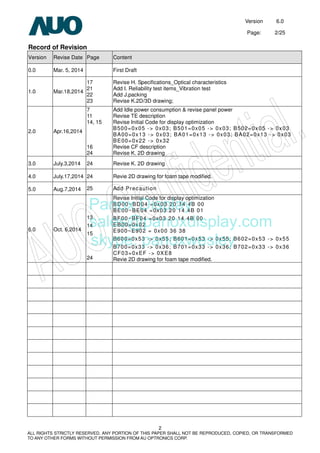
Record of Revision
Version Revise Date Page Content
0.0 Mar. 5, 2014 First Draft
1.0 Mar.18,2014
17
21
22
23
Revise H. Specifications_Optical characteristics
Add I. Reliability test items_Vibration test
Add J.packing
Revise K.2D/3D drawing;
2.0 Apr.16,2014
7
11
14, 15
16
24
Add Idle power consumption & revise panel power
Revise TE description
Revise Initial Code for display optimization
B500=0x05 -> 0x03; B501=0x05 -> 0x03; B502=0x05 -> 0x03
BA00=0x13 -> 0x03; BA01=0x13 -> 0x03; BA02=0x13 -> 0x03
BE00=0x22 -> 0x32
Revise CF description
Revise K. 2D drawing
3.0 July.3,2014 24 Revise K. 2D drawing
4.0 July.17,2014 24 Revie 2D drawing for foam tape modified.
5.0 Aug.7,2014 25 Add Precaution
6.0 Oct. 6,2014
13
14
15
24
Revise Initial Code for display optimization
BD00~BD04 =0x03 20 14 4B 00
BE00~BE04 =0x03 20 14 4B 01
BF00~BF04 =0x03 20 14 4B 00
EB00=0x02
E900~E902 = 0x00 36 38
B600=0x53 -> 0x55; B601=0x53 -> 0x55; B602=0x53 -> 0x55
B700=0x33 -> 0x36; B701=0x33 -> 0x36; B702=0x33 -> 0x36
CF03=0xEF -> 0XE8
Revie 2D drawing for foam tape modified.
Panox Display
sales@panoxdisplay.com
skype: panoxwesley
Version 6.0
Page: 3/25
3
ALL RIGHTS STRICTLY RESERVED. ANY PORTION OF THIS PAPER SHALL NOT BE REPRODUCED, COPIED, OR TRANSFORMED
TO ANY OTHER FORMS WITHOUT PERMISSION FROM AU OPTRONICS CORP.
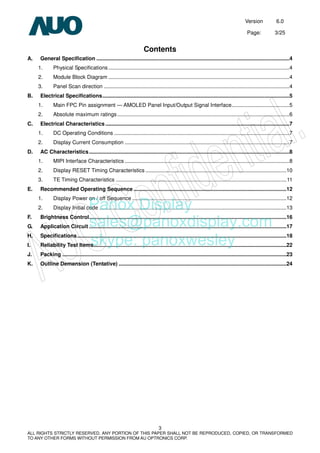
Contents
A. General Specification ..................................................................................................................................4
1. Physical Specifications..........................................................................................................................4
2. Module Block Diagram ..........................................................................................................................4
3. Panel Scan direction .............................................................................................................................4
B. Electrical Specifications..............................................................................................................................5
1. Main FPC Pin assignment — AMOLED Panel Input/Output Signal Interface.......................................5
2. Absolute maximum ratings....................................................................................................................6
C. Electrical Characteristics ............................................................................................................................7
1. DC Operating Conditions ......................................................................................................................7
2. Display Current Consumption ...............................................................................................................7
D. AC Characteristics.......................................................................................................................................8
1. MIPI Interface Characteristics ...............................................................................................................8
2. Display RESET Timing Characteristics ...............................................................................................10
3. TE Timing Characteristics ...................................................................................................................11
E. Recommended Operating Sequence .......................................................................................................12
1. Display Power on / off Sequence ........................................................................................................12
2. Display Initial code ..............................................................................................................................13
F. Brightness Control.....................................................................................................................................16
G. Application Circuit .....................................................................................................................................17
H. Specifications.............................................................................................................................................18
I. Reliability Test Items..................................................................................................................................22
J. Packing .......................................................................................................................................................23
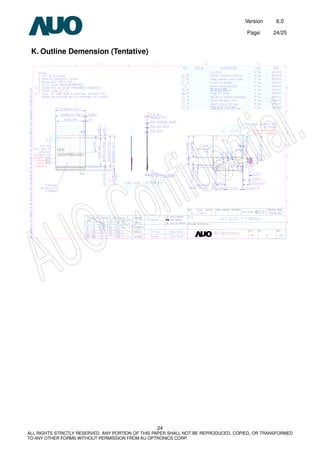
K. Outline Demension (Tentative) .................................................................................................................24
Panox Display
sales@panoxdisplay.com
skype: panoxwesley
Version 6.0
Page: 4/25
4
ALL RIGHTS STRICTLY RESERVED. ANY PORTION OF THIS PAPER SHALL NOT BE REPRODUCED, COPIED, OR TRANSFORMED
TO ANY OTHER FORMS WITHOUT PERMISSION FROM AU OPTRONICS CORP.
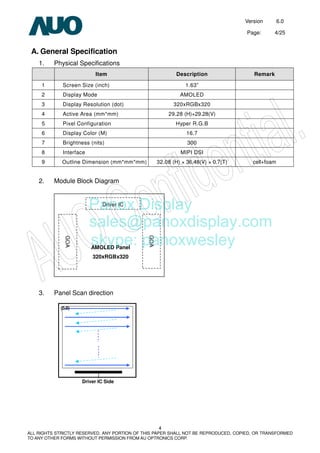
A. General Specification
1. Physical Specifications
Item Description Remark
1 Screen Size (inch) 1.63”
2 Display Mode AMOLED
3 Display Resolution (dot) 320xRGBx320
4 Active Area (mm*mm) 29.28 (H)×29.28(V)
5 Pixel Configuration Hyper R.G.B
6 Display Color (M) 16.7
7 Brightness (nits) 300
8 Interface MIPI DSI
9 Outline Dimension (mm*mm*mm) 32.08 (H) × 36.48(V) × 0.7(T) cell+foam
2. Module Block Diagram
3. Panel Scan direction
Driver IC Side
(0,0)
AMOLED Panel
320xRGBx320
GOA
Driver IC
GOA
Panox Display
sales@panoxdisplay.com
skype: panoxwesley
Version 6.0
Page: 5/25
5
ALL RIGHTS STRICTLY RESERVED. ANY PORTION OF THIS PAPER SHALL NOT BE REPRODUCED, COPIED, OR TRANSFORMED
TO ANY OTHER FORMS WITHOUT PERMISSION FROM AU OPTRONICS CORP.
B. Electrical Specifications
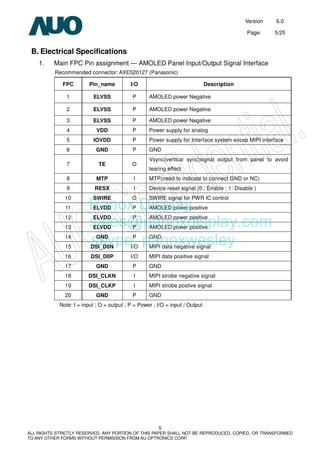
1. Main FPC Pin assignment — AMOLED Panel Input/Output Signal Interface
Recommended connector: AXE520127 (Panasonic)
FPC Pin_name I/O Description
1 ELVSS P AMOLED power Negative
2 ELVSS P AMOLED power Negative
3 ELVSS P AMOLED power Negative
4 VDD P Power supply for analog
5 IOVDD P Power supply for Interface system excep MIPI interface
6 GND P GND
7 TE O
Vsync(vertical sync)signal output from panel to avoid
tearing effect
8 MTP I MTP(need to indicate to connect GND or NC)
9 RESX I Device reset signal (0 : Enable ; 1: Disable )
10 SWIRE O SWIRE signal for PWR IC control
11 ELVDD P AMOLED power positive
12 ELVDD P AMOLED power positive
13 ELVDD P AMOLED power positive
14 GND P GND
15 DSI_D0N I/O MIPI data negative signal
16 DSI_D0P I/O MIPI data positive signal
17 GND P GND
18 DSI_CLKN I MIPI strobe negative signal
19 DSI_CLKP I MIPI strobe postive signal
20 GND P GND
Note: I = input ; O = output ; P = Power ; I/O = input / Output
Panox Display
sales@panoxdisplay.com
skype: panoxwesley
Version 6.0
Page: 6/25
6
ALL RIGHTS STRICTLY RESERVED. ANY PORTION OF THIS PAPER SHALL NOT BE REPRODUCED, COPIED, OR TRANSFORMED
TO ANY OTHER FORMS WITHOUT PERMISSION FROM AU OPTRONICS CORP.
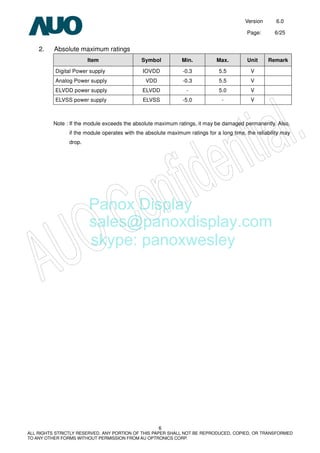
2. Absolute maximum ratings
Item Symbol Min. Max. Unit Remark
Digital Power supply IOVDD -0.3 5.5 V
Analog Power supply VDD -0.3 5.5 V
ELVDD power supply ELVDD - 5.0 V
ELVSS power supply ELVSS -5.0 - V
Note : If the module exceeds the absolute maximum ratings, it may be damaged permanently. Also,
if the module operates with the absolute maximum ratings for a long time, the reliability may
drop.
Panox Display
sales@panoxdisplay.com
skype: panoxwesley
Version 6.0
Page: 7/25
7
ALL RIGHTS STRICTLY RESERVED. ANY PORTION OF THIS PAPER SHALL NOT BE REPRODUCED, COPIED, OR TRANSFORMED
TO ANY OTHER FORMS WITHOUT PERMISSION FROM AU OPTRONICS CORP.
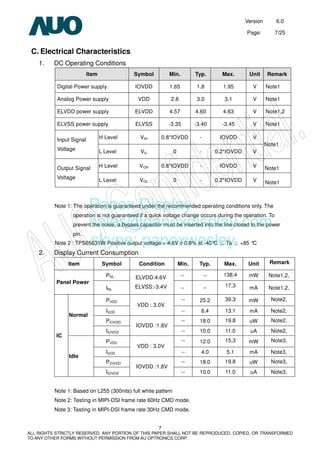
C. Electrical Characteristics
1. DC Operating Conditions
Item Symbol Min. Typ. Max. Unit Remark
Digital Power supply IOVDD 1.65 1.8 1.95 V Note1
Analog Power supply VDD 2.8 3.0 3.1 V Note1
ELVDD power supply ELVDD 4.57 4.60 4.63 V Note1,2
ELVSS power supply ELVSS -3.35 -3.40 -3.45 V Note1
H Level VIH 0.8*IOVDD - IOVDD VInput Signal
Voltage L Level VIL 0 - 0.2*IOVDD V
Note1
H Level VOH 0.8*IOVDD - IOVDD V Note1Output Signal
Voltage L Level VOL 0 - 0.2*IOVDD V Note1
Note 1: The operation is guaranteed under the recommended operating conditions only. The
operation is not guaranteed if a quick voltage change occurs during the operation. To
prevent the noise, a bypass capacitor must be inserted into the line closed to the power
pin.
Note 2 : TPS65631W Positive output voltage = 4.6V ± 0.8% at -40°C ≦ Ta ≦ +85 °C
2. Display Current Consumption
Item Symbol Condition Min. Typ. Max. Unit Remark
PNL -- -- 138.4 mW Note1,2,
Panel Power
INL
ELVDD:4.6V
ELVSS:-3.4V -- -- 17.3 mA Note1,2,
PVDD
-- 25.2 39.3 mW Note2,
IVDD
VDD : 3.0V
-- 8.4 13.1 mA Note2,
PIOVDD -- 18.0 19.8 uW Note2,
Normal
IIOVDD
IOVDD :1.8V
-- 10.0 11.0 uA Note2,
PVDD
-- 12.0 15.3 mW Note3,
IVDD
VDD : 3.0V
-- 4.0 5.1 mA Note3,
PIOVDD -- 18.0 19.8 uW Note3,
IC
Idle
IIOVDD
IOVDD :1.8V
-- 10.0 11.0 uA Note3,
Note 1: Based on L255 (300nits) full white pattern
Note 2: Testing in MIPI-DSI frame rate 60Hz CMD mode.
Note 3: Testing in MIPI-DSI frame rate 30Hz CMD mode.
Panox Display
sales@panoxdisplay.com
skype: panoxwesley
Version 6.0
Page: 8/25
8
ALL RIGHTS STRICTLY RESERVED. ANY PORTION OF THIS PAPER SHALL NOT BE REPRODUCED, COPIED, OR TRANSFORMED
TO ANY OTHER FORMS WITHOUT PERMISSION FROM AU OPTRONICS CORP.
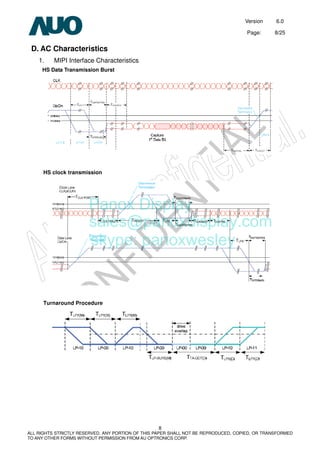
D. AC Characteristics
1. MIPI Interface Characteristics
HS Data Transmission Burst
HS clock transmission
Turnaround Procedure
Panox Display
sales@panoxdisplay.com
skype: panoxwesley
Version 6.0
Page: 9/25
9
ALL RIGHTS STRICTLY RESERVED. ANY PORTION OF THIS PAPER SHALL NOT BE REPRODUCED, COPIED, OR TRANSFORMED
TO ANY OTHER FORMS WITHOUT PERMISSION FROM AU OPTRONICS CORP.
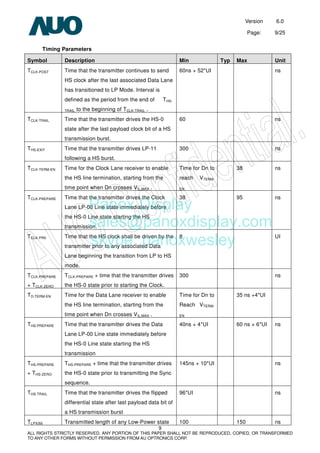
Timing Parameters
Symbol Description Min Typ Max Unit
TCLK-POST Time that the transmitter continues to send
HS clock after the last associated Data Lane
has transitioned to LP Mode. Interval is
defined as the period from the end of THS-
TRAIL to the beginning of TCLK-TRAIL .
60ns + 52*UI ns
TCLK-TRAIL Time that the transmitter drives the HS-0
state after the last payload clock bit of a HS
transmission burst.
60 ns
THS-EXIT Time that the transmitter drives LP-11
following a HS burst.
300 ns
TCLK-TERM-EN Time for the Clock Lane receiver to enable
the HS line termination, starting from the
time point when Dn crosses VIL,MAX .
Time for Dn to
reach VTERM-
EN
38 ns
TCLK-PREPARE Time that the transmitter drives the Clock
Lane LP-00 Line state immediately before
the HS-0 Line state starting the HS
transmission.
38 95 ns
TCLK-PRE Time that the HS clock shall be driven by the
transmitter prior to any associated Data
Lane beginning the transition from LP to HS
mode.
8 UI
TCLK-PREPARE
+ TCLK-ZERO
TCLK-PREPARE + time that the transmitter drives
the HS-0 state prior to starting the Clock.
300 ns
TD-TERM-EN Time for the Data Lane receiver to enable
the HS line termination, starting from the
time point when Dn crosses VIL,MAX .
Time for Dn to
Reach VTERM-
EN
35 ns +4*UI
THS-PREPARE Time that the transmitter drives the Data
Lane LP-00 Line state immediately before
the HS-0 Line state starting the HS
transmission
40ns + 4*UI 60 ns + 6*UI ns
THS-PREPARE
+ THS-ZERO
THS-PREPARE + time that the transmitter drives
the HS-0 state prior to transmitting the Sync
sequence.
145ns + 10*UI ns
THS-TRAIL Time that the transmitter drives the flipped
differential state after last payload data bit of
a HS transmission burst
96*UI ns
TLPX(M) Transmitted length of any Low-Power state 100 150 ns
Panox Display
sales@panoxdisplay.com
skype: panoxwesley
Version 6.0
Page: 10/25
10
ALL RIGHTS STRICTLY RESERVED. ANY PORTION OF THIS PAPER SHALL NOT BE REPRODUCED, COPIED, OR TRANSFORMED
TO ANY OTHER FORMS WITHOUT PERMISSION FROM AU OPTRONICS CORP.
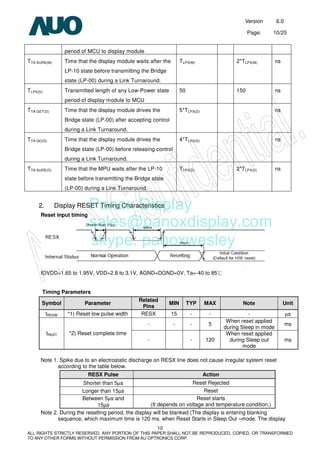
period of MCU to display module
TTA-SURE(M) Time that the display module waits after the
LP-10 state before transmitting the Bridge
state (LP-00) during a Link Turnaround.
TLPX(M) 2*TLPX(M) ns
TLPX(D) Transmitted length of any Low-Power state
period of display module to MCU
50 150 ns
TTA-GET(D) Time that the display module drives the
Bridge state (LP-00) after accepting control
during a Link Turnaround.
5*TLPX(D) ns
TTA-GO(D) Time that the display module drives the
Bridge state (LP-00) before releasing control
during a Link Turnaround.
4*TLPX(D) ns
TTA-SURE(D) Time that the MPU waits after the LP-10
state before transmitting the Bridge state
(LP-00) during a Link Turnaround.
TLPX(D) 2*TLPX(D) ns
2. Display RESET Timing Characteristics
Reset input timing
IOVDD=1.65 to 1.95V, VDD=2.8 to 3.1V, AGND=DGND=0V, Ta=-40 to 85℃
Timing Parameters
Symbol Parameter
Related
Pins
MIN TYP MAX Note Unit
tRESW *1) Reset low pulse width RESX 15 - - - µs
- - - 5
When reset applied
during Sleep in mode
ms
tREST *2) Reset complete time
- - 120
When reset applied
during Sleep out
mode
ms
Note 1. Spike due to an electrostatic discharge on RESX line does not cause irregular system reset
according to the table below.
RESX Pulse Action
Shorter than 5µs Reset Rejected
Longer than 15µs Reset
Between 5µs and
15µs
Reset starts
(It depends on voltage and temperature condition.)
Note 2. During the resetting period, the display will be blanked (The display is entering blanking
sequence, which maximum time is 120 ms, when Reset Starts in Sleep Out –mode. The display
Panox Display
sales@panoxdisplay.com
skype: panoxwesley
Version 6.0
Page: 11/25
11
ALL RIGHTS STRICTLY RESERVED. ANY PORTION OF THIS PAPER SHALL NOT BE REPRODUCED, COPIED, OR TRANSFORMED
TO ANY OTHER FORMS WITHOUT PERMISSION FROM AU OPTRONICS CORP.
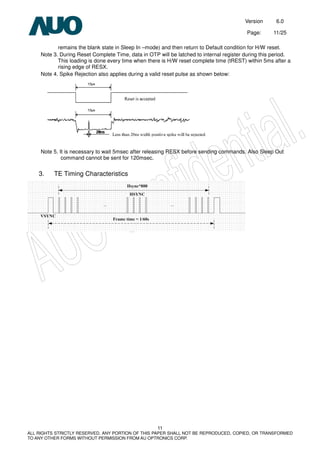
remains the blank state in Sleep In –mode) and then return to Default condition for H/W reset.
Note 3. During Reset Complete Time, data in OTP will be latched to internal register during this period.
This loading is done every time when there is H/W reset complete time (tREST) within 5ms after a
rising edge of RESX.
Note 4. Spike Rejection also applies during a valid reset pulse as shown below:
Note 5. It is necessary to wait 5msec after releasing RESX before sending commands. Also Sleep Out
command cannot be sent for 120msec.
3. TE Timing Characteristics
Version 6.0
Page: 12/25
12
ALL RIGHTS STRICTLY RESERVED. ANY PORTION OF THIS PAPER SHALL NOT BE REPRODUCED, COPIED, OR TRANSFORMED
TO ANY OTHER FORMS WITHOUT PERMISSION FROM AU OPTRONICS CORP.
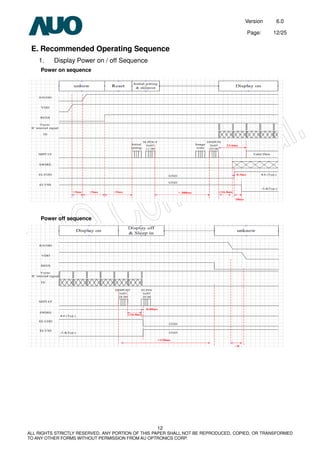
E. Recommended Operating Sequence
1. Display Power on / off Sequence
Power on sequence
Power off sequence
Version 6.0
Page: 13/25
13
ALL RIGHTS STRICTLY RESERVED. ANY PORTION OF THIS PAPER SHALL NOT BE REPRODUCED, COPIED, OR TRANSFORMED
TO ANY OTHER FORMS WITHOUT PERMISSION FROM AU OPTRONICS CORP.
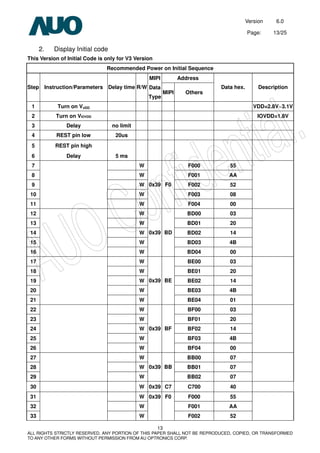
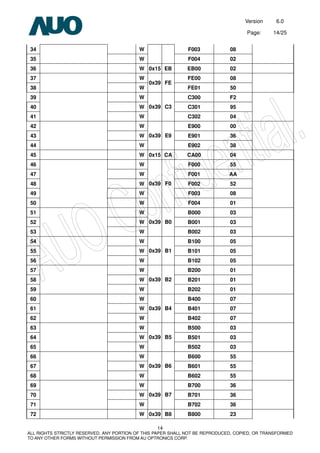
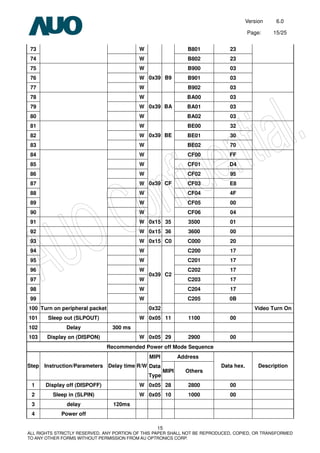
2. Display Initial code
This Version of Initial Code is only for V3 Version
Recommended Power on Initial Sequence
Address
Step Instruction/Parameters Delay time R/W
MIPI
Data
Type
MIPI Others
Data hex. Description
1 Turn on VvDD VDD=2.8V~3.1V
2 Turn on VIOVDD IOVDD=1.8V
3 Delay no limit
4 REST pin low 20us
5 REST pin high
6 Delay 5 ms
7 W F000 55
8 W F001 AA
9 W F002 52
10 W F003 08
11 W
0x39 F0
F004 00
12 W BD00 03
13 W BD01 20
14 W BD02 14
15 W BD03 4B
16 W
0x39 BD
BD04 00
17 W BE00 03
18 W BE01 20
19 W BE02 14
20 W BE03 4B
21 W
0x39 BE
BE04 01
22 W BF00 03
23 W BF01 20
24 W BF02 14
25 W BF03 4B
26 W
0x39 BF
BF04 00
27 W BB00 07
28 W BB01 07
29 W
0x39 BB
BB02 07
30 W 0x39 C7 C700 40
31 W F000 55
32 W F001 AA
33 W
0x39 F0
F002 52
Version 6.0
Page: 14/25
14
ALL RIGHTS STRICTLY RESERVED. ANY PORTION OF THIS PAPER SHALL NOT BE REPRODUCED, COPIED, OR TRANSFORMED
TO ANY OTHER FORMS WITHOUT PERMISSION FROM AU OPTRONICS CORP.
34 W F003 08
35 W F004 02
36 W 0x15 EB EB00 02
37 W FE00 08
38 W
0x39 FE
FE01 50
39 W C300 F2
40 W C301 95
41 W
0x39 C3
C302 04
42 W E900 00
43 W E901 36
44 W
0x39 E9
E902 38
45 W 0x15 CA CA00 04
46 W F000 55
47 W F001 AA
48 W F002 52
49 W F003 08
50 W
0x39 F0
F004 01
51 W B000 03
52 W B001 03
53 W
0x39 B0
B002 03
54 W B100 05
55 W B101 05
56 W
0x39 B1
B102 05
57 W B200 01
58 W B201 01
59 W
0x39 B2
B202 01
60 W B400 07
61 W B401 07
62 W
0x39 B4
B402 07
63 W B500 03
64 W B501 03
65 W
0x39 B5
B502 03
66 W B600 55
67 W B601 55
68 W
0x39 B6
B602 55
69 W B700 36
70 W B701 36
71 W
0x39 B7
B702 36
72 W 0x39 B8 B800 23
Version 6.0
Page: 15/25
15
ALL RIGHTS STRICTLY RESERVED. ANY PORTION OF THIS PAPER SHALL NOT BE REPRODUCED, COPIED, OR TRANSFORMED
TO ANY OTHER FORMS WITHOUT PERMISSION FROM AU OPTRONICS CORP.
73 W B801 23
74 W B802 23
75 W B900 03
76 W B901 03
77 W
0x39 B9
B902 03
78 W BA00 03
79 W BA01 03
80 W
0x39 BA
BA02 03
81 W BE00 32
82 W BE01 30
83 W
0x39 BE
BE02 70
84 W CF00 FF
85 W CF01 D4
86 W CF02 95
87 W CF03 E8
88 W CF04 4F
89 W CF05 00
90 W
0x39 CF
CF06 04
91 W 0x15 35 3500 01
92 W 0x15 36 3600 00
93 W 0x15 C0 C000 20
94 W C200 17
95 W C201 17
96 W C202 17
97 W C203 17
98 W C204 17
99 W
0x39 C2
C205 0B
100 Turn on peripheral packet 0x32 Video Turn On
101 Sleep out (SLPOUT) W 0x05 11 1100 00
102 Delay 300 ms
103 Display on (DISPON) W 0x05 29 2900 00
Recommended Power off Mode Sequence
Address
Step Instruction/Parameters Delay time R/W
MIPI
Data
Type
MIPI Others
Data hex. Description
1 Display off (DISPOFF) W 0x05 28 2800 00
2 Sleep in (SLPIN) W 0x05 10 1000 00
3 delay 120ms
4 Power off
Version 6.0
Page: 16/25
16
ALL RIGHTS STRICTLY RESERVED. ANY PORTION OF THIS PAPER SHALL NOT BE REPRODUCED, COPIED, OR TRANSFORMED
TO ANY OTHER FORMS WITHOUT PERMISSION FROM AU OPTRONICS CORP.
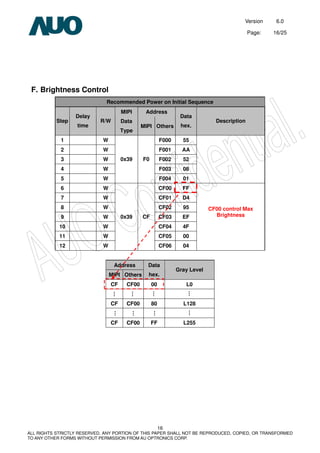
F. Brightness Control
Recommended Power on Initial Sequence
Address
Step
Delay
time
R/W
MIPI
Data
Type
MIPI Others
Data
hex.
Description
1 W F000 55
2 W F001 AA
3 W F002 52
4 W F003 08
5 W
0x39 F0
F004 01
6 W CF00 FF
7 W CF01 D4
8 W CF02 95
9 W CF03 EF
10 W CF04 4F
11 W CF05 00
12 W
0x39 CF
CF06 04
CF00 control Max
Brightness
Address
MIPI Others
Data
hex.
Gray Level
CF CF00 00 L0
CF CF00 80 L128
CF CF00 FF L255
…
…
…
…
…
…
…
…
Version 6.0
Page: 17/25
17
ALL RIGHTS STRICTLY RESERVED. ANY PORTION OF THIS PAPER SHALL NOT BE REPRODUCED, COPIED, OR TRANSFORMED
TO ANY OTHER FORMS WITHOUT PERMISSION FROM AU OPTRONICS CORP.
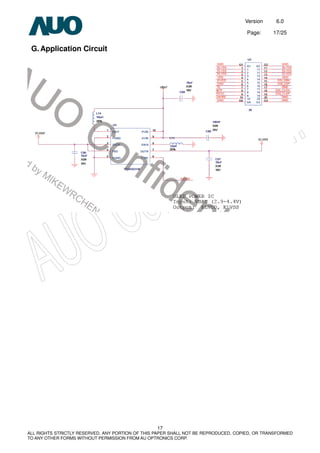
G.Application Circuit
Version 6.0
Page: 18/25
18
ALL RIGHTS STRICTLY RESERVED. ANY PORTION OF THIS PAPER SHALL NOT BE REPRODUCED, COPIED, OR TRANSFORMED
TO ANY OTHER FORMS WITHOUT PERMISSION FROM AU OPTRONICS CORP.
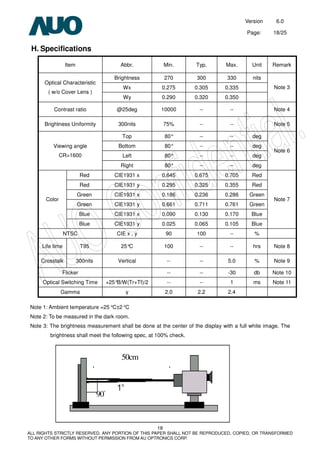
H. Specifications
Item Abbr. Min. Typ. Max. Unit Remark
Brightness 270 300 330 nits
Wx 0.275 0.305 0.335
Optical Characteristic
( w/o Cover Lens )
Wy 0.290 0.320 0.350
Note 3
Contrast ratio @25deg 10000 -- -- Note 4
Brightness Uniformity 300nits 75% -- -- Note 5
Top 80° -- -- deg
Bottom 80° -- -- deg
Left 80° -- -- deg
Viewing angle
CR>1600
Right 80° -- -- deg
Note 6
Red CIE1931 x 0.645 0.675 0.705 Red
Red CIE1931 y 0.295 0.325 0.355 Red
Green CIE1931 x 0.186 0.236 0.286 Green
Green CIE1931 y 0.661 0.711 0.761 Green
Blue CIE1931 x 0.090 0.130 0.170 Blue
Color
Blue CIE1931 y 0.025 0.065 0.105 Blue
Note 7
NTSC CIE x , y 90 100 -- %
Life time T95 25°C 100 -- -- hrs Note 8
Crosstalk 300nits Vertical -- -- 5.0 % Note 9
Flicker -- -- -30 db Note 10
Optical Switching Time +25°B/W(Tr+Tf)/2 -- -- 1 ms Note 11
Gamma γ 2.0 2.2 2.4
Note 1: Ambient temperature =25 ºC±2 ºC
Note 2: To be measured in the dark room.
Note 3: The brightness measurement shall be done at the center of the display with a full white image. The
brightness shall meet the following spec, at 100% check.
50cm
|-------------------------------|
90°
Version 6.0
Page: 19/25
19
ALL RIGHTS STRICTLY RESERVED. ANY PORTION OF THIS PAPER SHALL NOT BE REPRODUCED, COPIED, OR TRANSFORMED
TO ANY OTHER FORMS WITHOUT PERMISSION FROM AU OPTRONICS CORP.
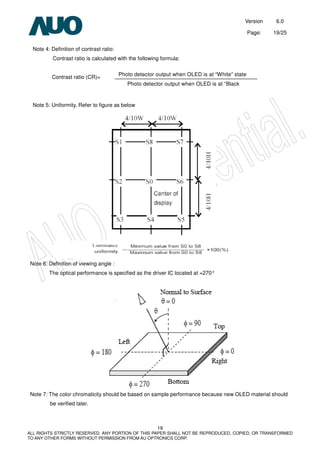
Note 4: Definition of contrast ratio:
Contrast ratio is calculated with the following formula:
Contrast ratio (CR)=
Note 5: Uniformity. Refer to figure as below
Note 6: Definition of viewing angle :
The optical performance is specified as the driver IC located at =270°
Note 7: The color chromaticity should be based on sample performance because new OLED material should
be verified later.
Photo detector output when OLED is at “White” state
Photo detector output when OLED is at “Black
Version 6.0
Page: 20/25
20
ALL RIGHTS STRICTLY RESERVED. ANY PORTION OF THIS PAPER SHALL NOT BE REPRODUCED, COPIED, OR TRANSFORMED
TO ANY OTHER FORMS WITHOUT PERMISSION FROM AU OPTRONICS CORP.
Note 8: Time to 95% Luminance
To measure the burn-in effect, a test pattern with white background applied to the AMOLED display at
30% loading
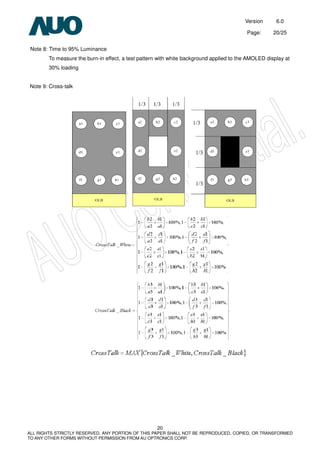
Note 9: Cross-talk
Version 6.0
Page: 21/25
21
ALL RIGHTS STRICTLY RESERVED. ANY PORTION OF THIS PAPER SHALL NOT BE REPRODUCED, COPIED, OR TRANSFORMED
TO ANY OTHER FORMS WITHOUT PERMISSION FROM AU OPTRONICS CORP.
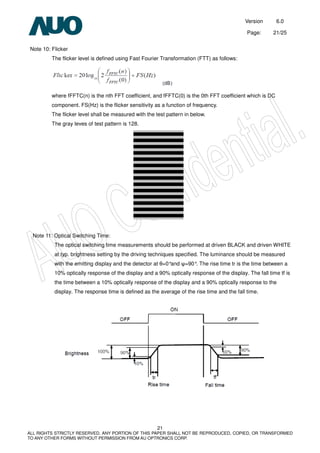
Note 10: Flicker
The flicker level is defined using Fast Fourier Transformation (FTT) as follows:
where fFFTC(n) is the nth FFT coefficient, and fFFTC(0) is the 0th FFT coefficient which is DC
component. FS(Hz) is the flicker sensitivity as a function of frequency.
The flicker level shall be measured with the test pattern in below.
The gray leves of test pattern is 128.
Note 11: Optical Switching Time:
The optical switching time measurements should be performed at driven BLACK and driven WHITE
at typ. brightness setting by the driving techniques specified. The luminance should be measured
with the emitting display and the detector at θ=0°and ψ=90°. The rise time tr is the time between a
10% optically response of the display and a 90% optically response of the display. The fall time tf is
the time between a 10% optically response of the display and a 90% optically response to the
display. The response time is defined as the average of the rise time and the fall time.
Version 6.0
Page: 22/25
22
ALL RIGHTS STRICTLY RESERVED. ANY PORTION OF THIS PAPER SHALL NOT BE REPRODUCED, COPIED, OR TRANSFORMED
TO ANY OTHER FORMS WITHOUT PERMISSION FROM AU OPTRONICS CORP.
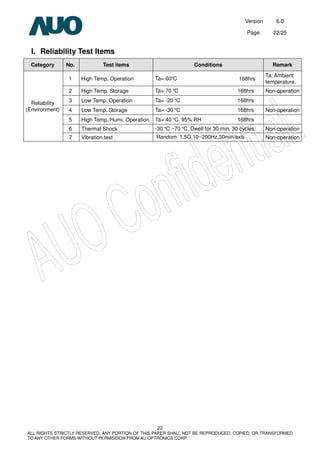
I. Reliability Test Items
Category No. Test items Conditions Remark
1 High Temp. Operation Ta= 60ºC 168hrs
Ta: Ambient
temperature.
2 High Temp. Storage Ta= 70 ºC 168hrs Non-operation
3 Low Temp. Operation Ta= -20 ºC 168hrs
4 Low Temp. Storage Ta= -30 ºC 168hrs Non-operation
5 High Temp./Humi. Operation Ta= 40 ºC. 95% RH 168hrs
6 Thermal Shock -30 ºC ~70 ºC, Dwell for 30 min. 30 cycles. Non-operation
Reliability
(Environment)
7 Vibration test Random 1.5G,10~200Hz,30min/axis Non-operation
Version 6.0
Page: 23/25
23
ALL RIGHTS STRICTLY RESERVED. ANY PORTION OF THIS PAPER SHALL NOT BE REPRODUCED, COPIED, OR TRANSFORMED
TO ANY OTHER FORMS WITHOUT PERMISSION FROM AU OPTRONICS CORP.
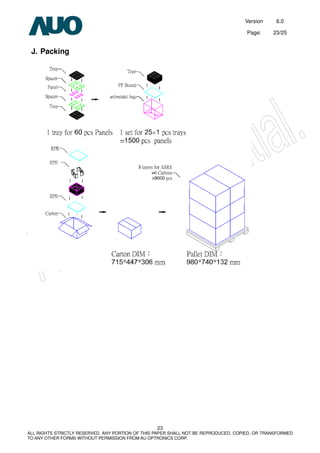
J. Packing
Version 6.0
Page: 24/25
24
ALL RIGHTS STRICTLY RESERVED. ANY PORTION OF THIS PAPER SHALL NOT BE REPRODUCED, COPIED, OR TRANSFORMED
TO ANY OTHER FORMS WITHOUT PERMISSION FROM AU OPTRONICS CORP.
K. Outline Demension (Tentative)
Version 6.0
Page: 25/25
25
ALL RIGHTS STRICTLY RESERVED. ANY PORTION OF THIS PAPER SHALL NOT BE REPRODUCED, COPIED, OR TRANSFORMED
TO ANY OTHER FORMS WITHOUT PERMISSION FROM AU OPTRONICS CORP.
Precaution:
Please pay attention to the following items when you use the OLED Modules(Panel):
7-1 Do not twist or bend the module(panel) and prevent the unsuitable external
force for display during assembly.
7-2 Adopt measures for good heat radiation. Be sure to use the module(panel)
with in the specified temperature.
7-3 Avoid dust or oil mist during assembly.
7-4 Follow the correct power sequence while operating. Do not apply the invalid
signal, otherwise, it will cause improper shut down and damage the
module(panel).
7-5 Less EMI: it will be more safety and less noise.
7-6 Please operate module(panel) in suitable temperature. The response time
& brightness will drift by different temperature.
7-7 Avoid to display the fixed pattern (exclude the white pattern) in a long
period, otherwise, it will cause image sticking.
7-8 Please be sure to turn-off the power when connecting or disconnecting the
circuit.
7-9 Polarizer scratches easily, please handle it carefully.
7-10 Display surface never likes dirt or stains.
7-11 A dew drop may lead to destruction. Please wipe off any moisture before
using module(panel).
7-12 Sudden temperature changes cause condensation, and it will cause
polarizer damaged.
7-13 High temperature and humidity may degrade performance. Please do not
expose the module(panel) to the direct sunlight and so on.
7-14 Acetic acid or chlorine compounds are not friends with AMOLED display
module(panel).
7-15 Static electricity will damage the module(panel), please do not touch the
module(panel) without any grounded device.
7-16 Please avoid any static electricity damage (ESD) during producing and
operating.
7-17 Do not disassemble and reassemble the module(panel) by self.
7-18 Be careful do not touch the rear side directly.
7-19 No strong vibration or shock. It will cause module(panel) broken.
7-20 Storage the modules(panel) in suitable environment with regular packing.
7-21 Be careful of injury from a broken display module(panel).
7-22 Please avoid the pressure adding to the surface (front or rear side) of
modules(panel), because it will cause the display non-uniformity or other
function issue.

1.63 inch AMOLED (320x320) Datasheet

  • 1.
    Version: 6.0 Page: 0 Date:2014/10/02 CUSTOMER APPROVAL SHEET Company Name MODEL H163QLN01.1 CUSTOMER APPROVED Title : Name : □ APPROVAL FOR SPECIFICATIONS ONLY (Spec. Ver. ) □ APPROVAL FOR SPECIFICATIONS AND ES SAMPLE (Spec. Ver. ) □ APPROVAL FOR SPECIFICATIONS AND CS SAMPLE (Spec. Ver. ) □ CUSTOMER REMARK : 1 Li-Hsin Rd. 2. Science-Based Industrial Park Hsinchu 300, Taiwan, R.O.C. Tel: +886-3-500-8899 Fax: +886-3-577-2730 Panox Display sales@panoxdisplay.com skype: panoxwesley
  • 2.
    ALL RIGHTS STRICTLYRESERVED. ANY PORTION OF THIS PAPER SHALL NOT BE REPRODUCED, COPIED, OR TRANSFORMED TO ANY OTHER FORMS WITHOUT PERMISSION FROM AU OPTRONICS CORP. Doc. version : 6.0 Total pages : Date : 2014/10/2 Product Specification 1.63" COLOR AMOLED MODULE MODEL NAME: H163QLN01 AUO Product P/N: 95.01H72.101 < >Preliminary Specification◆ < >Final Specification Note: The content of this specification is subject to change. © 2014 AU Optronics All Rights Reserved, Do Not Copy. Panox Display sales@panoxdisplay.com skype: panoxwesley
  • 3.
    Version 6.0 Page: 2/25 2 ALLRIGHTS STRICTLY RESERVED. ANY PORTION OF THIS PAPER SHALL NOT BE REPRODUCED, COPIED, OR TRANSFORMED TO ANY OTHER FORMS WITHOUT PERMISSION FROM AU OPTRONICS CORP. Record of Revision Version Revise Date Page Content 0.0 Mar. 5, 2014 First Draft 1.0 Mar.18,2014 17 21 22 23 Revise H. Specifications_Optical characteristics Add I. Reliability test items_Vibration test Add J.packing Revise K.2D/3D drawing; 2.0 Apr.16,2014 7 11 14, 15 16 24 Add Idle power consumption & revise panel power Revise TE description Revise Initial Code for display optimization B500=0x05 -> 0x03; B501=0x05 -> 0x03; B502=0x05 -> 0x03 BA00=0x13 -> 0x03; BA01=0x13 -> 0x03; BA02=0x13 -> 0x03 BE00=0x22 -> 0x32 Revise CF description Revise K. 2D drawing 3.0 July.3,2014 24 Revise K. 2D drawing 4.0 July.17,2014 24 Revie 2D drawing for foam tape modified. 5.0 Aug.7,2014 25 Add Precaution 6.0 Oct. 6,2014 13 14 15 24 Revise Initial Code for display optimization BD00~BD04 =0x03 20 14 4B 00 BE00~BE04 =0x03 20 14 4B 01 BF00~BF04 =0x03 20 14 4B 00 EB00=0x02 E900~E902 = 0x00 36 38 B600=0x53 -> 0x55; B601=0x53 -> 0x55; B602=0x53 -> 0x55 B700=0x33 -> 0x36; B701=0x33 -> 0x36; B702=0x33 -> 0x36 CF03=0xEF -> 0XE8 Revie 2D drawing for foam tape modified. Panox Display sales@panoxdisplay.com skype: panoxwesley
  • 4.
    Version 6.0 Page: 3/25 3 ALLRIGHTS STRICTLY RESERVED. ANY PORTION OF THIS PAPER SHALL NOT BE REPRODUCED, COPIED, OR TRANSFORMED TO ANY OTHER FORMS WITHOUT PERMISSION FROM AU OPTRONICS CORP. Contents A. General Specification ..................................................................................................................................4 1. Physical Specifications..........................................................................................................................4 2. Module Block Diagram ..........................................................................................................................4 3. Panel Scan direction .............................................................................................................................4 B. Electrical Specifications..............................................................................................................................5 1. Main FPC Pin assignment — AMOLED Panel Input/Output Signal Interface.......................................5 2. Absolute maximum ratings....................................................................................................................6 C. Electrical Characteristics ............................................................................................................................7 1. DC Operating Conditions ......................................................................................................................7 2. Display Current Consumption ...............................................................................................................7 D. AC Characteristics.......................................................................................................................................8 1. MIPI Interface Characteristics ...............................................................................................................8 2. Display RESET Timing Characteristics ...............................................................................................10 3. TE Timing Characteristics ...................................................................................................................11 E. Recommended Operating Sequence .......................................................................................................12 1. Display Power on / off Sequence ........................................................................................................12 2. Display Initial code ..............................................................................................................................13 F. Brightness Control.....................................................................................................................................16 G. Application Circuit .....................................................................................................................................17 H. Specifications.............................................................................................................................................18 I. Reliability Test Items..................................................................................................................................22 J. Packing .......................................................................................................................................................23 K. Outline Demension (Tentative) .................................................................................................................24 Panox Display sales@panoxdisplay.com skype: panoxwesley
  • 5.
    Version 6.0 Page: 4/25 4 ALLRIGHTS STRICTLY RESERVED. ANY PORTION OF THIS PAPER SHALL NOT BE REPRODUCED, COPIED, OR TRANSFORMED TO ANY OTHER FORMS WITHOUT PERMISSION FROM AU OPTRONICS CORP. A. General Specification 1. Physical Specifications Item Description Remark 1 Screen Size (inch) 1.63” 2 Display Mode AMOLED 3 Display Resolution (dot) 320xRGBx320 4 Active Area (mm*mm) 29.28 (H)×29.28(V) 5 Pixel Configuration Hyper R.G.B 6 Display Color (M) 16.7 7 Brightness (nits) 300 8 Interface MIPI DSI 9 Outline Dimension (mm*mm*mm) 32.08 (H) × 36.48(V) × 0.7(T) cell+foam 2. Module Block Diagram 3. Panel Scan direction Driver IC Side (0,0) AMOLED Panel 320xRGBx320 GOA Driver IC GOA Panox Display sales@panoxdisplay.com skype: panoxwesley
  • 6.
    Version 6.0 Page: 5/25 5 ALLRIGHTS STRICTLY RESERVED. ANY PORTION OF THIS PAPER SHALL NOT BE REPRODUCED, COPIED, OR TRANSFORMED TO ANY OTHER FORMS WITHOUT PERMISSION FROM AU OPTRONICS CORP. B. Electrical Specifications 1. Main FPC Pin assignment — AMOLED Panel Input/Output Signal Interface Recommended connector: AXE520127 (Panasonic) FPC Pin_name I/O Description 1 ELVSS P AMOLED power Negative 2 ELVSS P AMOLED power Negative 3 ELVSS P AMOLED power Negative 4 VDD P Power supply for analog 5 IOVDD P Power supply for Interface system excep MIPI interface 6 GND P GND 7 TE O Vsync(vertical sync)signal output from panel to avoid tearing effect 8 MTP I MTP(need to indicate to connect GND or NC) 9 RESX I Device reset signal (0 : Enable ; 1: Disable ) 10 SWIRE O SWIRE signal for PWR IC control 11 ELVDD P AMOLED power positive 12 ELVDD P AMOLED power positive 13 ELVDD P AMOLED power positive 14 GND P GND 15 DSI_D0N I/O MIPI data negative signal 16 DSI_D0P I/O MIPI data positive signal 17 GND P GND 18 DSI_CLKN I MIPI strobe negative signal 19 DSI_CLKP I MIPI strobe postive signal 20 GND P GND Note: I = input ; O = output ; P = Power ; I/O = input / Output Panox Display sales@panoxdisplay.com skype: panoxwesley
  • 7.
    Version 6.0 Page: 6/25 6 ALLRIGHTS STRICTLY RESERVED. ANY PORTION OF THIS PAPER SHALL NOT BE REPRODUCED, COPIED, OR TRANSFORMED TO ANY OTHER FORMS WITHOUT PERMISSION FROM AU OPTRONICS CORP. 2. Absolute maximum ratings Item Symbol Min. Max. Unit Remark Digital Power supply IOVDD -0.3 5.5 V Analog Power supply VDD -0.3 5.5 V ELVDD power supply ELVDD - 5.0 V ELVSS power supply ELVSS -5.0 - V Note : If the module exceeds the absolute maximum ratings, it may be damaged permanently. Also, if the module operates with the absolute maximum ratings for a long time, the reliability may drop. Panox Display sales@panoxdisplay.com skype: panoxwesley
  • 8.
    Version 6.0 Page: 7/25 7 ALLRIGHTS STRICTLY RESERVED. ANY PORTION OF THIS PAPER SHALL NOT BE REPRODUCED, COPIED, OR TRANSFORMED TO ANY OTHER FORMS WITHOUT PERMISSION FROM AU OPTRONICS CORP. C. Electrical Characteristics 1. DC Operating Conditions Item Symbol Min. Typ. Max. Unit Remark Digital Power supply IOVDD 1.65 1.8 1.95 V Note1 Analog Power supply VDD 2.8 3.0 3.1 V Note1 ELVDD power supply ELVDD 4.57 4.60 4.63 V Note1,2 ELVSS power supply ELVSS -3.35 -3.40 -3.45 V Note1 H Level VIH 0.8*IOVDD - IOVDD VInput Signal Voltage L Level VIL 0 - 0.2*IOVDD V Note1 H Level VOH 0.8*IOVDD - IOVDD V Note1Output Signal Voltage L Level VOL 0 - 0.2*IOVDD V Note1 Note 1: The operation is guaranteed under the recommended operating conditions only. The operation is not guaranteed if a quick voltage change occurs during the operation. To prevent the noise, a bypass capacitor must be inserted into the line closed to the power pin. Note 2 : TPS65631W Positive output voltage = 4.6V ± 0.8% at -40°C ≦ Ta ≦ +85 °C 2. Display Current Consumption Item Symbol Condition Min. Typ. Max. Unit Remark PNL -- -- 138.4 mW Note1,2, Panel Power INL ELVDD:4.6V ELVSS:-3.4V -- -- 17.3 mA Note1,2, PVDD -- 25.2 39.3 mW Note2, IVDD VDD : 3.0V -- 8.4 13.1 mA Note2, PIOVDD -- 18.0 19.8 uW Note2, Normal IIOVDD IOVDD :1.8V -- 10.0 11.0 uA Note2, PVDD -- 12.0 15.3 mW Note3, IVDD VDD : 3.0V -- 4.0 5.1 mA Note3, PIOVDD -- 18.0 19.8 uW Note3, IC Idle IIOVDD IOVDD :1.8V -- 10.0 11.0 uA Note3, Note 1: Based on L255 (300nits) full white pattern Note 2: Testing in MIPI-DSI frame rate 60Hz CMD mode. Note 3: Testing in MIPI-DSI frame rate 30Hz CMD mode. Panox Display sales@panoxdisplay.com skype: panoxwesley
  • 9.
    Version 6.0 Page: 8/25 8 ALLRIGHTS STRICTLY RESERVED. ANY PORTION OF THIS PAPER SHALL NOT BE REPRODUCED, COPIED, OR TRANSFORMED TO ANY OTHER FORMS WITHOUT PERMISSION FROM AU OPTRONICS CORP. D. AC Characteristics 1. MIPI Interface Characteristics HS Data Transmission Burst HS clock transmission Turnaround Procedure Panox Display sales@panoxdisplay.com skype: panoxwesley
  • 10.
    Version 6.0 Page: 9/25 9 ALLRIGHTS STRICTLY RESERVED. ANY PORTION OF THIS PAPER SHALL NOT BE REPRODUCED, COPIED, OR TRANSFORMED TO ANY OTHER FORMS WITHOUT PERMISSION FROM AU OPTRONICS CORP. Timing Parameters Symbol Description Min Typ Max Unit TCLK-POST Time that the transmitter continues to send HS clock after the last associated Data Lane has transitioned to LP Mode. Interval is defined as the period from the end of THS- TRAIL to the beginning of TCLK-TRAIL . 60ns + 52*UI ns TCLK-TRAIL Time that the transmitter drives the HS-0 state after the last payload clock bit of a HS transmission burst. 60 ns THS-EXIT Time that the transmitter drives LP-11 following a HS burst. 300 ns TCLK-TERM-EN Time for the Clock Lane receiver to enable the HS line termination, starting from the time point when Dn crosses VIL,MAX . Time for Dn to reach VTERM- EN 38 ns TCLK-PREPARE Time that the transmitter drives the Clock Lane LP-00 Line state immediately before the HS-0 Line state starting the HS transmission. 38 95 ns TCLK-PRE Time that the HS clock shall be driven by the transmitter prior to any associated Data Lane beginning the transition from LP to HS mode. 8 UI TCLK-PREPARE + TCLK-ZERO TCLK-PREPARE + time that the transmitter drives the HS-0 state prior to starting the Clock. 300 ns TD-TERM-EN Time for the Data Lane receiver to enable the HS line termination, starting from the time point when Dn crosses VIL,MAX . Time for Dn to Reach VTERM- EN 35 ns +4*UI THS-PREPARE Time that the transmitter drives the Data Lane LP-00 Line state immediately before the HS-0 Line state starting the HS transmission 40ns + 4*UI 60 ns + 6*UI ns THS-PREPARE + THS-ZERO THS-PREPARE + time that the transmitter drives the HS-0 state prior to transmitting the Sync sequence. 145ns + 10*UI ns THS-TRAIL Time that the transmitter drives the flipped differential state after last payload data bit of a HS transmission burst 96*UI ns TLPX(M) Transmitted length of any Low-Power state 100 150 ns Panox Display sales@panoxdisplay.com skype: panoxwesley
  • 11.
    Version 6.0 Page: 10/25 10 ALLRIGHTS STRICTLY RESERVED. ANY PORTION OF THIS PAPER SHALL NOT BE REPRODUCED, COPIED, OR TRANSFORMED TO ANY OTHER FORMS WITHOUT PERMISSION FROM AU OPTRONICS CORP. period of MCU to display module TTA-SURE(M) Time that the display module waits after the LP-10 state before transmitting the Bridge state (LP-00) during a Link Turnaround. TLPX(M) 2*TLPX(M) ns TLPX(D) Transmitted length of any Low-Power state period of display module to MCU 50 150 ns TTA-GET(D) Time that the display module drives the Bridge state (LP-00) after accepting control during a Link Turnaround. 5*TLPX(D) ns TTA-GO(D) Time that the display module drives the Bridge state (LP-00) before releasing control during a Link Turnaround. 4*TLPX(D) ns TTA-SURE(D) Time that the MPU waits after the LP-10 state before transmitting the Bridge state (LP-00) during a Link Turnaround. TLPX(D) 2*TLPX(D) ns 2. Display RESET Timing Characteristics Reset input timing IOVDD=1.65 to 1.95V, VDD=2.8 to 3.1V, AGND=DGND=0V, Ta=-40 to 85℃ Timing Parameters Symbol Parameter Related Pins MIN TYP MAX Note Unit tRESW *1) Reset low pulse width RESX 15 - - - µs - - - 5 When reset applied during Sleep in mode ms tREST *2) Reset complete time - - 120 When reset applied during Sleep out mode ms Note 1. Spike due to an electrostatic discharge on RESX line does not cause irregular system reset according to the table below. RESX Pulse Action Shorter than 5µs Reset Rejected Longer than 15µs Reset Between 5µs and 15µs Reset starts (It depends on voltage and temperature condition.) Note 2. During the resetting period, the display will be blanked (The display is entering blanking sequence, which maximum time is 120 ms, when Reset Starts in Sleep Out –mode. The display Panox Display sales@panoxdisplay.com skype: panoxwesley
  • 12.
    Version 6.0 Page: 11/25 11 ALLRIGHTS STRICTLY RESERVED. ANY PORTION OF THIS PAPER SHALL NOT BE REPRODUCED, COPIED, OR TRANSFORMED TO ANY OTHER FORMS WITHOUT PERMISSION FROM AU OPTRONICS CORP. remains the blank state in Sleep In –mode) and then return to Default condition for H/W reset. Note 3. During Reset Complete Time, data in OTP will be latched to internal register during this period. This loading is done every time when there is H/W reset complete time (tREST) within 5ms after a rising edge of RESX. Note 4. Spike Rejection also applies during a valid reset pulse as shown below: Note 5. It is necessary to wait 5msec after releasing RESX before sending commands. Also Sleep Out command cannot be sent for 120msec. 3. TE Timing Characteristics
  • 13.
    Version 6.0 Page: 12/25 12 ALLRIGHTS STRICTLY RESERVED. ANY PORTION OF THIS PAPER SHALL NOT BE REPRODUCED, COPIED, OR TRANSFORMED TO ANY OTHER FORMS WITHOUT PERMISSION FROM AU OPTRONICS CORP. E. Recommended Operating Sequence 1. Display Power on / off Sequence Power on sequence Power off sequence
  • 14.
    Version 6.0 Page: 13/25 13 ALLRIGHTS STRICTLY RESERVED. ANY PORTION OF THIS PAPER SHALL NOT BE REPRODUCED, COPIED, OR TRANSFORMED TO ANY OTHER FORMS WITHOUT PERMISSION FROM AU OPTRONICS CORP. 2. Display Initial code This Version of Initial Code is only for V3 Version Recommended Power on Initial Sequence Address Step Instruction/Parameters Delay time R/W MIPI Data Type MIPI Others Data hex. Description 1 Turn on VvDD VDD=2.8V~3.1V 2 Turn on VIOVDD IOVDD=1.8V 3 Delay no limit 4 REST pin low 20us 5 REST pin high 6 Delay 5 ms 7 W F000 55 8 W F001 AA 9 W F002 52 10 W F003 08 11 W 0x39 F0 F004 00 12 W BD00 03 13 W BD01 20 14 W BD02 14 15 W BD03 4B 16 W 0x39 BD BD04 00 17 W BE00 03 18 W BE01 20 19 W BE02 14 20 W BE03 4B 21 W 0x39 BE BE04 01 22 W BF00 03 23 W BF01 20 24 W BF02 14 25 W BF03 4B 26 W 0x39 BF BF04 00 27 W BB00 07 28 W BB01 07 29 W 0x39 BB BB02 07 30 W 0x39 C7 C700 40 31 W F000 55 32 W F001 AA 33 W 0x39 F0 F002 52
  • 15.
    Version 6.0 Page: 14/25 14 ALLRIGHTS STRICTLY RESERVED. ANY PORTION OF THIS PAPER SHALL NOT BE REPRODUCED, COPIED, OR TRANSFORMED TO ANY OTHER FORMS WITHOUT PERMISSION FROM AU OPTRONICS CORP. 34 W F003 08 35 W F004 02 36 W 0x15 EB EB00 02 37 W FE00 08 38 W 0x39 FE FE01 50 39 W C300 F2 40 W C301 95 41 W 0x39 C3 C302 04 42 W E900 00 43 W E901 36 44 W 0x39 E9 E902 38 45 W 0x15 CA CA00 04 46 W F000 55 47 W F001 AA 48 W F002 52 49 W F003 08 50 W 0x39 F0 F004 01 51 W B000 03 52 W B001 03 53 W 0x39 B0 B002 03 54 W B100 05 55 W B101 05 56 W 0x39 B1 B102 05 57 W B200 01 58 W B201 01 59 W 0x39 B2 B202 01 60 W B400 07 61 W B401 07 62 W 0x39 B4 B402 07 63 W B500 03 64 W B501 03 65 W 0x39 B5 B502 03 66 W B600 55 67 W B601 55 68 W 0x39 B6 B602 55 69 W B700 36 70 W B701 36 71 W 0x39 B7 B702 36 72 W 0x39 B8 B800 23
  • 16.
    Version 6.0 Page: 15/25 15 ALLRIGHTS STRICTLY RESERVED. ANY PORTION OF THIS PAPER SHALL NOT BE REPRODUCED, COPIED, OR TRANSFORMED TO ANY OTHER FORMS WITHOUT PERMISSION FROM AU OPTRONICS CORP. 73 W B801 23 74 W B802 23 75 W B900 03 76 W B901 03 77 W 0x39 B9 B902 03 78 W BA00 03 79 W BA01 03 80 W 0x39 BA BA02 03 81 W BE00 32 82 W BE01 30 83 W 0x39 BE BE02 70 84 W CF00 FF 85 W CF01 D4 86 W CF02 95 87 W CF03 E8 88 W CF04 4F 89 W CF05 00 90 W 0x39 CF CF06 04 91 W 0x15 35 3500 01 92 W 0x15 36 3600 00 93 W 0x15 C0 C000 20 94 W C200 17 95 W C201 17 96 W C202 17 97 W C203 17 98 W C204 17 99 W 0x39 C2 C205 0B 100 Turn on peripheral packet 0x32 Video Turn On 101 Sleep out (SLPOUT) W 0x05 11 1100 00 102 Delay 300 ms 103 Display on (DISPON) W 0x05 29 2900 00 Recommended Power off Mode Sequence Address Step Instruction/Parameters Delay time R/W MIPI Data Type MIPI Others Data hex. Description 1 Display off (DISPOFF) W 0x05 28 2800 00 2 Sleep in (SLPIN) W 0x05 10 1000 00 3 delay 120ms 4 Power off
  • 17.
    Version 6.0 Page: 16/25 16 ALLRIGHTS STRICTLY RESERVED. ANY PORTION OF THIS PAPER SHALL NOT BE REPRODUCED, COPIED, OR TRANSFORMED TO ANY OTHER FORMS WITHOUT PERMISSION FROM AU OPTRONICS CORP. F. Brightness Control Recommended Power on Initial Sequence Address Step Delay time R/W MIPI Data Type MIPI Others Data hex. Description 1 W F000 55 2 W F001 AA 3 W F002 52 4 W F003 08 5 W 0x39 F0 F004 01 6 W CF00 FF 7 W CF01 D4 8 W CF02 95 9 W CF03 EF 10 W CF04 4F 11 W CF05 00 12 W 0x39 CF CF06 04 CF00 control Max Brightness Address MIPI Others Data hex. Gray Level CF CF00 00 L0 CF CF00 80 L128 CF CF00 FF L255 … … … … … … … …
  • 18.
    Version 6.0 Page: 17/25 17 ALLRIGHTS STRICTLY RESERVED. ANY PORTION OF THIS PAPER SHALL NOT BE REPRODUCED, COPIED, OR TRANSFORMED TO ANY OTHER FORMS WITHOUT PERMISSION FROM AU OPTRONICS CORP. G.Application Circuit
  • 19.
    Version 6.0 Page: 18/25 18 ALLRIGHTS STRICTLY RESERVED. ANY PORTION OF THIS PAPER SHALL NOT BE REPRODUCED, COPIED, OR TRANSFORMED TO ANY OTHER FORMS WITHOUT PERMISSION FROM AU OPTRONICS CORP. H. Specifications Item Abbr. Min. Typ. Max. Unit Remark Brightness 270 300 330 nits Wx 0.275 0.305 0.335 Optical Characteristic ( w/o Cover Lens ) Wy 0.290 0.320 0.350 Note 3 Contrast ratio @25deg 10000 -- -- Note 4 Brightness Uniformity 300nits 75% -- -- Note 5 Top 80° -- -- deg Bottom 80° -- -- deg Left 80° -- -- deg Viewing angle CR>1600 Right 80° -- -- deg Note 6 Red CIE1931 x 0.645 0.675 0.705 Red Red CIE1931 y 0.295 0.325 0.355 Red Green CIE1931 x 0.186 0.236 0.286 Green Green CIE1931 y 0.661 0.711 0.761 Green Blue CIE1931 x 0.090 0.130 0.170 Blue Color Blue CIE1931 y 0.025 0.065 0.105 Blue Note 7 NTSC CIE x , y 90 100 -- % Life time T95 25°C 100 -- -- hrs Note 8 Crosstalk 300nits Vertical -- -- 5.0 % Note 9 Flicker -- -- -30 db Note 10 Optical Switching Time +25°B/W(Tr+Tf)/2 -- -- 1 ms Note 11 Gamma γ 2.0 2.2 2.4 Note 1: Ambient temperature =25 ºC±2 ºC Note 2: To be measured in the dark room. Note 3: The brightness measurement shall be done at the center of the display with a full white image. The brightness shall meet the following spec, at 100% check. 50cm |-------------------------------| 90°
  • 20.
    Version 6.0 Page: 19/25 19 ALLRIGHTS STRICTLY RESERVED. ANY PORTION OF THIS PAPER SHALL NOT BE REPRODUCED, COPIED, OR TRANSFORMED TO ANY OTHER FORMS WITHOUT PERMISSION FROM AU OPTRONICS CORP. Note 4: Definition of contrast ratio: Contrast ratio is calculated with the following formula: Contrast ratio (CR)= Note 5: Uniformity. Refer to figure as below Note 6: Definition of viewing angle : The optical performance is specified as the driver IC located at =270° Note 7: The color chromaticity should be based on sample performance because new OLED material should be verified later. Photo detector output when OLED is at “White” state Photo detector output when OLED is at “Black
  • 21.
    Version 6.0 Page: 20/25 20 ALLRIGHTS STRICTLY RESERVED. ANY PORTION OF THIS PAPER SHALL NOT BE REPRODUCED, COPIED, OR TRANSFORMED TO ANY OTHER FORMS WITHOUT PERMISSION FROM AU OPTRONICS CORP. Note 8: Time to 95% Luminance To measure the burn-in effect, a test pattern with white background applied to the AMOLED display at 30% loading Note 9: Cross-talk
  • 22.
    Version 6.0 Page: 21/25 21 ALLRIGHTS STRICTLY RESERVED. ANY PORTION OF THIS PAPER SHALL NOT BE REPRODUCED, COPIED, OR TRANSFORMED TO ANY OTHER FORMS WITHOUT PERMISSION FROM AU OPTRONICS CORP. Note 10: Flicker The flicker level is defined using Fast Fourier Transformation (FTT) as follows: where fFFTC(n) is the nth FFT coefficient, and fFFTC(0) is the 0th FFT coefficient which is DC component. FS(Hz) is the flicker sensitivity as a function of frequency. The flicker level shall be measured with the test pattern in below. The gray leves of test pattern is 128. Note 11: Optical Switching Time: The optical switching time measurements should be performed at driven BLACK and driven WHITE at typ. brightness setting by the driving techniques specified. The luminance should be measured with the emitting display and the detector at θ=0°and ψ=90°. The rise time tr is the time between a 10% optically response of the display and a 90% optically response of the display. The fall time tf is the time between a 10% optically response of the display and a 90% optically response to the display. The response time is defined as the average of the rise time and the fall time.
  • 23.
    Version 6.0 Page: 22/25 22 ALLRIGHTS STRICTLY RESERVED. ANY PORTION OF THIS PAPER SHALL NOT BE REPRODUCED, COPIED, OR TRANSFORMED TO ANY OTHER FORMS WITHOUT PERMISSION FROM AU OPTRONICS CORP. I. Reliability Test Items Category No. Test items Conditions Remark 1 High Temp. Operation Ta= 60ºC 168hrs Ta: Ambient temperature. 2 High Temp. Storage Ta= 70 ºC 168hrs Non-operation 3 Low Temp. Operation Ta= -20 ºC 168hrs 4 Low Temp. Storage Ta= -30 ºC 168hrs Non-operation 5 High Temp./Humi. Operation Ta= 40 ºC. 95% RH 168hrs 6 Thermal Shock -30 ºC ~70 ºC, Dwell for 30 min. 30 cycles. Non-operation Reliability (Environment) 7 Vibration test Random 1.5G,10~200Hz,30min/axis Non-operation
  • 24.
    Version 6.0 Page: 23/25 23 ALLRIGHTS STRICTLY RESERVED. ANY PORTION OF THIS PAPER SHALL NOT BE REPRODUCED, COPIED, OR TRANSFORMED TO ANY OTHER FORMS WITHOUT PERMISSION FROM AU OPTRONICS CORP. J. Packing
  • 25.
    Version 6.0 Page: 24/25 24 ALLRIGHTS STRICTLY RESERVED. ANY PORTION OF THIS PAPER SHALL NOT BE REPRODUCED, COPIED, OR TRANSFORMED TO ANY OTHER FORMS WITHOUT PERMISSION FROM AU OPTRONICS CORP. K. Outline Demension (Tentative)
  • 26.
    Version 6.0 Page: 25/25 25 ALLRIGHTS STRICTLY RESERVED. ANY PORTION OF THIS PAPER SHALL NOT BE REPRODUCED, COPIED, OR TRANSFORMED TO ANY OTHER FORMS WITHOUT PERMISSION FROM AU OPTRONICS CORP. Precaution: Please pay attention to the following items when you use the OLED Modules(Panel): 7-1 Do not twist or bend the module(panel) and prevent the unsuitable external force for display during assembly. 7-2 Adopt measures for good heat radiation. Be sure to use the module(panel) with in the specified temperature. 7-3 Avoid dust or oil mist during assembly. 7-4 Follow the correct power sequence while operating. Do not apply the invalid signal, otherwise, it will cause improper shut down and damage the module(panel). 7-5 Less EMI: it will be more safety and less noise. 7-6 Please operate module(panel) in suitable temperature. The response time & brightness will drift by different temperature. 7-7 Avoid to display the fixed pattern (exclude the white pattern) in a long period, otherwise, it will cause image sticking. 7-8 Please be sure to turn-off the power when connecting or disconnecting the circuit. 7-9 Polarizer scratches easily, please handle it carefully. 7-10 Display surface never likes dirt or stains. 7-11 A dew drop may lead to destruction. Please wipe off any moisture before using module(panel). 7-12 Sudden temperature changes cause condensation, and it will cause polarizer damaged. 7-13 High temperature and humidity may degrade performance. Please do not expose the module(panel) to the direct sunlight and so on. 7-14 Acetic acid or chlorine compounds are not friends with AMOLED display module(panel). 7-15 Static electricity will damage the module(panel), please do not touch the module(panel) without any grounded device. 7-16 Please avoid any static electricity damage (ESD) during producing and operating. 7-17 Do not disassemble and reassemble the module(panel) by self. 7-18 Be careful do not touch the rear side directly. 7-19 No strong vibration or shock. It will cause module(panel) broken. 7-20 Storage the modules(panel) in suitable environment with regular packing. 7-21 Be careful of injury from a broken display module(panel). 7-22 Please avoid the pressure adding to the surface (front or rear side) of modules(panel), because it will cause the display non-uniformity or other function issue.