1583
Environment & Ecology 32 (4A) : 1583—1587, October—December 2014
Website: environmentandecology.com ISSN 0970-0420
Effect of Different Packaging Material on Quality of Green
Dill (Sowa) (Anethum graveolens L.)
UnderStorage Condition
Viveka Nand, KailashChandraYadav
Received 21 March 2014 ; Accepted 28 April 2014 ; Published online 9 May 2014
Abstract Dill (Anethum graveolens L.) is an annual
aromatic branched herb and uses as leafy vegetable.
The study was conducted during 2009. The study
evaluated that the different packaging material was
done with and without open pore space area, to check
its effectiveness in extending the shelf life of dill.
Control sample lost its green color and aroma on 4th
day where as HDPE with 3 pores retains the color and
aroma maximum during storage. The percentage
weight loss of HDPE (3P) samples was only 3.5 %. Its
total chlorophyll content was recorded to be 10.47
mg/100 g. This study showed that leafy vegetable
could be stored by using modern technique of pack-
ing for reduction of the qualitative and quantitative
losses.
Keywords Dill, Packaging Materials, Quality.
V. Nand*
Research Scholar,
Department of Food Engineering, Bidhan Chandra Krishi
Viswavidyalaya (BCKV), Mohanpur, Nadia (WB) 741252,
India
K. C. Yadav
Assistant Professor,
Department of Food Processing Engineering, Vaugh School
of Agriculture Engineering and Technology, Sam Higginbottom
Institute of Agricultural, Technology and Sciences (SHIATS),
Allabad (UP) 211007, India
e-mail: vivekmtech08@gmail.com
*Correspondence
Introduction
Dill (Anethum graveolens L.) belongs to the family
Umbellifere (Apiaceae). Dill is an annual aromatic
branched herbs known for culinary use since ancient
times it is a native of south east Europe and is culti-
vated commercially in the most part of Europe, par-
ticularly the Netherlands, Hungary, Germany, Roma-
nia, South Russia, Bulgaria and on a lesser scale in
France, Sweden, Belgium, Poland, Greece, Spain, UK,
Turkey and the USA. Dill herbs and fruits represent
an important source for flavoring and seasoning of
salads, sauces, soups and seafood. Dill is grown as
an irrigated annual crop both in temperate and tropi-
cal regions. A large number of varieties are known in
cultivation [1]. Dill is characterized by long dissected
leaves and compound radiating umbels. The aroma
composition of dill has been the subject of numerous
investigations, which, however, have resulted in con-
troversial conclusions in terms of composition and
yields as a result of harvesting seasonality and dif-
ferent isolation methods [2]. It contains volatile oil
and fixed oil, anethine, phallandrane, and d-limonene.
The seed is hot, bitter, stomachic, antipyretic, carmi-
native greeneye diseases and urinary pains. The fruits
are hot, bitter, carminative, antidycentric, stomachic,
alexetric, diuretic laxative, emmenagogue, maturant
vulnerary, and relives griping pains. In recent years
the consumption of frozen vegetable has rapidly in-
creased prompting efforts to improve their quality and
self life.Appearance is taken as an indication of fresh-
ness palatability and nutritional value [3]. Storage
under controlled atmosphere conditionis known to
1584
extend the shelf life of fresh vegetables by retarding
their physiological metabolism [4] however, controlled
atmosphere (CA) storage has been found to be costly
for dill as they have shorter shelf life and any benefi-
cial effects of CA storage are lost as soon as the pro-
duce is removed from CA.Atmospheric packaging in
controlledconditioncanhelpextendshelflifebyshow-
ing respiration maintain appearance by showing color
development, maintain texture though slowing soft-
ening, maintain quality by retarding the growth of
some microorganisms and preserve flavor by check-
ing use of sugars during respiration. The scientific
literature reports that reduced oxygen (3–7% oxygen)
can help maintain firmness of cherriers while 10—
15% carbon dioxide can maintain green stems [5].
MaterialsandMethods
The experiment was conducted in APFE laboratory,
Department of Agricultural process and food engi-
neering. Allahabad Agricultural Institute —Deemed
University,Allahabad during 2009.Young, tender but
fresh herbs of dill were purchased from local market
of Allahabad and used as the samples for the experi-
ment.Thedifferentpackingmaterialsviz.,PP(polypro-
pylene), LDPE (low density polythyene) and HDPE
(High density polythene) were used for the experi-
ment. A brief description for each of the experiment
was comprised thirteen treatment: PP, LDPE, HDPE,
PP (I perforation), LDPE ( I perforation), HDPE (I per-
foration), PP (3 perforation), LDPE (3 perforation),
HDPE(3perforation),PP(5perforation),LDPE(5per-
foration), HDPE (5 perforation) and control. The ex-
periment was adopted a correlation factor and each
treatment replicated three times with 18 samples.
Qualitative analysis
Visual analysis
In the visual analysis, the following parameters viz.,
color, aroma, water accumulation and overall
accepatability were observed. The visual analysis was
done on the scorecard basis I. Subjective rating based
on the 4 point scale method was taken as the criteria
for visual assessment.
Physical analysis
In physical analysis, weight loss was observed inder
storage. The initial weights of the packets were re-
corded. Electronic weighing machine was used for
the weighing purposes.
Chemical analysis
Chlorophyll content was analyzed under chemical
analysis of dill during storage period. The total chlo-
rophyll concentration was quantified as per the
method proposed by Nagata and Yamashita [6].
Total chlorophyll (mg / 100 g) = 0.0202 (OD at 645 nm) +
0.00802 (OD at 663 nm)
Results and Discussion
Visual analysis
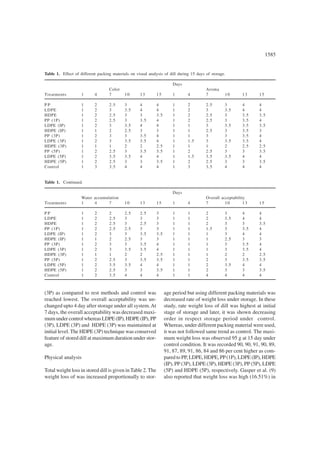
The minimally processed stored fresh dill was visu-
ally analyzed for color, aroma, water accumulation and
overall acceptability (Table 1).The color, aroma analy-
sis helped in determining the infection in the sample.
The water accumulation determined the state of fresh-
ness of the sample.
The color of stored dill was changed after 10 days
under PP, LDPE and HDPE samples which was con-
verted green to black. On the contrary control sample,
dill was lost green color on 4 day after stored. In HDPE
(3P) method, the color of stored dill was retained green
color for maximum duration under storage condition.
The aroma of stored dill under HDPE (3P) method
was decreased as same as color and retained highest
during the storage period. The PP, LDPE and HDPE
storage were retained aroma till 7th
day than after it
was decreased in respect storage time. In control,
aroma was reduced higher as compare to other pack-
ing materials and it was reduced after 4th
day of stor-
age. Similar finding was founded by Gil et al. [7] and
Deshpande and Shukla [8].
The water accumulation of stored dill was lost
under HDPE (IP) and HDPE (3P) as compared to rest
packing materials at 4 day after stored.At 15 day stor-
age, the water accumulation was highest under HDPE
1585
(3P) as compared to rest methods and control was
reached lowest. The overall acceptability was un-
changed upto 4 day after storage under all system.At
7 days, the overall acceptability was decreased maxi-
mumundercontrolwhereasLDPE(IP),HDPE(IP),PP
(3P), LDPE (3P) and HDPE (3P) was maintained at
initial level. The HDPE (3P) technique was conserved
feature of stored dill at maximum duration under stor-
age.
Physical analysis
Total weight loss in stored dill is given inTable 2. The
weight loss of was increased proportionally to stor-
Table 1. Effect of different packing materials on visual analysis of dill during 15 days of storage.
Days
Color Aroma
Treatments 1 4 7 10 13 15 1 4 7 10 13 15
P P 1 2 2.5 3 4 4 1 2 2.5 3 4 4
LDPE 1 2 3 3.5 4 4 1 2 3 3.5 4 4
HDPE 1 2 2.5 3 3 3.5 1 2 2.5 3 3.5 3.5
PP (1P) 1 2 2.5 3 3.5 4 1 2 2.5 3 3.5 4
LDPE (IP) 1 2 3 3.5 4 4 1 1 3 3.5 3.5 3.5
HDPE (IP) 1 1 2 2.5 3 3 1 1 2.5 3 3.5 3
PP (3P) 1 2 3 3 3.5 4 1 1 3 3 3.5 4
LDPE (3P) 1 2 3 3.5 3.5 4 1 1.5 3 3.5 3.5 4
HDPE (3P) 1 1 1 2 2 2.5 1 1 1 2 2.5 2.5
PP (5P) 1 2 2.5 3 3.5 3.5 1 2 2.5 3 3 3.5
LDPE (5P) 1 2 3.5 3.5 4 4 1 1.5 3.5 3.5 4 4
HDPE (5P) 1 2 2.5 3 3 3.5 1 2 2.5 3 3 3.5
Control 1 3 3.5 4 4 4 1 3 3.5 4 4 4
Table 1. Continued.
Days
Water accumulation Overall acceptability
Treatments 1 4 7 10 13 15 1 4 7 10 13 15
P P 1 2 2 2.5 2.5 3 1 1 2 3 4 4
LDPE 1 2 2.5 3 3 3 1 1 2 3.5 4 4
HDPE 1 2 2.5 3 2.5 3 1 1 2 3 3 3.5
PP (1P) 1 2 2.5 2.5 3 3 1 1 1.5 3 3.5 4
LDPE (IP) 1 2 3 3 3.5 3.5 1 1 1 3 4 4
HDPE (IP) 1 1 2 2.5 3 3 1 1 1 2.5 3 3
PP (3P) 1 2 3 3 3.5 4 1 1 1 3 3.5 4
LDPE (3P) 1 2 3 3.5 3.5 4 1 1 1 3 3.5 4
HDPE (3P) 1 1 1 2 2 2.5 1 1 1 2 2 2.5
PP (5P) 1 2 2.5 3 3.5 3.5 1 1 2 3 3.5 3.5
LDPE (5P) 1 2 3.5 3.5 4 4 1 1 2 3.5 4 4
HDPE (5P) 1 2 2.5 3 3 3.5 1 1 2 3 3 3.5
Control 1 2 3.5 4 4 4 1 1 4 4 4 4
age period but using different packing materials was
decreased rate of weight loss under storage. In these
study, rate weight loss of dill was highest at initial
stage of storage and later, it was shown decreasing
order in respect storage period under control.
Whereas, under different packing material were used,
it was not followed same trend as control. The maxi-
mum weight loss was observed 95 g at 15 day under
control condition. It was recorded 90, 90, 91, 90, 89,
91, 87, 89, 91, 86, 84 and 86 per cent higher as com-
pared to PP, LDPE, HDPE, PP(1P), LDPE (IP), HDPE
(IP), PP (3P), LDPE (3P), HDPE (3P), PP (5P), LDPE
(5P) and HDPE (5P), respectively. Gasper et al. (9)
also reported that weight loss was high (16.51%) in
1586
Table 2. Effect of different packaging materials on the chlorophyll content and percentage weight loss of the stored dill with
the passage of days.
Days
Chlorophyll content Weight loss (%)
Treatments 1 4 7 10 13 15 1 4 7 10 13 15
P P 9.07 9.94 10.03 11.31 8.89 8.09 0.38 1.43 1.88 2.35 3.45 4.5
LDPE 9.07 9.84 8.06 5.59 3.39 3.03 0.46 1.77 1.98 2.50 3.67 5.2
HDPE 9.07 9.91 10.05 11.45 10.15 10.11 0.17 0.89 1.03 2.08 2.68 3.7
PP (1P) 9.07 10.05 10.54 11.90 8.80 8.07 0.37 1.38 1.73 2.02 3.89 5.02
LDPE (IP) 9.07 5.96 5.83 5.46 4.88 4.11 0.46 1.39 2.63 3.87 4.93 5.8
HDPE (IP) 9.07 10.02 10.17 11.81 10.27 10.19 0.17 0.73 0.98 2.73 3.10 3.88
PP (3P) 9.07 9.18 9.23 9.02 8.68 6.99 0.4 2.29 3.87 4.97 5.89 7.8
LDPE (3P) 9.07 6.38 6.28 5.88 4.93 4.17 0.45 1.78 2.9 3.7 4.8 5.9
HDPE (3P) 9.07 10.08 10.89 11.47 10.59 10.47 0.15 0.67 1.08 1.93 2.12 3.5
PP (5P) 9.07 9.26 8.33 7.04 5.93 4.02 0.36 2.67 3.93 5.88 6.7 8.3
LDPE (5P) 9.07 8.38 8.02 7.87 5.23 2.59 0.42 2.89 4.87 5.93 7.8 10.8
HDPE (5P) 9.07 9.09 8.23 7.68 9.17 9.11 0.15 2.13 3.8 4.3 7.21 8.9
Control 9.07 5.03 3.87 1.7 0 0 0.5 17.5 35 70 83 95
Table 3. ANOVA of total chlorophyll content on dill after 15 day during storage condition.
F S
Tab Ed. CD at
Source df SS MSS F Cal 5% Result (±) 5%
Replication 2 0.0002 0.000123 3.0968 3.40 NS 0.005 0.011
Treatment 12 421.0658 35.0888 882879.966 2.18 S 0.005 0.011
Error 24 0.000954 0.000040 – – – – –
Total 38 245.50 – – – – – –
Correction factor CF G2
/ R × T 1512.21
Total SS TSS SUM (a1
2
+ a2
2
+ a232
+ a24
2
) – CF 421.07
SS due to replication SSR SUM (R1
2
+ R2
2
+ R3
2
) / T –CF 0.00
SS due to treatment SST SUM (T0
2
+ T1
2
....T8
2
) / R –CF 421.07
SS due to error ESS Total. SS–SSR–SST 0.00
guava Cv. Sardar kept in air than in polyethylene
packed fruits (4.43%) on the 9th
day of storage.
Chemical analysis
Total chlorophyll content of stored dill was shown in
(Table 2).Agradual increase in the value of total chlo-
rophyll in PP and HDPE samples were observed till 10
day after which there was a gradual decrease due to
blackening. On the contrary there was a gradual de-
crease in LDPE and control samples throughout the
experimentwithnochlorophyllleftincontrol.Lakshmi
and Vimala [10] was founded similar trend in the chlo-
rophyll content of Spinach when packed in different
packaging materials done. Among the perforated
samples there was a considerable loss in the values
of total chlorophyll in LDPE (1P, 3P, 5P) sample while
PP (1P, 3P, 5P) and HDPE (1P, 3P, 5P) showed an
increase in the value of total chlorophyll till 10th
day
after which it showed a gradual decrease. HDPE (3P)
showed the total chlorophyll content of 10.47 mg/
100 g. The ANOVA for the total chlorophyll content
at 15 days has been given Table 3. The analysis of
the variance at 5% level was showed that the packag-
ing material was not significant on the total chloro-
phyll content on day 1. Whereas, the storage period
was increased, the effect of packaging material on
total chlorophyll content was founded significant
at 5% level on day 4, 7, 10, 13 and 15 after storage
[11].
Conclusion
According to the results, the quality of dill (Anethum
1587
graveolens L.) green leaves was reduced with stor-
age duration, and significant quality losses were es-
tablished after 15 days storage. The different packag-
ing materials with pores have more water accumula-
tion but it retains color, aroma, and total chlorophyll
content more than the packaged in non perforated
packaging material. The percentage weight loss of
HDPE (3P) samples was only 3.5%. Its total chloro-
phyll content was recorded to be 10.47 mg / 100 g
Storage temperature strongly affected the quality and
biochemical properties of dill.
References
1. Randhwa GS, Kaur S (1995) Dill. In: Chadha KL, Gu-
pta R (eds). Advances in horticulture. Vol 11. Medici-
nal and aromatic plants. Malhotra Publ House, New
Delhi, pp 917—932.
2. Callan NW, Johnson DL, Wescott MP, Welty LE
(2007) Herb and oil composition of dill (Anethum
graveolens L.) Effects of crop maturity and plant
density. Indust Crops and Products 25 : 282—287.
3. López AB, Murcia AM, Garcia CF (1998) Lipid pero-
xidation and chlorophyll levels in spinach during refri-
gerated storage and after industrial processing. Food
Chem 61 : 113—118.
4. Kader AA (ed) (1992) Post harvest technology of
horticultural crops. 2nd edn. Univ Calif, Div Agric
and Nat Resour Publ 3311, pp 296.
5. Zagory Devon (1997) Advance in modified atmos-
pheric packing (MAP) of fresh produce. Perishable
handling Newsletter Issue No 90, pp 2—4.
6. Nagata M, Yamashita I (1992) Simple method for
simultaeous determination of chlorophyll and caro-
tenoids in tomato fruit. Nippon Shokuhin Kogyo
Gakkaish: 39 : 925—928.
7. Gil MI, Conesa MA, Artes F (2002) Quality chan-
ges in fresh cut tomato as affected by modified at-
mosphere packaging. Postharvest Biol and Technol
25 : 199—207.
8. deshpande SD, Shukla BD (2008) Modified atmos-
phere packaging of table grapes in polymeric films
under ambient conditions for increased storage life.
Acta Horticulture 785 : 431—434.
9. Gasper JW, Flavio AAC, Luiz CCS (1997) Effect of
low temperature and plastic films on postharvest life
of tomato (Lycopersicon esculentum). Acta Hort
452 : 107—114.
10. Lakshmi B, Vimala V (2000) Nutritive value of
dehydrated green leafy vegetable powders. J Food
Sci Tech 37 : 465—471.
11. Sakaldas Mustafa, Arzu S, Aslim, Canan Õ, Kuzucu,
Kenan Kaynas (2010) The effects of modified atmos-
phere packaging and storage temperature on quality
and biochemical properties of dill (Anethum graveo-
lens) leaves. J Food, Agric and Environ 8 : 21—25.

1615

  • 1.
    1583 Environment & Ecology32 (4A) : 1583—1587, October—December 2014 Website: environmentandecology.com ISSN 0970-0420 Effect of Different Packaging Material on Quality of Green Dill (Sowa) (Anethum graveolens L.) UnderStorage Condition Viveka Nand, KailashChandraYadav Received 21 March 2014 ; Accepted 28 April 2014 ; Published online 9 May 2014 Abstract Dill (Anethum graveolens L.) is an annual aromatic branched herb and uses as leafy vegetable. The study was conducted during 2009. The study evaluated that the different packaging material was done with and without open pore space area, to check its effectiveness in extending the shelf life of dill. Control sample lost its green color and aroma on 4th day where as HDPE with 3 pores retains the color and aroma maximum during storage. The percentage weight loss of HDPE (3P) samples was only 3.5 %. Its total chlorophyll content was recorded to be 10.47 mg/100 g. This study showed that leafy vegetable could be stored by using modern technique of pack- ing for reduction of the qualitative and quantitative losses. Keywords Dill, Packaging Materials, Quality. V. Nand* Research Scholar, Department of Food Engineering, Bidhan Chandra Krishi Viswavidyalaya (BCKV), Mohanpur, Nadia (WB) 741252, India K. C. Yadav Assistant Professor, Department of Food Processing Engineering, Vaugh School of Agriculture Engineering and Technology, Sam Higginbottom Institute of Agricultural, Technology and Sciences (SHIATS), Allabad (UP) 211007, India e-mail: vivekmtech08@gmail.com *Correspondence Introduction Dill (Anethum graveolens L.) belongs to the family Umbellifere (Apiaceae). Dill is an annual aromatic branched herbs known for culinary use since ancient times it is a native of south east Europe and is culti- vated commercially in the most part of Europe, par- ticularly the Netherlands, Hungary, Germany, Roma- nia, South Russia, Bulgaria and on a lesser scale in France, Sweden, Belgium, Poland, Greece, Spain, UK, Turkey and the USA. Dill herbs and fruits represent an important source for flavoring and seasoning of salads, sauces, soups and seafood. Dill is grown as an irrigated annual crop both in temperate and tropi- cal regions. A large number of varieties are known in cultivation [1]. Dill is characterized by long dissected leaves and compound radiating umbels. The aroma composition of dill has been the subject of numerous investigations, which, however, have resulted in con- troversial conclusions in terms of composition and yields as a result of harvesting seasonality and dif- ferent isolation methods [2]. It contains volatile oil and fixed oil, anethine, phallandrane, and d-limonene. The seed is hot, bitter, stomachic, antipyretic, carmi- native greeneye diseases and urinary pains. The fruits are hot, bitter, carminative, antidycentric, stomachic, alexetric, diuretic laxative, emmenagogue, maturant vulnerary, and relives griping pains. In recent years the consumption of frozen vegetable has rapidly in- creased prompting efforts to improve their quality and self life.Appearance is taken as an indication of fresh- ness palatability and nutritional value [3]. Storage under controlled atmosphere conditionis known to
  • 2.
    1584 extend the shelflife of fresh vegetables by retarding their physiological metabolism [4] however, controlled atmosphere (CA) storage has been found to be costly for dill as they have shorter shelf life and any benefi- cial effects of CA storage are lost as soon as the pro- duce is removed from CA.Atmospheric packaging in controlledconditioncanhelpextendshelflifebyshow- ing respiration maintain appearance by showing color development, maintain texture though slowing soft- ening, maintain quality by retarding the growth of some microorganisms and preserve flavor by check- ing use of sugars during respiration. The scientific literature reports that reduced oxygen (3–7% oxygen) can help maintain firmness of cherriers while 10— 15% carbon dioxide can maintain green stems [5]. MaterialsandMethods The experiment was conducted in APFE laboratory, Department of Agricultural process and food engi- neering. Allahabad Agricultural Institute —Deemed University,Allahabad during 2009.Young, tender but fresh herbs of dill were purchased from local market of Allahabad and used as the samples for the experi- ment.Thedifferentpackingmaterialsviz.,PP(polypro- pylene), LDPE (low density polythyene) and HDPE (High density polythene) were used for the experi- ment. A brief description for each of the experiment was comprised thirteen treatment: PP, LDPE, HDPE, PP (I perforation), LDPE ( I perforation), HDPE (I per- foration), PP (3 perforation), LDPE (3 perforation), HDPE(3perforation),PP(5perforation),LDPE(5per- foration), HDPE (5 perforation) and control. The ex- periment was adopted a correlation factor and each treatment replicated three times with 18 samples. Qualitative analysis Visual analysis In the visual analysis, the following parameters viz., color, aroma, water accumulation and overall accepatability were observed. The visual analysis was done on the scorecard basis I. Subjective rating based on the 4 point scale method was taken as the criteria for visual assessment. Physical analysis In physical analysis, weight loss was observed inder storage. The initial weights of the packets were re- corded. Electronic weighing machine was used for the weighing purposes. Chemical analysis Chlorophyll content was analyzed under chemical analysis of dill during storage period. The total chlo- rophyll concentration was quantified as per the method proposed by Nagata and Yamashita [6]. Total chlorophyll (mg / 100 g) = 0.0202 (OD at 645 nm) + 0.00802 (OD at 663 nm) Results and Discussion Visual analysis The minimally processed stored fresh dill was visu- ally analyzed for color, aroma, water accumulation and overall acceptability (Table 1).The color, aroma analy- sis helped in determining the infection in the sample. The water accumulation determined the state of fresh- ness of the sample. The color of stored dill was changed after 10 days under PP, LDPE and HDPE samples which was con- verted green to black. On the contrary control sample, dill was lost green color on 4 day after stored. In HDPE (3P) method, the color of stored dill was retained green color for maximum duration under storage condition. The aroma of stored dill under HDPE (3P) method was decreased as same as color and retained highest during the storage period. The PP, LDPE and HDPE storage were retained aroma till 7th day than after it was decreased in respect storage time. In control, aroma was reduced higher as compare to other pack- ing materials and it was reduced after 4th day of stor- age. Similar finding was founded by Gil et al. [7] and Deshpande and Shukla [8]. The water accumulation of stored dill was lost under HDPE (IP) and HDPE (3P) as compared to rest packing materials at 4 day after stored.At 15 day stor- age, the water accumulation was highest under HDPE
  • 3.
    1585 (3P) as comparedto rest methods and control was reached lowest. The overall acceptability was un- changed upto 4 day after storage under all system.At 7 days, the overall acceptability was decreased maxi- mumundercontrolwhereasLDPE(IP),HDPE(IP),PP (3P), LDPE (3P) and HDPE (3P) was maintained at initial level. The HDPE (3P) technique was conserved feature of stored dill at maximum duration under stor- age. Physical analysis Total weight loss in stored dill is given inTable 2. The weight loss of was increased proportionally to stor- Table 1. Effect of different packing materials on visual analysis of dill during 15 days of storage. Days Color Aroma Treatments 1 4 7 10 13 15 1 4 7 10 13 15 P P 1 2 2.5 3 4 4 1 2 2.5 3 4 4 LDPE 1 2 3 3.5 4 4 1 2 3 3.5 4 4 HDPE 1 2 2.5 3 3 3.5 1 2 2.5 3 3.5 3.5 PP (1P) 1 2 2.5 3 3.5 4 1 2 2.5 3 3.5 4 LDPE (IP) 1 2 3 3.5 4 4 1 1 3 3.5 3.5 3.5 HDPE (IP) 1 1 2 2.5 3 3 1 1 2.5 3 3.5 3 PP (3P) 1 2 3 3 3.5 4 1 1 3 3 3.5 4 LDPE (3P) 1 2 3 3.5 3.5 4 1 1.5 3 3.5 3.5 4 HDPE (3P) 1 1 1 2 2 2.5 1 1 1 2 2.5 2.5 PP (5P) 1 2 2.5 3 3.5 3.5 1 2 2.5 3 3 3.5 LDPE (5P) 1 2 3.5 3.5 4 4 1 1.5 3.5 3.5 4 4 HDPE (5P) 1 2 2.5 3 3 3.5 1 2 2.5 3 3 3.5 Control 1 3 3.5 4 4 4 1 3 3.5 4 4 4 Table 1. Continued. Days Water accumulation Overall acceptability Treatments 1 4 7 10 13 15 1 4 7 10 13 15 P P 1 2 2 2.5 2.5 3 1 1 2 3 4 4 LDPE 1 2 2.5 3 3 3 1 1 2 3.5 4 4 HDPE 1 2 2.5 3 2.5 3 1 1 2 3 3 3.5 PP (1P) 1 2 2.5 2.5 3 3 1 1 1.5 3 3.5 4 LDPE (IP) 1 2 3 3 3.5 3.5 1 1 1 3 4 4 HDPE (IP) 1 1 2 2.5 3 3 1 1 1 2.5 3 3 PP (3P) 1 2 3 3 3.5 4 1 1 1 3 3.5 4 LDPE (3P) 1 2 3 3.5 3.5 4 1 1 1 3 3.5 4 HDPE (3P) 1 1 1 2 2 2.5 1 1 1 2 2 2.5 PP (5P) 1 2 2.5 3 3.5 3.5 1 1 2 3 3.5 3.5 LDPE (5P) 1 2 3.5 3.5 4 4 1 1 2 3.5 4 4 HDPE (5P) 1 2 2.5 3 3 3.5 1 1 2 3 3 3.5 Control 1 2 3.5 4 4 4 1 1 4 4 4 4 age period but using different packing materials was decreased rate of weight loss under storage. In these study, rate weight loss of dill was highest at initial stage of storage and later, it was shown decreasing order in respect storage period under control. Whereas, under different packing material were used, it was not followed same trend as control. The maxi- mum weight loss was observed 95 g at 15 day under control condition. It was recorded 90, 90, 91, 90, 89, 91, 87, 89, 91, 86, 84 and 86 per cent higher as com- pared to PP, LDPE, HDPE, PP(1P), LDPE (IP), HDPE (IP), PP (3P), LDPE (3P), HDPE (3P), PP (5P), LDPE (5P) and HDPE (5P), respectively. Gasper et al. (9) also reported that weight loss was high (16.51%) in
  • 4.
    1586 Table 2. Effectof different packaging materials on the chlorophyll content and percentage weight loss of the stored dill with the passage of days. Days Chlorophyll content Weight loss (%) Treatments 1 4 7 10 13 15 1 4 7 10 13 15 P P 9.07 9.94 10.03 11.31 8.89 8.09 0.38 1.43 1.88 2.35 3.45 4.5 LDPE 9.07 9.84 8.06 5.59 3.39 3.03 0.46 1.77 1.98 2.50 3.67 5.2 HDPE 9.07 9.91 10.05 11.45 10.15 10.11 0.17 0.89 1.03 2.08 2.68 3.7 PP (1P) 9.07 10.05 10.54 11.90 8.80 8.07 0.37 1.38 1.73 2.02 3.89 5.02 LDPE (IP) 9.07 5.96 5.83 5.46 4.88 4.11 0.46 1.39 2.63 3.87 4.93 5.8 HDPE (IP) 9.07 10.02 10.17 11.81 10.27 10.19 0.17 0.73 0.98 2.73 3.10 3.88 PP (3P) 9.07 9.18 9.23 9.02 8.68 6.99 0.4 2.29 3.87 4.97 5.89 7.8 LDPE (3P) 9.07 6.38 6.28 5.88 4.93 4.17 0.45 1.78 2.9 3.7 4.8 5.9 HDPE (3P) 9.07 10.08 10.89 11.47 10.59 10.47 0.15 0.67 1.08 1.93 2.12 3.5 PP (5P) 9.07 9.26 8.33 7.04 5.93 4.02 0.36 2.67 3.93 5.88 6.7 8.3 LDPE (5P) 9.07 8.38 8.02 7.87 5.23 2.59 0.42 2.89 4.87 5.93 7.8 10.8 HDPE (5P) 9.07 9.09 8.23 7.68 9.17 9.11 0.15 2.13 3.8 4.3 7.21 8.9 Control 9.07 5.03 3.87 1.7 0 0 0.5 17.5 35 70 83 95 Table 3. ANOVA of total chlorophyll content on dill after 15 day during storage condition. F S Tab Ed. CD at Source df SS MSS F Cal 5% Result (±) 5% Replication 2 0.0002 0.000123 3.0968 3.40 NS 0.005 0.011 Treatment 12 421.0658 35.0888 882879.966 2.18 S 0.005 0.011 Error 24 0.000954 0.000040 – – – – – Total 38 245.50 – – – – – – Correction factor CF G2 / R × T 1512.21 Total SS TSS SUM (a1 2 + a2 2 + a232 + a24 2 ) – CF 421.07 SS due to replication SSR SUM (R1 2 + R2 2 + R3 2 ) / T –CF 0.00 SS due to treatment SST SUM (T0 2 + T1 2 ....T8 2 ) / R –CF 421.07 SS due to error ESS Total. SS–SSR–SST 0.00 guava Cv. Sardar kept in air than in polyethylene packed fruits (4.43%) on the 9th day of storage. Chemical analysis Total chlorophyll content of stored dill was shown in (Table 2).Agradual increase in the value of total chlo- rophyll in PP and HDPE samples were observed till 10 day after which there was a gradual decrease due to blackening. On the contrary there was a gradual de- crease in LDPE and control samples throughout the experimentwithnochlorophyllleftincontrol.Lakshmi and Vimala [10] was founded similar trend in the chlo- rophyll content of Spinach when packed in different packaging materials done. Among the perforated samples there was a considerable loss in the values of total chlorophyll in LDPE (1P, 3P, 5P) sample while PP (1P, 3P, 5P) and HDPE (1P, 3P, 5P) showed an increase in the value of total chlorophyll till 10th day after which it showed a gradual decrease. HDPE (3P) showed the total chlorophyll content of 10.47 mg/ 100 g. The ANOVA for the total chlorophyll content at 15 days has been given Table 3. The analysis of the variance at 5% level was showed that the packag- ing material was not significant on the total chloro- phyll content on day 1. Whereas, the storage period was increased, the effect of packaging material on total chlorophyll content was founded significant at 5% level on day 4, 7, 10, 13 and 15 after storage [11]. Conclusion According to the results, the quality of dill (Anethum
  • 5.
    1587 graveolens L.) greenleaves was reduced with stor- age duration, and significant quality losses were es- tablished after 15 days storage. The different packag- ing materials with pores have more water accumula- tion but it retains color, aroma, and total chlorophyll content more than the packaged in non perforated packaging material. The percentage weight loss of HDPE (3P) samples was only 3.5%. Its total chloro- phyll content was recorded to be 10.47 mg / 100 g Storage temperature strongly affected the quality and biochemical properties of dill. References 1. Randhwa GS, Kaur S (1995) Dill. In: Chadha KL, Gu- pta R (eds). Advances in horticulture. Vol 11. Medici- nal and aromatic plants. Malhotra Publ House, New Delhi, pp 917—932. 2. Callan NW, Johnson DL, Wescott MP, Welty LE (2007) Herb and oil composition of dill (Anethum graveolens L.) Effects of crop maturity and plant density. Indust Crops and Products 25 : 282—287. 3. López AB, Murcia AM, Garcia CF (1998) Lipid pero- xidation and chlorophyll levels in spinach during refri- gerated storage and after industrial processing. Food Chem 61 : 113—118. 4. Kader AA (ed) (1992) Post harvest technology of horticultural crops. 2nd edn. Univ Calif, Div Agric and Nat Resour Publ 3311, pp 296. 5. Zagory Devon (1997) Advance in modified atmos- pheric packing (MAP) of fresh produce. Perishable handling Newsletter Issue No 90, pp 2—4. 6. Nagata M, Yamashita I (1992) Simple method for simultaeous determination of chlorophyll and caro- tenoids in tomato fruit. Nippon Shokuhin Kogyo Gakkaish: 39 : 925—928. 7. Gil MI, Conesa MA, Artes F (2002) Quality chan- ges in fresh cut tomato as affected by modified at- mosphere packaging. Postharvest Biol and Technol 25 : 199—207. 8. deshpande SD, Shukla BD (2008) Modified atmos- phere packaging of table grapes in polymeric films under ambient conditions for increased storage life. Acta Horticulture 785 : 431—434. 9. Gasper JW, Flavio AAC, Luiz CCS (1997) Effect of low temperature and plastic films on postharvest life of tomato (Lycopersicon esculentum). Acta Hort 452 : 107—114. 10. Lakshmi B, Vimala V (2000) Nutritive value of dehydrated green leafy vegetable powders. J Food Sci Tech 37 : 465—471. 11. Sakaldas Mustafa, Arzu S, Aslim, Canan Õ, Kuzucu, Kenan Kaynas (2010) The effects of modified atmos- phere packaging and storage temperature on quality and biochemical properties of dill (Anethum graveo- lens) leaves. J Food, Agric and Environ 8 : 21—25.