Seminar on
Presented by
Nitish Kumar Pradhan
2161912003
Department of Horticulture
FAS, SOADU
HORT- 591
12
11
10
09
08
07
CONTENTS
01
02
03
04
05
06
Introduction
Shrink Packaging
Shrinking
Mechanism
Packaging
Points
Properties of
Shrink Wrapping
Film
Selection of
suitable films
The Machinery
Reference
Research Findings
Effect of ISW
The Method
Conclusion
 India is the 2nd largest producer of the fruits and vegetables in the world after China.
 A large fraction of the total produce is subjected to post harvest losses ranging from
20-30%.
 If these post harvest losses are controlled effectively than it would greatly increase the
availability of fruits and vegetables which otherwise goes waste.
 The quality of fresh produces depends primarily upon the selection and careful
handling.
 Several improvements have been made in post harvest handling method and in use of
improved packages to modify the atmosphere around the commodity to a favourable
extent.
 One of such technique is individual shrink wrapping.
Introduction
3
1
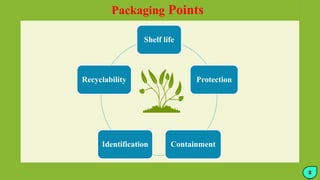
Packaging Points
Shelf life
Protection
Containment
Identification
Recyclability
2
Shrink Packaging
 Shrink wrap packaging is practiced either individually or as tray over packaging.
 Individual shrink wrapping produces a micro atmosphere that can control decay over
a prolonged period.
 It is the process of covering a product with clear polythene that shrinks when heated
to fit tightly around the shape of the product.
 This method has the greatest advantage of controlling moisture loss as the film forms
a barrier that markedly increases the resistance to water vapour and the transpiration
rate can be reduced 5 to 20 times by shrink wrapping using selectively permeable
films.
 Thus individual shrink wrapping results in a reduction in weight loss, prolonged fresh
appearance, delayed senescence, prevention of secondary infection.
 It also enhances the effectiveness of fungicide by slowing down it’s dissipation rate.
3
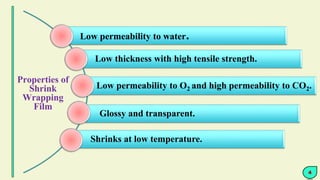
Low permeability to water.
Low thickness with high tensile strength.
Low permeability to O2 and high permeability to CO2.
Glossy and transparent.
Shrinks at low temperature.
Properties of
Shrink
Wrapping
Film
4
Shrinking Mechanism
5
 Heat shrinkable films are made by stretching a conventional film at
a temperature close to its softening point (Tg) and then quenching
the film in the oriented state.
 Oriented film is a single long chain polymer molecule in the relaxed
and curled state.
 Orientation is imparted by blown-film extrusion or in tenter frames.
 When the film is quenched after orientation, the molecules are
frozen in the oriented position, but they still 'remember' their
original shape, and will return to that shape when the film is
reheated to the orienting temperature.
 When this happens, the film shrinks around the product.
 The shrink temperatures are always higher than room temperature.
Fig.1 Single Polymer molecule in non-oriented state
Fig.2 Polymer molecules in uniaxially oriented film
Fig.3 Polymer molecules in biaxially oriented film
Selection of suitable film for Individual Shrink Wrapping
 The selected films must have desirable selective permeability for gases to avoid off-
flavour development produced by the fruit over a wide range of temperatures.
 Co-polymers of various combinations can be used to give better result than one
polymer.
 Multiple films co-extruded to form one film would give stronger sealing and more
attractive appearance after shrinking the film around the fruit.
 The films used should be adapted to the specific requirement of each fruit and
packaging machine.
6
The Machinery
Examples: Apples, Asparagus, Bananas,
Bell Peppers, Blueberries, Broccoli,
Brussel Sprouts, Cabbages, Cauliflower,
Carrots, Celery, Cherries, Cherry
Tomatoes, Citrus, Cucumber, Eggplants,
Grapes, Green Beans, Herbs, Lemons,
Melons, Nectarines, Oranges, Peach,
Pear, Peppermint, Pomegranate,
Raspberries, Lettuce, Stone Fruit,
Strawberries, Tangerines, Tomatoes,
Watermelons etc.
1. Film Sealing Machine
2. Hot Shrinking Machine
7
Fig: 1(a)
Fig: 1(b)
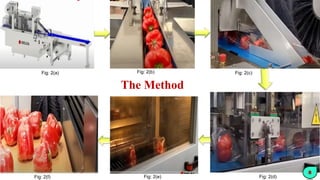
The Method
8
Fig: 2(a) Fig: 2(b) Fig: 2(c)
Fig: 2(f) Fig: 2(e) Fig: 2(d)
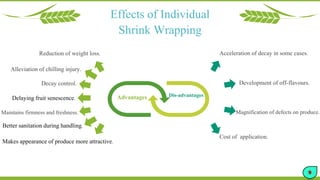
Effects of Individual
Shrink Wrapping
Advantages Dis-advantages
Acceleration of decay in some cases.
Cost of application.
Development of off-flavours.
Magnification of defects on produce.
Reduction of weight loss.
Decay control.
Maintains firmness and freshness.
Delaying fruit senescence.
Alleviation of chilling injury.
Better sanitation during handling.
Makes appearance of produce more attractive.
9
Research
Findings
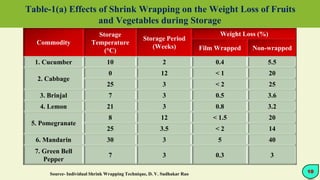
Table-1(a) Effects of Shrink Wrapping on the Weight Loss of Fruits
and Vegetables during Storage
Commodity
Storage
Temperature
(°C)
Storage Period
(Weeks)
Weight Loss (%)
Film Wrapped Non-wrapped
1. Cucumber 10 2 0.4 5.5
2. Cabbage
0 12 < 1 20
25 3 < 2 25
3. Brinjal 7 3 0.5 3.6
4. Lemon 21 3 0.8 3.2
5. Pomegranate
8 12 < 1.5 20
25 3.5 < 2 14
6. Mandarin 30 3 5 40
7. Green Bell
Pepper
7 3 0.3 3
10
Source- Individual Shrink Wrapping Technique, D. V. Sudhakar Rao
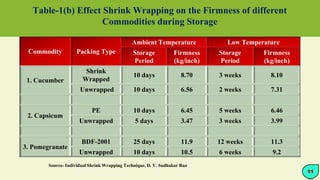
Table-1(b) Effect Shrink Wrapping on the Firmness of different
Commodities during Storage
Commodity Packing Type
Ambient Temperature Low Temperature
Storage
Period
Firmness
(kg/inch)
Storage
Period
Firmness
(kg/inch)
1. Cucumber
Shrink
Wrapped
10 days 8.70 3 weeks 8.10
Unwrapped 10 days 6.56 2 weeks 7.31
2. Capsicum
PE 10 days 6.45 5 weeks 6.46
Unwrapped 5 days 3.47 3 weeks 3.99
3. Pomegranate
BDF-2001 25 days 11.9 12 weeks 11.3
Unwrapped 10 days 10.5 6 weeks 9.2
11
Source- Individual Shrink Wrapping Technique, D. V. Sudhakar Rao
Table-1(c) Effect of Shrink Wrapping on the Respiration Rate of
different Fruits and Vegetables
Commodity
Storage
Temperature
Respiration Rate (mg CO2/kg/hr)
Non-wrapped Shrink-film Wrapped
1. Pomegranate 25°C 60-70 35-40
2. Cucumber
25°C 55-65 38-42
10°C 25-30 15-20
3. Bell Pepper
25°C 60-70 40-50
8°C 18-20 14-16
12
Source- Individual Shrink Wrapping Technique, D. V. Sudhakar Rao
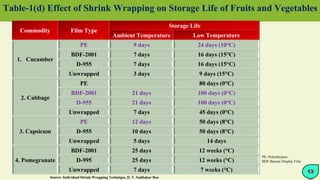
Table-1(d) Effect of Shrink Wrapping on Storage Life of Fruits and Vegetables
Commodity Film Type
Storage Life
Ambient Temperature Low Temperature
1. Cucumber
PE 9 days 24 days (10°C)
BDF-2001 7 days 16 days (15°C)
D-955 7 days 16 days (15°C)
Unwrapped 3 days 9 days (15°C)
2. Cabbage
PE 80 days (0°C)
BDF-2001 21 days 100 days (0°C)
D-955 21 days 100 days (0°C)
Unwrapped 7 days 45 days (0°C)
3. Capsicum
PE 12 days 50 days (8°C)
D-955 10 days 50 days (8°C)
Unwrapped 5 days 14 days
4. Pomegranate
BDF-2001 25 days 12 weeks (°C)
D-995 25 days 12 weeks (°C)
Unwrapped 7 days 7 weeks (°C) 13
Source- Individual Shrink Wrapping Technique, D. V. Sudhakar Rao
PE- Polyethylene
BDF-Barrier Display Film
Table-2 Physiological loss in weight (%) of lemon as affected by wrapping at different days of storage in ambient
condition(29-32 °C, 55-78% RH)
14
Treatment
Days of Storage
2 4 6 8 10 12 14 16 18 20 22 24 26 28 30 32
T1 0.26 0.26 0.52 0.77 I .23 1.51 1.77 2.07 2.14 2.46 2.74 2.88 3.06 3.25 3.74 3.92
T2 0.42 0.81 1.16 1.45 2.07 2.62 2.95 3.45 3.87 4.21 4.78 5.13 5.37 5.84 6.33 6.94
T3 7.12 13.77 18.54 23.57 31.57 37.27 41.34 51.24 59.37 62.43 73.16 77.43 87.09 95.33 101.97 113.33
Mean 2.60 4.94 6.74 8.60 11.62 13.80 15.36 18.92 21.79 23.03 26.89 28.48 31.84 34.81 37.34 41.39
SE (m±) 0.011 0.016 0.010 0.009 0.01 1 0.006 0.001 0.018 0.009 0.013 0.012 0.008 0.027 0.016 0.006 0.015
CD 5% 0.03 0.04 0.03 0.02 0.03 0.01 0.05 0.06 0.02 0.04 0.03 0.02 0.10 0.04 0.01 0.04
Effect of heat shrinkable film on storability of Citrus cv. Assam Lemon [Citrus limon Burm.f.] under ambient
conditions
Tl- Individual wrapping with heat shrinkable film ( 15μm); T2-Tray over-wrapped with heat shrinkable film (15μm);
T3-No wrapping (open condition)
Piloo et al. (2020)
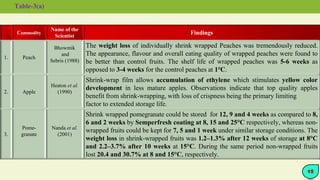
Commodity
Name of the
Scientist
Findings
1. Peach
Bhowmik
and
Sebris (1988)
The weight loss of individually shrink wrapped Peaches was tremendously reduced.
The appearance, flavour and overall eating quality of wrapped peaches were found to
be better than control fruits. The shelf life of wrapped peaches was 5-6 weeks as
opposed to 3-4 weeks for the control peaches at 1℃.
2. Apple
Heaton et al.
(1990)
Shrink-wrap film allows accumulation of ethylene which stimulates yellow color
development in less mature apples. Observations indicate that top quality apples
benefit from shrink-wrapping, with loss of crispness being the primary limiting
factor to extended storage life.
3.
Pome-
granate
Nanda et al.
(2001)
Shrink wrapped pomegranate could be stored for 12, 9 and 4 weeks as compared to 8,
6 and 2 weeks by Semperfresh coating at 8, 15 and 25°C respectively, whereas non-
wrapped fruits could be kept for 7, 5 and 1 week under similar storage conditions. The
weight loss in shrink-wrapped fruits was 1.2–1.3% after 12 weeks of storage at 8°C
and 2.2–3.7% after 10 weeks at 15°C. During the same period non-wrapped fruits
lost 20.4 and 30.7% at 8 and 15°C, respectively.
Table-3(a)
15
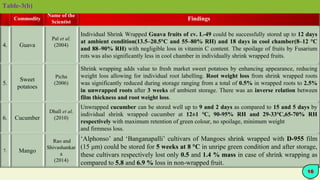
Commodity
Name of the
Scientist
Findings
4. Guava
Pal et al.
(2004)
Individual Shrink Wrapped Guava fruits of cv. L-49 could be successfully stored up to 12 days
at ambient condition(13.5–20.5°C and 55–80% RH) and 18 days in cool chamber(8–12 °C
and 88–90% RH) with negligible loss in vitamin C content. The spoilage of fruits by Fusarium
rots was also significantly less in cool chamber in individually shrink wrapped fruits.
5.
Sweet
potatoes
Picha
(2006)
Shrink wrapping adds value to fresh market sweet potatoes by enhancing appearance, reducing
weight loss allowing for individual root labelling. Root weight loss from shrink wrapped roots
was significantly reduced during storage ranging from a total of 0.5% in wrapped roots to 2.5%
in unwrapped roots after 3 weeks of ambient storage. There was an inverse relation between
film thickness and root weight loss.
6. Cucumber
Dhall et al.
(2010)
Unwrapped cucumber can be stored well up to 9 and 2 days as compared to 15 and 5 days by
individual shrink wrapped cucumber at 12±1 ℃, 90-95% RH and 29-33℃,65-70% RH
respectively with maximum retention of green colour, no spoilage, minimum weight
and firmness loss.
7. Mango
Rao and
Shivashankar
a
(2014)
‘Alphonso’ and ‘Banganapalli’ cultivars of Mangoes shrink wrapped with D-955 film
(15 μm) could be stored for 5 weeks at 8 °C in unripe green condition and after storage,
these cultivars respectively lost only 0.5 and 1.4 % mass in case of shrink wrapping as
compared to 5.8 and 6.9 % loss in non-wrapped fruit.
Table-3(b)
19
16
Commodity
Name of the
Scientist
Findings
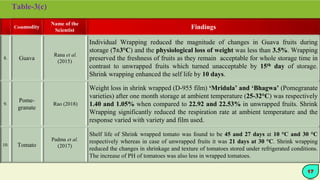
8. Guava
Rana et al.
(2015)
Individual Wrapping reduced the magnitude of changes in Guava fruits during
storage (7±3°C) and the physiological loss of weight was less than 3.5%. Wrapping
preserved the freshness of fruits as they remain acceptable for whole storage time in
contrast to unwrapped fruits which turned unacceptable by 15th day of storage.
Shrink wrapping enhanced the self life by 10 days.
9.
Pome-
granate
Rao (2018)
Weight loss in shrink wrapped (D-955 film) ‘Mridula’ and ‘Bhagwa’ (Pomegranate
varieties) after one month storage at ambient temperature (25-32°C) was respectively
1.40 and 1.05% when compared to 22.92 and 22.53% in unwrapped fruits. Shrink
Wrapping significantly reduced the respiration rate at ambient temperature and the
response varied with variety and film used.
10. Tomato
Padma et al.
(2017)
Shelf life of Shrink wrapped tomato was found to be 45 and 27 days at 10 °C and 30 °C
respectively whereas in case of unwrapped fruits it was 21 days at 30 °C. Shrink wrapping
reduced the changes in shrinkage and texture of tomatoes stored under refrigerated conditions.
The increase of PH of tomatoes was also less in wrapped tomatoes.
Table-3(c)
17
Conclusion
• In India there is a wastage of 25-30% of fresh produce in transit. Out of
this 5-10% losses are due to loss in weight by transportation from the
fresh produce. In transportation and handling reduce the mechanical
injuries to produce is very important. More the firmness less the
damage. The rate of decrease in firmness reduced considerably in
shrink packed produce. Apart from this individual produce hold
together firmly avoiding the friction and abrasion, thereby reducing the
mechanical damage and minimizing the handling hazards.
• Shrink packaging retards ripening and colour development, thereby
extends the shelf life to considerable degree. Shrink packaging helps in
better marketing the produce, reducing mechanical and biological
hazards, thereby minimizing the losses, ease in handling and
transportation and keeping the quality of the produce. Taking this
advantages shrink packaging would be a new major thrust area for
retailing in near future.
18
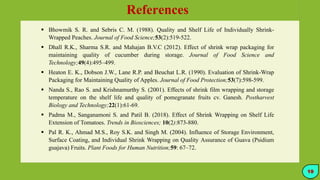
References
 Bhowmik S. R. and Sebris C. M. (1988). Quality and Shelf Life of Individually Shrink-
Wrapped Peaches. Journal of Food Science;53(2):519-522.
 Dhall R.K., Sharma S.R. and Mahajan B.V.C (2012). Effect of shrink wrap packaging for
maintaining quality of cucumber during storage. Journal of Food Science and
Technology;49(4):495–499.
 Heaton E. K., Dobson J.W., Lane R.P. and Beuchat L.R. (1990). Evaluation of Shrink-Wrap
Packaging for Maintaining Quality of Apples. Journal of Food Protection;53(7):598-599.
 Nanda S., Rao S. and Krishnamurthy S. (2001). Effects of shrink film wrapping and storage
temperature on the shelf life and quality of pomegranate fruits cv. Ganesh. Postharvest
Biology and Technology;22(1):61-69.
 Padma M., Sanganamoni S. and Patil B. (2018). Effect of Shrink Wrapping on Shelf Life
Extension of Tomatoes. Trends in Biosciences; 10(2):873-880.
 Pal R. K., Ahmad M.S., Roy S.K. and Singh M. (2004). Influence of Storage Environment,
Surface Coating, and Individual Shrink Wrapping on Quality Assurance of Guava (Psidium
guajava) Fruits. Plant Foods for Human Nutrition;59: 67–72.
19
References
 Picha D.H. (2006). Individual shrink wrapping of sweet potatoes: A value added marketing
trend. HortScience;40(3):517-518.
 Piloo N.G., Singh S.R., Messar O, Vida and Pandey A.K. (2020). Effect of heat shrinkable
film on storability of Citrus cv. Assam Lemon [Citrus limon Burm.f.] under ambient
conditions. Journal of Pharmacognosy and Phytochemistry;9(3):797-800.
 Rana S., Siddiqui S. and Goyal A. (2015). Extension of the shelf life of guava by individual
packaging with cling and shrink films. Journal of Food Science and Technology;
52(12):8148-55.
 Rao D.V.S. (2018). Individual shrink wrapping extends the storage life and maintains the
quality of pomegranates (cvs. ‘Mridula’ and ‘Bhagwa’) at ambient and low temperature.
Journal of Food Science and Technology; 55(1):351–365.
 Rao D.V.S. and Shivashankara K.S. (2015). Individual shrink wrapping extends the storage
life and maintains the antioxidants of mango (cvs. ‘Alphonso’ and ‘Banganapalli’) stored at 8
°C. Journal of Food Science and Technology; 52(7):4351–4359.
20
Individual Shrink Wrapping New.pptx

Individual Shrink Wrapping New.pptx

  • 1.
    Seminar on Presented by NitishKumar Pradhan 2161912003 Department of Horticulture FAS, SOADU HORT- 591
  • 2.
    12 11 10 09 08 07 CONTENTS 01 02 03 04 05 06 Introduction Shrink Packaging Shrinking Mechanism Packaging Points Properties of ShrinkWrapping Film Selection of suitable films The Machinery Reference Research Findings Effect of ISW The Method Conclusion
  • 3.
     India isthe 2nd largest producer of the fruits and vegetables in the world after China.  A large fraction of the total produce is subjected to post harvest losses ranging from 20-30%.  If these post harvest losses are controlled effectively than it would greatly increase the availability of fruits and vegetables which otherwise goes waste.  The quality of fresh produces depends primarily upon the selection and careful handling.  Several improvements have been made in post harvest handling method and in use of improved packages to modify the atmosphere around the commodity to a favourable extent.  One of such technique is individual shrink wrapping. Introduction 3 1
  • 4.
  • 5.
    Shrink Packaging  Shrinkwrap packaging is practiced either individually or as tray over packaging.  Individual shrink wrapping produces a micro atmosphere that can control decay over a prolonged period.  It is the process of covering a product with clear polythene that shrinks when heated to fit tightly around the shape of the product.  This method has the greatest advantage of controlling moisture loss as the film forms a barrier that markedly increases the resistance to water vapour and the transpiration rate can be reduced 5 to 20 times by shrink wrapping using selectively permeable films.  Thus individual shrink wrapping results in a reduction in weight loss, prolonged fresh appearance, delayed senescence, prevention of secondary infection.  It also enhances the effectiveness of fungicide by slowing down it’s dissipation rate. 3
  • 6.
    Low permeability towater. Low thickness with high tensile strength. Low permeability to O2 and high permeability to CO2. Glossy and transparent. Shrinks at low temperature. Properties of Shrink Wrapping Film 4
  • 7.
    Shrinking Mechanism 5  Heatshrinkable films are made by stretching a conventional film at a temperature close to its softening point (Tg) and then quenching the film in the oriented state.  Oriented film is a single long chain polymer molecule in the relaxed and curled state.  Orientation is imparted by blown-film extrusion or in tenter frames.  When the film is quenched after orientation, the molecules are frozen in the oriented position, but they still 'remember' their original shape, and will return to that shape when the film is reheated to the orienting temperature.  When this happens, the film shrinks around the product.  The shrink temperatures are always higher than room temperature. Fig.1 Single Polymer molecule in non-oriented state Fig.2 Polymer molecules in uniaxially oriented film Fig.3 Polymer molecules in biaxially oriented film
  • 8.
    Selection of suitablefilm for Individual Shrink Wrapping  The selected films must have desirable selective permeability for gases to avoid off- flavour development produced by the fruit over a wide range of temperatures.  Co-polymers of various combinations can be used to give better result than one polymer.  Multiple films co-extruded to form one film would give stronger sealing and more attractive appearance after shrinking the film around the fruit.  The films used should be adapted to the specific requirement of each fruit and packaging machine. 6
  • 9.
    The Machinery Examples: Apples,Asparagus, Bananas, Bell Peppers, Blueberries, Broccoli, Brussel Sprouts, Cabbages, Cauliflower, Carrots, Celery, Cherries, Cherry Tomatoes, Citrus, Cucumber, Eggplants, Grapes, Green Beans, Herbs, Lemons, Melons, Nectarines, Oranges, Peach, Pear, Peppermint, Pomegranate, Raspberries, Lettuce, Stone Fruit, Strawberries, Tangerines, Tomatoes, Watermelons etc. 1. Film Sealing Machine 2. Hot Shrinking Machine 7 Fig: 1(a) Fig: 1(b)
  • 10.
    The Method 8 Fig: 2(a)Fig: 2(b) Fig: 2(c) Fig: 2(f) Fig: 2(e) Fig: 2(d)
  • 11.
    Effects of Individual ShrinkWrapping Advantages Dis-advantages Acceleration of decay in some cases. Cost of application. Development of off-flavours. Magnification of defects on produce. Reduction of weight loss. Decay control. Maintains firmness and freshness. Delaying fruit senescence. Alleviation of chilling injury. Better sanitation during handling. Makes appearance of produce more attractive. 9
  • 12.
  • 13.
    Table-1(a) Effects ofShrink Wrapping on the Weight Loss of Fruits and Vegetables during Storage Commodity Storage Temperature (°C) Storage Period (Weeks) Weight Loss (%) Film Wrapped Non-wrapped 1. Cucumber 10 2 0.4 5.5 2. Cabbage 0 12 < 1 20 25 3 < 2 25 3. Brinjal 7 3 0.5 3.6 4. Lemon 21 3 0.8 3.2 5. Pomegranate 8 12 < 1.5 20 25 3.5 < 2 14 6. Mandarin 30 3 5 40 7. Green Bell Pepper 7 3 0.3 3 10 Source- Individual Shrink Wrapping Technique, D. V. Sudhakar Rao
  • 14.
    Table-1(b) Effect ShrinkWrapping on the Firmness of different Commodities during Storage Commodity Packing Type Ambient Temperature Low Temperature Storage Period Firmness (kg/inch) Storage Period Firmness (kg/inch) 1. Cucumber Shrink Wrapped 10 days 8.70 3 weeks 8.10 Unwrapped 10 days 6.56 2 weeks 7.31 2. Capsicum PE 10 days 6.45 5 weeks 6.46 Unwrapped 5 days 3.47 3 weeks 3.99 3. Pomegranate BDF-2001 25 days 11.9 12 weeks 11.3 Unwrapped 10 days 10.5 6 weeks 9.2 11 Source- Individual Shrink Wrapping Technique, D. V. Sudhakar Rao
  • 15.
    Table-1(c) Effect ofShrink Wrapping on the Respiration Rate of different Fruits and Vegetables Commodity Storage Temperature Respiration Rate (mg CO2/kg/hr) Non-wrapped Shrink-film Wrapped 1. Pomegranate 25°C 60-70 35-40 2. Cucumber 25°C 55-65 38-42 10°C 25-30 15-20 3. Bell Pepper 25°C 60-70 40-50 8°C 18-20 14-16 12 Source- Individual Shrink Wrapping Technique, D. V. Sudhakar Rao
  • 16.
    Table-1(d) Effect ofShrink Wrapping on Storage Life of Fruits and Vegetables Commodity Film Type Storage Life Ambient Temperature Low Temperature 1. Cucumber PE 9 days 24 days (10°C) BDF-2001 7 days 16 days (15°C) D-955 7 days 16 days (15°C) Unwrapped 3 days 9 days (15°C) 2. Cabbage PE 80 days (0°C) BDF-2001 21 days 100 days (0°C) D-955 21 days 100 days (0°C) Unwrapped 7 days 45 days (0°C) 3. Capsicum PE 12 days 50 days (8°C) D-955 10 days 50 days (8°C) Unwrapped 5 days 14 days 4. Pomegranate BDF-2001 25 days 12 weeks (°C) D-995 25 days 12 weeks (°C) Unwrapped 7 days 7 weeks (°C) 13 Source- Individual Shrink Wrapping Technique, D. V. Sudhakar Rao PE- Polyethylene BDF-Barrier Display Film
  • 17.
    Table-2 Physiological lossin weight (%) of lemon as affected by wrapping at different days of storage in ambient condition(29-32 °C, 55-78% RH) 14 Treatment Days of Storage 2 4 6 8 10 12 14 16 18 20 22 24 26 28 30 32 T1 0.26 0.26 0.52 0.77 I .23 1.51 1.77 2.07 2.14 2.46 2.74 2.88 3.06 3.25 3.74 3.92 T2 0.42 0.81 1.16 1.45 2.07 2.62 2.95 3.45 3.87 4.21 4.78 5.13 5.37 5.84 6.33 6.94 T3 7.12 13.77 18.54 23.57 31.57 37.27 41.34 51.24 59.37 62.43 73.16 77.43 87.09 95.33 101.97 113.33 Mean 2.60 4.94 6.74 8.60 11.62 13.80 15.36 18.92 21.79 23.03 26.89 28.48 31.84 34.81 37.34 41.39 SE (m±) 0.011 0.016 0.010 0.009 0.01 1 0.006 0.001 0.018 0.009 0.013 0.012 0.008 0.027 0.016 0.006 0.015 CD 5% 0.03 0.04 0.03 0.02 0.03 0.01 0.05 0.06 0.02 0.04 0.03 0.02 0.10 0.04 0.01 0.04 Effect of heat shrinkable film on storability of Citrus cv. Assam Lemon [Citrus limon Burm.f.] under ambient conditions Tl- Individual wrapping with heat shrinkable film ( 15μm); T2-Tray over-wrapped with heat shrinkable film (15μm); T3-No wrapping (open condition) Piloo et al. (2020)
  • 18.
    Commodity Name of the Scientist Findings 1.Peach Bhowmik and Sebris (1988) The weight loss of individually shrink wrapped Peaches was tremendously reduced. The appearance, flavour and overall eating quality of wrapped peaches were found to be better than control fruits. The shelf life of wrapped peaches was 5-6 weeks as opposed to 3-4 weeks for the control peaches at 1℃. 2. Apple Heaton et al. (1990) Shrink-wrap film allows accumulation of ethylene which stimulates yellow color development in less mature apples. Observations indicate that top quality apples benefit from shrink-wrapping, with loss of crispness being the primary limiting factor to extended storage life. 3. Pome- granate Nanda et al. (2001) Shrink wrapped pomegranate could be stored for 12, 9 and 4 weeks as compared to 8, 6 and 2 weeks by Semperfresh coating at 8, 15 and 25°C respectively, whereas non- wrapped fruits could be kept for 7, 5 and 1 week under similar storage conditions. The weight loss in shrink-wrapped fruits was 1.2–1.3% after 12 weeks of storage at 8°C and 2.2–3.7% after 10 weeks at 15°C. During the same period non-wrapped fruits lost 20.4 and 30.7% at 8 and 15°C, respectively. Table-3(a) 15
  • 19.
    Commodity Name of the Scientist Findings 4.Guava Pal et al. (2004) Individual Shrink Wrapped Guava fruits of cv. L-49 could be successfully stored up to 12 days at ambient condition(13.5–20.5°C and 55–80% RH) and 18 days in cool chamber(8–12 °C and 88–90% RH) with negligible loss in vitamin C content. The spoilage of fruits by Fusarium rots was also significantly less in cool chamber in individually shrink wrapped fruits. 5. Sweet potatoes Picha (2006) Shrink wrapping adds value to fresh market sweet potatoes by enhancing appearance, reducing weight loss allowing for individual root labelling. Root weight loss from shrink wrapped roots was significantly reduced during storage ranging from a total of 0.5% in wrapped roots to 2.5% in unwrapped roots after 3 weeks of ambient storage. There was an inverse relation between film thickness and root weight loss. 6. Cucumber Dhall et al. (2010) Unwrapped cucumber can be stored well up to 9 and 2 days as compared to 15 and 5 days by individual shrink wrapped cucumber at 12±1 ℃, 90-95% RH and 29-33℃,65-70% RH respectively with maximum retention of green colour, no spoilage, minimum weight and firmness loss. 7. Mango Rao and Shivashankar a (2014) ‘Alphonso’ and ‘Banganapalli’ cultivars of Mangoes shrink wrapped with D-955 film (15 μm) could be stored for 5 weeks at 8 °C in unripe green condition and after storage, these cultivars respectively lost only 0.5 and 1.4 % mass in case of shrink wrapping as compared to 5.8 and 6.9 % loss in non-wrapped fruit. Table-3(b) 19 16
  • 20.
    Commodity Name of the Scientist Findings 8.Guava Rana et al. (2015) Individual Wrapping reduced the magnitude of changes in Guava fruits during storage (7±3°C) and the physiological loss of weight was less than 3.5%. Wrapping preserved the freshness of fruits as they remain acceptable for whole storage time in contrast to unwrapped fruits which turned unacceptable by 15th day of storage. Shrink wrapping enhanced the self life by 10 days. 9. Pome- granate Rao (2018) Weight loss in shrink wrapped (D-955 film) ‘Mridula’ and ‘Bhagwa’ (Pomegranate varieties) after one month storage at ambient temperature (25-32°C) was respectively 1.40 and 1.05% when compared to 22.92 and 22.53% in unwrapped fruits. Shrink Wrapping significantly reduced the respiration rate at ambient temperature and the response varied with variety and film used. 10. Tomato Padma et al. (2017) Shelf life of Shrink wrapped tomato was found to be 45 and 27 days at 10 °C and 30 °C respectively whereas in case of unwrapped fruits it was 21 days at 30 °C. Shrink wrapping reduced the changes in shrinkage and texture of tomatoes stored under refrigerated conditions. The increase of PH of tomatoes was also less in wrapped tomatoes. Table-3(c) 17
  • 21.
    Conclusion • In Indiathere is a wastage of 25-30% of fresh produce in transit. Out of this 5-10% losses are due to loss in weight by transportation from the fresh produce. In transportation and handling reduce the mechanical injuries to produce is very important. More the firmness less the damage. The rate of decrease in firmness reduced considerably in shrink packed produce. Apart from this individual produce hold together firmly avoiding the friction and abrasion, thereby reducing the mechanical damage and minimizing the handling hazards. • Shrink packaging retards ripening and colour development, thereby extends the shelf life to considerable degree. Shrink packaging helps in better marketing the produce, reducing mechanical and biological hazards, thereby minimizing the losses, ease in handling and transportation and keeping the quality of the produce. Taking this advantages shrink packaging would be a new major thrust area for retailing in near future. 18
  • 22.
    References  Bhowmik S.R. and Sebris C. M. (1988). Quality and Shelf Life of Individually Shrink- Wrapped Peaches. Journal of Food Science;53(2):519-522.  Dhall R.K., Sharma S.R. and Mahajan B.V.C (2012). Effect of shrink wrap packaging for maintaining quality of cucumber during storage. Journal of Food Science and Technology;49(4):495–499.  Heaton E. K., Dobson J.W., Lane R.P. and Beuchat L.R. (1990). Evaluation of Shrink-Wrap Packaging for Maintaining Quality of Apples. Journal of Food Protection;53(7):598-599.  Nanda S., Rao S. and Krishnamurthy S. (2001). Effects of shrink film wrapping and storage temperature on the shelf life and quality of pomegranate fruits cv. Ganesh. Postharvest Biology and Technology;22(1):61-69.  Padma M., Sanganamoni S. and Patil B. (2018). Effect of Shrink Wrapping on Shelf Life Extension of Tomatoes. Trends in Biosciences; 10(2):873-880.  Pal R. K., Ahmad M.S., Roy S.K. and Singh M. (2004). Influence of Storage Environment, Surface Coating, and Individual Shrink Wrapping on Quality Assurance of Guava (Psidium guajava) Fruits. Plant Foods for Human Nutrition;59: 67–72. 19
  • 23.
    References  Picha D.H.(2006). Individual shrink wrapping of sweet potatoes: A value added marketing trend. HortScience;40(3):517-518.  Piloo N.G., Singh S.R., Messar O, Vida and Pandey A.K. (2020). Effect of heat shrinkable film on storability of Citrus cv. Assam Lemon [Citrus limon Burm.f.] under ambient conditions. Journal of Pharmacognosy and Phytochemistry;9(3):797-800.  Rana S., Siddiqui S. and Goyal A. (2015). Extension of the shelf life of guava by individual packaging with cling and shrink films. Journal of Food Science and Technology; 52(12):8148-55.  Rao D.V.S. (2018). Individual shrink wrapping extends the storage life and maintains the quality of pomegranates (cvs. ‘Mridula’ and ‘Bhagwa’) at ambient and low temperature. Journal of Food Science and Technology; 55(1):351–365.  Rao D.V.S. and Shivashankara K.S. (2015). Individual shrink wrapping extends the storage life and maintains the antioxidants of mango (cvs. ‘Alphonso’ and ‘Banganapalli’) stored at 8 °C. Journal of Food Science and Technology; 52(7):4351–4359. 20