Kishan Jalan
HPGD/AP15/2972
E-Commerce
Activities, Goals, Technical Aspects
(An overview)
WELINGKAR INSTITUTE OF MANAGEMENT DEVELOPMENT AND RESEARCH
Year of Submission :: January 2017
What is Ecommerce
Electronic commerce, commonly known as e-commerce, is a type of industry
where the buying and selling of products or services is conducted over electronic
systems such as the Internet and other computer networks. Electronic commerce
draws on technologies such as mobile commerce, electronic funds transfer,
supply chain management, Internet marketing, online transaction processing,
electronic data interchange (EDI), inventory management systems, and
automated data collection systems. Modern electronic commerce typically uses
the World Wide Web at least at one point in the transaction's life-cycle, although
it may encompass a wider range of technologies such as e-mail, mobile devices
social media, and telephones as well.
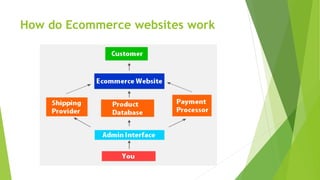
How do Ecommerce websites work
Types of Ecommerce
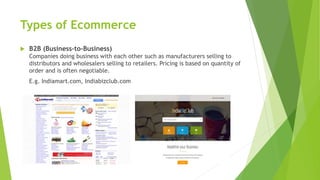
 B2B (Business-to-Business)
Companies doing business with each other such as manufacturers selling to
distributors and wholesalers selling to retailers. Pricing is based on quantity of
order and is often negotiable.
E.g. Indiamart.com, Indiabizclub.com
Types of Ecommerce
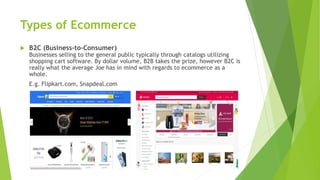
 B2C (Business-to-Consumer)
Businesses selling to the general public typically through catalogs utilizing
shopping cart software. By dollar volume, B2B takes the prize, however B2C is
really what the average Joe has in mind with regards to ecommerce as a
whole.
E.g. Flipkart.com, Snapdeal.com
Types of Ecommerce
 C2B (Consumer-to-Business)
A consumer posts his project with a set budget online and within hours companies
review the consumer's requirements and bid on the project. The consumer reviews
the bids and selects the company that will complete the project. Upwork
empowers consumers around the world by providing the meeting ground and
platform for such transactions.
E.g. Upwork.com
Types of Ecommerce
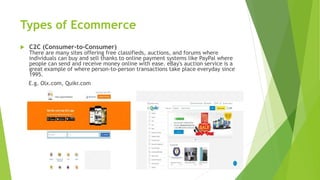
 C2C (Consumer-to-Consumer)
There are many sites offering free classifieds, auctions, and forums where
individuals can buy and sell thanks to online payment systems like PayPal where
people can send and receive money online with ease. eBay's auction service is a
great example of where person-to-person transactions take place everyday since
1995.
E.g. Olx.com, Quikr.com
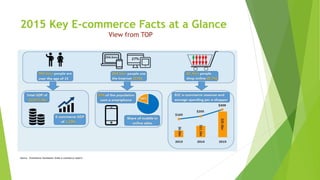
2015 Key E-commerce Facts at a Glance
Source – Ecommerce foundation (India e-commerce report)
2015 Key E-commerce Facts at a Glance
View from TOP
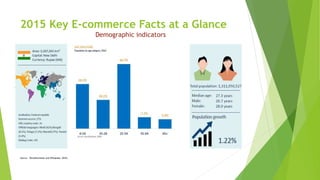
2015 Key E-commerce Facts at a Glance
Demographic indicators
Source – Worldfactbook and Wikipedia, 2016)
2015 Key E-commerce Facts at a Glance
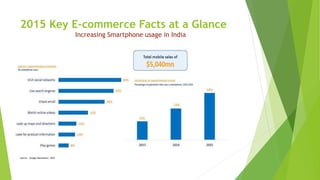
Increasing Smartphone usage in India
Source – Google Barometer, 2016
2015 Key E-commerce Facts at a Glance
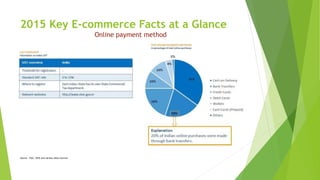
Online payment method
Source – PwC, 2016 and various other sources
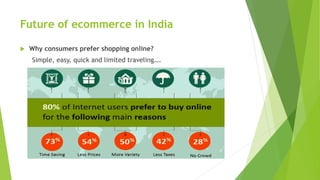
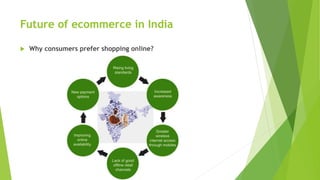
Future of ecommerce in India
 Why consumers prefer shopping online?
Simple, easy, quick and limited traveling….
Future of ecommerce in India
 Why consumers prefer shopping online?
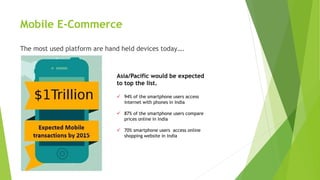
Mobile E-Commerce
The most used platform are hand held devices today….
Asia/Pacific would be expected
to top the list.
 94% of the smartphone users access
internet with phones in India
 87% of the smartphone users compare
prices online in India
 70% smartphone users access online
shopping website in India
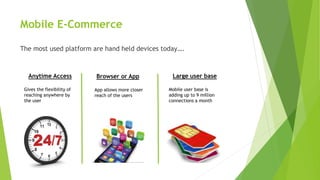
Mobile E-Commerce
The most used platform are hand held devices today….
Anytime Access
Gives the flexibility of
reaching anywhere by
the user
Browser or App
App allows more closer
reach of the users
Large user base
Mobile user base is
adding up to 9 million
connections a month
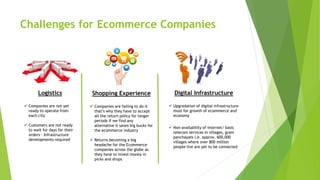
Challenges for Ecommerce Companies
Logistics
 Companies are not yet
ready to operate from
each city
 Customers are not ready
to wait for days for their
orders – Infrastructure
developments required
Shopping Experience
 Companies are failing to do it
that’s why they have to accept
all the return policy for longer
periods if we find any
alternative it saves big bucks for
the ecommerce industry
 Returns becoming a big
headache for the Ecommerce
companies across the globe as
they have to invest money in
picks and drops
Digital Infrastructure
 Upgradation of digital infrastructure
must for growth of ecommerce and
economy
 Non-availability of internet/ basic
telecom services in villages, gram
panchayats i.e. approx. 600,000
villages where over 800 million
people live are yet to be connected
Challenges for Ecommerce Companies
Making Profits …
Ecommerce business takes at least 6 to 8 years to yield profits
Companies are growing only by increasing their market share &
market value but not by returning profits!!
Challenges for Ecommerce Companies
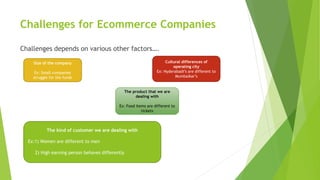
Challenges depends on various other factors….
Size of the company
Ex: Small companies
struggle for the funds
Cultural differences of
operating city
Ex: Hyderabadi’s are different to
Mumbaikar’s
The kind of customer we are dealing with
Ex:1) Women are different to men
2) High earning person behaves differently
The product that we are
dealing with
Ex: Food items are different to
tickets
157227

157227

  • 1.
    Kishan Jalan HPGD/AP15/2972 E-Commerce Activities, Goals,Technical Aspects (An overview) WELINGKAR INSTITUTE OF MANAGEMENT DEVELOPMENT AND RESEARCH Year of Submission :: January 2017
  • 2.
    What is Ecommerce Electroniccommerce, commonly known as e-commerce, is a type of industry where the buying and selling of products or services is conducted over electronic systems such as the Internet and other computer networks. Electronic commerce draws on technologies such as mobile commerce, electronic funds transfer, supply chain management, Internet marketing, online transaction processing, electronic data interchange (EDI), inventory management systems, and automated data collection systems. Modern electronic commerce typically uses the World Wide Web at least at one point in the transaction's life-cycle, although it may encompass a wider range of technologies such as e-mail, mobile devices social media, and telephones as well.
  • 3.
    How do Ecommercewebsites work
  • 4.
    Types of Ecommerce B2B (Business-to-Business) Companies doing business with each other such as manufacturers selling to distributors and wholesalers selling to retailers. Pricing is based on quantity of order and is often negotiable. E.g. Indiamart.com, Indiabizclub.com
  • 5.
    Types of Ecommerce B2C (Business-to-Consumer) Businesses selling to the general public typically through catalogs utilizing shopping cart software. By dollar volume, B2B takes the prize, however B2C is really what the average Joe has in mind with regards to ecommerce as a whole. E.g. Flipkart.com, Snapdeal.com
  • 6.
    Types of Ecommerce C2B (Consumer-to-Business) A consumer posts his project with a set budget online and within hours companies review the consumer's requirements and bid on the project. The consumer reviews the bids and selects the company that will complete the project. Upwork empowers consumers around the world by providing the meeting ground and platform for such transactions. E.g. Upwork.com
  • 7.
    Types of Ecommerce C2C (Consumer-to-Consumer) There are many sites offering free classifieds, auctions, and forums where individuals can buy and sell thanks to online payment systems like PayPal where people can send and receive money online with ease. eBay's auction service is a great example of where person-to-person transactions take place everyday since 1995. E.g. Olx.com, Quikr.com
  • 8.
    2015 Key E-commerceFacts at a Glance Source – Ecommerce foundation (India e-commerce report) 2015 Key E-commerce Facts at a Glance View from TOP
  • 9.
    2015 Key E-commerceFacts at a Glance Demographic indicators Source – Worldfactbook and Wikipedia, 2016)
  • 10.
    2015 Key E-commerceFacts at a Glance Increasing Smartphone usage in India Source – Google Barometer, 2016
  • 11.
    2015 Key E-commerceFacts at a Glance Online payment method Source – PwC, 2016 and various other sources
  • 12.
    Future of ecommercein India  Why consumers prefer shopping online? Simple, easy, quick and limited traveling….
  • 13.
    Future of ecommercein India  Why consumers prefer shopping online?
  • 14.
    Mobile E-Commerce The mostused platform are hand held devices today…. Asia/Pacific would be expected to top the list.  94% of the smartphone users access internet with phones in India  87% of the smartphone users compare prices online in India  70% smartphone users access online shopping website in India
  • 15.
    Mobile E-Commerce The mostused platform are hand held devices today…. Anytime Access Gives the flexibility of reaching anywhere by the user Browser or App App allows more closer reach of the users Large user base Mobile user base is adding up to 9 million connections a month
  • 16.
    Challenges for EcommerceCompanies Logistics  Companies are not yet ready to operate from each city  Customers are not ready to wait for days for their orders – Infrastructure developments required Shopping Experience  Companies are failing to do it that’s why they have to accept all the return policy for longer periods if we find any alternative it saves big bucks for the ecommerce industry  Returns becoming a big headache for the Ecommerce companies across the globe as they have to invest money in picks and drops Digital Infrastructure  Upgradation of digital infrastructure must for growth of ecommerce and economy  Non-availability of internet/ basic telecom services in villages, gram panchayats i.e. approx. 600,000 villages where over 800 million people live are yet to be connected
  • 17.
    Challenges for EcommerceCompanies Making Profits … Ecommerce business takes at least 6 to 8 years to yield profits Companies are growing only by increasing their market share & market value but not by returning profits!!
  • 18.
    Challenges for EcommerceCompanies Challenges depends on various other factors…. Size of the company Ex: Small companies struggle for the funds Cultural differences of operating city Ex: Hyderabadi’s are different to Mumbaikar’s The kind of customer we are dealing with Ex:1) Women are different to men 2) High earning person behaves differently The product that we are dealing with Ex: Food items are different to tickets