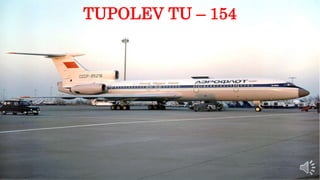
TUPOLEV TU – 154
INTRODUCTION
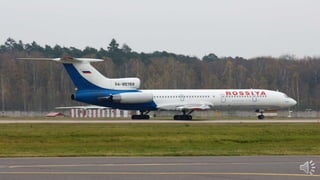
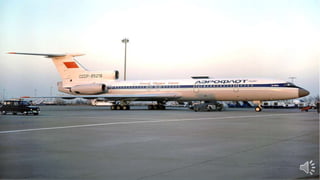
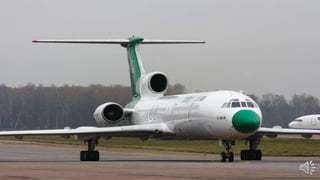
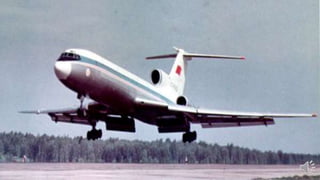
• The Tupolev Tu-154 is a three-engine medium-range narrow-body airliner
designed in the mid-1960s and manufactured by Tupolev.
• A workhorse of Soviet and (subsequently) Russian airlines for several decades, it
carried half of all passengers flown by Aeroflot and its subsidiaries remaining the
standard domestic-route airliner of Russia and former Soviet states until the
mid-2000s.
• It was exported to 17 non-Russian airlines and used as head-of-state transport by
the air forces of several countries.
DEVELOPMENT
• The Tu-154 was developed to meet Aeroflot's requirement to replace the jet-
powered Tu-104, the Antonov An-10 'Ukraine' and the Ilyushin Il-18 turboprops.
• The requirements called for either a payload capacity of 16–18 tonnes with a
range of 2,850–4,000 kilometres (1,770–2,490 mi) while cruising at 900 km/h (560
mph), or a payload of 5.8 tonnes with a range of 5,800–7,000 kilometres (3,600–
4,300 mi) while cruising at 850 km/h (530 mph).
• A take-off distance of 2,600 metres (8,500 ft) at maximum take-off weight was
also stipulated as a requirement.
• The Soviet Ministry of Aircraft Industry chose the Tu-154 as it incorporated the
latest in Soviet aircraft design and best met Aeroflot's anticipated requirements
for the 1970s and 1980s.
DESIGN
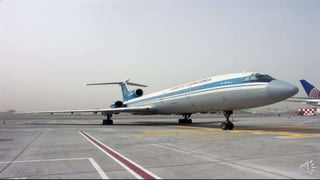
• The Tu-154 is powered by three rear-mounted low-bypass turbofan engines arranged similarly to
those of the Boeing 727, but it is slightly larger than its American counterpart.
• All Tu-154 aircraft models have a relatively high thrust-to-weight-ratio which gave excellent
performance, at the expense of poorer fuel efficiency.
• The cabin of the Tu-154, although of the same six-abreast seating layout, gives the impression of
an oval interior, with a lower ceiling than is common on Boeing and Airbus airliners.
• The passenger cabin accommodates 128 passengers in a two-class layout and 164 passengers in
single-class layout, and up to 180 passengers in high-density layout.
• The layout can be modified to what is called a winter version where some seats are taken out
and a wardrobe is installed for passenger coats.
• The passenger doors are smaller than on its Boeing and Airbus counterparts. Luggage space in
the overhead compartments is very limited.
CONTD…
• The latest variant includes an NVU-B3 Doppler navigation system, a triple
autopilot, which provides an automatic ILS approach according to ICAO
category II weather minima, an autothrottle, a Doppler drift and speed measure
system (DISS), "Kurs-MP" radio navigation suite and others.
• A stability and control augmentation system improves handling characteristics
during manual flight.
• Modern upgrades normally include a TCAS, GPS and other modern systems,
mostly American or EU-made.
• Early versions of the Tu-154 cannot be modified to meet the current Stage III
noise regulations and are banned from flying where those regulations are in
force, such as Europe.
SPECIFICATIONS
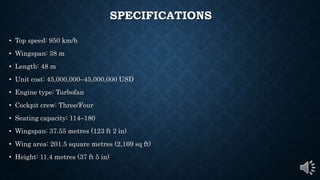
• Top speed: 950 km/h
• Wingspan: 38 m
• Length: 48 m
• Unit cost: 45,000,000–45,000,000 USD
• Engine type: Turbofan
• Cockpit crew: Three/Four
• Seating capacity: 114–180
• Wingspan: 37.55 metres (123 ft 2 in)
• Wing area: 201.5 square metres (2,169 sq ft)
• Height: 11.4 metres (37 ft 5 in)
REFERENCES
• http://en.wikipedia.org/wiki/Tupolev_Tu-154
• http://upload.wikimedia.org/wikipedia/commons/1/1c/Aeroflot_Tupolev_Tu-154_-
_CCCP-85219.jpg
• http://www.avsim.com/pages/1004/tu154/Tu-154_000_013.jpg
• http://upload.wikimedia.org/wikipedia/commons/9/96/Turan_Air_Tu-154.jpg
• http://cdn-www.airliners.net/aviation-photos/photos/4/3/9/1203934.jpg
THANK YOU

Russian TUPOLEV TU - 154

  • 1.
  • 2.
    INTRODUCTION • The TupolevTu-154 is a three-engine medium-range narrow-body airliner designed in the mid-1960s and manufactured by Tupolev. • A workhorse of Soviet and (subsequently) Russian airlines for several decades, it carried half of all passengers flown by Aeroflot and its subsidiaries remaining the standard domestic-route airliner of Russia and former Soviet states until the mid-2000s. • It was exported to 17 non-Russian airlines and used as head-of-state transport by the air forces of several countries.
  • 4.
    DEVELOPMENT • The Tu-154was developed to meet Aeroflot's requirement to replace the jet- powered Tu-104, the Antonov An-10 'Ukraine' and the Ilyushin Il-18 turboprops. • The requirements called for either a payload capacity of 16–18 tonnes with a range of 2,850–4,000 kilometres (1,770–2,490 mi) while cruising at 900 km/h (560 mph), or a payload of 5.8 tonnes with a range of 5,800–7,000 kilometres (3,600– 4,300 mi) while cruising at 850 km/h (530 mph). • A take-off distance of 2,600 metres (8,500 ft) at maximum take-off weight was also stipulated as a requirement. • The Soviet Ministry of Aircraft Industry chose the Tu-154 as it incorporated the latest in Soviet aircraft design and best met Aeroflot's anticipated requirements for the 1970s and 1980s.
  • 6.
    DESIGN • The Tu-154is powered by three rear-mounted low-bypass turbofan engines arranged similarly to those of the Boeing 727, but it is slightly larger than its American counterpart. • All Tu-154 aircraft models have a relatively high thrust-to-weight-ratio which gave excellent performance, at the expense of poorer fuel efficiency. • The cabin of the Tu-154, although of the same six-abreast seating layout, gives the impression of an oval interior, with a lower ceiling than is common on Boeing and Airbus airliners. • The passenger cabin accommodates 128 passengers in a two-class layout and 164 passengers in single-class layout, and up to 180 passengers in high-density layout. • The layout can be modified to what is called a winter version where some seats are taken out and a wardrobe is installed for passenger coats. • The passenger doors are smaller than on its Boeing and Airbus counterparts. Luggage space in the overhead compartments is very limited.
  • 8.
    CONTD… • The latestvariant includes an NVU-B3 Doppler navigation system, a triple autopilot, which provides an automatic ILS approach according to ICAO category II weather minima, an autothrottle, a Doppler drift and speed measure system (DISS), "Kurs-MP" radio navigation suite and others. • A stability and control augmentation system improves handling characteristics during manual flight. • Modern upgrades normally include a TCAS, GPS and other modern systems, mostly American or EU-made. • Early versions of the Tu-154 cannot be modified to meet the current Stage III noise regulations and are banned from flying where those regulations are in force, such as Europe.
  • 10.
    SPECIFICATIONS • Top speed:950 km/h • Wingspan: 38 m • Length: 48 m • Unit cost: 45,000,000–45,000,000 USD • Engine type: Turbofan • Cockpit crew: Three/Four • Seating capacity: 114–180 • Wingspan: 37.55 metres (123 ft 2 in) • Wing area: 201.5 square metres (2,169 sq ft) • Height: 11.4 metres (37 ft 5 in)
  • 12.
    REFERENCES • http://en.wikipedia.org/wiki/Tupolev_Tu-154 • http://upload.wikimedia.org/wikipedia/commons/1/1c/Aeroflot_Tupolev_Tu-154_- _CCCP-85219.jpg •http://www.avsim.com/pages/1004/tu154/Tu-154_000_013.jpg • http://upload.wikimedia.org/wikipedia/commons/9/96/Turan_Air_Tu-154.jpg • http://cdn-www.airliners.net/aviation-photos/photos/4/3/9/1203934.jpg
  • 13.