International Journal of Advance Research in Engineering, Science & Technology(IJAREST),
ISSN(O):2393-9877, ISSN(P): 2394-2444,
Volume 2,Issue 5, May- 2015, Impact Factor:2.125
All Rights Reserved, @IJAREST-2015
1
Phase-Shifting Transformer
Anuj Patel, Henil Patel, Ruchi Joshi, Milap Patel
anujpatel0311@gmail.com, henil.patel003@gmail.com
ruchijoshi2014@gmail.com, milap786@gmail.com
Abstract
In this paper Phase-shifting transformer is discussed Using appropriate connection of transformer. Phase-shifting will be reviewed
as one concept for solving certain types of problems related to power quality. A phase-shifting transformer is a special type of system
intertie transformers which Control the power flow through specific lines in a complex power transmission network by providing the
possibility to insert a voltage with an arbitrary phase angle in the power system. Phase-shifting involves separating the electrical
supply into two or more outputs; each output being phase shifted with respect to each other with an appropriate angle for the
harmonic pairs to be eliminated.
KEYWORDS- Phase-shifting Transformer,
INTRODUCTION
This Special transformer is a Phase-shifting transformer
which is an indispensable device in multi-pulse diode
rectifier. Phase-shifting transformers help control the real
power flow in transmission lines and systems interties. They
allow for better utilization of existing networks concerning
load growths.This special transformer is a phase shifting
transformer which is an indispensable device in multiple diode
rectifier.
It provides three main functions:
 A required phase displacement between primary and
secondary line-line voltage for harmonic cancellation.
 A proper secondary voltage.
 An electrical isolation between the rectifier and the utility
supply.
According to the winding arrangements, the
transformer can be classified into:
 Y/Z
 Δ/Z
The application of phase shifting transformers is mainly in
high voltage systems (up to 420 KV) and the throughput
power rating is quite large (up to 1630 MVA).
PURPOSES OF PHASE-SHIFTING TRANSFORMER:
 To control the power flow between two large independent
power systems
 To change the effective phase displacement between the
input voltage and the output voltage of a transmission
line, thus controlling the amount of active power that can
flow in the line.
 To balance the loading when power systems are
connected together in more than one point so that loops
exist and the impedances in parallel paths results in
undesired distribution of power flow in the paths.
International Journal of Advance Research in Engineering, Science & Technology(IJAREST),
ISSN(O):2393-9877, ISSN(P): 2394-2444,
Volume 2,Issue 5, May- 2015, Impact Factor:2.125
All Rights Reserved, @IJAREST-2015
2
 To Protect from thermal overload and to improve
transmission system stability.
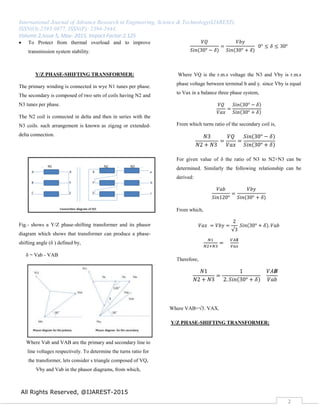
Y/Z PHASE-SHIFTING TRANSFORMER:
The primary winding is connected in wye N1 tunes per phase.
The secondary is composed of two sets of coils having N2 and
N3 tunes per phase.
The N2 coil is connected in delta and then in series with the
N3 coils. such arrangement is known as zigzag or extended-
delta connection.
Fig.- shows a Y/Z phase-shifting transformer and its phasor
diagram which shows that transformer can produce a phase-
shifting angle (δ ) defined by,
δ = Vab - VAB
Where Vab and VAB are the primary and secondary line to
line voltages respectively. To determine the turns ratio for
the transformer, lets consider s triangle composed of VQ,
Vby and Vab in the phasor diagrams, from which,
Where VQ is the r.m.s voltage the N3 and Vby is r.m.s
phase voltage between terminal b and y. since Vby is equal
to Vax in a balance three phase system,
From which turns ratio of the secondary coil is,
For given value of δ the ratio of N3 to N2+N3 can be
determined. Similarly the following relationship can be
derived:
From which,
Therefore,
Where VAB=√3. VAX.
Y/Z PHASE-SHIFTING TRANSFORMER:
International Journal of Advance Research in Engineering, Science & Technology(IJAREST),
ISSN(O):2393-9877, ISSN(P): 2394-2444,
Volume 2,Issue 5, May- 2015, Impact Factor:2.125
All Rights Reserved, @IJAREST-2015
3
The transformer turns ratio can be found from,
The phase angle δ has a negative value for the Y/Z
transformer that Vab lags VAB by δ as shown in fig.-
This way we will get required phase displacement in output
and all four different outputs which are displaced are as
follows:
PHASE-SHIFTING TRANSFORMER PROTECTIONS:
 The over voltage protection must be reviewed with the
manufacturers to minimize the effects of transient
voltages which can occur at the transformers windings
resulting in a high voltages and high frequencies
oscillations.
 A special differential protection scheme is required
because the phase angle difference between the source
and load current cause a much higher normal current
difference than in ordinary power transformers.
 Because of harmful short circuit can occur in the
connection between the two transformers, it is
recommended that the bus ducts to be provided around
the conductors connecting the secondary side of the
magnetizing transformer to the primary side of the
booster transformer.
CONCLUSION:
This paper presents a three-phase 18-pulse phase-controlled
rectifier with unity displacement factor, low line current
harmonic content, two quadrant operation and the absence of a
phase shifting transformer. The circuit is composed by three
three-phase 6-pulse rectifiers parallel connected by four
balancing reactors. One is a conventional thyristor rectifier
with a lag firing angle (δ). The other is an active rectifier
composed by GTOs or IGBTs and diodes, operating with a
International Journal of Advance Research in Engineering, Science & Technology(IJAREST),
ISSN(O):2393-9877, ISSN(P): 2394-2444,
Volume 2,Issue 5, May- 2015, Impact Factor:2.125
All Rights Reserved, @IJAREST-2015
4
lead (and symmetrical) firing angle (-δ). The 8-pulse
operation with line frequency modulation provides a line
current with reduction or cancellation of certain harmonics.
Circuit operation, theoretical analysis, key equations are
presented.
REFERENCES:
 R. K. Tiwari, J. S. Kuntia, and S. Sachdeva, “Development
of Phase Shifting Transformers” Presented in
International Conference on transformers-2009 held by
CBIP in New Delhi, India.
 J. Verboomen, D. V. Herten, W. L. Kling, and R. Belmans,
“Phase shifting transformers: Principles and applications,”
Future Power System, International Conference on, 2005.
 W. L. Kling et al, “Phase shifting transformers installed in
the Netherlands in order to increase available
international transmission capacity,” in CIGRE Session
2004 – C2-207, 2004.
 Phase Shifting Transformers: Principles and
Applications(Book by John Winders, CRC Press, Apr 12,
2002

150513095337

  • 1.
    International Journal ofAdvance Research in Engineering, Science & Technology(IJAREST), ISSN(O):2393-9877, ISSN(P): 2394-2444, Volume 2,Issue 5, May- 2015, Impact Factor:2.125 All Rights Reserved, @IJAREST-2015 1 Phase-Shifting Transformer Anuj Patel, Henil Patel, Ruchi Joshi, Milap Patel anujpatel0311@gmail.com, henil.patel003@gmail.com ruchijoshi2014@gmail.com, milap786@gmail.com Abstract In this paper Phase-shifting transformer is discussed Using appropriate connection of transformer. Phase-shifting will be reviewed as one concept for solving certain types of problems related to power quality. A phase-shifting transformer is a special type of system intertie transformers which Control the power flow through specific lines in a complex power transmission network by providing the possibility to insert a voltage with an arbitrary phase angle in the power system. Phase-shifting involves separating the electrical supply into two or more outputs; each output being phase shifted with respect to each other with an appropriate angle for the harmonic pairs to be eliminated. KEYWORDS- Phase-shifting Transformer, INTRODUCTION This Special transformer is a Phase-shifting transformer which is an indispensable device in multi-pulse diode rectifier. Phase-shifting transformers help control the real power flow in transmission lines and systems interties. They allow for better utilization of existing networks concerning load growths.This special transformer is a phase shifting transformer which is an indispensable device in multiple diode rectifier. It provides three main functions:  A required phase displacement between primary and secondary line-line voltage for harmonic cancellation.  A proper secondary voltage.  An electrical isolation between the rectifier and the utility supply. According to the winding arrangements, the transformer can be classified into:  Y/Z  Δ/Z The application of phase shifting transformers is mainly in high voltage systems (up to 420 KV) and the throughput power rating is quite large (up to 1630 MVA). PURPOSES OF PHASE-SHIFTING TRANSFORMER:  To control the power flow between two large independent power systems  To change the effective phase displacement between the input voltage and the output voltage of a transmission line, thus controlling the amount of active power that can flow in the line.  To balance the loading when power systems are connected together in more than one point so that loops exist and the impedances in parallel paths results in undesired distribution of power flow in the paths.
  • 2.
    International Journal ofAdvance Research in Engineering, Science & Technology(IJAREST), ISSN(O):2393-9877, ISSN(P): 2394-2444, Volume 2,Issue 5, May- 2015, Impact Factor:2.125 All Rights Reserved, @IJAREST-2015 2  To Protect from thermal overload and to improve transmission system stability. Y/Z PHASE-SHIFTING TRANSFORMER: The primary winding is connected in wye N1 tunes per phase. The secondary is composed of two sets of coils having N2 and N3 tunes per phase. The N2 coil is connected in delta and then in series with the N3 coils. such arrangement is known as zigzag or extended- delta connection. Fig.- shows a Y/Z phase-shifting transformer and its phasor diagram which shows that transformer can produce a phase- shifting angle (δ ) defined by, δ = Vab - VAB Where Vab and VAB are the primary and secondary line to line voltages respectively. To determine the turns ratio for the transformer, lets consider s triangle composed of VQ, Vby and Vab in the phasor diagrams, from which, Where VQ is the r.m.s voltage the N3 and Vby is r.m.s phase voltage between terminal b and y. since Vby is equal to Vax in a balance three phase system, From which turns ratio of the secondary coil is, For given value of δ the ratio of N3 to N2+N3 can be determined. Similarly the following relationship can be derived: From which, Therefore, Where VAB=√3. VAX. Y/Z PHASE-SHIFTING TRANSFORMER:
  • 3.
    International Journal ofAdvance Research in Engineering, Science & Technology(IJAREST), ISSN(O):2393-9877, ISSN(P): 2394-2444, Volume 2,Issue 5, May- 2015, Impact Factor:2.125 All Rights Reserved, @IJAREST-2015 3 The transformer turns ratio can be found from, The phase angle δ has a negative value for the Y/Z transformer that Vab lags VAB by δ as shown in fig.- This way we will get required phase displacement in output and all four different outputs which are displaced are as follows: PHASE-SHIFTING TRANSFORMER PROTECTIONS:  The over voltage protection must be reviewed with the manufacturers to minimize the effects of transient voltages which can occur at the transformers windings resulting in a high voltages and high frequencies oscillations.  A special differential protection scheme is required because the phase angle difference between the source and load current cause a much higher normal current difference than in ordinary power transformers.  Because of harmful short circuit can occur in the connection between the two transformers, it is recommended that the bus ducts to be provided around the conductors connecting the secondary side of the magnetizing transformer to the primary side of the booster transformer. CONCLUSION: This paper presents a three-phase 18-pulse phase-controlled rectifier with unity displacement factor, low line current harmonic content, two quadrant operation and the absence of a phase shifting transformer. The circuit is composed by three three-phase 6-pulse rectifiers parallel connected by four balancing reactors. One is a conventional thyristor rectifier with a lag firing angle (δ). The other is an active rectifier composed by GTOs or IGBTs and diodes, operating with a
  • 4.
    International Journal ofAdvance Research in Engineering, Science & Technology(IJAREST), ISSN(O):2393-9877, ISSN(P): 2394-2444, Volume 2,Issue 5, May- 2015, Impact Factor:2.125 All Rights Reserved, @IJAREST-2015 4 lead (and symmetrical) firing angle (-δ). The 8-pulse operation with line frequency modulation provides a line current with reduction or cancellation of certain harmonics. Circuit operation, theoretical analysis, key equations are presented. REFERENCES:  R. K. Tiwari, J. S. Kuntia, and S. Sachdeva, “Development of Phase Shifting Transformers” Presented in International Conference on transformers-2009 held by CBIP in New Delhi, India.  J. Verboomen, D. V. Herten, W. L. Kling, and R. Belmans, “Phase shifting transformers: Principles and applications,” Future Power System, International Conference on, 2005.  W. L. Kling et al, “Phase shifting transformers installed in the Netherlands in order to increase available international transmission capacity,” in CIGRE Session 2004 – C2-207, 2004.  Phase Shifting Transformers: Principles and Applications(Book by John Winders, CRC Press, Apr 12, 2002