STRUVIA™
Sustainable recycling of phosphorus
from wastewater
WATER TECHNOLOGIES
Sustainable recycling of phosphorus:
The stakes
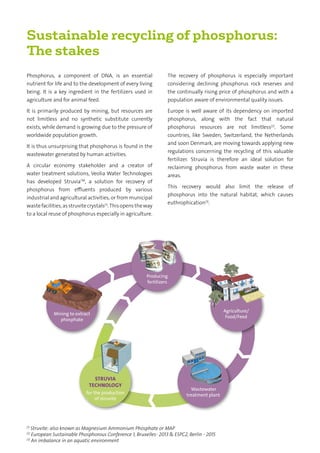
Phosphorus, a component of DNA, is an essential
nutrient for life and to the development of every living
being. It is a key ingredient in the fertilizers used in
agriculture and for animal feed.
It is primarily produced by mining, but resources are
not limitless and no synthetic substitute currently
exists, while demand is growing due to the pressure of
worldwide population growth.
It is thus unsurprising that phosphorus is found in the
wastewater generated by human activities.
A circular economy stakeholder and a creator of
water treatment solutions, Veolia Water Technologies
has developed StruviaTM
, a solution for recovery of
phosphorus from effluents produced by various
industrial and agricultural activities, or from municipal
wastefacilities,asstruvitecrystals(1)
.Thisopenstheway
to a local reuse of phosphorus especially in agriculture.
The recovery of phosphorus is especially important
considering declining phosphorus rock reserves and
the continually rising price of phosphorus and with a
population aware of environmental quality issues.
Europe is well aware of its dependency on imported
phosphorus, along with the fact that natural
phosphorus resources are not limitless(2)
. Some
countries, like Sweden, Switzerland, the Netherlands
and soon Denmark, are moving towards applying new
regulations concerning the recycling of this valuable
fertilizer. Struvia is therefore an ideal solution for
reclaiming phosphorus from waste water in these
areas.
This recovery would also limit the release of
phosphorus into the natural habitat, which causes
euthrophication(3)
.
Producing
fertilizers
STRUVIA
TECHNOLOGY
for the production
of struvite
Agriculture/
Food/Feed
Wastewater
treatment plant
Mining to extract
phosphate
(1)
Struvite: also known as Magnesium Ammonium Phosphate or MAP
(2)
European Sustainable Phosphorous Conference 1, Bruxelles- 2013 & ESPC2, Berlin - 2015
(3)
An imbalance in an aquatic environment
Operating principle
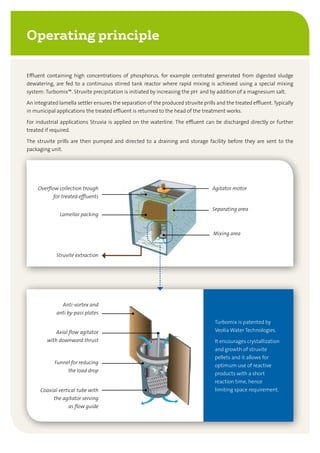
Effluent containing high concentrations of phosphorus, for example centrated generated from digested sludge
dewatering, are fed to a continuous stirred tank reactor where rapid mixing is achieved using a special mixing
system: Turbomix™. Struvite precipitation is initiated by increasing the pH and by addition of a magnesium salt.
An integrated lamella settler ensures the separation of the produced struvite prills and the treated effluent. Typically
in municipal applications the treated effluent is returned to the head of the treatment works.
For industrial applications Struvia is applied on the waterline. The effluent can be discharged directly or further
treated if required.
The struvite prills are then pumped and directed to a draining and storage facility before they are sent to the
packaging unit.
Separating area
Mixing area
Agitator motor
Lamellar packing
Struvite extraction
Overflow collection trough
for treated effluents
Axial flow agitator
with downward thrust
Anti-vortex and
anti by-pass plates
Funnel for reducing
the load drop
Coaxial vertical tube with
the agitator serving
as flow guide
Turbomix is patented by
Veolia Water Technologies.
It encourages crystallization
and growth of struvite
pellets and it allows for
optimum use of reactive
products with a short
reaction time, hence
limiting space requirement.
The advantages of the Struvia solution
Recovering phosphorus contained in wastewater leading to:
•	 A reduction in the production of sludge
•	 The production of sludge with a reduced phosphorus content
(ideal for areas that are saturated in phosphorus and threatened by
eutrophication)
Reduced operating costs for existing facilities
•	 Struvia prevent dysfonctions, over-costs and unplanned operation
downtime caused by uncontrolled struvite precipitation that clogs
pipes
•	 Struvite production reduces the need to inject precipitation triggering
reactive products like iron or aluminum salts into the waste water
treatment process.
An ideal solution for treating phosphorus laden effluents
•	 Limited space requirements
- a single reactor with integrated lamella settler
- no loop or recirculation pump
•	 Reduced maintenance
•	 Low investment and operating costs (combined with sales of struvite
produced)
THE FUTURE USES OF THE PRODUCT
> In a circular economy approach, the customer (whether a municipal
authority or an industrial operator) can decide to recycle struvite by
incorporating it into fertilizer. The customer can choose to handle this
reusedirectlyorentrustittoanoperatorlikeVeolia,throughitsspecialized
subsidiaries.
> With a view to involving local players and the population in sustainable
development in their local area, the municipal authorities may choose to
make the recovered struvite freely available.
P-REX, BRUSSELS-NORTH WWTP - A FIRST CONCLUSIVE PROJECT
A Struvia prototype unit was successfully implemented for the first time
at the Brussels-North waste water treatment plant in 2013 and 2014, as
part of the P-Rex program (this is a European program for the reuse of
phosphorus from waste water). It has reached P-PO4 phosphorus removal
efficiency levels higher than 85 % when treating centrate generated from
digested sludge dewatering as well as validating the potential of the
technology.
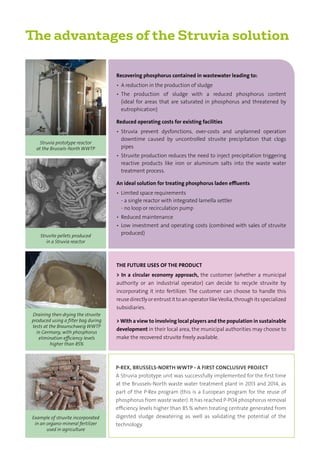
Struvia prototype reactor
at the Brussels-North WWTP
Struvite pellets produced
in a Struvia reactor
Draining then drying the struvite
produced using a filter bag during
tests at the Braunschweig WWTP
in Germany, with phosphorus
elimination efficiency levels
higher than 85%
Example of struvite incorporated
in an organo-mineral fertilizer
used in agriculture
The Struvia solution
The Struvia technology has been developed by Veolia Water Technologies to facilitate the recovery and reuse of
phosphorus. This allows municipal and industrial clients to turn a cost (purchase of metal salts and sludge disposal),
into a benefit (sale of struvite as a fertilizer).
Struvia is adapted to all circular economy and sustainable development projects.
MUNICIPAL
Struvia is of interest to public authorities and
municipal installation operators:
At the treatment plants that handle residual
municipal water and are equipped with
biological phosphorus treatment followed
by anaerobic sludge digestion, dewatering
stage centrates contain highly concentrated
phosphate that may uncontrollably precipitate
as struvite crystals. The Struvia solution ensures
controlled struvite precipitation in a specialized
reactor. The product can then be packaged and
sold. Struvite represents an ideal solution to the
need for slow release ammonium phosphate.
APPLICATIONS
•	 Wastewater treatment plants equipped with
digesters
•	 Water treatment plants equipped with
biological dephopsphatation wishing to
install sludge digestion
•	 Water treatment plants equipped with
anaerobic digestion wishing to install
biological phosphorus treatment
•	 Household waste methanization plants
•	 Territorial methanization sites
INDUSTRIAL
Struvia is also of interest to industrial and
agricultural operators:
At industrial facilities, the naturally high
phosphate concentration of a number of
effluents means that the Struvia solution can
be applied directly on the water line.
For industrial effluents that are treated by
methanization (UASB, EGSB, Memthane),
the ideal location for the Struvia reactor is
downstream to the anaerobic treatment and
upstream to the biological nitrogen using Nitri-
fication-Denitrification or with an Anita™ Mox
type deammonification process, for example.
APPLICATIONS
•	 In agriculture for treating livestock effluents
•	 In the Food & Beverage industry, in distilleries,
dairies, breweries, slaughterhouses, potato
processing and where fermentation effluents
are treated to be reclaimed
•	 In agrichemicals, in producing fertilizers and
biofuels
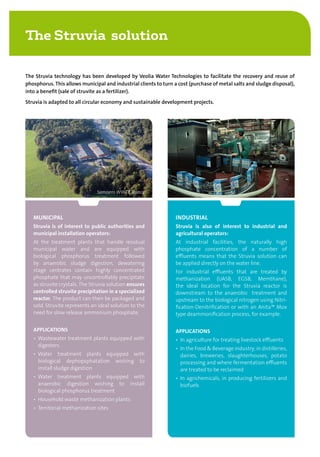
SamoensWWTP, France
VeoliaWaterTechnologiesCommunications-10/2015(150354)-Photocredits:VeoliaPhotoLibrary
Veolia Water Technologies
L’Aquarène • 1 place Montgolfier • 94417 Saint-Maurice Cedex • France
tel. +33 (0)1 45 11 55 55 - fax +33 (0)1 45 11 55 50
www.veoliawatertechnologies.com

150354_Mkt_Mun_Brochure_STRUVIA_EN_LR (1)

  • 1.
    STRUVIA™ Sustainable recycling ofphosphorus from wastewater WATER TECHNOLOGIES
  • 2.
    Sustainable recycling ofphosphorus: The stakes Phosphorus, a component of DNA, is an essential nutrient for life and to the development of every living being. It is a key ingredient in the fertilizers used in agriculture and for animal feed. It is primarily produced by mining, but resources are not limitless and no synthetic substitute currently exists, while demand is growing due to the pressure of worldwide population growth. It is thus unsurprising that phosphorus is found in the wastewater generated by human activities. A circular economy stakeholder and a creator of water treatment solutions, Veolia Water Technologies has developed StruviaTM , a solution for recovery of phosphorus from effluents produced by various industrial and agricultural activities, or from municipal wastefacilities,asstruvitecrystals(1) .Thisopenstheway to a local reuse of phosphorus especially in agriculture. The recovery of phosphorus is especially important considering declining phosphorus rock reserves and the continually rising price of phosphorus and with a population aware of environmental quality issues. Europe is well aware of its dependency on imported phosphorus, along with the fact that natural phosphorus resources are not limitless(2) . Some countries, like Sweden, Switzerland, the Netherlands and soon Denmark, are moving towards applying new regulations concerning the recycling of this valuable fertilizer. Struvia is therefore an ideal solution for reclaiming phosphorus from waste water in these areas. This recovery would also limit the release of phosphorus into the natural habitat, which causes euthrophication(3) . Producing fertilizers STRUVIA TECHNOLOGY for the production of struvite Agriculture/ Food/Feed Wastewater treatment plant Mining to extract phosphate (1) Struvite: also known as Magnesium Ammonium Phosphate or MAP (2) European Sustainable Phosphorous Conference 1, Bruxelles- 2013 & ESPC2, Berlin - 2015 (3) An imbalance in an aquatic environment
  • 3.
    Operating principle Effluent containinghigh concentrations of phosphorus, for example centrated generated from digested sludge dewatering, are fed to a continuous stirred tank reactor where rapid mixing is achieved using a special mixing system: Turbomix™. Struvite precipitation is initiated by increasing the pH and by addition of a magnesium salt. An integrated lamella settler ensures the separation of the produced struvite prills and the treated effluent. Typically in municipal applications the treated effluent is returned to the head of the treatment works. For industrial applications Struvia is applied on the waterline. The effluent can be discharged directly or further treated if required. The struvite prills are then pumped and directed to a draining and storage facility before they are sent to the packaging unit. Separating area Mixing area Agitator motor Lamellar packing Struvite extraction Overflow collection trough for treated effluents Axial flow agitator with downward thrust Anti-vortex and anti by-pass plates Funnel for reducing the load drop Coaxial vertical tube with the agitator serving as flow guide Turbomix is patented by Veolia Water Technologies. It encourages crystallization and growth of struvite pellets and it allows for optimum use of reactive products with a short reaction time, hence limiting space requirement.
  • 4.
    The advantages ofthe Struvia solution Recovering phosphorus contained in wastewater leading to: • A reduction in the production of sludge • The production of sludge with a reduced phosphorus content (ideal for areas that are saturated in phosphorus and threatened by eutrophication) Reduced operating costs for existing facilities • Struvia prevent dysfonctions, over-costs and unplanned operation downtime caused by uncontrolled struvite precipitation that clogs pipes • Struvite production reduces the need to inject precipitation triggering reactive products like iron or aluminum salts into the waste water treatment process. An ideal solution for treating phosphorus laden effluents • Limited space requirements - a single reactor with integrated lamella settler - no loop or recirculation pump • Reduced maintenance • Low investment and operating costs (combined with sales of struvite produced) THE FUTURE USES OF THE PRODUCT > In a circular economy approach, the customer (whether a municipal authority or an industrial operator) can decide to recycle struvite by incorporating it into fertilizer. The customer can choose to handle this reusedirectlyorentrustittoanoperatorlikeVeolia,throughitsspecialized subsidiaries. > With a view to involving local players and the population in sustainable development in their local area, the municipal authorities may choose to make the recovered struvite freely available. P-REX, BRUSSELS-NORTH WWTP - A FIRST CONCLUSIVE PROJECT A Struvia prototype unit was successfully implemented for the first time at the Brussels-North waste water treatment plant in 2013 and 2014, as part of the P-Rex program (this is a European program for the reuse of phosphorus from waste water). It has reached P-PO4 phosphorus removal efficiency levels higher than 85 % when treating centrate generated from digested sludge dewatering as well as validating the potential of the technology. Struvia prototype reactor at the Brussels-North WWTP Struvite pellets produced in a Struvia reactor Draining then drying the struvite produced using a filter bag during tests at the Braunschweig WWTP in Germany, with phosphorus elimination efficiency levels higher than 85% Example of struvite incorporated in an organo-mineral fertilizer used in agriculture
  • 5.
    The Struvia solution TheStruvia technology has been developed by Veolia Water Technologies to facilitate the recovery and reuse of phosphorus. This allows municipal and industrial clients to turn a cost (purchase of metal salts and sludge disposal), into a benefit (sale of struvite as a fertilizer). Struvia is adapted to all circular economy and sustainable development projects. MUNICIPAL Struvia is of interest to public authorities and municipal installation operators: At the treatment plants that handle residual municipal water and are equipped with biological phosphorus treatment followed by anaerobic sludge digestion, dewatering stage centrates contain highly concentrated phosphate that may uncontrollably precipitate as struvite crystals. The Struvia solution ensures controlled struvite precipitation in a specialized reactor. The product can then be packaged and sold. Struvite represents an ideal solution to the need for slow release ammonium phosphate. APPLICATIONS • Wastewater treatment plants equipped with digesters • Water treatment plants equipped with biological dephopsphatation wishing to install sludge digestion • Water treatment plants equipped with anaerobic digestion wishing to install biological phosphorus treatment • Household waste methanization plants • Territorial methanization sites INDUSTRIAL Struvia is also of interest to industrial and agricultural operators: At industrial facilities, the naturally high phosphate concentration of a number of effluents means that the Struvia solution can be applied directly on the water line. For industrial effluents that are treated by methanization (UASB, EGSB, Memthane), the ideal location for the Struvia reactor is downstream to the anaerobic treatment and upstream to the biological nitrogen using Nitri- fication-Denitrification or with an Anita™ Mox type deammonification process, for example. APPLICATIONS • In agriculture for treating livestock effluents • In the Food & Beverage industry, in distilleries, dairies, breweries, slaughterhouses, potato processing and where fermentation effluents are treated to be reclaimed • In agrichemicals, in producing fertilizers and biofuels SamoensWWTP, France
  • 6.
    VeoliaWaterTechnologiesCommunications-10/2015(150354)-Photocredits:VeoliaPhotoLibrary Veolia Water Technologies L’Aquarène• 1 place Montgolfier • 94417 Saint-Maurice Cedex • France tel. +33 (0)1 45 11 55 55 - fax +33 (0)1 45 11 55 50 www.veoliawatertechnologies.com