points to look for in your enterprise
mobile application platform15
What are the multiple points of engagement
supported? (Cross platform support)
1
Traditionally, desktop applications and web applications are major points
of engagement.
With the explosive growth in smartphone adoption and usage,
smartphones have become key points of strategic engagement.
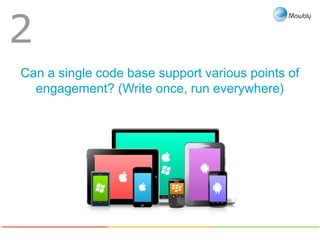
Can a single code base support various points of
engagement? (Write once, run everywhere)
2
Does it need an expansion in the IT team?
3
Enterprises have in-house IT teams which enable enterprise
technology support.
Specific mobile skills such as Android, iOS, etc. are needed for
mobile apps.
Does the IT team need to recruit members for specific skill
sets?
How much of present IT skill set can be used?
(Knowledge and training)
4
Enterprises have existing IT skill sets like rich web application skills.
These skill sets should be used for development of mobile apps without
spending too much time/effort on understanding new technology.
The platform should facilitate easy understanding and draw extensions
from existing IT skill set.
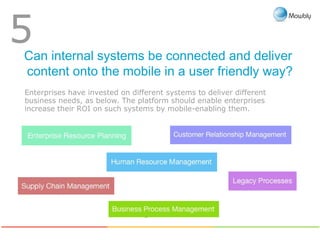
Can internal systems be connected and deliver
content onto the mobile in a user friendly way?
5
Enterprise Resource
Planning
Business Process
Management
Customer Relationship
Management
Legacy
processes
Human Resource
Management
Supply Chain
Management
Enterprises have invested on different systems to deliver different
business needs, as below. The platform should enable enterprises
increase their ROI on such systems by mobile-enabling them.
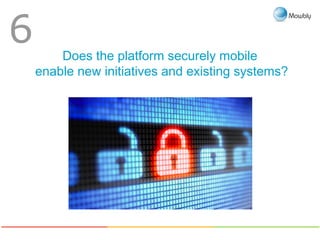
Does the platform securely mobile
enable new initiatives and existing systems?
6
Can the mobile data security be ensured
with operations such as remote wipes?
7
Enterprise data residing on a mobile app is physically out of reach from
the IT administrator.
The IT administrator should have the ability to remotely wipe enterprise
data the mobile app.
The platform should enable the IT administrator with advanced security
operations
Can the mobile apps be managed based
on users and policies?
8
Within enterprises, there are many people and multiple roles involved. Each
person/role have different business needs. The mobile app deployed to each
user is determined by the role/person. (For e.g. A Sales Manager is
different from a Project Engineer)
The IT Admin should be able to manage the control level of each app based
on certain policy requirements.
The platform should enable the enterprise to deploy apps based on user-
role relationship and manage them through policies.
Can the solution be installed on premise
or a private cloud?
9
Enterprises choose whether the platform should be hosted on premise, or
on a private cloud or on a public cloud.
The platform should provide enterprises with different deployment
strategies which suit the business and infrastructure needs of the
enterprise.
Can new initiatives be delivered
using the same platform?
10
Innovations in the enterprise directly translate into business scenarios that
need to be mobile-enabled.
The platform should facilitate new mobile initiatives for the enterprise easily.
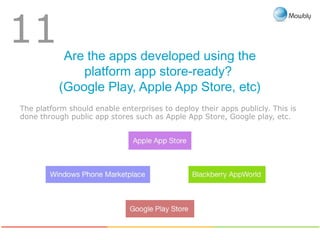
Are the apps developed using the
platform app store-ready?
(Google Play, Apple App Store, etc)
11
The platform should enable enterprises to deploy their apps publicly. This is
done through public app stores such as Apple App Store, Google play, etc.
Can apps be published through
a private enterprise app store?
12
Enterprises choose whether a mobile app should be made publicly available
or for internal teams only.
The platform should enable enterprises avoid the public app store approach
to deploy apps to their users.
Can multiple apps be deployed
through the platform?
13
Within an enterprise, there are multiple roles and people involved. Each
role/person have different business responsibilities.
The platform should provide easy modes to build, deploy and manage
multiple apps across users.
Can updates to apps be rolled out quickly?
14
As enterprises, changes to existing business scenarios happen very rapidly.
The platform should provide ways to update deployed apps without disturbing
the end user.
Can Enterprise Mobility initiatives
be monitored from a dashboard?
15
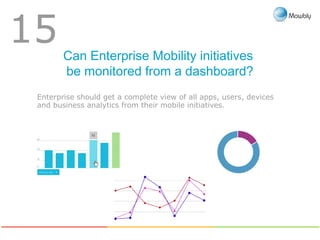
Enterprise should get a complete view of all apps, users, devices
and business analytics from their mobile initiatives.
Find out answers to these questions and more in our blog post
http://blog.cloudpact.com/2013/06/choosing-your-enterprise-mobile.html
Use it to accelerate decisions and execution in your Enterprise
mobility strategy.
Click link to view the original blog post
http://blog.cloudpact.com/2013/06/15-points-to-look-for-in-your.html
we add wings to your will

15 points to look for in your Enterprise Mobile Application Platform

  • 1.
    points to lookfor in your enterprise mobile application platform15
  • 2.
    What are themultiple points of engagement supported? (Cross platform support) 1 Traditionally, desktop applications and web applications are major points of engagement. With the explosive growth in smartphone adoption and usage, smartphones have become key points of strategic engagement.
  • 3.
    Can a singlecode base support various points of engagement? (Write once, run everywhere) 2
  • 4.
    Does it needan expansion in the IT team? 3 Enterprises have in-house IT teams which enable enterprise technology support. Specific mobile skills such as Android, iOS, etc. are needed for mobile apps. Does the IT team need to recruit members for specific skill sets?
  • 5.
    How much ofpresent IT skill set can be used? (Knowledge and training) 4 Enterprises have existing IT skill sets like rich web application skills. These skill sets should be used for development of mobile apps without spending too much time/effort on understanding new technology. The platform should facilitate easy understanding and draw extensions from existing IT skill set.
  • 6.
    Can internal systemsbe connected and deliver content onto the mobile in a user friendly way? 5 Enterprise Resource Planning Business Process Management Customer Relationship Management Legacy processes Human Resource Management Supply Chain Management Enterprises have invested on different systems to deliver different business needs, as below. The platform should enable enterprises increase their ROI on such systems by mobile-enabling them.
  • 7.
    Does the platformsecurely mobile enable new initiatives and existing systems? 6
  • 8.
    Can the mobiledata security be ensured with operations such as remote wipes? 7 Enterprise data residing on a mobile app is physically out of reach from the IT administrator. The IT administrator should have the ability to remotely wipe enterprise data the mobile app. The platform should enable the IT administrator with advanced security operations
  • 9.
    Can the mobileapps be managed based on users and policies? 8 Within enterprises, there are many people and multiple roles involved. Each person/role have different business needs. The mobile app deployed to each user is determined by the role/person. (For e.g. A Sales Manager is different from a Project Engineer) The IT Admin should be able to manage the control level of each app based on certain policy requirements. The platform should enable the enterprise to deploy apps based on user- role relationship and manage them through policies.
  • 10.
    Can the solutionbe installed on premise or a private cloud? 9 Enterprises choose whether the platform should be hosted on premise, or on a private cloud or on a public cloud. The platform should provide enterprises with different deployment strategies which suit the business and infrastructure needs of the enterprise.
  • 11.
    Can new initiativesbe delivered using the same platform? 10 Innovations in the enterprise directly translate into business scenarios that need to be mobile-enabled. The platform should facilitate new mobile initiatives for the enterprise easily.
  • 12.
    Are the appsdeveloped using the platform app store-ready? (Google Play, Apple App Store, etc) 11 The platform should enable enterprises to deploy their apps publicly. This is done through public app stores such as Apple App Store, Google play, etc.
  • 13.
    Can apps bepublished through a private enterprise app store? 12 Enterprises choose whether a mobile app should be made publicly available or for internal teams only. The platform should enable enterprises avoid the public app store approach to deploy apps to their users.
  • 14.
    Can multiple appsbe deployed through the platform? 13 Within an enterprise, there are multiple roles and people involved. Each role/person have different business responsibilities. The platform should provide easy modes to build, deploy and manage multiple apps across users.
  • 15.
    Can updates toapps be rolled out quickly? 14 As enterprises, changes to existing business scenarios happen very rapidly. The platform should provide ways to update deployed apps without disturbing the end user.
  • 16.
    Can Enterprise Mobilityinitiatives be monitored from a dashboard? 15 Enterprise should get a complete view of all apps, users, devices and business analytics from their mobile initiatives.
  • 17.
    Find out answersto these questions and more in our blog post http://blog.cloudpact.com/2013/06/choosing-your-enterprise-mobile.html Use it to accelerate decisions and execution in your Enterprise mobility strategy.
  • 18.
    Click link toview the original blog post http://blog.cloudpact.com/2013/06/15-points-to-look-for-in-your.html
  • 19.
    we add wingsto your will