PRESENTED TO
Prof. Dr. Maimul Ahsan Khan
A presentation on
14th Amendment of US Constitution
Md. Mostafizur Rahman
3rd Semester, LLM
Roll No.152 01 2015
DEPT. OF LAW
GREEN UNIVERSITY OF BANGLADESH
Date of presentation: 09.04.2016
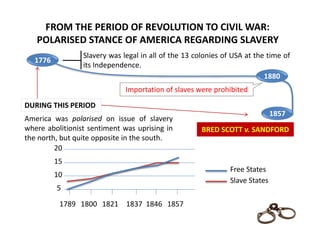
FROM THE PERIOD OF REVOLUTION TO CIVIL WAR:
POLARISED STANCE OF AMERICA REGARDING SLAVERY
1776
Slavery was legal in all of the 13 colonies of USA at the time of
its Independence.
1880
Importation of slaves were prohibited
1857
BRED SCOTT v. SANDFORD
DURING THIS PERIOD
America was polarised on issue of slavery
where abolitionist sentiment was uprising in
the north, but quite opposite in the south.
5
10
15
20
1789 1800 1821 1846 18571837
Slave States
Free States
BRED SCOTT v. SANDFORD
On the escalating tension regarding fate of slavery into America,
Judgment from US Supreme Court came out with the following:
“A negro, whose ancestors were imported into [the U.S.], and sold
as slaves", whether enslaved or free, could not be an American
citizen and therefore had no standing to sue in federal court, and
that the federal government had no power to regulate slavery in
the federal territories acquired after the creation of the United
States
“WORST JUDGMENT IN US SUPREME COURT HISTORY”
> Chief Justice Tany Began believed that the decision represented a
compromise that would settle the slavery question once and for all by
transforming a contested political issue into a matter of settled law.
“INDIRECT CATALYST OF AMERICAN CIVIL WAR”
INTENSIFICATION OF STRAIN THROUGH
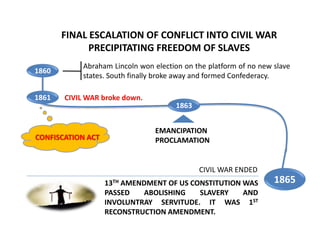
FINAL ESCALATION OF CONFLICT INTO CIVIL WAR
PRECIPITATING FREEDOM OF SLAVES
1860
Abraham Lincoln won election on the platform of no new slave
states. South finally broke away and formed Confederacy.
1861
CONFISCATION ACT
1863
EMANCIPATION
PROCLAMATION
CIVIL WAR broke down.
1865
CIVIL WAR ENDED
13TH AMENDMENT OF US CONSTITUTION WAS
PASSED ABOLISHING SLAVERY AND
INVOLUNTRAY SERVITUDE. IT WAS 1ST
RECONSTRUCTION AMENDMENT.
NEW CHALLENGE FOR NEWLY FREEDMEN FOR
AQUIRING THEIR STATUS, RIGHTS AND PRIVLIGES
BLACK CODES
Even after 13th Amendment, status of freed slaves were unresolved.
The South started to make Black Code imposing strict restrictions on
Blacks facilitating maintenance of white supremacy.
Blacks were bound to show employment papers otherwise fine, in failure
of which imprisonment. No movement after evening or not having any
right to carry weapons.
ENACTMENT OF CIVIL RIGHTS ACT, 1866 AS ANTI-DOTE
Congress passed the Civil Rights Act of 1866, guaranteeing blacks equal
rights in every state and territory in the United States.”
Congressmen could not shed away their unease as the rights of freedmen
was vulnerable, which can be turned down by simple majority, as such it
was thought to give place into constitution for lasting effect.
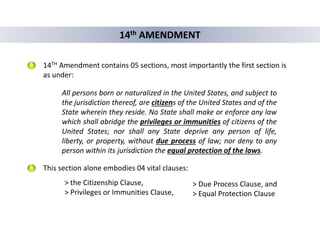
14th AMENDMENT
14TH Amendment contains 05 sections, most importantly the first section is
as under:
All persons born or naturalized in the United States, and subject to
the jurisdiction thereof, are citizens of the United States and of the
State wherein they reside. No State shall make or enforce any law
which shall abridge the privileges or immunities of citizens of the
United States; nor shall any State deprive any person of life,
liberty, or property, without due process of law; nor deny to any
person within its jurisdiction the equal protection of the laws.
This section alone embodies 04 vital clauses:
> the Citizenship Clause,
> Privileges or Immunities Clause,
> Due Process Clause, and
> Equal Protection Clause
14th AMENDMENT
OTHER PROVISIONS
Apportionment of representation in House of Representatives [section 2]
Participants in rebellion [section 3]
Apportionment of representatives in the Houses on the basis of counting
total number of residents.
Reduction of a state's apportionment if it wrongfully denies any adult male's
right to vote.
Prohibition of the election or appointment to any federal or state office of
any person who had held any of certain offices and then engaged in
insurrection, rebellion or treason.
However, a two-thirds vote by each House of the Congress can override this
limitation. In 1898, Congress enacted a general removal of section 3’s
limitation
14th AMENDMENT
OTHER PROVISIONS
Validity of Public Debt (section 4)
Power of Enforcement [section 5]
Confirmed the legitimacy of all public appropriated by the Congress.
Neither the United States nor any state would pay for the loss of slaves or
debts that had been incurred by the Confederacy
It enables Congress to pass laws enforcing the amendment's other
provisions
CONTINUED….
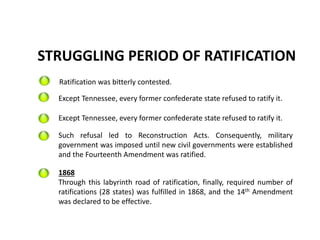
STRUGGLING PERIOD OF RATIFICATION
Ratification was bitterly contested.
Except Tennessee, every former confederate state refused to ratify it.
Such refusal led to Reconstruction Acts. Consequently, military
government was imposed until new civil governments were established
and the Fourteenth Amendment was ratified.
1868
Through this labyrinth road of ratification, finally, required number of
ratifications (28 states) was fulfilled in 1868, and the 14th Amendment
was declared to be effective.
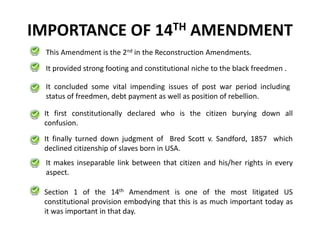
IMPORTANCE OF 14TH AMENDMENT
This Amendment is the 2nd in the Reconstruction Amendments.
It provided strong footing and constitutional niche to the black freedmen .
It finally turned down judgment of Bred Scott v. Sandford, 1857 which
declined citizenship of slaves born in USA.
Section 1 of the 14th Amendment is one of the most litigated US
constitutional provision embodying that this is as much important today as
it was important in that day.
It concluded some vital impending issues of post war period including
status of freedmen, debt payment as well as position of rebellion.
It first constitutionally declared who is the citizen burying down all
confusion.
It makes inseparable link between that citizen and his/her rights in every
aspect.
INTERPRETATIONAL GO THROUGH OF 14TH AMENDMENT
CITIZENSHIP ISSUE
A man born within the United States to Chinese citizens who have a permanent
domicile and residence in the United States and are carrying on business in the
United States.
United States v. Wong Kim Ark (1898)
EQUAL PROTECTION ISSUE
The states could impose segregation so long as they provided similar
facilities—the formation of the “separate but equal” doctrine.
Plessy v. Ferguson (1896)
The idea of ‘separate’ itself is inherentyl unequal.
Brown v. Boad of Education (1954)

14th Amendment of USA Constitution

  • 1.
    PRESENTED TO Prof. Dr.Maimul Ahsan Khan A presentation on 14th Amendment of US Constitution Md. Mostafizur Rahman 3rd Semester, LLM Roll No.152 01 2015 DEPT. OF LAW GREEN UNIVERSITY OF BANGLADESH Date of presentation: 09.04.2016
  • 2.
    FROM THE PERIODOF REVOLUTION TO CIVIL WAR: POLARISED STANCE OF AMERICA REGARDING SLAVERY 1776 Slavery was legal in all of the 13 colonies of USA at the time of its Independence. 1880 Importation of slaves were prohibited 1857 BRED SCOTT v. SANDFORD DURING THIS PERIOD America was polarised on issue of slavery where abolitionist sentiment was uprising in the north, but quite opposite in the south. 5 10 15 20 1789 1800 1821 1846 18571837 Slave States Free States
  • 3.
    BRED SCOTT v.SANDFORD On the escalating tension regarding fate of slavery into America, Judgment from US Supreme Court came out with the following: “A negro, whose ancestors were imported into [the U.S.], and sold as slaves", whether enslaved or free, could not be an American citizen and therefore had no standing to sue in federal court, and that the federal government had no power to regulate slavery in the federal territories acquired after the creation of the United States “WORST JUDGMENT IN US SUPREME COURT HISTORY” > Chief Justice Tany Began believed that the decision represented a compromise that would settle the slavery question once and for all by transforming a contested political issue into a matter of settled law. “INDIRECT CATALYST OF AMERICAN CIVIL WAR” INTENSIFICATION OF STRAIN THROUGH
  • 4.
    FINAL ESCALATION OFCONFLICT INTO CIVIL WAR PRECIPITATING FREEDOM OF SLAVES 1860 Abraham Lincoln won election on the platform of no new slave states. South finally broke away and formed Confederacy. 1861 CONFISCATION ACT 1863 EMANCIPATION PROCLAMATION CIVIL WAR broke down. 1865 CIVIL WAR ENDED 13TH AMENDMENT OF US CONSTITUTION WAS PASSED ABOLISHING SLAVERY AND INVOLUNTRAY SERVITUDE. IT WAS 1ST RECONSTRUCTION AMENDMENT.
  • 5.
    NEW CHALLENGE FORNEWLY FREEDMEN FOR AQUIRING THEIR STATUS, RIGHTS AND PRIVLIGES BLACK CODES Even after 13th Amendment, status of freed slaves were unresolved. The South started to make Black Code imposing strict restrictions on Blacks facilitating maintenance of white supremacy. Blacks were bound to show employment papers otherwise fine, in failure of which imprisonment. No movement after evening or not having any right to carry weapons. ENACTMENT OF CIVIL RIGHTS ACT, 1866 AS ANTI-DOTE Congress passed the Civil Rights Act of 1866, guaranteeing blacks equal rights in every state and territory in the United States.” Congressmen could not shed away their unease as the rights of freedmen was vulnerable, which can be turned down by simple majority, as such it was thought to give place into constitution for lasting effect.
  • 6.
    14th AMENDMENT 14TH Amendmentcontains 05 sections, most importantly the first section is as under: All persons born or naturalized in the United States, and subject to the jurisdiction thereof, are citizens of the United States and of the State wherein they reside. No State shall make or enforce any law which shall abridge the privileges or immunities of citizens of the United States; nor shall any State deprive any person of life, liberty, or property, without due process of law; nor deny to any person within its jurisdiction the equal protection of the laws. This section alone embodies 04 vital clauses: > the Citizenship Clause, > Privileges or Immunities Clause, > Due Process Clause, and > Equal Protection Clause
  • 7.
    14th AMENDMENT OTHER PROVISIONS Apportionmentof representation in House of Representatives [section 2] Participants in rebellion [section 3] Apportionment of representatives in the Houses on the basis of counting total number of residents. Reduction of a state's apportionment if it wrongfully denies any adult male's right to vote. Prohibition of the election or appointment to any federal or state office of any person who had held any of certain offices and then engaged in insurrection, rebellion or treason. However, a two-thirds vote by each House of the Congress can override this limitation. In 1898, Congress enacted a general removal of section 3’s limitation
  • 8.
    14th AMENDMENT OTHER PROVISIONS Validityof Public Debt (section 4) Power of Enforcement [section 5] Confirmed the legitimacy of all public appropriated by the Congress. Neither the United States nor any state would pay for the loss of slaves or debts that had been incurred by the Confederacy It enables Congress to pass laws enforcing the amendment's other provisions CONTINUED….
  • 9.
    STRUGGLING PERIOD OFRATIFICATION Ratification was bitterly contested. Except Tennessee, every former confederate state refused to ratify it. Except Tennessee, every former confederate state refused to ratify it. Such refusal led to Reconstruction Acts. Consequently, military government was imposed until new civil governments were established and the Fourteenth Amendment was ratified. 1868 Through this labyrinth road of ratification, finally, required number of ratifications (28 states) was fulfilled in 1868, and the 14th Amendment was declared to be effective.
  • 10.
    IMPORTANCE OF 14THAMENDMENT This Amendment is the 2nd in the Reconstruction Amendments. It provided strong footing and constitutional niche to the black freedmen . It finally turned down judgment of Bred Scott v. Sandford, 1857 which declined citizenship of slaves born in USA. Section 1 of the 14th Amendment is one of the most litigated US constitutional provision embodying that this is as much important today as it was important in that day. It concluded some vital impending issues of post war period including status of freedmen, debt payment as well as position of rebellion. It first constitutionally declared who is the citizen burying down all confusion. It makes inseparable link between that citizen and his/her rights in every aspect.
  • 11.
    INTERPRETATIONAL GO THROUGHOF 14TH AMENDMENT CITIZENSHIP ISSUE A man born within the United States to Chinese citizens who have a permanent domicile and residence in the United States and are carrying on business in the United States. United States v. Wong Kim Ark (1898) EQUAL PROTECTION ISSUE The states could impose segregation so long as they provided similar facilities—the formation of the “separate but equal” doctrine. Plessy v. Ferguson (1896) The idea of ‘separate’ itself is inherentyl unequal. Brown v. Boad of Education (1954)