Basic Scientific Programming
Arrays
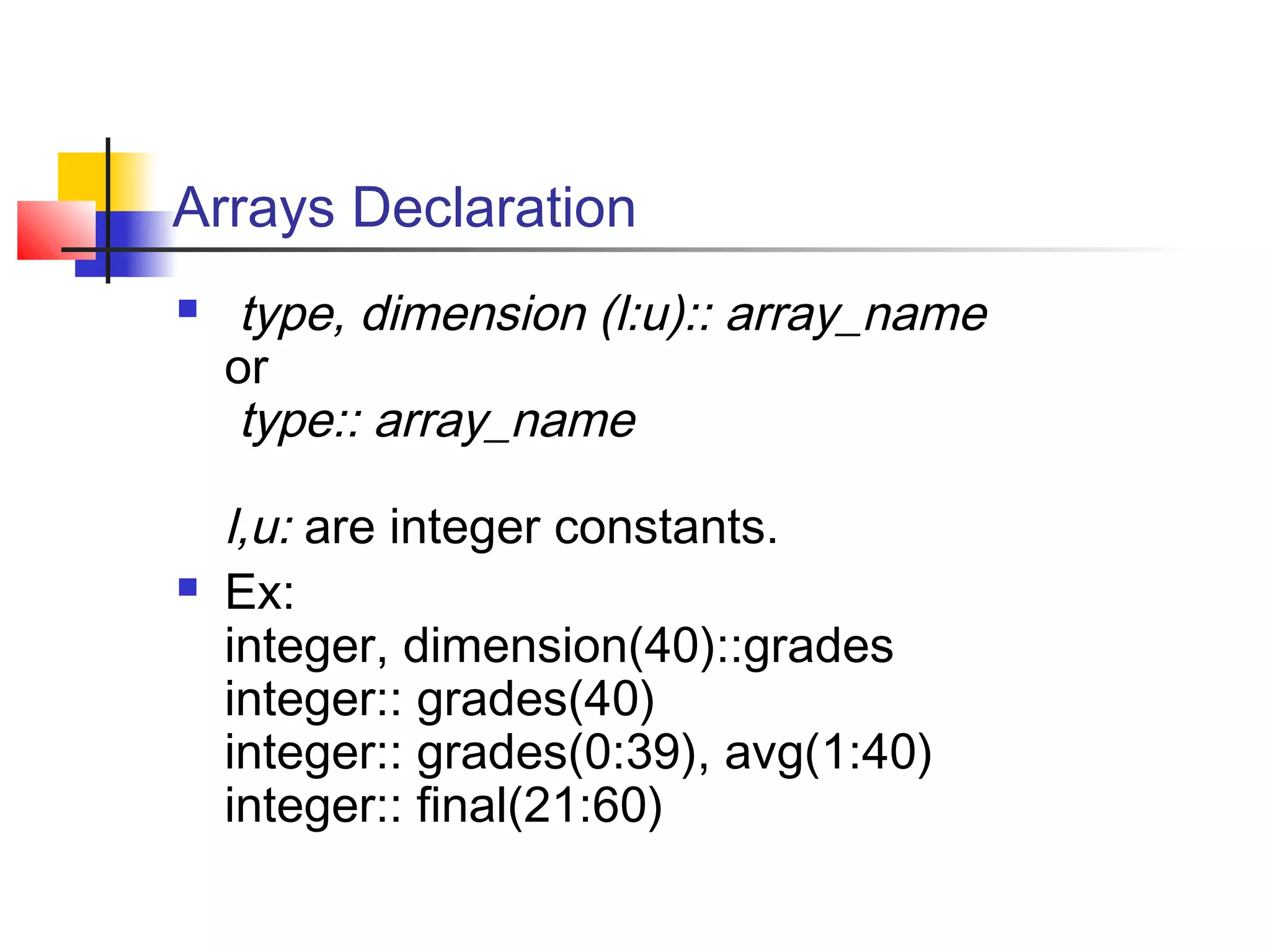
Arrays Declaration




type, dimension (l:u):: array_name
or
type:: array_name
l,u: are integer constants.
Ex:
integer, dimension(40)::grades
integer:: grades(40)
integer:: grades(0:39), avg(1:40)
integer:: final(21:60)
Ex:




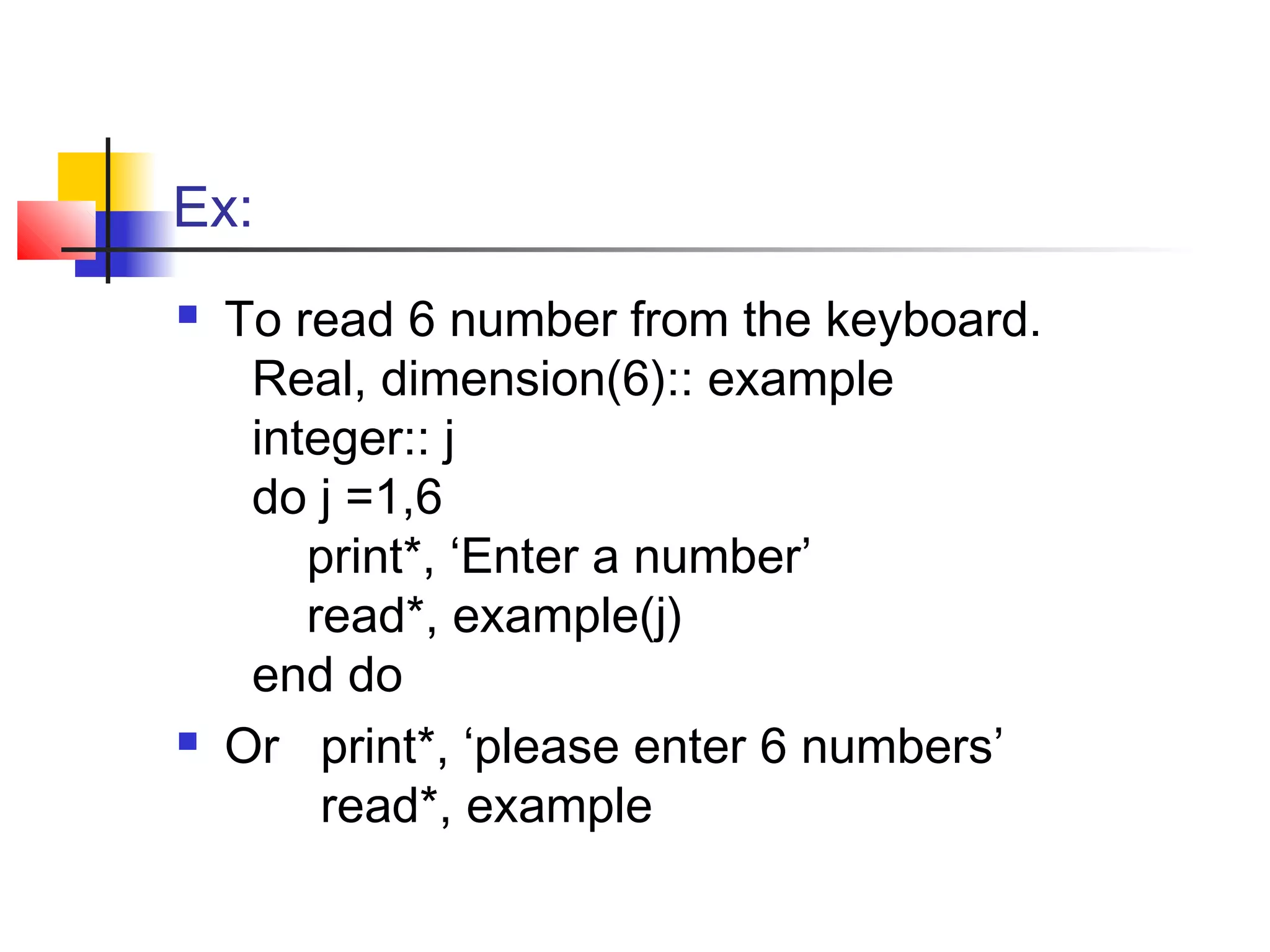
To read 6 number from the keyboard.
Real, dimension(6):: example
integer:: j
do j =1,6
print*, ‘Enter a number’
read*, example(j)
end do
Or print*, ‘please enter 6 numbers’
read*, example
Compile Time & Run Time Arrays








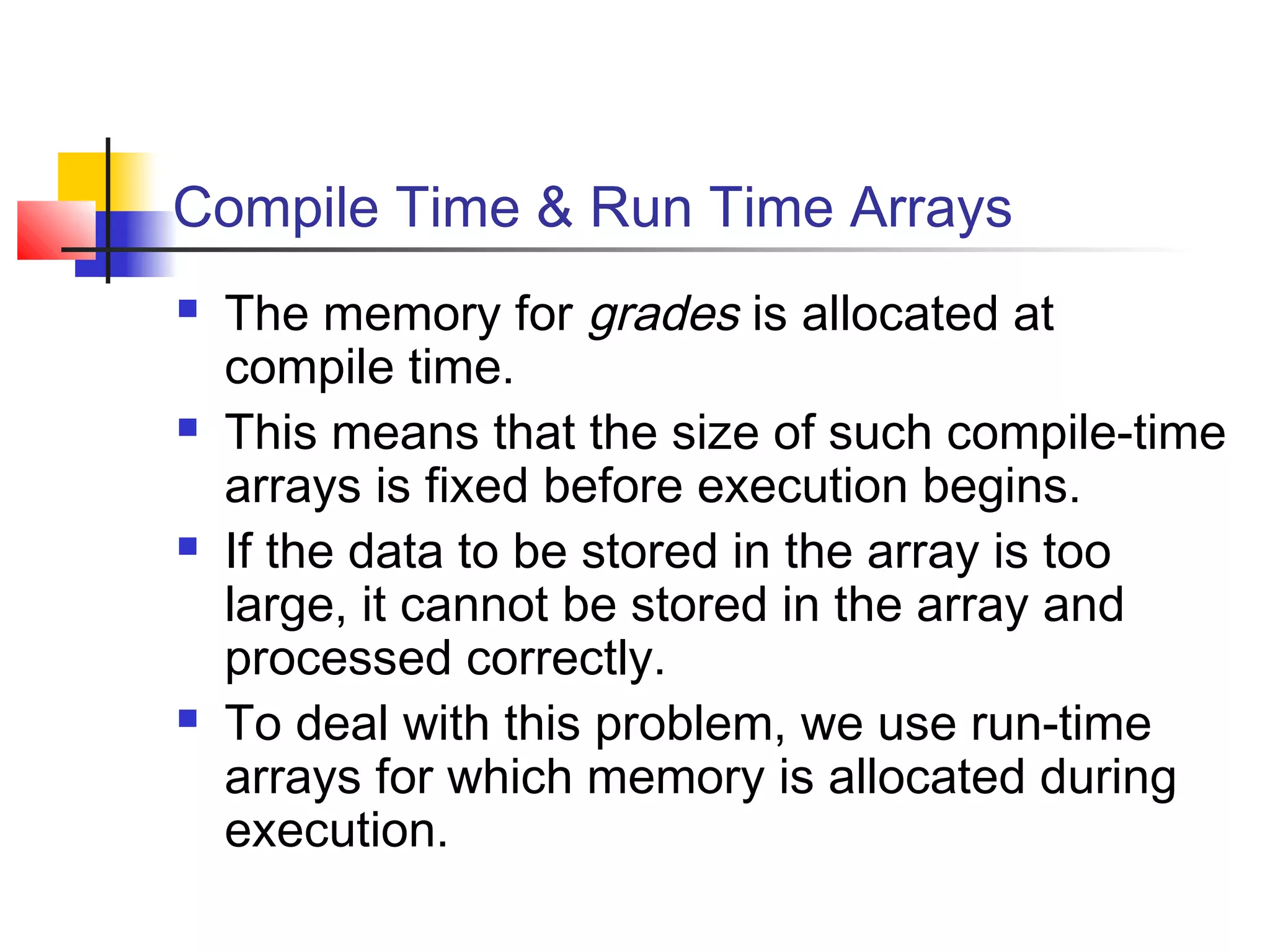
The memory for grades is allocated at
compile time.
This means that the size of such compile-time
arrays is fixed before execution begins.
If the data to be stored in the array is too
large, it cannot be stored in the array and
processed correctly.
To deal with this problem, we use run-time
arrays for which memory is allocated during
execution.
Allocatable Arrays


Integer :: N
print*, ‘ how many elements?’
read*, N
Real:: Grades(N)

THIS IS WRONG !!
Declaration of Allocatable Arrays


Type, dimension, Allocatable:: Array_name
the actual bounds of an allocatable array can
be specified in an Allocate statement.

Form
Allocate(array_name)
Allocate(array_name,Stat= StatusVariable)
Ex:






Print*, ‘Enter size of arrays A and B:’
read*, N
Allocate(A(N),B(0:N+1), stat=allostatus)
if(allostatus /= 0) stop “not enough memory”
If memory is available, A can store N values
and be can store N+2 values
Once memory has been allocated, these
arrays may be used in the same ways as
compile-time arrays.
Deallocate


Memory that is not needed anymore
should be cleared so that we can use it
for allocating other arrays.

Form deallocate(grades)
or

deallocate(grades,stat=StatusVar)

Please read the example in page 530.
Array Constants


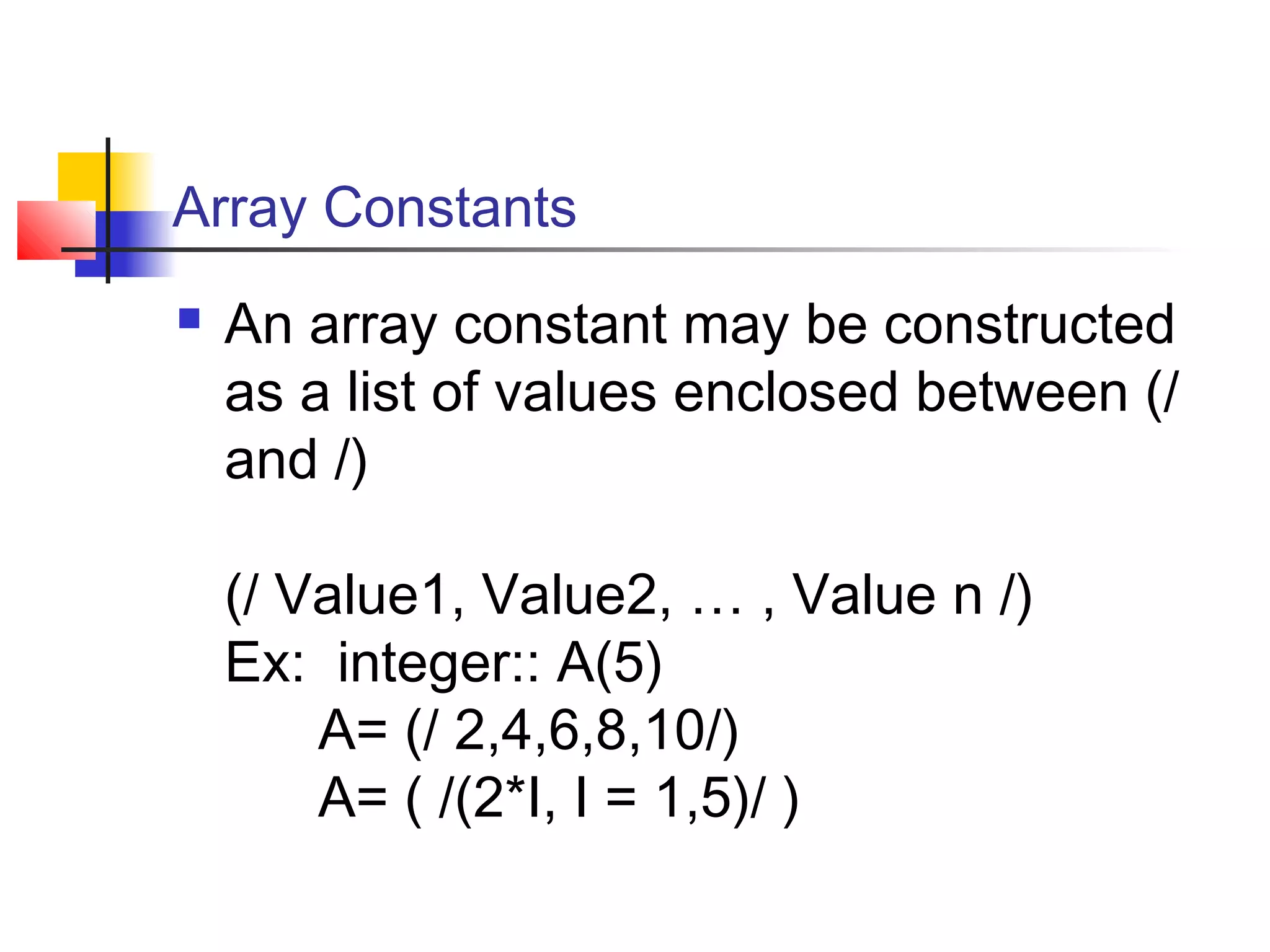
An array constant may be constructed
as a list of values enclosed between (/
and /)
(/ Value1, Value2, … , Value n /)
Ex: integer:: A(5)
A= (/ 2,4,6,8,10/)
A= ( /(2*I, I = 1,5)/ )
Array Expressions




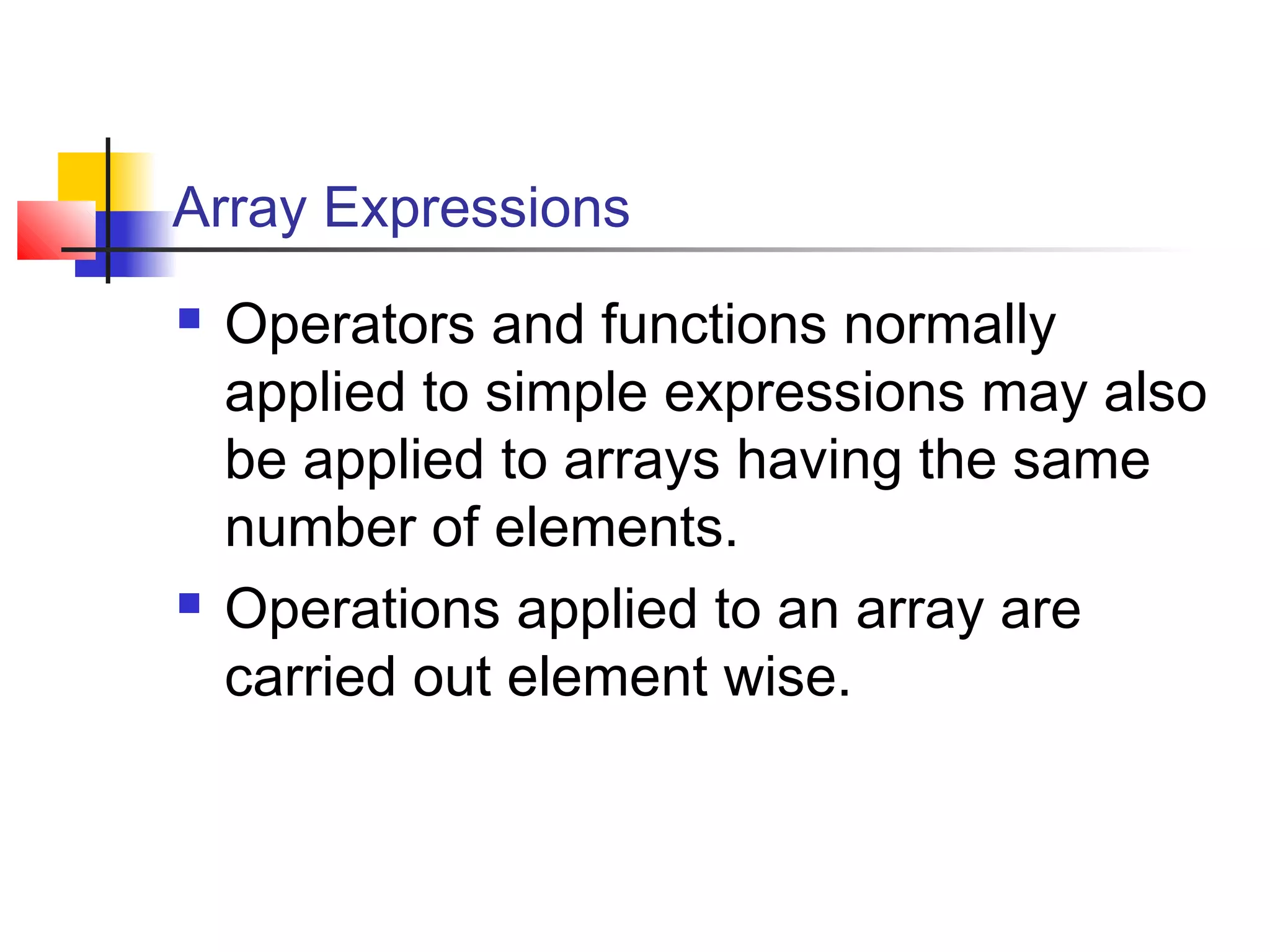
Operators and functions normally
applied to simple expressions may also
be applied to arrays having the same
number of elements.
Operations applied to an array are
carried out element wise.




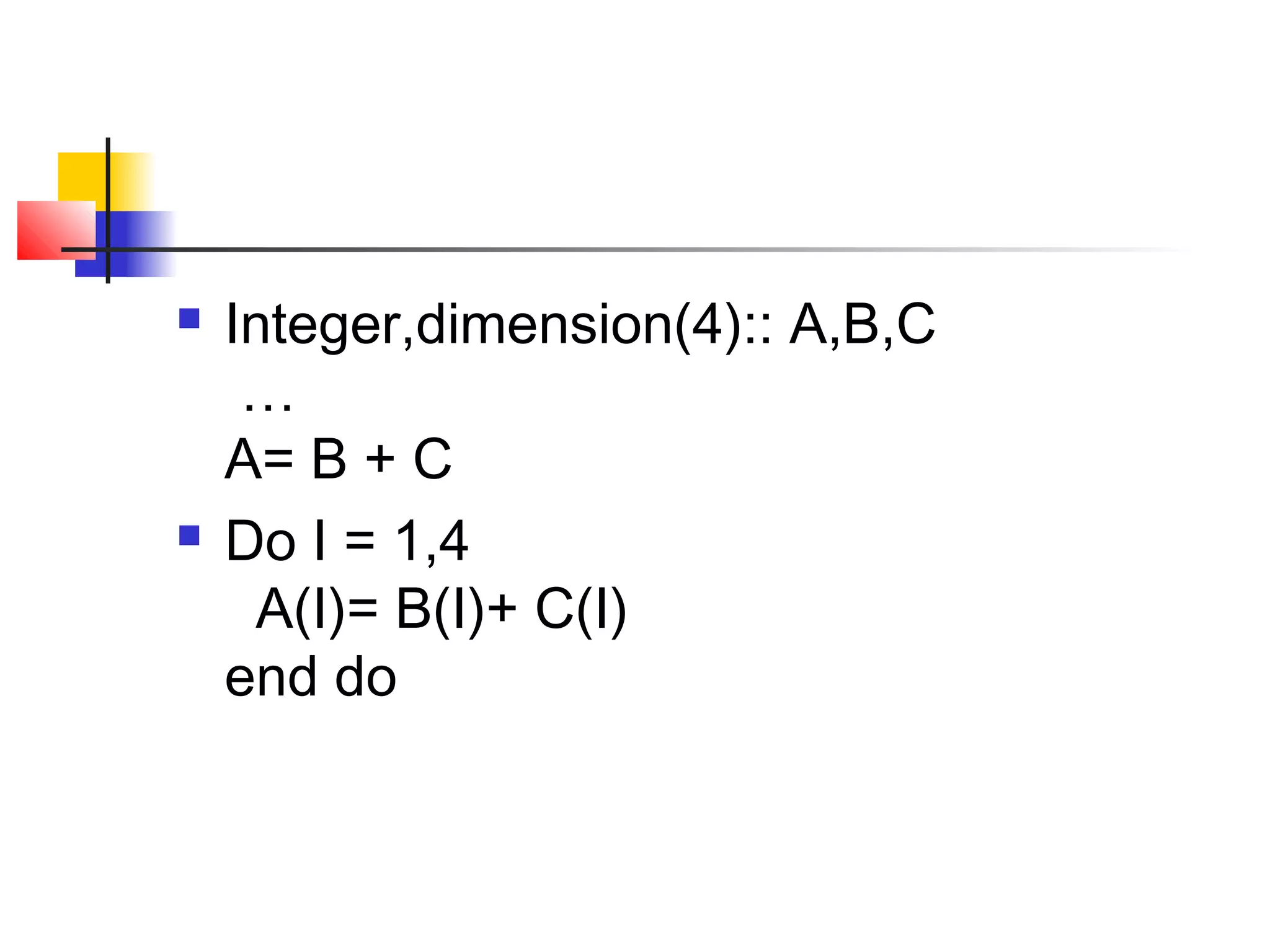
Integer,dimension(4):: A,B,C
…
A= B + C
Do I = 1,4
A(I)= B(I)+ C(I)
end do




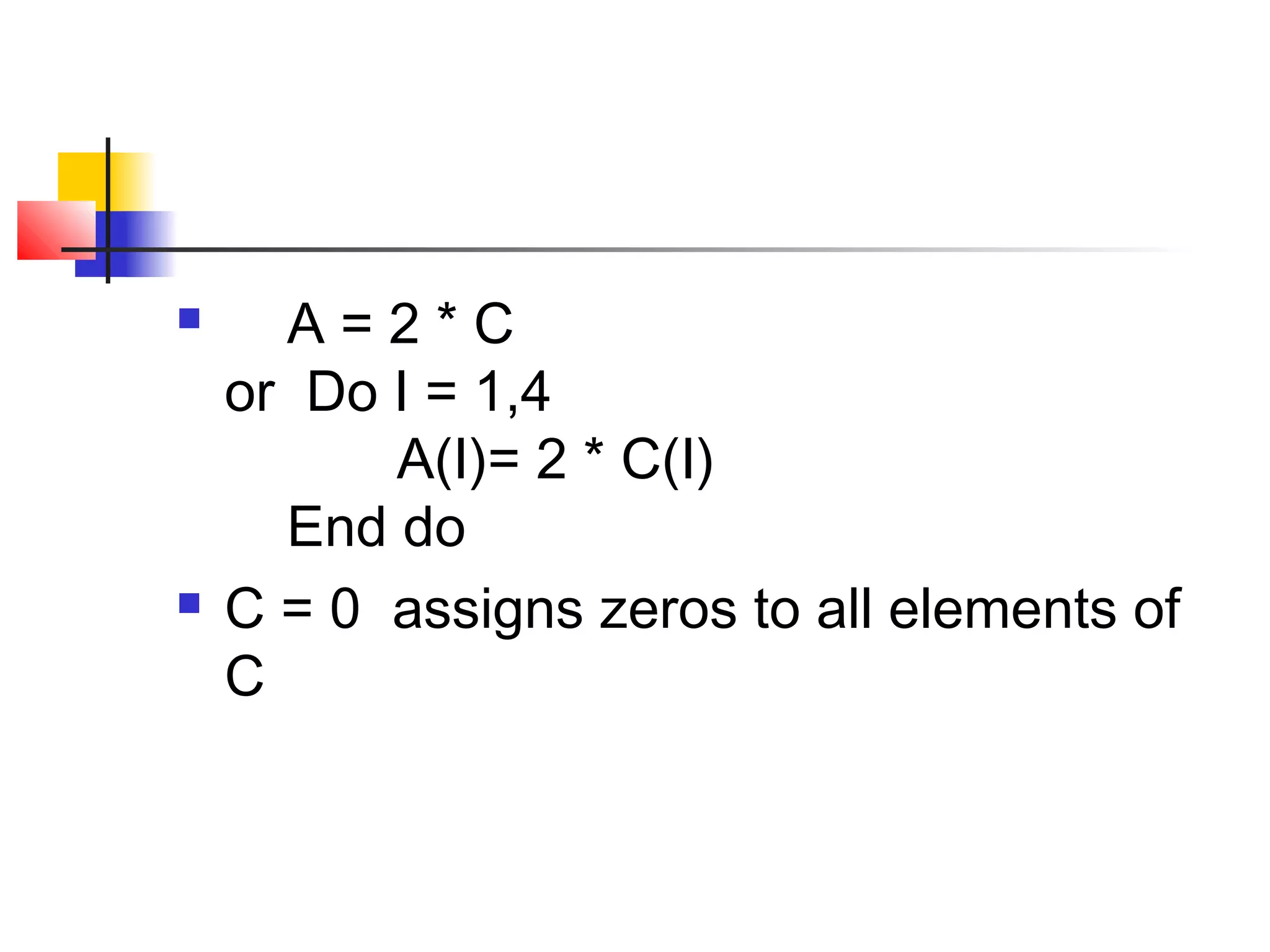
A=2*C
or Do I = 1,4
A(I)= 2 * C(I)
End do
C = 0 assigns zeros to all elements of
C
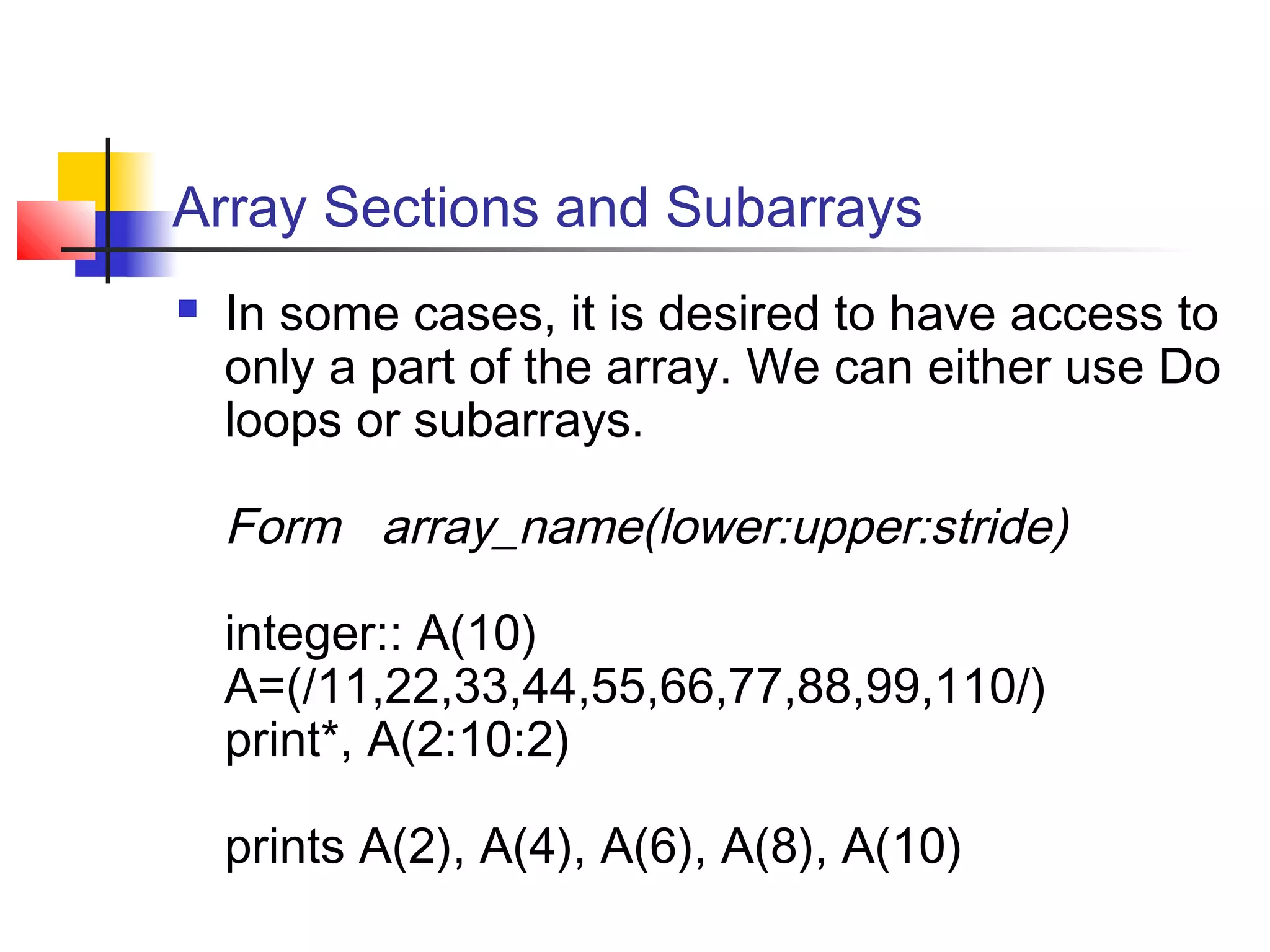
Array Sections and Subarrays


In some cases, it is desired to have access to
only a part of the array. We can either use Do
loops or subarrays.

Form array_name(lower:upper:stride)
integer:: A(10)
A=(/11,22,33,44,55,66,77,88,99,110/)
print*, A(2:10:2)
prints A(2), A(4), A(6), A(8), A(10)
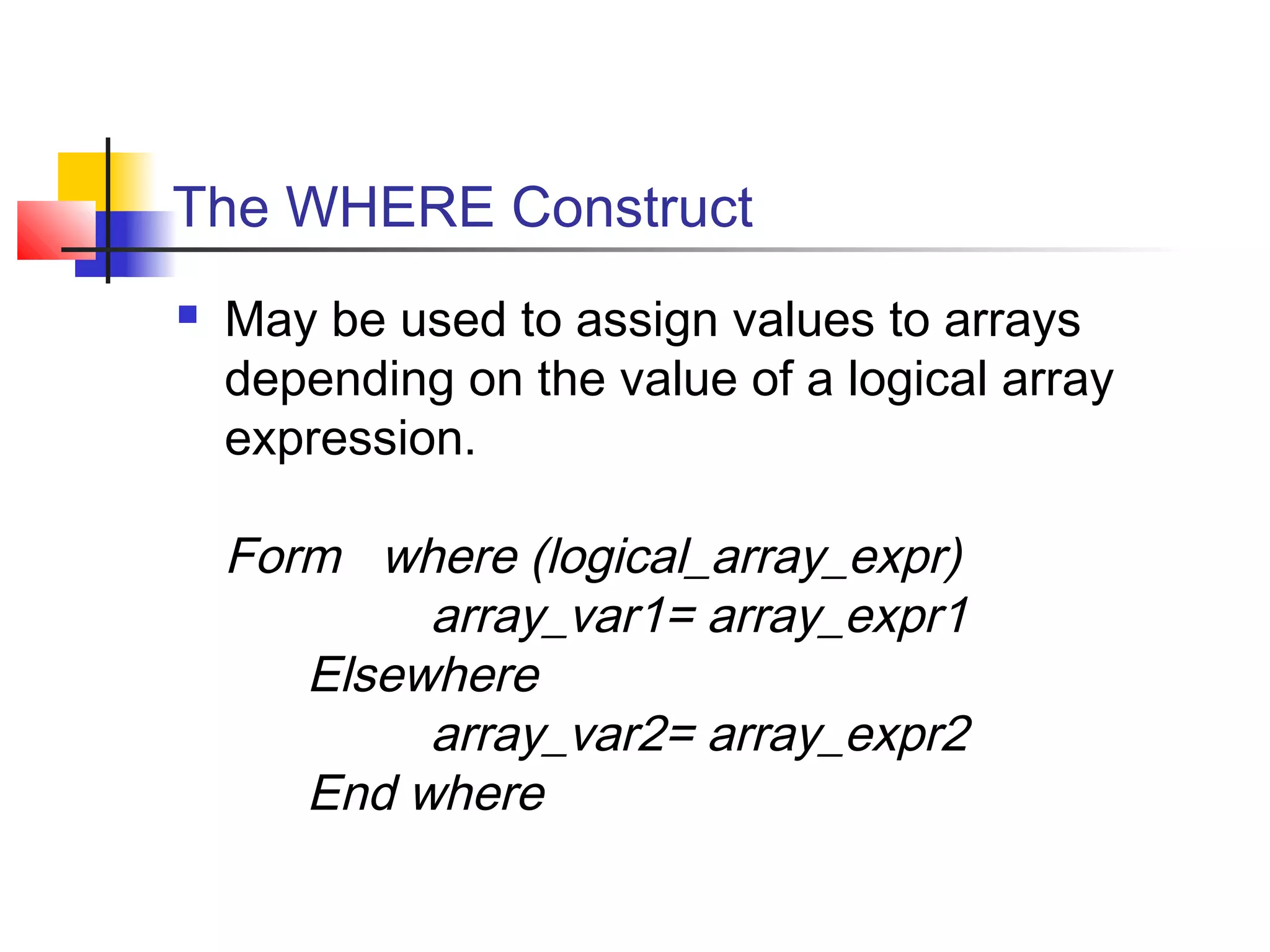
The WHERE Construct


May be used to assign values to arrays
depending on the value of a logical array
expression.

Form where (logical_array_expr)
array_var1= array_expr1
Elsewhere
array_var2= array_expr2
End where
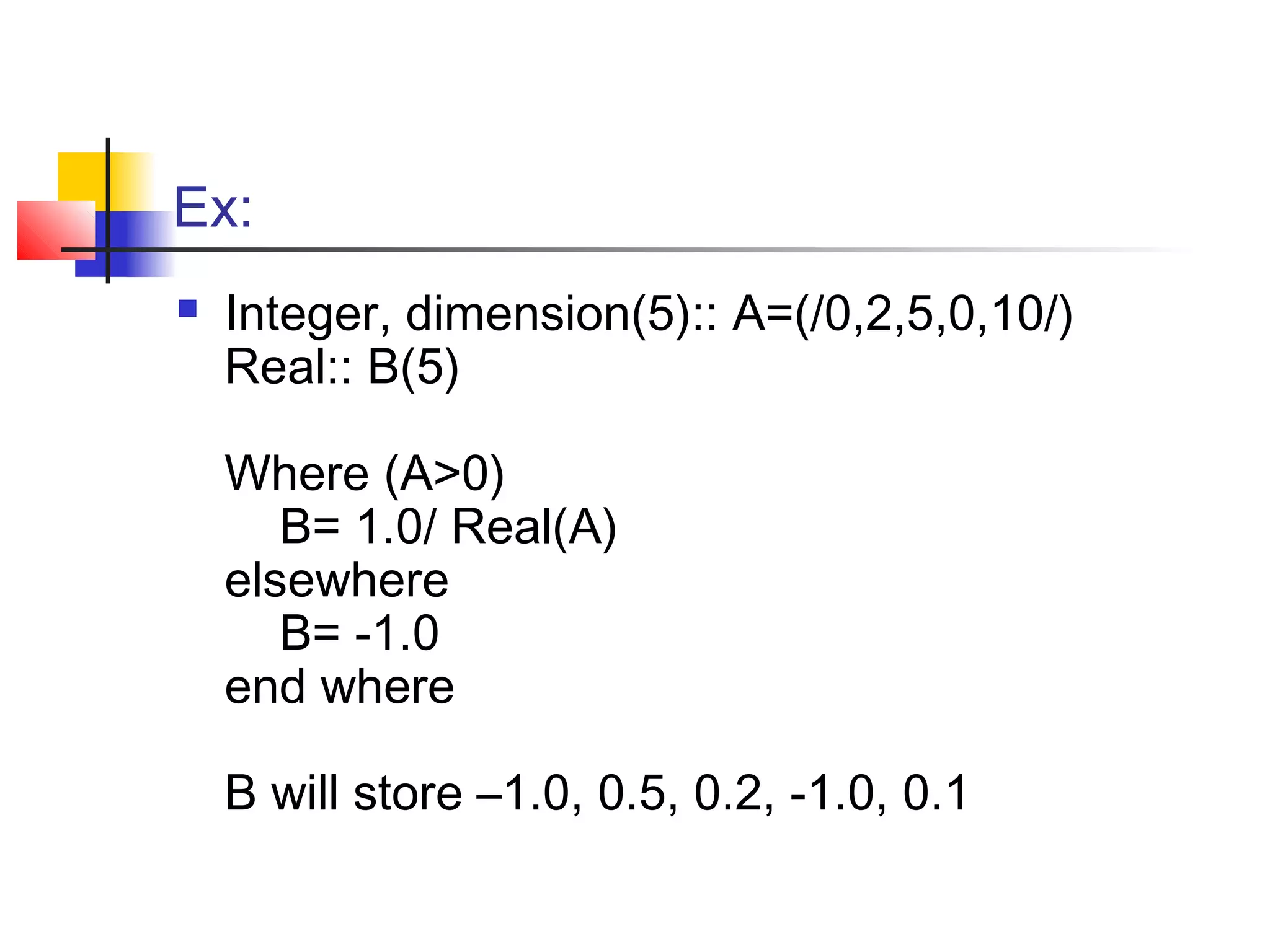
Ex:


Integer, dimension(5):: A=(/0,2,5,0,10/)
Real:: B(5)
Where (A>0)
B= 1.0/ Real(A)
elsewhere
B= -1.0
end where
B will store –1.0, 0.5, 0.2, -1.0, 0.1


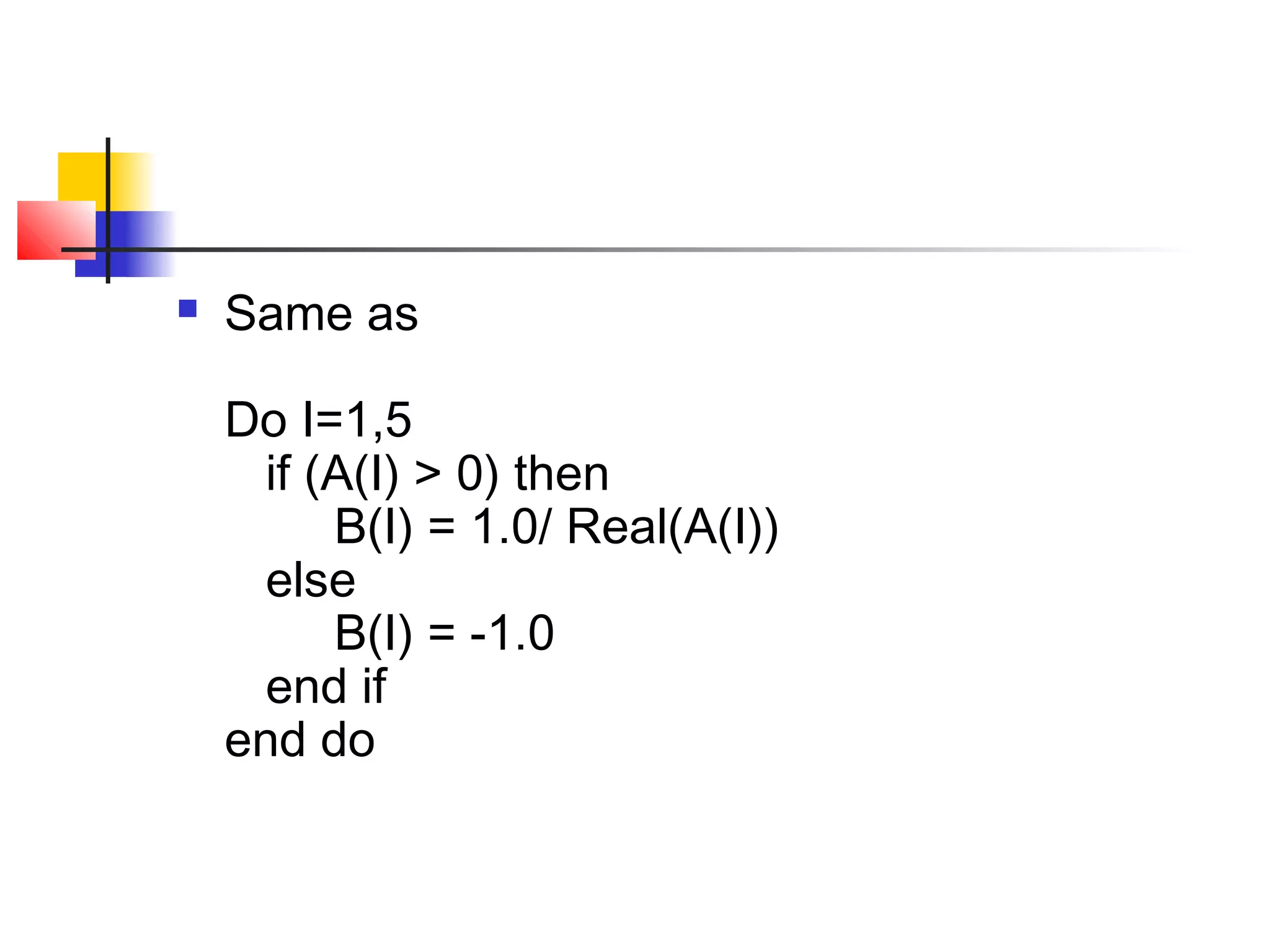
Same as
Do I=1,5
if (A(I) > 0) then
B(I) = 1.0/ Real(A(I))
else
B(I) = -1.0
end if
end do
Intrinsic Array-Processing Subprograms


Fortran 90 provides several intrinsic functions
whose arguments are arrays, some of the
useful ones are:
Dot_product(A,B)
Maxval(A)
Maxloc(A)
Minval(A)
Minloc(A)
refer to page 548 and Appendix D.
Programmer-defined Array-Processing
Subprograms


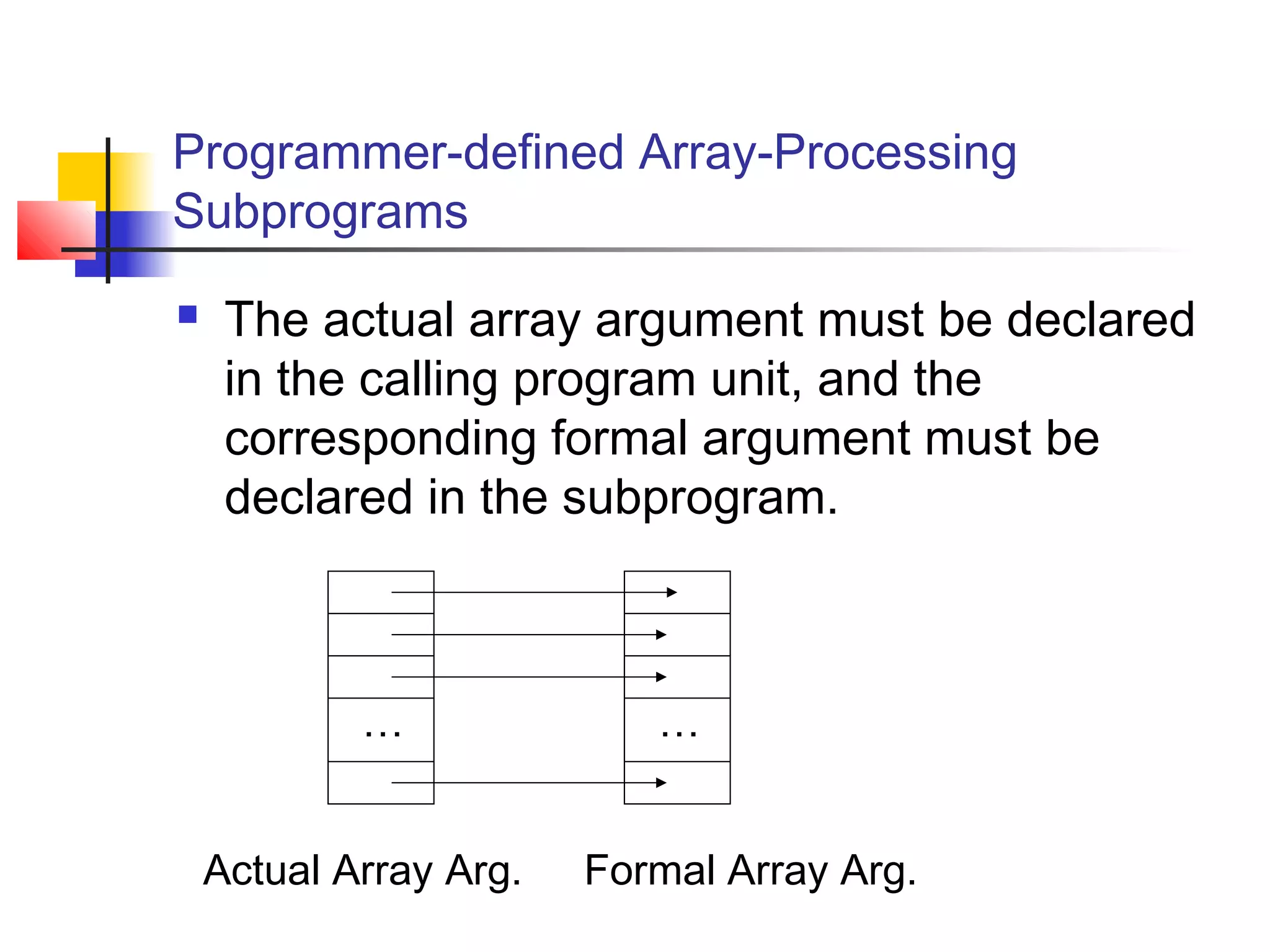
The actual array argument must be declared
in the calling program unit, and the
corresponding formal argument must be
declared in the subprogram.

…
Actual Array Arg.

…
Formal Array Arg.
Array Valued Functions


A function may return an array as the
return argument.
2-Dimensional Arrays








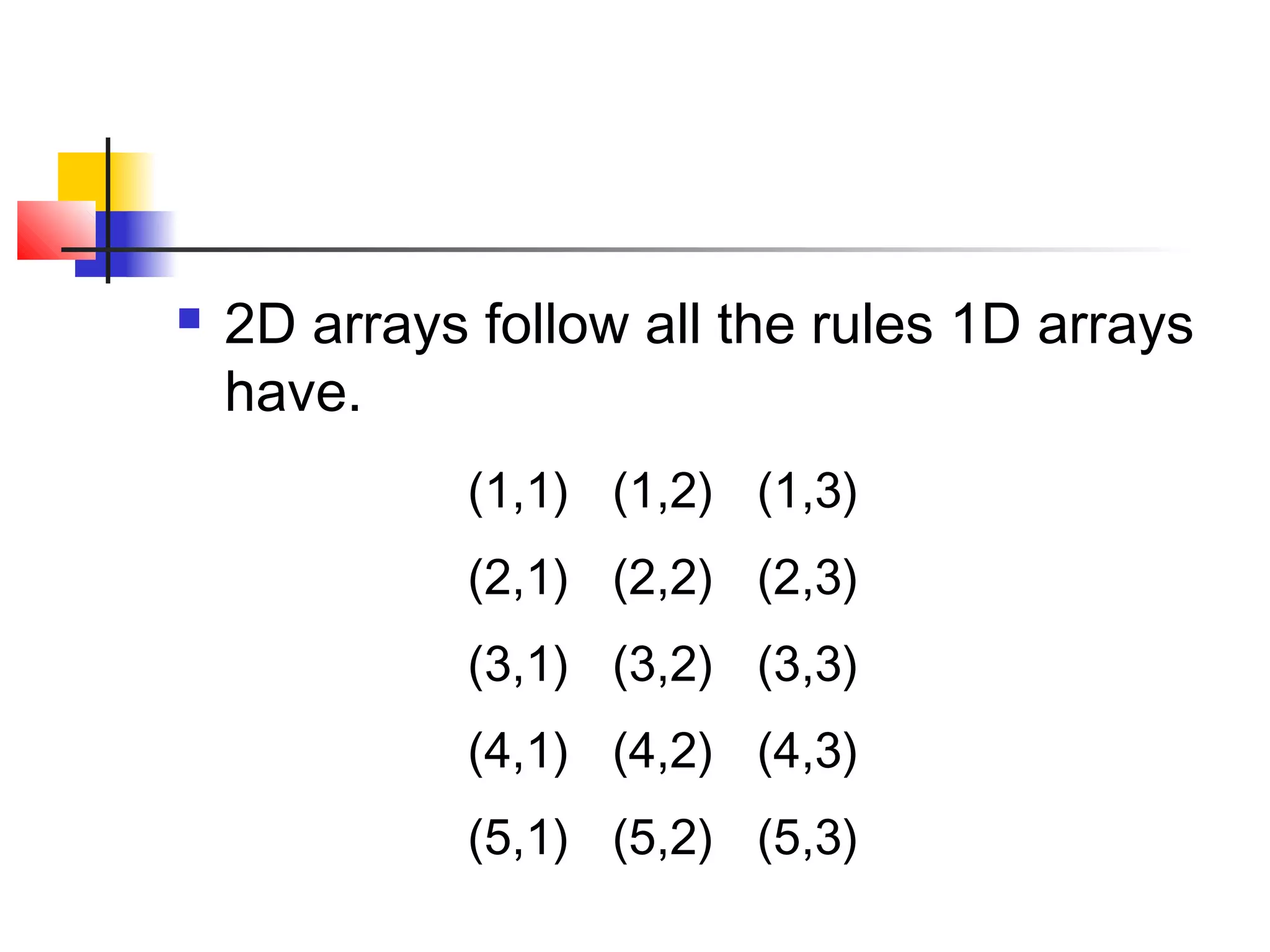
2-D arrays have two indices to indicate rows
and columns.(matrix)
The first index corresponds to rows, the
second to columns.
Real:: Matrix(5,3)
declares a matrix with 5 rows and 3
columns.
Integer, dimension(22:28,1:24):: hours
declares a matrix of 7 rows and 24 columns


2D arrays follow all the rules 1D arrays
have.
(1,1) (1,2) (1,3)
(2,1) (2,2) (2,3)
(3,1) (3,2) (3,3)
(4,1) (4,2) (4,3)
(5,1) (5,2) (5,3)
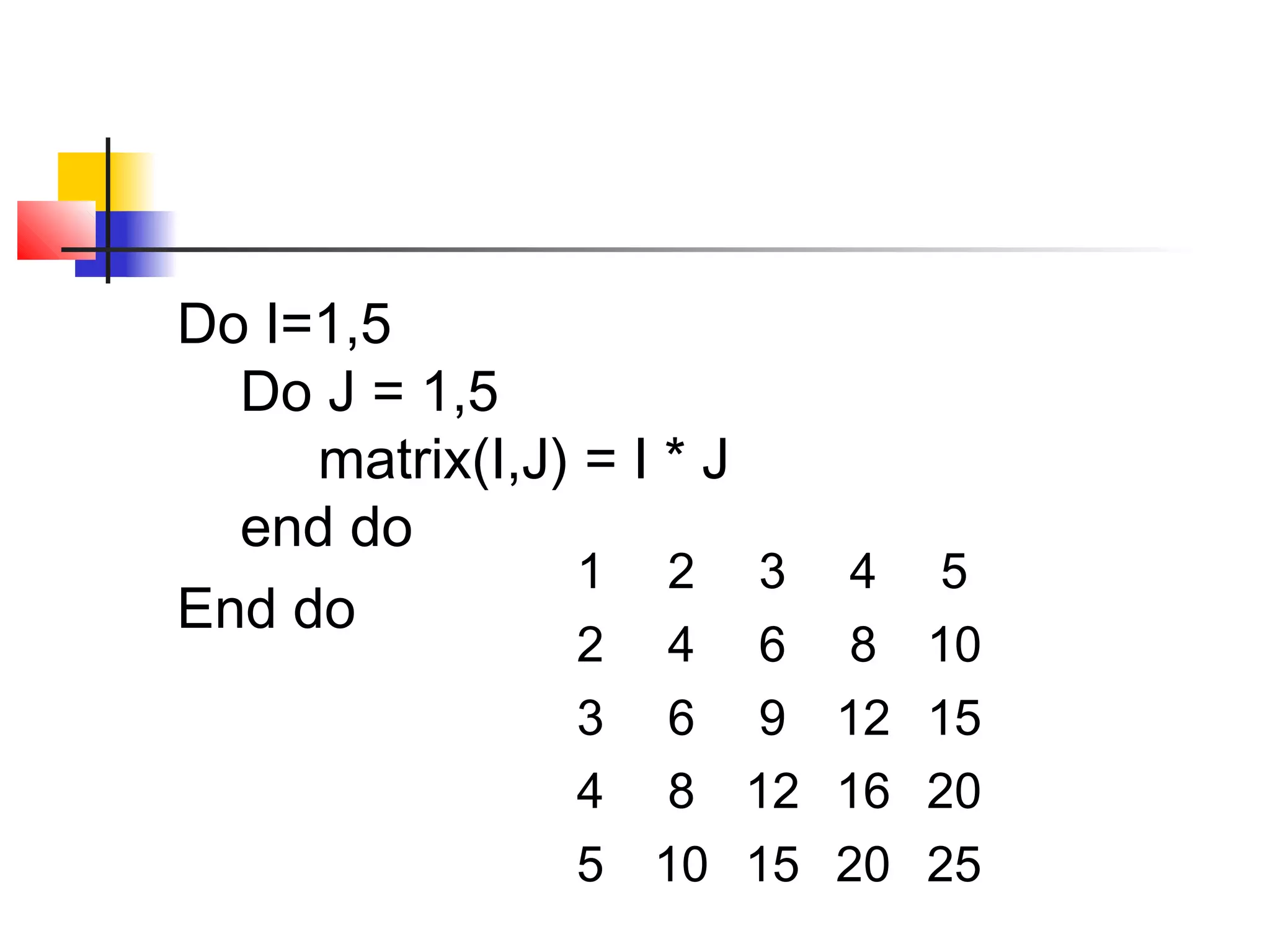
Do I=1,5
Do J = 1,5
matrix(I,J) = I * J
end do
1 2 3
End do
2
3
4
5

4
4 6 8
6 9 12
8 12 16
10 15 20

5
10
15
20
25

14 arrays

  • 1.
  • 2.
    Arrays Declaration   type, dimension(l:u):: array_name or type:: array_name l,u: are integer constants. Ex: integer, dimension(40)::grades integer:: grades(40) integer:: grades(0:39), avg(1:40) integer:: final(21:60)
  • 3.
    Ex:   To read 6number from the keyboard. Real, dimension(6):: example integer:: j do j =1,6 print*, ‘Enter a number’ read*, example(j) end do Or print*, ‘please enter 6 numbers’ read*, example
  • 4.
    Compile Time &Run Time Arrays     The memory for grades is allocated at compile time. This means that the size of such compile-time arrays is fixed before execution begins. If the data to be stored in the array is too large, it cannot be stored in the array and processed correctly. To deal with this problem, we use run-time arrays for which memory is allocated during execution.
  • 5.
    Allocatable Arrays  Integer ::N print*, ‘ how many elements?’ read*, N Real:: Grades(N) THIS IS WRONG !!
  • 6.
    Declaration of AllocatableArrays  Type, dimension, Allocatable:: Array_name the actual bounds of an allocatable array can be specified in an Allocate statement. Form Allocate(array_name) Allocate(array_name,Stat= StatusVariable)
  • 7.
    Ex:    Print*, ‘Enter sizeof arrays A and B:’ read*, N Allocate(A(N),B(0:N+1), stat=allostatus) if(allostatus /= 0) stop “not enough memory” If memory is available, A can store N values and be can store N+2 values Once memory has been allocated, these arrays may be used in the same ways as compile-time arrays.
  • 8.
    Deallocate  Memory that isnot needed anymore should be cleared so that we can use it for allocating other arrays. Form deallocate(grades) or deallocate(grades,stat=StatusVar) Please read the example in page 530.
  • 9.
    Array Constants  An arrayconstant may be constructed as a list of values enclosed between (/ and /) (/ Value1, Value2, … , Value n /) Ex: integer:: A(5) A= (/ 2,4,6,8,10/) A= ( /(2*I, I = 1,5)/ )
  • 10.
    Array Expressions   Operators andfunctions normally applied to simple expressions may also be applied to arrays having the same number of elements. Operations applied to an array are carried out element wise.
  • 11.
      Integer,dimension(4):: A,B,C … A= B+ C Do I = 1,4 A(I)= B(I)+ C(I) end do
  • 12.
      A=2*C or Do I= 1,4 A(I)= 2 * C(I) End do C = 0 assigns zeros to all elements of C
  • 13.
    Array Sections andSubarrays  In some cases, it is desired to have access to only a part of the array. We can either use Do loops or subarrays. Form array_name(lower:upper:stride) integer:: A(10) A=(/11,22,33,44,55,66,77,88,99,110/) print*, A(2:10:2) prints A(2), A(4), A(6), A(8), A(10)
  • 14.
    The WHERE Construct  Maybe used to assign values to arrays depending on the value of a logical array expression. Form where (logical_array_expr) array_var1= array_expr1 Elsewhere array_var2= array_expr2 End where
  • 15.
    Ex:  Integer, dimension(5):: A=(/0,2,5,0,10/) Real::B(5) Where (A>0) B= 1.0/ Real(A) elsewhere B= -1.0 end where B will store –1.0, 0.5, 0.2, -1.0, 0.1
  • 16.
     Same as Do I=1,5 if(A(I) > 0) then B(I) = 1.0/ Real(A(I)) else B(I) = -1.0 end if end do
  • 17.
    Intrinsic Array-Processing Subprograms  Fortran90 provides several intrinsic functions whose arguments are arrays, some of the useful ones are: Dot_product(A,B) Maxval(A) Maxloc(A) Minval(A) Minloc(A) refer to page 548 and Appendix D.
  • 18.
    Programmer-defined Array-Processing Subprograms  The actualarray argument must be declared in the calling program unit, and the corresponding formal argument must be declared in the subprogram. … Actual Array Arg. … Formal Array Arg.
  • 19.
    Array Valued Functions  Afunction may return an array as the return argument.
  • 20.
    2-Dimensional Arrays     2-D arrayshave two indices to indicate rows and columns.(matrix) The first index corresponds to rows, the second to columns. Real:: Matrix(5,3) declares a matrix with 5 rows and 3 columns. Integer, dimension(22:28,1:24):: hours declares a matrix of 7 rows and 24 columns
  • 21.
     2D arrays followall the rules 1D arrays have. (1,1) (1,2) (1,3) (2,1) (2,2) (2,3) (3,1) (3,2) (3,3) (4,1) (4,2) (4,3) (5,1) (5,2) (5,3)
  • 22.
    Do I=1,5 Do J= 1,5 matrix(I,J) = I * J end do 1 2 3 End do 2 3 4 5 4 4 6 8 6 9 12 8 12 16 10 15 20 5 10 15 20 25