Object Serialization in Java
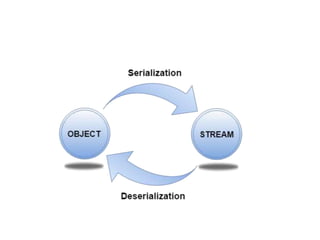
• Serialization in java is a mechanism of writing
the state of an object into a byte stream.
• It is mainly used in Hibernate, RMI, JPA, EJB
and JMS technologies.
• The reverse operation of serialization is called
deserialization.
• Advantage of Java Serialization
• It is mainly used to travel object's state on the
network (known as marshaling).
java.io.Serializable interface
import java.io.Serializable;
public class Student implements Serializable
{
int id;
String name;
public Student(int id, String name) {
this.id = id;
this.name = name;
}
}
• In the above example, Student class implements Serializable
interface. Now its objects can be converted into stream.
ObjectOutputStream class
• The ObjectOutputStream class is used to write
primitive data types and Java objects to an
OutputStream. Only objects that support the
java.io.Serializable interface can be written to
streams.
import java.io.*;
class Depersist{
public static void main(String args[])throws Exception{
ObjectInputStream in=new ObjectInputStream(new FileInputStream("f.txt"))
;
Student s=(Student)in.readObject();
System.out.println(s.id+" "+s.name);
in.close();
}
}
OP : 211 ravi
Deserialization in java
• Deserialization is the process of reconstructing the object
from the serialized state.It is the reverse operation of
serialization.
ObjectInputStream class
• An ObjectInputStream deserializes objects and primitive data
written using an ObjectOutputStream.
Example of Java Deserialization
import java.io.*;
class Depersist{
public static void main(String args[])throws Exception{
ObjectInputStream in=new ObjectInputStream(new FileInputStream("f.txt"))
;
Student s=(Student)in.readObject();
System.out.println(s.id+" "+s.name);
in.close();
}
}
211 ravi
(Internet Inter-ORB Protocol)
• IIOP (Internet Inter-ORB Protocol) is a protocol
that makes it possible for distributed
programs written in different programming
languages to communicate over the Internet.
• The distributed Hello World example uses a
client application to make a remote method
call via IIOP to a server running on the host
from which the client was downloaded. When
the client runs, "Hello from MARS!" is
displayed.
• The steps to write the source files
• The steps to compile the example
• The steps to run the example
Write or Download the Source Files
There are three tasks to complete in this section:
• Define the functions of the remote class as an interface
written in the Java programming language
• Write the implementation class
• Write the server class
• Write a client program that uses the remote service
• The source files used in this tutorial are:
HelloInterface.java - a remote interface
• HelloImpl.java - a remote object implementation
that implements HelloInterface
• HelloServer.java - an RMI server that creates an
instance of the remote object implementation
and binds that instance to a name in the Naming
Service
• HelloClient.java - a client application that invokes
the remote method, sayHello()
13243967

13243967

  • 1.
    Object Serialization inJava • Serialization in java is a mechanism of writing the state of an object into a byte stream. • It is mainly used in Hibernate, RMI, JPA, EJB and JMS technologies. • The reverse operation of serialization is called deserialization. • Advantage of Java Serialization • It is mainly used to travel object's state on the network (known as marshaling).
  • 3.
    java.io.Serializable interface import java.io.Serializable; publicclass Student implements Serializable { int id; String name; public Student(int id, String name) { this.id = id; this.name = name; } } • In the above example, Student class implements Serializable interface. Now its objects can be converted into stream.
  • 4.
    ObjectOutputStream class • TheObjectOutputStream class is used to write primitive data types and Java objects to an OutputStream. Only objects that support the java.io.Serializable interface can be written to streams.
  • 5.
    import java.io.*; class Depersist{ publicstatic void main(String args[])throws Exception{ ObjectInputStream in=new ObjectInputStream(new FileInputStream("f.txt")) ; Student s=(Student)in.readObject(); System.out.println(s.id+" "+s.name); in.close(); } } OP : 211 ravi
  • 6.
    Deserialization in java •Deserialization is the process of reconstructing the object from the serialized state.It is the reverse operation of serialization. ObjectInputStream class • An ObjectInputStream deserializes objects and primitive data written using an ObjectOutputStream.
  • 7.
    Example of JavaDeserialization import java.io.*; class Depersist{ public static void main(String args[])throws Exception{ ObjectInputStream in=new ObjectInputStream(new FileInputStream("f.txt")) ; Student s=(Student)in.readObject(); System.out.println(s.id+" "+s.name); in.close(); } } 211 ravi
  • 8.
    (Internet Inter-ORB Protocol) •IIOP (Internet Inter-ORB Protocol) is a protocol that makes it possible for distributed programs written in different programming languages to communicate over the Internet.
  • 9.
    • The distributedHello World example uses a client application to make a remote method call via IIOP to a server running on the host from which the client was downloaded. When the client runs, "Hello from MARS!" is displayed.
  • 10.
    • The stepsto write the source files • The steps to compile the example • The steps to run the example Write or Download the Source Files There are three tasks to complete in this section: • Define the functions of the remote class as an interface written in the Java programming language • Write the implementation class • Write the server class • Write a client program that uses the remote service
  • 11.
    • The sourcefiles used in this tutorial are: HelloInterface.java - a remote interface • HelloImpl.java - a remote object implementation that implements HelloInterface • HelloServer.java - an RMI server that creates an instance of the remote object implementation and binds that instance to a name in the Naming Service • HelloClient.java - a client application that invokes the remote method, sayHello()