A Solution to Remote Detection of Illegal
               Electricity
Usage via Power Line Communications


                              M.R. Rahul Raj
                             M. Nithin Mohan
                            (B-TECH FINAL YR)
PLC’S:
 Power Lines, originally devised to transmit
 electricity from some sources to many
 sinks

 Power Lines can be used for transmission
 of power as well as communication i.e., data
 is modulated on a carrier frequency and
 sent over
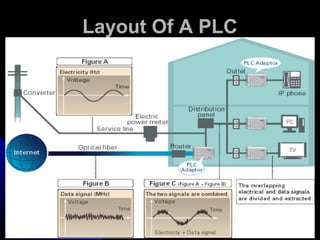
Layout Of A PLC
Building Blocks
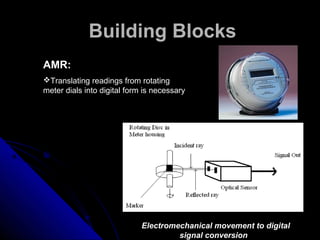
AMR:
Translating readings from rotating
meter dials into digital form is necessary


                             Electromechanical movement to digital
                                      signal conversion
Main components of AMR system

1.Meter interface module

2. Communications systems

3. Central office systems equipment
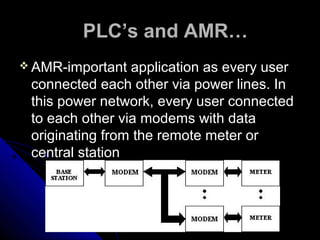
PLC’s and AMR…
 AMR-important  application as every user
 connected each other via power lines. In
 this power network, every user connected
 to each other via modems with data
 originating from the remote meter or
 central station
Detection and Control System
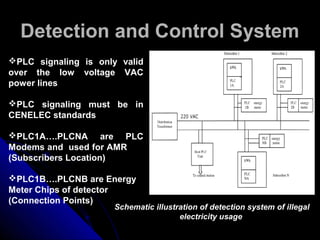
PLC signaling is only valid
over the low voltage VAC
power lines

PLC signaling must be in
CENELEC standards

PLC1A….PLCNA are PLC
Modems and used for AMR
(Subscribers Location)

PLC1B….PLCNB are Energy
Meter Chips of detector
(Connection Points)
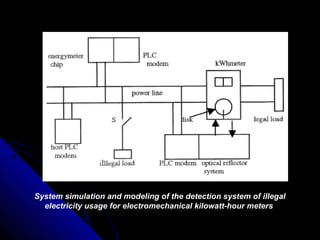
                     Schematic illustration of detection system of illegal
                                      electricity usage
Detection and Control System
           (contd…..)
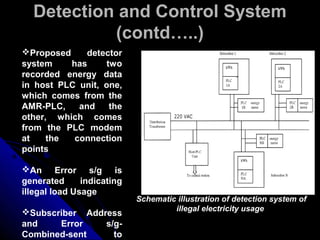
Proposed     detector
system    has     two
recorded energy data
in host PLC unit, one,
which comes from the
AMR-PLC,    and    the
other, which comes
from the PLC modem
at    the  connection
points

An Error s/g is
generated      indicating
illegal load Usage
                            Schematic illustration of detection system of
Subscriber Address                  illegal electricity usage
and    Error    s/g-
Combined-sent     to
System simulation and modeling of the detection system of illegal
  electricity usage for electromechanical kilowatt-hour meters
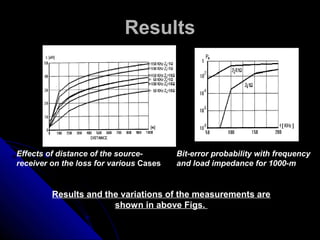
Results


Effects of distance of the source-       Bit-error probability with frequency
receiver on the loss for various Cases   and load impedance for 1000-m


         Results and the variations of the measurements are
                       shown in above Figs.
Conclusion
 The
    Proposed Detector System is
 Examined in Laboratory Conditions

 Once  this proposed detection systems are
 tried in real power lines, the distribution
 losses in India can be reduced effectively.
Bibliography
   I. H. Cavdar, “A Solution to Remote Detection of …”
    IEEE Transactions on power delivery, Vol. 19..
    I. H. Cavdar, “Performance analysis of FSK power line
    communications systems over the time-varying
    channels: Measurements and modeling,” IEEE Trans.
    Power Delivery, vol. 19, pp. 111–117, Jan. 2004.
    Yoshinori Mizugai and Masahiro Oya “World Trends in
    Power Line Communications” Mitsubishi Electric
   Tom D Tamar kin “Automatic Meter Reading”, Public
    Power magazine Volume50, Number5 September-
    October 1992.
13080527 a-solution-to-remote-detection-of-illegal-electricity-rahul-raj

13080527 a-solution-to-remote-detection-of-illegal-electricity-rahul-raj

  • 1.
    A Solution toRemote Detection of Illegal Electricity Usage via Power Line Communications M.R. Rahul Raj M. Nithin Mohan (B-TECH FINAL YR)
  • 2.
    PLC’S:  Power Lines,originally devised to transmit electricity from some sources to many sinks  Power Lines can be used for transmission of power as well as communication i.e., data is modulated on a carrier frequency and sent over
  • 3.
  • 4.
    Building Blocks AMR: Translating readingsfrom rotating meter dials into digital form is necessary Electromechanical movement to digital signal conversion
  • 5.
    Main components ofAMR system 1.Meter interface module 2. Communications systems 3. Central office systems equipment
  • 6.
    PLC’s and AMR… AMR-important application as every user connected each other via power lines. In this power network, every user connected to each other via modems with data originating from the remote meter or central station
  • 7.
    Detection and ControlSystem PLC signaling is only valid over the low voltage VAC power lines PLC signaling must be in CENELEC standards PLC1A….PLCNA are PLC Modems and used for AMR (Subscribers Location) PLC1B….PLCNB are Energy Meter Chips of detector (Connection Points) Schematic illustration of detection system of illegal electricity usage
  • 8.
    Detection and ControlSystem (contd…..) Proposed detector system has two recorded energy data in host PLC unit, one, which comes from the AMR-PLC, and the other, which comes from the PLC modem at the connection points An Error s/g is generated indicating illegal load Usage Schematic illustration of detection system of Subscriber Address illegal electricity usage and Error s/g- Combined-sent to
  • 9.
    System simulation andmodeling of the detection system of illegal electricity usage for electromechanical kilowatt-hour meters
  • 10.
    Results Effects of distanceof the source- Bit-error probability with frequency receiver on the loss for various Cases and load impedance for 1000-m Results and the variations of the measurements are shown in above Figs.
  • 11.
    Conclusion  The Proposed Detector System is Examined in Laboratory Conditions  Once this proposed detection systems are tried in real power lines, the distribution losses in India can be reduced effectively.
  • 12.
    Bibliography  I. H. Cavdar, “A Solution to Remote Detection of …” IEEE Transactions on power delivery, Vol. 19..  I. H. Cavdar, “Performance analysis of FSK power line communications systems over the time-varying channels: Measurements and modeling,” IEEE Trans. Power Delivery, vol. 19, pp. 111–117, Jan. 2004.  Yoshinori Mizugai and Masahiro Oya “World Trends in Power Line Communications” Mitsubishi Electric  Tom D Tamar kin “Automatic Meter Reading”, Public Power magazine Volume50, Number5 September- October 1992.