Practical Artificial Intelligence and Machine Learning arturo.servin_at_gmail.com http://arturo.servin.googlepages.com/
About this presentation Some theory on AI and ML Some practical ideas and simple how to What's out there using AI Resources, Kits and Data
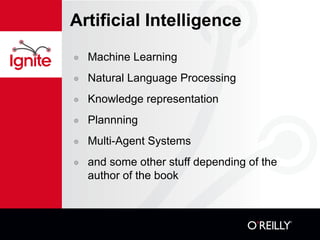
Artificial Intelligence Machine Learning Natural Language Processing Knowledge representation Plannning  Multi-Agent Systems and some other stuff depending of the author of the book
Machine Learning A program is  learning  when it executes a task  T  and acquires experience  E  and the measured performance  P  of  T  improves with experience  E  (T. Mitchell, Machine Learning, 1997)
Machine Learning Flavours Supervised Learning Programs learn a concept/hypothesis by means of labeled examples Examples: Artificial Neural Networks, Bayesian Methods, Decision Trees Unsupervised Learning Programs learn to categorise unlabelled examples Examples: Non-negative matrix factorization and self-organising maps
More flavours Reinforcement Learning Programs learn interacting with the environment, the execution of actions and observing the feedback in the form of + or – rewards Examples: SARSA, Q-Learning
Training Examples Continuous Discrete Inputs know as  Vectors  or  Features Example in Wine Classification: Alcohol level, Malic acid, Ash, Alcalinity of ash, etc.
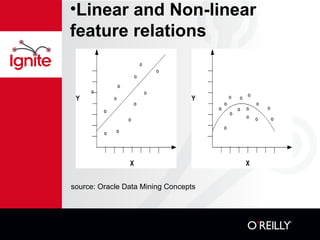
Linear and Non-linear feature relations source: Oracle Data Mining Concepts
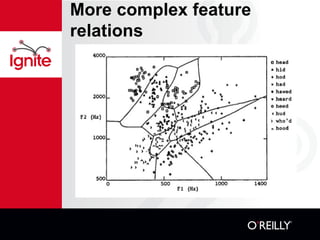
More complex feature relations
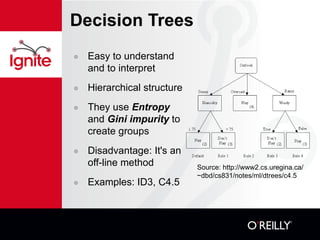
Decision Trees Easy to understand and to interpret Hierarchical structure They use  Entropy  and  Gini impurity  to create groups Disadvantage: It's an off-line method Examples: ID3, C4.5 Source: http://www2.cs.uregina.ca/~dbd/cs831/notes/ml/dtrees/c4.5
Decision Trees, example Create .names and .data files with training data Generate tree and rules (c4.5 -f <file> and c4.5rules -f <file>) Outlook Temperature Humidity Windy Play or Don't Play  Sunny  80 90 true Don't Play  Overcast  83 78 false Play  Rain 70 96  false Play  Categorize new data (consult,consultr). Use GPS/Geocoding, Google Maps and Yahoo Weather APIs to enhance aservin@turin:~/Projects/C45: consult -f golf C4.5 [release 8] decision tree interpreter Sat Jan 17 00:05:16 2009 ------------------------------------------ outlook: sunny humidity: 80 Decision: Don't Play  CF = 1.00  [ 0.63 - 1.00 ]
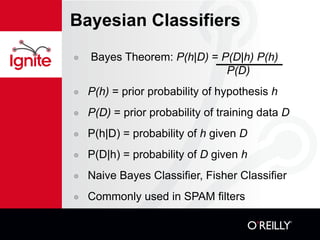
Bayesian Classifiers Bayes Theorem:  P(h|D)  =  P(D|h) P(h)   P(D) P(h)  = prior probability of hypothesis  h P(D)  = prior probability of training data  D P(h|D) = probability of  h  given  D P(D|h) = probability of  D  given  h Naive Bayes Classifier, Fisher Classifier Commonly used in SPAM filters
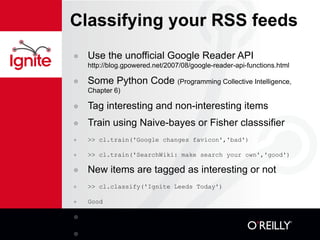
Classifying your RSS feeds Use the unofficial Google Reader API  http://blog.gpowered.net/2007/08/google-reader-api-functions.html Some Python Code  (Programming Collective Intelligence, Chapter 6) Tag interesting and non-interesting items Train using Naive-bayes or Fisher classsifier >> cl.train('Google changes favicon','bad') >> cl.train('SearchWiki: make search your own','good') New items are tagged as interesting or not >> cl.classify('Ignite Leeds Today') Good You can re-train online Add more features, try with e-mail
Finding Similarity Euclidean Distance, Pearson Correlation Score, Manhattan Document Clustering Price Prediction Item similarity k-Nearest Neighbors, k-means, Hierarchical Clustering, Support-Vector Machines, Kernel Methods
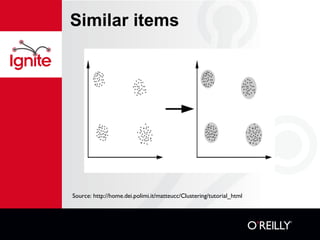
Similar items Source: http://home.dei.polimi.it/matteucc/Clustering/tutorial_html
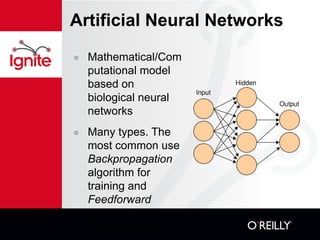
Artificial Neural Networks Mathematical/Computational model based on biological neural networks Many types. The most common use  Backpropagation  algorithm for training and  Feedforward  algorithm to get results/training
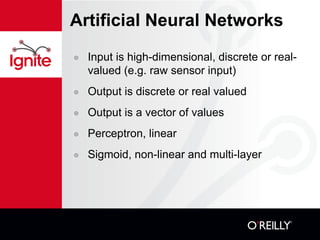
Artificial Neural Networks Input is high-dimensional, discrete or real-valued (e.g. raw sensor input) Output is discrete or real valued Output is a vector of values Perceptron, linear Sigmoid, non-linear and multi-layer
Example, finding the best price Create training data using Amazon/Ebay API Laptop prices. Use price, screen size as features Use a ANN, i.e. Fast Artificial Neural Network (FANN) struct fann *ann = fann_create_standard(num_layers, num_input, num_neurons_hidden, num_output); #C++ ann = fann.create(connection_rate, (num_input, num_neurons_hidden, num_output))  #Python $ann = fann_create(array(2, 4, 1),1.0,0.7); // PHP You can also try  k-Nearest Neighbours Try it!
Resources 1 Books Practical Artificial Intelligence Programming in Java, Mark Watson  http://www.markwatson.com/opencontent/  (There is a Ruby one as well) Programming Collective Intelligence, Toby Segaran; O'Reilly Artificial Intelligence: A Modern Approach, S. Russell, P. Norvig, J. Canny; Prentice Hall, Machine Learning, Tom Mitchell; MIT Press Online Stuff ML course in Stanford http://www.stanford.edu/class/cs229/materials.html   Statistical ML  http://bengio .abracadoudou.com/lectures/
Resources 2 Code FANN  http://leenissen.dk/fann/index.php NLP  http://opennlp.sourceforge.net/ C4.5   http://www2.cs.uregina.ca/~dbd/cs831/notes/ml/dtrees/c4.5/tutorial.html ML and Java http://www.developer.com/java/other/article.php/10936_1559871_1 Data UC Irvine Machine Learning Repository  http://archive.ics.uci.edu/ml/ Amazon Public Datasets  http://aws.amazon.com/publicdatasets/
More info For questions, projects and job offers: arturo.servin \_(at)\_ gmail.com http://twitter.com/the_real_r2d2 http://arturo.servin.googlepages.com/

Practical Artificial Intelligence & Machine Learning (Arturo Servin)

  • 1.
    Practical Artificial Intelligenceand Machine Learning arturo.servin_at_gmail.com http://arturo.servin.googlepages.com/
  • 2.
    About this presentationSome theory on AI and ML Some practical ideas and simple how to What's out there using AI Resources, Kits and Data
  • 3.
    Artificial Intelligence MachineLearning Natural Language Processing Knowledge representation Plannning Multi-Agent Systems and some other stuff depending of the author of the book
  • 4.
    Machine Learning Aprogram is learning when it executes a task T and acquires experience E and the measured performance P of T improves with experience E (T. Mitchell, Machine Learning, 1997)
  • 5.
    Machine Learning FlavoursSupervised Learning Programs learn a concept/hypothesis by means of labeled examples Examples: Artificial Neural Networks, Bayesian Methods, Decision Trees Unsupervised Learning Programs learn to categorise unlabelled examples Examples: Non-negative matrix factorization and self-organising maps
  • 6.
    More flavours ReinforcementLearning Programs learn interacting with the environment, the execution of actions and observing the feedback in the form of + or – rewards Examples: SARSA, Q-Learning
  • 7.
    Training Examples ContinuousDiscrete Inputs know as Vectors or Features Example in Wine Classification: Alcohol level, Malic acid, Ash, Alcalinity of ash, etc.
  • 8.
    Linear and Non-linearfeature relations source: Oracle Data Mining Concepts
  • 9.
  • 10.
    Decision Trees Easyto understand and to interpret Hierarchical structure They use Entropy and Gini impurity to create groups Disadvantage: It's an off-line method Examples: ID3, C4.5 Source: http://www2.cs.uregina.ca/~dbd/cs831/notes/ml/dtrees/c4.5
  • 11.
    Decision Trees, exampleCreate .names and .data files with training data Generate tree and rules (c4.5 -f <file> and c4.5rules -f <file>) Outlook Temperature Humidity Windy Play or Don't Play Sunny 80 90 true Don't Play Overcast 83 78 false Play Rain 70 96 false Play Categorize new data (consult,consultr). Use GPS/Geocoding, Google Maps and Yahoo Weather APIs to enhance aservin@turin:~/Projects/C45: consult -f golf C4.5 [release 8] decision tree interpreter Sat Jan 17 00:05:16 2009 ------------------------------------------ outlook: sunny humidity: 80 Decision: Don't Play CF = 1.00 [ 0.63 - 1.00 ]
  • 12.
    Bayesian Classifiers BayesTheorem: P(h|D) = P(D|h) P(h) P(D) P(h) = prior probability of hypothesis h P(D) = prior probability of training data D P(h|D) = probability of h given D P(D|h) = probability of D given h Naive Bayes Classifier, Fisher Classifier Commonly used in SPAM filters
  • 13.
    Classifying your RSSfeeds Use the unofficial Google Reader API http://blog.gpowered.net/2007/08/google-reader-api-functions.html Some Python Code (Programming Collective Intelligence, Chapter 6) Tag interesting and non-interesting items Train using Naive-bayes or Fisher classsifier >> cl.train('Google changes favicon','bad') >> cl.train('SearchWiki: make search your own','good') New items are tagged as interesting or not >> cl.classify('Ignite Leeds Today') Good You can re-train online Add more features, try with e-mail
  • 14.
    Finding Similarity EuclideanDistance, Pearson Correlation Score, Manhattan Document Clustering Price Prediction Item similarity k-Nearest Neighbors, k-means, Hierarchical Clustering, Support-Vector Machines, Kernel Methods
  • 15.
    Similar items Source:http://home.dei.polimi.it/matteucc/Clustering/tutorial_html
  • 16.
    Artificial Neural NetworksMathematical/Computational model based on biological neural networks Many types. The most common use Backpropagation algorithm for training and Feedforward algorithm to get results/training
  • 17.
    Artificial Neural NetworksInput is high-dimensional, discrete or real-valued (e.g. raw sensor input) Output is discrete or real valued Output is a vector of values Perceptron, linear Sigmoid, non-linear and multi-layer
  • 18.
    Example, finding thebest price Create training data using Amazon/Ebay API Laptop prices. Use price, screen size as features Use a ANN, i.e. Fast Artificial Neural Network (FANN) struct fann *ann = fann_create_standard(num_layers, num_input, num_neurons_hidden, num_output); #C++ ann = fann.create(connection_rate, (num_input, num_neurons_hidden, num_output)) #Python $ann = fann_create(array(2, 4, 1),1.0,0.7); // PHP You can also try k-Nearest Neighbours Try it!
  • 19.
    Resources 1 BooksPractical Artificial Intelligence Programming in Java, Mark Watson http://www.markwatson.com/opencontent/ (There is a Ruby one as well) Programming Collective Intelligence, Toby Segaran; O'Reilly Artificial Intelligence: A Modern Approach, S. Russell, P. Norvig, J. Canny; Prentice Hall, Machine Learning, Tom Mitchell; MIT Press Online Stuff ML course in Stanford http://www.stanford.edu/class/cs229/materials.html Statistical ML http://bengio .abracadoudou.com/lectures/
  • 20.
    Resources 2 CodeFANN http://leenissen.dk/fann/index.php NLP http://opennlp.sourceforge.net/ C4.5 http://www2.cs.uregina.ca/~dbd/cs831/notes/ml/dtrees/c4.5/tutorial.html ML and Java http://www.developer.com/java/other/article.php/10936_1559871_1 Data UC Irvine Machine Learning Repository http://archive.ics.uci.edu/ml/ Amazon Public Datasets http://aws.amazon.com/publicdatasets/
  • 21.
    More info Forquestions, projects and job offers: arturo.servin \_(at)\_ gmail.com http://twitter.com/the_real_r2d2 http://arturo.servin.googlepages.com/