Welcome to our Bible StudyWelcome to our Bible Study
1212thth
Sunday in the Ordinary Time CSunday in the Ordinary Time C
19 June 201619 June 2016
In preparation for this Sunday’s liturgyIn preparation for this Sunday’s liturgy
As aid in focusing our homilies and sharingAs aid in focusing our homilies and sharing
Prepared by Fr. Cielo R. Almazan,
OFM
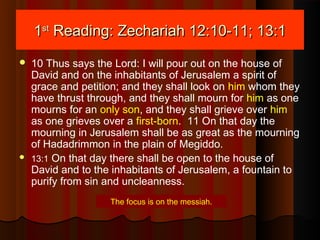
11stst
Reading: Zechariah 12:10-11; 13:1Reading: Zechariah 12:10-11; 13:1
 10 Thus says the Lord: I will pour out on the house of
David and on the inhabitants of Jerusalem a spirit of
grace and petition; and they shall look on him whom they
have thrust through, and they shall mourn for him as one
mourns for an only son, and they shall grieve over him
as one grieves over a first-born. 11 On that day the
mourning in Jerusalem shall be as great as the mourning
of Hadadrimmon in the plain of Megiddo.
 13:1 On that day there shall be open to the house of
David and to the inhabitants of Jerusalem, a fountain to
purify from sin and uncleanness.
The focus is on the messiah.
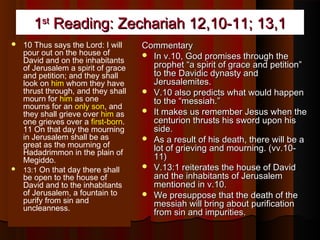
11stst
Reading: Zechariah 12,10-11; 13,1Reading: Zechariah 12,10-11; 13,1
 10 Thus says the Lord: I will
pour out on the house of
David and on the inhabitants
of Jerusalem a spirit of grace
and petition; and they shall
look on him whom they have
thrust through, and they shall
mourn for him as one
mourns for an only son, and
they shall grieve over him as
one grieves over a first-born.
11 On that day the mourning
in Jerusalem shall be as
great as the mourning of
Hadadrimmon in the plain of
Megiddo.
 13:1 On that day there shall
be open to the house of
David and to the inhabitants
of Jerusalem, a fountain to
purify from sin and
uncleanness.
CommentaryCommentary
 In v.10, God promises through theIn v.10, God promises through the
prophet “a spirit of grace and petition”prophet “a spirit of grace and petition”
to the Davidic dynasty andto the Davidic dynasty and
Jerusalemites.Jerusalemites.
 V.10 also predicts what would happenV.10 also predicts what would happen
to the “messiah.”to the “messiah.”
 It makes us remember Jesus when theIt makes us remember Jesus when the
centurion thrusts his sword upon hiscenturion thrusts his sword upon his
side.side.
 As a result of his death, there will be aAs a result of his death, there will be a
lot of grieving and mourning. (vv.10-lot of grieving and mourning. (vv.10-
11)11)
 V.13:1 reiterates the house of DavidV.13:1 reiterates the house of David
and the inhabitants of Jerusalemand the inhabitants of Jerusalem
mentioned in v.10.mentioned in v.10.
 We presuppose that the death of theWe presuppose that the death of the
messiah will bring about purificationmessiah will bring about purification
from sin and impurities.from sin and impurities.
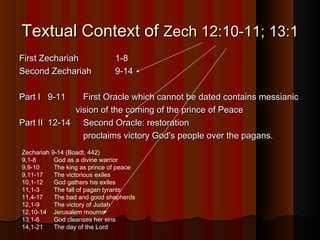
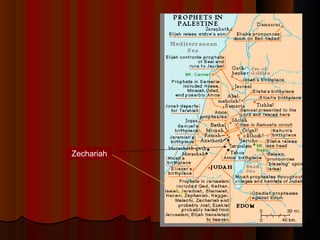
Textual Context ofTextual Context of Zech 12:10-11; 13:1Zech 12:10-11; 13:1
First ZechariahFirst Zechariah 1-81-8
Second ZechariahSecond Zechariah 9-149-14
Part I 9-11Part I 9-11 First Oracle which cannot be dated contains messianicFirst Oracle which cannot be dated contains messianic
vision of the coming of the prince of Peacevision of the coming of the prince of Peace
Part II 12-14Part II 12-14 Second Oracle: restorationSecond Oracle: restoration
proclaims victory God's people over the pagans.proclaims victory God's people over the pagans.
Zechariah 9-14 (Boadt, 442)
9,1-8 God as a divine warrior
9,9-10 The king as prince of peace
9,11-17 The victorious exiles
10,1-12 God gathers his exiles
11,1-3 The fall of pagan tyrants
11,4-17 The bad and good shepherds
12,1-9 The victory of Judah
12,10-14 Jerusalem mourns
13,1-6 God cleanses her sins
14,1-21 The day of the Lord
Zechariah
Reflections on the 1Reflections on the 1stst
readingreading
 The messiah comes from a royal family, not fromThe messiah comes from a royal family, not from
an ordinary family.an ordinary family.
 He is sent by God to save us, at a great price.He is sent by God to save us, at a great price.
 God does not send just anybody, but his onlyGod does not send just anybody, but his only
Son.Son.
 God is generous with his love.God is generous with his love.
 His son is the same. He is willing to undergoHis son is the same. He is willing to undergo
pain and death.pain and death.
 We must realize how God treasures us, sinners.We must realize how God treasures us, sinners.
Resp. Ps 63:2, 3-4, 5-6, 8-9Resp. Ps 63:2, 3-4, 5-6, 8-9
R.     (2b)R.     (2b) My soul is thirsting for you, O Lord my God.My soul is thirsting for you, O Lord my God.
2 O God, you are my God whom I seek;2 O God, you are my God whom I seek;
for you my flesh pines and my soul thirstsfor you my flesh pines and my soul thirsts
Like the earth, parched, lifeless and without water.Like the earth, parched, lifeless and without water.
3 Thus have I gazed toward you in the sanctuary3 Thus have I gazed toward you in the sanctuary
to see your power and your glory,to see your power and your glory,
4 For your kindness is a greater good than life; my lips shall glorify you.4 For your kindness is a greater good than life; my lips shall glorify you.
5 Thus will I bless you while I live;5 Thus will I bless you while I live;
lifting up my hands, I will call upon your name.lifting up my hands, I will call upon your name.
6 As with the riches of a banquet shall my soul be satisfied,6 As with the riches of a banquet shall my soul be satisfied,
and with exultant lips my mouth shall praise you.and with exultant lips my mouth shall praise you.
8 You are my help, and in the shadow of your wings I shout for joy.8 You are my help, and in the shadow of your wings I shout for joy.
9 My soul clings fast to you; your right hand upholds me.9 My soul clings fast to you; your right hand upholds me.
Resp. Ps 63:2, 3-4, 5-6, 8-9Resp. Ps 63:2, 3-4, 5-6, 8-9
R.     (2b)R.     (2b) My soul is thirsting for you, OMy soul is thirsting for you, O
Lord my God.Lord my God.
2 O God, you are my God whom I seek;2 O God, you are my God whom I seek;
for you my flesh pines and my soul thirstsfor you my flesh pines and my soul thirsts
like the earth, parched, lifeless and withoutlike the earth, parched, lifeless and without
water.water.
3 Thus have I gazed toward you in the3 Thus have I gazed toward you in the
sanctuary to see your power and yoursanctuary to see your power and your
glory,glory,
4 For your kindness is a greater good than4 For your kindness is a greater good than
life; my lips shall glorify you.life; my lips shall glorify you.
5 Thus will I bless you while I live;5 Thus will I bless you while I live;
lifting up my hands, I will call upon yourlifting up my hands, I will call upon your
name.name.
6 As with the riches of a banquet shall my6 As with the riches of a banquet shall my
soul be satisfied,soul be satisfied,
and with exultant lips my mouth shall praiseand with exultant lips my mouth shall praise
you.you.
8You are my help, and in the shadow of your8You are my help, and in the shadow of your
wings I shout for joy.wings I shout for joy.
9 My soul clings fast to you; your right hand9 My soul clings fast to you; your right hand
upholds me.upholds me.
CommentaryCommentary
 The psalm beautifully expressesThe psalm beautifully expresses
our desire for God.our desire for God.
 V.2 uses similes to describeV.2 uses similes to describe
how the psalmist longs for God.how the psalmist longs for God.
 In v.3, the psalmist finds God inIn v.3, the psalmist finds God in
the Temple.the Temple.
 V.4 recognizes the supremacyV.4 recognizes the supremacy
of God’s kindness over life.of God’s kindness over life.
 In v.5, the psalmist promises toIn v.5, the psalmist promises to
bless and pray to God.bless and pray to God.
 V.6 speaks of satisfaction of theV.6 speaks of satisfaction of the
psalmist.psalmist.
 The psalmist assures of hisThe psalmist assures of his
praise and thanksgiving.praise and thanksgiving.
 V.8 affirms God’s protection.V.8 affirms God’s protection.
 In v.9, the psalmist expressesIn v.9, the psalmist expresses
his deep faith in God and God’shis deep faith in God and God’s
protection to him.protection to him.
Reflections on the PsalmReflections on the Psalm
 We should be able to appropriate the psalm toWe should be able to appropriate the psalm to
ourselves.ourselves.
 We should become psalmists ourselves, not just readersWe should become psalmists ourselves, not just readers
of the psalm.of the psalm.
 We best express ourselves when we adopt the way ofWe best express ourselves when we adopt the way of
the psalmist.the psalmist.
 In this form of prayer, we should feel God’s presenceIn this form of prayer, we should feel God’s presence
better.better.
22ndnd
Reading: Galatians 3:26-29Reading: Galatians 3:26-29
26 Through faith you are all children of
God in Christ Jesus. 27 For all of you who
were baptized into Christ have clothed
yourselves with Christ. 28 There is neither
Jew nor Greek, there is neither slave nor
free person, there is not male and female;
for you are all one in Christ Jesus. 29 And
if you belong to Christ, then you are
Abraham's descendant, heirs according to
the promise.
The focus is on Christ.
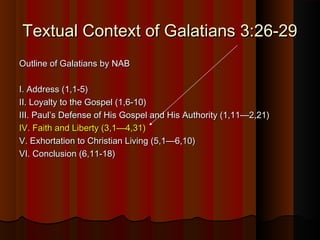
Textual Context of Galatians 3:26-29Textual Context of Galatians 3:26-29
Outline of Galatians by NABOutline of Galatians by NAB
I. Address (1,1-5)I. Address (1,1-5)
II. Loyalty to the Gospel (1,6-10)II. Loyalty to the Gospel (1,6-10)
III. Paul’s Defense of His Gospel and His Authority (1,11—2,21)III. Paul’s Defense of His Gospel and His Authority (1,11—2,21)
IV. Faith and Liberty (3,1—4,31)IV. Faith and Liberty (3,1—4,31)
V. Exhortation to Christian Living (5,1—6,10)V. Exhortation to Christian Living (5,1—6,10)
VI. Conclusion (6,11-18)VI. Conclusion (6,11-18)
22ndnd
Reading: Galatians 3,26-29Reading: Galatians 3,26-29
 26 Through faith you are all
children of God in Christ
Jesus. 27 For all of you
who were baptized into
Christ have clothed
yourselves with Christ. 28
There is neither Jew nor
Greek, there is neither
slave nor free person, there
is not male and female; for
you are all one in Christ
Jesus. 29 And if you
belong to Christ, then you
are Abraham's descendant,
heirs according to the
promise.
CommentaryCommentary
 In v.26, Paul affirms that we areIn v.26, Paul affirms that we are
God’s children.God’s children.
 We become God’s children throughWe become God’s children through
faith infaith in ChristChrist = Messiah (v.26) and= Messiah (v.26) and
through baptism (v.27).through baptism (v.27).
 In God’s family, there are noIn God’s family, there are no
distinctions. We are made one indistinctions. We are made one in
ChristChrist. V.28. V.28
 In v.29, Paul also affirms ourIn v.29, Paul also affirms our
common ancestry (Abraham) and wecommon ancestry (Abraham) and we
are entitled to God’s promise asare entitled to God’s promise as
heirs, through Jesusheirs, through Jesus ChristChrist..
Reflections on the 2Reflections on the 2ndnd
readingreading
 As Christians, we have to realize and appreciateAs Christians, we have to realize and appreciate
thatthat ChristChrist has done many great things for us.has done many great things for us.
 HeHe made us children of God.made us children of God.
 HeHe made us united as one, though of differentmade us united as one, though of different
cultures, genders and races.cultures, genders and races. (No more distinctions which are(No more distinctions which are
sources of divisions).sources of divisions).
 HeHe made us heirs in the kingdom.made us heirs in the kingdom.
 What more can we ask?What more can we ask?
Gospel Reading: Luke 9:18-24Gospel Reading: Luke 9:18-24
Identifying Jesus correctly
 18 Once when Jesus was praying in solitude, and the
disciples were with him, he asked them, "Who do the
crowds say that I am?“ 19 They said in reply, "John the
Baptist; others, Elijah; still others, 'One of the ancient
prophets has arisen.'“ 20 Then he said to them, "But who
do you say that I am?" Peter said in reply, "The Messiah
of God.“ 21 He rebuked them and directed them not to
tell this to anyone.
The Suffering Christ and discipleship
 22 He said, "The Son of Man must suffer greatly and be
rejected by the elders, the chief priests, and the scribes,
and be killed and on the third day be raised.” 23 Then
he said to all, "If anyone wishes to come after me, he
must deny himself and take up his cross daily and follow
me. 24 For whoever wishes to save his life will lose it,
but whoever loses his life for my sake will save it.
The focus is on the Messiah.
Textual Context of Luke 9:18-24Textual Context of Luke 9:18-24
Outline from the NABOutline from the NAB
 Mission of the Twelve (9,1-6)Mission of the Twelve (9,1-6)
 Herod’s Opinion of Jesus (9,7-9)Herod’s Opinion of Jesus (9,7-9)
 The Return of the Twelve and the Feeding of the 5000The Return of the Twelve and the Feeding of the 5000
(9,10-17)(9,10-17)
 Peter’s Confession about Jesus (9,18-21)Peter’s Confession about Jesus (9,18-21)
 The First Prediction of the Passion (9,22)The First Prediction of the Passion (9,22)
 The Conditions of Discipleship (9,23-27)The Conditions of Discipleship (9,23-27)
 The Transfiguration of Jesus (9,28-36)The Transfiguration of Jesus (9,28-36)
Gospel Reading: Luke 9,18-24Gospel Reading: Luke 9,18-24
Identifying Jesus correctly
 18 Once when Jesus was praying in
solitude, and the disciples were with
him, he asked them, "Who do the
crowds say that I am?“ 19 They said in
reply, "John the Baptist; others, Elijah;
still others, 'One of the ancient
prophets has arisen.'“ 20 Then he said
to them, "But who do you say that I
am?" Peter said in reply, "The Messiah
of God.“ 21 He rebuked them and
directed them not to tell this to anyone.
The Suffering Christ and
discipleship
 22 He said, "The Son of Man must
suffer greatly and be rejected by the
elders, the chief priests, and the
scribes, and be killed and on the third
day be raised.” 23 Then he said to all,
"If anyone wishes to come after me, he
must deny himself and take up his
cross daily and follow me. 24 For
whoever wishes to save his life will
lose it, but whoever loses his life for
my sake will save it.
CommentaryCommentary
 V.18 presents Jesus as praying, in theV.18 presents Jesus as praying, in the
presence of his disciples.presence of his disciples.
 In the context of prayer, Jesus asks hisIn the context of prayer, Jesus asks his
disciples how people size him up.disciples how people size him up.
 V.19 enumerates the wrong answers of theV.19 enumerates the wrong answers of the
people. They do not appreciate who Jesuspeople. They do not appreciate who Jesus
is.is.
 In v.20, Jesus asks the same question toIn v.20, Jesus asks the same question to
his apostles.his apostles.
 Peter, the spokesman of the apostles,Peter, the spokesman of the apostles,
answers correctly.answers correctly.
 Surprisingly in v.21, Jesus rebukes (as ifSurprisingly in v.21, Jesus rebukes (as if
he scolds them) and wants them to keephe scolds them) and wants them to keep
his identity secret.his identity secret.
 Then, in v.22, Jesus clarifies what kind ofThen, in v.22, Jesus clarifies what kind of
Messiah he is.Messiah he is.
 A suffering, rejected, and “killed” Messiah.A suffering, rejected, and “killed” Messiah.
 In v.23, Jesus challenges his apostles ifIn v.23, Jesus challenges his apostles if
they want to follow him, they too mustthey want to follow him, they too must
suffer.suffer.
 In v.24, Jesus does not buy the idea ofIn v.24, Jesus does not buy the idea of
self-preservation when following him.self-preservation when following him.
Reflections on the gospel readingReflections on the gospel reading
 We Christians must know who Jesus is.We Christians must know who Jesus is.
 We must not mistake his identity.We must not mistake his identity.
 He is the ChristHe is the Christ (Greek,(Greek, christoschristos),), MessiahMessiah (Hebrew, masiha).(Hebrew, masiha).
 But we should not misinterpret what kind of Messiah heBut we should not misinterpret what kind of Messiah he
is.is.
 Misinterpretation has devastating effect on ourMisinterpretation has devastating effect on our
discipleship and mission.discipleship and mission.
 In this Year of Faith, are you being clarified who Jesus isIn this Year of Faith, are you being clarified who Jesus is
by your pastor or your Church?by your pastor or your Church?
Tying the 3Tying the 3 readingsreadings and the Psalmand the Psalm
 The first reading talks about theThe first reading talks about the MessiahMessiah..
 The psalm talks about longing for God (for theThe psalm talks about longing for God (for the MessiahMessiah).).
 The second reading talks aboutThe second reading talks about ChristChrist..
 The gospel reading talks aboutThe gospel reading talks about MessiahMessiah..
On this Sunday, we focus on the Messiah.
How to develop your homily / sharingHow to develop your homily / sharing
 To begin with, ask the audience what they know aboutTo begin with, ask the audience what they know about
Jesus.Jesus.
 They may give these answers:They may give these answers:
 He is our Savior. He is our Lord. He is God. He is theHe is our Savior. He is our Lord. He is God. He is the
good Shepherd,good Shepherd, ChristChrist… etc.… etc.
 Now ask if they really know the meaning ofNow ask if they really know the meaning of ChristChrist. Is it. Is it
Jesus’ surname?Jesus’ surname?
 In those days, it was OK to call a man “Jesus.”In those days, it was OK to call a man “Jesus.”
 But whether he is the “But whether he is the “ChristChrist” or not, that was something” or not, that was something
else.else.
 If you claim to beIf you claim to be ChristChrist (anointed), you have a problem.(anointed), you have a problem.
 In theIn the first reading,first reading, Zechariah (333 BC) has longZechariah (333 BC) has long
predicted the coming of thepredicted the coming of the MessiahMessiah..
 The prophet Zechariah rightly identifies theThe prophet Zechariah rightly identifies the MessiahMessiah asas
the only Son, whose violent death has caused so muchthe only Son, whose violent death has caused so much
sorrow, but has brought us forgiveness and new life.sorrow, but has brought us forgiveness and new life.
 Jesus has properly submitted himself to the inhumanitiesJesus has properly submitted himself to the inhumanities
committed against him, according to the plan of God ascommitted against him, according to the plan of God as
revealed by the prophet.revealed by the prophet.
 Likewise, you have a problem also if you don’t know whoLikewise, you have a problem also if you don’t know who
Christ is.Christ is.
 You can’t be his true disciple.You can’t be his true disciple.
 Don’t imagine you know him, if you have neverDon’t imagine you know him, if you have never
encountered him in the sacraments and in the Church.encountered him in the sacraments and in the Church.
 What you may know about him is not the real Christ.What you may know about him is not the real Christ.
 It is the Christ of your (or other’s) imagination.It is the Christ of your (or other’s) imagination.
 In theIn the gospel readinggospel reading, the people did not identify Jesus, the people did not identify Jesus
as the Messiah; but Peter and the other apostles did.as the Messiah; but Peter and the other apostles did.
Why?Why?
 Knowledge of Jesus is not a one-shot deal.Knowledge of Jesus is not a one-shot deal.
 One encounter with him is not enough.One encounter with him is not enough.
 The apostles had the privilege of encountering himThe apostles had the privilege of encountering him
always, as they were following him, beginning from hisalways, as they were following him, beginning from his
baptism up to this moment.baptism up to this moment.
 So they know him, at the very least, 50% of him.So they know him, at the very least, 50% of him.
 What about the other 50%, which tells them what kind ofWhat about the other 50%, which tells them what kind of
Messiah he is?Messiah he is?
 They will come to know when they follow him, up to theThey will come to know when they follow him, up to the
Calvary, when they see him die on the cross.Calvary, when they see him die on the cross.
 And they will complete their knowledge of him, whenAnd they will complete their knowledge of him, when
they too will die like him.they too will die like him.
 We Christians come to know Jesus more when weWe Christians come to know Jesus more when we
continue encountering him in the sacraments, readingcontinue encountering him in the sacraments, reading
the Bible and listening to those who are trained tothe Bible and listening to those who are trained to
interpret biblical texts.interpret biblical texts.
 We must also journey with Christ.We must also journey with Christ.
 Our knowledge of him as the Messiah will never beOur knowledge of him as the Messiah will never be
complete, if we refuse to carry our crosses and becomplete, if we refuse to carry our crosses and be
crucified at the end.crucified at the end.
 TheThe second readingsecond reading enumerates whatenumerates what ChristChrist has donehas done
for us.for us.
 ChristChrist can do much for us because of his passion, deathcan do much for us because of his passion, death
and resurrection.and resurrection.
 HeHe has won life for us the hard way through his blood.has won life for us the hard way through his blood.
 We, too, will really enjoy the inheritance set aside for us,We, too, will really enjoy the inheritance set aside for us,
if we keep the faith inif we keep the faith in ChristChrist..
In our churches, let us speed upIn our churches, let us speed up
catechetical work and ongoing formation.catechetical work and ongoing formation.
Many of us are still ignorant about Christ.Many of us are still ignorant about Christ.
We do many things without knowing why.We do many things without knowing why.
We, Christians, should know the meaningWe, Christians, should know the meaning
of what we are doing, especially in theof what we are doing, especially in the
liturgy, in which we encounter Christ best.liturgy, in which we encounter Christ best.
 In theIn the EucharistEucharist, we come to know more about, we come to know more about
Jesus.Jesus.
 In theIn the EucharistEucharist, we participate in the journey of, we participate in the journey of
Jesus (passion, death and resurrection).Jesus (passion, death and resurrection).
 In theIn the EucharistEucharist, Christ promises us eternal life., Christ promises us eternal life.
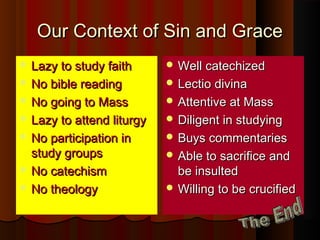
Our Context of Sin and GraceOur Context of Sin and Grace
 Lazy to study faithLazy to study faith
 No bible readingNo bible reading
 No going to MassNo going to Mass
 Lazy to attend liturgyLazy to attend liturgy
 No participation inNo participation in
study groupsstudy groups
 No catechismNo catechism
 No theologyNo theology
 Well catechizedWell catechized
 Lectio divinaLectio divina
 Attentive at MassAttentive at Mass
 Diligent in studyingDiligent in studying
 Buys commentariesBuys commentaries
 Able to sacrifice andAble to sacrifice and
be insultedbe insulted
 Willing to be crucifiedWilling to be crucified
Suggested SongsSuggested Songs
One Bread One BodyOne Bread One Body
 http://www.youtube.com/watch?v=WIl8CHLR4CQhttp://www.youtube.com/watch?v=WIl8CHLR4CQ
Sino ba ang Diyos?Sino ba ang Diyos?
 http://www.youtube.com/watch?v=m8glIv39uKAhttp://www.youtube.com/watch?v=m8glIv39uKA
Dear sisters and brothers,

We must have a correct view of Jesus as
the Messiah.

Fr. Cielo

12th Sunday C

  • 1.
    Welcome to ourBible StudyWelcome to our Bible Study 1212thth Sunday in the Ordinary Time CSunday in the Ordinary Time C 19 June 201619 June 2016 In preparation for this Sunday’s liturgyIn preparation for this Sunday’s liturgy As aid in focusing our homilies and sharingAs aid in focusing our homilies and sharing Prepared by Fr. Cielo R. Almazan, OFM
  • 2.
    11stst Reading: Zechariah 12:10-11;13:1Reading: Zechariah 12:10-11; 13:1  10 Thus says the Lord: I will pour out on the house of David and on the inhabitants of Jerusalem a spirit of grace and petition; and they shall look on him whom they have thrust through, and they shall mourn for him as one mourns for an only son, and they shall grieve over him as one grieves over a first-born. 11 On that day the mourning in Jerusalem shall be as great as the mourning of Hadadrimmon in the plain of Megiddo.  13:1 On that day there shall be open to the house of David and to the inhabitants of Jerusalem, a fountain to purify from sin and uncleanness. The focus is on the messiah.
  • 3.
    11stst Reading: Zechariah 12,10-11;13,1Reading: Zechariah 12,10-11; 13,1  10 Thus says the Lord: I will pour out on the house of David and on the inhabitants of Jerusalem a spirit of grace and petition; and they shall look on him whom they have thrust through, and they shall mourn for him as one mourns for an only son, and they shall grieve over him as one grieves over a first-born. 11 On that day the mourning in Jerusalem shall be as great as the mourning of Hadadrimmon in the plain of Megiddo.  13:1 On that day there shall be open to the house of David and to the inhabitants of Jerusalem, a fountain to purify from sin and uncleanness. CommentaryCommentary  In v.10, God promises through theIn v.10, God promises through the prophet “a spirit of grace and petition”prophet “a spirit of grace and petition” to the Davidic dynasty andto the Davidic dynasty and Jerusalemites.Jerusalemites.  V.10 also predicts what would happenV.10 also predicts what would happen to the “messiah.”to the “messiah.”  It makes us remember Jesus when theIt makes us remember Jesus when the centurion thrusts his sword upon hiscenturion thrusts his sword upon his side.side.  As a result of his death, there will be aAs a result of his death, there will be a lot of grieving and mourning. (vv.10-lot of grieving and mourning. (vv.10- 11)11)  V.13:1 reiterates the house of DavidV.13:1 reiterates the house of David and the inhabitants of Jerusalemand the inhabitants of Jerusalem mentioned in v.10.mentioned in v.10.  We presuppose that the death of theWe presuppose that the death of the messiah will bring about purificationmessiah will bring about purification from sin and impurities.from sin and impurities.
  • 4.
    Textual Context ofTextualContext of Zech 12:10-11; 13:1Zech 12:10-11; 13:1 First ZechariahFirst Zechariah 1-81-8 Second ZechariahSecond Zechariah 9-149-14 Part I 9-11Part I 9-11 First Oracle which cannot be dated contains messianicFirst Oracle which cannot be dated contains messianic vision of the coming of the prince of Peacevision of the coming of the prince of Peace Part II 12-14Part II 12-14 Second Oracle: restorationSecond Oracle: restoration proclaims victory God's people over the pagans.proclaims victory God's people over the pagans. Zechariah 9-14 (Boadt, 442) 9,1-8 God as a divine warrior 9,9-10 The king as prince of peace 9,11-17 The victorious exiles 10,1-12 God gathers his exiles 11,1-3 The fall of pagan tyrants 11,4-17 The bad and good shepherds 12,1-9 The victory of Judah 12,10-14 Jerusalem mourns 13,1-6 God cleanses her sins 14,1-21 The day of the Lord
  • 5.
  • 6.
    Reflections on the1Reflections on the 1stst readingreading  The messiah comes from a royal family, not fromThe messiah comes from a royal family, not from an ordinary family.an ordinary family.  He is sent by God to save us, at a great price.He is sent by God to save us, at a great price.  God does not send just anybody, but his onlyGod does not send just anybody, but his only Son.Son.  God is generous with his love.God is generous with his love.  His son is the same. He is willing to undergoHis son is the same. He is willing to undergo pain and death.pain and death.  We must realize how God treasures us, sinners.We must realize how God treasures us, sinners.
  • 7.
    Resp. Ps 63:2,3-4, 5-6, 8-9Resp. Ps 63:2, 3-4, 5-6, 8-9 R.     (2b)R.     (2b) My soul is thirsting for you, O Lord my God.My soul is thirsting for you, O Lord my God. 2 O God, you are my God whom I seek;2 O God, you are my God whom I seek; for you my flesh pines and my soul thirstsfor you my flesh pines and my soul thirsts Like the earth, parched, lifeless and without water.Like the earth, parched, lifeless and without water. 3 Thus have I gazed toward you in the sanctuary3 Thus have I gazed toward you in the sanctuary to see your power and your glory,to see your power and your glory, 4 For your kindness is a greater good than life; my lips shall glorify you.4 For your kindness is a greater good than life; my lips shall glorify you. 5 Thus will I bless you while I live;5 Thus will I bless you while I live; lifting up my hands, I will call upon your name.lifting up my hands, I will call upon your name. 6 As with the riches of a banquet shall my soul be satisfied,6 As with the riches of a banquet shall my soul be satisfied, and with exultant lips my mouth shall praise you.and with exultant lips my mouth shall praise you. 8 You are my help, and in the shadow of your wings I shout for joy.8 You are my help, and in the shadow of your wings I shout for joy. 9 My soul clings fast to you; your right hand upholds me.9 My soul clings fast to you; your right hand upholds me.
  • 8.
    Resp. Ps 63:2,3-4, 5-6, 8-9Resp. Ps 63:2, 3-4, 5-6, 8-9 R.     (2b)R.     (2b) My soul is thirsting for you, OMy soul is thirsting for you, O Lord my God.Lord my God. 2 O God, you are my God whom I seek;2 O God, you are my God whom I seek; for you my flesh pines and my soul thirstsfor you my flesh pines and my soul thirsts like the earth, parched, lifeless and withoutlike the earth, parched, lifeless and without water.water. 3 Thus have I gazed toward you in the3 Thus have I gazed toward you in the sanctuary to see your power and yoursanctuary to see your power and your glory,glory, 4 For your kindness is a greater good than4 For your kindness is a greater good than life; my lips shall glorify you.life; my lips shall glorify you. 5 Thus will I bless you while I live;5 Thus will I bless you while I live; lifting up my hands, I will call upon yourlifting up my hands, I will call upon your name.name. 6 As with the riches of a banquet shall my6 As with the riches of a banquet shall my soul be satisfied,soul be satisfied, and with exultant lips my mouth shall praiseand with exultant lips my mouth shall praise you.you. 8You are my help, and in the shadow of your8You are my help, and in the shadow of your wings I shout for joy.wings I shout for joy. 9 My soul clings fast to you; your right hand9 My soul clings fast to you; your right hand upholds me.upholds me. CommentaryCommentary  The psalm beautifully expressesThe psalm beautifully expresses our desire for God.our desire for God.  V.2 uses similes to describeV.2 uses similes to describe how the psalmist longs for God.how the psalmist longs for God.  In v.3, the psalmist finds God inIn v.3, the psalmist finds God in the Temple.the Temple.  V.4 recognizes the supremacyV.4 recognizes the supremacy of God’s kindness over life.of God’s kindness over life.  In v.5, the psalmist promises toIn v.5, the psalmist promises to bless and pray to God.bless and pray to God.  V.6 speaks of satisfaction of theV.6 speaks of satisfaction of the psalmist.psalmist.  The psalmist assures of hisThe psalmist assures of his praise and thanksgiving.praise and thanksgiving.  V.8 affirms God’s protection.V.8 affirms God’s protection.  In v.9, the psalmist expressesIn v.9, the psalmist expresses his deep faith in God and God’shis deep faith in God and God’s protection to him.protection to him.
  • 9.
    Reflections on thePsalmReflections on the Psalm  We should be able to appropriate the psalm toWe should be able to appropriate the psalm to ourselves.ourselves.  We should become psalmists ourselves, not just readersWe should become psalmists ourselves, not just readers of the psalm.of the psalm.  We best express ourselves when we adopt the way ofWe best express ourselves when we adopt the way of the psalmist.the psalmist.  In this form of prayer, we should feel God’s presenceIn this form of prayer, we should feel God’s presence better.better.
  • 10.
    22ndnd Reading: Galatians 3:26-29Reading:Galatians 3:26-29 26 Through faith you are all children of God in Christ Jesus. 27 For all of you who were baptized into Christ have clothed yourselves with Christ. 28 There is neither Jew nor Greek, there is neither slave nor free person, there is not male and female; for you are all one in Christ Jesus. 29 And if you belong to Christ, then you are Abraham's descendant, heirs according to the promise. The focus is on Christ.
  • 11.
    Textual Context ofGalatians 3:26-29Textual Context of Galatians 3:26-29 Outline of Galatians by NABOutline of Galatians by NAB I. Address (1,1-5)I. Address (1,1-5) II. Loyalty to the Gospel (1,6-10)II. Loyalty to the Gospel (1,6-10) III. Paul’s Defense of His Gospel and His Authority (1,11—2,21)III. Paul’s Defense of His Gospel and His Authority (1,11—2,21) IV. Faith and Liberty (3,1—4,31)IV. Faith and Liberty (3,1—4,31) V. Exhortation to Christian Living (5,1—6,10)V. Exhortation to Christian Living (5,1—6,10) VI. Conclusion (6,11-18)VI. Conclusion (6,11-18)
  • 13.
    22ndnd Reading: Galatians 3,26-29Reading:Galatians 3,26-29  26 Through faith you are all children of God in Christ Jesus. 27 For all of you who were baptized into Christ have clothed yourselves with Christ. 28 There is neither Jew nor Greek, there is neither slave nor free person, there is not male and female; for you are all one in Christ Jesus. 29 And if you belong to Christ, then you are Abraham's descendant, heirs according to the promise. CommentaryCommentary  In v.26, Paul affirms that we areIn v.26, Paul affirms that we are God’s children.God’s children.  We become God’s children throughWe become God’s children through faith infaith in ChristChrist = Messiah (v.26) and= Messiah (v.26) and through baptism (v.27).through baptism (v.27).  In God’s family, there are noIn God’s family, there are no distinctions. We are made one indistinctions. We are made one in ChristChrist. V.28. V.28  In v.29, Paul also affirms ourIn v.29, Paul also affirms our common ancestry (Abraham) and wecommon ancestry (Abraham) and we are entitled to God’s promise asare entitled to God’s promise as heirs, through Jesusheirs, through Jesus ChristChrist..
  • 14.
    Reflections on the2Reflections on the 2ndnd readingreading  As Christians, we have to realize and appreciateAs Christians, we have to realize and appreciate thatthat ChristChrist has done many great things for us.has done many great things for us.  HeHe made us children of God.made us children of God.  HeHe made us united as one, though of differentmade us united as one, though of different cultures, genders and races.cultures, genders and races. (No more distinctions which are(No more distinctions which are sources of divisions).sources of divisions).  HeHe made us heirs in the kingdom.made us heirs in the kingdom.  What more can we ask?What more can we ask?
  • 15.
    Gospel Reading: Luke9:18-24Gospel Reading: Luke 9:18-24 Identifying Jesus correctly  18 Once when Jesus was praying in solitude, and the disciples were with him, he asked them, "Who do the crowds say that I am?“ 19 They said in reply, "John the Baptist; others, Elijah; still others, 'One of the ancient prophets has arisen.'“ 20 Then he said to them, "But who do you say that I am?" Peter said in reply, "The Messiah of God.“ 21 He rebuked them and directed them not to tell this to anyone. The Suffering Christ and discipleship  22 He said, "The Son of Man must suffer greatly and be rejected by the elders, the chief priests, and the scribes, and be killed and on the third day be raised.” 23 Then he said to all, "If anyone wishes to come after me, he must deny himself and take up his cross daily and follow me. 24 For whoever wishes to save his life will lose it, but whoever loses his life for my sake will save it. The focus is on the Messiah.
  • 16.
    Textual Context ofLuke 9:18-24Textual Context of Luke 9:18-24 Outline from the NABOutline from the NAB  Mission of the Twelve (9,1-6)Mission of the Twelve (9,1-6)  Herod’s Opinion of Jesus (9,7-9)Herod’s Opinion of Jesus (9,7-9)  The Return of the Twelve and the Feeding of the 5000The Return of the Twelve and the Feeding of the 5000 (9,10-17)(9,10-17)  Peter’s Confession about Jesus (9,18-21)Peter’s Confession about Jesus (9,18-21)  The First Prediction of the Passion (9,22)The First Prediction of the Passion (9,22)  The Conditions of Discipleship (9,23-27)The Conditions of Discipleship (9,23-27)  The Transfiguration of Jesus (9,28-36)The Transfiguration of Jesus (9,28-36)
  • 18.
    Gospel Reading: Luke9,18-24Gospel Reading: Luke 9,18-24 Identifying Jesus correctly  18 Once when Jesus was praying in solitude, and the disciples were with him, he asked them, "Who do the crowds say that I am?“ 19 They said in reply, "John the Baptist; others, Elijah; still others, 'One of the ancient prophets has arisen.'“ 20 Then he said to them, "But who do you say that I am?" Peter said in reply, "The Messiah of God.“ 21 He rebuked them and directed them not to tell this to anyone. The Suffering Christ and discipleship  22 He said, "The Son of Man must suffer greatly and be rejected by the elders, the chief priests, and the scribes, and be killed and on the third day be raised.” 23 Then he said to all, "If anyone wishes to come after me, he must deny himself and take up his cross daily and follow me. 24 For whoever wishes to save his life will lose it, but whoever loses his life for my sake will save it. CommentaryCommentary  V.18 presents Jesus as praying, in theV.18 presents Jesus as praying, in the presence of his disciples.presence of his disciples.  In the context of prayer, Jesus asks hisIn the context of prayer, Jesus asks his disciples how people size him up.disciples how people size him up.  V.19 enumerates the wrong answers of theV.19 enumerates the wrong answers of the people. They do not appreciate who Jesuspeople. They do not appreciate who Jesus is.is.  In v.20, Jesus asks the same question toIn v.20, Jesus asks the same question to his apostles.his apostles.  Peter, the spokesman of the apostles,Peter, the spokesman of the apostles, answers correctly.answers correctly.  Surprisingly in v.21, Jesus rebukes (as ifSurprisingly in v.21, Jesus rebukes (as if he scolds them) and wants them to keephe scolds them) and wants them to keep his identity secret.his identity secret.  Then, in v.22, Jesus clarifies what kind ofThen, in v.22, Jesus clarifies what kind of Messiah he is.Messiah he is.  A suffering, rejected, and “killed” Messiah.A suffering, rejected, and “killed” Messiah.  In v.23, Jesus challenges his apostles ifIn v.23, Jesus challenges his apostles if they want to follow him, they too mustthey want to follow him, they too must suffer.suffer.  In v.24, Jesus does not buy the idea ofIn v.24, Jesus does not buy the idea of self-preservation when following him.self-preservation when following him.
  • 19.
    Reflections on thegospel readingReflections on the gospel reading  We Christians must know who Jesus is.We Christians must know who Jesus is.  We must not mistake his identity.We must not mistake his identity.  He is the ChristHe is the Christ (Greek,(Greek, christoschristos),), MessiahMessiah (Hebrew, masiha).(Hebrew, masiha).  But we should not misinterpret what kind of Messiah heBut we should not misinterpret what kind of Messiah he is.is.  Misinterpretation has devastating effect on ourMisinterpretation has devastating effect on our discipleship and mission.discipleship and mission.  In this Year of Faith, are you being clarified who Jesus isIn this Year of Faith, are you being clarified who Jesus is by your pastor or your Church?by your pastor or your Church?
  • 20.
    Tying the 3Tyingthe 3 readingsreadings and the Psalmand the Psalm  The first reading talks about theThe first reading talks about the MessiahMessiah..  The psalm talks about longing for God (for theThe psalm talks about longing for God (for the MessiahMessiah).).  The second reading talks aboutThe second reading talks about ChristChrist..  The gospel reading talks aboutThe gospel reading talks about MessiahMessiah.. On this Sunday, we focus on the Messiah.
  • 21.
    How to developyour homily / sharingHow to develop your homily / sharing  To begin with, ask the audience what they know aboutTo begin with, ask the audience what they know about Jesus.Jesus.  They may give these answers:They may give these answers:  He is our Savior. He is our Lord. He is God. He is theHe is our Savior. He is our Lord. He is God. He is the good Shepherd,good Shepherd, ChristChrist… etc.… etc.  Now ask if they really know the meaning ofNow ask if they really know the meaning of ChristChrist. Is it. Is it Jesus’ surname?Jesus’ surname?  In those days, it was OK to call a man “Jesus.”In those days, it was OK to call a man “Jesus.”  But whether he is the “But whether he is the “ChristChrist” or not, that was something” or not, that was something else.else.  If you claim to beIf you claim to be ChristChrist (anointed), you have a problem.(anointed), you have a problem.
  • 22.
     In theInthe first reading,first reading, Zechariah (333 BC) has longZechariah (333 BC) has long predicted the coming of thepredicted the coming of the MessiahMessiah..  The prophet Zechariah rightly identifies theThe prophet Zechariah rightly identifies the MessiahMessiah asas the only Son, whose violent death has caused so muchthe only Son, whose violent death has caused so much sorrow, but has brought us forgiveness and new life.sorrow, but has brought us forgiveness and new life.  Jesus has properly submitted himself to the inhumanitiesJesus has properly submitted himself to the inhumanities committed against him, according to the plan of God ascommitted against him, according to the plan of God as revealed by the prophet.revealed by the prophet.
  • 23.
     Likewise, youhave a problem also if you don’t know whoLikewise, you have a problem also if you don’t know who Christ is.Christ is.  You can’t be his true disciple.You can’t be his true disciple.  Don’t imagine you know him, if you have neverDon’t imagine you know him, if you have never encountered him in the sacraments and in the Church.encountered him in the sacraments and in the Church.  What you may know about him is not the real Christ.What you may know about him is not the real Christ.  It is the Christ of your (or other’s) imagination.It is the Christ of your (or other’s) imagination.
  • 24.
     In theInthe gospel readinggospel reading, the people did not identify Jesus, the people did not identify Jesus as the Messiah; but Peter and the other apostles did.as the Messiah; but Peter and the other apostles did. Why?Why?  Knowledge of Jesus is not a one-shot deal.Knowledge of Jesus is not a one-shot deal.  One encounter with him is not enough.One encounter with him is not enough.  The apostles had the privilege of encountering himThe apostles had the privilege of encountering him always, as they were following him, beginning from hisalways, as they were following him, beginning from his baptism up to this moment.baptism up to this moment.  So they know him, at the very least, 50% of him.So they know him, at the very least, 50% of him.
  • 25.
     What aboutthe other 50%, which tells them what kind ofWhat about the other 50%, which tells them what kind of Messiah he is?Messiah he is?  They will come to know when they follow him, up to theThey will come to know when they follow him, up to the Calvary, when they see him die on the cross.Calvary, when they see him die on the cross.  And they will complete their knowledge of him, whenAnd they will complete their knowledge of him, when they too will die like him.they too will die like him.
  • 26.
     We Christianscome to know Jesus more when weWe Christians come to know Jesus more when we continue encountering him in the sacraments, readingcontinue encountering him in the sacraments, reading the Bible and listening to those who are trained tothe Bible and listening to those who are trained to interpret biblical texts.interpret biblical texts.  We must also journey with Christ.We must also journey with Christ.  Our knowledge of him as the Messiah will never beOur knowledge of him as the Messiah will never be complete, if we refuse to carry our crosses and becomplete, if we refuse to carry our crosses and be crucified at the end.crucified at the end.
  • 27.
     TheThe secondreadingsecond reading enumerates whatenumerates what ChristChrist has donehas done for us.for us.  ChristChrist can do much for us because of his passion, deathcan do much for us because of his passion, death and resurrection.and resurrection.  HeHe has won life for us the hard way through his blood.has won life for us the hard way through his blood.  We, too, will really enjoy the inheritance set aside for us,We, too, will really enjoy the inheritance set aside for us, if we keep the faith inif we keep the faith in ChristChrist..
  • 28.
    In our churches,let us speed upIn our churches, let us speed up catechetical work and ongoing formation.catechetical work and ongoing formation. Many of us are still ignorant about Christ.Many of us are still ignorant about Christ. We do many things without knowing why.We do many things without knowing why. We, Christians, should know the meaningWe, Christians, should know the meaning of what we are doing, especially in theof what we are doing, especially in the liturgy, in which we encounter Christ best.liturgy, in which we encounter Christ best.
  • 29.
     In theInthe EucharistEucharist, we come to know more about, we come to know more about Jesus.Jesus.  In theIn the EucharistEucharist, we participate in the journey of, we participate in the journey of Jesus (passion, death and resurrection).Jesus (passion, death and resurrection).  In theIn the EucharistEucharist, Christ promises us eternal life., Christ promises us eternal life.
  • 30.
    Our Context ofSin and GraceOur Context of Sin and Grace  Lazy to study faithLazy to study faith  No bible readingNo bible reading  No going to MassNo going to Mass  Lazy to attend liturgyLazy to attend liturgy  No participation inNo participation in study groupsstudy groups  No catechismNo catechism  No theologyNo theology  Well catechizedWell catechized  Lectio divinaLectio divina  Attentive at MassAttentive at Mass  Diligent in studyingDiligent in studying  Buys commentariesBuys commentaries  Able to sacrifice andAble to sacrifice and be insultedbe insulted  Willing to be crucifiedWilling to be crucified
  • 31.
    Suggested SongsSuggested Songs OneBread One BodyOne Bread One Body  http://www.youtube.com/watch?v=WIl8CHLR4CQhttp://www.youtube.com/watch?v=WIl8CHLR4CQ Sino ba ang Diyos?Sino ba ang Diyos?  http://www.youtube.com/watch?v=m8glIv39uKAhttp://www.youtube.com/watch?v=m8glIv39uKA
  • 32.
    Dear sisters andbrothers,  We must have a correct view of Jesus as the Messiah.  Fr. Cielo