Sunday Readings
Commentary and Reflections
Twelfth Sunday in Ordinary Time A
25 June 2017
In preparation for this Sunday’s Liturgy
In aid of focusing our homilies and sharing
1st reading: Jeremiah 20:10-13
 10 Jeremiah said, I hear the whisperings of many:
"Terror on every side! Denounce! let us denounce
him!" All those who were my friends are on the watch
for any misstep of mine. "Perhaps he will be trapped;
then we can prevail, and take our vengeance on
him." 11 But the LORD is with me, like a mighty
champion: my persecutors will stumble, they will not
triumph. In their failure they will be put to utter
shame, to lasting, unforgettable confusion. 12 O
LORD of hosts, you who test the just, who probe
mind and heart, Let me witness the vengeance you
take on them, for to you I have entrusted my cause.
13 Sing to the LORD, praise the LORD, for he has
rescued the life of the poor from the power of the
wicked!
The focus is on the suffering of the prophet Jeremiah.
1st reading: Jeremiah 20:10-13
Plotting against Jeremiah
 10 Jeremiah said, I hear the whisperings of many: "Terror on
every side! Denounce! let us denounce him!" All those who were
my friends are on the watch for any misstep of mine. "Perhaps
he will be trapped; then we can prevail, and take our vengeance
on him."
Faith of Jeremiah
 11 But the LORD is with me, like a mighty champion: my
persecutors will stumble, they will not triumph. In their failure
they will be put to utter shame, to lasting, unforgettable
confusion.
The Prayer of Jeremiah
 12 O LORD of hosts, you who test the just, who probe mind and
heart, Let me witness the vengeance you take on them, for to
you I have entrusted my cause.
Praise
 13 Sing to the LORD, praise the LORD, for he has rescued the
life of the poor from the power of the wicked!
A simple outline!
1st reading: Jeremiah 20:10-13
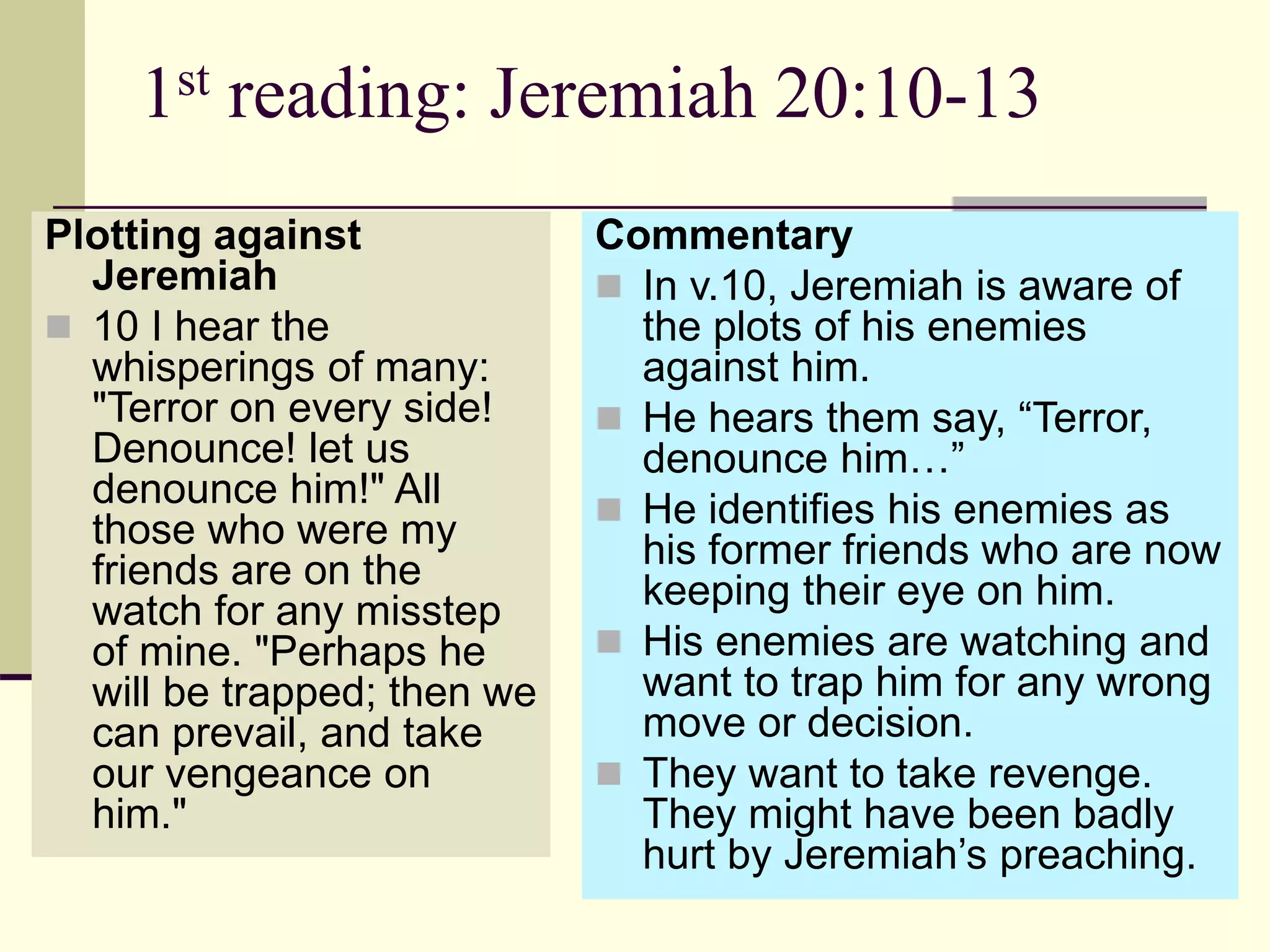
Plotting against
Jeremiah
 10 I hear the
whisperings of many:
"Terror on every side!
Denounce! let us
denounce him!" All
those who were my
friends are on the
watch for any misstep
of mine. "Perhaps he
will be trapped; then we
can prevail, and take
our vengeance on
him."
Commentary
 In v.10, Jeremiah is aware of
the plots of his enemies
against him.
 He hears them say, “Terror,
denounce him…”
 He identifies his enemies as
his former friends who are now
keeping their eye on him.
 His enemies are watching and
want to trap him for any wrong
move or decision.
 They want to take revenge.
They might have been badly
hurt by Jeremiah’s preaching.
1st reading: Jeremiah 20:10-13
Faith of Jeremiah
 11 But the LORD is with
me, like a mighty
champion: my
persecutors will stumble,
they will not triumph. In
their failure they will be
put to utter shame, to
lasting, unforgettable
confusion.
 In v.11, Jeremiah consoles
himself by acknowledging
the Lord’s protection.
 He predicts the downfall
and failure of his enemies
(persecutors).
 They will be put to (utter)
shame (sagad ang
pahiya).
 They will be put to
confusion (lasting and
unforgettable).
1st reading: Jeremiah 20:10-13
The Prayer of
Jeremiah
 12 O LORD of hosts,
you who test the
just, who probe mind
and heart, let me
witness the
vengeance you take
on them, for to you I
have entrusted my
cause.
Praise
 13 Sing to the
LORD, praise the
LORD, for he has
rescued the life of
the poor from the
power of the wicked!
 In v.12, Jeremiah understands what he is
undergoing right now.
 He sees it as God’s way to test him (to
probe his mind and heart, to probe his
loyalty to him).
 He sees himself as a just man (doing God’s
will, communicating God’s unsettling
message to the people).
 Jeremiah wants to see how God will take
vengeance on his enemies.
 God will take revenge upon Jeremiah’s
enemies.
 The reason: Jeremiah has entrusted his
cause to him.
 V.13 anticipates Jeremiah’s salvation.
 In parallel form, Jeremiah shouts with joy:
“Sing to the Lord // praise the Lord!”
 V.13 summarizes the point of the whole
text.
Reflections on the 1st reading
 Sometimes we feel like the prophet Jeremiah,
especially if we are given a big task.
 That big task may be to announce or denounce
something which people don’t like to hear.
 That big task may run counter to the interest of a
group.
 And we face reactions, objections and threats.
 Now like Jeremiah, we should take refuge in the
Lord.
 He will defend us and put our enemies to shame and
confusion (if we are just and we put our trust/case in him).
Resp. Psalm 69:8-10, 14, 17, 33-35
 R. (14c) Lord, in your great love, answer me.
8 For your sake I bear insult,
and shame covers my face.
9 I have become an outcast to my brothers,
a stranger to my children,
10 Because zeal for your house consumes me,
and the insults of those who blaspheme you fall upon me.
 14 I pray to you, O LORD,
for the time of your favor, O God!
17 In your great kindness answer me
with your constant help.
Answer me, O LORD, for bounteous is your kindness;
in your great mercy turn toward me.
 33 "See, you lowly ones, and be glad;
you who seek God, may your hearts revive!
34 For the LORD hears the poor,
and his own who are in bonds he spurns not.
35 Let the heavens and the earth praise him,
the seas and whatever moves in them!''
Resp. Psalm 69:8-10, 14, 17, 33-35
 R. (14c) Lord, in your great love, answer me.
8 For your sake I bear insult,
and shame covers my face.
9 I have become an outcast to my brothers,
a stranger to my children,
10 Because zeal for your house consumes me,
and the insults of those who blaspheme you fall
upon me.
 14 I pray to you, O LORD,
for the time of your favor, O God!
17 In your great kindness answer me
with your constant help.
Answer me, O LORD, for bounteous is your
kindness;
in your great mercy turn toward me.
 33 "See, you lowly ones, and be glad;
you who seek God, may your hearts revive!
34 For the LORD hears the poor,
and his own who are in bonds he spurns not.
35 Let the heavens and the earth praise him,
the seas and whatever moves in them!''
Commentary
 The psalm is classified as
individual lament.
 Vv. 8-9 indicates that it is a prayer
who is suffering from insult,
shame and rejection.
 He is suffering because he loves
the Temple (house of God). He
does not want it to be
disrespected. The liturgy must be
in proper order.
 Vv. 14 and 17 are pleadings for
God’s favorable response.
 Vv.33-35 are exhortations by the
psalmist to the humble and poor
to praise God.
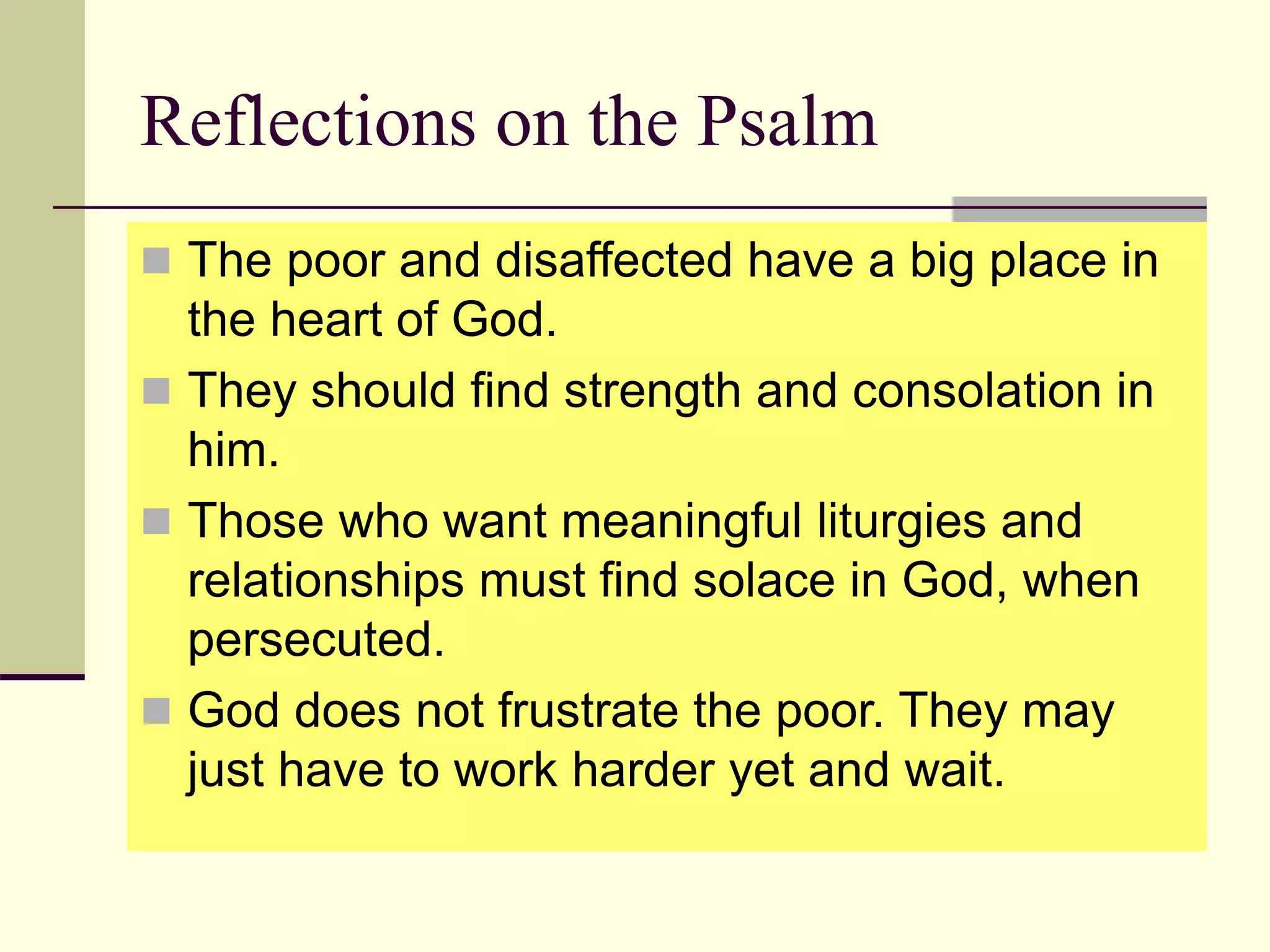
Reflections on the Psalm
 The poor and disaffected have a big place in
the heart of God.
 They should find strength and consolation in
him.
 Those who want meaningful liturgies and
relationships must find solace in God, when
persecuted.
 God does not frustrate the poor. They may
just have to work harder yet and wait.
2nd reading: Romans 5:12-15
 12 Through one person sin entered the world, and
through sin, death, and thus death came to all,
inasmuch as all sinned-- 13 for up to the time of the
law, sin was in the world, though sin is not accounted
when there is no law. 14 But death reigned from
Adam to Moses, even over those who did not sin
after the pattern of the trespass of Adam, who is the
type of the one who was to come. 15 But the gift is
not like the transgression. For if by that one person's
transgression the many died, how much more did the
grace of God and the gracious gift of the one person
Jesus Christ overflow for the many.
The focus is on the contrast between Adam and Christ.
2nd reading: Romans 5:12-15
 12 Through one person sin
entered the world, and through
sin, death, and thus death came
to all, inasmuch as all sinned--
13 for up to the time of the law,
sin was in the world, though sin
is not accounted when there is
no law. 14 But death reigned
from Adam to Moses, even over
those who did not sin after the
pattern of the trespass of Adam,
who is the type of the one who
was to come. 15 But the gift is
not like the transgression. For if
by that one person's
transgression the many died,
how much more did the grace of
God and the gracious gift of the
one person Jesus Christ
overflow for the many.
Commentary
 V.12 traces the coming of sin
and death through one person
(Adam)
 V.13 says that sin came with the
law. There was no sin, when
there was no law (mosaic law).
 V.14 says that death has been
there from Adam to Moses (since
creation up to the Sinai event),
and even to those who did not
sin (who are they?) (who is it?)
 The answer is Jesus (the one
who is to come).
 V.15 follows up the pattern of
v.12 in another way. This time
the focus is on the gracious gift
of the one person Jesus Christ.
Adam (one man) brings
•Sin
•Death
•Law
•Trespass
•Transgression
Christ brings
•Gift
•Grace of God
•Gracious gift of the one
person
Contrast between Adam and Christ
Reflections on the 2nd reading
 There is a great contrast between the first man (Adam)
and Christ.
 The contrast highlights the saving grace of God.
 Though the sin brought by the one man (Adam)
pervaded humanity (because all have sinned too), all the
more Jesus’ grace overflowed to many.
 God’s grace is never outdone by sin.
 God’s instrument to bring his grace is Jesus (who took
courage to be a man, to work as a man and to die as a
man).
 To establish communion, we must take courage to be
humans. If we are inhuman, we destroy communion.
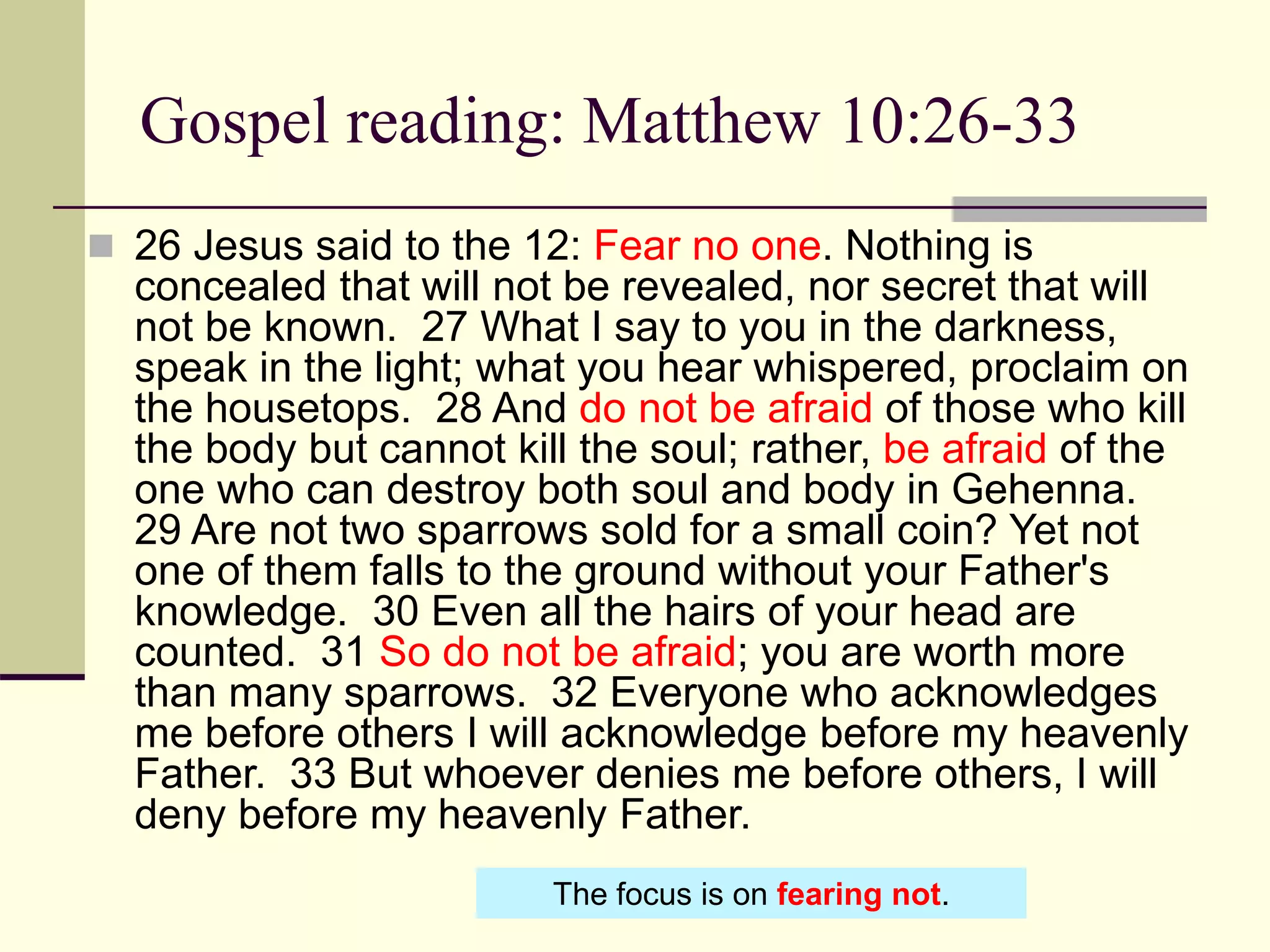
Gospel reading: Matthew 10:26-33
 26 Jesus said to the 12: Fear no one. Nothing is
concealed that will not be revealed, nor secret that will
not be known. 27 What I say to you in the darkness,
speak in the light; what you hear whispered, proclaim on
the housetops. 28 And do not be afraid of those who kill
the body but cannot kill the soul; rather, be afraid of the
one who can destroy both soul and body in Gehenna.
29 Are not two sparrows sold for a small coin? Yet not
one of them falls to the ground without your Father's
knowledge. 30 Even all the hairs of your head are
counted. 31 So do not be afraid; you are worth more
than many sparrows. 32 Everyone who acknowledges
me before others I will acknowledge before my heavenly
Father. 33 But whoever denies me before others, I will
deny before my heavenly Father.
The focus is on fearing not.
Gospel reading: Matthew 10:26-33
Courage to proclaim
 26 Jesus said to the 12: Fear no one. Nothing is concealed that
will not be revealed, nor secret that will not be known. 27 What I
say to you in the darkness, speak in the light; what you hear
whispered, proclaim on the housetops.
Courage to face persecutors
 28 And do not be afraid of those who kill the body but cannot kill
the soul; rather, be afraid of the one who can destroy both soul
and body in Gehenna. 29 Are not two sparrows sold for a small
coin? Yet not one of them falls to the ground without your
Father's knowledge. 30 Even all the hairs of your head are
counted.
Courage to acknowledge and its reward
 31 So do not be afraid; you are worth more than many sparrows.
32 Everyone who acknowledges me before others I will
acknowledge before my heavenly Father. 33 But whoever
denies me before others, I will deny before my heavenly Father.
A simple outline!
Gospel reading: Matthew 10:26-33
Courage to proclaim
 26 Jesus said to the 12:
Fear no one. Nothing is
concealed that will not be
revealed, nor secret that
will not be known. 27
What I say to you in the
darkness, speak in the
light; what you hear
whispered, proclaim on
the housetops.
Commentary
 Jesus is addressing himself to the
apostles in their role as
missionaries. They have to be
courageous to proclaim and to face
their persecutors.
 Jesus assures them of his love and
support and their reward.
 In v. 26, Jesus asks his apostles to
take courage, to be men… to
proclaim what he has revealed to
them.
 V.27 repeats v.26 in a different
manner: to proclaim what they
heard in the dark (in secret, when
they were alone with him).
Gospel reading: Matthew 10:26-33
Courage to face persecutors
 28 And do not be afraid of those
who kill the body but cannot kill the
soul; rather, be afraid of the one
who can destroy both soul and
body in Gehenna. 29 Are not two
sparrows sold for a small coin? Yet
not one of them falls to the ground
without your Father's knowledge.
30 Even all the hairs of your head
are counted.
Courage to acknowledge and its
reward
 31 So do not be afraid; you are
worth more than many sparrows.
32 Everyone who acknowledges
me before others I will
acknowledge before my heavenly
Father. 33 But whoever denies me
before others, I will deny before my
heavenly Father.
 V.28 repeats the exhortation in
v.26. “Do not be afraid.” But this
time, it is an exhortation to face
one’s enemy (objector of their
message, persecutor, and killer)
 Vv.29-31 indicate the importance
of the two sparrows, but for God,
his apostles are more valuable
than the sparrows.
 V.31 repeats vv.26 and 28.
 Vv.32-33 talk about
“acknowledging God” and its
reward.
 The missionary should not be
afraid to acknowledge Jesus
before others.
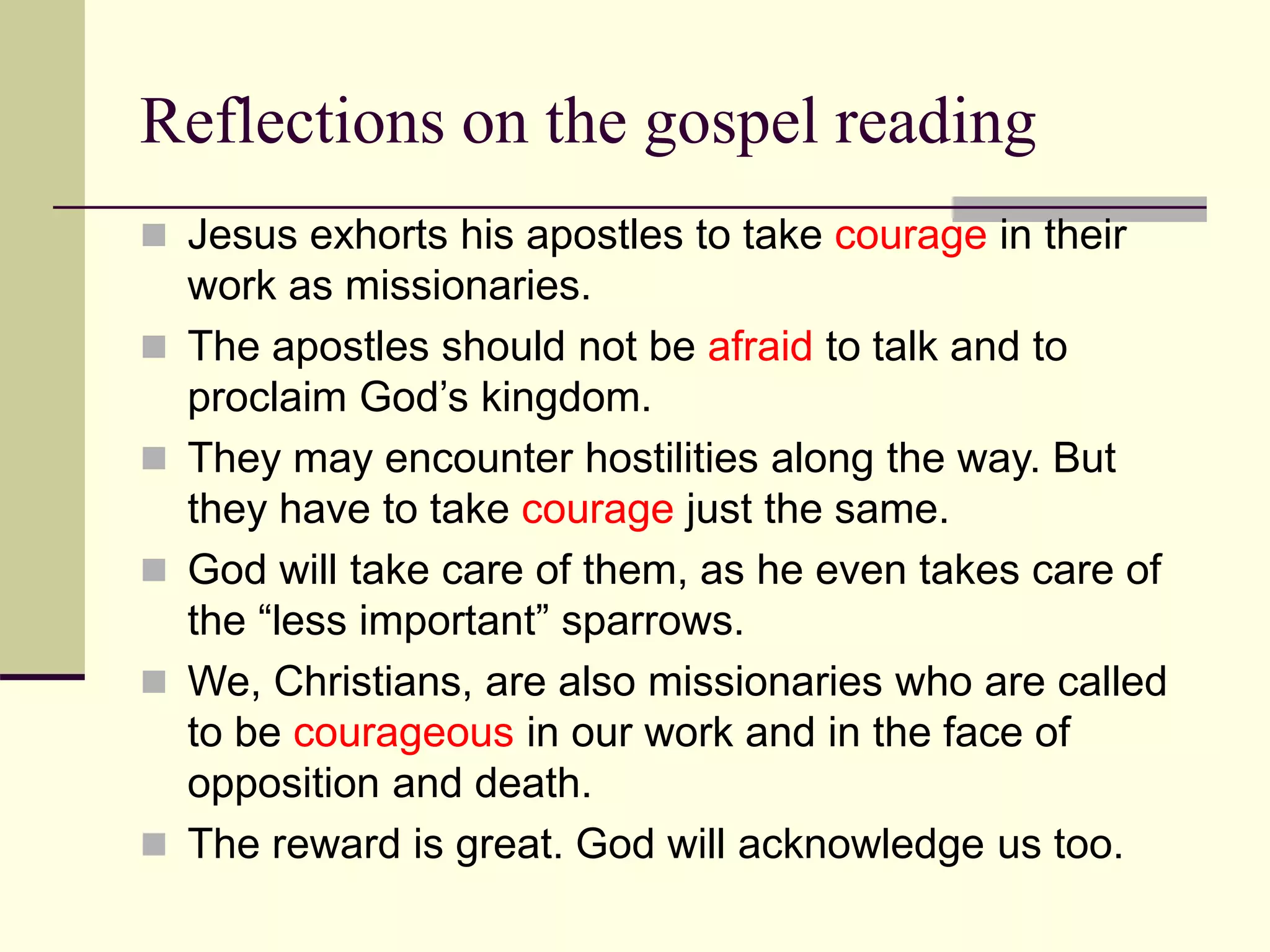
Reflections on the gospel reading
 Jesus exhorts his apostles to take courage in their
work as missionaries.
 The apostles should not be afraid to talk and to
proclaim God’s kingdom.
 They may encounter hostilities along the way. But
they have to take courage just the same.
 God will take care of them, as he even takes care of
the “less important” sparrows.
 We, Christians, are also missionaries who are called
to be courageous in our work and in the face of
opposition and death.
 The reward is great. God will acknowledge us too.
Tying the 3 readings
 The first reading talks about Jeremiah’s courageous
suffering in the face of his persecutors (with laments).
 The second reading talks about the graciousness of
God (God’s grace) to us sinners, once victims of sin
and death. We must be grateful to Christ who took
courage to die for us to save us.
 The gospel encourages us in our missionary work, in
the face of opposition.
The preacher must focus on being courageous in work in the
midst of oppositions.
How to develop your homily / sharing
 Are you easily discouraged when you are given a job?
 When you are easily discouraged when doing your
mission (because people say you are not doing the right thing or
your way of doing it is not good), Jesus has this to say: Take
courage.
 In the gospel, the apostles were sent for a mission.
 They were not experts in speaking and evangelizing.
 Their listeners were not prepared to accept anything from
them. They did not readily buy their ideas and beliefs.
 Many of them were unreceptive and intimidating. Why
should these men waste their time talking nonsense?
 The apostles allowed themselves to be made
courageous by the Holy Spirit.
 The apostles faced opposition because they touched
the sensitivities of people who preferred the rule of
power and gold rather than of God.
 They wanted to remain in their comfort zones (former
beliefs).
 Their preaching made faces sour because they
asked for conversion, change of value system,
paradigm shift. Who are they to tell them that?
 The apostles had to take courage in order to
accomplish their mission.
 If we are overcome with fear, we cannot do anything.
 We cannot participate in God’s mission.
 In the first reading, Jeremiah courageously, though he
was lamenting, faced his enemies who plotted against
his life.
 Jeremiah knew beforehand what would happen to him
when he opens his mouth to denounce the abuses of
the authorities and their wrong decisions.
 Jeremiah was also a victim of mudslinging, false
testimonies, outright resistance and physical violence.
 Yet, Jeremiah did not stop. He felt he could not be at
peace if he just kept quiet.
 With courage and a sense of mission, Jeremiah had to
pinpoint the sins / fault of the people and the whole
nation.
 In his sufferings, he was talking to God (praying).
 The second reading must lead us to appreciate the
courageous mission of Jesus.
 His mission was to overcome sin and death.
 Therefore, we listeners must align ourselves with
Christ.
 Through the courage of Christ, grace has come to us.
 Because of the merits of Christ, we are saved.
 What happens when we do not have any courage?
 We cannot accomplish anything.
 We cannot share in the mission of Christ.
 We can easily be discouraged when we meet
criticisms.
 We discontinue / give up our work easily. We fizzle out
in the middle of the work.
 Those who do not have courage are the ones who
don’t know or appreciate the will of God for them.
 Fear comes out of ignorance and lack of nurturance
or lack of self-confidence or low self-esteem.
 The eucharist is a sacrament of courage.
 It encourages us to participate in God’s mission.
 In the eucharist, Jesus comes down to us to dispel
our fears.
 In the eucharist, we encounter the brave Christ who
did his mission up to the last drop of his blood,
effecting salvation to all of us believers.
 The eucharist is the source of strength to those who
feel persecuted because they work hard for God.
Our Context
 PVC shower curtains,
toxic
 Ces freed
 Evildoers, no fear of
God
 Grafters, no fear of God
 Terror
 Phobias
 Paranoia
 Fear of authority
 Fear of the new
 Fear of the unknown
 Fear of separation
 Fear of the dark
 Fear of death
Sunday Readings site
Please click this site.
PRAYER
 "Lord Jesus, it is my joy and privilege to
your disciple. Give me strength and courage
to bear any hardship and suffering which
may come my way in your service. May I
witness to others the joy of the Gospel."

12th Sunday A

  • 1.
    Sunday Readings Commentary andReflections Twelfth Sunday in Ordinary Time A 25 June 2017 In preparation for this Sunday’s Liturgy In aid of focusing our homilies and sharing
  • 2.
    1st reading: Jeremiah20:10-13  10 Jeremiah said, I hear the whisperings of many: "Terror on every side! Denounce! let us denounce him!" All those who were my friends are on the watch for any misstep of mine. "Perhaps he will be trapped; then we can prevail, and take our vengeance on him." 11 But the LORD is with me, like a mighty champion: my persecutors will stumble, they will not triumph. In their failure they will be put to utter shame, to lasting, unforgettable confusion. 12 O LORD of hosts, you who test the just, who probe mind and heart, Let me witness the vengeance you take on them, for to you I have entrusted my cause. 13 Sing to the LORD, praise the LORD, for he has rescued the life of the poor from the power of the wicked! The focus is on the suffering of the prophet Jeremiah.
  • 3.
    1st reading: Jeremiah20:10-13 Plotting against Jeremiah  10 Jeremiah said, I hear the whisperings of many: "Terror on every side! Denounce! let us denounce him!" All those who were my friends are on the watch for any misstep of mine. "Perhaps he will be trapped; then we can prevail, and take our vengeance on him." Faith of Jeremiah  11 But the LORD is with me, like a mighty champion: my persecutors will stumble, they will not triumph. In their failure they will be put to utter shame, to lasting, unforgettable confusion. The Prayer of Jeremiah  12 O LORD of hosts, you who test the just, who probe mind and heart, Let me witness the vengeance you take on them, for to you I have entrusted my cause. Praise  13 Sing to the LORD, praise the LORD, for he has rescued the life of the poor from the power of the wicked! A simple outline!
  • 4.
    1st reading: Jeremiah20:10-13 Plotting against Jeremiah  10 I hear the whisperings of many: "Terror on every side! Denounce! let us denounce him!" All those who were my friends are on the watch for any misstep of mine. "Perhaps he will be trapped; then we can prevail, and take our vengeance on him." Commentary  In v.10, Jeremiah is aware of the plots of his enemies against him.  He hears them say, “Terror, denounce him…”  He identifies his enemies as his former friends who are now keeping their eye on him.  His enemies are watching and want to trap him for any wrong move or decision.  They want to take revenge. They might have been badly hurt by Jeremiah’s preaching.
  • 5.
    1st reading: Jeremiah20:10-13 Faith of Jeremiah  11 But the LORD is with me, like a mighty champion: my persecutors will stumble, they will not triumph. In their failure they will be put to utter shame, to lasting, unforgettable confusion.  In v.11, Jeremiah consoles himself by acknowledging the Lord’s protection.  He predicts the downfall and failure of his enemies (persecutors).  They will be put to (utter) shame (sagad ang pahiya).  They will be put to confusion (lasting and unforgettable).
  • 6.
    1st reading: Jeremiah20:10-13 The Prayer of Jeremiah  12 O LORD of hosts, you who test the just, who probe mind and heart, let me witness the vengeance you take on them, for to you I have entrusted my cause. Praise  13 Sing to the LORD, praise the LORD, for he has rescued the life of the poor from the power of the wicked!  In v.12, Jeremiah understands what he is undergoing right now.  He sees it as God’s way to test him (to probe his mind and heart, to probe his loyalty to him).  He sees himself as a just man (doing God’s will, communicating God’s unsettling message to the people).  Jeremiah wants to see how God will take vengeance on his enemies.  God will take revenge upon Jeremiah’s enemies.  The reason: Jeremiah has entrusted his cause to him.  V.13 anticipates Jeremiah’s salvation.  In parallel form, Jeremiah shouts with joy: “Sing to the Lord // praise the Lord!”  V.13 summarizes the point of the whole text.
  • 7.
    Reflections on the1st reading  Sometimes we feel like the prophet Jeremiah, especially if we are given a big task.  That big task may be to announce or denounce something which people don’t like to hear.  That big task may run counter to the interest of a group.  And we face reactions, objections and threats.  Now like Jeremiah, we should take refuge in the Lord.  He will defend us and put our enemies to shame and confusion (if we are just and we put our trust/case in him).
  • 8.
    Resp. Psalm 69:8-10,14, 17, 33-35  R. (14c) Lord, in your great love, answer me. 8 For your sake I bear insult, and shame covers my face. 9 I have become an outcast to my brothers, a stranger to my children, 10 Because zeal for your house consumes me, and the insults of those who blaspheme you fall upon me.  14 I pray to you, O LORD, for the time of your favor, O God! 17 In your great kindness answer me with your constant help. Answer me, O LORD, for bounteous is your kindness; in your great mercy turn toward me.  33 "See, you lowly ones, and be glad; you who seek God, may your hearts revive! 34 For the LORD hears the poor, and his own who are in bonds he spurns not. 35 Let the heavens and the earth praise him, the seas and whatever moves in them!''
  • 9.
    Resp. Psalm 69:8-10,14, 17, 33-35  R. (14c) Lord, in your great love, answer me. 8 For your sake I bear insult, and shame covers my face. 9 I have become an outcast to my brothers, a stranger to my children, 10 Because zeal for your house consumes me, and the insults of those who blaspheme you fall upon me.  14 I pray to you, O LORD, for the time of your favor, O God! 17 In your great kindness answer me with your constant help. Answer me, O LORD, for bounteous is your kindness; in your great mercy turn toward me.  33 "See, you lowly ones, and be glad; you who seek God, may your hearts revive! 34 For the LORD hears the poor, and his own who are in bonds he spurns not. 35 Let the heavens and the earth praise him, the seas and whatever moves in them!'' Commentary  The psalm is classified as individual lament.  Vv. 8-9 indicates that it is a prayer who is suffering from insult, shame and rejection.  He is suffering because he loves the Temple (house of God). He does not want it to be disrespected. The liturgy must be in proper order.  Vv. 14 and 17 are pleadings for God’s favorable response.  Vv.33-35 are exhortations by the psalmist to the humble and poor to praise God.
  • 10.
    Reflections on thePsalm  The poor and disaffected have a big place in the heart of God.  They should find strength and consolation in him.  Those who want meaningful liturgies and relationships must find solace in God, when persecuted.  God does not frustrate the poor. They may just have to work harder yet and wait.
  • 11.
    2nd reading: Romans5:12-15  12 Through one person sin entered the world, and through sin, death, and thus death came to all, inasmuch as all sinned-- 13 for up to the time of the law, sin was in the world, though sin is not accounted when there is no law. 14 But death reigned from Adam to Moses, even over those who did not sin after the pattern of the trespass of Adam, who is the type of the one who was to come. 15 But the gift is not like the transgression. For if by that one person's transgression the many died, how much more did the grace of God and the gracious gift of the one person Jesus Christ overflow for the many. The focus is on the contrast between Adam and Christ.
  • 12.
    2nd reading: Romans5:12-15  12 Through one person sin entered the world, and through sin, death, and thus death came to all, inasmuch as all sinned-- 13 for up to the time of the law, sin was in the world, though sin is not accounted when there is no law. 14 But death reigned from Adam to Moses, even over those who did not sin after the pattern of the trespass of Adam, who is the type of the one who was to come. 15 But the gift is not like the transgression. For if by that one person's transgression the many died, how much more did the grace of God and the gracious gift of the one person Jesus Christ overflow for the many. Commentary  V.12 traces the coming of sin and death through one person (Adam)  V.13 says that sin came with the law. There was no sin, when there was no law (mosaic law).  V.14 says that death has been there from Adam to Moses (since creation up to the Sinai event), and even to those who did not sin (who are they?) (who is it?)  The answer is Jesus (the one who is to come).  V.15 follows up the pattern of v.12 in another way. This time the focus is on the gracious gift of the one person Jesus Christ.
  • 13.
    Adam (one man)brings •Sin •Death •Law •Trespass •Transgression Christ brings •Gift •Grace of God •Gracious gift of the one person Contrast between Adam and Christ
  • 14.
    Reflections on the2nd reading  There is a great contrast between the first man (Adam) and Christ.  The contrast highlights the saving grace of God.  Though the sin brought by the one man (Adam) pervaded humanity (because all have sinned too), all the more Jesus’ grace overflowed to many.  God’s grace is never outdone by sin.  God’s instrument to bring his grace is Jesus (who took courage to be a man, to work as a man and to die as a man).  To establish communion, we must take courage to be humans. If we are inhuman, we destroy communion.
  • 15.
    Gospel reading: Matthew10:26-33  26 Jesus said to the 12: Fear no one. Nothing is concealed that will not be revealed, nor secret that will not be known. 27 What I say to you in the darkness, speak in the light; what you hear whispered, proclaim on the housetops. 28 And do not be afraid of those who kill the body but cannot kill the soul; rather, be afraid of the one who can destroy both soul and body in Gehenna. 29 Are not two sparrows sold for a small coin? Yet not one of them falls to the ground without your Father's knowledge. 30 Even all the hairs of your head are counted. 31 So do not be afraid; you are worth more than many sparrows. 32 Everyone who acknowledges me before others I will acknowledge before my heavenly Father. 33 But whoever denies me before others, I will deny before my heavenly Father. The focus is on fearing not.
  • 16.
    Gospel reading: Matthew10:26-33 Courage to proclaim  26 Jesus said to the 12: Fear no one. Nothing is concealed that will not be revealed, nor secret that will not be known. 27 What I say to you in the darkness, speak in the light; what you hear whispered, proclaim on the housetops. Courage to face persecutors  28 And do not be afraid of those who kill the body but cannot kill the soul; rather, be afraid of the one who can destroy both soul and body in Gehenna. 29 Are not two sparrows sold for a small coin? Yet not one of them falls to the ground without your Father's knowledge. 30 Even all the hairs of your head are counted. Courage to acknowledge and its reward  31 So do not be afraid; you are worth more than many sparrows. 32 Everyone who acknowledges me before others I will acknowledge before my heavenly Father. 33 But whoever denies me before others, I will deny before my heavenly Father. A simple outline!
  • 17.
    Gospel reading: Matthew10:26-33 Courage to proclaim  26 Jesus said to the 12: Fear no one. Nothing is concealed that will not be revealed, nor secret that will not be known. 27 What I say to you in the darkness, speak in the light; what you hear whispered, proclaim on the housetops. Commentary  Jesus is addressing himself to the apostles in their role as missionaries. They have to be courageous to proclaim and to face their persecutors.  Jesus assures them of his love and support and their reward.  In v. 26, Jesus asks his apostles to take courage, to be men… to proclaim what he has revealed to them.  V.27 repeats v.26 in a different manner: to proclaim what they heard in the dark (in secret, when they were alone with him).
  • 18.
    Gospel reading: Matthew10:26-33 Courage to face persecutors  28 And do not be afraid of those who kill the body but cannot kill the soul; rather, be afraid of the one who can destroy both soul and body in Gehenna. 29 Are not two sparrows sold for a small coin? Yet not one of them falls to the ground without your Father's knowledge. 30 Even all the hairs of your head are counted. Courage to acknowledge and its reward  31 So do not be afraid; you are worth more than many sparrows. 32 Everyone who acknowledges me before others I will acknowledge before my heavenly Father. 33 But whoever denies me before others, I will deny before my heavenly Father.  V.28 repeats the exhortation in v.26. “Do not be afraid.” But this time, it is an exhortation to face one’s enemy (objector of their message, persecutor, and killer)  Vv.29-31 indicate the importance of the two sparrows, but for God, his apostles are more valuable than the sparrows.  V.31 repeats vv.26 and 28.  Vv.32-33 talk about “acknowledging God” and its reward.  The missionary should not be afraid to acknowledge Jesus before others.
  • 19.
    Reflections on thegospel reading  Jesus exhorts his apostles to take courage in their work as missionaries.  The apostles should not be afraid to talk and to proclaim God’s kingdom.  They may encounter hostilities along the way. But they have to take courage just the same.  God will take care of them, as he even takes care of the “less important” sparrows.  We, Christians, are also missionaries who are called to be courageous in our work and in the face of opposition and death.  The reward is great. God will acknowledge us too.
  • 20.
    Tying the 3readings  The first reading talks about Jeremiah’s courageous suffering in the face of his persecutors (with laments).  The second reading talks about the graciousness of God (God’s grace) to us sinners, once victims of sin and death. We must be grateful to Christ who took courage to die for us to save us.  The gospel encourages us in our missionary work, in the face of opposition. The preacher must focus on being courageous in work in the midst of oppositions.
  • 21.
    How to developyour homily / sharing  Are you easily discouraged when you are given a job?  When you are easily discouraged when doing your mission (because people say you are not doing the right thing or your way of doing it is not good), Jesus has this to say: Take courage.  In the gospel, the apostles were sent for a mission.  They were not experts in speaking and evangelizing.  Their listeners were not prepared to accept anything from them. They did not readily buy their ideas and beliefs.  Many of them were unreceptive and intimidating. Why should these men waste their time talking nonsense?  The apostles allowed themselves to be made courageous by the Holy Spirit.
  • 22.
     The apostlesfaced opposition because they touched the sensitivities of people who preferred the rule of power and gold rather than of God.  They wanted to remain in their comfort zones (former beliefs).  Their preaching made faces sour because they asked for conversion, change of value system, paradigm shift. Who are they to tell them that?  The apostles had to take courage in order to accomplish their mission.  If we are overcome with fear, we cannot do anything.  We cannot participate in God’s mission.
  • 23.
     In thefirst reading, Jeremiah courageously, though he was lamenting, faced his enemies who plotted against his life.  Jeremiah knew beforehand what would happen to him when he opens his mouth to denounce the abuses of the authorities and their wrong decisions.  Jeremiah was also a victim of mudslinging, false testimonies, outright resistance and physical violence.  Yet, Jeremiah did not stop. He felt he could not be at peace if he just kept quiet.  With courage and a sense of mission, Jeremiah had to pinpoint the sins / fault of the people and the whole nation.  In his sufferings, he was talking to God (praying).
  • 24.
     The secondreading must lead us to appreciate the courageous mission of Jesus.  His mission was to overcome sin and death.  Therefore, we listeners must align ourselves with Christ.  Through the courage of Christ, grace has come to us.  Because of the merits of Christ, we are saved.
  • 25.
     What happenswhen we do not have any courage?  We cannot accomplish anything.  We cannot share in the mission of Christ.  We can easily be discouraged when we meet criticisms.  We discontinue / give up our work easily. We fizzle out in the middle of the work.  Those who do not have courage are the ones who don’t know or appreciate the will of God for them.  Fear comes out of ignorance and lack of nurturance or lack of self-confidence or low self-esteem.
  • 26.
     The eucharistis a sacrament of courage.  It encourages us to participate in God’s mission.  In the eucharist, Jesus comes down to us to dispel our fears.  In the eucharist, we encounter the brave Christ who did his mission up to the last drop of his blood, effecting salvation to all of us believers.  The eucharist is the source of strength to those who feel persecuted because they work hard for God.
  • 27.
    Our Context  PVCshower curtains, toxic  Ces freed  Evildoers, no fear of God  Grafters, no fear of God  Terror  Phobias  Paranoia  Fear of authority  Fear of the new  Fear of the unknown  Fear of separation  Fear of the dark  Fear of death Sunday Readings site Please click this site.
  • 28.
    PRAYER  "Lord Jesus,it is my joy and privilege to your disciple. Give me strength and courage to bear any hardship and suffering which may come my way in your service. May I witness to others the joy of the Gospel."