Government of India
COMBATING
CORRUPTION IN
PUBLIC SERVICES
India Overview
 World’s largest and a vibrant democracy
 Rule of law enshrined in Constitution
 Separation of Powers (Legislature, Executive and
Judiciary)
 Right to Equality and Equality of opportunity
 Affirmative action for disadvantaged.
 Independent and Proactive Judiciary
 Free Press & Media
 Liberalised Economy
Corruption
 Pernicious and Visible impediment to
good governance
 India 47th
most corrupt country – China
31st
(World Bank, 2006)
 India 70th in Corruption Perception Index
(T I 2006)
 Incidence widely known but impact little
realized
POLICY
ZERO TOLERANCE
AGAINST CORRUPTION
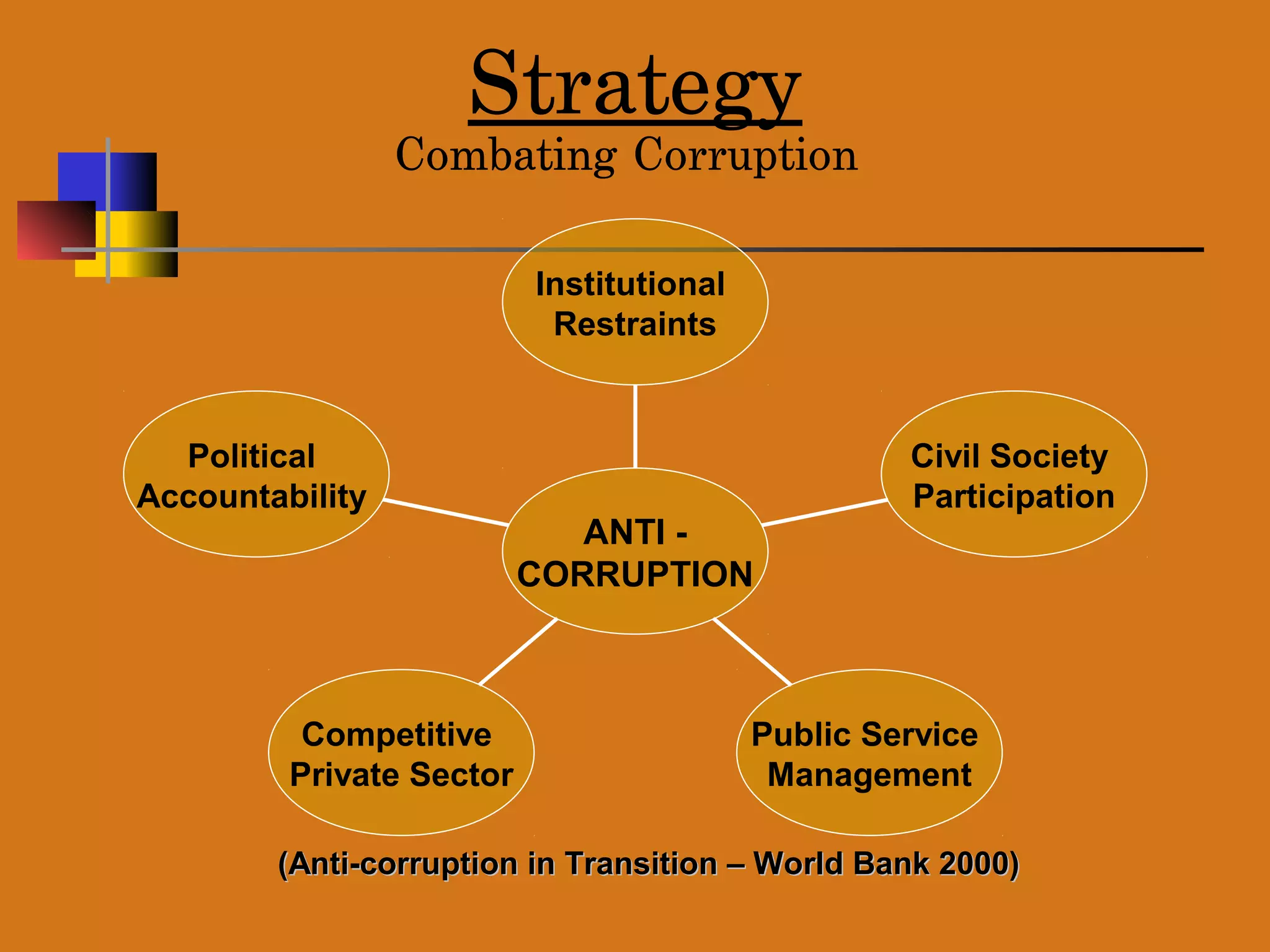
Strategy
Combating Corruption
Institutional
Restraints
Civil Society
Participation
Public Service
Management
Competitive
Private Sector
Political
Accountability
ANTI -
CORRUPTION
(Anti-corruption in Transition – World Bank 2000)(Anti-corruption in Transition – World Bank 2000)
Strategy
1) Institutional Restraints
- Independent and proactive judiciary
- Legislative oversight
- Independent prosecution, Enforcement
2) Political Accountability
- Political competition –Multi Parties
- Transparency in party financing
- Disclosure of voting
- Asset declaration, office of profit act
Strategy
3) Civil Society Participation
- Right to Information Act
- Public hearings
- Role for media/NGOs
4) Competitive Private Sector
- Economic Reforms
- Competitive restructuring of monopolies
- Regulatory simplification and standards
- Transparency in corporate governance
- Collective business associations
Strategy
5) Public Service Management
- Meritocratic civil service, adequate
pay
- Budget management
- Tax and customs administration
- Enhancing public service delivery
- Decentralization with accountability
INSTITUTIONAL FRAMEWORK
 CENTRAL VIGILANCE COMMISSION
 CENTRAL BUREAU OF INVESTIGATION
 ELECTION COMMISSION OF INDIA
 COMPTROLLER AND AUDITOR
GENERAL OF INDIA
LEGAL FRAMEWORK
 The Prevention of Corruption Act,
1988
 The Central Vigilance Commission Act,
2003
 Delhi Special Police Establishment
Act, 1946
 Prevention of Money Laundering Act,
2002
 Extradition Act, 1962
 The Representation of Peoples Act,
Action Plan against Corruption
Preventive Vigilance
• Conduct Rules – Sanctions for
violations
• Elaborate procedures
• Principles of Natural Justice
• Vigilance Clearance for Appointments
• Systemic Reforms
Surveillance and Detection
• Inspection / Pre-audit

Identifying suspect corrupt elements.

List of Officers of Doubtful Integrity.
Property Returns
Action Plan Continued
Deterrent Punitive Action
 Sanctions under All India Services Conduct Rules
 Sanctions for criminal misconduct and other acts

Prevention of Corruption Act, 1988

Code of Criminal Procedure and Indian Penal Code
 Close Monitoring
Citizens’ Charter
 Citizens’ Charters publicize services to members of
the public, commitment of the organization, expected
standards of service delivery, timeframe, grievance
redressal mechanism.
 Are a tool of public scrutiny to ensure accountability.
 35 Central Government Ministries and Departments
have formulated 127 Citizens’ Charters.
 683 Citizens’ Charters have been brought out by 24
State Governments/Union Territories.
Empowering the Civil Services
 Stability of Tenure
 Performance Appraisal System
 Mid–Career Training Programme
 Protection for bona fide actions
taken by Civil Servants.
 Public Services Bill
Public Services Bill
Objective:
To formulate Code of Ethics & Public service Management
Code
To provide a statutory basis for regulation of Public
Services under Article 309
Components:
Public Service Values
Code of Ethics
Public Service Management Code
Performance Management System and Accountability
Public Service Authority
PM’s Award for Excellence in Public
Administration
 Scheme to acknowledge outstanding performance of civil
servants; focus on innovations, efficient service delivery,
crisis management, leadership qualities etc.
 Officers of Central and State Governments eligible.
 Award to comprise of a medal, a scroll and cash amount
to be given by the Prime Minister on January 26 every
year.
 Nominations to be made by Government Departments,
NGOs and other stakeholders.
 Selection Process made rigorous and transparent -
Committee chaired by Cabinet Secretary with persons
from outside the government.
Right to Information
 To ensure availability & accessibility to
information and bring out transparency in
Government.
 Right to Information Act applicable from
October 2005.
 Empowers the citizen to seek information
from Public Authorities.
 22 States have constituted Information
Commissions under Section 15 of the Act.
FINAL WORD
1. Out of Box Approach
 Inculcate culture of performance: appreciate/ recognize
positives
 Focus on outputs and outcomes
 Reengineer business processes and leverage technology for
eliminating public interface
 Provide sharing platforms for replication of best practices
 Make islands of integrity grow beyond influence of individuals:
systemic reforms
 Create Research & Development Cells
2. Paradigm Shift
PARADIGM SHIFT
 Hit & miss
 Uniformity
 Provision
 Producers
 Inputs
 “Received wisdom”
 Regulation
 Demarcation
 Look up
 Universal high standards
 Diversity
 Choice
 Customers/citizens
 Outcomes
 Data and best practice
 Incentives
 Flexibility
 Look outwards
Comfortable Demanding
Last Thought
Ah! but a man’s reach should exceed
his grasp.
Or what’s heaven for?
-Robert Browning

120 sarin

  • 1.
  • 2.
    India Overview  World’slargest and a vibrant democracy  Rule of law enshrined in Constitution  Separation of Powers (Legislature, Executive and Judiciary)  Right to Equality and Equality of opportunity  Affirmative action for disadvantaged.  Independent and Proactive Judiciary  Free Press & Media  Liberalised Economy
  • 3.
    Corruption  Pernicious andVisible impediment to good governance  India 47th most corrupt country – China 31st (World Bank, 2006)  India 70th in Corruption Perception Index (T I 2006)  Incidence widely known but impact little realized
  • 4.
  • 5.
    Strategy Combating Corruption Institutional Restraints Civil Society Participation PublicService Management Competitive Private Sector Political Accountability ANTI - CORRUPTION (Anti-corruption in Transition – World Bank 2000)(Anti-corruption in Transition – World Bank 2000)
  • 6.
    Strategy 1) Institutional Restraints -Independent and proactive judiciary - Legislative oversight - Independent prosecution, Enforcement 2) Political Accountability - Political competition –Multi Parties - Transparency in party financing - Disclosure of voting - Asset declaration, office of profit act
  • 7.
    Strategy 3) Civil SocietyParticipation - Right to Information Act - Public hearings - Role for media/NGOs 4) Competitive Private Sector - Economic Reforms - Competitive restructuring of monopolies - Regulatory simplification and standards - Transparency in corporate governance - Collective business associations
  • 8.
    Strategy 5) Public ServiceManagement - Meritocratic civil service, adequate pay - Budget management - Tax and customs administration - Enhancing public service delivery - Decentralization with accountability
  • 9.
    INSTITUTIONAL FRAMEWORK  CENTRALVIGILANCE COMMISSION  CENTRAL BUREAU OF INVESTIGATION  ELECTION COMMISSION OF INDIA  COMPTROLLER AND AUDITOR GENERAL OF INDIA
  • 10.
    LEGAL FRAMEWORK  ThePrevention of Corruption Act, 1988  The Central Vigilance Commission Act, 2003  Delhi Special Police Establishment Act, 1946  Prevention of Money Laundering Act, 2002  Extradition Act, 1962  The Representation of Peoples Act,
  • 11.
    Action Plan againstCorruption Preventive Vigilance • Conduct Rules – Sanctions for violations • Elaborate procedures • Principles of Natural Justice • Vigilance Clearance for Appointments • Systemic Reforms Surveillance and Detection • Inspection / Pre-audit  Identifying suspect corrupt elements.  List of Officers of Doubtful Integrity. Property Returns
  • 12.
    Action Plan Continued DeterrentPunitive Action  Sanctions under All India Services Conduct Rules  Sanctions for criminal misconduct and other acts  Prevention of Corruption Act, 1988  Code of Criminal Procedure and Indian Penal Code  Close Monitoring
  • 13.
    Citizens’ Charter  Citizens’Charters publicize services to members of the public, commitment of the organization, expected standards of service delivery, timeframe, grievance redressal mechanism.  Are a tool of public scrutiny to ensure accountability.  35 Central Government Ministries and Departments have formulated 127 Citizens’ Charters.  683 Citizens’ Charters have been brought out by 24 State Governments/Union Territories.
  • 14.
    Empowering the CivilServices  Stability of Tenure  Performance Appraisal System  Mid–Career Training Programme  Protection for bona fide actions taken by Civil Servants.  Public Services Bill
  • 15.
    Public Services Bill Objective: Toformulate Code of Ethics & Public service Management Code To provide a statutory basis for regulation of Public Services under Article 309 Components: Public Service Values Code of Ethics Public Service Management Code Performance Management System and Accountability Public Service Authority
  • 16.
    PM’s Award forExcellence in Public Administration  Scheme to acknowledge outstanding performance of civil servants; focus on innovations, efficient service delivery, crisis management, leadership qualities etc.  Officers of Central and State Governments eligible.  Award to comprise of a medal, a scroll and cash amount to be given by the Prime Minister on January 26 every year.  Nominations to be made by Government Departments, NGOs and other stakeholders.  Selection Process made rigorous and transparent - Committee chaired by Cabinet Secretary with persons from outside the government.
  • 17.
    Right to Information To ensure availability & accessibility to information and bring out transparency in Government.  Right to Information Act applicable from October 2005.  Empowers the citizen to seek information from Public Authorities.  22 States have constituted Information Commissions under Section 15 of the Act.
  • 18.
    FINAL WORD 1. Outof Box Approach  Inculcate culture of performance: appreciate/ recognize positives  Focus on outputs and outcomes  Reengineer business processes and leverage technology for eliminating public interface  Provide sharing platforms for replication of best practices  Make islands of integrity grow beyond influence of individuals: systemic reforms  Create Research & Development Cells 2. Paradigm Shift
  • 19.
    PARADIGM SHIFT  Hit& miss  Uniformity  Provision  Producers  Inputs  “Received wisdom”  Regulation  Demarcation  Look up  Universal high standards  Diversity  Choice  Customers/citizens  Outcomes  Data and best practice  Incentives  Flexibility  Look outwards Comfortable Demanding
  • 20.
    Last Thought Ah! buta man’s reach should exceed his grasp. Or what’s heaven for? -Robert Browning