Free ebook
12 steps to prepare your
job interview
2017
Job interview checklist:
• behavioral interview
• situational interview
• types of interview questions
• interview thank you letters
• Mistakes in job interview
• Things to do after job interview
Useful free ebooks for your job interview:
• http://jobinterview247.com/free-ebook-145-interview-questions-and-answers
• http://jobinterview247.com/free-ebook-top-22-secrets-to-win-every-job-interviews
1. Know the company:
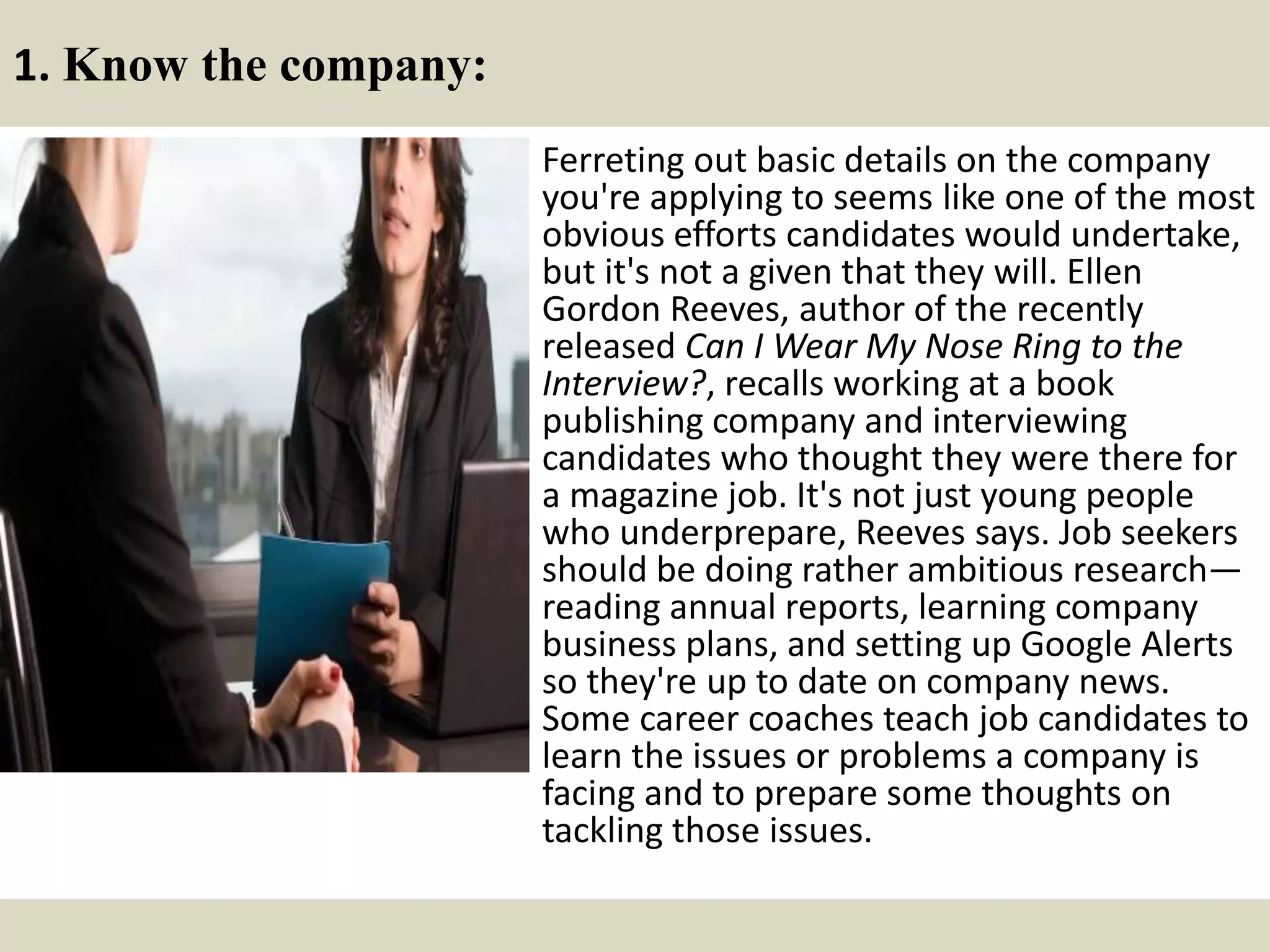
Ferreting out basic details on the company
you're applying to seems like one of the most
obvious efforts candidates would undertake,
but it's not a given that they will. Ellen
Gordon Reeves, author of the recently
released Can I Wear My Nose Ring to the
Interview?, recalls working at a book
publishing company and interviewing
candidates who thought they were there for
a magazine job. It's not just young people
who underprepare, Reeves says. Job seekers
should be doing rather ambitious research—
reading annual reports, learning company
business plans, and setting up Google Alerts
so they're up to date on company news.
Some career coaches teach job candidates to
learn the issues or problems a company is
facing and to prepare some thoughts on
tackling those issues.
2. Research the people:
It's important to know what the
company does, but it may be even
more important to know who you'll be
talking to once you get there. Reeves
suggests asking who you'll be
interviewing with—name and title.
Then get familiar with his or her staff
biography and LinkedIn profile. "You
need to know as much as possible
about the people you're interviewing
with," Reeves says. It's not a fail-safe,
however. Company plans could
change, and you might end up
interviewing with someone entirely
different.
3, Find an insider:
Find someone who knows this
company and can provide valuable
insights into the work you'll be
doing, Reeves suggests. He may be
able to provide some details on the
people you'll be interviewing with
and their style. He may also be able
to tell you about the person who's
leaving the job you're interviewing
for and about his or her skills and
the issues he or she dealt with.
4. Know what's coming:
Check out the Glassdoor data, even if your
company isn't among those listed. If you're lucky
enough to be applying for a software engineering
job at Microsoft, you'll have four interview reviews
to check out. But if you're applying for a software
engineering job at a small company in Indiana, just
reading through the 215 sample software
engineer interview questions can still be useful
preparation.
Job seekers tend to fear the interview experience
because it's filled with unknowns. "The only thing
that can ease the anxiety is information," says
Robert Hohman, founder and chief executive of
Glassdoor.
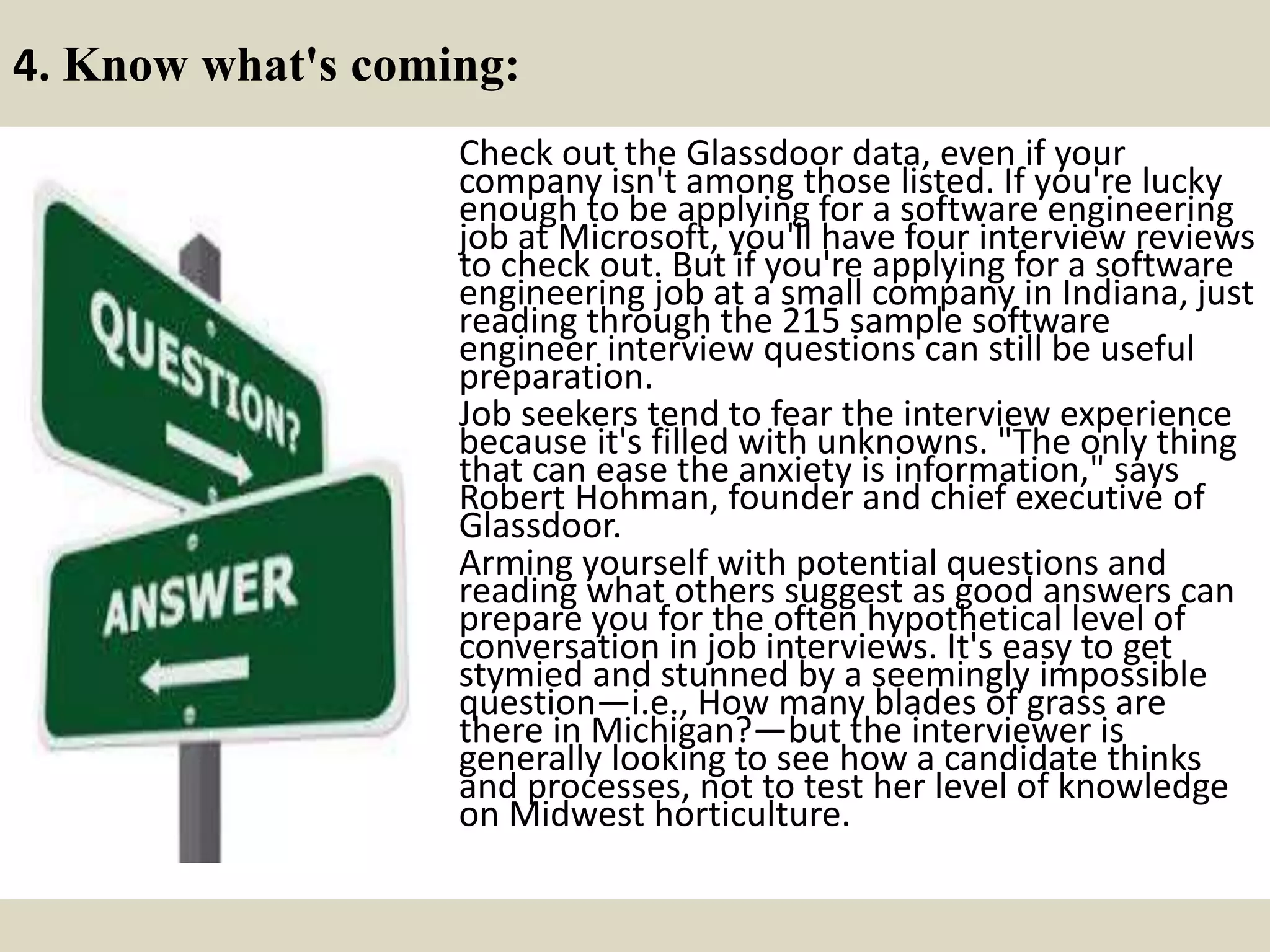
Arming yourself with potential questions and
reading what others suggest as good answers can
prepare you for the often hypothetical level of
conversation in job interviews. It's easy to get
stymied and stunned by a seemingly impossible
question—i.e., How many blades of grass are
there in Michigan?—but the interviewer is
generally looking to see how a candidate thinks
and processes, not to test her level of knowledge
on Midwest horticulture.
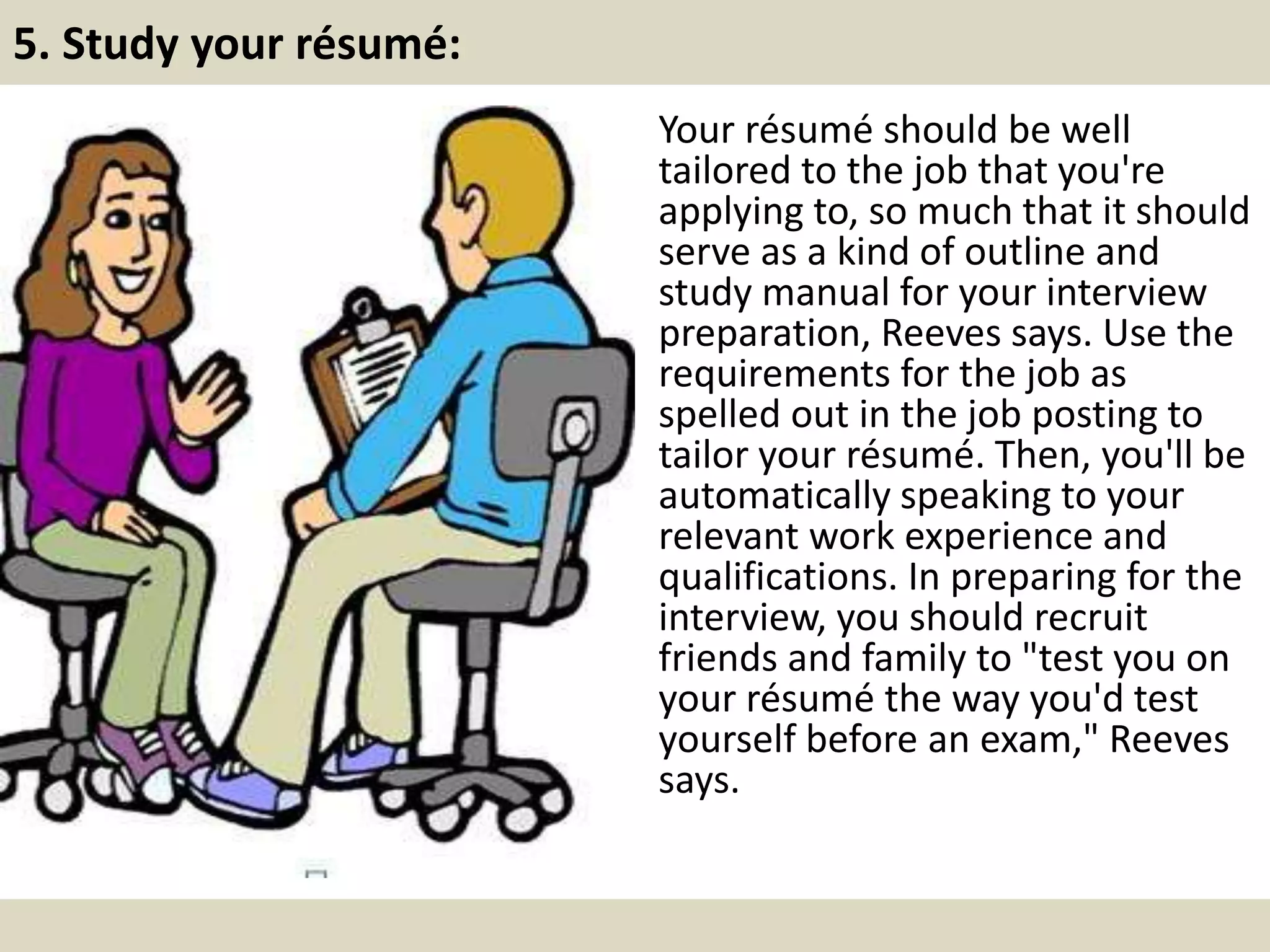
5. Study your résumé:
Your résumé should be well
tailored to the job that you're
applying to, so much that it should
serve as a kind of outline and
study manual for your interview
preparation, Reeves says. Use the
requirements for the job as
spelled out in the job posting to
tailor your résumé. Then, you'll be
automatically speaking to your
relevant work experience and
qualifications. In preparing for the
interview, you should recruit
friends and family to "test you on
your résumé the way you'd test
yourself before an exam," Reeves
says.
6. Change your point of view:
Once you're armed with information
about the company and your likely
interviewer and you've trained yourself to
talk about your work history in a way that
is suited to the specific job and the issues
likely to arise—step back and take a
breather. Reeves suggests repeating a
simple mantra: "I'm qualified, I want to
do it, and I'm the best person to do this
job," for example. Consider the interview
from the employer's point of view:
They've checked out your résumé and
responded positively to it. They want this
to work out. A hire is the successful
intersection of two searches, Reeves
says—your search for work, and the
company's search for the right worker.

12 steps to prepare job interview

  • 1.
    Free ebook 12 stepsto prepare your job interview 2017
  • 3.
    Job interview checklist: •behavioral interview • situational interview • types of interview questions • interview thank you letters • Mistakes in job interview • Things to do after job interview
  • 4.
    Useful free ebooksfor your job interview: • http://jobinterview247.com/free-ebook-145-interview-questions-and-answers • http://jobinterview247.com/free-ebook-top-22-secrets-to-win-every-job-interviews
  • 5.
    1. Know thecompany: Ferreting out basic details on the company you're applying to seems like one of the most obvious efforts candidates would undertake, but it's not a given that they will. Ellen Gordon Reeves, author of the recently released Can I Wear My Nose Ring to the Interview?, recalls working at a book publishing company and interviewing candidates who thought they were there for a magazine job. It's not just young people who underprepare, Reeves says. Job seekers should be doing rather ambitious research— reading annual reports, learning company business plans, and setting up Google Alerts so they're up to date on company news. Some career coaches teach job candidates to learn the issues or problems a company is facing and to prepare some thoughts on tackling those issues.
  • 6.
    2. Research thepeople: It's important to know what the company does, but it may be even more important to know who you'll be talking to once you get there. Reeves suggests asking who you'll be interviewing with—name and title. Then get familiar with his or her staff biography and LinkedIn profile. "You need to know as much as possible about the people you're interviewing with," Reeves says. It's not a fail-safe, however. Company plans could change, and you might end up interviewing with someone entirely different.
  • 7.
    3, Find aninsider: Find someone who knows this company and can provide valuable insights into the work you'll be doing, Reeves suggests. He may be able to provide some details on the people you'll be interviewing with and their style. He may also be able to tell you about the person who's leaving the job you're interviewing for and about his or her skills and the issues he or she dealt with.
  • 8.
    4. Know what'scoming: Check out the Glassdoor data, even if your company isn't among those listed. If you're lucky enough to be applying for a software engineering job at Microsoft, you'll have four interview reviews to check out. But if you're applying for a software engineering job at a small company in Indiana, just reading through the 215 sample software engineer interview questions can still be useful preparation. Job seekers tend to fear the interview experience because it's filled with unknowns. "The only thing that can ease the anxiety is information," says Robert Hohman, founder and chief executive of Glassdoor. Arming yourself with potential questions and reading what others suggest as good answers can prepare you for the often hypothetical level of conversation in job interviews. It's easy to get stymied and stunned by a seemingly impossible question—i.e., How many blades of grass are there in Michigan?—but the interviewer is generally looking to see how a candidate thinks and processes, not to test her level of knowledge on Midwest horticulture.
  • 9.
    5. Study yourrésumé: Your résumé should be well tailored to the job that you're applying to, so much that it should serve as a kind of outline and study manual for your interview preparation, Reeves says. Use the requirements for the job as spelled out in the job posting to tailor your résumé. Then, you'll be automatically speaking to your relevant work experience and qualifications. In preparing for the interview, you should recruit friends and family to "test you on your résumé the way you'd test yourself before an exam," Reeves says.
  • 10.
    6. Change yourpoint of view: Once you're armed with information about the company and your likely interviewer and you've trained yourself to talk about your work history in a way that is suited to the specific job and the issues likely to arise—step back and take a breather. Reeves suggests repeating a simple mantra: "I'm qualified, I want to do it, and I'm the best person to do this job," for example. Consider the interview from the employer's point of view: They've checked out your résumé and responded positively to it. They want this to work out. A hire is the successful intersection of two searches, Reeves says—your search for work, and the company's search for the right worker.