Network Models andDesign
Modelling the Design of Computer Networks for Effective Management
2.
Network Models
Networking isa complicated task.
It involves software, firmware, chip level engineering,
hardware and even electric pulses.
To ease network engineering, the whole networking
concept is divided into multiple layers.
The different classification of network into layers using
different standards is referred to as Modelling.
3.
Layered tasks
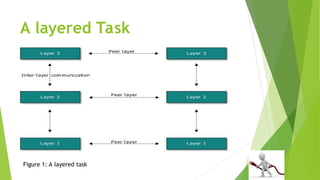
Inlayered architecture of Network Models, one whole
network process is divided into small tasks.
Each small task is then assigned to a particular layer
which works dedicatedly to process the task only.
Every layer does only specific work.
In layered communication system, one layer of a host
deals with the task done by or to be done by its peer
layer at the same level on the remote host.
Basic Network Models
Differentnetwork models exists.
But,
In this presentation we shall discuss the two different
internationally accepted network models
The OSI model
The internet model
6.
The OSI Model
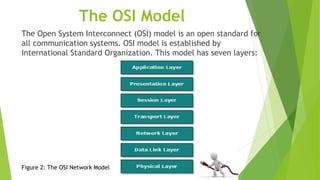
TheOpen System Interconnect (OSI) model is an open standard for
all communication systems. OSI model is established by
International Standard Organization. This model has seven layers:
Figure 2: The OSI Network Model
7.
OSI model contd.
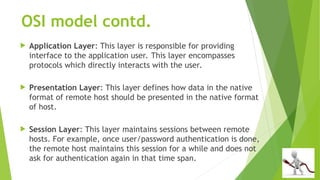
Application Layer: This layer is responsible for providing
interface to the application user. This layer encompasses
protocols which directly interacts with the user.
Presentation Layer: This layer defines how data in the native
format of remote host should be presented in the native format
of host.
Session Layer: This layer maintains sessions between remote
hosts. For example, once user/password authentication is done,
the remote host maintains this session for a while and does not
ask for authentication again in that time span.
8.
OSI model contd.
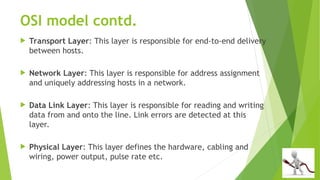
Transport Layer: This layer is responsible for end-to-end delivery
between hosts.
Network Layer: This layer is responsible for address assignment
and uniquely addressing hosts in a network.
Data Link Layer: This layer is responsible for reading and writing
data from and onto the line. Link errors are detected at this
layer.
Physical Layer: This layer defines the hardware, cabling and
wiring, power output, pulse rate etc.
9.
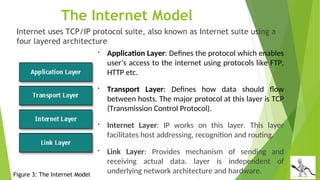
The Internet Model
Internetuses TCP/IP protocol suite, also known as Internet suite using a
four layered architecture
Application Layer: Defines the protocol which enables
user’s access to the internet using protocols like FTP,
HTTP etc.
Transport Layer: Defines how data should flow
between hosts. The major protocol at this layer is TCP
(Transmission Control Protocol).
Internet Layer: IP works on this layer. This layer
facilitates host addressing, recognition and routing.
Link Layer: Provides mechanism of sending and
receiving actual data. layer is independent of
underlying network architecture and hardware.
Figure 3: The Internet Model
10.
Networks types
A computernetwork is a connection of two or more
computers to intelligently share files and other computer
resources like printers, scanners, internet access and etc.
The basic types of computer networks include;
LAN (Local Area Network),
MAN (Metropolitan Area Network)
CAN (Campus Area Network)
WAN (Wide Area Network)
#5 Bellcore (the AT&T telephone company) has a huge set of protocols supporting their Signaling System 7 (SS7) network model. It was designed for switching telephone conversations.
note:
OSI was the first (and so far the only) project to consider the network problem in a top-down manner, all the way from application layer to physical layer. Many OSI protocols have proven to be so top-heavy, that stripped down versions have gained some popularity., eg. X.500 directory services prompted the development of the Lightweight Directory Access Protocol (LDAP). Of TCP/IP, it is sometimes said (turning the adage upside-down) that "it works in practice, but not in theory" Source(s): http://www.iana.org/assignments/protocol.
#9 This layer ensures data delivered between hosts is in-order and is responsible for end to end delivery. The data link layer of the OSI model is dependent on hardware and architecture but the Internet model unlike its OSI Model’s counterpart does not.
#10 A Campus Area Network (CAN) is a computer network that links the buildings and consists of two or more local area networks (LANs) within the limited geographical area. It can be the college campus, enterprise campus, office buildings, military base, industrial complex