THE 12 FACTORS
LIGHTNING TALKS ALICAN AKKUS@IYZICO
1
THE 12 FACTORS
1
2
3
4
5
6
8
10
7
11
9
Codebase

One codebase tracked in revision control, 

many deploys.
Dependencies

Explicitly declare and isolate dependencies.
Configuration

Store config in the environment.
Backing Services

Treat backing services as attached resources.
Build, release, run

Strictly separate build and run stages.
Processes

Execute the app as one or more stateless
processes.
12
Port binding

Export services via port binding.
Disposability

Maximize robustness with fast startup and
graceful shutdown.
Dev/Prod Parity

Keep development, staging, and production
as similar as possible
Logs

Treat logs as event streams.
Concurrency

Scale out via the process model.
Admin processes

Run admin/management tasks as one-off
processes.
2
THE 12 FACTORS
1
Codebase


One codebase tracked in revision control, many deploys. 

This means you must not have various codebase for various
versions. Branches and tags is okay, different repos are not.
3
THE 12 FACTORS
2
Dependencies


A twelve-factor app never relies on implicit existence of
system-wide packages. It declares all dependencies,
completely and exactly, via a dependency
declaration manifest. 
4
THE 12 FACTORS
3
Configuration


Store config in the environment. The most important rule here
is – never commit your environment-specific configuration
(most importantly: password) in the source code repo.
Otherwise your production system may be vulnerable.
5
THE 12 FACTORS
4
Backing Services


Treat backing services as attached resources. A backing
service is one that requires a network connection to run. This
is a very popular paradigm found in modern application
development, especially prevalent with the rise in popularity
of microservice architecture. The 12-Factor App methodology
advises developers to treat these services agnostically,
meaning changes or modifications should occur without
having to make any code changes.
6
THE 12 FACTORS
5
Build, release, run


Strictly separate build and run stages. The twelve-factor app
uses strict separation between the build, release, and run
stages. For example, it is impossible to make changes to the
code at runtime, since there is no way to propagate those
changes back to the build stage.
7
THE 12 FACTORS
6
Processes
Execute the app as one or more stateless processes. Twelve-
factor processes are stateless and share-nothing. Any data
that needs to persist must be stored in a stateful backing
service, typically a database.
8
THE 12 FACTORS
7
Port binding


Export services via port binding. The twelve-factor app is
completely self-contained and does not rely on runtime
injection of a webserver into the execution environment to
create a web-facing service. The web app exports HTTP as a
service by binding to a port, and listening to requests
coming in on that port.
9
THE 12 FACTORS
8
Concurrency


Scale out via the process model. In the twelve-factor app,
processes are a first class citizen. Processes in the twelve-
factor app take strong cues from the unix process model for
running service daemons. Using this model, the developer
can architect their app to handle diverse workloads by
assigning each type of work to a process type.
10
THE 12 FACTORS
9
Disposability


Maximize robustness with fast startup and graceful shutdown.
The twelve-factor app’s processes are disposable,
meaning they can be started or stopped at a moment’s
notice. This facilitates fast elastic scaling, rapid deployment
of code or config changes, and robustness of production
deploys.
11
THE 12 FACTORS
10
Dev/Prod Parity


Keep development, staging, and production as similar as
possible. The twelve-factor app is designed for continuous
deployment by keeping the gap between development and
production small.
12
THE 12 FACTORS
11
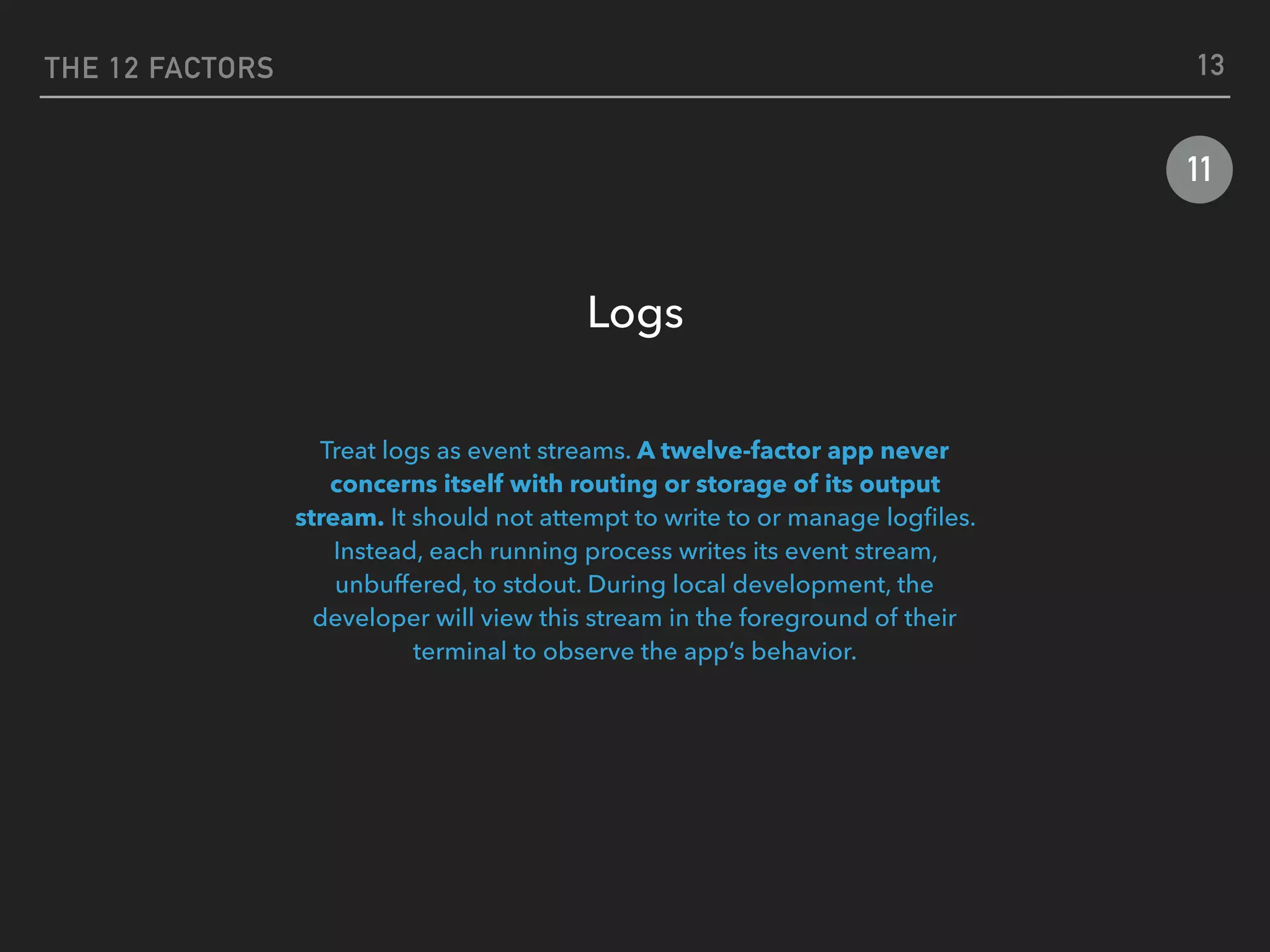
Logs


Treat logs as event streams. A twelve-factor app never
concerns itself with routing or storage of its output
stream. It should not attempt to write to or manage logfiles.
Instead, each running process writes its event stream,
unbuffered, to stdout. During local development, the
developer will view this stream in the foreground of their
terminal to observe the app’s behavior.
13
THE 12 FACTORS
12
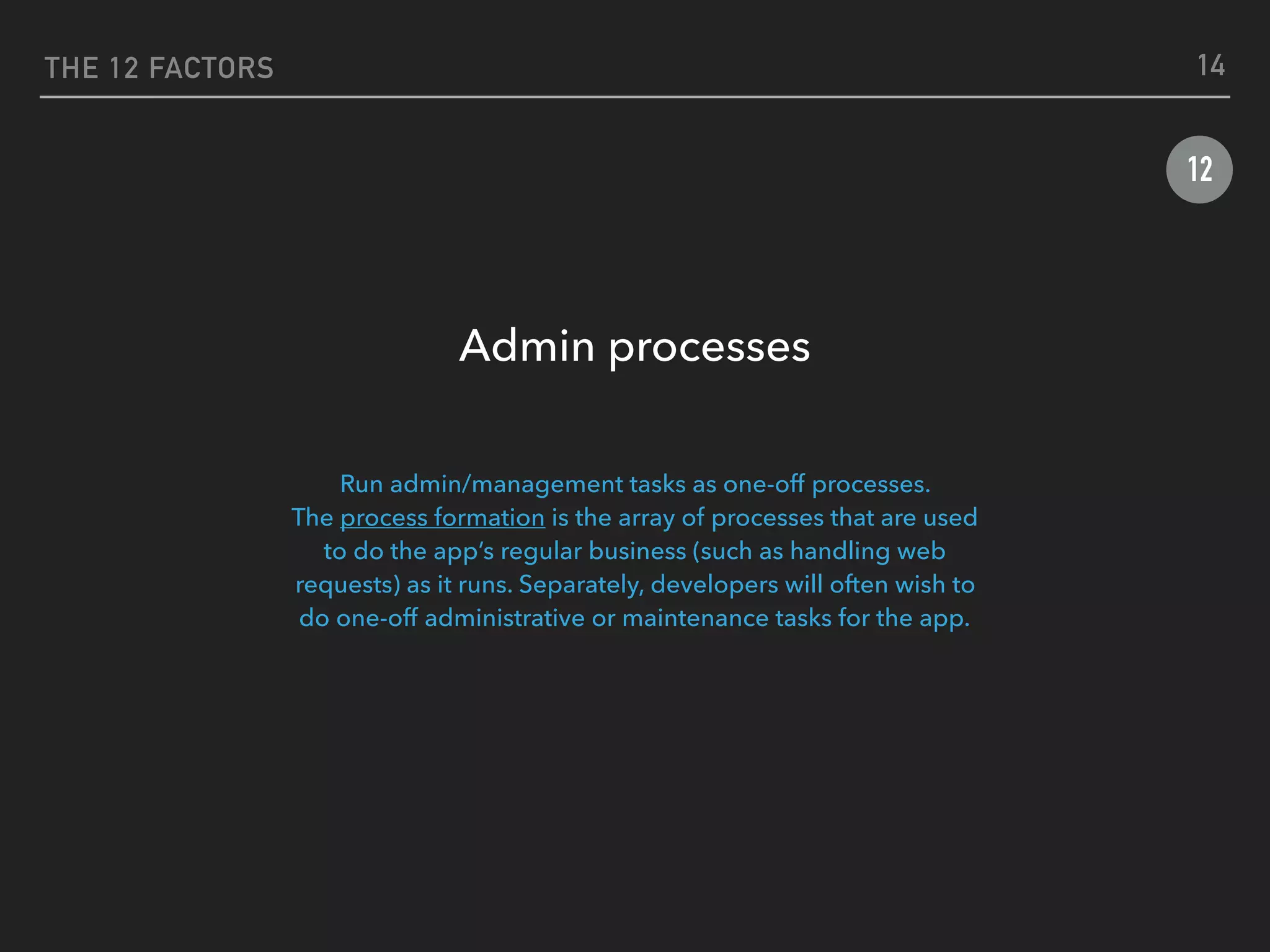
Admin processes


Run admin/management tasks as one-off processes.
The process formation is the array of processes that are used
to do the app’s regular business (such as handling web
requests) as it runs. Separately, developers will often wish to
do one-off administrative or maintenance tasks for the app.
14
THANKS
15
https://12factor.net 

https://dzone.com/articles/the-12-factor-app-a-java-developers-perspective 

https://www.sitepoint.com/12-factor-apps-methodology-implement-apps-appfog/

12 factor apps

  • 1.
    THE 12 FACTORS LIGHTNINGTALKS ALICAN AKKUS@IYZICO 1
  • 2.
    THE 12 FACTORS 1 2 3 4 5 6 8 10 7 11 9 Codebase
 Onecodebase tracked in revision control, 
 many deploys. Dependencies
 Explicitly declare and isolate dependencies. Configuration
 Store config in the environment. Backing Services
 Treat backing services as attached resources. Build, release, run
 Strictly separate build and run stages. Processes
 Execute the app as one or more stateless processes. 12 Port binding
 Export services via port binding. Disposability
 Maximize robustness with fast startup and graceful shutdown. Dev/Prod Parity
 Keep development, staging, and production as similar as possible Logs
 Treat logs as event streams. Concurrency
 Scale out via the process model. Admin processes
 Run admin/management tasks as one-off processes. 2
  • 3.
    THE 12 FACTORS 1 Codebase 
 Onecodebase tracked in revision control, many deploys. 
 This means you must not have various codebase for various versions. Branches and tags is okay, different repos are not. 3
  • 4.
    THE 12 FACTORS 2 Dependencies 
 Atwelve-factor app never relies on implicit existence of system-wide packages. It declares all dependencies, completely and exactly, via a dependency declaration manifest.  4
  • 5.
    THE 12 FACTORS 3 Configuration 
 Storeconfig in the environment. The most important rule here is – never commit your environment-specific configuration (most importantly: password) in the source code repo. Otherwise your production system may be vulnerable. 5
  • 6.
    THE 12 FACTORS 4 BackingServices 
 Treat backing services as attached resources. A backing service is one that requires a network connection to run. This is a very popular paradigm found in modern application development, especially prevalent with the rise in popularity of microservice architecture. The 12-Factor App methodology advises developers to treat these services agnostically, meaning changes or modifications should occur without having to make any code changes. 6
  • 7.
    THE 12 FACTORS 5 Build,release, run 
 Strictly separate build and run stages. The twelve-factor app uses strict separation between the build, release, and run stages. For example, it is impossible to make changes to the code at runtime, since there is no way to propagate those changes back to the build stage. 7
  • 8.
    THE 12 FACTORS 6 Processes Executethe app as one or more stateless processes. Twelve- factor processes are stateless and share-nothing. Any data that needs to persist must be stored in a stateful backing service, typically a database. 8
  • 9.
    THE 12 FACTORS 7 Portbinding 
 Export services via port binding. The twelve-factor app is completely self-contained and does not rely on runtime injection of a webserver into the execution environment to create a web-facing service. The web app exports HTTP as a service by binding to a port, and listening to requests coming in on that port. 9
  • 10.
    THE 12 FACTORS 8 Concurrency 
 Scaleout via the process model. In the twelve-factor app, processes are a first class citizen. Processes in the twelve- factor app take strong cues from the unix process model for running service daemons. Using this model, the developer can architect their app to handle diverse workloads by assigning each type of work to a process type. 10
  • 11.
    THE 12 FACTORS 9 Disposability 
 Maximizerobustness with fast startup and graceful shutdown. The twelve-factor app’s processes are disposable, meaning they can be started or stopped at a moment’s notice. This facilitates fast elastic scaling, rapid deployment of code or config changes, and robustness of production deploys. 11
  • 12.
    THE 12 FACTORS 10 Dev/ProdParity 
 Keep development, staging, and production as similar as possible. The twelve-factor app is designed for continuous deployment by keeping the gap between development and production small. 12
  • 13.
    THE 12 FACTORS 11 Logs 
 Treatlogs as event streams. A twelve-factor app never concerns itself with routing or storage of its output stream. It should not attempt to write to or manage logfiles. Instead, each running process writes its event stream, unbuffered, to stdout. During local development, the developer will view this stream in the foreground of their terminal to observe the app’s behavior. 13
  • 14.
    THE 12 FACTORS 12 Adminprocesses 
 Run admin/management tasks as one-off processes. The process formation is the array of processes that are used to do the app’s regular business (such as handling web requests) as it runs. Separately, developers will often wish to do one-off administrative or maintenance tasks for the app. 14
  • 15.