Hello Cloud
GIREESH KUMAR
Topics
 The DHARMA Principles
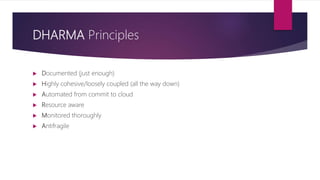
DHARMA Principles
 Documented (just enough)
 Highly cohesive/loosely coupled (all the way down)
 Automated from commit to cloud
 Resource aware
 Monitored thoroughly
 Antifragile
12 Factor App
Guidelines for writing scalable SaaS apps
http://12factor.net/
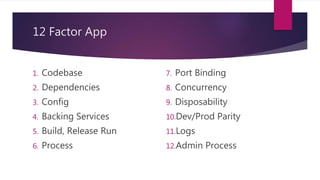
12 Factor App
1. Codebase
2. Dependencies
3. Config
4. Backing Services
5. Build, Release Run
6. Process
7. Port Binding
8. Concurrency
9. Disposability
10.Dev/Prod Parity
11.Logs
12.Admin Process
12 Factor App
Codebase
one codebase, multiple deploys
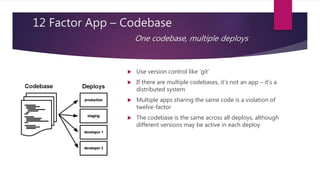
12 Factor App – Codebase
One codebase, multiple deploys
 Use version control like ‘git’
 If there are multiple codebases, it’s not an app – it’s a
distributed system
 Multiple apps sharing the same code is a violation of
twelve-factor
 The codebase is the same across all deploys, although
different versions may be active in each deploy
12 Factor App
Dependencies
Explicitly Declare and isolate
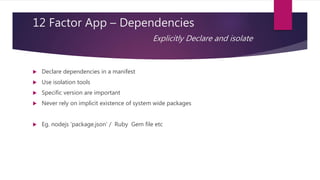
12 Factor App – Dependencies
Explicitly Declare and isolate
 Declare dependencies in a manifest
 Use isolation tools
 Specific version are important
 Never rely on implicit existence of system wide packages
 Eg. nodejs ‘package.json’ / Ruby Gem file etc
12 Factor App
Config
Store in the environment
12 Factor App – Config
Store in the environment
 Information required to host a deployment of your codebase
 Mainly DB Credentials, path, resources etc
 Should be strictly separated from code
 Configuration belongs in the environment not in the application
 No config in git
 Use Environment vars (like ENV['DATABASE_URL'] )
12 Factor App
Backing Services
As Attached resources
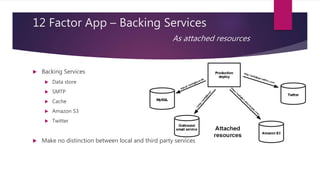
12 Factor App – Backing Services
As attached resources
 Backing Services
 Data store
 SMTP
 Cache
 Amazon S3
 Twitter
 Make no distinction between local and third party services
12 Factor App
Build, Release, Run
Strictly separate build & run stage
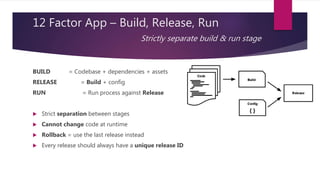
12 Factor App – Build, Release, Run
Strictly separate build & run stage
BUILD = Codebase + dependencies + assets
RELEASE = Build + config
RUN = Run process against Release
 Strict separation between stages
 Cannot change code at runtime
 Rollback = use the last release instead
 Every release should always have a unique release ID
12 Factor App
Processes
Execute the app as one or more stateless process
12 Factor App – Processes
Execute the app as one or more stateless process
 Does the running of the release
 Is stateless
 Share nothing with other process
 Use single transaction only caches
 No sticky sessions - Use session state data with memcached/redis
 Asset pre-compilation instead of over runtime calculation
12 Factor App
Port Binding
Export services via port binding
12 Factor App – Port Binding
Export services via port binding
The contract with the execution environment is binding to a port to serve request .
App is completely self-contained
Booking
http://192.168.123.45:5555
Shop
http://23.123.34.54:5505
12 Factor App
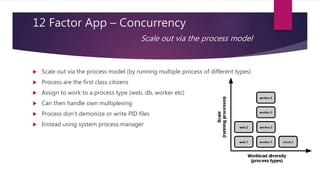
Concurrency
Scale out via the process model
12 Factor App – Concurrency
Scale out via the process model
 Scale out via the process model (by running multiple process of different types)
 Process are the first class citizens
 Assign to work to a process type (web, db, worker etc)
 Can then handle own multiplexing
 Process don't demonize or write PID files
 Instead using system process manager
12 Factor App
Disposability
Maximize robustness with fast startup and graceful shutdown
12 Factor App – Disposability
Maximize robustness with fast startup and graceful shutdown
 Process are disposable (they can be started or stopped at a moment’s notice)
 Start quickly
 Shutdown gracefully
 Be robust against sudden death
12 Factor App
Dev Prod Parity
Keep development, staging and production as similar as possible
12 Factor App – Dev Prod Parity
Keep development, staging and production as similar as possible
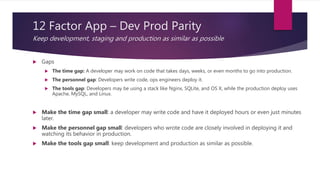
 Gaps
 The time gap: A developer may work on code that takes days, weeks, or even months to go into production.
 The personnel gap: Developers write code, ops engineers deploy it.
 The tools gap: Developers may be using a stack like Nginx, SQLite, and OS X, while the production deploy uses
Apache, MySQL, and Linux.
 Make the time gap small: a developer may write code and have it deployed hours or even just minutes
later.
 Make the personnel gap small: developers who wrote code are closely involved in deploying it and
watching its behavior in production.
 Make the tools gap small: keep development and production as similar as possible.
12 Factor App
Logs
Treat logs as event streams
12 Factor App – Logs
Treat logs as event streams
 Dont route or store logs in files
 Stream to stout instead and be captured and handled by environment
12 Factor App
Admin processes
Run admin/management tasks as one-off processes
12 Factor App – Admin processes
Run admin/management tasks as one-off processes
 Database migration
 Console view
 Running one time scripts
 Run as seperate process
 Run against the same release
 Admin code ships with app code
Next

Hello cloud 6

  • 1.
  • 2.
  • 3.
    DHARMA Principles  Documented(just enough)  Highly cohesive/loosely coupled (all the way down)  Automated from commit to cloud  Resource aware  Monitored thoroughly  Antifragile
  • 4.
    12 Factor App Guidelinesfor writing scalable SaaS apps http://12factor.net/
  • 5.
    12 Factor App 1.Codebase 2. Dependencies 3. Config 4. Backing Services 5. Build, Release Run 6. Process 7. Port Binding 8. Concurrency 9. Disposability 10.Dev/Prod Parity 11.Logs 12.Admin Process
  • 6.
    12 Factor App Codebase onecodebase, multiple deploys
  • 7.
    12 Factor App– Codebase One codebase, multiple deploys  Use version control like ‘git’  If there are multiple codebases, it’s not an app – it’s a distributed system  Multiple apps sharing the same code is a violation of twelve-factor  The codebase is the same across all deploys, although different versions may be active in each deploy
  • 8.
  • 9.
    12 Factor App– Dependencies Explicitly Declare and isolate  Declare dependencies in a manifest  Use isolation tools  Specific version are important  Never rely on implicit existence of system wide packages  Eg. nodejs ‘package.json’ / Ruby Gem file etc
  • 10.
    12 Factor App Config Storein the environment
  • 11.
    12 Factor App– Config Store in the environment  Information required to host a deployment of your codebase  Mainly DB Credentials, path, resources etc  Should be strictly separated from code  Configuration belongs in the environment not in the application  No config in git  Use Environment vars (like ENV['DATABASE_URL'] )
  • 12.
    12 Factor App BackingServices As Attached resources
  • 13.
    12 Factor App– Backing Services As attached resources  Backing Services  Data store  SMTP  Cache  Amazon S3  Twitter  Make no distinction between local and third party services
  • 14.
    12 Factor App Build,Release, Run Strictly separate build & run stage
  • 15.
    12 Factor App– Build, Release, Run Strictly separate build & run stage BUILD = Codebase + dependencies + assets RELEASE = Build + config RUN = Run process against Release  Strict separation between stages  Cannot change code at runtime  Rollback = use the last release instead  Every release should always have a unique release ID
  • 16.
    12 Factor App Processes Executethe app as one or more stateless process
  • 17.
    12 Factor App– Processes Execute the app as one or more stateless process  Does the running of the release  Is stateless  Share nothing with other process  Use single transaction only caches  No sticky sessions - Use session state data with memcached/redis  Asset pre-compilation instead of over runtime calculation
  • 18.
    12 Factor App PortBinding Export services via port binding
  • 19.
    12 Factor App– Port Binding Export services via port binding The contract with the execution environment is binding to a port to serve request . App is completely self-contained Booking http://192.168.123.45:5555 Shop http://23.123.34.54:5505
  • 20.
    12 Factor App Concurrency Scaleout via the process model
  • 21.
    12 Factor App– Concurrency Scale out via the process model  Scale out via the process model (by running multiple process of different types)  Process are the first class citizens  Assign to work to a process type (web, db, worker etc)  Can then handle own multiplexing  Process don't demonize or write PID files  Instead using system process manager
  • 22.
    12 Factor App Disposability Maximizerobustness with fast startup and graceful shutdown
  • 23.
    12 Factor App– Disposability Maximize robustness with fast startup and graceful shutdown  Process are disposable (they can be started or stopped at a moment’s notice)  Start quickly  Shutdown gracefully  Be robust against sudden death
  • 24.
    12 Factor App DevProd Parity Keep development, staging and production as similar as possible
  • 25.
    12 Factor App– Dev Prod Parity Keep development, staging and production as similar as possible  Gaps  The time gap: A developer may work on code that takes days, weeks, or even months to go into production.  The personnel gap: Developers write code, ops engineers deploy it.  The tools gap: Developers may be using a stack like Nginx, SQLite, and OS X, while the production deploy uses Apache, MySQL, and Linux.  Make the time gap small: a developer may write code and have it deployed hours or even just minutes later.  Make the personnel gap small: developers who wrote code are closely involved in deploying it and watching its behavior in production.  Make the tools gap small: keep development and production as similar as possible.
  • 26.
    12 Factor App Logs Treatlogs as event streams
  • 27.
    12 Factor App– Logs Treat logs as event streams  Dont route or store logs in files  Stream to stout instead and be captured and handled by environment
  • 28.
    12 Factor App Adminprocesses Run admin/management tasks as one-off processes
  • 29.
    12 Factor App– Admin processes Run admin/management tasks as one-off processes  Database migration  Console view  Running one time scripts  Run as seperate process  Run against the same release  Admin code ships with app code
  • 31.