Twelve-Factor App
Software Application Architecture
12-Factor App: Methodology for
building software applications.
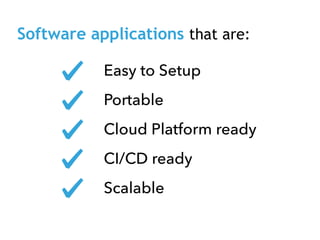
Software applications that are:
Easy to Setup
Software applications that are:
Easy to Setup
Portable
Software applications that are:
Easy to Setup
Portable
Cloud Platform ready
Software applications that are:
Easy to Setup
Portable
Cloud Platform ready
CI/CD ready
Software applications that are:
Easy to Setup
Portable
Cloud Platform ready
CI/CD ready
Scalable
Twelve-Factor Application
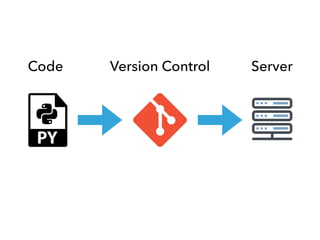
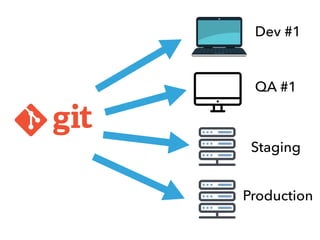
[1] Codebase
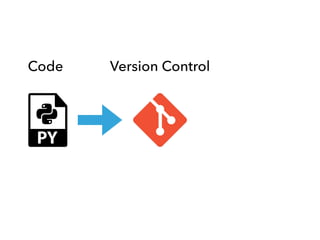
Code
Code Version Control
Code Version Control Server
Dev #1
QA #1
Staging
Production
Codebase: One codebase tracked in
revision control, many deploys.
Twelve-Factor Application
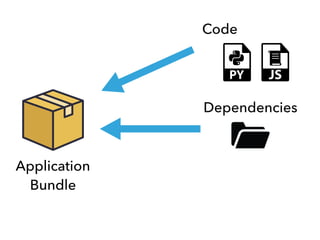
[2] Dependencies
Application
Bundle
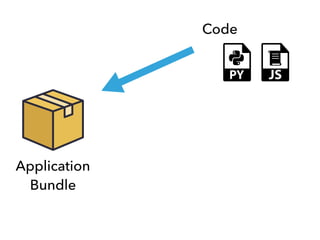
Code
Application
Bundle
Code
Application
Bundle
Dependencies
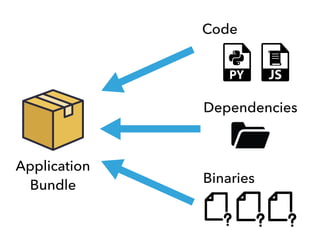
Code
Application
Bundle
Dependencies
Binaries
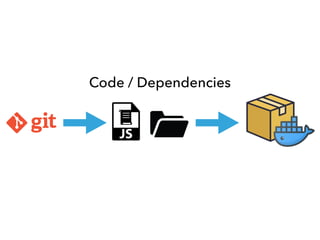
Code / Dependencies
Code / Dependencies
-
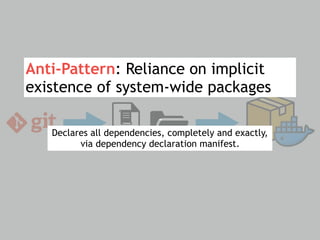
Anti-Pattern: Reliance on implicit
existence of system-wide packages
Declares all dependencies, completely and exactly,
via dependency declaration manifest.
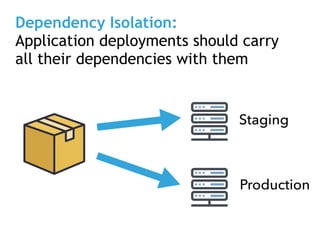
Dependency Isolation:
Application deployments should carry
all their dependencies with them
Staging
Production
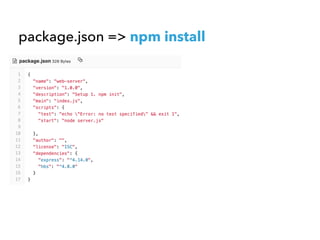
package.json => npm install
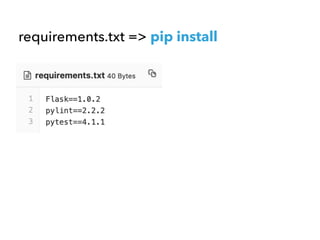
requirements.txt => pip install
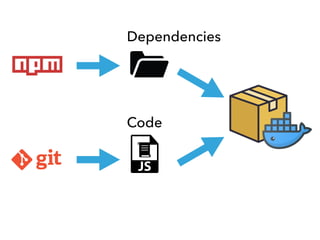
Code
Dependencies
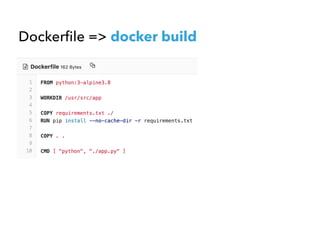
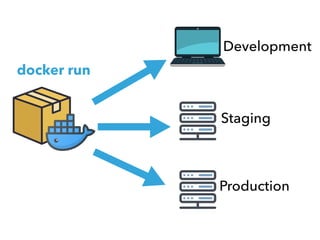
Dockerfile => docker build
Development
Staging
docker run
Production
Dependencies: Explicitly declare and
isolate dependencies.
Twelve-Factor Application
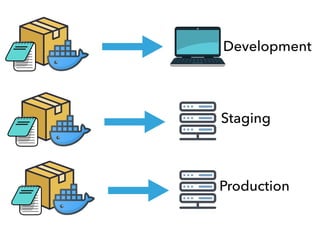
[3] Config
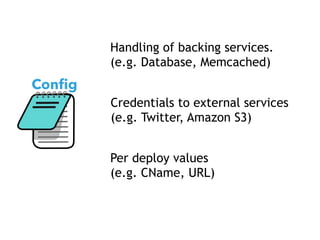
Credentials to external services
(e.g. Twitter, Amazon S3)
Per deploy values
(e.g. CName, URL)
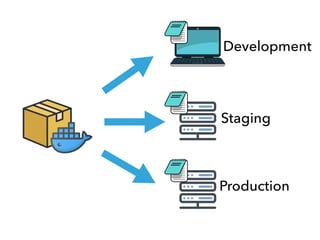
Config
Handling of backing services.
(e.g. Database, Memcached)
Development
Staging
Production
Development
Staging
Production
-
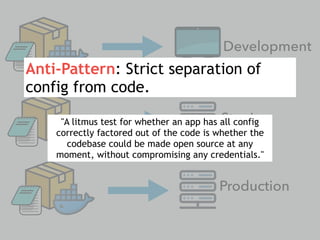
Anti-Pattern: Strict separation of
config from code.
"A litmus test for whether an app has all config
correctly factored out of the code is whether the
codebase could be made open source at any
moment, without compromising any credentials."
Development
Staging
Production
Twelve-Factor apps stores config in
environment variables
import os
ENV = os.environ[‘ENV’]
SECRET = os.environ[‘SECRET’]
[development]
> docker run -e “ENV=development” -e “SECRET=HIMIG” myApp
[production]
> docker run -e “ENV=production” -e “SECRET=MALAYA” myApp
[development] my.env
ENV=development
SECRET=HIMIG
[production] my.env
ENV=production
SECRET=MALAYA
OPTION #1
APPLICATION
CODE
OPTION #2
Config: Store config in the
environment.
Twelve-Factor Application
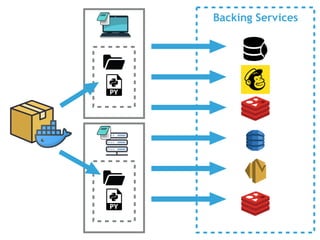
[4] Backing Services
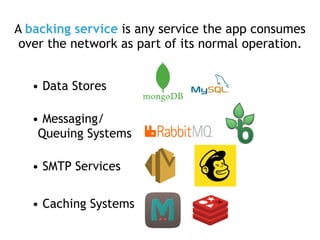
A backing service is any service the app consumes
over the network as part of its normal operation.
A backing service is any service the app consumes
over the network as part of its normal operation.
• Data Stores
A backing service is any service the app consumes
over the network as part of its normal operation.
• Data Stores
• Messaging/
Queuing Systems
A backing service is any service the app consumes
over the network as part of its normal operation.
• Data Stores
• Messaging/
Queuing Systems
• SMTP Services
A backing service is any service the app consumes
over the network as part of its normal operation.
• Data Stores
• Messaging/
Queuing Systems
• SMTP Services
• Caching Systems
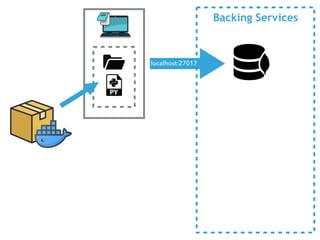
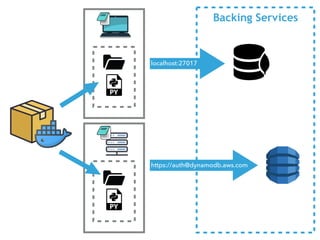
Backing Services
localhost:27017
Backing Services
localhost:27017
https://auth@dynamodb.aws.com
Backing Services
Backing Services: Treat backing
services as attached resources.
Twelve-Factor Application
[5] Build, Release, Run
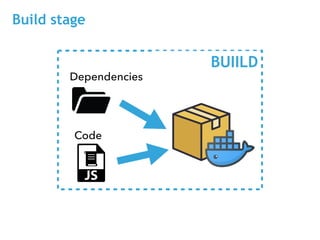
Build stage
Code
Dependencies
BUIILD
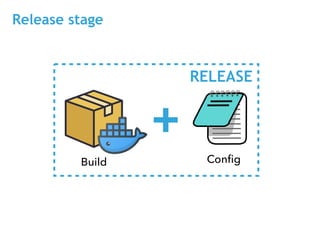
Release stage
+
Build Config
RELEASE
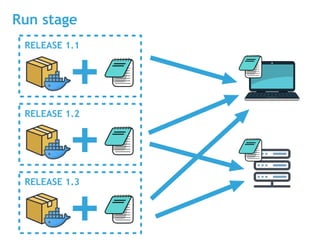
Run stage
+
RELEASE 1.1
+
RELEASE 1.2
+
RELEASE 1.3
Build, Release, Run: Strictly separate
build, release and run stages.
Twelve-Factor Application
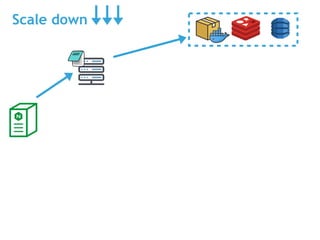
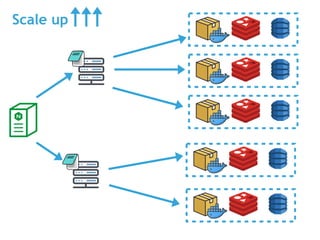
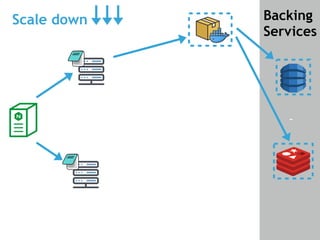
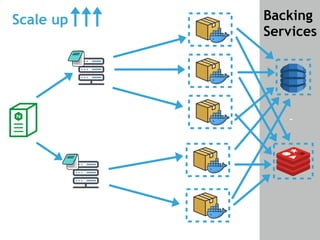
[6] Processes
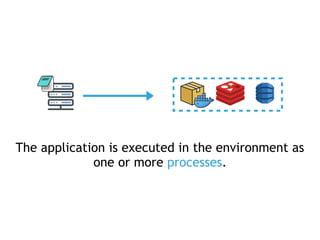
The application is executed in the environment as
one or more processes.
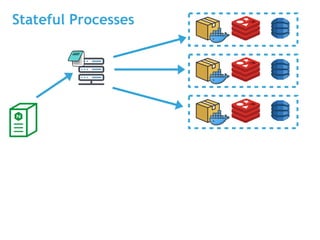
Stateful Processes
Scale down
Scale up
-
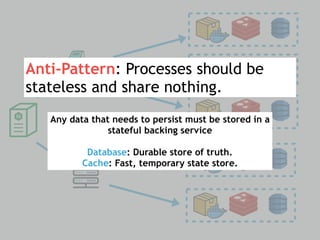
Anti-Pattern: Processes should be
stateless and share nothing.
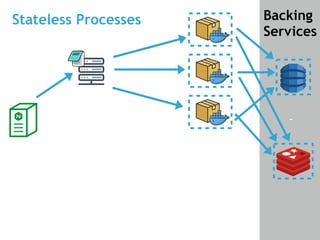
Any data that needs to persist must be stored in a
stateful backing service
Database: Durable store of truth.
Cache: Fast, temporary state store.
-
Stateless Processes Backing
Services
-
Backing
Services
Scale down
-
Backing
Services
Scale up
Processes: Execute the app as one or
more stateless processes.
Twelve-Factor Application
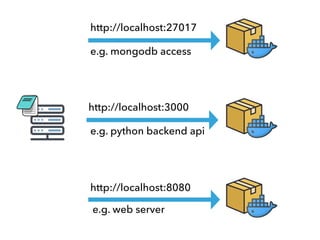
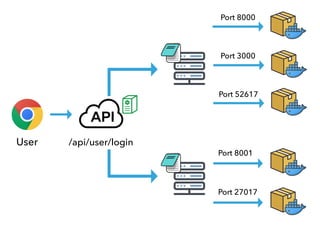
[7] Port Binding
http://localhost:27017
http://localhost:3000
http://localhost:8080
e.g. mongodb access
e.g. python backend api
e.g. web server
/api/user/loginUser
Port 8000
Port 3000
Port 8001
Port 52617
Port 27017
Port Binding: Export services via port
binding.
Twelve-Factor Application
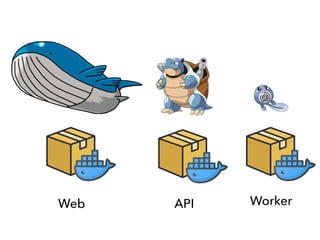
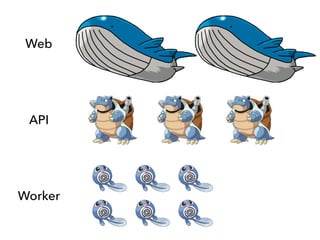
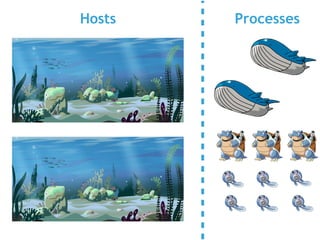
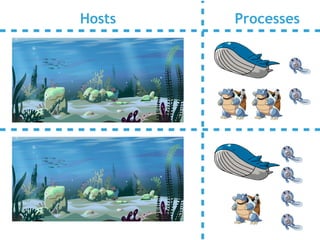
[8] Concurrency
Web API Worker
Web
API
Worker
Hosts Processes
Hosts Processes
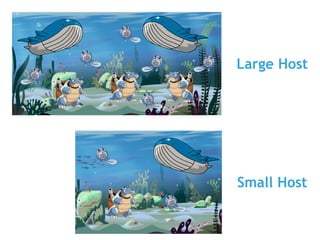
Large Host
Small Host
Concurrency: Scale out via the
process model.
Twelve-Factor Application
[9] Disposability
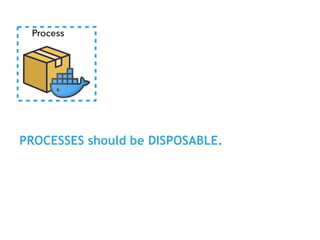
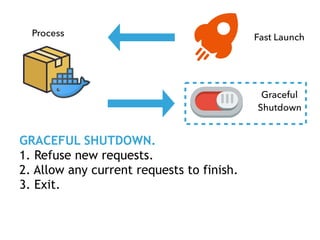
Process
PROCESSES should be DISPOSABLE.
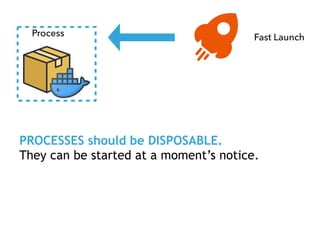
Process
PROCESSES should be DISPOSABLE.
They can be started at a moment’s notice.
Fast Launch
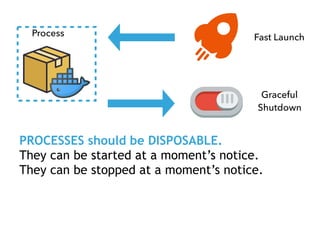
Process
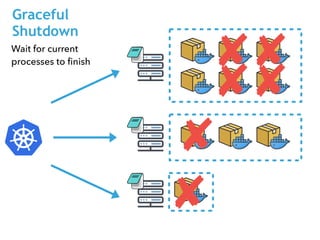
Graceful
Shutdown
PROCESSES should be DISPOSABLE.
They can be started at a moment’s notice.
They can be stopped at a moment’s notice.
Fast Launch
Process
Graceful
Shutdown
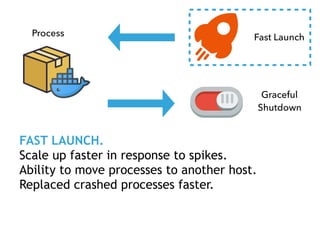
FAST LAUNCH.
Scale up faster in response to spikes.
Ability to move processes to another host.
Replaced crashed processes faster.
Fast Launch
Process
Graceful
Shutdown
GRACEFUL SHUTDOWN.
1. Refuse new requests.
2. Allow any current requests to finish.
3. Exit.
Fast Launch
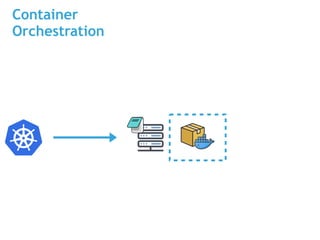
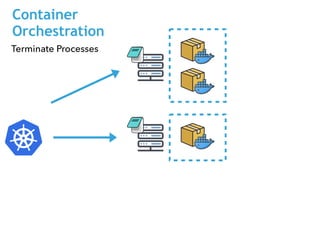
Container
Orchestration
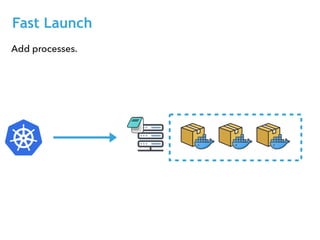
Fast Launch
Add processes.
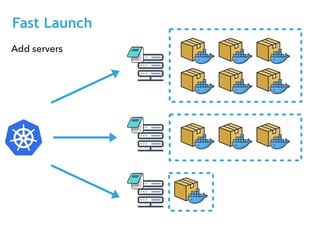
Fast Launch
Add servers
Graceful
Shutdown
Wait for current
processes to finish
Container
Orchestration
Terminate Processes
Disposability: Maximize robustness
with fast startup and graceful
shutdown.
Twelve-Factor Application
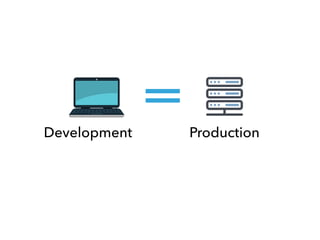
[10] Dev/Prod Parity
Development Production
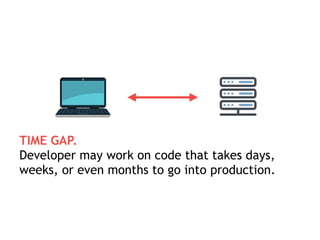
TIME GAP.
Developer may work on code that takes days,
weeks, or even months to go into production.
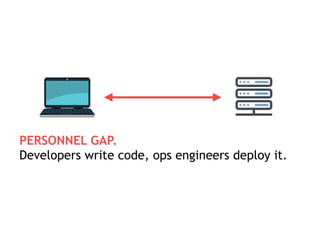
PERSONNEL GAP.
Developers write code, ops engineers deploy it.
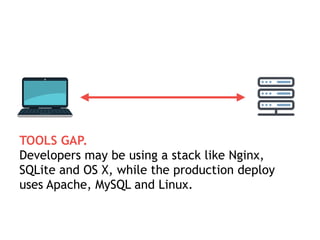
TOOLS GAP.
Developers may be using a stack like Nginx,
SQLite and OS X, while the production deploy
uses Apache, MySQL and Linux.
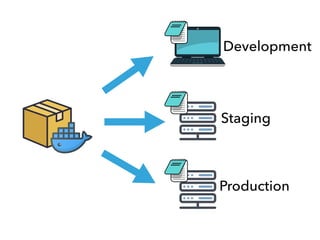
Development
Staging
Production
Dev/Prod Parity: Keep development,
staging and production as similar as
possible.
Twelve-Factor Application
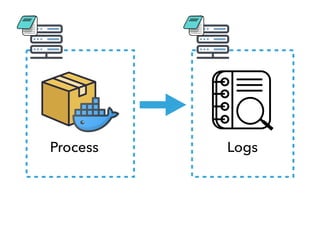
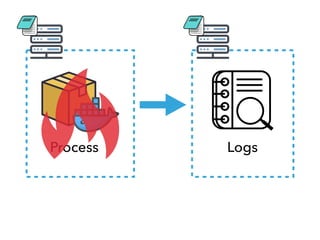
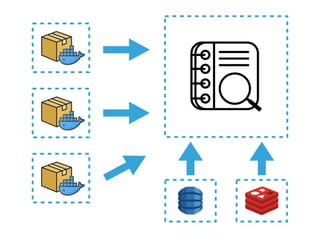
[11] Logs
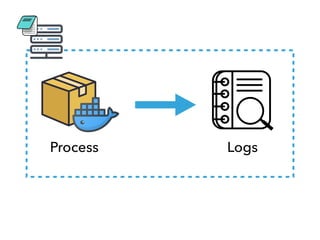
Process
Process Logs
Process Logs
Process Logs
Process Logs
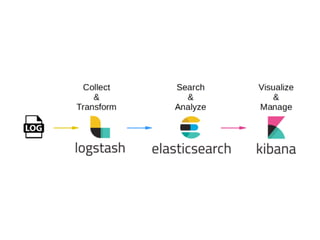
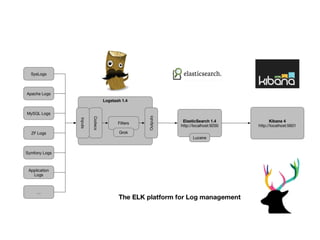
Logs: Treat logs as event streams.
Twelve-Factor Application
[12] Admin Processes
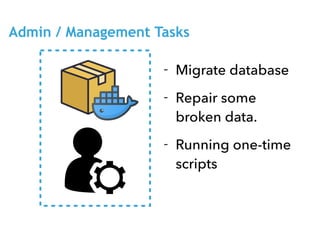
- Migrate database
- Repair some
broken data.
- Running one-time
scripts
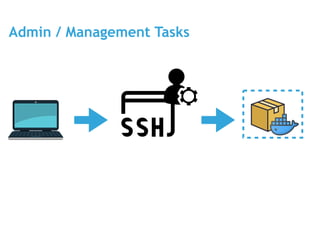
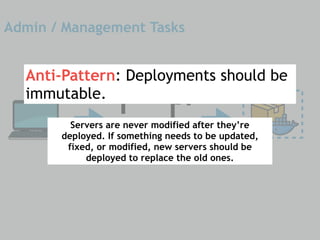
Admin / Management Tasks
-
Anti-Pattern: Deployments should be
immutable.
Servers are never modified after they’re
deployed. If something needs to be updated,
fixed, or modified, new servers should be
deployed to replace the old ones.
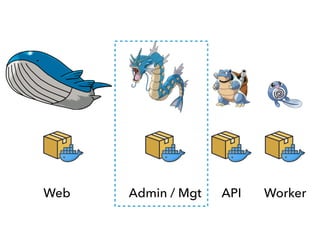
Web Admin / Mgt WorkerAPI
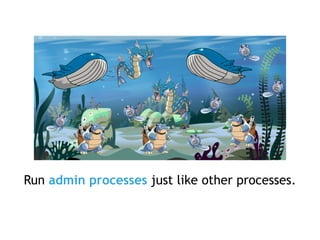
Run admin processes just like other processes.
Admin Processes: Run admin/
management tasks as one-off
processes.
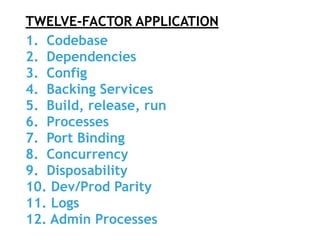
TWELVE-FACTOR APPLICATION
1. Codebase
2. Dependencies
3. Config
4. Backing Services
5. Build, release, run
6. Processes
7. Port Binding
8. Concurrency
9. Disposability
10. Dev/Prod Parity
11. Logs
12. Admin Processes
References:
1. Twelve-Factor App Website https://
12factor.net/
2. Building Microservices with 12 Factor App
on AWS https://www.youtube.com/watch?
v=2SxKKDXKrXQ
3. Hackernoon. https://hackernoon.com/
4. Medium. https://medium.com
SIGFRED B. BALATAN JR.
▸ [Email] sj.balatan@gmail.com
▸ [Mobile] +63 915 253 3212
▸ [Profile] https://www.linkedin.com/in/sjbalatan26/
▸ [Slides] https://www.slideshare.net/SJBalatan

Twelve-Factor App: Software Application Architecture