Exponential Functions,
Equations and
Inequalities
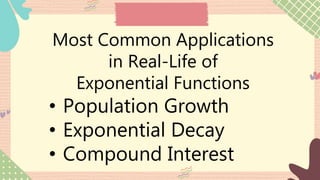
Most Common Applications
in Real-Life of
Exponential Functions
• Population Growth
• Exponential Decay
• Compound Interest
Exponential Models and
Population Growth
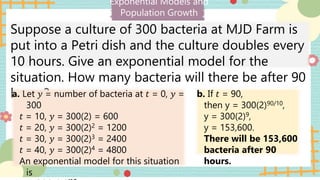
Suppose a culture of 300 bacteria at MJD Farm is
put into a Petri dish and the culture doubles every
10 hours. Give an exponential model for the
situation. How many bacteria will there be after 90
hours?
a. Let 𝑦 = number of bacteria at 𝑡 = 0, 𝑦 =
300
𝑡 = 10, 𝑦 = 300(2) = 600
𝑡 = 20, 𝑦 = 300(2)2 = 1200
𝑡 = 30, 𝑦 = 300(2)3 = 2400
𝑡 = 40, 𝑦 = 300(2)4 = 4800
An exponential model for this situation
is
b. If 𝑡 = 90,
then y = 300(2)90/10,
y = 300(2)9,
y = 153,600.
There will be 153,600
bacteria after 90
hours.
Exponential Decay
The half-life of a radioactive
substance is the time it takes for
half of the substance to decay. The
exponential decay formula is
y=yo(1/2)t/T .
Exponential Decay
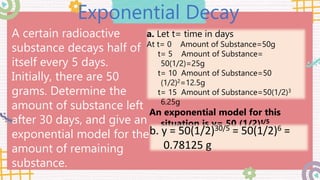
A certain radioactive
substance decays half of
itself every 5 days.
Initially, there are 50
grams. Determine the
amount of substance left
after 30 days, and give an
exponential model for the
amount of remaining
substance.
a. Let t= time in days
At t= 0 Amount of Substance=50g
t= 5 Amount of Substance=
50(1/2)=25g
t= 10 Amount of Substance=50
(1/2)2=12.5g
t= 15 Amount of Substance=50(1/2)3
6.25g
An exponential model for this
situation is y= 50 (1/2)t/5
b. y = 50(1/2)30/5 = 50(1/2)6 =
0.78125 g
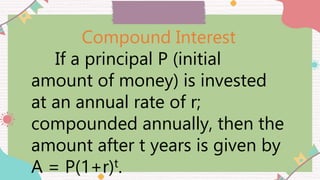
Compound Interest
If a principal P (initial
amount of money) is invested
at an annual rate of r;
compounded annually, then the
amount after t years is given by
A = P(1+r)t.
Compound Interest
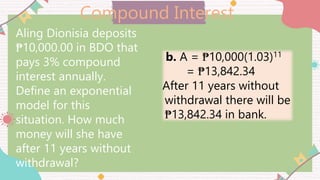
Aling Dionisia
deposits ₱10,000.00
in BDO that pays 3%
compound interest
annually. Define an
exponential model
for this situation. How
much money will she
have after 11 years
without withdrawal?
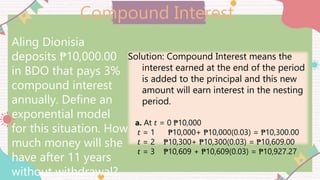
Solution: Compound Interest means the
interest earned at the end of the period
is added to the principal and this new
amount will earn interest in the nesting
period.
a. At 𝑡 = 0 ₱10,000
𝑡 = 1 ₱10,000+ ₱10,000(0.03) = ₱10,300.00
𝑡 = 2 ₱10,300+ ₱10,300(0.03) = ₱10,609.00
𝑡 = 3 ₱10,609 + ₱10,609(0.03) = ₱10,927.27
Compound Interest
Aling Dionisia deposits
₱10,000.00 in BDO that
pays 3% compound
interest annually.
Define an exponential
model for this
situation. How much
money will she have
after 11 years without
withdrawal?
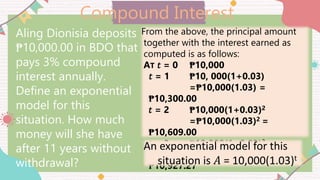
From the above, the principal amount
together with the interest earned as
computed is as follows:
AT 𝑡 = 0 ₱10,000
𝑡 = 1 ₱10, 000(1+0.03)
=₱10,000(1.03) =
₱10,300.00
𝑡 = 2 ₱10,000(1+0.03)2
=₱10,000(1.03)2 =
₱10,609.00
𝑡 = 3 ₱10,000(1+0.03)3
=₱10,000(1.03)3 =
₱10,927.27
An exponential model for this
situation is 𝐴 = 10,000(1.03)t
Compound Interest
Aling Dionisia deposits
₱10,000.00 in BDO that
pays 3% compound
interest annually.
Define an exponential
model for this
situation. How much
money will she have
after 11 years without
withdrawal?
b. A = ₱10,000(1.03)11
= ₱13,842.34
After 11 years without
withdrawal there will be
₱13,842.34 in bank.
Natural
Exponential
Function
Natural
Exponential
Function
While an exponential function may
have various bases, a frequently
used base is the irrational number e,
whose value is approximately
2.71828. Because e is a commonly
used base, the natural exponential
function is defined as having e as
the base. The predicted population
of a certain city is given by
P=200,000 e (0.03y) where y is the
number of years after the year 2020.
Predict the population for the year
2030.
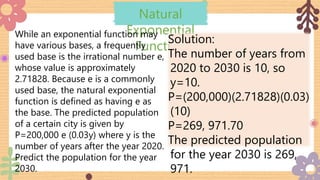
Solution:
The number of years from
2020 to 2030 is 10, so
y=10.
P=(200,000)(2.71828)(0.03)
(10)
P=269, 971.70
The predicted population
for the year 2030 is 269,
971.
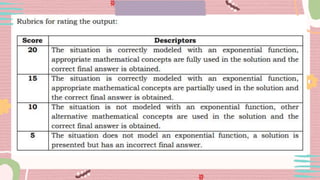
Performance
Task
Answer on a
One Whole
INTERMEDIATE
PAPER.
Page 446-447
What is the difference
of a function from an
equation and an
inequality?
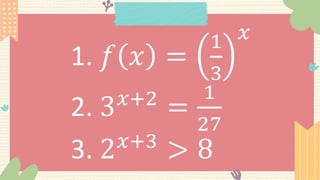
1. 𝑓 𝑥 =
1
3
𝑥
2. 3𝑥+2
=
1
27
3. 2𝑥+3
> 8
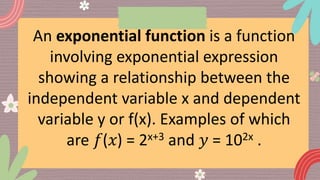
An exponential function is a function
involving exponential expression
showing a relationship between the
independent variable x and dependent
variable y or f(x). Examples of which
are 𝑓(𝑥) = 2x+3 and 𝑦 = 102x .
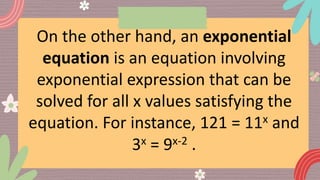
On the other hand, an exponential
equation is an equation involving
exponential expression that can be
solved for all x values satisfying the
equation. For instance, 121 = 11x and
3x = 9x-2 .
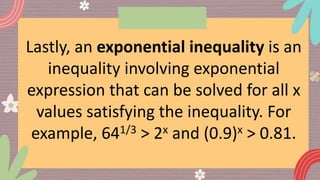
Lastly, an exponential inequality is an
inequality involving exponential
expression that can be solved for all x
values satisfying the inequality. For
example, 641/3 > 2x and (0.9)x > 0.81.

11.-Exponential-Function.pptx

  • 1.
  • 2.
    Most Common Applications inReal-Life of Exponential Functions • Population Growth • Exponential Decay • Compound Interest
  • 3.
    Exponential Models and PopulationGrowth Suppose a culture of 300 bacteria at MJD Farm is put into a Petri dish and the culture doubles every 10 hours. Give an exponential model for the situation. How many bacteria will there be after 90 hours? a. Let 𝑦 = number of bacteria at 𝑡 = 0, 𝑦 = 300 𝑡 = 10, 𝑦 = 300(2) = 600 𝑡 = 20, 𝑦 = 300(2)2 = 1200 𝑡 = 30, 𝑦 = 300(2)3 = 2400 𝑡 = 40, 𝑦 = 300(2)4 = 4800 An exponential model for this situation is b. If 𝑡 = 90, then y = 300(2)90/10, y = 300(2)9, y = 153,600. There will be 153,600 bacteria after 90 hours.
  • 4.
    Exponential Decay The half-lifeof a radioactive substance is the time it takes for half of the substance to decay. The exponential decay formula is y=yo(1/2)t/T .
  • 5.
    Exponential Decay A certainradioactive substance decays half of itself every 5 days. Initially, there are 50 grams. Determine the amount of substance left after 30 days, and give an exponential model for the amount of remaining substance. a. Let t= time in days At t= 0 Amount of Substance=50g t= 5 Amount of Substance= 50(1/2)=25g t= 10 Amount of Substance=50 (1/2)2=12.5g t= 15 Amount of Substance=50(1/2)3 6.25g An exponential model for this situation is y= 50 (1/2)t/5 b. y = 50(1/2)30/5 = 50(1/2)6 = 0.78125 g
  • 6.
    Compound Interest If aprincipal P (initial amount of money) is invested at an annual rate of r; compounded annually, then the amount after t years is given by A = P(1+r)t.
  • 7.
    Compound Interest Aling Dionisia deposits₱10,000.00 in BDO that pays 3% compound interest annually. Define an exponential model for this situation. How much money will she have after 11 years without withdrawal? Solution: Compound Interest means the interest earned at the end of the period is added to the principal and this new amount will earn interest in the nesting period. a. At 𝑡 = 0 ₱10,000 𝑡 = 1 ₱10,000+ ₱10,000(0.03) = ₱10,300.00 𝑡 = 2 ₱10,300+ ₱10,300(0.03) = ₱10,609.00 𝑡 = 3 ₱10,609 + ₱10,609(0.03) = ₱10,927.27
  • 8.
    Compound Interest Aling Dionisiadeposits ₱10,000.00 in BDO that pays 3% compound interest annually. Define an exponential model for this situation. How much money will she have after 11 years without withdrawal? From the above, the principal amount together with the interest earned as computed is as follows: AT 𝑡 = 0 ₱10,000 𝑡 = 1 ₱10, 000(1+0.03) =₱10,000(1.03) = ₱10,300.00 𝑡 = 2 ₱10,000(1+0.03)2 =₱10,000(1.03)2 = ₱10,609.00 𝑡 = 3 ₱10,000(1+0.03)3 =₱10,000(1.03)3 = ₱10,927.27 An exponential model for this situation is 𝐴 = 10,000(1.03)t
  • 9.
    Compound Interest Aling Dionisiadeposits ₱10,000.00 in BDO that pays 3% compound interest annually. Define an exponential model for this situation. How much money will she have after 11 years without withdrawal? b. A = ₱10,000(1.03)11 = ₱13,842.34 After 11 years without withdrawal there will be ₱13,842.34 in bank.
  • 10.
  • 11.
    Natural Exponential Function While an exponentialfunction may have various bases, a frequently used base is the irrational number e, whose value is approximately 2.71828. Because e is a commonly used base, the natural exponential function is defined as having e as the base. The predicted population of a certain city is given by P=200,000 e (0.03y) where y is the number of years after the year 2020. Predict the population for the year 2030. Solution: The number of years from 2020 to 2030 is 10, so y=10. P=(200,000)(2.71828)(0.03) (10) P=269, 971.70 The predicted population for the year 2030 is 269, 971.
  • 12.
    Performance Task Answer on a OneWhole INTERMEDIATE PAPER. Page 446-447
  • 15.
    What is thedifference of a function from an equation and an inequality?
  • 16.
    1. 𝑓 𝑥= 1 3 𝑥 2. 3𝑥+2 = 1 27 3. 2𝑥+3 > 8
  • 17.
    An exponential functionis a function involving exponential expression showing a relationship between the independent variable x and dependent variable y or f(x). Examples of which are 𝑓(𝑥) = 2x+3 and 𝑦 = 102x .
  • 18.
    On the otherhand, an exponential equation is an equation involving exponential expression that can be solved for all x values satisfying the equation. For instance, 121 = 11x and 3x = 9x-2 .
  • 19.
    Lastly, an exponentialinequality is an inequality involving exponential expression that can be solved for all x values satisfying the inequality. For example, 641/3 > 2x and (0.9)x > 0.81.