Indoor Air Quality Tools for Schools
REFERENCE GUIDE
Indoor Air Quality (IAQ)
U.S. Environmental Protection Agency
Indoor Environments Division, 6609J
1200 Pennsylvania Avenue, NW
Washington, DC 20460
(202) 564-9370
www.epa.gov/iaq
American Federation of Teachers
555 New Jersey Avenue, NW
Washington, DC 20001
(202) 879-4400
www.aft.org
Association of School Business Officials
11401 North Shore Drive
Reston, VA 22090
(703) 478-0405
www.asbointl.org
National Education Association
1201 16th Steet, NW
Washington, DC 20036-3290
(202) 833-4000
www.nea.org
National Parent Teachers Association
330 North Wabash Avenue, Suite 2100
Chicago, IL 60611-3690
(312) 670-6782
www.pta.org
American Lung Association
1740 Broadway
New York, NY 10019
(212) 315-8700
www.lungusa.org
EPA 402/K-07/008 I January 2009 I www.epa.gov/iaq/schools
Introduction
�
Understanding the importance of good
indoor air quality (IAQ) in schools is the
backbone of developing an effective IAQ
program. Poor IAQ can lead to a large
variety of health problems and potentially
affect comfort, concentration, and staff/
student performance. In recognition of
tight school budgets, this guidance is
designed to present practical and often
low-cost actions you can take to identify
and address existing or potential air quality
problems. You can accomplish this using
current school staff to perform a limited
and well-defined set of basic operations
and maintenance activities. However, some
actions may require specialized expertise.
Sections 1 and 2 of this Guide help
schools understand how IAQ problems
develop, the importance of good IAQ, and
its impact on students, staff, and building
occupants. Communicating this important
information with students, staff, parents,
and the community is the next step,
which is outlined in Section 3. Schools
dealing with an IAQ crisis will find the
section on communication particularly
helpful. Sections 4 to 6 contain valuable
information for schools that need
assistance diagnosing and responding to
IAQ problems with inexpensive, practical
solutions.
Refer to the appendices of this Guide for
detailed information on IAQ-related topics
including mold, radon, secondhand smoke,
asthma, and portable classrooms. Schools
may find the explanations of integrated
pest management programs, typical indoor
air pollutants, and pollutants from motor
vehicles and equipment helpful while
developing school policies or pinpointing
sources of poor IAQ. In addition, schools
investigating or resolving IAQ problems
may want to refer to appendices on
basic measurement equipment, hiring
professional assistance, and codes and
regulations. There are numerous resources
available to schools through EPA and other
organizations, many of which are listed in
Appendix L. Use the information in this
Guide to create the best possible learning
environment for students and maintain a
comfortable, healthy building for school
occupants.
Refer to A Framework for School
IAQ Management in this Kit to help
you organize your work as you move
through this Reference Guide. It can
help you as you plan and define the
roles, responsibilities and actions that are
necessary to effectively implement your
IAQ program.
This common-
sense guidance is
designed to help
you prevent and
solve the
majority of indoor
air problems with
minimal cost and
involvement.
i
ii
Contents
�
Introduction i
Acknowledgments v
BASICS
Section 1	� Why IAQ Is Important toYour School 1
Why IAQ Is Important 1
Unique Aspects of Schools 2
Section 2 Understanding IAQ Problems 3
Sources of Indoor Air Pollutants 3
Interaction of Sources, HVAC Systems,
Pathways, and Occupants 3
HVAC System Design and Operation 4
Description of HVAC Systems 5
Thermal Comfort 5
Ventilation For Occupant Needs 6
Pollutant Pathways and Driving Forces 6
Building Occupants 7
Section 3	� Effective Communication 9
Proactive Communication 9
Responsive Communication 10
Communication Principles 11
Section 4 	 Resolving IAQ Problems 13
Is This an Emergency? 13
Who Will Solve the Problem? 14
Section 5	� Diagnosing IAQ Problems 15
How to Diagnose Problems 15
Spatial and Timing Patterns 15
Section 6	� Solving IAQ Problems 17
Developing Solutions 17
Solutions for Other Complaints 18
Evaluating Solutions 18
Evaluating the Effectiveness of Your Solution 19
Persistent Problems 20
Note: Separate pieces
in this Kit include:
•	� A Framework for
School Management;
•	� IAQ Coordinator’s
Guide;
•	� IAQ Reference Guide;
•	� IAQ Backgrounder;
•	� Awards Program;
•	� Radon in Schools;
•	� IAQ Checklists;
•	� IAQ Problem
Solving Wheel;
•	� Managing Asthma
in the School
Environment; and
•	� Video Collection on
DVD.
iii
APPENDICES
Appendix A
Appendix B
Appendix C
Appendix D
Appendix E
Appendix F
Appendix G
Appendix H
Appendix I
Appendix J
Appendix K
Appendix L
Appendix M
INDEX
Hiring Professional Assistance 21
Basic Measurement Equipment 25
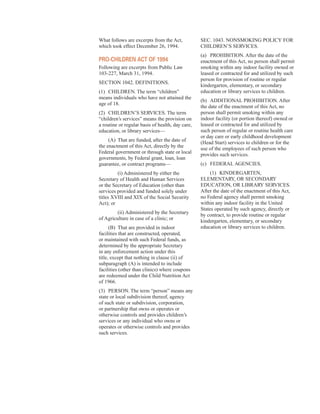
Codes and Regulations 27
Asthma 29
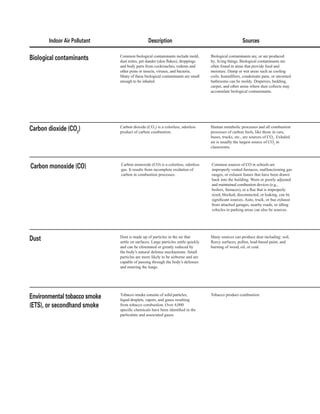
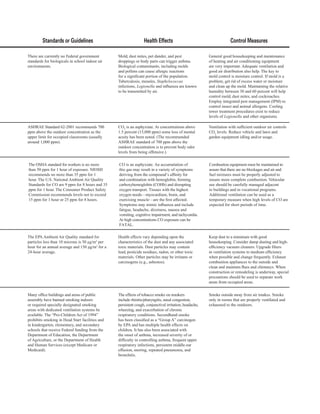
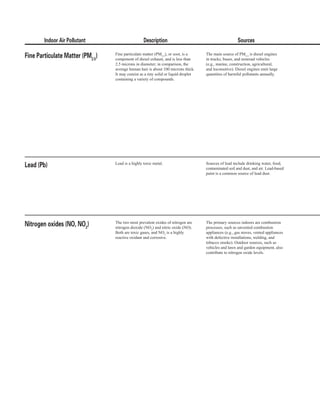
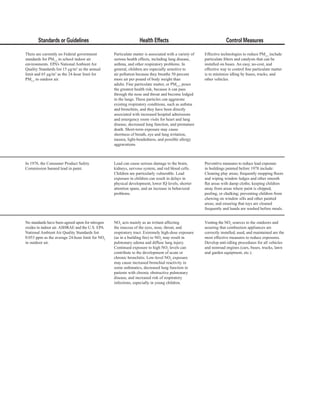
Typical Indoor Air Pollutants 33
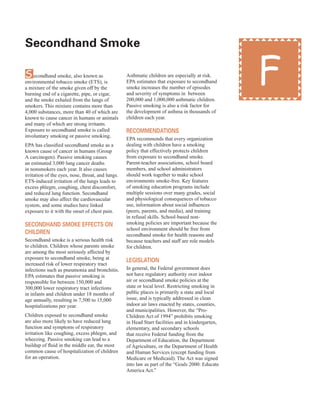
Secondhand Smoke 39
Radon 43
Mold and Moisture 45
Emissions from Motor Vehicles and Equipment
49
Portable Classrooms 53
Integrated Pest Management 57
Resources 59
Glossary and Acronyms 79
85
iv
DISClAImEr
Any information gathered using this Kit
is for the benefit and use of schools and
school districts. EPA does not require
retention or submission of any information
gathered, and EPA has no regulatory or
enforcement authority regarding general
indoor air quality in schools. This Kit has
been reviewed in accordance with EPA’s
policies. Information provides the current
scientific and technical understanding
of the issues presented. Following the
advice given will not necessarily provide
complete protection in all situations or
against all health hazards that may be
caused by indoor air pollution.
Mention of any trade names or commercial
products does not constitute endorsement
or recommendation for use.
WArNINg
Please note the following as you prepare to
use this Kit:
•	� This Kit is not intended as a substitute
for appropriate emergency action in
a hazardous situation that may be
immediately threatening to life or
safety.
•	� Modification of building functions,
equipment, or structure to remedy air
quality complaints may create other
indoor air quality problems and may
impact life-safety systems and energy
use. A thorough understanding of all
the factors that interact to create indoor
air quality problems can help avoid
this undesirable outcome. Consult with
professionals as necessary.
•	� In the event that medical records are
used while evaluating an IAQ problem,
maintain confidentiality.
rEProDuCTIoN
This Kit contains public information
that may be reproduced or modified in
whole or in part without permission. If
it is reproduced or modified, EPA would
appreciate knowing how it is used. Please
write:
IAQ Tools for Schools
Indoor Environments Division, #6609J
U.S. Environmental Protection Agency
1200 Pennsylvania Avenue, NW
Washington, DC 20460
For more information, see EPA’s website:
www.epa.gov/iaq.
v
1
1Most people are aware that outdoor
air pollution can impact their health, but
indoor air pollution can also have significant
and harmful health effects. The U.S.
Environmental Protection Agency (EPA)
studies of human exposure to air pollutants
indicate that indoor levels of pollutants may
be two to five times—and occasionally more
than 100 times—higher than outdoor levels.
These levels of indoor air pollutants are
of particular concern because most people
spend about 90 percent of their time indoors.
For the purposes of this guidance, the
definition of good indoor air quality (IAQ)
management includes:
• Control of airborne pollutants;
• Introduction and distribution of adequate
outdoor air; and
• Maintenance of acceptable temperature
and relative humidity.
Temperature and humidity cannot be
overlooked because thermal comfort
concerns underlie many complaints about
“poor air quality.” Furthermore, temperature
and humidity are among the many factors
that affect indoor contaminant levels.
Outdoor sources should also be considered
since outdoor air enters school buildings
through windows, doors, and ventilation
systems. Thus, transportation and grounds
maintenance activities become factors that
affect indoor pollutant levels as well as
outdoor air quality on school grounds.
Why Is IAQ ImportAnt?
In recent years, comparative risk studies
performed by EPA and its Science Advisory
Board (SAB) have consistently ranked
indoor air pollution among the top five
environmental risks to public health. Good
IAQ is an important component of a healthy
indoor environment, and can help schools
reach their primary goal of educating
children.
section 1 – Why IAQ Is Important
to your school
Failure to prevent or respond promptly to
IAQ problems can:
• Increase long- and short-term health
problems for students and staff (such
as cough, eye irritation, headache,
allergic reactions, and, in rarer cases,
life-threatening conditions such as
Legionnaire’s disease, or carbon
monoxide poisoning).
• Aggravate asthma and other respiratory
illnesses. Nearly 1 in 13 children of
school-age has asthma, the leading cause
of school absenteeism due to chronic
illness. There is substantial evidence
that indoor environmental exposure to
allergens, such as dust mites, pests, and
molds, plays a role in triggering asthma
symptoms. These allergens are common
in schools. There is also evidence that
exposure to diesel exhaust from school
buses and other vehicles exacerbates
asthma and allergies. These problems can:
• Impact student attendance, comfort,
and performance.
• Reduce teacher and staff performance.
• Accelerate the deterioration and reduce
the efficiency of the school’s physical
plant and equipment.
• Increase potential for school closings
or relocation of occupants.
• Strain relationships among school
administration, parents, and staff.
• Create negative publicity.
• Impact community trust.
• Create liability problems.
Indoor air problems can be subtle and do not
always produce easily recognized impacts
on health, well-being, or the physical plant.
Symptoms, such as headache, fatigue,
shortness of breath, sinus congestion,
coughing, sneezing, dizziness, nausea,
and irritation of the eye, nose, throat and
skin, are not necessarily due to air quality
deficiencies, but may also be caused by other
factors—poor lighting, stress, noise, and
Good IAQ
contributes to a
favorable
environment for
students,
performance of
teachers and staff,
and a sense of
comfort, health, and
well-being. these
elements combine
to assist a school in
its core mission—
educating children.
more. Due to varying sensitivities among community. Many other aspects are unique
school occupants, IAQ problems may affect to schools:
a group of people or just one individual. In
addition, IAQ problems may affect people in
different ways.
Individuals that may be particularly
susceptible to effects of indoor air
contaminants include, but are not limited to,
people with:
•	� Asthma, allergies, or chemical
sensitivities;
•	� Respiratory diseases;
•	� Suppressed immune systems (due to
radiation, chemotherapy, or disease); and
•	� Contact lenses.
Certain groups of people may be particularly
vulnerable to exposures of certain pollutants
or pollutant mixtures. For example:
•	� People with heart disease may be
more adversely affected by exposure
to carbon monoxide than healthy
individuals.
•	� People exposed to significant levels of
nitrogen dioxide are at higher risk for
respiratory infections.
In addition, the developing bodies of
children might be more susceptible to
environmental exposures than those of
adults. Children breathe more air, eat more
food, and drink more liquid in proportion to
their body weight than adults. Therefore, air
quality in schools is of particular concern.
Proper maintenance of indoor
air is more than a “quality” issue; it
encompasses safety and stewardship of your
investment in students, staff, and facilities.
UnIQUe Aspects of schools
Unlike other buildings, managing schools
involves the combined responsibility
for public funds and child safety issues.
These can instigate strong reactions
from concerned parents and the general
•	� Occupants are close together, with the
typical school having approximately
four times as many occupants as office
buildings for the same amount of floor
space.
•	� Budgets are tight, with maintenance often
receiving the largest cut during budget
reductions.
•	� The presence of a variety of pollutant
sources, including art and science
supplies, industrial and vocational arts,
home economic classes, and gyms.
•	� A large number of heating, ventilating,
and air-conditioning equipment place an
added strain on maintenance staff.
•	� Concentrated diesel exhaust exposure
due to school buses. (Students, staff, and
vehicles congregate at the same places at
the same time of day, increasing exposure
to vehicle emissions.) Long, daily school
bus rides may contribute to elevated
exposure to diesel exhaust for many
students.
•	� As schools add space, the operation and
maintenance of each addition are often
different.
•	� Schools sometimes use rooms, portable
classrooms, or buildings that were not
originally designed to service the unique
requirements of schools.
2
3
2Over the past several decades, exposure
to indoor air pollutants has increased
due to a variety of factors. These include
the construction of more tightly sealed
buildings; reduced ventilation rates to
save energy; the use of synthetic building
materials and furnishings; the use of
personal care products, pesticides, and
housekeeping supplies; and the increased
use of vehicles and power equipment. In
addition, activities and decisions, such as
deferring maintenance to “save” money,
can lead to problems from sources and
ventilation.
The indoor environment in any building is
a result of the interactions among the site,
climate, building structure, mechanical
systems (as originally designed and
later modified), construction techniques,
contaminant sources, building occupants,
and outdoor mobile sources (cars,
buses, trucks, and grounds maintenance
equipment). This section contains a
discussion on how these elements can cause
IAQ problems, and Section 6: “Solving
IAQ Problems” provides solutions. These
elements are grouped into four categories:
• Sources
• Heating, Ventilation, and Air-
Conditioning (HVAC) Systems
• Pathways
• Occupants
soUrces of Indoor AIr
pollUtAnts
Indoor air pollutants can originate within
the building or be drawn in from outdoors.
Air contaminants consist of numerous
particulates, fibers, mists, bioaerosols, and
gases. It is important to control air pollutant
sources, or IAQ problems can arise—even
if the HVAC system is properly operating.
It may be helpful to think of air pollutant
sources as fitting into one of the categories
in the table on the following page, “Typical
Sources of Indoor Air Pollutants.” The
examples given for each category are not
section 2 – Understanding IAQ
problems
intended to be an exhaustive list. Appendix
E: “Typical Indoor Air Pollutants” contains
a list of specific air pollutants with
descriptions, sources, and control measures.
In addition to the number of potential
pollutants, another complicating factor is
that indoor air pollutant concentration levels
can vary by time and location within the
school building, or even a single classroom.
Pollutants can be emitted from a variety of
sources including:
• Point sources (such as from science
storerooms);
• Area sources (such as newly painted
surfaces); and
• Mobile sources (such as cars, buses, and
power equipment).
Pollutants can also vary with time since
some activities take place over a short period
of time (such as stripping floors) or occur
continuously (such as mold growing in the
HVAC system).
Indoor air often contains a variety of
contaminants at concentrations that are
well below the published occupational
standards. Given our present knowledge,
it is often difficult to relate specific health
effects to exposures to specific pollutant
concentrations, especially since the
significant exposures may be due to low
levels of pollutant mixtures.
InterActIon of soUrces,
hVAc systems, pAthWAys, And
occUpAnts
If independently evaluated, a minor roof leak
and a dirty classroom carpet might not cause
much concern. But if the water from the
roof leak reaches the carpet, the water can
wet the dirt in the carpet and the mold that
has been dormant in the carpet. The mold
can grow and become a pollutant source
that releases spores into the classroom air.
The HVAC system may act as a pathway
that disperses the spores to other parts of
the school, where occupants may experience
allergic reactions.
Interaction of
sources,
hVAc systems,
pathways, and
occupants
If independently
evaluated, a
minor roof leak and
a dirty classroom
carpet might
not cause much
concern. But if the
water from the roof
leak reaches the
carpet, the water
can wet the dirt
in the carpet and
the mold that has
been dormant in
the carpet. The
mold can grow
and become a
pollutant source
that releases
spores into the
classroom air.
The HVAC system
acts as a pathway
that disperses the
spores to other
parts of the school,
where occupants
may experience
allergic reactions.
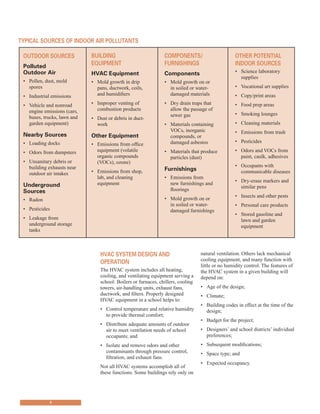
typIcAl soUrces of Indoor AIr pollUtAnts
oUtdoor soUrces BUIldInG components/ other potentIAl
polluted eQUIpment fUrnIshInGs Indoor soUrces
outdoor Air hVAc equipment components • Science laboratory
supplies
• Pollen, dust, mold • Mold growth in drip • Mold growth on or
spores pans, ductwork, coils, in soiled or water- • Vocational art supplies
• Industrial emissions and humidifiers damaged materials • Copy/print areas
• Vehicle and nonroad • Improper venting of • Dry drain traps that • Food prep areas
engine emissions (cars,
buses, trucks, lawn and
combustion products
• Dust or debris in duct-
allow the passage of
sewer gas • Smoking lounges
garden equipment) work • Materials containing • Cleaning materials
nearby sources other equipment
VOCs, inorganic
compounds, or
• Emissions from trash
• Loading docks • Emissions from office damaged asbestos • Pesticides
• Odors from dumpsters equipment (volatile
organic compounds
• Materials that produce
particles (dust)
• Odors and VOCs from
paint, caulk, adhesives
• Unsanitary debris or
building exhausts near
outdoor air intakes
(VOCs), ozone)
• Emissions from shop, furnishings
• Occupants with
communicable diseases
Underground
sources
lab, and cleaning
equipment
• Emissions from
new furnishings and
floorings
• Dry-erase markers and
similar pens
• Radon • Mold growth on or
in soiled or water-
• Insects and other pests
• Personal care products
• Pesticides damaged furnishings
• Stored gasoline and
• Leakage from lawn and garden
underground storage equipment
tanks
hVAc system desIGn And
operAtIon
The HVAC system includes all heating,
cooling, and ventilating equipment serving a
school: Boilers or furnaces, chillers, cooling
towers, air-handling units, exhaust fans,
ductwork, and filters. Properly designed
HVAC equipment in a school helps to:
•	� Control temperature and relative humidity
to provide thermal comfort;
•	� Distribute adequate amounts of outdoor
air to meet ventilation needs of school
occupants; and
•	� Isolate and remove odors and other
contaminants through pressure control,
filtration, and exhaust fans.
Not all HVAC systems accomplish all of
these functions. Some buildings rely only on
natural ventilation. Others lack mechanical
cooling equipment, and many function with
little or no humidity control. The features of
the HVAC system in a given building will
depend on:
•	� Age of the design;
•	� Climate;
•	� Building codes in effect at the time of the
design;
•	� Budget for the project;
•	� Designers’ and school districts’ individual
preferences;
•	� Subsequent modifications;
•	� Space type; and
•	� Expected occupancy.
4
descrIptIon of hVAc systems
The two most common HVAC designs in
schools are unit ventilators and central
air-handling systems. Both can perform
the same HVAC functions, but a unit
ventilator serves a single room while the
central air-handling unit serves multiple
rooms. For basic central air-handling
units, it is important that all rooms
served by the central unit have similar
thermal and ventilation requirements. If
these requirements differ significantly,
some rooms may be too hot, too cold,
or underventilated, while others are
comfortable and adequately ventilated.
Most air-handling units distribute a mixture
of outdoor air and recirculated indoor air.
HVAC designs may also include units that
introduce 100 percent outdoor air or that
simply recirculate indoor air within the
building. Uncontrolled quantities of outdoor
air enter buildings by leakage through
windows, doors, and gaps in the building
exterior. Thermal comfort and ventilation
needs are met by supplying “conditioned”
air, which is a mixture of outdoor and
recirculated air that has been filtered, heated
or cooled, and sometimes humidified or
dehumidified. The basic components for a
central air handling unit and a unit ventilator
are illustrated in the IAQ Backgrounder.
thermAl comfort
A number of variables interact to determine
whether people are comfortable with the
temperature and relative humidity of the
indoor air. Factors such as clothing, activity
level, age, and physiology of people in
schools vary widely, so the thermal comfort
requirements vary for each individual. The
American Society of Heating, Refrigerating,
and Air-Conditioning Engineers (ASHRAE)
Standard 55-1992 describes the temperature
and humidity ranges that are comfortable
for 80 percent of people engaged in largely
sedentary activities. That information is
summarized in the chart to the right. The
ASHRAE standard assumes “normal indoor
clothing.” Added layers of clothing reduce
the rate of heat loss.
Uniformity of temperature is important
to comfort. Rooms that share a common
heating and cooling system controlled by
a single thermostat may be at different
temperatures. Temperature stratification is a
common problem caused by convection—
the tendency of light, warm air to rise,
and heavier, cooler air to sink. If air is not
properly mixed by the ventilation system,
the temperature near the ceiling can be
several degrees warmer or cooler than near
the floor, where young children spend much
of their time. Even if air is properly mixed,
uninsulated floors over unheated spaces can
create discomfort in some climate zones.
Large fluctuations of indoor temperature can All schools need
also occur when thermostats have a wide ventilation, which
“dead band” (a temperature range in which
is the process ofneither heating or cooling takes place).
supplying outdoor
Radiant heat transfer may cause people
air to occupiedlocated near very hot or very cold surfaces
to be uncomfortable even though the areas within the
thermostat setting and the measured air school.
temperature are within the comfort range.
Schools with large window areas sometimes
have acute problems of discomfort due
to radiant heat gains and losses, with the
locations of complaints shifting during
the day as the sun angle changes. Poorly
insulated walls can also produce a flow
of naturally-convecting air, leading to
complaints of draftiness. Closing curtains
reduces heating from direct sunlight and
reduces occupant exposure to hot or cold
window surfaces. Large schools may have
interior (“core”) spaces in which year-round
cooling is required to compensate for heat
generated by occupants, office equipment,
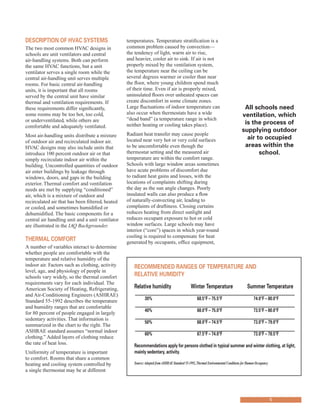
recommended rAnGes of temperAtUre And
relAtIVe hUmIdIty
relative humidity Winter temperature summer temperature
30% 68.5°f – 75.5°f 74.0°f – 80.0°f
40% 68.0°f – 75.0°f 73.5°f – 80.0°f
50% 68.0°f – 74.5°f 73.0°f – 79.0°f
60% 67.5°f – 74.0°f 73.0°f – 78.5°f
recommendations apply for persons clothed in typical summer and winter clothing, at light,
mainly sedentary, activity.
Source:Adopted fromASHRAE Standard 55-1992,Thermal Environmental Conditions for Human Occupancy
5
6
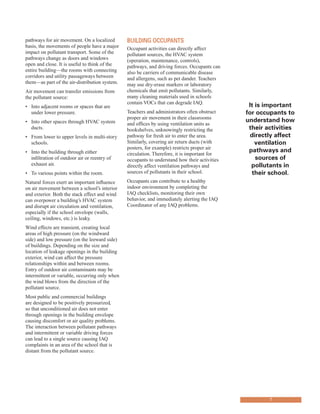
selected outdoor
Air Ventilation
recommendations
(minimum)
Application cubic feet per minute (cfm)
per person
Classroom 15
Music Rooms 15
Libraries 15
Auditoriums 15
Spectator Sport Areas 15
Playing Floors 20
Office Space 20
Conference Rooms 20
Smoking Lounges 60
Cafeteria 20
Kitchen (cooking) 15
Source:ASHRAE Standard 62-2001,
Ventilation for Acceptable Indoor Air
Quality
and lighting, while perimeter rooms may
require heating or cooling depending on
outdoor conditions.
Humidity is a factor in thermal comfort.
Raising relative humidity reduces a person’s
ability to lose heat through perspiration and
evaporation, so that the effect is similar to
raising the temperature. Humidity extremes
can also create other IAQ problems.
Excessively high or low relative humidities
can produce discomfort, high relative
humidities can promote the growth of mold
and mildew, and low relative humidities can
accelerate the release of spores into the air.
(See Appendix H: “Mold and Moisture.”)
VentIlAtIon for occUpAnt needs
Ventilation is the process of supplying
outdoor air to the occupied areas in the
school while indoor air is exhausted by fans
or allowed to escape through openings, thus
removing indoor air pollutants. Often, this
exhaust air is taken from areas that produce
air pollutants such as restrooms, kitchens,
science-storage closets, and fume hoods.
Modern schools generally use mechanical
ventilation systems to introduce outdoor air
during occupied periods, but some schools
use only natural ventilation or exhaust
fans to remove odors and contaminants. In
naturally ventilated buildings, unacceptable
indoor air quality is particularly likely when
occupants keep the windows closed due to
extreme hot or cold outdoor temperatures.
Even when windows and doors are open,
inadequate ventilation is likely when air
movement forces are weakest, such as when
there is little wind or when there is little
temperature difference between inside and
outside (stack effect).
Stack effect is the pressure-driven airflow
produced by convection, the tendency
of warm air to rise. Stack effect exists
whenever there is an indoor-outdoor
temperature difference, and the effect
becomes stronger as the temperature
difference increases. Multi-story schools are
more affected than single-story schools. As
heated air escapes from upper levels, indoor
air moves from lower to upper levels, and
outdoor air is drawn into the lower levels to
replace the air that has escaped. Stack effect
can transport contaminants between floors
by way of stairwells, elevator shafts, utility
chases, and other openings.
The amount of outdoor air considered
adequate for proper ventilation has varied
substantially over time. Because updating
building codes often takes several years,
current building codes may require more
ventilation then when the system was
designed. ASHRAE ventilation standards
are used as the basis for most building
ventilation codes. A table of outdoor air
quantities in schools as recommended by
ASHRAE Standard 62-2001, “Ventilation
for Acceptable Indoor Air Quality,” is
shown to the left. Please note that this is
a limited portion of the Standard, and that
the quantities listed are in units of cfm per
person, which are cubic feet per minute
of outdoor air for each person in the area
served by that ventilation system.
pollUtAnt pAthWAys And drIVInG
forces
Airflow patterns in buildings result from the
combined forces of mechanical ventilation
systems, human activity, and natural effects.
Air pressure differences created by these
forces move airborne pollutants from areas
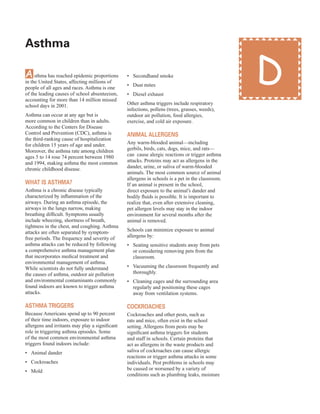
of higher pressure to areas of lower pressure
through any available openings in building
walls, ceilings, floors, doors, windows, and
HVAC systems. For example, as long as the
opening to an inflated balloon is kept shut,
no air will flow. When opened, however,
air will move from inside (area of higher
pressure) to the outside (area of lower
pressure).
Even if the opening is small, air will move
until the inside pressure is equal to the
outside pressure. If present, the HVAC ducts
are generally the predominant pathway and
driving force for air movement in buildings.
However, all of a building’s components
(walls, ceilings, floors, doors, windows,
HVAC equipment, and occupants) interact
to affect how air movement distributes
pollutants within a building.
As air moves from supply outlets to
return inlets, for example, it is diverted
or obstructed by walls and furnishings,
and redirected by openings that provide
pathways for air movement. On a localized
basis, the movements of people have a major
impact on pollutant transport. Some of the
pathways change as doors and windows
open and close. It is useful to think of the
entire building—the rooms with connecting
corridors and utility passageways between
them—as part of the air-distribution system.
Air movement can transfer emissions from
the pollutant source:
•	� Into adjacent rooms or spaces that are
under lower pressure.
•	� Into other spaces through HVAC system
ducts.
•	� From lower to upper levels in multi-story
schools.
•	� Into the building through either
infiltration of outdoor air or reentry of
exhaust air.
•	� To various points within the room.
Natural forces exert an important influence
on air movement between a school’s interior
and exterior. Both the stack effect and wind
can overpower a building’s HVAC system
and disrupt air circulation and ventilation,
especially if the school envelope (walls,
ceiling, windows, etc.) is leaky.
Wind effects are transient, creating local
areas of high pressure (on the windward
side) and low pressure (on the leeward side)
of buildings. Depending on the size and
location of leakage openings in the building
exterior, wind can affect the pressure
relationships within and between rooms.
Entry of outdoor air contaminants may be
intermittent or variable, occurring only when
the wind blows from the direction of the
pollutant source.
Most public and commercial buildings
are designed to be positively pressurized,
so that unconditioned air does not enter
through openings in the building envelope
causing discomfort or air quality problems.
The interaction between pollutant pathways
and intermittent or variable driving forces
can lead to a single source causing IAQ
complaints in an area of the school that is
distant from the pollutant source.
BUIldInG occUpAnts
Occupant activities can directly affect
pollutant sources, the HVAC system
(operation, maintenance, controls),
pathways, and driving forces. Occupants can
also be carriers of communicable disease
and allergens, such as pet dander. Teachers
may use dry-erase markers or laboratory
chemicals that emit pollutants. Similarly,
many cleaning materials used in schools
contain VOCs that can degrade IAQ.
Teachers and administrators often obstruct
proper air movement in their classrooms
and offices by using ventilation units as
bookshelves, unknowingly restricting the
pathway for fresh air to enter the area.
Similarly, covering air return ducts (with
posters, for example) restricts proper air
circulation. Therefore, it is important for
occupants to understand how their activities
directly affect ventilation pathways and
sources of pollutants in their school.
Occupants can contribute to a healthy
indoor environment by completing the
IAQ checklists, monitoring their own
behavior, and immediately alerting the IAQ
Coordinator of any IAQ problems.
It is important
for occupants to
understand how
their activities
directly affect
ventilation
pathways and
sources of
pollutants in
their school.
7
8
section 3 – effective 

communication
G ood communication can help to prevent
IAQ problems and can allay unnecessary
fears. In addition, schools should respond
promptly and effectively to any IAQ issues
that may arise. Communication can assist
school occupants in understanding how
their activities affect IAQ, which will
enable the occupants to improve their
indoor environment through proper choices
and actions. EPA’s IAQ Tools for Schools
Communications Guide (EPA 402-K-
02-008) provides more information on
communication strategies for addressing
IAQ concerns. To obtain a copy of the
Guide, call IAQ INFO at 800-438-4318 or
visit EPA’s website at www.epa.gov/iaq/
schools.
proActIVe commUnIcAtIon
Schools and school districts can reap many
benefits from taking a proactive approach to
addressing IAQ issues. The positive public
relations that can result from this approach
can lead to a better understanding of IAQ
by school occupants and the community.
Communicating effectively—both internally
and externally—is a key element.
Build rapport with the local media now.
An informed media that is aware of your
efforts to prevent IAQ problems and that
understands the basics of IAQ in schools can
be an asset instead of a liability during an
IAQ crisis.
Communicating the goals of the IAQ
Management Plan to those within
the school—teachers, custodians,
administrators, support staff, the school
nurse, students—is key. The following steps
can help develop good communication
between you and the school occupants:
1.	�Provide accurate information about
factors that are affecting IAQ.
2.	�Clarify the responsibilities and activities
of the IAQ Coordinator.
3.	�Clarify the responsibilities and activities
of each occupant.
4.	�Notify occupants and parents of planned
activities that may affect IAQ.
5.	�Employ good listening skills.
The checklists, forms, and information
contained in this guide will assist you in
accomplishing the first three objectives.
In addition, refer to the list of communi-
cation principles on the next page.
The necessary level of communication
is often dependent on the severity of the
IAQ complaint. If the complaint can be
resolved quickly (e.g., an annoying but
harmless odor from an easily identified
source) and involves a small number of
people, communication can be handled in
a straightforward manner without risking
confusion and bad feeling among school
occupants. Communication becomes a
more critical issue when there are delays in
identifying and resolving the problem and
when serious health concerns are involved.
The fourth objective deals with informing
occupants and parents before the start of
significant planned activities that produce
odors or contaminants. If occupants and
parents are uninformed, they may become
concerned about unknown air contaminants,
such as strange odors or excessive levels
of dust, and register an IAQ complaint.
Examples of planned activities include pest
control, painting, roofing, and installation
of new flooring. Notification of planned
activities can also prevent problems from
arising with students and staff with special
needs. For example, an asthmatic student
may wish to avoid certain areas within
a school, or use alternative classrooms,
during times when a major renovation
project will produce higher levels of dust.
A sample notification letter is provided in
the model painting policy in Appendix
B: “Developing Indoor Air Policies,” in
the IAQ Coordinator’s Guide:A Guide to
Implementing an IAQ Program.
3
9
The fifth objective involves effective
listening. School occupants can often
provide information that helps prevent
problems, and being “heard” may help
defuse negative reactions by occupants if
indoor air problems develop.
responsIVe commUnIcAtIon
When an IAQ problem occurs, you can
be assured that the school community
will learn about it quickly. Without open
communication, any IAQ problem can
become complicated by anxiety, frustration,
and distrust. These complications can
increase both the time and money needed to
resolve the problem.
Immediate communication is vital, and is
easiest if a few strategic steps are taken
before an IAQ problem arises. First,
ensure that a spokesperson is ready by
having a working understanding of the
communication guidance found in this
section, and a background knowledge of
IAQ as outlined in Sections 1 and 2. This
person should also have complete access to
information as the investigation progresses.
Because of these qualifications, the IAQ
Coordinator may be a good choice for
spokesperson. Second, establish a plan for
how you will communicate to the school
community. The school community includes
all occupants of the school, parents, the
school district administration and school
board, the local union, and the local news
media.
Paying attention to communication when
solving a problem helps to ensure the
support and cooperation of school occupants
as the problem is investigated and resolved.
There are basic, yet important, messages to
convey:
•	� School administrators are committed to
providing a healthy and safe school.
•	� Good IAQ is an essential component of a
healthy indoor environment.
•	� IAQ complaints are taken seriously.
When a problem arises, communication
should begin immediately. You should
not wait until an investigation is nearly
completed or until final data are available
before providing some basic elements of
information. Communications, whether in
conversations or in writing, should include
the following elements in a factual and
concise manner:
•	� The general nature of the problem,
the types of complaints that have been
received, and the locations that are
affected;
•	� The administration’s policy in regard to
providing a healthy and safe environment;
•	� What has been done to address the
problems or complaints, including the
types of information that are being
gathered;
•	� What is currently being done, including
factors that have been evaluated and
found not to be causing or contributing to
the problem;
•	� How the school community can help;
•	� Attempts that are being made to improve
IAQ;
•	� Work that remains to be done and the
expected schedule for its completion;
•	� The name and telephone number of the
IAQ Coordinator, who can be contacted
for further information or to register
complaints; and
•	� When the school will provide the next
update.
Productive relations will be enhanced if the
school community is given basic progress
reports during the process of diagnosing
and solving problems. It is advisable to
explain the nature of investigative activities,
so that rumors and suspicions can be
countered with factual information. Notices
or memoranda can be posted in general
use areas and delivered directly to parents,
the school board, the local union, and
other interested constituents of the school
community. Newsletter articles, the school
website, or other established communication
channels can also be used to keep the school
community up-to-date.
Problems can arise from saying either too
little or too much. Premature release of
information when data-gathering is still
10
incomplete can cause confusion, frustration,
and future mistrust. Similar problems can
result from incorrect representation of
risk—improperly assuming the worst case or
the best. However, if even simple progress
reports are not given, people will think
that either nothing is being done or that
something terrible is happening.
Even after the problem is correctly
diagnosed and a proper mitigation strategy
is in place, it may take days or weeks for
contaminants to dissipate and symptoms
to disappear. If building occupants are
informed that their symptoms may persist
for some time after solving the problem, the
inability to bring instant relief is less likely
to be seen as a failure.
Remember to communicate as the final step
in problem-solving—although you may
know that the problem has been resolved,
the school community may not know, so be
sure to provide a summary status report. The
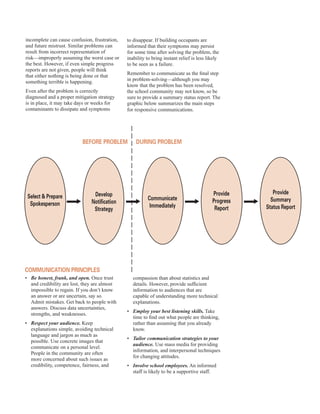
graphic below summarizes the main steps
for responsive communications.
Before proBlem dUrInG proBlem
select & prepare
spokesperson
develop
notification
strategy
communicate
Immediately
provide
progress
report
provide
summary
status report
commUnIcAtIon prIncIples
•	� Be honest, frank, and open. Once trust
and credibility are lost, they are almost
impossible to regain. If you don’t know
an answer or are uncertain, say so.
Admit mistakes. Get back to people with
answers. Discuss data uncertainties,
strengths, and weaknesses.
•	� Respect your audience. Keep
explanations simple, avoiding technical
language and jargon as much as
possible. Use concrete images that
communicate on a personal level.
People in the community are often
more concerned about such issues as
credibility, competence, fairness, and
compassion than about statistics and
details. However, provide sufficient
information to audiences that are
capable of understanding more technical
explanations.
•	� Employ your best listening skills. Take
time to find out what people are thinking,
rather than assuming that you already
know.
•	� Tailor communication strategies to your
audience. Use mass media for providing
information, and interpersonal techniques
for changing attitudes.
•	� Involve school employees. An informed
staff is likely to be a supportive staff.
11
•	� Involve parents. Inform parents about
what is being done and why, as well
as what will happen if problems are
detected.
•	� Involve the school board. Encourage
board members to observe the process
(e.g., taking a walk-through of the school
with the IAQ Coordinator).
•	� Involve businesses that provide services
to the school (e.g., exterminators, bus
fleet administrators/operators) and
businesses located around the school,
which may also negatively impact IAQ.
•	� Emphasize action. Always try to include
a discussion of actions that are underway
or that can be taken.
•	� Encourage feedback. Accentuate the
positive and learn from your mistakes.
•	� Strive for an informed public. The public
should be involved, interested, reasonable,
thoughtful, solution-oriented, and
collaborative.
•	� Be prepared for questions. Provide
background material on complex issues.
Avoid public conflicts or disagreements
among credible sources.
•	� Be responsive. Acknowledge the
emotions that people express and respond
in words and actions. When in doubt, lean
toward sharing more information, not
less, or people may think you are hiding
something.
•	� Combat rumors with facts. For example,
set up a chalkboard in the teachers’
lounge or in another general use area for
recording what is heard. Record rumors
as they arise and add responses. Then
pass out copies to the staff.
•	� Do not over promise. Promise only what
you can do and follow through with each
promise.
•	� Work with the media. Be accessible
to reporters and respect deadlines. Try
to establish long-term relationships of
trust with specific editors and reporters.
Remember that the media are frequently
more interested in politics than in science,
more interested in simplicity than
complexity, and more interested in danger
than safety.
12
13
Resolving IAQ problems involves
diagnosing the cause, applying practical
actions that either reduce emissions from
pollutant sources, remove pollutants from
the air (e.g., increasing ventilation or air
cleaning), or both. Problems related to
sources can stem from improper material
selection or application, allowing conditions
that can increase biological contamination
and dust accumulation, or source location.
Ventilation problems stem from improper
design, installation, operation, or
maintenance of the ventilation system.
This Guide provides information on most
IAQ problems found in schools, and does
not require that pollutant measurements be
performed and analyzed. It is important to
take reported IAQ problems seriously and
respond quickly:
• IAQ problems can be a serious health
threat and can cause acute discomfort
(irritation) or asthma attacks.
• Addressing an IAQ problem promptly
is good policy. Parents are sensitive to
unnecessary delays in resolving problems
that affect their children. Staff have
enough burdens without experiencing
frustration over unresolved problems, and
unaddressed problems invariably lead to
greater complaints.
• Diagnosing a problem is often easier
immediately after the complaint(s) has
been received. The source of the problem
may be intermittent and the symptoms
may come and go. Also, the complainant’s
memory of events is best immediately
after the problem occurs.
In some cases, people may believe that they
are being adversely affected by the indoor
air, but the basis for their perception may
be some other form of stressor not directly
related to IAQ. Section 6: “Solving IAQ
problems,” discusses some of these stressors
such as glare, noise, and stress.
4
section 4 – resolving
IAQ problems
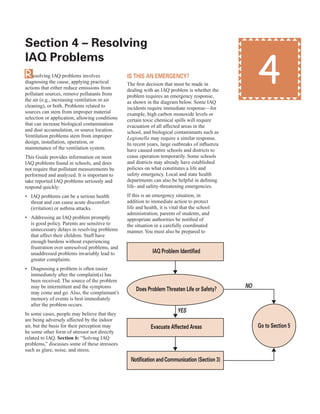
Is thIs An emerGency?
The first decision that must be made in
dealing with an IAQ problem is whether the
problem requires an emergency response,
as shown in the diagram below. Some IAQ
incidents require immediate response—for
example, high carbon monoxide levels or
certain toxic chemical spills will require
evacuation of all affected areas in the
school, and biological contaminants such as
Legionella may require a similar response.
In recent years, large outbreaks of influenza
have caused entire schools and districts to
cease operation temporarily. Some schools
and districts may already have established
policies on what constitutes a life and
safety emergency. Local and state health
departments can also be helpful in defining
life- and safety-threatening emergencies.
If this is an emergency situation, in
addition to immediate action to protect
life and health, it is vital that the school
administration, parents of students, and
appropriate authorities be notified of
the situation in a carefully coordinated
manner. You must also be prepared to
IAQ problem Identified
notification and communication (section 3)
does problem threaten life or safety?
Go to section 5evacuate Affected Areas
NO
YES
for most IAQ
issues, schools can
pull together a team
of in-house staff to
solve and prevent
problems.
deal quickly and properly with questions
from local media. Review the guidance
in Section 3: “Effective Communication,”
and in EPA’s IAQ Tools for Schools
Communications Guide
(EPA 402-K-02-008) to assist in
managing the issues of notification and
communication. The Guide is available
from NSCEP (800-490-9198) and
EPA’s website.
Who WIll solVe the proBlem?
For most IAQ issues, schools can pull
together a team of in-house staff with an
appropriate range of skills to resolve and
prevent problems. The IAQ Backgrounder
and checklists provide information on
typical IAQ problems found in schools.
On the other hand, unique or complex
IAQ problems may best be handled
by professionals who have specialized
knowledge, experience, and equipment.
Knowledge of your staff’s capabilities will
help you decide whether to use in-house
personnel or hire outside professionals to
respond to a specific IAQ problem.
Regardless of whether it is in-house staff
or outside assistance that diagnoses and
resolves the problem, the IAQ Coordinator
remains responsible for managing
the problem-solving process and for
communicating with all appropriate parties
during the process. If an IAQ Coordinator
has not been appointed already, please
refer to Section 2: “Role and Functions of
the IAQ Coordinator,” in the
IAQ Coordinator’s Guide.
14
section 5 – diagnosing 

IAQ problems
The goal of diagnosing an IAQ problem
is to identify the cause of the problem and
implement an appropriate solution. Often,
more than one problem can exist, requiring
more than one solution. For this reason,
EPA created the Problem Solving Checklist
(Appendix A: “IAQ Coordinator’s Forms” in
the IAQ Coordinator’s Guide) and the IAQ
Problem Solving Wheel (a separate tab of
this Kit). For best results, it is also important
to have good background knowledge of the
basics of IAQ as outlined in Sections 1 and 2.
The IAQ diagnostic process begins when a
complaint is registered or an IAQ problem
is discovered. Many problems can be simple
to diagnose, requiring a basic knowledge of
IAQ and some common sense. If the cause
(or causes) of the IAQ problem has already
been identified, proceed to the solution
phase outlined in Section 6: “Solving IAQ
problems.”
Not all occupant complaints about IAQ are
caused by poor indoor air. Other factors
such as noise, lighting, and job-, family-, or
peer-related stress can—individually and in
combination—contribute to a perception that
IAQ is poor.
hoW to dIAGnose proBlems
The Problem Solving Checklist and the IAQ
Problem Solving Wheel are your primary
tools for finding solutions to problems. They
will help simplify the process and lead the
investigation in the right direction.
Start with the Problem Solving Checklist and
encourage school staff to answer questions
or perform activities posed by the checklist
and the wheel. Pollutant sources and the
ventilation system may
act in combination to create an IAQ
problem. Resolve as many problems as
possible and note any problems that you
intend to fix later.
Once you identify the likely cause of the
IAQ problem, or the solution is readily
apparent, refer to Section 6: “Solving IAQ
Problems,” for potential courses of action.
spAtIAl And tImInG pAtterns
As a first step, use the spatial pattern
(locations) of complaints to define the
complaint area. Focus on areas in the school
where symptoms or discomfort have been
reported. The complaint area may need to
be revised as the investigation progresses.
Pollutant pathways can cause complaints in
parts of the school that are located far away
from the source of the problems. See the
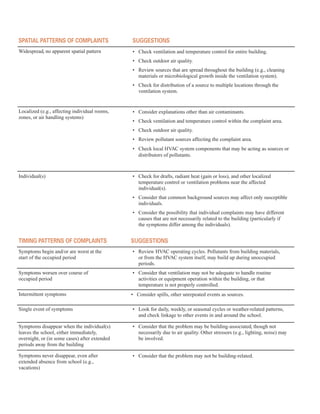
“Spatial Patterns of Complaints” table on the
next page.
After defining a location (or group of
locations), look for patterns in the timing
of complaints. The timing of symptoms and
complaints can indicate potential causes and
provide directions for further investigation.
Review the data for cyclic patterns of
symptoms (e.g., worst during periods of
minimum ventilation or when specific
sources are most active) that may be related
to the HVAC system or to other activities
affecting IAQ in or near the school. See the
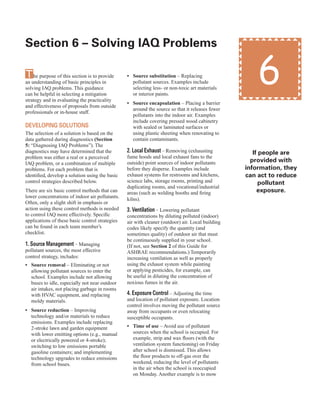
“Timing Patterns of Complaints” table on
the next page.
5
15
spAtIAl pAtterns of complAInts sUGGestIons
Widespread, no apparent spatial pattern •	� Check ventilation and temperature control for entire building.
•	� Check outdoor air quality.
•	� Review sources that are spread throughout the building (e.g., cleaning
materials or microbiological growth inside the ventilation system).
•	� Check for distribution of a source to multiple locations through the
ventilation system.
Localized (e.g., affecting individual rooms,
zones, or air handling systems)
•	� Consider explanations other than air contaminants.
•	� Check ventilation and temperature control within the complaint area.
•	� Check outdoor air quality.
•	� Review pollutant sources affecting the complaint area.
•	� Check local HVAC system components that may be acting as sources or
distributors of pollutants.
Individual(s) •	� Check for drafts, radiant heat (gain or loss), and other localized
temperature control or ventilation problems near the affected
individual(s).
•	� Consider that common background sources may affect only susceptible
individuals.
•	� Consider the possibility that individual complaints may have different
causes that are not necessarily related to the building (particularly if
the symptoms differ among the individuals).
tImInG pAtterns of complAInts sUGGestIons
Symptoms begin and/or are worst at the • Review HVAC operating cycles. Pollutants from building materials,
start of the occupied period or from the HVAC system itself, may build up during unoccupied
periods.
Symptoms worsen over course of • Consider that ventilation may not be adequate to handle routine
occupied period activities or equipment operation within the building, or that
temperature is not properly controlled.
Intermittent symptoms	� • Consider spills, other unrepeated events as sources.
Single event of symptoms • Look for daily, weekly, or seasonal cycles or weather-related patterns,
and check linkage to other events in and around the school.
Symptoms disappear when the individual(s)
leaves the school, either immediately,
overnight, or (in some cases) after extended
periods away from the building
•	� Consider that the problem may be building-associated, though not
necessarily due to air quality. Other stressors (e.g., lighting, noise) may
be involved.
Symptoms never disappear, even after • Consider that the problem may not be building-related.
�
extended absence from school (e.g., 

vacations)
�
16
17
The purpose of this section is to provide
an understanding of basic principles in
solving IAQ problems. This guidance
can be helpful in selecting a mitigation
strategy and in evaluating the practicality
and effectiveness of proposals from outside
professionals or in-house staff.
deVelopInG solUtIons
The selection of a solution is based on the
data gathered during diagnostics (Section
5: “Diagnosing IAQ Problems”). The
diagnostics may have determined that the
problem was either a real or a perceived
IAQ problem, or a combination of multiple
problems. For each problem that is
identified, develop a solution using the basic
control strategies described below.
There are six basic control methods that can
lower concentrations of indoor air pollutants.
Often, only a slight shift in emphasis or
action using these control methods is needed
to control IAQ more effectively. Specific
applications of these basic control strategies
can be found in each team member’s
checklist.
1. source management – Managing
pollutant sources, the most effective
control strategy, includes:
• Source removal – Eliminating or not
allowing pollutant sources to enter the
school. Examples include not allowing
buses to idle, especially not near outdoor
air intakes, not placing garbage in rooms
with HVAC equipment, and replacing
moldy materials.
• Source reduction – Improving
technology and/or materials to reduce
emissions. Examples include replacing
2-stroke lawn and garden equipment
with lower emitting options (e.g., manual
or electrically powered or 4-stroke);
switching to low emissions portable
gasoline containers; and implementing
technology upgrades to reduce emissions
from school buses.
6
section 6 – solving IAQ problems
• Source substitution – Replacing
pollutant sources. Examples include
selecting less- or non-toxic art materials
or interior paints.
• Source encapsulation – Placing a barrier
around the source so that it releases fewer
pollutants into the indoor air. Examples
include covering pressed wood cabinetry
with sealed or laminated surfaces or
using plastic sheeting when renovating to
contain contaminants.
2. local exhaust – Removing (exhausting
fume hoods and local exhaust fans to the
outside) point sources of indoor pollutants
before they disperse. Examples include
exhaust systems for restrooms and kitchens,
science labs, storage rooms, printing and
duplicating rooms, and vocational/industrial
areas (such as welding booths and firing
kilns).
3. Ventilation – Lowering pollutant
concentrations by diluting polluted (indoor)
air with cleaner (outdoor) air. Local building
codes likely specify the quantity (and
sometimes quality) of outdoor air that must
be continuously supplied in your school.
(If not, see Section 2 of this Guide for
ASHRAE recommendations.) Temporarily
increasing ventilation as well as properly
using the exhaust system while painting
or applying pesticides, for example, can
be useful in diluting the concentration of
noxious fumes in the air.
4. exposure control – Adjusting the time
and location of pollutant exposure. Location
control involves moving the pollutant source
away from occupants or even relocating
susceptible occupants.
• Time of use – Avoid use of pollutant
sources when the school is occupied. For
example, strip and wax floors (with the
ventilation system functioning) on Friday
after school is dismissed. This allows
the floor products to off-gas over the
weekend, reducing the level of pollutants
in the air when the school is reoccupied
on Monday. Another example is to mow
If people are
provided with
information, they
can act to reduce
pollutant
exposure.
around the building and near play fields
only before or after school hours.
•	� Amount of use – Use air-polluting
sources as little as possible to minimize
contamination of the indoor air.
•	� Location of use – Move polluting sources
as far away as possible from occupants or
relocating susceptible occupants.
5. Air cleaning – Filtering particles and
gaseous contaminants as air passes through
ventilation equipment. This type of system
should be engineered on a case-by-case
basis.
6. education – Teaching and training school
occupants about IAQ issues. People in
the school can reduce their exposure to
many pollutants by understanding basic
information about their environment and
knowing how to prevent, remove, or control
pollutants.
Some solutions, such as major ventilation
changes, may not be practical to implement
due to lack of resources or the need for
long periods of non-occupancy to ensure
the safety of the students and staff. Use
temporary measures to ensure good IAQ in
the meantime. Other solutions, such as anti-
idling programs, offer low-cost options that
can be easily and quickly implemented.
solUtIons for other
complAInts
Specific lighting deficiencies or localized
sources of noise or vibration may be easily
identified. Remedial action may be fairly
straightforward, such as having more or
fewer lights, making adjustments for glare,
and relocating, replacing, or acoustically
insulating a noise or vibration source.
In other cases, where problems may be more
subtle or solutions more complex, such as
psychogenic illnesses (originating in the
mind), enlist the services of a qualified
professional.
Remedial actions for lighting and noise
problems can range from modifications of
equipment or furnishings to renovation of
the building. Reducing stress for school staff
may involve new management practices, job
redesign, or resolution of underlying labor-
management problems.
eVAlUAtInG solUtIons
To help ensure a successful solution,
evaluate mitigation efforts at the planning
stage by considering the following criteria:
•	� Permanence;
•	� Durability;
•	� Operating principle;
•	� Installation and operating cost;
•	� Control capacity;
•	� Ability to institutionalize the solution;
and
•	� Conformity with codes.
permanence. Mitigation efforts that create
permanent solutions to indoor air problems
are clearly superior to those that provide
temporary solutions, unless the problems
are also temporary. Opening windows or
running air handlers on full outdoor air
may be suitable mitigation strategies for a
temporary problem, such as off-gassing of
volatile compounds
from new furnishings, but they are not
acceptable permanent solutions because
of increased costs for energy and
maintenance. A permanent solution to
microbiological contamination involves
cleaning and disinfection as well as moisture
control to prevent regrowth.
durability. IAQ solutions that are durable are
more attractive than approaches that require
frequent maintenance or specialized skills.
New items of equipment should be quiet,
energy-efficient, and durable.
operating principle. The operating principle
of the IAQ solution needs to make sense
and be suited to the problem. If a specific
point source of contaminants is identified,
treatment at the source by removal, sealing,
18
or local exhaust is a more appropriate
correction strategy than diluting the
contaminant with increased ventilation. If
the IAQ problem is caused by outdoor air
containing contaminants, then increasing
the outdoor air supply will only worsen the
situation, unless the supply of outdoor air is
cleaned.
Installation and operating costs. The
approach with the lowest initial cost
may not be the least expensive over the
long run. Long-term economic
considerations include energy costs for
equipment operation, increased staff time
for maintenance, differential cost
of alternative materials and supplies,
and higher hourly rates. Strong consideration
should be given to purchasing ENERGY
STAR qualified products.
control capacity. It is important to select
a solution that fits the size and scope of
the problem. If odors from a special use
area such as a kitchen entering nearby
classrooms, increasing the ventilation rate
in the classrooms may not be successful. If
mechanical equipment is needed to correct
the IAQ problem, it must be powerful
enough to accomplish the task. For example,
a local exhaust system should be strong
enough and close enough to the source so
that none of the contaminant moves into
other portions of the building.
Ability to Institutionalize the solution.
A solution will be most successful if it is
integrated into normal building operations.
To ensure success, solutions should not
require exotic equipment, unfamiliar
concepts, or delicately maintained systems.
If maintenance, housekeeping procedures, or
supplies must change as part of the solution,
it may be necessary to provide additional
training, new inspection checklists, or
modified purchasing guidelines. Operating
and maintenance schedules for heating,
cooling, and ventilation equipment may also
need modification.
conformity with codes. Any modification
to building components or mechanical
systems should be designed and installed in
conformance with applicable fire, electrical,
and other building codes.
eVAlUAtInG the effectIVeness of
yoUr solUtIon
Two kinds of indicators can be used to
evaluate the success of correcting an indoor
air problem:
•	� Reduced complaints.
•	� Measurement of the properties of the
indoor air.
Although reduction or elimination of
complaints appears to be a clear indication
of success, it may not necessarily be the
case. Occupants who feel their concerns are
being heard may temporarily stop reporting
discomfort or health symptoms, even if the
actual cause of their complaints has not
been corrected. On the other hand, lingering
complaints may continue after successful
mitigation if people are upset over the
handling of the problem. A smaller number
of ongoing complaints may indicate that
multiple IAQ problems exist and have not
been resolved.
Measurements of airflows, ventilation
rates, and air distribution patterns can be
used to assess the results of control efforts.
Airflow measurements taken during the
building investigation can identify areas
with poor ventilation; later they can be
used to evaluate attempts to improve the
ventilation rate, distribution, or direction
of flow. Studying air distribution patterns
will show whether a mitigation strategy has
successfully prevented the transportation
of a pollutant by airflow. While in some
cases measuring pollutant levels can help
determine whether IAQ has improved, in

many cases this may be difficult and/or cost
prohibitive. Concentrations of indoor air
pollutants typically vary greatly over time,
and the specific contaminant measured may
not be causing the problem. Measuring
a specific pollutant by a professional is
appropriate if the problem can be limited to
that pollutant. For further information on
IAQ measurements, see Appendix B: “Basic
Measurement Equipment.”
A solution will be
most successful if
it is integrated into
normal building
operations.
19
ongoing complaints 

may indicate 

that multiple IAQ 

problems have not 

been resolved.
�
persIstent proBlems
Sometimes even the best-planned
investigations and mitigation actions will not
resolve the problem. You may have carefully
investigated the problem, identified one or

more causes, and implemented a control

system. Nonetheless, your efforts may not
have noticeably reduced the concentration
of the contaminant or improved ventilation
rates or efficiency. Worse, the problem may
continue to persist.
If your efforts to control a problem are
unsuccessful, consider seeking outside
assistance. The problem could be fairly
complex, occur only intermittently, or extend
beyond traditional fields of knowledge. It
is possible that poor IAQ is not the actual
cause of the complaints. Bringing in a
new perspective at this point can be very
effective. Appendix A: “Hiring Professional
Assistance” provides guidance on hiring
professional IAQ assistance.
20
Hiring Professional assistance
�
Some indoor air quality (IAQ) problems
are simple to resolve when school personnel
understand the building investigation
process. Many potential problems will be
prevented if staff and students do their part
to maintain good IAQ. However, a time may
come when outside assistance is needed.
For example, professional help might be
necessary or desirable in the following
situations:
•	� If you suspect that you have a serious
building-related illness potentially linked
to biological contamination in your
building, mistakes or delays could have
serious consequences (such as health
hazards, liability exposure, regulatory
sanctions). Contact your local or state
Health Department.
•	� Testing for a public health hazard (such as
asbestos, lead, or radon) has identified a
problem that requires a prompt response.
•	� The school administration believes that an
independent investigation would be better
received or more effectively documented
than an in-house investigation.
•	� Investigation and mitigation efforts by
school staff have not relieved an IAQ
problem.
•	� Preliminary findings by staff suggest
the need for measurements that require
specialized equipment and skills that are
not available in-house.
Hiring Professional HelP
As you prepare to hire professional services
for a building investigation, be aware that
IAQ is a developing area of knowledge.
Most individuals working in IAQ received
their primary training in other disciplines.
It is important to define the scope of work
clearly and discuss any potential consultant’s
proposed approach to the investigation,
including plans for coordinating efforts
among team members. The school’s
representatives must exercise vigilance
in overseeing diagnostic activities and
corrective action. Performance specifications
can help to ensure the desired results.
Sample performance specification language
is provided at the end of this appendix in
italicized font.
Other than for lead and asbestos
remediation, there are no Federal regulations
covering professional services in the general
field of indoor air quality, although some
disciplines (e.g., engineers, industrial
hygienists) whose practitioners work
with IAQ problems have licensing and
certification requirements. Individuals and
groups that offer services in this evolving
field should be questioned closely about
their related experience and their proposed
approach to your problem. In addition,
request and contact references.
Local, state, or Federal government
agencies (e.g., education, health, or air
pollution agencies) may be able to provide
expert assistance or direction in solving
IAQ problems. If available government
agencies do not have personnel with the
appropriate skills to assist in solving your
IAQ problem, they may be able to direct
you to firms in your area with experience
in IAQ work. You may also be able to
locate potential consultants by looking in
the yellow pages (e.g., under “Engineers,”
“Environmental Services,” “Laboratories –
Testing,” or “Industrial Hygienists”), or by
asking other schools for referrals. Often, a
multi-disciplinary team of professionals is
needed to investigate and resolve an IAQ
problem. The skills of heating, ventilation,
and air-conditioning (HVAC) engineers and
industrial hygienists are typically useful for
this type of investigation. Input from other
disciplines such as chemistry, architecture,
microbiology, or medicine may also be
important.
If problems other than IAQ are involved,
experts in lighting, acoustic design, interior
design, psychology, or other fields may be
A
21
helpful in resolving occupant complaints 2. Consultants should be able to describe
about the indoor environment.
evaluating Potential
Consultants
As with any hiring process, the better you
know your own needs, the easier it will be to
select individuals or firms to service those
needs. The more clearly you can define the
project scope, the more likely you are to
achieve the desired result without paying
for unnecessary services. An investigation
strategy based on evaluating building
performance can be used to solve a problem
without necessarily identifying a particular
chemical compound as the cause. The
idea of testing the air to learn whether it is
“safe” or “unsafe” is very appealing. Most
existing standards for airborne pollutants,
however, were developed for industrial
settings where most occupants are usually
healthy adult men. Some state regulations
call for the involvement of a professional
engineer for any modifications or additions
to a school HVAC system. Whether or not
this is legally mandated for your school,
the professional engineer’s knowledge of
air handling, conditioning, and sequencing
strategies will help to design ventilation
system modifications without creating
other problems. In many situations,
proper engineering can save energy while
improving IAQ. An example of this might
be the redesign of outside air-handling
strategies to improve the performance of an
economizer cycle.
The following guidelines may be helpful in
evaluating potential consultants:
1.	� Competent professionals will ask
questions about your situation to see
whether they can offer services that will
assist you.
The causes and potential remedies
for IAQ problems vary greatly. A
firm needs at least a preliminary
understanding of the facts about
what is going on in your building to
evaluate if it can offer the professional
skills necessary to address your
concerns and to make effective use
of its personnel from the outset.
how they expect to form and test explana-
tions for and solutions to the problem.
Discuss the proposed approach to the
building investigation. It may involve
moving suspected contaminant sources
or manipulating HVAC controls to
simulate conditions at the time of
complaints or to test possible corrective
actions. Poorly designed studies may
lead to conclusions that are either “false
negative” (i.e., falsely concluding that
there is no problem) or “false positive”
(i.e., falsely concluding that a specific
condition caused the complaint).
Some consultants may produce an
inventory of problems in the build-
ing without determining which, if any,
of those problems caused the original
complaint. If investigators discover
IAQ problems unrelated to the concern
that prompted the evaluation, those
problems should be noted and reported.
It is important, however, that the
original complaint is resolved.
3.	� The decision to take IAQ measurements
should be approached with caution.
IAQ investigators often find a
large number of potential sources
contributing low levels of various
contaminants to the air. These findings
frequently raise more questions than
they answer. Before starting to take
measurements, investigators need a
clear understanding of how the results
will be used and interpreted. Without
this understanding, planning appropriate
sampling locations and times,
instrumentation, and analysis
procedures is impossible. Non-routine
measurements (such as relatively
expensive sampling for volatile
organic compounds (VOCs)) should
not be conducted without site-specific
justification. Concentrations that
comply with industrial occupational
standards are not necessarily protective
of children, or other school occupants.
4.	� A qualified IAQ investigator should
have appropriate experience, demon-
strate a broad understanding of IAQ
problems and the conditions that can
lead to them (e.g., the relationship
22
between IAQ and the building struc-
ture, mechanical systems, sources, and
human activities), and use a phased
diagnostic approach.
Have the firm identify the personnel
who would be responsible for your case,
their specific experience, and related
qualifications. Contract only for the
services of those individuals, or require
approval for substitutions. When hiring
an engineer, look for someone with the
equipment and expertise to perform a
ventilation system assessment and with
strong field experience. Some engineers
rarely work outside the office.
5.	� In the proposal and the interview, a
prospective consultant should present a
clear, detailed picture of the proposed
services and work products, including
the following information:
• 	 The basic goal(s), methodology, and
sequence of the investigation, the
information to be obtained, and the
process of hypothesis development
and testing, including criteria for
decision-making about further data-
gathering.
• 	 Any elements of the work that will
require a time commitment from
school staff, including information to
be collected by the school.
• 	 The schedule, cost, and work
product(s), such as a written
report, specifications, and plans
for mitigation work; supervision
of mitigation work; and training
program for school staff.
• 	 Additional tasks (and costs) that may
be part of solving the IAQ problem
but are outside the scope of the
contract. Examples include: medical
examination of complainants,
laboratory fees, and contractor’s fees
for mitigation work.
• 	 Communication between the IAQ
professional and the client: How
often will the contractor discuss the
progress of the work with the school?
Who will be notified of test results
and other data? Will communications
be in writing, by telephone, or
face-to-face? Will the consultant
meet with students and/or school
staff to collect information? Will the
consultant meet with staff, parent
organizations, or others to discuss
findings, if requested to do so?
• References from clients who have
received comparable services.
iaQ-related ventilation
ModifiCations
The school’s representatives need to
remember: Oversee the work and ask
questions that will help you ensure the
work is properly performed. Specialized
measurements of airflow or pre- and post-
mitigation contaminant concentrations may
be needed to know whether the corrective
action is effective.
Performance specifications can be used as
part of the contract package to establish
critical goals for system design and
operation. Performance specifications can
be used to force contractors to demonstrate
that they have met those goals. At the same
time, performance specifications should
avoid dictating specific design features such
as duct sizes and locations, thus leaving
HVAC system designers free to apply their
professional expertise. You may be able to
adapt appropriate sections of the following
sample performance specifications for your
school.
Performance specifications
•	 The control system shall be modified
and the ventilation system repaired and
adjusted as needed to provide outdoor
air ventilation during occupied hours.
The amount of outdoor air ventilation
shall meet ASHRAE Standard 62-2001
minimum recommendations or shall be
the maximum possible with the current
air-handling equipment, but in no case
shall the minimum outdoor air ventilation
rate be less than the ventilation guideline
in effect at the time the school was
constructed.
•	 When designing the ventilation system
modifications, it is important to ensure
that: 1) Increased outdoor air intake
23
rates do not negatively impact occupant
comfort; 2) heating coils do not freeze;
and 3) the cooling system can handle the
increased enthalpy load. A load analysis
shall be performed to determine if the
existing heating (or cooling) plant has the
capacity to meet the loads imposed by the
restored or increased ventilation rates.
•	 If the existing plant cannot meet this load
or, if for some other reason, it is decided
not to use the existing heating system to
condition outdoor air, then a heating (or
cooling) plant shall be designed for that
purpose. The proposal shall include a life-
cycle cost analysis of energy conservation
options (e.g., economizer cooling, heat
recovery ventilation).
•	 All screens in outdoor air intakes shall be
inspected for proper mesh size. Screens
with mesh size smaller than
1/2 inch are subject to clogging; if
present, they shall be removed and
replaced with larger-sized mesh (not so
large as to allow birds to enter).
demonstrating system
Performance
•	 The proper operation of control sequence
and outdoor air damper operation shall
be verified by school personnel or the
school’s agent after ventilation system
modifications and repairs have been
completed. This shall include, but not
be limited to: observation of damper
position for differing settings of low limit
stats and room stats, measurement of air
pressure at room stats and outdoor air
damper actuators, direct measurement
of air flow through outdoor air intakes,
and direct measurement of air flows at
exhaust grilles. The contractor shall
provide a written report documenting:
1) Test procedures used to evaluate
ventilation system performance; 2) test
locations; 3) HVAC operating conditions
during testing; and 4) findings.
institutionalizing the Corrective
action
•	 After the ventilation system modifications
are completed, school facility operators
shall be provided with training and
two copies of a manual that documents
the ventilation system control strategy,
operating parameters, and maintenance
requirements.
24
Basic Measurement equipment
�
To prevent or resolve indoor air quality
(IAQ) problems effectively and efficiently,
you must be able to take four basic
measurements relating to the air within the
school. Your school or school district may
already own some or all of the equipment
necessary to make these measurements. If
not, buying or borrowing that equipment is
important to assess the IAQ conditions in
your school accurately and ensure that the
ventilation equipment is working properly
(which can save the school money in heating
and cooling bills), as well as improve IAQ.
Check with your EPA regional office about
equipment availability (see Appendix L:
“Resources,” for a complete list of EPA
regional offices).
Four measurements are important to the
activities in this Guide:
•	� Temperature.
•	� Relative humidity.
•	� Air movement.
•	� Airflow volume.
In addition, a carbon dioxide (CO2
) monitor
is useful for indicating when outdoor air
ventilation may be inadequate (see the
Ventilation Checklist).
Sampling for pollutants is not recommended,
since results are difficult to interpret and can
require costly measurement equipment as
well as significant training and experience.
The activities described in this Guide are
likely to prevent or uncover problems
more effectively than pollutant sampling.
The four measurements listed above are
readily available, do not require expensive
equipment or special training, and are
straightforward to interpret.
If your school’s budget does not allow the
purchase of some or all of the equipment, try
a cooperative approach:
•	� Combine resources with other schools in
the district or neighboring schools.
•	� Contact school organizations and local
government to inquire about cooperative
purchasing options.
•	� Borrow equipment from another school,
district, a state or local government, or an
EPA regional office.
Do not let a lack of equipment prevent
you from conducting the recommended
activities. Conduct as many activities
as possible with the equipment you
have available. If you cannot obtain the
recommended equipment due to lack
of resources, prioritize your equipment
purchases as follows:
1.	� Temperature, relative humidity, and
chemical smoke device for indicating
air movement;
2.	� Airflow volume measuring devices; and
3.	� CO2
monitor.
B
25
Codes and regulations
�
Pollutant-related
regulations
The Federal government has a long history
of regulating outdoor air quality and the
concentrations of airborne contaminants
in industrial settings. In an industrial
environment, specific chemicals released by
industrial processes can be present in high
concentrations. It has been possible to study
the health effects of industrial exposures
and establish regulations to limit those
exposures.
Some states have established regulations
regarding specific pollutants in schools, such
as testing for radon and lead. Various States
have also established anti-idling policies that
establish maximum idling times for school
buses and other vehicles.
Indoor air quality (IAQ) in schools, however,
presents a different problem. A large variety
of chemicals used in classrooms, offices,
grounds maintenance, and kitchen and
cleaning applications exist at levels that are
almost always lower than the concentrations
found in industry. The individual and
combined effects of these chemicals are very
difficult to study, and the people exposed
may include pregnant women, children, and
others who are more susceptible to health
problems than the adult typically present in
regulated industrial settings.
There is still much to learn about the effects
of both acute (short-term) and chronic (long-
term) exposure to low levels of multiple
indoor air contaminants. At this time, there
are few Federal regulations for airborne
contaminants in non-industrial settings.
The Occupational Safety and Health
Administration (OSHA) is the Federal
agency responsible for workplace safety and
health. In the past, OSHA focused primarily
on industrial worksites, but most recently
has broadened its efforts to address other
worksite hazards. In spring 1994, OSHA
introduced a proposed rule regarding IAQ
in non-industrial environments, although
the proposal was withdrawn in December
2001. School employees may be able to
obtain advice (in the form of training and
information) from their state OSHA office
on how to reduce their exposure to potential
air contaminants. In states without OSHA
organizations, the regional OSHA contact
may be able to provide information or
assistance (see Appendix L: “Resources”).
ventilation-related
regulations
Ventilation is the other major influence on
IAQ that is subject to regulation. The Federal
government does not regulate ventilation
in non-industrial settings. However, many
state and local governments do regulate
ventilation system capacity through their
building codes. Building codes have been
developed to promote good construction
practices and prevent health and safety
hazards. Professional associations, such
as the American Society of Heating,
Refrigerating, and Air-Conditioning
Engineers (ASHRAE) and the National Fire
Protection Association (NFPA), develop
recommendations for appropriate building
and equipment design and installation (e.g.,
ASHRAE Standard 62-2001, “Ventilation
for Acceptable Indoor Air Quality”). Those
recommendations acquire the force of law
when adopted by state or local regulatory
bodies. There is generally a time lag between
the adoption of new standards by consensus
organizations such as ASHRAE and the
incorporation of those new standards as
code requirements. Contact your local code
enforcement official, your State’s Education
Department, or a consulting engineer to
learn about the code requirements that apply
to your school.
In general, building code requirements
are only enforceable during construction
and renovation. When code requirements
change over time (as code organizations
adapt to new information and technologies),
buildings are usually not required to modify
their structure or operation to conform to
the new codes. Indeed, many buildings do
not operate in conformance with current
codes, or with the codes they had to meet
C
27
at the time of construction. For example,
the outdoor air flows that ASHRAE’s
Standard 62 recommends for classrooms
were reduced from 30 cubic foot per minute
(cfm)/person to 10 cfm/person in the 1930s,
and reduced again to 5 cfm/person in 1973
in response to higher heating fuel costs
resulting from the oil embargo. Concern
about IAQ stimulated reconsideration of
the standard, so that its most recent version,
Standard 62-2001, calls for a minimum of
15 cfm/person in classrooms. However,
many schools that reduced outdoor air flow
during the energy crisis continue to operate
at ventilation rates of 5 cfm/person or less.
This underventilation is contrary to current
engineering recommendations, but, in most
jurisdictions, it is not against the law.
28
asthma
�
Asthma has reached epidemic proportions
in the United States, affecting millions of
people of all ages and races. Asthma is one
of the leading causes of school absenteeism,
accounting for more than 14 million missed
school days in 2001.
Asthma can occur at any age but is
more common in children than in adults.
According to the Centers for Disease
Control and Prevention (CDC), asthma is
the third-ranking cause of hospitalization
for children 15 years of age and under.
Moreover, the asthma rate among children
ages 5 to 14 rose 74 percent between 1980
and 1994, making asthma the most common
chronic childhood disease.
WHat is astHMa?
Asthma is a chronic disease typically
characterized by inflammation of the
airways. During an asthma episode, the
airways in the lungs narrow, making
breathing difficult. Symptoms usually
include wheezing, shortness of breath,
tightness in the chest, and coughing. Asthma
attacks are often separated by symptom-
free periods. The frequency and severity of
asthma attacks can be reduced by following
a comprehensive asthma management plan
that incorporates medical treatment and
environmental management of asthma.
While scientists do not fully understand
the causes of asthma, outdoor air pollution
and environmental contaminants commonly
found indoors are known to trigger asthma
attacks.
astHMa triggers
Because Americans spend up to 90 percent
of their time indoors, exposure to indoor
allergens and irritants may play a significant
role in triggering asthma episodes. Some
of the most common environmental asthma
triggers found indoors include:
•	� Animal dander
•	� Cockroaches
•	� Mold
•	� Secondhand smoke
•	� Dust mites
•	� Diesel exhaust
Other asthma triggers include respiratory
infections, pollens (trees, grasses, weeds),
outdoor air pollution, food allergies,
exercise, and cold air exposure.
aniMal allergens
Any warm-blooded animal—including
gerbils, birds, cats, dogs, mice, and rats—
can cause alergic reactions or trigger asthma
attacks. Proteins may act as allergens in the
dander, urine, or saliva of warm-blooded
animals. The most common source of animal
allergens in schools is a pet in the classroom.
If an animal is present in the school,
direct exposure to the animal’s dander and
bodily fluids is possible. It is important to
realize that, even after extensive cleaning,
pet allergen levels may stay in the indoor
environment for several months after the
animal is removed.
Schools can minimize exposure to animal
allergens by:
•	� Seating sensitive students away from pets
or considering removing pets from the
classroom.
•	� Vacuuming the classroom frequently and
thoroughly.
•	� Cleaning cages and the surrounding area
regularly and positioning these cages
away from ventilation systems.
CoCKroaCHes
Cockroaches and other pests, such as
rats and mice, often exist in the school
setting. Allergens from pests may be
significant asthma triggers for students
and staff in schools. Certain proteins that
act as allergens in the waste products and
saliva of cockroaches can cause allergic
reactions or trigger asthma attacks in some
individuals. Pest problems in schools may
be caused or worsened by a variety of
conditions such as plumbing leaks, moisture
D
29
problems, and improper food handling
and storage practices. It is important to
avoid exposure to these allergens through
the use of commonsense approaches and
integrated pest management (IPM) practices
throughout the entire school.
Schools can minimize cockroach
exposure by:
•	� Removing or covering food or garbage
found in classrooms or kitchens.
•	� Storing food in airtight containers.
•	� Cleaning all food crumbs or spilled
liquids immediately.
•	� Fixing plumbing leaks and other moisture
problems.
•	� Using poison baits, boric acid (for
cockroaches), and traps before applying
pesticidal sprays.
•	� If pesticide sprays are used, the school
should:
- Notify staff, students, and parents
before spraying.
-	 Limit spraying to the infested area.
- Only spray when rooms are 

unoccupied.
�
Ventilate the area well during and after
spraying.
Mold and Moisture
Molds can be found almost anywhere; they
can grow on virtually any substance when
moisture is present. Molds produce tiny
spores for reproduction that travel through
the air continually. When mold spores land
on a damp spot indoors, they may begin
growing and digesting whatever they are
growing on in order to survive. Molds can
grow on wood, paper, carpet, and food. If
excessive moisture or water accumulates
indoors, extensive mold growth may occur,
particularly if the moisture problem remains
undiscovered or ignored. Eliminating
all mold and mold spores in the indoor
environment is impractical—the way to
control indoor mold growth is to control
moisture.
When mold growth occurs in buildings,
reports of health-related symptoms from
some building occupants, particularly those
with allergies or respiratory problems,
may follow. Potential health effects and
symptoms associated with mold exposures
include allergic reactions, asthma, and other
respiratory complaints.
Schools can minimize mold and moisture
exposure by:
•	� Fixing plumbing leaks and other
unwanted sources of water.
•	� Ensuring that kitchen areas and locker
rooms are well ventilated.
•	� Maintaining low indoor humidity, ideally
between 30 and 60 percent. The humidity
level can be measured with a hygrometer,
available at local hardware stores.
•	� Cleaning mold off hard surfaces with
water and detergent, then drying
completely.
•	� Replacing absorbent materials, such
as ceiling tiles and carpet, if they are
contaminated with mold.
seCondHand sMoKe
Secondhand smoke is the smoke from the
burning end of a cigarette, pipe, or cigar or
the smoke exhaled by a smoker. Secondhand
smoke exposure causes a number of serious
health effects in young children, such as
coughing, wheezing, bronchitis, pneumonia,
ear infections, reduced lung function, and
more severe asthma attacks. Secondhand
smoke is an irritant that may trigger an
asthma episode, and increasing evidence
suggests that secondhand smoke may
cause asthma in pre-school aged children.
EPA estimates that between 200,000 and
1,000,000 children with asthma have
exacerbated asthma conditions caused by
exposure to secondhand smoke. Secondhand
smoke can also lead to buildup of fluid in
the middle ear—the most common reason
for operations in children.
Most schools in the United States prohibit
smoking on school grounds. However,
smoking often occurs in school bathrooms,
in lounges, and near school entrances.
If smoking occurs within the building,
secondhand smoke can travel through the
30
ventilation system to the entire school. Even
when people smoke outside, secondhand
smoke may enter the school through the
ventilation system, windows, and doors.
Schools can minimize exposure to
secondhand smoke by implementing and
enforcing nonsmoking policies, particularly
indoors and near school entrances.
dust Mites
Dust mites are too small to be seen, but
they are found in homes, schools, and other
buildings throughout the United States. Dust
mites live in mattresses, pillows, carpets,
fabric-covered furniture, bedcovers, clothes,
and stuffed toys. Their primary food source
is dead skin flakes. Dust mite allergens
may cause an allergic reaction or trigger
an asthma episode. In addition, there is
evidence that dust mites may cause asthma.
Schools can minimize dust mite
exposure by:
•	� Vacuuming carpet and fabric-covered
furniture regularly. Use vacuums with
high-efficiency filters or central vacuums,
if possible.
•	� Removing dust from hard surfaces with a
damp cloth and sweep floors frequently.
•	� Purchasing washable stuffed toys,
washing them often in hot water, and
drying them thoroughly.
Combining steps for reducing environmental
triggers with other proactive measures—
relocating areas where vehicles (e.g., buses
and delivery trucks) idle away from air
intakes, ensuring sufficient ventilation in
classrooms and offices, eliminating the
use of air fresheners, choosing building
materials with minimal formaldehyde
content, and purchasing environmentally
preferable cleaning products—can help
schools reduce student and staff exposure to
asthma triggers.
For additional information on asthma
and asthma triggers, refer to Appendix
E: “Typical Indoor Air Pollutants” and
Appendix L: “Resources.”
31
outdoor air Pollution
�
Exposure to outdoor air pollution, such as diesel exhaust, ozone, and particulate matter,
can trigger an asthma episode or exacerbate asthma symptoms. There are simple actions
that schools can take to minimize student and staff exposure to outdoor air pollutants.
diesel eXHaust
Exposure to diesel exhaust from school buses and other diesel vehicles can exacerbate
asthma symptoms. Diesel engines emit soot, also known as particulate matter (PM),
as well as ozone-forming nitrogen oxides and other toxic air pollutants. PM and ozone
(a primary ingredient of smog) are thought to trigger asthma symptoms and lung
inflammation, resulting in reduced lung function, greater use of asthma medication,
increased school absences, and more frequent visits to the emergency room and hospital.
Diesel PM is also associated with more severe allergies and respiratory disease. In recent
studies, outdoor ozone, or smog, has been associated with more frequent diagnoses of
new asthma cases in children.
Schools can take simple steps to reduce exposure to diesel exhaust pollutants:
•	� Do not allow school buses or other vehicles such as delivery trucks to idle on school
grounds and discourage carousing.
•	� Encourage your school bus fleet manager to implement district-wide anti-idling
policies and practices.
•	� Work with your school bus fleet manager to replace the oldest buses and to reduce
emissions from newer buses by retrofitting them with emission control technology and/
or by switching to cleaner fuels.
•	� For more information, visit www.epa.gov/cleanschoolbus or call 734-214-4780.
oZone and PartiCulate Matter
The Air Quality Index (AQI) is a tool to provide the public with clear and timely
information on local air quality and whether air pollution levels pose a health concern.
The AQI is reported and forecasted every day in many areas throughout the United States
on local weather reports and through national media. Asthma episodes are most likely to
occur the day after outdoor pollution levels are high.
Schools can take simple steps to ensure the health and comfort of students when the AQI
reports unhealthy levels:
•	� Limit physical exertion outdoors.
•	� Consider changing the time of day of strenuous outdoor activity to avoid the
period when air pollution levels are high or consider postponing sports activities to
another time.
32
typical indoor air Pollutants
The following four pages present
information about several indoor air
pollutants common to schools, in a
format that allows for easy comparison.
The pollutants presented include:
•	� Biological contaminants (mold, dust
mites, pet dander, pollen, etc.)
•	� Carbon dioxide (CO2
)
•	� Carbon monoxide (CO)
•	� Dust
•	� Environmental tobacco smoke (ETS) or
secondhand smoke
•	� Fine particulate matter (PM)
•	� Lead (Pb)
•	� Nitrogen oxides (NO, NO2
)
•	� Pesticides
•	� Radon (Rn)
•	� Other volatile organic compounds
(VOCs) (formaldehyde, solvents,
cleaning agents)
Each pollutant is described or analyzed
across five categories:
•	� Description
•	� Sources
•	� Standards and guidelines for indoor
air quality
•	� Health effects
•	� Control measures
E
33
indoor air Pollutant description	� sources
Common biological contaminants include mold,
Biological contaminants dust mites, pet dander (skin flakes), droppings
and body parts from cockroaches, rodents and
other pests or insects, viruses, and bacteria.
Many of these biological contaminants are small
enough to be inhaled.
Biological contaminants are, or are produced
by, living things. Biological contaminants are
often found in areas that provide food and
moisture. Damp or wet areas such as cooling
coils, humidifiers, condensate pans, or unvented
bathrooms can be moldy. Draperies, bedding,
carpet, and other areas where dust collects may
accumulate biological contaminants.
Carbon dioxide (CO2
) is a colorless, odorless 	 Human metabolic processes and all combustion
Carbon dioxide (Co )2 product of carbon combustion.	� processes of carbon fuels, like those in cars,
buses, trucks, etc., are sources of CO2
. Exhaled
air is usually the largest source of CO2
in
classrooms.
Carbon monoxide (CO) is a colorless, odorless
Carbon monoxide (Co) gas. It results from incomplete oxidation of
carbon in combustion processes.
Common sources of CO in schools are
improperly vented furnaces, malfunctioning gas
ranges, or exhaust fumes that have been drawn
back into the building. Worn or poorly adjusted
and maintained combustion devices (e.g.,
boilers, furnaces), or a flue that is improperly
sized, blocked, disconnected, or leaking, can be
significant sources. Auto, truck, or bus exhaust
from attached garages, nearby roads, or idling
vehicles in parking areas can also be sources.
Dust is made up of particles in the air that 	 Many sources can produce dust including: soil,
dust settle on surfaces. Large particles settle quickly fleecy surfaces, pollen, lead-based paint, and
and can be eliminated or greatly reduced by burning of wood, oil, or coal.
the body’s natural defense mechanisms. Small
particles are more likely to be airborne and are
capable of passing through the body’s defenses
and entering the lungs.
Tobacco smoke consists of solid particles, 	 Tobacco product combustion
environmental tobacco smoke liquid droplets, vapors, and gases resulting
(ets), or secondhand smoke	� from tobacco combustion. Over 4,000
specific chemicals have been identified in the
particulate and associated gases.
34
standards or guidelines Health effects Control Measures
There are currently no Federal government
standards for biologicals in school indoor air
environments.
Mold, dust mites, pet dander, and pest
droppings or body parts can trigger asthma.
Biological contaminants, including molds
and pollens can cause allergic reactions
for a significant portion of the population.
Tuberculosis, measles, Staphylococcus
infections, Legionella and influenza are known
to be transmitted by air.
General good housekeeping and maintenance
of heating and air conditioning equipment
are very important. Adequate ventilation and
good air distribution also help. The key to
mold control is moisture control. If mold is a
problem, get rid of excess water or moisture
and clean up the mold. Maintaining the relative
humidity between 30 and 60 percent will help
control mold, dust mites, and cockroaches.
Employ integrated pest management (IPM) to
control insect and animal allergens. Cooling
tower treatment procedures exist to reduce
levels of Legionella and other organisms.
ASHRAE Standard 62-2001 recommends 700 CO2
is an asphyxiate. At concentrations above Ventilation with sufficient outdoor air controls
ppm above the outdoor concentration as the 1.5 percent (15,000 ppm) some loss of mental CO2
levels. Reduce vehicle and lawn and
upper limit for occupied classrooms (usually acuity has been noted. (The recommended garden equipment idling and/or usage.
around 1,000 ppm). ASHRAE standard of 700 ppm above the
outdoor concentration is to prevent body odor
levels from being offensive.)
The OSHA standard for workers is no more
than 50 ppm for 1 hour of exposure. NIOSH
recommends no more than 35 ppm for 1
hour. The U.S. National Ambient Air Quality
Standards for CO are 9 ppm for 8 hours and 35
ppm for 1 hour. The Consumer Product Safety
Commission recommends levels not to exceed
15 ppm for 1 hour or 25 ppm for 8 hours.
CO is an asphyxiate. An accumulation of
this gas may result in a variety of symptoms
deriving from the compound’s affinity for
and combination with hemoglobin, forming
carboxyhemoglobin (COHb) and disrupting
oxygen transport. Tissues with the highest
oxygen needs—myocardium, brain, and
exercising muscle—are the first affected.
Symptoms may mimic influenza and include
fatigue, headache, dizziness, nausea and
vomiting, cognitive impairment, and tachycardia.
At high concentrations CO exposure can be
FATAL.
Combustion equipment must be maintained to
assure that there are no blockages and air and
fuel mixtures must be properly adjusted to
ensure more complete combustion. Vehicular
use should be carefully managed adjacent
to buildings and in vocational programs.
Additional ventilation can be used as a
temporary measure when high levels of CO are
expected for short periods of time.
The EPA Ambient Air Quality standard for Health effects vary depending upon the
particles less than 10 microns is 50 µg/m3
per characteristics of the dust and any associated
hour for an annual average and 150 µg/m3
for a toxic materials. Dust particles may contain
24-hour average. lead, pesticide residues, radon, or other toxic
materials. Other particles may be irritants or
carcinogens (e.g., asbestos).
Keep dust to a minimum with good
housekeeping. Consider damp dusting and high-
efficiency vacuum cleaners. Upgrade filters
in ventilation systems to medium efficiency
when possible and change frequently. Exhaust
combustion appliances to the outside and
clean and maintain flues and chimneys. When
construction or remodeling is underway, special
precautions should be used to separate work
areas from occupied areas.
Many office buildings and areas of public
assembly have banned smoking indoors
or required specially designated smoking
areas with dedicated ventilation systems be
available. The “Pro-Children Act of 1994”
prohibits smoking in Head Start facilities and
in kindergarten, elementary, and secondary
schools that receive Federal funding from the
Department of Education, the Department
of Agriculture, or the Department of Health
and Human Services (except Medicare or
Medicaid).
The effects of tobacco smoke on smokers
include rhinitis/pharyngitis, nasal congestion,
persistent cough, conjunctival irritation, headache,
wheezing, and exacerbation of chronic
respiratory conditions. Secondhand smoke
has been classified as a “Group A” carcinogen
by EPA and has multiple health effects on
children. It has also been associated with
the onset of asthma, increased severity of or
difficulty in controlling asthma, frequent upper
respiratory infections, persistent middle-ear
effusion, snoring, repeated pneumonia, and
bronchitis.
Smoke outside away from air intakes. Smoke
only in rooms that are properly ventilated and
exhausted to the outdoors.
35
indoor air Pollutant description sources
Fine particulate matter (PM ), or soot, is a The main source of PM is diesel engines2.5 2.5fine Particulate Matter (PM )2.5 component of diesel exhaust, and is less than in trucks, buses, and nonroad vehicles
2.5 microns in diameter; in comparison, the (e.g., marine, construction, agricultural,
average human hair is about 100 microns thick. and locomotive). Diesel engines emit large
It may consist as a tiny solid or liquid droplet quantities of harmful pollutants annually.
containing a variety of compounds.
Lead is a highly toxic metal. Sources of lead include drinking water, food,
lead (Pb) contaminated soil and dust, and air. Lead-based
paint is a common source of lead dust.
The two most prevalent oxides of nitrogen are The primary sources indoors are combustion
nitrogen oxides (no, no )2 nitrogen dioxide (NO2
) and nitric oxide (NO). processes, such as unvented combustion
Both are toxic gases, and NO2
is a highly appliances (e.g., gas stoves, vented appliances
reactive oxidant and corrosive. with defective installations, welding, and
tobacco smoke). Outdoor sources, such as
vehicles and lawn and garden equipment, also
contribute to nitrogen oxide levels.
36
standards or guidelines Health effects Control Measures
There are currently no Federal government
standards for PM2.5
in school indoor air
environments. EPA’s National Ambient Air
Quality Standards list 15 µg/m3
as the annual
limit and 65 µg/m3
as the 24-hour limit for
PM2.5
in outdoor air.
In 1978, the Consumer Product Safety
Commission banned lead in paint.
Particulate matter is associated with a variety of
serious health effects, including lung disease,
asthma, and other respiratory problems. In
general, children are especially sensitive to
air pollution because they breathe 50 percent
more air per pound of body weight than
adults. Fine particulate matter, or PM2.5
, poses
the greatest health risk, because it can pass
through the nose and throat and become lodged
in the lungs. These particles can aggravate
existing respiratory conditions, such as asthma
and bronchitis, and they have been directly
associated with increased hospital admissions
and emergency room visits for heart and lung
disease, decreased lung function, and premature
death. Short-term exposure may cause
shortness of breath, eye and lung irritation,
nausea, light-headedness, and possible allergy
aggravations.
Lead can cause serious damage to the brain,
kidneys, nervous system, and red blood cells.
Children are particularly vulnerable. Lead
exposure in children can result in delays in
physical development, lower IQ levels, shorter
attention spans, and an increase in behavioral
problems.
Effective technologies to reduce PM2.5
include
particulate filters and catalysts that can be
installed on buses. An easy, no-cost, and
effective way to control fine particulate matter
is to minimize idling by buses, trucks, and
other vehicles.
Preventive measures to reduce lead exposure
in buildings painted before 1978 include:
Cleaning play areas; frequently mopping floors
and wiping window ledges and other smooth
flat areas with damp cloths; keeping children
away from areas where paint is chipped,
peeling, or chalking; preventing children from
chewing on window sills and other painted
areas; and ensuring that toys are cleaned
frequently and hands are washed before meals.
No standards have been agreed upon for nitrogen
oxides in indoor air. ASHRAE and the U.S. EPA
National Ambient Air Quality Standards list
0.053 ppm as the average 24-hour limit for NO2
in outdoor air.
NO2
acts mainly as an irritant affecting
the mucosa of the eyes, nose, throat, and
respiratory tract. Extremely high-dose exposure
(as in a building fire) to NO2
may result in
pulmonary edema and diffuse lung injury.
Continued exposure to high NO2
levels can
contribute to the development of acute or
chronic bronchitis. Low-level NO2
exposure
may cause increased bronchial reactivity in
some asthmatics, decreased lung function in
patients with chronic obstructive pulmonary
disease, and increased risk of respiratory
infections, especially in young children.
Venting the NO2
sources to the outdoors and
assuring that combustion appliances are
correctly installed, used, and maintained are the
most effective measures to reduce exposures.
Develop anti-idling procedures for all vehicles
and nonroad engines (cars, buses, trucks, lawn
and garden equipment, etc.).
37
secondhand smoke
�
Secondhand smoke, also known as
environmental tobacco smoke (ETS), is
a mixture of the smoke given off by the
burning end of a cigarette, pipe, or cigar,
and the smoke exhaled from the lungs of
smokers. This mixture contains more than
4,000 substances, more than 40 of which are
known to cause cancer in humans or animals
and many of which are strong irritants.
Exposure to secondhand smoke is called
involuntary smoking or passive smoking.
EPA has classified secondhand smoke as a
known cause of cancer in humans (Group
A carcinogen). Passive smoking causes
an estimated 3,000 lung cancer deaths
in nonsmokers each year. It also causes
irritation of the eyes, nose, throat, and lungs.
ETS-induced irritation of the lungs leads to
excess phlegm, coughing, chest discomfort,
and reduced lung function. Secondhand
smoke may also affect the cardiovascular
system, and some studies have linked
exposure to it with the onset of chest pain.
seCondHand sMoKe effeCts on
CHildren
Secondhand smoke is a serious health risk
to children. Children whose parents smoke
are among the most seriously affected by
exposure to secondhand smoke, being at
increased risk of lower respiratory tract
infections such as pneumonia and bronchitis.
EPA estimates that passive smoking is
responsible for between 150,000 and
300,000 lower respiratory tract infections
in infants and children under 18 months of
age annually, resulting in 7,500 to 15,000
hospitalizations per year.
Children exposed to secondhand smoke
are also more likely to have reduced lung
function and symptoms of respiratory
irritation like coughing, excess phlegm, and
wheezing. Passive smoking can lead to a
buildup of fluid in the middle ear, the most
common cause of hospitalization of children
for an operation.
Asthmatic children are especially at risk.
EPA estimates that exposure to secondhand
smoke increases the number of episodes
and severity of symptoms in between
200,000 and 1,000,000 asthmatic children.
Passive smoking is also a risk factor for
the development of asthma in thousands of
children each year.
reCoMMendations
EPA recommends that every organization
dealing with children have a smoking
policy that effectively protects children
from exposure to secondhand smoke.
Parent-teacher associations, school board
members, and school administrators
should work together to make school
environments smoke-free. Key features
of smoking education programs include
multiple sessions over many grades, social
and physiological consequences of tobacco
use, information about social influences
(peers, parents, and media), and training
in refusal skills. School-based non-
smoking policies are important because the
school environment should be free from
secondhand smoke for health reasons and
because teachers and staff are role models
for children.
legislation
In general, the Federal government does
not have regulatory authority over indoor
air or secondhand smoke policies at the
state or local level. Restricting smoking in
public places is primarily a state and local
issue, and is typically addressed in clean
indoor air laws enacted by states, counties,
and municipalities. However, the “Pro-
Children Act of 1994” prohibits smoking
in Head Start facilities and in kindergarten,
elementary, and secondary schools
that receive Federal funding from the
Department of Education, the Department
of Agriculture, or the Department of Health
and Human Services (except funding from
Medicare or Medicaid). The Act was signed
into law as part of the “Goals 2000: Educate
America Act.”
F
39
What follows are excerpts from the Act,
which took effect December 26, 1994.
Pro-CHildren aCt of 1994
Following are excerpts from Public Law
103-227, March 31, 1994.
SECTION 1042. DEFINITIONS.
(1) CHILDREN. The term “children”
means individuals who have not attained the
age of 18.
(2) CHILDREN’S SERVICES. The term
“children’s services” means the provision on
a routine or regular basis of health, day care,
education, or library services—
(A) That are funded, after the date of
the enactment of this Act, directly by the
Federal government or through state or local
governments, by Federal grant, loan, loan
guarantee, or contract programs—
(i) Administered by either the
Secretary of Health and Human Services
or the Secretary of Education (other than
services provided and funded solely under
titles XVIII and XIX of the Social Security
Act); or
(ii) Administered by the Secretary
of Agriculture in case of a clinic; or
(B) That are provided in indoor
facilities that are constructed, operated,
or maintained with such Federal funds, as
determined by the appropriate Secretary
in any enforcement action under this
title, except that nothing in clause (ii) of
subparagraph (A) is intended to include
facilities (other than clinics) where coupons
are redeemed under the Child Nutrition Act
of 1966.
(3) PERSON. The term “person” means any
state or local subdivision thereof, agency
of such state or subdivision, corporation,
or partnership that owns or operates or
otherwise controls and provides children’s
services or any individual who owns or
operates or otherwise controls and provides
such services.
SEC. 1043. NONSMOKING POLICY FOR
CHILDREN’S SERVICES.
(a) PROHIBITION. After the date of the
enactment of this Act, no person shall permit
smoking within any indoor facility owned or
leased or contracted for and utilized by such
person for provision of routine or regular
kindergarten, elementary, or secondary
education or library services to children.
(b) ADDITIONAL PROHIBITION. After
the date of the enactment of this Act, no
person shall permit smoking within any
indoor facility (or portion thereof) owned or
leased or contracted for and utilized by
such person of regular or routine health care
or day care or early childhood development
(Head Start) services to children or for the
use of the employees of such person who
provides such services.
(c) FEDERAL AGENCIES.
(1) KINDERGARTEN,
ELEMENTARY, OR SECONDARY
EDUCATION, OR LIBRARY SERVICES.
After the date of the enactment of this Act,
no Federal agency shall permit smoking
within any indoor facility in the United
States operated by such agency, directly or
by contract, to provide routine or regular
kindergarten, elementary, or secondary
education or library services to children.
40
(e) SPECIAL WAIVER.
(1) IN GENERAL. On receipt of
an application, the head of the Federal
agency may grant a special waiver to a
person described in subsection (a) who
employs individuals who are members of
a labor organization and provide children’s
services pursuant to a collective bargaining
agreement that—
(A) Took effect before the date of
enactment of this Act; and
(B) Includes provisions relating to
smoking privileges that are in violation of
the requirements of this section.
(2) TERMINATION OF WAIVER.
A special waiver granted under this
subsection shall terminate on the earlier
of—
(A) The first expiration date (after
the date of enactment of this Act) of the
collective bargaining agreement containing
the provisions relating to smoking
privileges; or
(B) The date that is 1 year after
the date of the enactment of this Act.
(f) CIVIL PENALTIES.
(1) IN GENERAL. Any failure to
comply with a prohibition in this section
shall be a violation of this section and
any person subject to such prohibition
who commits such violation, or may be
subject to an administrative compliance
order, or both, as determined by the
Secretary. Each day a violation continues
shall constitute a separate violation.
41
radon
�
BaCKground inforMation
EPA and other major national and
international scientific organizations have
concluded that radon is a human carcinogen
and a serious public health risk. An
individual’s risk of developing lung cancer
from radon increases with the level of radon,
the duration of exposure, and the individual’s
smoking habits. EPA estimates that 7,000
to 30,000 lung cancer deaths in the United
States each year are attributed to radon.
Because many people spend much of their
time at home, the home is likely to be the
most significant source of radon exposure.
For most school children and staff, the
second largest contributor to their radon
exposure is likely to be their school. As a
result, EPA recommends that homes and
school buildings be tested for radon.
results froM a national survey
of radon levels
in sCHools
A nationwide survey of radon levels in
schools estimates that 19.3 percent of U.S.
schools, nearly one in five, have at least one
frequently occupied ground-contact room
with short-term radon levels at or above
the action level of 4 pCi/L (picocuries per
liter)—the level at which EPA recommends
mitigation. Approximately 73 percent of
these schools will have only five or fewer
schoolrooms with radon levels above the
action level. The other 27 percent will have
six or more such schoolrooms. If your
building has a radon problem, it is unlikely
that every room in your school will have an
elevated radon level. However, testing all
frequently occupied rooms that have contact
with the ground is necessary to identify
schoolrooms with elevated radon levels.
guidanCe for radon
ManageMent
Testing for and controlling radon are
important elements of comprehensive IAQ
management programs. Guidance contained
in the Radon tab of this Kit provides
assistance for incorporating the Framework
for Effective School IAQ Management into
schools’ radon testing and control measures
as part of their comprehensive IAQ
management programs. By making radon
management part of your everyday activities
and long-term plan for maintaining healthy
school environments, you will ensure that
your radon testing program is an effective,
sustainable component of your efforts.
guidanCe for radon testing
EPA’s document, Radon Measurement in
Schools – Revised Edition (EPA 402-R-
92-014), provides guidance on planning,
implementing, and evaluating a radon testing
program for a school.
To assist schools with testing, helpful
aids, such as a checklist of the testing
procedure, are included in the document.
Before initiating radon testing in your school
however, contact your state Radon Office
(see Appendix L: “Resources”)
for information on any state requirements
concerning radon testing or for a copy
of the document. Check
www.epa.gov/iaq/schools for documents on
radon in schools.
To reduce the health risk associated with
radon, EPA recommends that officials test
every school for elevated radon levels.
Because the entry and movement of
radon in buildings is difficult to predict,
officials should test all frequently occupied
schoolrooms that are in contact with the
ground. If testing identifies schoolrooms
with radon levels of 4 pCi/L or greater,
officials should reduce the radon levels using
an appropriate mitigation strategy.
G
43
guidanCe for radon
Mitigation
If you identify a radon problem in your
school, EPA developed guidance on radon
mitigation entitled Reducing Radon in
Schools – A Team Approach (EPA 402-R-
94-008) that describes the recommended
approach to radon mitigation in schools
and provides an overview of the mitigation
process to the IAQ Coordinator.
For a free copy, please call NSCEP at
1-800-490-9198 or contact your state Radon
Office (see Appendix L: “Resources”).
guidanCe for radon
Prevention in renovations and
neW Buildings
EPA’s document entitled Radon Prevention
in Design and Construction of Schools and
Other Large Buildings (EPA 625R-92-016)
provides guidance for incorporating radon
resistant and/or easy-to-mitigate features
into the design of a new school building
including design recommendations for
heating, ventilation, and air-conditioning
(HVAC) systems. This guidance is useful
to school personnel (e.g., school business
officials) and architects involved with the
new school construction.
For a free copy, contact 1-800-490-9198.
training for testing and
Mitigation
To develop public and private sector
capabilities for radon testing and mitigation,
EPA formed four Regional Radon Training
Centers (see Appendix L: “Resources”).
These training centers offer courses on
testing and mitigation in school buildings
designed to simulate hands-on activities by
having participants solve practical problems.
Contact your state Radon Office (see
Appendix L: “Resources”) for information
on local training opportunities or state
training requirements.
testing and Mitigation Costs
Cost for radon testing in a typical school
building ranges from $500 to $1,500.
Costs for testing depend on the type of
measurement device used, the size of the
school, and whether testing is performed
in-house using school personnel or a
measurement contractor.
If a radon problem is identified, the cost
for radon mitigation typically ranges from
$3,000 to $30,000 per school. The cost
of mitigating a school depends on the
mitigation strategy, the school building
design, the radon concentration in the
school room(s), and the number of school
rooms affected. The appropriate mitigation
strategy will consider the school building
design and initial levels of radon. Mitigation
costs at the high end of the cost range are
often associated with a mitigation strategy
involving the renovation of school HVAC
systems. Although the cost is higher, this
strategy has the added benefit of improving
ventilation within a school building,
which contributes to the overall
improvement of IAQ.
44
45
Molds can be found almost anywhere;
they can grow on virtually any substance,
providing moisture is present. Molds can
grow on and within wood, paper, carpet,
and foods. When excessive moisture
accumulates in buildings or on building
materials, mold growth will often occur,
particularly if the moisture problem remains
undiscovered or unaddressed. There is no
practical way to eliminate all mold and mold
spores in the indoor environment; the key
to control indoor mold growth is to control
moisture. If mold is discovered, clean it
up immediately and remove excess water
or moisture. In addition, maintaining the
relative humidity between 30 and 60 percent
will help control mold.
Molds produce tiny spores to reproduce.
Mold spores waft through indoor and
outdoor air continually. When mold spores
land on a damp spot indoors, they may begin
growing and digesting whatever they are
growing on to survive.
There are many different kinds of mold.
Molds can produce allergens, toxins, and
irritants. Molds can cause discoloration
and odor problems, deteriorate building
materials, and lead to health problems—
such as asthma episodes and allergic
reactions—in susceptible individuals.
Condensation, relative
HuMidity, and vaPor
Pressure
Mold growth does not require the presence
of standing water, leaks, or floods; mold can
grow when the relative humidity of the air
is high. Mold can also grow in damp areas
such as unvented bathrooms and kitchens,
crawl spaces, ducts, utility tunnels, gyms,
locker rooms, wet foundations, leaky
roof areas, and damp basements. Relative
humidity and the factors that govern it are
often misunderstood. This section discusses
relative humidity and describes common
moisture problems and their solutions.
Water enters buildings both as a liquid and
as a gas (water vapor). Water is introduced
intentionally in bathrooms, gym areas,
kitchens, and art and utility areas, and
accidentally by way of leaks and spills.
Some of the water evaporates and joins
the water vapor that is exhaled by building
occupants. Water vapor also moves into the
building through the ventilation system,
through openings in the building shell, or
directly through building materials.
The ability of air to hold water vapor
decreases as the air temperature falls. If a
unit of air contains half of the water vapor
it can hold, it is said to be at 50 percent
relative humidity (RH) or greater. The RH
increases as the air cools and approaches
saturation. When air contains all of the water
vapor it can hold, it is at 100 percent RH
or greater, and the water vapor condenses,
changing from a gas to a liquid. The
temperature at which condensation occurs is
the “dew point.”
Reaching 100 percent RH without changing
the air temperature is possible by increasing
the amount of water vapor in the air (the
“absolute humidity” or “vapor pressure”).
It is also possible to reach 100 percent RH
without changing the amount of water vapor
in the air, by lowering the air temperature to
the “dew point.”
The highest RH in a room is always next to
the coldest surface. This is referred to as the
“first condensing surface,” as it will be the
location where condensation happens first,
if the relative humidity of the air next to the
surface reaches 100 percent. Understanding
this is important when trying to understand
why mold is growing on one patch of wall or
only along the wall-ceiling joint. The surface
of the wall is likely to be cooler than the
room air because of a gap in the insulation
or because the wind is blowing through
cracks in the exterior of the building.
Mold and Moisture
H
taKing stePs to reduCe
Moisture and Mold
Respond to water damage within 24–48
hours to prevent mold growth, which
depends on moisture.
Mold growth can be reduced if relative
humidities near surfaces can be maintained
below the dew point. This can be done by:
1) reducing the moisture content (vapor
pressure) of the air; 2) increasing air
movement at the surface; or 3) increasing
the air temperature (either the general space
temperature or the temperature at building
surfaces).
Either vapor pressure or surface temperature
can be the dominant factor in a mold
problem. A vapor pressure-dominated
mold problem may not respond well to
increasing temperatures, whereas a surface
temperature-dominated mold problem
may not respond very well to increasing
ventilation. Understanding which factor
dominates will help in selecting an effective
control strategy.
If the relative humidity near the middle of
a room is fairly high (e.g., 50 percent at 70º
F), mold or mildew problems in the room
are likely to be vapor pressure dominated.
If the relative humidity near the middle of a
room is fairly low (e.g., 30 percent at 70º F),
mold or mildew problems in the room are
likely to be surface temperature dominated.
vaPor Pressure-doMinated Mold
groWtH
Vapor pressure-dominated mold growth
can be reduced by using one or more of the
following strategies:
•	� Use source control (e.g., direct venting
of moisture-generating activities such as
showers to the exterior).
•	� Dilute moisture-laden indoor air with out-
door air at a lower absolute humidity.
•	� Dehumidify the indoor air.
Note that dilution is only useful as a control
strategy during heating periods, when cold
outdoor air contains little total moisture.
During cooling periods, outdoor air often
contains as much moisture as
indoor air.
Consider a school locker room that has mold
on the ceiling. The locker room exhaust
fan is broken, and the relative humidity in
the room is 60 percent at 70º F. This is an
example of a vapor pressure-dominated
mold problem. In this case, increasing the
surface temperature is probably not an
effective way to correct the mold problem.
A better strategy is to repair or replace the
exhaust fan.
surfaCe teMPerature-
doMinated Mold groWtH
Surface temperature-dominated mold
growth can be reduced by increasing the
surface temperature using one or more of the
following approaches:
•	� Raise the temperature of the air near
room surfaces.
•	� Raise the thermostat setting.
•	� Improve air circulation so that supply
air is more effective at heating the room
surfaces.
•	� Decrease the heat loss from room
surfaces.
•	� Add insulation.
•	� Close cracks in the exterior wall to
prevent “wind washing” (air that enters
a wall at one exterior location and
exits another exterior location without
penetrating into the building).
Consider an old, leaky, poorly insulated
school that has mold and mildew in the
coldest corners of one classroom. The
indoor relative humidity is low (30 percent).
It is winter and cold air cannot hold much
water vapor. Therefore, outdoor air entering
through leaks in the building lowers the
airborne moisture levels indoors. This is an
example of a surface temperature-dominated
mold problem. In this building, increasing
the outdoor air ventilation rate is probably
not an effective way to control interior mold
and mildew. A better strategy would be to
increase surface temperatures by insulating
the exterior walls, thereby reducing relative
humidity in the corners.
46
Mold Clean uP
Because moisture is the key to mold control,
it is essential to clean up the mold and get
rid of excess water or moisture. If the excess
water or moisture problem is not fixed,
mold will most probably grow again, even
if the area was completely cleaned. Clean
hard surfaces with water and detergent and
dry quickly and completely. Absorbent
materials such as ceiling tiles may have to be
discarded.
Note that mold can cause health effects such
as allergic reactions; remediators should
avoid exposing themselves and others to
mold. Wear waterproof gloves during clean
up; do not touch mold or moldy items with
bare hands. Respiratory protection should
be used in most remediation situations
to prevent inhalation exposure to mold.
Respiratory protection may not be necessary
for small remediation jobs with little
exposure potential. Refer to Appendix
L: “Resources,” for more information on
mold remediation. When in doubt consult a
professional, experienced remediator.
identifying and
CorreCting CoMMon Mold and
Moisture ProBleMs
exterior Corners and Walls
The interior surfaces of exterior corners and
behind furnishings such as chalk boards,
file cabinets, and desks next to outside walls
are common locations for mold growth in
heating climates. They tend to be closer to
the outdoor temperature than other parts of
the building surface for one or more of the
following reasons:
•	� Poor indoor air circulation
•	� Wind washing
•	� Low insulation levels
•	� Greater surface area of heat loss
Sometimes mold growth can be reduced
by removing obstructions to airflow (e.g.,
rearranging furniture). Buildings with forced
air heating systems and/or room ceiling
fans tend to have fewer mold problems than
buildings with less air movement.
set-BaCK tHerMostats
Set-back thermostats (programmable
thermostats) are commonly used to reduce
energy consumption during the heating
season. Mold growth can occur when
temperatures are lowered in buildings with
high relative humidity. (Maintaining a room
at too low a temperature can have the same
effect as a set-back thermostat.) Mold can
often be controlled in colder climates by
increasing interior temperatures during
heating periods. Unfortunately, this also
increases energy consumption and reduces
relative humidity in the breathing zone,
which can create discomfort.
air-Conditioned sPaCes
Mold problems can be as extensive in
cooling climates as they are in heating
climates. The same principles apply: either
surfaces are too cold, moisture levels are too
high, or both.
One common example of mold growth in
cooling climates can be found in rooms
where conditioned “cold” air blows against
the interior surface of an exterior wall.
This condition, which may be due to poor
duct design, diffuser location, or diffuser
performance, creates a cold spot at the
interior finish surfaces, possibly allowing
moisture to condense.
Possible solutions for this problem include:
•	� Eliminate the cold spots (i.e., elevate the
temperature of the surface) by adjusting
the diffusers or deflecting the air away
from the condensing surface.
•	� Increase the room temperature to avoid
overcooling. NOTE: During the cooling
season, increasing temperature decreases
energy consumption, though it could
cause comfort problems.
Mold problems can also occur within the
wall cavity, when outdoor air comes in
contact with the cavity side of the cooled
interior surface. It is a particular problem
in rooms decorated with low maintenance
interior finishes (e.g., impermeable wall
covering such as vinyl wallpaper), which
can trap moisture between the finish and the
gypsum board. Mold growth can be rampant
when these interior finishes are coupled with
cold spots and exterior moisture.
47
Mold and
Health effects
Molds are a major
source of indoor
allergens. Molds
can also trigger
asthma. Even when
dead or unable
to grow, mold
can cause health
effects such as
allergic reactions.
The types and
severity of health
effects associated
with exposure to
mold depend, in
part, on the type
of mold present,
and the extent of
the occupants’
exposure
and existing
sensitivities or
allergies. Prompt
and effective
remediation of
moisture problems
is essential to
minimize potential
mold exposures
and their potential
health effects.
A possible solution for this problem is to
ensure that vapor barriers, facing sealants,
and insulation are properly specified,
installed, and maintained.
tHerMal Bridges
Localized cooling of surfaces commonly
occurs as a result of “thermal bridges,”
elements of the building structure that are
highly conductive of heat (e.g., steel studs
in exterior frame walls, uninsulated window
lintels, and the edges of concrete floor
slabs). Dust particles sometimes mark the
locations of thermal bridges because dust
tends to adhere to cold spots.
The use of insulating sheathings
significantly reduces the impact of thermal
bridges in building envelopes.
WindoW
In winter, windows are typically the coldest
surfaces in a room. The interior surface of a
window is often the first condensing surface
in a room.
Condensation on window surfaces has
historically been controlled by using storm
windows or “insulated glass” (e.g., double-
glazed windows or selective surface gas-
filled windows) to raise interior surface
temperatures. In older building enclosures
with less advanced glazing systems, visible
condensation on the windows often alerted
occupants to the need for ventilation to flush
out interior moisture, so they knew to open
the windows.
The advent of higher performance glazing
systems has led to a greater number of
moisture problems in heating climate
building enclosures because the buildings
can now be operated at higher interior vapor
pressures (moisture levels) without visible
surface condensation on windows.
ConCealed Condensation
The use of thermal insulation in wall cavities
increases interior surface temperatures in
heating climates, reducing the likelihood
of interior surface mold and condensation.
The use of thermal insulation without a
properly installed vapor barrier, however,
may increase moisture condensation within
the wall cavity.
The first condensing surface in a wall cavity
in a heating climate is typically the inner
surface of the exterior sheathing.
Concealed condensation can be controlled
by any or all of the following strategies:
•	� Reducing the entry of moisture into the
wall cavities (e.g., by controlling entry
and/or exit of moisture-laden air with a
continuous vapor barrier).
•	� Raising the temperature of the first
condensing surface.
•	� In heating-climate locations: Installing
exterior insulation (assuming that no
significant wind washing is occurring).
•	� In cooling-climate locations: Installing
insulating sheathing to the interior of
the wall framing and between the wall
framing and the interior gypsum board.
48
emissions from Motor vehicles 

and equipment
E missions from gas or diesel-powered
engines are a source of pollution for
school grounds and buildings. Exhaust
emissions come from mobile sources such
as school buses, cars, delivery trucks,
and motorcycles, gasoline or diesel
vehicles, engines, and equipment used for
construction and grounds maintenance.
“Mobile sources” is a term used to describe
a wide variety of motor vehicles, engines,
and equipment that generate air pollution
and that move, or can be moved, from place
to place.
MoBile sourCes at sCHool
Some mobile sources at your school may
include:
•	� School buses
•	� Cars
•	� Delivery trucks
•	� Portable fuel containers
•	� Mowers, snowblowers, trimmers, and
other equipment used for grounds
maintenance
Special situations involving motor vehicles
or equipment off school property may
also contribute to the deterioration of the
overall air quality near schools. These might
include, for example, truck loading docks or
construction sites.
MoBile sourCe eMissions
Mobile sources pollute the air through
fuel combustion and fuel evaporation.
These emissions contribute to air pollution
nationwide and are the primary cause of
air pollution in many areas. Mobile sources
emit several significant air pollutants that
affect human health and the environment,
including carbon monoxide, hydrocarbons,
nitrogen oxides, and particulate matter.
See Appendix E: “Typical Indoor Air
Pollutants,” for more information about
these pollutants.
In addition, mobile sources produce
air toxins (e.g., acetaldehyde, acrolein,
benzene, 1,3-butadiene, diesel exhaust, and
formaldehyde), which are pollutants known
or suspected to cause cancer or other serious
health or environmental effects. Mobile
sources are responsible for about half the air
toxin emissions and risk nationwide.
Fine particulate matter (PM2.5
) in diesel
exhaust creates further health concerns.
Recent studies suggest that children on
or near school buses may be exposed to
elevated levels of diesel exhaust. Children
are especially susceptible to advance
respiratory effects of PM2.5
because it can
penetrate children’s narrower airways,
reaching deep within the lungs where it is
likely to be retained, and because children
have higher rates of respiration per unit of
their body weight than adults.
air Quality issues
Mobile source air pollutants can contribute
to air quality issues at schools. With
sufficient concentrations and duration,
these pollutants may increase the chance of
cancer or other serious health effects, such
as asthma.
•	� Studies indicate that students can be
exposed to high levels of diesel exhaust
when they are inside school buses, near
idling school buses, and even inside
schools (due to exhaust penetration from
idling buses). Queuing of buses for pick-
up and drop-off and periods of idling
during the bus commute itself may be
particular problems. Diesel exhaust can
aggravate respiratory and cardiovascular
disease and existing asthma. It can
also cause acute respiratory symptoms,
chronic bronchitis, and decreased lung
function.
•	� Outdoor emissions can infiltrate through
windows and air intakes, resulting in
student and staff exposure to pollutants
and toxics.
I
49
•	� Chemicals and gasoline stored in school
buildings can contribute to indoor air
quality concerns, and equipment usage
can result in exposure to air pollutants
and toxics.
•	� Students, staff, and vehicles sometimes
congregate in the same place at the same
time, which increases their exposure.
reduCing eMissions
Successful reduction of vehicle and
equipment emission involves a variety
of approaches, some of which are no- or
low-cost options. Those concerned about
improving air quality in and around school
can choose from options ranging from better
vehicle technology and better transit options
to cleaner fuels.
Schools can help reduce air pollution from
mobile sources in a number of different
ways. A comprehensive program might
include bus retrofits and replacement,
anti-idling policies, reduced power
equipment usage, environmentally friendly
transportation choices, and equipment
replacement. Some other smart actions that
reduce emissions include adopting driving
practices that save gas and improve mileage,
maintaining vehicles on a regular basis, and
using cleaner fuels.
anti-idling
Policies to minimize idling offer a smart,
effective, and immediate way to reduce
emissions at little or no cost. In fact, reduced
idling will save money in most cases
because idling wastes fuel. The easiest way
to reduce vehicle idling emissions is to “Just
turn it off!” Today’s bus engines generally
require only three to five minutes of warm-
up time, even in cold weather. The problem
of diesel fuel gelling in cold weather has
been resolved by the creation of winter
blends of fuel and fuel additives that better
withstand colder temperatures.
Contrary to popular belief, idling actually
does more damage to an engine than starting
and stopping. Idling causes additional wear
on an engine’s internal parts and, therefore,
can increase maintenance costs and shorten
the life of the engine.
Several States and local communities have
already implemented anti-idling laws. These
programs can reduce pollution, odor, and
noise, and save schools money by reducing
engine wear and fuel consumption. Finally,
anti-idling information is easy to incorporate
into existing training and communications
opportunities. See Appendix B:
“Developing Indoor Air Policies” in the IAQ
Coordinator’s Guide for sample anti-idling
policies and a sample memo to bus drivers.
transPortation CHoiCes
Alternative transportation choices can
also be beneficial for reducing emissions.
For instance, “school-pooling” programs
encourage carpools, bike partners, or
“walking school buses” that reduce the
number of vehicles on school grounds.
Public transit buses may also be an
appropriate option for some students or staff.
otHer MoBile sourCes on
sCHool grounds
Since cars and trucks are not the only mobile
sources on school grounds, attention should
also be paid to lawn and garden equipment
for reducing emissions. The two main ways
to reduce emissions from such equipment
are to replace existing equipment with
cleaner options (e.g., manual, electric, or
new 4-stroke, gasoline engines) and to
reduce usage.
EPA adopted more stringent standards
for gasoline-powered equipment, such as
lawnmowers and string trimmers, which
will lower hydrocarbon and nitrogen oxide
emissions. Schools can reduce harmful
emissions by ensuring their grounds
maintenance equipment meets current
standards. Like school bus retrofits and
replacements, alternate equipment choices
will be specific to your school’s situation.
While manual and electric equipment are
most beneficial because they do not produce
emissions, these options are not always
practical for large grounds.
Portable gasoline containers are another
source of emissions on school grounds. Due
to evaporation of gasoline, these cans pollute
even when they are not being used, and
especially when they are stored in a warm
place. New, low-emission gasoline cans are
designed for easy use and have a thicker
lining in order to reduce fuel evaporation.
They meet specified standards to minimize
50
air pollution, including automatic closure,
automatic shut-off, only one opening,
and limited permeation. Many portable
containers available nationwide meet all
but the permeation standard. In addition,
they are inexpensive (approximately $10),
making them cost-effective solutions for
reducing exposure to evaporated fuel.
Finally, proper maintenance and storage help
decrease exposure to emissions from lawn
and garden equipment. For example, lawn
and garden equipment should be maintained
regularly according to manufacturer
guidelines to prevent problems that
decrease efficiency and increase emissions.
Keeping equipment tuned and in good
condition is inexpensive and beneficial for
minimizing emissions. In addition, fuels,
chemicals, and equipment should be stored
appropriately in a well-ventilated, cool,
and dry space. For extended periods of
storage (e.g., wintertime), gasoline should
be emptied from equipment and containers
or a stabilizer should be added to decrease
evaporation.
BenefiCial or environMentally
friendly landsCaPing
Beneficial landscaping refers to a suite
of landscaping practices that yield
environmental, economic, and aesthetic
benefits. These environmentally friendly
practices include planting native species and
low-maintenance turf grasses, reducing lawn
area, strategic use of trees, integrated pest
management (see Appendix K: “Integrated
Pest Management”), and optimizing water
efficiency. Ultimately, beneficial landscaping
produces a healthier environment and
reduces air, water, and soil pollution
by minimizing emissions from power
equipment, chemicals, fertilizer, and water.
In addition, beneficial landscaping is
effective on any size of land. Emission
reductions from beneficial landscaping
alone can result in nearly 100 pounds less
of smog-forming hydrocarbons and 10
pounds less of nitrogen oxide emissions per
year per acre of lawn converted to natural
landscaping due to reduced mowing. Hence,
even small converted areas can contribute to
notable reductions in emissions.
Grass can be replaced with trees, shrubs,
native wildflowers, and other native
plants that do not require mowing and are
already adapted to local conditions. Trees,
shrubs, and native plants absorb water
more efficiently than lawns and therefore
minimize runoff and erosion. They can also
decrease the amount of time you spend on
weeding and watering and reduce the need
for fertilizers and pesticides.
Beneficial landscaping can result in reduced
building heating and cooling costs. For
example, planting deciduous trees on the
south side of a building provides shade,
reducing heat absorbed by the building
during the summer. This practice can
decrease air conditioning costs by up to
20 percent. In the winter, deciduous trees
lose their leaves, allowing the winter sun to
warm the building. Planting conifers on the
northwest side of a building helps to block
northwest winds, reducing heating costs.
Finally, planting trellis vines on the bare
walls of buildings helps to keep these walls
cooler by absorbing the sunlight. Planting
trees around parking lots helps shade paved
areas and further reduce sun-heating effects.
Finally, schools should use outdoor water
efficiently by laying mulch in appropriate
areas and installing efficient irrigation
systems.
WHat are good PraCtiCes to
use in areas WHere Maintaining
laWns is neCessary?
Where lawns are necessary on school
grounds, such as on play areas or sports fields,
the following practices are best suited for
reducing environmental impacts:
•	� Plant low-maintenance turf grasses that
grow slowly and require less mowing.
•	� Leave grass clippings on lawns. This
practice decreases the need for fertilizers
and the amount of municipal solid waste
entering landfills.
•	� Keep grass well maintained. Only one-
third of the grass blade should be cut off
at one time, and no more than one inch
should be cut at one time.
51
Ways to reduce
emissions from
Mobile sources
•	� Diesel vehicle
replacement
and retrofit
•	� Idling policy and
training
•	� “School-
pooling” and
transportation
choices
•	� Environmentally
friendly
landscaping
•	� Low-emission
gas cans
•	� “Best Practices”
for equipment
maintenance
and storage
Cleanest
equipment
Choices
Manually powered:
Reel mowers,
rakes, clippers,
shovels
Electric/battery-
powered:
Walk-behind
mowers,
shredders, edgers,
tillers, hedge
trimmers, hand-
held leaf blowers
4-stroke gasoline
engines:
Available in almost
all new lawn and
garden equipment
WHat are tHe Benefits?
Many advantages are associated with
beneficial landscaping. Beneficial
landscaping can be incorporated into science
and environmental education. It creates
hands-on learning experiences for students,
while encouraging them to learn about
natural habitats and take an interest in their
surroundings.
Beneficial landscaping helps create a safer
environment by reducing student and staff
exposure to harmful emissions. It leads to
fewer emissions from fossil fuel consumed
during mowing, less fertilizer use, and lower
landscape maintenance labor and costs.
Beneficial landscaping can also help decrease
heating and cooling bills, reduce noise
pollution (due to less mowing), conserve
water, reduce flooding and stormwater
management costs, and decrease the strain
on municipal waste collection and water
treatment plants. In addition, it can lead to
cleaner water bodies for fishing, swimming,
and drinking due to reduced chemical use and
erosion.
additional resourCes
For more information about mobile sources
on school grounds, please visit the EPA
Clean School Bus USA Initiative at www.
epa.gov/cleanschoolbus. Clean School Bus
USA provides information and resources
to school districts on how to reduce
pollution from school buses through retrofit,
replacement, and anti-idling programs.
52
53
More than 385,000 portable classrooms,
or relocatables, are used in approximately
36 percent of school districts across the
nation, according to the National Center
for Education Statistics (NCES). Portable
classrooms are attractive to many school
districts because they provide a quick and
relatively inexpensive way to deal with
unpredictable school enrollment numbers,
limited building construction funds, and the
time lag between identification of need and
the construction of new facilities. While
portable classrooms are intended to provide
flexibility to school districts, in reality,
portable classrooms
are seldom moved and often become
permanent fixtures of the school.
Recent surges in student population
fueled an explosion in the use of portable
classrooms in many parts of the country.
Health-related concerns associated with
portable classrooms have arisen. Teachers
in the new units frequently complain
of chemical odors. In older units, odor
problems are often associated with moldy
classroom carpets. Both new and older units
are often subject to complaints about poor
ventilation and indoor air quality (IAQ).
indoor air Quality and
PortaBle ClassrooMs
All school buildings use similar construction
and furnishing materials, so the types of
chemicals present in the indoor air are not
likely to be different for portable versus
permanent classrooms. However, pressed-
wood products, which may contain higher
concentrations of formaldehyde, are used
more frequently in factory-built portable
units than in buildings constructed on-site.
As a result, concentrations of some airborne
chemicals may be higher in new portable
classrooms, especially if ventilation is
reduced.
The most common problems with portable
classrooms include:
• Poorly functioning ventilation systems
that provide inadequate quantities of
outside air;
• Poor acoustics due to loud heating and
cooling systems;
• Chemical off-gassing from pressed wood
and other high-emission materials, which
may be of greater concern because of
rapid occupancy and poor ventilation
after construction;
• Water entry and mold growth; and
• Site pollution from nearby parking lots or
loading areas.
reCoMMendations for sCHools
using PortaBles
Although portable classrooms are often the
lowest cost option for housing students,
they range in quality. Care should be
taken during specification and selection to
ensure that the health of the students is not
compromised on inexpensive, low quality
designs. When districts specify a portable
design, they typically create a term contract
that other districts can use to purchase the
same (or slightly different) design. This
practice (often called “piggy-backing”) can
save a district valuable time and money
on specifications and approvals, but it can
also compound poor decisions made by the
original procurement.
Like all school facilities, portable
classrooms should contain appropriate
building materials and properly designed
ventilation systems to minimize the presence
of indoor air pollutants. Commissioning
and regular maintenance are also important
to maintain the quality of the indoor
environment.
The following steps can help schools
maintain a healthy indoor environment in
their portable classrooms:
specifying new Portable
Classrooms
• Specify the appropriate vapor barrier
location for exterior wall construction,
consistent with the climate where the
classroom will be used.
Portable Classrooms
J
•	� When specifying a new portable
classroom, ensure that the heating,
ventilation, and air-conditioning (HVAC)
system can: (a) provide a minimum of
450 cfm of outside air (based on 30
occupants at 15 cfm/occupant); and
(b) heat and cool this outdoor air at
design outdoor air temperatures for the
specific geographic location where each
classroom is installed.
•	� Order an additional “outdoor air kit”
since manufacturers do not include
outdoor air intakes in their standard
classroom models. Outdoor air intakes
should not be located under portable
units; these areas are typically not well
ventilated and are prone to moisture,
biological contaminants, and other
pollutants.
•	� Outdoor air should be supplied
continuously when a classroom is
occupied. In order to provide a continuous
outdoor air supply, it is important to
ensure that the HVAC thermostat fan
switch is set in the “on” or continuous
mode when occupied.
•	� Air filters are needed for protection
of HVAC components and reduction
of airborne dust, pollens, and micro-
organisms from recirculated and outdoor
air streams. Air filters should have a
spot rating between 35 and 80 percent
or a Minimum Efficiency Rating Value
(MERV) of between 8 and 13.
•	� If carpets are specified, use carpets
that have been tested under the Carpet
and Rug Institute’s Green Label Carpet
Testing Program. Do not use carpet in
entryways to classrooms with direct
outdoor access. Supply waterproof
mats and walk-off mats over carpeted
entryways and other areas used for drying
clothing and umbrellas.
•	� Locate classroom away from areas where
vehicles idle or water accumulates after
rains.
•	� Ensure that at least one supply air register
and return air grille are located in each
enclosed area. Also, make sure that
building air intakes are located away from
any exhaust outlet(s) or other contaminant
sources.
•	� Specify operable windows to provide
user-controlled ventilation when needed.
•	� Locate HVAC and air handler units as far
away as possible from teaching areas to
reduce noise.
•	� Specify minimal use of VOC emitting
building materials.
•	� Install an awning over the portable’s
entrance to help prevent rain and snow
from blowing directly into classrooms.
•	� Specify complete documentation of
operation and maintenance requirements.
Commissioning
•	� Prior to occupany of any new portable
units, operate HVAC systems at their
maximum outdoor air intake rate
continuously for several days. Start the
“flush out” as soon as the HVAC system
is operational, and continue after furniture
installation. During this period, do not
re-circulate return air. In humid climates,
avoid introducing significant amounts of
moisture during the flush out.
•	� Measure the amount of outdoor air
entering the outdoor air intake of the
HVAC unit to ensure it meets or exceeds
the amount specified or 15 cfm per
person, whichever is greater.
•	� Do not “bake out” the unit. “Bake out”
is defined as increasing temperatures up
to 100o
F in order to “artificially age”
building materials. Its effectiveness
has not been proven and it may in fact
damage parts of the HVAC system or
building components.
•	� Establish and implement an Integrated
Pest Management plan.
operations and Maintenance
•	� Provide training on operation and
maintenance of new HVAC equipment
for appropriate staff. Instruct teachers
and staff on proper use and settings of
thermostat and ventilation controls.
54
•	� Train teachers how to minimize potential
toxic emissions from the decorations
and cleaning materials used in their
classrooms. Develop and implement
a “list of things to do before starting
the class,” including ensuring that
the ventilation system is operating at
least one hour before the class starts
and watching for rust spots, wet spots,
and other signs of deterioration of
infrastructure. Teachers should also be
educated about the potential risks of
turning off HVAC systems.
•	� Establish a regular and timely plan for
testing, inspecting, and performing
specific maintenance tasks: Inspect roofs,
ceilings, walls, floor, and carpet for
evidence of water leakage (e.g., stains),
and for mold growth or odor. Replace
water-damaged materials promptly and
fix leaks as soon as possible.
additional resourCes
For more information about portable
classrooms and recommendations for
designing, constructing, and renovating
school facilities to maintain good IAQ,
please visit EPA’s IAQ Design Tools for
Schools website at www.epa.gov/iaq/
schooldesign/.
National Clearinghouse for Educational
Facilities Portable Classrooms/Modular
Construction Resource List available at
www.edfacilities.org/rl/portable.cfm.
California Advisory on Relocatable and
Renovated Classrooms available at
www.cal-iaq.org/ADVISORY.pdf.
55
integrated Pest Management
�
Integrated Pest Management (IPM) is a
comprehensive approach to eliminating and
preventing pest problems with an emphasis
on reducing pest habitat and food sources.
IPM is a safer and usually less costly option
for effective pest management in the school
community. A well-designed integrated pest
management program is both effective and
environmentally sensitive. IPM relies on a
combination of (1) low-impact pesticides;
(2) comprehensive information about pests;
(3) available and economical pest control
methods; and (4) safety considerations for
people, property, and the environment.
Pests seek habitats that provide basic
needs—air, moisture, food, and shelter. Pest
populations can be eliminated, prevented, or
controlled by:
•	� Creating inhospitable pest environments;
•	� Removing basic elements that pests need
for survival; or
•	� Blocking pest access into buildings.
Pests may also be managed by other
methods such as traps and vacuums.
Managing Pests in sCHools
Common pests found in schools (or on
school grounds) include flies, cockroaches,
yellow jackets, ants, spiders, mice, and
termites.
Although they can help control pests,
pesticides need to be used carefully.
Children may be more sensitive to pesticides
than adults. In particular, young children
may be particularly susceptible as they
can encounter pesticides while crawling,
exploring, or through hand-to-mouth
activities.
Public concern about health and
environmental risks associated with
pesticides and other chemicals is increasing,
particularly when children are involved.
School administrators and others responsible
for decisions about school-based pest
control need to be aware of these risks and
knowledgeable about safe alternatives.
There are many safe IPM practices for
schools:
•	� Keep vegetation, shrubs, and wood mulch
at least one foot away from structures.
•	� Fill cracks and crevices in walls, floors,
and pavement.
•	� Empty and clean lockers and desks at
least twice a year.
•	� Clean food-contaminated dishes, utensils,
and surfaces right away.
•	� Clean garbage cans and dumpsters at least
bimonthly.
•	� Collect and properly dispose of litter or
garbage at least once a week.
•	� Identify the problem or pest before taking
action.
•	� Apply smaller amounts of fertilizers
several times during the year (spring,
summer, and fall, for example) rather
than one heavy application.
•	� Use spot applications or pesticides
(if necessary) rather than area-wide
applications.
•	� Store pesticides in well-ventilated
buildings that are inaccessible to
undesignated personnel or located offsite.
•	� Lock lids of bait boxes and place bait
away from the runway of the box.
estaBlisH an iPM PrograM for
your sCHool
An efficient IPM program can and should
be integrated with other school management
activities, such as preventive maintenance,
janitorial practices, landscaping, occupant
education, and staff training.
K
57
To establish an IPM program in your school:
Step 1: Develop an official IPM Policy
Statement. In addition to showing the
district’s support for an integrated approach
to pest management, the statement should
outline methods to educate and train staff,
store pesticides, notify parents and school
occupants of pesticide applications, and
keep accurate records. This policy statement
can also act as a guide for the IPM manager
while developing an IPM program.
Step 2: Designate specific roles for pest
management personnel, school occupants,
and key decision-makers. For example,
encourage occupants to keep their areas
clean, encourage parents to learn about IPM
practices and follow them at home, designate
a qualified person to be the pest manager,
and gain the support decision-makers who
control the funds for IPM projects. Establish
methods for good communication among
these groups of people, and educate or train
them in their respective roles.
Step 3: Set specific pest management
objectives for each site. Tailor each
objective to the site and situation. Examples
of objectives for school buildings may
include preserving the integrity of building
structures or preventing interference with
the learning environment of the students.
Providing safe playing areas and best
possible athletic surfaces are sample
objectives for school grounds.
Step 4: Inspect site(s) to identify and
estimate the extent of pest problems.
After identifying potential pest habitats in
buildings and on school grounds, develop
plans to modify the habitats (for example,
exclusion, repair, and sanitation). Establish
a monitoring program that involves routine
inspections to track the success of the habitat
modifications and to estimate the size of the
pest population.
Step 5: Set thresholds for taking action.
These thresholds are the levels of pest
populations or site environmental conditions
that require remedial action. It is important
to consider sensitive individuals when
setting thresholds.
Step 6: Apply IPM strategies to control
pests when you reach an action threshold or
to prevent pest problems. These strategies
may include redesigning and repairing
structures, establishing watering and
mowing practices, and storing pesticides
in well ventilated areas. Refer to the IPM
Checklist for a list of possible strategies
for indoor and outdoor sites as well as
information on safe pesticide use and
storage.
Step 7: Evaluate the results of your IPM
practices to determine if pest management
objectives are being met. Keep written
records of all aspects of the program,
including records for state and local
regulations.
evaluating tHe Costs
IPM programs may actually cost less in
the long-term than a conventional pest
control program that relies solely on the
use of pesticides. Although the long-term
labor costs for IPM may be higher than
those for conventional pesticide treatments,
the labor costs are often offset by reduced
expenditures for materials.
Whether an IPM program raises or lowers
costs depends in part on the nature of the
current housekeeping, maintenance, and
pest management operations. The costs of
implementing an IPM program also depend
on whether the pest management services
are contracted, performed in-house, or a
combination of both. To fit the IPM program
into the existing budgetary framework,
school administrators must consider what
additional and redistributed expenditures are
involved. As with any program, insufficient
resources will jeopardize the success of an
IPM program.
suMMary
IPM provides schools with an economical,
environmentally friendly alternative to
control and prevent pest problems. Schools
should tailor IPM programs to meet their
specific needs and set appropriate objectives
and thresholds to help them implement a
successful pest management program.
For additional information on IPM, see
Appendix L: “Resources.”
58
resources
T his appendix lists organizations with information or services related to indoor air
quality (IAQ). In addition, the appendix includes a section on IAQ-related publications.
Following is a list of the subsections contained in this appendix.
federal agencies with Major indoor air
responsibilities for Public and Commercial Buildings
ePa regional offices
other federal agencies
state and local agencies
Professional and standards setting organizations
Product Manufacturer associations
Building service associations
unions
environmental/Health/Consumer organizations
Multiple Chemical sensitivity-related organizations
organizations offering training on indoor air Quality
radon
other ePa Contacts and Programs of interest
Publications
general information
indoor air Quality
- Secondhand Smoke (Environmental Tobacco Smoke)
- Asthma
- Radon
- Asbestos
- Biological Contaminants
- Carbon Monoxide
- Lead
�
- PCBs
�
Building Management, investigation, and remediation
new Building design
ventilation/thermal Comfort
standards and guidelines
60
60
61
62
62
63
64
65
65
66
66
66
67
68
69
69
75
76
76
79
L
Please note:
Reference herein
to any specific
commercial
products, process,
or service by trade
name, trademark,
manufacturer, or
otherwise, does
not necessarily
constitute or imply
its endorsement,
recommendation,
or favoring by
the United States
Government.
The views and
opinions of
authors expressed
herein do not
necessarily state
or reflect those of
the United States
Government and
shall not be used
for advertising
or product
endorsement
purposes.
59
federal agenCies WitH Major indoor air resPonsiBilities for PuBliC
and CoMMerCial Buildings
The U.S. Environmental Protection Agency conducts a non-regulatory IAQ program
that emphasizes research, information dissemination, technical guidance, and training.
EPA issues regulations and carries out other activities that affect IAQ under the laws for
pesticides, toxic substances, and drinking water.
EPA Indoor Environments Division
(Headquarters)
Mailing Address:
1200 Pennsylvania Avenue, #6609J
Washington, D.C. 20460
www.epa.gov/iaq
Additonal Resources from EPA:
Indoor Air Quality
Information Hotline
(sponsored by U.S. EPA)
P.O. Box 37133
Washington, DC 20013-7133
Toll Free: 1-800-438-4318
EPA Office of Transportation and
Air Quality
National Vehicle and Fuel Emissions
Laboratory
2000 Traverwood Drive
Ann Arbor, MI 48105
734-214-4333 (voicemail) or
734-214-4462
www.epa.gov/otaq
Advances clean fuels and technology to
reconcile the transportation sector with
the environment and promote more livable
communities. Sponsors a voluntary diesel
retrofit program.
ePa regional offiCes
Address inquiries to IAQ staff in the EPA regional offices at the following addresses:
(CT, ME, MA, NH, RI,VT)
EPA Region 1
1 Congress Street, Suite 1100 (CAP)
Boston, MA 02114-2023
617-918-1639 (indoor air)
617-918-1285 (radon)
617-918-1524 (asbestos)
(NJ, NY, PR,VI)
EPA Region 2
290 Broadway (MC R2DEPDIV) 

28th
Floor
�
New York, NY 10007-1866 

212-637-4013 (indoor air) 

212-637-4013 (radon)
�
212-637-4081 (asbestos)
�
(DC, DE, MD, PA,VA,WV)
EPA Region 3
1650 Arch Street, (3PM52)
Philadelphia, PA 19103-2029
215-814-2086 (indoor air)
215-814-2086 (radon)
215-814-2103 (asbestos)
(AL, FL, GA, KY, MS, NC, SC, TN)
EPA Region 4
61 Forsyth Street, SW
Atlanta, GA 30303-3104
404-562-9143 (indoor air)
404-562-9145 (radon)
404-562-8978 (asbestos)
(IL, IN, MI, MN, OH,WI)
EPA Region 5
77 W. Jackson Boulevard 

(MC AE-17J) (MC AT-18J) 

Chicago, IL 60604-3590 

Region 5 Environmental Hotline: 

1-800-621-8431 

312-353-2000 (outside Region 5) 

312-886-6053 (indoor air)
�
312-886-6053 (radon)
�
312-353-9062 (asbestos)
�
60
(AR, LA, NM, OK, TX)
EPA Region 6
1445 Ross Avenue, Suite 1200 

(6 PD-T) 

Dallas, TX 75202-2733 

Region 6 Environmental Hotline: 

1-800-887-6063
�
214-665-7298 (indoor air) 

214-665-8541 (radon)
�
214-665-3127 (asbestos)
�
(IA, KS, MO, NE)
EPA Region 7
901 N. 5th
Street (MC ARTD/RALI)
Kansas City, KS 66101
913-551-7391 (indoor air)
913-551-7605 (radon)
913-551-7020 (asbestos)
(CO, MT, ND, SD, UT,WY)
EPA Region 8
999 18th
Street, Suite 300 

(MC 8P-AR) 

Denver, CO 80202-2466
�
303-312-6017 (indoor air) 

303-312-6031 (radon) 

303-312-6406 (asbestos)
�
(AZ, CA, HI, NV,AS, GU)
EPA Region 9
75 Hawthorne Street (MC AIR-6)
San Francisco, CA 94105
415-947-4189 (indoor air)
415-947-4193 (radon)
415-947-4168 (asbestos)
(AK, ID, OR,WA)
EPA Region 10
1200 Sixth Avenue (MC OAQ-107)
Seattle, WA 98101-9797
206-553-1189 (indoor air)
206-553-7660 (radon)
206-553-4762 (asbestos)
otHer federal agenCies
Occupational Safety and Health
Administration (OSHA) promulgates
safety and health standards, facilitates
training and consultation, and enforces
regulations to ensure that workers are
provided with safe and healthful working
conditions.
Room N3641
200 Constitution Avenue
Washington, DC 20210
1-800-321-OSHA
www.OSHA.gov
National Institute for Occupational
Safety and Health (NIOSH) conducts
research, recommends standards to the
U.S. Department of Labor, and conducts
training on various issues including IAQ
to promote safe and healthful workplaces.
Undertakes investigations at request of
employees, employers, other Federal
agencies, and state and local agencies to
identify and mitigate workplace problems.
Requests for Field Investigations:
Hazard Evaluations and Technical Assistance
Branch (R-9)
4676 Columbia Parkway
Cincinnati, OH 45226
513-841-4382
Requests for Information:
1-800-35-NIOSH
www.cdc.gov/niosh
Centers for Disease Control &
Prevention
4770 Buford Highway, NE
Mail Stop K50
Atlanta, GA 30341
770-488-5705
www.cdc.gov
• Office on Smoking and Health
Disseminates information about the

health effects of passive smoke and

strategies for reducing exposure to

secondhand smoke.

61
•	� National Center for Environmental
Health
Provides information and materials
regarding air pollution and respiratory
health, including asthma education and
prevention.
www.cdc.gov/nceh
•	� Division of Adolescent and School
Health
Provides information on school health,
including environmental health policy
and guidance.
www.cdc.gov/nccdphp/dash
National Heart, Lung, & Blood Institute
Information Center
P.O. Box 30105
Bethesda, MD 20824-0150
301-592-8573
www.nhlbi.nih.gov
Provides information and materials
regarding asthma education and
prevention.
U.S. Department of Energy
Energy Efficiency and Renewable Energy
1000 Independence Avenue, SW
Washington, DC 20585
202-586-9220
www.eere.energy.gov
Developing industry standards for
ventilation and ventilation strategies.
•	� Bonneville Power Administration
P.O. Box 3621-RMRD 

Portland, OR 97208 

503-230-3000 

800-282-3713 

www.bpa.gov 

Within the Department of Energy, BPA
serves the Northwest and provides
information on radon-resistant
construction techniques, source control,
and removal technology for indoor
air pollutants. Also provides teacher
resources and a variety of classroom
curricula.
state and loCal agenCies
Your questions and concerns about indoor air problems can frequently be answered most
readily by the government agencies in your state or locality. Responsibilities for IAQ issues
are usually divided among many different agencies. You will often find that calling or writing
the agencies responsible for health or air quality control is the best way to start getting
information from your state or local government. Check the EPA website for state agency
contacts (www.epa.gov/iaq/contacts.html).
Professional and standards setting organiZations
Air and Waste
Management Association
1 Gateway Center, 3rd
Floor
Pittsburgh, PA 15222
412-232-3444
www.awma.org
Air-Conditioning and
Refrigeration Institute
4301 N. Fairfax Dr., Suite 425
Arlington, VA 22203
703-524-8800
www.ari.org
American Conference of
Governmental Industrial Hygienists
1330 Kemper Meadow Drive
Cincinnati, OH 45240
513-742-2020
www.acgih.org
American Industrial
Hygiene Association
2700 Prosperity Avenue
Suite 250
Fairfax, VA 22031
703-849-8888
www.aiha.org
62
The American Institute
of Architects
1735 New York Avenue, NW
Washington, DC 20006
202-626-7300
www.aiaonline.com
American Society for Testing
and Materials
100 Bar Harbor Drive
West Conshohocken, PA 19428-2959
610-832-9710
www.astm.org
American Society of Heating,
Refrigerating, and
Air-Conditioning Engineers
1791 Tullie Circle, NE
Atlanta, GA 30329
404-636-8400
www.ASHRAE.org
Art and Craft Materials Institute
P.O. Box 479
Hanson, MA 02341
781-293-4100
www.acminet.org
Conducts a certification program to ensure
nontoxicity (or proper labeling) and quality
of products. Works to develop and maintain
chronic hazard labeling standard for art and
craft materials.
Association of Higher Education Facilities
Offices (APPA)
1643 Front Street
Alexandria, VA 22314
703-684-1446
www.appa.org
Council of Educational Facilities Planners
International (CEFPI)
9180 E. Desert Cove Drive, Suite 104
Scottsdale, AZ 85260
480-391-0840
www.cefpi.org
National Association
of School Nurses
1416 Park Street, Suite A
Castle Rock, CO 80109
1-866-627-6767
National Conference of States on
Building Codes and Standards, Inc.
505 Huntmar Park Drive
Suite 210
Herndon, VA 20170
703-437-0100
www.ncsbcs.org
ProduCt ManufaCturer assoCiations
Adhesive and Sealant Council
7979 Old Georgetown Road
Bethesda, MD 20814
301-986-9700
www.ascouncil.org
Asbestos Institute
1002 Sherbrooke St., West
Suite 1750
Montreal, Quebec
Canada H3A3L6
514-844-3956
www.asbestos-institute.ca/main.html
Association of Wall and Ceiling
Industries, International
803 West Broad Street, Suite 600
Falls Church, VA 22046
703-534-8300
www.awci.org/
e-mail: jones@awci.org
Carpet and Rug Institute
310 Holiday Avenue
Dalton, GA 30720
706-278-3176
www.carpet-rug.com
63
Chemical Specialties
Manufacturers’Association
1913 I Street, NW
Washington, DC 20006
202-872-8110
Electric Power Research Institute
P.O. Box 10412
Palo Alto, CA 94303
650-855-2902
www.epri.com
Gas Technology Institute
1700 South Mount Prospect Road
Des Plaines, IL 60018-1804
847-768-0500
www.gri.org
Manufacturers of Emissions Controls
Association
1660 L Street, NW
Suite 1100
Washington, DC 20036
202-296-4797
www.meca.org
National Paint and
Coatings Association
1500 Rhode Island Avenue, NW
Washington, DC 20005
202-462-6272
www.paint.org
North American Insulation
Manufacturers’Association
44 Canal Center Plaza, Suite 310
Alexandria, VA 22314
703-684-0084
www.naima.org
Outdoor Power Equipment Institute,
Inc.
341 South Patrick Street
Alexandria, VA 22314
703-549-7600
www.mow.org
Sustainable Building Industry Council
1331 H Street, N.W., Suite 1000
Washington, DC 20005 USA
202-628-7400 x210
www.sbicouncil.org
Building serviCe assoCiations
Air-Conditioning and
Refrigeration Institute
4301 North Fairfax Drive
Suite 425
Arlington, VA 22203
703-524-8800
www.ari.org
Air-Conditioning Contractors
of America
1712 New Hampshire Ave., NW
Washington DC 20009
202-483-9370
www.acca.org
American Council of Engineering
Companies
1015 15th
Street, NW, Suite 802
Washington, DC 20005
202-347-7474
www.acec.org
Associated Air Balance Council
1518 K Street, NW, Suite 503
Washington, DC 20005
202-737-0202
www.aabchq.com
Association of Energy Engineers
4025 Pleasantdale Rd., Suite 420
Atlanta, GA 30340
404-447-5083
www.aeecenter.org
Association of Specialists in
Cleaning and Restoration Intl.
8229 Clover Leaf Drive, Suite 460
Millersville, MD 21108
410-729-9900
www.ascr.org
National Air Duct
Cleaners Association
1518 K Street, NW, Suite 503
Washington, DC 20005
202-737-2926
www.nadca.com
National Association
of Power Engineers
5707 Seminary Rd, Suite 200
Falls Church, VA 22041
703-845-7055
www.nape.net/nape.html
64
National Energy
Management Institute
601 North Fairfax St., Suite 120
Alexandria, VA 22314
703-739-7100
www.nemionline.org
National Environmental
Balancing Bureau
8575 Grovemont Circle
Gaithersburg, MD 20877-4121
301-977-3698
www.nebb.org
National Pest Control Association, Inc.
8100 Oak Street
Dunn Loring, VA 22027
703-573-8330
www.pestworld.org
Sheet Metal and Air Conditioning
Contractors National Association
P.O. Box 221230
Chantilly, VA 20153
703-803-2980
www.smacna.org
eMPloyee unions
American Association of Classified
School Employees
7140 SW Childs Road
Lake Oswego, OR 97035
503-620-5663
www.aacse.org
American Federation of Teachers
555 New Jersey Avenue, NW
Washington, DC 20001
202-879-4400
www.aft.org
National Education Association
1201 16th
Street, NW
Washington, DC 20036
202-833-4000
www.nea.org
environMental/HealtH/ConsuMer organiZations
American Lung Association
(or your local lung association)
61 Broadway, 6th
Floor
New York, NY 10006
212-315-8700
www.lungusa.org
Consumer Federation of America
1424 16th
Street, NW, Suite 604
Washington, DC 20036
202-387-6121
www.consumerfed.org
National Environmental
Health Association
720 South Colorado Blvd.
South Tower, Suite 970
Denver, CO 80222
303-756-9090
www.neha.org
Occupational Health Foundation
815 16th
Street, NW, Room 312
Washington, DC 20006
Wild Ones—Natural
Landscapers, Ltd.
P.O. Box 23576
Milwaukee, WI 53223-0576
920-730-3986
www.for-wild.org
National Education Association
Health Information Network
1201 16th St. NW, Suite 521
Washington, DC 20036
800-718-8387
www.neahin.org
65
MultiPle CHeMiCal sensitivity (MCs)-related organiZations
Human Ecology Action League (HEAL) National Foundation for the
P.O. Box 29629 Chemically Hypersensitive
Atlanta, GA 30359 4407 Swinson Road
404-248-1898 Rhodes, MI 48652
www.members.aol.com/HEALNatnl 517-689-6369
National Center for
www.mcsrelief.com
Environmental Health Strategies
1100 Rural Avenue
Voorhees, NJ 08043
856-429-5358
www.ncehs.org
organiZations offering training on indoor air Quality
Also, note Regional Radon Training Centers in next section.
American Industrial
Hygiene Association
2700 Prosperity Avenue, Suite 250
Fairfax, VA 22031
703-849-8888
www.aiha.org
Sponsors IAQ courses in conjunction with
meetings for AIHA members only.
American Society of Heating,
Refrigerating, and
Air-Conditioning Engineers
1791 Tullie Circle NE
Atlanta, GA 30329.
404-636-8400
www.ASHRAE.org
Sponsors professional development
seminars on IAQ.
Mid-Atlantic Environmental
Hygiene Resource Center
University City Science Center
3624 Market Street, 1st
Floor East
Philadelphia, PA 19104
215-387-2255
Provides training to occupational safety
and
health professionals and paraprofessionals.
OSHA Training Institute
155 Times Drive
Des Plaines, IL 60018
www.OSHA.gov/fso/ote/training/training_
resources.html
OSHA.ucsd.edu
Provides courses to assist health and safety
professionals in evaluating IAQ.	
radon
state radon offices
For information, call the radon contact in the EPA Regional Office for your state, or visit the
EPA Radon website www.epa.gov/iaq/radon/index.html.
regional radon training Centers
EPA has coordinated the formation of four Regional Radon Training Centers (RRTCs). The
RRTCs provide a range of radon training and proficiency examination courses to the public
for a fee.
66
Eastern Regional Radon Training Center
(ERRTC)
Cook College
102 Ryders Lane
New Brunswick, NJ 08901-8519
732-932-9271
www.cookce.rutgers.edu/programs/radon.html
Midwest Universities Radon Consortium
(MURC)
University of Minnesota
1994 Buford Avenue (240)
St. Paul, MN 55108
800-843-8636 or 612-624-4754
radon.oznet.ksu.edu/radon_courses.htm.
Southern Regional Radon Training Center
(SRRTC)
Auburn University
217 Ramsay Hall
Auburn University, AL 36849-5331
800-626-2703 or 334-844-5719
eng.auburn.edu/contedu/pd/radon/index.html
Western Regional Radon Training Center
(WRRTC)
University of Colorado
1420 Austin Bluffs Parkway
Colorado Springs, CO 80918
1-877-723-6601
www.wrrtc.net
otHer ePa ContaCts and PrograMs of interest
EPA Asbestos and Small Business
Ombudsman
1200 Pennsylvania Ave., NW
Mail Code: 1808T
Washington, DC 20460
1-800-368-5888
http://www.epa.gov/sbo/
Provides information on asbestos.
EPA Clean School Bus U.S. Initiative
734-214-4780
Email: cleanschoolbususa@epa.gov
www.epa.gov/cleanschoolbus
Provides information and resources to
schools and school districts on how to
reduce pollution from school buses
through retrofit, replacement, and
anti-idling programs.
EPA ENERGY STAR Programs
1200 Pennsylvania Avenue, NW. (6202J)
Washington, DC 20460
1-888-STAR-YES
www.epa.gov/energystar
EPA Healthy Schools website
www.epa.gov/schools
Comprehensive resource for all healthy
schools-related programs at EPA. Links to
individual EPA programs.
IPM School Contacts
Biopesticides and Pollution Prevention
Division (7511C)
Pollution Prevention Staff
Ariel Rios Building
1200 Pennsylvania Ave., NW
Washington, D.C. 20460
www.epa.gov/oppbppd1/biopesticides/
bppd_contacts.htm
Field and External Affairs Division
(7506C)
Office of Pesticide Programs
Ariel Rios Building
1200 Pennsylvania Ave., NW
Washington, DC 20460
www.epa.gov/pesticides/
National Lead Information Center
1-800-424-5323
Provides information on lead, lead
contamination, and lead hazards.
National Pesticide Information Center
Oregon State University
333 Weniger
Corvallis, OR 97331-6502
1-800-858-7378
npic.orst.edu/
National Pesticides Telecommunications
Network
1-800-858-7378
In Texas: 806-743-3091
Provides information on pesticides,
hazards, and risks.
67
Purdue University’s IPM Technical
Resource Center
Serves only Illinois, Indiana, Michigan,
Minnesota, Ohio, and Wisconsin.
1-877-668-8IPM (1-877-668-8476)
www.entm.purdue.edu/entomology/
outreach/schoolipm/
EPA Supported Technical Resource Center
for IPM in Schools and Day Cares.
Provides tools, training and technical
support for schools and day care centers
to start an IPM program. Training
opportunities, IPM principles, and specific
management techniques are available for
custodial and maintenance staff.
RCRA/Superfund/EPCRA Hotline
1-800-424-9346
Safe Drinking Water Hotline
1-800-426-4791
Provides information on lead in drinking
water.
Stratospheric Ozone Information
Hotline
1-800-296-1996
Provides information on
chlorofluorocarbons (CFCs).
Texas A&M University’s IPM Technical
Resource Center
Serves only Texas, New Mexico, and 

Oklahoma. 

1-877-747-6872
�
schoolipm.tamu.edu/
�
EPA Supported Technical Resource Center
for IPM in Schools and Day Cares. Provides
tools, training and technical support for
schools and day care centers to start an
IPM program. Training opportunities,
IPM principles, and specific management
techniques are available for custodial and
maintenance staff.
TSCA Hotline Service
202-554-1404
Provides information on asbestos and other
toxic substances.
University of Florida’s IPM in Schools
schoolipm.ifas.ufl.edu/
Provides free, useful information for
school administrators, staff members, pest
managers, and parents to start an IPM
program.
Voluntary Diesel Retrofit Program
Office of Transportation and Air Quality
(6401A)
1200 Pennsylvania Avenue, NW
Washington, DC 20460
202-564-1682
www.epa.gov/otaq/retrofit
Addresses pollution from diesel construction
equipment and heavy-duty vehicles that are
on the road today.
PuBliCations
Items marked * are available for order from the National Service Center for
Environmental Publications (NSCEP). 1-800-490-9198 or Fax: 513-489-8695.
Contact: P.O. Box 42419 Cincinnati, OH 45242-0419. www.epa.gov/ncepihom/index.htm
Items marked ** are available for order from NIOSH Publications Dissemination.
1-800-356-4674 or 513-333-8287. Contact: 4676 Columbia Parkway, Cincinnati, OH 45202.
View the list of available publications at www.cdc.gov/niosh/publistd.html
Items marked *** are available for order from the U.S. General Accounting Office.
202-512-6000, Fax: 202-512-6061. Contact: P.O. Box 37050 Washington, DC 20013. Search
for available publications at www.gao.gov:8765/
68
general information
America’s Schools Report Differing
Conditions. (June 1996)*** Prepared
by the U.S. General Accounting Office.
Report to Congressional requesters on
School Facilities. GAO/HEHS 96-103
Publication #B260872.
Conditions of America’s Schools.
(February 1995)*** Prepared by the
U.S. General Accounting Office. Report
to Congressional requesters on school
facilities. GAO/HEHS 95-61 Publication
#B259307.
Healthy Buildings, Healthy People: A
Vision for the 21st
Century. (October
2001)** Prepared by U.S. EPA. EPA 402-
K-01-003.
Profiles of School Conditions by State.
(June 1996)*** Prepared by the U.S.
General Accounting Office. Report to
Congressional requesters on School
Facilities. GAO/HEHS 96-148 Publication
#B272038.
Report of the Inter-ministerial Committee
on Indoor Air Quality. (1988) G. Rajhans.
Contact: G. Rajhans, Health and Safety
Support Services Branch, Ministry of
Labour, 400 University Avenue, 7th
Floor,
Toronto, Ontario, Canada M7A 1T7.
indoor air Quality
General IAQ Information
IAQ Tools for Schools Kit (CD ROM). 

(Third Edition, December 2003)* 

Prepared by U.S. EPA. Includes all written 

materials provided in the Kit, including the 

IAQ Backgrounder and checklists, in Adobe 

PDF and MS Windows PageMaker format. 

EPA 402-C-00-002.
�
Indoor Air Quality and Student

Performance. (August 2003)* Prepared 

by U.S. EPA. Presents information about 

the problem of poor IAQ, its causes, health 

consequences, and solutions. EPA 402-K-
03-006.
�
Indoor Air Quality Tools for Schools:

Actions to Improve IAQ. (September 1999)*
�
Prepared by U.S. EPA. Serves as a marketing 

tool for the IAQ Tools for Schools Kit and 

program. EPA 402-F-99-008.
�
Indoor Air Quality Tools for Schools

Case Studies.* Prepared by U.S. EPA. 

Shares experiences, including issues in 

communicating problems, financing, and 

remediation, of schools across the country 

that have or are implementing the IAQ Tools

for Schools Kit. View a list of case studies 

available for order on the EPA website at 

www.epa.gov/iaq/schools
�
Indoor Air Quality Tools for Schools
Communications Guide. (September
2002)* Prepared by U.S. EPA. Offers
communication strategies for school
personnel addressing IAQ concerns
expressed by the school community.
EPA 402-K-02-008.
Indoor Air Quality Tools for Schools
Program: Benefits of Improving Air Quality
in the School Environment. (October 2002)*
Prepared by U.S. EPA. EPA 402-K-02-005.
Indoor Air Quality Tools for Schools
Training Modules 1 and 2. (CD ROM)*
Prepared by U.S. EPA. Provides three
modules, including Power Point presentation
slides, to assist in the training of school
district personnel for use of the IAQ Tools
for Schools Kit. EPA 402-C-99-002.
Indoor Air Quality Tools for Schools
Companion Documents
Air Quality Guidelines for Europe. Prepared
by the World Health Organization (WHO).
(1987) Available from WHO Publications
Center USA. Contact: 49 Sheridan Avenue,
Albany, NY 12210. WHO Regional
Publications, European Series Number 23.
69
Current Federal Indoor Air Quality
Activities. (March 1999)** Prepared by
U.S. EPA. Identifies the major IAQ-related
activities directed by Federal agencies,
including EPA, Department of Energy,
Department of Health and Human Services,
and the U.S. Consumer Product Safety
Commission. Provides a list of publications
available and agency contacts.
EPA 402-K-99-001.
Fact Sheet: Ventilation and Air Quality in

Offices.* Prepared by U.S. EPA. 

EPA 402-F-94-003.
�
Indoor Air Facts, Number 4: Sick Building

Syndrome.* Prepared by the U.S. EPA. 

EPA 402-F-94-004.
�
Indoor Air Pollution: An Introduction for

Health Professionals.* The American Lung 

Association, American Medical Association, 

U.S. Consumer Product Safety Commission,
and U.S. Environmental Protection Agency.
Manual assists health professionals in
diagnosing symptoms that may be related to
an indoor air pollution problem.
EPA 402-R-94-007.
The Inside Story: A Guide to Indoor Air
Quality. (1988)* Prepared by U.S. EPA
and the U.S. Consumer Product Safety
Commission. Addresses residential IAQ
primarily, but contains a section on offices.
EPA 402-K-93-007.
Introduction to Indoor Air Quality: A Self-
Paced Learning Module. (June 1991)*
National Environmental Health Association
(NEHA) and U.S. EPA. Introduces
environmental health professionals to the
information needed to recognize, evaluate,
and control IAQ problems. EPA 400-39-
1002. Available from NEHA. Contact: 720
Colorado Boulevard, Suite 970 South Tower,
Denver, CO 80222. 303-756-9090.
Introduction to Indoor Air Quality:
A Reference Manual. (June 1991)*
Prepared by the National Environmental
Health Association (NEHA), U.S. Public
Health Service, and U.S. EPA. Provides
reference material on selected IAQ topics.
(Companion document to the Learning
Module) EPA 400-39-1003. Available from
NEHA. Contact: 720 Colorado Boulevard,
Suite 970 South Tower, Denver, CO 80222.
303-756-9090.
Tomorrow’s Buses for Today’s Children.
(October 2003)* Prepared by U.S. EPA. EPA
420-F-03-039.
secondhand smoke
Secondhand Smoke and the Health of
Your Family. (2004)* Prepared by U.S.
EPA. Exemplifies the focus of the Indoor
Environments Program’s efforts to minimize
the exposure of secondhand smoke to
children indoors (bilingual).
EPA 402-F-06-004.
Series of one-page information sheets on
all aspects of smoking in the workplace.
Prepared by U.S. Department of Health and
Human Services, National Cancer Institute.
Office of Cancer Communications. For
copies, call 1-800-4-CANCER.
Take the Smoke-Free Home Pledge
Brochure. (January 2003)* Prepared
by U.S. EPA. Educates parents on the
effects of secondhand smoke on children
and encourages them to keep the home
environment smoke-free.
EPA 402-K-04-002.
Technical Bulletin: Guidelines for
Controlling Environmental Tobacco Smoke
In Schools. Ronald Turner, Bruce Lippy,
Arthur Wheeler. February 1991. Maryland
State Department of Education, Office
of Administration and Finance, Office of
School Facilities, 200 West Baltimore Street,
Baltimore, MD 21201.
70
The Health Consequences of Involuntary
Smoking: A Report of the Surgeon General.
(1986) Prepared by U.S. Department of
Health and Human Services, Public Health
Service, Office on Smoking and Health.
1600 Clifton Road, NE (Mail Stop K50)
Atlanta, GA 30333.
The Secondhand Smoke Community
Action Kit (online only).* Prepared by
U.S. EPA. Assists community leaders in
educating communities about the dangers
of secondhand smoke. EPA 402-C-06-005.
asthma
Asthma Media Campaign: Fish Out of

Water Brochure. Prepared by U.S. EPA. 

Provides information to people with asthma 

and parents and caretakers of children with 

asthma on strategies for managing asthma 

and exposure to triggers. EPA 402-F-01-008. 

(Also available in Spanish, 

EPA 402-F-01-008A.)
�
Asthma Speakers Kit. Prepared by U.S. EPA. 

Provides resources, including 35mm slides 

for educating the general public on asthma 

topics, including high-risk populations, 

effects of the indoor environment on asthma 

prevalence, and common indoor asthma 

triggers. EPA 402-B-01-002.
�
Asthma Speakers Kit (CD ROM). Prepared 

by U.S. EPA. Provides all resources available 

in the asthma education module in electronic 

format. EPA 402-C-01-002.
�
Managing Asthma: A Guide for Schools. 

Prepared by NHLBI. A 17-page booklet that 

provides action steps for school personnel 

to develop an asthma management program 

for students with asthma. Available for order 

from NHLBI, P.O. Box 30105, Bethesda, 

MD 20824. Publication 91-2650. (Order fee: 

$3.50.) Additional resources are available 

for order from the NHLBI website at emall.
�
nhlbihin.net
�
ClearYour Home of Asthma Triggers: Your
Children Will Breathe Easier.* Prepared by
U.S. EPA. This tri-fold brochure educates
parents and caretakers of children with
asthma on common environmental allergens
and asthma triggers found in the home and
offers suggestions for easy steps to control
exposure to and reduce or eliminate the
presence of allergens in the home.
EPA 402-F-99-005. (Also available in
Spanish EPA 402-F-99-005D,
Vietnamese EPA 402-F-99-005B,
Chinese EPA 402-F-99-005A, and
Korean EPA 402-F-99-005C.)
Health at Home: Controlling Asthma
(English/Spanish VHS Video)* Prepared by
U.S. EPA. EPA 402-V-01-006.
IAQ Tools for Schools Bulletin: Asthma and
Allergy. (Fall 2001)** Prepared by U.S.
EPA. Presents articles on various issues
relating to asthma and allergies management
in schools. EPA 402-F-01-019.
71
radon
A Citizen’s Guide to Radon: The Guide to
ProtectingYourself and Your Family from
Radon (May 2007)* Prepared by U.S. EPA,
U.S. Department of Health and Human
Services, and U.S. Public Health Service.
Offers strategies for testing radon levels and
what to do after testing, discussion of the
risks of radon and common myths.
EPA 402-K-07-009.
Consumers’Guide to Radon Reduction:
How to Reduce Radon Levels inYour
Home.* Prepared by U.S. EPA. Provides
guidelines for buildings that have tested
positive for radon and have elevated radon
levels. EPA 402-K-06-094.
Home Buyer’s and Seller’s Guide to Radon.
(November 2006)* Prepared by U.S. EPA.
Provides information on testing for radon
in homes and related health risks for new
homebuyers, sellers, real estate, relocation
professionals, and home inspections.
EPA 402-K-06-093. Also available for
downloading in PDF from the EPA
website at www.epa.gov/iaq/radon/images/
hmbuygud.pdf. Also available in Spanish
(EPA 402-K-02-001).
Indoor Radon and Radon Decay Product
Measurement Device Protocols. (July 1992)
Prepared by U.S. EPA. Provides information,
recommendations, and technical guidance
for using radon decay product measurement
methods to establish standard operating
procedures. EPA 402-R-92-004. Online only
at www.epa.gov/radon/pubs.
Learning About Radon: A Part of Nature. 

(February 2002) Prepared by U.S. EPA. 

Targeted to Native Americans, discusses 

the basics of radon sources in the natural 

environment, testing for radon and how 

homes can be fixed to reduce radon levels. 

EPA 402-K-02-002. Online only at www.
�
epa.gov/radon/pubs.
�
Radon in Schools (3rd
Edition, October 2003) 

Prepared by the National 

Education Association and the American 

Lung Association. Presents information on 

radon to raise awareness among students, 

teachers, and parents for potential radon 

problems in schools. EPA 402-F-03-025. 

Online only at www.epa.gov/radon/pubs.
�
Radon Measurements in Schools—Revised

Edition. (1993)* Prepared by U.S. EPA. EPA 

402-R-92-014. Online only at www.epa.gov/
�
radon/pubs.
�
Radon Measurement in Schools: Self-Paced
Training Workbook. (1994)* Prepared by
U.S. EPA. EPA 402-B-94-001.
Radon Prevention in the Design and
Construction of Schools and Other Large
Buildings. (June 1994)* Prepared by U.S.
EPA. Provides comprehensive information,
instructions, and guidelines on designing
and constructing a new building with radon-
resistant features and techniques for radon
mitigation that are currently being studied
and applied. EPA 625-R-92-016. Available
online at www.epa.gov/ORD/NRMRL/pubs.
asbestos
ABCs of Asbestos in Schools.* Prepared by
U.S. EPA. EPA 745-K-93-017.
Abatement of Asbestos-Containing Pipe
Insulation. (1986)** Prepared by U.S. EPA.
Technical Bulletin No. 1986-2.
A Guide to Monitoring Airborne Asbestos in
Buildings. (1989) Dale L. Keyes and Jean
Chesson. Environmental Sciences, Inc., 105
E. Speedway Blvd., Tucson, Arizona 85705.
A Guide to Respiratory Protection for the

Asbestos Abatement Industry. (1986)** 

Prepared by U.S. EPA. 

EPA 560-OTS-86-001.
�
Asbestos Abatement Projects: Worker

Protection. 40 CFR Part 763. (February 

1987)** U.S. EPA.
�
Asbestos Ban and Phaseout Rule. 40 CFR
Parts 763.160 to 763.179. ** U.S. EPA.
Federal Register, July 12, 1989.
72
Asbestos Fact Book.* Prepared by U.S.
EPA. EPA 745-K-93-016.
Asbestos in Buildings: Guidance for
Service and Maintenance Personnel
(English/Spanish). (1985)** Prepared by
U.S. EPA. EPA 560-5-85-018. (“Custodial
Pamphlet”)
Asbestos in Buildings: Simplified Sampling
Scheme for Surfacing Materials. (1985)
** Prepared by U.S. EPA. 560-5-85-030A.
(“Pink Book”)
Asbestos in Schools: Evaluation of the
Asbestos Hazard Emergency Response Act
(AHERA).* Summary report prepared by
U.S. EPA. EPA 560-491-012.
Construction Industry Asbestos Standard.
29 CFR Part 1926.58.
Fact Sheet: Asbestos.* Prepared by U.S.
EPA. EPA 745-F-93-007.
Fact Sheet: Asbestos in Schools:
Evaluation of AHERA.* Prepared by U.S.
EPA. EPA 745-F-91-100.
General Industry Asbestos Standard. 29
CFR Part 1910.1001.
Guidance for Controlling Asbestos-
Containing Materials in Buildings.
(1985)** Prepared by U.S. EPA. EPA 560-
5-85-024. (“Purple Book”)
Guidelines for Conducting the AHERA
TEM Clearance Test to Determine
Completion of an Asbestos Abatement
Project. ** Prepared by U.S. EPA. EPA
560-5-89-001.
Managing Asbestos In Place: A Building
Owner’s Guide to Operations and
Maintenance Programs for Asbestos-
Containing Materials. (1990)** Prepared
by U.S. EPA. 1990. (“Green Book”)
Measuring Airborne Asbestos Following
An Abatement Action. (1985)** Prepared
by U.S. EPA. EPA 600-4-85-049. (“Silver
Book”)
National Emissions Standards for
Hazardous Air Pollutants. 40 CFR Part 61.
(April 1984)** Prepared by U.S. EPA.
Biological Contaminants (Mold, Pests, etc.)
A Brief Guide to Mold, Moisture, andYour
Home.** Prepared by U.S. EPA. Provides
information and guidance for homeowners
and renters on how to clean up residential
mold and moisture problems and how to
prevent build-up. (Available in Spanish.)
EPA 402-K-02-003. Available for
downloading in PDF from the EPA
website at www.epa.gov/iaq/molds/
images/moldguide.pdf
Bioaerosols, Assessment and Control. (1999)
Prepared by the American Conference of
Governmental Industrial Hygienists, Inc.
Cincinnati, OH. ISBN 1-882417-29-1. 513-
742-2020. www.acgih.org
Fact Sheet: Mold in Schools. (2004)**
Prepared by U.S. EPA. Provides an
organized summary of information related to
facts of mold growth in school buildings and
portable classrooms. EPA 402-F-03-029.
Guidelines for the Assessment of
Bioaerosols in the Indoor Environment.
(1989) Prepared by the American
Conference of Governmental Industrial
Hygienists. 6500 Glenway Avenue,
Building D-7, Cincinnati, OH 45211.
Integrated Pest Management in Schools (A
Better Method). (VHS Video or CD-ROM)
Prepared by Safer Pest control Project
(SPCP). Explains in simple language what
IPM is and how to get it started. Available
from the SPCP website at spcpweb.org/ or
at 312-641-5575.
Integrated Pest Management for Schools:
A How-to Manual. (1997) Prepared
by U.S. EPA, Region 9. Provides a full
discussion of IPM concepts, policies,
and implementation practicalities. It also
has specific management strategies for
14 common pests and problem sites at
schools. EPA 909-B-97-001. Available
from the EPA website at www.epa.
gov/pesticides/ipm/schoolipm/index.html
73
Mold Remediation in Schools and
Commercial Buildings. (March 2001)**
Prepared by U.S. EPA. Presents guidelines
for the remediation and clean-up of mold
and moisture problems in schools and
commercial buildings, including measures
for protecting the health of building
occupants and remediators during
improvements. EPA 402-K-01-001.
Available for downloading in PDF from the
EPA website at www.epa.gov/iaq/molds/
images/moldremediation.pdf
Pest Control in the School Environment:
Adopting IPM. (1993)* Prepared by U.S.
EPA. This booklet is designed to encourage
and assist school officials in examining
and improving their pest management
practices. It identifies ways to reduce the
use of pesticides in school buildings and
landscapes, as well as alternative methods of
managing pests commonly found in schools.
EPA 735-F-93-012. Available from the EPA
website at www.epa.gov/pesticides/ipm/
brochure.
Pesticides: Uses, Effects and Alternatives to
Pesticides in Schools. (November 1999)***
Prepared by the U.S. General Accounting
Office. Report to the Ranking Minority
Member, Committee on Government Affairs,
Resources, Community and Economic
Development Division. GAO/RCED-00-17.
Protecting Children in Schools from Pests
and Pesticides. (2002)* Prepared by U.S.
EPA. The brochure provides resources,
success stories and examples of IPM
practices for safer pest management within
our nation’s schools. EPA 735-F-02-014.
The ABCs of IPM: A Modular Video Training
Course. (VHS Video 2087) Prepared by
the Texas Agricultural Extension Service.
Available from the Texas A&M University
website at schoolipm.tamu.edu/
Carbon Monoxide
ProtectYour Family and Yourself from
Carbon Monoxide Poisoning. (October
1996)** Prepared by U.S. EPA. This fact
sheet discusses common health hazards
associated with exposure to CO and provides
guidance on what to do if suffering from CO
poisoning and how to prevent exposure to
CO, including the use of carbon monoxide
detectors. EPA 402-F-96-005. (Also
available in Spanish EPA 402-F-97-004,
Vietnamese EPA 402-F-99-004C, Chinese
EPA 402-F-99-004A, and Korean EPA
402-F-99-004B.)
WhatYou Should Know About Combustion
Appliances and Indoor Air Pollution.
(1991) Prepared by the U.S. Consumer
Product Safety Commission, American
Lung Association, and EPA. Answers
commonly asked questions about the effect
of combustion appliances (e.g., kitchen
ovens, fuel-burning furnaces, fireplaces,
space heaters) on IAQ and human health,
and suggests ways to reduce exposure
to combustion pollutants with proper
installation, use, and maintenance of
combustion appliances in the home.
EPA 400-F-91-100.
lead
Fight Lead Poisoning with a Healthy Diet.
(2001) Prepared by U.S. EPA. Contains
lead poisoning prevention tips for families.
For hard copies, call the National Lead
Information Center at (800) 424-LEAD.
(Available in Spanish.) EPA 747-F-01-004.
Lead Poisoning andYour Children. (2000)
Prepared by U.S. EPA. Presents general
lead information and safe practices for
parents in a foldout poster. For hard
copies, call the National Lead Information
Center at (800) 424-LEAD. (Available in
Spanish.) EPA 747-K-00-003.
74
Lead Poisoning Prevention Media Outreach
Kit. (2001). Prepared by U.S. EPA. Assists
state and local health, environmental, and
housing agencies in working with the media,
and to create press and outreach materials.
For hard copies, call the National Lead
Information Center at (800) 424-LEAD.
(Available in Spanish.) EPA 747-K-01-002.
Polychlorinated Biphenyls (PCBs)
A Recommended Standard for Occupational
Exposure to Polychlorinated Biphenyls.
(1977) Prepared by U.S. Department of
Health and Human Services, Public Health
Service, Centers for Disease Control, and
National Institute for Occupational Safety
and Health. DHHS (NIOSH) Publication
No. 77-225. Available from the National
Technical Information Service, 5285 Port
Royal Road, Springfield, VA 22161.
Current Intelligence Bulletin 45:
Polychlorinated Biphenyls—Potential
Health Hazards from Electrical Equipment
Fires or Failures. (1977) Prepared by
U.S. Department of Health And Human
Services, Public Health Service, Centers
for Disease Control, and National Institute
of Occupational Safety and Health.
DHHS (NIOSH) Publication No. 86-111.
Available from the National Technical
Information Service, 5285 Port Royal
Road, Springfield, VA 22161.
Transformers and the Risk of Fire: A Guide
for Building Owners. (1986)** Prepared by
U.S. EPA. OPA/86-001.
Building Management, investigation, and remediation
An Update on Formaldehyde. (1997)
Prepared by the U.S. Consumer Product
Safety Commission. Provides information
about where consumers can come in contact
with formaldehyde, health effects, and how
to reduce exposure to chemicals. Available
from the CPSC website at www.cpsc.gov/
cpscpub/pubs/725.pdf
Building Air Quality Action Plan (BAQ
Action Plan).** Prepared by U.S. EPA.
Follows eight logical steps and includes
a checklist to assist building owners
and managers in understanding building
conditions and implementing good IAQ
management practices. EPA 402-K-98-
001. (A companion to BAQ: A Guide for
Building Owners and Facility Managers.)
Available for downloading in PDF from the
EPA website at www.epa.gov/iaq/largebldgs/
graphics/apchkl3.pdf
Building Air Quality: A Guide for
Building Owners and Facility Managers.
(December 1991)* Prepared by U.S.
EPA and U.S. Department of Health and
Human Services. EPA 402-F-91-102. Also
available for downloading in PDF from
the EPA website at www.epa.gov/iaq/
largebldgs/graphics/iaq.pdf
Fact Sheet: Flood Cleanup: Avoiding
Indoor Air Quality Problems. (August
1993)* Prepared by U.S. EPA. Provides
tips to avoid creating IAQ problems during
flood cleanup and making residential
repairs. EPA 402-F-93-005.
Healthy Indoor Painting Practices. (May
2000) Prepared by U.S. EPA, Office of
Pollution Prevention and Toxics, the
Consumer Product Safety Commission,
and the Montgomery County Maryland
Department of Environmental Protection.
75
Available for download in PDF from the
EPA website at www.epa.gov/opptintr/
exposure/docs/inpaint5.pdf
EPA 744-F-00-011. (Also available in
Spanish, www.epa.gov/opptintr/exposure/
docs/sp-pai~1.pdf)
IAQ Building Education and Assessment
Model (I-BEAM). (2001)** Prepared by U.S.
EPA. I-BEAM software updates and expands
EPA’s existing Building Air Quality guidance
and is designed to be comprehensive state-
of-the-art guidance for managing IAQ
in commercial buildings. This guidance
was designed to be used by building
professionals and others interested in
indoor air quality in commercial buildings.
I-BEAM contains text, animation/visual,
and interactive/calculation components that
can be used to perform a number of diverse
tasks.EPA 402-C-01-001.
Interior Painting and Indoor Air Quality
in Schools. (March 1994) Bruce Jacobs.
Maryland State Department of Education,
Division of Business Services, School
Facilities Branch, 200 West Baltimore Street,
Baltimore, MD 21201. 410-333-2508.
Office Building Occupant’s Guide to Indoor
Air Quality. (October 1997)* Prepared by
U.S. EPA. Provides information on factors
contributing to IAQ in office buildings,
promoting a partnership between building
managers and occupants to ensure a
comfortable working environment. EPA 402-
K-97-003.
Orientation to Indoor Air Quality.**
Prepared by U.S. EPA. Includes instructor
and student materials to conduct a 2–day
training course. (Order fee: $180)
Science Laboratories and Indoor Air Quality

in Schools. Bruce Jacobs. March 1994. 

Maryland State Department of Education, 

Division of Business Services, School 

Facilities Branch, 200 West Baltimore Street, 

Baltimore, MD 21201. 

410-333-2508.
�
WhatYou Should Know About Using Paint
Strippers. (February 1995)** Prepared by
U.S. EPA and the U.S. Consumer Product
Safety Commission. Discusses proper
procedures for handling and using paint
strippers to reduce exposure to chemicals
and lessen health risks. CPSC Publication
#F-747-F-95-002.
new Building design
Indoor Air Quality Design Tools for Schools.
EPA’s website for guidance on designing and
maintaining healthy, high-performing school
buildings. www.epa.gov/iaq/schooldesign
Building A Healthy Environment. (March
1997) Prepared by Elizabeth Simon.
Published by Learning by Design,
pp 17-20. Available from the Educational
Resources Information Center (ERIC)
Clearinghouse, Publication EF 501126.
www.ericse.org/
Healthy Building Design for the
Commercial, Industrial and Institutional
Marketplace. (1999) Prepared by William
A. Turner. Provides examples for high
performance building design. Available from
the ERIC Clearinghouse, Publication EF
005342. www.ericse.org/
High Performance Schools Best Practices
Manual. (March 2001) Prepared by Charles
Eley, Ed. The Collaborative for High
Performance Schools. This three-volume
guide presents guidelines for designing high
performing schools, including issues of IAQ,
ventilation and thermal comfort. Available
from Eley Associates, 142 Minna Street, San
Francisco, CA 94108.
Preventing Indoor Air Quality Problems
in New Buildings. (March 1998) Prepared
by Lisa M. Jackson. Published by College
Planning and Management, v1, n2,
pp 65-66, 68-69. Describes how IAQ can
be built into new facility planning, design
and construction. Available from the ERIC
Clearinghouse, Publication EF 501170.
www.ericse.org/
76
Right from the Start - Constructing a
Healthy School. (June 1994) Prepared by
Mary Oetzel. Published by School business
Affairs v. 60, n. 6, pp 4-8, 10-11. Describes
school construction practices used to design
high performance schools in Minnesota.
Available from the ERIC Clearinghouse,
Publication EA 529542. www.ericse.org/
School Indoor Air Quality Best Management
Practices Manual. (1995) Prepared by
Richard Hall, Richard Ellis, and Tim
Hardin. Describes best practices that can be
followed during siting, design, construction
and renovation of schools to ensure
good IAQ. Published by the Washington
State Department of Health, Office of
Environmental Health and Safety. PO Box
47825, Olympia, WA 98504-7825. Available
from the ERIC Clearinghouse, Publication
EF 005693. www.ericse.org/
Texas Sustainable School Design
Guideline. (1999) Prepared by Michael
Nicklas, Gary Bailey, Harshad D. Padia,
Nadav Malin. Published by Innovative
Design, Inc, Padia Consulting, Inc. and
E Build, Inc. Explores a detailed list of
practices and technologies that can help
create a sustainable school, from site
selection to construction. Available from
the ERIC Clearinghouse, Publication EF
005655. www.ericse.org/
ventilation/thermal Comfort
ASHRAE materials are available from their
Publication Sales Department, 1791 Tullie
Circle, NE, Atlanta, GA 30329.
404-636-8400.
Air Cleaning Devices for HVAC Supply
Systems In Schools. (December 1992) Arthur
Wheeler. Maryland State Department of
Education.
Energy Cost and IAQ Performance of
Ventilation Systems and Controls Modeling
Study.** Prepared by U.S. EPA. Reports on
the results from a 1999 EPA study to assess
the compatibilities among energy, IAQ,
and thermal comfort for HVAC systems,
comparing an office building, a school, and
an auditorium. www.epa.gov/iaq/largebldgs/
eiaq_page.htm
Guideline for the Commissioning of
HVAC Systems. (October 1989) ASHRAE
Guideline 1-1989. ASHRAE Standard
62-1989. Available from the ASHRAE
Journal. www.ASHRAE.org/template/
JournalLanding
Healthy Indoor Air for America’s Homes:
Indoor Hazards Every Homeowner Should
Know About.* Prepared by U.S. EPA. EPA
402-K-98-002.
Indoor Air Facts, Number 7: Residential
Air Cleaners. (February 1990)* Prepared
by U.S. EPA. Discusses air cleaning as a
method of reducing indoor air pollutants
and lists types of air cleaners for the
home, factors to consider, and sources for
additional information. EPA 20A-4001.
Indoor Air Facts, Number 8: Use and Care
of Home Humidifiers. (February 1991)*
Prepared by U.S. EPA. Describes the
different types of humidifiers, common
pollutants dispersed from the water tanks,
and recommendations for their use and
maintenance. EPA 402-F-91-101.
Method of Testing General Ventilation Air-
Cleaning Devices for Removal Efficiency
by Particle Size. (2000) ASHRAE Standard
52.2-1999.
77
Ozone Generators That Are Sold As Air
Cleaners. Prepared by U.S. EPA. Provides
accurate information to consumers on using
ozone-generating devices in indoor occupied
spaces. www.epa.gov/iaq/pubs/
Practices for Measurement, Testing,
Adjusting and Balancing of Building
Heating, Ventilation, Air-Conditioning and
Refrigeration Systems. ASHRAE Standard
111-1988. resourcecenter.ASHRAE.org/
store/ASHRAE/
Reducing Emissions of Fully Halogenated
Chlorofluorocarbon (CFC) Refrigerants in
Refrigeration and Air Condition Equipment
and Applications. (1996) ASHRAE
Guideline 3-1996. resourcecenter.ASHRAE.
org/store/ASHRAE/
School Advanced Ventilation Engineering
Software (SAVES). Prepared by U.S. EPA.
Helps school designers assess the potential
financial payback and indoor humidity
control benefits of Energy Recovery
Ventilation (ERV) systems for school
applications. To download the software,
visit: http://www.epa.gov/iaq/schooldesign/
saves.html.
Residential Air-Cleaning Devices: A
Summary of Available Information.**
Prepared by U.S. EPA. Describes the general
types of residential air cleaners and their
effectiveness in reducing indoor pollutants
and provides tips for choosing an air cleaner
and when to use it.
Selecting HVAC Systems for Schools.
(October 1994) Arthur Wheeler and Walter
Kunz, Jr. Maryland State Department of
Education, Division of Business Services,
School Facilities Branch, 200 West
Baltimore Street, Baltimore, MD 21201.
410-333-2508.
ShouldYou Have the Air Ducts inYour
Home Cleaned? (October 1997)** Prepared
by U.S. EPA. Presents information to help
consumers and homeowners understand
air duct cleaning, assess if they need the
service performed, choose a duct cleaner,
determine if the cleaning was done properly,
and prevent contamination of air ducts. EPA
402-K-97-002.
Thermal Environmental Conditions for
Human Occupancy. (1992) ASHRAE
Standard 55-1992. resourcecenter.ASHRAE.
org/store/ASHRAE/
The Ventilation Directory. National
Conference of States on Building Codes and
Standards, Inc., 505 Huntmar Park Drive,
Suite 210, Herndon, VA 22070.
703-481-2020. Summarizes natural,
mechanical, and exhaust ventilation
requirements of the model codes, ASHRAE
standards, and unique state codes.
Ventilation for Acceptable Indoor Air
Quality. (2001) ASHRAE Standard
62-2001. resourcecenter.ASHRAE.org/
store/ASHRAE/
standards and guidelines
NIOSH Recommendations for
Occupational Safety and Health.
(1991)*** Prepared by U.S. Department of
Health and Human Services, Public Health
Service, Centers for Disease Control,
National Institute for Occupational Safety
and Health. Compendium of Policy
Documents and Statements. DHHS
(NIOSH) Publications 91-109.
OSHA Standards for Air Contaminants.
29 CFR Part 1910.1000. Prepared by U.S.
Department of Labor. OSHA Regulations.
Available from the U.S. Government Printing
Office, Washington, DC 20402. 202-783-
3238. Additional health standards for some
specific air contaminants are also available
in Subpart Z.
Threshold Limit Values and Biological
Exposure Indices. (1990–91) American
Conference of Government Industrial
Hygienists. 6500 Glenway Avenue, Building
D-7, Cincinnati, OH 45211.
78
glossary and acronyms 

AHERA – Asbestos Hazard Emergency
response Act
AHU – See “Air handling unit.”
AQI – The Air Quality Index is a tool that
provides the public with clear and timely
information on local air quality and whether
air pollution levels pose a health concern.
ASHRAE – American Society of Heating,
Refrigerating, and Air-Conditioning
Engineers. See Appendix L: “Resources”
for more information.
ASTM – Consensus standard-setting
organization. See Appendix L: “Resources”
for more information.
Aftertreatment Device – Engine pollutant
emissions are generally reduced by engine
modifications, fuel specifications, or exhaust
gas aftertreatment. An aftertreatment device
is a component used to reduce engine
pollutant emissions downstream of the
combustion chamber. Catalytic converters
and particulate filters are examples of
aftertreatment devices.
Air Cleaning – An IAQ control strategy
to remove various airborne particulates
and/or gases from the air. The three types
of air cleaning most commonly used
are particulate filtration, electrostatic
precipitation, and gas sorption.
Air Exchange Rate – The rate at which
outside air replaces indoor air in a space.
Expressed in one of two ways: The number
of changes of outside air per unit of time—
air changes per hour (ACH); or the rate at
which a volume of outside air enters per unit
of time—cubic feet per minute (cfm).
Air Handling Unit – For purposes of this
document, refers to equipment that includes
a blower or fan, heating and/or cooling coils,
and related equipment such as controls,
condensate drain pans, and air filters. Does
not include ductwork, registers and grilles,
or boilers and chillers.
Air Toxics – Chemicals in the air that are
known or suspected to cause cancer or other
serious health effects, such as reproductive
problems or birth defects. Air toxics are
also known as “hazardous air pollutants.”
Mobile sources emit a number of air toxics
associated with both long-term and short-
term health effects in people, including heart
problems, asthma symptoms, eye and lung
irritation, cancer, and premature death.
Alternative Fuel – An alternative fuel is
any fuel other than gasoline and diesel fuels,
such as methanol, ethanol, compressed
natural gas, and other gaseous fuels.
Generally, alternative fuels burn more
cleanly and result in less air pollution.
Antimicrobial – Agent that kills microbial
growth. See “disinfectant,” “sanitizer,” and
“sterilizer.”
BRI – See “Building-related illness.”
Benzene – A cancer-causing hydrocarbon
(C6H6) derived from petroleum. Benzene is
a component of gasoline. Benzene emissions
occur in exhaust as a byproduct of fuel
combustion and when gasoline evaporates.
Biological Contaminants – Biological
contaminants are or are produced by
living organisms. Common biological
contaminants include mold, dust mites, pet
dander (skin flakes), droppings and body
parts from cockroaches, rodents and other
pests, or insects, viruses, and bacteria.
Biological contaminants can be inhaled
and can cause many types of health effects
including allergic reactions, respiratory
disorders, hypersensitivity diseases,
and infectious diseases. Also referred to
as “microbiologicals” or “microbials.”
See Appendix E: “Typical Indoor Air
Pollutants” for more information.
Building-Related Illness – Diagnosable
illness with identifiable symptoms for
which the cause can be directly attributed
to airborne building pollutants (e.g.,
Legionnaire’s disease, hypersensitivity
pneumonitis).
M
79
Central AHU – See “Central air handling
unit.”
Central Air Handling Unit – For purposes
of this document, this is the same as an Air
handling unit, but serves more than one area.
CFM – Cubic feet per minute. The amount
of air, in cubic feet, that flows through a
given space in one minute. 1 CFM equals
approximately 2 liters per second (L/s).
CO – Carbon monoxide. See Appendix E:
“Typical Indoor Air Pollutants” for more
information.
CO2
– Carbon dioxide. See Appendix
B: “Basic Measurement Equipment”
and Appendix E: “Typical Indoor Air
Pollutants” for more information.
Combustion – The process of burning.
Motor vehicles and equipment typically
burn fuel in an engine to create power.
Gasoline and diesel fuels are mixtures of
hydrocarbons, which are compounds that
contain hydrogen and carbon atoms. In
“perfect” combustion, oxygen in the air
would combine with all the hydrogen in the
fuel to form water and with all the carbon in
the fuel to form carbon dioxide. Nitrogen in
the air would remain unaffected. In reality,
the combustion process is not “perfect,” and
engines emit several types of pollutants as
combustion byproducts.
Conditioned Air – Air that has been
heated, cooled, humidified, or dehumidified
to maintain an interior space within the
“comfort zone.” (Sometimes referred to as
“tempered” air.)
Dampers – Controls that vary airflow
through an air outlet, inlet, or duct. A
damper position may be immovable,
manually adjustable, or part of an automated
control system.
Diesel Engine – An engine that operates
on diesel fuel and principally relies on
compression-ignition for engine operation.
The non-use of a throttle during normal
operation is indicative of a diesel engine.
Diffusers and Grilles – Components of the
ventilation system that distribute and return
air to promote air circulation in the occupied
space. As used in this document, supply air
enters a space through a diffuser or vent and
return air leaves a space through a grille.
Disinfectants – One of three groups of
antimicrobials registered by EPA for public
health concerns. A disinfectant destroys or
irreversibly inactivates undesirable (and
often infectious) organisms. EPA registers
three types of disinfectant products based
upon submitted efficacy data: limited,
general/broad spectrum, and hospital
disinfectant.
Drain Trap – A dip in the drain pipe of
sinks, toilets, floor drains, etc., which is
designed to stay filled with water, thereby
preventing sewer gases from escaping into
the room.
Emissions – Releases of pollutants into the
air from a source, such as a motor vehicles,
furnishings, or cleaning products.
Emissions Standards – Rules and
regulations that set limits on how
much pollution can be emitted from a
given source. Vehicle and equipment
manufacturers have responded to many
mobile source emissions standards by
redesigning vehicles and engines to reduce
pollution.
EPA – United States Environmental
Protection Agency. See Appendix L:
“Resources” for more information.
ETS – Environmental tobacco smoke.
Mixture of smoke from the burning end
of a cigarette, pipe, or cigar and smoke
exhaled by the smoker (also secondhand
smoke or passive smoking). See
Appendix E: “Typical Indoor Air
Pollutants,” Appendix F: “Secondhand
smoke,” and Appendix L: “Resources” for
more information.
Evaporation – The process by which a
substance is converted from a liquid to a
vapor. “Evaporative emissions” occur when
a liquid fuel evaporates and fuel molecules
escape into the atmosphere. A considerable
amount of hydrocarbon pollution results
from evaporative emissions that occur when
gasoline leaks or spills, or when gasoline
gets hot and evaporates from the fuel tank or
engine.
Exhaust Ventilation – Mechanical removal
of air from a building.
80
Fine Particulate Matter (PM2.5
or
PM fine) – Tiny particles or liquid droplets
less than 2.5 microns in diameter suspended
in the air that can contain a variety of
chemical components. PM fine particles are
so small that they are not typically visible
to the naked eye. These tiny particles can be
suspended in the air for long periods of time
and are the most harmful to human health
because they can penetrate deep into the
lungs. Some particles are directly emitted
into the air. Virtually all particulate matter
from mobile sources is PM2.5
. See Appendix
E: “Typical Indoor Air Pollutants” for more
information.
Flow Hood – Device that easily measures
airflow quantity, typically up to 2,500 cfm.
Highway Engine – Any engine that is
designed to transport people or property on
a street or highway.
HVAC – Heating, ventilation, and air-
conditioning system.
Hypersensitivity Diseases – Diseases
characterized by allergic responses
to pollutants. The hypersensitivity
diseases most clearly associated with
indoor air quality are asthma, rhinitis,
and hypersensitivity pneumonitis.
Hypersensitivity pneumonitis is a rare but
serious disease that involves progressive
lung damage as long as there is exposure to
the causative agent.
IAQ – Indoor air quality.
IAQ Backgrounder – A general
introduction to IAQ issues as well as IAQ
program implementation information that
accompanies the IAQ checklists.
IAQ Checklist – A list of suggested easy-
to-do activities for school staff to improve
or maintain good indoor air quality. Each
focuses on topic areas and actions that are
targeted to particular school staff (e.g.,
teachers, administrators, kitchen staff,
maintenance staff) or specific building
functions (e.g., HVAC system, roofing,
renovation). The checklists are to be
completed by the staff and returned to the
IAQ Coordinator as a record of completed
activities and requested assistance.
IAQ Coordinator – An individual at the
school and/or school district level who
provides leadership and coordination of
IAQ activities. See Section 2: “Role and
Functions of the IAQ Coordinator,” in
the IAQ Coordinator’s Guide for more
information.
Indoor Air Pollutant – Particles and dust,
fibers, mists, bioaerosols, and gases or
vapors. See Section 2: “Understanding
IAQ Problems” and Appendix E: “Typical
Indoor Air Pollutants” for more information.
IPM – Integrated Pest Management. A
comprehensive approach to eliminating and
preventing pest problems with an emphasis
on reducing pest habitat and food sources.
See Appendix B: “Developing Indoor
Air Policies” in the IAQ Coordinator’s
Guide and Appendix K: “Integrated Pest
Management” for more information.
MCS – See “Multiple Chemical
Sensitivity.”
Make-up Air – See “Outdoor Air
Supply.”
Microbiologicals – See “Biological
Contaminants.”
Mobile Sources – Motor vehicles, engines,
and equipment that move, or can be moved,
from place to place. Mobile sources include
vehicles that operate on roads and highways
(“on-road” or “highway” vehicles), as
well as nonroad vehicles, engines, and
equipment. Examples of mobile sources are
cars, trucks, buses, earth-moving equipment,
lawn and garden power tools, ships, railroad
locomotives, and airplanes.
Multiple Chemical Sensitivity (MCS)
– A condition in which a person reports
sensitivity or intolerance (as distinct from
“allergic”) to a number of chemicals and
other irritants at very low concentrations.
There are different views among medical
professionals about the existence, causes,
diagnosis, and treatment of
this condition.
NIOSH – National Institute for
Occupational Safety and Health. See
Appendix L: “Resources” for more
information.
81
Negative Pressure – Condition that exists
when less air is supplied to a space than
is exhausted from the space, so the air
pressure within that space is less than that
in surrounding areas. Under this condition,
if an opening exists, air will flow from
surrounding areas into the negatively
pressurized space.
Nonroad Engine – A term that covers a
diverse collection of engines, equipment,
vehicles, and vessels. Sometimes referred
to as “off-road” or “off-highway,” the
nonroad category includes garden tractors,
lawnmowers, bulldozers, and cranes.
Although nonroad engines can be self-
propelled, their primary function is to
perform a particular task. See Appendix I:
“Mobile sources” for more information.
OSHA – Occupational Safety and Health
Administration. See Appendix L:
“Resources” for more information.
Outdoor air supply – Air brought into a
building from the outdoors (often through
the ventilation system) that has not been
previously circulated through the system.
Oxidation Catalyst – A type of catalyst
(catalytic converter) that chemically converts
hydrocarbons and carbon monoxide to water
vapor and carbon dioxide.
Particulate Filter/Trap – An aftertreatment,
anti-pollution device designed to trap
particles in diesel particulate matter from
engine exhaust before they can escape into
the atmosphere.
Particulate Matter 2.5 (PM2.5
) –
See “Fine Particulate Matter”.
Plenum – Unducted air compartment used
to return air to central air handling unit.
Pollutant Pathways – Avenues for
distribution of pollutants in a
building. HVAC systems are the primary
pathways in most buildings; however, all
building components and occupants interact
to affect how pollutants are distributed. See
Section 2: “Understanding IAQ Problems”
for more information.
Pollutants (Pollution) – Unwanted
chemicals or contaminants found in the
environment. Pollutants can harm human
health, the environment, and property.
Air pollutants occur as gases, liquid
droplets, and solids. Once released into the
environment, many pollutants can persist,
travel long distances, and move from one
environmental medium (e.g., air, water, land)
to another.
Polychlorinated Biphenyls (PCBs) –
Mixtures of synthetic organic chemicals
with the same basic chemical structure
and similar physical properties ranging
from oily liquids to waxy solids. PCBs
were used in hundreds of industrial and
commercial applications including electrical,
heat transfer, and hydraulic equipment; as
plasticizers in paints, plastics, and rubber
products; in pigments, dyes, and carbonless
copy paper, and many other applications.
Production of PCBs in the United States
ceased in 1977.
Positive Pressure – Condition that exists
when more air is supplied to a space than
is exhausted, so the air pressure within that
space is greater than that in surrounding
areas. Under this condition, if an opening
exists, air will flow from the positively
pressurized space into surrounding areas.
PPM – Parts per million.
Pressure, Static – In flowing air, the total
pressure minus velocity pressure. The
portion of the pressure that pushes equally in
all directions.
Pressure, Total – In flowing air, the sum of
the static pressure and the velocity pressure.
Pressure,Velocity – The pressure due to the
air flow rate and density of the air.
Preventive Maintenance – Regular and
systematic inspection, cleaning, and
replacement of worn parts, materials, and
systems. Preventive maintenance helps
to prevent parts, material, and systems
failure by ensuring that parts, materials, and
systems are in good working order.
Psychogenic Illness – This syndrome has
been defined as a group of symptoms that
develop in an individual (or a group of
individuals in the same indoor environment)
who are under some type of physical or
emotional stress. This does not mean that
individuals have a psychiatric disorder or
that they are imagining symptoms.
82
Radon – A colorless, odorless gas that
occurs naturally in almost all soil and
rock. Radon migrates through the soil and
groundwater and can enter buildings through
cracks or other openings in the foundation.
Radon can also enter through well water.
Exposure to radon can cause lung cancer.
See Appendix G: “Radon” and Appendix
E: “Typical Indoor Air Pollutants” for more
information.
Re-entry – Situation that occurs when
the air being exhausted from a building is
immediately brought back into the system
through the air intake and other openings in
the building envelope.
Retrofit – An engine “retrofit” includes
(but is not limited to) any of the following
activities:
•	� Addition of new/better pollution control
aftertreatment equipment to certified
engines.
•	� Upgrading a certified engine to a cleaner
certified configuration.
•	� Upgrading an uncertified engine to a
cleaner “certified-like” configuration.
•	� Conversion of any engine to a cleaner
fuel.
•	� Early replacement of older engines with
newer (presumably cleaner) engines (in
lieu of regular expected rebuilding).
•	� Use of cleaner fuel and/or emissions
reducing fuel additive (without engine
conversion).
SBS – See “Sick Building Syndrome.”
Sanitizer – One of three groups of anti-
microbials registered by EPA for public
health uses. EPA considers an antimicrobial
to be a sanitizer when it reduces but does not
necessarily eliminate all the microorganisms
on a treated surface. To be a registered
sanitizer, the test results for a product must
show a reduction of at least 99.9 percent in
the number of each test microorganism over
the parallel control.
Secondhand Smoke – See Appendix F:
“Secondhand Smoke” for more information.
Short-circuiting – Situation that occurs
when the supply air flows to return or
exhaust grilles before entering the breathing
zone (area of a room where people are). To
avoid short-circuiting, the supply air must be
delivered at a temperature and a velocity that
result in mixing throughout the space.
Sick Building Syndrome – Term sometimes
used to describe situations in which building
occupants experience acute health and/or
comfort effects that appear to be linked to
time spent in a particular building, but where
no specific illness or cause can be identified.
The complaints may be localized in a
particular room or zone, or may be spread
throughout the building.
Soil Gases – Gases that enter a building
from the surrounding ground (e.g., radon,
volatile organic compounds, gases from
pesticides in the soil).
Sources – Sources of indoor air pollutants.
Indoor air pollutants can originate within
the building or be drawn in from outdoors.
Common sources include people, room
furnishings such as carpeting, photocopiers,
art supplies, etc. See Section 5: “Diagnosing
IAQ Problems” for more information.
Stack Effect – The flow of air that results
from warm air rising, creating a positive
pressure area at the top of a building and
a negative pressure area at the bottom of
a building. In some cases the stack effect
may overpower the mechanical system
and disrupt ventilation and circulation in a
building.
Sterilizer – One of three groups of anti-
microbials registered by EPA for public
health uses. EPA considers an antimicrobial
to be a sterilizer when it destroys or
eliminates all forms of bacteria, fungi,
viruses, and their spores. Because spores
are considered the most difficult form of a
microorganism to destroy, EPA considers
the term sporicide to be synonymous with
“sterilizer.”
TVOCs – Total volatile organic compounds.
See “Volatile Organic Compounds (VOCs).”
83
ULSD – Ultra-low Sulfur Fuel. The
manufacturers of retrofit technologies,
which reduce sulfur emissions, specify the
maximum allowable sulfur level for effective
operation of its products. For the purposes
of the diesel retrofit program, diesel fuel
must contain less than 15 ppm sulfur to be
considered as ultra-low sulfur fuel. The use
of ultra-low sulfur fuel alone can reduce
emissions of particulate matter. Sulfate, a
major constituent of particulate matter, is
produced as a byproduct of burning diesel
fuel containing sulfur. Reducing the sulfur
content of fuel, in turn, reduces sulfate
byproducts of combustion and, therefore,
particulate matter emissions.
Unit Ventilator – A single fan-coil unit
designed to satisfy tempering and ventilation
requirements for individual rooms.
VOCs – See “Volatile Organic Compounds.”
Ventilation Air – Defined as the total air,
which is a combination of the air brought
inside from outdoors and the air that is being
recirculated within the building. Sometimes,
however, used in reference only to the air
brought into the system from the outdoors;
this document defines this air as “outdoor air
ventilation.”
Volatile Organic Compounds (VOCs) –
Compounds are a gas at room temperature.
Common sources that may emit VOCs
into indoor air include housekeeping and
maintenance products and building and
furnishing materials. In sufficient quantities,
VOCs can cause eye, nose, and throat
irritations, headaches, dizziness, visual
disorders, memory impairment; some are
known to cause cancer in animals; some are
suspected of causing, or are known to cause,
cancer in humans. At present, not much is
known about what health effects occur at
the levels of VOCs typically found in public
and commercial buildings. See Appendix
E: “Typical Indoor Air Pollutants” for more
information.
Zone – The occupied space or group of
spaces within a building that has its heating
or cooling controlled by a single thermostat.
84
index
A
air
distribution
19, 34
flow
23, 24, 28, 82, 83
movement
6, 7, 25, 27, 46, 47
air filters
54, 79
air handling unit
5, 79, 80, 82
air pressure
6, 24, 25, 82
allergens
1, 7, 29, 30, 31, 34, 45, 48, 71
animals
39
antimicrobial
79, 80, 83
art supplies
83
asbestos
4, 21, 34, 59, 60, 61, 63, 67, 68, 71,
72, 73, 79
ASHRAE
5, 6, 17, 24, 25, 27, 28, 34, 36, 63, 66,
76, 77, 78, 79
asthma
1, 2, 3, 6, 9, 13, 29, 30, 31, 32, 34, 36,
39, 45, 48, 49, 59, 62, 71, 72, 79, 81
B
basic measurement equipment
25
biological contaminants
13, 33, 34, 73, 74, 79
building occupants
3, 5, 7, 11, 30, 45, 70, 83
building-related illness
21, 79
C
carbon dioxide
25, 33, 34, 80, 82
carbon monoxide
1, 2, 13, 33, 34, 49, 59, 74, 80, 82
carpet
3, 30, 31, 34, 45, 53, 54, 55, 63, 75, 83
chemical smoke 

25, 27
�
cleaning agents 

33
codes
3, 4, 6, 17, 18, 19, 27, 28, 63, 77
combustion appliances
34, 36, 74
communication
3, 5, 9, 10, 11, 13, 14, 23, 50, 58, 67,
69, 70
condensation
45, 48
construction
3, 27, 28, 34, 36, 43, 44, 49, 53, 54,
55, 62, 68, 72, 73, 76
D
dampers
80
diagnosing an IAQ problem
15
diesel engine
32, 36, 80
diffuser
47, 80
disinfectants
80
drafts
7, 16
drain trap
4, 80
ductwork
4, 79
dust
34, 36
dust mites
1, 29, 31, 33, 34, 79
85
E L
�
education
2, 18, 21, 27, 34, 39, 40, 52, 53, 55,
57, 62, 63, 65, 71, 72, 75, 76, 77
emergency response
13, 73, 79
exposure control
17
F
fans
4, 6, 47
flooring
4, 9
food
2, 4, 29, 30, 31, 34, 36, 45, 57, 81
formaldehyde
31, 33, 49, 53, 75
fume hoods
6
fumes
17, 34
G
grille
24, 25, 54, 79, 80, 83
H
health problems
1, 3, 27, 45
heating system
24, 25, 47
housekeeping
3, 19, 34, 58, 84
humidity
1, 4, 5, 6, 25, 27, 30, 34, 45, 46, 47
I
IAQ Coordinator
7, 9, 10, 12, 14, 15, 43, 50, 81
IAQ Management Plan
9
IAQ measurements
19, 22, 23
IAQ problems
21, 23
integrated pest management (IPM)
30, 34
lead
1, 3, 5, 7, 9, 13, 15, 21, 22, 23, 27, 28,
29, 30, 33, 34, 36, 39, 45, 52, 67, 68,
81
leaks
30, 45, 46, 55, 80
local exhaust
17, 19
locker room
45, 46
M
maintenance
1, 2, 3, 7, 13, 18, 19, 24, 25, 27, 34,
47, 49, 50, 51, 52, 53, 54, 55, 57, 58,
68, 73, 74, 77, 81, 82, 84
mobile sources
3, 49, 50, 52, 79, 81, 82
moisture
6, 18, 30, 34, 45, 46, 47, 48, 54, 57, 73
mold
1, 3, 4, 5, 6, 29, 30, 33, 34, 45, 46, 47,
48, 53, 55, 73, 79
N
natural disaster
43
nitrogen oxides
32, 33, 36, 49
O
odors
4, 5, 6, 9, 19, 53
off-gassing
18, 53
OSHA
27, 28, 34, 59, 61, 66, 78, 79, 82
outdoor air intake
5, 17, 24, 25, 54
outdoor air supply
19, 54, 82
86
P
paint
3, 4, 9, 17, 34, 36, 64, 75
parents
1, 2, 3, 9, 10, 11, 13, 14, 30, 39, 58,
68, 70, 71, 72
pest control
9, 57, 58, 65, 73, 74
pesticides
3, 4, 5, 17, 33, 34, 51, 57, 58, 60, 61,
67, 68, 74, 83
pollutants
3, 6, 19, 22, 25, 27, 28, 31, 32, 33, 36,
49, 50, 53, 54, 62, 73, 74, 77, 79, 80,
81, 82, 83, 84
professional assistance
3, 6, 20, 21
R
radon
3, 6, 5, 21, 27, 28, 33, 34, 41, 43, 44,
59, 60, 61, 62, 66, 67, 68, 71, 72, 82,
83
relative humidity
1, 4, 5, 6, 25, 27, 34, 45, 46, 47
renovation
9, 18, 27, 28, 43, 44, 76, 81
retrofit (engine)
32, 50, 52, 60, 67, 68, 83
roof
3, 9, 45, 47, 54, 55, 81
S
sample memo
50
school bus
1, 2, 17, 27, 32, 43, 49, 50, 52, 67, 76
science supplies
2
secondhand smoke
3, 6, 29, 30, 31, 33, 34, 39, 59, 61, 70,
71, 80, 83
solvents
33
solving IAQ problems
3, 5, 3, 13, 15, 17, 21
sources
1, 2, 3, 4, 5, 6, 7, 12, 13, 15, 16, 17,
18, 22, 23, 25, 27, 30, 31, 33, 34, 36,
43, 44, 47, 49, 50, 52, 54, 55, 57, 58,
59, 60, 62, 66, 67, 71, 72, 74, 76, 77,
79, 80, 81, 82, 83, 84
spills
13, 16, 45, 81
T
temperature
25, 27
thermal bridges
48
thermal comfort
77
thermostats
5, 47
tobacco smoke
34, 39, 70, 71
U
unit ventilators
5
V
ventilation
23, 24, 25, 28, 34, 44, 77
ventilation system
23, 25, 28, 34
volatile organic compounds (VOCs)
23
W
water
34, 36, 61, 68
87
115   2015   reference-guide

115 2015 reference-guide

  • 1.
    Indoor Air QualityTools for Schools REFERENCE GUIDE Indoor Air Quality (IAQ)
  • 2.
    U.S. Environmental ProtectionAgency Indoor Environments Division, 6609J 1200 Pennsylvania Avenue, NW Washington, DC 20460 (202) 564-9370 www.epa.gov/iaq American Federation of Teachers 555 New Jersey Avenue, NW Washington, DC 20001 (202) 879-4400 www.aft.org Association of School Business Officials 11401 North Shore Drive Reston, VA 22090 (703) 478-0405 www.asbointl.org National Education Association 1201 16th Steet, NW Washington, DC 20036-3290 (202) 833-4000 www.nea.org National Parent Teachers Association 330 North Wabash Avenue, Suite 2100 Chicago, IL 60611-3690 (312) 670-6782 www.pta.org American Lung Association 1740 Broadway New York, NY 10019 (212) 315-8700 www.lungusa.org EPA 402/K-07/008 I January 2009 I www.epa.gov/iaq/schools
  • 3.
    Introduction � Understanding the importanceof good indoor air quality (IAQ) in schools is the backbone of developing an effective IAQ program. Poor IAQ can lead to a large variety of health problems and potentially affect comfort, concentration, and staff/ student performance. In recognition of tight school budgets, this guidance is designed to present practical and often low-cost actions you can take to identify and address existing or potential air quality problems. You can accomplish this using current school staff to perform a limited and well-defined set of basic operations and maintenance activities. However, some actions may require specialized expertise. Sections 1 and 2 of this Guide help schools understand how IAQ problems develop, the importance of good IAQ, and its impact on students, staff, and building occupants. Communicating this important information with students, staff, parents, and the community is the next step, which is outlined in Section 3. Schools dealing with an IAQ crisis will find the section on communication particularly helpful. Sections 4 to 6 contain valuable information for schools that need assistance diagnosing and responding to IAQ problems with inexpensive, practical solutions. Refer to the appendices of this Guide for detailed information on IAQ-related topics including mold, radon, secondhand smoke, asthma, and portable classrooms. Schools may find the explanations of integrated pest management programs, typical indoor air pollutants, and pollutants from motor vehicles and equipment helpful while developing school policies or pinpointing sources of poor IAQ. In addition, schools investigating or resolving IAQ problems may want to refer to appendices on basic measurement equipment, hiring professional assistance, and codes and regulations. There are numerous resources available to schools through EPA and other organizations, many of which are listed in Appendix L. Use the information in this Guide to create the best possible learning environment for students and maintain a comfortable, healthy building for school occupants. Refer to A Framework for School IAQ Management in this Kit to help you organize your work as you move through this Reference Guide. It can help you as you plan and define the roles, responsibilities and actions that are necessary to effectively implement your IAQ program. This common- sense guidance is designed to help you prevent and solve the majority of indoor air problems with minimal cost and involvement. i
  • 4.
  • 5.
    Contents � Introduction i Acknowledgments v BASICS Section1 � Why IAQ Is Important toYour School 1 Why IAQ Is Important 1 Unique Aspects of Schools 2 Section 2 Understanding IAQ Problems 3 Sources of Indoor Air Pollutants 3 Interaction of Sources, HVAC Systems, Pathways, and Occupants 3 HVAC System Design and Operation 4 Description of HVAC Systems 5 Thermal Comfort 5 Ventilation For Occupant Needs 6 Pollutant Pathways and Driving Forces 6 Building Occupants 7 Section 3 � Effective Communication 9 Proactive Communication 9 Responsive Communication 10 Communication Principles 11 Section 4 Resolving IAQ Problems 13 Is This an Emergency? 13 Who Will Solve the Problem? 14 Section 5 � Diagnosing IAQ Problems 15 How to Diagnose Problems 15 Spatial and Timing Patterns 15 Section 6 � Solving IAQ Problems 17 Developing Solutions 17 Solutions for Other Complaints 18 Evaluating Solutions 18 Evaluating the Effectiveness of Your Solution 19 Persistent Problems 20 Note: Separate pieces in this Kit include: • � A Framework for School Management; • � IAQ Coordinator’s Guide; • � IAQ Reference Guide; • � IAQ Backgrounder; • � Awards Program; • � Radon in Schools; • � IAQ Checklists; • � IAQ Problem Solving Wheel; • � Managing Asthma in the School Environment; and • � Video Collection on DVD. iii
  • 6.
    APPENDICES Appendix A Appendix B AppendixC Appendix D Appendix E Appendix F Appendix G Appendix H Appendix I Appendix J Appendix K Appendix L Appendix M INDEX Hiring Professional Assistance 21 Basic Measurement Equipment 25 Codes and Regulations 27 Asthma 29 Typical Indoor Air Pollutants 33 Secondhand Smoke 39 Radon 43 Mold and Moisture 45 Emissions from Motor Vehicles and Equipment 49 Portable Classrooms 53 Integrated Pest Management 57 Resources 59 Glossary and Acronyms 79 85 iv
  • 7.
    DISClAImEr Any information gatheredusing this Kit is for the benefit and use of schools and school districts. EPA does not require retention or submission of any information gathered, and EPA has no regulatory or enforcement authority regarding general indoor air quality in schools. This Kit has been reviewed in accordance with EPA’s policies. Information provides the current scientific and technical understanding of the issues presented. Following the advice given will not necessarily provide complete protection in all situations or against all health hazards that may be caused by indoor air pollution. Mention of any trade names or commercial products does not constitute endorsement or recommendation for use. WArNINg Please note the following as you prepare to use this Kit: • � This Kit is not intended as a substitute for appropriate emergency action in a hazardous situation that may be immediately threatening to life or safety. • � Modification of building functions, equipment, or structure to remedy air quality complaints may create other indoor air quality problems and may impact life-safety systems and energy use. A thorough understanding of all the factors that interact to create indoor air quality problems can help avoid this undesirable outcome. Consult with professionals as necessary. • � In the event that medical records are used while evaluating an IAQ problem, maintain confidentiality. rEProDuCTIoN This Kit contains public information that may be reproduced or modified in whole or in part without permission. If it is reproduced or modified, EPA would appreciate knowing how it is used. Please write: IAQ Tools for Schools Indoor Environments Division, #6609J U.S. Environmental Protection Agency 1200 Pennsylvania Avenue, NW Washington, DC 20460 For more information, see EPA’s website: www.epa.gov/iaq. v
  • 9.
    1 1Most people areaware that outdoor air pollution can impact their health, but indoor air pollution can also have significant and harmful health effects. The U.S. Environmental Protection Agency (EPA) studies of human exposure to air pollutants indicate that indoor levels of pollutants may be two to five times—and occasionally more than 100 times—higher than outdoor levels. These levels of indoor air pollutants are of particular concern because most people spend about 90 percent of their time indoors. For the purposes of this guidance, the definition of good indoor air quality (IAQ) management includes: • Control of airborne pollutants; • Introduction and distribution of adequate outdoor air; and • Maintenance of acceptable temperature and relative humidity. Temperature and humidity cannot be overlooked because thermal comfort concerns underlie many complaints about “poor air quality.” Furthermore, temperature and humidity are among the many factors that affect indoor contaminant levels. Outdoor sources should also be considered since outdoor air enters school buildings through windows, doors, and ventilation systems. Thus, transportation and grounds maintenance activities become factors that affect indoor pollutant levels as well as outdoor air quality on school grounds. Why Is IAQ ImportAnt? In recent years, comparative risk studies performed by EPA and its Science Advisory Board (SAB) have consistently ranked indoor air pollution among the top five environmental risks to public health. Good IAQ is an important component of a healthy indoor environment, and can help schools reach their primary goal of educating children. section 1 – Why IAQ Is Important to your school Failure to prevent or respond promptly to IAQ problems can: • Increase long- and short-term health problems for students and staff (such as cough, eye irritation, headache, allergic reactions, and, in rarer cases, life-threatening conditions such as Legionnaire’s disease, or carbon monoxide poisoning). • Aggravate asthma and other respiratory illnesses. Nearly 1 in 13 children of school-age has asthma, the leading cause of school absenteeism due to chronic illness. There is substantial evidence that indoor environmental exposure to allergens, such as dust mites, pests, and molds, plays a role in triggering asthma symptoms. These allergens are common in schools. There is also evidence that exposure to diesel exhaust from school buses and other vehicles exacerbates asthma and allergies. These problems can: • Impact student attendance, comfort, and performance. • Reduce teacher and staff performance. • Accelerate the deterioration and reduce the efficiency of the school’s physical plant and equipment. • Increase potential for school closings or relocation of occupants. • Strain relationships among school administration, parents, and staff. • Create negative publicity. • Impact community trust. • Create liability problems. Indoor air problems can be subtle and do not always produce easily recognized impacts on health, well-being, or the physical plant. Symptoms, such as headache, fatigue, shortness of breath, sinus congestion, coughing, sneezing, dizziness, nausea, and irritation of the eye, nose, throat and skin, are not necessarily due to air quality deficiencies, but may also be caused by other factors—poor lighting, stress, noise, and Good IAQ contributes to a favorable environment for students, performance of teachers and staff, and a sense of comfort, health, and well-being. these elements combine to assist a school in its core mission— educating children.
  • 10.
    more. Due tovarying sensitivities among community. Many other aspects are unique school occupants, IAQ problems may affect to schools: a group of people or just one individual. In addition, IAQ problems may affect people in different ways. Individuals that may be particularly susceptible to effects of indoor air contaminants include, but are not limited to, people with: • � Asthma, allergies, or chemical sensitivities; • � Respiratory diseases; • � Suppressed immune systems (due to radiation, chemotherapy, or disease); and • � Contact lenses. Certain groups of people may be particularly vulnerable to exposures of certain pollutants or pollutant mixtures. For example: • � People with heart disease may be more adversely affected by exposure to carbon monoxide than healthy individuals. • � People exposed to significant levels of nitrogen dioxide are at higher risk for respiratory infections. In addition, the developing bodies of children might be more susceptible to environmental exposures than those of adults. Children breathe more air, eat more food, and drink more liquid in proportion to their body weight than adults. Therefore, air quality in schools is of particular concern. Proper maintenance of indoor air is more than a “quality” issue; it encompasses safety and stewardship of your investment in students, staff, and facilities. UnIQUe Aspects of schools Unlike other buildings, managing schools involves the combined responsibility for public funds and child safety issues. These can instigate strong reactions from concerned parents and the general • � Occupants are close together, with the typical school having approximately four times as many occupants as office buildings for the same amount of floor space. • � Budgets are tight, with maintenance often receiving the largest cut during budget reductions. • � The presence of a variety of pollutant sources, including art and science supplies, industrial and vocational arts, home economic classes, and gyms. • � A large number of heating, ventilating, and air-conditioning equipment place an added strain on maintenance staff. • � Concentrated diesel exhaust exposure due to school buses. (Students, staff, and vehicles congregate at the same places at the same time of day, increasing exposure to vehicle emissions.) Long, daily school bus rides may contribute to elevated exposure to diesel exhaust for many students. • � As schools add space, the operation and maintenance of each addition are often different. • � Schools sometimes use rooms, portable classrooms, or buildings that were not originally designed to service the unique requirements of schools. 2
  • 11.
    3 2Over the pastseveral decades, exposure to indoor air pollutants has increased due to a variety of factors. These include the construction of more tightly sealed buildings; reduced ventilation rates to save energy; the use of synthetic building materials and furnishings; the use of personal care products, pesticides, and housekeeping supplies; and the increased use of vehicles and power equipment. In addition, activities and decisions, such as deferring maintenance to “save” money, can lead to problems from sources and ventilation. The indoor environment in any building is a result of the interactions among the site, climate, building structure, mechanical systems (as originally designed and later modified), construction techniques, contaminant sources, building occupants, and outdoor mobile sources (cars, buses, trucks, and grounds maintenance equipment). This section contains a discussion on how these elements can cause IAQ problems, and Section 6: “Solving IAQ Problems” provides solutions. These elements are grouped into four categories: • Sources • Heating, Ventilation, and Air- Conditioning (HVAC) Systems • Pathways • Occupants soUrces of Indoor AIr pollUtAnts Indoor air pollutants can originate within the building or be drawn in from outdoors. Air contaminants consist of numerous particulates, fibers, mists, bioaerosols, and gases. It is important to control air pollutant sources, or IAQ problems can arise—even if the HVAC system is properly operating. It may be helpful to think of air pollutant sources as fitting into one of the categories in the table on the following page, “Typical Sources of Indoor Air Pollutants.” The examples given for each category are not section 2 – Understanding IAQ problems intended to be an exhaustive list. Appendix E: “Typical Indoor Air Pollutants” contains a list of specific air pollutants with descriptions, sources, and control measures. In addition to the number of potential pollutants, another complicating factor is that indoor air pollutant concentration levels can vary by time and location within the school building, or even a single classroom. Pollutants can be emitted from a variety of sources including: • Point sources (such as from science storerooms); • Area sources (such as newly painted surfaces); and • Mobile sources (such as cars, buses, and power equipment). Pollutants can also vary with time since some activities take place over a short period of time (such as stripping floors) or occur continuously (such as mold growing in the HVAC system). Indoor air often contains a variety of contaminants at concentrations that are well below the published occupational standards. Given our present knowledge, it is often difficult to relate specific health effects to exposures to specific pollutant concentrations, especially since the significant exposures may be due to low levels of pollutant mixtures. InterActIon of soUrces, hVAc systems, pAthWAys, And occUpAnts If independently evaluated, a minor roof leak and a dirty classroom carpet might not cause much concern. But if the water from the roof leak reaches the carpet, the water can wet the dirt in the carpet and the mold that has been dormant in the carpet. The mold can grow and become a pollutant source that releases spores into the classroom air. The HVAC system may act as a pathway that disperses the spores to other parts of the school, where occupants may experience allergic reactions. Interaction of sources, hVAc systems, pathways, and occupants If independently evaluated, a minor roof leak and a dirty classroom carpet might not cause much concern. But if the water from the roof leak reaches the carpet, the water can wet the dirt in the carpet and the mold that has been dormant in the carpet. The mold can grow and become a pollutant source that releases spores into the classroom air. The HVAC system acts as a pathway that disperses the spores to other parts of the school, where occupants may experience allergic reactions.
  • 12.
    typIcAl soUrces ofIndoor AIr pollUtAnts oUtdoor soUrces BUIldInG components/ other potentIAl polluted eQUIpment fUrnIshInGs Indoor soUrces outdoor Air hVAc equipment components • Science laboratory supplies • Pollen, dust, mold • Mold growth in drip • Mold growth on or spores pans, ductwork, coils, in soiled or water- • Vocational art supplies • Industrial emissions and humidifiers damaged materials • Copy/print areas • Vehicle and nonroad • Improper venting of • Dry drain traps that • Food prep areas engine emissions (cars, buses, trucks, lawn and combustion products • Dust or debris in duct- allow the passage of sewer gas • Smoking lounges garden equipment) work • Materials containing • Cleaning materials nearby sources other equipment VOCs, inorganic compounds, or • Emissions from trash • Loading docks • Emissions from office damaged asbestos • Pesticides • Odors from dumpsters equipment (volatile organic compounds • Materials that produce particles (dust) • Odors and VOCs from paint, caulk, adhesives • Unsanitary debris or building exhausts near outdoor air intakes (VOCs), ozone) • Emissions from shop, furnishings • Occupants with communicable diseases Underground sources lab, and cleaning equipment • Emissions from new furnishings and floorings • Dry-erase markers and similar pens • Radon • Mold growth on or in soiled or water- • Insects and other pests • Personal care products • Pesticides damaged furnishings • Stored gasoline and • Leakage from lawn and garden underground storage equipment tanks hVAc system desIGn And operAtIon The HVAC system includes all heating, cooling, and ventilating equipment serving a school: Boilers or furnaces, chillers, cooling towers, air-handling units, exhaust fans, ductwork, and filters. Properly designed HVAC equipment in a school helps to: • � Control temperature and relative humidity to provide thermal comfort; • � Distribute adequate amounts of outdoor air to meet ventilation needs of school occupants; and • � Isolate and remove odors and other contaminants through pressure control, filtration, and exhaust fans. Not all HVAC systems accomplish all of these functions. Some buildings rely only on natural ventilation. Others lack mechanical cooling equipment, and many function with little or no humidity control. The features of the HVAC system in a given building will depend on: • � Age of the design; • � Climate; • � Building codes in effect at the time of the design; • � Budget for the project; • � Designers’ and school districts’ individual preferences; • � Subsequent modifications; • � Space type; and • � Expected occupancy. 4
  • 13.
    descrIptIon of hVAcsystems The two most common HVAC designs in schools are unit ventilators and central air-handling systems. Both can perform the same HVAC functions, but a unit ventilator serves a single room while the central air-handling unit serves multiple rooms. For basic central air-handling units, it is important that all rooms served by the central unit have similar thermal and ventilation requirements. If these requirements differ significantly, some rooms may be too hot, too cold, or underventilated, while others are comfortable and adequately ventilated. Most air-handling units distribute a mixture of outdoor air and recirculated indoor air. HVAC designs may also include units that introduce 100 percent outdoor air or that simply recirculate indoor air within the building. Uncontrolled quantities of outdoor air enter buildings by leakage through windows, doors, and gaps in the building exterior. Thermal comfort and ventilation needs are met by supplying “conditioned” air, which is a mixture of outdoor and recirculated air that has been filtered, heated or cooled, and sometimes humidified or dehumidified. The basic components for a central air handling unit and a unit ventilator are illustrated in the IAQ Backgrounder. thermAl comfort A number of variables interact to determine whether people are comfortable with the temperature and relative humidity of the indoor air. Factors such as clothing, activity level, age, and physiology of people in schools vary widely, so the thermal comfort requirements vary for each individual. The American Society of Heating, Refrigerating, and Air-Conditioning Engineers (ASHRAE) Standard 55-1992 describes the temperature and humidity ranges that are comfortable for 80 percent of people engaged in largely sedentary activities. That information is summarized in the chart to the right. The ASHRAE standard assumes “normal indoor clothing.” Added layers of clothing reduce the rate of heat loss. Uniformity of temperature is important to comfort. Rooms that share a common heating and cooling system controlled by a single thermostat may be at different temperatures. Temperature stratification is a common problem caused by convection— the tendency of light, warm air to rise, and heavier, cooler air to sink. If air is not properly mixed by the ventilation system, the temperature near the ceiling can be several degrees warmer or cooler than near the floor, where young children spend much of their time. Even if air is properly mixed, uninsulated floors over unheated spaces can create discomfort in some climate zones. Large fluctuations of indoor temperature can All schools need also occur when thermostats have a wide ventilation, which “dead band” (a temperature range in which is the process ofneither heating or cooling takes place). supplying outdoor Radiant heat transfer may cause people air to occupiedlocated near very hot or very cold surfaces to be uncomfortable even though the areas within the thermostat setting and the measured air school. temperature are within the comfort range. Schools with large window areas sometimes have acute problems of discomfort due to radiant heat gains and losses, with the locations of complaints shifting during the day as the sun angle changes. Poorly insulated walls can also produce a flow of naturally-convecting air, leading to complaints of draftiness. Closing curtains reduces heating from direct sunlight and reduces occupant exposure to hot or cold window surfaces. Large schools may have interior (“core”) spaces in which year-round cooling is required to compensate for heat generated by occupants, office equipment, recommended rAnGes of temperAtUre And relAtIVe hUmIdIty relative humidity Winter temperature summer temperature 30% 68.5°f – 75.5°f 74.0°f – 80.0°f 40% 68.0°f – 75.0°f 73.5°f – 80.0°f 50% 68.0°f – 74.5°f 73.0°f – 79.0°f 60% 67.5°f – 74.0°f 73.0°f – 78.5°f recommendations apply for persons clothed in typical summer and winter clothing, at light, mainly sedentary, activity. Source:Adopted fromASHRAE Standard 55-1992,Thermal Environmental Conditions for Human Occupancy 5
  • 14.
    6 selected outdoor Air Ventilation recommendations (minimum) Applicationcubic feet per minute (cfm) per person Classroom 15 Music Rooms 15 Libraries 15 Auditoriums 15 Spectator Sport Areas 15 Playing Floors 20 Office Space 20 Conference Rooms 20 Smoking Lounges 60 Cafeteria 20 Kitchen (cooking) 15 Source:ASHRAE Standard 62-2001, Ventilation for Acceptable Indoor Air Quality and lighting, while perimeter rooms may require heating or cooling depending on outdoor conditions. Humidity is a factor in thermal comfort. Raising relative humidity reduces a person’s ability to lose heat through perspiration and evaporation, so that the effect is similar to raising the temperature. Humidity extremes can also create other IAQ problems. Excessively high or low relative humidities can produce discomfort, high relative humidities can promote the growth of mold and mildew, and low relative humidities can accelerate the release of spores into the air. (See Appendix H: “Mold and Moisture.”) VentIlAtIon for occUpAnt needs Ventilation is the process of supplying outdoor air to the occupied areas in the school while indoor air is exhausted by fans or allowed to escape through openings, thus removing indoor air pollutants. Often, this exhaust air is taken from areas that produce air pollutants such as restrooms, kitchens, science-storage closets, and fume hoods. Modern schools generally use mechanical ventilation systems to introduce outdoor air during occupied periods, but some schools use only natural ventilation or exhaust fans to remove odors and contaminants. In naturally ventilated buildings, unacceptable indoor air quality is particularly likely when occupants keep the windows closed due to extreme hot or cold outdoor temperatures. Even when windows and doors are open, inadequate ventilation is likely when air movement forces are weakest, such as when there is little wind or when there is little temperature difference between inside and outside (stack effect). Stack effect is the pressure-driven airflow produced by convection, the tendency of warm air to rise. Stack effect exists whenever there is an indoor-outdoor temperature difference, and the effect becomes stronger as the temperature difference increases. Multi-story schools are more affected than single-story schools. As heated air escapes from upper levels, indoor air moves from lower to upper levels, and outdoor air is drawn into the lower levels to replace the air that has escaped. Stack effect can transport contaminants between floors by way of stairwells, elevator shafts, utility chases, and other openings. The amount of outdoor air considered adequate for proper ventilation has varied substantially over time. Because updating building codes often takes several years, current building codes may require more ventilation then when the system was designed. ASHRAE ventilation standards are used as the basis for most building ventilation codes. A table of outdoor air quantities in schools as recommended by ASHRAE Standard 62-2001, “Ventilation for Acceptable Indoor Air Quality,” is shown to the left. Please note that this is a limited portion of the Standard, and that the quantities listed are in units of cfm per person, which are cubic feet per minute of outdoor air for each person in the area served by that ventilation system. pollUtAnt pAthWAys And drIVInG forces Airflow patterns in buildings result from the combined forces of mechanical ventilation systems, human activity, and natural effects. Air pressure differences created by these forces move airborne pollutants from areas of higher pressure to areas of lower pressure through any available openings in building walls, ceilings, floors, doors, windows, and HVAC systems. For example, as long as the opening to an inflated balloon is kept shut, no air will flow. When opened, however, air will move from inside (area of higher pressure) to the outside (area of lower pressure). Even if the opening is small, air will move until the inside pressure is equal to the outside pressure. If present, the HVAC ducts are generally the predominant pathway and driving force for air movement in buildings. However, all of a building’s components (walls, ceilings, floors, doors, windows, HVAC equipment, and occupants) interact to affect how air movement distributes pollutants within a building. As air moves from supply outlets to return inlets, for example, it is diverted or obstructed by walls and furnishings, and redirected by openings that provide
  • 15.
    pathways for airmovement. On a localized basis, the movements of people have a major impact on pollutant transport. Some of the pathways change as doors and windows open and close. It is useful to think of the entire building—the rooms with connecting corridors and utility passageways between them—as part of the air-distribution system. Air movement can transfer emissions from the pollutant source: • � Into adjacent rooms or spaces that are under lower pressure. • � Into other spaces through HVAC system ducts. • � From lower to upper levels in multi-story schools. • � Into the building through either infiltration of outdoor air or reentry of exhaust air. • � To various points within the room. Natural forces exert an important influence on air movement between a school’s interior and exterior. Both the stack effect and wind can overpower a building’s HVAC system and disrupt air circulation and ventilation, especially if the school envelope (walls, ceiling, windows, etc.) is leaky. Wind effects are transient, creating local areas of high pressure (on the windward side) and low pressure (on the leeward side) of buildings. Depending on the size and location of leakage openings in the building exterior, wind can affect the pressure relationships within and between rooms. Entry of outdoor air contaminants may be intermittent or variable, occurring only when the wind blows from the direction of the pollutant source. Most public and commercial buildings are designed to be positively pressurized, so that unconditioned air does not enter through openings in the building envelope causing discomfort or air quality problems. The interaction between pollutant pathways and intermittent or variable driving forces can lead to a single source causing IAQ complaints in an area of the school that is distant from the pollutant source. BUIldInG occUpAnts Occupant activities can directly affect pollutant sources, the HVAC system (operation, maintenance, controls), pathways, and driving forces. Occupants can also be carriers of communicable disease and allergens, such as pet dander. Teachers may use dry-erase markers or laboratory chemicals that emit pollutants. Similarly, many cleaning materials used in schools contain VOCs that can degrade IAQ. Teachers and administrators often obstruct proper air movement in their classrooms and offices by using ventilation units as bookshelves, unknowingly restricting the pathway for fresh air to enter the area. Similarly, covering air return ducts (with posters, for example) restricts proper air circulation. Therefore, it is important for occupants to understand how their activities directly affect ventilation pathways and sources of pollutants in their school. Occupants can contribute to a healthy indoor environment by completing the IAQ checklists, monitoring their own behavior, and immediately alerting the IAQ Coordinator of any IAQ problems. It is important for occupants to understand how their activities directly affect ventilation pathways and sources of pollutants in their school. 7
  • 16.
  • 17.
    section 3 –effective communication G ood communication can help to prevent IAQ problems and can allay unnecessary fears. In addition, schools should respond promptly and effectively to any IAQ issues that may arise. Communication can assist school occupants in understanding how their activities affect IAQ, which will enable the occupants to improve their indoor environment through proper choices and actions. EPA’s IAQ Tools for Schools Communications Guide (EPA 402-K- 02-008) provides more information on communication strategies for addressing IAQ concerns. To obtain a copy of the Guide, call IAQ INFO at 800-438-4318 or visit EPA’s website at www.epa.gov/iaq/ schools. proActIVe commUnIcAtIon Schools and school districts can reap many benefits from taking a proactive approach to addressing IAQ issues. The positive public relations that can result from this approach can lead to a better understanding of IAQ by school occupants and the community. Communicating effectively—both internally and externally—is a key element. Build rapport with the local media now. An informed media that is aware of your efforts to prevent IAQ problems and that understands the basics of IAQ in schools can be an asset instead of a liability during an IAQ crisis. Communicating the goals of the IAQ Management Plan to those within the school—teachers, custodians, administrators, support staff, the school nurse, students—is key. The following steps can help develop good communication between you and the school occupants: 1. �Provide accurate information about factors that are affecting IAQ. 2. �Clarify the responsibilities and activities of the IAQ Coordinator. 3. �Clarify the responsibilities and activities of each occupant. 4. �Notify occupants and parents of planned activities that may affect IAQ. 5. �Employ good listening skills. The checklists, forms, and information contained in this guide will assist you in accomplishing the first three objectives. In addition, refer to the list of communi- cation principles on the next page. The necessary level of communication is often dependent on the severity of the IAQ complaint. If the complaint can be resolved quickly (e.g., an annoying but harmless odor from an easily identified source) and involves a small number of people, communication can be handled in a straightforward manner without risking confusion and bad feeling among school occupants. Communication becomes a more critical issue when there are delays in identifying and resolving the problem and when serious health concerns are involved. The fourth objective deals with informing occupants and parents before the start of significant planned activities that produce odors or contaminants. If occupants and parents are uninformed, they may become concerned about unknown air contaminants, such as strange odors or excessive levels of dust, and register an IAQ complaint. Examples of planned activities include pest control, painting, roofing, and installation of new flooring. Notification of planned activities can also prevent problems from arising with students and staff with special needs. For example, an asthmatic student may wish to avoid certain areas within a school, or use alternative classrooms, during times when a major renovation project will produce higher levels of dust. A sample notification letter is provided in the model painting policy in Appendix B: “Developing Indoor Air Policies,” in the IAQ Coordinator’s Guide:A Guide to Implementing an IAQ Program. 3 9
  • 18.
    The fifth objectiveinvolves effective listening. School occupants can often provide information that helps prevent problems, and being “heard” may help defuse negative reactions by occupants if indoor air problems develop. responsIVe commUnIcAtIon When an IAQ problem occurs, you can be assured that the school community will learn about it quickly. Without open communication, any IAQ problem can become complicated by anxiety, frustration, and distrust. These complications can increase both the time and money needed to resolve the problem. Immediate communication is vital, and is easiest if a few strategic steps are taken before an IAQ problem arises. First, ensure that a spokesperson is ready by having a working understanding of the communication guidance found in this section, and a background knowledge of IAQ as outlined in Sections 1 and 2. This person should also have complete access to information as the investigation progresses. Because of these qualifications, the IAQ Coordinator may be a good choice for spokesperson. Second, establish a plan for how you will communicate to the school community. The school community includes all occupants of the school, parents, the school district administration and school board, the local union, and the local news media. Paying attention to communication when solving a problem helps to ensure the support and cooperation of school occupants as the problem is investigated and resolved. There are basic, yet important, messages to convey: • � School administrators are committed to providing a healthy and safe school. • � Good IAQ is an essential component of a healthy indoor environment. • � IAQ complaints are taken seriously. When a problem arises, communication should begin immediately. You should not wait until an investigation is nearly completed or until final data are available before providing some basic elements of information. Communications, whether in conversations or in writing, should include the following elements in a factual and concise manner: • � The general nature of the problem, the types of complaints that have been received, and the locations that are affected; • � The administration’s policy in regard to providing a healthy and safe environment; • � What has been done to address the problems or complaints, including the types of information that are being gathered; • � What is currently being done, including factors that have been evaluated and found not to be causing or contributing to the problem; • � How the school community can help; • � Attempts that are being made to improve IAQ; • � Work that remains to be done and the expected schedule for its completion; • � The name and telephone number of the IAQ Coordinator, who can be contacted for further information or to register complaints; and • � When the school will provide the next update. Productive relations will be enhanced if the school community is given basic progress reports during the process of diagnosing and solving problems. It is advisable to explain the nature of investigative activities, so that rumors and suspicions can be countered with factual information. Notices or memoranda can be posted in general use areas and delivered directly to parents, the school board, the local union, and other interested constituents of the school community. Newsletter articles, the school website, or other established communication channels can also be used to keep the school community up-to-date. Problems can arise from saying either too little or too much. Premature release of information when data-gathering is still 10
  • 19.
    incomplete can causeconfusion, frustration, and future mistrust. Similar problems can result from incorrect representation of risk—improperly assuming the worst case or the best. However, if even simple progress reports are not given, people will think that either nothing is being done or that something terrible is happening. Even after the problem is correctly diagnosed and a proper mitigation strategy is in place, it may take days or weeks for contaminants to dissipate and symptoms to disappear. If building occupants are informed that their symptoms may persist for some time after solving the problem, the inability to bring instant relief is less likely to be seen as a failure. Remember to communicate as the final step in problem-solving—although you may know that the problem has been resolved, the school community may not know, so be sure to provide a summary status report. The graphic below summarizes the main steps for responsive communications. Before proBlem dUrInG proBlem select & prepare spokesperson develop notification strategy communicate Immediately provide progress report provide summary status report commUnIcAtIon prIncIples • � Be honest, frank, and open. Once trust and credibility are lost, they are almost impossible to regain. If you don’t know an answer or are uncertain, say so. Admit mistakes. Get back to people with answers. Discuss data uncertainties, strengths, and weaknesses. • � Respect your audience. Keep explanations simple, avoiding technical language and jargon as much as possible. Use concrete images that communicate on a personal level. People in the community are often more concerned about such issues as credibility, competence, fairness, and compassion than about statistics and details. However, provide sufficient information to audiences that are capable of understanding more technical explanations. • � Employ your best listening skills. Take time to find out what people are thinking, rather than assuming that you already know. • � Tailor communication strategies to your audience. Use mass media for providing information, and interpersonal techniques for changing attitudes. • � Involve school employees. An informed staff is likely to be a supportive staff. 11
  • 20.
    • � Involve parents.Inform parents about what is being done and why, as well as what will happen if problems are detected. • � Involve the school board. Encourage board members to observe the process (e.g., taking a walk-through of the school with the IAQ Coordinator). • � Involve businesses that provide services to the school (e.g., exterminators, bus fleet administrators/operators) and businesses located around the school, which may also negatively impact IAQ. • � Emphasize action. Always try to include a discussion of actions that are underway or that can be taken. • � Encourage feedback. Accentuate the positive and learn from your mistakes. • � Strive for an informed public. The public should be involved, interested, reasonable, thoughtful, solution-oriented, and collaborative. • � Be prepared for questions. Provide background material on complex issues. Avoid public conflicts or disagreements among credible sources. • � Be responsive. Acknowledge the emotions that people express and respond in words and actions. When in doubt, lean toward sharing more information, not less, or people may think you are hiding something. • � Combat rumors with facts. For example, set up a chalkboard in the teachers’ lounge or in another general use area for recording what is heard. Record rumors as they arise and add responses. Then pass out copies to the staff. • � Do not over promise. Promise only what you can do and follow through with each promise. • � Work with the media. Be accessible to reporters and respect deadlines. Try to establish long-term relationships of trust with specific editors and reporters. Remember that the media are frequently more interested in politics than in science, more interested in simplicity than complexity, and more interested in danger than safety. 12
  • 21.
    13 Resolving IAQ problemsinvolves diagnosing the cause, applying practical actions that either reduce emissions from pollutant sources, remove pollutants from the air (e.g., increasing ventilation or air cleaning), or both. Problems related to sources can stem from improper material selection or application, allowing conditions that can increase biological contamination and dust accumulation, or source location. Ventilation problems stem from improper design, installation, operation, or maintenance of the ventilation system. This Guide provides information on most IAQ problems found in schools, and does not require that pollutant measurements be performed and analyzed. It is important to take reported IAQ problems seriously and respond quickly: • IAQ problems can be a serious health threat and can cause acute discomfort (irritation) or asthma attacks. • Addressing an IAQ problem promptly is good policy. Parents are sensitive to unnecessary delays in resolving problems that affect their children. Staff have enough burdens without experiencing frustration over unresolved problems, and unaddressed problems invariably lead to greater complaints. • Diagnosing a problem is often easier immediately after the complaint(s) has been received. The source of the problem may be intermittent and the symptoms may come and go. Also, the complainant’s memory of events is best immediately after the problem occurs. In some cases, people may believe that they are being adversely affected by the indoor air, but the basis for their perception may be some other form of stressor not directly related to IAQ. Section 6: “Solving IAQ problems,” discusses some of these stressors such as glare, noise, and stress. 4 section 4 – resolving IAQ problems Is thIs An emerGency? The first decision that must be made in dealing with an IAQ problem is whether the problem requires an emergency response, as shown in the diagram below. Some IAQ incidents require immediate response—for example, high carbon monoxide levels or certain toxic chemical spills will require evacuation of all affected areas in the school, and biological contaminants such as Legionella may require a similar response. In recent years, large outbreaks of influenza have caused entire schools and districts to cease operation temporarily. Some schools and districts may already have established policies on what constitutes a life and safety emergency. Local and state health departments can also be helpful in defining life- and safety-threatening emergencies. If this is an emergency situation, in addition to immediate action to protect life and health, it is vital that the school administration, parents of students, and appropriate authorities be notified of the situation in a carefully coordinated manner. You must also be prepared to IAQ problem Identified notification and communication (section 3) does problem threaten life or safety? Go to section 5evacuate Affected Areas NO YES
  • 22.
    for most IAQ issues,schools can pull together a team of in-house staff to solve and prevent problems. deal quickly and properly with questions from local media. Review the guidance in Section 3: “Effective Communication,” and in EPA’s IAQ Tools for Schools Communications Guide (EPA 402-K-02-008) to assist in managing the issues of notification and communication. The Guide is available from NSCEP (800-490-9198) and EPA’s website. Who WIll solVe the proBlem? For most IAQ issues, schools can pull together a team of in-house staff with an appropriate range of skills to resolve and prevent problems. The IAQ Backgrounder and checklists provide information on typical IAQ problems found in schools. On the other hand, unique or complex IAQ problems may best be handled by professionals who have specialized knowledge, experience, and equipment. Knowledge of your staff’s capabilities will help you decide whether to use in-house personnel or hire outside professionals to respond to a specific IAQ problem. Regardless of whether it is in-house staff or outside assistance that diagnoses and resolves the problem, the IAQ Coordinator remains responsible for managing the problem-solving process and for communicating with all appropriate parties during the process. If an IAQ Coordinator has not been appointed already, please refer to Section 2: “Role and Functions of the IAQ Coordinator,” in the IAQ Coordinator’s Guide. 14
  • 23.
    section 5 –diagnosing IAQ problems The goal of diagnosing an IAQ problem is to identify the cause of the problem and implement an appropriate solution. Often, more than one problem can exist, requiring more than one solution. For this reason, EPA created the Problem Solving Checklist (Appendix A: “IAQ Coordinator’s Forms” in the IAQ Coordinator’s Guide) and the IAQ Problem Solving Wheel (a separate tab of this Kit). For best results, it is also important to have good background knowledge of the basics of IAQ as outlined in Sections 1 and 2. The IAQ diagnostic process begins when a complaint is registered or an IAQ problem is discovered. Many problems can be simple to diagnose, requiring a basic knowledge of IAQ and some common sense. If the cause (or causes) of the IAQ problem has already been identified, proceed to the solution phase outlined in Section 6: “Solving IAQ problems.” Not all occupant complaints about IAQ are caused by poor indoor air. Other factors such as noise, lighting, and job-, family-, or peer-related stress can—individually and in combination—contribute to a perception that IAQ is poor. hoW to dIAGnose proBlems The Problem Solving Checklist and the IAQ Problem Solving Wheel are your primary tools for finding solutions to problems. They will help simplify the process and lead the investigation in the right direction. Start with the Problem Solving Checklist and encourage school staff to answer questions or perform activities posed by the checklist and the wheel. Pollutant sources and the ventilation system may act in combination to create an IAQ problem. Resolve as many problems as possible and note any problems that you intend to fix later. Once you identify the likely cause of the IAQ problem, or the solution is readily apparent, refer to Section 6: “Solving IAQ Problems,” for potential courses of action. spAtIAl And tImInG pAtterns As a first step, use the spatial pattern (locations) of complaints to define the complaint area. Focus on areas in the school where symptoms or discomfort have been reported. The complaint area may need to be revised as the investigation progresses. Pollutant pathways can cause complaints in parts of the school that are located far away from the source of the problems. See the “Spatial Patterns of Complaints” table on the next page. After defining a location (or group of locations), look for patterns in the timing of complaints. The timing of symptoms and complaints can indicate potential causes and provide directions for further investigation. Review the data for cyclic patterns of symptoms (e.g., worst during periods of minimum ventilation or when specific sources are most active) that may be related to the HVAC system or to other activities affecting IAQ in or near the school. See the “Timing Patterns of Complaints” table on the next page. 5 15
  • 24.
    spAtIAl pAtterns ofcomplAInts sUGGestIons Widespread, no apparent spatial pattern • � Check ventilation and temperature control for entire building. • � Check outdoor air quality. • � Review sources that are spread throughout the building (e.g., cleaning materials or microbiological growth inside the ventilation system). • � Check for distribution of a source to multiple locations through the ventilation system. Localized (e.g., affecting individual rooms, zones, or air handling systems) • � Consider explanations other than air contaminants. • � Check ventilation and temperature control within the complaint area. • � Check outdoor air quality. • � Review pollutant sources affecting the complaint area. • � Check local HVAC system components that may be acting as sources or distributors of pollutants. Individual(s) • � Check for drafts, radiant heat (gain or loss), and other localized temperature control or ventilation problems near the affected individual(s). • � Consider that common background sources may affect only susceptible individuals. • � Consider the possibility that individual complaints may have different causes that are not necessarily related to the building (particularly if the symptoms differ among the individuals). tImInG pAtterns of complAInts sUGGestIons Symptoms begin and/or are worst at the • Review HVAC operating cycles. Pollutants from building materials, start of the occupied period or from the HVAC system itself, may build up during unoccupied periods. Symptoms worsen over course of • Consider that ventilation may not be adequate to handle routine occupied period activities or equipment operation within the building, or that temperature is not properly controlled. Intermittent symptoms � • Consider spills, other unrepeated events as sources. Single event of symptoms • Look for daily, weekly, or seasonal cycles or weather-related patterns, and check linkage to other events in and around the school. Symptoms disappear when the individual(s) leaves the school, either immediately, overnight, or (in some cases) after extended periods away from the building • � Consider that the problem may be building-associated, though not necessarily due to air quality. Other stressors (e.g., lighting, noise) may be involved. Symptoms never disappear, even after • Consider that the problem may not be building-related. � extended absence from school (e.g., vacations) � 16
  • 25.
    17 The purpose ofthis section is to provide an understanding of basic principles in solving IAQ problems. This guidance can be helpful in selecting a mitigation strategy and in evaluating the practicality and effectiveness of proposals from outside professionals or in-house staff. deVelopInG solUtIons The selection of a solution is based on the data gathered during diagnostics (Section 5: “Diagnosing IAQ Problems”). The diagnostics may have determined that the problem was either a real or a perceived IAQ problem, or a combination of multiple problems. For each problem that is identified, develop a solution using the basic control strategies described below. There are six basic control methods that can lower concentrations of indoor air pollutants. Often, only a slight shift in emphasis or action using these control methods is needed to control IAQ more effectively. Specific applications of these basic control strategies can be found in each team member’s checklist. 1. source management – Managing pollutant sources, the most effective control strategy, includes: • Source removal – Eliminating or not allowing pollutant sources to enter the school. Examples include not allowing buses to idle, especially not near outdoor air intakes, not placing garbage in rooms with HVAC equipment, and replacing moldy materials. • Source reduction – Improving technology and/or materials to reduce emissions. Examples include replacing 2-stroke lawn and garden equipment with lower emitting options (e.g., manual or electrically powered or 4-stroke); switching to low emissions portable gasoline containers; and implementing technology upgrades to reduce emissions from school buses. 6 section 6 – solving IAQ problems • Source substitution – Replacing pollutant sources. Examples include selecting less- or non-toxic art materials or interior paints. • Source encapsulation – Placing a barrier around the source so that it releases fewer pollutants into the indoor air. Examples include covering pressed wood cabinetry with sealed or laminated surfaces or using plastic sheeting when renovating to contain contaminants. 2. local exhaust – Removing (exhausting fume hoods and local exhaust fans to the outside) point sources of indoor pollutants before they disperse. Examples include exhaust systems for restrooms and kitchens, science labs, storage rooms, printing and duplicating rooms, and vocational/industrial areas (such as welding booths and firing kilns). 3. Ventilation – Lowering pollutant concentrations by diluting polluted (indoor) air with cleaner (outdoor) air. Local building codes likely specify the quantity (and sometimes quality) of outdoor air that must be continuously supplied in your school. (If not, see Section 2 of this Guide for ASHRAE recommendations.) Temporarily increasing ventilation as well as properly using the exhaust system while painting or applying pesticides, for example, can be useful in diluting the concentration of noxious fumes in the air. 4. exposure control – Adjusting the time and location of pollutant exposure. Location control involves moving the pollutant source away from occupants or even relocating susceptible occupants. • Time of use – Avoid use of pollutant sources when the school is occupied. For example, strip and wax floors (with the ventilation system functioning) on Friday after school is dismissed. This allows the floor products to off-gas over the weekend, reducing the level of pollutants in the air when the school is reoccupied on Monday. Another example is to mow If people are provided with information, they can act to reduce pollutant exposure.
  • 26.
    around the buildingand near play fields only before or after school hours. • � Amount of use – Use air-polluting sources as little as possible to minimize contamination of the indoor air. • � Location of use – Move polluting sources as far away as possible from occupants or relocating susceptible occupants. 5. Air cleaning – Filtering particles and gaseous contaminants as air passes through ventilation equipment. This type of system should be engineered on a case-by-case basis. 6. education – Teaching and training school occupants about IAQ issues. People in the school can reduce their exposure to many pollutants by understanding basic information about their environment and knowing how to prevent, remove, or control pollutants. Some solutions, such as major ventilation changes, may not be practical to implement due to lack of resources or the need for long periods of non-occupancy to ensure the safety of the students and staff. Use temporary measures to ensure good IAQ in the meantime. Other solutions, such as anti- idling programs, offer low-cost options that can be easily and quickly implemented. solUtIons for other complAInts Specific lighting deficiencies or localized sources of noise or vibration may be easily identified. Remedial action may be fairly straightforward, such as having more or fewer lights, making adjustments for glare, and relocating, replacing, or acoustically insulating a noise or vibration source. In other cases, where problems may be more subtle or solutions more complex, such as psychogenic illnesses (originating in the mind), enlist the services of a qualified professional. Remedial actions for lighting and noise problems can range from modifications of equipment or furnishings to renovation of the building. Reducing stress for school staff may involve new management practices, job redesign, or resolution of underlying labor- management problems. eVAlUAtInG solUtIons To help ensure a successful solution, evaluate mitigation efforts at the planning stage by considering the following criteria: • � Permanence; • � Durability; • � Operating principle; • � Installation and operating cost; • � Control capacity; • � Ability to institutionalize the solution; and • � Conformity with codes. permanence. Mitigation efforts that create permanent solutions to indoor air problems are clearly superior to those that provide temporary solutions, unless the problems are also temporary. Opening windows or running air handlers on full outdoor air may be suitable mitigation strategies for a temporary problem, such as off-gassing of volatile compounds from new furnishings, but they are not acceptable permanent solutions because of increased costs for energy and maintenance. A permanent solution to microbiological contamination involves cleaning and disinfection as well as moisture control to prevent regrowth. durability. IAQ solutions that are durable are more attractive than approaches that require frequent maintenance or specialized skills. New items of equipment should be quiet, energy-efficient, and durable. operating principle. The operating principle of the IAQ solution needs to make sense and be suited to the problem. If a specific point source of contaminants is identified, treatment at the source by removal, sealing, 18
  • 27.
    or local exhaustis a more appropriate correction strategy than diluting the contaminant with increased ventilation. If the IAQ problem is caused by outdoor air containing contaminants, then increasing the outdoor air supply will only worsen the situation, unless the supply of outdoor air is cleaned. Installation and operating costs. The approach with the lowest initial cost may not be the least expensive over the long run. Long-term economic considerations include energy costs for equipment operation, increased staff time for maintenance, differential cost of alternative materials and supplies, and higher hourly rates. Strong consideration should be given to purchasing ENERGY STAR qualified products. control capacity. It is important to select a solution that fits the size and scope of the problem. If odors from a special use area such as a kitchen entering nearby classrooms, increasing the ventilation rate in the classrooms may not be successful. If mechanical equipment is needed to correct the IAQ problem, it must be powerful enough to accomplish the task. For example, a local exhaust system should be strong enough and close enough to the source so that none of the contaminant moves into other portions of the building. Ability to Institutionalize the solution. A solution will be most successful if it is integrated into normal building operations. To ensure success, solutions should not require exotic equipment, unfamiliar concepts, or delicately maintained systems. If maintenance, housekeeping procedures, or supplies must change as part of the solution, it may be necessary to provide additional training, new inspection checklists, or modified purchasing guidelines. Operating and maintenance schedules for heating, cooling, and ventilation equipment may also need modification. conformity with codes. Any modification to building components or mechanical systems should be designed and installed in conformance with applicable fire, electrical, and other building codes. eVAlUAtInG the effectIVeness of yoUr solUtIon Two kinds of indicators can be used to evaluate the success of correcting an indoor air problem: • � Reduced complaints. • � Measurement of the properties of the indoor air. Although reduction or elimination of complaints appears to be a clear indication of success, it may not necessarily be the case. Occupants who feel their concerns are being heard may temporarily stop reporting discomfort or health symptoms, even if the actual cause of their complaints has not been corrected. On the other hand, lingering complaints may continue after successful mitigation if people are upset over the handling of the problem. A smaller number of ongoing complaints may indicate that multiple IAQ problems exist and have not been resolved. Measurements of airflows, ventilation rates, and air distribution patterns can be used to assess the results of control efforts. Airflow measurements taken during the building investigation can identify areas with poor ventilation; later they can be used to evaluate attempts to improve the ventilation rate, distribution, or direction of flow. Studying air distribution patterns will show whether a mitigation strategy has successfully prevented the transportation of a pollutant by airflow. While in some cases measuring pollutant levels can help determine whether IAQ has improved, in many cases this may be difficult and/or cost prohibitive. Concentrations of indoor air pollutants typically vary greatly over time, and the specific contaminant measured may not be causing the problem. Measuring a specific pollutant by a professional is appropriate if the problem can be limited to that pollutant. For further information on IAQ measurements, see Appendix B: “Basic Measurement Equipment.” A solution will be most successful if it is integrated into normal building operations. 19
  • 28.
    ongoing complaints mayindicate that multiple IAQ problems have not been resolved. � persIstent proBlems Sometimes even the best-planned investigations and mitigation actions will not resolve the problem. You may have carefully investigated the problem, identified one or more causes, and implemented a control system. Nonetheless, your efforts may not have noticeably reduced the concentration of the contaminant or improved ventilation rates or efficiency. Worse, the problem may continue to persist. If your efforts to control a problem are unsuccessful, consider seeking outside assistance. The problem could be fairly complex, occur only intermittently, or extend beyond traditional fields of knowledge. It is possible that poor IAQ is not the actual cause of the complaints. Bringing in a new perspective at this point can be very effective. Appendix A: “Hiring Professional Assistance” provides guidance on hiring professional IAQ assistance. 20
  • 29.
    Hiring Professional assistance � Someindoor air quality (IAQ) problems are simple to resolve when school personnel understand the building investigation process. Many potential problems will be prevented if staff and students do their part to maintain good IAQ. However, a time may come when outside assistance is needed. For example, professional help might be necessary or desirable in the following situations: • � If you suspect that you have a serious building-related illness potentially linked to biological contamination in your building, mistakes or delays could have serious consequences (such as health hazards, liability exposure, regulatory sanctions). Contact your local or state Health Department. • � Testing for a public health hazard (such as asbestos, lead, or radon) has identified a problem that requires a prompt response. • � The school administration believes that an independent investigation would be better received or more effectively documented than an in-house investigation. • � Investigation and mitigation efforts by school staff have not relieved an IAQ problem. • � Preliminary findings by staff suggest the need for measurements that require specialized equipment and skills that are not available in-house. Hiring Professional HelP As you prepare to hire professional services for a building investigation, be aware that IAQ is a developing area of knowledge. Most individuals working in IAQ received their primary training in other disciplines. It is important to define the scope of work clearly and discuss any potential consultant’s proposed approach to the investigation, including plans for coordinating efforts among team members. The school’s representatives must exercise vigilance in overseeing diagnostic activities and corrective action. Performance specifications can help to ensure the desired results. Sample performance specification language is provided at the end of this appendix in italicized font. Other than for lead and asbestos remediation, there are no Federal regulations covering professional services in the general field of indoor air quality, although some disciplines (e.g., engineers, industrial hygienists) whose practitioners work with IAQ problems have licensing and certification requirements. Individuals and groups that offer services in this evolving field should be questioned closely about their related experience and their proposed approach to your problem. In addition, request and contact references. Local, state, or Federal government agencies (e.g., education, health, or air pollution agencies) may be able to provide expert assistance or direction in solving IAQ problems. If available government agencies do not have personnel with the appropriate skills to assist in solving your IAQ problem, they may be able to direct you to firms in your area with experience in IAQ work. You may also be able to locate potential consultants by looking in the yellow pages (e.g., under “Engineers,” “Environmental Services,” “Laboratories – Testing,” or “Industrial Hygienists”), or by asking other schools for referrals. Often, a multi-disciplinary team of professionals is needed to investigate and resolve an IAQ problem. The skills of heating, ventilation, and air-conditioning (HVAC) engineers and industrial hygienists are typically useful for this type of investigation. Input from other disciplines such as chemistry, architecture, microbiology, or medicine may also be important. If problems other than IAQ are involved, experts in lighting, acoustic design, interior design, psychology, or other fields may be A 21
  • 30.
    helpful in resolvingoccupant complaints 2. Consultants should be able to describe about the indoor environment. evaluating Potential Consultants As with any hiring process, the better you know your own needs, the easier it will be to select individuals or firms to service those needs. The more clearly you can define the project scope, the more likely you are to achieve the desired result without paying for unnecessary services. An investigation strategy based on evaluating building performance can be used to solve a problem without necessarily identifying a particular chemical compound as the cause. The idea of testing the air to learn whether it is “safe” or “unsafe” is very appealing. Most existing standards for airborne pollutants, however, were developed for industrial settings where most occupants are usually healthy adult men. Some state regulations call for the involvement of a professional engineer for any modifications or additions to a school HVAC system. Whether or not this is legally mandated for your school, the professional engineer’s knowledge of air handling, conditioning, and sequencing strategies will help to design ventilation system modifications without creating other problems. In many situations, proper engineering can save energy while improving IAQ. An example of this might be the redesign of outside air-handling strategies to improve the performance of an economizer cycle. The following guidelines may be helpful in evaluating potential consultants: 1. � Competent professionals will ask questions about your situation to see whether they can offer services that will assist you. The causes and potential remedies for IAQ problems vary greatly. A firm needs at least a preliminary understanding of the facts about what is going on in your building to evaluate if it can offer the professional skills necessary to address your concerns and to make effective use of its personnel from the outset. how they expect to form and test explana- tions for and solutions to the problem. Discuss the proposed approach to the building investigation. It may involve moving suspected contaminant sources or manipulating HVAC controls to simulate conditions at the time of complaints or to test possible corrective actions. Poorly designed studies may lead to conclusions that are either “false negative” (i.e., falsely concluding that there is no problem) or “false positive” (i.e., falsely concluding that a specific condition caused the complaint). Some consultants may produce an inventory of problems in the build- ing without determining which, if any, of those problems caused the original complaint. If investigators discover IAQ problems unrelated to the concern that prompted the evaluation, those problems should be noted and reported. It is important, however, that the original complaint is resolved. 3. � The decision to take IAQ measurements should be approached with caution. IAQ investigators often find a large number of potential sources contributing low levels of various contaminants to the air. These findings frequently raise more questions than they answer. Before starting to take measurements, investigators need a clear understanding of how the results will be used and interpreted. Without this understanding, planning appropriate sampling locations and times, instrumentation, and analysis procedures is impossible. Non-routine measurements (such as relatively expensive sampling for volatile organic compounds (VOCs)) should not be conducted without site-specific justification. Concentrations that comply with industrial occupational standards are not necessarily protective of children, or other school occupants. 4. � A qualified IAQ investigator should have appropriate experience, demon- strate a broad understanding of IAQ problems and the conditions that can lead to them (e.g., the relationship 22
  • 31.
    between IAQ andthe building struc- ture, mechanical systems, sources, and human activities), and use a phased diagnostic approach. Have the firm identify the personnel who would be responsible for your case, their specific experience, and related qualifications. Contract only for the services of those individuals, or require approval for substitutions. When hiring an engineer, look for someone with the equipment and expertise to perform a ventilation system assessment and with strong field experience. Some engineers rarely work outside the office. 5. � In the proposal and the interview, a prospective consultant should present a clear, detailed picture of the proposed services and work products, including the following information: • The basic goal(s), methodology, and sequence of the investigation, the information to be obtained, and the process of hypothesis development and testing, including criteria for decision-making about further data- gathering. • Any elements of the work that will require a time commitment from school staff, including information to be collected by the school. • The schedule, cost, and work product(s), such as a written report, specifications, and plans for mitigation work; supervision of mitigation work; and training program for school staff. • Additional tasks (and costs) that may be part of solving the IAQ problem but are outside the scope of the contract. Examples include: medical examination of complainants, laboratory fees, and contractor’s fees for mitigation work. • Communication between the IAQ professional and the client: How often will the contractor discuss the progress of the work with the school? Who will be notified of test results and other data? Will communications be in writing, by telephone, or face-to-face? Will the consultant meet with students and/or school staff to collect information? Will the consultant meet with staff, parent organizations, or others to discuss findings, if requested to do so? • References from clients who have received comparable services. iaQ-related ventilation ModifiCations The school’s representatives need to remember: Oversee the work and ask questions that will help you ensure the work is properly performed. Specialized measurements of airflow or pre- and post- mitigation contaminant concentrations may be needed to know whether the corrective action is effective. Performance specifications can be used as part of the contract package to establish critical goals for system design and operation. Performance specifications can be used to force contractors to demonstrate that they have met those goals. At the same time, performance specifications should avoid dictating specific design features such as duct sizes and locations, thus leaving HVAC system designers free to apply their professional expertise. You may be able to adapt appropriate sections of the following sample performance specifications for your school. Performance specifications • The control system shall be modified and the ventilation system repaired and adjusted as needed to provide outdoor air ventilation during occupied hours. The amount of outdoor air ventilation shall meet ASHRAE Standard 62-2001 minimum recommendations or shall be the maximum possible with the current air-handling equipment, but in no case shall the minimum outdoor air ventilation rate be less than the ventilation guideline in effect at the time the school was constructed. • When designing the ventilation system modifications, it is important to ensure that: 1) Increased outdoor air intake 23
  • 32.
    rates do notnegatively impact occupant comfort; 2) heating coils do not freeze; and 3) the cooling system can handle the increased enthalpy load. A load analysis shall be performed to determine if the existing heating (or cooling) plant has the capacity to meet the loads imposed by the restored or increased ventilation rates. • If the existing plant cannot meet this load or, if for some other reason, it is decided not to use the existing heating system to condition outdoor air, then a heating (or cooling) plant shall be designed for that purpose. The proposal shall include a life- cycle cost analysis of energy conservation options (e.g., economizer cooling, heat recovery ventilation). • All screens in outdoor air intakes shall be inspected for proper mesh size. Screens with mesh size smaller than 1/2 inch are subject to clogging; if present, they shall be removed and replaced with larger-sized mesh (not so large as to allow birds to enter). demonstrating system Performance • The proper operation of control sequence and outdoor air damper operation shall be verified by school personnel or the school’s agent after ventilation system modifications and repairs have been completed. This shall include, but not be limited to: observation of damper position for differing settings of low limit stats and room stats, measurement of air pressure at room stats and outdoor air damper actuators, direct measurement of air flow through outdoor air intakes, and direct measurement of air flows at exhaust grilles. The contractor shall provide a written report documenting: 1) Test procedures used to evaluate ventilation system performance; 2) test locations; 3) HVAC operating conditions during testing; and 4) findings. institutionalizing the Corrective action • After the ventilation system modifications are completed, school facility operators shall be provided with training and two copies of a manual that documents the ventilation system control strategy, operating parameters, and maintenance requirements. 24
  • 33.
    Basic Measurement equipment � Toprevent or resolve indoor air quality (IAQ) problems effectively and efficiently, you must be able to take four basic measurements relating to the air within the school. Your school or school district may already own some or all of the equipment necessary to make these measurements. If not, buying or borrowing that equipment is important to assess the IAQ conditions in your school accurately and ensure that the ventilation equipment is working properly (which can save the school money in heating and cooling bills), as well as improve IAQ. Check with your EPA regional office about equipment availability (see Appendix L: “Resources,” for a complete list of EPA regional offices). Four measurements are important to the activities in this Guide: • � Temperature. • � Relative humidity. • � Air movement. • � Airflow volume. In addition, a carbon dioxide (CO2 ) monitor is useful for indicating when outdoor air ventilation may be inadequate (see the Ventilation Checklist). Sampling for pollutants is not recommended, since results are difficult to interpret and can require costly measurement equipment as well as significant training and experience. The activities described in this Guide are likely to prevent or uncover problems more effectively than pollutant sampling. The four measurements listed above are readily available, do not require expensive equipment or special training, and are straightforward to interpret. If your school’s budget does not allow the purchase of some or all of the equipment, try a cooperative approach: • � Combine resources with other schools in the district or neighboring schools. • � Contact school organizations and local government to inquire about cooperative purchasing options. • � Borrow equipment from another school, district, a state or local government, or an EPA regional office. Do not let a lack of equipment prevent you from conducting the recommended activities. Conduct as many activities as possible with the equipment you have available. If you cannot obtain the recommended equipment due to lack of resources, prioritize your equipment purchases as follows: 1. � Temperature, relative humidity, and chemical smoke device for indicating air movement; 2. � Airflow volume measuring devices; and 3. � CO2 monitor. B 25
  • 35.
    Codes and regulations � Pollutant-related regulations TheFederal government has a long history of regulating outdoor air quality and the concentrations of airborne contaminants in industrial settings. In an industrial environment, specific chemicals released by industrial processes can be present in high concentrations. It has been possible to study the health effects of industrial exposures and establish regulations to limit those exposures. Some states have established regulations regarding specific pollutants in schools, such as testing for radon and lead. Various States have also established anti-idling policies that establish maximum idling times for school buses and other vehicles. Indoor air quality (IAQ) in schools, however, presents a different problem. A large variety of chemicals used in classrooms, offices, grounds maintenance, and kitchen and cleaning applications exist at levels that are almost always lower than the concentrations found in industry. The individual and combined effects of these chemicals are very difficult to study, and the people exposed may include pregnant women, children, and others who are more susceptible to health problems than the adult typically present in regulated industrial settings. There is still much to learn about the effects of both acute (short-term) and chronic (long- term) exposure to low levels of multiple indoor air contaminants. At this time, there are few Federal regulations for airborne contaminants in non-industrial settings. The Occupational Safety and Health Administration (OSHA) is the Federal agency responsible for workplace safety and health. In the past, OSHA focused primarily on industrial worksites, but most recently has broadened its efforts to address other worksite hazards. In spring 1994, OSHA introduced a proposed rule regarding IAQ in non-industrial environments, although the proposal was withdrawn in December 2001. School employees may be able to obtain advice (in the form of training and information) from their state OSHA office on how to reduce their exposure to potential air contaminants. In states without OSHA organizations, the regional OSHA contact may be able to provide information or assistance (see Appendix L: “Resources”). ventilation-related regulations Ventilation is the other major influence on IAQ that is subject to regulation. The Federal government does not regulate ventilation in non-industrial settings. However, many state and local governments do regulate ventilation system capacity through their building codes. Building codes have been developed to promote good construction practices and prevent health and safety hazards. Professional associations, such as the American Society of Heating, Refrigerating, and Air-Conditioning Engineers (ASHRAE) and the National Fire Protection Association (NFPA), develop recommendations for appropriate building and equipment design and installation (e.g., ASHRAE Standard 62-2001, “Ventilation for Acceptable Indoor Air Quality”). Those recommendations acquire the force of law when adopted by state or local regulatory bodies. There is generally a time lag between the adoption of new standards by consensus organizations such as ASHRAE and the incorporation of those new standards as code requirements. Contact your local code enforcement official, your State’s Education Department, or a consulting engineer to learn about the code requirements that apply to your school. In general, building code requirements are only enforceable during construction and renovation. When code requirements change over time (as code organizations adapt to new information and technologies), buildings are usually not required to modify their structure or operation to conform to the new codes. Indeed, many buildings do not operate in conformance with current codes, or with the codes they had to meet C 27
  • 36.
    at the timeof construction. For example, the outdoor air flows that ASHRAE’s Standard 62 recommends for classrooms were reduced from 30 cubic foot per minute (cfm)/person to 10 cfm/person in the 1930s, and reduced again to 5 cfm/person in 1973 in response to higher heating fuel costs resulting from the oil embargo. Concern about IAQ stimulated reconsideration of the standard, so that its most recent version, Standard 62-2001, calls for a minimum of 15 cfm/person in classrooms. However, many schools that reduced outdoor air flow during the energy crisis continue to operate at ventilation rates of 5 cfm/person or less. This underventilation is contrary to current engineering recommendations, but, in most jurisdictions, it is not against the law. 28
  • 37.
    asthma � Asthma has reachedepidemic proportions in the United States, affecting millions of people of all ages and races. Asthma is one of the leading causes of school absenteeism, accounting for more than 14 million missed school days in 2001. Asthma can occur at any age but is more common in children than in adults. According to the Centers for Disease Control and Prevention (CDC), asthma is the third-ranking cause of hospitalization for children 15 years of age and under. Moreover, the asthma rate among children ages 5 to 14 rose 74 percent between 1980 and 1994, making asthma the most common chronic childhood disease. WHat is astHMa? Asthma is a chronic disease typically characterized by inflammation of the airways. During an asthma episode, the airways in the lungs narrow, making breathing difficult. Symptoms usually include wheezing, shortness of breath, tightness in the chest, and coughing. Asthma attacks are often separated by symptom- free periods. The frequency and severity of asthma attacks can be reduced by following a comprehensive asthma management plan that incorporates medical treatment and environmental management of asthma. While scientists do not fully understand the causes of asthma, outdoor air pollution and environmental contaminants commonly found indoors are known to trigger asthma attacks. astHMa triggers Because Americans spend up to 90 percent of their time indoors, exposure to indoor allergens and irritants may play a significant role in triggering asthma episodes. Some of the most common environmental asthma triggers found indoors include: • � Animal dander • � Cockroaches • � Mold • � Secondhand smoke • � Dust mites • � Diesel exhaust Other asthma triggers include respiratory infections, pollens (trees, grasses, weeds), outdoor air pollution, food allergies, exercise, and cold air exposure. aniMal allergens Any warm-blooded animal—including gerbils, birds, cats, dogs, mice, and rats— can cause alergic reactions or trigger asthma attacks. Proteins may act as allergens in the dander, urine, or saliva of warm-blooded animals. The most common source of animal allergens in schools is a pet in the classroom. If an animal is present in the school, direct exposure to the animal’s dander and bodily fluids is possible. It is important to realize that, even after extensive cleaning, pet allergen levels may stay in the indoor environment for several months after the animal is removed. Schools can minimize exposure to animal allergens by: • � Seating sensitive students away from pets or considering removing pets from the classroom. • � Vacuuming the classroom frequently and thoroughly. • � Cleaning cages and the surrounding area regularly and positioning these cages away from ventilation systems. CoCKroaCHes Cockroaches and other pests, such as rats and mice, often exist in the school setting. Allergens from pests may be significant asthma triggers for students and staff in schools. Certain proteins that act as allergens in the waste products and saliva of cockroaches can cause allergic reactions or trigger asthma attacks in some individuals. Pest problems in schools may be caused or worsened by a variety of conditions such as plumbing leaks, moisture D 29
  • 38.
    problems, and improperfood handling and storage practices. It is important to avoid exposure to these allergens through the use of commonsense approaches and integrated pest management (IPM) practices throughout the entire school. Schools can minimize cockroach exposure by: • � Removing or covering food or garbage found in classrooms or kitchens. • � Storing food in airtight containers. • � Cleaning all food crumbs or spilled liquids immediately. • � Fixing plumbing leaks and other moisture problems. • � Using poison baits, boric acid (for cockroaches), and traps before applying pesticidal sprays. • � If pesticide sprays are used, the school should: - Notify staff, students, and parents before spraying. - Limit spraying to the infested area. - Only spray when rooms are unoccupied. � Ventilate the area well during and after spraying. Mold and Moisture Molds can be found almost anywhere; they can grow on virtually any substance when moisture is present. Molds produce tiny spores for reproduction that travel through the air continually. When mold spores land on a damp spot indoors, they may begin growing and digesting whatever they are growing on in order to survive. Molds can grow on wood, paper, carpet, and food. If excessive moisture or water accumulates indoors, extensive mold growth may occur, particularly if the moisture problem remains undiscovered or ignored. Eliminating all mold and mold spores in the indoor environment is impractical—the way to control indoor mold growth is to control moisture. When mold growth occurs in buildings, reports of health-related symptoms from some building occupants, particularly those with allergies or respiratory problems, may follow. Potential health effects and symptoms associated with mold exposures include allergic reactions, asthma, and other respiratory complaints. Schools can minimize mold and moisture exposure by: • � Fixing plumbing leaks and other unwanted sources of water. • � Ensuring that kitchen areas and locker rooms are well ventilated. • � Maintaining low indoor humidity, ideally between 30 and 60 percent. The humidity level can be measured with a hygrometer, available at local hardware stores. • � Cleaning mold off hard surfaces with water and detergent, then drying completely. • � Replacing absorbent materials, such as ceiling tiles and carpet, if they are contaminated with mold. seCondHand sMoKe Secondhand smoke is the smoke from the burning end of a cigarette, pipe, or cigar or the smoke exhaled by a smoker. Secondhand smoke exposure causes a number of serious health effects in young children, such as coughing, wheezing, bronchitis, pneumonia, ear infections, reduced lung function, and more severe asthma attacks. Secondhand smoke is an irritant that may trigger an asthma episode, and increasing evidence suggests that secondhand smoke may cause asthma in pre-school aged children. EPA estimates that between 200,000 and 1,000,000 children with asthma have exacerbated asthma conditions caused by exposure to secondhand smoke. Secondhand smoke can also lead to buildup of fluid in the middle ear—the most common reason for operations in children. Most schools in the United States prohibit smoking on school grounds. However, smoking often occurs in school bathrooms, in lounges, and near school entrances. If smoking occurs within the building, secondhand smoke can travel through the 30
  • 39.
    ventilation system tothe entire school. Even when people smoke outside, secondhand smoke may enter the school through the ventilation system, windows, and doors. Schools can minimize exposure to secondhand smoke by implementing and enforcing nonsmoking policies, particularly indoors and near school entrances. dust Mites Dust mites are too small to be seen, but they are found in homes, schools, and other buildings throughout the United States. Dust mites live in mattresses, pillows, carpets, fabric-covered furniture, bedcovers, clothes, and stuffed toys. Their primary food source is dead skin flakes. Dust mite allergens may cause an allergic reaction or trigger an asthma episode. In addition, there is evidence that dust mites may cause asthma. Schools can minimize dust mite exposure by: • � Vacuuming carpet and fabric-covered furniture regularly. Use vacuums with high-efficiency filters or central vacuums, if possible. • � Removing dust from hard surfaces with a damp cloth and sweep floors frequently. • � Purchasing washable stuffed toys, washing them often in hot water, and drying them thoroughly. Combining steps for reducing environmental triggers with other proactive measures— relocating areas where vehicles (e.g., buses and delivery trucks) idle away from air intakes, ensuring sufficient ventilation in classrooms and offices, eliminating the use of air fresheners, choosing building materials with minimal formaldehyde content, and purchasing environmentally preferable cleaning products—can help schools reduce student and staff exposure to asthma triggers. For additional information on asthma and asthma triggers, refer to Appendix E: “Typical Indoor Air Pollutants” and Appendix L: “Resources.” 31
  • 40.
    outdoor air Pollution � Exposureto outdoor air pollution, such as diesel exhaust, ozone, and particulate matter, can trigger an asthma episode or exacerbate asthma symptoms. There are simple actions that schools can take to minimize student and staff exposure to outdoor air pollutants. diesel eXHaust Exposure to diesel exhaust from school buses and other diesel vehicles can exacerbate asthma symptoms. Diesel engines emit soot, also known as particulate matter (PM), as well as ozone-forming nitrogen oxides and other toxic air pollutants. PM and ozone (a primary ingredient of smog) are thought to trigger asthma symptoms and lung inflammation, resulting in reduced lung function, greater use of asthma medication, increased school absences, and more frequent visits to the emergency room and hospital. Diesel PM is also associated with more severe allergies and respiratory disease. In recent studies, outdoor ozone, or smog, has been associated with more frequent diagnoses of new asthma cases in children. Schools can take simple steps to reduce exposure to diesel exhaust pollutants: • � Do not allow school buses or other vehicles such as delivery trucks to idle on school grounds and discourage carousing. • � Encourage your school bus fleet manager to implement district-wide anti-idling policies and practices. • � Work with your school bus fleet manager to replace the oldest buses and to reduce emissions from newer buses by retrofitting them with emission control technology and/ or by switching to cleaner fuels. • � For more information, visit www.epa.gov/cleanschoolbus or call 734-214-4780. oZone and PartiCulate Matter The Air Quality Index (AQI) is a tool to provide the public with clear and timely information on local air quality and whether air pollution levels pose a health concern. The AQI is reported and forecasted every day in many areas throughout the United States on local weather reports and through national media. Asthma episodes are most likely to occur the day after outdoor pollution levels are high. Schools can take simple steps to ensure the health and comfort of students when the AQI reports unhealthy levels: • � Limit physical exertion outdoors. • � Consider changing the time of day of strenuous outdoor activity to avoid the period when air pollution levels are high or consider postponing sports activities to another time. 32
  • 41.
    typical indoor airPollutants The following four pages present information about several indoor air pollutants common to schools, in a format that allows for easy comparison. The pollutants presented include: • � Biological contaminants (mold, dust mites, pet dander, pollen, etc.) • � Carbon dioxide (CO2 ) • � Carbon monoxide (CO) • � Dust • � Environmental tobacco smoke (ETS) or secondhand smoke • � Fine particulate matter (PM) • � Lead (Pb) • � Nitrogen oxides (NO, NO2 ) • � Pesticides • � Radon (Rn) • � Other volatile organic compounds (VOCs) (formaldehyde, solvents, cleaning agents) Each pollutant is described or analyzed across five categories: • � Description • � Sources • � Standards and guidelines for indoor air quality • � Health effects • � Control measures E 33
  • 42.
    indoor air Pollutantdescription � sources Common biological contaminants include mold, Biological contaminants dust mites, pet dander (skin flakes), droppings and body parts from cockroaches, rodents and other pests or insects, viruses, and bacteria. Many of these biological contaminants are small enough to be inhaled. Biological contaminants are, or are produced by, living things. Biological contaminants are often found in areas that provide food and moisture. Damp or wet areas such as cooling coils, humidifiers, condensate pans, or unvented bathrooms can be moldy. Draperies, bedding, carpet, and other areas where dust collects may accumulate biological contaminants. Carbon dioxide (CO2 ) is a colorless, odorless Human metabolic processes and all combustion Carbon dioxide (Co )2 product of carbon combustion. � processes of carbon fuels, like those in cars, buses, trucks, etc., are sources of CO2 . Exhaled air is usually the largest source of CO2 in classrooms. Carbon monoxide (CO) is a colorless, odorless Carbon monoxide (Co) gas. It results from incomplete oxidation of carbon in combustion processes. Common sources of CO in schools are improperly vented furnaces, malfunctioning gas ranges, or exhaust fumes that have been drawn back into the building. Worn or poorly adjusted and maintained combustion devices (e.g., boilers, furnaces), or a flue that is improperly sized, blocked, disconnected, or leaking, can be significant sources. Auto, truck, or bus exhaust from attached garages, nearby roads, or idling vehicles in parking areas can also be sources. Dust is made up of particles in the air that Many sources can produce dust including: soil, dust settle on surfaces. Large particles settle quickly fleecy surfaces, pollen, lead-based paint, and and can be eliminated or greatly reduced by burning of wood, oil, or coal. the body’s natural defense mechanisms. Small particles are more likely to be airborne and are capable of passing through the body’s defenses and entering the lungs. Tobacco smoke consists of solid particles, Tobacco product combustion environmental tobacco smoke liquid droplets, vapors, and gases resulting (ets), or secondhand smoke � from tobacco combustion. Over 4,000 specific chemicals have been identified in the particulate and associated gases. 34
  • 43.
    standards or guidelinesHealth effects Control Measures There are currently no Federal government standards for biologicals in school indoor air environments. Mold, dust mites, pet dander, and pest droppings or body parts can trigger asthma. Biological contaminants, including molds and pollens can cause allergic reactions for a significant portion of the population. Tuberculosis, measles, Staphylococcus infections, Legionella and influenza are known to be transmitted by air. General good housekeeping and maintenance of heating and air conditioning equipment are very important. Adequate ventilation and good air distribution also help. The key to mold control is moisture control. If mold is a problem, get rid of excess water or moisture and clean up the mold. Maintaining the relative humidity between 30 and 60 percent will help control mold, dust mites, and cockroaches. Employ integrated pest management (IPM) to control insect and animal allergens. Cooling tower treatment procedures exist to reduce levels of Legionella and other organisms. ASHRAE Standard 62-2001 recommends 700 CO2 is an asphyxiate. At concentrations above Ventilation with sufficient outdoor air controls ppm above the outdoor concentration as the 1.5 percent (15,000 ppm) some loss of mental CO2 levels. Reduce vehicle and lawn and upper limit for occupied classrooms (usually acuity has been noted. (The recommended garden equipment idling and/or usage. around 1,000 ppm). ASHRAE standard of 700 ppm above the outdoor concentration is to prevent body odor levels from being offensive.) The OSHA standard for workers is no more than 50 ppm for 1 hour of exposure. NIOSH recommends no more than 35 ppm for 1 hour. The U.S. National Ambient Air Quality Standards for CO are 9 ppm for 8 hours and 35 ppm for 1 hour. The Consumer Product Safety Commission recommends levels not to exceed 15 ppm for 1 hour or 25 ppm for 8 hours. CO is an asphyxiate. An accumulation of this gas may result in a variety of symptoms deriving from the compound’s affinity for and combination with hemoglobin, forming carboxyhemoglobin (COHb) and disrupting oxygen transport. Tissues with the highest oxygen needs—myocardium, brain, and exercising muscle—are the first affected. Symptoms may mimic influenza and include fatigue, headache, dizziness, nausea and vomiting, cognitive impairment, and tachycardia. At high concentrations CO exposure can be FATAL. Combustion equipment must be maintained to assure that there are no blockages and air and fuel mixtures must be properly adjusted to ensure more complete combustion. Vehicular use should be carefully managed adjacent to buildings and in vocational programs. Additional ventilation can be used as a temporary measure when high levels of CO are expected for short periods of time. The EPA Ambient Air Quality standard for Health effects vary depending upon the particles less than 10 microns is 50 µg/m3 per characteristics of the dust and any associated hour for an annual average and 150 µg/m3 for a toxic materials. Dust particles may contain 24-hour average. lead, pesticide residues, radon, or other toxic materials. Other particles may be irritants or carcinogens (e.g., asbestos). Keep dust to a minimum with good housekeeping. Consider damp dusting and high- efficiency vacuum cleaners. Upgrade filters in ventilation systems to medium efficiency when possible and change frequently. Exhaust combustion appliances to the outside and clean and maintain flues and chimneys. When construction or remodeling is underway, special precautions should be used to separate work areas from occupied areas. Many office buildings and areas of public assembly have banned smoking indoors or required specially designated smoking areas with dedicated ventilation systems be available. The “Pro-Children Act of 1994” prohibits smoking in Head Start facilities and in kindergarten, elementary, and secondary schools that receive Federal funding from the Department of Education, the Department of Agriculture, or the Department of Health and Human Services (except Medicare or Medicaid). The effects of tobacco smoke on smokers include rhinitis/pharyngitis, nasal congestion, persistent cough, conjunctival irritation, headache, wheezing, and exacerbation of chronic respiratory conditions. Secondhand smoke has been classified as a “Group A” carcinogen by EPA and has multiple health effects on children. It has also been associated with the onset of asthma, increased severity of or difficulty in controlling asthma, frequent upper respiratory infections, persistent middle-ear effusion, snoring, repeated pneumonia, and bronchitis. Smoke outside away from air intakes. Smoke only in rooms that are properly ventilated and exhausted to the outdoors. 35
  • 44.
    indoor air Pollutantdescription sources Fine particulate matter (PM ), or soot, is a The main source of PM is diesel engines2.5 2.5fine Particulate Matter (PM )2.5 component of diesel exhaust, and is less than in trucks, buses, and nonroad vehicles 2.5 microns in diameter; in comparison, the (e.g., marine, construction, agricultural, average human hair is about 100 microns thick. and locomotive). Diesel engines emit large It may consist as a tiny solid or liquid droplet quantities of harmful pollutants annually. containing a variety of compounds. Lead is a highly toxic metal. Sources of lead include drinking water, food, lead (Pb) contaminated soil and dust, and air. Lead-based paint is a common source of lead dust. The two most prevalent oxides of nitrogen are The primary sources indoors are combustion nitrogen oxides (no, no )2 nitrogen dioxide (NO2 ) and nitric oxide (NO). processes, such as unvented combustion Both are toxic gases, and NO2 is a highly appliances (e.g., gas stoves, vented appliances reactive oxidant and corrosive. with defective installations, welding, and tobacco smoke). Outdoor sources, such as vehicles and lawn and garden equipment, also contribute to nitrogen oxide levels. 36
  • 45.
    standards or guidelinesHealth effects Control Measures There are currently no Federal government standards for PM2.5 in school indoor air environments. EPA’s National Ambient Air Quality Standards list 15 µg/m3 as the annual limit and 65 µg/m3 as the 24-hour limit for PM2.5 in outdoor air. In 1978, the Consumer Product Safety Commission banned lead in paint. Particulate matter is associated with a variety of serious health effects, including lung disease, asthma, and other respiratory problems. In general, children are especially sensitive to air pollution because they breathe 50 percent more air per pound of body weight than adults. Fine particulate matter, or PM2.5 , poses the greatest health risk, because it can pass through the nose and throat and become lodged in the lungs. These particles can aggravate existing respiratory conditions, such as asthma and bronchitis, and they have been directly associated with increased hospital admissions and emergency room visits for heart and lung disease, decreased lung function, and premature death. Short-term exposure may cause shortness of breath, eye and lung irritation, nausea, light-headedness, and possible allergy aggravations. Lead can cause serious damage to the brain, kidneys, nervous system, and red blood cells. Children are particularly vulnerable. Lead exposure in children can result in delays in physical development, lower IQ levels, shorter attention spans, and an increase in behavioral problems. Effective technologies to reduce PM2.5 include particulate filters and catalysts that can be installed on buses. An easy, no-cost, and effective way to control fine particulate matter is to minimize idling by buses, trucks, and other vehicles. Preventive measures to reduce lead exposure in buildings painted before 1978 include: Cleaning play areas; frequently mopping floors and wiping window ledges and other smooth flat areas with damp cloths; keeping children away from areas where paint is chipped, peeling, or chalking; preventing children from chewing on window sills and other painted areas; and ensuring that toys are cleaned frequently and hands are washed before meals. No standards have been agreed upon for nitrogen oxides in indoor air. ASHRAE and the U.S. EPA National Ambient Air Quality Standards list 0.053 ppm as the average 24-hour limit for NO2 in outdoor air. NO2 acts mainly as an irritant affecting the mucosa of the eyes, nose, throat, and respiratory tract. Extremely high-dose exposure (as in a building fire) to NO2 may result in pulmonary edema and diffuse lung injury. Continued exposure to high NO2 levels can contribute to the development of acute or chronic bronchitis. Low-level NO2 exposure may cause increased bronchial reactivity in some asthmatics, decreased lung function in patients with chronic obstructive pulmonary disease, and increased risk of respiratory infections, especially in young children. Venting the NO2 sources to the outdoors and assuring that combustion appliances are correctly installed, used, and maintained are the most effective measures to reduce exposures. Develop anti-idling procedures for all vehicles and nonroad engines (cars, buses, trucks, lawn and garden equipment, etc.). 37
  • 47.
    secondhand smoke � Secondhand smoke,also known as environmental tobacco smoke (ETS), is a mixture of the smoke given off by the burning end of a cigarette, pipe, or cigar, and the smoke exhaled from the lungs of smokers. This mixture contains more than 4,000 substances, more than 40 of which are known to cause cancer in humans or animals and many of which are strong irritants. Exposure to secondhand smoke is called involuntary smoking or passive smoking. EPA has classified secondhand smoke as a known cause of cancer in humans (Group A carcinogen). Passive smoking causes an estimated 3,000 lung cancer deaths in nonsmokers each year. It also causes irritation of the eyes, nose, throat, and lungs. ETS-induced irritation of the lungs leads to excess phlegm, coughing, chest discomfort, and reduced lung function. Secondhand smoke may also affect the cardiovascular system, and some studies have linked exposure to it with the onset of chest pain. seCondHand sMoKe effeCts on CHildren Secondhand smoke is a serious health risk to children. Children whose parents smoke are among the most seriously affected by exposure to secondhand smoke, being at increased risk of lower respiratory tract infections such as pneumonia and bronchitis. EPA estimates that passive smoking is responsible for between 150,000 and 300,000 lower respiratory tract infections in infants and children under 18 months of age annually, resulting in 7,500 to 15,000 hospitalizations per year. Children exposed to secondhand smoke are also more likely to have reduced lung function and symptoms of respiratory irritation like coughing, excess phlegm, and wheezing. Passive smoking can lead to a buildup of fluid in the middle ear, the most common cause of hospitalization of children for an operation. Asthmatic children are especially at risk. EPA estimates that exposure to secondhand smoke increases the number of episodes and severity of symptoms in between 200,000 and 1,000,000 asthmatic children. Passive smoking is also a risk factor for the development of asthma in thousands of children each year. reCoMMendations EPA recommends that every organization dealing with children have a smoking policy that effectively protects children from exposure to secondhand smoke. Parent-teacher associations, school board members, and school administrators should work together to make school environments smoke-free. Key features of smoking education programs include multiple sessions over many grades, social and physiological consequences of tobacco use, information about social influences (peers, parents, and media), and training in refusal skills. School-based non- smoking policies are important because the school environment should be free from secondhand smoke for health reasons and because teachers and staff are role models for children. legislation In general, the Federal government does not have regulatory authority over indoor air or secondhand smoke policies at the state or local level. Restricting smoking in public places is primarily a state and local issue, and is typically addressed in clean indoor air laws enacted by states, counties, and municipalities. However, the “Pro- Children Act of 1994” prohibits smoking in Head Start facilities and in kindergarten, elementary, and secondary schools that receive Federal funding from the Department of Education, the Department of Agriculture, or the Department of Health and Human Services (except funding from Medicare or Medicaid). The Act was signed into law as part of the “Goals 2000: Educate America Act.” F 39
  • 48.
    What follows areexcerpts from the Act, which took effect December 26, 1994. Pro-CHildren aCt of 1994 Following are excerpts from Public Law 103-227, March 31, 1994. SECTION 1042. DEFINITIONS. (1) CHILDREN. The term “children” means individuals who have not attained the age of 18. (2) CHILDREN’S SERVICES. The term “children’s services” means the provision on a routine or regular basis of health, day care, education, or library services— (A) That are funded, after the date of the enactment of this Act, directly by the Federal government or through state or local governments, by Federal grant, loan, loan guarantee, or contract programs— (i) Administered by either the Secretary of Health and Human Services or the Secretary of Education (other than services provided and funded solely under titles XVIII and XIX of the Social Security Act); or (ii) Administered by the Secretary of Agriculture in case of a clinic; or (B) That are provided in indoor facilities that are constructed, operated, or maintained with such Federal funds, as determined by the appropriate Secretary in any enforcement action under this title, except that nothing in clause (ii) of subparagraph (A) is intended to include facilities (other than clinics) where coupons are redeemed under the Child Nutrition Act of 1966. (3) PERSON. The term “person” means any state or local subdivision thereof, agency of such state or subdivision, corporation, or partnership that owns or operates or otherwise controls and provides children’s services or any individual who owns or operates or otherwise controls and provides such services. SEC. 1043. NONSMOKING POLICY FOR CHILDREN’S SERVICES. (a) PROHIBITION. After the date of the enactment of this Act, no person shall permit smoking within any indoor facility owned or leased or contracted for and utilized by such person for provision of routine or regular kindergarten, elementary, or secondary education or library services to children. (b) ADDITIONAL PROHIBITION. After the date of the enactment of this Act, no person shall permit smoking within any indoor facility (or portion thereof) owned or leased or contracted for and utilized by such person of regular or routine health care or day care or early childhood development (Head Start) services to children or for the use of the employees of such person who provides such services. (c) FEDERAL AGENCIES. (1) KINDERGARTEN, ELEMENTARY, OR SECONDARY EDUCATION, OR LIBRARY SERVICES. After the date of the enactment of this Act, no Federal agency shall permit smoking within any indoor facility in the United States operated by such agency, directly or by contract, to provide routine or regular kindergarten, elementary, or secondary education or library services to children. 40
  • 49.
    (e) SPECIAL WAIVER. (1)IN GENERAL. On receipt of an application, the head of the Federal agency may grant a special waiver to a person described in subsection (a) who employs individuals who are members of a labor organization and provide children’s services pursuant to a collective bargaining agreement that— (A) Took effect before the date of enactment of this Act; and (B) Includes provisions relating to smoking privileges that are in violation of the requirements of this section. (2) TERMINATION OF WAIVER. A special waiver granted under this subsection shall terminate on the earlier of— (A) The first expiration date (after the date of enactment of this Act) of the collective bargaining agreement containing the provisions relating to smoking privileges; or (B) The date that is 1 year after the date of the enactment of this Act. (f) CIVIL PENALTIES. (1) IN GENERAL. Any failure to comply with a prohibition in this section shall be a violation of this section and any person subject to such prohibition who commits such violation, or may be subject to an administrative compliance order, or both, as determined by the Secretary. Each day a violation continues shall constitute a separate violation. 41
  • 51.
    radon � BaCKground inforMation EPA andother major national and international scientific organizations have concluded that radon is a human carcinogen and a serious public health risk. An individual’s risk of developing lung cancer from radon increases with the level of radon, the duration of exposure, and the individual’s smoking habits. EPA estimates that 7,000 to 30,000 lung cancer deaths in the United States each year are attributed to radon. Because many people spend much of their time at home, the home is likely to be the most significant source of radon exposure. For most school children and staff, the second largest contributor to their radon exposure is likely to be their school. As a result, EPA recommends that homes and school buildings be tested for radon. results froM a national survey of radon levels in sCHools A nationwide survey of radon levels in schools estimates that 19.3 percent of U.S. schools, nearly one in five, have at least one frequently occupied ground-contact room with short-term radon levels at or above the action level of 4 pCi/L (picocuries per liter)—the level at which EPA recommends mitigation. Approximately 73 percent of these schools will have only five or fewer schoolrooms with radon levels above the action level. The other 27 percent will have six or more such schoolrooms. If your building has a radon problem, it is unlikely that every room in your school will have an elevated radon level. However, testing all frequently occupied rooms that have contact with the ground is necessary to identify schoolrooms with elevated radon levels. guidanCe for radon ManageMent Testing for and controlling radon are important elements of comprehensive IAQ management programs. Guidance contained in the Radon tab of this Kit provides assistance for incorporating the Framework for Effective School IAQ Management into schools’ radon testing and control measures as part of their comprehensive IAQ management programs. By making radon management part of your everyday activities and long-term plan for maintaining healthy school environments, you will ensure that your radon testing program is an effective, sustainable component of your efforts. guidanCe for radon testing EPA’s document, Radon Measurement in Schools – Revised Edition (EPA 402-R- 92-014), provides guidance on planning, implementing, and evaluating a radon testing program for a school. To assist schools with testing, helpful aids, such as a checklist of the testing procedure, are included in the document. Before initiating radon testing in your school however, contact your state Radon Office (see Appendix L: “Resources”) for information on any state requirements concerning radon testing or for a copy of the document. Check www.epa.gov/iaq/schools for documents on radon in schools. To reduce the health risk associated with radon, EPA recommends that officials test every school for elevated radon levels. Because the entry and movement of radon in buildings is difficult to predict, officials should test all frequently occupied schoolrooms that are in contact with the ground. If testing identifies schoolrooms with radon levels of 4 pCi/L or greater, officials should reduce the radon levels using an appropriate mitigation strategy. G 43
  • 52.
    guidanCe for radon Mitigation Ifyou identify a radon problem in your school, EPA developed guidance on radon mitigation entitled Reducing Radon in Schools – A Team Approach (EPA 402-R- 94-008) that describes the recommended approach to radon mitigation in schools and provides an overview of the mitigation process to the IAQ Coordinator. For a free copy, please call NSCEP at 1-800-490-9198 or contact your state Radon Office (see Appendix L: “Resources”). guidanCe for radon Prevention in renovations and neW Buildings EPA’s document entitled Radon Prevention in Design and Construction of Schools and Other Large Buildings (EPA 625R-92-016) provides guidance for incorporating radon resistant and/or easy-to-mitigate features into the design of a new school building including design recommendations for heating, ventilation, and air-conditioning (HVAC) systems. This guidance is useful to school personnel (e.g., school business officials) and architects involved with the new school construction. For a free copy, contact 1-800-490-9198. training for testing and Mitigation To develop public and private sector capabilities for radon testing and mitigation, EPA formed four Regional Radon Training Centers (see Appendix L: “Resources”). These training centers offer courses on testing and mitigation in school buildings designed to simulate hands-on activities by having participants solve practical problems. Contact your state Radon Office (see Appendix L: “Resources”) for information on local training opportunities or state training requirements. testing and Mitigation Costs Cost for radon testing in a typical school building ranges from $500 to $1,500. Costs for testing depend on the type of measurement device used, the size of the school, and whether testing is performed in-house using school personnel or a measurement contractor. If a radon problem is identified, the cost for radon mitigation typically ranges from $3,000 to $30,000 per school. The cost of mitigating a school depends on the mitigation strategy, the school building design, the radon concentration in the school room(s), and the number of school rooms affected. The appropriate mitigation strategy will consider the school building design and initial levels of radon. Mitigation costs at the high end of the cost range are often associated with a mitigation strategy involving the renovation of school HVAC systems. Although the cost is higher, this strategy has the added benefit of improving ventilation within a school building, which contributes to the overall improvement of IAQ. 44
  • 53.
    45 Molds can befound almost anywhere; they can grow on virtually any substance, providing moisture is present. Molds can grow on and within wood, paper, carpet, and foods. When excessive moisture accumulates in buildings or on building materials, mold growth will often occur, particularly if the moisture problem remains undiscovered or unaddressed. There is no practical way to eliminate all mold and mold spores in the indoor environment; the key to control indoor mold growth is to control moisture. If mold is discovered, clean it up immediately and remove excess water or moisture. In addition, maintaining the relative humidity between 30 and 60 percent will help control mold. Molds produce tiny spores to reproduce. Mold spores waft through indoor and outdoor air continually. When mold spores land on a damp spot indoors, they may begin growing and digesting whatever they are growing on to survive. There are many different kinds of mold. Molds can produce allergens, toxins, and irritants. Molds can cause discoloration and odor problems, deteriorate building materials, and lead to health problems— such as asthma episodes and allergic reactions—in susceptible individuals. Condensation, relative HuMidity, and vaPor Pressure Mold growth does not require the presence of standing water, leaks, or floods; mold can grow when the relative humidity of the air is high. Mold can also grow in damp areas such as unvented bathrooms and kitchens, crawl spaces, ducts, utility tunnels, gyms, locker rooms, wet foundations, leaky roof areas, and damp basements. Relative humidity and the factors that govern it are often misunderstood. This section discusses relative humidity and describes common moisture problems and their solutions. Water enters buildings both as a liquid and as a gas (water vapor). Water is introduced intentionally in bathrooms, gym areas, kitchens, and art and utility areas, and accidentally by way of leaks and spills. Some of the water evaporates and joins the water vapor that is exhaled by building occupants. Water vapor also moves into the building through the ventilation system, through openings in the building shell, or directly through building materials. The ability of air to hold water vapor decreases as the air temperature falls. If a unit of air contains half of the water vapor it can hold, it is said to be at 50 percent relative humidity (RH) or greater. The RH increases as the air cools and approaches saturation. When air contains all of the water vapor it can hold, it is at 100 percent RH or greater, and the water vapor condenses, changing from a gas to a liquid. The temperature at which condensation occurs is the “dew point.” Reaching 100 percent RH without changing the air temperature is possible by increasing the amount of water vapor in the air (the “absolute humidity” or “vapor pressure”). It is also possible to reach 100 percent RH without changing the amount of water vapor in the air, by lowering the air temperature to the “dew point.” The highest RH in a room is always next to the coldest surface. This is referred to as the “first condensing surface,” as it will be the location where condensation happens first, if the relative humidity of the air next to the surface reaches 100 percent. Understanding this is important when trying to understand why mold is growing on one patch of wall or only along the wall-ceiling joint. The surface of the wall is likely to be cooler than the room air because of a gap in the insulation or because the wind is blowing through cracks in the exterior of the building. Mold and Moisture H
  • 54.
    taKing stePs toreduCe Moisture and Mold Respond to water damage within 24–48 hours to prevent mold growth, which depends on moisture. Mold growth can be reduced if relative humidities near surfaces can be maintained below the dew point. This can be done by: 1) reducing the moisture content (vapor pressure) of the air; 2) increasing air movement at the surface; or 3) increasing the air temperature (either the general space temperature or the temperature at building surfaces). Either vapor pressure or surface temperature can be the dominant factor in a mold problem. A vapor pressure-dominated mold problem may not respond well to increasing temperatures, whereas a surface temperature-dominated mold problem may not respond very well to increasing ventilation. Understanding which factor dominates will help in selecting an effective control strategy. If the relative humidity near the middle of a room is fairly high (e.g., 50 percent at 70º F), mold or mildew problems in the room are likely to be vapor pressure dominated. If the relative humidity near the middle of a room is fairly low (e.g., 30 percent at 70º F), mold or mildew problems in the room are likely to be surface temperature dominated. vaPor Pressure-doMinated Mold groWtH Vapor pressure-dominated mold growth can be reduced by using one or more of the following strategies: • � Use source control (e.g., direct venting of moisture-generating activities such as showers to the exterior). • � Dilute moisture-laden indoor air with out- door air at a lower absolute humidity. • � Dehumidify the indoor air. Note that dilution is only useful as a control strategy during heating periods, when cold outdoor air contains little total moisture. During cooling periods, outdoor air often contains as much moisture as indoor air. Consider a school locker room that has mold on the ceiling. The locker room exhaust fan is broken, and the relative humidity in the room is 60 percent at 70º F. This is an example of a vapor pressure-dominated mold problem. In this case, increasing the surface temperature is probably not an effective way to correct the mold problem. A better strategy is to repair or replace the exhaust fan. surfaCe teMPerature- doMinated Mold groWtH Surface temperature-dominated mold growth can be reduced by increasing the surface temperature using one or more of the following approaches: • � Raise the temperature of the air near room surfaces. • � Raise the thermostat setting. • � Improve air circulation so that supply air is more effective at heating the room surfaces. • � Decrease the heat loss from room surfaces. • � Add insulation. • � Close cracks in the exterior wall to prevent “wind washing” (air that enters a wall at one exterior location and exits another exterior location without penetrating into the building). Consider an old, leaky, poorly insulated school that has mold and mildew in the coldest corners of one classroom. The indoor relative humidity is low (30 percent). It is winter and cold air cannot hold much water vapor. Therefore, outdoor air entering through leaks in the building lowers the airborne moisture levels indoors. This is an example of a surface temperature-dominated mold problem. In this building, increasing the outdoor air ventilation rate is probably not an effective way to control interior mold and mildew. A better strategy would be to increase surface temperatures by insulating the exterior walls, thereby reducing relative humidity in the corners. 46
  • 55.
    Mold Clean uP Becausemoisture is the key to mold control, it is essential to clean up the mold and get rid of excess water or moisture. If the excess water or moisture problem is not fixed, mold will most probably grow again, even if the area was completely cleaned. Clean hard surfaces with water and detergent and dry quickly and completely. Absorbent materials such as ceiling tiles may have to be discarded. Note that mold can cause health effects such as allergic reactions; remediators should avoid exposing themselves and others to mold. Wear waterproof gloves during clean up; do not touch mold or moldy items with bare hands. Respiratory protection should be used in most remediation situations to prevent inhalation exposure to mold. Respiratory protection may not be necessary for small remediation jobs with little exposure potential. Refer to Appendix L: “Resources,” for more information on mold remediation. When in doubt consult a professional, experienced remediator. identifying and CorreCting CoMMon Mold and Moisture ProBleMs exterior Corners and Walls The interior surfaces of exterior corners and behind furnishings such as chalk boards, file cabinets, and desks next to outside walls are common locations for mold growth in heating climates. They tend to be closer to the outdoor temperature than other parts of the building surface for one or more of the following reasons: • � Poor indoor air circulation • � Wind washing • � Low insulation levels • � Greater surface area of heat loss Sometimes mold growth can be reduced by removing obstructions to airflow (e.g., rearranging furniture). Buildings with forced air heating systems and/or room ceiling fans tend to have fewer mold problems than buildings with less air movement. set-BaCK tHerMostats Set-back thermostats (programmable thermostats) are commonly used to reduce energy consumption during the heating season. Mold growth can occur when temperatures are lowered in buildings with high relative humidity. (Maintaining a room at too low a temperature can have the same effect as a set-back thermostat.) Mold can often be controlled in colder climates by increasing interior temperatures during heating periods. Unfortunately, this also increases energy consumption and reduces relative humidity in the breathing zone, which can create discomfort. air-Conditioned sPaCes Mold problems can be as extensive in cooling climates as they are in heating climates. The same principles apply: either surfaces are too cold, moisture levels are too high, or both. One common example of mold growth in cooling climates can be found in rooms where conditioned “cold” air blows against the interior surface of an exterior wall. This condition, which may be due to poor duct design, diffuser location, or diffuser performance, creates a cold spot at the interior finish surfaces, possibly allowing moisture to condense. Possible solutions for this problem include: • � Eliminate the cold spots (i.e., elevate the temperature of the surface) by adjusting the diffusers or deflecting the air away from the condensing surface. • � Increase the room temperature to avoid overcooling. NOTE: During the cooling season, increasing temperature decreases energy consumption, though it could cause comfort problems. Mold problems can also occur within the wall cavity, when outdoor air comes in contact with the cavity side of the cooled interior surface. It is a particular problem in rooms decorated with low maintenance interior finishes (e.g., impermeable wall covering such as vinyl wallpaper), which can trap moisture between the finish and the gypsum board. Mold growth can be rampant when these interior finishes are coupled with cold spots and exterior moisture. 47
  • 56.
    Mold and Health effects Moldsare a major source of indoor allergens. Molds can also trigger asthma. Even when dead or unable to grow, mold can cause health effects such as allergic reactions. The types and severity of health effects associated with exposure to mold depend, in part, on the type of mold present, and the extent of the occupants’ exposure and existing sensitivities or allergies. Prompt and effective remediation of moisture problems is essential to minimize potential mold exposures and their potential health effects. A possible solution for this problem is to ensure that vapor barriers, facing sealants, and insulation are properly specified, installed, and maintained. tHerMal Bridges Localized cooling of surfaces commonly occurs as a result of “thermal bridges,” elements of the building structure that are highly conductive of heat (e.g., steel studs in exterior frame walls, uninsulated window lintels, and the edges of concrete floor slabs). Dust particles sometimes mark the locations of thermal bridges because dust tends to adhere to cold spots. The use of insulating sheathings significantly reduces the impact of thermal bridges in building envelopes. WindoW In winter, windows are typically the coldest surfaces in a room. The interior surface of a window is often the first condensing surface in a room. Condensation on window surfaces has historically been controlled by using storm windows or “insulated glass” (e.g., double- glazed windows or selective surface gas- filled windows) to raise interior surface temperatures. In older building enclosures with less advanced glazing systems, visible condensation on the windows often alerted occupants to the need for ventilation to flush out interior moisture, so they knew to open the windows. The advent of higher performance glazing systems has led to a greater number of moisture problems in heating climate building enclosures because the buildings can now be operated at higher interior vapor pressures (moisture levels) without visible surface condensation on windows. ConCealed Condensation The use of thermal insulation in wall cavities increases interior surface temperatures in heating climates, reducing the likelihood of interior surface mold and condensation. The use of thermal insulation without a properly installed vapor barrier, however, may increase moisture condensation within the wall cavity. The first condensing surface in a wall cavity in a heating climate is typically the inner surface of the exterior sheathing. Concealed condensation can be controlled by any or all of the following strategies: • � Reducing the entry of moisture into the wall cavities (e.g., by controlling entry and/or exit of moisture-laden air with a continuous vapor barrier). • � Raising the temperature of the first condensing surface. • � In heating-climate locations: Installing exterior insulation (assuming that no significant wind washing is occurring). • � In cooling-climate locations: Installing insulating sheathing to the interior of the wall framing and between the wall framing and the interior gypsum board. 48
  • 57.
    emissions from Motorvehicles and equipment E missions from gas or diesel-powered engines are a source of pollution for school grounds and buildings. Exhaust emissions come from mobile sources such as school buses, cars, delivery trucks, and motorcycles, gasoline or diesel vehicles, engines, and equipment used for construction and grounds maintenance. “Mobile sources” is a term used to describe a wide variety of motor vehicles, engines, and equipment that generate air pollution and that move, or can be moved, from place to place. MoBile sourCes at sCHool Some mobile sources at your school may include: • � School buses • � Cars • � Delivery trucks • � Portable fuel containers • � Mowers, snowblowers, trimmers, and other equipment used for grounds maintenance Special situations involving motor vehicles or equipment off school property may also contribute to the deterioration of the overall air quality near schools. These might include, for example, truck loading docks or construction sites. MoBile sourCe eMissions Mobile sources pollute the air through fuel combustion and fuel evaporation. These emissions contribute to air pollution nationwide and are the primary cause of air pollution in many areas. Mobile sources emit several significant air pollutants that affect human health and the environment, including carbon monoxide, hydrocarbons, nitrogen oxides, and particulate matter. See Appendix E: “Typical Indoor Air Pollutants,” for more information about these pollutants. In addition, mobile sources produce air toxins (e.g., acetaldehyde, acrolein, benzene, 1,3-butadiene, diesel exhaust, and formaldehyde), which are pollutants known or suspected to cause cancer or other serious health or environmental effects. Mobile sources are responsible for about half the air toxin emissions and risk nationwide. Fine particulate matter (PM2.5 ) in diesel exhaust creates further health concerns. Recent studies suggest that children on or near school buses may be exposed to elevated levels of diesel exhaust. Children are especially susceptible to advance respiratory effects of PM2.5 because it can penetrate children’s narrower airways, reaching deep within the lungs where it is likely to be retained, and because children have higher rates of respiration per unit of their body weight than adults. air Quality issues Mobile source air pollutants can contribute to air quality issues at schools. With sufficient concentrations and duration, these pollutants may increase the chance of cancer or other serious health effects, such as asthma. • � Studies indicate that students can be exposed to high levels of diesel exhaust when they are inside school buses, near idling school buses, and even inside schools (due to exhaust penetration from idling buses). Queuing of buses for pick- up and drop-off and periods of idling during the bus commute itself may be particular problems. Diesel exhaust can aggravate respiratory and cardiovascular disease and existing asthma. It can also cause acute respiratory symptoms, chronic bronchitis, and decreased lung function. • � Outdoor emissions can infiltrate through windows and air intakes, resulting in student and staff exposure to pollutants and toxics. I 49
  • 58.
    • � Chemicals andgasoline stored in school buildings can contribute to indoor air quality concerns, and equipment usage can result in exposure to air pollutants and toxics. • � Students, staff, and vehicles sometimes congregate in the same place at the same time, which increases their exposure. reduCing eMissions Successful reduction of vehicle and equipment emission involves a variety of approaches, some of which are no- or low-cost options. Those concerned about improving air quality in and around school can choose from options ranging from better vehicle technology and better transit options to cleaner fuels. Schools can help reduce air pollution from mobile sources in a number of different ways. A comprehensive program might include bus retrofits and replacement, anti-idling policies, reduced power equipment usage, environmentally friendly transportation choices, and equipment replacement. Some other smart actions that reduce emissions include adopting driving practices that save gas and improve mileage, maintaining vehicles on a regular basis, and using cleaner fuels. anti-idling Policies to minimize idling offer a smart, effective, and immediate way to reduce emissions at little or no cost. In fact, reduced idling will save money in most cases because idling wastes fuel. The easiest way to reduce vehicle idling emissions is to “Just turn it off!” Today’s bus engines generally require only three to five minutes of warm- up time, even in cold weather. The problem of diesel fuel gelling in cold weather has been resolved by the creation of winter blends of fuel and fuel additives that better withstand colder temperatures. Contrary to popular belief, idling actually does more damage to an engine than starting and stopping. Idling causes additional wear on an engine’s internal parts and, therefore, can increase maintenance costs and shorten the life of the engine. Several States and local communities have already implemented anti-idling laws. These programs can reduce pollution, odor, and noise, and save schools money by reducing engine wear and fuel consumption. Finally, anti-idling information is easy to incorporate into existing training and communications opportunities. See Appendix B: “Developing Indoor Air Policies” in the IAQ Coordinator’s Guide for sample anti-idling policies and a sample memo to bus drivers. transPortation CHoiCes Alternative transportation choices can also be beneficial for reducing emissions. For instance, “school-pooling” programs encourage carpools, bike partners, or “walking school buses” that reduce the number of vehicles on school grounds. Public transit buses may also be an appropriate option for some students or staff. otHer MoBile sourCes on sCHool grounds Since cars and trucks are not the only mobile sources on school grounds, attention should also be paid to lawn and garden equipment for reducing emissions. The two main ways to reduce emissions from such equipment are to replace existing equipment with cleaner options (e.g., manual, electric, or new 4-stroke, gasoline engines) and to reduce usage. EPA adopted more stringent standards for gasoline-powered equipment, such as lawnmowers and string trimmers, which will lower hydrocarbon and nitrogen oxide emissions. Schools can reduce harmful emissions by ensuring their grounds maintenance equipment meets current standards. Like school bus retrofits and replacements, alternate equipment choices will be specific to your school’s situation. While manual and electric equipment are most beneficial because they do not produce emissions, these options are not always practical for large grounds. Portable gasoline containers are another source of emissions on school grounds. Due to evaporation of gasoline, these cans pollute even when they are not being used, and especially when they are stored in a warm place. New, low-emission gasoline cans are designed for easy use and have a thicker lining in order to reduce fuel evaporation. They meet specified standards to minimize 50
  • 59.
    air pollution, includingautomatic closure, automatic shut-off, only one opening, and limited permeation. Many portable containers available nationwide meet all but the permeation standard. In addition, they are inexpensive (approximately $10), making them cost-effective solutions for reducing exposure to evaporated fuel. Finally, proper maintenance and storage help decrease exposure to emissions from lawn and garden equipment. For example, lawn and garden equipment should be maintained regularly according to manufacturer guidelines to prevent problems that decrease efficiency and increase emissions. Keeping equipment tuned and in good condition is inexpensive and beneficial for minimizing emissions. In addition, fuels, chemicals, and equipment should be stored appropriately in a well-ventilated, cool, and dry space. For extended periods of storage (e.g., wintertime), gasoline should be emptied from equipment and containers or a stabilizer should be added to decrease evaporation. BenefiCial or environMentally friendly landsCaPing Beneficial landscaping refers to a suite of landscaping practices that yield environmental, economic, and aesthetic benefits. These environmentally friendly practices include planting native species and low-maintenance turf grasses, reducing lawn area, strategic use of trees, integrated pest management (see Appendix K: “Integrated Pest Management”), and optimizing water efficiency. Ultimately, beneficial landscaping produces a healthier environment and reduces air, water, and soil pollution by minimizing emissions from power equipment, chemicals, fertilizer, and water. In addition, beneficial landscaping is effective on any size of land. Emission reductions from beneficial landscaping alone can result in nearly 100 pounds less of smog-forming hydrocarbons and 10 pounds less of nitrogen oxide emissions per year per acre of lawn converted to natural landscaping due to reduced mowing. Hence, even small converted areas can contribute to notable reductions in emissions. Grass can be replaced with trees, shrubs, native wildflowers, and other native plants that do not require mowing and are already adapted to local conditions. Trees, shrubs, and native plants absorb water more efficiently than lawns and therefore minimize runoff and erosion. They can also decrease the amount of time you spend on weeding and watering and reduce the need for fertilizers and pesticides. Beneficial landscaping can result in reduced building heating and cooling costs. For example, planting deciduous trees on the south side of a building provides shade, reducing heat absorbed by the building during the summer. This practice can decrease air conditioning costs by up to 20 percent. In the winter, deciduous trees lose their leaves, allowing the winter sun to warm the building. Planting conifers on the northwest side of a building helps to block northwest winds, reducing heating costs. Finally, planting trellis vines on the bare walls of buildings helps to keep these walls cooler by absorbing the sunlight. Planting trees around parking lots helps shade paved areas and further reduce sun-heating effects. Finally, schools should use outdoor water efficiently by laying mulch in appropriate areas and installing efficient irrigation systems. WHat are good PraCtiCes to use in areas WHere Maintaining laWns is neCessary? Where lawns are necessary on school grounds, such as on play areas or sports fields, the following practices are best suited for reducing environmental impacts: • � Plant low-maintenance turf grasses that grow slowly and require less mowing. • � Leave grass clippings on lawns. This practice decreases the need for fertilizers and the amount of municipal solid waste entering landfills. • � Keep grass well maintained. Only one- third of the grass blade should be cut off at one time, and no more than one inch should be cut at one time. 51
  • 60.
    Ways to reduce emissionsfrom Mobile sources • � Diesel vehicle replacement and retrofit • � Idling policy and training • � “School- pooling” and transportation choices • � Environmentally friendly landscaping • � Low-emission gas cans • � “Best Practices” for equipment maintenance and storage Cleanest equipment Choices Manually powered: Reel mowers, rakes, clippers, shovels Electric/battery- powered: Walk-behind mowers, shredders, edgers, tillers, hedge trimmers, hand- held leaf blowers 4-stroke gasoline engines: Available in almost all new lawn and garden equipment WHat are tHe Benefits? Many advantages are associated with beneficial landscaping. Beneficial landscaping can be incorporated into science and environmental education. It creates hands-on learning experiences for students, while encouraging them to learn about natural habitats and take an interest in their surroundings. Beneficial landscaping helps create a safer environment by reducing student and staff exposure to harmful emissions. It leads to fewer emissions from fossil fuel consumed during mowing, less fertilizer use, and lower landscape maintenance labor and costs. Beneficial landscaping can also help decrease heating and cooling bills, reduce noise pollution (due to less mowing), conserve water, reduce flooding and stormwater management costs, and decrease the strain on municipal waste collection and water treatment plants. In addition, it can lead to cleaner water bodies for fishing, swimming, and drinking due to reduced chemical use and erosion. additional resourCes For more information about mobile sources on school grounds, please visit the EPA Clean School Bus USA Initiative at www. epa.gov/cleanschoolbus. Clean School Bus USA provides information and resources to school districts on how to reduce pollution from school buses through retrofit, replacement, and anti-idling programs. 52
  • 61.
    53 More than 385,000portable classrooms, or relocatables, are used in approximately 36 percent of school districts across the nation, according to the National Center for Education Statistics (NCES). Portable classrooms are attractive to many school districts because they provide a quick and relatively inexpensive way to deal with unpredictable school enrollment numbers, limited building construction funds, and the time lag between identification of need and the construction of new facilities. While portable classrooms are intended to provide flexibility to school districts, in reality, portable classrooms are seldom moved and often become permanent fixtures of the school. Recent surges in student population fueled an explosion in the use of portable classrooms in many parts of the country. Health-related concerns associated with portable classrooms have arisen. Teachers in the new units frequently complain of chemical odors. In older units, odor problems are often associated with moldy classroom carpets. Both new and older units are often subject to complaints about poor ventilation and indoor air quality (IAQ). indoor air Quality and PortaBle ClassrooMs All school buildings use similar construction and furnishing materials, so the types of chemicals present in the indoor air are not likely to be different for portable versus permanent classrooms. However, pressed- wood products, which may contain higher concentrations of formaldehyde, are used more frequently in factory-built portable units than in buildings constructed on-site. As a result, concentrations of some airborne chemicals may be higher in new portable classrooms, especially if ventilation is reduced. The most common problems with portable classrooms include: • Poorly functioning ventilation systems that provide inadequate quantities of outside air; • Poor acoustics due to loud heating and cooling systems; • Chemical off-gassing from pressed wood and other high-emission materials, which may be of greater concern because of rapid occupancy and poor ventilation after construction; • Water entry and mold growth; and • Site pollution from nearby parking lots or loading areas. reCoMMendations for sCHools using PortaBles Although portable classrooms are often the lowest cost option for housing students, they range in quality. Care should be taken during specification and selection to ensure that the health of the students is not compromised on inexpensive, low quality designs. When districts specify a portable design, they typically create a term contract that other districts can use to purchase the same (or slightly different) design. This practice (often called “piggy-backing”) can save a district valuable time and money on specifications and approvals, but it can also compound poor decisions made by the original procurement. Like all school facilities, portable classrooms should contain appropriate building materials and properly designed ventilation systems to minimize the presence of indoor air pollutants. Commissioning and regular maintenance are also important to maintain the quality of the indoor environment. The following steps can help schools maintain a healthy indoor environment in their portable classrooms: specifying new Portable Classrooms • Specify the appropriate vapor barrier location for exterior wall construction, consistent with the climate where the classroom will be used. Portable Classrooms J
  • 62.
    • � When specifyinga new portable classroom, ensure that the heating, ventilation, and air-conditioning (HVAC) system can: (a) provide a minimum of 450 cfm of outside air (based on 30 occupants at 15 cfm/occupant); and (b) heat and cool this outdoor air at design outdoor air temperatures for the specific geographic location where each classroom is installed. • � Order an additional “outdoor air kit” since manufacturers do not include outdoor air intakes in their standard classroom models. Outdoor air intakes should not be located under portable units; these areas are typically not well ventilated and are prone to moisture, biological contaminants, and other pollutants. • � Outdoor air should be supplied continuously when a classroom is occupied. In order to provide a continuous outdoor air supply, it is important to ensure that the HVAC thermostat fan switch is set in the “on” or continuous mode when occupied. • � Air filters are needed for protection of HVAC components and reduction of airborne dust, pollens, and micro- organisms from recirculated and outdoor air streams. Air filters should have a spot rating between 35 and 80 percent or a Minimum Efficiency Rating Value (MERV) of between 8 and 13. • � If carpets are specified, use carpets that have been tested under the Carpet and Rug Institute’s Green Label Carpet Testing Program. Do not use carpet in entryways to classrooms with direct outdoor access. Supply waterproof mats and walk-off mats over carpeted entryways and other areas used for drying clothing and umbrellas. • � Locate classroom away from areas where vehicles idle or water accumulates after rains. • � Ensure that at least one supply air register and return air grille are located in each enclosed area. Also, make sure that building air intakes are located away from any exhaust outlet(s) or other contaminant sources. • � Specify operable windows to provide user-controlled ventilation when needed. • � Locate HVAC and air handler units as far away as possible from teaching areas to reduce noise. • � Specify minimal use of VOC emitting building materials. • � Install an awning over the portable’s entrance to help prevent rain and snow from blowing directly into classrooms. • � Specify complete documentation of operation and maintenance requirements. Commissioning • � Prior to occupany of any new portable units, operate HVAC systems at their maximum outdoor air intake rate continuously for several days. Start the “flush out” as soon as the HVAC system is operational, and continue after furniture installation. During this period, do not re-circulate return air. In humid climates, avoid introducing significant amounts of moisture during the flush out. • � Measure the amount of outdoor air entering the outdoor air intake of the HVAC unit to ensure it meets or exceeds the amount specified or 15 cfm per person, whichever is greater. • � Do not “bake out” the unit. “Bake out” is defined as increasing temperatures up to 100o F in order to “artificially age” building materials. Its effectiveness has not been proven and it may in fact damage parts of the HVAC system or building components. • � Establish and implement an Integrated Pest Management plan. operations and Maintenance • � Provide training on operation and maintenance of new HVAC equipment for appropriate staff. Instruct teachers and staff on proper use and settings of thermostat and ventilation controls. 54
  • 63.
    • � Train teachershow to minimize potential toxic emissions from the decorations and cleaning materials used in their classrooms. Develop and implement a “list of things to do before starting the class,” including ensuring that the ventilation system is operating at least one hour before the class starts and watching for rust spots, wet spots, and other signs of deterioration of infrastructure. Teachers should also be educated about the potential risks of turning off HVAC systems. • � Establish a regular and timely plan for testing, inspecting, and performing specific maintenance tasks: Inspect roofs, ceilings, walls, floor, and carpet for evidence of water leakage (e.g., stains), and for mold growth or odor. Replace water-damaged materials promptly and fix leaks as soon as possible. additional resourCes For more information about portable classrooms and recommendations for designing, constructing, and renovating school facilities to maintain good IAQ, please visit EPA’s IAQ Design Tools for Schools website at www.epa.gov/iaq/ schooldesign/. National Clearinghouse for Educational Facilities Portable Classrooms/Modular Construction Resource List available at www.edfacilities.org/rl/portable.cfm. California Advisory on Relocatable and Renovated Classrooms available at www.cal-iaq.org/ADVISORY.pdf. 55
  • 65.
    integrated Pest Management � IntegratedPest Management (IPM) is a comprehensive approach to eliminating and preventing pest problems with an emphasis on reducing pest habitat and food sources. IPM is a safer and usually less costly option for effective pest management in the school community. A well-designed integrated pest management program is both effective and environmentally sensitive. IPM relies on a combination of (1) low-impact pesticides; (2) comprehensive information about pests; (3) available and economical pest control methods; and (4) safety considerations for people, property, and the environment. Pests seek habitats that provide basic needs—air, moisture, food, and shelter. Pest populations can be eliminated, prevented, or controlled by: • � Creating inhospitable pest environments; • � Removing basic elements that pests need for survival; or • � Blocking pest access into buildings. Pests may also be managed by other methods such as traps and vacuums. Managing Pests in sCHools Common pests found in schools (or on school grounds) include flies, cockroaches, yellow jackets, ants, spiders, mice, and termites. Although they can help control pests, pesticides need to be used carefully. Children may be more sensitive to pesticides than adults. In particular, young children may be particularly susceptible as they can encounter pesticides while crawling, exploring, or through hand-to-mouth activities. Public concern about health and environmental risks associated with pesticides and other chemicals is increasing, particularly when children are involved. School administrators and others responsible for decisions about school-based pest control need to be aware of these risks and knowledgeable about safe alternatives. There are many safe IPM practices for schools: • � Keep vegetation, shrubs, and wood mulch at least one foot away from structures. • � Fill cracks and crevices in walls, floors, and pavement. • � Empty and clean lockers and desks at least twice a year. • � Clean food-contaminated dishes, utensils, and surfaces right away. • � Clean garbage cans and dumpsters at least bimonthly. • � Collect and properly dispose of litter or garbage at least once a week. • � Identify the problem or pest before taking action. • � Apply smaller amounts of fertilizers several times during the year (spring, summer, and fall, for example) rather than one heavy application. • � Use spot applications or pesticides (if necessary) rather than area-wide applications. • � Store pesticides in well-ventilated buildings that are inaccessible to undesignated personnel or located offsite. • � Lock lids of bait boxes and place bait away from the runway of the box. estaBlisH an iPM PrograM for your sCHool An efficient IPM program can and should be integrated with other school management activities, such as preventive maintenance, janitorial practices, landscaping, occupant education, and staff training. K 57
  • 66.
    To establish anIPM program in your school: Step 1: Develop an official IPM Policy Statement. In addition to showing the district’s support for an integrated approach to pest management, the statement should outline methods to educate and train staff, store pesticides, notify parents and school occupants of pesticide applications, and keep accurate records. This policy statement can also act as a guide for the IPM manager while developing an IPM program. Step 2: Designate specific roles for pest management personnel, school occupants, and key decision-makers. For example, encourage occupants to keep their areas clean, encourage parents to learn about IPM practices and follow them at home, designate a qualified person to be the pest manager, and gain the support decision-makers who control the funds for IPM projects. Establish methods for good communication among these groups of people, and educate or train them in their respective roles. Step 3: Set specific pest management objectives for each site. Tailor each objective to the site and situation. Examples of objectives for school buildings may include preserving the integrity of building structures or preventing interference with the learning environment of the students. Providing safe playing areas and best possible athletic surfaces are sample objectives for school grounds. Step 4: Inspect site(s) to identify and estimate the extent of pest problems. After identifying potential pest habitats in buildings and on school grounds, develop plans to modify the habitats (for example, exclusion, repair, and sanitation). Establish a monitoring program that involves routine inspections to track the success of the habitat modifications and to estimate the size of the pest population. Step 5: Set thresholds for taking action. These thresholds are the levels of pest populations or site environmental conditions that require remedial action. It is important to consider sensitive individuals when setting thresholds. Step 6: Apply IPM strategies to control pests when you reach an action threshold or to prevent pest problems. These strategies may include redesigning and repairing structures, establishing watering and mowing practices, and storing pesticides in well ventilated areas. Refer to the IPM Checklist for a list of possible strategies for indoor and outdoor sites as well as information on safe pesticide use and storage. Step 7: Evaluate the results of your IPM practices to determine if pest management objectives are being met. Keep written records of all aspects of the program, including records for state and local regulations. evaluating tHe Costs IPM programs may actually cost less in the long-term than a conventional pest control program that relies solely on the use of pesticides. Although the long-term labor costs for IPM may be higher than those for conventional pesticide treatments, the labor costs are often offset by reduced expenditures for materials. Whether an IPM program raises or lowers costs depends in part on the nature of the current housekeeping, maintenance, and pest management operations. The costs of implementing an IPM program also depend on whether the pest management services are contracted, performed in-house, or a combination of both. To fit the IPM program into the existing budgetary framework, school administrators must consider what additional and redistributed expenditures are involved. As with any program, insufficient resources will jeopardize the success of an IPM program. suMMary IPM provides schools with an economical, environmentally friendly alternative to control and prevent pest problems. Schools should tailor IPM programs to meet their specific needs and set appropriate objectives and thresholds to help them implement a successful pest management program. For additional information on IPM, see Appendix L: “Resources.” 58
  • 67.
    resources T his appendixlists organizations with information or services related to indoor air quality (IAQ). In addition, the appendix includes a section on IAQ-related publications. Following is a list of the subsections contained in this appendix. federal agencies with Major indoor air responsibilities for Public and Commercial Buildings ePa regional offices other federal agencies state and local agencies Professional and standards setting organizations Product Manufacturer associations Building service associations unions environmental/Health/Consumer organizations Multiple Chemical sensitivity-related organizations organizations offering training on indoor air Quality radon other ePa Contacts and Programs of interest Publications general information indoor air Quality - Secondhand Smoke (Environmental Tobacco Smoke) - Asthma - Radon - Asbestos - Biological Contaminants - Carbon Monoxide - Lead � - PCBs � Building Management, investigation, and remediation new Building design ventilation/thermal Comfort standards and guidelines 60 60 61 62 62 63 64 65 65 66 66 66 67 68 69 69 75 76 76 79 L Please note: Reference herein to any specific commercial products, process, or service by trade name, trademark, manufacturer, or otherwise, does not necessarily constitute or imply its endorsement, recommendation, or favoring by the United States Government. The views and opinions of authors expressed herein do not necessarily state or reflect those of the United States Government and shall not be used for advertising or product endorsement purposes. 59
  • 68.
    federal agenCies WitHMajor indoor air resPonsiBilities for PuBliC and CoMMerCial Buildings The U.S. Environmental Protection Agency conducts a non-regulatory IAQ program that emphasizes research, information dissemination, technical guidance, and training. EPA issues regulations and carries out other activities that affect IAQ under the laws for pesticides, toxic substances, and drinking water. EPA Indoor Environments Division (Headquarters) Mailing Address: 1200 Pennsylvania Avenue, #6609J Washington, D.C. 20460 www.epa.gov/iaq Additonal Resources from EPA: Indoor Air Quality Information Hotline (sponsored by U.S. EPA) P.O. Box 37133 Washington, DC 20013-7133 Toll Free: 1-800-438-4318 EPA Office of Transportation and Air Quality National Vehicle and Fuel Emissions Laboratory 2000 Traverwood Drive Ann Arbor, MI 48105 734-214-4333 (voicemail) or 734-214-4462 www.epa.gov/otaq Advances clean fuels and technology to reconcile the transportation sector with the environment and promote more livable communities. Sponsors a voluntary diesel retrofit program. ePa regional offiCes Address inquiries to IAQ staff in the EPA regional offices at the following addresses: (CT, ME, MA, NH, RI,VT) EPA Region 1 1 Congress Street, Suite 1100 (CAP) Boston, MA 02114-2023 617-918-1639 (indoor air) 617-918-1285 (radon) 617-918-1524 (asbestos) (NJ, NY, PR,VI) EPA Region 2 290 Broadway (MC R2DEPDIV) 28th Floor � New York, NY 10007-1866 212-637-4013 (indoor air) 212-637-4013 (radon) � 212-637-4081 (asbestos) � (DC, DE, MD, PA,VA,WV) EPA Region 3 1650 Arch Street, (3PM52) Philadelphia, PA 19103-2029 215-814-2086 (indoor air) 215-814-2086 (radon) 215-814-2103 (asbestos) (AL, FL, GA, KY, MS, NC, SC, TN) EPA Region 4 61 Forsyth Street, SW Atlanta, GA 30303-3104 404-562-9143 (indoor air) 404-562-9145 (radon) 404-562-8978 (asbestos) (IL, IN, MI, MN, OH,WI) EPA Region 5 77 W. Jackson Boulevard (MC AE-17J) (MC AT-18J) Chicago, IL 60604-3590 Region 5 Environmental Hotline: 1-800-621-8431 312-353-2000 (outside Region 5) 312-886-6053 (indoor air) � 312-886-6053 (radon) � 312-353-9062 (asbestos) � 60
  • 69.
    (AR, LA, NM,OK, TX) EPA Region 6 1445 Ross Avenue, Suite 1200 (6 PD-T) Dallas, TX 75202-2733 Region 6 Environmental Hotline: 1-800-887-6063 � 214-665-7298 (indoor air) 214-665-8541 (radon) � 214-665-3127 (asbestos) � (IA, KS, MO, NE) EPA Region 7 901 N. 5th Street (MC ARTD/RALI) Kansas City, KS 66101 913-551-7391 (indoor air) 913-551-7605 (radon) 913-551-7020 (asbestos) (CO, MT, ND, SD, UT,WY) EPA Region 8 999 18th Street, Suite 300 (MC 8P-AR) Denver, CO 80202-2466 � 303-312-6017 (indoor air) 303-312-6031 (radon) 303-312-6406 (asbestos) � (AZ, CA, HI, NV,AS, GU) EPA Region 9 75 Hawthorne Street (MC AIR-6) San Francisco, CA 94105 415-947-4189 (indoor air) 415-947-4193 (radon) 415-947-4168 (asbestos) (AK, ID, OR,WA) EPA Region 10 1200 Sixth Avenue (MC OAQ-107) Seattle, WA 98101-9797 206-553-1189 (indoor air) 206-553-7660 (radon) 206-553-4762 (asbestos) otHer federal agenCies Occupational Safety and Health Administration (OSHA) promulgates safety and health standards, facilitates training and consultation, and enforces regulations to ensure that workers are provided with safe and healthful working conditions. Room N3641 200 Constitution Avenue Washington, DC 20210 1-800-321-OSHA www.OSHA.gov National Institute for Occupational Safety and Health (NIOSH) conducts research, recommends standards to the U.S. Department of Labor, and conducts training on various issues including IAQ to promote safe and healthful workplaces. Undertakes investigations at request of employees, employers, other Federal agencies, and state and local agencies to identify and mitigate workplace problems. Requests for Field Investigations: Hazard Evaluations and Technical Assistance Branch (R-9) 4676 Columbia Parkway Cincinnati, OH 45226 513-841-4382 Requests for Information: 1-800-35-NIOSH www.cdc.gov/niosh Centers for Disease Control & Prevention 4770 Buford Highway, NE Mail Stop K50 Atlanta, GA 30341 770-488-5705 www.cdc.gov • Office on Smoking and Health Disseminates information about the health effects of passive smoke and strategies for reducing exposure to secondhand smoke. 61
  • 70.
    • � National Centerfor Environmental Health Provides information and materials regarding air pollution and respiratory health, including asthma education and prevention. www.cdc.gov/nceh • � Division of Adolescent and School Health Provides information on school health, including environmental health policy and guidance. www.cdc.gov/nccdphp/dash National Heart, Lung, & Blood Institute Information Center P.O. Box 30105 Bethesda, MD 20824-0150 301-592-8573 www.nhlbi.nih.gov Provides information and materials regarding asthma education and prevention. U.S. Department of Energy Energy Efficiency and Renewable Energy 1000 Independence Avenue, SW Washington, DC 20585 202-586-9220 www.eere.energy.gov Developing industry standards for ventilation and ventilation strategies. • � Bonneville Power Administration P.O. Box 3621-RMRD Portland, OR 97208 503-230-3000 800-282-3713 www.bpa.gov Within the Department of Energy, BPA serves the Northwest and provides information on radon-resistant construction techniques, source control, and removal technology for indoor air pollutants. Also provides teacher resources and a variety of classroom curricula. state and loCal agenCies Your questions and concerns about indoor air problems can frequently be answered most readily by the government agencies in your state or locality. Responsibilities for IAQ issues are usually divided among many different agencies. You will often find that calling or writing the agencies responsible for health or air quality control is the best way to start getting information from your state or local government. Check the EPA website for state agency contacts (www.epa.gov/iaq/contacts.html). Professional and standards setting organiZations Air and Waste Management Association 1 Gateway Center, 3rd Floor Pittsburgh, PA 15222 412-232-3444 www.awma.org Air-Conditioning and Refrigeration Institute 4301 N. Fairfax Dr., Suite 425 Arlington, VA 22203 703-524-8800 www.ari.org American Conference of Governmental Industrial Hygienists 1330 Kemper Meadow Drive Cincinnati, OH 45240 513-742-2020 www.acgih.org American Industrial Hygiene Association 2700 Prosperity Avenue Suite 250 Fairfax, VA 22031 703-849-8888 www.aiha.org 62
  • 71.
    The American Institute ofArchitects 1735 New York Avenue, NW Washington, DC 20006 202-626-7300 www.aiaonline.com American Society for Testing and Materials 100 Bar Harbor Drive West Conshohocken, PA 19428-2959 610-832-9710 www.astm.org American Society of Heating, Refrigerating, and Air-Conditioning Engineers 1791 Tullie Circle, NE Atlanta, GA 30329 404-636-8400 www.ASHRAE.org Art and Craft Materials Institute P.O. Box 479 Hanson, MA 02341 781-293-4100 www.acminet.org Conducts a certification program to ensure nontoxicity (or proper labeling) and quality of products. Works to develop and maintain chronic hazard labeling standard for art and craft materials. Association of Higher Education Facilities Offices (APPA) 1643 Front Street Alexandria, VA 22314 703-684-1446 www.appa.org Council of Educational Facilities Planners International (CEFPI) 9180 E. Desert Cove Drive, Suite 104 Scottsdale, AZ 85260 480-391-0840 www.cefpi.org National Association of School Nurses 1416 Park Street, Suite A Castle Rock, CO 80109 1-866-627-6767 National Conference of States on Building Codes and Standards, Inc. 505 Huntmar Park Drive Suite 210 Herndon, VA 20170 703-437-0100 www.ncsbcs.org ProduCt ManufaCturer assoCiations Adhesive and Sealant Council 7979 Old Georgetown Road Bethesda, MD 20814 301-986-9700 www.ascouncil.org Asbestos Institute 1002 Sherbrooke St., West Suite 1750 Montreal, Quebec Canada H3A3L6 514-844-3956 www.asbestos-institute.ca/main.html Association of Wall and Ceiling Industries, International 803 West Broad Street, Suite 600 Falls Church, VA 22046 703-534-8300 www.awci.org/ e-mail: jones@awci.org Carpet and Rug Institute 310 Holiday Avenue Dalton, GA 30720 706-278-3176 www.carpet-rug.com 63
  • 72.
    Chemical Specialties Manufacturers’Association 1913 IStreet, NW Washington, DC 20006 202-872-8110 Electric Power Research Institute P.O. Box 10412 Palo Alto, CA 94303 650-855-2902 www.epri.com Gas Technology Institute 1700 South Mount Prospect Road Des Plaines, IL 60018-1804 847-768-0500 www.gri.org Manufacturers of Emissions Controls Association 1660 L Street, NW Suite 1100 Washington, DC 20036 202-296-4797 www.meca.org National Paint and Coatings Association 1500 Rhode Island Avenue, NW Washington, DC 20005 202-462-6272 www.paint.org North American Insulation Manufacturers’Association 44 Canal Center Plaza, Suite 310 Alexandria, VA 22314 703-684-0084 www.naima.org Outdoor Power Equipment Institute, Inc. 341 South Patrick Street Alexandria, VA 22314 703-549-7600 www.mow.org Sustainable Building Industry Council 1331 H Street, N.W., Suite 1000 Washington, DC 20005 USA 202-628-7400 x210 www.sbicouncil.org Building serviCe assoCiations Air-Conditioning and Refrigeration Institute 4301 North Fairfax Drive Suite 425 Arlington, VA 22203 703-524-8800 www.ari.org Air-Conditioning Contractors of America 1712 New Hampshire Ave., NW Washington DC 20009 202-483-9370 www.acca.org American Council of Engineering Companies 1015 15th Street, NW, Suite 802 Washington, DC 20005 202-347-7474 www.acec.org Associated Air Balance Council 1518 K Street, NW, Suite 503 Washington, DC 20005 202-737-0202 www.aabchq.com Association of Energy Engineers 4025 Pleasantdale Rd., Suite 420 Atlanta, GA 30340 404-447-5083 www.aeecenter.org Association of Specialists in Cleaning and Restoration Intl. 8229 Clover Leaf Drive, Suite 460 Millersville, MD 21108 410-729-9900 www.ascr.org National Air Duct Cleaners Association 1518 K Street, NW, Suite 503 Washington, DC 20005 202-737-2926 www.nadca.com National Association of Power Engineers 5707 Seminary Rd, Suite 200 Falls Church, VA 22041 703-845-7055 www.nape.net/nape.html 64
  • 73.
    National Energy Management Institute 601North Fairfax St., Suite 120 Alexandria, VA 22314 703-739-7100 www.nemionline.org National Environmental Balancing Bureau 8575 Grovemont Circle Gaithersburg, MD 20877-4121 301-977-3698 www.nebb.org National Pest Control Association, Inc. 8100 Oak Street Dunn Loring, VA 22027 703-573-8330 www.pestworld.org Sheet Metal and Air Conditioning Contractors National Association P.O. Box 221230 Chantilly, VA 20153 703-803-2980 www.smacna.org eMPloyee unions American Association of Classified School Employees 7140 SW Childs Road Lake Oswego, OR 97035 503-620-5663 www.aacse.org American Federation of Teachers 555 New Jersey Avenue, NW Washington, DC 20001 202-879-4400 www.aft.org National Education Association 1201 16th Street, NW Washington, DC 20036 202-833-4000 www.nea.org environMental/HealtH/ConsuMer organiZations American Lung Association (or your local lung association) 61 Broadway, 6th Floor New York, NY 10006 212-315-8700 www.lungusa.org Consumer Federation of America 1424 16th Street, NW, Suite 604 Washington, DC 20036 202-387-6121 www.consumerfed.org National Environmental Health Association 720 South Colorado Blvd. South Tower, Suite 970 Denver, CO 80222 303-756-9090 www.neha.org Occupational Health Foundation 815 16th Street, NW, Room 312 Washington, DC 20006 Wild Ones—Natural Landscapers, Ltd. P.O. Box 23576 Milwaukee, WI 53223-0576 920-730-3986 www.for-wild.org National Education Association Health Information Network 1201 16th St. NW, Suite 521 Washington, DC 20036 800-718-8387 www.neahin.org 65
  • 74.
    MultiPle CHeMiCal sensitivity(MCs)-related organiZations Human Ecology Action League (HEAL) National Foundation for the P.O. Box 29629 Chemically Hypersensitive Atlanta, GA 30359 4407 Swinson Road 404-248-1898 Rhodes, MI 48652 www.members.aol.com/HEALNatnl 517-689-6369 National Center for www.mcsrelief.com Environmental Health Strategies 1100 Rural Avenue Voorhees, NJ 08043 856-429-5358 www.ncehs.org organiZations offering training on indoor air Quality Also, note Regional Radon Training Centers in next section. American Industrial Hygiene Association 2700 Prosperity Avenue, Suite 250 Fairfax, VA 22031 703-849-8888 www.aiha.org Sponsors IAQ courses in conjunction with meetings for AIHA members only. American Society of Heating, Refrigerating, and Air-Conditioning Engineers 1791 Tullie Circle NE Atlanta, GA 30329. 404-636-8400 www.ASHRAE.org Sponsors professional development seminars on IAQ. Mid-Atlantic Environmental Hygiene Resource Center University City Science Center 3624 Market Street, 1st Floor East Philadelphia, PA 19104 215-387-2255 Provides training to occupational safety and health professionals and paraprofessionals. OSHA Training Institute 155 Times Drive Des Plaines, IL 60018 www.OSHA.gov/fso/ote/training/training_ resources.html OSHA.ucsd.edu Provides courses to assist health and safety professionals in evaluating IAQ. radon state radon offices For information, call the radon contact in the EPA Regional Office for your state, or visit the EPA Radon website www.epa.gov/iaq/radon/index.html. regional radon training Centers EPA has coordinated the formation of four Regional Radon Training Centers (RRTCs). The RRTCs provide a range of radon training and proficiency examination courses to the public for a fee. 66
  • 75.
    Eastern Regional RadonTraining Center (ERRTC) Cook College 102 Ryders Lane New Brunswick, NJ 08901-8519 732-932-9271 www.cookce.rutgers.edu/programs/radon.html Midwest Universities Radon Consortium (MURC) University of Minnesota 1994 Buford Avenue (240) St. Paul, MN 55108 800-843-8636 or 612-624-4754 radon.oznet.ksu.edu/radon_courses.htm. Southern Regional Radon Training Center (SRRTC) Auburn University 217 Ramsay Hall Auburn University, AL 36849-5331 800-626-2703 or 334-844-5719 eng.auburn.edu/contedu/pd/radon/index.html Western Regional Radon Training Center (WRRTC) University of Colorado 1420 Austin Bluffs Parkway Colorado Springs, CO 80918 1-877-723-6601 www.wrrtc.net otHer ePa ContaCts and PrograMs of interest EPA Asbestos and Small Business Ombudsman 1200 Pennsylvania Ave., NW Mail Code: 1808T Washington, DC 20460 1-800-368-5888 http://www.epa.gov/sbo/ Provides information on asbestos. EPA Clean School Bus U.S. Initiative 734-214-4780 Email: cleanschoolbususa@epa.gov www.epa.gov/cleanschoolbus Provides information and resources to schools and school districts on how to reduce pollution from school buses through retrofit, replacement, and anti-idling programs. EPA ENERGY STAR Programs 1200 Pennsylvania Avenue, NW. (6202J) Washington, DC 20460 1-888-STAR-YES www.epa.gov/energystar EPA Healthy Schools website www.epa.gov/schools Comprehensive resource for all healthy schools-related programs at EPA. Links to individual EPA programs. IPM School Contacts Biopesticides and Pollution Prevention Division (7511C) Pollution Prevention Staff Ariel Rios Building 1200 Pennsylvania Ave., NW Washington, D.C. 20460 www.epa.gov/oppbppd1/biopesticides/ bppd_contacts.htm Field and External Affairs Division (7506C) Office of Pesticide Programs Ariel Rios Building 1200 Pennsylvania Ave., NW Washington, DC 20460 www.epa.gov/pesticides/ National Lead Information Center 1-800-424-5323 Provides information on lead, lead contamination, and lead hazards. National Pesticide Information Center Oregon State University 333 Weniger Corvallis, OR 97331-6502 1-800-858-7378 npic.orst.edu/ National Pesticides Telecommunications Network 1-800-858-7378 In Texas: 806-743-3091 Provides information on pesticides, hazards, and risks. 67
  • 76.
    Purdue University’s IPMTechnical Resource Center Serves only Illinois, Indiana, Michigan, Minnesota, Ohio, and Wisconsin. 1-877-668-8IPM (1-877-668-8476) www.entm.purdue.edu/entomology/ outreach/schoolipm/ EPA Supported Technical Resource Center for IPM in Schools and Day Cares. Provides tools, training and technical support for schools and day care centers to start an IPM program. Training opportunities, IPM principles, and specific management techniques are available for custodial and maintenance staff. RCRA/Superfund/EPCRA Hotline 1-800-424-9346 Safe Drinking Water Hotline 1-800-426-4791 Provides information on lead in drinking water. Stratospheric Ozone Information Hotline 1-800-296-1996 Provides information on chlorofluorocarbons (CFCs). Texas A&M University’s IPM Technical Resource Center Serves only Texas, New Mexico, and Oklahoma. 1-877-747-6872 � schoolipm.tamu.edu/ � EPA Supported Technical Resource Center for IPM in Schools and Day Cares. Provides tools, training and technical support for schools and day care centers to start an IPM program. Training opportunities, IPM principles, and specific management techniques are available for custodial and maintenance staff. TSCA Hotline Service 202-554-1404 Provides information on asbestos and other toxic substances. University of Florida’s IPM in Schools schoolipm.ifas.ufl.edu/ Provides free, useful information for school administrators, staff members, pest managers, and parents to start an IPM program. Voluntary Diesel Retrofit Program Office of Transportation and Air Quality (6401A) 1200 Pennsylvania Avenue, NW Washington, DC 20460 202-564-1682 www.epa.gov/otaq/retrofit Addresses pollution from diesel construction equipment and heavy-duty vehicles that are on the road today. PuBliCations Items marked * are available for order from the National Service Center for Environmental Publications (NSCEP). 1-800-490-9198 or Fax: 513-489-8695. Contact: P.O. Box 42419 Cincinnati, OH 45242-0419. www.epa.gov/ncepihom/index.htm Items marked ** are available for order from NIOSH Publications Dissemination. 1-800-356-4674 or 513-333-8287. Contact: 4676 Columbia Parkway, Cincinnati, OH 45202. View the list of available publications at www.cdc.gov/niosh/publistd.html Items marked *** are available for order from the U.S. General Accounting Office. 202-512-6000, Fax: 202-512-6061. Contact: P.O. Box 37050 Washington, DC 20013. Search for available publications at www.gao.gov:8765/ 68
  • 77.
    general information America’s SchoolsReport Differing Conditions. (June 1996)*** Prepared by the U.S. General Accounting Office. Report to Congressional requesters on School Facilities. GAO/HEHS 96-103 Publication #B260872. Conditions of America’s Schools. (February 1995)*** Prepared by the U.S. General Accounting Office. Report to Congressional requesters on school facilities. GAO/HEHS 95-61 Publication #B259307. Healthy Buildings, Healthy People: A Vision for the 21st Century. (October 2001)** Prepared by U.S. EPA. EPA 402- K-01-003. Profiles of School Conditions by State. (June 1996)*** Prepared by the U.S. General Accounting Office. Report to Congressional requesters on School Facilities. GAO/HEHS 96-148 Publication #B272038. Report of the Inter-ministerial Committee on Indoor Air Quality. (1988) G. Rajhans. Contact: G. Rajhans, Health and Safety Support Services Branch, Ministry of Labour, 400 University Avenue, 7th Floor, Toronto, Ontario, Canada M7A 1T7. indoor air Quality General IAQ Information IAQ Tools for Schools Kit (CD ROM). (Third Edition, December 2003)* Prepared by U.S. EPA. Includes all written materials provided in the Kit, including the IAQ Backgrounder and checklists, in Adobe PDF and MS Windows PageMaker format. EPA 402-C-00-002. � Indoor Air Quality and Student Performance. (August 2003)* Prepared by U.S. EPA. Presents information about the problem of poor IAQ, its causes, health consequences, and solutions. EPA 402-K- 03-006. � Indoor Air Quality Tools for Schools: Actions to Improve IAQ. (September 1999)* � Prepared by U.S. EPA. Serves as a marketing tool for the IAQ Tools for Schools Kit and program. EPA 402-F-99-008. � Indoor Air Quality Tools for Schools Case Studies.* Prepared by U.S. EPA. Shares experiences, including issues in communicating problems, financing, and remediation, of schools across the country that have or are implementing the IAQ Tools for Schools Kit. View a list of case studies available for order on the EPA website at www.epa.gov/iaq/schools � Indoor Air Quality Tools for Schools Communications Guide. (September 2002)* Prepared by U.S. EPA. Offers communication strategies for school personnel addressing IAQ concerns expressed by the school community. EPA 402-K-02-008. Indoor Air Quality Tools for Schools Program: Benefits of Improving Air Quality in the School Environment. (October 2002)* Prepared by U.S. EPA. EPA 402-K-02-005. Indoor Air Quality Tools for Schools Training Modules 1 and 2. (CD ROM)* Prepared by U.S. EPA. Provides three modules, including Power Point presentation slides, to assist in the training of school district personnel for use of the IAQ Tools for Schools Kit. EPA 402-C-99-002. Indoor Air Quality Tools for Schools Companion Documents Air Quality Guidelines for Europe. Prepared by the World Health Organization (WHO). (1987) Available from WHO Publications Center USA. Contact: 49 Sheridan Avenue, Albany, NY 12210. WHO Regional Publications, European Series Number 23. 69
  • 78.
    Current Federal IndoorAir Quality Activities. (March 1999)** Prepared by U.S. EPA. Identifies the major IAQ-related activities directed by Federal agencies, including EPA, Department of Energy, Department of Health and Human Services, and the U.S. Consumer Product Safety Commission. Provides a list of publications available and agency contacts. EPA 402-K-99-001. Fact Sheet: Ventilation and Air Quality in Offices.* Prepared by U.S. EPA. EPA 402-F-94-003. � Indoor Air Facts, Number 4: Sick Building Syndrome.* Prepared by the U.S. EPA. EPA 402-F-94-004. � Indoor Air Pollution: An Introduction for Health Professionals.* The American Lung Association, American Medical Association, U.S. Consumer Product Safety Commission, and U.S. Environmental Protection Agency. Manual assists health professionals in diagnosing symptoms that may be related to an indoor air pollution problem. EPA 402-R-94-007. The Inside Story: A Guide to Indoor Air Quality. (1988)* Prepared by U.S. EPA and the U.S. Consumer Product Safety Commission. Addresses residential IAQ primarily, but contains a section on offices. EPA 402-K-93-007. Introduction to Indoor Air Quality: A Self- Paced Learning Module. (June 1991)* National Environmental Health Association (NEHA) and U.S. EPA. Introduces environmental health professionals to the information needed to recognize, evaluate, and control IAQ problems. EPA 400-39- 1002. Available from NEHA. Contact: 720 Colorado Boulevard, Suite 970 South Tower, Denver, CO 80222. 303-756-9090. Introduction to Indoor Air Quality: A Reference Manual. (June 1991)* Prepared by the National Environmental Health Association (NEHA), U.S. Public Health Service, and U.S. EPA. Provides reference material on selected IAQ topics. (Companion document to the Learning Module) EPA 400-39-1003. Available from NEHA. Contact: 720 Colorado Boulevard, Suite 970 South Tower, Denver, CO 80222. 303-756-9090. Tomorrow’s Buses for Today’s Children. (October 2003)* Prepared by U.S. EPA. EPA 420-F-03-039. secondhand smoke Secondhand Smoke and the Health of Your Family. (2004)* Prepared by U.S. EPA. Exemplifies the focus of the Indoor Environments Program’s efforts to minimize the exposure of secondhand smoke to children indoors (bilingual). EPA 402-F-06-004. Series of one-page information sheets on all aspects of smoking in the workplace. Prepared by U.S. Department of Health and Human Services, National Cancer Institute. Office of Cancer Communications. For copies, call 1-800-4-CANCER. Take the Smoke-Free Home Pledge Brochure. (January 2003)* Prepared by U.S. EPA. Educates parents on the effects of secondhand smoke on children and encourages them to keep the home environment smoke-free. EPA 402-K-04-002. Technical Bulletin: Guidelines for Controlling Environmental Tobacco Smoke In Schools. Ronald Turner, Bruce Lippy, Arthur Wheeler. February 1991. Maryland State Department of Education, Office of Administration and Finance, Office of School Facilities, 200 West Baltimore Street, Baltimore, MD 21201. 70
  • 79.
    The Health Consequencesof Involuntary Smoking: A Report of the Surgeon General. (1986) Prepared by U.S. Department of Health and Human Services, Public Health Service, Office on Smoking and Health. 1600 Clifton Road, NE (Mail Stop K50) Atlanta, GA 30333. The Secondhand Smoke Community Action Kit (online only).* Prepared by U.S. EPA. Assists community leaders in educating communities about the dangers of secondhand smoke. EPA 402-C-06-005. asthma Asthma Media Campaign: Fish Out of Water Brochure. Prepared by U.S. EPA. Provides information to people with asthma and parents and caretakers of children with asthma on strategies for managing asthma and exposure to triggers. EPA 402-F-01-008. (Also available in Spanish, EPA 402-F-01-008A.) � Asthma Speakers Kit. Prepared by U.S. EPA. Provides resources, including 35mm slides for educating the general public on asthma topics, including high-risk populations, effects of the indoor environment on asthma prevalence, and common indoor asthma triggers. EPA 402-B-01-002. � Asthma Speakers Kit (CD ROM). Prepared by U.S. EPA. Provides all resources available in the asthma education module in electronic format. EPA 402-C-01-002. � Managing Asthma: A Guide for Schools. Prepared by NHLBI. A 17-page booklet that provides action steps for school personnel to develop an asthma management program for students with asthma. Available for order from NHLBI, P.O. Box 30105, Bethesda, MD 20824. Publication 91-2650. (Order fee: $3.50.) Additional resources are available for order from the NHLBI website at emall. � nhlbihin.net � ClearYour Home of Asthma Triggers: Your Children Will Breathe Easier.* Prepared by U.S. EPA. This tri-fold brochure educates parents and caretakers of children with asthma on common environmental allergens and asthma triggers found in the home and offers suggestions for easy steps to control exposure to and reduce or eliminate the presence of allergens in the home. EPA 402-F-99-005. (Also available in Spanish EPA 402-F-99-005D, Vietnamese EPA 402-F-99-005B, Chinese EPA 402-F-99-005A, and Korean EPA 402-F-99-005C.) Health at Home: Controlling Asthma (English/Spanish VHS Video)* Prepared by U.S. EPA. EPA 402-V-01-006. IAQ Tools for Schools Bulletin: Asthma and Allergy. (Fall 2001)** Prepared by U.S. EPA. Presents articles on various issues relating to asthma and allergies management in schools. EPA 402-F-01-019. 71
  • 80.
    radon A Citizen’s Guideto Radon: The Guide to ProtectingYourself and Your Family from Radon (May 2007)* Prepared by U.S. EPA, U.S. Department of Health and Human Services, and U.S. Public Health Service. Offers strategies for testing radon levels and what to do after testing, discussion of the risks of radon and common myths. EPA 402-K-07-009. Consumers’Guide to Radon Reduction: How to Reduce Radon Levels inYour Home.* Prepared by U.S. EPA. Provides guidelines for buildings that have tested positive for radon and have elevated radon levels. EPA 402-K-06-094. Home Buyer’s and Seller’s Guide to Radon. (November 2006)* Prepared by U.S. EPA. Provides information on testing for radon in homes and related health risks for new homebuyers, sellers, real estate, relocation professionals, and home inspections. EPA 402-K-06-093. Also available for downloading in PDF from the EPA website at www.epa.gov/iaq/radon/images/ hmbuygud.pdf. Also available in Spanish (EPA 402-K-02-001). Indoor Radon and Radon Decay Product Measurement Device Protocols. (July 1992) Prepared by U.S. EPA. Provides information, recommendations, and technical guidance for using radon decay product measurement methods to establish standard operating procedures. EPA 402-R-92-004. Online only at www.epa.gov/radon/pubs. Learning About Radon: A Part of Nature. (February 2002) Prepared by U.S. EPA. Targeted to Native Americans, discusses the basics of radon sources in the natural environment, testing for radon and how homes can be fixed to reduce radon levels. EPA 402-K-02-002. Online only at www. � epa.gov/radon/pubs. � Radon in Schools (3rd Edition, October 2003) Prepared by the National Education Association and the American Lung Association. Presents information on radon to raise awareness among students, teachers, and parents for potential radon problems in schools. EPA 402-F-03-025. Online only at www.epa.gov/radon/pubs. � Radon Measurements in Schools—Revised Edition. (1993)* Prepared by U.S. EPA. EPA 402-R-92-014. Online only at www.epa.gov/ � radon/pubs. � Radon Measurement in Schools: Self-Paced Training Workbook. (1994)* Prepared by U.S. EPA. EPA 402-B-94-001. Radon Prevention in the Design and Construction of Schools and Other Large Buildings. (June 1994)* Prepared by U.S. EPA. Provides comprehensive information, instructions, and guidelines on designing and constructing a new building with radon- resistant features and techniques for radon mitigation that are currently being studied and applied. EPA 625-R-92-016. Available online at www.epa.gov/ORD/NRMRL/pubs. asbestos ABCs of Asbestos in Schools.* Prepared by U.S. EPA. EPA 745-K-93-017. Abatement of Asbestos-Containing Pipe Insulation. (1986)** Prepared by U.S. EPA. Technical Bulletin No. 1986-2. A Guide to Monitoring Airborne Asbestos in Buildings. (1989) Dale L. Keyes and Jean Chesson. Environmental Sciences, Inc., 105 E. Speedway Blvd., Tucson, Arizona 85705. A Guide to Respiratory Protection for the Asbestos Abatement Industry. (1986)** Prepared by U.S. EPA. EPA 560-OTS-86-001. � Asbestos Abatement Projects: Worker Protection. 40 CFR Part 763. (February 1987)** U.S. EPA. � Asbestos Ban and Phaseout Rule. 40 CFR Parts 763.160 to 763.179. ** U.S. EPA. Federal Register, July 12, 1989. 72
  • 81.
    Asbestos Fact Book.*Prepared by U.S. EPA. EPA 745-K-93-016. Asbestos in Buildings: Guidance for Service and Maintenance Personnel (English/Spanish). (1985)** Prepared by U.S. EPA. EPA 560-5-85-018. (“Custodial Pamphlet”) Asbestos in Buildings: Simplified Sampling Scheme for Surfacing Materials. (1985) ** Prepared by U.S. EPA. 560-5-85-030A. (“Pink Book”) Asbestos in Schools: Evaluation of the Asbestos Hazard Emergency Response Act (AHERA).* Summary report prepared by U.S. EPA. EPA 560-491-012. Construction Industry Asbestos Standard. 29 CFR Part 1926.58. Fact Sheet: Asbestos.* Prepared by U.S. EPA. EPA 745-F-93-007. Fact Sheet: Asbestos in Schools: Evaluation of AHERA.* Prepared by U.S. EPA. EPA 745-F-91-100. General Industry Asbestos Standard. 29 CFR Part 1910.1001. Guidance for Controlling Asbestos- Containing Materials in Buildings. (1985)** Prepared by U.S. EPA. EPA 560- 5-85-024. (“Purple Book”) Guidelines for Conducting the AHERA TEM Clearance Test to Determine Completion of an Asbestos Abatement Project. ** Prepared by U.S. EPA. EPA 560-5-89-001. Managing Asbestos In Place: A Building Owner’s Guide to Operations and Maintenance Programs for Asbestos- Containing Materials. (1990)** Prepared by U.S. EPA. 1990. (“Green Book”) Measuring Airborne Asbestos Following An Abatement Action. (1985)** Prepared by U.S. EPA. EPA 600-4-85-049. (“Silver Book”) National Emissions Standards for Hazardous Air Pollutants. 40 CFR Part 61. (April 1984)** Prepared by U.S. EPA. Biological Contaminants (Mold, Pests, etc.) A Brief Guide to Mold, Moisture, andYour Home.** Prepared by U.S. EPA. Provides information and guidance for homeowners and renters on how to clean up residential mold and moisture problems and how to prevent build-up. (Available in Spanish.) EPA 402-K-02-003. Available for downloading in PDF from the EPA website at www.epa.gov/iaq/molds/ images/moldguide.pdf Bioaerosols, Assessment and Control. (1999) Prepared by the American Conference of Governmental Industrial Hygienists, Inc. Cincinnati, OH. ISBN 1-882417-29-1. 513- 742-2020. www.acgih.org Fact Sheet: Mold in Schools. (2004)** Prepared by U.S. EPA. Provides an organized summary of information related to facts of mold growth in school buildings and portable classrooms. EPA 402-F-03-029. Guidelines for the Assessment of Bioaerosols in the Indoor Environment. (1989) Prepared by the American Conference of Governmental Industrial Hygienists. 6500 Glenway Avenue, Building D-7, Cincinnati, OH 45211. Integrated Pest Management in Schools (A Better Method). (VHS Video or CD-ROM) Prepared by Safer Pest control Project (SPCP). Explains in simple language what IPM is and how to get it started. Available from the SPCP website at spcpweb.org/ or at 312-641-5575. Integrated Pest Management for Schools: A How-to Manual. (1997) Prepared by U.S. EPA, Region 9. Provides a full discussion of IPM concepts, policies, and implementation practicalities. It also has specific management strategies for 14 common pests and problem sites at schools. EPA 909-B-97-001. Available from the EPA website at www.epa. gov/pesticides/ipm/schoolipm/index.html 73
  • 82.
    Mold Remediation inSchools and Commercial Buildings. (March 2001)** Prepared by U.S. EPA. Presents guidelines for the remediation and clean-up of mold and moisture problems in schools and commercial buildings, including measures for protecting the health of building occupants and remediators during improvements. EPA 402-K-01-001. Available for downloading in PDF from the EPA website at www.epa.gov/iaq/molds/ images/moldremediation.pdf Pest Control in the School Environment: Adopting IPM. (1993)* Prepared by U.S. EPA. This booklet is designed to encourage and assist school officials in examining and improving their pest management practices. It identifies ways to reduce the use of pesticides in school buildings and landscapes, as well as alternative methods of managing pests commonly found in schools. EPA 735-F-93-012. Available from the EPA website at www.epa.gov/pesticides/ipm/ brochure. Pesticides: Uses, Effects and Alternatives to Pesticides in Schools. (November 1999)*** Prepared by the U.S. General Accounting Office. Report to the Ranking Minority Member, Committee on Government Affairs, Resources, Community and Economic Development Division. GAO/RCED-00-17. Protecting Children in Schools from Pests and Pesticides. (2002)* Prepared by U.S. EPA. The brochure provides resources, success stories and examples of IPM practices for safer pest management within our nation’s schools. EPA 735-F-02-014. The ABCs of IPM: A Modular Video Training Course. (VHS Video 2087) Prepared by the Texas Agricultural Extension Service. Available from the Texas A&M University website at schoolipm.tamu.edu/ Carbon Monoxide ProtectYour Family and Yourself from Carbon Monoxide Poisoning. (October 1996)** Prepared by U.S. EPA. This fact sheet discusses common health hazards associated with exposure to CO and provides guidance on what to do if suffering from CO poisoning and how to prevent exposure to CO, including the use of carbon monoxide detectors. EPA 402-F-96-005. (Also available in Spanish EPA 402-F-97-004, Vietnamese EPA 402-F-99-004C, Chinese EPA 402-F-99-004A, and Korean EPA 402-F-99-004B.) WhatYou Should Know About Combustion Appliances and Indoor Air Pollution. (1991) Prepared by the U.S. Consumer Product Safety Commission, American Lung Association, and EPA. Answers commonly asked questions about the effect of combustion appliances (e.g., kitchen ovens, fuel-burning furnaces, fireplaces, space heaters) on IAQ and human health, and suggests ways to reduce exposure to combustion pollutants with proper installation, use, and maintenance of combustion appliances in the home. EPA 400-F-91-100. lead Fight Lead Poisoning with a Healthy Diet. (2001) Prepared by U.S. EPA. Contains lead poisoning prevention tips for families. For hard copies, call the National Lead Information Center at (800) 424-LEAD. (Available in Spanish.) EPA 747-F-01-004. Lead Poisoning andYour Children. (2000) Prepared by U.S. EPA. Presents general lead information and safe practices for parents in a foldout poster. For hard copies, call the National Lead Information Center at (800) 424-LEAD. (Available in Spanish.) EPA 747-K-00-003. 74
  • 83.
    Lead Poisoning PreventionMedia Outreach Kit. (2001). Prepared by U.S. EPA. Assists state and local health, environmental, and housing agencies in working with the media, and to create press and outreach materials. For hard copies, call the National Lead Information Center at (800) 424-LEAD. (Available in Spanish.) EPA 747-K-01-002. Polychlorinated Biphenyls (PCBs) A Recommended Standard for Occupational Exposure to Polychlorinated Biphenyls. (1977) Prepared by U.S. Department of Health and Human Services, Public Health Service, Centers for Disease Control, and National Institute for Occupational Safety and Health. DHHS (NIOSH) Publication No. 77-225. Available from the National Technical Information Service, 5285 Port Royal Road, Springfield, VA 22161. Current Intelligence Bulletin 45: Polychlorinated Biphenyls—Potential Health Hazards from Electrical Equipment Fires or Failures. (1977) Prepared by U.S. Department of Health And Human Services, Public Health Service, Centers for Disease Control, and National Institute of Occupational Safety and Health. DHHS (NIOSH) Publication No. 86-111. Available from the National Technical Information Service, 5285 Port Royal Road, Springfield, VA 22161. Transformers and the Risk of Fire: A Guide for Building Owners. (1986)** Prepared by U.S. EPA. OPA/86-001. Building Management, investigation, and remediation An Update on Formaldehyde. (1997) Prepared by the U.S. Consumer Product Safety Commission. Provides information about where consumers can come in contact with formaldehyde, health effects, and how to reduce exposure to chemicals. Available from the CPSC website at www.cpsc.gov/ cpscpub/pubs/725.pdf Building Air Quality Action Plan (BAQ Action Plan).** Prepared by U.S. EPA. Follows eight logical steps and includes a checklist to assist building owners and managers in understanding building conditions and implementing good IAQ management practices. EPA 402-K-98- 001. (A companion to BAQ: A Guide for Building Owners and Facility Managers.) Available for downloading in PDF from the EPA website at www.epa.gov/iaq/largebldgs/ graphics/apchkl3.pdf Building Air Quality: A Guide for Building Owners and Facility Managers. (December 1991)* Prepared by U.S. EPA and U.S. Department of Health and Human Services. EPA 402-F-91-102. Also available for downloading in PDF from the EPA website at www.epa.gov/iaq/ largebldgs/graphics/iaq.pdf Fact Sheet: Flood Cleanup: Avoiding Indoor Air Quality Problems. (August 1993)* Prepared by U.S. EPA. Provides tips to avoid creating IAQ problems during flood cleanup and making residential repairs. EPA 402-F-93-005. Healthy Indoor Painting Practices. (May 2000) Prepared by U.S. EPA, Office of Pollution Prevention and Toxics, the Consumer Product Safety Commission, and the Montgomery County Maryland Department of Environmental Protection. 75
  • 84.
    Available for downloadin PDF from the EPA website at www.epa.gov/opptintr/ exposure/docs/inpaint5.pdf EPA 744-F-00-011. (Also available in Spanish, www.epa.gov/opptintr/exposure/ docs/sp-pai~1.pdf) IAQ Building Education and Assessment Model (I-BEAM). (2001)** Prepared by U.S. EPA. I-BEAM software updates and expands EPA’s existing Building Air Quality guidance and is designed to be comprehensive state- of-the-art guidance for managing IAQ in commercial buildings. This guidance was designed to be used by building professionals and others interested in indoor air quality in commercial buildings. I-BEAM contains text, animation/visual, and interactive/calculation components that can be used to perform a number of diverse tasks.EPA 402-C-01-001. Interior Painting and Indoor Air Quality in Schools. (March 1994) Bruce Jacobs. Maryland State Department of Education, Division of Business Services, School Facilities Branch, 200 West Baltimore Street, Baltimore, MD 21201. 410-333-2508. Office Building Occupant’s Guide to Indoor Air Quality. (October 1997)* Prepared by U.S. EPA. Provides information on factors contributing to IAQ in office buildings, promoting a partnership between building managers and occupants to ensure a comfortable working environment. EPA 402- K-97-003. Orientation to Indoor Air Quality.** Prepared by U.S. EPA. Includes instructor and student materials to conduct a 2–day training course. (Order fee: $180) Science Laboratories and Indoor Air Quality in Schools. Bruce Jacobs. March 1994. Maryland State Department of Education, Division of Business Services, School Facilities Branch, 200 West Baltimore Street, Baltimore, MD 21201. 410-333-2508. � WhatYou Should Know About Using Paint Strippers. (February 1995)** Prepared by U.S. EPA and the U.S. Consumer Product Safety Commission. Discusses proper procedures for handling and using paint strippers to reduce exposure to chemicals and lessen health risks. CPSC Publication #F-747-F-95-002. new Building design Indoor Air Quality Design Tools for Schools. EPA’s website for guidance on designing and maintaining healthy, high-performing school buildings. www.epa.gov/iaq/schooldesign Building A Healthy Environment. (March 1997) Prepared by Elizabeth Simon. Published by Learning by Design, pp 17-20. Available from the Educational Resources Information Center (ERIC) Clearinghouse, Publication EF 501126. www.ericse.org/ Healthy Building Design for the Commercial, Industrial and Institutional Marketplace. (1999) Prepared by William A. Turner. Provides examples for high performance building design. Available from the ERIC Clearinghouse, Publication EF 005342. www.ericse.org/ High Performance Schools Best Practices Manual. (March 2001) Prepared by Charles Eley, Ed. The Collaborative for High Performance Schools. This three-volume guide presents guidelines for designing high performing schools, including issues of IAQ, ventilation and thermal comfort. Available from Eley Associates, 142 Minna Street, San Francisco, CA 94108. Preventing Indoor Air Quality Problems in New Buildings. (March 1998) Prepared by Lisa M. Jackson. Published by College Planning and Management, v1, n2, pp 65-66, 68-69. Describes how IAQ can be built into new facility planning, design and construction. Available from the ERIC Clearinghouse, Publication EF 501170. www.ericse.org/ 76
  • 85.
    Right from theStart - Constructing a Healthy School. (June 1994) Prepared by Mary Oetzel. Published by School business Affairs v. 60, n. 6, pp 4-8, 10-11. Describes school construction practices used to design high performance schools in Minnesota. Available from the ERIC Clearinghouse, Publication EA 529542. www.ericse.org/ School Indoor Air Quality Best Management Practices Manual. (1995) Prepared by Richard Hall, Richard Ellis, and Tim Hardin. Describes best practices that can be followed during siting, design, construction and renovation of schools to ensure good IAQ. Published by the Washington State Department of Health, Office of Environmental Health and Safety. PO Box 47825, Olympia, WA 98504-7825. Available from the ERIC Clearinghouse, Publication EF 005693. www.ericse.org/ Texas Sustainable School Design Guideline. (1999) Prepared by Michael Nicklas, Gary Bailey, Harshad D. Padia, Nadav Malin. Published by Innovative Design, Inc, Padia Consulting, Inc. and E Build, Inc. Explores a detailed list of practices and technologies that can help create a sustainable school, from site selection to construction. Available from the ERIC Clearinghouse, Publication EF 005655. www.ericse.org/ ventilation/thermal Comfort ASHRAE materials are available from their Publication Sales Department, 1791 Tullie Circle, NE, Atlanta, GA 30329. 404-636-8400. Air Cleaning Devices for HVAC Supply Systems In Schools. (December 1992) Arthur Wheeler. Maryland State Department of Education. Energy Cost and IAQ Performance of Ventilation Systems and Controls Modeling Study.** Prepared by U.S. EPA. Reports on the results from a 1999 EPA study to assess the compatibilities among energy, IAQ, and thermal comfort for HVAC systems, comparing an office building, a school, and an auditorium. www.epa.gov/iaq/largebldgs/ eiaq_page.htm Guideline for the Commissioning of HVAC Systems. (October 1989) ASHRAE Guideline 1-1989. ASHRAE Standard 62-1989. Available from the ASHRAE Journal. www.ASHRAE.org/template/ JournalLanding Healthy Indoor Air for America’s Homes: Indoor Hazards Every Homeowner Should Know About.* Prepared by U.S. EPA. EPA 402-K-98-002. Indoor Air Facts, Number 7: Residential Air Cleaners. (February 1990)* Prepared by U.S. EPA. Discusses air cleaning as a method of reducing indoor air pollutants and lists types of air cleaners for the home, factors to consider, and sources for additional information. EPA 20A-4001. Indoor Air Facts, Number 8: Use and Care of Home Humidifiers. (February 1991)* Prepared by U.S. EPA. Describes the different types of humidifiers, common pollutants dispersed from the water tanks, and recommendations for their use and maintenance. EPA 402-F-91-101. Method of Testing General Ventilation Air- Cleaning Devices for Removal Efficiency by Particle Size. (2000) ASHRAE Standard 52.2-1999. 77
  • 86.
    Ozone Generators ThatAre Sold As Air Cleaners. Prepared by U.S. EPA. Provides accurate information to consumers on using ozone-generating devices in indoor occupied spaces. www.epa.gov/iaq/pubs/ Practices for Measurement, Testing, Adjusting and Balancing of Building Heating, Ventilation, Air-Conditioning and Refrigeration Systems. ASHRAE Standard 111-1988. resourcecenter.ASHRAE.org/ store/ASHRAE/ Reducing Emissions of Fully Halogenated Chlorofluorocarbon (CFC) Refrigerants in Refrigeration and Air Condition Equipment and Applications. (1996) ASHRAE Guideline 3-1996. resourcecenter.ASHRAE. org/store/ASHRAE/ School Advanced Ventilation Engineering Software (SAVES). Prepared by U.S. EPA. Helps school designers assess the potential financial payback and indoor humidity control benefits of Energy Recovery Ventilation (ERV) systems for school applications. To download the software, visit: http://www.epa.gov/iaq/schooldesign/ saves.html. Residential Air-Cleaning Devices: A Summary of Available Information.** Prepared by U.S. EPA. Describes the general types of residential air cleaners and their effectiveness in reducing indoor pollutants and provides tips for choosing an air cleaner and when to use it. Selecting HVAC Systems for Schools. (October 1994) Arthur Wheeler and Walter Kunz, Jr. Maryland State Department of Education, Division of Business Services, School Facilities Branch, 200 West Baltimore Street, Baltimore, MD 21201. 410-333-2508. ShouldYou Have the Air Ducts inYour Home Cleaned? (October 1997)** Prepared by U.S. EPA. Presents information to help consumers and homeowners understand air duct cleaning, assess if they need the service performed, choose a duct cleaner, determine if the cleaning was done properly, and prevent contamination of air ducts. EPA 402-K-97-002. Thermal Environmental Conditions for Human Occupancy. (1992) ASHRAE Standard 55-1992. resourcecenter.ASHRAE. org/store/ASHRAE/ The Ventilation Directory. National Conference of States on Building Codes and Standards, Inc., 505 Huntmar Park Drive, Suite 210, Herndon, VA 22070. 703-481-2020. Summarizes natural, mechanical, and exhaust ventilation requirements of the model codes, ASHRAE standards, and unique state codes. Ventilation for Acceptable Indoor Air Quality. (2001) ASHRAE Standard 62-2001. resourcecenter.ASHRAE.org/ store/ASHRAE/ standards and guidelines NIOSH Recommendations for Occupational Safety and Health. (1991)*** Prepared by U.S. Department of Health and Human Services, Public Health Service, Centers for Disease Control, National Institute for Occupational Safety and Health. Compendium of Policy Documents and Statements. DHHS (NIOSH) Publications 91-109. OSHA Standards for Air Contaminants. 29 CFR Part 1910.1000. Prepared by U.S. Department of Labor. OSHA Regulations. Available from the U.S. Government Printing Office, Washington, DC 20402. 202-783- 3238. Additional health standards for some specific air contaminants are also available in Subpart Z. Threshold Limit Values and Biological Exposure Indices. (1990–91) American Conference of Government Industrial Hygienists. 6500 Glenway Avenue, Building D-7, Cincinnati, OH 45211. 78
  • 87.
    glossary and acronyms AHERA – Asbestos Hazard Emergency response Act AHU – See “Air handling unit.” AQI – The Air Quality Index is a tool that provides the public with clear and timely information on local air quality and whether air pollution levels pose a health concern. ASHRAE – American Society of Heating, Refrigerating, and Air-Conditioning Engineers. See Appendix L: “Resources” for more information. ASTM – Consensus standard-setting organization. See Appendix L: “Resources” for more information. Aftertreatment Device – Engine pollutant emissions are generally reduced by engine modifications, fuel specifications, or exhaust gas aftertreatment. An aftertreatment device is a component used to reduce engine pollutant emissions downstream of the combustion chamber. Catalytic converters and particulate filters are examples of aftertreatment devices. Air Cleaning – An IAQ control strategy to remove various airborne particulates and/or gases from the air. The three types of air cleaning most commonly used are particulate filtration, electrostatic precipitation, and gas sorption. Air Exchange Rate – The rate at which outside air replaces indoor air in a space. Expressed in one of two ways: The number of changes of outside air per unit of time— air changes per hour (ACH); or the rate at which a volume of outside air enters per unit of time—cubic feet per minute (cfm). Air Handling Unit – For purposes of this document, refers to equipment that includes a blower or fan, heating and/or cooling coils, and related equipment such as controls, condensate drain pans, and air filters. Does not include ductwork, registers and grilles, or boilers and chillers. Air Toxics – Chemicals in the air that are known or suspected to cause cancer or other serious health effects, such as reproductive problems or birth defects. Air toxics are also known as “hazardous air pollutants.” Mobile sources emit a number of air toxics associated with both long-term and short- term health effects in people, including heart problems, asthma symptoms, eye and lung irritation, cancer, and premature death. Alternative Fuel – An alternative fuel is any fuel other than gasoline and diesel fuels, such as methanol, ethanol, compressed natural gas, and other gaseous fuels. Generally, alternative fuels burn more cleanly and result in less air pollution. Antimicrobial – Agent that kills microbial growth. See “disinfectant,” “sanitizer,” and “sterilizer.” BRI – See “Building-related illness.” Benzene – A cancer-causing hydrocarbon (C6H6) derived from petroleum. Benzene is a component of gasoline. Benzene emissions occur in exhaust as a byproduct of fuel combustion and when gasoline evaporates. Biological Contaminants – Biological contaminants are or are produced by living organisms. Common biological contaminants include mold, dust mites, pet dander (skin flakes), droppings and body parts from cockroaches, rodents and other pests, or insects, viruses, and bacteria. Biological contaminants can be inhaled and can cause many types of health effects including allergic reactions, respiratory disorders, hypersensitivity diseases, and infectious diseases. Also referred to as “microbiologicals” or “microbials.” See Appendix E: “Typical Indoor Air Pollutants” for more information. Building-Related Illness – Diagnosable illness with identifiable symptoms for which the cause can be directly attributed to airborne building pollutants (e.g., Legionnaire’s disease, hypersensitivity pneumonitis). M 79
  • 88.
    Central AHU –See “Central air handling unit.” Central Air Handling Unit – For purposes of this document, this is the same as an Air handling unit, but serves more than one area. CFM – Cubic feet per minute. The amount of air, in cubic feet, that flows through a given space in one minute. 1 CFM equals approximately 2 liters per second (L/s). CO – Carbon monoxide. See Appendix E: “Typical Indoor Air Pollutants” for more information. CO2 – Carbon dioxide. See Appendix B: “Basic Measurement Equipment” and Appendix E: “Typical Indoor Air Pollutants” for more information. Combustion – The process of burning. Motor vehicles and equipment typically burn fuel in an engine to create power. Gasoline and diesel fuels are mixtures of hydrocarbons, which are compounds that contain hydrogen and carbon atoms. In “perfect” combustion, oxygen in the air would combine with all the hydrogen in the fuel to form water and with all the carbon in the fuel to form carbon dioxide. Nitrogen in the air would remain unaffected. In reality, the combustion process is not “perfect,” and engines emit several types of pollutants as combustion byproducts. Conditioned Air – Air that has been heated, cooled, humidified, or dehumidified to maintain an interior space within the “comfort zone.” (Sometimes referred to as “tempered” air.) Dampers – Controls that vary airflow through an air outlet, inlet, or duct. A damper position may be immovable, manually adjustable, or part of an automated control system. Diesel Engine – An engine that operates on diesel fuel and principally relies on compression-ignition for engine operation. The non-use of a throttle during normal operation is indicative of a diesel engine. Diffusers and Grilles – Components of the ventilation system that distribute and return air to promote air circulation in the occupied space. As used in this document, supply air enters a space through a diffuser or vent and return air leaves a space through a grille. Disinfectants – One of three groups of antimicrobials registered by EPA for public health concerns. A disinfectant destroys or irreversibly inactivates undesirable (and often infectious) organisms. EPA registers three types of disinfectant products based upon submitted efficacy data: limited, general/broad spectrum, and hospital disinfectant. Drain Trap – A dip in the drain pipe of sinks, toilets, floor drains, etc., which is designed to stay filled with water, thereby preventing sewer gases from escaping into the room. Emissions – Releases of pollutants into the air from a source, such as a motor vehicles, furnishings, or cleaning products. Emissions Standards – Rules and regulations that set limits on how much pollution can be emitted from a given source. Vehicle and equipment manufacturers have responded to many mobile source emissions standards by redesigning vehicles and engines to reduce pollution. EPA – United States Environmental Protection Agency. See Appendix L: “Resources” for more information. ETS – Environmental tobacco smoke. Mixture of smoke from the burning end of a cigarette, pipe, or cigar and smoke exhaled by the smoker (also secondhand smoke or passive smoking). See Appendix E: “Typical Indoor Air Pollutants,” Appendix F: “Secondhand smoke,” and Appendix L: “Resources” for more information. Evaporation – The process by which a substance is converted from a liquid to a vapor. “Evaporative emissions” occur when a liquid fuel evaporates and fuel molecules escape into the atmosphere. A considerable amount of hydrocarbon pollution results from evaporative emissions that occur when gasoline leaks or spills, or when gasoline gets hot and evaporates from the fuel tank or engine. Exhaust Ventilation – Mechanical removal of air from a building. 80
  • 89.
    Fine Particulate Matter(PM2.5 or PM fine) – Tiny particles or liquid droplets less than 2.5 microns in diameter suspended in the air that can contain a variety of chemical components. PM fine particles are so small that they are not typically visible to the naked eye. These tiny particles can be suspended in the air for long periods of time and are the most harmful to human health because they can penetrate deep into the lungs. Some particles are directly emitted into the air. Virtually all particulate matter from mobile sources is PM2.5 . See Appendix E: “Typical Indoor Air Pollutants” for more information. Flow Hood – Device that easily measures airflow quantity, typically up to 2,500 cfm. Highway Engine – Any engine that is designed to transport people or property on a street or highway. HVAC – Heating, ventilation, and air- conditioning system. Hypersensitivity Diseases – Diseases characterized by allergic responses to pollutants. The hypersensitivity diseases most clearly associated with indoor air quality are asthma, rhinitis, and hypersensitivity pneumonitis. Hypersensitivity pneumonitis is a rare but serious disease that involves progressive lung damage as long as there is exposure to the causative agent. IAQ – Indoor air quality. IAQ Backgrounder – A general introduction to IAQ issues as well as IAQ program implementation information that accompanies the IAQ checklists. IAQ Checklist – A list of suggested easy- to-do activities for school staff to improve or maintain good indoor air quality. Each focuses on topic areas and actions that are targeted to particular school staff (e.g., teachers, administrators, kitchen staff, maintenance staff) or specific building functions (e.g., HVAC system, roofing, renovation). The checklists are to be completed by the staff and returned to the IAQ Coordinator as a record of completed activities and requested assistance. IAQ Coordinator – An individual at the school and/or school district level who provides leadership and coordination of IAQ activities. See Section 2: “Role and Functions of the IAQ Coordinator,” in the IAQ Coordinator’s Guide for more information. Indoor Air Pollutant – Particles and dust, fibers, mists, bioaerosols, and gases or vapors. See Section 2: “Understanding IAQ Problems” and Appendix E: “Typical Indoor Air Pollutants” for more information. IPM – Integrated Pest Management. A comprehensive approach to eliminating and preventing pest problems with an emphasis on reducing pest habitat and food sources. See Appendix B: “Developing Indoor Air Policies” in the IAQ Coordinator’s Guide and Appendix K: “Integrated Pest Management” for more information. MCS – See “Multiple Chemical Sensitivity.” Make-up Air – See “Outdoor Air Supply.” Microbiologicals – See “Biological Contaminants.” Mobile Sources – Motor vehicles, engines, and equipment that move, or can be moved, from place to place. Mobile sources include vehicles that operate on roads and highways (“on-road” or “highway” vehicles), as well as nonroad vehicles, engines, and equipment. Examples of mobile sources are cars, trucks, buses, earth-moving equipment, lawn and garden power tools, ships, railroad locomotives, and airplanes. Multiple Chemical Sensitivity (MCS) – A condition in which a person reports sensitivity or intolerance (as distinct from “allergic”) to a number of chemicals and other irritants at very low concentrations. There are different views among medical professionals about the existence, causes, diagnosis, and treatment of this condition. NIOSH – National Institute for Occupational Safety and Health. See Appendix L: “Resources” for more information. 81
  • 90.
    Negative Pressure –Condition that exists when less air is supplied to a space than is exhausted from the space, so the air pressure within that space is less than that in surrounding areas. Under this condition, if an opening exists, air will flow from surrounding areas into the negatively pressurized space. Nonroad Engine – A term that covers a diverse collection of engines, equipment, vehicles, and vessels. Sometimes referred to as “off-road” or “off-highway,” the nonroad category includes garden tractors, lawnmowers, bulldozers, and cranes. Although nonroad engines can be self- propelled, their primary function is to perform a particular task. See Appendix I: “Mobile sources” for more information. OSHA – Occupational Safety and Health Administration. See Appendix L: “Resources” for more information. Outdoor air supply – Air brought into a building from the outdoors (often through the ventilation system) that has not been previously circulated through the system. Oxidation Catalyst – A type of catalyst (catalytic converter) that chemically converts hydrocarbons and carbon monoxide to water vapor and carbon dioxide. Particulate Filter/Trap – An aftertreatment, anti-pollution device designed to trap particles in diesel particulate matter from engine exhaust before they can escape into the atmosphere. Particulate Matter 2.5 (PM2.5 ) – See “Fine Particulate Matter”. Plenum – Unducted air compartment used to return air to central air handling unit. Pollutant Pathways – Avenues for distribution of pollutants in a building. HVAC systems are the primary pathways in most buildings; however, all building components and occupants interact to affect how pollutants are distributed. See Section 2: “Understanding IAQ Problems” for more information. Pollutants (Pollution) – Unwanted chemicals or contaminants found in the environment. Pollutants can harm human health, the environment, and property. Air pollutants occur as gases, liquid droplets, and solids. Once released into the environment, many pollutants can persist, travel long distances, and move from one environmental medium (e.g., air, water, land) to another. Polychlorinated Biphenyls (PCBs) – Mixtures of synthetic organic chemicals with the same basic chemical structure and similar physical properties ranging from oily liquids to waxy solids. PCBs were used in hundreds of industrial and commercial applications including electrical, heat transfer, and hydraulic equipment; as plasticizers in paints, plastics, and rubber products; in pigments, dyes, and carbonless copy paper, and many other applications. Production of PCBs in the United States ceased in 1977. Positive Pressure – Condition that exists when more air is supplied to a space than is exhausted, so the air pressure within that space is greater than that in surrounding areas. Under this condition, if an opening exists, air will flow from the positively pressurized space into surrounding areas. PPM – Parts per million. Pressure, Static – In flowing air, the total pressure minus velocity pressure. The portion of the pressure that pushes equally in all directions. Pressure, Total – In flowing air, the sum of the static pressure and the velocity pressure. Pressure,Velocity – The pressure due to the air flow rate and density of the air. Preventive Maintenance – Regular and systematic inspection, cleaning, and replacement of worn parts, materials, and systems. Preventive maintenance helps to prevent parts, material, and systems failure by ensuring that parts, materials, and systems are in good working order. Psychogenic Illness – This syndrome has been defined as a group of symptoms that develop in an individual (or a group of individuals in the same indoor environment) who are under some type of physical or emotional stress. This does not mean that individuals have a psychiatric disorder or that they are imagining symptoms. 82
  • 91.
    Radon – Acolorless, odorless gas that occurs naturally in almost all soil and rock. Radon migrates through the soil and groundwater and can enter buildings through cracks or other openings in the foundation. Radon can also enter through well water. Exposure to radon can cause lung cancer. See Appendix G: “Radon” and Appendix E: “Typical Indoor Air Pollutants” for more information. Re-entry – Situation that occurs when the air being exhausted from a building is immediately brought back into the system through the air intake and other openings in the building envelope. Retrofit – An engine “retrofit” includes (but is not limited to) any of the following activities: • � Addition of new/better pollution control aftertreatment equipment to certified engines. • � Upgrading a certified engine to a cleaner certified configuration. • � Upgrading an uncertified engine to a cleaner “certified-like” configuration. • � Conversion of any engine to a cleaner fuel. • � Early replacement of older engines with newer (presumably cleaner) engines (in lieu of regular expected rebuilding). • � Use of cleaner fuel and/or emissions reducing fuel additive (without engine conversion). SBS – See “Sick Building Syndrome.” Sanitizer – One of three groups of anti- microbials registered by EPA for public health uses. EPA considers an antimicrobial to be a sanitizer when it reduces but does not necessarily eliminate all the microorganisms on a treated surface. To be a registered sanitizer, the test results for a product must show a reduction of at least 99.9 percent in the number of each test microorganism over the parallel control. Secondhand Smoke – See Appendix F: “Secondhand Smoke” for more information. Short-circuiting – Situation that occurs when the supply air flows to return or exhaust grilles before entering the breathing zone (area of a room where people are). To avoid short-circuiting, the supply air must be delivered at a temperature and a velocity that result in mixing throughout the space. Sick Building Syndrome – Term sometimes used to describe situations in which building occupants experience acute health and/or comfort effects that appear to be linked to time spent in a particular building, but where no specific illness or cause can be identified. The complaints may be localized in a particular room or zone, or may be spread throughout the building. Soil Gases – Gases that enter a building from the surrounding ground (e.g., radon, volatile organic compounds, gases from pesticides in the soil). Sources – Sources of indoor air pollutants. Indoor air pollutants can originate within the building or be drawn in from outdoors. Common sources include people, room furnishings such as carpeting, photocopiers, art supplies, etc. See Section 5: “Diagnosing IAQ Problems” for more information. Stack Effect – The flow of air that results from warm air rising, creating a positive pressure area at the top of a building and a negative pressure area at the bottom of a building. In some cases the stack effect may overpower the mechanical system and disrupt ventilation and circulation in a building. Sterilizer – One of three groups of anti- microbials registered by EPA for public health uses. EPA considers an antimicrobial to be a sterilizer when it destroys or eliminates all forms of bacteria, fungi, viruses, and their spores. Because spores are considered the most difficult form of a microorganism to destroy, EPA considers the term sporicide to be synonymous with “sterilizer.” TVOCs – Total volatile organic compounds. See “Volatile Organic Compounds (VOCs).” 83
  • 92.
    ULSD – Ultra-lowSulfur Fuel. The manufacturers of retrofit technologies, which reduce sulfur emissions, specify the maximum allowable sulfur level for effective operation of its products. For the purposes of the diesel retrofit program, diesel fuel must contain less than 15 ppm sulfur to be considered as ultra-low sulfur fuel. The use of ultra-low sulfur fuel alone can reduce emissions of particulate matter. Sulfate, a major constituent of particulate matter, is produced as a byproduct of burning diesel fuel containing sulfur. Reducing the sulfur content of fuel, in turn, reduces sulfate byproducts of combustion and, therefore, particulate matter emissions. Unit Ventilator – A single fan-coil unit designed to satisfy tempering and ventilation requirements for individual rooms. VOCs – See “Volatile Organic Compounds.” Ventilation Air – Defined as the total air, which is a combination of the air brought inside from outdoors and the air that is being recirculated within the building. Sometimes, however, used in reference only to the air brought into the system from the outdoors; this document defines this air as “outdoor air ventilation.” Volatile Organic Compounds (VOCs) – Compounds are a gas at room temperature. Common sources that may emit VOCs into indoor air include housekeeping and maintenance products and building and furnishing materials. In sufficient quantities, VOCs can cause eye, nose, and throat irritations, headaches, dizziness, visual disorders, memory impairment; some are known to cause cancer in animals; some are suspected of causing, or are known to cause, cancer in humans. At present, not much is known about what health effects occur at the levels of VOCs typically found in public and commercial buildings. See Appendix E: “Typical Indoor Air Pollutants” for more information. Zone – The occupied space or group of spaces within a building that has its heating or cooling controlled by a single thermostat. 84
  • 93.
    index A air distribution 19, 34 flow 23, 24,28, 82, 83 movement 6, 7, 25, 27, 46, 47 air filters 54, 79 air handling unit 5, 79, 80, 82 air pressure 6, 24, 25, 82 allergens 1, 7, 29, 30, 31, 34, 45, 48, 71 animals 39 antimicrobial 79, 80, 83 art supplies 83 asbestos 4, 21, 34, 59, 60, 61, 63, 67, 68, 71, 72, 73, 79 ASHRAE 5, 6, 17, 24, 25, 27, 28, 34, 36, 63, 66, 76, 77, 78, 79 asthma 1, 2, 3, 6, 9, 13, 29, 30, 31, 32, 34, 36, 39, 45, 48, 49, 59, 62, 71, 72, 79, 81 B basic measurement equipment 25 biological contaminants 13, 33, 34, 73, 74, 79 building occupants 3, 5, 7, 11, 30, 45, 70, 83 building-related illness 21, 79 C carbon dioxide 25, 33, 34, 80, 82 carbon monoxide 1, 2, 13, 33, 34, 49, 59, 74, 80, 82 carpet 3, 30, 31, 34, 45, 53, 54, 55, 63, 75, 83 chemical smoke 25, 27 � cleaning agents 33 codes 3, 4, 6, 17, 18, 19, 27, 28, 63, 77 combustion appliances 34, 36, 74 communication 3, 5, 9, 10, 11, 13, 14, 23, 50, 58, 67, 69, 70 condensation 45, 48 construction 3, 27, 28, 34, 36, 43, 44, 49, 53, 54, 55, 62, 68, 72, 73, 76 D dampers 80 diagnosing an IAQ problem 15 diesel engine 32, 36, 80 diffuser 47, 80 disinfectants 80 drafts 7, 16 drain trap 4, 80 ductwork 4, 79 dust 34, 36 dust mites 1, 29, 31, 33, 34, 79 85
  • 94.
    E L � education 2, 18,21, 27, 34, 39, 40, 52, 53, 55, 57, 62, 63, 65, 71, 72, 75, 76, 77 emergency response 13, 73, 79 exposure control 17 F fans 4, 6, 47 flooring 4, 9 food 2, 4, 29, 30, 31, 34, 36, 45, 57, 81 formaldehyde 31, 33, 49, 53, 75 fume hoods 6 fumes 17, 34 G grille 24, 25, 54, 79, 80, 83 H health problems 1, 3, 27, 45 heating system 24, 25, 47 housekeeping 3, 19, 34, 58, 84 humidity 1, 4, 5, 6, 25, 27, 30, 34, 45, 46, 47 I IAQ Coordinator 7, 9, 10, 12, 14, 15, 43, 50, 81 IAQ Management Plan 9 IAQ measurements 19, 22, 23 IAQ problems 21, 23 integrated pest management (IPM) 30, 34 lead 1, 3, 5, 7, 9, 13, 15, 21, 22, 23, 27, 28, 29, 30, 33, 34, 36, 39, 45, 52, 67, 68, 81 leaks 30, 45, 46, 55, 80 local exhaust 17, 19 locker room 45, 46 M maintenance 1, 2, 3, 7, 13, 18, 19, 24, 25, 27, 34, 47, 49, 50, 51, 52, 53, 54, 55, 57, 58, 68, 73, 74, 77, 81, 82, 84 mobile sources 3, 49, 50, 52, 79, 81, 82 moisture 6, 18, 30, 34, 45, 46, 47, 48, 54, 57, 73 mold 1, 3, 4, 5, 6, 29, 30, 33, 34, 45, 46, 47, 48, 53, 55, 73, 79 N natural disaster 43 nitrogen oxides 32, 33, 36, 49 O odors 4, 5, 6, 9, 19, 53 off-gassing 18, 53 OSHA 27, 28, 34, 59, 61, 66, 78, 79, 82 outdoor air intake 5, 17, 24, 25, 54 outdoor air supply 19, 54, 82 86
  • 95.
    P paint 3, 4, 9,17, 34, 36, 64, 75 parents 1, 2, 3, 9, 10, 11, 13, 14, 30, 39, 58, 68, 70, 71, 72 pest control 9, 57, 58, 65, 73, 74 pesticides 3, 4, 5, 17, 33, 34, 51, 57, 58, 60, 61, 67, 68, 74, 83 pollutants 3, 6, 19, 22, 25, 27, 28, 31, 32, 33, 36, 49, 50, 53, 54, 62, 73, 74, 77, 79, 80, 81, 82, 83, 84 professional assistance 3, 6, 20, 21 R radon 3, 6, 5, 21, 27, 28, 33, 34, 41, 43, 44, 59, 60, 61, 62, 66, 67, 68, 71, 72, 82, 83 relative humidity 1, 4, 5, 6, 25, 27, 34, 45, 46, 47 renovation 9, 18, 27, 28, 43, 44, 76, 81 retrofit (engine) 32, 50, 52, 60, 67, 68, 83 roof 3, 9, 45, 47, 54, 55, 81 S sample memo 50 school bus 1, 2, 17, 27, 32, 43, 49, 50, 52, 67, 76 science supplies 2 secondhand smoke 3, 6, 29, 30, 31, 33, 34, 39, 59, 61, 70, 71, 80, 83 solvents 33 solving IAQ problems 3, 5, 3, 13, 15, 17, 21 sources 1, 2, 3, 4, 5, 6, 7, 12, 13, 15, 16, 17, 18, 22, 23, 25, 27, 30, 31, 33, 34, 36, 43, 44, 47, 49, 50, 52, 54, 55, 57, 58, 59, 60, 62, 66, 67, 71, 72, 74, 76, 77, 79, 80, 81, 82, 83, 84 spills 13, 16, 45, 81 T temperature 25, 27 thermal bridges 48 thermal comfort 77 thermostats 5, 47 tobacco smoke 34, 39, 70, 71 U unit ventilators 5 V ventilation 23, 24, 25, 28, 34, 44, 77 ventilation system 23, 25, 28, 34 volatile organic compounds (VOCs) 23 W water 34, 36, 61, 68 87