2023 Updated Hypertension Guideline
高雄醫學大學 附設中和紀念醫院
心臟血管內科
林宗憲
Conflict of Interest: nil
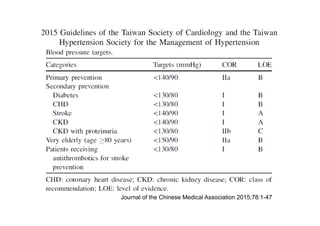
Journal of the Chinese Medical Association 2015;78:1-47
Systolic Blood Pressure Intervention Trial (SPRINT)
Principal Results
Paul K. Whelton, MB, MD, MSc
Chair, SPRINT Steering Committee
Tulane University School of Public Health and Tropical Medicine, and School of Medicine
For the SPRINT Research Group
N Engl J Med. 2015 Nov 26;373(22):2103-16.
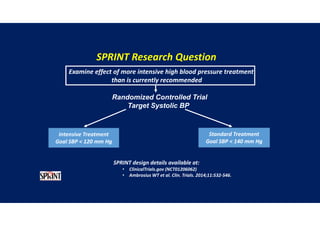
SPRINT Research Question
Examine effect of more intensive high blood pressure treatment
than is currently recommended
Randomized Controlled Trial
Target Systolic BP
Intensive Treatment
Goal SBP < 120 mm Hg
Standard Treatment
Goal SBP < 140 mm Hg
SPRINT design details available at:
• ClinicalTrials.gov (NCT01206062)
• Ambrosius WT et al. Clin. Trials. 2014;11:532-546.
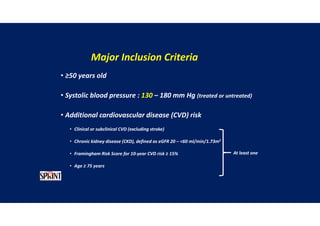
Major Inclusion Criteria
• ≥50 years old
• Systolic blood pressure : 130 – 180 mm Hg (treated or untreated)
• Additional cardiovascular disease (CVD) risk
• Clinical or subclinical CVD (excluding stroke)
• Chronic kidney disease (CKD), defined as eGFR 20 – <60 ml/min/1.73m2
• Framingham Risk Score for 10-year CVD risk ≥ 15%
• Age ≥ 75 years
At least one
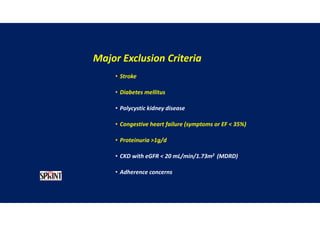
Major Exclusion Criteria
• Stroke
• Diabetes mellitus
• Polycystic kidney disease
• Congestive heart failure (symptoms or EF < 35%)
• Proteinuria >1g/d
• CKD with eGFR < 20 mL/min/1.73m2 (MDRD)
• Adherence concerns
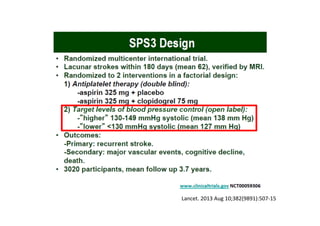
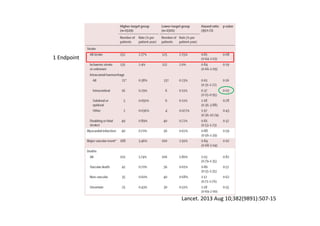
Lancet. 2013 Aug 10;382(9891):507-15
1 Endpoint
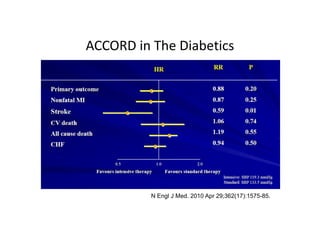
ACCORD in The Diabetics
N Engl J Med. 2010 Apr 29;362(17):1575-85.
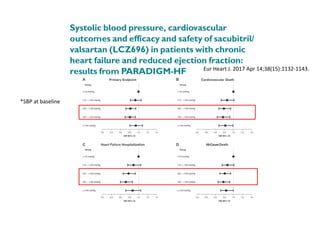
Eur Heart J. 2017 Apr 14;38(15):1132-1143.
*SBP at baseline
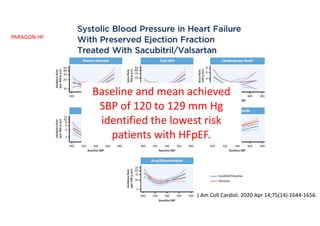
J Am Coll Cardiol. 2020 Apr 14;75(14):1644-1656.
PARAGON-HF
Baseline and mean achieved
SBP of 120 to 129 mm Hg
identified the lowest risk
patients with HFpEF.
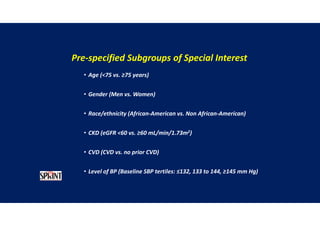
Pre-specified Subgroups of Special Interest
• Age (<75 vs. ≥75 years)
• Gender (Men vs. Women)
• Race/ethnicity (African-American vs. Non African-American)
• CKD (eGFR <60 vs. ≥60 mL/min/1.73m2)
• CVD (CVD vs. no prior CVD)
• Level of BP (Baseline SBP tertiles: ≤132, 133 to 144, ≥145 mm Hg)-
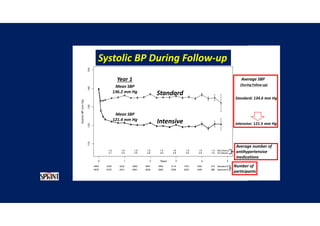
Systolic BP During Follow-up
Mean SBP
136.2 mm Hg
Mean SBP
121.4 mm Hg
Average SBP
(During Follow-up)
Standard: 134.6 mm Hg
Intensive: 121.5 mm Hg
Average number of
antihypertensive
medications
Number of
participants
Standard
Intensive
Year 1
Number of
Participants
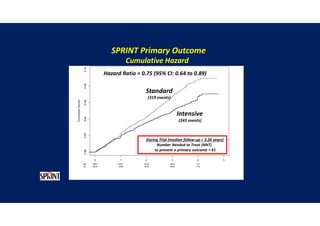
Hazard Ratio = 0.75 (95% CI: 0.64 to 0.89)
Standard
Intensive
(243 events)
During Trial (median follow-up = 3.26 years)
Number Needed to Treat (NNT)
to prevent a primary outcome = 61
SPRINT Primary Outcome
Cumulative Hazard
(319 events)
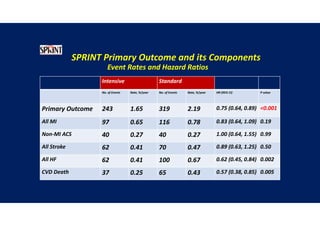
SPRINT Primary Outcome and its Components
Event Rates and Hazard Ratios
Intensive Standard
No. of Events Rate, %/year No. of Events Rate, %/year HR (95% CI) P value
Primary Outcome 243 1.65 319 2.19 0.75 (0.64, 0.89) <0.001
All MI 97 0.65 116 0.78 0.83 (0.64, 1.09) 0.19
Non-MI ACS 40 0.27 40 0.27 1.00 (0.64, 1.55) 0.99
All Stroke 62 0.41 70 0.47 0.89 (0.63, 1.25) 0.50
All HF 62 0.41 100 0.67 0.62 (0.45, 0.84) 0.002
CVD Death 37 0.25 65 0.43 0.57 (0.38, 0.85) 0.005
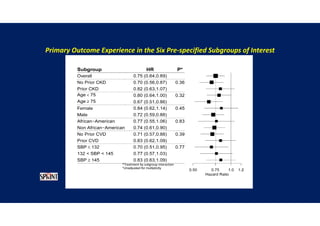
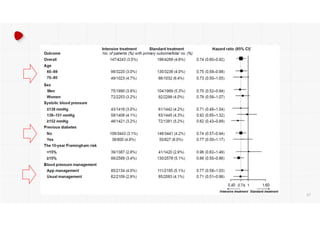
Primary Outcome Experience in the Six Pre-specified Subgroups of Interest
*Treatment by subgroup interaction
Intensive Standard
Events %/yr Events %/yr HR (95% CI) P
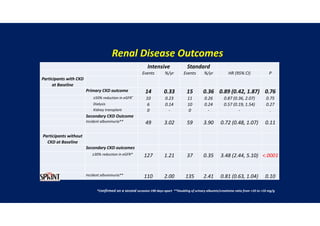
Participants with CKD
at Baseline
Primary CKD outcome 14 0.33 15 0.36 0.89 (0.42, 1.87) 0.76
≥50% reduction in eGFR*
10 0.23 11 0.26 0.87 (0.36, 2.07) 0.75
Dialysis 6 0.14 10 0.24 0.57 (0.19, 1.54) 0.27
Kidney transplant 0 - 0 - - .
Secondary CKD Outcome
Incident albuminuria** 49 3.02 59 3.90 0.72 (0.48, 1.07) 0.11
Participants without
CKD at Baseline
Secondary CKD outcomes
≥30% reduction in eGFR* 127 1.21 37 0.35 3.48 (2.44, 5.10) <.0001
Incident albuminuria** 110 2.00 135 2.41 0.81 (0.63, 1.04) 0.10
Renal Disease Outcomes
*Confirmed on a second occasion ≥90 days apart **Doubling of urinary albumin/creatinine ratio from <10 to >10 mg/g
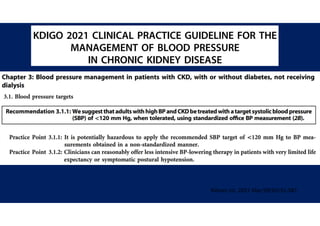
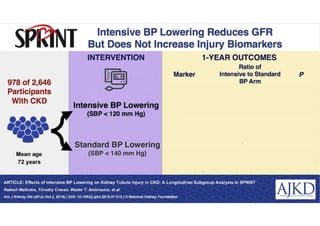
Kidney Int. 2021 Mar;99(3S):S1-S87.
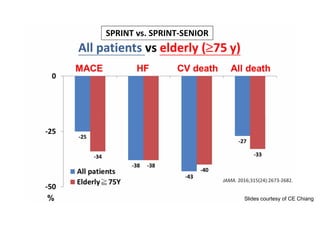
SPRINT vs. SPRINT-SENIOR
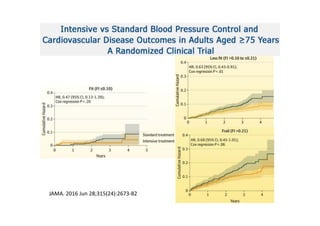
JAMA. 2016;315(24):2673-2682.
Slides courtesy of CE Chiang
JAMA. 2016 Jun 28;315(24):2673-82
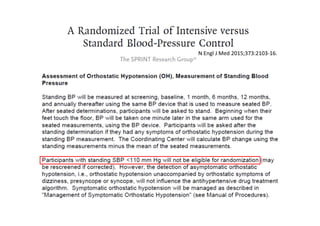
N Engl J Med 2015;373:2103-16.
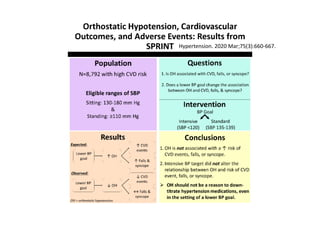
Hypertension. 2020 Mar;75(3):660-667.
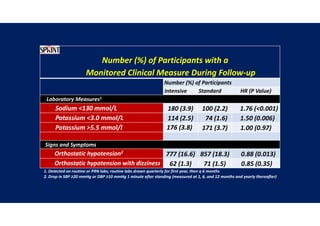
Number (%) of Participants with a
Monitored Clinical Measure During Follow-up
Number (%) of Participants
Intensive Standard HR (P Value)
Laboratory Measures1
Sodium <130 mmol/L 180 (3.9) 100 (2.2) 1.76 (<0.001)
Potassium <3.0 mmol/L 114 (2.5) 74 (1.6) 1.50 (0.006)
Potassium >5.5 mmol/l 176 (3.8) 171 (3.7) 1.00 (0.97)
Signs and Symptoms
Orthostatic hypotension2
777 (16.6) 857 (18.3) 0.88 (0.013)
Orthostatic hypotension with dizziness 62 (1.3) 71 (1.5) 0.85 (0.35)
1. Detected on routine or PRN labs; routine labs drawn quarterly for first year, then q 6 months
2. Drop in SBP ≥20 mmHg or DBP ≥10 mmHg 1 minute after standing (measured at 1, 6, and 12 months and yearly thereafter)
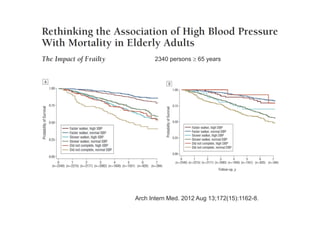
Arch Intern Med. 2012 Aug 13;172(15):1162-8.
2340 persons  65 years
26
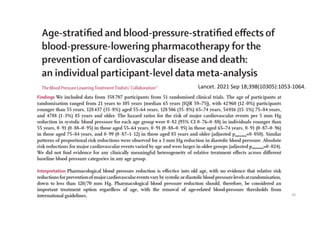
Lancet. 2021 Sep 18;398(10305):1053-1064.
27
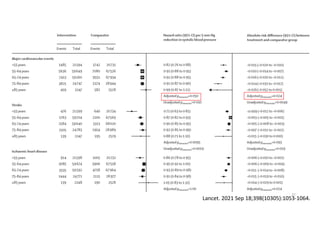
Lancet. 2021 Sep 18;398(10305):1053-1064.
28
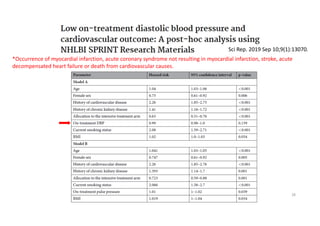
Sci Rep. 2019 Sep 10;9(1):13070.
*Occurrence of myocardial infarction, acute coronary syndrome not resulting in myocardial infarction, stroke, acute
decompensated heart failure or death from cardiovascular causes.
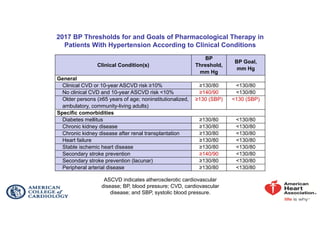
2017 BP Thresholds for and Goals of Pharmacological Therapy in
Patients With Hypertension According to Clinical Conditions
Clinical Condition(s)
BP
Threshold,
mm Hg
BP Goal,
mm Hg
General
Clinical CVD or 10-year ASCVD risk ≥10% ≥130/80 <130/80
No clinical CVD and 10-year ASCVD risk <10% ≥140/90 <130/80
Older persons (≥65 years of age; noninstitutionalized,
ambulatory, community-living adults)
≥130 (SBP) <130 (SBP)
Specific comorbidities
Diabetes mellitus ≥130/80 <130/80
Chronic kidney disease ≥130/80 <130/80
Chronic kidney disease after renal transplantation ≥130/80 <130/80
Heart failure ≥130/80 <130/80
Stable ischemic heart disease ≥130/80 <130/80
Secondary stroke prevention ≥140/90 <130/80
Secondary stroke prevention (lacunar) ≥130/80 <130/80
Peripheral arterial disease ≥130/80 <130/80
ASCVD indicates atherosclerotic cardiovascular
disease; BP, blood pressure; CVD, cardiovascular
disease; and SBP, systolic blood pressure.
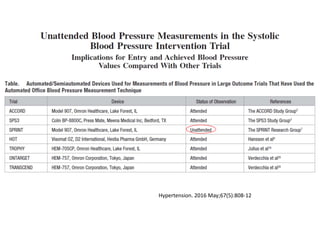
Hypertension. 2016 May;67(5):808-12
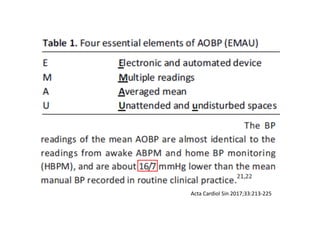
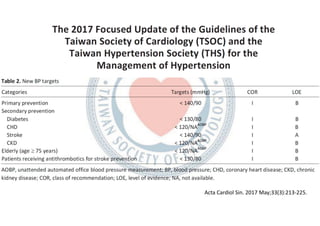
Acta Cardiol Sin 2017;33:213-225
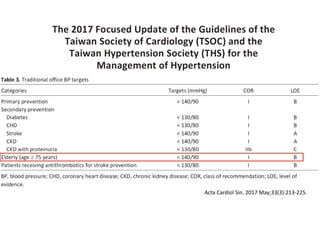
Acta Cardiol Sin. 2017 May;33(3):213-225.
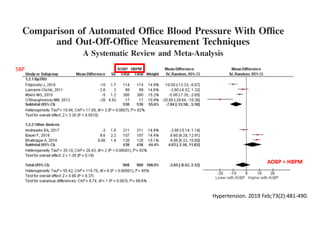
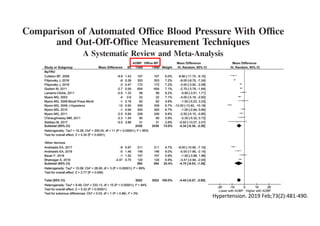
Hypertension. 2019 Feb;73(2):481-490.
SBP
AOBP = HBPM
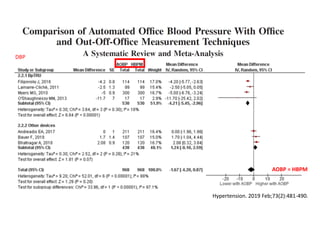
Hypertension. 2019 Feb;73(2):481-490.
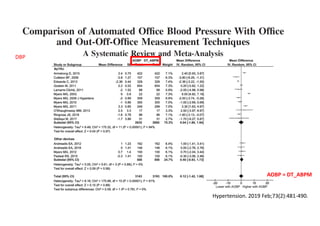
DBP
AOBP = HBPM
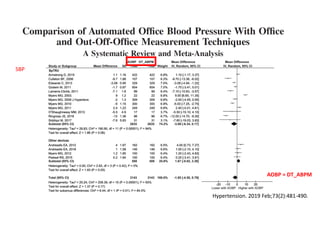
Hypertension. 2019 Feb;73(2):481-490.
SBP
AOBP = DT_ABPM
Hypertension. 2019 Feb;73(2):481-490.
DBP
AOBP = DT_ABPM
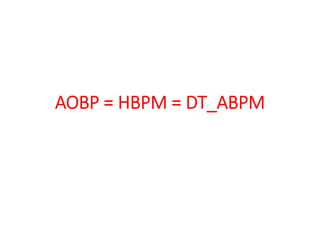
AOBP = HBPM = DT_ABPM
39
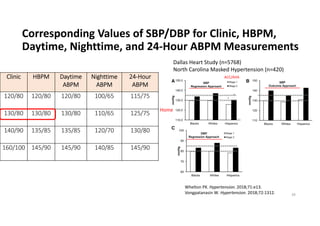
Clinic HBPM Daytime
ABPM
Nighttime
ABPM
24-Hour
ABPM
120/80 120/80 120/80 100/65 115/75
130/80 130/80 130/80 110/65 125/75
140/90 135/85 135/85 120/70 130/80
160/100 145/90 145/90 140/85 145/90
Corresponding Values of SBP/DBP for Clinic, HBPM,
Daytime, Nighttime, and 24-Hour ABPM Measurements
Whelton PK. Hypertension. 2018;71:e13.
Vongpatanasin W. Hypertension. 2018;72:1312.
Dallas Heart Study (n=5768)
North Carolina Masked Hypertension (n=420)
Home
ACC/AHA
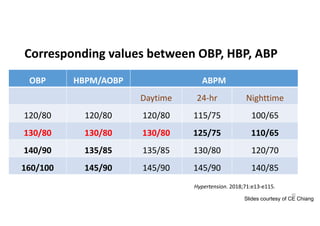
Corresponding values between OBP, HBP, ABP
OBP HBPM/AOBP ABPM
Daytime 24-hr Nighttime
120/80 120/80 120/80 115/75 100/65
130/80 130/80 130/80 125/75 110/65
140/90 135/85 135/85 130/80 120/70
160/100 145/90 145/90 145/90 140/85
40
Hypertension. 2018;71:e13-e115.
Slides courtesy of CE Chiang
42
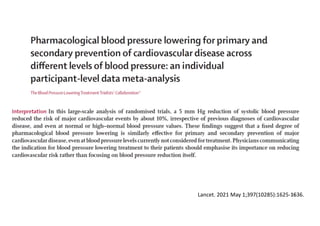
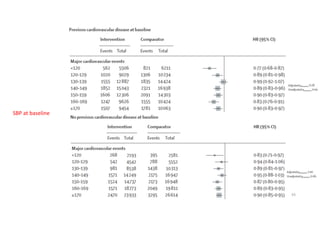
Lancet. 2021 May 1;397(10285):1625-1636.
43
SBP at baseline
44
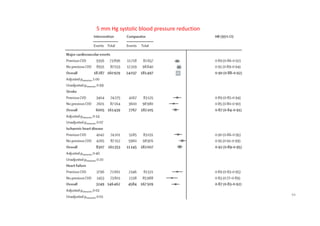
5 mm Hg systolic blood pressure reduction
Why Select HBPM?
45
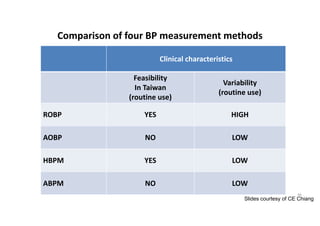
Comparison of four BP measurement methods
Clinical characteristics
Feasibility
In Taiwan
(routine use)
Variability
(routine use)
ROBP YES HIGH
AOBP NO LOW
HBPM YES LOW
ABPM NO LOW
46
Slides courtesy of CE Chiang
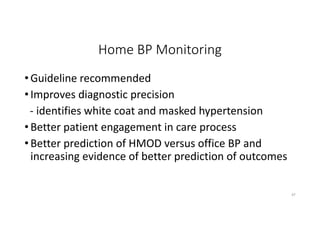
Home BP Monitoring
•Guideline recommended
•Improves diagnostic precision
- identifies white coat and masked hypertension
•Better patient engagement in care process
•Better prediction of HMOD versus office BP and
increasing evidence of better prediction of outcomes
47
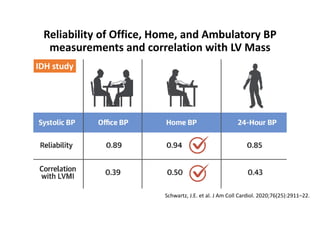
Reliability of Office, Home, and Ambulatory BP
measurements and correlation with LV Mass
Schwartz, J.E. et al. J Am Coll Cardiol. 2020;76(25):2911–22.
IDH study
49
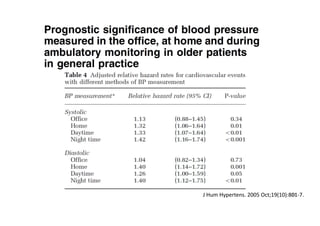
J Hum Hypertens. 2005 Oct;19(10):801-7.
50
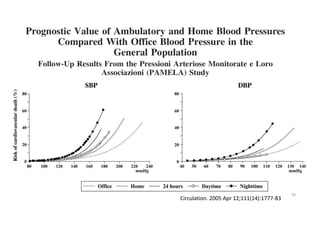
Circulation. 2005 Apr 12;111(14):1777-83
51
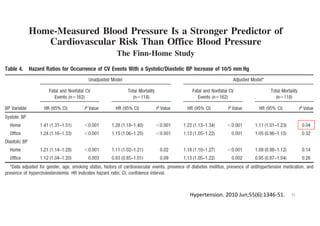
Hypertension. 2010 Jun;55(6):1346-51.
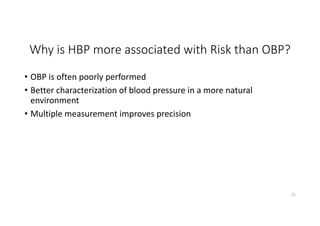
Why is HBP more associated with Risk than OBP?
• OBP is often poorly performed
• Better characterization of blood pressure in a more natural
environment
• Multiple measurement improves precision
52
Hypertension. 2019 Feb;73(2):481-490.
54
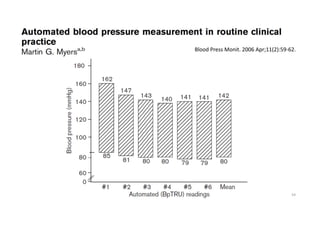
Blood Press Monit. 2006 Apr;11(2):59-62.
55
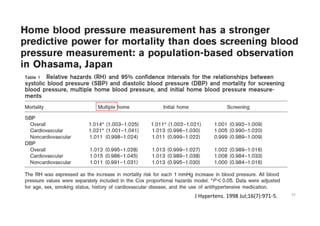
J Hypertens. 1998 Jul;16(7):971-5.
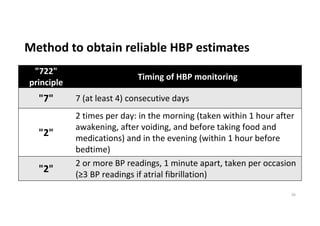
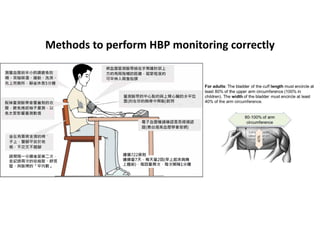
Method to obtain reliable HBP estimates
56
"722"
principle
Timing of HBP monitoring
"7" 7 (at least 4) consecutive days
"2"
2 times per day: in the morning (taken within 1 hour after
awakening, after voiding, and before taking food and
medications) and in the evening (within 1 hour before
bedtime)
"2"
2 or more BP readings, 1 minute apart, taken per occasion
(≥3 BP readings if atrial fibrillation)
Methods to perform HBP monitoring correctly
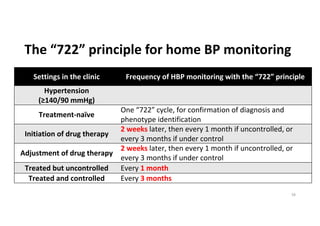
The “722” principle for home BP monitoring
58
Settings in the clinic Frequency of HBP monitoring with the “722” principle
Hypertension
(≥140/90 mmHg)
Treatment-naïve
One “722” cycle, for confirmation of diagnosis and
phenotype identification
Initiation of drug therapy
2 weeks later, then every 1 month if uncontrolled, or
every 3 months if under control
Adjustment of drug therapy
2 weeks later, then every 1 month if uncontrolled, or
every 3 months if under control
Treated but uncontrolled Every 1 month
Treated and controlled Every 3 months
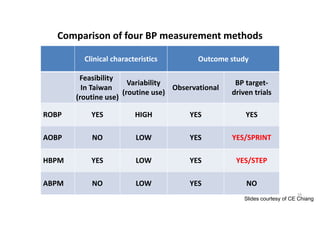
Comparison of four BP measurement methods
Clinical characteristics Outcome study
Feasibility
In Taiwan
(routine use)
Variability
(routine use)
Observational
BP target-
driven trials
ROBP YES HIGH YES YES
AOBP NO LOW YES YES/SPRINT
HBPM YES LOW YES YES/STEP
ABPM NO LOW YES NO
59
Slides courtesy of CE Chiang
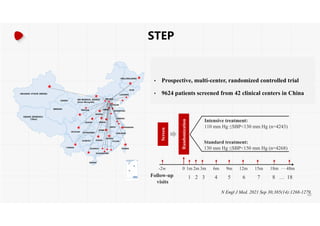
STEP
• Prospective, multi-center, randomized controlled trial
• 9624 patients screened from 42 clinical centers in China
Intensive treatment:
110 mm Hg ≤SBP<130 mm Hg (n=4243)
Standard treatment:
130 mm Hg ≤SBP<150 mm Hg (n=4268)
Screen
Randomization
0
-2w 1m 3m 15m
9m 48m
6m 12m 18m …
Follow-up
visits
1 2 3 4 5 6 7 8 18
…
2m
60
N Engl J Med. 2021 Sep 30;385(14):1268-1279.
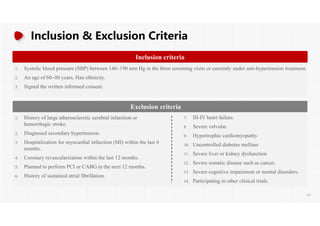
Inclusion & Exclusion Criteria
Inclusion criteria
1. Systolic blood pressure (SBP) between 140190 mm Hg in the three screening visits or currently under anti-hypertension treatment.
2. An age of 6080 years, Han ethnicity.
3. Signed the written informed consent.
1. History of large atherosclerotic cerebral infarction or
hemorrhagic stroke.
2. Diagnosed secondary hypertension.
3. Hospitalization for myocardial infarction (MI) within the last 6
months.
4. Coronary revascularization within the last 12 months.
5. Planned to perform PCI or CABG in the next 12 months.
6. History of sustained atrial fibrillation.
Exclusion criteria
7. III-IV heart failure.
8. Severe valvular.
9. Hypertrophic cardiomyopathy
10. Uncontrolled diabetes mellitus
11. Severe liver or kidney dysfunction
12. Severe somatic disease such as cancer.
13. Severe cognitive impairment or mental disorders.
14. Participating in other clinical trials.
61
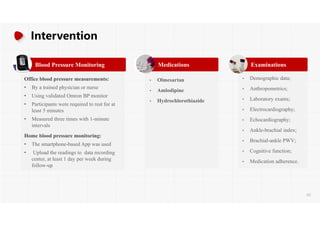
Intervention
Blood Pressure Monitoring
Office blood pressure measurements:
• By a trained physician or nurse
• Using validated Omron BP monitor
• Participants were required to rest for at
least 5 minutes
• Measured three times with 1-minute
intervals
Home blood pressure monitoring:
• The smartphone-based App was used
• Upload the readings to data recording
center, at least 1 day per week during
follow-up
Medications
• Olmesartan
• Amlodipine
• Hydrochlorothiazide
Examinations
• Demographic data;
• Anthropometrics;
• Laboratory exams;
• Electrocardiography;
• Echocardiography;
• Ankle-brachial index;
• Brachial-ankle PWV;
• Cognitive function;
• Medication adherence.
62
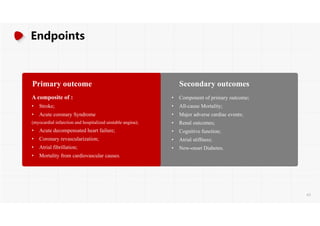
Endpoints
Primary outcome
A composite of :
• Stroke;
• Acute coronary Syndrome
(myocardial infarction and hospitalized unstable angina);
• Acute decompensated heart failure;
• Coronary revascularization;
• Atrial fibrillation;
• Mortality from cardiovascular causes.
Secondary outcomes
• Component of primary outcome;
• All-cause Mortality;
• Major adverse cardiac events;
• Renal outcomes;
• Cognitive function;
• Atrial stiffness;
• New-onset Diabetes.
63
Medications
VISIT_12M VISIT_24M VISIT_36M VISIT_42M
Intensive
(n=4172)
Standard
(n=4158)
Intensive
(n=4130)
Standard
(n=4131)
Intensive
(n=4085)
Standard
(n=4086)
Intensive
(n=2593)
Standard
(n=2592)
Patients using antihypertensive agent
CCB alone
780
(18.7%)
1209
(29.1%)
624
(15.1%)
1088
(26.3%)
532
(13.0%)
1028
(25.2%)
281
(10.8%)
531
(20.5%)
ARB alone
486
(11.6%)
726
(17.5%)
431
(10.4%)
726
(17.6%)
357 (8.7)
621
(15.2%)
184 (7.1%)
329
(12.7%)
CCB + ARB
1945
(46.6%)
1569
(37.7%)
2031
(49.2%)
1617
(39.1%)
2090
(51.2%)
1636
(40.0%)
1086
(41.9%)
787
(30.4%)
Hydrochlorothiazide 0 (0%) 3 (0.1%) 0 (0%) 1 (0.0%) 0 (0.0%) 1 (0.0%) 0 (0%) 0 (0%)
CCB +
Hydrochlorothiazide
18 (0.4%) 19 (0.5%) 37 (0.9%) 11 (0.3%) 22 (0.5%) 6 (0.1%) 23 (0.9%) 8 (0.3%)
ARB +
Hydrochlorothiazide
28 (0.7%) 21 (0.5%) 25 (0.6%) 24 (0.6%) 30 (0.7%) 27 (0.7%) 17 (0.7%) 7 (0.3%)
ARB+CCB+
Hydrochlorothiazide
448
(10.7%)
172
(4.1%)
527
(12.8%)
174
(4.2%)
524
(12.8%)
185
(4.5%)
240
(9.3%)
87
(3.4%)
Other drugs
337
(8.1%)
258
(6.2%)
328
(7.9%)
265
(6.4%)
412
(10.1%)
347
(8.5%)
711
(27.4%)
759
(29.3%)
Number of agents, no. (%)
0
130
(3.1%)
181
(4.4%)
127
(3.1%)
225
(5.4%)
118
(2.9%)
235
(5.8%)
51
(2.0%)
84
(3.2%)
1
1266
(30.3%)
1938
(46.6%)
1055
(25.5%)
1815
(43.9%)
889
(21.8%)
1650
(40.4%)
465
(17.9%)
860
(33.2%)
2
1991
(47.7%)
1609
(38.7%)
2093
(50.7%)
1652
(40.0%)
2142
(52.4%)
1669
(40.8%)
1126
(43.4%)
802
(30.9%)
3
448
(10.7%)
172
(4.1%)
527
(12.8%)
174
(4.2%)
524
(12.8%)
185
(4.5%)
240
(9.3%)
87
(3.4%)
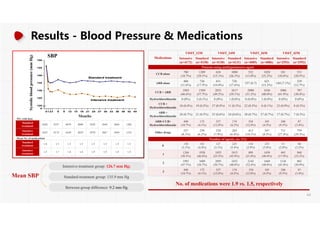
Results - Blood Pressure & Medications
Standard
treatment
4268 4147 4070 4000 3938 3849 3664 1200
Intensive
treatment
4243 4174 4109 4039 3970 3867 3694 1234
Standard
treatment
1.4 1.5 1.5 1.5 1.5 1.5 1.5 1.5
Intensive
treatment
1.5 1.7 1.8 1.8 1.9 1.9 1.9 1.9
SBP
Months
Systolic
blood
pressure
(mm
Hg)
Mean SBP
Intensive-treatment group: 126.7 mm Hg;
Standard-treatment group: 135.9 mm Hg
Between-group difference: 9.2 mm Hg
64
Time after randomization (Months)
Cumulative
incidence
26%
Results- Primary Composite Outcome
Standard
treatment
4268 4147 4070 4000 3938 3849 3664 1200
Intensive
treatment
4243 4174 4109 4039 3970 3867 3694 1234
NO.at risk
The cardiovascular
benefits
65
147 of 4243 patients (3.5% [1.0% per
year]) in the intensive-treatment group;
196 of 4268 patients (4.6% [1.4% per
year]) in the standard-treatment group.
During the median follow-up period of
3.34 years, primary-outcome events
occurred in:
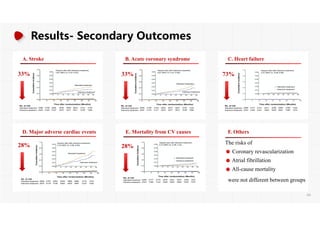
Results- Secondary Outcomes
B. Acute coronary syndrome C. Heart failure
A. Stroke
33%
E. Mortality from CV causes
D. Major adverse cardiac events F. Others
The risks of
Coronary revascularization
Atrial fibrillation
All-cause mortality
were not different between groups
33% 73%
28% 28%
66
67
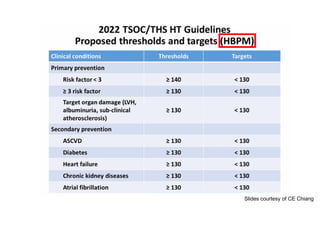
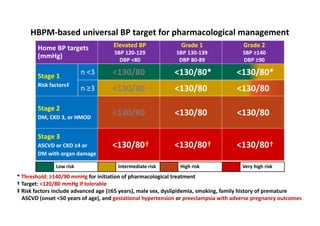
HBPM-based universal BP target for pharmacological management
* Threshold: ≥140/90 mmHg for initiation of pharmacological treatment
† Target: <120/80 mmHg if tolerable
‡ Risk factors include advanced age (≥65 years), male sex, dyslipidemia, smoking, family history of premature
ASCVD (onset <50 years of age), and gestational hypertension or preeclampsia with adverse pregnancy outcomes
Low risk Intermediate risk High risk Very high risk
Home BP targets
(mmHg)
Elevated BP
SBP 120-129
DBP <80
Grade 1
SBP 130-139
DBP 80-89
Grade 2
SBP ≥140
DBP ≥90
Stage 1
Risk factors‡
n <3 <130/80 <130/80* <130/80*
n ≥3 <130/80 <130/80 <130/80
Stage 2
DM, CKD 3, or HMOD
<130/80 <130/80 <130/80
Stage 3
ASCVD or CKD ≥4 or
DM with organ damage
<130/80† <130/80† <130/80†
70
Effects of reduced-sodium, added-potassium salt substitute
on stroke – the salt substitute and stroke study (SSaSS)
Professor Bruce Neal
Effects of reduced-sodium, added-potassium salt substitute
on stroke – the salt substitute and stroke study (SSaSS)
Professor Bruce Neal
N Engl J Med. 2021 Sep 16;385(12):1067-1077.
Design
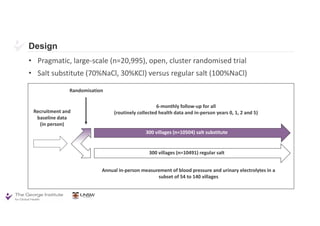
• Pragmatic, large-scale (n=20,995), open, cluster randomised trial
• Salt substitute (70%NaCl, 30%KCl) versus regular salt (100%NaCl)
Recruitment and
baseline data
(in person)
Randomisation
6-monthly follow-up for all
(routinely collected health data and in-person years 0, 1, 2 and 5)
Annual in-person measurement of blood pressure and urinary electrolytes in a
subset of 54 to 140 villages
300 villages (n=10504) salt substitute
300 villages (n=10491) regular salt
Follow-up and intermediate outcomes
Follow-up
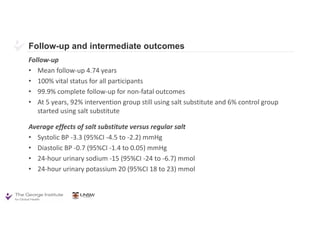
• Mean follow-up 4.74 years
• 100% vital status for all participants
• 99.9% complete follow-up for non-fatal outcomes
• At 5 years, 92% intervention group still using salt substitute and 6% control group
started using salt substitute
Average effects of salt substitute versus regular salt
• Systolic BP -3.3 (95%CI -4.5 to -2.2) mmHg
• Diastolic BP -0.7 (95%CI -1.4 to 0.05) mmHg
• 24-hour urinary sodium -15 (95%CI -24 to -6.7) mmol
• 24-hour urinary potassium 20 (95%CI 18 to 23) mmol
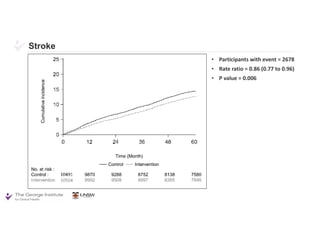
Stroke
• Participants with event = 2678
• Rate ratio = 0.86 (0.77 to 0.96)
• P value = 0.006
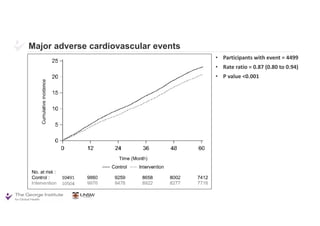
Major adverse cardiovascular events
• Participants with event = 4499
• Rate ratio = 0.87 (0.80 to 0.94)
• P value <0.001
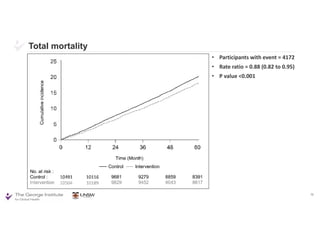
Total mortality
75
• Participants with event = 4172
• Rate ratio = 0.88 (0.82 to 0.95)
• P value <0.001
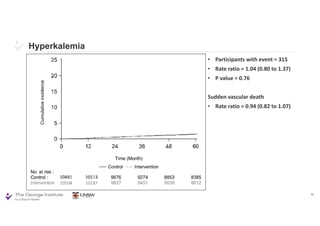
Hyperkalemia
76
• Participants with event = 315
• Rate ratio = 1.04 (0.80 to 1.37)
• P value = 0.76
Sudden vascular death
• Rate ratio = 0.94 (0.82 to 1.07)
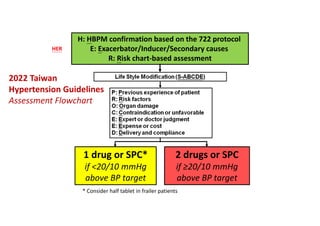
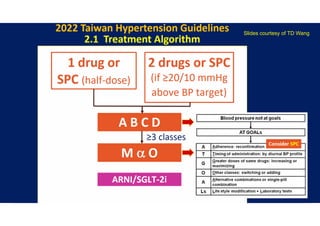
1 drug or SPC*
if <20/10 mmHg
above BP target
2 drugs or SPC
if ≥20/10 mmHg
above BP target
Wang TD, 2022.
H: HBPM confirmation based on the 722 protocol
E: Exacerbator/Inducer/Secondary causes
R: Risk chart-based assessment
2022 Taiwan
Hypertension Guidelines
Assessment Flowchart
* Consider half tablet in frailer patients
HER
Slides courtesy of TD Wang
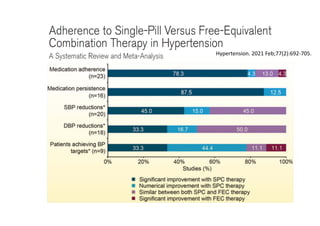
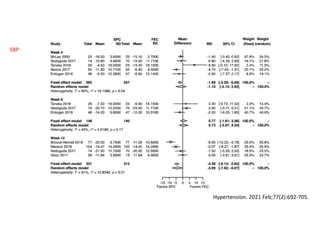
Hypertension. 2021 Feb;77(2):692-705.
SBP
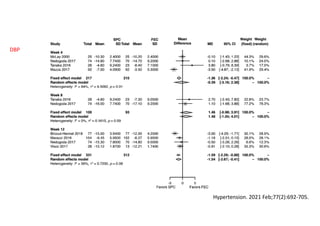
Hypertension. 2021 Feb;77(2):692-705.
DBP
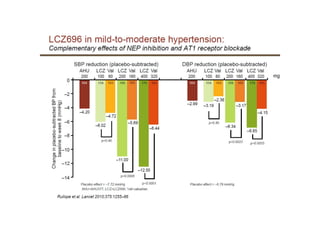
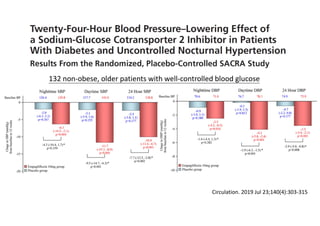
Circulation. 2019 Jul 23;140(4):303-315
132 non-obese, older patients with well-controlled blood glucose
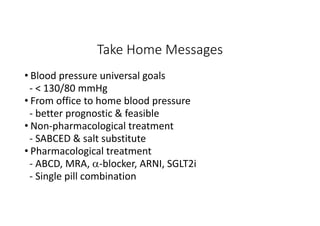
Take Home Messages
• Blood pressure universal goals
- < 130/80 mmHg
• From office to home blood pressure
- better prognostic & feasible
• Non-pharmacological treatment
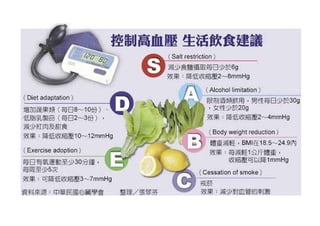
- SABCED & salt substitute
• Pharmacological treatment
- ABCD, MRA, -blocker, ARNI, SGLT2i
- Single pill combination
謝謝聆聽 敬請指教

1120310-最新台灣高血壓治療指引.pdf

  • 1.
    2023 Updated HypertensionGuideline 高雄醫學大學 附設中和紀念醫院 心臟血管內科 林宗憲 Conflict of Interest: nil
  • 2.
    Journal of theChinese Medical Association 2015;78:1-47
  • 3.
    Systolic Blood PressureIntervention Trial (SPRINT) Principal Results Paul K. Whelton, MB, MD, MSc Chair, SPRINT Steering Committee Tulane University School of Public Health and Tropical Medicine, and School of Medicine For the SPRINT Research Group N Engl J Med. 2015 Nov 26;373(22):2103-16.
  • 4.
    SPRINT Research Question Examineeffect of more intensive high blood pressure treatment than is currently recommended Randomized Controlled Trial Target Systolic BP Intensive Treatment Goal SBP < 120 mm Hg Standard Treatment Goal SBP < 140 mm Hg SPRINT design details available at: • ClinicalTrials.gov (NCT01206062) • Ambrosius WT et al. Clin. Trials. 2014;11:532-546.
  • 5.
    Major Inclusion Criteria •≥50 years old • Systolic blood pressure : 130 – 180 mm Hg (treated or untreated) • Additional cardiovascular disease (CVD) risk • Clinical or subclinical CVD (excluding stroke) • Chronic kidney disease (CKD), defined as eGFR 20 – <60 ml/min/1.73m2 • Framingham Risk Score for 10-year CVD risk ≥ 15% • Age ≥ 75 years At least one
  • 6.
    Major Exclusion Criteria •Stroke • Diabetes mellitus • Polycystic kidney disease • Congestive heart failure (symptoms or EF < 35%) • Proteinuria >1g/d • CKD with eGFR < 20 mL/min/1.73m2 (MDRD) • Adherence concerns
  • 7.
    Lancet. 2013 Aug10;382(9891):507-15
  • 8.
    Lancet. 2013 Aug10;382(9891):507-15 1 Endpoint
  • 9.
    ACCORD in TheDiabetics N Engl J Med. 2010 Apr 29;362(17):1575-85.
  • 10.
    Eur Heart J.2017 Apr 14;38(15):1132-1143. *SBP at baseline
  • 11.
    J Am CollCardiol. 2020 Apr 14;75(14):1644-1656. PARAGON-HF Baseline and mean achieved SBP of 120 to 129 mm Hg identified the lowest risk patients with HFpEF.
  • 12.
    Pre-specified Subgroups ofSpecial Interest • Age (<75 vs. ≥75 years) • Gender (Men vs. Women) • Race/ethnicity (African-American vs. Non African-American) • CKD (eGFR <60 vs. ≥60 mL/min/1.73m2) • CVD (CVD vs. no prior CVD) • Level of BP (Baseline SBP tertiles: ≤132, 133 to 144, ≥145 mm Hg)-
  • 13.
    Systolic BP DuringFollow-up Mean SBP 136.2 mm Hg Mean SBP 121.4 mm Hg Average SBP (During Follow-up) Standard: 134.6 mm Hg Intensive: 121.5 mm Hg Average number of antihypertensive medications Number of participants Standard Intensive Year 1
  • 14.
    Number of Participants Hazard Ratio= 0.75 (95% CI: 0.64 to 0.89) Standard Intensive (243 events) During Trial (median follow-up = 3.26 years) Number Needed to Treat (NNT) to prevent a primary outcome = 61 SPRINT Primary Outcome Cumulative Hazard (319 events)
  • 15.
    SPRINT Primary Outcomeand its Components Event Rates and Hazard Ratios Intensive Standard No. of Events Rate, %/year No. of Events Rate, %/year HR (95% CI) P value Primary Outcome 243 1.65 319 2.19 0.75 (0.64, 0.89) <0.001 All MI 97 0.65 116 0.78 0.83 (0.64, 1.09) 0.19 Non-MI ACS 40 0.27 40 0.27 1.00 (0.64, 1.55) 0.99 All Stroke 62 0.41 70 0.47 0.89 (0.63, 1.25) 0.50 All HF 62 0.41 100 0.67 0.62 (0.45, 0.84) 0.002 CVD Death 37 0.25 65 0.43 0.57 (0.38, 0.85) 0.005
  • 16.
    Primary Outcome Experiencein the Six Pre-specified Subgroups of Interest *Treatment by subgroup interaction
  • 17.
    Intensive Standard Events %/yrEvents %/yr HR (95% CI) P Participants with CKD at Baseline Primary CKD outcome 14 0.33 15 0.36 0.89 (0.42, 1.87) 0.76 ≥50% reduction in eGFR* 10 0.23 11 0.26 0.87 (0.36, 2.07) 0.75 Dialysis 6 0.14 10 0.24 0.57 (0.19, 1.54) 0.27 Kidney transplant 0 - 0 - - . Secondary CKD Outcome Incident albuminuria** 49 3.02 59 3.90 0.72 (0.48, 1.07) 0.11 Participants without CKD at Baseline Secondary CKD outcomes ≥30% reduction in eGFR* 127 1.21 37 0.35 3.48 (2.44, 5.10) <.0001 Incident albuminuria** 110 2.00 135 2.41 0.81 (0.63, 1.04) 0.10 Renal Disease Outcomes *Confirmed on a second occasion ≥90 days apart **Doubling of urinary albumin/creatinine ratio from <10 to >10 mg/g
  • 18.
    Kidney Int. 2021Mar;99(3S):S1-S87.
  • 20.
    SPRINT vs. SPRINT-SENIOR JAMA.2016;315(24):2673-2682. Slides courtesy of CE Chiang
  • 21.
    JAMA. 2016 Jun28;315(24):2673-82
  • 22.
    N Engl JMed 2015;373:2103-16.
  • 23.
  • 24.
    Number (%) ofParticipants with a Monitored Clinical Measure During Follow-up Number (%) of Participants Intensive Standard HR (P Value) Laboratory Measures1 Sodium <130 mmol/L 180 (3.9) 100 (2.2) 1.76 (<0.001) Potassium <3.0 mmol/L 114 (2.5) 74 (1.6) 1.50 (0.006) Potassium >5.5 mmol/l 176 (3.8) 171 (3.7) 1.00 (0.97) Signs and Symptoms Orthostatic hypotension2 777 (16.6) 857 (18.3) 0.88 (0.013) Orthostatic hypotension with dizziness 62 (1.3) 71 (1.5) 0.85 (0.35) 1. Detected on routine or PRN labs; routine labs drawn quarterly for first year, then q 6 months 2. Drop in SBP ≥20 mmHg or DBP ≥10 mmHg 1 minute after standing (measured at 1, 6, and 12 months and yearly thereafter)
  • 25.
    Arch Intern Med.2012 Aug 13;172(15):1162-8. 2340 persons  65 years
  • 26.
    26 Lancet. 2021 Sep18;398(10305):1053-1064.
  • 27.
    27 Lancet. 2021 Sep18;398(10305):1053-1064.
  • 28.
    28 Sci Rep. 2019Sep 10;9(1):13070. *Occurrence of myocardial infarction, acute coronary syndrome not resulting in myocardial infarction, stroke, acute decompensated heart failure or death from cardiovascular causes.
  • 29.
    2017 BP Thresholdsfor and Goals of Pharmacological Therapy in Patients With Hypertension According to Clinical Conditions Clinical Condition(s) BP Threshold, mm Hg BP Goal, mm Hg General Clinical CVD or 10-year ASCVD risk ≥10% ≥130/80 <130/80 No clinical CVD and 10-year ASCVD risk <10% ≥140/90 <130/80 Older persons (≥65 years of age; noninstitutionalized, ambulatory, community-living adults) ≥130 (SBP) <130 (SBP) Specific comorbidities Diabetes mellitus ≥130/80 <130/80 Chronic kidney disease ≥130/80 <130/80 Chronic kidney disease after renal transplantation ≥130/80 <130/80 Heart failure ≥130/80 <130/80 Stable ischemic heart disease ≥130/80 <130/80 Secondary stroke prevention ≥140/90 <130/80 Secondary stroke prevention (lacunar) ≥130/80 <130/80 Peripheral arterial disease ≥130/80 <130/80 ASCVD indicates atherosclerotic cardiovascular disease; BP, blood pressure; CVD, cardiovascular disease; and SBP, systolic blood pressure.
  • 30.
  • 31.
    Acta Cardiol Sin2017;33:213-225
  • 32.
    Acta Cardiol Sin.2017 May;33(3):213-225.
  • 33.
    Acta Cardiol Sin.2017 May;33(3):213-225.
  • 34.
  • 35.
  • 36.
  • 37.
  • 38.
    AOBP = HBPM= DT_ABPM
  • 39.
    39 Clinic HBPM Daytime ABPM Nighttime ABPM 24-Hour ABPM 120/80120/80 120/80 100/65 115/75 130/80 130/80 130/80 110/65 125/75 140/90 135/85 135/85 120/70 130/80 160/100 145/90 145/90 140/85 145/90 Corresponding Values of SBP/DBP for Clinic, HBPM, Daytime, Nighttime, and 24-Hour ABPM Measurements Whelton PK. Hypertension. 2018;71:e13. Vongpatanasin W. Hypertension. 2018;72:1312. Dallas Heart Study (n=5768) North Carolina Masked Hypertension (n=420) Home ACC/AHA
  • 40.
    Corresponding values betweenOBP, HBP, ABP OBP HBPM/AOBP ABPM Daytime 24-hr Nighttime 120/80 120/80 120/80 115/75 100/65 130/80 130/80 130/80 125/75 110/65 140/90 135/85 135/85 130/80 120/70 160/100 145/90 145/90 145/90 140/85 40 Hypertension. 2018;71:e13-e115. Slides courtesy of CE Chiang
  • 41.
  • 42.
    42 Lancet. 2021 May1;397(10285):1625-1636.
  • 43.
  • 44.
    44 5 mm Hgsystolic blood pressure reduction
  • 45.
  • 46.
    Comparison of fourBP measurement methods Clinical characteristics Feasibility In Taiwan (routine use) Variability (routine use) ROBP YES HIGH AOBP NO LOW HBPM YES LOW ABPM NO LOW 46 Slides courtesy of CE Chiang
  • 47.
    Home BP Monitoring •Guidelinerecommended •Improves diagnostic precision - identifies white coat and masked hypertension •Better patient engagement in care process •Better prediction of HMOD versus office BP and increasing evidence of better prediction of outcomes 47
  • 48.
    Reliability of Office,Home, and Ambulatory BP measurements and correlation with LV Mass Schwartz, J.E. et al. J Am Coll Cardiol. 2020;76(25):2911–22. IDH study
  • 49.
    49 J Hum Hypertens.2005 Oct;19(10):801-7.
  • 50.
    50 Circulation. 2005 Apr12;111(14):1777-83
  • 51.
  • 52.
    Why is HBPmore associated with Risk than OBP? • OBP is often poorly performed • Better characterization of blood pressure in a more natural environment • Multiple measurement improves precision 52
  • 53.
  • 54.
    54 Blood Press Monit.2006 Apr;11(2):59-62.
  • 55.
    55 J Hypertens. 1998Jul;16(7):971-5.
  • 56.
    Method to obtainreliable HBP estimates 56 "722" principle Timing of HBP monitoring "7" 7 (at least 4) consecutive days "2" 2 times per day: in the morning (taken within 1 hour after awakening, after voiding, and before taking food and medications) and in the evening (within 1 hour before bedtime) "2" 2 or more BP readings, 1 minute apart, taken per occasion (≥3 BP readings if atrial fibrillation)
  • 57.
    Methods to performHBP monitoring correctly
  • 58.
    The “722” principlefor home BP monitoring 58 Settings in the clinic Frequency of HBP monitoring with the “722” principle Hypertension (≥140/90 mmHg) Treatment-naïve One “722” cycle, for confirmation of diagnosis and phenotype identification Initiation of drug therapy 2 weeks later, then every 1 month if uncontrolled, or every 3 months if under control Adjustment of drug therapy 2 weeks later, then every 1 month if uncontrolled, or every 3 months if under control Treated but uncontrolled Every 1 month Treated and controlled Every 3 months
  • 59.
    Comparison of fourBP measurement methods Clinical characteristics Outcome study Feasibility In Taiwan (routine use) Variability (routine use) Observational BP target- driven trials ROBP YES HIGH YES YES AOBP NO LOW YES YES/SPRINT HBPM YES LOW YES YES/STEP ABPM NO LOW YES NO 59 Slides courtesy of CE Chiang
  • 60.
    STEP • Prospective, multi-center,randomized controlled trial • 9624 patients screened from 42 clinical centers in China Intensive treatment: 110 mm Hg ≤SBP<130 mm Hg (n=4243) Standard treatment: 130 mm Hg ≤SBP<150 mm Hg (n=4268) Screen Randomization 0 -2w 1m 3m 15m 9m 48m 6m 12m 18m … Follow-up visits 1 2 3 4 5 6 7 8 18 … 2m 60 N Engl J Med. 2021 Sep 30;385(14):1268-1279.
  • 61.
    Inclusion & ExclusionCriteria Inclusion criteria 1. Systolic blood pressure (SBP) between 140190 mm Hg in the three screening visits or currently under anti-hypertension treatment. 2. An age of 6080 years, Han ethnicity. 3. Signed the written informed consent. 1. History of large atherosclerotic cerebral infarction or hemorrhagic stroke. 2. Diagnosed secondary hypertension. 3. Hospitalization for myocardial infarction (MI) within the last 6 months. 4. Coronary revascularization within the last 12 months. 5. Planned to perform PCI or CABG in the next 12 months. 6. History of sustained atrial fibrillation. Exclusion criteria 7. III-IV heart failure. 8. Severe valvular. 9. Hypertrophic cardiomyopathy 10. Uncontrolled diabetes mellitus 11. Severe liver or kidney dysfunction 12. Severe somatic disease such as cancer. 13. Severe cognitive impairment or mental disorders. 14. Participating in other clinical trials. 61
  • 62.
    Intervention Blood Pressure Monitoring Officeblood pressure measurements: • By a trained physician or nurse • Using validated Omron BP monitor • Participants were required to rest for at least 5 minutes • Measured three times with 1-minute intervals Home blood pressure monitoring: • The smartphone-based App was used • Upload the readings to data recording center, at least 1 day per week during follow-up Medications • Olmesartan • Amlodipine • Hydrochlorothiazide Examinations • Demographic data; • Anthropometrics; • Laboratory exams; • Electrocardiography; • Echocardiography; • Ankle-brachial index; • Brachial-ankle PWV; • Cognitive function; • Medication adherence. 62
  • 63.
    Endpoints Primary outcome A compositeof : • Stroke; • Acute coronary Syndrome (myocardial infarction and hospitalized unstable angina); • Acute decompensated heart failure; • Coronary revascularization; • Atrial fibrillation; • Mortality from cardiovascular causes. Secondary outcomes • Component of primary outcome; • All-cause Mortality; • Major adverse cardiac events; • Renal outcomes; • Cognitive function; • Atrial stiffness; • New-onset Diabetes. 63
  • 64.
    Medications VISIT_12M VISIT_24M VISIT_36MVISIT_42M Intensive (n=4172) Standard (n=4158) Intensive (n=4130) Standard (n=4131) Intensive (n=4085) Standard (n=4086) Intensive (n=2593) Standard (n=2592) Patients using antihypertensive agent CCB alone 780 (18.7%) 1209 (29.1%) 624 (15.1%) 1088 (26.3%) 532 (13.0%) 1028 (25.2%) 281 (10.8%) 531 (20.5%) ARB alone 486 (11.6%) 726 (17.5%) 431 (10.4%) 726 (17.6%) 357 (8.7) 621 (15.2%) 184 (7.1%) 329 (12.7%) CCB + ARB 1945 (46.6%) 1569 (37.7%) 2031 (49.2%) 1617 (39.1%) 2090 (51.2%) 1636 (40.0%) 1086 (41.9%) 787 (30.4%) Hydrochlorothiazide 0 (0%) 3 (0.1%) 0 (0%) 1 (0.0%) 0 (0.0%) 1 (0.0%) 0 (0%) 0 (0%) CCB + Hydrochlorothiazide 18 (0.4%) 19 (0.5%) 37 (0.9%) 11 (0.3%) 22 (0.5%) 6 (0.1%) 23 (0.9%) 8 (0.3%) ARB + Hydrochlorothiazide 28 (0.7%) 21 (0.5%) 25 (0.6%) 24 (0.6%) 30 (0.7%) 27 (0.7%) 17 (0.7%) 7 (0.3%) ARB+CCB+ Hydrochlorothiazide 448 (10.7%) 172 (4.1%) 527 (12.8%) 174 (4.2%) 524 (12.8%) 185 (4.5%) 240 (9.3%) 87 (3.4%) Other drugs 337 (8.1%) 258 (6.2%) 328 (7.9%) 265 (6.4%) 412 (10.1%) 347 (8.5%) 711 (27.4%) 759 (29.3%) Number of agents, no. (%) 0 130 (3.1%) 181 (4.4%) 127 (3.1%) 225 (5.4%) 118 (2.9%) 235 (5.8%) 51 (2.0%) 84 (3.2%) 1 1266 (30.3%) 1938 (46.6%) 1055 (25.5%) 1815 (43.9%) 889 (21.8%) 1650 (40.4%) 465 (17.9%) 860 (33.2%) 2 1991 (47.7%) 1609 (38.7%) 2093 (50.7%) 1652 (40.0%) 2142 (52.4%) 1669 (40.8%) 1126 (43.4%) 802 (30.9%) 3 448 (10.7%) 172 (4.1%) 527 (12.8%) 174 (4.2%) 524 (12.8%) 185 (4.5%) 240 (9.3%) 87 (3.4%) Results - Blood Pressure & Medications Standard treatment 4268 4147 4070 4000 3938 3849 3664 1200 Intensive treatment 4243 4174 4109 4039 3970 3867 3694 1234 Standard treatment 1.4 1.5 1.5 1.5 1.5 1.5 1.5 1.5 Intensive treatment 1.5 1.7 1.8 1.8 1.9 1.9 1.9 1.9 SBP Months Systolic blood pressure (mm Hg) Mean SBP Intensive-treatment group: 126.7 mm Hg; Standard-treatment group: 135.9 mm Hg Between-group difference: 9.2 mm Hg 64
  • 65.
    Time after randomization(Months) Cumulative incidence 26% Results- Primary Composite Outcome Standard treatment 4268 4147 4070 4000 3938 3849 3664 1200 Intensive treatment 4243 4174 4109 4039 3970 3867 3694 1234 NO.at risk The cardiovascular benefits 65 147 of 4243 patients (3.5% [1.0% per year]) in the intensive-treatment group; 196 of 4268 patients (4.6% [1.4% per year]) in the standard-treatment group. During the median follow-up period of 3.34 years, primary-outcome events occurred in:
  • 66.
    Results- Secondary Outcomes B.Acute coronary syndrome C. Heart failure A. Stroke 33% E. Mortality from CV causes D. Major adverse cardiac events F. Others The risks of Coronary revascularization Atrial fibrillation All-cause mortality were not different between groups 33% 73% 28% 28% 66
  • 67.
  • 68.
    HBPM-based universal BPtarget for pharmacological management * Threshold: ≥140/90 mmHg for initiation of pharmacological treatment † Target: <120/80 mmHg if tolerable ‡ Risk factors include advanced age (≥65 years), male sex, dyslipidemia, smoking, family history of premature ASCVD (onset <50 years of age), and gestational hypertension or preeclampsia with adverse pregnancy outcomes Low risk Intermediate risk High risk Very high risk Home BP targets (mmHg) Elevated BP SBP 120-129 DBP <80 Grade 1 SBP 130-139 DBP 80-89 Grade 2 SBP ≥140 DBP ≥90 Stage 1 Risk factors‡ n <3 <130/80 <130/80* <130/80* n ≥3 <130/80 <130/80 <130/80 Stage 2 DM, CKD 3, or HMOD <130/80 <130/80 <130/80 Stage 3 ASCVD or CKD ≥4 or DM with organ damage <130/80† <130/80† <130/80†
  • 70.
    70 Effects of reduced-sodium,added-potassium salt substitute on stroke – the salt substitute and stroke study (SSaSS) Professor Bruce Neal Effects of reduced-sodium, added-potassium salt substitute on stroke – the salt substitute and stroke study (SSaSS) Professor Bruce Neal N Engl J Med. 2021 Sep 16;385(12):1067-1077.
  • 71.
    Design • Pragmatic, large-scale(n=20,995), open, cluster randomised trial • Salt substitute (70%NaCl, 30%KCl) versus regular salt (100%NaCl) Recruitment and baseline data (in person) Randomisation 6-monthly follow-up for all (routinely collected health data and in-person years 0, 1, 2 and 5) Annual in-person measurement of blood pressure and urinary electrolytes in a subset of 54 to 140 villages 300 villages (n=10504) salt substitute 300 villages (n=10491) regular salt
  • 72.
    Follow-up and intermediateoutcomes Follow-up • Mean follow-up 4.74 years • 100% vital status for all participants • 99.9% complete follow-up for non-fatal outcomes • At 5 years, 92% intervention group still using salt substitute and 6% control group started using salt substitute Average effects of salt substitute versus regular salt • Systolic BP -3.3 (95%CI -4.5 to -2.2) mmHg • Diastolic BP -0.7 (95%CI -1.4 to 0.05) mmHg • 24-hour urinary sodium -15 (95%CI -24 to -6.7) mmol • 24-hour urinary potassium 20 (95%CI 18 to 23) mmol
  • 73.
    Stroke • Participants withevent = 2678 • Rate ratio = 0.86 (0.77 to 0.96) • P value = 0.006
  • 74.
    Major adverse cardiovascularevents • Participants with event = 4499 • Rate ratio = 0.87 (0.80 to 0.94) • P value <0.001
  • 75.
    Total mortality 75 • Participantswith event = 4172 • Rate ratio = 0.88 (0.82 to 0.95) • P value <0.001
  • 76.
    Hyperkalemia 76 • Participants withevent = 315 • Rate ratio = 1.04 (0.80 to 1.37) • P value = 0.76 Sudden vascular death • Rate ratio = 0.94 (0.82 to 1.07)
  • 77.
    1 drug orSPC* if <20/10 mmHg above BP target 2 drugs or SPC if ≥20/10 mmHg above BP target Wang TD, 2022. H: HBPM confirmation based on the 722 protocol E: Exacerbator/Inducer/Secondary causes R: Risk chart-based assessment 2022 Taiwan Hypertension Guidelines Assessment Flowchart * Consider half tablet in frailer patients HER
  • 78.
  • 82.
  • 83.
  • 84.
  • 86.
    Circulation. 2019 Jul23;140(4):303-315 132 non-obese, older patients with well-controlled blood glucose
  • 87.
    Take Home Messages •Blood pressure universal goals - < 130/80 mmHg • From office to home blood pressure - better prognostic & feasible • Non-pharmacological treatment - SABCED & salt substitute • Pharmacological treatment - ABCD, MRA, -blocker, ARNI, SGLT2i - Single pill combination
  • 88.