

The test consist of administering the compound on the one
occasion
Purpose
 Deamination the symptomatology consequent
 Determination the order of lethality of the
compound
ACUTE TOXICITY TESTS
Some definitions
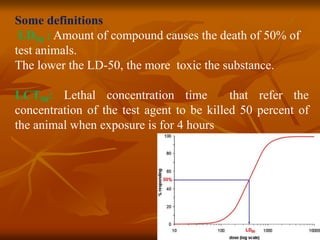
LD50 : Amount of compound causes the death of 50% of
test animals.
The lower the LD-50, the more toxic the substance.
LCT50: Lethal concentration time that refer the
concentration of the test agent to be killed 50 percent of
the animal when exposure is for 4 hours
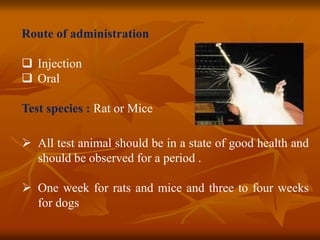
Route of administration
 Injection
 Oral
Test species : Rat or Mice
 All test animal should be in a state of good health and
should be observed for a period .
 One week for rats and mice and three to four weeks
for dogs
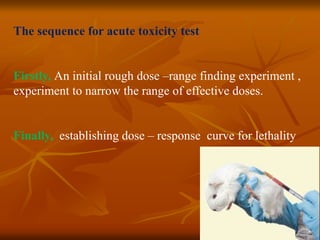
The sequence for acute toxicity test
Firstly, An initial rough dose –range finding experiment ,
experiment to narrow the range of effective doses.
Finally, establishing dose – response curve for lethality
The initial rough dose-range-finding experiment
 Based on suspected toxicity obtaining from a
knowledge of the structure of the compound .
 Only two Rats or mice are used for each dose.
 By using logarithms of the dose, a range of doses is
experimentally determined that will produce death
versus no effect or minimal effects.
 The animals are observed for a minimum of 24 hr.
 A second series of tests then is performed on the
same species using 4 animals in each test group
in an attempt to narrow the range of doses
When the data from dose-range-finding experiment
are obtained, the final experiment is performed.
No. of animal : 10 , same sex or both sexes .
Doses : Different dose to produce between 10 and 90%
mortality.
The LD50 is statistically determined
Establishing dose – response curve for lethality
 The LCT50 (lethal concentration time) is
determined.
 During the test, the duration of exposure is
always kept constant.
ACUTE TOXICITY TESTS VIA INHALATION
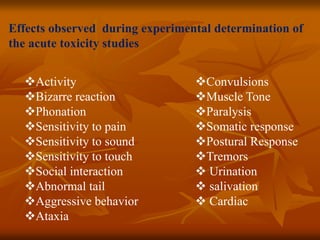
Effects observed during experimental determination of
the acute toxicity studies
Activity
Bizarre reaction
Phonation
Sensitivity to pain
Sensitivity to sound
Sensitivity to touch
Social interaction
Abnormal tail
Aggressive behavior
Ataxia
Convulsions
Muscle Tone
Paralysis
Somatic response
Postural Response
Tremors
 Urination
 salivation
 Cardiac
Though acute test the following information is found
o At the dose when no activity is observed .
o At the dose when maximum activity is observed .
o At the dose when minimum activity is observed .
o We can also determine the of action .
111135 (3)

111135 (3)

  • 2.
    The test consistof administering the compound on the one occasion Purpose  Deamination the symptomatology consequent  Determination the order of lethality of the compound ACUTE TOXICITY TESTS
  • 3.
    Some definitions LD50 :Amount of compound causes the death of 50% of test animals. The lower the LD-50, the more toxic the substance. LCT50: Lethal concentration time that refer the concentration of the test agent to be killed 50 percent of the animal when exposure is for 4 hours
  • 4.
    Route of administration Injection  Oral Test species : Rat or Mice  All test animal should be in a state of good health and should be observed for a period .  One week for rats and mice and three to four weeks for dogs
  • 5.
    The sequence foracute toxicity test Firstly, An initial rough dose –range finding experiment , experiment to narrow the range of effective doses. Finally, establishing dose – response curve for lethality
  • 6.
    The initial roughdose-range-finding experiment  Based on suspected toxicity obtaining from a knowledge of the structure of the compound .  Only two Rats or mice are used for each dose.  By using logarithms of the dose, a range of doses is experimentally determined that will produce death versus no effect or minimal effects.  The animals are observed for a minimum of 24 hr.
  • 7.
     A secondseries of tests then is performed on the same species using 4 animals in each test group in an attempt to narrow the range of doses When the data from dose-range-finding experiment are obtained, the final experiment is performed.
  • 8.
    No. of animal: 10 , same sex or both sexes . Doses : Different dose to produce between 10 and 90% mortality. The LD50 is statistically determined Establishing dose – response curve for lethality
  • 9.
     The LCT50(lethal concentration time) is determined.  During the test, the duration of exposure is always kept constant. ACUTE TOXICITY TESTS VIA INHALATION
  • 10.
    Effects observed duringexperimental determination of the acute toxicity studies Activity Bizarre reaction Phonation Sensitivity to pain Sensitivity to sound Sensitivity to touch Social interaction Abnormal tail Aggressive behavior Ataxia Convulsions Muscle Tone Paralysis Somatic response Postural Response Tremors  Urination  salivation  Cardiac
  • 11.
    Though acute testthe following information is found o At the dose when no activity is observed . o At the dose when maximum activity is observed . o At the dose when minimum activity is observed . o We can also determine the of action .