POVERTY AND THE
ENVIRONMENT:
WHAT THE POOR SAY
An Assessment of
Poverty-Environment Linkages
in Participatory Poverty
Assessments
Mary Ann Brocklesby
Emily Hinshelwood
Centre for Development Studies
University of Wales Swansea
SWANSEA SA2 8PP
The views expressed in this document
do not necessarily reflect official DFID policies.
EXECUTIVE SUMMARY iii
1.0. INTRODUCTION 1
1.1 PPAs and the Environment – Some Caveats 1
2.0 CONCEPTUALISING ENVIRONMENT - POVERTY LINKS 3
2.1. Dispelling the Myths around Poverty and Environment. 5
3.0. POVERTY AND ENVIRONMENT: KEY MESSAGES FROM THE POOR 6
3.1. Characteristics of well-being and ill-being in relation to the environment 7
3.2. Environmental Trends 9
3.2.1 Seasonal Trends 11
3.3. Livelihood Management Activities 12
3.3.1 Food security 14
3.3.2 Productive Assets and Livelihood Diversification 15
3.3.3 Time management 19
3.3.4 Physical Space and Environmental Health 20
3.4 Institutional influences 22
3.5 Shocks and Stresses Related to Poverty and the Environment 28
3.6 Overview of key messages from the poor 29
4.0 LESSONS FOR FUTURE PPAS 32
4.1 Identifying Gaps and Partial Analysis 32
4.1.1. Definition of Environment 33
4.1.2 Selection of Research Sites. 34
4.1.3. Spatial Dimension of Environment. 34
4.1.4. Socially Differentiated Interactions with the Environment. 34
4.1.5. The Bigger Environmental Picture. 35
4.1.6. Urban Environment 36
4.1.7 Livelihood Tasks 36
4.1.8. Environmental Health. 36
4.2 Recommendations 37
ANNEXE ONE: PPA DOCUMENTS CONSULTED AND OTHER REFERENCES 42
ANNEXE TWO: MATRIX OF ISSUES 46
TEXT BOXES
Box 1 Voices of the Poor 10
Box 2 Deforestation – Whose Problem is it? (case study from Tanzania) 11
Box 3 Terms as Used in this Report 12
Box 4 Common Myths and Misconceptions about Poverty and the Environment 13
Box 5 Examples of Long-term Environmental Trends 18
Box 6 Those Who Control Resources Control Lives 28
Box 7 Conflict, the Environment and Rights 31
TABLES
Table 1 Summary Characteristics of Ill-being/Well-being in Relation to the Environment 17
FIGURES
Figure 1 Flow Analysis from Marumofuse, South Africa 20
DFID 2001
CONTENTS
Participatory Poverty Assessments (PPA) seek to
understand poverty from the standpoint of poor people
themselves and include their voice in decision-making
processes that affect them. PPA studies have led to a
deeper and broader understanding of poverty. They have
helped to reveal the capacity of poor people themselves
to provide sophisticated insights into their own
predicaments and to point to solutions. To date however,
the key findings of the PPAs with respect to the
environment have not been summarised. This report is
intended to fill that gap.
This report presents the findings from a review of 23
PPAs covering 14 countries in Asia, Africa, Latin
America and Europe. Where possible these were
supplemented with other major qualitative studies in
key DFID partner countries. The objective of the review
was twofold:
• to document the main findings and key messages
from PPAs and complementary studies and,
• to provide guidance on how poverty/environment
links can be made more explicit in future PPAs.
Gaining a full understanding of poverty-environment
links from the perspective of the poor was not a
straightforward exercise. This was because the structure
and methodology of the PPAs were not intended to
support a detailed understanding of these links.
Furthermore, poor people’s perceptions of their
‘environment’ (a concept, like poverty, that is dynamic,
multi-faceted and locally specific) were not questioned.
This undoubtedly led to different working assumptions
about values, meanings and understandings of the local
environmental context. Nevertheless a review of a
range of PPAs can provide signposts or guidance about
what areas should be examined in future policy-
orientated studies. Three distinct aspects were addressed
in the review:
• the messages of the poor;
• what the PPAs leave out and,
• areas where environmental causes and effects are
alluded to, but not elaborated upon.
Overview Of The Key Messages
Poor people’s livelihood strategies are intricately tied to
their environmental context. While these links are
location-specific, participants referred to processes and
trends that influenced their interaction with their
environment and affected their well-being. These were
not only biophysical changes in their surroundings, but
social and political processes as well. It was made clear
that this relationship between poverty and the
environment is a complex one, often expressed
indirectly.
In brief, well-being was related to the environment in
terms of health, security, hygienic physical
surroundings; safe and clean energy supplies; decent
low density housing on hazard-free ground; access to
and control over resources particularly regarding food
security and agricultural production. While there were
differences in urban and rural characteristics, the
poverty-environment links were less distinct than is
sometimes suggested.
Poor people demonstrated that the environment was a
crucial ‘card’ in the balance of livelihood management.
Although just one element in a complex livelihood
strategy, if environmental resources were threatened,
damaged or withdrawn, it had substantial impact on
poor people’s well-being. Some poverty-environment
links were straightforward to dissect. However, more
complex poverty-environment links were knitted into
PPAs, which showed how a change in access to
environmental resources can trigger a series of
livelihood problems. The way poor people were able to
use, maintain and control their environmental resources
and services influenced their well-being. The PPAs
demonstrated that three main factors determined how
well they could do this:
Local environmental context:
Across the breadth of PPAs, rural and urban poor people
talked of living in increasingly fragile biophysical
contexts. Natural hazards, changing climatic conditions,
and unpredictable seasons were common. Equally
DFID 1 2001
EXECUTIVE SUMMARY
important though were references to pollution,
deforestation, soil exhaustion, and other trends resulting
from intervention. On the one hand, the impact of these
environmental changes were felt in terms of decreasing
access to natural resources making livelihood
management more difficult. On the other hand, disasters
such as flooding, fire, chemical pollution were
characterised as situations that could suddenly push a
person into extreme poverty.
The poor, in relying on natural resources more heavily,
felt themselves to be more vulnerable to environmental
change. Particularly stressed was the gradual loss of
access to stable environmental contexts. This, it was
apparent, made people increasingly vulnerable as
livelihood tasks became more time-consuming, more
dangerous, more costly and often requiring more inputs.
As a consequence, poor people talked of having to take
unfavourable decisions and greater risks in order to
balance the range of livelihood tasks. Levels of poverty
were characterised by ever increasing dependence on
Common Property Resources (CPRs) and a common
concern was that despite poor people’s knowledge of
seasonal conditions, their ability to prepare themselves
for the consequences were limited by their poverty.
Poor people were keenly aware of the effects of poor
environmental health on their ability to move out of
poverty. Unsanitary conditions and a poor working
environment were identified as contributors to poor
health. Chronic livelihood insecurity was raised as a
critical factor in forcing poor people to work in
environmentally dangerous jobs. In urban areas in
particular, pollution of water sources, flooding of
housing, lack of drainage and stagnation of water and
lack of sanitation facilities were all raised as both causes
and consequences of poverty.
How environmental shocks and stresses are experienced
by poor people is linked to the ways in which they deal
with environmental change and develop their
management strategies. The PPAs demonstrated the
commitment of poor people to adapt to their changing
surroundings in order to maintain their livelihood
strategies. But other factors play a key part in
determining how well people can use, maintain and
control their environmental resources.
Political and institutional context
Throughout the PPAs the poor recognised that
institutional structures and processes from micro level
up to macro level were important influencing factors in
how they were able to control, manage and access
environmental resources. They were under no illusions
about how power and their lack of it both underpinned
well-being and shaped their relationship to the
environment.
Several aspects were of particular concern. Firstly, the
lack of accountability of government services and the
ways in which government cutbacks in service provision
had served to undermine access to information, goods
and services regarding the environmental context. For
the poor, their continual marginalisation restricted their
access to information and public officials and
consequently they had less understanding of how to
make use of available goods and services.
Secondly, it was felt in several PPAs that markets were
actively biased against the poor and that the allocation
of permits for commercial exploitation of natural
resources such as logging or fishing were inherently
biased towards the wealthy. This, it was felt, not only
skewed local markets but also had long term impacts on
the local and national resource base. Governments’
priorities were considered by some to override poor
people’s reliance on CPRs, and to threaten poor people’s
urban and rural security. Planning procedures and
processes of consultation were raised as major causes
for concern.
Thirdly, the point was raised in a number of PPAs that
the institutional context influences the extent to which
poor people can mitigate against and recover from
disaster. The poorest were often excluded from benefits.
It was argued that strong social networks and
community co-operation were the best way of
DFID 2 2001
EXECUTIVE SUMMARY
improving livelihoods, and yet the breakdown in social
cohesiveness because of long term entrenched poverty
was commonly cited as a key reason for the poorest and
most vulnerable being left-out.
Social differentiation
Throughout the PPAs it was apparent that social
differences were clear mediating factors in people’s
interaction with their environment. This was particularly
apparent in terms of gender relations, but clear
references were made to age, caste, ethnicity and social
status. Given the specific remit of the PPAs to address
gender relations, it is unclear to what extent other social
differentiation influenced environmental entitlements.
Gender differences surfaced particularly in relation to
access and control over resources. The use of and
reliance on CPR for survival was predominantly a
female option, partly as a result of land tenure
arrangements. The insecurity of collecting CPR and the
declining resources therefore disproportionately
affected women. Not only did they have less time for
other production and domestic activities, they also
faced greater risk and ill health. The same applied to
other very poor community members, for example
‘untouchables’ in Nepal or ethnic minority groups in
Bangladesh.
It was also stressed that seasonal changes affected
different people in different ways. A long dry season in
Sub Saharan Africa, for example, disproportionately
affected women who reported the huge time burdens
required for household fuel and water collection.
Furthermore, as a result of environmental changes,
children were increasingly involved in household tasks,
often removing them from school for the purpose. This
disproportionately affected girls, but boys also suffered.
Coping strategies also had consequences for certain
household members. For example, reducing food
consumption and substituting less nutritional food for
women and often children was a way of dealing with
food shortage in many areas. In many PPAs, women
stressed that in managing an increasingly complex set of
livelihood activities they were forced into particular risk
of ill-health and assault.
Lack of power and status of certain groups was
attributed by many to be a contributory factor in their
limited access to environmental resources. In a number
of PPAs, women-headed households, for example,
reported that their status made it difficult to get credit.
This in turn made it difficult to buy agricultural inputs
(seeds, fertilisers etc.) leading to chronic food insecurity.
Minority groups, refugees, and migrants were
consistently characterised as having no voice, due to
their lack of representation and political networks,
isolation and exclusion. This served to undermine their
access to environmental goods and services.
The examination of PPAs demonstrated the resilience
and resourcefulness of poor people. The way poor
people adapt to their changing environment and the
institutional arrangements that influence their ability to
manage this change is clearly significant in their ability
to maintain their livelihoods. Poor people utilised an
array of actions ranging from adapting, mitigating and
coping strategies. The type of strategy adopted depends
on a range of factors - environmental, social, political.
Moreover the range of strategies employed are balanced
one against another within a given circumstance.
In all PPAs poor people had an awareness of the
importance in protecting, and managing their
environment whether it be specifically the natural
resource base (mainly rural areas) or their physical
environment (often but not exclusively urban areas).
However, running throughout the PPAs was a common
acknowledgement of the gradual decline in the ability of
poor men and women to control and manage the
natural resource base.
In the course of the review, a number of omissions were
noted with regard to the environment in the collection,
analysis and reporting of the data. In many reports,
allusions were made to poverty-environment links
without demonstrating the full cause and effect. The
DFID 3 2001
EXECUTIVE SUMMARY
nature of the indirect linkages between poverty and
environment meant that the analysis was often obscured
or could not be verified with evidence from poor
people.
Key gaps identified
• Definition of environment: the term environment
was not always subject to the same rigour as the
term poverty. Consequently, the limited
contextual analysis of the environment restricted
a fuller understanding of the local poverty-
environment linkages.
• Local perceptions of environment: Poor people’s
perceptions of the environment were rarely
questioned. Without understanding local
perceptions it is hard to avoid making
assumptions about local poverty-environment
links based on external - for example,
conservationist or government - discourses.
• Selection of research sites: Not all PPAs selected
research sites incorporating ecological indicators
into their criteria. This meant that comparisons
could not necessarily be carried out between
poor people’s livelihoods in different
environmental conditions.
• Spatial dimension of environment: The spatial
dimension of environment and its link to poverty
was often alluded to but rarely developed. Most
reports recognised a macro spatial dimension to
the occurrence of poverty but very few looked at
meso or micro level spatial dimensions of
poverty.
• Socially differentiated interactions with the
environment: Socially differentiated perceptions
and values about the environment and the role if
any it played in the understanding of poverty was
the exception rather than the norm.
• The bigger environmental picture: Macro level
issues: In the majority of PPAs there was an
absence of contextual analysis with regard to
environment issues. Issues emerged sporadically
and were not necessarily followed through.
• Policies, institutions, and processes: In very few
PPAs were policies, institutions and processes
examined in relation to environmental goods and
services beyond extension services.
• Historical context: This was discussed to some
extent, but what was missing was the
development of an historical trajectory defined
and shaped by local people themselves.
• Urban environment: There appeared to be an
assumption that environment equals natural
resources and consequently this was primarily a
rural issue. The concept of environment is
multidimensional and natural resources can and
do play a role in urban livelihoods. More
attention could also be paid to health,
environmental aspects of social safety nets, and
spatial impacts on urban poverty.
• Livelihood tasks: Livelihood analysis was
rudimentary. The ways in which people interact
with their environment - on an everyday basis as
well as during periods of crisis - goes a long way
towards establishing an understanding of poverty
and environment linkages.
• Environmental health: Little attention was paid to
environmental health, work place issues and
domestic health and safety in either urban or rural
areas aside from sanitation.
• Biodiversity: Where issues relating to biodiversity
where raised, the opportunity to explore the
wider implications were rarely taken up.
Recommendations
1. Define a clear framework through
which to examine poverty-environment
linkages
In order to undertake an examination of the range and
type of issues identified in the foregoing review, the
‘environment’ needs to be fully integrated into PPA
design and methodology. By establishing a clear
framework poverty-environment links can be addressed
DFID 4 2001
EXECUTIVE SUMMARY
strategically through ensuring that the issues are picked
up at the design stage, during fieldwork and in the
analyses of data. In particular, the following points are
highlighted:
PPA design
As has been demonstrated in several of the PPAs, a
thorough analysis can be made given the use of
appropriate methodology and approach. Lessons learnt
suggest that integration of poverty-environment links
into the PPA will need to take into consideration:
• Timing of data collection: Seasonal changes have
a clear impact on poverty and it is recommended
that data be collected over a range of seasons.
Where this is not possible, systematically drawing
on existing data and triangulating information
with follow-up participatory methods is essential.
• Site selection and sampling: Criteria for site
selection will need to incorporate environmental
concerns for example: ecological contexts; areas
prone to natural disasters; areas of environmental
degradation. Different options will need to be
explored and will vary from country to country.
However, given the desirability of maximising
analytical links between survey results and
integrated PPA poverty/environment themes and
findings, this will be a critical consideration.
• Research teams: Inclusion of social and
biological scientists with a environmental/natural
resource background will strengthen both design
and implementation
• Literature review: Prior to research, a review of
current environmental literature ought to inform
the team regarding poverty-environment debates
as well as the regional environmental context.
• Methods: Methods selected will need to have the
capacity to explore a range of issues regarding the
environment. This will require an iterative process
at the design stage and where appropriate, the
commissioning of background overview papers
aimed at providing the country specific context of
poverty-environment linkages.
PPA implementation/fieldwork
• Capacity of field teams: Some of the gaps
identified appear to be attributed to the limited
capacity of field workers to probe effectively the
social, political and cultural influences on poor
people’s interactions with their environment. In
particular, there appears to be a need to develop
the capacity of field researchers to follow through
issues as they emerge in order to a) comprehend
fully the knock on effects of changes in the
environment and livelihood management
strategies and b) build up a comprehensive
picture of how poor people interact with the
space around them. Strengthening their capacity
is obviously a process and includes: making time
in implementation workshops to discuss linkages
and research approaches; field supervision
picking up on environment issues or gaps and a
review process designed to pick up on their
inputs.
• Support and external inputs: Good practice
lessons from Uganda, South Africa and Vietnam
suggest that:
• Provision of modest technical assistance
inputs at key stages in the PPA can have a
powerful influence on strengthening attention
to poverty-environment linkages.
• Building of linkages and dialogue with
environment-focused stakeholders in the
private sector, across ministries and civil
society especially specialist research
institutions (e.g. energy private
sectors/research institutes in countries where
declining fuelwood supplies is recognised as a
problem), will increase research-policy
linkages and broaden ownership of results.
This will be particularly important in
integrating environment into poverty
reduction strategies.
• Some issues identified at field level will be
DFID 5 2001
EXECUTIVE SUMMARY
better addressed through the commissioning
of supplementary studies as an addition or
amendment to the main PPA. For example the
impacts of agricultural modernisation or
clarification of property rights/tenure
arrangements in rural, peri-urban and urban
areas.
• It is critical to the overall focus of the PPA to
strengthen the review process in relation to
poverty and environment linkages. The
already well-established review process in the
Pakistan PPA for example offers opportunities
for enhancing attention given to integrating an
environmental focus without placing undue
strain on resources/capacity.
2. Incorporate an understanding of the
poverty-environment context
As demonstrated in the review, the context -
environmental, political and social - are key factors in
influencing poor people’s relationship with their
environment. An examination of these factors is crucial
in an analysis of poverty-environment links. Of
particular interest:
• Greater attention given to defining
‘environment’: In the same way that poverty is
unravelled in PPAs, local definitions of
environment also need to be addressed in order
to facilitate a fuller understanding of the
complexities underpinning poverty-environment
linkages. Breaking down people’s perceptions of
the environment at a local level and how their
perceptions change over time support a process
of understanding poverty-environment linkages.
However, given the plethora of meanings
surrounding the term environment and the
consequent preconceptions about the links
between poverty and environment, it is
recommended that greater rigour be given to:
• Clarifying terminology among researchers
prior to the start of the research process. In
this way assumptions/preconceptions can be
made overt and methodologies developed
with clarify rather than obscure local
perspectives.
• It will also be useful to develop theme areas
aimed at unravelling socially differentiated
local definitions of environment. This in turn
feeds into understanding local perceptions,
values and terms for the environment.
• Examine socially differentiated values and uses
of the environment: The impact of socio-political
influences on the way poor people are able to
interact with their environment is a key issue to
be incorporated into an analysis of poverty-
environment links. This requires rigorous analysis
because in effect these influences blur the links
between poverty and environment. While the
issue of gender relations was addressed to varying
degrees in all PPAs, other social divisions were
less rigorously analysed. Different social groups
(e.g. caste, ethnicity, age etc) need to be analysed
in terms of their:
• knowledge of, access to and control over
resources including property rights;
• livelihood strategies and division of labour
within their environment;
• understanding of environmental legislation
and its impact on them;
• perceived threats to and opportunities from
their environment and,
• impacts of environmental change on their
livelihoods
• Facilitate an examination of the broader context:
A clearer examination of institutional influences
on environmental goods and services, and local
institutional responses to resource changes (e.g.
DFID 6 2001
EXECUTIVE SUMMARY
tracking these over time) would support a more
detailed understanding of poverty-environment
links. Examining the broader context helps to
identify the social actors and interfaces that cause
the main pressures on local environmental
resources. An analysis aimed at examining how
macro-policy relates to change in local
livelihoods and environments requires overt
attention to:
• Government policies, legislation and their
implementation with regards to
environmental issues from the perspective of
poor people. For example, the establishment
of conservation areas, or issuing of fishing
permits.
• Institutions and customs and their impact on
people’s access to environmental goods and
services.
• Historical context and its influence on current
livelihood sustainability.
• Examine the urban and peri-urban environment:
The importance of the environment on the urban
poor emerged as an important but relatively
unexplored issue. Examples referred to in the
PPAs were the physical space in which they live,
the scarcity of environmental resources on which
they rely (e.g. fuelwood and water), dependence
on scraps of land for urban agriculture and the
impact of climate on livelihoods. These issues
were discussed to a greater or lesser degree in the
PPAs, some not touching on urban environment
at all. In future PPAs the design, survey
implementation and review process will all need
to integrate and differentiate systematically urban
and peri-urban perspectives in relation to the
environment.
• Incorporate a fuller analysis of livelihood
management activities: It is recommended that
future PPAs address how people interact with
their environment and what their practices are.
There will be a difference between everyday
practices and those they adopt during periods of
crisis – shocks and stresses. In particular key areas
of interest include:
• How they use and interact with the
environment, including natural resources;
• The constraints they face in ensuring a stable
livelihood and,
• How they adapt across seasons and cope with
environmental change.
3. Develop a handbook to ensure adequate
treatment of environmental issues in
PPAs
It is suggested that a separate handbook be produced
that could summarise the main poverty-environment
issues and provide guidance for integrating them into
the design and implementation of PPAs. In particular, it
is suggested that the handbook would:
• Relate closely to the PPA protocol, dividing
guidance into sections appropriate to design,
implementation and analysis.
• Identify key poverty-environment themes, and
suggest approaches to integrating these themes
into the existing PPA approach.
• Identify questions appropriate to an
understanding of poverty-environment links, for
example:
• Do different sorts of poor people degrade or
improve various components of the
environment to different degrees?
• Do particular environmental shocks and
stresses impose different kinds of costs or
different levels of cost on different sorts of
poor people?
DFID 7 2001
EXECUTIVE SUMMARY
• In what ways do formal and informal
institutions influence the relationship of poor
people to environmental goods and services?
• To what extent do poor people draw on
environmental goods and services in order to
maintain their livelihood security?
• Suggest appropriate participatory methods for the
examination of suggested themes.
• Incorporate a matrix to aid the analysis of PPAs
from an environmental perspective.
In conclusion, the findings of this review make clear that
the relationship between poverty and the environment is
rarely simple or direct. An observation well-understood
by poor people when given the opportunity to engage in
analysis. In particular, understanding the local social,
cultural and political context of environmental issues is
essential. Moreover, explicit recognition of the diverse
factors shaping people-environment relations is
paramount if the messages of the poor are to be heard,
understood and incorporated into policy formulation.
DFID 8 2001
EXECUTIVE SUMMARY
Since the 1990s, attention has increasingly focused on
seeking a deeper understanding of the causes and
consequences of poverty and providing policy solutions
which will break the cycle of persistent poverty. An
important innovation has been the development of
participatory approaches to poverty analysis and policy
formulation and in particular the emergence of
Participatory Poverty Assessments (PPA).
PPAs seek to understand poverty from the standpoint of
poor people themselves and include their voice in
decision-making processes that affect them. PPA studies
have led to a deeper and broader understanding of
poverty. They have helped to reveal the capacity of poor
people themselves to provide sophisticated insights into
their own predicaments and to point to solutions
(Brocklesby and Holland, 1998). To date, however, the
key findings of the PPAs with respect to the environment
have not been summarised. This report is intended to fill
that gap.
We present here the findings from a review of 23
Participatory Poverty Assessments covering 14 countries
in Asia, Africa, Latin America and Europe1
. The PPAs
under review were selected as representative of the
Department of International Development’s (DFID) key
partner countries. The majority of the reports were
country synthesis reports from the World Bank Voices of
the Poor PPAs carried out to inform the 2000/2001
World Development Report. Where possible these were
supplemented with other major qualitative studies in
Key DFID partner countries. (See Annexe 1 for full list).
The objective of the review was twofold:
• to document the main findings and key messages
from PPAs and complementary studies and,
• to provide guidance on how poverty/environment
links can be made more explicit in future PPAs.
1.1 PPAs and the Environment – Some
Caveats
Despite the increasing awareness of the inter-relatedness
between poverty and the environment, gaining a full
understanding of these links from the perspective of the
poor has not been an altogether straightforward
exercise. This is, to be fair, because it was not the main
remit of the PPAs to be examining environmental issues.
Specifically,
• the structure and methodology of the PPAs were
not intended to support a detailed understanding
of the links between poverty and environment
and,
• poor people’s perceptions of their ‘environment’
were not questioned, undoubtedly leading to
different working assumptions about locally-
specific values, meanings and understandings of
the environmental context.
This raises a number of concerns. Firstly, it creates
problems of validity in a review of this kind. The Voices
of the Poor reports adopted common categories of
analysis across populations and regions in order to
aggregate findings (see Box 1).
Box 1: Voices of the Poor
The second generation PPAs, carried out for the World
Development Report 2000/2001, sought to provide a
comparative analysis of the realities of poverty in 23
different countries. The key aspects studied were:
• Exploring well-being and ill-being
• Problems and priorities of the poor
• Institutional analysis
• Gender relations
Since the environment was not a chosen theme, the
ways in which the topic was explored varied
DFID 9 2001
1 PPAs reviewed were: Bangladesh, Brazil, Ghana, India, Kenya, Malawi, Nepal, Nigeria, Russia, South Africa, Tanzania, Uganda, Vietnam and
Zambia.
1. INTRODUCTION
enormously between countries and between research
sites in the same country. Three other studies reviewed
from Uganda, Nepal and Vietnam, which were not part
of Voices of the Poor, addressed linkages between the
poverty and environment both in site selection and in
the methodology adopted. One must therefore be
cautious when comparing the thematic emphasis of one
study with another, which had a different focus or
adopted broader entry points.
Secondly, it is worth reiterating an accepted caveat with
regard to PPAs. Conclusions drawn from PPAs provided
indicative ideas about what might or might not be
important to different groups of local people. In the
context of an analysis of poverty-environment linkages,
a review of a range of PPAs can provide signposts or
guidance about what areas should be examined in
future policy-orientated studies. This means that we
need to analyse three distinct aspects:
• the messages of the poor;
• what the PPAs leave out and,
• areas where environmental causes and effects are
alluded to, but not elaborated upon.
We return to this issue in section four of the report.
Thirdly, in the Voices of the Poor reports in particular,
there were a number of discrepancies between the
opinions of the poor and the interpretation of the
researchers. We would suggest two possible reasons for
this. In part it reflects the relative lack of importance
assigned to environment issues in the Voices of the Poor
methodology. Researchers were provided with
guidelines, question prompts and suggested tools for
exploring the selected themes but not for other topics
that may have emerged. Combined with the relatively
short timeframe for researchers this, by default,
weakened the methodological rigour when applied to
the environment. Where opportunities arose to explore
and probe environmental issues with the poor they were
not always taken. One example is declining soil fertility
– a concern raised in the majority of rural areas in the
PPAs under review. In some PPAs the issue was reported
with an overview interpretation of the causal factors
based on the researcher’s own general understanding of
the issue. The data did not always support the view and
could be contradictory, as was the case of the Malawi
PPA.
Allied to this was the fact that the majority of research
teams had not developed an overt framework for
conceptualising and analysing poverty-environment
linkages and thus made assumptions about what was or
was not important for the poor in their region. The case
study below clearly illustrates this point (Box 2).
Given these caveats, it is necessary to clarify both the
conceptual framework being used in this review and the
definitions of key environmental terms being employed
here.
DFID 10 2001
1. INTRODUCTION
DFID 11 2001
1. INTRODUCTION
Box 2: Deforestation - Whose Problem is it? (case study from Tanzania)
Businda subvillage, Bukombe District was one of the eight research sites of the Shinyanga Participatory Poverty
Assessment in Tanzania. Located in the north west of the country it is an area vastly forested and rich in natural
resources. The report of findings was meant to give a broad picture about “the life of people in Businda” according to
their own perception and understanding. The report achieved this objective to a great extent perhaps with one
exception: that related to its analysis of environmental trends and specifically with its assessment of deforestation in
Businda. In the Businda PPA deforestation was presented as a major problem requiring government intervention.
An assessment of the raw data and the process of data collection by one of the researchers reveal that the report’s
concern with deforestation in the district does not tally with the opinions of the Businda villagers. The issue of
deforestation is only raised twice: once by bee keepers complaining of the distance they now need to travel to site their
hives and once from women who raised the difficulties of collecting fuelwood around the homestead. Neither of these
issues was probed further although cross-referencing of data suggests that in the case of fuel wood collection denial of
access and control were significant aspects of their concern.
Source: Yashine-Arroyo: 1998
The Earth Summit also launched Agenda 21, a global
action plan based on the principles of sustainable
development and the integration of economic, social
and environmental objectives. It places particular
emphasis on the importance of participation, and action
plans based on local priorities and local involvement.
The sustainable development agenda has progressed
substantially since the 1980s and current approaches to
development, such as the Sustainable Livelihoods
Approach, are underpinned by an acknowledgement of
the complex relationship between environment and
development.
Box 3: Terms as Used in This Report
Biodiversity: The variability among living organisms from all sources; terrestrial, marine and other aquatic ecosystems
of which they are part. This includes diversity within species, between species and of ecosystems. It includes cultivated
species and varieties and agricultural ecosystems as well as natural ecosystems and their components.
Biophysical Environment: The natural environment including both living and non-living organisms and the interactions
among them. Social, cultural and political factors are not considered in biophysical analysis.
Entitlement: A bundle of commodities over which a person can establish command. Environmental entitlements: sets
of benefits derived from the environment over which people have legitimate effective command and which are
instrumental in achieving well-being.
Environment: the condition or influence under which any person or thing lives or is developed.
Environmental services: services pertaining to natural resources and physical environment (eg. agricultural extension
services, urban slum sanitation project).
Physical environment: the constructed or built surroundings in which a person lives.
Resource: a stock or reserve upon which one can draw when necessary.
Natural resource: a resource occurring naturally within the environment.
DFID 12 2001
2. CONCEPTUALISING POVERTY - ENVIRONMENT LINKS
One of the key achievements of the United Nations
Earth Summit in 1992 was the international recognition
that global poverty and environmental concerns are
closely linked, and cannot be tackled in isolation. In
particular, the Conference highlighted the impact of
lifestyles in developed countries on both the
environment and people’s livelihoods in the rest of the
world. These principles are widely reflected in
subsequent policies and action plans world-wide.
2.0 Conceptualising Poverty - Environment
Links
The concept of sustainable development emerged onto
the world agenda via the World Commission on
Environment and Development, whose report came out
in 1987. Essentially, it set in process an examination of
the links between environment and development and
was pivotal in that it considered social issues to be
central to the effective management of the environment.
Until then, the ‘standard environmental agenda’ was
concerned primarily with biophysical processes and
conservation and protection of natural resources.
Examination of this complex relationship is by no means
simple. A task made more difficult by the fact that
different disciplines understand the ‘environment’
according to their own speciality, thus generating a
range of paradigms that can create a plethora of
concepts manifest in a confusion of terminology. In
addressing the links between poverty and environment,
a clear understanding of the language used is vital (See
Box 3).
Even with clarification of terminology, the term
‘environment’ remains an abstract concept, drawn into
different debates to plug a language gap. In fact the
‘environment’ means different things to different people
in different places. Moreover, there is a distinction that
must be made between popular conceptions of
environment which may be informed by local context-
specific social, political and cultural frames of reference
and the range of meanings employed by experts from
different disciplinary backgrounds.
Thinking through the implications of these multi-layered
meanings leads to the recognition that environment as a
concept, like poverty, is dynamic, multi-faceted and
locally specific. This point takes us back to addressing
the effectiveness of PPAs in contributing to an
understanding of the links between poverty and
environment. But as Markandya and Galarraga (1999)
note “it is important to recognise the paucity of
information on the linkages between poverty and
environmental policies” and how this limits policy
formulation. As a policy tool, PPAs ought to be
developed in such a way as to enable a clear analysis of
poverty-environment links. Nevertheless, some of the
received wisdom concerning these linkages often serves
as a barrier to analytical rigour.
2.1 Dispelling the Myths around Poverty and
Environment
Ideas and theories about the linkages between poverty
and the environment have been around for many years.
A range of myths have developed (see Box 4) which
form something of a ‘conventional narrative’ around the
relationship between poor people and their
environment. These myths are being increasingly
challenged as a greater understanding is developing
about poor people’s livelihoods and complex links are
being unravelled. The simplistic approach of viewing
poverty and environmental degradation as a mutually
enforcing downward cycle - fuelled by population
explosion - has given way to an argument for examining
a range of issues that help to build up a fuller picture of
the reality of poverty-environment links. Nonetheless
these myths remain pervasive both in policy and
research arenas.
Box 4: Common Myths and Misconceptions
about Poverty and Environment
1. Poverty and population growth cause environmental
degradation
2. Equity, participation, and environmental
sustainability go hand in hand
3. Nature seeks balance
4. High-input farming is the only way to avoid a global
food crisis
5. Urbanisation and urban consumption are the biggest
environmental threat2
6. Poverty eradication first before environmental
improvement
7. Poor people are too poor to invest in the
environment3
Numerous recent studies focus on a range of issues to
examine the poverty-environment relationship4
, these
include: health, natural resources, environmental
degradation and its impact on livelihoods,
environmental policy, conservation, agriculture,
gendered division of labour with regards environmental
management, property rights and institutional
arrangements, social capital and its influence on natural
capital, migration and disasters.
Key issues that have emerged from the current body of
knowledge are:
• That poor people are disproportionately affected
by living in a degraded environment.
• That actions taken by different groups of
stakeholders have a much wider impact than that
DFID 13 2001
2 1-5 Taken from Neefjes K. ‘Environment and Livelihoods. strategies for sustainability’ Oxfam
3 6-7 Taken from ‘Achieving Sustainability. Poverty elimination and the environment’. DFID 2000
4 See for example: Leach and Mearns; 1996; Joekes et al, 1996; Forsyth et al 1998; Koziell 2000; Gordon et al 2001.
2. CONCEPTUALISING POVERTY - ENVIRONMENT LINKS
in the immediate locality e.g. run off from
pesticides and fertilisers in the water supply in
rural areas presents health problems for
downstream urban populations.
• That the relationship between poverty and
environment is mediated by institutional, socio-
economic factors.
DFID 14 2001
2. CONCEPTUALISING POVERTY - ENVIRONMENT LINKS
This section details issues identified by poor people. It
aims to identify trends, commonalities, and differences
to show both the complexity of the issues as well as the
diversity of contexts.
The current conceptual framework utilised by DFID in
analysing the links between poverty and environment
addresses issues under the headings:
• environment and health
• environment and livelihoods
• environment and vulnerability
While these headings provide an overview of the
linkages between environmental and poverty issues, we
propose in this report that the framework also needs to
ensure an examination of:
• Social differentiation with respect to ownership,
use of and control over the physical environment
and natural resources.
• Distinction between rural and urban experiences.
• How distribution of power in society shapes and
determines use and maintenance of natural
resources and environmental services.
• Seasonality, inter-seasonal variation, long-term
environmental change and their social
consequences.
• Spatial understandings of environment and
related differential use of the environment
according to gender, age, occupational
specialism.
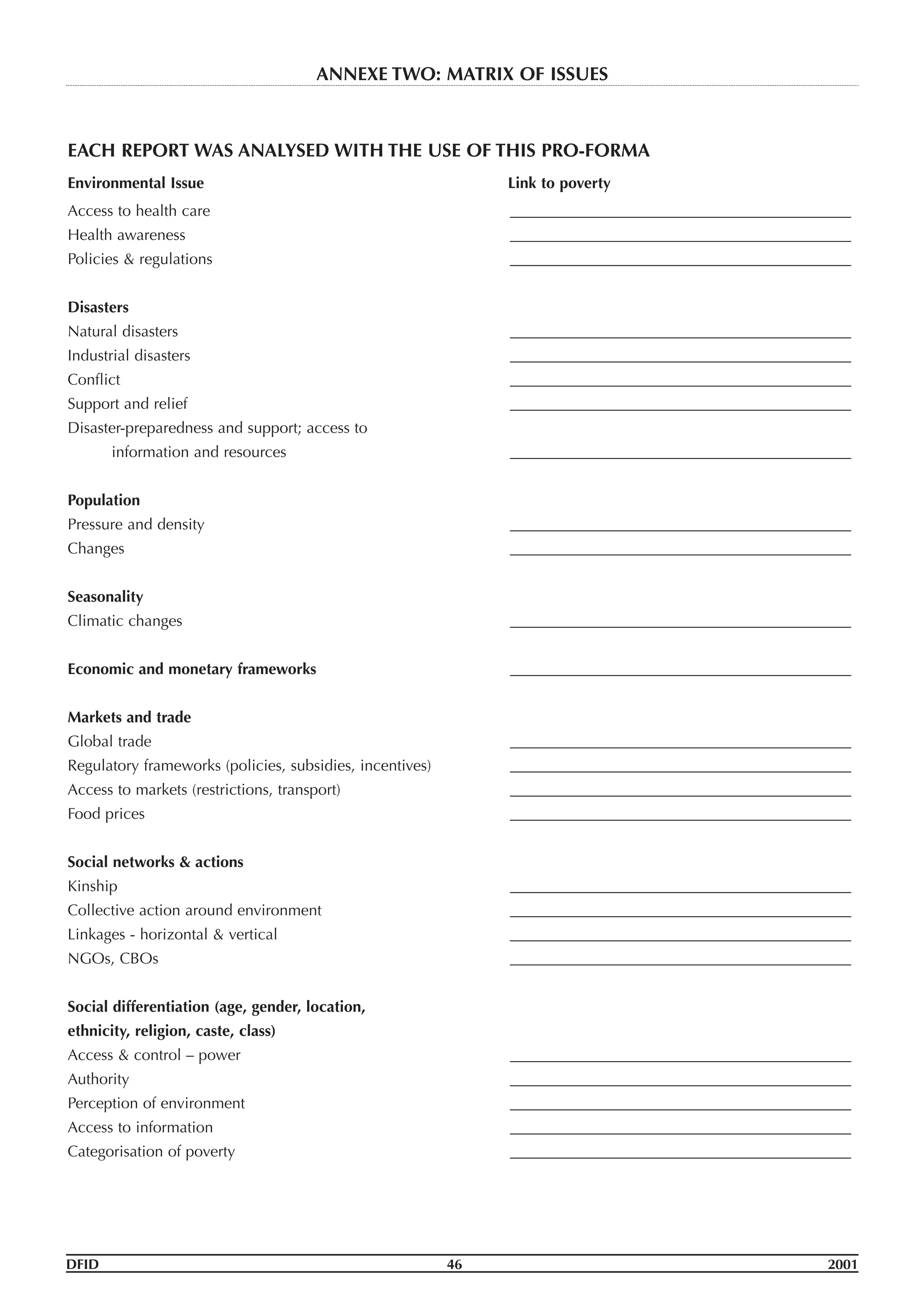
In reviewing a range of PPAs a matrix was developed,
(see Annexe 2) which would bring to the forefront the
social, political and cultural context in which the poor
interacted with their environment. It emphasised the
importance of integrating environment throughout the
analysis. By doing so, the issues of health, vulnerability
and livelihoods - substantial elements of the analysis -
were picked up and are consequently referred to
throughout the report.
The review findings are divided into five sections:
1. Characteristics of well being and ill being in relation
to the environment.
• To what extent do poor people consider their
interaction with the environment as important in
an analysis of well being?
2. Environmental Trends.
• What long-term and seasonal environmental
changes are identified by the poor as having an
impact on their lives?
3. Managing livelihood activities.
• In what ways do poor people interact with their
environment in order to maintain a stable
livelihood? What influence do environmental
trends have on their ability to maintain and
manage their livelihood activities?
4. Institutional Influences.
• How do poor people perceive formal and
informal institutions to influence their ownership
of, control over and use and maintenance of their
environment? How do they see these influences
affecting their ability to make choices that
positively contribute to well being and security?
5. Dealing with crises - environmental shocks and
stresses.
• What are the impacts of crises on poor people’s
lives? In what ways do they deal with different
crises?
DFID 15 2001
3. POVERTY AND ENVIRONMENT: KEY MESSAGES FROM THE POOR
3.1 Characteristics of Well-being and Ill-
being in Relation to the Environment
The poorest ‘cannot feed themselves, can barely feed
their children and have no assets’ (Ghana
Consultations with the Poor)
Poor people’s perceptions of well-being are an excellent
starting point for understanding the ways in which a)
poor people themselves link poverty to their
environment and b) the importance attached to
environmental issues in their lives. Throughout the PPAs
consulted, the extent to which poor people referred to
the environment when discussing well-being and ill-
being was striking. These references were clearly
location-specific, and also highlighted seasonal
characteristics of well-being. There were differences in
urban and rural characteristics, but the differences were
not as distinct as is sometimes suggested.
DFID 16 2001
3. POVERTY AND ENVIRONMENT: KEY MESSAGES FROM THE POOR
In brief, well-being was strongly related to the
environment in terms of health, security, peace of mind;
pleasant and hygienic physical surroundings; safe and
clean energy supplies appropriate to the climate and
seasons; decent low density housing free from
overcrowding and built on safe ground free from
flooding and other environmental hazards.
Unsurprisingly people in rural areas placed emphasis on
access and control over natural resources particularly in
relation to food security and agricultural production.
Participants in urban areas, on the other hand,
highlighted having sufficient financial assets so as to be
able to purchase basic needs such as water and a clean
safe environment. Gender differences surfaced
particularly in relation to access and control over
resources and domestic well-being. For example,
women, reflecting their primary role in managing the
household, highlighted safe and physically close access
to potable water and abundant energy supplies as
critical aspects of well-being in the majority of PPAs.
In discussing well-being and ill-being, poor people
highlighted seasonal fluctuations that pushed a person
into a situation of ill-being. Dry season accessibility to
water near the settlement for example was a critical
well-being indicator because of the impacts lack of
accessibility had on health, livelihood security and
peace of mind.
Interestingly poor men and women in all PPAs made
very clear links between, on the one hand, the presence
of tangible environmental assets (water, land etc.) plus
preferred living conditions such as food security or the
built environment and on the other hand their command
over more intangible social and political resources. The
latter, although understood in particular and distinct
ways in each of the PPAs were viewed as crucial to
accessing and controlling environmental entitlements.
The poor were under no illusions about how power and
their lack of it both underpinned well-being and shaped
their relationship to the environment.
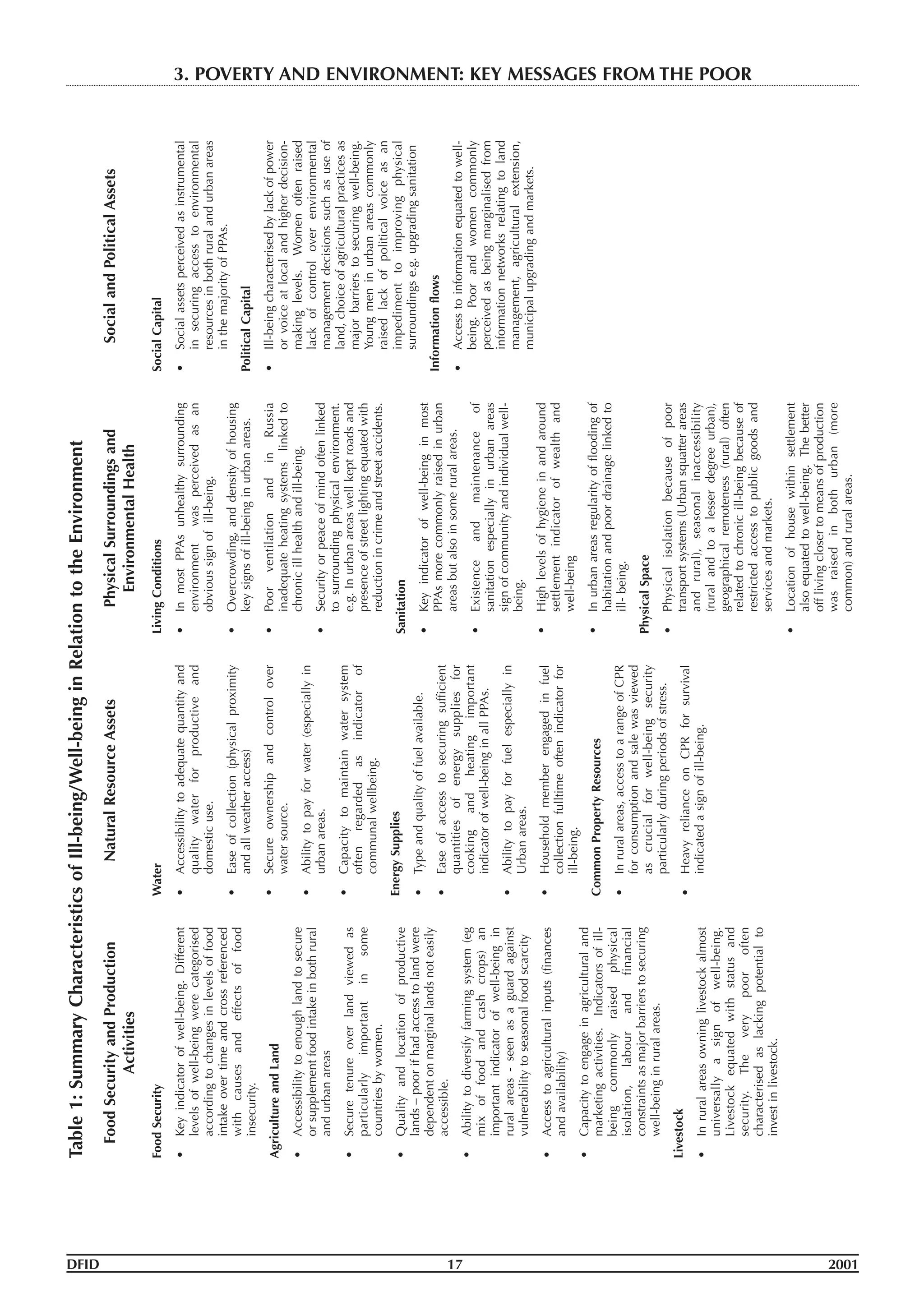
We summarise in Table 1 (overleaf) the environment
criteria that were used by poor people for consideration
of well-being and ill-being.
3.2 Environmental Trends
‘Farming is speculation on rainfall, and in years when
it doesn’t rain, there are no crops at all’
(South Africa 1998).
A range of environmental trends emerged in the PPAs as
having significant impact on poor people’s lives. These
had implications for the way they sustained their
livelihoods and managed their resources, particularly
their natural resources. These were clearly location-
specific and generalisations can not be made across the
breadth of the reports. However, it is possible to point
out that in many situations, poor people were living in
increasingly fragile biophysical contexts. Declining
conditions - e.g. salination and erosion, soil infertility,
reduced tree cover, increasing industrial pollution in
urban slum areas - were mentioned in many reports.
Particularly stressed was the gradual loss of access to
Table1:SummaryCharacteristicsofIll-being/Well-beinginRelationtotheEnvironment
FoodSecurityandProduction
Activities
NaturalResourceAssetsPhysicalSurroundingsand
EnvironmentalHealth
SocialandPoliticalAssets
DFID 17 2001
3. POVERTY AND ENVIRONMENT: KEY MESSAGES FROM THE POOR
FoodSecurity
•Keyindicatorofwell-being.Different
levelsofwell-beingwerecategorised
accordingtochangesinlevelsoffood
intakeovertimeandcrossreferenced
withcausesandeffectsoffood
insecurity.
AgricultureandLand
•Accessibilitytoenoughlandtosecure
orsupplementfoodintakeinbothrural
andurbanareas
•Securetenureoverlandviewedas
particularlyimportantinsome
countriesbywomen.
•Qualityandlocationofproductive
lands–poorifhadaccesstolandwere
dependentonmarginallandsnoteasily
accessible.
•Abilitytodiversifyfarmingsystem(eg
mixoffoodandcashcrops)an
importantindicatorofwell-beingin
ruralareas-seenasaguardagainst
vulnerabilitytoseasonalfoodscarcity
•Accesstoagriculturalinputs(finances
andavailability)
•Capacitytoengageinagriculturaland
marketingactivities.Indicatorsofill-
beingcommonlyraisedphysical
isolation,labourandfinancial
constraintsasmajorbarrierstosecuring
well-beinginruralareas.
Livestock
•Inruralareasowninglivestockalmost
universallyasignofwell-being.
Livestockequatedwithstatusand
security.Theverypooroften
characterisedaslackingpotentialto
investinlivestock.
Water
•Accessibilitytoadequatequantityand
qualitywaterforproductiveand
domesticuse.
•Easeofcollection(physicalproximity
andallweatheraccess)
•Secureownershipandcontrolover
watersource.
•Abilitytopayforwater(especiallyin
urbanareas.
•Capacitytomaintainwatersystem
oftenregardedasindicatorof
communalwellbeing.
EnergySupplies
•Typeandqualityoffuelavailable.
•Easeofaccesstosecuringsufficient
quantitiesofenergysuppliesfor
cookingandheatingimportant
indicatorofwell-beinginallPPAs.
•Abilitytopayforfuelespeciallyin
Urbanareas.
•Householdmemberengagedinfuel
collectionfulltimeoftenindicatorfor
ill-being.
CommonPropertyResources
•Inruralareas,accesstoarangeofCPR
forconsumptionandsalewasviewed
ascrucialforwell-beingsecurity
particularlyduringperiodsofstress.
•HeavyrelianceonCPRforsurvival
indicatedasignofill-being.
LivingConditions
•InmostPPAsunhealthysurrounding
environmentwasperceivedasan
obvioussignofill-being.
•Overcrowding,anddensityofhousing
keysignsofill-beinginurbanareas.
•PoorventilationandinRussia
inadequateheatingsystemslinkedto
chronicillhealthandill-being.
•Securityorpeaceofmindoftenlinked
tosurroundingphysicalenvironment.
e.g.Inurbanareaswellkeptroadsand
presenceofstreetlightingequatedwith
reductionincrimeandstreetaccidents.
Sanitation
•Keyindicatorofwell-beinginmost
PPAsmorecommonlyraisedinurban
areasbutalsoinsomeruralareas.
•Existenceandmaintenanceof
sanitationespeciallyinurbanareas
signofcommunityandindividualwell-
being.
•Highlevelsofhygieneinandaround
settlementindicatorofwealthand
well-being
•Inurbanareasregularityoffloodingof
habitationandpoordrainagelinkedto
ill-being.
PhysicalSpace
•Physicalisolationbecauseofpoor
transportsystems(Urbansquatterareas
andrural),seasonalinaccessibility
(ruralandtoalesserdegreeurban),
geographicalremoteness(rural)often
relatedtochronicill-beingbecauseof
restrictedaccesstopublicgoodsand
servicesandmarkets.
•Locationofhousewithinsettlement
alsoequatedtowell-being.Thebetter
offlivingclosertomeansofproduction
wasraisedinbothurban(more
common)andruralareas.
SocialCapital
•Socialassetsperceivedasinstrumental
insecuringaccesstoenvironmental
resourcesinbothruralandurbanareas
inthemajorityofPPAs.
PoliticalCapital
•Ill-beingcharacterisedbylackofpower
orvoiceatlocalandhigherdecision-
makinglevels.Womenoftenraised
lackofcontroloverenvironmental
managementdecisionssuchasuseof
land,choiceofagriculturalpracticesas
majorbarrierstosecuringwell-being.
Youngmeninurbanareascommonly
raisedlackofpoliticalvoiceasan
impedimenttoimprovingphysical
surroundingse.g.upgradingsanitation
Informationflows
•Accesstoinformationequatedtowell-
being.Poorandwomencommonly
perceivedasbeingmarginalisedfrom
informationnetworksrelatingtoland
management,agriculturalextension,
municipalupgradingandmarkets.
stable environmental contexts. This may be as a result of
population pressure, fragmentation of land, natural
disasters (eg flood, landslide), and in a significant
number of reports, from poverty itself - selling land was
a common coping strategy, often leaving poor people
with no land or marginal, poor quality land.
Significantly for poor people, forests, lakes other water
bodies and grazing lands, for example, were facing long
term environmental degradation. Common property
resources (CPRs) were in decline. Poor people
throughout the PPAs highlighted that their dependence
on CPRs as a safety net, meant that the decline in
conditions and loss of access to these resources
contributed to their poverty and exacerbated their
vulnerability. As was stated in the Nepal PPA
‘dependency on common property natural resources
increases with the increase in poverty, but at the same
time their access to natural resources are increasingly
becoming limited’ (1999:18).
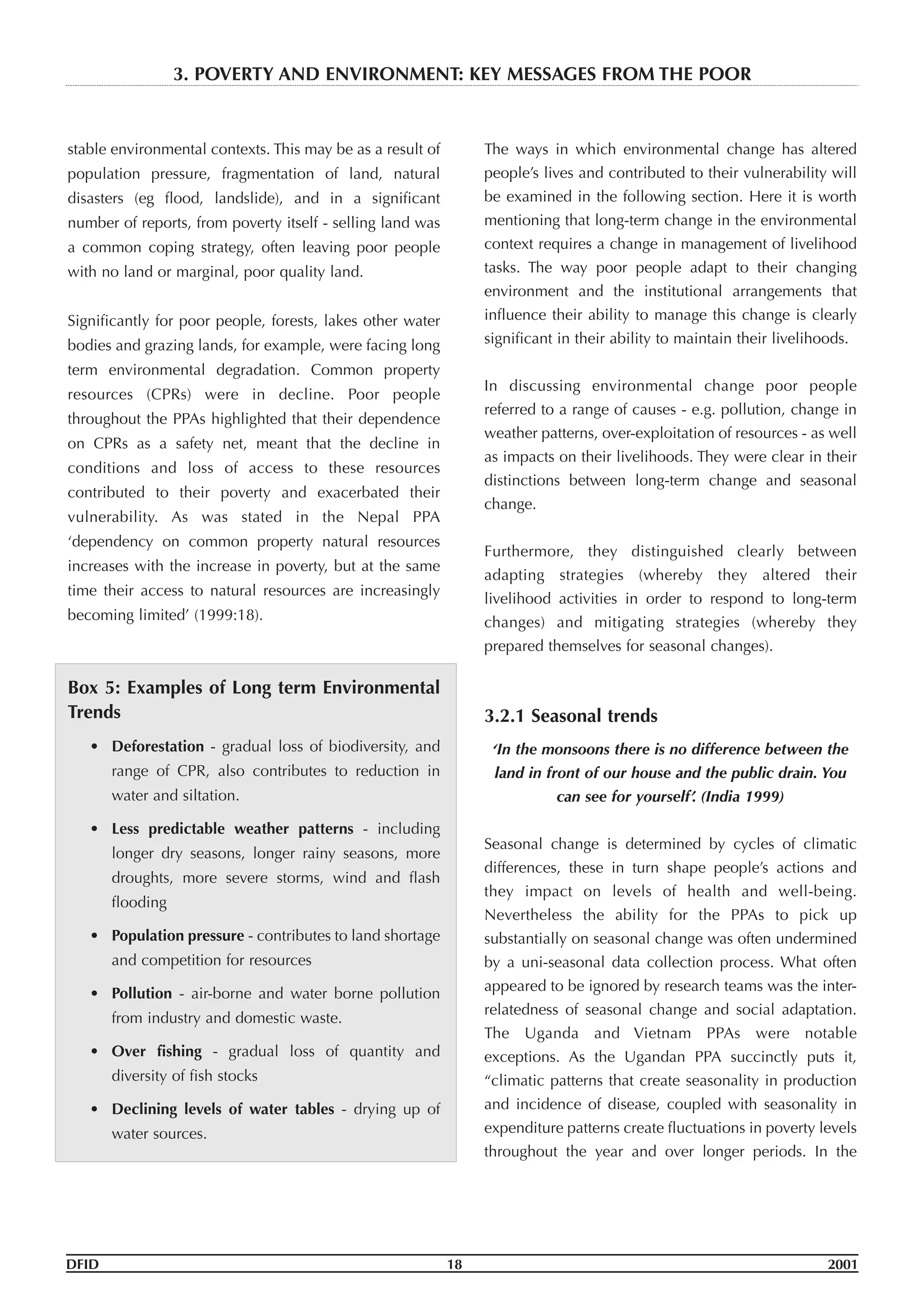
Box 5: Examples of Long term Environmental
Trends
• Deforestation - gradual loss of biodiversity, and
range of CPR, also contributes to reduction in
water and siltation.
• Less predictable weather patterns - including
longer dry seasons, longer rainy seasons, more
droughts, more severe storms, wind and flash
flooding
• Population pressure - contributes to land shortage
and competition for resources
• Pollution - air-borne and water borne pollution
from industry and domestic waste.
• Over fishing - gradual loss of quantity and
diversity of fish stocks
• Declining levels of water tables - drying up of
water sources.
The ways in which environmental change has altered
people’s lives and contributed to their vulnerability will
be examined in the following section. Here it is worth
mentioning that long-term change in the environmental
context requires a change in management of livelihood
tasks. The way poor people adapt to their changing
environment and the institutional arrangements that
influence their ability to manage this change is clearly
significant in their ability to maintain their livelihoods.
In discussing environmental change poor people
referred to a range of causes - e.g. pollution, change in
weather patterns, over-exploitation of resources - as well
as impacts on their livelihoods. They were clear in their
distinctions between long-term change and seasonal
change.
Furthermore, they distinguished clearly between
adapting strategies (whereby they altered their
livelihood activities in order to respond to long-term
changes) and mitigating strategies (whereby they
prepared themselves for seasonal changes).
3.2.1 Seasonal trends
‘In the monsoons there is no difference between the
land in front of our house and the public drain. You
can see for yourself’. (India 1999)
Seasonal change is determined by cycles of climatic
differences, these in turn shape people’s actions and
they impact on levels of health and well-being.
Nevertheless the ability for the PPAs to pick up
substantially on seasonal change was often undermined
by a uni-seasonal data collection process. What often
appeared to be ignored by research teams was the inter-
relatedness of seasonal change and social adaptation.
The Uganda and Vietnam PPAs were notable
exceptions. As the Ugandan PPA succinctly puts it,
“climatic patterns that create seasonality in production
and incidence of disease, coupled with seasonality in
expenditure patterns create fluctuations in poverty levels
throughout the year and over longer periods. In the
DFID 18 2001
3. POVERTY AND ENVIRONMENT: KEY MESSAGES FROM THE POOR
absence of surface water harvesting methods, storage
facilities, accessible markets, as well as accessible and
affordable financial services, preparing for the hard
times during the good times can become extremely
difficult for many” (Uganda 1999:pxii).
Particular manifestations of seasonality are clearly
location-specific - whether it be extremely harsh
winters as in regions in Russia, or excessive flooding as
in many urban areas of sub Saharan African and in
Brazil. In India and Ghana, some communities
mentioned that they were totally isolated in the rainy
season, cut off from markets and all sources of help and
information. A common concern was that despite poor
people’s knowledge of seasonal conditions, their ability
to prepare themselves for the consequences were
limited by their poverty.
Seasonal vulnerability to natural disasters, hunger and to
illness were mentioned almost across the board, and
were reflected on as contributors to falling into a state of
poverty. In Vietnam, Uganda, Ghana and Zambia local
people all commented how vulnerability to illness at
critical periods of the year such as the peak agricultural
season could mean household hunger for the rest of the
year. In a number of PPAs people also argued that
seasonality affects their livestock; the ploughing season
often coinciding with the time when draught animals
were in the weakest condition after the dry season or the
winter months.
Furthermore, seasonal changes affected different people
in different ways. In urban South Africa during the
winter months street children become increasingly
vulnerable to hunger, cold and hardship because of bad
weather and the down turn in tourism – a major source
of income. The seasonal combination of ill health and
high workload is particularly problematic for women as
caring for sick children limits the time available for
income earning activities outside the home. A long dry
season in Sub Saharan Africa, for example,
disproportionately affects women who reported the
huge time burdens they were subjected to because of
having primary responsibility for household fuel and
water collection (which took anything between three
and seven hours per day).
3.3 Livelihood Management Activities
‘Many households from the social poor sold out their
last piece of land during the slack season, or used it as
collateral for getting a loan from money-lenders and
eventually lost it’ (Bangladesh 1999).
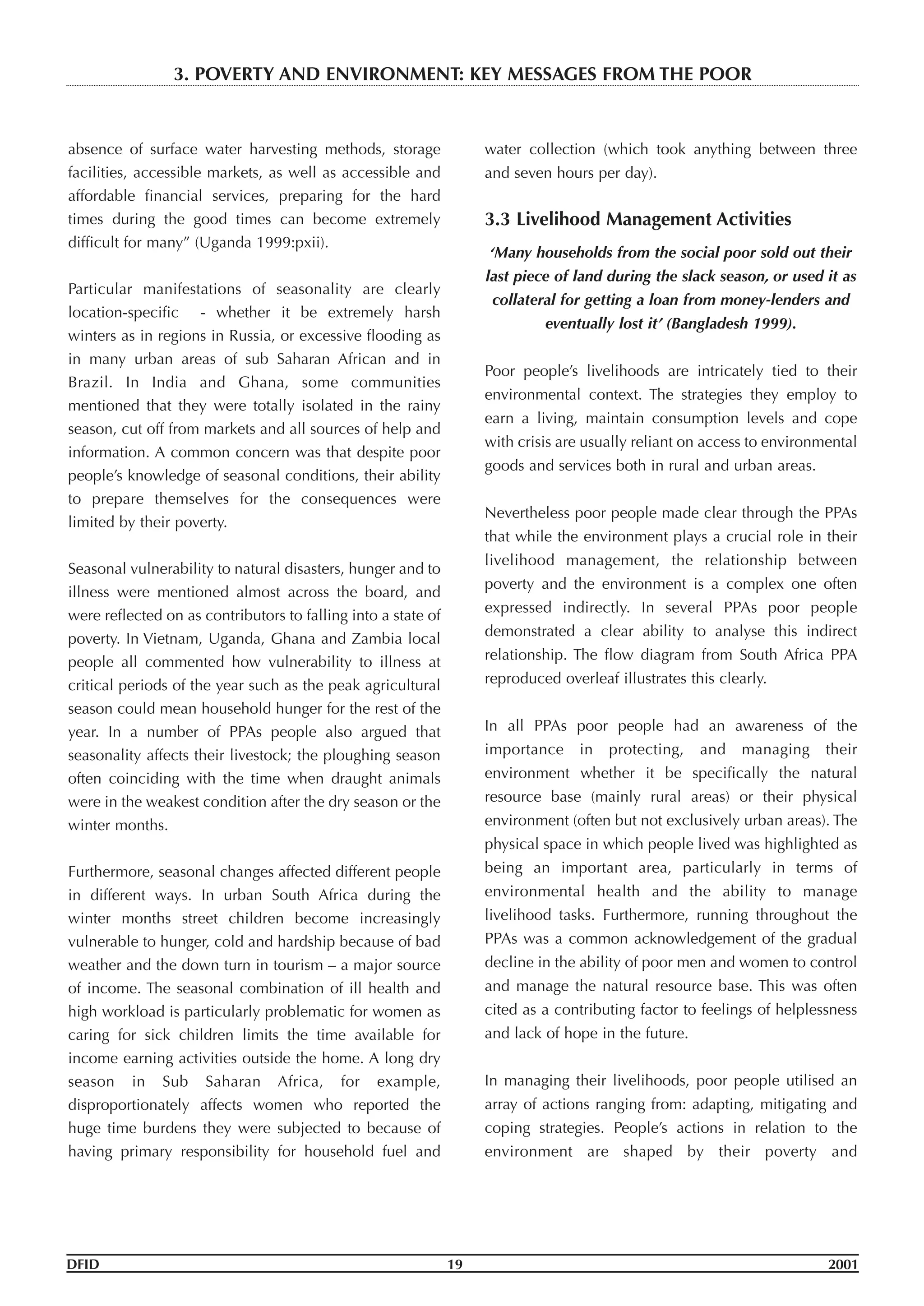
Poor people’s livelihoods are intricately tied to their
environmental context. The strategies they employ to
earn a living, maintain consumption levels and cope
with crisis are usually reliant on access to environmental
goods and services both in rural and urban areas.
Nevertheless poor people made clear through the PPAs
that while the environment plays a crucial role in their
livelihood management, the relationship between
poverty and the environment is a complex one often
expressed indirectly. In several PPAs poor people
demonstrated a clear ability to analyse this indirect
relationship. The flow diagram from South Africa PPA
reproduced overleaf illustrates this clearly.
In all PPAs poor people had an awareness of the
importance in protecting, and managing their
environment whether it be specifically the natural
resource base (mainly rural areas) or their physical
environment (often but not exclusively urban areas). The
physical space in which people lived was highlighted as
being an important area, particularly in terms of
environmental health and the ability to manage
livelihood tasks. Furthermore, running throughout the
PPAs was a common acknowledgement of the gradual
decline in the ability of poor men and women to control
and manage the natural resource base. This was often
cited as a contributing factor to feelings of helplessness
and lack of hope in the future.
In managing their livelihoods, poor people utilised an
array of actions ranging from: adapting, mitigating and
coping strategies. People’s actions in relation to the
environment are shaped by their poverty and
DFID 19 2001
3. POVERTY AND ENVIRONMENT: KEY MESSAGES FROM THE POOR
Malnutrition
vulnerability status. As such, the type of strategy adopted
depends on a range of factors - environmental, social,
political - and is therefore context specific. They also
operate on a number of different levels - personal,
household, community and beyond. Moreover, the
range of strategies employed are balanced one against
another within a given circumstance. We aim to
document the range of strategies people use across the
span of the PPAs rather than give a detailed examination
of the web of strategies employed in one particular
circumstance.
Figure 1: Flow Analysis from Marumofuse South Africa
The flow diagram starts from no rains and no food and
carries linkages through to changing family size,
malnutrition, the introduction of contraception,
prostitution, STD’s and death. It also relates to the
impact of apartheid (no farm work), thereby drawing
together shocks, long term trends and historical root
causes. (Source: May et al. 1995:30)
DFID 20 2001
3. POVERTY AND ENVIRONMENT: KEY MESSAGES FROM THE POOR
Starting point
End point
No Rain No more work on farms
Less/No Food
Prostitution for
Money/food
Disease Pregnancy
Marry to leave - alt. Food
sources
Abortion Have more children
Death Lack of food
More children in original
home
Mis/no information about
contraception
Less food per Child Return Home
More sex before marriage
Introduction of
contraception
KEY
3.2.1Food security
The poor live ‘without adequate food and cloth even
when working to death’ (Nepal 2000).
In all PPAs, in both urban and rural areas, the poor made
it very clear that access to environmental resources was
vital to food security. In urban Russia the point was
made starkly: the availability of land on which to grow
vegetables for sale and consumption..”virtually saves
million of Russians from starvation”. It was a key
indicator of well-being and extreme poverty was always
partly judged in terms of the length of the period of
annual hunger. For the destitute this was lifelong and for
all categories of poor a sophisticated array of strategies
were employed to alleviate the hungry times.
Reducing food consumption and substituting less
nutritional food particularly for women and often
children was a common coping strategy. In Nepal’s
hungry period, ‘red soil with water is used to keep the
intestine moist’. Other strategies included migration
and sending children away to relatives both of which
had implications for household labour and long-term
security.
In the majority of PPAs poor people argued that ensuring
year round food security was becoming increasing
difficult. In rural areas local people cited declining
harvests linked to changing climate, water pollution,
land degradation; lack of access to land itself and labour
constraints brought about by chronic illness or migration
as all contributing to their increased vulnerability to
hunger. In urban areas, particularly in sub Saharan
Africa, men and women observed that land conversion
from housing to commercial use and removal from
better quality land sites to more marginal areas such as
on the edge of land fill sites stopped them from growing
food as a safety net against hunger.
Long-term impacts were also identified as both a cause
and consequence of chronic food insecurity. Long term
health risks contributed to death and reproductive
complications, which increased the vulnerability of the
whole household in general, and women in particular.
At the same time lack of food over long periods led to a
loss of energy and made it difficult to carry out basic
domestic tasks or seek productive opportunities.
Common Property Resources: In the majority of PPAs,
the poor drew attention to the use of CPR as a hedge
against food insecurity. Levels of poverty were
characterised by ever increasing dependence on CPRs
such as wild foods, building materials, medicines and
fuel, both for consumption and for sale.
Urban participants in the Vietnam PPA pointed out that
scavenging in markets for leftovers was the urban
equivalent of relying on CPR. Analysis across PPAs
showed that the urban poor rely on all sorts of CPR for
their survival, from scouring rubbish dumps, to growing
food on scraps of roadside land.
The use of and reliance on CPR for survival was
predominantly a female option, partly as a result of land
tenure arrangements which usually favoured male land
ownership. The insecurity of collecting CPR and the
declining resources disproportionately affect women.
The same applies to other very poor community
members, for example ‘untouchables’ in Nepal or ethnic
minority groups in Bangladesh.
‘In the absence of credit, people indicated that they
turned to greater exploitation of the natural
environment because it was the only resource that was
free’
Tanzania Voices of the Poor p. 74
A common theme emerging in the PPAs was the impacts
on livelihoods from declining availability of CPRs. The
most obvious was greater vulnerability to hunger. Also
cited was, for women generally, the increased time
burden and personal risk involved in having to travel
further and enter into forbidden areas in order to collect
essential CPRs. In South Africa the older generation
observed that what was once free and abundant was
now scarce and costly substitutes had to be found such
as plastic buckets in place of gourds. In some PPAs local
DFID 21 2001
3. POVERTY AND ENVIRONMENT: KEY MESSAGES FROM THE POOR
people commented how restricted access to common
land for livestock grazing, fuelwood collection and
other CPRs could for the poor be a critical contributor to
temporary and permanent migration.
3.3.2 Productive assets and livelihood
diversification
‘If you have land you have life’ (Uganda 1999)
“Water is life and because we have no water, life is
miserable”. (Kenya PPA)
The poor, in relying on natural resources more heavily,
are also more vulnerable to negative environmental
change. The interrelationship between the latter two has
profound implications for the range of productive assets
the poor have access to and their capacity to diversify.
The ability to diversify productive activities was almost
unanimously considered to be a sign of well-being.
Diversification implied having the investment capacity
in terms of land, livestock, inputs, and labour and meant
greater security in times of difficulty. Poverty and ill-
being on the other hand was characterised by a reliance
on a single crop or trading activity, lack of ability to
invest in livestock, fruit trees, or engage in any
agricultural activity at all. In a number of PPAs (Nepal,
South Africa, Nigeria, Uganda) local people highlighted
that decreasing access to natural assets meant that
diversification into off-land activities was more than a
preferred option – it was necessary for well-being.
Many poor people maintained that their situation had
worsened as a result of environmental change. The PPAs
were full of examples of poor people selling off their last
piece of land, shortening the fallow period of their
agricultural cycle and thereby increasing soil infertility,
or drawing water from a polluted river. But these
changes in the environment were clearly exacerbated by
institutional constraints. Many felt unable to invest in
their land due to a fear of eviction, or took great risks as
a result of allocation of conservation land or a bias
towards the wealthy in the allocation of fishing rights.
As such they are required to expend more time and
energy as well as demonstrate a greater degree of
ingenuity than the better off in managing their livelihood
activities in tune with both short-term and longer-term
environmental change. This aspect of their lives emerges
most strongly with regard to natural resources.
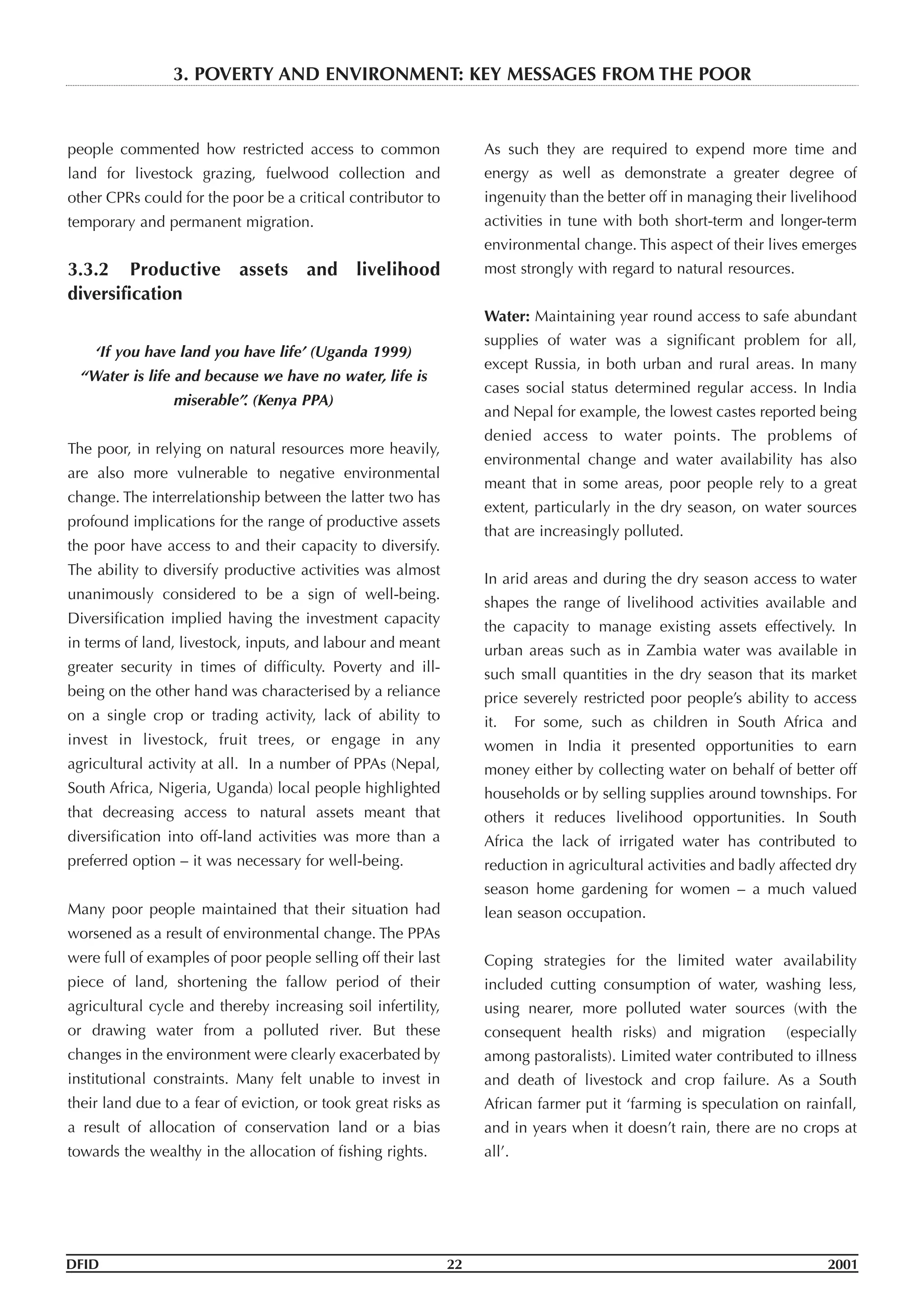
Water: Maintaining year round access to safe abundant
supplies of water was a significant problem for all,
except Russia, in both urban and rural areas. In many
cases social status determined regular access. In India
and Nepal for example, the lowest castes reported being
denied access to water points. The problems of
environmental change and water availability has also
meant that in some areas, poor people rely to a great
extent, particularly in the dry season, on water sources
that are increasingly polluted.
In arid areas and during the dry season access to water
shapes the range of livelihood activities available and
the capacity to manage existing assets effectively. In
urban areas such as in Zambia water was available in
such small quantities in the dry season that its market
price severely restricted poor people’s ability to access
it. For some, such as children in South Africa and
women in India it presented opportunities to earn
money either by collecting water on behalf of better off
households or by selling supplies around townships. For
others it reduces livelihood opportunities. In South
Africa the lack of irrigated water has contributed to
reduction in agricultural activities and badly affected dry
season home gardening for women – a much valued
lean season occupation.
Coping strategies for the limited water availability
included cutting consumption of water, washing less,
using nearer, more polluted water sources (with the
consequent health risks) and migration (especially
among pastoralists). Limited water contributed to illness
and death of livestock and crop failure. As a South
African farmer put it ‘farming is speculation on rainfall,
and in years when it doesn’t rain, there are no crops at
all’.
DFID 22 2001
3. POVERTY AND ENVIRONMENT: KEY MESSAGES FROM THE POOR
Women throughout sub Saharan Africa and Asia
detailed the knock on effects of the hours spent
collecting water during periods of water shortage. Not
only did they have less time for other productive and
domestic activities which made the entire household
more vulnerable to hunger and hardship, they also faced
greater ill health. Health risks included backaches,
headaches, cuts and wounds - as a result of continual
extreme labour; tiredness and loss of energy as a result
of less sleep and rest. For pregnant and lactating women,
further health risks were implied. In Bangladesh it was
stated that shortage of water led to ‘intolerable mental
and physical pressure’.
Land and agriculture: Land was an important productive
asset in most rural areas. Landlessness or near
landlessness increases vulnerability to extreme poverty.
A Ugandan farmer summed up the argument: “if you
have land you have life”. Social assets were also
perceived to help gain temporary access of land so for
example in Bangladesh those who had links with a
better off household were able to access a piece of their
unused land for the cultivation of food crops.
As a crucial asset, people were unwilling to sell their
land, but were forced to do so as a coping strategy. The
knock on effects of land sale often push a household
further into poverty as it reduces their asset base and
also restricts their access to credit as land is a common
form of collateral. (This is equally true of livestock).
Women were particularly vulnerable where they lacked
tenure rights over land. In South Africa, Tanzania and
Kenya widows reported being stripped of their land and
other productive assets by their deceased husband’s
relatives. In India women commented that their own
assets such as jewellery and household utensils were
taken first and sold by male relatives rather than resort to
land sales thereby reducing their independence. In
urban areas insecurity of tenure over housing was the
equivalent to rural landlessness. It increased
vulnerability to eviction and sudden homelessness,
reduced livelihood opportunities and severely restricted
access to credit and other financial services.
A key message from the poor was that the quality and
accessibility of land was of equal importance to the size
of land holdings. In parts of Zambia farmers reported
moving to distant hilly areas in order to secure access to
fertile land. If there was a greater possibility for owning
and hiring land the poor were more likely to contend
with marginal, difficult to farm lands some distance
away from their homestead. Their inability to access
appropriate inputs and information to improve
production kept yields low and exacerbated
vulnerability. Moreover, small land holdings, reduced
fallow periods together with poor farming methods all
contributed to lowered fertility and declining yields.
Poor soils also meant crop diversification was a more
risky option.
In many cases in rural areas, despite constraints, the
poor proved adept at adapting their cropping systems in
response to long-term environmental change, growing
different crops and changing the pattern of production.
In Ghana farmers offered examples of substituting
hardier crops - if less tasty, or nutritional - to cope with
unpredictability of rains, or soil exhaustion or pests.
In Ghana, cassava is used as a crop to mitigate against
vulnerability because it can be harvested at any time.
In the majority of PPAs the poor emphasised the critical
links between financial assets and production. They are
an important factor in strengthening access to natural
resources. In both rural and urban areas access to
money enables the hire and purchase of land as well as
the purchase of inputs for primary production. In India
and Malawi lack of capital made it difficult for fishing
communities to obtain and maintain vital equipment. In
Kenya, male farmers reported that lack of access to
credit meant having to sell off their own maize seed
during the hungry dry season only to have to buy it back
later for planting at higher prices. Women-headed
households in a number of PPAs reported that their
status made it difficult to get credit, which in turn made
it difficult to buy agricultural inputs (seeds, fertilisers
etc.) They argued that the ultimate impact was chronic
food insecurity in the household.
DFID 23 2001
3. POVERTY AND ENVIRONMENT: KEY MESSAGES FROM THE POOR
The inability to capitalise on harvests was also raised in
rural areas. Loss of crops due to pests was commonly
reported. In Uganda farmers complained that
government conservation regulations stopped them from
dealing properly with farm pests. Lack of ready cash also
made post harvest processing difficult for poorer
households. But both women and men argued that
inadequate access to markets were a major barrier to
optimising harvest yields. For women if allowed access
to markets - in Bangladesh and parts of India this was
not the case - there was the added safety risk involved in
travelling in isolated areas. The poor also highlighted
that being unable to store crops in safe secure facilities
free from attack from pests, theft or deterioration
increased their vulnerability to hunger and decreased
their capacity to deal with seasonal fluctuations in
income.
In sub Saharan Africa lack of labour resources often
made farming difficult. Chronic illness, male migration
to urban or to other rural areas and both men and
women having to work as agricultural labourers meant
their own production as a hedge against future
insecurity was often impossible or severely constrained.
In Bangladesh agriculture was increasingly loosing its
elasticity to absorb a growing labour force of landless
and near landless labourers but limited off-farm
opportunities meant there was very high competition
amongst men for waged labour. Women in Ghana
highlighted that lack of decision making powers over
labour allocation and cropping patterns meant they
were forced to work on male cash crop plots at the
expense of their own food plots. This in many cases
severely undermined the household’s ability to produce
sufficient food.
Livestock: Livestock was considered an investment by
the poor in most PPAs. Ownership of livestock can
represent savings, draught power, products for
consumption and sale, fertiliser for agriculture, cultural
significance as well as other aspects such as bride price.
Managing these valuable assets was therefore a crucial
component of livelihood decision-making. Loss of
livestock through death or theft was commonly cited as
increasing vulnerability to shocks and stresses.
Losing a large animal has implications for different
aspects of people’s livelihoods. It was stated in the
Vietnam PPA that it would take approcimately 5 years
to recover from the loss of a buffalo.
In many rural areas PPA participants highlighted that
loss of grazing land through soil erosion, fragmentation
of land and limited access to common land contributed
to greater insecurity with respect to the health of
livestock and ultimately their capacity to continue
ownership. This was keenly felt by pastoralists
throughout sub Saharan Africa. In urban Malawi
expropriation of common grazing land by municipal
authorities further undermined poor people’s already
insecure livelihoods.
‘The cost of energy, both in terms of money and
effort, is enormous for most, paralysing for some’
(South Africa 1998).
Energy supplies: Access to fuel for cooking, heating and
productive activities was seen by the poor to be
influenced by environmental factors. It was mentioned
in several PPAs in Asia and Africa that in rural areas
fuelwood supplies were in decline because of
appropriation of common lands and/or land clearance
in the vicinity of settlements both of which serve to
restrict access. As with water, collection of fuelwood
across the range of PPAs was a labour activity
predominantly carried out by women and children
bringing with it the same problems of lowered resistance
to illness and disease, lack of time for other activities
and withdrawal of children from schooling.
Many strategies were employed by poor people to deal
with declining access to energy supplies for example, in
Zambia, this included substitution with a different fuel.
eg. maize cobs. In Nepal and parts of India travelling
further often for days in order to collect food and coping
with the risk of fines or violence by collecting illegally
in prohibited areas. In Bangladesh for example tribal
DFID 24 2001
3. POVERTY AND ENVIRONMENT: KEY MESSAGES FROM THE POOR
groups mentioned the border controls in the hills
denying them access to collect fuel.
In urban areas a key priority in relation to energy
supplies was safety. In South Africa dependency on
paraffin and candles for domestic purposes in houses
made of wood and cardboard made households
extremely vulnerable to sudden fire. In one research site
over 90% of domestic fires were caused by their use. In
India and Brazil illegal electricity hook ups were both
commonplace and dangerous placing households at risk
of burning, sudden fire and possible electrocution.
3.3.3 Time management
‘It’s difficult to catch up with the seasons’
Ugandan Villager.
Time is a valuable asset for poor people but, as
articulated very clearly in the PPAs, their capacity to
manage it in such a way as to protect and enhance their
livelihood options was increasingly being eroded. Whist
environmental factors were not the only cause, the
changes in access to environmental goods and services
was a major contributor to the squeezing of livelihood
options available and the subsequent increased time
burdens faced in merely ensuring household survival. In
most cases it was women and children who bore the
brunt. The starkest examples came from Kenya, where
female villagers talked of walking 7 hours a day in the
dry season to collect a bucket of water from a (polluted)
river and, Bihar India, where women firewood sellers
were reduced to 2 hours sleep per night because of the
distances involved in collection and sale. Yet long hours
spent in water and fuel collection was a common story
in rural areas in all PPAs.
Lack of time was clearly recognised as a major
constraint to improving livelihood outcomes.
Inadequate rest increased vulnerability to mental stress,
chronic ill health and disease. It reduced opportunities
to built strong social support systems and made it
difficult to access information and public support
services such as agricultural extension. Landless poor
people in India and Vietnam pointed out that in
searching for agricultural labour they regularly travel
outside the village, thus missing agricultural extension
workers. In Bangladesh male agricultural labourers
pointed out that time constraints made it difficult for
them to attend training, a point echoed by women in
many PPAs. In India and Africa, death, disease and
abandonment meant women were taking on traditional
male jobs (land clearance etc.) and in women-headed
households with no adult males for support the added
time burdens helped to tip the poorest into extreme
poverty.
Often local people talked of the appalling trade offs they
were forced to make in order to save time such as
knowingly taking water from an unsafe but nearer water
supply rather than walking further to clean water
supplies. Or, as in urban Russia reducing food
consumption rather than spend valuable time queuing
for food. Women in rural Vietnam told of choosing to go
back to agricultural work in order to secure food
supplies within days of giving birth despite the impact
on their own health and on their infant’s early
development.
Moreover, due to the increased time required for
production activities, water and fuel collection, children
were increasingly involved in this labour, often
removing them from school for the purpose. This
disproportionately affected girls, but boys also suffered.
In pastoralist communities, for example, boys were
commonly removed from school to help with herding.
Not only was this of considerable health risk to
children’s smaller bodies it also – a point well
understood by the poor - blighted their opportunities for
future well being and livelihood security.
DFID 25 2001
3. POVERTY AND ENVIRONMENT: KEY MESSAGES FROM THE POOR
3.3.4 Physical space and environmental
health
‘We put the older children in these classes so that
when the walls or roof collapse they can run to save
themselves’ (Kenya 1996)
The space around settlements whether urban or rural are
clearly important and in some PPAs this was brought out
by a reference to the settlement’s safety as opposed to
the bush or forest as being unsafe. This sense of safety
and security of environment emerged in several ways,
although not specifically inquired about by researchers.
It is however, worth touching on here as the different
strands build up a picture of the importance of an
anxiety-free, secure dwelling place for livelihood
security.
Environmental health: Poor people were keenly aware
of the effects of poor environmental health on their
ability to move out of poverty. A healthy environment
was for example cited in the majority of PPAs as a key
indicator of well being. In Ghana older men mentioned
how clearing vegetation away from around homesteads
had increased the incidence of diarrhoea diseases
because clearance had not been allied to improved
sanitation facilities. This was echoed in a number of
reports where lack of space and/or facilities was related
to the occurrence of unsanitary practices. In South
Africa the link was made between poverty and being
exposed to poor working conditions. Chronic livelihood
insecurity was raised as a critical factor in forcing poor
people to work in environmentally dangerous jobs. For
example, rubbish picking was cited as exposing pickers
to extreme hazard and in India, poor men and women
spoke of the dangers involved in having to work in
limestone quarries or down the mines.
In urban areas in particular, pollution of water sources,
flooding of housing, lack of drainage and stagnation of
water and lack of sanitation facilities were all raised as
both causes and consequences of poverty. Disease, it
was said, ran rampant in crowded settlements, and rats,
mosquitoes and other pests were a significant danger to
health. Urban residents also identified dangling electric
cables that were hooked up illegally, the lack of lighting
and the threat of fire - especially in overcrowded urban
slums as environmental health risks. Respiratory
diseases were mentioned in some reports (Uganda,
India, Ghana) as a result of lack of ventilation within
housing.
Violence: The regular incidence of violence was
prevalent almost across the range of PPAs, and was
stated in many cases to be on the increase in both urban
and rural areas. Mostly reported was domestic violence
against women, which had significant implications for
their ability to manage their livelihood, not just in the
collection of CPR, but in agricultural and trading
activities. Areas of safety were key considerations for
women when undertaking livelihood tasks. The lack of
security when collecting fuel was mentioned by women
in several PPAs. This made them vulnerable to physical
attack and rape. Women in South Africa try as far as
possible to collect in groups to ensure safety, but it is not
always possible. In India women fuel wood collectors
were at continual risk of harassment and violence
during collection and sale from higher caste men and
petty officials. In the case of Nepal where women and
children were reported to have been sold, this was a
particular concern.
Theft and crime: Particularly in urban areas, it was
mentioned that crime was on the increase, and that
theft, drugs and alcohol abuse were making areas
unsafe. In South Africa the demand for electrification in
townships by women was a high priority because it
reduced their vulnerability to rape and physical attack
when outside the home. Stealing crops and livestock in
rural areas was also mentioned, in some cases as a
coping strategy against hunger but often to highlight the
vulnerability of poorer communities to the risks of theft.
Stigma and shame: ‘The stigma of poverty encompasses
a socio-spatial dimension’ (Brazil 1999:28). In Brazil it
was mentioned that certain urban poor areas had a
stigma attached to them. This made them no go areas for
DFID 26 2001
3. POVERTY AND ENVIRONMENT: KEY MESSAGES FROM THE POOR
the police and branded residents unemployable in the
wider job market. In India spatial segregation along the
lines of ethnicity and caste especially in rural areas
served to mark out the poorest and act to deny them of
their rights and entitlements. Although the idea of an
area being stigmatised was not discussed in other
reports, the issue of shame and humiliation were
common themes. For the poor the physical environment
and space around a household or settlement were felt to
indicate a person’s poverty.
‘You grow up in an environment full of diseases, of
violence and drugs - you don’t have the right to
education, work nor leisure and you are forced to eat
in the hands of the government, so you are an easy
prey to the rulers. You have to accept whatever they
give you’. (Brazil 1999).
3.4 Institutional Influences
Throughout the PPAs the poor recognised institutional
structures and processes from micro level up to macro
level were important influencing factors in how they
were able to control, manage and access environmental
resources. There were several themes that ran across all
the PPAs.
3.4.1 Community co-operation and collective
action
In many PPAs, communities detailed the importance of
mutual aid and informal networks of support in
improving access to and control over environmental
entitlements. Examples include collecting and storing
water for absent neighbours in urban Brazil, sharing
energy supplies in India and South Africa, collective tree
planting and well construction in Tanzania. In Uganda,
rural women argued that strong social networks and
community cooperation were the best way of improving
livelihoods citing the pooling of land and bulk
marketing as examples of self help against poverty.
More formal community based organisations (CBOs)
were also identified as essential for long term sustained
poverty reduction with environmental issues often
sparking their development. In urban areas CBOs were
instrumental in securing better living conditions, access
to water and sanitation facilities. In Kampala youth
associations had taken the lead in improving
environmental sanitation. In Kenya, community
organisation was a route to improve access to public
water and sanitation facilities. In South Africa women
identified communal vegetable gardening as a highly
prized activity for off-setting vulnerability to ill-being
and strengthening social cohesiveness.
In a number of PPAs environmental degradation
provided the initial impetus for collective action. In the
oil producing area of Nigeria, a youth organisation – The
Ughoton Progressive Union – focused on improving
environmental conditions and fighting poverty began as
a direct response to oil spillage. In Mbwadzulu fishing
community, Malawi, men and women mobilised to
protect severely depleted fish stocks in Lake Malawi by
forming a committee to monitor illegal commercial
fishing during the closed season. But, the committee
was never properly effective. The lack of alternative
livelihood options for local fisher folk meant short term
exploitation to meet basic needs ultimately took priority
over the community’s desire for long term protection.
This example highlights a note of caution raised in many
PPAs by local people who argued against idealising the
capacity of community initiatives to sustain positive
change for all. The breakdown in social cohesiveness
because of long term entrenched poverty was
commonly cited as a key reason for the poorest and
most vulnerable being left-out of or self excluding from
networks of decision making. Underpinning poor
people’s analysis of their poverty in all the PPAs was a
strong feeling of powerlessness in the face of entrenched
institutional barriers to change.
3.4.2 Socio-political barriers
Access and control over natural assets and the means to
better manage them (finance, markets, transport etc.)
was viewed by the poor, particularly in rural areas, as a
DFID 27 2001
3. POVERTY AND ENVIRONMENT: KEY MESSAGES FROM THE POOR
key determinant in reducing risk. But gaining access was
overwhelmingly perceived to be constrained by deep-
rooted socio-political barriers. In Nigeria, for example,
exclusion from community affairs and decision-making
was said to be clearly linked to caste, ethnicity and
gender.
Throughout the PPAs, minority groups, refugees,
migrants were consistently characterised as having no
voice, due to their lack of representation and political
networks, isolation and exclusion. This was often
exacerbated by limited knowledge of the local language
and practices. Several examples were given of isolated
communities such as forest dwellers or tribal peoples
who lost land or were restricted access to environmental
goods (see Box 6). In Uganda, for example, it was stated
that the gazetting of forest land to make the Mpoka
DFID 28 2001
3. POVERTY AND ENVIRONMENT: KEY MESSAGES FROM THE POOR
Box 6: Those who Control Resources Control Lives
In Dalukone, Nalitabari, I heard the story of the Mandi dispossession of lands. Fifty years or so ago they cultivated jhum
(berries) on the mountains and freely used the plains. After partition, officials came and told them to register their land.
They did not think it was important. ‘We were stupid and simple and asked “why do we have to register these huge
mountains? That’s crazy. there are plenty of them so who cares?”. When the officials came back, we refused to see them,
and some fled to the mountains. The officials forcefully recorded the homesteads with only a little land around each
one.’
They have had to flee many times (1952,1964,1971, 1975) and each time, on their return they have found more and
more new settlers. These Muslim settlers let their cows graze on the little land the Mandis still own. If the Mandis
protest, the Muslims threaten and harass them. they even burned down their houses. As Mandi girls inherit the land
from their families, there has been pressure from Muslim boys to marry them.
Now the forestry department has taken over the mountains for forestry plantations. The Mandi are not allowed to collect
fuelwood and they are threatened with police action.
Many families have left for India since 1975. They flee at night to avoid the security forces. By the year 2000, they
predict that most Mandis will have crossed the border into India. Others will be absorbed into the general population.
Soon there will not be any tribal people living separately.
Source: Field notes of Asif Munier Feb 96; UNDP’s 1996 Report on Human development in Bangladesh.
game reserve meant the Batwa - the traditional forest
dwellers - lost their land and livelihoods leaving them
destitute and dependent on begging. In India the poor
from lower and scheduled castes and tribal groups were
systematically excluded from resources and decision-
making processes at the village and district levels. This
served to undermine their access to reliable water
sources, better quality land, food relief and other public
goods and services.
Conflicts between different social groups over water was
mentioned in a number of reports as a result of
dwindling supplies. An example was given in the
Uganda report of a communal water site fenced off by
wealthy/more powerful members and denied to some
social groups.
3.4.3 Government and the public sector
If ‘no attempt is made by policy makers to .. provide
input fertilisers through village headmen and groups,
we will all one day wake up dead’ (Zambia 1999).
The public sector was referred to in all PPAs, but rarely
with any degree of confidence in government’s actions
to alleviate poverty. In the majority of the PPAs poor
men and women were highly articulate about the lack of
accountability of government services and the ways in
which government cutbacks in service provision had
served to undermine access to information, goods and
services. In the majority of PPAs the poor reported little
contact with government officials (both politicians and
officers, for example those providing extension advice)
and when it did happen it was regarded as largely
unsatisfactory.
Inappropriate targeting and information in agricultural
services was raised as an issue in a number of PPAs.
Women farmers in sub Saharan Africa (Tanzania South
Africa, Uganda and Ghana) complained of institutional
bias from extension workers who rarely, if ever, made
contact with them. This undermined their ability to
adapt to new technologies and farming practices or to
take advantage of information. Male farmers expressed
anger in a few PPAs that they were not given the
necessary information to deal with changing
environmental conditions. In Nepal the advice was
labelled irrelevant to poor farmers owning marginal
holdings. In Malawi, farmers argued that extensionists
were not providing information about how to cope with
increasing vulnerability to flooding and drought. A
point echoed by South African farmers.
The public sector role in disseminating information
generally was also raised. For the poor their continual
marginalisation underlined their lack of power.
The more powerful and better off had better access to
information and public officials and consequently a
better understanding of how to use make use of
available goods and services. In Uganda government
disinterest in passing on information about their policies
particularly with regard to taxation and land was viewed
as a restriction on their rights. In a few PPAs local
people in rural areas mentioned that the government
was failing in its duty to provide timely and relevant
information about markets and prices which in turn
undermined their food security.
The allocation of permits for commercial exploitation of
natural resources such as logging or fishing was raised in
a number of PPAs as being inherently biased towards the
wealthy, not least because corruption was rampant. The
poor also forcibly articulated how public sector biases
towards commercial enterprises not only skewed local
markets but also had long term impacts on the local and
national resource base. In India and Ghana commercial
logging was cited as a critical factor in the depletion of
CPRs. In Malawi fisher folk spoke of how unregulated
commercial fishing was depleting fish stocks, destroying
the local markets and ruining their livelihoods.
Planning procedures and processes of consultation in
both rural and urban areas were raised as major causes
for concern. Throughout the PPAs urban residents
complained of chronic insecurity and their vulnerability
to eviction by municipal authorities often without
warning and rarely with any compensation paid. In
urban Brazil, Kenya and India slum dwellers reflected
that even when living on government land, no effort was
made by the local authorities to involve them in
planning particularly with sanitation and the siting of
public washing facilities. In rural areas lack of
consultation between government and local people over
natural resource use was a major source of hardship and
conflict. In Ghana and India people mentioned how
forest management regimes did not take account of their
need to access CPRs and other benefits or properly
involve them in planning decisions. In Uganda, Park
authorities excluded local people from full access to and
management of the national parks. This led to conflict,
loss of livelihood and increased distrust in government .
DFID 29 2001
3. POVERTY AND ENVIRONMENT: KEY MESSAGES FROM THE POOR
National conservation efforts were often viewed as an
attack on local livelihoods and denial of rights. In a
number of PPAs people living on the edges of gazetted
forests, national parks or protected areas reported open
conflict and hostility with government guards brought
into to protect the areas. In Nepal villagers living on the
fringes of the Shivapuri protected area lost all access to
CPRs when the government, without warning, declared
it a conservation zone. Along with restriction came the
army, increased hostility and conflict. Local people
argued it was an example of the government taking
rights of livelihood away from the weakest.
In some PPAs government deregulation of food prices
and market was linked to the rising of food prices. In
urban areas this was particularly problematic because of
the greater reliance of the poor on a monetary economy.
In Russia the removal of subsidies was seen as both a
major contribution to poverty and a sign that the
government no longer listens.
In a number of PPAs (India and Uganda, for example)
the point was raised in rural areas about the
effectiveness of government food relief or food for work
schemes. These did not always take account of the
seasonal agricultural calendar meaning that the poorest
were often excluded from benefits because at the time
of registration they had temporarily migrated or were
tied into labour contracts that could not be broken.
3.4.4 Markets and the private sector
Poor people talked about the influence of the market on
their livelihoods. This was particularly so in countries
like Zambia and Malawi where market liberalisation
had recently occurred. This is not to say that poor
people were urging for a re-establishment of state
control over markets, but in many cases the poor were
acutely aware of their limited ability to compete. Male
farmers in sub Saharan Africa pointed out that annual
price fluctuations on world markets meant
unpredictability of prices but they lacked the asset base
to effectively offset the risk. Growing cash crops in such
a way as to ensure food security simultaneously relied
on a level of investment, unavailable to many poor
people. Therefore, for many, mono-cropping a cash crop
was more likely. This, however, relied on a variety of
factors: availability of inputs, including labour,
appropriate climatic conditions ensuring a good yield,
accessibility to markets to get a good price. Without
these, many poor people reflected on the consequence
of harvesting little produce and thus loosing the
investment and having no food crop to fall back on.
In a majority of rural areas seasonal isolation and poor
infrastructure constrained access to markets and gave an
advantage to middlemen in setting prices. In a few PPAs
farmers suggested that lack of physical access acted as a
disincentive to produce surpluses. In two PPAs people
argued that markets were actively biased against the
poor. In India it was argued that discriminatory land and
labour markets denied access to women, tribal and low
caste groups to employment opportunities and
productive farm-land. In urban Russia people
commonly complained that Mafia domination of the
private sector effectively reduced their income earning
opportunities.
3.4.5 Conflict
Conflict over environmental goods and services was a
common theme throughout the PPAs. These centred
around issues such as inequitable and differential access
to common goods such as water bodies and grazing
lands; government exclusion from land and water
bodies hitherto in common ownership such as forests
and community and household conflicts over natural
assets. In a number of PPAs it was suggested that a
degree of conflict between groups and communities was
not necessarily all bad; rather it indicated the capacity
to assert one’s rights (see Box 7). In South Africa, for
example, it was commented that as a legacy of
apartheid negotiations between the powerful and those
in opposition to authority was a common aspect of
national polity.
DFID 30 2001
3. POVERTY AND ENVIRONMENT: KEY MESSAGES FROM THE POOR
Box 7: Conflict, the Environment and Rights
In India the point was made that conflict can be seen as
a sign of transition away from oppressive patron-client
and bonded relationships as poor people fight back
against social discrimination. Poor low and scheduled
caste women were perceived to be at the forefront of
social justice movements. It was argued that particularly
in rural areas environmental issues provide an entry
point for the poor to contest their rights and
entitlements. Issues contested included access to land
and common property resources, equitable distribution
of water sources and irrigation channels.
Source: Voices of the Poor: Poverty in People’s Perceptions 1999:9
Conflicts over land in urban and rural areas were
widespread. Population pressure, land fragmentation,
forced migration and overcrowding were all mentioned
as common causes of open conflict. Poor people’s lack
of access to formal channels of arbitration as well as, in
some cases the gradual breakdown in traditional forms
of mediation was highlighted as exacerbating
vulnerability and undermining the potential for peaceful
and just conflict resolution. In urban Brazil, residents of
squatter camps noted that support from religious
institutions was an important avenue for resolving land
conflicts between neighbours and between
communities and municipal authorities.
In a few PPAs young men raised the issue of inter-
generational conflicts with their elders (South Africa,
Uganda and Malawi for example), particularly over
land. Age based marginalisation from community level
decision-making and informal institutions exacerbated
their frustration and increased their vulnerability to
poverty.
3.5 Shocks and Stresses Related to Poverty
and the Environment
‘We live in paraffin and we burn in it’
(South Africa 1998)
The PPAs brought out countless examples of poor
people’s concern for and feeling of vulnerability in the
face of environmental shocks such as natural disasters,
fire and total crop failure. In many instances the poor
identified those living in areas prone to natural disasters
such as earthquakes, cyclones landslides and annual
flooding or drought (for example, South Africa Nigeria,
Uganda, Malawi, Bangladesh and India) as being a
special category of poor. The level of impact on poor
people of these kinds of shocks was graphically
described and was clearly a contributory factor to falling
into poverty or of moving down to a lower state of well-
being.
How environmental shocks and stresses are experienced
by poor people is linked to the ways in which they deal
with environmental change and develop their
management strategies. The obvious impact on the poor
of such disasters is the effect of a sudden loss of
resources or access to resources. But poor people
emphasised throughout the PPAs that the institutional
context influences the extent to which they can mitigate
against and recover from disaster. Their already limited
assets and limited social networks made it difficult for
them to access financial support, demand public
attention and aid or call on friends and relatives to give
temporary shelter, food and other support. In Vietnam
PPA participants pointed out that there is a price to
ensuring community and social support during periods
of crisis and one the poorest were often unable to pay.
Thus, wherever possible, poor people in Vietnam
invested in social capital by contributing to community
social events as insurance against future crisis.
In South Africa where people have stake in multiple
households in rural and urban areas it was pointed out
the impacts of an environmental shock can be felt some
distance away from the sight of actual occurrence. For
example, the impact of rural drought or agricultural
collapse has important indirect impacts on non-rural
families who may be called upon to underwrite losses in
the rural home.
DFID 31 2001
3. POVERTY AND ENVIRONMENT: KEY MESSAGES FROM THE POOR
3.5.1 Natural disaster
The type and therefore impact of disaster depends on
the ecological context. However, the poor analysed
their situations demonstrating a pattern of consequences
of natural disasters that cut across the PPAs:
• Food insecurity: many natural disasters, such as
floods, typhoons, landslides, drought etc.
destroyed crops and killed livestock and therefore
set off a chain of food insecurity.
• Land loss and long-term food insecurity: Some
natural disasters are so destructive that they
entirely destroy whole areas, washing away land
and homesteads. In these situations poor people,
with no other land to fall back on are suddenly
left to cope with immense loss and to rebuild
their lives with very little resources. Sale of
livestock was also a common strategy but also
depleted the asset base and in many cases further
restricted access to credit.
• Migration: This was seen as a strategy of last
resort. In South Africa where drought was a
critical and recurrent shock to rural livelihoods a
common response was migration to urban areas
leading to an increase in the numbers of urban
poor
3.5.2 Man-made disaster
In urban areas in particular the poor highlighted the high
cost of induced disasters on their lives. For example, the
devastation caused by fire - itself linked to poor housing,
overcrowding and risky energy supplies was often cited
as a cause of destitution. In South Africa it was suggested
that tensions and cleavages within households and
communities became more intense in the face of sudden
fire. In Brazil it was mentioned how chemical pollution
can destroy a whole community’s water resources and
increase vulnerability to death and disease.
3.6 Overview of Key Messages From The
Poor
As section three demonstrates, poor people are able to
elucidate clear links between poverty and environment.
Their livelihood strategies are intricately tied to their
environmental context. While these links are location-
specific, participants referred to processes and trends
that influenced their interaction with their environment
and affected their well-being. These were not only bio-
physical changes in their surroundings, but social and
political processes as well. It was made clear that this
relationship between poverty and the environment is a
complex one, often expressed indirectly.
In brief, well-being was related to the environment in
terms of health, security, hygienic physical
surroundings; safe and clean energy supplies; decent
low density housing on hazard-free ground; access to
and control over resources particularly regarding food
security and agricultural production. While there were
differences in urban and rural characteristics, the
poverty-environment links were less distinct than is
sometimes suggested.
Poor people demonstrated that the environment was a
crucial ‘card’ in the balance of livelihood management.
Although just one element in a complex livelihood
strategy, if environmental resources were threatened,
damaged or withdrawn, it had substantial impact on
poor people’s well-being. Some poverty-environment
links were straightforward to dissect. However, more
complex poverty-environment links were knitted into
PPAs which showed how a change in access to
environmental resources can trigger a series of
livelihood problems. The way poor people were able to
use, maintain and control their environmental resources
and services influenced their well-being. The PPAs
demonstrated that three main factors determined how
well they could do this:
3.6.1 Local environmental context
Across the breadth of PPAs, rural and urban poor people
talked of living in increasingly fragile biophysical
DFID 32 2001
3. POVERTY AND ENVIRONMENT: KEY MESSAGES FROM THE POOR
contexts. Natural hazards, changing climatic conditions
and unpredictable seasons were common. Equally
important though were references to pollution,
deforestation, soil exhaustion, and other trends resulting
from intervention. On the one hand, the impact of these
environmental changes were felt in terms of decreasing
access to natural resources making livelihood
management more difficult. On the other hand, disasters
such as flooding, fire, chemical pollution were
characterised as situations that could suddenly push a
person into extreme poverty.
The poor, in relying on natural resources more heavily,
felt themselves to be more vulnerable to environmental
change. Particularly stressed was the gradual loss of
access to stable environmental contexts. This, it was
apparent, made people increasingly vulnerable as
livelihood tasks became more time-consuming, more
dangerous, more costly and often requiring more inputs.
As a consequence, poor people talked of having to take
unfavourable decisions and greater risks in order to
balance the range of livelihood tasks. Levels of poverty
were characterised by ever increasing dependence on
CPRs and a common concern was that despite poor
people’s knowledge of seasonal conditions, their ability
to prepare themselves for the consequences were
limited by their poverty.
Poor people were keenly aware of the affects of poor
environmental health on their ability to move out of
poverty. Unsanitary conditions and a poor working
environment were identified as contributors to poor
health. Chronic livelihood insecurity was raised as a
critical factor in forcing poor people to work in
environmentally dangerous jobs. In urban areas in
particular, pollution of water sources, flooding of
housing, lack of drainage and stagnation of water and
lack of sanitation facilities were all raised as both causes
and consequences of poverty.
How environmental shocks and stresses are experienced
by poor people is linked to the ways in which they deal
with environmental change and develop their
management strategies. The PPAs demonstrated the
commitment of poor people to adapt to their changing
surroundings in order to maintain their livelihood
strategies. But other factors play a key part in
determining how well people can use, maintain and
control their environmental resources.
3.6.2 Political and institutional context
Throughout the PPAs the poor recognised that
institutional structures and processes from micro level
up to macro level were important influencing factors in
how they were able to control, manage and access
environmental resources. They were under no illusions
about how power and their lack of it both underpinned
well-being and shaped their relationship to the
environment.
Several aspects were of particular concern. Firstly, the
lack of accountability of government services and the
ways in which government cutbacks in service provision
had served to undermine access to information, goods
and services regarding the environmental context. For
the poor, their continual marginalisation restricted their
access to information and public officials and
consequently they had less understanding of how to
make use of available goods and services.
Secondly, it was felt in several PPAs that markets were
actively biased against the poor and that the allocation
of permits for commercial exploitation of natural
resources such as logging or fishing were inherently
biased towards the wealthy. This, it was felt, not only
skewed local markets but also had long term impacts on
the local and national resource base. Governments’
priorities were considered by some to override poor
people’s reliance on CPRs, and to threaten poor people’s
urban and rural security. Planning procedures and
processes of consultation were raised as major causes
for concern.
Thirdly, the point was raised in a number of PPAs that
the institutional context influences the extent to which
poor people can mitigate against and recover from
disaster. The poorest were often excluded from benefits.
DFID 33 2001
3. POVERTY AND ENVIRONMENT: KEY MESSAGES FROM THE POOR
It was argued that strong social networks and
community co-operation were the best way of
improving livelihoods, and yet the breakdown in social
cohesiveness because of long term entrenched poverty
was commonly cited as a key reason for the poorest and
most vulnerable being left-out.
3.6.3 Social differentiation
Throughout the PPAs it was apparent that social
differences were clear mediating factors in people’s
interaction with their environment. This was particularly
apparent in terms of gender relations, but clear
references were made to age, caste, ethnicity and social
status. Given the specific remit of the PPAs to address
gender relations, it is unclear to what extent other social
differentiation influenced environmental entitlements.
Gender differences surfaced particularly in relation to
access and control over resources. The use of and
reliance on CPR for survival was predominantly a
female option, partly as a result of land tenure
arrangements. The insecurity of collecting CPR and the
declining resources therefore disproportionately
affected women. Not only did they have less time for
other production and domestic activities, they also
faced greater risk and ill health. The same applied to
other very poor community members, for example
‘untouchables’ in Nepal or ethnic minority groups in
Bangladesh.
It was also stressed that seasonal changes affected
different people in different ways. A long dry season in
Sub Saharan Africa, for example, disproportionately
affected women who reported the huge time burdens
required for household fuel and water collection.
Furthermore, as a result of environmental changes,
children were increasingly involved in household tasks,
often removing them from school for the purpose. This
disproportionately affected girls, but boys also suffered.
Coping strategies also had consequences for certain
household members. For example, reducing food
consumption and substituting less nutritional food for
women and often children was a way of dealing with
food shortage in many areas. In many PPAs, women
stressed that in managing an increasingly complex set of
livelihood activities they were forced into particular risk
of ill-health and assault.
Lack of power and status of certain groups was
attributed by many to be a contributory factor in their
limited access to environmental resources. In a number
of PPAs, women-headed households, for example,
reported that their status made it difficult to get credit.
This in turn made it difficult to buy agricultural inputs
(seeds, fertilisers etc.) leading to chronic food insecurity.
Minority groups, refugees, and migrants were
consistently characterised as having no voice, due to
their lack of representation and political networks,
isolation and exclusion. This served to undermine their
access to environmental goods and services.
The examination of PPAs demonstrated the resilience
and resourcefulness of poor people. The way poor
people adapt to their changing environment and the
institutional arrangements that influence their ability to
manage this change is clearly significant in their ability
to maintain their livelihoods. Poor people utilised an
array of actions ranging from adapting, mitigating and
coping strategies. The type of strategy adopted depends
on a range of factors - environmental, social, political.
Moreover the range of strategies employed are balanced
one against another within a given circumstance.
In all PPAs poor people had an awareness of the
importance in protecting, and managing their
environment whether it be specifically the natural
resource base (mainly rural areas) or their physical
environment (often but not exclusively urban areas).
However, running throughout the PPAs was a common
acknowledgement of the gradual decline in the ability of
poor men and women to control and manage the
natural resource base.
DFID 34 2001
3. POVERTY AND ENVIRONMENT: KEY MESSAGES FROM THE POOR
4.1 Identifying Gaps and Partial Analysis
The preceding account of poor people’s own assessment
of poverty confirms the complex realities they face in
dealing with vulnerability and processes of moving in
and out of poverty. Poor people made it clear, in all
PPAs, that the environment and allied goods and
services play a crucial role in their lives. In doing so,
they amply demonstrated their capacity to analyse their
situation with respect to the environment. Furthermore,
they referred to specific constraints that limit their
potential to manage their environmental resources in
such a way as to secure a sustainable livelihood.
At the same time, there were a number of notable
omissions with regard to the environment in the
collection, analysis and reporting of the data. As we
indicated in section one, this was largely due to: a) the
structure and methodology used and b) the absence in
many PPAs of a thorough examination by researchers of
the poverty-environment links. In many reports,
allusions were made to these types of links without
demonstrating the full cause and effect. In other cases
interesting comments were made about environmental
issues but were not followed through with further
investigations. The nature of indirect linkages between
poverty and environment meant therefore that often the
analysis was obscured or could not be verified with
evidence from poor people. As such, it is instructive for
future participatory assessments to examine in some
detail, the analytical gaps that have been identified. We
also highlight examples of good practice which could
easily be incorporated into future assessment
methodologies.
4.1.1 Definition of environment
Terminology: The term environment was not always
subject to the same rigour as the term poverty. The
problem raised in Section 1 of the differing viewpoints
regarding the term environment was not addressed to
any great extent by many of the PPAs. In other words,
assumptions were sometimes made based on external
paradigmatic models. Consequently, the limited
contextual analysis of the environment restricted a fuller
understanding of the local poverty-environment
linkages. This was not the case in all reports studied. The
Ghana (1995) report does offer an example of good
practice. A background report looking at the conceptual
linkages between poverty and the environment was
commissioned to inform the methodology and analysis.
Poverty and environment linkages were therefore made
explicit at the start of the research process and gave
methodological room for continued analysis.
Local perceptions of environment: Poor people’s
perceptions of the environment were rarely questioned.
In tandem with inexact use of terms it undermined
consistency in approach and allowed for unexplored
assumptions about how local people understood and
valued the environment in their own lives. This may
allow researchers to unduly influence the shape of
discussions and prescribe the type of linkages between
participatory poverty analysis and policy formulation.
For example, the division of natural resources into
sectors such as fisheries, forestry or agriculture does not
reflect the way many poor people perceive their
livelihoods or their environment. When given the
opportunity to explore, holistically, resource
management (in the Ugandan and South African PPAs
for example) poor people demonstrated careful
management practices combining land for agriculture,
protection of forests for resources, grazing for livestock,
water conservation and so on. Without understanding
local perceptions it is difficult to avoid making
assumptions about local poverty-environment links
based on external - for example, conservationist or
government - discourses. The fact that the poor do not
determine their lives sectorally is now well understood
in public sector delivery but also needs to be picked up
and explored more precisely in the way environmental
goods and services are harnessed by the poor.
Moreover, some effort is needed to capture the way
locally specific definitions are mediated over time and
space as the physical environment/landscape changes
seasonally and in the longer term.
DFID 35 2001
4. LESSONS FOR FUTURE PPAS
4.1.2 Selection of research sites
Not all PPAs selected research sites incorporating
ecological indicators into their criteria. This meant that
comparisons could not necessarily be carried out
between poor people’s livelihoods in different
environmental conditions. The PPAs from Uganda,
Ghana, Vietnam and Tanzania Shinyanga region are
worth highlighting because of the conscious linkage
made between the poverty and environment status in
site selection. This enabled a full contextual analysis of
the biophysical, ecological, historical and spatial issues
underpinning livelihood choices and changes over time
in poverty and vulnerability. It also allowed for the
emergence of contextually specific perceptions of
environment and equally importantly illuminated
linkages between social trends such as migration with
environmental trends.
4.1.3 Spatial dimension of environment
The spatial dimension of environment and its link to
poverty was often alluded to but rarely developed. Most
reports recognised a macro spatial dimension to the
occurrence of poverty and clearly identified national
geographical differences in poverty. Very few looked at
meso or micro level spatial dimensions of poverty. The
PPAs of Brazil and India however linked structural
discrimination against groups of poor people with
where they lived, why they lived there and not
elsewhere and how the location shaped their access to
resources. Other studies referred to distinctions between
safe and unsafe areas or prohibited and accessible areas
which have an impact on people’s livelihoods.
Importantly these usually have clear social dimensions,
in that what is safe for one person is unsafe for another.
In several African PPAs it was pointed out that there are
gendered relationships to the space around a village
which determines where men and women can go for
social or productive purposes and what they do or do
not have access to.
4.1.4 Socially differentiated interactions with
the environment
Socially differentiated perceptions and values about the
environment and the role, if any, it played in the
understanding of poverty was the exception rather than
the norm. Poor people’s perceptions and values were
not necessarily uniform in a given location. However
this was often left implicit rather that examined in detail.
One example is CPR: an issue examined in almost all
PPAs. A heavy reliance on CPRs was perceived as an
indication of the very poor. But an implication in some
PPAs (e.g. Malawi, Zambia) that population increase
had led to greater CPR decline was not explored in
terms of who actually had access and control and how
this access was mediated. In some PPAs, links were also
made to commercial exploitation of CPRs but the
opportunity to examine whether or not the impacts were
differentiated (by gender or ethnicity for example) was
not exploited. Given the overwhelming importance
attached to CPRs, it presented a missed opportunity to
explore more fully poverty-environment links.
4.1.5 The bigger environmental picture
Macro issues: In the majority of PPAs there was an
absence of contextual analysis about government
legislation, and customary law with regard to
environment issues. Issues such as land use planning,
food price controls, agriculture for domestic and export
market, urban waste disposal and sanitation regulations,
emerged sporadically and were not necessarily followed
through. In some PPAs an overall context was provided
in the form of an introduction, which was a useful
addition for the reader, but the issues raised were not
always brought up with respondents. For example, in the
Bangladesh PPA (1999) the introduction observed that
current irrigation practice and chemical input employed
in HYV cultivation has depleted capture fisheries.
However, neither HYV cultivation nor its impact was
discussed with respondents.
Policies, institutions, and processes: In very few PPAs
were policies, institutions and processes examined in
relation to environmental goods and services beyond
extension services. While the PPA methodology
included a section on institutional analysis, the indirect
nature of links between poverty and the environment
DFID 36 2001
4. LESSONS FOR FUTURE PPAS
meant that careful probing and on the spot analysis
would be required to unravel some of the socio-political
influences on poor people’s environmental entitlements.
Where this was done it added substantially to the depth
of understanding. For example, the Tanzanian and
Kenyan PPAs explore the issue of women’s property
rights under customary law. Such an analysis
demonstrated how in those specific contexts, divorce or
widowhood can affect a woman’s entitlement to not
only land, livestock and homestead but also her harvest
and her labour power - her children.
Historical context: Historical context with regard to use
of, ownership and control over environmental goods
and services was discussed to some extent. However in
the Voices of the Poor reports it was confined to a
comparative analysis between current experiences of
poverty and those of ten years ago. This is an
understandable but somewhat arbitrary cut off point.
What was missing was the development of an historical
trajectory defined and shaped by local people
themselves. It also undermined the systematic
integration of environmental trends and changes into the
overall picture. The South Africa PPA was an exception
in that an histio-ecological analysis was consciously
included in the assessment.
4.1.6 Urban environment
There was a sense of frustration in analysis of urban
poverty. In most cases the linkages between poverty and
environment were alluded to but not expanded on.
There appeared to be an assumption that environment
equals natural resources and consequently this was
primarily a rural issue. There is compelling evidence
that this is not the case. The concept of environment is
multidimensional and natural resources can and do play
a role in urban livelihoods5
. In some PPAs, for example
Ghana, there was the astonishing omission of the role
urban agriculture plays in the lives of the poor. More
attention could also be paid to health, environmental
aspects of social safety nets, and spatial impacts on
urban poverty.
4.1.7 Livelihood tasks
In the majority of PPAs reviewed the livelihood analysis
was rudimentary. The PPAs of Uganda, Vietnam and
Bangladesh are notable exceptions because they
appreciated and examined the importance of multiple
asset bases and socially diverse livelihood strategies. The
ways in which people interact with their environment -
on an everyday basis as well as during periods of crisis
- goes a long way towards establishing an understanding
of poverty and environment linkages. In a significant
number of PPAs it was somewhat difficult to get a sense
of what people’s everyday practices were and how they
vary their practices from season to season. Where these
were examined - and we would highlight Uganda and
South Africa - it substantially supported a deepened
understanding of constraints faced in maintaining a
secure livelihood and the strategies employed by
different social groups during periods of crisis.
4.1.8 Environmental health
Little attention was paid to environmental health. South
Africa and Tanzania PPAs were the only ones to
explicitly raise work place issues and few explored
domestic health and safety in either urban or rural areas
aside from sanitation. Interestingly the Vietnam PPA
discussed women’s heavy work burden in relation to
women’s health referring to the impact on their back,
their feet, their energy and their pregnancies. The
seasonal effects on health were referred to in some
instances, such as being ill at a certain time of year
means being hungry the rest of the year. These types of
comments demonstrate the importance of
understanding the impact of seasonal diseases.
4.1.9 Biodiversity
The terminology of ‘biodiversity’ was rarely used, but
issues of loss of diversity and the impacts on livelihoods
has been shown to be of profound importance to poor
people.6
Biodiversity is integral to many of the topics
covered, for example:
• deforestation (e.g. loss of source of diverse ‘free’
local goods and services)
DFID 37 2001
5 See for example Gordon at al (2001) The Role of Natural Resources in the Livelihoods of the Urban Poor.
6 See Kozel et al:2000
4. LESSONS FOR FUTURE PPAS
• food security (e.g. importance of CPR and wild
foods)
• agriculture (e.g. balance between high yielding
varieties and a range of local varieties which
provide resilience in times of stress)
• population pressure (e.g. the poor are pushed to
even more marginal lands)
• livelihood diversification (e.g. the role of diverse
natural resources in providing for the different
needs of subsistence and sale)
However, when these issues where raised, the
opportunity to explore the wider implications were
rarely taken up.
4.2 Recommendations
These recommendations emerge directly from the
review and present a synthesis of lessons learnt. They are
based on three premises:
• in cases where a country PPA is on-going, it is
more effective to build on existing strategies than
recommend major changes to the methodology
and process;
• in newly initiated PPAs especially those directly
linked to policy formulation, opportunities are
available to shape both research methodology
and the review process and,
• a holistic approach is required to integrating
environmental issues that takes account of
stakeholder involvement, linkages with other
research studies and findings, sequencing of
inputs and reviewing of progress.
1. Define a clear framework through
which to examine poverty-environment
linkages
In order to undertake an examination of the range and
types of issues identified in the foregoing review, the
‘environment’ needs to be fully integrated into PPA
design and methodology. By establishing a clear
framework, poverty-environment links can be addressed
strategically through ensuring that the issues are picked
up at the design stage, during fieldwork and in the
analyses of data. In particular the following points are
highlighted:
PPA design
As has been demonstrated in several of the PPAs, a
thorough analysis can be made given the use of
appropriate methodology and approach. Lessons learnt
suggest that integration of poverty-environment links
into the PPA will need to take into consideration:
• Timing of data collection: Seasonal changes have
a clear impact on poverty and it is recommended
that data be collected over a range of seasons.
Where this is not possible, systematically drawing
on existing data and triangulating information
with follow-up participatory methods is essential.
• Site selection and sampling: Criteria for site
selection will need to incorporate environmental
concerns for example: eco-logical contexts; areas
prone to natural disasters; areas of environmental
degradation. Different options will need to be
explored and will vary from country to country.
However, given the desirability of maximising
analytical links between survey results and
integrated PPA poverty/environment themes and
findings, this will be a critical consideration.
• Research teams: Inclusion of social and
biological scientists with a environmental/natural
resource background will strengthen both design
and implementation
• Literature review: Prior to research, a review of
current environmental literature ought to inform
the team regarding poverty-environment debates
as well as the regional environmental context.
• Methods: Methods selected will need to have the
capacity to explore a range of issues regarding the
environment. This will require an iterative process
at the design stage and where appropriate, the
DFID 38 2001
4. LESSONS FOR FUTURE PPAS
commissioning of background overview papers
aimed at providing the country specific context of
poverty-environment linkages.
PPA implementation/fieldwork
• Capacity of field teams: Some of the gaps
identified appear to be attributed to limited
capacity of field workers to probe effectively the
social, political and cultural influences on poor
people’s interactions with their environment. In
particular there appears a need to develop the
capacity of field researchers to follow through
issues as they emerge in order to a) comprehend
fully the knock on effects of changes in the
environment and livelihood management
strategies and b) build up a comprehensive
picture of how poor people interact with the
space around them. Strengthening their capacity
is obviously a process and includes: making time
in implementation workshops to discuss linkages
and research approaches; field supervision
picking up on environment issues or gaps and a
review process designed to pick up on their
inputs.
• Support and external inputs: Good practice
lessons from Uganda, South Africa and Vietnam
suggest that:
• Provision of modest technical assistance
inputs at key stages in the PPA can have a
powerful influence on strengthening attention
to poverty-environment linkages.
• Building of linkages and dialogue with
environment-focused stakeholders in the
private sector, across ministries and civil
society especially specialist research
institutions (e.g. energy private
sectors/research institutes in countries where
declining fuelwood supplies is recognised as a
problem), will increase research-policy
linkages and broaden ownership of results.
This will be particularly important in
integrating environment into poverty
reduction strategies.
• Some issues identified at field level will be
better addressed through the commissioning
of supplementary studies as an addition or
amendment to the main PPA. For example the
impacts of agricultural modernisation or
clarification of property rights/tenure
arrangements in rural, peri-urban and urban
areas.
• It is critical to the overall focus of the PPA to
strengthen the review process in relation to
poverty and environment linkages. The
already well-established review process in the
Pakistan PPA for example offers opportunities
for enhancing attention given to integrating an
environmental focus without placing undue
strain on resources/capacity.
2. Incorporate an understanding of the
poverty-environment context
As demonstrated in the review, the context -
environmental, political and social - are key factors in
influencing poor people’s relationship with their
environment. An examination of these factors is crucial
in an analysis of poverty-environment links. Of
particular interest:
• Greater attention given to defining
‘environment’: In the same way that poverty is
unravelled in PPAs, local definitions of
environment also need to be addressed in order
to facilitate a fuller understanding of the
complexities underpinning poverty-environment
linkages. Breaking down people’s perceptions of
the environment at a local level and how their
perceptions change over time support a process
of understanding poverty-environment linkages.
However, given the plethora of meanings
surrounding the term environment and the
consequent preconceptions about the links
between poverty and environment, it is
recommended that greater rigour be given to:
DFID 39 2001
4. LESSONS FOR FUTURE PPAS
• Clarifying terminology among researchers
prior to the start of the research process. In
this way assumptions/preconceptions can be
made overt and methodologies developed
with clarify rather than obscure local
perspectives.
• It will also be useful to develop theme areas
aimed at unravelling socially differentiated
local definitions of environment. This in turn
feeds into understanding local perceptions,
values and terms for the environment.
• Examine socially differentiated values and uses
of the environment: The impact of socio-political
influences on the way poor people are able to
interact with their environment is a key issue to
be incorporated into an analysis of poverty-
environment links. This requires rigorous analysis
because in effect these influences blur the links
between poverty and environment. While the
issue of gender relations was addressed to varying
degrees in all PPAs, other social divisions were
less rigorously analysed. Different social groups
(e.g. caste, ethnicity, age etc) need to be analysed
in terms of their:
• knowledge of, access to and control over
resources including property rights;
• livelihood strategies and division of labour
within their environment;
• understanding of environmental legislation
and its impact on them;
• perceived threats to and opportunities from
their environment and,
• impacts of environmental change on their
livelihoods
• Facilitate an examination of the broader context:
A clearer examination of institutional influences
on environmental goods and services, and local
institutional responses to resource changes (e.g.
tracking these over time) would support a more
detailed understanding of poverty-environment
links. Examining the broader context helps to
identify the social actors and interfaces that cause
the main pressures on local environmental
resources. An analysis aimed at examining how
macro-policy relates to change in local
livelihoods and environments requires overt
attention to:
• Government policies, legislation and their
implementation with regards environmental
issues from the perspective of poor people. For
example, the establishment of conservation
areas, or issuing of fishing permits.
• Institutions and customs and their impact on
people’s access to environmental goods and
services.
• Historical context and its influence on current
livelihood sustainability.
• Examine the urban and peri-urban environment:
The importance of the environment on the urban
poor emerged as an important but relatively
unexplored issue. Examples referred to in the
PPAs were the physical space in which they live,
the scarcity of environmental resources on which
they rely (e.g. fuelwood and water), dependence
on scraps of land for urban agriculture and the
impact of climate on livelihoods. These issues
were discussed to a greater or lesser degree in the
PPAs, some not touching on urban environment
at all. In future PPAs the design, survey
implementation and review process will all need
to integrate and differentiate systematically urban
and peri-urban perspectives in relation to the
environment.
• Incorporate a fuller analysis of livelihood
management activities: It is recommended that
future PPAs address how people interact with
their environment and what their practices are.
DFID 40 2001
4. LESSONS FOR FUTURE PPAS
There will be a difference between everyday
practices and those they adopt during periods of
crisis – shocks and stresses. In particular key areas
of interest include:
• How they use and interact with the
environment, including natural resources;
• The constraints they face in ensuring a stable
livelihood and,
• How they adapt across seasons and cope with
environmental change.
3. Develop a handbook to ensure adequate
treatment of environmental issues in
PPAs
It is suggested that a separate handbook be produced
that could summarise the main poverty-environment
issues and provide guidance for integrating them into
the design and implementation of PPAs. In particular, it
is suggested that the handbook would:
• Relate closely to the PPA protocol, dividing
guidance into sections appropriate to design,
implementation and analysis.
• Identify key poverty-environment themes, and
suggest approaches to integrating these themes
into the existing PPA approach.
• Identify questions appropriate to an
understanding of poverty-environment links, for
example:
• Do different sorts of poor people degrade or
improve various components of the
environment to different degrees?
• Do particular environmental shocks and
stresses impose different kinds of costs or
different levels of cost on different sorts of
poor people?
• In what ways do formal and informal
institutions influence the relationship of poor
people to environmental goods and services?
• To what extent do poor people draw on
environmental goods and services in order to
maintain their livelihood security?
• Suggest appropriate participatory methods for the
examination of suggested themes.
• Incorporate a matrix to aid the analysis of PPAs
from an environmental perspective.
In conclusion, the findings of this review make clear that
the relationship between poverty and the environment is
rarely simple or direct. An observation well-understood
by poor people when given the opportunity to engage in
analysis. In particular, understanding the local social,
cultural and political context of environmental issues is
essential. Moreover, explicit recognition of the diverse
factors shaping people-environment relations is
paramount if the messages of the poor are to be heard,
understood and incorporated into policy formulation.
DFID 41 2001
4. LESSONS FOR FUTURE PPAS
A. Country Studies
Bangladesh
Nabi, R., Datta, D. Chakrabarty, S., Begum, M. and Chaudhury, N. (1999) Consultations with the Poor. Participatory
Poverty Assessment in Bangladesh. NGO Working Group on the World Bank Bangladesh
UNDP (1996) Poor People’s Perspectives UNDP’S 1996 Report on Human Development in Bangladesh. A Pro Poor
Agenda UNDP Dhaka
Brazil
WB (1999) Consultations With The Poor. Brazil – National Synthesis Report. Participatory Poverty Assessment prepared
for the Poverty Reduction and Economic Management Network. The World Bank. Brazil
Ghana
Kunfaa, E.Y. with Lambongang, J.; Dogbe, T. and Heather Mackay. 1999. Consultations With The Poor, Ghana. Country
synthesis report commissioned by the World Bank. Prepared for the Global Synthesis Workshop September 22-23,
1999. Poverty Group, World Bank.
Norton, A.; Bortei-Doku Aryeetey, E.; Korboe, D. and Dogbe, D.K.T. (1995). Poverty Assessment in Ghana using
Qualitative and Participatory Research Methods. Poverty and Social Policy Department, Human Capital Development
and Operations Policy. The World Bank.
India
Kozel, V. and Parker, B. (n.d.) Poverty in rural India: the contribution of qualitative research in poverty analysis.
PRAXIS (1999). Consultations With The Poor, India 1999. Country synthesis report on a study Commissioned by the
Poverty Reduction and Economic Management Network of the World Bank to inform World Development Report 2000-
2001 on Poverty and Development. Prepared for the Global Synthesis Workshop September 22-23, 1999. Poverty
Group, World Bank.
The Institute For Human Development. (n.d.) Voices Of The Poor – Poverty In People’s Perceptions In India. Shastri
Indo-Canadian Institute. Calgary, Alberta, Canada.
Kenya
Narayan D and Nyamwaya, D. (1996). Learning From The Poor: A Participatory Poverty Assessment In Kenya. Social
Policy and Resettlement Division. The World Bank.
Malawi
Khaila, S.W.; Mvula, P.M. and Kadzandira, J.M. (1999). Consultations with the poor. Country synthesis report – Malawi,
Submitted to the Poverty Group, Poverty Reduction and Economic Management Network and The World Bank.
Prepared for the Global Synthesis Workshop September 22-23, 1999. Poverty Group, World Bank.
Nepal
Blaikie, P.M., Cameron, J. and Seddon, J.D. (1998) Livelihood Trajectories and Long-term Change. Final Report to
ESCOR DFID. Overseas Development Group. University of East Anglia Norwich
NGO FN (2000) Searching for Poor People’s Voice on Poverty in Nepal. NGO Federation of Nepal Kathmandu
DFID 42 2001
ANNEXE ONE: PPA DOCUMENTS CONSULTED AND OTHER REFERENCES
Nigeria
Ayoola, G.B.; Aina; Mamman, B.; Nweze, N.; Odebiyi, T.; Foluso Okunmadewa.; Shehu, D.; Olukemi.; Zasha, J. (1999).
Nigeria: Voice of the Poor - Consultations with the poor. Country synthesis report on a study to inform the World Bank
Development Report 2000/1 on Poverty and Development. Prepared for the Global Synthesis Workshop September 22-
23, 1999. Poverty Group, World Bank.
Russia
Alexey Levinson; Olga Stouchevskaya; Oxana Bocharova; Anton Lerner. (1999). Consultations with the poor, National
Synthesis report, Russia. A study to inform the World Development Report 2000/1 on Poverty and Development.
Prepared for the Global Synthesis Workshop September 22-23, 1999. Poverty Group, World Bank.
South Africa
May, J. with Attwood H. Ewang, P.; Lund, F.; Norton, A. and Wentzal, W. (1998). Experience and perceptions of poverty
in South Africa. Praxis Publishing, Durban, South Africa.
Tanzania
Attwood, H., Jamhuri, W., Lugusha, E. Lukondo, M. Madenge, R. Masaiganah, M., Mtani, M. Mwaruka, T. and Shilogile,
E. (1998) Participatory Poverty Assessment Shinyanga Region, Tanzania. Background Report Prepared For UNDP
Human Development Report. Tanzania
Narayan, D. (1997). Voices of the poor – Poverty and Social Capital in Tanzania. Drafted of 18 June 1997. The World
Bank. Washington D.C.
Yashine-Arroyo I. (1998) Analysing the Deforestation Narrative in the Businda PPA Report: How was it Constructed?
Institute of Development Studies Sussex
Uganda
GOU (1999) Uganda Participatory Poverty Assessment Report. Learning From The Poor. Ministry of Finance, Planning
and Economic Development Kampala
Vietnam
WB/DFID (1999) Vietnam Voices of the Poor. Synthesis of Participatory Poverty Assessments. The World Bank and DFID
(UK) in Partnership with ActionAid Vietnam, Save the Children (UK) and Vietnam-Sweden MRDP. Vietnam
Bond, T. (1999) Poverty in Ho Chi Minh City. Results of Participatory Poverty Assessments in Three Districts. Save the
Children Vietnam
Turk, C. (1996) Findings on Poverty: ActionAid’s Micro-level Research 1992 – 1996 ActionAid Vietnam
Zambia
Norton, A.; Owen, D. and Milimo, J.T. (1994). Zambia Participatory Poverty Assessment. Synthesis report. The World
Bank.
PAG (1999) Zambia Consultations with the Poor. National Synthesis Report Zambia. Prepared by the Participatory
Assessment Group. Lusaka May 1999
DFID 43 2001
ANNEXE ONE: PPA DOCUMENTS CONSULTED AND OTHER REFERENCES
Other References
Brocklesby, M.A. and Holland, J. (1998) Participatory Poverty Assessments and Public Services: Key Messages From the
Poor. Social Development Issues DFID London
Brundtland, G. et al (1987) Our Common Future: World Commission on Environment and Development. Oxford
University Press Oxford
DFID (2000) ‘Achieving Sustainability. Poverty Elimination and the Environment’. Department for International
Development London
Forsyth, T. and Leach, M. with Scoones, I. (1998) Poverty and Environment: Priorities for Research and Policy. An
Overview Study. Prepared for the United Nations Development Programme and European Commission. IDS Sussex
Gordon, A., Davis, J., Long, Andrew and Meadows, K. (2001) The Role of Natural Resources in the Livelihoods of the
Urban Poor. Policy Series 9 Social Sciences Department, NRI Chatham UK
Joekes, S. Green, C and Leach, M. (1996) Integrating Gender into Environmental Research and Policy. IDS Working
Paper 27 Institute for Development Studies Sussex
Koziell, I. and Saunders, J. (eds.) Living Off Biodiversity. Exploring Livelihoods and Biodiversity. Issues in Natural
Resources Management IIED London
Leach, M. and Mearns R. (eds.) 1996) The Lie of the Land. Challenging Received Wisdom on the African Environment.
The International African Institute London in Association with James Currey Oxford
Markandya, A. and Galarraga I. (1999) Poverty, Environment and Development in Brazil, and Mexico: A Scoping Study,
Prepared for DFID, University of Bath, Bath. DRAFT
Neefjes, K. (2000) Environment and Livelihoods. Strategies for Sustainability Oxfam GB Oxford
Nunan, F., Grant, U. and Shepherd, A. (2001) Poverty-Environment Linkages: Developing and assessing the use of
indicators. Report prepared for the Department for International Development By the International Development
Department, University of Birmingham. DRAFT
Robb, Caroline, M. (1999). Can the poor influence policy? Participatory Poverty Assessments in the Developing World.
The World Bank, Washington D.C.
Narayan, D. and Prennushi, G. (1999) Poverty Trends and Voices of the Poor. Prepared for the Partnership in Health and
Poverty: Towards a Common Agenda Meeting 12-14 June 2000, World Health Organisation, Geneva, Switzerland.
Poverty Reduction and Economic Management, Human Development, Development Economics, the World Bank
Group.
Norton, A. with Bird, B, Kakande, M. and Turk, C. (2000). A Rough Guide to PPAs - Participatory Poverty Assessments:
an Introduction to theory and practice. DFID London DRAFT
DFID 44 2001
ANNEXE ONE: PPA DOCUMENTS CONSULTED AND OTHER REFERENCES
EACH REPORT WAS ANALYSED WITH THE USE OF THIS PRO-FORMA
Environmental Issue Link to poverty
DFID 45 2001
ANNEXE TWO: MATRIX OF ISSUES
Natural resources (wild)
Common Property Resources ____________________________________________
Water security ____________________________________________
Fuel ____________________________________________
Deforestation ____________________________________________
Environmentally fragile areas ____________________________________________
Fisheries & Coastal areas ____________________________________________
Local/global climate change ____________________________________________
Bio-diversity ____________________________________________
Pollution: chemical ____________________________________________
Customary rights ____________________________________________
Regulations & legislation ____________________________________________
Agriculture ____________________________________________
Soil degradation/infertility ____________________________________________
Crops ____________________________________________
Livestock ____________________________________________
Food security and land ownership ____________________________________________
Traditional practices ____________________________________________
Pest infestation ____________________________________________
Diversification ____________________________________________
Inputs - pesticides/fertilisers ____________________________________________
Property regimes and tenure ____________________________________________
Information ____________________________________________
Govt programmes for agriculture - export; subsidies ____________________________________________
Migration & labour mobility
Patterns of migration ____________________________________________
Impact ____________________________________________
Health
Sanitation ____________________________________________
Potable water ____________________________________________
Disease ____________________________________________
Environmental health - occupational: chemical, air,
space, machinery ____________________________________________
Environmental health, eg Pollution: respiratory disease ____________________________________________
Substandard housing ____________________________________________
Food security ____________________________________________
Access to health care ____________________________________________
Health awareness ____________________________________________
Policies & regulations ____________________________________________
Disasters
Natural disasters ____________________________________________
Industrial disasters ____________________________________________
Conflict ____________________________________________
Support and relief ____________________________________________
Disaster-preparedness and support; access to
information and resources ____________________________________________
Population
Pressure and density ____________________________________________
Changes ____________________________________________
Seasonality
Climatic changes ____________________________________________
Economic and monetary frameworks ____________________________________________
Markets and trade
Global trade ____________________________________________
Regulatory frameworks (policies, subsidies, incentives) ____________________________________________
Access to markets (restrictions, transport) ____________________________________________
Food prices ____________________________________________
Social networks & actions
Kinship ____________________________________________
Collective action around environment ____________________________________________
Linkages - horizontal & vertical ____________________________________________
NGOs, CBOs ____________________________________________
Social differentiation (age, gender, location,
ethnicity, religion, caste, class)
Access & control – power ____________________________________________
Authority ____________________________________________
Perception of environment ____________________________________________
Access to information ____________________________________________
Categorisation of poverty ____________________________________________
DFID 46 2001
ANNEXE TWO: MATRIX OF ISSUES
EACH REPORT WAS ANALYSED WITH THE USE OF THIS PRO-FORMA
Environmental Issue Link to poverty
DEPARTMENT FOR INTERNATIONAL DEVELOPMENT
The Department for International Development (DFID)is the UK government department
responsible for promoting development and the reduction of poverty. The government first
elected in 1997 has increased its commitment to development by strengthening the
department and increasing its budget. The central focus of the Government ’s policy, set out
in the 1997 White Paper on International Development, is a commitment to the internationally
agreed target to halve the proportion of people living in extreme poverty by 2015, together
with the associated targets including basic health care provision and universal access to
primary education by the same date. The second White Paper on International Development,
published in December 2000,reaffirmed this commitment, while focusing specifically on how
to manage the process of globalisation to benefit poor people.
DFID seeks to work in partnership with governments which are committed to the international
targets, and seeks to work with business, civil society and the research community to this
end. We also work with multilateral institutions including the World Bank, United Nations
agencies and the European Community.
The bulk of our assistance is concentrated on the poorest countries in Asia and sub-Saharan
Africa. We are also contributing to poverty elimination and sustainable development in middle
income countries in Latin America, the Caribbean and elsewhere. DFID is also helping the
transition countries in central and eastern Europe to try to ensure that the process of change
brings benefits to all people and particularly to the poorest.
As well as its headquarters in London and East Kilbride, DFID has offices in many developing
countries. In others,DFID works through staff based in British embassies and high
commissions.
DFID ’s headquarters are located at:
DFID
94 Victoria Street
London SW1E 5JL
UK
(from January 2002:1 Palace Street,London Street,London SW1E 5HE,UK)
and at:
DFID
Abercrombie House
Eaglesham Road
East Kilbride
Glasgow G75 8EA
UK
Switchboard:020 7917 7000 Fax:020 7917 0019
Website:www.dfid.gov.uk
email:enquiry@dfid.gov.uk
Public enquiry point:0845 3004100
From overseas:+44 1355 84 3132
ISBN 1 86192 408 9 10/01 1K

Poverty and the Environment: What the poor say

  • 1.
    POVERTY AND THE ENVIRONMENT: WHATTHE POOR SAY An Assessment of Poverty-Environment Linkages in Participatory Poverty Assessments Mary Ann Brocklesby Emily Hinshelwood Centre for Development Studies University of Wales Swansea SWANSEA SA2 8PP The views expressed in this document do not necessarily reflect official DFID policies.
  • 2.
    EXECUTIVE SUMMARY iii 1.0.INTRODUCTION 1 1.1 PPAs and the Environment – Some Caveats 1 2.0 CONCEPTUALISING ENVIRONMENT - POVERTY LINKS 3 2.1. Dispelling the Myths around Poverty and Environment. 5 3.0. POVERTY AND ENVIRONMENT: KEY MESSAGES FROM THE POOR 6 3.1. Characteristics of well-being and ill-being in relation to the environment 7 3.2. Environmental Trends 9 3.2.1 Seasonal Trends 11 3.3. Livelihood Management Activities 12 3.3.1 Food security 14 3.3.2 Productive Assets and Livelihood Diversification 15 3.3.3 Time management 19 3.3.4 Physical Space and Environmental Health 20 3.4 Institutional influences 22 3.5 Shocks and Stresses Related to Poverty and the Environment 28 3.6 Overview of key messages from the poor 29 4.0 LESSONS FOR FUTURE PPAS 32 4.1 Identifying Gaps and Partial Analysis 32 4.1.1. Definition of Environment 33 4.1.2 Selection of Research Sites. 34 4.1.3. Spatial Dimension of Environment. 34 4.1.4. Socially Differentiated Interactions with the Environment. 34 4.1.5. The Bigger Environmental Picture. 35 4.1.6. Urban Environment 36 4.1.7 Livelihood Tasks 36 4.1.8. Environmental Health. 36 4.2 Recommendations 37 ANNEXE ONE: PPA DOCUMENTS CONSULTED AND OTHER REFERENCES 42 ANNEXE TWO: MATRIX OF ISSUES 46 TEXT BOXES Box 1 Voices of the Poor 10 Box 2 Deforestation – Whose Problem is it? (case study from Tanzania) 11 Box 3 Terms as Used in this Report 12 Box 4 Common Myths and Misconceptions about Poverty and the Environment 13 Box 5 Examples of Long-term Environmental Trends 18 Box 6 Those Who Control Resources Control Lives 28 Box 7 Conflict, the Environment and Rights 31 TABLES Table 1 Summary Characteristics of Ill-being/Well-being in Relation to the Environment 17 FIGURES Figure 1 Flow Analysis from Marumofuse, South Africa 20 DFID 2001 CONTENTS
  • 3.
    Participatory Poverty Assessments(PPA) seek to understand poverty from the standpoint of poor people themselves and include their voice in decision-making processes that affect them. PPA studies have led to a deeper and broader understanding of poverty. They have helped to reveal the capacity of poor people themselves to provide sophisticated insights into their own predicaments and to point to solutions. To date however, the key findings of the PPAs with respect to the environment have not been summarised. This report is intended to fill that gap. This report presents the findings from a review of 23 PPAs covering 14 countries in Asia, Africa, Latin America and Europe. Where possible these were supplemented with other major qualitative studies in key DFID partner countries. The objective of the review was twofold: • to document the main findings and key messages from PPAs and complementary studies and, • to provide guidance on how poverty/environment links can be made more explicit in future PPAs. Gaining a full understanding of poverty-environment links from the perspective of the poor was not a straightforward exercise. This was because the structure and methodology of the PPAs were not intended to support a detailed understanding of these links. Furthermore, poor people’s perceptions of their ‘environment’ (a concept, like poverty, that is dynamic, multi-faceted and locally specific) were not questioned. This undoubtedly led to different working assumptions about values, meanings and understandings of the local environmental context. Nevertheless a review of a range of PPAs can provide signposts or guidance about what areas should be examined in future policy- orientated studies. Three distinct aspects were addressed in the review: • the messages of the poor; • what the PPAs leave out and, • areas where environmental causes and effects are alluded to, but not elaborated upon. Overview Of The Key Messages Poor people’s livelihood strategies are intricately tied to their environmental context. While these links are location-specific, participants referred to processes and trends that influenced their interaction with their environment and affected their well-being. These were not only biophysical changes in their surroundings, but social and political processes as well. It was made clear that this relationship between poverty and the environment is a complex one, often expressed indirectly. In brief, well-being was related to the environment in terms of health, security, hygienic physical surroundings; safe and clean energy supplies; decent low density housing on hazard-free ground; access to and control over resources particularly regarding food security and agricultural production. While there were differences in urban and rural characteristics, the poverty-environment links were less distinct than is sometimes suggested. Poor people demonstrated that the environment was a crucial ‘card’ in the balance of livelihood management. Although just one element in a complex livelihood strategy, if environmental resources were threatened, damaged or withdrawn, it had substantial impact on poor people’s well-being. Some poverty-environment links were straightforward to dissect. However, more complex poverty-environment links were knitted into PPAs, which showed how a change in access to environmental resources can trigger a series of livelihood problems. The way poor people were able to use, maintain and control their environmental resources and services influenced their well-being. The PPAs demonstrated that three main factors determined how well they could do this: Local environmental context: Across the breadth of PPAs, rural and urban poor people talked of living in increasingly fragile biophysical contexts. Natural hazards, changing climatic conditions, and unpredictable seasons were common. Equally DFID 1 2001 EXECUTIVE SUMMARY
  • 4.
    important though werereferences to pollution, deforestation, soil exhaustion, and other trends resulting from intervention. On the one hand, the impact of these environmental changes were felt in terms of decreasing access to natural resources making livelihood management more difficult. On the other hand, disasters such as flooding, fire, chemical pollution were characterised as situations that could suddenly push a person into extreme poverty. The poor, in relying on natural resources more heavily, felt themselves to be more vulnerable to environmental change. Particularly stressed was the gradual loss of access to stable environmental contexts. This, it was apparent, made people increasingly vulnerable as livelihood tasks became more time-consuming, more dangerous, more costly and often requiring more inputs. As a consequence, poor people talked of having to take unfavourable decisions and greater risks in order to balance the range of livelihood tasks. Levels of poverty were characterised by ever increasing dependence on Common Property Resources (CPRs) and a common concern was that despite poor people’s knowledge of seasonal conditions, their ability to prepare themselves for the consequences were limited by their poverty. Poor people were keenly aware of the effects of poor environmental health on their ability to move out of poverty. Unsanitary conditions and a poor working environment were identified as contributors to poor health. Chronic livelihood insecurity was raised as a critical factor in forcing poor people to work in environmentally dangerous jobs. In urban areas in particular, pollution of water sources, flooding of housing, lack of drainage and stagnation of water and lack of sanitation facilities were all raised as both causes and consequences of poverty. How environmental shocks and stresses are experienced by poor people is linked to the ways in which they deal with environmental change and develop their management strategies. The PPAs demonstrated the commitment of poor people to adapt to their changing surroundings in order to maintain their livelihood strategies. But other factors play a key part in determining how well people can use, maintain and control their environmental resources. Political and institutional context Throughout the PPAs the poor recognised that institutional structures and processes from micro level up to macro level were important influencing factors in how they were able to control, manage and access environmental resources. They were under no illusions about how power and their lack of it both underpinned well-being and shaped their relationship to the environment. Several aspects were of particular concern. Firstly, the lack of accountability of government services and the ways in which government cutbacks in service provision had served to undermine access to information, goods and services regarding the environmental context. For the poor, their continual marginalisation restricted their access to information and public officials and consequently they had less understanding of how to make use of available goods and services. Secondly, it was felt in several PPAs that markets were actively biased against the poor and that the allocation of permits for commercial exploitation of natural resources such as logging or fishing were inherently biased towards the wealthy. This, it was felt, not only skewed local markets but also had long term impacts on the local and national resource base. Governments’ priorities were considered by some to override poor people’s reliance on CPRs, and to threaten poor people’s urban and rural security. Planning procedures and processes of consultation were raised as major causes for concern. Thirdly, the point was raised in a number of PPAs that the institutional context influences the extent to which poor people can mitigate against and recover from disaster. The poorest were often excluded from benefits. It was argued that strong social networks and community co-operation were the best way of DFID 2 2001 EXECUTIVE SUMMARY
  • 5.
    improving livelihoods, andyet the breakdown in social cohesiveness because of long term entrenched poverty was commonly cited as a key reason for the poorest and most vulnerable being left-out. Social differentiation Throughout the PPAs it was apparent that social differences were clear mediating factors in people’s interaction with their environment. This was particularly apparent in terms of gender relations, but clear references were made to age, caste, ethnicity and social status. Given the specific remit of the PPAs to address gender relations, it is unclear to what extent other social differentiation influenced environmental entitlements. Gender differences surfaced particularly in relation to access and control over resources. The use of and reliance on CPR for survival was predominantly a female option, partly as a result of land tenure arrangements. The insecurity of collecting CPR and the declining resources therefore disproportionately affected women. Not only did they have less time for other production and domestic activities, they also faced greater risk and ill health. The same applied to other very poor community members, for example ‘untouchables’ in Nepal or ethnic minority groups in Bangladesh. It was also stressed that seasonal changes affected different people in different ways. A long dry season in Sub Saharan Africa, for example, disproportionately affected women who reported the huge time burdens required for household fuel and water collection. Furthermore, as a result of environmental changes, children were increasingly involved in household tasks, often removing them from school for the purpose. This disproportionately affected girls, but boys also suffered. Coping strategies also had consequences for certain household members. For example, reducing food consumption and substituting less nutritional food for women and often children was a way of dealing with food shortage in many areas. In many PPAs, women stressed that in managing an increasingly complex set of livelihood activities they were forced into particular risk of ill-health and assault. Lack of power and status of certain groups was attributed by many to be a contributory factor in their limited access to environmental resources. In a number of PPAs, women-headed households, for example, reported that their status made it difficult to get credit. This in turn made it difficult to buy agricultural inputs (seeds, fertilisers etc.) leading to chronic food insecurity. Minority groups, refugees, and migrants were consistently characterised as having no voice, due to their lack of representation and political networks, isolation and exclusion. This served to undermine their access to environmental goods and services. The examination of PPAs demonstrated the resilience and resourcefulness of poor people. The way poor people adapt to their changing environment and the institutional arrangements that influence their ability to manage this change is clearly significant in their ability to maintain their livelihoods. Poor people utilised an array of actions ranging from adapting, mitigating and coping strategies. The type of strategy adopted depends on a range of factors - environmental, social, political. Moreover the range of strategies employed are balanced one against another within a given circumstance. In all PPAs poor people had an awareness of the importance in protecting, and managing their environment whether it be specifically the natural resource base (mainly rural areas) or their physical environment (often but not exclusively urban areas). However, running throughout the PPAs was a common acknowledgement of the gradual decline in the ability of poor men and women to control and manage the natural resource base. In the course of the review, a number of omissions were noted with regard to the environment in the collection, analysis and reporting of the data. In many reports, allusions were made to poverty-environment links without demonstrating the full cause and effect. The DFID 3 2001 EXECUTIVE SUMMARY
  • 6.
    nature of theindirect linkages between poverty and environment meant that the analysis was often obscured or could not be verified with evidence from poor people. Key gaps identified • Definition of environment: the term environment was not always subject to the same rigour as the term poverty. Consequently, the limited contextual analysis of the environment restricted a fuller understanding of the local poverty- environment linkages. • Local perceptions of environment: Poor people’s perceptions of the environment were rarely questioned. Without understanding local perceptions it is hard to avoid making assumptions about local poverty-environment links based on external - for example, conservationist or government - discourses. • Selection of research sites: Not all PPAs selected research sites incorporating ecological indicators into their criteria. This meant that comparisons could not necessarily be carried out between poor people’s livelihoods in different environmental conditions. • Spatial dimension of environment: The spatial dimension of environment and its link to poverty was often alluded to but rarely developed. Most reports recognised a macro spatial dimension to the occurrence of poverty but very few looked at meso or micro level spatial dimensions of poverty. • Socially differentiated interactions with the environment: Socially differentiated perceptions and values about the environment and the role if any it played in the understanding of poverty was the exception rather than the norm. • The bigger environmental picture: Macro level issues: In the majority of PPAs there was an absence of contextual analysis with regard to environment issues. Issues emerged sporadically and were not necessarily followed through. • Policies, institutions, and processes: In very few PPAs were policies, institutions and processes examined in relation to environmental goods and services beyond extension services. • Historical context: This was discussed to some extent, but what was missing was the development of an historical trajectory defined and shaped by local people themselves. • Urban environment: There appeared to be an assumption that environment equals natural resources and consequently this was primarily a rural issue. The concept of environment is multidimensional and natural resources can and do play a role in urban livelihoods. More attention could also be paid to health, environmental aspects of social safety nets, and spatial impacts on urban poverty. • Livelihood tasks: Livelihood analysis was rudimentary. The ways in which people interact with their environment - on an everyday basis as well as during periods of crisis - goes a long way towards establishing an understanding of poverty and environment linkages. • Environmental health: Little attention was paid to environmental health, work place issues and domestic health and safety in either urban or rural areas aside from sanitation. • Biodiversity: Where issues relating to biodiversity where raised, the opportunity to explore the wider implications were rarely taken up. Recommendations 1. Define a clear framework through which to examine poverty-environment linkages In order to undertake an examination of the range and type of issues identified in the foregoing review, the ‘environment’ needs to be fully integrated into PPA design and methodology. By establishing a clear framework poverty-environment links can be addressed DFID 4 2001 EXECUTIVE SUMMARY
  • 7.
    strategically through ensuringthat the issues are picked up at the design stage, during fieldwork and in the analyses of data. In particular, the following points are highlighted: PPA design As has been demonstrated in several of the PPAs, a thorough analysis can be made given the use of appropriate methodology and approach. Lessons learnt suggest that integration of poverty-environment links into the PPA will need to take into consideration: • Timing of data collection: Seasonal changes have a clear impact on poverty and it is recommended that data be collected over a range of seasons. Where this is not possible, systematically drawing on existing data and triangulating information with follow-up participatory methods is essential. • Site selection and sampling: Criteria for site selection will need to incorporate environmental concerns for example: ecological contexts; areas prone to natural disasters; areas of environmental degradation. Different options will need to be explored and will vary from country to country. However, given the desirability of maximising analytical links between survey results and integrated PPA poverty/environment themes and findings, this will be a critical consideration. • Research teams: Inclusion of social and biological scientists with a environmental/natural resource background will strengthen both design and implementation • Literature review: Prior to research, a review of current environmental literature ought to inform the team regarding poverty-environment debates as well as the regional environmental context. • Methods: Methods selected will need to have the capacity to explore a range of issues regarding the environment. This will require an iterative process at the design stage and where appropriate, the commissioning of background overview papers aimed at providing the country specific context of poverty-environment linkages. PPA implementation/fieldwork • Capacity of field teams: Some of the gaps identified appear to be attributed to the limited capacity of field workers to probe effectively the social, political and cultural influences on poor people’s interactions with their environment. In particular, there appears to be a need to develop the capacity of field researchers to follow through issues as they emerge in order to a) comprehend fully the knock on effects of changes in the environment and livelihood management strategies and b) build up a comprehensive picture of how poor people interact with the space around them. Strengthening their capacity is obviously a process and includes: making time in implementation workshops to discuss linkages and research approaches; field supervision picking up on environment issues or gaps and a review process designed to pick up on their inputs. • Support and external inputs: Good practice lessons from Uganda, South Africa and Vietnam suggest that: • Provision of modest technical assistance inputs at key stages in the PPA can have a powerful influence on strengthening attention to poverty-environment linkages. • Building of linkages and dialogue with environment-focused stakeholders in the private sector, across ministries and civil society especially specialist research institutions (e.g. energy private sectors/research institutes in countries where declining fuelwood supplies is recognised as a problem), will increase research-policy linkages and broaden ownership of results. This will be particularly important in integrating environment into poverty reduction strategies. • Some issues identified at field level will be DFID 5 2001 EXECUTIVE SUMMARY
  • 8.
    better addressed throughthe commissioning of supplementary studies as an addition or amendment to the main PPA. For example the impacts of agricultural modernisation or clarification of property rights/tenure arrangements in rural, peri-urban and urban areas. • It is critical to the overall focus of the PPA to strengthen the review process in relation to poverty and environment linkages. The already well-established review process in the Pakistan PPA for example offers opportunities for enhancing attention given to integrating an environmental focus without placing undue strain on resources/capacity. 2. Incorporate an understanding of the poverty-environment context As demonstrated in the review, the context - environmental, political and social - are key factors in influencing poor people’s relationship with their environment. An examination of these factors is crucial in an analysis of poverty-environment links. Of particular interest: • Greater attention given to defining ‘environment’: In the same way that poverty is unravelled in PPAs, local definitions of environment also need to be addressed in order to facilitate a fuller understanding of the complexities underpinning poverty-environment linkages. Breaking down people’s perceptions of the environment at a local level and how their perceptions change over time support a process of understanding poverty-environment linkages. However, given the plethora of meanings surrounding the term environment and the consequent preconceptions about the links between poverty and environment, it is recommended that greater rigour be given to: • Clarifying terminology among researchers prior to the start of the research process. In this way assumptions/preconceptions can be made overt and methodologies developed with clarify rather than obscure local perspectives. • It will also be useful to develop theme areas aimed at unravelling socially differentiated local definitions of environment. This in turn feeds into understanding local perceptions, values and terms for the environment. • Examine socially differentiated values and uses of the environment: The impact of socio-political influences on the way poor people are able to interact with their environment is a key issue to be incorporated into an analysis of poverty- environment links. This requires rigorous analysis because in effect these influences blur the links between poverty and environment. While the issue of gender relations was addressed to varying degrees in all PPAs, other social divisions were less rigorously analysed. Different social groups (e.g. caste, ethnicity, age etc) need to be analysed in terms of their: • knowledge of, access to and control over resources including property rights; • livelihood strategies and division of labour within their environment; • understanding of environmental legislation and its impact on them; • perceived threats to and opportunities from their environment and, • impacts of environmental change on their livelihoods • Facilitate an examination of the broader context: A clearer examination of institutional influences on environmental goods and services, and local institutional responses to resource changes (e.g. DFID 6 2001 EXECUTIVE SUMMARY
  • 9.
    tracking these overtime) would support a more detailed understanding of poverty-environment links. Examining the broader context helps to identify the social actors and interfaces that cause the main pressures on local environmental resources. An analysis aimed at examining how macro-policy relates to change in local livelihoods and environments requires overt attention to: • Government policies, legislation and their implementation with regards to environmental issues from the perspective of poor people. For example, the establishment of conservation areas, or issuing of fishing permits. • Institutions and customs and their impact on people’s access to environmental goods and services. • Historical context and its influence on current livelihood sustainability. • Examine the urban and peri-urban environment: The importance of the environment on the urban poor emerged as an important but relatively unexplored issue. Examples referred to in the PPAs were the physical space in which they live, the scarcity of environmental resources on which they rely (e.g. fuelwood and water), dependence on scraps of land for urban agriculture and the impact of climate on livelihoods. These issues were discussed to a greater or lesser degree in the PPAs, some not touching on urban environment at all. In future PPAs the design, survey implementation and review process will all need to integrate and differentiate systematically urban and peri-urban perspectives in relation to the environment. • Incorporate a fuller analysis of livelihood management activities: It is recommended that future PPAs address how people interact with their environment and what their practices are. There will be a difference between everyday practices and those they adopt during periods of crisis – shocks and stresses. In particular key areas of interest include: • How they use and interact with the environment, including natural resources; • The constraints they face in ensuring a stable livelihood and, • How they adapt across seasons and cope with environmental change. 3. Develop a handbook to ensure adequate treatment of environmental issues in PPAs It is suggested that a separate handbook be produced that could summarise the main poverty-environment issues and provide guidance for integrating them into the design and implementation of PPAs. In particular, it is suggested that the handbook would: • Relate closely to the PPA protocol, dividing guidance into sections appropriate to design, implementation and analysis. • Identify key poverty-environment themes, and suggest approaches to integrating these themes into the existing PPA approach. • Identify questions appropriate to an understanding of poverty-environment links, for example: • Do different sorts of poor people degrade or improve various components of the environment to different degrees? • Do particular environmental shocks and stresses impose different kinds of costs or different levels of cost on different sorts of poor people? DFID 7 2001 EXECUTIVE SUMMARY
  • 10.
    • In whatways do formal and informal institutions influence the relationship of poor people to environmental goods and services? • To what extent do poor people draw on environmental goods and services in order to maintain their livelihood security? • Suggest appropriate participatory methods for the examination of suggested themes. • Incorporate a matrix to aid the analysis of PPAs from an environmental perspective. In conclusion, the findings of this review make clear that the relationship between poverty and the environment is rarely simple or direct. An observation well-understood by poor people when given the opportunity to engage in analysis. In particular, understanding the local social, cultural and political context of environmental issues is essential. Moreover, explicit recognition of the diverse factors shaping people-environment relations is paramount if the messages of the poor are to be heard, understood and incorporated into policy formulation. DFID 8 2001 EXECUTIVE SUMMARY
  • 11.
    Since the 1990s,attention has increasingly focused on seeking a deeper understanding of the causes and consequences of poverty and providing policy solutions which will break the cycle of persistent poverty. An important innovation has been the development of participatory approaches to poverty analysis and policy formulation and in particular the emergence of Participatory Poverty Assessments (PPA). PPAs seek to understand poverty from the standpoint of poor people themselves and include their voice in decision-making processes that affect them. PPA studies have led to a deeper and broader understanding of poverty. They have helped to reveal the capacity of poor people themselves to provide sophisticated insights into their own predicaments and to point to solutions (Brocklesby and Holland, 1998). To date, however, the key findings of the PPAs with respect to the environment have not been summarised. This report is intended to fill that gap. We present here the findings from a review of 23 Participatory Poverty Assessments covering 14 countries in Asia, Africa, Latin America and Europe1 . The PPAs under review were selected as representative of the Department of International Development’s (DFID) key partner countries. The majority of the reports were country synthesis reports from the World Bank Voices of the Poor PPAs carried out to inform the 2000/2001 World Development Report. Where possible these were supplemented with other major qualitative studies in Key DFID partner countries. (See Annexe 1 for full list). The objective of the review was twofold: • to document the main findings and key messages from PPAs and complementary studies and, • to provide guidance on how poverty/environment links can be made more explicit in future PPAs. 1.1 PPAs and the Environment – Some Caveats Despite the increasing awareness of the inter-relatedness between poverty and the environment, gaining a full understanding of these links from the perspective of the poor has not been an altogether straightforward exercise. This is, to be fair, because it was not the main remit of the PPAs to be examining environmental issues. Specifically, • the structure and methodology of the PPAs were not intended to support a detailed understanding of the links between poverty and environment and, • poor people’s perceptions of their ‘environment’ were not questioned, undoubtedly leading to different working assumptions about locally- specific values, meanings and understandings of the environmental context. This raises a number of concerns. Firstly, it creates problems of validity in a review of this kind. The Voices of the Poor reports adopted common categories of analysis across populations and regions in order to aggregate findings (see Box 1). Box 1: Voices of the Poor The second generation PPAs, carried out for the World Development Report 2000/2001, sought to provide a comparative analysis of the realities of poverty in 23 different countries. The key aspects studied were: • Exploring well-being and ill-being • Problems and priorities of the poor • Institutional analysis • Gender relations Since the environment was not a chosen theme, the ways in which the topic was explored varied DFID 9 2001 1 PPAs reviewed were: Bangladesh, Brazil, Ghana, India, Kenya, Malawi, Nepal, Nigeria, Russia, South Africa, Tanzania, Uganda, Vietnam and Zambia. 1. INTRODUCTION
  • 12.
    enormously between countriesand between research sites in the same country. Three other studies reviewed from Uganda, Nepal and Vietnam, which were not part of Voices of the Poor, addressed linkages between the poverty and environment both in site selection and in the methodology adopted. One must therefore be cautious when comparing the thematic emphasis of one study with another, which had a different focus or adopted broader entry points. Secondly, it is worth reiterating an accepted caveat with regard to PPAs. Conclusions drawn from PPAs provided indicative ideas about what might or might not be important to different groups of local people. In the context of an analysis of poverty-environment linkages, a review of a range of PPAs can provide signposts or guidance about what areas should be examined in future policy-orientated studies. This means that we need to analyse three distinct aspects: • the messages of the poor; • what the PPAs leave out and, • areas where environmental causes and effects are alluded to, but not elaborated upon. We return to this issue in section four of the report. Thirdly, in the Voices of the Poor reports in particular, there were a number of discrepancies between the opinions of the poor and the interpretation of the researchers. We would suggest two possible reasons for this. In part it reflects the relative lack of importance assigned to environment issues in the Voices of the Poor methodology. Researchers were provided with guidelines, question prompts and suggested tools for exploring the selected themes but not for other topics that may have emerged. Combined with the relatively short timeframe for researchers this, by default, weakened the methodological rigour when applied to the environment. Where opportunities arose to explore and probe environmental issues with the poor they were not always taken. One example is declining soil fertility – a concern raised in the majority of rural areas in the PPAs under review. In some PPAs the issue was reported with an overview interpretation of the causal factors based on the researcher’s own general understanding of the issue. The data did not always support the view and could be contradictory, as was the case of the Malawi PPA. Allied to this was the fact that the majority of research teams had not developed an overt framework for conceptualising and analysing poverty-environment linkages and thus made assumptions about what was or was not important for the poor in their region. The case study below clearly illustrates this point (Box 2). Given these caveats, it is necessary to clarify both the conceptual framework being used in this review and the definitions of key environmental terms being employed here. DFID 10 2001 1. INTRODUCTION
  • 13.
    DFID 11 2001 1.INTRODUCTION Box 2: Deforestation - Whose Problem is it? (case study from Tanzania) Businda subvillage, Bukombe District was one of the eight research sites of the Shinyanga Participatory Poverty Assessment in Tanzania. Located in the north west of the country it is an area vastly forested and rich in natural resources. The report of findings was meant to give a broad picture about “the life of people in Businda” according to their own perception and understanding. The report achieved this objective to a great extent perhaps with one exception: that related to its analysis of environmental trends and specifically with its assessment of deforestation in Businda. In the Businda PPA deforestation was presented as a major problem requiring government intervention. An assessment of the raw data and the process of data collection by one of the researchers reveal that the report’s concern with deforestation in the district does not tally with the opinions of the Businda villagers. The issue of deforestation is only raised twice: once by bee keepers complaining of the distance they now need to travel to site their hives and once from women who raised the difficulties of collecting fuelwood around the homestead. Neither of these issues was probed further although cross-referencing of data suggests that in the case of fuel wood collection denial of access and control were significant aspects of their concern. Source: Yashine-Arroyo: 1998
  • 14.
    The Earth Summitalso launched Agenda 21, a global action plan based on the principles of sustainable development and the integration of economic, social and environmental objectives. It places particular emphasis on the importance of participation, and action plans based on local priorities and local involvement. The sustainable development agenda has progressed substantially since the 1980s and current approaches to development, such as the Sustainable Livelihoods Approach, are underpinned by an acknowledgement of the complex relationship between environment and development. Box 3: Terms as Used in This Report Biodiversity: The variability among living organisms from all sources; terrestrial, marine and other aquatic ecosystems of which they are part. This includes diversity within species, between species and of ecosystems. It includes cultivated species and varieties and agricultural ecosystems as well as natural ecosystems and their components. Biophysical Environment: The natural environment including both living and non-living organisms and the interactions among them. Social, cultural and political factors are not considered in biophysical analysis. Entitlement: A bundle of commodities over which a person can establish command. Environmental entitlements: sets of benefits derived from the environment over which people have legitimate effective command and which are instrumental in achieving well-being. Environment: the condition or influence under which any person or thing lives or is developed. Environmental services: services pertaining to natural resources and physical environment (eg. agricultural extension services, urban slum sanitation project). Physical environment: the constructed or built surroundings in which a person lives. Resource: a stock or reserve upon which one can draw when necessary. Natural resource: a resource occurring naturally within the environment. DFID 12 2001 2. CONCEPTUALISING POVERTY - ENVIRONMENT LINKS One of the key achievements of the United Nations Earth Summit in 1992 was the international recognition that global poverty and environmental concerns are closely linked, and cannot be tackled in isolation. In particular, the Conference highlighted the impact of lifestyles in developed countries on both the environment and people’s livelihoods in the rest of the world. These principles are widely reflected in subsequent policies and action plans world-wide. 2.0 Conceptualising Poverty - Environment Links The concept of sustainable development emerged onto the world agenda via the World Commission on Environment and Development, whose report came out in 1987. Essentially, it set in process an examination of the links between environment and development and was pivotal in that it considered social issues to be central to the effective management of the environment. Until then, the ‘standard environmental agenda’ was concerned primarily with biophysical processes and conservation and protection of natural resources. Examination of this complex relationship is by no means simple. A task made more difficult by the fact that different disciplines understand the ‘environment’ according to their own speciality, thus generating a range of paradigms that can create a plethora of concepts manifest in a confusion of terminology. In addressing the links between poverty and environment, a clear understanding of the language used is vital (See Box 3).
  • 15.
    Even with clarificationof terminology, the term ‘environment’ remains an abstract concept, drawn into different debates to plug a language gap. In fact the ‘environment’ means different things to different people in different places. Moreover, there is a distinction that must be made between popular conceptions of environment which may be informed by local context- specific social, political and cultural frames of reference and the range of meanings employed by experts from different disciplinary backgrounds. Thinking through the implications of these multi-layered meanings leads to the recognition that environment as a concept, like poverty, is dynamic, multi-faceted and locally specific. This point takes us back to addressing the effectiveness of PPAs in contributing to an understanding of the links between poverty and environment. But as Markandya and Galarraga (1999) note “it is important to recognise the paucity of information on the linkages between poverty and environmental policies” and how this limits policy formulation. As a policy tool, PPAs ought to be developed in such a way as to enable a clear analysis of poverty-environment links. Nevertheless, some of the received wisdom concerning these linkages often serves as a barrier to analytical rigour. 2.1 Dispelling the Myths around Poverty and Environment Ideas and theories about the linkages between poverty and the environment have been around for many years. A range of myths have developed (see Box 4) which form something of a ‘conventional narrative’ around the relationship between poor people and their environment. These myths are being increasingly challenged as a greater understanding is developing about poor people’s livelihoods and complex links are being unravelled. The simplistic approach of viewing poverty and environmental degradation as a mutually enforcing downward cycle - fuelled by population explosion - has given way to an argument for examining a range of issues that help to build up a fuller picture of the reality of poverty-environment links. Nonetheless these myths remain pervasive both in policy and research arenas. Box 4: Common Myths and Misconceptions about Poverty and Environment 1. Poverty and population growth cause environmental degradation 2. Equity, participation, and environmental sustainability go hand in hand 3. Nature seeks balance 4. High-input farming is the only way to avoid a global food crisis 5. Urbanisation and urban consumption are the biggest environmental threat2 6. Poverty eradication first before environmental improvement 7. Poor people are too poor to invest in the environment3 Numerous recent studies focus on a range of issues to examine the poverty-environment relationship4 , these include: health, natural resources, environmental degradation and its impact on livelihoods, environmental policy, conservation, agriculture, gendered division of labour with regards environmental management, property rights and institutional arrangements, social capital and its influence on natural capital, migration and disasters. Key issues that have emerged from the current body of knowledge are: • That poor people are disproportionately affected by living in a degraded environment. • That actions taken by different groups of stakeholders have a much wider impact than that DFID 13 2001 2 1-5 Taken from Neefjes K. ‘Environment and Livelihoods. strategies for sustainability’ Oxfam 3 6-7 Taken from ‘Achieving Sustainability. Poverty elimination and the environment’. DFID 2000 4 See for example: Leach and Mearns; 1996; Joekes et al, 1996; Forsyth et al 1998; Koziell 2000; Gordon et al 2001. 2. CONCEPTUALISING POVERTY - ENVIRONMENT LINKS
  • 16.
    in the immediatelocality e.g. run off from pesticides and fertilisers in the water supply in rural areas presents health problems for downstream urban populations. • That the relationship between poverty and environment is mediated by institutional, socio- economic factors. DFID 14 2001 2. CONCEPTUALISING POVERTY - ENVIRONMENT LINKS
  • 17.
    This section detailsissues identified by poor people. It aims to identify trends, commonalities, and differences to show both the complexity of the issues as well as the diversity of contexts. The current conceptual framework utilised by DFID in analysing the links between poverty and environment addresses issues under the headings: • environment and health • environment and livelihoods • environment and vulnerability While these headings provide an overview of the linkages between environmental and poverty issues, we propose in this report that the framework also needs to ensure an examination of: • Social differentiation with respect to ownership, use of and control over the physical environment and natural resources. • Distinction between rural and urban experiences. • How distribution of power in society shapes and determines use and maintenance of natural resources and environmental services. • Seasonality, inter-seasonal variation, long-term environmental change and their social consequences. • Spatial understandings of environment and related differential use of the environment according to gender, age, occupational specialism. In reviewing a range of PPAs a matrix was developed, (see Annexe 2) which would bring to the forefront the social, political and cultural context in which the poor interacted with their environment. It emphasised the importance of integrating environment throughout the analysis. By doing so, the issues of health, vulnerability and livelihoods - substantial elements of the analysis - were picked up and are consequently referred to throughout the report. The review findings are divided into five sections: 1. Characteristics of well being and ill being in relation to the environment. • To what extent do poor people consider their interaction with the environment as important in an analysis of well being? 2. Environmental Trends. • What long-term and seasonal environmental changes are identified by the poor as having an impact on their lives? 3. Managing livelihood activities. • In what ways do poor people interact with their environment in order to maintain a stable livelihood? What influence do environmental trends have on their ability to maintain and manage their livelihood activities? 4. Institutional Influences. • How do poor people perceive formal and informal institutions to influence their ownership of, control over and use and maintenance of their environment? How do they see these influences affecting their ability to make choices that positively contribute to well being and security? 5. Dealing with crises - environmental shocks and stresses. • What are the impacts of crises on poor people’s lives? In what ways do they deal with different crises? DFID 15 2001 3. POVERTY AND ENVIRONMENT: KEY MESSAGES FROM THE POOR
  • 18.
    3.1 Characteristics ofWell-being and Ill- being in Relation to the Environment The poorest ‘cannot feed themselves, can barely feed their children and have no assets’ (Ghana Consultations with the Poor) Poor people’s perceptions of well-being are an excellent starting point for understanding the ways in which a) poor people themselves link poverty to their environment and b) the importance attached to environmental issues in their lives. Throughout the PPAs consulted, the extent to which poor people referred to the environment when discussing well-being and ill- being was striking. These references were clearly location-specific, and also highlighted seasonal characteristics of well-being. There were differences in urban and rural characteristics, but the differences were not as distinct as is sometimes suggested. DFID 16 2001 3. POVERTY AND ENVIRONMENT: KEY MESSAGES FROM THE POOR In brief, well-being was strongly related to the environment in terms of health, security, peace of mind; pleasant and hygienic physical surroundings; safe and clean energy supplies appropriate to the climate and seasons; decent low density housing free from overcrowding and built on safe ground free from flooding and other environmental hazards. Unsurprisingly people in rural areas placed emphasis on access and control over natural resources particularly in relation to food security and agricultural production. Participants in urban areas, on the other hand, highlighted having sufficient financial assets so as to be able to purchase basic needs such as water and a clean safe environment. Gender differences surfaced particularly in relation to access and control over resources and domestic well-being. For example, women, reflecting their primary role in managing the household, highlighted safe and physically close access to potable water and abundant energy supplies as critical aspects of well-being in the majority of PPAs. In discussing well-being and ill-being, poor people highlighted seasonal fluctuations that pushed a person into a situation of ill-being. Dry season accessibility to water near the settlement for example was a critical well-being indicator because of the impacts lack of accessibility had on health, livelihood security and peace of mind. Interestingly poor men and women in all PPAs made very clear links between, on the one hand, the presence of tangible environmental assets (water, land etc.) plus preferred living conditions such as food security or the built environment and on the other hand their command over more intangible social and political resources. The latter, although understood in particular and distinct ways in each of the PPAs were viewed as crucial to accessing and controlling environmental entitlements. The poor were under no illusions about how power and their lack of it both underpinned well-being and shaped their relationship to the environment. We summarise in Table 1 (overleaf) the environment criteria that were used by poor people for consideration of well-being and ill-being. 3.2 Environmental Trends ‘Farming is speculation on rainfall, and in years when it doesn’t rain, there are no crops at all’ (South Africa 1998). A range of environmental trends emerged in the PPAs as having significant impact on poor people’s lives. These had implications for the way they sustained their livelihoods and managed their resources, particularly their natural resources. These were clearly location- specific and generalisations can not be made across the breadth of the reports. However, it is possible to point out that in many situations, poor people were living in increasingly fragile biophysical contexts. Declining conditions - e.g. salination and erosion, soil infertility, reduced tree cover, increasing industrial pollution in urban slum areas - were mentioned in many reports. Particularly stressed was the gradual loss of access to
  • 19.
    Table1:SummaryCharacteristicsofIll-being/Well-beinginRelationtotheEnvironment FoodSecurityandProduction Activities NaturalResourceAssetsPhysicalSurroundingsand EnvironmentalHealth SocialandPoliticalAssets DFID 17 2001 3.POVERTY AND ENVIRONMENT: KEY MESSAGES FROM THE POOR FoodSecurity •Keyindicatorofwell-being.Different levelsofwell-beingwerecategorised accordingtochangesinlevelsoffood intakeovertimeandcrossreferenced withcausesandeffectsoffood insecurity. AgricultureandLand •Accessibilitytoenoughlandtosecure orsupplementfoodintakeinbothrural andurbanareas •Securetenureoverlandviewedas particularlyimportantinsome countriesbywomen. •Qualityandlocationofproductive lands–poorifhadaccesstolandwere dependentonmarginallandsnoteasily accessible. •Abilitytodiversifyfarmingsystem(eg mixoffoodandcashcrops)an importantindicatorofwell-beingin ruralareas-seenasaguardagainst vulnerabilitytoseasonalfoodscarcity •Accesstoagriculturalinputs(finances andavailability) •Capacitytoengageinagriculturaland marketingactivities.Indicatorsofill- beingcommonlyraisedphysical isolation,labourandfinancial constraintsasmajorbarrierstosecuring well-beinginruralareas. Livestock •Inruralareasowninglivestockalmost universallyasignofwell-being. Livestockequatedwithstatusand security.Theverypooroften characterisedaslackingpotentialto investinlivestock. Water •Accessibilitytoadequatequantityand qualitywaterforproductiveand domesticuse. •Easeofcollection(physicalproximity andallweatheraccess) •Secureownershipandcontrolover watersource. •Abilitytopayforwater(especiallyin urbanareas. •Capacitytomaintainwatersystem oftenregardedasindicatorof communalwellbeing. EnergySupplies •Typeandqualityoffuelavailable. •Easeofaccesstosecuringsufficient quantitiesofenergysuppliesfor cookingandheatingimportant indicatorofwell-beinginallPPAs. •Abilitytopayforfuelespeciallyin Urbanareas. •Householdmemberengagedinfuel collectionfulltimeoftenindicatorfor ill-being. CommonPropertyResources •Inruralareas,accesstoarangeofCPR forconsumptionandsalewasviewed ascrucialforwell-beingsecurity particularlyduringperiodsofstress. •HeavyrelianceonCPRforsurvival indicatedasignofill-being. LivingConditions •InmostPPAsunhealthysurrounding environmentwasperceivedasan obvioussignofill-being. •Overcrowding,anddensityofhousing keysignsofill-beinginurbanareas. •PoorventilationandinRussia inadequateheatingsystemslinkedto chronicillhealthandill-being. •Securityorpeaceofmindoftenlinked tosurroundingphysicalenvironment. e.g.Inurbanareaswellkeptroadsand presenceofstreetlightingequatedwith reductionincrimeandstreetaccidents. Sanitation •Keyindicatorofwell-beinginmost PPAsmorecommonlyraisedinurban areasbutalsoinsomeruralareas. •Existenceandmaintenanceof sanitationespeciallyinurbanareas signofcommunityandindividualwell- being. •Highlevelsofhygieneinandaround settlementindicatorofwealthand well-being •Inurbanareasregularityoffloodingof habitationandpoordrainagelinkedto ill-being. PhysicalSpace •Physicalisolationbecauseofpoor transportsystems(Urbansquatterareas andrural),seasonalinaccessibility (ruralandtoalesserdegreeurban), geographicalremoteness(rural)often relatedtochronicill-beingbecauseof restrictedaccesstopublicgoodsand servicesandmarkets. •Locationofhousewithinsettlement alsoequatedtowell-being.Thebetter offlivingclosertomeansofproduction wasraisedinbothurban(more common)andruralareas. SocialCapital •Socialassetsperceivedasinstrumental insecuringaccesstoenvironmental resourcesinbothruralandurbanareas inthemajorityofPPAs. PoliticalCapital •Ill-beingcharacterisedbylackofpower orvoiceatlocalandhigherdecision- makinglevels.Womenoftenraised lackofcontroloverenvironmental managementdecisionssuchasuseof land,choiceofagriculturalpracticesas majorbarrierstosecuringwell-being. Youngmeninurbanareascommonly raisedlackofpoliticalvoiceasan impedimenttoimprovingphysical surroundingse.g.upgradingsanitation Informationflows •Accesstoinformationequatedtowell- being.Poorandwomencommonly perceivedasbeingmarginalisedfrom informationnetworksrelatingtoland management,agriculturalextension, municipalupgradingandmarkets.
  • 20.
    stable environmental contexts.This may be as a result of population pressure, fragmentation of land, natural disasters (eg flood, landslide), and in a significant number of reports, from poverty itself - selling land was a common coping strategy, often leaving poor people with no land or marginal, poor quality land. Significantly for poor people, forests, lakes other water bodies and grazing lands, for example, were facing long term environmental degradation. Common property resources (CPRs) were in decline. Poor people throughout the PPAs highlighted that their dependence on CPRs as a safety net, meant that the decline in conditions and loss of access to these resources contributed to their poverty and exacerbated their vulnerability. As was stated in the Nepal PPA ‘dependency on common property natural resources increases with the increase in poverty, but at the same time their access to natural resources are increasingly becoming limited’ (1999:18). Box 5: Examples of Long term Environmental Trends • Deforestation - gradual loss of biodiversity, and range of CPR, also contributes to reduction in water and siltation. • Less predictable weather patterns - including longer dry seasons, longer rainy seasons, more droughts, more severe storms, wind and flash flooding • Population pressure - contributes to land shortage and competition for resources • Pollution - air-borne and water borne pollution from industry and domestic waste. • Over fishing - gradual loss of quantity and diversity of fish stocks • Declining levels of water tables - drying up of water sources. The ways in which environmental change has altered people’s lives and contributed to their vulnerability will be examined in the following section. Here it is worth mentioning that long-term change in the environmental context requires a change in management of livelihood tasks. The way poor people adapt to their changing environment and the institutional arrangements that influence their ability to manage this change is clearly significant in their ability to maintain their livelihoods. In discussing environmental change poor people referred to a range of causes - e.g. pollution, change in weather patterns, over-exploitation of resources - as well as impacts on their livelihoods. They were clear in their distinctions between long-term change and seasonal change. Furthermore, they distinguished clearly between adapting strategies (whereby they altered their livelihood activities in order to respond to long-term changes) and mitigating strategies (whereby they prepared themselves for seasonal changes). 3.2.1 Seasonal trends ‘In the monsoons there is no difference between the land in front of our house and the public drain. You can see for yourself’. (India 1999) Seasonal change is determined by cycles of climatic differences, these in turn shape people’s actions and they impact on levels of health and well-being. Nevertheless the ability for the PPAs to pick up substantially on seasonal change was often undermined by a uni-seasonal data collection process. What often appeared to be ignored by research teams was the inter- relatedness of seasonal change and social adaptation. The Uganda and Vietnam PPAs were notable exceptions. As the Ugandan PPA succinctly puts it, “climatic patterns that create seasonality in production and incidence of disease, coupled with seasonality in expenditure patterns create fluctuations in poverty levels throughout the year and over longer periods. In the DFID 18 2001 3. POVERTY AND ENVIRONMENT: KEY MESSAGES FROM THE POOR
  • 21.
    absence of surfacewater harvesting methods, storage facilities, accessible markets, as well as accessible and affordable financial services, preparing for the hard times during the good times can become extremely difficult for many” (Uganda 1999:pxii). Particular manifestations of seasonality are clearly location-specific - whether it be extremely harsh winters as in regions in Russia, or excessive flooding as in many urban areas of sub Saharan African and in Brazil. In India and Ghana, some communities mentioned that they were totally isolated in the rainy season, cut off from markets and all sources of help and information. A common concern was that despite poor people’s knowledge of seasonal conditions, their ability to prepare themselves for the consequences were limited by their poverty. Seasonal vulnerability to natural disasters, hunger and to illness were mentioned almost across the board, and were reflected on as contributors to falling into a state of poverty. In Vietnam, Uganda, Ghana and Zambia local people all commented how vulnerability to illness at critical periods of the year such as the peak agricultural season could mean household hunger for the rest of the year. In a number of PPAs people also argued that seasonality affects their livestock; the ploughing season often coinciding with the time when draught animals were in the weakest condition after the dry season or the winter months. Furthermore, seasonal changes affected different people in different ways. In urban South Africa during the winter months street children become increasingly vulnerable to hunger, cold and hardship because of bad weather and the down turn in tourism – a major source of income. The seasonal combination of ill health and high workload is particularly problematic for women as caring for sick children limits the time available for income earning activities outside the home. A long dry season in Sub Saharan Africa, for example, disproportionately affects women who reported the huge time burdens they were subjected to because of having primary responsibility for household fuel and water collection (which took anything between three and seven hours per day). 3.3 Livelihood Management Activities ‘Many households from the social poor sold out their last piece of land during the slack season, or used it as collateral for getting a loan from money-lenders and eventually lost it’ (Bangladesh 1999). Poor people’s livelihoods are intricately tied to their environmental context. The strategies they employ to earn a living, maintain consumption levels and cope with crisis are usually reliant on access to environmental goods and services both in rural and urban areas. Nevertheless poor people made clear through the PPAs that while the environment plays a crucial role in their livelihood management, the relationship between poverty and the environment is a complex one often expressed indirectly. In several PPAs poor people demonstrated a clear ability to analyse this indirect relationship. The flow diagram from South Africa PPA reproduced overleaf illustrates this clearly. In all PPAs poor people had an awareness of the importance in protecting, and managing their environment whether it be specifically the natural resource base (mainly rural areas) or their physical environment (often but not exclusively urban areas). The physical space in which people lived was highlighted as being an important area, particularly in terms of environmental health and the ability to manage livelihood tasks. Furthermore, running throughout the PPAs was a common acknowledgement of the gradual decline in the ability of poor men and women to control and manage the natural resource base. This was often cited as a contributing factor to feelings of helplessness and lack of hope in the future. In managing their livelihoods, poor people utilised an array of actions ranging from: adapting, mitigating and coping strategies. People’s actions in relation to the environment are shaped by their poverty and DFID 19 2001 3. POVERTY AND ENVIRONMENT: KEY MESSAGES FROM THE POOR
  • 22.
    Malnutrition vulnerability status. Assuch, the type of strategy adopted depends on a range of factors - environmental, social, political - and is therefore context specific. They also operate on a number of different levels - personal, household, community and beyond. Moreover, the range of strategies employed are balanced one against another within a given circumstance. We aim to document the range of strategies people use across the span of the PPAs rather than give a detailed examination of the web of strategies employed in one particular circumstance. Figure 1: Flow Analysis from Marumofuse South Africa The flow diagram starts from no rains and no food and carries linkages through to changing family size, malnutrition, the introduction of contraception, prostitution, STD’s and death. It also relates to the impact of apartheid (no farm work), thereby drawing together shocks, long term trends and historical root causes. (Source: May et al. 1995:30) DFID 20 2001 3. POVERTY AND ENVIRONMENT: KEY MESSAGES FROM THE POOR Starting point End point No Rain No more work on farms Less/No Food Prostitution for Money/food Disease Pregnancy Marry to leave - alt. Food sources Abortion Have more children Death Lack of food More children in original home Mis/no information about contraception Less food per Child Return Home More sex before marriage Introduction of contraception KEY
  • 23.
    3.2.1Food security The poorlive ‘without adequate food and cloth even when working to death’ (Nepal 2000). In all PPAs, in both urban and rural areas, the poor made it very clear that access to environmental resources was vital to food security. In urban Russia the point was made starkly: the availability of land on which to grow vegetables for sale and consumption..”virtually saves million of Russians from starvation”. It was a key indicator of well-being and extreme poverty was always partly judged in terms of the length of the period of annual hunger. For the destitute this was lifelong and for all categories of poor a sophisticated array of strategies were employed to alleviate the hungry times. Reducing food consumption and substituting less nutritional food particularly for women and often children was a common coping strategy. In Nepal’s hungry period, ‘red soil with water is used to keep the intestine moist’. Other strategies included migration and sending children away to relatives both of which had implications for household labour and long-term security. In the majority of PPAs poor people argued that ensuring year round food security was becoming increasing difficult. In rural areas local people cited declining harvests linked to changing climate, water pollution, land degradation; lack of access to land itself and labour constraints brought about by chronic illness or migration as all contributing to their increased vulnerability to hunger. In urban areas, particularly in sub Saharan Africa, men and women observed that land conversion from housing to commercial use and removal from better quality land sites to more marginal areas such as on the edge of land fill sites stopped them from growing food as a safety net against hunger. Long-term impacts were also identified as both a cause and consequence of chronic food insecurity. Long term health risks contributed to death and reproductive complications, which increased the vulnerability of the whole household in general, and women in particular. At the same time lack of food over long periods led to a loss of energy and made it difficult to carry out basic domestic tasks or seek productive opportunities. Common Property Resources: In the majority of PPAs, the poor drew attention to the use of CPR as a hedge against food insecurity. Levels of poverty were characterised by ever increasing dependence on CPRs such as wild foods, building materials, medicines and fuel, both for consumption and for sale. Urban participants in the Vietnam PPA pointed out that scavenging in markets for leftovers was the urban equivalent of relying on CPR. Analysis across PPAs showed that the urban poor rely on all sorts of CPR for their survival, from scouring rubbish dumps, to growing food on scraps of roadside land. The use of and reliance on CPR for survival was predominantly a female option, partly as a result of land tenure arrangements which usually favoured male land ownership. The insecurity of collecting CPR and the declining resources disproportionately affect women. The same applies to other very poor community members, for example ‘untouchables’ in Nepal or ethnic minority groups in Bangladesh. ‘In the absence of credit, people indicated that they turned to greater exploitation of the natural environment because it was the only resource that was free’ Tanzania Voices of the Poor p. 74 A common theme emerging in the PPAs was the impacts on livelihoods from declining availability of CPRs. The most obvious was greater vulnerability to hunger. Also cited was, for women generally, the increased time burden and personal risk involved in having to travel further and enter into forbidden areas in order to collect essential CPRs. In South Africa the older generation observed that what was once free and abundant was now scarce and costly substitutes had to be found such as plastic buckets in place of gourds. In some PPAs local DFID 21 2001 3. POVERTY AND ENVIRONMENT: KEY MESSAGES FROM THE POOR
  • 24.
    people commented howrestricted access to common land for livestock grazing, fuelwood collection and other CPRs could for the poor be a critical contributor to temporary and permanent migration. 3.3.2 Productive assets and livelihood diversification ‘If you have land you have life’ (Uganda 1999) “Water is life and because we have no water, life is miserable”. (Kenya PPA) The poor, in relying on natural resources more heavily, are also more vulnerable to negative environmental change. The interrelationship between the latter two has profound implications for the range of productive assets the poor have access to and their capacity to diversify. The ability to diversify productive activities was almost unanimously considered to be a sign of well-being. Diversification implied having the investment capacity in terms of land, livestock, inputs, and labour and meant greater security in times of difficulty. Poverty and ill- being on the other hand was characterised by a reliance on a single crop or trading activity, lack of ability to invest in livestock, fruit trees, or engage in any agricultural activity at all. In a number of PPAs (Nepal, South Africa, Nigeria, Uganda) local people highlighted that decreasing access to natural assets meant that diversification into off-land activities was more than a preferred option – it was necessary for well-being. Many poor people maintained that their situation had worsened as a result of environmental change. The PPAs were full of examples of poor people selling off their last piece of land, shortening the fallow period of their agricultural cycle and thereby increasing soil infertility, or drawing water from a polluted river. But these changes in the environment were clearly exacerbated by institutional constraints. Many felt unable to invest in their land due to a fear of eviction, or took great risks as a result of allocation of conservation land or a bias towards the wealthy in the allocation of fishing rights. As such they are required to expend more time and energy as well as demonstrate a greater degree of ingenuity than the better off in managing their livelihood activities in tune with both short-term and longer-term environmental change. This aspect of their lives emerges most strongly with regard to natural resources. Water: Maintaining year round access to safe abundant supplies of water was a significant problem for all, except Russia, in both urban and rural areas. In many cases social status determined regular access. In India and Nepal for example, the lowest castes reported being denied access to water points. The problems of environmental change and water availability has also meant that in some areas, poor people rely to a great extent, particularly in the dry season, on water sources that are increasingly polluted. In arid areas and during the dry season access to water shapes the range of livelihood activities available and the capacity to manage existing assets effectively. In urban areas such as in Zambia water was available in such small quantities in the dry season that its market price severely restricted poor people’s ability to access it. For some, such as children in South Africa and women in India it presented opportunities to earn money either by collecting water on behalf of better off households or by selling supplies around townships. For others it reduces livelihood opportunities. In South Africa the lack of irrigated water has contributed to reduction in agricultural activities and badly affected dry season home gardening for women – a much valued lean season occupation. Coping strategies for the limited water availability included cutting consumption of water, washing less, using nearer, more polluted water sources (with the consequent health risks) and migration (especially among pastoralists). Limited water contributed to illness and death of livestock and crop failure. As a South African farmer put it ‘farming is speculation on rainfall, and in years when it doesn’t rain, there are no crops at all’. DFID 22 2001 3. POVERTY AND ENVIRONMENT: KEY MESSAGES FROM THE POOR
  • 25.
    Women throughout subSaharan Africa and Asia detailed the knock on effects of the hours spent collecting water during periods of water shortage. Not only did they have less time for other productive and domestic activities which made the entire household more vulnerable to hunger and hardship, they also faced greater ill health. Health risks included backaches, headaches, cuts and wounds - as a result of continual extreme labour; tiredness and loss of energy as a result of less sleep and rest. For pregnant and lactating women, further health risks were implied. In Bangladesh it was stated that shortage of water led to ‘intolerable mental and physical pressure’. Land and agriculture: Land was an important productive asset in most rural areas. Landlessness or near landlessness increases vulnerability to extreme poverty. A Ugandan farmer summed up the argument: “if you have land you have life”. Social assets were also perceived to help gain temporary access of land so for example in Bangladesh those who had links with a better off household were able to access a piece of their unused land for the cultivation of food crops. As a crucial asset, people were unwilling to sell their land, but were forced to do so as a coping strategy. The knock on effects of land sale often push a household further into poverty as it reduces their asset base and also restricts their access to credit as land is a common form of collateral. (This is equally true of livestock). Women were particularly vulnerable where they lacked tenure rights over land. In South Africa, Tanzania and Kenya widows reported being stripped of their land and other productive assets by their deceased husband’s relatives. In India women commented that their own assets such as jewellery and household utensils were taken first and sold by male relatives rather than resort to land sales thereby reducing their independence. In urban areas insecurity of tenure over housing was the equivalent to rural landlessness. It increased vulnerability to eviction and sudden homelessness, reduced livelihood opportunities and severely restricted access to credit and other financial services. A key message from the poor was that the quality and accessibility of land was of equal importance to the size of land holdings. In parts of Zambia farmers reported moving to distant hilly areas in order to secure access to fertile land. If there was a greater possibility for owning and hiring land the poor were more likely to contend with marginal, difficult to farm lands some distance away from their homestead. Their inability to access appropriate inputs and information to improve production kept yields low and exacerbated vulnerability. Moreover, small land holdings, reduced fallow periods together with poor farming methods all contributed to lowered fertility and declining yields. Poor soils also meant crop diversification was a more risky option. In many cases in rural areas, despite constraints, the poor proved adept at adapting their cropping systems in response to long-term environmental change, growing different crops and changing the pattern of production. In Ghana farmers offered examples of substituting hardier crops - if less tasty, or nutritional - to cope with unpredictability of rains, or soil exhaustion or pests. In Ghana, cassava is used as a crop to mitigate against vulnerability because it can be harvested at any time. In the majority of PPAs the poor emphasised the critical links between financial assets and production. They are an important factor in strengthening access to natural resources. In both rural and urban areas access to money enables the hire and purchase of land as well as the purchase of inputs for primary production. In India and Malawi lack of capital made it difficult for fishing communities to obtain and maintain vital equipment. In Kenya, male farmers reported that lack of access to credit meant having to sell off their own maize seed during the hungry dry season only to have to buy it back later for planting at higher prices. Women-headed households in a number of PPAs reported that their status made it difficult to get credit, which in turn made it difficult to buy agricultural inputs (seeds, fertilisers etc.) They argued that the ultimate impact was chronic food insecurity in the household. DFID 23 2001 3. POVERTY AND ENVIRONMENT: KEY MESSAGES FROM THE POOR
  • 26.
    The inability tocapitalise on harvests was also raised in rural areas. Loss of crops due to pests was commonly reported. In Uganda farmers complained that government conservation regulations stopped them from dealing properly with farm pests. Lack of ready cash also made post harvest processing difficult for poorer households. But both women and men argued that inadequate access to markets were a major barrier to optimising harvest yields. For women if allowed access to markets - in Bangladesh and parts of India this was not the case - there was the added safety risk involved in travelling in isolated areas. The poor also highlighted that being unable to store crops in safe secure facilities free from attack from pests, theft or deterioration increased their vulnerability to hunger and decreased their capacity to deal with seasonal fluctuations in income. In sub Saharan Africa lack of labour resources often made farming difficult. Chronic illness, male migration to urban or to other rural areas and both men and women having to work as agricultural labourers meant their own production as a hedge against future insecurity was often impossible or severely constrained. In Bangladesh agriculture was increasingly loosing its elasticity to absorb a growing labour force of landless and near landless labourers but limited off-farm opportunities meant there was very high competition amongst men for waged labour. Women in Ghana highlighted that lack of decision making powers over labour allocation and cropping patterns meant they were forced to work on male cash crop plots at the expense of their own food plots. This in many cases severely undermined the household’s ability to produce sufficient food. Livestock: Livestock was considered an investment by the poor in most PPAs. Ownership of livestock can represent savings, draught power, products for consumption and sale, fertiliser for agriculture, cultural significance as well as other aspects such as bride price. Managing these valuable assets was therefore a crucial component of livelihood decision-making. Loss of livestock through death or theft was commonly cited as increasing vulnerability to shocks and stresses. Losing a large animal has implications for different aspects of people’s livelihoods. It was stated in the Vietnam PPA that it would take approcimately 5 years to recover from the loss of a buffalo. In many rural areas PPA participants highlighted that loss of grazing land through soil erosion, fragmentation of land and limited access to common land contributed to greater insecurity with respect to the health of livestock and ultimately their capacity to continue ownership. This was keenly felt by pastoralists throughout sub Saharan Africa. In urban Malawi expropriation of common grazing land by municipal authorities further undermined poor people’s already insecure livelihoods. ‘The cost of energy, both in terms of money and effort, is enormous for most, paralysing for some’ (South Africa 1998). Energy supplies: Access to fuel for cooking, heating and productive activities was seen by the poor to be influenced by environmental factors. It was mentioned in several PPAs in Asia and Africa that in rural areas fuelwood supplies were in decline because of appropriation of common lands and/or land clearance in the vicinity of settlements both of which serve to restrict access. As with water, collection of fuelwood across the range of PPAs was a labour activity predominantly carried out by women and children bringing with it the same problems of lowered resistance to illness and disease, lack of time for other activities and withdrawal of children from schooling. Many strategies were employed by poor people to deal with declining access to energy supplies for example, in Zambia, this included substitution with a different fuel. eg. maize cobs. In Nepal and parts of India travelling further often for days in order to collect food and coping with the risk of fines or violence by collecting illegally in prohibited areas. In Bangladesh for example tribal DFID 24 2001 3. POVERTY AND ENVIRONMENT: KEY MESSAGES FROM THE POOR
  • 27.
    groups mentioned theborder controls in the hills denying them access to collect fuel. In urban areas a key priority in relation to energy supplies was safety. In South Africa dependency on paraffin and candles for domestic purposes in houses made of wood and cardboard made households extremely vulnerable to sudden fire. In one research site over 90% of domestic fires were caused by their use. In India and Brazil illegal electricity hook ups were both commonplace and dangerous placing households at risk of burning, sudden fire and possible electrocution. 3.3.3 Time management ‘It’s difficult to catch up with the seasons’ Ugandan Villager. Time is a valuable asset for poor people but, as articulated very clearly in the PPAs, their capacity to manage it in such a way as to protect and enhance their livelihood options was increasingly being eroded. Whist environmental factors were not the only cause, the changes in access to environmental goods and services was a major contributor to the squeezing of livelihood options available and the subsequent increased time burdens faced in merely ensuring household survival. In most cases it was women and children who bore the brunt. The starkest examples came from Kenya, where female villagers talked of walking 7 hours a day in the dry season to collect a bucket of water from a (polluted) river and, Bihar India, where women firewood sellers were reduced to 2 hours sleep per night because of the distances involved in collection and sale. Yet long hours spent in water and fuel collection was a common story in rural areas in all PPAs. Lack of time was clearly recognised as a major constraint to improving livelihood outcomes. Inadequate rest increased vulnerability to mental stress, chronic ill health and disease. It reduced opportunities to built strong social support systems and made it difficult to access information and public support services such as agricultural extension. Landless poor people in India and Vietnam pointed out that in searching for agricultural labour they regularly travel outside the village, thus missing agricultural extension workers. In Bangladesh male agricultural labourers pointed out that time constraints made it difficult for them to attend training, a point echoed by women in many PPAs. In India and Africa, death, disease and abandonment meant women were taking on traditional male jobs (land clearance etc.) and in women-headed households with no adult males for support the added time burdens helped to tip the poorest into extreme poverty. Often local people talked of the appalling trade offs they were forced to make in order to save time such as knowingly taking water from an unsafe but nearer water supply rather than walking further to clean water supplies. Or, as in urban Russia reducing food consumption rather than spend valuable time queuing for food. Women in rural Vietnam told of choosing to go back to agricultural work in order to secure food supplies within days of giving birth despite the impact on their own health and on their infant’s early development. Moreover, due to the increased time required for production activities, water and fuel collection, children were increasingly involved in this labour, often removing them from school for the purpose. This disproportionately affected girls, but boys also suffered. In pastoralist communities, for example, boys were commonly removed from school to help with herding. Not only was this of considerable health risk to children’s smaller bodies it also – a point well understood by the poor - blighted their opportunities for future well being and livelihood security. DFID 25 2001 3. POVERTY AND ENVIRONMENT: KEY MESSAGES FROM THE POOR
  • 28.
    3.3.4 Physical spaceand environmental health ‘We put the older children in these classes so that when the walls or roof collapse they can run to save themselves’ (Kenya 1996) The space around settlements whether urban or rural are clearly important and in some PPAs this was brought out by a reference to the settlement’s safety as opposed to the bush or forest as being unsafe. This sense of safety and security of environment emerged in several ways, although not specifically inquired about by researchers. It is however, worth touching on here as the different strands build up a picture of the importance of an anxiety-free, secure dwelling place for livelihood security. Environmental health: Poor people were keenly aware of the effects of poor environmental health on their ability to move out of poverty. A healthy environment was for example cited in the majority of PPAs as a key indicator of well being. In Ghana older men mentioned how clearing vegetation away from around homesteads had increased the incidence of diarrhoea diseases because clearance had not been allied to improved sanitation facilities. This was echoed in a number of reports where lack of space and/or facilities was related to the occurrence of unsanitary practices. In South Africa the link was made between poverty and being exposed to poor working conditions. Chronic livelihood insecurity was raised as a critical factor in forcing poor people to work in environmentally dangerous jobs. For example, rubbish picking was cited as exposing pickers to extreme hazard and in India, poor men and women spoke of the dangers involved in having to work in limestone quarries or down the mines. In urban areas in particular, pollution of water sources, flooding of housing, lack of drainage and stagnation of water and lack of sanitation facilities were all raised as both causes and consequences of poverty. Disease, it was said, ran rampant in crowded settlements, and rats, mosquitoes and other pests were a significant danger to health. Urban residents also identified dangling electric cables that were hooked up illegally, the lack of lighting and the threat of fire - especially in overcrowded urban slums as environmental health risks. Respiratory diseases were mentioned in some reports (Uganda, India, Ghana) as a result of lack of ventilation within housing. Violence: The regular incidence of violence was prevalent almost across the range of PPAs, and was stated in many cases to be on the increase in both urban and rural areas. Mostly reported was domestic violence against women, which had significant implications for their ability to manage their livelihood, not just in the collection of CPR, but in agricultural and trading activities. Areas of safety were key considerations for women when undertaking livelihood tasks. The lack of security when collecting fuel was mentioned by women in several PPAs. This made them vulnerable to physical attack and rape. Women in South Africa try as far as possible to collect in groups to ensure safety, but it is not always possible. In India women fuel wood collectors were at continual risk of harassment and violence during collection and sale from higher caste men and petty officials. In the case of Nepal where women and children were reported to have been sold, this was a particular concern. Theft and crime: Particularly in urban areas, it was mentioned that crime was on the increase, and that theft, drugs and alcohol abuse were making areas unsafe. In South Africa the demand for electrification in townships by women was a high priority because it reduced their vulnerability to rape and physical attack when outside the home. Stealing crops and livestock in rural areas was also mentioned, in some cases as a coping strategy against hunger but often to highlight the vulnerability of poorer communities to the risks of theft. Stigma and shame: ‘The stigma of poverty encompasses a socio-spatial dimension’ (Brazil 1999:28). In Brazil it was mentioned that certain urban poor areas had a stigma attached to them. This made them no go areas for DFID 26 2001 3. POVERTY AND ENVIRONMENT: KEY MESSAGES FROM THE POOR
  • 29.
    the police andbranded residents unemployable in the wider job market. In India spatial segregation along the lines of ethnicity and caste especially in rural areas served to mark out the poorest and act to deny them of their rights and entitlements. Although the idea of an area being stigmatised was not discussed in other reports, the issue of shame and humiliation were common themes. For the poor the physical environment and space around a household or settlement were felt to indicate a person’s poverty. ‘You grow up in an environment full of diseases, of violence and drugs - you don’t have the right to education, work nor leisure and you are forced to eat in the hands of the government, so you are an easy prey to the rulers. You have to accept whatever they give you’. (Brazil 1999). 3.4 Institutional Influences Throughout the PPAs the poor recognised institutional structures and processes from micro level up to macro level were important influencing factors in how they were able to control, manage and access environmental resources. There were several themes that ran across all the PPAs. 3.4.1 Community co-operation and collective action In many PPAs, communities detailed the importance of mutual aid and informal networks of support in improving access to and control over environmental entitlements. Examples include collecting and storing water for absent neighbours in urban Brazil, sharing energy supplies in India and South Africa, collective tree planting and well construction in Tanzania. In Uganda, rural women argued that strong social networks and community cooperation were the best way of improving livelihoods citing the pooling of land and bulk marketing as examples of self help against poverty. More formal community based organisations (CBOs) were also identified as essential for long term sustained poverty reduction with environmental issues often sparking their development. In urban areas CBOs were instrumental in securing better living conditions, access to water and sanitation facilities. In Kampala youth associations had taken the lead in improving environmental sanitation. In Kenya, community organisation was a route to improve access to public water and sanitation facilities. In South Africa women identified communal vegetable gardening as a highly prized activity for off-setting vulnerability to ill-being and strengthening social cohesiveness. In a number of PPAs environmental degradation provided the initial impetus for collective action. In the oil producing area of Nigeria, a youth organisation – The Ughoton Progressive Union – focused on improving environmental conditions and fighting poverty began as a direct response to oil spillage. In Mbwadzulu fishing community, Malawi, men and women mobilised to protect severely depleted fish stocks in Lake Malawi by forming a committee to monitor illegal commercial fishing during the closed season. But, the committee was never properly effective. The lack of alternative livelihood options for local fisher folk meant short term exploitation to meet basic needs ultimately took priority over the community’s desire for long term protection. This example highlights a note of caution raised in many PPAs by local people who argued against idealising the capacity of community initiatives to sustain positive change for all. The breakdown in social cohesiveness because of long term entrenched poverty was commonly cited as a key reason for the poorest and most vulnerable being left-out of or self excluding from networks of decision making. Underpinning poor people’s analysis of their poverty in all the PPAs was a strong feeling of powerlessness in the face of entrenched institutional barriers to change. 3.4.2 Socio-political barriers Access and control over natural assets and the means to better manage them (finance, markets, transport etc.) was viewed by the poor, particularly in rural areas, as a DFID 27 2001 3. POVERTY AND ENVIRONMENT: KEY MESSAGES FROM THE POOR
  • 30.
    key determinant inreducing risk. But gaining access was overwhelmingly perceived to be constrained by deep- rooted socio-political barriers. In Nigeria, for example, exclusion from community affairs and decision-making was said to be clearly linked to caste, ethnicity and gender. Throughout the PPAs, minority groups, refugees, migrants were consistently characterised as having no voice, due to their lack of representation and political networks, isolation and exclusion. This was often exacerbated by limited knowledge of the local language and practices. Several examples were given of isolated communities such as forest dwellers or tribal peoples who lost land or were restricted access to environmental goods (see Box 6). In Uganda, for example, it was stated that the gazetting of forest land to make the Mpoka DFID 28 2001 3. POVERTY AND ENVIRONMENT: KEY MESSAGES FROM THE POOR Box 6: Those who Control Resources Control Lives In Dalukone, Nalitabari, I heard the story of the Mandi dispossession of lands. Fifty years or so ago they cultivated jhum (berries) on the mountains and freely used the plains. After partition, officials came and told them to register their land. They did not think it was important. ‘We were stupid and simple and asked “why do we have to register these huge mountains? That’s crazy. there are plenty of them so who cares?”. When the officials came back, we refused to see them, and some fled to the mountains. The officials forcefully recorded the homesteads with only a little land around each one.’ They have had to flee many times (1952,1964,1971, 1975) and each time, on their return they have found more and more new settlers. These Muslim settlers let their cows graze on the little land the Mandis still own. If the Mandis protest, the Muslims threaten and harass them. they even burned down their houses. As Mandi girls inherit the land from their families, there has been pressure from Muslim boys to marry them. Now the forestry department has taken over the mountains for forestry plantations. The Mandi are not allowed to collect fuelwood and they are threatened with police action. Many families have left for India since 1975. They flee at night to avoid the security forces. By the year 2000, they predict that most Mandis will have crossed the border into India. Others will be absorbed into the general population. Soon there will not be any tribal people living separately. Source: Field notes of Asif Munier Feb 96; UNDP’s 1996 Report on Human development in Bangladesh. game reserve meant the Batwa - the traditional forest dwellers - lost their land and livelihoods leaving them destitute and dependent on begging. In India the poor from lower and scheduled castes and tribal groups were systematically excluded from resources and decision- making processes at the village and district levels. This served to undermine their access to reliable water sources, better quality land, food relief and other public goods and services. Conflicts between different social groups over water was mentioned in a number of reports as a result of dwindling supplies. An example was given in the Uganda report of a communal water site fenced off by wealthy/more powerful members and denied to some social groups.
  • 31.
    3.4.3 Government andthe public sector If ‘no attempt is made by policy makers to .. provide input fertilisers through village headmen and groups, we will all one day wake up dead’ (Zambia 1999). The public sector was referred to in all PPAs, but rarely with any degree of confidence in government’s actions to alleviate poverty. In the majority of the PPAs poor men and women were highly articulate about the lack of accountability of government services and the ways in which government cutbacks in service provision had served to undermine access to information, goods and services. In the majority of PPAs the poor reported little contact with government officials (both politicians and officers, for example those providing extension advice) and when it did happen it was regarded as largely unsatisfactory. Inappropriate targeting and information in agricultural services was raised as an issue in a number of PPAs. Women farmers in sub Saharan Africa (Tanzania South Africa, Uganda and Ghana) complained of institutional bias from extension workers who rarely, if ever, made contact with them. This undermined their ability to adapt to new technologies and farming practices or to take advantage of information. Male farmers expressed anger in a few PPAs that they were not given the necessary information to deal with changing environmental conditions. In Nepal the advice was labelled irrelevant to poor farmers owning marginal holdings. In Malawi, farmers argued that extensionists were not providing information about how to cope with increasing vulnerability to flooding and drought. A point echoed by South African farmers. The public sector role in disseminating information generally was also raised. For the poor their continual marginalisation underlined their lack of power. The more powerful and better off had better access to information and public officials and consequently a better understanding of how to use make use of available goods and services. In Uganda government disinterest in passing on information about their policies particularly with regard to taxation and land was viewed as a restriction on their rights. In a few PPAs local people in rural areas mentioned that the government was failing in its duty to provide timely and relevant information about markets and prices which in turn undermined their food security. The allocation of permits for commercial exploitation of natural resources such as logging or fishing was raised in a number of PPAs as being inherently biased towards the wealthy, not least because corruption was rampant. The poor also forcibly articulated how public sector biases towards commercial enterprises not only skewed local markets but also had long term impacts on the local and national resource base. In India and Ghana commercial logging was cited as a critical factor in the depletion of CPRs. In Malawi fisher folk spoke of how unregulated commercial fishing was depleting fish stocks, destroying the local markets and ruining their livelihoods. Planning procedures and processes of consultation in both rural and urban areas were raised as major causes for concern. Throughout the PPAs urban residents complained of chronic insecurity and their vulnerability to eviction by municipal authorities often without warning and rarely with any compensation paid. In urban Brazil, Kenya and India slum dwellers reflected that even when living on government land, no effort was made by the local authorities to involve them in planning particularly with sanitation and the siting of public washing facilities. In rural areas lack of consultation between government and local people over natural resource use was a major source of hardship and conflict. In Ghana and India people mentioned how forest management regimes did not take account of their need to access CPRs and other benefits or properly involve them in planning decisions. In Uganda, Park authorities excluded local people from full access to and management of the national parks. This led to conflict, loss of livelihood and increased distrust in government . DFID 29 2001 3. POVERTY AND ENVIRONMENT: KEY MESSAGES FROM THE POOR
  • 32.
    National conservation effortswere often viewed as an attack on local livelihoods and denial of rights. In a number of PPAs people living on the edges of gazetted forests, national parks or protected areas reported open conflict and hostility with government guards brought into to protect the areas. In Nepal villagers living on the fringes of the Shivapuri protected area lost all access to CPRs when the government, without warning, declared it a conservation zone. Along with restriction came the army, increased hostility and conflict. Local people argued it was an example of the government taking rights of livelihood away from the weakest. In some PPAs government deregulation of food prices and market was linked to the rising of food prices. In urban areas this was particularly problematic because of the greater reliance of the poor on a monetary economy. In Russia the removal of subsidies was seen as both a major contribution to poverty and a sign that the government no longer listens. In a number of PPAs (India and Uganda, for example) the point was raised in rural areas about the effectiveness of government food relief or food for work schemes. These did not always take account of the seasonal agricultural calendar meaning that the poorest were often excluded from benefits because at the time of registration they had temporarily migrated or were tied into labour contracts that could not be broken. 3.4.4 Markets and the private sector Poor people talked about the influence of the market on their livelihoods. This was particularly so in countries like Zambia and Malawi where market liberalisation had recently occurred. This is not to say that poor people were urging for a re-establishment of state control over markets, but in many cases the poor were acutely aware of their limited ability to compete. Male farmers in sub Saharan Africa pointed out that annual price fluctuations on world markets meant unpredictability of prices but they lacked the asset base to effectively offset the risk. Growing cash crops in such a way as to ensure food security simultaneously relied on a level of investment, unavailable to many poor people. Therefore, for many, mono-cropping a cash crop was more likely. This, however, relied on a variety of factors: availability of inputs, including labour, appropriate climatic conditions ensuring a good yield, accessibility to markets to get a good price. Without these, many poor people reflected on the consequence of harvesting little produce and thus loosing the investment and having no food crop to fall back on. In a majority of rural areas seasonal isolation and poor infrastructure constrained access to markets and gave an advantage to middlemen in setting prices. In a few PPAs farmers suggested that lack of physical access acted as a disincentive to produce surpluses. In two PPAs people argued that markets were actively biased against the poor. In India it was argued that discriminatory land and labour markets denied access to women, tribal and low caste groups to employment opportunities and productive farm-land. In urban Russia people commonly complained that Mafia domination of the private sector effectively reduced their income earning opportunities. 3.4.5 Conflict Conflict over environmental goods and services was a common theme throughout the PPAs. These centred around issues such as inequitable and differential access to common goods such as water bodies and grazing lands; government exclusion from land and water bodies hitherto in common ownership such as forests and community and household conflicts over natural assets. In a number of PPAs it was suggested that a degree of conflict between groups and communities was not necessarily all bad; rather it indicated the capacity to assert one’s rights (see Box 7). In South Africa, for example, it was commented that as a legacy of apartheid negotiations between the powerful and those in opposition to authority was a common aspect of national polity. DFID 30 2001 3. POVERTY AND ENVIRONMENT: KEY MESSAGES FROM THE POOR
  • 33.
    Box 7: Conflict,the Environment and Rights In India the point was made that conflict can be seen as a sign of transition away from oppressive patron-client and bonded relationships as poor people fight back against social discrimination. Poor low and scheduled caste women were perceived to be at the forefront of social justice movements. It was argued that particularly in rural areas environmental issues provide an entry point for the poor to contest their rights and entitlements. Issues contested included access to land and common property resources, equitable distribution of water sources and irrigation channels. Source: Voices of the Poor: Poverty in People’s Perceptions 1999:9 Conflicts over land in urban and rural areas were widespread. Population pressure, land fragmentation, forced migration and overcrowding were all mentioned as common causes of open conflict. Poor people’s lack of access to formal channels of arbitration as well as, in some cases the gradual breakdown in traditional forms of mediation was highlighted as exacerbating vulnerability and undermining the potential for peaceful and just conflict resolution. In urban Brazil, residents of squatter camps noted that support from religious institutions was an important avenue for resolving land conflicts between neighbours and between communities and municipal authorities. In a few PPAs young men raised the issue of inter- generational conflicts with their elders (South Africa, Uganda and Malawi for example), particularly over land. Age based marginalisation from community level decision-making and informal institutions exacerbated their frustration and increased their vulnerability to poverty. 3.5 Shocks and Stresses Related to Poverty and the Environment ‘We live in paraffin and we burn in it’ (South Africa 1998) The PPAs brought out countless examples of poor people’s concern for and feeling of vulnerability in the face of environmental shocks such as natural disasters, fire and total crop failure. In many instances the poor identified those living in areas prone to natural disasters such as earthquakes, cyclones landslides and annual flooding or drought (for example, South Africa Nigeria, Uganda, Malawi, Bangladesh and India) as being a special category of poor. The level of impact on poor people of these kinds of shocks was graphically described and was clearly a contributory factor to falling into poverty or of moving down to a lower state of well- being. How environmental shocks and stresses are experienced by poor people is linked to the ways in which they deal with environmental change and develop their management strategies. The obvious impact on the poor of such disasters is the effect of a sudden loss of resources or access to resources. But poor people emphasised throughout the PPAs that the institutional context influences the extent to which they can mitigate against and recover from disaster. Their already limited assets and limited social networks made it difficult for them to access financial support, demand public attention and aid or call on friends and relatives to give temporary shelter, food and other support. In Vietnam PPA participants pointed out that there is a price to ensuring community and social support during periods of crisis and one the poorest were often unable to pay. Thus, wherever possible, poor people in Vietnam invested in social capital by contributing to community social events as insurance against future crisis. In South Africa where people have stake in multiple households in rural and urban areas it was pointed out the impacts of an environmental shock can be felt some distance away from the sight of actual occurrence. For example, the impact of rural drought or agricultural collapse has important indirect impacts on non-rural families who may be called upon to underwrite losses in the rural home. DFID 31 2001 3. POVERTY AND ENVIRONMENT: KEY MESSAGES FROM THE POOR
  • 34.
    3.5.1 Natural disaster Thetype and therefore impact of disaster depends on the ecological context. However, the poor analysed their situations demonstrating a pattern of consequences of natural disasters that cut across the PPAs: • Food insecurity: many natural disasters, such as floods, typhoons, landslides, drought etc. destroyed crops and killed livestock and therefore set off a chain of food insecurity. • Land loss and long-term food insecurity: Some natural disasters are so destructive that they entirely destroy whole areas, washing away land and homesteads. In these situations poor people, with no other land to fall back on are suddenly left to cope with immense loss and to rebuild their lives with very little resources. Sale of livestock was also a common strategy but also depleted the asset base and in many cases further restricted access to credit. • Migration: This was seen as a strategy of last resort. In South Africa where drought was a critical and recurrent shock to rural livelihoods a common response was migration to urban areas leading to an increase in the numbers of urban poor 3.5.2 Man-made disaster In urban areas in particular the poor highlighted the high cost of induced disasters on their lives. For example, the devastation caused by fire - itself linked to poor housing, overcrowding and risky energy supplies was often cited as a cause of destitution. In South Africa it was suggested that tensions and cleavages within households and communities became more intense in the face of sudden fire. In Brazil it was mentioned how chemical pollution can destroy a whole community’s water resources and increase vulnerability to death and disease. 3.6 Overview of Key Messages From The Poor As section three demonstrates, poor people are able to elucidate clear links between poverty and environment. Their livelihood strategies are intricately tied to their environmental context. While these links are location- specific, participants referred to processes and trends that influenced their interaction with their environment and affected their well-being. These were not only bio- physical changes in their surroundings, but social and political processes as well. It was made clear that this relationship between poverty and the environment is a complex one, often expressed indirectly. In brief, well-being was related to the environment in terms of health, security, hygienic physical surroundings; safe and clean energy supplies; decent low density housing on hazard-free ground; access to and control over resources particularly regarding food security and agricultural production. While there were differences in urban and rural characteristics, the poverty-environment links were less distinct than is sometimes suggested. Poor people demonstrated that the environment was a crucial ‘card’ in the balance of livelihood management. Although just one element in a complex livelihood strategy, if environmental resources were threatened, damaged or withdrawn, it had substantial impact on poor people’s well-being. Some poverty-environment links were straightforward to dissect. However, more complex poverty-environment links were knitted into PPAs which showed how a change in access to environmental resources can trigger a series of livelihood problems. The way poor people were able to use, maintain and control their environmental resources and services influenced their well-being. The PPAs demonstrated that three main factors determined how well they could do this: 3.6.1 Local environmental context Across the breadth of PPAs, rural and urban poor people talked of living in increasingly fragile biophysical DFID 32 2001 3. POVERTY AND ENVIRONMENT: KEY MESSAGES FROM THE POOR
  • 35.
    contexts. Natural hazards,changing climatic conditions and unpredictable seasons were common. Equally important though were references to pollution, deforestation, soil exhaustion, and other trends resulting from intervention. On the one hand, the impact of these environmental changes were felt in terms of decreasing access to natural resources making livelihood management more difficult. On the other hand, disasters such as flooding, fire, chemical pollution were characterised as situations that could suddenly push a person into extreme poverty. The poor, in relying on natural resources more heavily, felt themselves to be more vulnerable to environmental change. Particularly stressed was the gradual loss of access to stable environmental contexts. This, it was apparent, made people increasingly vulnerable as livelihood tasks became more time-consuming, more dangerous, more costly and often requiring more inputs. As a consequence, poor people talked of having to take unfavourable decisions and greater risks in order to balance the range of livelihood tasks. Levels of poverty were characterised by ever increasing dependence on CPRs and a common concern was that despite poor people’s knowledge of seasonal conditions, their ability to prepare themselves for the consequences were limited by their poverty. Poor people were keenly aware of the affects of poor environmental health on their ability to move out of poverty. Unsanitary conditions and a poor working environment were identified as contributors to poor health. Chronic livelihood insecurity was raised as a critical factor in forcing poor people to work in environmentally dangerous jobs. In urban areas in particular, pollution of water sources, flooding of housing, lack of drainage and stagnation of water and lack of sanitation facilities were all raised as both causes and consequences of poverty. How environmental shocks and stresses are experienced by poor people is linked to the ways in which they deal with environmental change and develop their management strategies. The PPAs demonstrated the commitment of poor people to adapt to their changing surroundings in order to maintain their livelihood strategies. But other factors play a key part in determining how well people can use, maintain and control their environmental resources. 3.6.2 Political and institutional context Throughout the PPAs the poor recognised that institutional structures and processes from micro level up to macro level were important influencing factors in how they were able to control, manage and access environmental resources. They were under no illusions about how power and their lack of it both underpinned well-being and shaped their relationship to the environment. Several aspects were of particular concern. Firstly, the lack of accountability of government services and the ways in which government cutbacks in service provision had served to undermine access to information, goods and services regarding the environmental context. For the poor, their continual marginalisation restricted their access to information and public officials and consequently they had less understanding of how to make use of available goods and services. Secondly, it was felt in several PPAs that markets were actively biased against the poor and that the allocation of permits for commercial exploitation of natural resources such as logging or fishing were inherently biased towards the wealthy. This, it was felt, not only skewed local markets but also had long term impacts on the local and national resource base. Governments’ priorities were considered by some to override poor people’s reliance on CPRs, and to threaten poor people’s urban and rural security. Planning procedures and processes of consultation were raised as major causes for concern. Thirdly, the point was raised in a number of PPAs that the institutional context influences the extent to which poor people can mitigate against and recover from disaster. The poorest were often excluded from benefits. DFID 33 2001 3. POVERTY AND ENVIRONMENT: KEY MESSAGES FROM THE POOR
  • 36.
    It was arguedthat strong social networks and community co-operation were the best way of improving livelihoods, and yet the breakdown in social cohesiveness because of long term entrenched poverty was commonly cited as a key reason for the poorest and most vulnerable being left-out. 3.6.3 Social differentiation Throughout the PPAs it was apparent that social differences were clear mediating factors in people’s interaction with their environment. This was particularly apparent in terms of gender relations, but clear references were made to age, caste, ethnicity and social status. Given the specific remit of the PPAs to address gender relations, it is unclear to what extent other social differentiation influenced environmental entitlements. Gender differences surfaced particularly in relation to access and control over resources. The use of and reliance on CPR for survival was predominantly a female option, partly as a result of land tenure arrangements. The insecurity of collecting CPR and the declining resources therefore disproportionately affected women. Not only did they have less time for other production and domestic activities, they also faced greater risk and ill health. The same applied to other very poor community members, for example ‘untouchables’ in Nepal or ethnic minority groups in Bangladesh. It was also stressed that seasonal changes affected different people in different ways. A long dry season in Sub Saharan Africa, for example, disproportionately affected women who reported the huge time burdens required for household fuel and water collection. Furthermore, as a result of environmental changes, children were increasingly involved in household tasks, often removing them from school for the purpose. This disproportionately affected girls, but boys also suffered. Coping strategies also had consequences for certain household members. For example, reducing food consumption and substituting less nutritional food for women and often children was a way of dealing with food shortage in many areas. In many PPAs, women stressed that in managing an increasingly complex set of livelihood activities they were forced into particular risk of ill-health and assault. Lack of power and status of certain groups was attributed by many to be a contributory factor in their limited access to environmental resources. In a number of PPAs, women-headed households, for example, reported that their status made it difficult to get credit. This in turn made it difficult to buy agricultural inputs (seeds, fertilisers etc.) leading to chronic food insecurity. Minority groups, refugees, and migrants were consistently characterised as having no voice, due to their lack of representation and political networks, isolation and exclusion. This served to undermine their access to environmental goods and services. The examination of PPAs demonstrated the resilience and resourcefulness of poor people. The way poor people adapt to their changing environment and the institutional arrangements that influence their ability to manage this change is clearly significant in their ability to maintain their livelihoods. Poor people utilised an array of actions ranging from adapting, mitigating and coping strategies. The type of strategy adopted depends on a range of factors - environmental, social, political. Moreover the range of strategies employed are balanced one against another within a given circumstance. In all PPAs poor people had an awareness of the importance in protecting, and managing their environment whether it be specifically the natural resource base (mainly rural areas) or their physical environment (often but not exclusively urban areas). However, running throughout the PPAs was a common acknowledgement of the gradual decline in the ability of poor men and women to control and manage the natural resource base. DFID 34 2001 3. POVERTY AND ENVIRONMENT: KEY MESSAGES FROM THE POOR
  • 37.
    4.1 Identifying Gapsand Partial Analysis The preceding account of poor people’s own assessment of poverty confirms the complex realities they face in dealing with vulnerability and processes of moving in and out of poverty. Poor people made it clear, in all PPAs, that the environment and allied goods and services play a crucial role in their lives. In doing so, they amply demonstrated their capacity to analyse their situation with respect to the environment. Furthermore, they referred to specific constraints that limit their potential to manage their environmental resources in such a way as to secure a sustainable livelihood. At the same time, there were a number of notable omissions with regard to the environment in the collection, analysis and reporting of the data. As we indicated in section one, this was largely due to: a) the structure and methodology used and b) the absence in many PPAs of a thorough examination by researchers of the poverty-environment links. In many reports, allusions were made to these types of links without demonstrating the full cause and effect. In other cases interesting comments were made about environmental issues but were not followed through with further investigations. The nature of indirect linkages between poverty and environment meant therefore that often the analysis was obscured or could not be verified with evidence from poor people. As such, it is instructive for future participatory assessments to examine in some detail, the analytical gaps that have been identified. We also highlight examples of good practice which could easily be incorporated into future assessment methodologies. 4.1.1 Definition of environment Terminology: The term environment was not always subject to the same rigour as the term poverty. The problem raised in Section 1 of the differing viewpoints regarding the term environment was not addressed to any great extent by many of the PPAs. In other words, assumptions were sometimes made based on external paradigmatic models. Consequently, the limited contextual analysis of the environment restricted a fuller understanding of the local poverty-environment linkages. This was not the case in all reports studied. The Ghana (1995) report does offer an example of good practice. A background report looking at the conceptual linkages between poverty and the environment was commissioned to inform the methodology and analysis. Poverty and environment linkages were therefore made explicit at the start of the research process and gave methodological room for continued analysis. Local perceptions of environment: Poor people’s perceptions of the environment were rarely questioned. In tandem with inexact use of terms it undermined consistency in approach and allowed for unexplored assumptions about how local people understood and valued the environment in their own lives. This may allow researchers to unduly influence the shape of discussions and prescribe the type of linkages between participatory poverty analysis and policy formulation. For example, the division of natural resources into sectors such as fisheries, forestry or agriculture does not reflect the way many poor people perceive their livelihoods or their environment. When given the opportunity to explore, holistically, resource management (in the Ugandan and South African PPAs for example) poor people demonstrated careful management practices combining land for agriculture, protection of forests for resources, grazing for livestock, water conservation and so on. Without understanding local perceptions it is difficult to avoid making assumptions about local poverty-environment links based on external - for example, conservationist or government - discourses. The fact that the poor do not determine their lives sectorally is now well understood in public sector delivery but also needs to be picked up and explored more precisely in the way environmental goods and services are harnessed by the poor. Moreover, some effort is needed to capture the way locally specific definitions are mediated over time and space as the physical environment/landscape changes seasonally and in the longer term. DFID 35 2001 4. LESSONS FOR FUTURE PPAS
  • 38.
    4.1.2 Selection ofresearch sites Not all PPAs selected research sites incorporating ecological indicators into their criteria. This meant that comparisons could not necessarily be carried out between poor people’s livelihoods in different environmental conditions. The PPAs from Uganda, Ghana, Vietnam and Tanzania Shinyanga region are worth highlighting because of the conscious linkage made between the poverty and environment status in site selection. This enabled a full contextual analysis of the biophysical, ecological, historical and spatial issues underpinning livelihood choices and changes over time in poverty and vulnerability. It also allowed for the emergence of contextually specific perceptions of environment and equally importantly illuminated linkages between social trends such as migration with environmental trends. 4.1.3 Spatial dimension of environment The spatial dimension of environment and its link to poverty was often alluded to but rarely developed. Most reports recognised a macro spatial dimension to the occurrence of poverty and clearly identified national geographical differences in poverty. Very few looked at meso or micro level spatial dimensions of poverty. The PPAs of Brazil and India however linked structural discrimination against groups of poor people with where they lived, why they lived there and not elsewhere and how the location shaped their access to resources. Other studies referred to distinctions between safe and unsafe areas or prohibited and accessible areas which have an impact on people’s livelihoods. Importantly these usually have clear social dimensions, in that what is safe for one person is unsafe for another. In several African PPAs it was pointed out that there are gendered relationships to the space around a village which determines where men and women can go for social or productive purposes and what they do or do not have access to. 4.1.4 Socially differentiated interactions with the environment Socially differentiated perceptions and values about the environment and the role, if any, it played in the understanding of poverty was the exception rather than the norm. Poor people’s perceptions and values were not necessarily uniform in a given location. However this was often left implicit rather that examined in detail. One example is CPR: an issue examined in almost all PPAs. A heavy reliance on CPRs was perceived as an indication of the very poor. But an implication in some PPAs (e.g. Malawi, Zambia) that population increase had led to greater CPR decline was not explored in terms of who actually had access and control and how this access was mediated. In some PPAs, links were also made to commercial exploitation of CPRs but the opportunity to examine whether or not the impacts were differentiated (by gender or ethnicity for example) was not exploited. Given the overwhelming importance attached to CPRs, it presented a missed opportunity to explore more fully poverty-environment links. 4.1.5 The bigger environmental picture Macro issues: In the majority of PPAs there was an absence of contextual analysis about government legislation, and customary law with regard to environment issues. Issues such as land use planning, food price controls, agriculture for domestic and export market, urban waste disposal and sanitation regulations, emerged sporadically and were not necessarily followed through. In some PPAs an overall context was provided in the form of an introduction, which was a useful addition for the reader, but the issues raised were not always brought up with respondents. For example, in the Bangladesh PPA (1999) the introduction observed that current irrigation practice and chemical input employed in HYV cultivation has depleted capture fisheries. However, neither HYV cultivation nor its impact was discussed with respondents. Policies, institutions, and processes: In very few PPAs were policies, institutions and processes examined in relation to environmental goods and services beyond extension services. While the PPA methodology included a section on institutional analysis, the indirect nature of links between poverty and the environment DFID 36 2001 4. LESSONS FOR FUTURE PPAS
  • 39.
    meant that carefulprobing and on the spot analysis would be required to unravel some of the socio-political influences on poor people’s environmental entitlements. Where this was done it added substantially to the depth of understanding. For example, the Tanzanian and Kenyan PPAs explore the issue of women’s property rights under customary law. Such an analysis demonstrated how in those specific contexts, divorce or widowhood can affect a woman’s entitlement to not only land, livestock and homestead but also her harvest and her labour power - her children. Historical context: Historical context with regard to use of, ownership and control over environmental goods and services was discussed to some extent. However in the Voices of the Poor reports it was confined to a comparative analysis between current experiences of poverty and those of ten years ago. This is an understandable but somewhat arbitrary cut off point. What was missing was the development of an historical trajectory defined and shaped by local people themselves. It also undermined the systematic integration of environmental trends and changes into the overall picture. The South Africa PPA was an exception in that an histio-ecological analysis was consciously included in the assessment. 4.1.6 Urban environment There was a sense of frustration in analysis of urban poverty. In most cases the linkages between poverty and environment were alluded to but not expanded on. There appeared to be an assumption that environment equals natural resources and consequently this was primarily a rural issue. There is compelling evidence that this is not the case. The concept of environment is multidimensional and natural resources can and do play a role in urban livelihoods5 . In some PPAs, for example Ghana, there was the astonishing omission of the role urban agriculture plays in the lives of the poor. More attention could also be paid to health, environmental aspects of social safety nets, and spatial impacts on urban poverty. 4.1.7 Livelihood tasks In the majority of PPAs reviewed the livelihood analysis was rudimentary. The PPAs of Uganda, Vietnam and Bangladesh are notable exceptions because they appreciated and examined the importance of multiple asset bases and socially diverse livelihood strategies. The ways in which people interact with their environment - on an everyday basis as well as during periods of crisis - goes a long way towards establishing an understanding of poverty and environment linkages. In a significant number of PPAs it was somewhat difficult to get a sense of what people’s everyday practices were and how they vary their practices from season to season. Where these were examined - and we would highlight Uganda and South Africa - it substantially supported a deepened understanding of constraints faced in maintaining a secure livelihood and the strategies employed by different social groups during periods of crisis. 4.1.8 Environmental health Little attention was paid to environmental health. South Africa and Tanzania PPAs were the only ones to explicitly raise work place issues and few explored domestic health and safety in either urban or rural areas aside from sanitation. Interestingly the Vietnam PPA discussed women’s heavy work burden in relation to women’s health referring to the impact on their back, their feet, their energy and their pregnancies. The seasonal effects on health were referred to in some instances, such as being ill at a certain time of year means being hungry the rest of the year. These types of comments demonstrate the importance of understanding the impact of seasonal diseases. 4.1.9 Biodiversity The terminology of ‘biodiversity’ was rarely used, but issues of loss of diversity and the impacts on livelihoods has been shown to be of profound importance to poor people.6 Biodiversity is integral to many of the topics covered, for example: • deforestation (e.g. loss of source of diverse ‘free’ local goods and services) DFID 37 2001 5 See for example Gordon at al (2001) The Role of Natural Resources in the Livelihoods of the Urban Poor. 6 See Kozel et al:2000 4. LESSONS FOR FUTURE PPAS
  • 40.
    • food security(e.g. importance of CPR and wild foods) • agriculture (e.g. balance between high yielding varieties and a range of local varieties which provide resilience in times of stress) • population pressure (e.g. the poor are pushed to even more marginal lands) • livelihood diversification (e.g. the role of diverse natural resources in providing for the different needs of subsistence and sale) However, when these issues where raised, the opportunity to explore the wider implications were rarely taken up. 4.2 Recommendations These recommendations emerge directly from the review and present a synthesis of lessons learnt. They are based on three premises: • in cases where a country PPA is on-going, it is more effective to build on existing strategies than recommend major changes to the methodology and process; • in newly initiated PPAs especially those directly linked to policy formulation, opportunities are available to shape both research methodology and the review process and, • a holistic approach is required to integrating environmental issues that takes account of stakeholder involvement, linkages with other research studies and findings, sequencing of inputs and reviewing of progress. 1. Define a clear framework through which to examine poverty-environment linkages In order to undertake an examination of the range and types of issues identified in the foregoing review, the ‘environment’ needs to be fully integrated into PPA design and methodology. By establishing a clear framework, poverty-environment links can be addressed strategically through ensuring that the issues are picked up at the design stage, during fieldwork and in the analyses of data. In particular the following points are highlighted: PPA design As has been demonstrated in several of the PPAs, a thorough analysis can be made given the use of appropriate methodology and approach. Lessons learnt suggest that integration of poverty-environment links into the PPA will need to take into consideration: • Timing of data collection: Seasonal changes have a clear impact on poverty and it is recommended that data be collected over a range of seasons. Where this is not possible, systematically drawing on existing data and triangulating information with follow-up participatory methods is essential. • Site selection and sampling: Criteria for site selection will need to incorporate environmental concerns for example: eco-logical contexts; areas prone to natural disasters; areas of environmental degradation. Different options will need to be explored and will vary from country to country. However, given the desirability of maximising analytical links between survey results and integrated PPA poverty/environment themes and findings, this will be a critical consideration. • Research teams: Inclusion of social and biological scientists with a environmental/natural resource background will strengthen both design and implementation • Literature review: Prior to research, a review of current environmental literature ought to inform the team regarding poverty-environment debates as well as the regional environmental context. • Methods: Methods selected will need to have the capacity to explore a range of issues regarding the environment. This will require an iterative process at the design stage and where appropriate, the DFID 38 2001 4. LESSONS FOR FUTURE PPAS
  • 41.
    commissioning of backgroundoverview papers aimed at providing the country specific context of poverty-environment linkages. PPA implementation/fieldwork • Capacity of field teams: Some of the gaps identified appear to be attributed to limited capacity of field workers to probe effectively the social, political and cultural influences on poor people’s interactions with their environment. In particular there appears a need to develop the capacity of field researchers to follow through issues as they emerge in order to a) comprehend fully the knock on effects of changes in the environment and livelihood management strategies and b) build up a comprehensive picture of how poor people interact with the space around them. Strengthening their capacity is obviously a process and includes: making time in implementation workshops to discuss linkages and research approaches; field supervision picking up on environment issues or gaps and a review process designed to pick up on their inputs. • Support and external inputs: Good practice lessons from Uganda, South Africa and Vietnam suggest that: • Provision of modest technical assistance inputs at key stages in the PPA can have a powerful influence on strengthening attention to poverty-environment linkages. • Building of linkages and dialogue with environment-focused stakeholders in the private sector, across ministries and civil society especially specialist research institutions (e.g. energy private sectors/research institutes in countries where declining fuelwood supplies is recognised as a problem), will increase research-policy linkages and broaden ownership of results. This will be particularly important in integrating environment into poverty reduction strategies. • Some issues identified at field level will be better addressed through the commissioning of supplementary studies as an addition or amendment to the main PPA. For example the impacts of agricultural modernisation or clarification of property rights/tenure arrangements in rural, peri-urban and urban areas. • It is critical to the overall focus of the PPA to strengthen the review process in relation to poverty and environment linkages. The already well-established review process in the Pakistan PPA for example offers opportunities for enhancing attention given to integrating an environmental focus without placing undue strain on resources/capacity. 2. Incorporate an understanding of the poverty-environment context As demonstrated in the review, the context - environmental, political and social - are key factors in influencing poor people’s relationship with their environment. An examination of these factors is crucial in an analysis of poverty-environment links. Of particular interest: • Greater attention given to defining ‘environment’: In the same way that poverty is unravelled in PPAs, local definitions of environment also need to be addressed in order to facilitate a fuller understanding of the complexities underpinning poverty-environment linkages. Breaking down people’s perceptions of the environment at a local level and how their perceptions change over time support a process of understanding poverty-environment linkages. However, given the plethora of meanings surrounding the term environment and the consequent preconceptions about the links between poverty and environment, it is recommended that greater rigour be given to: DFID 39 2001 4. LESSONS FOR FUTURE PPAS
  • 42.
    • Clarifying terminologyamong researchers prior to the start of the research process. In this way assumptions/preconceptions can be made overt and methodologies developed with clarify rather than obscure local perspectives. • It will also be useful to develop theme areas aimed at unravelling socially differentiated local definitions of environment. This in turn feeds into understanding local perceptions, values and terms for the environment. • Examine socially differentiated values and uses of the environment: The impact of socio-political influences on the way poor people are able to interact with their environment is a key issue to be incorporated into an analysis of poverty- environment links. This requires rigorous analysis because in effect these influences blur the links between poverty and environment. While the issue of gender relations was addressed to varying degrees in all PPAs, other social divisions were less rigorously analysed. Different social groups (e.g. caste, ethnicity, age etc) need to be analysed in terms of their: • knowledge of, access to and control over resources including property rights; • livelihood strategies and division of labour within their environment; • understanding of environmental legislation and its impact on them; • perceived threats to and opportunities from their environment and, • impacts of environmental change on their livelihoods • Facilitate an examination of the broader context: A clearer examination of institutional influences on environmental goods and services, and local institutional responses to resource changes (e.g. tracking these over time) would support a more detailed understanding of poverty-environment links. Examining the broader context helps to identify the social actors and interfaces that cause the main pressures on local environmental resources. An analysis aimed at examining how macro-policy relates to change in local livelihoods and environments requires overt attention to: • Government policies, legislation and their implementation with regards environmental issues from the perspective of poor people. For example, the establishment of conservation areas, or issuing of fishing permits. • Institutions and customs and their impact on people’s access to environmental goods and services. • Historical context and its influence on current livelihood sustainability. • Examine the urban and peri-urban environment: The importance of the environment on the urban poor emerged as an important but relatively unexplored issue. Examples referred to in the PPAs were the physical space in which they live, the scarcity of environmental resources on which they rely (e.g. fuelwood and water), dependence on scraps of land for urban agriculture and the impact of climate on livelihoods. These issues were discussed to a greater or lesser degree in the PPAs, some not touching on urban environment at all. In future PPAs the design, survey implementation and review process will all need to integrate and differentiate systematically urban and peri-urban perspectives in relation to the environment. • Incorporate a fuller analysis of livelihood management activities: It is recommended that future PPAs address how people interact with their environment and what their practices are. DFID 40 2001 4. LESSONS FOR FUTURE PPAS
  • 43.
    There will bea difference between everyday practices and those they adopt during periods of crisis – shocks and stresses. In particular key areas of interest include: • How they use and interact with the environment, including natural resources; • The constraints they face in ensuring a stable livelihood and, • How they adapt across seasons and cope with environmental change. 3. Develop a handbook to ensure adequate treatment of environmental issues in PPAs It is suggested that a separate handbook be produced that could summarise the main poverty-environment issues and provide guidance for integrating them into the design and implementation of PPAs. In particular, it is suggested that the handbook would: • Relate closely to the PPA protocol, dividing guidance into sections appropriate to design, implementation and analysis. • Identify key poverty-environment themes, and suggest approaches to integrating these themes into the existing PPA approach. • Identify questions appropriate to an understanding of poverty-environment links, for example: • Do different sorts of poor people degrade or improve various components of the environment to different degrees? • Do particular environmental shocks and stresses impose different kinds of costs or different levels of cost on different sorts of poor people? • In what ways do formal and informal institutions influence the relationship of poor people to environmental goods and services? • To what extent do poor people draw on environmental goods and services in order to maintain their livelihood security? • Suggest appropriate participatory methods for the examination of suggested themes. • Incorporate a matrix to aid the analysis of PPAs from an environmental perspective. In conclusion, the findings of this review make clear that the relationship between poverty and the environment is rarely simple or direct. An observation well-understood by poor people when given the opportunity to engage in analysis. In particular, understanding the local social, cultural and political context of environmental issues is essential. Moreover, explicit recognition of the diverse factors shaping people-environment relations is paramount if the messages of the poor are to be heard, understood and incorporated into policy formulation. DFID 41 2001 4. LESSONS FOR FUTURE PPAS
  • 44.
    A. Country Studies Bangladesh Nabi,R., Datta, D. Chakrabarty, S., Begum, M. and Chaudhury, N. (1999) Consultations with the Poor. Participatory Poverty Assessment in Bangladesh. NGO Working Group on the World Bank Bangladesh UNDP (1996) Poor People’s Perspectives UNDP’S 1996 Report on Human Development in Bangladesh. A Pro Poor Agenda UNDP Dhaka Brazil WB (1999) Consultations With The Poor. Brazil – National Synthesis Report. Participatory Poverty Assessment prepared for the Poverty Reduction and Economic Management Network. The World Bank. Brazil Ghana Kunfaa, E.Y. with Lambongang, J.; Dogbe, T. and Heather Mackay. 1999. Consultations With The Poor, Ghana. Country synthesis report commissioned by the World Bank. Prepared for the Global Synthesis Workshop September 22-23, 1999. Poverty Group, World Bank. Norton, A.; Bortei-Doku Aryeetey, E.; Korboe, D. and Dogbe, D.K.T. (1995). Poverty Assessment in Ghana using Qualitative and Participatory Research Methods. Poverty and Social Policy Department, Human Capital Development and Operations Policy. The World Bank. India Kozel, V. and Parker, B. (n.d.) Poverty in rural India: the contribution of qualitative research in poverty analysis. PRAXIS (1999). Consultations With The Poor, India 1999. Country synthesis report on a study Commissioned by the Poverty Reduction and Economic Management Network of the World Bank to inform World Development Report 2000- 2001 on Poverty and Development. Prepared for the Global Synthesis Workshop September 22-23, 1999. Poverty Group, World Bank. The Institute For Human Development. (n.d.) Voices Of The Poor – Poverty In People’s Perceptions In India. Shastri Indo-Canadian Institute. Calgary, Alberta, Canada. Kenya Narayan D and Nyamwaya, D. (1996). Learning From The Poor: A Participatory Poverty Assessment In Kenya. Social Policy and Resettlement Division. The World Bank. Malawi Khaila, S.W.; Mvula, P.M. and Kadzandira, J.M. (1999). Consultations with the poor. Country synthesis report – Malawi, Submitted to the Poverty Group, Poverty Reduction and Economic Management Network and The World Bank. Prepared for the Global Synthesis Workshop September 22-23, 1999. Poverty Group, World Bank. Nepal Blaikie, P.M., Cameron, J. and Seddon, J.D. (1998) Livelihood Trajectories and Long-term Change. Final Report to ESCOR DFID. Overseas Development Group. University of East Anglia Norwich NGO FN (2000) Searching for Poor People’s Voice on Poverty in Nepal. NGO Federation of Nepal Kathmandu DFID 42 2001 ANNEXE ONE: PPA DOCUMENTS CONSULTED AND OTHER REFERENCES
  • 45.
    Nigeria Ayoola, G.B.; Aina;Mamman, B.; Nweze, N.; Odebiyi, T.; Foluso Okunmadewa.; Shehu, D.; Olukemi.; Zasha, J. (1999). Nigeria: Voice of the Poor - Consultations with the poor. Country synthesis report on a study to inform the World Bank Development Report 2000/1 on Poverty and Development. Prepared for the Global Synthesis Workshop September 22- 23, 1999. Poverty Group, World Bank. Russia Alexey Levinson; Olga Stouchevskaya; Oxana Bocharova; Anton Lerner. (1999). Consultations with the poor, National Synthesis report, Russia. A study to inform the World Development Report 2000/1 on Poverty and Development. Prepared for the Global Synthesis Workshop September 22-23, 1999. Poverty Group, World Bank. South Africa May, J. with Attwood H. Ewang, P.; Lund, F.; Norton, A. and Wentzal, W. (1998). Experience and perceptions of poverty in South Africa. Praxis Publishing, Durban, South Africa. Tanzania Attwood, H., Jamhuri, W., Lugusha, E. Lukondo, M. Madenge, R. Masaiganah, M., Mtani, M. Mwaruka, T. and Shilogile, E. (1998) Participatory Poverty Assessment Shinyanga Region, Tanzania. Background Report Prepared For UNDP Human Development Report. Tanzania Narayan, D. (1997). Voices of the poor – Poverty and Social Capital in Tanzania. Drafted of 18 June 1997. The World Bank. Washington D.C. Yashine-Arroyo I. (1998) Analysing the Deforestation Narrative in the Businda PPA Report: How was it Constructed? Institute of Development Studies Sussex Uganda GOU (1999) Uganda Participatory Poverty Assessment Report. Learning From The Poor. Ministry of Finance, Planning and Economic Development Kampala Vietnam WB/DFID (1999) Vietnam Voices of the Poor. Synthesis of Participatory Poverty Assessments. The World Bank and DFID (UK) in Partnership with ActionAid Vietnam, Save the Children (UK) and Vietnam-Sweden MRDP. Vietnam Bond, T. (1999) Poverty in Ho Chi Minh City. Results of Participatory Poverty Assessments in Three Districts. Save the Children Vietnam Turk, C. (1996) Findings on Poverty: ActionAid’s Micro-level Research 1992 – 1996 ActionAid Vietnam Zambia Norton, A.; Owen, D. and Milimo, J.T. (1994). Zambia Participatory Poverty Assessment. Synthesis report. The World Bank. PAG (1999) Zambia Consultations with the Poor. National Synthesis Report Zambia. Prepared by the Participatory Assessment Group. Lusaka May 1999 DFID 43 2001 ANNEXE ONE: PPA DOCUMENTS CONSULTED AND OTHER REFERENCES
  • 46.
    Other References Brocklesby, M.A.and Holland, J. (1998) Participatory Poverty Assessments and Public Services: Key Messages From the Poor. Social Development Issues DFID London Brundtland, G. et al (1987) Our Common Future: World Commission on Environment and Development. Oxford University Press Oxford DFID (2000) ‘Achieving Sustainability. Poverty Elimination and the Environment’. Department for International Development London Forsyth, T. and Leach, M. with Scoones, I. (1998) Poverty and Environment: Priorities for Research and Policy. An Overview Study. Prepared for the United Nations Development Programme and European Commission. IDS Sussex Gordon, A., Davis, J., Long, Andrew and Meadows, K. (2001) The Role of Natural Resources in the Livelihoods of the Urban Poor. Policy Series 9 Social Sciences Department, NRI Chatham UK Joekes, S. Green, C and Leach, M. (1996) Integrating Gender into Environmental Research and Policy. IDS Working Paper 27 Institute for Development Studies Sussex Koziell, I. and Saunders, J. (eds.) Living Off Biodiversity. Exploring Livelihoods and Biodiversity. Issues in Natural Resources Management IIED London Leach, M. and Mearns R. (eds.) 1996) The Lie of the Land. Challenging Received Wisdom on the African Environment. The International African Institute London in Association with James Currey Oxford Markandya, A. and Galarraga I. (1999) Poverty, Environment and Development in Brazil, and Mexico: A Scoping Study, Prepared for DFID, University of Bath, Bath. DRAFT Neefjes, K. (2000) Environment and Livelihoods. Strategies for Sustainability Oxfam GB Oxford Nunan, F., Grant, U. and Shepherd, A. (2001) Poverty-Environment Linkages: Developing and assessing the use of indicators. Report prepared for the Department for International Development By the International Development Department, University of Birmingham. DRAFT Robb, Caroline, M. (1999). Can the poor influence policy? Participatory Poverty Assessments in the Developing World. The World Bank, Washington D.C. Narayan, D. and Prennushi, G. (1999) Poverty Trends and Voices of the Poor. Prepared for the Partnership in Health and Poverty: Towards a Common Agenda Meeting 12-14 June 2000, World Health Organisation, Geneva, Switzerland. Poverty Reduction and Economic Management, Human Development, Development Economics, the World Bank Group. Norton, A. with Bird, B, Kakande, M. and Turk, C. (2000). A Rough Guide to PPAs - Participatory Poverty Assessments: an Introduction to theory and practice. DFID London DRAFT DFID 44 2001 ANNEXE ONE: PPA DOCUMENTS CONSULTED AND OTHER REFERENCES
  • 47.
    EACH REPORT WASANALYSED WITH THE USE OF THIS PRO-FORMA Environmental Issue Link to poverty DFID 45 2001 ANNEXE TWO: MATRIX OF ISSUES Natural resources (wild) Common Property Resources ____________________________________________ Water security ____________________________________________ Fuel ____________________________________________ Deforestation ____________________________________________ Environmentally fragile areas ____________________________________________ Fisheries & Coastal areas ____________________________________________ Local/global climate change ____________________________________________ Bio-diversity ____________________________________________ Pollution: chemical ____________________________________________ Customary rights ____________________________________________ Regulations & legislation ____________________________________________ Agriculture ____________________________________________ Soil degradation/infertility ____________________________________________ Crops ____________________________________________ Livestock ____________________________________________ Food security and land ownership ____________________________________________ Traditional practices ____________________________________________ Pest infestation ____________________________________________ Diversification ____________________________________________ Inputs - pesticides/fertilisers ____________________________________________ Property regimes and tenure ____________________________________________ Information ____________________________________________ Govt programmes for agriculture - export; subsidies ____________________________________________ Migration & labour mobility Patterns of migration ____________________________________________ Impact ____________________________________________ Health Sanitation ____________________________________________ Potable water ____________________________________________ Disease ____________________________________________ Environmental health - occupational: chemical, air, space, machinery ____________________________________________ Environmental health, eg Pollution: respiratory disease ____________________________________________ Substandard housing ____________________________________________ Food security ____________________________________________
  • 48.
    Access to healthcare ____________________________________________ Health awareness ____________________________________________ Policies & regulations ____________________________________________ Disasters Natural disasters ____________________________________________ Industrial disasters ____________________________________________ Conflict ____________________________________________ Support and relief ____________________________________________ Disaster-preparedness and support; access to information and resources ____________________________________________ Population Pressure and density ____________________________________________ Changes ____________________________________________ Seasonality Climatic changes ____________________________________________ Economic and monetary frameworks ____________________________________________ Markets and trade Global trade ____________________________________________ Regulatory frameworks (policies, subsidies, incentives) ____________________________________________ Access to markets (restrictions, transport) ____________________________________________ Food prices ____________________________________________ Social networks & actions Kinship ____________________________________________ Collective action around environment ____________________________________________ Linkages - horizontal & vertical ____________________________________________ NGOs, CBOs ____________________________________________ Social differentiation (age, gender, location, ethnicity, religion, caste, class) Access & control – power ____________________________________________ Authority ____________________________________________ Perception of environment ____________________________________________ Access to information ____________________________________________ Categorisation of poverty ____________________________________________ DFID 46 2001 ANNEXE TWO: MATRIX OF ISSUES EACH REPORT WAS ANALYSED WITH THE USE OF THIS PRO-FORMA Environmental Issue Link to poverty
  • 49.
    DEPARTMENT FOR INTERNATIONALDEVELOPMENT The Department for International Development (DFID)is the UK government department responsible for promoting development and the reduction of poverty. The government first elected in 1997 has increased its commitment to development by strengthening the department and increasing its budget. The central focus of the Government ’s policy, set out in the 1997 White Paper on International Development, is a commitment to the internationally agreed target to halve the proportion of people living in extreme poverty by 2015, together with the associated targets including basic health care provision and universal access to primary education by the same date. The second White Paper on International Development, published in December 2000,reaffirmed this commitment, while focusing specifically on how to manage the process of globalisation to benefit poor people. DFID seeks to work in partnership with governments which are committed to the international targets, and seeks to work with business, civil society and the research community to this end. We also work with multilateral institutions including the World Bank, United Nations agencies and the European Community. The bulk of our assistance is concentrated on the poorest countries in Asia and sub-Saharan Africa. We are also contributing to poverty elimination and sustainable development in middle income countries in Latin America, the Caribbean and elsewhere. DFID is also helping the transition countries in central and eastern Europe to try to ensure that the process of change brings benefits to all people and particularly to the poorest. As well as its headquarters in London and East Kilbride, DFID has offices in many developing countries. In others,DFID works through staff based in British embassies and high commissions. DFID ’s headquarters are located at: DFID 94 Victoria Street London SW1E 5JL UK (from January 2002:1 Palace Street,London Street,London SW1E 5HE,UK) and at: DFID Abercrombie House Eaglesham Road East Kilbride Glasgow G75 8EA UK Switchboard:020 7917 7000 Fax:020 7917 0019 Website:www.dfid.gov.uk email:enquiry@dfid.gov.uk Public enquiry point:0845 3004100 From overseas:+44 1355 84 3132 ISBN 1 86192 408 9 10/01 1K