


Unmanned Aircraft
for Agricultural
Spraying of
Specialty Crops
Ken Giles
Ryan Billing
UC-Davis Biological &
Agricultural Engineering
Small Unmanned Systems
Business Expo
July 2013
Overview of current project:
- UAV development and deployment in the United States
- Regulatory process
- Commercial availability
- Suitability for specialty crops
- Testing protocol and results
- Future work
Overview of current project:
-UAV development and deployment in the United States
Significant interest in the ag sector.
UAV: “Dull, dirty & dangerous”.
(Bob Cabanya, UAS, Inc)
Primarily for inspection, asset tracking.
Hobbyist industry.
Overview of current project:
-Regulatory process
No commercial use of UAV’s.
Public agencies can deploy UAV’s via
the COA (Certificate of Authorization)
process.
Current ag spraying R&D project
under UC Davis COA.
Overview of current project:
-Regulatory process
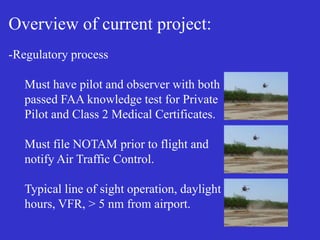
Must have pilot and observer with both
passed FAA knowledge test for Private
Pilot and Class 2 Medical Certificates.
Must file NOTAM prior to flight and
notify Air Traffic Control.
Typical line of sight operation, daylight
hours, VFR, > 5 nm from airport.
Overview of current project:
-Regulatory process
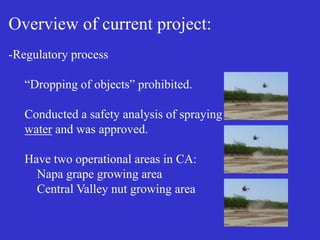
“Dropping of objects” prohibited.
Conducted a safety analysis of spraying
water and was approved.
Have two operational areas in CA:
Napa grape growing area
Central Valley nut growing area
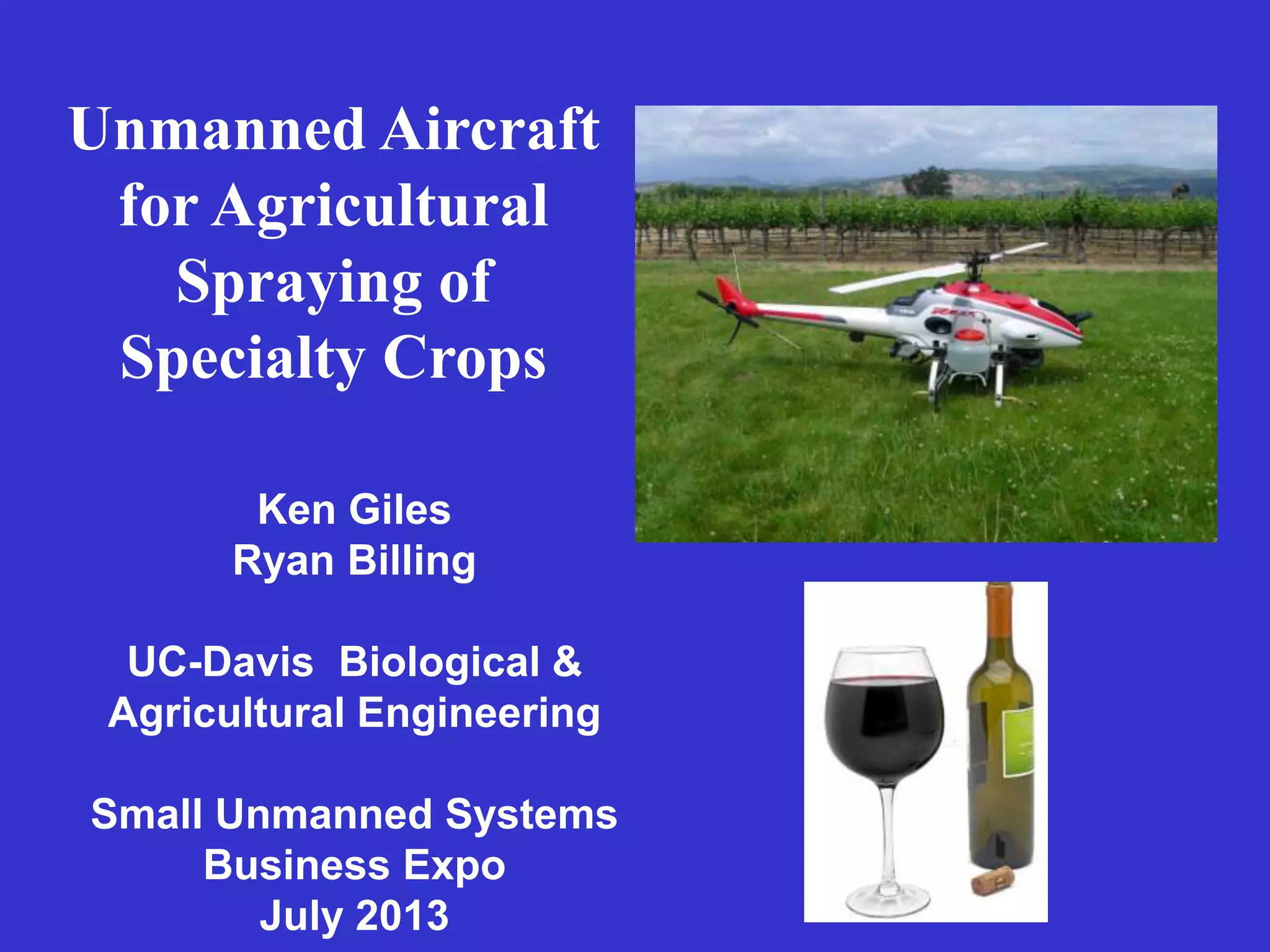
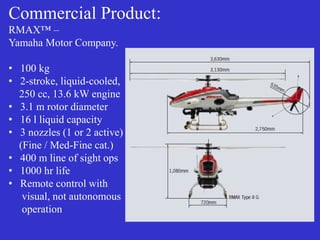
Commercial Product:
RMAX™ –
Yamaha Motor Company.
• 100 kg
• 2-stroke, liquid-cooled,
250 cc, 13.6 kW engine
• 3.1 m rotor diameter
• 16 l liquid capacity
• 3 nozzles (1 or 2 active)
(Fine / Med-Fine cat.)
• 400 m line of sight ops
• 1000 hr life
• Remote control with
visual, not autonomous
operation
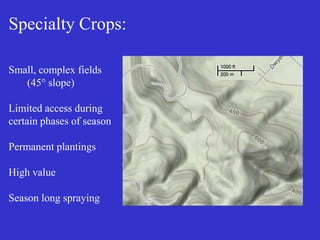
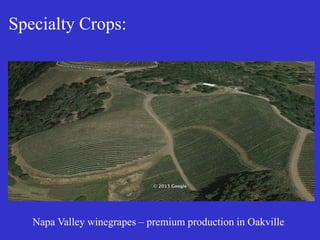
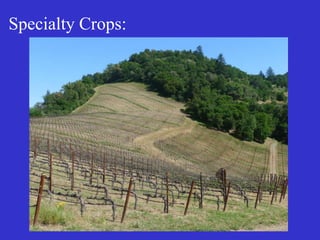
Specialty Crops:
Small, complex fields
(45° slope)
Limited access during
certain phases of season
Permanent plantings
High value
Season long spraying
Specialty Crops:
Napa Valley winegrapes – premium production in Oakville
Specialty Crops:
Objectives of current project:
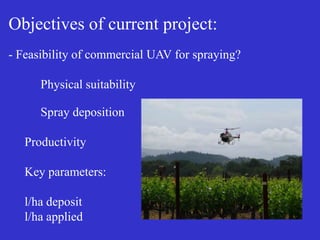
- Feasibility of commercial UAV for spraying?
Physical suitability
Spray deposition
Productivity
Key parameters:
l/ha deposit
l/ha applied
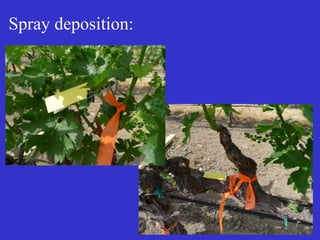
Spray deposition:
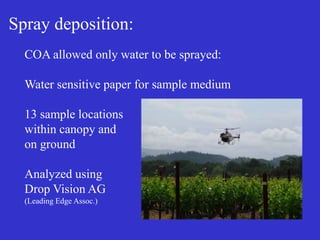
COA allowed only water to be sprayed:
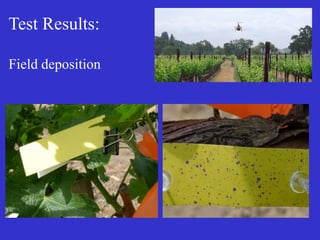
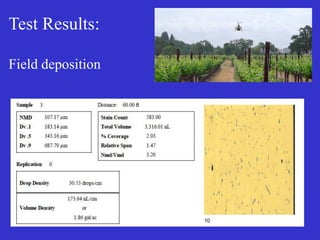
Water sensitive paper for sample medium
13 sample locations
within canopy and
on ground
Analyzed using
Drop Vision AG
(Leading Edge Assoc.)
Spray deposition:
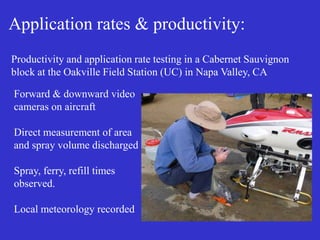
Application rates & productivity:
Productivity and application rate testing in a Cabernet Sauvignon
block at the Oakville Field Station (UC) in Napa Valley, CA
Forward & downward video
cameras on aircraft
Direct measurement of area
and spray volume discharged
Spray, ferry, refill times
observed.
Local meteorology recorded
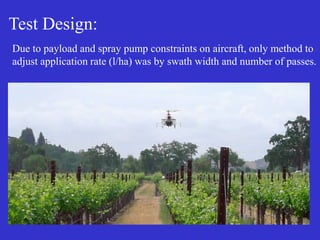
Test Design:
Due to payload and spray pump constraints on aircraft, only method to
adjust application rate (l/ha) was by swath width and number of passes.
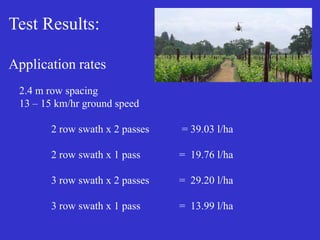
Test Results:
Application rates
2.4 m row spacing
13 – 15 km/hr ground speed
2 row swath x 2 passes = 39.03 l/ha
2 row swath x 1 pass = 19.76 l/ha
3 row swath x 2 passes = 29.20 l/ha
3 row swath x 1 pass = 13.99 l/ha
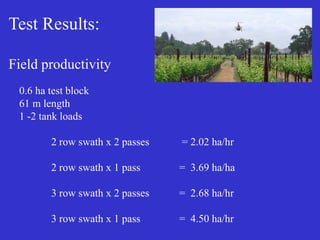
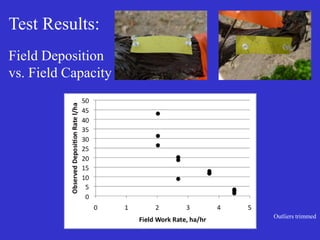
Test Results:
Field productivity
0.6 ha test block
61 m length
1 -2 tank loads
2 row swath x 2 passes = 2.02 ha/hr
2 row swath x 1 pass = 3.69 ha/ha
3 row swath x 2 passes = 2.68 ha/hr
3 row swath x 1 pass = 4.50 ha/hr
Test Results:
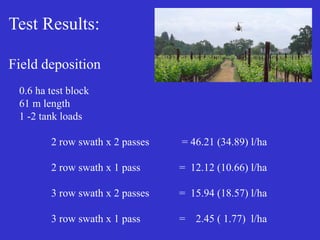
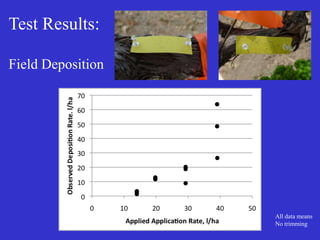
Field deposition
Test Results:
Field deposition
Test Results:
Field deposition
0.6 ha test block
61 m length
1 -2 tank loads
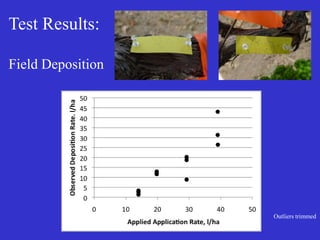
2 row swath x 2 passes = 46.21 (34.89) l/ha
2 row swath x 1 pass = 12.12 (10.66) l/ha
3 row swath x 2 passes = 15.94 (18.57) l/ha
3 row swath x 1 pass = 2.45 ( 1.77) l/ha
Test Results:
Field Deposition
All data means
No trimming
Test Results:
Field Deposition
Outliers trimmed
Test Results:
Field Deposition
vs. Field Capacity
Outliers trimmed
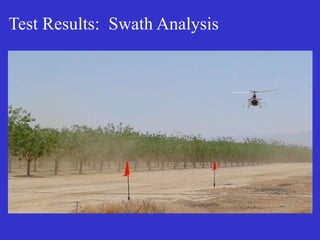
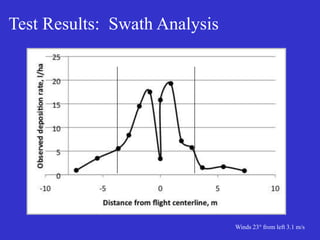
Test Results: Swath Analysis
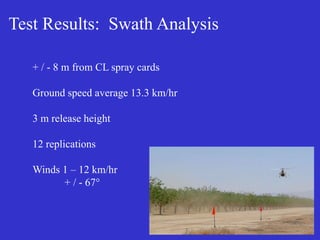
+ / - 8 m from CL spray cards
Ground speed average 13.3 km/hr
3 m release height
12 replications
Winds 1 – 12 km/hr
+ / - 67°
Test Results: Swath Analysis
Winds 23° from left 3.1 m/s
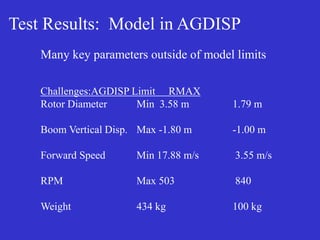
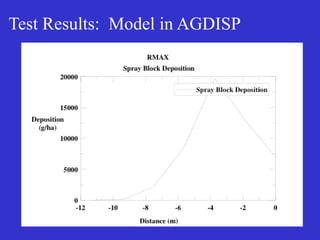
Test Results: Model in AGDISP
Many key parameters outside of model limits
Challenges:AGDISP Limit RMAX
Rotor Diameter Min 3.58 m 1.79 m
Boom Vertical Disp. Max -1.80 m -1.00 m
Forward Speed Min 17.88 m/s 3.55 m/s
RPM Max 503 840
Weight 434 kg 100 kg
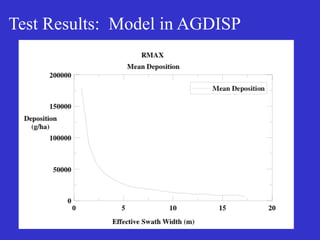
Test Results: Model in AGDISP
Conclusions:
UAV is a feasible spraying alternative to manned aerial application.
The tested platform (Yamaha RMAX™) is a low volume,
small droplet size application.
Increasing application rate volume is challenging and not without
significant decreases in field capacity (work rate).
Flight and vehicle parameters are outside the recommended
ranges for AGDISP inputs.
Next Steps:
Will be spraying active ingredients to determine biological
efficacy and performance.
Will develop field measurements of off-target drift.
Will develop business case and grower economics.
Will begin regulatory activities to address permitting and
chemical label constraints.
Public acceptance of UAV-based spraying:
UAV for Ag Ken Giles

UAV for Ag Ken Giles

  • 1.
    Unmanned Aircraft for Agricultural Sprayingof Specialty Crops Ken Giles Ryan Billing UC-Davis Biological & Agricultural Engineering Small Unmanned Systems Business Expo July 2013
  • 2.
    Overview of currentproject: - UAV development and deployment in the United States - Regulatory process - Commercial availability - Suitability for specialty crops - Testing protocol and results - Future work
  • 3.
    Overview of currentproject: -UAV development and deployment in the United States Significant interest in the ag sector. UAV: “Dull, dirty & dangerous”. (Bob Cabanya, UAS, Inc) Primarily for inspection, asset tracking. Hobbyist industry.
  • 4.
    Overview of currentproject: -Regulatory process No commercial use of UAV’s. Public agencies can deploy UAV’s via the COA (Certificate of Authorization) process. Current ag spraying R&D project under UC Davis COA.
  • 5.
    Overview of currentproject: -Regulatory process Must have pilot and observer with both passed FAA knowledge test for Private Pilot and Class 2 Medical Certificates. Must file NOTAM prior to flight and notify Air Traffic Control. Typical line of sight operation, daylight hours, VFR, > 5 nm from airport.
  • 6.
    Overview of currentproject: -Regulatory process “Dropping of objects” prohibited. Conducted a safety analysis of spraying water and was approved. Have two operational areas in CA: Napa grape growing area Central Valley nut growing area
  • 7.
    Commercial Product: RMAX™ – YamahaMotor Company. • 100 kg • 2-stroke, liquid-cooled, 250 cc, 13.6 kW engine • 3.1 m rotor diameter • 16 l liquid capacity • 3 nozzles (1 or 2 active) (Fine / Med-Fine cat.) • 400 m line of sight ops • 1000 hr life • Remote control with visual, not autonomous operation
  • 8.
    Specialty Crops: Small, complexfields (45° slope) Limited access during certain phases of season Permanent plantings High value Season long spraying
  • 9.
    Specialty Crops: Napa Valleywinegrapes – premium production in Oakville
  • 10.
  • 11.
    Objectives of currentproject: - Feasibility of commercial UAV for spraying? Physical suitability Spray deposition Productivity Key parameters: l/ha deposit l/ha applied
  • 12.
    Spray deposition: COA allowedonly water to be sprayed: Water sensitive paper for sample medium 13 sample locations within canopy and on ground Analyzed using Drop Vision AG (Leading Edge Assoc.)
  • 13.
  • 14.
    Application rates &productivity: Productivity and application rate testing in a Cabernet Sauvignon block at the Oakville Field Station (UC) in Napa Valley, CA Forward & downward video cameras on aircraft Direct measurement of area and spray volume discharged Spray, ferry, refill times observed. Local meteorology recorded
  • 15.
    Test Design: Due topayload and spray pump constraints on aircraft, only method to adjust application rate (l/ha) was by swath width and number of passes.
  • 16.
    Test Results: Application rates 2.4m row spacing 13 – 15 km/hr ground speed 2 row swath x 2 passes = 39.03 l/ha 2 row swath x 1 pass = 19.76 l/ha 3 row swath x 2 passes = 29.20 l/ha 3 row swath x 1 pass = 13.99 l/ha
  • 17.
    Test Results: Field productivity 0.6ha test block 61 m length 1 -2 tank loads 2 row swath x 2 passes = 2.02 ha/hr 2 row swath x 1 pass = 3.69 ha/ha 3 row swath x 2 passes = 2.68 ha/hr 3 row swath x 1 pass = 4.50 ha/hr
  • 18.
  • 19.
  • 20.
    Test Results: Field deposition 0.6ha test block 61 m length 1 -2 tank loads 2 row swath x 2 passes = 46.21 (34.89) l/ha 2 row swath x 1 pass = 12.12 (10.66) l/ha 3 row swath x 2 passes = 15.94 (18.57) l/ha 3 row swath x 1 pass = 2.45 ( 1.77) l/ha
  • 21.
    Test Results: Field Deposition Alldata means No trimming
  • 22.
  • 23.
    Test Results: Field Deposition vs.Field Capacity Outliers trimmed
  • 24.
  • 25.
    Test Results: SwathAnalysis + / - 8 m from CL spray cards Ground speed average 13.3 km/hr 3 m release height 12 replications Winds 1 – 12 km/hr + / - 67°
  • 26.
    Test Results: SwathAnalysis Winds 23° from left 3.1 m/s
  • 27.
    Test Results: Modelin AGDISP Many key parameters outside of model limits Challenges:AGDISP Limit RMAX Rotor Diameter Min 3.58 m 1.79 m Boom Vertical Disp. Max -1.80 m -1.00 m Forward Speed Min 17.88 m/s 3.55 m/s RPM Max 503 840 Weight 434 kg 100 kg
  • 28.
  • 29.
  • 30.
    Conclusions: UAV is afeasible spraying alternative to manned aerial application. The tested platform (Yamaha RMAX™) is a low volume, small droplet size application. Increasing application rate volume is challenging and not without significant decreases in field capacity (work rate). Flight and vehicle parameters are outside the recommended ranges for AGDISP inputs.
  • 31.
    Next Steps: Will bespraying active ingredients to determine biological efficacy and performance. Will develop field measurements of off-target drift. Will develop business case and grower economics. Will begin regulatory activities to address permitting and chemical label constraints.
  • 32.
    Public acceptance ofUAV-based spraying: