DON'T LOOK UP
PRACTICE 11 - SOCIAL AND ENVIRONMENTAL ISSUES
C1
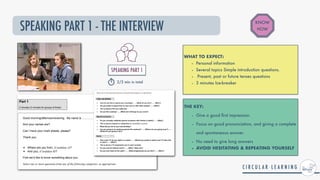
SPEAKING PART 1 - THE INTERVIEW
WHAT TO EXPECT:


- Personal information


- Several topics Simple introduction questions.


- Present, past or future tenses questions


- 3 minutes Ice-breaker
THE KEY:


- Give a good
fi
rst impression.


- Focus on good pronunciation, and giving a complete
and spontaneous answer.


- No need to give long answers


- AVOID HESITATING & REPEATING YOURSELF
KNOW
HOW
SPEAKING PART 1


2/3 min in total
SPEAKING PART 1


2/3 min in total
Are you an eco-friendly person?
I endavour to ...


I do my best to ...


I make an effort to ...


I always strive for ...


I do everything within my means to ...


Talking about effort
SPEAKING PART 1


2/3 min in total
What could you do to make your lifestyle more sustainable?
Recommendations
I guess I should ...


It would bene
fi
t the planet if ...


I know I don't ... enough


I should really work on ...


There's plenty of area for improvement in terms of ..
SPEAKING PART 1


2/3 min in total
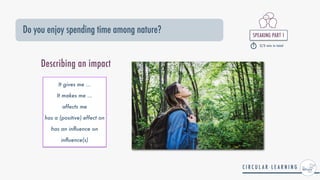
Do you enjoy spending time among nature?
It gives me ...


It makes me ...


affects me


has a (positive) effect on


has an in
fl
uence on


in
fl
uence(s)
Describing an impact
SPEAKING PART 1


2/3 min in total
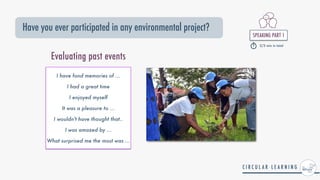
Have you ever participated in any environmental project?
Evaluating past events
I have fond memories of ...


I had a great time


I enjoyed myself


It was a pleasure to ...


I wouldn't have thought that..


I was amazed by ...


What surprised me the most was ...
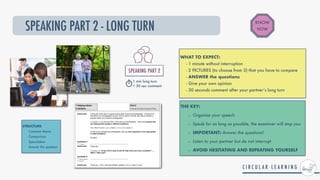
SPEAKING PART 2 - LONG TURN
WHAT TO EXPECT:


- 1 minute without interruption


- 2 PICTURES (to choose from 3) that you have to compare


- ANSWER the questions


- Give your own opinion


- 30 seconds comment after your partner’s long turn
THE KEY:


- Organise your speech


- Speak for as long as possible, the examiner will stop you


- IMPORTANT: Answer the questions!


- Listen to your partner but do not interrupt


- AVOID HESITATING AND REPEATING YOURSELF
KNOW
HOW
STRUCTURE


Common theme


Comparison


Speculation


Answer the question
SPEAKING PART 2


1 min long turn


+ 30 sec comment
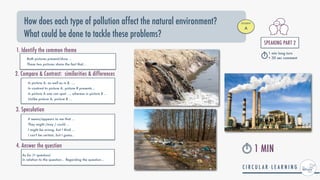
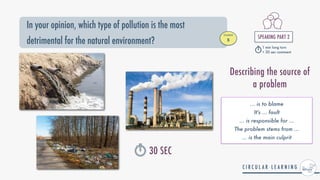
How does each type of pollution affect the natural environment?
What could be done to tackle these problems?
3. Speculation
It seems/appears to me that ...


They might /may / could ...


I might be wrong, but I think ...


I can't be certain, but I guess..
Both pictures present/show …


These two pictures share the fact that...
1. Identify the common theme
In picture A, as well as in B, ….


In contrast to picture A, picture B presents...


In picture A one can spot ..., whereas in picture B ...


Unlike picture A, picture B ...
2. Compare & Contrast: similarities & differences
As for (+ question)


In relation to the question... Regarding the question...
4. Answer the question
STUDENT


A
SPEAKING PART 2


1 min long turn


+ 30 sec comment
1 MIN
In your opinion, which type of pollution is the most
detrimental for the natural environment?
STUDENT


B
SPEAKING PART 2


1 min long turn


+ 30 sec comment
30 SEC
... is to blame


It's ... fault


... is responsible for ...


The problem stems from ...


... is the main culprit
Describing the source of
a problem
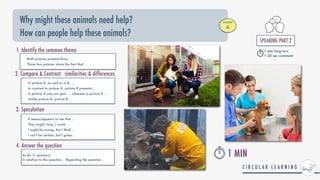
Why might these animals need help?
How can people help these animals?
3. Speculation
It seems/appears to me that ...


They might /may / could ...


I might be wrong, but I think ...


I can't be certain, but I guess..
Both pictures present/show …


These two pictures share the fact that...
1. Identify the common theme
In picture A, as well as in B, ….


In contrast to picture A, picture B presents...


In picture A one can spot ..., whereas in picture B ...


Unlike picture A, picture B ...
2. Compare & Contrast: similarities & differences
As for (+ question)


In relation to the question... Regarding the question...
4. Answer the question
STUDENT


A
SPEAKING PART 2


1 min long turn


+ 30 sec comment
1 MIN
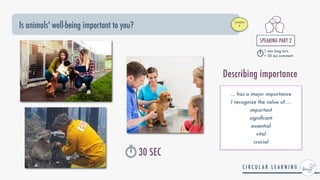
Is animals' well-being important to you?
STUDENT


B
SPEAKING PART 2


1 min long turn


+ 30 sec comment
30 SEC
Describing importance
... has a major importance


I recognize the value of ...


important


signi
fi
cant


essential


vital


crucial
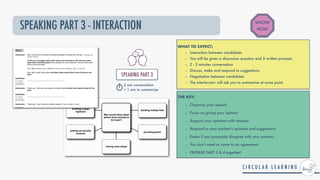
SPEAKING PART 3 - INTERACTION
WHAT TO EXPECT:


- Interaction between candidates


- You will be given a discussion question and 5 written prompts


- 2 - 3 minutes conversation


- Discuss, make and respond to suggestions


- Negotiation between candidates


- The interlocutor will ask you to summarise at some point.
THE KEY:


- Organise your speech


- Focus on giving your opinion


- Support your opinions with reasons


- Respond to your partner's opinions and suggestions


- Easier if you purposely disagree with your partner.


- You don’t need to come to an agreement.


- PREPARE PART 3 & 4 together!
KNOW
HOW
SPEAKING PART 3


2 min conversation


+ 1 min to summarize
SPEAKING PART 3


2 min conversation


+ 1 min to summarize
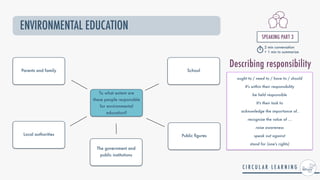
ENVIRONMENTAL EDUCATION
To what extent are
these people responsible
for environmental
education?
Local authorities
The government and
public institutions
Public
fi
gures
Parents and family School
ought to / need to / have to / should


It's within their responsibility


be held responsible


It's their task to


acknowledge the importance of..


recognize the value of ...


raise awareness


speak out against


stand for (one's rights)
Describing responsibility
SPEAKING PART 4 - DISCUSSION
WHAT TO EXPECT:


- General conversation based on the topic in part 3


- Both of you will have to give your opinions.


- IT’S THE PERFECT OPPORTUNITY TO SHOW THAT YOU ARE
CAPABLE OF DISCUSSING ISSUES IN DEPTH
THE KEY:


- Organise your speech


- Focus on developing the conversation


- Listen to the questions carefully and answer them according to your
opinion BUT ALWAYS: Support your opinions with reasons
KNOW
HOW
SPEAKING PART 4


5 min conversation
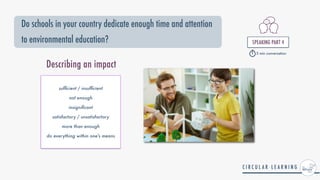
Do schools in your country dedicate enough time and attention
to environmental education? SPEAKING PART 4


5 min conversation
Describing an impact
suf
fi
cient / insuf
fi
cient


not enough


insigni
fi
cant


satisfactory / unsatisfactory


more than enough


do everything within one's means
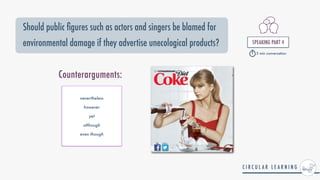
Should public gures such as actors and singers be blamed for
environmental damage if they advertise unecological products? SPEAKING PART 4


5 min conversation
nevertheless


however


yet


although


even though
Counterarguments:
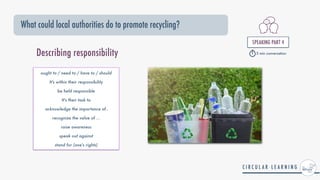
What could local authorities do to promote recycling?
SPEAKING PART 4


5 min conversation
ought to / need to / have to / should


It's within their responsibility


be held responsible


It's their task to


acknowledge the importance of..


recognize the value of ...


raise awareness


speak out against


stand for (one's rights)
Describing responsibility
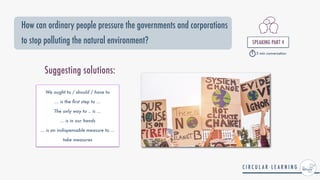
How can ordinary people pressure the governments and corporations
to stop polluting the natural environment? SPEAKING PART 4


5 min conversation
Suggesting solutions:
We ought to / should / have to


... is the
fi
rst step to ...


The only way to .. is ...


... is in our hands


... is an indispensable measure to ...


take measures
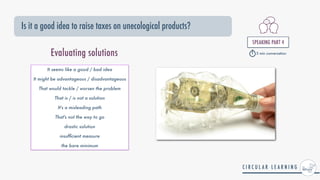
Is it a good idea to raise taxes on unecological products?
SPEAKING PART 4


5 min conversation
Evaluating solutions
It seems like a good / bad idea


It might be advantageous / disadvantageous


That would tackle / worsen the problem


That is / is not a solution


It's a misleading path


That's not the way to go


drastic solution


insuf
fi
cient measure


the bare minimum
Reading & Use of English: Part 1
READING & UOE


1h 30 min/ 8 parts
Whenever we read about the natural world nowadays, it is
generally to be given dire predictions about its (1) ...... destruction.
Some scientists go so (2) ..... as to assert that from now on, the
world can no longer be called 'natural', insofar as future processes
of weather, climate and all the interactions of plant and animal life
will no longer carry on in their time-honoured way, unaffected by
humans. There will never be such a thing as 'natural weather'
again, say such writers, only weather affected by global warming.
It is hard to know whether to believe such (3) ..... of doom, possibly
because what they are saying seems too terrible to be true. There
are other equally in
fl
uential scientists who argue that climate, for
example, has changed many times over the (4) .... , and that what
we are experiencing now may simply be part of an endless (5) .....
of change, rather than a disaster on a global (6) ......
1. a) coming b)close c) imminent d) nigh


2. a) much b) deep c) long d) far


3. a) prophets b) champions c) warriors d) giants


4. a) generations b) millennia c) centuries d) eras


5. a) revolution b) circle c) round d) cycle


6. a) measure b) scale c) proportion d) extent
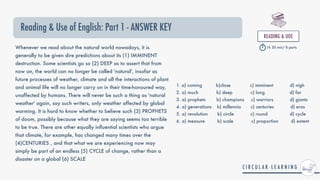
Reading & Use of English: Part 1 - ANSWER KEY
READING & UOE


1h 30 min/ 8 parts
Whenever we read about the natural world nowadays, it is
generally to be given dire predictions about its (1) IMMINENT
destruction. Some scientists go so (2) DEEP as to assert that from
now on, the world can no longer be called 'natural', insofar as
future processes of weather, climate and all the interactions of plant
and animal life will no longer carry on in their time-honoured way,
unaffected by humans. There will never be such a thing as 'natural
weather' again, say such writers, only weather affected by global
warming. It is hard to know whether to believe such (3) PROPHETS
of doom, possibly because what they are saying seems too terrible
to be true. There are other equally in
fl
uential scientists who argue
that climate, for example, has changed many times over the
(4)CENTURIES , and that what we are experiencing now may
simply be part of an endless (5) CYCLE of change, rather than a
disaster on a global (6) SCALE
1. a) coming b)close c) imminent d) nigh


2. a) much b) deep c) long d) far


3. a) prophets b) champions c) warriors d) giants


4. a) generations b) millennia c) centuries d) eras


5. a) revolution b) circle c) round d) cycle


6. a) measure b) scale c) proportion d) extent

11. Don't look up C1 - Exam practice 11.pdf

  • 1.
    DON'T LOOK UP PRACTICE11 - SOCIAL AND ENVIRONMENTAL ISSUES C1
  • 2.
    SPEAKING PART 1- THE INTERVIEW WHAT TO EXPECT: - Personal information - Several topics Simple introduction questions. - Present, past or future tenses questions - 3 minutes Ice-breaker THE KEY: - Give a good fi rst impression. - Focus on good pronunciation, and giving a complete and spontaneous answer. - No need to give long answers - AVOID HESITATING & REPEATING YOURSELF KNOW HOW SPEAKING PART 1 2/3 min in total
  • 3.
    SPEAKING PART 1 2/3min in total Are you an eco-friendly person? I endavour to ... I do my best to ... I make an effort to ... I always strive for ... I do everything within my means to ... Talking about effort
  • 4.
    SPEAKING PART 1 2/3min in total What could you do to make your lifestyle more sustainable? Recommendations I guess I should ... It would bene fi t the planet if ... I know I don't ... enough I should really work on ... There's plenty of area for improvement in terms of ..
  • 5.
    SPEAKING PART 1 2/3min in total Do you enjoy spending time among nature? It gives me ... It makes me ... affects me has a (positive) effect on has an in fl uence on in fl uence(s) Describing an impact
  • 6.
    SPEAKING PART 1 2/3min in total Have you ever participated in any environmental project? Evaluating past events I have fond memories of ... I had a great time I enjoyed myself It was a pleasure to ... I wouldn't have thought that.. I was amazed by ... What surprised me the most was ...
  • 7.
    SPEAKING PART 2- LONG TURN WHAT TO EXPECT: - 1 minute without interruption - 2 PICTURES (to choose from 3) that you have to compare - ANSWER the questions - Give your own opinion - 30 seconds comment after your partner’s long turn THE KEY: - Organise your speech - Speak for as long as possible, the examiner will stop you - IMPORTANT: Answer the questions! - Listen to your partner but do not interrupt - AVOID HESITATING AND REPEATING YOURSELF KNOW HOW STRUCTURE Common theme Comparison Speculation Answer the question SPEAKING PART 2 1 min long turn + 30 sec comment
  • 8.
    How does eachtype of pollution affect the natural environment? What could be done to tackle these problems? 3. Speculation It seems/appears to me that ... They might /may / could ... I might be wrong, but I think ... I can't be certain, but I guess.. Both pictures present/show … These two pictures share the fact that... 1. Identify the common theme In picture A, as well as in B, …. In contrast to picture A, picture B presents... In picture A one can spot ..., whereas in picture B ... Unlike picture A, picture B ... 2. Compare & Contrast: similarities & differences As for (+ question) 
 In relation to the question... Regarding the question... 4. Answer the question STUDENT A SPEAKING PART 2 1 min long turn + 30 sec comment 1 MIN
  • 9.
    In your opinion,which type of pollution is the most detrimental for the natural environment? STUDENT B SPEAKING PART 2 1 min long turn + 30 sec comment 30 SEC ... is to blame It's ... fault ... is responsible for ... The problem stems from ... ... is the main culprit Describing the source of a problem
  • 10.
    Why might theseanimals need help? How can people help these animals? 3. Speculation It seems/appears to me that ... They might /may / could ... I might be wrong, but I think ... I can't be certain, but I guess.. Both pictures present/show … These two pictures share the fact that... 1. Identify the common theme In picture A, as well as in B, …. In contrast to picture A, picture B presents... In picture A one can spot ..., whereas in picture B ... Unlike picture A, picture B ... 2. Compare & Contrast: similarities & differences As for (+ question) 
 In relation to the question... Regarding the question... 4. Answer the question STUDENT A SPEAKING PART 2 1 min long turn + 30 sec comment 1 MIN
  • 11.
    Is animals' well-beingimportant to you? STUDENT B SPEAKING PART 2 1 min long turn + 30 sec comment 30 SEC Describing importance ... has a major importance I recognize the value of ... important signi fi cant essential vital crucial
  • 12.
    SPEAKING PART 3- INTERACTION WHAT TO EXPECT: - Interaction between candidates - You will be given a discussion question and 5 written prompts - 2 - 3 minutes conversation - Discuss, make and respond to suggestions - Negotiation between candidates - The interlocutor will ask you to summarise at some point. THE KEY: - Organise your speech - Focus on giving your opinion - Support your opinions with reasons - Respond to your partner's opinions and suggestions - Easier if you purposely disagree with your partner. - You don’t need to come to an agreement. - PREPARE PART 3 & 4 together! KNOW HOW SPEAKING PART 3 2 min conversation + 1 min to summarize
  • 13.
    SPEAKING PART 3 2min conversation + 1 min to summarize ENVIRONMENTAL EDUCATION To what extent are these people responsible for environmental education? Local authorities The government and public institutions Public fi gures Parents and family School ought to / need to / have to / should It's within their responsibility be held responsible It's their task to acknowledge the importance of.. recognize the value of ... raise awareness speak out against stand for (one's rights) Describing responsibility
  • 14.
    SPEAKING PART 4- DISCUSSION WHAT TO EXPECT: - General conversation based on the topic in part 3 - Both of you will have to give your opinions. - IT’S THE PERFECT OPPORTUNITY TO SHOW THAT YOU ARE CAPABLE OF DISCUSSING ISSUES IN DEPTH THE KEY: - Organise your speech - Focus on developing the conversation - Listen to the questions carefully and answer them according to your opinion BUT ALWAYS: Support your opinions with reasons KNOW HOW SPEAKING PART 4 5 min conversation
  • 15.
    Do schools inyour country dedicate enough time and attention to environmental education? SPEAKING PART 4 5 min conversation Describing an impact suf fi cient / insuf fi cient not enough insigni fi cant satisfactory / unsatisfactory more than enough do everything within one's means
  • 16.
    Should public guressuch as actors and singers be blamed for environmental damage if they advertise unecological products? SPEAKING PART 4 5 min conversation nevertheless however yet although even though Counterarguments:
  • 17.
    What could localauthorities do to promote recycling? SPEAKING PART 4 5 min conversation ought to / need to / have to / should It's within their responsibility be held responsible It's their task to acknowledge the importance of.. recognize the value of ... raise awareness speak out against stand for (one's rights) Describing responsibility
  • 18.
    How can ordinarypeople pressure the governments and corporations to stop polluting the natural environment? SPEAKING PART 4 5 min conversation Suggesting solutions: We ought to / should / have to ... is the fi rst step to ... The only way to .. is ... ... is in our hands ... is an indispensable measure to ... take measures
  • 19.
    Is it agood idea to raise taxes on unecological products? SPEAKING PART 4 5 min conversation Evaluating solutions It seems like a good / bad idea It might be advantageous / disadvantageous That would tackle / worsen the problem That is / is not a solution It's a misleading path That's not the way to go drastic solution insuf fi cient measure the bare minimum
  • 20.
    Reading & Useof English: Part 1 READING & UOE 1h 30 min/ 8 parts Whenever we read about the natural world nowadays, it is generally to be given dire predictions about its (1) ...... destruction. Some scientists go so (2) ..... as to assert that from now on, the world can no longer be called 'natural', insofar as future processes of weather, climate and all the interactions of plant and animal life will no longer carry on in their time-honoured way, unaffected by humans. There will never be such a thing as 'natural weather' again, say such writers, only weather affected by global warming. It is hard to know whether to believe such (3) ..... of doom, possibly because what they are saying seems too terrible to be true. There are other equally in fl uential scientists who argue that climate, for example, has changed many times over the (4) .... , and that what we are experiencing now may simply be part of an endless (5) ..... of change, rather than a disaster on a global (6) ...... 1. a) coming b)close c) imminent d) nigh 2. a) much b) deep c) long d) far 3. a) prophets b) champions c) warriors d) giants 4. a) generations b) millennia c) centuries d) eras 5. a) revolution b) circle c) round d) cycle 6. a) measure b) scale c) proportion d) extent
  • 21.
    Reading & Useof English: Part 1 - ANSWER KEY READING & UOE 1h 30 min/ 8 parts Whenever we read about the natural world nowadays, it is generally to be given dire predictions about its (1) IMMINENT destruction. Some scientists go so (2) DEEP as to assert that from now on, the world can no longer be called 'natural', insofar as future processes of weather, climate and all the interactions of plant and animal life will no longer carry on in their time-honoured way, unaffected by humans. There will never be such a thing as 'natural weather' again, say such writers, only weather affected by global warming. It is hard to know whether to believe such (3) PROPHETS of doom, possibly because what they are saying seems too terrible to be true. There are other equally in fl uential scientists who argue that climate, for example, has changed many times over the (4)CENTURIES , and that what we are experiencing now may simply be part of an endless (5) CYCLE of change, rather than a disaster on a global (6) SCALE 1. a) coming b)close c) imminent d) nigh 2. a) much b) deep c) long d) far 3. a) prophets b) champions c) warriors d) giants 4. a) generations b) millennia c) centuries d) eras 5. a) revolution b) circle c) round d) cycle 6. a) measure b) scale c) proportion d) extent