Climate/Weather
MEM EDUCATION CENTER
Terminology
v Weather – is more about short term changes
v Climate – is more about longer term changes
“Weather tells you what to wear each day.
Climate tells you what types of clothes to have in your wardrobe!”
Collocations
for Climate
• harsh/inhospitable (=uncomfortable and difficult to live in)
• temperate/mild (= not too hot/ not too cold)
• warm/hot/ tropical (= very hot and wet)
• humid (=with hot and wet air)
• human-induced ( influenced by human activities )
Collocations for Weather
• extreme/hostile
• changeable
• good/nice/lovely
• glorious/perfect/beautiful
• atrocious (=very bad or unpleasant)
• awful/dreadful/ terrible
• dismal, dreary (=dull, depressing)
• fine/ sunny/ fair/ dry
• wet/rainy
• windy/stormy
We can also describe the weather as ...
§ nippy
§ chilly (quite cold)
§ bone dry (very dry)
VOCABULARY
vGlobal warming – an increase in the global average temperature on earth
vClimate change – the change in general weather conditions on the earth
over a long period of time.
vGas emissions – the production of gases like carbon dioxide (CO2) and
methane (CH4)
To reduce/ lower/ cut back on/ offset emissions
vThe Greenhouse effect – greenhouse gases trap heat from the sun in the
atmosphere. The heat cannot escape; as result, the planet gets hotter.
VOCABULARY
§ fossil fuels – non-renewable fuels, e.g. coal, carbon, oil, gas
§ deforestation – the cutting down of trees on a large scale
§ habitats – where animals and plants live
§ ecosystem – a community of living things connected to their environment
§ carbon footprint – The amount of greenhouse gases produced from any
person or organisation’s activity.
“I can reduce my carbon footprint by using less electricity at home.”
VOCABULARY
§ renewable energies - water (hydro), wind, sun (solar)
§ biodegradable waste = waste that naturally decomposes.
§ A landfill (n.) (C) = a place where rubbish is dumped and buried
§ Try to solve / tackle / address climate change / global warming
e.g., “We need to tackle climate change head on” (=directly)
§ to mitigate climate change (=reduce, alleviate, minimise)
§ environmentally-friendly: not harmful to the environment
e.g., Electric cars are more environmentally-friendly than those that run on petrol.
§ gas guzzler (informal): a vehicle that uses a lot of fuel
e.g., For many people, a large car is a status symbol, and they aren’t concerned
about the harm their gas guzzler is doing to the environment.
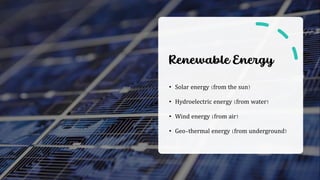
Renewable Energy
• Solar energy (from the sun)
• Hydroelectric energy (from water)
• Wind energy (from air)
• Geo-thermal energy (from underground)
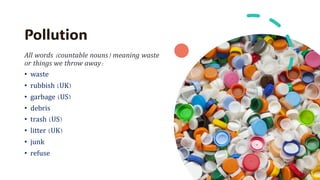
Pollution
All words (countable nouns) meaning waste
or things we throw away:
• waste
• rubbish (UK)
• garbage (US)
• debris
• trash (US)
• litter (UK)
• junk
• refuse
The Solutions to Climate Change
o segregate our rubbish (to separate) into ….
Ø The 3 Rs: Recycle – Reduce – Reuse
o opt for public transport
o avoid travel
o reduce the demand for livestock and cattle.
o shop locally
o consume less, whether it be for.......
o be a victim of fast fashion
o use energy saving bulbs
o save energy/ electricity/ water
o save water, by not leaving the tap running
unnecessarily
o do some volunteer work
o run a campaign to raise awareness
o clean up beaches
o participate in a beach clean-up
o reduce plastic wastes
o protect wildlife habitats
How can governments tackle this issue?
• Promote the use of electric cars – and public
transport
• Raise awareness of the need to recycle
• Sensitise people to the importance of using
renewable energy
• Incentivise (=to motivate) people to recycle
• Incentivise (=to motivate) companies to use
renewable/ sustainable energy
(solar (sun), hydro (water), wind…geothermal..)
• Set zero-carbon energy targets
• Reduce their carbon footprint to ‘net zero’
• Carry out research on plastic substitutes
(research on biodegradable alternatives)
• Set up initiatives to protect…. wildlife / natural
habitats / forests / endangered species
• Implement policies to protect…
• Put measures in place to protect…
• Impose restrictions on….
• Put in place strict / stringent policies
How can we protect the environment?
To protect the environment, we can use phrases:
• I am careful to ______
• I am careful to recycle rubbish and waste at
home
• I strive not to ______
• I strive not to use disposable plastic, such as
coffee cups in Starbucks
• I endeavour to _______
• I endeavour to turn off the lights in my home
• I make an effort to ______
• I make an effort to turn taps off when possible
I pick up discarded rubbish sometimes OR …
q…from time to time
q…once in a while
q…every now and then
q…at times
• I like to do my bit = to play my part = to
contribute
• We should steer clear of….. = to avoid
• We should be wary of = be careful and cautious
with.
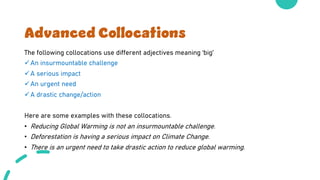
Advanced Collocations
The following collocations use different adjectives meaning ‘big’
üAn insurmountable challenge
üA serious impact
üAn urgent need
üA drastic change/action
Here are some examples with these collocations.
• Reducing Global Warming is not an insurmountable challenge.
• Deforestation is having a serious impact on Climate Change.
• There is an urgent need to take drastic action to reduce global warming.
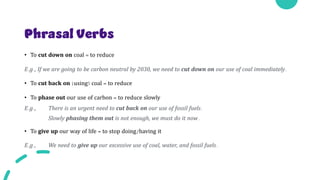
Phrasal Verbs
• To cut down on coal = to reduce
E.g., If we are going to be carbon neutral by 2030, we need to cut down on our use of coal immediately.
• To cut back on (using) coal = to reduce
• To phase out our use of carbon = to reduce slowly
E.g., There is an urgent need to cut back on our use of fossil fuels.
Slowly phasing them out is not enough, we must do it now.
• To give up our way of life = to stop doing/having it
E.g., We need to give up our excessive use of coal, water, and fossil fuels.
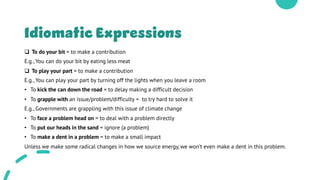
Idiomatic Expressions
q To do your bit = to make a contribution
E.g., You can do your bit by eating less meat
q To play your part = to make a contribution
E.g., You can play your part by turning off the lights when you leave a room
• To kick the can down the road = to delay making a difficult decision
• To grapple with an issue/problem/difficulty = to try hard to solve it
E.g., Governments are grappling with this issue of climate change
• To face a problem head on = to deal with a problem directly
• To put our heads in the sand = ignore (a problem)
• To make a dent in a problem = to make a small impact
Unless we make some radical changes in how we source energy, we won’t even make a dent in this problem.
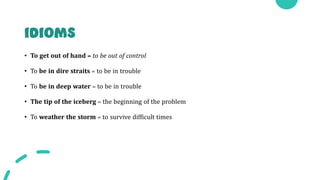
IDIOMS
• To get out of hand = to be out of control
• To be in dire straits = to be in trouble
• To be in deep water = to be in trouble
• The tip of the iceberg = the beginning of the problem
• To weather the storm = to survive difficult times
PART 1
§ What is the weather like in your country?
§ Do you like the weather in your country?
§ Is the weather the same in all parts of your country?
§ Are there any problems with the climate in your country?
§ Does the weather ever affect the way you feel?
§ What’s the weather like in your country?
§ Does the weather affect your mood?
§ How do rainy days make you feel?
§ What’s your favourite season of the year?
§ What do you like to do when it’s hot?
§ What do you usually do in the winter?
§ How many seasons does your country have?
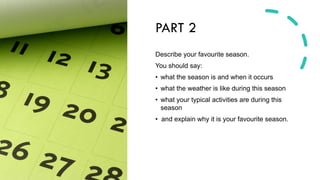
PART 2
Describe your favourite season.
You should say:
• what the season is and when it occurs
• what the weather is like during this season
• what your typical activities are during this
season
• and explain why it is your favourite season.
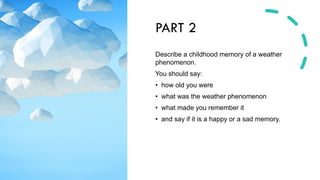
PART 2
Describe a childhood memory of a weather
phenomenon.
You should say:
• how old you were
• what was the weather phenomenon
• what made you remember it
• and say if it is a happy or a sad memory.
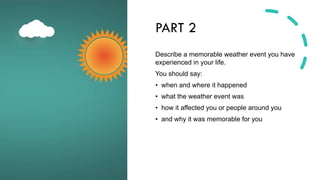
PART 2
Describe a memorable weather event you have
experienced in your life.
You should say:
• when and where it happened
• what the weather event was
• how it affected you or people around you
• and why it was memorable for you
PART 2
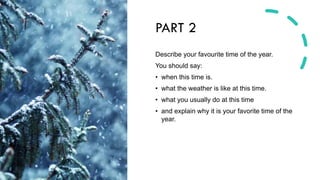
Describe your favourite time of the year.
You should say:
• when this time is.
• what the weather is like at this time.
• what you usually do at this time
• and explain why it is your favorite time of the
year.
PART 2
Describe an unusually hot or cold season in your
country.
You should say:
• what season it was
• how long it lasted
• how you coped with the extreme temperature
• and say how you felt about it.
PART 2
Describe an environmental problem that has
been in the news.
You should say:
• when this was
• where the event happened
• what actually took place
• and say how you felt about this problem.
Part 3
§ How do different seasons affect the way people feel?
§ Do you think weather forecasts are accurate? Why or why not?
§ How does weather affect people’s daily routines?
§ What examples are there of how we damage the natural world?
§ What are some ways people can adapt to extreme weather conditions?
§ In which ways do we respond well to environmental problems?
§ How can governments and societies address the challenges posed by changing weather patterns?
§ How can we teach children about the importance of protecting the environment?
§ Do you think there will be more environmental disasters caused by humans in the future?
§ What do you think is the main danger the world faces in terms of the environment?
§ Which environmental problems are people most concerned about in your country?
§ Do you think fighting global climate change is a governmental responsibility or the responsibility of
individuals?
MEM EDUCATION CENTER
“Save the bees
Protect the trees
Clean the seas”

Climate Change Topic for IELTS SPEAKING Class

  • 1.
  • 2.
    Terminology v Weather –is more about short term changes v Climate – is more about longer term changes “Weather tells you what to wear each day. Climate tells you what types of clothes to have in your wardrobe!”
  • 3.
    Collocations for Climate • harsh/inhospitable(=uncomfortable and difficult to live in) • temperate/mild (= not too hot/ not too cold) • warm/hot/ tropical (= very hot and wet) • humid (=with hot and wet air) • human-induced ( influenced by human activities )
  • 4.
    Collocations for Weather •extreme/hostile • changeable • good/nice/lovely • glorious/perfect/beautiful • atrocious (=very bad or unpleasant) • awful/dreadful/ terrible • dismal, dreary (=dull, depressing) • fine/ sunny/ fair/ dry • wet/rainy • windy/stormy We can also describe the weather as ... § nippy § chilly (quite cold) § bone dry (very dry)
  • 5.
    VOCABULARY vGlobal warming –an increase in the global average temperature on earth vClimate change – the change in general weather conditions on the earth over a long period of time. vGas emissions – the production of gases like carbon dioxide (CO2) and methane (CH4) To reduce/ lower/ cut back on/ offset emissions vThe Greenhouse effect – greenhouse gases trap heat from the sun in the atmosphere. The heat cannot escape; as result, the planet gets hotter.
  • 6.
    VOCABULARY § fossil fuels– non-renewable fuels, e.g. coal, carbon, oil, gas § deforestation – the cutting down of trees on a large scale § habitats – where animals and plants live § ecosystem – a community of living things connected to their environment § carbon footprint – The amount of greenhouse gases produced from any person or organisation’s activity. “I can reduce my carbon footprint by using less electricity at home.”
  • 7.
    VOCABULARY § renewable energies- water (hydro), wind, sun (solar) § biodegradable waste = waste that naturally decomposes. § A landfill (n.) (C) = a place where rubbish is dumped and buried § Try to solve / tackle / address climate change / global warming e.g., “We need to tackle climate change head on” (=directly) § to mitigate climate change (=reduce, alleviate, minimise) § environmentally-friendly: not harmful to the environment e.g., Electric cars are more environmentally-friendly than those that run on petrol. § gas guzzler (informal): a vehicle that uses a lot of fuel e.g., For many people, a large car is a status symbol, and they aren’t concerned about the harm their gas guzzler is doing to the environment.
  • 8.
    Renewable Energy • Solarenergy (from the sun) • Hydroelectric energy (from water) • Wind energy (from air) • Geo-thermal energy (from underground)
  • 9.
    Pollution All words (countablenouns) meaning waste or things we throw away: • waste • rubbish (UK) • garbage (US) • debris • trash (US) • litter (UK) • junk • refuse
  • 10.
    The Solutions toClimate Change o segregate our rubbish (to separate) into …. Ø The 3 Rs: Recycle – Reduce – Reuse o opt for public transport o avoid travel o reduce the demand for livestock and cattle. o shop locally o consume less, whether it be for....... o be a victim of fast fashion o use energy saving bulbs o save energy/ electricity/ water o save water, by not leaving the tap running unnecessarily o do some volunteer work o run a campaign to raise awareness o clean up beaches o participate in a beach clean-up o reduce plastic wastes o protect wildlife habitats
  • 11.
    How can governmentstackle this issue? • Promote the use of electric cars – and public transport • Raise awareness of the need to recycle • Sensitise people to the importance of using renewable energy • Incentivise (=to motivate) people to recycle • Incentivise (=to motivate) companies to use renewable/ sustainable energy (solar (sun), hydro (water), wind…geothermal..) • Set zero-carbon energy targets • Reduce their carbon footprint to ‘net zero’ • Carry out research on plastic substitutes (research on biodegradable alternatives) • Set up initiatives to protect…. wildlife / natural habitats / forests / endangered species • Implement policies to protect… • Put measures in place to protect… • Impose restrictions on…. • Put in place strict / stringent policies
  • 12.
    How can weprotect the environment? To protect the environment, we can use phrases: • I am careful to ______ • I am careful to recycle rubbish and waste at home • I strive not to ______ • I strive not to use disposable plastic, such as coffee cups in Starbucks • I endeavour to _______ • I endeavour to turn off the lights in my home • I make an effort to ______ • I make an effort to turn taps off when possible I pick up discarded rubbish sometimes OR … q…from time to time q…once in a while q…every now and then q…at times • I like to do my bit = to play my part = to contribute • We should steer clear of….. = to avoid • We should be wary of = be careful and cautious with.
  • 13.
    Advanced Collocations The followingcollocations use different adjectives meaning ‘big’ üAn insurmountable challenge üA serious impact üAn urgent need üA drastic change/action Here are some examples with these collocations. • Reducing Global Warming is not an insurmountable challenge. • Deforestation is having a serious impact on Climate Change. • There is an urgent need to take drastic action to reduce global warming.
  • 14.
    Phrasal Verbs • Tocut down on coal = to reduce E.g., If we are going to be carbon neutral by 2030, we need to cut down on our use of coal immediately. • To cut back on (using) coal = to reduce • To phase out our use of carbon = to reduce slowly E.g., There is an urgent need to cut back on our use of fossil fuels. Slowly phasing them out is not enough, we must do it now. • To give up our way of life = to stop doing/having it E.g., We need to give up our excessive use of coal, water, and fossil fuels.
  • 15.
    Idiomatic Expressions q Todo your bit = to make a contribution E.g., You can do your bit by eating less meat q To play your part = to make a contribution E.g., You can play your part by turning off the lights when you leave a room • To kick the can down the road = to delay making a difficult decision • To grapple with an issue/problem/difficulty = to try hard to solve it E.g., Governments are grappling with this issue of climate change • To face a problem head on = to deal with a problem directly • To put our heads in the sand = ignore (a problem) • To make a dent in a problem = to make a small impact Unless we make some radical changes in how we source energy, we won’t even make a dent in this problem.
  • 16.
    IDIOMS • To getout of hand = to be out of control • To be in dire straits = to be in trouble • To be in deep water = to be in trouble • The tip of the iceberg = the beginning of the problem • To weather the storm = to survive difficult times
  • 17.
    PART 1 § Whatis the weather like in your country? § Do you like the weather in your country? § Is the weather the same in all parts of your country? § Are there any problems with the climate in your country? § Does the weather ever affect the way you feel? § What’s the weather like in your country? § Does the weather affect your mood? § How do rainy days make you feel? § What’s your favourite season of the year? § What do you like to do when it’s hot? § What do you usually do in the winter? § How many seasons does your country have?
  • 18.
    PART 2 Describe yourfavourite season. You should say: • what the season is and when it occurs • what the weather is like during this season • what your typical activities are during this season • and explain why it is your favourite season.
  • 19.
    PART 2 Describe achildhood memory of a weather phenomenon. You should say: • how old you were • what was the weather phenomenon • what made you remember it • and say if it is a happy or a sad memory.
  • 20.
    PART 2 Describe amemorable weather event you have experienced in your life. You should say: • when and where it happened • what the weather event was • how it affected you or people around you • and why it was memorable for you
  • 21.
    PART 2 Describe yourfavourite time of the year. You should say: • when this time is. • what the weather is like at this time. • what you usually do at this time • and explain why it is your favorite time of the year.
  • 22.
    PART 2 Describe anunusually hot or cold season in your country. You should say: • what season it was • how long it lasted • how you coped with the extreme temperature • and say how you felt about it.
  • 23.
    PART 2 Describe anenvironmental problem that has been in the news. You should say: • when this was • where the event happened • what actually took place • and say how you felt about this problem.
  • 24.
    Part 3 § Howdo different seasons affect the way people feel? § Do you think weather forecasts are accurate? Why or why not? § How does weather affect people’s daily routines? § What examples are there of how we damage the natural world? § What are some ways people can adapt to extreme weather conditions? § In which ways do we respond well to environmental problems? § How can governments and societies address the challenges posed by changing weather patterns? § How can we teach children about the importance of protecting the environment? § Do you think there will be more environmental disasters caused by humans in the future? § What do you think is the main danger the world faces in terms of the environment? § Which environmental problems are people most concerned about in your country? § Do you think fighting global climate change is a governmental responsibility or the responsibility of individuals?
  • 25.
    MEM EDUCATION CENTER “Savethe bees Protect the trees Clean the seas”