WRITING GUIDE
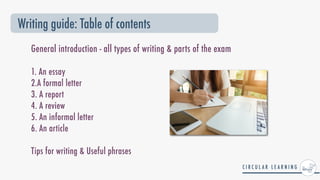
General introduction - all types of writing & parts of the exam


1. An essay


2.A formal letter


3. A report


4. A review


5. An informal letter


6. An article


Tips for writing & Useful phrases


Writing guide: Table of contents
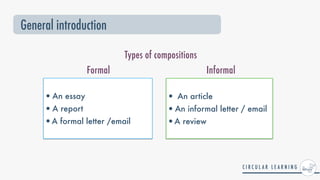
General introduction
•An essay


•A report


•A formal letter /email
• An article


•An informal letter / email


•A review
Types of compositions
Formal Informal
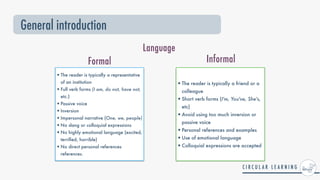
General introduction
•The reader is typically a representative
of an institution


•Full verb forms (I am, do not, have not,
etc.)


•Passive voice


•Inversion


•Impersonal narrative (One, we, people)


•No slang or colloquial expressions


•No highly emotional language (excited,
terri
fi
ed, horrible)


•No direct personal references
references.
•The reader is typically a friend or a
colleague


•Short verb forms (I'm, You've, She's,
etc)


•Avoid using too much inversion or
passive voice


•Personal references and examples


•Use of emotional language


•Colloquial expressions are accepted
Language
Formal Informal
General introduction
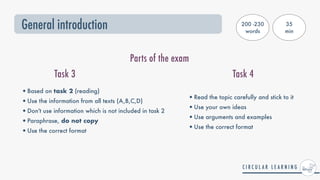
Parts of the exam
Task 3 Task 4
•Based on task 2 (reading)


•Use the information from all texts (A,B,C,D)


•Don't use information which is not included in task 2


•Paraphrase, do not copy


•Use the correct format
•Read the topic carefully and stick to it


•Use your own ideas


•Use arguments and examples


•Use the correct format
200 -230
words
35


min
1. An essay
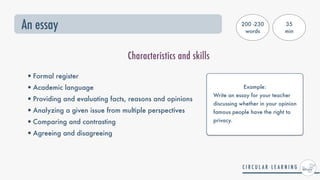
An essay
Characteristics and skills
•Formal register


•Academic language


•Providing and evaluating facts, reasons and opinions


•Analyzing a given issue from multiple perspectives


•Comparing and contrasting


•Agreeing and disagreeing
Example:


Write an essay for your teacher
discussing whether in your opinion
famous people have the right to
privacy.
200 -230
words
35


min
An essay
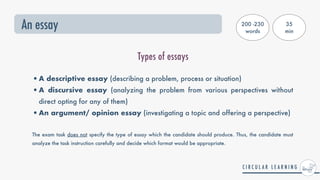
Types of essays
•A descriptive essay (describing a problem, process or situation)


•A discursive essay (analyzing the problem from various perspectives without
direct opting for any of them)


•An argument/ opinion essay (investigating a topic and offering a perspective)


The exam task does not specify the type of essay which the candidate should produce. Thus, the candidate must
analyze the task instruction carefully and decide which format would be appropriate.
200 -230
words
35


min
An essay
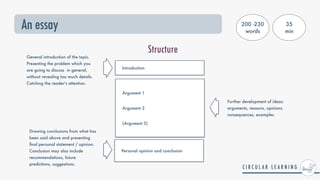
Structure
Introduction
Argument 1


Argument 2


(Argument 3)
General introduction of the topic.
Presenting the problem which you
are going to discuss in general,
without revealing too much details.
Catching the reader's attention.
Further development of ideas:
arguments, reasons, opinions
consequences, examples
Drawing conclusions from what has
been said above and presenting
fi
nal personal statement / opinion.
Conclusion may also include
recommendations, future
predictions, suggestions.
Personal opinion and conclusion
200 -230
words
35


min
2. A FORMAL EMAIL
A formal letter
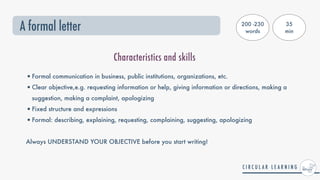
•Formal communication in business, public institutions, organizations, etc.


•Clear objective,e.g. requesting information or help, giving information or directions, making a
suggestion, making a complaint, apologizing


•Fixed structure and expressions


•Formal: describing, explaining, requesting, complaining, suggesting, apologizing


Always UNDERSTAND YOUR OBJECTIVE before you start writing!
Characteristics and skills
200 -230
words
35


min
A formal letter
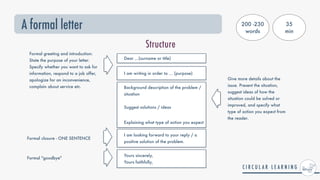
Structure
Dear ...(surname or title)


Background description of the problem /
situation


Suggest solutions / ideas


Explaining what type of action you expect
I am looking forward to your reply / a
positive solution of the problem.
Formal greeting and introduction:


State the purpose of your letter.
Specify whether you want to ask for
information, respond to a job offer,
apologize for an inconvenience,
complain about service etc.
Give more details about the
issue. Present the situation,
suggest ideas of how the
situation could be solved or
improved, and specify what
type of action you expect from
the reader.
Formal closure - ONE SENTENCE
I am writing in order to ... (purpose)
Yours sincerely,


Yours faithfully,


Formal "goodbye"
200 -230
words
35


min
A formal letter
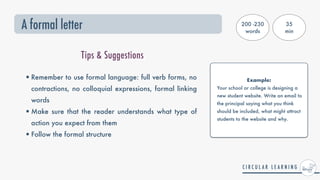
Tips & Suggestions
•Remember to use formal language: full verb forms, no
contractions, no colloquial expressions, formal linking
words


•Make sure that the reader understands what type of
action you expect from them


•Follow the formal structure


Example:


Your school or college is designing a
new student website. Write an email to
the principal saying what you think
should be included, what might attract
students to the website and why.
200 -230
words
35


min
3. A REPORT
A report
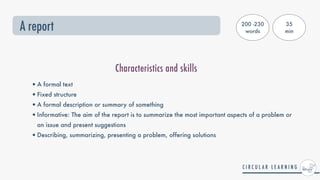
•A formal text


•Fixed structure


•A formal description or summary of something


•Informative: The aim of the report is to summarize the most important aspects of a problem or
an issue and present suggestions


•Describing, summarizing, presenting a problem, offering solutions
Characteristics and skills
200 -230
words
35


min
A report
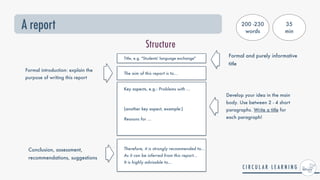
Structure
Title, e.g. "Students' language exchange"
Key aspects, e.g.: Problems with ...


(another key aspect, example:)


Reasons for ...


Formal and purely informative
title
Formal introduction: explain the
purpose of writing this report
The aim of this report is to...
Therefore, it is strongly recommended to...


As it can be inferred from this report…


It is highly advisable to…
Conclusion, assessment,
recommendations, suggestions
Develop your idea in the main
body. Use between 2 - 4 short
paragraphs. Write a title for
each paragraph!
200 -230
words
35


min
A report
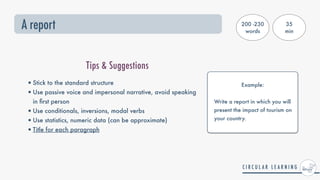
Tips & Suggestions
•Stick to the standard structure


•Use passive voice and impersonal narrative, avoid speaking
in
fi
rst person


•Use conditionals, inversions, modal verbs


•Use statistics, numeric data (can be approximate)


•Title for each paragraph
200 -230
words
35


min
Example:


Write a report in which you will
present the impact of tourism on
your country.
4. A REVIEW
A review
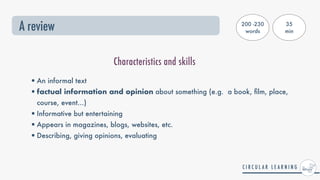
•An informal text


•factual information and opinion about something (e.g. a book,
fi
lm, place,
course, event...)


•Informative but entertaining


•Appears in magazines, blogs, websites, etc.


•Describing, giving opinions, evaluating
Characteristics and skills
200 -230
words
35


min
A review
Structure
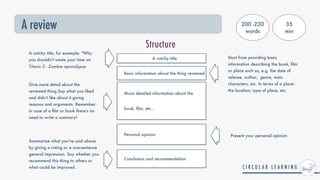
A catchy title


More detailed information about the
book,
fi
lm, etc...
Personal opinion
A catchy title, for example: "Why
you shouldn't waste your time on
Titanic 2 - Zombie apocalypse
Start from providing basic
information describing the book,
fi
lm
or place such as, e.g. the date of
release, author, genre, main
characters, etc. In terms of a place:
the location, type of place, etc.
Basic information about the thing reviewed
Conclusion and recommendation
Summarize what you've said above
by giving a rating or a one-sentence
general impression. Say whether you
recommend this thing to others or
what could be improved.
Give more detail about the
reviewed thing.Say what you liked
and didn't like about it giving
reasons and arguments. Remember:
in case of a
fi
lm or book there's no
need to write a summary!
Present your personal opinion
200 -230
words
35


min
A review
Tips & Suggestions
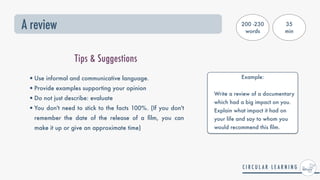
•Use informal and communicative language.


•Provide examples supporting your opinion


•Do not just describe: evaluate


•You don't need to stick to the facts 100%. (If you don't
remember the date of the release of a
fi
lm, you can
make it up or give an approximate time)
200 -230
words
35


min
Example:


Write a review of a documentary
which had a big impact on you.
Explain what impact it had on
your life and say to whom you
would recommend this
fi
lm.
5. AN INFORMAL LETTER / EMAIL
An informal letter / email
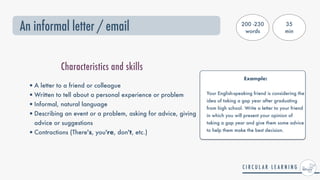
•A letter to a friend or colleague


•Written to tell about a personal experience or problem


•Informal, natural language


•Describing an event or a problem, asking for advice, giving
advice or suggestions


•Contractions (There's, you're, don't, etc.)
Characteristics and skills
200 -230
words
35


min
Example:


Your English-speaking friend is considering the
idea of taking a gap year after graduating
from high school. Write a letter to your friend
in which you will present your opinion of
taking a gap year and give them some advice
to help them make the best decision.
Part 1 - An informal letter / email
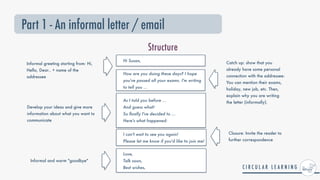
Structure
Hi Susan,
How are you doing these days? I hope
you've passed all your exams. I'm writing
to tell you ...
Informal greeting starting from: Hi,
Hello, Dear.. + name of the
addressee
Catch up: show that you
already have some personal
connection with the addressee:
You can mention their exams,
holiday, new job, etc. Then,
explain why you are writing
the letter (informally).
Develop your ideas and give more
information about what you want to
communicate
As I told you before ...


And guess what!


So
fi
nally I've decided to ...


Here's what happened:
I can't wait to see you again!


Please let me know if you'd like to join me!
Love,


Talk soon,


Best wishes,


Closure: Invite the reader to
further correspondence
Informal and warm "goodbye"
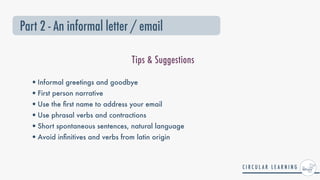
Tips & Suggestions
•Informal greetings and goodbye


•First person narrative


•Use the
fi
rst name to address your email


•Use phrasal verbs and contractions


•Short spontaneous sentences, natural language


•Avoid in
fi
nitives and verbs from latin origin
Part 2 - An informal letter / email
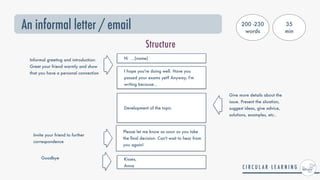
PART 2 - AN ARTICLE
An informal letter / email
Structure
Hi ...(name)


Development of the topic
Kisses,


Anna
Informal greeting and introduction:


Greet your friend warmly and show
that you have a personal connection
Give more details about the
issue. Present the situation,
suggest ideas, give advice,
solutions, examples, etc..
Invite your friend to further
correspondence
I hope you're doing well. Have you
passed your exams yet? Anyway, I'm
writing because...
Please let me know as soon as you take
the
fi
nal decision. Can't wait to hear from
you again!


Goodbye
200 -230
words
35


min
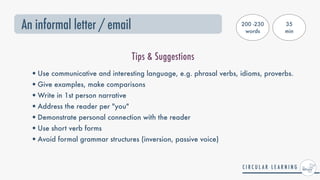
An informal letter / email
Tips & Suggestions
•Use communicative and interesting language, e.g. phrasal verbs, idioms, proverbs.


•Give examples, make comparisons


•Write in 1st person narrative


•Address the reader per "you"


•Demonstrate personal connection with the reader


•Use short verb forms


•Avoid formal grammar structures (inversion, passive voice)
200 -230
words
35


min
6. An Article
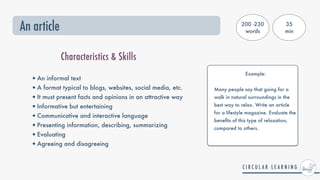
An article
•An informal text


•A format typical to blogs, websites, social media, etc.


•It must present facts and opinions in an attractive way


•Informative but entertaining


•Communicative and interactive language


•Presenting information, describing, summarizing


•Evaluating


•Agreeing and disagreeing
Characteristics & Skills
200 -230
words
35


min
Example:


Many people say that going for a
walk in natural surroundings in the
best way to relax. Write an article


for a lifestyle magazine. Evaluate the
bene
fi
ts of this type of relaxation,
compared to others.
An article
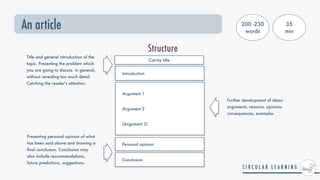
Structure
Introduction
Argument 1


Argument 2


(Argument 3)
Title and general introduction of the
topic. Presenting the problem which
you are going to discuss in general,
without revealing too much detail.
Catching the reader's attention.
Further development of ideas:
arguments, reasons, opinions
consequences, examples
Presenting personal opinion of what
has been said above and drawing a
fi
nal conclusion. Conclusion may
also include recommendations,
future predictions, suggestions.
Personal opinion
Catchy title
Conclusion
200 -230
words
35


min
An article
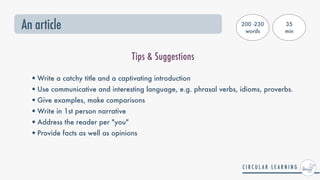
Tips & Suggestions
•Write a catchy title and a captivating introduction


•Use communicative and interesting language, e.g. phrasal verbs, idioms, proverbs.


•Give examples, make comparisons


•Write in 1st person narrative


•Address the reader per "you"


•Provide facts as well as opinions
200 -230
words
35


min
TIPS FOR WRITING
Writing tips - Introduction
Introduction to an article / essay / review
Idea 1: Start from presenting a general truth. Present a well-known fact or a
commonly accepted opinion.
.... has been gaining popularity in recent years.


Most people would agree that ....


We live in a world where ...


... is of the most common topics of public discussion nowadays.
Idea 2: Include a contrasting opinion using a rhetorical question:
.... has been gaining popularity in recent years, however, does it mean we should ...?


Most people would agree that .... , but is it really the case?


We live in a world where ... . Therefore, what can be done to ... ?


... is of the most common topics of public discussion nowadays, but should we really ...?
Writing tips - Introduction
Introduction to an article / essay / review
These two forms have a
fi
xed, formal introduction:
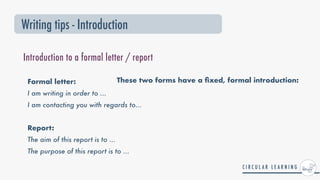
Writing tips - Introduction
Introduction to a formal letter / report
Formal letter:


I am writing in order to ...


I am contacting you with regards to...


Report:


The aim of this report is to ...


The purpose of this report is to ...
Idea 1: The pyramid method: Start from a general idea. Provide more detailed
explanation in the second sentence. Finish the paragraph with an example or a
conclusion.
Working from home can be extremely time and energy ef
fi
cient. Since there is no need
to commute, employees gain at least 30 minutes every day for extra sleep or time with
their families. That results in them being well rested and more enthusiastic at work.


Writing tips - Developing an argument
Idea 2: The snowball method: Start from an example or a particular situation. Provide
further conclusion in the second sentence. Finish the paragraph with a generalization.
It has been proven that workers who work from home are better rested more
enthusiastic at work. That may result from the fact that they have no need to commute,
which saves them long hours in traf
fi
c. Therefore, there is no doubt about the fact that
working from home is much more time and energy ef
fi
cient.


Writing tips - Developing an argument
Idea 1: Use a concluding and a contrasting linking word
Therefore, it can be said that although working from home has its drawbacks such
as distractions or the feeling of isolation, there is no doubt about the fact that
due to its convenience it is here to stay.
Writing tips - Conclusion
Idea 2: Suggestions or recommendations
Therefore, despite all the disadvantages of working from home, it can be
concluded that the businesses who want to stay on the surface will need to adapt
to the modern standards. Similarly, workers who have not been exposed to
remote work before might need to change their lifestyle in order to stay relevant
on modern job market.
Writing tips - Conclusion
Linking words & Phrases
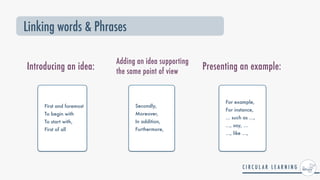
First and foremost


To begin with


To start with,


First of all
Secondly,


Moreover,


In addition,


Furthermore,
For example,


For instance,


... such as ...,


..., say, ...


..., like ...,
Introducing an idea:
Adding an idea supporting
the same point of view
Presenting an example:
Linking words & Phrases
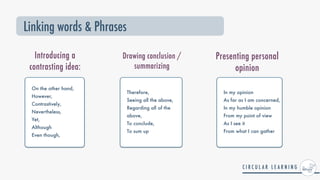
On the other hand,


However,


Contrastively,


Nevertheless,


Yet,


Although


Even though,
In my opinion


As far as I am concerned,


In my humble opinion


From my point of view


As I see it


From what I can gather
Therefore,


Seeing all the above,


Regarding all of the
above,


To conclude,


To sum up
Introducing a


contrasting idea:
Drawing conclusion /
summarizing
Presenting personal
opinion
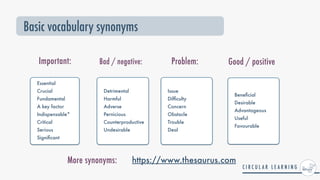
Basic vocabulary synonyms
Important: Bad / negative: Problem:
Essential


Crucial


Fundamental


A key factor


Indispensable*


Critical


Serious


Signi
fi
cant
Detrimental


Harmful


Adverse


Pernicious


Counterproductive


Undesirable
Issue


Dif
fi
culty


Concern


Obstacle


Trouble


Deal
Good / positive
Bene
fi
cial


Desirable


Advantageous


Useful


Favourable
https://www.thesaurus.com
More synonyms:

WRITING GUIDE TRINITY.pdf

  • 1.
  • 2.
    General introduction -all types of writing & parts of the exam 
 1. An essay 2.A formal letter 3. A report 4. A review 5. An informal letter 6. An article Tips for writing & Useful phrases Writing guide: Table of contents
  • 3.
    General introduction •An essay •Areport •A formal letter /email • An article •An informal letter / email •A review Types of compositions Formal Informal
  • 4.
    General introduction •The readeris typically a representative of an institution •Full verb forms (I am, do not, have not, etc.) •Passive voice •Inversion •Impersonal narrative (One, we, people) •No slang or colloquial expressions •No highly emotional language (excited, terri fi ed, horrible) •No direct personal references references. •The reader is typically a friend or a colleague •Short verb forms (I'm, You've, She's, etc) •Avoid using too much inversion or passive voice •Personal references and examples •Use of emotional language •Colloquial expressions are accepted Language Formal Informal
  • 5.
    General introduction Parts ofthe exam Task 3 Task 4 •Based on task 2 (reading) •Use the information from all texts (A,B,C,D) •Don't use information which is not included in task 2 •Paraphrase, do not copy •Use the correct format •Read the topic carefully and stick to it •Use your own ideas •Use arguments and examples •Use the correct format 200 -230 words 35 min
  • 6.
  • 7.
    An essay Characteristics andskills •Formal register •Academic language •Providing and evaluating facts, reasons and opinions •Analyzing a given issue from multiple perspectives •Comparing and contrasting •Agreeing and disagreeing Example: Write an essay for your teacher discussing whether in your opinion famous people have the right to privacy. 200 -230 words 35 min
  • 8.
    An essay Types ofessays •A descriptive essay (describing a problem, process or situation) •A discursive essay (analyzing the problem from various perspectives without direct opting for any of them) •An argument/ opinion essay (investigating a topic and offering a perspective) 
 The exam task does not specify the type of essay which the candidate should produce. Thus, the candidate must analyze the task instruction carefully and decide which format would be appropriate. 200 -230 words 35 min
  • 9.
    An essay Structure Introduction Argument 1 Argument2 (Argument 3) General introduction of the topic. Presenting the problem which you are going to discuss in general, without revealing too much details. Catching the reader's attention. Further development of ideas: arguments, reasons, opinions consequences, examples Drawing conclusions from what has been said above and presenting fi nal personal statement / opinion. Conclusion may also include recommendations, future predictions, suggestions. Personal opinion and conclusion 200 -230 words 35 min
  • 10.
  • 11.
    A formal letter •Formalcommunication in business, public institutions, organizations, etc. •Clear objective,e.g. requesting information or help, giving information or directions, making a suggestion, making a complaint, apologizing •Fixed structure and expressions •Formal: describing, explaining, requesting, complaining, suggesting, apologizing Always UNDERSTAND YOUR OBJECTIVE before you start writing! Characteristics and skills 200 -230 words 35 min
  • 12.
    A formal letter Structure Dear...(surname or title) Background description of the problem / situation Suggest solutions / ideas Explaining what type of action you expect I am looking forward to your reply / a positive solution of the problem. Formal greeting and introduction: State the purpose of your letter. Specify whether you want to ask for information, respond to a job offer, apologize for an inconvenience, complain about service etc. Give more details about the issue. Present the situation, suggest ideas of how the situation could be solved or improved, and specify what type of action you expect from the reader. Formal closure - ONE SENTENCE I am writing in order to ... (purpose) Yours sincerely, 
 Yours faithfully, Formal "goodbye" 200 -230 words 35 min
  • 13.
    A formal letter Tips& Suggestions •Remember to use formal language: full verb forms, no contractions, no colloquial expressions, formal linking words •Make sure that the reader understands what type of action you expect from them •Follow the formal structure Example: Your school or college is designing a new student website. Write an email to the principal saying what you think should be included, what might attract students to the website and why. 200 -230 words 35 min
  • 14.
  • 15.
    A report •A formaltext •Fixed structure •A formal description or summary of something •Informative: The aim of the report is to summarize the most important aspects of a problem or an issue and present suggestions •Describing, summarizing, presenting a problem, offering solutions Characteristics and skills 200 -230 words 35 min
  • 16.
    A report Structure Title, e.g."Students' language exchange" Key aspects, e.g.: Problems with ... 
 (another key aspect, example:) Reasons for ... Formal and purely informative title Formal introduction: explain the purpose of writing this report The aim of this report is to... Therefore, it is strongly recommended to... As it can be inferred from this report… It is highly advisable to… Conclusion, assessment, recommendations, suggestions Develop your idea in the main body. Use between 2 - 4 short paragraphs. Write a title for each paragraph! 200 -230 words 35 min
  • 17.
    A report Tips &Suggestions •Stick to the standard structure •Use passive voice and impersonal narrative, avoid speaking in fi rst person •Use conditionals, inversions, modal verbs •Use statistics, numeric data (can be approximate) •Title for each paragraph 200 -230 words 35 min Example: 
 Write a report in which you will present the impact of tourism on your country.
  • 18.
  • 19.
    A review •An informaltext •factual information and opinion about something (e.g. a book, fi lm, place, course, event...) •Informative but entertaining •Appears in magazines, blogs, websites, etc. •Describing, giving opinions, evaluating Characteristics and skills 200 -230 words 35 min
  • 20.
    A review Structure A catchytitle More detailed information about the book, fi lm, etc... Personal opinion A catchy title, for example: "Why you shouldn't waste your time on Titanic 2 - Zombie apocalypse Start from providing basic information describing the book, fi lm or place such as, e.g. the date of release, author, genre, main characters, etc. In terms of a place: the location, type of place, etc. Basic information about the thing reviewed Conclusion and recommendation Summarize what you've said above by giving a rating or a one-sentence general impression. Say whether you recommend this thing to others or what could be improved. Give more detail about the reviewed thing.Say what you liked and didn't like about it giving reasons and arguments. Remember: in case of a fi lm or book there's no need to write a summary! Present your personal opinion 200 -230 words 35 min
  • 21.
    A review Tips &Suggestions •Use informal and communicative language. •Provide examples supporting your opinion •Do not just describe: evaluate •You don't need to stick to the facts 100%. (If you don't remember the date of the release of a fi lm, you can make it up or give an approximate time) 200 -230 words 35 min Example: 
 Write a review of a documentary which had a big impact on you. Explain what impact it had on your life and say to whom you would recommend this fi lm.
  • 22.
    5. AN INFORMALLETTER / EMAIL
  • 23.
    An informal letter/ email •A letter to a friend or colleague •Written to tell about a personal experience or problem •Informal, natural language •Describing an event or a problem, asking for advice, giving advice or suggestions •Contractions (There's, you're, don't, etc.) Characteristics and skills 200 -230 words 35 min Example: 
 Your English-speaking friend is considering the idea of taking a gap year after graduating from high school. Write a letter to your friend in which you will present your opinion of taking a gap year and give them some advice to help them make the best decision.
  • 24.
    Part 1 -An informal letter / email Structure Hi Susan, How are you doing these days? I hope you've passed all your exams. I'm writing to tell you ... Informal greeting starting from: Hi, Hello, Dear.. + name of the addressee Catch up: show that you already have some personal connection with the addressee: You can mention their exams, holiday, new job, etc. Then, explain why you are writing the letter (informally). Develop your ideas and give more information about what you want to communicate As I told you before ... And guess what! So fi nally I've decided to ... Here's what happened: I can't wait to see you again! Please let me know if you'd like to join me! Love, Talk soon, Best wishes, Closure: Invite the reader to further correspondence Informal and warm "goodbye"
  • 25.
    Tips & Suggestions •Informalgreetings and goodbye •First person narrative •Use the fi rst name to address your email •Use phrasal verbs and contractions •Short spontaneous sentences, natural language •Avoid in fi nitives and verbs from latin origin Part 2 - An informal letter / email
  • 26.
    PART 2 -AN ARTICLE
  • 27.
    An informal letter/ email Structure Hi ...(name) Development of the topic Kisses, Anna Informal greeting and introduction: Greet your friend warmly and show that you have a personal connection Give more details about the issue. Present the situation, suggest ideas, give advice, solutions, examples, etc.. Invite your friend to further correspondence I hope you're doing well. Have you passed your exams yet? Anyway, I'm writing because... Please let me know as soon as you take the fi nal decision. Can't wait to hear from you again! Goodbye 200 -230 words 35 min
  • 28.
    An informal letter/ email Tips & Suggestions •Use communicative and interesting language, e.g. phrasal verbs, idioms, proverbs. •Give examples, make comparisons •Write in 1st person narrative •Address the reader per "you" •Demonstrate personal connection with the reader •Use short verb forms •Avoid formal grammar structures (inversion, passive voice) 200 -230 words 35 min
  • 29.
  • 30.
    An article •An informaltext •A format typical to blogs, websites, social media, etc. •It must present facts and opinions in an attractive way •Informative but entertaining •Communicative and interactive language •Presenting information, describing, summarizing •Evaluating •Agreeing and disagreeing Characteristics & Skills 200 -230 words 35 min Example: Many people say that going for a walk in natural surroundings in the best way to relax. Write an article for a lifestyle magazine. Evaluate the bene fi ts of this type of relaxation, compared to others.
  • 31.
    An article Structure Introduction Argument 1 Argument2 (Argument 3) Title and general introduction of the topic. Presenting the problem which you are going to discuss in general, without revealing too much detail. Catching the reader's attention. Further development of ideas: arguments, reasons, opinions consequences, examples Presenting personal opinion of what has been said above and drawing a fi nal conclusion. Conclusion may also include recommendations, future predictions, suggestions. Personal opinion Catchy title Conclusion 200 -230 words 35 min
  • 32.
    An article Tips &Suggestions •Write a catchy title and a captivating introduction •Use communicative and interesting language, e.g. phrasal verbs, idioms, proverbs. •Give examples, make comparisons •Write in 1st person narrative •Address the reader per "you" •Provide facts as well as opinions 200 -230 words 35 min
  • 33.
  • 34.
    Writing tips -Introduction Introduction to an article / essay / review Idea 1: Start from presenting a general truth. Present a well-known fact or a commonly accepted opinion. .... has been gaining popularity in recent years. Most people would agree that .... We live in a world where ... ... is of the most common topics of public discussion nowadays.
  • 35.
    Idea 2: Includea contrasting opinion using a rhetorical question: .... has been gaining popularity in recent years, however, does it mean we should ...? Most people would agree that .... , but is it really the case? We live in a world where ... . Therefore, what can be done to ... ? ... is of the most common topics of public discussion nowadays, but should we really ...? Writing tips - Introduction Introduction to an article / essay / review
  • 36.
    These two formshave a fi xed, formal introduction: Writing tips - Introduction Introduction to a formal letter / report Formal letter: I am writing in order to ... I am contacting you with regards to... Report: The aim of this report is to ... The purpose of this report is to ...
  • 37.
    Idea 1: Thepyramid method: Start from a general idea. Provide more detailed explanation in the second sentence. Finish the paragraph with an example or a conclusion. Working from home can be extremely time and energy ef fi cient. Since there is no need to commute, employees gain at least 30 minutes every day for extra sleep or time with their families. That results in them being well rested and more enthusiastic at work. Writing tips - Developing an argument
  • 38.
    Idea 2: Thesnowball method: Start from an example or a particular situation. Provide further conclusion in the second sentence. Finish the paragraph with a generalization. It has been proven that workers who work from home are better rested more enthusiastic at work. That may result from the fact that they have no need to commute, which saves them long hours in traf fi c. Therefore, there is no doubt about the fact that working from home is much more time and energy ef fi cient. Writing tips - Developing an argument
  • 39.
    Idea 1: Usea concluding and a contrasting linking word Therefore, it can be said that although working from home has its drawbacks such as distractions or the feeling of isolation, there is no doubt about the fact that due to its convenience it is here to stay. Writing tips - Conclusion
  • 40.
    Idea 2: Suggestionsor recommendations Therefore, despite all the disadvantages of working from home, it can be concluded that the businesses who want to stay on the surface will need to adapt to the modern standards. Similarly, workers who have not been exposed to remote work before might need to change their lifestyle in order to stay relevant on modern job market. Writing tips - Conclusion
  • 41.
    Linking words &Phrases First and foremost To begin with To start with, First of all Secondly, Moreover, In addition, Furthermore, For example, For instance, ... such as ..., ..., say, ... ..., like ..., Introducing an idea: Adding an idea supporting the same point of view Presenting an example:
  • 42.
    Linking words &Phrases On the other hand, However, Contrastively, Nevertheless, Yet, Although Even though, In my opinion As far as I am concerned, In my humble opinion From my point of view As I see it From what I can gather Therefore, Seeing all the above, Regarding all of the above, To conclude, To sum up Introducing a contrasting idea: Drawing conclusion / summarizing Presenting personal opinion
  • 43.
    Basic vocabulary synonyms Important:Bad / negative: Problem: Essential Crucial Fundamental A key factor Indispensable* Critical Serious Signi fi cant Detrimental Harmful Adverse Pernicious Counterproductive Undesirable Issue Dif fi culty Concern Obstacle Trouble Deal Good / positive Bene fi cial Desirable Advantageous Useful Favourable https://www.thesaurus.com More synonyms: