BALKAN
GREEN
ENERGY
NEWSThe most comprehensive coverage of green energy news from the Balkans
FEBRUARY 2016
Interview
Legal Insights
Projects
Serbia
Kosovo*
Montenegro
Croatia
Slovenia
Bosnia and Herzegovina
Romania
Bulgaria
FYR Macedonia
Greece
Cyprus
Albania
Turkey
Region/EU
Events
03
07
12
16
20
21
22
25
27
29
33
33
37
39
40
40
44
47
Content
Balkan Green Energy News February 201603
INTERVIEW
Jelena Peruničić
Senior Manager,
German Development Cooperation (GIZ)
project Climate Change Adaptation in
Western Balkans (CCAWB).
Balkan countries must manage floods, droughts together
There are cooperation and communication mechanisms missing between neighboring countries, in order to
take into account the transboundary nature of flood and drought risk at operational level, says Jelena Peruničić,
senior manager at the regional German Development Cooperation (GIZ) project Climate Change Adaptation in
Western Balkans (CCAWB). There is much to be done at the local and national levels, too, but not all necessary
measures need massive funding, she told Balkan Green Energy News. “For example, for flood management good
spatial planning and strong community cooperation could be very effective measures. But of course, there are
some crucial infrastructure measures which need investments. According to the Paris agreement from COP21
of the United Nations Framework Convention on Climate Change (UNFCCC), adaptation to climate change and
strengthening ability of countries to deal with climate impacts will be emphasized in the next years. Developing
countries will receive increased support for adaptation actions and the adequacy of this support will be assessed”,
Peruničić stated.
In the last three years, within the project of the German Development Cooperation (GIZ), commissioned by the
German Ministry for Economic Cooperation and Development (BMZ), she has focused on flood issue and integration
of adaptation to climate change in urban planning. Jelena Peruničić has more than 10 years of experience in
international organisations in the field of environmental protection and management of natural resources.
What is the overall climate change strategy of GIZ and what activities are, in particular,
related to Western Balkan region and Southeastern Europe?
Through its bilateral cooperation, the Federal Government of Germany is supporting the countries of South-East
Europe in their alignment with the European Union and implementation of EU policy, economic and social standards.
Climate change adaptation has been declared a priority by the EU and is to be integrated as a cross-cutting issue
in all sectors. Also for German Development Cooperation, adaptation to climate change constitutes an important,
strategic field of aid support.
The need for climate change adaptation is a very relevant subject for all states in the Western Balkans. Recent floods
and droughts have underpinned the need of being prepared with respect to increased disasters. In all states the
effects of climate change are on the political agenda which is in line with the EU’s acquis communautaire and now
the Paris COP21 agreement.
Since 2012 the GIZ – German Development Cooperation, on behalf of the German Ministry for Economic Cooperation
and Development (BMZ), is implementing the Climate Change Adaptation in Western Balkans (CCAWB) project in
cooperation with relevant Ministries in Albania, Kosovo*, Macedonia, Montenegro and Serbia . CCAWB has focused
Balkan Green Energy News February 201604
on adaptation to the predicted impacts of climate change. Specifically, the project has aimed at reducing of flood
and drought risks, adaptation in urban areas, as well as to strengthen regional cooperation in the field of integrated
water resources management.
What are the results so far of the project Climate Change Adaption in the Western Balkans?
This was achieved in the first phase (2012–2015) of CCAWB:
• Establishment of a regional Flood Early Warning System for the Drin River Basin in the form of four national early
warning systems in Macedonia, Kosovo, Albania and Montenegro;
• Support to the drafting of national climate change adaptation strategies for Albania and Macedonia;
• Support to the drafting of drought management plans for water companies in Kosovo and formulating flood risk
management plans on community level in Albania and Montenegro;
• Support to cooperation in water resources management at the regional level; and
• Integration of climate change adaptation in large cities Belgrade, Podgorica and Tirana – in urban planning and
development in particular.
Support from GIZ has been provided by means of capacity development, advisory services and the procurement of
equipment.
What are the main challenges in each of the countries included in the project?
All these topics have required special expertise and had different partner organizations involved from the region, but
also from Germany.
Flood risk management as one important element of water resources management in the
Drin catchment is not possible without information sharing among the riparian countries.
One of the most important and most challenging topics was the establishment of hydrological measuring stations,
data management and exchange, and the setup of the hydrological planning model in the frame of Flood Early
Warning System for the Drin River Basin. This is still the most challenging topic in the terms of further development
of the communication channels and exchange of the information between the neighboring countries, especially
exchange in real time, and on the other side, maintaining of the established network of the hydrological measuring
stations in all four countries. Very often stations are under the pressure of local vandalism and people who are
damaging solar panels or roofs. We already had two cases of vandalism at the newly established network.
The project is to last until 2018. What activities remain for it to be completed?
Form March 2016 the project will go in the follow-up phase till June 2018, focusing more on the area of flood
risk management in the Drin river catchment area. Flood risk management as one important element of water
resources management in the Drin catchment is not possible without information sharing among the riparian
countries. Information needs to be collected, analyzed and shared among the riparian countries in order to use them
for informed actions on local level. The project activities will be again shared on regional, national and local levels.
The project will be focused on three levels:
• It intends to improve the availability of hydrometeorological data in the riparian countries and to improve the
application of available data for flood forecasting. Further attention shall be given to the support of the hydromet
services of the four riparian countries in order to increase sustainability.
• It focuses on the improvement of information exchange to attain better knowledge about the Drin catchment for all
riparian countries, and a more formalised cooperation in the medium term.
• It strengthens the ability of actors that are responsible for flood risk management and in case of flood disasters at
local level.
Balkan Green Energy News February 201605
What are the main points from the project’s assessments of vulnerability for the region and
particular countries?
Climate change will lead to increased flood and drought risks in the Drin basin. According to the National
Communications (UNFCCC), an increase in annual average temperatures is expected (e. g. up to 5.6 °C in Albania)
with falling precipitation in the annual average (e. g. reduction of 5% until 2050 in Macedonia). This leads to milder
winters with decreasing number of frost days, to warmer and drier spring and extended dry periods and long periods
of high temperatures (over 35 °C) during the summer months. In addition, the increase in urban areas could be up to
10 °C higher compared to the undeveloped countryside. A decrease in total annual rainfall is expected, increasing
the probability of high intensity rainfall and extreme weather incidents (e. g. severe storms), which increases
considerably the flood risk, soil erosion and hazardous pollution of the waters.
The serious situations during the flood events in 2010 emphasized the need to establish an
integrated early warning system for the whole Drin/Drim – Buna/Bojana Basin with special focus
on the lower part.
When we are thinking about the management of flood risk and newest solutions we cannot skip
or substitute effective urban planning and strong community engagement.
At the local level there was lack of planning for management of flood risk and there were no concepts for the
management of drought risk. At the national level there is no consideration of the legal, regulatory framework of
the climate change on the one hand and partly in planning of water resource management. At the regional level,
especially cooperation and communication mechanisms are missing between the neighboring countries, in order to
take into account the transboundary nature of flood and drought risk at operational level. In addition, available data
are not enough for the specific regional modeling of climate change and its impacts on water resources in the Drin
basin.
How does the early warning system for floods in the Drin basin work and what were the steps
to establish it?
In the coming years climate change is predicted to increase both the frequency and intensity of flooding and droughts
in the region. The serious situations during the flood events in 2010 emphasized the need to establish an integrated
early warning system for the whole Drin/Drim – Buna/Bojana Basin with special focus on the lower part.
The project supports the establishment of the flood early warning system in the following steps:
• Assessing gaps and needs to establish flood early warning system
• Design, procurement and installation of hydrological and meteorological stations and IT set-up for real-time data
• Organizing measuring campaigns
• Building up the hydrological model
• Organizing regional data exchange and cooperation
In total, 33 water level and rainfall stations in the Drin river basin are rehabilitated and upgraded. Real time information
for issuing flood warnings is now available in the four countries of the area and approximately 300.000 potentially
flood affected people can be warned in advance. For the first time, a hydrological model covering the whole basin
has been developed and will be operated very soon.
The project included work of many scientists. Who was involved?
A lot of assessment and deliverables have been done during the project, like drought plans, the participatory
development of flood risk management plans, the gap analysis of hydrological information and the hydrological
planning model for the Drin Basin were of particular importance for the project partners in the Western Balkans. A
lot of local expertise was involved but also GIZ provided consultants from Germany.
Balkan Green Energy News February 201606
What are the challenges in flood protection in urban areas and what are the newest
solutions?
The main challenges in the most of urban areas in the region are inadequate urban planning and illegal building
which caused a lot of channels and small rivers to be blocked. Disposal of solid and working waste material in
riverbeds makes the problem worse. Due to huge precipitation in very short period of time and inadequate maintained
channels we have flash floods in the urban areas. When we are thinking about the management of flood risk and
newest solutions we cannot skip or substitute effective urban planning and strong community engagement.
The correction in urban planning could be done by strict implementation of the flood risk management plans which
have listed infrastructural protecting measures. There is also the need to build strong social infrastructure which
includes disaster planning, capacity-building and training that can help communities mobilize in the event of disasters.
People should be aware about the need to be prepared, informed and ready to act, not wait
for the government or rescue system to help you in the case of extreme weather events.
One new developed mechanism with the aim to help cities to increase urban resilience, to share experiences,
expertise and knowledge about how to reduce vulnerability and accelerate recovery is Mayors Adapt – the Covenant
of Mayors Initiative on Climate Change Adaptation has been set up by the European Commission to engage cities
in taking action to adapt to climate change. Cities should develop a comprehensive local adaptation strategy
or integrating adaptation to climate change into relevant existing plans. Three cities that we have worked with –
Podgorica, Belgrade and Tirana, are in the process to sign the covenant and start implementing the action plans for
adaptation to climate change developed through the CCAWB project.
Who were GIZ’s most important partners? Are there examples of new cooperation
established between institutions across borders during the project?
The regional Flood Early Warning System for the Drin River Basin was and will be the main component of the project
and in line with this, hydrometeorological services from four countries where and are the most important partners.
The improved communications in the field of data exchange in the Drin river catchment has been an important
impact of the project, which would not have been possible without the important mediating function of GIZ, but also
the readiness of the institutes to provide the data and to cooperate.
Although the signing of the Memorandum of Cooperation and Exchange of Data between the countries is expected
for March, the institutes already have established a daily exchange of data in the basin and react in the case of an
increase in water level in the Drin and Lake Skadar Watershed. Compared with the situation in 2010 when there was
not any cross-border exchange of information, this can be considered as a significant success.
Is there progress in climate change awareness?
In the Balkan countries I would say yes, especially when people are facing extreme weather events such as floods,
droughts, heat waves or huge precipitation. People start to think about it. There is still a need to do a lot of more
in sense of education, how to act at the local level, in our daily life. People should be aware about the need to be
prepared, informed and ready to act, not wait for the government or rescue system to help you in the case of extreme
weather events.
The CCAWB project intends to help raising awareness about climate changein the region in a different filed: supporting
celebration of the Drin Day in the Drin river catchment area in all four countries, supporting local non-governmental
organizations to develop events with local people with the aim to raise awareness about the sustainable use of rivers;
supporting educative brochures about flood risk management in the region of Skadar lake and Bojana/Buna river for
people from both side of the border in Albania and Montenegro; in 2013 we supported the Heat Wave Campaign in
Podgorica and Air Quality Campaign in Tirana; currently we are supporting the climate change awareness campaign
in the city of Belgrade with the accent on adaptation in urban area.
Balkan Green Energy News February 201607
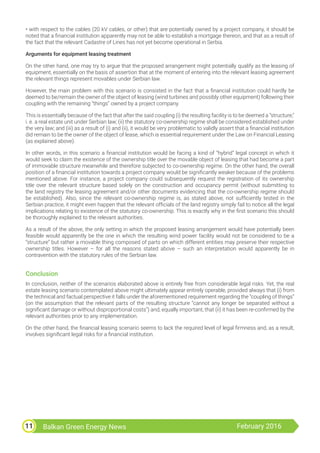
LEGAL INSIGHTS
Đorđe Popović
Senior Attorney &
Marija Marošan
Attorney-at-Law
Petrikić & Partneri AOD in cooperation
with CMS Reich-Rohrwig Hainz
Is leasing of wind turbines feasible in Serbia?
This article deals with one of the hot topics in renewables in Serbia, namely the legal treatment of leasing
arrangements, contemplated by a notable number of financial players on the Serbian market for the purposes of
potential financing of renewable energy projects.
At present, a number of financial institutions on the market is contemplating entering wind farm projects as lessors
providing wind turbines (and, possibly, other equipment) to renewable project companies as lessees, thus enabling
the project companies to complete the construction of a wind farm by, inter alia, installing the wind turbines (and
other equipment) so leased from the financial institution.
In particular, the question that is commonly raised on the market in the mentioned context is whether the proposed
business transactions are to be treated as equipment leasing or rather as real estate leasing, depending on the
equipment that is financed.
Let us state at the beginning that Serbian law does not appear to provide for an explicit answer to the subject matter
above and, as a result, both interpretations are generally arguable. That is, that the proposed leasing arrangement
within the context of the renewable project may be treated as a real estate leasing and that the proposed leasing
arrangement may be treated as a leasing of equipment, whereas both interpretations seem to raise substantive
ambiguities. However, after having thoroughly analysed the relevant matter, we are of the view that the legal
treatment of the proposed transaction as the real estate leasing would apparently be more grounded in the Serbian
law, involving thus relatively fewer risks and potentially being practically operable, as opposed to equipment leasing
treatment.
General considerations
Prior to going into more details as to legal treatment of the relevant leasing arrangements, we find it necessary to
briefly elaborate on certain general concepts of the Serbian law being of relevance thereof.
(a) Notion of “structure”
In Serbian law, a “structure” (in Serbian: “objekat”) is defined as such a structure (facility, building) that is “connected
to the ground and represents a physical, functional, techno-technological or biotechnological entirety (buildings of all
kinds, traffic, waterpower and energy structures, infrastructure facilities of electronic communications…)” – Article 2
Paragraph 1 Point 22 of the Law on Planning and Construction (the Construction Law).
Balkan Green Energy News February 201608
Moreover, the Construction Law stipulates that the Serbian Ministry of Construction, Traffic and Infrastructure is in
charge of the issuance of construction permits for certain specific structures, including, inter alia, “structures for
production of energy from renewable energy resources.”
Having these statutory provisions in mind, it follows that the wind power structures (including wind farms) are
considered to be “structures” from the standpoint of Serbian law, i. e. separate real estate units connected to
the ground for which the construction and occupancy permits are issued and the titles on which are subject to
registration with the land registry.
(b) Notion of mandatory co-ownership over “coupled things”
The Serbian law provides that “if the things [movable or immovable] which are owned by different owners are
connected or coupled so as that they cannot any longer be separated without a significant damage or without
disproportional costs, on the new thing thus formed there shall be a co-ownership right established in favour of
previous owners, and that in proportion to the value of individual things at the moment of such connection or
coupling” – (Article 23 Paragraph 1 of the Law on Basic Proprietary Relations).
The very legal institute of co-ownership in the Serbian law essentially implies that two or more entities are co-owners
of the same item (thing, title), whereby their relevant shares ratio thereto is “ideal” (in Serbian: “idealni udeo”), i. e.
presented in certain percentage as to the entirety of the relevant item (e. g. 30% of the entirety of ownership over a
plant is co-owned by one entity whilst the remaining 70% is co-owned by another entity).
If the relevant co-ownership shares of the respective co-owners are not determined, it shall be deemed that they are
equal. As a matter of principle, the co-owners of the thing have the right to jointly manage the thing as well as to
freely dispose with their respective co-ownership shares, subject to pre-emptive rights of the remaining co-owners.
(c) General features of the leasing transaction
The Law on Financial Leasing defines the leasing transaction as the arrangement/transaction involving such
“financial intermediation performed by the lessor which implies that the lessor, retaining its ownership right over
the subject of leasing, transfers to the lessee, for a certain time period, the entitlement to hold and use the object
of leasing, with all the risks and all the benefits associated with the ownership title, whilst, in return, the lessee is
obliged to pay a leasing fee to the lessor” (Article 2 Paragraph 1 of the said law). The Law on Financial Leasing further
differentiates between various modalities of the leasing transaction, including the transfer of ownership over the
object of leasing to a lessee or an option for a lessee to acquire the ownership thereto, in all cases only after the total
pre-agreed amount of the leasing fee is duly paid by a lessee to a lessor.
It thus follows from the above that at the time of entering into a leasing agreement and up to the lessee’s payment of
the total pre-agreed amount of the leasing fee, the lessor remains to be the owner of the object of leasing.
The Law on Financial Leasing further provides that the object of financial leasing may both be “a movable durable
thing (equipment, machinery, vehicles) and an immovable thing that may be subject of ownership rights according to
the applicable proprietary laws.” In that respect, although the Law on Financial Leasing does not contain an explicit
provision thereof, it may firmly be argued that, as a matter of principle, any movable (durable) thing or immovable
thing that may be subject of ownership principally qualifies to be the object of leasing, including those subjected to
the co-ownership regime (being a modality of the general ownership regime).
Arguments for real estate leasing treatment
Having all the general considerations above in mind as well as the principal structure of the contemplated renewable
projects, the question therefore arises whether the leasing of wind turbines (and possibly other equipment) by a
financial institution as a lessor to a project company as a lessee would be considered as equipment leasing or as real
estate leasing. This question arises precisely because of the fact that at the time of entering into a relevant leasing
agreement the object of leasing will be a movable thing whilst throughout the relevant project the wind turbines (and
possibly other equipment) are to be installed on the relevant site and therefore potentially represent an immovable
thing.
Although, as stated, Serbian law does not provide for a clear answer to the question above, we are of the view that
the relevant leasing arrangement should be considered as ultimately resulting in the real estate leasing, and that for
the following principal reasons:
Balkan Green Energy News February 201609
(a) Wind power facility is a structure and therefore an immovable thing
For the reasons stated above, the wind power facility may with a great amount of certainty be qualified as a “structure,”
i. e. the real estate, immovable thing that is subject to issuance of the construction and occupancy permits and
registration with the relevant land registry (still, we note that in some other European jurisdictions, for example in
Germany, there is currently a great discussion ongoing amongst practitioners and relevant stakeholders whether
wind power facilities should be treated as movable or immovable things; apparently, the laws of such countries raise
ambiguities in that respect whilst the titles on such facilities are not the subject of registration with the relevant land
registries).
However, whilst in no doubt under the Serbian law such structures are subjected to issuance of the requisite real
estate permits (e. g. a construction permit, an occupancy permit), the practice of registration of such structures with
the land registries is currently – to the best of our knowledge – either completely non-existing or extremely scarce in
Serbia. In that respect, the relevant Law on State Survey and Cadastre does not contain any provisions specifically
relating to the wind power structures but merely provides that titles to “structures” and other real estate units are to
be the subject of registration therewith.
(b) Moment of structure’s formation and acquisition of titles thereto
Subject to qualifications above, the wind power structure should (ultimately) be treated as an immovable thing
and from the viewpoint of the proposed leasing transaction it would therefore be essential to determine the exact
moment when the respective structure becomes the immovable thing within the context of the project:
• having in mind the considerations outlined above, it would have followed that at the time when the relevant wind
power structure is (fully) assembled thus implying the previous coupling of the wind turbines (and possibly other
equipment) that are financial institution’s “thing” leased to a project company but still in the ownership of a financial
institution (at least until the payment of the pre-agreed leasing fees by a project company) with other relevant project
company’s “things” (ground structures, machineries, cables, switches, racks, etc.), the “newly formed thing” (i. e. the
assembled wind power structure) is to be considered a “structure” thereafter and principally to become the subject
of co-ownership of both a financial institution and a project company, with their co-ownership shares being pro rata
to the values of their respective “things” prior to coupling;
yet,
• under general Serbian rules on (derivative) acquisition of ownership titles over real estate, such titles are considered
fully acquired only following the registration of the relevant real estate with the land registry. Had this principal
requirement been applicable to the case at hand, it could have been potentially argued that despite the rules
mentioned in the previous paragraph the valid acquisition of the relevant co-ownership titles of a project company
and a financial institution may be deemed to have occurred only after their registration with the land registry has
been duly completed;
on the other hand,
• it may firmly be argued that the relevant coupling essentially represents an original (in Serbian: “origineran”) modality
of the acquisition of ownership and that, therefore, the registration of the relevant co-ownership shares of a project
company and a financial institution would primarily be needed for the purposes of claiming/proving the said (co)
ownership title to third parties;
however, from the practical perspective:
• even regardless of the aforesaid ambiguities as to the moment/acquisition of ownership, from the viewpoint of a
financial institution and the pertaining risks, it is certainly recommendable that the entire arrangement is structured
so as to stipulate that the co-ownership over the relevant real estate unit shall be deemed to have occurred as at
the moment when the relevant coupling is completed, irrespectively from the subsequent registration of the wind-
power structure and the titles thereon with the relevant land registry, and that essentially to avoid the risk of a project
company registering its sole titles thereof by simply submitting the relevant construction and occupancy permit
(once issued) to the land registry.
Summing up on this topic, the relevant real estate unit may be considered to be formed once the previously mentioned
coupling has been done, irrespectively of the subsequent registration of the titles thereto with the land registry. This
Balkan Green Energy News February 201610
further means that certain practical considerations would have to be examined for the purpose of optimizing the
relevant renewable projects from the legal perspective:
(c) Important practical considerations
Firstly, a financial institution has to secure that the relevant leasing agreement principally reflects/address the
considerations above. This is to say that as at the moment of entering into the leasing agreement and up to the
moment of coupling of the wind power structure the object of lease would still be considered to be a movable thing
whereas, after the coupling has been completed, the resulting structure would represent an immovable thing over
which the financial institution would have a co-ownership share (together with a project company). As shown above,
the leasing arrangement principally requires that the lessor remains the owner of the object of lease (at least until
the moment when the pre-agreed leasing fee is duly paid by the lessee). It thus follows that the leasing agreement
would have to take this requirement into account and therefore to expressly stipulate that the lessor shall remain
the owner of the (movable) object of leasing until the moment of coupling and thereafter it shall be the (co)owner of
the object of lease, and that in a certain percentage essentially equalling the relevant proportion as to the value of
object of leasing prior to coupling.
Secondly, it would surely be recommendable that a financial institution and a project company also enter into a
separate co-ownership agreement (preferably, simultaneously with entering into the very leasing agreement), in
which their respective co-ownership shares would be regulated in detail and in which the obligations of the parties
relating to the subsequent registration of the relevant wind power structure with the land registry would be set.
Thirdly, as a results of all the ambiguities above and the general absence of the relevant practice in this kind of
arrangements on the Serbian market, it would be essential that the full feasibility of this entire scenario is pre-verified
(even on an anonymous basis) with the competent land registry (and possibly also with other authorities, e. g. the
National Bank of Serbia) prior to entering into any of the two aforesaid agreements. If it eventually appears that the
land registry (and possibly other authorities) show their understanding of the proposed transactional steps and are
generally willing to enable the full implementation of this scenario, the following should be submitted to the relevant
land registry:
• all the relevant permits (construction and occupancy permit);
• the leasing agreement;
• the co-ownership agreement;
• other standard land registry’s forms and statutory documentation.
Finally, it is worthwhile noting that from the viewpoint of securing the position of a financial institution as (partial)
financier of the relevant renewables project, the potential establishment of a mortgage should also be tailored to the
pertinent scenario. In particular:
• the mortgage may be established in favour of a financial institution over the “structure undergoing construction.”
SuchamortgagemaygenerallybeestablishedundertheSerbianlawonthestructuresthatarestillunderconstruction
whereas the mortgage is technically registered over the land on which the structure is being constructed. Once the
relevant structure is duly registered in the land registry, the mortgage is then generally to be re-registered over the
relevant structure – however, considering that a financial institution in this scenario would have become the co-
owner of the relevant real estate and that one may not be a mortgage creditor in respect to the very property it
owns, there would be a legal confusion (in Serbian: “konfuzija”) of the part of the mortgage relating to the relevant
financial institution’s co-ownership share. This would further mean that the financial institution’s mortgage could be
re-registered only over the project company’s co-ownership share following the structure’s registration with the land
registry. As well, in the case of enforcement of financial institution’s mortgage over project company’s co-ownership
share, a financial institution would be having a statutory pre-emptive right regarding this share as it would be the
co-owner of the remaining share in the property;
• in addition, a financial institution may of course also establish a mortgage over land parcel(s) underlying the wind
structures as a collateral for the project’s financing, and that obviously assuming that a project company has duly
registered its ownership thereon.
Balkan Green Energy News February 201611
• with respect to the cables (20 kV cables, or other) that are potentially owned by a project company, it should be
noted that a financial institution apparently may not be able to establish a mortgage thereon, and that as a result of
the fact that the relevant Cadastre of Lines has not yet become operational in Serbia.
Arguments for equipment leasing treatment
On the other hand, one may try to argue that the proposed arrangement might potentially qualify as the leasing of
equipment, essentially on the basis of assertion that at the moment of entering into the relevant leasing agreement
the relevant things represent movables under Serbian law.
However, the main problem with this scenario is consisted in the fact that a financial institution could hardly be
deemed to be/remain the owner of the object of leasing (wind turbines and possibly other equipment) following their
coupling with the remaining “things” owned by a project company.
This is essentially because of the fact that after the said coupling (i) the resulting facility is to be deemed a “structure,”
i. e. a real estate unit under Serbian law; (ii) the statutory co-ownership regime shall be considered established under
the very law; and (iii) as a result of (i) and (ii), it would be very problematic to validly assert that a financial institution
did remain to be the owner of the object of lease, which is essential requirement under the Law on Financial Leasing
(as explained above).
In other words, in this scenario a financial institution would be facing a kind of “hybrid” legal concept in which it
would seek to claim the existence of the ownership title over the movable object of leasing that had become a part
of immovable structure meanwhile and therefore subjected to co-ownership regime. On the other hand, the overall
position of a financial institution towards a project company would be significantly weaker because of the problems
mentioned above. For instance, a project company could subsequently request the registration of its ownership
title over the relevant structure based solely on the construction and occupancy permit (without submitting to
the land registry the leasing agreement and/or other documents evidencing that the co-ownership regime should
be established). Also, since the relevant co-ownership regime is, as stated above, not sufficiently tested in the
Serbian practice, it might even happen that the relevant officials of the land registry simply fail to notice all the legal
implications relating to existence of the statutory co-ownership. This is exactly why in the first scenario this should
be thoroughly explained to the relevant authorities.
As a result of the above, the only setting in which the proposed leasing arrangement would have potentially been
feasible would apparently be the one in which the resulting wind power facility would not be considered to be a
“structure” but rather a movable thing composed of parts on which different entities may preserve their respective
ownership titles. However – for all the reasons stated above – such an interpretation would apparently be in
contravention with the statutory rules of the Serbian law.
Conclusion
In conclusion, neither of the scenarios elaborated above is entirely free from considerable legal risks. Yet, the real
estate leasing scenario contemplated above might ultimately appear entirely operable, provided always that (i) from
the technical and factual perspective it falls under the aforementioned requirement regarding the “coupling of things”
(on the assumption that the relevant parts of the resulting structure “cannot any longer be separated without a
significant damage or without disproportional costs”) and, equally important, that (ii) it has been re-confirmed by the
relevant authorities prior to any implementation.
On the other hand, the financial leasing scenario seems to lack the required level of legal firmness and, as a result,
involves significant legal risks for a financial institution.
Balkan Green Energy News February 201612
PROJECTS
Prof. Čedo
Maksimović PhD
Imperial College, London, UK,
and Director of the Blue Green Global (BGG-
Ltd) company and Blue Green Global Group
c.maksimovic@imperial.ac.uk
Innovations in planning for urban resilience and sustainability:
Blue Green Dream’s integrated interactions
Introduction
This presentation introduces the innovative urban planning method developed by the Blue Green Dream (BGD)
project, funded by the EIT (European Institute of Innovation and Technology) through its Climate_KiC program
in the period 2012–2015. The project is aimed at achieving high levels of sustainability and resilience to the
negative impacts of climate change and extreme weather events, equally applicable to new build and retrofitting
areas. The Blue Green Dream approach entails harnessing the interactions between urban water infrastructure,
urban green spaces and other urban ecosystems and functions to yield sustainable, resilient city systems that
move from centralised water, energy and waste utilities to decentralised but integrated systems.
About the “masterminder”
The project is conceptualised – conceived, fundraised and brought to successful conclusion of the development
phase by professor Čedo Maksimović, PhD Dipl. Civ.Eng. After having worked at the Faculty of Civil Engineering in
Belgrade for more than 20 years, from 1996 he works at the Imperial College London where he heads the UWRG –
Urban Water Research Group. During the past four years he initiated two major projects: RainGain and Blue Green
Dream, dealing with interactions of urban water systems and urban vegetated areas which develops new paradigm
for planning and redevelopment of smart, sustainable, natural hazard resilient cities with enhanced urban ecosystem
services.
He is the editor-in-chief of the international Urban Water journal and of the Urban Water Book series. He also served
as a chief advisor to Unesco International Hydrological Programme (IHPVI) on Integrated Urban Water Management.
He published over 420 papers in journals and events and authored and edited 42 books. At the Imperial College
London he supervised 16 PhD and 108 MSc theses.
What is BGD?
By interlinking urban water infrastructure (blue) and urban vegetated areas (green infrastructure) systems, resource
efficient, multifunctional Blue Green Solutions for supporting urban adaptation to climate change are produced. The
benefits of Blue Green Solutions include resilience to droughts and floods; reduction of water, air and noise pollution;
mitigation of the urban heat island effect; increase of liveability, amenity, human health and wellbeing; reduction of
Balkan Green Energy News February 201613
operational costs (lower energy and water bills); enhancement of biodiversity and urban agriculture; improvement
of governance and reduction of socio-economic problems. Key to BGD concept is the replacement of conventional,
linear urban resource flows (figure 1a) with the BGD-based, circular resource flow model, with localised recycling and
generation of “new resources” (figure 1b). The EUR 3.1 million BGD project features a range of academic and industry
and commercial partners, who are developing the science and tools for realising and maximising the full range of
benefits provided by BG Solutions, whether integrated into new developments or retrofitted to existing cities. The
crucial innovations of the BGD are the modelling of interactions, quantification and optimisation of urban ecosystem
ecosystem interactions and their application in innovative urban planning of new development and retrofitting of the
existing ones.
Fig. 1a Conventional horizontal flow of resources 	 Fig. 1b BGD approach – for reduced impact of climate change
Why BGD?
Current “wisdom” of planning new developments and retrofitting existing ones is usually piecemeal (more often than
not, solving one problem and creating several others), does not address a variety of interactions (technical, natural,
socio-economical) and thus fails to address key challenges of future cities. Furthermore, the traditional perception of
nature and environmental protection (specifically within the urban fabric) which often comprises of costly projects
of unquantifiable and uncertain outcome is challenged by BGD project. Instead of protecting nature, in our innovative
paradigm nature is “engaged” to protect and create more livable conditions for the urban population, enhancing its
metabolism, and creating a win-win scenario for both the city and nature.
Are environmental solutions more costly? On the contrary.
Sustainable, environmentally friendly solutions based on BGD paradigm do not add significant additional costs on
top of the conventional design. Blue Green Solutions are innovative proven strategies that significantly lower whole-
life costs. Corporations which adopt Blue Green’s sustainability corporate strategy can benefit from significant cost
savings at retrofitting and in running, hence with new revenue generation.
Major activities projects (new development and retrofitting)
a. Existing situation at the development location – systematic assessment of criteria and parameters relevant to BG
Solutions;
b. Definition of strategy goals, development of goal-driven implementation matrix to define targets, indicators and
required analysis;
c. Potential capital and running costs derived from urban components interactions;
d. Assessment of possible interactions between urban components and ecosystem services;
e. Blue green optimisation analysis;
Balkan Green Energy News February 201614
f. Project resilience to weather extremes;
g. Implementation of innovative BG Solutions at master planning, conceptual and final design in collaboration with
the local consultancy companies;
Some possible deliverables for the new projects and retrofits or revitalisations
a. Development strategy (for central and local governments, cities, development and corporations) based on
innovative Blue Green Solutions for sustainability and climate change resilience.
b. Optimised master plan conceptual solutions based on integrated life cycle analysis
c. Detailed master plan and BGD-based design guidelines
d. Capacity building
e. Innovative certifications
Track record (success stories):
Blue Green Global Ltd in partnership with EnPlus company is proud to continue working in the areas in which Blue
Green Dram Team and collaborating local project partners have demonstrated advantages and benefits from
implanting BG Solutions:
• Enabling – environmental impact and sustainability studies for the Porto Montenegro project
• Retrofitting of the World Bank Building, Paris, France
• Innovative – BG Solutions based Planning Methodology and Tools for Multifunctional Flood Risk Reduction and
Management (United Nations Development Programme’s project)
• Marlow Road, Residential Area, London Project Upgrade by BGD paradigm
• Innovative Master Plan for the Borongaj University Campus in Zagreb, Croatia
• Residential area Holland Plain, Singapore
• Energy Audit and Upgrade Strategy, Siemens Industrial Plant, Germany
• Energy Efficient and Sustainable Solutions for Winter Sport Centre (the Republic of Srpska, Bosnia and Herzegovina)
Business Green Technology Award 2015
On November 2 in London, Blue Green Dream Team lead by prof. Čedo Maksimović won the Business Green
Technology Award in the category Research and Development Programme of the Year 2015. The award is a
recognition of the achievements in development of the innovations in planning of the future cities for resilience to
climate changes and extreme weather.
Balkan Green Energy News February 201615
International BG network
International network of regional and national collaborating partners and organisations is under creation is
expanding. The Regional network of BG national focal points and collaborating entities for Central and South East
Europe (CSEE) is coordinated by Mikser and EnPlus.
How to collaborate, contribute and benefit?
Regardless whether you are working for governmental organisation (strategic planning for example), local
government (city) planning, utility consulting company (big one or one man band), if you are big corporation or
group or a small or medium-sized enterprise, philanthropic organisation or non-governmental organisation, there are
numerous ways to collaborate (work together), contribute (in knowledge, in kind or otherwise) and make significant
benefit by associating yourself with BG paradigm and international community. Visit BGD’s site or contact prof.
Čedo Maksimović.
Professor Čedo Maksimović, PhD heads the
UWRG - Urban Water Research Group at the
Imperial College London. His major project is
Blue Green Dream dealing with interactions of
urban water systems and urban vegetated areas
which develops new paradigm for planning and re-
development of smart, sustainable, natural hazard
resilient cities with enhanced urban ecosystem
services.
He is the Editor-in-Chief of the international
URBAN WATER journal and of the Urban Water
Book series. He also served as a chief advisor to
UNESCO International Hydrological ProgrammeVI
on Integrated Urban Water Management. He
published over 390 papers in journals and events
and authored and edited 42 books.
Balkan Green Energy News February 201616
SERBIA
Greentech launches polyethylene
recycling plant
December 25
With the completion of the facility for hot-washing PET
flakes, and the lines for waste water treatment and
polyethylene recycling, Greentech d. o. o. launched the
factory worth EUR 5 million in Mladenovo near Bačka
Palanka. The project in Serbia’s northwest started in
2013 and it employs 130 people.
Stana Božović, state secretary in the Ministry of
Agriculture and Environmental Protection, said that
the decree on the plan of reduction of packaging for
enabled the recycling of a third of the overall 330,000
tonnes from 2014. She said the new law on waste
management is being drawn up.
Greentech’s chief Mihail Mateski said the company
recycled 55,000 tonnes of PET bottles in ten years of
operations, decreasing landfills by 2.75 million cubic
metres, with 82,500 tonnes less carbon emissions.
The launch of the factory coincided with the jubilee.
The output in 2014 was 1,800 tonnes of PET bottles,
the company’s data show.
Call for waste management concession
renewed
December 29
Bidders have 37 days to send propositions in the
prequalification phase for the concession for Regional
Centre for Waste Management Keleš with an energy
plant in Serbia’s south. The 25 year contract will
include construction and operation and the method of
processing and gathering for the city of Niš and seven
surrounding municipalities. Regional development
agency Jug manages the project and 70 hectares in
Kereš location in Doljevac municipality was provided,
while the eight local self-governments agreed on the
minimum amount of waste they are obliged to deliver
to the future partner company, 82,000 tonnes per year
altogether.
Last year’s process for selecting a concessionaire
was annulled after there was only one, uncomplete
offer, from consortium Urbaser SA — Danhos Ltd. A
prequalification phase was added to the new public
call. Deadline for submission of notifications and the
decision on the recognition of qualifications to the
bidders is 20 days from the deadline for submission
of applications. The deadline for making a decision
on the best bid is 60 days from the deadline for
submission of the bids.
EPS becomes joint stock company by
July
January 3
Electric Power Industry of Serbia (EPS) will become
a joint stock company by July 1 to demonstrate to
citizens that it is operating under conditions dictated
bythemarket,itschiefexecutiveAleksandarObradović
told the company magazine.
The transformation is an obligation from the state’s
agreements with the International Monetary Fund and
the transition from the status of a public enterprise
must demonstrate there is no more room for the
company to rely on the government, he was quoted
by EPS energija. Net income and efficient operations
will be the gauge of success for the state-owned
company, Obradović said. The complex has proved to
have gone the farthest in reforms and it was the first
to start acting on them, he stressed.
The completion of the transition to a joint stock
company has the support of the Ministry of Mining
Balkan Green Energy News February 201617
and Energy and other ministries, as well as the
Government of Serbia overall, Obradović said.
Crédit Agricole finances energy
efficiency in agriculture
January 14
A line of long-term loans was launched by Crédit
Agricole banka Srbija a. d. for investment in projects
of energy efficiency and renewable sources in
agricultural production. They are denominated in
euros and are approved for up to 60 months with an
optional grace period of a maximum of 12 months.
The bank said the loans are worth more than EUR
5,000 and the participation is up to 20%.
The credit line is designed for the purchase of energy
efficient equipment and agricultural tools which apply
improved systems for processing to reduce energy
consumption in field work. Heating, cooling and
irrigation systems are included. Financing can be
used for materials, pumps with electronic regulation,
solar panels and heat pumps.
The loans can be used by registered farms,
cooperatives and enterprises and entrepreneurs which
generate more than 50% of income from agricultural
production. The line is launched in cooperation with
the Guarantee Fund of Vojvodina, which secures the
guarantee, the bank said.
SEEPEX to launch Serbian day-ahead
electricity market
January 18
The South East European Power Exchange (SEEPEX)
and its partners announced the launch of the Serbian
day-ahead market for February 17, subject to member
readiness. Member tests have been conducted and
regulatory issues were about to be cleared. The
aim is a power trading solution for Southeastern
Europe. SEEPEX said it will foster the development
of a competitive, transparent and reliable electricity
market, boosting electricity trading in the entire
region. The day-ahead market is the backbone of an
efficient power system, says Miloš Mladenović, its
managing director, and adds this is the first offer of a
fully-fledged integrated trading and clearing solution
in the region, compatible with the European coupling
initiatives from the start.
SEEPEX is a joint venture of the Serbian transmission
system operator Elektromreža Srbije (EMS) and the
European Power Exchange EPEX Spot. Operations
will rely on the trading system ETS, used by EPEX
Spot for operating its own markets in Central-Western
Europe. Clearing and settlement will be performed by
European Commodity Clearing (ECC). This also allows
for an efficient and fast adherence to existing market
coupling initiatives such as the 4M Market Coupling or
the Multi-Regional Coupling, already covering 85% of
European electricity consumption, the press release
said.
SEEPEX a. d. Beograd is a licensed market operator
for an organized electricity market - power exchange
established in the form of partnership between JP
EMS and EPEX Spot as a joint stock company. EMS is
a public company fully owned by the state, established
under Serbian law in 2005. EPEX Spot SE and its
affiliates operate organised short-term electricity
markets for Germany, France, United Kingdom,
the Netherlands, Belgium, Austria, Switzerland and
Luxembourg; markets representing 50% of European
electricity consumptionm the statement adds.
Zumtobel donates efficient lighting to
Belgrade, Niš
January 19
LED street lights and a smart operating system will be
given by an Austrian company to Serbian municipal
authorities, according to an announcement at an event
in the Chamber of Commerce and Industry of Serbia.
Zumtobel Group AG’s donation will be sufficient for
two streets.
The plan is that the company’s
experts find the most suitable locations in
cooperation with the city officials, so that
one street in both Belgrade and Niš can get
efficient lighting within a month.
“With the decision to give modern equipment for
the improvement of transport in the city streets of
Belgrade and Niš, Zumtobel Group confirmed the
intention to expand operations in Serbia and the region
Balkan Green Energy News February 201618
of Southeastern Europe and remain on this market in
the long term. This is another proof of the developing
economic cooperation of Austria and Serbia,” said
Marko Čadež, the chamber’s president, in discussion
with the representatives of the firm.The plan is that the
company’s experts find the most suitable locations in
cooperation with the city officials, so that one street in
both Belgrade and Niš can get efficient lighting within
a month. Zumtobel, based in Dornbirn and listed on
the Vienna Stock Exchange, has 7,234 employees and
production facilities in four continents.
Waste-to-energy project presented in
Prokuplje
January 19
The association of entrepreneurs, employers and
craftspeople of Toplica region in Serbia’s south
organized a presentation of electricity generation from
waste incineration. In cooperation with the Toplica
District and the Municipality of Prokuplje, it brought
experts from Slovakian development assistance
project to speak about how to use municipal solid
waste in the best way. The event was also attended by
representatives of municipal inspections of Prokuplje
and nearby towns of Blace, Žitorađa and Kuršumlija.
In the past several years, countries of the European
Union process municipal waste and partly use it for
electricity generation, the guests said. This way many
problems were solved, the environment is protected,
jobs are created and resources are saved, they added
and recommended to Serbian municipal authorities to
learn about projects of waste-to-energy. The experts
underscored developed EU countries partly solved
issues of municipal waste dumping.
Belgrade purchases five electric buses
January 21
Serbian capital’s public transportation company GSP
Beograd signed a contract with Chariot Motors from
Sofia, Bulgaria, for the delivery of five electric buses.
The solo low-floor vehicles will come to Belgrade
within 150 days. Mayor Siniša Mali said there are 700
buses in the city streets, spending three million litres
of fuel a month. The four kilometre line in the central
part of the city will be the first in any European capital
to be served only by electric buses, he stressed and
expressed hope that it will be possible to buy more
units every year.
Željko Milković, head of GSP, said Belgrade will be
the first city in Europe to utilize the technology of
ultracapacitors with fast charging. The system is
used in Tel Aviv and Tehran, while the Austrian city
of Graz is negotiating about purchasing buses from
Chariot, he underscored.
The vehicles are designed for 80 passengers and
outside temperatures from minus 20 to plus 50
degrees. The charging time is 10 minutes, for the
range of 20 kilometres.
Project Impact brings funds for circular
economy
January 26
Snežana Bogosavljević Bošković, Serbian minister of
agriculture and environmental protection, Siegmund
Müller, director of German Development Cooperation
(GIZ) Serbia, and Klaus Shmidt, Impact Project leader,
signed an agreement on the implementation of the
second phase of the project. In the next three years,
EUR 3 million will be invested in five pilot municipalities
in areas of waste and waste water management, the
ministry said.
The project is funded by the German government, it
includes strengthening of administrative capacity, and
it will be realized in Aleksandrovac, Kuršumlija, Bela
Crkva, Krupanj and Svilajnac. Minister Bogosavljević
Bošković said there are great efforts to attract
investments in the field and that more than EUR
3 billion is needed. The aim is to promote waste as
resource to be reused, she added.
Müller said the idea for the new phase of the project
is for the municipal authorities to implement an
integrated system of environmental protection and
waste management, including waste water. Schmidt
added one of the aspects is integration of minorities
and vulnerable groups, particularly people from the
Roma community, as many gather waste.
The Impact Project was launched in 2012 and lasted
for three years. During that time, the five municipalities
measured the amounts and composition of waste and
waste waters. The project aims to set preconditions
for the introduction of circular economy on the local
and national levels.
Balkan Green Energy News February 201619
Countdown to RENEXPO Western
Balkans
January 28
BelExpocentar in Belgrade will be the business
meeting point of investors, decision makers, ministries
representatives and municipal authorities, as well
as business leaders from renewable energy sectors
on April 20 and 21, company REECO said. The third
RENEXPO Western Balkans will provide a complete
regional overview of potentials, projects, legislation
and news. Side programs during the trade fair, such
as exclusive industry roundtables, matchmaking
between European and regional companies and
entrepreneurs, as well as tailor made conferences, are
included in the schedule.
The organizers said this time they are introducing
Regional Engineer Employment Days in the sections.
Travelling interactive exhibition Energiewende
exhibition will give an overview of energy transition. It
is funded by the Federal Ministry for Economic Affairs
and Energy of Germany. Other topics are geothermal
energy, biofuel, waste management, energy efficiency,
wind power, small hydro and photovoltaics.
RENEXPO will host B2B meetings of Serbian engineers
and representatives of European companies.
Enterprises with operations in the fields of biogas,
biomass and hydropower are looking for experts with
knowledge of German or English language. Interested
engineers must register on RENEXPO’s website and
provide a CV and motivation letter.
Visitors of the event come from the sectors of housing,
agriculture and forestry, finance, project development,
architecture and planning, energy trading and more.
Last year’s trade fair and conferences presented
expertise, know-how and innovation.
Balkan Energy Leaders conference
announced for March
January 28
Green World Conferences invited participants to
the fourth edition of Balkan Energy Leaders, annual
conference and exhibition, which will be held on
March 9 and 10 in hotel Hyatt Regency Belgrade.
The event will expand coverage of the renewable
energy deployment opportunities and obstacles
that wind, hydro, waste-to-energy, biomass and solar
sectors are currently facing in the Balkans, organizers
underscored.
Renewables are receiving more and more recognition
in the region and although there are still a lot of issues
and gaps in legislation, headway has been made, the
announcementsaid.Themaintopicsoftheconference
include governmental support for renewable energy
development and the region’s energy infrastructure
integration with the European Union.
The event will have topics like project development
options, renewable energy technologies update and
energy storage. Visitors can attend presentations
about turning municipal waste to energy, the
biogas and biomass market opportunities, and grid
integration in the green power sector.
Some of the themes are also operations and
maintenance and wear and tear protection, project
finance, power purchase agreements and energy
legislation update. The third Serbian annual EnerTech
Balkans conference and exhibition was organized in
Hyatt in March of last year.
Balkan Green Energy News February 201620
KOSOVO
KOSTT, KfW commit to enhance
cooperation
January 15
Mustafë Hasani, chief executive of KOSTT –
Transmission, System and Market Operator JSC,
met Esther Gravenkötter, director of German KfW
Development Bank’s Kosovo office. They discussed
the progress regarding the implementation of KOSTT’s
projects financed by KfW as well as regarding further
cooperation between the two institutions, the operator
said on its website.
Hasani expressed his interest to further enhance
cooperation with KfW, as a strategic partner for
the development the local transmission system.
Gravenkötter informed him that energy holds the
primary focus for KfW financing, as it was the case to
date, with 70% of investments directed to this sector,
and expressed her readiness to support KOSTT in
new projects to ensure further development of the
electricity transmission system in Kosovo.
Hasani handed an appreciation to Gravenkoetter for
the financial contribution of KfW in the implementation
of projects, in particular the on for the construction of
the 400 kV interconnection line between Kosovo and
Albania.
Representatives of United States visit
KOSTT
January 22
Senior economic official of the Embassy of the United
States in Kosovo Tod Christiansen, representative
of the U. S. Agency for International Development
(USAID) Scott Cameron, and project management
specialist Arben Nagavci visited the seat of KOSTT
– Transmission, System and Market Operator JSC,
and met Mustafë Hasani, its chief executive, and his
associates.
The topic of the meeting was the support to the energy
sector in Kosovo, namely the progress of USAID’s
Repower project, which includes KOSTT. Through
consulting, Repower-Kosovo contributed with the
study on the benefits of the common power market
of Kosovo and Albania, KOSTT’s steps towards the
power exhange that is being created in Albania. The
five-year project supports Kosovo to modernize the
country’s electricity sector and open the door to clean
energy projects for more consistent, more reliable and
affordable energy supply.
TheUSD12million(EUR11million)endeavour,launched
in October of 2014, aims to deliver innovative technical
assistance and capacity building solutions by applying
tested approaches and leveraging existing networks.
It facilitated a connection agreement between KOSTT
and the European Network of Transmission System
Operators for Electricity (Entso-E). It also completed
the power tariff review process to allow licensees
to recover sufficient revenues to provide regulated
electricity service. Repower initiated the procedure to
enable small renewable energy producers to construct
capacities with a simplified administrative process. It
also completed the first steps for planned unbundling
of the Kosovo Energy Company (KEK).
Balkan Green Energy News February 201621
MONTENEGRO
Serbian EMS buys share in transmission
utility CGES
December 29
Electric Transmission Network of Serbia (EMS)
purchased 10% of ownership of the Montenegrin
Electric Power Transmission System (CGES) for EUR
13.84 million at Montenegrin Stock Exchange today,
Mina-Business news agency said. A total of 14.57
million stocks were purchased in 197 transactions.
The price jumped 9.2% to EUR 0.95 per share.
Serbian Prime Minister Aleksandar Vučić earlier
stated that EPS has bought 11% of shares in CGES,
part of Montenegrin Electric Power Company (EPCG).
Montenegro is looking for a new strategic partner
in the energy industry because it wants to ensure
the construction of the second part of the thermal
power plant Pljevlja II, which requires an investment
of EUR 338 million. Vučić said on December 1 that his
government bought a stake, and that it is considering
investing further. The company reacted by saying
it is not aware of any sale to Serbia and that such
purchase wasn’t mentioned even as an idea. “Terna
couldn’t have negotiated the sale of a part of its 22%
of shares either, not without the knowledge its partner,
the Government of Montenegro, which owns 55% of
the shares,” CGES stated. Eight thousand minority
shareholders own about 23%, some through custodial
accounts.
An owner of a 3.71% stake is hidden behind HB
omnibus custodial account, whereas Investment
Fund Trend owns about 2.8%, Mina-Business said.
An owner of 1.57% shares is behind EC omnibus
custodial account. Sig company owns a 1.55% stake,
and others hold less than 1% each.
CGES will cover the cost for a cross-border power
transmission capacity with half of the EUR 50 million
in European Union funds recently secured by the
government in Podgorica. Funds secured at last year’s
Western Balkans Summit in Vienna will be earmarked
for the construction of a transmission line connecting
Montenegro with Serbia and Bosnia, a project being
implemented by the company.
Malta investing in Montenegro energy
sector
January 11
Investment in the wind farm at Možura hill is a first
step of possible cooperation between Montenegro
and Malta in energy sector, prime minister Milo
Đukanović said, adding he is sure that the project will
be implemented within deadlines. At the meeting
with the delegation from the island country, the
prime minister of Montenegro said he had been
presented many ideas that can be useful in terms of
implementing positive experiences in economic and
pro-European development, Mina-Business news
agency reported.
Đukanović said that he discussed primarily about
economic cooperation with his Maltese counterpart
Joseph Muscat. The EUR 80 million investment
includes use of new energy sources and complements
Montenegrin generation capacities in energy sector,
he said and expressed hope the project will lead to
more cooperation. Namely, there are possibilities for
joint use of renewable sources in Montenegro.
The Maltese prime minister offered Montenegro to
use his country’s experience in the field of tourism
development through internationalisation of
educational and other capacities, Đukanović said.
Muscat said the delegation came to Montenegro
to visit the construction site of their first foreign
investment in many years. “We have chosen
Montenegro because we see the potential here. We
invest money and credibility, because we have chosen
Montenegro among the many options and I welcome
the efforts of the Montenegrin government in creating
the conditions to ensure facilitating bureaucracy and
concluding contracts on time. We can assure you that
the project will be implemented,” said Muscat.
The transfer of the agreement on the lease of land
and construction of the Možura wind power plant
was conducted in Podgorica in November between
Montenegro and Enemalta Plc, a company majority-
owned by the Government of Malta. After the investors
began works for first wind farm in Montenegro near
Nikšić, implementation of a similar investment at
Balkan Green Energy News February 201622
Možura near Bar, in the south of the country, was
launched in the summer. The domestic Ministry of
Economy said the construction of these two power
facilities will greatly contribute to meeting the national
target of 33% share of renewable energy in final
consumption.
Green power producers get new
compensation decree
January 23
Montenegrin Electric Power Company (EPCG) is the
qualified buyer of electricity from renewable sources,
highly efficient cogeneration and waste, according to
a decree adopted by the country’s government. The
utility is obligated to provide the compensation, as
it is declared a non-budgetary category. The tariff is
added to the electricity bill for all consumers and is
determined in euro cents per kilowatt hour.
The decree is in line with the Law on Energy which the
country’s parliament adopted on December 29. Out
of 57 members of the national assembly who voted,
43 supported the law, nine were against and five
abstained. Minister of Economy Vladimir Kavarić said
the new legislation should remove shortcomings such
as the underdevelopment of the electricity market,
and the ones in the regulation of agreements between
entities and quality of information provided to citizens.
The law secures obligations by entities and introduces
new electric power suppliers. It will also contribute to
consumer protection, according to the minister. The
legislation covers electricity from renewable energy
sources and high efficiency cogeneration in particular.
Members of parliament from the opposition argued
the document provides for financing monopolistic
activities, stipulating incentives and subsidies for
companies that construct small hydropower plants.
They disputed the method of calculating power prices.
CROATIA
Biogas power plant boosting Slatina’s
economy
January 7
Company Biointegra d. o. o. plans to complete its
2.4 MW facility for generating electrical energy
from biogas in Slatina by May 1, regional daily Glas
Slavonije’s portal said. The municipality in Croatia’s
northeast experienced stagnation for three years, as
procedureswereunderwayforsignificantprojects,and
this one is worth EUR 7 million. The enterprise’s owner
Franjo Hoić said the power plant in the economic zone
of Kućanica-Medinci will supply its manufacturing
facility with 0.4 MW and sell the remaining output to
the grid. The electricity generation will be run remotely,
from a dispatch centre. The plant will employ three
people, with help from six seasonal workers.
Thirty family farms on 400 hectares, producing
maize silage, will supply the plant. “We plan to build
greenhouses for vegetable production, and the heat
energy will suffice for two hectares. More than twenty
workers could be hired in them,” Hoić said. His and his
partners’ firm Bioplin proizvodnja d. o. o. will launch
construction of another electric power plant in the
same economic zone. The facility will have capacity
of 1 MW and the project is worth EUR 4.4 million. Total
investment by the entrepreneur in Slatina, including
two power plants and greenhouses, are estimated at
EUR 14 million, the article said.
In early November, canopy solar power plant Sinerot
started to operate nearby. Its total value is EUR
900,000 and its co-founder is the local authority.
Končar chosen to to construct Vranduk
hydro plant
January 9
Croatian company Končar – Power Plant and Electric
Traction Engineering Inc. (Končar – Ket) signed a
contract with public utility Elektroprivreda Bosne
i Hercegovine d. d. in Sarajevo to build Vranduk
hydroelectric power plant as part of consortium with
Austrian Strabag AG, which dominates with a share of
63.4%. The project is worth EUR 63 million. This will
be the first new hydropower facility for Elektroprivreda
BiH after the last war period. It will be located on the
Bosna river, in the Zenica municipality.
Balkan Green Energy News February 201623
The consortium has won an international tender.
Končar will be responsible for the design, manufacture
and delivery of the electric equipment, with installation
and initial operation. The delivery part will involve other
Končar’s companies. The turbines will be designed in
cooperation with an Austrian partner company Voith.
Preparation works are announced for the start of
this year, while the construction of the facilities will
be launched in six months, after main projects are
reviewed and building permits are received. The
overall deadline is 46 months. Vranduk will have a
capacity of 19.63 MW for the output of 96.38 GWh per
year. Elektroprivreda said it financed 34 infrastructure
projects in surrounding settlements with EUR
770,000. The European Bank for Reconstruction and
Development and the European Investment Bank will
fund the construction of the hydropower plant.
Earth, wind, sun fuel Seecel’s new home
January 12
A unique energy efficient building is under construction
in Zagreb. It will serve as a hub for entrepreneurial
learning for countries of Southeastern Europe, and civil
engineering students are already at the site, improving
their skills. The Home of Entrepreneurial Learning uses
renewable energy sources: groundwater of 12 to 15
degrees Celsius provides heating and cooling, while
solar panels are paired with six small wind turbines,
N1 television reported. The investment is worth over
EUR 30 million.
The future seat of the South East European Centre
for Entrepreneurial Learning (Seecel) is the only social
infrastructure project for the region of Southeastern
Europe. Its director Efka Heder told Balkan Green
Energy News it was directly funded through Western
Balkans Investment Framework – WBIF. The facility
supported the production of technical documentation
as well as the construction work supervision, while the
whole project is financed from European Union funds
with 85% and the remainder is provided by Croatia,
she explained.
Seecel was founded in 2009 on the initiative of
EU’s eight pre-accession countries with the aim to
develop competitiveness of small and medium-sized
enterprises, defined by the Small Business Act for
Europe.
The new building has a total of 14,500 square metres
on a plot of 13,000 square metres. It should be
complete in the summer.
Crobiom opposes regulation on
renewables
January 13
At an emergency meeting of the Executive Board of
Crobiom, Association of Peat, Briquettes and Wood
Biomass Producers, a motion was adopted on January
8 to propose a delay of the adoption of regulations
on renewable sources, for which public consultation
was held until January 13. The asociation drew
attention to the overall situation regarding the need
for greater use of biomass and wood fuel, the status
of cogeneration plants and the contract with Croatian
Energy Market Operator (HROTE), as well as the
negotiation about contracts for raw material with
public forest management company Hrvatske šume
d. o. o.
Representatives of Crobiom expressed concern that
the introduction of regulation is rushed immediately
after the law on renewables came into force at the
beginning of the year. The companies in the sector say
the pellet business isn’t profitable as before, as several
mild winters caused saturation in the market, and that
the commodity’s prices dropped by one fifth because
of imports from the United States.
Biomass plants quotas envisaged in the
national action plan for 2020 were completed
at the end of November, which is a limiting
factor for all investors.
Marijan Kavran, head of Croatian Wood Cluster, said
the proposed regulations favour big producers, ones
with cogeneration capacity between 5 MW and 20
MW.
Biomass plants quotas envisaged in the national
action plan for 2020 were completed at the end of
November, which is a limiting factor for all investors
from the timber industry, but also for others interested
in this sector, Crobiom said.
“We are committed to raising the share of biomass
and wood fuel in Croatian energy strategies and
the implementation of European policies on
renewable energy sources, said Raoul Cvečić Bole,
the association’s president. Given that some of the
EU member states, such as Austria and the Baltic
countries,exceededtheshareof30percentofbiomass
in the total energy production in these countries, and
that in Croatia such production is still unsufficient,
it is inevitable to audit quota and reconceptualize
national use of biomass, Crobiom said.
Balkan Green Energy News February 201624
Ministry’s assessment for wind park
annulled
January 15
The Administrative Court in Split accepted
Association BIOM’s law suit and declared invalid the
decision of Croatia’s Ministry of Environmental and
Nature Protection to accept the construction of Bila
Ploča wind power plant in Pelješac peninsula in the
country’s south. This is the first ruling which blocks
a project in an area significant for bird protection
as it has been determined that the environmental
impact assessment study was unfounded, BIOM
said. According to its press release, studies have
been produced unprofessionally for years, including
findings related to the Natura 2000 network.
The process was initiated by the association and
the Croatian Society for Bird and Nature Protection
three years ago and the court issued the ruling on
December 28. The situation with the study was
absurd as state institutions had identified the area as
significant for bird protection on an international level,
said Vedran Lucić, spokesman of BIOM, and added
that bad positioning of wind power plants can cause
high mortality of birds and bats, as they collide with
turbine blades.
Unfoundedstudiesaretheconsequenceofdirectdeals
between investors and producers of the document,
and the ministry tolerates actions against protected
species and habitats in Croatia, the press release said.
BIOM has three more pending law suits related to bird
protection, for wind parks in the mountains of Dinara
and Velebit.
Dutch investor sues government for
blocked project
January 21
Amlyn Holding BV, registered in Amsterdam, informed
the Ministry of Economy of Croatia in December
that it had started a process the European Court of
Arbitration. It is asking for payment of damages
because of a blockage imposed on the construction
of a woody biomass–fired power plant in Koprivnički
Ivanec in the country’s north, portal Poslovni.hr said.
The firm launched the project in 2009 under the name
TEKI Amlyn, encouraged by calls from the government,
which stated it is ready for investment in green energy.
The 20 MW facility was supposed to be one of the
biggest ones in Croatia of its kind, and EUR 85 million
was planned for investment. The power plant was
supposed to employ 150 people, but the company
claims it faced obstruction at the local and state
levels. E2G, the company which Amlyn established in
Croatia, invested EUR 8 million in land purchase and
procedures for permits and other documents, the
Dutch firm argues.
Thefirstblocksoccurredduringthepublicprocurement
for biomass from the public forest management
company Hrvatske šume d. o. o., the only supplier,
the article said. The struggle for a contract lasted
for years, as the procedures were suspended and
annulled. Finally in 2001 the company received a
power purchase agreement (PPA) from HROTE, energy
market operator. Still, the implementation required an
application at regulatory agency HERA for the status
of a privileged energy producer. It was approved in the
spring of 2012.
E2G, the company which Amlyn established
in Croatia, invested EUR 8 million in land
purchase and procedures for permits and other
documents, the Dutch firm argues.
The European Bank for Reconstruction and
Development stepped in with financing, but
subsequently the biomass contract criteria changed
and the minimum efficiency was raised to 50%, while
the project was planned for 37%, according to the
article. The investor needed to change the concept so
that the possibility of heat supply is introduced, which
wasn’t foreseen in the PPA. The alteration meant new
permits were needed. Later the contract was annulled
as the status expired, so EBRD and other partners
pulled away, Amlyn said.
Balkan Green Energy News February 201625
SLOVENIA
Crodux energija joins BSP SouthPool
January 1
BSP Regional Energy Exchange LLC, registered in
Ljubljana, said Crodux energija d. o. o. became a
member of BSP SouthPool. The company joined the
Slovenian electricity day-ahead and intraday market.
Crodux energija was stablished by Croatian enterprise
Crodux plin. In September it started trading in
electricity in its home country in strategic partnership
with Swiss company Alpiq.
The exchange has 45 members: Alpiq Energy, Axpo
Trading AG, Ayen energija, Crodux energija, Danske
Commodities, DufEnergy Trading, Duferco Energia,
Edelweiss Energia, EDF Trading, Ekologicke Zdroje
Energie, Electrade, Elektro Slovenija, Edison Trading,
Elektro energija Celje, Elektro energija, Energija plus,
Energija naturalis Int., E3, Enel Trading, Energetika
Ljubljana, Energi Danmark, Energy Financing Team,
Europe Energy SpA, EVN Trading South East Europe,
Ezpada, GALA, Gazprom Marketing & Trading, GEN-I,
HEP, Hera Trading, Holding Slovenske elektrarne,
Illumia, Interenergo, JAS Energy Trading, MVM Partner
ZRt., Neas Energy, Petrol d. d., Petrol energetika,
Statkraft Markets, TEI Deutschland, Tradition Financial
Services (TFS), Unitrading Energia Srl, Vattenfall
Energy Trading, Verbund Trading, and Vitol.
New player and statuses in Balance
Scheme
January 5
New player in the Slovenian power market is NIS
Petrol Srl. The company entered the Balance Scheme
on December 31, Borzen said.
As of January 1 there are changes within the system,
namely balance group Borzen, d. o. o. – Centre for
support (Eco group) changed its status to balance
subgroup responsible party in the GEN-I d. o. o.
group, while subgroup Petrol energetika d. o. o. and its
subgroups Acroni d. o. o. and ZDS Jesenice passed
from group HSE d. o. o. to GEN-I.
Balance subgroup Gorenjske elektrarne d. o. o. passed
from group GEN-I to subgroup ECE d. o. o., which is
in group HSE. Balance subgroups SODO d. o. o. (d. o.
Elektro Ljubljana d. d.), SODO (d. o. Elektro Celje d. d.),
SODO (d. o. Elektro Maribor d. d.), SODO (d. o. Elektro
Gorenjska d. d.) and SODO (d. o. Elektro Primorska d.
d.) exited the scheme. Subgroup SODO (distribution
area for entire Slovenia) entered the scheme and now
has a status of subgroup responsible party in the
HEP group. Company Repower Italia SpA exited the
Balance Scheme.
There are now 79 members in the Slovenian Balance
Scheme. Members can act on the market as traders
who buy or sell electricity according to volumes
known in advance (closed contracts), or as suppliers
of electricity who, besides electricity trading, also deal
with electricity supply to consumers or with electricity
purchase from producers (open contracts). The
transmission system operator, distribution system
operator and energy exchange are also members. The
Centre for support has established one or more eco
(sub)groups with special status in accordance with
the regulations in force. An eco group is designed for
the settlement of differences between announced and
realised production and sale of electricity, gathered
from participants of the support scheme who are
entitled to guaranteed purchase.
Over 1,000 proposals for energy
concept blueprint
January 13
The Ministry of Infrastructure is organising four
consultation rounds as a broad debate about the
Energy Concept of Slovenia, before the government
adopts the document in October of next year,
according to Danijel Levičar, head of the ministry’s
Energy Directorate, portal Trajnostna energija said.
He stressed such an important document cannot be
produced in rush, without adequate professional basis,
particular numbers and a wide public consensus. The
parliament should pass the concept by the end of
2017.
More than 1,000 proposals were submitted after
the concept blueprint was presented last year,
the ministry said. They came from seven hundred
individuals and 53 organizations, including energy
companies, state administration, different parts of
the non-governmental sector, science and research
institutions and trade unions. Levičar said key topics
are the availability of sources, electricity generation,
heating and transport.
There were 20 presentations from last June, and
minister Peter Gašperčič said consultations continue
throughout this year. At the same time, the Energy
Union process is ongoing and the documents need
Balkan Green Energy News February 201626
to be harmonized, he said and underscored that
European targets were included in the concept.
Net metering decree comes into force
January 15
Slovenian prosumers, consumers of electricity who
also generate power, became active players in the
market with the implementation of the decree on
self-consumption and net metering. The regulations
cover households and small business customers.
Installation of the device in the home low-voltage
system is for the most part intended for the utilization
of electricity from renewable sources. Potential
surplus is sold to a power trader, portal Naš stik
reported.
The overall controlled deployed power
for the calendar year is seven megavolt-
amperes for household consumers and three
megavolt-amperes for small businesses.
The decree and the rulebook based on it determine
the conditions and safety measures. Nominal
strength of the net metering device is limited to 11
kilovolt-amperes, suitable for covering household
needs throughout the year. The overall controlled
deployed power for the calendar year is seven
megavolt-amperes for household consumers and
three megavolt-amperes for small businesses. Adding
10 MW of supply per year until 2020 would mean
27.8 kilotonnes of carbon dioxide less emissions and
another 50 megavolt-amperes would be equivalent to
52.5 GWh of green energy without additional burden
for the support scheme for renewables, the article
said.
Eco Fund to disburse higher grants for
e-vehicles
January 19
Slovenian Environmental Public Fund extended last
year’s public calls for grants for electric vehicles and
announced it would publish new ones. The institution
determined grant levels to be between EUR 3,000
and EUR 7,500 depending on the vehicle, compared
to last year’s EUR 2,000 to EUR 5,000, according to
portal Invest in Slovenia. Citizens can also apply for
loans with favourable conditions consistent with
environmentally friendly investment.
Eco Fund plans to publish yearly tenders in February.
Individuals, the state, local communities and
companies will be eligible to apply. Since 2011, the
fund has made available EUR 1.8 million euros in
grants for e-cars, while it has actually paid out EUR
1.1 million for the purchase or remodelling of 274
vehicles. Apart from the grants, the fund also made
available EUR 15 million in low-interest loans for
environmental investments.
Businesses expand operations with
energy efficiency
January 20
Three companies in Slovenia invested in distribution
and generation of warm water, portal Trajnostna
energija reported.
The steel industry is focusing on the vast potentials
of waste heat for electricity and district heating. Metal
Ravne d. o. o. launched a project with Petrol energetika
to provide heat to the local Carinthian village Ravne
na Koroškem. The member of SIJ – Slovenian Steel
Group completed the first phase by taking the surplus
energy from the furnace to the local businesses
and population. The produced heating is equivalent
to between a fifth and a quarter of the needs. The
challenge is to move to second phase, where low-
temperature waste heat would, for instance, be
converted with heat pumps, the article said.
Metal Ravne may invest in heat pumps to
convert low-temperature waste heat and fully
cover the needs of the local community.
Group Hoteli Bernardin d. d. installed a heat pump in
San Simon resort in Izola in the country’s seaside. The
project is worth EUR 150,000 and it was implemented
with GGE d. o. o. This is the hotel enterprise’s third
heat pump with the partner’s solutions.
Italian Aquafil SpA’s chemical industry Julon d. o. o.
in capital Ljubljana invested EUR 300,000 together
with Atlantis spa centre to supply it with waste
heat for the swimming pool, meeting all needs. The
companies say an equivalent of over 2,000 tonnes of
carbon dioxide emissions is saved per year, parallel to
economic gain.
Balkan Green Energy News February 201627
BOSNIA AND
HERZEGOVINA
Foča assembly has little power over
small hydro
December 31
The opposition in a town in southeastern Bosnia and
Herzegovina is asking for a special session of the
local parliament. At a regular meeting, Radisav Mašić,
chief of the Municipality of Foča, read information on
the plans and development of 14 small hydropower
plants on the rivers Ćehotina, Govza, Bistrica, Oteša,
Krupica, Jabušnica, Sutjeska i Hrčavka. He said a third
of the members of the local assembly asked for the
opportunity to talk to investors and contractors, portal
Novosti.rs reported.
The concessions are issued by the Government of the
Republic of Srpska, one of the country’s two entities,
and there are problems that the affected population
have from the construction, says Izet Spahić from the
opposition group. „We want to put an end to this and
make it clear who is obligated to do what and who is
responsible for what,“ he said.
Besides the 14 small projects, there is a plan to build
hydropower plants Buk Bijela, Foča and Paunci
nearby on river Drina. So far only the small facility
Oteša B-O-2 was built, chief Mašić said. „The only
issues are about the small hydropower plants on
Sutjeska and Hrčavka, as the spatial plan of national
park Sutjeska is not yet adopted. But I have nothing
against a special session of the Municipal Assembly
of Foča about the construction of hydropower plants
in the area,“ he said.
It remained unclear when the session will be held and
who will present conclusions and other information
to owners of mini hydro facilities. The municipality
is only responsible for location permits for systems
smaller than 250 kW, like the ones planned to be built
on the water streams Krupica and Jabušnica.
Works on Podveležje wind park to start
this year
January 12
The Government of the Federation of Bosnia and
Herzegovina gave approval to public enterprise
Elektroprivreda BiH d. d. (Electric Utility of BiH) for the
launch of the construction of Podveležje wind power
plant near Mostar in the south of the country. The
project starts with roads, and goes on to substations
and the installation of wind turbines. The activities
should start in the fourth quarter, the company said.
KfW Development Bank from Germany financed 90%
of the project with a loan of EUR 65 million, while the
utility provides another EUR 6.8 million.
Sixteen turbines are planned to be installed at the
locations of Mali grad and Svetigora. Total capacity is
48 MW and the expected output is 120 GWh per year.
Elektroprivreda BiH said local population will have a
better economic situation, as the project supports the
community with a friendly environment programme
of infrastructure investment. The works include roads
and water supply, as well as the development of the
power grid in the wider area, the company stated.
Its public relations sector said domestic engineering
forces will be hired and that this will contribute to
employment of the population. The press release
mentions a positive effect from the development of
the local tourism capacity.
Representatives of Turkish dairy
industry visit BiH
January 12
Sütaş Süt Ürünleri AŞ, which generates 30 GWh of
electricity per year from stable and production waste,
presented its activities to dairy companies and the
Ministry of Agriculture, Water Management and
Forestry of the Federation of Bosnia and Herzegovina.
Šemsudin Dedić, the responsible minister in the
Balkan Green Energy News February 201628
government of the entity, spoke with Haydar Yılmaz
and İlhan İla, representatives of the Turkish company,
and Sedat Yıldız, economic counsellor from the
country’s embassy in Sarajevo.
The minister spoke to the guests about the challenges
for the sector in the current negotiations about
a stabilization and association agreement with
the European Union, especially in the segment of
traditional trade with neighbouring Croatia, an EU
member, as there is concern that abolition of import
tariffs would destroy the local economy, where dairy
producers are particularly vulnerable. Officials from
Sütaş told Dedić about the company’s plans to expand
in the Western Balkans countries, with focus on milk
production in BiH. The Turkish enterprise implements
an integrated manufacturing system with highly
efficient technology for the processing of raw material
and recycling, they said.
Progress made in development of three
wind farms
January 14
A memorandum of understanding was signed by local
company Gradina d. o. o. on the one side, and the
China Machinery Engineering Corporation and China-
Africa Investment and Development Corporation on
the other, with the aim to build a wind power plant
in the municipality of Tomislavgrad, in the south of
Bosnia and Herzegovina. The project is worth BAM
150 million (EUR 76.73 million) and partners made
commitment to launch the facility before the end
of 2017. The location of Gradina is planned for 35
turbines of 3.2 MW each, and the Tomislavgrad-based
company’s chief Mate Dukić said research started ten
years ago.
In other news, the Una–Sana Canton’s government
published an invitation for applications in a project
of concession for the utilization of construction-
designated land to research, design, build, develop,
equip and maintain a wind power plant in the territory
of the town of Bihać. The facilities in question should
have individual power of up to 5 MW. The public
procurement gives the concessionaire the ability to
build a wind park with installed power of up to 40
MW in two locations. The land has a surface of one
million hectares, and the concession is for a period
of maximum thirty years. If measurement data
shows there is no feasibility, the concession will be
terminated, but it can otherwise be extended.
The government of the Federation of Bosnia and
Herzegovina, one of the country’s two entities,
approved initially the application of company Kamen-
dent from Mostar to build a wind park with 16 turbines
of 3 MW each in the territory of the Ravno-Kozjača
village in Kupres municipality. The project is for yearly
electricity generation of 139.5 MWh.
Entity government combs idle energy
concessions
January 20
The Republic of Srpska plans to review all concession
contracts in the energy sector this year and to
annul the ones which aren’t making progress for no
particular reason, portal Nezavisne.com said. Then
new public calls will be launched for investors.
Sources from the entity’s police ministry said some
checks have already started for cases which are not
meeting deadlines. The concession authority’s data
shows 276 contracts have been signed since the year
2000, mostly in the sector under the responsibility of
the Ministry of Industry, Energy and Mining, with 198
documents. They include hydropower projects by HES
Vrbas, the only ones granted by the government itself.
Nezavisne say the activities have the support of
investors, which argue that the review will show who
the speculators are. Minister Petar Đokić said the
government wants energy projects to progress as fast
as possible. He stated negotiations are ongoing with
the representatives of HES Vrbas, who claim damages
of BAM 46 million (EUR 23.5 million), but that there
is no need for arbitration. Đokić said the company’s
investments should be estimated realistically, so that
the value can be reimbursed.
The agreement on the construction of the 48.5 MW
Krupa hydropower plant and the 37.2 Banja Luka
– niska facility was signed in November 2004, and
valued at EUR 164.7 million. The concession period
was supposed to be 25 years, after four and a half
years of construction. Under pressure from a public
campaign by a coalition of over 30 non-governmental
organizations, and almost 20,000 signatures in a
petition, the Banja Luka City Assembly adopted a
resolution in 2005 to oppose the project, which made
it unfeasable, according to the Center for Environment
(CZŽS), an environmentalist group. It issued a
statement in early October of 2015, praising the
termination of the contract.
The firm secured guarantees for only EUR 1 million
in the project worth EUR 165 million, according to
findings by portal Rtvbn.com. MBB WS Energy GmbH
from Munich had a stake of 79% in 2006, while Viadukt
Balkan Green Energy News February 201629
from Portorož, Slovenia, had 20% and Građevinar
from Kraljevo, Serbia, had 1% of shares. A registration
document from last September shows the company
have BAM 51,000 (EUR 26,000) in capital.
Japan’s Marubeni eyes investment
opportunities
January 21
RepresentativesofMarubeniCorporation’sbusinesses
in the Czech Republic and Romania Kazuya Kodama
and Tashiro Kimura visited the Foreign Investment
Promotion Agency (FIPA). The institution’s director
Gordan Milinić  informed the guests on major
projects owned by public companies of Bosnia
and Herzegovina, including also private companies’
projects, as well as on the conditions for investing and
the status of foreign investors.
Japanese companies are interested in major energy
projects (thermal, hydro and wind projects), as well
as major endeavours related to the water sector
and the environment, FIPA said. Milinić stressed the
importance of establishing direct contact between
investors and the owners or holders of these projects,
and stressed that the agency will provide all necessary
assistance.
Marubeni was founded in 1858 in Tokyo. It has 10
offices in Japan and 117 offices in 64 countries with
4,289 employees. The company operates in the field
of agriculture, chemical industry, energy and metal
sector, construction of power plants, transportation
and mechanical industry.
ROMANIA
Hydro, wind, photovoltaics output to
grow by 14.65%
December 29
Green energy output from Romanian hydroelectric
power, wind and photovoltaics will grow 14.65%
through 2019, according to a power balance estimate
of the National Prognosis Board (CNP), Agerpres
reported. Renewable energy facilities hit an aggregate
capacity of 5.1 GW at the end of November 2015,
power grid operator Transelectrica’s data show,
according to an article by news agency Act Media.
There were four wind farms with a capacity of
3.13 GW connected to the system, the capacity of
photovoltaic parks was 1.31 GW, small hydro facilities
accounted for 583 MW and biomass energy projects
had a cumulative capacity of 103 MW.
The green power capacity installed in the system fell
from 5.18 GW, recorded as of October 31. The most
substantial decline was for wind farms, dipping from
3.19 GW. At the end of 2014, renewable capacities
connected to the system stood at a combined 5.2 GW,
Transelectrica said.
Hydro, wind and photovoltaic energy will increase
from 2.32 million tonnes of oil equivalent in 2015 to
2.405 million this year, to 2.49 million in 2017, to 2.575
million in the subsequent year, and to 2.66 million
tonnes in 2019, CNP estimates. Nuclear power output
will be flat through 2019, at 2.865 million tonnes of oil
equivalent per year. Total imports of electricity should
count for 260,000 tonnes of oil equivalent annually
until 2019, and will represent 2.2% of total imports of
primary energy resources in 2016, 2.1% in 2017 and
2% in 2018 and 2019.
Balkan Green Energy News February 201630
EBRD exits ownership over share in
E.ON Romania
January 5
The European Bank for Reconstruction and
Development (EBRD) sold its 9.82% stake in E.ON
Romania, part of German E.ON Group, Romania
Journal reported on its website. The company is an
integrated natural gas and electricity supplier on the
domestic market.
EBRD, which in 2007 bought E.ON’s shares for EUR 43
million, passed the stake to E.ON Beteiligungen GmbH,
the majority shareholder of E.ON Romania, local
media informed, citing information from the Official
Gazette. Following the transfer, E.ON Beteiligungen
holds a 99.92% stake in E.ON Romania.
Total value of shares transferred by the EBRD amounts
to RON 141.83 million (EUR 31.27 million).
Constanța leads in green energy
capacity
January 7
With an installed capacity of over 1,639 MW,
Constanța has the most renewable energy, followed
by Tulcea and Giurgiu, while Sălaj, Ilfov and Covasna
are the least developed, having less than 10 MW each,
according to a document of Romanian state-owned
Transelectrica SA. The champion county has the most
wind energy, with turbines of 1,636 MW, and 3.5 MW
are photovoltaic panels, Act Media reported.
Neighbouring Tulcea has 809 MW, with wind turbines’
capacity of 796 MW and the rest fro photovoltaic
panels, according to data provided by the transmission
system operator. The region of Dobrogea, consisting
of the two counties, is considered to have the biggest
wind potential in Southeastern Europe, and it initially
drew investors in the sector to Romania. Giurgiu has
193 MW installed, while Prahova has 188 MW.
Transelectrica and the eight electricity distribution
operators in Romania had a contract valid through
last month for connection to the grid for renewable
energy projects with a total of 10.8 GW, according
to another document of Transelectrica. The biggest
capacities are those producing wind energy, 7.52 GW.
Photovoltaic projects with connection contracts got to
2.5 GW while small hydropower stations have a total of
621 MW. There are capacities of 139.9 MW of biomass
and 16.7 MW of biogas with connection contracts, as
well as a small project of 50 kW of geothermal energy.
The contract means they are already functioning or in
advanced stage of construction.
At the end of November, capacities for renewable
electricity with installed power of 5.13 GW were in
function in the system, according to Transelectrica.
Wind parks accounted for 3.13 GW, photovoltaic
panels had 1.31 GW, small hydropower stations had
583 MW, and biomass projects had the capacity of
103 MW.
Renewable energy producers receive free green
certificates to sell. They are paid by all users in
Romania, including by the population in the electricity
bill. This year’s compulsory quota of electricity
produced from renewable sources in the system of
certificates is 12.15% of consumption, according to a
decision adopted by the government on December 30.
Last year’s quota was 11.9%. The current level is flat
on the year, at RON 35 (EUR 7.72) per MWh, without
transferring unjustified costs in the bill, the authorities
say.
Watchdog fines Hidroelectrica’s group
EUR 37 million
January 11
TheCompetitionCouncilhassanctionedHidroelectrica
SA and its ten contractual partners, mainly electricity
traders, with fines of RON 165.84 million (EUR 36.57
million) for concluding irregular agreements. The
ruling will help Hidroelectrica in its law suits as it
shows contracts were illegal, said Remus Borza, the
company’s insolvency administrator. The opponents
in the cases are small firms which bought cheap
power from Hidroelectrica from 2003 to 2012, and
asked for damages when contracts were terminated,
Borza said.
Earlier, president of the Bucharest Stock Exchange
Lucian Anghel said listing of state-controlled
companies improves their corporate governance,
and that Hidroelectrica is awaited at the market by
investors. Hidroelectrica, under insolvency, reported
net profit of EUR 198.5 million for last year, from a
turnover of EUR 710 million and power generation
of 15.9 TWh. Earlier in the year, the company’s
administrator Remus Borza said expected production
Balkan Green Energy News February 201631
is at least 18 TWh, with profit of over EUR 300 million.
Net income in the previous year was EUR 220 million,
from a turnover of EUR 750 million and output of
18.4 TWh. As of last June, Hidroelectrica has no
accumulated debts to banks or suppliers, only current
ones, Romania Journal reported. The management
expects it to become officially solvent in the summer.
Within the investigation, the Competition Council
had analysed the long-term contracts with electricity
suppliers and eligible consumers on the wholesale
market.Thecontractspreferentiallyconcludedwithout
an objective selection process and in the absence
of transparent procedures provided for trading of a
higher quantity of electricity than Hidroelectrica was
able to produce (between 95% and 175%). Prices were
lower than those on the trading platforms such as
CMBC (Centralized Market of Bilateral Contracts) and
DAM (Day-Ahead Market). “Substantially, the entire
quantity of electricity produced by Hidroelectrica was
delivered based on these long-term contracts while
other market participants had no access to this source
of cheap electricity. Moreover, the contracts were
concluded under the conditions in which all parties
involved knew information on the hydrologically
increased risk, respectively on insufficient amount
of electricity available. Thus, to honour its contracts,
Hidroelectrica had purchased substantial quantities
of electricity from competitive market at a higher
price than that charged to its partners” said Bogdan
Chiriţoiu, president of the council.
Several companies and electricity traders
sued the Competition Council, which delayed
the investigation procedure for more than
one year.
Hidroelectrica received about 450 requests for
electricity supply from 2003 through 2012 which it
was unable to meet. At the same time, the agreements
also affected the company’s competitors in electricity
production and trading market, the decision adds.
The commission concluded Energy Holding Srl, Alpiq
RomIndustries Srl, and Alpiq RomEnergie Srl had
coordination to determine trading conditions. The
same behavior was proved in case of Elsid SA and
Electrocarbon SA.
Energy Financing Team AG, Alpiq RomIndustries Srl,
Hidroelectrica SA, Alro SA, Energy Holding Srl, and
Electromagnetica SA are listed with sums from EUR
2 million to EUR 16 million, while other participants
had smaller turnover. Swiss trader Energy Financing
Team’s penalty is EUR 16 million and Hidroelectrica’s
is EUR 4.6 million.
Hidroelectrica SA, Elsid SA and Electrocarbon SA
admitted their anticompetitive actions, the press
release said. During the investigation, several
companiesandelectricitytraderssuedtheCompetition
Council, challenging the use of documents gathered
during the unannounced inspection carried out at
their premises. These actions have delayed the
investigation procedure for more than one year.
Following an in-depth investigation, the European
Commission has concluded in June that electricity
supply contracts signed by the state-owned Romanian
electricity generator Hidroelectrica SA with certain
electricity traders and industrial customers did not
involve state aid within the meaning of the EU rules.
In particular, the analysis revealed that Hidroelectrica
chargedpricesthatwerefullyinlinewiththebenchmark
market price to nine customers (ArcelorMittal, Alro,
Alpiq RomEnergie, Alpiq RomIndustries, EFT, Electrica,
Electromagnetica, Energy Holding, Euro-PEC).
On April 21, the European Commission concluded
that in the contracts between Hidroelectrica and
Electrocentrale Deva SA, on the one hand, and
Hidroelectrica and Termoelectrica SA, on the other, the
two companies were offered an unjustified economic
advantage, thus breaching EU norms.
Electricity bills cut, green energy
surplus growing
January 12
The decrease in value-added tax and distribution tarifs
led to a reduction of electricity bills, estimated at 8%
on average, energy minister Victor Grigorescu said on
Antena 3 TV. The tax was cut as of January 1 from
24% to 20%. The Energy Regulatory Authority (ANRE)
of Romania cut the tariffs by an average of 12%. They
represent 40% of the final price, Romania Journal
reports. In contrast, the share of green certificates in
the bill increased from RON 35 (EUR 7.72) per MWh to
EUR 9.48, so the price was lowered 3.5% in total. Had
the share of green certificates not been increased,
ANRE’s part of the reduction would have reached 5.5
points.
Balkan Green Energy News February 201632
Romania will reach the level of 24% of the final energy
consumption from renewable sources before 2020 so
it could statistically transfer to other states the green
energy surplus, according to the Ministry of Energy.
The share in 2013 and 2014 was 25.13% and 26.27%,
far exceeding the target of 19.66%, its document says,
as reported by Agerpres. At the proposal of ANRE,
the government accepted to regulate the share of
renewable energy in the system of certificates for this
year at 12.15%, compared to 17% as stipulated by law.
Last year’s quota was 11.9%. The current level is flat
on the year, at RON 35 (EUR 7.72) per MWh, without
transferring unjustified costs in the bill, the authorities
say. The quota for this year was approved based on
ANRE’s scenarios. The target should be reached by
limiting the sale of green certificates to 60% of the
number issued.
Renewable energy associations protested, stating
that they would not have anywhere to sell their green
certificates and thus would go bankrupt. Renewable
energy producers receive free green certificates to
sell. They are paid by all users in Romania, including
by the population in the electricity bill. Suppliers must
purchase the certificates, so the cost is transferred to
end consumers. Employers say the quota ensures the
sale of only half of the certificates, so producers have
nowhere to sell the remainder.
By January 14, national electricity transmission
company Transelectrica issued 13.2 million green
certificates for 2015, and 4.1 million were still available,
according to Opcom’s data, reported by Energy World
Magazine. Only 2,739 certificates were traded on
the market, while 9.2 million were transferred under
bilateral contracts, and 124,522 have been reserved
by green energy producers who are also suppliers and
have to own a quota of green certificates, Nineoclock.
ro reported.
Producers say the quota ensures the sale
of only half of the certificates, so producers
have nowhere to sell the remainder.
Romanian state-controlled energy holding Complexul
Energetic Oltenia said it acquired 1.6 million carbon-
dioxide certificates worth EUR 12.5 million in
December, at EUR 7.94 each. Total number of last
year’s purchases was six million, and the remaining
7.85 million certificates, for 14.95 TWh, remained to
be bought early this year.
The volume traded on the Centralized Market of Green
Certificates, managed by Opcom, the operator of
Romania’s electricity and natural gas market, dropped
last year by over 73 times to 36,618, compared to 2.68
millioncertificatestradedin2014,Nineoclock.roreports.
According to Opcom’s data, 98% of transactions
were made in the first four months.
In October, the government granted 19 energy
intensive companies agreements for exemption
from a part of the number of green certificates in the
mandatory quota.
Energy Strategy to be ready in
September
January 18
As soon as governments change, the newcomers
usually do everything possible to shed the so-called
inherited burdens, Nine o’Clock portal said, adding
that however this time there is progress in Romania.
Reportedly, the new Energy Minister will not annul
what his predecessor Răzvan Nicolescu did in 2013.
Victor Grigorescu assumed the portfolio and included
the former minister as consultant for the finalization
of the Energy Strategy. The responsible council
consists of 22 specialists from the energy industry,
regulatory bodies, consultancies, the financial sector
as well as scholars.
Romania’s Energy Strategy 2016–2035 was started
in 2014 with preliminary analysis and the outline
of obligations. They are in the process of updating.
New data are put in and legislative, political and
technological solutions are taken into account. The
revisions should be published by February 15, while
the estimated deadline for the strategy is September
15. The document should go through parliamentary
debate and be adopted as a legislative act.
Balkan Green Energy News February 201633
BULGARIA
EU Court rules against wind park
projects in Kaliakra
January 18
The Court of Justice of the European Union said it
ruled that Bulgaria failed to fulfil its obligations under
European law by approving the implementation of
several projects for wind farms and a golf course in
the northeast of the country. The state should pay
the costs of the process, the court said and SeeNews
reported.
Projects in question are AES Geo Energy, Disib and
Longman Investment, located in the territory of the
important bird area covering the Kaliakra region
which was not classified as a special protection area,
although it should have been, according to the ruling.
The state also approved implementation of irregular
projects Kaliakra Wind Power, EVN Enertrag Kavarna
and Vertikal — Petkov & Cie, and of the Thracian Cliffs
Golf & Spa Resort in special bird protection areas
covering the regions of Kaliakra and Belite Skali,
respectively, the court said.
The state approved implementation of
irregular projects in special bird protection
areas including the region of Belite Skali.
Bulgaria failed to assess properly the cumulative effect
of the projects Windtech, Brestiom, Eco Energy and
Longman Investment in the territory of the important
bird area covering the Kaliakra region which was not
classified as a special protection area, although it
should have been, and none the less authorised the
implementation of the Longman Investment project,
the court added.
MACEDONIA
Bitola to get district heating from KfW’s
loan
December 29
The governments of Macedonia and Germany, local
utility ELEM and KfW Development Bank signed
agreements for the project of new district heating
system for Bitola, Novaci, Mogila and Logovardi. The
bank provides a EUR 39 million loan with fixed interest
rate of 1.5% for 15 years, including a grace period of
four years, according to a report by MIA news agency.
ELEM is obligated to provide EUR 7.5 million from its
funds. The first phase is for a 12.5 kilometre pipeline
from coal-fired power plant REK Bitola to the town
itself, with a substation and distribution network, as
well as connections for the three remaining villages in
the country’s southwest.
The project is for the utilization of waste heat from
the power plant. The first phase includes 35 public
facilities. Later on, distribution network can be
constructed for Novaci, Mogula and Logovardi. Vice
premier and minister of finance Zoran Stavreski said
significant savings of wood and heating oil will be
achieved, alongside benefits for the environment.
KfW will transfer its funds to the contractor which will
be picked at an international tender.
Municipality in Skopje to purchase
electric cars
December 30
The old fleet of Čair local authority will be replaced by
five environmentally friendly vehicles through public
procurement. The council of Skopje’s old town, the
smallest municipality in Macedonia, decided to go
Balkan Green Energy News February 201634
ahead with the purchase after results of an analysis
showed the system was economically viable, portal
Meta.mk reported.
“With this decision we want to show an example of
how we can act towards long-term improvement of
environmental protection, especially the quality of air,
which we all breathe. I am aware that only one activity
cannot bring wanted results, but small steps also
lead to a solution,” said Izet Mexhiti, the municipality
chief, adding the first charger will be installed so that
citizens can also use it. He announced that the City
of Skopje, in collaboration with the Association of
the Units of Local Self-government of the Republic of
Macedonia (ZELS), will start an initiative to expand the
efforts, especially in the segment of charger units in
public spaces.
Shoe soles prototype charges phones,
gadgets
December 30
Marathon runner Kokan Ajanovski publicly tested a
prototype for a revolutionary device that uses the
energy generated by walking and running to charge
mobile devices like phones and tablets, the United
Nations Development Programme reported.
The device is the outcome of six months of
development by a group of four students whose idea
for the invention won a national Climate Challenge
competition with a prize of USD 10,000 (EUR 9,180)
to help develop the prototype. “Sometimes it’s felt
like winning the competition was the easy part!”
says Aleksandar Lazovski. “Since the win we’ve been
working non-stop on the practical details of the design,
consulting with experts and UNDP staff on the most
effective ways to develop the prototype.”
The demonstration in a shopping centre showed the
prototype is up and running, the press release said.
“Who wouldn’t want these shoes soles? It’s a no-
brainer,” said one shopper. “The only weird thing is
they don’t already exist.”
The idea was first thought up by 19-year-old Loreta
Todorovska, student of accounting. “I was getting so
frustrated with forgetting to bring my charger with me
that I started thinking of ways to attach a charger to
clothes. Then I started thinking of how to cut out the
need for a power source altogether.” She shared her
idea with 21-year-old Martina Dimoska, student of
nano-materials and robotics; 20-year-old Aleksandar
Lazovski, student of marketing and management;
and 20-year-old Nikolco Gošev, student of network
technologies. Together they came up with the project
for using energy from everyday walking and running to
generate charging power.
The team had already worked together
on other innovations, including establishing a
non-governmental organization called Smart-
Up dedicated to helping IT graduates develop
their marketing and communications skills
in order to get ahead in their careers and
business.
The team had already worked together on
other innovations, including establishing a non-
governmental organization called Smart-Up dedicated
to helping IT graduates develop their marketing and
communications skills in order to get ahead in their
careers and business. “We knew from the start it was
a smart idea,” says Gošev. “But then we faced the
hard questions of how to fund its development into
a marketable product. We needed backing and we
needed expert advice. And, fortunately, that’s when we
heard about the Climate Challenge.”
Organized by UNDP with support from the Ministry
of Environment and Physical Planning, the Swedish
Embassy, USAID, MilieuKontakt and the Social
Innovation Hub, the Climate Challenge sought to tap
into the country’s talent by inviting the public to submit
innovative ideas for mitigating climate change. Some
130 ideas were submitted and ten were shortlisted for
the two-day Climate Camp.
They will be applying for a patent for their invention,
making them the youngest patent holders in the
country. “If there’s enough demand for the shoe soles,”
says Martina, “the next step is to start up a company.”
World Bank assists in inclusive
municipal services
January 11
Almost half of the loans from the International Bank
for Reconstruction and Development’s Municipal
Balkan Green Energy News February 201635
Services Improvement Project (MSIP) was used for
energy efficiency projects, rehabilitation of buildings
and waste management.
The World Bank said the Board of Executive Directors
approved EUR 25 million for the Second Municipal
Services Improvement Project (MSIP2). The project
aims to improve transparency, financial sustainability,
and inclusive delivery of municipal services across
the country. MSIP2 will provide sub-loans to
municipalities for infrastructure investments such as
water supply, sewerage, solid waste management,
local roads, energy efficiency improvements to
municipal buildings, and other high priority municipal
infrastructure investments with clear impact on
welfare of citizens and efficiency of services. The
project will also introduce a grant component to
enhance service delivery and infrastructure for poorer
and marginalized communities.
The first additional financing of EUR 37.2
million was provided by the World Bank in
2012. The second, of EUR 15.5 million, was
recently approved by the European Union
with financing from the Instrument for Pre-
Accession (IPA) specifically to support rural
investment.
Fifty seven of the country’s eighty municipalities
have chosen to participate in the first round and are
implementing or have already completed priority
infrastructure projects. Of these, 36% have been
for street rehabilitation, 13% for water supply, 13%
for rehabilitation of municipal buildings, 13% for
energy efficiency improvements, 12% for solid waste
management, and 13% for procurement of communal
service vehicles or other priorities.
“The Second Municipal Services Improvement
Project will continue to link investments in priority
infrastructure with greater government transparency
and accountability and strong citizen engagement
at the local level,” said Ellen Goldstein, World Bank’s
country director for South East Europe. “Going
forward, we want to encourage all municipalities in
FYR Macedonia to participate in the project, and to
address poverty and exclusion by investing more in
their poorer communities.”
Themunicipalinvestmentsub-loansofEUR18.5million
will provide financing to municipalities for investments
in high priority local infrastructure. The poverty and
social inclusion grants of EUR 4.9 million will provide
investment to municipalities as an incentive for them
to invest in infrastructure improvements in poorer
and marginalized communities. The component for
project management, monitoring and evaluation,
and capacity building worth EUR 1.5 million will be
used for support and to help ministries and agencies
at the national and municipal levels to strengthen
institutional and financial systems for sustainable
service delivery.
The first MSIP loan of EUR 18.9 million was followed
by two additional financings. The first additional
financing of EUR 37.2 million was provided by the
World Bank in 2012. The second, of EUR 15.5 million,
was recently approved by the European Union with
financing from the Instrument for Pre-Accession (IPA)
specifically to support rural investment. MSIP2 is
financed from a World Bank loan of EUR 25 million
with a final maturity of 18 years including a grace
period of five years. Total maturity of municipal sub-
loans will not exceed thirteen years, including up to
three years of grace period. All municipalities are
eligible and encouraged to participate.
In view of the electoral cycle in Macedonia, the MSIP2
project will become effective and disbursements will
begin only after upcoming parliamentary elections are
completed.
Italian company Condotte building
hydropower plants
January 13
Italian construction company Condotte is investing
in the construction of four small hydropower plants
in Macedonia, news agency Independent reported.
Speaking at a news conference, Minister of economy
Bekim Neziri said the facility on river Ešterička near
Probištip is expected to start to operate. The two
stations on River Zrnovska in the Kočani area and
another one on river Kadina in the region of Skopje
are in different stages of construction. Even though
the company is investing only EUR 19 million, it›s
encouraging that it is a potential investor that will keep
investing in Macedonia, Neziri stated.
Condotte’s head Duccio Astaldi praised the
cooperation with Macedonia›s institutions and its
local partner IMPG company in Skopje. The Italian
Balkan Green Energy News February 201636
construction company entered the Macedonian
market in 2013. Founded 130 years ago, Condotte
invests in infrastructural projects across the world
and has annual turnover of EUR 1.2 billion.
Neziri said the possibility of investing in the projects
Čebren and Galište and in the Skopje–Blace road was
being discussed with Condotte’s officials. The Italian
company is receiving feed­in tariffs from the state,
the same as the remaining 64 concessionaires in
Macedonia.
Wire and metal producer Brako taps
EBRD’s loan
January 15
New energy efficient equipment for drawn wire
production and metal processing equipment will be
purchased from a loan to Brako d. o. o. from Veles to
improve production efficiency and quality for the other
metal engineered products. The investment by the
European Bank for Reconstruction and Development
will support the company’s growth of the higher value-
added and export-oriented products.
Over the past decade Brako has been investing
in the development of health mobility systems,
metal accessories, conveyor belt systems,
telecommunication gear and equipment for
hydropower plants, according to a press release on
EBRD’s website.
Anca Ioana Ionescu, EBRD’s associate director and
head of Skopje office, said: “Using the most innovative
tools available in the market in an energy-efficient
way is an important component for a competitive and
successful business. We’re certain that this financing
will help Brako to further strengthen its product
portfolio and exports.”
Kočo Anđušev, president of Brako’s Board of Directors,
added: “We’re keen to continue upgrading our
production facilities through the acquisition of new
and more efficient equipment. We want to improve our
product quality, reduce operating costs and increase
production capacity in line with the growing demand.”
The EBRD began investing in the Macedonian
economy in 1993. To date, it has signed 99 projects in
the country with a net cumulative business volume of
more than EUR 1.6 billion.
Germany’s GES establishing solar panel
plant
January 18
Renewable energy company German Electro-
Mechatronic Systems (GES) signed a contract worth
EUR 15 million for the construction of a solar panel and
LED lights plant and an office building in Macedonia,
the government in Skopje said and SeeNews reported.
The construction of the manufacturing facility is
expected to start at the end of February or in the
beginning of March, as production is set to begin by
the end of 2016, a press release revealed. The plant
will create 200 jobs and the technology is from the
company’s unit in China’s southeast. The factory and
theofficebuildingwillcoveracombinedareaof15,000
square metres in the industrial zone near the capital.
The company will initially export its products to the
Middle East and later to Europe as well, Macedonian
officials said.
GES provides engineering, construction, assembly,
operations and maintenance services in the wind
and solar industry. The company has over 3,500
employees and is present in twenty countries.
Biogas plant, cow farm launched in
Bitola
January 22
Agriculture company ZIK Pelagonija JSC Bitola
opened its biogas-fuelled power plant and cow dairy
farm in the village of Novaci in Pelagonija region. It
invested EUR 10.5 million in electricity generation of
3 MW and EUR 9.78 in the facility with 2,000 cows.
ZIK Pelagonija said it is also investing in a farm in the
village of Porodin with another power plant of 3 MW.
There it will use heat from generators for two glass
houses.
ZIK Pelagonija said it is also investing in
a farm in the village of Porodin with another
power plant of 3 MW.
“I hope there will be similar investments in agriculture
in the future with funds provided by the budget, i. e.
direct investments projected at over EUR 100 million
Balkan Green Energy News February 201637
and the rural development program from which EUR
50 million are singled aside every year. The third
financial source is the Ipard 2 program estimated
at EUR 106 million,” said Mihail Cvetkov, minister of
agriculture, forestry and water economy.
In May, subsidiary Pelagonija Enerdži DOOEL had its
biogas-fuelled electric power plant registered in the
national list of electricity-generating facilities that run
on renewable sources. The generator has an installed
capacity of 2 MW and it is the second of the type
in Macedonia, as a thermal power plant on biogas
operated by Elektro Šarri DOOEL was registered in
February by the Energy Regulatory Commission.
Interconnection between Macedonia
and Serbia set into operation
January 22
A new 70 kilometre long 400 kV line connecting
the power systems of Macedonia and Serbia was
launched. The EUR 11 million investment is a
strategic project of MEPSO (Electricity Transmission
System Operator of Macedonia) to improve the safety
of the national and regional energy networking, the
government in Skopje said.
TheceremonyofsettingthelinefromŠtipinMacedonia
to Vranje in Serbia into operation was attended by
MEPSO’s general manager Siniša Spasov and EMS
Serbia’s executive manager for system and market
operation Branko Šumonja. The new line will improve
security, reliability and operability of the wider region
and create conditions for larger amount of electricity
exchange, Spasov said. Constant upgrading of the
security of the national power system and advancing
the connections with neighboring energy system
operators are MEPSO›s top priorities, he added.
Šumonja said Serbia›s power grid operator EMS
invested a total of EUR 50 million from donations and
own funds in the transmission line Niš–Leskovac–
Vranje–Štip. Macedonia›s Government has invested
EUR 50 million in new power lines and renewing the
existing power transmitting network, said Vladimir
Peševski, vice-premier for economic affairs. The
implementation of the interconnection project,
supported by the World Bank, is rather significant for
Macedonia, as it now connects the country with four
neighbors via five lines, he added.
GREECE
Metka’s subsidiary wins international
contracts
December 28
Athens-listed firm Metka said its subsidiary Metka
EGN has signed contracts for turn-key engineering,
procurement and construction (EPC) as well as the
operation and maintenance of seven photovoltaic
power production units with a total capacity of over
116 MW in Puerto Rico and the United Kingdom.
The contracts add up to EUR 112 million, the company
announced. Metka, owner of 50.1% of the subsidiary,
is a member of the Mytilineos Group. The largest of
the contracts is with Oriana Energy LLC, a subsidiary
of independent solar power producer Sonnedix Group,
(IPP), for a 57 MW project in Puerto Rico.Together with
the EPC for the solar plant, which will be completed in
mid-2016, Metka EGN will also provide operation and
maintenance services.
Further six contracts have been signed for projects
in the United Kingdom with investors including
Lightsource and Moser Baer, both existing clients, and
Canadian Solar, a new one, the press release said.
Metka EGN is a joint venture with Egnatia Group,
established in October and focused on utility-scale
projects for the global solar power market. The two
Greek companies have operations in the Middle
East, while Egnatia owns solar parks in Romania and
Bulgaria, too. Its portfolio in the Balkans, including
Greece, consists of facilities with the capacity between
8.6 MW and 13 MW.
Large industry gets discount for
disruption plan
December 30
The country’s disruption management plan, aiming
to introduce energy cost savings for major-scale
industry in exchange for shifting energy usage to off-
peak hours whenever required by IPTO, the power grid
operator, has been published in the official gazette,
portal Energy Press reported.
A so-called transitional supply security fee of various
levels is imposed on electricity production stations
of all technologies to cover the measure’s cost. Wind
energy units will be charged 0.9% of revenue. Owners
of photovoltaic facilities, except for roof-mounted
Balkan Green Energy News February 201638
systems, will be charged 1.8%, small hydropower
plants will pay 0.4%, while geothermal and biomass-
biogas units’ obligations are for 0.3%. Large thermal
units, lignite-fired stations, natural gas-fuelled units,
and combined heat and power (CHP) facilities will be
charged 0.2% of revenue, petrol-fuelled stations will
pay 0.1%, and hydropower stations 0.4% of revenue,
the report said.
Owners of photovoltaic facilities, except
for roof-mounted systems, will be charged
1.8%, small hydropower plants will pay 0.4%,
while geothermal and biomass-biogas units’
obligations are for 0.3%.
If the annual sums accumulated into the fee exceed
the amount required to cover the disruption plan’s
costs, then the power producers will be proportionally
reimbursed. For the plan’s next step, IPTO will need
to establish a registry and stage auctions. The total
annual sum to be offered by the plan through auctions
will be EUR 50 million. This amount will be covered by
the transitional supply security fee to be imposed on
producers from renewable energy sources.
Greece raises wind power capacity
January 13
Last year 171.8 MW in new wind power capacity
was installed in Greece, and 210.7 MW of wind parks
were under construction, according to a report by the
Hellenic Wind Energy Association (HWEA or Eletaen).
Capacity of 2,150.8 MW was either in commercial
use or being tested, up 8.7% from 2014, portal Energy
Press reported.
Wind power capacity on non-interconnected islands
was 322.6 MW. EDF EN Hellas added 43.8 MW, the
EREN Group connected 42 MW, Ell. Tech Anemos
(Ellaktor) added 36.1 MW, Protergia increased the
capacity by 27 MW, and Terna Energy added 10 MW.
Terna was ranked first overall, with 369.6 MW (17.2%),
followed by EDF, which had 358 MW (16.6%). Iberdrola
Rokas had a capacity of 250.7 MW (11.7%), ENEL
Green Power was next with 200.5 MW (9.3%), while
Ellaktor stood at 199 MW (9.3%).
Total capacity of renewable energy
sources to in the interconnected grid rose
in November, according to data revealed by
Lagie, the electricity market operator.
Total capacity of renewable energy sources to in the
interconnected grid rose in November, according to
data revealed by Lagie, the electricity market operator.
Wind energy production increased by 4 MW to
1,772.07 MW in November. In November, contracted
capacity of interconnected photovoltaic systems
remained steady at 3,083 MW, while installed capacity
rose to 2,092.56 MW from 2,092.07 MW in October.
Capacity remained unchanged for small hydropower
units (223.53 MW), biomass-biogas units (51.18 MW),
and combined heat and power (CHP) production
(100.07 MW), the report said.
Emission rights auctions to fund energy
efficiency
January 22
The Ministry of Environment and Energy plans to
implement the energy efficiency policy mandated by
the European Union by using 40% of funds raised at
carbon emission rights auctions, portal Energy Press
reported. The remainder will be transferred to the
special account for renewable sources, according to
the Greek ministry’s report to the Regulatory Authority
for Energy, the article said. The aim is to avoid the
increase in Etmear, the renewables levy in electricity
bills, and to reduce it.
The industrial sector has opposed the solution for its
share of Etmear and its representatives have been
calling for adoption of an upper limit at 0.5% of a
company’s economic value added. RAE’s distribution
plan, which came into force in December, was to
collect EUR 937 million from Etmear surcharges this
year, compared to EUR 1.07 billion from 2015.
Balkan Green Energy News February 201639
CYPRUS
Cystat: Solar thermal systems steadily
expand
December 31
Electricity production from renewable sources
increased from 807 MWh, recorded in 2004, to an
estimated 315.8 GWh in 2014, according to Cystat’s
annual report issued at the end of last year. The
statistical bureau said in the beginning there were no
systems connected to the grid, while by the end of the
period gross production of 294.4 GWh went online,
compared to 311.6 GWh from 2013, from a total gross
output of 326.9 GWh. Year on year, the production
rose from 47 GWh to 82.4 GWh in photovoltaic
systems, and it fell from 231 GWh to 182.8 GWh in
wind facilities, while output from biomass rose less
than 2 GWh to 50.57 GWh.
Electricity generation in 2014 was 4.35
TWh, compared to 4.29 TWh from the year
before.
Heat production from renewable sources more than
doubled from 2000 through 2014 to 3.05 terajoules,
largely dominated by solar thermal systems and their
steady rise in capacity and output.
Electricity generation in 2014 was 4.35 TWh,
compared to 4.29 TWh from the year before. Total
consumption rose from 3.89 TWh to 3.92 TWh,
mostly due to increases in industrial and agricultural
segments, while slight declines were recorded in
areas of domestic and commercial consumption and
public lighting. The value of electricity consumption
was EUR 721 million, compared to EUR 805 million
from 2013.
Gross production in the grid of the Electricity Authority
of Cyprus rose from 4.25 TWh to 4.3 TWh on the year,
while net production increased less, from 4.08 TWh
to 4.1 TWh, with losses of 186 GWh and 182 GWh,
respectively. Power prices rose from 9.7 euro cents
per KWh to 18.66 cents from 2004 through 2014, the
report said, and they peaked at 23.91 euro cents in
2012.
Cyprus has role in energy supply to
European Union
January 12
This is the year for delivering the Energy Union and
Cyprus can play an important regional part, said Maroš
Šefčovič vice president of the European Commission,
responsible for the Energy Union. “We need a better
energy community, we need to look at energy in a
different way,” Šefčovič stressed at a press conference
in Nicosia at the end of his two-day working visit, portal
In-Cyprus reported. Cyprus might be an island, but it
doesn’t have to be an energy island, he said.He said
the Eastern Mediterranean is seen as very important
for energy security of the block and that the island
country will participate in its development. Šefčovič
said the government is dedicated to enlarging the
share of renewable energy to meet targets for 2020.
He underscored sunny countries like Cyprus and
Europe in general can lead in energy from sun and
wind, and that innovations are crucial to promote
„smart financing for smart buildings.”Šefčovič met
president Nicos Anastasiades, responsible ministers
and representatives of parliamentary groups for
energy, trade, industry, foreign and European affairs.
Balkan Green Energy News February 201640
ALBANIA
Government files charges in ČEZ
privatization affair
December 28
The Ministry of Energy and Industry completed the
audit on the privatization of the electricity distribution
network operator (Oshee sh. a.) and pressed charges
against three former ministers in the government of
Sali Berisha, one of his then-advisors and two deputy
ministers. Besides Ridvan Bode, Genc Ruli, Florion
Mima, Enno Bozdo, Neritan Alibali and Zana Guxholli,
charges were filed against former head of commercial
services Mimoza Vokshi and other senior officials.
According to the audit, the damage caused to the
state is ALL 57.93 billion (EUR 414 million).
The ministry says the case includes investigations for
favors during ČEZ’s activity, by failing to take measures
in defence of government interests, after the Czech
company had its license revoked. Prime minister Edi
Rama’s government accuses its predecessors for
corruption and for the same things that the opposition
accuses the government today, Independent Balkan
News Agency reported.
In October, the state prosecution has launched an
investigation to determine the role of Arben Seferi,
former chief executive of ČEZ Albania sh. a., Czech
state-run company which used to control power
distribution in Albania from 2009 to 2012, and two
other people. The Supreme State Audit (KLSH) had
earlier filed a law suit against the three for abuse of
office in 2014 and 2013, resulting in financial damage
of EUR 32.04 million suffered by electricity distribution
network operator Oshee sh. a., and EUR 5.63 million of
state income. On October 14, KLSH said it filed a suit
against the current energy minister Damian Gjiknuri
and state attorney Alma Hicka. The auditors stated
the amicable agreement the two officials made in
June of last year with the Czech Republic has caused
a EUR 479 million damage, while they should have
pursued international arbitration.
TURKEY
GGF sets USD 11 million credit line for
Odeabank
December 21
Projects of wind and geothermal energy as well as,
increasingly, in the photovoltaic sector are in the focus
of a new package secured by Green for Growth Fund,
Southeast Europe (GGF) for Odeabank. The Istanbul-
based financial institution plans to finance mainly
renewable energy with the loans worth a total USD 11
million (EUR 1.1 million).
While Turkey’s current electricity mix still relies heavily
on fossil fuels (coal- and gas-fired plants account for
more than two thirds of inland power generation), it
holds vast resources in almost all types of renewable
energy, GGF said. Projects funded by the facility are
estimated to reduce primary energy consumption
by up to 12 GWh and carbon dioxide emissions by
2,640 metric tons per year. Odeabank is a subsidiary
of Lebanon-based Bank Audi, operating in the Middle
East and North Africa. In order to further optimize
Odeabank’s environmental & social expertise, GGF’s
technical assistance facility will contribute to the
internal training program with additional seminars.
TPI signs wind blade supply agreement
with Vestas
January 5
Denmark’s Vestas Wind Systems A/S agreed to
source blades for its V126 wind turbine from a
recently announced factory in Izmir, Turkey, owned by
TPI Composites Inc., SeeNews reported.
Under the fresh multi-year supply agreement, the
United States–based blade manufacturer will be
delivering components for Vestas’ customers in the
region of Europe, the Middle East and Africa (EMEA).
TPI’s blade factory in Izmir is expected to start
production in late 2016, Vestas said. The facility will
be located on a 10 hectares site and initially be 30,000
square metres with the ability to expand. The company
has been manufacturing blades in Turkey since 2012.
Currently it is producing such turbine components
there for General Electric and Nordex.
Vestas and TPI signed a similar deal in China a year
earlier. In December 2014, they agreed for TPI to
supply China-made blades for Vestas’ V110 machine.
Balkan Green Energy News February 201641
The American company is producing the components
under that contract at its facility in Dafeng, Jiangsu
province.
Biomass as storage facility in green
energy system
January 5
Renewable energy is vast but one downside is that it
is not a constant source of energy, Tanay Sıdkı Uyar,
president of the Bioenergy Association of Turkey, told
Anadolu Agency. The use of biomass energy in Turkey
should be increased as it can provide independence
from fossil fuels, he stressed. “The sun’s energy can
be utilized during the day time and wind will blow
sporadically, but biomass is more reliable as it can act
as an energy storage facility,” he added, as quoted by
the agency’s Energy Terminal.
Biomass, any organic material which has stored
sunlight in the form of chemical energy, will allow
the sun’s energy to be used for heating or electricity
even during the night time, he elaborated. With this
feature, there is no need for coal, natural gas or oil,
Uyar argued.
Turkey can switch to become a 100%
renewable energy country while also
decreasing energy use by 50%.
As a fuel source, biomass may include wood, wood
waste, straw, manure, sugarcane, and many other
byproducts from a variety of agricultural processes.
Turkey aims to raise the capacity of biomass to 1 GW
from over 300 MW by 2023. However, Uyar says the
target level is unambitious as the country has the
capacity to reach 5 GW in the same period.
“The country should utilize biomass energy even
more, the potential and infrastructure is available,” he
said and added that a target of increasing its share
within electricity generation to 30% would be more
acceptable. Uyar highlighted renewable energy’s
abundance and said there is no scarcity of source.
“The share of hydroelectricity is already great; it should
not be included in Turkey’s 2023 renewable goals. The
country has the potential to reach the target without
hydroelectricity,” he stressed.
Turkey aims to raise renewable energy’s share within
energy usage to 30%. Renewable energy technology is
currently cheap, affordable and found in vast amounts,
which is why fossil fuel prices are falling, Uyar said.
Turkey is mostly reliant on energy imports for its
demand. “Renewable energy has all the necessary
qualities to be a solution to the supply demand.
Turkey can switch to become a 100% renewable
energy country, with efficient energy use, while also
decreasing it by 50%,” he said.
Efficiency in energy use will lower energy demand and
lessen the supply problem’s scope, Uyar added. He
urged organizations, academicians and students to
attend the Irenec 2016 conference on May 26 to 28
in Istanbul, where they will discuss the possibility of a
100% renewable future for Turkey.
Italian green energy company Exergy
thrives in Turkey
January 6
Attracted by Turkey’s geothermal energy potential,
Italian engineering company Exergy’s investment in
a turbine production plant in Izmir has made it the
number one supplier of geothermal power generation
equipment in the country, Invest in Turkey portal said.
Exergy’s new production facility manufactures
turbines for use in combined-cycle geothermal power
generation plants. The company’s turbines are used
in more than 60% of Turkey’s operational geothermal
power plants, the press release said. The company’s
founder and chief executive Claudio Spadacini said
the country’s geothermal potential was immense and
that Turkey would continue to be the priority market.
Exergy sources parts and components from Turkish
companies. “Our plant in Izmir has a localization ratio
of 60 percent,” he said.
Spadacini added Turkey’s feed-in tariff for renewables
favored locally produced equipment. “Energy projects
using locally produced turbines benefit from higher
rates when selling power to the national grid. That
increases the feasibility of the project,” he said. The
Italian company also has a regional service center
in Turkey, which is likely to become an export hub
too, according to Exergy’s head. “Our focus is on the
Turkish market but exporting to other countries from
Turkey can be considered in the future,” he noted.
Balkan Green Energy News February 201642
Garanti Bank to increase focus on
renewables
January 8
Financing of about $1 billion was provided for
the energy sector last year, out of which 90% for
renewables, by Turkey’s Garanti Bank, its executive
vice president Ebru Dildar Edin told Anadolu Agency.
This year the institution will focus on financing green
energy projects, especially solar and wind, and
increasing involvement in energy efficiency, she said,
as quoted by AA Energy Terminal.
Garanti Bank targets financing renewable energy
projects with a minimum of $1 billion a year, Edin
said. Firstly, the bank closely surveys its own energy
consumption, and with constant improvements it
aims to lower the harmful effects to the environment,
she said. With implementation towards increasing
energy efficiency, the bank managed to reduce its
total energy consumption by 10% in 2014, Edin added.
With implementation towards increasing
energy efficiency, the bank managed to
reduce its total energy consumption by 10%
in 2014.
In addition to reducing its own energy demand, the
bank finances energy efficiency projects in different
sectors but the funds have been limited in this field
so far, she emphasized. Edin expressed the need to
collectively raise energy efficiency financing. Falling
oil prices created uncertainty in the energy market and
investors turned to renewables; a sector which is not
usually exposed to market risks, she said. Energy has
become increasingly important for banks in the last
five to ten years, Edin said.
During the same period, a total of over USD 60 billion
(EUR 55.1 billion) in financing was poured into the
sector in Turkey – EUR 45.92 billion supplied by
domestic companies and the rest by Garanti Bank,
Edin stated. With the EUR 9.18 billion, the bank gained
a 20% market share, she added.As energy will continue
to hold a large place in banks’ agendas, Edin argued,
wind and solar energy investments are expected to
pick up pace this year, leading to renewables topping
the banks’ lists for investment.
Turkey’s geothermal sector seeks
incentives hike
January 14
Orhan Mertoğlu, head of Geothermal Association of
Turkey, said told Anadolu Agency the country is rich
in geothermal potential and should utilize the local
source as much as possible. The sector is seeking
an increase in government incentives, AA Energy
Terminal reported.
In hydrothermal, or hot water, the country’s potential
is 2 GW, and with improved hot dry rock technology,
the country can unearth 15 GW, Mertoğlu said, adding
this requires government support. State incentives for
geothermal electricity are 10.5 US cents (9.64 euro
cents) per KWh. He urged the government to take
action and raise the level to 13.77 euro cents.
Mertoğlu also stressed the importance of raising the
guarantee of the government’s purchase contract
period to buy geothermal electricity. In European Union
member countries, the length is 20 years, whereas
in Turkey it is 10 years, he reminded. “The current
purchase guarantee will end in 2020. The government
needs to announce that the time has been extended
to at least 20 years as in the EU countries. With the
required improvements, investors will be encouraged
to make more investments, look for fields and start
developing them,” Mertoğlu underlined.
Globally, Turkey is in the top 10 for
geothermal electricity use and in the top five
for heating-related usage.
He also said that through increasing the use of
geothermal energy, it is also possible to reduce
dependence on energy imports. Globally, Turkey is in
the top 10 for geothermal electricity use and in the
top five for heating-related usage. Currently 160,000
houses are heated with the source and the number
can be increased to one million, Mertoğlu said. In
Europe, geothermal heating is incentivized but there is
no government support in Turkey, he stressed.
The government should grant 25% of project costs in
the geothermal heating field to increase investments,
Mertoğlu argued. He added the field lacks proper
administrative and legal regulation. As part of the
country’s renewable energy goals for 2023, Turkey
aims to reach 1 GW in geothermal energy. Mertoğlu
Balkan Green Energy News February 201643
expressed his confidence that the country will reach
its 2023 geothermal target. Eight years ago the
country had 15 MW and now it increased to 650 MW;
it can even reach 2 GW with added incentives, he
said. During the last year’s geothermal conference in
Australia, Turkey was declared as an example country
for showing the highest increase in geothermal
capacity, he reminded.
EBRD, CTF unlocking Turkey’s energy
trapped underground
January 14
Aiming to tap Turkey’s significant geothermal energy
potential, the European Bank for Reconstruction
and Development (EBRD) and the Clean Technology
Fund (CTF) are launching a programme to support
exploratory drilling investments. The endeavour
announced at the 35th Energy Efficiency Forum
in Istanbul includes finance and advice to private
developers.
Geothermal energy projects face high risks particularly
in their initial stages, including high investment costs
and in development and limited access to project
finance once drilling has confirmed the resource,
EBRD said in a press release on its website. The Pluto
initiative, worth USD 125 million (EUR 114.55 million),
helps minimize the risks, according to the statement.
CTF provides EUR 22.91 million.
Phase one will finance geothermal
exploration, drawing on the funds provided by
the CTF.
Pluto is structured in two phases. Phase one will
finance geothermal exploration, drawing on the funds
provided by the CTF. If it proves successful, EBRD will
be available to finance the final stages of the drilling
and the construction of the power plant. Pluto is for
five new geothermal power plants with a combined
capacity of at least 60 MW, generating more than 450
GWh of renewable electricity per year. It will increase
the amount of installed geothermal capacity in Turkey
by more than 10%.
Turkey has pledged to develop 30% of its total installed
capacity from renewable sources by 2023. About
600 MW of geothermal capacity has been installed
in the country – equivalent to 13% of the potential.
The resources are mostly concentrated in western
Anatolia, with significant potential also identified in
central and eastern parts of the region.
Adonai Herrera-Martinez, senior manager in the bank’s
energy efficiency and climate change team, said: “The
EBRD is the first international financial institution to
help private geothermal energy developers bridge the
equity gap.” Previously, it has financed six geothermal
facilities through Turkish commercial banks. It has
also financed Efeler, the largest geothermal power
plant in Turkey and the second largest in Europe.
Phoenix Solar, partner win 4.9 MW
project
January 20
German solar system integrator Phoenix Solar AG
said it will build four solar power plants with a total
capacity of 4.9 MW in Turkey in partnership with
Asunim Yenilenebilir Enerji Teknolojileri, SeeNews
reported. The companies have been jointly awarded
the contract by a Turkish governmental enterprise.
The solar arrays, which will use Jinko polycrystalline
solar modules and SMA inverters, will be located in
the İncesu Industrial Zone in Kayseri, central Anatolia.
The power generated will be sold to the grid. Phoenix
Solar will be responsible for all the engineering and
procurement work, while Asunim, which has already
conducted the earlier project development, will do the
actual construction.
Klaus Friedl, head for Middle East at Phoenix, said
that in cooperation with strategic partner Asunim, the
company now had power plants totalling almost 13
MW under construction in Turkey. «We see this new
project along with a promising sales pipeline as an
excellent basis to further grow our activities in the
entire region,» he added.
London airport buys solar panels made
in Turkey
January 20
Southend Airport, located east of the capital of Great
Britain, is installing solar energy panels from Turkey,
the company leading the project announced, as
reported by Anadolu Agency’s Energy Terminal.
Balkan Green Energy News February 201644
Over 9,500 high-efficiency solar panels were produced
in Istanbul, where Chinese company CSUN established
the country’s largest solar panel factory in 2013, with
350 MW of capacity. It was initially focused solely on
cell manufacturing and it supplied European solar
module manufacturers. CSUN added solar module
production capacity of 1.2 GW to its portfolio. It
has sold over 1.4 GW of modules around the world,
according to the statement.
The solar plant, with 2.5 MW of installed capacity,
plans to come online in the near future. The plant
is expected to generate 20% of the airport’s annual
electricity needs. With the solar panels, the airport
is estimated to prevent 1,053 tonnes of carbon
emissions per year.
Sustainable energy facility launch
event, awards
January 25
The European Bank for Reconstruction and
Development, in cooperation with the European
Investment Bank, the European Union and the
Turkish Ministry of Energy and Natural Resources
will promote sustainable energy financing in Turkey
through the Mid-size Sustainable Energy Financing
Facility (MidSEFF).
The launch event will also mark the third stage of
financing for MidSEFF, which funds solar, hydropower,
wind, geothermal and resource efficiency projects
through Turkish banks, the bank said. The event will
bring together senior representatives from the Ministry
of Energy and Natural Resources, partner banks,
private companies who have obtained financing under
MidSEFF, and non-governmental organisations.
The gathering will take place on February 10 in hotel
Hilton Istanbul Bosphorus. The event will be opened
by Jean-Patrick Marquet, EBRD’s country director.
REGION/EU
Net metering – photovoltaic sector’s
only hope
December 22
Many member countries of the European Union are
increasing their reliance on fossil energy, much of it
imported, despite large domestic renewable resources
and the fact that the European Union (EU) has pledged
to develop renewables totalling 20% of all generation
capacity before 2020 and 50% of all capacity before
mid-century. As Lee Buchsbaum outlines in an article
in Powermag, each of the 28 member nations enjoys
wide latitude to chart its own course. “A growing
number of economists and researchers believe the
nations are missing out on an incredible economic
opportunity as well. Nowhere is this more evident
than in the sun-rich but economically poor southern
nations of Italy, Greece, and Croatia,” Buchsbaum said.
The author concludes prospects offered by the
introduction of net metering represent the only hope of
reviving Greece’s photovoltaic sector, which collapsed
with the course reversed to lignite. Net metering
will enable prosumers – consumers who generate
their own power and deliver it to the grid, to offset
the power from the utility in a billing period. Greece
offered generous subsidies before the crisis, when
there was a complete policy overhaul with retroactive
tariff reductions, the article notes. Household tariffs
are EUR 11.5 euro cents per KWh, while savings
through net metering reaches 13 cents per KWh, the
article adds.
Meanwhile, short-term forecasts for expansion in EU’s
south are ”cloudy at best,” he stressed. Many players in
the region, among them owners of conventional power
stations, have succeeded in portraying photovoltaic
systems as costly options, said Eicke Weber, director
of Germany’s Fraunhofer Institute for Solar Energy
Systems and university professor of physics and solar
energy. Nowadays, however, it has become clear that
Balkan Green Energy News February 201645
solar energy is ready, costs are low, and funding is
available in many cases – the only thing missing in
Germany and in a good part of Europe is political will,
he added.
Market penetration of solar power systems was 7.6%
in Greece, 8% in Italy, and 7% in Croatia towards the
end of last year, the article notes. The government
in Zagreb began awarding a handful of exploration
and drilling permits for natural gas in the Adriatic Sea
while freezing new grid connection licenses for solar
installations, the author said. Croatia had 33.28 MW
of solar photovoltaics early last year, compared to
just 89.72 kW in December 2012, but the sector isn’t
expected to grow drastically anymore, Buchsbaum
said.
The region is passing on a great opportunity for job
creation and reduction of the dependence on energy
imports, according to studies like the one published
recently by Greenpeace. Findings by a team from
Stanford University show the three particular
countries, along with 136 other nations, could meet all
energy needs from renewable sources by 2050, the
Powermag article’s author reminded.
EC’s contracting parties to cap pollution
from plants
January 7
Bosnia and Herzegovina, Kosovo, Macedonia, Serbia
and Ukraine submitted national emission reduction
plans (NERPs) to the Energy Community (EC)
Secretariat by the deadline of end-2015.
This marks a highly important milestone in preparing
for the implementation of the Large Combustion
Plants Directive (as amended by Decision 2013/05/
MC-EnC of the Ministerial Council), which is to
commence on January 1, 2018. The directive sets
maximum limits for three pollutants (sulphur dioxide,
nitrogen oxides and dust), EC said. The NERPs, as
an implementation option, set overall ceilings for the
conglomerate of combustion plants brought under
their scope, according to the press release.
The directive allows operators of
combustion plants to subject their
installations to the so-called limited lifetime
derogation via a written declaration by the
same deadline.
The secretariat has nine months to analyze the plans
and provide comments, if necessary. Furthermore,
the directive allows operators of combustion plants
to subject their installations to the so-called limited
lifetime derogation via a written declaration by the
same deadline. This means that for a maximum of
20,000 operational hours between January 1, 2018,
and December 31, 2023, the plant can be kept in
operation while not meeting the emission limit values
of the Large Combustion Plants Directive. However,
once the hours limit is reached or, in any case, from
January 1, 2024, the facility must either be shut down
or continue operating as a new plant – and meet
the more stringent requirements on emissions into
the air. Bosnia and Herzegovina, Montenegro, Serbia
and Ukraine informed the secretariat of such written
declarations by operators in their territories. The EC
Ministerial Council has to approve the list of opted-out
plants.
Call for entries open for EU Sustainable
Energy Awards
January 12
Innovative and effective projects in energy efficiency
or renewable energy can win a European Union
Sustainable Energy Award at EU’s Sustainable Energy
Week (EUSEW).
It takes place every year in June. A month-long series
of activities – including conferences (from June 13
to 17), local sustainable energy events and the EU
Sustainable Energy Awards is dedicated to building
a secure energy future for Europe. The awards aim
to promote energy saving and renewable energy
projects and initiatives. The project must be ongoing
or concluded after June 30 of last year.
The project must be based in the EU, Iceland, Norway,
Albania, Bosnia and Herzegovina, the Former Yugoslav
Republic of Macedonia, Montenegro, Serbia, Turkey,
Israel, Moldova, Switzerland, Faroe Islands or Ukraine.
There are several categories: consumers – for actions
that lead to the behavioural change of individual energy
users, public sector – for exemplary initiatives lead
by public and non-profit organisations, businesses
– for forward-thinking firms, and the Citizens’ Award
Balkan Green Energy News February 201646
– for the endeavour which best captures the public
imagination.
The projects should have a positive public opinion
and be replicable across Europe. They should be
innovative with original features likely to attract EU
media, they should have a measurable impact in that
they help reduce energy use or bring online renewable
energy which will contribute to the EU’s climate and
energy goals. For example, projects should state
final energy saved in KWh per year, the generation of
renewable heating, cooling and electricity produced,
carbon dioxide emissions avoided per year or number
of jobs created. Research projects are not eligible.
Applications open for Energy
Community Summer School
Januar 18
The application process is underway for the
first Energy Community Summer School. The
multidisciplinary training programme is aimed at
providing highly motivated post-graduate students
and young professionals with a strong understanding
of the full complexity of the energy sectors as well as
giving them a platform for exchange and contribution
to the energy debate, the Energy Community said.
Researchers from all energy-related disciplines, people
from governmental institutions, companies, think
tanks and the civil sector from the Energy Community
region are invited to apply.
The school will cover scientific, legal, economic,
cultural, political as well as technical aspects of
energy production, supply and consumption, with a
particular focus on energy sectors in transition. The
interactive training sessions will be led by renowned
academics and professionals with decisive expertise
in the energy sector.
The first Energy Community Summer School will
take place in Tirana from September 3 to September
10. It is organised in close collaboration with the
Open Regional Fund for South-East Europe – Energy
Efficiency (ORF-EE), funded by the German Federal
Ministry for Economic Cooperation and Development
(BMZ), and implemented by the Deutsche Gesellschaft
für Internationale Zusammenarbeit (GIZ). It will be
hosted by the Polis University.
The application deadline is March 31. Participation is
free of charge. To find out more about the Summer
School, including the selection criteria and registration
process, please consult the link below.
Three countries complete energy
consumption surveys
January 22
The first contracting parties of the Energy Community
have completed energy consumption surveys under
a technical assistance project financed by the Energy
Community Secretariat. Bosnia and Herzegovina,
the Former Yugoslav Republic of Macedonia and
Montenegro submitted the survey results to the
International Energy Agency. The results now feature
in the IEA’s energy efficiency country practices
database as examples of best country practice,
Energy Community said.
Technical assistance will be extended to the other
contracting parties once they complete the necessary
preparations. The surveys targeted electricity
consumption in the services and households sectors
using Eurostat’s manual for statistics on energy
consumption in households as a guide. Energy
Institute Hrvoje Požar (EIHP) provided guidance and
consulting. Experts from the participating institutions
– the Agency for Statistics of Bosnia and Herzegovina
(BHAS), the State Statistic Office of Macedonia (SSO)
and the Statistical Office of Montenegro (Monstat)
presented the methodology, applied procedures,
lessons learned and key challenges at the Energy
Community Statistical Workshop on December 14 in
Vienna.
Each of the participating institutions has published
the main outcomes of the surveys on their website.
The publications for BiH and Macedonia are written
both in the local language and English.
Balkan Green Energy News February 201647
UPCOMING
EVENTS
February 10-11, 2016
2nd Hydro Tech Albania
Tirana, Albania
February 25, 2016
Possibilities of Renewable Energy Sources Application
Zagreb, Croatia
March 9-10, 2016
Balkan Energy Leaders
Belgrade, Serbia
March 14-15, 2016
Energy Risk Summit 2016 Balkans
Sofia, Bulgaria
March 20-22, 2016
International Conference on District Energy
Portoroz, Slovenia
April 5-7, 2016
South-East European Exhibition on Energy Efficiency and
Renewable Energy
Sofia, Bulgaria
April 15, 2016
4th
Investing in Turkey Forum
London, Great Britain
April 20-21, 2016
RENEXPO Western Balkans
Belgrade, Serbia
September 3-10, 2016
Energy Community Summer School
Tirana, Albania
SUPPORTER
PARTNERS
MEDIA PARTNER
Balkan Green Energy News is a project of the Center for Promotion of Sustainable Development, a non-profit organization
from Belgrade, Serbia. It is published one a month and distributed without charge.
We encourage you to share the newsletter to persons that may be interested in its content.
Balkan Green Energy News is not responsible for the accuracy of information provided from third party media sources.
Contact information:
Center for Promotion of Sustainable Development
Bulevar Mihaila Pupina 133, Belgrade, Serbia
Phone: +381 63 871 28 74
E-mail: office@balkangreenenergynews.com
Web: www.balkangreenenergynews.com

BGEN-2016-02

  • 1.
    BALKAN GREEN ENERGY NEWSThe most comprehensivecoverage of green energy news from the Balkans FEBRUARY 2016
  • 2.
    Interview Legal Insights Projects Serbia Kosovo* Montenegro Croatia Slovenia Bosnia andHerzegovina Romania Bulgaria FYR Macedonia Greece Cyprus Albania Turkey Region/EU Events 03 07 12 16 20 21 22 25 27 29 33 33 37 39 40 40 44 47 Content
  • 3.
    Balkan Green EnergyNews February 201603 INTERVIEW Jelena Peruničić Senior Manager, German Development Cooperation (GIZ) project Climate Change Adaptation in Western Balkans (CCAWB). Balkan countries must manage floods, droughts together There are cooperation and communication mechanisms missing between neighboring countries, in order to take into account the transboundary nature of flood and drought risk at operational level, says Jelena Peruničić, senior manager at the regional German Development Cooperation (GIZ) project Climate Change Adaptation in Western Balkans (CCAWB). There is much to be done at the local and national levels, too, but not all necessary measures need massive funding, she told Balkan Green Energy News. “For example, for flood management good spatial planning and strong community cooperation could be very effective measures. But of course, there are some crucial infrastructure measures which need investments. According to the Paris agreement from COP21 of the United Nations Framework Convention on Climate Change (UNFCCC), adaptation to climate change and strengthening ability of countries to deal with climate impacts will be emphasized in the next years. Developing countries will receive increased support for adaptation actions and the adequacy of this support will be assessed”, Peruničić stated. In the last three years, within the project of the German Development Cooperation (GIZ), commissioned by the German Ministry for Economic Cooperation and Development (BMZ), she has focused on flood issue and integration of adaptation to climate change in urban planning. Jelena Peruničić has more than 10 years of experience in international organisations in the field of environmental protection and management of natural resources. What is the overall climate change strategy of GIZ and what activities are, in particular, related to Western Balkan region and Southeastern Europe? Through its bilateral cooperation, the Federal Government of Germany is supporting the countries of South-East Europe in their alignment with the European Union and implementation of EU policy, economic and social standards. Climate change adaptation has been declared a priority by the EU and is to be integrated as a cross-cutting issue in all sectors. Also for German Development Cooperation, adaptation to climate change constitutes an important, strategic field of aid support. The need for climate change adaptation is a very relevant subject for all states in the Western Balkans. Recent floods and droughts have underpinned the need of being prepared with respect to increased disasters. In all states the effects of climate change are on the political agenda which is in line with the EU’s acquis communautaire and now the Paris COP21 agreement. Since 2012 the GIZ – German Development Cooperation, on behalf of the German Ministry for Economic Cooperation and Development (BMZ), is implementing the Climate Change Adaptation in Western Balkans (CCAWB) project in cooperation with relevant Ministries in Albania, Kosovo*, Macedonia, Montenegro and Serbia . CCAWB has focused
  • 4.
    Balkan Green EnergyNews February 201604 on adaptation to the predicted impacts of climate change. Specifically, the project has aimed at reducing of flood and drought risks, adaptation in urban areas, as well as to strengthen regional cooperation in the field of integrated water resources management. What are the results so far of the project Climate Change Adaption in the Western Balkans? This was achieved in the first phase (2012–2015) of CCAWB: • Establishment of a regional Flood Early Warning System for the Drin River Basin in the form of four national early warning systems in Macedonia, Kosovo, Albania and Montenegro; • Support to the drafting of national climate change adaptation strategies for Albania and Macedonia; • Support to the drafting of drought management plans for water companies in Kosovo and formulating flood risk management plans on community level in Albania and Montenegro; • Support to cooperation in water resources management at the regional level; and • Integration of climate change adaptation in large cities Belgrade, Podgorica and Tirana – in urban planning and development in particular. Support from GIZ has been provided by means of capacity development, advisory services and the procurement of equipment. What are the main challenges in each of the countries included in the project? All these topics have required special expertise and had different partner organizations involved from the region, but also from Germany. Flood risk management as one important element of water resources management in the Drin catchment is not possible without information sharing among the riparian countries. One of the most important and most challenging topics was the establishment of hydrological measuring stations, data management and exchange, and the setup of the hydrological planning model in the frame of Flood Early Warning System for the Drin River Basin. This is still the most challenging topic in the terms of further development of the communication channels and exchange of the information between the neighboring countries, especially exchange in real time, and on the other side, maintaining of the established network of the hydrological measuring stations in all four countries. Very often stations are under the pressure of local vandalism and people who are damaging solar panels or roofs. We already had two cases of vandalism at the newly established network. The project is to last until 2018. What activities remain for it to be completed? Form March 2016 the project will go in the follow-up phase till June 2018, focusing more on the area of flood risk management in the Drin river catchment area. Flood risk management as one important element of water resources management in the Drin catchment is not possible without information sharing among the riparian countries. Information needs to be collected, analyzed and shared among the riparian countries in order to use them for informed actions on local level. The project activities will be again shared on regional, national and local levels. The project will be focused on three levels: • It intends to improve the availability of hydrometeorological data in the riparian countries and to improve the application of available data for flood forecasting. Further attention shall be given to the support of the hydromet services of the four riparian countries in order to increase sustainability. • It focuses on the improvement of information exchange to attain better knowledge about the Drin catchment for all riparian countries, and a more formalised cooperation in the medium term. • It strengthens the ability of actors that are responsible for flood risk management and in case of flood disasters at local level.
  • 5.
    Balkan Green EnergyNews February 201605 What are the main points from the project’s assessments of vulnerability for the region and particular countries? Climate change will lead to increased flood and drought risks in the Drin basin. According to the National Communications (UNFCCC), an increase in annual average temperatures is expected (e. g. up to 5.6 °C in Albania) with falling precipitation in the annual average (e. g. reduction of 5% until 2050 in Macedonia). This leads to milder winters with decreasing number of frost days, to warmer and drier spring and extended dry periods and long periods of high temperatures (over 35 °C) during the summer months. In addition, the increase in urban areas could be up to 10 °C higher compared to the undeveloped countryside. A decrease in total annual rainfall is expected, increasing the probability of high intensity rainfall and extreme weather incidents (e. g. severe storms), which increases considerably the flood risk, soil erosion and hazardous pollution of the waters. The serious situations during the flood events in 2010 emphasized the need to establish an integrated early warning system for the whole Drin/Drim – Buna/Bojana Basin with special focus on the lower part. When we are thinking about the management of flood risk and newest solutions we cannot skip or substitute effective urban planning and strong community engagement. At the local level there was lack of planning for management of flood risk and there were no concepts for the management of drought risk. At the national level there is no consideration of the legal, regulatory framework of the climate change on the one hand and partly in planning of water resource management. At the regional level, especially cooperation and communication mechanisms are missing between the neighboring countries, in order to take into account the transboundary nature of flood and drought risk at operational level. In addition, available data are not enough for the specific regional modeling of climate change and its impacts on water resources in the Drin basin. How does the early warning system for floods in the Drin basin work and what were the steps to establish it? In the coming years climate change is predicted to increase both the frequency and intensity of flooding and droughts in the region. The serious situations during the flood events in 2010 emphasized the need to establish an integrated early warning system for the whole Drin/Drim – Buna/Bojana Basin with special focus on the lower part. The project supports the establishment of the flood early warning system in the following steps: • Assessing gaps and needs to establish flood early warning system • Design, procurement and installation of hydrological and meteorological stations and IT set-up for real-time data • Organizing measuring campaigns • Building up the hydrological model • Organizing regional data exchange and cooperation In total, 33 water level and rainfall stations in the Drin river basin are rehabilitated and upgraded. Real time information for issuing flood warnings is now available in the four countries of the area and approximately 300.000 potentially flood affected people can be warned in advance. For the first time, a hydrological model covering the whole basin has been developed and will be operated very soon. The project included work of many scientists. Who was involved? A lot of assessment and deliverables have been done during the project, like drought plans, the participatory development of flood risk management plans, the gap analysis of hydrological information and the hydrological planning model for the Drin Basin were of particular importance for the project partners in the Western Balkans. A lot of local expertise was involved but also GIZ provided consultants from Germany.
  • 6.
    Balkan Green EnergyNews February 201606 What are the challenges in flood protection in urban areas and what are the newest solutions? The main challenges in the most of urban areas in the region are inadequate urban planning and illegal building which caused a lot of channels and small rivers to be blocked. Disposal of solid and working waste material in riverbeds makes the problem worse. Due to huge precipitation in very short period of time and inadequate maintained channels we have flash floods in the urban areas. When we are thinking about the management of flood risk and newest solutions we cannot skip or substitute effective urban planning and strong community engagement. The correction in urban planning could be done by strict implementation of the flood risk management plans which have listed infrastructural protecting measures. There is also the need to build strong social infrastructure which includes disaster planning, capacity-building and training that can help communities mobilize in the event of disasters. People should be aware about the need to be prepared, informed and ready to act, not wait for the government or rescue system to help you in the case of extreme weather events. One new developed mechanism with the aim to help cities to increase urban resilience, to share experiences, expertise and knowledge about how to reduce vulnerability and accelerate recovery is Mayors Adapt – the Covenant of Mayors Initiative on Climate Change Adaptation has been set up by the European Commission to engage cities in taking action to adapt to climate change. Cities should develop a comprehensive local adaptation strategy or integrating adaptation to climate change into relevant existing plans. Three cities that we have worked with – Podgorica, Belgrade and Tirana, are in the process to sign the covenant and start implementing the action plans for adaptation to climate change developed through the CCAWB project. Who were GIZ’s most important partners? Are there examples of new cooperation established between institutions across borders during the project? The regional Flood Early Warning System for the Drin River Basin was and will be the main component of the project and in line with this, hydrometeorological services from four countries where and are the most important partners. The improved communications in the field of data exchange in the Drin river catchment has been an important impact of the project, which would not have been possible without the important mediating function of GIZ, but also the readiness of the institutes to provide the data and to cooperate. Although the signing of the Memorandum of Cooperation and Exchange of Data between the countries is expected for March, the institutes already have established a daily exchange of data in the basin and react in the case of an increase in water level in the Drin and Lake Skadar Watershed. Compared with the situation in 2010 when there was not any cross-border exchange of information, this can be considered as a significant success. Is there progress in climate change awareness? In the Balkan countries I would say yes, especially when people are facing extreme weather events such as floods, droughts, heat waves or huge precipitation. People start to think about it. There is still a need to do a lot of more in sense of education, how to act at the local level, in our daily life. People should be aware about the need to be prepared, informed and ready to act, not wait for the government or rescue system to help you in the case of extreme weather events. The CCAWB project intends to help raising awareness about climate changein the region in a different filed: supporting celebration of the Drin Day in the Drin river catchment area in all four countries, supporting local non-governmental organizations to develop events with local people with the aim to raise awareness about the sustainable use of rivers; supporting educative brochures about flood risk management in the region of Skadar lake and Bojana/Buna river for people from both side of the border in Albania and Montenegro; in 2013 we supported the Heat Wave Campaign in Podgorica and Air Quality Campaign in Tirana; currently we are supporting the climate change awareness campaign in the city of Belgrade with the accent on adaptation in urban area.
  • 7.
    Balkan Green EnergyNews February 201607 LEGAL INSIGHTS Đorđe Popović Senior Attorney & Marija Marošan Attorney-at-Law Petrikić & Partneri AOD in cooperation with CMS Reich-Rohrwig Hainz Is leasing of wind turbines feasible in Serbia? This article deals with one of the hot topics in renewables in Serbia, namely the legal treatment of leasing arrangements, contemplated by a notable number of financial players on the Serbian market for the purposes of potential financing of renewable energy projects. At present, a number of financial institutions on the market is contemplating entering wind farm projects as lessors providing wind turbines (and, possibly, other equipment) to renewable project companies as lessees, thus enabling the project companies to complete the construction of a wind farm by, inter alia, installing the wind turbines (and other equipment) so leased from the financial institution. In particular, the question that is commonly raised on the market in the mentioned context is whether the proposed business transactions are to be treated as equipment leasing or rather as real estate leasing, depending on the equipment that is financed. Let us state at the beginning that Serbian law does not appear to provide for an explicit answer to the subject matter above and, as a result, both interpretations are generally arguable. That is, that the proposed leasing arrangement within the context of the renewable project may be treated as a real estate leasing and that the proposed leasing arrangement may be treated as a leasing of equipment, whereas both interpretations seem to raise substantive ambiguities. However, after having thoroughly analysed the relevant matter, we are of the view that the legal treatment of the proposed transaction as the real estate leasing would apparently be more grounded in the Serbian law, involving thus relatively fewer risks and potentially being practically operable, as opposed to equipment leasing treatment. General considerations Prior to going into more details as to legal treatment of the relevant leasing arrangements, we find it necessary to briefly elaborate on certain general concepts of the Serbian law being of relevance thereof. (a) Notion of “structure” In Serbian law, a “structure” (in Serbian: “objekat”) is defined as such a structure (facility, building) that is “connected to the ground and represents a physical, functional, techno-technological or biotechnological entirety (buildings of all kinds, traffic, waterpower and energy structures, infrastructure facilities of electronic communications…)” – Article 2 Paragraph 1 Point 22 of the Law on Planning and Construction (the Construction Law).
  • 8.
    Balkan Green EnergyNews February 201608 Moreover, the Construction Law stipulates that the Serbian Ministry of Construction, Traffic and Infrastructure is in charge of the issuance of construction permits for certain specific structures, including, inter alia, “structures for production of energy from renewable energy resources.” Having these statutory provisions in mind, it follows that the wind power structures (including wind farms) are considered to be “structures” from the standpoint of Serbian law, i. e. separate real estate units connected to the ground for which the construction and occupancy permits are issued and the titles on which are subject to registration with the land registry. (b) Notion of mandatory co-ownership over “coupled things” The Serbian law provides that “if the things [movable or immovable] which are owned by different owners are connected or coupled so as that they cannot any longer be separated without a significant damage or without disproportional costs, on the new thing thus formed there shall be a co-ownership right established in favour of previous owners, and that in proportion to the value of individual things at the moment of such connection or coupling” – (Article 23 Paragraph 1 of the Law on Basic Proprietary Relations). The very legal institute of co-ownership in the Serbian law essentially implies that two or more entities are co-owners of the same item (thing, title), whereby their relevant shares ratio thereto is “ideal” (in Serbian: “idealni udeo”), i. e. presented in certain percentage as to the entirety of the relevant item (e. g. 30% of the entirety of ownership over a plant is co-owned by one entity whilst the remaining 70% is co-owned by another entity). If the relevant co-ownership shares of the respective co-owners are not determined, it shall be deemed that they are equal. As a matter of principle, the co-owners of the thing have the right to jointly manage the thing as well as to freely dispose with their respective co-ownership shares, subject to pre-emptive rights of the remaining co-owners. (c) General features of the leasing transaction The Law on Financial Leasing defines the leasing transaction as the arrangement/transaction involving such “financial intermediation performed by the lessor which implies that the lessor, retaining its ownership right over the subject of leasing, transfers to the lessee, for a certain time period, the entitlement to hold and use the object of leasing, with all the risks and all the benefits associated with the ownership title, whilst, in return, the lessee is obliged to pay a leasing fee to the lessor” (Article 2 Paragraph 1 of the said law). The Law on Financial Leasing further differentiates between various modalities of the leasing transaction, including the transfer of ownership over the object of leasing to a lessee or an option for a lessee to acquire the ownership thereto, in all cases only after the total pre-agreed amount of the leasing fee is duly paid by a lessee to a lessor. It thus follows from the above that at the time of entering into a leasing agreement and up to the lessee’s payment of the total pre-agreed amount of the leasing fee, the lessor remains to be the owner of the object of leasing. The Law on Financial Leasing further provides that the object of financial leasing may both be “a movable durable thing (equipment, machinery, vehicles) and an immovable thing that may be subject of ownership rights according to the applicable proprietary laws.” In that respect, although the Law on Financial Leasing does not contain an explicit provision thereof, it may firmly be argued that, as a matter of principle, any movable (durable) thing or immovable thing that may be subject of ownership principally qualifies to be the object of leasing, including those subjected to the co-ownership regime (being a modality of the general ownership regime). Arguments for real estate leasing treatment Having all the general considerations above in mind as well as the principal structure of the contemplated renewable projects, the question therefore arises whether the leasing of wind turbines (and possibly other equipment) by a financial institution as a lessor to a project company as a lessee would be considered as equipment leasing or as real estate leasing. This question arises precisely because of the fact that at the time of entering into a relevant leasing agreement the object of leasing will be a movable thing whilst throughout the relevant project the wind turbines (and possibly other equipment) are to be installed on the relevant site and therefore potentially represent an immovable thing. Although, as stated, Serbian law does not provide for a clear answer to the question above, we are of the view that the relevant leasing arrangement should be considered as ultimately resulting in the real estate leasing, and that for the following principal reasons:
  • 9.
    Balkan Green EnergyNews February 201609 (a) Wind power facility is a structure and therefore an immovable thing For the reasons stated above, the wind power facility may with a great amount of certainty be qualified as a “structure,” i. e. the real estate, immovable thing that is subject to issuance of the construction and occupancy permits and registration with the relevant land registry (still, we note that in some other European jurisdictions, for example in Germany, there is currently a great discussion ongoing amongst practitioners and relevant stakeholders whether wind power facilities should be treated as movable or immovable things; apparently, the laws of such countries raise ambiguities in that respect whilst the titles on such facilities are not the subject of registration with the relevant land registries). However, whilst in no doubt under the Serbian law such structures are subjected to issuance of the requisite real estate permits (e. g. a construction permit, an occupancy permit), the practice of registration of such structures with the land registries is currently – to the best of our knowledge – either completely non-existing or extremely scarce in Serbia. In that respect, the relevant Law on State Survey and Cadastre does not contain any provisions specifically relating to the wind power structures but merely provides that titles to “structures” and other real estate units are to be the subject of registration therewith. (b) Moment of structure’s formation and acquisition of titles thereto Subject to qualifications above, the wind power structure should (ultimately) be treated as an immovable thing and from the viewpoint of the proposed leasing transaction it would therefore be essential to determine the exact moment when the respective structure becomes the immovable thing within the context of the project: • having in mind the considerations outlined above, it would have followed that at the time when the relevant wind power structure is (fully) assembled thus implying the previous coupling of the wind turbines (and possibly other equipment) that are financial institution’s “thing” leased to a project company but still in the ownership of a financial institution (at least until the payment of the pre-agreed leasing fees by a project company) with other relevant project company’s “things” (ground structures, machineries, cables, switches, racks, etc.), the “newly formed thing” (i. e. the assembled wind power structure) is to be considered a “structure” thereafter and principally to become the subject of co-ownership of both a financial institution and a project company, with their co-ownership shares being pro rata to the values of their respective “things” prior to coupling; yet, • under general Serbian rules on (derivative) acquisition of ownership titles over real estate, such titles are considered fully acquired only following the registration of the relevant real estate with the land registry. Had this principal requirement been applicable to the case at hand, it could have been potentially argued that despite the rules mentioned in the previous paragraph the valid acquisition of the relevant co-ownership titles of a project company and a financial institution may be deemed to have occurred only after their registration with the land registry has been duly completed; on the other hand, • it may firmly be argued that the relevant coupling essentially represents an original (in Serbian: “origineran”) modality of the acquisition of ownership and that, therefore, the registration of the relevant co-ownership shares of a project company and a financial institution would primarily be needed for the purposes of claiming/proving the said (co) ownership title to third parties; however, from the practical perspective: • even regardless of the aforesaid ambiguities as to the moment/acquisition of ownership, from the viewpoint of a financial institution and the pertaining risks, it is certainly recommendable that the entire arrangement is structured so as to stipulate that the co-ownership over the relevant real estate unit shall be deemed to have occurred as at the moment when the relevant coupling is completed, irrespectively from the subsequent registration of the wind- power structure and the titles thereon with the relevant land registry, and that essentially to avoid the risk of a project company registering its sole titles thereof by simply submitting the relevant construction and occupancy permit (once issued) to the land registry. Summing up on this topic, the relevant real estate unit may be considered to be formed once the previously mentioned coupling has been done, irrespectively of the subsequent registration of the titles thereto with the land registry. This
  • 10.
    Balkan Green EnergyNews February 201610 further means that certain practical considerations would have to be examined for the purpose of optimizing the relevant renewable projects from the legal perspective: (c) Important practical considerations Firstly, a financial institution has to secure that the relevant leasing agreement principally reflects/address the considerations above. This is to say that as at the moment of entering into the leasing agreement and up to the moment of coupling of the wind power structure the object of lease would still be considered to be a movable thing whereas, after the coupling has been completed, the resulting structure would represent an immovable thing over which the financial institution would have a co-ownership share (together with a project company). As shown above, the leasing arrangement principally requires that the lessor remains the owner of the object of lease (at least until the moment when the pre-agreed leasing fee is duly paid by the lessee). It thus follows that the leasing agreement would have to take this requirement into account and therefore to expressly stipulate that the lessor shall remain the owner of the (movable) object of leasing until the moment of coupling and thereafter it shall be the (co)owner of the object of lease, and that in a certain percentage essentially equalling the relevant proportion as to the value of object of leasing prior to coupling. Secondly, it would surely be recommendable that a financial institution and a project company also enter into a separate co-ownership agreement (preferably, simultaneously with entering into the very leasing agreement), in which their respective co-ownership shares would be regulated in detail and in which the obligations of the parties relating to the subsequent registration of the relevant wind power structure with the land registry would be set. Thirdly, as a results of all the ambiguities above and the general absence of the relevant practice in this kind of arrangements on the Serbian market, it would be essential that the full feasibility of this entire scenario is pre-verified (even on an anonymous basis) with the competent land registry (and possibly also with other authorities, e. g. the National Bank of Serbia) prior to entering into any of the two aforesaid agreements. If it eventually appears that the land registry (and possibly other authorities) show their understanding of the proposed transactional steps and are generally willing to enable the full implementation of this scenario, the following should be submitted to the relevant land registry: • all the relevant permits (construction and occupancy permit); • the leasing agreement; • the co-ownership agreement; • other standard land registry’s forms and statutory documentation. Finally, it is worthwhile noting that from the viewpoint of securing the position of a financial institution as (partial) financier of the relevant renewables project, the potential establishment of a mortgage should also be tailored to the pertinent scenario. In particular: • the mortgage may be established in favour of a financial institution over the “structure undergoing construction.” SuchamortgagemaygenerallybeestablishedundertheSerbianlawonthestructuresthatarestillunderconstruction whereas the mortgage is technically registered over the land on which the structure is being constructed. Once the relevant structure is duly registered in the land registry, the mortgage is then generally to be re-registered over the relevant structure – however, considering that a financial institution in this scenario would have become the co- owner of the relevant real estate and that one may not be a mortgage creditor in respect to the very property it owns, there would be a legal confusion (in Serbian: “konfuzija”) of the part of the mortgage relating to the relevant financial institution’s co-ownership share. This would further mean that the financial institution’s mortgage could be re-registered only over the project company’s co-ownership share following the structure’s registration with the land registry. As well, in the case of enforcement of financial institution’s mortgage over project company’s co-ownership share, a financial institution would be having a statutory pre-emptive right regarding this share as it would be the co-owner of the remaining share in the property; • in addition, a financial institution may of course also establish a mortgage over land parcel(s) underlying the wind structures as a collateral for the project’s financing, and that obviously assuming that a project company has duly registered its ownership thereon.
  • 11.
    Balkan Green EnergyNews February 201611 • with respect to the cables (20 kV cables, or other) that are potentially owned by a project company, it should be noted that a financial institution apparently may not be able to establish a mortgage thereon, and that as a result of the fact that the relevant Cadastre of Lines has not yet become operational in Serbia. Arguments for equipment leasing treatment On the other hand, one may try to argue that the proposed arrangement might potentially qualify as the leasing of equipment, essentially on the basis of assertion that at the moment of entering into the relevant leasing agreement the relevant things represent movables under Serbian law. However, the main problem with this scenario is consisted in the fact that a financial institution could hardly be deemed to be/remain the owner of the object of leasing (wind turbines and possibly other equipment) following their coupling with the remaining “things” owned by a project company. This is essentially because of the fact that after the said coupling (i) the resulting facility is to be deemed a “structure,” i. e. a real estate unit under Serbian law; (ii) the statutory co-ownership regime shall be considered established under the very law; and (iii) as a result of (i) and (ii), it would be very problematic to validly assert that a financial institution did remain to be the owner of the object of lease, which is essential requirement under the Law on Financial Leasing (as explained above). In other words, in this scenario a financial institution would be facing a kind of “hybrid” legal concept in which it would seek to claim the existence of the ownership title over the movable object of leasing that had become a part of immovable structure meanwhile and therefore subjected to co-ownership regime. On the other hand, the overall position of a financial institution towards a project company would be significantly weaker because of the problems mentioned above. For instance, a project company could subsequently request the registration of its ownership title over the relevant structure based solely on the construction and occupancy permit (without submitting to the land registry the leasing agreement and/or other documents evidencing that the co-ownership regime should be established). Also, since the relevant co-ownership regime is, as stated above, not sufficiently tested in the Serbian practice, it might even happen that the relevant officials of the land registry simply fail to notice all the legal implications relating to existence of the statutory co-ownership. This is exactly why in the first scenario this should be thoroughly explained to the relevant authorities. As a result of the above, the only setting in which the proposed leasing arrangement would have potentially been feasible would apparently be the one in which the resulting wind power facility would not be considered to be a “structure” but rather a movable thing composed of parts on which different entities may preserve their respective ownership titles. However – for all the reasons stated above – such an interpretation would apparently be in contravention with the statutory rules of the Serbian law. Conclusion In conclusion, neither of the scenarios elaborated above is entirely free from considerable legal risks. Yet, the real estate leasing scenario contemplated above might ultimately appear entirely operable, provided always that (i) from the technical and factual perspective it falls under the aforementioned requirement regarding the “coupling of things” (on the assumption that the relevant parts of the resulting structure “cannot any longer be separated without a significant damage or without disproportional costs”) and, equally important, that (ii) it has been re-confirmed by the relevant authorities prior to any implementation. On the other hand, the financial leasing scenario seems to lack the required level of legal firmness and, as a result, involves significant legal risks for a financial institution.
  • 12.
    Balkan Green EnergyNews February 201612 PROJECTS Prof. Čedo Maksimović PhD Imperial College, London, UK, and Director of the Blue Green Global (BGG- Ltd) company and Blue Green Global Group c.maksimovic@imperial.ac.uk Innovations in planning for urban resilience and sustainability: Blue Green Dream’s integrated interactions Introduction This presentation introduces the innovative urban planning method developed by the Blue Green Dream (BGD) project, funded by the EIT (European Institute of Innovation and Technology) through its Climate_KiC program in the period 2012–2015. The project is aimed at achieving high levels of sustainability and resilience to the negative impacts of climate change and extreme weather events, equally applicable to new build and retrofitting areas. The Blue Green Dream approach entails harnessing the interactions between urban water infrastructure, urban green spaces and other urban ecosystems and functions to yield sustainable, resilient city systems that move from centralised water, energy and waste utilities to decentralised but integrated systems. About the “masterminder” The project is conceptualised – conceived, fundraised and brought to successful conclusion of the development phase by professor Čedo Maksimović, PhD Dipl. Civ.Eng. After having worked at the Faculty of Civil Engineering in Belgrade for more than 20 years, from 1996 he works at the Imperial College London where he heads the UWRG – Urban Water Research Group. During the past four years he initiated two major projects: RainGain and Blue Green Dream, dealing with interactions of urban water systems and urban vegetated areas which develops new paradigm for planning and redevelopment of smart, sustainable, natural hazard resilient cities with enhanced urban ecosystem services. He is the editor-in-chief of the international Urban Water journal and of the Urban Water Book series. He also served as a chief advisor to Unesco International Hydrological Programme (IHPVI) on Integrated Urban Water Management. He published over 420 papers in journals and events and authored and edited 42 books. At the Imperial College London he supervised 16 PhD and 108 MSc theses. What is BGD? By interlinking urban water infrastructure (blue) and urban vegetated areas (green infrastructure) systems, resource efficient, multifunctional Blue Green Solutions for supporting urban adaptation to climate change are produced. The benefits of Blue Green Solutions include resilience to droughts and floods; reduction of water, air and noise pollution; mitigation of the urban heat island effect; increase of liveability, amenity, human health and wellbeing; reduction of
  • 13.
    Balkan Green EnergyNews February 201613 operational costs (lower energy and water bills); enhancement of biodiversity and urban agriculture; improvement of governance and reduction of socio-economic problems. Key to BGD concept is the replacement of conventional, linear urban resource flows (figure 1a) with the BGD-based, circular resource flow model, with localised recycling and generation of “new resources” (figure 1b). The EUR 3.1 million BGD project features a range of academic and industry and commercial partners, who are developing the science and tools for realising and maximising the full range of benefits provided by BG Solutions, whether integrated into new developments or retrofitted to existing cities. The crucial innovations of the BGD are the modelling of interactions, quantification and optimisation of urban ecosystem ecosystem interactions and their application in innovative urban planning of new development and retrofitting of the existing ones. Fig. 1a Conventional horizontal flow of resources Fig. 1b BGD approach – for reduced impact of climate change Why BGD? Current “wisdom” of planning new developments and retrofitting existing ones is usually piecemeal (more often than not, solving one problem and creating several others), does not address a variety of interactions (technical, natural, socio-economical) and thus fails to address key challenges of future cities. Furthermore, the traditional perception of nature and environmental protection (specifically within the urban fabric) which often comprises of costly projects of unquantifiable and uncertain outcome is challenged by BGD project. Instead of protecting nature, in our innovative paradigm nature is “engaged” to protect and create more livable conditions for the urban population, enhancing its metabolism, and creating a win-win scenario for both the city and nature. Are environmental solutions more costly? On the contrary. Sustainable, environmentally friendly solutions based on BGD paradigm do not add significant additional costs on top of the conventional design. Blue Green Solutions are innovative proven strategies that significantly lower whole- life costs. Corporations which adopt Blue Green’s sustainability corporate strategy can benefit from significant cost savings at retrofitting and in running, hence with new revenue generation. Major activities projects (new development and retrofitting) a. Existing situation at the development location – systematic assessment of criteria and parameters relevant to BG Solutions; b. Definition of strategy goals, development of goal-driven implementation matrix to define targets, indicators and required analysis; c. Potential capital and running costs derived from urban components interactions; d. Assessment of possible interactions between urban components and ecosystem services; e. Blue green optimisation analysis;
  • 14.
    Balkan Green EnergyNews February 201614 f. Project resilience to weather extremes; g. Implementation of innovative BG Solutions at master planning, conceptual and final design in collaboration with the local consultancy companies; Some possible deliverables for the new projects and retrofits or revitalisations a. Development strategy (for central and local governments, cities, development and corporations) based on innovative Blue Green Solutions for sustainability and climate change resilience. b. Optimised master plan conceptual solutions based on integrated life cycle analysis c. Detailed master plan and BGD-based design guidelines d. Capacity building e. Innovative certifications Track record (success stories): Blue Green Global Ltd in partnership with EnPlus company is proud to continue working in the areas in which Blue Green Dram Team and collaborating local project partners have demonstrated advantages and benefits from implanting BG Solutions: • Enabling – environmental impact and sustainability studies for the Porto Montenegro project • Retrofitting of the World Bank Building, Paris, France • Innovative – BG Solutions based Planning Methodology and Tools for Multifunctional Flood Risk Reduction and Management (United Nations Development Programme’s project) • Marlow Road, Residential Area, London Project Upgrade by BGD paradigm • Innovative Master Plan for the Borongaj University Campus in Zagreb, Croatia • Residential area Holland Plain, Singapore • Energy Audit and Upgrade Strategy, Siemens Industrial Plant, Germany • Energy Efficient and Sustainable Solutions for Winter Sport Centre (the Republic of Srpska, Bosnia and Herzegovina) Business Green Technology Award 2015 On November 2 in London, Blue Green Dream Team lead by prof. Čedo Maksimović won the Business Green Technology Award in the category Research and Development Programme of the Year 2015. The award is a recognition of the achievements in development of the innovations in planning of the future cities for resilience to climate changes and extreme weather.
  • 15.
    Balkan Green EnergyNews February 201615 International BG network International network of regional and national collaborating partners and organisations is under creation is expanding. The Regional network of BG national focal points and collaborating entities for Central and South East Europe (CSEE) is coordinated by Mikser and EnPlus. How to collaborate, contribute and benefit? Regardless whether you are working for governmental organisation (strategic planning for example), local government (city) planning, utility consulting company (big one or one man band), if you are big corporation or group or a small or medium-sized enterprise, philanthropic organisation or non-governmental organisation, there are numerous ways to collaborate (work together), contribute (in knowledge, in kind or otherwise) and make significant benefit by associating yourself with BG paradigm and international community. Visit BGD’s site or contact prof. Čedo Maksimović. Professor Čedo Maksimović, PhD heads the UWRG - Urban Water Research Group at the Imperial College London. His major project is Blue Green Dream dealing with interactions of urban water systems and urban vegetated areas which develops new paradigm for planning and re- development of smart, sustainable, natural hazard resilient cities with enhanced urban ecosystem services. He is the Editor-in-Chief of the international URBAN WATER journal and of the Urban Water Book series. He also served as a chief advisor to UNESCO International Hydrological ProgrammeVI on Integrated Urban Water Management. He published over 390 papers in journals and events and authored and edited 42 books.
  • 16.
    Balkan Green EnergyNews February 201616 SERBIA Greentech launches polyethylene recycling plant December 25 With the completion of the facility for hot-washing PET flakes, and the lines for waste water treatment and polyethylene recycling, Greentech d. o. o. launched the factory worth EUR 5 million in Mladenovo near Bačka Palanka. The project in Serbia’s northwest started in 2013 and it employs 130 people. Stana Božović, state secretary in the Ministry of Agriculture and Environmental Protection, said that the decree on the plan of reduction of packaging for enabled the recycling of a third of the overall 330,000 tonnes from 2014. She said the new law on waste management is being drawn up. Greentech’s chief Mihail Mateski said the company recycled 55,000 tonnes of PET bottles in ten years of operations, decreasing landfills by 2.75 million cubic metres, with 82,500 tonnes less carbon emissions. The launch of the factory coincided with the jubilee. The output in 2014 was 1,800 tonnes of PET bottles, the company’s data show. Call for waste management concession renewed December 29 Bidders have 37 days to send propositions in the prequalification phase for the concession for Regional Centre for Waste Management Keleš with an energy plant in Serbia’s south. The 25 year contract will include construction and operation and the method of processing and gathering for the city of Niš and seven surrounding municipalities. Regional development agency Jug manages the project and 70 hectares in Kereš location in Doljevac municipality was provided, while the eight local self-governments agreed on the minimum amount of waste they are obliged to deliver to the future partner company, 82,000 tonnes per year altogether. Last year’s process for selecting a concessionaire was annulled after there was only one, uncomplete offer, from consortium Urbaser SA — Danhos Ltd. A prequalification phase was added to the new public call. Deadline for submission of notifications and the decision on the recognition of qualifications to the bidders is 20 days from the deadline for submission of applications. The deadline for making a decision on the best bid is 60 days from the deadline for submission of the bids. EPS becomes joint stock company by July January 3 Electric Power Industry of Serbia (EPS) will become a joint stock company by July 1 to demonstrate to citizens that it is operating under conditions dictated bythemarket,itschiefexecutiveAleksandarObradović told the company magazine. The transformation is an obligation from the state’s agreements with the International Monetary Fund and the transition from the status of a public enterprise must demonstrate there is no more room for the company to rely on the government, he was quoted by EPS energija. Net income and efficient operations will be the gauge of success for the state-owned company, Obradović said. The complex has proved to have gone the farthest in reforms and it was the first to start acting on them, he stressed. The completion of the transition to a joint stock company has the support of the Ministry of Mining
  • 17.
    Balkan Green EnergyNews February 201617 and Energy and other ministries, as well as the Government of Serbia overall, Obradović said. Crédit Agricole finances energy efficiency in agriculture January 14 A line of long-term loans was launched by Crédit Agricole banka Srbija a. d. for investment in projects of energy efficiency and renewable sources in agricultural production. They are denominated in euros and are approved for up to 60 months with an optional grace period of a maximum of 12 months. The bank said the loans are worth more than EUR 5,000 and the participation is up to 20%. The credit line is designed for the purchase of energy efficient equipment and agricultural tools which apply improved systems for processing to reduce energy consumption in field work. Heating, cooling and irrigation systems are included. Financing can be used for materials, pumps with electronic regulation, solar panels and heat pumps. The loans can be used by registered farms, cooperatives and enterprises and entrepreneurs which generate more than 50% of income from agricultural production. The line is launched in cooperation with the Guarantee Fund of Vojvodina, which secures the guarantee, the bank said. SEEPEX to launch Serbian day-ahead electricity market January 18 The South East European Power Exchange (SEEPEX) and its partners announced the launch of the Serbian day-ahead market for February 17, subject to member readiness. Member tests have been conducted and regulatory issues were about to be cleared. The aim is a power trading solution for Southeastern Europe. SEEPEX said it will foster the development of a competitive, transparent and reliable electricity market, boosting electricity trading in the entire region. The day-ahead market is the backbone of an efficient power system, says Miloš Mladenović, its managing director, and adds this is the first offer of a fully-fledged integrated trading and clearing solution in the region, compatible with the European coupling initiatives from the start. SEEPEX is a joint venture of the Serbian transmission system operator Elektromreža Srbije (EMS) and the European Power Exchange EPEX Spot. Operations will rely on the trading system ETS, used by EPEX Spot for operating its own markets in Central-Western Europe. Clearing and settlement will be performed by European Commodity Clearing (ECC). This also allows for an efficient and fast adherence to existing market coupling initiatives such as the 4M Market Coupling or the Multi-Regional Coupling, already covering 85% of European electricity consumption, the press release said. SEEPEX a. d. Beograd is a licensed market operator for an organized electricity market - power exchange established in the form of partnership between JP EMS and EPEX Spot as a joint stock company. EMS is a public company fully owned by the state, established under Serbian law in 2005. EPEX Spot SE and its affiliates operate organised short-term electricity markets for Germany, France, United Kingdom, the Netherlands, Belgium, Austria, Switzerland and Luxembourg; markets representing 50% of European electricity consumptionm the statement adds. Zumtobel donates efficient lighting to Belgrade, Niš January 19 LED street lights and a smart operating system will be given by an Austrian company to Serbian municipal authorities, according to an announcement at an event in the Chamber of Commerce and Industry of Serbia. Zumtobel Group AG’s donation will be sufficient for two streets. The plan is that the company’s experts find the most suitable locations in cooperation with the city officials, so that one street in both Belgrade and Niš can get efficient lighting within a month. “With the decision to give modern equipment for the improvement of transport in the city streets of Belgrade and Niš, Zumtobel Group confirmed the intention to expand operations in Serbia and the region
  • 18.
    Balkan Green EnergyNews February 201618 of Southeastern Europe and remain on this market in the long term. This is another proof of the developing economic cooperation of Austria and Serbia,” said Marko Čadež, the chamber’s president, in discussion with the representatives of the firm.The plan is that the company’s experts find the most suitable locations in cooperation with the city officials, so that one street in both Belgrade and Niš can get efficient lighting within a month. Zumtobel, based in Dornbirn and listed on the Vienna Stock Exchange, has 7,234 employees and production facilities in four continents. Waste-to-energy project presented in Prokuplje January 19 The association of entrepreneurs, employers and craftspeople of Toplica region in Serbia’s south organized a presentation of electricity generation from waste incineration. In cooperation with the Toplica District and the Municipality of Prokuplje, it brought experts from Slovakian development assistance project to speak about how to use municipal solid waste in the best way. The event was also attended by representatives of municipal inspections of Prokuplje and nearby towns of Blace, Žitorađa and Kuršumlija. In the past several years, countries of the European Union process municipal waste and partly use it for electricity generation, the guests said. This way many problems were solved, the environment is protected, jobs are created and resources are saved, they added and recommended to Serbian municipal authorities to learn about projects of waste-to-energy. The experts underscored developed EU countries partly solved issues of municipal waste dumping. Belgrade purchases five electric buses January 21 Serbian capital’s public transportation company GSP Beograd signed a contract with Chariot Motors from Sofia, Bulgaria, for the delivery of five electric buses. The solo low-floor vehicles will come to Belgrade within 150 days. Mayor Siniša Mali said there are 700 buses in the city streets, spending three million litres of fuel a month. The four kilometre line in the central part of the city will be the first in any European capital to be served only by electric buses, he stressed and expressed hope that it will be possible to buy more units every year. Željko Milković, head of GSP, said Belgrade will be the first city in Europe to utilize the technology of ultracapacitors with fast charging. The system is used in Tel Aviv and Tehran, while the Austrian city of Graz is negotiating about purchasing buses from Chariot, he underscored. The vehicles are designed for 80 passengers and outside temperatures from minus 20 to plus 50 degrees. The charging time is 10 minutes, for the range of 20 kilometres. Project Impact brings funds for circular economy January 26 Snežana Bogosavljević Bošković, Serbian minister of agriculture and environmental protection, Siegmund Müller, director of German Development Cooperation (GIZ) Serbia, and Klaus Shmidt, Impact Project leader, signed an agreement on the implementation of the second phase of the project. In the next three years, EUR 3 million will be invested in five pilot municipalities in areas of waste and waste water management, the ministry said. The project is funded by the German government, it includes strengthening of administrative capacity, and it will be realized in Aleksandrovac, Kuršumlija, Bela Crkva, Krupanj and Svilajnac. Minister Bogosavljević Bošković said there are great efforts to attract investments in the field and that more than EUR 3 billion is needed. The aim is to promote waste as resource to be reused, she added. Müller said the idea for the new phase of the project is for the municipal authorities to implement an integrated system of environmental protection and waste management, including waste water. Schmidt added one of the aspects is integration of minorities and vulnerable groups, particularly people from the Roma community, as many gather waste. The Impact Project was launched in 2012 and lasted for three years. During that time, the five municipalities measured the amounts and composition of waste and waste waters. The project aims to set preconditions for the introduction of circular economy on the local and national levels.
  • 19.
    Balkan Green EnergyNews February 201619 Countdown to RENEXPO Western Balkans January 28 BelExpocentar in Belgrade will be the business meeting point of investors, decision makers, ministries representatives and municipal authorities, as well as business leaders from renewable energy sectors on April 20 and 21, company REECO said. The third RENEXPO Western Balkans will provide a complete regional overview of potentials, projects, legislation and news. Side programs during the trade fair, such as exclusive industry roundtables, matchmaking between European and regional companies and entrepreneurs, as well as tailor made conferences, are included in the schedule. The organizers said this time they are introducing Regional Engineer Employment Days in the sections. Travelling interactive exhibition Energiewende exhibition will give an overview of energy transition. It is funded by the Federal Ministry for Economic Affairs and Energy of Germany. Other topics are geothermal energy, biofuel, waste management, energy efficiency, wind power, small hydro and photovoltaics. RENEXPO will host B2B meetings of Serbian engineers and representatives of European companies. Enterprises with operations in the fields of biogas, biomass and hydropower are looking for experts with knowledge of German or English language. Interested engineers must register on RENEXPO’s website and provide a CV and motivation letter. Visitors of the event come from the sectors of housing, agriculture and forestry, finance, project development, architecture and planning, energy trading and more. Last year’s trade fair and conferences presented expertise, know-how and innovation. Balkan Energy Leaders conference announced for March January 28 Green World Conferences invited participants to the fourth edition of Balkan Energy Leaders, annual conference and exhibition, which will be held on March 9 and 10 in hotel Hyatt Regency Belgrade. The event will expand coverage of the renewable energy deployment opportunities and obstacles that wind, hydro, waste-to-energy, biomass and solar sectors are currently facing in the Balkans, organizers underscored. Renewables are receiving more and more recognition in the region and although there are still a lot of issues and gaps in legislation, headway has been made, the announcementsaid.Themaintopicsoftheconference include governmental support for renewable energy development and the region’s energy infrastructure integration with the European Union. The event will have topics like project development options, renewable energy technologies update and energy storage. Visitors can attend presentations about turning municipal waste to energy, the biogas and biomass market opportunities, and grid integration in the green power sector. Some of the themes are also operations and maintenance and wear and tear protection, project finance, power purchase agreements and energy legislation update. The third Serbian annual EnerTech Balkans conference and exhibition was organized in Hyatt in March of last year.
  • 20.
    Balkan Green EnergyNews February 201620 KOSOVO KOSTT, KfW commit to enhance cooperation January 15 Mustafë Hasani, chief executive of KOSTT – Transmission, System and Market Operator JSC, met Esther Gravenkötter, director of German KfW Development Bank’s Kosovo office. They discussed the progress regarding the implementation of KOSTT’s projects financed by KfW as well as regarding further cooperation between the two institutions, the operator said on its website. Hasani expressed his interest to further enhance cooperation with KfW, as a strategic partner for the development the local transmission system. Gravenkötter informed him that energy holds the primary focus for KfW financing, as it was the case to date, with 70% of investments directed to this sector, and expressed her readiness to support KOSTT in new projects to ensure further development of the electricity transmission system in Kosovo. Hasani handed an appreciation to Gravenkoetter for the financial contribution of KfW in the implementation of projects, in particular the on for the construction of the 400 kV interconnection line between Kosovo and Albania. Representatives of United States visit KOSTT January 22 Senior economic official of the Embassy of the United States in Kosovo Tod Christiansen, representative of the U. S. Agency for International Development (USAID) Scott Cameron, and project management specialist Arben Nagavci visited the seat of KOSTT – Transmission, System and Market Operator JSC, and met Mustafë Hasani, its chief executive, and his associates. The topic of the meeting was the support to the energy sector in Kosovo, namely the progress of USAID’s Repower project, which includes KOSTT. Through consulting, Repower-Kosovo contributed with the study on the benefits of the common power market of Kosovo and Albania, KOSTT’s steps towards the power exhange that is being created in Albania. The five-year project supports Kosovo to modernize the country’s electricity sector and open the door to clean energy projects for more consistent, more reliable and affordable energy supply. TheUSD12million(EUR11million)endeavour,launched in October of 2014, aims to deliver innovative technical assistance and capacity building solutions by applying tested approaches and leveraging existing networks. It facilitated a connection agreement between KOSTT and the European Network of Transmission System Operators for Electricity (Entso-E). It also completed the power tariff review process to allow licensees to recover sufficient revenues to provide regulated electricity service. Repower initiated the procedure to enable small renewable energy producers to construct capacities with a simplified administrative process. It also completed the first steps for planned unbundling of the Kosovo Energy Company (KEK).
  • 21.
    Balkan Green EnergyNews February 201621 MONTENEGRO Serbian EMS buys share in transmission utility CGES December 29 Electric Transmission Network of Serbia (EMS) purchased 10% of ownership of the Montenegrin Electric Power Transmission System (CGES) for EUR 13.84 million at Montenegrin Stock Exchange today, Mina-Business news agency said. A total of 14.57 million stocks were purchased in 197 transactions. The price jumped 9.2% to EUR 0.95 per share. Serbian Prime Minister Aleksandar Vučić earlier stated that EPS has bought 11% of shares in CGES, part of Montenegrin Electric Power Company (EPCG). Montenegro is looking for a new strategic partner in the energy industry because it wants to ensure the construction of the second part of the thermal power plant Pljevlja II, which requires an investment of EUR 338 million. Vučić said on December 1 that his government bought a stake, and that it is considering investing further. The company reacted by saying it is not aware of any sale to Serbia and that such purchase wasn’t mentioned even as an idea. “Terna couldn’t have negotiated the sale of a part of its 22% of shares either, not without the knowledge its partner, the Government of Montenegro, which owns 55% of the shares,” CGES stated. Eight thousand minority shareholders own about 23%, some through custodial accounts. An owner of a 3.71% stake is hidden behind HB omnibus custodial account, whereas Investment Fund Trend owns about 2.8%, Mina-Business said. An owner of 1.57% shares is behind EC omnibus custodial account. Sig company owns a 1.55% stake, and others hold less than 1% each. CGES will cover the cost for a cross-border power transmission capacity with half of the EUR 50 million in European Union funds recently secured by the government in Podgorica. Funds secured at last year’s Western Balkans Summit in Vienna will be earmarked for the construction of a transmission line connecting Montenegro with Serbia and Bosnia, a project being implemented by the company. Malta investing in Montenegro energy sector January 11 Investment in the wind farm at Možura hill is a first step of possible cooperation between Montenegro and Malta in energy sector, prime minister Milo Đukanović said, adding he is sure that the project will be implemented within deadlines. At the meeting with the delegation from the island country, the prime minister of Montenegro said he had been presented many ideas that can be useful in terms of implementing positive experiences in economic and pro-European development, Mina-Business news agency reported. Đukanović said that he discussed primarily about economic cooperation with his Maltese counterpart Joseph Muscat. The EUR 80 million investment includes use of new energy sources and complements Montenegrin generation capacities in energy sector, he said and expressed hope the project will lead to more cooperation. Namely, there are possibilities for joint use of renewable sources in Montenegro. The Maltese prime minister offered Montenegro to use his country’s experience in the field of tourism development through internationalisation of educational and other capacities, Đukanović said. Muscat said the delegation came to Montenegro to visit the construction site of their first foreign investment in many years. “We have chosen Montenegro because we see the potential here. We invest money and credibility, because we have chosen Montenegro among the many options and I welcome the efforts of the Montenegrin government in creating the conditions to ensure facilitating bureaucracy and concluding contracts on time. We can assure you that the project will be implemented,” said Muscat. The transfer of the agreement on the lease of land and construction of the Možura wind power plant was conducted in Podgorica in November between Montenegro and Enemalta Plc, a company majority- owned by the Government of Malta. After the investors began works for first wind farm in Montenegro near Nikšić, implementation of a similar investment at
  • 22.
    Balkan Green EnergyNews February 201622 Možura near Bar, in the south of the country, was launched in the summer. The domestic Ministry of Economy said the construction of these two power facilities will greatly contribute to meeting the national target of 33% share of renewable energy in final consumption. Green power producers get new compensation decree January 23 Montenegrin Electric Power Company (EPCG) is the qualified buyer of electricity from renewable sources, highly efficient cogeneration and waste, according to a decree adopted by the country’s government. The utility is obligated to provide the compensation, as it is declared a non-budgetary category. The tariff is added to the electricity bill for all consumers and is determined in euro cents per kilowatt hour. The decree is in line with the Law on Energy which the country’s parliament adopted on December 29. Out of 57 members of the national assembly who voted, 43 supported the law, nine were against and five abstained. Minister of Economy Vladimir Kavarić said the new legislation should remove shortcomings such as the underdevelopment of the electricity market, and the ones in the regulation of agreements between entities and quality of information provided to citizens. The law secures obligations by entities and introduces new electric power suppliers. It will also contribute to consumer protection, according to the minister. The legislation covers electricity from renewable energy sources and high efficiency cogeneration in particular. Members of parliament from the opposition argued the document provides for financing monopolistic activities, stipulating incentives and subsidies for companies that construct small hydropower plants. They disputed the method of calculating power prices. CROATIA Biogas power plant boosting Slatina’s economy January 7 Company Biointegra d. o. o. plans to complete its 2.4 MW facility for generating electrical energy from biogas in Slatina by May 1, regional daily Glas Slavonije’s portal said. The municipality in Croatia’s northeast experienced stagnation for three years, as procedureswereunderwayforsignificantprojects,and this one is worth EUR 7 million. The enterprise’s owner Franjo Hoić said the power plant in the economic zone of Kućanica-Medinci will supply its manufacturing facility with 0.4 MW and sell the remaining output to the grid. The electricity generation will be run remotely, from a dispatch centre. The plant will employ three people, with help from six seasonal workers. Thirty family farms on 400 hectares, producing maize silage, will supply the plant. “We plan to build greenhouses for vegetable production, and the heat energy will suffice for two hectares. More than twenty workers could be hired in them,” Hoić said. His and his partners’ firm Bioplin proizvodnja d. o. o. will launch construction of another electric power plant in the same economic zone. The facility will have capacity of 1 MW and the project is worth EUR 4.4 million. Total investment by the entrepreneur in Slatina, including two power plants and greenhouses, are estimated at EUR 14 million, the article said. In early November, canopy solar power plant Sinerot started to operate nearby. Its total value is EUR 900,000 and its co-founder is the local authority. Končar chosen to to construct Vranduk hydro plant January 9 Croatian company Končar – Power Plant and Electric Traction Engineering Inc. (Končar – Ket) signed a contract with public utility Elektroprivreda Bosne i Hercegovine d. d. in Sarajevo to build Vranduk hydroelectric power plant as part of consortium with Austrian Strabag AG, which dominates with a share of 63.4%. The project is worth EUR 63 million. This will be the first new hydropower facility for Elektroprivreda BiH after the last war period. It will be located on the Bosna river, in the Zenica municipality.
  • 23.
    Balkan Green EnergyNews February 201623 The consortium has won an international tender. Končar will be responsible for the design, manufacture and delivery of the electric equipment, with installation and initial operation. The delivery part will involve other Končar’s companies. The turbines will be designed in cooperation with an Austrian partner company Voith. Preparation works are announced for the start of this year, while the construction of the facilities will be launched in six months, after main projects are reviewed and building permits are received. The overall deadline is 46 months. Vranduk will have a capacity of 19.63 MW for the output of 96.38 GWh per year. Elektroprivreda said it financed 34 infrastructure projects in surrounding settlements with EUR 770,000. The European Bank for Reconstruction and Development and the European Investment Bank will fund the construction of the hydropower plant. Earth, wind, sun fuel Seecel’s new home January 12 A unique energy efficient building is under construction in Zagreb. It will serve as a hub for entrepreneurial learning for countries of Southeastern Europe, and civil engineering students are already at the site, improving their skills. The Home of Entrepreneurial Learning uses renewable energy sources: groundwater of 12 to 15 degrees Celsius provides heating and cooling, while solar panels are paired with six small wind turbines, N1 television reported. The investment is worth over EUR 30 million. The future seat of the South East European Centre for Entrepreneurial Learning (Seecel) is the only social infrastructure project for the region of Southeastern Europe. Its director Efka Heder told Balkan Green Energy News it was directly funded through Western Balkans Investment Framework – WBIF. The facility supported the production of technical documentation as well as the construction work supervision, while the whole project is financed from European Union funds with 85% and the remainder is provided by Croatia, she explained. Seecel was founded in 2009 on the initiative of EU’s eight pre-accession countries with the aim to develop competitiveness of small and medium-sized enterprises, defined by the Small Business Act for Europe. The new building has a total of 14,500 square metres on a plot of 13,000 square metres. It should be complete in the summer. Crobiom opposes regulation on renewables January 13 At an emergency meeting of the Executive Board of Crobiom, Association of Peat, Briquettes and Wood Biomass Producers, a motion was adopted on January 8 to propose a delay of the adoption of regulations on renewable sources, for which public consultation was held until January 13. The asociation drew attention to the overall situation regarding the need for greater use of biomass and wood fuel, the status of cogeneration plants and the contract with Croatian Energy Market Operator (HROTE), as well as the negotiation about contracts for raw material with public forest management company Hrvatske šume d. o. o. Representatives of Crobiom expressed concern that the introduction of regulation is rushed immediately after the law on renewables came into force at the beginning of the year. The companies in the sector say the pellet business isn’t profitable as before, as several mild winters caused saturation in the market, and that the commodity’s prices dropped by one fifth because of imports from the United States. Biomass plants quotas envisaged in the national action plan for 2020 were completed at the end of November, which is a limiting factor for all investors. Marijan Kavran, head of Croatian Wood Cluster, said the proposed regulations favour big producers, ones with cogeneration capacity between 5 MW and 20 MW. Biomass plants quotas envisaged in the national action plan for 2020 were completed at the end of November, which is a limiting factor for all investors from the timber industry, but also for others interested in this sector, Crobiom said. “We are committed to raising the share of biomass and wood fuel in Croatian energy strategies and the implementation of European policies on renewable energy sources, said Raoul Cvečić Bole, the association’s president. Given that some of the EU member states, such as Austria and the Baltic countries,exceededtheshareof30percentofbiomass in the total energy production in these countries, and that in Croatia such production is still unsufficient, it is inevitable to audit quota and reconceptualize national use of biomass, Crobiom said.
  • 24.
    Balkan Green EnergyNews February 201624 Ministry’s assessment for wind park annulled January 15 The Administrative Court in Split accepted Association BIOM’s law suit and declared invalid the decision of Croatia’s Ministry of Environmental and Nature Protection to accept the construction of Bila Ploča wind power plant in Pelješac peninsula in the country’s south. This is the first ruling which blocks a project in an area significant for bird protection as it has been determined that the environmental impact assessment study was unfounded, BIOM said. According to its press release, studies have been produced unprofessionally for years, including findings related to the Natura 2000 network. The process was initiated by the association and the Croatian Society for Bird and Nature Protection three years ago and the court issued the ruling on December 28. The situation with the study was absurd as state institutions had identified the area as significant for bird protection on an international level, said Vedran Lucić, spokesman of BIOM, and added that bad positioning of wind power plants can cause high mortality of birds and bats, as they collide with turbine blades. Unfoundedstudiesaretheconsequenceofdirectdeals between investors and producers of the document, and the ministry tolerates actions against protected species and habitats in Croatia, the press release said. BIOM has three more pending law suits related to bird protection, for wind parks in the mountains of Dinara and Velebit. Dutch investor sues government for blocked project January 21 Amlyn Holding BV, registered in Amsterdam, informed the Ministry of Economy of Croatia in December that it had started a process the European Court of Arbitration. It is asking for payment of damages because of a blockage imposed on the construction of a woody biomass–fired power plant in Koprivnički Ivanec in the country’s north, portal Poslovni.hr said. The firm launched the project in 2009 under the name TEKI Amlyn, encouraged by calls from the government, which stated it is ready for investment in green energy. The 20 MW facility was supposed to be one of the biggest ones in Croatia of its kind, and EUR 85 million was planned for investment. The power plant was supposed to employ 150 people, but the company claims it faced obstruction at the local and state levels. E2G, the company which Amlyn established in Croatia, invested EUR 8 million in land purchase and procedures for permits and other documents, the Dutch firm argues. Thefirstblocksoccurredduringthepublicprocurement for biomass from the public forest management company Hrvatske šume d. o. o., the only supplier, the article said. The struggle for a contract lasted for years, as the procedures were suspended and annulled. Finally in 2001 the company received a power purchase agreement (PPA) from HROTE, energy market operator. Still, the implementation required an application at regulatory agency HERA for the status of a privileged energy producer. It was approved in the spring of 2012. E2G, the company which Amlyn established in Croatia, invested EUR 8 million in land purchase and procedures for permits and other documents, the Dutch firm argues. The European Bank for Reconstruction and Development stepped in with financing, but subsequently the biomass contract criteria changed and the minimum efficiency was raised to 50%, while the project was planned for 37%, according to the article. The investor needed to change the concept so that the possibility of heat supply is introduced, which wasn’t foreseen in the PPA. The alteration meant new permits were needed. Later the contract was annulled as the status expired, so EBRD and other partners pulled away, Amlyn said.
  • 25.
    Balkan Green EnergyNews February 201625 SLOVENIA Crodux energija joins BSP SouthPool January 1 BSP Regional Energy Exchange LLC, registered in Ljubljana, said Crodux energija d. o. o. became a member of BSP SouthPool. The company joined the Slovenian electricity day-ahead and intraday market. Crodux energija was stablished by Croatian enterprise Crodux plin. In September it started trading in electricity in its home country in strategic partnership with Swiss company Alpiq. The exchange has 45 members: Alpiq Energy, Axpo Trading AG, Ayen energija, Crodux energija, Danske Commodities, DufEnergy Trading, Duferco Energia, Edelweiss Energia, EDF Trading, Ekologicke Zdroje Energie, Electrade, Elektro Slovenija, Edison Trading, Elektro energija Celje, Elektro energija, Energija plus, Energija naturalis Int., E3, Enel Trading, Energetika Ljubljana, Energi Danmark, Energy Financing Team, Europe Energy SpA, EVN Trading South East Europe, Ezpada, GALA, Gazprom Marketing & Trading, GEN-I, HEP, Hera Trading, Holding Slovenske elektrarne, Illumia, Interenergo, JAS Energy Trading, MVM Partner ZRt., Neas Energy, Petrol d. d., Petrol energetika, Statkraft Markets, TEI Deutschland, Tradition Financial Services (TFS), Unitrading Energia Srl, Vattenfall Energy Trading, Verbund Trading, and Vitol. New player and statuses in Balance Scheme January 5 New player in the Slovenian power market is NIS Petrol Srl. The company entered the Balance Scheme on December 31, Borzen said. As of January 1 there are changes within the system, namely balance group Borzen, d. o. o. – Centre for support (Eco group) changed its status to balance subgroup responsible party in the GEN-I d. o. o. group, while subgroup Petrol energetika d. o. o. and its subgroups Acroni d. o. o. and ZDS Jesenice passed from group HSE d. o. o. to GEN-I. Balance subgroup Gorenjske elektrarne d. o. o. passed from group GEN-I to subgroup ECE d. o. o., which is in group HSE. Balance subgroups SODO d. o. o. (d. o. Elektro Ljubljana d. d.), SODO (d. o. Elektro Celje d. d.), SODO (d. o. Elektro Maribor d. d.), SODO (d. o. Elektro Gorenjska d. d.) and SODO (d. o. Elektro Primorska d. d.) exited the scheme. Subgroup SODO (distribution area for entire Slovenia) entered the scheme and now has a status of subgroup responsible party in the HEP group. Company Repower Italia SpA exited the Balance Scheme. There are now 79 members in the Slovenian Balance Scheme. Members can act on the market as traders who buy or sell electricity according to volumes known in advance (closed contracts), or as suppliers of electricity who, besides electricity trading, also deal with electricity supply to consumers or with electricity purchase from producers (open contracts). The transmission system operator, distribution system operator and energy exchange are also members. The Centre for support has established one or more eco (sub)groups with special status in accordance with the regulations in force. An eco group is designed for the settlement of differences between announced and realised production and sale of electricity, gathered from participants of the support scheme who are entitled to guaranteed purchase. Over 1,000 proposals for energy concept blueprint January 13 The Ministry of Infrastructure is organising four consultation rounds as a broad debate about the Energy Concept of Slovenia, before the government adopts the document in October of next year, according to Danijel Levičar, head of the ministry’s Energy Directorate, portal Trajnostna energija said. He stressed such an important document cannot be produced in rush, without adequate professional basis, particular numbers and a wide public consensus. The parliament should pass the concept by the end of 2017. More than 1,000 proposals were submitted after the concept blueprint was presented last year, the ministry said. They came from seven hundred individuals and 53 organizations, including energy companies, state administration, different parts of the non-governmental sector, science and research institutions and trade unions. Levičar said key topics are the availability of sources, electricity generation, heating and transport. There were 20 presentations from last June, and minister Peter Gašperčič said consultations continue throughout this year. At the same time, the Energy Union process is ongoing and the documents need
  • 26.
    Balkan Green EnergyNews February 201626 to be harmonized, he said and underscored that European targets were included in the concept. Net metering decree comes into force January 15 Slovenian prosumers, consumers of electricity who also generate power, became active players in the market with the implementation of the decree on self-consumption and net metering. The regulations cover households and small business customers. Installation of the device in the home low-voltage system is for the most part intended for the utilization of electricity from renewable sources. Potential surplus is sold to a power trader, portal Naš stik reported. The overall controlled deployed power for the calendar year is seven megavolt- amperes for household consumers and three megavolt-amperes for small businesses. The decree and the rulebook based on it determine the conditions and safety measures. Nominal strength of the net metering device is limited to 11 kilovolt-amperes, suitable for covering household needs throughout the year. The overall controlled deployed power for the calendar year is seven megavolt-amperes for household consumers and three megavolt-amperes for small businesses. Adding 10 MW of supply per year until 2020 would mean 27.8 kilotonnes of carbon dioxide less emissions and another 50 megavolt-amperes would be equivalent to 52.5 GWh of green energy without additional burden for the support scheme for renewables, the article said. Eco Fund to disburse higher grants for e-vehicles January 19 Slovenian Environmental Public Fund extended last year’s public calls for grants for electric vehicles and announced it would publish new ones. The institution determined grant levels to be between EUR 3,000 and EUR 7,500 depending on the vehicle, compared to last year’s EUR 2,000 to EUR 5,000, according to portal Invest in Slovenia. Citizens can also apply for loans with favourable conditions consistent with environmentally friendly investment. Eco Fund plans to publish yearly tenders in February. Individuals, the state, local communities and companies will be eligible to apply. Since 2011, the fund has made available EUR 1.8 million euros in grants for e-cars, while it has actually paid out EUR 1.1 million for the purchase or remodelling of 274 vehicles. Apart from the grants, the fund also made available EUR 15 million in low-interest loans for environmental investments. Businesses expand operations with energy efficiency January 20 Three companies in Slovenia invested in distribution and generation of warm water, portal Trajnostna energija reported. The steel industry is focusing on the vast potentials of waste heat for electricity and district heating. Metal Ravne d. o. o. launched a project with Petrol energetika to provide heat to the local Carinthian village Ravne na Koroškem. The member of SIJ – Slovenian Steel Group completed the first phase by taking the surplus energy from the furnace to the local businesses and population. The produced heating is equivalent to between a fifth and a quarter of the needs. The challenge is to move to second phase, where low- temperature waste heat would, for instance, be converted with heat pumps, the article said. Metal Ravne may invest in heat pumps to convert low-temperature waste heat and fully cover the needs of the local community. Group Hoteli Bernardin d. d. installed a heat pump in San Simon resort in Izola in the country’s seaside. The project is worth EUR 150,000 and it was implemented with GGE d. o. o. This is the hotel enterprise’s third heat pump with the partner’s solutions. Italian Aquafil SpA’s chemical industry Julon d. o. o. in capital Ljubljana invested EUR 300,000 together with Atlantis spa centre to supply it with waste heat for the swimming pool, meeting all needs. The companies say an equivalent of over 2,000 tonnes of carbon dioxide emissions is saved per year, parallel to economic gain.
  • 27.
    Balkan Green EnergyNews February 201627 BOSNIA AND HERZEGOVINA Foča assembly has little power over small hydro December 31 The opposition in a town in southeastern Bosnia and Herzegovina is asking for a special session of the local parliament. At a regular meeting, Radisav Mašić, chief of the Municipality of Foča, read information on the plans and development of 14 small hydropower plants on the rivers Ćehotina, Govza, Bistrica, Oteša, Krupica, Jabušnica, Sutjeska i Hrčavka. He said a third of the members of the local assembly asked for the opportunity to talk to investors and contractors, portal Novosti.rs reported. The concessions are issued by the Government of the Republic of Srpska, one of the country’s two entities, and there are problems that the affected population have from the construction, says Izet Spahić from the opposition group. „We want to put an end to this and make it clear who is obligated to do what and who is responsible for what,“ he said. Besides the 14 small projects, there is a plan to build hydropower plants Buk Bijela, Foča and Paunci nearby on river Drina. So far only the small facility Oteša B-O-2 was built, chief Mašić said. „The only issues are about the small hydropower plants on Sutjeska and Hrčavka, as the spatial plan of national park Sutjeska is not yet adopted. But I have nothing against a special session of the Municipal Assembly of Foča about the construction of hydropower plants in the area,“ he said. It remained unclear when the session will be held and who will present conclusions and other information to owners of mini hydro facilities. The municipality is only responsible for location permits for systems smaller than 250 kW, like the ones planned to be built on the water streams Krupica and Jabušnica. Works on Podveležje wind park to start this year January 12 The Government of the Federation of Bosnia and Herzegovina gave approval to public enterprise Elektroprivreda BiH d. d. (Electric Utility of BiH) for the launch of the construction of Podveležje wind power plant near Mostar in the south of the country. The project starts with roads, and goes on to substations and the installation of wind turbines. The activities should start in the fourth quarter, the company said. KfW Development Bank from Germany financed 90% of the project with a loan of EUR 65 million, while the utility provides another EUR 6.8 million. Sixteen turbines are planned to be installed at the locations of Mali grad and Svetigora. Total capacity is 48 MW and the expected output is 120 GWh per year. Elektroprivreda BiH said local population will have a better economic situation, as the project supports the community with a friendly environment programme of infrastructure investment. The works include roads and water supply, as well as the development of the power grid in the wider area, the company stated. Its public relations sector said domestic engineering forces will be hired and that this will contribute to employment of the population. The press release mentions a positive effect from the development of the local tourism capacity. Representatives of Turkish dairy industry visit BiH January 12 Sütaş Süt Ürünleri AŞ, which generates 30 GWh of electricity per year from stable and production waste, presented its activities to dairy companies and the Ministry of Agriculture, Water Management and Forestry of the Federation of Bosnia and Herzegovina. Šemsudin Dedić, the responsible minister in the
  • 28.
    Balkan Green EnergyNews February 201628 government of the entity, spoke with Haydar Yılmaz and İlhan İla, representatives of the Turkish company, and Sedat Yıldız, economic counsellor from the country’s embassy in Sarajevo. The minister spoke to the guests about the challenges for the sector in the current negotiations about a stabilization and association agreement with the European Union, especially in the segment of traditional trade with neighbouring Croatia, an EU member, as there is concern that abolition of import tariffs would destroy the local economy, where dairy producers are particularly vulnerable. Officials from Sütaş told Dedić about the company’s plans to expand in the Western Balkans countries, with focus on milk production in BiH. The Turkish enterprise implements an integrated manufacturing system with highly efficient technology for the processing of raw material and recycling, they said. Progress made in development of three wind farms January 14 A memorandum of understanding was signed by local company Gradina d. o. o. on the one side, and the China Machinery Engineering Corporation and China- Africa Investment and Development Corporation on the other, with the aim to build a wind power plant in the municipality of Tomislavgrad, in the south of Bosnia and Herzegovina. The project is worth BAM 150 million (EUR 76.73 million) and partners made commitment to launch the facility before the end of 2017. The location of Gradina is planned for 35 turbines of 3.2 MW each, and the Tomislavgrad-based company’s chief Mate Dukić said research started ten years ago. In other news, the Una–Sana Canton’s government published an invitation for applications in a project of concession for the utilization of construction- designated land to research, design, build, develop, equip and maintain a wind power plant in the territory of the town of Bihać. The facilities in question should have individual power of up to 5 MW. The public procurement gives the concessionaire the ability to build a wind park with installed power of up to 40 MW in two locations. The land has a surface of one million hectares, and the concession is for a period of maximum thirty years. If measurement data shows there is no feasibility, the concession will be terminated, but it can otherwise be extended. The government of the Federation of Bosnia and Herzegovina, one of the country’s two entities, approved initially the application of company Kamen- dent from Mostar to build a wind park with 16 turbines of 3 MW each in the territory of the Ravno-Kozjača village in Kupres municipality. The project is for yearly electricity generation of 139.5 MWh. Entity government combs idle energy concessions January 20 The Republic of Srpska plans to review all concession contracts in the energy sector this year and to annul the ones which aren’t making progress for no particular reason, portal Nezavisne.com said. Then new public calls will be launched for investors. Sources from the entity’s police ministry said some checks have already started for cases which are not meeting deadlines. The concession authority’s data shows 276 contracts have been signed since the year 2000, mostly in the sector under the responsibility of the Ministry of Industry, Energy and Mining, with 198 documents. They include hydropower projects by HES Vrbas, the only ones granted by the government itself. Nezavisne say the activities have the support of investors, which argue that the review will show who the speculators are. Minister Petar Đokić said the government wants energy projects to progress as fast as possible. He stated negotiations are ongoing with the representatives of HES Vrbas, who claim damages of BAM 46 million (EUR 23.5 million), but that there is no need for arbitration. Đokić said the company’s investments should be estimated realistically, so that the value can be reimbursed. The agreement on the construction of the 48.5 MW Krupa hydropower plant and the 37.2 Banja Luka – niska facility was signed in November 2004, and valued at EUR 164.7 million. The concession period was supposed to be 25 years, after four and a half years of construction. Under pressure from a public campaign by a coalition of over 30 non-governmental organizations, and almost 20,000 signatures in a petition, the Banja Luka City Assembly adopted a resolution in 2005 to oppose the project, which made it unfeasable, according to the Center for Environment (CZŽS), an environmentalist group. It issued a statement in early October of 2015, praising the termination of the contract. The firm secured guarantees for only EUR 1 million in the project worth EUR 165 million, according to findings by portal Rtvbn.com. MBB WS Energy GmbH from Munich had a stake of 79% in 2006, while Viadukt
  • 29.
    Balkan Green EnergyNews February 201629 from Portorož, Slovenia, had 20% and Građevinar from Kraljevo, Serbia, had 1% of shares. A registration document from last September shows the company have BAM 51,000 (EUR 26,000) in capital. Japan’s Marubeni eyes investment opportunities January 21 RepresentativesofMarubeniCorporation’sbusinesses in the Czech Republic and Romania Kazuya Kodama and Tashiro Kimura visited the Foreign Investment Promotion Agency (FIPA). The institution’s director Gordan Milinić  informed the guests on major projects owned by public companies of Bosnia and Herzegovina, including also private companies’ projects, as well as on the conditions for investing and the status of foreign investors. Japanese companies are interested in major energy projects (thermal, hydro and wind projects), as well as major endeavours related to the water sector and the environment, FIPA said. Milinić stressed the importance of establishing direct contact between investors and the owners or holders of these projects, and stressed that the agency will provide all necessary assistance. Marubeni was founded in 1858 in Tokyo. It has 10 offices in Japan and 117 offices in 64 countries with 4,289 employees. The company operates in the field of agriculture, chemical industry, energy and metal sector, construction of power plants, transportation and mechanical industry. ROMANIA Hydro, wind, photovoltaics output to grow by 14.65% December 29 Green energy output from Romanian hydroelectric power, wind and photovoltaics will grow 14.65% through 2019, according to a power balance estimate of the National Prognosis Board (CNP), Agerpres reported. Renewable energy facilities hit an aggregate capacity of 5.1 GW at the end of November 2015, power grid operator Transelectrica’s data show, according to an article by news agency Act Media. There were four wind farms with a capacity of 3.13 GW connected to the system, the capacity of photovoltaic parks was 1.31 GW, small hydro facilities accounted for 583 MW and biomass energy projects had a cumulative capacity of 103 MW. The green power capacity installed in the system fell from 5.18 GW, recorded as of October 31. The most substantial decline was for wind farms, dipping from 3.19 GW. At the end of 2014, renewable capacities connected to the system stood at a combined 5.2 GW, Transelectrica said. Hydro, wind and photovoltaic energy will increase from 2.32 million tonnes of oil equivalent in 2015 to 2.405 million this year, to 2.49 million in 2017, to 2.575 million in the subsequent year, and to 2.66 million tonnes in 2019, CNP estimates. Nuclear power output will be flat through 2019, at 2.865 million tonnes of oil equivalent per year. Total imports of electricity should count for 260,000 tonnes of oil equivalent annually until 2019, and will represent 2.2% of total imports of primary energy resources in 2016, 2.1% in 2017 and 2% in 2018 and 2019.
  • 30.
    Balkan Green EnergyNews February 201630 EBRD exits ownership over share in E.ON Romania January 5 The European Bank for Reconstruction and Development (EBRD) sold its 9.82% stake in E.ON Romania, part of German E.ON Group, Romania Journal reported on its website. The company is an integrated natural gas and electricity supplier on the domestic market. EBRD, which in 2007 bought E.ON’s shares for EUR 43 million, passed the stake to E.ON Beteiligungen GmbH, the majority shareholder of E.ON Romania, local media informed, citing information from the Official Gazette. Following the transfer, E.ON Beteiligungen holds a 99.92% stake in E.ON Romania. Total value of shares transferred by the EBRD amounts to RON 141.83 million (EUR 31.27 million). Constanța leads in green energy capacity January 7 With an installed capacity of over 1,639 MW, Constanța has the most renewable energy, followed by Tulcea and Giurgiu, while Sălaj, Ilfov and Covasna are the least developed, having less than 10 MW each, according to a document of Romanian state-owned Transelectrica SA. The champion county has the most wind energy, with turbines of 1,636 MW, and 3.5 MW are photovoltaic panels, Act Media reported. Neighbouring Tulcea has 809 MW, with wind turbines’ capacity of 796 MW and the rest fro photovoltaic panels, according to data provided by the transmission system operator. The region of Dobrogea, consisting of the two counties, is considered to have the biggest wind potential in Southeastern Europe, and it initially drew investors in the sector to Romania. Giurgiu has 193 MW installed, while Prahova has 188 MW. Transelectrica and the eight electricity distribution operators in Romania had a contract valid through last month for connection to the grid for renewable energy projects with a total of 10.8 GW, according to another document of Transelectrica. The biggest capacities are those producing wind energy, 7.52 GW. Photovoltaic projects with connection contracts got to 2.5 GW while small hydropower stations have a total of 621 MW. There are capacities of 139.9 MW of biomass and 16.7 MW of biogas with connection contracts, as well as a small project of 50 kW of geothermal energy. The contract means they are already functioning or in advanced stage of construction. At the end of November, capacities for renewable electricity with installed power of 5.13 GW were in function in the system, according to Transelectrica. Wind parks accounted for 3.13 GW, photovoltaic panels had 1.31 GW, small hydropower stations had 583 MW, and biomass projects had the capacity of 103 MW. Renewable energy producers receive free green certificates to sell. They are paid by all users in Romania, including by the population in the electricity bill. This year’s compulsory quota of electricity produced from renewable sources in the system of certificates is 12.15% of consumption, according to a decision adopted by the government on December 30. Last year’s quota was 11.9%. The current level is flat on the year, at RON 35 (EUR 7.72) per MWh, without transferring unjustified costs in the bill, the authorities say. Watchdog fines Hidroelectrica’s group EUR 37 million January 11 TheCompetitionCouncilhassanctionedHidroelectrica SA and its ten contractual partners, mainly electricity traders, with fines of RON 165.84 million (EUR 36.57 million) for concluding irregular agreements. The ruling will help Hidroelectrica in its law suits as it shows contracts were illegal, said Remus Borza, the company’s insolvency administrator. The opponents in the cases are small firms which bought cheap power from Hidroelectrica from 2003 to 2012, and asked for damages when contracts were terminated, Borza said. Earlier, president of the Bucharest Stock Exchange Lucian Anghel said listing of state-controlled companies improves their corporate governance, and that Hidroelectrica is awaited at the market by investors. Hidroelectrica, under insolvency, reported net profit of EUR 198.5 million for last year, from a turnover of EUR 710 million and power generation of 15.9 TWh. Earlier in the year, the company’s administrator Remus Borza said expected production
  • 31.
    Balkan Green EnergyNews February 201631 is at least 18 TWh, with profit of over EUR 300 million. Net income in the previous year was EUR 220 million, from a turnover of EUR 750 million and output of 18.4 TWh. As of last June, Hidroelectrica has no accumulated debts to banks or suppliers, only current ones, Romania Journal reported. The management expects it to become officially solvent in the summer. Within the investigation, the Competition Council had analysed the long-term contracts with electricity suppliers and eligible consumers on the wholesale market.Thecontractspreferentiallyconcludedwithout an objective selection process and in the absence of transparent procedures provided for trading of a higher quantity of electricity than Hidroelectrica was able to produce (between 95% and 175%). Prices were lower than those on the trading platforms such as CMBC (Centralized Market of Bilateral Contracts) and DAM (Day-Ahead Market). “Substantially, the entire quantity of electricity produced by Hidroelectrica was delivered based on these long-term contracts while other market participants had no access to this source of cheap electricity. Moreover, the contracts were concluded under the conditions in which all parties involved knew information on the hydrologically increased risk, respectively on insufficient amount of electricity available. Thus, to honour its contracts, Hidroelectrica had purchased substantial quantities of electricity from competitive market at a higher price than that charged to its partners” said Bogdan Chiriţoiu, president of the council. Several companies and electricity traders sued the Competition Council, which delayed the investigation procedure for more than one year. Hidroelectrica received about 450 requests for electricity supply from 2003 through 2012 which it was unable to meet. At the same time, the agreements also affected the company’s competitors in electricity production and trading market, the decision adds. The commission concluded Energy Holding Srl, Alpiq RomIndustries Srl, and Alpiq RomEnergie Srl had coordination to determine trading conditions. The same behavior was proved in case of Elsid SA and Electrocarbon SA. Energy Financing Team AG, Alpiq RomIndustries Srl, Hidroelectrica SA, Alro SA, Energy Holding Srl, and Electromagnetica SA are listed with sums from EUR 2 million to EUR 16 million, while other participants had smaller turnover. Swiss trader Energy Financing Team’s penalty is EUR 16 million and Hidroelectrica’s is EUR 4.6 million. Hidroelectrica SA, Elsid SA and Electrocarbon SA admitted their anticompetitive actions, the press release said. During the investigation, several companiesandelectricitytraderssuedtheCompetition Council, challenging the use of documents gathered during the unannounced inspection carried out at their premises. These actions have delayed the investigation procedure for more than one year. Following an in-depth investigation, the European Commission has concluded in June that electricity supply contracts signed by the state-owned Romanian electricity generator Hidroelectrica SA with certain electricity traders and industrial customers did not involve state aid within the meaning of the EU rules. In particular, the analysis revealed that Hidroelectrica chargedpricesthatwerefullyinlinewiththebenchmark market price to nine customers (ArcelorMittal, Alro, Alpiq RomEnergie, Alpiq RomIndustries, EFT, Electrica, Electromagnetica, Energy Holding, Euro-PEC). On April 21, the European Commission concluded that in the contracts between Hidroelectrica and Electrocentrale Deva SA, on the one hand, and Hidroelectrica and Termoelectrica SA, on the other, the two companies were offered an unjustified economic advantage, thus breaching EU norms. Electricity bills cut, green energy surplus growing January 12 The decrease in value-added tax and distribution tarifs led to a reduction of electricity bills, estimated at 8% on average, energy minister Victor Grigorescu said on Antena 3 TV. The tax was cut as of January 1 from 24% to 20%. The Energy Regulatory Authority (ANRE) of Romania cut the tariffs by an average of 12%. They represent 40% of the final price, Romania Journal reports. In contrast, the share of green certificates in the bill increased from RON 35 (EUR 7.72) per MWh to EUR 9.48, so the price was lowered 3.5% in total. Had the share of green certificates not been increased, ANRE’s part of the reduction would have reached 5.5 points.
  • 32.
    Balkan Green EnergyNews February 201632 Romania will reach the level of 24% of the final energy consumption from renewable sources before 2020 so it could statistically transfer to other states the green energy surplus, according to the Ministry of Energy. The share in 2013 and 2014 was 25.13% and 26.27%, far exceeding the target of 19.66%, its document says, as reported by Agerpres. At the proposal of ANRE, the government accepted to regulate the share of renewable energy in the system of certificates for this year at 12.15%, compared to 17% as stipulated by law. Last year’s quota was 11.9%. The current level is flat on the year, at RON 35 (EUR 7.72) per MWh, without transferring unjustified costs in the bill, the authorities say. The quota for this year was approved based on ANRE’s scenarios. The target should be reached by limiting the sale of green certificates to 60% of the number issued. Renewable energy associations protested, stating that they would not have anywhere to sell their green certificates and thus would go bankrupt. Renewable energy producers receive free green certificates to sell. They are paid by all users in Romania, including by the population in the electricity bill. Suppliers must purchase the certificates, so the cost is transferred to end consumers. Employers say the quota ensures the sale of only half of the certificates, so producers have nowhere to sell the remainder. By January 14, national electricity transmission company Transelectrica issued 13.2 million green certificates for 2015, and 4.1 million were still available, according to Opcom’s data, reported by Energy World Magazine. Only 2,739 certificates were traded on the market, while 9.2 million were transferred under bilateral contracts, and 124,522 have been reserved by green energy producers who are also suppliers and have to own a quota of green certificates, Nineoclock. ro reported. Producers say the quota ensures the sale of only half of the certificates, so producers have nowhere to sell the remainder. Romanian state-controlled energy holding Complexul Energetic Oltenia said it acquired 1.6 million carbon- dioxide certificates worth EUR 12.5 million in December, at EUR 7.94 each. Total number of last year’s purchases was six million, and the remaining 7.85 million certificates, for 14.95 TWh, remained to be bought early this year. The volume traded on the Centralized Market of Green Certificates, managed by Opcom, the operator of Romania’s electricity and natural gas market, dropped last year by over 73 times to 36,618, compared to 2.68 millioncertificatestradedin2014,Nineoclock.roreports. According to Opcom’s data, 98% of transactions were made in the first four months. In October, the government granted 19 energy intensive companies agreements for exemption from a part of the number of green certificates in the mandatory quota. Energy Strategy to be ready in September January 18 As soon as governments change, the newcomers usually do everything possible to shed the so-called inherited burdens, Nine o’Clock portal said, adding that however this time there is progress in Romania. Reportedly, the new Energy Minister will not annul what his predecessor Răzvan Nicolescu did in 2013. Victor Grigorescu assumed the portfolio and included the former minister as consultant for the finalization of the Energy Strategy. The responsible council consists of 22 specialists from the energy industry, regulatory bodies, consultancies, the financial sector as well as scholars. Romania’s Energy Strategy 2016–2035 was started in 2014 with preliminary analysis and the outline of obligations. They are in the process of updating. New data are put in and legislative, political and technological solutions are taken into account. The revisions should be published by February 15, while the estimated deadline for the strategy is September 15. The document should go through parliamentary debate and be adopted as a legislative act.
  • 33.
    Balkan Green EnergyNews February 201633 BULGARIA EU Court rules against wind park projects in Kaliakra January 18 The Court of Justice of the European Union said it ruled that Bulgaria failed to fulfil its obligations under European law by approving the implementation of several projects for wind farms and a golf course in the northeast of the country. The state should pay the costs of the process, the court said and SeeNews reported. Projects in question are AES Geo Energy, Disib and Longman Investment, located in the territory of the important bird area covering the Kaliakra region which was not classified as a special protection area, although it should have been, according to the ruling. The state also approved implementation of irregular projects Kaliakra Wind Power, EVN Enertrag Kavarna and Vertikal — Petkov & Cie, and of the Thracian Cliffs Golf & Spa Resort in special bird protection areas covering the regions of Kaliakra and Belite Skali, respectively, the court said. The state approved implementation of irregular projects in special bird protection areas including the region of Belite Skali. Bulgaria failed to assess properly the cumulative effect of the projects Windtech, Brestiom, Eco Energy and Longman Investment in the territory of the important bird area covering the Kaliakra region which was not classified as a special protection area, although it should have been, and none the less authorised the implementation of the Longman Investment project, the court added. MACEDONIA Bitola to get district heating from KfW’s loan December 29 The governments of Macedonia and Germany, local utility ELEM and KfW Development Bank signed agreements for the project of new district heating system for Bitola, Novaci, Mogila and Logovardi. The bank provides a EUR 39 million loan with fixed interest rate of 1.5% for 15 years, including a grace period of four years, according to a report by MIA news agency. ELEM is obligated to provide EUR 7.5 million from its funds. The first phase is for a 12.5 kilometre pipeline from coal-fired power plant REK Bitola to the town itself, with a substation and distribution network, as well as connections for the three remaining villages in the country’s southwest. The project is for the utilization of waste heat from the power plant. The first phase includes 35 public facilities. Later on, distribution network can be constructed for Novaci, Mogula and Logovardi. Vice premier and minister of finance Zoran Stavreski said significant savings of wood and heating oil will be achieved, alongside benefits for the environment. KfW will transfer its funds to the contractor which will be picked at an international tender. Municipality in Skopje to purchase electric cars December 30 The old fleet of Čair local authority will be replaced by five environmentally friendly vehicles through public procurement. The council of Skopje’s old town, the smallest municipality in Macedonia, decided to go
  • 34.
    Balkan Green EnergyNews February 201634 ahead with the purchase after results of an analysis showed the system was economically viable, portal Meta.mk reported. “With this decision we want to show an example of how we can act towards long-term improvement of environmental protection, especially the quality of air, which we all breathe. I am aware that only one activity cannot bring wanted results, but small steps also lead to a solution,” said Izet Mexhiti, the municipality chief, adding the first charger will be installed so that citizens can also use it. He announced that the City of Skopje, in collaboration with the Association of the Units of Local Self-government of the Republic of Macedonia (ZELS), will start an initiative to expand the efforts, especially in the segment of charger units in public spaces. Shoe soles prototype charges phones, gadgets December 30 Marathon runner Kokan Ajanovski publicly tested a prototype for a revolutionary device that uses the energy generated by walking and running to charge mobile devices like phones and tablets, the United Nations Development Programme reported. The device is the outcome of six months of development by a group of four students whose idea for the invention won a national Climate Challenge competition with a prize of USD 10,000 (EUR 9,180) to help develop the prototype. “Sometimes it’s felt like winning the competition was the easy part!” says Aleksandar Lazovski. “Since the win we’ve been working non-stop on the practical details of the design, consulting with experts and UNDP staff on the most effective ways to develop the prototype.” The demonstration in a shopping centre showed the prototype is up and running, the press release said. “Who wouldn’t want these shoes soles? It’s a no- brainer,” said one shopper. “The only weird thing is they don’t already exist.” The idea was first thought up by 19-year-old Loreta Todorovska, student of accounting. “I was getting so frustrated with forgetting to bring my charger with me that I started thinking of ways to attach a charger to clothes. Then I started thinking of how to cut out the need for a power source altogether.” She shared her idea with 21-year-old Martina Dimoska, student of nano-materials and robotics; 20-year-old Aleksandar Lazovski, student of marketing and management; and 20-year-old Nikolco Gošev, student of network technologies. Together they came up with the project for using energy from everyday walking and running to generate charging power. The team had already worked together on other innovations, including establishing a non-governmental organization called Smart- Up dedicated to helping IT graduates develop their marketing and communications skills in order to get ahead in their careers and business. The team had already worked together on other innovations, including establishing a non- governmental organization called Smart-Up dedicated to helping IT graduates develop their marketing and communications skills in order to get ahead in their careers and business. “We knew from the start it was a smart idea,” says Gošev. “But then we faced the hard questions of how to fund its development into a marketable product. We needed backing and we needed expert advice. And, fortunately, that’s when we heard about the Climate Challenge.” Organized by UNDP with support from the Ministry of Environment and Physical Planning, the Swedish Embassy, USAID, MilieuKontakt and the Social Innovation Hub, the Climate Challenge sought to tap into the country’s talent by inviting the public to submit innovative ideas for mitigating climate change. Some 130 ideas were submitted and ten were shortlisted for the two-day Climate Camp. They will be applying for a patent for their invention, making them the youngest patent holders in the country. “If there’s enough demand for the shoe soles,” says Martina, “the next step is to start up a company.” World Bank assists in inclusive municipal services January 11 Almost half of the loans from the International Bank for Reconstruction and Development’s Municipal
  • 35.
    Balkan Green EnergyNews February 201635 Services Improvement Project (MSIP) was used for energy efficiency projects, rehabilitation of buildings and waste management. The World Bank said the Board of Executive Directors approved EUR 25 million for the Second Municipal Services Improvement Project (MSIP2). The project aims to improve transparency, financial sustainability, and inclusive delivery of municipal services across the country. MSIP2 will provide sub-loans to municipalities for infrastructure investments such as water supply, sewerage, solid waste management, local roads, energy efficiency improvements to municipal buildings, and other high priority municipal infrastructure investments with clear impact on welfare of citizens and efficiency of services. The project will also introduce a grant component to enhance service delivery and infrastructure for poorer and marginalized communities. The first additional financing of EUR 37.2 million was provided by the World Bank in 2012. The second, of EUR 15.5 million, was recently approved by the European Union with financing from the Instrument for Pre- Accession (IPA) specifically to support rural investment. Fifty seven of the country’s eighty municipalities have chosen to participate in the first round and are implementing or have already completed priority infrastructure projects. Of these, 36% have been for street rehabilitation, 13% for water supply, 13% for rehabilitation of municipal buildings, 13% for energy efficiency improvements, 12% for solid waste management, and 13% for procurement of communal service vehicles or other priorities. “The Second Municipal Services Improvement Project will continue to link investments in priority infrastructure with greater government transparency and accountability and strong citizen engagement at the local level,” said Ellen Goldstein, World Bank’s country director for South East Europe. “Going forward, we want to encourage all municipalities in FYR Macedonia to participate in the project, and to address poverty and exclusion by investing more in their poorer communities.” Themunicipalinvestmentsub-loansofEUR18.5million will provide financing to municipalities for investments in high priority local infrastructure. The poverty and social inclusion grants of EUR 4.9 million will provide investment to municipalities as an incentive for them to invest in infrastructure improvements in poorer and marginalized communities. The component for project management, monitoring and evaluation, and capacity building worth EUR 1.5 million will be used for support and to help ministries and agencies at the national and municipal levels to strengthen institutional and financial systems for sustainable service delivery. The first MSIP loan of EUR 18.9 million was followed by two additional financings. The first additional financing of EUR 37.2 million was provided by the World Bank in 2012. The second, of EUR 15.5 million, was recently approved by the European Union with financing from the Instrument for Pre-Accession (IPA) specifically to support rural investment. MSIP2 is financed from a World Bank loan of EUR 25 million with a final maturity of 18 years including a grace period of five years. Total maturity of municipal sub- loans will not exceed thirteen years, including up to three years of grace period. All municipalities are eligible and encouraged to participate. In view of the electoral cycle in Macedonia, the MSIP2 project will become effective and disbursements will begin only after upcoming parliamentary elections are completed. Italian company Condotte building hydropower plants January 13 Italian construction company Condotte is investing in the construction of four small hydropower plants in Macedonia, news agency Independent reported. Speaking at a news conference, Minister of economy Bekim Neziri said the facility on river Ešterička near Probištip is expected to start to operate. The two stations on River Zrnovska in the Kočani area and another one on river Kadina in the region of Skopje are in different stages of construction. Even though the company is investing only EUR 19 million, it›s encouraging that it is a potential investor that will keep investing in Macedonia, Neziri stated. Condotte’s head Duccio Astaldi praised the cooperation with Macedonia›s institutions and its local partner IMPG company in Skopje. The Italian
  • 36.
    Balkan Green EnergyNews February 201636 construction company entered the Macedonian market in 2013. Founded 130 years ago, Condotte invests in infrastructural projects across the world and has annual turnover of EUR 1.2 billion. Neziri said the possibility of investing in the projects Čebren and Galište and in the Skopje–Blace road was being discussed with Condotte’s officials. The Italian company is receiving feed­in tariffs from the state, the same as the remaining 64 concessionaires in Macedonia. Wire and metal producer Brako taps EBRD’s loan January 15 New energy efficient equipment for drawn wire production and metal processing equipment will be purchased from a loan to Brako d. o. o. from Veles to improve production efficiency and quality for the other metal engineered products. The investment by the European Bank for Reconstruction and Development will support the company’s growth of the higher value- added and export-oriented products. Over the past decade Brako has been investing in the development of health mobility systems, metal accessories, conveyor belt systems, telecommunication gear and equipment for hydropower plants, according to a press release on EBRD’s website. Anca Ioana Ionescu, EBRD’s associate director and head of Skopje office, said: “Using the most innovative tools available in the market in an energy-efficient way is an important component for a competitive and successful business. We’re certain that this financing will help Brako to further strengthen its product portfolio and exports.” Kočo Anđušev, president of Brako’s Board of Directors, added: “We’re keen to continue upgrading our production facilities through the acquisition of new and more efficient equipment. We want to improve our product quality, reduce operating costs and increase production capacity in line with the growing demand.” The EBRD began investing in the Macedonian economy in 1993. To date, it has signed 99 projects in the country with a net cumulative business volume of more than EUR 1.6 billion. Germany’s GES establishing solar panel plant January 18 Renewable energy company German Electro- Mechatronic Systems (GES) signed a contract worth EUR 15 million for the construction of a solar panel and LED lights plant and an office building in Macedonia, the government in Skopje said and SeeNews reported. The construction of the manufacturing facility is expected to start at the end of February or in the beginning of March, as production is set to begin by the end of 2016, a press release revealed. The plant will create 200 jobs and the technology is from the company’s unit in China’s southeast. The factory and theofficebuildingwillcoveracombinedareaof15,000 square metres in the industrial zone near the capital. The company will initially export its products to the Middle East and later to Europe as well, Macedonian officials said. GES provides engineering, construction, assembly, operations and maintenance services in the wind and solar industry. The company has over 3,500 employees and is present in twenty countries. Biogas plant, cow farm launched in Bitola January 22 Agriculture company ZIK Pelagonija JSC Bitola opened its biogas-fuelled power plant and cow dairy farm in the village of Novaci in Pelagonija region. It invested EUR 10.5 million in electricity generation of 3 MW and EUR 9.78 in the facility with 2,000 cows. ZIK Pelagonija said it is also investing in a farm in the village of Porodin with another power plant of 3 MW. There it will use heat from generators for two glass houses. ZIK Pelagonija said it is also investing in a farm in the village of Porodin with another power plant of 3 MW. “I hope there will be similar investments in agriculture in the future with funds provided by the budget, i. e. direct investments projected at over EUR 100 million
  • 37.
    Balkan Green EnergyNews February 201637 and the rural development program from which EUR 50 million are singled aside every year. The third financial source is the Ipard 2 program estimated at EUR 106 million,” said Mihail Cvetkov, minister of agriculture, forestry and water economy. In May, subsidiary Pelagonija Enerdži DOOEL had its biogas-fuelled electric power plant registered in the national list of electricity-generating facilities that run on renewable sources. The generator has an installed capacity of 2 MW and it is the second of the type in Macedonia, as a thermal power plant on biogas operated by Elektro Šarri DOOEL was registered in February by the Energy Regulatory Commission. Interconnection between Macedonia and Serbia set into operation January 22 A new 70 kilometre long 400 kV line connecting the power systems of Macedonia and Serbia was launched. The EUR 11 million investment is a strategic project of MEPSO (Electricity Transmission System Operator of Macedonia) to improve the safety of the national and regional energy networking, the government in Skopje said. TheceremonyofsettingthelinefromŠtipinMacedonia to Vranje in Serbia into operation was attended by MEPSO’s general manager Siniša Spasov and EMS Serbia’s executive manager for system and market operation Branko Šumonja. The new line will improve security, reliability and operability of the wider region and create conditions for larger amount of electricity exchange, Spasov said. Constant upgrading of the security of the national power system and advancing the connections with neighboring energy system operators are MEPSO›s top priorities, he added. Šumonja said Serbia›s power grid operator EMS invested a total of EUR 50 million from donations and own funds in the transmission line Niš–Leskovac– Vranje–Štip. Macedonia›s Government has invested EUR 50 million in new power lines and renewing the existing power transmitting network, said Vladimir Peševski, vice-premier for economic affairs. The implementation of the interconnection project, supported by the World Bank, is rather significant for Macedonia, as it now connects the country with four neighbors via five lines, he added. GREECE Metka’s subsidiary wins international contracts December 28 Athens-listed firm Metka said its subsidiary Metka EGN has signed contracts for turn-key engineering, procurement and construction (EPC) as well as the operation and maintenance of seven photovoltaic power production units with a total capacity of over 116 MW in Puerto Rico and the United Kingdom. The contracts add up to EUR 112 million, the company announced. Metka, owner of 50.1% of the subsidiary, is a member of the Mytilineos Group. The largest of the contracts is with Oriana Energy LLC, a subsidiary of independent solar power producer Sonnedix Group, (IPP), for a 57 MW project in Puerto Rico.Together with the EPC for the solar plant, which will be completed in mid-2016, Metka EGN will also provide operation and maintenance services. Further six contracts have been signed for projects in the United Kingdom with investors including Lightsource and Moser Baer, both existing clients, and Canadian Solar, a new one, the press release said. Metka EGN is a joint venture with Egnatia Group, established in October and focused on utility-scale projects for the global solar power market. The two Greek companies have operations in the Middle East, while Egnatia owns solar parks in Romania and Bulgaria, too. Its portfolio in the Balkans, including Greece, consists of facilities with the capacity between 8.6 MW and 13 MW. Large industry gets discount for disruption plan December 30 The country’s disruption management plan, aiming to introduce energy cost savings for major-scale industry in exchange for shifting energy usage to off- peak hours whenever required by IPTO, the power grid operator, has been published in the official gazette, portal Energy Press reported. A so-called transitional supply security fee of various levels is imposed on electricity production stations of all technologies to cover the measure’s cost. Wind energy units will be charged 0.9% of revenue. Owners of photovoltaic facilities, except for roof-mounted
  • 38.
    Balkan Green EnergyNews February 201638 systems, will be charged 1.8%, small hydropower plants will pay 0.4%, while geothermal and biomass- biogas units’ obligations are for 0.3%. Large thermal units, lignite-fired stations, natural gas-fuelled units, and combined heat and power (CHP) facilities will be charged 0.2% of revenue, petrol-fuelled stations will pay 0.1%, and hydropower stations 0.4% of revenue, the report said. Owners of photovoltaic facilities, except for roof-mounted systems, will be charged 1.8%, small hydropower plants will pay 0.4%, while geothermal and biomass-biogas units’ obligations are for 0.3%. If the annual sums accumulated into the fee exceed the amount required to cover the disruption plan’s costs, then the power producers will be proportionally reimbursed. For the plan’s next step, IPTO will need to establish a registry and stage auctions. The total annual sum to be offered by the plan through auctions will be EUR 50 million. This amount will be covered by the transitional supply security fee to be imposed on producers from renewable energy sources. Greece raises wind power capacity January 13 Last year 171.8 MW in new wind power capacity was installed in Greece, and 210.7 MW of wind parks were under construction, according to a report by the Hellenic Wind Energy Association (HWEA or Eletaen). Capacity of 2,150.8 MW was either in commercial use or being tested, up 8.7% from 2014, portal Energy Press reported. Wind power capacity on non-interconnected islands was 322.6 MW. EDF EN Hellas added 43.8 MW, the EREN Group connected 42 MW, Ell. Tech Anemos (Ellaktor) added 36.1 MW, Protergia increased the capacity by 27 MW, and Terna Energy added 10 MW. Terna was ranked first overall, with 369.6 MW (17.2%), followed by EDF, which had 358 MW (16.6%). Iberdrola Rokas had a capacity of 250.7 MW (11.7%), ENEL Green Power was next with 200.5 MW (9.3%), while Ellaktor stood at 199 MW (9.3%). Total capacity of renewable energy sources to in the interconnected grid rose in November, according to data revealed by Lagie, the electricity market operator. Total capacity of renewable energy sources to in the interconnected grid rose in November, according to data revealed by Lagie, the electricity market operator. Wind energy production increased by 4 MW to 1,772.07 MW in November. In November, contracted capacity of interconnected photovoltaic systems remained steady at 3,083 MW, while installed capacity rose to 2,092.56 MW from 2,092.07 MW in October. Capacity remained unchanged for small hydropower units (223.53 MW), biomass-biogas units (51.18 MW), and combined heat and power (CHP) production (100.07 MW), the report said. Emission rights auctions to fund energy efficiency January 22 The Ministry of Environment and Energy plans to implement the energy efficiency policy mandated by the European Union by using 40% of funds raised at carbon emission rights auctions, portal Energy Press reported. The remainder will be transferred to the special account for renewable sources, according to the Greek ministry’s report to the Regulatory Authority for Energy, the article said. The aim is to avoid the increase in Etmear, the renewables levy in electricity bills, and to reduce it. The industrial sector has opposed the solution for its share of Etmear and its representatives have been calling for adoption of an upper limit at 0.5% of a company’s economic value added. RAE’s distribution plan, which came into force in December, was to collect EUR 937 million from Etmear surcharges this year, compared to EUR 1.07 billion from 2015.
  • 39.
    Balkan Green EnergyNews February 201639 CYPRUS Cystat: Solar thermal systems steadily expand December 31 Electricity production from renewable sources increased from 807 MWh, recorded in 2004, to an estimated 315.8 GWh in 2014, according to Cystat’s annual report issued at the end of last year. The statistical bureau said in the beginning there were no systems connected to the grid, while by the end of the period gross production of 294.4 GWh went online, compared to 311.6 GWh from 2013, from a total gross output of 326.9 GWh. Year on year, the production rose from 47 GWh to 82.4 GWh in photovoltaic systems, and it fell from 231 GWh to 182.8 GWh in wind facilities, while output from biomass rose less than 2 GWh to 50.57 GWh. Electricity generation in 2014 was 4.35 TWh, compared to 4.29 TWh from the year before. Heat production from renewable sources more than doubled from 2000 through 2014 to 3.05 terajoules, largely dominated by solar thermal systems and their steady rise in capacity and output. Electricity generation in 2014 was 4.35 TWh, compared to 4.29 TWh from the year before. Total consumption rose from 3.89 TWh to 3.92 TWh, mostly due to increases in industrial and agricultural segments, while slight declines were recorded in areas of domestic and commercial consumption and public lighting. The value of electricity consumption was EUR 721 million, compared to EUR 805 million from 2013. Gross production in the grid of the Electricity Authority of Cyprus rose from 4.25 TWh to 4.3 TWh on the year, while net production increased less, from 4.08 TWh to 4.1 TWh, with losses of 186 GWh and 182 GWh, respectively. Power prices rose from 9.7 euro cents per KWh to 18.66 cents from 2004 through 2014, the report said, and they peaked at 23.91 euro cents in 2012. Cyprus has role in energy supply to European Union January 12 This is the year for delivering the Energy Union and Cyprus can play an important regional part, said Maroš Šefčovič vice president of the European Commission, responsible for the Energy Union. “We need a better energy community, we need to look at energy in a different way,” Šefčovič stressed at a press conference in Nicosia at the end of his two-day working visit, portal In-Cyprus reported. Cyprus might be an island, but it doesn’t have to be an energy island, he said.He said the Eastern Mediterranean is seen as very important for energy security of the block and that the island country will participate in its development. Šefčovič said the government is dedicated to enlarging the share of renewable energy to meet targets for 2020. He underscored sunny countries like Cyprus and Europe in general can lead in energy from sun and wind, and that innovations are crucial to promote „smart financing for smart buildings.”Šefčovič met president Nicos Anastasiades, responsible ministers and representatives of parliamentary groups for energy, trade, industry, foreign and European affairs.
  • 40.
    Balkan Green EnergyNews February 201640 ALBANIA Government files charges in ČEZ privatization affair December 28 The Ministry of Energy and Industry completed the audit on the privatization of the electricity distribution network operator (Oshee sh. a.) and pressed charges against three former ministers in the government of Sali Berisha, one of his then-advisors and two deputy ministers. Besides Ridvan Bode, Genc Ruli, Florion Mima, Enno Bozdo, Neritan Alibali and Zana Guxholli, charges were filed against former head of commercial services Mimoza Vokshi and other senior officials. According to the audit, the damage caused to the state is ALL 57.93 billion (EUR 414 million). The ministry says the case includes investigations for favors during ČEZ’s activity, by failing to take measures in defence of government interests, after the Czech company had its license revoked. Prime minister Edi Rama’s government accuses its predecessors for corruption and for the same things that the opposition accuses the government today, Independent Balkan News Agency reported. In October, the state prosecution has launched an investigation to determine the role of Arben Seferi, former chief executive of ČEZ Albania sh. a., Czech state-run company which used to control power distribution in Albania from 2009 to 2012, and two other people. The Supreme State Audit (KLSH) had earlier filed a law suit against the three for abuse of office in 2014 and 2013, resulting in financial damage of EUR 32.04 million suffered by electricity distribution network operator Oshee sh. a., and EUR 5.63 million of state income. On October 14, KLSH said it filed a suit against the current energy minister Damian Gjiknuri and state attorney Alma Hicka. The auditors stated the amicable agreement the two officials made in June of last year with the Czech Republic has caused a EUR 479 million damage, while they should have pursued international arbitration. TURKEY GGF sets USD 11 million credit line for Odeabank December 21 Projects of wind and geothermal energy as well as, increasingly, in the photovoltaic sector are in the focus of a new package secured by Green for Growth Fund, Southeast Europe (GGF) for Odeabank. The Istanbul- based financial institution plans to finance mainly renewable energy with the loans worth a total USD 11 million (EUR 1.1 million). While Turkey’s current electricity mix still relies heavily on fossil fuels (coal- and gas-fired plants account for more than two thirds of inland power generation), it holds vast resources in almost all types of renewable energy, GGF said. Projects funded by the facility are estimated to reduce primary energy consumption by up to 12 GWh and carbon dioxide emissions by 2,640 metric tons per year. Odeabank is a subsidiary of Lebanon-based Bank Audi, operating in the Middle East and North Africa. In order to further optimize Odeabank’s environmental & social expertise, GGF’s technical assistance facility will contribute to the internal training program with additional seminars. TPI signs wind blade supply agreement with Vestas January 5 Denmark’s Vestas Wind Systems A/S agreed to source blades for its V126 wind turbine from a recently announced factory in Izmir, Turkey, owned by TPI Composites Inc., SeeNews reported. Under the fresh multi-year supply agreement, the United States–based blade manufacturer will be delivering components for Vestas’ customers in the region of Europe, the Middle East and Africa (EMEA). TPI’s blade factory in Izmir is expected to start production in late 2016, Vestas said. The facility will be located on a 10 hectares site and initially be 30,000 square metres with the ability to expand. The company has been manufacturing blades in Turkey since 2012. Currently it is producing such turbine components there for General Electric and Nordex. Vestas and TPI signed a similar deal in China a year earlier. In December 2014, they agreed for TPI to supply China-made blades for Vestas’ V110 machine.
  • 41.
    Balkan Green EnergyNews February 201641 The American company is producing the components under that contract at its facility in Dafeng, Jiangsu province. Biomass as storage facility in green energy system January 5 Renewable energy is vast but one downside is that it is not a constant source of energy, Tanay Sıdkı Uyar, president of the Bioenergy Association of Turkey, told Anadolu Agency. The use of biomass energy in Turkey should be increased as it can provide independence from fossil fuels, he stressed. “The sun’s energy can be utilized during the day time and wind will blow sporadically, but biomass is more reliable as it can act as an energy storage facility,” he added, as quoted by the agency’s Energy Terminal. Biomass, any organic material which has stored sunlight in the form of chemical energy, will allow the sun’s energy to be used for heating or electricity even during the night time, he elaborated. With this feature, there is no need for coal, natural gas or oil, Uyar argued. Turkey can switch to become a 100% renewable energy country while also decreasing energy use by 50%. As a fuel source, biomass may include wood, wood waste, straw, manure, sugarcane, and many other byproducts from a variety of agricultural processes. Turkey aims to raise the capacity of biomass to 1 GW from over 300 MW by 2023. However, Uyar says the target level is unambitious as the country has the capacity to reach 5 GW in the same period. “The country should utilize biomass energy even more, the potential and infrastructure is available,” he said and added that a target of increasing its share within electricity generation to 30% would be more acceptable. Uyar highlighted renewable energy’s abundance and said there is no scarcity of source. “The share of hydroelectricity is already great; it should not be included in Turkey’s 2023 renewable goals. The country has the potential to reach the target without hydroelectricity,” he stressed. Turkey aims to raise renewable energy’s share within energy usage to 30%. Renewable energy technology is currently cheap, affordable and found in vast amounts, which is why fossil fuel prices are falling, Uyar said. Turkey is mostly reliant on energy imports for its demand. “Renewable energy has all the necessary qualities to be a solution to the supply demand. Turkey can switch to become a 100% renewable energy country, with efficient energy use, while also decreasing it by 50%,” he said. Efficiency in energy use will lower energy demand and lessen the supply problem’s scope, Uyar added. He urged organizations, academicians and students to attend the Irenec 2016 conference on May 26 to 28 in Istanbul, where they will discuss the possibility of a 100% renewable future for Turkey. Italian green energy company Exergy thrives in Turkey January 6 Attracted by Turkey’s geothermal energy potential, Italian engineering company Exergy’s investment in a turbine production plant in Izmir has made it the number one supplier of geothermal power generation equipment in the country, Invest in Turkey portal said. Exergy’s new production facility manufactures turbines for use in combined-cycle geothermal power generation plants. The company’s turbines are used in more than 60% of Turkey’s operational geothermal power plants, the press release said. The company’s founder and chief executive Claudio Spadacini said the country’s geothermal potential was immense and that Turkey would continue to be the priority market. Exergy sources parts and components from Turkish companies. “Our plant in Izmir has a localization ratio of 60 percent,” he said. Spadacini added Turkey’s feed-in tariff for renewables favored locally produced equipment. “Energy projects using locally produced turbines benefit from higher rates when selling power to the national grid. That increases the feasibility of the project,” he said. The Italian company also has a regional service center in Turkey, which is likely to become an export hub too, according to Exergy’s head. “Our focus is on the Turkish market but exporting to other countries from Turkey can be considered in the future,” he noted.
  • 42.
    Balkan Green EnergyNews February 201642 Garanti Bank to increase focus on renewables January 8 Financing of about $1 billion was provided for the energy sector last year, out of which 90% for renewables, by Turkey’s Garanti Bank, its executive vice president Ebru Dildar Edin told Anadolu Agency. This year the institution will focus on financing green energy projects, especially solar and wind, and increasing involvement in energy efficiency, she said, as quoted by AA Energy Terminal. Garanti Bank targets financing renewable energy projects with a minimum of $1 billion a year, Edin said. Firstly, the bank closely surveys its own energy consumption, and with constant improvements it aims to lower the harmful effects to the environment, she said. With implementation towards increasing energy efficiency, the bank managed to reduce its total energy consumption by 10% in 2014, Edin added. With implementation towards increasing energy efficiency, the bank managed to reduce its total energy consumption by 10% in 2014. In addition to reducing its own energy demand, the bank finances energy efficiency projects in different sectors but the funds have been limited in this field so far, she emphasized. Edin expressed the need to collectively raise energy efficiency financing. Falling oil prices created uncertainty in the energy market and investors turned to renewables; a sector which is not usually exposed to market risks, she said. Energy has become increasingly important for banks in the last five to ten years, Edin said. During the same period, a total of over USD 60 billion (EUR 55.1 billion) in financing was poured into the sector in Turkey – EUR 45.92 billion supplied by domestic companies and the rest by Garanti Bank, Edin stated. With the EUR 9.18 billion, the bank gained a 20% market share, she added.As energy will continue to hold a large place in banks’ agendas, Edin argued, wind and solar energy investments are expected to pick up pace this year, leading to renewables topping the banks’ lists for investment. Turkey’s geothermal sector seeks incentives hike January 14 Orhan Mertoğlu, head of Geothermal Association of Turkey, said told Anadolu Agency the country is rich in geothermal potential and should utilize the local source as much as possible. The sector is seeking an increase in government incentives, AA Energy Terminal reported. In hydrothermal, or hot water, the country’s potential is 2 GW, and with improved hot dry rock technology, the country can unearth 15 GW, Mertoğlu said, adding this requires government support. State incentives for geothermal electricity are 10.5 US cents (9.64 euro cents) per KWh. He urged the government to take action and raise the level to 13.77 euro cents. Mertoğlu also stressed the importance of raising the guarantee of the government’s purchase contract period to buy geothermal electricity. In European Union member countries, the length is 20 years, whereas in Turkey it is 10 years, he reminded. “The current purchase guarantee will end in 2020. The government needs to announce that the time has been extended to at least 20 years as in the EU countries. With the required improvements, investors will be encouraged to make more investments, look for fields and start developing them,” Mertoğlu underlined. Globally, Turkey is in the top 10 for geothermal electricity use and in the top five for heating-related usage. He also said that through increasing the use of geothermal energy, it is also possible to reduce dependence on energy imports. Globally, Turkey is in the top 10 for geothermal electricity use and in the top five for heating-related usage. Currently 160,000 houses are heated with the source and the number can be increased to one million, Mertoğlu said. In Europe, geothermal heating is incentivized but there is no government support in Turkey, he stressed. The government should grant 25% of project costs in the geothermal heating field to increase investments, Mertoğlu argued. He added the field lacks proper administrative and legal regulation. As part of the country’s renewable energy goals for 2023, Turkey aims to reach 1 GW in geothermal energy. Mertoğlu
  • 43.
    Balkan Green EnergyNews February 201643 expressed his confidence that the country will reach its 2023 geothermal target. Eight years ago the country had 15 MW and now it increased to 650 MW; it can even reach 2 GW with added incentives, he said. During the last year’s geothermal conference in Australia, Turkey was declared as an example country for showing the highest increase in geothermal capacity, he reminded. EBRD, CTF unlocking Turkey’s energy trapped underground January 14 Aiming to tap Turkey’s significant geothermal energy potential, the European Bank for Reconstruction and Development (EBRD) and the Clean Technology Fund (CTF) are launching a programme to support exploratory drilling investments. The endeavour announced at the 35th Energy Efficiency Forum in Istanbul includes finance and advice to private developers. Geothermal energy projects face high risks particularly in their initial stages, including high investment costs and in development and limited access to project finance once drilling has confirmed the resource, EBRD said in a press release on its website. The Pluto initiative, worth USD 125 million (EUR 114.55 million), helps minimize the risks, according to the statement. CTF provides EUR 22.91 million. Phase one will finance geothermal exploration, drawing on the funds provided by the CTF. Pluto is structured in two phases. Phase one will finance geothermal exploration, drawing on the funds provided by the CTF. If it proves successful, EBRD will be available to finance the final stages of the drilling and the construction of the power plant. Pluto is for five new geothermal power plants with a combined capacity of at least 60 MW, generating more than 450 GWh of renewable electricity per year. It will increase the amount of installed geothermal capacity in Turkey by more than 10%. Turkey has pledged to develop 30% of its total installed capacity from renewable sources by 2023. About 600 MW of geothermal capacity has been installed in the country – equivalent to 13% of the potential. The resources are mostly concentrated in western Anatolia, with significant potential also identified in central and eastern parts of the region. Adonai Herrera-Martinez, senior manager in the bank’s energy efficiency and climate change team, said: “The EBRD is the first international financial institution to help private geothermal energy developers bridge the equity gap.” Previously, it has financed six geothermal facilities through Turkish commercial banks. It has also financed Efeler, the largest geothermal power plant in Turkey and the second largest in Europe. Phoenix Solar, partner win 4.9 MW project January 20 German solar system integrator Phoenix Solar AG said it will build four solar power plants with a total capacity of 4.9 MW in Turkey in partnership with Asunim Yenilenebilir Enerji Teknolojileri, SeeNews reported. The companies have been jointly awarded the contract by a Turkish governmental enterprise. The solar arrays, which will use Jinko polycrystalline solar modules and SMA inverters, will be located in the İncesu Industrial Zone in Kayseri, central Anatolia. The power generated will be sold to the grid. Phoenix Solar will be responsible for all the engineering and procurement work, while Asunim, which has already conducted the earlier project development, will do the actual construction. Klaus Friedl, head for Middle East at Phoenix, said that in cooperation with strategic partner Asunim, the company now had power plants totalling almost 13 MW under construction in Turkey. «We see this new project along with a promising sales pipeline as an excellent basis to further grow our activities in the entire region,» he added. London airport buys solar panels made in Turkey January 20 Southend Airport, located east of the capital of Great Britain, is installing solar energy panels from Turkey, the company leading the project announced, as reported by Anadolu Agency’s Energy Terminal.
  • 44.
    Balkan Green EnergyNews February 201644 Over 9,500 high-efficiency solar panels were produced in Istanbul, where Chinese company CSUN established the country’s largest solar panel factory in 2013, with 350 MW of capacity. It was initially focused solely on cell manufacturing and it supplied European solar module manufacturers. CSUN added solar module production capacity of 1.2 GW to its portfolio. It has sold over 1.4 GW of modules around the world, according to the statement. The solar plant, with 2.5 MW of installed capacity, plans to come online in the near future. The plant is expected to generate 20% of the airport’s annual electricity needs. With the solar panels, the airport is estimated to prevent 1,053 tonnes of carbon emissions per year. Sustainable energy facility launch event, awards January 25 The European Bank for Reconstruction and Development, in cooperation with the European Investment Bank, the European Union and the Turkish Ministry of Energy and Natural Resources will promote sustainable energy financing in Turkey through the Mid-size Sustainable Energy Financing Facility (MidSEFF). The launch event will also mark the third stage of financing for MidSEFF, which funds solar, hydropower, wind, geothermal and resource efficiency projects through Turkish banks, the bank said. The event will bring together senior representatives from the Ministry of Energy and Natural Resources, partner banks, private companies who have obtained financing under MidSEFF, and non-governmental organisations. The gathering will take place on February 10 in hotel Hilton Istanbul Bosphorus. The event will be opened by Jean-Patrick Marquet, EBRD’s country director. REGION/EU Net metering – photovoltaic sector’s only hope December 22 Many member countries of the European Union are increasing their reliance on fossil energy, much of it imported, despite large domestic renewable resources and the fact that the European Union (EU) has pledged to develop renewables totalling 20% of all generation capacity before 2020 and 50% of all capacity before mid-century. As Lee Buchsbaum outlines in an article in Powermag, each of the 28 member nations enjoys wide latitude to chart its own course. “A growing number of economists and researchers believe the nations are missing out on an incredible economic opportunity as well. Nowhere is this more evident than in the sun-rich but economically poor southern nations of Italy, Greece, and Croatia,” Buchsbaum said. The author concludes prospects offered by the introduction of net metering represent the only hope of reviving Greece’s photovoltaic sector, which collapsed with the course reversed to lignite. Net metering will enable prosumers – consumers who generate their own power and deliver it to the grid, to offset the power from the utility in a billing period. Greece offered generous subsidies before the crisis, when there was a complete policy overhaul with retroactive tariff reductions, the article notes. Household tariffs are EUR 11.5 euro cents per KWh, while savings through net metering reaches 13 cents per KWh, the article adds. Meanwhile, short-term forecasts for expansion in EU’s south are ”cloudy at best,” he stressed. Many players in the region, among them owners of conventional power stations, have succeeded in portraying photovoltaic systems as costly options, said Eicke Weber, director of Germany’s Fraunhofer Institute for Solar Energy Systems and university professor of physics and solar energy. Nowadays, however, it has become clear that
  • 45.
    Balkan Green EnergyNews February 201645 solar energy is ready, costs are low, and funding is available in many cases – the only thing missing in Germany and in a good part of Europe is political will, he added. Market penetration of solar power systems was 7.6% in Greece, 8% in Italy, and 7% in Croatia towards the end of last year, the article notes. The government in Zagreb began awarding a handful of exploration and drilling permits for natural gas in the Adriatic Sea while freezing new grid connection licenses for solar installations, the author said. Croatia had 33.28 MW of solar photovoltaics early last year, compared to just 89.72 kW in December 2012, but the sector isn’t expected to grow drastically anymore, Buchsbaum said. The region is passing on a great opportunity for job creation and reduction of the dependence on energy imports, according to studies like the one published recently by Greenpeace. Findings by a team from Stanford University show the three particular countries, along with 136 other nations, could meet all energy needs from renewable sources by 2050, the Powermag article’s author reminded. EC’s contracting parties to cap pollution from plants January 7 Bosnia and Herzegovina, Kosovo, Macedonia, Serbia and Ukraine submitted national emission reduction plans (NERPs) to the Energy Community (EC) Secretariat by the deadline of end-2015. This marks a highly important milestone in preparing for the implementation of the Large Combustion Plants Directive (as amended by Decision 2013/05/ MC-EnC of the Ministerial Council), which is to commence on January 1, 2018. The directive sets maximum limits for three pollutants (sulphur dioxide, nitrogen oxides and dust), EC said. The NERPs, as an implementation option, set overall ceilings for the conglomerate of combustion plants brought under their scope, according to the press release. The directive allows operators of combustion plants to subject their installations to the so-called limited lifetime derogation via a written declaration by the same deadline. The secretariat has nine months to analyze the plans and provide comments, if necessary. Furthermore, the directive allows operators of combustion plants to subject their installations to the so-called limited lifetime derogation via a written declaration by the same deadline. This means that for a maximum of 20,000 operational hours between January 1, 2018, and December 31, 2023, the plant can be kept in operation while not meeting the emission limit values of the Large Combustion Plants Directive. However, once the hours limit is reached or, in any case, from January 1, 2024, the facility must either be shut down or continue operating as a new plant – and meet the more stringent requirements on emissions into the air. Bosnia and Herzegovina, Montenegro, Serbia and Ukraine informed the secretariat of such written declarations by operators in their territories. The EC Ministerial Council has to approve the list of opted-out plants. Call for entries open for EU Sustainable Energy Awards January 12 Innovative and effective projects in energy efficiency or renewable energy can win a European Union Sustainable Energy Award at EU’s Sustainable Energy Week (EUSEW). It takes place every year in June. A month-long series of activities – including conferences (from June 13 to 17), local sustainable energy events and the EU Sustainable Energy Awards is dedicated to building a secure energy future for Europe. The awards aim to promote energy saving and renewable energy projects and initiatives. The project must be ongoing or concluded after June 30 of last year. The project must be based in the EU, Iceland, Norway, Albania, Bosnia and Herzegovina, the Former Yugoslav Republic of Macedonia, Montenegro, Serbia, Turkey, Israel, Moldova, Switzerland, Faroe Islands or Ukraine. There are several categories: consumers – for actions that lead to the behavioural change of individual energy users, public sector – for exemplary initiatives lead by public and non-profit organisations, businesses – for forward-thinking firms, and the Citizens’ Award
  • 46.
    Balkan Green EnergyNews February 201646 – for the endeavour which best captures the public imagination. The projects should have a positive public opinion and be replicable across Europe. They should be innovative with original features likely to attract EU media, they should have a measurable impact in that they help reduce energy use or bring online renewable energy which will contribute to the EU’s climate and energy goals. For example, projects should state final energy saved in KWh per year, the generation of renewable heating, cooling and electricity produced, carbon dioxide emissions avoided per year or number of jobs created. Research projects are not eligible. Applications open for Energy Community Summer School Januar 18 The application process is underway for the first Energy Community Summer School. The multidisciplinary training programme is aimed at providing highly motivated post-graduate students and young professionals with a strong understanding of the full complexity of the energy sectors as well as giving them a platform for exchange and contribution to the energy debate, the Energy Community said. Researchers from all energy-related disciplines, people from governmental institutions, companies, think tanks and the civil sector from the Energy Community region are invited to apply. The school will cover scientific, legal, economic, cultural, political as well as technical aspects of energy production, supply and consumption, with a particular focus on energy sectors in transition. The interactive training sessions will be led by renowned academics and professionals with decisive expertise in the energy sector. The first Energy Community Summer School will take place in Tirana from September 3 to September 10. It is organised in close collaboration with the Open Regional Fund for South-East Europe – Energy Efficiency (ORF-EE), funded by the German Federal Ministry for Economic Cooperation and Development (BMZ), and implemented by the Deutsche Gesellschaft für Internationale Zusammenarbeit (GIZ). It will be hosted by the Polis University. The application deadline is March 31. Participation is free of charge. To find out more about the Summer School, including the selection criteria and registration process, please consult the link below. Three countries complete energy consumption surveys January 22 The first contracting parties of the Energy Community have completed energy consumption surveys under a technical assistance project financed by the Energy Community Secretariat. Bosnia and Herzegovina, the Former Yugoslav Republic of Macedonia and Montenegro submitted the survey results to the International Energy Agency. The results now feature in the IEA’s energy efficiency country practices database as examples of best country practice, Energy Community said. Technical assistance will be extended to the other contracting parties once they complete the necessary preparations. The surveys targeted electricity consumption in the services and households sectors using Eurostat’s manual for statistics on energy consumption in households as a guide. Energy Institute Hrvoje Požar (EIHP) provided guidance and consulting. Experts from the participating institutions – the Agency for Statistics of Bosnia and Herzegovina (BHAS), the State Statistic Office of Macedonia (SSO) and the Statistical Office of Montenegro (Monstat) presented the methodology, applied procedures, lessons learned and key challenges at the Energy Community Statistical Workshop on December 14 in Vienna. Each of the participating institutions has published the main outcomes of the surveys on their website. The publications for BiH and Macedonia are written both in the local language and English.
  • 47.
    Balkan Green EnergyNews February 201647 UPCOMING EVENTS February 10-11, 2016 2nd Hydro Tech Albania Tirana, Albania February 25, 2016 Possibilities of Renewable Energy Sources Application Zagreb, Croatia March 9-10, 2016 Balkan Energy Leaders Belgrade, Serbia March 14-15, 2016 Energy Risk Summit 2016 Balkans Sofia, Bulgaria March 20-22, 2016 International Conference on District Energy Portoroz, Slovenia April 5-7, 2016 South-East European Exhibition on Energy Efficiency and Renewable Energy Sofia, Bulgaria April 15, 2016 4th Investing in Turkey Forum London, Great Britain April 20-21, 2016 RENEXPO Western Balkans Belgrade, Serbia September 3-10, 2016 Energy Community Summer School Tirana, Albania
  • 48.
    SUPPORTER PARTNERS MEDIA PARTNER Balkan GreenEnergy News is a project of the Center for Promotion of Sustainable Development, a non-profit organization from Belgrade, Serbia. It is published one a month and distributed without charge. We encourage you to share the newsletter to persons that may be interested in its content. Balkan Green Energy News is not responsible for the accuracy of information provided from third party media sources. Contact information: Center for Promotion of Sustainable Development Bulevar Mihaila Pupina 133, Belgrade, Serbia Phone: +381 63 871 28 74 E-mail: office@balkangreenenergynews.com Web: www.balkangreenenergynews.com