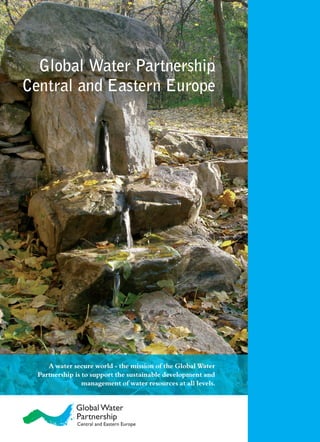
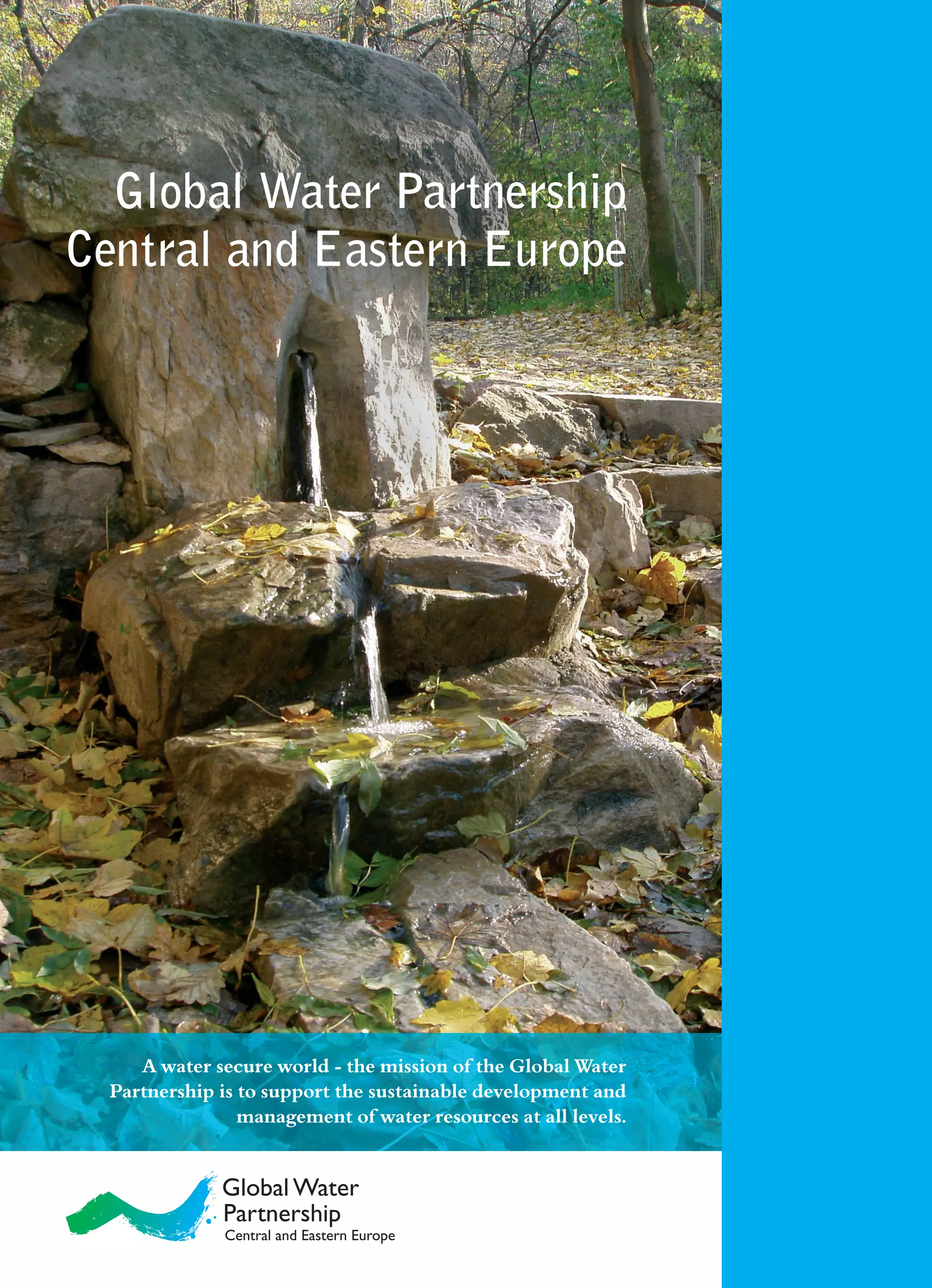
Global Water Partnership
Central and Eastern Europe


     A water secure world - the mission of the Global Water
  Partnership is to support the sustainable development and
                 management of water resources at all levels.
Global Water Partnership Central and
Eastern Europe

Only 3% of water on Earth is fresh water.        purposes. Ecosystems depending on water
Of all the freshwater, only about 0.3 percent    form the backbone of the region’s biodiversity
is contained in rivers and lakes. The rest is    including lakes, river basins, wetlands, coastal
locked up in glaciers and icecaps and stored     areas and groundwater. Throughout the
                         below your feet as      region, many water ecosystems have suffered
                         ground water.           from degradation or are threatened by
                                                 pollution, overuse of surface and groundwater
                       Water situation           and habitat loss.
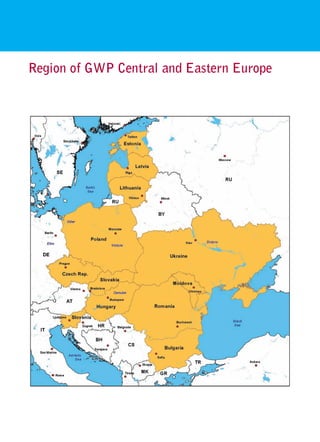
                       The region of Central
                       and Eastern Europe        Countries of Central and Eastern Europe
                       (CEE), covered            have a long history of water management
                       by Global Water           and water related legislation dating back to
                       Partnership (GWP)         the end of the 18th century. The traditional
                       has a population of       fragmented or so-called sector approach has
                       152 million people,       its limitations in the sense that it does not
                       a quarter of all          support mutual cooperation, communication
                       Europeans. It has a       and common solutions with stakeholders and
                       total area of over 2.03   the participation of the public. In addition to
                       million km2 and is        purely technical solutions for the protection
                       mostly located in the     and use of water resources, authorities
                       Baltic Sea and the        should apply modern management principles
                       Black Sea basins.         including landscape planning, communication
                                                 and conflict resolution. This integrated
Rivers in Estonia, Latvia, Lithuania, Poland     approach can only be implemented through
and Ukraine discharge their flows to the Baltic   consultation and the exchange of experiences
Sea. Bulgaria, Hungary, the Czech Republic,      and expertise of all involved parties.
Moldova, Romania, Slovakia, Slovenia and
Ukraine are located in the Danube, Dniester      GWP CEE Strategy 2009-2013
and Dnieper River basins which flow into the      The application of integrated approaches
Black Sea.                                       to water resources management remains
                                                 a key challenge and a key rationale for the
Water resources in the CEE region are            12 Country Water Partnerships forming
important for the development of its             the Regional Water Partnership. GWP CEE
countries, providing water for consumption,      Strategy 2009-2013 was developed as a tool
sanitation, irrigation, industrial use,          for facilitating implementation of integrated
navigation, fishing, recreation, and other        water resources management (IWRM)
principles in the context of European water       to information and access to justice. GWP
polices. It has four strategic goals covering     CEE established Public Participation Task
multi-sectoral dialogues, public participation,   Force covering Eastern Baltic and the Danube
sustainable sanitation, floods and droughts,       River basin in 2004. The Task Force organized
communication and network governance.             international Danube Day celebrations at
It also involves inter-regional cooperation       Water and Sustainable Development Expo
with the GWP Central Asia and Caucasus            in Zaragoza in 2008, co-organized Danube
region via UN Economic Commission for             Stakeholder Forum in 2009 and coordinated
Europe. The strategy is regularly updated with    regional input to European Union Strategy for
emerging issues such as climate adaptation.       the Danube Region in 2010. GWP CEE has
                                                  an observer status to two major international
Strategic Goal 1: National Dialogues              commissions in the region – International
There is active involvement of the Country        Commission for the Protection of the Danube
Water Partnerships to support the national        River and the Helsinki Commission.
polices by convening IWRM dialogues since
2000. National and regional dialogues are         Strategic Goal 2: Sustainable Sanitation
synthesized into regional reports. Regional       The issue cuts across sectors of water,
water vision up to 2025 was a result of first      environment and rural development,
dialogues “From Vision to Action” presented       addressing the demands of the poor and
at the Hague World Water Forum in 2000.           populations in small settlements. It seeks
Next dialogues took up several cross sectoral     alternative and decentralized solution to
issues such as gender, governance, food           sanitation services in IWRM context for
security, urban planning, environmental           rural population, constituting 20–40% of
protection and financial flows. A series of         the total population in CEE countries. A
IWRM National Policy Dialogues in 2006-           group of experts prepared a regional book,
2007 resulted in common declarations with         Sustainable Sanitation in Central and Eastern
governments, changes in legislation and           Europe: Addressing the Needs of Small and
closer cooperation with major stakeholders.       Medium-Size Settlements translated into 12
In Romania, for example, a Common                 CEE languages. The study has revealed that
Declaration considers IWRM as overarching         20 million of Europeans, especially in new
aim to which European Union water related         member states, are lacking access to sanitation
directives contribute and create synergic         services. In order to place sustainable
effects. Three years after the dialogues, GWP     sanitation high on international agenda,
Ukraine succeeded in embedding IWRM in            GWP CEE has advocated for sustainable
National Environmental Strategy.                  sanitation at various forums and frameworks,
                                                  including World Water Week and UNECE.
Strategic Goal 1: Public Participation            Water Partnership also actively contributes
Public participation has emerged in Central       to drafting Equitable Access to Water and
and European countries’ culture over the          Sanitation book that will be presented by
last twenty years. In addition to public          UNECE, WHO and the French government
participation Aarhus Convention (1998)            at the Sixth World Water Forum in Marseille
provides a legal framework regarding access       in 2012.
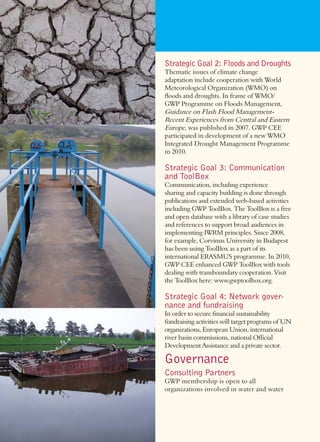
Strategic Goal 2: Floods and Droughts
Thematic issues of climate change
adaptation include cooperation with World
Meteorological Organization (WMO) on
floods and droughts. In frame of WMO/
GWP Programme on Floods Management,
Guidance on Flash Flood Management-
Recent Experiences from Central and Eastern
Europe, was published in 2007. GWP CEE
participated in development of a new WMO
Integrated Drought Management Programme
in 2010.

Strategic Goal 3: Communication
and ToolBox
Communication, including experience
sharing and capacity building is done through
publications and extended web-based activities
including GWP ToolBox. The ToolBox is a free
and open database with a library of case studies
and references to support broad audiences in
implementing IWRM principles. Since 2008,
for example, Corvinus University in Budapest
has been using ToolBox as a part of its
international ERASMUS programme. In 2010,
GWP CEE enhanced GWP ToolBox with tools
dealing with transboundary cooperation. Visit
the ToolBox here: www.gwptoolbox.org.

Strategic Goal 4: Network gover-
nance and fundraising
In order to secure financial sustainability
fundraising activities will target programs of UN
organizations, European Union, international
river basin commissions, national Official
Development Assistance and a private sector.

Governance
Consulting Partners
GWP membership is open to all
organizations involved in water and water
resource management. Currently the GWP
CEE network has more than 140 member
organizations called “Consulting Partners”
in 12 countries of Central and Eastern
Europe.

Country Water Partnerships
Country Water Partnerships are up and
running in Bulgaria, the Czech Republic,        coordinated development and management
Estonia, Hungary, Latvia, Lithuania, Moldova,   of water, land, and related resources by
Poland, Romania, Slovakia, Slovenia and         maximising economic and social welfare
Ukraine. They serve as information centers      without compromising the sustainability of
and actively support the development of         ecosystems and the environment.
national policies by convening IWRM multi-
stakeholder dialogues.                          The network is open to all organisations
                                                involved in water resources management:
Regional Council                                developed and developing country
The Council, headed by its Chair and            government institutions, agencies of
representing the 12 Country Water               the United Nations, bi- and multi-
Partnerships, is the highest decision making    lateral development banks, professional
body of GWP CEE.                                associations, research institutions, non-
                                                governmental organisations, and the private
Secretariat                                     sector.
A small Secretariat is responsible for the
coordination and implementation of              GWP’s international network comprises
regional workplan 2009-2013 and projects        13 Regional Water Partnerships, over 74
in close cooperation with the Council. The      Country Water Partnerships, and more than
Secretariat is now based in Bratislava and is   2,350 Partners located in 154 countries. The
hosted by the Slovak Hydrometeorological        secretariat is based in Stockholm, Sweden.
Institute.
                                                The network is supported financially
                                                by Canada, Denmark, the European
GWP Network
GWP CEE is a part of Global Water
Partnership network that was founded
in 1996 by the World Bank, the United
Nations Development Programme
(UNDP), and the Swedish International
Development Agency (SIDA) to foster
the implementation of integrated water
resources management (IWRM): the
Commission, Finland, France, Germany,     Vision and Mission
the Netherlands, Norway, Sweden, Spain,   The Global Water Partnership’s vision is for a
Switzerland, the United Kingdom and the   water secure world. Its mission is to support
United States.                            the sustainable development and management
More information: www.gwp.org.            of water resources at all levels.
Region of GWP Central and Eastern Europe
Regional Council:
GWP Bulgaria                                             sos Hincesti 58, 2028 Chisinau, Moldova
Ms. Galia Bardarska                                      Phone: +373 22 738889
Hristo Belchev Str. 14, floor 1, app. 1, 1000 Sofia,       E-mail: drumead25@yahoo.com
Bulgaria
Phone/Fax: + 359 2 987 04 61                             GWP Poland
Mobile phone: +359 887 602 672                           Mr. Tomasz Okruszko
E-mail: bardarska@dir.bg                                 University of Life Sciences – SGGW
Web: www.gwpbg.org                                       159 Nowoursynowska Str, 02-766 Warszaw, Poland
                                                         Phone: +48 22 5935 300
GWP Czech Republic                                       E-mail: t.okruszko@levis.sggw.pl
Mr. Mark Rieder                                          Website: www.gwppl.org
T. G. Masaryk Water Research Institute, p.r.i.
Podlabská 30/2582, 160 00 Praha 6, Czech Republic        GWP Romania
Phone: +420 220 197 200                                  Mr. Liviu-Nicolae Popescu
Fax: +420 22431 0450                                     Asociatia Parteneriatul Global al Apei din Romania
E-mail: mark_rieder@vuv.cz                               “GWP-Romania”
                                                         Alea Fizicienilor no 4 , Bloc 3C , Ap 16 , Sector 3,
GWP Estonia                                              Cod 032113, Bucharest, Romania
Mr. Harry Liiv                                           Phone +40 21 3480 947
Ministry of the Environment of Estonia                   E-mail: lipopesc@gmail.com
Narva mnt 7a, 15172 Tallinn, Estonia                     Website: www.gwp-romania.ro
Phone: +372 62 62 850
Fax: +372 62 62 928                                      GWP Slovakia
E-mail: harry.liiv@envir.ee                              Mr. Peter Roncak
Website: www.veeyhing.ee                                 GWP Slovakia
                                                         Jeseniova 17, 833 15 Bratislava, Slovakia
GWP Hungary                                              Phone: +421 905 619 107
Mr. János Fehér                                          E-mail: peter.roncak@gmail.com
VITUKI Environmental and Water Management
Research Institute Nonprofit Ltd.                         GWP Slovenia
Kvassay Jenö út 1, H-1095 Budapest, Hungary              Ms. Martina Zupan
Phone: +36 1 2158 160 (dial up ext. 2308)                Limnos Company for Applied Ecology d.o.o.
Fax: +36 1 2161 514                                      Podlimbarskega 31, 1000 Ljubljana, Slovenia
E-mail: feher.janos@vituki.hu, feher.medve@t-online.hu   Phone: +386 1 427 32 45
Website: www.gwpmo.hu                                    Fax: +386 1 505 73 86
                                                         E-mail: martina.zupan@siol.net
GWP Latvia
Ms. Sandra Krivmane                                      GWP Ukraine
JSC “Olainfarm”                                          Mr. Andriy Demydenko
Phone: +371 6701 3784                                    Ukrainian Center of Environmental and Water
Fax: +371 6701 3777                                      Projects
E-mail: skrivmane@olainfarm.lv, skrivmane@inbox.lv       Prospekt Glushkova 42, 03187 Kiev, Ukraine
                                                         Phone: +380 50 352 96 70
GWP Lithuania                                            Fax: +380 44 526 36 15
Mr. Bernardas Paukstys                                   E-mail: andriyd@ucewp.kiev.ua
Public Establishment “Vandens namai” (Water House)
Juozapaviciaus street 6/2, LT-09310 Vilnius, Lithuania   GWP CEE Regional Secretariat:
Phone: +370 5 275 72 78                                  Mr. Milan Matuska, Regional Coordinator
Fax: +370 5 275 72 78                                    c/o Slovak Hydrometeorological Institute
E-mail: bernardas@iti.lt                                 Jeseniova 17, 833 15 Bratislava, Slovakia
Website: www.vandensklubas.lt                            Phone: +421 2 5941 5224
                                                         Fax: +421 2 5941 5273
GWP Moldova                                              E-mail: gwpcee@shmu.sk
Mr. Dumitru Drumea                                       Web: www.gwpceeforum.org
Center for Strategic Environmental Studies (ECOS)


                                                               Imprint   Publisher: GWP CEE
                                                                         Editor: Richard Muller
                                                                         Pictures: Milan Matuska, Richard Muller
                                                                         Map: Ludovit Molnar
                                                                         Edition: December 2010

GWP CEE Leaflet

  • 1.
    Global Water Partnership Centraland Eastern Europe A water secure world - the mission of the Global Water Partnership is to support the sustainable development and management of water resources at all levels.
  • 2.
    Global Water PartnershipCentral and Eastern Europe Only 3% of water on Earth is fresh water. purposes. Ecosystems depending on water Of all the freshwater, only about 0.3 percent form the backbone of the region’s biodiversity is contained in rivers and lakes. The rest is including lakes, river basins, wetlands, coastal locked up in glaciers and icecaps and stored areas and groundwater. Throughout the below your feet as region, many water ecosystems have suffered ground water. from degradation or are threatened by pollution, overuse of surface and groundwater Water situation and habitat loss. The region of Central and Eastern Europe Countries of Central and Eastern Europe (CEE), covered have a long history of water management by Global Water and water related legislation dating back to Partnership (GWP) the end of the 18th century. The traditional has a population of fragmented or so-called sector approach has 152 million people, its limitations in the sense that it does not a quarter of all support mutual cooperation, communication Europeans. It has a and common solutions with stakeholders and total area of over 2.03 the participation of the public. In addition to million km2 and is purely technical solutions for the protection mostly located in the and use of water resources, authorities Baltic Sea and the should apply modern management principles Black Sea basins. including landscape planning, communication and conflict resolution. This integrated Rivers in Estonia, Latvia, Lithuania, Poland approach can only be implemented through and Ukraine discharge their flows to the Baltic consultation and the exchange of experiences Sea. Bulgaria, Hungary, the Czech Republic, and expertise of all involved parties. Moldova, Romania, Slovakia, Slovenia and Ukraine are located in the Danube, Dniester GWP CEE Strategy 2009-2013 and Dnieper River basins which flow into the The application of integrated approaches Black Sea. to water resources management remains a key challenge and a key rationale for the Water resources in the CEE region are 12 Country Water Partnerships forming important for the development of its the Regional Water Partnership. GWP CEE countries, providing water for consumption, Strategy 2009-2013 was developed as a tool sanitation, irrigation, industrial use, for facilitating implementation of integrated navigation, fishing, recreation, and other water resources management (IWRM)
  • 3.
    principles in thecontext of European water to information and access to justice. GWP polices. It has four strategic goals covering CEE established Public Participation Task multi-sectoral dialogues, public participation, Force covering Eastern Baltic and the Danube sustainable sanitation, floods and droughts, River basin in 2004. The Task Force organized communication and network governance. international Danube Day celebrations at It also involves inter-regional cooperation Water and Sustainable Development Expo with the GWP Central Asia and Caucasus in Zaragoza in 2008, co-organized Danube region via UN Economic Commission for Stakeholder Forum in 2009 and coordinated Europe. The strategy is regularly updated with regional input to European Union Strategy for emerging issues such as climate adaptation. the Danube Region in 2010. GWP CEE has an observer status to two major international Strategic Goal 1: National Dialogues commissions in the region – International There is active involvement of the Country Commission for the Protection of the Danube Water Partnerships to support the national River and the Helsinki Commission. polices by convening IWRM dialogues since 2000. National and regional dialogues are Strategic Goal 2: Sustainable Sanitation synthesized into regional reports. Regional The issue cuts across sectors of water, water vision up to 2025 was a result of first environment and rural development, dialogues “From Vision to Action” presented addressing the demands of the poor and at the Hague World Water Forum in 2000. populations in small settlements. It seeks Next dialogues took up several cross sectoral alternative and decentralized solution to issues such as gender, governance, food sanitation services in IWRM context for security, urban planning, environmental rural population, constituting 20–40% of protection and financial flows. A series of the total population in CEE countries. A IWRM National Policy Dialogues in 2006- group of experts prepared a regional book, 2007 resulted in common declarations with Sustainable Sanitation in Central and Eastern governments, changes in legislation and Europe: Addressing the Needs of Small and closer cooperation with major stakeholders. Medium-Size Settlements translated into 12 In Romania, for example, a Common CEE languages. The study has revealed that Declaration considers IWRM as overarching 20 million of Europeans, especially in new aim to which European Union water related member states, are lacking access to sanitation directives contribute and create synergic services. In order to place sustainable effects. Three years after the dialogues, GWP sanitation high on international agenda, Ukraine succeeded in embedding IWRM in GWP CEE has advocated for sustainable National Environmental Strategy. sanitation at various forums and frameworks, including World Water Week and UNECE. Strategic Goal 1: Public Participation Water Partnership also actively contributes Public participation has emerged in Central to drafting Equitable Access to Water and and European countries’ culture over the Sanitation book that will be presented by last twenty years. In addition to public UNECE, WHO and the French government participation Aarhus Convention (1998) at the Sixth World Water Forum in Marseille provides a legal framework regarding access in 2012.
  • 4.
    Strategic Goal 2:Floods and Droughts Thematic issues of climate change adaptation include cooperation with World Meteorological Organization (WMO) on floods and droughts. In frame of WMO/ GWP Programme on Floods Management, Guidance on Flash Flood Management- Recent Experiences from Central and Eastern Europe, was published in 2007. GWP CEE participated in development of a new WMO Integrated Drought Management Programme in 2010. Strategic Goal 3: Communication and ToolBox Communication, including experience sharing and capacity building is done through publications and extended web-based activities including GWP ToolBox. The ToolBox is a free and open database with a library of case studies and references to support broad audiences in implementing IWRM principles. Since 2008, for example, Corvinus University in Budapest has been using ToolBox as a part of its international ERASMUS programme. In 2010, GWP CEE enhanced GWP ToolBox with tools dealing with transboundary cooperation. Visit the ToolBox here: www.gwptoolbox.org. Strategic Goal 4: Network gover- nance and fundraising In order to secure financial sustainability fundraising activities will target programs of UN organizations, European Union, international river basin commissions, national Official Development Assistance and a private sector. Governance Consulting Partners GWP membership is open to all organizations involved in water and water
  • 5.
    resource management. Currentlythe GWP CEE network has more than 140 member organizations called “Consulting Partners” in 12 countries of Central and Eastern Europe. Country Water Partnerships Country Water Partnerships are up and running in Bulgaria, the Czech Republic, coordinated development and management Estonia, Hungary, Latvia, Lithuania, Moldova, of water, land, and related resources by Poland, Romania, Slovakia, Slovenia and maximising economic and social welfare Ukraine. They serve as information centers without compromising the sustainability of and actively support the development of ecosystems and the environment. national policies by convening IWRM multi- stakeholder dialogues. The network is open to all organisations involved in water resources management: Regional Council developed and developing country The Council, headed by its Chair and government institutions, agencies of representing the 12 Country Water the United Nations, bi- and multi- Partnerships, is the highest decision making lateral development banks, professional body of GWP CEE. associations, research institutions, non- governmental organisations, and the private Secretariat sector. A small Secretariat is responsible for the coordination and implementation of GWP’s international network comprises regional workplan 2009-2013 and projects 13 Regional Water Partnerships, over 74 in close cooperation with the Council. The Country Water Partnerships, and more than Secretariat is now based in Bratislava and is 2,350 Partners located in 154 countries. The hosted by the Slovak Hydrometeorological secretariat is based in Stockholm, Sweden. Institute. The network is supported financially by Canada, Denmark, the European GWP Network GWP CEE is a part of Global Water Partnership network that was founded in 1996 by the World Bank, the United Nations Development Programme (UNDP), and the Swedish International Development Agency (SIDA) to foster the implementation of integrated water resources management (IWRM): the
  • 6.
    Commission, Finland, France,Germany, Vision and Mission the Netherlands, Norway, Sweden, Spain, The Global Water Partnership’s vision is for a Switzerland, the United Kingdom and the water secure world. Its mission is to support United States. the sustainable development and management More information: www.gwp.org. of water resources at all levels.
  • 7.
    Region of GWPCentral and Eastern Europe
  • 8.
    Regional Council: GWP Bulgaria sos Hincesti 58, 2028 Chisinau, Moldova Ms. Galia Bardarska Phone: +373 22 738889 Hristo Belchev Str. 14, floor 1, app. 1, 1000 Sofia, E-mail: drumead25@yahoo.com Bulgaria Phone/Fax: + 359 2 987 04 61 GWP Poland Mobile phone: +359 887 602 672 Mr. Tomasz Okruszko E-mail: bardarska@dir.bg University of Life Sciences – SGGW Web: www.gwpbg.org 159 Nowoursynowska Str, 02-766 Warszaw, Poland Phone: +48 22 5935 300 GWP Czech Republic E-mail: t.okruszko@levis.sggw.pl Mr. Mark Rieder Website: www.gwppl.org T. G. Masaryk Water Research Institute, p.r.i. Podlabská 30/2582, 160 00 Praha 6, Czech Republic GWP Romania Phone: +420 220 197 200 Mr. Liviu-Nicolae Popescu Fax: +420 22431 0450 Asociatia Parteneriatul Global al Apei din Romania E-mail: mark_rieder@vuv.cz “GWP-Romania” Alea Fizicienilor no 4 , Bloc 3C , Ap 16 , Sector 3, GWP Estonia Cod 032113, Bucharest, Romania Mr. Harry Liiv Phone +40 21 3480 947 Ministry of the Environment of Estonia E-mail: lipopesc@gmail.com Narva mnt 7a, 15172 Tallinn, Estonia Website: www.gwp-romania.ro Phone: +372 62 62 850 Fax: +372 62 62 928 GWP Slovakia E-mail: harry.liiv@envir.ee Mr. Peter Roncak Website: www.veeyhing.ee GWP Slovakia Jeseniova 17, 833 15 Bratislava, Slovakia GWP Hungary Phone: +421 905 619 107 Mr. János Fehér E-mail: peter.roncak@gmail.com VITUKI Environmental and Water Management Research Institute Nonprofit Ltd. GWP Slovenia Kvassay Jenö út 1, H-1095 Budapest, Hungary Ms. Martina Zupan Phone: +36 1 2158 160 (dial up ext. 2308) Limnos Company for Applied Ecology d.o.o. Fax: +36 1 2161 514 Podlimbarskega 31, 1000 Ljubljana, Slovenia E-mail: feher.janos@vituki.hu, feher.medve@t-online.hu Phone: +386 1 427 32 45 Website: www.gwpmo.hu Fax: +386 1 505 73 86 E-mail: martina.zupan@siol.net GWP Latvia Ms. Sandra Krivmane GWP Ukraine JSC “Olainfarm” Mr. Andriy Demydenko Phone: +371 6701 3784 Ukrainian Center of Environmental and Water Fax: +371 6701 3777 Projects E-mail: skrivmane@olainfarm.lv, skrivmane@inbox.lv Prospekt Glushkova 42, 03187 Kiev, Ukraine Phone: +380 50 352 96 70 GWP Lithuania Fax: +380 44 526 36 15 Mr. Bernardas Paukstys E-mail: andriyd@ucewp.kiev.ua Public Establishment “Vandens namai” (Water House) Juozapaviciaus street 6/2, LT-09310 Vilnius, Lithuania GWP CEE Regional Secretariat: Phone: +370 5 275 72 78 Mr. Milan Matuska, Regional Coordinator Fax: +370 5 275 72 78 c/o Slovak Hydrometeorological Institute E-mail: bernardas@iti.lt Jeseniova 17, 833 15 Bratislava, Slovakia Website: www.vandensklubas.lt Phone: +421 2 5941 5224 Fax: +421 2 5941 5273 GWP Moldova E-mail: gwpcee@shmu.sk Mr. Dumitru Drumea Web: www.gwpceeforum.org Center for Strategic Environmental Studies (ECOS) Imprint Publisher: GWP CEE Editor: Richard Muller Pictures: Milan Matuska, Richard Muller Map: Ludovit Molnar Edition: December 2010