11
11
2019
профільний рівень
УДК 811.111(075.3)
M 79
Рекомендовано Міністерством освіти і науки України
(наказ Міністерства освіти і науки України від 12.04.2019 № 472)
Видано за рахунок державних коштів.
Продаж заборонено.
Підручник призначений для учнів одинадцятих класів закладів загальної
середньої освіти, що виконують навчальну програму за профільним рівнем.
Підручник складається із восьми тематичних розділів відповідно до
вимог чинної програми Міністерства освіти і науки України (”Покоління:
люди і суспільство”, ”Здоровий спосіб життя: їжа”, ”Хобі і відпочинок у
вільний час”, ”Світ мандрів”, ”Вік живи – вік учись”, ”Цифрові технології
і наукові досягнення”, ”Світ професій” ”Мистецтво”), кожен з яких
пропонує вправи і завдання для формування мовних навичок (лексичних
і граматичних – Vocabulary Builder, Grammar Builder) і мовленнєвих
умінь (читання – Reading Skill Builder, аудіювання – Listening Skill Builder,
усного мовлення – Speaking Skill Builder і писемного мовлення – Writing
Skill Builder). У запропонованих розділах подається блок завдань для
повторення (Let’s Revise and Practise), а також для консолідації лексико-
граматичних навичок (Use of English) у форматі тестів зовнішнього
незалежного оцінювання (ЗНО). Варто зазначити, що більшість завдань у
підручнику відповідає формату ЗНО з метою належної підготовки учнів до
завершального оцінювання.
ISBN 978-966-308-749-8
	
Морська Л. І.
M 79	 Англійська мова (11-й рік навчання, профільний рівень) (English (the 11th
year of studies)): підручник для 11 класу закладів загальної середньої освіти.
— Тернопіль: Астон, 2019. — 256 c. : іл.
ISBN 978-966-308-749-8
© Морська Л. І., 2019
			
© ТзОВ ”Видавництво Астон”, 2019
3
завдання для
аудіювання
граматичні
завдання
лексичні
завдання
завдання для
писемного мовлення
завдання для
cамостійної роботи
завдання для
читання
завдання для
усного мовлення
Are You Ready for Achievement Assessment?
Let’s Revise and Practise!
Dear pupils!
This academic year is going to be the last one for you at school! I am sure
it will be difficult and demanding, requiring much effort investment on your
part. A lot of you will have to take your final test or exam in English.
Sitting for exams is usually stressful for those people who are not properly
prepared. I do hope that the book you are holding in your hands will help you
consolidate your knowledge and skills in English, get perfectly ready for the
assessment of your academic achievement and enjoy the process of passing
your final exams.
The textbook has been created not only to help you with tests, but also
to keep you interested in a plethora of burning issues for discussion, to
upgrade your knowledge of state-of-the-art technology and advancements
in education, to expand your horizons in traveling opportunities, to sharpen
your eye in appreciation of artistic creations, to draw your attention to healthy
eating habits, to remind you of the excitement of some leisure activities as
well as the necessity of being engaged in a tailor-made occupational activity.
You are kindly encouraged to look through the book and mark the pages
containing some information which has triggered the desire to learn more
about the issue or to share what you already know with your classmates. I wish
you to fully realise your expectations about the study process throughout this
academic year and get pleasure from learning English!!!
Умовні позначення
4
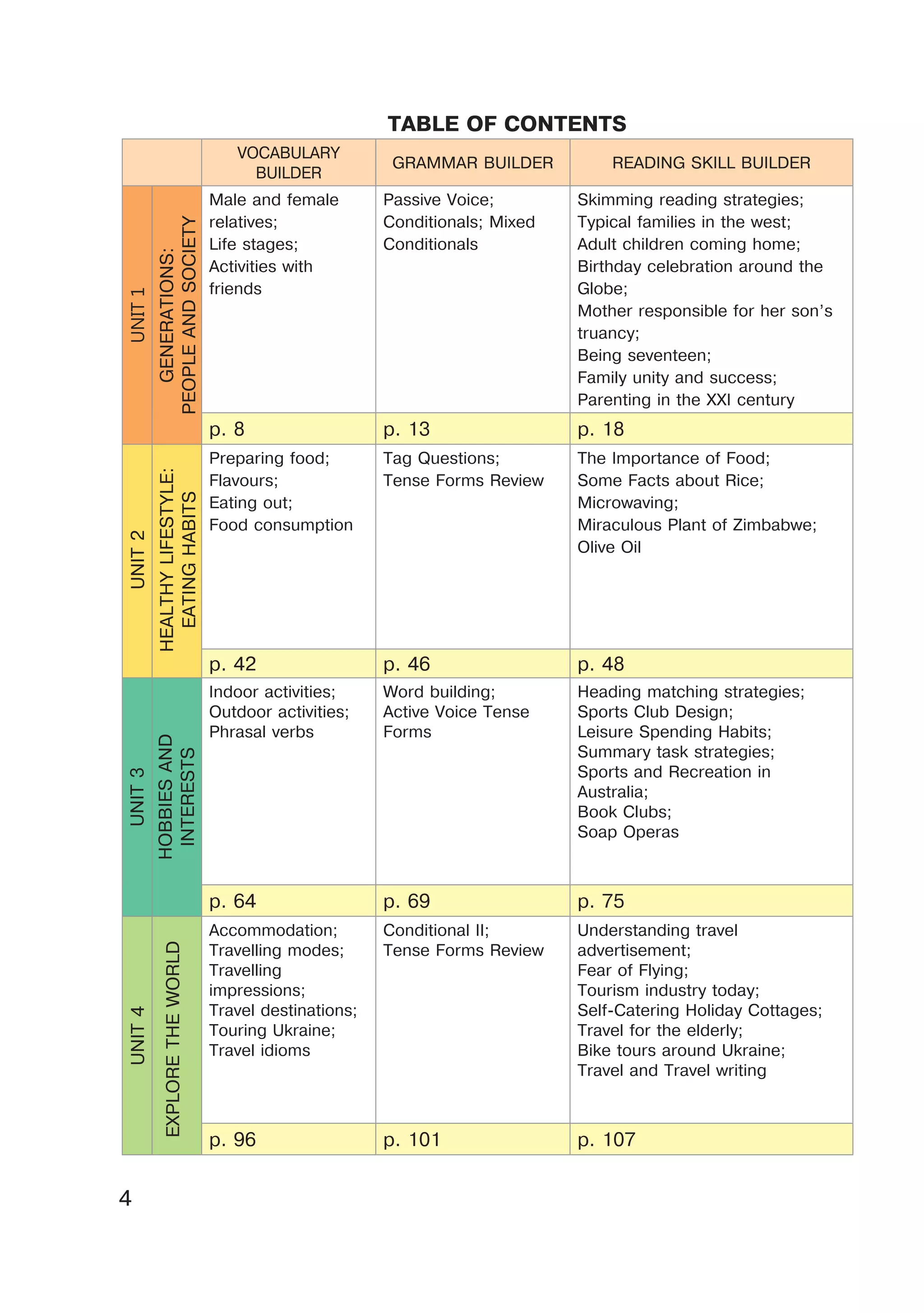
TABLE OF CONTENTS
VOCABULARY
BUILDER
GRAMMAR BUILDER READING SKILL BUILDER
Male and female
relatives;
Life stages;
Activities with
friends
Passive Voice;
Conditionals; Mixed
Conditionals
Skimming reading strategies;
Typical families in the west;
Adult children coming home;
Birthday celebration around the
Globe;
Mother responsible for her son’s
truancy;
Being seventeen;
Family unity and success;
Parenting in the XXI century
p. 8 p. 13 p. 18
Preparing food;
Flavours;
Eating out;
Food consumption
Tag Questions;
Tense Forms Review
The Importance of Food;
Some Facts about Rice;
Microwaving;
Miraculous Plant of Zimbabwe;
Olive Oil
p. 42 p. 46 p. 48
Indoor activities;
Outdoor activities;
Phrasal verbs
Word building;
Active Voice Tense
Forms
Heading matching strategies;
Sports Club Design;
Leisure Spending Habits;
Summary task strategies;
Sports and Recreation in
Australia;
Book Clubs;
Soap Operas
p. 64 p. 69 p. 75
Accommodation;
Travelling modes;
Travelling
impressions;
Travel destinations;
Touring Ukraine;
Travel idioms
Conditional II;
Tense Forms Review
Understanding travel
advertisement;
Fear of Flying;
Tourism industry today;
Self-Catering Holiday Cottages;
Travel for the elderly;
Bike tours around Ukraine;
Travel and Travel writing
p. 96 p. 101 p. 107
UNIT2
GENERATIONS:
PEOPLEANDSOCIETY
HEALTHYLIFESTYLE:
EATINGHABITS
UNIT1UNIT3
HOBBIESAND
INTERESTS
UNIT4
EXPLORETHEWORLD
5
LISTENING SKILL BUILDER SPEAKING SKILL BUILDER
WRITING SKILL
BUILDER
Listen and match the items;
Listen and complete the table;
Listen and compare
Group discussion;
Ask and answer questions;
Rearranging and acting out
a dialogue;
Conducting a survey;
Matching activity
Writing an informal
letter
p. 31 p. 33 p. 36
Listen and complete the notes;
Listen and choose the correct item;
Listen and do ”true/false” activity
Asking and answering
questions;
Reasoning to prove one’s
opinion;
Rearranging and acting out
the dialogue;
Preparing food according
to the recipe
Writing a review
p. 55 p. 57 p. 59
Listen and do ”true/false” activity;
Listen and fill in the gaps;
Listen and answer the questions
Group discussion;
Ask and answer questions;
Expressing a personal
opinion;
Speaking using the
substitution table;
Describing a recent TV
programme;
Conducting an interview
and presenting the results
Writing a review;
Describing graphs
p. 84 p. 85 p. 87
Listen and match the items;
Listen and do ”true/false” activity;
Listen and rearrange the dialogue;
Listen and complete the sentences;
Listen and choose the correct item
Group discussion;
Ask and answer questions;
Describing a travel
destination
Writing a description
of a perfect holiday
p. 116 p. 121 p. 122
6
VOCABULARY
BUILDER
GRAMMAR BUILDER READING SKILL BUILDER
Types of schools;
Academic
achievement and
degrees;
School idioms and
collocations
Review of -ed (or the
past participle) or -ing
forms;
Adverbial modifiers;
Indirect questions;
Conditionals;
Clauses of purpose
Multiple-choice task strategies;
The love for books;
The Creation Myth;
True/False/Not given task
strategies;
Revolution in Knowledge Sharing;
Unfair Education;
Classification task strategies;
Oxford and Cambridge;
The Use of Interactive
Whiteboard
p. 126 p. 131 p. 135
Technological
advancement;
Techno-savvy home
Clauses of Purpose;
Future Tense Forms
Digital Dark Age;
Mobile Phone Games;
Techno-Wizardry in the Home;
Human Voice Simulation;
Augmented Reality
p. 156 p. 162 p. 169
Names of
occupations;
Types of employees;
Popular occupations
in Ukraine;
Job description;
Job Interviews;
Phrasal verbs
Used to/ be used to;
Modals;
Defining/ non-defining
clauses
Job description;
Workaholics;
Why women have to work;
Colleagues at work;
Career promotion;
Job opportunities for foreigners
in Ukraine
p. 192 p. 197 p. 202
Visual Arts;
Performance Arts;
Prominent artists;
Attending Arts
Events;
Music Idioms
Pronouns;
Verbs of Sensation;
Future in the Past
History of Architecture;
Playing the Bagpipe;
Vivid and Unique: London’s
Notting Hill Carnival;
The Mystery behind the Great
Pyramid at Giza;
The Sahara Film Festival
p. 222 p. 229 p. 234
UNIT5UNIT7
LIVEANDLEARNATAILOR-MADEJOB:
WHATISYOURCHOICE?
UNIT6
DIGITALWORLD
AROUNDUS
UNIT8
ARTS:THEBEAUTY
OFCREATION
7
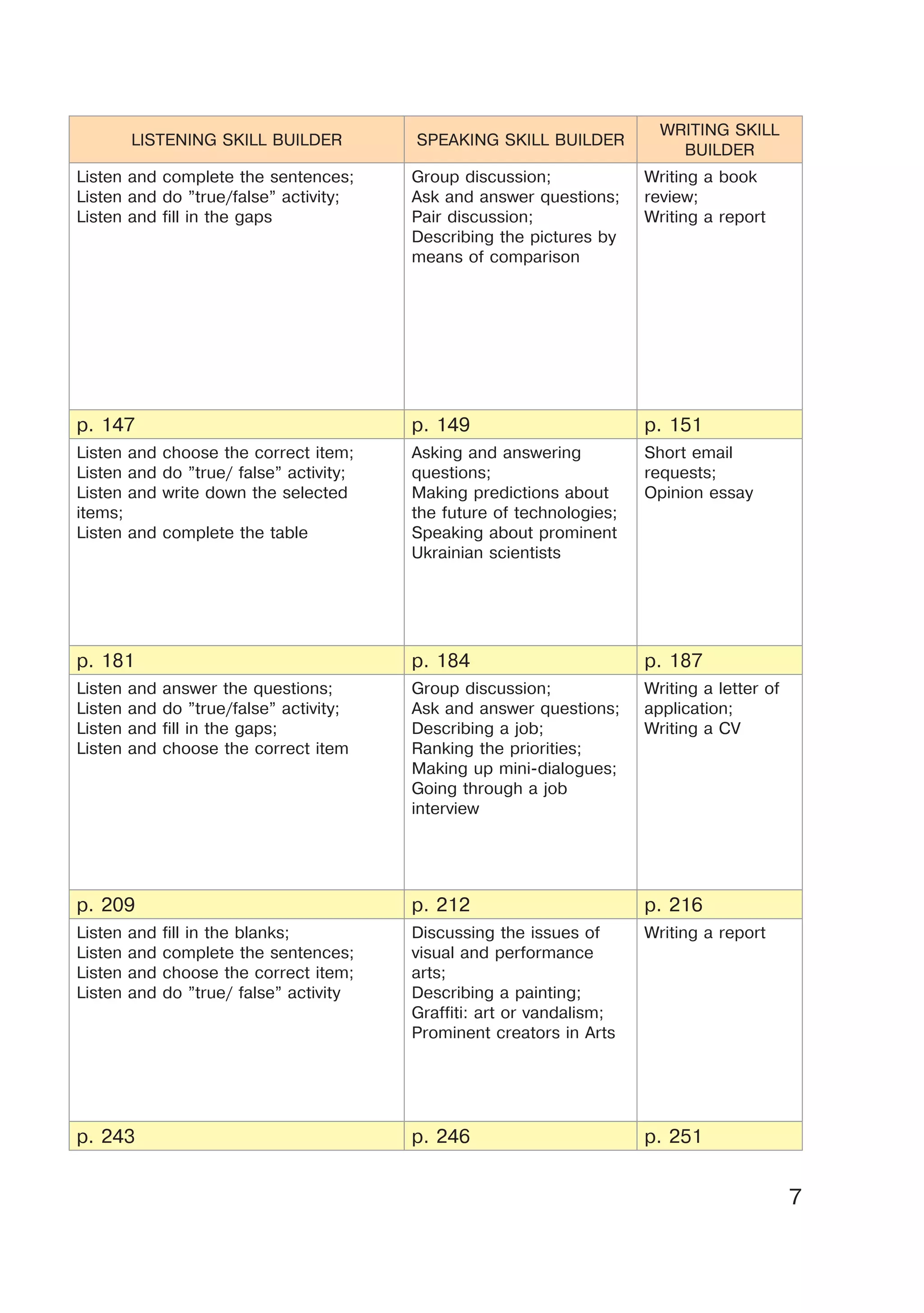
LISTENING SKILL BUILDER SPEAKING SKILL BUILDER
WRITING SKILL
BUILDER
Listen and complete the sentences;
Listen and do ”true/false” activity;
Listen and fill in the gaps
Group discussion;
Ask and answer questions;
Pair discussion;
Describing the pictures by
means of comparison
Writing a book
review;
Writing a report
p. 147 p. 149 p. 151
Listen and choose the correct item;
Listen and do ”true/ false” activity;
Listen and write down the selected
items;
Listen and complete the table
Asking and answering
questions;
Making predictions about
the future of technologies;
Speaking about prominent
Ukrainian scientists
Short email
requests;
Opinion essay
p. 181 p. 184 p. 187
Listen and answer the questions;
Listen and do ”true/false” activity;
Listen and fill in the gaps;
Listen and choose the correct item
Group discussion;
Ask and answer questions;
Describing a job;
Ranking the priorities;
Making up mini-dialogues;
Going through a job
interview
Writing a letter of
application;
Writing a CV
p. 209 p. 212 p. 216
Listen and fill in the blanks;
Listen and complete the sentences;
Listen and choose the correct item;
Listen and do ”true/ false” activity
Discussing the issues of
visual and performance
arts;
Describing a painting;
Graffiti: art or vandalism;
Prominent creators in Arts
Writing a report
p. 243 p. 246 p. 251
GENERATIONS: PEOPLE AND SOCIETY
8
UNITUNIT GENERATIONS: PEOPLE AND SOCIETY
1
Nuclear
(immediate)
family:
Father, mother, son,
daughter, brother,
sister, siblings,
stepfather, stepmother,
half-sister(brother),
stepson(daughter),
adopted child, parents
Close and distant
relatives
(extended family):
grandfather, grandmother,
uncle, aunt, grandson,
granddaughter, nephew,
niece, son-in-law, daughter-
in-law, father-in-law,
mother-in-law, godfather,
godmother, cousin, second
cousin
Marital status:
married, single, unmarried,
a bachelor (male)
a widow (female),
a widower (male), engaged,
fiancée (female)
separated, divorced,
ex-husband, ex-wife
Additional vocabulary:
relatives, ancestors, descendants, twins,
triplets, maternal, paternal, peer,
baby boom, generation gap, sandwich
generation, to take after, to resemble,
to be named after
fair-weather friend
fellow student
flatmate
girlfriend / boyfriend
mutual friends
old friend/ pal/ buddy
travel companion
workmate/ classmate
pen-friend
make friends with
hang around
stand by somebody
see each other
keep up with
lose touch of
count on
a faithful
companion
an acquaintance
mutual respect
a strong bond
true friends
close friends
Friends
UNIT 1
GENERATIONS: PEOPLE AND SOCIETY
VOCABULARY BUILDER
Family
YOUTH LIFESTYLE. MODERN YOUTH CLUBSGENERATIONS: PEOPLE AND SOCIETY
9
UNIT
GENERATIONS: PEOPLE AND SOCIETY
1
1. Complete the sentences with the words from the
Vocabulary Builder box above.
1. Your brother or sister is your ____________. 2. Your mother’s sister is your
_______. 3. Your brother’s wife is your ___________. 4. Your aunt’s or uncle’s
children are your __________. 5. Your father, mother, sister and brother are your
__________. 6. A person who has no brothers or sisters is called an ________.
7. Your mother’s new husband (not your father) is your _____________. 8. A
child whose mother and father are dead is an _________. 9. An unmarried man
is called a _________ or ________. 10. A woman whose husband has died is a
________. 11. Your father’s parents are your ______________. 12. A child who
you have legal custody of, but is not your biological child, is your __________.
13. Your parents” cousin’s children are your ___________.
2. Work with your partner and complete the family tree
below.
Student A.
1.	Doris is Tom’s wife.
2.	Rachel is Doris’s daughter.
3.	Bobby isn’t married.
4.	Judy has two children.
5.	Bill is Rachel’s husband.
6.	Mary is Andrew’s sister.
Student B.
1.	Tom is a grandfather.
2.	Bobby is Tom’s son.
3.	Judy is Rachel’s sister.
4.	Rachel has no children.
5.	Rachel’s sister is married to David.
6.	Doris’s granddaughter is Mary.
GENERATIONS: PEOPLE AND SOCIETY
10
UNITUNIT GENERATIONS: PEOPLE AND SOCIETY
1
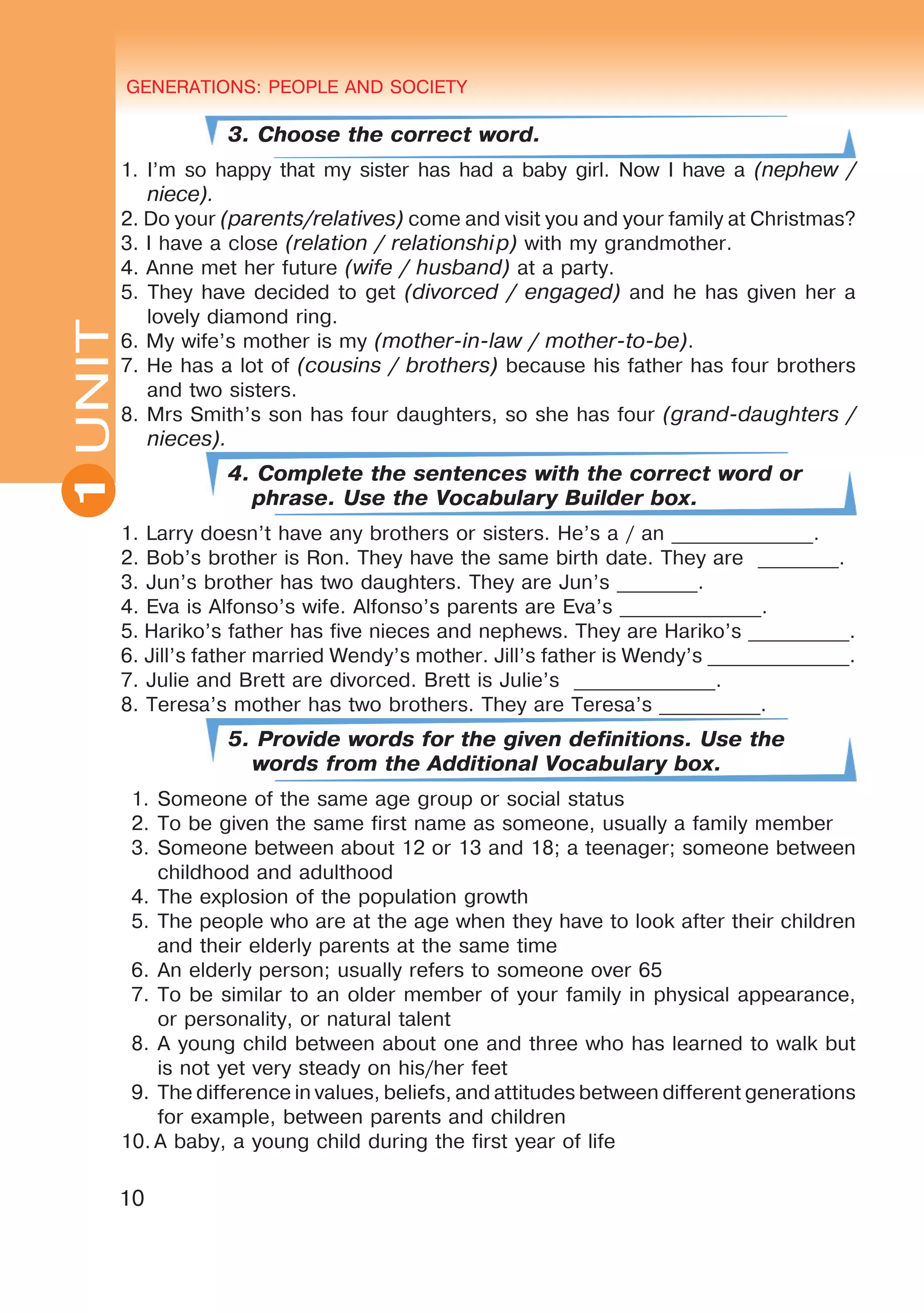
3. Choose the correct word.
1. I’m so happy that my sister has had a baby girl. Now I have a (nephew /
niece).
2. Do your (parents/relatives) come and visit you and your family at Christmas?
3. I have a close (relation / relationship) with my grandmother.
4. Anne met her future (wife / husband) at a party.
5. They have decided to get (divorced / engaged) and he has given her a
lovely diamond ring.
6. My wife’s mother is my (mother-in-law / mother-to-be).
7. He has a lot of (cousins / brothers) because his father has four brothers
and two sisters.
8. Mrs Smith’s son has four daughters, so she has four (grand-daughters /
nieces).
4. Complete the sentences with the correct word or
phrase. Use the Vocabulary Builder box.
1. Larry doesn’t have any brothers or sisters. He’s a / an ______________.
2. Bob’s brother is Ron. They have the same birth date. They are ________.
3. Jun’s brother has two daughters. They are Jun’s ________.
4. Eva is Alfonso’s wife. Alfonso’s parents are Eva’s ______________.
5. Hariko’s father has five nieces and nephews. They are Hariko’s __________.
6. Jill’s father married Wendy’s mother. Jill’s father is Wendy’s ______________.
7. Julie and Brett are divorced. Brett is Julie’s ______________.
8. Teresa’s mother has two brothers. They are Teresa’s __________.
5. Provide words for the given definitions. Use the
words from the Additional Vocabulary box.
1.	Someone of the same age group or social status
2.	To be given the same first name as someone, usually a family member
3.	Someone between about 12 or 13 and 18; a teenager; someone between
childhood and adulthood
4.	The explosion of the population growth
5.	The people who are at the age when they have to look after their children
and their elderly parents at the same time
6.	An elderly person; usually refers to someone over 65
7.	To be similar to an older member of your family in physical appearance,
or personality, or natural talent
8.	A young child between about one and three who has learned to walk but
is not yet very steady on his/her feet
9.	The difference in values, beliefs, and attitudes between different generations
for example, between parents and children
10.	A baby, a young child during the first year of life
YOUTH LIFESTYLE. MODERN YOUTH CLUBSGENERATIONS: PEOPLE AND SOCIETY
11
UNIT
GENERATIONS: PEOPLE AND SOCIETY
1
6. Use the words from the box below to complete the
sentences.
1. I hear you work with Peter. Did you know he was a friend of _____?
2. I suppose Sandra is my _______ friend. We call each other most evenings.
3. I’m going up to see some _______ friends in Scotland next week. I haven’t
seen them for over 30 years!
4. I wouldn’t say he was a _____ friend. We used to work together and we go
for a drink now and then.
5. I met Martin at university. It was the start of a _____ friendship.
6. I wouldn’t really call Sam a friend. He’s just a/an _______. I know him
through Paul and Pam.
7. Match the beginnings with the endings of the
sentences below.
1.	 I didn’t like Jenny at first but now we get on ….
2.	 We live in different towns now but we still try to see ….
3.	 Mark and I get on very well. We’ve got so much ….
4.	 Lucy’s my best friend. I know I can always rely on …..
5.	 Even if we move to different countries, we’d always stay …..
6.	 Mike and I do everything together. We really enjoy ….
7.	 I think we’re friends because we come from …..
8.	 I’ve known Susan since we were at school. We go back ….
lifelong, acquaintance, mine, close, old, best
a. similar backgrounds.
b. in common.
c. in touch.
d. each other’s company.
e. a long way.
f. very well.
g. her.
h. each other whenever
we can.
GENERATIONS: PEOPLE AND SOCIETY
12
UNITUNIT GENERATIONS: PEOPLE AND SOCIETY
1
8. Replace the words in italics with the phrasal verbs
from the box.
1. I don’t know how long I can tolerate her.
2. All the staff like her and are friendly to her.
3. I met Kim by chance the other day.
4. She wants to end the relationship with him.
5. They have arguments over everything.
6. She always leaves him and then a week later they start their relationship
again.
7. There was a mother and father on the show who still take care of their
three grown-up children.
8. They never do anything around the house and always disappoint parents
by not doing what they should do.
9. She said she would be loyal to him whatever happened.
9. Find phrasal verbs in the following sentences.
1. I live with Sarah, but each of us has our own group of friends that we
hang out with. 2. Olivia and I went on a trip to Peru together ten years ago
and we’ve kept up with each other ever since. 3. Oh, do you know Tom? He’s
a good friend of mine too. We should all meet up some time. 4. Jacob always
hangs around when he’s bored, but he never comes round when he’s got
something better to do. 5. Kate has always stood by me in times of difficulty.
If ever I’m in trouble, I know I can rely on her for help. 6. Colin and I have been
teaching at the same school for years. We get on very well, even though we
never really see each other socially. I think I’ve been round to his house once.
7. Barney and I have known each other since we were at school. It doesn’t
matter if we haven’t seen each other for a while; we just seem to pick up
where we left off.
10. Use the phrasal verbs you have found in exercise 9
to complete the sentences below.
1. We come from different backgrounds but we __________ really well.
2. We don’t have to do anything special, like going to a show. It would just be
nice to ________ together for a bit.
3. I made a lot of really good friends at university, but I haven’t __________
with many of them.
4. Why don’t you _________ to my house for supper tonight?
5. Some friends are great just to have a good time with, but real friends are
the ones who you _________ when you’re in trouble.
6. I’m busy at six o’clock but we could __________ later, if you like. Say, eight
thirty?
break up, fall out, get
back together, get on with,
let down, look after, put
up with, ran into, stand by
YOUTH LIFESTYLE. MODERN YOUTH CLUBSGENERATIONS: PEOPLE AND SOCIETY
13
UNIT
GENERATIONS: PEOPLE AND SOCIETY
1
GRAMMAR BUILDER
Review of the Passive Voice
1. Complete the text with the correct item.
When talking about family, a distinction (1) is making/is made between
extended family and nuclear family. The nuclear family is the basic family
unit of parents and children. The extended family is all the other members
who (2) are related/have been related by blood and by marriage: aunts,
uncles, grandparents, nieces, nephews, inlaws, etc. In the West, the
importance of extended family (3) has decreased/has been decreased
greatly in the last 50 years. But the extended family has many economic
benefits. Grandparents (4)  help/are helped with childcare and in turn
they (5) are looked after/have been looked after when they are old by
younger members of the family. Also, when houses and domestic chores
(6)  are sharing/are being shared by many, living costs are naturally
lower. But in recent years more and more young people (7) are choosing/
have been choosing to live in nuclear families and so the economics
(8) have changed/have been changing. The older generation say that
traditional family values (9)  are losing/are being lost; but the more
serious economic issue is that everyone’s network of support (10) has
been taking/has been taken away.
2. Read the text in exercise 1 (Reading Skill Builder),
find the sentences in the passive voice and turn them
into the active voice. Add the necessary information
on your own.
Model:	
In Canada and the United
States, children are encouraged
to be independent.
In Canada and the United
States, parents encourage children
to be independent.
Review of Conditionals
3. Read the text in exercise 6 (Reading Skill Builder),
find conditional sentences and state their types.
4. Put the verbs in brackets in the correct tense form.
1. I wouldn’t drink that if I (be) ________________ you. 2. If I were sent
to prison (you visit) _______________________ me? 3. If you (not belong)
_____________________ to a union you couldn’t get a job. 4. He might get
fat if he (stop) ______________________ smoking. 5. I’d climb over the wall
if there (not be) ______________________ so much broken glass on top of it.
GENERATIONS: PEOPLE AND SOCIETY
14
UNITUNIT GENERATIONS: PEOPLE AND SOCIETY
1
5. Rewrite the sentences without changing their
meaning. Use conditionals.
1.	 You didn’t tell me we had run out of bread, so I didn’t buy any. If you
had told me we had run out of bread,I would have bought some.	
2.	 We only came by bus because there were no taxis.
If there ________________________________________________________
3.	 I didn’t know the ice was thin, so I was walking on it quite confidently.
If I’d __________________________________________________________
4.	 He smokes too much. That’s why he can’t get rid of his cough.
If he smoked ___________________________________________________
5.	 The shops don’t deliver now, which makes life difficult. If the _________
6.	 You work too fast; that’s why you make so many mistakes.
If you __________________________________________________________
7.	 I used the dictionary. Otherwise, I wouldn’t have known the answers.
If I _____________________________________________________________
8.	 I’m very stubborn. I can’t admit I was wrong. I could ____________
9.	 I couldn’t visit my grandparents because I didn’t have time.
If ______________________________________________________________
10.	You must eat only fresh fruit and vegetables in that country. Otherwise,
you may get food poisoning.
11.	Providing _______________________________________________________
12.	He is well-known because he has starred in successful films.
If ______________________________________________________________
13.	You feel bad because you didn’t apologise to her last night.
If you __________________________________________________________
14.	He wrote the message in code in order to avoid being discovered.
If ______________________________________________________________
15.	We could control pollution by making strict laws. If ________
6. Complete the sentences using the correct form
of the verbs in brackets.
1. My father would have died if the doctors (not operate) … on him straight
away. 2. Don’t worry. If you (miss) … the last bus, I’ll give you a lift in my car.
3. My friend (get) … better marks at school if she did more homework. 4. If
she doesn’t have much time, she normally (have) … a sandwich for lunch.
5. I (wear) … some warm clothes today, if I were you. It’s quite cold outside.
6. You (not have) … the accident if you’d been more careful. 7. If you (wait)
… for a few minutes, I’ll come into town with you. 8. I would have told you
if I (know) … 9. I (speak) … to my boss about my holidays today if I get the
chance. 10. If he (make) … a promise, he always keeps it. 11. I’d go to the
cinema more often if it (not be) … so expensive. 12. If you eat all those cakes,
you (make) … yourself sick. 13. If you (ask) … me, I would have helped you.
YOUTH LIFESTYLE. MODERN YOUTH CLUBSGENERATIONS: PEOPLE AND SOCIETY
15
UNIT
GENERATIONS: PEOPLE AND SOCIETY
1
USE OF ENGLISH PRACTICE
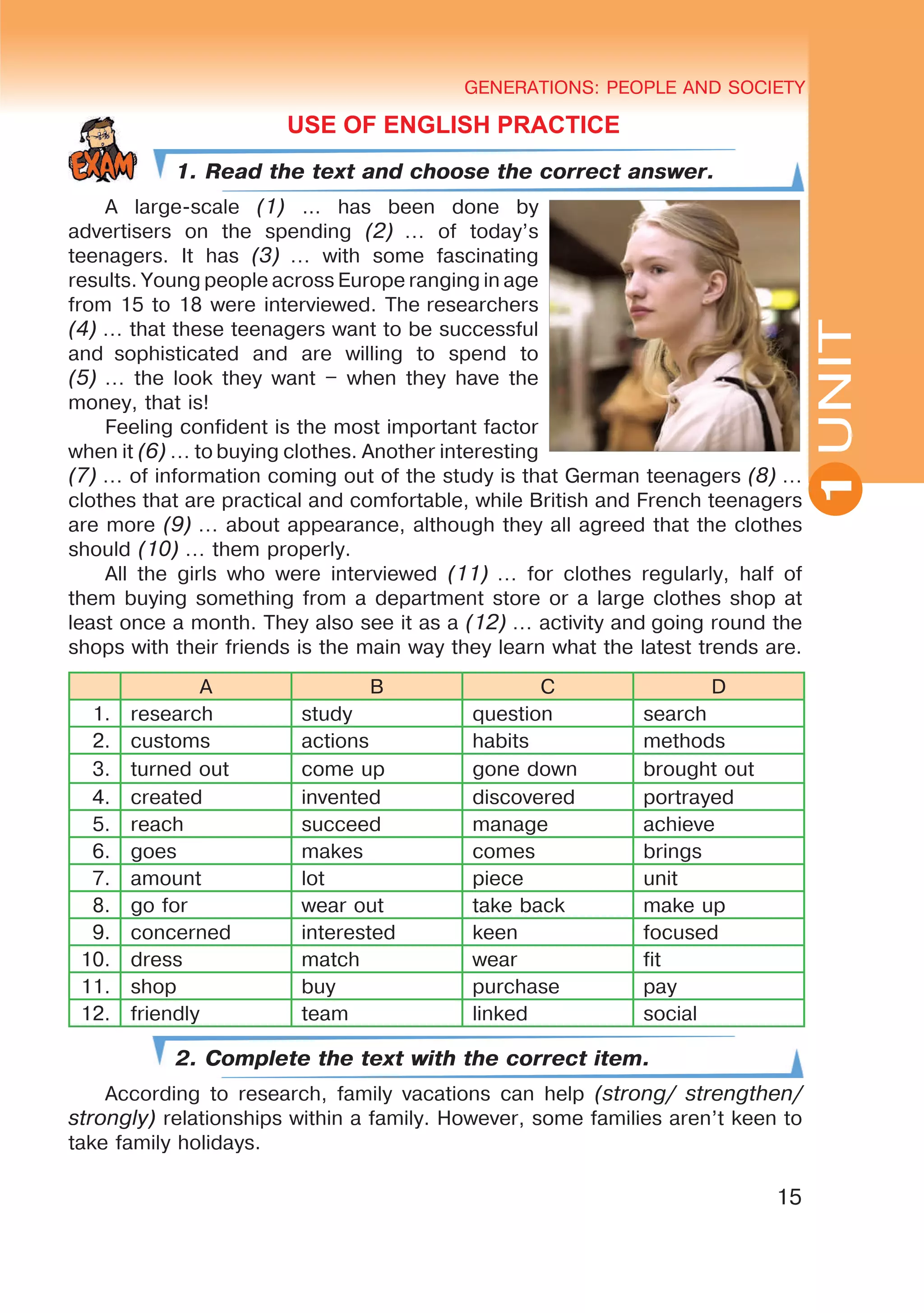
1. Read the text and choose the correct answer.
A large-scale (1) … has been done by
advertisers on the spending (2) … of today’s
teenagers. It has (3) … with some fascinating
results. Young people across Europe ranging in age
from 15 to 18 were interviewed. The researchers
(4) … that these teenagers want to be successful
and  sophisticated and are willing to spend to
(5) … the look they want – when they have the
money, that is!
Feeling confident is the most important factor
when it (6) … to buying clothes. Another interesting
(7) … of information coming out of the study is that German teenagers (8) …
clothes that are practical and comfortable, while British and French teenagers
are more (9) … about appearance, although they all agreed that the clothes
should (10) … them properly.
All the girls who were interviewed (11) … for clothes regularly, half of
them buying something from a department store or a large clothes shop at
least once a month. They also see it as a (12) … activity and going round the
shops with their friends is the main way they learn what the latest trends are.
A B C D
1. research study question search
2. customs actions habits methods
3. turned out come up gone down brought out
4. created invented discovered portrayed
5. reach succeed manage achieve
6. goes makes comes brings
7. amount lot piece unit
8. go for wear out take back make up
9. concerned interested keen focused
10. dress match wear fit
11. shop buy purchase pay
12. friendly team linked social
2. Complete the text with the correct item.
According to research, family vacations can help (strong/ strengthen/
strongly) relationships within a family. However, some families aren’t keen to
take family holidays.
GENERATIONS: PEOPLE AND SOCIETY
16
UNITUNIT GENERATIONS: PEOPLE AND SOCIETY
1
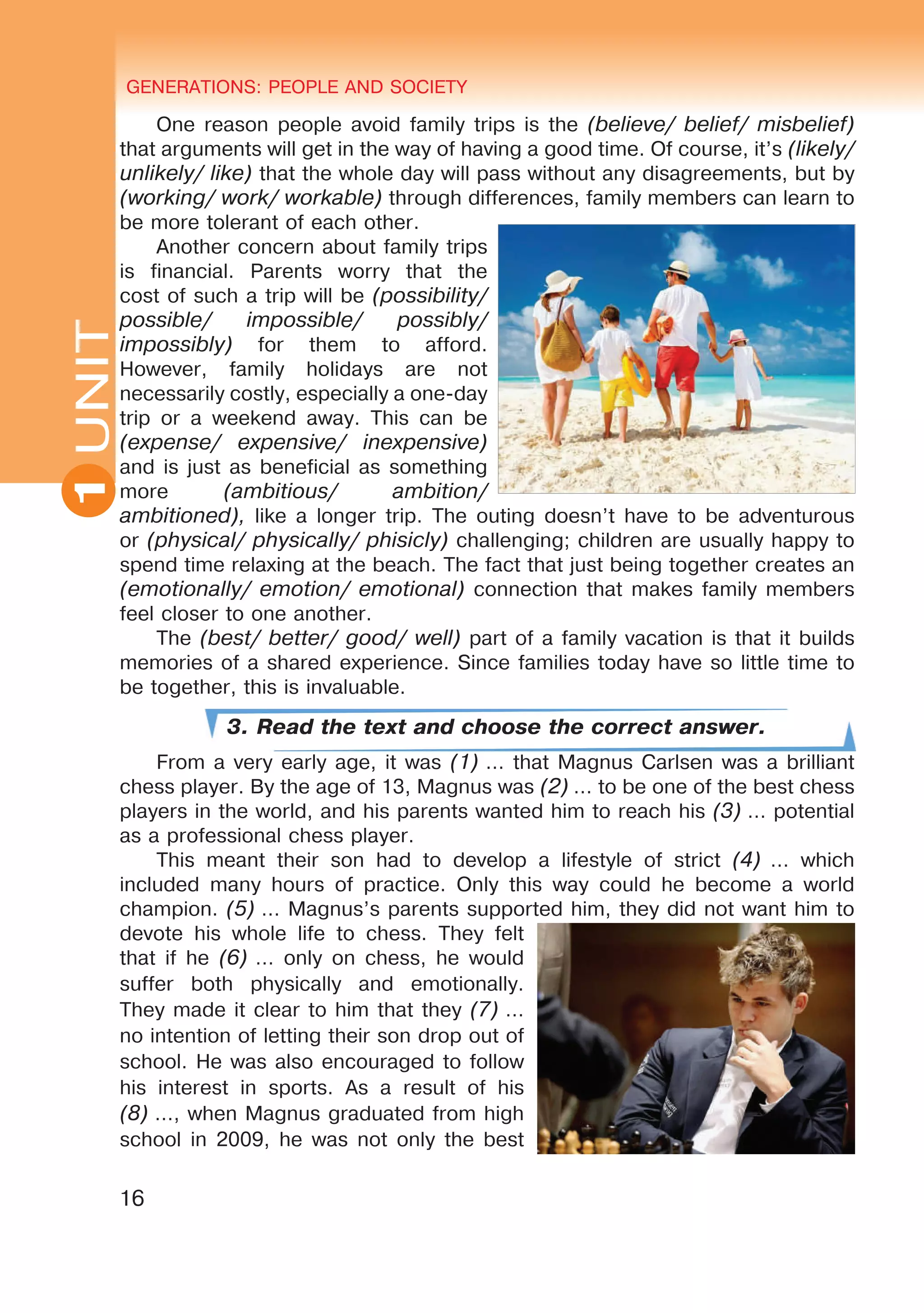
One reason people avoid family trips is the (believe/ belief/ misbelief)
that arguments will get in the way of having a good time. Of course, it’s (likely/
unlikely/ like) that the whole day will pass without any disagreements, but by
(working/ work/ workable) through differences, family members can learn to
be more tolerant of each other.
Another concern about family trips
is financial. Parents worry that the
cost of such a trip will be (possibility/
possible/ impossible/ possibly/
impossibly) for them to afford.
However, family holidays are not
necessarily costly, especially a one-day
trip or a weekend away. This can be
(expense/ expensive/ inexpensive)
and is just as beneficial as something
more (ambitious/ ambition/
ambitioned), like a longer trip. The outing doesn’t have to be adventurous
or (physical/ physically/ phisicly) challenging; children are usually happy to
spend time relaxing at the beach. The fact that just being together creates an
(emotionally/ emotion/ emotional) connection that makes family members
feel closer to one another.
The (best/ better/ good/ well) part of a family vacation is that it builds
memories of a shared experience. Since families today have so little time to
be together, this is invaluable.
3. Read the text and choose the correct answer.
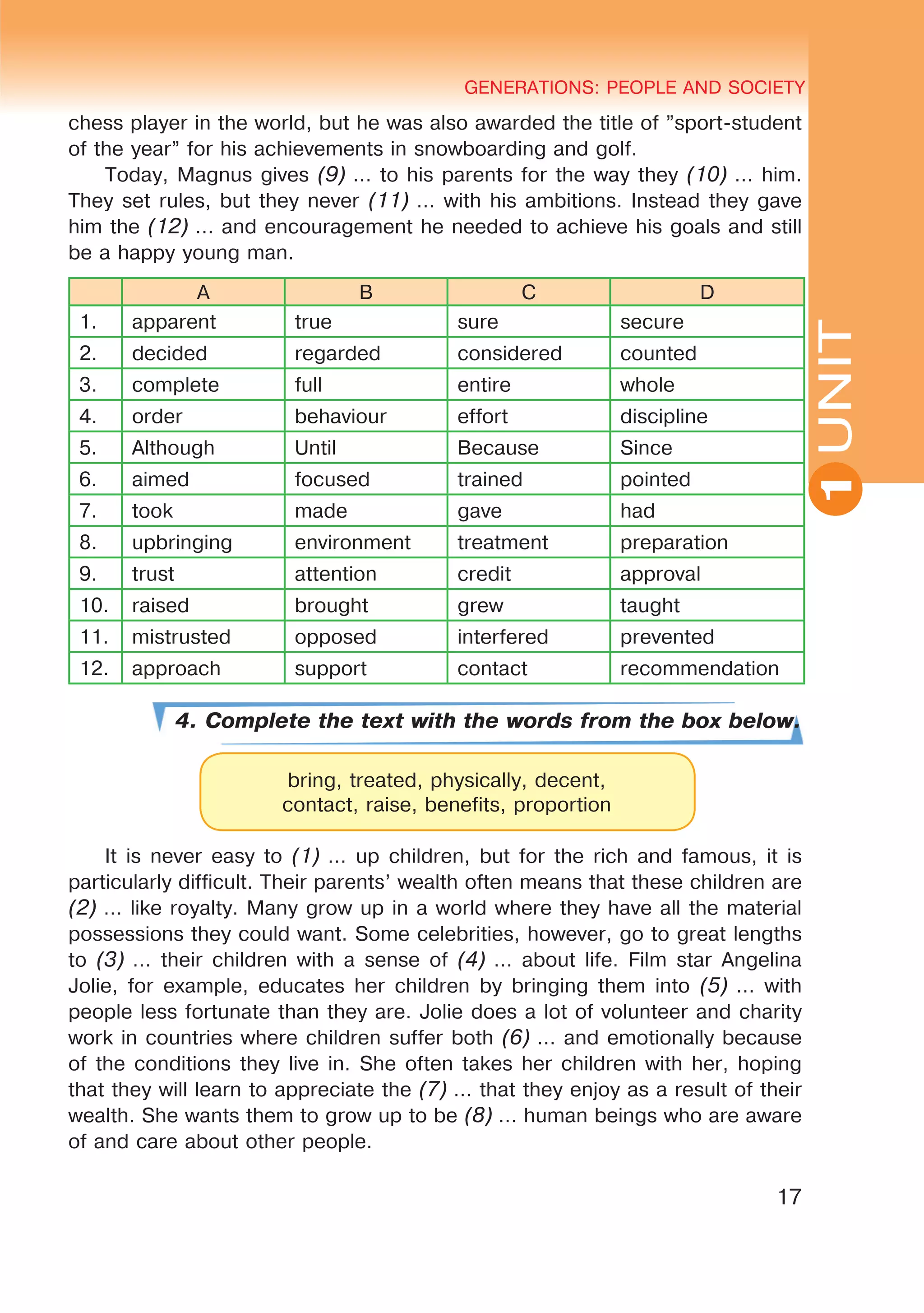
From a very early age, it was (1) … that Magnus Carlsen was a brilliant
chess player. By the age of 13, Magnus was (2) … to be one of the best chess
players in the world, and his parents wanted him to reach his (3) … potential
as a professional chess player.
This meant their son had to develop a lifestyle of strict (4)  … which
included many hours of practice. Only this way could he become a world
champion. (5) … Magnus’s parents supported him, they did not want him to
devote his whole life to chess. They felt
that if he (6) … only on chess, he would
suffer both physically and emotionally.
They made it clear to him that they (7) …
no intention of letting their son drop out of
school. He was also encouraged to follow
his interest in sports. As a result of his
(8) …, when Magnus graduated from high
school in 2009, he was not only the best
YOUTH LIFESTYLE. MODERN YOUTH CLUBSGENERATIONS: PEOPLE AND SOCIETY
17
UNIT
GENERATIONS: PEOPLE AND SOCIETY
1
chess player in the world, but he was also awarded the title of ”sport-student
of the year” for his achievements in snowboarding and golf.
Today, Magnus gives (9) … to his parents for the way they (10) … him.
They set rules, but they never (11) … with his ambitions. Instead they gave
him the (12) … and encouragement he needed to achieve his goals and still
be a happy young man.
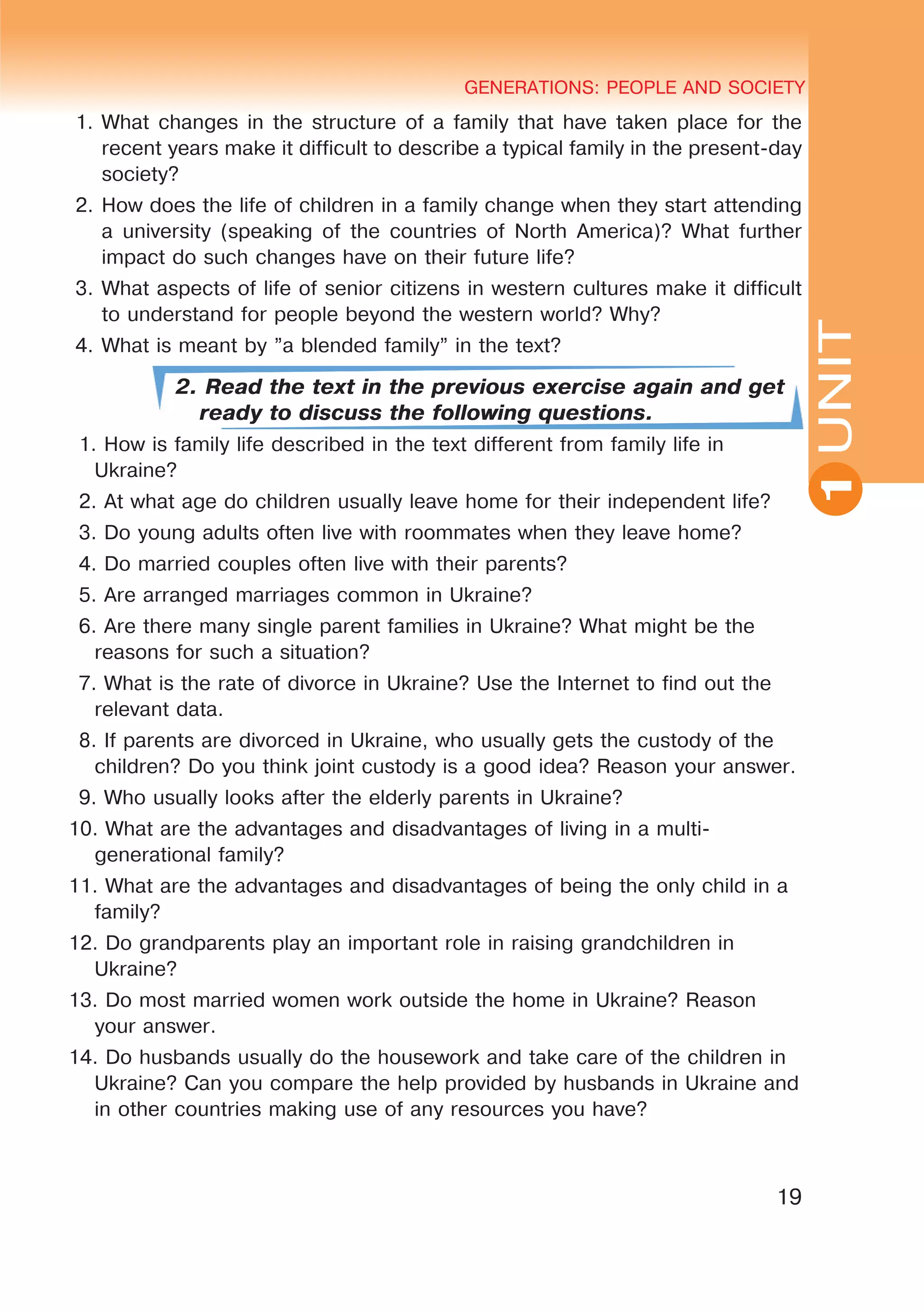
A B C D
1. apparent true sure secure
2. decided regarded considered counted
3. complete full entire whole
4. order behaviour effort discipline
5. Although Until Because Since
6. aimed focused trained pointed
7. took made gave had
8. upbringing environment treatment preparation
9. trust attention credit approval
10. raised brought grew taught
11. mistrusted opposed interfered prevented
12. approach support contact recommendation
4. Complete the text with the words from the box below.
It is never easy to (1) … up children, but for the rich and famous, it is
particularly difficult. Their parents’ wealth often means that these children are
(2) … like royalty. Many grow up in a world where they have all the material
possessions they could want. Some celebrities, however, go to great lengths
to (3) … their children with a sense of (4) … about life. Film star Angelina
Jolie, for example, educates her children by bringing them into (5) … with
people less fortunate than they are. Jolie does a lot of volunteer and charity
work in countries where children suffer both (6) … and emotionally because
of the conditions they live in. She often takes her children with her, hoping
that they will learn to appreciate the (7) … that they enjoy as a result of their
wealth. She wants them to grow up to be (8) … human beings who are aware
of and care about other people.
bring, treated, physically, decent,
contact, raise, benefits, proportion
GENERATIONS: PEOPLE AND SOCIETY
18
UNITUNIT GENERATIONS: PEOPLE AND SOCIETY
1
READING SKILL BUILDER
1. Read the text and answer the questions below.
It is difficult to describe a typical family nowadays. Depending on the
country and the culture, families can range from a large extended group of
relatives living together in one home to a single parent family with only one
child. While the former families were once common in North America and
many western countries, nowadays, it is unusual for grandparents, uncles,
aunts, and cousins to all live together in one home.
In Canada and the United States,
children are encouraged to be independent.
Many young adults live by themselves or
with roommates while going to university
and most move out of the family home
permanently when they have completed their
education. They choose their own careers
and their own spouses. Arranged marriages
are not part of the western culture. Most
young married couples choose to live apart
from their parents and many even end up
living in different cities.
The independence of the elderly is
also emphasized by western society. When
senior citizens become too old to live independently, they often move into
special care facilities or nursing homes. People from other cultures may find
this aspect of western society very strange because in their cultures they are
used to caring for their elderly parents in their own homes.
Another major change in the structure of the family results from the
increase in divorce and remarriage in our modern society. Nowadays, blended
families are becoming more and more common. Many households now
include stepparents, stepbrothers and sisters, and half-brothers and sisters.
The number of single parent homes is also increasing rapidly.
YOUTH LIFESTYLE. MODERN YOUTH CLUBSGENERATIONS: PEOPLE AND SOCIETY
19
UNIT
GENERATIONS: PEOPLE AND SOCIETY
1
1.	What changes in the structure of a family that have taken place for the
recent years make it difficult to describe a typical family in the present-day
society?
2.	How does the life of children in a family change when they start attending
a university (speaking of the countries of North America)? What further
impact do such changes have on their future life?
3.	What aspects of life of senior citizens in western cultures make it difficult
to understand for people beyond the western world? Why?
4.	What is meant by ”a blended family” in the text?
2. Read the text in the previous exercise again and get
ready to discuss the following questions.
1. How is family life described in the text different from family life in
Ukraine?
2. At what age do children usually leave home for their independent life?
3. Do young adults often live with roommates when they leave home?
4. Do married couples often live with their parents?
5. Are arranged marriages common in Ukraine?
6. Are there many single parent families in Ukraine? What might be the
reasons for such a situation?
7. What is the rate of divorce in Ukraine? Use the Internet to find out the
relevant data.
8. If parents are divorced in Ukraine, who usually gets the custody of the
children? Do you think joint custody is a good idea? Reason your answer.
9. Who usually looks after the elderly parents in Ukraine?
10. What are the advantages and disadvantages of living in a multi-
generational family?
11. What are the advantages and disadvantages of being the only child in a
family?
12. Do grandparents play an important role in raising grandchildren in
Ukraine?
13. Do most married women work outside the home in Ukraine? Reason
your answer.
14. Do husbands usually do the housework and take care of the children in
Ukraine? Can you compare the help provided by husbands in Ukraine and
in other countries making use of any resources you have?
GENERATIONS: PEOPLE AND SOCIETY
20
UNITUNIT GENERATIONS: PEOPLE AND SOCIETY
1
3. Read the text and do the tasks below.
When Adult Children Come
Home
Q: My wife and I recently sent our
last child off to college. We are ready to
sell the house and travel, but our oldest
daughter doesn’t have a job and plans to
move back home. What should we do?
A: Most North Americans expect
their children to move out of the house
at eighteen. But that’s changing. Today,
more adult children are returning home to
live. Some don’t have jobs or can’t pay
for the high costs of housing. Some are
recently separated or divorced. Most are
single, but some come home with a wife,
husband, or child, too. Most parents are
happy when their kids come back home
to live. However, when a son or daughter
can’t find a job – or is recently divorced
– there can be problems. And if their son
or daughter is still at home at the age of
thirty-five, many parents are no longer
happy.
In your case, what if your
daughter moves back home?
● Don’t worry. If you and your
daughter had a good relationship
when she was younger, she’ll be
fine. Help her in any way you can.
And it’s OK to ask, ”How long do
you plan on staying?”
● Don’t treat your daughter
like a child. In our culture, adult
children don’t feel good about
living at home, and they don’t want
to depend on their parents’ help.
Tell her you understand.
● Talk to your daughter as an
adult. Have a discussion about
paying for expenses and helping
with household responsibilities and
chores, such as kitchen cleanup
and doing laundry. If you and your
daughter talk and try to understand
each other, everyone will be happier.
YOUTH LIFESTYLE. MODERN YOUTH CLUBSGENERATIONS: PEOPLE AND SOCIETY
21
UNIT
GENERATIONS: PEOPLE AND SOCIETY
1
A) Complete each statement.
1. The parents are worried because their daughter _______.
a) wants to move into their home
b) doesn’t want to leave their home
c) wants to move away from their home
d) doesn’t want to come home
2. According to Admin, most North Americans expect children to move
out of their parents” home when they ________.
a) reach the age of eighteen b) find a job
c) finish college d) get married
B) Choose the correct answers (more than one).
1. What are the reasons adult children are moving back home?
a) They don’t have jobs.
b) They get divorced.
c) They can’t afford housing.
d) They feel good about living with their parents.
e) They want to depend on their parents.
2. What are Admin’s suggestions to the father?
a) to sell his house and go traveling
b) to discuss chores at home
c) to ask his daughter
d) to find a job
e) to try to understand his daughter
f) to not worry too much about his daughter
4. Read the text below and say in which country (or
countries) the following things take place at birthday
celebrations.
1.	 Money is traditionally given. – __________
2.	 Everyone celebrates their birthday on the same day. – _______
3.	 Birthdays are celebrated on a different day than the real one. – _______
4.	 Various tricks are played to the birthday child, sometimes they are quite
naughty. – _______
5.	 Sweets are involved. – _______
6.	 The birthday is made known to the outside world. – _________
7.	 There are some birthdays that are more significant than others. - ______
8.	 Dancing plays an important part. – _________
9.	 Special clothes are worn. – _________
10.	 A chair is involved. – _______
Birthday Traditions Around the Globe
Birthdays are celebrated all over the world. Some traditions are fairly similar
from country to country: candles, cakes and birthday wishes, birthday games
and pinches for good luck. Other customs are quite different. Here are a few.
GENERATIONS: PEOPLE AND SOCIETY
22
UNITUNIT GENERATIONS: PEOPLE AND SOCIETY
1
In Argentina, one of the most important birthday parties
is a girl’s fifteenth. When girls turn 15, they have a huge party
and dance the waltz first with their father, and then the boys
at the party.
In China, first the birthday child pays respect to the
parents and receives a gift of money. Friends and relatives
are invited to lunch, and noodles are served to wish the
birthday child a long life.
In Denmark, a flag is flown outside a window to show that someone who
lives in that house is having a birthday.
In the Netherlands, special year birthdays such as 5, 10, 15, 20, 21 are
called ”crown” years and the birthday child receives an especially large gift. The
guests are treated with lemonade and hot chocolate. The family also decorates
the birthday child’s chair with flowers or paper streamers and balloons.
Usually Indian children wear white to school.
However, on their birthday children in India wear
coloured clothes to school and give out chocolates to
everyone in the class.
In Israel, a small child sits in a chair while adults
lift it up and down a number of times corresponding
to the child’s age, plus one for good luck.
A Japanese birthday child wears new clothes
to mark the occasion. Certain birthdays are more
important than others and these are celebrated with
a visit to the local shrine. These are the third and
seventh birthdays for girls and the fifth for boys.
Everyone celebrates their birthdays on New Year’s Day, or Tet as it is
known in Vietnam. The Vietnamese do not acknowledge the exact day they
were born. A baby is considered to be one year old on Tet no matter when
they were born that year.
Norwegians traditionally eat a chocolate cake on
their birthdays. They also pick a person in class to do a
little dance with them.
Children in Ecuador celebrate their birthdays on the
day that the Saint they were named after was born. On
their actual birthdays they just get a card.
People in Jamaica have wonderful senses of humor.
They have a tradition of throwing flour at the birthday
boy or girl.
In Mexico, the pinata, a big hollow animal toy usually
made of papier mache, is filled with goodies and hung
from the ceiling. The birthday child is blindfolded and hits
the pinata which breaks open and then all the guests share the sweets.
YOUTH LIFESTYLE. MODERN YOUTH CLUBSGENERATIONS: PEOPLE AND SOCIETY
23
UNIT
GENERATIONS: PEOPLE AND SOCIETY
1
5. Read the text and say whether the statements
below are true or false.
An Ipswich mother, who allowed her son to go on holiday during school
term, has been fined J400 after her son repeatedly refused to go to school.
The 36-year-old mother, who can not be named for legal reasons, appeared
before South East Suffolk Magistrates Court yesterday where magistrates
heard her 14-year-old son was currently on holiday in Spain. She told that
court: ”He just does not like going to school. Although he is getting better now
and seems to be enjoying it.” The boy has had 145 unauthorised absences
between October 15 last year and March 22 this year. His absences were
blamed on a late-night life style. The mother has been attending parenting
classes voluntarily and told the court that she thought they were helping her.
Out of the last eight school sessions — there are two a day — he has attended
five.
Chairman of the bench David Coe asked her if she thought she could get
her son to school in future. ”Yes I think I can with some help”, she said. She
told the court that he was on holiday during the time other pupils were doing
work experience because he had not been given a place. On sentencing Mr
Coe said: ”He is not in school and then he disappears on holiday. We would
expect the local authority to bring this back to court quickly if there are further
problems.” She was fined £400 and ordered to pay £50.
Yesterday’s case is the second to be dealt with by south east Suffolk
magistrates recently. Last month a 37-year-old was fined £50 after her son had
attended just 16 out of 182 sessions. And the cases follow national concern
after Oxfordshire mother Patricia Amos was jailed for allowing her children
to miss school. She was originally sentenced to 60 days in jail, but this was
reduced on appeal.
1. The boy returned to school after his mother had been to court.
2. The main reason for his absences was the fact that he went out late every
night.
3. The mother has to go to parenting classes.
4. The mother claims her son is not currently missing school lessons.
5. The mother may find herself in court again soon.
6. There have been other similar cases nationwide but this is the first in this area.
7. There was national support for the tough treatment of Patricia Amos.
6. Read the magazine article and complete the
sentences below with the correct items.
Being Seventeen: Advice from the Experienced
Imagine being able to go back in time and have a little chat with the
17-year-old you. We asked two 30-somethings what advice they would give
their younger selves.
GENERATIONS: PEOPLE AND SOCIETY
24
UNITUNIT GENERATIONS: PEOPLE AND SOCIETY
1
Martha
The problem with most 17-year-olds is not that
they are wild or cruel but that they’re just so sensitive,
and so self-obsessed that even an innocent comment
might cause them much emotional pain. So, what I’d
tell my younger self is to live a little, relax, and take
no notice of what anyone else says. At parties, when
I was 17, I’d sit in the corner trying to look grown up
and sophisticated instead of enjoying myself. I’d soon
put a stop to that if I could go back in time. I’d drag the
silly girl up and show her just how much fun dancing
in an embarrassing way can be! I might have a word
with her about how a little lipstick is more appealing
than layers and layers, and why that lovely flowery
dress didn’t suit those awful high-heeled white sandals.
When I was 17, I was constantly worrying about
boys. So, I’d tell her to lighten up, forget about them, and spend more time
with friends. I’d love her to know that not having a date on a Saturday night
was not the end of the world, and didn’t mean she was a loser. And I’d tell her
that if a boy she liked didn’t fancy her, he was allowed to have that opinion,
and that following him around, changing hairstyles, or ringing him up and
putting the phone down as soon as he answered wouldn’t change anything.
The other thing I’d tell her is that her mother was not an ignorant,
embarrassing but loveable creature, who didn’t know what she was talking
about, but rather a witty and forgiving woman who was intelligent enough to
be amused rather than annoyed at how arrogant and selfish teenagers can be.
Jim
To be honest with you, I don’t think there would be
much point in going back in time and talking to me as
a 17-year-old, and not because I wouldn’t listen. I was
always being given advice, but, at that age, however
hard I tried, I just couldn’t take it in. My world was
listening to rock music, cleaning my new motorbike and
watching football. Everything else seemed irrelevant. I
tried to have ambitions and be sensible, but I really
couldn’t see why.
But if I did have a chance to talk to tall, skinny, long-
haired me, what would I say? Get your hair cut? No, I
don’t think so, although I would tell the younger me to
try to eat more healthily. Not that I was overweight. On
the contrary, when I look at old photos, I always envy the fact that I managed
to wear such tight jeans. Actually, what I’d really want to tell myself is to think
bigger and to not limit my horizons. I don’t think I was encouraged to take risks
YOUTH LIFESTYLE. MODERN YOUTH CLUBSGENERATIONS: PEOPLE AND SOCIETY
25
UNIT
GENERATIONS: PEOPLE AND SOCIETY
1
and to try to find out what I really wanted to do. Perhaps there was pressure
on me to conform, to go to college, to get a good job, that sort of thing.
Oh, and the other thing I’d tell the 17-year-old me is to cut up all my credit
cards. I wasn’t very good with money and I just didn’t realise how quickly you
can get into debt. If it hadn’t been for my dad, it would have taken years to
pay off all the bills I ran up.
1. Martha thinks 17-year-olds are … .
a. adventurous b. impulsive c. easily hurt
2. Martha advises her younger self to … .
a. be more mature
b. be more sensitive to
others
c. not worry about
what others think
3. Martha thinks that her younger self … .
a. wore too much
lipstick
b. should have worn trousers
rather than dresses
c. shouldn’t have worn
high heels
4. Martha thinks her younger self … .
a. took dating too
seriously
b. went out with too
many boys
c. was a bit of a loser
5. If she liked a boy who wouldn’t like her, young Martha would … .
a. take dating too
seriously
b. call her parents
c. refuse to speak to him
when he phoned her
6. Martha’s mother … .
a. was annoyed with young
Martha’s selfishness
b. laughed at
young Martha
c. tolerated young
Martha’s selfishness
7. Jim thinks that his younger self … .
a. refused to
listen to anyone
b. was too interested in
rock music to listen to
advice
c. didn’t know what to
do with the advice he
received
8. These days, Jim … .
a. is not as slim as he was
b. doesn’t wear
jeans very often
c. has shorter hair
9. Jim would advise his younger self to … .
a. be more
adventurous when
deciding what to do
b. go to college and
finish his studies
c. make sure he
worked hard and got a
good job
10. Jim criticizes his younger self for … .
a. buying expensive
things
b. being in debt for so
long
c. not knowing that it
is easy to get into debt
GENERATIONS: PEOPLE AND SOCIETY
26
UNITUNIT GENERATIONS: PEOPLE AND SOCIETY
1
Skimming reading strategies
Skimming is reading a text quickly to get the general idea of what it is
about. The following tips might be useful:
● Read the title.
● Quickly read the first sentence of each paragraph.
● Move your eyes quickly through the text.
● Do not read every sentence or every word.
● If the text is short, read the first and the last sentence of each paragraph.
7. Skim the text and provide the number of the
paragraph that contains the details below.
… a. After college, the daughters returned to work in the family business.
… b. The Ans’ company makes more than $20 million annually.
… c. Helene and Danny An left Vietnam in 1975 with no money.
… d. The business became a corporation in 1996.
… e. The An daughters worked in the restaurant when they were young.
Family Unity Builds Success
When her five daughters were young, Helene An always told them
that there was strength in unity. To show this, she held up one chopstick,
representing one person. Then she easily broke it into pieces. Next, she tied
several chopsticks together, representing a family. She showed the girls it was
hard to break the tied chopsticks. This lesson about family unity stayed with
the daughters as they grew up.
Helene An and her family own a multi-million-dollar restaurant business
in California. However, when Helene and her husband Danny left their home
in Vietnam in 1975, they didn’t have much money. They moved their family to
San Francisco. There they joined Danny’s mother, who owned a small Italian
sandwich shop. The Ans began with only a small idea and never dreamt of the
success they have today.
Soon after the Ans” arrival in the United States, Helene and her mother-
in-law, Diana, changed the sandwich shop into a small Vietnamese restaurant.
They named it Green Dragon, which symbolizes good luck in Vietnam. The
restaurant was very popular, and they expanded from 20 seats to 70. The
five daughters helped in the restaurant when they were young. Their mother
told them that they all had to work hard to reach their goals and make their
family stronger. Though Helene didn’t want her daughters to always work in
the family business because she thought it was too hard.
Eventually, the girls all graduated from college and went away to work
for themselves, but one by one, the daughters returned to work in the family
business. They opened new restaurants in San Francisco and in Beverly Hills,
a wealthy area in Los Angeles. The daughters chose new names and styles for
YOUTH LIFESTYLE. MODERN YOUTH CLUBSGENERATIONS: PEOPLE AND SOCIETY
27
UNIT
GENERATIONS: PEOPLE AND SOCIETY
1
their restaurants. Over the years, some ideas were successful, but other were
not. Even though family members sometimes disagreed with each other, they
worked together to make the business prospering.
Their expanding business became a large corporation in 1996, with three
generations of Ans working together. Helene is the expert on cooking. Danny,
her husband, is good at making decisions. Their daughter Hanna is good
with computers, and her husband is keen on thinking of new ideas and doing
research. Hanna’s sister Elizabeth is the family artist. She designs the insides
of the restaurants. Their sister Monique is good at managing.
Elizabeth says, ”If you’re going to work as a family, you have to know what
you’re good at. We work well together because we have different strengths”.
Even the grandchildren help out.
Now the Ans’ corporation makes more than $20 million each year. Although
they began with a small restaurant, they had big dreams, and they worked
together. Helene says she was never unhappy. She had to work hard, but
she could see all the members of her family helping her, and that gave her
courage to do more. ”This has been our greatest fortune, to work together as
a family”, she says.
8. Read the text above and choose the correct answer
to the questions below.
1. What is the main idea of paragraph 1?
a. Family business can have problems.
b. There is strength in working together as a family.
c. Only family businesses are successful.
GENERATIONS: PEOPLE AND SOCIETY
28
UNITUNIT GENERATIONS: PEOPLE AND SOCIETY
1
2. What is the main idea of paragraph 5?
a. By 1996, their business was a large corporation.
b. Different family members have strengths that help the business.
c. The family members don’t know what they are good at.
3. What is the main idea of the entire article?
a. Any family can become a big success.
b. Family members have different strengths.
c. A family that has unity can be successful.
9. Read the text and choose the correct answer.
XXI century parents
The reason for writing this book was my dissatisfaction with parenting-
advice literature. I found it to be riddled with oversimplified messages, and
often unrelated to or at odds with current scientific knowledge. My persuasion,
therefore, was that parents needed a consistent way of thinking about their
role to facilitate children in making effective decisions.
It’s little wonder that parents are perplexed about what approach to
take to upbringing of their off-springs. Today’s world is the one that makes
parenting extremely difficult. In many highly developed countries, the majority
of mothers of preschool children are in the workforce. Not always this is their
choice to start working. Many parents simultaneously complain that they’re
busier than ever and that due to the growing demands of their jobs, they have
little time for their children.
In many countries there exists a phenomenon of ”youth alienation”
and parents’ fear for their own children’s futures is quite understandable.
But agreement on what parents can and should do to shield children from
underachievement and demoralisation eludes those who seek it on the
shelves of libraries or bookstores. Parenting advice has always been in a
state of continuous motion. While the fundamental goal of parenting – to instil
character and moral development – has stood firm among the various passing
fashions in child care over the years, the approach to accomplishing this has
varied considerably.
Some authors, convinced that parents are in control of what their children
become, advise a ”get tough” approach. The educational parallel to this
”parent-power” example is to train and start education as early as possible,
and this has been justified by claims of maximising brain growth or securing
high achievement by starting sooner. Other authors, however, attribute many of
today’s social problems to the excessive pressure put on children by parents.
According to these ”child-power” proponents, children have their own built-
YOUTH LIFESTYLE. MODERN YOUTH CLUBSGENERATIONS: PEOPLE AND SOCIETY
29
UNIT
GENERATIONS: PEOPLE AND SOCIETY
1
in timetables for maturing and learning. Waiting for cues that children are
ready, these experts say, will relieve the stress that fuels youth discontent and
rebellion. The reality, however, is that there are no hard-and-fast rules.
Current thinking on child upbringing advice mirrors historical shifts in
theories of development and education. The most disturbing trend in the
literature has been a move to deny that parents make any notable contribution
to their children’s development. This public declaration of parental weakness
comes at a time when many busy parents retreat from family obligations, and,
indeed, it grants them licence to do so.
1. The author says that one reason for writing the book was the fact that
a) research suggests the quality of parenting skills has deteriorated.
b) today’s scientific views of parenting seem to be flawed.
c) there is a lack of parenting literature written in a straightforward way.
d) the available advisory material does not reflect current academic
thinking.
2. What does the author say about the concerns parents have?
a) Some of the issues are contradictory in nature.
b) They are understandable given the challenges of modern life.
c) They cause a disproportionate amount of stress in family relationships.
d) The balance between work and family life is only a secondary problem.
GENERATIONS: PEOPLE AND SOCIETY
30
UNITUNIT GENERATIONS: PEOPLE AND SOCIETY
1
3. What does the author say in the third paragraph about parenting advice?
a) Its core objective has remained constant.
b) Its ideology stems from contemporary social issues.
c) It traditionally placed strong emphasis on the protection of the child.
d) It currently benefits from techniques tried and tested by previous
generations.
4. In the fourth paragraph, what point is the author making about bringing
up children?
a) There is an absence of consensus on child-rearing among the experts
themselves.
b) Educational policies should be revised in the light of recent findings.
c) Strict parents tend to have children who are academically unsuccessful.
d) One approach to child-rearing appears to be more effective than all
others.
5. What criticism of contemporary thinking on child-rearing does the author
make?
a) It repeats theories which have no
solid foundation.
b) It places too much importance
on formal education.
c) It encourages parents to neglect
their responsibilities.
d) It undermines the role of friends
in children’s development.
YOUTH LIFESTYLE. MODERN YOUTH CLUBSGENERATIONS: PEOPLE AND SOCIETY
31
UNIT
GENERATIONS: PEOPLE AND SOCIETY
1
LISTENING SKILL BUILDER
1. Listen to the people talking about their families.
Choose the correct item in the box for family size
for each speaker and write the number of children in
each person’s family.
A big family A small family Number of children
Brenda
Steven
Leslie
Jason
2. Listen to Lucille talking about herself and her sister,
Laura, about identifying similarities and differences.
Choose the correct statements.
Lucille Laura
1 look alike look different
2 like the same kind of food like different kinds of food
3 like the same kind of movies like different kinds of movies
4 like the same kind of music like different kinds of music
5 have the same number of kids have different numbers of kids
6
Lucille and Laura
are twins
Lucille and Laura are
stepsisters
Lucille and Laura are
half-sisters
3. Listen to the recording from exercise 2 again and
take notes.
Laura Lucille
Appearance glasses for reading
Sports
Families
Favorite colors
Musical tastes
Clothes same
GENERATIONS: PEOPLE AND SOCIETY
32
UNITUNIT GENERATIONS: PEOPLE AND SOCIETY
1
4. Look at the pictures and listen to four conversations,
then match them with the statements below.
CONVERSATION 1 ________
CONVERSATION 2 ________
CONVERSATION 3 ________
CONVERSATION 4 ________
My sister is engaged.
My aunt is divorced.
My sister’s marriage is going to be over.
My husband takes after his parents.
Use this QR code to access the audioscripts
of the exercises for listening.
YOUTH LIFESTYLE. MODERN YOUTH CLUBSGENERATIONS: PEOPLE AND SOCIETY
33
UNIT
GENERATIONS: PEOPLE AND SOCIETY
1
SPEAKING SKILL BUILDER
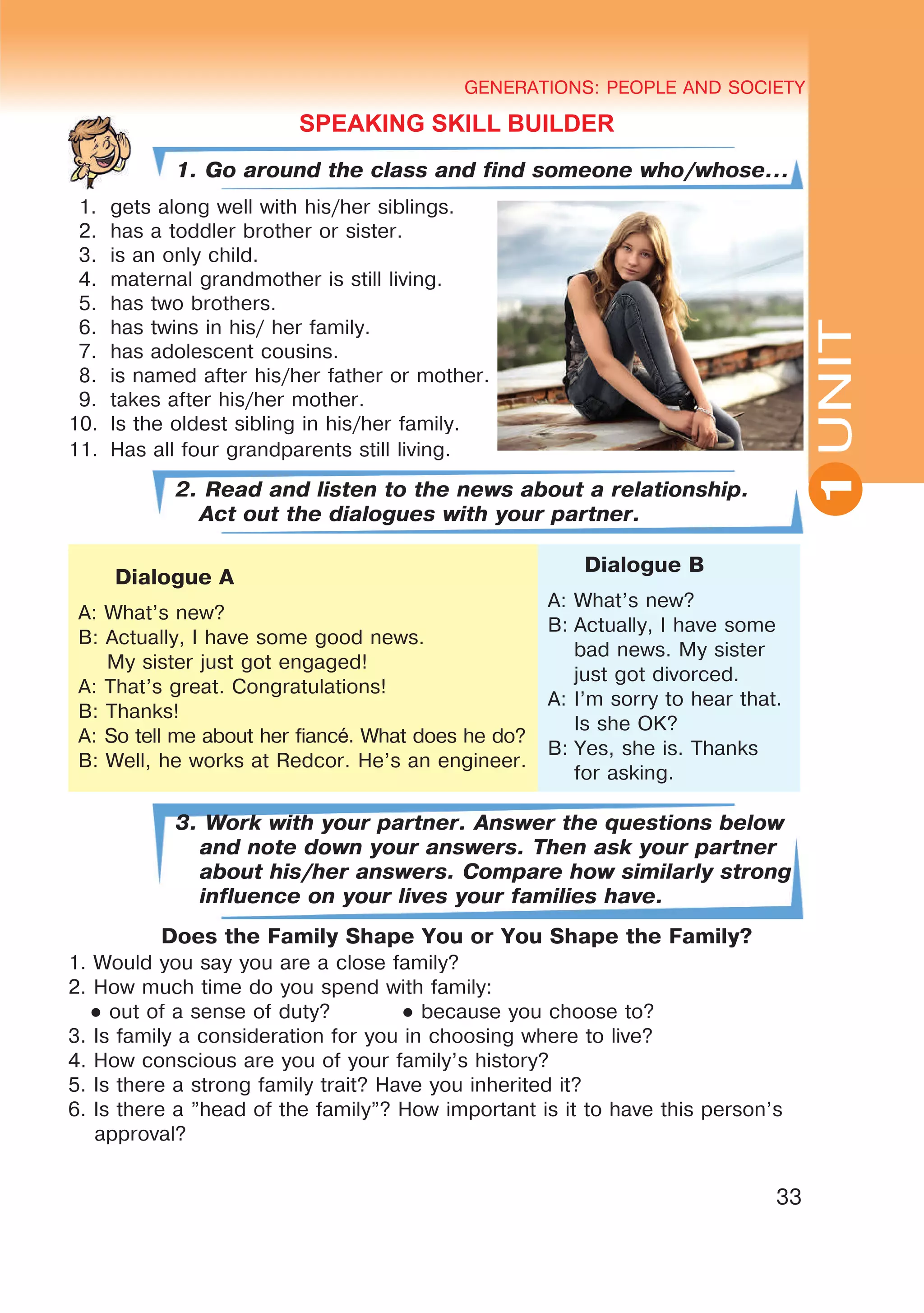
1. Go around the class and find someone who/whose…
1.	 gets along well with his/her siblings.
2.	 has a toddler brother or sister.
3.	 is an only child.
4.	 maternal grandmother is still living.
5.	 has two brothers.
6.	 has twins in his/ her family.
7.	 has adolescent cousins.
8.	 is named after his/her father or mother.
9.	 takes after his/her mother.
10.	 Is the oldest sibling in his/her family.
11.	 Has all four grandparents still living.
2. Read and listen to the news about a relationship.
Act out the dialogues with your partner.
Dialogue A
A: What’s new?
B: Actually, I have some good news.
My sister just got engaged!
A: That’s great. Congratulations!
B: Thanks!
A: So tell me about her fiancé. What does he do?
B: Well, he works at Redcor. He’s an engineer.
Dialogue B
A:	What’s new?
B:	Actually, I have some
bad news. My sister
just got divorced.
A:	I’m sorry to hear that.
Is she OK?
B:	Yes, she is. Thanks
for asking.
3. Work with your partner. Answer the questions below
and note down your answers. Then ask your partner
about his/her answers. Compare how similarly strong
influence on your lives your families have.
Does the Family Shape You or You Shape the Family?
1. Would you say you are a close family?
2. How much time do you spend with family:
● out of a sense of duty? 	 ● because you choose to?
3. Is family a consideration for you in choosing where to live?
4. How conscious are you of your family’s history?
5. Is there a strong family trait? Have you inherited it?
6. Is there a ”head of the family”? How important is it to have this person’s
approval?
GENERATIONS: PEOPLE AND SOCIETY
34
UNITUNIT GENERATIONS: PEOPLE AND SOCIETY
1
1. What’s your brother like?
2. Does he look like you?
3. What does he like doing at the
weekend?
4. Do you like him?
5. Do you think he would like to
come out with us sometime?
a. I like him a lot.
b. He’s quite serious and quiet when
you first meet him but he relaxes
when you get to know him.
c. Yes, I’m sure he would.
d. Yes, we’re both dark-haired with
blue eyes.
e. He likes going to the cinema or
sometimes eating out.
7. Is there someone in the family you particularly admire? Why?
8. Has your family influenced the career choice you are considering?
9. When seeking advice, are you more likely to turn to friends or family?
10. Would you say your family members have the same attitude to:
	● money? 		 ● bringing up children?
4. Match the answers (a–e) with the questions (1–5).
Pay attention to the meaning of the word like in each
case.
Useful Language box
5. Work in pairs. Discuss the questions.
1. When was the last time you bumped into someone you hadn’t seen for
ages?
2. What did you talk about?
3. Had he / she changed a lot?
MEETING PEOPLE YOU KNOW
Fancy meeting / bumping into / seeing you here!
What a (nice) surprise! How are things?
What have you been up to? / How’s it all going?
Busy as ever. I’ve been completely snowed under. / It has its ups and
downs.
You’re looking well. It obviously suits you.
Do you see much of Amanda? How’s Amanda getting on?
She was asking after you the other day. Do give her my regards. Say
hello to her from me.
Well, I should probably go and … Sorry, I’ve got to rush. / I’m in a bit of
a hurry. I don’t mean to be rude, but I need to …
It was really nice to see you. / Great to see you. Good luck with …
YOUTH LIFESTYLE. MODERN YOUTH CLUBSGENERATIONS: PEOPLE AND SOCIETY
35
UNIT
GENERATIONS: PEOPLE AND SOCIETY
1
6. Put the sentences below in the right order to complete
the conversation between Karen (K) and Jim (J).
J: Well, it was great to see you.
K: Hello Jim. Fancy bumping into you here.
J: I’ve been working in New York for the past month.
K: Great. Well, I should probably go. I’m in a bit of a hurry to get to the bank.
J: Well, do give him my regards.
K: Of course I will. We should get together some time.
J: Yes, that would be nice. I’ll get in touch when I’m back next month.
K: You know – busy as ever. He’s working for some IT company now in
London.
J: Oh hello, Karen. What a nice surprise! How are things?
K: You too. Good luck with the work in New York.
J: Thanks. You too. How’s David getting on these days?
K: Not bad, thanks. What have you been up to?
K: Have you? That sounds exciting. You’re looking well.
7. Imagine you are in a large shopping centre.
Walk around and ”bump into” other people that
you have met before. Find out what each person
has been doing and make a future arrangement.
Use the Useful Language box to help you.
8. Use the substitution table below and make up as
many sentences as you can.
It’s
It isn’t
difficult
embarrassing
easy
boring
irritating
amusing
for me
to look at photos of myself as a child.
to talk about relationships with my
parents.
to discuss politics with my parents.
to see my parents dancing.
to annoy my brothers and sisters.
to visit relatives.
I find it /
I don’t
find it
-------
GENERATIONS: PEOPLE AND SOCIETY
36
UNITUNIT GENERATIONS: PEOPLE AND SOCIETY
1
WRITING SKILL BUILDER
Pre-writing activities
1. How often do you send news to friends and family? Do you communicate
by letter, email, text message?
2. Which of these phrases for greeting and ending would be appropriate
in an informal email to a friend or relative?
All my love Best wishes Dear Mr Franks
Dear Sir or Madam Hello / Hi John Kind regards
Love Regards Warm regards
Yours Yours faithfully Yours sincerely
3. The verb get is used often in spoken or informal written English. Read
the sentences. Match the uses of get whith a word of a similar meaning in
the table.
be (in passive sentences) catch do / manage
persuade reach receive
a) Did you get my last letter?
b) How have you been getting on in your new job?
c) I got a virus which kept me in bed for two weeks.
d) We got delayed for four hours at the border.
e) I’m going to try to get him to come with me.
f) I’ll call you when I get to London.
4. Write three sentences of your own with get giving recent news about
yourself.
5. Read the email below from Kevin to his cousin, Ben. Where is Kevin
and what is he doing there? How would you summarise the contents of each
of the three paragraphs?
Dear Ben,
I hope all’s well with you. I’ve been meaning to write for ages,but
my study takes up a lot of my time,the language especially – you know
how bad my German was. Please don’t think it’s because I haven’t been
thinking about you all – I have and I’m getting quite homesick. But I have
to remind myself of why I am here,which is to try and get established as a
study abroad student and focus on what I would like to do in the future.
I’m now in Vienna visiting some seminar in IT genetics and
talking to professionals about how our lives have changed in the
YOUTH LIFESTYLE. MODERN YOUTH CLUBSGENERATIONS: PEOPLE AND SOCIETY
37
UNIT
GENERATIONS: PEOPLE AND SOCIETY
1
last 20 years or so. The facilities here, at the University of Vienna,
are amazing. I’m trying to get an interview with one of the plenary
speakers that I would like to collaborate with. Fingers crossed!
So, my plan is to stay here until the end of September and then
get a plane back to Berlin to start looking for a good accommodation
not far from my university there. It would be great to get together
with you some day. Is there a possibility for you to visit me in
Berlin? How is the family? Is Sarah still working for that horrible
estate agent? Do give them all my love. I’ll write again soon.
All the best,
Kevin
6. What features of the language in this letter tell you that it is an informal
style?
While-writing activities
1. Read the information about informal letter writing.
Informal letters are written to close acquaintances of the writer, their
friends, family, relatives etc., as a result, they have an informal and personal
tone with casual language used. Sometimes the letters may even have an
emotional undertone.
Such letters are mainly used for personal communication, so they do not
have to follow any specific pattern, format or conventions. Thus, informal
letters are usually written in a personal fashion in casual unassuming language.
Though there is no set format when writing an informal letter, there is a
general pattern, some conventions that people usually follow.
Address and Date. The first thing to write is your address, i.e. the address
of the writer, which is usually placed on the left-hand side of the page at the very
top. Next just below the address we write the date. This allows the reader to have
a reference as to when the letter was written.
Greeting. Since you know the person you are writing to, the greeting can
be informal as well. If it is a friend or someone close to your age you can greet
them by their first name, like ”Dear Alex”. If you are writing to your relative like
your mother/father/aunt/uncle etc., you may greet them as such, for example,
”Dear Mom”.
GENERATIONS: PEOPLE AND SOCIETY
38
UNITUNIT GENERATIONS: PEOPLE AND SOCIETY
1
Introduction Paragraph. The introductory paragraph sets the tone for
the whole letter. You might begin by asking the recipient about their well being.
Or you may say that you hope the letter finds them in good health and great
spirits. The opening of informal letters should be casual and comforting.
Body of the Letter. The letter overall should maintain a friendly tone. But
you have to adjust the language and the wordings according to who you are
writing to. One way to determine the tonality of your letter is to remember how
you talk to the person in a conversation and then apply the same syntax and
sentiments to the letter.
Conclusion. In the conclusive paragraph summarize the letter. Do not
forget to invite the reader to write back or reply to your letter, or inquire about
his/her well-being, life, job, education etc. It shows an intention to keep the
conversation going. Say a meaningful and affectionate goodbye to the reader.
Signature. There is no one way to sign off informal letters. Since they do
not follow a strict format, you may sign off as you please. Some commonly used
phrases are ”Lots of love”, ”Best”, ”Best wishes”, ”Kind regards”, ”Kindly”,
”Hugs” and others.
2. Read the email and choose the correct verb forms to
complete it.
Dear Mike,
Thanks for your email. It (1)’s been/’s being great to hear
from you again and interesting to hear that your family (2) moves/
is moving house. I (3) hope/’m hoping they’ll like their new
home. It’s also wonderful that you (4) start/’re starting University.
I (5) write/’m writing to ask you a favour. A friend of mine from Greece
is going to Britain in three weeks. It’ll be his first time and he (6) doesn’t
understand/isn’t understanding much English. Would it be possible for
you to meet him and let him stay at your flat for the night? He has a
great sense of humour and he (7) looks/is looking rather like Brad Pitt!
Anyway, let me know if you (8) don’t have/aren’t having time.
Love,
Brenda
3. Imagine you have been away from home for some
time. Write an email (200 words) to a friend or family
member to ask them for news from home and to give
them your news. Try to use the verb get at least twice.
YOUTH LIFESTYLE. MODERN YOUTH CLUBSGENERATIONS: PEOPLE AND SOCIETY
39
UNIT
GENERATIONS: PEOPLE AND SOCIETY
1
LET’S REVISE AND PRACTISE
1. Choose the correct item.
1. Mr and Mrs Smith live at home with their two children. They are a typical
example of a modern … family.
A. extended B. nuclear C. compact
2. Mr and Mrs Propper live at home with their aged parents, children and
grandchildren. They are a typical example of a traditional … family.
A. nuclear B. enlarged C. extended
3. Mrs Jones lives on her own and has to look after her two children.
There are a lot of … families like hers.
A. single-parent B. mother-only C. mono-parent
4. Some parents need to … their children more strictly.
A. bring down B. bring about C. bring up
5. When I was a child, I had a very turbulent … .
A. upbringing B. upraising C. uplifting
6. Mrs Kelly is … and finds it difficult to look after her children on her own.
A. divorced B. divided C. diverged
7. Many men believe that … is the responsibility of a woman.
A. childhelp B. childcare C. childaid
8. … is a particularly difficult time of life for a child.
A. Convalescence B. Adolescence C. Convergence
9. A person’s behaviour can sometimes be traced back to his/her … .
A. creative years B. formulating years 	 C. formative years
10. The country has seen a sharp drop in the … in the last few years.
A. birth rate B. baby rate C. born rate
11. She has five … who rely on her to look after them.
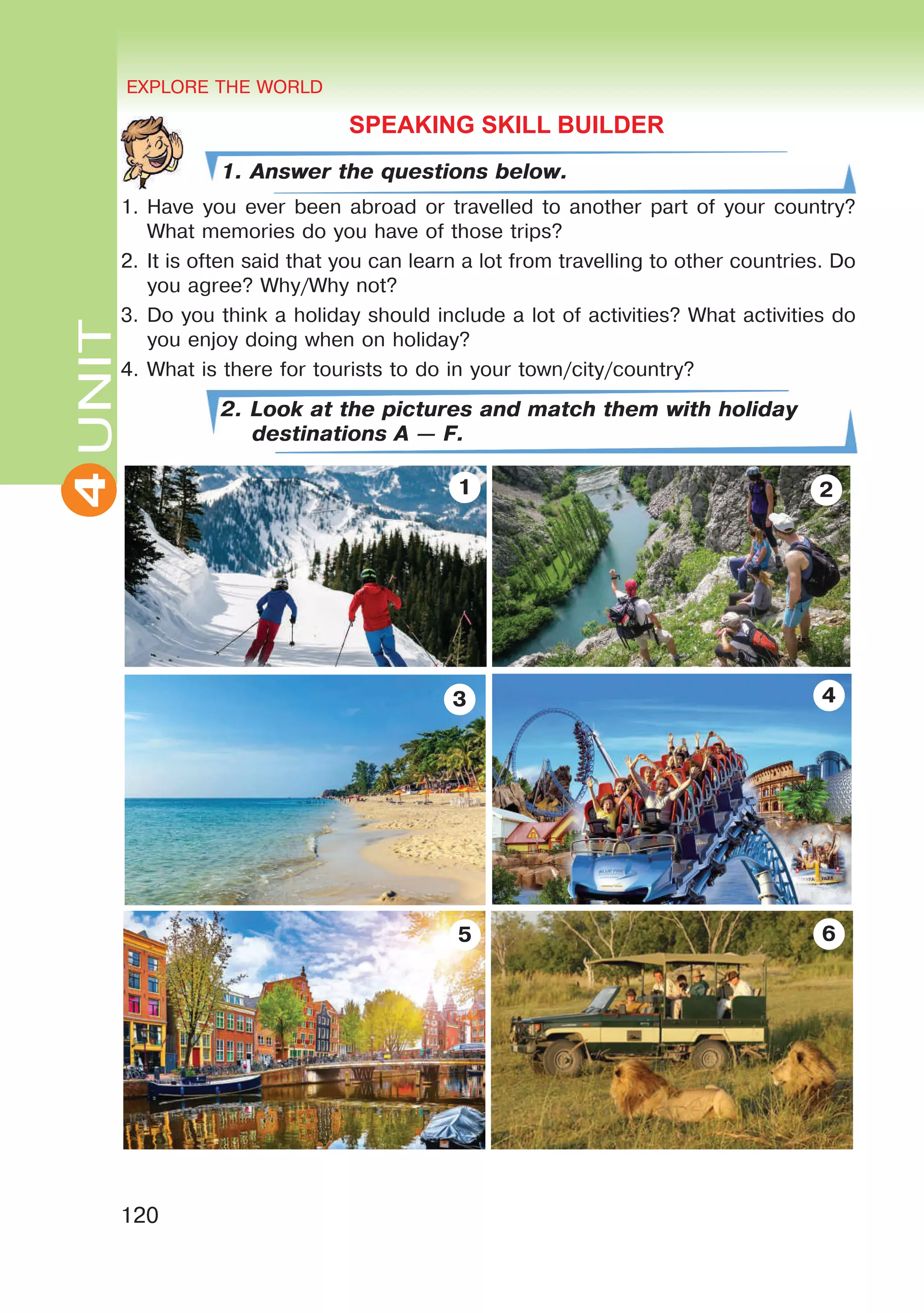
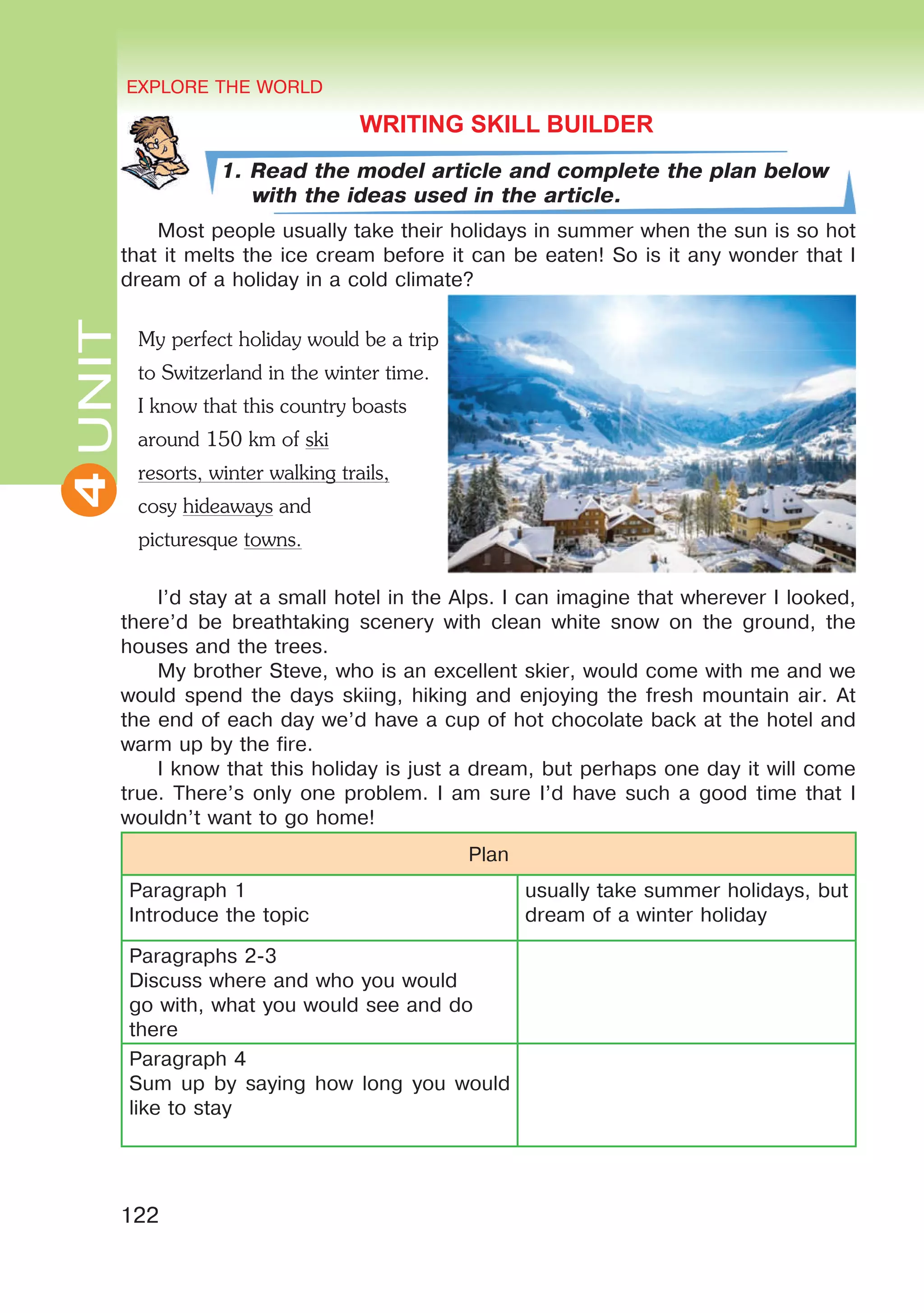
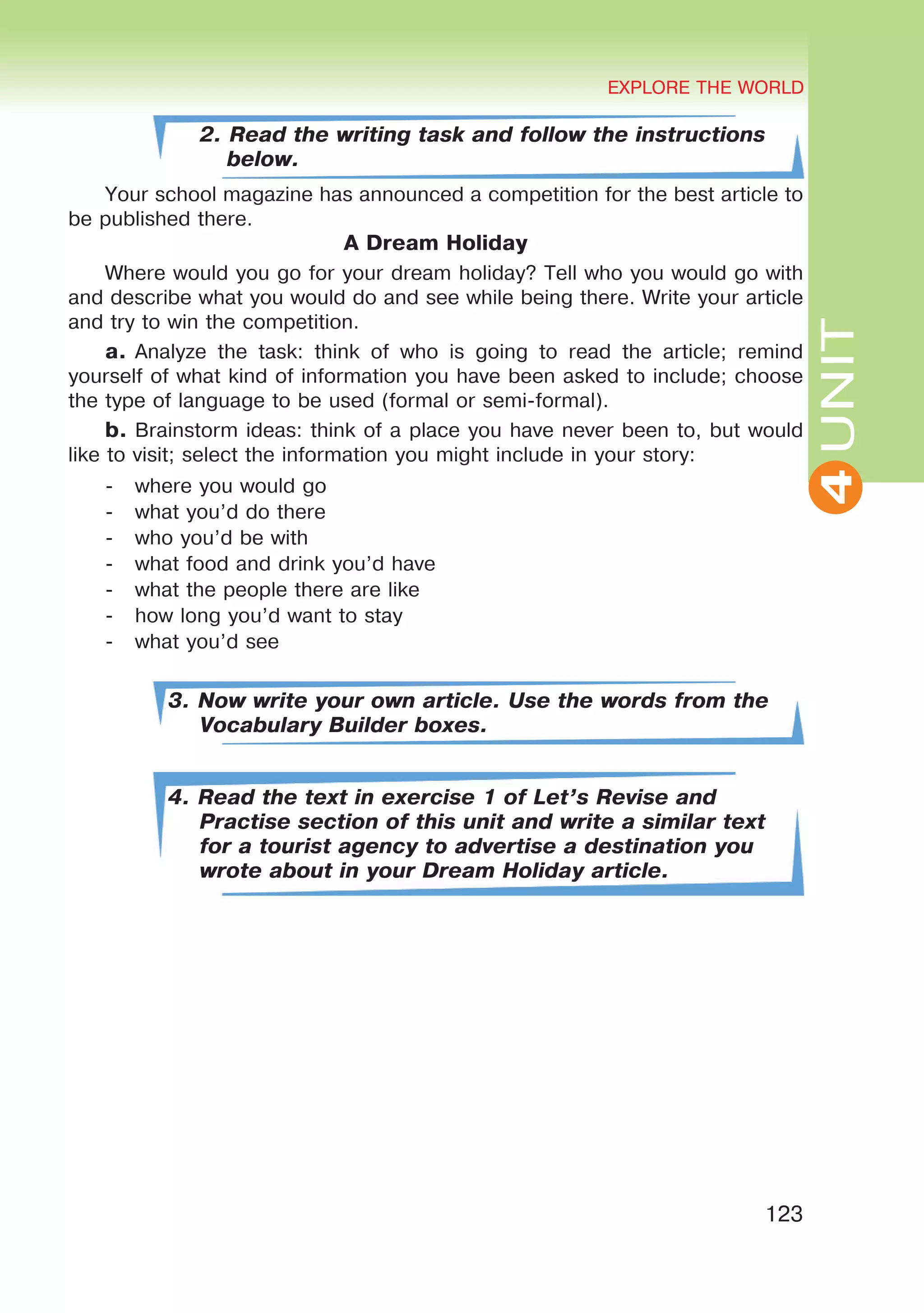
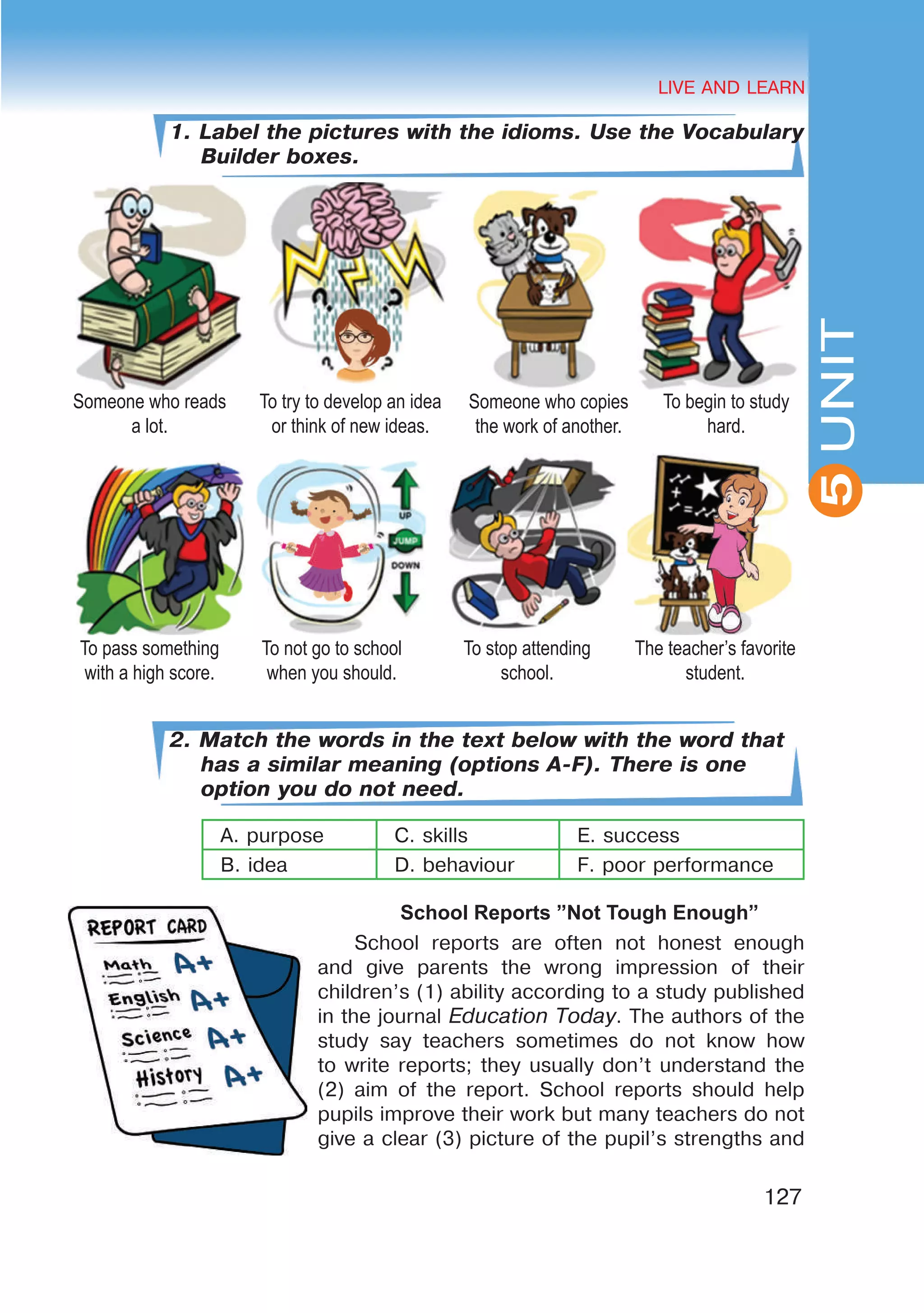
A. dependants B. dependers C. dependents
12. … crime is on the rise, with over 30 per cent of thefts being committed
by young people under the age of eighteen.
A. Junior B. Juvenile C. Children
GENERATIONS: PEOPLE AND SOCIETY
40
UNITUNIT GENERATIONS: PEOPLE AND SOCIETY
1
2. Match the sentences 1 – 12 with the sentences A – M.
1. Mr and Mrs White are very authoritarian parents.
2. Mr Bowles is considered to be too lenient.
3. Mr and Mrs Harris lead separate lives.
4. Billy is a well-adjusted kid.
5. The Mannings are not very responsible parents.
6. My parents are separated.
7. Parents must look after their children, but they shouldn’t be over-
protective.
8. Professor Maynard has made a study of the cognitive processes of
young children.
9. I’m afraid my youngest child is running wild.
10. She looks quite different from all her siblings.
11. There are several different and distinct stages of development
in a child’s life.
12. Tony was raised by a foster family when his own parents died.
A. They don’t look after their children very well.
B. He is fascinated by the way they learn new things.
C. He very rarely punishes his children.
D. I live with my mother and visit my father at weekends.
E. He never listens to a word I say, and is always playing truant
from school.
F. Brothers and sisters usually bear some resemblance to one another.
G. Although they are married and live together, they rarely speak
to each other.
H. They are very strict with their children.
I. Of all of these, the teenage years are the most difficult.
J. Children need the freedom to get out and experience the world
around them.
K. He’s happy at home and is doing well at school.
L. Many families take in children who are not their own.
YOUTH LIFESTYLE. MODERN YOUTH CLUBSGENERATIONS: PEOPLE AND SOCIETY
41
UNIT
GENERATIONS: PEOPLE AND SOCIETY
1
3. Complete this case study with one of the words
or phrases from exercises 1 and 2 of this section.
Change one of the word forms.
Bob’s problems began during his (1) … years. His parents got (2) … when
he was young, and neither of them wanted to raise him or his brother and sister,
so he was (3) … by a (4) … chosen by his parents’ social worker. Unfortunately,
his foster father was a strict (5) … and often beat him. Bob rebelled against
this strict (6) …, and by the time he was eight, he was already (7) …, stealing
from shops and playing truant. By the time he reached (8) …, sometime around
his 13th
birthday, he had already appeared in court several times, charged with
(9) … crime. The judge blamed his foster parents, explaining that children needed
(10) … parents and guardians who would look after them properly. The foster
father objected to this, pointing out that Bob’s (11) …— his two brothers and sister
— were (12) … children who behaved well at home and worked well at school.
This has raised some interesting questions about the modern family system.
While it is true that parents should not be too (13) … with children by letting
them do what they want when they want, or be too (14) … by sheltering them
from the realities of life, it is also true that they should not be too strict. It has
also highlighted the disadvantages of the modern (15) … family where the child
has only his/her mother and father to rely on (or the (16) … family, in which
the mother or father has to struggle particularly hard to support their (17) …).
In fact, many believe that we should return to traditional family values and the
(18) … family: extensive research has shown that children from these families
are generally better behaved and have a better chance of success in later life.
42
UNITHEALTHY LIFESTYLE: EATING HABITS
2
UNIT 2
HEALTHY LIFESTYLE: EATING HABITS
VOCABULARY BUILDER
1. Use the Vocabulary Builder box A to label the
pictures.
B.
greasy, sickly, juicy,
stodgy, tough, bland,
plain, overcooked, tender,
tasty/delicious/yummy,
light, overripe, rich, raw,
fresh, sour, sweet, spicy,
savoury, fizzy, tart, stale,
mouldy, mouthwatering,
lip-smacking, finger-licking
A.
stir, grate,
steam,
slice, bake,
pour, beat,
peel, grill,
cut, fry,
chop, mix,
poach,
blanche
C.
skip lunch, eat out, fast/
junk food, condiment, pig
out, craving, obesity, feel
puckish, processed food,
pile on the pounds, shed
a few pounds, quench
thirst, omega-3 fatty acids,
flaxceed oil, consume/
take in, play havoc, run the
risk, resist the urge
D.
sip, nibble,
munch,
chew,
gobble,
swallow,
drink, eat
E. ”Review” vocabulary: family style restaurant,
informally decorated, lively/casual/informal/formal
atmosphere, modest/outstanding/tasty/varied
menu; wide/limited selection, offer fast/home-
cooked/organic food; generous/small portions,
friendly/helpful/rude waiters; efficient/poor service,
reasonably priced/ overpriced; fresh ingredients,
starters/main course/dessert
A. ____________ B. ____________ C. ____________
D. ____________ E. ____________ F. ___________
43
UNIT
HEALTHY LIFESTYLE: EATING HABITS
2
2. Use the Vocabulary Builder box B and decide
which adjectives have a negative meaning. Use the
dictionary if necessary.
3. Use the Vocabulary Builder box B and say which
adjectives mean the following.
	 a. heavy and fattening
	 b. lacking in flavor
	 c. difficult to chew
	 d. too sweet
	 e. containing a lot of butter, cream, eggs, etc.
	 f. not cooked at all
	 g. cooked in too much fat or oil
	 h. prepared in a simple way/not rich
4. Choose the correct item for the definitions below.
1. a framework of metal bars used as a partition or a grate
a. grill b. barbecue c. coconut
					
2. an edible emulsion of fat globules made by churning milk or cream; for
cooking and table use
a. cocoa b. corn c. butter
3. fine powdery foodstuff obtained by grinding and sifting the meal of a cereal
grain
a. duck b. grill c. flour
4. the first meal of the day (usually in the morning)
a. cauliflour b. breakfast c. cook
5. a beverage consisting of an infusion of ground coffee beans
a. apple b. grape c. coffee
G. ____________ H. ____________ I. ____________
44
UNITHEALTHY LIFESTYLE: EATING HABITS
2
6. the property of having a harsh unpleasant taste
a. bitter b. carrot c. cabbage
7. a dish served as the last course of a meal
a. cake b. dessert c. fresh
8. any of various small flat sweet cakes (”biscuit” is the British term)
a. cookie b. pea c. cocoa
9. a breakfast food prepared from grain
a. cake b. cereal c. cookie
10. elongated crescent-shaped yellow fruit with soft sweet flesh
a. banana b. pear c. plum
5. Fill in the gaps with the verbs from the Vocabulary
Builder box C.
1. I’ve started to ……… on the pounds so I’m cutting down on savoury
snacks. 2. Yo-yo dieting can ……… havoc with your metabolism. 3. There’s
nothing better than water to ………… your thirst. 4. If you don’t stop eating
junk food, you ………… the risk of developing diabetes. 5. Kyle is seeing a
dietician as he needs to ……… a few pounds. 6. Some people can’t ……… the
urge to pig out on sweets.
6. Read the text and fill in the gaps with the correct
item (A-F). There is one option you do not need.
Good news for chocoholics
The treat loved by millions
not only (1)_______ delicious
but, according to the latest
research findings, it also (2)______ you good. The
reason for this is that chocolate (3)_______certain
substances such as flavonoids that are good for
your heart; they also help to cut down blood clotting
which (4)_______heart attacks. ”Research indicates
that eating chocolate can have a positive effect on
health”, said Dr. Carl Ritter of the University of New
York. ”Research shows that cocoa is a bit like aspirin:
it (5)_____ reduce heart attacks”. The Conference on
diet and health begins this Saturday in New York at
the Rockefeller Center.
A. contains 	 B. causes 	 C. tastes
D. does 		 E. helps 	 F. avoids
45
UNIT
HEALTHY LIFESTYLE: EATING HABITS
2
7. Choose the correct item given in brackets to
complete the sentences.
1. I threw out the ………… and put the ………… in the fridge for the
following day. (leftovers/scraps) 2. No, I don’t want a hot ………… ; I’d rather
have a soft ………… if that’s OK. (drink/beverage) 3. Helen doesn’t drink black
coffee as it’s too ………… , but she does like the ………… taste of lemons in
her tea. (bitter/sharp) 4. To make the omelette, first ………… the eggs into a
bowl and then ………… them vigorously with a fork. (beat/crack)
8. Choose the correct explanation for the idioms.
1. It’s not my cup of tea.
	 a. It’s not the kind of thing I like.
	 b. It’s someone else’s responsibility.
2. That will give him food for thought.
	 a. That will make him think more clearly.
	 b. That will give him a lot to think about.
3. You’ll find that windsurfing is a piece of cake.
	 a. You’ll enjoy it.
	 b. You’ll find it easy.
4. She’s the breadwinner in the family.
	 a. She earns the main salary.
	 b. She works the hardest.
5. I’ve got a lot on my plate at the moment.
	 a. I’m very busy.
	 b. I’m enjoying life.
6. That’s a half-baked idea.
	 a. It’s a ridiculous idea.
	 b. It hasn’t been thought through very carefully.
7. Buttering me up will get you nowhere.
	 a. You won’t get what you want by telling me lies.
	 b. You won’t get what you want by flattery.
8. She’s out to lunch most of the time.
	 a. She concentrates hard.
	 b. She’s slightly mad.
9. He’s got a sweet tooth.
	 a. He likes sweet food.
	 b. He always talks nicely to people.
10. He gets paid peanuts.
	 a. His salary is low.
	 b. He gets a lot of extra benefits.
46
UNITHEALTHY LIFESTYLE: EATING HABITS
2
GRAMMAR BUILDER
Question Tags
Question tags are used mainly in spoken English:
1. To encourage a reply from the person we are speaking to:
	 Eg.: Let’s have coffee, shall we?
2. To reinforce what the speaker has said:
	 Eg.: 	 a) That’s a great restaurant, that is.
		 b) She really enjoys cooking, Jane does.
		 c) We had a great time at the barbeque, we did.
3. To confirm that something is true or not.
	 Eg.: He shouldn’t eat too much chocolate, should he?
4. To request politely:
	 Eg.: 	 a) I couldn’t borrow your recipe book, could I?
		 b) I don’t suppose I could pay by cheque, could I?
1. Choose the correct item from those given in brackets.
1. I don’t suppose you could make breakfast today, (could/couldn’t) … you?
2. You’ll never eat mussels again after that incident, (will/won’t) … you? 3. He
really enjoys his sweets, Peter (doesn’t/does) … . 4. So your cousins came
to the party after all, (did/didn’t) … they? 5. Those boys need to cut down on
junk food, they … (do/don’t). 6. We’d better leave now, (shall/shall not) … we?
7. The kids would love an ice cream treat, (wouldn’t/would) … they?
Review of Tense Forms
2. Put the verbs in brackets in the Present Perfect or
Perfect Continuous tense form.
1. I ………… (learn) how to prepare Braciole and I prepare them every week.
2. How long …………… (you stir-fry) these prawns? They look completely
dry. 3. Frank ………… (buy) 3 new cookery books and he ………… (cook) like
crazy ever since. 4. He ………… (add) ingredients in the wok so rapidly that I
………… (not manage) to remember what he had used. 5. How long …………
(you cut) these vegetables? It must have taken you hours. 6. The stew …………
(simmer) for 2 hours and I think it is ready.
3. Put the verbs in brackets in the appropriate tense form.
Food additives ………… (be) substances to food to preserve flavor or enhance
its taste and appearance. Some additives ………… (use) for centuries; for
example, preserving food by pickling (with vinegar), salting, as with bacon,
preserving sweets or using sulfur dioxide as in some wines. With the advent of
processed foods in the second half of the 20th century, many more additives
………… (introduce), of both natural and artificial origin. To regulate these
47
UNIT
HEALTHY LIFESTYLE: EATING HABITS
2
additives, and inform consumers, each
additive ………… (assign) a unique number,
termed as ”E numbers”, which is used in
Europe for all approved additives. E numbers
are all prefixed by ”E”, but countries outside
Europe ………… (use) only the number,
whether the additive is approved in Europe
or not. For example, acetic acid is written
as E260 on products sold in Europe, but
is simply known as additive 260 in some
countries. Additive 103, alkanet, ………… (not approve) for use in Europe so
………… (not have) an E number, although it is approved for use in Australia
and New Zealand. Since 1987, Australia …… (have) an approved system of
labeling for additives in packaged foods. Each food additive has to be named
or numbered. Each number ………… (be) the same as in Europe, but without
the prefix ”E”. The United States Food and Drug Administration ………… (list)
these items as ”Generally recognized as safe” or GRAS; now they ………… (list)
under both their Chemical Abstract Services number and Fukda regulation
under the US Code of Federal Regulations.
USE OF ENGLISH
		 1. Choose the correct item.
1. That was really good! Can I have ………… (second/seconds/a second/
the second)? 2. When you’re making this sauce, don’t forget to …………
(stir/spin/pin/spun) it every 5 minutes. 3. An ………… (appetizer/artichoke/
apricot/appetite) is something you eat before the main course of a meal. 4.
Would you like some more potatoes? No, thanks. I’m ………… (complete/
full/filled/fulled). 5. A very informal way of saying that you’ve eaten a lot is
”I’m ………… (stuffed/complete)”. 6. People who are lactose-intolerant cannot
eat ………… (meat/dairy/diary/meet) products. 7. You shouldn’t eat a lot of
………… (fat/fatty/fattening/fattened) food. 8. If something is ”sugar-…………
(gone/free/deprived)”, it does not contain sugar. 9. We have two kinds of
mineral water - sparkling and ………… (unsparkling/still). 10. Slices of ham,
pastrami, sausage, etc. are often referred to as ”cold-…………” (cuts/meat).
48
UNITHEALTHY LIFESTYLE: EATING HABITS
2
READING SKILL BUILDER
1. Read the text and say whether the statements below
are true, false or not given.
Everybody has to eat and drink. But for most people food isn’t just a
matter of survival. Sharing food brings friends, family and colleagues closer.
One way or another, food is an important part of our lifestyle. Food contains
five groups of nutrients – proteins, fats, carbohydrates (starches and sugars),
vitamins and minerals. Each of them is essential. The body uses the nutrients
to provide itself with energy, to help it grow, to help digestion and control body
temperature. Water and dietary fibre are also important. Water is essential for
health. But what is dietary fibre? It is a mixture of substances found only in
plants. Some types help food pass more quickly through the intestines, some
may help to lower blood cholesterol. You need nutrients in the right amounts
to grow and enjoy good health. The best way to balance your diet is to eat a
wide variety of foods. What you eat and when is part of your way of life. Most
people in western Europe have enough to eat and drink. Some people even
eat too much. Others have ”unbalanced” diets, which often means too much
fat and sugar or too little fresh fruit and vegetables.
composes 75% of your brain
regulates your
body temperature
helps carry
nutrients
and oxygen
to your
cells
moistens
oxygen
for breathing
helps convert
food to
energy
helps your body
absorb nutrients
makes up 75% of
your muscles
cushions your
joints
composes 22%
of your bones
makes up 83%
of your blood
removes
waste protects and
cushions your
vital organs
49
UNIT
HEALTHY LIFESTYLE: EATING HABITS
2
1. People do not just eat to survive.
2. Meals bring people together.
3. There is one essential nutrient.
4. Water keeps body temperature down.
5. Dietary fibre is found in water and plants.
6. Dietary fibre lowers your blood pressure.
7. We should eat different kinds of food.
8. We should all eat less.
2. Read the text and say whether the statements below
are true, false or not given.
Some Facts about Rice
● The first rice was probably
grown in East and South Asia as
long as 15,000 years ago, when
people began to settle in river
deltas where they found wild
rice.
● Today, rice is grown practically
everywhere, except the
Antarctica! It is cultivated on
flooded and on dry land, in the
tropical rain forests of Africa and
in the arid deserts of the Middle
East, on coastal plains and on
the Himalayan mountains.
● In the year 2003, the world produced about 589 million tons of paddy rice
of which the vast majority - 534 million tons - was grown in Asia.
● It takes between 3 and 6 months for a rice plant to reach maturity, depending
on variety and location.
● The amount of rice people eat varies. In Myanmar, people eat an average
of half a kilogram of rice every day. The average European consumes much
less, only about 3 kg per year.
● Rice is the national dish in three of the world’s biggest countries: China,
India and Indonesia.
● Rice is used for many purposes, apart from eating. It is used for making
straw and rope, paper, wine, crackers, milk, beer, cosmetics, packing material,
and even toothpaste.
● Brown rice is unpolished whole grain rice.
● Compared with white rice, brown rice is more nutritious because it contains
bran, which is a source of fibre, oils, B vitamins, and important minerals, which
are all good for you.
50
UNITHEALTHY LIFESTYLE: EATING HABITS
2
1. The text informs us about the origin of rice.
2. Rice can be grown anywhere on earth.
3. Most of the world’s rice is grown in Asia.
4. There are thousands of kinds of rice.
5. Rice needs at least three months to grow.
6. In China they eat more rice than in any other country in the world.
3. Choose from the following sentences to fill the
spaces in the text. There is one extra sentence.
There is jne extra sentence.
A.	Using a microwave for cooking a large food mass is difficult due to limited
penetration of microwaves.
B.	This can be overcome by leaving the food to stand for a few minutes when
cooking is completed.
C.	It is advised that the water should be poured slowly into another container
that already contains the powder.
D.	In this way, buying a microwave oven with a turntable ensure the food is
cooked throughout.
E.	 Conversely the microwaves do not heat glass, ceramic and plastic containers.
F.	If the microwaves are not absorbed inside the oven, the oven can be
damaged by electrical arcs and overheating of the microwave source.
G.	When water in that state is
disturbed, it can suddenly and
unexpectedly boil violently.
Microwaving is a method of
cooking where food is bombarded
by microwaves, usually within an
appliance called a microwave oven
which excite the water, fat and sugar
molecules, thereby heating (cooking)
both the outside and center of the
food at the same time. (1) _______
(A common myth is that a microwave
oven cooks from the center of the food outward. This appears to happen
because heat generated at the surface escapes more readily from the surface
of the food into the surrounding air.) One advantage of microwaving is that
small amounts of food can be heated very quickly, making it useful for
reheating leftovers.
The disadvantage is that food which is microwaved does not undergo
some of the chemical reactions, such as browning, which makes the food
visually attractive. Primitive microwave ovens often do not cook evenly, leading
to a concern that bacteria easily killed by more traditional cooking methods
may survive the quick cooking time in ”cold spots”, though the food item as
a whole is cooked to a safe average temperature. (2)______. Some high-end
51
UNIT
HEALTHY LIFESTYLE: EATING HABITS
2
microwave ovens are combined with a convection oven which basically cook
the food using microwave and hot air simultaneously to achieve both the fast
cooking time and browning effect.
(3) _____. However microwave ovens are used in some fast food chains and
special microwave bags are available for cooking fowl or large joints of meat.
Using a microwave to boil water is potentially dangerous, due to
superheating. In a microwave, water can be raised quickly to a temperature
above the boiling point before major bubbles form, especially if it is purified
and in a very clean glass vessel. (4) _____. This effect is rare, even for scientists
who try to deliberately recreate it, and any seed whatsoever for boiling is likely
to prevent the problem. Boiling water with, for instance, a teabag already in it
will prevent any dangers by providing a seed, as will using a mug that is not
perfectly clean.
Care should be taken when removing heated water from a microwave.
Make sure that the hands are protected from possible liquid boil-over, place
the container on a level, heat-proof surface and stir liquid with a warm spoon.
Also, never add powdered substances (such as instant coffee or cocoa mix)
to the container taken from the microwave, due to the addition of all those
seed bubbles and the potential for violent, spontaneous boiling. (5) _______.
Metal objects, such as metal utensils, in a microwave oven can lead to
dangerous situations. Metals do not absorb microwaves effectively. Instead,
metals reflect microwaves, thereby preventing the latter from reaching the
food. (6) _______. Thin metal layers, such as metal foil and mugs with metal
trim can melt or burn due to the strong electrical currents that are generated
in metal objects. However, small solid metal objects, such as spoons, in
combination with a large amount of absorbing food or liquid, normally do not
lead to problems.
4. Read the text and match the headings with the
paragraphs.
1. Hoodia may help people to lose weight.
2. Some children have a weight problem in the developed world.
3. Most places have a staple food.
4. The San can be found in the Kalahari desert in Africa.
5. The San learnt to survive without food for days on end.
6. Hoodia contains P57.
A. The San live in Africa, in the Kalahari Desert. Life there is hard, and
nature can be harsh. There are somewhere between 45,000 and 100,000
of them living in Zambia and Zimbabwe. They’re the San, a tribe of hunter-
gatherers, who used to travel in search of food for their families instead of
growing it or keeping animals. They have a culture that is 20,000 years old,
but their old way of life is disappearing fast and has nearly gone forever. They
don’t have many material possessions like cars or computers, things that
52
UNITHEALTHY LIFESTYLE: EATING HABITS
2
people in the developed world can’t do without. But they do have one thing
that certain people in the developed world are very, very interested in and
want to have, and that may make them some money. It’s called hoodia.
B.	Many countries have basic, common crops that people plant for food,
such as rice or potatoes. Potatoes are grown in many European countries
as well as South America, and rice is a staple food in Asia. Some plants are
grown as medicine. A few examples are garlic, which is said to help with colds
or high blood pressure, ginger to help with headaches or toothache, or the
magnolia tree which is used in Chinese traditional medicine to treat some
forms of cancer and heart disease. Hoodia, a cactus-like plant, only grows in
the area where the San live. They have known about it for centuries, but they
don’t use it for food. They use it to fight hunger.
C.	In the old days when the San had to travel in search of food, they
and their children sometimes had to go without food for several days. This
was even longer in times of famine or when the rains failed. They ate the
hoodia plant when they were starving to help them survive until they found
food. However, it didn’t give them energy like normal food would. Instead, the
chemicals in the hoodia plant killed the feeling of hunger and stopped them
wanting food.
D.	Scientists have now discovered that the plant contains a substance
which they have called P57. This chemical makes the brain believe that the
stomach is full and that the body doesn’t need food.
E.	Obesity in the developed world is a huge and growing problem, not
only among adults, but increasingly among children. It has been estimated
that up to 50% of people in the developed world are overweight and 20%
of these are obese. One cause of obesity is eating too much, too often, and
another is eating the wrong kind of food. Today, we have less time to cook,
and we have more money, so the easiest thing to do is to buy ready-made
meals high in fat, salt, and sugar. Too much of these makes people unhealthy
and fat. They need to lose weight, and that’s where hoodia comes in.
53
UNIT
HEALTHY LIFESTYLE: EATING HABITS
2
F.	It seems to be the perfect solution. People in the west want to lose
weight and hoodia is ideal. Western companies pay for the right to use the
secrets of the hoodia plant; by selling these rights to the West, the San make
money and can help themselves. Obese people lose weight and the San
people make a profit, so everyone is happy.
5. Complete the summary of the text in the
previous exercise with the words from the box.
There are more words than you need.
The San are a tribe of hunter-gathereres in the Kalahari Desert whose
(1) ……… lifestyle is changing fast. They now suffer from ”modern” problems
such as poverty and (2) ……… . Since ancient times, they have used a cactus-
like plant, hoodia, to help (3) ……… hunger when food was scarce. In the
West, where (4) ……… is becoming a major health issue, hoodia is seen as a
solution as it appears to control the (5) ……… to eat.
6. Complete the text with the passages (1-8) given
below. There is one you don’t need to use.
A. Crete, the Greek island of olive trees and sunny beaches which was the
home of the mythical Minotaur, now has another claim to fame. It has Europe’s
healthiest population.
_______
B. The secret of Cretans’ good
health, say experts, lies in their
diet. They have long been known
to use far more extra virgin olive
oil, flavoured with fresh herbs
from the mountains, than other
nationalities.
_______
C. Experts believe the oil is so good for the health because it provides plenty
of oleic acid. This is the kind of fat that is found in the purest olive oil.
_______
D. Research has shown the benefits of oils. When tests were carried out,
replacing some animal fat content of the European diet with olive oil, it was
found that olive oil can greatly reduce levels of the cholesterol that can clog
the bloodstream and cause heart problems.
______
E. Research was conducted by Dr. Williams, Professor of Food Studies at
	nourishing		desire		overcome	obesity
	 unemployment	 attractive	 ideal		 cactus
	originate		hoodia		material	traditional
54
UNITHEALTHY LIFESTYLE: EATING HABITS
2
Reading University. She wanted to
compare a diet rich in animal fats with
one that used olive oil.
_______
F. The results showed that the oily
simplicity of the Cretan diet is its strength.
As the very essence of the Mediterranean
cooking, it lacks the piles of pasta
favoured by the Italians, the grilled meats
of southern France or the corizo (spicy sausages) of Spain.
_______
G. Spreading mountains of butter on toast is equally foreign to them. The
standard treatment for bread is to break it into lumps and dip them into a
bowl of oil.
_______
H. ”I don’t think we’re going to get people eating a Mediterranian diet here
because we don’t have the climate for it, but we could incorporate the benefits
of olive oil into the foods we are used to”, she said.
1. These scientists also say that the greener and more virgin the olive oil,
the higher the level of flavonoid chemicals. These stop cholesterol deposits
sticking to the artery walls.
2. But whether this diet will catch on with Britons is uncertain. Williams believes
it’s unlikely that they will change their eating habits.
3. A reduction in heart disease was noted when rationing limited people’s
choice of food during the Second World War. Once they returned to their
usual diet the number of patients quickly rose again.
4. In fact, Cretans consume almost three times as much oil as northern
Europeans, whose diets tend to be dominated by animal fats. The oil
undoubtedly brings many benefits.
5. Unilever supplied it with a variety of apparently identical foods, including
ready meals, puddings and cakes, for a seven-month experiment involving two
groups of men aged 30 and 45. In half the meals the fat content was made up
of animal products, the others contained olive oil instead.
6. This discovery is one reason why leading doctors and scientists are finalizing
a Cretan dietary factsheet. This will be circulated in the European Union, so
everyone can benefit from the island’s nutrition secrets.
7. Unlike the British, the islanders have always had a low intake of meat and
dairy products. Instead of decorating animal-based food with creamy sauces,
they would much rather soak the local aubergines, tomatoes and courgettes
with their precious olive oil.
8. In a development that could create a new fashion for Cretan food, nutritionists
have found that the islanders have rates of heart disease, obesity and cancer
far below those of people in Britain.
55
UNIT
HEALTHY LIFESTYLE: EATING HABITS
2
LISTENING SKILL BUILDER
1. Listen to a man talking about the importance of
organic food. Complete the notes, using one word
or a short phrase.
We support naturally grown produce partly because it _______. Naturally
grown produce is healthier than _______ food. Whether farm animals have
an illness or not, they are given growth promoting drugs, _______ and anti-
parasite drugs on a daily basis. Consumers dislike the idea of animals raised
in _______ . The use of pesticides is monitored every year, for which more than
______of public money is spent. Billions
of pounds are spent on cleaning up the
mess made by________. _________ are
the ones who benefit from GM products.
Organic food becomes less expensive as
consumers ______. It’s also important to
reduce ______ in farm workers. However,
shopping ______ is difficult, since there are
competing interests.
2. Listen to the texts. Provide one sentence summarizing
the main idea of each text. Listen to the texts again
and choose the best item for the questions below.
Listen one more time and write down the names of
food mentioned in the texts.
Text 1
1. Why do some processed foods contain corn sugar according to the text?
	 a. to make people fatter
	 b. to substitute a more expensive alternative
	 c. to help neuroscientists with their research
	 d. to improve people’s memories
2. What is Gomez-Pinilla worried about?
	 a. Antioxidants may be damaging our brain.
	 b. Diets high in omega-3s alone cannot improve our brains.
	 c. Having a high-sugar diet can have a detrimental affect on our brains.
	 d. Not enough research is being conducted into the effects of fluctose
	 in foods.
Text 2
1. According to the text, if you try not to think about a fattening food you
	 a. are more likely to eat it.
	 b. will probably lose weight.
56
UNITHEALTHY LIFESTYLE: EATING HABITS
2
	 c. will get over your cravings for that food.
	 d. can control your appetite better.
2. The anti-over-eating technique mentioned involves
	 a. only thinking about the taste, smell and appearance of food.
	 b. giving up smoking.
	 c. substituting the food you crave with another one.
	 d. constantly imagining yourself eating a specific food.
3. Listen to the text and choose the correct item.
1. The text was probably written to:
	 A. give the reader more information about GM.
	 B. give the scientists” view of GM.
	 C. persuade the reader to avoid GM food.
2. Why do scientists change the genetic structure of food?
	 A. To make it taste more natural.
	 B. To make it taste nice.
	 C. To make it last longer.
3. GM food is made by
	 A. mixing different vegetables.
	 B. mixing genes and natural products.
	 C. mixing fish and tomatoes.
4. What is one disadvantage of GM products?
	 A. They have damaged the food chain.
	 B. They can cause diseases.
	 C. We don’t know enough about them.
4. Listen to the text in the previous exercise again and
say whether the statements below are true, false or
not given.
1. Diseases do not affect GM food.
2. We need to do more research into GM food.
3. We do not yet know all the dangers of GM food.
4. The label on supermarket products is not easy to read.
5. Soya is often genetically modified.
Use this QR code to access the audioscripts
of the exercises for listening.
57
UNIT
HEALTHY LIFESTYLE: EATING HABITS
2
SPEAKING SKILL BUILDER
1. Work in pairs. Discuss the questions below.
1. How important is food for you?
2. How fussy are you about your food?
3. How do you feel about cooking?
4. How often do you eat out?
5. What is your attitude to food additives?
6. How important are meal times to you?
7. How often do you nibble between meals?
8. How health-conscious are you? What is your attitude to fast/junk food?
9. What food do you find hard to resist? What food do you think you should
cut down on? Why?
10. What food do you find disgusting? Yummy?
2. Complete the week’s menu including only healthy
food that you enjoy. Compare your menu with your
partner’s. There is a model to help you.
Model:	 A:	 What would you like to have for breakfast on Monday?
	 B:	 I usually have some sandwiches, but to make my diet healthier
I’d prefer porridge with some honey. What about you?
breakfast lunch dinner snack
Monday
Tuesday
Wednesday
Thursday
Friday
Saturday
Sunday
58
UNITHEALTHY LIFESTYLE: EATING HABITS
2
	 3. Put the dialogue in the correct order and then act
it out with your partner.
Paul: What about chocolate balls? I love them very much.
Paul:
It’s been so long since I ate the delicious food you make. What do
you think if we try one of your fantastic recipes today?
Mary: Yes, as easy as that. Help yourself!
Paul:
We’ve got everything ready now. Mmm… what if we use solid
chocolate instead of chocolate milk?
Mary: No, we can’t use solid chocolate. It tastes bitter.
Mary:
Now, please smash biscuits until they seem like powder. Then,
stir them. Next, add the chocolate milk and at the same time stir
thoroughly, until the mixture becomes hard.
Mary: Well, what would you prefer?
Paul: What about if the mixture is runny? What will happen?
Mary:
Well, make sure it’s not too runny. It should be somewhere in
between hard and mild. So it will be easy to form balls with.
Mary: Why not? Let’s go to the kitchen.
Paul: Ok. Then..?
Paul: Do we have all the necessary ingredients?
Paul: Ok, let’s continue.
Mary:
After that we can form chocolate balls, just like this. Finally, roll the
balls into the colourful chocolate sprinkles. Stick in the toothpicks
for handles. It’s finished.
Paul:
That’s a piece of cake. I thought it was complicated. Thanks a lot.
Let’s eat, shall we?
Mary:
Let’s see. First of all, we should prepare a can of chocolate milk,
three packs of milk biscuits, one pack of colourful chocolate
sprinkles, and toothpicks just for accessories.
4. Make up a similar dialogue suggesting the recipe and
the procedure of cooking of your favourite dish.
59
UNIT
HEALTHY LIFESTYLE: EATING HABITS
2
WRITING SKILL BUILDER
1. Read a model review and complete its plan below.
Panorama Restaurant
Last week I went to Panorama Restaurant, a new place that had recently
opened in the very heart of the town. Panorama has very posh atmosphere and
caters to a variety of customers. It would suit the tastes of visitors ranging from
young couples celebrating their weddings, family holidays, new year parties
to senior citizens enjoying the celebration of their retirement or any other
important occasions. At the same time, Panorama welcomes younger visitors
as well and could even cater to smaller kids for their birthdays celebrations,
since there is a specially equipped room for smaller customers.
The restaurant has a varied menu, with a rich choice of salads, starters
and main courses. It also has a wide selection of cakes and desserts. I odered
a Greek salad and cabbage rolls under muchroom sauce for the main course,
and cheese cake with coffee for dessert. The dishes were not only delicious,
or mouthwatering I should say, but they were also elaborately decorated and
served. The portions were relatively big, I confess.
In addition, I found the service at Panorama restaurant really friendly.
The waiters were very polite and absolutely helpful. Unfortunately, I couldn’t
order much, because the prices were rather high, so that might be my only
complaint about the restaurant. I can’t say the place is overpriced, but I
wouldn’t recommend Panorama to students or people on a shoestring budget.
Overall, Panorama is a pleasant place to have a memorable celebration
of some important occasions, spend really good time with your relatives or
friends. I would recommend this place without reservations. An important
reminder might be: check the prices on the menu before you order!
60
UNITHEALTHY LIFESTYLE: EATING HABITS
2
Introduction: Paragraph 1
Give general information about the place: customers,
atmosphere and other features.
Body: Paragraphs 2 and 3
Say what you ordered and comment on the food and
portions. Give information about the service, the waiters.
Say if there is anything you didn’t like very much.
Conclusion: Paragraph 4
Sum up, making your recommendation and saying who
would enjoy visiting the place.
	 2. Complete the sentences with the words from the
Vocabulary Builder box (”Review” vocabulary).
In a café, there was a varied (1) ……… with a wide (2) ……… of delicious
home-cooked (3) ……… to choose from. I had cream soup with mushrooms
for (4) ……… , steak and a green salad for (5) ……… course and chocolate
cake for (6) ……… . The (7) ……… were so generous that I couldn’t finish my
food. The (8) ……… was efficient and I hardly had to wait. In addition, the (9)
……… were friendly and at 120 hrn, the meal was reasonably (10) ……… .
3. Make up sentences as it is given in the model.
Model: 		Dishes mouthwatering/ they beautifully decorated. –
	 The dishes were not only mouthwatering, but they were also
beautifully decorated.
61
UNIT
HEALTHY LIFESTYLE: EATING HABITS
2
1. Service efficient/ it absolutely professional
2. Waiters polite and friendly/ they really helpful
3. Food delicious/ it reasonably priced
4. Atmosphere pleasant/ it informal and relaxing
4. Brainstorm some negative things you remember
experiencing while visiting cafés or restaurants.
Model:	 One of my complaints is that the waiters seem rather rude and
impatient.
	 My only complaint is that the music was too loud. It hurt my ears.
So we had to ask the waiters to put it down, but they were quite
reluctant to do that.
5. Read the task and answer the questions below.
Then do the task.
1. What do you have to write about?
2. What kind of information should you include?
3. Which café or restaurant are you going to write about?
4. What is the atmosphere like there? Who does the café cater to? What
special features of the restaurant/café can you mention?
5. What did you order when you visited the café? What was the food like? Did
you like the taste? The size of the portions? How did you feel after your
meal?
6. What was the service like? What about the price? Do you consider the food
was worth the money you spent?
7. Do you have any complaints about the restaurant?
8. Would you like to visit that café/restaurant again? What recommendation
will you make about the café/ restaurant?
Have you been to a café or restaurant recently? Write a review about
the place you have been to. You can include the information about
the kind of food, the service, the prices, the atmosphere and the size
of the portions. Say what you liked or disliked about the place and
whether you would recommend it to other people to visit.
62
UNITHEALTHY LIFESTYLE: EATING HABITS
2
LET’S REVISE AND PRACTISE
1. Choose the correct item.
1. The front-left _____(burner/fire) doesn’t work on that stove.
2. I know a fantastic ______ (recipe/receipt) for mushroom soup.
3. Pass me the hot sauce. This meal is too ______ (spicy/bland).
4. What are we going to have for ________ (dessert/desert)?
5. I can’t eat that much. Whenever I eat a _______ (heavy/light) meal, I get
sleepy.
6. Don’t eat that apple. It’s _______ (rotten/rot).
7. Meat that doesn’t have a lot of fat is called ______ (unfat/lean) meat.
8. Fresh squeezed juice is very ______ (nutritious/nutritional).
9. In a restaurant, you can order your steak ”rare”, ”medium”, or ”well
_____”(cooked/done).
10. I once got food ______ (poison/poisoning) from eating raw fish.
2. Choose from the following sentences to fill
the spaces in the text. There is one extra sentence.
A. The next development was the semi-automatic toaster
B. Simply dropping the slices into the machine commenced the toasting
procedure
C. Set the heating element on a timer
D. (And many modern ones)
E. The company also produced the ”toaster that turns toast”
F. Slowly raising the finished toast
G. Which wasn’t considered safe in the kitchen
H. Meanwhile electricity was not readily available
History of the Toaster
Before the development of the electric toaster, sliced bread was toasted
by placing it in a metal frame or a long-handled fork and holding it near
a fire or kitchen grill. Simple utensils for toasting
bread over open flames appeared in the early 19th
century.
In 1905, Irishman Conor Neeson of Detroit,
Michigan, and his employer, American chemist,
electrical engineer William Hoskins of Chicago,
Illinois, invented chromel, an alloy from which
could be made the first high-resistance wire of the
sort used in all early electric heating appliances
(1) ______.
The first electric bread toaster was created
by Alan MacMasters in Edinburgh, Scotland. In
63
UNIT
HEALTHY LIFESTYLE: EATING HABITS
2
1893, Crompton, Stephen J. Cook & Company of
the UK marketed an electric, iron-wired toasting
appliance called the Eclipse. Early attempts at
producing electrical appliances using iron wiring
were unsuccessful, because the wiring was easily
melted and a serious fire hazard. (2) ______, and
when it was, mostly only at night. The first US
patent application for an electric toaster was filed
by George Schneider.
In 1913, Lloyd Groff Copeman and his wife Hazel Berger Copeman applied
for various toaster patents and in that same year the Copeman Electric Stove
Company introduced the toaster with automatic bread turner. (3) ______.
Before this, electric toasters cooked bread on one side and then it was flipped
by hand to toast the other side.
(4) _____, which turned off the heating
element automatically after the bread toasted,
using either a clockwork mechanism or a
bimetallic strip. However, the toast was still
manually lowered and raised from the toaster
via a lever mechanism.
In 1925, using a redesigned version of
Strite’s toaster, the Waters Genter Company
introduced the first automatic pop-up, household
toaster that could brown bread on both sides
simultaneously, (5) ______ and eject the toast
when finished.
By the middle of the 20th century, some
high-end U.S. toasters featured automatic toast
lowering and raising, with no levers to operate —
(6) ______. A notable example was the Sunbeam
model, which used the mechanically multiplied thermal expansion of the
resistance wire in the center element assembly to lower the bread. When the
toast was done, as determined by a small bimetallic sensor actuated by the
heat passing through the toast, the heaters were shut off and the pull-down
mechanism returned to its room-temperature position, (7) ______.
3. Provide the synonyms (from the text in the previous
exercise) for the following words and word
combinations.
To invent, utensils, to pop-up, at the same time.
THE HOBBIES AND INTERESTS
3
64
UNIT HOBBIES AND INTERESTS
3
UNIT 3
HOBBIES AND INTERESTS
VOCABULARY BUILDER
1. Read the list of skills, talents and qualities. Circle the
ones that apply to you. Then work with your partner
and use your own experiences to think of more. Use
the Vocabulary Builder boxes.
Skill Talent Quality
swimming
managing time well
speaking another language
using computers efficiently
writing stories and poems
dancing
building a house
playing the piano
athletic ability
thinking ahead
musical ability
analytical mind
imagination
creativity
body awareness
coordination
encouraging others
being energetic
helping others to
understand
being persistent
listening to people
being expressive and
open
entertaining others
good communication
Hobbies and interests
Indoors
bingo, antique collecting, aquariums, painting, artifacts, board
games, carpentry, carving, coin collecting, dancing, embroidery,
handicrafts, knitting, macrame, model airplanes, numismatics,
origami, photography, pottery, quilting, reading, sewing, weaving,
woodworking, ikebana, playing musical instruments
Outdoors
horse riding, biking, rock climbing, shopping, skydiving, yachting,
yoga, backpacking, bird-watching, boating, camping, fishing,
gardening, hiking, hunting, ice-skating, jogging, kite flying,
mountaineering, photography, scuba diving, surfing
Actions
take something up, pick something up, sign up for something,
stick at something, give up something, take part in something
THE HOBBIES AND INTERESTS
3
65
UNIT
HOBBIES AND INTERESTS
3
taking a leading role
sewing or knitting
using numbers to solve
problems
eye for detail
motivating others
working with
machinery
self-motivated
adaptable
being optimistic
2. Look at the pictures and match them with the words
from the box below.
a. eating out h. computer games o. playing the guitar
b. darts i. card games p. bowling
c. cinema j. cooking q. chess
d. watching TV k. crossword puzzles r. sunbathing
e. painting l. billiards s. camping
f. reading m. puzzle games t. sailing
g. knitting n. gardening
THE HOBBIES AND INTERESTS
3
66
UNIT HOBBIES AND INTERESTS
3
3. Read the text and choose the correct item. Write
down any hobbies or interest activities mentioned in
it. Then discuss with your partner the possibility of
taking up each activity you have written down.
Model A: I would never do bungee jumping. It’s too risky. Tandem
skydiving seems rather reasonable, but I wouldn’t dare it either.
B: I don’t mind trying bungee jumping. I have seen people doing
it. I don’t find it risky at all.
Whatever kind of outdoor activity you’re into, New Zealand has it
all: whale-watching, fishing, walking, swimming. Or maybe you’d prefer
something with a slightly higher thrill factor? So-called ”extreme sports’, such
as bungee jumping and tandem skydiving, have become a lucrative market,
allowing the New Zealand travel industry to attract a wider range of visitors
than ever. Young people from many countries are spreading the word that
New Zealand has much to offer, contributing to the changing perception of
the country once known more for its population of sheep than excitement.
1. The main idea of this paragraph is _____
a) New Zealand has become a popular travel destination.
b) You can do extreme sports in New Zealand.
c) New Zealand attracts diverse range of tourists.
2. The supporting idea(s) is/are _____
a) New Zealand has become a popular travel destination.
b) You can do extreme sports in New Zealand.
c) New Zealand attracts diverse range of tourists.
4. Read the list of hobbies and interests in the box. Put
five interests under each heading in the table below.
Add one extra item of your own to each category.
hip-hop
walking the dog
restaurants
sci-fi movies
romantic comedies
markets
small boutiques
shows
classical music
doing aerobics
buying online
local food
food courts
jazz
art galleries
attending concerts
emailing
gardening
reading
rap
playing team sports
watching team sports
doing yoga / pilates
going to the theatre
department stores
text messaging
dramas
downloading files
playing online games
action films talking to friends / family
THE HOBBIES AND INTERESTS
3
67
UNIT
HOBBIES AND INTERESTS
3
Me
My friends or family
members
Common in my country
5. For each sentence, choose the word or expression
below (a or b) which is closest in meaning to the
expression in italics.
1. The smooth running of the project depends on everyone arriving on
time.
a) early b) punctually
2. I first became interested in sport when I was 18. I was at university
at the time.
a) far a while b) then
3. He worked for some time as a personal coach.
a) This lasted a long time. b) This lasted a short time.
4. You can leave your things here for the time being.
a) temporarily b) as long as you like
5. In my time, students used to spend hours in the library. Now it’s all
on the Internet.
a) if I remember b) when I was younger
6. By the time she was 21, she was already a champion.
a) before then b) until then
7. I was lucky because I arrived just in time.
a) early b) at the last minute
8. There is only one law of success — be in the right place at the right
time.
a) when it is important b) when someone tells you
THE HOBBIES AND INTERESTS
3
68
UNIT HOBBIES AND INTERESTS
3
9. It’s about time the system changed.
a) This could happen any time. b)
This should have happened
before.
10. The new machines can process 1.200 people at a time.
a) simultaneously b) consecutively
11. It’s a battle against time.
a) It is important to hurry. b) It is important to finish now.
12. I like to finish ahead of time.
a) as soon as possible b) early
13. You need to have your ID card with you at all times.
a) generally b) always
14. The food here is not brilliant at the best of times.
a) even on a good day b) unless you are lucky
15 This is the best team of all time.
a) ever b) as far as I know
6. Provide a verb phrase from the Vocabulary Builder
box for the definitions.
1. Register for a course or activity.
2. Stop doing something you have done for a period of time.
3. Start doing a new activity.
4. Learn without too much difficulty.
5. Persist in trying to do something.
6. Participate in an activity.
THE HOBBIES AND INTERESTS
3
69
UNIT
HOBBIES AND INTERESTS
3
GRAMMAR BUILDER
Review of the Word Building
1. Complete the following sentences with the correct
form of the words given below. There are some extra
words.
1. The bowls club _____ in 1822 and is still the best in the area. 2. No
one could _____ the fantastic win by Range Rovers over a strong team like
Manchester United. 3. While many people still watch sporting events, _______
in sports is decreasing these days. 4. He gets little ______ for all his hard work
at the club, but they would miss him if he left. 5. Despite the emergence of
younger players, she ______ her dominance of the game. 6. Helen’s face gave
no ______ that she was losing badly. 7. She had to ______ from the competition
after pulling a leg muscle. 8. There was a significant _______ to her golf swing
after several lessons. 9. The coach felt that the goalkeeper’s magnificent save
had really _____ to the team’s win. 10. John was disappointed that after the huge
______ of time, money and energy to train his horse, it still didn’t win the race.
2. Choose the correct option to complete the sentences.
1. I’d rather go/going/to go out with my boyfriend than my friends.
2. I don’t like classical music. I prefer listen/listening/to listen to rhythm
and blues music.
3. I’d rather not do/to do/doing exercise but I know I need to!
4. I prefer watch/watching/to watch movies at the cinema to watch/
watching/to watch TV at home.
5. I’d rather eat/eating/to eat Chinese food than Italian.
predict retain increase
invest indicate establish
contribute significant participate
important recognise develop
improve retire continue
THE HOBBIES AND INTERESTS
3
70
UNIT HOBBIES AND INTERESTS
3
Review of the Active Tense Forms
3. Complete the conversation with the correct present
tense form of the verbs in brackets.
A: First of all I’d like to know something about you, Dorota.
Where (1)____ (you / be) from?
B: Poland. I (2) _____ (live) in a small town called Nowy Targ.
A: And how long (3) _____ (you / live) there?
B: I (4)_____ (live) there all my life, though I (5) ______ (study) English
in Torun at the moment.
A: (6) _____ (you / ever / study) any other languages?
B: Yes. I (7) ______ (learn) German for two years when I was at school.
A: OK. So what (8)_______ (you and your family / enjoy) doing at
home?
B: We all (9) ______ (like) skiing. My family always (10) _____ (go)
skiing each winter in a place called Zakopane which is near us.
A: And what’s the most exciting thing you (11) _____ (ever / do)?
B: Oh, that’s a difficult question. Erm… well, currently I (12) _____
(take) a course in paragliding.
THE HOBBIES AND INTERESTS
3
71
UNIT
HOBBIES AND INTERESTS
3
4. Complete the sentences with the correct tense form
of the verbs in brackets.
1. I ______ (love) dogs since I was a child.
2. Jane ______ (try) to learn knitting for years.
3. Celebrities _____ (donate) to hundreds of charities every year.
4. The exhibition _____ (come) to Houston in September.
5. When she was young, my sister _____ (play) with me all the time.
6. The man in the corner ______ (play) lead guitar in the band. 
7. By the time I moved to Lutsk, I ______ (write) for ten years.
8. We ______ (bake) cookies tomorrow.
5. Choose the correct item.
1. Last Saturday, my father ____ that his dinner suit was too small, so
now he ____ a strict diet.
A) has discovered / followed B) discovers / was following
C) discovered / is following D) was discovering / has followed
2. Helen ____ her driving test five times so far without success, but she
____ yet.
A) takes / isn’t giving up B) has taken / hasn’t given up
C) was taking / didn’t give up D) is taking / doesn’t give up
3. Most of the time, John and his friends ____ football matches at their
local, but this Saturday, they ____ to the stadium.
A) watch / are going B) have been watching / go
C) are watching / have gone D) were watching / went
4. Kate ____ a vegetarian for eleven years now, and she ____ meat at all
during this time.
A) is / isn’t eating B) has been / wasn’t eating
C) is / doesn’t eat D) has been / hasn’t eaten
5. Last year, Richard ____ his bicycle to work every day, but he ____ the
bus since the accident.
A) rides / takes B) has ridden / is taking
C) rode / has been taking D) was riding / took
THE HOBBIES AND INTERESTS
3
72
UNIT HOBBIES AND INTERESTS
3
6. I ____ glasses when I was younger, but now I ____ contact lenses.
A) was wearing / have had B) have been wearing / had
C) wear / was having D) wore / have
7. About a month ago, I ____ a brochure about your hotel, but I ____ it yet.
A) request / didn’t receive
B) have requested / am not
receiving
C) was requesting / wasn’t receiving D) requested / haven’t received
8. The conditions in our office ____ more and more unbearable, so quite
often recently I ____ quitting it and looking for a new job.
A) have got / was considering B) was getting / am considering
C) are getting / have considered D) have been getting / consider
9. Because I ____ a long way from my work, I ____ lots of time.
A) live / waste B) lived / have wasted
C) have been living / wasted D) am living / have been wasting
10. In the USA, the twenty largest newspaper chains ____ for almost half
of the circulation, reflecting a trend that ____ in the 1970s.
A) account / started B) were accounting / start
C) has accounted / was starting D) accounted / is starting
THE HOBBIES AND INTERESTS
3
73
UNIT
HOBBIES AND INTERESTS
3
USE OF ENGLISH PRACTICE
1. Complete the text with the words from the box below.
Skydivers in free fall 1. _____ speeds of 100 miles per hour in seconds.
They reach terminal velocity when air 2. _____ on their bodies prevents more
acceleration. But in 3. _____ speed skydiving, participants use scientific
approaches to go faster.
The peregrine falcon, however, has learned how to reach higher speeds.
Ken Franklin decided to find out just how fast the peregrine falcon was. He
released a falcon from 15,000 feet and then he jumped out. When Ken reached
terminal velocity, he dropped a 4._____ of meat, which the bird chased in an
attack dive. A computer attached to the bird 5._____ a speed of 242 miles per
hour.
Mark Calland, who 6. _____ the British record for speed skydiving,
hopes a method similar to the falcon’s will increase his speed for the world
championship. His main 7. _____ is Marco Wiederkehr from Liechtenstein.
The average speed of participants’ best three jumps is measured with
speedometres attached to their 8.____. Mark’s first jump is 302 miles per
hour, but Marco’s is 312 miles per hour. Mark is still confident because
of his special trousers that 9._____ with air. His body takes the shape of a
shuttlecock, giving him more control during a dive. Marco’s rubber suit keeps
air resistance to a minimum, but he wobbles and loses speed. Mark’s final
skydive goes beautifully and he manages to take first 10._____.
challenger competitive exceed
harnesses holds inflate
lure place recorded
resistance
THE HOBBIES AND INTERESTS
3
74
UNIT HOBBIES AND INTERESTS
3
2. Use the collocations in the correct form to complete
the two stories. There is an example at the beginning.
a) take photos f) make a decision
b) run out of petrol g) get stuck in a traffic jam
c) do a sport h) make a living
d) run a company i) get a new job
e) do a course j) make mistakes
k) do a full-time job
1. Robert never (0) did any full-time job.
He was a gifted guitarist and played with
his friends in a band. Robert enjoyed his
temporary job but it was really hard to (1) ____
as a jazz musician. Last summer he decided
to find a new job. His brother, Jack, (2) _____
a big _____ and knows many businessmen.
Jack introduced and recommended Robert
to some of them. After a few days Robert (3)
______ . He was really happy! Unfortunately,
when he was driving his car through the city
centre, he (4) _____ for two hours and was
late at work on the very first day. As a result, Robert lost the job. His wife told
him: ”Don’t worry! Everyone (5) ______, nobody’s perfect.” Now he earns a
decent salary as a … taxi driver!
2. Emily loves spending her free time
outdoors. She has a very healthy lifestyle and (6)
______ a few different _____ : she plays tennis
twice a week, runs in a park every morning and
goes swimming at the weekends. Emily travels
a lot in Europe and (7) _______ thousands of
_____. Some of them are really beautiful and
show spectacular views. Her worst journey took
place three years ago. When she was driving to
Greece, she (8)______ somewhere in the country.
There wasn’t any petrol station so she had to
walk more than five miles! Finally, she (9) ______
to leave the car and continue the journey on foot.
This year Emily (10) _______ a Spanish ______
because she wants to visit Mexico next summer.
THE HOBBIES AND INTERESTS
3
75
UNIT
HOBBIES AND INTERESTS
3
READING SKILL BUILDER
1. Read the text below and label the diagram with the
words from the text.
New Sports Club Design
As you enter the building through the door on the left, there are two rooms
on either side of you: women’s changing rooms on the right and men’s
changing rooms on the left. In the corner of the changing rooms, there are
showers. Walking further along the corridor, you can see our equipment room
on the right, which we use to store all the balls, nets, mats, etc. Across the
corridor from that room is the weight-lifting room, as many sportsmen and
women want to work on their strength these days. The two rooms at the end
of the corridor are very important ones. On the right is a creche. Many people
who want to visit the sports club don’t want to leave their children at home, so
the creche is a play area for young children while their parents are practising
sports. Opposite the creche is our first-aid room. It’s reassuring to know that,
despite space being at a premium, it’s got all the latest equipment for dealing
with both slight and serious injuries. The first-aid medic is on hand all the time
the centre is open. Both the creche and the first-aid centre look out onto the
main sports hall, which can accommodate tennis, basketball, badminton and
five-a-side soccer - though obviously not all at the same time.
As you leave the building, have a look at the fruit trees planted on either
side of the entrance to remind people of a healthy lifestyle - three plum trees
on your right and three apple trees on your left.
THE HOBBIES AND INTERESTS
3
76
UNIT HOBBIES AND INTERESTS
3
Strategies and tips for ”Heading matching” tasks.
Study key parts of the text by skimming. Skim through the entire passage
to get its general idea: determine the main idea from the title, the first and
the last paragraphs. The first sentence of each paragraph usually expresses
the key points of the paragraph. Generally, the last paragraph provides a
summary of the text.
Read the list of headings and underline key words.
Read the first sentence of each paragraph and guess the best heading
choice.
Go back and quickly read the paragraph or section and re-evaluate your
guess. Make changes if necessary.
Make sure the heading you have chosen sums up the entire paragraph
and not just one idea within it.
Should you become unsure concerning the heading, proceed to the next
paragraph so you won’t unnecessarily consume your remaining time.
2. Read the text and choose the headings which match
the paragraphs A-H. There are more headings than
you need.
Headings List
1.	 Leisure spending goes up strongly
2.	 Decreasing unemployment
3.	 False forecasts
4.	 Spending trends – leisure vs food
5.	 More affordable food
6.	 Leisure as an answer to stress
7.	 Looking forward
8.	 The leisure revolution – working
hours reduced to 25
9.	 The ”grey dollar/pound” soars
10.	 Rising expenditure
11.	 The elderly leisure market
12.	 National Statisticians
13.	 Work, stress, and leisure all on the up and up
14.	 Money – yes, leisure time – no
A. A raft of forecasts has been made in recent decades, predicting the decline
in the number of working hours coupled with a consequent increase in
leisure time. It was estimated that the leisure revolution would take place
by the turn of the last century, with hours devoted to work falling to 25-30
per week. This reduction has failed to materialize, but the revolution has,
nonetheless, arrived.
THE HOBBIES AND INTERESTS
3
77
UNIT
HOBBIES AND INTERESTS
3
B. Over the past 30 to 40 years, spending on leisure has witnessed a strong
increase. According to the annual family expenditure survey published in
1999 by the Office for National Statistics, the average household in the
United Kingdom spent more on leisure than on food, housing and transport
for the very first time. And the trend is also set to continue upwards well
into the present century.
C. The survey, based on sample of 6500 households showed that the days
are long gone when the average family struggled to buy basic foods. As
recently as 1960, family spending on food was approximately one third
compared to 17 % now.
D. The average household income in the US in 1999 was $530 per week
before tax and average spending was $ 410. Of the latter sum, $ 56 was
spent on leisure and $52 – on food. On holidays alone, family expenditure
was 6%, while in 1969 the proportion spent on holidays was just 2%.
E. Among the professional and managerial classes, working hours have
increased and, overall in the economy, record numbers of people are in
employment. As people work more, the appetite for leisure activities has
grown to compensate for the greater stress in life. The past 5 years alone
have seen the leisure business expand by 25 % with a change in emphasis
to short domestic weekend breaks, and long-haul short breaks to exotic
destinations in place of long holidays. In the future, it is expected that
people will jump from one leisure activity to another in complexes catering
for everyone’s needs with gyms, cinemas, cafes, restaurants, bars and
Internet facilities all under one roof. The leisure complexes of today will
expand to house all the leisure facilities required for the leisure age.
F. Other factors fueling demand for leisure activities are rising prosperity,
increasing longevity and a more active elderly population. Hence, at the
forefront of leisure spending are not just young or the professional classes.
The 2009 family expenditure survey showed that the 64 to 75-year-old group
spend a higher proportion of their income on leisure than any other group.
The strength of the ”grey pound/dollar” now means that elderly people are
able to command more respect and, thus, attention in the leisure market.
G. And the future? It is anticipated that, in the years to come, leisure spending
will account for between a third to a half of all household spending. Whilst it
is difficult to give exact figures, the leisure industry will certainly experience
a long period of sustained growth. Working hours are not expected to
decrease, partly because the 24-hour society will need to be serviced, and
secondly, because more people will be needed to keep the service/leisure
industries running.
H. In the coming decades, the pace of change will accelerate, generating
greater wealth at a faster rate than even before. Surveys show that this is
already happening in many parts of Europe.
THE HOBBIES AND INTERESTS
3
78
UNIT HOBBIES AND INTERESTS
3
Strategies for ”Summary” tasks.
Summary tasks are those which test your ability to locate and identify
particular details in a text. The following tips and strategies are worth
considering when you approach summary tasks:
1.	 Read the instructions carefully to know whether you have to choose the
answers from the words provided or you have to write your own answers.
2.	 Skim through the summary to get an idea of the topic.
3.	 Decide which section of the text the summary covers. In some tasks the
summary may cover the whole text.
4.	 Read through the summary, referring to the list of words each time you
reach a gap. Reject any words that do not fit grammatically, even if the
meaning seems correct.
3. Read the text and complete the summary with the
words given below. There are four extra words.
Sports and Recreation in Australia
A large proportion of Australians, regardless
of social position, income and age, participate
in some form of sporting activity. The impact of
sports extends over a wide range of associated
activities in community and commercial
fields. Sports is a large industry in Australia
encompassing not only participants but also
employment within the sporting infrastructure,
manufacture of equipment and other goods,
tourism and supporting industries (eg. printing, media). The sporting activities
of Australians include a range of organized and social sports, recreational and
leisure activities undertaken both at home and away from home.
In March 2013, an ABS survey of persons 15 years of age and over was
conducted throughout Australia to obtain information about involvement in
sports defined to include both paid and unpaid participation in playing and
non-playing capacities during the previous 12 months. Spectator involvement
in sports was excluded.
The survey found that one third of the Australian population aged 15 and
over were involved in sports, as players (3,1 million), non-players (0,5 million)
or both players and non-players (0,9 million). More men than women were
involved as players and as non-players.
Overall, 35% of males played sports compared to 23% of females, and at all
ages a greater proportion of males than females played sports. Younger men
and women were more likely to play sports than older men and women. Fifty-
six percent of men aged 15 to 24 played sports compared to 39% of women
THE HOBBIES AND INTERESTS
3
79
UNIT
HOBBIES AND INTERESTS
3
in the same age group. In the 25 to
34 age group, 43% of men played
sports compared to 28% of women.
20% of men and 12 % of women
aged 65 and over played sports. For
those involved in sports solely as
non-players, the 36 to 44 age group
had the highest participation rate (8
% and 9 % for males and females
respectively).
Summary
In Australia, sports is not only a recreational and 1. ________ activity but also
an industry. One survey looked at participation in sports based on whether
participation was 2. ________ or 3. ________ and whether they were paid or
not. The survey did not consider 4. ________ to be 5. ________.
In general, women were found to be 6. ________ involved in sports than
men and there were 7. ________ young people involved than older people. The
results of the survey also showed that 8. ________ were generally involved in
two different capacities.
4. Read the text and complete the summary below using
the words from the text.
A.	The proliferation of book clubs, some 50,000 in the UK alone and who knows
how many more worldwide, is quite a remarkable literary phenomenon.
Participants of different ages and backgrounds gather on a weekly or monthly
basis ostensibly to discuss books chosen by the members, but the primary
attraction for most people, and the factor behind the explosion in the number
of groups, is not literary, but social. Human interaction with some added
mental stimulation in a relaxed environment is integral to their success.
B.	The social aspect apart, the spread of book clubs could also be attributed
to the low cost and the availability of books, and the fact that compared
to, say, the cinema or theatre, the clubs provide cheap entertainment. The
Internet has played its part as well. Once seen as foreshadowing the end of
reading, it allows people even cheaper access to books. A further draw is
the number of people who read for pleasure. With reading being listed as the
most popular major leisure activity according to a survey carried out over a
four-week period in the UK, there is no shortage of willing participants.
C.	The clubs vary, ranging from cosy get-togethers in friends’ houses, with or
without set rules and with or without food and drink, to more formal, official
business non-players more unpaid	 less women
fewer participants social most players spectators
THE HOBBIES AND INTERESTS
3
80
UNIT HOBBIES AND INTERESTS
3
set-ups in educational-cum-literary establishments like libraries, sometimes
with literary functions with guest speakers. The overwhelming majority are
of a more unthreatening easy-going nature. People come and go, but the
cohesion of the groups seems to live on with new ones springing up to
replace those which have faded away.
D.	From the literary point of view, the focus of each group is different as it turns
solely on the make-up of the members and their passion. There are reading
clubs which specilise in football, romance, horror, science fiction and so on.
Groups can focus on one type or they can be eclectic, combining different
types of fiction like romance with, for example, cricket. Some may even
dress up in the style of the characters or the time that a story took place to
bring mystery or an old classic to life. With such a variety of choice, book
clubs are sure to survive and expand.
Summary:
Most people join book clubs for 1. _____ reasons. The official reason is
to discuss books, but members principally enjoy interacting with others in a
2._____ atmosphere. Another reason for the popularity of book clubs is that
reading is a 3. _____ pastime compared with cinema or theatre going. Some
book clubs may 4. _____ on a particular genre, or they may decide to be 5.
_____ in their choice of reading material. It all depends on the interests of the
participants. Research suggests that the popularity of reading is strong, and it
seems likely that the number of clubs will 6. _____ in the future.
5. Read the text in the previous exercise again and
choose the correct answer.
1. The increase in book clubs has occurred mainly because they ____
a) perform a social function. c) cater for people from a variety of
backgrounds.
b) fulfil an intellectual need. d) solve the social problems of the
participants.
2. The number of people who read for pleasure in the UK _____
a) shows that the Internet has some benefits.
b) means that the cost of books will be kept down.
c) ensures there will always be a pool of readers to supply book clubs.
d) means that cinemas and theatres are losing money.
3. Which of the following best describes most book groups mentioned by the
writer?
a) restrictive b) formal c) small d) informal
THE HOBBIES AND INTERESTS
3
81
UNIT
HOBBIES AND INTERESTS
3
4. Books for discussion in groups are _____
a) restricted to one type.
c) limited to several different
authors.
b) dependent on member
preference.
d) dependent on the chairperson’s
reading list.
5. The writer of the article thinks that _____
a) book clubs have a certain future. c) book clubs may not survive.
b) book clubs will expand slowly but
surely.
d) the variety of book clubs will
increase.
6. Read the text and answer the questions 1–10.
Which soap opera
1) is about families living as neighbours?
2) includes a character that became richer?
3) has the name of its town as the title?
4) features a mother and three brothers?
5) is adapted from a soap in another country?
6) created arguments off-screen as well as on?
7) has a star who is starting a new job?
8) has actors from different ethnic backgrounds?
9) is about moving from one country to another?
10) is written in more than one language?
Soap Operas around the Globe
POLAND Zlotopolscy (The Golden
Poles) is a soap based around the
main members of the Zlotopolscy
family. That’s Barbara, her sons Marek,
Waldek and Kasper, plus their wives
and children. But the family is divided.
Some of the relatives live in a small town
and the other half live in Warsaw. The
Golden Poles forms an important part of
the Polish soap industry, which is one of the biggest in the world. Poles have
a particular love for Brazilian soaps and many people regularly listen to the
second-longest running radio soap opera in the world called The Matysiak
Family. It has been broadcast since 1956.
SOUTH AFRICA South Africa’s most popular soap opera is called Isidingo
and is set in a gold mining town of the same name. It follows the lives of
the local residents and has the usual storylines of car accidents and family
THE HOBBIES AND INTERESTS
3
82
UNIT HOBBIES AND INTERESTS
3
arguments, but unlike some soaps, Isidingo has
a multiracial cast and is often praised because
it deals with real social issues. For viewers new
to Isidingo, one of the most interesting – and
perhaps confusing – aspects of the programme
is that it is multilingual. Characters speak in a
variety of languages to reflect the real cultural
mix of modern South Africa.
INDIA Apart from the fact that Kyunki Saas Bhi Kabhi Bahu Thi (Because
Once a Mother Was a Daughter-in-Law) has a title which is longer than most
soap operas, the basic ingredients of this Indian TV series are the same as
those of every other soap opera – it’s about a family! It began over 1,250
episodes ago with the heroine, Tulsi,
marrying into the wealthy Virani family.
Tulsi, who was poor before she joined the
family, is always arguing with her mother
and sisters-in-law. Recently the serial
jumped 20 years forward and introduced
a new generation of siblings. The latest
news from the series is the real-life news
that Smriti Irani, who plays Tulsi, has
recently started a career in politics.
BRAZIL In a country which loves its soap operas, the series America had
won 64 per cent of Brazil’s TV audience every night by the time it finished. It
tells the story of a tough but vulnerable girl called Sol, from Rio de Janeiro,
who travels to Miami in search of ”the American dream’. She leaves behind
her parents as well as her fiance, Tigo, who rides bulls at the rodeo. As
well as being popular, America was controversial. Many people criticised the
show for presenting an idealised view of the USA and for encouraging illegal
immigration.
GERMANY Germans have been watching Lindenstrasse (Linden Street),
the country’s favourite soap opera, since it began over 1,000 episodes ago.
Set in Munich, it isn’t so much about individual characters, but more about
extended families living on top of, or next
door to, each other. Another German
soap, Verbotene Liebe (Forbidden Love),
is a version of the Australian soap Sons
and Daughters. In it, all sorts of people,
including twins, cousins, half-brothers and
stepsisters, spouses and their offspring, all
fall in love with people they aren’t supposed
to fall in love with!
THE HOBBIES AND INTERESTS
3
83
UNIT
HOBBIES AND INTERESTS
3
LISTENING SKILL BUILDER
1. Listen to Hannah who talks about her passions for cooking
and blogging and answer the questions below.
1.	 Who passed on a love of cooking to Hannah?
2.	 Which countries have influenced the food she cooks?
3.	 Why did she start writing the food blog?
4.	 How does writing a blog make her feel?
5.	 When does she find her blog particularly useful?
2. Listen to Alex speaking about keeping pets. Alex lives
in the countryside, just outside London. Predict the
types of animals he keeps. Then say whether the
statements below are true or false.
You are going to listen to Alex speaking about keeping pets. Alex lives in
the countryside, just outside London. Predict the types of animals he keeps.
Then listen and say whether the statements below are true or false.
1.	Alex’s family keeps chickens at the bottom of the garden.
2.	His children enjoy collecting the eggs.
3.	His neighbours don’t seem to enjoy being woken up
by the cockerel.
4.	He has definitely decided to get rid of the cockerel.
5.	His parents do not keep chickens.
Strategies for while-listening
(”listen and do the task at the same time”)
activities.
It is not necessary to understand every single word. Try to ignore those
words that you think are less important anyway.
Focus on key words and facts.
Take notes to support your memory.
Intonation and stress of the speakers can help you to understand what
you hear.
Try to think ahead, make predictions. What might happen next? What
might the speakers say, which words might they use? Use the context
and the neighbouring elements in a sentence to make predictions about
word grammar.
THE HOBBIES AND INTERESTS
3
84
UNIT HOBBIES AND INTERESTS
3
3. Listen to Alex’s talk again and fill in the gaps as you
listen.
1. Summer is probably ______ to get a cockerel.
2. The cockerel’s ______ everybody that he’s up.
3. We _________ ask the neighbours if it was going to be a problem.
4. I think they had slightly ______ when they said that.
5. He may ________ back.
4. Listen to James talking about his passion for music
and answer the questions given below.
1.	How often does James’s band practise?
2.	Why do they find it diffifcult to practise more often?
3.	What does James have rarely time for?
4.	What would he like to do more often?
5. Listen to James’s talk again and fill in the gaps as
you listen.
1. The band tries to practise _______, if we can.
2. We do ______ as much as possible.
3. I’m ______ listening to music and playing it whenever I have spare time.
4. I don’t go to enough _______.
5. There are ______ very, very good open-mic nights.
6. It’s just a ________ knowing where they are.
Use this QR code to access the audioscripts
of the exercises for listening.
THE HOBBIES AND INTERESTS
3
85
UNIT
HOBBIES AND INTERESTS
3
SPEAKING SKILL BUILDER
1. Answer the questions given below.
1.	Would you like to try extreme skydiving? Why?/ Why not?
2.	What kind of personality do you think an extreme skydiver has?
3.	 What are the advantages and disadvantages of extreme sports or activities?
4.	What do you enjoy doing in your free time?
5.	If you could take up a new sport or activity, what would it be?
6.	What kind of television programmes do you watch?
7.	How much time do you spend on leisure compared to work or study?
2. Say which you prefer from the options below, making
sure you use the correct form of the verb. Reason
your answers.
Would you rather ...
… study with a friend or study alone?
… buy things on the Internet or buy things in a shop?
… watch TV or listen to music?
… send a text message or send an email?
… visit friends or visit relatives?
… eat traditional dishes from your country or eat fast food?
3. Read the texts and complete them with the phrases
from the box below.
A. 1. ______, I’d much rather study alone than with a friend. 2. ______ I feel
I get more done when I work alone. Maybe it’s because I am the only child,
so I didn’t grow up with other children to share things with. I suppose I have
always studied by myself.
B. 3. ______, I prefer visiting friends to visiting relatives. 4. ______ my friends
are people I have chosen to have in my life, whereas you have no choice over
your family. I know it sounds horrible, but family can be difficult sometimes!
C. 5. ______, I’d rather send a text message than an email because texting
is really fun. 6. ______ it is instant – my brother, for example, gets the message
immediately and can reply. And I love all the shortcuts – it’s like another
language.
The main reason I like it is that ...
I enjoy this because …
Actually, …
One of the reasons I prefer it is because ...
To be honest, …
On the whole, …
THE HOBBIES AND INTERESTS
3
86
UNIT HOBBIES AND INTERESTS
3
4. Work in pairs. Ask and answer the questions below.
1.	What’s your name?
2.	How do you like to spend your evenings? Why?
3.	How much TV do you and your family watch a week? Would you prefer to
watch more TV than that, or less?
4.	What kinds of TV programmes do you like? Do you like the same TV
programmes as the rest of your family?
5. Tell the class about the person you interviewed in
exercise 4.
Model: This is Marko. He likes watching TV but he thinks that he 			
			watches too much. His favourite TV programme is …
6. Talk about a book, movie or TV program you have
read/seen recently.
You should say:
•	 what the book/movie/TV program was
•	 what happened in the story
•	 why you chose it
•	 whether you would recommend it
7. Make up as many sentences as you can using the
table below.
I
He
We
am
is
are
into/
crasy
about/
obsessed
with/
fond of/
interested
in
listening to music
watching movies/TV
reading
surfing the Internet
cooking
yoga
sewing
video games
singing
playing an instrument
board/card games
hiking
biking
drawing/painting
photography
gardening
in my free
time.
was
were
when I was a
child.
when I was
younger.
when I was at
primary school.
prefer/prefered
like/liked
enjoy/enjoyed
THE HOBBIES AND INTERESTS
3
87
UNIT
HOBBIES AND INTERESTS
3
WRITING SKILL BUILDER
1. Read the blog. Write what your favourite children’s
story is about and why you like it (80 words).
The models below will help you to write your own
text. Complete the second model with the correct
prepositions.
My favourite book is Great Expectations (1)______ Charles Dickens.
This classic tells the story of Pip, an orphan who is brought up in humble
surroundings but with dreams of something greater. In love with a beautiful
girl who shows little interest (2)______ him, Pip is changed completely by a
chance meeting that will turn him (3)_______ a man of deep character.
Monday, October 17, 2011
My favourite play is Romeo and Juliet by
William Shakespeare. It is about a young
couple who fall in love and want to be
together but their parents disagree. The
play shows how their happiness is
destroyed by their parents' stupidity. I
think the story is great and the language of
the play is very beautiful. It is a sad play
but there are very beautiful moments in it,
too, especially the scene where the two
lovers meet. It's a brilliant play.
THE HOBBIES AND INTERESTS
3
88
UNIT HOBBIES AND INTERESTS
3
Describing Graphs
2. Sort the following words and phrases into four
categories given in the table below.
fluctuation
overall
peak
exemplar
hottest
rise
midnight
average
fall
variation
availability
midday
cheapest
busiest
low
in general
temperature
mild
respectively
high
consistent
decline
usage
similarly
in comparison
remain
slightly higher
vary
halved
however
locally grown
most expensive
peak morning rush hour
drop by nearly half
imported
similar pattern
heavy daytime use
in contrast
traffic volume
quite similar
Climate
Seasonal fruit /
fruit prices
Traffic flow on
bridges
General task
vocabulary
3. Look at the graph, read the task and answer the
questions.
The charts below represent movie preferences in Britain for people aged
20-35 years, 36-50 years, and 51-65 years. Use the information from the charts
to summarise and report the main features. You should write at least 150 words.
1.	 What is the type of the charts: flow, bar, pie, line?
2.	 What is the topic of the charts?
3.	 What do the different pies and segments represent?
4.	 What are the similarities and differences between the three pies?
5.	 What significant differences do you need to focus on in the task?
6.	 What is the best way to group the data?
romance	 action	 documentary drama animation
20 ‒ 35 yaers old 36 ‒ 50 yaers old 51 ‒ 65 yaers old
THE HOBBIES AND INTERESTS
3
89
UNIT
HOBBIES AND INTERESTS
3
4. Read the model task and fill in the gaps with the word
combinations from the text.
The pie charts depict film viewing choices in Britain over three age categories
from 20 to 65 years old. In general, preferences are quite similar for the two
younger groups, but they change markedly for the older group.
The only film category which is equally favoured across all ages is romance,
at about 20 percent.
Action and animation are the two best liked types of movie for 20- to 35-year-
olds, at 24 % and 28 % respectively. This pattern is similar for the middle
group, but the percentages fall slightly. However, there is a significant drop for
those from 51 to 65 years old, to 7 and 10 per cent.
In contrast, dramas and documentaries are less popular with the younger group,
at 15 % and 11 % accordingly, and these rise slightly in popularity for the middle-
aged group. The older group much prefers these movies, and they account for
63% of all viewing preferences in this age group.
1.	 Romances – mostly __________
2.	 Documentaries and dramas _______ slightly, then rise _________
3.	 Action and animation _________ slightly, then ___________
4.	 Biggest change is between _____ and ______ groups; ______ and _____
are fairly similar
•	 ... has the largest (number of) ...
•	 ... has the second largest (number of) ...
•	 ... is as big as ...
•	 ... is twice as big as ...
•	 ... is bigger than ...
•	 more than ... per cent ...
•	 only one third ...
•	 less than half ...
•	 The number ... increases/goes up/grows by ...
•	 The number ... decreases/goes down/sinks by ...
•	 The number ... does not change/remains stable
•	 I was really surprised/shocked by the ...
•	 So we can say ...
•	 The pie chart is about ...
•	 The bar chart deals with ...
•	 The line graph (clearly) shows ...
•	 The slices of the pie chart compare the ...
•	 The chart is divided into ... parts.
•	 It highlights ...
THE HOBBIES AND INTERESTS
3
90
UNIT HOBBIES AND INTERESTS
3
Useful Language:
5. Use the Useful Language boxes to describe the
information in the bar charts given below.
Useful introductory expressions:
The graph shows / indicates / depicts / illustrates...
From the graph it is clear...
It can be seen from the graph...
As can be seen from the graph...
As is shown / illustrated by the graph...
Example: The graph shows the percentage of children using supplements.
Per cent is the word form of the symbol %. We can write 10% or 10 per
cent.
football
volleyball
working out
cycling
swimming
running
darts
weight training
tenpin bowing
hockey
working out
swimming
running
snooker/pool
volleyball
cycling
tenpin bowling
football
ice skating
badminton
What active 16-24-year-olds do in Britain
Men
Women
0 10 20 30 40 50
Percentage
0 10 20 30 40 50
Percentage
THE HOBBIES AND INTERESTS
3
91
UNIT
HOBBIES AND INTERESTS
3
LET’S REVISE AND PRACTISE
1. Read the text and say which paragraph contains the
information below. You may use any letter (denoting
the paragraph) more than once.
1. The role played by individual differences.
2. An experiment that manipulated feelings.
3. Our perception of time periods enhanced by danger.
4. Lack of light can affect perception of time.
5. Greater appreciation can result in losing track of time.
6. Reactions to negative situations influence time.
How We Experience Time
A The mind does funny things to our experience of
time. Just ask French cave expert Michel Siffre.
In 1962, Siffre went to live in a cave that was
completely isolated from mechanical clocks
and natural light. He soon began to experience
a huge change in his perception of time.
When he tried to measure out two minutes by
counting up to 120 at one-second intervals, it
took him five minutes. After emerging from the
cave, he guessed the trip had lasted 34 days.
He’d actually been down there for 59 days.
His experience of time was rapidly changing.
From an outside perspective, he was slowing down, but the psychological
experience for Siffre was that time was speeding up. Our experience of
time is flexible; it depends on attention, motivation, the emotions and more.
B People often report that time seems to slow down in life-threatening
situations, like skydiving. But are we really processing more information
in these seconds when time seems to stretch? In a 2007 test, people
stared at a special chronometer while free-falling 50 metres into a net.
The results showed that time resolution doesn’t increase: we’re not able to
distinguish shorter periods of time in these conditions. What happens is we
remember the time as longer because we record more of the experience.
Life-threatening experiences make us really pay attention, but we don’t
gain superhuman powers of perception.
C We’ve all experienced the fact that time seems to fly when we’re
having fun. Or does it? Tests found that when listeners appreciated the
music more, time seemed to slow down. This may be because when
we find music pleasant, we listen more carefully, getting lost in it.
Paying closer attention leads to perception of a longer interval of time.
THE HOBBIES AND INTERESTS
3
92
UNIT HOBBIES AND INTERESTS
3
D The emotions we feel in the moment
directly affect our perception of time.
At the end of an exciting day out, it can
feel like you ate breakfast a lifetime
ago. You had a great time and yet time
has stretched out. The fact that we
intuitively believe time flies when we’re
having fun may have more to do with
how time seems to slow when we’re
not having fun. Boredom and negative
emotions draw our attention to the passage of time, which gives us the feeling
that it’s slowing down. Research on anxious cancer patients, those with
depression and boredom prone individuals suggests time stretches out for them.
E When things happen very close together in time, our brains fuse them
together into a single snapshot of the present. For vision, the shortest
interval we can perceive is about 80 milliseconds. If two things happen
closer together than that, then we experience them as simultaneous. When
we’re tired, though, our perception of time becomes extremely unreliable
and we find it more difficult to distinguish between short spaces of time.
F People often say the years pass more quickly as they get older. While
youthful summers seemed to stretch on into infinity, the summers of your
later years zip by in the blink of an eye. A common explanation for this
is that everything is new when we are young, so we pay more attention;
consequently it feels like time expands. With age, though, new experiences
diminish and it tends to be more of the same, so time seems to pass more
quickly.
G Our experience of time is also affected by who we are. People seem to
operate to different beats; we’ve all met people who work at a much slower
or faster pace than we do. Psychologists have found that people who are
impulsive and oriented towards the present tend to find that time moves
faster for them than others.
2. Match the underlined words in the text (1-5) with the
word or phrase (A-F) that has a similar meaning in
this context. There is one option you do not need.
Laughter clubs have (1) spread all over the world and they have now
reached Greece. Laughter Gym (Greece) finally opened its 1st club on 5th
November 2008, in Marousi, Athens.
The club was started by Georgia and Dimitra Yiannakopoulou, who both (2)
qualified as Laughter Yoga teachers in the USA. They have brought together
a group of all ages and all participants that (3) shared one thing: they were all
ready to spend an hour on laughing!
THE HOBBIES AND INTERESTS
3
93
UNIT
HOBBIES AND INTERESTS
3
The members of the club (4) aim to organize laughter seminars and
workshops all over Greece. Their main aim is to help people enjoy laughter.
Besides, they also plan to encourage activities related to peace through
laughter. The club plans to organize volunteers to help elderly people and to
(5) offer free Laughter Gym lessons to the unemployed and to immigrants.
We’re sure you will agree with our directors, Dr. Georgia and Dimitra
Yiannakopoulou that laughter is the best medicine!
A. pass B. give C. had in common
D. plan E. grown F. trained
3. Read the text below and choose the best answer
(A, B, or C) for the items 1-10.
The Capital of Cool
(by Simon Kuper)
The essential thing to do for
a perfect Amsterdam weekend is
to rent a bike. Cycling will make
you feel more as if you belong,
but only if you do it right. Just
get an old-fashioned, sturdy
bike, probably stolen 20 times
over the decades, and sit up
straight. With jeans and a T-shirt,
you will have the city’s equivalent
of a sports car in Los Angeles
or a bikini on Copacabana
beach. Now that you have your bike you can relax, and that is the whole
point of coming to Amsterdam. The first thing to do is to find a cafe to eat
breakfast – outdoors, preferably. Wherever you eat, it helps to realise that
in Amsterdam you should expect poor service. The waiters and waitresses
don’t mean to be rude, but they don’t understand the normal relationship
between waiters and customers. In Amsterdam, nobody gets treated with
respect. After breakfast get back on your bike, which you should have
locked to something that cannot easily be removed, such as a tree. Then
you can cycle round the beautiful 17th
century canals. There is no need to
look out for any particular house. There are almost no palaces or grand
buildings, but all the ordinary buildings are lovely. Amsterdam was built by
merchants, so wealth was widely spread, and it is almost perfectly preserved.
Amsterdam has never really known great difficulties, but it owes its
preservation to local campaigners. After the war there were plans to tear
THE HOBBIES AND INTERESTS
3
94
UNIT HOBBIES AND INTERESTS
3
up the old city, build a proper metro system and a four-lane highway to the
train station. US cities were the future then. But a group of young people
successfully opposed the changes, and saved Amsterdam from the terrible
fate of Brussels. After lunch you might feel like a trip to a museum. Most
famous is the Rijksmuseum, a gorgeous 19-century building that looks almost
exactly like the Central Station, possibly because it was built by the same
architect. The full collection you can see a huge range of the Dutch masters
and, of course, Rembrandt’s ”Nightwatch”.
The rest of the afternoon and early evening can be spent touring the pretty
streets beside the canals, and when night falls, you have to have Indonesian
food. (You can get all kinds of surprisingly good European cuisine here but
there is no point in coming to Amsterdam for that. It is much better in London
or Paris or New York). There are plenty of quiet little places where you can
order a rijsttafel (rice table), a Dutch invention that is a collection of many
small dishes – it makes a perfect way to end a perfect day. Over rijsttafel an
Amsterdam friend said: ”We live in an open-air museum where you can get
everywhere by bike in five minutes. And there are trees too. What more could
you want?”
1. The aim of the text is to ___
A. make suggestions. B. argue a point. C. sell holidays.
2. The writer’s overall impression of Amsterdam is that it is ____
A. expensive. B. relaxing. C. disappointing
THE HOBBIES AND INTERESTS
3
95
UNIT
HOBBIES AND INTERESTS
3
3. The writer recommends getting about ____
A. on foot. B. by bicycle. C. in a sports car.
4. Which crime appears to be relatively common in Amsterdam? ____
A. Pick-pocketing B. Shoplifting C. Bicycle theft
5. The writer says that waiters and waitresses often appear to be ____
A. lazy. B. unhelpful. C. over-attentive.
6. The city of Amsterdam ____
A. is based on an
American model.
B. was badly damaged
during the war.
C. was not re-developed
after the war.
7. The writer implies that Brussels _____
A. was spoiled by
development.
B. is more important
than Amsterdam.
C. is more attractive
than Amsterdam.
8. The main museum _____
A. is similar to the train
station.
B. will be finished
in 2010.
C. has a disappointingly small
number of paintings.
9. The writer suggests that visitors should eat at _____
A. an American
restaurant.
B. a French restaurant. C. an Indonesian
restaurant.
10. Which point does the writer’s friend NOT make about Amsterdam? _____
A. It is beautiful to look
at.
B. It is convenient to
get around in.
C. It is cheap to live in.
EXPLORE THE WORLD
96
4UNITUNITEXPLORE THE WORLD
4
UNIT 4
EXPLORE THE WORLD
VOCABULARY BUILDER
1. Complete the story with the words from the box
below. There is one extra word. Find the words from
the Vocabulary Builder boxes in the story.
А
in the heart of a big city
in a small town
in the suburbs
in a village
on the outskirts of a city
in the countryside
В
peace and quiet
thatched cottages
squalor
wildlife
hustle and bustle
a sense of community
isolation
hedgerows the green belt
green space
the frantic pace of life
exhaust fumes
С
go on a cruise/travel by air
				Itinerary
escape the stress of school/work
enjoy the fresh air
have fun/relax
at the seaside
beautiful (picturesque) scenery
take a stroll/go sightseeing
go hiking/camping
visit landmarks
D
delicious food
golden sands on beaches
clear, blue skies
clean, white snow
spectacular view
exciting attractions
virgin, unspoilt nature
overcrowded
E
chill out (unwind) soak up (immerse yourself in); sample (try); hit the
shops (go shopping); get away from it all (have a holiday in a place
where you can really relax); recharge your batteries (get back your
strength and energy by having a holiday); off the beaten track (away
from where people normally go); remote (far away from places where
other people live)
passage	 different	 ranging 	 diversity 	 crew	 itinerary
smoothly	 cruise	 techniques	 aboard		 taste
EXPLORE THE WORLD
97
UNIT
EXPLORE THE WORLD
4
Alaska is the largest and least-populated state in the US. Situated in the
Arctic, this vast region stretches over 800 kilometres of magnificent coastline.
I’ve always wanted to visit this remarkable place and get a (1) … of something
special, so last year I decided to go on a (2) ... to Alaska. I’d saved enough
money to pay my (3) ... , and I made a booking on a ship called the Explorer.
The travel brochure advertised a great (4) ... of experiences and in fact,
while (5) ... the Explorer, we saw a variety of wildlife, (6) ... from whales
playing in the water to polar bears and seals hunting for fish. In addition,
hiking and kayaking enabled us to see the countryside from close up. At first,
I was worried about taking a kayak out on my own. Luckily, before setting
out, the (7) ... spent time teaching us useful (8) ...to manage this small boat.
Fortunately, everything ran (9) ... .
All in all, the trip was (10) ... from any holiday I’d ever had and I’d highly
recommend it.
2. Match the expressions with their definitions.
a. Get itchy feet 1. Become addicted to travelling
b. Get the travel bug 2. Spend lots of money, travel in luxury
c. Culture vulture 3. Sunbathe
d. Catch some rays 4. Travel without much stuff
e. Sit and watch the world go by 5. Early in the morning
f. Pack a lot in/Have a full plate 6. Get a strong desire to travel again
g. See how the mood takes me 7. Relax, not do anything
h. Travel on a shoe string 8. Feel very comfortable
i. Live it up 9. Feel uncomfortable in a new place
EXPLORE THE WORLD
98
4UNITUNITEXPLORE THE WORLD
4
j. A culture shock 10. Be careful
k. Feel right at home 11. Someone who likes museums,
books, art galleries etc.
l. Watch your back 12. Have lots of activities planned
m. Travel light 13. Not spend much money while
travelling
n. At the crack of dawn 14.Make decisions in the moment
depending on how you’re feeling
3. Complete the sentences with the expressions from
exercise 2.
1. My friends always ..., they hitchhike and couchsurf everywhere.
2. We had to get up ... to catch the 4 a.m. sleeper train.
3. My parents are real ..., they love museums, ancient ruins and art galleries.
4. I’ll meet up with you guys later, I’m gonna chill by the pool and ... for a bit.
5. When I’m on holiday I like to ..., I can’t stand getting up late or lying
around on the beach.
6. My uncle always ... when he goes on holiday, 5-star hotels, private
beaches, pool parties, you name it.
7. You have to ... when you’re travelling alone; there are a lot of dangerous
people out there.
8. When I went to India it was a real ... for the first few days, you get used
to it after a while though.
9. I always try to ..., people always pack so much stuff they don’t need.
10. I ... in Stockholm, the people are so friendly and they all speak English!
11. I don’t like planning my holidays meticulously, I’d rather just ... .
12. I’ve definitely ... , I’ve only been home for a week and I’m already
planning my next trip.
13. There’s nothing I like more than to sip a coffee in a nice Italian piazza
and ... .
14. I’ve lived in Berlin for 6 months, I’m not sure how much longer I’ll stay,
I’m starting to ...
4. Fill in the gaps with the correct form of the words
from the box below.
customs officer	 queue	 carry-on bag	 baggage allowance
immigration officer	 collection	 check in 		 travel documents
departure lounge	 visa		 baggage 		 immigration
EXPLORE THE WORLD
99
UNIT
EXPLORE THE WORLD
4
Arriving and Departing
A.	When you arrive in a country from
overseas the (1) ... checks your
passport. In some countries you must
have a (2) ... before you can enter.
Then you proceed to the (3) ... area
to pick-up your bags and then to
the (4) ... who may (but not always)
check your baggage.
B.	When you leave a country you must
first (5) ... with the airline to get
your boarding pass. If there are a lot
of people you must (6) ... . Then you
go through (7) ... where they check
your travel documents and then to
the (8) ... to wait for your flight.
C.	On most international flights you
have a (9) ... of 20 kilograms per
person. Many airlines allow you
to take one bag on to the aircraft
usually a maximum weight of 7 kg. This is called a (10) ... .
5. Read the advertisement above and find the words and
phrases which mean the same as the expressions
below.
1. A single ticket: .....................................
2. A ticket to go and come back: .....................................
3. Less expensive fares: .....................................
4. Extra luggage: .....................................
5. Young people pay less: .....................................
6. You cannot change your ticket: .....................................
7. Reserve: .....................................
8. A good price if you buy your ticket early: .....................................
6. Look at the map of Europe and name the capital
cities of the countries indicated on the map. Use
the Internet to help you. Then write down the names
of the countries, their capital cities and nationality
names.
EXPLORE THE WORLD
100
4UNITUNITEXPLORE THE WORLD
4
7. Fill in the gaps with the words from the box below.
1. It’s an ______ city. It was founded over 2000 years ago.
2.	 It’s a seaside resort, but we stayed there in the off-season, so it was
more like a _____ . It was absolutely dead!
3.	 What I like about Amsterdam is how _______ it is. I mean, you can walk
round it very easily.
4.	 It’s a huge _____ city – it goes on for miles and miles.
5.	 She’s from some place called Batagal, in a really _____ part of Siberia.
6.	 All around the outskirts of Johannesburg there are these huge sprawling
_____. They’are really rough. They are like complete _____ areas for the police.
7.	It’s a nice place. It’s just a _____ little provincial town where nothing
much ever really happens.
8.	 As you come across the Brooklyn Bridge, the Manhattan _____ is just
incredible – all those _____ everywhere! It’s really exciting.
9.	 It’s a very poor area – one of the most run-down, ____ areas of the city.
no-go skyline compact remote stretched skyscrapers
deprived residential ghost town ancient stretched shanty towns
EXPLORE THE WORLD
101
UNIT
EXPLORE THE WORLD
4
GRAMMAR BUILDER
Review of Conditional 2
1. Read the conversation and fill in the gaps with the
correct form of the verbs in brackets.
Summer Study Abroad
Brad: I’m not really looking forward to taking classes this summer, but
it’s something that I have to do. I wish I ____ (can, could) travel
instead. That’s what I did last summer: I traveled around Spain for
two months.
Alan: Where would you want to go this summer? Around the U.S.?
Brad: No, I really wish I _____ (have,had) the money to go overseas
again. In fact, I wish I _____ (could,could have) spend an entire
year overseas.
Alan: An entire year?
Brad: Yeah, don’t you wish you _____ (can,could) do something like
that, too? You know, just take a break from school and do
something else?
Alan: No, not really. I’m happy studying here. But I sure wish I ______
(took,were taking) a heavier load so I could finish school sooner.
I need to start making some money.
Brad: Not me. I’m happy taking just 12 credits every semester. My only
wish is that I _____ (didn’t wait,hadn’t waited) so long to start
college after high school. It took me a while to figure out what I
wanted to do.
Alan: You know what? I just remembered something, and it just might be
what you’re looking for. I wish I ______ (knew,had known) where
I saw it. It was a poster about studying abroad. You go overseas
and get credit for it.
Brad: That sounds perfect! I wish I ______ (got,could have got) credit
for the time I spent in Spain last summer. I went to so many places
and learned so much about the history and culture of Spain.
Alan: Maybe you still can if you take a test or write a paper. Hey, I
remember now … I saw the poster near the International Center.
It was a Study Abroad poster. Why don’t you stop by and check it
out?
Brad: I will. I wish I ______ (knew,had known) about this program
earlier. It sounds perfect for me. Thanks, Alan. Don’t you wish you
_____ (are,were) able to come with me?
EXPLORE THE WORLD
102
4UNITUNITEXPLORE THE WORLD
4
2. Decide whether each sentence is grammatically
correct or not. The first one has been done for you
as an example.
a) If you haven’t received a letter yet, you haven’t got the job. – correct.
b) If it isn’t for David, we are missing the bus.
c) If it’s raining, we go to the pub on the corner instead.
d) If you didn’t lend us the money, we would have gone to the bank.
e) If you should happen to change your mind, drop me a line.
f) If it wasn’t for the rain, we would have been home by now.
g) If you will drive so fast, no wonder the police keep stopping you.
h) If I knew you were coming, I would have met you at the airport.
i) But for you helped us, we would have taken much longer.
j) If Jack joins the team, I’m leaving.
Review of Tense Forms
3. Fill in the gaps with the correct tense form of the
verbs given in brackets.
Postcards from Singapore and Amsterdam
Hi Maria,
I ... (write) this letter from Singapore airport. I ... (sit) in a small coffee
shop and I ... (wait) for my flight to Paris. My flight ... (depart) at 4.30 p.m.
and the trip ... (take) about 12 hours. I ... (not,look) forward to the flight, it
... (be) too long.
I ... (go) to Paris last year and ... (stay) in a very small hotel in the centre
of town. It ... (be) very noisy and I ... (not,sleep) well. It ... (be) too cold.
This time I ... (stay) in Paris for a few days and then I ... (take) the train to
Amsterdam.
See you later,
Your friend Mario.
EXPLORE THE WORLD
103
UNIT
EXPLORE THE WORLD
4
Hi Maria,
I ... (arrive) in Amsterdam at 10.30 a.m. this morning. It ... (be) very cold
and it ... (snow). All the passengers on the train ... (speak) Dutch and I ...
(not,understand) a word. It ... (take) about three and a half hours from Paris
to here. I ... (buy) lunch on the train but it ... (not,be) very good and it ... (be)
expensive too. It ... (not,be) good value for money. Now I ... (be) very tired.
At the moment I ... (wait) for a taxi.
I ... (be) sorry about my writing but my hands ... (be) so cold. I ... (wear)
a woollen hat to keep my head and my ears warm.
Looking forward… to a good night’s sleep after all the travelling.
Best regards,
Mario
Hi Maria,
This ... (be) my last postcard from Amsterdam. I ... (sleep) well last night
and I ... (get up) for an early breakfast this morning. I ... (receive) your text,
thanks. I ... (be) here for nearly a week now. How time ... (fly)! It ... (be) a
very busy city but the people ... (be) friendly. The weather ... (also,be) a lot
better over the past few days. Last night I ... (have) dinner in an exclusive
restaurant and a fly ... (land) in my soup. I ... (not,know) what to do. I ... (try)
to explain to the waiter but he ... (not,understand) what I ... (say). Anyway, I
... (not,finish) the soup. This afternoon I ... (go) to the famous Rijksmuseum.
I ... (always,want) to go there.
My flight ... (leave) at 11.00 p.m. tonight and so I ... (order) a taxi for 9.00
p.m. I ... (pack) my bags last night and I ... (find) a few extra dollars so I ...
(buy) a few more souvenirs.
See you later,
Mario
EXPLORE THE WORLD
104
4UNITUNITEXPLORE THE WORLD
4
4. Fill in the gaps with the correct prepositions or
particles.
If you want to do more than just lounge (1) ... on the beach this summer,
and you don’t enjoy staying (2) ... busy hotels, why not visit the Eco-Lodge?
This holiday resort, which is situated in the beautiful region of Sweden, is
different (3) ... other places. Accommodation is provided in simple wooden huts
built deep in the forest. The resort is known (4) ... its varied outdoor activities,
ranging (5) ... fishing to mushroom collecting. Anyone drawn (6) ... observing
wildlife in the forest can take one of the guided tours and see wild animals in
their natural habitat.
At the Eco-Lodge, visitors have the chance (7) ... get a taste (8) ... a simple
life, surrounded (9) ... magnificent scenery. It’s an opportunity to enjoy an
environmentally friendly holiday. Just remember – the resort is very popular,
so it’s better to book (10) ... advance.
EXPLORE THE WORLD
105
UNIT
EXPLORE THE WORLD
4
USE OF ENGLISH PRACTICE
1. Complete the text with the correct item.
Most of us don’t think twice about
travelling by air. However, an (1) ... number
of people are terrified of flying. In fact, a
recent (2) ... shows that the (3) ... might be
as high as 35 out of every 100 travellers.
When these people get on a plane, it’s
quite (4) ... that their hands will become
sweaty and their hearts will race. Luckily,
proper treatment can go a (5) ... way
towards helping them overcome their fear
of flying, or aviophobia, as it is called. One
kind of treatment that has recently had (6) ... success is virtual reality therapy.
In this therapy, the experience of being on a flight is recreated. First,
people deal with a feeling of being in an airport. If they (7) ... to this situation
with stress and anxiety, they are taught how to relax before going on to the
next (8) ... . This might be boarding the airplane and walking down the (9)
... to their seat. Step by step, they learn to overcome their fears by (10) ...
different relaxation techniques. Finally, after learning to manage a virtual flight,
they are able to get on a real plane without going to (11) ... . As air travel
is important today, more and more people are (12) ... advantage of virtual
therapy so they can fly without any fear.
A B C D
1. enthusiastic astounding extensive increased
2. experiment research argument theory
3. sums amounts figures signs
4. like likingly unlikely likely
5. long far distant wide
6. countless foremost significant heavy
7. respond answer reply comment
8. period time stage phase
9. corridor aisle way line
10. referring concerning enforcing applying
11. pieces parts slices fragments
12. getting having making taking
EXPLORE THE WORLD
106
4UNITUNITEXPLORE THE WORLD
4
2. Complete the text with the correct item.
With its spectacular mountain scenery,
Austria is a popular tourist destination both
in summer and in winter. One of the greatest
sights of the Eastern Alps is the World of
the Ice Giants, which 1. ____ regarded as
especially worth visiting. It is the largest
system of ice caves in the world. The huge
number 2. _____ caves found there were
carved out of rock over thousands of years
by an underground river. When the caves 3.____ first explored in 1879, huge
ice formations, amazing frozen waterfalls and huge icicles were found. So far,
over 40 kilometres of tunnels 4. ____ been explored.
The World of the Ice Giants is visited 5.
____ about 200,000 people a year and has
been open to the public 6._____ 1920. Back
7._____, anyone who was interested 8._____
seeing the impressive ice formations 9._____
to make a tiring 90-minute journey up the
mountain on foot. Today, however, the
entrance of the ice cave can easily 10.____
reached by cable car. People are 11.____
to visit the cave between May and October. But even then, the temperatures
inside the caves are so low that visitors are advised 12.____ dress warmly.
A B C D
1. was is had been is being
2. off in of about
3. was have been are were
4. have been were are has been
5. at over by with
6. since for by in
7. there then were that
8. by with about in
9. ought have had were
10. have been has been was be
11. welcome greeted allowed sent
12. for to about with
EXPLORE THE WORLD
107
UNIT
EXPLORE THE WORLD
4
READING SKILL BUILDER
1. Read the short texts and choose the correct answer.
1. a) Anyone can visit the private rooms from
10 a.m. to 2 p.m.
b) You can get your membership cards from
the Private Rooms between 10 a.m. and 2 p.m.  
c) Only members can visit the Private Rooms
from 10 a.m. to 2 p.m.
2. a) The trip to London will take place on a different
day.
b) The group leader cannot go on the trip of
Saturday.
c) Miriam will not be able to visit London at the
weekend.
3. a) You need a special type of ticket if you travel
regularly.
b) The Super Weekly Saver ticket can help all
travellers to save money.
c) Cheaper tickets are available for people who
travel often.
4. What should people at the restaurant do first?
a) Go to the bar
b) Find a table
c) Pay for their food
EXPLORE THE WORLD
108
4UNITUNITEXPLORE THE WORLD
4
2. Read the text and match the paragraphs with their
headings. There is one extra heading.
1.	 Understanding triggers
2.	 Elements of successful treatment
3.	 Behind the phobias and fear
4.	 Encouragement from an expert
5.	 Fear of flying: defining the problem
6.	 Medical treatment for the fear of flying
7.	 Treatment techniques
A.	 Overcoming a fear of flying takes a lot of courage and practice. But it is
possible with appropriate treatment. If you can successfully identify the
triggers that produce your anxiety, you’ve taken the first step. It’s important
to note that fear of flying is not a single phobia. Most people who fear flying
are claustrophobic, or frightened of being locked in the plane and unable to
choose when to get off. A phobia is an intense fear that is out of proportion
to the danger, which is particularly relevant to fears of flying. Although we
know our phobias are not logical, we cannot reason ourselves out of one.
B.	 Our fears of flying have triggers, which are thoughts, images, sensations,
and memories to which we have become sensitized. A person who is
sensitized to certain bodily feelings might fear turbulence or normal take-
off and landing. And someone who fears heights might become terrified
thinking about flying many miles above the ground. The list of triggers is
long: turbulence, take-off, landings, terrorism, crashes, social anxieties, or
being too far from home.
C.	The common denominator for more than 90 percent of flight phobics is
the fear that they will become overwhelmed with anxiety during the flight.
Usually people experience an unexpected panic while flying, and then
they fear the terrifying symptoms will return during their next flight. These
panics typically emerge between the ages of 17 to 34, around the time
of a significant life change such as a birth, death, marriage, divorce, or
graduation. That is why people with flying phobias often wonder why they
had once been able to fly so comfortably. Experts divide fear of flying into
three main groups; which one do you belong to? 1. Those who don’t fly or
haven’t flown for more than five years despite the opportunity to do so. 2.
Those who fly only when absolutely necessary with extreme terror. 3. Those
who fly when required, but with anxiety.
D.	 The ”active ingredient” for overcoming phobias is exposure to feared triggers.
It’s important to note that avoidance keeps your phobia alive and intense.
With fear of flying, there is a huge component of anticipatory anxiety, or the
EXPLORE THE WORLD
109
UNIT
EXPLORE THE WORLD
4
fear experienced in anticipation of taking a flight. Any successful treatment
will help fearful fliers manage anticipatory anxiety as well as during a flight.
E.	 Newer treatments for fear of flying involve traditional methods of
cognitivebehavioral therapy, tailored to flying. Therapy includes techniques
for managing anxiety, such as diaphragmatic breathing, to use while on
the flight. People who are sensitized to bodily sensations during take-
off, landing, or turbulence are desensitized to these triggers. Education
helps calm anxiety, too: how a plane flies, facts about turbulence, and the
meaning of the various sounds and bumps during a normal flight.
F.	 ”Having once been flight phobic myself, now I am constantly rewarded
by the pleasure of being able to jump on a plane and fly anywhere in the
world”, says Martin N. Seif, a master clinician who has spent the last thirty
years developing treatment methods for anxiety disorders. 
3. Read the text and complete the summary with the
information from the text.
Tourism, holiday making and travel are these days more significant social
phenomena than most commentators have considered. On the face of it, there
could not be a more trivial subject for a book. And indeed, since social scientists
have had considerable difficulty explaining weightier topics, such as work or
politics, it might be thought that they would have great difficulties in accounting
for more trivial phenomena such as holiday making.
Tourism is a leisure activity which presupposes its opposite, namely
regulated and organized work. It is one manifestation of how work and leisure
are organized as separate and regulated spheres of social practice in ”modern”
societies. Indeed, acting as a tourist is one of the defining characteristics of
EXPLORE THE WORLD
110
4UNITUNITEXPLORE THE WORLD
4
being ”modern” and the popular concept of tourism is that it is organized within
popular places and occurs for regularized periods of time. Tourist relationships
arise from a movement of people to, and their stay in, various destinations. This
necessarily involves some movement, that is the journey, and a period of stay
in a new place or places.
A substantial proportion of the population of modern societies engages
in such tourist practices; new socialized forms of provision have developed in
order to cope with the mass character of the gazes of tourists, as opposed to
the individual, and be gazed upon because there is an anticipation, especially
through daydreaming and fantasy, of intense pleasures, either on a different
scale or involving different senses from those customarily encountered. Such
anticipation is constructed and sustained through a variety of non-tourist
practices, such as films, TV, literature, magazines, the Internet, records and
videos which construct and reinforce this daydreaming.
Tourists tend to visit features of landscape and townscape which separate
them off from everyday experience. The viewing of these tourist sights often
involves different forms of social patterning, with a much greater sensitivity to
visual elements of landscape or townscape than is normally found in everyday
life. People linger over these sights in a way that they would not normally do
in their home environment and the vision is objectified or captured through
photographs, postcards, films and so on which enable the memory to be
endlessly reproduced and recaptured.
To service the burgeoning tourist industry, an array of professionals has
developed who attempt to reproduce ever-new objects for the tourist to look
at. These objects or places are located in a complex and changing hierarchy. It
has been said that to be a tourist is one of the characteristics of the ”modern
experience”. Not to ”go away” is like not possessing a car or a nice house. Travel
is really popular in modern societies. The role of the professional, therefore, is
to cater for the needs and tastes of the tourists in accordance with their class
and overall expectations.
Summary
Tourism is a hot topic worth (1) ... because it reflects the (2) ... of modern
societies. Now people tend to separate (3) ... from (4) ... Compared with (5) ...
travelers, tourists possess a (6) ... with an anticipation of daydreaming, which
is intensified by many (7) ... such as films and magazines. Tourists are tired of
the places similar to their (8) ... . Nevertheless, the very nature of mass tourist
travels can only provide them with (9) ... especially when they are led around
by tourist professionals.
EXPLORE THE WORLD
111
UNIT
EXPLORE THE WORLD
4
4. Read the information and answer the question below.
Self-Catering Holiday Cottages
in the Lake District National Park
At Lilliput Farm we have three cottages for rent as self-catering holiday
accommodation. We have been awarded 4 stars in the Holiday Accommodation
Accreditation Service for excellence in quality and service.
A. Dairymaid’s Loft is situated above the barn under the eaves. It is the
largest of the properties, having one double bedroom with a suite facilities,
a twin room and a single room. There is also a sofa-bed in the living
room. There is a large kitchen, a living room, dining room and newly-fitted
bathroom. Please note that, since the entire property is on the first floor,
and the stairs are steep.
B. Shepherd’s Rest is suitable for up to four occupants. There is a double
bedroom and a twin room with bunk-beds. There is a small kitchen and
a large living room. There is a shower room with separate WC. The
accommodation is spread over two floors. Pets are allowed, but we request
that they are kept downstairs.
C. Haymaker’s Den is a one-bedroom cottage
at ground floor level. There is also a sofa
bed in the living room which can sleep two
people. It has a large living area comprising
a kitchen/diner and living space. There is
a ramp leading up to the property, and the
large bathroom is fitted so as to be suitable
for wheelchair users and people who use
walking aids. We ask that pets are not
brought into this property.
All the properties have: a television, CD
player and DVD player. Dairymaid’s Loft and
EXPLORE THE WORLD
112
4UNITUNITEXPLORE THE WORLD
4
Haymaker’s Den have Sky Television. Shepherd’s Rest has wi-fi access.
Cots can be provided to all properties, but please note that Dairymaid’s Loft
may be unsuitable for toddlers and crawling babies. All properties have a
washing machine, fridge, freezer and microwave. Dairymaid’s Loft also has a
dishwasher and a tumble drier.
All cottages have electric power. Shepherd’s Rest also has a wood-
burning stove. Guests will receive one complimentary basket of wood.
Cottages can be booked by the week or for short breaks. Short breaks
are either Fridays – Mondays (3 nights) or Mondays to Fridays (4 nights).
Discounts are available in the low season (October to March). Couples staying
in Dairymaid’s Loft and Shepherd’s Rest can also get a two-person discount.
Week-long bookings are on a Saturday – Saturday basis.
To make a booking, you
will need to make a deposit
of fifty percent up front. The
remainder is payable one month
before your arrival. If you need
to cancel your stay, you will
receive a complete refund if you
contact us 30 days in advance
of your booking. Cancellations
made two weeks in advance will
receive a 60% discount.
Which of the cottages is
most suitable for the following guests?
a. An elderly couple, one of whom uses a walking frame. _______
b. A family of two adults and two children, the youngest being 3 years old. __
c. A group of six young adults. _____
d. Someone who wants to use the internet during their stay. _______
e. Someone who doesn’t want to wash up while on holiday. _______
f. A family with a dog. _______
5. Read the text in the previous exercise again and say
whether the statements are true, false, or not given.
1. Guests have to pay extra for all the electricity they use. ______
2. Each property has its own garden. _______
3. Dairymaid’s Loft costs less to rent if only two people stay there in
December. _____
4. There are no electric heaters in Shepherd’s Rest. ______
EXPLORE THE WORLD
113
UNIT
EXPLORE THE WORLD
4
6. Read the text in exercise 4 and say which cottage
you would choose for a week holiday for your family.
Reason your answer.
Model: My family consists of four persons, so ”Shepherd’s Rest” would be
a good place to stay. This cottage also has a wi-fi access which is
very important for my father and me. I guess this cottage would be
a perfect choice for my family.
7. Read the text and answer the questions below.
Travel for the Elderly
Whether you’re going abroad or staying in the UK, follow these simple
tips so you can relax on your holiday. We spoke to Emma O’Boyle from
TripAdvisor and Gill Williams, editorial head of greentravelguides.tv.
A. When to travel
You can save money by booking a holiday out of season, or booking well
in advance. Emma O’Boyle recommends, ”Taking a holiday during ”shoulder
periods” can be a good way of saving money. Shoulder periods are the months
either side of peak season. You can avoid the uncomfortably hot weather,
crowds and high prices, yet still enjoy some beautiful temperatures.”
B. Guidebooks
Buying a guide book on where you’re going will give you loads of helpful
information on what sights to see, the best and cheapest places to eat, local
transport and much more. O’Boyle suggests, ”Ask friends for recommendations
or use the internet to find a hotel that matches your criteria.”
C. Research
Using the internet to check what the weather’s like before you leave means
you can avoid taking things you don’t need. ”Don’t over-pack. Go online before
you travel to check local weather forecasts and conditions and pack appropriate
clothing and footwear”, Gill Williams suggests.
D. Copy documents
Photocopy your passport and other important documents in case the
original gets lost or stolen and remember to take details of your travel
EXPLORE THE WORLD
114
4UNITUNITEXPLORE THE WORLD
4
insurance policy with you. You can find a travel insurance broker from the
British Insurance Brokers’ Association.
E. Luggage
Check restrictions with the airport before travelling to see what you can
and can’t take in your hand luggage - now most liquids have to be packed in
a clear container. Pack anything you’ll need in your hand luggage like a book,
travel game or medicine. ”If you are flying, always carry essential medication
in your carry-on hand luggage rather than the hold – just in case the flight is
delayed or the airline loses your suitcases,” says Williams.
F. Long flights
Let the airline know if you have any specific needs like a vegetarian or
kosher meal. You may want to ask for an aisle seat so you can get up easily
when you want. ”Let your airline know well in advance if you need assistance
at airports”, advises Williams. ”Corridors can be long – up to 20 minutes walk
at many international airports.”
G. Be active
On longer flights it’s important to have good circulation to reduce the risk
of Deep Vein Thrombosis (DVT), which is caused when poor circulation results
in blood clots. To improve circulation while flying, walk up and down the aisle
every hour, rotate your ankles clockwise and anticlockwise and keep hydrated
by drinking plenty of water.
Which section (A – G) contains the following information?
1. where to keep the medicine you need ______
2. how to avoid noisy people _______
3. how to keep your packing to a minimum _______
4. what to do if you need help at the airport _______
5. where to look for travel insurance _______
6. how to keep the main cost of your holiday down _______
7. how to save money when you’re there _______
8. Read the advertisement and match the paragraphs
1-3 with the impression descriptions A-C.
Touring Ukraine on a Bike
Hey traveler,
Sunflower fields in the south, gorgeous mountains in the west, river plains
in the north – Ukraine has got plenty of natural beauty for the backdrop of
your cycling trip. You can choose easy day rides in the city, challenging
mountain biking routes, or moderate trips around the countryside. Our cycling
guides are passionate about showing you the best of Ukraine!
EXPLORE THE WORLD
115
UNIT
EXPLORE THE WORLD
4
1.	 Extreme adventure in the Carpathians:
hiking, riding, rafting or kayaking, having
fun and sightseeing. Spend a weekend
exploring mountain paths in the heart of the
Carpathians. No tight asphalt roads! You’ll
experience cycling along impressive views,
tasting delicious home-made meals with a
host family and visiting local artisans and
learning more about traditional local crafts.
2.	Lviv bike tour: Take this two-day
cycling tour to explore Lviv parks, visit Open
Air Folk Art Museum, go up to the High Castle
hill to get the picturesque panorama view of
the whole city, stop by Lychakiv cemetery
to take a look at the tombs of famous Lviv
citizens, and the other day dedicate to Lviv
escape tour sightseeing forests, Yaniv lake,
and off-the-beaten track in Roztochchia
Nature Preserve.
3.	 Kyiv bike tour gives you the possibility
to combine city sightseeing with cycling to
cover longer routes and observing more
sights of Kyiv, as well as quiet rides through
Golosiyivskyi Park and enjoying the beautiful
nature right in the outskirts of Kyiv.
A.	 ”This trip was wonderful, and we would recommend it to any experienced
bikers. The old city breathed its rich history. Cycling through its narrow streets
was a marvelous experience. We were told that our trip was a test of a new
tour idea. It was fantastic...”
Zach and Jolene Armstrong,United States
B.	”Overall the trip was excellent. From beginning to end we enjoyed the
whole thing. First we had some great conversation and history from our guide,
Artem. He took us to some perfect places that were exactly what we wanted.
We saw perfect sites and went out into the country and into some small
villages which was exactly what we wanted for a day trip. It was perfect.”
Tara and her friend,Sweden
C.	”I really enjoyed my tour. It’s a lot more interesting to see the sights
of a big city while being on a bike rather than on foot. Then some fresh air
outside the city downtown area – everything was unbelievably exciting and
memorable”.
Monika,Great Britain
EXPLORE THE WORLD
116
4UNITUNITEXPLORE THE WORLD
4
LISTENING SKILL BUILDER
1. Listen to six short conversations and choose the
correct item.
1. Francesca Meyer must …
a.	 go to gate 23 right away.
b.	 take a different flight.
c.	 board her plane in five minutes’ time.
2. The train to Bristol …
a.	 is not running.
b.	 has just arrived.
c.	 is late.
3. What are they watching on television?
a.	Gymnastics
b.	 High jump
c.	 Diving
4. Passengers to Lenton Bridge must …
a.	 stay on the bus.
b.	 change onto the 10a bus.
c.	 buy another bus ticket.
5. The captain announces that the plane …
a.	 will arrive on time.
b.	 will arrive late.
c.	 will land at a different airport.
6. Train passengers for Hastings must …
a.	 sit in coach A or B.
b.	 change trains in Tonbridge.
c.	 change trains in Ashford.
2. Listen to the radio report on a new type of air
transport and complete the sentences. Write no more
than three words and/or a number.
1. It will take 37 hours for the new form of transport to travel from London to
________.
2. Unlike crowded jets, the Aircruise will allow passengers to travel in ______.
3.The Aircruise can travel at low altitudes if there is something _______.
4. Hydrogen fuels the airship and also provides _______ for the people on
board.
5. The Hindenburg airship disaster killed ______ people.
6. Scientists are keen to develop transport options which are both ______ and
environmentally friendly.
7. The Aircruise will carry a total of ______ passengers.
EXPLORE THE WORLD
117
UNIT
EXPLORE THE WORLD
4
8. The luxury features on board include private apartments, a bar and a _____ .
9. Compared to airports, the Aircruise has the potential to land closer to _____.
10. The concept is getting a lot of attention from a Korean company which
makes _______.
3. Listen to five short extracts in which people are
talking about their recent holidays.
a. For questions 1-5, choose from the list the type of holiday the person had.
b. For questions 6-10, choose from the list what each speaker is expressing.
There is one extra answer.
1. 	Speaker 1. ____ 	 a. A stay with relatives
2. 	Speaker 2. ____ 	 b. A cottage holiday
3. 	Speaker 3. ____ 	 c. A tropical destination
4. 	Speaker 4. ____ 	 d. A walking holiday
5. 	Speaker 5. _____ 	 e. A camping trip
6. 	Speaker 1. ____ 	 f. It was a surprisingly good place for shopping.
7. 	Speaker 2. ____ 	 g. It was less problematic than past holidays.
8. 	Speaker 3. ____ 	 h. It wasn’t as restful as expected.
9. 	Speaker 4. ____ 	 i. It had several unforgettable moments.
10. Speaker 5. ____ 	 j. It was a great cultural experience.
				 k. It was surprisingly relaxing.
4. Listen to Jessica, who works for Cape Town Tourism,
and Seila, who would like to have a holiday in this
south African city. Then say whether the statements
below are true or false.
1. The Table Mountain aerial cableway is one of the ”top six” attractions.
2. The Castle of Good Hope is not in the ”top six” attractions and is not worth
seeing.
3. If you want to visit Robben Island, you just turn up and go.
4. A tour of Robben Island takes three hours and thirty minutes.
EXPLORE THE WORLD
118
4UNITUNITEXPLORE THE WORLD
4
5. Listen to the dialogues and put them in the correct
order. Then act them out with your partner.
In the Queue
Penny: I think it’s about 20 hours.
Penny: I’m going to Australia to see my cousin.
Woman: Where are you travelling to?
Penny: Oh, I am so excited. I have never flown before!
Woman: That is nice. How long is the flight?
At the Check-in Desk
Penny: Yes, here you are.
Penny: Oh no, what happens now?
Check-in girl: That’s fine. Please put your
luggage on here to be weighed.
How many suitcases do you
have?
Penny: $60! Oh, I’ll have to pay, as I
don’t want to miss the plane.
Check-in girl: And can I take your passport?
Penny: Here it is.
Check-in girl: Sorry but your luggage is 3 kilos over the allowed weight.
Check-in girl: Good morning! Can I see your ticket please?
Penny: Only two.
Check-in girl: You have to pay $20 for each kilo.
At Security
Security man: If you look at the departure board, you will find the information
about your flight.
Penny: Yes, why is there a problem?
EXPLORE THE WORLD
119
UNIT
EXPLORE THE WORLD
4
Security man: Well, you should have read
the regulations beforehand.
There are notices displayed
everywhere in the airport
on what you can take on-
board. Please proceed to
your gate number now.
Penny: Thanks.
Security man: You do know that you aren’t allowed to take any sharp
objects on the aircraft.
Penny: Gate number? I don’t know it.
Penny: But I do not have anything sharp.
Security man: You have some nail scissors and these are not permitted. I’ll
have to confiscate them.
Security man: Is this your luggage Madam?
Penny: It seems that everything I do is wrong.
Penny: Just a minute, I have to find the key, Madam.
Security man: Can you open the bag, please?
At the Gate
Penny: Excuse me, where can I find my seat number?
Air
stewardess:
It’s on your boarding pass, Madam. Ah, your seat number
is 68J.You will be one of the last passengers we call.
Penny: Oh dear – am I ever going to get to Australia?
Air
stewardess:
We are ready for boarding now. Please
have your boarding passes ready.
Please proceed to the aircraft when
we call your seat number.
Use this QR code to access the audioscripts
of the exercises for listening.
EXPLORE THE WORLD
120
4UNITUNITEXPLORE THE WORLD
4
SPEAKING SKILL BUILDER
1. Answer the questions below.
1.	Have you ever been abroad or travelled to another part of your country?
What memories do you have of those trips?
2.	It is often said that you can learn a lot from travelling to other countries. Do
you agree? Why/Why not?
3.	Do you think a holiday should include a lot of activities? What activities do
you enjoy doing when on holiday?
4.	What is there for tourists to do in your town/city/country?
2. Look at the pictures and match them with holiday
destinations A — F.
65
43
21
EXPLORE THE WORLD
121
UNIT
EXPLORE THE WORLD
4
A.	 Safari tour
B.	Sightseeing a city
C.	Trekking
3. Use the pictures in exercise 2 and say what you think
people would enjoy about a holiday in each of these
places. Use the Vocabulary Builder boxes. There is a
model to help you.
Model: I suppose people would enjoy the fun and excitement about a holiday
in a theme park. The thrill of a ride on a roller-coaster would leave
immemorable impressions on both children and adults.
4. Discuss the questions below. Refer to the Vocabulary
Builder section of this unit to clarify the meaning of
expressions in italics.
1. Do you travel light? If so, how do you decide what to pack?
2. You have to watch your back when you’re travelling alone; there are a lot
of dangerous people out there. Do you agree?
3. Which place that you’ve visited was the biggest culture shock? Where did
you feel right at home? Why?
4. Do you normally travel on a shoestring or live it up? How can you save
money while travelling? Would you consider hitchhiking or couchsurfing?
5. Have you got the travel bug? Have you got itchy feet? If so, where’s next
on the list?
6. Do you like to pack a lot in/have a full plate or see how the mood takes
you when you’re travelling?
7. What’s the perfect place to sit and watch the world go by for you?
8. How important is it for you to catch some rays when you’re on holiday?
9. How do you choose a holiday destination? Are you a culture vulture?
D. Theme park attractions
E. Beach resorts
F. Ski resorts
EXPLORE THE WORLD
122
4UNITUNITEXPLORE THE WORLD
4
WRITING SKILL BUILDER
1. Read the model article and complete the plan below
with the ideas used in the article.
Most people usually take their holidays in summer when the sun is so hot
that it melts the ice cream before it can be eaten! So is it any wonder that I
dream of a holiday in a cold climate?
I’d stay at a small hotel in the Alps. I can imagine that wherever I looked,
there’d be breathtaking scenery with clean white snow on the ground, the
houses and the trees.
My brother Steve, who is an excellent skier, would come with me and we
would spend the days skiing, hiking and enjoying the fresh mountain air. At
the end of each day we’d have a cup of hot chocolate back at the hotel and
warm up by the fire.
I know that this holiday is just a dream, but perhaps one day it will come
true. There’s only one problem. I am sure I’d have such a good time that I
wouldn’t want to go home!
Plan
Paragraph 1
Introduce the topic
usually take summer holidays, but
dream of a winter holiday
Paragraphs 2-3
Discuss where and who you would
go with, what you would see and do
there	
Paragraph 4
Sum up by saying how long you would
like to stay
My perfect holiday would be a trip
to Switzerland in the winter time.
I know that this country boasts
around 150 km of ski
resorts, winter walking trails,
cosy hideaways and
picturesque towns.
EXPLORE THE WORLD
123
UNIT
EXPLORE THE WORLD
4
	 2. Read the writing task and follow the instructions 	
below.
Your school magazine has announced a competition for the best article to
be published there.
A Dream Holiday
Where would you go for your dream holiday? Tell who you would go with
and describe what you would do and see while being there. Write your article
and try to win the competition.
a.	Analyze the task: think of who is going to read the article; remind
yourself of what kind of information you have been asked to include; choose
the type of language to be used (formal or semi-formal).
b.	Brainstorm ideas: think of a place you have never been to, but would
like to visit; select the information you might include in your story:
-	 where you would go
-	 what you’d do there
-	 who you’d be with
-	 what food and drink you’d have
-	 what the people there are like
-	 how long you’d want to stay
-	 what you’d see
	
3. Now write your own article. Use the words from the
Vocabulary Builder boxes.
4. Read the text in exercise 1 of Let’s Revise and
Practise section of this unit and write a similar text
for a tourist agency to advertise a destination you
wrote about in your Dream Holiday article.
EXPLORE THE WORLD
124
4UNITUNITEXPLORE THE WORLD
4
LET’S REVISE AND PRACTISE
1. Read the text and fill in the gaps (A-E) with the
sentences (1-5).
A Holiday Destination for Everyone
Mystic Seaport offers such a diversity of experiences that there is
something for visitors of all ages to do throughout the year.
If you are in Connecticut, don’t miss a visit to Mystic Seaport. A_______.
Since 1929, Mystic has been an open-air museum where people can get
a taste of what America’s coastal ports were like in the 18th and 19th
centuries. Visitors can spend a day or more exploring the tall sailing ships,
historic buildings and fascinating exhibitions that help preserve and celebrate
America’s old seafaring traditions.
What to Do
Mystic offers a variety of experiences for visitors. B_______. In addition,
there are many workshops where craftsmen still practise the same techniques
used 200 years ago, to construct and decorate old ships. C_______.
What to See
Ships: Mystic has over 500 old ships and boats, many of which can
be visited. One of the most impressive ships is the historical landmark, the
Charles W. Morgan. D_______. Visitors can also take a tour of the Joseph
Conrad, constructed especially to train 19th century sailors. For a cruise
down the Mystic River, book a passage aboard the Sabino, the only coal-fired
passenger ship still in use.
Buildings and exhibits: The village has 60 historic buildings, many of
which were carefully transported from various locations to help recreate the
seaport as it used to be. E______. There is also a fascinating old pharmacy,
so different from pharmacies today, where, in addition to medical supplies,
locals would have bought spices and tobacco, as well as some groceries and
other household items.
Mystic also boasts some wonderful exhibits. You can see an exhibition
of ships’ figureheads, which is highly recommended. These wooden figures
were traditionally placed on the front of large ships. Each one is unique and
beautifully carved.
EXPLORE THE WORLD
125
UNIT
EXPLORE THE WORLD
4
1. Talking to these craftsmen can be a real learning experience because
they are always happy to explain their craft to you.
2. This magnificent sailing ship is the last wooden whale ship in the world,
built in 1841 at a cost of $26,877.
3. Mystic’s maritime past goes back on the 18th century, when it was a
thriving village with a coast that provided a safe harbor for trading, fishing and
for whaling ships.
4. Of particular interest is the Boardman School, a typical one-room
schoolhouse built in the 18th century and brought to its present location in
1949.
5. These range from purchasing old-fashioned soft drinks and ice cream
from street vendors in period dress in the summer, to night tours with costumed
guides during the Christmas season.
2. Complete the text with the correct item.
Joe stepped onto the aeroplane and was met by one of the cabin crew
who showed him to his seat. This was his first flight and he was feeling quite
nervous. His hands were (1) … slightly and he
was breathing deeply. He walked along the (2) …
of the plane and found his seat. Joe had spent a
lot of time on planning his holiday, given this was
the first time he had been abroad. Sitting next to
him was an 8 year-old-boy who also (3) … to be
quite nervous. Joe knew he was quite good with
children, so he decided to try to calm the boy. After (4) … with the boy for
a few minutes, Joe produced some chocolate and gave it to him. The (5) …
then became quite cheerful as he explained that he loved chocolate so much.
The man and the boy found that they (6) … well together as they chatted
for the whole flight. Joe discovered that they were on the same return flight the
following week, which pleased them both. When they (7) … at the terminal, Joe
commented about what a very good flight he’d had. The young boy agreed,
saying that he was looking forward to (8) … Joe again on the return flight.
A B C D
1 . moving trembling jumping rattling
2 . corridor path lane aisle
3 . was appeared sat showed
4 . conversing discussing debating negotiating
5 . young youths juvenile youngster
6 . got on were got to got so
7 . disembarked took off left boarded
8 . bumping into catching up with getting on with keeping up with
HEALTHY LIFESTYLE: EATING HABITS
2UNIT
126
UNIT LIVE AND LEARN
5
UNIT 5
LIVE AND LEARN
VOCABULARY BUILDER
А
boarding school, co-educational school, single-sex school,
qualification, nursery school, private school, public school,
primary education, secondary education, tertiary education,
kindergarten, on campus
В
learn by heart
work one’s way through
take a year out
keep up with the studies/
fall behind with the studies
give feedback
cram for an exam
burn the midnight oil
eager beaver
have one’s nose in a book
pass with flying colours
take the roll
learn by rote
draw a blank
С
enrol, do coursework,
drop out of school/flunk out,
fail, cheat, plagiarise,
to play truant, skip classes,
attend a class/lecture/tutorial,
meet the deadline/requirements,
revise (AE review),
a bookworm, an academic,
a scholar, a mature student,
a freshman, a sophomore,
an undergraduate, a graduate,
teacher’s pet, to brainstorm
ideas, write in pen/pencil
an examhave
failretake
do
resit
sittake
pass
HEALTHY LIFESTYLE: EATING HABITS
2UNIT
127
UNIT
LIVE AND LEARN
5
1. Label the pictures with the idioms. Use the Vocabulary
Builder boxes.
2. Match the words in the text below with the word that
has a similar meaning (options A-F). There is one
option you do not need.
A. purpose C. skills E. success
B. idea D. behaviour F. poor performance
School Reports ”Not Tough Enough”
School reports are often not honest enough
and give parents the wrong impression of their
children’s (1) ability according to a study published
in the journal Education Today. The authors of the
study say teachers sometimes do not know how
to write reports; they usually don’t understand the
(2) aim of the report. School reports should help
pupils improve their work but many teachers do not
give a clear (3) picture of the pupil’s strengths and
Someone who reads
a lot.
To try to develop an idea
or think of new ideas.
Someone who copies
the work of another.
To begin to study
hard.
To pass something
with a high score.
To not go to school
when you should.
To stop attending
school.
The teacher’s favorite
student.
HEALTHY LIFESTYLE: EATING HABITS
2UNIT
128
UNIT LIVE AND LEARN
5
(4) weaknesses. ”Many reports are too positive and pupils often think their
grades are better than they really are”. There is a problem at both primary
and secondary school where teachers need more support with how to write
reports. Teachers discuss children’s marks with parents but it is difficult to be
honest face-to-face. Some children not only fail to do well on tests but also
have (5) discipline problems.
3. Fill in the gaps with the words from the box below.
Say what you know about final national exams for
Ukrainian school pupils.
British students who study a foreign language in secondary school take
national exams that (1) … a speaking task. This task is (2) … and counts for
25% of the grade, so students have to (3) … time and energy preparing.
There is a great (4) … for extra help to get students ready for their oral exam.
Arrangements have been made for foreign university students studying in the
UK for an academic (5) … to go into classrooms in disadvantaged areas. They
talk with the British students in the language they are studying and so far, the
(6) … has been very positive. The British students say that they enjoy talking
with someone close to them in age. For the assistance they give, the university
students are happy to receive a (7) … of 10 pounds an hour, which helps them
cover their (8) … while studying in the UK.
4. Complete the text with the words from the box below.
Hotter weather leads to lower exam results, (1) …… to a new study from
Harvard University, the University of California and Georgia State University.
What’s (2) …… , hot weather may reduce learning in both the short term and
long term. Researchers reported that hot weather on test days and higher
than (3) …… temperatures (4) …… the school year resulted in poorer grades.
The study is the first major research into the (5) …… of heat on students in
the USA. Researchers analyzed how test scores from 10 million American
students were (6) …… by the weather. Their (7) …… showed that an average
temperature increase of just 0.55o
C over one year resulted in a 1 per cent (8)
…… in learning.
demand invest expenses include
feedback degree fee mandatory
average impacted decrease according
throughout findings more effect
HEALTHY LIFESTYLE: EATING HABITS
2UNIT
129
UNIT
LIVE AND LEARN
5
5. Decide which verb does not collocate in each
sentence.
1. I must work hard, because next Tuesday I have to … an exam.
a. make b. sit for c. take d. pass e. do
2. I’m planning to … a course in Computing.
a. take b. do c. enrol on d. make e. begin
3. The teacher … us a really difficult test on phrasal verbs.
a. gave b. set c. made
4. At the end of term students have to spend hours … what they have
learnt.
a. revising b. going over c. taking up d. studying
5. Schools … for the summer holidays in July.
a. break up b. end up c. close d. shut
6. Read the international education program offers
and find the words from Vocabulary Builder boxes.
Explain what they mean.
1.	 NORTHERN ARIZONA UNIVERSITY (USA): Our degree program prepares
candidates for a career as an English as a second language (ESL) classroom
teacher, ESL resource teacher, or a teacher responsible for providing ESL
instruction and support in the regular classroom or special settings.
2.	 UNIVERSITY OF OULU (FINLAND): MA in Education and Globalisation
is a full-time two-year international Master’s programme. Students major in
educational sciences. The central aim of the programme is to develop quality in
education and to equip students to exercise socially responsible leadership in
complex and diverse societies. The programme emphasises North-South-East-
West dialogue and includes studies in international education, interculturalism,
globalisation and their effects on various sectors of education.
3.	VANDERBILT PEABODY COLLEGE (USA): Through a multifaceted
approach to education led by faculty with expertise in human capital
development, international organizations, and education policy reform, IEPM
equips students with the skills and knowledge to become changemakers in
the field of international education and human and economic development
around the world.
HEALTHY LIFESTYLE: EATING HABITS
2UNIT
130
UNIT LIVE AND LEARN
5
4.	 RAYS ONLINE COLLEGE CREDITS, JOHN ZEPP ACADEMY FOUNDATION
INC (the Philippines): A Two-year course (including thesis) for international
educators. Contains basic courses in research methods, as well as specialized
courses such as e-learning, cross-cultural psychology, language issues,
comparative education systems.
5.	 INSTITUTO FRANKLIN – UNIVERSIDAD ALCALA DE HENARES (SPAIN):
he Master in International Education is part of the Teach & Learn in Spain
Master Program, and it is designed for future professionals, teachers and
administrators who pursue a career in an international environment in all
educational levels (from kindergarten to high school).
7. Complete the text with the words from the box below.
The teachers at my high school used to take us on field trips and we
enjoyed these (1) …… very much. Our art teacher, for example, would (2)
…… trips to local galleries and museums where we could learn about art first
hand. She believed that field trips were an important (3) …… of learning. Our
science teacher took us to the nearby park to (4) …… the insect world. We
were disappointed when bad weather (5) …… meant an outing had to be (6)
…… . Of course, a lot of (7) …… took place in class, but I remember things
we learned on our field trips better than anything else.
explore aspect organize excursions
conditions postponed instruction
HEALTHY LIFESTYLE: EATING HABITS
2UNIT
131
UNIT
LIVE AND LEARN
5
GRAMMAR BUILDER
Review of -ed (or the past participle) or -ing forms.
1. Fill in the gaps with either the past participle or the
-ing form of the words from the box below.
1.	…… by a young Chinese entrepreneur in post-1997 Hong Kong, the final
chapters of the novel are the most impressive.
2.	…… with supernatural powers, Taki decides to travel across Japan and free
the ordinary people from the evil demons that threaten them.
3.	…… the idea of human relationships as a way of exploring man’s relationship
with God, the writer takes us on a spiritual journey to enlightment.
4.	Loosely …… on a real-life murder in Los Angeles in the 1950s, this novel
is a dark psychological thriller that takes you into the depths of the human
soul.
5.	First …… in the 1930s, this book has continued to delight generation after
generation of children.
6.	…… around a love triangle in turn-of-the-century Paris, this novel explores
the themes of love, lust and betrayal.
7.	…… the childish part of his life behind him, the young protagonist sets out
on the journey of a lifetime.
8.	…… from the premise that the desire for world peace is almost universal,
the book sets out to explode cross-cultural myths and explore the deep
similarities we share.
9.	With her parents …… likely to divorce and her brother already …… , our
heroine falls into the depths of depression that only that special someone
can pull her out of.
Review of Adverbial Modifiers
2. Choose the two most suitable items (only one is the
least likely to be used).
1.	The narration is really/very/absolutely appaling.
2.	The protagonist is actually not very/quite/really all that likeable, though I
personally found this an interesting twist.
3.	The relationship between mother and son is slightly/downright/crucially
unhealthy.
4.	While the main characters are very well-portrayed, the minor characters
aren’t handled very/really/that well.
5.	The plot is very/absolutely/really intricate and it is not until the very last
page that all the loose ends are tied up.
	 base die look publish start
	 bless leave narrative	 revolve use
HEALTHY LIFESTYLE: EATING HABITS
2UNIT
132
UNIT LIVE AND LEARN
5
6.	The so called hero turns out to be utterly/fully/disturbingly amoral.
7.	The ending comes as a complete shock and is emotionally/totally/bitterly
devastating.
Review of Indirect Questions
3. Change the questions below from direct into indirect.
Model:	 Where are you studying? – It would be helpful to know where you are
studying.
1.	Which book have you read recently? – Could you let me know …..
2.	What time does the lecture begin? – You asked …….
3.	Can you arrange a meeting with our Professor? – You wanted to know if I
……
4.	Do you need any further information about the educational program? –
Please let me know whether …..
Review of Conditional II
4. Put the verbs in brackets in the correct form to
complete the sentences.
1. If you _____ (be) a teacher, how strict would you be? 2. I wish our English
teacher _____ (not give) us so much home assignment all the time! 3.	I t ’ s
high time you _____ (learn) how to tell the time. 4. If only I _____ (know) the
answer to question number 4! What could it be? 5. I wish you ____ (come)
on the field trip with us next month. 6. I’d rather you two (not sit) next to
each other today. 7. I wish I _____ (start) studying hard earlier. The exam is
tomorrow and I haven’t revised for it properly yet! 8. Suppose you ___ (see)
tomorrow’s exam paper lying on the teacher’s desk. Would you look at it?
9. What if you _____ (can) go back in time? Would you make another choice
for the university?
Review of the Clauses of Purpose
5. Complete the sentences, giving aderce to a friend
who is going away to study at the university in a
foreign country.
Model:	 In the first week, go to all the meetings to get to know other students.
1.	When you meet the staff, ask lots of questions to….. .
2.	Go for a walk around the university campus, so …… .
3.	Find out what your timetable is, so as not to ….. .
4.	Make lots of notes in every lecture, so that ….. .
5.	Do as much work as you can now in case ….. .
6.	Buy all the recommended books straight away in case …. .
7.	The first time you have an exam take an extra pen in order to/that…..
HEALTHY LIFESTYLE: EATING HABITS
2UNIT
133
UNIT
LIVE AND LEARN
5
USE OF ENGLISH PRACTICE
1. Read the text and choose the correct item.
We cannot say for (1) …… how many languages are spoken in the world
today, but it has been (2) …… that the number is somewhere between three
thousand and ten thousand. Why is it so difficult to (3) …… ? There are
several (4) …… . Firstly, even today in some (5) …… parts of the world –
particularly in South America and Africa – new languages are being (6) ……
by scientists. Secondly, because languages can (7) …… extinct remarkably
quickly, it is not always easy to know whether a language which has been
recorded by scientists is still being used by (8) …… speakers. Thirdly, there is
not always agreement between linguists (9) …… whether the language spoken
by a certain group of people is a language in its own (10) …… , or is merely
a dialect of another language.
Several modern linguists believe that, although we often (11) …… on the
differences between languages, all the world’s languages – without (12) ……
- share many fundamental similarities. (13) …… , it has been argued that if
a Martian came down to Earth, he or she would probably think that everyone
in the world spoke essentially the same language, as the similarities far (14)
…… the differences. There is no (15) …… language in the world, for example,
which makes questions by (16) …… the word order of sentence, or which
doesn’t have subjects and verbs.
A B C D
1. certain accurate clear evident
2. worked valued estimated charged
3. inform tell reveal advise
4. motives reasons intentions purposes
5. vacant empty discarded remote
6. invented discovered developed created
7. become make do have
8. native natural normal typical
9. at in under over
10. permission right justice claim
11. direct focus aim regard
12. difference exclusion exception variety
13. Nevertheless Lastly Indeed Still
14. outweigh outlive outdo outgrow
15. distinguished experienced known notorious
16. reversing driving correcting designing
HEALTHY LIFESTYLE: EATING HABITS
2UNIT
134
UNIT LIVE AND LEARN
5
2. Fill in the gaps in the text with the correct item.
People appear (1) …… in different ways. Some people expect (2) ……
mistakes in their studies and are capable of (3) …… from their mistakes. They
don’t mind (4) …… by their teacher and indeed often ask (5) …… corrected.
Others, however, dislike (6) …… mistakes.They try to avoid (7) …… anything
which they might do badly.They would rather (8) …… something in small steps
and be sure they have got it right (9) …… attempt to do a task based on a
subject they don’t feel they have finished (10) …… yet. Both ways of learning
seem (11) …… equally valid, but a combination of the two may be the best
solution. In (12) …… to learn effectively, students have to remember (13) ……
risks sometimes. But they also have to feel comfortable and secure with what
they’re doing so (14) …… not to become demotivated. All students should at
least think about (15) …… the way that they approach learning.
A B C D
1. learning to learn learn having learnt
2. making to make make having made
3. benefiting to benefit benefit to have benefited
4. correcting being corrected to correct to be corrected
5. being be to have been to be
6. making to make to be making make
7. doing to do having done to have done
8. to perfect perfecting perfect be perfected
9. to from that than
10. explore to explore exploring being explored
11. that to be as being
12. desire demand need order
13. to take taking to have taken having taken
14. that much as many
15. to question question questioning to be questioned
HEALTHY LIFESTYLE: EATING HABITS
2UNIT
135
UNIT
LIVE AND LEARN
5
READING SKILL BUILDER
Multiple-Choice Task Strategies and Tips
Such tasks ask you to choose an answer from a list of three or four
alternatives given in the question.
There are usually three possibilities for every alternative that you see in
the task:
1.	 It might be stated differently in the passage.
2.	 It might be incorrect from the one stated in the passage.
3.	 It may not be stated in the passage.
Scan the passage and locate where the alternatives are stated.
Be careful of the words such as more, all, always, never etc, as they may
change the meaning expressed in the passage or alternatives.
Cross out the alternatives that you have identified as incorrect.
Do the easiest items first. Proceed to the next item (items) should you find
that you are unsure of the answer to a particular item.
Do not spend too much time on a particular item. Skip, but make a point
of going back to the item skipped if you still have time.
1. Read the text and choose the correct item.
Some years ago I was in Zimbabwe, visiting a friend who was a teacher.
He was there ”to help Africa”, as he put it, but what he found in his school
shocked him. The school consisted of four large brick rooms side by side,
each with nothing more than a blackboard and a few pieces of chalk. There
were no textbooks or no exercise books, and the former headmaster had
gone off with the few funds the school had had.
The pupils’ ages ranged from six to 26, because some who did not get
schooling as children were there to make it up. Some pupils walked many
miles every morning, rain or shine and across rivers. The girls had to fetch
HEALTHY LIFESTYLE: EATING HABITS
2UNIT
136
UNIT LIVE AND LEARN
5
water and cook before they set off for school and when they got back. They
struggled to do homework because there was no electricity in the villages.
But what I noticed most was a real desire to learn and a longing to read. The
school ”library” was half a room with nothing more than an encyclopedia and
a few old paperbacks. Each of these had been read and re-read a thousand
times, and they wanted more. ”Please send us books when you get back to
London,” one man said. Everybody I met, everyone, begged for books.
Some time later I gave a talk at a school in North London, a very good
school with beautiful buildings and gardens. The children there had a visit
from some wellknown person every week.
Afterwards I asked the teachers how the library was, and if the pupils read.
I heard what I always hear when I go to such schools and even universities.
”You know how it is,” one of the teachers said. ”A lot of the boys have never
read at all, and the library is only half used.”
Sadly, we do know how it is. We are in a culture where it is common for
young men and women, who have had years of education, to know nothing
of the world, to have read nothing, knowing only some speciality or other,
for instance, computers. We are in the middle of a revolution brought on by
computers and the internet and TV. It is an amazing revolution, but it is also
dangerous. The internet has already seduced the whole generation with its
stupidities, so that even quite reasonable people can become addicted and
find it hard to cut free. But perhaps more importantly, the internet has stopped
a whole generation from reading books.
Until recently, everyone would respect learning, education and our great
treasurehouse of literature. But if we ever lost all interest in books, it would be
as if they didn’t exist. And then how impoverished, how empty we would be.
1. The text was written in order to
A. trace the history of education in Africa.
B. sensitize people to a problem.
C. highlight the problems in London schools.
2. The writer appears
A. critical. B. neutral. C. positive.
3. The best title for the text would be
A. A Hunger for Books. B. London Schools. C. African Storytellers.
4. The writer’s friend was shocked by
A. the lack of resources.
B. the lack of teachers.
C. the attitude of the other teachers.
HEALTHY LIFESTYLE: EATING HABITS
2UNIT
137
UNIT
LIVE AND LEARN
5
5. The students at the school
A. varied considerably in age.
B. all had part time jobs.
C. were unable to do any homework.
6. The library at the school in Zimbabwe
A. was rarely used by the students.
B. had very few books.
C. did not allow students to take books out.
7. How did the students at the London school feel about the writer’s visit?
A. They wanted to hear more about Zimbabwe.
B. They were enthusiastic about attending her talk.
C. They were not particularly excited.
8. When she heard about the library in the London school, the writer was
A. shocked. B. disappointed. C. not surprised.
9. The writer is particularly angry about the effects of
A. TV. B. computers. C. the internet.
10. The writer feels we would be impoverished if we
A. spent less money on education.
B. no longer studied ancient cultures.
C. were no longer interested in reading.
2. Read the text and choose the correct item.
The Creation Myth
A.	It is a myth that creative people are born with their talents: gifts from God
or nature. Creative genius is, in fact, latent within many of us, without our
realizing. But how far do we need to travel to find the path to creativity?
For many people, a long way. In our everyday lives, we have to perform
many acts out of a habit to survive, like opening the door, shaving, getting
dressed, walking to work, and so on. So strongly ingrained are our habits,
though this varies from person to person, that, sometimes, when a conscious
effort is made to be creative, automatic response takes over. We may try,
for example, to walk to work following a different route, but end up on our
usual path. The same applies to all other areas of our lives. When we are
solving problems, for example, we may seek different answers, but, often
as not, find ourselves walking along the same well-trodden paths.
HEALTHY LIFESTYLE: EATING HABITS
2UNIT
138
UNIT LIVE AND LEARN
5
B.	So, for many people, their actions
and behavior are set in immovable
blocks, their minds clogged with
the cholesterol of habitual actions,
preventing them from operating
freely, and thereby stifting creation.
Unfortunately, mankind’s very struggle
for survival has become a tyranny –
the obsessive desire to give order to
the world is a case in point.
C.	The groundwork for keeping creative ability in check begins at school.
School, later university and then work teach us to regulate our lives, imposing
a continuous process of restrictions, which is increasing exponentially with
the advancement of technology. Is it surprising then that creative ability
appears to be so rare? It is trapped in the prison that we have created.
Yet, even here in this hostile environment, the foundations for creativity
are being laid, because setting off on the creative path is also partly about
using rules and regulations.
D.	The truly creative mind is often seen as totally free and unfettered. But a
better image is of a mind which can be free when it wants, and one that
recognizes that rules and regulations are parametres, or barriers, to be
raised and dropped again at will. People’s minds are just like tense muscles
that need to be freed up and the potential unlocked.
E.	Lifting barriers into place also plays a major part in helping the mind to
control ideas rather than letting them collide at random. Parametres act as
containers for ideas, and thus help the mind to fix on them. When the mind
is thinking laterally, and two ideas from different areas of the brain come or
are brought together, they form a new idea, just like atoms floating around
and then forming a molecule. Once the idea has been formed, it needs to
be contained or it will fly away, so fleeting is its passage. The mind needs
to hold it in place for a time so that it can recognize it or call on it again.
And then the parametres can act as channels along which the ideas can
flow, developing and expanding.
1.	According to the text, creative people _____.
a. are usually born
with their talents
c. are not born with
their talents
b. are born with their
talents
d. are geniuses
2. According to the author of the text, creativity is _____.
a. a gift from God or nature c. difficult for many people to achieve
b. an automatic response d. a well-trodden path
HEALTHY LIFESTYLE: EATING HABITS
2UNIT
139
UNIT
LIVE AND LEARN
5
3. According to the text, _______.
a. the human race’s fight to live is becoming a tyranny
b. the human brain is blocked with cholesterol
c. the human race is now circumscribed by talents
d. the human race’s fight to survive stifles creative ability
4. Advancing technology _____.
a. holds creativity in check c. enhances creativity
b. improves creativity d. is a tyranny
5. According to the author, creativity _____.
a. is common c. is becoming rarer and rarer
b. is increasingly common d. is a rare commodity
True-False-Not Given Task Strategies and Tips
These tasks ask you to either identify the writer’s views or claims or identify
the information in the passage.
Quickly read through all the statements in the task to get an idea about
the topic.
Search for the section of the passage which deals with the idea of fact
mentioned in the statement. Once you have found the relevant section, read
it carefully for the answer.
For answers that are False, you will be given the information to prove that
at least one or more aspects of the statement is incorrect.
You should decide that a statement is Not Given if:
-	 the statement presents the information that is not mentioned in the
passage
-	 the statement presents the information that is mentioned in the
passage but is not clearly the same as or not clearly opposite to the
information in the passage.
For True answers, all the aspects of the statement will be proven correct
from the passage.
Beware of words like must,all,always,never etc. these words may make
the statement false.
3. Read the text in exercise 2 again and say whether the
statements below are true, false or not given.
1.	Rules and regulations are examples of parametres.
2.	The truly creative mind is associated with the need for free speech and a
totally free society.
HEALTHY LIFESTYLE: EATING HABITS
2UNIT
140
UNIT LIVE AND LEARN
5
3.	One problem with creativity is that people think it is impossible.
4.	The act of creation is linked to madness.
5.	Parametres help the mind by holding ideas and helping them to develop.
4. Read the article and say whether the statements
below are true, false or not given.
1.	E-knowledge is primarily based on practices used in business.
2.	Educational institutions can be leaders in knowledge net-working.
3.	E-knowledge has several benefits to it.
4.	Communities of practice are one source of E-knowledge.
5.	 The key to the success of knowledge management and e-learning is offering
strategic differentiation.
A Revolution in Knowledge Sharing
The pressure to transform our institutions
of learning continues. Virtually every enterprise
and institution is grappling with the disruptions
and opportunities caused by Web-enabled
infrastructures and practices. New best practices,
business models, innovations, and strategies are
emerging, including new ways
to acquire, assimilate, and share
knowledge. Using technologies
that are already developed or that
will be deployed over the next
five years, best practices in knowledge sharing not only are diffusing rapidly
but will be substantially reinvented in all settings: educational institutions,
corporations, government organizations, associations, and nonprofits. But
institutions of learning are in a unique position to benefit from an added
opportunity: providing leadership in e-knowledge.
E-knowledge finds expression in many shapes and forms in a profoundly
networked world. It is not just a digitised collection of knowledge. E-knowledge
consists of knowledge objects and knowledge flows that combine content,
context, and insights on application. E-knowledge also emerges from
interactivity within and among communities of practice and from the troves
of tacit knowledge and tradecraft that can be understood only through
conversations with knowledgeable practitioners.
Transactable e-knowledge and knowledge net-working will become the
lifeblood of knowledge sharing. They will create a vibrant market for e-knowledge
commerce and will stimulate dramatic changes in the knowledge ecologies
of enterprises of all kinds. They will support a ”Knowledge Economy” based
on creating, distributing, and adding value to knowledge, the very activities in
HEALTHY LIFESTYLE: EATING HABITS
2UNIT
141
UNIT
LIVE AND LEARN
5
which colleges and universities are engaged. Yet few colleges and universities
have taken sufficient account of the need to use their knowledge assets to
achieve strategic differentiation.
In ”It Doesn’t Matter,” a recent article in Harvard Business Review, Nicholas
G. Carr endorsed corporate leaders’ growing view that information technology
offers only limited potential for strategic differentiation. Similar points are
starting to be made about e-learning, and knowledge management has been
under fire as ineffectual for some time.
The truth is that e-learning and knowledge management can provide
strategic differentiation only if they drive genuine innovation and business
practice changes that yield greater value for learners. Carr’s article provoked
a host of contrary responses, including a letter from John Seely Brown and
John Hagel III. Brown is well-known for his insights into the ways in which
knowledge sharing can provide organizations with a solid basis for strategic
differentiation.
Donald M. Norris, Jon Mason,Robby Robson,Paul Lefrere,and Geoff
Collier. ”A Revolution in Knowledge Sharing,” EDUCAUSE Review,
vol. 38,no. 5 (September/October 2003): 14-26.
5. Read the article in the previous exercise again and
complete the summary below. Choose NO MORE than
TWO WORDS for each answer.
Summary
Thanks to the advent of the computer, learning institutions today are
providing new ways of acquiring knowledge, through tools that are ______ fast
and which are being already ________ in all fields and settings, despite the
________the process may entail, which all institutions are now _______.
HEALTHY LIFESTYLE: EATING HABITS
2UNIT
142
UNIT LIVE AND LEARN
5
6. Read the article and say whether the statements
below are true, false or not given.
Unfair Education
1.	Numbers of pupils at private schools have doubled since 1975.
2.	On average, the cost of tuition at a private school in the UK is £12,500 per
child, per year.
3.	The interview process at elite universities gives private and state-educated
students an equal chance of success.
4.	All students at private schools in Britain come from rich families.
5.	Most leading politicians and judges in the UK were educated at Oxford or
Cambridge University.
6.	Former prime minister Gordon Brown was educated at Oxford University.
7.	Both Kate Middleton and Prince William applied to Oxford University.
In a country where government and families alike are tightening their
belts and trying to make do with less, you could be pardoned for thinking that
private education would be in a bit of a jam right now. And yet, although fees
at independent schools in Britain have approximately doubled over the last
two and a half decades, pupil numbers are the highest since records started
in 1974.
Although there are numerous reasons why parents might choose to fork out
an average of £12,500 per year on their child’s education, there is one which
stands out more than any other: their reputation for getting their students into
elite universities, such as the American Ivy League colleges and Britain’s most
prestigious universities: Oxford and Cambridge.
Private schools with experience in these admissions processes run like well-
oiled machines. Their informed careers advisers have in-depth tactical knowledge
of which colleges would best suit each candidate, and help them to edit their
personal statements to reflect the qualities that elite universities are looking for.
Those with family members and teachers who have successfully gone through
the admissions process are at a considerable advantage to those who are the
first to apply among their social group.
Consequently, the social mix of students at the top universities remains
sadly biased towards the rich and privately educated – although thanks to
HEALTHY LIFESTYLE: EATING HABITS
2UNIT
143
UNIT
LIVE AND LEARN
5
increasing numbers of bursaries
providing free private school
education to academically gifted
youngsters, it is possible to be
one without the other. Even so, the
fact is that 7% of British children
go to private schools, while more
than 40% of the intake at Oxford
and Cambridge is privately
educated, and this statistic depicts
a worryingly skewed trend.
The proportion matters because, although there are obviously plenty of
other universities offering excellent study programmes, an Oxbridge or Ivy-
League degree undoubtedly enhances employability in the ruling professions.
According to recent studies by the UK educational charity The Sutton Trust,
over 30% of leading professionals in the United Kingdom, including almost
80% of lawyers, 47% of highflyers in financial services and 41% of top
journalists attended Oxford or Cambridge. Every university-educated Prime
Minister since 1937 except one, Gordon Brown, is an alumnus of one or the
other, as are approximately two-thirds of the current government cabinet.
This disproportion was brought to public attention in 2000, when politician
Gordon Brown launched an attack on the selection processes at Oxford
University. He publicised the story of Laura Spence, a gifted students who had
the ”best A-level qualifications you can have”, but nevertheless was turned
down by Magdalen College, Oxford. Later, Member of Parliament David Lammy
used the freedom of information act to examine admissions data at Oxford and
Cambridge Universities, and found that almost 90% of the student body at both
universities was drawn from the upper and middle classes, that in 2009 Oxford
accepted only one British black Caribbean undergraduate, and it focused its
attentions on admissions events at private schools such as Kate Middleton’s
school, Marlborough College, and Prince William’s alma mater, Eton.
HEALTHY LIFESTYLE: EATING HABITS
2UNIT
144
UNIT LIVE AND LEARN
5
Since then, universities have been forced to up their game welcoming
the less privileged among their students. Quotas have been put into place to
ensure that the colleges admit a larger proportion of less privileged students.
These targets are not often met, however, and they have brought about a new
practice in which parents privately educate their children up to the age of 16,
giving them a sound academic background, then put them in state education
for their two final years, to better improve their chances of being accepted at
a top university as part of their ”less privileged” quota.
Even so, Oxford now spends $4 million a year on student outreach, a $1.6
million increase since 2006–07. Much of this is spent on school visits and
teacher-training programmes aimed at supporting poor and minority students
who wish to apply to the university. The university has also launched a summer
school, which allows around 500 academically talented, state-school students
a chance to experience studying at Oxford for a week.
And yet these strategies depend on state schools being able to educate
students to the same level as private schools; where stringent selection
processes, partnered with high budgets, parental support and top-class
facilities allow schools to spew out students of an impressively high academic
calibre. State schools have much less opportunity to do this.
Or have they? One commentator argues that the success of private schools
is not in their money, but in their organisation. State schools fail their pupils
because, under government control, they lack options. But if head teachers
at state schools were given the same freedom as those at private schools,
namely to sack poor teachers and pay more to good ones, parents would not
need to send their children to private schools any more.
Classification Task Strategies and Tips
This task asks you to classify information given in the reading passage.
Make sure you know how many classifications there are and what letters
or numbers you have to use.
Read the statements, phrases or words beside the question numbers and
underline key words.
HEALTHY LIFESTYLE: EATING HABITS
2UNIT
145
UNIT
LIVE AND LEARN
5
Start with the first statement and work your way through them one by one,
searching the passage to find where the information is mentioned.
The questions will not necessarily be in the same order as the passage
and the wording will probably be different in the passage, so look out for
synonyms and parallel expressions.
When you have located the reference in the passage, read it carefully and
select your answer.
7. Read the text in exercise 2 again and say which
paragraph (A-E) focuses on the information below.
1.	The way parametres in the mind help people to be creative
2.	The need to learn rules in order to break them
3.	How habits restrict us and limit creativity
4.	How to train the mind to be creative
5.	How the mind is trapped by the desire for order
8. Read the article in exercise 6 again and complete the
text with up to four words from the passage.
One study found that nearly nine tenths of students entering Oxford and
Cambridge universities came from the ______. Universities must now adhere
to ______to ensure that they admit a socio-economic mix of students. This
has led to parents choosing to educate their children in _______ to increase
their chances of getting into an elite university. Oxford’s _____ programme
has been expanded to attract the less privileged. However, private schools can
educate students to a higher standard because they have more money and
they employ strict _______. However, one commentator believes that state
schools would do better if their head teachers were allowed more _______.
9. Read the text and answer the question by selecting
all the correct responses. More than one response
is correct.
When he was awarded an Honorary Degree by the University of Newcastle,
even John Robertson himself must surely have looked back in wonder at his
astonishing rise to success.
The year was 1910, and those assembled were to hear not only of his
generosity to the University, which enabled it to contribute to the pioneering
research into tropical diseases being carried out at that time, but also of
his humanitarian work in southern Africa, where he was ahead of his time in
improving the working conditions of local mine workers.
To those who knew John in his youth, it will have come as no surprise to hear
of his success. He was now enjoying the rewards of the fierce determination,
HEALTHY LIFESTYLE: EATING HABITS
2UNIT
146
UNIT LIVE AND LEARN
5
desire to succeed and extraordinary ability to acquire knowledge, which they
had noticed in the young man.
What does the reader of this text learn about John Robertson?
a.	 He was born in Africa.
b.	 His abilities were evident at a young age.
c.	 He studied medicine.
d.	 He completed his degree in 1910.
e.	 He achieved success rapidly.
10. Read the text below and choose the correct item.
Then say whether statements given after the text are
true, false or not given.
1. This text was written for
A. pupils. B. parents. C. teachers.
2. This text would mostly interest interactive whiteboard users
A. who are experienced
in this technology.
B. who are just starting
off.
C. who have problems
with its use.
An interactive whiteboard is a board that is connected to a computer and
projector. Everything on the computer screen can be seen on the interactive
whiteboard. The teacher and learners can write on the interactive board using
a pen or finger. The board is usually fixed to a wall. There is also a mobile
whiteboard which you can move from classroom to classroom.
Interactive whiteboards are used in classrooms at all levels of education,
for sports coaching, business meetings, and more. The use of the computer
and the interactive whiteboard makes teaching very enjoyable for students
and much easier for teachers.
Interactive whiteboards in schools in many countries have replaced
traditional whiteboards. There are a lot of things interactive whiteboards can
do to make your teaching better.
Here are just a few of the ways teachers can use interactive whiteboards in
the classroom. You can: record the lesson and keep the material for revision
by students at a later time; save lessons for students who were absent; save
lessons for future use or to be shared with other teachers.
These examples give you an idea of how useful interactive whiteboards
can be for students who happen to miss a class, for ”slow” learners and those
students who need help with their revisions.
1.	You can write without a pen on interactive whiteboards.
2.	Anyone who can use a computer can learn to use an interactive whiteboard.
3.	Interactive whiteboards make tests much easier.
HEALTHY LIFESTYLE: EATING HABITS
2UNIT
147
UNIT
LIVE AND LEARN
5
LISTENING SKILL BUILDER
1. Listen to Marcia and Steve, two teachers, talking
about something that has happened at the school
where they work and say whether the statements
below are true or false.
1. Steve’s class worked well for his lesson.
2. Marcia bought a cake for her class to celebrate the end of the school year.
3. Marcia would feel embarrassed bringing a not-whole cake into her class.
4. There are few people in the school staffroom on a Friday.
5. The chemistry teacher couldn’t have taken it because she’s ill today.
6. Marcia’s friend Michelle is on a diet.
7. The new teacher Neil probably didn’t have a class in the morning.
8. Marcia will confront Neil about taking the slice of cake.
2. Listen to a mother speaking to a teacher about her
son’s progress and behaviour and complete the tag
questions.
1. You’re his English teacher, _____?
2. That’s the case, _____?
3. I’m sure that’s helpful, _____?
4. And he’s enjoying doing this extra spelling work at home, _____?
5. You don’t think there’s anything more serious wrong with him, _____?
6. You’ve heard of dyslexia, _____?
7. But you’re not seriously suggesting Billy has dyslexia, _____?
8. This wouldn’t be a problem for you, _____?
3. Listen to a woman, a recent UK university graduate,
explaining about the school system in the UK and
answer the questions below.
1.	When do you start primary school in the UK?
2.	According to the speaker, when does compulsory education end?
3.	What is the alternative for staying at high school for sixth form?
4.	When did the speaker leave her high school?
5.	Do all the countries in the UK share the same system of education?
HEALTHY LIFESTYLE: EATING HABITS
2UNIT
148
UNIT LIVE AND LEARN
5
4. Listen to James who attended a boarding school in
the south of England and complete the sentences.
1.	I went to ____ from the age of seven.
2.	So the best thing for me was to go and have _____ at one school.
3.	I was at a _____ from seven till fourteen.
4.	The main difference obviously to _____ is that I was at school most of the
time.
5.	There were quite a few activities _____ for us.
6.	A lot of the boys _____ to go home quite often.
7.	That was quite good fun for _____ who had parents living overseas.
8.	You had the ______ to yourself and all the teachers were sort of quietly ____
business.
5. Listen to Laura who compares her time as a student
with her new life as a teacher and say whether the
statements below are true or false.
1.	She enjoys chatting with the older schoolchildren.
2.	She does not get angry when the children do not pay attention in class.
3.	She would rather be a teacher than a student.
4.	She now understands that being a teacher is hard work.
6. Listen to the text in exercise 5 again and fill in the
gaps in the sentences below.
1. There’s a sort of relationship where you almost want to, kind of, be more
_____ with them. 2. You’ve got to _____ line. 3. I’m ______ if they’re not
_____ you know, they’re talking or if they’re looking away. 4. I do remember
school ____ very tiring. 5. I wish it _____ me that was at the desk. 6. _____
writing things down _____, you know, being the teacher is just so much
work. 7. So I kind of now _____ some of the teachers that I had, if that
makes sense.
Use this QR code to access the audioscripts
of the exercises for listening.
HEALTHY LIFESTYLE: EATING HABITS
2UNIT
149
UNIT
LIVE AND LEARN
5
SPEAKING SKILL BUILDER
1. Look at the pictures and find at least five differences
between the way children study.
2. Work with your partner to make up sentences about
education in the previous century and modern
schools.
Model: In the previous century, students/pupils…., while nowadays….
3. Match the statements below with the pictures in
exercise 1.
1.	Children should be quiet and keep still while they are learning and they
should do what the teachers tell them.
2.	Children need to talk and discuss together while they are learning.
3.	Pictures and books help children to learn.
4.	Education means learning to read and write and do maths.
5.	Education means learning about the world and about how to find out
information for yourself.
6.	Teachers should set a good example to their students both in and out of
the classroom.
7.	Teachers should teach children to co-operate and to respect each other.
4. Work with your partner. Discuss the questions below.
1.	Do the elite in Ukraine attend universities? Do elite universities help or
harm the country?
2.	 Where do we learn the skills necessary to become a good student - in
elementary, middle or high school?
3.	 What are the skills that separate good students from bad students?
4.	 Are grades important in your study?
HEALTHY LIFESTYLE: EATING HABITS
2UNIT
150
UNIT LIVE AND LEARN
5
5.	 Do teachers grade students fairly in Ukraine? Did you ever feel like you
should have gotten a better grade then you did in a class?
6.	 Did you skip class very often? What were the main reasons for that?
7.	Do many people in Ukraine study abroad? What are the most popular
countries young people in Ukraine choose to get their education?
8.	 Are there any subjects you wanted to study but they weren’t available at
your school?
9.	 Do you know anyone who does not know how to read or write?
10.	Do you think it is easier to learn as a child or as an adult?
11.	Is it difficult for people without a college education to get good jobs in
Ukraine? Does education guarantee a good job?
12.	What are the qualities of a good student? What are the qualities of a good
teacher?
13.	Do parents home-school their children in Ukraine? Do you know anyone
who didn’t attend school but was educated at home? What do you think of
home schooling?
14.	What improvements does the school system in Ukraine need?
15.	What is your attitude towards cheating? What are the dangers of cheating?
How should parents react? How should teachers react?
5. Read the information about International education
programs (Vocabulary Builder section, exercise 7)
and say which program you would like to take.
Reason your choice.
HEALTHY LIFESTYLE: EATING HABITS
2UNIT
151
UNIT
LIVE AND LEARN
5
WRITING SKILL BUILDER
Writing a Report
1. Read the task and follow the steps below.
1. Analyse the task: What is the purpose of your report? Who will read it? What
two things have you been asked to suggest? What kind of language should
you use?
2. Brainstorm ideas: What interesting places in your area might foreign
students enjoy? What can they see and do in those places? What might
they learn about each place?
3. Organise your ideas: remember to include appropriate section headings
where necessary.
2. Read the ideas some of the students have
brainstormed for the task given in exercise 1. Decide
which you might include in your report. Reason your
choices.
- Visit ancient monuments/ museums
- Souvenir shops
- The oldest/ most modern area
- Spectacular view
- Traditional dishes
- Local music
- Learn about history and culture
- Go on an excursion
- Explore the city
- Take a guided tour
- Enjoy great natural beauty
- Take scenic routes
- Attend a popular show in the evening
A group of foreign students is coming to your school, and they want
to learn about Ukraine and its culture. Your teacher has asked you
to write a report on interesting things for the students to do and see
on their one-day trip to your area. In your report suggest two places
you think would be educational to visit. Include information on what
you think students could learn about each place.
HEALTHY LIFESTYLE: EATING HABITS
2UNIT
152
UNIT LIVE AND LEARN
5
3. Use the useful language box and write your report for
the task in exercise 1.
Writing a Book Review
4. Use the vocabulary from the box below to write a
review of the book you have recently read.
5. Read the comments from book reviews and decide
which have positive and which have negative meaning.
1.	 It’s a witty satire of modern political life.
2.	 It’s puerile and offensive.
3.	 It’s an incisive commentary on the conflict in the Balkans.
4.	 It’s a very underrated book.
5.	 I personally found it really heavy going.
6.	 It’s written in a clear, concise style.
7.	 The plot was totally preposterous.
8.	 The style is wordy and verbose.
9.	 It’s a tremendous page-turner.
10.	 The ending was perhaps a touch predictable.
Useful language:
The purpose of the report is to ….
I would recommend/ suggest that…
Another possibility is to…
Sometimes students need help ... In this case, I recommend that
they ….
To sum up…
It’s called…. And it’s by ….. The author also wrote ……
It’s an absolutely hilarious/terrifying/reveting read.
It’s really moving/gripping/fast-paced/evocative/disturbing.
The main character is ….. and it’s set in …..
First and foremost, it’s a book about…..
I think the main reason it had such an impact on me is because….
It’s been made into a film starring….
It’s the kind of book that would appeal to…..
HEALTHY LIFESTYLE: EATING HABITS
2UNIT
153
UNIT
LIVE AND LEARN
5
LET’S REVISE AND PRACTISE
1. Choose the correct item.
1. An academic degree is a basic _____ for many jobs.
2. It got so warm that he _____ his coat and tie.
3. Were you given a reading _____ to complete?
4. They used _____ animation techniques in this film.
5. This money should _____ all your expenses.
6. The school has a limited _____ to buy more computers.
7. The company I work for ____ educational films.
8. We enjoyed _____ around the city on our own.
9. Cathy is a _____ of a local newspaper.
10. The first ____ of the film will take place at 8 pm.
A B C D
1. credit insistence requirement condition
2. released exchanged resisted removed
3. assignement demonstration mission operation
4. foremost sophisticated competitive latest
5. purchase measure cover invest
6. budget cost expense fund
7. brings invents recreates produces
8. watching seeing looking glancing
9. member editor assistant guide
10. observation exhibition display screening
	 2. Read the text and fill in the gaps with the
sentences below (A-H). There is one extra sentence.
A.	Therefore, the idea of using mobile phones for learning is financially
appealing to administrators and teachers alike.
B.	The small size of many today’s phones means that they are light and easy
to slip into a pocket or book-bag.
C.	Another problem relates to the fact that mobile phones facilitate cheating.
D.	She makes vocabulary learning an active challenge, by telling them to find
something yellow, or go to the playground and so on.
E.	They say that learning in the digital age has changed, and that mobile
phones allow schools to keep up with the times.
F.	At the moment, most mobile phones used in schools are used in high
school.
G.	In this way, they are able to check a student’s progress during the year.
H.	The camera incorporated in many phones is useful too.
HEALTHY LIFESTYLE: EATING HABITS
2UNIT
154
UNIT LIVE AND LEARN
5
The arguments against allowing mobile phones in schools are well-known.
Teachers claim that they distract students during class, and students can
use them to cheat. But several schools in the United States are now actively
encouraging students to bring their phones to class and use them as part of
their classwork.
The most basic mobile phones can be used to make calls, record
messages and send texts. That’s all some teachers need to interest their
students. In one language class in Florida, for example, a high school Spanish
teacher regularly texts her students in Spanish. (1) … . Texting is also used by
teachers to remind students about homework assignments and due dates for
projects. A useful feature of the phone is the recording function that enables
students to record themselves as they read a poem in English or a foreign
language. They can record people who they may need to interview. Some
students even record lessons so they can go over them at home.
There are other standard features in phones that make them useful in the
classroom. For example, the stopwatch or the calculator. (2) … . It enables
students to take pictures of people, places and objects viewed on field trips
or during the day. Students are able to photograph notes and send them to a
classmate who is ill.
Many students have sophisticated mobile phones, whereas not all school
districts have the money to supply everyone with a computer. (3) … . Teachers
who use phones in class claim that students are no more disruptive than
before. They believe anything that promotes learning should be encouraged.
One key to the mobile phone’s usefulness is the web-based services they
offer. Today’s smart phones are really small computers, so they can be used
HEALTHY LIFESTYLE: EATING HABITS
2UNIT
155
UNIT
LIVE AND LEARN
5
to collect data. A teacher may ask students to find facts about a subject they
are studying. Some teachers also post homework and quizzes on special
websites. Teachers can easily store the work that is sent back to them.
(4) … . Students can also work independently, using recommended sites to
revise material before exams, to download or create podcasts, and to transfer
files between home and school. And of course, teachers and students can
email each other from their phones.
Some educators go even further. (5) … . With facts and figures so readily
available on the Internet, it is argued that memorizing information is no longer
a useful learning tool. Students should rather use their smart phones to find
information, which they can then discuss or analyze with their teacher.
There are some problematic issues regarding the use of mobile phones in
the classroom. Is it fair that families have to pay for mobile phones in order to
provide services that schools are unable to supply? What about students who
do not have smart phones? One solution might be to organize group work for
this kind of learning. (6) … . Banning them during tests would address this
problem.
(7) … . However, the number of younger children who have mobile phones
is increasing all the time. As a result, these phones may be used more and
more in middle and even elementary school lessons.
3. Fill in the gaps with one word.
It may sound strange, but Ben was looking forward to the English exam.
Now, don’t imagine that Ben was a great student. He was always slow to catch
(1) … in class and couldn’t really keep (2) … with the other students. And he
hadn’t even studied (3) … the exam. The real reason he thought he was going
to sail (4) … was that he had all the answers! Two days before, he had found
a piece of paper with all the questions and answers on it on his teacher’s
desk. It suddenly (5) … his mind that maybe for once he could pass the exam.
”What’s the point (6) … studying?” he asked himself. After thinking it (7) … for
a second, he (8) … his mind up. He copied the piece of paper and his teacher
(9) … no idea what had happened. When the exam started, Ben sat down
and turned the question paper over. He looked, and then looked again. It was
the wrong paper! It dawned (10) … Ben that he had copied the wrong exam
paper! His teacher was looking at him, so Ben thought he’d better get (11) …
with it. He knew he would never succeed (12) … passing the exam. Not all of
it (13) … sense to him, but he did his best. The next day, his teacher gave him
his paper back and said ”Well done, Ben. Much better.” Ben couldn’t believe
it! He had passed with a B! He realised he had (14) … an important lesson.
With a little work, who knew what he would be capable (15) …?
DIGITAL WORLD AROUND US
156
6UNITUNITDIGITAL WORLD AROUND US
6
UNIT 6
DIGITAL WORLD AROUND US
VOCABULARY BUILDER
1. Complete the definitions with the words and
expressions from the Vocabulary box A above.
1. … is the practice or science of changing the genes of a living thing, especially
in order to make it more suitable for a particular purpose. 2. A … is a rule, law,
or plan that protects people or something from harm or problems. 3. … is the
study of living things. 4. A … is someone who does not like, trust, or want to
use technology, especially computers. 5. A … is a discovery or achievement
that comes after a lot of hard work. 6. … is the study or use of computers and
electronic systems for storing and using information. 7. If something is … , it is
A. analyze, bioclimatology, biology, breakthrough, cellphone,
chemistry, computers, control, cryogenics, cybernetics, development,
digital, discover, discovery, e-mail, experiment, genetic modification,
genetic engineering, genetic fingerprinting, geneticist, information
superhighway, information technology (IT), innovation, Internet,
invent, invention, life expectancy, microchip, modified, molecular
biology, nuclear engineering, physics, research, safeguard, scientist,
technocrat, technologist, technophile, technophobe
B. Material
characteristics
Iron: heavy, stiff, rigid,
corrosion-resistant
Steel: light, malleable
Aluminium: light, ductile,
conductive
Rubber: flexible, soft, heat-
resistant
Concrete: rough, hard, non-
combustible
Oil: oily, thick, combustible,
viscous
Wood: soft, flammable
Glass: brittle, breakable,
transparent, clear,
shatterproof
Plastics: tough, good
C. Popular collocations
1. state-of-the-art/cutting-edge/
obsolete technology/design
2. power cut/outage/breakdown
3. to halt production
4. to suffer a lot of wear and tear
5. to run smoothly
6. to harness technology
7. to publish scientific findings
8. to push back the frontiers of science
9. to install equipment
10. to swipe a card
11. enter your pin
12. wireless hotspots
13. flat screen/high-definition TV
14. viral video
15. techno-savvy home
DIGITAL WORLD AROUND US
157
UNIT
DIGITAL WORLD AROUND US
6
changed slightly in order to improve it. 8. A … is a scientist who studies or works
in genetics. 9. … is the use of technology to make copies of natural things (for
example, artificial body parts). 10. A … is a scientist or other technical expert with
a high position in industry or government. 11. …is the detailed study of something
in order to discover new facts. 12. … is the science that studies the effects of low
temperatures, especially the use of low temperatures for preserving the bodies
of dead people. 13. An … is a scientific test to find out what happens to someone
or something in particular conditions. 14. … is the length of time that someone is
likely to live. 15. … is the invention or use of new ideas, methods, equipment, etc.
2. Complete the essay with the appropriate form of
the words and expressions from exercise 1.
Science and technology have come a long way in the last 60 years,
and our lives have become better as a result.
The second half of the twentieth century saw more changes than in the previous
two hundred years. Penicillin has already been (1) … and used to treat infections;
there have been many remarkable advances in medicine that have helped to
increase our average (2) … way beyond that of our ancestors. Incredible (3) …
such as television have changed the way we spend our leisure hours. Perhaps
the most important (4) …, however, has been the microchip. Nobody could have
imagined, when it was first (5) …, that within a matter of years, this tiny piece
of silicon and circuitry would be found in almost every household object from
the kettle to the DVD recorder. And nobody could have predicted the sudden
proliferation of computers that would completely change our lives, allowing us
to access information from the other side of the world via the (6) … or send
messages around the world by (7) … at the touch of a button. Meanwhile, (8) …
into other aspects of information technology is making it easier and cheaper for
us to talk to friends and relatives around the world. Good news for (9) … who
love modern technology, bad news for the (10) … who would prefer to hide from
these modern miracles.
But everything has a price. The development of (11) … led to mass automation
in factories, which in turn led to millions losing their jobs. The genius of Einstein
led to the horrors of the atomic bomb and the dangerous uncertainties of (12) …
(we hear of accidents and mishaps at nuclear power stations around the world,
where (13) … to prevent accidents were inadequate). The relatively new science
of (14) … has been seen as a major step forward, but putting modified foods
onto the market before scientists had properly (15) … them was perhaps one of
the most irresponsible decisions of the 1990s. Meanwhile, pharmaceutical and
cosmetic companies continue to (16) … on animals, a move that many consider
to be cruel and unnecessary. Of course we all rely on modern science and
technology to improve our lives. However, we need to make sure that we (17) …
it rather than the other way round.
DIGITAL WORLD AROUND US
158
6UNITUNITDIGITAL WORLD AROUND US
6
3. Match the descriptions with the appropriate scientific
disciplines.
1. Howard designed the engine for the new moon vehicle.
2. Jane discovered the gene responsible for hair loss.
3. Patrick dissolved oxygen gas in a liquid.
4. Li knows many languages and he studies their grammar and
vocabulary.
5. Hilary found Roman ruins in southern Spain.
6. Jude spent a year studying orangutans in the wild.
7. Liliana analyzed the mind of a mentally disabled person.
a. archeology	 b. biology		c. chemistry	 d. engineering
e. genetics	 f. linguistics		g. psychology
4. Read the text and write down the sciences and
disciplines engineering is related to. Then name other
spheres you know that engineering could be applied
into.
Engineering is based on many other sciences, such as physics, chemistry,
mathematics but also mechanics, thermodynamics and analysis. It is a science,
discipline, art and profession of acquiring and applying technical, scientific
and mathematical knowledge to design and implement materials, structures,
machines, devices, systems, and processes that safely realize a desired
objective or inventions. Its main focus is to design or develop structures,
machines, apparatus, or manufacturing processes, or works utilizing them singly
or in combination; or to construct or operate the same with full cognizance of
their design; or to forecast their behavior under specific operating conditions;
all as respects an intended function, economics of operation and safety to life
and property. This broad discipline can be further divided into sub disciplines,
each with a more specific emphasis on certain fields and particular areas,
for example: civil, mechanical, electrical, electronic, marine, automotive,
aeronautical, heating and ventilation, mining and medical engineering.
One who practices engineering is called an engineer.
DIGITAL WORLD AROUND US
159
UNIT
DIGITAL WORLD AROUND US
6
5. Complete the sentences with the adjectives from
the box.
1. It’s a very neat solution: both clever and ______. 2. It’s
a time-consuming process. We need to find a solution
that’s more _____. 3. We don’t just want a quick fix; we
want a _______ solution. 4. It’s a handy gadget, much more
_______ than an average penknife. 5. It’s not cutting-edge
technology, but often the _______ ways are the best. 6. It’s
essentially a labor-saving device; it makes cutting up wood
very ______. 7.  It’s an environmentally-friendly product
because it’s made from _______ materials.
6. Match the adjectives with their meaning.
A. able to last a long time
B. hard, but easily broken
C. easy to bend without breaking, flexible
D. light can pass through
E. has many small holes that allow water and air
	 to pass through
F. has a high mass to volume ratio
G. clear, allows to see through it
7. Read the text and find the words described below.
1.	What seven-letter adjective means ”displaying data numerically rather than
physically”?
2.	What eleven-letter noun means ”the conditions that surround a person,
animal, or plant and affect its character and growth”?
3.	What four-letter noun means ”the basic unit of weight in the metric system:
about 1/28 of an ounce”?
4.	What eight-letter noun means ”a place where garbage or rubbish is disposed
of by being buried under a shallow layer of earth”?
Does your family still have an old-fashioned mercury thermometer?
These days, most people use the new digital thermometers. They measure
temperature faster, and they’re a lot easier to read. How can you get rid of
your old thermometer? You can’t just dump it in the trash. That tiny drop of
mercury inside can be very dangerous to human health. The half gram of
mercury in one broken thermometer is enough to pollute 5 million gallons
of water! That’s why a mercury thermometer should never be incinerated
or buried in landfill. Instead, old thermometers should be taken to the
nearest household hazardous waste site. Mercury in the environment carries
unique risks. It affects the brain, spinal cord, kidneys, and liver. In humans,
elevated mercury levels can cause mental and physical retardation. The U.S.
appropriate	
easy	
efficient
long-term
renewable
useful
old
1) transparent
2) porous
3) durable
4) brittle
5) dense
6) pliable
7) translucent
DIGITAL WORLD AROUND US
160
6UNITUNITDIGITAL WORLD AROUND US
6
Environmental Protection Agency (EPA) is working to reduce human exposure
to mercury. In 1998, the American Hospital Association signed an agreement
with the EPA to start eliminating mercury from hospitals and clinics. A number
of states and cities have recently passed laws making the sale of mercury
thermometers illegal.
8. Choose the correct item.
Smart Gadgets
Today’s smartphones are smart but tomorrow’s
gadgets will inevitably be even smarter. According
to experts, soon they will have ”emotional
intelligence”. They will be able to (1) …….. how
we feel and react to our mood, by joining in our
happiness or leaving us alone when we are angry.
Scientists are (2) …….. a technology that uses
both speech-recognition software and special
sensors to figure out how the user is feeling.
Their goal is to develop a way to accurately
(3) …….. the emotional state of a person holding a smartphone.
Another project is looking at (4) …….. emotional detection into GPS car
navigation devices. The vision is of a dashboard GPS device that would
register facial expressions, voice intonation and hand movements to work
out the emotions of the driver. For example, if the driver were experiencing
stress, it could temporarily (5) …….. giving additional instructions or even
turn itself off. But for many, there is something slightly (6) …….. about
emotion recognition. It (7) …….. into yet another part of our lives which are
already being closely (8) …….. by technology, not always for our benefit.
A B C D
1. expose perceive guess realise
2. operating developing working progressing
3. count rank value measure
4. creating locating absorbing building
5. put up take over hold off set back
6. unreasonable disturbing irregular impossible
7. intrudes invades interrupts forces
8. searched supervised monitored handled
9. Complete the expressions with out of using the words
given below.
1. I’ve done all I can to get them to change their decision. It’s out of my _____
DIGITAL WORLD AROUND US
161
UNIT
DIGITAL WORLD AROUND US
6
now. 2. She is still in shock after losing her job; the news came out of the _____.
3. I’m afraid that printer is out of ______. You’ll have to use the one in the next
office. 4. This information is out of _____. It has last year’s numbers on it, not
this year’s. 5. I’m sorry we are out of ______. Let’s continue the discussion
tomorrow. 6. You’re out of ______, I’m afraid. We sold the last one an hour ago.
10. Complete the sentences with the correct form
of the phrasal verbs below.
Model: Jane isn’t here. Can you call back later?
1. Let me ……… to the computer and then I’ll open up the website. 2. Can
you ……… how much a new MP3 player costs? 3. James, can you ……… the
television please? It’s time for bed. 4. I like social networking sites because you
can ……… with your friends. 5. ……… the radio, will you? I love this song. 6. What
are you ……… ? 7. My son ……… my new laptop for me. It’s wonderful. 8. Let’s
……… your friends on the social networking site, they’ll be registered there.
11. Match the words and phrases in two columns.
1. cutting-edge design a) making use of
2. viral b) outdated, no longer used because
something newer exists
3. to push back the frontiers c) work without problems
4. cutting-edge d) knowing a lot about modern technologies
5. wireless hotspots e) an act of making important discoveries
6. wear and tear f) public places where people can access
the Internet via a wireless signal
7. breakthrough g) to extend the limits
8. state-of-the-art h) quickly and widely circulated from one
Internet user to another
9. obsolete i) the most recent stage in the development
of a product, incorporating the newest
ideas and features
10. techno-savvy j) the most advanced, the latest
11. harnessing k) the most innovative design
12. run smoothly l) damage caused by ordinary use
blue date hands luck order time
call back catch up find out log on look for
look up set up turn off turn up
DIGITAL WORLD AROUND US
162
6UNITUNITDIGITAL WORLD AROUND US
6
GRAMMAR BUILDER
1. Indicate which of the following sentences use ”to +
infinitive” to express purpose.
1. Techno-savvy systems rely on a control panel or touch screen to access
the desired function. 2. This means the architect, developer, and home owner
have to co-plan very carefully. 3. In order to achieve a truly integrated system,
there must be careful planning. 4. It allows all sorts of electronic gadgets and
appliances to perform a variety of tasks. 5. An alarm clock can be programmed
to send a message to the coffee maker. 6. It seems hard to believe that these
types of refrigerators already exist. 7. They are able to scan and log bar
codes of food items. 8. The system can manage heaters and air conditioning
in a way as to save energy. 9. One way to make the home a safe haven is to
monitor security. 10. When nobody is at home, the lights randomly turn on
and off to make it look like someone is there. 11. If the power supply was to
be interrupted, chaos would prevail.
Review of Future tense forms
will
One moment, I’ll just adjust my microphone.
It will be a bad thing for the planet if all those people start
eating meat and driving big cars.
The population will probably peak at around 9 billion by the
middle of the century.
going to
I’m not going to speak for too long.
Those of you who have come here looking for answers are
going to be disappointed.
about to
Science is about to step in again with nanotechnology
solutions.
Present Continuous
I’m speaking to a government committee tomorrow.
Present Simple
My plane to France leaves in 10 minutes.
DIGITAL WORLD AROUND US
163
UNIT
DIGITAL WORLD AROUND US
6
2. Match the verb forms (1–5) with their uses (a–i).
Some verb forms have more than one use.
1. will	
2. going to
3. about to
4. present
continuous
5. simple
present
a.	 scheduled event
b.	 a future event in an if or when clause
c.	 a prediction
d.	 a confident prediction based on present information
e.	 a decision made at the time of speaking
f.	 an intention or previously made decision
g.	 a formal arrangement
h.	 an event in the immediate future
3. Underline the correct future forms in this
presentation. Sometimes both are possible.
I think we (1) wait / will wait a few moments until everyone (2) arrives/
will arrive… OK, (3) I am beginning / I’ll begin now. Hello everyone and thank
you for coming to hear my presentation about appropriate technology. I am
(4) about to / going to speak for about 30 minutes and then I (5) will take
/ am taking your questions. If there (6) is/is going to be anything that you
don’t understand, please ask me then, rather than during the presentation. My
colleague, Liesel Babel, (7) talks / is talking this afternoon in the green seminar
room, if people would like to learn more about appropriate technology. I think her
session (8) starts / is starting at two o’clock. She (9) is speaking / will speak
about her experiences in the field, working on various development projects in
Africa. OK, (10) I am going to show / I’ll show you a short video now...
DIGITAL WORLD AROUND US
164
6UNITUNITDIGITAL WORLD AROUND US
6
4. Complete the news headlines using the appropriate
future form of the verbs in brackets.
1. World leaders …… (meet) in Geneva tomorrow to discuss the issue of
overpopulation. 2. In the next few weeks, the government …… (introduce) a
fee for each child that couples have after their first two children. 3. Scientists
say that space colonies …… (be) the only solution for overpopulation in the
near future. 4. Doctors have said that in the future they …… (not / spend)
so much effort keeping the old alive. 5. The government …… (launch) a
new education program later today to encourage women to have fewer
children. 6. People …… (have to) change their lifestyles if they …… (want)
the world’s resources to support the growing population in the coming years.
5. Look at the sentences (1-5) and the verbs in bold.
Which sentences describe:
a.	 an action in progress some time in the future?
b.	 an action completed before a certain point of time in the future?
1.	A few years from now, the quantity of information available will have
increased enormously.
2.	Ten years from now, people trying to fix their cars won’t be looking at
repair manuals.
3.	They will be wearing a device that projects animated 3-D computer
graphics onto the equipment under repair.
4.	In ten years’ time this device will have been replaced by contact lenses
etched with LEDs.
5.	But in our new AR worlds, how will we be interacting with each other?
6. Complete the predictions by putting the verbs in
the Future Continuous or Future Perfect tense form.
Ten years from now:
1.	 very few people in the developed world (use) credit cards because cell
phone payment (replace) them.
2.	 people (sit) in front of traditional computers much less than they do now.
3.	 data security (become) a huge issue because mobile devices will store so
much personal information.
4.	 advertisers (put) their ads on mobile devices instead of in traditional media
like TV, magazines, etc.
5.	 we (get) used to ads which target us directly with personalized messages.
DIGITAL WORLD AROUND US
165
UNIT
DIGITAL WORLD AROUND US
6
6.	 body sensors connected to our mobile devices (provide) us with real-time
information about our health.
7.	 the problem of short battery life (disappear) because phones and mobile
devices (use) more sophisticated power sources, like kinetic energy.
8.	 cell phones (become) very sophisticated, so that in addition to using them
as a calendar, address book, and music player, you (also / use) them as
your secretary, accountant, and lawyer.
9.	 everyone (use) universal translators in their cell phones, which will make
language learning less necessary.
10.	it is unlikely that we (find) a way to use technology to know exactly where
people are, because legally it is so difficult.
7. Choose the correct item.
Reducing CO2
emissions is perhaps the world’s biggest problem. If we (1) 
won’t reduce/don’t reduce our emissions to almost zero, global temperatures
(2) will continue/are continuing to rise. At the current rate, temperatures
(3) will be increasing/will have increased by three or four degrees by 2050.
CO2
emissions (4) will come/are about to come down if one of three things
(5) happens/will happen. First, if we change our lifestyles and stop using
electricity; second, if the gadgets we use don’t need energy; or third, if we find
a way to generate electricity without producing CO2
. Well, people (6) are not
stopping/are not going to stop using electricity. If anything, in 30 years’ time,
they (7) will be using/will have used more. Perhaps in the future, gadgets
(8) will consume/will be consuming less energy, but certainly not zero energy.
Thatleavesonlyonepossibility.Scientists(9) arehaving/willhave tofindaway
togenerateCO2
-freeelectricity.Windandsolarpowerareonlyintermittentenergy
sources. What miracle invention (10) will be generating/will have generated
our electricity in 2050? No one knows, but the miracle will need to happen soon.
DIGITAL WORLD AROUND US
166
6UNITUNITDIGITAL WORLD AROUND US
6
USE OF ENGLISH PRACTICE
1. Complete the sentences with the correct word.
Young Women in Science
The Perry Outreach Programme, based in San Francisco, encourages
young women to pursue careers in orthopaedic surgery and biomechanical
engineering. The programme, which is (1) _____ for teenage girls, offers
them an opportunity to learn more about working in these fields because
according to statistics, most girls are (2) ____ to go into these professions.
One possible reason for their (3) ____ of interest could be that boys,
in (4) _____, are encouraged more than girls to study maths and science
at school. With (5) _____ to orthopaedic surgery, it’s possible that girls
are not (6) _____ encouragement to enter the profession because of the
physical strength which is sometimes (7) _____ to perform these operations.
The girls participating in the Perry Outreach Programme actually watch female
surgeons (8) ___ their skills in the operating theatre. They also attend workshops
and take part in hands-on activities which are (9) _____ to orthopaedic surgery
and biomedical engineering. Working under the personal (10) _____ of women
surgeons and engineers, the students learn a great deal. Teenage girls are
encouraged to reach their (11) _____ potential in this way. The organisers of the
scheme hope that in the future they will see a significant (12) _____ in the number
of women working in orthopaedic surgery and biomechanical engineering.
DIGITAL WORLD AROUND US
167
UNIT
DIGITAL WORLD AROUND US
6
A B C D
1. founded planned catered designed
2. unlikely uncommon rare unusual
3. lack loss exclusion indifference
4. actual whole general full
5. view regard point mention
6. conveyed shown given enabled
7. demanded required desired sought
8. demonstrate provide conduct share
9. similar necessary related known
10. reputation interest assignment supervision
11. complete full strong total
12. addition extension development rise
2. Choose the correct item.
1) Using social media too much and posting many selfies have caused
______ narcissism
a. a rising b. a risen in c. a rise in d. a riser in
2) when someone becomes very selfish and believes they are _____ beautiful
a. very talent it and c. very talent it end
b. very talented end d. very talented and
3) They need attention from other people and think they are better ____ else
a. that everyone c. than everyone
b. them everyone d. their everyone
DIGITAL WORLD AROUND US
168
6UNITUNITDIGITAL WORLD AROUND US
6
4) aged 18 to 34 used social media and looked at how ______ changed
a. their purse anomaly b. their pursue sanity
c. their purser sanity d. their personality
5) selfies seemed to increase levels of narcissism in a way that text ____ not
a. massaging does b. messaging does
c. massage in does d. messaging doesn’t
6) There have been suggestions of links between narcissism and _____
selfies
a. the used of b. the use of c. the uses off d. the use off
7) using such platforms is associated with the ______ narcissism
a. grow thing b. grow thin c. grow think d. growth in
8) The results of this study suggest that...posting selfies ______ narcissism
a. can ink crease b. can ink raise
c. can in creased d. can increase
9) Read said that ”about 20 per cent of people may be at risk ______
narcissism
a. of develop in b. off developing
c. off develop in d. of developing
10) show others how their life is better or how they are more beautiful _____
a. or attractively b. or attractive
c. or attract live d. or a tracked tiff
DIGITAL WORLD AROUND US
169
UNIT
DIGITAL WORLD AROUND US
6
READING SKILL BUILDER
1. Choose the correct item.
Digital Dark Age
A.	Since the internet became a global forum during the tail-end of the 1990s,
millions of pages have come and gone and yet no one has a clear picture of
what has been lost or its value. Since 1911, publishers of books, pamphlets,
maps, printed music, journals and newspapers produced in the UK and
Ireland have been required to deposit a copy with the British Library within
one month of publication. The five other legal deposit libraries: the national
libraries of Scotland and Wales, the university library in Cambridge, the
Bodleian in Oxford and Trinity College library in Dublin have the right to
claim copies of the same material within 12 months.
B.	All this may change if Chris Mole gets his way. Mole is MP and has tabled
a private member’s bill that received its second reading last Friday to bring
the law up date. ”We need legislation now to ensure a substantial and vital
part of the nation’s heritage is not last,” he says. ”We must ensure the 21st
century is not written about in future centuries as a new Dark Age where
significant data and records are missing because certain formats were not
collected and saved for posterity.”
DIGITAL WORLD AROUND US
170
6UNITUNITDIGITAL WORLD AROUND US
6
C.	The bill is hardly controversial, it enjoys wide cross-party backing but, as
Mole knows only too well, the private member’s route is a lottery with odds
little better than Camelot, as the UK already lags behind other countries in
this area. The French government has issued a directive to ensure its national
library collects all electronic material; Norway, Finland and Denmark have
similar schemes, while Germany has new draft legislation.
D.	Everyone accepts it won’t be easy. ”We have a very robust system for
collecting print,” says Clive Field, chairman of the JCVD and director of
collections and scholarship at the British library. ”But digital media is
growing so fast it would be extremely different not to mention expensive to
keep a comprehensive archive. What we probably need to do is to ensure
we have a snapshot of everything at appropriate intervals say, once or twice
a year or more frequently for more transient data. It’s also about trying to
predict what will be of interest to researchers in two or three centuries”
time.”
E.	If our national heritage would be the main winner from a change in legislation,
universities and colleges wouldn’t be far behind. As with most parts of
academia, libraries are financially stretched. They barely have the budget to
keep pace with the necessary acquisition of printed matter, let alone to keep
tabs with the proliferation of electronic material much of which is extremely
expensive. The gap in library spending gets wider the further you move down
the academic food chain with the newer universities tending to be far less well
resourced.
F.	”Similarly, publishers may well understand the value of their current material
and may continue to do so for the next 10 years or so, but it may be
difficult for them to see what importance it might have in 100 years. Without
legislation for legal deposit it will be extremely difficult to guarantee the
future of any electronic material.” Field remains upbeat about the prospects
of success even if Mole’s bill dies a death. ”We will try other routes,” he
says bullishly. ”We can either try to initiate a bill in the Lords or persuade
the government to make it part of their own legislation programme.”
1. Which library has the right to claim copies of the publication within one month?
a. The Bodleian in Oxford. c. The university library in Cambridge.
b. The British Library. d. Trinity College library in Dublin.
2. In Mole’s opinion, a new Dark Age is formed because _______ .
a. legislation for legal deposit is
still urgently required
c. data and records of that age can’t
be found
DIGITAL WORLD AROUND US
171
UNIT
DIGITAL WORLD AROUND US
6
b. we can’t find the online
material at that time
d. publications haven’t been received
by legal deposit libraries
3. Which of the following countries didn’t issue a directive or a similar
scheme to ensure its national library collects all electronic material?
a. Britain c. France
b. Finland d. Denmark
4. In Field’s opinion, the aim of the legislation for legal deposit is ________.
a. to ensure a substantial and vital part of the nation’s heritage is not lost
b. to predict what will be of interest to researchers
c. to keep pace with the necessary acquisition of printed matter
d. to guarantee the future of any electronic material
5. Field’s attitude towards the prospects of the legislation for legal deposit is
_______.
a. pessimistic	 c. depressed
b. optimistic	 d. irritated
2. Read the text and say whether the statements below
are true or false.
A Scottish University has announced a world first prize in the field of elite
academic achievement. It is offering a Master’s degree course in computer
games software engineering. The University of Abertay in Dundee says it could
put the city at the centre of a multi-million pound industry. Over £45 bn will
be spent on computer software in Europe this year, with the games market
making up a substantial share.
There are only forty places on
the course. The course leader, John
Sutherland says he hopes that people
will see that computer games are about
people as well as machines. ”Students
will have to learn about how people see,
feel and hear to be successful in this
environment” he said. ”In the next five
years the computer games industry will
be worth more than the entire cinema
industry is today.”
DIGITAL WORLD AROUND US
172
6UNITUNITDIGITAL WORLD AROUND US
6
The University will be offering
a Bachelor’s course in the same
discipline in the very near future
and are in the process of building a
new computer laboratory. Computer
games technology, particularly virtual
applications, have other uses apart from
entertainment. Medical simulations for
training surgeons and more realistic
flight simulators for pilot education are
just two uses for the technology.
1. The university wants to teach people how to play games better.
2. There’s a chance that the area might become very important for the
computer game industry if this course goes ahead.
3. The leader of the course hopes to expand people’s understanding of what
computer games are about.
4. There is more money now in computer games than in the entire cinema
industry.
5. Only older, more advanced students can currently take the course.
6. The university is undergoing expansion to allow the course to take place.
7. The course is specially designed for professionals such as doctors and
pilots.
3. Read the text and choose the correct item.
Researchers Test Mobile
Phone Games
By Dian Schaffhauser
Researchers in the United States and China are exploring how games on
mobile phones can be used to teach children the Chinese language. The
results may help promote the idea of mobile phones as learning devices,
especially in rural areas of China.
Computer scientists from Carnegie
Mellon, the University of California,
Berkeley, and the Chinese Academy of
Sciences developed two mobile learning
games inspired by traditional Chinese
games that emphasize cooperative
playing, songs, and handmade
objects. The Chinese language is more
complex than most other languages
because it uses 6,000 characters, each
DIGITAL WORLD AROUND US
173
UNIT
DIGITAL WORLD AROUND US
6
corresponding to a syllable or word.
One game, Multimedia Word, has
the player recognize and write a
Chinese character correctly, based
on hints such as a sketch or photo.
A second game, Drumming Stroke,
has a group of players practice
writing Chinese characters in turns;
participants must write one then
pass the mobile phone to the next
player within the beat of a drum stroke of the character in the correct order,
and then pass the mobile phone to the next player within the beat of a drum.
Initially, the games were tested with children in Xin’an, China. Later, the
testing was done at a private school in Beijing. In both cases the games
showed that students could improve their knowledge of Chinese characters.
”We believe that the cooperative learning encouraged by the games
contributed to character learning” said Matthew Kam, assistant professor in
Carnegie Mellon’s School of Computer Science’s Human-Computer Interaction
Institute and project director. ”The results of our studies suggest that further
development of these games could make inexpensive mobile phones important
learning tools, particularly for children in underdeveloped rural areas.”
”Despite their small screens and low computing power”, Kam said, ”mobile
phones could become a major educational resource as wireless carriers and
mobile phone manufacturers extend sales into ever more rural areas of the
globe.”
The use of mobile phone-based games for teaching English literacy has
also been investigated to rural children in India and Kenya.
1. The title is best completed with the phrase
A. to learn more. B. for quality. C. to teach children.
2. The learning games have been designed according to
A. Chinese letters. B. Chinese computers. C. Chinese games.
3. Chinese is a difficult language because it has
A. complex vowels.	 B. so many characters. C. many letters.
4. Researchers say that mobile phones could become important
A. learning tools.	 B. entertainment
devices.
C. means of
communication.
DIGITAL WORLD AROUND US
174
6UNITUNITDIGITAL WORLD AROUND US
6
5. The use of mobile phones for the development of literacy has also
been investigated
A. in connection with
poverty. 	
B. in other countries. C. by the Chinese.
4. Read the first sentence of each paragraph and quess
its topic. Then read the text and find the words given
in the Vocabulary Builder boxes.
Model: Paragraph A is about ….. It describes ……
Techno-Wizardry in the Home
A.	Techno-Wizardry sounds like something for the future, but actually homes
with advanced technological ability are already in existence. If you want a
home that is not only convenient but safer than a conventional one, then a
techno-savvy home is for you. A techno-savvy house is basically a network of
appliances, light switches, and various assorted items which intercommunicate
so that the whole house operates a lot more efficiently and smoothly.
B.	Cutting-edge technology is being integrated into homes everywhere. In
simple terms, a techno-savvy house has a ”brain”. Techno-savvy systems
rely on a control panel, switches, or a touch screen to access the desired
function. The connections are made using cabling within walls, ceilings, and
under floors of the house, or an internal wireless system or a combination
of both of these.
C.	In order for the system to meet the needs of the home’s occupants, it
should not be too complex; it must be both convenient and time-saving.
This means the architect, developer, and home owner have to co-plan
very carefully in order to achieve a truly integrated, easy-to-use system.
An integrated house system operates and manages all the electrical
equipment in a home to increase comfort, flexibility, communication, safety
and security, and also to reduce energy consumption.
D.	A techno-savvy home can have a tremendous impact on the occupants’
lives. Many chores or jobs can be done more simply, as it allows all sorts
of electronic gadgets and appliances to perform a variety of tasks. For
example, an alarm clock can be programmed to send a message to the
coffee maker to begin brewing the morning coffee. In another example, the
refrigerator can suggest what could be eaten as a snack based on what it
has inside. It then communicates with the microwave or oven to suggest
a cooking time. It seems hard to believe that these types of refrigerators
already exist. They can talk to the Internet and download recipes; they can
even order new groceries as required, because they are able to scan and
log bar codes of food items taken from inside.
DIGITAL WORLD AROUND US
175
UNIT
DIGITAL WORLD AROUND US
6
E.	Although there are many smart appliances available on the market and
many more becoming available, probably one of the first aspects that is
fully automated in a home is the entertainment system. While it is not
necessarily making the lives of the occupants easier or making them any
safer, it is fun being able to change channels by speaking to the TV and to
use the Internet in conjunction with the television.
F.	A techno-savvy house can save energy by lowering the temperature setting
and switching off appliances and lights that are not required. It can also
manage heaters, the air conditioning, and fans in such a way as to save
energy. For example, if the outside temperature is only slightly more than
the setting on the thermostat, then a smart home will use fans instead of
the air conditioner, which uses a lot more energy. Also, if the television
is not in use, then it will completely turn off the energy outlet, which also
saves a small amount of energy. Over an extended period of time, these
actions can mean a considerable saving.
G.	Being able to monitor security from a central system makes the home
a safe haven for all occupants. With a single push of a button, an alarm
system puts the entire home into security mode. All the windows and doors
close and lock, and the security systems are activated. Absent owners can
check their security system via the Internet, due to hidden surveillance
cameras around the house which send information. A further useful feature
is that lights can be programmed to go on and off at random times when
nobody is at home to make it look like somebody is there. This feature acts
as a major deterrent to criminals.
DIGITAL WORLD AROUND US
176
6UNITUNITDIGITAL WORLD AROUND US
6
H.	In an emergency, people can panic and not react in the best possible
manner. However, a techno-savvy house can help here. For example, at the
time of a fire, the fire alarm would activate and the techno-savvy house’s
”brain” immediately calls the fire brigade. It would also turn on the lights
that lead to an exit and unlock all the windows and doors to make the
escape route easier.
I.	 However, any techno-savvy home has a major vulnerability: it relies on a
power supply. If this were to be interrupted, chaos would prevail. Being
connected to a battery system is essential, so there is a back-up energy
supply should there be a power cut. It is essential that safe entry and exit
points to the home are always available. Provided the system is safe, it will
save power and increase security and pleasure for house occupants of the
future.
5. Read the text in the previous exercise again and
complete the chart given below. Use no more than
two words from the text.
A Techno-Savvy House
programme from the
1. __________
re-order consumed items using
2. __________
be vulnerable during a
9. __________
A techno-savvy
house can...
change 3. __________
by voice communication
power by making smart choices
7. __________
an alarm and use lights
to clearly mark
8. __________
make the home a 5. __________
for its occupiers because cameras
6. __________ the entire home
to the to brew
4. __________
DIGITAL WORLD AROUND US
177
UNIT
DIGITAL WORLD AROUND US
6
6. Using the text in exercise 4, match the two parts of
the sentences. There is one part you don’t need.
7. Read the text in exercise 4 and match the paragraphs
with their headings. There is one extra heading.
1.	Saving Power for the Home
2.	Entertainment Management
3.	Planning and Integration
4.	Techno-Savvy Homes of the Future
5.	Emergency Management
6.	Power Failures
7.	Techno-Savvy Homes at Present
8.	The Central System
9.	Managing Home Security
10.	Kitchen Wizardry
8. Read the text and answer the questions below.
1.	Why has it been challenging to create natural-sounding voices in machines?
2.	What happened when BMW used a ”female” voice to give directions in its
cars?
3.	What did scientists discover about how people react to computer voices?
1.	 To be convenient for the home owner, the central system….
2.	 One of the main functions of the central system …..
3.	 The central system ….
4.	 Connecting items to the system …
5.	 Surveillance cameras ….
6.	 A back-up power supply….
a.	 is to reduce energy consumption.
b.	 is very important for safety reasons.
c.	 should be simple and easy to use.
d.	 provide home owners with a means of checking security.
e.	 can be done by switches or a touch screen.
f.	 manages all the electrical equipment in a techno-savvy house.
g.	 can be done by wireless or cables or a system of both.
DIGITAL WORLD AROUND US
178
6UNITUNITDIGITAL WORLD AROUND US
6
Artificial Voices
People have attempted to simulate human voices
in machines for quite some time. In the late 1700s,
Hungarian scientist Wolfgang von Kempelen used
whistles, resonance chambers, and other objects to
create voice sounds for his ”Speaking Machine”. With
the rise of computers, scientists were able to create
artificial voices by storing and digitally processing real
voice sounds. By the 1970s, these computer-generated
voices were widely used. Although these early voices
were understandable, they had a distinct mechanical or
”robotic” sound.
Coming up with more natural-sounding voices has been a challenge due
to the complex nature of language. To produce a natural-sounding voice,
scientists need to simulate not only the individual sounds of a language,
but also the volume, pitch, rhythm, and tones that help to express meaning.
Natural-sounding computer voices are now used to provide information to
people in a variety of applications, from automated phone lines to language
learning programs. Many systems are also able to listen to users’ questions
and statements and respond to them.
One good example of this comes from the
BMW car company. BMW has programmed
cars to both listen and speak to the driver.
The car can give directions, provide
warnings and information about traffic and
safety conditions, and even control certain
functions, such as raising or lowering the
windows or playing music. When BMW first
released cars with a computer-generated
voice, many drivers had a negative reaction
to it because drivers perceived the voice
as female. German drivers were uncomfortable with a ”female” voice giving
directions. As a result, BMW recalled the cars and gave them ”male” voices.
The reaction to the female voice was emotional. It had no reasoning behind
it. Common sense says that the ”gender” of the voice in the car shouldn’t
matter because drivers know that they are listening to a computer, not a
person. But even without a visual representation of the voice, such as a male
or female face, people reacted with the same stereotypes they would apply
to a person. Studies have also shown that people react similarly to other
aspects of computer voices, such as the ”personality” of the voice or its level
of ”politeness”.
DIGITAL WORLD AROUND US
179
UNIT
DIGITAL WORLD AROUND US
6
Researchers now know that
voice interfaces are actually social
interfaces: that is, people will react to
a computer using the same rules and
expectations that they would apply to
people. As a result, designers of these
systems consider not only the sounds
of the voices they use, but also their
psychological effect on users.
9. Read the article about augmented reality and
complete the table.
Other terms for augmented
reality:
1. AR
2.
Examples of augmented reality
already in use:
3. restaurant menus and prices
4.
Devices we will use to see the
augmented reality world:
5.
6.
Future applications for
augmented reality technology:
7. 3-D repair instructions
8.
Revealed World
By Tim Folger
The regular world presented to us by our five senses — you could call it reality
1.0 — is not always the most user-friendly of places. We get lost in unfamiliar
cities; we meet people whose language we don’t understand. So why not try
the improved version: augmented reality (AR) or reality 2.0? AR technology
superimposes computer-generated information on the real world, via a cell
phone camera or special video glasses.
Dance
DIGITAL WORLD AROUND US
180
6UNITUNITDIGITAL WORLD AROUND US
6
Early forms of AR are already here. With the right downloads, smart phones
can deliver information about nearby ATMs and restaurants and other points
of interest. Not only can you see that there’s a Chinese restaurant on the next
block, you can read the menu and prices, read reviews, and even find out how
busy it is at the time.
This is where the next revolution in computing
will take place: not in ever-more-sophisticated
virtual-reality games, but rather in the interface
between the real world and the information
brought to us via the Internet. Imagine bubbles
floating before your eyes, filled with cool
information about anything and everything that
you see in front of you. Information overload?
Maybe not.
Let’s jump ahead ten years. People trying to fix their cars won’t be looking
at online repair manuals or books; they will be wearing a device that projects
animated 3-D computer graphics onto the equipment under repair, labeling
parts and giving step-by-step guidance. Such technology is already being
used by the US Marines.
Today’s window into the AR world can be a smart phone or special video
glasses that look like wraparound sunglasses. But in ten years’ time, cell
phones and video glasses will have been replaced by contact lenses etched
with tiny LEDs which display text and images at a readable distance in front of
the eye. A deaf person wearing these inconspicuous lenses will be able to see
a real-time transcript of what people are saying as they speak.
The question is: while we are all absorbed in our new AR worlds, how will
we be interacting with each other?
DIGITAL WORLD AROUND US
181
UNIT
DIGITAL WORLD AROUND US
6
LISTENING SKILL BUILDER
1. Listen to the interview and say whether
the statements below are true or false.
1. Jenny’s guest works for an e-mail company.
2. David suggests not writing your e-mail address on a piece of paper.
3. David says it’s better not to mix work and personal e-mail accounts.
4. There are little software programs that travel the internet looking for e-mail
addresses.
5. Jenny claims not everyone can simply open a new e-mail account.
6. David advises people not to write e-mails in blue.
7. It’s impossible to get a computer virus from an e-mail off a friend.
8. The recent phenomenon David speaks about is spelt ”fhishing”.
9. David suggests never giving away information such as account numbers
and passwords via an e-mail.
2. Listen to the dialogue and choose the correct item.
1. The odd thing about light pollution is that most people
a. don’t see it on a day to day basis. c. don’t want legislation to stop it.
b. have never witnessed it. d. don’t have much knowledge about it.
2.	Speaking about the stars, Susan makes a comparison with twenty years
ago in order to show
a. that the situation is deteriorating. c. that cities are getting bigger.
b. that tougher legislation is needed. d. that there are fewer stars than in
the past.
3. A positive benefit of reducing light pollution that Susan mentions is
a. the US could import less foreign
oil.
c.  the US could stop importing oil
after a few months.
b. the US wouldn’t need to burn coal
to produce electricity.
d.  the US could export more oil to
foreign countries.
4.	Which of these people does Susan not mention with reference to the light
pollution problem?
a. Criminals b. Pilots c. Drivers d. Amateur
astronomers
5. What is the best definition of ”light trespass” as described by Susan?
a. Using light sources which do not meet international standards.
b. Using too strong light sources which create dark shadows.
DIGITAL WORLD AROUND US
182
6UNITUNITDIGITAL WORLD AROUND US
6
c. Using light sources that allow light to escape into areas surrounding the
parking lot, building, etc.
d. Using light sources that allow light to escape upwards into the sky.
6.	Which of these measures does Susan not mention when talking about
what we as individuals can do to reduce light pollution?
a.  Only buy light fittings from a
recognized store.
c. Contacting politicians.
b.  Not to use light bulbs without a
cover.
d. Use downward facing lighting.
3. Listen to Dennis and Amber talking about eBooks.
Write ONE word used in the conversation that best
matches these definitions.
1. stylish, classy ______
2. smell, perfume _______
3. short summary of a book’s content _______
4. paying careful attention ______
5. crazy, mad _______
6. complex, not simple ______
7. joking, not being serious ______
8. most recent  _______
4. Listen to the conversation again and say who
mentions the following.
Dennis Amber Nobody
1. The old method of marking your place in
a book is better.
2. There have always been people unhappy
with progress.
3. Reading documents on the computer is
very tiring.
4. Research shows e-Ink is as easy to read
as printed books.
5. My current job prevents me from reading
much.
6. The eBook readers can hold up to five
thousand books.
7. You can use the reader in so many
different places.
8. You can read a novel in just a couple of
days.
DIGITAL WORLD AROUND US
183
UNIT
DIGITAL WORLD AROUND US
6
5. Listen to the texts and fill in the gaps with the words
from the boxes.
Scientists at the Canadian company Carbon Engineering have said they are
(1) … to making carbon capture work. Carbon capture is the (2) … of capturing
waste carbon dioxide (CO2
) from places like power plants and then (3) … it
so it does not harm the environment. Carbon Engineering say its scientists
are close to capturing CO2
from the (4) … and turning it into carbon-neutral
fuel. This could be a big (5)… forward in the fight against global warming. The
scientists also said they have greatly reduced the (6) … of carbon capture,
to as (7) … as $94 per ton of CO2
captured. Many scientists believed carbon
capture would cost about $1,000 per ton (8) … .
The technology works by (9) … air into special industrial towers. The CO2
is
mixed with an alkaline (10) … and frozen. It is then heated and combined
with hydrogen. This produces liquid fuels (11) … gasoline and jet fuel. The
founder of Carbon Engineering, Professor David Keith, was (12) … about the
future of this process. He believes his company could help to (13) … climate
change. He said: ”After 100 years of practical engineering and cost analysis,
we can (14) … say that while air capture is not some magical cheap (15) …, it
is a viable and buildable technology for producing carbon-neutral fuels in the
immediate future, and for removing carbon in the long (16) … .”
process, cost, atmosphere, captured, close, low, storing, step
optimistic, liquid, solution, combat, like, run, sucking, confidently
Use this QR code to access the audioscripts
of the exercises for listening.
Capture Solution
FROM REGENERATION PLANT
~400 PPM CO2
~100 PPM CO2
CONTAINS CAPTURED CO2
SENT TO
STRUCTURED PACKING WITHIN
REGENERATION FOR CO2
PURIFICATION
AIR CONTACTOR STRUCTURE
Atmospheric Air
Air
Carbonate Solution
DIGITAL WORLD AROUND US
184
6UNITUNITDIGITAL WORLD AROUND US
6
SPEAKING SKILL BUILDER
1. In pairs, discuss these predictions about the future.
Do you think they are justified? Why? Which do you
think will come true?
1. I expect that most of my generation will live to be around 100 years old.
2. I think in the future people will interact with intelligent machines even more
than they do now.
3. I don’t think global warming is going to be the problem that everyone says it is.
2. Work with your partner. Discuss the following
questions.
1. What is the difference between science and technology?
2. What are some of the greatest technological achievements?
3. What are the advantages and disadvantages of technology?
4. In your opinion,what is the greatest technological invention? Why?
5. What do you think are the three most important or interesting inventions
since 1850?
6. Do you think pets should be cloned? Why or why not?
7. Do you think people should be allowed to clone people or organs of
people? Why?
8. What do you think about GMO (genetically modified organisms)
vegetables?
9. What do you think robots should be used for?
10. Do you think robots will cause unemployment in the future or make
more work? Why?
11. How do you think face to face communication differs from
communication using computers?
12. What social changes have cell phones made?
13. What changes would you like to see science make to the world?
14. Do you think that one day science will find a way to make people live
forever? If so, do you think that would be a good or a bad thing?
15. How have technological advances affected our life? Do you think
technological advances are always good?
DIGITAL WORLD AROUND US
185
UNIT
DIGITAL WORLD AROUND US
6
3. Look at the pictures and say whether these
technological innovations will change or have
changed our lives and how.
1 2
3 4
65
DIGITAL WORLD AROUND US
186
6UNITUNITDIGITAL WORLD AROUND US
6
4. Match the names with the photos. Say what you know
about the people in the photos and their scientific
discoveries. Prepare a factfile on one of them.
You may use the Internet resources listed below.
Say what other Ukrainians in science you know and
mention their scientific achievements.
1. Maryna Viazovska. 		 2. Nataliya Polonska-Vasylenko.
3. Oleksandr Bohomolets. 	 4. Yurii Kondratiuk.
5. Illia Mechnikov. 		 6. Mykola Amosov.
7. Borys Paton. 		 8. Ihor Sikorskyi.
9. Serhii Koroliov.
	 a)				 b)				 c)
	
	 d)				 e)				 f)
	
	 g)				 h)				 i)
DIGITAL WORLD AROUND US
187
UNIT
DIGITAL WORLD AROUND US
6
WRITING SKILL BUILDER
Writing short email requests
1. Match the emails (1–4) with the correct reply (a-d).
Then answer the questions below.
A.	What is the relationship between the correspondents in each case?
B.	What help is offered in response to each request?
1.	Three months ago I bought one of your X3000 digital cameras from a store
that has since gone out of business. The camera is fine but I cannot find
the user manual. Could you please tell me where I can find one? I’ve looked
on the Internet, but without success. Thank you.
2.	I bought a printer at your store only five weeks ago and the pages are
coming out very light. I am very disappointed and would like to return it and
get a new one. Can you please tell me how?
3.	Thanks a lot for the advice with the car, Jim. I changed the air filter and
it’s running much better now. Just out of curiosity, do you happen to know
anything else I could do to improve its performance? Let me know!
4.	Would you mind stopping by and having a look at my bike sometime? It’s
making a strange noise. I’d be really grateful. Please don’t go out of your
way, though. Anytime in the next week is fine.
a.	Sorry, I’d love to help, but I’m going on vacation tomorrow for three weeks.
Why not take it to Cycle Surgery on Main Street? They know their stuff.
b.	I am sorry, but an exchange is out of the question. It is too long after the
original purchase date. However, from what you say, it may be that it is just
out of ink. Please check the ink cartridges. If that does not work, contact
our technical team for further advice.
c.	I’m afraid I’m out of my depth there. Try looking at the discussion boards
on the Internet for your particular model. I’m sure someone’ll know.
d.	I regret to say that we only supply user manuals with the equipment at the
time of purchase. However, you can download one using the link below.
2. Work in pairs. Circle the expressions with out of in
the emails (exercise 1) and discuss what you think
they mean.
3. Look at the following situation and write a short
email requesting help.
You buy two cartridges for your printer online, but when they arrive you
notice that the expiration date on them has already passed. Write and ask for
replacements to be sent.
DIGITAL WORLD AROUND US
188
6UNITUNITDIGITAL WORLD AROUND US
6
Writing For and Against Essays
Useful Language
Introduction
-	 As a general rule…..
-	 It is popularly/commonly believed/considered that…..
-	 It is often suggested that…
-	 People often claim that….
-	 Many people are in favour of/convinced that…..
-	 We all know that…
-	 Can you imagine….?
-	 Have you ever thought of….?
-	 Isn’t it amazing….?
-	 There are both advantages/benefits/plus points/
positive sides/pros and disadvantages/drawbacks/
minuses/negative aspects/cons about….
-	 Let’s begin with….
Main body
Arguments
for
Contrasting
arguments
(against)
-	 One major advantage of …. is that …..
-	 One point of view in favour of …. is that …..
-	 First of all, …..
-	 To start with, it is important to mention…..
-	 Secondly, .../Thirdly, .../ Furthermore,…/ Moreover, …
-	 Last but not least,…..
-	 In addition to that…..
-	 Apart from this…..
-	 ……not to mention the fact that…..
-	 For example,…..
-	 In particular,…..
-	 In spite of the fact that…..
-	 On the other hand,….
-	 While…./Nevertheless….
-	 Even though….
-	 It can be argued that….
-	 It may be true to say that…., but what about….
-	 What’s more…..
Conclusions
(here
personal
opinion
can be
expressed)
-	 To sum up,….
-	 All in all,…..
-	 All things considered,….
-	 Although there are quite a few disadvantages,….
-	 I believe it is….
-	 On the whole,….
-	 Taking everything into account,…
-	 As was previously stated,…..
DIGITAL WORLD AROUND US
189
UNIT
DIGITAL WORLD AROUND US
6
4. Read the topic titles and say which refers to a
”for and against” essay.
1.	 The most incredible experience I’ve ever had.
2.	 What’s the best way to learn English vocabulary?
3.	 Credit cards: a curse or a blessing?
5. Read the sample introduction extracts and underline
the phrases that could be used for more than one
essay topics.
Topic Introduction
1. Is the
Internet bad
for young
people?
It is now easier than ever to access the Internet,
whether you are using a computer, phone or tablet.
Undoubtedly, a great many teenagers are spending more
and more time online, with both positive and negative
consequences.
2. Is online
communication
more
preferable than
face-to-face
interaction?
In today’s world, we find ourselves communicating more
and more through online channels such as messaging,
social media and video calls, often at the expense of
face-to-face dialogue. There are certain situations where
online communication is unavoidable, but there are
others where we might try real-life conversations, but we
actually don’t do so. There comes the question: is online
interaction more preferable nowadays?
3. Should
handwriting
be taught at
school?
More and more schools worldwide are no longer legally
obliged to teach their students how to write by hand,
and yet some institutions have decided to continue to
do so. Clearly, some teachers do feel handwriting is not
necessary in the modern world, whereas others still view
it as important.
4. The
importance
of mobile
phones.
Mobile phones have become really widespread these
days. The fact is they are everywhere. However, while
smart phones certainly have many supporters, there are
also people who have reservations about them.
5. Credit
cards: a curse
or a blessing?
Many people believe that cash circulation has become a
thing of the past due to convenience and multiple options
of credit cards use. At the same time, there are a lot of
opponents to cashless payments who single out a great
number of hazards a credit card owner is faced with.
DIGITAL WORLD AROUND US
190
6UNITUNITDIGITAL WORLD AROUND US
6
6. The role of
social media
in modern
society.
In the past decade, the amount of Internet users has
proliferated replacing old-fashioned forms of media and
entertainment with a skyrocketing trend among all ages.
While social media may appear to be aiding a variety
of young people to discover the pleasures of online
interaction, it is gradually eradicating humanity’s face-
to-face social communication, which is considered as a
strong drawback by quite many people.
6. Make general comments on the topics listed below.
1.	Positive and negative aspects of technological advances
in space exploration.
2.	Should a primary school child learn a foreign language?
3.	The advantages and disadvantages of the increased level
of affluence.
4.	Private funding of research: success or failure?
5.	Experimenting on animals: pros and cons.
7. Choose the topic from the previous exercise and list
two items expressing the ideas ”for” and ”against” a
particular issue of the topic. There is a model to help
you.
Model: Should handwriting be taught at school?
Arguments FOR:
— Handwriting develops a person’s visual memory.
— There might be situations in life when a person will have to write by hand.
Arguments AGAINST:
— Wasting too much academic time which instead might be used to teach
typing.
— Modern world is full of gadgets which require typing rather than
handwriting skills.
8. Choose the topic from exercises 5 or 6 and write
your own essay. You should write at least 250 words.
DIGITAL WORLD AROUND US
191
UNIT
DIGITAL WORLD AROUND US
6
LET’S REVISE AND PRACTISE
Read the text and choose the correct item.
Humans have always tried to (1) … their standard
of living using technology. With the first humans,
many thousands of years ago, this was through the
(2) … of simple tools and weapons. Later, agriculture
and the wheel were (3) … . All these are examples
of technological (4) … . And this scientific (5) … has
continued up to the (6) … day.
Almost every day, new products are (7) … out
which make what we want to do faster, more (8) … ,
more effective and often cheaper. So is technology
always a good thing? Can’t we point to nuclear weapons and guns and say that
they are essentially (9) … ? Perhaps it (10) … on how you look at the (11) … .
Some people argue that guns don’t kill people – people kill people. It’s how
we use the technology that determines whether it is (12) … to society or not.
(13) … television, for example. It’s an extremely powerful (14) … that can
be used for educational purposes. If, however, (15) … demand mindless game
shows rather than documentaries, whose fault is that? Is it television’s, or is
it ours?
A B C D
1. multiply improve grow rise
2. production delivery distribution sale
3. renovated discovered manufactured developed
4. motions advances movements actions
5. increase progress addition travel
6. existing current present contemporary
7. made given taken brought
8. complicated traditional obsolete efficient
9. pessimistic disapproving critical destructive
10. depends matters questions balances
11. condition situation appearance state
12. informative beneficial reliable responsible
13. Take Give Hold Carry
14. standard average middle medium
15. spectators viewers sightseers onlookers
7 A TAILOR-MADE JOB: WHAT IS YOUR CHOICE?
192
UNITUNITA TAILOR-MADE JOB: WHAT IS YOUR CHOICE?
7
UNIT 7
A TAILOR-MADE JOB: WHAT IS YOUR CHOICE?
VOCABULARY BUILDER
A: adverse working conditions, applicant, application form,
be laid off, blue-collar worker, boss, candidate, commission,
demanding, dismiss, dismissal, downsize, employee, embark on,
employer, fire, flexible working hours, freelance, full time, hire,
homeworker, incentives, (fixed) income, increment, interview,
industry, interviewee, interviewer, job satisfaction, job security,
(on) leave, manual worker, manufacturing, night shifts, part-time,
overtime, pension contributions, perks, profession, promotion,
recruitment drive, repetitive strain injury (RSI), resign, retire, rewards
and benefits, salary, self-employed, semi-skilled, service industry,
sick building syndrome, sickness benefit, skilled, a steady job,
stress, supervisor, unemployed, unemployment, union, unsociable
hours, wage, (on) welfare, white-collar worker, workaholic
B: challenging, emotionally/physically demanding, highly stressful,
immensely/financially rewarding, high-powered, very varied, slightly
demanding, incredibly competitive/tedious, fulfilling/not very fulfilling
1. Fill in the gaps with the words from the Vocabulary
Builder box A.
”Some people live to work and others work to live. In most cases, this
depends on the job they have and the conditions under which they are
employed. In your opinion, what are the elements that make a job worthwhile?”
In answering this question, I would like to look first at the elements that are
combined to make a job undesirable. By avoiding such factors, potential (1)
_________ are more likely to find a job that is more worthwhile, and by doing
so, hope to achieve happiness in their work.
First of all, it doesn’t matter if you are an (2) ___________ worker cleaning
the floor, a (3) ___________ (4) ___________ worker on a production line in one
of the (5) ____________, or a (6) ___________ worker in a bank, store, or one of
the other (7) ____________: if you lack (8) ___________, with the knowledge that
A TAILOR-MADE JOB: WHAT IS YOUR CHOICE?
193
UNITUNIT
A TAILOR-MADE JOB: WHAT IS YOUR CHOICE?
7
you might lose your job at any time, you will never feel happy. Everybody would
like a (9) _____________ in which he or she is guaranteed work. Nowadays,
however, companies have a high turnover of staff, (10) ___________ new staff
and (11) ____________ others on a weekly basis. Such companies are not
popular with their workers.
The same can be said of a job in which you are put under a lot of (12)
_____________ and worry, a job which is so (13) _____________ that it takes
over your life, a job where you work (14) _____________ and so never get to
see your family or friends, or a physical job in which you do the same thing
every day and end up with the industrial disease that is always in the papers
nowadays – (15) _____________.
With all these negative factors, it would be difficult to believe that there
are any elements that make a job worthwhile. Money is, of course, the prime
motivator, and everybody wants a good (16) _____________. But of course that
is not all. The chance of (17) _____________, of being given a better position
in a company, is a motivating factor. Likewise, (18) _____________ such as a
free lunch or a company car, an (19) _____________ plan to make you work
hard such as a regular (20) _____________ above the rate of inflation, (21)
____________ in case you fall ill and a company (22) _____________ plan so that
you have some money when you retire all combine to make a job worthwhile.
Unfortunately, it is not always easy to find all of these. There is, however,
an alternative. Forget the office and the factory floor and become (23)
_____________ and work for yourself. Your future may not be secure, but at
least you will be happy.
7 A TAILOR-MADE JOB: WHAT IS YOUR CHOICE?
194
UNITUNITA TAILOR-MADE JOB: WHAT IS YOUR CHOICE?
7
2. Read John’s story (HR – Human Resources -
manager) and explain the meaning of the expressions
(professional jargon that he uses) in italics.
My day is really quite varied every day. You can come in and plan everything
out meticulously and ultimately your day will be thrown by a manager coming
up to you and asking you for a particular request which will change the whole
landscape of what you’re going to face for the rest of the afternoon.
The first thing I do when I come in is I clear all my emails, just so I can be up
to speed of where I am up to. And then certainly I’m quite organized, so I
like to do a list of the most important things that I need to do, who I need to
respond to and in what order. It’s all about priorities and deadlines. So, I
suppose a typical day is: I’ve got ten vacancies at the moment that I’m looking
after.
The other thing that I’ve got is I’m devising a training programme for our
performance reviews, because we’ve just launched our online performance
review. We’ve upgraded it, so I’m devising a programme that I can roll out next
week. They’re the things I’d like to achieve. For instance, for ten vacancies
that I’ve got, I’ve got to make sure they’re all tracking on time. They’re all at
different stages. One of them might be at the advertising stage, the other one
– at the final interview stage. There
is a whole mix of making sure you
don’t drop any balls in the process,
because you can’t let anything slip.
If you make a mistake at the
hiring stage, the payback is really
tremendous. The implications are
so vast when someone joins an
organization and they haven’t worked
out. It’s critical to get it right.
3. Fill in the gaps with work or job.
1.	I’ve been up to my eyes in _____ all week!
2.	It’s a dirty ____, but someone’s got to do it.
3.	Are you still looking for a _____?
4.	It’s quite hard _____ finding a flat in a big city like Barcelona.
5.	I know the money’s not very good, but at least you’ll get some good ____
experience.
6.	The kitchen looks lovely now! You’ve made a really good _____ of it.
7.	He’s never done a day’s _____ in his life!
A TAILOR-MADE JOB: WHAT IS YOUR CHOICE?
195
UNITUNIT
A TAILOR-MADE JOB: WHAT IS YOUR CHOICE?
7
4. Explain the difference between the expressions below
(use the dictionary if necessary).
1.	Being unemployed and being self-employed.
2.	A permanent and a temporary job.
3.	A salary and wages.
4.	A part-time job and a full-time job.
5.	Being on commission and getting royalties.
6.	Getting the sack or being fired and being made redundant.
7.	Commuting and going on a business trip.
8.	Doing overtime and being / going on strike.
5. Fill in the gaps with the words from the box below.
Job Interviews
One way of improving your chances of succeeding at a job interview is to
(1) _____ well for it. You can do this in a number of ways:
-	 First think of the kind of questions you might be asked as an (2) _____
for the job, and decide how you would answer them.
-	 Dress smartly. Your interviewer will definitely (3) _____ of anyone who
turns up in jeans and a T-shirt.
-	 You might want to convince the interviewer you are the right person for
the job, but at the same time, don’t (4) _____ your abilities. Claiming that you
can do something that you can’t might get you into trouble.
-	 Show you’re interested in the position by asking about the kind of
responsibilities you would be (5) _____ to take on.
Don’t feel nervous. You were (6) _____ to attend an interview because
the company feels you might be the right employee for them. You have every
reason to feel confident.
6. Choose the correct preposition to make the
appropriate phrasal verb.
1.	Is there an application form to fill in/up or should I just send you a CV?
2.	The company took up/on over a hundred new members of staff last year.
3.	I think I’ve taken off/on more work than I can actually manage.
4.	Interviewing job applicants takes over/up a lot of my time.
5.	Why don’t you put in/up for promotion? You deserve it.
6.	 Their family business was taken up/over by a huge multinational corporation.
	 exaggerate		 selected		 prepare
	disapprove		required		applicant
7 A TAILOR-MADE JOB: WHAT IS YOUR CHOICE?
196
UNITUNITA TAILOR-MADE JOB: WHAT IS YOUR CHOICE?
7
7. Fill in the gaps with the correct form of the verbs from
the box below.
1.	She had a promising career ahead of her, but it was completely _____ by
her friend, who was basically jealous of her success, and persuaded her to
____ it all _____ and stay at home.
2.	A lot of women _____ their careers to start a family and allow their husbands
to continue to ____ theirs. I wonder if it ever happens the other way round.
3.	He’s very ambitious, but his career has been _____ a little by a lack of
opportunity. He probably needs move on to a different company.
4.	I don’t really know what I want to do. I’m not one of those people who have
their careers all ____ in careful detail by the age of twenty-one.
5.	It’s much more common to _____ careers today than it was for my parents’
generation.
6.	I did quite a few different jobs before ____ a career in teaching.
8. Read the information below and name the occupations
mentioned. Then say which positions you would like/
wouldn’t like to take up and why.
Top-10 in Demand Jobs of 2018 in Ukraine
The position of a shop assistant leads the rating, Rabota.ua informed.
Sellers and cashiers can easily find a vacancy and such positions do not
require a degree or some special skills. Normally it’s possible to find a position
in nearby areas, since there are so many stores and cafes.
The second most popular job in Kyiv is an accountant (in Ukraine this
position also includes bookkeepers, who are also called ”accountants”), and
country-wide factory vacancies scored this place in the rating.
Drivers got #3 and warehouse
workers got #4 in both Kyiv and
country-wide ratings.
Bar personnel, waitresses and
hostesses are on #7 in the country and
in the capital.
Other popular jobs include
chefs, web developers, construction
workers, internet marketing specialists,
cosmetologists and hairdressers, sales
reps (repre sentatives).
	 change	 give up	 map out	 ruin
	embark on	hinder		pursue		sacrifice
A TAILOR-MADE JOB: WHAT IS YOUR CHOICE?
197
UNITUNIT
A TAILOR-MADE JOB: WHAT IS YOUR CHOICE?
7
GRAMMAR BUILDER
Review of ”used to/be used to/get used to”
1. Fill in the gaps with used to/be used to/get used to.
1.	I’ve only been at this company a couple of months. I _____ (still not) how
they do things round here.
2.	Working till 10 p.m. isn’t a problem. I _____ (finish) late. I did it in my last
job too.
3.	European drivers find it difficult to _____ (drive) on the left when they visit
Britain.
4.	See that building there? I _____ (go) to school there, but now it’s a factory.
5.	When I first arrived in this neighbourhood, I _____ (live) in a house. I had
always lived in apartment buildings.
6.	I can’t believe they are going to build an airport just two miles from our
office! I will _____ (never) all that noise! What a nightmare!
7.	His father ____ (smoke) twenty cigars a day - now he doesn’t smoke at all!
8.	Whenever all my friends went to discos, I _____ (never go) with them, but
now I enjoy it.
9.	I ____ (drive) as I have had my driving licence almost a year now.
10. When Max went to live in Italy, he _____ (live) there very quickly. He’s a
very open-minded person.
2. Find mistakes in some sentences below and correct
them.
1.	I’m not used to having to work so hard.
2.	Get used to working hard quickly or you’ll be looking for another job.
3.	Didn’t your uncle use to work in that factory that burnt down yesterday?
4.	It takes a long time to get used to live in another country.
5.	I don’t like eating pizza but I used to.
6.	I can’t be used to living in such a small apartment. My house was huge!
7.	Are you getting used to having a small baby in the house?
8.	The politicians said they didn’t used to working in the new parliament
building yet.
Review of Modal Verbs
3. Match each sentence that summarizes the situation
(A-H) with the situation description (1-8).
A. I had to take one.
B. He shouldn’t have been.
C. We didn’t have to pay.
D. You should have told me.
E. I had to study a lot.
F. He didn’t have to pay.
G. You shouldn’t have.
H. He shouldn’t have done it.
7 A TAILOR-MADE JOB: WHAT IS YOUR CHOICE?
198
UNITUNITA TAILOR-MADE JOB: WHAT IS YOUR CHOICE?
7
1.	John was in the building after 10 p.m. The rules state ”nobody in building
after 9 p.m.”
2.	We expected to pay $5 to enter the park. We got into the park for free. We
were surprised.
3.	My biology exam was very hard. It was necessary to study a lot for it.
4.	You never told me it was Hilary’s birthday yesterday. She’s angry at me
because I forgot.
5.	You got me a very expensive Christmas gift. That wasn’t necessary.
6.	Phil was fired because he discussed his company’s policies with a person
from another company.
7.	It was raining when I left the house yesterday. For that reason, I took an
umbrella.
8.	Coming from a rich family, Phil Harman was able to travel around the world
after university. His family paid for everything.
4. Fill in the gaps with can’t, might or must.
1. Your mother _____ be a great cook. You are always so keen to get back
home to eat! 2. I don’t know why I am so tired these days. I _____ be working
too hard. Or maybe I am not sleeping too well. 3. Do you know where Carl is?
He _____ be out – his car keys are on the table. 4. You seem to know everything
about the theatre. You _____ go every week. 5. To give the promotion to
Harold was silly. He _____ know much about this company after only a year
working here. 6. Go and look in the kitchen for your gloves. They _____ be in
there. 7. Oh, the phone is ringing. Answer it. It _____ be Kate. She always rings
at this time. 8. Dan has been drinking that whiskey since early this afternoon.
He _____ be totally drunk by now. 9. That couple _____ think much of this film.
They’re leaving already – after only 20 minutes! 10. That’s the second new car
they have bought this year. They _____ be very rich!
5. Find mistakes in some sentences below and correct
them.
The Titanic
1. It might have been very dangerous to work in the shipyard. Some men were
killed during the building of the ship. 2. There can’t have been a big crowd
present when the ship was finally launched. 3. The ship’s owners must have
been very proud to see the Titanic in the water for the first time. 4. The first
passengers can’t have been very excited to climb aboard the ship. 5. The
Titanic could have been a very luxurious ship on the inside. 6. It must have
been going very fast when it was near the iceberg. 7. The ship’s lookout can’t
have seen the iceberg in time - and it was too late. 8. The North Atlantic water
might have been very cold at that time of year.
A TAILOR-MADE JOB: WHAT IS YOUR CHOICE?
199
UNITUNIT
A TAILOR-MADE JOB: WHAT IS YOUR CHOICE?
7
6. Fill in the gaps with must have, might have, should have,
or can’t have.
1. John _____ gone on holiday. I saw him this morning downtown. 2. Nobody
answered the phone at the clinic. It _____ closed early. 3. I _____ revised more
for my exams. I think I’ll fail! 4. Sarah looks really pleased with herself. She
_____ passed her driving test this morning. 5. I didn’t know you were going to
Phil’s party yesterday. You _____ told me! 6. I can’t believe Jim hasn’t arrived
yet. He ______ caught the wrong train. 7. I can’t believe Jim hasn’t arrived
yet. He _____ caught the correct train. 8. Don’t lie to me that you were ill
yesterday. You _____ been ill – Don said you were at the ice hockey match
last night. 9. I don’t know where they went on holiday but they bought Euros
before they left so they _____ gone to France or Germany. 10. His number
was busy all night – he _____ been on the phone continuously for hours. 11. It
_____ been Mickey I saw at the party. He didn’t recognise me at all.
Review of defining/non-defining clauses
7. Classify the sentences below into those with:
a) a defining clause b) a non-defining clause.
1. The woman who was offered a job had very good qualifications. 2. The job
which I turned down was very badly-paid. 3. I’ve worked here for twenty years,
which is a very long time. 4. My boss is the Sales Manager, who actually
spends most of his time abroad. 5. The position of Sales Director, which
is very well-paid, has been vacant for several months. 6. I’ll have another
interview next week, on which they’ll tell me if I’ve got the job or not. 7. There
are several reasons why we decided not to offer you the position. 8. This is
the desk where I work. 9. My new boss, whose name is Alan, seems very nice.
8. Fill in the gaps with the correct relative pronoun.
My first paid job, (1) ____ I got when I was fourteen, was on a Christmas
tree farm (2) ____ was run by Mr. and Mrs. Greenhow, (3) ____ were friends of
my parents. People (4) ______ wanted to buy a Christmas tree would come to
the field (5) _____ I was working and would tell me (6) _____ tree they wanted,
(7) _____ I woud then dig up for them and carry down to the farmhouse, (8)
____ Mrs. Greenhow would sort out payment. The job, (9) ____ sounded easy
when they offered it to me, was actually extremely hard work as the trees (10)
____ I had to dig up were always the really big ones – no one (11) _____ wants
a real Christmas tree wants a small Christmas tree! That was the time (12)
_____ I realized I was better suited to working in an office. Doing that holiday
job was the main reason (13) ____ I decided to work hard at school – so I
wouldn’t have to work on a farm for the rest of my life.
7 A TAILOR-MADE JOB: WHAT IS YOUR CHOICE?
200
UNITUNITA TAILOR-MADE JOB: WHAT IS YOUR CHOICE?
7
USE OF ENGLISH PRACTICE
1. Complete the sentences with the correct item.
1. The new supermarket is so much cheaper than the one in John Street. ____,
they do free home deliveries too.
a. However b. On the whole c. Furthermore
2. Australia has some beautiful parts of the country. _____, they also have a
lot of dangerous animals.
a. Though b. However c. Despite
3. _____ the high risk involved, many scientists chase tornadoes so they can
study them more closely.
a. But b. Though c. Despite
4. _____ television can be educational, I think it’s better to read a book.
a. On the other hand b. Even though c. However
5. So you can see there are both advantages and disadvantages of the new
system for organising the timetable. ____, I would say it would be better to
stick with the current system.
a. On the whole b. And c. Lastly
6. _____ the rain and the high winds, they never went camping.
a. Because b. Due to c. Despite
7. This new computer has a better monitor. Its memory is twice as large as
the current one and we can use the internet with it. _____ its software will
make our job so much easier.
a. Finally b. However c. In short
8. Saline speaks in class when we are trying to work. She shouts out to other
students when it is not necessary and when she does ask me a question,
it is doubtlessly a stupid one just to get some attention. _____ she is a very
disruptive presence in the class. I’m sorry Mr. Philicott.
a. Furthermore b. And c. In short
A TAILOR-MADE JOB: WHAT IS YOUR CHOICE?
201
UNITUNIT
A TAILOR-MADE JOB: WHAT IS YOUR CHOICE?
7
2. Choose the correct item.
Six-year-old Sam Pointton is (1) … keen on trains that his favourite outing
is to the National Railway Museum in New York. Sam (2) … rather spend time
looking at the exhibits there (3) … do anything else. When he heard that the
director of the museum was retiring, Sam decided to apply for the position!
Obviously, the six-year-old was (4) … young to be given the job, but he wrote
(5) … an enthusiastic letter of application that the bosses at the museum
decided to make him Director of Fun instead! Sam will be responsible for
giving advice on making the museum a more fun place for young visitors.
They’re interested to see if any of his ideas are practical (6) … to use. Sam’s
dad told journalists (7) … a wonderful surprise it had been for Sam and (8) …
excited his son was.
A B C D
1. such so very much
2. might would should could
3. then as than thus
4. too so very much
5. so that such much
6. rather too enough much
7. if how what which
8. how very so such
7 A TAILOR-MADE JOB: WHAT IS YOUR CHOICE?
202
UNITUNITA TAILOR-MADE JOB: WHAT IS YOUR CHOICE?
7
READING SKILL BUILDER
1. Read the sentences and match what is said with the
name of the job.
A. Police Officer E. Sports Player I. Pilot
B. Waiter F. Dentist J. Author
C. Teacher G. Gardener K. Architect
D. Nurse H. Musician
1.	Some people treat you so badly and think that’s OK as long as they give
you a few dollars. _____
2.	Many people are suspicious of us but I believe those people are the ones
with something to hide. _____
3.	It’s true that I have had to put my hands into and look into some nasty
places, but the money’s great and everybody wants to know one of us!
_____
4.	It’s not all fancy performances and globetrotting I can tell you! Without hard
work, dedication and lots and lots of practice, you won’t succeed. _____
5.	We have become a lot more aware in recent years about health dangers
that exist while working here and now we are even more careful. After all, I
want to remain on this side of the curtain! ______
6.	It’s great seeing paper plans come to real stone and brick reality. _______
7.	Yeah, we get paid a lot but there’s always the risk of injury and our careers
are pretty short. ______
8.	The first and last five minutes are the most stressful and that goes for the
members of the public as well. ______
9.	Some days, I get blocked really badly and can’t string more than two words
together. _____
2. Read the text and choose the correct item.
1. The writer
A. advises readers to work fewer hours.
B. criticizes people who overwork.
C. explains that people who work too hard may need help.
2. The writer is probably someone who
A. is trying to relax
more.
B. enjoys working a
lot.
C. is trying to work
harder.
3. Workaholics meetings are for people who
A. are too busy. B. want to work less. C. enjoy working hard.
A TAILOR-MADE JOB: WHAT IS YOUR CHOICE?
203
UNITUNIT
A TAILOR-MADE JOB: WHAT IS YOUR CHOICE?
7
4. The members of Workaholics Anonymous
A. do not have face-to-face meetings.
B. can talk to each other on the internet.
C. are too busy to talk to each other.
5. The writer thinks lazy people
A. have a serious addiction problem.
B. are luckier than workaholics.
C. are in greater danger than workaholics.
6. The writer says that one of his colleagues worked very hard
A. but was not effective. B. and was always upset. C. and got a lot done.
Workaholic
”Workaholics anonymous” is for real. Membership is free and the only
qualification you need is the wish to stop working all the time. My favourite
thing about it is that they also have meetings online and by phone for people
who are too busy to turn up in person!
What’s so wrong with being a workaholic anyway? At least it’s better-
paid than being addicted to more dangerous habits. Instead of getting you
into debt, it gets you promotion, extra money and more interesting work.
Aren’t these things what most people want? Like many who work late into
the night, I am a workaholic and proud of it. I know it’s not very healthy, but
it is preferable to being lazy. It’s the latter who are likely to develop more
dangerous addictions.
But there is a difference between those who are workaholics because they
love their work and can relax at some point and those who are workaholics
because they have nothing better to do.
I once saw a colleague get promoted to a job she was not ready for and
she began to work around the clock to cover up for the fact that she didn’t
know what she was doing. The more hours she worked, the worse things
became. In six months, she had a nervous breakdown.
Anyway, the point is you have to know whether being a workaholic is good
for you and those around you. If you can manage to be a bit of a workaholic
and yet still lead an ordinary life outside work, you’re fine. If not, maybe you
need help.
3. Read the text and match the list A clauses with the
clauses from the list B to make cause-and-effect
relationships.
7 A TAILOR-MADE JOB: WHAT IS YOUR CHOICE?
204
UNITUNITA TAILOR-MADE JOB: WHAT IS YOUR CHOICE?
7
Why Women Have to Work
Why are today’s mothers working so hard, putting in long hours at home
and at the office? For the money.
Oh, sure, those ladies who took their grandmothers’ advice and married a
doctor, a lawyer or an Eton executive may show up for work to ”fulfil themselves”
or to ”expand their horizons” . But for most women who, like me, came of age
in the 90s, it comes down to dollars and cents, and the calculation is brutal.
Because in most of the US it is no longer
possible to support a middle-class family on
Dad’s income alone. This isn’t a question of
having enough cash to buy Game Boys and
exotic trips. It is a question of having enough
to buy the basics.
Like a home. Anyone who hasn’t been
hiding under a rock in Montana knows that it
costs more to purchase a house than it used to. But what many do not realise
is that this increase has become a family problem, with mothers caught in the
cross hairs. Over the past generation, home prices have risen twice as fast for
couples with young children as for those without kids. Why?
Confidence in the public schools has dwindled, leaving millions of families
to conclude that the only way to ensure Junior a slot in a safe, quality school is
to snatch up a home in a good school district. In most cities that means paying
more for the family home. Since the mid-70s, the amount of the average family
budget earmarked for the mortgage has increased a whopping 69% (adjusted
for inflation). At the same time, the average father’s income increased less
than 1%. How to make up the difference? With Mom’s paycheck, of course.
These moms aren’t marching to the office so they can get into brand new
McMansions. In fact, the average family today lives in a house that is older
than the one Mom and Dad grew up in, and scarcely half a room bigger. The
average couple with young children now shells out more than $127,000 for a
home, up from $72,000 (adjusted for inflation) less than 20 years ago.
Then there is preschool. No longer an optional ”Mother’s Day Out”
enterprise, preschool is widely viewed as a prerequisite for elementary school.
But that prerequisite isn’t offered at most public schools, which means that
any mother who wants her kids to have access to this ”essential start to early
education”, as the experts call it, has to come up with
cold, hard cash. A full-time preschool programme
can cost over $5,000 a year – more than a year’s
tuition at most state universities! Add the cost of
health insurance (for those lucky enough to have it)
and the eventual price of sending a kid to college
(double – when adjusted for inflation – what it was
A TAILOR-MADE JOB: WHAT IS YOUR CHOICE?
205
UNITUNIT
A TAILOR-MADE JOB: WHAT IS YOUR CHOICE?
7
a generation ago), and most middle-class moms find they have no choice but
to get a job if they want to make ends meet.
To be sure, there are plenty of mothers who scrimp and save and find a
way to stay home (at least for a few years). But there are plenty more who
decide that the cost is just too high, and the choice of whether to stay home
is no choice at all.
List A - Causes List B - Effects
1. Make ends meet
2. Low confidence in public schools
3. Experts’ strong recommendation
4. Rising home prices
5. Wishing to stay home
a. Budget for preschool education
b. Expand their horizons
c. Go out to work
d. Father’s income decreases
e. Be economical in life
f. Home near a good school
g. Essential early education
h. Inflation
i. Mother’s Day Out
4. Read the texts and complete the sentences 1-8 with
the endings a-h.
1. Dan could be inclined ______. a. to have things hidden away everywhere
2. Dan tries ______. b. to make your special day very special
3. Melissa helps you _____. c. to ignore all the angry people
4. Melissa does her best _____. d. to put on weight
5. Clara seems ______. e. to pass on news and information
6. Clara seems unable ______. f. to think about your decisions
7. Christopher is trying _____. g. to think that others love sports
8. Christopher seems able _____. h. to complete a great creative work
Dan
Dan’s a real gossip. It’s not something you’d expect, looking at him. He
loves his sports and there he’ll be chatting away about last night’s game,
all of it going right over my head of course, then he’ll just slip in something
about ”Liz in Human Resources”. I guess that’s why I listen to whatever
he says so attentively. He must think I’m crazy about sports. Or him! My
word, I never thought about that! I think he sees himself as an informal
news service within the office. He’s never malicious or nasty, he just
passes on information. One girl told him something, knowing that it would
be around the office by lunchtime – we should be paying him really!
7 A TAILOR-MADE JOB: WHAT IS YOUR CHOICE?
206
UNITUNITA TAILOR-MADE JOB: WHAT IS YOUR CHOICE?
7
Melissa
Melissa is like the favorite aunt to everybody in the office. There’s about
a dozen of us and she’s been here the longest. She has such a wise
head on her shoulders. She won’t tell you she disapproves of something
you’ve done, but she’ll gently suggest alternative courses of action and,
you know, later on, at home perhaps, you’ll realize that what she said was
absolutely what you should have done. I think she’s godmother to about
four of the girls’ kids. And every birthday, she’s there with something that
isn’t necessarily showy or expensive, but has had a world of thought put
into it.
Clara
Clara is the office squirrel. Every office I’ve worked in has had one. She
has a little cache of nuts in a drawer, or chocolate peanuts or raisins – it
seems to be something different each week. A few weeks back, it was
dried banana slices – I could smell them from five desks away. Her hand’s
in that drawer more often than it’s on the keyboard. No, that’s unfair, she’s
a good worker and you know what – there isn’t an ounce of fat on that
girl – I don’t know where she puts it all! Maybe she doesn’t eat anything
at home or spends most of her free time on the treadmill in the gym.
Christopher
Christopher is a funny one. He’s a terrific worker, probably works harder
than anyone else. We work on telephone support and you never know
when the next call is coming in. What he’s doing is, between calls, he’s
writing a play, it sounds incredible, doesn’t it? He’s been at it for months.
He might only get a minute to write before the next angry customer’s on
the phone, so this play is inching forward so slowly, line by line. I can’t wait
till it’s finished. I have no idea when that may be – he probably doesn’t
either. It’s such a stressful job we have with random strangers yelling at
us for little or no reason, it must be such a release for him to be able to
write. Maybe he pours all his anger into it!
5. Read the text and classify the career growth patterns
(1-7) into the groups below (A-C).
A.	Vertical movement B.	Horizontal movement C.	Radial movement
1.	Accountant to financial director
2.	Librarian to publishing editor
3.	Head office manager to overseas affiliated director
4.	Accounts director to branch manager
5.	Class teacher to head teacher
6.	Factory worker to foreman
7.	Nurse to hospital registrar
A TAILOR-MADE JOB: WHAT IS YOUR CHOICE?
207
UNITUNIT
A TAILOR-MADE JOB: WHAT IS YOUR CHOICE?
7
The Changing Nature of Careers
As time marches on, the nature of
people’s jobs changes and the characteristics
of organisations change – and as a result, so
do people’s careers. These changes can be
characterized as developments along three basic
dimensions summarized in his career cone. First,
careers often involve vertical movement – that is,
promotions up an organizational hierarchy (such as from assistant manager
to manager). In today’s organisations, in which layers of management are
being reduced all the time, there are fewer rungs in the organizational ladder,
making opportunities for vertical movement more limited than they used to be.
Second, careers often involve horizontal movement. This reflects in specific
job functions, or sometimes, in major fields or specialties. For example,
individuals who start out in marketing may move into the related field of sales.
This trend may result from several sources, such as people’s needs to seek
fulfilment by doing a different kind of work, or by their belief that they might
sooner be able to make a vertical movement by first moving horizontally into
a field with greater opportunities for advancement.
Finally, careers involve radial movement – shifts toward or away from
the inner circle of management in an organization, the base of power. Such
movement often follows vertical movement (i.e. promotion), but not always.
For example, a manager of engineering operations for a television network,
who works at its headquarters, may be promoted to the
vice-president at one of the network’s local affiliates.
The promotion in this case is real, but the individual is
now farther away from the organisation’s inner circle of
power than before (both literally in terms of miles and
figuratively in terms of influence).
6. Read the text in the previous exercise and complete
the summary with the words from the text (no more
than three words are possible).
Vertical movement is defined as 1._______ involving promotion up 2. _____.
Both speed and timing of vertical movement vary and today there are 3.
______ for vertical movement. A change in 4. _____ functions or field of work
is called horizontal movement. Individuals often find that further study or 5.
_____ may be necessary in order to learn new skills and acquire new types
of expertise. Two reasons for making horizontal career changes are to obtain
greater 6. _____ and / or to facilitate further 7. _____. Sometimes, vertical
movement is associated with 7. _____ in which a person is transferred to a
branch or an affiliate. This movement away from the 8. _____ base involves
both distance and level of 9. _____.
7 A TAILOR-MADE JOB: WHAT IS YOUR CHOICE?
208
UNITUNITA TAILOR-MADE JOB: WHAT IS YOUR CHOICE?
7
7. Read the text and fill in the gaps with the sentences
below.
A.	Look through vacancies of translation bureaus or companies in collaboration
with foreign partners.
B.	Excellent English in that case is a must.
C.	Restaurants with delicious food from all over the world or special cuisines
are rather widespread in Kyiv and other big Ukrainian cities like Lviv, Dnipro,
Kharkiv etc.
D.	Our labor market is open for professionals all around the world.
E.	Native speakers are very popular among Ukrainians who want to learn
languages as good as possible and have a lot of practice.
Job Opportunities for Foreigners in Ukraine
The number of job offers which requires good command of foreign language or
work experience at international companies is constantly growing in Ukraine.
(1) _____. Destinations made a list of best job offers for foreigners in search
of professional opportunities in Ukraine.
A Teacher. The first idea which comes to mind when one thinks of work
for English speaking professionals in Ukraine, is teaching. (2) _____. You can
work in a number of language schools (in Kyiv there are a lot of them) or
offer individual tutoring. Prices per lesson may vary. Usually they start from
UAH 300-400. Be ready to work in the evenings or on weekends – the most
claimed time for students or people busy at work from Monday to Friday.
An Interpreter. A specialist good at a couple or more languages will also
find a job in Ukraine without any problems. (3) _____. From time to time
they are looking for new candidates. You can be offered either permanent
employment or freelance position. The salary may reach up to uah 10 000
or even higher, depending on your qualifications and ability to work hard.
A Chef. Job opportunities in Ukraine are not limited only by language
courses. Foreigners can also try their hands and talents in culinary art. (4)
_______. There are two possible options: to open your own cafe or try to
become a chef of already existing place. The first variant is more complicated
because of a lot of formal procedures. For the second opportunity you will
need to have some prior experience and knowledge of that area.
An IT-Specialist. Employment in Ukraine for foreigners also includes IT-
sphere. Good programming skills will open doors to leading companies.
(5) _______. A successful candidate has to compose his or her CV and be
ready to prove their level of knowledge on the job interview. Salaries for
programmers in Ukraine are high. For example junior Java developer in Kyiv
can earn about $500 per month.
A TAILOR-MADE JOB: WHAT IS YOUR CHOICE?
209
UNITUNIT
A TAILOR-MADE JOB: WHAT IS YOUR CHOICE?
7
 
LISTENING SKILL BUILDER
1. Listen to the text and say whether the statements
below are true or false.
1.	People never question why or how Santa works for free.
2.	An employment agency calculated a possible salary Santa might get.
3.	Santa’s imaginary salary was 1.5% higher this year than last.
4.	A website asked Santa for his job description.
5.	The article says Santa is limited in the number of skills he has.
6.	Most of Santa’s time is spent looking after the toy factory.
7.	Santa gets just over $40 an hour for looking after the toy factory.
8.	Santa gets slightly over $60 an hour for piloting his sleigh.
2. Listen to the text and choose the correct item.
1. Next time you take a flight, you just never know who might ______ .
a. be on the controls b. beat the controls
c. by that the controls d. be at the controls
2. secretly flying planes for the Dutch carrier KLM for ______ ...
a. the parsed 21 years b. the passed 21 years
c. the past 21 years d. the PSST 21 years
3. He developed a love of flying and trained to become ______ .
a. a commercially pilot b. a commercial pilot
c. a commercial pilots d. a commercialized pilot
4. He revealed his secret life as a pilot in an interview ______ .
a. with Dutch medium b. within Dutch media
c. without Dutch media d. with Dutch media
5. He is back on the aircraft simulator to train to ______ .
a. flight Boeing 737s b. fly Boeing 747s
c. flies Boeing 747s d. fly Boeing 737s
6. His passion for flying meant he could relieve all stress ______ skies.
a. while upping the b. while upper in the
c. while up in the d. while up pin the
7. He explained: ”You have an aircraft, passengers ______.”
a. and clue b. and crew c. and craw d. and claw
7 A TAILOR-MADE JOB: WHAT IS YOUR CHOICE?
210
UNITUNITA TAILOR-MADE JOB: WHAT IS YOUR CHOICE?
7
8. You can completely disengage and concentrate ______ .
a. on something else b. ton something else
c. on some things else d. on something or else
9. He said it was easy to keep his ______ flying.
a. a non a mighty while b. a non almighty while
c. a non all mighty while d. anonymity while
10. I always say that I wish everyone a heartfelt welcome on ____ captain.
a. bee half of a b. behind of the c. behalf of the d. behalf of a
3. Listen to the text and fill in the gaps with the words
you hear.
Jonathan Ive, designer of Apple’s
best-(1) ____ iMacs, iPods, iPhones
and iPads has (2) ____ a knighthood
from Britain’s Queen Elizabeth. This
means he can now put ”Sir” Jonathan
on his (3) ____ cards. The honour is
the highest award the Queen can give
to a citizen. Sir Jonathan received it for
his (4) ____ to design and enterprise –
his iconic designs of Apple’s products
helped turn the Silicon Valley 5.____
into the world’s most admired (6) ____ and most valuable company. He
has worked with Apple since the mid-1990s and is Senior Vice President of
Industrial Design. He shared Apple co-(7) ____ Steve Jobs’ passion for high
quality and stylish products. Many of these have few buttons but are (8) ____
functional and easy to use.
Ive said of his (9) ____: ”To be recognized with this honour is (10) ____
thrilling and I am both humbled and sincerely grateful.” Ive told reporters his
childhood dream was to be a designer, saying: ”I discovered at an early age
that (11) ____ I’ve ever wanted to do is design. I feel enormously (12) ____ that
I continue to be able to design and make products with a truly (13) ____ group
of people here at Apple.” Steve Jobs supposedly called Ive his ”soul mate”
because of their shared understanding of (14) ____ in design. He elevated the
British designer to a special position within Apple, (15) ____ only to Jobs. Six
of Ive’s works, including the original iPod, are (16) ____ in a collection at the
Museum of Modern Art in New York.
A TAILOR-MADE JOB: WHAT IS YOUR CHOICE?
211
UNITUNIT
A TAILOR-MADE JOB: WHAT IS YOUR CHOICE?
7
4. Listen to the interview and fill in the gaps with one
word from the interview.
1. Q: How long has Animal Appetite been in business? A: About ___ years.
2. Q: How many types of animals do they provide food for? A: More than
______.
3. Q: Why do Animal Appetite run ______ on the animals before starting
deliveries? A: Because the animal might have a medical condition.
4. Q: What was strange about the _____ Cat mentioned by Dan? A: It couldn’t
eat fish.
5. Q: Why does Dan’s company make deliveries so often to customers’ houses.
A: To ensure the food is _______.
6. Q: Do Animal Appetite provide pet owners with ______ for their pets’ food?
A: No, the owners use their own.
7. Q: Why was Janice surprised by Dan’s answer concerning the different
_____ of animals they provide food for? A: Because she didn’t expect so
many animals to be kept as pets in the city.
8. Q: When did Dan first realize he might be interested in looking after animals
for a living? A: When he looked after some pedigree _____ for a friend.
9. Q: What was the name of the computer software company that Dan worked
at before setting up Animal Appetite. A: _____ Systems.
5. Listen to Mark, a duty manager in a large hotel, and
fill in the gaps in the sentences below.
1.	And then in the afternoon to evening, where ____ are coming in.
2.	I look after a lot of the _____, feedback, and also complaints.
3.	So anything to do with a guest coming to the hotel that’s ____ or had a
dissatisfied stay.
4.	I would then try to _____ that or, you know, follow that up.
5.	… and see if I can somehow _____ their stay for the next couple of days.
6.	 Looking after them in any sort of general way, sort of _____ their expectations.
6. Listen to the text in exercise 5 again and answer the
questions.
1.	In which part of the hotel does Mark spend his time?
2.	What are his busy times?
3.	What kinds of complaints does he receive and deal with?
4.	How would he try to put things right for his guests if they had
a bad experience in the hotel?
Use this QR code to access the audioscripts
of the exercises for listening.
7 A TAILOR-MADE JOB: WHAT IS YOUR CHOICE?
212
UNITUNITA TAILOR-MADE JOB: WHAT IS YOUR CHOICE?
7
SPEAKING SKILL BUILDER
1. Work with your partner. Discuss the questions below.
1.	At what age do people usually begin to work in Ukraine? At what age do
people usually retire? Do women usually work after they get married?
2.	Do you think women and men should be paid the same for the same job?
3.	Do you think it is more important to make a lot of money or to enjoy your
job? If you had to choose between a satisfying job and a well-paid one,
which would you choose?
4.	How much do you think a doctor should be paid a month? How about a
secretary? How about a truck driver? Reason your answer.
5.	Name three occupations that you could do. Name three occupations that
you could never do. Reason your answer.
6.	What are some common occupations in Ukraine? What are some jobs that
you think would be boring? What are some jobs that you think would be
fun? What do you think would be the most interesting job?
7.	What do you think is the best job? What do you think is the worst? What
jobs in Ukraine are considered to be good jobs? Why?
8.	What job(s) do you wish to have in the future? What three adjectives would
describe yourself as a worker? What would be your dream job? Do you
think it would be possible for you to get this job after you leave school?
Which college courses are required for your dream job?
9.	If money weren’t a problem for you, which job would you prefer to have?
10.	When you were a child, what did you want to be when you grew up? When
you were a child, what job did you want to have when you grew up?
11.	Who is the breadwinner (provider) in your family?
12.	Who among the people you know has the most interesting job? What is it?
13.	Is it better to be a boss or an employee? Why?
14.	How difficult is it to get a job in Ukraine?
15.	What are some questions that are frequently asked in a job interview?
16.	Would you consider yourself to be an ambitious person at work? Would
you describe yourself as a workaholic?
17.	Would you like a job in which you traveled a lot? Would you like a job that
required you to sit at a computer all day?
18.	Would you like to do the same job for the rest of your life?
19.	Would you like to work in an office? Why or why not? Would you rather be
a doctor or a banker? Would you rather work inside or outside?
20.	Would you like to have a management position? What are the pros and
cons of being a manager? What are the qualities a good boss should
have?
A TAILOR-MADE JOB: WHAT IS YOUR CHOICE?
213
UNITUNIT
A TAILOR-MADE JOB: WHAT IS YOUR CHOICE?
7
2. Name the occupations of people in the pictures and
describe them. Use the Vocabulary Builder boxes.
3. Rank the items below according to your preferences.
What do you look for in your future job? Reason your answers.
a. earning a good salary
b. being able to work flexi-time
c. getting holiday pay and sick pay
d. doing an interesting job
e. doing something useful for society
f. knowing your job is secure
A. __________ B. __________ C. __________ D. __________
E. __________ F. __________ G. __________ H. __________
I. __________ J. __________ K. __________ L. __________
7 A TAILOR-MADE JOB: WHAT IS YOUR CHOICE?
214
UNITUNITA TAILOR-MADE JOB: WHAT IS YOUR CHOICE?
7
g. not being stuck behind a desk all day
h. working with modern technologies
i. being able to work from home
j. getting a company car and a smartphone
k. being self-employed
l. getting maternity leave
m. being double-paid for working overtime
n. not having to work night shifts
4. Match the questions about work with typical answers.
1. How are things at
work?
a. It’s OK. It’s enough to live on.
b. It’s not very good – more like slave-labour!
c. Well, actually I don’t think it’s any of your
business!
2.	What exactly does your
job involve?
a. They’re OK. The usual nine to five.
b. Awful! I don’t usually get home until ten.
c. Great! I’m usually home by two or three.
3. Have you been doing it
long?
a. Crazy! I’ve been rushed off my feet all week!
b. We’ve been pretty quiet, actually.
c. It’s Ok, the same as ever.
4.	What are the hours
like?
a. I’m in charge of Accounts.
b. I do all the marketing.
c. I deal with all the complaints that we get.
5.	What’s the money like? a. Yes, it’s about ten years now, I suppose.
b. No, I’ve only just started, actually.
c. Yes, too long.
5. Work with your partner. Use the expressions in
exercise 4 and make up dialogues taking the roles of
the occupations mentioned in exercise 2.
A TAILOR-MADE JOB: WHAT IS YOUR CHOICE?
215
UNITUNIT
A TAILOR-MADE JOB: WHAT IS YOUR CHOICE?
7
6. Match the model answers with the possible questions
at a job interview.
1.	I would say my greatest weakness has been my lack of proper planning in
the past. However, since I’ve come to recognize that weakness, I’ve taken
steps to correct it.
2.	I graduated from university last year and since then I’ve been travelling.
Now I’m ready to embark on my career and I’m very keen to work for a
company like yours.
3.	I’m highly motivated and conscientious. I’m a team-player, but equally I can
work on my own.
4.	I’ve always been interested in working in the media. I think I’m well-suited
to this kind of work because I work well under pressure. I don’t have much
experience yet, but anything I don’t know, I’m willing to learn.
5.	Ideally, I’d like to be managing my own team.
6.	I’d like to know a bit about the training opportunities in this job.
7.	I’d like to gain some experience in this field for a few years, and then
decide which area I want to specialize in.
a.	Do you have any questions you’d like to ask us?
b.	What would you say your weaknesses are?
c.	In your opinion, what are your greatest strengths?
d.	What would you like to be doing in five years’ time?
e.	Tell us a little about yourself.
f.	 Why do you think you’d be the right person for a position in this company?
g.	What are your long-term objectives?
7 A TAILOR-MADE JOB: WHAT IS YOUR CHOICE?
216
UNITUNITA TAILOR-MADE JOB: WHAT IS YOUR CHOICE?
7
WRITING SKILL BUILDER
Writing an Application Letter
1. Read the instructions and the model application letter
below and find appropriate sentences or clauses in
the letter to correspond with the instructions.
1.	Use an appropriate greeting.
2.	Explain the reason for writing.
3.	Explain where and when you saw the job advertised.
4.	 Provide details about yourself, including qualifications, experience, character
and appearance, where relevant.
5.	Provide any information asked for.
6.	Offer further information and say when you are available for the interview.
7.	Use the appropriate closing. Write both your first and last names.
	 Dear Mr. Spencer,
I am writing in response to your advertisement,which appeared in
tonight’s Evening News. I would like to be considered for the filming
you are planning to do in my local area during the month of August.
I am sixteen years old and attend my local secondary school. I
am one metre fifty-seven centimetres tall,of slim build,with shoulder-
length dark hair. In terms of my character,I am outgoing and sociable
and enjoy meeting new people.
The advertisement mentions the fact that applicants need to be
available for ten days of filming. I would like to inform you that I am
available any time between the 14th and the 29th of August.
As for why I would like the job,it has always been my ambition to
work in television,and I think that being involved in your project would
teach me a lot about that career.
If you require any further information, please do not hesitate to
contact me. I am available for the interview at your convenience.
	 Yours sincerely,
	 Martha Cohen
2. Read the job advertisement and the model letter
of application and match the paragraphs with the
headings below.
Come and See the World!
Recently-formed airline company requires flight attendants and check-in
staff. Successful applicants will be of smart appearance, polite and efficient,
and able to communicate in three or more languages. Must be willing to
A TAILOR-MADE JOB: WHAT IS YOUR CHOICE?
217
UNITUNIT
A TAILOR-MADE JOB: WHAT IS YOUR CHOICE?
7
relocate for periods of up to a month. Starting salary depends on experience.
Good prospects for promotion. Apply in writing, including a copy of your CV.
1.	Dear Sir/Madam,
2.	I am writing to apply for the job of flight attendant as advertised in The
Standard. As requested, I enclose my CV and a recent photo.
3.	As you will see from my CV, I have worked as a restaurant waiter and as a
sales assistant. In those jobs, I had to pay close attention to my appearance
and be courteous with customers. In addition, both jobs involved speaking
different languages. I can speak German, English, and Russian, as well as
my own language, Ukrainian.
4.	Although I have never worked as a flight attendant, I am an enthusiastic
traveler and I have always wanted to work for an airline. I am also very keen
to apply my skills to a different area of work. I would have no problem with
being away from home for long periods of time.
5.	Please do not hesitate to contact me if you would like further information. I
look forward to hearing from you.
6.	Yours faithfully,
	 Oksana Pavliuk
A.	Next steps
B.	Greeting
C.	Closing
3. Read the job advertisements in this and the previous
exercises and say which of them mention the items
below.
1.	The job might involve working in an office.
2.	There is information about the salary.
3.	Previous experience is not mentioned.
4.	There is no mention of academic achievements.
5.	The company is new.
6.	The company will offer you some courses to provide additional skills.
D.	Reason for writing
E.	Interests and ambitions
F.	Skills and experience
7 A TAILOR-MADE JOB: WHAT IS YOUR CHOICE?
218
UNITUNITA TAILOR-MADE JOB: WHAT IS YOUR CHOICE?
7
A.	Are you a media-savvy graduate?
This post is ideal for a graduate keen to start a career in Media Sales. We
are looking for sales staff with the ability to attract new clients in the highly
competitive world of internet advertising. We offer a very attractive starting
salary, and will reward talent and hard work. The successful applicant will be
confident, creative, articulate, and ambitious, with good people-skills (soft-
skills) and a flexible attitude.
Please send a CV, recent photograph, and a cover letter to….
B.	Open Skies
A leading adventure holiday company is
looking for guides and instructors for a variety
of outdoor pursuits. We need physically fit,
enthusiastic, and sociable people – good team
workers with an interest in cycling, riding, water
sports, mountain sports, and other adventure
activities. First-aid training will be provided.
Preferences will be given to candidates with
experience and suitable qualifications.
4. Use the phrases below and write your application
letter to one of the advertisements mentioned in
exercises 2 and 3.
Useful phrases:
I am writing with regard to/in response to… which I saw/ which appeared
in…
I am generally considered to be outgoing/ sociable/ hard-working…
I would say I was…
I passed….. with an A, I also hold a qualification in…..
Although I have no direct experience, I have…/I have some experience
of this work because…..
I wonder if you could tell me…./Do you think you could let me know…..?
If you require any further information, do not hesitate to contact me.
A TAILOR-MADE JOB: WHAT IS YOUR CHOICE?
219
UNITUNIT
A TAILOR-MADE JOB: WHAT IS YOUR CHOICE?
7
Writing a CV (Curriculum Vitae)
5. Read the model CV and write your own one.
Personal details
Name
Date of birth
Address
Telephone
Email	
Sam Robertson
12th August 1999
311 Cowley Rd. Oxford
0788 988789
samrobert@hotmail.com
Education
June 2015
June 2013
2 A-levels: English and Geography
8 GCSEs
Experience/Employment
– July 2018 up to
the present
– September 2017
to July 2018
– January 2016 to
August 2017
– June 2015 to
December 2016	
– Office assistant for Soft Serve. Improved my
computer skills.
– Worked in Astoria hotel, located in Bordeau.
Gained experience in French tourism industry.
– Fruit picking in France and Spain. Improved my
language skills.
– Shop assistant. Gained experience of the retail
industry.
Skills
Computer skills
Languages
Driving
Proficient in Microsoft applications, Internet and
emailing
Working knowledge of French, Spanish
Driver’s license
Interests Sport, music, tourism and foreign travel
References Available on request
7 A TAILOR-MADE JOB: WHAT IS YOUR CHOICE?
220
UNITUNITA TAILOR-MADE JOB: WHAT IS YOUR CHOICE?
7
LET’S REVISE AND PRACTISE
1. Choose the correct item.
In the mid to late 1990s, thousands of new companies were (1) … up with
one purpose: to benefit from the explosion of interest in the Internet. Large
corporations were happy to (2) … millions in the weirdest website ideas,
confident that they would make (3) … over time. Most of them didn’t. Indeed,
the vast majority of them have gone (4) … , leaving their investors severely out
of pocket. So what went wrong?
The main mistake that companies (5) … was to forget to ask how their
dot.com company (as interest-based companies are sometimes called) would
actually make a (6) … . It sounds fairly obvious now, but in the rush to ”get
on the net”, the whole concept was (7) … . There was also a second problem
which dot.coms did not (8)… . Yes, Internet traffic was (9) … enormously, but
people still felt uncomfortable – many still do, in fact – about buying products
and services online. Even if the dot.coms had come up with sensible business
ideas, it’s unlikely they would have brought in enough to cover their (10) …
investment.
There were some (11) … , of course. Some companies have been hugely
successful on the Internet. Most, however, found it wasn’t as easy to (12) …
an Internet business as they’d thought.
A B C D
1. held got set let
2. throw add pay invest
3. prosperity wealth treasure fortune
4. ruined bust broken smashed
5. made did had took
6. profit salary commission royalty
7. overseen unobserved overlooked reviewed
8. hesitate anticipate regard maintain
9. raising improving increasing extending
10. novel initial authentic innovative
11. endings differences exclusions exceptions
12. run rule govern supervise
A TAILOR-MADE JOB: WHAT IS YOUR CHOICE?
221
UNITUNIT
A TAILOR-MADE JOB: WHAT IS YOUR CHOICE?
7
2. Work in a group. Follow the instructions in The
Interview Game.
Start
1. Let’s get down to
business.
2. What are your
main strengths and
weaknesses?
3. You start off well. Go
forward two squares.
6. You say something
which is not quite
true. The interviewer
caught you out. Go
back one square.
5. How would your
friends describe
you?
4. You make a mistake,
but you carry on and
luckily you get away
with it.
7. The interviewer asks
a trick question to
trip you up, but
you don’t fall for it
and give a perfect
answer. Well done!
8. What kind of job are
you looking for?
9. The interviewer tests
your knowledge
about the company.
Fortunately, you read
up on it beforehand!
12. The interviewer has
turned up some
embarrassing facts
about you, but you
deal with it well.
11. Do you work well in
a team?
10. The interviewer
asks a difficult
question and you
dry up because
you can’t think of
anything to say.
Miss a turn.
13. You run out of
things to say
and there’s an
uncomfortable
silence. Go back
one square.
14. What is your
greatest
achievement?
15. You come across
as an excellent
candidate. Go
forward two
squares.
Finish
18. Well done – you’ve
sailed through the
interview!
17. Where do you think
you’ll be in five
years’ time?
16. You end up in
tears, but don’t
give up! Miss a
turn while you sort
yourself out.
8 ARTS: THE BEAUTY OF CREATION
222
UNITARTS: THE BEAUTY OF CREATION
8
UNIT 8
ARTS: THE BEAUTY OF CREATION
VOCABULARY BUILDER
Visual Art:
architecture, ceramics, crafts, design, drawing, film-
making, painting, photography, printmaking, sculpture,
stained glass, video, wood carving
Performing Art:
ballet, cinema, concert, dance, opera, theatre
	 Painting:
brush stroke, canvas, dabble, depict, drawing, easel, landscape,
monochrome/abstract painting, oil/watercolour paints, paintbrush,
palette, portrait, seascape, sitter, sketches, still-life, the foreground/
background, trompe l’oeil, undercoat
	 Painting genres:
Baroque, Cubism, Expressionism, Futurism, Impressionism, Modernism,
Renaissance, Romanticism, Surrealism, Symbolism
	 Idioms:
blank canvas, drama queen, no oil painting, paint a rosy/bleak/gloomy
picture, paint something with a broad brush, paint the town red,
thumbnail sketch, watch paint dry
	 Music:
ambient, amplify, audio editing software, backbeat, backing singer,
catchy melody, (the) charts, crossover hit, hook/chorus, house band,
singer-songwriter, turntable, verse, yodel
	 Music genres and styles:
bebop, bluegrass, blues, classical music, country, country pop,
country rock, dance-pop, disco, dubstep, EDM, folk music, funk,
gangsta rap, glam rock, gospel music, grunge, heavy metal, hip hop,
honky tonk, jazz, jazz rap, Latin music, modal jazz, neo soul, old-
time music (hillbilly music), outlaw country, pop music, pop soul,
post-punk, punk, rap, reggae music, rockabilly, rock music, techno,
Western (country) music, Western swing
	 Architecture:
arcade, arch, architrave, capital, column, cornice, dome,
entablature, frieze, oder, order, pediment, pillar, pronaos, vault
8
ARTS: THE BEAUTY OF CREATION
223
UNIT
ARTS: THE BEAUTY OF CREATION
8
1. Match the words from the Vocabulary Builder box
(Music) with the definitions below.
1. lists of the best-selling songs of the previous week
2. to sing in a way that quickly changes from a very high voice to a normal
voice
3. a singer who gives vocal support to a lead singer
4. a rotating plate that records sit on while being played
5. a country, dance or hip hop song that’s on the pop-music charts
6. calming, atmospheric background music
7. a beat counted as ”two” or ”four” in 4/4 rhythm
8. a group of session musicians who work for a music company
9. to make sounds louder, especially by using electrical equipment
10.	the part of a song with the same melody and words each time it’s heard
11. a musician who writes and performs his or her own songs
12. software used to produce music, movie soundtracks
13. the part of a song with the same melody but different words each time
it’s heard
14. enjoyable when first heard, and difficult to forget
2. Use the Internet resources to find the information
about music genres and styles mentioned in
the Vocabulary Builder boxes. Get ready with a
presentation on the genre or style you have chosen.
3. Read the text and then match the words with their
definitions.
A cafe in London has started a personalized
way of making coffee. It is a new form of barista
art called the ”selfieccino”. A barista is someone
who makes the coffee, lattes and frappuccinos
in coffee shops. They used to draw chocolate
hearts, flowers and swirls in the white froth of
the coffee. However, they have now taken that
to a new level. They can now put a picture of
a customer’s face in the white frothy coffee topping. This means coffee lovers
can sip on a cup of coffee with their own self-portrait in it. The cafe is called
the Tea Terrace. It is located in one of London’s top shopping areas, Oxford
Street. The cafe sold over 400 of the personalized drinks within days of starting
the service earlier this week.
8 ARTS: THE BEAUTY OF CREATION
224
UNITARTS: THE BEAUTY OF CREATION
8
1. personalized a) a picture, photograph, drawing or painting of
someone’s face and head
2. form b) a type, kind or variety of something
3. swirls c) a mass or big amount of small bubbles in liquid; foam
4. froth d) made something known as belonging to a particular
person, especially by marking it with their name or
photo
5. topping e) situated, to be found in a place
6. self-portrait f) a twisting or spiraling movement or pattern
7. located g) extra things put, poured or spread over another type of
food to add flavor or make it look better
4. Match the pictures with the idioms below.
Reporting an illegal or
unacceptable activity to the
authorities.
Pleasant but boring recorded
music that is played in public
places.
Proudly boasting about your
own talents and successes.
Making important decisions
and controlling a situation.
Playing improvised music
in an informal setting.
8
ARTS: THE BEAUTY OF CREATION
225
UNIT
ARTS: THE BEAUTY OF CREATION
8
a.	 Like a broken record
b.	 Blow the whistle
c.	 Ring a bell
d.	 For a song
5. Read the text below and find the word that matches
each pair of definitions below.
In 1774, four-year-old Ludwig van Beethoven had to stand on the piano
bench to reach the keys. Eventually, he became known as Germany’s greatest
pianist. Beethoven’s talent attracted many friends. But he was a moody
genius. If people talked while he played, he would walk off in a huff. He was
notorious for rude behavior. Once he got mad at a
waiter and dumped gravy on the man’s head! The
fashionable hairstyle of the times was neat pigtails,
but Beethoven wore his hair long and wild. He cared
nothing about stylish clothes. Beethoven scorned
company. He preferred being alone to compose
symphonies. Sometimes he worked for days without
sleep. Beethoven’s most well-known notes begin his
Fifth Symphony. They are three short beats followed
by one long beat. Some people think these notes
represent Fate knocking at the door.
What is the worst thing you could imagine
happening to a musician? In his twenties, Beethoven began to lose his hearing.
He broke piano strings by pounding hard enough to hear the notes. The deaf
composer became even more eccentric. When conducting an orchestra, he’d
shout without realizing it. In his last performance, Beethoven could not hear
e.	 Blow your own trumpet
f.	 Call the tune
g.	 Jam session
h.	 Elevator music
Sumething that sounds
familiar.
Buying or selling something
at a very cheap price.
Someone who repeats the
same thing again and again.
8 ARTS: THE BEAUTY OF CREATION
226
UNITARTS: THE BEAUTY OF CREATION
8
the audience. When someone turned him around to make him aware of the
applause, Beethoven began to cry. The great composer died at age 57. Until
the very end, he was a wild, defiant genius. According to legend, when a
thunderstorm rattled the room, Beethoven roused himself from his death bed
and shook his fist at the sky.
1. ______ a. a fit of anger (noun)
b. to blow or puff air (verb)
2. ______ a. to form by combining (verb)
b. to create or to write (verb)
3. ______ a. hits or strikes (verb)
b. units of rhythm in music (noun)
4. ______ a. metal devices used to open locks (noun)
b. flat slats that are pressed down to play certain instruments
(noun)
5. ______ a. musical tones (noun)
b. written reminders (noun)
6. ______ a. a story retold through the years (noun)
b. a description of the details on a map (noun)
6. Read the definitions and label the pictures below.
Arcade: a succession of arches supported on columns. An arcade
can be free-standing covered passage or attached to a wall.
Arch: the curved support of a building or doorway. The tops of the
arches can be curved, semicircular, pointed, etc.
Architrave: the lowest part of the entablature that sits directly on the
capitals (tops) of the columns.
Capital: the top portion of a column. In classical architecture, the
architectural order is usually identified by design of the
capital (Doric, Ionic, or Corinthian).
Column: an upright post, usually square, round, or rectangular. It can
be used as a support or attached to a wall for decoration. In
classical architecture, columns are composed of a capital,
shaft, and a base (except in the Doric order).
Cornice: the rectangular band above the frieze, below the pediment.
Dome: a half-sphere curvature constructed on a circular base.
Entablature: the upper portion of an order, it includes the architrave,
frieze and cornice.
8
ARTS: THE BEAUTY OF CREATION
227
UNIT
ARTS: THE BEAUTY OF CREATION
8
Frieze: the wide rectangular section on the entablature, above the
architrave and below the cornice. In the Doric order, the
frieze is often decorated with triglyphs (altering tablets of
vertical groves) and the plain, rectangular bands spaced
between the triglyphs (called metopes).
Order: an ancient style of architecture. The classical orders are
Doric, Ionic, or Corinthian. An order consists of a column,
with a distinctive capital, supporting the entablature and
pediment.
Pediment: a classical element that forms a triangular shape above the
entablature.The pediment is often decorated with statues and
its sides can be curved or straight.
Pronaos: the entrance hall of a temple.
Vault: an arched ceiling usually made of wood or stone.
7. Fill in the gaps with the appropriate idiom. Use the
Vocabulary Builder box (Painting).
1. The accountant gave a _________ of the financial situation of the company.
2. She is very intelligent, but she’s __________.
Pointed	 Curved	 Broken
4
31 2
8 ARTS: THE BEAUTY OF CREATION
228
UNITARTS: THE BEAUTY OF CREATION
8
3. Children are _________. It’s easy to make them believe whatever you want.
4. When asked about his policy to reform the educational system, the president
______ his plan ______.
5. She is such a _______! She always tends to exaggerate things.
6. She always _________. She’s so sure that global warming, wars and famine
are the only things in store for all of us.
7. When she heard that she’d passed all her exams, she went out with her
friends and _______. She didn’t get home till 3 in the morning!
8. I’d rather _______ than play computer games. They’re so boring!
8. Look at the picture and match the names of musicians
with the musical instruments they play in the
orchestra.
a. flautist; b. guitarist; c. bassist; d. cellist;
e. drummer; f. violinist; g. keyboard player; h. trombonist;
i. saxophonist; j. trumpeter; k. goboist; l. clarinetist;
m. violist; n. bassoonist; o. tubist; p. timpanist;
q. harpist; r. horn player
8
ARTS: THE BEAUTY OF CREATION
229
UNIT
ARTS: THE BEAUTY OF CREATION
8
GRAMMAR BUILDER
	 Review of the Pronouns:
Demonstrative, Indefinite, Reflexive, Reciprocal.
1. Read the sentences and classify them into groups
mentioned above according to the type of the
pronouns used. Some sentences can fall into more
than one group.
1.	 Anything is possible, but nothing can be achieved without hard work.
2.	 The doctor himself said the medicine wasn’t working.
3.	 ”Have you seen this? It’s an article on laser eye surgery.” – ”Sounds
interesting. Can I have a look?”
4.	 Some of these vegetables have been genetically modified, but all look
delicious.
5.	 Look, anti-dandruff shampoos! These are really cheap, and those over
there are too expensive.
6.	 The students checked each other’s essays.
7.	 Why are you talking to yourself, Maggy?
8.	 Mark and Jack dislike one another.
9.	 The patients weren’t able to wash themselves.
10.	 During this time in his life, Picasso himself was poor and unhealthy.
2. Read the text and choose the correct pronoun.
Researchhasshownthatmusictherapyhasaverypositiveeffecton (1)one/
one’s physical and mental health. (2) These/Those who practise music therapy
use it to deal with short-term conditions and more serious long-term (3) one/
ones. Cancer patients, children with attention deficit disorder (ADD) and many
(4) other/others have been able to help (5) them/themselves through music.
(6) Many/Much is known about the health benefits of music, but how exactly
does it work? Music can slow down bodily functions leading to physical relaxation,
or it can speed them up to increase energy. (7) Another/Other effect of music
is that it can influence emotions, which can help with stress relief too. (8) Any/
Anything that can prevent stress also helps to prevent the body’s response to
stress (for example, increased blood preassure) from harming the organism.
8 ARTS: THE BEAUTY OF CREATION
230
UNITARTS: THE BEAUTY OF CREATION
8
Sense Verbs (Verbs of Sensation)
A sense verb is a verb that describes one of the five senses: sight, hearing,
smell, touch, and taste. Verbs such as look, seem, taste, feel, smell, and
sound are sensory (sense) verbs. In English, it is important to use adjectives
rather than adverbs with sense verbs.
The rules of grammar usually require verbs to be modified by adverbs.
Example: Ethan crossed the street quickly.
However, sense verbs should be modified by adjectives to sound right.
Even from a distance, Ethan’s pace looked quickly.
Even from a distance, Ethan’s pace looked quick.
To native speakers of English, the impulse to pair sense verbs with
adjectives is instinctive. Adverbs sound completely wrong in their place.
The cookies smelled deliciously.
The cookies smelled delicious.
To use an adverb here makes it sound as if the cookies themselves are
beings capable of smelling.
3. Choose the correct item to complete the sentences.
1. The milk is off. It tastes sourly/sour. 2. She looks likely/like an angel in
that dress. 3. They looked angrily/angry at the child, and the baby started to
cry. 4. It tastes very different/differently from anything I have eaten before.
5. I was cutting off a piece of cake when my mother got in and asked me if it
tasted well/good. 6. Sorry, there’s a lot of noise and I can’t hear you very well/
good. 7. He sounded indifferent/indifferently as if he was not fond of that
idea. 8. She felt emabarrassed/embarrassedly because of not recognising
her first school teacher.
Review of the Future in the Past
When we talk about the past, we sometimes want to refer to something
which was in the future at the time we were speaking. We use past verb forms
to do this:
The last time I met her,she was leaving for a new job in Italy the
following day. (past form of ”She is leaving”).
They rang to say they would be with us by ten o’clock but then their
flight was cancelled. (past form of ”They will be with us”).
I saw the house that I was to live in for the next six months. (past
form of ”I am to live in this house”).
He said he was going to see the match but it was cancelled. (past
form of ”He is going to see the match”).
I knew the concert was due to start at 7:30,but I couldn’t make on
time because of bad weather conditions (past for of ”The concert is due”).
8
ARTS: THE BEAUTY OF CREATION
231
UNIT
ARTS: THE BEAUTY OF CREATION
8
4. Choose the correct item to complete the sentences.
1. The start of the film was wonderful. I hoped it ________ better, but in fact
it got worse as it went on.
a. was to get b. would get c. was going to get
2. You’re home early. I thought you _______ the concert with Alex tonight.
a. would attend b. were going to attend c. were due to attend
3. She said she ________ to Marek unless he apologised for being rude.
a. wouldn’t speak b. was not going to speak c. was not to speak
4. Sorry I’m late. I didn’t realise the meeting ________ go on the whole day.
a. was to be about to b. was going to c. was due to
5. When I got to the station, the train ________ .
a. would leave b. was to leave c. was about to leave
6. I thought she ________ everything by our arrival, but I was wrong.
a. would have prepared b. would be preparing c. would prepare
7. I ________ to the party, but Peter made me come.
a. wouldn’t go b. wasn’t going c. wasn’t going to go
8. I was sure that Kate ________ by the time I arrived.
a. would leave b. would be leaving c. would have left
9. We couldn’t be at that party, because we _______ abroad the following day.
a. would go b. were going c. went
10. The concert ________ at 5 p.m. but in fact it started 3 hours later.
a. would start b. had to start c. was due to start
8 ARTS: THE BEAUTY OF CREATION
232
UNITARTS: THE BEAUTY OF CREATION
8
USE OF ENGLISH PRACTICE
1. Complete the text with the correct item.
Where in the world will you be greeted by the
sculpture of an angel? The sculpture, at Gateshead
in Northern England, stands on a hilltop and is
20 metres tall. Its wings (1) … for 26 metres on
either side of its body and are (2) … to look like
two open arms, welcoming people to the area.
Known throughout Britain as The Angel of the
North, the statue was created by well-known British artist Anthony Gormley,
who succeeded in (3) … across the welcome message he wanted to convey.
Creating the sculpture was no easy
task. Gormley had never built such a large
statue before, so he had to get engineers
to help him with its (4) … . They had to take
(5) … consideration both height and width
of the structure in oder to ensure it would
not fall over when there was a strong wind.
Built at a (6) … of nearly 800,000
pounds, some people were (7) … of the
project because of the expense. (8) … , the sculpture has become one of the
most famous (9) … in the country, (10) … thousands of tourists every year. In
addition, local people say that the Angel has had a (11) … influence on the cultural
life of Gateshead, (12) … other artists and architects to contribute to the city.
A B C D
1. surround compose display extend
2. combined conveyed intended illustrated
3. making giving coming getting
4. development industry effort construction
5. into over by with
6. purchase cost fee price
7. angry opposed critical negative
8. Although However Despite In spite
9. details signs landmarks views
10. drawing encouraging appealing recommending
11. intentional mostly serious significant
12. persuading inspiring engaging enabling
8
ARTS: THE BEAUTY OF CREATION
233
UNIT
ARTS: THE BEAUTY OF CREATION
8
2. Complete the text with the correct item.
Have you ever (1) … whether a picture (2) … a drawing or a photograph?
Some artists deliberately try to trick the viewer. They (3) … to make a work of
art look like the real thing! This style of art is
called trompe l’oeil. The name, pronounced
trawmp-LOY, is French. It (4) … ”to trick
or fool the eye.” Artists (5) …. different
techniques to create trompe l’oeil. Some (6)
... realistic statues of human beings. Others
have modeled wax fruits that (7) … people to
take a bite. Interior decorators have painted
windows on walls and carpets on floors. An
early example of trompe l’oeil (8) … in an ancient Roman ruin. The floor (9)
… with mosaic tiles. The image created on the tiles (10) … to be the remains
of a great feast. The artist even created a mouse
in one corner to nibble the crumbs! This famous
mosaic is known as The Unswept Floor. If you (11)
… your eyes open, you’re likely to see examples
of trompe l’oeil. This is a popular, entertaining
art form. Trompe l’oeil artists – sometimes called
illusionists – enjoy the challenge of deceiving
their viewers. They (12) … an optical illusion –
an effect so convincing that viewers truly can’t
believe their own eyes!
A B C D
1. wondering wondered wonders been wondering
2. will be has been is was
3. try are trying have tried have been trying
4. meant is meaning means has meant
5. used have used will use have been using
6. sculpted sculpt have sculpted are sculpting
7. tempted are tempting tempt have tempted
8. was found was founded was being found have found
9.
was being
covered
was covered had covered had been covered
10. appeared appears appearing appear
11. keep kept are keeping have kept
12. are creating have created created create
8 ARTS: THE BEAUTY OF CREATION
234
UNITARTS: THE BEAUTY OF CREATION
8
	 READING SKILL BUILDER
1. Read the text and complete the table after it.
The use of an architectural style cannot be
said to start or finish on a specific date. Neither
is it possible to say exactly what characterizes a
particular movement. But the origins of what is now
generally known as modern architecture can be
traced back to the social and technological changes
of the 18th and 19th centuries.
Instead of using timber, stone and traditional
building technique, architects began to explore ways
of creating buildings by using the latest technology
and materials such as steel, glass, and concrete
strengthened steel bars, known as reinforced
concrete. Technological advances also helped bring
about the decline of rural industries and an increase
in urban population as people moved to the towns to work in the new factories.
Such rapid and uncontrolled growth helped to turn parts of cities into slums.
By the 1920s, architects throughout Europe were reacting against the
conditions created by industrialization. A new style of architecture emerged
to reflect more idealistic notions for the future. It was made possible by new
materials and construction techniques and was known as Modernism.
During 1930s, many buildings emerging from this movement were designed
in the International Style. This was largely characterized by the bold use of
new materials and simple, geometric forms, often with white walls supported
by stilt-like pillars. These were stripped of unnecessary decoration that would
detract from their primary purpose – to be
used or lived in.
By the 1950s, the International Style
had developed into a universal approach to
building, which standardized the appearance
of new buildings in cities across the world.
Unfortunately, this Modernist interest in
geometric simplicity and function became
exploited for profit. The rediscovery of quick-
and-easy-to-handle reinforced concrete
and an improved ability to prefabricate building sections meant that builders
could meet the budgets of commissioning authorities and handle a renewed
demand for development quickly and cheaply. But this led to many badly
designed buildings, which discredited the original aims of Modernism.
By the 1970s, a new respect for the place of buildings within the existing
townscape arose. Preserving historic buildings or keeping only their facades
8
ARTS: THE BEAUTY OF CREATION
235
UNIT
ARTS: THE BEAUTY OF CREATION
8
(or fronts) grew common. Architects also began to make more use of building
styles and materials that were traditional to the area. The architectural style
usually referred to a High-Tech was also emerging. It celebrated scientific and
engineering achievements by openly parading the sophisticated techniques
used in construction. Such buildings are commonly made of metal and glass;
examples are Stansted Airport and the Lloyd’s building in London.
Disillusionment at the failure of many of the poor imitations of Modernist
architecture led to interest in various styles and ideas from the past and
present. By the 1980s, the coexistence of different styles of architecture in
the same building became known as Post-
Modern. Other architects looked back to the
classical tradition. The trend in architecture
now favours smaller scale building design
that reflects a growing public awareness
of environmental issues such as energy
efficiency. Like the Modernists, people
today recognize that a well-designed
environment improves the quality of life but
is not necessarily achieved by adopting one
well-defined style of architecture.
Twentieth century architecture will mainly be remembered for its tall
buildings. They have been made possible by the development of light steel
frames and safe passenger lifts. They originated in the US over a century ago
to help meet the demand for more economical use of land. As construction
techniques improved, the skyscraper became a reality.
Period Style of Period Building materials Characteristics
Before 18th
century
Traditional 1. _________
1920s Introduction of
2. _________
Steel, glass, and
concrete
Exploration of
latest technology
1930s-1950s 3. ________ Geometric forms
1960s Decline of
Modernist era
Prefabricated
sections
4. ____________
1970s
End of Modernist
era
Traditional
materials
5. _________ of
historic buildings
Beginning of
6. ______ era
Metal and glass Sophisticated
techniques
paraded
1980s Post-Modernism 7. ____________
8 ARTS: THE BEAUTY OF CREATION
236
UNITARTS: THE BEAUTY OF CREATION
8
2. Label the picture below with the information from the
text.
Bagpipe Finger Positions
There are nine notes most commonly played on the Great Highland
Bagpipe. The nine basic notes are sounded using the eight finger holes found
on the chanter. The holes are named for the note that is sounded when that
hole is open. Located on the front of the chanter are seven holes. Located
from the bottom up are Low-A up to High-G. Located on the back near the top
is High-A. (Piper’s typically don’t refer to a ”Low-G hole” as Low-G is sounded
when all the finger holes are closed.
Finger Locations
On the two hands, the only fingers not used to sound notes are the left
little finger — and the right thumb which simply holds the chanter. Positioning
the hands, the left index finger covers the High-G hole, and the right index
finger covers the D hole. The rest of the fingers fall into place.
Finger/Hand/Arm Positioning
The top thumb’s pad covers the High-A hole. The bottom thumb holds
the chanter a little lower than is typically natural, that is, it rests in the vicinity
of where the C finger is on the opposite side of the chanter, perhaps a little
lower or higher, but definitely below the level of the D finger. The fingers are
kept relatively straight, though not locked stiff, just ever so slightly curved. The
back of each hand should be parallel with the back of the forearm, not bent
in, not bent out.
When you raise fingers to
play notes, they should be raised
approximately the thickness of a finger.
To be safe, if you were to pass a finger
under that raised finger, the passing
finger should brush both the chanter
and the raised finger. A little higher is
fine, you want the finger high enough
that the note will sound clearly, but not
have ”fly away finger syndrome” – you
need to keep control. Also a raised
finger should stay above its hole so it’s
ready to come straight down to close
the hole, not having to move forward,
backward or side to side to meet the
hole.
Andrew T. Lenz, Jr., www.BagpipeJourney.com.
Low-
G
Low-
A
B C D E F
High-
G
High-
A
chanter
  





2
3
4
5
6
7
8
1
8
ARTS: THE BEAUTY OF CREATION
237
UNIT
ARTS: THE BEAUTY OF CREATION
8
3. Read the text below and choose the correct item.
1. The text was written to be read by
a. the organisers. b. the performers. c. the general public.
2. The first Notting Hill Carnival
a. was held in Trinidad. b. was organised by
people from Trinidad.
c. had its roots in the
Trinidad carnival.
3. The best way to avoid getting lost during the Carnival is
a. to agree on a place
to meet.
b. to stay with your
friends.
c. to use your mobile
phone.
4. You should leave the Carnival from
a. the same station as
the one you arrived at.
b. the nearest station
to where you are.
c. a different station
from the one you
arrived at.
5. Which of the following is a risk for visitors to the Carnival?
a. Spending too much
money.
b. Being pushed by the
crowd.
c. Having things stolen.
6. During the Carnival visitors
a. should use only
credit cards.
b. should avoid
spending money.
c. should carry only a
little money.
Vivid and Unique:
London’s Notting Hill Carnival
Notting Hill Carnival is London’s liveliest celebration of diversity, colour
and sound.
Originally started in 1964, and inspired by the Trinidad Carnival, the Notting
Hill Carnival has grown into an international event which remains true to its
Caribbean roots. Over the last four decades, it’s become a mixture of various
cultural and musical traditions that come together in modern West London
streets.
Today it’s Europe’s largest street festival with thousands of visitors enjoying
live bands, street food, dancing and much more. And this year it is going to
be bigger and better than ever.
Notting Hill Carnival Code. Please remember:
— Set a meeting place in case you lose family or friends – try not to rely
on your mobile phone.
— Keep aware – pickpockets will be attracted to the large crowds.
8 ARTS: THE BEAUTY OF CREATION
238
UNITARTS: THE BEAUTY OF CREATION
8
— Check arrangements for your return journey before leaving for the
Carnival – if you move around the area you may find that your return journey
will be easier from another station or bus stop.
— Go with the flow of the crowd – don’t try and walk against it.
— Don’t bring your valuables or wear expensive jewellery.
— Keep your belongings with you at all times.
— Don’t carry too much cash or your credit cards.
— If you are travelling only a short distance, it may be quicker to walk.
— Arrange to meet friends and family before entering the Carnival area.
4. Read the text and fill in the gaps with the phrases or
clauses below. There are two extras you don’t need
to use.
In 1999, Miguel Sanchez, a retired Spanish civil engineer, (0) F was struck
with an idea. ”It was the same pyramid-building stuff—old theories, but he
wasn’t satisfied as an engineer,” says his son, Eduardo, a freelance architect.
(1) … by using computer-based 3-D modeling, and taking the Great
Pyramid at Giza for his model, Eduardo was able to begin constructing his
father’s work. (2) … and urged him to look deeper in the riddle that has
bewildered humankind for ages: how exactly was the Great Pyramid built?
(3)… and he can finish the work.
Four thousand five-hundred years ago, The Great Pyramid rose on the
heights of Giza plateau, near Cairo, to be home to the pharaoh Khufu. (4) …
it remains as the lone survivor of the ”seven wonders” of the ancient world.
Modern architects and engineers marvel at the precision, especially in light of
the available resources. Without the benefit of wheels, pulleys and iron tools,
(5) … were cut and hauled into place by strictly human efforts.
These efforts have impressed mankind through all the ages. But the belief
that slaves did the work has long been losing credibility. Researchers now
believe the pyramids were huge public works projects where every household
in the kingdom was expected to provide workers, food and supplies.
Sanchez consulted with Egyptologists (6) … keeping construction faithful
to methods of the past and accepted knowledge in the field. Several years
8
ARTS: THE BEAUTY OF CREATION
239
UNIT
ARTS: THE BEAUTY OF CREATION
8
into the project, Nova De La Punta, a Spanish software company that makes
3-D models for marine engines and home appliances, (7) … in May at a press
conference in Madrid, Sanchez revealed the results of his study, which has
not yet been published in a scientific journal. (8) … as he explained his view
of how it was built.
As Sanchez sees it, things worked a little differently: to begin with, workers
started by pulling the stones up a straight ramp and assemble the large stone
blocks for the pyramid’s base layers, by then, (9) … which took about twelve
years. Next came the construction of the interior portion, King’s Chamber.
This has amazed engineers particularly too, due to the separate engineering
obstacle. The ceiling relied on sturdy granite struts weighing up to 60 tons each.
(10) … and most disputed. Sanchez proposed that the builders reached
the steep upper layers of the pyramid by means of spiraling internal ramps, or
tunnels. Stone blocks from the external ramp, he believes, were cut smaller to
fill the top spaces. ”At the end you have no waste,” he says. ”That’s why we
never found any remains at the site.”
Sanchez plans to prove his theory. He
has arranged to test for the presence of
tunnels using non-invasive technologies
such as infrared photography, radar and
sonar, which can detect gaps in solid
structures by measuring density differences.
Permission from Egyptian authorities should
come within the next year or two.
A) the audience wore 3-D glasses to follow Sanchez through his rendition
of the Great Pyramid
B) questions gathered in his mind
C) Eduardo Sanchez was determined to prove the validity of his father’s idea
D) the final stage is the most radical
E) originally 481 feet high and spanning 13 acres
F) while watching a television documentary on the construction of Egypt’s
ancient pyramids
G) workers often died of exhaustion
H) the pyramid’s 2.9 million dolomite blocks, weighing several tons
I) for authentication of his 3-D models of the pyramid
J) Sanchez thinks his father was onto something
K) there is a fierce argument about this point
L) became interested and offered support
M) nearly two-thirds of the structure’s total volume would be finished
8 ARTS: THE BEAUTY OF CREATION
240
UNITARTS: THE BEAUTY OF CREATION
8
5. Read the article about an African film festival and
choose the correct item.
The Sahara Film Festival
After a bumpy 225 km drive from a meagre airstrip in Tindouf, south
western Algeria, a sprawling single-story town begins to emerge from the
desert’s dust. It isn’t the most obvious setting for a film festival, but for seven
years, just before the glitz and glamour of Cannes, the Sahrawi people of
Dakhla have hosted actors and film-makers from around the world for this
six-day event. But despite the energy and excitement, the background to the
film festival is a serious one, as the Sahrawi people have been living for thirty
years in this isolated desert outpost, having been forced to flee their native
Western Sahara.
Western Sahara, Africa’s last colony, was taken over by Morocco when
the Spanish withdrew in 1976, despite a ruling from the International Court of
Justice. This was followed by a brutal 16-year war, during which time tens of
thousands of Sahrawis fled across the Algerian border to refugee camps. In
1991, a ceasefire agreement was drawn up, in which a referendum on self-
determination was promised to decide the fate of the country and its people.
However, almost twenty years later, the gears of diplomacy have turned slowly
and nothing has happened. Meanwhile the refugees have been left stranded
in five refugee camps dotted around the vast, inhospitable desert.
Dakhla, home to nearly 30,000 of these refugees, is the most remote of
these camps, being located 175 km from the nearest city. It has no paved
roads and is entirely dependent on outside supplies for food and water.
Temperatures regularly top 120 degrees, there is minimal vegetation and there
are frequent sandstorms. Locally it is known as the Devil’s Garden. Despite
these obvious setbacks, the town is clean and well organised, with wide sandy
streets. Houses and tents are grouped in neat family compounds. There are
hospitals, funded by aid agencies, and a good standard of education.
The aim of the festival is to raise international awareness on the plight of
the refugees. However, it also offers a rare chance for the refugees to go
8
ARTS: THE BEAUTY OF CREATION
241
UNIT
ARTS: THE BEAUTY OF CREATION
8
to the movies and experience some educational
opportunities. The program of films for this year
included over forty films from around the world.
Films range from international blockbusters to
various works on and by the Sahrawi people. The
themes mostly centre on experiences of struggle
and hope, but there were lighter moments, such
as an animated film for the children and a flash of
Rachel Weisz’s naked bottom during the ancient
Egyptian epic Agora which proved to be a highlight
for many older boys. However, the runaway
favourite was ”a Victime”, a documentary about
Ibrahim Leibeit, a 19-year-old Sahrawi who lost his
leg to a land mine last year.
One afternoon the London-based charity
”Sandblast” put on a joint workshop with a film-maker, giving refugees the
opportunity to learn about filmmaking and create their own video messages.
Helen Whitehead, a film-maker from London said, ”Working together really
broke down language and cultural barriers. It was very rewarding, and we
came across some real talent.”
On the final day of the gathering, there is a dusty red-carpet ceremony in
which the White Camel award for best picture is presented to Jordi Ferrer and
Paul Vidal for ”El Problema”, their 2009 film about Western Sahara. Actors,
activists and festival organisers gather on stage in high spirits to show their
solidarity with the refugees. But as the stalls are dismantled and the trucks
are driven away, the thoughts of the visitors turn to the people they are leaving
behind. They may never get the chance to see the world or fulfil their dreams
of becoming actors or film-makers. For them, there is nowhere to go. Dakhla
is essentially a desert prison.
1. In the first paragraph, the writer emphasises:
a. the enthusiasm that the festival
instils
c. the festival’s increasing media
attention
b. the sensational nature of the
festival
d. the festival’s unlikely location
2. According to the writer, the refugees have been in the desert for so
long because:
a. international agencies do not
know they are there
c. a proposed vote is yet to take
place
b. the Moroccan government
disagree with the UN
d. there is a war in their home
country
8 ARTS: THE BEAUTY OF CREATION
242
UNITARTS: THE BEAUTY OF CREATION
8
3. What does the writer say about the original city of Dakhla?
a. It is by the sea. c. It does not have proper roads.
b. It has good health and
educational facilities.
d. It gets food and water from aid
agencies.
4. What is said about the films shown at the festival?
a. They mostly show the personal
experiences of the Sahwari
people.
c. The variety of films suited a wide
range of tastes.
b. All of the films are serious in
content.
d. The international films were more
popular than the local films.
5. What was the British visitors’ response to the workshops?
a. They were surprised by the
refugee’s film knowledge.
c. The workshops taught the visitors
a lot about local culture.
b. The workshops enabled them to
communicate with local people.
d. They showed the local films to
their families via the internet.
6. What point does the writer highlight in the final paragraph?
a. There is a contrast between
the visitors’ freedom and the
refugees’ confinement.
c. The visitors only care about the
refugees for the duration of the
festival.
b. The film festival only gives the
refugees unattainable dreams.
d. The festival is a poor copy of the
more famous film festivals.
8
ARTS: THE BEAUTY OF CREATION
243
UNIT
ARTS: THE BEAUTY OF CREATION
8
LISTENING SKILL BUILDER
1. Listen to the conversation in a tourist information
office in Guernsey and choose the correct item.
1. There is a concert on Saturday night...
a. at the castle. b. in the St James
concert hall.
c. in the Candie
Gardens.
2. The woman says that Hauteville House…
a. was the home of a
famous writer.
b. has an excellent
cafe.
c. has beautiful
gardens.
3. The guided walk in St Peter Port…
a. starts at 1.30 and
lasts two hours.
b. starts at 2.00 and
lasts 1.5 hours.
c. starts at 5.00 and
lasts 1.5 hours.
4. To join the guided walk, visitors must…
a. buy a ticket from the
information office.
b. meet outside the
information office.
c. phone the walk
leaders in advance.
5. The man …. the Autumn Walking Festival.
a. has missed b. plans to take part in c. is not interested in
6. Tennerfest is a festival to celebrate…
a. history. b. food. c. sports.
7. Tennerfest…
a. has just finished. b. is happening now. c. will start soon.
8. The man … the island of Jersey.
a. is definitely
interested in visiting
b. may visit c. does not want to visit
2. Listen to the radio programme about the life of the
singer Lena Horne and complete the sentences.
1. The ”talented tenth” was a label given to those African Americans who
had good social positions and were ... . 2. She left school and began her
singing career at the well-known ... . 3. Her mother was keen that Lena’s
singing career would bring about the collapse of ... . 4. Lena refused to sing
for audiences of servicemen and prisoners which were ... . 5. When Lena
entered Hollywood, black actors were generally only hired to act in the roles
8 ARTS: THE BEAUTY OF CREATION
244
UNITARTS: THE BEAUTY OF CREATION
8
of ... . 6. While she was working for Hollywood, Lena found that, during the
... , much of her spoken work was removed from the film. 7. Lena spent a lot
of the 1950s working in ... . 8. Most people will remember Lena for her ... .
3. Listen to the radio interview with the comedian Brian
Conley and choose the correct item.
1. Brian likes Birmingham because
a. it has provided him
with a steady income.
b. it is where he grew
up.
c. it was where he first
became famous.
2. When they discuss children’s participation in panto, Brian says that
a. he prefers children
not to come up on
stage.
b. it’s important to
get the parents’
permission if a child
wants to participate.
c. he thinks that
children’s
participation adds a
certain quality to the
show.
3. According to Brian, the advantage of panto is that
a. all the actors can
change their lines
to reflect current
events.
b. the qualities required
in panto match his
talents.
c. it gives him the
chance to play a
comedy character.
4. Brian became involved in comedy because
a. he had wanted to
do it since he was a
child.
b. his friends at school
encouraged him to
do it.
c. he found he could
earn more by doing
comedy.
5. What does Brian say about providing comedy for corporate events?
a. It is easy because
the audience has had
a lot to drink.
b. He has learnt
how to respond to
comments from the
audience.
c. It’s the only way for
many comedians to
find work.
6. What does Brian feel with regards to nerves?
a. He agrees with a
comment someone
made early in his
career.
b. He no longer feels
nervous because he
is more experienced.
c. The extent of his
nerves has changed
over the years.
8
ARTS: THE BEAUTY OF CREATION
245
UNIT
ARTS: THE BEAUTY OF CREATION
8
4. Listen to the text and fill in the gaps as you hear.
Scientists say they have (1) ____________ details about who built the
5,000-year-old prehistoric (2) ____________ Stonehenge. The ancient stones
in the southwest of England are (3) ____________ all over the world. How
Stonehenge was built has been a (4) ____________ for thousands of years. A
new study shows that the architects and (5) ____________ of Stonehenge could
have come from Wales, which is more than 160 kilometres (6) ____________.
Researchers wrote in the Scientific Reports journal that some human (7)
____________ found at the site were from the Preseli Mountains in west Wales.
The researchers said the oldest human (8) ____________ discovered so far
date back to about 3000 BC, which is over 5,000 years ago.
Stonehenge is a (9) ____________ of standing monoliths - giant stones.
Each standing stone is around four metres (10) ____________ and 2.1 metres
wide. They each weigh around 25 tons. Scientists say Stonehenge was
(11) ____________ used as a burial mound. The giant monoliths also came
from the Preseli Mountains. Scientists are not (12) ____________ how ancient
people transported the giant stones the 160 km to their (13) ____________
in Stonehenge. They now believe the people who are buried at Stonehenge
helped transport, (14) ____________ and erect the stones. Researcher John
Pouncett said, ”People from the Preseli Mountains not only (15) ____________
the bluestones used to build the stone (16) ____________ but moved with the
stones and were buried there too.”
5. Listen to the text and say whether the statements
below are true or false.
1.	 Jennifer Lopez was to sing Brazil’s national anthem at the World Cup.
2.	 Ms Lopez told organisers why she would not be able to sing.
3.	 Lopez was going to sing onstage with two other people.
4.	 The official song will now be sung just by a Brazilian singer.
5.	 The tradition of a World Cup song started in England in 1966.
6.	 People say a singer from the host nation should sing the official song.
7.	 Brazilians are unhappy the 2014 song has so little Portuguese in it.
8.	 A Brazilian singer said the song is full of Brazilian colour.
Use this QR code to access the audioscripts
of the exercises for listening.
8 ARTS: THE BEAUTY OF CREATION
246
UNITARTS: THE BEAUTY OF CREATION
8
SPEAKING SKILL BUILDER
1. Look at the photos and say which represent a piece
of art, in your opinion. Reason your answers.
2. Work with your partner. Discuss the questions below.
1.	Have you ever gone to an exhibition? Do you know any art galleries? Are
there any in the place where you live? When was the last time you went to
an art museum?
2.	What famous painters do you know? What are they famous for?
3.	Have you ever visited an art museum? What art museums have you visited?
4.	Do you visit museums when you go to another city?
5.	Do you think music and dancing are forms of art?
6.	Do you think of cartoons and comics as art?
7.	What art form do you like best?
8.	Were you interested in art when you were younger?
9.	In your opinion, is design an important part of culture? Can you give the
8
ARTS: THE BEAUTY OF CREATION
247
UNIT
ARTS: THE BEAUTY OF CREATION
8
names of fashion designers? Is design of great importance in your daily life?
10.	The famous artist and designer William Morris said that you should not
have anything in your house that you do not know to be useful, or believe
to be beautiful. Do you agree? Why or why not?
11.	If you could buy a great work of art, what would it be? (style, title, artist’s
name...)
12.	Do you think performance art should be considered art?
13.	Have you ever seen shock art? What do you think of shock art?
14.	Have you ever seen performance art?
15.	Does art imitate life?
16.	Are movies a form of art?
17.	Who is the most famous artist in Ukraine? What kind of art does he do?
Who is your favourite Ukrainian artist?
18.	Why is art so expensive? Do you think it should be more, or less, expensive?
19.	In your opinion how important is it for all people to be able to enjoy a
variety of cultural experiences?
20.	What in your opinion should be done to increase the opportunities for
cultural involvement across all social groups?
21.	In your opinion how valued will today’s modern art forms be in the future,
particularly those based around modern technology?
22.	Who do you feel should be responsible for funding art and cultural events
and organisations in your country and why?
Describing a Painting
Description plan:
1.	 the subject of a painting (what is depicted in it)
2.	 the composition (how space is arranged) and the colours
3.	 the details
4.	 the impression made by the picture
Description instructions:
1. To begin with, you should say that the painting belongs to a particular
genre. It can be: a portrait, a landscape (seascape, townscape), a still-life, a
genre scene, a historical/mythological painting.
Example: To begin with, this painting is a portrait which belongs to the
brush of (…. the name of the painter).
1.1. If you remember some information about the painter, say it then.
Example: This artist lived in the … century and worked in the style known
as … (Classicism, Romanticism, Realism, Impressionism,
Surrealism, Cubism, Expressionism, Abstract Art, etc.).
1.2. Give your opinion about the painting. Use adjectives: lifelike/true
8 ARTS: THE BEAUTY OF CREATION
248
UNITARTS: THE BEAUTY OF CREATION
8
to life,dreamlike/work of imagination,confusing,colourful,romantic,lyrical,
powerful,outstanding,heart-breaking,impressive,elaborate,lavish.
Example: To my mind, it is a … picture, which shows (… say what you see).
2. Mention the colours and the composition.
2.1. Colours can be: warm/cold, bold, oppressive, bright, deep, light, soft
and delicate.
Example: The picture is painted in …… colours. These colours contrast
very well. The dominating colours are …. The colours contrast with each other.
2.2. Mention the composition/ the space.
Example: The space of the picture is symmetrically/asymmetrically divided.
2.3. Try to describe what you can see in general.
Example:
— In the centre/middle of the painting we can see a ….
— In the foreground there is a….
— In the background there are….
— In the far distance we can make out the outline of a…
— On the left/ right there stands/sits…
3. Give some details.
Example:
— At first glance, it looks strange/confusing/depressing/ …
— But if you look closely, you can see…
— It looks like ….
— The artists managed to capture the sitter’s impression/the atmosphere
of a…../the mood of the moment, etc.
— The atmosphere is peaceful/depressing ...
3.1. Make guesses about the situation.
Example: They might be talking about …
She may have just woken up …
It looks as if …
4. In the end, give your impression.
Example:
— Well, I feel that I am unable to put into words what I feel looking at the
painting.
— To my mind, it is a masterpiece that could stand the test of time.
— Well, it seems to me that I couldn’t put into words the impression made
on me by this painting.
— I feel extremely impressed by this painting.
— It is brilliant, amazing. It is a real masterpiece by (… the painter).
8
ARTS: THE BEAUTY OF CREATION
249
UNIT
ARTS: THE BEAUTY OF CREATION
8
3. Use the instructions above to describe the paintings
below.
by Patti Mollica				 by Paul Gauguin
by Reynolds				 by Samuel Earp
4. Read the teacher’s task and the students’ comments
in a chat room in Telegram. Reason on the students’
ideas. Say whether you agree/disagree with them.
Express your own opinion on the question posed by
the teacher in the chat.
8 ARTS: THE BEAUTY OF CREATION
250
UNITARTS: THE BEAUTY OF CREATION
8
Teacher: Graffiti is controversial. Some people like it, some people don’t,
but is it art? Your thoughts?
Mary: I think graffiti on buildings is mostly ugly; it’s an eyesore. I don’t
know why people think they should be able to draw and write
anywhere they want to. Why should we have to look at it? Graffiti
looks like garbage and makes the area look like nobody’s taking
care of it.
Teacher: Must anything be pretty in order to be considered as art?
Oksanka: That’s a good point, but I still think graffiti is art. It is the creative
expression of the graffiti artist. How can we draw that kind of
boundary and say graffiti can’t be art just because it’s created
without permission?
Viktor: Regarding graffiti’s effect on the appearance of the community,
I think it’s mostly a positive one. It can make ugly gray walls and
buildings more colourful and beautiful.
Oksanka: But not for long. Graffiti may not be permanent, but it costs a lot
of money for people and cities to remove it. Usually they don’t,
and it just gets old and dirty and even uglier.
Teacher: Let’s get back to the topic. Victor, do you think graffiti is art?
Viktor: Not all graffiti. I think people who just write a name or some
profanity – well, that’s just vandalism.
Mary: Exactly! I agree. It’s vandalism.
Peter: But every day I look at ads of all kinds in my neighbourhood –
posters, billboards, signs in windows. They are just as colourful
and wild as the graffiti. These legal images and ideas are very
much a part of our view of the world every single day, but for
some reason people don’t think of them as ugly. Creating graffiti
is a way to take more control of the public space.
Sophia: I agree. The ideas and messages in graffiti can act as a response
to the commercial messages. The messages in graffiti have more
integrity because they aren’t just trying to sell you something;
they are pictures and messages from people in my community.
The artists are trying to engage with each other and with me.
I can understand why graffiti artists want to create their own
visuals in their own neighbourhood.
Teacher: Okay, very good. Let’s move on now to the topic of…
8
ARTS: THE BEAUTY OF CREATION
251
UNIT
ARTS: THE BEAUTY OF CREATION
8
WRITING SKILL BUILDER
Writing a Report
	 A report is usually written for a person who has requested it, such
as a manager, teacher or peer group, like members of a club or readers of a
magazine, visitors of your blog, etc.
The purpose of a report is to provide factual information about something
that has been experienced and to make suggestions or recommendations for
its improvement.
A report must be clearly organized into paragraphs and may or may not
include headings.
In a report you should cover all the points mentioned in the task, use a range
of sentence structures and the language of description and recommendation;
you should be consistently appropriate (formal or semi-formal, depending on
the target audience of your report).
Useful Language
Introducing positive aspects:
By far the best thing was….
Without doubt, …. was the best…..
In terms of ….., the best thing was…..
Introducing negative sides:
On the down side, ….. could have been better.
I wasn’t very impressed with/by….
There’s room for improvement…..
Making recommendations:
I would therefore suggest/recommend…..
The problem can be easily addressed by…..
One way to deal with it would be to ….
An effective solution would be ….
1. Read the model report on the task below and find
the expressions from the Useful Language box given
above.
International music magazine has posted the following information:
We are conducting a survey comparing music festivals around the world.
We would like you to write a report on a music festival you have attended. In
your report you should:
-	 Outline your favourite part of the festival
-	 Describe any problems you experienced
-	 Suggest improvements you would like to see in the future event
8 ARTS: THE BEAUTY OF CREATION
252
UNITARTS: THE BEAUTY OF CREATION
8
Model report:
I was fortunate enough to attend the
Faine Misto Music Festival held in Ternopil
on the 27-28 August. This year’s event
provided fantastic acts in a great setting
and was well attended by music lovers from
near and far. Actually, I have seen people
not only from the local places, and not even
from Ukraine, but also from lots of European
countries.
Musically, the highlight of the weekend
was Brothers Hadiukiny. The band brought
edgy music, nostalgia and plenty of energy
to the venue. The members of the band turned back the clock with a brilliant
set. Their big hits of the 1990s received deafening applause from the crowd.
On the down side, though, parking was a problem. The festival has gained
in popularity but the organisers have yet to make more space available for
those arriving by car. This resulted in many visitors having to park miles away.
I would therefore suggest that parking points are arranged around the
venue during the next festival. This should also ease the problem with mud
left by the cars parked just in the neighbouring field. There should also be
regular buses provided by the organisers to take ticket holders from the
festival venue to the city of Ternopil, making the whole festival experience far
more enjoyable for all attending.
8
ARTS: THE BEAUTY OF CREATION
253
UNIT
ARTS: THE BEAUTY OF CREATION
8
2. Read the model report below and brainstorm the
possible task it could be written on.
Introduction
As requested, I have visited the new Bakeworth Toy Museum at 24 Pensiva
Street, Bakeworth. My findings are presented below.
Entrance fees
Entrance is free for children under eight. For those aged eight to sixteen,
entrance costs 1,50 pounds. The fee is 2,50 for adults.
The museum
Having been recently renovated, the building is in extremely good condition.
The museum is large, with over twenty rooms full of toys and games from the
past hundred years. There are many toys for visitors to actually touch and
play with, so many tourists – children and adults alike – will find the museum
interesting and entertaining.
Other facilities
There is a cafe on the fourth floor, which serves snacks and cold drinks.
Prices are reasonable and there is plenty of seating.
Conclusion
The Bakeworth Toy museum is an excellent tourist attraction. The entrance
fees are reasonable and there is plenty for people to do there. I believe we
should recommend the museum to tourists, particularly those with children.
3. Write a report on the topic below.
International theatre magazine has asked young people to write a report
on the theatre they have recently been to. Write your report and include the
following:
-	 Outline the play you watched
-	 Describe the building of the theatre
-	 Speculate on the actors’ performance
-	 Provide your recommendations about the theatre and plays it stages
8 ARTS: THE BEAUTY OF CREATION
254
UNITARTS: THE BEAUTY OF CREATION
8
LET’S REVISE AND PRACTISE
1. Complete the text with the correct item.
Today, there is a huge (1) … for schools to train people in the performing
arts. The BRIT School in London, which was (2) … in 1991, is considered to be
one of the best. However, the BRIT is not only for students whose hearts are
(3) … on fame. The school (4) … courses that provide teenagers with the (5) …
qualifications for varied careers in the performing arts, media, art and design.
The school has studios for dance, theatre, music, TV and radio as well as
a theatre which (6) … up to 700 people. In addition, students have (7) … to
state-of-the-art equipment. (8) … the school’s focus is on the arts, it is (9) …
for its high standard of education in all academic subjects.
Not all students who (10) … to BRIT are accepted. Those who do get in
must be (11) … to work hard at all their subjects. The teachers invest a great
deal of time and (12) ... in their students, motivating them to do their very
best. With over 60 per cent of their students going on to professions in the
creative industries, the school and staff are certainly doing something right!
A B C D
1. wish demand request order
2. founded constructed made raised
3. put carried taken set
4. includes enables conducts contains
5. necessary wanted needed demanded
6. enters has provides seats
7. opening access entrance approach
8. In spite Despite Apart from Although
9. recognised admitted familiar noticed
10. assign submit apply intend
11. arranged prepared concerned enthusiastic
12. force power energy activity
2. Complete the text with the correct item.
Some exceptional paintings are (1) … to be ”great” rather than ”good.”
These works of art are called masterpieces. A masterpiece is more than a
picture of something. It also (2) … a story and excites strong emotions in the
viewers. A masterpiece (3) … on all the senses. Viewers might smell the sea,
taste a peach, or even feel motion. In the dreariness of winter, a masterpiece
can (4) … viewers to a bright spring. The next time you (5) … a painting, ask
yourself what senses it awakens. A masterpiece makes viewers (6) … what
they see. Ancient cave paintings of stampeding bison reflect the terror in the
8
ARTS: THE BEAUTY OF CREATION
255
UNIT
ARTS: THE BEAUTY OF CREATION
8
animals’ eyes. They tell the viewer something about fear. Loneliness, joy,
hope, unhappiness, and courage – these are some of the emotions great
artists call upon in creating their masterpieces. A masterpiece (7) … clues
about the artist’s world, culture, and character. By choice of subject, artists
reflect their surroundings and their state of mind. During his ”blue period,”
for example, the 20th century artist Pablo Picasso (8) … the poor people of
Paris. The main color of the works (9) … blue – a color which often symbolizes
sadness. Like the color, Picasso’s subjects were sad. During this time in his
life, Picasso himself (10) … poor and unhealthy. The next time you go to a
museum or look in an art book, take a closer look at a great painting. By
studying the masterpiece, see what facts about history or the artist you can
discover.
A B C D
1. being said saying said have said
2. told is telling tells have told
3. calls is called called has called
4. be transporting have transported be transported transport
5. have viewed viewed will view view
6. felt to feel feel feeling
7. has given will give gives is giving
8. painted had painted was painting would have painted
9. were had been is was
10. is was had been will be
3. Provide the sentences in the indirect speech.
Model:	 ”Don’t touch!” – She told me not to touch.
	 ”Did you arrive before seven?” –
	 He asked me if I had arrived before seven.
1.	”How was the concert?”
2.	 ”I would have attended the concert, if I had known Imagine Dragons were
performing.”
3.	 ”Do you usually cook at home?”
4.	 ”They had never been to Scotland until last year.”
5.	 ”Make sure you arrive early!”
6.	 ”I should have studied harder for the exam.”
7.	 ”Would you mind telling me how to get to the art gallery, please?”
8.	 ”Please don’t forget the tickets for the show.”
9.	 ”I’ll come and help you on Saturday.”
10. ”Dennis often downloads the latest tunes.”
256
Навчальне видання
Морська Лілія Іванівна
АНГЛІЙСЬКА МОВА
(11-й рік навчання профільний рівень)
Підручник для 11 класу
закладів загальної середньої освіти
Головний редактор Іван Білах
Фахове редагування Наталії Бахурської
Дизайн і комп’ютерна верстка Інни Малявської
			
Підписано до друку 13.06.19 р. Формат 70х100 1/16.
Умовно-друк. арк. 20,736. Облік.-видавн. арк. 13,87. Наклад 22411 пр.
ТзОВ ”Видавництво Астон” 46006, м. Тернопіль, вул. Гайова, 8
Свідоцтво про внесення до Державного реєстру суб’єктів видавничої справи ТР №28 від 09.06.2005 р.
www.aston.te.ua, e-mail: tovaston@gmail.com
Рекомендовано Міністерством освіти і науки України
Видано за рахунок державних коштів. Продаж заборонено.
Використано Інтернет-джерела вільного доступу.

11 am m_2019

  • 1.
  • 2.
    УДК 811.111(075.3) M 79 РекомендованоМіністерством освіти і науки України (наказ Міністерства освіти і науки України від 12.04.2019 № 472) Видано за рахунок державних коштів. Продаж заборонено. Підручник призначений для учнів одинадцятих класів закладів загальної середньої освіти, що виконують навчальну програму за профільним рівнем. Підручник складається із восьми тематичних розділів відповідно до вимог чинної програми Міністерства освіти і науки України (”Покоління: люди і суспільство”, ”Здоровий спосіб життя: їжа”, ”Хобі і відпочинок у вільний час”, ”Світ мандрів”, ”Вік живи – вік учись”, ”Цифрові технології і наукові досягнення”, ”Світ професій” ”Мистецтво”), кожен з яких пропонує вправи і завдання для формування мовних навичок (лексичних і граматичних – Vocabulary Builder, Grammar Builder) і мовленнєвих умінь (читання – Reading Skill Builder, аудіювання – Listening Skill Builder, усного мовлення – Speaking Skill Builder і писемного мовлення – Writing Skill Builder). У запропонованих розділах подається блок завдань для повторення (Let’s Revise and Practise), а також для консолідації лексико- граматичних навичок (Use of English) у форматі тестів зовнішнього незалежного оцінювання (ЗНО). Варто зазначити, що більшість завдань у підручнику відповідає формату ЗНО з метою належної підготовки учнів до завершального оцінювання. ISBN 978-966-308-749-8 Морська Л. І. M 79 Англійська мова (11-й рік навчання, профільний рівень) (English (the 11th year of studies)): підручник для 11 класу закладів загальної середньої освіти. — Тернопіль: Астон, 2019. — 256 c. : іл. ISBN 978-966-308-749-8 © Морська Л. І., 2019 © ТзОВ ”Видавництво Астон”, 2019
  • 3.
    3 завдання для аудіювання граматичні завдання лексичні завдання завдання для писемногомовлення завдання для cамостійної роботи завдання для читання завдання для усного мовлення Are You Ready for Achievement Assessment? Let’s Revise and Practise! Dear pupils! This academic year is going to be the last one for you at school! I am sure it will be difficult and demanding, requiring much effort investment on your part. A lot of you will have to take your final test or exam in English. Sitting for exams is usually stressful for those people who are not properly prepared. I do hope that the book you are holding in your hands will help you consolidate your knowledge and skills in English, get perfectly ready for the assessment of your academic achievement and enjoy the process of passing your final exams. The textbook has been created not only to help you with tests, but also to keep you interested in a plethora of burning issues for discussion, to upgrade your knowledge of state-of-the-art technology and advancements in education, to expand your horizons in traveling opportunities, to sharpen your eye in appreciation of artistic creations, to draw your attention to healthy eating habits, to remind you of the excitement of some leisure activities as well as the necessity of being engaged in a tailor-made occupational activity. You are kindly encouraged to look through the book and mark the pages containing some information which has triggered the desire to learn more about the issue or to share what you already know with your classmates. I wish you to fully realise your expectations about the study process throughout this academic year and get pleasure from learning English!!! Умовні позначення
  • 4.
    4 TABLE OF CONTENTS VOCABULARY BUILDER GRAMMARBUILDER READING SKILL BUILDER Male and female relatives; Life stages; Activities with friends Passive Voice; Conditionals; Mixed Conditionals Skimming reading strategies; Typical families in the west; Adult children coming home; Birthday celebration around the Globe; Mother responsible for her son’s truancy; Being seventeen; Family unity and success; Parenting in the XXI century p. 8 p. 13 p. 18 Preparing food; Flavours; Eating out; Food consumption Tag Questions; Tense Forms Review The Importance of Food; Some Facts about Rice; Microwaving; Miraculous Plant of Zimbabwe; Olive Oil p. 42 p. 46 p. 48 Indoor activities; Outdoor activities; Phrasal verbs Word building; Active Voice Tense Forms Heading matching strategies; Sports Club Design; Leisure Spending Habits; Summary task strategies; Sports and Recreation in Australia; Book Clubs; Soap Operas p. 64 p. 69 p. 75 Accommodation; Travelling modes; Travelling impressions; Travel destinations; Touring Ukraine; Travel idioms Conditional II; Tense Forms Review Understanding travel advertisement; Fear of Flying; Tourism industry today; Self-Catering Holiday Cottages; Travel for the elderly; Bike tours around Ukraine; Travel and Travel writing p. 96 p. 101 p. 107 UNIT2 GENERATIONS: PEOPLEANDSOCIETY HEALTHYLIFESTYLE: EATINGHABITS UNIT1UNIT3 HOBBIESAND INTERESTS UNIT4 EXPLORETHEWORLD
  • 5.
    5 LISTENING SKILL BUILDERSPEAKING SKILL BUILDER WRITING SKILL BUILDER Listen and match the items; Listen and complete the table; Listen and compare Group discussion; Ask and answer questions; Rearranging and acting out a dialogue; Conducting a survey; Matching activity Writing an informal letter p. 31 p. 33 p. 36 Listen and complete the notes; Listen and choose the correct item; Listen and do ”true/false” activity Asking and answering questions; Reasoning to prove one’s opinion; Rearranging and acting out the dialogue; Preparing food according to the recipe Writing a review p. 55 p. 57 p. 59 Listen and do ”true/false” activity; Listen and fill in the gaps; Listen and answer the questions Group discussion; Ask and answer questions; Expressing a personal opinion; Speaking using the substitution table; Describing a recent TV programme; Conducting an interview and presenting the results Writing a review; Describing graphs p. 84 p. 85 p. 87 Listen and match the items; Listen and do ”true/false” activity; Listen and rearrange the dialogue; Listen and complete the sentences; Listen and choose the correct item Group discussion; Ask and answer questions; Describing a travel destination Writing a description of a perfect holiday p. 116 p. 121 p. 122
  • 6.
    6 VOCABULARY BUILDER GRAMMAR BUILDER READINGSKILL BUILDER Types of schools; Academic achievement and degrees; School idioms and collocations Review of -ed (or the past participle) or -ing forms; Adverbial modifiers; Indirect questions; Conditionals; Clauses of purpose Multiple-choice task strategies; The love for books; The Creation Myth; True/False/Not given task strategies; Revolution in Knowledge Sharing; Unfair Education; Classification task strategies; Oxford and Cambridge; The Use of Interactive Whiteboard p. 126 p. 131 p. 135 Technological advancement; Techno-savvy home Clauses of Purpose; Future Tense Forms Digital Dark Age; Mobile Phone Games; Techno-Wizardry in the Home; Human Voice Simulation; Augmented Reality p. 156 p. 162 p. 169 Names of occupations; Types of employees; Popular occupations in Ukraine; Job description; Job Interviews; Phrasal verbs Used to/ be used to; Modals; Defining/ non-defining clauses Job description; Workaholics; Why women have to work; Colleagues at work; Career promotion; Job opportunities for foreigners in Ukraine p. 192 p. 197 p. 202 Visual Arts; Performance Arts; Prominent artists; Attending Arts Events; Music Idioms Pronouns; Verbs of Sensation; Future in the Past History of Architecture; Playing the Bagpipe; Vivid and Unique: London’s Notting Hill Carnival; The Mystery behind the Great Pyramid at Giza; The Sahara Film Festival p. 222 p. 229 p. 234 UNIT5UNIT7 LIVEANDLEARNATAILOR-MADEJOB: WHATISYOURCHOICE? UNIT6 DIGITALWORLD AROUNDUS UNIT8 ARTS:THEBEAUTY OFCREATION
  • 7.
    7 LISTENING SKILL BUILDERSPEAKING SKILL BUILDER WRITING SKILL BUILDER Listen and complete the sentences; Listen and do ”true/false” activity; Listen and fill in the gaps Group discussion; Ask and answer questions; Pair discussion; Describing the pictures by means of comparison Writing a book review; Writing a report p. 147 p. 149 p. 151 Listen and choose the correct item; Listen and do ”true/ false” activity; Listen and write down the selected items; Listen and complete the table Asking and answering questions; Making predictions about the future of technologies; Speaking about prominent Ukrainian scientists Short email requests; Opinion essay p. 181 p. 184 p. 187 Listen and answer the questions; Listen and do ”true/false” activity; Listen and fill in the gaps; Listen and choose the correct item Group discussion; Ask and answer questions; Describing a job; Ranking the priorities; Making up mini-dialogues; Going through a job interview Writing a letter of application; Writing a CV p. 209 p. 212 p. 216 Listen and fill in the blanks; Listen and complete the sentences; Listen and choose the correct item; Listen and do ”true/ false” activity Discussing the issues of visual and performance arts; Describing a painting; Graffiti: art or vandalism; Prominent creators in Arts Writing a report p. 243 p. 246 p. 251
  • 8.
    GENERATIONS: PEOPLE ANDSOCIETY 8 UNITUNIT GENERATIONS: PEOPLE AND SOCIETY 1 Nuclear (immediate) family: Father, mother, son, daughter, brother, sister, siblings, stepfather, stepmother, half-sister(brother), stepson(daughter), adopted child, parents Close and distant relatives (extended family): grandfather, grandmother, uncle, aunt, grandson, granddaughter, nephew, niece, son-in-law, daughter- in-law, father-in-law, mother-in-law, godfather, godmother, cousin, second cousin Marital status: married, single, unmarried, a bachelor (male) a widow (female), a widower (male), engaged, fiancée (female) separated, divorced, ex-husband, ex-wife Additional vocabulary: relatives, ancestors, descendants, twins, triplets, maternal, paternal, peer, baby boom, generation gap, sandwich generation, to take after, to resemble, to be named after fair-weather friend fellow student flatmate girlfriend / boyfriend mutual friends old friend/ pal/ buddy travel companion workmate/ classmate pen-friend make friends with hang around stand by somebody see each other keep up with lose touch of count on a faithful companion an acquaintance mutual respect a strong bond true friends close friends Friends UNIT 1 GENERATIONS: PEOPLE AND SOCIETY VOCABULARY BUILDER Family
  • 9.
    YOUTH LIFESTYLE. MODERNYOUTH CLUBSGENERATIONS: PEOPLE AND SOCIETY 9 UNIT GENERATIONS: PEOPLE AND SOCIETY 1 1. Complete the sentences with the words from the Vocabulary Builder box above. 1. Your brother or sister is your ____________. 2. Your mother’s sister is your _______. 3. Your brother’s wife is your ___________. 4. Your aunt’s or uncle’s children are your __________. 5. Your father, mother, sister and brother are your __________. 6. A person who has no brothers or sisters is called an ________. 7. Your mother’s new husband (not your father) is your _____________. 8. A child whose mother and father are dead is an _________. 9. An unmarried man is called a _________ or ________. 10. A woman whose husband has died is a ________. 11. Your father’s parents are your ______________. 12. A child who you have legal custody of, but is not your biological child, is your __________. 13. Your parents” cousin’s children are your ___________. 2. Work with your partner and complete the family tree below. Student A. 1. Doris is Tom’s wife. 2. Rachel is Doris’s daughter. 3. Bobby isn’t married. 4. Judy has two children. 5. Bill is Rachel’s husband. 6. Mary is Andrew’s sister. Student B. 1. Tom is a grandfather. 2. Bobby is Tom’s son. 3. Judy is Rachel’s sister. 4. Rachel has no children. 5. Rachel’s sister is married to David. 6. Doris’s granddaughter is Mary.
  • 10.
    GENERATIONS: PEOPLE ANDSOCIETY 10 UNITUNIT GENERATIONS: PEOPLE AND SOCIETY 1 3. Choose the correct word. 1. I’m so happy that my sister has had a baby girl. Now I have a (nephew / niece). 2. Do your (parents/relatives) come and visit you and your family at Christmas? 3. I have a close (relation / relationship) with my grandmother. 4. Anne met her future (wife / husband) at a party. 5. They have decided to get (divorced / engaged) and he has given her a lovely diamond ring. 6. My wife’s mother is my (mother-in-law / mother-to-be). 7. He has a lot of (cousins / brothers) because his father has four brothers and two sisters. 8. Mrs Smith’s son has four daughters, so she has four (grand-daughters / nieces). 4. Complete the sentences with the correct word or phrase. Use the Vocabulary Builder box. 1. Larry doesn’t have any brothers or sisters. He’s a / an ______________. 2. Bob’s brother is Ron. They have the same birth date. They are ________. 3. Jun’s brother has two daughters. They are Jun’s ________. 4. Eva is Alfonso’s wife. Alfonso’s parents are Eva’s ______________. 5. Hariko’s father has five nieces and nephews. They are Hariko’s __________. 6. Jill’s father married Wendy’s mother. Jill’s father is Wendy’s ______________. 7. Julie and Brett are divorced. Brett is Julie’s ______________. 8. Teresa’s mother has two brothers. They are Teresa’s __________. 5. Provide words for the given definitions. Use the words from the Additional Vocabulary box. 1. Someone of the same age group or social status 2. To be given the same first name as someone, usually a family member 3. Someone between about 12 or 13 and 18; a teenager; someone between childhood and adulthood 4. The explosion of the population growth 5. The people who are at the age when they have to look after their children and their elderly parents at the same time 6. An elderly person; usually refers to someone over 65 7. To be similar to an older member of your family in physical appearance, or personality, or natural talent 8. A young child between about one and three who has learned to walk but is not yet very steady on his/her feet 9. The difference in values, beliefs, and attitudes between different generations for example, between parents and children 10. A baby, a young child during the first year of life
  • 11.
    YOUTH LIFESTYLE. MODERNYOUTH CLUBSGENERATIONS: PEOPLE AND SOCIETY 11 UNIT GENERATIONS: PEOPLE AND SOCIETY 1 6. Use the words from the box below to complete the sentences. 1. I hear you work with Peter. Did you know he was a friend of _____? 2. I suppose Sandra is my _______ friend. We call each other most evenings. 3. I’m going up to see some _______ friends in Scotland next week. I haven’t seen them for over 30 years! 4. I wouldn’t say he was a _____ friend. We used to work together and we go for a drink now and then. 5. I met Martin at university. It was the start of a _____ friendship. 6. I wouldn’t really call Sam a friend. He’s just a/an _______. I know him through Paul and Pam. 7. Match the beginnings with the endings of the sentences below. 1. I didn’t like Jenny at first but now we get on …. 2. We live in different towns now but we still try to see …. 3. Mark and I get on very well. We’ve got so much …. 4. Lucy’s my best friend. I know I can always rely on ….. 5. Even if we move to different countries, we’d always stay ….. 6. Mike and I do everything together. We really enjoy …. 7. I think we’re friends because we come from ….. 8. I’ve known Susan since we were at school. We go back …. lifelong, acquaintance, mine, close, old, best a. similar backgrounds. b. in common. c. in touch. d. each other’s company. e. a long way. f. very well. g. her. h. each other whenever we can.
  • 12.
    GENERATIONS: PEOPLE ANDSOCIETY 12 UNITUNIT GENERATIONS: PEOPLE AND SOCIETY 1 8. Replace the words in italics with the phrasal verbs from the box. 1. I don’t know how long I can tolerate her. 2. All the staff like her and are friendly to her. 3. I met Kim by chance the other day. 4. She wants to end the relationship with him. 5. They have arguments over everything. 6. She always leaves him and then a week later they start their relationship again. 7. There was a mother and father on the show who still take care of their three grown-up children. 8. They never do anything around the house and always disappoint parents by not doing what they should do. 9. She said she would be loyal to him whatever happened. 9. Find phrasal verbs in the following sentences. 1. I live with Sarah, but each of us has our own group of friends that we hang out with. 2. Olivia and I went on a trip to Peru together ten years ago and we’ve kept up with each other ever since. 3. Oh, do you know Tom? He’s a good friend of mine too. We should all meet up some time. 4. Jacob always hangs around when he’s bored, but he never comes round when he’s got something better to do. 5. Kate has always stood by me in times of difficulty. If ever I’m in trouble, I know I can rely on her for help. 6. Colin and I have been teaching at the same school for years. We get on very well, even though we never really see each other socially. I think I’ve been round to his house once. 7. Barney and I have known each other since we were at school. It doesn’t matter if we haven’t seen each other for a while; we just seem to pick up where we left off. 10. Use the phrasal verbs you have found in exercise 9 to complete the sentences below. 1. We come from different backgrounds but we __________ really well. 2. We don’t have to do anything special, like going to a show. It would just be nice to ________ together for a bit. 3. I made a lot of really good friends at university, but I haven’t __________ with many of them. 4. Why don’t you _________ to my house for supper tonight? 5. Some friends are great just to have a good time with, but real friends are the ones who you _________ when you’re in trouble. 6. I’m busy at six o’clock but we could __________ later, if you like. Say, eight thirty? break up, fall out, get back together, get on with, let down, look after, put up with, ran into, stand by
  • 13.
    YOUTH LIFESTYLE. MODERNYOUTH CLUBSGENERATIONS: PEOPLE AND SOCIETY 13 UNIT GENERATIONS: PEOPLE AND SOCIETY 1 GRAMMAR BUILDER Review of the Passive Voice 1. Complete the text with the correct item. When talking about family, a distinction (1) is making/is made between extended family and nuclear family. The nuclear family is the basic family unit of parents and children. The extended family is all the other members who (2) are related/have been related by blood and by marriage: aunts, uncles, grandparents, nieces, nephews, inlaws, etc. In the West, the importance of extended family (3) has decreased/has been decreased greatly in the last 50 years. But the extended family has many economic benefits. Grandparents (4)  help/are helped with childcare and in turn they (5) are looked after/have been looked after when they are old by younger members of the family. Also, when houses and domestic chores (6)  are sharing/are being shared by many, living costs are naturally lower. But in recent years more and more young people (7) are choosing/ have been choosing to live in nuclear families and so the economics (8) have changed/have been changing. The older generation say that traditional family values (9)  are losing/are being lost; but the more serious economic issue is that everyone’s network of support (10) has been taking/has been taken away. 2. Read the text in exercise 1 (Reading Skill Builder), find the sentences in the passive voice and turn them into the active voice. Add the necessary information on your own. Model: In Canada and the United States, children are encouraged to be independent. In Canada and the United States, parents encourage children to be independent. Review of Conditionals 3. Read the text in exercise 6 (Reading Skill Builder), find conditional sentences and state their types. 4. Put the verbs in brackets in the correct tense form. 1. I wouldn’t drink that if I (be) ________________ you. 2. If I were sent to prison (you visit) _______________________ me? 3. If you (not belong) _____________________ to a union you couldn’t get a job. 4. He might get fat if he (stop) ______________________ smoking. 5. I’d climb over the wall if there (not be) ______________________ so much broken glass on top of it.
  • 14.
    GENERATIONS: PEOPLE ANDSOCIETY 14 UNITUNIT GENERATIONS: PEOPLE AND SOCIETY 1 5. Rewrite the sentences without changing their meaning. Use conditionals. 1. You didn’t tell me we had run out of bread, so I didn’t buy any. If you had told me we had run out of bread,I would have bought some. 2. We only came by bus because there were no taxis. If there ________________________________________________________ 3. I didn’t know the ice was thin, so I was walking on it quite confidently. If I’d __________________________________________________________ 4. He smokes too much. That’s why he can’t get rid of his cough. If he smoked ___________________________________________________ 5. The shops don’t deliver now, which makes life difficult. If the _________ 6. You work too fast; that’s why you make so many mistakes. If you __________________________________________________________ 7. I used the dictionary. Otherwise, I wouldn’t have known the answers. If I _____________________________________________________________ 8. I’m very stubborn. I can’t admit I was wrong. I could ____________ 9. I couldn’t visit my grandparents because I didn’t have time. If ______________________________________________________________ 10. You must eat only fresh fruit and vegetables in that country. Otherwise, you may get food poisoning. 11. Providing _______________________________________________________ 12. He is well-known because he has starred in successful films. If ______________________________________________________________ 13. You feel bad because you didn’t apologise to her last night. If you __________________________________________________________ 14. He wrote the message in code in order to avoid being discovered. If ______________________________________________________________ 15. We could control pollution by making strict laws. If ________ 6. Complete the sentences using the correct form of the verbs in brackets. 1. My father would have died if the doctors (not operate) … on him straight away. 2. Don’t worry. If you (miss) … the last bus, I’ll give you a lift in my car. 3. My friend (get) … better marks at school if she did more homework. 4. If she doesn’t have much time, she normally (have) … a sandwich for lunch. 5. I (wear) … some warm clothes today, if I were you. It’s quite cold outside. 6. You (not have) … the accident if you’d been more careful. 7. If you (wait) … for a few minutes, I’ll come into town with you. 8. I would have told you if I (know) … 9. I (speak) … to my boss about my holidays today if I get the chance. 10. If he (make) … a promise, he always keeps it. 11. I’d go to the cinema more often if it (not be) … so expensive. 12. If you eat all those cakes, you (make) … yourself sick. 13. If you (ask) … me, I would have helped you.
  • 15.
    YOUTH LIFESTYLE. MODERNYOUTH CLUBSGENERATIONS: PEOPLE AND SOCIETY 15 UNIT GENERATIONS: PEOPLE AND SOCIETY 1 USE OF ENGLISH PRACTICE 1. Read the text and choose the correct answer. A large-scale (1) … has been done by advertisers on the spending (2) … of today’s teenagers. It has (3) … with some fascinating results. Young people across Europe ranging in age from 15 to 18 were interviewed. The researchers (4) … that these teenagers want to be successful and  sophisticated and are willing to spend to (5) … the look they want – when they have the money, that is! Feeling confident is the most important factor when it (6) … to buying clothes. Another interesting (7) … of information coming out of the study is that German teenagers (8) … clothes that are practical and comfortable, while British and French teenagers are more (9) … about appearance, although they all agreed that the clothes should (10) … them properly. All the girls who were interviewed (11) … for clothes regularly, half of them buying something from a department store or a large clothes shop at least once a month. They also see it as a (12) … activity and going round the shops with their friends is the main way they learn what the latest trends are. A B C D 1. research study question search 2. customs actions habits methods 3. turned out come up gone down brought out 4. created invented discovered portrayed 5. reach succeed manage achieve 6. goes makes comes brings 7. amount lot piece unit 8. go for wear out take back make up 9. concerned interested keen focused 10. dress match wear fit 11. shop buy purchase pay 12. friendly team linked social 2. Complete the text with the correct item. According to research, family vacations can help (strong/ strengthen/ strongly) relationships within a family. However, some families aren’t keen to take family holidays.
  • 16.
    GENERATIONS: PEOPLE ANDSOCIETY 16 UNITUNIT GENERATIONS: PEOPLE AND SOCIETY 1 One reason people avoid family trips is the (believe/ belief/ misbelief) that arguments will get in the way of having a good time. Of course, it’s (likely/ unlikely/ like) that the whole day will pass without any disagreements, but by (working/ work/ workable) through differences, family members can learn to be more tolerant of each other. Another concern about family trips is financial. Parents worry that the cost of such a trip will be (possibility/ possible/ impossible/ possibly/ impossibly) for them to afford. However, family holidays are not necessarily costly, especially a one-day trip or a weekend away. This can be (expense/ expensive/ inexpensive) and is just as beneficial as something more (ambitious/ ambition/ ambitioned), like a longer trip. The outing doesn’t have to be adventurous or (physical/ physically/ phisicly) challenging; children are usually happy to spend time relaxing at the beach. The fact that just being together creates an (emotionally/ emotion/ emotional) connection that makes family members feel closer to one another. The (best/ better/ good/ well) part of a family vacation is that it builds memories of a shared experience. Since families today have so little time to be together, this is invaluable. 3. Read the text and choose the correct answer. From a very early age, it was (1) … that Magnus Carlsen was a brilliant chess player. By the age of 13, Magnus was (2) … to be one of the best chess players in the world, and his parents wanted him to reach his (3) … potential as a professional chess player. This meant their son had to develop a lifestyle of strict (4)  … which included many hours of practice. Only this way could he become a world champion. (5) … Magnus’s parents supported him, they did not want him to devote his whole life to chess. They felt that if he (6) … only on chess, he would suffer both physically and emotionally. They made it clear to him that they (7) … no intention of letting their son drop out of school. He was also encouraged to follow his interest in sports. As a result of his (8) …, when Magnus graduated from high school in 2009, he was not only the best
  • 17.
    YOUTH LIFESTYLE. MODERNYOUTH CLUBSGENERATIONS: PEOPLE AND SOCIETY 17 UNIT GENERATIONS: PEOPLE AND SOCIETY 1 chess player in the world, but he was also awarded the title of ”sport-student of the year” for his achievements in snowboarding and golf. Today, Magnus gives (9) … to his parents for the way they (10) … him. They set rules, but they never (11) … with his ambitions. Instead they gave him the (12) … and encouragement he needed to achieve his goals and still be a happy young man. A B C D 1. apparent true sure secure 2. decided regarded considered counted 3. complete full entire whole 4. order behaviour effort discipline 5. Although Until Because Since 6. aimed focused trained pointed 7. took made gave had 8. upbringing environment treatment preparation 9. trust attention credit approval 10. raised brought grew taught 11. mistrusted opposed interfered prevented 12. approach support contact recommendation 4. Complete the text with the words from the box below. It is never easy to (1) … up children, but for the rich and famous, it is particularly difficult. Their parents’ wealth often means that these children are (2) … like royalty. Many grow up in a world where they have all the material possessions they could want. Some celebrities, however, go to great lengths to (3) … their children with a sense of (4) … about life. Film star Angelina Jolie, for example, educates her children by bringing them into (5) … with people less fortunate than they are. Jolie does a lot of volunteer and charity work in countries where children suffer both (6) … and emotionally because of the conditions they live in. She often takes her children with her, hoping that they will learn to appreciate the (7) … that they enjoy as a result of their wealth. She wants them to grow up to be (8) … human beings who are aware of and care about other people. bring, treated, physically, decent, contact, raise, benefits, proportion
  • 18.
    GENERATIONS: PEOPLE ANDSOCIETY 18 UNITUNIT GENERATIONS: PEOPLE AND SOCIETY 1 READING SKILL BUILDER 1. Read the text and answer the questions below. It is difficult to describe a typical family nowadays. Depending on the country and the culture, families can range from a large extended group of relatives living together in one home to a single parent family with only one child. While the former families were once common in North America and many western countries, nowadays, it is unusual for grandparents, uncles, aunts, and cousins to all live together in one home. In Canada and the United States, children are encouraged to be independent. Many young adults live by themselves or with roommates while going to university and most move out of the family home permanently when they have completed their education. They choose their own careers and their own spouses. Arranged marriages are not part of the western culture. Most young married couples choose to live apart from their parents and many even end up living in different cities. The independence of the elderly is also emphasized by western society. When senior citizens become too old to live independently, they often move into special care facilities or nursing homes. People from other cultures may find this aspect of western society very strange because in their cultures they are used to caring for their elderly parents in their own homes. Another major change in the structure of the family results from the increase in divorce and remarriage in our modern society. Nowadays, blended families are becoming more and more common. Many households now include stepparents, stepbrothers and sisters, and half-brothers and sisters. The number of single parent homes is also increasing rapidly.
  • 19.
    YOUTH LIFESTYLE. MODERNYOUTH CLUBSGENERATIONS: PEOPLE AND SOCIETY 19 UNIT GENERATIONS: PEOPLE AND SOCIETY 1 1. What changes in the structure of a family that have taken place for the recent years make it difficult to describe a typical family in the present-day society? 2. How does the life of children in a family change when they start attending a university (speaking of the countries of North America)? What further impact do such changes have on their future life? 3. What aspects of life of senior citizens in western cultures make it difficult to understand for people beyond the western world? Why? 4. What is meant by ”a blended family” in the text? 2. Read the text in the previous exercise again and get ready to discuss the following questions. 1. How is family life described in the text different from family life in Ukraine? 2. At what age do children usually leave home for their independent life? 3. Do young adults often live with roommates when they leave home? 4. Do married couples often live with their parents? 5. Are arranged marriages common in Ukraine? 6. Are there many single parent families in Ukraine? What might be the reasons for such a situation? 7. What is the rate of divorce in Ukraine? Use the Internet to find out the relevant data. 8. If parents are divorced in Ukraine, who usually gets the custody of the children? Do you think joint custody is a good idea? Reason your answer. 9. Who usually looks after the elderly parents in Ukraine? 10. What are the advantages and disadvantages of living in a multi- generational family? 11. What are the advantages and disadvantages of being the only child in a family? 12. Do grandparents play an important role in raising grandchildren in Ukraine? 13. Do most married women work outside the home in Ukraine? Reason your answer. 14. Do husbands usually do the housework and take care of the children in Ukraine? Can you compare the help provided by husbands in Ukraine and in other countries making use of any resources you have?
  • 20.
    GENERATIONS: PEOPLE ANDSOCIETY 20 UNITUNIT GENERATIONS: PEOPLE AND SOCIETY 1 3. Read the text and do the tasks below. When Adult Children Come Home Q: My wife and I recently sent our last child off to college. We are ready to sell the house and travel, but our oldest daughter doesn’t have a job and plans to move back home. What should we do? A: Most North Americans expect their children to move out of the house at eighteen. But that’s changing. Today, more adult children are returning home to live. Some don’t have jobs or can’t pay for the high costs of housing. Some are recently separated or divorced. Most are single, but some come home with a wife, husband, or child, too. Most parents are happy when their kids come back home to live. However, when a son or daughter can’t find a job – or is recently divorced – there can be problems. And if their son or daughter is still at home at the age of thirty-five, many parents are no longer happy. In your case, what if your daughter moves back home? ● Don’t worry. If you and your daughter had a good relationship when she was younger, she’ll be fine. Help her in any way you can. And it’s OK to ask, ”How long do you plan on staying?” ● Don’t treat your daughter like a child. In our culture, adult children don’t feel good about living at home, and they don’t want to depend on their parents’ help. Tell her you understand. ● Talk to your daughter as an adult. Have a discussion about paying for expenses and helping with household responsibilities and chores, such as kitchen cleanup and doing laundry. If you and your daughter talk and try to understand each other, everyone will be happier.
  • 21.
    YOUTH LIFESTYLE. MODERNYOUTH CLUBSGENERATIONS: PEOPLE AND SOCIETY 21 UNIT GENERATIONS: PEOPLE AND SOCIETY 1 A) Complete each statement. 1. The parents are worried because their daughter _______. a) wants to move into their home b) doesn’t want to leave their home c) wants to move away from their home d) doesn’t want to come home 2. According to Admin, most North Americans expect children to move out of their parents” home when they ________. a) reach the age of eighteen b) find a job c) finish college d) get married B) Choose the correct answers (more than one). 1. What are the reasons adult children are moving back home? a) They don’t have jobs. b) They get divorced. c) They can’t afford housing. d) They feel good about living with their parents. e) They want to depend on their parents. 2. What are Admin’s suggestions to the father? a) to sell his house and go traveling b) to discuss chores at home c) to ask his daughter d) to find a job e) to try to understand his daughter f) to not worry too much about his daughter 4. Read the text below and say in which country (or countries) the following things take place at birthday celebrations. 1. Money is traditionally given. – __________ 2. Everyone celebrates their birthday on the same day. – _______ 3. Birthdays are celebrated on a different day than the real one. – _______ 4. Various tricks are played to the birthday child, sometimes they are quite naughty. – _______ 5. Sweets are involved. – _______ 6. The birthday is made known to the outside world. – _________ 7. There are some birthdays that are more significant than others. - ______ 8. Dancing plays an important part. – _________ 9. Special clothes are worn. – _________ 10. A chair is involved. – _______ Birthday Traditions Around the Globe Birthdays are celebrated all over the world. Some traditions are fairly similar from country to country: candles, cakes and birthday wishes, birthday games and pinches for good luck. Other customs are quite different. Here are a few.
  • 22.
    GENERATIONS: PEOPLE ANDSOCIETY 22 UNITUNIT GENERATIONS: PEOPLE AND SOCIETY 1 In Argentina, one of the most important birthday parties is a girl’s fifteenth. When girls turn 15, they have a huge party and dance the waltz first with their father, and then the boys at the party. In China, first the birthday child pays respect to the parents and receives a gift of money. Friends and relatives are invited to lunch, and noodles are served to wish the birthday child a long life. In Denmark, a flag is flown outside a window to show that someone who lives in that house is having a birthday. In the Netherlands, special year birthdays such as 5, 10, 15, 20, 21 are called ”crown” years and the birthday child receives an especially large gift. The guests are treated with lemonade and hot chocolate. The family also decorates the birthday child’s chair with flowers or paper streamers and balloons. Usually Indian children wear white to school. However, on their birthday children in India wear coloured clothes to school and give out chocolates to everyone in the class. In Israel, a small child sits in a chair while adults lift it up and down a number of times corresponding to the child’s age, plus one for good luck. A Japanese birthday child wears new clothes to mark the occasion. Certain birthdays are more important than others and these are celebrated with a visit to the local shrine. These are the third and seventh birthdays for girls and the fifth for boys. Everyone celebrates their birthdays on New Year’s Day, or Tet as it is known in Vietnam. The Vietnamese do not acknowledge the exact day they were born. A baby is considered to be one year old on Tet no matter when they were born that year. Norwegians traditionally eat a chocolate cake on their birthdays. They also pick a person in class to do a little dance with them. Children in Ecuador celebrate their birthdays on the day that the Saint they were named after was born. On their actual birthdays they just get a card. People in Jamaica have wonderful senses of humor. They have a tradition of throwing flour at the birthday boy or girl. In Mexico, the pinata, a big hollow animal toy usually made of papier mache, is filled with goodies and hung from the ceiling. The birthday child is blindfolded and hits the pinata which breaks open and then all the guests share the sweets.
  • 23.
    YOUTH LIFESTYLE. MODERNYOUTH CLUBSGENERATIONS: PEOPLE AND SOCIETY 23 UNIT GENERATIONS: PEOPLE AND SOCIETY 1 5. Read the text and say whether the statements below are true or false. An Ipswich mother, who allowed her son to go on holiday during school term, has been fined J400 after her son repeatedly refused to go to school. The 36-year-old mother, who can not be named for legal reasons, appeared before South East Suffolk Magistrates Court yesterday where magistrates heard her 14-year-old son was currently on holiday in Spain. She told that court: ”He just does not like going to school. Although he is getting better now and seems to be enjoying it.” The boy has had 145 unauthorised absences between October 15 last year and March 22 this year. His absences were blamed on a late-night life style. The mother has been attending parenting classes voluntarily and told the court that she thought they were helping her. Out of the last eight school sessions — there are two a day — he has attended five. Chairman of the bench David Coe asked her if she thought she could get her son to school in future. ”Yes I think I can with some help”, she said. She told the court that he was on holiday during the time other pupils were doing work experience because he had not been given a place. On sentencing Mr Coe said: ”He is not in school and then he disappears on holiday. We would expect the local authority to bring this back to court quickly if there are further problems.” She was fined £400 and ordered to pay £50. Yesterday’s case is the second to be dealt with by south east Suffolk magistrates recently. Last month a 37-year-old was fined £50 after her son had attended just 16 out of 182 sessions. And the cases follow national concern after Oxfordshire mother Patricia Amos was jailed for allowing her children to miss school. She was originally sentenced to 60 days in jail, but this was reduced on appeal. 1. The boy returned to school after his mother had been to court. 2. The main reason for his absences was the fact that he went out late every night. 3. The mother has to go to parenting classes. 4. The mother claims her son is not currently missing school lessons. 5. The mother may find herself in court again soon. 6. There have been other similar cases nationwide but this is the first in this area. 7. There was national support for the tough treatment of Patricia Amos. 6. Read the magazine article and complete the sentences below with the correct items. Being Seventeen: Advice from the Experienced Imagine being able to go back in time and have a little chat with the 17-year-old you. We asked two 30-somethings what advice they would give their younger selves.
  • 24.
    GENERATIONS: PEOPLE ANDSOCIETY 24 UNITUNIT GENERATIONS: PEOPLE AND SOCIETY 1 Martha The problem with most 17-year-olds is not that they are wild or cruel but that they’re just so sensitive, and so self-obsessed that even an innocent comment might cause them much emotional pain. So, what I’d tell my younger self is to live a little, relax, and take no notice of what anyone else says. At parties, when I was 17, I’d sit in the corner trying to look grown up and sophisticated instead of enjoying myself. I’d soon put a stop to that if I could go back in time. I’d drag the silly girl up and show her just how much fun dancing in an embarrassing way can be! I might have a word with her about how a little lipstick is more appealing than layers and layers, and why that lovely flowery dress didn’t suit those awful high-heeled white sandals. When I was 17, I was constantly worrying about boys. So, I’d tell her to lighten up, forget about them, and spend more time with friends. I’d love her to know that not having a date on a Saturday night was not the end of the world, and didn’t mean she was a loser. And I’d tell her that if a boy she liked didn’t fancy her, he was allowed to have that opinion, and that following him around, changing hairstyles, or ringing him up and putting the phone down as soon as he answered wouldn’t change anything. The other thing I’d tell her is that her mother was not an ignorant, embarrassing but loveable creature, who didn’t know what she was talking about, but rather a witty and forgiving woman who was intelligent enough to be amused rather than annoyed at how arrogant and selfish teenagers can be. Jim To be honest with you, I don’t think there would be much point in going back in time and talking to me as a 17-year-old, and not because I wouldn’t listen. I was always being given advice, but, at that age, however hard I tried, I just couldn’t take it in. My world was listening to rock music, cleaning my new motorbike and watching football. Everything else seemed irrelevant. I tried to have ambitions and be sensible, but I really couldn’t see why. But if I did have a chance to talk to tall, skinny, long- haired me, what would I say? Get your hair cut? No, I don’t think so, although I would tell the younger me to try to eat more healthily. Not that I was overweight. On the contrary, when I look at old photos, I always envy the fact that I managed to wear such tight jeans. Actually, what I’d really want to tell myself is to think bigger and to not limit my horizons. I don’t think I was encouraged to take risks
  • 25.
    YOUTH LIFESTYLE. MODERNYOUTH CLUBSGENERATIONS: PEOPLE AND SOCIETY 25 UNIT GENERATIONS: PEOPLE AND SOCIETY 1 and to try to find out what I really wanted to do. Perhaps there was pressure on me to conform, to go to college, to get a good job, that sort of thing. Oh, and the other thing I’d tell the 17-year-old me is to cut up all my credit cards. I wasn’t very good with money and I just didn’t realise how quickly you can get into debt. If it hadn’t been for my dad, it would have taken years to pay off all the bills I ran up. 1. Martha thinks 17-year-olds are … . a. adventurous b. impulsive c. easily hurt 2. Martha advises her younger self to … . a. be more mature b. be more sensitive to others c. not worry about what others think 3. Martha thinks that her younger self … . a. wore too much lipstick b. should have worn trousers rather than dresses c. shouldn’t have worn high heels 4. Martha thinks her younger self … . a. took dating too seriously b. went out with too many boys c. was a bit of a loser 5. If she liked a boy who wouldn’t like her, young Martha would … . a. take dating too seriously b. call her parents c. refuse to speak to him when he phoned her 6. Martha’s mother … . a. was annoyed with young Martha’s selfishness b. laughed at young Martha c. tolerated young Martha’s selfishness 7. Jim thinks that his younger self … . a. refused to listen to anyone b. was too interested in rock music to listen to advice c. didn’t know what to do with the advice he received 8. These days, Jim … . a. is not as slim as he was b. doesn’t wear jeans very often c. has shorter hair 9. Jim would advise his younger self to … . a. be more adventurous when deciding what to do b. go to college and finish his studies c. make sure he worked hard and got a good job 10. Jim criticizes his younger self for … . a. buying expensive things b. being in debt for so long c. not knowing that it is easy to get into debt
  • 26.
    GENERATIONS: PEOPLE ANDSOCIETY 26 UNITUNIT GENERATIONS: PEOPLE AND SOCIETY 1 Skimming reading strategies Skimming is reading a text quickly to get the general idea of what it is about. The following tips might be useful: ● Read the title. ● Quickly read the first sentence of each paragraph. ● Move your eyes quickly through the text. ● Do not read every sentence or every word. ● If the text is short, read the first and the last sentence of each paragraph. 7. Skim the text and provide the number of the paragraph that contains the details below. … a. After college, the daughters returned to work in the family business. … b. The Ans’ company makes more than $20 million annually. … c. Helene and Danny An left Vietnam in 1975 with no money. … d. The business became a corporation in 1996. … e. The An daughters worked in the restaurant when they were young. Family Unity Builds Success When her five daughters were young, Helene An always told them that there was strength in unity. To show this, she held up one chopstick, representing one person. Then she easily broke it into pieces. Next, she tied several chopsticks together, representing a family. She showed the girls it was hard to break the tied chopsticks. This lesson about family unity stayed with the daughters as they grew up. Helene An and her family own a multi-million-dollar restaurant business in California. However, when Helene and her husband Danny left their home in Vietnam in 1975, they didn’t have much money. They moved their family to San Francisco. There they joined Danny’s mother, who owned a small Italian sandwich shop. The Ans began with only a small idea and never dreamt of the success they have today. Soon after the Ans” arrival in the United States, Helene and her mother- in-law, Diana, changed the sandwich shop into a small Vietnamese restaurant. They named it Green Dragon, which symbolizes good luck in Vietnam. The restaurant was very popular, and they expanded from 20 seats to 70. The five daughters helped in the restaurant when they were young. Their mother told them that they all had to work hard to reach their goals and make their family stronger. Though Helene didn’t want her daughters to always work in the family business because she thought it was too hard. Eventually, the girls all graduated from college and went away to work for themselves, but one by one, the daughters returned to work in the family business. They opened new restaurants in San Francisco and in Beverly Hills, a wealthy area in Los Angeles. The daughters chose new names and styles for
  • 27.
    YOUTH LIFESTYLE. MODERNYOUTH CLUBSGENERATIONS: PEOPLE AND SOCIETY 27 UNIT GENERATIONS: PEOPLE AND SOCIETY 1 their restaurants. Over the years, some ideas were successful, but other were not. Even though family members sometimes disagreed with each other, they worked together to make the business prospering. Their expanding business became a large corporation in 1996, with three generations of Ans working together. Helene is the expert on cooking. Danny, her husband, is good at making decisions. Their daughter Hanna is good with computers, and her husband is keen on thinking of new ideas and doing research. Hanna’s sister Elizabeth is the family artist. She designs the insides of the restaurants. Their sister Monique is good at managing. Elizabeth says, ”If you’re going to work as a family, you have to know what you’re good at. We work well together because we have different strengths”. Even the grandchildren help out. Now the Ans’ corporation makes more than $20 million each year. Although they began with a small restaurant, they had big dreams, and they worked together. Helene says she was never unhappy. She had to work hard, but she could see all the members of her family helping her, and that gave her courage to do more. ”This has been our greatest fortune, to work together as a family”, she says. 8. Read the text above and choose the correct answer to the questions below. 1. What is the main idea of paragraph 1? a. Family business can have problems. b. There is strength in working together as a family. c. Only family businesses are successful.
  • 28.
    GENERATIONS: PEOPLE ANDSOCIETY 28 UNITUNIT GENERATIONS: PEOPLE AND SOCIETY 1 2. What is the main idea of paragraph 5? a. By 1996, their business was a large corporation. b. Different family members have strengths that help the business. c. The family members don’t know what they are good at. 3. What is the main idea of the entire article? a. Any family can become a big success. b. Family members have different strengths. c. A family that has unity can be successful. 9. Read the text and choose the correct answer. XXI century parents The reason for writing this book was my dissatisfaction with parenting- advice literature. I found it to be riddled with oversimplified messages, and often unrelated to or at odds with current scientific knowledge. My persuasion, therefore, was that parents needed a consistent way of thinking about their role to facilitate children in making effective decisions. It’s little wonder that parents are perplexed about what approach to take to upbringing of their off-springs. Today’s world is the one that makes parenting extremely difficult. In many highly developed countries, the majority of mothers of preschool children are in the workforce. Not always this is their choice to start working. Many parents simultaneously complain that they’re busier than ever and that due to the growing demands of their jobs, they have little time for their children. In many countries there exists a phenomenon of ”youth alienation” and parents’ fear for their own children’s futures is quite understandable. But agreement on what parents can and should do to shield children from underachievement and demoralisation eludes those who seek it on the shelves of libraries or bookstores. Parenting advice has always been in a state of continuous motion. While the fundamental goal of parenting – to instil character and moral development – has stood firm among the various passing fashions in child care over the years, the approach to accomplishing this has varied considerably. Some authors, convinced that parents are in control of what their children become, advise a ”get tough” approach. The educational parallel to this ”parent-power” example is to train and start education as early as possible, and this has been justified by claims of maximising brain growth or securing high achievement by starting sooner. Other authors, however, attribute many of today’s social problems to the excessive pressure put on children by parents. According to these ”child-power” proponents, children have their own built-
  • 29.
    YOUTH LIFESTYLE. MODERNYOUTH CLUBSGENERATIONS: PEOPLE AND SOCIETY 29 UNIT GENERATIONS: PEOPLE AND SOCIETY 1 in timetables for maturing and learning. Waiting for cues that children are ready, these experts say, will relieve the stress that fuels youth discontent and rebellion. The reality, however, is that there are no hard-and-fast rules. Current thinking on child upbringing advice mirrors historical shifts in theories of development and education. The most disturbing trend in the literature has been a move to deny that parents make any notable contribution to their children’s development. This public declaration of parental weakness comes at a time when many busy parents retreat from family obligations, and, indeed, it grants them licence to do so. 1. The author says that one reason for writing the book was the fact that a) research suggests the quality of parenting skills has deteriorated. b) today’s scientific views of parenting seem to be flawed. c) there is a lack of parenting literature written in a straightforward way. d) the available advisory material does not reflect current academic thinking. 2. What does the author say about the concerns parents have? a) Some of the issues are contradictory in nature. b) They are understandable given the challenges of modern life. c) They cause a disproportionate amount of stress in family relationships. d) The balance between work and family life is only a secondary problem.
  • 30.
    GENERATIONS: PEOPLE ANDSOCIETY 30 UNITUNIT GENERATIONS: PEOPLE AND SOCIETY 1 3. What does the author say in the third paragraph about parenting advice? a) Its core objective has remained constant. b) Its ideology stems from contemporary social issues. c) It traditionally placed strong emphasis on the protection of the child. d) It currently benefits from techniques tried and tested by previous generations. 4. In the fourth paragraph, what point is the author making about bringing up children? a) There is an absence of consensus on child-rearing among the experts themselves. b) Educational policies should be revised in the light of recent findings. c) Strict parents tend to have children who are academically unsuccessful. d) One approach to child-rearing appears to be more effective than all others. 5. What criticism of contemporary thinking on child-rearing does the author make? a) It repeats theories which have no solid foundation. b) It places too much importance on formal education. c) It encourages parents to neglect their responsibilities. d) It undermines the role of friends in children’s development.
  • 31.
    YOUTH LIFESTYLE. MODERNYOUTH CLUBSGENERATIONS: PEOPLE AND SOCIETY 31 UNIT GENERATIONS: PEOPLE AND SOCIETY 1 LISTENING SKILL BUILDER 1. Listen to the people talking about their families. Choose the correct item in the box for family size for each speaker and write the number of children in each person’s family. A big family A small family Number of children Brenda Steven Leslie Jason 2. Listen to Lucille talking about herself and her sister, Laura, about identifying similarities and differences. Choose the correct statements. Lucille Laura 1 look alike look different 2 like the same kind of food like different kinds of food 3 like the same kind of movies like different kinds of movies 4 like the same kind of music like different kinds of music 5 have the same number of kids have different numbers of kids 6 Lucille and Laura are twins Lucille and Laura are stepsisters Lucille and Laura are half-sisters 3. Listen to the recording from exercise 2 again and take notes. Laura Lucille Appearance glasses for reading Sports Families Favorite colors Musical tastes Clothes same
  • 32.
    GENERATIONS: PEOPLE ANDSOCIETY 32 UNITUNIT GENERATIONS: PEOPLE AND SOCIETY 1 4. Look at the pictures and listen to four conversations, then match them with the statements below. CONVERSATION 1 ________ CONVERSATION 2 ________ CONVERSATION 3 ________ CONVERSATION 4 ________ My sister is engaged. My aunt is divorced. My sister’s marriage is going to be over. My husband takes after his parents. Use this QR code to access the audioscripts of the exercises for listening.
  • 33.
    YOUTH LIFESTYLE. MODERNYOUTH CLUBSGENERATIONS: PEOPLE AND SOCIETY 33 UNIT GENERATIONS: PEOPLE AND SOCIETY 1 SPEAKING SKILL BUILDER 1. Go around the class and find someone who/whose… 1. gets along well with his/her siblings. 2. has a toddler brother or sister. 3. is an only child. 4. maternal grandmother is still living. 5. has two brothers. 6. has twins in his/ her family. 7. has adolescent cousins. 8. is named after his/her father or mother. 9. takes after his/her mother. 10. Is the oldest sibling in his/her family. 11. Has all four grandparents still living. 2. Read and listen to the news about a relationship. Act out the dialogues with your partner. Dialogue A A: What’s new? B: Actually, I have some good news. My sister just got engaged! A: That’s great. Congratulations! B: Thanks! A: So tell me about her fiancé. What does he do? B: Well, he works at Redcor. He’s an engineer. Dialogue B A: What’s new? B: Actually, I have some bad news. My sister just got divorced. A: I’m sorry to hear that. Is she OK? B: Yes, she is. Thanks for asking. 3. Work with your partner. Answer the questions below and note down your answers. Then ask your partner about his/her answers. Compare how similarly strong influence on your lives your families have. Does the Family Shape You or You Shape the Family? 1. Would you say you are a close family? 2. How much time do you spend with family: ● out of a sense of duty? ● because you choose to? 3. Is family a consideration for you in choosing where to live? 4. How conscious are you of your family’s history? 5. Is there a strong family trait? Have you inherited it? 6. Is there a ”head of the family”? How important is it to have this person’s approval?
  • 34.
    GENERATIONS: PEOPLE ANDSOCIETY 34 UNITUNIT GENERATIONS: PEOPLE AND SOCIETY 1 1. What’s your brother like? 2. Does he look like you? 3. What does he like doing at the weekend? 4. Do you like him? 5. Do you think he would like to come out with us sometime? a. I like him a lot. b. He’s quite serious and quiet when you first meet him but he relaxes when you get to know him. c. Yes, I’m sure he would. d. Yes, we’re both dark-haired with blue eyes. e. He likes going to the cinema or sometimes eating out. 7. Is there someone in the family you particularly admire? Why? 8. Has your family influenced the career choice you are considering? 9. When seeking advice, are you more likely to turn to friends or family? 10. Would you say your family members have the same attitude to: ● money? ● bringing up children? 4. Match the answers (a–e) with the questions (1–5). Pay attention to the meaning of the word like in each case. Useful Language box 5. Work in pairs. Discuss the questions. 1. When was the last time you bumped into someone you hadn’t seen for ages? 2. What did you talk about? 3. Had he / she changed a lot? MEETING PEOPLE YOU KNOW Fancy meeting / bumping into / seeing you here! What a (nice) surprise! How are things? What have you been up to? / How’s it all going? Busy as ever. I’ve been completely snowed under. / It has its ups and downs. You’re looking well. It obviously suits you. Do you see much of Amanda? How’s Amanda getting on? She was asking after you the other day. Do give her my regards. Say hello to her from me. Well, I should probably go and … Sorry, I’ve got to rush. / I’m in a bit of a hurry. I don’t mean to be rude, but I need to … It was really nice to see you. / Great to see you. Good luck with …
  • 35.
    YOUTH LIFESTYLE. MODERNYOUTH CLUBSGENERATIONS: PEOPLE AND SOCIETY 35 UNIT GENERATIONS: PEOPLE AND SOCIETY 1 6. Put the sentences below in the right order to complete the conversation between Karen (K) and Jim (J). J: Well, it was great to see you. K: Hello Jim. Fancy bumping into you here. J: I’ve been working in New York for the past month. K: Great. Well, I should probably go. I’m in a bit of a hurry to get to the bank. J: Well, do give him my regards. K: Of course I will. We should get together some time. J: Yes, that would be nice. I’ll get in touch when I’m back next month. K: You know – busy as ever. He’s working for some IT company now in London. J: Oh hello, Karen. What a nice surprise! How are things? K: You too. Good luck with the work in New York. J: Thanks. You too. How’s David getting on these days? K: Not bad, thanks. What have you been up to? K: Have you? That sounds exciting. You’re looking well. 7. Imagine you are in a large shopping centre. Walk around and ”bump into” other people that you have met before. Find out what each person has been doing and make a future arrangement. Use the Useful Language box to help you. 8. Use the substitution table below and make up as many sentences as you can. It’s It isn’t difficult embarrassing easy boring irritating amusing for me to look at photos of myself as a child. to talk about relationships with my parents. to discuss politics with my parents. to see my parents dancing. to annoy my brothers and sisters. to visit relatives. I find it / I don’t find it -------
  • 36.
    GENERATIONS: PEOPLE ANDSOCIETY 36 UNITUNIT GENERATIONS: PEOPLE AND SOCIETY 1 WRITING SKILL BUILDER Pre-writing activities 1. How often do you send news to friends and family? Do you communicate by letter, email, text message? 2. Which of these phrases for greeting and ending would be appropriate in an informal email to a friend or relative? All my love Best wishes Dear Mr Franks Dear Sir or Madam Hello / Hi John Kind regards Love Regards Warm regards Yours Yours faithfully Yours sincerely 3. The verb get is used often in spoken or informal written English. Read the sentences. Match the uses of get whith a word of a similar meaning in the table. be (in passive sentences) catch do / manage persuade reach receive a) Did you get my last letter? b) How have you been getting on in your new job? c) I got a virus which kept me in bed for two weeks. d) We got delayed for four hours at the border. e) I’m going to try to get him to come with me. f) I’ll call you when I get to London. 4. Write three sentences of your own with get giving recent news about yourself. 5. Read the email below from Kevin to his cousin, Ben. Where is Kevin and what is he doing there? How would you summarise the contents of each of the three paragraphs? Dear Ben, I hope all’s well with you. I’ve been meaning to write for ages,but my study takes up a lot of my time,the language especially – you know how bad my German was. Please don’t think it’s because I haven’t been thinking about you all – I have and I’m getting quite homesick. But I have to remind myself of why I am here,which is to try and get established as a study abroad student and focus on what I would like to do in the future. I’m now in Vienna visiting some seminar in IT genetics and talking to professionals about how our lives have changed in the
  • 37.
    YOUTH LIFESTYLE. MODERNYOUTH CLUBSGENERATIONS: PEOPLE AND SOCIETY 37 UNIT GENERATIONS: PEOPLE AND SOCIETY 1 last 20 years or so. The facilities here, at the University of Vienna, are amazing. I’m trying to get an interview with one of the plenary speakers that I would like to collaborate with. Fingers crossed! So, my plan is to stay here until the end of September and then get a plane back to Berlin to start looking for a good accommodation not far from my university there. It would be great to get together with you some day. Is there a possibility for you to visit me in Berlin? How is the family? Is Sarah still working for that horrible estate agent? Do give them all my love. I’ll write again soon. All the best, Kevin 6. What features of the language in this letter tell you that it is an informal style? While-writing activities 1. Read the information about informal letter writing. Informal letters are written to close acquaintances of the writer, their friends, family, relatives etc., as a result, they have an informal and personal tone with casual language used. Sometimes the letters may even have an emotional undertone. Such letters are mainly used for personal communication, so they do not have to follow any specific pattern, format or conventions. Thus, informal letters are usually written in a personal fashion in casual unassuming language. Though there is no set format when writing an informal letter, there is a general pattern, some conventions that people usually follow. Address and Date. The first thing to write is your address, i.e. the address of the writer, which is usually placed on the left-hand side of the page at the very top. Next just below the address we write the date. This allows the reader to have a reference as to when the letter was written. Greeting. Since you know the person you are writing to, the greeting can be informal as well. If it is a friend or someone close to your age you can greet them by their first name, like ”Dear Alex”. If you are writing to your relative like your mother/father/aunt/uncle etc., you may greet them as such, for example, ”Dear Mom”.
  • 38.
    GENERATIONS: PEOPLE ANDSOCIETY 38 UNITUNIT GENERATIONS: PEOPLE AND SOCIETY 1 Introduction Paragraph. The introductory paragraph sets the tone for the whole letter. You might begin by asking the recipient about their well being. Or you may say that you hope the letter finds them in good health and great spirits. The opening of informal letters should be casual and comforting. Body of the Letter. The letter overall should maintain a friendly tone. But you have to adjust the language and the wordings according to who you are writing to. One way to determine the tonality of your letter is to remember how you talk to the person in a conversation and then apply the same syntax and sentiments to the letter. Conclusion. In the conclusive paragraph summarize the letter. Do not forget to invite the reader to write back or reply to your letter, or inquire about his/her well-being, life, job, education etc. It shows an intention to keep the conversation going. Say a meaningful and affectionate goodbye to the reader. Signature. There is no one way to sign off informal letters. Since they do not follow a strict format, you may sign off as you please. Some commonly used phrases are ”Lots of love”, ”Best”, ”Best wishes”, ”Kind regards”, ”Kindly”, ”Hugs” and others. 2. Read the email and choose the correct verb forms to complete it. Dear Mike, Thanks for your email. It (1)’s been/’s being great to hear from you again and interesting to hear that your family (2) moves/ is moving house. I (3) hope/’m hoping they’ll like their new home. It’s also wonderful that you (4) start/’re starting University. I (5) write/’m writing to ask you a favour. A friend of mine from Greece is going to Britain in three weeks. It’ll be his first time and he (6) doesn’t understand/isn’t understanding much English. Would it be possible for you to meet him and let him stay at your flat for the night? He has a great sense of humour and he (7) looks/is looking rather like Brad Pitt! Anyway, let me know if you (8) don’t have/aren’t having time. Love, Brenda 3. Imagine you have been away from home for some time. Write an email (200 words) to a friend or family member to ask them for news from home and to give them your news. Try to use the verb get at least twice.
  • 39.
    YOUTH LIFESTYLE. MODERNYOUTH CLUBSGENERATIONS: PEOPLE AND SOCIETY 39 UNIT GENERATIONS: PEOPLE AND SOCIETY 1 LET’S REVISE AND PRACTISE 1. Choose the correct item. 1. Mr and Mrs Smith live at home with their two children. They are a typical example of a modern … family. A. extended B. nuclear C. compact 2. Mr and Mrs Propper live at home with their aged parents, children and grandchildren. They are a typical example of a traditional … family. A. nuclear B. enlarged C. extended 3. Mrs Jones lives on her own and has to look after her two children. There are a lot of … families like hers. A. single-parent B. mother-only C. mono-parent 4. Some parents need to … their children more strictly. A. bring down B. bring about C. bring up 5. When I was a child, I had a very turbulent … . A. upbringing B. upraising C. uplifting 6. Mrs Kelly is … and finds it difficult to look after her children on her own. A. divorced B. divided C. diverged 7. Many men believe that … is the responsibility of a woman. A. childhelp B. childcare C. childaid 8. … is a particularly difficult time of life for a child. A. Convalescence B. Adolescence C. Convergence 9. A person’s behaviour can sometimes be traced back to his/her … . A. creative years B. formulating years C. formative years 10. The country has seen a sharp drop in the … in the last few years. A. birth rate B. baby rate C. born rate 11. She has five … who rely on her to look after them. A. dependants B. dependers C. dependents 12. … crime is on the rise, with over 30 per cent of thefts being committed by young people under the age of eighteen. A. Junior B. Juvenile C. Children
  • 40.
    GENERATIONS: PEOPLE ANDSOCIETY 40 UNITUNIT GENERATIONS: PEOPLE AND SOCIETY 1 2. Match the sentences 1 – 12 with the sentences A – M. 1. Mr and Mrs White are very authoritarian parents. 2. Mr Bowles is considered to be too lenient. 3. Mr and Mrs Harris lead separate lives. 4. Billy is a well-adjusted kid. 5. The Mannings are not very responsible parents. 6. My parents are separated. 7. Parents must look after their children, but they shouldn’t be over- protective. 8. Professor Maynard has made a study of the cognitive processes of young children. 9. I’m afraid my youngest child is running wild. 10. She looks quite different from all her siblings. 11. There are several different and distinct stages of development in a child’s life. 12. Tony was raised by a foster family when his own parents died. A. They don’t look after their children very well. B. He is fascinated by the way they learn new things. C. He very rarely punishes his children. D. I live with my mother and visit my father at weekends. E. He never listens to a word I say, and is always playing truant from school. F. Brothers and sisters usually bear some resemblance to one another. G. Although they are married and live together, they rarely speak to each other. H. They are very strict with their children. I. Of all of these, the teenage years are the most difficult. J. Children need the freedom to get out and experience the world around them. K. He’s happy at home and is doing well at school. L. Many families take in children who are not their own.
  • 41.
    YOUTH LIFESTYLE. MODERNYOUTH CLUBSGENERATIONS: PEOPLE AND SOCIETY 41 UNIT GENERATIONS: PEOPLE AND SOCIETY 1 3. Complete this case study with one of the words or phrases from exercises 1 and 2 of this section. Change one of the word forms. Bob’s problems began during his (1) … years. His parents got (2) … when he was young, and neither of them wanted to raise him or his brother and sister, so he was (3) … by a (4) … chosen by his parents’ social worker. Unfortunately, his foster father was a strict (5) … and often beat him. Bob rebelled against this strict (6) …, and by the time he was eight, he was already (7) …, stealing from shops and playing truant. By the time he reached (8) …, sometime around his 13th birthday, he had already appeared in court several times, charged with (9) … crime. The judge blamed his foster parents, explaining that children needed (10) … parents and guardians who would look after them properly. The foster father objected to this, pointing out that Bob’s (11) …— his two brothers and sister — were (12) … children who behaved well at home and worked well at school. This has raised some interesting questions about the modern family system. While it is true that parents should not be too (13) … with children by letting them do what they want when they want, or be too (14) … by sheltering them from the realities of life, it is also true that they should not be too strict. It has also highlighted the disadvantages of the modern (15) … family where the child has only his/her mother and father to rely on (or the (16) … family, in which the mother or father has to struggle particularly hard to support their (17) …). In fact, many believe that we should return to traditional family values and the (18) … family: extensive research has shown that children from these families are generally better behaved and have a better chance of success in later life.
  • 42.
    42 UNITHEALTHY LIFESTYLE: EATINGHABITS 2 UNIT 2 HEALTHY LIFESTYLE: EATING HABITS VOCABULARY BUILDER 1. Use the Vocabulary Builder box A to label the pictures. B. greasy, sickly, juicy, stodgy, tough, bland, plain, overcooked, tender, tasty/delicious/yummy, light, overripe, rich, raw, fresh, sour, sweet, spicy, savoury, fizzy, tart, stale, mouldy, mouthwatering, lip-smacking, finger-licking A. stir, grate, steam, slice, bake, pour, beat, peel, grill, cut, fry, chop, mix, poach, blanche C. skip lunch, eat out, fast/ junk food, condiment, pig out, craving, obesity, feel puckish, processed food, pile on the pounds, shed a few pounds, quench thirst, omega-3 fatty acids, flaxceed oil, consume/ take in, play havoc, run the risk, resist the urge D. sip, nibble, munch, chew, gobble, swallow, drink, eat E. ”Review” vocabulary: family style restaurant, informally decorated, lively/casual/informal/formal atmosphere, modest/outstanding/tasty/varied menu; wide/limited selection, offer fast/home- cooked/organic food; generous/small portions, friendly/helpful/rude waiters; efficient/poor service, reasonably priced/ overpriced; fresh ingredients, starters/main course/dessert A. ____________ B. ____________ C. ____________ D. ____________ E. ____________ F. ___________
  • 43.
    43 UNIT HEALTHY LIFESTYLE: EATINGHABITS 2 2. Use the Vocabulary Builder box B and decide which adjectives have a negative meaning. Use the dictionary if necessary. 3. Use the Vocabulary Builder box B and say which adjectives mean the following. a. heavy and fattening b. lacking in flavor c. difficult to chew d. too sweet e. containing a lot of butter, cream, eggs, etc. f. not cooked at all g. cooked in too much fat or oil h. prepared in a simple way/not rich 4. Choose the correct item for the definitions below. 1. a framework of metal bars used as a partition or a grate a. grill b. barbecue c. coconut 2. an edible emulsion of fat globules made by churning milk or cream; for cooking and table use a. cocoa b. corn c. butter 3. fine powdery foodstuff obtained by grinding and sifting the meal of a cereal grain a. duck b. grill c. flour 4. the first meal of the day (usually in the morning) a. cauliflour b. breakfast c. cook 5. a beverage consisting of an infusion of ground coffee beans a. apple b. grape c. coffee G. ____________ H. ____________ I. ____________
  • 44.
    44 UNITHEALTHY LIFESTYLE: EATINGHABITS 2 6. the property of having a harsh unpleasant taste a. bitter b. carrot c. cabbage 7. a dish served as the last course of a meal a. cake b. dessert c. fresh 8. any of various small flat sweet cakes (”biscuit” is the British term) a. cookie b. pea c. cocoa 9. a breakfast food prepared from grain a. cake b. cereal c. cookie 10. elongated crescent-shaped yellow fruit with soft sweet flesh a. banana b. pear c. plum 5. Fill in the gaps with the verbs from the Vocabulary Builder box C. 1. I’ve started to ……… on the pounds so I’m cutting down on savoury snacks. 2. Yo-yo dieting can ……… havoc with your metabolism. 3. There’s nothing better than water to ………… your thirst. 4. If you don’t stop eating junk food, you ………… the risk of developing diabetes. 5. Kyle is seeing a dietician as he needs to ……… a few pounds. 6. Some people can’t ……… the urge to pig out on sweets. 6. Read the text and fill in the gaps with the correct item (A-F). There is one option you do not need. Good news for chocoholics The treat loved by millions not only (1)_______ delicious but, according to the latest research findings, it also (2)______ you good. The reason for this is that chocolate (3)_______certain substances such as flavonoids that are good for your heart; they also help to cut down blood clotting which (4)_______heart attacks. ”Research indicates that eating chocolate can have a positive effect on health”, said Dr. Carl Ritter of the University of New York. ”Research shows that cocoa is a bit like aspirin: it (5)_____ reduce heart attacks”. The Conference on diet and health begins this Saturday in New York at the Rockefeller Center. A. contains B. causes C. tastes D. does E. helps F. avoids
  • 45.
    45 UNIT HEALTHY LIFESTYLE: EATINGHABITS 2 7. Choose the correct item given in brackets to complete the sentences. 1. I threw out the ………… and put the ………… in the fridge for the following day. (leftovers/scraps) 2. No, I don’t want a hot ………… ; I’d rather have a soft ………… if that’s OK. (drink/beverage) 3. Helen doesn’t drink black coffee as it’s too ………… , but she does like the ………… taste of lemons in her tea. (bitter/sharp) 4. To make the omelette, first ………… the eggs into a bowl and then ………… them vigorously with a fork. (beat/crack) 8. Choose the correct explanation for the idioms. 1. It’s not my cup of tea. a. It’s not the kind of thing I like. b. It’s someone else’s responsibility. 2. That will give him food for thought. a. That will make him think more clearly. b. That will give him a lot to think about. 3. You’ll find that windsurfing is a piece of cake. a. You’ll enjoy it. b. You’ll find it easy. 4. She’s the breadwinner in the family. a. She earns the main salary. b. She works the hardest. 5. I’ve got a lot on my plate at the moment. a. I’m very busy. b. I’m enjoying life. 6. That’s a half-baked idea. a. It’s a ridiculous idea. b. It hasn’t been thought through very carefully. 7. Buttering me up will get you nowhere. a. You won’t get what you want by telling me lies. b. You won’t get what you want by flattery. 8. She’s out to lunch most of the time. a. She concentrates hard. b. She’s slightly mad. 9. He’s got a sweet tooth. a. He likes sweet food. b. He always talks nicely to people. 10. He gets paid peanuts. a. His salary is low. b. He gets a lot of extra benefits.
  • 46.
    46 UNITHEALTHY LIFESTYLE: EATINGHABITS 2 GRAMMAR BUILDER Question Tags Question tags are used mainly in spoken English: 1. To encourage a reply from the person we are speaking to: Eg.: Let’s have coffee, shall we? 2. To reinforce what the speaker has said: Eg.: a) That’s a great restaurant, that is. b) She really enjoys cooking, Jane does. c) We had a great time at the barbeque, we did. 3. To confirm that something is true or not. Eg.: He shouldn’t eat too much chocolate, should he? 4. To request politely: Eg.: a) I couldn’t borrow your recipe book, could I? b) I don’t suppose I could pay by cheque, could I? 1. Choose the correct item from those given in brackets. 1. I don’t suppose you could make breakfast today, (could/couldn’t) … you? 2. You’ll never eat mussels again after that incident, (will/won’t) … you? 3. He really enjoys his sweets, Peter (doesn’t/does) … . 4. So your cousins came to the party after all, (did/didn’t) … they? 5. Those boys need to cut down on junk food, they … (do/don’t). 6. We’d better leave now, (shall/shall not) … we? 7. The kids would love an ice cream treat, (wouldn’t/would) … they? Review of Tense Forms 2. Put the verbs in brackets in the Present Perfect or Perfect Continuous tense form. 1. I ………… (learn) how to prepare Braciole and I prepare them every week. 2. How long …………… (you stir-fry) these prawns? They look completely dry. 3. Frank ………… (buy) 3 new cookery books and he ………… (cook) like crazy ever since. 4. He ………… (add) ingredients in the wok so rapidly that I ………… (not manage) to remember what he had used. 5. How long ………… (you cut) these vegetables? It must have taken you hours. 6. The stew ………… (simmer) for 2 hours and I think it is ready. 3. Put the verbs in brackets in the appropriate tense form. Food additives ………… (be) substances to food to preserve flavor or enhance its taste and appearance. Some additives ………… (use) for centuries; for example, preserving food by pickling (with vinegar), salting, as with bacon, preserving sweets or using sulfur dioxide as in some wines. With the advent of processed foods in the second half of the 20th century, many more additives ………… (introduce), of both natural and artificial origin. To regulate these
  • 47.
    47 UNIT HEALTHY LIFESTYLE: EATINGHABITS 2 additives, and inform consumers, each additive ………… (assign) a unique number, termed as ”E numbers”, which is used in Europe for all approved additives. E numbers are all prefixed by ”E”, but countries outside Europe ………… (use) only the number, whether the additive is approved in Europe or not. For example, acetic acid is written as E260 on products sold in Europe, but is simply known as additive 260 in some countries. Additive 103, alkanet, ………… (not approve) for use in Europe so ………… (not have) an E number, although it is approved for use in Australia and New Zealand. Since 1987, Australia …… (have) an approved system of labeling for additives in packaged foods. Each food additive has to be named or numbered. Each number ………… (be) the same as in Europe, but without the prefix ”E”. The United States Food and Drug Administration ………… (list) these items as ”Generally recognized as safe” or GRAS; now they ………… (list) under both their Chemical Abstract Services number and Fukda regulation under the US Code of Federal Regulations. USE OF ENGLISH 1. Choose the correct item. 1. That was really good! Can I have ………… (second/seconds/a second/ the second)? 2. When you’re making this sauce, don’t forget to ………… (stir/spin/pin/spun) it every 5 minutes. 3. An ………… (appetizer/artichoke/ apricot/appetite) is something you eat before the main course of a meal. 4. Would you like some more potatoes? No, thanks. I’m ………… (complete/ full/filled/fulled). 5. A very informal way of saying that you’ve eaten a lot is ”I’m ………… (stuffed/complete)”. 6. People who are lactose-intolerant cannot eat ………… (meat/dairy/diary/meet) products. 7. You shouldn’t eat a lot of ………… (fat/fatty/fattening/fattened) food. 8. If something is ”sugar-………… (gone/free/deprived)”, it does not contain sugar. 9. We have two kinds of mineral water - sparkling and ………… (unsparkling/still). 10. Slices of ham, pastrami, sausage, etc. are often referred to as ”cold-…………” (cuts/meat).
  • 48.
    48 UNITHEALTHY LIFESTYLE: EATINGHABITS 2 READING SKILL BUILDER 1. Read the text and say whether the statements below are true, false or not given. Everybody has to eat and drink. But for most people food isn’t just a matter of survival. Sharing food brings friends, family and colleagues closer. One way or another, food is an important part of our lifestyle. Food contains five groups of nutrients – proteins, fats, carbohydrates (starches and sugars), vitamins and minerals. Each of them is essential. The body uses the nutrients to provide itself with energy, to help it grow, to help digestion and control body temperature. Water and dietary fibre are also important. Water is essential for health. But what is dietary fibre? It is a mixture of substances found only in plants. Some types help food pass more quickly through the intestines, some may help to lower blood cholesterol. You need nutrients in the right amounts to grow and enjoy good health. The best way to balance your diet is to eat a wide variety of foods. What you eat and when is part of your way of life. Most people in western Europe have enough to eat and drink. Some people even eat too much. Others have ”unbalanced” diets, which often means too much fat and sugar or too little fresh fruit and vegetables. composes 75% of your brain regulates your body temperature helps carry nutrients and oxygen to your cells moistens oxygen for breathing helps convert food to energy helps your body absorb nutrients makes up 75% of your muscles cushions your joints composes 22% of your bones makes up 83% of your blood removes waste protects and cushions your vital organs
  • 49.
    49 UNIT HEALTHY LIFESTYLE: EATINGHABITS 2 1. People do not just eat to survive. 2. Meals bring people together. 3. There is one essential nutrient. 4. Water keeps body temperature down. 5. Dietary fibre is found in water and plants. 6. Dietary fibre lowers your blood pressure. 7. We should eat different kinds of food. 8. We should all eat less. 2. Read the text and say whether the statements below are true, false or not given. Some Facts about Rice ● The first rice was probably grown in East and South Asia as long as 15,000 years ago, when people began to settle in river deltas where they found wild rice. ● Today, rice is grown practically everywhere, except the Antarctica! It is cultivated on flooded and on dry land, in the tropical rain forests of Africa and in the arid deserts of the Middle East, on coastal plains and on the Himalayan mountains. ● In the year 2003, the world produced about 589 million tons of paddy rice of which the vast majority - 534 million tons - was grown in Asia. ● It takes between 3 and 6 months for a rice plant to reach maturity, depending on variety and location. ● The amount of rice people eat varies. In Myanmar, people eat an average of half a kilogram of rice every day. The average European consumes much less, only about 3 kg per year. ● Rice is the national dish in three of the world’s biggest countries: China, India and Indonesia. ● Rice is used for many purposes, apart from eating. It is used for making straw and rope, paper, wine, crackers, milk, beer, cosmetics, packing material, and even toothpaste. ● Brown rice is unpolished whole grain rice. ● Compared with white rice, brown rice is more nutritious because it contains bran, which is a source of fibre, oils, B vitamins, and important minerals, which are all good for you.
  • 50.
    50 UNITHEALTHY LIFESTYLE: EATINGHABITS 2 1. The text informs us about the origin of rice. 2. Rice can be grown anywhere on earth. 3. Most of the world’s rice is grown in Asia. 4. There are thousands of kinds of rice. 5. Rice needs at least three months to grow. 6. In China they eat more rice than in any other country in the world. 3. Choose from the following sentences to fill the spaces in the text. There is one extra sentence. There is jne extra sentence. A. Using a microwave for cooking a large food mass is difficult due to limited penetration of microwaves. B. This can be overcome by leaving the food to stand for a few minutes when cooking is completed. C. It is advised that the water should be poured slowly into another container that already contains the powder. D. In this way, buying a microwave oven with a turntable ensure the food is cooked throughout. E. Conversely the microwaves do not heat glass, ceramic and plastic containers. F. If the microwaves are not absorbed inside the oven, the oven can be damaged by electrical arcs and overheating of the microwave source. G. When water in that state is disturbed, it can suddenly and unexpectedly boil violently. Microwaving is a method of cooking where food is bombarded by microwaves, usually within an appliance called a microwave oven which excite the water, fat and sugar molecules, thereby heating (cooking) both the outside and center of the food at the same time. (1) _______ (A common myth is that a microwave oven cooks from the center of the food outward. This appears to happen because heat generated at the surface escapes more readily from the surface of the food into the surrounding air.) One advantage of microwaving is that small amounts of food can be heated very quickly, making it useful for reheating leftovers. The disadvantage is that food which is microwaved does not undergo some of the chemical reactions, such as browning, which makes the food visually attractive. Primitive microwave ovens often do not cook evenly, leading to a concern that bacteria easily killed by more traditional cooking methods may survive the quick cooking time in ”cold spots”, though the food item as a whole is cooked to a safe average temperature. (2)______. Some high-end
  • 51.
    51 UNIT HEALTHY LIFESTYLE: EATINGHABITS 2 microwave ovens are combined with a convection oven which basically cook the food using microwave and hot air simultaneously to achieve both the fast cooking time and browning effect. (3) _____. However microwave ovens are used in some fast food chains and special microwave bags are available for cooking fowl or large joints of meat. Using a microwave to boil water is potentially dangerous, due to superheating. In a microwave, water can be raised quickly to a temperature above the boiling point before major bubbles form, especially if it is purified and in a very clean glass vessel. (4) _____. This effect is rare, even for scientists who try to deliberately recreate it, and any seed whatsoever for boiling is likely to prevent the problem. Boiling water with, for instance, a teabag already in it will prevent any dangers by providing a seed, as will using a mug that is not perfectly clean. Care should be taken when removing heated water from a microwave. Make sure that the hands are protected from possible liquid boil-over, place the container on a level, heat-proof surface and stir liquid with a warm spoon. Also, never add powdered substances (such as instant coffee or cocoa mix) to the container taken from the microwave, due to the addition of all those seed bubbles and the potential for violent, spontaneous boiling. (5) _______. Metal objects, such as metal utensils, in a microwave oven can lead to dangerous situations. Metals do not absorb microwaves effectively. Instead, metals reflect microwaves, thereby preventing the latter from reaching the food. (6) _______. Thin metal layers, such as metal foil and mugs with metal trim can melt or burn due to the strong electrical currents that are generated in metal objects. However, small solid metal objects, such as spoons, in combination with a large amount of absorbing food or liquid, normally do not lead to problems. 4. Read the text and match the headings with the paragraphs. 1. Hoodia may help people to lose weight. 2. Some children have a weight problem in the developed world. 3. Most places have a staple food. 4. The San can be found in the Kalahari desert in Africa. 5. The San learnt to survive without food for days on end. 6. Hoodia contains P57. A. The San live in Africa, in the Kalahari Desert. Life there is hard, and nature can be harsh. There are somewhere between 45,000 and 100,000 of them living in Zambia and Zimbabwe. They’re the San, a tribe of hunter- gatherers, who used to travel in search of food for their families instead of growing it or keeping animals. They have a culture that is 20,000 years old, but their old way of life is disappearing fast and has nearly gone forever. They don’t have many material possessions like cars or computers, things that
  • 52.
    52 UNITHEALTHY LIFESTYLE: EATINGHABITS 2 people in the developed world can’t do without. But they do have one thing that certain people in the developed world are very, very interested in and want to have, and that may make them some money. It’s called hoodia. B. Many countries have basic, common crops that people plant for food, such as rice or potatoes. Potatoes are grown in many European countries as well as South America, and rice is a staple food in Asia. Some plants are grown as medicine. A few examples are garlic, which is said to help with colds or high blood pressure, ginger to help with headaches or toothache, or the magnolia tree which is used in Chinese traditional medicine to treat some forms of cancer and heart disease. Hoodia, a cactus-like plant, only grows in the area where the San live. They have known about it for centuries, but they don’t use it for food. They use it to fight hunger. C. In the old days when the San had to travel in search of food, they and their children sometimes had to go without food for several days. This was even longer in times of famine or when the rains failed. They ate the hoodia plant when they were starving to help them survive until they found food. However, it didn’t give them energy like normal food would. Instead, the chemicals in the hoodia plant killed the feeling of hunger and stopped them wanting food. D. Scientists have now discovered that the plant contains a substance which they have called P57. This chemical makes the brain believe that the stomach is full and that the body doesn’t need food. E. Obesity in the developed world is a huge and growing problem, not only among adults, but increasingly among children. It has been estimated that up to 50% of people in the developed world are overweight and 20% of these are obese. One cause of obesity is eating too much, too often, and another is eating the wrong kind of food. Today, we have less time to cook, and we have more money, so the easiest thing to do is to buy ready-made meals high in fat, salt, and sugar. Too much of these makes people unhealthy and fat. They need to lose weight, and that’s where hoodia comes in.
  • 53.
    53 UNIT HEALTHY LIFESTYLE: EATINGHABITS 2 F. It seems to be the perfect solution. People in the west want to lose weight and hoodia is ideal. Western companies pay for the right to use the secrets of the hoodia plant; by selling these rights to the West, the San make money and can help themselves. Obese people lose weight and the San people make a profit, so everyone is happy. 5. Complete the summary of the text in the previous exercise with the words from the box. There are more words than you need. The San are a tribe of hunter-gathereres in the Kalahari Desert whose (1) ……… lifestyle is changing fast. They now suffer from ”modern” problems such as poverty and (2) ……… . Since ancient times, they have used a cactus- like plant, hoodia, to help (3) ……… hunger when food was scarce. In the West, where (4) ……… is becoming a major health issue, hoodia is seen as a solution as it appears to control the (5) ……… to eat. 6. Complete the text with the passages (1-8) given below. There is one you don’t need to use. A. Crete, the Greek island of olive trees and sunny beaches which was the home of the mythical Minotaur, now has another claim to fame. It has Europe’s healthiest population. _______ B. The secret of Cretans’ good health, say experts, lies in their diet. They have long been known to use far more extra virgin olive oil, flavoured with fresh herbs from the mountains, than other nationalities. _______ C. Experts believe the oil is so good for the health because it provides plenty of oleic acid. This is the kind of fat that is found in the purest olive oil. _______ D. Research has shown the benefits of oils. When tests were carried out, replacing some animal fat content of the European diet with olive oil, it was found that olive oil can greatly reduce levels of the cholesterol that can clog the bloodstream and cause heart problems. ______ E. Research was conducted by Dr. Williams, Professor of Food Studies at nourishing desire overcome obesity unemployment attractive ideal cactus originate hoodia material traditional
  • 54.
    54 UNITHEALTHY LIFESTYLE: EATINGHABITS 2 Reading University. She wanted to compare a diet rich in animal fats with one that used olive oil. _______ F. The results showed that the oily simplicity of the Cretan diet is its strength. As the very essence of the Mediterranean cooking, it lacks the piles of pasta favoured by the Italians, the grilled meats of southern France or the corizo (spicy sausages) of Spain. _______ G. Spreading mountains of butter on toast is equally foreign to them. The standard treatment for bread is to break it into lumps and dip them into a bowl of oil. _______ H. ”I don’t think we’re going to get people eating a Mediterranian diet here because we don’t have the climate for it, but we could incorporate the benefits of olive oil into the foods we are used to”, she said. 1. These scientists also say that the greener and more virgin the olive oil, the higher the level of flavonoid chemicals. These stop cholesterol deposits sticking to the artery walls. 2. But whether this diet will catch on with Britons is uncertain. Williams believes it’s unlikely that they will change their eating habits. 3. A reduction in heart disease was noted when rationing limited people’s choice of food during the Second World War. Once they returned to their usual diet the number of patients quickly rose again. 4. In fact, Cretans consume almost three times as much oil as northern Europeans, whose diets tend to be dominated by animal fats. The oil undoubtedly brings many benefits. 5. Unilever supplied it with a variety of apparently identical foods, including ready meals, puddings and cakes, for a seven-month experiment involving two groups of men aged 30 and 45. In half the meals the fat content was made up of animal products, the others contained olive oil instead. 6. This discovery is one reason why leading doctors and scientists are finalizing a Cretan dietary factsheet. This will be circulated in the European Union, so everyone can benefit from the island’s nutrition secrets. 7. Unlike the British, the islanders have always had a low intake of meat and dairy products. Instead of decorating animal-based food with creamy sauces, they would much rather soak the local aubergines, tomatoes and courgettes with their precious olive oil. 8. In a development that could create a new fashion for Cretan food, nutritionists have found that the islanders have rates of heart disease, obesity and cancer far below those of people in Britain.
  • 55.
    55 UNIT HEALTHY LIFESTYLE: EATINGHABITS 2 LISTENING SKILL BUILDER 1. Listen to a man talking about the importance of organic food. Complete the notes, using one word or a short phrase. We support naturally grown produce partly because it _______. Naturally grown produce is healthier than _______ food. Whether farm animals have an illness or not, they are given growth promoting drugs, _______ and anti- parasite drugs on a daily basis. Consumers dislike the idea of animals raised in _______ . The use of pesticides is monitored every year, for which more than ______of public money is spent. Billions of pounds are spent on cleaning up the mess made by________. _________ are the ones who benefit from GM products. Organic food becomes less expensive as consumers ______. It’s also important to reduce ______ in farm workers. However, shopping ______ is difficult, since there are competing interests. 2. Listen to the texts. Provide one sentence summarizing the main idea of each text. Listen to the texts again and choose the best item for the questions below. Listen one more time and write down the names of food mentioned in the texts. Text 1 1. Why do some processed foods contain corn sugar according to the text? a. to make people fatter b. to substitute a more expensive alternative c. to help neuroscientists with their research d. to improve people’s memories 2. What is Gomez-Pinilla worried about? a. Antioxidants may be damaging our brain. b. Diets high in omega-3s alone cannot improve our brains. c. Having a high-sugar diet can have a detrimental affect on our brains. d. Not enough research is being conducted into the effects of fluctose in foods. Text 2 1. According to the text, if you try not to think about a fattening food you a. are more likely to eat it. b. will probably lose weight.
  • 56.
    56 UNITHEALTHY LIFESTYLE: EATINGHABITS 2 c. will get over your cravings for that food. d. can control your appetite better. 2. The anti-over-eating technique mentioned involves a. only thinking about the taste, smell and appearance of food. b. giving up smoking. c. substituting the food you crave with another one. d. constantly imagining yourself eating a specific food. 3. Listen to the text and choose the correct item. 1. The text was probably written to: A. give the reader more information about GM. B. give the scientists” view of GM. C. persuade the reader to avoid GM food. 2. Why do scientists change the genetic structure of food? A. To make it taste more natural. B. To make it taste nice. C. To make it last longer. 3. GM food is made by A. mixing different vegetables. B. mixing genes and natural products. C. mixing fish and tomatoes. 4. What is one disadvantage of GM products? A. They have damaged the food chain. B. They can cause diseases. C. We don’t know enough about them. 4. Listen to the text in the previous exercise again and say whether the statements below are true, false or not given. 1. Diseases do not affect GM food. 2. We need to do more research into GM food. 3. We do not yet know all the dangers of GM food. 4. The label on supermarket products is not easy to read. 5. Soya is often genetically modified. Use this QR code to access the audioscripts of the exercises for listening.
  • 57.
    57 UNIT HEALTHY LIFESTYLE: EATINGHABITS 2 SPEAKING SKILL BUILDER 1. Work in pairs. Discuss the questions below. 1. How important is food for you? 2. How fussy are you about your food? 3. How do you feel about cooking? 4. How often do you eat out? 5. What is your attitude to food additives? 6. How important are meal times to you? 7. How often do you nibble between meals? 8. How health-conscious are you? What is your attitude to fast/junk food? 9. What food do you find hard to resist? What food do you think you should cut down on? Why? 10. What food do you find disgusting? Yummy? 2. Complete the week’s menu including only healthy food that you enjoy. Compare your menu with your partner’s. There is a model to help you. Model: A: What would you like to have for breakfast on Monday? B: I usually have some sandwiches, but to make my diet healthier I’d prefer porridge with some honey. What about you? breakfast lunch dinner snack Monday Tuesday Wednesday Thursday Friday Saturday Sunday
  • 58.
    58 UNITHEALTHY LIFESTYLE: EATINGHABITS 2 3. Put the dialogue in the correct order and then act it out with your partner. Paul: What about chocolate balls? I love them very much. Paul: It’s been so long since I ate the delicious food you make. What do you think if we try one of your fantastic recipes today? Mary: Yes, as easy as that. Help yourself! Paul: We’ve got everything ready now. Mmm… what if we use solid chocolate instead of chocolate milk? Mary: No, we can’t use solid chocolate. It tastes bitter. Mary: Now, please smash biscuits until they seem like powder. Then, stir them. Next, add the chocolate milk and at the same time stir thoroughly, until the mixture becomes hard. Mary: Well, what would you prefer? Paul: What about if the mixture is runny? What will happen? Mary: Well, make sure it’s not too runny. It should be somewhere in between hard and mild. So it will be easy to form balls with. Mary: Why not? Let’s go to the kitchen. Paul: Ok. Then..? Paul: Do we have all the necessary ingredients? Paul: Ok, let’s continue. Mary: After that we can form chocolate balls, just like this. Finally, roll the balls into the colourful chocolate sprinkles. Stick in the toothpicks for handles. It’s finished. Paul: That’s a piece of cake. I thought it was complicated. Thanks a lot. Let’s eat, shall we? Mary: Let’s see. First of all, we should prepare a can of chocolate milk, three packs of milk biscuits, one pack of colourful chocolate sprinkles, and toothpicks just for accessories. 4. Make up a similar dialogue suggesting the recipe and the procedure of cooking of your favourite dish.
  • 59.
    59 UNIT HEALTHY LIFESTYLE: EATINGHABITS 2 WRITING SKILL BUILDER 1. Read a model review and complete its plan below. Panorama Restaurant Last week I went to Panorama Restaurant, a new place that had recently opened in the very heart of the town. Panorama has very posh atmosphere and caters to a variety of customers. It would suit the tastes of visitors ranging from young couples celebrating their weddings, family holidays, new year parties to senior citizens enjoying the celebration of their retirement or any other important occasions. At the same time, Panorama welcomes younger visitors as well and could even cater to smaller kids for their birthdays celebrations, since there is a specially equipped room for smaller customers. The restaurant has a varied menu, with a rich choice of salads, starters and main courses. It also has a wide selection of cakes and desserts. I odered a Greek salad and cabbage rolls under muchroom sauce for the main course, and cheese cake with coffee for dessert. The dishes were not only delicious, or mouthwatering I should say, but they were also elaborately decorated and served. The portions were relatively big, I confess. In addition, I found the service at Panorama restaurant really friendly. The waiters were very polite and absolutely helpful. Unfortunately, I couldn’t order much, because the prices were rather high, so that might be my only complaint about the restaurant. I can’t say the place is overpriced, but I wouldn’t recommend Panorama to students or people on a shoestring budget. Overall, Panorama is a pleasant place to have a memorable celebration of some important occasions, spend really good time with your relatives or friends. I would recommend this place without reservations. An important reminder might be: check the prices on the menu before you order!
  • 60.
    60 UNITHEALTHY LIFESTYLE: EATINGHABITS 2 Introduction: Paragraph 1 Give general information about the place: customers, atmosphere and other features. Body: Paragraphs 2 and 3 Say what you ordered and comment on the food and portions. Give information about the service, the waiters. Say if there is anything you didn’t like very much. Conclusion: Paragraph 4 Sum up, making your recommendation and saying who would enjoy visiting the place. 2. Complete the sentences with the words from the Vocabulary Builder box (”Review” vocabulary). In a café, there was a varied (1) ……… with a wide (2) ……… of delicious home-cooked (3) ……… to choose from. I had cream soup with mushrooms for (4) ……… , steak and a green salad for (5) ……… course and chocolate cake for (6) ……… . The (7) ……… were so generous that I couldn’t finish my food. The (8) ……… was efficient and I hardly had to wait. In addition, the (9) ……… were friendly and at 120 hrn, the meal was reasonably (10) ……… . 3. Make up sentences as it is given in the model. Model: Dishes mouthwatering/ they beautifully decorated. – The dishes were not only mouthwatering, but they were also beautifully decorated.
  • 61.
    61 UNIT HEALTHY LIFESTYLE: EATINGHABITS 2 1. Service efficient/ it absolutely professional 2. Waiters polite and friendly/ they really helpful 3. Food delicious/ it reasonably priced 4. Atmosphere pleasant/ it informal and relaxing 4. Brainstorm some negative things you remember experiencing while visiting cafés or restaurants. Model: One of my complaints is that the waiters seem rather rude and impatient. My only complaint is that the music was too loud. It hurt my ears. So we had to ask the waiters to put it down, but they were quite reluctant to do that. 5. Read the task and answer the questions below. Then do the task. 1. What do you have to write about? 2. What kind of information should you include? 3. Which café or restaurant are you going to write about? 4. What is the atmosphere like there? Who does the café cater to? What special features of the restaurant/café can you mention? 5. What did you order when you visited the café? What was the food like? Did you like the taste? The size of the portions? How did you feel after your meal? 6. What was the service like? What about the price? Do you consider the food was worth the money you spent? 7. Do you have any complaints about the restaurant? 8. Would you like to visit that café/restaurant again? What recommendation will you make about the café/ restaurant? Have you been to a café or restaurant recently? Write a review about the place you have been to. You can include the information about the kind of food, the service, the prices, the atmosphere and the size of the portions. Say what you liked or disliked about the place and whether you would recommend it to other people to visit.
  • 62.
    62 UNITHEALTHY LIFESTYLE: EATINGHABITS 2 LET’S REVISE AND PRACTISE 1. Choose the correct item. 1. The front-left _____(burner/fire) doesn’t work on that stove. 2. I know a fantastic ______ (recipe/receipt) for mushroom soup. 3. Pass me the hot sauce. This meal is too ______ (spicy/bland). 4. What are we going to have for ________ (dessert/desert)? 5. I can’t eat that much. Whenever I eat a _______ (heavy/light) meal, I get sleepy. 6. Don’t eat that apple. It’s _______ (rotten/rot). 7. Meat that doesn’t have a lot of fat is called ______ (unfat/lean) meat. 8. Fresh squeezed juice is very ______ (nutritious/nutritional). 9. In a restaurant, you can order your steak ”rare”, ”medium”, or ”well _____”(cooked/done). 10. I once got food ______ (poison/poisoning) from eating raw fish. 2. Choose from the following sentences to fill the spaces in the text. There is one extra sentence. A. The next development was the semi-automatic toaster B. Simply dropping the slices into the machine commenced the toasting procedure C. Set the heating element on a timer D. (And many modern ones) E. The company also produced the ”toaster that turns toast” F. Slowly raising the finished toast G. Which wasn’t considered safe in the kitchen H. Meanwhile electricity was not readily available History of the Toaster Before the development of the electric toaster, sliced bread was toasted by placing it in a metal frame or a long-handled fork and holding it near a fire or kitchen grill. Simple utensils for toasting bread over open flames appeared in the early 19th century. In 1905, Irishman Conor Neeson of Detroit, Michigan, and his employer, American chemist, electrical engineer William Hoskins of Chicago, Illinois, invented chromel, an alloy from which could be made the first high-resistance wire of the sort used in all early electric heating appliances (1) ______. The first electric bread toaster was created by Alan MacMasters in Edinburgh, Scotland. In
  • 63.
    63 UNIT HEALTHY LIFESTYLE: EATINGHABITS 2 1893, Crompton, Stephen J. Cook & Company of the UK marketed an electric, iron-wired toasting appliance called the Eclipse. Early attempts at producing electrical appliances using iron wiring were unsuccessful, because the wiring was easily melted and a serious fire hazard. (2) ______, and when it was, mostly only at night. The first US patent application for an electric toaster was filed by George Schneider. In 1913, Lloyd Groff Copeman and his wife Hazel Berger Copeman applied for various toaster patents and in that same year the Copeman Electric Stove Company introduced the toaster with automatic bread turner. (3) ______. Before this, electric toasters cooked bread on one side and then it was flipped by hand to toast the other side. (4) _____, which turned off the heating element automatically after the bread toasted, using either a clockwork mechanism or a bimetallic strip. However, the toast was still manually lowered and raised from the toaster via a lever mechanism. In 1925, using a redesigned version of Strite’s toaster, the Waters Genter Company introduced the first automatic pop-up, household toaster that could brown bread on both sides simultaneously, (5) ______ and eject the toast when finished. By the middle of the 20th century, some high-end U.S. toasters featured automatic toast lowering and raising, with no levers to operate — (6) ______. A notable example was the Sunbeam model, which used the mechanically multiplied thermal expansion of the resistance wire in the center element assembly to lower the bread. When the toast was done, as determined by a small bimetallic sensor actuated by the heat passing through the toast, the heaters were shut off and the pull-down mechanism returned to its room-temperature position, (7) ______. 3. Provide the synonyms (from the text in the previous exercise) for the following words and word combinations. To invent, utensils, to pop-up, at the same time.
  • 64.
    THE HOBBIES ANDINTERESTS 3 64 UNIT HOBBIES AND INTERESTS 3 UNIT 3 HOBBIES AND INTERESTS VOCABULARY BUILDER 1. Read the list of skills, talents and qualities. Circle the ones that apply to you. Then work with your partner and use your own experiences to think of more. Use the Vocabulary Builder boxes. Skill Talent Quality swimming managing time well speaking another language using computers efficiently writing stories and poems dancing building a house playing the piano athletic ability thinking ahead musical ability analytical mind imagination creativity body awareness coordination encouraging others being energetic helping others to understand being persistent listening to people being expressive and open entertaining others good communication Hobbies and interests Indoors bingo, antique collecting, aquariums, painting, artifacts, board games, carpentry, carving, coin collecting, dancing, embroidery, handicrafts, knitting, macrame, model airplanes, numismatics, origami, photography, pottery, quilting, reading, sewing, weaving, woodworking, ikebana, playing musical instruments Outdoors horse riding, biking, rock climbing, shopping, skydiving, yachting, yoga, backpacking, bird-watching, boating, camping, fishing, gardening, hiking, hunting, ice-skating, jogging, kite flying, mountaineering, photography, scuba diving, surfing Actions take something up, pick something up, sign up for something, stick at something, give up something, take part in something
  • 65.
    THE HOBBIES ANDINTERESTS 3 65 UNIT HOBBIES AND INTERESTS 3 taking a leading role sewing or knitting using numbers to solve problems eye for detail motivating others working with machinery self-motivated adaptable being optimistic 2. Look at the pictures and match them with the words from the box below. a. eating out h. computer games o. playing the guitar b. darts i. card games p. bowling c. cinema j. cooking q. chess d. watching TV k. crossword puzzles r. sunbathing e. painting l. billiards s. camping f. reading m. puzzle games t. sailing g. knitting n. gardening
  • 66.
    THE HOBBIES ANDINTERESTS 3 66 UNIT HOBBIES AND INTERESTS 3 3. Read the text and choose the correct item. Write down any hobbies or interest activities mentioned in it. Then discuss with your partner the possibility of taking up each activity you have written down. Model A: I would never do bungee jumping. It’s too risky. Tandem skydiving seems rather reasonable, but I wouldn’t dare it either. B: I don’t mind trying bungee jumping. I have seen people doing it. I don’t find it risky at all. Whatever kind of outdoor activity you’re into, New Zealand has it all: whale-watching, fishing, walking, swimming. Or maybe you’d prefer something with a slightly higher thrill factor? So-called ”extreme sports’, such as bungee jumping and tandem skydiving, have become a lucrative market, allowing the New Zealand travel industry to attract a wider range of visitors than ever. Young people from many countries are spreading the word that New Zealand has much to offer, contributing to the changing perception of the country once known more for its population of sheep than excitement. 1. The main idea of this paragraph is _____ a) New Zealand has become a popular travel destination. b) You can do extreme sports in New Zealand. c) New Zealand attracts diverse range of tourists. 2. The supporting idea(s) is/are _____ a) New Zealand has become a popular travel destination. b) You can do extreme sports in New Zealand. c) New Zealand attracts diverse range of tourists. 4. Read the list of hobbies and interests in the box. Put five interests under each heading in the table below. Add one extra item of your own to each category. hip-hop walking the dog restaurants sci-fi movies romantic comedies markets small boutiques shows classical music doing aerobics buying online local food food courts jazz art galleries attending concerts emailing gardening reading rap playing team sports watching team sports doing yoga / pilates going to the theatre department stores text messaging dramas downloading files playing online games action films talking to friends / family
  • 67.
    THE HOBBIES ANDINTERESTS 3 67 UNIT HOBBIES AND INTERESTS 3 Me My friends or family members Common in my country 5. For each sentence, choose the word or expression below (a or b) which is closest in meaning to the expression in italics. 1. The smooth running of the project depends on everyone arriving on time. a) early b) punctually 2. I first became interested in sport when I was 18. I was at university at the time. a) far a while b) then 3. He worked for some time as a personal coach. a) This lasted a long time. b) This lasted a short time. 4. You can leave your things here for the time being. a) temporarily b) as long as you like 5. In my time, students used to spend hours in the library. Now it’s all on the Internet. a) if I remember b) when I was younger 6. By the time she was 21, she was already a champion. a) before then b) until then 7. I was lucky because I arrived just in time. a) early b) at the last minute 8. There is only one law of success — be in the right place at the right time. a) when it is important b) when someone tells you
  • 68.
    THE HOBBIES ANDINTERESTS 3 68 UNIT HOBBIES AND INTERESTS 3 9. It’s about time the system changed. a) This could happen any time. b) This should have happened before. 10. The new machines can process 1.200 people at a time. a) simultaneously b) consecutively 11. It’s a battle against time. a) It is important to hurry. b) It is important to finish now. 12. I like to finish ahead of time. a) as soon as possible b) early 13. You need to have your ID card with you at all times. a) generally b) always 14. The food here is not brilliant at the best of times. a) even on a good day b) unless you are lucky 15 This is the best team of all time. a) ever b) as far as I know 6. Provide a verb phrase from the Vocabulary Builder box for the definitions. 1. Register for a course or activity. 2. Stop doing something you have done for a period of time. 3. Start doing a new activity. 4. Learn without too much difficulty. 5. Persist in trying to do something. 6. Participate in an activity.
  • 69.
    THE HOBBIES ANDINTERESTS 3 69 UNIT HOBBIES AND INTERESTS 3 GRAMMAR BUILDER Review of the Word Building 1. Complete the following sentences with the correct form of the words given below. There are some extra words. 1. The bowls club _____ in 1822 and is still the best in the area. 2. No one could _____ the fantastic win by Range Rovers over a strong team like Manchester United. 3. While many people still watch sporting events, _______ in sports is decreasing these days. 4. He gets little ______ for all his hard work at the club, but they would miss him if he left. 5. Despite the emergence of younger players, she ______ her dominance of the game. 6. Helen’s face gave no ______ that she was losing badly. 7. She had to ______ from the competition after pulling a leg muscle. 8. There was a significant _______ to her golf swing after several lessons. 9. The coach felt that the goalkeeper’s magnificent save had really _____ to the team’s win. 10. John was disappointed that after the huge ______ of time, money and energy to train his horse, it still didn’t win the race. 2. Choose the correct option to complete the sentences. 1. I’d rather go/going/to go out with my boyfriend than my friends. 2. I don’t like classical music. I prefer listen/listening/to listen to rhythm and blues music. 3. I’d rather not do/to do/doing exercise but I know I need to! 4. I prefer watch/watching/to watch movies at the cinema to watch/ watching/to watch TV at home. 5. I’d rather eat/eating/to eat Chinese food than Italian. predict retain increase invest indicate establish contribute significant participate important recognise develop improve retire continue
  • 70.
    THE HOBBIES ANDINTERESTS 3 70 UNIT HOBBIES AND INTERESTS 3 Review of the Active Tense Forms 3. Complete the conversation with the correct present tense form of the verbs in brackets. A: First of all I’d like to know something about you, Dorota. Where (1)____ (you / be) from? B: Poland. I (2) _____ (live) in a small town called Nowy Targ. A: And how long (3) _____ (you / live) there? B: I (4)_____ (live) there all my life, though I (5) ______ (study) English in Torun at the moment. A: (6) _____ (you / ever / study) any other languages? B: Yes. I (7) ______ (learn) German for two years when I was at school. A: OK. So what (8)_______ (you and your family / enjoy) doing at home? B: We all (9) ______ (like) skiing. My family always (10) _____ (go) skiing each winter in a place called Zakopane which is near us. A: And what’s the most exciting thing you (11) _____ (ever / do)? B: Oh, that’s a difficult question. Erm… well, currently I (12) _____ (take) a course in paragliding.
  • 71.
    THE HOBBIES ANDINTERESTS 3 71 UNIT HOBBIES AND INTERESTS 3 4. Complete the sentences with the correct tense form of the verbs in brackets. 1. I ______ (love) dogs since I was a child. 2. Jane ______ (try) to learn knitting for years. 3. Celebrities _____ (donate) to hundreds of charities every year. 4. The exhibition _____ (come) to Houston in September. 5. When she was young, my sister _____ (play) with me all the time. 6. The man in the corner ______ (play) lead guitar in the band.  7. By the time I moved to Lutsk, I ______ (write) for ten years. 8. We ______ (bake) cookies tomorrow. 5. Choose the correct item. 1. Last Saturday, my father ____ that his dinner suit was too small, so now he ____ a strict diet. A) has discovered / followed B) discovers / was following C) discovered / is following D) was discovering / has followed 2. Helen ____ her driving test five times so far without success, but she ____ yet. A) takes / isn’t giving up B) has taken / hasn’t given up C) was taking / didn’t give up D) is taking / doesn’t give up 3. Most of the time, John and his friends ____ football matches at their local, but this Saturday, they ____ to the stadium. A) watch / are going B) have been watching / go C) are watching / have gone D) were watching / went 4. Kate ____ a vegetarian for eleven years now, and she ____ meat at all during this time. A) is / isn’t eating B) has been / wasn’t eating C) is / doesn’t eat D) has been / hasn’t eaten 5. Last year, Richard ____ his bicycle to work every day, but he ____ the bus since the accident. A) rides / takes B) has ridden / is taking C) rode / has been taking D) was riding / took
  • 72.
    THE HOBBIES ANDINTERESTS 3 72 UNIT HOBBIES AND INTERESTS 3 6. I ____ glasses when I was younger, but now I ____ contact lenses. A) was wearing / have had B) have been wearing / had C) wear / was having D) wore / have 7. About a month ago, I ____ a brochure about your hotel, but I ____ it yet. A) request / didn’t receive B) have requested / am not receiving C) was requesting / wasn’t receiving D) requested / haven’t received 8. The conditions in our office ____ more and more unbearable, so quite often recently I ____ quitting it and looking for a new job. A) have got / was considering B) was getting / am considering C) are getting / have considered D) have been getting / consider 9. Because I ____ a long way from my work, I ____ lots of time. A) live / waste B) lived / have wasted C) have been living / wasted D) am living / have been wasting 10. In the USA, the twenty largest newspaper chains ____ for almost half of the circulation, reflecting a trend that ____ in the 1970s. A) account / started B) were accounting / start C) has accounted / was starting D) accounted / is starting
  • 73.
    THE HOBBIES ANDINTERESTS 3 73 UNIT HOBBIES AND INTERESTS 3 USE OF ENGLISH PRACTICE 1. Complete the text with the words from the box below. Skydivers in free fall 1. _____ speeds of 100 miles per hour in seconds. They reach terminal velocity when air 2. _____ on their bodies prevents more acceleration. But in 3. _____ speed skydiving, participants use scientific approaches to go faster. The peregrine falcon, however, has learned how to reach higher speeds. Ken Franklin decided to find out just how fast the peregrine falcon was. He released a falcon from 15,000 feet and then he jumped out. When Ken reached terminal velocity, he dropped a 4._____ of meat, which the bird chased in an attack dive. A computer attached to the bird 5._____ a speed of 242 miles per hour. Mark Calland, who 6. _____ the British record for speed skydiving, hopes a method similar to the falcon’s will increase his speed for the world championship. His main 7. _____ is Marco Wiederkehr from Liechtenstein. The average speed of participants’ best three jumps is measured with speedometres attached to their 8.____. Mark’s first jump is 302 miles per hour, but Marco’s is 312 miles per hour. Mark is still confident because of his special trousers that 9._____ with air. His body takes the shape of a shuttlecock, giving him more control during a dive. Marco’s rubber suit keeps air resistance to a minimum, but he wobbles and loses speed. Mark’s final skydive goes beautifully and he manages to take first 10._____. challenger competitive exceed harnesses holds inflate lure place recorded resistance
  • 74.
    THE HOBBIES ANDINTERESTS 3 74 UNIT HOBBIES AND INTERESTS 3 2. Use the collocations in the correct form to complete the two stories. There is an example at the beginning. a) take photos f) make a decision b) run out of petrol g) get stuck in a traffic jam c) do a sport h) make a living d) run a company i) get a new job e) do a course j) make mistakes k) do a full-time job 1. Robert never (0) did any full-time job. He was a gifted guitarist and played with his friends in a band. Robert enjoyed his temporary job but it was really hard to (1) ____ as a jazz musician. Last summer he decided to find a new job. His brother, Jack, (2) _____ a big _____ and knows many businessmen. Jack introduced and recommended Robert to some of them. After a few days Robert (3) ______ . He was really happy! Unfortunately, when he was driving his car through the city centre, he (4) _____ for two hours and was late at work on the very first day. As a result, Robert lost the job. His wife told him: ”Don’t worry! Everyone (5) ______, nobody’s perfect.” Now he earns a decent salary as a … taxi driver! 2. Emily loves spending her free time outdoors. She has a very healthy lifestyle and (6) ______ a few different _____ : she plays tennis twice a week, runs in a park every morning and goes swimming at the weekends. Emily travels a lot in Europe and (7) _______ thousands of _____. Some of them are really beautiful and show spectacular views. Her worst journey took place three years ago. When she was driving to Greece, she (8)______ somewhere in the country. There wasn’t any petrol station so she had to walk more than five miles! Finally, she (9) ______ to leave the car and continue the journey on foot. This year Emily (10) _______ a Spanish ______ because she wants to visit Mexico next summer.
  • 75.
    THE HOBBIES ANDINTERESTS 3 75 UNIT HOBBIES AND INTERESTS 3 READING SKILL BUILDER 1. Read the text below and label the diagram with the words from the text. New Sports Club Design As you enter the building through the door on the left, there are two rooms on either side of you: women’s changing rooms on the right and men’s changing rooms on the left. In the corner of the changing rooms, there are showers. Walking further along the corridor, you can see our equipment room on the right, which we use to store all the balls, nets, mats, etc. Across the corridor from that room is the weight-lifting room, as many sportsmen and women want to work on their strength these days. The two rooms at the end of the corridor are very important ones. On the right is a creche. Many people who want to visit the sports club don’t want to leave their children at home, so the creche is a play area for young children while their parents are practising sports. Opposite the creche is our first-aid room. It’s reassuring to know that, despite space being at a premium, it’s got all the latest equipment for dealing with both slight and serious injuries. The first-aid medic is on hand all the time the centre is open. Both the creche and the first-aid centre look out onto the main sports hall, which can accommodate tennis, basketball, badminton and five-a-side soccer - though obviously not all at the same time. As you leave the building, have a look at the fruit trees planted on either side of the entrance to remind people of a healthy lifestyle - three plum trees on your right and three apple trees on your left.
  • 76.
    THE HOBBIES ANDINTERESTS 3 76 UNIT HOBBIES AND INTERESTS 3 Strategies and tips for ”Heading matching” tasks. Study key parts of the text by skimming. Skim through the entire passage to get its general idea: determine the main idea from the title, the first and the last paragraphs. The first sentence of each paragraph usually expresses the key points of the paragraph. Generally, the last paragraph provides a summary of the text. Read the list of headings and underline key words. Read the first sentence of each paragraph and guess the best heading choice. Go back and quickly read the paragraph or section and re-evaluate your guess. Make changes if necessary. Make sure the heading you have chosen sums up the entire paragraph and not just one idea within it. Should you become unsure concerning the heading, proceed to the next paragraph so you won’t unnecessarily consume your remaining time. 2. Read the text and choose the headings which match the paragraphs A-H. There are more headings than you need. Headings List 1. Leisure spending goes up strongly 2. Decreasing unemployment 3. False forecasts 4. Spending trends – leisure vs food 5. More affordable food 6. Leisure as an answer to stress 7. Looking forward 8. The leisure revolution – working hours reduced to 25 9. The ”grey dollar/pound” soars 10. Rising expenditure 11. The elderly leisure market 12. National Statisticians 13. Work, stress, and leisure all on the up and up 14. Money – yes, leisure time – no A. A raft of forecasts has been made in recent decades, predicting the decline in the number of working hours coupled with a consequent increase in leisure time. It was estimated that the leisure revolution would take place by the turn of the last century, with hours devoted to work falling to 25-30 per week. This reduction has failed to materialize, but the revolution has, nonetheless, arrived.
  • 77.
    THE HOBBIES ANDINTERESTS 3 77 UNIT HOBBIES AND INTERESTS 3 B. Over the past 30 to 40 years, spending on leisure has witnessed a strong increase. According to the annual family expenditure survey published in 1999 by the Office for National Statistics, the average household in the United Kingdom spent more on leisure than on food, housing and transport for the very first time. And the trend is also set to continue upwards well into the present century. C. The survey, based on sample of 6500 households showed that the days are long gone when the average family struggled to buy basic foods. As recently as 1960, family spending on food was approximately one third compared to 17 % now. D. The average household income in the US in 1999 was $530 per week before tax and average spending was $ 410. Of the latter sum, $ 56 was spent on leisure and $52 – on food. On holidays alone, family expenditure was 6%, while in 1969 the proportion spent on holidays was just 2%. E. Among the professional and managerial classes, working hours have increased and, overall in the economy, record numbers of people are in employment. As people work more, the appetite for leisure activities has grown to compensate for the greater stress in life. The past 5 years alone have seen the leisure business expand by 25 % with a change in emphasis to short domestic weekend breaks, and long-haul short breaks to exotic destinations in place of long holidays. In the future, it is expected that people will jump from one leisure activity to another in complexes catering for everyone’s needs with gyms, cinemas, cafes, restaurants, bars and Internet facilities all under one roof. The leisure complexes of today will expand to house all the leisure facilities required for the leisure age. F. Other factors fueling demand for leisure activities are rising prosperity, increasing longevity and a more active elderly population. Hence, at the forefront of leisure spending are not just young or the professional classes. The 2009 family expenditure survey showed that the 64 to 75-year-old group spend a higher proportion of their income on leisure than any other group. The strength of the ”grey pound/dollar” now means that elderly people are able to command more respect and, thus, attention in the leisure market. G. And the future? It is anticipated that, in the years to come, leisure spending will account for between a third to a half of all household spending. Whilst it is difficult to give exact figures, the leisure industry will certainly experience a long period of sustained growth. Working hours are not expected to decrease, partly because the 24-hour society will need to be serviced, and secondly, because more people will be needed to keep the service/leisure industries running. H. In the coming decades, the pace of change will accelerate, generating greater wealth at a faster rate than even before. Surveys show that this is already happening in many parts of Europe.
  • 78.
    THE HOBBIES ANDINTERESTS 3 78 UNIT HOBBIES AND INTERESTS 3 Strategies for ”Summary” tasks. Summary tasks are those which test your ability to locate and identify particular details in a text. The following tips and strategies are worth considering when you approach summary tasks: 1. Read the instructions carefully to know whether you have to choose the answers from the words provided or you have to write your own answers. 2. Skim through the summary to get an idea of the topic. 3. Decide which section of the text the summary covers. In some tasks the summary may cover the whole text. 4. Read through the summary, referring to the list of words each time you reach a gap. Reject any words that do not fit grammatically, even if the meaning seems correct. 3. Read the text and complete the summary with the words given below. There are four extra words. Sports and Recreation in Australia A large proportion of Australians, regardless of social position, income and age, participate in some form of sporting activity. The impact of sports extends over a wide range of associated activities in community and commercial fields. Sports is a large industry in Australia encompassing not only participants but also employment within the sporting infrastructure, manufacture of equipment and other goods, tourism and supporting industries (eg. printing, media). The sporting activities of Australians include a range of organized and social sports, recreational and leisure activities undertaken both at home and away from home. In March 2013, an ABS survey of persons 15 years of age and over was conducted throughout Australia to obtain information about involvement in sports defined to include both paid and unpaid participation in playing and non-playing capacities during the previous 12 months. Spectator involvement in sports was excluded. The survey found that one third of the Australian population aged 15 and over were involved in sports, as players (3,1 million), non-players (0,5 million) or both players and non-players (0,9 million). More men than women were involved as players and as non-players. Overall, 35% of males played sports compared to 23% of females, and at all ages a greater proportion of males than females played sports. Younger men and women were more likely to play sports than older men and women. Fifty- six percent of men aged 15 to 24 played sports compared to 39% of women
  • 79.
    THE HOBBIES ANDINTERESTS 3 79 UNIT HOBBIES AND INTERESTS 3 in the same age group. In the 25 to 34 age group, 43% of men played sports compared to 28% of women. 20% of men and 12 % of women aged 65 and over played sports. For those involved in sports solely as non-players, the 36 to 44 age group had the highest participation rate (8 % and 9 % for males and females respectively). Summary In Australia, sports is not only a recreational and 1. ________ activity but also an industry. One survey looked at participation in sports based on whether participation was 2. ________ or 3. ________ and whether they were paid or not. The survey did not consider 4. ________ to be 5. ________. In general, women were found to be 6. ________ involved in sports than men and there were 7. ________ young people involved than older people. The results of the survey also showed that 8. ________ were generally involved in two different capacities. 4. Read the text and complete the summary below using the words from the text. A. The proliferation of book clubs, some 50,000 in the UK alone and who knows how many more worldwide, is quite a remarkable literary phenomenon. Participants of different ages and backgrounds gather on a weekly or monthly basis ostensibly to discuss books chosen by the members, but the primary attraction for most people, and the factor behind the explosion in the number of groups, is not literary, but social. Human interaction with some added mental stimulation in a relaxed environment is integral to their success. B. The social aspect apart, the spread of book clubs could also be attributed to the low cost and the availability of books, and the fact that compared to, say, the cinema or theatre, the clubs provide cheap entertainment. The Internet has played its part as well. Once seen as foreshadowing the end of reading, it allows people even cheaper access to books. A further draw is the number of people who read for pleasure. With reading being listed as the most popular major leisure activity according to a survey carried out over a four-week period in the UK, there is no shortage of willing participants. C. The clubs vary, ranging from cosy get-togethers in friends’ houses, with or without set rules and with or without food and drink, to more formal, official business non-players more unpaid less women fewer participants social most players spectators
  • 80.
    THE HOBBIES ANDINTERESTS 3 80 UNIT HOBBIES AND INTERESTS 3 set-ups in educational-cum-literary establishments like libraries, sometimes with literary functions with guest speakers. The overwhelming majority are of a more unthreatening easy-going nature. People come and go, but the cohesion of the groups seems to live on with new ones springing up to replace those which have faded away. D. From the literary point of view, the focus of each group is different as it turns solely on the make-up of the members and their passion. There are reading clubs which specilise in football, romance, horror, science fiction and so on. Groups can focus on one type or they can be eclectic, combining different types of fiction like romance with, for example, cricket. Some may even dress up in the style of the characters or the time that a story took place to bring mystery or an old classic to life. With such a variety of choice, book clubs are sure to survive and expand. Summary: Most people join book clubs for 1. _____ reasons. The official reason is to discuss books, but members principally enjoy interacting with others in a 2._____ atmosphere. Another reason for the popularity of book clubs is that reading is a 3. _____ pastime compared with cinema or theatre going. Some book clubs may 4. _____ on a particular genre, or they may decide to be 5. _____ in their choice of reading material. It all depends on the interests of the participants. Research suggests that the popularity of reading is strong, and it seems likely that the number of clubs will 6. _____ in the future. 5. Read the text in the previous exercise again and choose the correct answer. 1. The increase in book clubs has occurred mainly because they ____ a) perform a social function. c) cater for people from a variety of backgrounds. b) fulfil an intellectual need. d) solve the social problems of the participants. 2. The number of people who read for pleasure in the UK _____ a) shows that the Internet has some benefits. b) means that the cost of books will be kept down. c) ensures there will always be a pool of readers to supply book clubs. d) means that cinemas and theatres are losing money. 3. Which of the following best describes most book groups mentioned by the writer? a) restrictive b) formal c) small d) informal
  • 81.
    THE HOBBIES ANDINTERESTS 3 81 UNIT HOBBIES AND INTERESTS 3 4. Books for discussion in groups are _____ a) restricted to one type. c) limited to several different authors. b) dependent on member preference. d) dependent on the chairperson’s reading list. 5. The writer of the article thinks that _____ a) book clubs have a certain future. c) book clubs may not survive. b) book clubs will expand slowly but surely. d) the variety of book clubs will increase. 6. Read the text and answer the questions 1–10. Which soap opera 1) is about families living as neighbours? 2) includes a character that became richer? 3) has the name of its town as the title? 4) features a mother and three brothers? 5) is adapted from a soap in another country? 6) created arguments off-screen as well as on? 7) has a star who is starting a new job? 8) has actors from different ethnic backgrounds? 9) is about moving from one country to another? 10) is written in more than one language? Soap Operas around the Globe POLAND Zlotopolscy (The Golden Poles) is a soap based around the main members of the Zlotopolscy family. That’s Barbara, her sons Marek, Waldek and Kasper, plus their wives and children. But the family is divided. Some of the relatives live in a small town and the other half live in Warsaw. The Golden Poles forms an important part of the Polish soap industry, which is one of the biggest in the world. Poles have a particular love for Brazilian soaps and many people regularly listen to the second-longest running radio soap opera in the world called The Matysiak Family. It has been broadcast since 1956. SOUTH AFRICA South Africa’s most popular soap opera is called Isidingo and is set in a gold mining town of the same name. It follows the lives of the local residents and has the usual storylines of car accidents and family
  • 82.
    THE HOBBIES ANDINTERESTS 3 82 UNIT HOBBIES AND INTERESTS 3 arguments, but unlike some soaps, Isidingo has a multiracial cast and is often praised because it deals with real social issues. For viewers new to Isidingo, one of the most interesting – and perhaps confusing – aspects of the programme is that it is multilingual. Characters speak in a variety of languages to reflect the real cultural mix of modern South Africa. INDIA Apart from the fact that Kyunki Saas Bhi Kabhi Bahu Thi (Because Once a Mother Was a Daughter-in-Law) has a title which is longer than most soap operas, the basic ingredients of this Indian TV series are the same as those of every other soap opera – it’s about a family! It began over 1,250 episodes ago with the heroine, Tulsi, marrying into the wealthy Virani family. Tulsi, who was poor before she joined the family, is always arguing with her mother and sisters-in-law. Recently the serial jumped 20 years forward and introduced a new generation of siblings. The latest news from the series is the real-life news that Smriti Irani, who plays Tulsi, has recently started a career in politics. BRAZIL In a country which loves its soap operas, the series America had won 64 per cent of Brazil’s TV audience every night by the time it finished. It tells the story of a tough but vulnerable girl called Sol, from Rio de Janeiro, who travels to Miami in search of ”the American dream’. She leaves behind her parents as well as her fiance, Tigo, who rides bulls at the rodeo. As well as being popular, America was controversial. Many people criticised the show for presenting an idealised view of the USA and for encouraging illegal immigration. GERMANY Germans have been watching Lindenstrasse (Linden Street), the country’s favourite soap opera, since it began over 1,000 episodes ago. Set in Munich, it isn’t so much about individual characters, but more about extended families living on top of, or next door to, each other. Another German soap, Verbotene Liebe (Forbidden Love), is a version of the Australian soap Sons and Daughters. In it, all sorts of people, including twins, cousins, half-brothers and stepsisters, spouses and their offspring, all fall in love with people they aren’t supposed to fall in love with!
  • 83.
    THE HOBBIES ANDINTERESTS 3 83 UNIT HOBBIES AND INTERESTS 3 LISTENING SKILL BUILDER 1. Listen to Hannah who talks about her passions for cooking and blogging and answer the questions below. 1. Who passed on a love of cooking to Hannah? 2. Which countries have influenced the food she cooks? 3. Why did she start writing the food blog? 4. How does writing a blog make her feel? 5. When does she find her blog particularly useful? 2. Listen to Alex speaking about keeping pets. Alex lives in the countryside, just outside London. Predict the types of animals he keeps. Then say whether the statements below are true or false. You are going to listen to Alex speaking about keeping pets. Alex lives in the countryside, just outside London. Predict the types of animals he keeps. Then listen and say whether the statements below are true or false. 1. Alex’s family keeps chickens at the bottom of the garden. 2. His children enjoy collecting the eggs. 3. His neighbours don’t seem to enjoy being woken up by the cockerel. 4. He has definitely decided to get rid of the cockerel. 5. His parents do not keep chickens. Strategies for while-listening (”listen and do the task at the same time”) activities. It is not necessary to understand every single word. Try to ignore those words that you think are less important anyway. Focus on key words and facts. Take notes to support your memory. Intonation and stress of the speakers can help you to understand what you hear. Try to think ahead, make predictions. What might happen next? What might the speakers say, which words might they use? Use the context and the neighbouring elements in a sentence to make predictions about word grammar.
  • 84.
    THE HOBBIES ANDINTERESTS 3 84 UNIT HOBBIES AND INTERESTS 3 3. Listen to Alex’s talk again and fill in the gaps as you listen. 1. Summer is probably ______ to get a cockerel. 2. The cockerel’s ______ everybody that he’s up. 3. We _________ ask the neighbours if it was going to be a problem. 4. I think they had slightly ______ when they said that. 5. He may ________ back. 4. Listen to James talking about his passion for music and answer the questions given below. 1. How often does James’s band practise? 2. Why do they find it diffifcult to practise more often? 3. What does James have rarely time for? 4. What would he like to do more often? 5. Listen to James’s talk again and fill in the gaps as you listen. 1. The band tries to practise _______, if we can. 2. We do ______ as much as possible. 3. I’m ______ listening to music and playing it whenever I have spare time. 4. I don’t go to enough _______. 5. There are ______ very, very good open-mic nights. 6. It’s just a ________ knowing where they are. Use this QR code to access the audioscripts of the exercises for listening.
  • 85.
    THE HOBBIES ANDINTERESTS 3 85 UNIT HOBBIES AND INTERESTS 3 SPEAKING SKILL BUILDER 1. Answer the questions given below. 1. Would you like to try extreme skydiving? Why?/ Why not? 2. What kind of personality do you think an extreme skydiver has? 3. What are the advantages and disadvantages of extreme sports or activities? 4. What do you enjoy doing in your free time? 5. If you could take up a new sport or activity, what would it be? 6. What kind of television programmes do you watch? 7. How much time do you spend on leisure compared to work or study? 2. Say which you prefer from the options below, making sure you use the correct form of the verb. Reason your answers. Would you rather ... … study with a friend or study alone? … buy things on the Internet or buy things in a shop? … watch TV or listen to music? … send a text message or send an email? … visit friends or visit relatives? … eat traditional dishes from your country or eat fast food? 3. Read the texts and complete them with the phrases from the box below. A. 1. ______, I’d much rather study alone than with a friend. 2. ______ I feel I get more done when I work alone. Maybe it’s because I am the only child, so I didn’t grow up with other children to share things with. I suppose I have always studied by myself. B. 3. ______, I prefer visiting friends to visiting relatives. 4. ______ my friends are people I have chosen to have in my life, whereas you have no choice over your family. I know it sounds horrible, but family can be difficult sometimes! C. 5. ______, I’d rather send a text message than an email because texting is really fun. 6. ______ it is instant – my brother, for example, gets the message immediately and can reply. And I love all the shortcuts – it’s like another language. The main reason I like it is that ... I enjoy this because … Actually, … One of the reasons I prefer it is because ... To be honest, … On the whole, …
  • 86.
    THE HOBBIES ANDINTERESTS 3 86 UNIT HOBBIES AND INTERESTS 3 4. Work in pairs. Ask and answer the questions below. 1. What’s your name? 2. How do you like to spend your evenings? Why? 3. How much TV do you and your family watch a week? Would you prefer to watch more TV than that, or less? 4. What kinds of TV programmes do you like? Do you like the same TV programmes as the rest of your family? 5. Tell the class about the person you interviewed in exercise 4. Model: This is Marko. He likes watching TV but he thinks that he watches too much. His favourite TV programme is … 6. Talk about a book, movie or TV program you have read/seen recently. You should say: • what the book/movie/TV program was • what happened in the story • why you chose it • whether you would recommend it 7. Make up as many sentences as you can using the table below. I He We am is are into/ crasy about/ obsessed with/ fond of/ interested in listening to music watching movies/TV reading surfing the Internet cooking yoga sewing video games singing playing an instrument board/card games hiking biking drawing/painting photography gardening in my free time. was were when I was a child. when I was younger. when I was at primary school. prefer/prefered like/liked enjoy/enjoyed
  • 87.
    THE HOBBIES ANDINTERESTS 3 87 UNIT HOBBIES AND INTERESTS 3 WRITING SKILL BUILDER 1. Read the blog. Write what your favourite children’s story is about and why you like it (80 words). The models below will help you to write your own text. Complete the second model with the correct prepositions. My favourite book is Great Expectations (1)______ Charles Dickens. This classic tells the story of Pip, an orphan who is brought up in humble surroundings but with dreams of something greater. In love with a beautiful girl who shows little interest (2)______ him, Pip is changed completely by a chance meeting that will turn him (3)_______ a man of deep character. Monday, October 17, 2011 My favourite play is Romeo and Juliet by William Shakespeare. It is about a young couple who fall in love and want to be together but their parents disagree. The play shows how their happiness is destroyed by their parents' stupidity. I think the story is great and the language of the play is very beautiful. It is a sad play but there are very beautiful moments in it, too, especially the scene where the two lovers meet. It's a brilliant play.
  • 88.
    THE HOBBIES ANDINTERESTS 3 88 UNIT HOBBIES AND INTERESTS 3 Describing Graphs 2. Sort the following words and phrases into four categories given in the table below. fluctuation overall peak exemplar hottest rise midnight average fall variation availability midday cheapest busiest low in general temperature mild respectively high consistent decline usage similarly in comparison remain slightly higher vary halved however locally grown most expensive peak morning rush hour drop by nearly half imported similar pattern heavy daytime use in contrast traffic volume quite similar Climate Seasonal fruit / fruit prices Traffic flow on bridges General task vocabulary 3. Look at the graph, read the task and answer the questions. The charts below represent movie preferences in Britain for people aged 20-35 years, 36-50 years, and 51-65 years. Use the information from the charts to summarise and report the main features. You should write at least 150 words. 1. What is the type of the charts: flow, bar, pie, line? 2. What is the topic of the charts? 3. What do the different pies and segments represent? 4. What are the similarities and differences between the three pies? 5. What significant differences do you need to focus on in the task? 6. What is the best way to group the data? romance action documentary drama animation 20 ‒ 35 yaers old 36 ‒ 50 yaers old 51 ‒ 65 yaers old
  • 89.
    THE HOBBIES ANDINTERESTS 3 89 UNIT HOBBIES AND INTERESTS 3 4. Read the model task and fill in the gaps with the word combinations from the text. The pie charts depict film viewing choices in Britain over three age categories from 20 to 65 years old. In general, preferences are quite similar for the two younger groups, but they change markedly for the older group. The only film category which is equally favoured across all ages is romance, at about 20 percent. Action and animation are the two best liked types of movie for 20- to 35-year- olds, at 24 % and 28 % respectively. This pattern is similar for the middle group, but the percentages fall slightly. However, there is a significant drop for those from 51 to 65 years old, to 7 and 10 per cent. In contrast, dramas and documentaries are less popular with the younger group, at 15 % and 11 % accordingly, and these rise slightly in popularity for the middle- aged group. The older group much prefers these movies, and they account for 63% of all viewing preferences in this age group. 1. Romances – mostly __________ 2. Documentaries and dramas _______ slightly, then rise _________ 3. Action and animation _________ slightly, then ___________ 4. Biggest change is between _____ and ______ groups; ______ and _____ are fairly similar • ... has the largest (number of) ... • ... has the second largest (number of) ... • ... is as big as ... • ... is twice as big as ... • ... is bigger than ... • more than ... per cent ... • only one third ... • less than half ... • The number ... increases/goes up/grows by ... • The number ... decreases/goes down/sinks by ... • The number ... does not change/remains stable • I was really surprised/shocked by the ... • So we can say ... • The pie chart is about ... • The bar chart deals with ... • The line graph (clearly) shows ... • The slices of the pie chart compare the ... • The chart is divided into ... parts. • It highlights ...
  • 90.
    THE HOBBIES ANDINTERESTS 3 90 UNIT HOBBIES AND INTERESTS 3 Useful Language: 5. Use the Useful Language boxes to describe the information in the bar charts given below. Useful introductory expressions: The graph shows / indicates / depicts / illustrates... From the graph it is clear... It can be seen from the graph... As can be seen from the graph... As is shown / illustrated by the graph... Example: The graph shows the percentage of children using supplements. Per cent is the word form of the symbol %. We can write 10% or 10 per cent. football volleyball working out cycling swimming running darts weight training tenpin bowing hockey working out swimming running snooker/pool volleyball cycling tenpin bowling football ice skating badminton What active 16-24-year-olds do in Britain Men Women 0 10 20 30 40 50 Percentage 0 10 20 30 40 50 Percentage
  • 91.
    THE HOBBIES ANDINTERESTS 3 91 UNIT HOBBIES AND INTERESTS 3 LET’S REVISE AND PRACTISE 1. Read the text and say which paragraph contains the information below. You may use any letter (denoting the paragraph) more than once. 1. The role played by individual differences. 2. An experiment that manipulated feelings. 3. Our perception of time periods enhanced by danger. 4. Lack of light can affect perception of time. 5. Greater appreciation can result in losing track of time. 6. Reactions to negative situations influence time. How We Experience Time A The mind does funny things to our experience of time. Just ask French cave expert Michel Siffre. In 1962, Siffre went to live in a cave that was completely isolated from mechanical clocks and natural light. He soon began to experience a huge change in his perception of time. When he tried to measure out two minutes by counting up to 120 at one-second intervals, it took him five minutes. After emerging from the cave, he guessed the trip had lasted 34 days. He’d actually been down there for 59 days. His experience of time was rapidly changing. From an outside perspective, he was slowing down, but the psychological experience for Siffre was that time was speeding up. Our experience of time is flexible; it depends on attention, motivation, the emotions and more. B People often report that time seems to slow down in life-threatening situations, like skydiving. But are we really processing more information in these seconds when time seems to stretch? In a 2007 test, people stared at a special chronometer while free-falling 50 metres into a net. The results showed that time resolution doesn’t increase: we’re not able to distinguish shorter periods of time in these conditions. What happens is we remember the time as longer because we record more of the experience. Life-threatening experiences make us really pay attention, but we don’t gain superhuman powers of perception. C We’ve all experienced the fact that time seems to fly when we’re having fun. Or does it? Tests found that when listeners appreciated the music more, time seemed to slow down. This may be because when we find music pleasant, we listen more carefully, getting lost in it. Paying closer attention leads to perception of a longer interval of time.
  • 92.
    THE HOBBIES ANDINTERESTS 3 92 UNIT HOBBIES AND INTERESTS 3 D The emotions we feel in the moment directly affect our perception of time. At the end of an exciting day out, it can feel like you ate breakfast a lifetime ago. You had a great time and yet time has stretched out. The fact that we intuitively believe time flies when we’re having fun may have more to do with how time seems to slow when we’re not having fun. Boredom and negative emotions draw our attention to the passage of time, which gives us the feeling that it’s slowing down. Research on anxious cancer patients, those with depression and boredom prone individuals suggests time stretches out for them. E When things happen very close together in time, our brains fuse them together into a single snapshot of the present. For vision, the shortest interval we can perceive is about 80 milliseconds. If two things happen closer together than that, then we experience them as simultaneous. When we’re tired, though, our perception of time becomes extremely unreliable and we find it more difficult to distinguish between short spaces of time. F People often say the years pass more quickly as they get older. While youthful summers seemed to stretch on into infinity, the summers of your later years zip by in the blink of an eye. A common explanation for this is that everything is new when we are young, so we pay more attention; consequently it feels like time expands. With age, though, new experiences diminish and it tends to be more of the same, so time seems to pass more quickly. G Our experience of time is also affected by who we are. People seem to operate to different beats; we’ve all met people who work at a much slower or faster pace than we do. Psychologists have found that people who are impulsive and oriented towards the present tend to find that time moves faster for them than others. 2. Match the underlined words in the text (1-5) with the word or phrase (A-F) that has a similar meaning in this context. There is one option you do not need. Laughter clubs have (1) spread all over the world and they have now reached Greece. Laughter Gym (Greece) finally opened its 1st club on 5th November 2008, in Marousi, Athens. The club was started by Georgia and Dimitra Yiannakopoulou, who both (2) qualified as Laughter Yoga teachers in the USA. They have brought together a group of all ages and all participants that (3) shared one thing: they were all ready to spend an hour on laughing!
  • 93.
    THE HOBBIES ANDINTERESTS 3 93 UNIT HOBBIES AND INTERESTS 3 The members of the club (4) aim to organize laughter seminars and workshops all over Greece. Their main aim is to help people enjoy laughter. Besides, they also plan to encourage activities related to peace through laughter. The club plans to organize volunteers to help elderly people and to (5) offer free Laughter Gym lessons to the unemployed and to immigrants. We’re sure you will agree with our directors, Dr. Georgia and Dimitra Yiannakopoulou that laughter is the best medicine! A. pass B. give C. had in common D. plan E. grown F. trained 3. Read the text below and choose the best answer (A, B, or C) for the items 1-10. The Capital of Cool (by Simon Kuper) The essential thing to do for a perfect Amsterdam weekend is to rent a bike. Cycling will make you feel more as if you belong, but only if you do it right. Just get an old-fashioned, sturdy bike, probably stolen 20 times over the decades, and sit up straight. With jeans and a T-shirt, you will have the city’s equivalent of a sports car in Los Angeles or a bikini on Copacabana beach. Now that you have your bike you can relax, and that is the whole point of coming to Amsterdam. The first thing to do is to find a cafe to eat breakfast – outdoors, preferably. Wherever you eat, it helps to realise that in Amsterdam you should expect poor service. The waiters and waitresses don’t mean to be rude, but they don’t understand the normal relationship between waiters and customers. In Amsterdam, nobody gets treated with respect. After breakfast get back on your bike, which you should have locked to something that cannot easily be removed, such as a tree. Then you can cycle round the beautiful 17th century canals. There is no need to look out for any particular house. There are almost no palaces or grand buildings, but all the ordinary buildings are lovely. Amsterdam was built by merchants, so wealth was widely spread, and it is almost perfectly preserved. Amsterdam has never really known great difficulties, but it owes its preservation to local campaigners. After the war there were plans to tear
  • 94.
    THE HOBBIES ANDINTERESTS 3 94 UNIT HOBBIES AND INTERESTS 3 up the old city, build a proper metro system and a four-lane highway to the train station. US cities were the future then. But a group of young people successfully opposed the changes, and saved Amsterdam from the terrible fate of Brussels. After lunch you might feel like a trip to a museum. Most famous is the Rijksmuseum, a gorgeous 19-century building that looks almost exactly like the Central Station, possibly because it was built by the same architect. The full collection you can see a huge range of the Dutch masters and, of course, Rembrandt’s ”Nightwatch”. The rest of the afternoon and early evening can be spent touring the pretty streets beside the canals, and when night falls, you have to have Indonesian food. (You can get all kinds of surprisingly good European cuisine here but there is no point in coming to Amsterdam for that. It is much better in London or Paris or New York). There are plenty of quiet little places where you can order a rijsttafel (rice table), a Dutch invention that is a collection of many small dishes – it makes a perfect way to end a perfect day. Over rijsttafel an Amsterdam friend said: ”We live in an open-air museum where you can get everywhere by bike in five minutes. And there are trees too. What more could you want?” 1. The aim of the text is to ___ A. make suggestions. B. argue a point. C. sell holidays. 2. The writer’s overall impression of Amsterdam is that it is ____ A. expensive. B. relaxing. C. disappointing
  • 95.
    THE HOBBIES ANDINTERESTS 3 95 UNIT HOBBIES AND INTERESTS 3 3. The writer recommends getting about ____ A. on foot. B. by bicycle. C. in a sports car. 4. Which crime appears to be relatively common in Amsterdam? ____ A. Pick-pocketing B. Shoplifting C. Bicycle theft 5. The writer says that waiters and waitresses often appear to be ____ A. lazy. B. unhelpful. C. over-attentive. 6. The city of Amsterdam ____ A. is based on an American model. B. was badly damaged during the war. C. was not re-developed after the war. 7. The writer implies that Brussels _____ A. was spoiled by development. B. is more important than Amsterdam. C. is more attractive than Amsterdam. 8. The main museum _____ A. is similar to the train station. B. will be finished in 2010. C. has a disappointingly small number of paintings. 9. The writer suggests that visitors should eat at _____ A. an American restaurant. B. a French restaurant. C. an Indonesian restaurant. 10. Which point does the writer’s friend NOT make about Amsterdam? _____ A. It is beautiful to look at. B. It is convenient to get around in. C. It is cheap to live in.
  • 96.
    EXPLORE THE WORLD 96 4UNITUNITEXPLORETHE WORLD 4 UNIT 4 EXPLORE THE WORLD VOCABULARY BUILDER 1. Complete the story with the words from the box below. There is one extra word. Find the words from the Vocabulary Builder boxes in the story. А in the heart of a big city in a small town in the suburbs in a village on the outskirts of a city in the countryside В peace and quiet thatched cottages squalor wildlife hustle and bustle a sense of community isolation hedgerows the green belt green space the frantic pace of life exhaust fumes С go on a cruise/travel by air Itinerary escape the stress of school/work enjoy the fresh air have fun/relax at the seaside beautiful (picturesque) scenery take a stroll/go sightseeing go hiking/camping visit landmarks D delicious food golden sands on beaches clear, blue skies clean, white snow spectacular view exciting attractions virgin, unspoilt nature overcrowded E chill out (unwind) soak up (immerse yourself in); sample (try); hit the shops (go shopping); get away from it all (have a holiday in a place where you can really relax); recharge your batteries (get back your strength and energy by having a holiday); off the beaten track (away from where people normally go); remote (far away from places where other people live) passage different ranging diversity crew itinerary smoothly cruise techniques aboard taste
  • 97.
    EXPLORE THE WORLD 97 UNIT EXPLORETHE WORLD 4 Alaska is the largest and least-populated state in the US. Situated in the Arctic, this vast region stretches over 800 kilometres of magnificent coastline. I’ve always wanted to visit this remarkable place and get a (1) … of something special, so last year I decided to go on a (2) ... to Alaska. I’d saved enough money to pay my (3) ... , and I made a booking on a ship called the Explorer. The travel brochure advertised a great (4) ... of experiences and in fact, while (5) ... the Explorer, we saw a variety of wildlife, (6) ... from whales playing in the water to polar bears and seals hunting for fish. In addition, hiking and kayaking enabled us to see the countryside from close up. At first, I was worried about taking a kayak out on my own. Luckily, before setting out, the (7) ... spent time teaching us useful (8) ...to manage this small boat. Fortunately, everything ran (9) ... . All in all, the trip was (10) ... from any holiday I’d ever had and I’d highly recommend it. 2. Match the expressions with their definitions. a. Get itchy feet 1. Become addicted to travelling b. Get the travel bug 2. Spend lots of money, travel in luxury c. Culture vulture 3. Sunbathe d. Catch some rays 4. Travel without much stuff e. Sit and watch the world go by 5. Early in the morning f. Pack a lot in/Have a full plate 6. Get a strong desire to travel again g. See how the mood takes me 7. Relax, not do anything h. Travel on a shoe string 8. Feel very comfortable i. Live it up 9. Feel uncomfortable in a new place
  • 98.
    EXPLORE THE WORLD 98 4UNITUNITEXPLORETHE WORLD 4 j. A culture shock 10. Be careful k. Feel right at home 11. Someone who likes museums, books, art galleries etc. l. Watch your back 12. Have lots of activities planned m. Travel light 13. Not spend much money while travelling n. At the crack of dawn 14.Make decisions in the moment depending on how you’re feeling 3. Complete the sentences with the expressions from exercise 2. 1. My friends always ..., they hitchhike and couchsurf everywhere. 2. We had to get up ... to catch the 4 a.m. sleeper train. 3. My parents are real ..., they love museums, ancient ruins and art galleries. 4. I’ll meet up with you guys later, I’m gonna chill by the pool and ... for a bit. 5. When I’m on holiday I like to ..., I can’t stand getting up late or lying around on the beach. 6. My uncle always ... when he goes on holiday, 5-star hotels, private beaches, pool parties, you name it. 7. You have to ... when you’re travelling alone; there are a lot of dangerous people out there. 8. When I went to India it was a real ... for the first few days, you get used to it after a while though. 9. I always try to ..., people always pack so much stuff they don’t need. 10. I ... in Stockholm, the people are so friendly and they all speak English! 11. I don’t like planning my holidays meticulously, I’d rather just ... . 12. I’ve definitely ... , I’ve only been home for a week and I’m already planning my next trip. 13. There’s nothing I like more than to sip a coffee in a nice Italian piazza and ... . 14. I’ve lived in Berlin for 6 months, I’m not sure how much longer I’ll stay, I’m starting to ... 4. Fill in the gaps with the correct form of the words from the box below. customs officer queue carry-on bag baggage allowance immigration officer collection check in travel documents departure lounge visa baggage immigration
  • 99.
    EXPLORE THE WORLD 99 UNIT EXPLORETHE WORLD 4 Arriving and Departing A. When you arrive in a country from overseas the (1) ... checks your passport. In some countries you must have a (2) ... before you can enter. Then you proceed to the (3) ... area to pick-up your bags and then to the (4) ... who may (but not always) check your baggage. B. When you leave a country you must first (5) ... with the airline to get your boarding pass. If there are a lot of people you must (6) ... . Then you go through (7) ... where they check your travel documents and then to the (8) ... to wait for your flight. C. On most international flights you have a (9) ... of 20 kilograms per person. Many airlines allow you to take one bag on to the aircraft usually a maximum weight of 7 kg. This is called a (10) ... . 5. Read the advertisement above and find the words and phrases which mean the same as the expressions below. 1. A single ticket: ..................................... 2. A ticket to go and come back: ..................................... 3. Less expensive fares: ..................................... 4. Extra luggage: ..................................... 5. Young people pay less: ..................................... 6. You cannot change your ticket: ..................................... 7. Reserve: ..................................... 8. A good price if you buy your ticket early: ..................................... 6. Look at the map of Europe and name the capital cities of the countries indicated on the map. Use the Internet to help you. Then write down the names of the countries, their capital cities and nationality names.
  • 100.
    EXPLORE THE WORLD 100 4UNITUNITEXPLORETHE WORLD 4 7. Fill in the gaps with the words from the box below. 1. It’s an ______ city. It was founded over 2000 years ago. 2. It’s a seaside resort, but we stayed there in the off-season, so it was more like a _____ . It was absolutely dead! 3. What I like about Amsterdam is how _______ it is. I mean, you can walk round it very easily. 4. It’s a huge _____ city – it goes on for miles and miles. 5. She’s from some place called Batagal, in a really _____ part of Siberia. 6. All around the outskirts of Johannesburg there are these huge sprawling _____. They’are really rough. They are like complete _____ areas for the police. 7. It’s a nice place. It’s just a _____ little provincial town where nothing much ever really happens. 8. As you come across the Brooklyn Bridge, the Manhattan _____ is just incredible – all those _____ everywhere! It’s really exciting. 9. It’s a very poor area – one of the most run-down, ____ areas of the city. no-go skyline compact remote stretched skyscrapers deprived residential ghost town ancient stretched shanty towns
  • 101.
    EXPLORE THE WORLD 101 UNIT EXPLORETHE WORLD 4 GRAMMAR BUILDER Review of Conditional 2 1. Read the conversation and fill in the gaps with the correct form of the verbs in brackets. Summer Study Abroad Brad: I’m not really looking forward to taking classes this summer, but it’s something that I have to do. I wish I ____ (can, could) travel instead. That’s what I did last summer: I traveled around Spain for two months. Alan: Where would you want to go this summer? Around the U.S.? Brad: No, I really wish I _____ (have,had) the money to go overseas again. In fact, I wish I _____ (could,could have) spend an entire year overseas. Alan: An entire year? Brad: Yeah, don’t you wish you _____ (can,could) do something like that, too? You know, just take a break from school and do something else? Alan: No, not really. I’m happy studying here. But I sure wish I ______ (took,were taking) a heavier load so I could finish school sooner. I need to start making some money. Brad: Not me. I’m happy taking just 12 credits every semester. My only wish is that I _____ (didn’t wait,hadn’t waited) so long to start college after high school. It took me a while to figure out what I wanted to do. Alan: You know what? I just remembered something, and it just might be what you’re looking for. I wish I ______ (knew,had known) where I saw it. It was a poster about studying abroad. You go overseas and get credit for it. Brad: That sounds perfect! I wish I ______ (got,could have got) credit for the time I spent in Spain last summer. I went to so many places and learned so much about the history and culture of Spain. Alan: Maybe you still can if you take a test or write a paper. Hey, I remember now … I saw the poster near the International Center. It was a Study Abroad poster. Why don’t you stop by and check it out? Brad: I will. I wish I ______ (knew,had known) about this program earlier. It sounds perfect for me. Thanks, Alan. Don’t you wish you _____ (are,were) able to come with me?
  • 102.
    EXPLORE THE WORLD 102 4UNITUNITEXPLORETHE WORLD 4 2. Decide whether each sentence is grammatically correct or not. The first one has been done for you as an example. a) If you haven’t received a letter yet, you haven’t got the job. – correct. b) If it isn’t for David, we are missing the bus. c) If it’s raining, we go to the pub on the corner instead. d) If you didn’t lend us the money, we would have gone to the bank. e) If you should happen to change your mind, drop me a line. f) If it wasn’t for the rain, we would have been home by now. g) If you will drive so fast, no wonder the police keep stopping you. h) If I knew you were coming, I would have met you at the airport. i) But for you helped us, we would have taken much longer. j) If Jack joins the team, I’m leaving. Review of Tense Forms 3. Fill in the gaps with the correct tense form of the verbs given in brackets. Postcards from Singapore and Amsterdam Hi Maria, I ... (write) this letter from Singapore airport. I ... (sit) in a small coffee shop and I ... (wait) for my flight to Paris. My flight ... (depart) at 4.30 p.m. and the trip ... (take) about 12 hours. I ... (not,look) forward to the flight, it ... (be) too long. I ... (go) to Paris last year and ... (stay) in a very small hotel in the centre of town. It ... (be) very noisy and I ... (not,sleep) well. It ... (be) too cold. This time I ... (stay) in Paris for a few days and then I ... (take) the train to Amsterdam. See you later, Your friend Mario.
  • 103.
    EXPLORE THE WORLD 103 UNIT EXPLORETHE WORLD 4 Hi Maria, I ... (arrive) in Amsterdam at 10.30 a.m. this morning. It ... (be) very cold and it ... (snow). All the passengers on the train ... (speak) Dutch and I ... (not,understand) a word. It ... (take) about three and a half hours from Paris to here. I ... (buy) lunch on the train but it ... (not,be) very good and it ... (be) expensive too. It ... (not,be) good value for money. Now I ... (be) very tired. At the moment I ... (wait) for a taxi. I ... (be) sorry about my writing but my hands ... (be) so cold. I ... (wear) a woollen hat to keep my head and my ears warm. Looking forward… to a good night’s sleep after all the travelling. Best regards, Mario Hi Maria, This ... (be) my last postcard from Amsterdam. I ... (sleep) well last night and I ... (get up) for an early breakfast this morning. I ... (receive) your text, thanks. I ... (be) here for nearly a week now. How time ... (fly)! It ... (be) a very busy city but the people ... (be) friendly. The weather ... (also,be) a lot better over the past few days. Last night I ... (have) dinner in an exclusive restaurant and a fly ... (land) in my soup. I ... (not,know) what to do. I ... (try) to explain to the waiter but he ... (not,understand) what I ... (say). Anyway, I ... (not,finish) the soup. This afternoon I ... (go) to the famous Rijksmuseum. I ... (always,want) to go there. My flight ... (leave) at 11.00 p.m. tonight and so I ... (order) a taxi for 9.00 p.m. I ... (pack) my bags last night and I ... (find) a few extra dollars so I ... (buy) a few more souvenirs. See you later, Mario
  • 104.
    EXPLORE THE WORLD 104 4UNITUNITEXPLORETHE WORLD 4 4. Fill in the gaps with the correct prepositions or particles. If you want to do more than just lounge (1) ... on the beach this summer, and you don’t enjoy staying (2) ... busy hotels, why not visit the Eco-Lodge? This holiday resort, which is situated in the beautiful region of Sweden, is different (3) ... other places. Accommodation is provided in simple wooden huts built deep in the forest. The resort is known (4) ... its varied outdoor activities, ranging (5) ... fishing to mushroom collecting. Anyone drawn (6) ... observing wildlife in the forest can take one of the guided tours and see wild animals in their natural habitat. At the Eco-Lodge, visitors have the chance (7) ... get a taste (8) ... a simple life, surrounded (9) ... magnificent scenery. It’s an opportunity to enjoy an environmentally friendly holiday. Just remember – the resort is very popular, so it’s better to book (10) ... advance.
  • 105.
    EXPLORE THE WORLD 105 UNIT EXPLORETHE WORLD 4 USE OF ENGLISH PRACTICE 1. Complete the text with the correct item. Most of us don’t think twice about travelling by air. However, an (1) ... number of people are terrified of flying. In fact, a recent (2) ... shows that the (3) ... might be as high as 35 out of every 100 travellers. When these people get on a plane, it’s quite (4) ... that their hands will become sweaty and their hearts will race. Luckily, proper treatment can go a (5) ... way towards helping them overcome their fear of flying, or aviophobia, as it is called. One kind of treatment that has recently had (6) ... success is virtual reality therapy. In this therapy, the experience of being on a flight is recreated. First, people deal with a feeling of being in an airport. If they (7) ... to this situation with stress and anxiety, they are taught how to relax before going on to the next (8) ... . This might be boarding the airplane and walking down the (9) ... to their seat. Step by step, they learn to overcome their fears by (10) ... different relaxation techniques. Finally, after learning to manage a virtual flight, they are able to get on a real plane without going to (11) ... . As air travel is important today, more and more people are (12) ... advantage of virtual therapy so they can fly without any fear. A B C D 1. enthusiastic astounding extensive increased 2. experiment research argument theory 3. sums amounts figures signs 4. like likingly unlikely likely 5. long far distant wide 6. countless foremost significant heavy 7. respond answer reply comment 8. period time stage phase 9. corridor aisle way line 10. referring concerning enforcing applying 11. pieces parts slices fragments 12. getting having making taking
  • 106.
    EXPLORE THE WORLD 106 4UNITUNITEXPLORETHE WORLD 4 2. Complete the text with the correct item. With its spectacular mountain scenery, Austria is a popular tourist destination both in summer and in winter. One of the greatest sights of the Eastern Alps is the World of the Ice Giants, which 1. ____ regarded as especially worth visiting. It is the largest system of ice caves in the world. The huge number 2. _____ caves found there were carved out of rock over thousands of years by an underground river. When the caves 3.____ first explored in 1879, huge ice formations, amazing frozen waterfalls and huge icicles were found. So far, over 40 kilometres of tunnels 4. ____ been explored. The World of the Ice Giants is visited 5. ____ about 200,000 people a year and has been open to the public 6._____ 1920. Back 7._____, anyone who was interested 8._____ seeing the impressive ice formations 9._____ to make a tiring 90-minute journey up the mountain on foot. Today, however, the entrance of the ice cave can easily 10.____ reached by cable car. People are 11.____ to visit the cave between May and October. But even then, the temperatures inside the caves are so low that visitors are advised 12.____ dress warmly. A B C D 1. was is had been is being 2. off in of about 3. was have been are were 4. have been were are has been 5. at over by with 6. since for by in 7. there then were that 8. by with about in 9. ought have had were 10. have been has been was be 11. welcome greeted allowed sent 12. for to about with
  • 107.
    EXPLORE THE WORLD 107 UNIT EXPLORETHE WORLD 4 READING SKILL BUILDER 1. Read the short texts and choose the correct answer. 1. a) Anyone can visit the private rooms from 10 a.m. to 2 p.m. b) You can get your membership cards from the Private Rooms between 10 a.m. and 2 p.m.   c) Only members can visit the Private Rooms from 10 a.m. to 2 p.m. 2. a) The trip to London will take place on a different day. b) The group leader cannot go on the trip of Saturday. c) Miriam will not be able to visit London at the weekend. 3. a) You need a special type of ticket if you travel regularly. b) The Super Weekly Saver ticket can help all travellers to save money. c) Cheaper tickets are available for people who travel often. 4. What should people at the restaurant do first? a) Go to the bar b) Find a table c) Pay for their food
  • 108.
    EXPLORE THE WORLD 108 4UNITUNITEXPLORETHE WORLD 4 2. Read the text and match the paragraphs with their headings. There is one extra heading. 1. Understanding triggers 2. Elements of successful treatment 3. Behind the phobias and fear 4. Encouragement from an expert 5. Fear of flying: defining the problem 6. Medical treatment for the fear of flying 7. Treatment techniques A. Overcoming a fear of flying takes a lot of courage and practice. But it is possible with appropriate treatment. If you can successfully identify the triggers that produce your anxiety, you’ve taken the first step. It’s important to note that fear of flying is not a single phobia. Most people who fear flying are claustrophobic, or frightened of being locked in the plane and unable to choose when to get off. A phobia is an intense fear that is out of proportion to the danger, which is particularly relevant to fears of flying. Although we know our phobias are not logical, we cannot reason ourselves out of one. B. Our fears of flying have triggers, which are thoughts, images, sensations, and memories to which we have become sensitized. A person who is sensitized to certain bodily feelings might fear turbulence or normal take- off and landing. And someone who fears heights might become terrified thinking about flying many miles above the ground. The list of triggers is long: turbulence, take-off, landings, terrorism, crashes, social anxieties, or being too far from home. C. The common denominator for more than 90 percent of flight phobics is the fear that they will become overwhelmed with anxiety during the flight. Usually people experience an unexpected panic while flying, and then they fear the terrifying symptoms will return during their next flight. These panics typically emerge between the ages of 17 to 34, around the time of a significant life change such as a birth, death, marriage, divorce, or graduation. That is why people with flying phobias often wonder why they had once been able to fly so comfortably. Experts divide fear of flying into three main groups; which one do you belong to? 1. Those who don’t fly or haven’t flown for more than five years despite the opportunity to do so. 2. Those who fly only when absolutely necessary with extreme terror. 3. Those who fly when required, but with anxiety. D. The ”active ingredient” for overcoming phobias is exposure to feared triggers. It’s important to note that avoidance keeps your phobia alive and intense. With fear of flying, there is a huge component of anticipatory anxiety, or the
  • 109.
    EXPLORE THE WORLD 109 UNIT EXPLORETHE WORLD 4 fear experienced in anticipation of taking a flight. Any successful treatment will help fearful fliers manage anticipatory anxiety as well as during a flight. E. Newer treatments for fear of flying involve traditional methods of cognitivebehavioral therapy, tailored to flying. Therapy includes techniques for managing anxiety, such as diaphragmatic breathing, to use while on the flight. People who are sensitized to bodily sensations during take- off, landing, or turbulence are desensitized to these triggers. Education helps calm anxiety, too: how a plane flies, facts about turbulence, and the meaning of the various sounds and bumps during a normal flight. F. ”Having once been flight phobic myself, now I am constantly rewarded by the pleasure of being able to jump on a plane and fly anywhere in the world”, says Martin N. Seif, a master clinician who has spent the last thirty years developing treatment methods for anxiety disorders.  3. Read the text and complete the summary with the information from the text. Tourism, holiday making and travel are these days more significant social phenomena than most commentators have considered. On the face of it, there could not be a more trivial subject for a book. And indeed, since social scientists have had considerable difficulty explaining weightier topics, such as work or politics, it might be thought that they would have great difficulties in accounting for more trivial phenomena such as holiday making. Tourism is a leisure activity which presupposes its opposite, namely regulated and organized work. It is one manifestation of how work and leisure are organized as separate and regulated spheres of social practice in ”modern” societies. Indeed, acting as a tourist is one of the defining characteristics of
  • 110.
    EXPLORE THE WORLD 110 4UNITUNITEXPLORETHE WORLD 4 being ”modern” and the popular concept of tourism is that it is organized within popular places and occurs for regularized periods of time. Tourist relationships arise from a movement of people to, and their stay in, various destinations. This necessarily involves some movement, that is the journey, and a period of stay in a new place or places. A substantial proportion of the population of modern societies engages in such tourist practices; new socialized forms of provision have developed in order to cope with the mass character of the gazes of tourists, as opposed to the individual, and be gazed upon because there is an anticipation, especially through daydreaming and fantasy, of intense pleasures, either on a different scale or involving different senses from those customarily encountered. Such anticipation is constructed and sustained through a variety of non-tourist practices, such as films, TV, literature, magazines, the Internet, records and videos which construct and reinforce this daydreaming. Tourists tend to visit features of landscape and townscape which separate them off from everyday experience. The viewing of these tourist sights often involves different forms of social patterning, with a much greater sensitivity to visual elements of landscape or townscape than is normally found in everyday life. People linger over these sights in a way that they would not normally do in their home environment and the vision is objectified or captured through photographs, postcards, films and so on which enable the memory to be endlessly reproduced and recaptured. To service the burgeoning tourist industry, an array of professionals has developed who attempt to reproduce ever-new objects for the tourist to look at. These objects or places are located in a complex and changing hierarchy. It has been said that to be a tourist is one of the characteristics of the ”modern experience”. Not to ”go away” is like not possessing a car or a nice house. Travel is really popular in modern societies. The role of the professional, therefore, is to cater for the needs and tastes of the tourists in accordance with their class and overall expectations. Summary Tourism is a hot topic worth (1) ... because it reflects the (2) ... of modern societies. Now people tend to separate (3) ... from (4) ... Compared with (5) ... travelers, tourists possess a (6) ... with an anticipation of daydreaming, which is intensified by many (7) ... such as films and magazines. Tourists are tired of the places similar to their (8) ... . Nevertheless, the very nature of mass tourist travels can only provide them with (9) ... especially when they are led around by tourist professionals.
  • 111.
    EXPLORE THE WORLD 111 UNIT EXPLORETHE WORLD 4 4. Read the information and answer the question below. Self-Catering Holiday Cottages in the Lake District National Park At Lilliput Farm we have three cottages for rent as self-catering holiday accommodation. We have been awarded 4 stars in the Holiday Accommodation Accreditation Service for excellence in quality and service. A. Dairymaid’s Loft is situated above the barn under the eaves. It is the largest of the properties, having one double bedroom with a suite facilities, a twin room and a single room. There is also a sofa-bed in the living room. There is a large kitchen, a living room, dining room and newly-fitted bathroom. Please note that, since the entire property is on the first floor, and the stairs are steep. B. Shepherd’s Rest is suitable for up to four occupants. There is a double bedroom and a twin room with bunk-beds. There is a small kitchen and a large living room. There is a shower room with separate WC. The accommodation is spread over two floors. Pets are allowed, but we request that they are kept downstairs. C. Haymaker’s Den is a one-bedroom cottage at ground floor level. There is also a sofa bed in the living room which can sleep two people. It has a large living area comprising a kitchen/diner and living space. There is a ramp leading up to the property, and the large bathroom is fitted so as to be suitable for wheelchair users and people who use walking aids. We ask that pets are not brought into this property. All the properties have: a television, CD player and DVD player. Dairymaid’s Loft and
  • 112.
    EXPLORE THE WORLD 112 4UNITUNITEXPLORETHE WORLD 4 Haymaker’s Den have Sky Television. Shepherd’s Rest has wi-fi access. Cots can be provided to all properties, but please note that Dairymaid’s Loft may be unsuitable for toddlers and crawling babies. All properties have a washing machine, fridge, freezer and microwave. Dairymaid’s Loft also has a dishwasher and a tumble drier. All cottages have electric power. Shepherd’s Rest also has a wood- burning stove. Guests will receive one complimentary basket of wood. Cottages can be booked by the week or for short breaks. Short breaks are either Fridays – Mondays (3 nights) or Mondays to Fridays (4 nights). Discounts are available in the low season (October to March). Couples staying in Dairymaid’s Loft and Shepherd’s Rest can also get a two-person discount. Week-long bookings are on a Saturday – Saturday basis. To make a booking, you will need to make a deposit of fifty percent up front. The remainder is payable one month before your arrival. If you need to cancel your stay, you will receive a complete refund if you contact us 30 days in advance of your booking. Cancellations made two weeks in advance will receive a 60% discount. Which of the cottages is most suitable for the following guests? a. An elderly couple, one of whom uses a walking frame. _______ b. A family of two adults and two children, the youngest being 3 years old. __ c. A group of six young adults. _____ d. Someone who wants to use the internet during their stay. _______ e. Someone who doesn’t want to wash up while on holiday. _______ f. A family with a dog. _______ 5. Read the text in the previous exercise again and say whether the statements are true, false, or not given. 1. Guests have to pay extra for all the electricity they use. ______ 2. Each property has its own garden. _______ 3. Dairymaid’s Loft costs less to rent if only two people stay there in December. _____ 4. There are no electric heaters in Shepherd’s Rest. ______
  • 113.
    EXPLORE THE WORLD 113 UNIT EXPLORETHE WORLD 4 6. Read the text in exercise 4 and say which cottage you would choose for a week holiday for your family. Reason your answer. Model: My family consists of four persons, so ”Shepherd’s Rest” would be a good place to stay. This cottage also has a wi-fi access which is very important for my father and me. I guess this cottage would be a perfect choice for my family. 7. Read the text and answer the questions below. Travel for the Elderly Whether you’re going abroad or staying in the UK, follow these simple tips so you can relax on your holiday. We spoke to Emma O’Boyle from TripAdvisor and Gill Williams, editorial head of greentravelguides.tv. A. When to travel You can save money by booking a holiday out of season, or booking well in advance. Emma O’Boyle recommends, ”Taking a holiday during ”shoulder periods” can be a good way of saving money. Shoulder periods are the months either side of peak season. You can avoid the uncomfortably hot weather, crowds and high prices, yet still enjoy some beautiful temperatures.” B. Guidebooks Buying a guide book on where you’re going will give you loads of helpful information on what sights to see, the best and cheapest places to eat, local transport and much more. O’Boyle suggests, ”Ask friends for recommendations or use the internet to find a hotel that matches your criteria.” C. Research Using the internet to check what the weather’s like before you leave means you can avoid taking things you don’t need. ”Don’t over-pack. Go online before you travel to check local weather forecasts and conditions and pack appropriate clothing and footwear”, Gill Williams suggests. D. Copy documents Photocopy your passport and other important documents in case the original gets lost or stolen and remember to take details of your travel
  • 114.
    EXPLORE THE WORLD 114 4UNITUNITEXPLORETHE WORLD 4 insurance policy with you. You can find a travel insurance broker from the British Insurance Brokers’ Association. E. Luggage Check restrictions with the airport before travelling to see what you can and can’t take in your hand luggage - now most liquids have to be packed in a clear container. Pack anything you’ll need in your hand luggage like a book, travel game or medicine. ”If you are flying, always carry essential medication in your carry-on hand luggage rather than the hold – just in case the flight is delayed or the airline loses your suitcases,” says Williams. F. Long flights Let the airline know if you have any specific needs like a vegetarian or kosher meal. You may want to ask for an aisle seat so you can get up easily when you want. ”Let your airline know well in advance if you need assistance at airports”, advises Williams. ”Corridors can be long – up to 20 minutes walk at many international airports.” G. Be active On longer flights it’s important to have good circulation to reduce the risk of Deep Vein Thrombosis (DVT), which is caused when poor circulation results in blood clots. To improve circulation while flying, walk up and down the aisle every hour, rotate your ankles clockwise and anticlockwise and keep hydrated by drinking plenty of water. Which section (A – G) contains the following information? 1. where to keep the medicine you need ______ 2. how to avoid noisy people _______ 3. how to keep your packing to a minimum _______ 4. what to do if you need help at the airport _______ 5. where to look for travel insurance _______ 6. how to keep the main cost of your holiday down _______ 7. how to save money when you’re there _______ 8. Read the advertisement and match the paragraphs 1-3 with the impression descriptions A-C. Touring Ukraine on a Bike Hey traveler, Sunflower fields in the south, gorgeous mountains in the west, river plains in the north – Ukraine has got plenty of natural beauty for the backdrop of your cycling trip. You can choose easy day rides in the city, challenging mountain biking routes, or moderate trips around the countryside. Our cycling guides are passionate about showing you the best of Ukraine!
  • 115.
    EXPLORE THE WORLD 115 UNIT EXPLORETHE WORLD 4 1. Extreme adventure in the Carpathians: hiking, riding, rafting or kayaking, having fun and sightseeing. Spend a weekend exploring mountain paths in the heart of the Carpathians. No tight asphalt roads! You’ll experience cycling along impressive views, tasting delicious home-made meals with a host family and visiting local artisans and learning more about traditional local crafts. 2. Lviv bike tour: Take this two-day cycling tour to explore Lviv parks, visit Open Air Folk Art Museum, go up to the High Castle hill to get the picturesque panorama view of the whole city, stop by Lychakiv cemetery to take a look at the tombs of famous Lviv citizens, and the other day dedicate to Lviv escape tour sightseeing forests, Yaniv lake, and off-the-beaten track in Roztochchia Nature Preserve. 3. Kyiv bike tour gives you the possibility to combine city sightseeing with cycling to cover longer routes and observing more sights of Kyiv, as well as quiet rides through Golosiyivskyi Park and enjoying the beautiful nature right in the outskirts of Kyiv. A. ”This trip was wonderful, and we would recommend it to any experienced bikers. The old city breathed its rich history. Cycling through its narrow streets was a marvelous experience. We were told that our trip was a test of a new tour idea. It was fantastic...” Zach and Jolene Armstrong,United States B. ”Overall the trip was excellent. From beginning to end we enjoyed the whole thing. First we had some great conversation and history from our guide, Artem. He took us to some perfect places that were exactly what we wanted. We saw perfect sites and went out into the country and into some small villages which was exactly what we wanted for a day trip. It was perfect.” Tara and her friend,Sweden C. ”I really enjoyed my tour. It’s a lot more interesting to see the sights of a big city while being on a bike rather than on foot. Then some fresh air outside the city downtown area – everything was unbelievably exciting and memorable”. Monika,Great Britain
  • 116.
    EXPLORE THE WORLD 116 4UNITUNITEXPLORETHE WORLD 4 LISTENING SKILL BUILDER 1. Listen to six short conversations and choose the correct item. 1. Francesca Meyer must … a. go to gate 23 right away. b. take a different flight. c. board her plane in five minutes’ time. 2. The train to Bristol … a. is not running. b. has just arrived. c. is late. 3. What are they watching on television? a. Gymnastics b. High jump c. Diving 4. Passengers to Lenton Bridge must … a. stay on the bus. b. change onto the 10a bus. c. buy another bus ticket. 5. The captain announces that the plane … a. will arrive on time. b. will arrive late. c. will land at a different airport. 6. Train passengers for Hastings must … a. sit in coach A or B. b. change trains in Tonbridge. c. change trains in Ashford. 2. Listen to the radio report on a new type of air transport and complete the sentences. Write no more than three words and/or a number. 1. It will take 37 hours for the new form of transport to travel from London to ________. 2. Unlike crowded jets, the Aircruise will allow passengers to travel in ______. 3.The Aircruise can travel at low altitudes if there is something _______. 4. Hydrogen fuels the airship and also provides _______ for the people on board. 5. The Hindenburg airship disaster killed ______ people. 6. Scientists are keen to develop transport options which are both ______ and environmentally friendly. 7. The Aircruise will carry a total of ______ passengers.
  • 117.
    EXPLORE THE WORLD 117 UNIT EXPLORETHE WORLD 4 8. The luxury features on board include private apartments, a bar and a _____ . 9. Compared to airports, the Aircruise has the potential to land closer to _____. 10. The concept is getting a lot of attention from a Korean company which makes _______. 3. Listen to five short extracts in which people are talking about their recent holidays. a. For questions 1-5, choose from the list the type of holiday the person had. b. For questions 6-10, choose from the list what each speaker is expressing. There is one extra answer. 1. Speaker 1. ____ a. A stay with relatives 2. Speaker 2. ____ b. A cottage holiday 3. Speaker 3. ____ c. A tropical destination 4. Speaker 4. ____ d. A walking holiday 5. Speaker 5. _____ e. A camping trip 6. Speaker 1. ____ f. It was a surprisingly good place for shopping. 7. Speaker 2. ____ g. It was less problematic than past holidays. 8. Speaker 3. ____ h. It wasn’t as restful as expected. 9. Speaker 4. ____ i. It had several unforgettable moments. 10. Speaker 5. ____ j. It was a great cultural experience. k. It was surprisingly relaxing. 4. Listen to Jessica, who works for Cape Town Tourism, and Seila, who would like to have a holiday in this south African city. Then say whether the statements below are true or false. 1. The Table Mountain aerial cableway is one of the ”top six” attractions. 2. The Castle of Good Hope is not in the ”top six” attractions and is not worth seeing. 3. If you want to visit Robben Island, you just turn up and go. 4. A tour of Robben Island takes three hours and thirty minutes.
  • 118.
    EXPLORE THE WORLD 118 4UNITUNITEXPLORETHE WORLD 4 5. Listen to the dialogues and put them in the correct order. Then act them out with your partner. In the Queue Penny: I think it’s about 20 hours. Penny: I’m going to Australia to see my cousin. Woman: Where are you travelling to? Penny: Oh, I am so excited. I have never flown before! Woman: That is nice. How long is the flight? At the Check-in Desk Penny: Yes, here you are. Penny: Oh no, what happens now? Check-in girl: That’s fine. Please put your luggage on here to be weighed. How many suitcases do you have? Penny: $60! Oh, I’ll have to pay, as I don’t want to miss the plane. Check-in girl: And can I take your passport? Penny: Here it is. Check-in girl: Sorry but your luggage is 3 kilos over the allowed weight. Check-in girl: Good morning! Can I see your ticket please? Penny: Only two. Check-in girl: You have to pay $20 for each kilo. At Security Security man: If you look at the departure board, you will find the information about your flight. Penny: Yes, why is there a problem?
  • 119.
    EXPLORE THE WORLD 119 UNIT EXPLORETHE WORLD 4 Security man: Well, you should have read the regulations beforehand. There are notices displayed everywhere in the airport on what you can take on- board. Please proceed to your gate number now. Penny: Thanks. Security man: You do know that you aren’t allowed to take any sharp objects on the aircraft. Penny: Gate number? I don’t know it. Penny: But I do not have anything sharp. Security man: You have some nail scissors and these are not permitted. I’ll have to confiscate them. Security man: Is this your luggage Madam? Penny: It seems that everything I do is wrong. Penny: Just a minute, I have to find the key, Madam. Security man: Can you open the bag, please? At the Gate Penny: Excuse me, where can I find my seat number? Air stewardess: It’s on your boarding pass, Madam. Ah, your seat number is 68J.You will be one of the last passengers we call. Penny: Oh dear – am I ever going to get to Australia? Air stewardess: We are ready for boarding now. Please have your boarding passes ready. Please proceed to the aircraft when we call your seat number. Use this QR code to access the audioscripts of the exercises for listening.
  • 120.
    EXPLORE THE WORLD 120 4UNITUNITEXPLORETHE WORLD 4 SPEAKING SKILL BUILDER 1. Answer the questions below. 1. Have you ever been abroad or travelled to another part of your country? What memories do you have of those trips? 2. It is often said that you can learn a lot from travelling to other countries. Do you agree? Why/Why not? 3. Do you think a holiday should include a lot of activities? What activities do you enjoy doing when on holiday? 4. What is there for tourists to do in your town/city/country? 2. Look at the pictures and match them with holiday destinations A — F. 65 43 21
  • 121.
    EXPLORE THE WORLD 121 UNIT EXPLORETHE WORLD 4 A. Safari tour B. Sightseeing a city C. Trekking 3. Use the pictures in exercise 2 and say what you think people would enjoy about a holiday in each of these places. Use the Vocabulary Builder boxes. There is a model to help you. Model: I suppose people would enjoy the fun and excitement about a holiday in a theme park. The thrill of a ride on a roller-coaster would leave immemorable impressions on both children and adults. 4. Discuss the questions below. Refer to the Vocabulary Builder section of this unit to clarify the meaning of expressions in italics. 1. Do you travel light? If so, how do you decide what to pack? 2. You have to watch your back when you’re travelling alone; there are a lot of dangerous people out there. Do you agree? 3. Which place that you’ve visited was the biggest culture shock? Where did you feel right at home? Why? 4. Do you normally travel on a shoestring or live it up? How can you save money while travelling? Would you consider hitchhiking or couchsurfing? 5. Have you got the travel bug? Have you got itchy feet? If so, where’s next on the list? 6. Do you like to pack a lot in/have a full plate or see how the mood takes you when you’re travelling? 7. What’s the perfect place to sit and watch the world go by for you? 8. How important is it for you to catch some rays when you’re on holiday? 9. How do you choose a holiday destination? Are you a culture vulture? D. Theme park attractions E. Beach resorts F. Ski resorts
  • 122.
    EXPLORE THE WORLD 122 4UNITUNITEXPLORETHE WORLD 4 WRITING SKILL BUILDER 1. Read the model article and complete the plan below with the ideas used in the article. Most people usually take their holidays in summer when the sun is so hot that it melts the ice cream before it can be eaten! So is it any wonder that I dream of a holiday in a cold climate? I’d stay at a small hotel in the Alps. I can imagine that wherever I looked, there’d be breathtaking scenery with clean white snow on the ground, the houses and the trees. My brother Steve, who is an excellent skier, would come with me and we would spend the days skiing, hiking and enjoying the fresh mountain air. At the end of each day we’d have a cup of hot chocolate back at the hotel and warm up by the fire. I know that this holiday is just a dream, but perhaps one day it will come true. There’s only one problem. I am sure I’d have such a good time that I wouldn’t want to go home! Plan Paragraph 1 Introduce the topic usually take summer holidays, but dream of a winter holiday Paragraphs 2-3 Discuss where and who you would go with, what you would see and do there Paragraph 4 Sum up by saying how long you would like to stay My perfect holiday would be a trip to Switzerland in the winter time. I know that this country boasts around 150 km of ski resorts, winter walking trails, cosy hideaways and picturesque towns.
  • 123.
    EXPLORE THE WORLD 123 UNIT EXPLORETHE WORLD 4 2. Read the writing task and follow the instructions below. Your school magazine has announced a competition for the best article to be published there. A Dream Holiday Where would you go for your dream holiday? Tell who you would go with and describe what you would do and see while being there. Write your article and try to win the competition. a. Analyze the task: think of who is going to read the article; remind yourself of what kind of information you have been asked to include; choose the type of language to be used (formal or semi-formal). b. Brainstorm ideas: think of a place you have never been to, but would like to visit; select the information you might include in your story: - where you would go - what you’d do there - who you’d be with - what food and drink you’d have - what the people there are like - how long you’d want to stay - what you’d see 3. Now write your own article. Use the words from the Vocabulary Builder boxes. 4. Read the text in exercise 1 of Let’s Revise and Practise section of this unit and write a similar text for a tourist agency to advertise a destination you wrote about in your Dream Holiday article.
  • 124.
    EXPLORE THE WORLD 124 4UNITUNITEXPLORETHE WORLD 4 LET’S REVISE AND PRACTISE 1. Read the text and fill in the gaps (A-E) with the sentences (1-5). A Holiday Destination for Everyone Mystic Seaport offers such a diversity of experiences that there is something for visitors of all ages to do throughout the year. If you are in Connecticut, don’t miss a visit to Mystic Seaport. A_______. Since 1929, Mystic has been an open-air museum where people can get a taste of what America’s coastal ports were like in the 18th and 19th centuries. Visitors can spend a day or more exploring the tall sailing ships, historic buildings and fascinating exhibitions that help preserve and celebrate America’s old seafaring traditions. What to Do Mystic offers a variety of experiences for visitors. B_______. In addition, there are many workshops where craftsmen still practise the same techniques used 200 years ago, to construct and decorate old ships. C_______. What to See Ships: Mystic has over 500 old ships and boats, many of which can be visited. One of the most impressive ships is the historical landmark, the Charles W. Morgan. D_______. Visitors can also take a tour of the Joseph Conrad, constructed especially to train 19th century sailors. For a cruise down the Mystic River, book a passage aboard the Sabino, the only coal-fired passenger ship still in use. Buildings and exhibits: The village has 60 historic buildings, many of which were carefully transported from various locations to help recreate the seaport as it used to be. E______. There is also a fascinating old pharmacy, so different from pharmacies today, where, in addition to medical supplies, locals would have bought spices and tobacco, as well as some groceries and other household items. Mystic also boasts some wonderful exhibits. You can see an exhibition of ships’ figureheads, which is highly recommended. These wooden figures were traditionally placed on the front of large ships. Each one is unique and beautifully carved.
  • 125.
    EXPLORE THE WORLD 125 UNIT EXPLORETHE WORLD 4 1. Talking to these craftsmen can be a real learning experience because they are always happy to explain their craft to you. 2. This magnificent sailing ship is the last wooden whale ship in the world, built in 1841 at a cost of $26,877. 3. Mystic’s maritime past goes back on the 18th century, when it was a thriving village with a coast that provided a safe harbor for trading, fishing and for whaling ships. 4. Of particular interest is the Boardman School, a typical one-room schoolhouse built in the 18th century and brought to its present location in 1949. 5. These range from purchasing old-fashioned soft drinks and ice cream from street vendors in period dress in the summer, to night tours with costumed guides during the Christmas season. 2. Complete the text with the correct item. Joe stepped onto the aeroplane and was met by one of the cabin crew who showed him to his seat. This was his first flight and he was feeling quite nervous. His hands were (1) … slightly and he was breathing deeply. He walked along the (2) … of the plane and found his seat. Joe had spent a lot of time on planning his holiday, given this was the first time he had been abroad. Sitting next to him was an 8 year-old-boy who also (3) … to be quite nervous. Joe knew he was quite good with children, so he decided to try to calm the boy. After (4) … with the boy for a few minutes, Joe produced some chocolate and gave it to him. The (5) … then became quite cheerful as he explained that he loved chocolate so much. The man and the boy found that they (6) … well together as they chatted for the whole flight. Joe discovered that they were on the same return flight the following week, which pleased them both. When they (7) … at the terminal, Joe commented about what a very good flight he’d had. The young boy agreed, saying that he was looking forward to (8) … Joe again on the return flight. A B C D 1 . moving trembling jumping rattling 2 . corridor path lane aisle 3 . was appeared sat showed 4 . conversing discussing debating negotiating 5 . young youths juvenile youngster 6 . got on were got to got so 7 . disembarked took off left boarded 8 . bumping into catching up with getting on with keeping up with
  • 126.
    HEALTHY LIFESTYLE: EATINGHABITS 2UNIT 126 UNIT LIVE AND LEARN 5 UNIT 5 LIVE AND LEARN VOCABULARY BUILDER А boarding school, co-educational school, single-sex school, qualification, nursery school, private school, public school, primary education, secondary education, tertiary education, kindergarten, on campus В learn by heart work one’s way through take a year out keep up with the studies/ fall behind with the studies give feedback cram for an exam burn the midnight oil eager beaver have one’s nose in a book pass with flying colours take the roll learn by rote draw a blank С enrol, do coursework, drop out of school/flunk out, fail, cheat, plagiarise, to play truant, skip classes, attend a class/lecture/tutorial, meet the deadline/requirements, revise (AE review), a bookworm, an academic, a scholar, a mature student, a freshman, a sophomore, an undergraduate, a graduate, teacher’s pet, to brainstorm ideas, write in pen/pencil an examhave failretake do resit sittake pass
  • 127.
    HEALTHY LIFESTYLE: EATINGHABITS 2UNIT 127 UNIT LIVE AND LEARN 5 1. Label the pictures with the idioms. Use the Vocabulary Builder boxes. 2. Match the words in the text below with the word that has a similar meaning (options A-F). There is one option you do not need. A. purpose C. skills E. success B. idea D. behaviour F. poor performance School Reports ”Not Tough Enough” School reports are often not honest enough and give parents the wrong impression of their children’s (1) ability according to a study published in the journal Education Today. The authors of the study say teachers sometimes do not know how to write reports; they usually don’t understand the (2) aim of the report. School reports should help pupils improve their work but many teachers do not give a clear (3) picture of the pupil’s strengths and Someone who reads a lot. To try to develop an idea or think of new ideas. Someone who copies the work of another. To begin to study hard. To pass something with a high score. To not go to school when you should. To stop attending school. The teacher’s favorite student.
  • 128.
    HEALTHY LIFESTYLE: EATINGHABITS 2UNIT 128 UNIT LIVE AND LEARN 5 (4) weaknesses. ”Many reports are too positive and pupils often think their grades are better than they really are”. There is a problem at both primary and secondary school where teachers need more support with how to write reports. Teachers discuss children’s marks with parents but it is difficult to be honest face-to-face. Some children not only fail to do well on tests but also have (5) discipline problems. 3. Fill in the gaps with the words from the box below. Say what you know about final national exams for Ukrainian school pupils. British students who study a foreign language in secondary school take national exams that (1) … a speaking task. This task is (2) … and counts for 25% of the grade, so students have to (3) … time and energy preparing. There is a great (4) … for extra help to get students ready for their oral exam. Arrangements have been made for foreign university students studying in the UK for an academic (5) … to go into classrooms in disadvantaged areas. They talk with the British students in the language they are studying and so far, the (6) … has been very positive. The British students say that they enjoy talking with someone close to them in age. For the assistance they give, the university students are happy to receive a (7) … of 10 pounds an hour, which helps them cover their (8) … while studying in the UK. 4. Complete the text with the words from the box below. Hotter weather leads to lower exam results, (1) …… to a new study from Harvard University, the University of California and Georgia State University. What’s (2) …… , hot weather may reduce learning in both the short term and long term. Researchers reported that hot weather on test days and higher than (3) …… temperatures (4) …… the school year resulted in poorer grades. The study is the first major research into the (5) …… of heat on students in the USA. Researchers analyzed how test scores from 10 million American students were (6) …… by the weather. Their (7) …… showed that an average temperature increase of just 0.55o C over one year resulted in a 1 per cent (8) …… in learning. demand invest expenses include feedback degree fee mandatory average impacted decrease according throughout findings more effect
  • 129.
    HEALTHY LIFESTYLE: EATINGHABITS 2UNIT 129 UNIT LIVE AND LEARN 5 5. Decide which verb does not collocate in each sentence. 1. I must work hard, because next Tuesday I have to … an exam. a. make b. sit for c. take d. pass e. do 2. I’m planning to … a course in Computing. a. take b. do c. enrol on d. make e. begin 3. The teacher … us a really difficult test on phrasal verbs. a. gave b. set c. made 4. At the end of term students have to spend hours … what they have learnt. a. revising b. going over c. taking up d. studying 5. Schools … for the summer holidays in July. a. break up b. end up c. close d. shut 6. Read the international education program offers and find the words from Vocabulary Builder boxes. Explain what they mean. 1. NORTHERN ARIZONA UNIVERSITY (USA): Our degree program prepares candidates for a career as an English as a second language (ESL) classroom teacher, ESL resource teacher, or a teacher responsible for providing ESL instruction and support in the regular classroom or special settings. 2. UNIVERSITY OF OULU (FINLAND): MA in Education and Globalisation is a full-time two-year international Master’s programme. Students major in educational sciences. The central aim of the programme is to develop quality in education and to equip students to exercise socially responsible leadership in complex and diverse societies. The programme emphasises North-South-East- West dialogue and includes studies in international education, interculturalism, globalisation and their effects on various sectors of education. 3. VANDERBILT PEABODY COLLEGE (USA): Through a multifaceted approach to education led by faculty with expertise in human capital development, international organizations, and education policy reform, IEPM equips students with the skills and knowledge to become changemakers in the field of international education and human and economic development around the world.
  • 130.
    HEALTHY LIFESTYLE: EATINGHABITS 2UNIT 130 UNIT LIVE AND LEARN 5 4. RAYS ONLINE COLLEGE CREDITS, JOHN ZEPP ACADEMY FOUNDATION INC (the Philippines): A Two-year course (including thesis) for international educators. Contains basic courses in research methods, as well as specialized courses such as e-learning, cross-cultural psychology, language issues, comparative education systems. 5. INSTITUTO FRANKLIN – UNIVERSIDAD ALCALA DE HENARES (SPAIN): he Master in International Education is part of the Teach & Learn in Spain Master Program, and it is designed for future professionals, teachers and administrators who pursue a career in an international environment in all educational levels (from kindergarten to high school). 7. Complete the text with the words from the box below. The teachers at my high school used to take us on field trips and we enjoyed these (1) …… very much. Our art teacher, for example, would (2) …… trips to local galleries and museums where we could learn about art first hand. She believed that field trips were an important (3) …… of learning. Our science teacher took us to the nearby park to (4) …… the insect world. We were disappointed when bad weather (5) …… meant an outing had to be (6) …… . Of course, a lot of (7) …… took place in class, but I remember things we learned on our field trips better than anything else. explore aspect organize excursions conditions postponed instruction
  • 131.
    HEALTHY LIFESTYLE: EATINGHABITS 2UNIT 131 UNIT LIVE AND LEARN 5 GRAMMAR BUILDER Review of -ed (or the past participle) or -ing forms. 1. Fill in the gaps with either the past participle or the -ing form of the words from the box below. 1. …… by a young Chinese entrepreneur in post-1997 Hong Kong, the final chapters of the novel are the most impressive. 2. …… with supernatural powers, Taki decides to travel across Japan and free the ordinary people from the evil demons that threaten them. 3. …… the idea of human relationships as a way of exploring man’s relationship with God, the writer takes us on a spiritual journey to enlightment. 4. Loosely …… on a real-life murder in Los Angeles in the 1950s, this novel is a dark psychological thriller that takes you into the depths of the human soul. 5. First …… in the 1930s, this book has continued to delight generation after generation of children. 6. …… around a love triangle in turn-of-the-century Paris, this novel explores the themes of love, lust and betrayal. 7. …… the childish part of his life behind him, the young protagonist sets out on the journey of a lifetime. 8. …… from the premise that the desire for world peace is almost universal, the book sets out to explode cross-cultural myths and explore the deep similarities we share. 9. With her parents …… likely to divorce and her brother already …… , our heroine falls into the depths of depression that only that special someone can pull her out of. Review of Adverbial Modifiers 2. Choose the two most suitable items (only one is the least likely to be used). 1. The narration is really/very/absolutely appaling. 2. The protagonist is actually not very/quite/really all that likeable, though I personally found this an interesting twist. 3. The relationship between mother and son is slightly/downright/crucially unhealthy. 4. While the main characters are very well-portrayed, the minor characters aren’t handled very/really/that well. 5. The plot is very/absolutely/really intricate and it is not until the very last page that all the loose ends are tied up. base die look publish start bless leave narrative revolve use
  • 132.
    HEALTHY LIFESTYLE: EATINGHABITS 2UNIT 132 UNIT LIVE AND LEARN 5 6. The so called hero turns out to be utterly/fully/disturbingly amoral. 7. The ending comes as a complete shock and is emotionally/totally/bitterly devastating. Review of Indirect Questions 3. Change the questions below from direct into indirect. Model: Where are you studying? – It would be helpful to know where you are studying. 1. Which book have you read recently? – Could you let me know ….. 2. What time does the lecture begin? – You asked ……. 3. Can you arrange a meeting with our Professor? – You wanted to know if I …… 4. Do you need any further information about the educational program? – Please let me know whether ….. Review of Conditional II 4. Put the verbs in brackets in the correct form to complete the sentences. 1. If you _____ (be) a teacher, how strict would you be? 2. I wish our English teacher _____ (not give) us so much home assignment all the time! 3. I t ’ s high time you _____ (learn) how to tell the time. 4. If only I _____ (know) the answer to question number 4! What could it be? 5. I wish you ____ (come) on the field trip with us next month. 6. I’d rather you two (not sit) next to each other today. 7. I wish I _____ (start) studying hard earlier. The exam is tomorrow and I haven’t revised for it properly yet! 8. Suppose you ___ (see) tomorrow’s exam paper lying on the teacher’s desk. Would you look at it? 9. What if you _____ (can) go back in time? Would you make another choice for the university? Review of the Clauses of Purpose 5. Complete the sentences, giving aderce to a friend who is going away to study at the university in a foreign country. Model: In the first week, go to all the meetings to get to know other students. 1. When you meet the staff, ask lots of questions to….. . 2. Go for a walk around the university campus, so …… . 3. Find out what your timetable is, so as not to ….. . 4. Make lots of notes in every lecture, so that ….. . 5. Do as much work as you can now in case ….. . 6. Buy all the recommended books straight away in case …. . 7. The first time you have an exam take an extra pen in order to/that…..
  • 133.
    HEALTHY LIFESTYLE: EATINGHABITS 2UNIT 133 UNIT LIVE AND LEARN 5 USE OF ENGLISH PRACTICE 1. Read the text and choose the correct item. We cannot say for (1) …… how many languages are spoken in the world today, but it has been (2) …… that the number is somewhere between three thousand and ten thousand. Why is it so difficult to (3) …… ? There are several (4) …… . Firstly, even today in some (5) …… parts of the world – particularly in South America and Africa – new languages are being (6) …… by scientists. Secondly, because languages can (7) …… extinct remarkably quickly, it is not always easy to know whether a language which has been recorded by scientists is still being used by (8) …… speakers. Thirdly, there is not always agreement between linguists (9) …… whether the language spoken by a certain group of people is a language in its own (10) …… , or is merely a dialect of another language. Several modern linguists believe that, although we often (11) …… on the differences between languages, all the world’s languages – without (12) …… - share many fundamental similarities. (13) …… , it has been argued that if a Martian came down to Earth, he or she would probably think that everyone in the world spoke essentially the same language, as the similarities far (14) …… the differences. There is no (15) …… language in the world, for example, which makes questions by (16) …… the word order of sentence, or which doesn’t have subjects and verbs. A B C D 1. certain accurate clear evident 2. worked valued estimated charged 3. inform tell reveal advise 4. motives reasons intentions purposes 5. vacant empty discarded remote 6. invented discovered developed created 7. become make do have 8. native natural normal typical 9. at in under over 10. permission right justice claim 11. direct focus aim regard 12. difference exclusion exception variety 13. Nevertheless Lastly Indeed Still 14. outweigh outlive outdo outgrow 15. distinguished experienced known notorious 16. reversing driving correcting designing
  • 134.
    HEALTHY LIFESTYLE: EATINGHABITS 2UNIT 134 UNIT LIVE AND LEARN 5 2. Fill in the gaps in the text with the correct item. People appear (1) …… in different ways. Some people expect (2) …… mistakes in their studies and are capable of (3) …… from their mistakes. They don’t mind (4) …… by their teacher and indeed often ask (5) …… corrected. Others, however, dislike (6) …… mistakes.They try to avoid (7) …… anything which they might do badly.They would rather (8) …… something in small steps and be sure they have got it right (9) …… attempt to do a task based on a subject they don’t feel they have finished (10) …… yet. Both ways of learning seem (11) …… equally valid, but a combination of the two may be the best solution. In (12) …… to learn effectively, students have to remember (13) …… risks sometimes. But they also have to feel comfortable and secure with what they’re doing so (14) …… not to become demotivated. All students should at least think about (15) …… the way that they approach learning. A B C D 1. learning to learn learn having learnt 2. making to make make having made 3. benefiting to benefit benefit to have benefited 4. correcting being corrected to correct to be corrected 5. being be to have been to be 6. making to make to be making make 7. doing to do having done to have done 8. to perfect perfecting perfect be perfected 9. to from that than 10. explore to explore exploring being explored 11. that to be as being 12. desire demand need order 13. to take taking to have taken having taken 14. that much as many 15. to question question questioning to be questioned
  • 135.
    HEALTHY LIFESTYLE: EATINGHABITS 2UNIT 135 UNIT LIVE AND LEARN 5 READING SKILL BUILDER Multiple-Choice Task Strategies and Tips Such tasks ask you to choose an answer from a list of three or four alternatives given in the question. There are usually three possibilities for every alternative that you see in the task: 1. It might be stated differently in the passage. 2. It might be incorrect from the one stated in the passage. 3. It may not be stated in the passage. Scan the passage and locate where the alternatives are stated. Be careful of the words such as more, all, always, never etc, as they may change the meaning expressed in the passage or alternatives. Cross out the alternatives that you have identified as incorrect. Do the easiest items first. Proceed to the next item (items) should you find that you are unsure of the answer to a particular item. Do not spend too much time on a particular item. Skip, but make a point of going back to the item skipped if you still have time. 1. Read the text and choose the correct item. Some years ago I was in Zimbabwe, visiting a friend who was a teacher. He was there ”to help Africa”, as he put it, but what he found in his school shocked him. The school consisted of four large brick rooms side by side, each with nothing more than a blackboard and a few pieces of chalk. There were no textbooks or no exercise books, and the former headmaster had gone off with the few funds the school had had. The pupils’ ages ranged from six to 26, because some who did not get schooling as children were there to make it up. Some pupils walked many miles every morning, rain or shine and across rivers. The girls had to fetch
  • 136.
    HEALTHY LIFESTYLE: EATINGHABITS 2UNIT 136 UNIT LIVE AND LEARN 5 water and cook before they set off for school and when they got back. They struggled to do homework because there was no electricity in the villages. But what I noticed most was a real desire to learn and a longing to read. The school ”library” was half a room with nothing more than an encyclopedia and a few old paperbacks. Each of these had been read and re-read a thousand times, and they wanted more. ”Please send us books when you get back to London,” one man said. Everybody I met, everyone, begged for books. Some time later I gave a talk at a school in North London, a very good school with beautiful buildings and gardens. The children there had a visit from some wellknown person every week. Afterwards I asked the teachers how the library was, and if the pupils read. I heard what I always hear when I go to such schools and even universities. ”You know how it is,” one of the teachers said. ”A lot of the boys have never read at all, and the library is only half used.” Sadly, we do know how it is. We are in a culture where it is common for young men and women, who have had years of education, to know nothing of the world, to have read nothing, knowing only some speciality or other, for instance, computers. We are in the middle of a revolution brought on by computers and the internet and TV. It is an amazing revolution, but it is also dangerous. The internet has already seduced the whole generation with its stupidities, so that even quite reasonable people can become addicted and find it hard to cut free. But perhaps more importantly, the internet has stopped a whole generation from reading books. Until recently, everyone would respect learning, education and our great treasurehouse of literature. But if we ever lost all interest in books, it would be as if they didn’t exist. And then how impoverished, how empty we would be. 1. The text was written in order to A. trace the history of education in Africa. B. sensitize people to a problem. C. highlight the problems in London schools. 2. The writer appears A. critical. B. neutral. C. positive. 3. The best title for the text would be A. A Hunger for Books. B. London Schools. C. African Storytellers. 4. The writer’s friend was shocked by A. the lack of resources. B. the lack of teachers. C. the attitude of the other teachers.
  • 137.
    HEALTHY LIFESTYLE: EATINGHABITS 2UNIT 137 UNIT LIVE AND LEARN 5 5. The students at the school A. varied considerably in age. B. all had part time jobs. C. were unable to do any homework. 6. The library at the school in Zimbabwe A. was rarely used by the students. B. had very few books. C. did not allow students to take books out. 7. How did the students at the London school feel about the writer’s visit? A. They wanted to hear more about Zimbabwe. B. They were enthusiastic about attending her talk. C. They were not particularly excited. 8. When she heard about the library in the London school, the writer was A. shocked. B. disappointed. C. not surprised. 9. The writer is particularly angry about the effects of A. TV. B. computers. C. the internet. 10. The writer feels we would be impoverished if we A. spent less money on education. B. no longer studied ancient cultures. C. were no longer interested in reading. 2. Read the text and choose the correct item. The Creation Myth A. It is a myth that creative people are born with their talents: gifts from God or nature. Creative genius is, in fact, latent within many of us, without our realizing. But how far do we need to travel to find the path to creativity? For many people, a long way. In our everyday lives, we have to perform many acts out of a habit to survive, like opening the door, shaving, getting dressed, walking to work, and so on. So strongly ingrained are our habits, though this varies from person to person, that, sometimes, when a conscious effort is made to be creative, automatic response takes over. We may try, for example, to walk to work following a different route, but end up on our usual path. The same applies to all other areas of our lives. When we are solving problems, for example, we may seek different answers, but, often as not, find ourselves walking along the same well-trodden paths.
  • 138.
    HEALTHY LIFESTYLE: EATINGHABITS 2UNIT 138 UNIT LIVE AND LEARN 5 B. So, for many people, their actions and behavior are set in immovable blocks, their minds clogged with the cholesterol of habitual actions, preventing them from operating freely, and thereby stifting creation. Unfortunately, mankind’s very struggle for survival has become a tyranny – the obsessive desire to give order to the world is a case in point. C. The groundwork for keeping creative ability in check begins at school. School, later university and then work teach us to regulate our lives, imposing a continuous process of restrictions, which is increasing exponentially with the advancement of technology. Is it surprising then that creative ability appears to be so rare? It is trapped in the prison that we have created. Yet, even here in this hostile environment, the foundations for creativity are being laid, because setting off on the creative path is also partly about using rules and regulations. D. The truly creative mind is often seen as totally free and unfettered. But a better image is of a mind which can be free when it wants, and one that recognizes that rules and regulations are parametres, or barriers, to be raised and dropped again at will. People’s minds are just like tense muscles that need to be freed up and the potential unlocked. E. Lifting barriers into place also plays a major part in helping the mind to control ideas rather than letting them collide at random. Parametres act as containers for ideas, and thus help the mind to fix on them. When the mind is thinking laterally, and two ideas from different areas of the brain come or are brought together, they form a new idea, just like atoms floating around and then forming a molecule. Once the idea has been formed, it needs to be contained or it will fly away, so fleeting is its passage. The mind needs to hold it in place for a time so that it can recognize it or call on it again. And then the parametres can act as channels along which the ideas can flow, developing and expanding. 1. According to the text, creative people _____. a. are usually born with their talents c. are not born with their talents b. are born with their talents d. are geniuses 2. According to the author of the text, creativity is _____. a. a gift from God or nature c. difficult for many people to achieve b. an automatic response d. a well-trodden path
  • 139.
    HEALTHY LIFESTYLE: EATINGHABITS 2UNIT 139 UNIT LIVE AND LEARN 5 3. According to the text, _______. a. the human race’s fight to live is becoming a tyranny b. the human brain is blocked with cholesterol c. the human race is now circumscribed by talents d. the human race’s fight to survive stifles creative ability 4. Advancing technology _____. a. holds creativity in check c. enhances creativity b. improves creativity d. is a tyranny 5. According to the author, creativity _____. a. is common c. is becoming rarer and rarer b. is increasingly common d. is a rare commodity True-False-Not Given Task Strategies and Tips These tasks ask you to either identify the writer’s views or claims or identify the information in the passage. Quickly read through all the statements in the task to get an idea about the topic. Search for the section of the passage which deals with the idea of fact mentioned in the statement. Once you have found the relevant section, read it carefully for the answer. For answers that are False, you will be given the information to prove that at least one or more aspects of the statement is incorrect. You should decide that a statement is Not Given if: - the statement presents the information that is not mentioned in the passage - the statement presents the information that is mentioned in the passage but is not clearly the same as or not clearly opposite to the information in the passage. For True answers, all the aspects of the statement will be proven correct from the passage. Beware of words like must,all,always,never etc. these words may make the statement false. 3. Read the text in exercise 2 again and say whether the statements below are true, false or not given. 1. Rules and regulations are examples of parametres. 2. The truly creative mind is associated with the need for free speech and a totally free society.
  • 140.
    HEALTHY LIFESTYLE: EATINGHABITS 2UNIT 140 UNIT LIVE AND LEARN 5 3. One problem with creativity is that people think it is impossible. 4. The act of creation is linked to madness. 5. Parametres help the mind by holding ideas and helping them to develop. 4. Read the article and say whether the statements below are true, false or not given. 1. E-knowledge is primarily based on practices used in business. 2. Educational institutions can be leaders in knowledge net-working. 3. E-knowledge has several benefits to it. 4. Communities of practice are one source of E-knowledge. 5. The key to the success of knowledge management and e-learning is offering strategic differentiation. A Revolution in Knowledge Sharing The pressure to transform our institutions of learning continues. Virtually every enterprise and institution is grappling with the disruptions and opportunities caused by Web-enabled infrastructures and practices. New best practices, business models, innovations, and strategies are emerging, including new ways to acquire, assimilate, and share knowledge. Using technologies that are already developed or that will be deployed over the next five years, best practices in knowledge sharing not only are diffusing rapidly but will be substantially reinvented in all settings: educational institutions, corporations, government organizations, associations, and nonprofits. But institutions of learning are in a unique position to benefit from an added opportunity: providing leadership in e-knowledge. E-knowledge finds expression in many shapes and forms in a profoundly networked world. It is not just a digitised collection of knowledge. E-knowledge consists of knowledge objects and knowledge flows that combine content, context, and insights on application. E-knowledge also emerges from interactivity within and among communities of practice and from the troves of tacit knowledge and tradecraft that can be understood only through conversations with knowledgeable practitioners. Transactable e-knowledge and knowledge net-working will become the lifeblood of knowledge sharing. They will create a vibrant market for e-knowledge commerce and will stimulate dramatic changes in the knowledge ecologies of enterprises of all kinds. They will support a ”Knowledge Economy” based on creating, distributing, and adding value to knowledge, the very activities in
  • 141.
    HEALTHY LIFESTYLE: EATINGHABITS 2UNIT 141 UNIT LIVE AND LEARN 5 which colleges and universities are engaged. Yet few colleges and universities have taken sufficient account of the need to use their knowledge assets to achieve strategic differentiation. In ”It Doesn’t Matter,” a recent article in Harvard Business Review, Nicholas G. Carr endorsed corporate leaders’ growing view that information technology offers only limited potential for strategic differentiation. Similar points are starting to be made about e-learning, and knowledge management has been under fire as ineffectual for some time. The truth is that e-learning and knowledge management can provide strategic differentiation only if they drive genuine innovation and business practice changes that yield greater value for learners. Carr’s article provoked a host of contrary responses, including a letter from John Seely Brown and John Hagel III. Brown is well-known for his insights into the ways in which knowledge sharing can provide organizations with a solid basis for strategic differentiation. Donald M. Norris, Jon Mason,Robby Robson,Paul Lefrere,and Geoff Collier. ”A Revolution in Knowledge Sharing,” EDUCAUSE Review, vol. 38,no. 5 (September/October 2003): 14-26. 5. Read the article in the previous exercise again and complete the summary below. Choose NO MORE than TWO WORDS for each answer. Summary Thanks to the advent of the computer, learning institutions today are providing new ways of acquiring knowledge, through tools that are ______ fast and which are being already ________ in all fields and settings, despite the ________the process may entail, which all institutions are now _______.
  • 142.
    HEALTHY LIFESTYLE: EATINGHABITS 2UNIT 142 UNIT LIVE AND LEARN 5 6. Read the article and say whether the statements below are true, false or not given. Unfair Education 1. Numbers of pupils at private schools have doubled since 1975. 2. On average, the cost of tuition at a private school in the UK is £12,500 per child, per year. 3. The interview process at elite universities gives private and state-educated students an equal chance of success. 4. All students at private schools in Britain come from rich families. 5. Most leading politicians and judges in the UK were educated at Oxford or Cambridge University. 6. Former prime minister Gordon Brown was educated at Oxford University. 7. Both Kate Middleton and Prince William applied to Oxford University. In a country where government and families alike are tightening their belts and trying to make do with less, you could be pardoned for thinking that private education would be in a bit of a jam right now. And yet, although fees at independent schools in Britain have approximately doubled over the last two and a half decades, pupil numbers are the highest since records started in 1974. Although there are numerous reasons why parents might choose to fork out an average of £12,500 per year on their child’s education, there is one which stands out more than any other: their reputation for getting their students into elite universities, such as the American Ivy League colleges and Britain’s most prestigious universities: Oxford and Cambridge. Private schools with experience in these admissions processes run like well- oiled machines. Their informed careers advisers have in-depth tactical knowledge of which colleges would best suit each candidate, and help them to edit their personal statements to reflect the qualities that elite universities are looking for. Those with family members and teachers who have successfully gone through the admissions process are at a considerable advantage to those who are the first to apply among their social group. Consequently, the social mix of students at the top universities remains sadly biased towards the rich and privately educated – although thanks to
  • 143.
    HEALTHY LIFESTYLE: EATINGHABITS 2UNIT 143 UNIT LIVE AND LEARN 5 increasing numbers of bursaries providing free private school education to academically gifted youngsters, it is possible to be one without the other. Even so, the fact is that 7% of British children go to private schools, while more than 40% of the intake at Oxford and Cambridge is privately educated, and this statistic depicts a worryingly skewed trend. The proportion matters because, although there are obviously plenty of other universities offering excellent study programmes, an Oxbridge or Ivy- League degree undoubtedly enhances employability in the ruling professions. According to recent studies by the UK educational charity The Sutton Trust, over 30% of leading professionals in the United Kingdom, including almost 80% of lawyers, 47% of highflyers in financial services and 41% of top journalists attended Oxford or Cambridge. Every university-educated Prime Minister since 1937 except one, Gordon Brown, is an alumnus of one or the other, as are approximately two-thirds of the current government cabinet. This disproportion was brought to public attention in 2000, when politician Gordon Brown launched an attack on the selection processes at Oxford University. He publicised the story of Laura Spence, a gifted students who had the ”best A-level qualifications you can have”, but nevertheless was turned down by Magdalen College, Oxford. Later, Member of Parliament David Lammy used the freedom of information act to examine admissions data at Oxford and Cambridge Universities, and found that almost 90% of the student body at both universities was drawn from the upper and middle classes, that in 2009 Oxford accepted only one British black Caribbean undergraduate, and it focused its attentions on admissions events at private schools such as Kate Middleton’s school, Marlborough College, and Prince William’s alma mater, Eton.
  • 144.
    HEALTHY LIFESTYLE: EATINGHABITS 2UNIT 144 UNIT LIVE AND LEARN 5 Since then, universities have been forced to up their game welcoming the less privileged among their students. Quotas have been put into place to ensure that the colleges admit a larger proportion of less privileged students. These targets are not often met, however, and they have brought about a new practice in which parents privately educate their children up to the age of 16, giving them a sound academic background, then put them in state education for their two final years, to better improve their chances of being accepted at a top university as part of their ”less privileged” quota. Even so, Oxford now spends $4 million a year on student outreach, a $1.6 million increase since 2006–07. Much of this is spent on school visits and teacher-training programmes aimed at supporting poor and minority students who wish to apply to the university. The university has also launched a summer school, which allows around 500 academically talented, state-school students a chance to experience studying at Oxford for a week. And yet these strategies depend on state schools being able to educate students to the same level as private schools; where stringent selection processes, partnered with high budgets, parental support and top-class facilities allow schools to spew out students of an impressively high academic calibre. State schools have much less opportunity to do this. Or have they? One commentator argues that the success of private schools is not in their money, but in their organisation. State schools fail their pupils because, under government control, they lack options. But if head teachers at state schools were given the same freedom as those at private schools, namely to sack poor teachers and pay more to good ones, parents would not need to send their children to private schools any more. Classification Task Strategies and Tips This task asks you to classify information given in the reading passage. Make sure you know how many classifications there are and what letters or numbers you have to use. Read the statements, phrases or words beside the question numbers and underline key words.
  • 145.
    HEALTHY LIFESTYLE: EATINGHABITS 2UNIT 145 UNIT LIVE AND LEARN 5 Start with the first statement and work your way through them one by one, searching the passage to find where the information is mentioned. The questions will not necessarily be in the same order as the passage and the wording will probably be different in the passage, so look out for synonyms and parallel expressions. When you have located the reference in the passage, read it carefully and select your answer. 7. Read the text in exercise 2 again and say which paragraph (A-E) focuses on the information below. 1. The way parametres in the mind help people to be creative 2. The need to learn rules in order to break them 3. How habits restrict us and limit creativity 4. How to train the mind to be creative 5. How the mind is trapped by the desire for order 8. Read the article in exercise 6 again and complete the text with up to four words from the passage. One study found that nearly nine tenths of students entering Oxford and Cambridge universities came from the ______. Universities must now adhere to ______to ensure that they admit a socio-economic mix of students. This has led to parents choosing to educate their children in _______ to increase their chances of getting into an elite university. Oxford’s _____ programme has been expanded to attract the less privileged. However, private schools can educate students to a higher standard because they have more money and they employ strict _______. However, one commentator believes that state schools would do better if their head teachers were allowed more _______. 9. Read the text and answer the question by selecting all the correct responses. More than one response is correct. When he was awarded an Honorary Degree by the University of Newcastle, even John Robertson himself must surely have looked back in wonder at his astonishing rise to success. The year was 1910, and those assembled were to hear not only of his generosity to the University, which enabled it to contribute to the pioneering research into tropical diseases being carried out at that time, but also of his humanitarian work in southern Africa, where he was ahead of his time in improving the working conditions of local mine workers. To those who knew John in his youth, it will have come as no surprise to hear of his success. He was now enjoying the rewards of the fierce determination,
  • 146.
    HEALTHY LIFESTYLE: EATINGHABITS 2UNIT 146 UNIT LIVE AND LEARN 5 desire to succeed and extraordinary ability to acquire knowledge, which they had noticed in the young man. What does the reader of this text learn about John Robertson? a. He was born in Africa. b. His abilities were evident at a young age. c. He studied medicine. d. He completed his degree in 1910. e. He achieved success rapidly. 10. Read the text below and choose the correct item. Then say whether statements given after the text are true, false or not given. 1. This text was written for A. pupils. B. parents. C. teachers. 2. This text would mostly interest interactive whiteboard users A. who are experienced in this technology. B. who are just starting off. C. who have problems with its use. An interactive whiteboard is a board that is connected to a computer and projector. Everything on the computer screen can be seen on the interactive whiteboard. The teacher and learners can write on the interactive board using a pen or finger. The board is usually fixed to a wall. There is also a mobile whiteboard which you can move from classroom to classroom. Interactive whiteboards are used in classrooms at all levels of education, for sports coaching, business meetings, and more. The use of the computer and the interactive whiteboard makes teaching very enjoyable for students and much easier for teachers. Interactive whiteboards in schools in many countries have replaced traditional whiteboards. There are a lot of things interactive whiteboards can do to make your teaching better. Here are just a few of the ways teachers can use interactive whiteboards in the classroom. You can: record the lesson and keep the material for revision by students at a later time; save lessons for students who were absent; save lessons for future use or to be shared with other teachers. These examples give you an idea of how useful interactive whiteboards can be for students who happen to miss a class, for ”slow” learners and those students who need help with their revisions. 1. You can write without a pen on interactive whiteboards. 2. Anyone who can use a computer can learn to use an interactive whiteboard. 3. Interactive whiteboards make tests much easier.
  • 147.
    HEALTHY LIFESTYLE: EATINGHABITS 2UNIT 147 UNIT LIVE AND LEARN 5 LISTENING SKILL BUILDER 1. Listen to Marcia and Steve, two teachers, talking about something that has happened at the school where they work and say whether the statements below are true or false. 1. Steve’s class worked well for his lesson. 2. Marcia bought a cake for her class to celebrate the end of the school year. 3. Marcia would feel embarrassed bringing a not-whole cake into her class. 4. There are few people in the school staffroom on a Friday. 5. The chemistry teacher couldn’t have taken it because she’s ill today. 6. Marcia’s friend Michelle is on a diet. 7. The new teacher Neil probably didn’t have a class in the morning. 8. Marcia will confront Neil about taking the slice of cake. 2. Listen to a mother speaking to a teacher about her son’s progress and behaviour and complete the tag questions. 1. You’re his English teacher, _____? 2. That’s the case, _____? 3. I’m sure that’s helpful, _____? 4. And he’s enjoying doing this extra spelling work at home, _____? 5. You don’t think there’s anything more serious wrong with him, _____? 6. You’ve heard of dyslexia, _____? 7. But you’re not seriously suggesting Billy has dyslexia, _____? 8. This wouldn’t be a problem for you, _____? 3. Listen to a woman, a recent UK university graduate, explaining about the school system in the UK and answer the questions below. 1. When do you start primary school in the UK? 2. According to the speaker, when does compulsory education end? 3. What is the alternative for staying at high school for sixth form? 4. When did the speaker leave her high school? 5. Do all the countries in the UK share the same system of education?
  • 148.
    HEALTHY LIFESTYLE: EATINGHABITS 2UNIT 148 UNIT LIVE AND LEARN 5 4. Listen to James who attended a boarding school in the south of England and complete the sentences. 1. I went to ____ from the age of seven. 2. So the best thing for me was to go and have _____ at one school. 3. I was at a _____ from seven till fourteen. 4. The main difference obviously to _____ is that I was at school most of the time. 5. There were quite a few activities _____ for us. 6. A lot of the boys _____ to go home quite often. 7. That was quite good fun for _____ who had parents living overseas. 8. You had the ______ to yourself and all the teachers were sort of quietly ____ business. 5. Listen to Laura who compares her time as a student with her new life as a teacher and say whether the statements below are true or false. 1. She enjoys chatting with the older schoolchildren. 2. She does not get angry when the children do not pay attention in class. 3. She would rather be a teacher than a student. 4. She now understands that being a teacher is hard work. 6. Listen to the text in exercise 5 again and fill in the gaps in the sentences below. 1. There’s a sort of relationship where you almost want to, kind of, be more _____ with them. 2. You’ve got to _____ line. 3. I’m ______ if they’re not _____ you know, they’re talking or if they’re looking away. 4. I do remember school ____ very tiring. 5. I wish it _____ me that was at the desk. 6. _____ writing things down _____, you know, being the teacher is just so much work. 7. So I kind of now _____ some of the teachers that I had, if that makes sense. Use this QR code to access the audioscripts of the exercises for listening.
  • 149.
    HEALTHY LIFESTYLE: EATINGHABITS 2UNIT 149 UNIT LIVE AND LEARN 5 SPEAKING SKILL BUILDER 1. Look at the pictures and find at least five differences between the way children study. 2. Work with your partner to make up sentences about education in the previous century and modern schools. Model: In the previous century, students/pupils…., while nowadays…. 3. Match the statements below with the pictures in exercise 1. 1. Children should be quiet and keep still while they are learning and they should do what the teachers tell them. 2. Children need to talk and discuss together while they are learning. 3. Pictures and books help children to learn. 4. Education means learning to read and write and do maths. 5. Education means learning about the world and about how to find out information for yourself. 6. Teachers should set a good example to their students both in and out of the classroom. 7. Teachers should teach children to co-operate and to respect each other. 4. Work with your partner. Discuss the questions below. 1. Do the elite in Ukraine attend universities? Do elite universities help or harm the country? 2. Where do we learn the skills necessary to become a good student - in elementary, middle or high school? 3. What are the skills that separate good students from bad students? 4. Are grades important in your study?
  • 150.
    HEALTHY LIFESTYLE: EATINGHABITS 2UNIT 150 UNIT LIVE AND LEARN 5 5. Do teachers grade students fairly in Ukraine? Did you ever feel like you should have gotten a better grade then you did in a class? 6. Did you skip class very often? What were the main reasons for that? 7. Do many people in Ukraine study abroad? What are the most popular countries young people in Ukraine choose to get their education? 8. Are there any subjects you wanted to study but they weren’t available at your school? 9. Do you know anyone who does not know how to read or write? 10. Do you think it is easier to learn as a child or as an adult? 11. Is it difficult for people without a college education to get good jobs in Ukraine? Does education guarantee a good job? 12. What are the qualities of a good student? What are the qualities of a good teacher? 13. Do parents home-school their children in Ukraine? Do you know anyone who didn’t attend school but was educated at home? What do you think of home schooling? 14. What improvements does the school system in Ukraine need? 15. What is your attitude towards cheating? What are the dangers of cheating? How should parents react? How should teachers react? 5. Read the information about International education programs (Vocabulary Builder section, exercise 7) and say which program you would like to take. Reason your choice.
  • 151.
    HEALTHY LIFESTYLE: EATINGHABITS 2UNIT 151 UNIT LIVE AND LEARN 5 WRITING SKILL BUILDER Writing a Report 1. Read the task and follow the steps below. 1. Analyse the task: What is the purpose of your report? Who will read it? What two things have you been asked to suggest? What kind of language should you use? 2. Brainstorm ideas: What interesting places in your area might foreign students enjoy? What can they see and do in those places? What might they learn about each place? 3. Organise your ideas: remember to include appropriate section headings where necessary. 2. Read the ideas some of the students have brainstormed for the task given in exercise 1. Decide which you might include in your report. Reason your choices. - Visit ancient monuments/ museums - Souvenir shops - The oldest/ most modern area - Spectacular view - Traditional dishes - Local music - Learn about history and culture - Go on an excursion - Explore the city - Take a guided tour - Enjoy great natural beauty - Take scenic routes - Attend a popular show in the evening A group of foreign students is coming to your school, and they want to learn about Ukraine and its culture. Your teacher has asked you to write a report on interesting things for the students to do and see on their one-day trip to your area. In your report suggest two places you think would be educational to visit. Include information on what you think students could learn about each place.
  • 152.
    HEALTHY LIFESTYLE: EATINGHABITS 2UNIT 152 UNIT LIVE AND LEARN 5 3. Use the useful language box and write your report for the task in exercise 1. Writing a Book Review 4. Use the vocabulary from the box below to write a review of the book you have recently read. 5. Read the comments from book reviews and decide which have positive and which have negative meaning. 1. It’s a witty satire of modern political life. 2. It’s puerile and offensive. 3. It’s an incisive commentary on the conflict in the Balkans. 4. It’s a very underrated book. 5. I personally found it really heavy going. 6. It’s written in a clear, concise style. 7. The plot was totally preposterous. 8. The style is wordy and verbose. 9. It’s a tremendous page-turner. 10. The ending was perhaps a touch predictable. Useful language: The purpose of the report is to …. I would recommend/ suggest that… Another possibility is to… Sometimes students need help ... In this case, I recommend that they …. To sum up… It’s called…. And it’s by ….. The author also wrote …… It’s an absolutely hilarious/terrifying/reveting read. It’s really moving/gripping/fast-paced/evocative/disturbing. The main character is ….. and it’s set in ….. First and foremost, it’s a book about….. I think the main reason it had such an impact on me is because…. It’s been made into a film starring…. It’s the kind of book that would appeal to…..
  • 153.
    HEALTHY LIFESTYLE: EATINGHABITS 2UNIT 153 UNIT LIVE AND LEARN 5 LET’S REVISE AND PRACTISE 1. Choose the correct item. 1. An academic degree is a basic _____ for many jobs. 2. It got so warm that he _____ his coat and tie. 3. Were you given a reading _____ to complete? 4. They used _____ animation techniques in this film. 5. This money should _____ all your expenses. 6. The school has a limited _____ to buy more computers. 7. The company I work for ____ educational films. 8. We enjoyed _____ around the city on our own. 9. Cathy is a _____ of a local newspaper. 10. The first ____ of the film will take place at 8 pm. A B C D 1. credit insistence requirement condition 2. released exchanged resisted removed 3. assignement demonstration mission operation 4. foremost sophisticated competitive latest 5. purchase measure cover invest 6. budget cost expense fund 7. brings invents recreates produces 8. watching seeing looking glancing 9. member editor assistant guide 10. observation exhibition display screening 2. Read the text and fill in the gaps with the sentences below (A-H). There is one extra sentence. A. Therefore, the idea of using mobile phones for learning is financially appealing to administrators and teachers alike. B. The small size of many today’s phones means that they are light and easy to slip into a pocket or book-bag. C. Another problem relates to the fact that mobile phones facilitate cheating. D. She makes vocabulary learning an active challenge, by telling them to find something yellow, or go to the playground and so on. E. They say that learning in the digital age has changed, and that mobile phones allow schools to keep up with the times. F. At the moment, most mobile phones used in schools are used in high school. G. In this way, they are able to check a student’s progress during the year. H. The camera incorporated in many phones is useful too.
  • 154.
    HEALTHY LIFESTYLE: EATINGHABITS 2UNIT 154 UNIT LIVE AND LEARN 5 The arguments against allowing mobile phones in schools are well-known. Teachers claim that they distract students during class, and students can use them to cheat. But several schools in the United States are now actively encouraging students to bring their phones to class and use them as part of their classwork. The most basic mobile phones can be used to make calls, record messages and send texts. That’s all some teachers need to interest their students. In one language class in Florida, for example, a high school Spanish teacher regularly texts her students in Spanish. (1) … . Texting is also used by teachers to remind students about homework assignments and due dates for projects. A useful feature of the phone is the recording function that enables students to record themselves as they read a poem in English or a foreign language. They can record people who they may need to interview. Some students even record lessons so they can go over them at home. There are other standard features in phones that make them useful in the classroom. For example, the stopwatch or the calculator. (2) … . It enables students to take pictures of people, places and objects viewed on field trips or during the day. Students are able to photograph notes and send them to a classmate who is ill. Many students have sophisticated mobile phones, whereas not all school districts have the money to supply everyone with a computer. (3) … . Teachers who use phones in class claim that students are no more disruptive than before. They believe anything that promotes learning should be encouraged. One key to the mobile phone’s usefulness is the web-based services they offer. Today’s smart phones are really small computers, so they can be used
  • 155.
    HEALTHY LIFESTYLE: EATINGHABITS 2UNIT 155 UNIT LIVE AND LEARN 5 to collect data. A teacher may ask students to find facts about a subject they are studying. Some teachers also post homework and quizzes on special websites. Teachers can easily store the work that is sent back to them. (4) … . Students can also work independently, using recommended sites to revise material before exams, to download or create podcasts, and to transfer files between home and school. And of course, teachers and students can email each other from their phones. Some educators go even further. (5) … . With facts and figures so readily available on the Internet, it is argued that memorizing information is no longer a useful learning tool. Students should rather use their smart phones to find information, which they can then discuss or analyze with their teacher. There are some problematic issues regarding the use of mobile phones in the classroom. Is it fair that families have to pay for mobile phones in order to provide services that schools are unable to supply? What about students who do not have smart phones? One solution might be to organize group work for this kind of learning. (6) … . Banning them during tests would address this problem. (7) … . However, the number of younger children who have mobile phones is increasing all the time. As a result, these phones may be used more and more in middle and even elementary school lessons. 3. Fill in the gaps with one word. It may sound strange, but Ben was looking forward to the English exam. Now, don’t imagine that Ben was a great student. He was always slow to catch (1) … in class and couldn’t really keep (2) … with the other students. And he hadn’t even studied (3) … the exam. The real reason he thought he was going to sail (4) … was that he had all the answers! Two days before, he had found a piece of paper with all the questions and answers on it on his teacher’s desk. It suddenly (5) … his mind that maybe for once he could pass the exam. ”What’s the point (6) … studying?” he asked himself. After thinking it (7) … for a second, he (8) … his mind up. He copied the piece of paper and his teacher (9) … no idea what had happened. When the exam started, Ben sat down and turned the question paper over. He looked, and then looked again. It was the wrong paper! It dawned (10) … Ben that he had copied the wrong exam paper! His teacher was looking at him, so Ben thought he’d better get (11) … with it. He knew he would never succeed (12) … passing the exam. Not all of it (13) … sense to him, but he did his best. The next day, his teacher gave him his paper back and said ”Well done, Ben. Much better.” Ben couldn’t believe it! He had passed with a B! He realised he had (14) … an important lesson. With a little work, who knew what he would be capable (15) …?
  • 156.
    DIGITAL WORLD AROUNDUS 156 6UNITUNITDIGITAL WORLD AROUND US 6 UNIT 6 DIGITAL WORLD AROUND US VOCABULARY BUILDER 1. Complete the definitions with the words and expressions from the Vocabulary box A above. 1. … is the practice or science of changing the genes of a living thing, especially in order to make it more suitable for a particular purpose. 2. A … is a rule, law, or plan that protects people or something from harm or problems. 3. … is the study of living things. 4. A … is someone who does not like, trust, or want to use technology, especially computers. 5. A … is a discovery or achievement that comes after a lot of hard work. 6. … is the study or use of computers and electronic systems for storing and using information. 7. If something is … , it is A. analyze, bioclimatology, biology, breakthrough, cellphone, chemistry, computers, control, cryogenics, cybernetics, development, digital, discover, discovery, e-mail, experiment, genetic modification, genetic engineering, genetic fingerprinting, geneticist, information superhighway, information technology (IT), innovation, Internet, invent, invention, life expectancy, microchip, modified, molecular biology, nuclear engineering, physics, research, safeguard, scientist, technocrat, technologist, technophile, technophobe B. Material characteristics Iron: heavy, stiff, rigid, corrosion-resistant Steel: light, malleable Aluminium: light, ductile, conductive Rubber: flexible, soft, heat- resistant Concrete: rough, hard, non- combustible Oil: oily, thick, combustible, viscous Wood: soft, flammable Glass: brittle, breakable, transparent, clear, shatterproof Plastics: tough, good C. Popular collocations 1. state-of-the-art/cutting-edge/ obsolete technology/design 2. power cut/outage/breakdown 3. to halt production 4. to suffer a lot of wear and tear 5. to run smoothly 6. to harness technology 7. to publish scientific findings 8. to push back the frontiers of science 9. to install equipment 10. to swipe a card 11. enter your pin 12. wireless hotspots 13. flat screen/high-definition TV 14. viral video 15. techno-savvy home
  • 157.
    DIGITAL WORLD AROUNDUS 157 UNIT DIGITAL WORLD AROUND US 6 changed slightly in order to improve it. 8. A … is a scientist who studies or works in genetics. 9. … is the use of technology to make copies of natural things (for example, artificial body parts). 10. A … is a scientist or other technical expert with a high position in industry or government. 11. …is the detailed study of something in order to discover new facts. 12. … is the science that studies the effects of low temperatures, especially the use of low temperatures for preserving the bodies of dead people. 13. An … is a scientific test to find out what happens to someone or something in particular conditions. 14. … is the length of time that someone is likely to live. 15. … is the invention or use of new ideas, methods, equipment, etc. 2. Complete the essay with the appropriate form of the words and expressions from exercise 1. Science and technology have come a long way in the last 60 years, and our lives have become better as a result. The second half of the twentieth century saw more changes than in the previous two hundred years. Penicillin has already been (1) … and used to treat infections; there have been many remarkable advances in medicine that have helped to increase our average (2) … way beyond that of our ancestors. Incredible (3) … such as television have changed the way we spend our leisure hours. Perhaps the most important (4) …, however, has been the microchip. Nobody could have imagined, when it was first (5) …, that within a matter of years, this tiny piece of silicon and circuitry would be found in almost every household object from the kettle to the DVD recorder. And nobody could have predicted the sudden proliferation of computers that would completely change our lives, allowing us to access information from the other side of the world via the (6) … or send messages around the world by (7) … at the touch of a button. Meanwhile, (8) … into other aspects of information technology is making it easier and cheaper for us to talk to friends and relatives around the world. Good news for (9) … who love modern technology, bad news for the (10) … who would prefer to hide from these modern miracles. But everything has a price. The development of (11) … led to mass automation in factories, which in turn led to millions losing their jobs. The genius of Einstein led to the horrors of the atomic bomb and the dangerous uncertainties of (12) … (we hear of accidents and mishaps at nuclear power stations around the world, where (13) … to prevent accidents were inadequate). The relatively new science of (14) … has been seen as a major step forward, but putting modified foods onto the market before scientists had properly (15) … them was perhaps one of the most irresponsible decisions of the 1990s. Meanwhile, pharmaceutical and cosmetic companies continue to (16) … on animals, a move that many consider to be cruel and unnecessary. Of course we all rely on modern science and technology to improve our lives. However, we need to make sure that we (17) … it rather than the other way round.
  • 158.
    DIGITAL WORLD AROUNDUS 158 6UNITUNITDIGITAL WORLD AROUND US 6 3. Match the descriptions with the appropriate scientific disciplines. 1. Howard designed the engine for the new moon vehicle. 2. Jane discovered the gene responsible for hair loss. 3. Patrick dissolved oxygen gas in a liquid. 4. Li knows many languages and he studies their grammar and vocabulary. 5. Hilary found Roman ruins in southern Spain. 6. Jude spent a year studying orangutans in the wild. 7. Liliana analyzed the mind of a mentally disabled person. a. archeology b. biology c. chemistry d. engineering e. genetics f. linguistics g. psychology 4. Read the text and write down the sciences and disciplines engineering is related to. Then name other spheres you know that engineering could be applied into. Engineering is based on many other sciences, such as physics, chemistry, mathematics but also mechanics, thermodynamics and analysis. It is a science, discipline, art and profession of acquiring and applying technical, scientific and mathematical knowledge to design and implement materials, structures, machines, devices, systems, and processes that safely realize a desired objective or inventions. Its main focus is to design or develop structures, machines, apparatus, or manufacturing processes, or works utilizing them singly or in combination; or to construct or operate the same with full cognizance of their design; or to forecast their behavior under specific operating conditions; all as respects an intended function, economics of operation and safety to life and property. This broad discipline can be further divided into sub disciplines, each with a more specific emphasis on certain fields and particular areas, for example: civil, mechanical, electrical, electronic, marine, automotive, aeronautical, heating and ventilation, mining and medical engineering. One who practices engineering is called an engineer.
  • 159.
    DIGITAL WORLD AROUNDUS 159 UNIT DIGITAL WORLD AROUND US 6 5. Complete the sentences with the adjectives from the box. 1. It’s a very neat solution: both clever and ______. 2. It’s a time-consuming process. We need to find a solution that’s more _____. 3. We don’t just want a quick fix; we want a _______ solution. 4. It’s a handy gadget, much more _______ than an average penknife. 5. It’s not cutting-edge technology, but often the _______ ways are the best. 6. It’s essentially a labor-saving device; it makes cutting up wood very ______. 7.  It’s an environmentally-friendly product because it’s made from _______ materials. 6. Match the adjectives with their meaning. A. able to last a long time B. hard, but easily broken C. easy to bend without breaking, flexible D. light can pass through E. has many small holes that allow water and air to pass through F. has a high mass to volume ratio G. clear, allows to see through it 7. Read the text and find the words described below. 1. What seven-letter adjective means ”displaying data numerically rather than physically”? 2. What eleven-letter noun means ”the conditions that surround a person, animal, or plant and affect its character and growth”? 3. What four-letter noun means ”the basic unit of weight in the metric system: about 1/28 of an ounce”? 4. What eight-letter noun means ”a place where garbage or rubbish is disposed of by being buried under a shallow layer of earth”? Does your family still have an old-fashioned mercury thermometer? These days, most people use the new digital thermometers. They measure temperature faster, and they’re a lot easier to read. How can you get rid of your old thermometer? You can’t just dump it in the trash. That tiny drop of mercury inside can be very dangerous to human health. The half gram of mercury in one broken thermometer is enough to pollute 5 million gallons of water! That’s why a mercury thermometer should never be incinerated or buried in landfill. Instead, old thermometers should be taken to the nearest household hazardous waste site. Mercury in the environment carries unique risks. It affects the brain, spinal cord, kidneys, and liver. In humans, elevated mercury levels can cause mental and physical retardation. The U.S. appropriate easy efficient long-term renewable useful old 1) transparent 2) porous 3) durable 4) brittle 5) dense 6) pliable 7) translucent
  • 160.
    DIGITAL WORLD AROUNDUS 160 6UNITUNITDIGITAL WORLD AROUND US 6 Environmental Protection Agency (EPA) is working to reduce human exposure to mercury. In 1998, the American Hospital Association signed an agreement with the EPA to start eliminating mercury from hospitals and clinics. A number of states and cities have recently passed laws making the sale of mercury thermometers illegal. 8. Choose the correct item. Smart Gadgets Today’s smartphones are smart but tomorrow’s gadgets will inevitably be even smarter. According to experts, soon they will have ”emotional intelligence”. They will be able to (1) …….. how we feel and react to our mood, by joining in our happiness or leaving us alone when we are angry. Scientists are (2) …….. a technology that uses both speech-recognition software and special sensors to figure out how the user is feeling. Their goal is to develop a way to accurately (3) …….. the emotional state of a person holding a smartphone. Another project is looking at (4) …….. emotional detection into GPS car navigation devices. The vision is of a dashboard GPS device that would register facial expressions, voice intonation and hand movements to work out the emotions of the driver. For example, if the driver were experiencing stress, it could temporarily (5) …….. giving additional instructions or even turn itself off. But for many, there is something slightly (6) …….. about emotion recognition. It (7) …….. into yet another part of our lives which are already being closely (8) …….. by technology, not always for our benefit. A B C D 1. expose perceive guess realise 2. operating developing working progressing 3. count rank value measure 4. creating locating absorbing building 5. put up take over hold off set back 6. unreasonable disturbing irregular impossible 7. intrudes invades interrupts forces 8. searched supervised monitored handled 9. Complete the expressions with out of using the words given below. 1. I’ve done all I can to get them to change their decision. It’s out of my _____
  • 161.
    DIGITAL WORLD AROUNDUS 161 UNIT DIGITAL WORLD AROUND US 6 now. 2. She is still in shock after losing her job; the news came out of the _____. 3. I’m afraid that printer is out of ______. You’ll have to use the one in the next office. 4. This information is out of _____. It has last year’s numbers on it, not this year’s. 5. I’m sorry we are out of ______. Let’s continue the discussion tomorrow. 6. You’re out of ______, I’m afraid. We sold the last one an hour ago. 10. Complete the sentences with the correct form of the phrasal verbs below. Model: Jane isn’t here. Can you call back later? 1. Let me ……… to the computer and then I’ll open up the website. 2. Can you ……… how much a new MP3 player costs? 3. James, can you ……… the television please? It’s time for bed. 4. I like social networking sites because you can ……… with your friends. 5. ……… the radio, will you? I love this song. 6. What are you ……… ? 7. My son ……… my new laptop for me. It’s wonderful. 8. Let’s ……… your friends on the social networking site, they’ll be registered there. 11. Match the words and phrases in two columns. 1. cutting-edge design a) making use of 2. viral b) outdated, no longer used because something newer exists 3. to push back the frontiers c) work without problems 4. cutting-edge d) knowing a lot about modern technologies 5. wireless hotspots e) an act of making important discoveries 6. wear and tear f) public places where people can access the Internet via a wireless signal 7. breakthrough g) to extend the limits 8. state-of-the-art h) quickly and widely circulated from one Internet user to another 9. obsolete i) the most recent stage in the development of a product, incorporating the newest ideas and features 10. techno-savvy j) the most advanced, the latest 11. harnessing k) the most innovative design 12. run smoothly l) damage caused by ordinary use blue date hands luck order time call back catch up find out log on look for look up set up turn off turn up
  • 162.
    DIGITAL WORLD AROUNDUS 162 6UNITUNITDIGITAL WORLD AROUND US 6 GRAMMAR BUILDER 1. Indicate which of the following sentences use ”to + infinitive” to express purpose. 1. Techno-savvy systems rely on a control panel or touch screen to access the desired function. 2. This means the architect, developer, and home owner have to co-plan very carefully. 3. In order to achieve a truly integrated system, there must be careful planning. 4. It allows all sorts of electronic gadgets and appliances to perform a variety of tasks. 5. An alarm clock can be programmed to send a message to the coffee maker. 6. It seems hard to believe that these types of refrigerators already exist. 7. They are able to scan and log bar codes of food items. 8. The system can manage heaters and air conditioning in a way as to save energy. 9. One way to make the home a safe haven is to monitor security. 10. When nobody is at home, the lights randomly turn on and off to make it look like someone is there. 11. If the power supply was to be interrupted, chaos would prevail. Review of Future tense forms will One moment, I’ll just adjust my microphone. It will be a bad thing for the planet if all those people start eating meat and driving big cars. The population will probably peak at around 9 billion by the middle of the century. going to I’m not going to speak for too long. Those of you who have come here looking for answers are going to be disappointed. about to Science is about to step in again with nanotechnology solutions. Present Continuous I’m speaking to a government committee tomorrow. Present Simple My plane to France leaves in 10 minutes.
  • 163.
    DIGITAL WORLD AROUNDUS 163 UNIT DIGITAL WORLD AROUND US 6 2. Match the verb forms (1–5) with their uses (a–i). Some verb forms have more than one use. 1. will 2. going to 3. about to 4. present continuous 5. simple present a. scheduled event b. a future event in an if or when clause c. a prediction d. a confident prediction based on present information e. a decision made at the time of speaking f. an intention or previously made decision g. a formal arrangement h. an event in the immediate future 3. Underline the correct future forms in this presentation. Sometimes both are possible. I think we (1) wait / will wait a few moments until everyone (2) arrives/ will arrive… OK, (3) I am beginning / I’ll begin now. Hello everyone and thank you for coming to hear my presentation about appropriate technology. I am (4) about to / going to speak for about 30 minutes and then I (5) will take / am taking your questions. If there (6) is/is going to be anything that you don’t understand, please ask me then, rather than during the presentation. My colleague, Liesel Babel, (7) talks / is talking this afternoon in the green seminar room, if people would like to learn more about appropriate technology. I think her session (8) starts / is starting at two o’clock. She (9) is speaking / will speak about her experiences in the field, working on various development projects in Africa. OK, (10) I am going to show / I’ll show you a short video now...
  • 164.
    DIGITAL WORLD AROUNDUS 164 6UNITUNITDIGITAL WORLD AROUND US 6 4. Complete the news headlines using the appropriate future form of the verbs in brackets. 1. World leaders …… (meet) in Geneva tomorrow to discuss the issue of overpopulation. 2. In the next few weeks, the government …… (introduce) a fee for each child that couples have after their first two children. 3. Scientists say that space colonies …… (be) the only solution for overpopulation in the near future. 4. Doctors have said that in the future they …… (not / spend) so much effort keeping the old alive. 5. The government …… (launch) a new education program later today to encourage women to have fewer children. 6. People …… (have to) change their lifestyles if they …… (want) the world’s resources to support the growing population in the coming years. 5. Look at the sentences (1-5) and the verbs in bold. Which sentences describe: a. an action in progress some time in the future? b. an action completed before a certain point of time in the future? 1. A few years from now, the quantity of information available will have increased enormously. 2. Ten years from now, people trying to fix their cars won’t be looking at repair manuals. 3. They will be wearing a device that projects animated 3-D computer graphics onto the equipment under repair. 4. In ten years’ time this device will have been replaced by contact lenses etched with LEDs. 5. But in our new AR worlds, how will we be interacting with each other? 6. Complete the predictions by putting the verbs in the Future Continuous or Future Perfect tense form. Ten years from now: 1. very few people in the developed world (use) credit cards because cell phone payment (replace) them. 2. people (sit) in front of traditional computers much less than they do now. 3. data security (become) a huge issue because mobile devices will store so much personal information. 4. advertisers (put) their ads on mobile devices instead of in traditional media like TV, magazines, etc. 5. we (get) used to ads which target us directly with personalized messages.
  • 165.
    DIGITAL WORLD AROUNDUS 165 UNIT DIGITAL WORLD AROUND US 6 6. body sensors connected to our mobile devices (provide) us with real-time information about our health. 7. the problem of short battery life (disappear) because phones and mobile devices (use) more sophisticated power sources, like kinetic energy. 8. cell phones (become) very sophisticated, so that in addition to using them as a calendar, address book, and music player, you (also / use) them as your secretary, accountant, and lawyer. 9. everyone (use) universal translators in their cell phones, which will make language learning less necessary. 10. it is unlikely that we (find) a way to use technology to know exactly where people are, because legally it is so difficult. 7. Choose the correct item. Reducing CO2 emissions is perhaps the world’s biggest problem. If we (1)  won’t reduce/don’t reduce our emissions to almost zero, global temperatures (2) will continue/are continuing to rise. At the current rate, temperatures (3) will be increasing/will have increased by three or four degrees by 2050. CO2 emissions (4) will come/are about to come down if one of three things (5) happens/will happen. First, if we change our lifestyles and stop using electricity; second, if the gadgets we use don’t need energy; or third, if we find a way to generate electricity without producing CO2 . Well, people (6) are not stopping/are not going to stop using electricity. If anything, in 30 years’ time, they (7) will be using/will have used more. Perhaps in the future, gadgets (8) will consume/will be consuming less energy, but certainly not zero energy. Thatleavesonlyonepossibility.Scientists(9) arehaving/willhave tofindaway togenerateCO2 -freeelectricity.Windandsolarpowerareonlyintermittentenergy sources. What miracle invention (10) will be generating/will have generated our electricity in 2050? No one knows, but the miracle will need to happen soon.
  • 166.
    DIGITAL WORLD AROUNDUS 166 6UNITUNITDIGITAL WORLD AROUND US 6 USE OF ENGLISH PRACTICE 1. Complete the sentences with the correct word. Young Women in Science The Perry Outreach Programme, based in San Francisco, encourages young women to pursue careers in orthopaedic surgery and biomechanical engineering. The programme, which is (1) _____ for teenage girls, offers them an opportunity to learn more about working in these fields because according to statistics, most girls are (2) ____ to go into these professions. One possible reason for their (3) ____ of interest could be that boys, in (4) _____, are encouraged more than girls to study maths and science at school. With (5) _____ to orthopaedic surgery, it’s possible that girls are not (6) _____ encouragement to enter the profession because of the physical strength which is sometimes (7) _____ to perform these operations. The girls participating in the Perry Outreach Programme actually watch female surgeons (8) ___ their skills in the operating theatre. They also attend workshops and take part in hands-on activities which are (9) _____ to orthopaedic surgery and biomedical engineering. Working under the personal (10) _____ of women surgeons and engineers, the students learn a great deal. Teenage girls are encouraged to reach their (11) _____ potential in this way. The organisers of the scheme hope that in the future they will see a significant (12) _____ in the number of women working in orthopaedic surgery and biomechanical engineering.
  • 167.
    DIGITAL WORLD AROUNDUS 167 UNIT DIGITAL WORLD AROUND US 6 A B C D 1. founded planned catered designed 2. unlikely uncommon rare unusual 3. lack loss exclusion indifference 4. actual whole general full 5. view regard point mention 6. conveyed shown given enabled 7. demanded required desired sought 8. demonstrate provide conduct share 9. similar necessary related known 10. reputation interest assignment supervision 11. complete full strong total 12. addition extension development rise 2. Choose the correct item. 1) Using social media too much and posting many selfies have caused ______ narcissism a. a rising b. a risen in c. a rise in d. a riser in 2) when someone becomes very selfish and believes they are _____ beautiful a. very talent it and c. very talent it end b. very talented end d. very talented and 3) They need attention from other people and think they are better ____ else a. that everyone c. than everyone b. them everyone d. their everyone
  • 168.
    DIGITAL WORLD AROUNDUS 168 6UNITUNITDIGITAL WORLD AROUND US 6 4) aged 18 to 34 used social media and looked at how ______ changed a. their purse anomaly b. their pursue sanity c. their purser sanity d. their personality 5) selfies seemed to increase levels of narcissism in a way that text ____ not a. massaging does b. messaging does c. massage in does d. messaging doesn’t 6) There have been suggestions of links between narcissism and _____ selfies a. the used of b. the use of c. the uses off d. the use off 7) using such platforms is associated with the ______ narcissism a. grow thing b. grow thin c. grow think d. growth in 8) The results of this study suggest that...posting selfies ______ narcissism a. can ink crease b. can ink raise c. can in creased d. can increase 9) Read said that ”about 20 per cent of people may be at risk ______ narcissism a. of develop in b. off developing c. off develop in d. of developing 10) show others how their life is better or how they are more beautiful _____ a. or attractively b. or attractive c. or attract live d. or a tracked tiff
  • 169.
    DIGITAL WORLD AROUNDUS 169 UNIT DIGITAL WORLD AROUND US 6 READING SKILL BUILDER 1. Choose the correct item. Digital Dark Age A. Since the internet became a global forum during the tail-end of the 1990s, millions of pages have come and gone and yet no one has a clear picture of what has been lost or its value. Since 1911, publishers of books, pamphlets, maps, printed music, journals and newspapers produced in the UK and Ireland have been required to deposit a copy with the British Library within one month of publication. The five other legal deposit libraries: the national libraries of Scotland and Wales, the university library in Cambridge, the Bodleian in Oxford and Trinity College library in Dublin have the right to claim copies of the same material within 12 months. B. All this may change if Chris Mole gets his way. Mole is MP and has tabled a private member’s bill that received its second reading last Friday to bring the law up date. ”We need legislation now to ensure a substantial and vital part of the nation’s heritage is not last,” he says. ”We must ensure the 21st century is not written about in future centuries as a new Dark Age where significant data and records are missing because certain formats were not collected and saved for posterity.”
  • 170.
    DIGITAL WORLD AROUNDUS 170 6UNITUNITDIGITAL WORLD AROUND US 6 C. The bill is hardly controversial, it enjoys wide cross-party backing but, as Mole knows only too well, the private member’s route is a lottery with odds little better than Camelot, as the UK already lags behind other countries in this area. The French government has issued a directive to ensure its national library collects all electronic material; Norway, Finland and Denmark have similar schemes, while Germany has new draft legislation. D. Everyone accepts it won’t be easy. ”We have a very robust system for collecting print,” says Clive Field, chairman of the JCVD and director of collections and scholarship at the British library. ”But digital media is growing so fast it would be extremely different not to mention expensive to keep a comprehensive archive. What we probably need to do is to ensure we have a snapshot of everything at appropriate intervals say, once or twice a year or more frequently for more transient data. It’s also about trying to predict what will be of interest to researchers in two or three centuries” time.” E. If our national heritage would be the main winner from a change in legislation, universities and colleges wouldn’t be far behind. As with most parts of academia, libraries are financially stretched. They barely have the budget to keep pace with the necessary acquisition of printed matter, let alone to keep tabs with the proliferation of electronic material much of which is extremely expensive. The gap in library spending gets wider the further you move down the academic food chain with the newer universities tending to be far less well resourced. F. ”Similarly, publishers may well understand the value of their current material and may continue to do so for the next 10 years or so, but it may be difficult for them to see what importance it might have in 100 years. Without legislation for legal deposit it will be extremely difficult to guarantee the future of any electronic material.” Field remains upbeat about the prospects of success even if Mole’s bill dies a death. ”We will try other routes,” he says bullishly. ”We can either try to initiate a bill in the Lords or persuade the government to make it part of their own legislation programme.” 1. Which library has the right to claim copies of the publication within one month? a. The Bodleian in Oxford. c. The university library in Cambridge. b. The British Library. d. Trinity College library in Dublin. 2. In Mole’s opinion, a new Dark Age is formed because _______ . a. legislation for legal deposit is still urgently required c. data and records of that age can’t be found
  • 171.
    DIGITAL WORLD AROUNDUS 171 UNIT DIGITAL WORLD AROUND US 6 b. we can’t find the online material at that time d. publications haven’t been received by legal deposit libraries 3. Which of the following countries didn’t issue a directive or a similar scheme to ensure its national library collects all electronic material? a. Britain c. France b. Finland d. Denmark 4. In Field’s opinion, the aim of the legislation for legal deposit is ________. a. to ensure a substantial and vital part of the nation’s heritage is not lost b. to predict what will be of interest to researchers c. to keep pace with the necessary acquisition of printed matter d. to guarantee the future of any electronic material 5. Field’s attitude towards the prospects of the legislation for legal deposit is _______. a. pessimistic c. depressed b. optimistic d. irritated 2. Read the text and say whether the statements below are true or false. A Scottish University has announced a world first prize in the field of elite academic achievement. It is offering a Master’s degree course in computer games software engineering. The University of Abertay in Dundee says it could put the city at the centre of a multi-million pound industry. Over £45 bn will be spent on computer software in Europe this year, with the games market making up a substantial share. There are only forty places on the course. The course leader, John Sutherland says he hopes that people will see that computer games are about people as well as machines. ”Students will have to learn about how people see, feel and hear to be successful in this environment” he said. ”In the next five years the computer games industry will be worth more than the entire cinema industry is today.”
  • 172.
    DIGITAL WORLD AROUNDUS 172 6UNITUNITDIGITAL WORLD AROUND US 6 The University will be offering a Bachelor’s course in the same discipline in the very near future and are in the process of building a new computer laboratory. Computer games technology, particularly virtual applications, have other uses apart from entertainment. Medical simulations for training surgeons and more realistic flight simulators for pilot education are just two uses for the technology. 1. The university wants to teach people how to play games better. 2. There’s a chance that the area might become very important for the computer game industry if this course goes ahead. 3. The leader of the course hopes to expand people’s understanding of what computer games are about. 4. There is more money now in computer games than in the entire cinema industry. 5. Only older, more advanced students can currently take the course. 6. The university is undergoing expansion to allow the course to take place. 7. The course is specially designed for professionals such as doctors and pilots. 3. Read the text and choose the correct item. Researchers Test Mobile Phone Games By Dian Schaffhauser Researchers in the United States and China are exploring how games on mobile phones can be used to teach children the Chinese language. The results may help promote the idea of mobile phones as learning devices, especially in rural areas of China. Computer scientists from Carnegie Mellon, the University of California, Berkeley, and the Chinese Academy of Sciences developed two mobile learning games inspired by traditional Chinese games that emphasize cooperative playing, songs, and handmade objects. The Chinese language is more complex than most other languages because it uses 6,000 characters, each
  • 173.
    DIGITAL WORLD AROUNDUS 173 UNIT DIGITAL WORLD AROUND US 6 corresponding to a syllable or word. One game, Multimedia Word, has the player recognize and write a Chinese character correctly, based on hints such as a sketch or photo. A second game, Drumming Stroke, has a group of players practice writing Chinese characters in turns; participants must write one then pass the mobile phone to the next player within the beat of a drum stroke of the character in the correct order, and then pass the mobile phone to the next player within the beat of a drum. Initially, the games were tested with children in Xin’an, China. Later, the testing was done at a private school in Beijing. In both cases the games showed that students could improve their knowledge of Chinese characters. ”We believe that the cooperative learning encouraged by the games contributed to character learning” said Matthew Kam, assistant professor in Carnegie Mellon’s School of Computer Science’s Human-Computer Interaction Institute and project director. ”The results of our studies suggest that further development of these games could make inexpensive mobile phones important learning tools, particularly for children in underdeveloped rural areas.” ”Despite their small screens and low computing power”, Kam said, ”mobile phones could become a major educational resource as wireless carriers and mobile phone manufacturers extend sales into ever more rural areas of the globe.” The use of mobile phone-based games for teaching English literacy has also been investigated to rural children in India and Kenya. 1. The title is best completed with the phrase A. to learn more. B. for quality. C. to teach children. 2. The learning games have been designed according to A. Chinese letters. B. Chinese computers. C. Chinese games. 3. Chinese is a difficult language because it has A. complex vowels. B. so many characters. C. many letters. 4. Researchers say that mobile phones could become important A. learning tools. B. entertainment devices. C. means of communication.
  • 174.
    DIGITAL WORLD AROUNDUS 174 6UNITUNITDIGITAL WORLD AROUND US 6 5. The use of mobile phones for the development of literacy has also been investigated A. in connection with poverty. B. in other countries. C. by the Chinese. 4. Read the first sentence of each paragraph and quess its topic. Then read the text and find the words given in the Vocabulary Builder boxes. Model: Paragraph A is about ….. It describes …… Techno-Wizardry in the Home A. Techno-Wizardry sounds like something for the future, but actually homes with advanced technological ability are already in existence. If you want a home that is not only convenient but safer than a conventional one, then a techno-savvy home is for you. A techno-savvy house is basically a network of appliances, light switches, and various assorted items which intercommunicate so that the whole house operates a lot more efficiently and smoothly. B. Cutting-edge technology is being integrated into homes everywhere. In simple terms, a techno-savvy house has a ”brain”. Techno-savvy systems rely on a control panel, switches, or a touch screen to access the desired function. The connections are made using cabling within walls, ceilings, and under floors of the house, or an internal wireless system or a combination of both of these. C. In order for the system to meet the needs of the home’s occupants, it should not be too complex; it must be both convenient and time-saving. This means the architect, developer, and home owner have to co-plan very carefully in order to achieve a truly integrated, easy-to-use system. An integrated house system operates and manages all the electrical equipment in a home to increase comfort, flexibility, communication, safety and security, and also to reduce energy consumption. D. A techno-savvy home can have a tremendous impact on the occupants’ lives. Many chores or jobs can be done more simply, as it allows all sorts of electronic gadgets and appliances to perform a variety of tasks. For example, an alarm clock can be programmed to send a message to the coffee maker to begin brewing the morning coffee. In another example, the refrigerator can suggest what could be eaten as a snack based on what it has inside. It then communicates with the microwave or oven to suggest a cooking time. It seems hard to believe that these types of refrigerators already exist. They can talk to the Internet and download recipes; they can even order new groceries as required, because they are able to scan and log bar codes of food items taken from inside.
  • 175.
    DIGITAL WORLD AROUNDUS 175 UNIT DIGITAL WORLD AROUND US 6 E. Although there are many smart appliances available on the market and many more becoming available, probably one of the first aspects that is fully automated in a home is the entertainment system. While it is not necessarily making the lives of the occupants easier or making them any safer, it is fun being able to change channels by speaking to the TV and to use the Internet in conjunction with the television. F. A techno-savvy house can save energy by lowering the temperature setting and switching off appliances and lights that are not required. It can also manage heaters, the air conditioning, and fans in such a way as to save energy. For example, if the outside temperature is only slightly more than the setting on the thermostat, then a smart home will use fans instead of the air conditioner, which uses a lot more energy. Also, if the television is not in use, then it will completely turn off the energy outlet, which also saves a small amount of energy. Over an extended period of time, these actions can mean a considerable saving. G. Being able to monitor security from a central system makes the home a safe haven for all occupants. With a single push of a button, an alarm system puts the entire home into security mode. All the windows and doors close and lock, and the security systems are activated. Absent owners can check their security system via the Internet, due to hidden surveillance cameras around the house which send information. A further useful feature is that lights can be programmed to go on and off at random times when nobody is at home to make it look like somebody is there. This feature acts as a major deterrent to criminals.
  • 176.
    DIGITAL WORLD AROUNDUS 176 6UNITUNITDIGITAL WORLD AROUND US 6 H. In an emergency, people can panic and not react in the best possible manner. However, a techno-savvy house can help here. For example, at the time of a fire, the fire alarm would activate and the techno-savvy house’s ”brain” immediately calls the fire brigade. It would also turn on the lights that lead to an exit and unlock all the windows and doors to make the escape route easier. I. However, any techno-savvy home has a major vulnerability: it relies on a power supply. If this were to be interrupted, chaos would prevail. Being connected to a battery system is essential, so there is a back-up energy supply should there be a power cut. It is essential that safe entry and exit points to the home are always available. Provided the system is safe, it will save power and increase security and pleasure for house occupants of the future. 5. Read the text in the previous exercise again and complete the chart given below. Use no more than two words from the text. A Techno-Savvy House programme from the 1. __________ re-order consumed items using 2. __________ be vulnerable during a 9. __________ A techno-savvy house can... change 3. __________ by voice communication power by making smart choices 7. __________ an alarm and use lights to clearly mark 8. __________ make the home a 5. __________ for its occupiers because cameras 6. __________ the entire home to the to brew 4. __________
  • 177.
    DIGITAL WORLD AROUNDUS 177 UNIT DIGITAL WORLD AROUND US 6 6. Using the text in exercise 4, match the two parts of the sentences. There is one part you don’t need. 7. Read the text in exercise 4 and match the paragraphs with their headings. There is one extra heading. 1. Saving Power for the Home 2. Entertainment Management 3. Planning and Integration 4. Techno-Savvy Homes of the Future 5. Emergency Management 6. Power Failures 7. Techno-Savvy Homes at Present 8. The Central System 9. Managing Home Security 10. Kitchen Wizardry 8. Read the text and answer the questions below. 1. Why has it been challenging to create natural-sounding voices in machines? 2. What happened when BMW used a ”female” voice to give directions in its cars? 3. What did scientists discover about how people react to computer voices? 1. To be convenient for the home owner, the central system…. 2. One of the main functions of the central system ….. 3. The central system …. 4. Connecting items to the system … 5. Surveillance cameras …. 6. A back-up power supply…. a. is to reduce energy consumption. b. is very important for safety reasons. c. should be simple and easy to use. d. provide home owners with a means of checking security. e. can be done by switches or a touch screen. f. manages all the electrical equipment in a techno-savvy house. g. can be done by wireless or cables or a system of both.
  • 178.
    DIGITAL WORLD AROUNDUS 178 6UNITUNITDIGITAL WORLD AROUND US 6 Artificial Voices People have attempted to simulate human voices in machines for quite some time. In the late 1700s, Hungarian scientist Wolfgang von Kempelen used whistles, resonance chambers, and other objects to create voice sounds for his ”Speaking Machine”. With the rise of computers, scientists were able to create artificial voices by storing and digitally processing real voice sounds. By the 1970s, these computer-generated voices were widely used. Although these early voices were understandable, they had a distinct mechanical or ”robotic” sound. Coming up with more natural-sounding voices has been a challenge due to the complex nature of language. To produce a natural-sounding voice, scientists need to simulate not only the individual sounds of a language, but also the volume, pitch, rhythm, and tones that help to express meaning. Natural-sounding computer voices are now used to provide information to people in a variety of applications, from automated phone lines to language learning programs. Many systems are also able to listen to users’ questions and statements and respond to them. One good example of this comes from the BMW car company. BMW has programmed cars to both listen and speak to the driver. The car can give directions, provide warnings and information about traffic and safety conditions, and even control certain functions, such as raising or lowering the windows or playing music. When BMW first released cars with a computer-generated voice, many drivers had a negative reaction to it because drivers perceived the voice as female. German drivers were uncomfortable with a ”female” voice giving directions. As a result, BMW recalled the cars and gave them ”male” voices. The reaction to the female voice was emotional. It had no reasoning behind it. Common sense says that the ”gender” of the voice in the car shouldn’t matter because drivers know that they are listening to a computer, not a person. But even without a visual representation of the voice, such as a male or female face, people reacted with the same stereotypes they would apply to a person. Studies have also shown that people react similarly to other aspects of computer voices, such as the ”personality” of the voice or its level of ”politeness”.
  • 179.
    DIGITAL WORLD AROUNDUS 179 UNIT DIGITAL WORLD AROUND US 6 Researchers now know that voice interfaces are actually social interfaces: that is, people will react to a computer using the same rules and expectations that they would apply to people. As a result, designers of these systems consider not only the sounds of the voices they use, but also their psychological effect on users. 9. Read the article about augmented reality and complete the table. Other terms for augmented reality: 1. AR 2. Examples of augmented reality already in use: 3. restaurant menus and prices 4. Devices we will use to see the augmented reality world: 5. 6. Future applications for augmented reality technology: 7. 3-D repair instructions 8. Revealed World By Tim Folger The regular world presented to us by our five senses — you could call it reality 1.0 — is not always the most user-friendly of places. We get lost in unfamiliar cities; we meet people whose language we don’t understand. So why not try the improved version: augmented reality (AR) or reality 2.0? AR technology superimposes computer-generated information on the real world, via a cell phone camera or special video glasses. Dance
  • 180.
    DIGITAL WORLD AROUNDUS 180 6UNITUNITDIGITAL WORLD AROUND US 6 Early forms of AR are already here. With the right downloads, smart phones can deliver information about nearby ATMs and restaurants and other points of interest. Not only can you see that there’s a Chinese restaurant on the next block, you can read the menu and prices, read reviews, and even find out how busy it is at the time. This is where the next revolution in computing will take place: not in ever-more-sophisticated virtual-reality games, but rather in the interface between the real world and the information brought to us via the Internet. Imagine bubbles floating before your eyes, filled with cool information about anything and everything that you see in front of you. Information overload? Maybe not. Let’s jump ahead ten years. People trying to fix their cars won’t be looking at online repair manuals or books; they will be wearing a device that projects animated 3-D computer graphics onto the equipment under repair, labeling parts and giving step-by-step guidance. Such technology is already being used by the US Marines. Today’s window into the AR world can be a smart phone or special video glasses that look like wraparound sunglasses. But in ten years’ time, cell phones and video glasses will have been replaced by contact lenses etched with tiny LEDs which display text and images at a readable distance in front of the eye. A deaf person wearing these inconspicuous lenses will be able to see a real-time transcript of what people are saying as they speak. The question is: while we are all absorbed in our new AR worlds, how will we be interacting with each other?
  • 181.
    DIGITAL WORLD AROUNDUS 181 UNIT DIGITAL WORLD AROUND US 6 LISTENING SKILL BUILDER 1. Listen to the interview and say whether the statements below are true or false. 1. Jenny’s guest works for an e-mail company. 2. David suggests not writing your e-mail address on a piece of paper. 3. David says it’s better not to mix work and personal e-mail accounts. 4. There are little software programs that travel the internet looking for e-mail addresses. 5. Jenny claims not everyone can simply open a new e-mail account. 6. David advises people not to write e-mails in blue. 7. It’s impossible to get a computer virus from an e-mail off a friend. 8. The recent phenomenon David speaks about is spelt ”fhishing”. 9. David suggests never giving away information such as account numbers and passwords via an e-mail. 2. Listen to the dialogue and choose the correct item. 1. The odd thing about light pollution is that most people a. don’t see it on a day to day basis. c. don’t want legislation to stop it. b. have never witnessed it. d. don’t have much knowledge about it. 2. Speaking about the stars, Susan makes a comparison with twenty years ago in order to show a. that the situation is deteriorating. c. that cities are getting bigger. b. that tougher legislation is needed. d. that there are fewer stars than in the past. 3. A positive benefit of reducing light pollution that Susan mentions is a. the US could import less foreign oil. c.  the US could stop importing oil after a few months. b. the US wouldn’t need to burn coal to produce electricity. d.  the US could export more oil to foreign countries. 4. Which of these people does Susan not mention with reference to the light pollution problem? a. Criminals b. Pilots c. Drivers d. Amateur astronomers 5. What is the best definition of ”light trespass” as described by Susan? a. Using light sources which do not meet international standards. b. Using too strong light sources which create dark shadows.
  • 182.
    DIGITAL WORLD AROUNDUS 182 6UNITUNITDIGITAL WORLD AROUND US 6 c. Using light sources that allow light to escape into areas surrounding the parking lot, building, etc. d. Using light sources that allow light to escape upwards into the sky. 6. Which of these measures does Susan not mention when talking about what we as individuals can do to reduce light pollution? a.  Only buy light fittings from a recognized store. c. Contacting politicians. b.  Not to use light bulbs without a cover. d. Use downward facing lighting. 3. Listen to Dennis and Amber talking about eBooks. Write ONE word used in the conversation that best matches these definitions. 1. stylish, classy ______ 2. smell, perfume _______ 3. short summary of a book’s content _______ 4. paying careful attention ______ 5. crazy, mad _______ 6. complex, not simple ______ 7. joking, not being serious ______ 8. most recent  _______ 4. Listen to the conversation again and say who mentions the following. Dennis Amber Nobody 1. The old method of marking your place in a book is better. 2. There have always been people unhappy with progress. 3. Reading documents on the computer is very tiring. 4. Research shows e-Ink is as easy to read as printed books. 5. My current job prevents me from reading much. 6. The eBook readers can hold up to five thousand books. 7. You can use the reader in so many different places. 8. You can read a novel in just a couple of days.
  • 183.
    DIGITAL WORLD AROUNDUS 183 UNIT DIGITAL WORLD AROUND US 6 5. Listen to the texts and fill in the gaps with the words from the boxes. Scientists at the Canadian company Carbon Engineering have said they are (1) … to making carbon capture work. Carbon capture is the (2) … of capturing waste carbon dioxide (CO2 ) from places like power plants and then (3) … it so it does not harm the environment. Carbon Engineering say its scientists are close to capturing CO2 from the (4) … and turning it into carbon-neutral fuel. This could be a big (5)… forward in the fight against global warming. The scientists also said they have greatly reduced the (6) … of carbon capture, to as (7) … as $94 per ton of CO2 captured. Many scientists believed carbon capture would cost about $1,000 per ton (8) … . The technology works by (9) … air into special industrial towers. The CO2 is mixed with an alkaline (10) … and frozen. It is then heated and combined with hydrogen. This produces liquid fuels (11) … gasoline and jet fuel. The founder of Carbon Engineering, Professor David Keith, was (12) … about the future of this process. He believes his company could help to (13) … climate change. He said: ”After 100 years of practical engineering and cost analysis, we can (14) … say that while air capture is not some magical cheap (15) …, it is a viable and buildable technology for producing carbon-neutral fuels in the immediate future, and for removing carbon in the long (16) … .” process, cost, atmosphere, captured, close, low, storing, step optimistic, liquid, solution, combat, like, run, sucking, confidently Use this QR code to access the audioscripts of the exercises for listening. Capture Solution FROM REGENERATION PLANT ~400 PPM CO2 ~100 PPM CO2 CONTAINS CAPTURED CO2 SENT TO STRUCTURED PACKING WITHIN REGENERATION FOR CO2 PURIFICATION AIR CONTACTOR STRUCTURE Atmospheric Air Air Carbonate Solution
  • 184.
    DIGITAL WORLD AROUNDUS 184 6UNITUNITDIGITAL WORLD AROUND US 6 SPEAKING SKILL BUILDER 1. In pairs, discuss these predictions about the future. Do you think they are justified? Why? Which do you think will come true? 1. I expect that most of my generation will live to be around 100 years old. 2. I think in the future people will interact with intelligent machines even more than they do now. 3. I don’t think global warming is going to be the problem that everyone says it is. 2. Work with your partner. Discuss the following questions. 1. What is the difference between science and technology? 2. What are some of the greatest technological achievements? 3. What are the advantages and disadvantages of technology? 4. In your opinion,what is the greatest technological invention? Why? 5. What do you think are the three most important or interesting inventions since 1850? 6. Do you think pets should be cloned? Why or why not? 7. Do you think people should be allowed to clone people or organs of people? Why? 8. What do you think about GMO (genetically modified organisms) vegetables? 9. What do you think robots should be used for? 10. Do you think robots will cause unemployment in the future or make more work? Why? 11. How do you think face to face communication differs from communication using computers? 12. What social changes have cell phones made? 13. What changes would you like to see science make to the world? 14. Do you think that one day science will find a way to make people live forever? If so, do you think that would be a good or a bad thing? 15. How have technological advances affected our life? Do you think technological advances are always good?
  • 185.
    DIGITAL WORLD AROUNDUS 185 UNIT DIGITAL WORLD AROUND US 6 3. Look at the pictures and say whether these technological innovations will change or have changed our lives and how. 1 2 3 4 65
  • 186.
    DIGITAL WORLD AROUNDUS 186 6UNITUNITDIGITAL WORLD AROUND US 6 4. Match the names with the photos. Say what you know about the people in the photos and their scientific discoveries. Prepare a factfile on one of them. You may use the Internet resources listed below. Say what other Ukrainians in science you know and mention their scientific achievements. 1. Maryna Viazovska. 2. Nataliya Polonska-Vasylenko. 3. Oleksandr Bohomolets. 4. Yurii Kondratiuk. 5. Illia Mechnikov. 6. Mykola Amosov. 7. Borys Paton. 8. Ihor Sikorskyi. 9. Serhii Koroliov. a) b) c) d) e) f) g) h) i)
  • 187.
    DIGITAL WORLD AROUNDUS 187 UNIT DIGITAL WORLD AROUND US 6 WRITING SKILL BUILDER Writing short email requests 1. Match the emails (1–4) with the correct reply (a-d). Then answer the questions below. A. What is the relationship between the correspondents in each case? B. What help is offered in response to each request? 1. Three months ago I bought one of your X3000 digital cameras from a store that has since gone out of business. The camera is fine but I cannot find the user manual. Could you please tell me where I can find one? I’ve looked on the Internet, but without success. Thank you. 2. I bought a printer at your store only five weeks ago and the pages are coming out very light. I am very disappointed and would like to return it and get a new one. Can you please tell me how? 3. Thanks a lot for the advice with the car, Jim. I changed the air filter and it’s running much better now. Just out of curiosity, do you happen to know anything else I could do to improve its performance? Let me know! 4. Would you mind stopping by and having a look at my bike sometime? It’s making a strange noise. I’d be really grateful. Please don’t go out of your way, though. Anytime in the next week is fine. a. Sorry, I’d love to help, but I’m going on vacation tomorrow for three weeks. Why not take it to Cycle Surgery on Main Street? They know their stuff. b. I am sorry, but an exchange is out of the question. It is too long after the original purchase date. However, from what you say, it may be that it is just out of ink. Please check the ink cartridges. If that does not work, contact our technical team for further advice. c. I’m afraid I’m out of my depth there. Try looking at the discussion boards on the Internet for your particular model. I’m sure someone’ll know. d. I regret to say that we only supply user manuals with the equipment at the time of purchase. However, you can download one using the link below. 2. Work in pairs. Circle the expressions with out of in the emails (exercise 1) and discuss what you think they mean. 3. Look at the following situation and write a short email requesting help. You buy two cartridges for your printer online, but when they arrive you notice that the expiration date on them has already passed. Write and ask for replacements to be sent.
  • 188.
    DIGITAL WORLD AROUNDUS 188 6UNITUNITDIGITAL WORLD AROUND US 6 Writing For and Against Essays Useful Language Introduction - As a general rule….. - It is popularly/commonly believed/considered that….. - It is often suggested that… - People often claim that…. - Many people are in favour of/convinced that….. - We all know that… - Can you imagine….? - Have you ever thought of….? - Isn’t it amazing….? - There are both advantages/benefits/plus points/ positive sides/pros and disadvantages/drawbacks/ minuses/negative aspects/cons about…. - Let’s begin with…. Main body Arguments for Contrasting arguments (against) - One major advantage of …. is that ….. - One point of view in favour of …. is that ….. - First of all, ….. - To start with, it is important to mention….. - Secondly, .../Thirdly, .../ Furthermore,…/ Moreover, … - Last but not least,….. - In addition to that….. - Apart from this….. - ……not to mention the fact that….. - For example,….. - In particular,….. - In spite of the fact that….. - On the other hand,…. - While…./Nevertheless…. - Even though…. - It can be argued that…. - It may be true to say that…., but what about…. - What’s more….. Conclusions (here personal opinion can be expressed) - To sum up,…. - All in all,….. - All things considered,…. - Although there are quite a few disadvantages,…. - I believe it is…. - On the whole,…. - Taking everything into account,… - As was previously stated,…..
  • 189.
    DIGITAL WORLD AROUNDUS 189 UNIT DIGITAL WORLD AROUND US 6 4. Read the topic titles and say which refers to a ”for and against” essay. 1. The most incredible experience I’ve ever had. 2. What’s the best way to learn English vocabulary? 3. Credit cards: a curse or a blessing? 5. Read the sample introduction extracts and underline the phrases that could be used for more than one essay topics. Topic Introduction 1. Is the Internet bad for young people? It is now easier than ever to access the Internet, whether you are using a computer, phone or tablet. Undoubtedly, a great many teenagers are spending more and more time online, with both positive and negative consequences. 2. Is online communication more preferable than face-to-face interaction? In today’s world, we find ourselves communicating more and more through online channels such as messaging, social media and video calls, often at the expense of face-to-face dialogue. There are certain situations where online communication is unavoidable, but there are others where we might try real-life conversations, but we actually don’t do so. There comes the question: is online interaction more preferable nowadays? 3. Should handwriting be taught at school? More and more schools worldwide are no longer legally obliged to teach their students how to write by hand, and yet some institutions have decided to continue to do so. Clearly, some teachers do feel handwriting is not necessary in the modern world, whereas others still view it as important. 4. The importance of mobile phones. Mobile phones have become really widespread these days. The fact is they are everywhere. However, while smart phones certainly have many supporters, there are also people who have reservations about them. 5. Credit cards: a curse or a blessing? Many people believe that cash circulation has become a thing of the past due to convenience and multiple options of credit cards use. At the same time, there are a lot of opponents to cashless payments who single out a great number of hazards a credit card owner is faced with.
  • 190.
    DIGITAL WORLD AROUNDUS 190 6UNITUNITDIGITAL WORLD AROUND US 6 6. The role of social media in modern society. In the past decade, the amount of Internet users has proliferated replacing old-fashioned forms of media and entertainment with a skyrocketing trend among all ages. While social media may appear to be aiding a variety of young people to discover the pleasures of online interaction, it is gradually eradicating humanity’s face- to-face social communication, which is considered as a strong drawback by quite many people. 6. Make general comments on the topics listed below. 1. Positive and negative aspects of technological advances in space exploration. 2. Should a primary school child learn a foreign language? 3. The advantages and disadvantages of the increased level of affluence. 4. Private funding of research: success or failure? 5. Experimenting on animals: pros and cons. 7. Choose the topic from the previous exercise and list two items expressing the ideas ”for” and ”against” a particular issue of the topic. There is a model to help you. Model: Should handwriting be taught at school? Arguments FOR: — Handwriting develops a person’s visual memory. — There might be situations in life when a person will have to write by hand. Arguments AGAINST: — Wasting too much academic time which instead might be used to teach typing. — Modern world is full of gadgets which require typing rather than handwriting skills. 8. Choose the topic from exercises 5 or 6 and write your own essay. You should write at least 250 words.
  • 191.
    DIGITAL WORLD AROUNDUS 191 UNIT DIGITAL WORLD AROUND US 6 LET’S REVISE AND PRACTISE Read the text and choose the correct item. Humans have always tried to (1) … their standard of living using technology. With the first humans, many thousands of years ago, this was through the (2) … of simple tools and weapons. Later, agriculture and the wheel were (3) … . All these are examples of technological (4) … . And this scientific (5) … has continued up to the (6) … day. Almost every day, new products are (7) … out which make what we want to do faster, more (8) … , more effective and often cheaper. So is technology always a good thing? Can’t we point to nuclear weapons and guns and say that they are essentially (9) … ? Perhaps it (10) … on how you look at the (11) … . Some people argue that guns don’t kill people – people kill people. It’s how we use the technology that determines whether it is (12) … to society or not. (13) … television, for example. It’s an extremely powerful (14) … that can be used for educational purposes. If, however, (15) … demand mindless game shows rather than documentaries, whose fault is that? Is it television’s, or is it ours? A B C D 1. multiply improve grow rise 2. production delivery distribution sale 3. renovated discovered manufactured developed 4. motions advances movements actions 5. increase progress addition travel 6. existing current present contemporary 7. made given taken brought 8. complicated traditional obsolete efficient 9. pessimistic disapproving critical destructive 10. depends matters questions balances 11. condition situation appearance state 12. informative beneficial reliable responsible 13. Take Give Hold Carry 14. standard average middle medium 15. spectators viewers sightseers onlookers
  • 192.
    7 A TAILOR-MADEJOB: WHAT IS YOUR CHOICE? 192 UNITUNITA TAILOR-MADE JOB: WHAT IS YOUR CHOICE? 7 UNIT 7 A TAILOR-MADE JOB: WHAT IS YOUR CHOICE? VOCABULARY BUILDER A: adverse working conditions, applicant, application form, be laid off, blue-collar worker, boss, candidate, commission, demanding, dismiss, dismissal, downsize, employee, embark on, employer, fire, flexible working hours, freelance, full time, hire, homeworker, incentives, (fixed) income, increment, interview, industry, interviewee, interviewer, job satisfaction, job security, (on) leave, manual worker, manufacturing, night shifts, part-time, overtime, pension contributions, perks, profession, promotion, recruitment drive, repetitive strain injury (RSI), resign, retire, rewards and benefits, salary, self-employed, semi-skilled, service industry, sick building syndrome, sickness benefit, skilled, a steady job, stress, supervisor, unemployed, unemployment, union, unsociable hours, wage, (on) welfare, white-collar worker, workaholic B: challenging, emotionally/physically demanding, highly stressful, immensely/financially rewarding, high-powered, very varied, slightly demanding, incredibly competitive/tedious, fulfilling/not very fulfilling 1. Fill in the gaps with the words from the Vocabulary Builder box A. ”Some people live to work and others work to live. In most cases, this depends on the job they have and the conditions under which they are employed. In your opinion, what are the elements that make a job worthwhile?” In answering this question, I would like to look first at the elements that are combined to make a job undesirable. By avoiding such factors, potential (1) _________ are more likely to find a job that is more worthwhile, and by doing so, hope to achieve happiness in their work. First of all, it doesn’t matter if you are an (2) ___________ worker cleaning the floor, a (3) ___________ (4) ___________ worker on a production line in one of the (5) ____________, or a (6) ___________ worker in a bank, store, or one of the other (7) ____________: if you lack (8) ___________, with the knowledge that
  • 193.
    A TAILOR-MADE JOB:WHAT IS YOUR CHOICE? 193 UNITUNIT A TAILOR-MADE JOB: WHAT IS YOUR CHOICE? 7 you might lose your job at any time, you will never feel happy. Everybody would like a (9) _____________ in which he or she is guaranteed work. Nowadays, however, companies have a high turnover of staff, (10) ___________ new staff and (11) ____________ others on a weekly basis. Such companies are not popular with their workers. The same can be said of a job in which you are put under a lot of (12) _____________ and worry, a job which is so (13) _____________ that it takes over your life, a job where you work (14) _____________ and so never get to see your family or friends, or a physical job in which you do the same thing every day and end up with the industrial disease that is always in the papers nowadays – (15) _____________. With all these negative factors, it would be difficult to believe that there are any elements that make a job worthwhile. Money is, of course, the prime motivator, and everybody wants a good (16) _____________. But of course that is not all. The chance of (17) _____________, of being given a better position in a company, is a motivating factor. Likewise, (18) _____________ such as a free lunch or a company car, an (19) _____________ plan to make you work hard such as a regular (20) _____________ above the rate of inflation, (21) ____________ in case you fall ill and a company (22) _____________ plan so that you have some money when you retire all combine to make a job worthwhile. Unfortunately, it is not always easy to find all of these. There is, however, an alternative. Forget the office and the factory floor and become (23) _____________ and work for yourself. Your future may not be secure, but at least you will be happy.
  • 194.
    7 A TAILOR-MADEJOB: WHAT IS YOUR CHOICE? 194 UNITUNITA TAILOR-MADE JOB: WHAT IS YOUR CHOICE? 7 2. Read John’s story (HR – Human Resources - manager) and explain the meaning of the expressions (professional jargon that he uses) in italics. My day is really quite varied every day. You can come in and plan everything out meticulously and ultimately your day will be thrown by a manager coming up to you and asking you for a particular request which will change the whole landscape of what you’re going to face for the rest of the afternoon. The first thing I do when I come in is I clear all my emails, just so I can be up to speed of where I am up to. And then certainly I’m quite organized, so I like to do a list of the most important things that I need to do, who I need to respond to and in what order. It’s all about priorities and deadlines. So, I suppose a typical day is: I’ve got ten vacancies at the moment that I’m looking after. The other thing that I’ve got is I’m devising a training programme for our performance reviews, because we’ve just launched our online performance review. We’ve upgraded it, so I’m devising a programme that I can roll out next week. They’re the things I’d like to achieve. For instance, for ten vacancies that I’ve got, I’ve got to make sure they’re all tracking on time. They’re all at different stages. One of them might be at the advertising stage, the other one – at the final interview stage. There is a whole mix of making sure you don’t drop any balls in the process, because you can’t let anything slip. If you make a mistake at the hiring stage, the payback is really tremendous. The implications are so vast when someone joins an organization and they haven’t worked out. It’s critical to get it right. 3. Fill in the gaps with work or job. 1. I’ve been up to my eyes in _____ all week! 2. It’s a dirty ____, but someone’s got to do it. 3. Are you still looking for a _____? 4. It’s quite hard _____ finding a flat in a big city like Barcelona. 5. I know the money’s not very good, but at least you’ll get some good ____ experience. 6. The kitchen looks lovely now! You’ve made a really good _____ of it. 7. He’s never done a day’s _____ in his life!
  • 195.
    A TAILOR-MADE JOB:WHAT IS YOUR CHOICE? 195 UNITUNIT A TAILOR-MADE JOB: WHAT IS YOUR CHOICE? 7 4. Explain the difference between the expressions below (use the dictionary if necessary). 1. Being unemployed and being self-employed. 2. A permanent and a temporary job. 3. A salary and wages. 4. A part-time job and a full-time job. 5. Being on commission and getting royalties. 6. Getting the sack or being fired and being made redundant. 7. Commuting and going on a business trip. 8. Doing overtime and being / going on strike. 5. Fill in the gaps with the words from the box below. Job Interviews One way of improving your chances of succeeding at a job interview is to (1) _____ well for it. You can do this in a number of ways: - First think of the kind of questions you might be asked as an (2) _____ for the job, and decide how you would answer them. - Dress smartly. Your interviewer will definitely (3) _____ of anyone who turns up in jeans and a T-shirt. - You might want to convince the interviewer you are the right person for the job, but at the same time, don’t (4) _____ your abilities. Claiming that you can do something that you can’t might get you into trouble. - Show you’re interested in the position by asking about the kind of responsibilities you would be (5) _____ to take on. Don’t feel nervous. You were (6) _____ to attend an interview because the company feels you might be the right employee for them. You have every reason to feel confident. 6. Choose the correct preposition to make the appropriate phrasal verb. 1. Is there an application form to fill in/up or should I just send you a CV? 2. The company took up/on over a hundred new members of staff last year. 3. I think I’ve taken off/on more work than I can actually manage. 4. Interviewing job applicants takes over/up a lot of my time. 5. Why don’t you put in/up for promotion? You deserve it. 6. Their family business was taken up/over by a huge multinational corporation. exaggerate selected prepare disapprove required applicant
  • 196.
    7 A TAILOR-MADEJOB: WHAT IS YOUR CHOICE? 196 UNITUNITA TAILOR-MADE JOB: WHAT IS YOUR CHOICE? 7 7. Fill in the gaps with the correct form of the verbs from the box below. 1. She had a promising career ahead of her, but it was completely _____ by her friend, who was basically jealous of her success, and persuaded her to ____ it all _____ and stay at home. 2. A lot of women _____ their careers to start a family and allow their husbands to continue to ____ theirs. I wonder if it ever happens the other way round. 3. He’s very ambitious, but his career has been _____ a little by a lack of opportunity. He probably needs move on to a different company. 4. I don’t really know what I want to do. I’m not one of those people who have their careers all ____ in careful detail by the age of twenty-one. 5. It’s much more common to _____ careers today than it was for my parents’ generation. 6. I did quite a few different jobs before ____ a career in teaching. 8. Read the information below and name the occupations mentioned. Then say which positions you would like/ wouldn’t like to take up and why. Top-10 in Demand Jobs of 2018 in Ukraine The position of a shop assistant leads the rating, Rabota.ua informed. Sellers and cashiers can easily find a vacancy and such positions do not require a degree or some special skills. Normally it’s possible to find a position in nearby areas, since there are so many stores and cafes. The second most popular job in Kyiv is an accountant (in Ukraine this position also includes bookkeepers, who are also called ”accountants”), and country-wide factory vacancies scored this place in the rating. Drivers got #3 and warehouse workers got #4 in both Kyiv and country-wide ratings. Bar personnel, waitresses and hostesses are on #7 in the country and in the capital. Other popular jobs include chefs, web developers, construction workers, internet marketing specialists, cosmetologists and hairdressers, sales reps (repre sentatives). change give up map out ruin embark on hinder pursue sacrifice
  • 197.
    A TAILOR-MADE JOB:WHAT IS YOUR CHOICE? 197 UNITUNIT A TAILOR-MADE JOB: WHAT IS YOUR CHOICE? 7 GRAMMAR BUILDER Review of ”used to/be used to/get used to” 1. Fill in the gaps with used to/be used to/get used to. 1. I’ve only been at this company a couple of months. I _____ (still not) how they do things round here. 2. Working till 10 p.m. isn’t a problem. I _____ (finish) late. I did it in my last job too. 3. European drivers find it difficult to _____ (drive) on the left when they visit Britain. 4. See that building there? I _____ (go) to school there, but now it’s a factory. 5. When I first arrived in this neighbourhood, I _____ (live) in a house. I had always lived in apartment buildings. 6. I can’t believe they are going to build an airport just two miles from our office! I will _____ (never) all that noise! What a nightmare! 7. His father ____ (smoke) twenty cigars a day - now he doesn’t smoke at all! 8. Whenever all my friends went to discos, I _____ (never go) with them, but now I enjoy it. 9. I ____ (drive) as I have had my driving licence almost a year now. 10. When Max went to live in Italy, he _____ (live) there very quickly. He’s a very open-minded person. 2. Find mistakes in some sentences below and correct them. 1. I’m not used to having to work so hard. 2. Get used to working hard quickly or you’ll be looking for another job. 3. Didn’t your uncle use to work in that factory that burnt down yesterday? 4. It takes a long time to get used to live in another country. 5. I don’t like eating pizza but I used to. 6. I can’t be used to living in such a small apartment. My house was huge! 7. Are you getting used to having a small baby in the house? 8. The politicians said they didn’t used to working in the new parliament building yet. Review of Modal Verbs 3. Match each sentence that summarizes the situation (A-H) with the situation description (1-8). A. I had to take one. B. He shouldn’t have been. C. We didn’t have to pay. D. You should have told me. E. I had to study a lot. F. He didn’t have to pay. G. You shouldn’t have. H. He shouldn’t have done it.
  • 198.
    7 A TAILOR-MADEJOB: WHAT IS YOUR CHOICE? 198 UNITUNITA TAILOR-MADE JOB: WHAT IS YOUR CHOICE? 7 1. John was in the building after 10 p.m. The rules state ”nobody in building after 9 p.m.” 2. We expected to pay $5 to enter the park. We got into the park for free. We were surprised. 3. My biology exam was very hard. It was necessary to study a lot for it. 4. You never told me it was Hilary’s birthday yesterday. She’s angry at me because I forgot. 5. You got me a very expensive Christmas gift. That wasn’t necessary. 6. Phil was fired because he discussed his company’s policies with a person from another company. 7. It was raining when I left the house yesterday. For that reason, I took an umbrella. 8. Coming from a rich family, Phil Harman was able to travel around the world after university. His family paid for everything. 4. Fill in the gaps with can’t, might or must. 1. Your mother _____ be a great cook. You are always so keen to get back home to eat! 2. I don’t know why I am so tired these days. I _____ be working too hard. Or maybe I am not sleeping too well. 3. Do you know where Carl is? He _____ be out – his car keys are on the table. 4. You seem to know everything about the theatre. You _____ go every week. 5. To give the promotion to Harold was silly. He _____ know much about this company after only a year working here. 6. Go and look in the kitchen for your gloves. They _____ be in there. 7. Oh, the phone is ringing. Answer it. It _____ be Kate. She always rings at this time. 8. Dan has been drinking that whiskey since early this afternoon. He _____ be totally drunk by now. 9. That couple _____ think much of this film. They’re leaving already – after only 20 minutes! 10. That’s the second new car they have bought this year. They _____ be very rich! 5. Find mistakes in some sentences below and correct them. The Titanic 1. It might have been very dangerous to work in the shipyard. Some men were killed during the building of the ship. 2. There can’t have been a big crowd present when the ship was finally launched. 3. The ship’s owners must have been very proud to see the Titanic in the water for the first time. 4. The first passengers can’t have been very excited to climb aboard the ship. 5. The Titanic could have been a very luxurious ship on the inside. 6. It must have been going very fast when it was near the iceberg. 7. The ship’s lookout can’t have seen the iceberg in time - and it was too late. 8. The North Atlantic water might have been very cold at that time of year.
  • 199.
    A TAILOR-MADE JOB:WHAT IS YOUR CHOICE? 199 UNITUNIT A TAILOR-MADE JOB: WHAT IS YOUR CHOICE? 7 6. Fill in the gaps with must have, might have, should have, or can’t have. 1. John _____ gone on holiday. I saw him this morning downtown. 2. Nobody answered the phone at the clinic. It _____ closed early. 3. I _____ revised more for my exams. I think I’ll fail! 4. Sarah looks really pleased with herself. She _____ passed her driving test this morning. 5. I didn’t know you were going to Phil’s party yesterday. You _____ told me! 6. I can’t believe Jim hasn’t arrived yet. He ______ caught the wrong train. 7. I can’t believe Jim hasn’t arrived yet. He _____ caught the correct train. 8. Don’t lie to me that you were ill yesterday. You _____ been ill – Don said you were at the ice hockey match last night. 9. I don’t know where they went on holiday but they bought Euros before they left so they _____ gone to France or Germany. 10. His number was busy all night – he _____ been on the phone continuously for hours. 11. It _____ been Mickey I saw at the party. He didn’t recognise me at all. Review of defining/non-defining clauses 7. Classify the sentences below into those with: a) a defining clause b) a non-defining clause. 1. The woman who was offered a job had very good qualifications. 2. The job which I turned down was very badly-paid. 3. I’ve worked here for twenty years, which is a very long time. 4. My boss is the Sales Manager, who actually spends most of his time abroad. 5. The position of Sales Director, which is very well-paid, has been vacant for several months. 6. I’ll have another interview next week, on which they’ll tell me if I’ve got the job or not. 7. There are several reasons why we decided not to offer you the position. 8. This is the desk where I work. 9. My new boss, whose name is Alan, seems very nice. 8. Fill in the gaps with the correct relative pronoun. My first paid job, (1) ____ I got when I was fourteen, was on a Christmas tree farm (2) ____ was run by Mr. and Mrs. Greenhow, (3) ____ were friends of my parents. People (4) ______ wanted to buy a Christmas tree would come to the field (5) _____ I was working and would tell me (6) _____ tree they wanted, (7) _____ I woud then dig up for them and carry down to the farmhouse, (8) ____ Mrs. Greenhow would sort out payment. The job, (9) ____ sounded easy when they offered it to me, was actually extremely hard work as the trees (10) ____ I had to dig up were always the really big ones – no one (11) _____ wants a real Christmas tree wants a small Christmas tree! That was the time (12) _____ I realized I was better suited to working in an office. Doing that holiday job was the main reason (13) ____ I decided to work hard at school – so I wouldn’t have to work on a farm for the rest of my life.
  • 200.
    7 A TAILOR-MADEJOB: WHAT IS YOUR CHOICE? 200 UNITUNITA TAILOR-MADE JOB: WHAT IS YOUR CHOICE? 7 USE OF ENGLISH PRACTICE 1. Complete the sentences with the correct item. 1. The new supermarket is so much cheaper than the one in John Street. ____, they do free home deliveries too. a. However b. On the whole c. Furthermore 2. Australia has some beautiful parts of the country. _____, they also have a lot of dangerous animals. a. Though b. However c. Despite 3. _____ the high risk involved, many scientists chase tornadoes so they can study them more closely. a. But b. Though c. Despite 4. _____ television can be educational, I think it’s better to read a book. a. On the other hand b. Even though c. However 5. So you can see there are both advantages and disadvantages of the new system for organising the timetable. ____, I would say it would be better to stick with the current system. a. On the whole b. And c. Lastly 6. _____ the rain and the high winds, they never went camping. a. Because b. Due to c. Despite 7. This new computer has a better monitor. Its memory is twice as large as the current one and we can use the internet with it. _____ its software will make our job so much easier. a. Finally b. However c. In short 8. Saline speaks in class when we are trying to work. She shouts out to other students when it is not necessary and when she does ask me a question, it is doubtlessly a stupid one just to get some attention. _____ she is a very disruptive presence in the class. I’m sorry Mr. Philicott. a. Furthermore b. And c. In short
  • 201.
    A TAILOR-MADE JOB:WHAT IS YOUR CHOICE? 201 UNITUNIT A TAILOR-MADE JOB: WHAT IS YOUR CHOICE? 7 2. Choose the correct item. Six-year-old Sam Pointton is (1) … keen on trains that his favourite outing is to the National Railway Museum in New York. Sam (2) … rather spend time looking at the exhibits there (3) … do anything else. When he heard that the director of the museum was retiring, Sam decided to apply for the position! Obviously, the six-year-old was (4) … young to be given the job, but he wrote (5) … an enthusiastic letter of application that the bosses at the museum decided to make him Director of Fun instead! Sam will be responsible for giving advice on making the museum a more fun place for young visitors. They’re interested to see if any of his ideas are practical (6) … to use. Sam’s dad told journalists (7) … a wonderful surprise it had been for Sam and (8) … excited his son was. A B C D 1. such so very much 2. might would should could 3. then as than thus 4. too so very much 5. so that such much 6. rather too enough much 7. if how what which 8. how very so such
  • 202.
    7 A TAILOR-MADEJOB: WHAT IS YOUR CHOICE? 202 UNITUNITA TAILOR-MADE JOB: WHAT IS YOUR CHOICE? 7 READING SKILL BUILDER 1. Read the sentences and match what is said with the name of the job. A. Police Officer E. Sports Player I. Pilot B. Waiter F. Dentist J. Author C. Teacher G. Gardener K. Architect D. Nurse H. Musician 1. Some people treat you so badly and think that’s OK as long as they give you a few dollars. _____ 2. Many people are suspicious of us but I believe those people are the ones with something to hide. _____ 3. It’s true that I have had to put my hands into and look into some nasty places, but the money’s great and everybody wants to know one of us! _____ 4. It’s not all fancy performances and globetrotting I can tell you! Without hard work, dedication and lots and lots of practice, you won’t succeed. _____ 5. We have become a lot more aware in recent years about health dangers that exist while working here and now we are even more careful. After all, I want to remain on this side of the curtain! ______ 6. It’s great seeing paper plans come to real stone and brick reality. _______ 7. Yeah, we get paid a lot but there’s always the risk of injury and our careers are pretty short. ______ 8. The first and last five minutes are the most stressful and that goes for the members of the public as well. ______ 9. Some days, I get blocked really badly and can’t string more than two words together. _____ 2. Read the text and choose the correct item. 1. The writer A. advises readers to work fewer hours. B. criticizes people who overwork. C. explains that people who work too hard may need help. 2. The writer is probably someone who A. is trying to relax more. B. enjoys working a lot. C. is trying to work harder. 3. Workaholics meetings are for people who A. are too busy. B. want to work less. C. enjoy working hard.
  • 203.
    A TAILOR-MADE JOB:WHAT IS YOUR CHOICE? 203 UNITUNIT A TAILOR-MADE JOB: WHAT IS YOUR CHOICE? 7 4. The members of Workaholics Anonymous A. do not have face-to-face meetings. B. can talk to each other on the internet. C. are too busy to talk to each other. 5. The writer thinks lazy people A. have a serious addiction problem. B. are luckier than workaholics. C. are in greater danger than workaholics. 6. The writer says that one of his colleagues worked very hard A. but was not effective. B. and was always upset. C. and got a lot done. Workaholic ”Workaholics anonymous” is for real. Membership is free and the only qualification you need is the wish to stop working all the time. My favourite thing about it is that they also have meetings online and by phone for people who are too busy to turn up in person! What’s so wrong with being a workaholic anyway? At least it’s better- paid than being addicted to more dangerous habits. Instead of getting you into debt, it gets you promotion, extra money and more interesting work. Aren’t these things what most people want? Like many who work late into the night, I am a workaholic and proud of it. I know it’s not very healthy, but it is preferable to being lazy. It’s the latter who are likely to develop more dangerous addictions. But there is a difference between those who are workaholics because they love their work and can relax at some point and those who are workaholics because they have nothing better to do. I once saw a colleague get promoted to a job she was not ready for and she began to work around the clock to cover up for the fact that she didn’t know what she was doing. The more hours she worked, the worse things became. In six months, she had a nervous breakdown. Anyway, the point is you have to know whether being a workaholic is good for you and those around you. If you can manage to be a bit of a workaholic and yet still lead an ordinary life outside work, you’re fine. If not, maybe you need help. 3. Read the text and match the list A clauses with the clauses from the list B to make cause-and-effect relationships.
  • 204.
    7 A TAILOR-MADEJOB: WHAT IS YOUR CHOICE? 204 UNITUNITA TAILOR-MADE JOB: WHAT IS YOUR CHOICE? 7 Why Women Have to Work Why are today’s mothers working so hard, putting in long hours at home and at the office? For the money. Oh, sure, those ladies who took their grandmothers’ advice and married a doctor, a lawyer or an Eton executive may show up for work to ”fulfil themselves” or to ”expand their horizons” . But for most women who, like me, came of age in the 90s, it comes down to dollars and cents, and the calculation is brutal. Because in most of the US it is no longer possible to support a middle-class family on Dad’s income alone. This isn’t a question of having enough cash to buy Game Boys and exotic trips. It is a question of having enough to buy the basics. Like a home. Anyone who hasn’t been hiding under a rock in Montana knows that it costs more to purchase a house than it used to. But what many do not realise is that this increase has become a family problem, with mothers caught in the cross hairs. Over the past generation, home prices have risen twice as fast for couples with young children as for those without kids. Why? Confidence in the public schools has dwindled, leaving millions of families to conclude that the only way to ensure Junior a slot in a safe, quality school is to snatch up a home in a good school district. In most cities that means paying more for the family home. Since the mid-70s, the amount of the average family budget earmarked for the mortgage has increased a whopping 69% (adjusted for inflation). At the same time, the average father’s income increased less than 1%. How to make up the difference? With Mom’s paycheck, of course. These moms aren’t marching to the office so they can get into brand new McMansions. In fact, the average family today lives in a house that is older than the one Mom and Dad grew up in, and scarcely half a room bigger. The average couple with young children now shells out more than $127,000 for a home, up from $72,000 (adjusted for inflation) less than 20 years ago. Then there is preschool. No longer an optional ”Mother’s Day Out” enterprise, preschool is widely viewed as a prerequisite for elementary school. But that prerequisite isn’t offered at most public schools, which means that any mother who wants her kids to have access to this ”essential start to early education”, as the experts call it, has to come up with cold, hard cash. A full-time preschool programme can cost over $5,000 a year – more than a year’s tuition at most state universities! Add the cost of health insurance (for those lucky enough to have it) and the eventual price of sending a kid to college (double – when adjusted for inflation – what it was
  • 205.
    A TAILOR-MADE JOB:WHAT IS YOUR CHOICE? 205 UNITUNIT A TAILOR-MADE JOB: WHAT IS YOUR CHOICE? 7 a generation ago), and most middle-class moms find they have no choice but to get a job if they want to make ends meet. To be sure, there are plenty of mothers who scrimp and save and find a way to stay home (at least for a few years). But there are plenty more who decide that the cost is just too high, and the choice of whether to stay home is no choice at all. List A - Causes List B - Effects 1. Make ends meet 2. Low confidence in public schools 3. Experts’ strong recommendation 4. Rising home prices 5. Wishing to stay home a. Budget for preschool education b. Expand their horizons c. Go out to work d. Father’s income decreases e. Be economical in life f. Home near a good school g. Essential early education h. Inflation i. Mother’s Day Out 4. Read the texts and complete the sentences 1-8 with the endings a-h. 1. Dan could be inclined ______. a. to have things hidden away everywhere 2. Dan tries ______. b. to make your special day very special 3. Melissa helps you _____. c. to ignore all the angry people 4. Melissa does her best _____. d. to put on weight 5. Clara seems ______. e. to pass on news and information 6. Clara seems unable ______. f. to think about your decisions 7. Christopher is trying _____. g. to think that others love sports 8. Christopher seems able _____. h. to complete a great creative work Dan Dan’s a real gossip. It’s not something you’d expect, looking at him. He loves his sports and there he’ll be chatting away about last night’s game, all of it going right over my head of course, then he’ll just slip in something about ”Liz in Human Resources”. I guess that’s why I listen to whatever he says so attentively. He must think I’m crazy about sports. Or him! My word, I never thought about that! I think he sees himself as an informal news service within the office. He’s never malicious or nasty, he just passes on information. One girl told him something, knowing that it would be around the office by lunchtime – we should be paying him really!
  • 206.
    7 A TAILOR-MADEJOB: WHAT IS YOUR CHOICE? 206 UNITUNITA TAILOR-MADE JOB: WHAT IS YOUR CHOICE? 7 Melissa Melissa is like the favorite aunt to everybody in the office. There’s about a dozen of us and she’s been here the longest. She has such a wise head on her shoulders. She won’t tell you she disapproves of something you’ve done, but she’ll gently suggest alternative courses of action and, you know, later on, at home perhaps, you’ll realize that what she said was absolutely what you should have done. I think she’s godmother to about four of the girls’ kids. And every birthday, she’s there with something that isn’t necessarily showy or expensive, but has had a world of thought put into it. Clara Clara is the office squirrel. Every office I’ve worked in has had one. She has a little cache of nuts in a drawer, or chocolate peanuts or raisins – it seems to be something different each week. A few weeks back, it was dried banana slices – I could smell them from five desks away. Her hand’s in that drawer more often than it’s on the keyboard. No, that’s unfair, she’s a good worker and you know what – there isn’t an ounce of fat on that girl – I don’t know where she puts it all! Maybe she doesn’t eat anything at home or spends most of her free time on the treadmill in the gym. Christopher Christopher is a funny one. He’s a terrific worker, probably works harder than anyone else. We work on telephone support and you never know when the next call is coming in. What he’s doing is, between calls, he’s writing a play, it sounds incredible, doesn’t it? He’s been at it for months. He might only get a minute to write before the next angry customer’s on the phone, so this play is inching forward so slowly, line by line. I can’t wait till it’s finished. I have no idea when that may be – he probably doesn’t either. It’s such a stressful job we have with random strangers yelling at us for little or no reason, it must be such a release for him to be able to write. Maybe he pours all his anger into it! 5. Read the text and classify the career growth patterns (1-7) into the groups below (A-C). A. Vertical movement B. Horizontal movement C. Radial movement 1. Accountant to financial director 2. Librarian to publishing editor 3. Head office manager to overseas affiliated director 4. Accounts director to branch manager 5. Class teacher to head teacher 6. Factory worker to foreman 7. Nurse to hospital registrar
  • 207.
    A TAILOR-MADE JOB:WHAT IS YOUR CHOICE? 207 UNITUNIT A TAILOR-MADE JOB: WHAT IS YOUR CHOICE? 7 The Changing Nature of Careers As time marches on, the nature of people’s jobs changes and the characteristics of organisations change – and as a result, so do people’s careers. These changes can be characterized as developments along three basic dimensions summarized in his career cone. First, careers often involve vertical movement – that is, promotions up an organizational hierarchy (such as from assistant manager to manager). In today’s organisations, in which layers of management are being reduced all the time, there are fewer rungs in the organizational ladder, making opportunities for vertical movement more limited than they used to be. Second, careers often involve horizontal movement. This reflects in specific job functions, or sometimes, in major fields or specialties. For example, individuals who start out in marketing may move into the related field of sales. This trend may result from several sources, such as people’s needs to seek fulfilment by doing a different kind of work, or by their belief that they might sooner be able to make a vertical movement by first moving horizontally into a field with greater opportunities for advancement. Finally, careers involve radial movement – shifts toward or away from the inner circle of management in an organization, the base of power. Such movement often follows vertical movement (i.e. promotion), but not always. For example, a manager of engineering operations for a television network, who works at its headquarters, may be promoted to the vice-president at one of the network’s local affiliates. The promotion in this case is real, but the individual is now farther away from the organisation’s inner circle of power than before (both literally in terms of miles and figuratively in terms of influence). 6. Read the text in the previous exercise and complete the summary with the words from the text (no more than three words are possible). Vertical movement is defined as 1._______ involving promotion up 2. _____. Both speed and timing of vertical movement vary and today there are 3. ______ for vertical movement. A change in 4. _____ functions or field of work is called horizontal movement. Individuals often find that further study or 5. _____ may be necessary in order to learn new skills and acquire new types of expertise. Two reasons for making horizontal career changes are to obtain greater 6. _____ and / or to facilitate further 7. _____. Sometimes, vertical movement is associated with 7. _____ in which a person is transferred to a branch or an affiliate. This movement away from the 8. _____ base involves both distance and level of 9. _____.
  • 208.
    7 A TAILOR-MADEJOB: WHAT IS YOUR CHOICE? 208 UNITUNITA TAILOR-MADE JOB: WHAT IS YOUR CHOICE? 7 7. Read the text and fill in the gaps with the sentences below. A. Look through vacancies of translation bureaus or companies in collaboration with foreign partners. B. Excellent English in that case is a must. C. Restaurants with delicious food from all over the world or special cuisines are rather widespread in Kyiv and other big Ukrainian cities like Lviv, Dnipro, Kharkiv etc. D. Our labor market is open for professionals all around the world. E. Native speakers are very popular among Ukrainians who want to learn languages as good as possible and have a lot of practice. Job Opportunities for Foreigners in Ukraine The number of job offers which requires good command of foreign language or work experience at international companies is constantly growing in Ukraine. (1) _____. Destinations made a list of best job offers for foreigners in search of professional opportunities in Ukraine. A Teacher. The first idea which comes to mind when one thinks of work for English speaking professionals in Ukraine, is teaching. (2) _____. You can work in a number of language schools (in Kyiv there are a lot of them) or offer individual tutoring. Prices per lesson may vary. Usually they start from UAH 300-400. Be ready to work in the evenings or on weekends – the most claimed time for students or people busy at work from Monday to Friday. An Interpreter. A specialist good at a couple or more languages will also find a job in Ukraine without any problems. (3) _____. From time to time they are looking for new candidates. You can be offered either permanent employment or freelance position. The salary may reach up to uah 10 000 or even higher, depending on your qualifications and ability to work hard. A Chef. Job opportunities in Ukraine are not limited only by language courses. Foreigners can also try their hands and talents in culinary art. (4) _______. There are two possible options: to open your own cafe or try to become a chef of already existing place. The first variant is more complicated because of a lot of formal procedures. For the second opportunity you will need to have some prior experience and knowledge of that area. An IT-Specialist. Employment in Ukraine for foreigners also includes IT- sphere. Good programming skills will open doors to leading companies. (5) _______. A successful candidate has to compose his or her CV and be ready to prove their level of knowledge on the job interview. Salaries for programmers in Ukraine are high. For example junior Java developer in Kyiv can earn about $500 per month.
  • 209.
    A TAILOR-MADE JOB:WHAT IS YOUR CHOICE? 209 UNITUNIT A TAILOR-MADE JOB: WHAT IS YOUR CHOICE? 7   LISTENING SKILL BUILDER 1. Listen to the text and say whether the statements below are true or false. 1. People never question why or how Santa works for free. 2. An employment agency calculated a possible salary Santa might get. 3. Santa’s imaginary salary was 1.5% higher this year than last. 4. A website asked Santa for his job description. 5. The article says Santa is limited in the number of skills he has. 6. Most of Santa’s time is spent looking after the toy factory. 7. Santa gets just over $40 an hour for looking after the toy factory. 8. Santa gets slightly over $60 an hour for piloting his sleigh. 2. Listen to the text and choose the correct item. 1. Next time you take a flight, you just never know who might ______ . a. be on the controls b. beat the controls c. by that the controls d. be at the controls 2. secretly flying planes for the Dutch carrier KLM for ______ ... a. the parsed 21 years b. the passed 21 years c. the past 21 years d. the PSST 21 years 3. He developed a love of flying and trained to become ______ . a. a commercially pilot b. a commercial pilot c. a commercial pilots d. a commercialized pilot 4. He revealed his secret life as a pilot in an interview ______ . a. with Dutch medium b. within Dutch media c. without Dutch media d. with Dutch media 5. He is back on the aircraft simulator to train to ______ . a. flight Boeing 737s b. fly Boeing 747s c. flies Boeing 747s d. fly Boeing 737s 6. His passion for flying meant he could relieve all stress ______ skies. a. while upping the b. while upper in the c. while up in the d. while up pin the 7. He explained: ”You have an aircraft, passengers ______.” a. and clue b. and crew c. and craw d. and claw
  • 210.
    7 A TAILOR-MADEJOB: WHAT IS YOUR CHOICE? 210 UNITUNITA TAILOR-MADE JOB: WHAT IS YOUR CHOICE? 7 8. You can completely disengage and concentrate ______ . a. on something else b. ton something else c. on some things else d. on something or else 9. He said it was easy to keep his ______ flying. a. a non a mighty while b. a non almighty while c. a non all mighty while d. anonymity while 10. I always say that I wish everyone a heartfelt welcome on ____ captain. a. bee half of a b. behind of the c. behalf of the d. behalf of a 3. Listen to the text and fill in the gaps with the words you hear. Jonathan Ive, designer of Apple’s best-(1) ____ iMacs, iPods, iPhones and iPads has (2) ____ a knighthood from Britain’s Queen Elizabeth. This means he can now put ”Sir” Jonathan on his (3) ____ cards. The honour is the highest award the Queen can give to a citizen. Sir Jonathan received it for his (4) ____ to design and enterprise – his iconic designs of Apple’s products helped turn the Silicon Valley 5.____ into the world’s most admired (6) ____ and most valuable company. He has worked with Apple since the mid-1990s and is Senior Vice President of Industrial Design. He shared Apple co-(7) ____ Steve Jobs’ passion for high quality and stylish products. Many of these have few buttons but are (8) ____ functional and easy to use. Ive said of his (9) ____: ”To be recognized with this honour is (10) ____ thrilling and I am both humbled and sincerely grateful.” Ive told reporters his childhood dream was to be a designer, saying: ”I discovered at an early age that (11) ____ I’ve ever wanted to do is design. I feel enormously (12) ____ that I continue to be able to design and make products with a truly (13) ____ group of people here at Apple.” Steve Jobs supposedly called Ive his ”soul mate” because of their shared understanding of (14) ____ in design. He elevated the British designer to a special position within Apple, (15) ____ only to Jobs. Six of Ive’s works, including the original iPod, are (16) ____ in a collection at the Museum of Modern Art in New York.
  • 211.
    A TAILOR-MADE JOB:WHAT IS YOUR CHOICE? 211 UNITUNIT A TAILOR-MADE JOB: WHAT IS YOUR CHOICE? 7 4. Listen to the interview and fill in the gaps with one word from the interview. 1. Q: How long has Animal Appetite been in business? A: About ___ years. 2. Q: How many types of animals do they provide food for? A: More than ______. 3. Q: Why do Animal Appetite run ______ on the animals before starting deliveries? A: Because the animal might have a medical condition. 4. Q: What was strange about the _____ Cat mentioned by Dan? A: It couldn’t eat fish. 5. Q: Why does Dan’s company make deliveries so often to customers’ houses. A: To ensure the food is _______. 6. Q: Do Animal Appetite provide pet owners with ______ for their pets’ food? A: No, the owners use their own. 7. Q: Why was Janice surprised by Dan’s answer concerning the different _____ of animals they provide food for? A: Because she didn’t expect so many animals to be kept as pets in the city. 8. Q: When did Dan first realize he might be interested in looking after animals for a living? A: When he looked after some pedigree _____ for a friend. 9. Q: What was the name of the computer software company that Dan worked at before setting up Animal Appetite. A: _____ Systems. 5. Listen to Mark, a duty manager in a large hotel, and fill in the gaps in the sentences below. 1. And then in the afternoon to evening, where ____ are coming in. 2. I look after a lot of the _____, feedback, and also complaints. 3. So anything to do with a guest coming to the hotel that’s ____ or had a dissatisfied stay. 4. I would then try to _____ that or, you know, follow that up. 5. … and see if I can somehow _____ their stay for the next couple of days. 6. Looking after them in any sort of general way, sort of _____ their expectations. 6. Listen to the text in exercise 5 again and answer the questions. 1. In which part of the hotel does Mark spend his time? 2. What are his busy times? 3. What kinds of complaints does he receive and deal with? 4. How would he try to put things right for his guests if they had a bad experience in the hotel? Use this QR code to access the audioscripts of the exercises for listening.
  • 212.
    7 A TAILOR-MADEJOB: WHAT IS YOUR CHOICE? 212 UNITUNITA TAILOR-MADE JOB: WHAT IS YOUR CHOICE? 7 SPEAKING SKILL BUILDER 1. Work with your partner. Discuss the questions below. 1. At what age do people usually begin to work in Ukraine? At what age do people usually retire? Do women usually work after they get married? 2. Do you think women and men should be paid the same for the same job? 3. Do you think it is more important to make a lot of money or to enjoy your job? If you had to choose between a satisfying job and a well-paid one, which would you choose? 4. How much do you think a doctor should be paid a month? How about a secretary? How about a truck driver? Reason your answer. 5. Name three occupations that you could do. Name three occupations that you could never do. Reason your answer. 6. What are some common occupations in Ukraine? What are some jobs that you think would be boring? What are some jobs that you think would be fun? What do you think would be the most interesting job? 7. What do you think is the best job? What do you think is the worst? What jobs in Ukraine are considered to be good jobs? Why? 8. What job(s) do you wish to have in the future? What three adjectives would describe yourself as a worker? What would be your dream job? Do you think it would be possible for you to get this job after you leave school? Which college courses are required for your dream job? 9. If money weren’t a problem for you, which job would you prefer to have? 10. When you were a child, what did you want to be when you grew up? When you were a child, what job did you want to have when you grew up? 11. Who is the breadwinner (provider) in your family? 12. Who among the people you know has the most interesting job? What is it? 13. Is it better to be a boss or an employee? Why? 14. How difficult is it to get a job in Ukraine? 15. What are some questions that are frequently asked in a job interview? 16. Would you consider yourself to be an ambitious person at work? Would you describe yourself as a workaholic? 17. Would you like a job in which you traveled a lot? Would you like a job that required you to sit at a computer all day? 18. Would you like to do the same job for the rest of your life? 19. Would you like to work in an office? Why or why not? Would you rather be a doctor or a banker? Would you rather work inside or outside? 20. Would you like to have a management position? What are the pros and cons of being a manager? What are the qualities a good boss should have?
  • 213.
    A TAILOR-MADE JOB:WHAT IS YOUR CHOICE? 213 UNITUNIT A TAILOR-MADE JOB: WHAT IS YOUR CHOICE? 7 2. Name the occupations of people in the pictures and describe them. Use the Vocabulary Builder boxes. 3. Rank the items below according to your preferences. What do you look for in your future job? Reason your answers. a. earning a good salary b. being able to work flexi-time c. getting holiday pay and sick pay d. doing an interesting job e. doing something useful for society f. knowing your job is secure A. __________ B. __________ C. __________ D. __________ E. __________ F. __________ G. __________ H. __________ I. __________ J. __________ K. __________ L. __________
  • 214.
    7 A TAILOR-MADEJOB: WHAT IS YOUR CHOICE? 214 UNITUNITA TAILOR-MADE JOB: WHAT IS YOUR CHOICE? 7 g. not being stuck behind a desk all day h. working with modern technologies i. being able to work from home j. getting a company car and a smartphone k. being self-employed l. getting maternity leave m. being double-paid for working overtime n. not having to work night shifts 4. Match the questions about work with typical answers. 1. How are things at work? a. It’s OK. It’s enough to live on. b. It’s not very good – more like slave-labour! c. Well, actually I don’t think it’s any of your business! 2. What exactly does your job involve? a. They’re OK. The usual nine to five. b. Awful! I don’t usually get home until ten. c. Great! I’m usually home by two or three. 3. Have you been doing it long? a. Crazy! I’ve been rushed off my feet all week! b. We’ve been pretty quiet, actually. c. It’s Ok, the same as ever. 4. What are the hours like? a. I’m in charge of Accounts. b. I do all the marketing. c. I deal with all the complaints that we get. 5. What’s the money like? a. Yes, it’s about ten years now, I suppose. b. No, I’ve only just started, actually. c. Yes, too long. 5. Work with your partner. Use the expressions in exercise 4 and make up dialogues taking the roles of the occupations mentioned in exercise 2.
  • 215.
    A TAILOR-MADE JOB:WHAT IS YOUR CHOICE? 215 UNITUNIT A TAILOR-MADE JOB: WHAT IS YOUR CHOICE? 7 6. Match the model answers with the possible questions at a job interview. 1. I would say my greatest weakness has been my lack of proper planning in the past. However, since I’ve come to recognize that weakness, I’ve taken steps to correct it. 2. I graduated from university last year and since then I’ve been travelling. Now I’m ready to embark on my career and I’m very keen to work for a company like yours. 3. I’m highly motivated and conscientious. I’m a team-player, but equally I can work on my own. 4. I’ve always been interested in working in the media. I think I’m well-suited to this kind of work because I work well under pressure. I don’t have much experience yet, but anything I don’t know, I’m willing to learn. 5. Ideally, I’d like to be managing my own team. 6. I’d like to know a bit about the training opportunities in this job. 7. I’d like to gain some experience in this field for a few years, and then decide which area I want to specialize in. a. Do you have any questions you’d like to ask us? b. What would you say your weaknesses are? c. In your opinion, what are your greatest strengths? d. What would you like to be doing in five years’ time? e. Tell us a little about yourself. f. Why do you think you’d be the right person for a position in this company? g. What are your long-term objectives?
  • 216.
    7 A TAILOR-MADEJOB: WHAT IS YOUR CHOICE? 216 UNITUNITA TAILOR-MADE JOB: WHAT IS YOUR CHOICE? 7 WRITING SKILL BUILDER Writing an Application Letter 1. Read the instructions and the model application letter below and find appropriate sentences or clauses in the letter to correspond with the instructions. 1. Use an appropriate greeting. 2. Explain the reason for writing. 3. Explain where and when you saw the job advertised. 4. Provide details about yourself, including qualifications, experience, character and appearance, where relevant. 5. Provide any information asked for. 6. Offer further information and say when you are available for the interview. 7. Use the appropriate closing. Write both your first and last names. Dear Mr. Spencer, I am writing in response to your advertisement,which appeared in tonight’s Evening News. I would like to be considered for the filming you are planning to do in my local area during the month of August. I am sixteen years old and attend my local secondary school. I am one metre fifty-seven centimetres tall,of slim build,with shoulder- length dark hair. In terms of my character,I am outgoing and sociable and enjoy meeting new people. The advertisement mentions the fact that applicants need to be available for ten days of filming. I would like to inform you that I am available any time between the 14th and the 29th of August. As for why I would like the job,it has always been my ambition to work in television,and I think that being involved in your project would teach me a lot about that career. If you require any further information, please do not hesitate to contact me. I am available for the interview at your convenience. Yours sincerely, Martha Cohen 2. Read the job advertisement and the model letter of application and match the paragraphs with the headings below. Come and See the World! Recently-formed airline company requires flight attendants and check-in staff. Successful applicants will be of smart appearance, polite and efficient, and able to communicate in three or more languages. Must be willing to
  • 217.
    A TAILOR-MADE JOB:WHAT IS YOUR CHOICE? 217 UNITUNIT A TAILOR-MADE JOB: WHAT IS YOUR CHOICE? 7 relocate for periods of up to a month. Starting salary depends on experience. Good prospects for promotion. Apply in writing, including a copy of your CV. 1. Dear Sir/Madam, 2. I am writing to apply for the job of flight attendant as advertised in The Standard. As requested, I enclose my CV and a recent photo. 3. As you will see from my CV, I have worked as a restaurant waiter and as a sales assistant. In those jobs, I had to pay close attention to my appearance and be courteous with customers. In addition, both jobs involved speaking different languages. I can speak German, English, and Russian, as well as my own language, Ukrainian. 4. Although I have never worked as a flight attendant, I am an enthusiastic traveler and I have always wanted to work for an airline. I am also very keen to apply my skills to a different area of work. I would have no problem with being away from home for long periods of time. 5. Please do not hesitate to contact me if you would like further information. I look forward to hearing from you. 6. Yours faithfully, Oksana Pavliuk A. Next steps B. Greeting C. Closing 3. Read the job advertisements in this and the previous exercises and say which of them mention the items below. 1. The job might involve working in an office. 2. There is information about the salary. 3. Previous experience is not mentioned. 4. There is no mention of academic achievements. 5. The company is new. 6. The company will offer you some courses to provide additional skills. D. Reason for writing E. Interests and ambitions F. Skills and experience
  • 218.
    7 A TAILOR-MADEJOB: WHAT IS YOUR CHOICE? 218 UNITUNITA TAILOR-MADE JOB: WHAT IS YOUR CHOICE? 7 A. Are you a media-savvy graduate? This post is ideal for a graduate keen to start a career in Media Sales. We are looking for sales staff with the ability to attract new clients in the highly competitive world of internet advertising. We offer a very attractive starting salary, and will reward talent and hard work. The successful applicant will be confident, creative, articulate, and ambitious, with good people-skills (soft- skills) and a flexible attitude. Please send a CV, recent photograph, and a cover letter to…. B. Open Skies A leading adventure holiday company is looking for guides and instructors for a variety of outdoor pursuits. We need physically fit, enthusiastic, and sociable people – good team workers with an interest in cycling, riding, water sports, mountain sports, and other adventure activities. First-aid training will be provided. Preferences will be given to candidates with experience and suitable qualifications. 4. Use the phrases below and write your application letter to one of the advertisements mentioned in exercises 2 and 3. Useful phrases: I am writing with regard to/in response to… which I saw/ which appeared in… I am generally considered to be outgoing/ sociable/ hard-working… I would say I was… I passed….. with an A, I also hold a qualification in….. Although I have no direct experience, I have…/I have some experience of this work because….. I wonder if you could tell me…./Do you think you could let me know…..? If you require any further information, do not hesitate to contact me.
  • 219.
    A TAILOR-MADE JOB:WHAT IS YOUR CHOICE? 219 UNITUNIT A TAILOR-MADE JOB: WHAT IS YOUR CHOICE? 7 Writing a CV (Curriculum Vitae) 5. Read the model CV and write your own one. Personal details Name Date of birth Address Telephone Email Sam Robertson 12th August 1999 311 Cowley Rd. Oxford 0788 988789 samrobert@hotmail.com Education June 2015 June 2013 2 A-levels: English and Geography 8 GCSEs Experience/Employment – July 2018 up to the present – September 2017 to July 2018 – January 2016 to August 2017 – June 2015 to December 2016 – Office assistant for Soft Serve. Improved my computer skills. – Worked in Astoria hotel, located in Bordeau. Gained experience in French tourism industry. – Fruit picking in France and Spain. Improved my language skills. – Shop assistant. Gained experience of the retail industry. Skills Computer skills Languages Driving Proficient in Microsoft applications, Internet and emailing Working knowledge of French, Spanish Driver’s license Interests Sport, music, tourism and foreign travel References Available on request
  • 220.
    7 A TAILOR-MADEJOB: WHAT IS YOUR CHOICE? 220 UNITUNITA TAILOR-MADE JOB: WHAT IS YOUR CHOICE? 7 LET’S REVISE AND PRACTISE 1. Choose the correct item. In the mid to late 1990s, thousands of new companies were (1) … up with one purpose: to benefit from the explosion of interest in the Internet. Large corporations were happy to (2) … millions in the weirdest website ideas, confident that they would make (3) … over time. Most of them didn’t. Indeed, the vast majority of them have gone (4) … , leaving their investors severely out of pocket. So what went wrong? The main mistake that companies (5) … was to forget to ask how their dot.com company (as interest-based companies are sometimes called) would actually make a (6) … . It sounds fairly obvious now, but in the rush to ”get on the net”, the whole concept was (7) … . There was also a second problem which dot.coms did not (8)… . Yes, Internet traffic was (9) … enormously, but people still felt uncomfortable – many still do, in fact – about buying products and services online. Even if the dot.coms had come up with sensible business ideas, it’s unlikely they would have brought in enough to cover their (10) … investment. There were some (11) … , of course. Some companies have been hugely successful on the Internet. Most, however, found it wasn’t as easy to (12) … an Internet business as they’d thought. A B C D 1. held got set let 2. throw add pay invest 3. prosperity wealth treasure fortune 4. ruined bust broken smashed 5. made did had took 6. profit salary commission royalty 7. overseen unobserved overlooked reviewed 8. hesitate anticipate regard maintain 9. raising improving increasing extending 10. novel initial authentic innovative 11. endings differences exclusions exceptions 12. run rule govern supervise
  • 221.
    A TAILOR-MADE JOB:WHAT IS YOUR CHOICE? 221 UNITUNIT A TAILOR-MADE JOB: WHAT IS YOUR CHOICE? 7 2. Work in a group. Follow the instructions in The Interview Game. Start 1. Let’s get down to business. 2. What are your main strengths and weaknesses? 3. You start off well. Go forward two squares. 6. You say something which is not quite true. The interviewer caught you out. Go back one square. 5. How would your friends describe you? 4. You make a mistake, but you carry on and luckily you get away with it. 7. The interviewer asks a trick question to trip you up, but you don’t fall for it and give a perfect answer. Well done! 8. What kind of job are you looking for? 9. The interviewer tests your knowledge about the company. Fortunately, you read up on it beforehand! 12. The interviewer has turned up some embarrassing facts about you, but you deal with it well. 11. Do you work well in a team? 10. The interviewer asks a difficult question and you dry up because you can’t think of anything to say. Miss a turn. 13. You run out of things to say and there’s an uncomfortable silence. Go back one square. 14. What is your greatest achievement? 15. You come across as an excellent candidate. Go forward two squares. Finish 18. Well done – you’ve sailed through the interview! 17. Where do you think you’ll be in five years’ time? 16. You end up in tears, but don’t give up! Miss a turn while you sort yourself out.
  • 222.
    8 ARTS: THEBEAUTY OF CREATION 222 UNITARTS: THE BEAUTY OF CREATION 8 UNIT 8 ARTS: THE BEAUTY OF CREATION VOCABULARY BUILDER Visual Art: architecture, ceramics, crafts, design, drawing, film- making, painting, photography, printmaking, sculpture, stained glass, video, wood carving Performing Art: ballet, cinema, concert, dance, opera, theatre Painting: brush stroke, canvas, dabble, depict, drawing, easel, landscape, monochrome/abstract painting, oil/watercolour paints, paintbrush, palette, portrait, seascape, sitter, sketches, still-life, the foreground/ background, trompe l’oeil, undercoat Painting genres: Baroque, Cubism, Expressionism, Futurism, Impressionism, Modernism, Renaissance, Romanticism, Surrealism, Symbolism Idioms: blank canvas, drama queen, no oil painting, paint a rosy/bleak/gloomy picture, paint something with a broad brush, paint the town red, thumbnail sketch, watch paint dry Music: ambient, amplify, audio editing software, backbeat, backing singer, catchy melody, (the) charts, crossover hit, hook/chorus, house band, singer-songwriter, turntable, verse, yodel Music genres and styles: bebop, bluegrass, blues, classical music, country, country pop, country rock, dance-pop, disco, dubstep, EDM, folk music, funk, gangsta rap, glam rock, gospel music, grunge, heavy metal, hip hop, honky tonk, jazz, jazz rap, Latin music, modal jazz, neo soul, old- time music (hillbilly music), outlaw country, pop music, pop soul, post-punk, punk, rap, reggae music, rockabilly, rock music, techno, Western (country) music, Western swing Architecture: arcade, arch, architrave, capital, column, cornice, dome, entablature, frieze, oder, order, pediment, pillar, pronaos, vault
  • 223.
    8 ARTS: THE BEAUTYOF CREATION 223 UNIT ARTS: THE BEAUTY OF CREATION 8 1. Match the words from the Vocabulary Builder box (Music) with the definitions below. 1. lists of the best-selling songs of the previous week 2. to sing in a way that quickly changes from a very high voice to a normal voice 3. a singer who gives vocal support to a lead singer 4. a rotating plate that records sit on while being played 5. a country, dance or hip hop song that’s on the pop-music charts 6. calming, atmospheric background music 7. a beat counted as ”two” or ”four” in 4/4 rhythm 8. a group of session musicians who work for a music company 9. to make sounds louder, especially by using electrical equipment 10. the part of a song with the same melody and words each time it’s heard 11. a musician who writes and performs his or her own songs 12. software used to produce music, movie soundtracks 13. the part of a song with the same melody but different words each time it’s heard 14. enjoyable when first heard, and difficult to forget 2. Use the Internet resources to find the information about music genres and styles mentioned in the Vocabulary Builder boxes. Get ready with a presentation on the genre or style you have chosen. 3. Read the text and then match the words with their definitions. A cafe in London has started a personalized way of making coffee. It is a new form of barista art called the ”selfieccino”. A barista is someone who makes the coffee, lattes and frappuccinos in coffee shops. They used to draw chocolate hearts, flowers and swirls in the white froth of the coffee. However, they have now taken that to a new level. They can now put a picture of a customer’s face in the white frothy coffee topping. This means coffee lovers can sip on a cup of coffee with their own self-portrait in it. The cafe is called the Tea Terrace. It is located in one of London’s top shopping areas, Oxford Street. The cafe sold over 400 of the personalized drinks within days of starting the service earlier this week.
  • 224.
    8 ARTS: THEBEAUTY OF CREATION 224 UNITARTS: THE BEAUTY OF CREATION 8 1. personalized a) a picture, photograph, drawing or painting of someone’s face and head 2. form b) a type, kind or variety of something 3. swirls c) a mass or big amount of small bubbles in liquid; foam 4. froth d) made something known as belonging to a particular person, especially by marking it with their name or photo 5. topping e) situated, to be found in a place 6. self-portrait f) a twisting or spiraling movement or pattern 7. located g) extra things put, poured or spread over another type of food to add flavor or make it look better 4. Match the pictures with the idioms below. Reporting an illegal or unacceptable activity to the authorities. Pleasant but boring recorded music that is played in public places. Proudly boasting about your own talents and successes. Making important decisions and controlling a situation. Playing improvised music in an informal setting.
  • 225.
    8 ARTS: THE BEAUTYOF CREATION 225 UNIT ARTS: THE BEAUTY OF CREATION 8 a. Like a broken record b. Blow the whistle c. Ring a bell d. For a song 5. Read the text below and find the word that matches each pair of definitions below. In 1774, four-year-old Ludwig van Beethoven had to stand on the piano bench to reach the keys. Eventually, he became known as Germany’s greatest pianist. Beethoven’s talent attracted many friends. But he was a moody genius. If people talked while he played, he would walk off in a huff. He was notorious for rude behavior. Once he got mad at a waiter and dumped gravy on the man’s head! The fashionable hairstyle of the times was neat pigtails, but Beethoven wore his hair long and wild. He cared nothing about stylish clothes. Beethoven scorned company. He preferred being alone to compose symphonies. Sometimes he worked for days without sleep. Beethoven’s most well-known notes begin his Fifth Symphony. They are three short beats followed by one long beat. Some people think these notes represent Fate knocking at the door. What is the worst thing you could imagine happening to a musician? In his twenties, Beethoven began to lose his hearing. He broke piano strings by pounding hard enough to hear the notes. The deaf composer became even more eccentric. When conducting an orchestra, he’d shout without realizing it. In his last performance, Beethoven could not hear e. Blow your own trumpet f. Call the tune g. Jam session h. Elevator music Sumething that sounds familiar. Buying or selling something at a very cheap price. Someone who repeats the same thing again and again.
  • 226.
    8 ARTS: THEBEAUTY OF CREATION 226 UNITARTS: THE BEAUTY OF CREATION 8 the audience. When someone turned him around to make him aware of the applause, Beethoven began to cry. The great composer died at age 57. Until the very end, he was a wild, defiant genius. According to legend, when a thunderstorm rattled the room, Beethoven roused himself from his death bed and shook his fist at the sky. 1. ______ a. a fit of anger (noun) b. to blow or puff air (verb) 2. ______ a. to form by combining (verb) b. to create or to write (verb) 3. ______ a. hits or strikes (verb) b. units of rhythm in music (noun) 4. ______ a. metal devices used to open locks (noun) b. flat slats that are pressed down to play certain instruments (noun) 5. ______ a. musical tones (noun) b. written reminders (noun) 6. ______ a. a story retold through the years (noun) b. a description of the details on a map (noun) 6. Read the definitions and label the pictures below. Arcade: a succession of arches supported on columns. An arcade can be free-standing covered passage or attached to a wall. Arch: the curved support of a building or doorway. The tops of the arches can be curved, semicircular, pointed, etc. Architrave: the lowest part of the entablature that sits directly on the capitals (tops) of the columns. Capital: the top portion of a column. In classical architecture, the architectural order is usually identified by design of the capital (Doric, Ionic, or Corinthian). Column: an upright post, usually square, round, or rectangular. It can be used as a support or attached to a wall for decoration. In classical architecture, columns are composed of a capital, shaft, and a base (except in the Doric order). Cornice: the rectangular band above the frieze, below the pediment. Dome: a half-sphere curvature constructed on a circular base. Entablature: the upper portion of an order, it includes the architrave, frieze and cornice.
  • 227.
    8 ARTS: THE BEAUTYOF CREATION 227 UNIT ARTS: THE BEAUTY OF CREATION 8 Frieze: the wide rectangular section on the entablature, above the architrave and below the cornice. In the Doric order, the frieze is often decorated with triglyphs (altering tablets of vertical groves) and the plain, rectangular bands spaced between the triglyphs (called metopes). Order: an ancient style of architecture. The classical orders are Doric, Ionic, or Corinthian. An order consists of a column, with a distinctive capital, supporting the entablature and pediment. Pediment: a classical element that forms a triangular shape above the entablature.The pediment is often decorated with statues and its sides can be curved or straight. Pronaos: the entrance hall of a temple. Vault: an arched ceiling usually made of wood or stone. 7. Fill in the gaps with the appropriate idiom. Use the Vocabulary Builder box (Painting). 1. The accountant gave a _________ of the financial situation of the company. 2. She is very intelligent, but she’s __________. Pointed Curved Broken 4 31 2
  • 228.
    8 ARTS: THEBEAUTY OF CREATION 228 UNITARTS: THE BEAUTY OF CREATION 8 3. Children are _________. It’s easy to make them believe whatever you want. 4. When asked about his policy to reform the educational system, the president ______ his plan ______. 5. She is such a _______! She always tends to exaggerate things. 6. She always _________. She’s so sure that global warming, wars and famine are the only things in store for all of us. 7. When she heard that she’d passed all her exams, she went out with her friends and _______. She didn’t get home till 3 in the morning! 8. I’d rather _______ than play computer games. They’re so boring! 8. Look at the picture and match the names of musicians with the musical instruments they play in the orchestra. a. flautist; b. guitarist; c. bassist; d. cellist; e. drummer; f. violinist; g. keyboard player; h. trombonist; i. saxophonist; j. trumpeter; k. goboist; l. clarinetist; m. violist; n. bassoonist; o. tubist; p. timpanist; q. harpist; r. horn player
  • 229.
    8 ARTS: THE BEAUTYOF CREATION 229 UNIT ARTS: THE BEAUTY OF CREATION 8 GRAMMAR BUILDER Review of the Pronouns: Demonstrative, Indefinite, Reflexive, Reciprocal. 1. Read the sentences and classify them into groups mentioned above according to the type of the pronouns used. Some sentences can fall into more than one group. 1. Anything is possible, but nothing can be achieved without hard work. 2. The doctor himself said the medicine wasn’t working. 3. ”Have you seen this? It’s an article on laser eye surgery.” – ”Sounds interesting. Can I have a look?” 4. Some of these vegetables have been genetically modified, but all look delicious. 5. Look, anti-dandruff shampoos! These are really cheap, and those over there are too expensive. 6. The students checked each other’s essays. 7. Why are you talking to yourself, Maggy? 8. Mark and Jack dislike one another. 9. The patients weren’t able to wash themselves. 10. During this time in his life, Picasso himself was poor and unhealthy. 2. Read the text and choose the correct pronoun. Researchhasshownthatmusictherapyhasaverypositiveeffecton (1)one/ one’s physical and mental health. (2) These/Those who practise music therapy use it to deal with short-term conditions and more serious long-term (3) one/ ones. Cancer patients, children with attention deficit disorder (ADD) and many (4) other/others have been able to help (5) them/themselves through music. (6) Many/Much is known about the health benefits of music, but how exactly does it work? Music can slow down bodily functions leading to physical relaxation, or it can speed them up to increase energy. (7) Another/Other effect of music is that it can influence emotions, which can help with stress relief too. (8) Any/ Anything that can prevent stress also helps to prevent the body’s response to stress (for example, increased blood preassure) from harming the organism.
  • 230.
    8 ARTS: THEBEAUTY OF CREATION 230 UNITARTS: THE BEAUTY OF CREATION 8 Sense Verbs (Verbs of Sensation) A sense verb is a verb that describes one of the five senses: sight, hearing, smell, touch, and taste. Verbs such as look, seem, taste, feel, smell, and sound are sensory (sense) verbs. In English, it is important to use adjectives rather than adverbs with sense verbs. The rules of grammar usually require verbs to be modified by adverbs. Example: Ethan crossed the street quickly. However, sense verbs should be modified by adjectives to sound right. Even from a distance, Ethan’s pace looked quickly. Even from a distance, Ethan’s pace looked quick. To native speakers of English, the impulse to pair sense verbs with adjectives is instinctive. Adverbs sound completely wrong in their place. The cookies smelled deliciously. The cookies smelled delicious. To use an adverb here makes it sound as if the cookies themselves are beings capable of smelling. 3. Choose the correct item to complete the sentences. 1. The milk is off. It tastes sourly/sour. 2. She looks likely/like an angel in that dress. 3. They looked angrily/angry at the child, and the baby started to cry. 4. It tastes very different/differently from anything I have eaten before. 5. I was cutting off a piece of cake when my mother got in and asked me if it tasted well/good. 6. Sorry, there’s a lot of noise and I can’t hear you very well/ good. 7. He sounded indifferent/indifferently as if he was not fond of that idea. 8. She felt emabarrassed/embarrassedly because of not recognising her first school teacher. Review of the Future in the Past When we talk about the past, we sometimes want to refer to something which was in the future at the time we were speaking. We use past verb forms to do this: The last time I met her,she was leaving for a new job in Italy the following day. (past form of ”She is leaving”). They rang to say they would be with us by ten o’clock but then their flight was cancelled. (past form of ”They will be with us”). I saw the house that I was to live in for the next six months. (past form of ”I am to live in this house”). He said he was going to see the match but it was cancelled. (past form of ”He is going to see the match”). I knew the concert was due to start at 7:30,but I couldn’t make on time because of bad weather conditions (past for of ”The concert is due”).
  • 231.
    8 ARTS: THE BEAUTYOF CREATION 231 UNIT ARTS: THE BEAUTY OF CREATION 8 4. Choose the correct item to complete the sentences. 1. The start of the film was wonderful. I hoped it ________ better, but in fact it got worse as it went on. a. was to get b. would get c. was going to get 2. You’re home early. I thought you _______ the concert with Alex tonight. a. would attend b. were going to attend c. were due to attend 3. She said she ________ to Marek unless he apologised for being rude. a. wouldn’t speak b. was not going to speak c. was not to speak 4. Sorry I’m late. I didn’t realise the meeting ________ go on the whole day. a. was to be about to b. was going to c. was due to 5. When I got to the station, the train ________ . a. would leave b. was to leave c. was about to leave 6. I thought she ________ everything by our arrival, but I was wrong. a. would have prepared b. would be preparing c. would prepare 7. I ________ to the party, but Peter made me come. a. wouldn’t go b. wasn’t going c. wasn’t going to go 8. I was sure that Kate ________ by the time I arrived. a. would leave b. would be leaving c. would have left 9. We couldn’t be at that party, because we _______ abroad the following day. a. would go b. were going c. went 10. The concert ________ at 5 p.m. but in fact it started 3 hours later. a. would start b. had to start c. was due to start
  • 232.
    8 ARTS: THEBEAUTY OF CREATION 232 UNITARTS: THE BEAUTY OF CREATION 8 USE OF ENGLISH PRACTICE 1. Complete the text with the correct item. Where in the world will you be greeted by the sculpture of an angel? The sculpture, at Gateshead in Northern England, stands on a hilltop and is 20 metres tall. Its wings (1) … for 26 metres on either side of its body and are (2) … to look like two open arms, welcoming people to the area. Known throughout Britain as The Angel of the North, the statue was created by well-known British artist Anthony Gormley, who succeeded in (3) … across the welcome message he wanted to convey. Creating the sculpture was no easy task. Gormley had never built such a large statue before, so he had to get engineers to help him with its (4) … . They had to take (5) … consideration both height and width of the structure in oder to ensure it would not fall over when there was a strong wind. Built at a (6) … of nearly 800,000 pounds, some people were (7) … of the project because of the expense. (8) … , the sculpture has become one of the most famous (9) … in the country, (10) … thousands of tourists every year. In addition, local people say that the Angel has had a (11) … influence on the cultural life of Gateshead, (12) … other artists and architects to contribute to the city. A B C D 1. surround compose display extend 2. combined conveyed intended illustrated 3. making giving coming getting 4. development industry effort construction 5. into over by with 6. purchase cost fee price 7. angry opposed critical negative 8. Although However Despite In spite 9. details signs landmarks views 10. drawing encouraging appealing recommending 11. intentional mostly serious significant 12. persuading inspiring engaging enabling
  • 233.
    8 ARTS: THE BEAUTYOF CREATION 233 UNIT ARTS: THE BEAUTY OF CREATION 8 2. Complete the text with the correct item. Have you ever (1) … whether a picture (2) … a drawing or a photograph? Some artists deliberately try to trick the viewer. They (3) … to make a work of art look like the real thing! This style of art is called trompe l’oeil. The name, pronounced trawmp-LOY, is French. It (4) … ”to trick or fool the eye.” Artists (5) …. different techniques to create trompe l’oeil. Some (6) ... realistic statues of human beings. Others have modeled wax fruits that (7) … people to take a bite. Interior decorators have painted windows on walls and carpets on floors. An early example of trompe l’oeil (8) … in an ancient Roman ruin. The floor (9) … with mosaic tiles. The image created on the tiles (10) … to be the remains of a great feast. The artist even created a mouse in one corner to nibble the crumbs! This famous mosaic is known as The Unswept Floor. If you (11) … your eyes open, you’re likely to see examples of trompe l’oeil. This is a popular, entertaining art form. Trompe l’oeil artists – sometimes called illusionists – enjoy the challenge of deceiving their viewers. They (12) … an optical illusion – an effect so convincing that viewers truly can’t believe their own eyes! A B C D 1. wondering wondered wonders been wondering 2. will be has been is was 3. try are trying have tried have been trying 4. meant is meaning means has meant 5. used have used will use have been using 6. sculpted sculpt have sculpted are sculpting 7. tempted are tempting tempt have tempted 8. was found was founded was being found have found 9. was being covered was covered had covered had been covered 10. appeared appears appearing appear 11. keep kept are keeping have kept 12. are creating have created created create
  • 234.
    8 ARTS: THEBEAUTY OF CREATION 234 UNITARTS: THE BEAUTY OF CREATION 8 READING SKILL BUILDER 1. Read the text and complete the table after it. The use of an architectural style cannot be said to start or finish on a specific date. Neither is it possible to say exactly what characterizes a particular movement. But the origins of what is now generally known as modern architecture can be traced back to the social and technological changes of the 18th and 19th centuries. Instead of using timber, stone and traditional building technique, architects began to explore ways of creating buildings by using the latest technology and materials such as steel, glass, and concrete strengthened steel bars, known as reinforced concrete. Technological advances also helped bring about the decline of rural industries and an increase in urban population as people moved to the towns to work in the new factories. Such rapid and uncontrolled growth helped to turn parts of cities into slums. By the 1920s, architects throughout Europe were reacting against the conditions created by industrialization. A new style of architecture emerged to reflect more idealistic notions for the future. It was made possible by new materials and construction techniques and was known as Modernism. During 1930s, many buildings emerging from this movement were designed in the International Style. This was largely characterized by the bold use of new materials and simple, geometric forms, often with white walls supported by stilt-like pillars. These were stripped of unnecessary decoration that would detract from their primary purpose – to be used or lived in. By the 1950s, the International Style had developed into a universal approach to building, which standardized the appearance of new buildings in cities across the world. Unfortunately, this Modernist interest in geometric simplicity and function became exploited for profit. The rediscovery of quick- and-easy-to-handle reinforced concrete and an improved ability to prefabricate building sections meant that builders could meet the budgets of commissioning authorities and handle a renewed demand for development quickly and cheaply. But this led to many badly designed buildings, which discredited the original aims of Modernism. By the 1970s, a new respect for the place of buildings within the existing townscape arose. Preserving historic buildings or keeping only their facades
  • 235.
    8 ARTS: THE BEAUTYOF CREATION 235 UNIT ARTS: THE BEAUTY OF CREATION 8 (or fronts) grew common. Architects also began to make more use of building styles and materials that were traditional to the area. The architectural style usually referred to a High-Tech was also emerging. It celebrated scientific and engineering achievements by openly parading the sophisticated techniques used in construction. Such buildings are commonly made of metal and glass; examples are Stansted Airport and the Lloyd’s building in London. Disillusionment at the failure of many of the poor imitations of Modernist architecture led to interest in various styles and ideas from the past and present. By the 1980s, the coexistence of different styles of architecture in the same building became known as Post- Modern. Other architects looked back to the classical tradition. The trend in architecture now favours smaller scale building design that reflects a growing public awareness of environmental issues such as energy efficiency. Like the Modernists, people today recognize that a well-designed environment improves the quality of life but is not necessarily achieved by adopting one well-defined style of architecture. Twentieth century architecture will mainly be remembered for its tall buildings. They have been made possible by the development of light steel frames and safe passenger lifts. They originated in the US over a century ago to help meet the demand for more economical use of land. As construction techniques improved, the skyscraper became a reality. Period Style of Period Building materials Characteristics Before 18th century Traditional 1. _________ 1920s Introduction of 2. _________ Steel, glass, and concrete Exploration of latest technology 1930s-1950s 3. ________ Geometric forms 1960s Decline of Modernist era Prefabricated sections 4. ____________ 1970s End of Modernist era Traditional materials 5. _________ of historic buildings Beginning of 6. ______ era Metal and glass Sophisticated techniques paraded 1980s Post-Modernism 7. ____________
  • 236.
    8 ARTS: THEBEAUTY OF CREATION 236 UNITARTS: THE BEAUTY OF CREATION 8 2. Label the picture below with the information from the text. Bagpipe Finger Positions There are nine notes most commonly played on the Great Highland Bagpipe. The nine basic notes are sounded using the eight finger holes found on the chanter. The holes are named for the note that is sounded when that hole is open. Located on the front of the chanter are seven holes. Located from the bottom up are Low-A up to High-G. Located on the back near the top is High-A. (Piper’s typically don’t refer to a ”Low-G hole” as Low-G is sounded when all the finger holes are closed. Finger Locations On the two hands, the only fingers not used to sound notes are the left little finger — and the right thumb which simply holds the chanter. Positioning the hands, the left index finger covers the High-G hole, and the right index finger covers the D hole. The rest of the fingers fall into place. Finger/Hand/Arm Positioning The top thumb’s pad covers the High-A hole. The bottom thumb holds the chanter a little lower than is typically natural, that is, it rests in the vicinity of where the C finger is on the opposite side of the chanter, perhaps a little lower or higher, but definitely below the level of the D finger. The fingers are kept relatively straight, though not locked stiff, just ever so slightly curved. The back of each hand should be parallel with the back of the forearm, not bent in, not bent out. When you raise fingers to play notes, they should be raised approximately the thickness of a finger. To be safe, if you were to pass a finger under that raised finger, the passing finger should brush both the chanter and the raised finger. A little higher is fine, you want the finger high enough that the note will sound clearly, but not have ”fly away finger syndrome” – you need to keep control. Also a raised finger should stay above its hole so it’s ready to come straight down to close the hole, not having to move forward, backward or side to side to meet the hole. Andrew T. Lenz, Jr., www.BagpipeJourney.com. Low- G Low- A B C D E F High- G High- A chanter         2 3 4 5 6 7 8 1
  • 237.
    8 ARTS: THE BEAUTYOF CREATION 237 UNIT ARTS: THE BEAUTY OF CREATION 8 3. Read the text below and choose the correct item. 1. The text was written to be read by a. the organisers. b. the performers. c. the general public. 2. The first Notting Hill Carnival a. was held in Trinidad. b. was organised by people from Trinidad. c. had its roots in the Trinidad carnival. 3. The best way to avoid getting lost during the Carnival is a. to agree on a place to meet. b. to stay with your friends. c. to use your mobile phone. 4. You should leave the Carnival from a. the same station as the one you arrived at. b. the nearest station to where you are. c. a different station from the one you arrived at. 5. Which of the following is a risk for visitors to the Carnival? a. Spending too much money. b. Being pushed by the crowd. c. Having things stolen. 6. During the Carnival visitors a. should use only credit cards. b. should avoid spending money. c. should carry only a little money. Vivid and Unique: London’s Notting Hill Carnival Notting Hill Carnival is London’s liveliest celebration of diversity, colour and sound. Originally started in 1964, and inspired by the Trinidad Carnival, the Notting Hill Carnival has grown into an international event which remains true to its Caribbean roots. Over the last four decades, it’s become a mixture of various cultural and musical traditions that come together in modern West London streets. Today it’s Europe’s largest street festival with thousands of visitors enjoying live bands, street food, dancing and much more. And this year it is going to be bigger and better than ever. Notting Hill Carnival Code. Please remember: — Set a meeting place in case you lose family or friends – try not to rely on your mobile phone. — Keep aware – pickpockets will be attracted to the large crowds.
  • 238.
    8 ARTS: THEBEAUTY OF CREATION 238 UNITARTS: THE BEAUTY OF CREATION 8 — Check arrangements for your return journey before leaving for the Carnival – if you move around the area you may find that your return journey will be easier from another station or bus stop. — Go with the flow of the crowd – don’t try and walk against it. — Don’t bring your valuables or wear expensive jewellery. — Keep your belongings with you at all times. — Don’t carry too much cash or your credit cards. — If you are travelling only a short distance, it may be quicker to walk. — Arrange to meet friends and family before entering the Carnival area. 4. Read the text and fill in the gaps with the phrases or clauses below. There are two extras you don’t need to use. In 1999, Miguel Sanchez, a retired Spanish civil engineer, (0) F was struck with an idea. ”It was the same pyramid-building stuff—old theories, but he wasn’t satisfied as an engineer,” says his son, Eduardo, a freelance architect. (1) … by using computer-based 3-D modeling, and taking the Great Pyramid at Giza for his model, Eduardo was able to begin constructing his father’s work. (2) … and urged him to look deeper in the riddle that has bewildered humankind for ages: how exactly was the Great Pyramid built? (3)… and he can finish the work. Four thousand five-hundred years ago, The Great Pyramid rose on the heights of Giza plateau, near Cairo, to be home to the pharaoh Khufu. (4) … it remains as the lone survivor of the ”seven wonders” of the ancient world. Modern architects and engineers marvel at the precision, especially in light of the available resources. Without the benefit of wheels, pulleys and iron tools, (5) … were cut and hauled into place by strictly human efforts. These efforts have impressed mankind through all the ages. But the belief that slaves did the work has long been losing credibility. Researchers now believe the pyramids were huge public works projects where every household in the kingdom was expected to provide workers, food and supplies. Sanchez consulted with Egyptologists (6) … keeping construction faithful to methods of the past and accepted knowledge in the field. Several years
  • 239.
    8 ARTS: THE BEAUTYOF CREATION 239 UNIT ARTS: THE BEAUTY OF CREATION 8 into the project, Nova De La Punta, a Spanish software company that makes 3-D models for marine engines and home appliances, (7) … in May at a press conference in Madrid, Sanchez revealed the results of his study, which has not yet been published in a scientific journal. (8) … as he explained his view of how it was built. As Sanchez sees it, things worked a little differently: to begin with, workers started by pulling the stones up a straight ramp and assemble the large stone blocks for the pyramid’s base layers, by then, (9) … which took about twelve years. Next came the construction of the interior portion, King’s Chamber. This has amazed engineers particularly too, due to the separate engineering obstacle. The ceiling relied on sturdy granite struts weighing up to 60 tons each. (10) … and most disputed. Sanchez proposed that the builders reached the steep upper layers of the pyramid by means of spiraling internal ramps, or tunnels. Stone blocks from the external ramp, he believes, were cut smaller to fill the top spaces. ”At the end you have no waste,” he says. ”That’s why we never found any remains at the site.” Sanchez plans to prove his theory. He has arranged to test for the presence of tunnels using non-invasive technologies such as infrared photography, radar and sonar, which can detect gaps in solid structures by measuring density differences. Permission from Egyptian authorities should come within the next year or two. A) the audience wore 3-D glasses to follow Sanchez through his rendition of the Great Pyramid B) questions gathered in his mind C) Eduardo Sanchez was determined to prove the validity of his father’s idea D) the final stage is the most radical E) originally 481 feet high and spanning 13 acres F) while watching a television documentary on the construction of Egypt’s ancient pyramids G) workers often died of exhaustion H) the pyramid’s 2.9 million dolomite blocks, weighing several tons I) for authentication of his 3-D models of the pyramid J) Sanchez thinks his father was onto something K) there is a fierce argument about this point L) became interested and offered support M) nearly two-thirds of the structure’s total volume would be finished
  • 240.
    8 ARTS: THEBEAUTY OF CREATION 240 UNITARTS: THE BEAUTY OF CREATION 8 5. Read the article about an African film festival and choose the correct item. The Sahara Film Festival After a bumpy 225 km drive from a meagre airstrip in Tindouf, south western Algeria, a sprawling single-story town begins to emerge from the desert’s dust. It isn’t the most obvious setting for a film festival, but for seven years, just before the glitz and glamour of Cannes, the Sahrawi people of Dakhla have hosted actors and film-makers from around the world for this six-day event. But despite the energy and excitement, the background to the film festival is a serious one, as the Sahrawi people have been living for thirty years in this isolated desert outpost, having been forced to flee their native Western Sahara. Western Sahara, Africa’s last colony, was taken over by Morocco when the Spanish withdrew in 1976, despite a ruling from the International Court of Justice. This was followed by a brutal 16-year war, during which time tens of thousands of Sahrawis fled across the Algerian border to refugee camps. In 1991, a ceasefire agreement was drawn up, in which a referendum on self- determination was promised to decide the fate of the country and its people. However, almost twenty years later, the gears of diplomacy have turned slowly and nothing has happened. Meanwhile the refugees have been left stranded in five refugee camps dotted around the vast, inhospitable desert. Dakhla, home to nearly 30,000 of these refugees, is the most remote of these camps, being located 175 km from the nearest city. It has no paved roads and is entirely dependent on outside supplies for food and water. Temperatures regularly top 120 degrees, there is minimal vegetation and there are frequent sandstorms. Locally it is known as the Devil’s Garden. Despite these obvious setbacks, the town is clean and well organised, with wide sandy streets. Houses and tents are grouped in neat family compounds. There are hospitals, funded by aid agencies, and a good standard of education. The aim of the festival is to raise international awareness on the plight of the refugees. However, it also offers a rare chance for the refugees to go
  • 241.
    8 ARTS: THE BEAUTYOF CREATION 241 UNIT ARTS: THE BEAUTY OF CREATION 8 to the movies and experience some educational opportunities. The program of films for this year included over forty films from around the world. Films range from international blockbusters to various works on and by the Sahrawi people. The themes mostly centre on experiences of struggle and hope, but there were lighter moments, such as an animated film for the children and a flash of Rachel Weisz’s naked bottom during the ancient Egyptian epic Agora which proved to be a highlight for many older boys. However, the runaway favourite was ”a Victime”, a documentary about Ibrahim Leibeit, a 19-year-old Sahrawi who lost his leg to a land mine last year. One afternoon the London-based charity ”Sandblast” put on a joint workshop with a film-maker, giving refugees the opportunity to learn about filmmaking and create their own video messages. Helen Whitehead, a film-maker from London said, ”Working together really broke down language and cultural barriers. It was very rewarding, and we came across some real talent.” On the final day of the gathering, there is a dusty red-carpet ceremony in which the White Camel award for best picture is presented to Jordi Ferrer and Paul Vidal for ”El Problema”, their 2009 film about Western Sahara. Actors, activists and festival organisers gather on stage in high spirits to show their solidarity with the refugees. But as the stalls are dismantled and the trucks are driven away, the thoughts of the visitors turn to the people they are leaving behind. They may never get the chance to see the world or fulfil their dreams of becoming actors or film-makers. For them, there is nowhere to go. Dakhla is essentially a desert prison. 1. In the first paragraph, the writer emphasises: a. the enthusiasm that the festival instils c. the festival’s increasing media attention b. the sensational nature of the festival d. the festival’s unlikely location 2. According to the writer, the refugees have been in the desert for so long because: a. international agencies do not know they are there c. a proposed vote is yet to take place b. the Moroccan government disagree with the UN d. there is a war in their home country
  • 242.
    8 ARTS: THEBEAUTY OF CREATION 242 UNITARTS: THE BEAUTY OF CREATION 8 3. What does the writer say about the original city of Dakhla? a. It is by the sea. c. It does not have proper roads. b. It has good health and educational facilities. d. It gets food and water from aid agencies. 4. What is said about the films shown at the festival? a. They mostly show the personal experiences of the Sahwari people. c. The variety of films suited a wide range of tastes. b. All of the films are serious in content. d. The international films were more popular than the local films. 5. What was the British visitors’ response to the workshops? a. They were surprised by the refugee’s film knowledge. c. The workshops taught the visitors a lot about local culture. b. The workshops enabled them to communicate with local people. d. They showed the local films to their families via the internet. 6. What point does the writer highlight in the final paragraph? a. There is a contrast between the visitors’ freedom and the refugees’ confinement. c. The visitors only care about the refugees for the duration of the festival. b. The film festival only gives the refugees unattainable dreams. d. The festival is a poor copy of the more famous film festivals.
  • 243.
    8 ARTS: THE BEAUTYOF CREATION 243 UNIT ARTS: THE BEAUTY OF CREATION 8 LISTENING SKILL BUILDER 1. Listen to the conversation in a tourist information office in Guernsey and choose the correct item. 1. There is a concert on Saturday night... a. at the castle. b. in the St James concert hall. c. in the Candie Gardens. 2. The woman says that Hauteville House… a. was the home of a famous writer. b. has an excellent cafe. c. has beautiful gardens. 3. The guided walk in St Peter Port… a. starts at 1.30 and lasts two hours. b. starts at 2.00 and lasts 1.5 hours. c. starts at 5.00 and lasts 1.5 hours. 4. To join the guided walk, visitors must… a. buy a ticket from the information office. b. meet outside the information office. c. phone the walk leaders in advance. 5. The man …. the Autumn Walking Festival. a. has missed b. plans to take part in c. is not interested in 6. Tennerfest is a festival to celebrate… a. history. b. food. c. sports. 7. Tennerfest… a. has just finished. b. is happening now. c. will start soon. 8. The man … the island of Jersey. a. is definitely interested in visiting b. may visit c. does not want to visit 2. Listen to the radio programme about the life of the singer Lena Horne and complete the sentences. 1. The ”talented tenth” was a label given to those African Americans who had good social positions and were ... . 2. She left school and began her singing career at the well-known ... . 3. Her mother was keen that Lena’s singing career would bring about the collapse of ... . 4. Lena refused to sing for audiences of servicemen and prisoners which were ... . 5. When Lena entered Hollywood, black actors were generally only hired to act in the roles
  • 244.
    8 ARTS: THEBEAUTY OF CREATION 244 UNITARTS: THE BEAUTY OF CREATION 8 of ... . 6. While she was working for Hollywood, Lena found that, during the ... , much of her spoken work was removed from the film. 7. Lena spent a lot of the 1950s working in ... . 8. Most people will remember Lena for her ... . 3. Listen to the radio interview with the comedian Brian Conley and choose the correct item. 1. Brian likes Birmingham because a. it has provided him with a steady income. b. it is where he grew up. c. it was where he first became famous. 2. When they discuss children’s participation in panto, Brian says that a. he prefers children not to come up on stage. b. it’s important to get the parents’ permission if a child wants to participate. c. he thinks that children’s participation adds a certain quality to the show. 3. According to Brian, the advantage of panto is that a. all the actors can change their lines to reflect current events. b. the qualities required in panto match his talents. c. it gives him the chance to play a comedy character. 4. Brian became involved in comedy because a. he had wanted to do it since he was a child. b. his friends at school encouraged him to do it. c. he found he could earn more by doing comedy. 5. What does Brian say about providing comedy for corporate events? a. It is easy because the audience has had a lot to drink. b. He has learnt how to respond to comments from the audience. c. It’s the only way for many comedians to find work. 6. What does Brian feel with regards to nerves? a. He agrees with a comment someone made early in his career. b. He no longer feels nervous because he is more experienced. c. The extent of his nerves has changed over the years.
  • 245.
    8 ARTS: THE BEAUTYOF CREATION 245 UNIT ARTS: THE BEAUTY OF CREATION 8 4. Listen to the text and fill in the gaps as you hear. Scientists say they have (1) ____________ details about who built the 5,000-year-old prehistoric (2) ____________ Stonehenge. The ancient stones in the southwest of England are (3) ____________ all over the world. How Stonehenge was built has been a (4) ____________ for thousands of years. A new study shows that the architects and (5) ____________ of Stonehenge could have come from Wales, which is more than 160 kilometres (6) ____________. Researchers wrote in the Scientific Reports journal that some human (7) ____________ found at the site were from the Preseli Mountains in west Wales. The researchers said the oldest human (8) ____________ discovered so far date back to about 3000 BC, which is over 5,000 years ago. Stonehenge is a (9) ____________ of standing monoliths - giant stones. Each standing stone is around four metres (10) ____________ and 2.1 metres wide. They each weigh around 25 tons. Scientists say Stonehenge was (11) ____________ used as a burial mound. The giant monoliths also came from the Preseli Mountains. Scientists are not (12) ____________ how ancient people transported the giant stones the 160 km to their (13) ____________ in Stonehenge. They now believe the people who are buried at Stonehenge helped transport, (14) ____________ and erect the stones. Researcher John Pouncett said, ”People from the Preseli Mountains not only (15) ____________ the bluestones used to build the stone (16) ____________ but moved with the stones and were buried there too.” 5. Listen to the text and say whether the statements below are true or false. 1. Jennifer Lopez was to sing Brazil’s national anthem at the World Cup. 2. Ms Lopez told organisers why she would not be able to sing. 3. Lopez was going to sing onstage with two other people. 4. The official song will now be sung just by a Brazilian singer. 5. The tradition of a World Cup song started in England in 1966. 6. People say a singer from the host nation should sing the official song. 7. Brazilians are unhappy the 2014 song has so little Portuguese in it. 8. A Brazilian singer said the song is full of Brazilian colour. Use this QR code to access the audioscripts of the exercises for listening.
  • 246.
    8 ARTS: THEBEAUTY OF CREATION 246 UNITARTS: THE BEAUTY OF CREATION 8 SPEAKING SKILL BUILDER 1. Look at the photos and say which represent a piece of art, in your opinion. Reason your answers. 2. Work with your partner. Discuss the questions below. 1. Have you ever gone to an exhibition? Do you know any art galleries? Are there any in the place where you live? When was the last time you went to an art museum? 2. What famous painters do you know? What are they famous for? 3. Have you ever visited an art museum? What art museums have you visited? 4. Do you visit museums when you go to another city? 5. Do you think music and dancing are forms of art? 6. Do you think of cartoons and comics as art? 7. What art form do you like best? 8. Were you interested in art when you were younger? 9. In your opinion, is design an important part of culture? Can you give the
  • 247.
    8 ARTS: THE BEAUTYOF CREATION 247 UNIT ARTS: THE BEAUTY OF CREATION 8 names of fashion designers? Is design of great importance in your daily life? 10. The famous artist and designer William Morris said that you should not have anything in your house that you do not know to be useful, or believe to be beautiful. Do you agree? Why or why not? 11. If you could buy a great work of art, what would it be? (style, title, artist’s name...) 12. Do you think performance art should be considered art? 13. Have you ever seen shock art? What do you think of shock art? 14. Have you ever seen performance art? 15. Does art imitate life? 16. Are movies a form of art? 17. Who is the most famous artist in Ukraine? What kind of art does he do? Who is your favourite Ukrainian artist? 18. Why is art so expensive? Do you think it should be more, or less, expensive? 19. In your opinion how important is it for all people to be able to enjoy a variety of cultural experiences? 20. What in your opinion should be done to increase the opportunities for cultural involvement across all social groups? 21. In your opinion how valued will today’s modern art forms be in the future, particularly those based around modern technology? 22. Who do you feel should be responsible for funding art and cultural events and organisations in your country and why? Describing a Painting Description plan: 1. the subject of a painting (what is depicted in it) 2. the composition (how space is arranged) and the colours 3. the details 4. the impression made by the picture Description instructions: 1. To begin with, you should say that the painting belongs to a particular genre. It can be: a portrait, a landscape (seascape, townscape), a still-life, a genre scene, a historical/mythological painting. Example: To begin with, this painting is a portrait which belongs to the brush of (…. the name of the painter). 1.1. If you remember some information about the painter, say it then. Example: This artist lived in the … century and worked in the style known as … (Classicism, Romanticism, Realism, Impressionism, Surrealism, Cubism, Expressionism, Abstract Art, etc.). 1.2. Give your opinion about the painting. Use adjectives: lifelike/true
  • 248.
    8 ARTS: THEBEAUTY OF CREATION 248 UNITARTS: THE BEAUTY OF CREATION 8 to life,dreamlike/work of imagination,confusing,colourful,romantic,lyrical, powerful,outstanding,heart-breaking,impressive,elaborate,lavish. Example: To my mind, it is a … picture, which shows (… say what you see). 2. Mention the colours and the composition. 2.1. Colours can be: warm/cold, bold, oppressive, bright, deep, light, soft and delicate. Example: The picture is painted in …… colours. These colours contrast very well. The dominating colours are …. The colours contrast with each other. 2.2. Mention the composition/ the space. Example: The space of the picture is symmetrically/asymmetrically divided. 2.3. Try to describe what you can see in general. Example: — In the centre/middle of the painting we can see a …. — In the foreground there is a…. — In the background there are…. — In the far distance we can make out the outline of a… — On the left/ right there stands/sits… 3. Give some details. Example: — At first glance, it looks strange/confusing/depressing/ … — But if you look closely, you can see… — It looks like …. — The artists managed to capture the sitter’s impression/the atmosphere of a…../the mood of the moment, etc. — The atmosphere is peaceful/depressing ... 3.1. Make guesses about the situation. Example: They might be talking about … She may have just woken up … It looks as if … 4. In the end, give your impression. Example: — Well, I feel that I am unable to put into words what I feel looking at the painting. — To my mind, it is a masterpiece that could stand the test of time. — Well, it seems to me that I couldn’t put into words the impression made on me by this painting. — I feel extremely impressed by this painting. — It is brilliant, amazing. It is a real masterpiece by (… the painter).
  • 249.
    8 ARTS: THE BEAUTYOF CREATION 249 UNIT ARTS: THE BEAUTY OF CREATION 8 3. Use the instructions above to describe the paintings below. by Patti Mollica by Paul Gauguin by Reynolds by Samuel Earp 4. Read the teacher’s task and the students’ comments in a chat room in Telegram. Reason on the students’ ideas. Say whether you agree/disagree with them. Express your own opinion on the question posed by the teacher in the chat.
  • 250.
    8 ARTS: THEBEAUTY OF CREATION 250 UNITARTS: THE BEAUTY OF CREATION 8 Teacher: Graffiti is controversial. Some people like it, some people don’t, but is it art? Your thoughts? Mary: I think graffiti on buildings is mostly ugly; it’s an eyesore. I don’t know why people think they should be able to draw and write anywhere they want to. Why should we have to look at it? Graffiti looks like garbage and makes the area look like nobody’s taking care of it. Teacher: Must anything be pretty in order to be considered as art? Oksanka: That’s a good point, but I still think graffiti is art. It is the creative expression of the graffiti artist. How can we draw that kind of boundary and say graffiti can’t be art just because it’s created without permission? Viktor: Regarding graffiti’s effect on the appearance of the community, I think it’s mostly a positive one. It can make ugly gray walls and buildings more colourful and beautiful. Oksanka: But not for long. Graffiti may not be permanent, but it costs a lot of money for people and cities to remove it. Usually they don’t, and it just gets old and dirty and even uglier. Teacher: Let’s get back to the topic. Victor, do you think graffiti is art? Viktor: Not all graffiti. I think people who just write a name or some profanity – well, that’s just vandalism. Mary: Exactly! I agree. It’s vandalism. Peter: But every day I look at ads of all kinds in my neighbourhood – posters, billboards, signs in windows. They are just as colourful and wild as the graffiti. These legal images and ideas are very much a part of our view of the world every single day, but for some reason people don’t think of them as ugly. Creating graffiti is a way to take more control of the public space. Sophia: I agree. The ideas and messages in graffiti can act as a response to the commercial messages. The messages in graffiti have more integrity because they aren’t just trying to sell you something; they are pictures and messages from people in my community. The artists are trying to engage with each other and with me. I can understand why graffiti artists want to create their own visuals in their own neighbourhood. Teacher: Okay, very good. Let’s move on now to the topic of…
  • 251.
    8 ARTS: THE BEAUTYOF CREATION 251 UNIT ARTS: THE BEAUTY OF CREATION 8 WRITING SKILL BUILDER Writing a Report A report is usually written for a person who has requested it, such as a manager, teacher or peer group, like members of a club or readers of a magazine, visitors of your blog, etc. The purpose of a report is to provide factual information about something that has been experienced and to make suggestions or recommendations for its improvement. A report must be clearly organized into paragraphs and may or may not include headings. In a report you should cover all the points mentioned in the task, use a range of sentence structures and the language of description and recommendation; you should be consistently appropriate (formal or semi-formal, depending on the target audience of your report). Useful Language Introducing positive aspects: By far the best thing was…. Without doubt, …. was the best….. In terms of ….., the best thing was….. Introducing negative sides: On the down side, ….. could have been better. I wasn’t very impressed with/by…. There’s room for improvement….. Making recommendations: I would therefore suggest/recommend….. The problem can be easily addressed by….. One way to deal with it would be to …. An effective solution would be …. 1. Read the model report on the task below and find the expressions from the Useful Language box given above. International music magazine has posted the following information: We are conducting a survey comparing music festivals around the world. We would like you to write a report on a music festival you have attended. In your report you should: - Outline your favourite part of the festival - Describe any problems you experienced - Suggest improvements you would like to see in the future event
  • 252.
    8 ARTS: THEBEAUTY OF CREATION 252 UNITARTS: THE BEAUTY OF CREATION 8 Model report: I was fortunate enough to attend the Faine Misto Music Festival held in Ternopil on the 27-28 August. This year’s event provided fantastic acts in a great setting and was well attended by music lovers from near and far. Actually, I have seen people not only from the local places, and not even from Ukraine, but also from lots of European countries. Musically, the highlight of the weekend was Brothers Hadiukiny. The band brought edgy music, nostalgia and plenty of energy to the venue. The members of the band turned back the clock with a brilliant set. Their big hits of the 1990s received deafening applause from the crowd. On the down side, though, parking was a problem. The festival has gained in popularity but the organisers have yet to make more space available for those arriving by car. This resulted in many visitors having to park miles away. I would therefore suggest that parking points are arranged around the venue during the next festival. This should also ease the problem with mud left by the cars parked just in the neighbouring field. There should also be regular buses provided by the organisers to take ticket holders from the festival venue to the city of Ternopil, making the whole festival experience far more enjoyable for all attending.
  • 253.
    8 ARTS: THE BEAUTYOF CREATION 253 UNIT ARTS: THE BEAUTY OF CREATION 8 2. Read the model report below and brainstorm the possible task it could be written on. Introduction As requested, I have visited the new Bakeworth Toy Museum at 24 Pensiva Street, Bakeworth. My findings are presented below. Entrance fees Entrance is free for children under eight. For those aged eight to sixteen, entrance costs 1,50 pounds. The fee is 2,50 for adults. The museum Having been recently renovated, the building is in extremely good condition. The museum is large, with over twenty rooms full of toys and games from the past hundred years. There are many toys for visitors to actually touch and play with, so many tourists – children and adults alike – will find the museum interesting and entertaining. Other facilities There is a cafe on the fourth floor, which serves snacks and cold drinks. Prices are reasonable and there is plenty of seating. Conclusion The Bakeworth Toy museum is an excellent tourist attraction. The entrance fees are reasonable and there is plenty for people to do there. I believe we should recommend the museum to tourists, particularly those with children. 3. Write a report on the topic below. International theatre magazine has asked young people to write a report on the theatre they have recently been to. Write your report and include the following: - Outline the play you watched - Describe the building of the theatre - Speculate on the actors’ performance - Provide your recommendations about the theatre and plays it stages
  • 254.
    8 ARTS: THEBEAUTY OF CREATION 254 UNITARTS: THE BEAUTY OF CREATION 8 LET’S REVISE AND PRACTISE 1. Complete the text with the correct item. Today, there is a huge (1) … for schools to train people in the performing arts. The BRIT School in London, which was (2) … in 1991, is considered to be one of the best. However, the BRIT is not only for students whose hearts are (3) … on fame. The school (4) … courses that provide teenagers with the (5) … qualifications for varied careers in the performing arts, media, art and design. The school has studios for dance, theatre, music, TV and radio as well as a theatre which (6) … up to 700 people. In addition, students have (7) … to state-of-the-art equipment. (8) … the school’s focus is on the arts, it is (9) … for its high standard of education in all academic subjects. Not all students who (10) … to BRIT are accepted. Those who do get in must be (11) … to work hard at all their subjects. The teachers invest a great deal of time and (12) ... in their students, motivating them to do their very best. With over 60 per cent of their students going on to professions in the creative industries, the school and staff are certainly doing something right! A B C D 1. wish demand request order 2. founded constructed made raised 3. put carried taken set 4. includes enables conducts contains 5. necessary wanted needed demanded 6. enters has provides seats 7. opening access entrance approach 8. In spite Despite Apart from Although 9. recognised admitted familiar noticed 10. assign submit apply intend 11. arranged prepared concerned enthusiastic 12. force power energy activity 2. Complete the text with the correct item. Some exceptional paintings are (1) … to be ”great” rather than ”good.” These works of art are called masterpieces. A masterpiece is more than a picture of something. It also (2) … a story and excites strong emotions in the viewers. A masterpiece (3) … on all the senses. Viewers might smell the sea, taste a peach, or even feel motion. In the dreariness of winter, a masterpiece can (4) … viewers to a bright spring. The next time you (5) … a painting, ask yourself what senses it awakens. A masterpiece makes viewers (6) … what they see. Ancient cave paintings of stampeding bison reflect the terror in the
  • 255.
    8 ARTS: THE BEAUTYOF CREATION 255 UNIT ARTS: THE BEAUTY OF CREATION 8 animals’ eyes. They tell the viewer something about fear. Loneliness, joy, hope, unhappiness, and courage – these are some of the emotions great artists call upon in creating their masterpieces. A masterpiece (7) … clues about the artist’s world, culture, and character. By choice of subject, artists reflect their surroundings and their state of mind. During his ”blue period,” for example, the 20th century artist Pablo Picasso (8) … the poor people of Paris. The main color of the works (9) … blue – a color which often symbolizes sadness. Like the color, Picasso’s subjects were sad. During this time in his life, Picasso himself (10) … poor and unhealthy. The next time you go to a museum or look in an art book, take a closer look at a great painting. By studying the masterpiece, see what facts about history or the artist you can discover. A B C D 1. being said saying said have said 2. told is telling tells have told 3. calls is called called has called 4. be transporting have transported be transported transport 5. have viewed viewed will view view 6. felt to feel feel feeling 7. has given will give gives is giving 8. painted had painted was painting would have painted 9. were had been is was 10. is was had been will be 3. Provide the sentences in the indirect speech. Model: ”Don’t touch!” – She told me not to touch. ”Did you arrive before seven?” – He asked me if I had arrived before seven. 1. ”How was the concert?” 2. ”I would have attended the concert, if I had known Imagine Dragons were performing.” 3. ”Do you usually cook at home?” 4. ”They had never been to Scotland until last year.” 5. ”Make sure you arrive early!” 6. ”I should have studied harder for the exam.” 7. ”Would you mind telling me how to get to the art gallery, please?” 8. ”Please don’t forget the tickets for the show.” 9. ”I’ll come and help you on Saturday.” 10. ”Dennis often downloads the latest tunes.”
  • 256.
    256 Навчальне видання Морська ЛіліяІванівна АНГЛІЙСЬКА МОВА (11-й рік навчання профільний рівень) Підручник для 11 класу закладів загальної середньої освіти Головний редактор Іван Білах Фахове редагування Наталії Бахурської Дизайн і комп’ютерна верстка Інни Малявської Підписано до друку 13.06.19 р. Формат 70х100 1/16. Умовно-друк. арк. 20,736. Облік.-видавн. арк. 13,87. Наклад 22411 пр. ТзОВ ”Видавництво Астон” 46006, м. Тернопіль, вул. Гайова, 8 Свідоцтво про внесення до Державного реєстру суб’єктів видавничої справи ТР №28 від 09.06.2005 р. www.aston.te.ua, e-mail: tovaston@gmail.com Рекомендовано Міністерством освіти і науки України Видано за рахунок державних коштів. Продаж заборонено. Використано Інтернет-джерела вільного доступу.