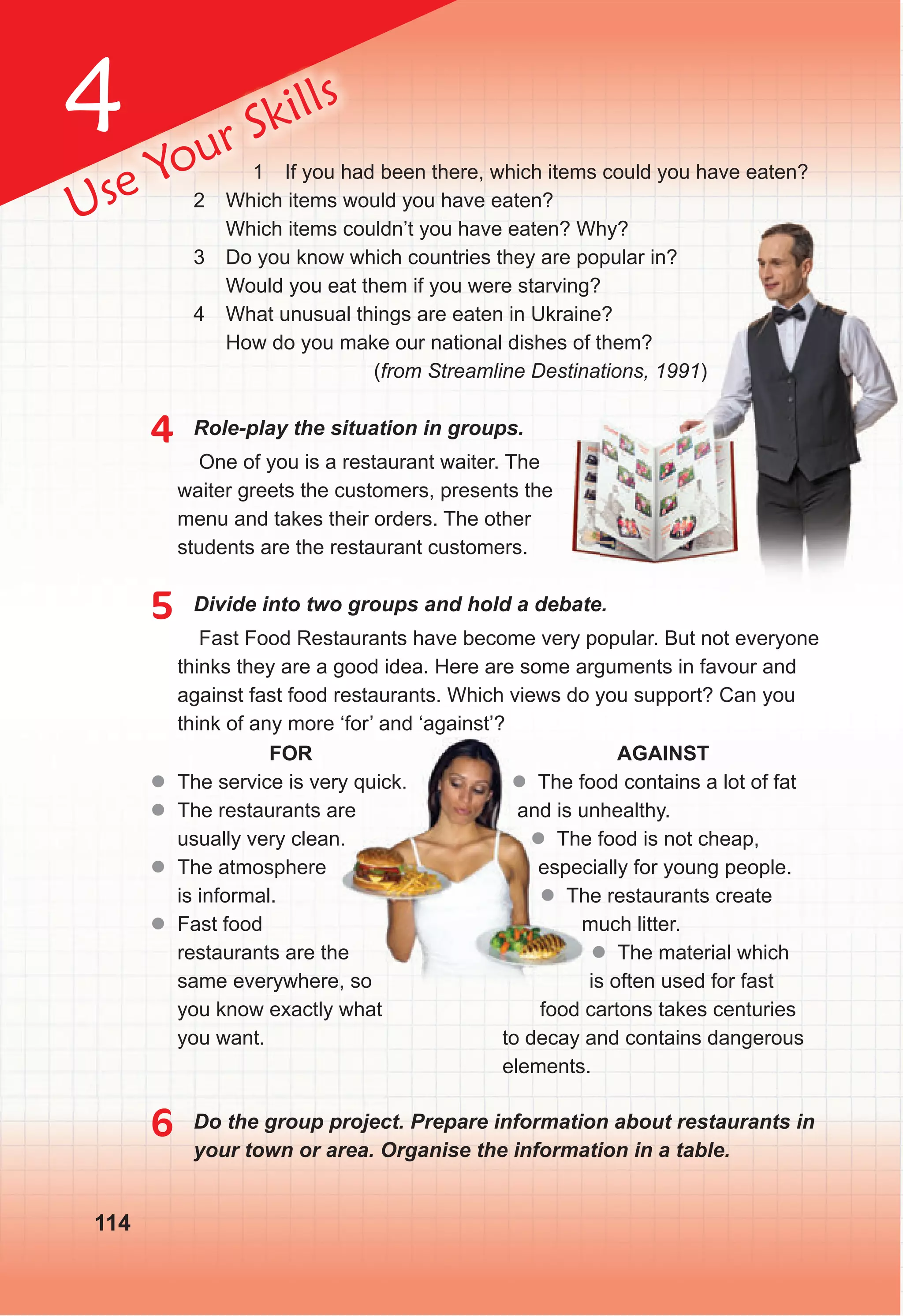
Oksana Karpyuk
ENGLIS H
Year 11
A textbook for the eleventh form of secondary schools
Oксана Kарпюк
АНГЛІЙСЬКА
МОВА
(11-й рік навчання, рівень стандарту)
Standard level
Підручник для 11 класу
закладів загальної середньої освіти
Рекомендовано Міністерством освіти і науки України
Тернопіль
Астон
2019
УДК 811.111(075.3)
К 26
© О. Д. Карпюк, 2019
© ТОВ “Видавництво Астон”, 2019
ISBN 978-966-308-748-1
Карпюк О. Д.
Англійська мова (11-й рік навчання) (English (the 11th year of studies)) :
підручник для 11 класу закладів загальної середньої освіти. Рівень
стандарту. — Тернопіль : Астон, 2019. — 256 с. : іл.
ISBN 978-966-308-748-1
К 26
Підручник завершує серію навчальних видань рівня стандарту,
створених для старшої школи. Видання реалізовує компетентісний
потенціал галузі «іноземні мови», передбачений програмою, чинною з
2018 року. Інтегровані змістові лінії «Екологічна безпека та сталий
розвиток», «Громадянська відповідальність», «Здоров’я та безпека» та
«Підприємливість та фінансова грамотність» знаходять свою реалізацію
в тематиці навчального матеріалу та характері завдань.
Рекомендовано Міністерством освіти і науки України
(наказ Міністерства освіти і науки України від 12.04.2019 № 472)
Видано за рахунок державних коштів.
Продаж заборонено.
— символ, що позначає вправи, які мають аудіосупровід.
Аудіосупровід можна завантажити за посиланням:
https://www.libra-terra.com.ua/userfiles/audio/
karpyuk_audio_11_zag_2019.zip
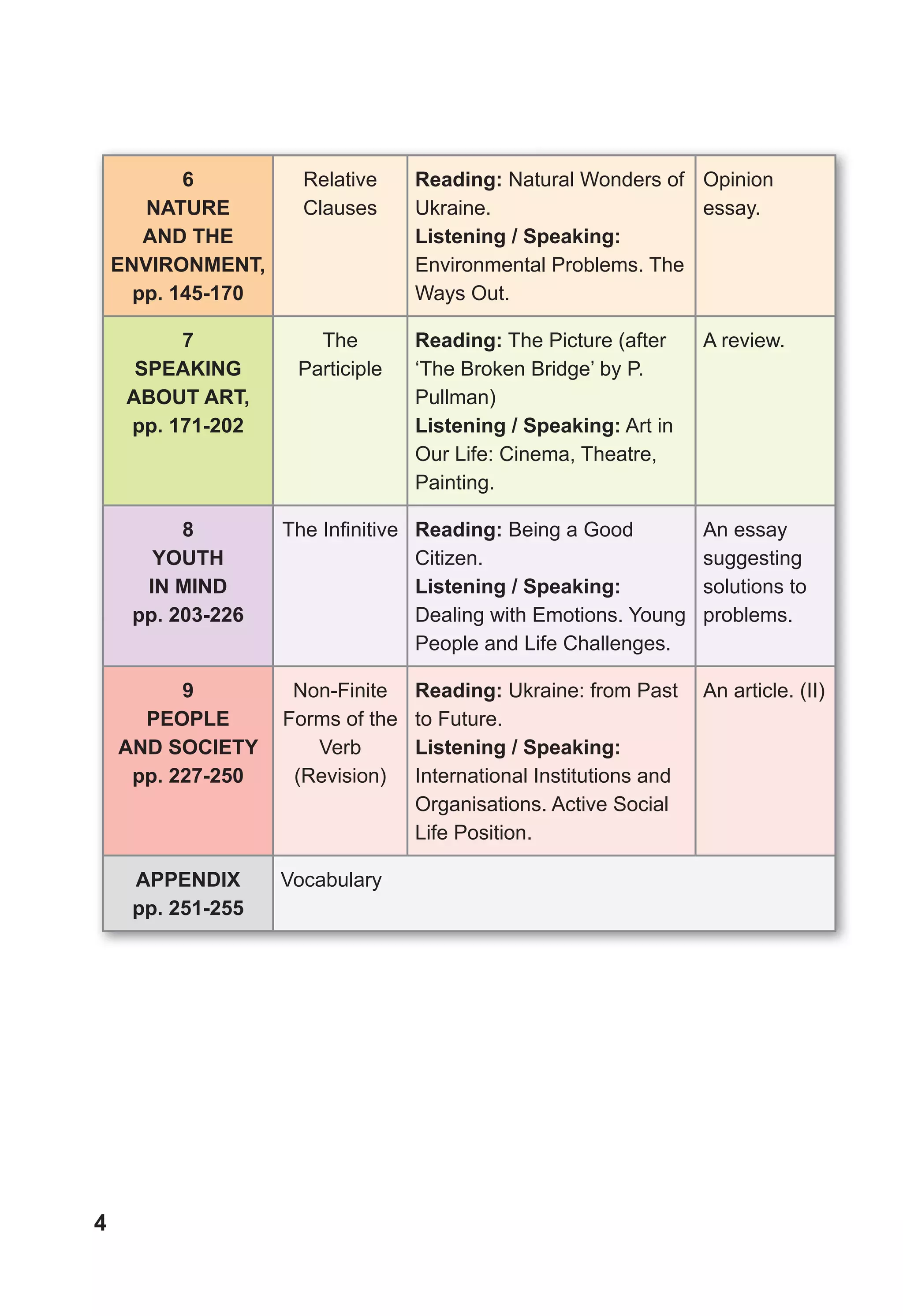
Contents
UNIT,
pages
Grammar
Focus
Reading / Listening /
Speaking
Writing
STARTER,
pp. 5-16
English is the Language of
International Communication.
Learning English.
1
BEING
A STUDENT,
pp. 17-40
Сonditionals
I, II
(Revision)
Reading: Independent
Language Learning
Listening / Speaking: Get
Ready for Your Finals
Making
notes. Doing
summary.
2
MAKE UP
YOUR MIND
pp. 41-70
Direct and
Reported
Speech,
Future-in-
the-Past
Reading: Fill that Gap
Listening / Speaking: Where
to Study? Choose Your
Future Profession.
Application
letter.
3
FAMILY
RELATIONSHIP,
pp. 71-94
Conditionals
III
Reading: Teen Terror
Listening / Speaking:
Relationship with Parents.
Generation Gap.
A letter to the
editor.
4
EATING OUT,
pp. 95-118
Reported
Speech
Reading: Eating Out in
Ukraine.
Listening / Speaking:
Choose a restaurant. Order
Your Meal.
A report.
5
INVENTIONS
AND
LIFESTYLES,
pp. 119-144
Adverb
Clauses with
Time:
till, untill
Reading: New Technologies.
Listening / Speaking: Mobile
Phones and the Internet.
An article. (I)
3
6
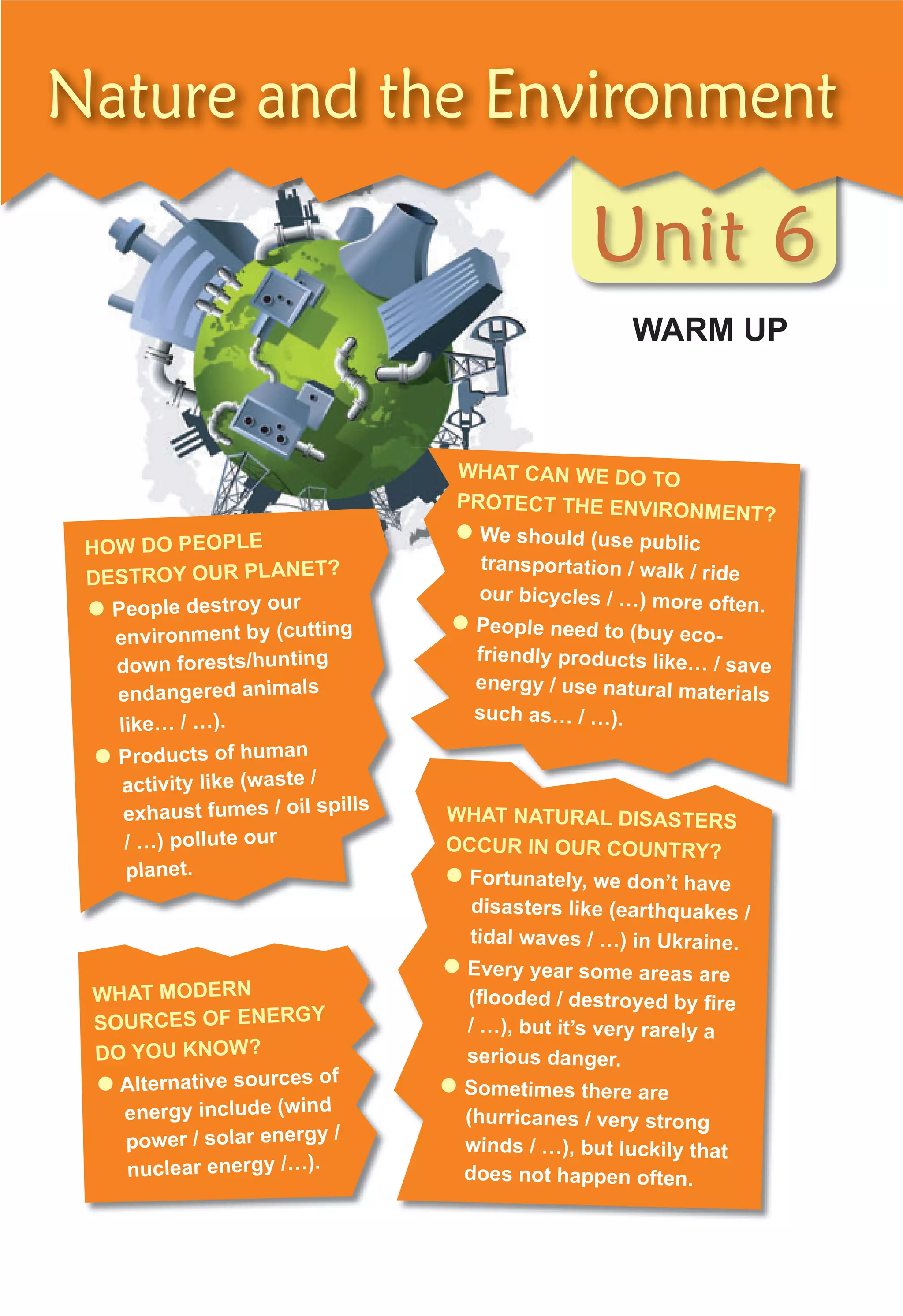
NATURE
AND THE
ENVIRONMENT,
pp. 145-170
Relative
Clauses
Reading: Natural Wonders of
Ukraine.
Listening / Speaking:
Environmental Problems. The
Ways Out.
Opinion
essay.
7
SPEAKING
ABOUT ART,
pp. 171-202
The
Participle
Reading: The Picture (after
‘The Broken Bridge’ by P.
Pullman)
Listening / Speaking: Art in
Our Life: Cinema, Theatre,
Painting.
A review.
8
YOUTH
IN MIND
pp. 203-226
The Infinitive Reading: Being a Good
Citizen.
Listening / Speaking:
Dealing with Emotions. Young
People and Life Challenges.
An essay
suggesting
solutions to
problems.
9
PEOPLE
AND SOCIETY
pp. 227-250
Non-Finite
Forms of the
Verb
(Revision)
Reading: Ukraine: from Past
to Future.
Listening / Speaking:
International Institutions and
Organisations. Active Social
Life Position.
An article. (II)
APPENDIX
pp. 251-255
Vocabulary
4
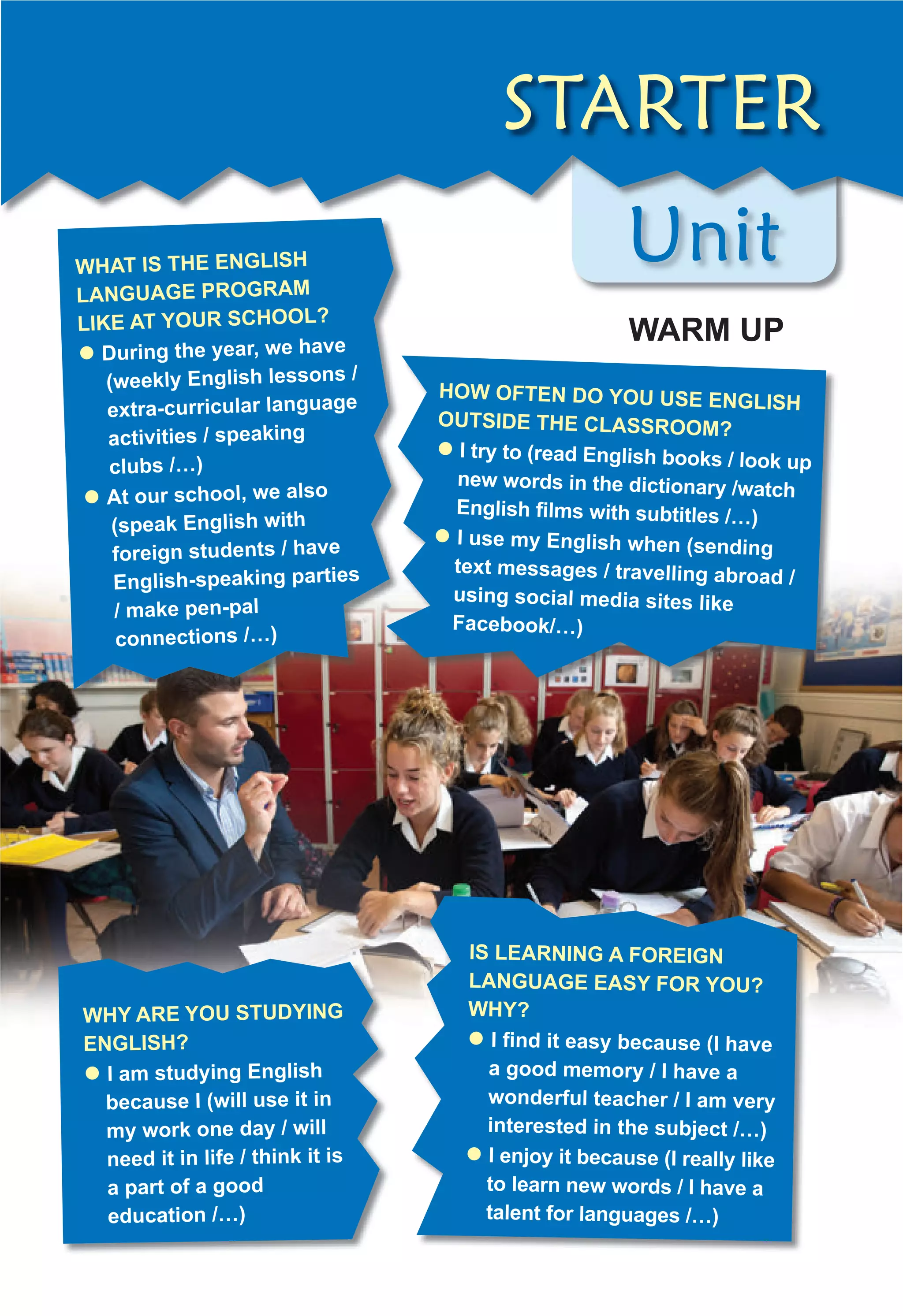
Unit
Unit
WHAT IS THE ENGLISH
LANGUAGE PROGRAM
LIKE AT YOUR SCHOOL?
z During the year, we have
(weekly English lessons /
extra-curricular language
activities / speaking
clubs /…)
z At our school, we also
(speak English with
foreign students / have
English-speaking parties
/ make pen-pal
connections /…)
WHY ARE YOU STUDYING
ENGLISH?
z I am studying English
because I (will use it in
my work one day / will
need it in life / think it is
a part of a good
education /…)
STARTER
HOW OFTEN DO YOU USE ENGLISH
OUTSIDE THE CLASSROOM?
z I try to (read English books / look up
new words in the dictionary /watch
English films with subtitles /…)
z I use my English when (sending
text messages / travelling abroad /
using social media sites like
Facebook/…)
IS LEARNING A FOREIGN
LANGUAGE EASY FOR YOU?
WHY?
z I find it easy because (I have
a good memory / I have a
wonderful teacher / I am very
interested in the subject /…)
z I enjoy it because (I really like
to learn new words / I have a
talent for languages /…)
WARM UP
6
1
STARTER
6
1 Read and discuss the letter in class.
Focus on Reading and Vocabulary
Congratulations! You’re back to school again and you will
be called a school leaver now as this year is the last one of
your study at secondary school.
In ten months you’re going to take your finals and make
up your mind what to do in your personal future. You
should be a good time manager and work hard to prepare
for your exams as well as for making your own choice after
school.
Learning is a precious gift to be treasured always.
Whether you are from Kyiv or London, you all must
appreciate and embrace study skills as the key to
achievement of your dreams.
Why do you need to know English? English is becoming a
global language. At least half a billion people in the world
use English at home or work. Problems of the 21st century,
such as problems of war and peace, democracy, ecology and
demography cannot be solved if people cannot speak the
same language. Interpreters take time and now time is as
precious as never before. So, dear boys and girls, don’t waste
your time. Go on studying English each and every day.
And finally, I’d like to wish you all a long, fruitful and
happy life!
Yours sincerely,
the author of the book
7
7
2 a) Choose the correct
word and complete
each sentence.
1 Could you
(translate /
interpret) this
paragraph into
English, please?
2 I’m sorry, I can’t
3 Ask and answer the questions in pairs.
z
z How do you organise your learning process?
z
z How much time do you need to do English tasks?
z
z Are you a motivated learner or you are forced to learn English?
z
z How often do you speak English outside the classroom?
z
z How often do you write in English?
z
z How often do you read in English?
z
z Have you got any chance to watch English video?
4 a) Read the article quickly. Refer the paragraphs (1-5)
to the headings (A-E) on page 8.
1 Language is the most powerful tool we have for reaching out to
others. We can use it to express our feelings, to spread our
ideas, and even to establish peace.
2 Learning English is like learning to swim or play ball. We learn
to swim by swimming, to play ball by playing ball, and to speak
English by speaking English.
grammar, spelling,
pronunciation, vocabulary,
reading, writing, speaking
b) Speak on what you find to be the
easiest and the most difficult
about learning English. Choose
from the box and explain why.
read your handwriting. What does this word (say / mean)?
3 Can anyone tell me the (meaning / understanding) of ‘shiver’?
4 How do you (pronounce / spell) ‘accomodation’? Does it have
one ‘m’ or ‘mm’?
8
1
STARTER
3	 Acquiring the ability to use a language automatically, that is to
think without stopping to think, is a process of habit formation1
.
Forming a habit, any kind of habit, requires2
much practice.
4	 Learning English efficiently requires that you put your mind on
what you are doing and have the intention and will to learn. The
time you have is so short that you cannot afford to waste3
it by
giving less than your full cooperation in class and in home
studies. In other words, you have to build up language habits in
English just as you build up language habits in your mother
tongue4
.
5	 Good luck to you then in your learning English! It’s up to you.
Nobody can learn to swim for you. Nobody can learn English
for you. You have to learn it by yourself, and you will learn if you
really want to and are willing to practise. Language is not to be
taught, language is to be learnt.
1
formation [fc:9meiSn] — утворення, формування
2
to require [ri9kwai3] — вимагати
3
to waste [weist] — марнувати
4
mother tongue [tyN] — рідна мова
	A Concentration will bring its own reward.
	B Language is the key to the outer world.
	C Teaching or learning?
	D Just another habit.
	E Learning English through action.
b) Read the article again and discuss the questions in groups.
1	 What does the author mean saying that learning English is like
learning to swim?
2	 Do you have any opportunity to speak English?
3	 What do you prefer — to read or speak English?
4	 What does it mean “to acquire the ability to use a language
automatically”?
5	 What does it mean ‘the process of habit formation’?
6	 What does the author mean saying that “language is not to be
taught, language is to be learnt”?
9
5 Read about the people below and decide which course (A-F)
on pages 9-10 would be the most suitable for each person.
Lee is going to the university in Sweden next
year and wants to spend this year improving her
English. She wants to meet people from other
parts of the world and have a good social life.
Abraham is a journalist. He knows quite
a lot of English, but he wants to improve
his writing skills. He works long hours on
weekdays at an office in London.
Yoko is visiting England for the first time this summer. He’ll stay
for a month there and hopes to make new friends, but is rather
shy, so he’d like a school with lots of out-of-class activities.
Tina lives with a family
in London and looks
after their little girls
during the day. She
studies on her own but
also needs a language
course that will help her
prepare for her exams.
Suzy is 45.
She would like
to follow an
individual
course of study
somewhere quiet
and comfortable with
a private teacher.
year and wants to spend this year improving her
A
This excellent school is an attractive suburb of Brighton.
It offers courses in general English from three to twelve
months. Accommodation is carefully chosen and the
school is famous for its programme of activities beyond
the classroom. Teenagers and young adults come here
from over thirty different countries to study hard and
enjoy themselves, too.
ELGIN
HOUSE
SCHOOL
10
1
10
STARTER
B
D
C
E
Summer Holiday Courses
Three-week, one-month or six-week courses for students of all
standards, which combine daily language classes with a full
programme of sports (tennis, swimming, volleyball, etc.), social
activities (discos, quizzes, film club, etc.) and outings (London,
Stratford-upon-Avon, Bath, etc.).
Business Department
Courses in most European languages are offered for adults
wishing to study outside office hours, including weekends. Our
qualified teachers are always native speakers, whether of
Danish, English or Greek origin. You will study hard in very
small groups with lots of attention to individual needs. Courses
last between three and six months.
Home from Home
We place students with experienced and qualified teachers
throughout Britain for individual study programmes in the
teacher’s own home. An excellent choice for those who wish
to improve their English fast, but who are not keen on
returning to the classroom. High standards of comfort in a
friendly but peaceful atmosphere.
Part-time Courses
Morning classes 15 hours per week, afternoon classes 15
hours per week. Examination preparation 4 or 6 hours per
week, afternoons or evenings. All teachers are highly
experienced and well qualified. Minimum course — one
month. Central location, easy access by bus or underground.
F
This small school offers a wide range of courses, both half-
day and evenings, from five to fifteen hours per week. In an
attractive building near Edinburgh’s main business centre, it is
easy to reach by public transport. Modern equipment and
experienced staff make it an obvious choice for any business
person or student studying English in Scotland.
BESTON
HALL
LONDON
LANGUAGES
LONDON
LANGUAGES
LONDON
LANGUAGES
CRAWFORD’S
LANGUAGE
ACADEMY
11
11
6 In groups, speak on why you want to learn English.
Use the scheme below.
7 In groups of three or four, try to find as many words as you
can which are identical in English and your own language
(for example: radio, lift). The winner is the group with the
longest list. Set a time limit.
8 a) Skim the short article in one minute. Which of the following
sentences describes the main idea of the text?
a It is important to speak English if you want to be successful
in business.
b Most of the world’s mail is written in English.
c English is the most widely used language in the world.
to get a qualification
for personal interest
to pass an exam
to have access to
to teach
to understand
to study to speak
to watch to read
to improve
to use
for pleasure for work
b) Look at the numbers below and say what they refer to.
Match each number with its reference.
over 70% the amount of business done in English
over 50% the amount of mail written in English
c) Scan the text again in 30 seconds
to check your answers in (b).
STARTER
English is the second
most commonly spoken,
and by far the most widespread of
the world’s languages. It is esti-
mated that there are 350 million
native speakers, 300 million who
use English as a second language
and a further billion using it as a
foreign language. English is spo-
ken by scientists, pilots, computer
experts, diplomats and tourists; it
is the language of the world! Do
you know that over 50% of all
business deals are conducted in
English? And over 70% of all mail
is written and addressed in Eng-
lish? It is the official or co-official
language of over 45 countries and
furthermore, it is spoken exten-
sively in other countries where it
has no official status. It is perhaps,
therefore, not surprising that in
recent years we have seen a dra-
matic increase in the number of
students opting to study abroad.
In the future this will cement the
role that English plays in the cul-
tural, political or economic life of
many countries around the world
from Australia to Zambia.
(From IELTS express
Intermediate Coursebook, 2004.)
12
12
13
13
Focus on Speaking
1 Match each question (1-6) with the appropriate answer (a-f).
Work in pairs.
1 Do you enjoy
learning English?
2 What do you do
in your free time?
3 Do you plan to
study abroad?
4 Do you have any
brothers or
sisters?
5 What’s your job?
6 Where do you
live?
a Well, I have one brother and one
sister.
b I’m afraid I don’t like it very
much. I think it’s really difficult,
especially the grammar.
c I haven’t really decided yet. I
guess I’d like to one day, maybe
in Canada or Australia.
d Actually, my parents moved
around a lot and I’ve lived in
many cities. Now I live in Odesa.
e I have a part-time job in a local
shop. In fact, I’ve worked there
for more than three years.
f It depends. I often go out with
my friends, but sometimes I
enjoy just reading in my room.
2 Role-play the situation in pairs.
Student A, you’re the examiner. Choose some questions from task 1.
For each question think of follow-up questions (why, when,
where, who with, etc.) and interview student B for 4 or 5 minutes.
Listen to the student B’s answers carefully. Did he or she give
short or extended1
answers?
USEFUL
LANGUAGE
Using words or expressions like ‘actually’,
‘well’, ‘I guess’ or ‘It depends’ will make
you sound more natural when you speak.
1
extended [ik9stendid] — розширений, широкий
14
14
Student B, you are the student.
Imagine you are in the exam.
Introduce yourself briefly and
then listen to the examiner’s
questions. Answer as fully as
possible, giving two or three
additional pieces of information
for each question. Follow the
Useful Tips. When you’ve
finished, change roles with your
partner.
Example:
A: Where do you live?
B: Now I live in London, but before
that I have been studying in Ireland
— for 2 years. Actually, it was
great. I was living in the
countryside and it was very
peaceful. Not like London — it’s so
busy and noisy! I guess I’ll get
used to London eventually — it just
takes time to adjust, doesn’t it?
3 a) Write ten sentences about yourself. Five should be true
and five should be false. Choose topics in the box below.
Where you come from
Your age
Your family
Your leisure activities
Your personality
A problem you have
What languages you speak
Your favourite kind of music
Countries you’ve visited
What you’re going to do this weekend
A book you’re reading at the moment
What you did yesterday evening
Something important that’s
happened to you recently
b) Give a piece of paper to the person sitting next to you. Can
he/she tell which sentences are true and which are false?
1
STARTER
15
15
15
15
15
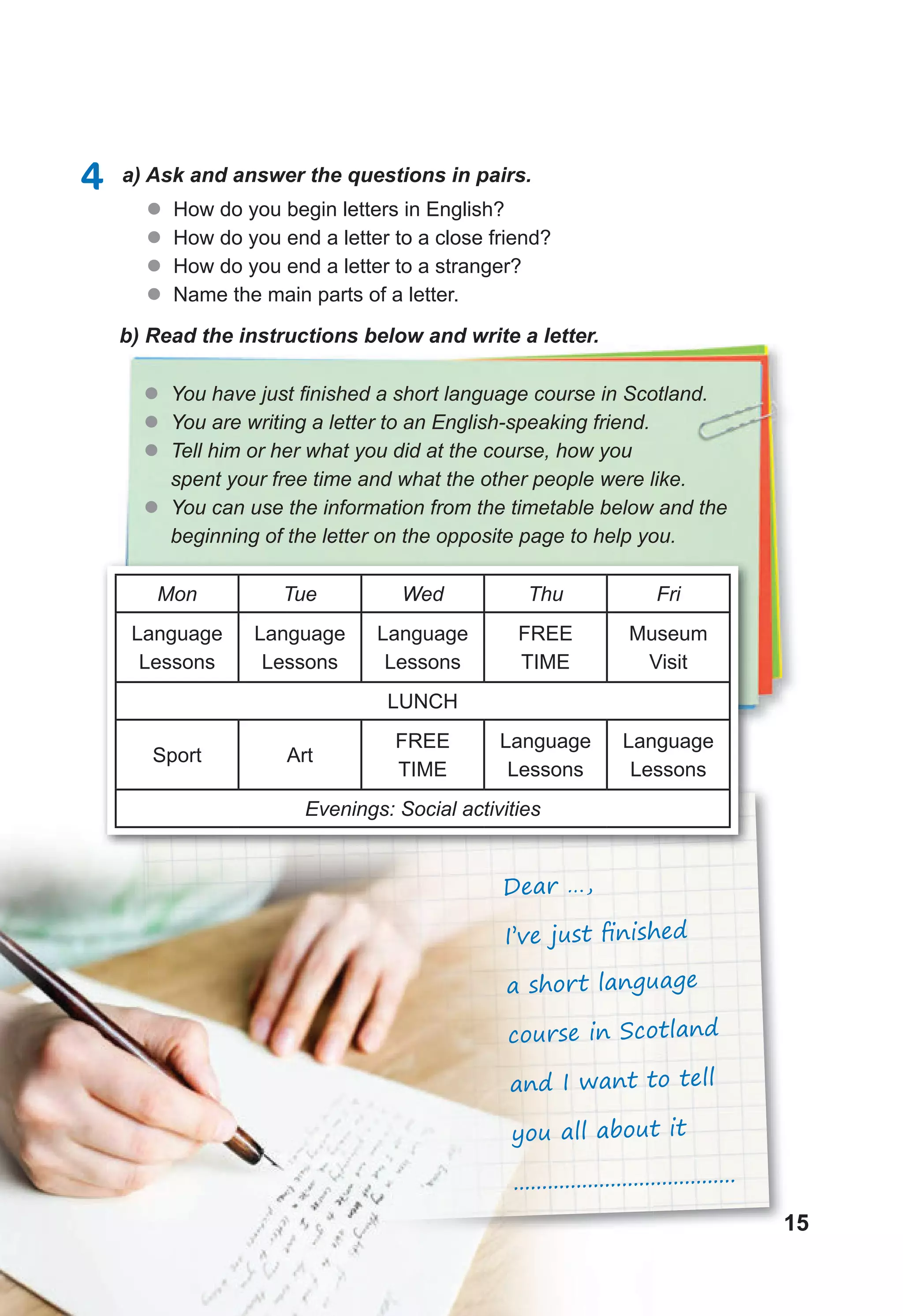
4 a) Ask and answer the questions in pairs.
z
z How do you begin letters in English?
z
z How do you end a letter to a close friend?
z
z How do you end a letter to a stranger?
z
z Name the main parts of a letter.
b) Read the instructions below and write a letter.
z
z You have just finished a short language course in Scotland.
z
z You are writing a letter to an English-speaking friend.
z
z Tell him or her what you did at the course, how you
spent your free time and what the other people were like.
z
z You can use the information from the timetable below and the
beginning of the letter on the opposite page to help you.
Mon Tue Wed Thu Fri
Language
Lessons
Language
Lessons
Language
Lessons
FREE
TIME
Museum
Visit
LUNCH
Sport Art
FREE
TIME
Language
Lessons
Language
Lessons
Evenings: Social activities
Dear …,
I’ve just finished
a short language
course in Scotland
and I want to tell
you all about it
.......................................
16
1
16
STARTER
c) Check your writing after you have finished it, using a checklist
below. Use it every time you practise writing something.
Checklist 
Have you included all the notes?
Have you used paragraphs?
Have you written the right number of words?
Have you linked the points clearly?
Have you started sentences in different ways so that it is
interesting to read?
Have you checked your grammar or spelling mistakes?
Have you used a range of vocabulary?
Are there any words you have used too many times?
Have you started and ended the letter or email correctly?
Have you used the right style for the person you're writing to?
5 Discuss the following questions in groups.
1 How long have you been learning English?
2 Why do people need English?
3 When have you had an opportunity to speak or read English?
4 Have you ever been to an English-speaking country?
5 What do you think about the idea that a language gets rusty1
if it
is not practised?
6 Can you follow TV programmes in English on satellite television?
7 Can you understand songs in English?
8 Do you have problems learning English? What are they?
9 Have you ever taken private lessons?
10 What do you find easy about English, and what do you find difficult
(think about pronunciation, learning new vocabulary, grammar,
spelling, listening, reading, understanding, translating, etc.)?
1
rusty [9rystI] — занедбаний, забутий
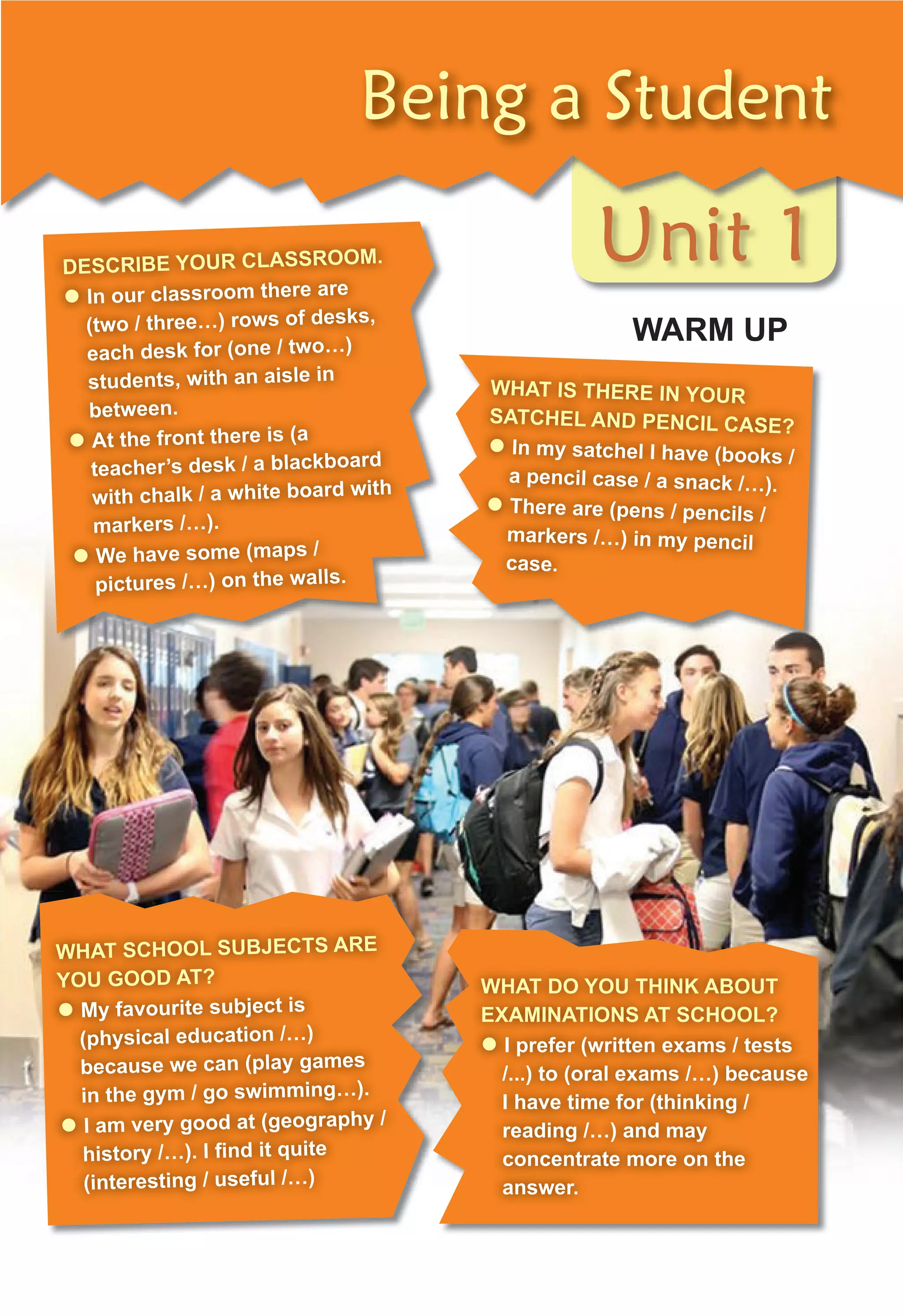
Unit 1
Being a Student
WARM UP
DESCRIBE YOUR CLASSROOM.
z In our classroom there are
(two / three…) rows of desks,
each desk for (one / two…)
students, with an aisle in
between.
z At the front there is (a
teacher’s desk / a blackboard
with chalk / a white board with
markers /…).
z We have some (maps /
pictures /…) on the walls.
WHAT IS THERE IN YOUR
SATCHEL AND PENCIL CASE?
z In my satchel I have (books /
a pencil case / a snack /…).
z There are (pens / pencils /
markers /…) in my pencil
case.
WHAT SCHOOL SUBJECTS ARE
YOU GOOD AT?
z My favourite subject is
(physical education /…)
because we can (play games
in the gym / go swimming…).
z I am very good at (geography /
history /…). I find it quite
(interesting / useful /…)
WHAT DO YOU THINK ABOUT
EXAMINATIONS AT SCHOOL?
z I prefer (written exams / tests
/...) to (oral exams /…) because
I have time for (thinking /
reading /…) and may
concentrate more on the
answer.
18
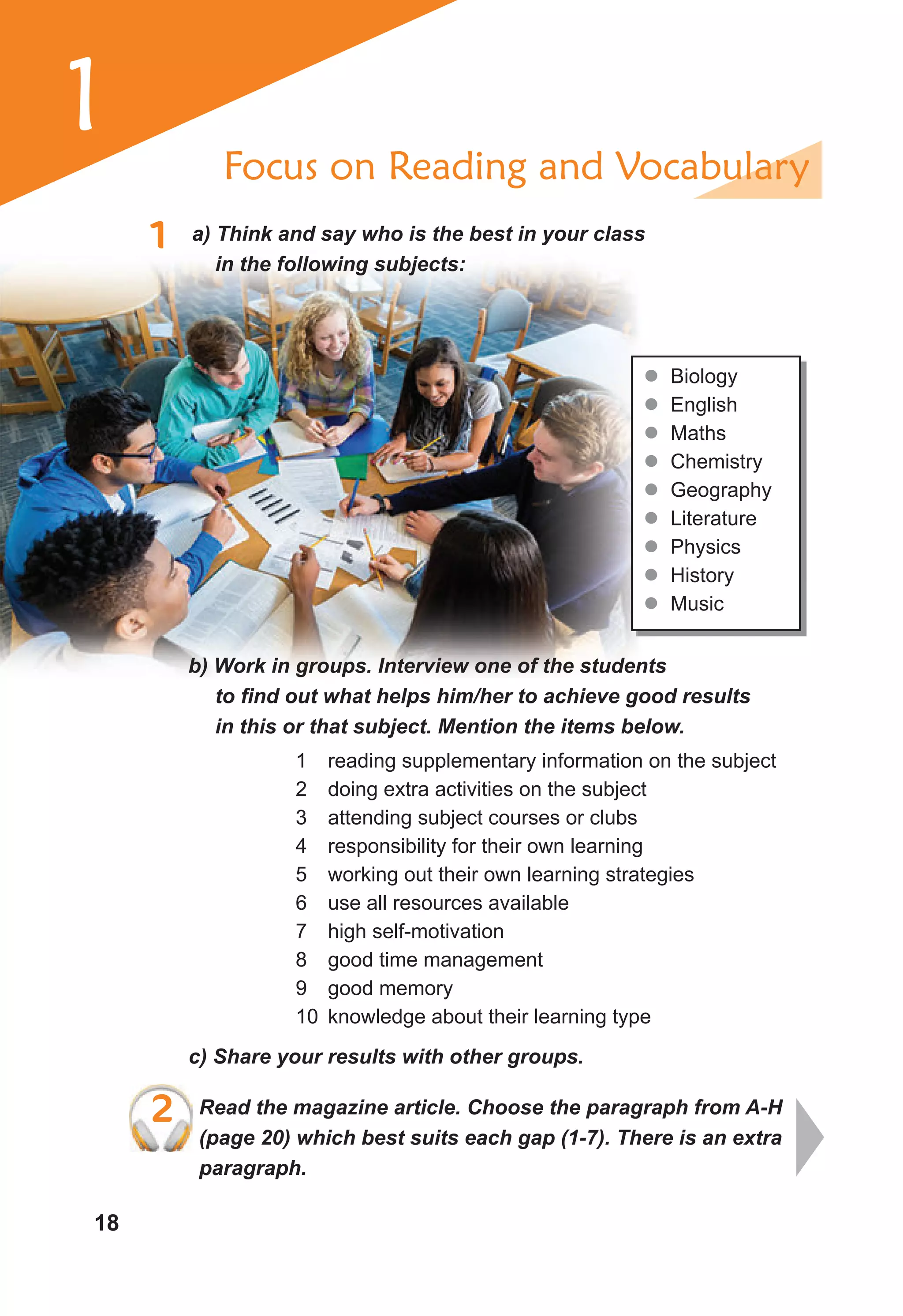
1 a) Think and say who is the best in your class
in the following subjects:
Focus on Reading and Vocabulary
z
z Biology
z
z English
z
z Maths
z
z Chemistry
z
z Geography
z
z Literature
z
z Physics
z
z History
z
z Music
b) Work in groups. Interview one of the students
to find out what helps him/her to achieve good results
in this or that subject. Mention the items below.
1 reading supplementary information on the subject
2 doing extra activities on the subject
3 attending subject courses or clubs
4 responsibility for their own learning
5 working out their own learning strategies
6 use all resources available
7 high self-motivation
8 good time management
9 good memory
10 knowledge about their learning type
c) Share your results with other groups.
2 Read the magazine article. Choose the paragraph from A-H
(page 20) which best suits each gap (1-7). There is an extra
paragraph.
2 Read the magazine article. Choose the paragraph from A-H
1
19
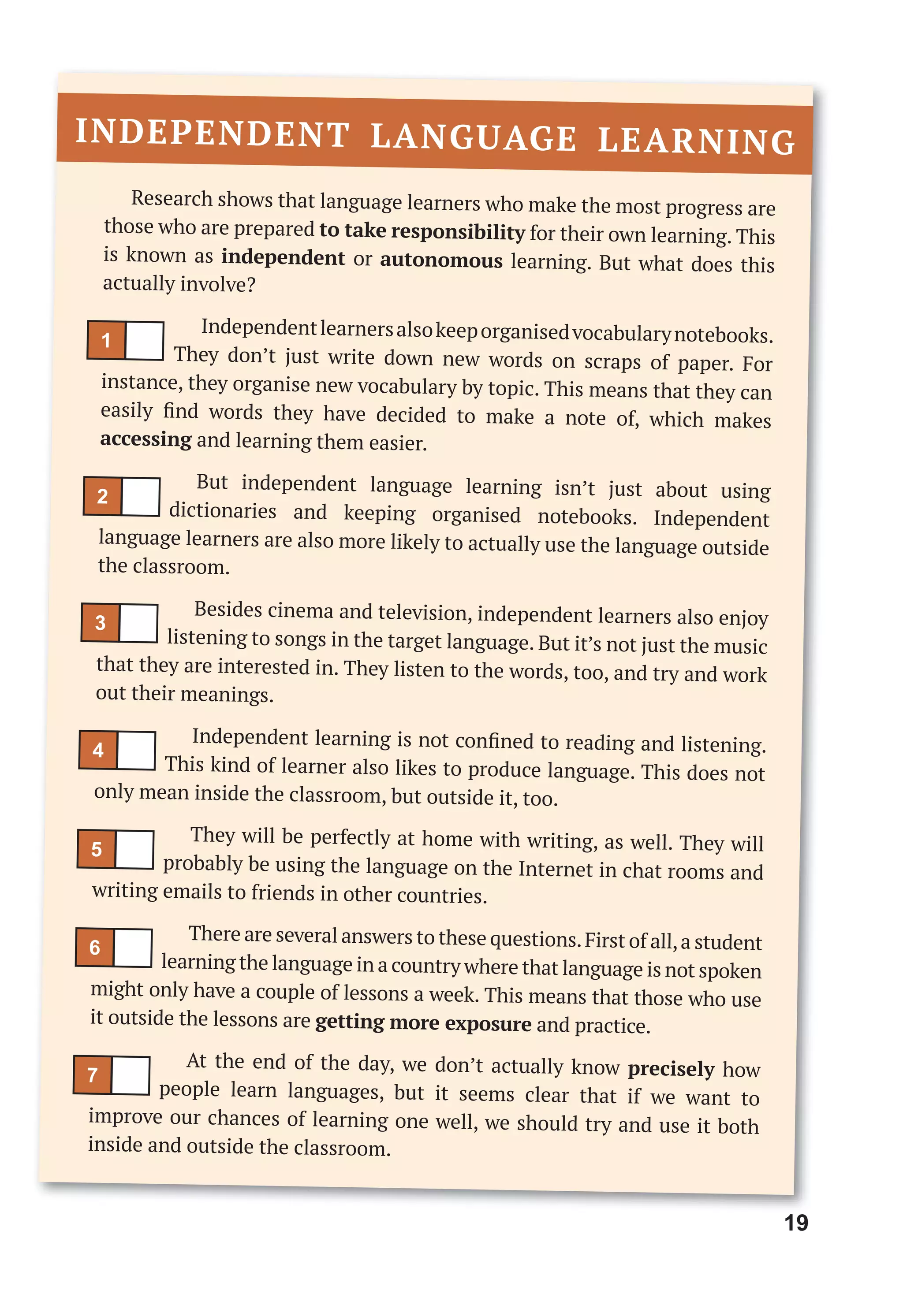
Research shows that language learners who make the most progress are
those who are prepared to take responsibility for their own learning. This
is known as independent or autonomous learning. But what does this
actually involve?
Independentlearnersalsokeeporganisedvocabularynotebooks.
They don’t just write down new words on scraps of paper. For
instance, they organise new vocabulary by topic. This means that they can
easily find words they have decided to make a note of, which makes
accessing and learning them easier.
But independent language learning isn’t just about using
dictionaries and keeping organised notebooks. Independent
language learners are also more likely to actually use the language outside
the classroom.
Besides cinema and television, independent learners also enjoy
listening to songs in the target language. But it’s not just the music
that they are interested in. They listen to the words, too, and try and work
out their meanings.
Independent learning is not confined to reading and listening.
This kind of learner also likes to produce language. This does not
only mean inside the classroom, but outside it, too.
They will be perfectly at home with writing, as well. They will
probably be using the language on the Internet in chat rooms and
writing emails to friends in other countries.
There are several answers to these questions.First of all,a student
learning the language in a country where that language is not spoken
might only have a couple of lessons a week. This means that those who use
it outside the lessons are getting more exposure and practice.
At the end of the day, we don’t actually know precisely how
people learn languages, but it seems clear that if we want to
improve our chances of learning one well, we should try and use it both
inside and outside the classroom.
INDEPENDENT LANGUAGE LEARNING
1
5
3
7
2
6
4
20
1 a Andadditionalreasonisthattheirlearningismorepersonalisedbecause
they are doing things in the language that they are actually interested in,
such as listening to their favourite bands singing in the target language.
b First of all, language learners should know how to use resources like
dictionaries. This is important, because it allows the learners to work
on their own without a teacher. For example, if you know how to use a
dictionary, you can look up words and check spellings on your own.
c For example, they like watching films in the language they are
learning. However, they don’t just read the subtitles. They try to listen
to how things are said, and might even try and follow what they are
watching without looking at the subtitles at all.
d However, independent learners not only write down new words and
their meanings. They also make a note of other important information
connected with the word, such as its pronunciation and other words
that usually go with it. They also write down examples of the word in
context. All this information makes it easier for them to actually use
the words they have recorded.
e Reading in the target language is another favoured strategy. Such
learners will be browsing the Internet or flicking through magazines
dealing with subjects that they are interested in.
f So why is it that independent learners seem to learn more? What is
it about using the language outside the classroom that makes it more
memorable?
g There have been some spectacular results. A recent survey in
Sweden concluded that children who had access to one at home
scored significantly higher in English tests that those who didn’t.
h They don’t worry about using the language in shops when they go
abroad or if a foreign tourist stops them to ask for directions. In fact,
they will eagerly grab the opportunity to practise their foreign
language skills.
21
1 ... having the ability to work
and make decisions by yourself
without any help from anyone else
2 ... the way by which you can
enter a place
3 ... an aim as a result that you
want to achieve
4 ... to make facts known or to
say things that make a
person (or an event) known
to a lot of people
5 ... receiving special attention,
help or treatment
6 ... if it is educational, it is
something such as a book,
film or picture, etc. used by
teachers or students to provide information and training
7 ... be in charge of something or someone, so that you make
decisions and can be blamed if something bad happens
8 ... a well-planned series of actions for achieving an aim
9 ... exactly
10 ... enjoyable or unusual, and worth remembering
... having the ability to work
and make decisions by yourself
without any help from anyone else
... the way by which you can
... an aim as a result that you
3 Read the article again and guess the
meanings of the words in bold. Match
each word or phrase from the ‘Words
for You’ box with its definition.
4 Complete the sentences on the basis of the article.
1 If you take responsibility for your own learning, you will …
2 Autonomous learner doesn’t need a …
3 Independent language learners use …
4 The important resources for autonomous learner are …
5 They use the Internet to …
6 If you want to improve your chances of learning at least one
foreign language well, you should …
a resource [ri9sc:s]
a strategy [9str2t3dzI]
a target [9t4:git]
to access [92kses]
autonomous [c:9tAn3m3s]
favoured [9feiv3d]
memorable [9mem3r3bl]
precisely [pri9saislI]
z to get exposure
z to take responsibility
(for)
WORDS
FOR YOU
22
1 Develop Your Vocabulary
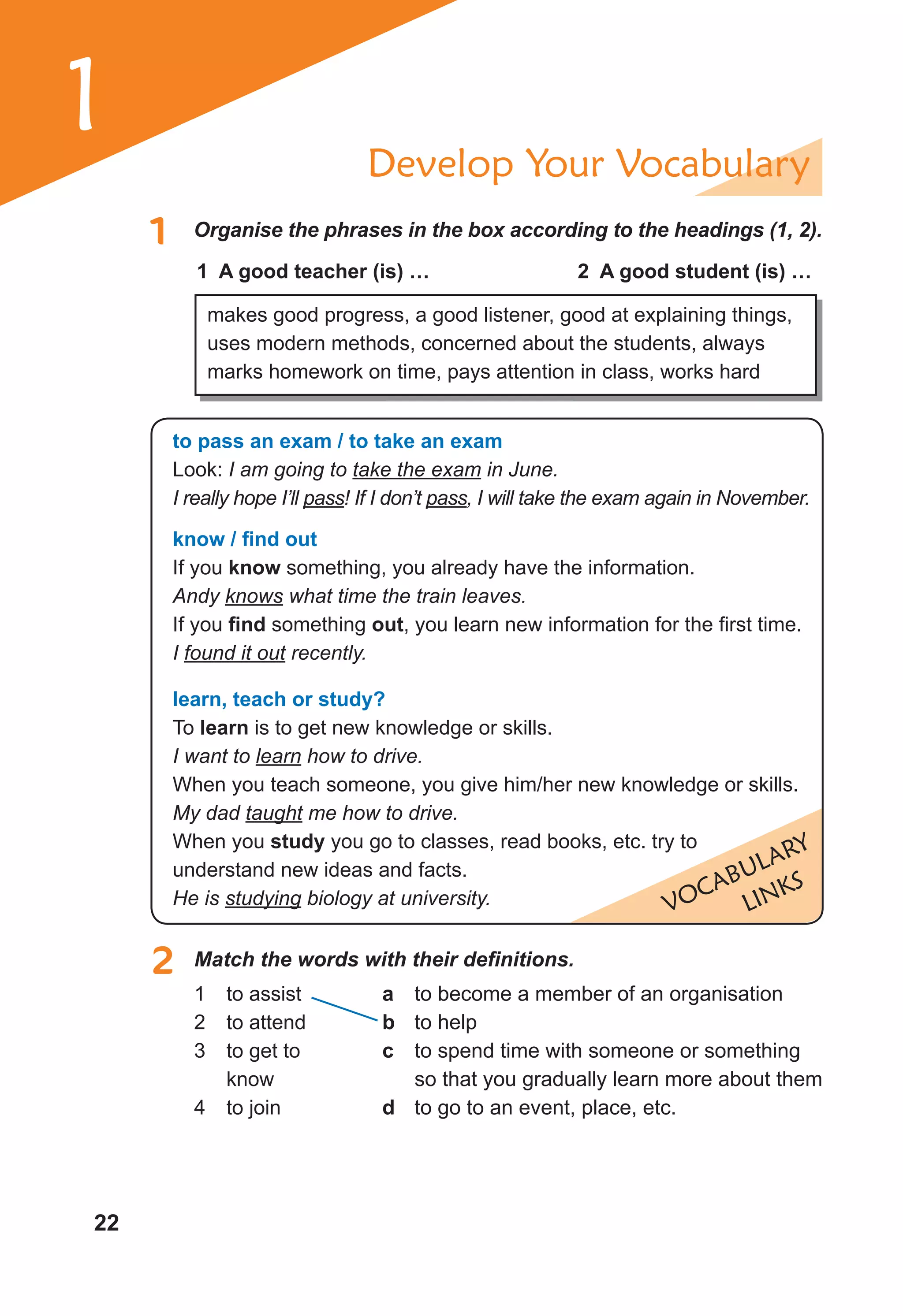
1 Organise the phrases in the box according to the headings (1, 2).
1 A good teacher (is) … 2 A good student (is) …
makes good progress, a good listener, good at explaining things,
uses modern methods, concerned about the students, always
marks homework on time, pays attention in class, works hard
VOCABULARY
LINKS
to pass an exam / to take an exam
Look: I am going to take the exam in June.
I really hope I’ll pass! If I don’t pass, I will take the exam again in November.
know / find out
If you know something, you already have the information.
Andy knows what time the train leaves.
If you find something out, you learn new information for the first time.
I found it out recently.
learn, teach or study?
To learn is to get new knowledge or skills.
I want to learn how to drive.
When you teach someone, you give him/her new knowledge or skills.
My dad taught me how to drive.
When you study you go to classes, read books, etc. try to
understand new ideas and facts.
He is studying biology at university.
2 Match the words with their definitions.
1 to assist
2 to attend
3 to get to
know
4 to join
a to become a member of an organisation
b to help
c to spend time with someone or something
so that you gradually learn more about them
d to go to an event, place, etc.
23
1	 a) Refresh what you learnt about Conditionals last year.
Put the type (I or II) into the boxes to complete the rules.
Build Up Your Grammar
1	 Conditionals are used for future results, predictions,
promises, threats and warnings.
2	 Conditionals are used for unreal situations in the present
and for the situations that are unlike to happen in the future.
	 1 Virtual friends would be more interesting than real friends.
	 2 If Anthony gets a scholarship, he will be studying
at Cambridge this time next year.
	 3 We won’t finish this job on time unless we start right away,
so let’s get down to work.
	 4 What would you do if you won the lottery?
	 5 If you worked harder, you’d probably do better.
	 6 If we miss the last bus, my dad will come and pick us up.
b) Refer each sentence to the correct type of Conditionals
(I or II).
The conditional clause can start with if, even if or unless.
It’ll be great if Garry comes.
It’ll be boring unless Garry comes.
Carl won’t go to the party
even if you beg him. GRAMMAR
LINKS
2	 Fill in the blanks with if, even if or unless.
1	 David will come … you invite him.
2	 David won’t know about the party … you tell him.
3	 Clive hates parties and won’t come … you invite him.
4	 This is too big a job. We won’t finish it on time … we
start right away.
5	 We won’t finish this job on time … we start right away,
so let’s get down to work.
24
1
The verb in the conditional clauses of the 1st type is in a
present tense even though it refers to a future event.
Present Simple: We’ll have a barbecue if the weather is fine.
Present Perfect: I’ll cook you something if you haven’t eaten.
Present Continuous: If you’re doing your homework when I
arrive, I’ll be as quiet as a mouse.
Present Perfect Continuous: He’ll be tired when he gets home
if he’s been working all day.
In 1st CONDITIONALS the verb in the main clause can be in any
of future tenses, structure going to, or Present Simple or
Present Continuous in future meaning.
Future Simple: Paul will do it if you ask him.
Future Perfect: They’ll have arrived by one pm unless their
plane is late.
Future Continuous: Sarah will be waiting for us outside the
cinema unless it’s raining.
Future Perfect Continuous: If they don’t come in the next five
minutes, we’ll have been waiting for over an hour.
going to: I’m going to scream if you do that again.
Present Continuous: I’m meeting Tanya after school if she
doesn’t have choir practice.
Present Simple: The plane arrives at three if it’s on schedule.
3	 Fill in the gaps with the appropriate form of the verb in brackets.
1	 I won’t disturb you if you … when I arrive. (work)
2	 I’ll lend you the video if you … it. (not see)
3	 He will be in a bad mood when we arrive if he … for long. (wait)
4	 They’ll get lost unless they … there before. (be)
4	 Fill in the gaps with the appropriate form of the verb in brackets.
1	 IfAndy gets a scholarship, he … at Cambridge this time next year. (study)
2	 If we don’t get there soon, they … all the food and nothing will be
left. (eat)
25
3 If we don’t stop soon, we … for three hours without a break. (drive)
4 Sue has made a decision. She … to Liz unless she apologises.
(not talk)
5 It’s all been arranged. We … the party at Bill’s if his parents go
away for the weekend. (have)
5 Fill in the gaps with different modal verbs.
1 If we don’t invite Jeffrey, he … be offended.
2 Be careful. If you stand on the table, it … collapse.
3 If you don’t start preparing for the exam, you … fail.
4 We … get there quicker if we take the motorway.
Focus on Listening
1 In pairs, speak on how you feel when you hear the word ‘exams’.
What feelings does this word evoke?
If the future result is not certain, we use the modal verbs that
express possibility: may, might, can or could.
If Hamlet kills Claudius, the guilt could drive him crazy.
If you go to Sarah’s round dinnertime, you might get something
to eat.
You may get lost if you go there by the back roads.
You can do it if you try.
What feelings does this word evoke?
You can start this way:
I feel ...
It makes me think of ...
I am ...
It sounds like ...
I feel as if ...
It reminds me of ...
26
1
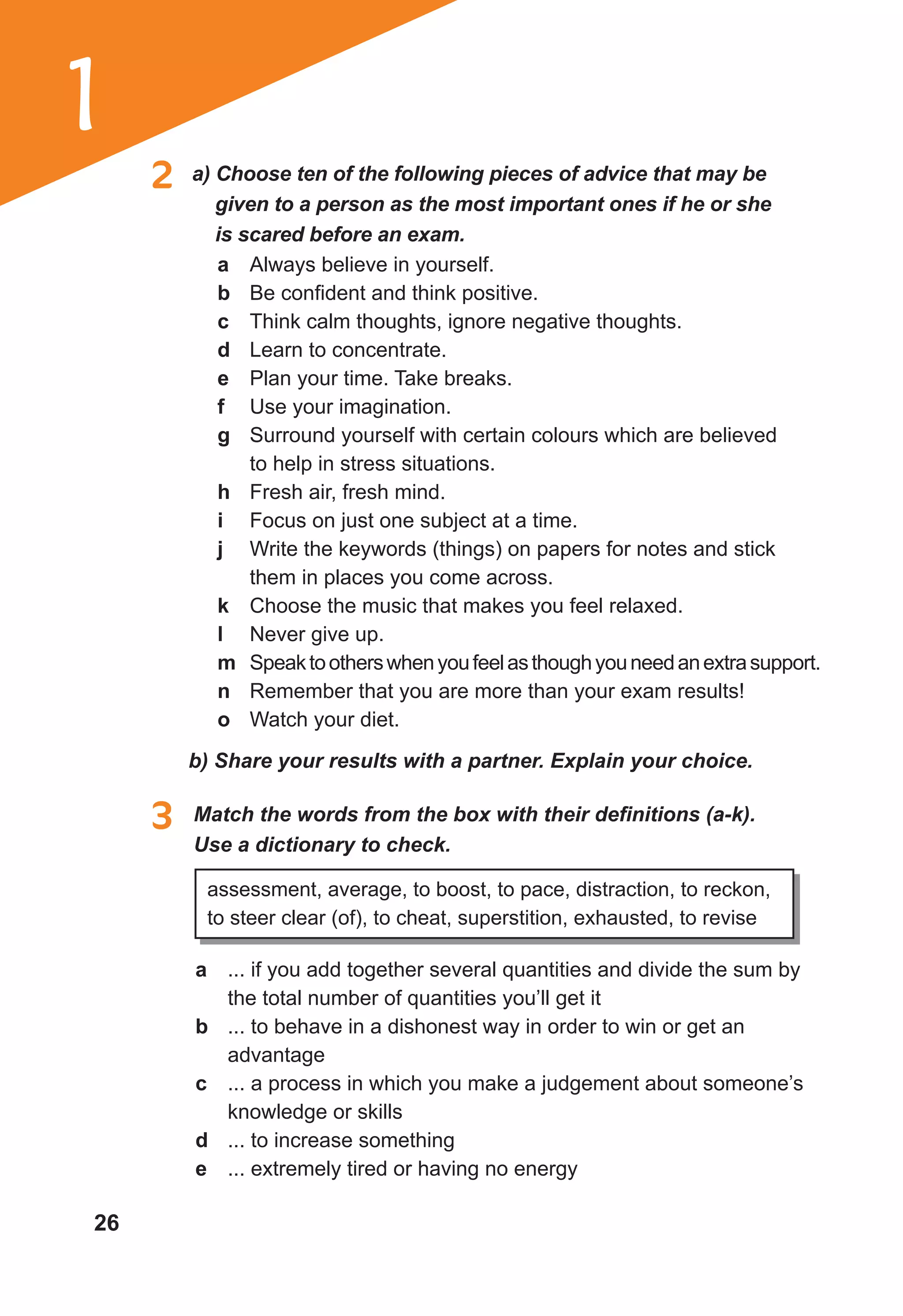
2 a) Choose ten of the following pieces of advice that may be
given to a person as the most important ones if he or she
is scared before an exam.
a Always believe in yourself.
b Be confident and think positive.
c Think calm thoughts, ignore negative thoughts.
d Learn to concentrate.
e Plan your time. Take breaks.
f Use your imagination.
g Surround yourself with certain colours which are believed
to help in stress situations.
h Fresh air, fresh mind.
i Focus on just one subject at a time.
j Write the keywords (things) on papers for notes and stick
them in places you come across.
k Choose the music that makes you feel relaxed.
l Never give up.
m Speaktootherswhenyoufeelasthoughyouneedanextrasupport.
n Remember that you are more than your exam results!
o Watch your diet.
b) Share your results with a partner. Explain your choice.
3 Match the words from the box with their definitions (a-k).
Use a dictionary to check.
assessment, average, to boost, to pace, distraction, to reckon,
to steer clear (of), to cheat, superstition, exhausted, to revise
a ... if you add together several quantities and divide the sum by
the total number of quantities you’ll get it
b ... to behave in a dishonest way in order to win or get an
advantage
c ... a process in which you make a judgement about someone’s
knowledge or skills
d ... to increase something
e ... extremely tired or having no energy
an assessment
[39sesm3nt]
a distraction [di9str2kSn]
a superstition [0su:p39stiSn]
to boost [bu:st]
to cheat [tSI:t]
to reckon [9rek3n]
to pace [peis]
average [92v3ridz]
exhausted [ig9xc:stid]
z to steer clear (of)
WORDS
FOR YOU
4 Listen to the conversation between two friends and name
the pieces of advice that one gives another.
5 Listen again and decide if the opinions below are expressed by Sara,
Tony or both of them. Note ‘S’ for Sara, ‘T’ for Tony or ‘B’ for both.
	 3 You should turn your phone
off when you study.
	 4 Make sure you have enough
sleep before your exam.
	 5 Eating fish can help you
perform better in tests.
	 6 Doing previous test papers
can help you do better in
examinations.
	 7 You should have a break
every hour when studying.
f ... to study lessons again in
order to learn them before
an examination
g ... to set a controlled regular
speed for yourself
h ... a belief that some objects
or actions are luck and
some are unluck, based on
old ideas of magic
i ... a pleasant and not very
serious activity (that can
drive your attention away
from serious things)
j ... this word is spoken to think that something is a fact
k ... to try to avoid something unnecessary or annoying
27
	 1 Tests are not a good way of measuring someone’s knowledge.
	 2 It can be hard to tell if students’ works outside exams
are their own ones.
4 Listen to the conversation between two friends and name
5 Listen again and decide if the opinions below are expressed by Sara,
1
1 In pairs, ask and answer the questions.
Focus on Speaking
1 Do you write notes in pencil in your course book and revise them
for tests? Why (not)?
2 Do you try talking to a partner during the school breaks and after
classes only in English?
3 Do you revise new words every day? Why (not)?
4 Do you only work hard a few days before an exam? Why (not)?
5 Do you ever help your group mates if they don’t understand
anything? Why (not)?
6 Do you regularly make a list of your common mistakes? Why (not)?
7 Are you sure you know how to use your dictionary? Why (not)?
8 Do you study only the material that was given at the lesson and
nothing else? Why (not)?
9 Do you have special time or special day for studying? Why (not)?
10 Do you keep a list of useful vocabulary in a special notebook?
Why (not)?
11 Do you give the tests to yourself or study with friends and test
each other? Why (not)?
12 Do you only learn what the teacher tells you to? Why (not)?
28
13 Do you have time only to attend the
lessons? Do you have time for
anything extra?
14 Do you write everything you know on
your hand before you go into the
exam? Why (not)?
15 Do you think that passing or failing an
exam is a matter of luck? Why (not)?
29
a	 No, I think I’ll definitely fail
that exam.
b	 That history exam was really
awful.
c	 Yes, it was. Only a couple of
the topics, which I reviewed
for the exam, came up.
a	 I’d just started on the third and last
question when my mind suddenly
went blank. I couldn’t remember
anything of what I’d reviewed for
that topic.
b	 Well yes, but…
c	 But it was absolutely awful. I just
don’t know why it happened.
2	 In pairs, complete the dialogues with the sentences (a-c)
and dramatise them.
A: …
B: Was it really so bad?
A: …
B: That was really bad luck.
Do you think you managed
to do enough to pass?
A: …
B: Oh, come on, don’t be so pessimistic.
A: Now come on, calm
down, it’s not the end
of the world. It was
just an exam.
B: …
A: Why? What happened?
B: …
A: But you answered the first two questions?
B: …
A: Then stop worrying. I’m sure you did enough on those to pass.
3	 Work in groups. Read the situation and prepare a five-minute talk
on how to do well in school exams. Use the ‘Useful Tips’ below.
z
z Some classmates of yours
keep complaining about
their grades. They claim
that they spend hours
preparing for the exams,
but results are disastrous.
Your results are impressive.
You have decided to help
your classmates.
USEFUL
TIPS
A Short Talk
z
z plan your talk, but DO NOT read it
z
z include all important information
z
z present your points in a simple,
clear and direct way
z
z use informal language
z
z use transitional
words / phrases
1
2
30
1 Focus on Writing
1 Get some information and look through the examples below.
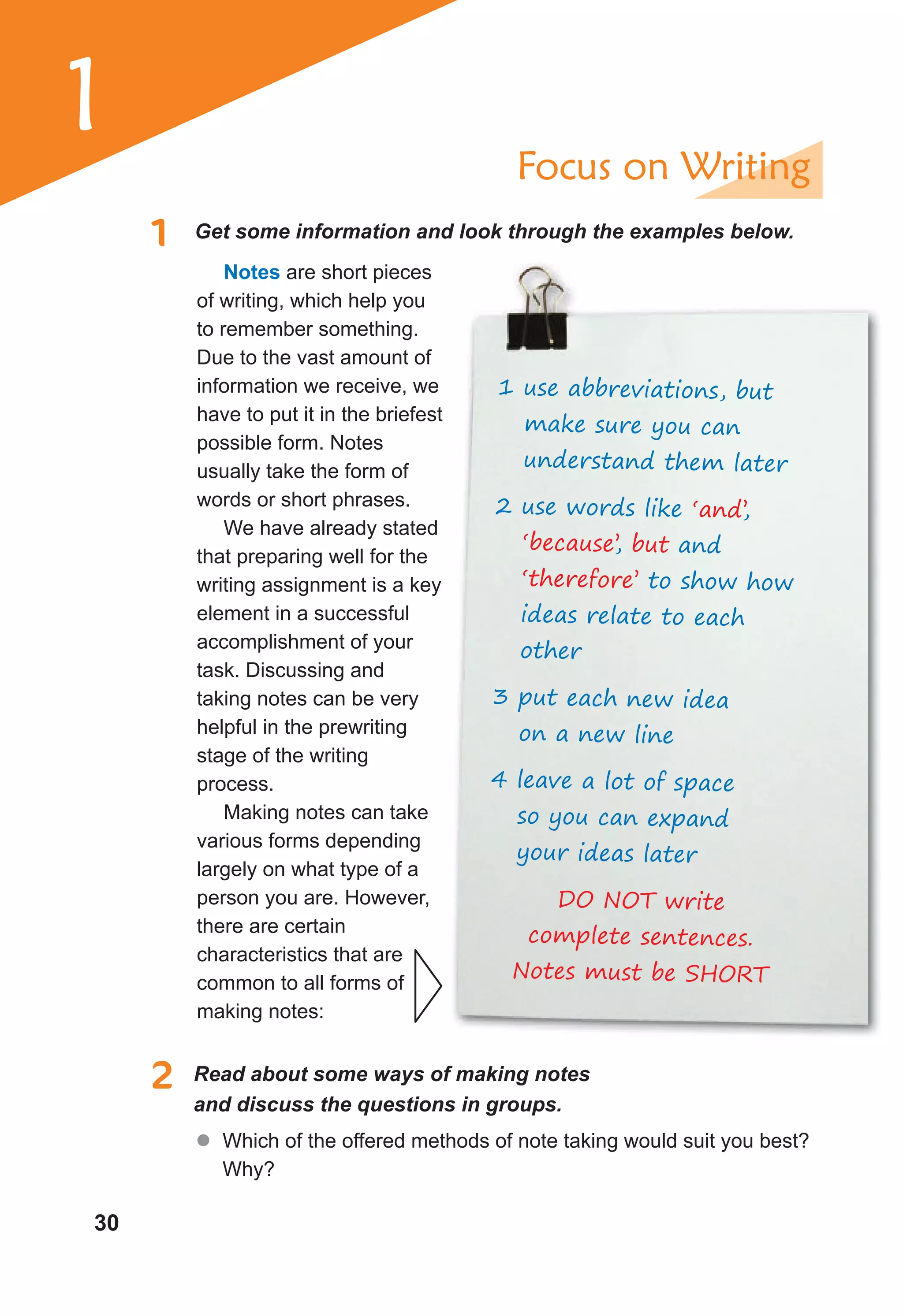
Notes are short pieces
of writing, which help you
to remember something.
Due to the vast amount of
information we receive, we
have to put it in the briefest
possible form. Notes
usually take the form of
words or short phrases.
We have already stated
that preparing well for the
writing assignment is a key
element in a successful
accomplishment of your
task. Discussing and
taking notes can be very
helpful in the prewriting
stage of the writing
process.
Making notes can take
various forms depending
largely on what type of a
person you are. However,
there are certain
characteristics that are
common to all forms of
making notes:
1 use abbreviations, but
make sure you can
understand them later
2 use words like ‘and’
,
‘because’
, but and
‘therefore’ to show how
ideas relate to each
other
3 put each new idea
on a new line
4 leave a lot of space
so you can expand
your ideas later
DO NOT write
complete sentences.
Notes must be SHORT
2 Read about some ways of making notes
and discuss the questions in groups.
z
z Which of the offered methods of note taking would suit you best?
Why?
31
b) CLUSTERING (Travelling to the Island of Fuji)
c) LISTING (Traditional Holidays Are Dying Out)
1 the idea of a traditional holiday has changed significantly
in the past decade
2 people in general have become more demanding
and expect better quality for their money
3 love of adventure has always been a part of the human nature
4 new means of transport have enabled us to travel more
easily and faster
5 more people can afford these new types of holidays due
to more reasonable prices
a) FLOW CHART (Having Friends for Dinner)
cancel late meetings
leave office at four
check passport validity
take traveller’s cheques
get some travel guides (local customs, sights)
check the weather — clothes
travelling to the island of Fuji
call the Horist — ask to
deliver Howers by six
start cooking by 5:30
check evening dress
go to the supermarket
DO NOT forget shopping list
1
3 Choose one of the topic sentences below and make notes.
Write a paragraph in 80-100 words.
1 Mathematics has always been my favourite subject at school.
2 Independent language learning has several advantages.
4 Read and discuss the information in pairs.
5 Choose a text from a
newspaper or a magazine
and read it. First
determine the number of
words and then write your
own summaries.
Comment on each other’s
summary regarding the
characteristics of a good
summary.
A summary is a short statement that gives only the main points
and not the details of a longer text.
A well-written summary should be concise (only essential
information should be included), complete (all important information
must be included) and clear, i.e. understandable to the reader. At
last, a summary must be correct. It must convey the exact meaning
of the original text.
A summary must be written in full sentences.
Don’t mix up paraphrasing and summarising! Paraphrasing is
“rewriting” information from another source in your own words without
changing its meaning. Since you have to include almost all the original
information, a paraphrase is almost as long as the original. On the
other hand, a summary includes only the essential information, which
makes it much shorter than the original text.
However, changing the original meaning is not
allowed in either a summary or a paraphrase. WRITING
POINT
32
Use Your Skills
33
1 Complete the text with the correct words
from the box.
achievement, adjustment, admit, attitude, average, colleges, common,
failure, grade, letter, marking, method, minimum, occasionally, pass,
percentage, perfect, progress, record, reports, school, teacher
GRADING
Grading is a (1) … used in schools to (2) … students’ achievements.
Almost every (3) … keeps a record of each student’s (4) … in order to
have some basis for measuring his (5) … . The record supplies
information for (6) … to parents. Universities and (7) … often use this
information to help determine whether they should (8) … a student.
For a long time, the most (9) … method of recording achievement
was by (10) …, with a mark or (11) …, of 100 per cent representing
(12) … achievement. The (13) … mark for a (14) … was usually 70 per
cent, and for (15) … work, about 80 per cent. Today, the letters A, B,
C, D, E and (16) … F, are much more commonly used. The mark A
stands for exceptional achievement, and E or F means (17) … .
A few schools use no (18) …
system at all. Instead, each (19)
… writes a detailed (20) … to
the parents. Such letters report
the student’s progress, (21) …
activities and social (22) … .
Use Your Skills
1
Use Your Skills
34
1
CAE = Certificate in Advanced English
2 Complete the interview by changing the
forms of the verbs in brackets. Then act
out the interview in pairs.
Journalist: What exam did you
… (take)?
Viktor: FCE. First Certificate in
English.
Journalist: Do you think you …
(pass)?
Viktor: I think so. I’m quite
optimistic. I think I … (do)
the exam quite well.
Journalist: When … you …
(get) your result?
3 Do the project. Search for the information on the international
exams in English and prepare a short presentation.
Use the instructions below.
1 Search for PET, FCE and CAE in the Internet.
2 Write your presentation using the material you have found,
the following phrases and the plan below.
3 Do the presentation in class using the Helpful Tips.
Viktor: Tomorrow morning. I study at a language school and when I
… (go) to class tomorrow the grades will be on the notice board.
My name … (be) the first on the list because my surname begins
with ‘A’.
Journalist: How … you … (celebrate) if you … (pass)?
Viktor: I … (go) to a cafe with other students from my class. Well,
with the students who have passed.
Journalist: And what will you do if you … (pass)? … you … (carry)
on studying English?
Viktor: Yes, I’d like … (take) the CAE1
exam next year.
Journalist: And if you … (not, pass)?
Viktor: I … (take) the exam again in June.
Good morning, everyone, and
welcome! The purpose of this
presentation is to get you
acquainted with ... . First of all …
35
To start with …
Today I want to talk to you
about …
After that, I’ll move on to ...
That’s all about …
Now I would like to …
Finally, I’ll review the main
points.
Feel free to interrupt me
if you have any
questions.
Let’s move on to …
A good example of this
is …
Giving a Presentation
z
z Speak slowly, don’t speak too quickly.
z
z Pause between important points.
z
z Lower your voice to draw
the audience in.
z
z Raise your voice to emphasise
important points.
z
z Maintain1
good eye contact
with your audience.
z
z Don’t use long sentences
or difficult grammar.
z
z Avoid using words
the audience may
not know. HELPFUL
TIPS
THE PLAN OF YOUR
PRESENTATION
1 Welcome your audience.
2 Introduce your subject.
3 Outline2
the structure
of the talk.
4 Give a summary of your
findings.
5 Make conclusions.
6 Answer the questions
of your audience.
1
to maintain [9meintein] — підтримувати
2
to outline [9autlain] —
окреслювати
Use Your Skills
1
4 Read the information in the box
and get ready to hold the class
debate.
Then follow the instructions
below.
1 Form three groups.
z
z The first two groups should
prepare arguments for
either accepting or
rejecting the motion,
present their arguments
and be ready to answer
the questions from the
other group.
z
z The third group should listen to both groups and decide
whether to accept or reject the motion providing
arguments for their decision. Before making the decision,
the third group can put questions to both groups.
2 Allow time for the groups to prepare their arguments.
3 Group presentations.
4 Asking and answering the questions.
5 Presenting the decision.
1
controversial [0kAntrC9vE:Sl] — спірний, дискусійний
CONTINUOUS ASSESSMENT
OR ONE FINAL EXAMINATION?
A proposal for education
reform is being discussed by
students, teachers, parents,
experts, etc. It still hasn’t been
decided how students will be
assessed at the end of their
secondary school education.
Before making the final
decision, the Ministry of
Education is interested in what
students have to say about this
rather controversial1
issue.
36
Use Your Skills
37
Check Your English
1 Fill in the gaps in the sentences given below
with one of the words A, B, C or D. Change
the forms of the words where necessary.
A failing B studying for C passing D taking
A memorise B revise C repeat D learn by heart
A learn B study C find out D know
1 Congratulations on … all your exams!
2 No one likes … an exam. I hope she will do better next time.
3 When are you … your English exam, in May or June?
4 Maria is … her English exam so hard, she doesn’t go out at all!
5 Do you think it is possible to … everything that we have studied
during the year in two days before the exam?
6 My friend has a very good memory, she can … a long poem easily.
7 If you want to master foreign pronunciation, you should have enough
patience to … phrases after the tape for many times in a row.
8 No matter how hard he tried, he couldn’t … the list of irregular
verbs the teacher gave in class.
9 Where does your friend …? — He does an English course at university.
10 It has always been easy for Jack to … foreign languages.
11 Peter … several foreign languages and his dream is to work as a
tour guide.
12 It is always very interesting for me to … about the culture of the
country the language of which I study.
Grammar
2 Complete the sentences by changing the verb in brackets
into the First or Second Conditional form.
1 If it … (stop) raining we’ll have to cancel the tennis game.
2 If you loved her, you … (lie) to her.
3 If you … (finish), show me your notebook.
Check Your English
Vocabulary
38
1
Check Your English
Listening
3 Listen to the four international students talking about how they
memorise words. Match them with the strategies they use.
Analytical: thinking about the structure of words
Visual: writing, drawing, connecting photos with words
Self-testing: doing personal tests or asking someone
at home to test you
Oral: saying words aloud, making connections
between words
Johan
Basia
Pablo
Hilmi
4 I … (lend) you any money unless you promise to
pay me back before the end of the month.
5 If I … (speak) Italian, I would move to Florence.
6 If I … (be) you, I would notify them of the changes.
7 If we meet in front of the cinema at quarter to eight,
we … (have) enough time to buy the tickets.
Right, well, er… my talk today is on learning
styles. I chose this because there is a lot of
research into it and it seems as if nobody really
agrees on how to assess learning styles. I’ll start
by outlining some competing theories about.
How people learn… There aren’t any handouts,
I’m afraid, but anyway… One theory is the VARK
system. V-A-R-K means V for visual, A for auditory,
Reading
4 a) Read the student’s presentation on learning
styles and complete the form below.
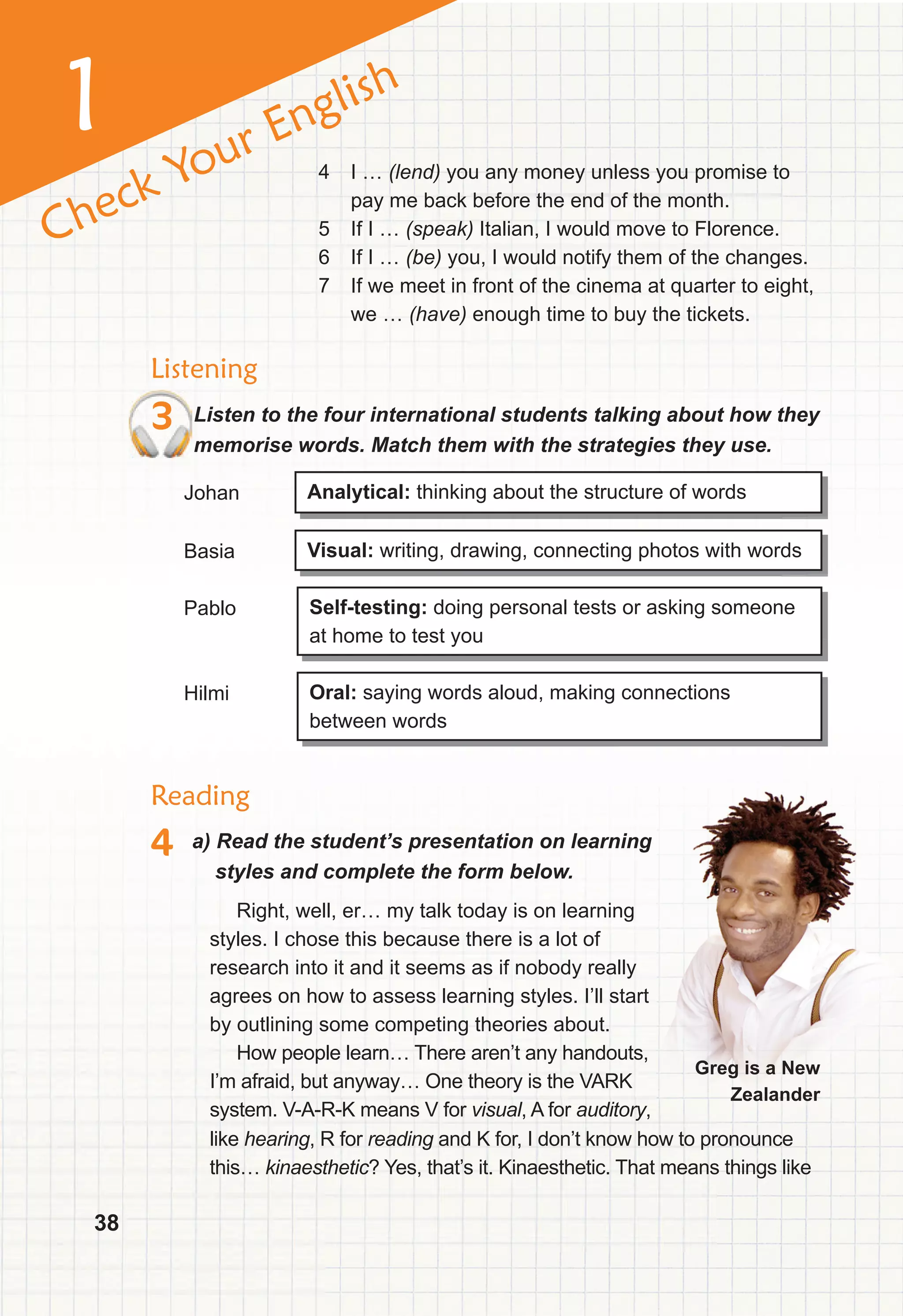
Greg is a New
Zealander
like hearing, R for reading and K for, I don’t know how to pronounce
this… kinaesthetic? Yes, that’s it. Kinaesthetic. That means things like
Learning Style Advice for Studying
V
A
R
K
39
Check Your English
touch,
movement and stuff.
Anyway, according to the VARK
system, depending on your learning style, you learn in different ways.
If you’re a visual learner, then you need to use charts and pictures,
use colour highlighting in your notes, and stuff. If you’re an auditory
learner, then reading aloud and listening will help you learn. Reading
is just reading, of course. You learn by reading. Kinaesthetic learners
need to move around while they learn. You’re a kind of hands-on
person if you’re that kind of a learner, so you should revise while
standing up and walking around the room, for example. Anyway, that’s
just one theory. There are lots of others, too.
So, to conclude then, personally I think that we all have our own
learning styles and we are not just one type or another. In other
words, we are probably a blend of lots of styles. I don’t think any of
the learning styles I’ve told you about is better than any other. I
think the problem is that we all learn in different ways, and try to
find a system to fit in all the different ways we learn. We are too
creative to be boxed in like that. Not everything about the human
brain can be mapped and predicted. How we learn is different for
each person, so the point I’m making is I don’t know how useful it
is to try to categorise everyone into types.
1
Check Your English
I CAN …
read and understand what autonomous learning means
listen to and understand advice how to get ready
for final exams
talk about my learning
express my opinion about grading and assessment
understand and use Conditionals I and II
use different methods of note making

40
b) Read the statements below and tick ()
your answers.
Greg thinks that: Yes No
a most people have the same learning style
b one learning style is better than the rest
c people learn in similar ways
d we all have more than one learning style, but
we usually rely on one or two most of the time
e by categorising learning styles we can help
people to learn very effectively
f it’s not possible to categorise everyone
g it’s not possible to analyse learning styles
because we learn in too many different ways
h the human brain is predictable
i more research into how people learn is
necessary
Unit 2
Make Up Your Mind
IS IT DIFFICULT FOR
YOUNG PEOPLE TO FIND
A JOB NOWADAYS?
z Young people with a
(university degree /
secondary education
only /…) may (have
problems with…/ find it
easy to…/…).
z You have to be really
(responsible /
professional /…) to get
a good job.
HOW CAN YOU IMPROVE YOUR
CHANCES OF GETTING A GOOD JOB?
z When studying it is important to (have
good marks/be active outside the
classroom /…).
z You should (attend courses / study
books /…).
z It is always useful to have many skills
like (driving license / PC skills /…).
DO YOU WANT TO DO THE
SAME WORK ALL YOUR LIFE
OR TRY DIFFERENT JOBS?
z In my opinion, it is better
(to try different jobs / work
for one company /…).
z Different jobs and positions
may bring you a lot of
(experience / problems
such as…/…).
HOW DO YOU IMAGINE A GOOD
BOSS? WHAT QUALITIES
SHOULD HE/SHE HAVE?
z A good boss should be
(understanding / sociable /
generous…).
z If you have done well, he/she
should (notice it / reward you /…).
z If you failed at something, both
of you should (analyze the
mistakes /…) together.
WARM UP
2
1 Work in small groups. Read and discuss the following.
Focus on Reading and Vocabulary
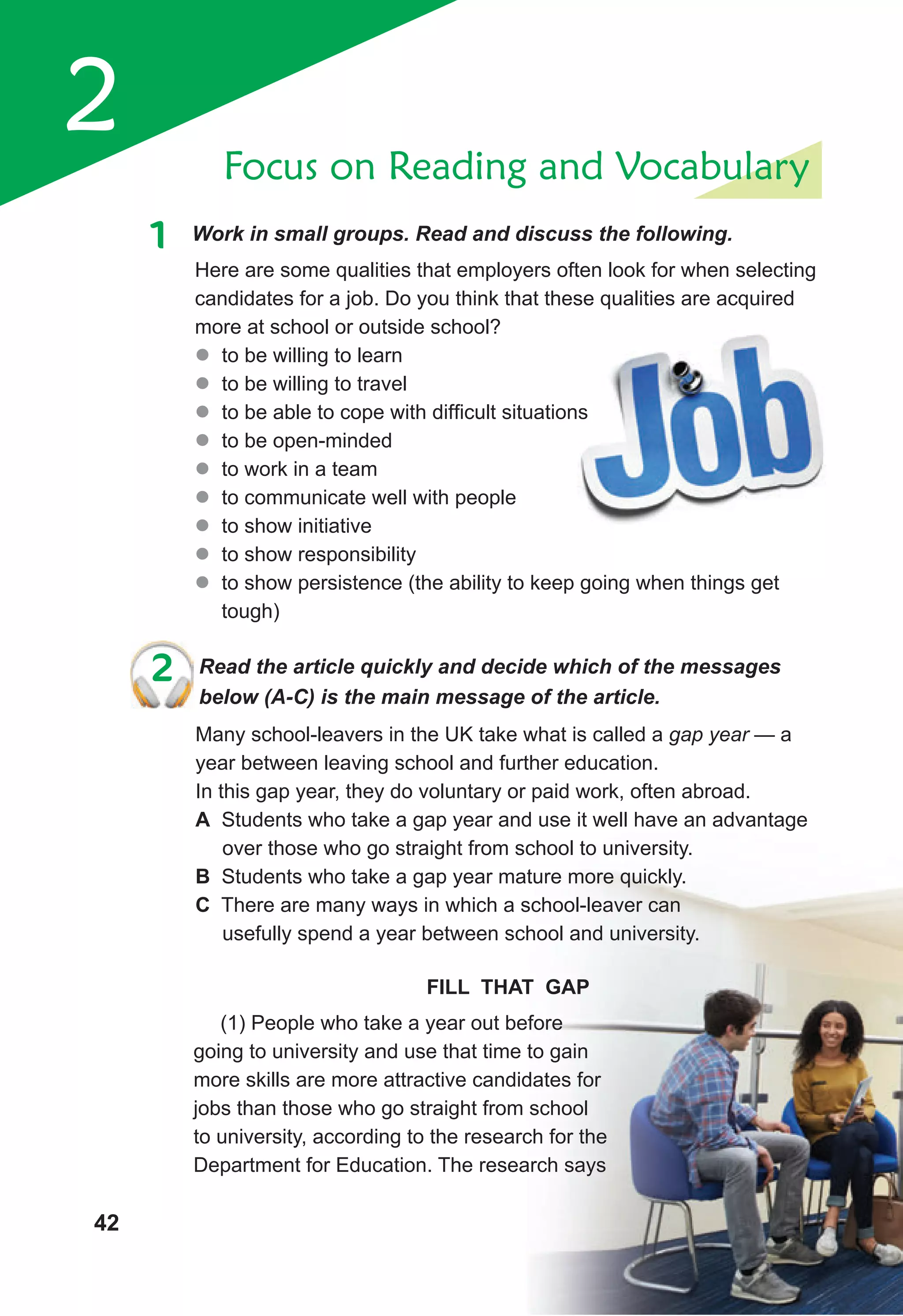
Here are some qualities that employers often look for when selecting
candidates for a job. Do you think that these qualities are acquired
more at school or outside school?
z
z to be willing to learn
z
z to be willing to travel
z
z to be able to cope with difficult situations
z
z to be open-minded
z
z to work in a team
z
z to communicate well with people
z
z to show initiative
z
z to show responsibility
z
z to show persistence (the ability to keep going when things get
tough)
2 Read the article quickly and decide which of the messages
below (A-C) is the main message of the article.
Many school-leavers in the UK take what is called a gap year — a
year between leaving school and further education.
In this gap year, they do voluntary or paid work, often abroad.
A Students who take a gap year and use it well have an advantage
over those who go straight from school to university.
B Students who take a gap year mature more quickly.
C There are many ways in which a school-leaver can
usefully spend a year between school and university.
(1) People who take a year out before
going to university and use that time to gain
more skills are more attractive candidates for
jobs than those who go straight from school
to university, according to the research for the
Department for Education. The research says
FILL THAT GAP
2 Read the article quickly and decide which of the messages
42
43
that employers are particularly
interested in the skills that students
pick up when travelling,
volunteering and working,
because they do not trust
universities to teach the arts of
communication, teamwork and
leadership.
(2) There are many reasons
why there is a growing number of
students who take a gap year.
There are school-leavers who are
happy to be out of the school
system at last and want to have
some time to do something
interesting or crazy before they go
back into the educational system.
There are those who want to earn
money to pay their university fees.
There are those who feel they
want to do something useful with their lives and there are those
who want to get away from home and see the world while they can.
Finally, there are those who want to prepare themselves better for
the job market once they get their degrees. Jamie Underwood, a
founder of a gap year agency, says, “It’s a brilliant thing to do. If
you’re focusing on getting ahead, employers love it: it shows
character, confidence, achieving goals and persistence.”
(3) School-leavers can
choose from a wide range of
activities for their gap year.
They can take part in an
adventure project, like an
expedition to some remote
corner of the earth, which can
be really exciting and it has the
advantage of travelling as part
confidence
[9kAnfid3ns]
an employer [im9plci3]
a fee [fI:]
a founder [9faUnd3]
persistence [p39sist3ns]
a volunteer [0vAl3n9ti3]
to mature [m39tSU3]
to trust [tryst]
extended [ik9stendid]
faint-hearted [0feint 9h4:tid]
isolated [9ais3leitid]
remote [ri9m3Ut]
tough [tyf]
overseas [03Uv39sI:x]
z to conduct a survey
z to get insight (into)
z to work on
(a project)
WORDS
FOR YOU
2 of a group and making some life-long friends. They can work on a
conservation or environmental project, like conducting an underwa-
ter survey of a coral reef or monitoring endangered species. They
can do temporary or seasonal work abroad and this way get insight
into a very different way of life. They can join a humanitarian project,
such as doing social work with people in need. Or they can join a
structured work experience programme and gain valuable experience
and practical skills in their chosen field. Mr Underwood says, “I ma-
tured during my gap year. I grew up. You come back with a real
sense of achievement and a new perspective on life.”
(4) But some locations aren’t for the faint-hearted. Voluntary work
can be tough. You may be out in the middle of nowhere, feeling
isolated and having trouble coping with the complete culture shock.
So it’s important to research the opportunities fully and take time to
read what other ‘gappers’ have to say about their experience of
volunteering overseas. And it’s also important to plan the year
properly. According to the research of the Department for Education
and Skills, too many students fail to plan properly and do not take
advantage of the opportunities on offer. This can turn the gap into a
blank hole. As Mr Underwood says, “There’s a great difference
between doing a structured placement and going on an extended
holiday in some exotic place. Students who are doing volunteering get
an awful lot of good experiences. Employers are falling over
themselves for those maturing skills, which they think universities
don’t give.”
44
45
3 Read the article again paying attention to the words in bold
and consulting a dictionary if necessary. Decide which of
the following messages (a-g) is not included in it.
a Students who do voluntary or paid work in their gap year have a
better chance of getting a job after university.
b Employers look for much more than educational qualifications.
c Many students use their gap year to pay for their university
education.
d Voluntary work in another culture can broaden your view of the
world.
e Some students can have negative gap year experiences.
f A number of students do not use their gap year well.
g Some students find it difficult to adjust to further education after
a gap year.
4 Match the words with their definitions.
a to become fully grown or developed
b someone who does something without
being paid
c the belief that you have the ability to do
things well or deal with the situation
successfully
d a quality that gives a person ability to
continue to do something although this
is difficult
e abroad
f to believe that someone is honest and
will not harm you, cheat on you, etc.
g difficult
h increased, longer in time or bigger in size
i not trying very hard, because you do
not want to do something, or you are
not confident that you can succeed
j feeling alone and unable to meet or
speak to other people
1 confidence
2 extended
3 faint-hearted
4 isolated
5 to mature
6 overseas
7 persistence
8 tough
9 to trust
10 a volunteer
46
6 Look for five types of gap year activities in paragraph 3
of the article. Ask and answer the questions in pairs.
1 To which types do the following activities belong?
a working with homeless children
b protecting the habitat of white-headed vultures1
c searching for dinosaur fossils2
in Patagonia
d working in a mobile phone company
e picking olives in Spain
a is adventurous and has strong endurance3
skills?
b can adapt to different cultures?
c has practical skills in the field of work?
d has a caring personality?
2 Which of the types of gap year activities would interest an
employer who is looking for someone who
5 Find the words
or phrases in the
article that mean
the following
(the number of the
paragraph, in which
the word appears,
is in brackets).
a to acquire (a skill) — ... (1)
b far from towns — ... (3)
c carrying out (research, a survey) — ... (3)
d carefully watching a situation to see how it changes — ... (3)
e a clear understanding of something, especially of something
complicated — ... (3)
f people who are not prepared to make a lot of effort or are easily
demotivated — ... (4)
g in a remote place — ... (4)
h being very eager for something — ... (4)
2
1
a vulture [9vyltS3] — гриф
2
fossils [9fAslx] — скам’янілості; викопні тварини
3
an endurance [in9djU3r3ns] —
витривалість, терпіння
Develop Your Vocabulary
VOCABULARY
LINKS
WORK or JOB?
Work is something you do to earn money. This noun is uncountable.
She enjoys her work in the hospital.
Job is used to talk about the particular type of work activity which you do.
He’s looking for a job in computer programming.
POSSIBILITY, OCCASION or OPPORTUNITY?
A possibility is a chance that something may happen or be true.
‘Possibility’ cannot be followed by an infinitive.
Is there a possibility of getting a job in your organisation?
An occasion is an event, or a time when something happens.
‘Occasion’ does not mean ‘chance’ or ‘opportunity’.
Birthdays are always special occasions.
An opportunity is a possibility of doing something, or a situation
which gives you the possibility of doing something.
The trip to Paris gave me an opportunity to speak French.
I have more opportunity to travel than my parents did.
1 Choose the correct word to complete each sentence.
1 It was hard physical (job / work), you know, lifting people,
helping them into wheelchairs and pushing them.
2 I got my first (job / work) as an assistant receptionist in a hotel
when I was just 18.
3 It wasn’t a very well-paid (job / work), but then first (jobs / works)
often aren’t.
4 I thought it was a great (opportunity /
occasion / possibility) to get
some work experience.
5 And on some (opportunities /
possibilities / occasions)
I was left on my own as the person
in charge of the whole of this
enormous hotel.
47
2
48
VOCABULARY
LINKS
career [k29rIC]
Your career is the work you do over a number of years:
His acting career began when he was
just 6 years old and is still going well.
employer [im9plciC]
is a person or a company
that employs other people.
employee [implc9iI:]
is a person who works
for somebody.
2	 Brush up your vocabulary. Choose the best word to complete
each sentence. Use a dictionary to help you.
1	 I plan to have a long (career / occupation) in advertising, but I
know I will have to work hard to succeed.
2	 The annual (salary / money) for this job is £35,000 a year.
3	 I’ve got a holiday job, delivering newspapers. The (salary / pay)
is quite good. It’s £5.00 an hour.
4	 When did your (occupation / employment) with this company
begin?
5	 So, would you like to arrange a loan with our bank, Mr Johnson?
Do you mind if I ask you a few questions first? What is your
(occupation / employment)?
Word Formation
assist	 	 assistant, assistance
employ	 	 (un)employment, employer, employee, unemployed
occupy	 	 occupation
retire	 	 retired, retirement
succeed	 	 success, (un)successful
3	 Complete the sentences by changing the words
in brackets into correct forms.
1	 My granddad had a long career. He started work as an assistant
and worked his way to the top. (assist)
2	 Being a firefighter is a very stressful … . (occupy)
49
3	 It took Mark a long time to find a new job. He was … for nearly
two years. (employ)
4	 It takes a lot of hard work to be … in this business. (succeed)
5	 Mary is 60 next week and she’s leaving, so remember to wish her
‘Happy ...’. (retire)
Build Up Your Grammar
GRAMMAR
LINKS
Direct Speech (Пряма мова)
Direct speech is the words that people actually say. When we
write direct speech, we use speech marks (“ ”). We usually use
said when we write direct speech: “I’m very happy,” she said.
“What about you?”
Reported Speech (Непряма мова)
Reported Speech is used to express what others say (said, have
said, etc). When we report a statement (твердження) in the
present we can use say or tell: My friends say I am lucky. (It
means they always say this about me.) When we report
statements in the past we use said or told: My friends told me I
was lucky. (It means they say this about the situation in the past.)
With tell the object pronoun must be used:
They told me (that)…
She told him (that)…
1	 Study the examples, then write ‘say’ or ‘tell’ in the blanks
to complete the sentences below.
“I have my lunch at school,” he said.
He said (that) he had his lunch at school.
He said to Sally (that) he had his lunch at school.
He told Sally (that) he had his lunch at school.
2
50
GRAMMAR
LINKS
1	 Jane … (that) she wanted to learn how to use reported speech.
2	 Mary … us (that) she had done her homework already.
3	 She … to Tom (that) she was going to join the judo club at school.
4	 Lucy … me (that) she couldn’t come to the party.
5	 Our teacher … (that) he wasn’t going to give us any homework
for Monday.
6	 They … us (that) the pupils got a lot of work to do.
7	 Suzan … (that) she hadn’t visited her granny yet.
8	 Nobody … me (that) I had to do this.
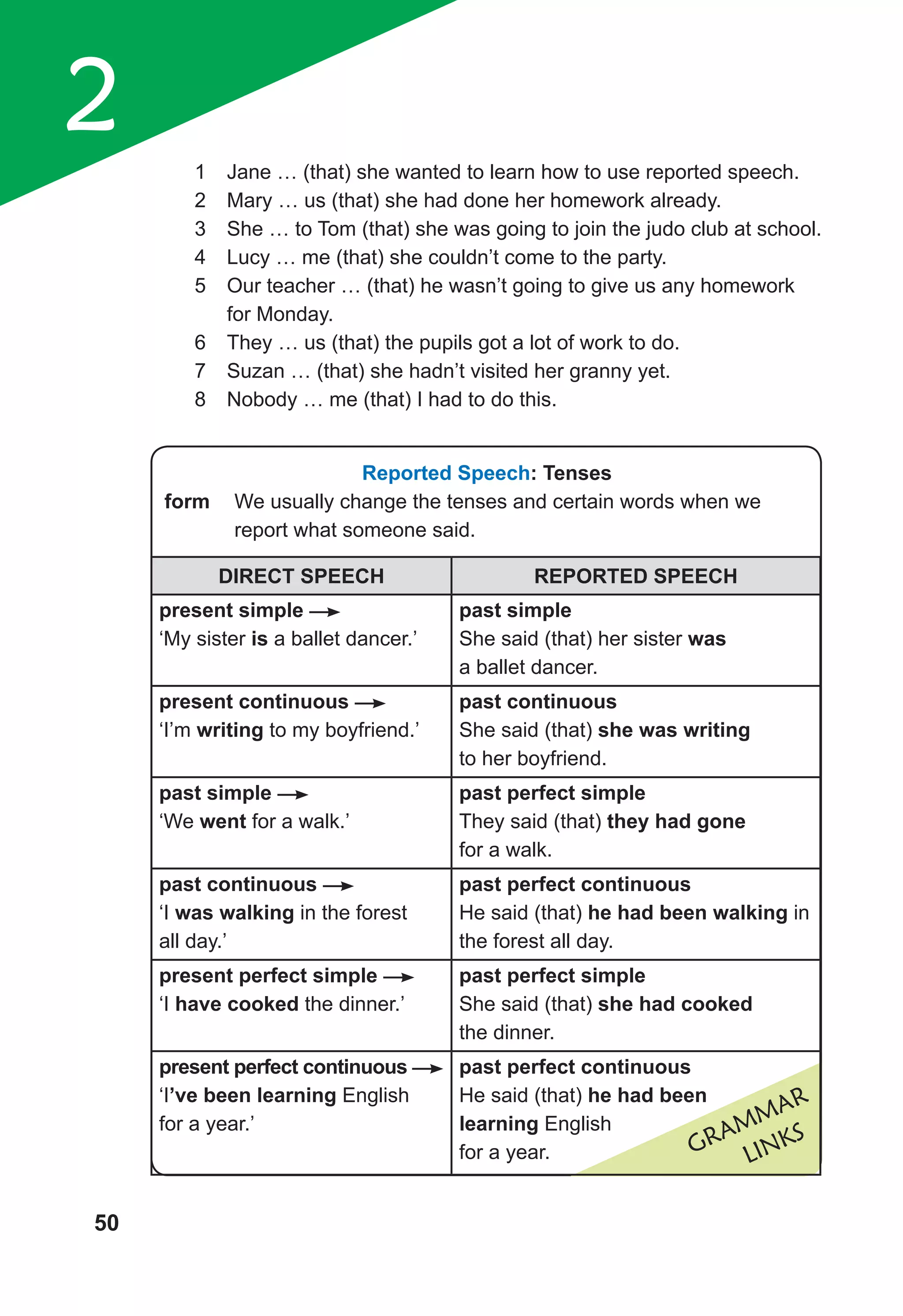
Reported Speech: Tenses
form	 We usually change the tenses and certain words when we
report what someone said.
DIRECT SPEECH REPORTED SPEECH
present simple
‘My sister is a ballet dancer.’
past simple
She said (that) her sister was
a ballet dancer.
present continuous
‘I’m writing to my boyfriend.’
past continuous
She said (that) she was writing
to her boyfriend.
past simple
‘We went for a walk.’
past perfect simple
They said (that) they had gone
for a walk.
past continuous
‘I was walking in the forest
all day.’
past perfect continuous
He said (that) he had been walking in
the forest all day.
present perfect simple
‘I have cooked the dinner.’
past perfect simple
She said (that) she had cooked
the dinner.
present perfect continuous
‘I’ve been learning English
for a year.’
past perfect continuous
He said (that) he had been
learning English
for a year.
51
Notes:
z
z I sometimes changes to he or she.
z
z My sometimes changes to her or his. Our changes to their.
z
z The adjectives this, that, these and those usually change to the.
e.g. ‘I like these grapes.’ He/She said he/she liked the grapes.
z
z The pronouns this and that usually change to it.
e.g. ‘I want to paint this blue.’ ‘He/She said he/she wanted to
paint it blue.
z
z The pronouns these and those usually change to them.
2 Read, then tell about everything Natasha said
about her experience. Use the Reported Speech.
I’VE GOT A WHOLE NEW WAY
OF LOOKING AT THE WORLD
Natasha Anderson, 19, had not planned to
take a gap year this year. “I didn’t get the
grades I needed for the university.
I’ll take my exams again next June. At first, I
didn’t know what to do, but after a couple of
months of doing nothing and feeling bad about myself, I contacted
a gap year agency and now here I am, far from home.”
“I’ve been here for five weeks so far. I’ve been helping build
a water system, working alongside professionals. We’re
based in a permanent tented camp, but for the last two
weeks I’ve been staying in a small camp some distance
from the main one. It’s all very exciting. Before I came
here, I had just been sitting around watching daytime TV
and getting bored.”
“I’ve learned so much while I’ve been here. For
example, I’ve been learning Spanish since I arrived, and that might be
very useful for me later. I’ve met so many interesting people. I’ve got to
know the locals and to understand their point of view. I realised how
much of what I thought was true was just the way my particular culture
viewed the world. In fact, I’ve now got a whole new way of looking at
the world. Not only that, I now feel much more confident about myself.”
months of doing nothing and feeling bad about myself, I contacted
“I’ve been here for five weeks so far. I’ve been helping build
months of doing nothing and feeling bad about myself, I contacted
“I’ve been here for five weeks so far. I’ve been helping build
52
Future-in-the-Past
(Майбутній час з точки зору минулого)
is used when you look back on the past and want to remember
things that were planned or believed to happen in the future.
He hoped I would give him that book that day, but I haven’t
finished reading it yet.
I knew she wouldn’t come to see us so soon.
Mary said that she would play tennis with me.
Future-in-the-Past is also used when we want to report
the statement about the future.
“I’ll go to the library,” she said.
(Direct Speech, Future Simple.)
She said (that) she would go to the library.
(Reported Speech,
Future-in-the-Past.) GRAMMAR
LINKS
3 Change the sentences from direct into reported speech.
1 “The concert finished at four,” John said.
2 “I’ve finished the report,” said Mary.
3 “I’ll be late,” she said to me.
4 “We’ll have dinner in a cafe,” they said to their mother.
5 “I’m joining the Maths Club at school,” he said.
6 “The bell is ringing,” Rosie said.
7 “Nobody has to do it,” my mum said.
8 “They can speak about it later,” Bill noticed.
4 Read what Charlie says.
Then report his statements to another person.
Example: Charlie said (that) he had finished his work already.
2
53
Direct Speech Reported Speech
now at that time, then
tonight, today, this week, etc that night, that day, that week, etc
yesterday, last night/month, etc the day before, the previous
night/month, etc
tomorrow, next year, etc the day after, the next year, etc
two days/weeks ago two days/weeks before
this, these that, those
here there
ago before
Charlie, 25
I have finished
my work already.
My wife has
had a baby.
I saw Bill at the
shop yesterday.
I work 10
hours a day.
Mary and Sally are
visiting Paris next month.
I don’t know what
Ted is doing.
I’ll have a holiday
next week.
It’s my mother’s
birthday today.
I can’t come to the
party on Saturday.
2
54
Reported Speech (Commands and Requests)
To report a command we use ‘tell’.
“Go to the library.” — The teacher told Jack to go to the library.
“Don’t stand up!” — The head teacher told the children not to stand up.
To report a request we use ‘ask’.
“Could you fill in the form, please?” —
		 The clerk asked him to fill in the form.
“Don’t use a pencil, please.” —
	 She asked him not to use a pencil. GRAMMAR
LINKS
5	 Make up and complete the sentences using the table below.
The librarian
The parents
The teachers
the little
children
Mike
Helen
the young
readers
tell(s)
ask(s)
(not)
to wash their hands …
to write …
to make drawings …
to make dog’s ears …
to tear the pages …
to lose books …
to return books in time …
to use book-marks …
to cut out …
to colour …
to keep the books …
to put the books …
6	 Rewrite the requests.
Example: “Mike, can you help me find a book about monsters?”
She asked Mike to help her find a book about monsters.
1	 “Amy, can you send the e-mail for me?”
2	 “Sally, please, don’t copy my homework.”
3	 “Mum, please, let me go to the disco!”
4	 “Ron, can you turn your music down?”
5	 “Please, don’t make me tidy my room, dad.”
6	 “Tom, please give me your new CD!”
55
7 Report the following sentences.
1 “Close the door, please,” the conductor says to a passenger.
2 “Open fire!” the officer ordered the soldiers.
3 “Bring me a sheet of paper,” Mike said to Ann.
4 The client said to the cook, “Please, warm the supper up.”
5 The teacher said to the children, “Don’t make such a noise.”
6 Mike said to Sue, “Don’t come tonight.”
7 Ann said to her dad, “Please, give me that sandwich.”
8 Mr Baxter said to his wife, “Don’t be so kind to the children.”
9 “Don’t close the window!” Jack said.
Focus on Listening
1 Speak on the reasons why some young people would like
to study abroad. Use and complete the word map below.
go sightseeing
...
...
get a certificate
make friends from
different countries
prepare for a university
in that country
REASONS
TO STUDY ABROAD
experience a different
culture firsthand
communicate every
day in English
2
56
2 Listen to the information about what each of the five
English-speaking countries has to offer for students who
are thinking of going overseas to study and answer the
following questions in no more than three words. Make
notes if you need.
1 What type of university preparation course is available in the UK?
2 On which education system are New Zealand programmes
founded?
3 Which two values are extremely important to Americans?
4 Which US educational programmes are two years in length?
5 Who concluded that Canada is one of the best countries in the world
to live in? (From IELTS express Intermediate Coursebook, 2004.)
3 Match the words from the ‘Word File’ with their definitions (1-9).
1 … is known and admired by a lot of people, especially for some
special skill, achievement, etc.
2 … is attractive or interesting
3 … is the right to do what you want without being restricted by
anyone
4 … is the freedom and the right to do whatever you want without
being afraid of authority
5 … is a variety including a range
of different people or things
6 … is someone who has
completed a university degree
course, especially for a first
degree
7 … is a course of study including
several different subjects, taught
in the first year at some
universities in Britain
8 … is funded by ordinary people in
a country, who are not members
of the government
9 … is thought about in a good way
2 Listen to the information about what each of the five
diversity
[dai9vE:s3tI]
freedom [9frI:d3m]
a graduate [9gr2dzu3t]
liberty [9lib3tI]
Montreal [0mAntri9c:l]
Vancouver [v2n9ku:v3]
appealing [39pI:liN]
renowned [ri9naUnd]
foundation course
publicly funded
z to be well regarded
(in)
WORDS
FOR YOU
57
4 a) Listen to the information again and refer the following
countries to the appropriate statements (1-5).
AU (Australia)
CA (Canada)
NZ (New Zealand)
UK (United Kingdom)
US (United States)
1 There is an
enormous choice of
colleges and universities.
2 Some universities are
famous for courses in
environmental studies.
3 It is well-known for producing many famous authors.
4 Students should be able to think
for themselves.
5 It is not a very expensive
place to live in.
	1 Australia is a dangerous country.
	2 Most state universities in Australia are of comparable quality.
	3 A degree from a UK university is highly regarded.
	4 The British education system has a large practical element.
	5 Canada has the top three universities in the world.
(From IELTS express Intermediate Coursebook, 2004.)
4 a) Listen to the information again and refer the following
b) Tick () the statements below if
they are true and agree with them.
5 It is not a very expensive
place to live in.
b) Tick (
b) Tick () the statements below if
) the statements below if

2 Focus on Speaking
1 In pairs, speak on how people find information about jobs
in Ukraine.
2 In groups, discuss the questions below.
1 When were you able to give a definite answer about your future
profession? Who helped you to make your choice?
2 Has your choice of profession been changed from time to time as
you grew older? Why?
3 Do you think you’ll have to change your mind after you finish school?
What reasons could make you think about another profession?
4 What should a young boy (girl) do to be well suited for a chosen job?
5 Can you explain why new jobs are constantly appearing? What
might be especially attractive in a new job?
3 In pairs, complete the dialogues with your own endings
and dramatise them in class.
a “Have you chosen your future profession?”
“Strange as it may seem, I haven’t yet.”
“Well, I think it is natural that you hesitate. There are so many
occupations, that it is not easy to decide.”
b “Have you heard the news?”
“What news?”
“Nick has made up his mind to try to enter the teachers’ college.”
“Oh, my! It’s unbelievable that he will become a teacher. He
hates children.”
58
c “There’s no doubt that she
should become a doctor.”
“Why do you think so?”
“I’ve known her for many
years as a very kind-hearted
girl. Besides, she comes
from a doctor’s family. For
several generations they all
have been doctors.”
59
4 Interview your classmates about their future jobs.
Use the questions below. Work in pairs.
z
z Have they already made decisions?
z
z Do they realise what they particularly enjoy about their jobs?
z
z Do they know what they should learn and be good at in order to
be successful in their jobs?
Focus on Writing
1 Refresh your knowledge on application letters. Compare
the structures of two types of applications and find out
the difference between them. Work in pairs.
FORMAL GREETING
INTRODUCTORY
PARAGRAPH
Paragraph 1
stating reason(s) for writing
BODY PARAGRAPH
Paragraph 2-3-4
education & training
& qualifications
(previous work experience,
skills, qualities, suitability)
CONCLUDING
PARAGRAPH
Paragraph 5
writing closing remarks with
other important information
(job interview, references)
FORMAL ENDING
writer’s full name
FORMAL GREETING
INTRODUCTORY
PARAGRAPH
Paragraph 1
stating reason(s) for writing
BODY PARAGRAPH
Paragraph 2-3
qualifications & reason for
applying
for a course
CONCLUDING
PARAGRAPH
Paragraph 4
writing closing remarks
FORMAL ENDING
writer’s full name
A JOB A COURSE
2
60
2 Read the situation and make notes which
will help you to write a letter.
You are an 18-year-old student looking for a
summer job. A few days ago you
saw an interesting advertisement in
the daily newspaper for the position of a
companion to a group of young children going
to England for a language course. Write a letter
of application explaining why you consider
yourself to be suitable for the position.
3 Read the advertisement and put the extracts (a-i) from the
application letter (p. 61) in the correct order.
Read the situation and make notes which
You are an 18-year-old student looking for a
the daily newspaper for the position of a
companion to a group of young children going
to England for a language course. Write a letter
of application explaining why you consider
yourself to be suitable for the position.
z
z reason(s) for writing .....................................................................
.....................................................................
z
z education .....................................................................
.....................................................................
z
z experience .....................................................................
.....................................................................
z
z skills, qualities .....................................................................
.....................................................................
z
z closing remarks .....................................................................
.....................................................................
HOTEL RECEPTIONIST
Excellent entry level vacancy for outgoing personality
at this three-star hotel. The person appointed will be the
first point of contact for visitors, clients and suppliers.
Good phone and computer skills are a must. In this
full-time position you will be part of a friendly and
dynamic team, responsible for handing all front
desk operations.
Reply to Mrs Willis, Manager, The Manor Park
Hotel, Stony Stratford, Buckinghamshire.
61
1 2 3 4 5 6 7 8 9
I am twenty-four years old and am about to finish a course in
hotel administration. Earlier this year I worked for three
months as a trainee in a small family-run hotel. Your vacancy
is of a particular interest to me as my duties involved taking
phone calls, making bookings and providing guests with a
warm welcome, which I feel is important for this kind of post.
I enclose a copy of my current
CV for your information.
Please contact me should you
require any further details.
Dear Mrs Willis, Enc. CV
I have a very pleasant,
outgoing personality
and am used to
dealing with people of
all ages and levels.
Re: Hotel receptionist
vacancy
I would like to apply for the
position of hotel receptionist,
as advertised in the Hotel &
Catering Reporter on May, 12.
I look forward to hearing from you.
Yours sincerely,
a
b
d
e f g
h
i
c
2
62
4 Read the advertisement
and write your own
letter of application.
Follow the instructions
below.
ENERGETIC YOUNG PEOPLE NEEDED
to help organise social activities
for summer camps for young
people (aged 10-14)
on the coast in August.
Have you got what it takes?
If so, we’d like to hear from you.
SallyWright, Beach Camp Europe
18 Palmers Rd, LondonW2 8EX, England
email: sally@beachcamp.uk
on the coast in August.
CANDIDATES SHOULD:
zz
be over 17
zz
have a good knowledge
of English
zz
be interested in sport
zz
be good at organising
games, etc.
zz
enjoy working with
young people
1 Start: I am writing …
2 Then give information
about yourself, making
sure you show your
qualities and motivation.
3 Organise your paragraphs
according to the
instructions in task 5.
4 Start the final paragraph with “I would very much appreciate …”.
5 Write your name under your signature.
2
Use Your Skills
63
1 Write the words you should say
in direct speech.
1 Ask your friend to stay at school after the lessons.
.........................................................................................................
2 Tell your classmates not to talk at the lesson.
.........................................................................................................
3 Ask a girl to pass you her textbook.
.........................................................................................................
4 Ask the teacher to come up to you.
.........................................................................................................
5 Tell a boy to write the date on the blackboard.
.........................................................................................................
2 Choose the correct word to complete each sentence.
1 I don’t think there’s much (possibility / opportunity) for us
choosing him for the job.
2 I only wear this suit on special (occasions / opportunities).
3 Did you get a(n) (possibility / opportunity) to speak to Matt
yesterday?
4 She’s just written to our company applying for a (work / job).
5 I’m a qualified engineer, so my aim is to find (work / job) in
that field if I can.
6 One of my (work / job) was to count the money at the end
of the day.
3 Fill in the gaps choosing the correct words from the list.
0 a) every b) this с) last d) one
1 a) from b) of с) among d) in
2 a) however b) but с) because d) although
3 a) have b) ought с) need d) must
4 a) run b) make с) do d) set
5 a) more b) rather с) earlier d) quicker
6 a) which b) how с) whether d) that
7 a) fine b) firm с) well d) good
8 a) at b) for с) in d) with
9 a) short b) little с) low d) few
10 a) give b) report с) answer d) put
2
Use Your Skills
STARTING A BUSINESS
Nearly 450,000 businesses are started in Britain (0) every year. One
third (1) … these stops trading during the first three years.
Starting a business is never easy (2) … so many things
are outside your control. If you are thinking about working
for yourself, you (3) … start by thinking about the qualities
you need to (4) … a business. Be hard with yourself. If you have
a weakness, it is better to find out now (5) … than later when your business
could be in danger.Ask yourself (6) … you are a good organiser. Is your
health (7) … ? Are you good (8) … making decisions? Do you have
any practical experience of the business you want to start? Are
you prepared to work long hours for very (9) … money? If you
can’t (10) … ‘yes’ to most of these questions, perhaps you
should think again about starting up a business on your own.
64
64
65
65
Use Your Skills
4 Role-play the situations (1, 2) in small groups.
Your older friend has just returned from the army.
But he hasn’t chosen a trade for himself yet. A special
job service for young people has been opened
recently in your town. They consult young people
about the opportunities in getting jobs. Your friend asks
you to go there and find out everything for him.
1 Go to the job centre and have a consultation about the opportunities
for vocational training and choosing a trade. Find out if the local
authorities are obliged to assist young people in finding a job.
2 Go back to your friend and tell him about your visit. Discuss all the
opportunities together and choose a job for him.
5 Read and discuss the questions in groups.
Leaving school and going on to higher
education is an exciting thought. A university or
college education has many attractions. A
degree is still a must for many careers, and the
graduates tend to earn more than the non-
graduates. The university life also gives you
important experience as you leave home, mix
with new people, learn to stand two feet on your
own and broaden your horizons. There are
plenty of universities to choose from in Ukraine.
Look at them and consider practical questions
like these ones.
about the opportunities in getting jobs. Your friend asks
z
z Do you want
to live away
from home?
z
z Do you want
to live on
campus?
z
z Are there
societies
which interest
you?
z
z What is the
cost of living
in different
areas of
Ukraine?
z
z How quickly
can you get
home for
weekends
and holidays?
2
Use Your Skills
6 Do a group project. You are going to prepare a
presentation. Read the situation and follow the
items below.
TAKING A GAP YEAR IN UKRAINE
You’re going to attend an International Youth Action Conference that
includes a section on gap years. You have been asked to present Ukraine.
1 In your group, prepare a short presentation. Your presentation should include
z
z the present attitude among young people in
Ukraine towards taking a gap year;
z
z the present opportunities for young people in
Ukraine to have a gap year-type experience;
z
z your view on the advantages and
disadvantages for Ukrainian students of
taking a gap year;
z
z recommendations on what action, if any, should
be taken in Ukraine concerning gap years.
2 Use the phrases from the “Useful Language” and make sure that your
presentation has an Introduction, a Body, a Conclusion, and an Ending.
3 Give your presentation to the class and answer any questions the class
might have.
66
What I want to do (today / this morning) is to …
My purpose / aim (today / this morning) is to …
I’m going to talk about …
The topic of my presentation is …
Let me begin with …
Now if we turn to …
Let’s deal next with … (+ topic)
This brings me to …
I would like to go on to …
To summarise, …
To conclude / In conclusion …
Well, that’s all I have to say.
Thank you for your attention.
If you have any questions, I’ll do
my best to answer them.
67
Check Your English
Grammar
Vocabulary
1 Change the sentences into the reported
statements.
2 Choose the correct word from the list on p. 68 to complete the text.
1 “You have to do your homework first,” said my mother.
……………...……………………………………………………………
2 “Mimi always sits next to me,” George said.
……………...……………………………………………………………
3 “We are not going to have a test tomorrow,” the teacher said to us.
……………...……………………………………………………………
4 “I haven’t done my project yet,” said Alice.
……………...……………………………………………………………
5 “We’ll do the experiments on Monday,” Rob said to Tom.
……………...……………………………………………………………
FURTHER EDUCATION
Around the age of sixteen you must make one of the
biggest decisions (1) … your life. Do I stay on at school
and hopefully go on to the university (2) … ? Do I leave
and start work or begin a training (3) … ? The decision is
yours, but it may be (4) … remembering two things: there’s
more unemployment (5) … people who haven’t been to the
university, and people who have the right (6) … will have a big
advantage in the competition for jobs.
If you decide to go (7) … into a job, there are many opportu-
nities for training. Getting qualifications will (8) … you to get on
more quickly in many careers, and evening classes allow you
to learn (9) … you earn. Starting work and taking a break to
study when you’re older is (10) … possibility. This way, you can
save up money for your student days, as well as (11) …
practical work experience.
and start work or begin a training (3) … ? The decision is
yours, but it may be (4) … remembering two things: there’s
more unemployment (5) … people who haven’t been to the
university, and people who have the right (6) … will have a big
If you decide to go (7) … into a job, there are many opportu-
nities for training. Getting qualifications will (8) … you to get on
more quickly in many careers, and evening classes allow you
Check Your English
68
68
68
2
Check Your English
Listening
3 You will hear somebody showing new students around
a college. Complete each sentence with no more than
two words. You will hear the words that you need.
1 a) of b) to c) with d) for
2 a) after b) later c) then d) past
3 a) school b) class c) course d) term
4 a) worth b) necessary c) important d) useful
5 a) between b) among c) with d) through
6 a) notes b) paper c) arts d) skills
7 a) straight b) just c) direct d) rather
8 a) make b) help c) let d) give
9 a) where b) while c) when d) what
10 a) also b) again c) another d) always
11 a) get b) make c) take d) do
— The people on duty at the (1) … should be able to help you
with any enquiries.
— At the examinations office, you can (2) … and pay for exams.
— You can also get leaflets with information on (3) … and
prices.
— In order to get a library card, you must show your (4) … .
— You can use the IT centre if you need to use a computer for
your (5) … or to access the Internet.
— All students are issued a college (6) … and a password to
access the college intranet.
— You should go to the student (7) … office if you have any
problems of any kind.
— The canteen works from seven-thirty a.m. until (8) … p.m.
— The bar serves drinks from eleven a.m. until one p.m., and
from seven-thirty p.m. until (9) … at night.
— All classrooms have (10) …, audio-visual equipment and
boards.
Reading
4 Read the text first, then read the statements (1-10) on page 70
and tick () only those ones which are appropriate to the
content of the text.
69
69
GETTING A JOB IN EUROPE
You can find information about jobs at a number of different places.
At school. During their last years at school, students get advice
about further study and finding jobs.All secondary schools have a career
teacher. It’s his/her job to provide students with information about study
and work. Career teachers will arrange visits to factories, offices,
colleges, etc. They invite people from local organisations to come to the
school to talk to pupils. They also help pupils to apply for jobs.
Alot of schools now organise ‘work experience’for pupils in the last two
compulsory years of school (aged 14-16). The students go out to work for
a week. They work in all kinds of places — factories, shops, offices or
hotels. Afterwards they have to write about their experience and what it
has taught them. (Most pupils report that school isn’t so bad after all!)
Outside school. For people who have already left school, there are
number of places where they can find out about jobs. Local newspapers
carry advertisements for jobs, and there is a Job Centre in every large
town. Employers advertise jobs here. If you are unemployed, you can
go to the Job Centre to look for a job.
More and more young people now continue their studies as long as
possible. They go on from school to university or college to get higher
qualifications. There are also several training schemes, where young
people can learn the skills to help them get a better job.
Check Your English
70
2
Check Your English
70
I CAN …
read and understand the information about
professions and jobs
listen to and understand information about courses
and universities
talk about my plans for future
discuss the problem of young people employment
understand Direct and Reported Speech
write an application letter for a job
or a study course

		1 There are lots of places where people can find
information about jobs.
		2 It’s a head-teacher’s responsibility to provide students
with information about jobs.
		3 People from factories, colleges, etc. help students to
apply for jobs.
		4 Students of 14-16 years old are invited to go out for
‘work experience’.
		5 There are Job Centres at many schools.
		6 Advertisements for jobs are often published in
newspapers.
		7 Employers go to students who are in the last two
compulsory years.
		8 Young people prefer to study as long as they can.
		9 Getting higher qualifications is not much popular
nowadays.
		10 Young people can learn how to get a better job due to
some training schemes that have appeared recently.
Unit 3
Family Relationship
DESCRIBE PERSONAL QUALITIES
OF A CLOSE PERSON.
z ... is very (sincere / honest /easy-going
/…) person.
z Sometimes he / she can be quite (lazy /
moody…), but then he / she (has a rest /
calms down /…) and is as (hard-
working / cheerful /…) as ever.
z He / She is (reliable / optimistic /…)
though not very (punctual / talkative /…).
IS IT AN ADVANTAGE OR DISAD-
VANTAGE TO BE AN ONLY CHILD?
z I (don’t want/would like /…) to be
an only child in the family.
z I think that only children (have/
don’t have /…) problems with
(making friends / communication
/…) and
are often (spoilt / relaxed /…).
z All in all, I am very glad to have
a (big / small /…) family.
WHEN DO CHILDREN LEAVE
HOME NOWADAYS?
z These days children leave
their parents (later / earlier
/…) than in the past.
z The reason is they want to
(study as long as possible /
travel a lot / become
independent / start their own
family /…).
WARM UP
DO YOU GET ON WELL
WITH YOUR PARENTS?
z I can say that I (get on
well / argue a lot /…)
with my parents.
z The last argument we
had was about my
(coming late from a
party/bad mark at
school /…).
z They (told me off/were
angry /…) but later we
made up.
3
1 Work in small groups. Read and discuss the following.
Focus on Reading and Vocabulary
1 Do you get on well with your parents?
2 Do your parents trust you?
3 Do you sometimes talk back to them?
4 Are you often grounded?
5 What did you do the last time you were grounded?
6 Do you always obey your parents?
7 Do you think you are a good child to your parents?
8 Are your parents often nervous?
9 Do they keep their promises?
10 Are your parents violent?
11 Do you often slam1
the door and go to your room?
12 Can you rely on your parents?
13 Can they rely on you?
14 Are your parents understanding?
15 Do your parents always have time to listen to your problems?
16 Do your parents know about all your problems?
17 What do you like about your parents? What do you dislike?
18 What would you do if you were in your parents’ place?
19 Would you behave the same way or differently?
20 What are the possible conflicts between children and parents?
1
to slam (the door) — грюкати (дверима)
72
73
z
z school and marks?
z
z staying out late?
z
z pocket money?
z
z friends?
z
z clothes?
z
z posters on the wall?
z
z telephone bills?
z
z your untidy room?
z
z doing the housework?
z
z doing your homework?
z
z listening to music too loudly?
z
z watching TV?
z
z brothers and sisters?
z
z playing computer games?
z
z going to the disco?
z
z wearing make-up?
	1 Perhaps George doesn’t really see the problems his daughters
have.After all, this is a serious eating disorder and he treats it lightly.
	2 George doesn’t seem to want his daughters to grow up and be
adults in their own right.
	3 George says Susie’s behaviour got worse, but perhaps she
was just rejecting her father’s values in order to find her own.
Perhaps she was starting to look for her own identity.
2 Read the newspaper article and match the comments (1-10)
made by people with the parts (a-k) of George’s story on
pages 74-75.
2 Read the newspaper article and match the comments (1-10)
21 What do you and your parents usually argue about? Is it:
1
to restrain [ri9strein] — стримувати,
приборкувати, вгамовувати
2
a wrist [rist] — зап’ясток
3
to patch things up — улагоджувати (сварку)
	
pages 74-75.
TEEN TERROR
A father was jailed last
week for restraining1
his
daughter.
George Trimble was
jailed for a few hours last
week for physically trying
to prevent his 15-year-old
daughter Susie from going
to see her boyfriend. He
held her by the wrist2
, but
she managed to escape.
Later, she told the police
he’d assaulted her, and he
was held at the station for
questioning. Susie has
now dropped the assault
charges and the family is
trying to patch things up3
.
74
3 	4 George has a clear idea of the sort of boy who is right for his
daughters — white, well-off and around their age.
	5 This could have been a ‘wake-up’ call for her father to see what
he could lose if he didn’t start respecting her individuality.
	6 He wants Susie to listen to him, but does he listen to her?
	7 George clearly sees himself as the victim in the affair.
	8 Perhaps George is over-ambitious for his daughters and
resents the sacrifices he made. You can’t buy someone’s love.
	9 Maybe George unquestioningly took on the values of his
parents and now resents Susie’s questioning of his values.
	10 George has worked hard all his life for his family and now feels
very frustrated that his daughter isn’t turning out the way he
wanted.
GEORGE’S STORY
I’m a respectable businessman and all I’d been trying to do was
keep my daughter away from drugs and bad company, and I ended up
in a police cell.
I’ve got two daughters, Helen and Susie. Helen’s 17 and Susie’s 15.
I’ve had no trouble with Helen, apart from a bit of bulimia1
. Susie’s the
problem. She used to be a lovely girl with her dolls and toys, but a few
months ago her behaviour started to deteriorate. She started dating
people who were much poorer than her and staying out later at night.
It was really worrying and annoying. Her American boyfriend was much
older than her, not at all suitable for her.
We had some rows2
about this, and after one row
she stormed out and went missing for
a whole weekend. I think she was
taking drugs. So then I started
physically to stop her going out. But
one night she went out when we’d
gone to bed, and in the early morning
the police brought her home. So I told
1
bulimia [bu9limI3] — булімія, ненормально
підвищений апетит
2
a row [r3U] — гучна сварка, суперечка
about this, and after one row
gone to bed, and in the early morning
the police brought her home. So I told
a
b
d
f
c
e
75
her, ‘You see what happens?’ I told
her she’d only got herself to blame.
After that, I hoped she would start
listening to me. But she didn’t.
Then last week she wanted to go
out again. I had had enough. I told
her, ‘You’re going to do as I tell you.’
But she shouted she’d do what she
liked. I grabbed her by the wrists, but
she pulled herself free and ran out of
the house. I was sick with worry. And
then the police came and arrested me
for assault! I was taken to the police
station like a common criminal. After
a few hours,
they released1
me on bail,
and I haven’t
been charged. But it was really unpleasant. I’m
just a normal father trying to save my little girl.
My girls were lovely when they were younger.
I drove them to piano lessons and drove them
back. My wife always made sure they were
dressed really nicely. We gave them everything
we could, the sort of things I never had when I
was a child. They were my pride and joy.
I don’t understand this rebellious stuff. I never
spoke back to my parents. I never went out drinking. In those days, if you
didn’t like something you just put up with it. I was working when I was 16,
and I’ve spent my life building up a business for my family, so they would
have a better future. And now this! I feel like my world has fallen apart.
an adolescent
[02d39lesnt]
to assault [39sc:lt]
to blame [bleim]
to escape [i9skeip]
to interfere [0int39fi3]
to obey [39bei]
to prevent [pri9vent]
to reject [ri9dzekt]
to remain [ri9mein]
to resent [ri9xent]
inevitable [in9evit3bl]
rebellious [ri9belj3s]
z to be grounded
z to be jailed
z to run out of
z in order to
WORDS
FOR YOU
1
to release [ri9lIP:s] — звільняти
3 Read the article and the George’s story again and guess the
meanings of the words from the ‘Words for You’. Then check
yourself consulting a dictionary.
g
h
i
k
j
3
4 Work with a partner and discuss the following questions.
5 Work in groups and do the task below.
6 a) Brainstorm the main areas
of conflict between parents
and adolescents.
1 How do you feel about the fact that George was jailed?
2 If you were Susie, would you have gone to the police? Why (not)?
3 How would you have handled the situation if you had been in
George’s shoes?
4 Why do you think George acted the way he did? Why do you
think Susie acted the way she did? Justify your answer by
referring to their characters, childhood and environment.
Suppose you had the opportunity to talk to any of the people
mentioned in the article, what questions would you ask them?
Write some questions and then discuss with your mates how
these people might answer them.
b) Think and say:
z
z To what extent do
you think that such
conflict is
inevitable? How
can it be avoided?
z
z What does it mean
to be a good son or
a good daughter?
z
z Do you think the
ability to be a good
parent comes
naturally or should
people be taught
certain rules? What
rules?
76
77
Develop Your Vocabulary
tactful
responsible
talkative
strict
1 Brush up some personality describing adjectives.
a) Group up the adjectives into the appropriate columns.
fussy
polite
rude
tidy
hard-working
quiet
nervous
sensitive
tactless
lazy
mature
relaxed
usually positive usually negative could be either
critical
b) Add one of these prefixes un-, im-, ir-, in- to each
of the words from the box to make opposites.
For example: critical — uncritical
critical, mature, polite, responsible, sensitive, tidy
2 Refresh your knowledge of word formation.
a) Rephrase the sentences, adding the appropriate suffix
to the noun in italics.
-ful -ish -less -ly -y
For example: Alec did it without care. Alec was careless.
1 Don’t be such a fool. Stop being … .
2 The magazine comes out every week.
The magazine comes out … .
3 Look at all the dirt on your hands. Your hands are … .
4 The situation is without hope. The situation is … .
b) Fill in the gaps with the relevant form of the word on the right.
1 Sarah is not very tolerant of people
who don’t think the same as she does.
2 Dave always makes a … contribution
to the class discussions.
3 Lyn thinks she deserves special … .
tolerance
value
treat
78
3 Build Up Your Grammar
1	 Read each sentence (1-6). Write ‘T’ for each true sentence (a-f)
or ‘F’ for the false one.
1 If I had had time, I would have watched It’s a Wonderful Life.
a I didn’t have time to watch It’s a Wonderful Life.
2 I would have recorded the film if my DVD hadn’t been broken.
b I recorded the film.
3 John wouldn’t have met Linda if he hadn’t gone to his brother’s party.
c John didn’t go to the party.
4 John would have been happier if he had become an architect.
d John became an architect.
GRAMMAR
LINKS
We use the Third Conditional for the imaginary situations in the past.
Example: If it had been sunny, we should have gone sailing.
(But it wasn’t sunny so we didn’t go sailing.)
We can also use:
l other modals to show how possible or sure the result was.
Example: If it had been sunny, we could / might have gone sailing.
l the Perfect Continuous
Example: If I had been feeling tired, I wouldn’t have been driving.
l passive forms
Example: The medicine shouldn’t have been discovered if there
hadn’t been an accident.
3rd CONDITIONAL
If + Past Perfect would have
+ 3rd form
(Past Participle)
Positive
Negative
Question
If it had been sunny,
If I hadn’t gone skiing,
If you had had the
money,
we would have
I wouldn’t have
would you have
gone sailing.
broken my leg.
bought the
house?
T
79
2	 Choose the correct form of the 3rd Conditional.
1	 If the Titanic (didn’t hit / hadn’t hit) an iceberg, it (wouldn’t
have sunk / doesn’t sink).
2	 If the Aztecs (had defeated / defeated) Cortes’ soldiers, the Spanish
(mightn’t conquered / mightn’t have conquered) Mexico.
3	 What (happened / would have happened) if Columbus (thought
/ had thought) the world was flat?
4	 If the Tsar’s soldiers (hadn’t shot / wouldn’t shoot)
demonstrating workers in 1905, there (mightn’t been / mightn’t
have been) a revolution in Russia.
5	 John Kennedy (couldn’t be assassinated / mightn’t have been
assassinated) in 1963 if he (hadn’t been travelling / hadn’t
travelling) in an open-top car.
1 I / recognise / you / if / it / not be / dark
I’d have recognised you if it hadn’t been dark.
2 If / my alarm / not ring / this morning / I / be / late for work
.........................................................................................................
3 If / you / ask / politely / I / lend / you / my car
.........................................................................................................
4 If / we / save / more money / we / might / be able to / afford /
a holiday abroad
.........................................................................................................
5 If / you / read / the instructions / you / not break / the washing
machine
.........................................................................................................
6 If / you / not remind / me / I / forget / pay / my tax bill
.........................................................................................................
3	 Write sentences using the 3rd Conditional.
5 The film wouldn’t have been so good if James Stewart hadn’t
played the part of George Bailey.
e James Stewart played the part of George Bailey.
6 The enterprise wouldn’t have been successful if they hadn’t
provided such a strong marketing company.
f The enterprise isn’t successful.
80
3
4	 Complete the sentences following one of the patterns for the
Conditional III (see ‘Grammar Point’).
1	 I would have enjoyed the party much more if … .
2	 It … if the sea hadn’t been so rough.
3	 Would you have been able to come next Tuesday if …?
4	 If you had taken my advice … .
5	 If I had realised that you were really serious in what you said … .
6	 If it hadn’t been for the fact that his father had influence … .
7	 If he had told me the truth in the first place … .
8	 Would you have lent him the money if … ?
1	 to have money — to buy a new car
2	 to employ her — not to have the right qualifications
3	 to pass the exam — to study more
4	 to win the game — to train hard
5	 to buy the house — to be cheap
6	 to be offered the job — to take it
5	 Refresh your knowledge of Conditionals I, II, III and make up
the sentences using the prompts below.
Example: to rain — not to go there
If it rains, I will not go there.
If it rained, I would not go there.
If it had rained, I would not have gone there.
6	 Choose the Conditional II or Conditional III to complete each
sentence. Use negatives if they are required.
1	 I would go skiing more often if we lived (live) closer to the ski resorts.
2	 The snow … (clean) if I had had a shovel.
3	 If I had a key, I … (let) you inside.
4	 If John … (be) in town, he would invite you to this new restaurant.
5	 If I … (know) you were coming, I would have thrown a party.
6	 If he had given her his email address, she … (send) him the price
list.
7	 If we … (get) lost, we would have arrived on time.
8	 Where would you live if you … (have) this house?
81
Focus on Listening
1 In pairs, ask and answer the questions.
2 a) Read the sentences and guess the meanings of the words
in bold.
z
z Which of the personality describing adjectives in task 1 on page
77 describe your parents’ attitude to you as a teenager? Why?
z
z Which adjectives describe your attitude to your parents as a
teenager? Why?
approach, n — They introduced a new approach to teaching
languages.
judgement, n — “In my judgement we should accept the proposal.”
“Your judgement is not fair,” she answered with a protest in
her eyes.
assume, v — He didn’t see her car, so he assumed she had gone out.
annoy, v — Sheila annoyed Bill with her unpleasant screamy voice.
bring up, v — Tom was brought up a Catholic. “In my day, children
were brought up to respect their parents,” granny said.
irritating, adj — She has an irritating habit of interrupting everybody.
intention, n — They came with the intention of visiting the museum.
negotiation, n — This contract is the result of long and difficult
negotiations between the businessmen of both companies.
b) Work in pairs. Check your answers using a dictionary.
Take turns.
3 Listen about Penny Palmano,
who has written the best-
selling book on teenagers
and say if she has
a mostly positive
or a mostly negative
attitude to teenagers.
3 Listen about Penny Palmano,
and say if she has
a mostly positive
or a mostly negative
attitude to teenagers.
82
3
4 Listen again and answer the questions.
4
1 What is the main idea of the new approach to dealing with
difficult teenagers that Penny Palmano offers?
2 How many children does Palmano have?
3 Has she got any problems with clearing up at home?
4 Do teenagers annoy their
parents intentionally?
5 Why can’t many teenagers
make good decisions and
control their emotions?
6 What does Penny believe the
keys to happiness for all are?
7 What does Palmano advise to
do if a teenager comes home a
little bit later than it was agreed?
8 Is it important to criticise a
teenager for having an untidy
room? Why?
an approach
[39pr3UtS]
a generation [0dzen39reiSn]
an intention [in9tenSn]
a judgement [9dzydzm3nt]
a negotiation [ni0g3USI9eiSn]
to annoy [39nci]
to assume [39sju:m]
to overcome [03Uv39kym]
irritating [9iriteitiN]
to bring up
WORDS
FOR YOU
Focus on Speaking
1 Read and express your opinion on the following.
2 Ask and answer the questions in pairs.
z
z Many people say we have a responsibility to look after the elderly
people in our family or community. Why is it important to take care
of them? How should we take care of elderly people?
1 Can you give some examples of the generation gap from your
own experience?
2 Can this gap be overcome? What causes it?
3 Can you imagine a situation, in which you and your parents exchange
roles? What would be the same, and what would be different?
4 What is your relationship with your grandparents?
5 Can you compare your relationship with your parents to their
relationship with their parents?
3 Discuss the following questions in groups.
1
utterly [9ytClI] — цілком, абсолютно
z
z When couples have their first-born
child, they become parents and
face an utterly1
new stage in their
lives. What should parents do to
be successful?
z
z What parents shouldn’t do to be
successful?
z
z In their turn teenagers are old
enough to realise that adults are
not saints and may make mistakes
and that the so-called generation
4 Read and comment on the following statements.
Discuss the following questions in groups.
gap should not necessarily spoil their relations.
What should good children do?
83
If there is right in the soul,
There is beauty in the person.
If there is beauty in the person,
There will be harmony in the home.
If there is harmony in the home,
There will be order in the nation.
If there is order in the nation,
There will be peace in the world.
84
3
5 a) Read what teenagers sometimes
say about the points that annoy
them in their parents.
I love my dad but he has absolutely no sense
of rhythm. That wouldn’t matter if he didn’t insist,
even at his advanced age, on dancing at parties
and weddings. Worse than this, he once started
playing an imaginary guitar in a CD shop. They
were playing a track from the latest hit parade
which dad recognised. So he started jumping
about like a madman, not caring I was standing
right beside him. I was shocked and embarrassed.
Later he told me that when he was a teenager,
he’d been in a band for a few weeks.
Usually my mum is very sweet and tactful,
but she has moments when she totally loses
her tact and becomes dictatorial. You never
know when this will occur. The most recent
was when I was innocently watching TV, and she
suddenly stood in front of the telly, shouting,
“You’re not watching this stupid programme, are
you? You must have something better to do with
your time than that.” She went on like this for
several minutes. But I was calm and patient with
her and after a bit she calmed down again leaving
me in front of the telly watching my programme. I
think I have learned to avoid conflicts. The main
thing is to control yourself.
b) Imagine you are Max or Kate. What would you say to your
dad (mum)? Role-play the situations in pairs.
was when I was innocently watching TV, and she
suddenly stood in front of the telly, shouting,
I love my dad but he has absolutely no sense
of rhythm. That wouldn’t matter if he didn’t insist,
Max
Kate
Focus on Writing
WRITING
POINT
A LETTER TO THE EDITOR
The Structure
FORMAL GREETING
INTRODUCTORY PARAGRAPH
Paragraph 1
stating reason(s) for writing & your opinion
BODY PARAGRAPH
Paragraph 2-3
presenting the problem (causes and effects) or arguments
supporting your opinion
Paragraph 4-5
giving suggestions or opposing already published views
CONCLUDING PARAGRAPH
Paragraph 6
summarising or restating your opinion & writing
closing remarks
FORMAL ENDING
writer’s full name
1 Read the letter and answer the question after it.
Dear Sir/Madam,
I am writing to tell you that the case of George Trimble in your
edition of September 14th highlights one of the major issues that
society faces today.
Dr Margaret Haster, a British
psychologist who specialises in
adolescence, wrote the following
letter to the newspaper in response
to the story of George Trimble.
(See Reading on pages 81-83.)
22 Robin Hill
Sunderland
September 2011
Sunderland Daily News
Editor
85
86
As to a psychologist who specialises in adolescence, it is clear
to me that the problems confronting young people are increasing.
More teenage girls are getting pregnant and there are more single
mothers. There is also a higher incidence of teenage boys dropping
out of school and more gangs on the street corners. 22 percent of
boys up to age 18 are reported by a school or other authority for
delinquency. Moreover, suicide rates among young men are
climbing and a third of teenagers suffer depression at some point.
But what are parents to do? Should they be more liberal and risk
losing authority in the child’s eyes? Or should they be more
authoritarian and risk alienating1
their children so much they won’t
talk about their fears and concerns? Should they try to stop them
having sex or encourage safe sex? It is no easy thing to find a balance
between discipline and tolerance. No one seems to know what the
rules are any more.
However, unless we start to address these questions as a society,
and that means government, schools and parents, things will only
get worse.
Yours faithfully,
Dr Margaret Haster
z
z Which of the statements below (A-C) best summarises her point
of view?
a Parents should be more strict with their children.
b Parents should be less strict with their children.
c We don’t know whether parents should be more strict or less
strict with their children.
1
to alienate [9eilI3neit] — відштовхувати
2 In groups, discuss the following questions.
z
z What’s your view on ‘the balance between discipline and tolerance’
that Dr Haster mentions? Where would you draw the line?
3
87
4 Look back at Dr Haster’s letter and answer the questions
in pairs.
1 The letter has four paragraphs. What is the main idea or purpose
of each one?
2 Find examples of the use of facts to support opinions. Why does
the writer use them?
3 Find uses of transitional phrases. Why are they used?
4 Find examples of rhetorical questions, i.e. questions that the writer
does not expect an answer to. Why does Dr Haster use them?
3 a) Read the situation and make notes which will help you
to write the letter. Work in pairs.
A local newspaper has recently published a series of articles
about young people. In most of the articles, young people are
described as irresponsible, rude and looking only for cheap
entertainment. These opinions are mainly based on a few recent
incidents in the local discotheque.
You’re going to write a letter to the editor expressing your
disapproval not only with the editorial policy of treating the topic,
but also with the perception1
of young people.
1
a perception [p39sepSn] — сприйняття
5 Margaret Haster’s letter appeared in the ‘Letters to the Editor’
column of a newspaper. Write an answer to Margaret Haster
that could be put in the column. Follow the instructions below.
First, identify the points in the letter that you need to answer (the
questions in the 3rd paragraph).
Second, write down some ideas (you can use your ideas from the
discussion above and the one on the ‘Teen Terror’ article at the
beginning of this unit).
Next, organise your ideas into paragraphs, making sure you have
support for your opinions. Then, write your letter using paragraphs
(don’t forget introduction), but don’t overuse them.
Finally, check your work for mistakes.
88
1 Complete the text with the words from the box.
reasons, adults, in love, get angry, intolerance,
conflicts, argument, get along with, violence, decide
There are (1) … everywhere: in families, between neighbours or
between the boys and the girls in your class. What are the (2) … of these
conflicts? Perhaps the neighbours (3) … because your football lands in
their garden, or because your music is too loud. May (4) … say hasty
things about your hairstyle or about the way you dress. Perhaps your
mother has a serious (5) … with you because of your boyfriend. Perhaps
your brother and his best friend have become bitter rivals because they
are (6) … with the same girl. Or a friend in your class cannot (7) … which
classmates or teachers he/she should invite to a party.
And if you open a newspaper, almost every day you will find reports
about individuals, groups of people or countries that do not (8) … each
other at all. Lies, misunderstandings, prejudice1
, (9) … and discrimination
often cause serious problems which can lead to (10) … or even war.
1
a prejudice [9predzUdis] — упередження
2 Write sentences using Conditional III.
1 As a young child Ellen Macarthur went on a sailing trip with her
aunt. A few years later she took up sailing.
If Ellen Macarthur hadn’t gone on a sailing trip with her aunt,
she might not have taken up sailing.
Use Your Skills
3
Use Your Skills
3 Put the verbs in brackets into the correct tenses.
1 If you … (find) a skeleton in the cellar don’t mention it to anyone.
2 If you pass your examination we … (have) a celebration.
3 What … (happen) if I press this button?
4 I should have voted for her if I … (have) a vote then.
5 If you go to Paris where you … (stay)?
6 If someone offered to buy you one of those rings, which you …
(choose)?
7 The flight may be cancelled if the fog … (get) thick.
8 If the milkman … (come), tell him to leave two pints.
9 Someone … (sit) on your glasses if you leave them there.
10 You would play better bridge if you … (not talk) so much.
11 What I … (do) if I hear the burglar alarm?
12 If you ... (read) the instructions carefully you wouldn’t have
answered the wrong question.
89
2 She saved up her school dinner money. She was able to buy a boat.
If she ………………………………………….. money,
………………………………………….. a boat.
3 She decided not to study to be a vet. She became a sailor.
She ………………………………………….. a sailor
………………………………………….. a vet.
4 At 18 she sailed around Britain single-handed. She won the
Young Sailor of the Year Award.
She ………………………………………….. the Young Sailor of the
Year Award if ………………………………………….. single-handed.
5 She had a good boat. She broke the round-the-world record by
31 hours.
If she ………………………………………….., she
………………………………………….. by 31 hours.
6 The navigational equipment worked. The boat’s generator didn’t fail.
If the boat’s generator ………………………………………….., the
navigational equipment …………………………………………... .
Use Your Skills
90
3
4 Read, then express your opinion on the charter.
Use Your Skills
Use Your Skills
Use Your Skills
THE BELL FAMILY CHARTER
Housework:
All members of the family must do an equal share of the
housework according to age and ability. A list of duties will be
put up each week.
Free time:
Children and parents have an equal right to free time.
Visitors:
Children have a right to bring friends home whenever they like.
Bedtime:
Bedtime will be fixed according to age. Children of 15 may go
to bed when they like.
Rules for parents:
Parents must not break promises. Parents must not cancel plans
suddenly. Parents must not criticise their children in public.
N. B.
Parents are not always right.
5 Divide into two groups. The first one writes the list of the ways
to describe successful relationships, the second group writes
the list of the ways to describe unsuccessful relationships.
The winner is the group with the longest list.
1 You belong to a very close family who have always done things
together. You’d like to spend more time with your friends, especially
at weekends. But your parents always organise family activities
that fill up the whole weekend, and say you’re too young to go out
on your own. What would you do and say to your parents?
2 Susan is 16. Every year she, her parents and her younger brother
who is 14 go on a family holiday to their house by the lake. A
week before the holiday Susan’s boyfriend Andrew who is 18
6 Role-play the situations (1, 2) in pairs.
7 In groups, read and make notes on your answers to the
questions below and organise them into sections. Use your
notes to give your speech. (See tips on presentation on page
35 and the letter on pages 85, 86).
WHAT ABOUT UKRAINE?
Dr Margaret Haster is carrying out research into how the generation
gap is perceived in different cultures in Europe. She will be visiting
schools in Ukraine to hear the viewpoints of Ukrainian children.
She has sent you the following questions that she would like to
discuss with you.
z
z What do parents expect from their children?
z
z What do children expect from their parents?
z
z Where do you most learn your social survival skills from: family,
school or peers?
z
z To what extent is there a generation gap? How do you feel about it?
Use Your Skills
8 Do the individual project ‘Three Generations’ following
the items below.
1 Interview your grandmother or grandfather, or the grandparents of
one of your friends. Think carefully what questions you are going
to ask them. (Ask them about their childhood and their
relationship with their own parents and grandparents.)
2 Ask your parents the same questions.
3 Answer the same questions yourself.
4 Compare the answers and discuss the generation gap. (What is
the same, what is different.)
5 You can decide on the questions, each of you within the group is
going to ask, so that you have a greater range of answers to
compare. Try to reach some kind of conclusion on
the generation gap question.
6 Share your conclusions in class.
91
asks her to join him and a group of friends on a camping trip. She
wants to go but knows that it will not be easy to persuade her
father. Also, she does not want to upset or disappoint her parents.
She decides to speak to her father and mother after dinner.
92
3
92
Check Your English
Vocabulary
Grammar
1 Match the words with their definitions.
2 Two friends are talking about their old university days.
Write the verbs in the correct forms.
1 an adolescent
2 negotiation
3 to assault
4 to blame
5 to interfere
6 to obey
7 to prevent
a to say or think that someone or something
is responsible for something bad
b to do what someone in a position of
authority tells you to do
c to attack someone in a violent way
d a young person who is developing into an
adult
e a method of doing something or dealing
with a problem
f to get involved in a situation that does not
concern you, and try to influence what
happens in a way that annoys people
g discussions between the representatives
of opposing groups
1 I … (go) to university a year earlier if I’d passed my exams.
2 You … (pass) your exams if you’d worked a bit harder.
3 “What … (you / study) if you hadn’t studied history?”
“I don’t know. I … (study) politics.”
4 If I … (know) the course was
going to be so dull, I would have
gone somewhere else.
5 If you … (not / recommend) that
university to me, I … (try) to get a
place at Cambridge university.
6 If you … (go)
somewhere else,
you … (not / meet)
your wife!
93
93
Listening
Reading
3 Listen to the story and name in one word the person who:
4 Read the article and refer the headings
(a-e) to the appropriate paragraphs (1-5).
1 started the quarrel more and more _______________________
2 began working more hours than ever _____________________
3 gathered in the television room __________________________
4 had an announcement to make _________________________
5 assured Marc that there would be no divorce _______________
6 told Marc that they would leave their home ________________
7 tried to fill the house with warmth and care _________________
8 asked Mark about school ______________________________
9 changed their concept about perfect family ________________
a All we need is
tolerance.
b Parents are more
tolerant nowadays.
c Spend more time
practising to
produce sweet
harmony.
d You’ll know about
parents’ love
when you become
a parent yourself.
e Self-development
is a great thing!
RELATIONSHIP WITH PARENTS
	 1 Do your parents love you? Whether you
believe they do or not, I have no
intention of trying to persuade you one
way or the other. Instead, I will tell you
just when you find this out for yourselves.
Actually not until you become parents
yourselves. Then you will know.
	 2 Mark Twain, the great American writer,
used to say when he was fourteen his
father was so ignorant he could hardly
stand to have him around. But when he
was twenty-one he was astonished at
how much his father
had learned
in those seven
years.
Check Your English
94
3
94
Check Your English
	 4 I heard recently of a father who was found sitting on the front steps of his
house at three in the morning by a policeman. “What are you doing
here?”, asked the policeman. “Oh,” said the man, “I’ve lost my key so
I’m waiting for my children to come home and let me in.” But few parents
stay out “partying” until the early hours of the morning. I wonder how you
would feel if your parents started doing this and you had to wait up until
they came in? Even if you didn’t wait up for them! Would you not be
asking such questions as “Where have you been? What have you been
doing?” How would you react to their answers? What we all need, the
young people and those who are older, is tolerance.
	 5 There are, you all know, black and white keys on a piano. Play them
together thoughtlessly, without any rules, and you get discord. But if you
understand music and spend some more time practising, you can, with
the same black and white keys, produce sweet harmony. Why not try?
You start. You’ll be surprised at how quickly your people will respond.
(after Gordon Williams)
94
94
94
I CAN …
read about and understand family relationship
listen to and understand information about the period
of adolescence
talk about generation gap and teenagers‛ behaviour
discuss the ways to improve relationship with parents
understand and use the 3rd Conditional
write a letter to the editor (an opinion letter)

	 3 Today, your parents may seem to you to be people who
keep on saying: “Now when I was young…” But, believe
me, that is how their parents seemed to be when they
were young. Today parents are, in my opinion, more
tolerant of the behaviour of their sons and daughters than
ever before. I wonder, however, whether you are tolerant.
Unit 4
WARM UP
Unit 4
Unit 4
Eating Out
WHAT CAN YOU START YOUR
DAY WITH?
z My typical breakfast menu
includes (sandwiches /an
omelette / ham and eggs /…).
z People who prefer a healthier
diet eat (yoghurt/porridge /
fresh fruit/…).
z Popular drinks include (tea/
coffee / cocoa/fruit juice /
…).
WHAT SHOULD YOU EAT AND
DRINK TO STAY HEALTHY?
z I think that a good diet
consists of (meat/fresh fruit /
fish / vegetables /…).
z It is a good idea to cut down
on (white-flour bread /
potatoes / sugar / sweets /…).
z It is healthy to drink (non-
sparkling water / herbal
tea / fruit juice /…).
HOW HAVE EATING HABITS
CHANGED IN THE RECENT
YEARS?
z Ukrainian cuisine has become
more (international / traditional
/ …) in the recent years.
z People can hardly do without
(Ukrainian / Italian / French /
…) restaurants.
z (Pizza / sushi / lasagna /
borsch…) is a very popular
dish these days.
WHAT TYPES OF
RESTAURANTS ARE THERE
IN UKRAINE?
z There are different types
of restaurants: (cafeterias
/ snack bars / take-away
restaurants / …) in Ukraine.
z As to the drinks, (cafes /
beer houses / bars / …) are
the popular places.
4 Focus on Reading
1 In pairs, ask and answer the questions.
1 What kinds of food do you know? Give
as many nouns denoting food as you
can.
2 What dishes do you know? Give as
many names of dishes as you can.
3 What is understood by a ‘course’?
What attributes may qualify this word?
4 What can be boiled?
5 What is an omelette made of?
6 What kind of meal is a five o’clock tea
in England? Do you know other names
for this meal?
7 What food is Ukraine famous for?
8 Do you enjoy Ukrainian dishes?
2 Read and match the headings (A-F) with the paragraphs (1-5)
from the guidebook for foreigners in Ukraine. (There is an extra
heading.)
A Restaurants in the City Centre
B A Wide Choice of Drinks
C Fast Food System Is at Your Service
D Ukrainian Mineral Waters and
Juices
E Enjoy the Ukrainian
Cuisine
F How Much
to Pay?
What kinds of food do you know? Give
as many nouns denoting food as you
What dishes do you know? Give as
many names of dishes as you can.
What is understood by a ‘course’?
What attributes may qualify this word?
What is an omelette made of?
five o’clock tea
in England? Do you know other names
What food is Ukraine famous for?
96
1 Restaurant business has been
developing rapidly in Kyiv. As
a rule, restaurants open at
11:00 and work until midnight;
actually, nowadays most of
them close even later — “when
the last customer is gone”. In
Kyiv restaurants experienced
masters of cuisine will offer you
a wide choice of dishes to suit
any taste. If you want to have
supper at a certain restaurant,
instead of eating elsewhere, it is
best for you to order a table in
advance.
2 At your service there is also a network of Ukrainian restaurants of
fast food which offer a choice of dishes from traditional Ukrainian
cuisine: varenyky (dumplings filled with cabbage, potatoes,
mushrooms, etc.), salads, beer and juices. You can also have
a cheap and tasty dinner at a Domashnia Kuhnia (‘domestic
cuisine’) quality food network.
3 The city centre is particularly abundant in restaurants, cafes
and bars. Each restaurant is noted for an original interior and a
distinctive cuisine. We do hope that in our list of restaurants you
will find the right one for you: American, Italian, German, French,
Japanese, etc.
4 Ukrainian food restaurants are presented in a separate section
at the top of the list. Ukrainian cuisine is rich in traditions. At
restaurants specialising in Ukrainian food you will have a chance
to taste the famous Ukrainian Borshch — a savory red-
coloured soup which has such ingredients
as minced beet, carrots, potatoes
and other vegetables. Borshch
is always garnished with sour
Ukrainian Borshch — a savory red-
coloured soup which has such ingredients
as minced beet, carrots, potatoes
and other vegetables. Borshch
is always garnished with sour
a fixed price
[0fikst 9prais]
a quality [9kwAl3tI]
abundant [39bynd3nt]
customary [9kyst3m3rI]
distinctive [di9stiNktiv]
garnished [9g4:niSt]
inferior [in9fi3rI3]
interior [in9ti3rI3]
minced [9minst]
relatively [9rel3tivlI]
rapidly [9r2pidlI]
WORDS
FOR YOU
97
98
4 cream. As a rule,
borshch is eaten
with pampushky,
small rolls rubbed
with garlic. Kulish
is a dish of millet1
cooked in meat
soup; lard, onion
and garlic are
added to the dish
before it can be served. Pechenia is stewed pork and potatoes
(to which mushrooms or vegetables can be added). This dish is
served in a clay pot. Carp in Sour Cream is a fried riverine2
fish
(carp) with a sour cream sauce. Coming to the sweets we would
recommend Cherry varenyky, an old Ukrainian dish. They are
delicious, especially when served with cream.
5 In addition to dishes we also recommend you to taste Ukrainian-
made juices such as Halychyna, Sandora or Sadochok. Not
inferior to Fanta or Sprite are Ukrainian nonalcoholic drinks
Rosynka-Ginseng, Zhyvchyk-Apple or Zhyvchyk-Lemon. Good at
refreshing are mineral waters Obolon, or Sofia Kyivska. There is
a wide choice of medicinal mineral waters as well: Myrhorodska,
Morshynska, Truskavetska, Poliana Kvasova, etc.
3 Read the text again and say if the statements below are true or
false.
1 Most of the restaurants work 24 hours a day in Kyiv.
2 Business lunch is a set menu at a fixed price.
3 Domashnia Kuhnia is a very expensive restaurant.
4 Ukrainian food restaurants are located in the city centre.
5 Pechenia is served in a clay pot.
6 Ukrainian beer is not worse than other European brands.
7 Fanta and Sprite are Ukrainian-made juices.
1
millet [milit] — просо
2
riverine [9rivCrain] — річковий
99
4 a) Work in pairs. Look at the menus below and guess where
they come from (1-4).
1 a pizzeria 3 a British pub
2 a business-class flight 4 a fast-food restaurant
b) Work in pairs. Look at the menus again and say what you
would order to eat in each place. Explain your choice.
Menu 1 Menu 2
5 Match the dishes with the appropriate ingredients.
1 Hungarian goulash is made with
2 Ratatouille is made with
3 Ratafia is made from
4 Pasta is made from
5 A seafood cocktail is served with
6 Hamburgers are often served with
a a mayonnaise dressing
b beef and vegetables
c almonds
d tomatoes and lettuce
e flour, eggs and water
f red peppers, aubergines
and courgettes
would order to eat in each place. Explain your choice.
Menu 1 Menu 2
5 Match the dishes with the appropriate ingredients.
Menu 1 Menu 2
MENU
MENU
Appetisers
Main course
Chicken stuffed
with ricolla cheese
served with
ratatouille
Salmon and tuna
baked and served
with béchamel
sauce
Dessert
White chocolate
mousse
with orange
segments
A range of
wines, minerals
and spirits are
available from the
bar.
5
Hungarian goulash with rice
Spaghetti carbonara
Cod, chips and peas
Roast lamb with roast potatoes,
peas and carrots
Chicken curry and rice
Cheeseburger, chips and salad
Vegetarian terrine made with goat’s
cheese and aubergines
Range of sandwiches and salads
Please pay for your food when
you order at the bar.
100
4 Develop Your Vocabulary
VOCABULARY
LINKS
food, dish or meal?
food — something that people and animals eat or plants absorb to
keep them alive: baby food. There was lots of food and drink
at the party.
dish — food prepared in a particular way as part of a meal:
a chicken / vegetarian dish
meal — an occasion when food is eaten, or the food which
is eaten on such an occasion:
I have my main meal at midday.
You must come round for a meal sometime.
1 Choose ‘food’, ‘dish’ or ‘meal’ and complete the sentences.
a good part of the (1) food grown here is used in the school’s daily
(2) … .
b The (3) … cooked here includes a range of (4) … from pasta
to stuffed vine leaves and delicious Italian omelettes filled with
herbs and vegetables.
c Today’s midday (5) … consists of home-made pesto and tomato
sandwiches.
2 Match the verbs with the phrases. Use a dictionary to help you.
1 made with
2 range of
3 stuff with
4 roast
5 bake
6 served with
a cook in an oven without using oil or fat
b list of ingredients in a dish
c accompanies a main dish
d fill with something
e cook in oil or fat in an oven or over a fire
f number of similar things
3 Complete the text with the words from the box.
choice, vegetarian, food, Japanese, restaurants, request
French food is one of the reasons a great many people come to
Paris but there are other types of (1) … as well. Two Chinatowns, one
101
near Belleville and the other south of the Place d’Italie, have excellent
(2) … . In the Belleville area you are spoilt for (3) … as there are also
many Algerian, Tunisian and Moroccan restaurants. But if you are
looking for (4) … food there is very little choice, although there are
some good places in the Opera quarter.
There are a few (5) … restaurants in Paris although North African
establishments will serve you couscous [9ku:sku:s] without any meat.
However, you can get a good salad from many restaurants and many,
if not most, cafes will make you a vegetarian dish on (6) … if you are
prepared to wait some more time before you eat.
Build Up Your Grammar
GRAMMAR
LINKS
REPORTED SPEECH
When we report what someone has said, we can:
1 repeat their exact words:
Doctor described Mr G’s condition as a ‘non-life closer to death’.
2 report what they said:
Alison Clarke said that the Government should intervene immediately.
3 report the idea of what they said using a reporting verb:
Brutus decides to explain why Julius Caesar had to be killed.
Don Quixote was still recommended …
He was threatened with death and torture.
z
z If you want to report a statement, you use a ‘that-clause’:
Alison Clarke said that the Government should intervene immediately.
Note: ‘that’ can be omitted.
z
z If you want to report a question, you use an ‘If-clause’ or a ‘Wh-clause’:
We asked three people what they thought.
We asked them if they thought they had made the right decision.
Note: there is no inversion.
z
z If you want to report an order, a request or a piece of advice, you use
a ‘to-clause’:
She told him to go away. He asked her to come in.
102
4
1	 Choose the correct verb form.
1	 Jane told me that she (had been / was) there the day before.
2	 He asked me if I (would / will go) to the concert with him.
3	 My family wanted to know when (had I seen / I had seen) him.
4	 He says that he always (drinks / has drunk) two cups of coffee
in the morning.
5	 My sister said that she (ate / eats) her lunch at noon.
2	 Rewrite the sentences in reported speech.
1	 “Take these bags, please!” she asked me.
She asked me to take those bags.
2	 “When did you paint this room, yesterday or last week?” my
parents inquired.
3	 “Were you sitting in a pub when the accident happened?” she
asked.
4	 “We have never tried any drugs,” they claim.
5	 “They are going to assess our written exams tomorrow,” said a
student.
3	 Turn the sentences into direct speech.
1	 My class mistress wanted to know what I had done during the last
lesson.
“What have you done during the lesson?” my class mistress asked.
2	 Tom says that they didn’t call him so he hasn’t done it.
3	 She told me that her grandpa took a spoon of honey every single
morning.
4	 She reported that they were planning a trip to Paris the following
week.
5	 She wondered if those were his best paintings.
4	 a) Read the text and make up a dialogue by transforming the
sentences into direct speech. Dramatise the dialogue in pairs.
After having entered a cafe a customer asked a waiter if he might sit
in a certain place. The waiter offered him to sit in any place he preferred
including the one he asked about. The customer asked if he could see the
menu. The waiter gave him the menu and asked if the customer would
103
make an order immediately. The customer agreed and explained that
he was short of time. He pointed out at some of the dishes on the menu
saying he would like to have them. For not to make a mistake the waiter
repeated the dishes again and asked the customer to confirm his order.
b) Report the dialogues.
A
Paula: 	 Here we are. Dinner’s ready. Come to the table, everybody.
Donna: 	 Thank you, Paula. Everything looks wonderful, and it smells
delicious, too.
Paula: 	 I’ll put the salad in the middle of the table. Shall I serve you?
Donna: 	 No, that’s all right. We can help ourselves. Sit down and relax.
Paula: 	 Peter, would you pour some juice, please? Ken, help yourself
to vegetables, too.
B
Waiter: 	 Welcome to the restaurant, folks. What’ll it be?
Harry: 	 What do you recommend?
Waiter: 	 Well, the crab salad’s always a big hit.
Harry: 	 Susan, would you like the crab salad?
Susan: 	 I’d love the crab salad.
Harry: 	 Michelle, would you like to try the crab salad, too?
Michelle: OK.
Harry: 	 We’ll have three crab salads and a bottle of lemonade.
Focus on Listening
1	 Speak on the following questions in pairs.
z
z Which kind of restaurants do you like to go to?
	expensive restaurants
	small, local restaurants
	family restaurants
	fast food restaurants
	self-service restaurants
z
z What do you usually eat when you go out for a meal?
4
2 a) Listen to a man’s story about his visit to a restaurant and
tick () the information that he provides.
	a when he went
	b what the weather was like
	c how he was dressed
	d what he did before going to
the restaurant
	e how often he goes there
	f what his friend ate
	g how much he paid for the
meal
	h what his friend thought of the
meal
b) Listen again and describe your own experience.
You should say: z where you ate
z
z who you went with
z
z what you ate
z
z explain how you felt about the experience
3 a) Listen and choose the right word for each item of the review.
a bistro [9bI:str3U]
a dressing [9dresiN]
a reservation [0rex39veiSn]
staff [st4:f]
veggie [9vedzI]
sophisticated [s39fistikeitid]
undercooked
[0ynd39kUkt]
WORDS
FOR YOU
2 a) Listen to a man’s story about his visit to a restaurant and
3 a) Listen and choose the right word for each item of the review.
The Big Bistro
Atmosphere Good / Average / Poor
Service Good / Average / Poor
Food quality Good / Average / Poor
Value for money ____ / 10
Sala Thai
Atmosphere Good / Average / Poor
Service Good / Average / Poor
Food quality Good / Average / Poor
Value for money ____ / 10
104
105
b) Copy the form below. Listen again and complete the food
critic’s notes.
4 a) Read the questions (a-h) and think when a waiter might ask
them: before or during the meal?
a Can I take your coat?
b Is everything OK with your meal?
c Are you ready to order?
d Would you like anything to drink first?
e Here’s your main course … the steak?
f Have you made a reservation?
g Would you like some more wine?
h Can I get you any dessert?
b) Write each question in a proper column.
Before the meal During the meal
The Big Bistro
Atmosphere: quite sophisticated
Staff: …
Service: very …
Food: … (tuna salad …, steak rather …, potatoes …)
Total cost: …
Sala Thai
Atmosphere: … and …
Staff: very …
Service: …
Food: absolutely … (soup very ..., fish very …)
Total cost: …
106
4 Focus on Speaking
1 In pairs, speak on the following items.
1 Do you always have dinner at home or do you sometimes eat out?
2 What do you usually order for the main course (dessert)? What
do you usually drink?
3 Are national dishes served in restaurants?
4 What is the difference between a regular and a self-service
restaurant? Which is generally less expensive?
5 Why are many self-service cafes opened throughout the country
nowadays?
2 Read and dramatise the conversation in a group of three.
Waiter: We have a few specials on the menu this evening. First
there’s a lovely pepper steak served with beans and potatoes.
And we have a delicious shrimp dish in garlic sauce served
over rice.
Eva: Which one would you
recommend?
Waiter: I think the steak is the best
thing on the menu.
Eva: OK, I’ll have that then.
Waiter: How would you like your
steak?
Eva: Medium rare.
Waiter: Anything to drink?
Eva: What kind of juice have you got?
Waiter: Orange, apple and pineapple.
Eva: A glass of apple juice,
please.
Waiter: Sure.
Eva: Actually, I’d rather
have carrots and
beans with my
steak.
A glass of apple juice,
Actually, I’d rather
a customer [9kyst3m3]
nutritions [nju9triSnx]
a passion [9p2Sn]
canned [k2nd]
enthusiastic [in08ju:xI92stik]
beforehand
[bi9fc:h2nd]
WORDS
FOR YOU
107
Waiter: I’ll check with the chef, but I’m
sure that won’t be a problem.
Eva: Great.
(A little later.)
Waiter: Would you like some coffee or
dessert?
Martin: I could go for some coffee. And
you?
Eva: Nothing for me, thanks.
Waiter: American coffee, sir?
Martin: I’d rather have cappuccino. And the check, please.
Waiter: Right away.
3 Role-play the situation in a group of four. Use the phrases from
the ‘Useful Language’ box.
Students A and B, you are the customers. Ask about the dishes on
the menu and decide what to have. Unfortunately, the meal and
the service are not very good, so you will need to complain.
Student C, you are the waiter. Welcome your customers. Explain the
dishes on the menu, take their order and serve the food.
Student D, you are the manager. Deal with any problems and try to
keep the customers happy!
LANGUAGE
USEFUL Eating Out
Things you can say
I’ve booked a table for eight
o’clock.
For starter I’d like …
Oh, it looks lovely! Thank you.
I’ll have an orange juice.
Can I have the bill, please?
Things you might hear
Follow me, please.
Are you ready to order?
Would you like anything to drink?
Would you like dessert?
This is our house special.
4 Do the individual project. Prepare a traditional menu with
English translations for a restaurant in your town or area.
108
4 Focus on Writing
WRITING
POINT
Reports
Reports are formal pieces of writing about a specific person, place,
event, plan, etc. They are always directed to others usually in written
form in response to their request to provide information.
Reports can take the form of:
1 an assessment report
2 a proposal report
3 a survey report
1 Guess and match the parts of a report (1-3) with their contents
(a-c).
1 An Introduction
2 A Body
3 A Conclusion
a summarises the presented information
and may offer an opinion or some
suggestions
b points out the content and the objective
of the report
c presents the detailed information
relevant to the topic (+ headings for
different parts of the report)
LANGUAGE
USEFUL z beginning reports
The purpose / intention / aim of this report is to …
This report contains / examines / assesses / evaluates /
discusses / presents …
This is a report concerning / regarding the topic / subject of …
As requested, this report …
z ending reports
To conclude / To sum up …
In conclusion ...
I / We conclude / recommend / suggest / …
On the whole ...
1
2
3
109
2 In pairs, analyse the plans for writing both types of the reports
and speak on the difference between them.
To:
From:
Subject:
Date:
INTRODUCTORY PARAGRAPH
Paragraph 1
presenting the content
and the aim of the report
BODY PARAGRAPHS
Paragraph 2-31
detailed presentation of
assessment of the positive/
negative aspects of the topic
in separate paragraphs
CONCLUDING PARAGRAPH
Paragraph 4
summarising the presented
assessment and expressing
your opinion or giving
suggestions
To:
From:
Subject:
Date:
INTRODUCTORY PARAGRAPH
Paragraph 1
presenting the content
and the aim of the report
BODY PARAGRAPHS
Paragraph 2-3
detailed presentation of
suggestions or recommendations
in separate paragraphs
(+ reasons & justifications)
CONCLUDING PARAGRAPH
Paragraph 4
summarising the presented
proposals and, if needed, stating
your opinion with the choice of
the best proposal
3 In groups, read the situation and analyse the information on
page 110.
You are a teacher of English in a secondary school. You have
decided to take a group of your students to England not only to improve
their knowledge of English, but also to introduce them to the customs
and the way of life in England.
Before taking your students for a three-week course you decide to
visit and check the college your students have chosen to stay at.
The following is the report that will be presented to the students’
parents at the meeting prior to the final decision being made.
1
The number of paragraphs depends on the number of aspects
you want to present.
110
4 St James’s Languages International
SUBHEADINGS GOOD POINTS BAD POINTS
PRICE z
z everything included
(transportation,
accommodation)
z
z relatively expensive
(£ 1,700)
LOCATION z
z Greenfield (a small town
near London)
z
z typical English town
z
z short distance from
London (students
can go on their own)
z
z drinking in local pubs
COURSE(S) z
z safe for young people
z
z courses in general
English, specialised
courses as well
z
z small groups
(up to 10 students)
z
z 5 classes a day
(25 per week)
z
z students have the
option of taking only
morning classes
z
z students do their
assignments
unsupervised
COLLEGE
FACILITIES
z
z excellent academic
facilities (college library,
computer rooms, study
rooms)
z
z superb sports facilities
(swimming pools, play-
grounds, tennis courts…)
z
z renting sport
equipment must be
paid extra
ACCOM-
MODATION
z
z a choice between a
residential course or
staying with a family
z
z food provided in a college
canteen (3 meals)
z
z some families allow
too much freedom to
students
z
z students might not
be accustomed to
canteen food
EXCURSION(S) z
z a whole day trip to
London
z
z a whole day trip to Oxford
and Stratford-on-Avon
111
4 Read the situation and
write a report following
the instructions below.
You have noticed that the
number of students eating junk
food during the breaks in your
school is increasing. You have
spoken to some members of the Students’ Council. They have decided
to launch a campaign called ‘Teenagers for Healthy Food’. You have
been asked to contribute by writing a report with suggestions for a more
balanced diet.
1 Write a report. Include the following information:
z
z the harmful effects of junk food on students’ health
z
z alternative healthier diets
z
z how to start changing their eating habits
z
z how this change will have beneficial effects on their health
2 Write 200-250 words.
z
z use clear headings to help the reader to follow
your report easily (introduction, recommendations,
conclusion)
z
z divide your report into short sections (paragraphs)
z
z state your ideas clearly and directly (see ‘Useful
Phrases’ on page 121)
z
z use traditional words / phrases (stating aims,
giving reasons, making recommendations,
conclusions)
3 Check.
a check if the task is completed
b check if the layout / organisation is appropriate
for the task
c reread your report and check for mistakes
(grammar, vocabulary, spelling,
punctuation)
d check the number of words
4
112
Use Your Skills
1 a) Complete the tour guide information with the
words from the box.
baked, fried, garnished, grilled, served, steamed, sliced, poached
WHAT TO EAT IN PARIS
The French national passion for good cuisine
makes eating out one of the greatest pleasures
of a visit to Paris. Everywhere in the city you
see people eating — in restaurants, bistros, tea
salons, cafes and wine bars.
Most restaurants serve French food but
there is a range of Chinese, Vietnamese and
North African eateries in many areas as well as
Italian, Greek, Lebanese and Indian places.
Moules Marinieres
Mussels are (2) …
in a garlic-flavoured
wine stock.
Coquille Saint-Jacques
Scallops are classically
cooked with butter with
(3) … mushrooms in
white wine, lemon juice
and butter.
Andouillettes
à la Lyonnaise
These sausages made
from pork intestines
are (4) … or fried and
served with onions.
Noisettes d’agneau
Small tender lamb
cutlets are (5)… in
butter and (6) … with a
variety of garnishes.
Oeufs en cocotte
à l’Estragon
A tarragon-flavoured
sauce is poured over
(7) … eggs.
Escargot
à la Bourguignone
Cooked snails are
replaced in their shells
and (8) … with lemon.
Croissants
These flaky pastry
crescents are eaten
freshly-(1)baked for
breakfast.
113
Use Your Skills
b) Work in pairs. Find out which of the above dishes your
partner would or wouldn’t like to try and why.
2 Use the verbs in brackets to report the following statements.
1 Robert: I’ll tell the teacher! (threaten)
2 James (to Cheryl): You should see a doctor. (advise)
3 Charles (to Ben): No, I won’t lend you my Walkman. (refuse)
4 Michael: I’m sorry I broke the window. (apologise)
5 Colin: Yes, I did go out with Jennifer on Saturday. (admit)
6 Mark (to Eliza): You’ve taken my pen! (accuse)
3 Work in groups.
a) Read the information and discuss the problem.
“One man’s meat is another man’s poison,” one English
proverb says. There is a wide range of nutritious
foods in the world. However, eating habits differ from
country tо country. In some societies certain foods
are taboo. An eccentric millionaire once invited
guests from several countries tо a banquet and
offered them the menu below. All the foods are popular
in some parts of the world, but are not eaten in others.
b) Look at this menu and answer the questions below.
“One man’s meat is another man’s poison,” one English
offered them the menu below. All the foods are popular
STARTERS
Snail
Frogs’ legs
Pigs’ feet
Shellfish
Caviar
100-year-old eggs
Tripe (cow’s stomach)
Black pudding
(made from blood)
SOUPS
Bird’s nest soup
Shark fin soup
Sea-weed soup
FISH
Jellied eels
Octopus
DESSERT
Chocolate-covered
ants
Salad of flower
petals
MAIN COURSES
Brains
Whole stuffed camel
Grilled songbirds
Roast snake
Bat stew
Horsemeat
Kangaroo
Whale
Roast dog
Pork
Beef
Lamb
Veal
4
114
Use Your Skills
1 If you had been there, which items could you have eaten?
2 Which items would you have eaten?
Which items couldn’t you have eaten? Whу?
3 Do you know which countries they are popular in?
Would you eat them if you were starving?
4 What unusual things are eaten in Ukraine?
How do you make our national dishes of them?
(from Streamline Destinations, 1991)
4 Role-play the situation in groups.
One of you is a restaurant waiter. The
waiter greets the customers, presents the
menu and takes their orders. The other
students are the restaurant customers.
5 Divide into two groups and hold a debate.
Fast Food Restaurants have become very popular. But not everyone
thinks they are a good idea. Here are some arguments in favour and
against fast food restaurants. Which views do you support? Can you
think of any more ‘for’ and ‘against’?
6 Do the group project. Prepare information about restaurants in
your town or area. Organise the information in a table.
FOR
z
z The service is very quick.
z
z The restaurants are
usually very clean.
z
z The atmosphere
is informal.
z
z Fast food
restaurants are the
same everywhere, so
you know exactly what
you want.
AGAINST
z The food contains a lot of fat
and is unhealthy.
z The food is not cheap,
especially for young people.
z The restaurants create
much litter.
z The material which
is often used for fast
food cartons takes centuries
to decay and contains dangerous
elements.
The service is very quick.
The restaurants are
usually very clean.
restaurants are the
same everywhere, so
z The food contains a lot of fat
and is unhealthy.
z The food is not cheap,
especially for young people.
z The restaurants create
much litter.
115
Check Your English
Check Your English
Vocabulary
1 Complete each sentence choosing a correct word ‘food’, ‘dish’
or ‘meal’ in a correct form.
1 I’m quite surprised but I’m really enjoying English … .
2 Moussaka is one of the most delicious … you can eat in this
country.
3 The cost of your holidays includes two … a day: breakfast and
dinner.
4 When I visit you I will cook you a … that is from Ukraine.
5 The … in my country is delicious.
6 Too many people eat ready … which they buy from supermarkets.
7 It’s difficult not to cook good … when the ingredients are so fresh.
8 I’ve got such a little food in the house that I think we’d better go
out for a … .
Grammar
2 Choose the correct verb form to complete each sentence.
1 The boss ordered them (to not go / not to go) home until the job
(was / is) done.
2 My friend says that he (has been working / had been working)
for that company since 1996.
3 Joanna told me that she (didn’t want / doesn’t want) anything
from me.
4 She reported that they (were having / had) dinner then.
5 They told me that they (had read / have read) that novel the year
before.
6 The class repeated that they (had made / have made) up their
mind and they (were going to travel / would travel) to Spain.
7 She asked me if (had I seen / I had seen) him.
8 He wanted to know what (was I doing / I was doing) that night.
116
Check Your English
4
Listening
3 Listen to two people ordering food and answer these
questions.
1 What do they order to drink?
........................................................................................................
2 Have they been to this restaurant before?
........................................................................................................
3 What starters do they order?
........................................................................................................
4 For what reason does Peter choose his starter?
........................................................................................................
5 What main courses do they order?
........................................................................................................
6 What special request does Mary make?
.......................................................................................................
7 What is a choron sauce?
........................................................................................................
8 What are they going to have for a drink with their meal?
........................................................................................................
3 Listen to two people ordering food and answer these
117
Check Your English
Reading
4 Read about the restaurant below and choose the correct item
(a-d) on page 118 to each question after the text.
Check Your English
Check Your English
Average cost £30 per head
Set lunch from £8.50
Set dinner from £14
House wine (bottle) £12
Freshly cooked
Japanese food
and the theatrical
performances by
the chefs make this
establishment very
entertaining.
Watch the way your meat, fish and vegetables are chopped,
thrown around and chargrilled by the chefs. Take your kids to see
this spectacle. Adults will have fun, too.
The menu is made up of mainly teppaniaki-style complete meals.
Dinners sit around a hotplate (hibachi) table for eight. Each table’s
chef brings in the ingredients and theatrically prepares the food.
He then serves it, freshly cooked and steaming hot.
Prices aren’t cheap, but such as the tuna fillet steak, the
Benihana Regal, which includes king prawns and hibachi
steak with mushrooms, offer good value for money.
The clientele consists mainly of families and noisy
parties. On Sunday lunchtimes under-tens get their own
menu which includes a selection from chicken, steak
and pasta meals.
Six vegetarian dishes
Wheelchair access
Private room available (max 12 people)
Kids’ menu Sunday lunch only from £4.75
Highchairs available
Prices aren’t cheap, but such as the tuna fillet steak, the
Benihana Regal, which includes king prawns and hibachi
steak with mushrooms, offer good value for money.
The clientele consists mainly of families and noisy
parties. On Sunday lunchtimes under-tens get their own
menu which includes a selection from chicken, steak
and pasta meals.
4
118
Check Your English
1 What type of restaurant is the Benihana?
a) Chinese b) Indian c) English d) Japanese
2 How much does an evening meal chosen from the menu usually
cost?
a) £8.50 b) £12 c) £14 d) £30
3 Which of these groups cannot reserve a private dining room?
a) a family group of eight
b) ten people having a business lunch
c) an office party of twenty people
d) six people celebrating a friend’s birthday
4 How many people can sit together at the hibachi table?
a) eight b) ten c) twelve d) sixteen
5 The food is prepared and cooked in the …
a) dining room and served by the waiters.
b) dining room and served by the chefs.
c) kitchen and served by the waiters.
d) kitchen and served by the chefs.
6 When is the children’s special available?
a) every lunchtime
b) all day Sunday
c) Sunday lunchtime
d) all weekend
d) all weekend
read and understand the texts about restaurants
listen to and understand information about different types
of restaurants
talk about eating out
make an order in the restaurant
discuss about dishes and healthy food
understand and use Reported Speech
write a report
I CAN … 
Unit 5
Inventions and Lifestyles
WARM UP
WHY IS IT IMPORTANT TO STUDY
SCIENCE?
l Studying science allows
people to (change their lives
/ make discoveries / develop
important innovations /…).
l I think students should study
science to (succeed in the
modern world / become future
researchers / …).
WHAT IS THE GREATEST
INVENTION OF THE LAST
CENTURY?
l It is impossible to imagine
our world without (computers
/ mobile phones / digital
cameras / …).
l People use this invention to
(analyze information / make
cheap phone calls / take
pictures / …).
WHAT IS YOUR FAVOURITE
SCIENCE SUBJECT? WHY?
l I love (biology / chemistry / …)
because I think that information
about (the life of plants and
animals / the structure of
substances / …) is quite
interesting.
l (Botany / physics / geology / …) is
my favourite science subject
because I like to (discover
and observe things / do the
experiments / learn something new
about the world we live in / …).
HOW HAS THE INTERNET
CHANGED THE WORLD?
l Nowadays people are
able to (communicate
via e-mail / meet new
friends / learn foreign
languages / …) using
the Internet.
l The average person can
also (participate in a
web-conference / share
videos with other users
/ read news / …) online.
5 Focus on Reading
1 a) Read the poem and discuss the questions after it in pairs.
1
a consumer [k3n9sju:m3] — споживач;
(тут) споживчий
BARE NECESSITIES
There is little I need to survive:
Some air, some fire, some water, too,
Four walls, a roof, a kitchen and a loo,
Some friends, so I don’t feel alone,
And my mobile phone.
Some clothes, especially my jeans,
Bacon and tins of Heinz baked beans,
Mars, Snickers and Toblerone,
And my mobile phone.
My fridge, my freezer and my TV,
And digital camera and DVD,
And the cool gear that I’ve outgrown,
And my mobile phone.
And Adidas, Nike and satellite dish,
A friend, and love, and meat, and fish,
And make-up, and perfume, and cars, that go fast,
And hope that the future will be better than the past,
And my Beatles CDs and my Pearl Jam Live.
But if it was necessary,
to survive
I’d give up
everything I own
But my mobile
phone!
And hope that the future will be better than the past,
But if it was necessary,
1 Which of the following statements is closest to
what you think the meaning of the poem is?
a People don’t need much
b People need a lot
c People need too much
4 Do you think the poet is serious or he is
making fun of our consumer1
society?
5 Do you think our society is too materialistic?
Give reasons and support your answer.
6 Which of the things that the poet mentions are
wants and which are needs?
120
121
b) In pairs, change the words of the poem so that it reflects
your ‘bare necessities’. Then read your poem to the class.
2 a) Read about mobile phones and choose the correct answer
(А, В, С or D) on page 122.
MOBILE PHONES
The love affair with mobile phones is worldwide. The Germans call
them “handy”; the Singaporeans refer to them (1) “prawns” because
a popular model looks (2) … a prawn when opened; the Finns have
(3) … them “kannykka” or “kanny”, meaning an extension of the hand;
everywhere they are establishing (4) … as one of the world’s most
successful consumer products. Mobiles have two qualities (5) …
make them much more powerful (6) … their fixed-line brothers: they
travel around with you and they know (7) … you are. This means you
can keep in (8) … with people – and increasingly with information -
wherever you (9) … to be. The most obvious reason (10) … mobile
phones are so popular is that the quality is going up (11) … the same
time as prices are coming down.
HISTORY
Analogue technology (the so-called first generation) 12) … people
a taste for mobile communications. Digital technology (the second
generation) improved mobile communications. Digital technology
(the second generation) improved reception and enabled a range of
sophisticated services to (13) … offered. The third generation of digital
phones will make (14) … possible for mobile-phone users to access
15) … Internet at lightning speed.
122
5
a consumer
[k3n9sju:m3]
a handset [9h2ndset]
a range [reindz]
stuff [styf]
a victim [9viktim]
to enable [i9neibl]
average [92v3ridz]
cellular [9seljul3]
digital [9didzitl]
sophisticated [s39fistikeitid]
l emergency service
l to install
software
WORDS
FOR YOU
1 A like B as C with D the
2 A how B like C of D as
3 A named B name C naming D names
4 A it B they C themselves D itself
5 A - B who C that D what
6 A than B that C then D there
7 A what B how C when D where
8 A connect B call C touch D news
9 A try B happen C must D going
10 A which B what C why D whose
11 A at B in C of D with
12 A give B giving C gave D given
13 A be B have C has D -
14 A that B it C there D them
15 A - B an C of D the
3	 a) Before reading the article say if the Internet may affect all
aspects of our lives.
b) Read the article and match
the aspects (A-l) with the
problems (1-9).
YOU HAVE AN INTERNET
ADDICTION WHEN ...
1 …:	 You start introducing yourself
as „Jim at I-I-Net dot net dot...“
All of your friends have signs
in their names. You don’t know
the sex of three of your closest
friends, because they have
neutral nicknames and you never
bothered to ask.
2…:	 You kiss your boyfriend’s home
page. Your girlfriend drapes a
blond wig over your monitor
123
to remind you of
what she looks
like. Your wife says
communication
is important in a
marriage...so you buy
another computer and
install a second phone line so the two of you can chat.
3…: You step out of your room and realize that your parents have
moved and you don’t have a clue when it happened. You can’t call
your mother...she doesn’t have a modem.
4…: Your dog has its own home page... And your dog’s home page is
actually good.
5…: You code your homework in HTML and give your teacher the URL.
6…: You wake up at 3 a.m. to go to the bathroom and stop and check
your e-mail on the way back to bed. It says “no new messages”.
So you check it again.
7…: Your bookmark takes 15 minutes to scroll from top to bottom.
When looking at a pageful of someone else’s links, you notice all
of them are already highlighted in purple.
8…: Your phone bill comes to your doorstep in a box.
9…: Your heart races faster and beats irregularly each time you see
a new WWW site address in print or on TV, even though you’ve
never had heart problems before.
10 Other: You refer to going to the bathroom as downloading. As your
car crashes through the guardrail on a mountain road, your first
instinct is to search for the “back” button.
A Parents B E-mail C Pets
D Making friends E Money F Schoolwork
C Dating and marriage H Health I Surfing
(from www.math.psu.edu/tseng/NetAddict.html)
c) In pairs discuss the questions below.
l Do you show any of these signs?
l Do you think you are addicted to the Internet or to your cellular
phone to a certain degree? Why?
marriage...so you buy
another computer and
install a second phone line so the two of you can chat.
5
124
Develop Your Vocabulary
1 Read the names of natural and social sciences for four
minutes. Then close the books and working in pairs, name all
the sciences you remember in turns. The winner is the person
whose word was the last.
2 Match the science with its definition.
 cryogenics /  astronautics /  ethnology /  ergonomics /
 astrophysics /  cybernetics /  civil engineering /  geopolitics
1 design and construction of roads, bridges,
buildings
2 science of very low temperatures
3 science of communication and
control in machines and brain
4 study of work environments and
conditions
Natural sciences: physics (acoustics, astronomy, dynamics,
mechanics, optics), chemistry (analytical, organic, biochemistry,
materials science), Earth sciences (geology, geography,
meteorology, oceanography, paleontology, seismology), biology
(anatomy, botany, epidemiology, genetics, histology, immunology,
microbiology, physiology, virology, zoology), computer science,
information science, cybernetics, engineering (agricultural,
biomedical, civil, electrical, mechanical), health science (dentistry;
medicine - dermatology, gynaecology, immunology, internal
medicine, neurology, ophthalmology, pathology, paediatrics,
pharmacology, psychiatry, radiology, toxicology; veterinary
medicine), environmental science
Social sciences: anthropology, archaeology, economics,
linguistics, political science, psychology (behaviour
analysis, cognitive psychology, developmental psychology,
neuropsychology, personality psychology, social psychology.)
design and construction of roads, bridges,
125
5 scientific study of the chemical nature and natural forces
influencing stars
6 study of the influence of a country’s position on its politics
7 scientific study of space travel
8 scientific study of human races and their characteristics
3 Complete the sentences with the suitable types of inventions
from the box.
appliances / device / gadgets / machine / machinery / motor
1 Empty the washing … .
2 They have installed all the latest household … .
3 The factory’s current technology requires new industrial … .
4 The tin-opener is a handy … .
5 … are small mechanical tools.
6 … bikes are dangerous to ride.
4 Choose the best answer.
1 The batteries have … Get another set.
a) died b) stopped с) run out d) gone off
2 There has been a power … and now the lights are not working.
a) cut b) run c) stop d) break
3 The dishwasher broke …yesterday. We’ll have to get a new one.
a) out b) over c) up d) down
4 I can’t plug in the lawn mower because the cable is too short.
Please bring me the … lead.
a) wire b) power c) external d) extension
5 This pipe is leaking. I’ll need a … to turn this bolt.
a) spanner b) screwdriver c) hammer d) torch
5 Match the nouns below with their meanings (1-10) on page 126.
 scanner /  chat room /  megabyte /  newsgroup /  server /
 attachment /  spam /  database /  spreadsheet /  RAM /
 template /  CD-ROM /  palmtop /  terminal
5
126
1	 online conversation between a group of people
2	 website where people get information about a certain topic they
are interested in
3	 file sent together with an e-mail message
4	 unwanted material sent to your computer (ads etc.)
5	 large collection of information
6	 measure for computer memory
7	 memory in a computer used for temporary storage of information
8	 programme which puts figures in grids for easier calculation
9	 model for writing similar kinds of texts, e.g. letters
10	 compact disc with read-only memory
11	 central computer
12	 computer served by a central computer
13	 small computer which fits in your hand
14	 machine that transfers documents into a computer
Build Up Your Grammar
GRAMMAR
LINKS
Adverb Clauses with Time
Adverb clauses can be joined by time conjunctions (сполучниками
часу) like ‘when’, ‘as soon as’, ‘until’, ‘after’, ‘before’, ‘while’ etc. A
time conjunction gives us information about when two events happen,
relative to each other.
‘When’ is a conjunction that means ‘at that moment, at that time’.
When I arrive, I will phone you.
I wasn’t watching TV when you called me.
‘Until’ and ‘till’ are conjunctions that express ‘up to a time in the past
or future’. ‘Till’ is usually only used in spoken English.
We waited until he finished his homework.
I’ll wait till you finish.
‘Not until / till’ can mean the same as ‘not before’.
We won’t be seeing each other until / before Christmas holidays begin.
Warning! We can’t use until or till to mean ‘in advance of’.
In this case we use ‘before’:
Please return your registration form before you
leave the room.
127
NOTE
Note. Punctuation. When an adverb clause begins the
sentence, use a comma to separate the two clauses.
When he arrived into town, he gave me a call.
When the adverb clause finishes the sentence, there is
no need for a comma. He gave
me a call when he arrived into town.
1 Notice the different tenses used in relationship to the clause
beginning with ‘when.’
a He was talking on the phone when I arrived.
b When she called, he had already eaten lunch.
c I washed the dishes when my daughter fell asleep.
d We’ll go to lunch when you come to visit.
2 Choose the correct verb form to complete each sentence.
1 When you come back, I … the programme.
a) download b) will have downloaded c) will download
2 We will delete that file when the boss … .
a) tells us to b) will tell us to c) will have told us to
3 Jane was looking for the wire when Bob … .
a) has come in b) came in c) would come in
4 When Eric retires from that company, he … there for ten years.
a) will be working b) will work c) will have been working
5 The young generation always surfs the Internet when they … new
information.
a) need b) will need c) needs
6 Until she … for the network, she wasn’t able to be in contact with
me.
a) would register b) registered c) had registered
7 You can use my printer till you … .
a) will get yours fixed b) would get yours fixed
c) get yours fixed
8 I use my nickname when I … messages online.
a) send b) sent c) will send
127
a) will get yours fixed b) would get yours fixed
I use my nickname when I … messages online.
128
5
3 Put the verbs in brackets into the correct forms.
1 Kevin … (change) his password when he realized that someone
else was using his page.
2 When Kate buys herself a new computer next week, she … (use)
her old one for five years.
3 We need to check the database until Mr. Smith … (arrive).
4 Until she returns, you … (hide) all of the appliances.
5 I … (fix) the printer for two hours when Jake entered the room.
6 Helen … (not leave) the office till her boss allowed her to.
7 They … (not improve) the website until you require to do this.
8 Life had not been so convenient as nowadays until the Internet …
(invent).
4 Correct the mistakes printed in bold. Explain your corrections.
1 We will be waiting here until he plugged in the laptop.
2 I forbid you to use the computer till you have been sixteen.
3 When Sophia comes back next month, it is three years since she
was away.
4 Scientists find it difficult to cure many illnesses until the level of
technology was improved.
5 She never uses her mobile when the battery had been low.
6 Last week, Sam requires a refund when he discovers that his
new digital camera is broken.
7 Until you bought me a cellular, I used a land-line phone.
8 Tomorrow Tom pay the connection fee when he go to work.
5 Finish the sentences on your own.
1 I will remind you about the attachment when … .
2 When Ben retires next week, … .
3 Till you are ready, I … .
4 Lilly was in the chat room until … .
5 Press this button when … .
6 Until the industrial revolution started, … .
7 This machine needs more power when … .
8 We will be surfing the Internet till … .
129
Focus on Listening
1 All these words have something to do with new technology.
Say which of them relate to computers, music, mobile phones,
or the Internet. Give explanations.
Cyberspace / an MP3 player / texting / an iPod / online /
Wikipedia / to download / YouTube / a website / a gigabyte /
a password / a hacker / MySpace / a blogger / a virus /
a gadget / Facebook / a laptop
2 a) In groups discuss the questions below.
l Why are mobile phones so popular among teenagers?
l How can new technology make classes more interesting?
b) Listen to the information and compare your answers
to those statements.
c) Listen again and complete the sentences below.
1 New technology has changed the way teenagers learn, think and
… with their family and friends in the 21st …, which is why they
are often called GenTech.
2 Most teenagers aged 12 to 15 have their own mobile phone, and
many of them spend most of their pocket money on topping up
their … .
b) Listen to the information and compare your answers
to those statements.
c) Listen again and complete the sentences below.
130
5 3 The fact that you can talk to your friends anytime and save
money by … is a great advantage, but many parents and
psychologists are worried about the growing number of teens …
to their mobile phones.
4 According to some psychologists, mobile phones give young
people prestige, while … a mobile phone call or text message
makes them feel … and boosts their self-confidence.
5 In addition to computer labs which facilitate learning, some history
teachers have … video games based on history lessons, while in
some schools students can re-create novels and plays on … as
part of their English homework.
3 a) Ask and answer the following questions in pairs.
l Can you download your favourite songs and films free of charge
due to the Internet?
l Is the Internet attractive to you? Why?
b) Listen to the attractions of the Internet, then agree or
disagree with the statements.
4 In groups discuss the following information.
WHAT ARE THE DANGERS OF THE INTERNET?
Instead of going out, these days, teenagers mostly make friends
online, since they spend hours on the Internet. But, are these long-
lasting and reliable friendships? Are computers becoming their best
friends since they spend hours playing computer games? Does so
much available information make teens more educated or does
it reduce their ability to think for themselves? By
sharing their typical teenage problems online, teen
bloggers, who write more than half the blogs in the
world, often reveal personal information, which
puts them in danger from stalkers. It is even less
safe on Facebook and MySpace,
where people post their personal
details and photos for everyone to
see. Unlike television programmes,
b) Listen to the attractions of the Internet, then agree or
disagree with the statements.
131
Internet content is not limited by any legal restrictions, so even young
children can be exposed to harmful content, such as pornography.
5 a) Match the words on the left with the words on the right to
get the right phrases from tasks 2 - 4.
1 to top up
2 to boost
3 to facilitate
4 free
5 long-lasting
6 to share
7 harmful
8 legal
 of charge
 learning
 cell phone
 self-confidence
 problems
 content
 restrictions
 friendship
b) Check the meaning of these phrases.
6 Answer the following questions.
1 How often do you top up your cell phone?
2 What material from the Internet do you download free of charge?
3 Do you sometimes share your problems online?
4 Have you made any long-lasting friendships in cyberspace?
5 Do teachers at your school use new technology to facilitate
learning?
6 Have you ever come across any harmful content on the Internet?
Are there any legal restrictions for teenagers in Ukraine?
7 What can boost your self-confidence?
7 Take a minute to prepare a mini talk about the positive and
negative effects of new technology on the lives of teenagers
today.
1 Why is the new generation of teenagers called GenTech?
2 Why are mobile phones so popular among teenagers?
3 How can new technology make classes more interesting?
4 What are the attractions of the Internet?
5 What are the dangers of the Internet?
132
5 Focus on Speaking
1 Choose ten top inventions from the box below.
Explain your choice.
electric stove, plastic, computer game, automobile, gramophone,
world wide web, lawn-mower, adjustable spanner, hovercraft,
diesel engine, liquid crystal display, thermometer, light bulb,
laser, synthetic rubber, binary numeral system, fertilizer, nuclear
chain reaction, hot-air balloon, dynamite, adding machine. X-ray
machine, compact disc, saxophone, cat’s eye, steam locomotive,
blue jeans, induction motor, wireless communication, robotics,
paper clip, battery, contact lenses
2 Work in small groups.
a) Look at the photos and say whether these inventions
have had a good or bad effect on people’s lifestyles.
Think of arguments that give different points of view
about each invention.
b) Discuss the following:
l Have our lives always been improved? Have we become too
passive?
l Are we too dependent on technology? How dangerous could it be?
Think of arguments that give different points of view
1 2 3
4 5 6
133
3 Discuss why the following inventions would be totally useless.
l nonstick Sellotape
l solar-powered flash light
l a black highlighter pen
l glow-in-the-dark
sunglasses
l smooth sandpaper
l waterproof sponge/teabags
l AC adapter for solar-
powered calculator
l fireproof matches/cigarettes
l battery-powered battery
charger
l seatbelts for motorbikes
l hand-powered chainsaw
l inflatable dartboard
l silent alarm clock
l double-sided playing cards
l ejector seats for helicopters
4 a) Read what people say about how they use the internet.
It’s difficult to imagine living without it. I use
it a lot for project work and exams. Some of
my mates say it’s absolutely no help at all. I
really don’t understand what they’re talking
about.
I don’t know what people used to do before.
It’s a great way of chatting with people you
know. It allows you to find out what they are
doing. It’s certainly more interesting than
homework.
To be honest, I never watch the news, so
I use the net to find out what’s going on in
the world. In particular, I like to read the
home, sport and entertainment news.
You can get everything you want at the click
of a mouse. Who needs the video store
or DVD shop when you can get almost
anything online? I must admit, I’d like a job
connected with the internet.
Alison
Bill
Carl
Diana
134
5
5
b) For questions 1-6, choose from the
people above. Give their names.
Which person says the Internet
1 doesn’t help them at all?
2 is useful when studying?
3 tells them what’s happening?
4 is important for their work?
5 offers them entertainment?
6 helps them keep in touch with friends?
c) Work in pairs. Tell each other about how you use the internet.
5 Work in groups. Prepare a five-minute talk about the dangers
of reckless surfing of the Internet.
a Think about your classmates who are using the Internet on a daily
basis. They download information for their school projects, visit
various web pages, join chat rooms, etc.
b Search for the information for safe
usage of the Internet.
c Address the following issues:
l downloading copyright material
l spyware programmes
l chatting with people you do not
know and give advice how to avoid
these dangers.
Things are very different now. I use it all the
time at my place of employment. I particularly
use it for research. My boss expects
everything to be perfect. I also use it to e-mail
colleagues and clients.
Sometimes I am worried that I might be
addicted. I spend hours surfing but it’s a waste
of time really. I never find out what’s happening
and I’m not even sure that I enjoy it.
Giving advice
Make sure you...
Be careful you don’t...
Never...
Always...
You should /
shouldn’t...
Emma
Fiona
people above. Give their names.
helps them keep in touch with friends?
c) Work in pairs. Tell each other about how you use the internet.
Focus on Writing
WRITING
POINT
Articles are pieces of writing published in magazines, newspapers,
newsletters, leaflets and brochures. They can cover a wide range of
topics and their aim is to give information or express opinions.
According to their purpose articles can be classified as discursive
(giving an opinion or making suggestions), descriptive (giving
information about people, places and events), narrative, etc.
They can be written in either a formal or informal style
depending on the audience and the topic
presented.
1 Take a few copies of various English magazines and
newspapers. Look through them and choose three or four
with appealing or provoking headlines.
Skim through the articles and answer the
following questions.
l What are the articles about?
l What is their purpose?
l In your opinion, are they good articles? Why?
2 Read about what a gadget is and answer the question.
According to the dictionary, a gadget is a device having a unique
purpose and function. Most people would find it extremely difficult to
live without smart phones, camcorders, laptops, DVDs or television.
Nobody wants to go back to the days when there was no television, no
dishwashers and certainly no cell phones.
l Have these modern gadgets
changed our world and
made it a better place or
have they turned us into
slaves?
dishwashers and certainly no cell phones.
Have these modern gadgets
135
newspapers. Look through them and choose three or four
In your opinion, are they good articles? Why?
136
5
3 Follow the instructions and write an article (150-200 words)
about young people and technology to your school magazine.
You should address the following issues:
l Which three gadgets do most students find to be “cool”?
l What are the good and the bad sides of using technology in
students’ daily lives?
l How can technology change students’ lives in the future?
You need to give your article
an attractive title. TITLE
You should start your
article in an interesting way
(address your readers - ask
them a direct question).
When you change the topic,
start with a new paragraph.
Use an informal and lively
style.
Finish your article with an
interesting conclusion.
If you could choose, what would you ask
your parents for your next birthday?
The three most popular xxxxxxxxxxx xxx
xxxxxxxxxxxxxxxxxxxxxxxxxxxxxxxxxxxx
xxxxxxxxxxxxxxxx xxxxxxxxxxx.
There are many good xxxxxxxxxxxxxxxx
xxxxxxxxxxxxxxxxxxxxxxxxxxxxxxxxxxx.
On the other hand, the bad sides xxxxx
xxxxxxxxxxxxxxxxxxxxxxxxxxxxxxxxxxx
Technology will play an important xxxxx
xxxxxxxxxxxxxxxxxxxxxxxxxxxxxxxxxxx
xxxxxxxxxxxxxxxxxxxxxxxxxxxxxxxxxxx.
In conclusion, xxxxxxxxxxxxxxxxxxxxx
xxxxxxxxxxx xxxxxxxxxxxxxxxxxxxxxxx.
CHECKLIST
Have you included all the required information? Is the layout
appropriate? Re-read the article and check for mistakes (vocabulary,
grammar, spelling, punctuation). Count the number of words.
4 Write an article (220-240 words) on one of the topics below.
l My Mobile Phone — Love It or Hate It?
l The Internet — Infinite Possibilities
l People and Machines — How I See the Future
Use Your Skills
137
Use Your Skills
1 Put the verbs in brackets into the
correct tense forms.
1 We (not be able) … to gain this power until the
current technology (be changed) … .
2 We (tell) … him when he (return) …home from work.
3 I (not pay) … you until I (get) … the pay cheque.
4 I (not talk) … with him until he (apologise) … to me.
5 When the phone (ring) …, somebody (pick) … it up.
6 Till the streets (be) … full of cars, I (stay) … here.
2 Fill in the gaps with the words below. Some of the words will
need to be changed to fit the sentences.
delete / highlight / paste / store / switch / correction /
drive / icon / file / laptop
Writing or translating without a word … would be an impossible task
nowadays. Think only of the many … we all make when we write, and
later the editing that takes place after we have written our texts.
So, you … on the PC or … , … your word program by clicking on
one of the many … available on your screen. And you start writing your
document. You need to create and name your … and directories, … or
mark your text, use the commands ‘copy’, ‘cut’ and … to move parts of
the text about and ‘save’ to … your data.
3 Find out the main idea of each message below (1-6).
Choose from the ideas a-f. There is one extra letter that you do
not need. There is an example (g) at the beginning.
 1 Your battery is now empty. Please can you recharge it?
 2 Ask a crew member if you wish to use electronic equipment
during the flight.
 3 Defend your PC from hackers and viruses.
Download “Anti-Virus” now!
 4 Electronic devices may not be used until the plane
has come to a standstill.
g
5
Use Your Skills
 5 There is an insufficient credit on your phone to
make this call.
 6 Your computer may have been infected. Do you wish to
remove this file now?
a Your message has not been sent for technical reasons.
b You do not have enough money to telephone anybody.
c You can only use electronic equipment when the aircraft has
stopped.
d You can delete a possible virus from your PC immediately.
e You can buy protection for your computer on-line.
f Do not use laptops or phones without first checking with the staff
while on board.
g There is not enough energy for you to use this
device.
4 Listen to the radio programme about a summer
science school. Copy and complete the notes
below with a word or a number. You will hear the
words or numbers that you need.
SUMMER SCIENCE SCHOOL
The school started: (1) … years ago.
An example activity this year is cutting open a (2) … .
The course lasts (3) … days.
For more information, call: (4) … .
The next session that you can do takes place in (5) … .
5 Role-play the situation in pairs. Use the phrases from the
‘Useful language’.
Your brother is celebrating his eighteenth birthday. You would like to
‘Useful language’.
Your brother is celebrating his eighteenth birthday. You would like to
138
4 Listen to the radio programme about a summer
139
Use Your Skills
LANGUAGE
USEFUL
Talking about pros
The main benefit of... is ...
One positive aspect of... is ...
... is a good thing because
Talking about cons
On the other hand, ...
As for the disadvantages, ...
... is not a good idea
because ...
Giving opinions
I believe /I don’t believe ...
In my view / opinion, ...
Personally, I believe...
I agree with /I disagree
with ...
buy him something special for his
big day and here is a list of the
things you have in mind:
l MP3
l iPhone
l camcorder
You can’t make up your mind,
so you ask your best friend Simon
to help you. Talk about each
gadget and discuss its benefits
and possible drawbacks. Finally,
choose the one you consider to
be the best gift for your brother.
6 In groups discuss the
following questions.
1 List the advantages and disadvantages of computers and the
Internet. Which list is longer?
2 Do you think modern ways of communication (e.g. e-mail, mobile
phones, etc.) are more impersonal than traditional ones (e.g.
letters, face to face)? How have mobile phones and the Internet
changed the way we keep in touch with friends and family? Do
you send text messages from your holiday rather than postcards?
Think of other examples.
3 Which modern inventions help most to make your life easier?
Choose three and give reasons.
4 Put the following inventions in your order of importance: airplane,
assembly line, telephone, car, television, radio, mobile phone,
computer, penicillin, nylon, atomic bomb, Internet, printing press.
Explain your choice.
140
Check Your English
5
Vocabulary
1 Match the computer expressions with their meanings.
upload information / encode / browse the Web / download information /
hack into a computer / bounce an e-mail / install software / surf the net
1 … - visit different websites
2 … - visit web pages for a particular purpose
3 … - copy files to your computer from the Internet
4 … - send files to the Internet or other Internet users
5 … - return a message
6 … - change into a form suitable for computer processing
7 … - put a program into use
8 … - access illegally
Grammar
2 Choose the correct answer.
1 You can’t get access to the programme until you … your log in.
a) will register b) have register c) registered
2 We had been using land-lines until cellular phones … .
a) have appeared b) appear c) appeared
3 They won’t return their books until they … them all.
a) have read b) will read c) won’t read
4 We will take the dog for a walk when it … raining.
a) will stop b) stops c) stopped
5 Will you explain the problem when she … here?
a) have arrived b) arrives c) will arrive
6 When I … time, I’ll paint the house.
a) have had b) will have c) have
7 I won’t get married until I … a job.
a) will get b) get c) got
8 When I … next June, I will have been working for this company
for 25 years.
a) retire b) will retire c) will have retired
Check Your English
141
Listening
3 Listen about one of the most important
inventions and complete the sentences.
Electricity completely surrounds us. For
most of us, modern life would ….
Throughout your house, you probably find
…
Most portable devices contain batteries,
which …
It is easy to create electricity from …
So what is this mysterious stuff that we call
electricity?
The electricity that we get from power outlets
and batteries can power many …
The fact is that electricity can be used … For
example:
— Electric motors turn electricity ….
— Light bulbs, fluorescent lamps and LEDs turn electricity … .
— Computers turn electricity into … .
— Telephones turn electricity into … .
— TVs turn electricity into … .
Reading
4 Read the article and choose the best
answer A, B or C.
DIGITAL CAMERAS WORKING AS
COMPUTERS
A lot of us have already noticed the
existence of digital cameras. These are
cameras that have an electronic image sensor
(sensitive to light - something like a miniature
scanner) instead of film. The picture created on this
sensor is “scanned” after pressing the release button and
Listen about one of the most important
inventions and complete the sentences.
Throughout your house, you probably find
Most portable devices contain batteries,
So what is this mysterious stuff that we call
The electricity that we get from power outlets
The fact is that electricity can be used … For
Check Your English
cameras that have an electronic image sensor
(sensitive to light - something like a miniature
Check Your English
cameras that have an electronic image sensor
(sensitive to light - something like a miniature
Check Your English
5 saved into the camera’s memory. Then all
you have to do is to upload it into a
computer and print it - and here
comes a photo.
The advantage of such
photographing is that you can go
on clicking and taking pictures as
long as the camera’s memory
allows you to. Then you
empty the memory into a
computer and you can
continue shooting. Before
you actually print your
pictures you can choose
those you like best and
erase the rest.
That is surely grand! There were people, however, who wanted
more. And as digital cameras are in fact little computers that consist of
similar components to an “ordinary” PC, it was not difficult. Clever tech-
heads soon turned a digital camera into a mini-computer on which you
could even play computer games. You only have to look for the right
programs on the Internet, load them into your digital camera and start
up the camera in the necessary mode.
It is surprising, but it works on most digital cameras. You can play
classic games like DOOM (and a thousand other games found on
Check Your English
saved into the camera’s memory. Then all
you have to do is to upload it into a
computer and print it - and here
photographing is that you can go
on clicking and taking pictures as
long as the camera’s memory
142
Check Your English
143
the Net) on them. This, most of all, must have startled the camera
manufacturers and some of them realized that they must keep up with
this fast-developing world. And so, on the current market one can find
cameras on which you can play music, cameras with voicemail, etc...
1 Which of the following parts do digital cameras have?
A scanner
B sensor
C film
2 In what order is the picture produced?
A “scanning”, pressing the button, saving into memory, printing
B “scanning”, pressing the button, uploading into the computer,
saving into memory
C pressing the button, “scanning”, saving into memory, printing
3 Which of these sentences is true according to the second
paragraph?
144
Check Your English
5
read and understand texts about gadgets and
technologies
listen to and understand information about modern
devices
talk about inventions and their influence on human
life
discuss benefits and drawbacks of modern
technologies
understand and use Adverb Clauses with time
conjunctions ‘when‛ and ‘until‛ for linking events
write an article about young people and technology
to a school magazine
I CAN … 
A You have to print all your pictures before you can take some
more.
B You can extend the memory if you carry on clicking.
C You can renew the memory by transferring the pictures into
your PC.
4 You can play computer games on a modern digital camera if you
A connect it to a mini-computer.
B find a suitable program.
C buy similar PC components.
5 Camera manufacturers have decided to
A follow the current trends.
B play many different games.
C use cameras with voicemail.
Unit 6
WARM UP
Unit 6
Unit 6
Nature and the Environment
WHAT CAN WE DO TO
PROTECT THE ENVIRONMENT?
 We should (use public
transportation / walk / ride
our bicycles / …) more often.
 People need to (buy eco-
friendly products like… / save
energy / use natural materials
such as… / …).
HOW DO PEOPLE
DESTROY OUR PLANET?
 People destroy our
environment by (cutting
down forests/hunting
endangered animals
like… / …).
 Products of human
activity like (waste /
exhaust fumes / oil spills
/ …) pollute our
planet.
WHAT NATURAL DISASTERS
OCCUR IN OUR COUNTRY?
 Fortunately, we don’t have
disasters like (earthquakes /
tidal waves / …) in Ukraine.
 Every year some areas are
(flooded / destroyed by fire
/ …), but it’s very rarely a
serious danger.
 Sometimes there are
(hurricanes / very strong
winds / …), but luckily that
does not happen often.
WHAT MODERN
SOURCES OF ENERGY
DO YOU KNOW?
 Alternative sources of
energy include (wind
power / solar energy /
nuclear energy /…).
146
6 Focus on Reading
1	 a) Remember what you know about national parks and
reserves. Match the halves of the sentences in both
columns below.
1	 A national park is a park
2	 There is a common idea about
national parks: the conservation of
‘wild nature’ for posterity and as a
3	 The International Union for
Conservation of Nature (IUCN),
has defined “National Park” as
4	 National parks are almost always
open to visitors
5	 Most national parks are designed
to educate the public on the
importance of conservation
	type of protected areas.
	for outdoor recreation
and camping
opportunities.
	for conservation
purposes.
	the natural wonders of
the land in which the
national park is located.
	symbol of national
pride.
b) Give your own definition to ‘national park’. Explain your
statement.
2	 a) Read the article and find the territories of these areas on the
map of Ukraine. Use a dictionary if necessary.
NATURAL WONDERS OF UKRAINE
Herbs of buffalo, wildebeest and zebras are roaming in the steppes
of Kherson Region between Odessa and Crimea. Hey, what zebras?
This is not Africa! Well, indeed – but it is really inside the 2300 hectare
Askania Nova Reserve – the brainchild of a 19th century Odesa
German who acted on his slightly mad idea of importing animals from
different continents to this unique natural steppe.
In addition to the above-mentioned species, the reserve boasts
Przevalski horses from Mongolia, camels, Central Asian saiga antelopes
and all types of birds, from pink flamingos to rare steppe eagles. But
perhaps the main attraction here is the virgin steppe – flat as a skating
rink. Apart from its zoo and gardens, the reserve is closed to visitors for
most of summer because of steppe fire danger. So late spring and early
1
147
autumn are the best times to take a safari
in a horse-drawn cart.
Another large chunk of virgin steppe
that you admire is actually out in the
Black sea. The isle of Dzharylhach is
separated from the mainland by a narrow
strait. It is also teeming with all kinds of
wildlife – though, admittedly not African,
which makes it all the more authentic.
Dzharylhach and its bay is part of the
Dzharylhach National Nature Park. Its
area of 56 square km and length of 42 km
make it the Black Sea’s biggest island.
It has clean sandy beaches and mineral
springs. In the middle of the island there
is a fresh water spring, and more than
four hundred small salty lakes are scattered all over its territory. The
unique flora and fauna of Dzharylhach have been well preserved. It is a
habitat for wild boars, deer, mouflon, as well as numerous seagulls and
cormorant, hunting crabs, raps whelk and shrimp.
The Shatskiy National Nature Park lies 160 km northwest of Lutsk
in the corner between Belarus and Poland, and has some 200 lakes,
rivers and streams. Shatsky National Natural Park was established
in 1983 and aimed to preserve, reconstitute and to use effectively
Volyn Polissia natural complexes and objects of special evironmental,
recreational, educational and aesthetic value.
The park is located on the territory of Shatsk Region in northwest
part of Volyn Oblast. The general area of the park is 490 square
kilometres. Two ecological paths, Svitiazianka and Lisova Pisnia, are
working in the Shatsk NNP. Shatsk lake group is one of the biggest
in Europe. On its territory there are more than thirty lakes of varying
sizes. Their total area is almost 70 square kilometers. They constitute
one of the biggest European groupings of lakes. Among them is
Svitiaz, the deepest lake in Ukraine.
Forests occupy 52.5% of general park area. According to the
Ramsar Water and Moor Protection agreement, the Shatsk lakes’
conservation
[0kAns39vei1n]
heritage [9heritidz]
recreation [0rekri9ei1n]
reproduction [0rI:pr39dyk1n]
reserve [ri9xE:v]
value [9v2lju:]
virgin [9vE:dzin]
to admire [3d9mai3]
to constitute [9kAnstitju:t]
to preserve [pri9xE:v]
precious [9pre13s]
unvaluable [0yn9v2lju3bl]
varying [9vea9rai6]
WORDS
FOR YOU
148
6 lands, which are situated between the Prypiat and the western Bug,
are considered to be one of the most important areas in Ukraine. In this
territory, migrating birds can find places for their reproduction as well
as food and rest on their way from the north to warmer countries.
The national park together with the local administration, manage
the main nature protection tasks. Due to these achievements, the park
was included in the World Network of Biosphere Reserves (as West
Polesie Transboundary Biosphere Reserve) within the frameworks of
the UNESCO “Man and the Biosphere Programme” on April 30, 2002.
By this act, the Shats’k lakes were referred to as some of the most
precious complexes of the Earth. In Ukraine, Svitiaz Lake is considered
to be one of the Seven Natural Wonders of Ukraine.
In the Shatsk Lakes territory, 1180 species of plants belonging to 124
families are found. Pine and blueberry forests dominate the territory of
the park. Alder and birch forests grow in the lowlands.
Fauna is represented by typical woodlands species: elk, wild boar,
roe deer, rabbits, squirrels. 332 vertebrate species have been noted
in the park: 55 mammals, 241 birds, 7 amphibians, and 29 fish, which
represent 11 families.
Danube Delta Biosphere Reserve, Europe’s largest wetland,
and the 4th part of it is located in Ukraine’s far southwest where the
Danube dumps water and silt into the Black Sea. Few make the effort
to reach this far-flung wedge of fertile territoty, but those who do are
rewarded with astoundingly beautiful scenery, colourful birdlife, and
serene evenings in drowsy Vylcovo, fancifully nicknamed the ‘Ukrainian
Venice’ thanks to its network of canals.
Carpathian Biosphere Reserve was declared a Unesco Biosphere
reserve in 1992. This protected area is made up of six separate
locations, four of which can be found around Rakhiv. Some 90% of the
reserve is made up of virgin forest, home to rare flora and fauna. The
Museum of Forest Ecology stands on the hill behind the Carpathian
Biosphere Reserve headquarters building. The exhibition is very
informative, rich and colourful.
Carpathian National Natural Park is the largest national park,
which was founded in 1980. It covers 503 sq km of wooded mountains
and hills, but only about a quarter of the area is completely protected.
149
Parts of it shelter small numbers of animals and alpine meadows
are carpeted with species of flora. A special gift of nature is that the
National Park – is a source of mineral water of different types, that’s
why many objects in it are closely related to recreational and medicinal
activities here.
(from guidebook ‘Lonely Planet’: Southern Ukraine, p.182)
b) Read the article again and complete the sentences.
Elk, wild boar, roe deer, rabbits, squirrels are typical species for …
… is one of the biggest lake groups in Europe.
… is the place where the Museum of Forest Ecology opens its doors
to visitors.
… is closed to visitors for most of summer because of steppe fire
danger.
… is a habitat for wild boars, deer, mouflon, as well as numerous
seagulls and others.
… is the area where only a quarter of the territory is completely
protected.
… is Europe’s largest wetland, the fourth part of which is situated in
Ukraine.
3 In groups discuss the question.
Use the phrases from the box below.
 Why are the national parks important?
unique wildlife; protection of biodiversity; conservation effort; to protect
the best of our natural heritage; to form economic and social wellbeing;
to deliver invaluable economic, social, cultural and health benefits; to
provide safe environments in which animals and plants can survive and
thrive, to provide life-sustaining services vital for the wellbeing of our
environment and society
4 Work in groups. Search for the information and prepare a
presentation about one of the national parks of Ukraine. Use
slides with images or design a poster.
150
6 Develop Your Vocabulary
VOCABULARY
LINKS
prevent, v — to stop something from happening or someone from
doing something: Label your suitcases to prevent confusion.
avoid, v — to stay away from someone or something:
We left early to avoid the traffic.
protect, v — to keep someone or something safe from
injury, damage or loss: It’s important to protect
your skin from the harmful effects of the sun.
1	 Read and choose the verb ‘prevent’, ‘avoid’ or ‘protect’ to
complete each sentence. Put it in the appropriate form if
necessary.
1	 The government has opened a nature reserve to … people from
hunting endangered species.
2	 This cream is perfect for … you from insect bites.
3	 The new law … people from building houses near the National
Park.
4	 I think we should set out early to … the worst of the traffic.
5	 You ought to be wearing a hat to … your head from the sun.
2	 Match the definitions (a-k) with the words (1-11).
a	 the air, water and land where people, animals and plants live
b	 the way in which plants, animals and natural features of a place
affect and depend on each other
c	 the natural home of a plant or animal
d	 the natural system in which, for example, an insect eats a plant,
a bird eats the insect, an animal eats the bird, etc. with the result
that all these different forms of life depend on each other
e	 general increase in the temperature of the world, caused by
pollution from cars, factories, etc.
f	 changes in the weather around the world, which result in much
higher or lower temperatures, violent storms, floods, etc.
151
g the gradual warming of the
Earth caused by pollution that
stops heat from leaving the
Earth’s atmosphere
h a layer of natural gases around
the Earth. The ozone layer
protects the Earth from the
harmful effects of the sun, but
pollution is causing a hole in it
i a tropical forest with tall trees
growing very close together, in
an area where it rains a lot. It is
very important for the balance of
the Earth’s ecology
j a situation, in which most of the trees in an area are cut down or
destroyed, resulting in great damage to the environment
k a type of plant or animal that is likely to stop existing completely,
for example because of hunting or pollution
3 Complete the sentences with some of the words and word
combinations above (see task 2). Put them in correct forms.
1 … cover about 6% of the Earth’s surface.
2 The white rhino is close to become …
3 New laws are being introduced to protect …
4 The hole in … is thought to be responsible for an increase in
cases of skin cancer1
.
5 Many consumers don’t want to eat … foods.
6 There are dangerously high … levels in our rivers.
7 The rapid pace of … in Malaysia makes the world community to
worry.
8 Scientists are predicting a substantial rise of … over the next 20
years.
9 The threat to life higher up … .
10 An international conference on … took place in Paris last Monday.
	1 global warming
	2 the ozone layer
	3 climate change
	4 the greenhouse effect
	5 ecology
	6 the environment
	7 the food chain
	8 habitat
	9 rainforest
	10 deforestation
	11 endangered species
e
1
a skin cancer [9skin k2ns3] — рак шкіри
152
6 Build Up Your Grammar
RELATIVE PRONOUNS (ВІДНОСНІ ЗАЙМЕННИКИ)
Pronoun Use
who / that
whose
which / that
where
when
why
for people
possessive of ‘who’
for things
for places
for time
for reasons GRAMMAR
LINKS
DEFINING RELATIVE CLAUSE
(Обмежувальне означальне речення)
We use defining relative clauses to define a noun by giving
essential information about it. The clause tells us exactly which
person, thing, time or place the speaker or writer means.
Herbs of buffalo and zebras which roam in the steppes of
Kherson Region attract a lot of visitors.
With defining relative clauses, we can use ‘that’ instead of ‘who’
and ‘which’.
Lily is the woman who/that visited our national nature park in
Polissya region.
Another large chunk of steppe which/that you can find in Ukraine is
actually out in the Black Sea.
NON-DEFINING RELATIVE CLAUSE
(Описове означальне речення)
We use non-defining relative clauses to give additional, non-
essential information. They provide more facts about a person,
thing, time or place that is already identified. Commas are used
before and after the relative clause.
Carpathian National Natural Park, which was founded in 1980, is
the largest national park in Ukraine.
153
We can’t use ‘that’ in non-defining relative clauses.
Michael, who had never been to Ukraine before, was impressed by
the beauty of our natural wonders.
Askania Nova Reserve, which was established in 1898, is the
member of the World Network of Biosphere Reserves of UNESCO.
1 Answer the Nature Quiz and compare your answers in pairs.
Then go back to the text ‘Natural Wonders of Ukraine’ to check
your answers.
NATURE QUIZ
1 What is the time of the year when many tourists have a safari trip
at the Askania Nova Reserve?
a) late autumn b) late winter c) late spring
2 What is the name of the explorer who studied wild horses?
a) Darwin b) Przewalski c) Columbus
3 What is the name of the park where you can find sandy beaches
and mineral springs?
a) Carpathian Biosphere Reserve b) Askania Nova
c) Dzharylhach National Nature Park
4 What is the name of the lake that is considered to be one of the
seven natural wonders of Ukraine?
a) Svitiaz b) Yalpuh c) Donuzlav
5 What is the name of the reserve which is Europe’s largest
wetland?
a) Carpathian Biosphere Reserve
b) Danube Delta Biosphere Reserve
c) Shatskiy Nature Park
2 Look at the underlined relative pronouns in task 1. Find the
category below they refer to.
154
6
3	 Complete the statements with ‘who’, ‘which’, ‘that’, ‘where’, ‘when’
or ‘whose’. Sometimes there is more than one correct answer.
1	 Climate change is a serious issue ....is affecting many countries.
2	 She is the girl ... father is a famous explorer.
3	 Habitat is the air, water and land .... people, animals and plants live.
4	 This is the map ... will show you where national nature park is.
5	 Pollution is especially bad in big cities…the number of cars is
increasing every year.
6	 We live in a time … many wild animals become extinct.
4	 Choose all the possible completions for each sentence.
1	 I met the woman… works at Askania Nova Reserve.
a) who	 b) that	 c) which	 d) whose
2	 Where is the newspaper … has the article about the greenhouse
effect?
a) who	 b) which	 c) where	 d) that
3	 Did I tell you about a scientist … lived in the rainforest?
a) who	 b) that	 c) which	 d)	 whose
4	 The forest… is across the street from our house is going to be
destroyed soon.
a) who	 b) that	 c) which	 d) where
5	 The report on exhaust fumes … Michael is writing must be
finished by Thursday.
a) who	 b) that	 c) which	 d) whose
5	 Match the beginnings with the endings to make correct
sentences.
1	 African safari tours
2	 Otto Finsch was a famous
naturalist
3	 I met the veterinarian
4	 Saiga antelopes are
animals
5	 Vylkove is a small
Ukrainian town
6	 Acid rain is natural
phenomenon
a	 which come from Central Asia.
b	 which causes damage to
forests.
c	 that is also known as the
“Ukrainian Venice”.
d	 that we offer are very
interesting.
e	 who saved many homeless
animals.
f	 who was born in Germany.
155
6	 Combine the sentences using relative clauses as in the example.
Example:	That is the place. The deforestation occurred there.
That is the place where the deforestation occurred.
1	 Askania Nova Reserve is a beautiful place. People can find all
types of birds there.
2	 There was a time. Dinosaurs dominated our planet then.
3	 Shatsk lake group covers a large area. There are over thirty lakes
there.
4	 I like the article about environmental problems. You wrote it.
5	 That is the man. His first novel about wild nature became a best-
seller.
7	 Correct the mistakes in the relative clauses.
1	 In our town, there were many people did not care about the
environment.
2	 I enjoyed visiting the nature park whose you recommended.
3	 I still remember the man which taught me to climb trees when I
was a little boy.
4	 The scientists appear on national television are often amateurs.
5	 People which work for the hunger program say that thousands of
people worldwide die from starvation every single day of the year.
6	 While the boy was at the Askania Nova Reserve, he took many
pictures of zebras who were roaming in the steppe.
8	 Use the correct relative pronoun to complete the text.
UNUSUAL SOUP
The dishes (1) who / that / whose people choose to eat say
something about the people (2) which / when / who eat them and the
traditions of the place (3) when / where / why they live. One of the most
unusual and very expensive soups that some people in China make is
bird’s nest soup. The thing you may notice (4) that / when / where you
taste this dish for the first time is its sweetness. This is a taste of the
bird’s saliva1
, (5) where / which / who the birds use to build their nests.
Before you start preparing this unusual dish, you need to get rid of the
1
saliva /s39laiv3/ — слина
6 feathers (6) whose / that / who are attached to the nest. Those people
(7) that / which / whose job it is to collect these nests often face many
risks because a bird’s nest may be difficult to reach.
Focus on Listening
1 In pairs, think how the phenomena in both the columns can be
connected and comment on them.
A
1 global warming
2 earthquakes
3 destruction of forests
4 (tropical forests in
particular) highly
developed and booming
economy
5 world population growth
6 agricultural
mismanagement
7 development of new
technologies
8 consumer society
B
a water shortages
b climate change
c heat waves, intense
rainstorms and floods
d growing demand for energy
e land erosion
f increasing production of
carbon dioxide (the main
greenhouse gas)
g growing demand for
comfort, electric devices,
machines, etc.
h tsunamis
2 a) Listen about one of the
environmental troubles and say
what problem it causes.
2 a) Listen about one of the acid rain
[02sid 9rein]
extinction [ik9stiNkSn]
a particle [9p4:tikl]
shortage [9Sc:tidz]
waste disposal
[9weist disp3Uxl]
to escape [i9skeip]
to react [rI92kt]
damaging
[9d2midziN]
WORDS
FOR YOU
156
157
gases carried by the wind
gases dissolve
in rainwater
to form
acid rain
acid
rain kills
plantlife, pollutes
rivers and streams,
and erodes stonework
acidic gases
(sulphur dioxide
and nitrogen
oxides released
into atmosphere)
b) Listen again and complete the sentences.
1 Acid rain is a result …
2 It damages …
3 Cars burn …
4 Some gases react with …
5 Acid rain can take the
form of …
6 Governments need to …
7 It’s better to use electric
appliances only …
3 Choose one of the problems below and discuss it in pairs.
Explain:
1 why you find this problem urgent
2 what possible attitudes to this problem can exist
3 if there is anything possible to do to change the situation for better
4 what in particular you think can be done
 shortage of fresh water
 waste dumping
 air, water and soil pollution
 radioactive pollution
 global warming
 climatic change
 burying nuclear wastes
 ozone layer destruction and the increase of
ultraviolet light
 forest destruction and deforestation
 endangered plants and animals
 excessive exploitation of environmental
resources
 extinction of species
 disruption of ecological balances
 overspending of energy resources
 forest fires
 land erosion and flooding
158
6
4 Read and speak on the reasons of the greenhouse effect.
Now scientists are more or less sure about the greenhouse effect,
which makes the Earth warmer by trapping energy in the atmosphere
because certain gases (carbon dioxide1
, methane and some others)
prevent heat from escaping into space. Look at the picture and say
how people increase the amount of such gases in the atmosphere. Add
some more examples to illustrate your answer.
Focus on Speaking
1 a) Work in pairs. Analise the list of the environmental problems
and speak what you’ve already known about them.
 water problems
 destruction of rainforests
 rising sea levels
 industrial pollution
 climate change
 endangered species / threats to wildlife
2 a) Read five short conversations.
For each one choose a word
from the box to describe the
speaker’s main purpose.
encourage, persuade,
recommend, decide, advise,
promise, agree, disagree,
remind, complain
Conversation 1: ......................................
Conversation 2: ......................................
Conversation 3: ......................................
Conversation 4: ......................................
Conversation 5: ......................................
1
carbon dioxide [0k4:b3n dai9Aksaid] — вуглекислий газ
an interference
[0int39fi3r3ns]
pesticides [9pestisaidx]
to complain [k3m9plein]
to convince [k3n9vins]
to dig [dig]
to persuade [p39sweid]
to remind [ri9maind]
harmful [9h4:mfl]
renewable [ri9nju:3bl]
sustainable
[s39stein3bl]
WORDS
FOR YOU
159
1
Male: Let’s plant a tree in the back garden. It will be great for
wildlife and it will give us some shade in the summer.
Female: Oh, I don’t know. Won’t it be expensive, and demand a
lot of hard work?
Male: Not really. I’ll do all the digging. It’ll look great when it’s
done, trust me. You’re always talking about the ways of
helping the environment. Well, this is a really good way
to start.
Female: Oh, OK, then. What kind of tree shall we get?
2
Male: What are you going to do about your car? It broke down
again yesterday, didn’t it?
Female: Yes. I’m not sure what to do. I could sell it and buy a
bike. Or I could try and fix it one more time.
Male: You know it will only break down again. It always does!
Female: You’re right. I’ll sell it. That way I’ll get fit and help the
environment at the same time!
3
Male: I went to the bottle bank today, and guess what? It was
completely full!
Female: Oh that’s a shame. Did you have to bring all the glass
home again?
Male: Yes. There was a sign saying not to leave anything on
the ground. I really don’t understand — why they can’t
empty it more often. What’s the point of having a bottle
bank if you can’t put any bottles into it?
Female: You’re right. Maybe you should write a letter.
4
Female: I think nuclear power stations are the best way to make
energy because they don’t make any pollution.
Male: That’s not true. Just think about the waste they produce.
Some of it is dangerous for thousands of years.
Female: There are safe ways to store it now — they can bury it
deep under the ground.
160
6 Male: 	 Well, I don’t think that’s safe — I would like to see more
electricity being made from wind and the sun.
5
Male: 	 Did you get that book about the environment I asked you to
buy for me?
Female: 	Oh, sorry. I completely forgot. What’s it called?
Male: 	 How to Save the Planet. It costs £8.99 and you can get it from
Wetherby’s bookshop.
Female: 	OK. I’ll get it for you tomorrow when I go to town.
b) Choose and dramatise any conversation in pairs.
3	 Ask and answer the questions in pairs.
1	 Why do people at the beginning of the new millennium spend so
much time and effort drawing public attention to the problem of
ecology?
2	 What ecological problems that the humanity faces nowadays in
your opinion are the most urgent?
3	 Why are scientists concerned so much about the greenhouse
effect and the process of global warming?
4	 Do you think global warming is caused by human activities?
Which ones?
5	 Can you say that the climate in the place where you live is
changing? How? Do you find these changes for better or for
worse? Can you give the examples of climate changes in other
places of the planet?
6	 Do you think humankind can solve the world’s ecological
problems? If so, in what way?
4	 Discuss the questions in groups.
1	 Which of these environmental problems do you think are the most
serious in Ukraine? Why?
2	 How do you think they will affect our country in the future?
161
Focus on Writing
1 Get some information and discuss it in pairs.
WRITING
POINT
Opinion Essay
It is a kind of an essay in which you express your personal opinion on
a particular topic. You must state your opinion clearly and support it
with relevant information and examples. You should also present the
opposing arguments supported by reasons.
Subsequently you should indicate why, in your opinion,
they are rather unconvincing. The opposing
viewpoint is written in a separate paragraph.
opinion essay
opinion essay
opinion essay
2 a) Work in pairs. Read the statement, agree or disagree with it.
Explain your viewpoint.
Briefly note down the
main reasons for your
opinion.
*
The number of body paragraphs depends on the number of viewpoints
you want to present.
Our children will live in a worse
environment then we do.
162
6 b) Complete the plan for the essay by writing down your ideas.
Paragraph 1: The present situation and your opinion:
.............................................................................................................
.............................................................................................................
Paragraph 2: First reason for your opinion:
.............................................................................................................
.............................................................................................................
Paragraph 3: Second and third reasons for your opinion:
.............................................................................................................
.............................................................................................................
Paragraph 4: Action we can take; consequences if we don’t take it:
.............................................................................................................
.............................................................................................................
c) In pairs, make a list of words connected with the
environment that you could use when writing the essay.
3 a) Read the sample essay without paying attention to the gaps
and compare the plan for this essay with the plan you made
in task 2b.
Environmentalists have been warning us for many years about
the effects of human activity on the environment. (1) Despite being
aware of the dangers, we continue to harm it, and for (2) … I believe
that our children will live in a worse world than we do.
I think there are two aspects of human activity, which are especially
dangerous. (3) … is atmospheric pollution, which is caused by exhaust
fumes and industry. This will lead to changes in the climate and make
sea levels rise. As a (4) …, our children will live in a warmer world and
people living near the coast may have to leave their homes.
(5) … is the destruction of our natural environment such as
rainforests and countryside. (6) …, we are damaging the habitats of
many animals and plants that live there and these will become extinct.
(7) …, urgent action is needed to protect the environment by
reducing pollution and creating nature reserves. (8) …, the world our
children live in will be much less pleasant than ours.
163
b) Add useful vocabulary from the essay to the list you have
made in task 2c.
c) Complete the sample essay with the words or phrases from
the box.
consequently, despite, this reason, in my opinion, result,
the first, the second aspect, unless we do so
4 Read the thesis statement and write a plan of a possible essay.
Advances in technology have solved many problems. However, they
have also created the new ones. Discuss some of these new problems
and give your opinion on how they should be dealt with.
5 a) Read the following writing task and follow the steps
mentioned in task 2 (a-c).
You have had a class discussion on things you can do to protect the
environment. Your teacher
has asked you to write an
essay giving your opinion
on the following statement:
b) Write the essay following your plan. Use some of the
transitional words and phrases from the box below.
LANGUAGE
USEFUL GIVING AN OPINION
In my opinion / view ...
My opinion is that …
It is my belief / opinion / view …
It seems / appears to me …
As far as I am concerned …
The way I see it …
I (strongly / firmly) believe …
I think / feel …
I am (not) convinced …
I agree / disagree that / with …
I am inclined to believe that …
I couldn’t agree / disagree
more that / with
The environment we live in will
change dramatically in the next
50 years.
6
Use Your Skills
164
1Use an appropriate relative pronoun to complete the
sentences.
1 Global warming is a general increase in the temperature ....is
affecting many countries.
2 Michael is the man ... daughter is a well-known scientist.
3 A tropical forest is an area .... tall trees grow very close together.
4 This is the lady ... can show you the way to national parks without
a car.
5 Deforestation is really bad in the mountains… many trees are cut
down every year.
6 We live in a time … some animals may stop existing because of
hunting and pollution.
2 Read the texts below and say what the writer’s purpose is in
each case. Circle the best verb for each.
If you want to help local insects and birds, a
really good way to do it is to let your garden
grow a little bit wild and not tidy it up too
much. If you don’t want the whole garden to
be untidy, just choose one area at the back of
the garden and let nature take control of it.
From the mid 1800s until the 1950s large cities in
Britain, such as London and Manchester, suffered
every winter from thick, yellow fog. It was caused
by smoke from burning coal in homes and
factories. Many people became ill from it every
year. Eventually the government passed laws to
control the amount of fuel that could be burnt in
the cities and the fog disappeared.
There are several ways that you can use less
power in your home. First of all, if you are
cold, put on a jumper instead of turning up the
heating. If you are hot, turn down the heating
rather than opening a window. Switch the TV
off when you are not using it and always buy
low-energy light bulbs.
suggest
remind
review
persuade
explain
warn
recommend
promise
compare
1
2
3
165
3 Read and role-play the situation.
Some years ago in a number of countries there was a campaign of
protest against McDonald’s restaurants, which used beef produced in
Argentina, where the cattle for this beef was raised on the land cleared
from rain forests. Imagine that you’ve joined the campaign and are
picketing one of such restaurants. What will you say to people, who are
going to visit McDonald’s, trying to stop them from doing it?
4 In groups, read and discuss the problem.
FEEDING THE WORLD
The environment is about plants and animals but it’s about humans,
too. They need to work and earn money, and they also need to eat.
Many people do not have enough food. So scientists and governments
are always looking for new ways to feed them. The problem is that
many of these new discoveries and ideas bring new problems!
For example, are GM crops a solution or problem?
Supermarkets want to sell cheap food, fruit and vegetables that look
big and bright and ‘perfect’. To grow these, some farmers use more
and more chemicals on their crops. When you eat an apple, do you
know what chemicals are on the skin? What is the effect of these on
our health?
GM (Genetically-modified) crops sound like a great idea. They don’t
get diseases like normal crops. They produce lots of strong plants.
They are cheap. Isn’t this a great way to feed the world, especially
poor countries?
The problem is that nobody knows the consequences! Will these
crops affect human health? What happens if something goes wrong?
Can GM crops encourage diseases like
cancer? Nobody knows for certain!
So people are nervous.
Are GM crops a step too far?
Will they affect our environment —
and us?
We don’t know!
crops affect human health? What happens if something goes wrong?
Can GM crops encourage diseases like
cancer? Nobody knows for certain!
Will they affect our environment —
6
Use Your Skills
166
5 Do the group project and make a leaflet on the
environment. Read the situation and follow the instructions
below.
ECO-Action (Environmental Community Action; www.eco-act.
org) is a new environmental group in your city. In order to encourage
more people to take part in community activities, such as clearing up
the local surroundings, they have decided to ask secondary school
students to design a leaflet, which would invite people to participate in
the forthcoming project and also provide necessary information.
1 Discuss and include the following points in the text of your leaflet.
 point out the increasing number of people taking part in such
activities
 briefly present the project
 explain what way people can participate
 say how this project will help the environment
2 Write 180-200 words.
 choose a catchy title
 be informative, concise and convincing
 use subheadings for clarity
 write in short sections
 write something about each of the points in
the instructions
 use present tenses
 make it visually attractive
3 Present your leaflet in class.
2 Write 180-200 words.



Check Your English
Check Your English
167
Vocabulary
1 a) Combine words from the box into pairs to make
expressions.
endangered
ecological
forests
habitats
irreparable
green
species
climatic
sustainable
tropical
balance
tidal
natural
politics
bottle
development
energy
projections
changes
shrinking
bank
damage
resources
demographic
1 ..........................................
2 ..........................................
3 ..........................................
4 ..........................................
5 ..........................................
6 ..........................................
7 ..........................................
8 ..........................................
9 ..........................................
10 ..........................................
11 ..........................................
12 ..........................................
b) Use the appropriate expressions above to complete these
sentences.
1 .............. ......................... show that by 2050 the world’s
population will be 3.5 billion.
2 Scientists define .............. ......................... as the harmonious
coexistence between organisms and their environment.
3 .............. ......................... are caused by global warming and the
greenhouse effect.
4 .............. ......................... is a renewable energy source that
converts the energy of tides into electricity.
5 Taking two bottles to the .............. ......................... for recycling
saves enough energy to boil water for five cups of tea.
6 Since people need more and more land for farming, ..............
......................... are being cleared at an alarming rate.
Check Your English
6
Grammar
2 Choose the correct relative pronoun to complete the
sentences.
1 Mr. Smith, (who / that) is my friend, has worked in the National
Reserve for five years.
2 The Askania Nova, (which / that) I visited last year, is a great
home for wildlife.
3 I finished reading an article about climate change (that / who)
was really interesting.
4 An environmental conference (which / who) will take place in
Berlin next Monday is rather important.
5 I finished reading the book about nature, (which / whose) was
made into a film.
6 Pesticides are chemicals (that / who) are used for killing insects.
Listening
3 Listen to the interview and answer the questions below.
1 What organisation does Jane present?
..........................................................................................................
2 What is the topic of the interview?
..........................................................................................................
3 What is the amount of driving cars in East Los Angeles per day?
..........................................................................................................
4 What are three health problems caused by heavy traffic?
..........................................................................................................
5 Is traffic in Los Angeles faster or slower than forty years ago?
..........................................................................................................
168
Check Your English
169
Reading
4 Read the text and fill in the table after it.
WHAT’S HAPPENING TO OUR ENVIRONMENT?
Many people believe that the way we live our lives today is having a
very damaging effect on the environment. Here are some examples of
the kinds of problems we face, followed by some things that we can do
to help protect our environment.
The Greenhouse Effect. Pollution from cars, factories and power
stations is causing harmful greenhouse gases to build up in the Earth’s
atmosphere. These gases prevent heat from escaping, and as a result
our planet is getting warmer. This process is known as global warming.
Global warming is causing the ice at the North and South Poles to
melt and sea levels and sea temperatures to rise, leading to serious
flooding and violent storms in many parts of the world. In other places,
there will be less rain and the land will be turned into desert.
Pollution. The biggest polluter today is the car. Exhaust fumes are
the main cause of poor air quality, which can make people feel ill and
have difficulty in breathing. This problem is especially bad in cities,
where the number of cars is increasing every year, causing serious
congestion and filling the air with smog. Governments try to improve
the situation by encouraging people to use their cars less or buy cars
that do not use as much fuel.
All over the world, wildlife
habitats are being destroyed.
There are many endangered
species that could soon
become extinct. Rainforests
are being cut down so that
people can grow crops and
feed the world’s increasing
population. Modern farming
methods, for example
using pesticides and
genetically
Check Your English
6
170
modified crops, are having a very bad effect on the food
chain. Killing insects may be useful for growing crops, but it
reduces the amount of available food for other animals and birds.
Climate change is also making conditions difficult for some animals.
In the Arctic, the ice is melting, threatening the survival of animals such
as polar bears.
The problem The reason The effect
read about and understand the importance of
nature parks and reserves
read and understand information about
environmental problems
listen to and understand harmful effects of
human activities
talk about ecological problems
discuss the ways to improve the environment
understand and use Relative Clauses
write an opinion essay
I CAN … 
Unit 7
WARM UP
Unit 7
Unit 7
Speaking about Art...
DO PEOPLE OFTEN VISIT
CINEMA THESE DAYS?
� Many people prefer to watch
fi
	lms	on	(TV/satellites/cable	
television/…)	in	their	cozy	
homes.
� On	the	other	hand,	cinemas	
offer	(better	sound	features/
special	atmosphere/better	
quality	of	the	fi
	lm/…).
WHAT KIND OF DANCES DO
YOU KNOW?
� I	know	classical	dances	like	
(polka/waltz/…).
� I	was	also	taught	(rumba/
samba/tango…)	and	some	
other	(Latin	American/…)	
dances.
WHAT MUSICAL
INSTRUMENTS ARE POPULAR
AMONG TEENAGERS?
� 	Teenagers	often	play	
(guitar/keyboard/…)	and	
dream	of	having	their	own	
band.
� (Strings/percussion	
instruments/…)	have	also	
become	popular	recently.
WHO ARE YOUR FAVOURITE
PAINTERS?
� I	like	(the	portraitist/
the	landscaper/the	
surrealist/…).	
� I	fi
	nd	his/her	paintings	
really	(interesting/
unusual/...).
172
7 Focus on Reading
1 In pairs, try to write as many names of actors and actresses as
you can. Set time limits.
2 In groups, try to brush up words connected with painting
(trends, styles, etc.) you learnt in the tenth form. You can
arrange a competition. Set time limits.
3 Ask and answer the following questions in pairs.
1 Are you interested in art? What art in particular?
2 Painting and sculpture are visual arts, aren’t they?
Which of them do you think is more exciting for you?
3 What world-famous artists do you know / like?
4 Who is your favourite painter? Why?
5 Which of the two genres — portrait or landscape painting —
attracts you more? Do you know any well-known portraitists /
landscapists?
4 a) Listen, then read the text and say what of a greater interest
for the girl is: the stories, she imagines watching pictures,
or technical things, the painters use in their works.
THE PICTURE
(after ‘The Broken Bridge’ by Ph. Pullman)
Ginny, the main character of the story, is 16. She’s turning out to be
a brilliant artist like her mother, who died when she was a baby. In the
extract you’re going to read Ginny sees her mother’s picture in the art
gallery.
When Ginny was first becoming interested in art and the history of
painting, Dad had given her a big book with hundreds of reproductions
in it. She’d pored over it with more than delight — with a kind of
greed, in fact. She absorbed	everything the book told her about the
Renaissance, and the Impressionists, and the Cubists, about Boticelli
173
and Monet and Picasso,
and she breathed it all in like
oxygen she hadn’t known she
was missing. And among the
pictures in the book, there
were two that made	her
gasp. One was Whistler’s
Arrangement1
in Grey and
Black, the portrait of his
mother sitting on an upright
chair, and the other was El Greco’s View of Toledo. She remembered
her reaction quite clearly: a sudden intake of breath, caused by sheer
surprise at the arrangement of shapes and colours. It was a physical
shock.
And when she looked at the big painting that dominated the end
wall, the same thing happened. It would have affected her the same
way whoever had painted it, because it was a masterpiece. What it
showed was a middle-aged black man, in a uniform with epaulettes
[0ep39lets] and medals, in the act of falling on to the red-carpeted floor
of a well furnished room. He’d been eating a meal, and on the table
beside him there was a plate of yellow soup. Beyond him, through the
open door and at the open window, stood a crowd of people, watching:
white people and black, old and young, richly dressed and poverty-
stricken. Some of them carried objects that helped you understand
who they were: a wad of dollar bills for a banker, a clutch of guns2
for an arms dealer, a chicken for a peasant; and the expressions on
their faces told Ginny that they’d all in some ways been victims or
accomplices3
of the man who was dying.
And all that was important, but just as important was the strange
discord of the particular red of the carpet and the particular yellow
of the soup, so that you knew it was something signifi
	cant, and you
guessed the soup had been poisoned. And the way the dying man
was isolated by the acid red from every other shape in the picture, so
1
an arrangement [39reindzm3nt] — етюд
2
a clutch of guns [klytS] — купа зброї
3
an accomplice [39kymplis] — спільник, співучасник (злочину)
Arrangement in Grey and Black, Whistler
174
7 that it looked as if he were sinking	out	
of	sight in a pool of blood. And mainly
what was important was the thing that
was impossible to	put	into	words:
the arrangements of the shapes on
the canvas. These same elements put
together differently would have been an
interesting picture, but put together like
this, they made Ginny catch	her	breath.
She began thinking of what her
mother had wanted to say by the picture.
Tell the story of the corrupt1
officer?
Yes… But not mainly. What she had probably wanted to do was just
to see what happened when she put that red and that yellow together.
That was what could start it. Some little technical thing like that. And
the shape of the man as he falls… Because there’s no shadow, you
can’t see easily where he is in relation to the floor. He seems to be
fl
	oating in space, almost. But at the same time no one could say that
the picture wasn’t technically correct. It was amazing, brilliant! Ginny
felt	a	lump	in her throat.
b) Read the text again paying attention to the words in bold
and using a dictionary.
Then choose the right answer (a-c) to each question.
1 What impression did the book given by her father make on Ginny?
a) She liked the chapters devoted to Boticelli, Monet and Picasso.
b) She had a mixed feeling of pleasure and disbelief.
c) She felt that she had badly needed a book like that.
2 What did Ginny feel when she first looked at her favourite
reproductions of Whistler and El Greco?
a) The two pictures struck her as extremely original.
b) The girl was overwhelmed by the deep emotions the pictures
awakened.
c) The girl was surprised by the colours and shapes in the pictures.
View of Toledo, El Greco
1
corrupt [k39rypt] — продажний, корумпований
175
3 What type did the picture on the wall belong to?
a) It was a genre painting.
b) It was a portrait.
c) It was a battle scene.
4 Besides the officer’s victims, who were the people in the crowd?
a) His relatives.
b) His partners in crime.
c) His enemies.
5 How could one guess that the soup in the picture had been
poisoned?
a) By the position of the plate.
b) By the discord of colours.
c) By the dark shade.
6 What did Ginny’s mother want to express by painting her
masterpiece?
a) She wanted to tell a story.
b) She wanted to experiment with some
painting techniques.
c) She wanted to tell a story and make it
more effective by using some special
techniques.
5	 In the text, find the words which
mean the following:
1	 to study something closely
2	 to take something in gradually
3	 straight up
4	 to have the most important
noticeable place
5	 with furniture in it
6	 a person who works on the land
7	 a person who helps another person
to do wrong
8	 special, distinctive
ban arrangement
(of) [39reindzm3nt]
a shadow [9S2d3U]
a victim [9viktim]
to absorb [3b9sc:b]
to affect [39fekt]
to enliven [in9laivn]
to float [fl3Ut]
sheer [Si3]
significant [sig9nifik3nt]
� to catch somebody’s
breath
� to feel a lump in some-
body’s throat
� to make somebody gasp
� to pore over something
with delight
� to put into words
� to be sinking out
of sight
WORDS
FOR YOU
176
7 9 extremely unnaturally bright
10 important, meaningful
11 not near any others, separated
12 some liquid poured or dropped on a surface
13 practising the dishonest use of power and position
6 Say when people experience such
feelings or behave in the following
way. Give examples.
1 pore over something with delight
2 breathe something in
3 miss something
4 gasp
5 have a shock
6 find something impossible to put
into words
7 catch one’s breath
8 feel amazed
9 feel a lump in one’s throat
7 Work in pairs.
a) Imagine that you’re Ginny and speak about your interest
				in	art	and	the	fi
	rst	impression	of	your	mother’s	picture.
b) Speak about a strong impression a particular picture
once made on you. Describe the picture.
c) Speak about the pictures and artists mentioned in the text.
Use encyclopedias and / or Internet links.
8 Complete the sentences. Take turns in pairs.
1 My preference lies with the genre of portrait because …
2 I personally like genre paintings. They are …
3 I prefer landscape to other genres. You see …
4 I care much for still lives …
5 I prefer battle pieces …
177
Develop Your Vocabulary
VOCABULARY
LINKS
Art is a way of representing things, expressing ideas, using pictures,
sculpture, films, plays and other objects that people can look at.
This is a book about Italian art in the 17th century. What kind of
art do you like?
Work of art — something produced by an artist, especially
something that is of very high quality: Several
priceless works of art were stolen from
the museum.
1	 a) Read and guess the meanings of the words in bold.
1 entertain, v
The play failed to entertain
the audience.
We’re entertaining our
neighbours this evening.
a) to invite people to your home for a
party
b) to do something that amuses or
interests people
c) to take people to a restaurant for a
meal
2 entertainer, n
I like street entertainers.
He is a very popular
television entertainer.
a) someone who does tricks
b) someone who sings
с) a person who entertains
professionally, e.g. by singing or
telling jokes
3 entertainment, n
This law is applied to
theatres, cinemas and other
places of entertainment.
It’s not a serious film, but it’s
good entertainment.
a) such things as films, television,
performances, etc. that amuse or
interest people
b) a performance or show
c) an act of entertaining
b) Choose the appropriate item (a), (b) or (c) to explain each
word.
178
7
2 Read the passages (A-D) and guess what entertainment they
describe.
ballet mime musical music hall
A It is a form of entertainment for an audience, which may include
drama, dancing, music, mime, puppetry and so on.
B It is the art of combining sounds into a unified whole, typically in
accordance with fixed patterns and for an aesthetic purpose.
C It is a modern form of art and entertainment which borrows
from the other arts, such as music, drama and literature, but is
dependent for its origin on technological development.
D In ancient Greece it was a realistic comedy with speech and
exaggerated gestures. But in common usage it is applied to
acting in which gestures, movements and facial expressions
replace dialogue. It has developed as a form of theatre,
particularly in France.
3 Group up the words and expressions into two columns.
heartwarming, well acted, lots of twists and turns, too long, a bit boring,
very surprising, gripping, utterly believable, original, predictable
positive negative
4	 Match	the	words	from	the	box	with	their	defi
	nitions.
1 cast all the people who act in a film
2 … the most important actor or actress in a film
3 … person who makes a film
4 … music of a film
5 … story of a film
6 … a part of a film happening in one place
7 … people who watch a film in a cinema
8 … a film which continues the story of an
earlier film
audience, cast,
director, plot,
scene, script,
sequel, soundtrack,
special effects, star,
subtitles
179
9	 … images, often created by a computer
10	 … words of the film
11	 … transcription (usually translation) of the dialogue of a film that
appears at the bottom of the screen
5	 Match the sentences in both columns.
1	 The film was set in the 19th
century in Italy and England.
2	 It was based on a novel by
E.M. Forster.
3	 It was filmed / shot on
location in Florence.
4	 It was directed by James
Ivory.
5	 Helena Bonham-Carter
played the part of Lucy.
6	 It was dubbed into other
languages.
a	 He was the director.
b	 This was her role in the
film.
c	 It was situated in that
place at that time.
d	 The actors originally spoke
English.
e	 It was an adaptation of the
book.
f	 It was filmed in the real
place, not in a studio.
Build Up Your Grammar
GRAMMAR
LINKS
THE PARTICIPLE (Дієприкметник)
The Participle is a non-finite (безособова) form of the verb that can
function as an adjective or an adverb.
Example: A broken cup lay on the floor.
	 They passed me talking loudly.
There are three forms of participle:
Present Participle (Participle I),
Past Participle (Participle II)
Perfect Participle.
180
7
GRAMMAR
LINKS
Examples:
The Present Participle: Reading English books I wrote out new words.
(Обставина, що вказує на одночасність дії з дією присудка)
The Past Participle: The faded leaves fell to the ground.
The book taken from the library was interesting.
Written in pencil, the article was difficult to read.
(Означення по відношенню до іменника)
The Perfect Participle: Having missed the train he spent the night
at the station. Having finished school he went to Oxford.
(Позначення причини або передування дії по
відношенню до дії, вираженої присудком)
1	 Get to know all the forms of the Participle.
Форма
дієприкметника
Неперехідні
дієслова
Перехідні дієслова
Active Voice Active Voice Passive Voice
Present Participle
(Participle I)
going asking being asked
Past Participle
(Participle II)
gone — asked
Perfect
Participle
having gone having asked
having been
asked
2	 a) Read the text and write out all participle forms of the verb.
Define their functions.
THE APPROACHING STORM BY G. MORLAND
George Morland (1763-1804) was an outstanding English artist of
the 18th century and a brilliant painter of landscape. Like many artists,
he turned to nature for inspiration. He had an instinctive feeling for
nature. Among his pictures The Approaching Storm is truly remarkable.
It is, indeed, a masterpiece of the world painting. Looking at the
picture, you can easily understand how keenly the artist felt nature
in every detail. He was able to impart a sinister atmosphere of the
181
coming storm. You feel the
threatening silence before the
storm. The sky is overcast.
The first gust of wind shakes
the trees, the next moment it
will start raining.
The artist enlivens the
landscape by two horses and
a dog huddling1
together in a
little group, seeking protection
from a man in danger.
This landscape is a typical
example of sentimental and poetic painting.
b) Describe the picture close to the text using participle forms
of the verbs.
3 Match the examples (a-e) with the names of different participle
forms.
1 Present Participle
2 Past Participle
3 Perfect Participle
4 Passive Participle
5 Perfect Passive Participle
a being spoken
b	 having been spoken
c speaking
d having spoken
e spoken
4 Open the brackets and use the Present Participle or Perfect
Participle form.
1 … (to write) out all the new words, I started to learn them.
2 … (to live) in Kyiv, he was able to see all the ancient monuments.
3 … (to hear) my friend’s voice, I left the room to open the door.
4 We went home, … (to look) through the documents.
5 … (to drink) coffee she was talking to her pal.
6 … (to go) down the street, the boy was looking back from time to
time.
7 … (to throw) the ball, the little girl ran home.
1
to huddle [9hydl] — тиснутися
182
7
5	 Change the sentences using a participle form as in the example.
Example:	After he had received all the necessary documents, he
went to the police station.
Having received all the necessary documents he went to
the police station.
1	 After Mary had passed all her examinations, she went to the
seaside.
2	 After he had returned from the expedition, he made a very
interesting report.
3	 As they had lived in Spain for four years, they knew Spanish very
well.
4	 As Peter had lost the key, he could not enter the house.
5	 As the soldiers had been wounded, they were taken to the
hospital.
6	 Choose the correct form of the participles.
1	 John, (having been seen / being seen), finally admitted to his
parents that he smokes.
2	 The placement test, (carried out / carrying out) by our teachers,
could give us a detailed picture of our student’s knowledge.
3	 The carpet (covered / covering) the floor in his dining room was
bought in Iran.
4	 Football fans were (asked / asking) to head towards the exit.
5	 The documentary on animals, (being recorded / recorded)
yesterday, will be shown to our students.
7	 Put the verbs in brackets into the Present Participle or Past
Participle.
1	 The hunters were absolutely silent … (follow) the tiger’s footsteps.
2	 The president climbed the stage, … (follow) by his family.
3	 He arranged the whole trip for the English tourists … (wish) to
visit the Carpathian Mountains.
4	 She had to stay at the customs for 5 hours, … (need) some extra
medical papers for her dog to be allowed to enter.
5	 … (shock) by his boss’ terrible behaviour, Helen decided to quit
the post.
an approval [39pru:vl]
a fiction film [9fikSn film]
a must-see movie
[myst sI: 9mu:vI]
recognition [0rek3g9niSn]
heartwarming [9h4:t0wc:miN]
meaningless [9mI:niNl3s]
striking [9straikiN]
unfavourable [yn9feiv3r3bl]
� to blend
together
WORDS
FOR YOU
Focus on Listening
1 In pairs, interview each other.
Do you have similar or different tastes?
z
� Is watching a film more interesting than reading a book?
z
� What films made you laugh a lot?
z
� What films made you cry?
z
� What films sent you to sleep?
z
� What films made you feel good?
z
� Is there a big difference between
watching a film on video at home
and watching it in the cinema?
z
� Do you like science fiction films?
Why (Why not)?
z
� Who is your favourite actor and
actress? Why?
z
� What is the best film you have
ever seen? Who was in it? Who
was it directed by?
z
� When were you last in the cinema? Was the film thrilling, exciting,
scary, humorous, funny, gripping? Did you enjoy it?
z
� Have you ever watched the same film more than twice?
Why?
z
� What do you think the success of a film depends on?
z
� What is your favourite genre (action films,
romances, comedies, thrillers, westerns,
adventure films, horror films,
cartoons, science fiction films,
animated films, etc.)?
� When were you last in the cinema? Was the film thrilling, exciting,
scary, humorous, funny, gripping? Did you enjoy it?
� Have you ever watched the same film more than twice?
Why?
� What do you think the success of a film depends on?
� What is your favourite genre (action films,
romances, comedies, thrillers, westerns,
adventure films, horror films,
cartoons, science fiction films,
animated films, etc.)?
183
184
7
2	 Listen	to	a	fi
	lm	critic,	then	note	down	who	the	people	below	
are.	Talk	about	a	new	fi
	lm.
Jane Martins A maid in a large country house.
Charles Danton .............................................................
Helen Richards ............................................................
Peter Kite .....................................................................
Kevin Hadley ...............................................
LANGUAGE
USEFUL
																				Listening	for	opinions is a useful skill. Try to notice
if the speaker is using positive or negative words, and
ask yourself how these reflect his / her viewpoint. If you hear
mostly negative words, then the speaker’s opinion is likely to be
unfavourable. Similarly, a lot of positive words would
indicate approval.
3 Look at the statements below. Tick () in the appropriate
column for True, False or Don’t know. Then listen again and
check.
True False Don’t know
a The film takes place in the north of
England.
b It is based on a true story.
c Both of the main actors are very good.
d The ending is rather weak.
e It is Kevin Hadley’s first film.
f The movie is only suitable for adults.


















2	 Listen	to	a	fi
	lm	critic,	then	note	down	who	the	people	below	
Helen Richards ............................................................
Peter Kite .....................................................................
Kevin Hadley ...............................................
Charles Danton .............................................................
Helen Richards ............................................................
Peter Kite .....................................................................
Kevin Hadley ...............................................

185
4 a) Look at the pictures and say
which of the words in the box
you would use to describe each
picture.
b) Think and say.
z
� Which of the above pictures
would you put on walls in
your flat?
z
� Which of the pictures do you
like the best? Why?
z
� What’s the most striking
thing about it?
z
� What does it make you
think of?
picture.
Woman’s Head with
Sombrero (1962).
By Pablo Picasso
A
Circus Girl (1939).
By Georges Rouault
B
Icarus (1947).
By Henri Matisse
C
Landscape by the Sea (1914).
By August Macke
D
Painting (1937). By Ben Nicholson
E
Street Scene (1935). By L.S. Lowry
F
attractive, ugly, interesting,
beautiful, silly, meaningless
186
7
5 a) Listen to someone talking about paintings,
then match the paintings (A-F) with the
following comments about them (1-6).
1 I’d find it rather disturbing.
2 It’s a very warm painting.
3 Suitable for a hall.
4 Interesting for a few moments.
5 I’d grow bored with it rather quickly.
6 A very peaceful painting.
b) Listen again and decide which pictures he would put on a
wall in his home.
c) Work in pairs. Check each other’s answers.
Focus on Speaking
1	 a)	Think	of	a	fi
	lm	you	
like. Look at the
questions below
and make notes.
b) In pairs, tell
each other
about the
fi
	lms	you	
like.
?
Focus on Speaking
	 a)	Think	of	a	fi
	lm	you	
like. Look at the
questions below
and make notes.
b) In pairs, tell
My favourite film
______________________________________
What is the plot?
______________________________________
Who are the main characters?
______________________________________
How does it end?
______________________________________
Who was it directed by?
______________________________________
Can you remember any of the actors?
______________________________________
Is it well acted?
______________________________________
Were there any special effects?
______________________________________
Do you like the soundtrack?
______________________________________
Why do you like this film?
______________________________________
______________________________________
______________________________________
______________________________________
______________________________________
______________________________________
______________________________________
______________________________________
5 a) Listen to someone talking about paintings,
187
2 In pairs, study the advertisements on pages 187-188 and
discuss what you would choose to see.
OLIVIER
THEATRE
Settings
John Gunter
Costumes
Sue Blane
Lighting
David Hersey
Music Director
Tony Britten
Associate Music
Director
Mark W Dorrell
Cast to be
announced
Richard Eyre’s
production
recreated by
Fiona Laird
Musical Staging
David Toguri
Now booking
2 July to
30 August
Richard Eyre’s
Approx.
running time
3 hours
GUYS AND DOLLS
based on a story and characters
of Damon Runyon, music and lyrics
by Frank Loesser, book by Jo
Swerling and Abe Burrows (1950)
A MUSICAL FABLE
OF BROADWAY
‘A night of high musical pleasure’
Evening Standard
‘Richard Eyre’s production is a glorious
success’
The Sunday Telegraph
‘A magical production,
a jewel in the National’s crown’
The Sunday Times
‘Take your family. Take other people’s
families. Take your street. Then go again’
The Independent
‘This astonishing mixture of infectiously
swaggering and lyrical music, biting and
warm-hearted lyrics, sharp psychological
insight and edgy but generous humour is
the fruit of consummate craftsmanship
and artistry’
The Sunday Times
187
THE CONTEMPORARY MEETS THE CLASSIC
This innovative programme features a charming mix of the
modern and the classic. Antony Tudor’s brilliant choreography
unites with Arnold Schoenberg’s moving score to create Pillar of Fire,
an intense psychological drama that was first performed in 1942.
Also on the programme is the smash
hit Within You Without You: A Tribute to
George Harrison, featuring the music by
the late, great Beatle, George Harrison,
and riveting choreography by Natalie
Weir, Stanton Welch, David Parsons and
Ann Reinking.
BE
SURPRISED
188
7
LADY IN THE DARK Lyttelton Theatre
a	musical	play	by	Moss	Hart	with	
lyrics	by	Ira	Gershwin	
and	music	by	Kurt	Weill	(1941)
Moss Hart collaborated with Ira
Gershwin and Kurt Weill to
produce his wittiest and most
inventive work. This is the first
time it has been staged in London.
Fashion magazine editor Liza
Elliott (Maria Friedman), a woman
struggling to balance her career and
personal life, visits a psychiatrist
in an effort to resolve her feelings
of indecision and to explain the
extraordinary dreams she’s been
having about her men: Kendall
Nesbitt (Paul Shelley), her lover
and professional patron; Randy
Curtis (Steven Edward Moore),
a glamorous, but shallow, movie
star; and Charley Johnson (Adrian
Dunbar), a cantankerous advertising
manager.
Director
Francesca	Zambello
Settings
Adrianne	Lobel
Costumes
Nicky	Gillibrand
Lighting
Rick	Fisher
Original Orchestrations
Kurt	Weill
adapted for smaller
ensemble by
Terry	Davis
by special permission of
the Kurt Weill Foundation
for Music Director
Mark W Dorrell
Choreographer
Quinny	Sacks
Cast
7
American Ballet Theatre at the Metropolitan Opera House
is proud to present the U.S. Premiere of Raymonda,
and all-new production by Anna-Marie Holmes and Kevin
McKenzie. In this masterpiece of love and mystery, the
sanctity of a betrothed couple’s relationship is challenged
as an aggressive suitor attempts to conquer and subdue the
young Raymonda. The ballet culminates in a dramatic
duel, followed by a lavish wedding celebration.
Raymonda mixes Marius Petipa’s choreography
with a colourful score by Alexander Glazunov
to create an enchanting and sumptuous experience.
RAYMONDA
Be Enchanted
189
3 a) Look at the works by Ukrainian painters and say in what
genres they are painted.
Water-mill. By V. Shtenberg
The Bridge. By O. Ekster
Portrait of Hanna Zakrevska.
By T. Shevchenko
A Town. By S. Rybak
Still-life. By A. Manevich
Three Ages. By F. Krychevskyi
190
7 b) Work in groups. Speak about each picture. Use the phrases
from the ‘Useful Language’ box below. Don’t forget to
mention:
z
z the subject (that is represented or depicted)
z
z the composition (how the space of the picture is used)
z
z the colours (how different colours are handled)
z
z the details (what they are and how they are related to the subject)
z
z the general impression the picture makes
LANGUAGE
USEFUL Some helpful words and phrases to describe
a picture:
z
z the space of the picture is symmetrically / asymmetrically divided;
z
z in the foreground / background / far distance;
z
z the shapes echo with each other / contrast each other;
z
z the picture is painted in warm / cold colours;
z
z the dominating colours are…;
z
z the colours are bright, pale, brilliant, intense, luminous, soft,
pure, pastel, delicate, etc.;
z
z the colours contrast with each other / blend together;
z
z the sitter / model.
These words describe a positive impression of a picture:
z
z a masterpiece that can (could) stand the test of time;
z
z a romantic, lyrical, charming, appealing, powerful, original,
outstanding painting;
z
z the artist demonstrates a great sense of space, a real talent as a
colourist and the precision of drawing;
z
z the artist managed to capture the sitter’s expression,
the atmosphere of the place and the mood
of the moment.
4	 In groups, speak on the statements (1-6) on page 191. Highlight
the following points about each of them:
z
z What does it mean?
z
z Do you agree? Why (not)?
191
1 It’s hard to overestimate the role of art in one’s life.
2 Art forms our outlook and enriches our inner world.
3 Art has a great educational significance.
4 Art brings people up — makes them more humane and kind.
5 Art holds up people’s spirits in the tragic moments of their lives.
6 The language of art is universal.
Focus on Writing
1 a) Read the information and put 6-8 questions to it.
Reviews are brief descriptions of books, films, CDs, TV
programmes, etc. They can be either formal or semi-formal in style,
depending on the type of publications they appear in and who the
target readers are. They are published in newspapers, journals,
periodicals or magazines.
A review usually consists of:
z
� an introduction	which briefly states all the background information
concerning a book / film / TV programme, etc. (the title, the type, the
author or director, the theme, main characters, etc.);
z
� a body	consisting of two or more paragraphs giving an outline
of the plot (you should NOT under any circumstances reveal
the end), including an evaluation of and comments on various
features, such as the direction, acting, cast, main characters, plot,
sound effects, screen play, special effects, music, etc., or to put it
briefly, all the good and bad points of the film, book, etc.;
� a conclusion which includes a general assessment and/or
a recommendation supported by relevant reasons.
We often use present	tenses	when reviewing a film, a book,
etc. to make the description vivid and lively. We also use a
variety of adjectives to make it more interesting and appealing
to the reader.
b) Ask and answer in pairs.
192
7
2	 Match	review	parts	(1-3)	with	their	contents	(а-с).
1 Introductory paragraph
2 Body paragraphs
3 Concluding paragraph
a chronological outline of the plot with
an evaluation of various features
b	 general assessment and/or possible
recommendation with justifications
c stating all the background
information
3 Put the parts of the review below into the correct order.
The film is everything what most of others are not. It is
deep, sincere and magnificent. Make sure you don’t miss it.
A
‘A Beautiful Mind’ (USA, 2001) is an impressive drama with
great success. This masterpiece, directed by Ron Howard,
has four Oscar awards and the award for the best movie.
B
The cast is superb, special effects are fabulous and the
performance in general is perfect. I recommend this film to
everyone. It doesn’t matter if you like drama or not, because this
film will simply fascinate you.
C
The story is set in Princeton in 1947. John Nash is an
incredible strong performance of Russell Crowe. He is a
brilliant and young mathematical genius. Three years after
finishing the university he becomes a victim of mystical
conspiracy. His devoted wife, a convincing Jennifer Connelly,
is the only person who can help him in this extremely powerful
realisation of courage, passion and triumph.
D
1
2
3
4
193
4	 Write	a	review	of	a	book	/	fi
	lm	you	have	recently	read	or	seen.	
Use the expressions from the box below.
LANGUAGE
USEFUL
Expressions	for	Writing	Reviews
z
� background
This fascinating / highly provoking / well-written / original book is …
This chilling / realistic / magnificent / spectacular film is …
The book / film tells the story of … / is based on …
The book / film is set in / takes place in …
The book / film was written / directed by …
The film stars …
It is a comedy / action / historical / science fiction / war / western /
romantic / disaster / mystery / horror / biographic … film.
z
� plot
The story begins / is about / focuses on …
The book / film reaches a tragic / dramatic climax / culmination
when …
The story of the book / film unfolds …
The book / film ends …
In the end, the book / film …
z
� evaluation	and	comments	on	various	
features
The plot is …
The book / film is … written / directed by …
The cast is … / The film has a … cast.
The acting …
The script is …
The book / film is pretty / rather …
z
� recommendations
I would (highly / strongly / thoroughly /
definitely) / wouldn’t recommend it because …
It is (not) worth seeing …
You should definitely read / see …
Note:
Don’t forget to use
various transitional
words / phrases to
express contrast, to add
points, to give examples,
to express your opinion
and to conclude. (See
pages 168-169 of the
Appendix in ‘English 11’
textbook.)
7
Use Your Skills
194
1 Complete the text with the words from the box.
surrealists, realistic, Cubism, emotions, effect, shapes,
arrangement, images, colours, scenes
In European art in the late 18th and early 19th centuries there
appeared a group of artists who followed their feelings and (0)
emotions rather than logical thought or reason, and who preferred wild,
natural beauty to things made by man. Realism followed Romanticism
in the 19th century. (1) … paintings show things as they really are, as
they appear to most people. In the 20th century there appeared such
art movements as Impressionism, Surrealism, such styles as (2) …
and Expressionism.
Impressionism was founded in France in the
1870s by Claude Monet and his friends. They
painted outdoors and developed a sketchy,
‘impressionistic’ style, trying to capture the changing
(3) … of natural light.
Surrealism appeared in the 20th century. Salvador
Dali [9d4:lI] and Rene Magritte [9renei m39grI:t] were
famous (4) … . In their works they used strange
dreamlike (5) … .
Pablo Picasso became one of the most famous
modern artists, working in many different styles from
delicate pastels to striking Cubist (6) … where he
wasn’t trying to create lifelike pictures. He distorted
space and broke things up into angular (7) … . This
style became known as Cubism.
At the beginning of the 20th century in Germany
there developed a style known as Expressionism.
Expressionist artists use exaggerated shapes and
(8) … to try to convey feelings, as in the works of
Edward Munch [mUNk].
Abstract art became popular in the 20th century. It
doesn’t mirror real people or things, but is an (9) …
of shapes and colours.
Use Your Skills
195
2 Use the verbs from the box putting them in the correct
participle forms to complete the text in the appropriate places.
see, crawl, be tired, try, dress up, find, whisper,
lose, check, feel, cry, draw, push, be
AN ACTOR IN A ZOO
One day an actor went to the zoo, and while (0) being there, he
tried, (1) … his job the day before, to earn some money as a street
performer, (2) … his artistic skills at the same time.
A crowd, (3) … by his performance, started to gather around him.
(4) … that, a zoo manager invited him into his office. The actor was
offered a job, to take the place of their lost gorilla.
The next day, (5) … as a gorilla, he was entertaining visitors, (6) …
to catch a glimpse of his
show.
After a while, the crowd,
(7) … of his jokes, turned
to the tiger’s cage, next
to his own. (8) … envious,
he began teasing the
tiger. The tiger, absolutely
furious, grabbed him. (9)
… himself in a tiger’s cage
he had forgotten his role,
(10) … for help, and (11) …
towards the gate.
Suddenly, (12) … onto
his back, he saw the tiger
above him, (13) … “Keep
quiet! Do you want us to
lose our jobs?”
… himself in a tiger’s cage
(10) … for help, and (11) …
7
Use Your Skills
3	 Work	in	pairs.	Read	the	email,	then	fi
	nd	answers	to	all	
the questions after it.
1
a potion [9peUSn] — доза ліків
(отрути); зілля
Hi,
I saw Shrek 2 for the first time yesterday. Loved it.
It’s about an ugly but lovable green ogre — that’s
Shrek — who’s married to an ugly but lovable green
Princess Fiona. They live in a swamp, but they go to
see Fiona’s parents in the Kingdom of Far, Far Away,
which is really like a cross between Los Angeles,
Hollywood and Disneyland. The king cannot accept Shrek
as a son-in-law, and Shrek decides to drink a magic
potion1
to make him handsome and Fiona beautiful.
There’s also a nasty Fairy Godmother and a horrible
self-centred but fantastically handsome Prince
Charming, her son, who wants to take Shrek’s place and
become Fiona’s husband. In the end, of course, Shrek
and Fiona end up together, as ugly as ever.
I think the point of the film is that if you
love someone, it doesn’t matter about the colour
of his / her skin or look. When Fiona thinks that
Prince Charming is Shrek, she can’t fall in love
with him, even though he is so fantastically
good-looking. What matters is the character
of the person. You know, in most Hollywood
films, everyone is so good-looking, and it
is really nice to have main characters who
are ugly. And although we live in a culture
where everyone wants to be beautiful,
when watching the film you
1
(отрути); зілля
Prince Charming is Shrek, she can’t fall in love
with him, even though he is so fantastically
good-looking. What matters is the character
of the person. You know, in most Hollywood
films, everyone is so good-looking, and it
is really nice to have main characters who
are ugly. And although we live in a culture
where everyone wants to be beautiful,
when watching the film you
196
Use Your Skills
197
don’t want Fiona and Shrek to change — you want them
to stay the ugly people they are.
And the film’s great fun — full of humour. Especially
the Donkey (Eddie Murphy’s voice). And visually it’s
brilliant. The animation is unbelievable. It was
directed by Andrew Adamson. Although it’s a cartoon,
the facial expressions of the cartoon characters are
very realistic and believable — even the Donkey’s. So
there were
plenty of moments where I had a good laugh, and the
film leaves you with a smile on your face. I’m sure
you’ll really like it. Shall I lend you the DVD?
See you,
Mandy
z
� Who is the director?
z
� What is the title?
z
� What genre does it fit?
z
� Who are the main characters?
z
� What are they like?
z
� What is it about, in general?
z
� What issues does it raise?
z
� Did you like it in general? Why?
z
� How did the film affect you?
z
� Are the actors good in their parts? Why or why not?
z
� Is it interesting, memorable, entertaining? Why?
z
� What specifically did you like / dislike? Why?
z
� Did you agree with the main theme / purpose? Why or why not?
z
� Did the director do a good job? Why or why not?
z
� Would you recommend the film to your friends? Why or why not?
4	 Imagine	you	are	a	fi
	lm	critic.	Choose	the	last	fi
	lm	you	saw	and	
follow the instructions below. Work in groups.
1 First, give the title and the genre. Mention the director, actors,
special effects, duration, country of origin (Britain, Italy, France),
etc.
2 Tell the story. What is the film about? Who are the characters?
What happens in the film?
3 Give your opinion — why you like / don’t like the film.
4 Recommend / don’t recommend the film.
5 Role-play the situation in pairs.
You and your friend want to visit an exhibition of pictures. Discuss
with him/her which one of the options below is the best place to go.
� an exhibition of pictures by Ukrainian
artists of the 19th-20th centuries and
avant-garde works
� an exhibition of T. Shevchenko’s
paintings and drawings
� an exhibition of the Ukrainian folk arts
of the 15th-20th centuries
� an exhibition of the Italian
Renaissance of 17th-18th centuries
7
Use Your Skills
198
Use Your Skills
199
You begin the conversation and have to decide on which option (only
one) to choose. Remember to:
1 discuss all the options;
2 take an active part in the conversation and be polite;
3 come up with ideas;
4 give good reasons;
5 find out your friend’s attitudes and take them into account;
6 invite your friend to come up with suggestions;
7 come to an agreement.
6 In groups, discuss the following items.
1 What makes good art? Do you think art can be great if it is not
linked with people’s lives, their interests and ideals? Give your
reasons.
2 How does art help us understand the outside world?
3 What purpose does a true art serve?
Share your opinions:
Real art appeals to the heart and mind of man,
to his feelings and ideals and it proclaims life.
Art is life, pretence of art is death.
5 True art elevates the mind and the soul of people.
You begin the conversation and have to decide on which option (only
200
Check Your English
7
Vocabulary
1 Complete the texts with the words from the box.
stars, special effects, science fiction thriller, minds, succeeded,
photography, movies, filmed, directed, powerful, true
One of my favourite films of all
time is The Matrix. The film is a
…, which has a very complicated
storyline. It … Keanu Reeves
who plays a computer expert
called Neo. Neo finds out that
his world has been taken over
by intelligent machines. The
Matrix is a computer programme
created by the machines, which
they use to control people’s … .
Neo and two other rebels (called
Morpheus and Trinity) set out to
try to destroy the Matrix. What
I like most about the film is the
photography and the … . These
are really amazing and make it
look like a computer game.
Schindler’s List is one of
the best ... I have ever seen. It
was … by Steven Spielberg. It
tells the story of a man called
Oskar Schindler who owned
a factory in Nazi Germany.
He … in saving the lives of
thousands of Jews by giving
them jobs in his factory. It is
an extremely … movie, and
is based on a … story. One of
the things I like most about the
movie is the … because it was
made almost entirely in black
and white. This makes it seem
very real, even though it was
… 50 years after the events
actually happened.
The Matrix Schindler’s List
Check Your English
201
Grammar
2 Put the verbs in brackets into the appropriate participle forms
to complete the description.
Look at the picture … (paint) by a young artist. The lady … (stand) on
the bank of the river has two children — a boy … (play) with a dog and
girl … (follow) her mother. It is a warm summer day. We see some boats
… (sail) down the river. … (come) in the morning, they have been staying
here for some hours. They are enjoying themselves. We see a happy
family, which is in harmony with nature. Would you like to join them?
Listening
3 Listen to the conversation and complete the sentences.
One of two men saw a film that was …
The film was on at …
There was a special attraction that
night: …
Judy Davis is …
The review of the film is …
The producer makes …
The director is …
The cast was …
His wife and he sat in …
Except the film
there was a …
Reading
4 Read short reviews and answer the questions after them.
A OUT OF AFRICA
This film was nominated for 11 Oscars and it won seven. It’s about a
Danish writer (Meryl Streep) who goes to Africa to help her husband run
a coffee plantation. To her surprise, she finds herself falling in love with
the country, the people and a mysterious white hunter (Robert Redford).
The film is based on an autobiographical novel by the Danish writer, Isak
Dinesen, and was directed by the American director Sydney Pollack.
The story is set in Africa in 1914 and was shot on location in the Masai
Mara National Park. Apart from the actors, the ‘stars’ of the film are a
This film was nominated for 11 Oscars and it won seven. It’s about a
Danish writer (Meryl Streep) who goes to Africa to help her husband run
This film was nominated for 11 Oscars and it won seven. It’s about a
202
Check Your English
7
read and understand texts about visual arts
listen to and understand info about films and paintings
talk about theatre performances and films
describe a painting
discuss the influence of art on people
understand and use the Participles
write a film review
I CAN … 
breathtaking scenery and a exotic wildlife, which look so
wonderful on the big screen. The film also has an unforgettable
soundtrack guaranteed to move even the most unromantic people.
B THE LORD OF THE RINGS
This trilogy of films won a total of 17 Oscars, including the Best
Picture and the Best Director.
They are based on the books written by JRR Tolkien. They tell the
story of a hobbit, Frodo Baggins, who has to try and destroy a magic
ring in order to defeat the evil forces of the dark Lord Sauron. He is
helped on his journey by a group of friends.
The story is set in an imaginary land called Middle Earth. All three
films were filmed in New Zealand, which was chosen because of
its magnificent and dramatic scenery. The director of the film, Peter
Jackson, was born there. The success of the films has attracted
thousands of tourists to the country, and last year it was voted the most
popular holiday destination by UK travellers.
Which	fi
	lm	(A	or	B)	…?
1 had three parts
2 was based on a book
3 was filmed in a wildlife park
4 was set at the beginning of the 20th century
5 was a romantic film
6 was directed by a man born in New Zealand
7 won more Oscars
Unit 8
WARM UP
Unit 8
Youth in Mind
Unit 8
Unit 8
WARM UP
Unit 8
Unit 8
IS IT DIFFICULT FOR YOUNG
PEOPLE TO GET A JOB?
z Nowadays young people (face
/ don’t face / …) a big problem
finding a good job.
z It is (difficult / easy / …) to find
a job as a (lawyer / doctor / …)
because (there are not many
well-paid jobs / you have to
be really good in your field
/…).
WHAT DO YOUNG PEOPLE
THINK ABOUT THEIR
FUTURE?
z Young people have to decide
about (their education / their
future job / their career / …).
z They want to be
(independent / responsible
/ …) and (take care of
themselves / live with their
parents / ...).
WHAT IDEALS DO TEENAGERS
HAVE?
z Teenagers often admire famous
people such as (sportsmen /
actors / singers / …).
z These people are admired for
doing something (extraordinary
/ unusual…).
WHAT DO YOUNG PEOPLE THINK
ABOUT FRIENDSHIP?
z Friendship is (very important/
not important / …) for many
young people.
z I like to make friends with
(people of my own age / people
with similar hobbies / …).
z A true friend is someone who
(listens to me / gives
me a helping hand / …).
8 Focus on Reading
1 Brainstorm the activities that give you the opportunities:
z
z to develop your independent thinking and independence of character
z
z to develop responsibility for your own actions
z
z to understand the value of help, advice and encouragement
2 Read what young people say about citizenship projects
they have been involved in (A-F, pp. 204-206) and refer each
question (1-8) to the appropriate person.
1  Which project(s):
2  had very little equipment for the job?
3  benefited the local economy?
4  was part of normal school lessons?
5  deals with a problem largely caused by local people?
6  requires being taught skills?
7  involved cooperation with businesses?
8  can involve helping injured people?
9  is seasonal?
BEING GOOD CITIZENS
Our school is in a small town on the coast and
tourism is very important for our community. One of
the problems we’ve been having though is all the
litter that gets left on the beaches. It’s not all left
by tourists. Unfortunately, most gets dumped by
people who live in the area and some is washed up
by the sea. Anyway, we decided to do something
about it, so once a week during the summer we
organised ourselves into work parties and cleaned
the beaches. Apart from helping the image of the
town, it gave us the chance to get plenty of fresh air.
A
WENDY
204
I had quite a few personal problems and it was
a great help when I was able to phone up and
talk to someone about them. That was when I
decided that I would like to help out. Basically,
I’m a volunteer on a help line for young people.
Teenagers who have various problems can
ring us and just talk about what’s worrying
them. If it’s something very serious, we can
recommend professional help. Of course, we
get training on how to handle calls, and it’s
a great feeling to know that you’re there for
people if they need you.
In citizenship classes, we visit elderly people in the
community, who have difficulty in doing things for
themselves, and help them. This means doing things
like going to the shops and helping out in the house
and garden. Sometimes, all we do is just have a chat
with them. Sometimes we can find out something
about life from them, because they’ve lived through a
lot and have plenty of experience. I think it’s important
for different generations to look out for each other.
It’s very beautiful here in the mountains and we get
a lot of visitors, but beneath all the beauty it is quite
a wild and dangerous place. I should know because
I’m a volunteer with the local mountain rescue
service. Naturally, we receive instructions on first-
aid and how to use maps and compasses. I’ve even
been in a helicopter. Last summer, I helped to find
a walker who had fallen and broken his leg. If we
hadn’t got to him, he would have died.
C
B
D
FRANCIS
ALEX
TONY
B
205
206
8
8
3 Read again and refer each person to the appropriate question.
Which person:
z
z learnt about the project in a newspaper? Naz
z
z had previously been helped by the project? ...
z
z found the project different from what they had expected? ...
z
z says the project was physically demanding? ...
z
z went on the project after leaving school? ...
z
z says you can learn from those you help? ...
z
z says they have developed as a person?
E
I saw this ad in the press calling for volunteers to
go and work in the Third World for a year. I decided
to take a year out before university and I thought
it would be a great opportunity. I ended up helping
kids learn English in a village in Africa. It was a real
eye-opener for me as the resources were virtually
non-existent and the classes were much larger than
I thought they would be. However, I learnt a lot about
myself being out there and benefited enormously
from the experience.
NAZ
This boy in our town was very ill and needed an
operation, but the waiting list was very long. So we
decided to help raise money for him so he could
have the operation privately, which would be a lot
quicker. We decided to have a sponsored six-a-
side football tournament in the gym at school. We
had several teams and we all played each other
round the clock for twenty-four hours. Of course, we
rested while the other teams were playing, but it was
exhausting. Anyway, we got family, friends and local
firms to sponsor us, and we made enough money for
Richard to have the operation he needed.
B
GARY
207
4 a) Work in pairs. Pay attention to the words in bold in task 2
and guess their meanings.
b) Match the words with their definitions.
1 to benefit
2 non-existing
3 to handle
4 to dump
5 exhausting
a is not present one; isn’t being used
nowadays
b making you feel extremely tired
c to put something, such as a bag, books,
etc. in a careless, untidy way
d to bring advantages to someone or
improve lives in some way
e to deal with something by doing what is
necessary
5 Do the individual project
‘Citizenship for Young People’
and make a presentation. Read
the situation and follow the
instructions below.
You are a PR (public relations)
expert for an independent educational
organisation called Citizenship for
Young People whose goal is to
encourage and enable young people
to play an effective role in democratic
society. The local school authorities
have asked you to give a presentation
on your organisation.
1 Brainstorm the ideas.
2 Include the following points:
z basic information
z programmes
z goals
z plans for future
3 Revise the rules for making and giving a presentation (see page 37).
4 Give your presentation in class.
an addict [92dikt]
a citizen [9sitixn]
drug [dryg]
government [9gyv3nm3nt]
hardship [9h4:dSip]
a participant [p4:9tisip3nt]
a pregnancy [9pregn3nsI]
to benefit [9benifit]
to handle [9h2ndl]
exhausting [ig9xc:stiN]
non-existent
[0nAn ig9xist3nt]
worldwide [9wE:ldwaid]
z to get dumped
z to get training (on)
z to raise money
(for)
WORDS
FOR YOU
208
8 Develop Your Vocabulary
1	 a) Guess the meanings of the following words (1-6) and match
them with their definitions (a-f).
1	 selfish
2	 self-disciplined
3	 self-interested
4	 self-confident
5	 self-educated
6	 self-possessed
a	 feeling sure of their abilities and worth
b	 are able to control themselves and
make themselves work hard or
behave in a particular way without
needing anyone else to tell them what
to do
c	 always want to do what is best for
themselves rather than for anyone
else
d	 care only about themselves, and not
about other people
e	 are calm and confident and in control
of their emotions
f	 have learnt a skill by themselves
b) Say which of the characteristics above are positive? Why?
self-confident or self-assured?
The words self-confident and self-assured are very close in meaning. They
both are used to show that a person can deal with a situation successfully
and is not worried that he/she could do something wrong or fail.
The adjective self-assured
usually stresses that people are
very confident in the way they
deal with other people, especially
in public situations when other
people’s attention is fixed on them.
Dr Lauren was a very self-
assured woman. She answered
the difficult questions of the
audience in a very assured way.
Self-confident people are sure
that they have abilities and are
attractive and that other people
like them.
Self-confident people are
not afraid or nervous in social
situations.
As a child he was always self-
confident, happily joining in adult
conversations.
209
2 Find Ukrainian equivalents for these words and word
combinations.
1 a self-addressed
envelope
2 self-admiration
3 self-centred
4 self-coloured
5 self-discipline
6 self-educated
7 self-importance
8 self-love
9 self-made
10 self-mockery
11 self-neglect
12 self-pity
13 self-reproach
14 self-sacrifice
3 Think about word-formation in English and name the antonyms
to the following adjectives:
1 tolerant
2 flexible
3 patient
4 tidy
5 ashamed
6 dependent
7 civilised
8 controlled
9 fair
10 polite
11 supportive
12 reasonable
13 willing
14 moral
15 balanced
4 Work in pairs. Read and explain the meanings of the following
words. Use the synonyms.
It is generally believed that teenagers tend to become:
z
z rebellious
z
z ill-mannered, impertinent1
or cheeky
z
z aggressive and violent
z
z skeptical or cynical
z
z intolerant and inflexible
z
z impatient and flighty
z
z clumsy2
and awkward
z
z untidy or scruffy3
z
z too self-assured or cocky
z
z over-ambitious
z
z shy of talking about their problems
z
z afraid to be seen as losers
z
z scared of being lonely, bullied or rejected
b) Speak on the question.
z
z Why do adults often see the age between 13 and 19 as ‘difficult’?
1
impertinent [im9pE:tin3nt] — зухвалий, нахабний
2
clumsy [9klymxI] — незграбний; нетактовний
3
scruffy [9skryfI] — неохайний
8
210
Build Up Your Grammar
GRAMMAR
LINKS
The Infinitive is the base form of a verb that you will find in a
dictionary. There are, however, four other forms of the infinitive: the
perfect infinitive, the perfect continuous infinitive, the continuous
infinitive and the passive infinitive.
The present infinitive has two forms:
to-infinitive = to + base	 zero infinitive = base
The negative infinitive is formed by putting ‘not’ in front of any
form of the infinitive
I decided not to go to London.
He asked me not to be late.
1	 Match the names of the different infinitive forms (1-6) with the
examples (a-f).
1 Present Infinitive
2 Perfect Infinitive
3 Present Continuos Infinitive
4 Perfect Continuos Infinitive
5 Present Infinitive Passive
6 Perfect Infinitive Passive
a	 to have sent
b	 to send
c	 to be sent
d	 to have been sending
e	 to have been sent
f	 to be sending
GRAMMAR
LINKS
USE OF TO-INFINITIVES
The to-infinitive form is used in many sentence constructions, often
z
z to express the purpose or intention of an action. In this case
‘to’ has the same meaning as in order to or so as to.
I am calling to ask you about dad.
You sister has gone to finish her homework.
z
z to express someone’s opinion about something.
It is good for you to learn a foreign language.
It is a stupid way to behave.
z
z to indicate what smth can or will be used for
The children need a garden to play in.
I would like a sandwich to eat.
211
2	 Choose the correct verb form.
1	 They made us (to follow / follow) them.
2	 He tried to avoid (to crash / crashing) into the truck.
3	 The Browns can’t afford (to stay / staying) at the Ritz.
4	 She finally managed (not to drop / not dropping) a ball while
juggling.
5	 The boy doesn’t seem (to understand / understanding) what he
has to do.
6	 He kept (to avoid / avoiding) eye contact.
7	 When she returned to the room, I couldn’t help (to notice /
noticing) that she’d smeared1
her lipstick.
8	 I don’t mind (to work / working) alone.
9	 Emma suggested (to go / going) for a walk.
10	 I’m glad he decided (to stay / staying). I’d hate (to see / seeing)
him go.
GRAMMAR
LINKS
USE OF ZERO-INFINITIVES
z
z the zero-infinitive after auxiliaries
She can’t speak to you.
Would you like a cup of coffee?
z
z after verbs of perception
(the pattern is verb + object + zero infinitive)
He saw her fall from the cliff.
We heard them close the door.
z
z after the verbs ‘make’ and ‘let’
Her parents let her stay out late.
Let’s go to the cinema tonight.
You made me come with you.
z
z with ‘why’ (when making suggestions)
Why wait until tomorrow?
Why not ask him now?
1
to smear [smiC] — мазати, намазувати
212
8
3 Complete the sentences with the correct forms of the verbs in
brackets (Infinitive or Gerund).
1 Don’t forget … (do) your homework tonight.
2 Frank says he promises … (give up) … (smoke).
3 I’m finishing … (read) the article.
4 Cheer up and keep … (smile).
5 Bob wrote to me he was looking forward to … (see) us at
Christmas.
6 I have no idea what … (choose) for a dessert.
7 How many times a week do you have … (go / shop)?
4 Match the beginnings (1-5) with the endings to make
sentences.
1 My Math teacher pretended
2 My Music teacher made
3 My boss reminded
4 I’d hate
5 I let
a people to forget my birthday.
b me to check my email.
c the children watch a video.
d not to see me at the disco.
e me take the exam.
5 Complete each sentence with the correct form of the
appropriate verb from the box.
change, check, contact, look, phone, send, spend, travel
1 Remember … your grandmother a card on her birthday next
week.
2 She stopped … at a poster and missed the train.
3 Do you remember … alone for the first time?
4 I’ll never forget … three weeks in the rainforest.
5 Don’t forget … your email before you leave home.
6 He tried … his hair colour, but he still looked awful.
7 Please stop … me at work, my boss doesn’t allow personal calls.
8 I tried … my boss, but he was on a climbing holiday.
213
Focus on Listening
1 In pairs, ask and answer the questions.
z How are you feeling at the moment?
z Which of the following adjectives is the closest to the way
you are feeling now?
bored, interested, relaxed, tense, happy, sad, calm, excited
2 a) Listen about dealing with emotions and decide which idea of
the following ones (a-f) is not in the information.
a Emotions are exciting.
b We need emotions in order to
survive.
c Without emotions, we’re just like
robots.
d Emotions create problems.
e We need to be aware of our
emotions.
f We should control our emotions
and be sensitive towards those
of other people.
What about other ideas?
b) Listen again and say which
of the ideas in task (a)
best summarises the main
message of the article.
an anxiety
[2N9xaietI]
an envy [9envI]
a handicap [9h2ndik2p]
an intelligence [in9telidz3ns]
an illiteracy [i9lit3r3sI]
a rage [reidz]
a response [ri9spAns]
to stunt [stynt]
contented [k3n9tentid]
vulnerable [9vyln3r3bl]
z to carry away
z to gain control
WORDS
FOR YOU
2 a) Listen about dealing with emotions and decide which idea of
8
3 Listen and sing along.
Here is a little song I
wrote.
You might want to sing
it note for note,
‘Don’t worry, be happy!’
In every life we have
some trouble
When you worry
you make it double.
Don’t worry, be happy …
Ain’t got no place
to lay your head,
Somebody came and took your
bed.
Don’t worry, be happy.
The landlord say your rent is late,
He may have no litigate1
.
Don’t worry, be happy.
Look at me — I am happy.
Don’t worry, be happy.
Here I give you my phone
number.
When you worry call me,
I make you happy.
Don’t worry, be happy.
Ain’t got no cash,
ain’t got no style,
Ain’t got no girl
to make you smile.
But don’t worry,
be happy.
‘Cause when you worry
Your face will frown2
.
And that will bring
everybody down.
So don’t worry,
be happy (now) …
There is this little song I wrote.
I hope you learn it note for note
Like good little children.
Don’t worry, be happy.
Listen to what I say,
In your life expect some trouble.
But when you worry
You make it double.
Don’t worry, be happy
Don’t worry, don’t do it, be happy,
Put a smile on your face.
Don’t bring everybody
down like this.
Don’t worry, it will soon past
Whatever it is.
Don’t worry, be happy!
(composed by Robert Jr. McFerrin)
1
stunted [9styntid] — (тут) низької якості
2
to frown [fraun] — насупитись
3 Listen and sing along.
Here is a little song I
214
Focus on Speaking
1 Look through the list of problems that may worry teenagers.
Put them in order of importance. Explain your choice.
You can add your own items.
 physical health
 eating disorders
 suicide
 sexually transmitted disease
 abuse (emotional, physical, sexual)
 bullying
 pregnancy and sex
 appearances and clothes
 relationships with friends,
 family and others
 drugs
 school marks
 participating in youth movements
 their future
 the possibility of earning money
 being overworked at school
2 Speak on certain dangers and hardships that may occur in
young people’s lives and discuss the questions on page 216 in
pairs. Use some of the following ideas.
Modern life exposes young people to certain
dangers and hardships. Some teens may:
z
z believe that only fit, healthy and glamorous
people can be a success and copy fashion
models and pop stars
z
z become fans of a sports team or a pop
singer and dedicate their lives to this
passion
z
z become net addicts and spend too much
time with the computer
FOR YOU
an abuse [39bju:s]
bullying [9bUliN]
a disease [di9xI:x]
a disorder [dis9c:d3]
a suicide [9su:isaid]
to embarrass [im9b2r3s]
to expose [ik9sp3Ux]
to frustrate [fry9streit]
to neglect [ni9glekt]
outrageous [aUt9reidz3s]
sexually [9sekS3lI]
WORDS
pairs. Use some of the following ideas.
Modern life exposes young people to certain
dangers and hardships. Some teens may:
believe that only fit, healthy and glamorous
people can be a success and copy fashion
models and pop stars
become fans of a sports team or a pop
singer and dedicate their lives to this
become net addicts and spend too much
time with the computer
215
216
8 z
z get bored or depressed and think that
nothing interesting can happen to them
z
z try to earn their own money and begin
to neglect their school and homework
z
z fail to think of what to do with
themselves in their spare time and waste the best years of their lives
z
z forget that parents remain the most important people in teenagers’
lives and become unsupportive
z
z give up too easily when they feel that too much pressure is put on
them
z
z ruin their health at a young age
z
z fall victims to crime
1 Do you have a lot of problems? How do you try to solve them?
2 Do you ask anybody for advice? Do you talk about your problems
with other people?
3 What kinds of problems do your classmates usually have?
4 Have you ever solved somebody else’s problem?
5 Have you ever written to an advice column? Do you often read
the advice columns in magazines? What can you learn from the
answers? Are all problems of equal importance?
6 In what way are today’s young Ukrainians different from those of
the same age six or seven years ago?
3 Work in pairs and try to describe a typical Ukrainian teenager.
Use the phrases below if you think they are appropriate.
— can’t get along with adults or their peers
— feel self-conscious about their looks
— experiment with their appearances
— loudly protest against being treated like children
— seek independence in everything
— have low or high self-esteem
— lose self-confidence
— develop complexes (like inferiority or superiority complexes)
— try to look cool in front of (in the eyes of) their friends
— embarrass their parents by outrageous
or unsocial behaviour
217
Focus on Writing
WRITING
POINT
Essays Suggesting Solutions to Problems
An essay discussing problems and providing solutions is a
type of discursive essay where you present the problem, its causes,
and then suggest solutions, at the same time anticipating1
likely
results or effects. An essay of this type consists of:
z
z an introduction in which you state the problem with its causes
and current effects;
z
z a body in which you give your suggestions with their
expected results;
z
z a conclusion in which you give a summary
of your opinion.
1	 Work in groups. Read the situation and discuss the problems.
Give your opinion on the suggested solutions and results.
Hundreds and hundreds of teenagers regularly go out at the weekend.
They spend their time in discos, talking to friends, smoking, drinking, etc.
We all see them in the early morning hours, some of them barely
able to walk. Binge1
drinking is obviously becoming a serious problem
among teenagers. What might be done about it?
problems solutions results
The law on the sales
of alcohol to minors2
is
not obeyed.
strict implementation of the
law, high fines for offenders
alcohol not sold to
minors (minors stay
sober)
The working hours of
discos are too long
change the working hours,
make them more suitable for
minors
teenagers would
still have fun, but be
home on time
The youngsters are
staying out late. (lack
of sleep)
different working hours
of discos, places for
teenagers
healthier lifestyle for
teenagers
1
a binge [bindz] — гульня, пиятика
2
a minor [9mainC] — неповнолітній; підліток
218
8 wrong role models provide new models,
introduce new values
different models
and values to follow
lack of information
on the dangers of
drinking
parents talking to
teenagers, school providing
relevant information
teenagers aware of
the dangers
2 Describe the community you live in. Answer the questions and
complete the table below.
Do you like living there? In your opinion, what are the benefits of
having a flat there? Are there any problems you would like to point out?
problems solutions results
3 In groups, choose one of the topics (1-9) and discuss it.
Complete the table ‘Problems. Solutions. Results’ above.
See the example in task 1.
1 How can my generation make our home town a
better place to live?
2 How to keep fit?
3 How to reduce violence among young people?
4 How can I improve my grades?
5 How to deal with the problem of young highly
educated people leaving Ukraine?
6 How to integrate HIV-positive students into
regular classes?
7 How can I control my emotions?
8 What can we do to improve the quality of lives
of our disabled citizens?
9 What can we do to prevent forest fires during
the summer?
4 Write an essay suggesting solutions to the problem on one
of the topics above. Use a formal style and appropriate
transitional words / phrases.
219
Use Your Skills
Use Your Skills
1 Refresh your knowledge of the word formation.
Complete the text with the appropriate forms of the
words on the left.
EMOTIONAL MATURITY1
emotion
break
fight
frustrate
angry
behave
anxious
success
real
person
According to psychologists, we become … mature when
we outgrow our childish anger and fear.
Do you remember what made you angry when you were
a young child? Typically, young children get angry over
possessions2
. For example, they get angry if a toy … or if
it won’t do what they want it to do; they … with each other
over toys. They also get angry when their parents want
them to do something that they don’t want to do. They
scream, shout, lie on the floor and beat it with their hands
and legs and seem quite out of control. Early childhood
can be a very … time. In adolescence, however, the major
cause of … comes from social situations. Adolescents
are easily annoyed by the … of others and feel offended3
and embarrassed by what others say or do. Adults, on the
other hand, become angry when their sense of abstract
justice is offended.
With regard to fear, children are afraid of things like
dogs, storms and the dark, and some of these fears
continue in adolescence and adulthood. Early adolescence
is a time of worry about family and school, and in middle
adolescence there is also … about boy-girl relationships,
career and religion. In late adolescence, people typically
suffer from a feeling of personal inadequacy; they feel that
they are not being … and not working hard enough; they
worry about the impression they make on others.
Becoming mature is about not running away from
… , not taking … things and not getting angry in trivial
situations. It’s all about adapting to the world and finding
our place in it.
1
a maturity [m39tSUritI] — зрілість
2
possessions [p39xeSnx] — власність; майно
3
to feel offended — почуватися ображеним
8
220
Use Your Skills
2 Choose the correct forms on the verbs (Infinitive or
Ing-form) to complete the letter.
3 a) Role-play the situation in pairs.
Elizabeth and Roger have been together for two years. Everything
was going fine — they studied together, went to discos together and
visited friends together. They were in love. One day, Roger suddenly
broke up with her. Elizabeth rarely saw him. A friend of hers told her
that he was hanging around with some guys who looked thin, ill and
almost transparent. One day she met him but he didn’t
want to listen to her when she tried to warn him.
Hi George,
How are you? I’m on holiday by the sea. I’d hoped (to go /
going) abroad but I couldn’t afford (flying / to fly) anywhere
because I started
(to save / saving) too late. But I don’t mind (not to travel
/ not travelling) abroad because this is a great place. My
brother encouraged me (to come / coming). I’d love you
(seeing / to see) it. You should try (to get / getting)
a few days holiday so you can come here. My landlady will
let you
(share / to share) my room. I hope (hear / to hear) from
you soon.
Love,
Timophy P.S. Don’t forget to (book /
booking) a seat on the
coach if you travel at
the weekend!
want to listen to her when she tried to warn him.
221
Use Your Skills
His grades were getting worse and worse. He was seen in strange
company with some older boys who had a reputation of being heavily
into drugs. Roger’s mother was in tears, begging for help. His class
teacher was worried. Elizabeth decided to talk to him seriously. What
would you suggest Elizabeth to tell him?
b) Perform your dialogue in class. Compare it with the
dialogues made by other pairs.
Discuss and vote for the best role-play.
4 Choose one of the organisations from the list and give a short
presentation of it.
1 The Boys’ Brigade
2 The Boy Scouts
3 The Girl Guides
4 The Teddy Boys
5 The Mods
6 The Rockers
7 The Hippies
8 The Skinheads
9 The Punk Rockers
5 Role-play the situation in pairs.
You and your friend feel that you would like to join a youth
movement. Discuss which of these organisations you would like to join.
z
z The Green Movement
z
z Young People for Peace
z
z Help-Youth-Neighbour Group
z
z Young People in Politics
z
z The Stay Healthy Movement
8
Use Your Skills
Remember to:
z
z discuss all the
options;
z
z take an active part in
the conversation and
be polite;
z
z come up with ideas;
z
z give good reasons;
z
z invite your friend
to come up with
suggestions;
z
z find out your friend’s
attitudes and take
them into account;
z
z come to an agreement.
6 In groups, brainstorm the problems of youth and decide on the
most difficult one. Then try to offer an answer to that particular
problem.
More people will see the problem from a different angle and come
up with different suggestions. Compare the suggestions! How many of
them are the same? How many of them are different? Which would be
the most useful?
Discuss the suggestions. Use the phrases below.
222
Check Your English
Check Your English
223
Vocabulary
1 Complete the text with the words from the box.
control, manage, problem, contented, intelligent,
survive, create, cause, interfere
Emotions are exciting, and primitive man needed this excitement to
help him (1) … in a dangerous world. However, emotions (2) … with
thinking, and, in modern society, they can (3) … problems at home
and at work. They can damage our health, (4) … mental suffering and
even lead to tragedies such as killings. Therefore, we should (5) …
our emotions. Emotionally (6) … people are aware of the emotions
in themselves and others and can analyse (7) … situations and do
something to improve them. If we can (8) … our feelings and deal
effectively with others, we are more likely to live (9) … lives.
Grammar
2 Choose the correct verb form to complete each sentence.
1 I can’t wait (to see / seeing) his new movie.
2 She remembered (to visit / visiting) Disneyland when she was
about five years old.
3 They expected her (to refuse / refusing) (to give / giving) them
the money.
4 I don’t think he meant (to betray / betraying) us.
5 You shouldn’t forget (to take / taking) the laundry out.
6 She was watching TV and knitting, but she stopped (to change /
changing) the channel.
7 Can you stop (to shout / shouting)? I’m trying (to study /
studying).
8 She tried (to talk / talking) to her parents but they couldn’t help her.
9 I regret (to tell / telling) you that you’re dismissed.
10 In the beginning he considered (to give / giving) her a
hand but when she snapped at him he walked away.
Check Your English
8
224
Listening
3 Listen to the interview with Benjamin Wilkinson, who is
a school official from York, England. Choose
the most suitable item to finish each
sentence (1-4).
1 The interview is about … .
a) schoolchildren not having
enough pocket money
b) schoolchildren getting jobs
c) schoolchildren leaving schools
early
2 One of the two jobs most popular with
teenagers is … .
a) taking care of babies and children while
their parents are out
b) washing the dishes in cafes and restaurants
c) house cleaning
3 Compared to grown-ups, teenagers are … .
a) fairly paid b) overpaid c) underpaid
4 Doing a part-time job can turn out to be a problem because … .
a) working schoolchildren spend too much time at work and don’t
see their parents
b) working schoolchildren cannot fully concentrate on their
studies
c) working schoolchildren cannot be allowed to spend more than
two or three hours at work
a school official from York, England. Choose
the most suitable item to finish each
c) schoolchildren leaving schools
One of the two jobs most popular with
a) taking care of babies and children while
Check Your English
225
Reading
4 a) Read and learn about emotional intelligence and some of
Mr Goleman’s suggestions to control emotions.
For Goleman, Emotional Intelligence includes:
z
z self-awareness — knowing your emotions, recognising your
feelings as they occur and discriminating between them
z
z mood management — handling
feelings so they’re relevant to
the current situation and you
react appropriately
z
z self-motivation — directing
yourself towards a goal
z
z empathy — recognising
feelings in others
z
z managing relationships
— handling interpersonal
interaction, conflict resolution
and negotiations
And how can we control our emotions? Here are some suggestions:
1 Face the emotion. Be aware of the feeling.
2 Analyse the situation. Are you sure that the situation really is as
you think it is? Perhaps you’ve misinterpreted it.
3 Use up the extra energy. Do something that helps you ‘let off steam’.
8
226
4 Do something that improves the situation. For example,
if you are afraid of failing an exam, work on the subject so there is
no reason to fear. If you are afraid of talking to people at a party,
practise going up to people and talking to them.
b) Match the sentences (1-5) with five aspects of emotional
intelligence.
1 I can see that she’s feeling angry.
2 I’m feeling angry.
3 I’m feeling angry so I’d better calm
down so I don’t make the situation
worse.
4 Maybe we could reach a compromise.
5 I’m going to pass that exam.
a Self-awareness
b Mood management
c Self-motivation
d Empathy
e Managing
relationships
c) Refer the sentences below (a-d) to the suggestions (1-4) in
task 4a about how to control our emotions.
a I think I’ll go jogging.
b I’m afraid of heights.
c I’m afraid of heights, so I’ll climb that tower.
d Maybe she didn’t mean what I thought she meant.
Check Your English
read about and understand the importance of
being a good citizen
listen to and understand the information about
emotions and how to deal with them
talk about the problems of young people
discuss the ways to look after myself
understand and use the Infinitive
write an essay suggesting solutions to problems
I CAN … 
DO YOU FOLLOW WHAT IS
HAPPENNING IN POLITICS?
 I am (interested / somewhat
interested/not interested / …) in
politics because (I have so many
other interests / my father works
for the government / I do not
understand what goes on / …).
WHAT COMES TO YOUR MIND
WHEN YOU HEAR “GREAT
BRITAIN”?
 I think about (the Queen /
the Big Ben / driving on the
left / …).
politics because (I have so many
other interests / my father works
for the government / I do not
understand what goes on / …).
I think about (the Queen /
the Big Ben / driving on the
left / …).
Unit 9
WARM UP
Unit 9
Unit 9
People and Society
WHAT IMPORTANT
INTERNATIONAL
ORGANIZATIONS HAS
UKRAINE JOINED?
 Ukraine is a member state
of (the United Nations
Organization / UNESCO /
the Council of Europe / …)
 I support the idea of (EU
membership / NATO
membership / …) for my
country.
WOULD YOU LIKE TO BE A
POLITICIAN?
 I would like to be a politician
because I could (work for the
wellbeing of the people / bring
positive changes / …).
 Personally, I would not like to
be involved in politics because
I am not (sure what I could do /
interested in it / …).
228
9 Focus on Reading
1 Here are some images associated with Ukraine. Look at the
table below and brainstorm things, events or people that you
associate with other countries. Make a list for each country.
Country Associations
Ukraine
Andriy Shevchenko, sunflower fields,
Revolution of Dignity…
Great Britain
The United States of America
2 Read the article and write out suitable phrases to complete
your list in task 1.
UKRAINE: FROM PAST TO FUTURE
In 1991 Ukrainians made a conscious choice in favour of an
independent Ukraine. Nowadays it is very important to take advantage
of an opportunity to build a new country, a democratic and sovereign
Ukraine, a Ukraine of the future. We should try to reform our state for
the sake of the country of this type.
Ukraine is not a political novice on the international arena. We were
one of the co-founders of the UN1
. We have successfully integrated
ourselves into many international structures like the Council of Europe2
1
the UN (United Nations ) — ООН (Організація Об’єднаних Націй)
2
the Council of Europe — Рада Європи
3
the OSCE (Organization for Security and Co-operation in Europe) —
ОБСЄ (Організація з безпеки і співробітництва у Європі)
229
the OSCE3
and the WTO4
. At the same time, we continue to look for a
good security model to protect our country and our citizens. Resolving
national security issue and fighting against foreign aggression will be
some of our key tasks in the future.
Another important factor to our success is related to building a
democratic society, in which government and common people are
dedicated to some fundamental principles – the rule of law, openness
and transparency. We need to have an agreement about the kind
of future we want for Ukraine. Young or old, Ukrainian-speaking or
Russian-speaking, Hutsuls or Tatars may have very different attitudes.
However, we need to come together as a nation to overcome many
problems that we faced after the collapse of the Soviet Union.
Modern Ukraine can offer a lot to the world. It has a large territory
and one of the largest populations among European countries. There
are many examples of success in farming, business and tourism.
According to one ranking, our country is 33rd in the world for the IT
start-ups at the moment. We have something to be proud of and need
to keep moving forward.
What is more, we need to create a society where members not only
enjoy their rights, but takes responsibility for their house, their town
and their country. We should not expect that somebody will fix our
problems, but should focus on what we can do for ourselves and build
a Ukraine of the future today.
3	 Read the article again and complete the sentences.
1	 In 1991 the Ukrainians made a choice in favour of…..
2	 Our country is one of the co-founders of…
3	 We have been integrated into many international organizations,
for example…
4	 The government and people should be dedicated to the
fundamental principles such as…
5	 Ukraine has many problems after…
6	 There are many examples of success in…
7	 Our country is the 33rd in the world for…
8	 We should not expect that somebody…
4
the WTO ( World Trade Organization ) — СОТ (Світова організація торгівлі)
230
9
4	 In	the	text,	fi
	nd	the	words	
which mean the following.
1 A person who starts something
(for example, a new business)
together with someone else
2 To change or improve
something that is wrong or
corrupt
3 A beginner or a person who is
new to some work
4 A rule or a law that people
accept
5 A new business or project
6 To join or become a part of
something
7 Freedom from danger or risk
8 Being open and easy to see
9 A destruction or a breakdown
5 Great Britain voted to leave the European Union. Say what you
know about Brexit. Choose the best answers to the questions
below and then read the text to check them up.
1 When was the Brexit referendum?
a) 2016 b) 2017 c) 2018
2 What percentage of UK citizens actually voted?
a) 51.8% b) 61.8% c) 71.8%
3 How many British people voted to leave the European Union?
a) 62% b) 52% c) 72%
BREXIT: FACTS AND NUMBERS
On 23 June 2016 Great Britain voted to leave the European Union – a
partnership that allows people and products to move freely around the
EU member states. This result was a surprise for people on both sides of
the vote. Over 30 million UK citizens took part in this referendum, so the
conscious [9kAn13s]
a favour [9feiv3]
nowadays [9naU3deix]
an advantage [3d9v4:ntidz]
sovereign [9sAvrin]
a novice [9nAvis]
a co-founder [0k3U9faUnd3]
to integrate [9intigreit]
to resolve [ri9xAlv]
a security [si9kjU3r3ti]
an issue [9i1u:]
dedicated [9dedikeitid]
fundamental [fynd39mentl]
a transparency [tr2n9sp2r3nsi]
to overcome [3Uv39kym]
a collapse [k39l2ps]
a ranking [9r2NkiN]
a start-up [9st4:typ]
WORDS
FOR YOU
230
partnership that allows people and products to move freely around the
EU member states. This result was a surprise for people on both sides of
the vote. Over 30 million UK citizens took part in this referendum, so the
231
turnout was pretty high – about 71.8%.
A majority of British voters (around
52%) voted to leave the EU. However,
there were differences across the country. For example,
Scotland and Northern Ireland wanted to remain in the EU while Wales
and England voted to leave it. As a result of the referendum, British
Prime Minister David Cameron decided to resign.
For the time being it is difficult to say how the Brexit vote will influence
British politics and economy. British citizens may face some restrictions
when living in the EU. EU citizens may need a work permit to work in
the UK. The situation will depend on the agreement between the UK
and EU. It is possible, for example, that British and EU citizens will be
allowed to visit each other for up to 90 days without needing a visa.
It is important to remember that the UK did not formally leave the
EU after the Brexit referendum. The country prepares to leave the EU
on 29 March 2019. At the moment British politicians are discussing the
details of this event with their European counterparts. The situation is
changing very quickly, so it is important to check for the latest updates
in the news.
6 Read the text in task 5 again and say if the sentences below
are true or false.
1 The European Union is a partnership that allows people and
products to move freely around member states.
2 Prime Minister David Cameron continues to work for the British
government.
3 The UK formally left the EU after Brexit.
4 If the United Kingdom formally leaves the EU, British people may
need a visa to stay in EU countries for a long period of time.
5 The UK prepares to formally leave the EU in 2019.
7 In groups discuss the following questions.
1 What do you think about the results of the Brexit referendum?
2 Do you think the UK will formally leave the EU in 2019?
3 What do you think will happen to British political situation and
economy when the UK leaves the EU?
there were differences across the country. For example,
9 Develop Your Vocabulary
VOCABULARY
LINKS
Brexit, n — [9br5ksit] or [9br5gxit] – an abbreviation for “British exit,” refers
to the UK’s vote on June 23, 2016 to leave the European Union:
Theresa May says that formal Brexit discussions will start in spring.
referendum, n — [ref39rend3m] – a vote in which all the people in a
country are asked to decide about an important question:
A referendum was held on the question of whether the UK should
remain a member of the EU.
vote, n — [v3Ut] – showing your choice or opinion by
writing a mark on an official paper:
She cast her vote against Brexit.
1 Read and choose the noun ‘vote’ or ‘referendum’ to complete
each sentence. Put the noun in the appropriate form where
necessary.
1 His idea was approved, with twenty… in favour, and seven
against.
2 They cast their … for the Conservative party.
3 Is it better to hold a … or let the President alone decide about the
future of the country?
4 A manager organized a meeting to take a … on the question.
5 A nationwide…will be held to decide this important issue.
2 Match the synonyms.
1 state
2 take part
3 majority
4 remain
5 leave
6 formally
a officially
b most
c stay
d participate
e country
f go away
6 formally f go away
232
233
3	 Match	the	words	with	their	defi
	nitions.
A
1 counterpart
2 turnout
3 to resign
4 restriction
5 work permit
6 visa
7 politician
a a member of a government or party
b an official mark, usually made in a passport to
enter a country
c a document that gives permission for a
foreigner to work in a country
d an official limit on something
e the number of people who go to vote at an
election
f a person that has the same purpose as another
one in a different place or organization
g to give up a job or position
B
1 member
2 voter
3 to influence
4 agreement
5 update
6 to allow
a the most recent information about something
b a plan to do something made by two or more
people, countries etc.
c a person who votes in an election
d to affect someone or something
e to make it possible for someone to do something
f a person or country that belongs to some
organization
4 Work in pairs.
a) Match the verbs on the left to the words on the right to form
word combinations from task 5 on pages 230-231.
1 to leave
2 to discuss
3 to prepare
4 to move
5 to decide
6 to change
a freely
b to resign
c very quickly
d the details
e to leave
f the European Union
b) Make up your own sentences with these word combinations.
234
9 Build Up Your Grammar
1	 Identify the appropriate non-finite verb forms.
A Infinitive
B Gerund
C Participle
 1 The best part of living is loving and giving.
 2 Lose an hour in the morning, and you will
spend all day looking for it.
 3 Lost time is never found again.
 4 To be or not to be, that is the question.
2	 Group up the sentences (1-8) according to the columns.
A Participle B Gerund C Noun
1	 We go to the play for the acting.
2	 Every theatrical production consists of a number of players acting
imaginary characters.
3	 His acting of the part of Hamlet was most convincing.
4	 The extension of education partly depends on the training of
teachers.
5	 Various germs of poison would be killed by the boiling.
6	 Mr Teen spoke to us in a threatening and loud tone.
7	 When tired of working, he only leaned back in his chair and sat
immobile for a while.
8	 I don’t like your boasting.
3	 Open the brackets and use the Gerund or the Infinitive with or
without particle ‘to’.
1	 Stop ... (make) that dreadful noise.
2	 I like ... (bathe) in the sea.
3	 Yesterday I started ... (make) a new bookcase.
4	 I would like ... (see) him tomorrow.
5	 Would you mind ... (open) the door for me?
6	 He was made .. (do) his work again.
Focus on Listening
1 Ask and answer in pairs.
1 What European countries do
you know? How do you call
their people? What languages
do people speak in Europe?
2 What is the widest
organisation in Europe?
3 What does the term ‘The
Council of Europe’ mean?
4 Is Ukraine a member of the
Council of Europe?
2 a) Listen about the Council of
Europe and name the main
areas of its activity.
b) Listen again, then copy and
complete the table below.
The Council of Europe is the organisation that unites …
Its structure
It works to
It has created
Its programmes
3 In groups, discuss the priority
objectives of the Council
of Europe and the activities
it carries out.
an affair [39fe3]
a guideline [9gaidlain]
headquarters [0hed9kwc:t3x]
an integration [0inti9greiSn]
jurisdiction [0dzU3ris9dikSn]
justice [9dzystis]
labour [9leib3]
a procedure [pr39sI:dz3]
violation [0vai39leiSn]
to concern [k3n9sE:n]
to defend [di9fend]
to promote [pr39m3Ut]
legal [9lI:gl]
human right
[0hju:m3n 9rait]
WORDS
FOR YOU
2 a) Listen about the Council of
235
236
9
4 Listen to the song and say what its main idea is.
What do you know about the author of the song?
IMAGINE
by John Lennon
Imagine there’s no heaven,
It’s easy if you try.
No hell below us,
Above us only sky,
Imagine
all the people,
Living for today,
A-ha.
Imagine there’s
no countries,
It isn’t hard to do,
Nothing to kill or die for,
And no religion too,
Imagine all the people
Living life in peace, yu-huh.
What do you know about the author of the song?
You may say I’m a dreamer,
But I’m not the only one.
I hope some day you’ll join us,
And the world will be one.
Imagine no possessions,
I wonder if you can,
No need for greed or hunger,
A brotherhood of man,
Imagine all the people
Sharing all the world, yu-huh.
You may say I’m a dreamer,
But I’m not the only one.
I hope some day you’ll join us,
And the world will live as one.
4 Listen to the song and say what its main idea is.
237
Focus on Speaking
1 In pairs, speak on the following questions.
1 Do you think young people can
help to solve the problems that
our country faces? If yes, in
what way? If no, why not?
2 Is it a good or a bad idea to be
socially and politically active?
Explain your opinion.
3 Have you ever done a voluntary
work? If yes, what did you do?
4 Do you know anyone who is
a member of the youth-led
organization? Which one?
5 What suggestions do you have
for the student activists in
Ukraine?
6 Have you ever donated to
charity? To which one?
2 a) Read the following examples of activities that young people
may do to help solve problems in their country. Then answer
the following questions in groups.
1 Do you approve or disapprove of these activities?
2 Which ones are the most effective in our country? Why?
 Use social media to discuss social or political problems
 Create an online petition
 Raise money
 Volunteer
 Write an article about the problem
 Educate other people
 Register to vote in the next election
 Encourage others to vote
b) Think about some other ideas for activities that young
people may do. Share your opinions in pairs.
voluntary [9vAl3nt3rI]
a member [9memb3]
youth-led [9ju:8led]
a suggestion [s39dzest13n]
an activist [92ktivist]
to donate [d3U9neit]
a charity [9t12r3ti]
a petition [p39ti13n]
to raise [reix]
to volunteer [0vAl3n9ti3]
to register [9redzist3]
to encourage [in9kyr9dz]
to approve [39pru:v]
to disapprove
[0dis39pru:v]
WORDS
FOR YOU
238
9
3 Read the information and role-play the interview.
 In June 1993, the Copenhagen European Council laid down the
criteria for accession:
1 an applicant country must have achieved stability of institutions
guaranteeing democracy, the rule of law, human rights, and
respect for and protection of minorities;
2 it must have a functioning market economy, as well as the
capacity to cope with the competitive pressure and market
forces within the EU;
3 it must have the ability to take on the obligations of
membership, including adherence to the objectives of political,
economic and monetary union.
 Enlargement is a crucial step in the shaping of a reconciled1
,
peaceful and democratic Europe. The possibility of achieving this
historic objective became a real prospect in November 1989 with
the fall of the Berlin Wall and the break-up of the Soviet empire.
This opened the way to German integration and free, democratic
elections in all the central and eastern European countries.
 In order to help the candidate countries prepare for EU
membership, the EU designed special programmes to provide
assistance and promote investment. These programmes include:
Phare (institution building, economic and social cohesion, industrial
restructuring), ISPA (environment and transport investment support)
and Sapard (modernisation of agriculture and rural development).
Student A, you’re a
Ukrainian journalist who
is going to interview
your colleague from a
country that is
a member of the
European Union. Use
the short passages
above to ask questions.
Student B, you’re a journalist
of a country that is a
member of the European
Union. You’re going to
be interviewed by your
Ukrainian colleague.
Use the short passages
above to answer his/her
questions.
Student A
Ukrainian journalist who
is going to interview
your colleague from a
country that is
a member of the
European Union. Use
the short passages
above to ask questions.
, you’re a journalist
member of the European
Union. You’re going to
be interviewed by your
Use the short passages
above to answer his/her
1
to reconcile [9rekCnsail] — узгоджувати
239
Focus on Writing
WRITING
POINT
A well-written article consists of:
 a brief, attractive headline / title which introduces the topic of the
article;
 an interesting introduction which clearly states the topic;
 a body consisting of several paragraphs in which the subject
is developed;
 a conclusion which may give a summary of the
topic and/or offer an opinion or comment.
1 Read and discuss the information in pairs.
HOW TO WRITE
EYE-CATCHING HEADLINES (TITLES)
A headline / title should be a short and clear
summary of the information presented in the
article. Attract your readers’ interest by giving
them a clear idea what your article is going to be
about. The topic should be mentioned in the title.
These are the basic rules:
1 make it SHORT, CLEAR and APPEALING
2 use the Present Simple (it makes the
events vivid)
3 put nouns one after another
4 use abbreviations
(Note: omit articles and prepositions)
2 Change the following sentences into attractive headlines
applying the guidelines mentioned in task 1.
1 Last night the President returned from his one-week holidays
which he spent on safari in Kenya.
2 The Prime Minister announced that the following elections would
take place in December.
9 3 Two people were killed and three injured when a car crashed into
a tanker parked by the road.
4 Ms Alicia Bedford, a three-time Academy Award Winner, was
found dead in her house in Malibu yesterday.
5 Special Task Police Forces surrounded a family house in the quiet
suburb of Chester and apprehended1
two men and a woman.
3 Choose one of the following writing tasks. Write notes and
suggest the appropriate headline. Outline the plan for your
article. Finally, write the article in 250-300 words.
1 The newspaper you are working for has asked you to
write an article about young people and their attitudes
to politics.
2 You have been asked to write an article for an international
magazine about the education system in your country.
3 You are a reporter for a popular
youth magazine. Write an article
describing the learning styles of
teenagers.
1
to apprehend [02pri9hend] —
затримувати,
заарештовувати
T I P S
USEFUL
Writing an Article
1 Before you start writing your article decide who the readers are
and what its purpose is.
2 Think of a short, intriguing headline / title.
3 Use either a formal or informal style depending on your readers
and your topic.
4 Organise your ideas and information into well-planned
paragraphs using appropriate transitional words / phrases.
5 In longer articles each paragraph can be
preceded by a subheading.
240
241
Use Your Skills
Use Your Skills
1 Complete the text with the words from the
box. Put them in the right form if necessary.
reform, conscious, fundamental, integrate, remain, Tatar, Hutsul,
take part, independence, majority, issue, dedicated
MODERN UKRAINE: PEOPLE AND LIFESTYLES
As a crossroads1
between Europe and Asia, Ukraine (1)… one of
the most diverse2
countries of the Eastern Europe. Over 70 percent
of its population are ethnical Ukrainians.
Other groups include Russians, Belarusians,
Moldovans, Romanians etc. A (2)… of the
country’s 260 thousand (3)… live in Crimea.
(4)… in western Ukraine with their rich culture
continue to (5)… into the wider community3
of
this region.
Since (6)… in 1991, low birthrate4
has been
one of the most serious (7)… in Ukraine. The
number of people who live in the country fell
from 52 million people in 1993 to around 44
million people in 2013. Many citizens made a
(8)… choice to emigrate looking for a better life.
There is a large diaspora of Ukrainians living
abroad, for example in Canada and the USA.
Despite the crisis, many Ukrainians are active
and (9)… citizens of their communities. They
(10)… in volunteer movements, organize cultural
events and try to (11)… the country from within.
The return to the history and traditions has
become one of the most (12)… trends. Many
modern Ukrainian artists use national motives in
their creative projects.
1
crossroads [9krAsr3Udx] — перехрестя
2
diverse [dai9vE:s] — різноманітний
3
community [k39mju:n3ti] — спільнота
4
birthrate [9bE:8reit] — рівень народжуваності
9
Use Your Skills
2 Open the brackets and use the Gerund, the Present
Participle	or	the	Infi
	nitive	with	or	without	‘to’.
1 Let him ... (come) again tomorrow.
2 Do you allow them ... (smoke) in here?
3 I stopped for a moment to ... (speak) to him.
4 He is not yet used to ... (operate) this machine.
5 I need ... (see) Dr Smith at once.
6 This machine needs ... (attend) to.
3 a) In pairs, discuss the following questions.
1 How different are Ukrainians from the people in the rest of the
world?
2 What do you know about our diaspora in other countries?
3 Comment on the relationship of Ukraine with the EU member
states.
4 What do you think Ukraine will be like twenty years from now?
b) Share your viewpoints with other pairs.
4 Expand on the following.
1 The end of the cold war opened new prospects for peace and
cooperation.
2 The era of globalisation is transforming the world bringing
knowledge, information and economic opportunity into all corners
of the world.
3 Today the international community faces a large number of
dramatic and profound changes that bring threats to social unity,
cultural diversity and the environment.
4 People of the world can resist such long-standing problems as
drug trafficking, organised crime, nationalism and ethnic tensions
only through international cooperation.
242
Use Your Skills
243
5 a) Complete the interview of a well-known journalist with the
leader of the Independent Party Mr. N. with paragraphs A-C
and answer the questions after it (see page 244).
1 Interviewer: It has been a week since you were elected to be a
leader of the Independent Party. What are your thoughts on this?
 Mr N.:…
2 Interviewer: There are over fifty registered parties in our country
at the moment. What makes your political group unique1
?
 Mr N.:…
3 Interviewer: Our country is facing many problems right now.
What are some of the main issues, in your opinion, that must be
resolved?
 Mr.N.: …
A We really need to reform our schools, our hospitals and
our police. We must also focus on what people can do for
themselves in their own families and communities. In the end,
people want to live in a democratic society where they can make
their own decisions about their future lives. We need to trust our
citizens to make the right choices. We believe we can transform
our country after the election and people will start to believe in
their government and above all, in themselves.
B It is a great honour that so many party members asked me to
lead our party to victory at the next election. I do not think that
our return to power after ten years in opposition2
will be easy.
1
unique [ju:9ni:k ] — унікальний
2
opposition [Ap39xi13n] — опозиція
9
244
Use Your Skills
However, I am thankful for this opportunity and I am also
very optimistic about our chances of winning.
C I think that our country has had enough of the dishonest and
corrupt politicians. I would like to create a different kind of party.
I want to lead a political group that is trusted by our citizens. We
say what we mean and mean what we say at all times.
1 What are Mr. N.’s thoughts in connection with his election as a
leader of the Independent Party?
2 In what way is his party unique?
3 What social or political problems does this country face at the
moment?
4 What solutions to these problems does Mr. N. suggest?
5 Which institutions need to be reformed according to Mr. N.?
b) Pretend you are a journalist. Write down the questions you
could ask Mr. N. Role-play your interview.
6 Do a group project ‘At the Seminar’. Follow the instructions
below.
1 Each group chooses one of the topics below and prepares a talk.
You can find some materials in the Internet or other sources. Use
the phrases from the box and ‘Useful Tips’ on page 248.
THE TOPIC OF THE SEMINAR: PEOPLE AND SOCIETY
The questions to be considered:
1 The Future of Europe
 How do you see the future of Europe? Are all European
countries likely to unite? What are the pros and cons of such
uniting?
 What do you know about the European Union? Why was it
formed? Which European countries have joined it and which
haven’t? Would you like Ukraine to join? Why?
How do you see the future of Europe? Are all European
countries likely to unite? What are the pros and cons of such
What do you know about the European Union? Why was it
formed? Which European countries have joined it and which
245
Use Your Skills
2 International Relations is an important point of any state.
People and governments of goodwill have always aspired to a
lasting peace in the world. To this end they:
 cooperate or unite efforts with other countries
 hold international meetings, conferences, summits,
negotiations, talks on problems of war and peace
 sign international treaties
 try to keep international peace and security
 seek to ban and gradually eliminate weapons, especially
weapons of mass destruction
 do their best to settle local conflicts and restore peace in
troubled areas
 take steps to ease world tensions
 pledge not to use force in international relations
 stop terrorist attacks
 fight against terrorism
 save generations to come from (the) horrors of war
3 The rights of countries and individuals is an important
aspect of life in the world.
People also aspire to justice and encourage their governments to
recognise the rights of countries and individuals. Countries are entitled
to independence, sovereignty and territorial integrity. Individuals are
entitled to civil and political rights and liberties (freedoms).
Some of the civil rights are:
 the right to work
 the right to health care
 the right to education
 the right to travel
 the right to housing
 the right to life
 the right to fair trial
People’s rights can be:
 declared or not declared
 provided or not provided to them
 respected or not respected
 protected or not protected
 observed or not observed
 implemented or not implemented
 violated or not violated
 abused or not abused
 the right to travel
 the right to housing
 the right to life
 the right to fair trial
9
246
Use Your Skills
T I P S
USEFUL
Providing a Seminar
Starting your seminar:
1 Say what the topic is.
2 Say why you have chosen that topic.
3 Outline the structure of the task.
4 Give a summary of the theory.
 When giving a talk in a seminar, don’t just read aloud from
a prepared script. Refer to notes, and try to speak to the
audience and engage them directly.
 Remember about good eye contact and your body
language.
 The more enthusiastic you appear and sound, the more
interested your audience will be.
 You can sound enthusiastic when you speak by:
— raising the pitch of you voice
— emphasising the key words
— making your voice go up and down more than usual
 Be ready to ask and answer questions.
 Remember the purpose of a seminar is to
explore a topic in more detail.
2 Provide your seminar in class.
International law also provides for:
 human treatment of civilians in wartime
 protection of sick and wounded soldiers
 fair treatment of prisoners of war, refugees and hostages
Thanks to such laws every person can complain about human rights
violations.
human treatment of civilians in wartime
protection of sick and wounded soldiers
247
Check Your English
Check Your English
Vocabulary
1 Complete the text with the appropriate words from the box.
visa, Brexit, the European Union, remain, referendum, influence,
formally, citizens, restrictions, work permit, leave, Prime Minister
POST-BREXIT BRITAIN
There have been many changes in Great Britain since the results
of the Brexit (1)… were announced. The outcome of this vote was
a surprise for many British-born (2)... At the moment, no one knows
how this vote will (3)… British economy and political situation. Until
the country (4)… leaves (5)…, its citizens should still follow EU laws.
People from Europe can work and live in Great Britain without (6)…,
and British citizens do not need a (7)… to live and work in the EU. It is
also important to mention that according to the legislation, the UK does
not have to (8)… the European Union. British Parliament may ignore
the results of (9)… However, British (10)… promised to accept its
result. Additionally, the UK may have informal talks with the EU to allow
the country to (11)… in the EU, but with better conditions.
Grammar
2	 Choose	the	Gerund,	the	Present	Participle	or	the	Infi
	nitive	with	
or without ‘to’ to open the brackets and complete the sentences.
1 I have stopped … (read) the Daily Sketch and have decided …
(read) the Daily Mirror instead.
2 Do you enjoy … (look) at these strip cartoons?
3 Try … (solve) the puzzle in yesterday’s paper without … (look) at
the answers in today’s paper.
4 Do you remember … (see) an advertisement for the new Ford
cars in yesterday’s paper?
5 Did you remember … (buy) a copy of the Star on your way home?
6 I saw a man … (stand) at the street corner … (sell) newspapers.
7 Please let me … (help) you … (solve) that puzzle.
9
248
Check Your English
8 These cinema advertisements do not make me …
(want) … (see) the films.
9 Would you like … (see) them?
10 Megan used … (think) that a library was a place where books
were … (buy) and … (sell); now she knows that a library is a
place for … (lend) and … (borrow) books.
Listening
3 Listen about Martin Luther King and say if the statements
below are true (T) or false (F).
 1 King lived in the 19th century.
 2 King’s aim was to put an end to segregation1
in the USA.
 3 King and his followers never used force or violence.
 4 Rosa Parks from Montgomery was a poor old black woman.
 5 Rosa Parks organised a boycott of city buses.
 6 King and his followers won their first victory in
Montgomery.
 7 The 1963 protest march was broadcast.
 8 It was very hard for King to organise the protest
action in Washington, D.C.
 9 In 1965 black Americans were given the right to
vote.
 10 King received the Nobel Peace Prize in 1964.
Reading
4 Read the text and refer its paragraphs (A-F) to the questions
(1-6) on page 250.
FOREIGN AFFAIRS OF UKRAINE
A Ukraine has wide relations with many countries of the world. The
Ukrainian leaders pay official visits to different countries. During
these visits a number of important political agreements are
1
a segregation [0segri9geiSn] — ізоляція; відокремлення
8 It was very hard for King to organise the protest
9 In 1965 black Americans were given the right to
3 Listen about Martin Luther King and say if the statements
249
Check Your English
reached. First and foremost Ukraine gives priority to developing
its relations with neighbouring states.
B On an ever growing scale the Ministry of Foreign Affairs assists
the Ukrainian business in entering the foreign market, provides
them with diplomatic and political support and helps in searching
for business partners abroad.
Recently a great number of various joint ventures and economic,
cultural and political projects have appeared in Ukraine.
Our specialists in different fields improve their qualification
abroad.
C We also have programmes of students’ and schoolchildren’s
exchange.
English, Canadian and American children visit Ukrainian
families, go to Ukrainian schools, while Ukrainian children stay
at their host families abroad.
These exchange programmes help us to understand each other
better, to study culture and traditions of other countries.
D A lot of Ukrainians have immigrated to Great Britain.
That’s why in 1947 the Association of Ukrainians in Great Britain
was founded.
This association has some Help Funds that sponsor different
important actions.
The association gives help to the Ukrainian students who study
in British Universities.
The same associations and societies exist in many other
countries.
E From year to year the number of spheres of our relations with
the countries abroad grow.
Ukraine is a member of many international
organisations like the Council of Europe or
the United Nations. This means that in many
spheres of life Ukraine supports the policy of
peace and cooperation, mutual understanding
and recognition of the priority of universal
human values.
Ukraine is a member of many international
organisations like the Council of Europe or
the United Nations. This means that in many
spheres of life Ukraine supports the policy of
peace and cooperation, mutual understanding
and recognition of the priority of universal
human values.
www.augb.co.uk
9
250
Check Your English
read and understand the information about political
and social situation in a country
listen to and understand information about international
institutions and organizations
talk about young people participation in social and
political life
discuss the importance of youth-led organizations and
student activism
understand and use non-finite forms of the verb like
Participle, Gerund and Infinitive
write an article on social issue
I CAN … 
F Ukraine has changed over the last years. From ‘Terra
Incognita’ in Eastern Europe it has turned into a fashionable
tourist country. The number of guests visiting it is growing
annually. In 2005 Ukraine was admitted into the world tourist’s
organisation. Citizens of the European Union, USA, Canada and
some other countries come to Ukraine more eagerly.
1 What programmes help to study other cultures and traditions?
2 When was Ukraine admitted into the world tourist’s organisation?
3 What way does the Ministry of Foreign Affairs help the Ukrainian
businesses?
4 Who helps Ukrainian students to study in British Universities?
5 What countries does Ukraine give priority to developing relations?
6 What policy does Ukraine support on international arena?
251
Vocabulary
A
AIDS [eidx] СНІД
absorb [3b9sc:b] вбирати, всмоктувати
abuse [39bju:x] ображати; зловживати
access [92kses] 1. n. доступ; 2. v. мати
доступ, одержати доступ
acquire [39kwai3] набувати, здобувати;
одержувати
adherence [3d9hi3r3ns] прихильність;
суворе додержання
adolescent [02d39lesnt] юнак; дівчина;
підліток
advance [3d9v4:ns] просування; успіх;
прогрес
affect [39fekt] впливати; хвилювати,
зворушувати
affectionate [39fekS3nit] люблячий,
ніжний; пристрасний
ambitious [2m9biS3s] честолюбний; що
прагне (чогось, до чогось)
appealing [39pI:liN] благальний;
зворушливий; привабливий
appreciate [39prI:SIeit] оцінювати; цінувати
argue [94:gju:] сперечатися;
аргументувати; переконувати
arrangement (of) [39reindzm3nt]
впорядкування; розташування;
домовленість
assault [39sc:lt] насилувати; ґвалтувати
assessment [39sesm3nt] оцінка, оцінювання
assist [39sist] допомагати, сприяти
authorise [9c:83raix] уповноважувати;
доручати
authorities [c:98Aritix] органи влади
autonomous [c:9tAn3m3s] автономний
available [39veil3bl] доступний, наявний
be available бути наявним
avalanche [92v3l4:nS] сніговий обвал,
лавина
average [92v3ridz] середній
avoid [39vcid] уникати
B
ban [b2n] забороняти
bandage [9b2ndidz] бинт, пов'язка
be grounded ґрунтуватися
be jailed бути ув'язненим
be obliged (to) бути зобов'язаним
(змушеним)
be satisfied with бути задоволеним
чимось
be sinking out of sight зникати з поля зору
be well regarded (in) добре
котируватися
become commonplace стати звичайною
річчю; стати банальним
benefit [9benifit] давати користь;
допомагати; одержувати користь
blame [bleim] звинувачувати; вважати
винним
blizzard [9blix3d] завірюха, хуртовина
boost [bu:st] піднімати; допомагати
піднятися; рекламувати; підвищувати
(ціну)
brain drain [9brein drein] відплив мізків
breakthrough [9breik8ru:] прорив, велике
досягнення
bricklayer [9briklei3] муляр
С
cantankerous [9kCn9t2NkrCs] сварливий,
причепливий
capture [9k2ptS3] брати в полон;
спіймати, схопити; привертати
(увагу)
carpenter [9k4:p3nt3] тесляр; столяр
carry out доводити до кінця; виконувати
catch smb's breath затамувати подих
cause [kc:x] причина; підстава; привід
cheat [tSI:t] обманювати, обдурювати
cherish [9tSeriS] плекати; цінувати
civic [9sivik] громадянський, цивільний
coach [k3UtS] карета; репетитор; тренер,
інструктор
coherent [k3U9hi3r3nt] зв’язаний; логічно
послідовний
Прийняті позначення:
n. = noun (іменник)
v. = verb (дієслово
adj. = adjective (прикметник)
adv. = adverb (прислівник)
prep. = preposition (прийменник)
252
Appendix
common [9kAm3n] звичайний; спільний
commonplace [9kAm3npleis] звичайна
річ; банальність
confidence[9kAnfid3ns]довіра;упевненість
consequent [9kAnsikw3nt] послідовний;
що є результатом (чогось)
considerable [k3n9sid3r3bl] значний
contradictory [0kAntr39dikt3rI]
1 n. суперечливе твердження;
2 adj. суперечливий
contribute [k3n9tribju:t] сприяти; робити
вклад
conviction [k3n9vikSn] засудження;
переконання
course [kc:s] курс; шлях; страва
court [kc:t] суд; двір; корт, майданчик
crucial [9kru:Sl] вирішальний
cuisine [kwi9xI:n] кухня
curriculum [k39rikj3l3m] курс навчання;
навчальний план; розклад
D
damage [9d2midz] завдавати збитків
(шкоди); пошкоджувати
decay [di9kei] гнити, розкладатися
degree [di9grI:] ступінь; градус
deliberate[di9lib3r3t]навмисний;обдуманий
delinquency [di9liNkw3nsI] злочинність
(неповнолітніх)
desirable [di9xai3r3bl] бажаний, жаданий
despite smth [di9spait] незважаючи на
щось
device [di9vais] план; прийом; пристрій,
механізм
disaster [di9x4:st3] лихо, біда; катастрофа
disgrace [dis9greis] 1. n. ганьба, безчестя;
2. v. ганьбити, безчестити
distinguished [di9stiNgwiSt] відомий,
видатний
distraction [di9str2kSn] відволікання
уваги; неуважність; розвага
diversity [dai9vE:s3tI] різноманітність,
різноманіття
dough [d3Ul] тісто; паста
draughts [dr4:fts] шашки (гра)
dreadful [9dredfl] жахливий, страшний
drought [draUt] посуха, засуха
drug [dryg] ліки; наркотик
E
employee [im9plciI:] службовець,
працівник
employer [im9plci3] роботодавець
engage [in9geidz] займатися
enliven [in9laivn] пожвавлювати; надихати
enterprise [9ent3praix] підприємство
entertain [0ent39tein] розважати,
забавляти
entertainer [0ent39tein3] естрадний
артист; конферансьє
essential [i9senSl] необхідний; істотний
exhausted [ig9xc:stid] виснажений,
змучений
existence [ig9xist3ns] існування
exponent [ik9sp3Un3nt] інтерпретатор;
виконавець (музичного твору);
представник (теорії); тип, зразок;
експонент
exposition [0eksp39xiSn] виставка,
експозиція
extended [ik9stendid] розтягнений;
розширений; продовжений; тривалий
extensive [ik9stensiv] обширний,
широкий; далекосяжний
F
facility [f39silitI] здатність; уміння;
доступність; pl можливості, умови; pl
устаткування, обладнання, пристрої
faint-hearted [0feint 9h4:tid] боягузливий,
легкодухий
favoured [9feiv3d] привілейований; що
має перевагу
fee [fI:] гонорар; платня; вступний внесок
feel a lump in smb's throat відчувати
клубок у горлі
flaky [9fleikI] пластівчастий
fleeting [flI:tiN] скороминучий
float [fl3Ut] плавати, триматися на
поверхні; пливти
fluent [9flu:3nt] плавний, вільний (про мову)
forbid [f39bid] (forbad, forbade; forbidden)
забороняти
fossil [9fAsl] скам'янілість; викопна тварина
foundation course підготовчий, базовий
курс
founder [9faUnd3] засновник
253
freedom [9frI:d3m] свобода, воля
frequency [9frI:kw3nsI] частота; часте
повторювання
frequent [9frI:kw3nt] частий; часто
повторюваний
freshman [9freSm3n] першокурсник; амер.
новачок (у школі)
fuel [9fju:3l] паливо; пальне
fussy [9fysI] метушливий
G
generous [9dzen3r3s] щедрий
get exposure бути висвітленим
get insight (into) проникнути в суть
get on well ладити (з кимсь)
give due to the memory віддавати
належне пам'яті
global warming [0gl3Ubl 9wc:miN]
глобальне потепління
goal [g3Ul] мета, ціль
graduate [9gr2dzu3t] випускник вищого
навчального закладу; амер. той, що
закінчив навчальний заклад
graduate (from) [9gr2dzjueit] закінчувати
навчальний заклад
greenhouse gas [0grI:nhaUs 9g2s]
парниковий газ
H
hailstorm [9heilstc:m] гроза з градом,
злива; сильний град
handle [9h2ndl] керувати; упоратися з
heatwave [9hI:tweiv] період сильної спеки
helicopter [9helik3pt3] вертоліт
highlight [9hailait] виділяти; яскраво
освітлювати
high-tech (also hi-tech British) [0hai 9tek]
1. n. сучасна технологія;
2. adj. високотехнологічний
HIV-positive [0eitS ai vI: 9pAx3tiv] ВІЛ-
позитивний
I
immensely [i9menslI] дуже, надзвичайно,
надмірно
implication [0impli9keiSn] вплутування;
причетність; приховане значення
impose [im9p3Ux] обкладати (податком
тощо); покладати (обов'язки тощо)
include [in9klu:d] містити в собі; включати
до складу
injure [9indz3] пошкодити; поранити
get injured поранитися
inevitable [in9evit3bl] неминучий;
невідворотний
influence [9influ3ns] 1. n. вплив;
2. v. справляти вплив; впливати
be influenced by перебувати під
впливом чогось
intercourse [9int3kc:s] спілкування;
стосунки
interfere [0int39fi3] втручатися;
перешкоджати
intestine [in9testin] анат. кишечник
investigate [in9vestigeit] досліджувати;
вивчати; розслідувати
invisible [in9vix3bl] невидимий
isolated [9ais3leitid] ізольований;
відокремлений
IT = information technology
інформаційна технологія
J
join [dzcin] з'єднувати(ся),
об'єднувати(ся)
junior [9dzu:nI3] молодший; амер.
студент передостаннього курсу
K
keep pace with йти нарівні, не
відставати
L
landslide [9l2ndslaid] зсув, обвал
legislation [0ledzis9leiSn] законодавство
liberty [9lib3tI] свобода, воля
load of rubbish купа сміття
local authorities місцева влада
M
make smb gasp змусити задихнутися
(роззявити рота) від подиву
mankind [m2n9kaind] людство
masterpiece [9m4:st3pI:s] шедевр
memorable [9mem3r3bl] пам'ятний,
незабутній
254
Appendix
Montreal [0mAntri9c:l] Монреаль
music hall мюзик-хол; концертний зал
mutual [9mju:tSu3l] взаємний
N
notable [9n3Ut3bl] видатний, визначний
nuclear [9nju:klI3] ядерний
O
obey [39bei] слухатися, коритися
objective [3b9dzektiv] мета, прагнення
obligation [0Abli9geiSn] зобов'язання;
обов'язок
obliteration [30blit39reiSn] знищення;
стирання
obvious [9AbvI3s] явний, очевидний
obviously [9AbvI3slI] явно, очевидно
occur [39kE:] траплятися; відбуватися
offend [39fend] кривдити, ображати
offender [39fend3] правопорушник,
злочинець
oppose [39p3Ux] чинити опір, опиратися
order [9c:d3] порядок
in order to для того щоб
orphan [9c:fn] сирота
overall [03Uv3r9c:l] загальний
overseas [03Uv39sI:x] 1. adj. заморський;
заокеанський; закордонний; 2. adv.
за кордоном; за кордон
owe smth to smb [3U] заборгувати щось
комусь
ozone layer [93Ux3Un lei3] озоновий шар
P
pace [peis] крокувати, ходити
participant [p4:9tisip3nt] учасник
participate [p4:9tisipeit] брати участь
particular [p39tikj3l3] особливий
pass [p4:s] проходити, проїжджати;
передавати
persistence [p39sist3ns] упертість,
наполегливість
persuade [p39sweid] переконувати
phenomenon [fi9nAmin3n] (pl phenomena)
явище, феномен
poison [9pcixn] отрута
pore over [pc:] зосереджено вивчати
possibility [0pAsi9bilitI] можливість
precisely [pri9saislI] точно
predecessor [9prI:dises3] попередник
pregnant [9pregn3nt] вагітна
preserve [pri9xE:v] берегти, охороняти;
зберігати
prevent [pri9vent] відвертати; запобігати;
перешкоджати
prevention [pri9venSn] запобігання
provide [pr39vaid] постачати; надавати
publicly funded фінансований
державним коштом
purpose [9pE:p3s] мета
put into words висловлювати,
формулювати словами
Q
quality [9kwAlitI] якість; властивість
quotation [kw3U9teiSn] цитата; цитування
R
ray [rei] промінь
rebellious [ri9belj3s] бунтарський;
повстанський; упертий
reckon [9rek3n] рахувати, підраховувати;
розраховувати; думати, гадати
recognize [9rek3gnaix] упізнавати;
визнавати
reduction [ri9dykSn] зниження;
зменшення, скорочення
reject [ri9dzekt] відкидати, відхиляти;
відмовляти
rely [ri9lai] покладатися
reliable [ri9lai3bl] надійний
remain [ri9mein] залишатися
remote [ri9m3Ut] віддалений, далекий
renowned [ri9naUnd] славетний,
знаменитий
rescue [9reskju:] рятування, визволення
resemblance [ri9xembl3ns] схожість,
подібність
resist [ri9xist] оборонятися, чинити опір
respond [ri9spAnd] відповідати
responsible [ri9spAns3bl] відповідальний
rissole [9ris3Ul] січена котлета; пиріжок з
м'ясом (рибою)
rude [ru:d] грубий, брутальний
255
run out of вибігати; закінчуватися
S
safety [9seiftI] безпека
salary [9s2l3rI] заробітна плата
security [si9kjU3ritI] безпечність; безпека
self-assured [0self39SU3d] самовпевнений
shadow [9S2d3U] тінь
sheer [Si3] явний, абсолютний
shot-putting [9SAtpUtiN] штовхання ядра
shrimp [Srimp] дрібна креветка
sitter [9sit3] натурник; той, хто позує
художникові (фотографові)
skilled [skild] кваліфікований, умілий
speciality [0speSI92litI] фах, спеціальність;
фірмова страва
spectator [spek9teit3] глядач
spicy [9spaisI] присмачений спеціями;
змішаний зі спеціями; пряний
sport event [0spc:t i9vent] спортивне
змагання
steer clear of smb (smth) уникати когось
(щось)
stew [stju:] тушкувати(ся)
still life [0stil 9laif] натюрморт
strict [strikt] суворий
strike [straik] (struck; struck, stricken)
бити, ударяти(ся); влучати
strive [straiv] (strove, striven) старатися;
докладати зусиль
strive for perfection прагнути
досконалості
suicide [9s(j)u:isaid] самогубство
sumptuous [9symtjUCs] розкішний;
пишний, чудовий
superstition [0su:p39stiSn] забобон
suppress [s39pres] пригнічувати
survival [s39vaivl] виживання
suspect [s39spekt] підозрювати
Т
tactless [9t2ktl3s] нетактовний
takeaway [9teik3wei] що відпускається на
дім (про готові страви)
target [9t4:git] ціль, мішень
tarragon [9t2r3g3n] бот. полин острогін
tension [9tenSn] напруження
the cutting edge [q3 0kytiN 9edz] передній
край, центр діяльності
threat [8ret] загроза, погроза
tough [tyf] міцний, твердий; цупкий;
розм. важкий, тяжкий
transmission [tr2nx9miSn] передача
treat [trI:t] поводитися, ставитися;
лікувати
treaty [9trI:tI] договір, угода
trust [tryst] довіряти(ся); покладатися
U
undertake [0ynd39teik] (undertook,
undertaken) починати, братися;
брати на себе (зобов'язання тощо);
ручатися, гарантувати
unrest [yn9rest] хвилювання;
заворушення
V
value [9v2lju:] цінність; вартість; ціна
Vancouver [v2n9ku:v3] Ванкувер
veal [vI:l] телятина
victim [9viktim] жертва
violation [0vai39leiSn] осквернення;
порушення
vocational [v3U9keiS3nl] професійний
voluntarily [9vAl3ntrilI] добровільно;
навмисно
volunteer [0vAl3n9ti3] доброволець,
волонтер
W
weight [weit] вага
whirlpool [9wE:lpu:l] водоверть,
коловорот
white goods [9wait gUdx] техніка, яка
використовується в домашньому
господарстві
work of art витвір мистецтва
work on (a project) працювати над
(проектом)
Y
yield [jI:ld] збирання плодів (урожаю);
виробіток; видобуток
Навчальне видання
Карпюк Оксана Дмитрівна
Англійська мова
(11-й рік навчання, рівень стандарту)
Підручник для 11 класу
закладів загальної середньої освіти
Рекомендовано Міністерством освіти і науки України
Англійською та українською мовами
Видано за рахунок державних коштів. Продаж заборонений.
Редактори Ігор Миколів, Наталія Батрин
Художники Любомир Бейгер, Інна Малявська
Дизайн і комп’ютерна верстка Андрій Костишин, Богдан Демчук,
Мар’яна Тераз
Підписано до друку 20.06.2019.
Формат 70х100 1/16.
Умовн. друк. арк. 20,736. Обл.-видав. арк. 16,41.
Тираж 240910 (1-й завод 80010) прим.
ТзОВ “Видавництво “Астон”
46006, м. Тернопіль, вул. Гайова, 8.
Свідоцтво про внесення до Державного реєстру суб’єктів
видавничої справи ТР № 28 від 9.06.2005 р.
Віддруковано згідно з наданим оригінал-макетом у
ТОВ “ЗахідноУкраїнська Книжкова Фабрика” www.zukf.com.ua
2

2

  • 3.
    Oksana Karpyuk ENGLIS H Year11 A textbook for the eleventh form of secondary schools Oксана Kарпюк АНГЛІЙСЬКА МОВА (11-й рік навчання, рівень стандарту) Standard level Підручник для 11 класу закладів загальної середньої освіти Рекомендовано Міністерством освіти і науки України Тернопіль Астон 2019
  • 4.
    УДК 811.111(075.3) К 26 ©О. Д. Карпюк, 2019 © ТОВ “Видавництво Астон”, 2019 ISBN 978-966-308-748-1 Карпюк О. Д. Англійська мова (11-й рік навчання) (English (the 11th year of studies)) : підручник для 11 класу закладів загальної середньої освіти. Рівень стандарту. — Тернопіль : Астон, 2019. — 256 с. : іл. ISBN 978-966-308-748-1 К 26 Підручник завершує серію навчальних видань рівня стандарту, створених для старшої школи. Видання реалізовує компетентісний потенціал галузі «іноземні мови», передбачений програмою, чинною з 2018 року. Інтегровані змістові лінії «Екологічна безпека та сталий розвиток», «Громадянська відповідальність», «Здоров’я та безпека» та «Підприємливість та фінансова грамотність» знаходять свою реалізацію в тематиці навчального матеріалу та характері завдань. Рекомендовано Міністерством освіти і науки України (наказ Міністерства освіти і науки України від 12.04.2019 № 472) Видано за рахунок державних коштів. Продаж заборонено. — символ, що позначає вправи, які мають аудіосупровід. Аудіосупровід можна завантажити за посиланням: https://www.libra-terra.com.ua/userfiles/audio/ karpyuk_audio_11_zag_2019.zip
  • 5.
    Contents UNIT, pages Grammar Focus Reading / Listening/ Speaking Writing STARTER, pp. 5-16 English is the Language of International Communication. Learning English. 1 BEING A STUDENT, pp. 17-40 Сonditionals I, II (Revision) Reading: Independent Language Learning Listening / Speaking: Get Ready for Your Finals Making notes. Doing summary. 2 MAKE UP YOUR MIND pp. 41-70 Direct and Reported Speech, Future-in- the-Past Reading: Fill that Gap Listening / Speaking: Where to Study? Choose Your Future Profession. Application letter. 3 FAMILY RELATIONSHIP, pp. 71-94 Conditionals III Reading: Teen Terror Listening / Speaking: Relationship with Parents. Generation Gap. A letter to the editor. 4 EATING OUT, pp. 95-118 Reported Speech Reading: Eating Out in Ukraine. Listening / Speaking: Choose a restaurant. Order Your Meal. A report. 5 INVENTIONS AND LIFESTYLES, pp. 119-144 Adverb Clauses with Time: till, untill Reading: New Technologies. Listening / Speaking: Mobile Phones and the Internet. An article. (I) 3
  • 6.
    6 NATURE AND THE ENVIRONMENT, pp. 145-170 Relative Clauses Reading:Natural Wonders of Ukraine. Listening / Speaking: Environmental Problems. The Ways Out. Opinion essay. 7 SPEAKING ABOUT ART, pp. 171-202 The Participle Reading: The Picture (after ‘The Broken Bridge’ by P. Pullman) Listening / Speaking: Art in Our Life: Cinema, Theatre, Painting. A review. 8 YOUTH IN MIND pp. 203-226 The Infinitive Reading: Being a Good Citizen. Listening / Speaking: Dealing with Emotions. Young People and Life Challenges. An essay suggesting solutions to problems. 9 PEOPLE AND SOCIETY pp. 227-250 Non-Finite Forms of the Verb (Revision) Reading: Ukraine: from Past to Future. Listening / Speaking: International Institutions and Organisations. Active Social Life Position. An article. (II) APPENDIX pp. 251-255 Vocabulary 4
  • 7.
    Unit Unit WHAT IS THEENGLISH LANGUAGE PROGRAM LIKE AT YOUR SCHOOL? z During the year, we have (weekly English lessons / extra-curricular language activities / speaking clubs /…) z At our school, we also (speak English with foreign students / have English-speaking parties / make pen-pal connections /…) WHY ARE YOU STUDYING ENGLISH? z I am studying English because I (will use it in my work one day / will need it in life / think it is a part of a good education /…) STARTER HOW OFTEN DO YOU USE ENGLISH OUTSIDE THE CLASSROOM? z I try to (read English books / look up new words in the dictionary /watch English films with subtitles /…) z I use my English when (sending text messages / travelling abroad / using social media sites like Facebook/…) IS LEARNING A FOREIGN LANGUAGE EASY FOR YOU? WHY? z I find it easy because (I have a good memory / I have a wonderful teacher / I am very interested in the subject /…) z I enjoy it because (I really like to learn new words / I have a talent for languages /…) WARM UP
  • 8.
    6 1 STARTER 6 1 Read anddiscuss the letter in class. Focus on Reading and Vocabulary Congratulations! You’re back to school again and you will be called a school leaver now as this year is the last one of your study at secondary school. In ten months you’re going to take your finals and make up your mind what to do in your personal future. You should be a good time manager and work hard to prepare for your exams as well as for making your own choice after school. Learning is a precious gift to be treasured always. Whether you are from Kyiv or London, you all must appreciate and embrace study skills as the key to achievement of your dreams. Why do you need to know English? English is becoming a global language. At least half a billion people in the world use English at home or work. Problems of the 21st century, such as problems of war and peace, democracy, ecology and demography cannot be solved if people cannot speak the same language. Interpreters take time and now time is as precious as never before. So, dear boys and girls, don’t waste your time. Go on studying English each and every day. And finally, I’d like to wish you all a long, fruitful and happy life! Yours sincerely, the author of the book
  • 9.
    7 7 2 a) Choosethe correct word and complete each sentence. 1 Could you (translate / interpret) this paragraph into English, please? 2 I’m sorry, I can’t 3 Ask and answer the questions in pairs. z z How do you organise your learning process? z z How much time do you need to do English tasks? z z Are you a motivated learner or you are forced to learn English? z z How often do you speak English outside the classroom? z z How often do you write in English? z z How often do you read in English? z z Have you got any chance to watch English video? 4 a) Read the article quickly. Refer the paragraphs (1-5) to the headings (A-E) on page 8. 1 Language is the most powerful tool we have for reaching out to others. We can use it to express our feelings, to spread our ideas, and even to establish peace. 2 Learning English is like learning to swim or play ball. We learn to swim by swimming, to play ball by playing ball, and to speak English by speaking English. grammar, spelling, pronunciation, vocabulary, reading, writing, speaking b) Speak on what you find to be the easiest and the most difficult about learning English. Choose from the box and explain why. read your handwriting. What does this word (say / mean)? 3 Can anyone tell me the (meaning / understanding) of ‘shiver’? 4 How do you (pronounce / spell) ‘accomodation’? Does it have one ‘m’ or ‘mm’?
  • 10.
    8 1 STARTER 3 Acquiring theability to use a language automatically, that is to think without stopping to think, is a process of habit formation1 . Forming a habit, any kind of habit, requires2 much practice. 4 Learning English efficiently requires that you put your mind on what you are doing and have the intention and will to learn. The time you have is so short that you cannot afford to waste3 it by giving less than your full cooperation in class and in home studies. In other words, you have to build up language habits in English just as you build up language habits in your mother tongue4 . 5 Good luck to you then in your learning English! It’s up to you. Nobody can learn to swim for you. Nobody can learn English for you. You have to learn it by yourself, and you will learn if you really want to and are willing to practise. Language is not to be taught, language is to be learnt. 1 formation [fc:9meiSn] — утворення, формування 2 to require [ri9kwai3] — вимагати 3 to waste [weist] — марнувати 4 mother tongue [tyN] — рідна мова  A Concentration will bring its own reward.  B Language is the key to the outer world.  C Teaching or learning?  D Just another habit.  E Learning English through action. b) Read the article again and discuss the questions in groups. 1 What does the author mean saying that learning English is like learning to swim? 2 Do you have any opportunity to speak English? 3 What do you prefer — to read or speak English? 4 What does it mean “to acquire the ability to use a language automatically”? 5 What does it mean ‘the process of habit formation’? 6 What does the author mean saying that “language is not to be taught, language is to be learnt”?
  • 11.
    9 5 Read aboutthe people below and decide which course (A-F) on pages 9-10 would be the most suitable for each person. Lee is going to the university in Sweden next year and wants to spend this year improving her English. She wants to meet people from other parts of the world and have a good social life. Abraham is a journalist. He knows quite a lot of English, but he wants to improve his writing skills. He works long hours on weekdays at an office in London. Yoko is visiting England for the first time this summer. He’ll stay for a month there and hopes to make new friends, but is rather shy, so he’d like a school with lots of out-of-class activities. Tina lives with a family in London and looks after their little girls during the day. She studies on her own but also needs a language course that will help her prepare for her exams. Suzy is 45. She would like to follow an individual course of study somewhere quiet and comfortable with a private teacher. year and wants to spend this year improving her A This excellent school is an attractive suburb of Brighton. It offers courses in general English from three to twelve months. Accommodation is carefully chosen and the school is famous for its programme of activities beyond the classroom. Teenagers and young adults come here from over thirty different countries to study hard and enjoy themselves, too. ELGIN HOUSE SCHOOL
  • 12.
    10 1 10 STARTER B D C E Summer Holiday Courses Three-week,one-month or six-week courses for students of all standards, which combine daily language classes with a full programme of sports (tennis, swimming, volleyball, etc.), social activities (discos, quizzes, film club, etc.) and outings (London, Stratford-upon-Avon, Bath, etc.). Business Department Courses in most European languages are offered for adults wishing to study outside office hours, including weekends. Our qualified teachers are always native speakers, whether of Danish, English or Greek origin. You will study hard in very small groups with lots of attention to individual needs. Courses last between three and six months. Home from Home We place students with experienced and qualified teachers throughout Britain for individual study programmes in the teacher’s own home. An excellent choice for those who wish to improve their English fast, but who are not keen on returning to the classroom. High standards of comfort in a friendly but peaceful atmosphere. Part-time Courses Morning classes 15 hours per week, afternoon classes 15 hours per week. Examination preparation 4 or 6 hours per week, afternoons or evenings. All teachers are highly experienced and well qualified. Minimum course — one month. Central location, easy access by bus or underground. F This small school offers a wide range of courses, both half- day and evenings, from five to fifteen hours per week. In an attractive building near Edinburgh’s main business centre, it is easy to reach by public transport. Modern equipment and experienced staff make it an obvious choice for any business person or student studying English in Scotland. BESTON HALL LONDON LANGUAGES LONDON LANGUAGES LONDON LANGUAGES CRAWFORD’S LANGUAGE ACADEMY
  • 13.
    11 11 6 In groups,speak on why you want to learn English. Use the scheme below. 7 In groups of three or four, try to find as many words as you can which are identical in English and your own language (for example: radio, lift). The winner is the group with the longest list. Set a time limit. 8 a) Skim the short article in one minute. Which of the following sentences describes the main idea of the text? a It is important to speak English if you want to be successful in business. b Most of the world’s mail is written in English. c English is the most widely used language in the world. to get a qualification for personal interest to pass an exam to have access to to teach to understand to study to speak to watch to read to improve to use for pleasure for work
  • 14.
    b) Look atthe numbers below and say what they refer to. Match each number with its reference. over 70% the amount of business done in English over 50% the amount of mail written in English c) Scan the text again in 30 seconds to check your answers in (b). STARTER English is the second most commonly spoken, and by far the most widespread of the world’s languages. It is esti- mated that there are 350 million native speakers, 300 million who use English as a second language and a further billion using it as a foreign language. English is spo- ken by scientists, pilots, computer experts, diplomats and tourists; it is the language of the world! Do you know that over 50% of all business deals are conducted in English? And over 70% of all mail is written and addressed in Eng- lish? It is the official or co-official language of over 45 countries and furthermore, it is spoken exten- sively in other countries where it has no official status. It is perhaps, therefore, not surprising that in recent years we have seen a dra- matic increase in the number of students opting to study abroad. In the future this will cement the role that English plays in the cul- tural, political or economic life of many countries around the world from Australia to Zambia. (From IELTS express Intermediate Coursebook, 2004.) 12 12
  • 15.
    13 13 Focus on Speaking 1Match each question (1-6) with the appropriate answer (a-f). Work in pairs. 1 Do you enjoy learning English? 2 What do you do in your free time? 3 Do you plan to study abroad? 4 Do you have any brothers or sisters? 5 What’s your job? 6 Where do you live? a Well, I have one brother and one sister. b I’m afraid I don’t like it very much. I think it’s really difficult, especially the grammar. c I haven’t really decided yet. I guess I’d like to one day, maybe in Canada or Australia. d Actually, my parents moved around a lot and I’ve lived in many cities. Now I live in Odesa. e I have a part-time job in a local shop. In fact, I’ve worked there for more than three years. f It depends. I often go out with my friends, but sometimes I enjoy just reading in my room. 2 Role-play the situation in pairs. Student A, you’re the examiner. Choose some questions from task 1. For each question think of follow-up questions (why, when, where, who with, etc.) and interview student B for 4 or 5 minutes. Listen to the student B’s answers carefully. Did he or she give short or extended1 answers? USEFUL LANGUAGE Using words or expressions like ‘actually’, ‘well’, ‘I guess’ or ‘It depends’ will make you sound more natural when you speak. 1 extended [ik9stendid] — розширений, широкий
  • 16.
    14 14 Student B, youare the student. Imagine you are in the exam. Introduce yourself briefly and then listen to the examiner’s questions. Answer as fully as possible, giving two or three additional pieces of information for each question. Follow the Useful Tips. When you’ve finished, change roles with your partner. Example: A: Where do you live? B: Now I live in London, but before that I have been studying in Ireland — for 2 years. Actually, it was great. I was living in the countryside and it was very peaceful. Not like London — it’s so busy and noisy! I guess I’ll get used to London eventually — it just takes time to adjust, doesn’t it? 3 a) Write ten sentences about yourself. Five should be true and five should be false. Choose topics in the box below. Where you come from Your age Your family Your leisure activities Your personality A problem you have What languages you speak Your favourite kind of music Countries you’ve visited What you’re going to do this weekend A book you’re reading at the moment What you did yesterday evening Something important that’s happened to you recently b) Give a piece of paper to the person sitting next to you. Can he/she tell which sentences are true and which are false? 1 STARTER
  • 17.
    15 15 15 15 15 4 a) Askand answer the questions in pairs. z z How do you begin letters in English? z z How do you end a letter to a close friend? z z How do you end a letter to a stranger? z z Name the main parts of a letter. b) Read the instructions below and write a letter. z z You have just finished a short language course in Scotland. z z You are writing a letter to an English-speaking friend. z z Tell him or her what you did at the course, how you spent your free time and what the other people were like. z z You can use the information from the timetable below and the beginning of the letter on the opposite page to help you. Mon Tue Wed Thu Fri Language Lessons Language Lessons Language Lessons FREE TIME Museum Visit LUNCH Sport Art FREE TIME Language Lessons Language Lessons Evenings: Social activities Dear …, I’ve just finished a short language course in Scotland and I want to tell you all about it .......................................
  • 18.
    16 1 16 STARTER c) Check yourwriting after you have finished it, using a checklist below. Use it every time you practise writing something. Checklist  Have you included all the notes? Have you used paragraphs? Have you written the right number of words? Have you linked the points clearly? Have you started sentences in different ways so that it is interesting to read? Have you checked your grammar or spelling mistakes? Have you used a range of vocabulary? Are there any words you have used too many times? Have you started and ended the letter or email correctly? Have you used the right style for the person you're writing to? 5 Discuss the following questions in groups. 1 How long have you been learning English? 2 Why do people need English? 3 When have you had an opportunity to speak or read English? 4 Have you ever been to an English-speaking country? 5 What do you think about the idea that a language gets rusty1 if it is not practised? 6 Can you follow TV programmes in English on satellite television? 7 Can you understand songs in English? 8 Do you have problems learning English? What are they? 9 Have you ever taken private lessons? 10 What do you find easy about English, and what do you find difficult (think about pronunciation, learning new vocabulary, grammar, spelling, listening, reading, understanding, translating, etc.)? 1 rusty [9rystI] — занедбаний, забутий
  • 19.
    Unit 1 Being aStudent WARM UP DESCRIBE YOUR CLASSROOM. z In our classroom there are (two / three…) rows of desks, each desk for (one / two…) students, with an aisle in between. z At the front there is (a teacher’s desk / a blackboard with chalk / a white board with markers /…). z We have some (maps / pictures /…) on the walls. WHAT IS THERE IN YOUR SATCHEL AND PENCIL CASE? z In my satchel I have (books / a pencil case / a snack /…). z There are (pens / pencils / markers /…) in my pencil case. WHAT SCHOOL SUBJECTS ARE YOU GOOD AT? z My favourite subject is (physical education /…) because we can (play games in the gym / go swimming…). z I am very good at (geography / history /…). I find it quite (interesting / useful /…) WHAT DO YOU THINK ABOUT EXAMINATIONS AT SCHOOL? z I prefer (written exams / tests /...) to (oral exams /…) because I have time for (thinking / reading /…) and may concentrate more on the answer.
  • 20.
    18 1 a) Thinkand say who is the best in your class in the following subjects: Focus on Reading and Vocabulary z z Biology z z English z z Maths z z Chemistry z z Geography z z Literature z z Physics z z History z z Music b) Work in groups. Interview one of the students to find out what helps him/her to achieve good results in this or that subject. Mention the items below. 1 reading supplementary information on the subject 2 doing extra activities on the subject 3 attending subject courses or clubs 4 responsibility for their own learning 5 working out their own learning strategies 6 use all resources available 7 high self-motivation 8 good time management 9 good memory 10 knowledge about their learning type c) Share your results with other groups. 2 Read the magazine article. Choose the paragraph from A-H (page 20) which best suits each gap (1-7). There is an extra paragraph. 2 Read the magazine article. Choose the paragraph from A-H 1
  • 21.
    19 Research shows thatlanguage learners who make the most progress are those who are prepared to take responsibility for their own learning. This is known as independent or autonomous learning. But what does this actually involve? Independentlearnersalsokeeporganisedvocabularynotebooks. They don’t just write down new words on scraps of paper. For instance, they organise new vocabulary by topic. This means that they can easily find words they have decided to make a note of, which makes accessing and learning them easier. But independent language learning isn’t just about using dictionaries and keeping organised notebooks. Independent language learners are also more likely to actually use the language outside the classroom. Besides cinema and television, independent learners also enjoy listening to songs in the target language. But it’s not just the music that they are interested in. They listen to the words, too, and try and work out their meanings. Independent learning is not confined to reading and listening. This kind of learner also likes to produce language. This does not only mean inside the classroom, but outside it, too. They will be perfectly at home with writing, as well. They will probably be using the language on the Internet in chat rooms and writing emails to friends in other countries. There are several answers to these questions.First of all,a student learning the language in a country where that language is not spoken might only have a couple of lessons a week. This means that those who use it outside the lessons are getting more exposure and practice. At the end of the day, we don’t actually know precisely how people learn languages, but it seems clear that if we want to improve our chances of learning one well, we should try and use it both inside and outside the classroom. INDEPENDENT LANGUAGE LEARNING 1 5 3 7 2 6 4
  • 22.
    20 1 a Andadditionalreasonisthattheirlearningismorepersonalisedbecause theyare doing things in the language that they are actually interested in, such as listening to their favourite bands singing in the target language. b First of all, language learners should know how to use resources like dictionaries. This is important, because it allows the learners to work on their own without a teacher. For example, if you know how to use a dictionary, you can look up words and check spellings on your own. c For example, they like watching films in the language they are learning. However, they don’t just read the subtitles. They try to listen to how things are said, and might even try and follow what they are watching without looking at the subtitles at all. d However, independent learners not only write down new words and their meanings. They also make a note of other important information connected with the word, such as its pronunciation and other words that usually go with it. They also write down examples of the word in context. All this information makes it easier for them to actually use the words they have recorded. e Reading in the target language is another favoured strategy. Such learners will be browsing the Internet or flicking through magazines dealing with subjects that they are interested in. f So why is it that independent learners seem to learn more? What is it about using the language outside the classroom that makes it more memorable? g There have been some spectacular results. A recent survey in Sweden concluded that children who had access to one at home scored significantly higher in English tests that those who didn’t. h They don’t worry about using the language in shops when they go abroad or if a foreign tourist stops them to ask for directions. In fact, they will eagerly grab the opportunity to practise their foreign language skills.
  • 23.
    21 1 ... havingthe ability to work and make decisions by yourself without any help from anyone else 2 ... the way by which you can enter a place 3 ... an aim as a result that you want to achieve 4 ... to make facts known or to say things that make a person (or an event) known to a lot of people 5 ... receiving special attention, help or treatment 6 ... if it is educational, it is something such as a book, film or picture, etc. used by teachers or students to provide information and training 7 ... be in charge of something or someone, so that you make decisions and can be blamed if something bad happens 8 ... a well-planned series of actions for achieving an aim 9 ... exactly 10 ... enjoyable or unusual, and worth remembering ... having the ability to work and make decisions by yourself without any help from anyone else ... the way by which you can ... an aim as a result that you 3 Read the article again and guess the meanings of the words in bold. Match each word or phrase from the ‘Words for You’ box with its definition. 4 Complete the sentences on the basis of the article. 1 If you take responsibility for your own learning, you will … 2 Autonomous learner doesn’t need a … 3 Independent language learners use … 4 The important resources for autonomous learner are … 5 They use the Internet to … 6 If you want to improve your chances of learning at least one foreign language well, you should … a resource [ri9sc:s] a strategy [9str2t3dzI] a target [9t4:git] to access [92kses] autonomous [c:9tAn3m3s] favoured [9feiv3d] memorable [9mem3r3bl] precisely [pri9saislI] z to get exposure z to take responsibility (for) WORDS FOR YOU
  • 24.
    22 1 Develop YourVocabulary 1 Organise the phrases in the box according to the headings (1, 2). 1 A good teacher (is) … 2 A good student (is) … makes good progress, a good listener, good at explaining things, uses modern methods, concerned about the students, always marks homework on time, pays attention in class, works hard VOCABULARY LINKS to pass an exam / to take an exam Look: I am going to take the exam in June. I really hope I’ll pass! If I don’t pass, I will take the exam again in November. know / find out If you know something, you already have the information. Andy knows what time the train leaves. If you find something out, you learn new information for the first time. I found it out recently. learn, teach or study? To learn is to get new knowledge or skills. I want to learn how to drive. When you teach someone, you give him/her new knowledge or skills. My dad taught me how to drive. When you study you go to classes, read books, etc. try to understand new ideas and facts. He is studying biology at university. 2 Match the words with their definitions. 1 to assist 2 to attend 3 to get to know 4 to join a to become a member of an organisation b to help c to spend time with someone or something so that you gradually learn more about them d to go to an event, place, etc.
  • 25.
    23 1 a) Refreshwhat you learnt about Conditionals last year. Put the type (I or II) into the boxes to complete the rules. Build Up Your Grammar 1 Conditionals are used for future results, predictions, promises, threats and warnings. 2 Conditionals are used for unreal situations in the present and for the situations that are unlike to happen in the future.  1 Virtual friends would be more interesting than real friends.  2 If Anthony gets a scholarship, he will be studying at Cambridge this time next year.  3 We won’t finish this job on time unless we start right away, so let’s get down to work.  4 What would you do if you won the lottery?  5 If you worked harder, you’d probably do better.  6 If we miss the last bus, my dad will come and pick us up. b) Refer each sentence to the correct type of Conditionals (I or II). The conditional clause can start with if, even if or unless. It’ll be great if Garry comes. It’ll be boring unless Garry comes. Carl won’t go to the party even if you beg him. GRAMMAR LINKS 2 Fill in the blanks with if, even if or unless. 1 David will come … you invite him. 2 David won’t know about the party … you tell him. 3 Clive hates parties and won’t come … you invite him. 4 This is too big a job. We won’t finish it on time … we start right away. 5 We won’t finish this job on time … we start right away, so let’s get down to work.
  • 26.
    24 1 The verb inthe conditional clauses of the 1st type is in a present tense even though it refers to a future event. Present Simple: We’ll have a barbecue if the weather is fine. Present Perfect: I’ll cook you something if you haven’t eaten. Present Continuous: If you’re doing your homework when I arrive, I’ll be as quiet as a mouse. Present Perfect Continuous: He’ll be tired when he gets home if he’s been working all day. In 1st CONDITIONALS the verb in the main clause can be in any of future tenses, structure going to, or Present Simple or Present Continuous in future meaning. Future Simple: Paul will do it if you ask him. Future Perfect: They’ll have arrived by one pm unless their plane is late. Future Continuous: Sarah will be waiting for us outside the cinema unless it’s raining. Future Perfect Continuous: If they don’t come in the next five minutes, we’ll have been waiting for over an hour. going to: I’m going to scream if you do that again. Present Continuous: I’m meeting Tanya after school if she doesn’t have choir practice. Present Simple: The plane arrives at three if it’s on schedule. 3 Fill in the gaps with the appropriate form of the verb in brackets. 1 I won’t disturb you if you … when I arrive. (work) 2 I’ll lend you the video if you … it. (not see) 3 He will be in a bad mood when we arrive if he … for long. (wait) 4 They’ll get lost unless they … there before. (be) 4 Fill in the gaps with the appropriate form of the verb in brackets. 1 IfAndy gets a scholarship, he … at Cambridge this time next year. (study) 2 If we don’t get there soon, they … all the food and nothing will be left. (eat)
  • 27.
    25 3 If wedon’t stop soon, we … for three hours without a break. (drive) 4 Sue has made a decision. She … to Liz unless she apologises. (not talk) 5 It’s all been arranged. We … the party at Bill’s if his parents go away for the weekend. (have) 5 Fill in the gaps with different modal verbs. 1 If we don’t invite Jeffrey, he … be offended. 2 Be careful. If you stand on the table, it … collapse. 3 If you don’t start preparing for the exam, you … fail. 4 We … get there quicker if we take the motorway. Focus on Listening 1 In pairs, speak on how you feel when you hear the word ‘exams’. What feelings does this word evoke? If the future result is not certain, we use the modal verbs that express possibility: may, might, can or could. If Hamlet kills Claudius, the guilt could drive him crazy. If you go to Sarah’s round dinnertime, you might get something to eat. You may get lost if you go there by the back roads. You can do it if you try. What feelings does this word evoke? You can start this way: I feel ... It makes me think of ... I am ... It sounds like ... I feel as if ... It reminds me of ...
  • 28.
    26 1 2 a) Chooseten of the following pieces of advice that may be given to a person as the most important ones if he or she is scared before an exam. a Always believe in yourself. b Be confident and think positive. c Think calm thoughts, ignore negative thoughts. d Learn to concentrate. e Plan your time. Take breaks. f Use your imagination. g Surround yourself with certain colours which are believed to help in stress situations. h Fresh air, fresh mind. i Focus on just one subject at a time. j Write the keywords (things) on papers for notes and stick them in places you come across. k Choose the music that makes you feel relaxed. l Never give up. m Speaktootherswhenyoufeelasthoughyouneedanextrasupport. n Remember that you are more than your exam results! o Watch your diet. b) Share your results with a partner. Explain your choice. 3 Match the words from the box with their definitions (a-k). Use a dictionary to check. assessment, average, to boost, to pace, distraction, to reckon, to steer clear (of), to cheat, superstition, exhausted, to revise a ... if you add together several quantities and divide the sum by the total number of quantities you’ll get it b ... to behave in a dishonest way in order to win or get an advantage c ... a process in which you make a judgement about someone’s knowledge or skills d ... to increase something e ... extremely tired or having no energy
  • 29.
    an assessment [39sesm3nt] a distraction[di9str2kSn] a superstition [0su:p39stiSn] to boost [bu:st] to cheat [tSI:t] to reckon [9rek3n] to pace [peis] average [92v3ridz] exhausted [ig9xc:stid] z to steer clear (of) WORDS FOR YOU 4 Listen to the conversation between two friends and name the pieces of advice that one gives another. 5 Listen again and decide if the opinions below are expressed by Sara, Tony or both of them. Note ‘S’ for Sara, ‘T’ for Tony or ‘B’ for both. 3 You should turn your phone off when you study. 4 Make sure you have enough sleep before your exam. 5 Eating fish can help you perform better in tests. 6 Doing previous test papers can help you do better in examinations. 7 You should have a break every hour when studying. f ... to study lessons again in order to learn them before an examination g ... to set a controlled regular speed for yourself h ... a belief that some objects or actions are luck and some are unluck, based on old ideas of magic i ... a pleasant and not very serious activity (that can drive your attention away from serious things) j ... this word is spoken to think that something is a fact k ... to try to avoid something unnecessary or annoying 27 1 Tests are not a good way of measuring someone’s knowledge. 2 It can be hard to tell if students’ works outside exams are their own ones. 4 Listen to the conversation between two friends and name 5 Listen again and decide if the opinions below are expressed by Sara,
  • 30.
    1 1 In pairs,ask and answer the questions. Focus on Speaking 1 Do you write notes in pencil in your course book and revise them for tests? Why (not)? 2 Do you try talking to a partner during the school breaks and after classes only in English? 3 Do you revise new words every day? Why (not)? 4 Do you only work hard a few days before an exam? Why (not)? 5 Do you ever help your group mates if they don’t understand anything? Why (not)? 6 Do you regularly make a list of your common mistakes? Why (not)? 7 Are you sure you know how to use your dictionary? Why (not)? 8 Do you study only the material that was given at the lesson and nothing else? Why (not)? 9 Do you have special time or special day for studying? Why (not)? 10 Do you keep a list of useful vocabulary in a special notebook? Why (not)? 11 Do you give the tests to yourself or study with friends and test each other? Why (not)? 12 Do you only learn what the teacher tells you to? Why (not)? 28 13 Do you have time only to attend the lessons? Do you have time for anything extra? 14 Do you write everything you know on your hand before you go into the exam? Why (not)? 15 Do you think that passing or failing an exam is a matter of luck? Why (not)?
  • 31.
    29 a No, Ithink I’ll definitely fail that exam. b That history exam was really awful. c Yes, it was. Only a couple of the topics, which I reviewed for the exam, came up. a I’d just started on the third and last question when my mind suddenly went blank. I couldn’t remember anything of what I’d reviewed for that topic. b Well yes, but… c But it was absolutely awful. I just don’t know why it happened. 2 In pairs, complete the dialogues with the sentences (a-c) and dramatise them. A: … B: Was it really so bad? A: … B: That was really bad luck. Do you think you managed to do enough to pass? A: … B: Oh, come on, don’t be so pessimistic. A: Now come on, calm down, it’s not the end of the world. It was just an exam. B: … A: Why? What happened? B: … A: But you answered the first two questions? B: … A: Then stop worrying. I’m sure you did enough on those to pass. 3 Work in groups. Read the situation and prepare a five-minute talk on how to do well in school exams. Use the ‘Useful Tips’ below. z z Some classmates of yours keep complaining about their grades. They claim that they spend hours preparing for the exams, but results are disastrous. Your results are impressive. You have decided to help your classmates. USEFUL TIPS A Short Talk z z plan your talk, but DO NOT read it z z include all important information z z present your points in a simple, clear and direct way z z use informal language z z use transitional words / phrases 1 2
  • 32.
    30 1 Focus onWriting 1 Get some information and look through the examples below. Notes are short pieces of writing, which help you to remember something. Due to the vast amount of information we receive, we have to put it in the briefest possible form. Notes usually take the form of words or short phrases. We have already stated that preparing well for the writing assignment is a key element in a successful accomplishment of your task. Discussing and taking notes can be very helpful in the prewriting stage of the writing process. Making notes can take various forms depending largely on what type of a person you are. However, there are certain characteristics that are common to all forms of making notes: 1 use abbreviations, but make sure you can understand them later 2 use words like ‘and’ , ‘because’ , but and ‘therefore’ to show how ideas relate to each other 3 put each new idea on a new line 4 leave a lot of space so you can expand your ideas later DO NOT write complete sentences. Notes must be SHORT 2 Read about some ways of making notes and discuss the questions in groups. z z Which of the offered methods of note taking would suit you best? Why?
  • 33.
    31 b) CLUSTERING (Travellingto the Island of Fuji) c) LISTING (Traditional Holidays Are Dying Out) 1 the idea of a traditional holiday has changed significantly in the past decade 2 people in general have become more demanding and expect better quality for their money 3 love of adventure has always been a part of the human nature 4 new means of transport have enabled us to travel more easily and faster 5 more people can afford these new types of holidays due to more reasonable prices a) FLOW CHART (Having Friends for Dinner) cancel late meetings leave office at four check passport validity take traveller’s cheques get some travel guides (local customs, sights) check the weather — clothes travelling to the island of Fuji call the Horist — ask to deliver Howers by six start cooking by 5:30 check evening dress go to the supermarket DO NOT forget shopping list
  • 34.
    1 3 Choose oneof the topic sentences below and make notes. Write a paragraph in 80-100 words. 1 Mathematics has always been my favourite subject at school. 2 Independent language learning has several advantages. 4 Read and discuss the information in pairs. 5 Choose a text from a newspaper or a magazine and read it. First determine the number of words and then write your own summaries. Comment on each other’s summary regarding the characteristics of a good summary. A summary is a short statement that gives only the main points and not the details of a longer text. A well-written summary should be concise (only essential information should be included), complete (all important information must be included) and clear, i.e. understandable to the reader. At last, a summary must be correct. It must convey the exact meaning of the original text. A summary must be written in full sentences. Don’t mix up paraphrasing and summarising! Paraphrasing is “rewriting” information from another source in your own words without changing its meaning. Since you have to include almost all the original information, a paraphrase is almost as long as the original. On the other hand, a summary includes only the essential information, which makes it much shorter than the original text. However, changing the original meaning is not allowed in either a summary or a paraphrase. WRITING POINT 32
  • 35.
    Use Your Skills 33 1Complete the text with the correct words from the box. achievement, adjustment, admit, attitude, average, colleges, common, failure, grade, letter, marking, method, minimum, occasionally, pass, percentage, perfect, progress, record, reports, school, teacher GRADING Grading is a (1) … used in schools to (2) … students’ achievements. Almost every (3) … keeps a record of each student’s (4) … in order to have some basis for measuring his (5) … . The record supplies information for (6) … to parents. Universities and (7) … often use this information to help determine whether they should (8) … a student. For a long time, the most (9) … method of recording achievement was by (10) …, with a mark or (11) …, of 100 per cent representing (12) … achievement. The (13) … mark for a (14) … was usually 70 per cent, and for (15) … work, about 80 per cent. Today, the letters A, B, C, D, E and (16) … F, are much more commonly used. The mark A stands for exceptional achievement, and E or F means (17) … . A few schools use no (18) … system at all. Instead, each (19) … writes a detailed (20) … to the parents. Such letters report the student’s progress, (21) … activities and social (22) … . Use Your Skills
  • 36.
    1 Use Your Skills 34 1 CAE= Certificate in Advanced English 2 Complete the interview by changing the forms of the verbs in brackets. Then act out the interview in pairs. Journalist: What exam did you … (take)? Viktor: FCE. First Certificate in English. Journalist: Do you think you … (pass)? Viktor: I think so. I’m quite optimistic. I think I … (do) the exam quite well. Journalist: When … you … (get) your result? 3 Do the project. Search for the information on the international exams in English and prepare a short presentation. Use the instructions below. 1 Search for PET, FCE and CAE in the Internet. 2 Write your presentation using the material you have found, the following phrases and the plan below. 3 Do the presentation in class using the Helpful Tips. Viktor: Tomorrow morning. I study at a language school and when I … (go) to class tomorrow the grades will be on the notice board. My name … (be) the first on the list because my surname begins with ‘A’. Journalist: How … you … (celebrate) if you … (pass)? Viktor: I … (go) to a cafe with other students from my class. Well, with the students who have passed. Journalist: And what will you do if you … (pass)? … you … (carry) on studying English? Viktor: Yes, I’d like … (take) the CAE1 exam next year. Journalist: And if you … (not, pass)? Viktor: I … (take) the exam again in June.
  • 37.
    Good morning, everyone,and welcome! The purpose of this presentation is to get you acquainted with ... . First of all … 35 To start with … Today I want to talk to you about … After that, I’ll move on to ... That’s all about … Now I would like to … Finally, I’ll review the main points. Feel free to interrupt me if you have any questions. Let’s move on to … A good example of this is … Giving a Presentation z z Speak slowly, don’t speak too quickly. z z Pause between important points. z z Lower your voice to draw the audience in. z z Raise your voice to emphasise important points. z z Maintain1 good eye contact with your audience. z z Don’t use long sentences or difficult grammar. z z Avoid using words the audience may not know. HELPFUL TIPS THE PLAN OF YOUR PRESENTATION 1 Welcome your audience. 2 Introduce your subject. 3 Outline2 the structure of the talk. 4 Give a summary of your findings. 5 Make conclusions. 6 Answer the questions of your audience. 1 to maintain [9meintein] — підтримувати 2 to outline [9autlain] — окреслювати Use Your Skills
  • 38.
    1 4 Read theinformation in the box and get ready to hold the class debate. Then follow the instructions below. 1 Form three groups. z z The first two groups should prepare arguments for either accepting or rejecting the motion, present their arguments and be ready to answer the questions from the other group. z z The third group should listen to both groups and decide whether to accept or reject the motion providing arguments for their decision. Before making the decision, the third group can put questions to both groups. 2 Allow time for the groups to prepare their arguments. 3 Group presentations. 4 Asking and answering the questions. 5 Presenting the decision. 1 controversial [0kAntrC9vE:Sl] — спірний, дискусійний CONTINUOUS ASSESSMENT OR ONE FINAL EXAMINATION? A proposal for education reform is being discussed by students, teachers, parents, experts, etc. It still hasn’t been decided how students will be assessed at the end of their secondary school education. Before making the final decision, the Ministry of Education is interested in what students have to say about this rather controversial1 issue. 36 Use Your Skills
  • 39.
    37 Check Your English 1Fill in the gaps in the sentences given below with one of the words A, B, C or D. Change the forms of the words where necessary. A failing B studying for C passing D taking A memorise B revise C repeat D learn by heart A learn B study C find out D know 1 Congratulations on … all your exams! 2 No one likes … an exam. I hope she will do better next time. 3 When are you … your English exam, in May or June? 4 Maria is … her English exam so hard, she doesn’t go out at all! 5 Do you think it is possible to … everything that we have studied during the year in two days before the exam? 6 My friend has a very good memory, she can … a long poem easily. 7 If you want to master foreign pronunciation, you should have enough patience to … phrases after the tape for many times in a row. 8 No matter how hard he tried, he couldn’t … the list of irregular verbs the teacher gave in class. 9 Where does your friend …? — He does an English course at university. 10 It has always been easy for Jack to … foreign languages. 11 Peter … several foreign languages and his dream is to work as a tour guide. 12 It is always very interesting for me to … about the culture of the country the language of which I study. Grammar 2 Complete the sentences by changing the verb in brackets into the First or Second Conditional form. 1 If it … (stop) raining we’ll have to cancel the tennis game. 2 If you loved her, you … (lie) to her. 3 If you … (finish), show me your notebook. Check Your English Vocabulary
  • 40.
    38 1 Check Your English Listening 3Listen to the four international students talking about how they memorise words. Match them with the strategies they use. Analytical: thinking about the structure of words Visual: writing, drawing, connecting photos with words Self-testing: doing personal tests or asking someone at home to test you Oral: saying words aloud, making connections between words Johan Basia Pablo Hilmi 4 I … (lend) you any money unless you promise to pay me back before the end of the month. 5 If I … (speak) Italian, I would move to Florence. 6 If I … (be) you, I would notify them of the changes. 7 If we meet in front of the cinema at quarter to eight, we … (have) enough time to buy the tickets. Right, well, er… my talk today is on learning styles. I chose this because there is a lot of research into it and it seems as if nobody really agrees on how to assess learning styles. I’ll start by outlining some competing theories about. How people learn… There aren’t any handouts, I’m afraid, but anyway… One theory is the VARK system. V-A-R-K means V for visual, A for auditory, Reading 4 a) Read the student’s presentation on learning styles and complete the form below. Greg is a New Zealander like hearing, R for reading and K for, I don’t know how to pronounce this… kinaesthetic? Yes, that’s it. Kinaesthetic. That means things like
  • 41.
    Learning Style Advicefor Studying V A R K 39 Check Your English touch, movement and stuff. Anyway, according to the VARK system, depending on your learning style, you learn in different ways. If you’re a visual learner, then you need to use charts and pictures, use colour highlighting in your notes, and stuff. If you’re an auditory learner, then reading aloud and listening will help you learn. Reading is just reading, of course. You learn by reading. Kinaesthetic learners need to move around while they learn. You’re a kind of hands-on person if you’re that kind of a learner, so you should revise while standing up and walking around the room, for example. Anyway, that’s just one theory. There are lots of others, too. So, to conclude then, personally I think that we all have our own learning styles and we are not just one type or another. In other words, we are probably a blend of lots of styles. I don’t think any of the learning styles I’ve told you about is better than any other. I think the problem is that we all learn in different ways, and try to find a system to fit in all the different ways we learn. We are too creative to be boxed in like that. Not everything about the human brain can be mapped and predicted. How we learn is different for each person, so the point I’m making is I don’t know how useful it is to try to categorise everyone into types.
  • 42.
    1 Check Your English ICAN … read and understand what autonomous learning means listen to and understand advice how to get ready for final exams talk about my learning express my opinion about grading and assessment understand and use Conditionals I and II use different methods of note making  40 b) Read the statements below and tick () your answers. Greg thinks that: Yes No a most people have the same learning style b one learning style is better than the rest c people learn in similar ways d we all have more than one learning style, but we usually rely on one or two most of the time e by categorising learning styles we can help people to learn very effectively f it’s not possible to categorise everyone g it’s not possible to analyse learning styles because we learn in too many different ways h the human brain is predictable i more research into how people learn is necessary
  • 43.
    Unit 2 Make UpYour Mind IS IT DIFFICULT FOR YOUNG PEOPLE TO FIND A JOB NOWADAYS? z Young people with a (university degree / secondary education only /…) may (have problems with…/ find it easy to…/…). z You have to be really (responsible / professional /…) to get a good job. HOW CAN YOU IMPROVE YOUR CHANCES OF GETTING A GOOD JOB? z When studying it is important to (have good marks/be active outside the classroom /…). z You should (attend courses / study books /…). z It is always useful to have many skills like (driving license / PC skills /…). DO YOU WANT TO DO THE SAME WORK ALL YOUR LIFE OR TRY DIFFERENT JOBS? z In my opinion, it is better (to try different jobs / work for one company /…). z Different jobs and positions may bring you a lot of (experience / problems such as…/…). HOW DO YOU IMAGINE A GOOD BOSS? WHAT QUALITIES SHOULD HE/SHE HAVE? z A good boss should be (understanding / sociable / generous…). z If you have done well, he/she should (notice it / reward you /…). z If you failed at something, both of you should (analyze the mistakes /…) together. WARM UP
  • 44.
    2 1 Work insmall groups. Read and discuss the following. Focus on Reading and Vocabulary Here are some qualities that employers often look for when selecting candidates for a job. Do you think that these qualities are acquired more at school or outside school? z z to be willing to learn z z to be willing to travel z z to be able to cope with difficult situations z z to be open-minded z z to work in a team z z to communicate well with people z z to show initiative z z to show responsibility z z to show persistence (the ability to keep going when things get tough) 2 Read the article quickly and decide which of the messages below (A-C) is the main message of the article. Many school-leavers in the UK take what is called a gap year — a year between leaving school and further education. In this gap year, they do voluntary or paid work, often abroad. A Students who take a gap year and use it well have an advantage over those who go straight from school to university. B Students who take a gap year mature more quickly. C There are many ways in which a school-leaver can usefully spend a year between school and university. (1) People who take a year out before going to university and use that time to gain more skills are more attractive candidates for jobs than those who go straight from school to university, according to the research for the Department for Education. The research says FILL THAT GAP 2 Read the article quickly and decide which of the messages 42
  • 45.
    43 that employers areparticularly interested in the skills that students pick up when travelling, volunteering and working, because they do not trust universities to teach the arts of communication, teamwork and leadership. (2) There are many reasons why there is a growing number of students who take a gap year. There are school-leavers who are happy to be out of the school system at last and want to have some time to do something interesting or crazy before they go back into the educational system. There are those who want to earn money to pay their university fees. There are those who feel they want to do something useful with their lives and there are those who want to get away from home and see the world while they can. Finally, there are those who want to prepare themselves better for the job market once they get their degrees. Jamie Underwood, a founder of a gap year agency, says, “It’s a brilliant thing to do. If you’re focusing on getting ahead, employers love it: it shows character, confidence, achieving goals and persistence.” (3) School-leavers can choose from a wide range of activities for their gap year. They can take part in an adventure project, like an expedition to some remote corner of the earth, which can be really exciting and it has the advantage of travelling as part confidence [9kAnfid3ns] an employer [im9plci3] a fee [fI:] a founder [9faUnd3] persistence [p39sist3ns] a volunteer [0vAl3n9ti3] to mature [m39tSU3] to trust [tryst] extended [ik9stendid] faint-hearted [0feint 9h4:tid] isolated [9ais3leitid] remote [ri9m3Ut] tough [tyf] overseas [03Uv39sI:x] z to conduct a survey z to get insight (into) z to work on (a project) WORDS FOR YOU
  • 46.
    2 of agroup and making some life-long friends. They can work on a conservation or environmental project, like conducting an underwa- ter survey of a coral reef or monitoring endangered species. They can do temporary or seasonal work abroad and this way get insight into a very different way of life. They can join a humanitarian project, such as doing social work with people in need. Or they can join a structured work experience programme and gain valuable experience and practical skills in their chosen field. Mr Underwood says, “I ma- tured during my gap year. I grew up. You come back with a real sense of achievement and a new perspective on life.” (4) But some locations aren’t for the faint-hearted. Voluntary work can be tough. You may be out in the middle of nowhere, feeling isolated and having trouble coping with the complete culture shock. So it’s important to research the opportunities fully and take time to read what other ‘gappers’ have to say about their experience of volunteering overseas. And it’s also important to plan the year properly. According to the research of the Department for Education and Skills, too many students fail to plan properly and do not take advantage of the opportunities on offer. This can turn the gap into a blank hole. As Mr Underwood says, “There’s a great difference between doing a structured placement and going on an extended holiday in some exotic place. Students who are doing volunteering get an awful lot of good experiences. Employers are falling over themselves for those maturing skills, which they think universities don’t give.” 44
  • 47.
    45 3 Read thearticle again paying attention to the words in bold and consulting a dictionary if necessary. Decide which of the following messages (a-g) is not included in it. a Students who do voluntary or paid work in their gap year have a better chance of getting a job after university. b Employers look for much more than educational qualifications. c Many students use their gap year to pay for their university education. d Voluntary work in another culture can broaden your view of the world. e Some students can have negative gap year experiences. f A number of students do not use their gap year well. g Some students find it difficult to adjust to further education after a gap year. 4 Match the words with their definitions. a to become fully grown or developed b someone who does something without being paid c the belief that you have the ability to do things well or deal with the situation successfully d a quality that gives a person ability to continue to do something although this is difficult e abroad f to believe that someone is honest and will not harm you, cheat on you, etc. g difficult h increased, longer in time or bigger in size i not trying very hard, because you do not want to do something, or you are not confident that you can succeed j feeling alone and unable to meet or speak to other people 1 confidence 2 extended 3 faint-hearted 4 isolated 5 to mature 6 overseas 7 persistence 8 tough 9 to trust 10 a volunteer
  • 48.
    46 6 Look forfive types of gap year activities in paragraph 3 of the article. Ask and answer the questions in pairs. 1 To which types do the following activities belong? a working with homeless children b protecting the habitat of white-headed vultures1 c searching for dinosaur fossils2 in Patagonia d working in a mobile phone company e picking olives in Spain a is adventurous and has strong endurance3 skills? b can adapt to different cultures? c has practical skills in the field of work? d has a caring personality? 2 Which of the types of gap year activities would interest an employer who is looking for someone who 5 Find the words or phrases in the article that mean the following (the number of the paragraph, in which the word appears, is in brackets). a to acquire (a skill) — ... (1) b far from towns — ... (3) c carrying out (research, a survey) — ... (3) d carefully watching a situation to see how it changes — ... (3) e a clear understanding of something, especially of something complicated — ... (3) f people who are not prepared to make a lot of effort or are easily demotivated — ... (4) g in a remote place — ... (4) h being very eager for something — ... (4) 2 1 a vulture [9vyltS3] — гриф 2 fossils [9fAslx] — скам’янілості; викопні тварини 3 an endurance [in9djU3r3ns] — витривалість, терпіння
  • 49.
    Develop Your Vocabulary VOCABULARY LINKS WORKor JOB? Work is something you do to earn money. This noun is uncountable. She enjoys her work in the hospital. Job is used to talk about the particular type of work activity which you do. He’s looking for a job in computer programming. POSSIBILITY, OCCASION or OPPORTUNITY? A possibility is a chance that something may happen or be true. ‘Possibility’ cannot be followed by an infinitive. Is there a possibility of getting a job in your organisation? An occasion is an event, or a time when something happens. ‘Occasion’ does not mean ‘chance’ or ‘opportunity’. Birthdays are always special occasions. An opportunity is a possibility of doing something, or a situation which gives you the possibility of doing something. The trip to Paris gave me an opportunity to speak French. I have more opportunity to travel than my parents did. 1 Choose the correct word to complete each sentence. 1 It was hard physical (job / work), you know, lifting people, helping them into wheelchairs and pushing them. 2 I got my first (job / work) as an assistant receptionist in a hotel when I was just 18. 3 It wasn’t a very well-paid (job / work), but then first (jobs / works) often aren’t. 4 I thought it was a great (opportunity / occasion / possibility) to get some work experience. 5 And on some (opportunities / possibilities / occasions) I was left on my own as the person in charge of the whole of this enormous hotel. 47
  • 50.
    2 48 VOCABULARY LINKS career [k29rIC] Your careeris the work you do over a number of years: His acting career began when he was just 6 years old and is still going well. employer [im9plciC] is a person or a company that employs other people. employee [implc9iI:] is a person who works for somebody. 2 Brush up your vocabulary. Choose the best word to complete each sentence. Use a dictionary to help you. 1 I plan to have a long (career / occupation) in advertising, but I know I will have to work hard to succeed. 2 The annual (salary / money) for this job is £35,000 a year. 3 I’ve got a holiday job, delivering newspapers. The (salary / pay) is quite good. It’s £5.00 an hour. 4 When did your (occupation / employment) with this company begin? 5 So, would you like to arrange a loan with our bank, Mr Johnson? Do you mind if I ask you a few questions first? What is your (occupation / employment)? Word Formation assist assistant, assistance employ (un)employment, employer, employee, unemployed occupy occupation retire retired, retirement succeed success, (un)successful 3 Complete the sentences by changing the words in brackets into correct forms. 1 My granddad had a long career. He started work as an assistant and worked his way to the top. (assist) 2 Being a firefighter is a very stressful … . (occupy)
  • 51.
    49 3 It tookMark a long time to find a new job. He was … for nearly two years. (employ) 4 It takes a lot of hard work to be … in this business. (succeed) 5 Mary is 60 next week and she’s leaving, so remember to wish her ‘Happy ...’. (retire) Build Up Your Grammar GRAMMAR LINKS Direct Speech (Пряма мова) Direct speech is the words that people actually say. When we write direct speech, we use speech marks (“ ”). We usually use said when we write direct speech: “I’m very happy,” she said. “What about you?” Reported Speech (Непряма мова) Reported Speech is used to express what others say (said, have said, etc). When we report a statement (твердження) in the present we can use say or tell: My friends say I am lucky. (It means they always say this about me.) When we report statements in the past we use said or told: My friends told me I was lucky. (It means they say this about the situation in the past.) With tell the object pronoun must be used: They told me (that)… She told him (that)… 1 Study the examples, then write ‘say’ or ‘tell’ in the blanks to complete the sentences below. “I have my lunch at school,” he said. He said (that) he had his lunch at school. He said to Sally (that) he had his lunch at school. He told Sally (that) he had his lunch at school.
  • 52.
    2 50 GRAMMAR LINKS 1 Jane …(that) she wanted to learn how to use reported speech. 2 Mary … us (that) she had done her homework already. 3 She … to Tom (that) she was going to join the judo club at school. 4 Lucy … me (that) she couldn’t come to the party. 5 Our teacher … (that) he wasn’t going to give us any homework for Monday. 6 They … us (that) the pupils got a lot of work to do. 7 Suzan … (that) she hadn’t visited her granny yet. 8 Nobody … me (that) I had to do this. Reported Speech: Tenses form We usually change the tenses and certain words when we report what someone said. DIRECT SPEECH REPORTED SPEECH present simple ‘My sister is a ballet dancer.’ past simple She said (that) her sister was a ballet dancer. present continuous ‘I’m writing to my boyfriend.’ past continuous She said (that) she was writing to her boyfriend. past simple ‘We went for a walk.’ past perfect simple They said (that) they had gone for a walk. past continuous ‘I was walking in the forest all day.’ past perfect continuous He said (that) he had been walking in the forest all day. present perfect simple ‘I have cooked the dinner.’ past perfect simple She said (that) she had cooked the dinner. present perfect continuous ‘I’ve been learning English for a year.’ past perfect continuous He said (that) he had been learning English for a year.
  • 53.
    51 Notes: z z I sometimeschanges to he or she. z z My sometimes changes to her or his. Our changes to their. z z The adjectives this, that, these and those usually change to the. e.g. ‘I like these grapes.’ He/She said he/she liked the grapes. z z The pronouns this and that usually change to it. e.g. ‘I want to paint this blue.’ ‘He/She said he/she wanted to paint it blue. z z The pronouns these and those usually change to them. 2 Read, then tell about everything Natasha said about her experience. Use the Reported Speech. I’VE GOT A WHOLE NEW WAY OF LOOKING AT THE WORLD Natasha Anderson, 19, had not planned to take a gap year this year. “I didn’t get the grades I needed for the university. I’ll take my exams again next June. At first, I didn’t know what to do, but after a couple of months of doing nothing and feeling bad about myself, I contacted a gap year agency and now here I am, far from home.” “I’ve been here for five weeks so far. I’ve been helping build a water system, working alongside professionals. We’re based in a permanent tented camp, but for the last two weeks I’ve been staying in a small camp some distance from the main one. It’s all very exciting. Before I came here, I had just been sitting around watching daytime TV and getting bored.” “I’ve learned so much while I’ve been here. For example, I’ve been learning Spanish since I arrived, and that might be very useful for me later. I’ve met so many interesting people. I’ve got to know the locals and to understand their point of view. I realised how much of what I thought was true was just the way my particular culture viewed the world. In fact, I’ve now got a whole new way of looking at the world. Not only that, I now feel much more confident about myself.” months of doing nothing and feeling bad about myself, I contacted “I’ve been here for five weeks so far. I’ve been helping build months of doing nothing and feeling bad about myself, I contacted “I’ve been here for five weeks so far. I’ve been helping build
  • 54.
    52 Future-in-the-Past (Майбутній час зточки зору минулого) is used when you look back on the past and want to remember things that were planned or believed to happen in the future. He hoped I would give him that book that day, but I haven’t finished reading it yet. I knew she wouldn’t come to see us so soon. Mary said that she would play tennis with me. Future-in-the-Past is also used when we want to report the statement about the future. “I’ll go to the library,” she said. (Direct Speech, Future Simple.) She said (that) she would go to the library. (Reported Speech, Future-in-the-Past.) GRAMMAR LINKS 3 Change the sentences from direct into reported speech. 1 “The concert finished at four,” John said. 2 “I’ve finished the report,” said Mary. 3 “I’ll be late,” she said to me. 4 “We’ll have dinner in a cafe,” they said to their mother. 5 “I’m joining the Maths Club at school,” he said. 6 “The bell is ringing,” Rosie said. 7 “Nobody has to do it,” my mum said. 8 “They can speak about it later,” Bill noticed. 4 Read what Charlie says. Then report his statements to another person. Example: Charlie said (that) he had finished his work already. 2
  • 55.
    53 Direct Speech ReportedSpeech now at that time, then tonight, today, this week, etc that night, that day, that week, etc yesterday, last night/month, etc the day before, the previous night/month, etc tomorrow, next year, etc the day after, the next year, etc two days/weeks ago two days/weeks before this, these that, those here there ago before Charlie, 25 I have finished my work already. My wife has had a baby. I saw Bill at the shop yesterday. I work 10 hours a day. Mary and Sally are visiting Paris next month. I don’t know what Ted is doing. I’ll have a holiday next week. It’s my mother’s birthday today. I can’t come to the party on Saturday.
  • 56.
    2 54 Reported Speech (Commandsand Requests) To report a command we use ‘tell’. “Go to the library.” — The teacher told Jack to go to the library. “Don’t stand up!” — The head teacher told the children not to stand up. To report a request we use ‘ask’. “Could you fill in the form, please?” — The clerk asked him to fill in the form. “Don’t use a pencil, please.” — She asked him not to use a pencil. GRAMMAR LINKS 5 Make up and complete the sentences using the table below. The librarian The parents The teachers the little children Mike Helen the young readers tell(s) ask(s) (not) to wash their hands … to write … to make drawings … to make dog’s ears … to tear the pages … to lose books … to return books in time … to use book-marks … to cut out … to colour … to keep the books … to put the books … 6 Rewrite the requests. Example: “Mike, can you help me find a book about monsters?” She asked Mike to help her find a book about monsters. 1 “Amy, can you send the e-mail for me?” 2 “Sally, please, don’t copy my homework.” 3 “Mum, please, let me go to the disco!” 4 “Ron, can you turn your music down?” 5 “Please, don’t make me tidy my room, dad.” 6 “Tom, please give me your new CD!”
  • 57.
    55 7 Report thefollowing sentences. 1 “Close the door, please,” the conductor says to a passenger. 2 “Open fire!” the officer ordered the soldiers. 3 “Bring me a sheet of paper,” Mike said to Ann. 4 The client said to the cook, “Please, warm the supper up.” 5 The teacher said to the children, “Don’t make such a noise.” 6 Mike said to Sue, “Don’t come tonight.” 7 Ann said to her dad, “Please, give me that sandwich.” 8 Mr Baxter said to his wife, “Don’t be so kind to the children.” 9 “Don’t close the window!” Jack said. Focus on Listening 1 Speak on the reasons why some young people would like to study abroad. Use and complete the word map below. go sightseeing ... ... get a certificate make friends from different countries prepare for a university in that country REASONS TO STUDY ABROAD experience a different culture firsthand communicate every day in English
  • 58.
    2 56 2 Listen tothe information about what each of the five English-speaking countries has to offer for students who are thinking of going overseas to study and answer the following questions in no more than three words. Make notes if you need. 1 What type of university preparation course is available in the UK? 2 On which education system are New Zealand programmes founded? 3 Which two values are extremely important to Americans? 4 Which US educational programmes are two years in length? 5 Who concluded that Canada is one of the best countries in the world to live in? (From IELTS express Intermediate Coursebook, 2004.) 3 Match the words from the ‘Word File’ with their definitions (1-9). 1 … is known and admired by a lot of people, especially for some special skill, achievement, etc. 2 … is attractive or interesting 3 … is the right to do what you want without being restricted by anyone 4 … is the freedom and the right to do whatever you want without being afraid of authority 5 … is a variety including a range of different people or things 6 … is someone who has completed a university degree course, especially for a first degree 7 … is a course of study including several different subjects, taught in the first year at some universities in Britain 8 … is funded by ordinary people in a country, who are not members of the government 9 … is thought about in a good way 2 Listen to the information about what each of the five diversity [dai9vE:s3tI] freedom [9frI:d3m] a graduate [9gr2dzu3t] liberty [9lib3tI] Montreal [0mAntri9c:l] Vancouver [v2n9ku:v3] appealing [39pI:liN] renowned [ri9naUnd] foundation course publicly funded z to be well regarded (in) WORDS FOR YOU
  • 59.
    57 4 a) Listento the information again and refer the following countries to the appropriate statements (1-5). AU (Australia) CA (Canada) NZ (New Zealand) UK (United Kingdom) US (United States) 1 There is an enormous choice of colleges and universities. 2 Some universities are famous for courses in environmental studies. 3 It is well-known for producing many famous authors. 4 Students should be able to think for themselves. 5 It is not a very expensive place to live in.  1 Australia is a dangerous country.  2 Most state universities in Australia are of comparable quality.  3 A degree from a UK university is highly regarded.  4 The British education system has a large practical element.  5 Canada has the top three universities in the world. (From IELTS express Intermediate Coursebook, 2004.) 4 a) Listen to the information again and refer the following b) Tick () the statements below if they are true and agree with them. 5 It is not a very expensive place to live in. b) Tick ( b) Tick () the statements below if ) the statements below if 
  • 60.
    2 Focus onSpeaking 1 In pairs, speak on how people find information about jobs in Ukraine. 2 In groups, discuss the questions below. 1 When were you able to give a definite answer about your future profession? Who helped you to make your choice? 2 Has your choice of profession been changed from time to time as you grew older? Why? 3 Do you think you’ll have to change your mind after you finish school? What reasons could make you think about another profession? 4 What should a young boy (girl) do to be well suited for a chosen job? 5 Can you explain why new jobs are constantly appearing? What might be especially attractive in a new job? 3 In pairs, complete the dialogues with your own endings and dramatise them in class. a “Have you chosen your future profession?” “Strange as it may seem, I haven’t yet.” “Well, I think it is natural that you hesitate. There are so many occupations, that it is not easy to decide.” b “Have you heard the news?” “What news?” “Nick has made up his mind to try to enter the teachers’ college.” “Oh, my! It’s unbelievable that he will become a teacher. He hates children.” 58 c “There’s no doubt that she should become a doctor.” “Why do you think so?” “I’ve known her for many years as a very kind-hearted girl. Besides, she comes from a doctor’s family. For several generations they all have been doctors.”
  • 61.
    59 4 Interview yourclassmates about their future jobs. Use the questions below. Work in pairs. z z Have they already made decisions? z z Do they realise what they particularly enjoy about their jobs? z z Do they know what they should learn and be good at in order to be successful in their jobs? Focus on Writing 1 Refresh your knowledge on application letters. Compare the structures of two types of applications and find out the difference between them. Work in pairs. FORMAL GREETING INTRODUCTORY PARAGRAPH Paragraph 1 stating reason(s) for writing BODY PARAGRAPH Paragraph 2-3-4 education & training & qualifications (previous work experience, skills, qualities, suitability) CONCLUDING PARAGRAPH Paragraph 5 writing closing remarks with other important information (job interview, references) FORMAL ENDING writer’s full name FORMAL GREETING INTRODUCTORY PARAGRAPH Paragraph 1 stating reason(s) for writing BODY PARAGRAPH Paragraph 2-3 qualifications & reason for applying for a course CONCLUDING PARAGRAPH Paragraph 4 writing closing remarks FORMAL ENDING writer’s full name A JOB A COURSE
  • 62.
    2 60 2 Read thesituation and make notes which will help you to write a letter. You are an 18-year-old student looking for a summer job. A few days ago you saw an interesting advertisement in the daily newspaper for the position of a companion to a group of young children going to England for a language course. Write a letter of application explaining why you consider yourself to be suitable for the position. 3 Read the advertisement and put the extracts (a-i) from the application letter (p. 61) in the correct order. Read the situation and make notes which You are an 18-year-old student looking for a the daily newspaper for the position of a companion to a group of young children going to England for a language course. Write a letter of application explaining why you consider yourself to be suitable for the position. z z reason(s) for writing ..................................................................... ..................................................................... z z education ..................................................................... ..................................................................... z z experience ..................................................................... ..................................................................... z z skills, qualities ..................................................................... ..................................................................... z z closing remarks ..................................................................... ..................................................................... HOTEL RECEPTIONIST Excellent entry level vacancy for outgoing personality at this three-star hotel. The person appointed will be the first point of contact for visitors, clients and suppliers. Good phone and computer skills are a must. In this full-time position you will be part of a friendly and dynamic team, responsible for handing all front desk operations. Reply to Mrs Willis, Manager, The Manor Park Hotel, Stony Stratford, Buckinghamshire.
  • 63.
    61 1 2 34 5 6 7 8 9 I am twenty-four years old and am about to finish a course in hotel administration. Earlier this year I worked for three months as a trainee in a small family-run hotel. Your vacancy is of a particular interest to me as my duties involved taking phone calls, making bookings and providing guests with a warm welcome, which I feel is important for this kind of post. I enclose a copy of my current CV for your information. Please contact me should you require any further details. Dear Mrs Willis, Enc. CV I have a very pleasant, outgoing personality and am used to dealing with people of all ages and levels. Re: Hotel receptionist vacancy I would like to apply for the position of hotel receptionist, as advertised in the Hotel & Catering Reporter on May, 12. I look forward to hearing from you. Yours sincerely, a b d e f g h i c
  • 64.
    2 62 4 Read theadvertisement and write your own letter of application. Follow the instructions below. ENERGETIC YOUNG PEOPLE NEEDED to help organise social activities for summer camps for young people (aged 10-14) on the coast in August. Have you got what it takes? If so, we’d like to hear from you. SallyWright, Beach Camp Europe 18 Palmers Rd, LondonW2 8EX, England email: sally@beachcamp.uk on the coast in August. CANDIDATES SHOULD: zz be over 17 zz have a good knowledge of English zz be interested in sport zz be good at organising games, etc. zz enjoy working with young people 1 Start: I am writing … 2 Then give information about yourself, making sure you show your qualities and motivation. 3 Organise your paragraphs according to the instructions in task 5. 4 Start the final paragraph with “I would very much appreciate …”. 5 Write your name under your signature.
  • 65.
    2 Use Your Skills 63 1Write the words you should say in direct speech. 1 Ask your friend to stay at school after the lessons. ......................................................................................................... 2 Tell your classmates not to talk at the lesson. ......................................................................................................... 3 Ask a girl to pass you her textbook. ......................................................................................................... 4 Ask the teacher to come up to you. ......................................................................................................... 5 Tell a boy to write the date on the blackboard. ......................................................................................................... 2 Choose the correct word to complete each sentence. 1 I don’t think there’s much (possibility / opportunity) for us choosing him for the job. 2 I only wear this suit on special (occasions / opportunities). 3 Did you get a(n) (possibility / opportunity) to speak to Matt yesterday? 4 She’s just written to our company applying for a (work / job). 5 I’m a qualified engineer, so my aim is to find (work / job) in that field if I can. 6 One of my (work / job) was to count the money at the end of the day.
  • 66.
    3 Fill inthe gaps choosing the correct words from the list. 0 a) every b) this с) last d) one 1 a) from b) of с) among d) in 2 a) however b) but с) because d) although 3 a) have b) ought с) need d) must 4 a) run b) make с) do d) set 5 a) more b) rather с) earlier d) quicker 6 a) which b) how с) whether d) that 7 a) fine b) firm с) well d) good 8 a) at b) for с) in d) with 9 a) short b) little с) low d) few 10 a) give b) report с) answer d) put 2 Use Your Skills STARTING A BUSINESS Nearly 450,000 businesses are started in Britain (0) every year. One third (1) … these stops trading during the first three years. Starting a business is never easy (2) … so many things are outside your control. If you are thinking about working for yourself, you (3) … start by thinking about the qualities you need to (4) … a business. Be hard with yourself. If you have a weakness, it is better to find out now (5) … than later when your business could be in danger.Ask yourself (6) … you are a good organiser. Is your health (7) … ? Are you good (8) … making decisions? Do you have any practical experience of the business you want to start? Are you prepared to work long hours for very (9) … money? If you can’t (10) … ‘yes’ to most of these questions, perhaps you should think again about starting up a business on your own. 64 64
  • 67.
    65 65 Use Your Skills 4Role-play the situations (1, 2) in small groups. Your older friend has just returned from the army. But he hasn’t chosen a trade for himself yet. A special job service for young people has been opened recently in your town. They consult young people about the opportunities in getting jobs. Your friend asks you to go there and find out everything for him. 1 Go to the job centre and have a consultation about the opportunities for vocational training and choosing a trade. Find out if the local authorities are obliged to assist young people in finding a job. 2 Go back to your friend and tell him about your visit. Discuss all the opportunities together and choose a job for him. 5 Read and discuss the questions in groups. Leaving school and going on to higher education is an exciting thought. A university or college education has many attractions. A degree is still a must for many careers, and the graduates tend to earn more than the non- graduates. The university life also gives you important experience as you leave home, mix with new people, learn to stand two feet on your own and broaden your horizons. There are plenty of universities to choose from in Ukraine. Look at them and consider practical questions like these ones. about the opportunities in getting jobs. Your friend asks z z Do you want to live away from home? z z Do you want to live on campus? z z Are there societies which interest you? z z What is the cost of living in different areas of Ukraine? z z How quickly can you get home for weekends and holidays?
  • 68.
    2 Use Your Skills 6Do a group project. You are going to prepare a presentation. Read the situation and follow the items below. TAKING A GAP YEAR IN UKRAINE You’re going to attend an International Youth Action Conference that includes a section on gap years. You have been asked to present Ukraine. 1 In your group, prepare a short presentation. Your presentation should include z z the present attitude among young people in Ukraine towards taking a gap year; z z the present opportunities for young people in Ukraine to have a gap year-type experience; z z your view on the advantages and disadvantages for Ukrainian students of taking a gap year; z z recommendations on what action, if any, should be taken in Ukraine concerning gap years. 2 Use the phrases from the “Useful Language” and make sure that your presentation has an Introduction, a Body, a Conclusion, and an Ending. 3 Give your presentation to the class and answer any questions the class might have. 66 What I want to do (today / this morning) is to … My purpose / aim (today / this morning) is to … I’m going to talk about … The topic of my presentation is … Let me begin with … Now if we turn to … Let’s deal next with … (+ topic) This brings me to … I would like to go on to … To summarise, … To conclude / In conclusion … Well, that’s all I have to say. Thank you for your attention. If you have any questions, I’ll do my best to answer them.
  • 69.
    67 Check Your English Grammar Vocabulary 1Change the sentences into the reported statements. 2 Choose the correct word from the list on p. 68 to complete the text. 1 “You have to do your homework first,” said my mother. ……………...…………………………………………………………… 2 “Mimi always sits next to me,” George said. ……………...…………………………………………………………… 3 “We are not going to have a test tomorrow,” the teacher said to us. ……………...…………………………………………………………… 4 “I haven’t done my project yet,” said Alice. ……………...…………………………………………………………… 5 “We’ll do the experiments on Monday,” Rob said to Tom. ……………...…………………………………………………………… FURTHER EDUCATION Around the age of sixteen you must make one of the biggest decisions (1) … your life. Do I stay on at school and hopefully go on to the university (2) … ? Do I leave and start work or begin a training (3) … ? The decision is yours, but it may be (4) … remembering two things: there’s more unemployment (5) … people who haven’t been to the university, and people who have the right (6) … will have a big advantage in the competition for jobs. If you decide to go (7) … into a job, there are many opportu- nities for training. Getting qualifications will (8) … you to get on more quickly in many careers, and evening classes allow you to learn (9) … you earn. Starting work and taking a break to study when you’re older is (10) … possibility. This way, you can save up money for your student days, as well as (11) … practical work experience. and start work or begin a training (3) … ? The decision is yours, but it may be (4) … remembering two things: there’s more unemployment (5) … people who haven’t been to the university, and people who have the right (6) … will have a big If you decide to go (7) … into a job, there are many opportu- nities for training. Getting qualifications will (8) … you to get on more quickly in many careers, and evening classes allow you Check Your English
  • 70.
    68 68 68 2 Check Your English Listening 3You will hear somebody showing new students around a college. Complete each sentence with no more than two words. You will hear the words that you need. 1 a) of b) to c) with d) for 2 a) after b) later c) then d) past 3 a) school b) class c) course d) term 4 a) worth b) necessary c) important d) useful 5 a) between b) among c) with d) through 6 a) notes b) paper c) arts d) skills 7 a) straight b) just c) direct d) rather 8 a) make b) help c) let d) give 9 a) where b) while c) when d) what 10 a) also b) again c) another d) always 11 a) get b) make c) take d) do — The people on duty at the (1) … should be able to help you with any enquiries. — At the examinations office, you can (2) … and pay for exams. — You can also get leaflets with information on (3) … and prices. — In order to get a library card, you must show your (4) … . — You can use the IT centre if you need to use a computer for your (5) … or to access the Internet. — All students are issued a college (6) … and a password to access the college intranet. — You should go to the student (7) … office if you have any problems of any kind. — The canteen works from seven-thirty a.m. until (8) … p.m. — The bar serves drinks from eleven a.m. until one p.m., and from seven-thirty p.m. until (9) … at night. — All classrooms have (10) …, audio-visual equipment and boards.
  • 71.
    Reading 4 Read thetext first, then read the statements (1-10) on page 70 and tick () only those ones which are appropriate to the content of the text. 69 69 GETTING A JOB IN EUROPE You can find information about jobs at a number of different places. At school. During their last years at school, students get advice about further study and finding jobs.All secondary schools have a career teacher. It’s his/her job to provide students with information about study and work. Career teachers will arrange visits to factories, offices, colleges, etc. They invite people from local organisations to come to the school to talk to pupils. They also help pupils to apply for jobs. Alot of schools now organise ‘work experience’for pupils in the last two compulsory years of school (aged 14-16). The students go out to work for a week. They work in all kinds of places — factories, shops, offices or hotels. Afterwards they have to write about their experience and what it has taught them. (Most pupils report that school isn’t so bad after all!) Outside school. For people who have already left school, there are number of places where they can find out about jobs. Local newspapers carry advertisements for jobs, and there is a Job Centre in every large town. Employers advertise jobs here. If you are unemployed, you can go to the Job Centre to look for a job. More and more young people now continue their studies as long as possible. They go on from school to university or college to get higher qualifications. There are also several training schemes, where young people can learn the skills to help them get a better job. Check Your English
  • 72.
    70 2 Check Your English 70 ICAN … read and understand the information about professions and jobs listen to and understand information about courses and universities talk about my plans for future discuss the problem of young people employment understand Direct and Reported Speech write an application letter for a job or a study course   1 There are lots of places where people can find information about jobs.  2 It’s a head-teacher’s responsibility to provide students with information about jobs.  3 People from factories, colleges, etc. help students to apply for jobs.  4 Students of 14-16 years old are invited to go out for ‘work experience’.  5 There are Job Centres at many schools.  6 Advertisements for jobs are often published in newspapers.  7 Employers go to students who are in the last two compulsory years.  8 Young people prefer to study as long as they can.  9 Getting higher qualifications is not much popular nowadays.  10 Young people can learn how to get a better job due to some training schemes that have appeared recently.
  • 73.
    Unit 3 Family Relationship DESCRIBEPERSONAL QUALITIES OF A CLOSE PERSON. z ... is very (sincere / honest /easy-going /…) person. z Sometimes he / she can be quite (lazy / moody…), but then he / she (has a rest / calms down /…) and is as (hard- working / cheerful /…) as ever. z He / She is (reliable / optimistic /…) though not very (punctual / talkative /…). IS IT AN ADVANTAGE OR DISAD- VANTAGE TO BE AN ONLY CHILD? z I (don’t want/would like /…) to be an only child in the family. z I think that only children (have/ don’t have /…) problems with (making friends / communication /…) and are often (spoilt / relaxed /…). z All in all, I am very glad to have a (big / small /…) family. WHEN DO CHILDREN LEAVE HOME NOWADAYS? z These days children leave their parents (later / earlier /…) than in the past. z The reason is they want to (study as long as possible / travel a lot / become independent / start their own family /…). WARM UP DO YOU GET ON WELL WITH YOUR PARENTS? z I can say that I (get on well / argue a lot /…) with my parents. z The last argument we had was about my (coming late from a party/bad mark at school /…). z They (told me off/were angry /…) but later we made up.
  • 74.
    3 1 Work insmall groups. Read and discuss the following. Focus on Reading and Vocabulary 1 Do you get on well with your parents? 2 Do your parents trust you? 3 Do you sometimes talk back to them? 4 Are you often grounded? 5 What did you do the last time you were grounded? 6 Do you always obey your parents? 7 Do you think you are a good child to your parents? 8 Are your parents often nervous? 9 Do they keep their promises? 10 Are your parents violent? 11 Do you often slam1 the door and go to your room? 12 Can you rely on your parents? 13 Can they rely on you? 14 Are your parents understanding? 15 Do your parents always have time to listen to your problems? 16 Do your parents know about all your problems? 17 What do you like about your parents? What do you dislike? 18 What would you do if you were in your parents’ place? 19 Would you behave the same way or differently? 20 What are the possible conflicts between children and parents? 1 to slam (the door) — грюкати (дверима) 72
  • 75.
    73 z z school andmarks? z z staying out late? z z pocket money? z z friends? z z clothes? z z posters on the wall? z z telephone bills? z z your untidy room? z z doing the housework? z z doing your homework? z z listening to music too loudly? z z watching TV? z z brothers and sisters? z z playing computer games? z z going to the disco? z z wearing make-up?  1 Perhaps George doesn’t really see the problems his daughters have.After all, this is a serious eating disorder and he treats it lightly.  2 George doesn’t seem to want his daughters to grow up and be adults in their own right.  3 George says Susie’s behaviour got worse, but perhaps she was just rejecting her father’s values in order to find her own. Perhaps she was starting to look for her own identity. 2 Read the newspaper article and match the comments (1-10) made by people with the parts (a-k) of George’s story on pages 74-75. 2 Read the newspaper article and match the comments (1-10) 21 What do you and your parents usually argue about? Is it: 1 to restrain [ri9strein] — стримувати, приборкувати, вгамовувати 2 a wrist [rist] — зап’ясток 3 to patch things up — улагоджувати (сварку)  pages 74-75. TEEN TERROR A father was jailed last week for restraining1 his daughter. George Trimble was jailed for a few hours last week for physically trying to prevent his 15-year-old daughter Susie from going to see her boyfriend. He held her by the wrist2 , but she managed to escape. Later, she told the police he’d assaulted her, and he was held at the station for questioning. Susie has now dropped the assault charges and the family is trying to patch things up3 .
  • 76.
    74 3  4 Georgehas a clear idea of the sort of boy who is right for his daughters — white, well-off and around their age.  5 This could have been a ‘wake-up’ call for her father to see what he could lose if he didn’t start respecting her individuality.  6 He wants Susie to listen to him, but does he listen to her?  7 George clearly sees himself as the victim in the affair.  8 Perhaps George is over-ambitious for his daughters and resents the sacrifices he made. You can’t buy someone’s love.  9 Maybe George unquestioningly took on the values of his parents and now resents Susie’s questioning of his values.  10 George has worked hard all his life for his family and now feels very frustrated that his daughter isn’t turning out the way he wanted. GEORGE’S STORY I’m a respectable businessman and all I’d been trying to do was keep my daughter away from drugs and bad company, and I ended up in a police cell. I’ve got two daughters, Helen and Susie. Helen’s 17 and Susie’s 15. I’ve had no trouble with Helen, apart from a bit of bulimia1 . Susie’s the problem. She used to be a lovely girl with her dolls and toys, but a few months ago her behaviour started to deteriorate. She started dating people who were much poorer than her and staying out later at night. It was really worrying and annoying. Her American boyfriend was much older than her, not at all suitable for her. We had some rows2 about this, and after one row she stormed out and went missing for a whole weekend. I think she was taking drugs. So then I started physically to stop her going out. But one night she went out when we’d gone to bed, and in the early morning the police brought her home. So I told 1 bulimia [bu9limI3] — булімія, ненормально підвищений апетит 2 a row [r3U] — гучна сварка, суперечка about this, and after one row gone to bed, and in the early morning the police brought her home. So I told a b d f c e
  • 77.
    75 her, ‘You seewhat happens?’ I told her she’d only got herself to blame. After that, I hoped she would start listening to me. But she didn’t. Then last week she wanted to go out again. I had had enough. I told her, ‘You’re going to do as I tell you.’ But she shouted she’d do what she liked. I grabbed her by the wrists, but she pulled herself free and ran out of the house. I was sick with worry. And then the police came and arrested me for assault! I was taken to the police station like a common criminal. After a few hours, they released1 me on bail, and I haven’t been charged. But it was really unpleasant. I’m just a normal father trying to save my little girl. My girls were lovely when they were younger. I drove them to piano lessons and drove them back. My wife always made sure they were dressed really nicely. We gave them everything we could, the sort of things I never had when I was a child. They were my pride and joy. I don’t understand this rebellious stuff. I never spoke back to my parents. I never went out drinking. In those days, if you didn’t like something you just put up with it. I was working when I was 16, and I’ve spent my life building up a business for my family, so they would have a better future. And now this! I feel like my world has fallen apart. an adolescent [02d39lesnt] to assault [39sc:lt] to blame [bleim] to escape [i9skeip] to interfere [0int39fi3] to obey [39bei] to prevent [pri9vent] to reject [ri9dzekt] to remain [ri9mein] to resent [ri9xent] inevitable [in9evit3bl] rebellious [ri9belj3s] z to be grounded z to be jailed z to run out of z in order to WORDS FOR YOU 1 to release [ri9lIP:s] — звільняти 3 Read the article and the George’s story again and guess the meanings of the words from the ‘Words for You’. Then check yourself consulting a dictionary. g h i k j
  • 78.
    3 4 Work witha partner and discuss the following questions. 5 Work in groups and do the task below. 6 a) Brainstorm the main areas of conflict between parents and adolescents. 1 How do you feel about the fact that George was jailed? 2 If you were Susie, would you have gone to the police? Why (not)? 3 How would you have handled the situation if you had been in George’s shoes? 4 Why do you think George acted the way he did? Why do you think Susie acted the way she did? Justify your answer by referring to their characters, childhood and environment. Suppose you had the opportunity to talk to any of the people mentioned in the article, what questions would you ask them? Write some questions and then discuss with your mates how these people might answer them. b) Think and say: z z To what extent do you think that such conflict is inevitable? How can it be avoided? z z What does it mean to be a good son or a good daughter? z z Do you think the ability to be a good parent comes naturally or should people be taught certain rules? What rules? 76
  • 79.
    77 Develop Your Vocabulary tactful responsible talkative strict 1Brush up some personality describing adjectives. a) Group up the adjectives into the appropriate columns. fussy polite rude tidy hard-working quiet nervous sensitive tactless lazy mature relaxed usually positive usually negative could be either critical b) Add one of these prefixes un-, im-, ir-, in- to each of the words from the box to make opposites. For example: critical — uncritical critical, mature, polite, responsible, sensitive, tidy 2 Refresh your knowledge of word formation. a) Rephrase the sentences, adding the appropriate suffix to the noun in italics. -ful -ish -less -ly -y For example: Alec did it without care. Alec was careless. 1 Don’t be such a fool. Stop being … . 2 The magazine comes out every week. The magazine comes out … . 3 Look at all the dirt on your hands. Your hands are … . 4 The situation is without hope. The situation is … . b) Fill in the gaps with the relevant form of the word on the right. 1 Sarah is not very tolerant of people who don’t think the same as she does. 2 Dave always makes a … contribution to the class discussions. 3 Lyn thinks she deserves special … . tolerance value treat
  • 80.
    78 3 Build UpYour Grammar 1 Read each sentence (1-6). Write ‘T’ for each true sentence (a-f) or ‘F’ for the false one. 1 If I had had time, I would have watched It’s a Wonderful Life. a I didn’t have time to watch It’s a Wonderful Life. 2 I would have recorded the film if my DVD hadn’t been broken. b I recorded the film. 3 John wouldn’t have met Linda if he hadn’t gone to his brother’s party. c John didn’t go to the party. 4 John would have been happier if he had become an architect. d John became an architect. GRAMMAR LINKS We use the Third Conditional for the imaginary situations in the past. Example: If it had been sunny, we should have gone sailing. (But it wasn’t sunny so we didn’t go sailing.) We can also use: l other modals to show how possible or sure the result was. Example: If it had been sunny, we could / might have gone sailing. l the Perfect Continuous Example: If I had been feeling tired, I wouldn’t have been driving. l passive forms Example: The medicine shouldn’t have been discovered if there hadn’t been an accident. 3rd CONDITIONAL If + Past Perfect would have + 3rd form (Past Participle) Positive Negative Question If it had been sunny, If I hadn’t gone skiing, If you had had the money, we would have I wouldn’t have would you have gone sailing. broken my leg. bought the house? T
  • 81.
    79 2 Choose thecorrect form of the 3rd Conditional. 1 If the Titanic (didn’t hit / hadn’t hit) an iceberg, it (wouldn’t have sunk / doesn’t sink). 2 If the Aztecs (had defeated / defeated) Cortes’ soldiers, the Spanish (mightn’t conquered / mightn’t have conquered) Mexico. 3 What (happened / would have happened) if Columbus (thought / had thought) the world was flat? 4 If the Tsar’s soldiers (hadn’t shot / wouldn’t shoot) demonstrating workers in 1905, there (mightn’t been / mightn’t have been) a revolution in Russia. 5 John Kennedy (couldn’t be assassinated / mightn’t have been assassinated) in 1963 if he (hadn’t been travelling / hadn’t travelling) in an open-top car. 1 I / recognise / you / if / it / not be / dark I’d have recognised you if it hadn’t been dark. 2 If / my alarm / not ring / this morning / I / be / late for work ......................................................................................................... 3 If / you / ask / politely / I / lend / you / my car ......................................................................................................... 4 If / we / save / more money / we / might / be able to / afford / a holiday abroad ......................................................................................................... 5 If / you / read / the instructions / you / not break / the washing machine ......................................................................................................... 6 If / you / not remind / me / I / forget / pay / my tax bill ......................................................................................................... 3 Write sentences using the 3rd Conditional. 5 The film wouldn’t have been so good if James Stewart hadn’t played the part of George Bailey. e James Stewart played the part of George Bailey. 6 The enterprise wouldn’t have been successful if they hadn’t provided such a strong marketing company. f The enterprise isn’t successful.
  • 82.
    80 3 4 Complete thesentences following one of the patterns for the Conditional III (see ‘Grammar Point’). 1 I would have enjoyed the party much more if … . 2 It … if the sea hadn’t been so rough. 3 Would you have been able to come next Tuesday if …? 4 If you had taken my advice … . 5 If I had realised that you were really serious in what you said … . 6 If it hadn’t been for the fact that his father had influence … . 7 If he had told me the truth in the first place … . 8 Would you have lent him the money if … ? 1 to have money — to buy a new car 2 to employ her — not to have the right qualifications 3 to pass the exam — to study more 4 to win the game — to train hard 5 to buy the house — to be cheap 6 to be offered the job — to take it 5 Refresh your knowledge of Conditionals I, II, III and make up the sentences using the prompts below. Example: to rain — not to go there If it rains, I will not go there. If it rained, I would not go there. If it had rained, I would not have gone there. 6 Choose the Conditional II or Conditional III to complete each sentence. Use negatives if they are required. 1 I would go skiing more often if we lived (live) closer to the ski resorts. 2 The snow … (clean) if I had had a shovel. 3 If I had a key, I … (let) you inside. 4 If John … (be) in town, he would invite you to this new restaurant. 5 If I … (know) you were coming, I would have thrown a party. 6 If he had given her his email address, she … (send) him the price list. 7 If we … (get) lost, we would have arrived on time. 8 Where would you live if you … (have) this house?
  • 83.
    81 Focus on Listening 1In pairs, ask and answer the questions. 2 a) Read the sentences and guess the meanings of the words in bold. z z Which of the personality describing adjectives in task 1 on page 77 describe your parents’ attitude to you as a teenager? Why? z z Which adjectives describe your attitude to your parents as a teenager? Why? approach, n — They introduced a new approach to teaching languages. judgement, n — “In my judgement we should accept the proposal.” “Your judgement is not fair,” she answered with a protest in her eyes. assume, v — He didn’t see her car, so he assumed she had gone out. annoy, v — Sheila annoyed Bill with her unpleasant screamy voice. bring up, v — Tom was brought up a Catholic. “In my day, children were brought up to respect their parents,” granny said. irritating, adj — She has an irritating habit of interrupting everybody. intention, n — They came with the intention of visiting the museum. negotiation, n — This contract is the result of long and difficult negotiations between the businessmen of both companies. b) Work in pairs. Check your answers using a dictionary. Take turns. 3 Listen about Penny Palmano, who has written the best- selling book on teenagers and say if she has a mostly positive or a mostly negative attitude to teenagers. 3 Listen about Penny Palmano, and say if she has a mostly positive or a mostly negative attitude to teenagers.
  • 84.
    82 3 4 Listen againand answer the questions. 4 1 What is the main idea of the new approach to dealing with difficult teenagers that Penny Palmano offers? 2 How many children does Palmano have? 3 Has she got any problems with clearing up at home? 4 Do teenagers annoy their parents intentionally? 5 Why can’t many teenagers make good decisions and control their emotions? 6 What does Penny believe the keys to happiness for all are? 7 What does Palmano advise to do if a teenager comes home a little bit later than it was agreed? 8 Is it important to criticise a teenager for having an untidy room? Why? an approach [39pr3UtS] a generation [0dzen39reiSn] an intention [in9tenSn] a judgement [9dzydzm3nt] a negotiation [ni0g3USI9eiSn] to annoy [39nci] to assume [39sju:m] to overcome [03Uv39kym] irritating [9iriteitiN] to bring up WORDS FOR YOU Focus on Speaking 1 Read and express your opinion on the following. 2 Ask and answer the questions in pairs. z z Many people say we have a responsibility to look after the elderly people in our family or community. Why is it important to take care of them? How should we take care of elderly people? 1 Can you give some examples of the generation gap from your own experience? 2 Can this gap be overcome? What causes it? 3 Can you imagine a situation, in which you and your parents exchange roles? What would be the same, and what would be different? 4 What is your relationship with your grandparents? 5 Can you compare your relationship with your parents to their relationship with their parents?
  • 85.
    3 Discuss thefollowing questions in groups. 1 utterly [9ytClI] — цілком, абсолютно z z When couples have their first-born child, they become parents and face an utterly1 new stage in their lives. What should parents do to be successful? z z What parents shouldn’t do to be successful? z z In their turn teenagers are old enough to realise that adults are not saints and may make mistakes and that the so-called generation 4 Read and comment on the following statements. Discuss the following questions in groups. gap should not necessarily spoil their relations. What should good children do? 83 If there is right in the soul, There is beauty in the person. If there is beauty in the person, There will be harmony in the home. If there is harmony in the home, There will be order in the nation. If there is order in the nation, There will be peace in the world.
  • 86.
    84 3 5 a) Readwhat teenagers sometimes say about the points that annoy them in their parents. I love my dad but he has absolutely no sense of rhythm. That wouldn’t matter if he didn’t insist, even at his advanced age, on dancing at parties and weddings. Worse than this, he once started playing an imaginary guitar in a CD shop. They were playing a track from the latest hit parade which dad recognised. So he started jumping about like a madman, not caring I was standing right beside him. I was shocked and embarrassed. Later he told me that when he was a teenager, he’d been in a band for a few weeks. Usually my mum is very sweet and tactful, but she has moments when she totally loses her tact and becomes dictatorial. You never know when this will occur. The most recent was when I was innocently watching TV, and she suddenly stood in front of the telly, shouting, “You’re not watching this stupid programme, are you? You must have something better to do with your time than that.” She went on like this for several minutes. But I was calm and patient with her and after a bit she calmed down again leaving me in front of the telly watching my programme. I think I have learned to avoid conflicts. The main thing is to control yourself. b) Imagine you are Max or Kate. What would you say to your dad (mum)? Role-play the situations in pairs. was when I was innocently watching TV, and she suddenly stood in front of the telly, shouting, I love my dad but he has absolutely no sense of rhythm. That wouldn’t matter if he didn’t insist, Max Kate
  • 87.
    Focus on Writing WRITING POINT ALETTER TO THE EDITOR The Structure FORMAL GREETING INTRODUCTORY PARAGRAPH Paragraph 1 stating reason(s) for writing & your opinion BODY PARAGRAPH Paragraph 2-3 presenting the problem (causes and effects) or arguments supporting your opinion Paragraph 4-5 giving suggestions or opposing already published views CONCLUDING PARAGRAPH Paragraph 6 summarising or restating your opinion & writing closing remarks FORMAL ENDING writer’s full name 1 Read the letter and answer the question after it. Dear Sir/Madam, I am writing to tell you that the case of George Trimble in your edition of September 14th highlights one of the major issues that society faces today. Dr Margaret Haster, a British psychologist who specialises in adolescence, wrote the following letter to the newspaper in response to the story of George Trimble. (See Reading on pages 81-83.) 22 Robin Hill Sunderland September 2011 Sunderland Daily News Editor 85
  • 88.
    86 As to apsychologist who specialises in adolescence, it is clear to me that the problems confronting young people are increasing. More teenage girls are getting pregnant and there are more single mothers. There is also a higher incidence of teenage boys dropping out of school and more gangs on the street corners. 22 percent of boys up to age 18 are reported by a school or other authority for delinquency. Moreover, suicide rates among young men are climbing and a third of teenagers suffer depression at some point. But what are parents to do? Should they be more liberal and risk losing authority in the child’s eyes? Or should they be more authoritarian and risk alienating1 their children so much they won’t talk about their fears and concerns? Should they try to stop them having sex or encourage safe sex? It is no easy thing to find a balance between discipline and tolerance. No one seems to know what the rules are any more. However, unless we start to address these questions as a society, and that means government, schools and parents, things will only get worse. Yours faithfully, Dr Margaret Haster z z Which of the statements below (A-C) best summarises her point of view? a Parents should be more strict with their children. b Parents should be less strict with their children. c We don’t know whether parents should be more strict or less strict with their children. 1 to alienate [9eilI3neit] — відштовхувати 2 In groups, discuss the following questions. z z What’s your view on ‘the balance between discipline and tolerance’ that Dr Haster mentions? Where would you draw the line? 3
  • 89.
    87 4 Look backat Dr Haster’s letter and answer the questions in pairs. 1 The letter has four paragraphs. What is the main idea or purpose of each one? 2 Find examples of the use of facts to support opinions. Why does the writer use them? 3 Find uses of transitional phrases. Why are they used? 4 Find examples of rhetorical questions, i.e. questions that the writer does not expect an answer to. Why does Dr Haster use them? 3 a) Read the situation and make notes which will help you to write the letter. Work in pairs. A local newspaper has recently published a series of articles about young people. In most of the articles, young people are described as irresponsible, rude and looking only for cheap entertainment. These opinions are mainly based on a few recent incidents in the local discotheque. You’re going to write a letter to the editor expressing your disapproval not only with the editorial policy of treating the topic, but also with the perception1 of young people. 1 a perception [p39sepSn] — сприйняття 5 Margaret Haster’s letter appeared in the ‘Letters to the Editor’ column of a newspaper. Write an answer to Margaret Haster that could be put in the column. Follow the instructions below. First, identify the points in the letter that you need to answer (the questions in the 3rd paragraph). Second, write down some ideas (you can use your ideas from the discussion above and the one on the ‘Teen Terror’ article at the beginning of this unit). Next, organise your ideas into paragraphs, making sure you have support for your opinions. Then, write your letter using paragraphs (don’t forget introduction), but don’t overuse them. Finally, check your work for mistakes.
  • 90.
    88 1 Complete thetext with the words from the box. reasons, adults, in love, get angry, intolerance, conflicts, argument, get along with, violence, decide There are (1) … everywhere: in families, between neighbours or between the boys and the girls in your class. What are the (2) … of these conflicts? Perhaps the neighbours (3) … because your football lands in their garden, or because your music is too loud. May (4) … say hasty things about your hairstyle or about the way you dress. Perhaps your mother has a serious (5) … with you because of your boyfriend. Perhaps your brother and his best friend have become bitter rivals because they are (6) … with the same girl. Or a friend in your class cannot (7) … which classmates or teachers he/she should invite to a party. And if you open a newspaper, almost every day you will find reports about individuals, groups of people or countries that do not (8) … each other at all. Lies, misunderstandings, prejudice1 , (9) … and discrimination often cause serious problems which can lead to (10) … or even war. 1 a prejudice [9predzUdis] — упередження 2 Write sentences using Conditional III. 1 As a young child Ellen Macarthur went on a sailing trip with her aunt. A few years later she took up sailing. If Ellen Macarthur hadn’t gone on a sailing trip with her aunt, she might not have taken up sailing. Use Your Skills 3
  • 91.
    Use Your Skills 3Put the verbs in brackets into the correct tenses. 1 If you … (find) a skeleton in the cellar don’t mention it to anyone. 2 If you pass your examination we … (have) a celebration. 3 What … (happen) if I press this button? 4 I should have voted for her if I … (have) a vote then. 5 If you go to Paris where you … (stay)? 6 If someone offered to buy you one of those rings, which you … (choose)? 7 The flight may be cancelled if the fog … (get) thick. 8 If the milkman … (come), tell him to leave two pints. 9 Someone … (sit) on your glasses if you leave them there. 10 You would play better bridge if you … (not talk) so much. 11 What I … (do) if I hear the burglar alarm? 12 If you ... (read) the instructions carefully you wouldn’t have answered the wrong question. 89 2 She saved up her school dinner money. She was able to buy a boat. If she ………………………………………….. money, ………………………………………….. a boat. 3 She decided not to study to be a vet. She became a sailor. She ………………………………………….. a sailor ………………………………………….. a vet. 4 At 18 she sailed around Britain single-handed. She won the Young Sailor of the Year Award. She ………………………………………….. the Young Sailor of the Year Award if ………………………………………….. single-handed. 5 She had a good boat. She broke the round-the-world record by 31 hours. If she ………………………………………….., she ………………………………………….. by 31 hours. 6 The navigational equipment worked. The boat’s generator didn’t fail. If the boat’s generator ………………………………………….., the navigational equipment …………………………………………... .
  • 92.
    Use Your Skills 90 3 4Read, then express your opinion on the charter. Use Your Skills Use Your Skills Use Your Skills THE BELL FAMILY CHARTER Housework: All members of the family must do an equal share of the housework according to age and ability. A list of duties will be put up each week. Free time: Children and parents have an equal right to free time. Visitors: Children have a right to bring friends home whenever they like. Bedtime: Bedtime will be fixed according to age. Children of 15 may go to bed when they like. Rules for parents: Parents must not break promises. Parents must not cancel plans suddenly. Parents must not criticise their children in public. N. B. Parents are not always right. 5 Divide into two groups. The first one writes the list of the ways to describe successful relationships, the second group writes the list of the ways to describe unsuccessful relationships. The winner is the group with the longest list. 1 You belong to a very close family who have always done things together. You’d like to spend more time with your friends, especially at weekends. But your parents always organise family activities that fill up the whole weekend, and say you’re too young to go out on your own. What would you do and say to your parents? 2 Susan is 16. Every year she, her parents and her younger brother who is 14 go on a family holiday to their house by the lake. A week before the holiday Susan’s boyfriend Andrew who is 18 6 Role-play the situations (1, 2) in pairs.
  • 93.
    7 In groups,read and make notes on your answers to the questions below and organise them into sections. Use your notes to give your speech. (See tips on presentation on page 35 and the letter on pages 85, 86). WHAT ABOUT UKRAINE? Dr Margaret Haster is carrying out research into how the generation gap is perceived in different cultures in Europe. She will be visiting schools in Ukraine to hear the viewpoints of Ukrainian children. She has sent you the following questions that she would like to discuss with you. z z What do parents expect from their children? z z What do children expect from their parents? z z Where do you most learn your social survival skills from: family, school or peers? z z To what extent is there a generation gap? How do you feel about it? Use Your Skills 8 Do the individual project ‘Three Generations’ following the items below. 1 Interview your grandmother or grandfather, or the grandparents of one of your friends. Think carefully what questions you are going to ask them. (Ask them about their childhood and their relationship with their own parents and grandparents.) 2 Ask your parents the same questions. 3 Answer the same questions yourself. 4 Compare the answers and discuss the generation gap. (What is the same, what is different.) 5 You can decide on the questions, each of you within the group is going to ask, so that you have a greater range of answers to compare. Try to reach some kind of conclusion on the generation gap question. 6 Share your conclusions in class. 91 asks her to join him and a group of friends on a camping trip. She wants to go but knows that it will not be easy to persuade her father. Also, she does not want to upset or disappoint her parents. She decides to speak to her father and mother after dinner.
  • 94.
    92 3 92 Check Your English Vocabulary Grammar 1Match the words with their definitions. 2 Two friends are talking about their old university days. Write the verbs in the correct forms. 1 an adolescent 2 negotiation 3 to assault 4 to blame 5 to interfere 6 to obey 7 to prevent a to say or think that someone or something is responsible for something bad b to do what someone in a position of authority tells you to do c to attack someone in a violent way d a young person who is developing into an adult e a method of doing something or dealing with a problem f to get involved in a situation that does not concern you, and try to influence what happens in a way that annoys people g discussions between the representatives of opposing groups 1 I … (go) to university a year earlier if I’d passed my exams. 2 You … (pass) your exams if you’d worked a bit harder. 3 “What … (you / study) if you hadn’t studied history?” “I don’t know. I … (study) politics.” 4 If I … (know) the course was going to be so dull, I would have gone somewhere else. 5 If you … (not / recommend) that university to me, I … (try) to get a place at Cambridge university. 6 If you … (go) somewhere else, you … (not / meet) your wife!
  • 95.
    93 93 Listening Reading 3 Listen tothe story and name in one word the person who: 4 Read the article and refer the headings (a-e) to the appropriate paragraphs (1-5). 1 started the quarrel more and more _______________________ 2 began working more hours than ever _____________________ 3 gathered in the television room __________________________ 4 had an announcement to make _________________________ 5 assured Marc that there would be no divorce _______________ 6 told Marc that they would leave their home ________________ 7 tried to fill the house with warmth and care _________________ 8 asked Mark about school ______________________________ 9 changed their concept about perfect family ________________ a All we need is tolerance. b Parents are more tolerant nowadays. c Spend more time practising to produce sweet harmony. d You’ll know about parents’ love when you become a parent yourself. e Self-development is a great thing! RELATIONSHIP WITH PARENTS  1 Do your parents love you? Whether you believe they do or not, I have no intention of trying to persuade you one way or the other. Instead, I will tell you just when you find this out for yourselves. Actually not until you become parents yourselves. Then you will know.  2 Mark Twain, the great American writer, used to say when he was fourteen his father was so ignorant he could hardly stand to have him around. But when he was twenty-one he was astonished at how much his father had learned in those seven years. Check Your English
  • 96.
    94 3 94 Check Your English  4 I heard recently of a father who was found sitting on the front steps of his house at three in the morning by a policeman. “What are you doing here?”, asked the policeman. “Oh,” said the man, “I’ve lost my key so I’m waiting for my children to come home and let me in.” But few parents stay out “partying” until the early hours of the morning. I wonder how you would feel if your parents started doing this and you had to wait up until they came in? Even if you didn’t wait up for them! Would you not be asking such questions as “Where have you been? What have you been doing?” How would you react to their answers? What we all need, the young people and those who are older, is tolerance.  5 There are, you all know, black and white keys on a piano. Play them together thoughtlessly, without any rules, and you get discord. But if you understand music and spend some more time practising, you can, with the same black and white keys, produce sweet harmony. Why not try? You start. You’ll be surprised at how quickly your people will respond. (after Gordon Williams) 94 94 94 I CAN … read about and understand family relationship listen to and understand information about the period of adolescence talk about generation gap and teenagers‛ behaviour discuss the ways to improve relationship with parents understand and use the 3rd Conditional write a letter to the editor (an opinion letter)   3 Today, your parents may seem to you to be people who keep on saying: “Now when I was young…” But, believe me, that is how their parents seemed to be when they were young. Today parents are, in my opinion, more tolerant of the behaviour of their sons and daughters than ever before. I wonder, however, whether you are tolerant.
  • 97.
    Unit 4 WARM UP Unit4 Unit 4 Eating Out WHAT CAN YOU START YOUR DAY WITH? z My typical breakfast menu includes (sandwiches /an omelette / ham and eggs /…). z People who prefer a healthier diet eat (yoghurt/porridge / fresh fruit/…). z Popular drinks include (tea/ coffee / cocoa/fruit juice / …). WHAT SHOULD YOU EAT AND DRINK TO STAY HEALTHY? z I think that a good diet consists of (meat/fresh fruit / fish / vegetables /…). z It is a good idea to cut down on (white-flour bread / potatoes / sugar / sweets /…). z It is healthy to drink (non- sparkling water / herbal tea / fruit juice /…). HOW HAVE EATING HABITS CHANGED IN THE RECENT YEARS? z Ukrainian cuisine has become more (international / traditional / …) in the recent years. z People can hardly do without (Ukrainian / Italian / French / …) restaurants. z (Pizza / sushi / lasagna / borsch…) is a very popular dish these days. WHAT TYPES OF RESTAURANTS ARE THERE IN UKRAINE? z There are different types of restaurants: (cafeterias / snack bars / take-away restaurants / …) in Ukraine. z As to the drinks, (cafes / beer houses / bars / …) are the popular places.
  • 98.
    4 Focus onReading 1 In pairs, ask and answer the questions. 1 What kinds of food do you know? Give as many nouns denoting food as you can. 2 What dishes do you know? Give as many names of dishes as you can. 3 What is understood by a ‘course’? What attributes may qualify this word? 4 What can be boiled? 5 What is an omelette made of? 6 What kind of meal is a five o’clock tea in England? Do you know other names for this meal? 7 What food is Ukraine famous for? 8 Do you enjoy Ukrainian dishes? 2 Read and match the headings (A-F) with the paragraphs (1-5) from the guidebook for foreigners in Ukraine. (There is an extra heading.) A Restaurants in the City Centre B A Wide Choice of Drinks C Fast Food System Is at Your Service D Ukrainian Mineral Waters and Juices E Enjoy the Ukrainian Cuisine F How Much to Pay? What kinds of food do you know? Give as many nouns denoting food as you What dishes do you know? Give as many names of dishes as you can. What is understood by a ‘course’? What attributes may qualify this word? What is an omelette made of? five o’clock tea in England? Do you know other names What food is Ukraine famous for? 96
  • 99.
    1 Restaurant businesshas been developing rapidly in Kyiv. As a rule, restaurants open at 11:00 and work until midnight; actually, nowadays most of them close even later — “when the last customer is gone”. In Kyiv restaurants experienced masters of cuisine will offer you a wide choice of dishes to suit any taste. If you want to have supper at a certain restaurant, instead of eating elsewhere, it is best for you to order a table in advance. 2 At your service there is also a network of Ukrainian restaurants of fast food which offer a choice of dishes from traditional Ukrainian cuisine: varenyky (dumplings filled with cabbage, potatoes, mushrooms, etc.), salads, beer and juices. You can also have a cheap and tasty dinner at a Domashnia Kuhnia (‘domestic cuisine’) quality food network. 3 The city centre is particularly abundant in restaurants, cafes and bars. Each restaurant is noted for an original interior and a distinctive cuisine. We do hope that in our list of restaurants you will find the right one for you: American, Italian, German, French, Japanese, etc. 4 Ukrainian food restaurants are presented in a separate section at the top of the list. Ukrainian cuisine is rich in traditions. At restaurants specialising in Ukrainian food you will have a chance to taste the famous Ukrainian Borshch — a savory red- coloured soup which has such ingredients as minced beet, carrots, potatoes and other vegetables. Borshch is always garnished with sour Ukrainian Borshch — a savory red- coloured soup which has such ingredients as minced beet, carrots, potatoes and other vegetables. Borshch is always garnished with sour a fixed price [0fikst 9prais] a quality [9kwAl3tI] abundant [39bynd3nt] customary [9kyst3m3rI] distinctive [di9stiNktiv] garnished [9g4:niSt] inferior [in9fi3rI3] interior [in9ti3rI3] minced [9minst] relatively [9rel3tivlI] rapidly [9r2pidlI] WORDS FOR YOU 97
  • 100.
    98 4 cream. Asa rule, borshch is eaten with pampushky, small rolls rubbed with garlic. Kulish is a dish of millet1 cooked in meat soup; lard, onion and garlic are added to the dish before it can be served. Pechenia is stewed pork and potatoes (to which mushrooms or vegetables can be added). This dish is served in a clay pot. Carp in Sour Cream is a fried riverine2 fish (carp) with a sour cream sauce. Coming to the sweets we would recommend Cherry varenyky, an old Ukrainian dish. They are delicious, especially when served with cream. 5 In addition to dishes we also recommend you to taste Ukrainian- made juices such as Halychyna, Sandora or Sadochok. Not inferior to Fanta or Sprite are Ukrainian nonalcoholic drinks Rosynka-Ginseng, Zhyvchyk-Apple or Zhyvchyk-Lemon. Good at refreshing are mineral waters Obolon, or Sofia Kyivska. There is a wide choice of medicinal mineral waters as well: Myrhorodska, Morshynska, Truskavetska, Poliana Kvasova, etc. 3 Read the text again and say if the statements below are true or false. 1 Most of the restaurants work 24 hours a day in Kyiv. 2 Business lunch is a set menu at a fixed price. 3 Domashnia Kuhnia is a very expensive restaurant. 4 Ukrainian food restaurants are located in the city centre. 5 Pechenia is served in a clay pot. 6 Ukrainian beer is not worse than other European brands. 7 Fanta and Sprite are Ukrainian-made juices. 1 millet [milit] — просо 2 riverine [9rivCrain] — річковий
  • 101.
    99 4 a) Workin pairs. Look at the menus below and guess where they come from (1-4). 1 a pizzeria 3 a British pub 2 a business-class flight 4 a fast-food restaurant b) Work in pairs. Look at the menus again and say what you would order to eat in each place. Explain your choice. Menu 1 Menu 2 5 Match the dishes with the appropriate ingredients. 1 Hungarian goulash is made with 2 Ratatouille is made with 3 Ratafia is made from 4 Pasta is made from 5 A seafood cocktail is served with 6 Hamburgers are often served with a a mayonnaise dressing b beef and vegetables c almonds d tomatoes and lettuce e flour, eggs and water f red peppers, aubergines and courgettes would order to eat in each place. Explain your choice. Menu 1 Menu 2 5 Match the dishes with the appropriate ingredients. Menu 1 Menu 2 MENU MENU Appetisers Main course Chicken stuffed with ricolla cheese served with ratatouille Salmon and tuna baked and served with béchamel sauce Dessert White chocolate mousse with orange segments A range of wines, minerals and spirits are available from the bar. 5 Hungarian goulash with rice Spaghetti carbonara Cod, chips and peas Roast lamb with roast potatoes, peas and carrots Chicken curry and rice Cheeseburger, chips and salad Vegetarian terrine made with goat’s cheese and aubergines Range of sandwiches and salads Please pay for your food when you order at the bar.
  • 102.
    100 4 Develop YourVocabulary VOCABULARY LINKS food, dish or meal? food — something that people and animals eat or plants absorb to keep them alive: baby food. There was lots of food and drink at the party. dish — food prepared in a particular way as part of a meal: a chicken / vegetarian dish meal — an occasion when food is eaten, or the food which is eaten on such an occasion: I have my main meal at midday. You must come round for a meal sometime. 1 Choose ‘food’, ‘dish’ or ‘meal’ and complete the sentences. a good part of the (1) food grown here is used in the school’s daily (2) … . b The (3) … cooked here includes a range of (4) … from pasta to stuffed vine leaves and delicious Italian omelettes filled with herbs and vegetables. c Today’s midday (5) … consists of home-made pesto and tomato sandwiches. 2 Match the verbs with the phrases. Use a dictionary to help you. 1 made with 2 range of 3 stuff with 4 roast 5 bake 6 served with a cook in an oven without using oil or fat b list of ingredients in a dish c accompanies a main dish d fill with something e cook in oil or fat in an oven or over a fire f number of similar things 3 Complete the text with the words from the box. choice, vegetarian, food, Japanese, restaurants, request French food is one of the reasons a great many people come to Paris but there are other types of (1) … as well. Two Chinatowns, one
  • 103.
    101 near Belleville andthe other south of the Place d’Italie, have excellent (2) … . In the Belleville area you are spoilt for (3) … as there are also many Algerian, Tunisian and Moroccan restaurants. But if you are looking for (4) … food there is very little choice, although there are some good places in the Opera quarter. There are a few (5) … restaurants in Paris although North African establishments will serve you couscous [9ku:sku:s] without any meat. However, you can get a good salad from many restaurants and many, if not most, cafes will make you a vegetarian dish on (6) … if you are prepared to wait some more time before you eat. Build Up Your Grammar GRAMMAR LINKS REPORTED SPEECH When we report what someone has said, we can: 1 repeat their exact words: Doctor described Mr G’s condition as a ‘non-life closer to death’. 2 report what they said: Alison Clarke said that the Government should intervene immediately. 3 report the idea of what they said using a reporting verb: Brutus decides to explain why Julius Caesar had to be killed. Don Quixote was still recommended … He was threatened with death and torture. z z If you want to report a statement, you use a ‘that-clause’: Alison Clarke said that the Government should intervene immediately. Note: ‘that’ can be omitted. z z If you want to report a question, you use an ‘If-clause’ or a ‘Wh-clause’: We asked three people what they thought. We asked them if they thought they had made the right decision. Note: there is no inversion. z z If you want to report an order, a request or a piece of advice, you use a ‘to-clause’: She told him to go away. He asked her to come in.
  • 104.
    102 4 1 Choose thecorrect verb form. 1 Jane told me that she (had been / was) there the day before. 2 He asked me if I (would / will go) to the concert with him. 3 My family wanted to know when (had I seen / I had seen) him. 4 He says that he always (drinks / has drunk) two cups of coffee in the morning. 5 My sister said that she (ate / eats) her lunch at noon. 2 Rewrite the sentences in reported speech. 1 “Take these bags, please!” she asked me. She asked me to take those bags. 2 “When did you paint this room, yesterday or last week?” my parents inquired. 3 “Were you sitting in a pub when the accident happened?” she asked. 4 “We have never tried any drugs,” they claim. 5 “They are going to assess our written exams tomorrow,” said a student. 3 Turn the sentences into direct speech. 1 My class mistress wanted to know what I had done during the last lesson. “What have you done during the lesson?” my class mistress asked. 2 Tom says that they didn’t call him so he hasn’t done it. 3 She told me that her grandpa took a spoon of honey every single morning. 4 She reported that they were planning a trip to Paris the following week. 5 She wondered if those were his best paintings. 4 a) Read the text and make up a dialogue by transforming the sentences into direct speech. Dramatise the dialogue in pairs. After having entered a cafe a customer asked a waiter if he might sit in a certain place. The waiter offered him to sit in any place he preferred including the one he asked about. The customer asked if he could see the menu. The waiter gave him the menu and asked if the customer would
  • 105.
    103 make an orderimmediately. The customer agreed and explained that he was short of time. He pointed out at some of the dishes on the menu saying he would like to have them. For not to make a mistake the waiter repeated the dishes again and asked the customer to confirm his order. b) Report the dialogues. A Paula: Here we are. Dinner’s ready. Come to the table, everybody. Donna: Thank you, Paula. Everything looks wonderful, and it smells delicious, too. Paula: I’ll put the salad in the middle of the table. Shall I serve you? Donna: No, that’s all right. We can help ourselves. Sit down and relax. Paula: Peter, would you pour some juice, please? Ken, help yourself to vegetables, too. B Waiter: Welcome to the restaurant, folks. What’ll it be? Harry: What do you recommend? Waiter: Well, the crab salad’s always a big hit. Harry: Susan, would you like the crab salad? Susan: I’d love the crab salad. Harry: Michelle, would you like to try the crab salad, too? Michelle: OK. Harry: We’ll have three crab salads and a bottle of lemonade. Focus on Listening 1 Speak on the following questions in pairs. z z Which kind of restaurants do you like to go to?  expensive restaurants  small, local restaurants  family restaurants  fast food restaurants  self-service restaurants z z What do you usually eat when you go out for a meal?
  • 106.
    4 2 a) Listento a man’s story about his visit to a restaurant and tick () the information that he provides.  a when he went  b what the weather was like  c how he was dressed  d what he did before going to the restaurant  e how often he goes there  f what his friend ate  g how much he paid for the meal  h what his friend thought of the meal b) Listen again and describe your own experience. You should say: z where you ate z z who you went with z z what you ate z z explain how you felt about the experience 3 a) Listen and choose the right word for each item of the review. a bistro [9bI:str3U] a dressing [9dresiN] a reservation [0rex39veiSn] staff [st4:f] veggie [9vedzI] sophisticated [s39fistikeitid] undercooked [0ynd39kUkt] WORDS FOR YOU 2 a) Listen to a man’s story about his visit to a restaurant and 3 a) Listen and choose the right word for each item of the review. The Big Bistro Atmosphere Good / Average / Poor Service Good / Average / Poor Food quality Good / Average / Poor Value for money ____ / 10 Sala Thai Atmosphere Good / Average / Poor Service Good / Average / Poor Food quality Good / Average / Poor Value for money ____ / 10 104
  • 107.
    105 b) Copy theform below. Listen again and complete the food critic’s notes. 4 a) Read the questions (a-h) and think when a waiter might ask them: before or during the meal? a Can I take your coat? b Is everything OK with your meal? c Are you ready to order? d Would you like anything to drink first? e Here’s your main course … the steak? f Have you made a reservation? g Would you like some more wine? h Can I get you any dessert? b) Write each question in a proper column. Before the meal During the meal The Big Bistro Atmosphere: quite sophisticated Staff: … Service: very … Food: … (tuna salad …, steak rather …, potatoes …) Total cost: … Sala Thai Atmosphere: … and … Staff: very … Service: … Food: absolutely … (soup very ..., fish very …) Total cost: …
  • 108.
    106 4 Focus onSpeaking 1 In pairs, speak on the following items. 1 Do you always have dinner at home or do you sometimes eat out? 2 What do you usually order for the main course (dessert)? What do you usually drink? 3 Are national dishes served in restaurants? 4 What is the difference between a regular and a self-service restaurant? Which is generally less expensive? 5 Why are many self-service cafes opened throughout the country nowadays? 2 Read and dramatise the conversation in a group of three. Waiter: We have a few specials on the menu this evening. First there’s a lovely pepper steak served with beans and potatoes. And we have a delicious shrimp dish in garlic sauce served over rice. Eva: Which one would you recommend? Waiter: I think the steak is the best thing on the menu. Eva: OK, I’ll have that then. Waiter: How would you like your steak? Eva: Medium rare. Waiter: Anything to drink? Eva: What kind of juice have you got? Waiter: Orange, apple and pineapple. Eva: A glass of apple juice, please. Waiter: Sure. Eva: Actually, I’d rather have carrots and beans with my steak. A glass of apple juice, Actually, I’d rather a customer [9kyst3m3] nutritions [nju9triSnx] a passion [9p2Sn] canned [k2nd] enthusiastic [in08ju:xI92stik] beforehand [bi9fc:h2nd] WORDS FOR YOU
  • 109.
    107 Waiter: I’ll checkwith the chef, but I’m sure that won’t be a problem. Eva: Great. (A little later.) Waiter: Would you like some coffee or dessert? Martin: I could go for some coffee. And you? Eva: Nothing for me, thanks. Waiter: American coffee, sir? Martin: I’d rather have cappuccino. And the check, please. Waiter: Right away. 3 Role-play the situation in a group of four. Use the phrases from the ‘Useful Language’ box. Students A and B, you are the customers. Ask about the dishes on the menu and decide what to have. Unfortunately, the meal and the service are not very good, so you will need to complain. Student C, you are the waiter. Welcome your customers. Explain the dishes on the menu, take their order and serve the food. Student D, you are the manager. Deal with any problems and try to keep the customers happy! LANGUAGE USEFUL Eating Out Things you can say I’ve booked a table for eight o’clock. For starter I’d like … Oh, it looks lovely! Thank you. I’ll have an orange juice. Can I have the bill, please? Things you might hear Follow me, please. Are you ready to order? Would you like anything to drink? Would you like dessert? This is our house special. 4 Do the individual project. Prepare a traditional menu with English translations for a restaurant in your town or area.
  • 110.
    108 4 Focus onWriting WRITING POINT Reports Reports are formal pieces of writing about a specific person, place, event, plan, etc. They are always directed to others usually in written form in response to their request to provide information. Reports can take the form of: 1 an assessment report 2 a proposal report 3 a survey report 1 Guess and match the parts of a report (1-3) with their contents (a-c). 1 An Introduction 2 A Body 3 A Conclusion a summarises the presented information and may offer an opinion or some suggestions b points out the content and the objective of the report c presents the detailed information relevant to the topic (+ headings for different parts of the report) LANGUAGE USEFUL z beginning reports The purpose / intention / aim of this report is to … This report contains / examines / assesses / evaluates / discusses / presents … This is a report concerning / regarding the topic / subject of … As requested, this report … z ending reports To conclude / To sum up … In conclusion ... I / We conclude / recommend / suggest / … On the whole ... 1 2 3
  • 111.
    109 2 In pairs,analyse the plans for writing both types of the reports and speak on the difference between them. To: From: Subject: Date: INTRODUCTORY PARAGRAPH Paragraph 1 presenting the content and the aim of the report BODY PARAGRAPHS Paragraph 2-31 detailed presentation of assessment of the positive/ negative aspects of the topic in separate paragraphs CONCLUDING PARAGRAPH Paragraph 4 summarising the presented assessment and expressing your opinion or giving suggestions To: From: Subject: Date: INTRODUCTORY PARAGRAPH Paragraph 1 presenting the content and the aim of the report BODY PARAGRAPHS Paragraph 2-3 detailed presentation of suggestions or recommendations in separate paragraphs (+ reasons & justifications) CONCLUDING PARAGRAPH Paragraph 4 summarising the presented proposals and, if needed, stating your opinion with the choice of the best proposal 3 In groups, read the situation and analyse the information on page 110. You are a teacher of English in a secondary school. You have decided to take a group of your students to England not only to improve their knowledge of English, but also to introduce them to the customs and the way of life in England. Before taking your students for a three-week course you decide to visit and check the college your students have chosen to stay at. The following is the report that will be presented to the students’ parents at the meeting prior to the final decision being made. 1 The number of paragraphs depends on the number of aspects you want to present.
  • 112.
    110 4 St James’sLanguages International SUBHEADINGS GOOD POINTS BAD POINTS PRICE z z everything included (transportation, accommodation) z z relatively expensive (£ 1,700) LOCATION z z Greenfield (a small town near London) z z typical English town z z short distance from London (students can go on their own) z z drinking in local pubs COURSE(S) z z safe for young people z z courses in general English, specialised courses as well z z small groups (up to 10 students) z z 5 classes a day (25 per week) z z students have the option of taking only morning classes z z students do their assignments unsupervised COLLEGE FACILITIES z z excellent academic facilities (college library, computer rooms, study rooms) z z superb sports facilities (swimming pools, play- grounds, tennis courts…) z z renting sport equipment must be paid extra ACCOM- MODATION z z a choice between a residential course or staying with a family z z food provided in a college canteen (3 meals) z z some families allow too much freedom to students z z students might not be accustomed to canteen food EXCURSION(S) z z a whole day trip to London z z a whole day trip to Oxford and Stratford-on-Avon
  • 113.
    111 4 Read thesituation and write a report following the instructions below. You have noticed that the number of students eating junk food during the breaks in your school is increasing. You have spoken to some members of the Students’ Council. They have decided to launch a campaign called ‘Teenagers for Healthy Food’. You have been asked to contribute by writing a report with suggestions for a more balanced diet. 1 Write a report. Include the following information: z z the harmful effects of junk food on students’ health z z alternative healthier diets z z how to start changing their eating habits z z how this change will have beneficial effects on their health 2 Write 200-250 words. z z use clear headings to help the reader to follow your report easily (introduction, recommendations, conclusion) z z divide your report into short sections (paragraphs) z z state your ideas clearly and directly (see ‘Useful Phrases’ on page 121) z z use traditional words / phrases (stating aims, giving reasons, making recommendations, conclusions) 3 Check. a check if the task is completed b check if the layout / organisation is appropriate for the task c reread your report and check for mistakes (grammar, vocabulary, spelling, punctuation) d check the number of words
  • 114.
    4 112 Use Your Skills 1a) Complete the tour guide information with the words from the box. baked, fried, garnished, grilled, served, steamed, sliced, poached WHAT TO EAT IN PARIS The French national passion for good cuisine makes eating out one of the greatest pleasures of a visit to Paris. Everywhere in the city you see people eating — in restaurants, bistros, tea salons, cafes and wine bars. Most restaurants serve French food but there is a range of Chinese, Vietnamese and North African eateries in many areas as well as Italian, Greek, Lebanese and Indian places. Moules Marinieres Mussels are (2) … in a garlic-flavoured wine stock. Coquille Saint-Jacques Scallops are classically cooked with butter with (3) … mushrooms in white wine, lemon juice and butter. Andouillettes à la Lyonnaise These sausages made from pork intestines are (4) … or fried and served with onions. Noisettes d’agneau Small tender lamb cutlets are (5)… in butter and (6) … with a variety of garnishes. Oeufs en cocotte à l’Estragon A tarragon-flavoured sauce is poured over (7) … eggs. Escargot à la Bourguignone Cooked snails are replaced in their shells and (8) … with lemon. Croissants These flaky pastry crescents are eaten freshly-(1)baked for breakfast.
  • 115.
    113 Use Your Skills b)Work in pairs. Find out which of the above dishes your partner would or wouldn’t like to try and why. 2 Use the verbs in brackets to report the following statements. 1 Robert: I’ll tell the teacher! (threaten) 2 James (to Cheryl): You should see a doctor. (advise) 3 Charles (to Ben): No, I won’t lend you my Walkman. (refuse) 4 Michael: I’m sorry I broke the window. (apologise) 5 Colin: Yes, I did go out with Jennifer on Saturday. (admit) 6 Mark (to Eliza): You’ve taken my pen! (accuse) 3 Work in groups. a) Read the information and discuss the problem. “One man’s meat is another man’s poison,” one English proverb says. There is a wide range of nutritious foods in the world. However, eating habits differ from country tо country. In some societies certain foods are taboo. An eccentric millionaire once invited guests from several countries tо a banquet and offered them the menu below. All the foods are popular in some parts of the world, but are not eaten in others. b) Look at this menu and answer the questions below. “One man’s meat is another man’s poison,” one English offered them the menu below. All the foods are popular STARTERS Snail Frogs’ legs Pigs’ feet Shellfish Caviar 100-year-old eggs Tripe (cow’s stomach) Black pudding (made from blood) SOUPS Bird’s nest soup Shark fin soup Sea-weed soup FISH Jellied eels Octopus DESSERT Chocolate-covered ants Salad of flower petals MAIN COURSES Brains Whole stuffed camel Grilled songbirds Roast snake Bat stew Horsemeat Kangaroo Whale Roast dog Pork Beef Lamb Veal
  • 116.
    4 114 Use Your Skills 1If you had been there, which items could you have eaten? 2 Which items would you have eaten? Which items couldn’t you have eaten? Whу? 3 Do you know which countries they are popular in? Would you eat them if you were starving? 4 What unusual things are eaten in Ukraine? How do you make our national dishes of them? (from Streamline Destinations, 1991) 4 Role-play the situation in groups. One of you is a restaurant waiter. The waiter greets the customers, presents the menu and takes their orders. The other students are the restaurant customers. 5 Divide into two groups and hold a debate. Fast Food Restaurants have become very popular. But not everyone thinks they are a good idea. Here are some arguments in favour and against fast food restaurants. Which views do you support? Can you think of any more ‘for’ and ‘against’? 6 Do the group project. Prepare information about restaurants in your town or area. Organise the information in a table. FOR z z The service is very quick. z z The restaurants are usually very clean. z z The atmosphere is informal. z z Fast food restaurants are the same everywhere, so you know exactly what you want. AGAINST z The food contains a lot of fat and is unhealthy. z The food is not cheap, especially for young people. z The restaurants create much litter. z The material which is often used for fast food cartons takes centuries to decay and contains dangerous elements. The service is very quick. The restaurants are usually very clean. restaurants are the same everywhere, so z The food contains a lot of fat and is unhealthy. z The food is not cheap, especially for young people. z The restaurants create much litter.
  • 117.
    115 Check Your English CheckYour English Vocabulary 1 Complete each sentence choosing a correct word ‘food’, ‘dish’ or ‘meal’ in a correct form. 1 I’m quite surprised but I’m really enjoying English … . 2 Moussaka is one of the most delicious … you can eat in this country. 3 The cost of your holidays includes two … a day: breakfast and dinner. 4 When I visit you I will cook you a … that is from Ukraine. 5 The … in my country is delicious. 6 Too many people eat ready … which they buy from supermarkets. 7 It’s difficult not to cook good … when the ingredients are so fresh. 8 I’ve got such a little food in the house that I think we’d better go out for a … . Grammar 2 Choose the correct verb form to complete each sentence. 1 The boss ordered them (to not go / not to go) home until the job (was / is) done. 2 My friend says that he (has been working / had been working) for that company since 1996. 3 Joanna told me that she (didn’t want / doesn’t want) anything from me. 4 She reported that they (were having / had) dinner then. 5 They told me that they (had read / have read) that novel the year before. 6 The class repeated that they (had made / have made) up their mind and they (were going to travel / would travel) to Spain. 7 She asked me if (had I seen / I had seen) him. 8 He wanted to know what (was I doing / I was doing) that night.
  • 118.
    116 Check Your English 4 Listening 3Listen to two people ordering food and answer these questions. 1 What do they order to drink? ........................................................................................................ 2 Have they been to this restaurant before? ........................................................................................................ 3 What starters do they order? ........................................................................................................ 4 For what reason does Peter choose his starter? ........................................................................................................ 5 What main courses do they order? ........................................................................................................ 6 What special request does Mary make? ....................................................................................................... 7 What is a choron sauce? ........................................................................................................ 8 What are they going to have for a drink with their meal? ........................................................................................................ 3 Listen to two people ordering food and answer these
  • 119.
    117 Check Your English Reading 4Read about the restaurant below and choose the correct item (a-d) on page 118 to each question after the text. Check Your English Check Your English Average cost £30 per head Set lunch from £8.50 Set dinner from £14 House wine (bottle) £12 Freshly cooked Japanese food and the theatrical performances by the chefs make this establishment very entertaining. Watch the way your meat, fish and vegetables are chopped, thrown around and chargrilled by the chefs. Take your kids to see this spectacle. Adults will have fun, too. The menu is made up of mainly teppaniaki-style complete meals. Dinners sit around a hotplate (hibachi) table for eight. Each table’s chef brings in the ingredients and theatrically prepares the food. He then serves it, freshly cooked and steaming hot. Prices aren’t cheap, but such as the tuna fillet steak, the Benihana Regal, which includes king prawns and hibachi steak with mushrooms, offer good value for money. The clientele consists mainly of families and noisy parties. On Sunday lunchtimes under-tens get their own menu which includes a selection from chicken, steak and pasta meals. Six vegetarian dishes Wheelchair access Private room available (max 12 people) Kids’ menu Sunday lunch only from £4.75 Highchairs available Prices aren’t cheap, but such as the tuna fillet steak, the Benihana Regal, which includes king prawns and hibachi steak with mushrooms, offer good value for money. The clientele consists mainly of families and noisy parties. On Sunday lunchtimes under-tens get their own menu which includes a selection from chicken, steak and pasta meals.
  • 120.
    4 118 Check Your English 1What type of restaurant is the Benihana? a) Chinese b) Indian c) English d) Japanese 2 How much does an evening meal chosen from the menu usually cost? a) £8.50 b) £12 c) £14 d) £30 3 Which of these groups cannot reserve a private dining room? a) a family group of eight b) ten people having a business lunch c) an office party of twenty people d) six people celebrating a friend’s birthday 4 How many people can sit together at the hibachi table? a) eight b) ten c) twelve d) sixteen 5 The food is prepared and cooked in the … a) dining room and served by the waiters. b) dining room and served by the chefs. c) kitchen and served by the waiters. d) kitchen and served by the chefs. 6 When is the children’s special available? a) every lunchtime b) all day Sunday c) Sunday lunchtime d) all weekend d) all weekend read and understand the texts about restaurants listen to and understand information about different types of restaurants talk about eating out make an order in the restaurant discuss about dishes and healthy food understand and use Reported Speech write a report I CAN … 
  • 121.
    Unit 5 Inventions andLifestyles WARM UP WHY IS IT IMPORTANT TO STUDY SCIENCE? l Studying science allows people to (change their lives / make discoveries / develop important innovations /…). l I think students should study science to (succeed in the modern world / become future researchers / …). WHAT IS THE GREATEST INVENTION OF THE LAST CENTURY? l It is impossible to imagine our world without (computers / mobile phones / digital cameras / …). l People use this invention to (analyze information / make cheap phone calls / take pictures / …). WHAT IS YOUR FAVOURITE SCIENCE SUBJECT? WHY? l I love (biology / chemistry / …) because I think that information about (the life of plants and animals / the structure of substances / …) is quite interesting. l (Botany / physics / geology / …) is my favourite science subject because I like to (discover and observe things / do the experiments / learn something new about the world we live in / …). HOW HAS THE INTERNET CHANGED THE WORLD? l Nowadays people are able to (communicate via e-mail / meet new friends / learn foreign languages / …) using the Internet. l The average person can also (participate in a web-conference / share videos with other users / read news / …) online.
  • 122.
    5 Focus onReading 1 a) Read the poem and discuss the questions after it in pairs. 1 a consumer [k3n9sju:m3] — споживач; (тут) споживчий BARE NECESSITIES There is little I need to survive: Some air, some fire, some water, too, Four walls, a roof, a kitchen and a loo, Some friends, so I don’t feel alone, And my mobile phone. Some clothes, especially my jeans, Bacon and tins of Heinz baked beans, Mars, Snickers and Toblerone, And my mobile phone. My fridge, my freezer and my TV, And digital camera and DVD, And the cool gear that I’ve outgrown, And my mobile phone. And Adidas, Nike and satellite dish, A friend, and love, and meat, and fish, And make-up, and perfume, and cars, that go fast, And hope that the future will be better than the past, And my Beatles CDs and my Pearl Jam Live. But if it was necessary, to survive I’d give up everything I own But my mobile phone! And hope that the future will be better than the past, But if it was necessary, 1 Which of the following statements is closest to what you think the meaning of the poem is? a People don’t need much b People need a lot c People need too much 4 Do you think the poet is serious or he is making fun of our consumer1 society? 5 Do you think our society is too materialistic? Give reasons and support your answer. 6 Which of the things that the poet mentions are wants and which are needs? 120
  • 123.
    121 b) In pairs,change the words of the poem so that it reflects your ‘bare necessities’. Then read your poem to the class. 2 a) Read about mobile phones and choose the correct answer (А, В, С or D) on page 122. MOBILE PHONES The love affair with mobile phones is worldwide. The Germans call them “handy”; the Singaporeans refer to them (1) “prawns” because a popular model looks (2) … a prawn when opened; the Finns have (3) … them “kannykka” or “kanny”, meaning an extension of the hand; everywhere they are establishing (4) … as one of the world’s most successful consumer products. Mobiles have two qualities (5) … make them much more powerful (6) … their fixed-line brothers: they travel around with you and they know (7) … you are. This means you can keep in (8) … with people – and increasingly with information - wherever you (9) … to be. The most obvious reason (10) … mobile phones are so popular is that the quality is going up (11) … the same time as prices are coming down. HISTORY Analogue technology (the so-called first generation) 12) … people a taste for mobile communications. Digital technology (the second generation) improved mobile communications. Digital technology (the second generation) improved reception and enabled a range of sophisticated services to (13) … offered. The third generation of digital phones will make (14) … possible for mobile-phone users to access 15) … Internet at lightning speed.
  • 124.
    122 5 a consumer [k3n9sju:m3] a handset[9h2ndset] a range [reindz] stuff [styf] a victim [9viktim] to enable [i9neibl] average [92v3ridz] cellular [9seljul3] digital [9didzitl] sophisticated [s39fistikeitid] l emergency service l to install software WORDS FOR YOU 1 A like B as C with D the 2 A how B like C of D as 3 A named B name C naming D names 4 A it B they C themselves D itself 5 A - B who C that D what 6 A than B that C then D there 7 A what B how C when D where 8 A connect B call C touch D news 9 A try B happen C must D going 10 A which B what C why D whose 11 A at B in C of D with 12 A give B giving C gave D given 13 A be B have C has D - 14 A that B it C there D them 15 A - B an C of D the 3 a) Before reading the article say if the Internet may affect all aspects of our lives. b) Read the article and match the aspects (A-l) with the problems (1-9). YOU HAVE AN INTERNET ADDICTION WHEN ... 1 …: You start introducing yourself as „Jim at I-I-Net dot net dot...“ All of your friends have signs in their names. You don’t know the sex of three of your closest friends, because they have neutral nicknames and you never bothered to ask. 2…: You kiss your boyfriend’s home page. Your girlfriend drapes a blond wig over your monitor
  • 125.
    123 to remind youof what she looks like. Your wife says communication is important in a marriage...so you buy another computer and install a second phone line so the two of you can chat. 3…: You step out of your room and realize that your parents have moved and you don’t have a clue when it happened. You can’t call your mother...she doesn’t have a modem. 4…: Your dog has its own home page... And your dog’s home page is actually good. 5…: You code your homework in HTML and give your teacher the URL. 6…: You wake up at 3 a.m. to go to the bathroom and stop and check your e-mail on the way back to bed. It says “no new messages”. So you check it again. 7…: Your bookmark takes 15 minutes to scroll from top to bottom. When looking at a pageful of someone else’s links, you notice all of them are already highlighted in purple. 8…: Your phone bill comes to your doorstep in a box. 9…: Your heart races faster and beats irregularly each time you see a new WWW site address in print or on TV, even though you’ve never had heart problems before. 10 Other: You refer to going to the bathroom as downloading. As your car crashes through the guardrail on a mountain road, your first instinct is to search for the “back” button. A Parents B E-mail C Pets D Making friends E Money F Schoolwork C Dating and marriage H Health I Surfing (from www.math.psu.edu/tseng/NetAddict.html) c) In pairs discuss the questions below. l Do you show any of these signs? l Do you think you are addicted to the Internet or to your cellular phone to a certain degree? Why? marriage...so you buy another computer and install a second phone line so the two of you can chat.
  • 126.
    5 124 Develop Your Vocabulary 1Read the names of natural and social sciences for four minutes. Then close the books and working in pairs, name all the sciences you remember in turns. The winner is the person whose word was the last. 2 Match the science with its definition.  cryogenics /  astronautics /  ethnology /  ergonomics /  astrophysics /  cybernetics /  civil engineering /  geopolitics 1 design and construction of roads, bridges, buildings 2 science of very low temperatures 3 science of communication and control in machines and brain 4 study of work environments and conditions Natural sciences: physics (acoustics, astronomy, dynamics, mechanics, optics), chemistry (analytical, organic, biochemistry, materials science), Earth sciences (geology, geography, meteorology, oceanography, paleontology, seismology), biology (anatomy, botany, epidemiology, genetics, histology, immunology, microbiology, physiology, virology, zoology), computer science, information science, cybernetics, engineering (agricultural, biomedical, civil, electrical, mechanical), health science (dentistry; medicine - dermatology, gynaecology, immunology, internal medicine, neurology, ophthalmology, pathology, paediatrics, pharmacology, psychiatry, radiology, toxicology; veterinary medicine), environmental science Social sciences: anthropology, archaeology, economics, linguistics, political science, psychology (behaviour analysis, cognitive psychology, developmental psychology, neuropsychology, personality psychology, social psychology.) design and construction of roads, bridges,
  • 127.
    125 5 scientific studyof the chemical nature and natural forces influencing stars 6 study of the influence of a country’s position on its politics 7 scientific study of space travel 8 scientific study of human races and their characteristics 3 Complete the sentences with the suitable types of inventions from the box. appliances / device / gadgets / machine / machinery / motor 1 Empty the washing … . 2 They have installed all the latest household … . 3 The factory’s current technology requires new industrial … . 4 The tin-opener is a handy … . 5 … are small mechanical tools. 6 … bikes are dangerous to ride. 4 Choose the best answer. 1 The batteries have … Get another set. a) died b) stopped с) run out d) gone off 2 There has been a power … and now the lights are not working. a) cut b) run c) stop d) break 3 The dishwasher broke …yesterday. We’ll have to get a new one. a) out b) over c) up d) down 4 I can’t plug in the lawn mower because the cable is too short. Please bring me the … lead. a) wire b) power c) external d) extension 5 This pipe is leaking. I’ll need a … to turn this bolt. a) spanner b) screwdriver c) hammer d) torch 5 Match the nouns below with their meanings (1-10) on page 126.  scanner /  chat room /  megabyte /  newsgroup /  server /  attachment /  spam /  database /  spreadsheet /  RAM /  template /  CD-ROM /  palmtop /  terminal
  • 128.
    5 126 1 online conversationbetween a group of people 2 website where people get information about a certain topic they are interested in 3 file sent together with an e-mail message 4 unwanted material sent to your computer (ads etc.) 5 large collection of information 6 measure for computer memory 7 memory in a computer used for temporary storage of information 8 programme which puts figures in grids for easier calculation 9 model for writing similar kinds of texts, e.g. letters 10 compact disc with read-only memory 11 central computer 12 computer served by a central computer 13 small computer which fits in your hand 14 machine that transfers documents into a computer Build Up Your Grammar GRAMMAR LINKS Adverb Clauses with Time Adverb clauses can be joined by time conjunctions (сполучниками часу) like ‘when’, ‘as soon as’, ‘until’, ‘after’, ‘before’, ‘while’ etc. A time conjunction gives us information about when two events happen, relative to each other. ‘When’ is a conjunction that means ‘at that moment, at that time’. When I arrive, I will phone you. I wasn’t watching TV when you called me. ‘Until’ and ‘till’ are conjunctions that express ‘up to a time in the past or future’. ‘Till’ is usually only used in spoken English. We waited until he finished his homework. I’ll wait till you finish. ‘Not until / till’ can mean the same as ‘not before’. We won’t be seeing each other until / before Christmas holidays begin. Warning! We can’t use until or till to mean ‘in advance of’. In this case we use ‘before’: Please return your registration form before you leave the room.
  • 129.
    127 NOTE Note. Punctuation. Whenan adverb clause begins the sentence, use a comma to separate the two clauses. When he arrived into town, he gave me a call. When the adverb clause finishes the sentence, there is no need for a comma. He gave me a call when he arrived into town. 1 Notice the different tenses used in relationship to the clause beginning with ‘when.’ a He was talking on the phone when I arrived. b When she called, he had already eaten lunch. c I washed the dishes when my daughter fell asleep. d We’ll go to lunch when you come to visit. 2 Choose the correct verb form to complete each sentence. 1 When you come back, I … the programme. a) download b) will have downloaded c) will download 2 We will delete that file when the boss … . a) tells us to b) will tell us to c) will have told us to 3 Jane was looking for the wire when Bob … . a) has come in b) came in c) would come in 4 When Eric retires from that company, he … there for ten years. a) will be working b) will work c) will have been working 5 The young generation always surfs the Internet when they … new information. a) need b) will need c) needs 6 Until she … for the network, she wasn’t able to be in contact with me. a) would register b) registered c) had registered 7 You can use my printer till you … . a) will get yours fixed b) would get yours fixed c) get yours fixed 8 I use my nickname when I … messages online. a) send b) sent c) will send 127 a) will get yours fixed b) would get yours fixed I use my nickname when I … messages online.
  • 130.
    128 5 3 Put theverbs in brackets into the correct forms. 1 Kevin … (change) his password when he realized that someone else was using his page. 2 When Kate buys herself a new computer next week, she … (use) her old one for five years. 3 We need to check the database until Mr. Smith … (arrive). 4 Until she returns, you … (hide) all of the appliances. 5 I … (fix) the printer for two hours when Jake entered the room. 6 Helen … (not leave) the office till her boss allowed her to. 7 They … (not improve) the website until you require to do this. 8 Life had not been so convenient as nowadays until the Internet … (invent). 4 Correct the mistakes printed in bold. Explain your corrections. 1 We will be waiting here until he plugged in the laptop. 2 I forbid you to use the computer till you have been sixteen. 3 When Sophia comes back next month, it is three years since she was away. 4 Scientists find it difficult to cure many illnesses until the level of technology was improved. 5 She never uses her mobile when the battery had been low. 6 Last week, Sam requires a refund when he discovers that his new digital camera is broken. 7 Until you bought me a cellular, I used a land-line phone. 8 Tomorrow Tom pay the connection fee when he go to work. 5 Finish the sentences on your own. 1 I will remind you about the attachment when … . 2 When Ben retires next week, … . 3 Till you are ready, I … . 4 Lilly was in the chat room until … . 5 Press this button when … . 6 Until the industrial revolution started, … . 7 This machine needs more power when … . 8 We will be surfing the Internet till … .
  • 131.
    129 Focus on Listening 1All these words have something to do with new technology. Say which of them relate to computers, music, mobile phones, or the Internet. Give explanations. Cyberspace / an MP3 player / texting / an iPod / online / Wikipedia / to download / YouTube / a website / a gigabyte / a password / a hacker / MySpace / a blogger / a virus / a gadget / Facebook / a laptop 2 a) In groups discuss the questions below. l Why are mobile phones so popular among teenagers? l How can new technology make classes more interesting? b) Listen to the information and compare your answers to those statements. c) Listen again and complete the sentences below. 1 New technology has changed the way teenagers learn, think and … with their family and friends in the 21st …, which is why they are often called GenTech. 2 Most teenagers aged 12 to 15 have their own mobile phone, and many of them spend most of their pocket money on topping up their … . b) Listen to the information and compare your answers to those statements. c) Listen again and complete the sentences below.
  • 132.
    130 5 3 Thefact that you can talk to your friends anytime and save money by … is a great advantage, but many parents and psychologists are worried about the growing number of teens … to their mobile phones. 4 According to some psychologists, mobile phones give young people prestige, while … a mobile phone call or text message makes them feel … and boosts their self-confidence. 5 In addition to computer labs which facilitate learning, some history teachers have … video games based on history lessons, while in some schools students can re-create novels and plays on … as part of their English homework. 3 a) Ask and answer the following questions in pairs. l Can you download your favourite songs and films free of charge due to the Internet? l Is the Internet attractive to you? Why? b) Listen to the attractions of the Internet, then agree or disagree with the statements. 4 In groups discuss the following information. WHAT ARE THE DANGERS OF THE INTERNET? Instead of going out, these days, teenagers mostly make friends online, since they spend hours on the Internet. But, are these long- lasting and reliable friendships? Are computers becoming their best friends since they spend hours playing computer games? Does so much available information make teens more educated or does it reduce their ability to think for themselves? By sharing their typical teenage problems online, teen bloggers, who write more than half the blogs in the world, often reveal personal information, which puts them in danger from stalkers. It is even less safe on Facebook and MySpace, where people post their personal details and photos for everyone to see. Unlike television programmes, b) Listen to the attractions of the Internet, then agree or disagree with the statements.
  • 133.
    131 Internet content isnot limited by any legal restrictions, so even young children can be exposed to harmful content, such as pornography. 5 a) Match the words on the left with the words on the right to get the right phrases from tasks 2 - 4. 1 to top up 2 to boost 3 to facilitate 4 free 5 long-lasting 6 to share 7 harmful 8 legal  of charge  learning  cell phone  self-confidence  problems  content  restrictions  friendship b) Check the meaning of these phrases. 6 Answer the following questions. 1 How often do you top up your cell phone? 2 What material from the Internet do you download free of charge? 3 Do you sometimes share your problems online? 4 Have you made any long-lasting friendships in cyberspace? 5 Do teachers at your school use new technology to facilitate learning? 6 Have you ever come across any harmful content on the Internet? Are there any legal restrictions for teenagers in Ukraine? 7 What can boost your self-confidence? 7 Take a minute to prepare a mini talk about the positive and negative effects of new technology on the lives of teenagers today. 1 Why is the new generation of teenagers called GenTech? 2 Why are mobile phones so popular among teenagers? 3 How can new technology make classes more interesting? 4 What are the attractions of the Internet? 5 What are the dangers of the Internet?
  • 134.
    132 5 Focus onSpeaking 1 Choose ten top inventions from the box below. Explain your choice. electric stove, plastic, computer game, automobile, gramophone, world wide web, lawn-mower, adjustable spanner, hovercraft, diesel engine, liquid crystal display, thermometer, light bulb, laser, synthetic rubber, binary numeral system, fertilizer, nuclear chain reaction, hot-air balloon, dynamite, adding machine. X-ray machine, compact disc, saxophone, cat’s eye, steam locomotive, blue jeans, induction motor, wireless communication, robotics, paper clip, battery, contact lenses 2 Work in small groups. a) Look at the photos and say whether these inventions have had a good or bad effect on people’s lifestyles. Think of arguments that give different points of view about each invention. b) Discuss the following: l Have our lives always been improved? Have we become too passive? l Are we too dependent on technology? How dangerous could it be? Think of arguments that give different points of view 1 2 3 4 5 6
  • 135.
    133 3 Discuss whythe following inventions would be totally useless. l nonstick Sellotape l solar-powered flash light l a black highlighter pen l glow-in-the-dark sunglasses l smooth sandpaper l waterproof sponge/teabags l AC adapter for solar- powered calculator l fireproof matches/cigarettes l battery-powered battery charger l seatbelts for motorbikes l hand-powered chainsaw l inflatable dartboard l silent alarm clock l double-sided playing cards l ejector seats for helicopters 4 a) Read what people say about how they use the internet. It’s difficult to imagine living without it. I use it a lot for project work and exams. Some of my mates say it’s absolutely no help at all. I really don’t understand what they’re talking about. I don’t know what people used to do before. It’s a great way of chatting with people you know. It allows you to find out what they are doing. It’s certainly more interesting than homework. To be honest, I never watch the news, so I use the net to find out what’s going on in the world. In particular, I like to read the home, sport and entertainment news. You can get everything you want at the click of a mouse. Who needs the video store or DVD shop when you can get almost anything online? I must admit, I’d like a job connected with the internet. Alison Bill Carl Diana
  • 136.
    134 5 5 b) For questions1-6, choose from the people above. Give their names. Which person says the Internet 1 doesn’t help them at all? 2 is useful when studying? 3 tells them what’s happening? 4 is important for their work? 5 offers them entertainment? 6 helps them keep in touch with friends? c) Work in pairs. Tell each other about how you use the internet. 5 Work in groups. Prepare a five-minute talk about the dangers of reckless surfing of the Internet. a Think about your classmates who are using the Internet on a daily basis. They download information for their school projects, visit various web pages, join chat rooms, etc. b Search for the information for safe usage of the Internet. c Address the following issues: l downloading copyright material l spyware programmes l chatting with people you do not know and give advice how to avoid these dangers. Things are very different now. I use it all the time at my place of employment. I particularly use it for research. My boss expects everything to be perfect. I also use it to e-mail colleagues and clients. Sometimes I am worried that I might be addicted. I spend hours surfing but it’s a waste of time really. I never find out what’s happening and I’m not even sure that I enjoy it. Giving advice Make sure you... Be careful you don’t... Never... Always... You should / shouldn’t... Emma Fiona people above. Give their names. helps them keep in touch with friends? c) Work in pairs. Tell each other about how you use the internet.
  • 137.
    Focus on Writing WRITING POINT Articlesare pieces of writing published in magazines, newspapers, newsletters, leaflets and brochures. They can cover a wide range of topics and their aim is to give information or express opinions. According to their purpose articles can be classified as discursive (giving an opinion or making suggestions), descriptive (giving information about people, places and events), narrative, etc. They can be written in either a formal or informal style depending on the audience and the topic presented. 1 Take a few copies of various English magazines and newspapers. Look through them and choose three or four with appealing or provoking headlines. Skim through the articles and answer the following questions. l What are the articles about? l What is their purpose? l In your opinion, are they good articles? Why? 2 Read about what a gadget is and answer the question. According to the dictionary, a gadget is a device having a unique purpose and function. Most people would find it extremely difficult to live without smart phones, camcorders, laptops, DVDs or television. Nobody wants to go back to the days when there was no television, no dishwashers and certainly no cell phones. l Have these modern gadgets changed our world and made it a better place or have they turned us into slaves? dishwashers and certainly no cell phones. Have these modern gadgets 135 newspapers. Look through them and choose three or four In your opinion, are they good articles? Why?
  • 138.
    136 5 3 Follow theinstructions and write an article (150-200 words) about young people and technology to your school magazine. You should address the following issues: l Which three gadgets do most students find to be “cool”? l What are the good and the bad sides of using technology in students’ daily lives? l How can technology change students’ lives in the future? You need to give your article an attractive title. TITLE You should start your article in an interesting way (address your readers - ask them a direct question). When you change the topic, start with a new paragraph. Use an informal and lively style. Finish your article with an interesting conclusion. If you could choose, what would you ask your parents for your next birthday? The three most popular xxxxxxxxxxx xxx xxxxxxxxxxxxxxxxxxxxxxxxxxxxxxxxxxxx xxxxxxxxxxxxxxxx xxxxxxxxxxx. There are many good xxxxxxxxxxxxxxxx xxxxxxxxxxxxxxxxxxxxxxxxxxxxxxxxxxx. On the other hand, the bad sides xxxxx xxxxxxxxxxxxxxxxxxxxxxxxxxxxxxxxxxx Technology will play an important xxxxx xxxxxxxxxxxxxxxxxxxxxxxxxxxxxxxxxxx xxxxxxxxxxxxxxxxxxxxxxxxxxxxxxxxxxx. In conclusion, xxxxxxxxxxxxxxxxxxxxx xxxxxxxxxxx xxxxxxxxxxxxxxxxxxxxxxx. CHECKLIST Have you included all the required information? Is the layout appropriate? Re-read the article and check for mistakes (vocabulary, grammar, spelling, punctuation). Count the number of words. 4 Write an article (220-240 words) on one of the topics below. l My Mobile Phone — Love It or Hate It? l The Internet — Infinite Possibilities l People and Machines — How I See the Future
  • 139.
    Use Your Skills 137 UseYour Skills 1 Put the verbs in brackets into the correct tense forms. 1 We (not be able) … to gain this power until the current technology (be changed) … . 2 We (tell) … him when he (return) …home from work. 3 I (not pay) … you until I (get) … the pay cheque. 4 I (not talk) … with him until he (apologise) … to me. 5 When the phone (ring) …, somebody (pick) … it up. 6 Till the streets (be) … full of cars, I (stay) … here. 2 Fill in the gaps with the words below. Some of the words will need to be changed to fit the sentences. delete / highlight / paste / store / switch / correction / drive / icon / file / laptop Writing or translating without a word … would be an impossible task nowadays. Think only of the many … we all make when we write, and later the editing that takes place after we have written our texts. So, you … on the PC or … , … your word program by clicking on one of the many … available on your screen. And you start writing your document. You need to create and name your … and directories, … or mark your text, use the commands ‘copy’, ‘cut’ and … to move parts of the text about and ‘save’ to … your data. 3 Find out the main idea of each message below (1-6). Choose from the ideas a-f. There is one extra letter that you do not need. There is an example (g) at the beginning.  1 Your battery is now empty. Please can you recharge it?  2 Ask a crew member if you wish to use electronic equipment during the flight.  3 Defend your PC from hackers and viruses. Download “Anti-Virus” now!  4 Electronic devices may not be used until the plane has come to a standstill. g
  • 140.
    5 Use Your Skills 5 There is an insufficient credit on your phone to make this call.  6 Your computer may have been infected. Do you wish to remove this file now? a Your message has not been sent for technical reasons. b You do not have enough money to telephone anybody. c You can only use electronic equipment when the aircraft has stopped. d You can delete a possible virus from your PC immediately. e You can buy protection for your computer on-line. f Do not use laptops or phones without first checking with the staff while on board. g There is not enough energy for you to use this device. 4 Listen to the radio programme about a summer science school. Copy and complete the notes below with a word or a number. You will hear the words or numbers that you need. SUMMER SCIENCE SCHOOL The school started: (1) … years ago. An example activity this year is cutting open a (2) … . The course lasts (3) … days. For more information, call: (4) … . The next session that you can do takes place in (5) … . 5 Role-play the situation in pairs. Use the phrases from the ‘Useful language’. Your brother is celebrating his eighteenth birthday. You would like to ‘Useful language’. Your brother is celebrating his eighteenth birthday. You would like to 138 4 Listen to the radio programme about a summer
  • 141.
    139 Use Your Skills LANGUAGE USEFUL Talkingabout pros The main benefit of... is ... One positive aspect of... is ... ... is a good thing because Talking about cons On the other hand, ... As for the disadvantages, ... ... is not a good idea because ... Giving opinions I believe /I don’t believe ... In my view / opinion, ... Personally, I believe... I agree with /I disagree with ... buy him something special for his big day and here is a list of the things you have in mind: l MP3 l iPhone l camcorder You can’t make up your mind, so you ask your best friend Simon to help you. Talk about each gadget and discuss its benefits and possible drawbacks. Finally, choose the one you consider to be the best gift for your brother. 6 In groups discuss the following questions. 1 List the advantages and disadvantages of computers and the Internet. Which list is longer? 2 Do you think modern ways of communication (e.g. e-mail, mobile phones, etc.) are more impersonal than traditional ones (e.g. letters, face to face)? How have mobile phones and the Internet changed the way we keep in touch with friends and family? Do you send text messages from your holiday rather than postcards? Think of other examples. 3 Which modern inventions help most to make your life easier? Choose three and give reasons. 4 Put the following inventions in your order of importance: airplane, assembly line, telephone, car, television, radio, mobile phone, computer, penicillin, nylon, atomic bomb, Internet, printing press. Explain your choice.
  • 142.
    140 Check Your English 5 Vocabulary 1Match the computer expressions with their meanings. upload information / encode / browse the Web / download information / hack into a computer / bounce an e-mail / install software / surf the net 1 … - visit different websites 2 … - visit web pages for a particular purpose 3 … - copy files to your computer from the Internet 4 … - send files to the Internet or other Internet users 5 … - return a message 6 … - change into a form suitable for computer processing 7 … - put a program into use 8 … - access illegally Grammar 2 Choose the correct answer. 1 You can’t get access to the programme until you … your log in. a) will register b) have register c) registered 2 We had been using land-lines until cellular phones … . a) have appeared b) appear c) appeared 3 They won’t return their books until they … them all. a) have read b) will read c) won’t read 4 We will take the dog for a walk when it … raining. a) will stop b) stops c) stopped 5 Will you explain the problem when she … here? a) have arrived b) arrives c) will arrive 6 When I … time, I’ll paint the house. a) have had b) will have c) have 7 I won’t get married until I … a job. a) will get b) get c) got 8 When I … next June, I will have been working for this company for 25 years. a) retire b) will retire c) will have retired
  • 143.
    Check Your English 141 Listening 3Listen about one of the most important inventions and complete the sentences. Electricity completely surrounds us. For most of us, modern life would …. Throughout your house, you probably find … Most portable devices contain batteries, which … It is easy to create electricity from … So what is this mysterious stuff that we call electricity? The electricity that we get from power outlets and batteries can power many … The fact is that electricity can be used … For example: — Electric motors turn electricity …. — Light bulbs, fluorescent lamps and LEDs turn electricity … . — Computers turn electricity into … . — Telephones turn electricity into … . — TVs turn electricity into … . Reading 4 Read the article and choose the best answer A, B or C. DIGITAL CAMERAS WORKING AS COMPUTERS A lot of us have already noticed the existence of digital cameras. These are cameras that have an electronic image sensor (sensitive to light - something like a miniature scanner) instead of film. The picture created on this sensor is “scanned” after pressing the release button and Listen about one of the most important inventions and complete the sentences. Throughout your house, you probably find Most portable devices contain batteries, So what is this mysterious stuff that we call The electricity that we get from power outlets The fact is that electricity can be used … For Check Your English cameras that have an electronic image sensor (sensitive to light - something like a miniature Check Your English cameras that have an electronic image sensor (sensitive to light - something like a miniature
  • 144.
    Check Your English 5saved into the camera’s memory. Then all you have to do is to upload it into a computer and print it - and here comes a photo. The advantage of such photographing is that you can go on clicking and taking pictures as long as the camera’s memory allows you to. Then you empty the memory into a computer and you can continue shooting. Before you actually print your pictures you can choose those you like best and erase the rest. That is surely grand! There were people, however, who wanted more. And as digital cameras are in fact little computers that consist of similar components to an “ordinary” PC, it was not difficult. Clever tech- heads soon turned a digital camera into a mini-computer on which you could even play computer games. You only have to look for the right programs on the Internet, load them into your digital camera and start up the camera in the necessary mode. It is surprising, but it works on most digital cameras. You can play classic games like DOOM (and a thousand other games found on Check Your English saved into the camera’s memory. Then all you have to do is to upload it into a computer and print it - and here photographing is that you can go on clicking and taking pictures as long as the camera’s memory 142
  • 145.
    Check Your English 143 theNet) on them. This, most of all, must have startled the camera manufacturers and some of them realized that they must keep up with this fast-developing world. And so, on the current market one can find cameras on which you can play music, cameras with voicemail, etc... 1 Which of the following parts do digital cameras have? A scanner B sensor C film 2 In what order is the picture produced? A “scanning”, pressing the button, saving into memory, printing B “scanning”, pressing the button, uploading into the computer, saving into memory C pressing the button, “scanning”, saving into memory, printing 3 Which of these sentences is true according to the second paragraph?
  • 146.
    144 Check Your English 5 readand understand texts about gadgets and technologies listen to and understand information about modern devices talk about inventions and their influence on human life discuss benefits and drawbacks of modern technologies understand and use Adverb Clauses with time conjunctions ‘when‛ and ‘until‛ for linking events write an article about young people and technology to a school magazine I CAN …  A You have to print all your pictures before you can take some more. B You can extend the memory if you carry on clicking. C You can renew the memory by transferring the pictures into your PC. 4 You can play computer games on a modern digital camera if you A connect it to a mini-computer. B find a suitable program. C buy similar PC components. 5 Camera manufacturers have decided to A follow the current trends. B play many different games. C use cameras with voicemail.
  • 147.
    Unit 6 WARM UP Unit6 Unit 6 Nature and the Environment WHAT CAN WE DO TO PROTECT THE ENVIRONMENT?  We should (use public transportation / walk / ride our bicycles / …) more often.  People need to (buy eco- friendly products like… / save energy / use natural materials such as… / …). HOW DO PEOPLE DESTROY OUR PLANET?  People destroy our environment by (cutting down forests/hunting endangered animals like… / …).  Products of human activity like (waste / exhaust fumes / oil spills / …) pollute our planet. WHAT NATURAL DISASTERS OCCUR IN OUR COUNTRY?  Fortunately, we don’t have disasters like (earthquakes / tidal waves / …) in Ukraine.  Every year some areas are (flooded / destroyed by fire / …), but it’s very rarely a serious danger.  Sometimes there are (hurricanes / very strong winds / …), but luckily that does not happen often. WHAT MODERN SOURCES OF ENERGY DO YOU KNOW?  Alternative sources of energy include (wind power / solar energy / nuclear energy /…).
  • 148.
    146 6 Focus onReading 1 a) Remember what you know about national parks and reserves. Match the halves of the sentences in both columns below. 1 A national park is a park 2 There is a common idea about national parks: the conservation of ‘wild nature’ for posterity and as a 3 The International Union for Conservation of Nature (IUCN), has defined “National Park” as 4 National parks are almost always open to visitors 5 Most national parks are designed to educate the public on the importance of conservation  type of protected areas.  for outdoor recreation and camping opportunities.  for conservation purposes.  the natural wonders of the land in which the national park is located.  symbol of national pride. b) Give your own definition to ‘national park’. Explain your statement. 2 a) Read the article and find the territories of these areas on the map of Ukraine. Use a dictionary if necessary. NATURAL WONDERS OF UKRAINE Herbs of buffalo, wildebeest and zebras are roaming in the steppes of Kherson Region between Odessa and Crimea. Hey, what zebras? This is not Africa! Well, indeed – but it is really inside the 2300 hectare Askania Nova Reserve – the brainchild of a 19th century Odesa German who acted on his slightly mad idea of importing animals from different continents to this unique natural steppe. In addition to the above-mentioned species, the reserve boasts Przevalski horses from Mongolia, camels, Central Asian saiga antelopes and all types of birds, from pink flamingos to rare steppe eagles. But perhaps the main attraction here is the virgin steppe – flat as a skating rink. Apart from its zoo and gardens, the reserve is closed to visitors for most of summer because of steppe fire danger. So late spring and early 1
  • 149.
    147 autumn are thebest times to take a safari in a horse-drawn cart. Another large chunk of virgin steppe that you admire is actually out in the Black sea. The isle of Dzharylhach is separated from the mainland by a narrow strait. It is also teeming with all kinds of wildlife – though, admittedly not African, which makes it all the more authentic. Dzharylhach and its bay is part of the Dzharylhach National Nature Park. Its area of 56 square km and length of 42 km make it the Black Sea’s biggest island. It has clean sandy beaches and mineral springs. In the middle of the island there is a fresh water spring, and more than four hundred small salty lakes are scattered all over its territory. The unique flora and fauna of Dzharylhach have been well preserved. It is a habitat for wild boars, deer, mouflon, as well as numerous seagulls and cormorant, hunting crabs, raps whelk and shrimp. The Shatskiy National Nature Park lies 160 km northwest of Lutsk in the corner between Belarus and Poland, and has some 200 lakes, rivers and streams. Shatsky National Natural Park was established in 1983 and aimed to preserve, reconstitute and to use effectively Volyn Polissia natural complexes and objects of special evironmental, recreational, educational and aesthetic value. The park is located on the territory of Shatsk Region in northwest part of Volyn Oblast. The general area of the park is 490 square kilometres. Two ecological paths, Svitiazianka and Lisova Pisnia, are working in the Shatsk NNP. Shatsk lake group is one of the biggest in Europe. On its territory there are more than thirty lakes of varying sizes. Their total area is almost 70 square kilometers. They constitute one of the biggest European groupings of lakes. Among them is Svitiaz, the deepest lake in Ukraine. Forests occupy 52.5% of general park area. According to the Ramsar Water and Moor Protection agreement, the Shatsk lakes’ conservation [0kAns39vei1n] heritage [9heritidz] recreation [0rekri9ei1n] reproduction [0rI:pr39dyk1n] reserve [ri9xE:v] value [9v2lju:] virgin [9vE:dzin] to admire [3d9mai3] to constitute [9kAnstitju:t] to preserve [pri9xE:v] precious [9pre13s] unvaluable [0yn9v2lju3bl] varying [9vea9rai6] WORDS FOR YOU
  • 150.
    148 6 lands, whichare situated between the Prypiat and the western Bug, are considered to be one of the most important areas in Ukraine. In this territory, migrating birds can find places for their reproduction as well as food and rest on their way from the north to warmer countries. The national park together with the local administration, manage the main nature protection tasks. Due to these achievements, the park was included in the World Network of Biosphere Reserves (as West Polesie Transboundary Biosphere Reserve) within the frameworks of the UNESCO “Man and the Biosphere Programme” on April 30, 2002. By this act, the Shats’k lakes were referred to as some of the most precious complexes of the Earth. In Ukraine, Svitiaz Lake is considered to be one of the Seven Natural Wonders of Ukraine. In the Shatsk Lakes territory, 1180 species of plants belonging to 124 families are found. Pine and blueberry forests dominate the territory of the park. Alder and birch forests grow in the lowlands. Fauna is represented by typical woodlands species: elk, wild boar, roe deer, rabbits, squirrels. 332 vertebrate species have been noted in the park: 55 mammals, 241 birds, 7 amphibians, and 29 fish, which represent 11 families. Danube Delta Biosphere Reserve, Europe’s largest wetland, and the 4th part of it is located in Ukraine’s far southwest where the Danube dumps water and silt into the Black Sea. Few make the effort to reach this far-flung wedge of fertile territoty, but those who do are rewarded with astoundingly beautiful scenery, colourful birdlife, and serene evenings in drowsy Vylcovo, fancifully nicknamed the ‘Ukrainian Venice’ thanks to its network of canals. Carpathian Biosphere Reserve was declared a Unesco Biosphere reserve in 1992. This protected area is made up of six separate locations, four of which can be found around Rakhiv. Some 90% of the reserve is made up of virgin forest, home to rare flora and fauna. The Museum of Forest Ecology stands on the hill behind the Carpathian Biosphere Reserve headquarters building. The exhibition is very informative, rich and colourful. Carpathian National Natural Park is the largest national park, which was founded in 1980. It covers 503 sq km of wooded mountains and hills, but only about a quarter of the area is completely protected.
  • 151.
    149 Parts of itshelter small numbers of animals and alpine meadows are carpeted with species of flora. A special gift of nature is that the National Park – is a source of mineral water of different types, that’s why many objects in it are closely related to recreational and medicinal activities here. (from guidebook ‘Lonely Planet’: Southern Ukraine, p.182) b) Read the article again and complete the sentences. Elk, wild boar, roe deer, rabbits, squirrels are typical species for … … is one of the biggest lake groups in Europe. … is the place where the Museum of Forest Ecology opens its doors to visitors. … is closed to visitors for most of summer because of steppe fire danger. … is a habitat for wild boars, deer, mouflon, as well as numerous seagulls and others. … is the area where only a quarter of the territory is completely protected. … is Europe’s largest wetland, the fourth part of which is situated in Ukraine. 3 In groups discuss the question. Use the phrases from the box below.  Why are the national parks important? unique wildlife; protection of biodiversity; conservation effort; to protect the best of our natural heritage; to form economic and social wellbeing; to deliver invaluable economic, social, cultural and health benefits; to provide safe environments in which animals and plants can survive and thrive, to provide life-sustaining services vital for the wellbeing of our environment and society 4 Work in groups. Search for the information and prepare a presentation about one of the national parks of Ukraine. Use slides with images or design a poster.
  • 152.
    150 6 Develop YourVocabulary VOCABULARY LINKS prevent, v — to stop something from happening or someone from doing something: Label your suitcases to prevent confusion. avoid, v — to stay away from someone or something: We left early to avoid the traffic. protect, v — to keep someone or something safe from injury, damage or loss: It’s important to protect your skin from the harmful effects of the sun. 1 Read and choose the verb ‘prevent’, ‘avoid’ or ‘protect’ to complete each sentence. Put it in the appropriate form if necessary. 1 The government has opened a nature reserve to … people from hunting endangered species. 2 This cream is perfect for … you from insect bites. 3 The new law … people from building houses near the National Park. 4 I think we should set out early to … the worst of the traffic. 5 You ought to be wearing a hat to … your head from the sun. 2 Match the definitions (a-k) with the words (1-11). a the air, water and land where people, animals and plants live b the way in which plants, animals and natural features of a place affect and depend on each other c the natural home of a plant or animal d the natural system in which, for example, an insect eats a plant, a bird eats the insect, an animal eats the bird, etc. with the result that all these different forms of life depend on each other e general increase in the temperature of the world, caused by pollution from cars, factories, etc. f changes in the weather around the world, which result in much higher or lower temperatures, violent storms, floods, etc.
  • 153.
    151 g the gradualwarming of the Earth caused by pollution that stops heat from leaving the Earth’s atmosphere h a layer of natural gases around the Earth. The ozone layer protects the Earth from the harmful effects of the sun, but pollution is causing a hole in it i a tropical forest with tall trees growing very close together, in an area where it rains a lot. It is very important for the balance of the Earth’s ecology j a situation, in which most of the trees in an area are cut down or destroyed, resulting in great damage to the environment k a type of plant or animal that is likely to stop existing completely, for example because of hunting or pollution 3 Complete the sentences with some of the words and word combinations above (see task 2). Put them in correct forms. 1 … cover about 6% of the Earth’s surface. 2 The white rhino is close to become … 3 New laws are being introduced to protect … 4 The hole in … is thought to be responsible for an increase in cases of skin cancer1 . 5 Many consumers don’t want to eat … foods. 6 There are dangerously high … levels in our rivers. 7 The rapid pace of … in Malaysia makes the world community to worry. 8 Scientists are predicting a substantial rise of … over the next 20 years. 9 The threat to life higher up … . 10 An international conference on … took place in Paris last Monday.  1 global warming  2 the ozone layer  3 climate change  4 the greenhouse effect  5 ecology  6 the environment  7 the food chain  8 habitat  9 rainforest  10 deforestation  11 endangered species e 1 a skin cancer [9skin k2ns3] — рак шкіри
  • 154.
    152 6 Build UpYour Grammar RELATIVE PRONOUNS (ВІДНОСНІ ЗАЙМЕННИКИ) Pronoun Use who / that whose which / that where when why for people possessive of ‘who’ for things for places for time for reasons GRAMMAR LINKS DEFINING RELATIVE CLAUSE (Обмежувальне означальне речення) We use defining relative clauses to define a noun by giving essential information about it. The clause tells us exactly which person, thing, time or place the speaker or writer means. Herbs of buffalo and zebras which roam in the steppes of Kherson Region attract a lot of visitors. With defining relative clauses, we can use ‘that’ instead of ‘who’ and ‘which’. Lily is the woman who/that visited our national nature park in Polissya region. Another large chunk of steppe which/that you can find in Ukraine is actually out in the Black Sea. NON-DEFINING RELATIVE CLAUSE (Описове означальне речення) We use non-defining relative clauses to give additional, non- essential information. They provide more facts about a person, thing, time or place that is already identified. Commas are used before and after the relative clause. Carpathian National Natural Park, which was founded in 1980, is the largest national park in Ukraine.
  • 155.
    153 We can’t use‘that’ in non-defining relative clauses. Michael, who had never been to Ukraine before, was impressed by the beauty of our natural wonders. Askania Nova Reserve, which was established in 1898, is the member of the World Network of Biosphere Reserves of UNESCO. 1 Answer the Nature Quiz and compare your answers in pairs. Then go back to the text ‘Natural Wonders of Ukraine’ to check your answers. NATURE QUIZ 1 What is the time of the year when many tourists have a safari trip at the Askania Nova Reserve? a) late autumn b) late winter c) late spring 2 What is the name of the explorer who studied wild horses? a) Darwin b) Przewalski c) Columbus 3 What is the name of the park where you can find sandy beaches and mineral springs? a) Carpathian Biosphere Reserve b) Askania Nova c) Dzharylhach National Nature Park 4 What is the name of the lake that is considered to be one of the seven natural wonders of Ukraine? a) Svitiaz b) Yalpuh c) Donuzlav 5 What is the name of the reserve which is Europe’s largest wetland? a) Carpathian Biosphere Reserve b) Danube Delta Biosphere Reserve c) Shatskiy Nature Park 2 Look at the underlined relative pronouns in task 1. Find the category below they refer to.
  • 156.
    154 6 3 Complete thestatements with ‘who’, ‘which’, ‘that’, ‘where’, ‘when’ or ‘whose’. Sometimes there is more than one correct answer. 1 Climate change is a serious issue ....is affecting many countries. 2 She is the girl ... father is a famous explorer. 3 Habitat is the air, water and land .... people, animals and plants live. 4 This is the map ... will show you where national nature park is. 5 Pollution is especially bad in big cities…the number of cars is increasing every year. 6 We live in a time … many wild animals become extinct. 4 Choose all the possible completions for each sentence. 1 I met the woman… works at Askania Nova Reserve. a) who b) that c) which d) whose 2 Where is the newspaper … has the article about the greenhouse effect? a) who b) which c) where d) that 3 Did I tell you about a scientist … lived in the rainforest? a) who b) that c) which d) whose 4 The forest… is across the street from our house is going to be destroyed soon. a) who b) that c) which d) where 5 The report on exhaust fumes … Michael is writing must be finished by Thursday. a) who b) that c) which d) whose 5 Match the beginnings with the endings to make correct sentences. 1 African safari tours 2 Otto Finsch was a famous naturalist 3 I met the veterinarian 4 Saiga antelopes are animals 5 Vylkove is a small Ukrainian town 6 Acid rain is natural phenomenon a which come from Central Asia. b which causes damage to forests. c that is also known as the “Ukrainian Venice”. d that we offer are very interesting. e who saved many homeless animals. f who was born in Germany.
  • 157.
    155 6 Combine thesentences using relative clauses as in the example. Example: That is the place. The deforestation occurred there. That is the place where the deforestation occurred. 1 Askania Nova Reserve is a beautiful place. People can find all types of birds there. 2 There was a time. Dinosaurs dominated our planet then. 3 Shatsk lake group covers a large area. There are over thirty lakes there. 4 I like the article about environmental problems. You wrote it. 5 That is the man. His first novel about wild nature became a best- seller. 7 Correct the mistakes in the relative clauses. 1 In our town, there were many people did not care about the environment. 2 I enjoyed visiting the nature park whose you recommended. 3 I still remember the man which taught me to climb trees when I was a little boy. 4 The scientists appear on national television are often amateurs. 5 People which work for the hunger program say that thousands of people worldwide die from starvation every single day of the year. 6 While the boy was at the Askania Nova Reserve, he took many pictures of zebras who were roaming in the steppe. 8 Use the correct relative pronoun to complete the text. UNUSUAL SOUP The dishes (1) who / that / whose people choose to eat say something about the people (2) which / when / who eat them and the traditions of the place (3) when / where / why they live. One of the most unusual and very expensive soups that some people in China make is bird’s nest soup. The thing you may notice (4) that / when / where you taste this dish for the first time is its sweetness. This is a taste of the bird’s saliva1 , (5) where / which / who the birds use to build their nests. Before you start preparing this unusual dish, you need to get rid of the 1 saliva /s39laiv3/ — слина
  • 158.
    6 feathers (6)whose / that / who are attached to the nest. Those people (7) that / which / whose job it is to collect these nests often face many risks because a bird’s nest may be difficult to reach. Focus on Listening 1 In pairs, think how the phenomena in both the columns can be connected and comment on them. A 1 global warming 2 earthquakes 3 destruction of forests 4 (tropical forests in particular) highly developed and booming economy 5 world population growth 6 agricultural mismanagement 7 development of new technologies 8 consumer society B a water shortages b climate change c heat waves, intense rainstorms and floods d growing demand for energy e land erosion f increasing production of carbon dioxide (the main greenhouse gas) g growing demand for comfort, electric devices, machines, etc. h tsunamis 2 a) Listen about one of the environmental troubles and say what problem it causes. 2 a) Listen about one of the acid rain [02sid 9rein] extinction [ik9stiNkSn] a particle [9p4:tikl] shortage [9Sc:tidz] waste disposal [9weist disp3Uxl] to escape [i9skeip] to react [rI92kt] damaging [9d2midziN] WORDS FOR YOU 156
  • 159.
    157 gases carried bythe wind gases dissolve in rainwater to form acid rain acid rain kills plantlife, pollutes rivers and streams, and erodes stonework acidic gases (sulphur dioxide and nitrogen oxides released into atmosphere) b) Listen again and complete the sentences. 1 Acid rain is a result … 2 It damages … 3 Cars burn … 4 Some gases react with … 5 Acid rain can take the form of … 6 Governments need to … 7 It’s better to use electric appliances only … 3 Choose one of the problems below and discuss it in pairs. Explain: 1 why you find this problem urgent 2 what possible attitudes to this problem can exist 3 if there is anything possible to do to change the situation for better 4 what in particular you think can be done  shortage of fresh water  waste dumping  air, water and soil pollution  radioactive pollution  global warming  climatic change  burying nuclear wastes  ozone layer destruction and the increase of ultraviolet light  forest destruction and deforestation  endangered plants and animals  excessive exploitation of environmental resources  extinction of species  disruption of ecological balances  overspending of energy resources  forest fires  land erosion and flooding
  • 160.
    158 6 4 Read andspeak on the reasons of the greenhouse effect. Now scientists are more or less sure about the greenhouse effect, which makes the Earth warmer by trapping energy in the atmosphere because certain gases (carbon dioxide1 , methane and some others) prevent heat from escaping into space. Look at the picture and say how people increase the amount of such gases in the atmosphere. Add some more examples to illustrate your answer. Focus on Speaking 1 a) Work in pairs. Analise the list of the environmental problems and speak what you’ve already known about them.  water problems  destruction of rainforests  rising sea levels  industrial pollution  climate change  endangered species / threats to wildlife 2 a) Read five short conversations. For each one choose a word from the box to describe the speaker’s main purpose. encourage, persuade, recommend, decide, advise, promise, agree, disagree, remind, complain Conversation 1: ...................................... Conversation 2: ...................................... Conversation 3: ...................................... Conversation 4: ...................................... Conversation 5: ...................................... 1 carbon dioxide [0k4:b3n dai9Aksaid] — вуглекислий газ an interference [0int39fi3r3ns] pesticides [9pestisaidx] to complain [k3m9plein] to convince [k3n9vins] to dig [dig] to persuade [p39sweid] to remind [ri9maind] harmful [9h4:mfl] renewable [ri9nju:3bl] sustainable [s39stein3bl] WORDS FOR YOU
  • 161.
    159 1 Male: Let’s planta tree in the back garden. It will be great for wildlife and it will give us some shade in the summer. Female: Oh, I don’t know. Won’t it be expensive, and demand a lot of hard work? Male: Not really. I’ll do all the digging. It’ll look great when it’s done, trust me. You’re always talking about the ways of helping the environment. Well, this is a really good way to start. Female: Oh, OK, then. What kind of tree shall we get? 2 Male: What are you going to do about your car? It broke down again yesterday, didn’t it? Female: Yes. I’m not sure what to do. I could sell it and buy a bike. Or I could try and fix it one more time. Male: You know it will only break down again. It always does! Female: You’re right. I’ll sell it. That way I’ll get fit and help the environment at the same time! 3 Male: I went to the bottle bank today, and guess what? It was completely full! Female: Oh that’s a shame. Did you have to bring all the glass home again? Male: Yes. There was a sign saying not to leave anything on the ground. I really don’t understand — why they can’t empty it more often. What’s the point of having a bottle bank if you can’t put any bottles into it? Female: You’re right. Maybe you should write a letter. 4 Female: I think nuclear power stations are the best way to make energy because they don’t make any pollution. Male: That’s not true. Just think about the waste they produce. Some of it is dangerous for thousands of years. Female: There are safe ways to store it now — they can bury it deep under the ground.
  • 162.
    160 6 Male: Well, I don’t think that’s safe — I would like to see more electricity being made from wind and the sun. 5 Male: Did you get that book about the environment I asked you to buy for me? Female: Oh, sorry. I completely forgot. What’s it called? Male: How to Save the Planet. It costs £8.99 and you can get it from Wetherby’s bookshop. Female: OK. I’ll get it for you tomorrow when I go to town. b) Choose and dramatise any conversation in pairs. 3 Ask and answer the questions in pairs. 1 Why do people at the beginning of the new millennium spend so much time and effort drawing public attention to the problem of ecology? 2 What ecological problems that the humanity faces nowadays in your opinion are the most urgent? 3 Why are scientists concerned so much about the greenhouse effect and the process of global warming? 4 Do you think global warming is caused by human activities? Which ones? 5 Can you say that the climate in the place where you live is changing? How? Do you find these changes for better or for worse? Can you give the examples of climate changes in other places of the planet? 6 Do you think humankind can solve the world’s ecological problems? If so, in what way? 4 Discuss the questions in groups. 1 Which of these environmental problems do you think are the most serious in Ukraine? Why? 2 How do you think they will affect our country in the future?
  • 163.
    161 Focus on Writing 1Get some information and discuss it in pairs. WRITING POINT Opinion Essay It is a kind of an essay in which you express your personal opinion on a particular topic. You must state your opinion clearly and support it with relevant information and examples. You should also present the opposing arguments supported by reasons. Subsequently you should indicate why, in your opinion, they are rather unconvincing. The opposing viewpoint is written in a separate paragraph. opinion essay opinion essay opinion essay 2 a) Work in pairs. Read the statement, agree or disagree with it. Explain your viewpoint. Briefly note down the main reasons for your opinion. * The number of body paragraphs depends on the number of viewpoints you want to present. Our children will live in a worse environment then we do.
  • 164.
    162 6 b) Completethe plan for the essay by writing down your ideas. Paragraph 1: The present situation and your opinion: ............................................................................................................. ............................................................................................................. Paragraph 2: First reason for your opinion: ............................................................................................................. ............................................................................................................. Paragraph 3: Second and third reasons for your opinion: ............................................................................................................. ............................................................................................................. Paragraph 4: Action we can take; consequences if we don’t take it: ............................................................................................................. ............................................................................................................. c) In pairs, make a list of words connected with the environment that you could use when writing the essay. 3 a) Read the sample essay without paying attention to the gaps and compare the plan for this essay with the plan you made in task 2b. Environmentalists have been warning us for many years about the effects of human activity on the environment. (1) Despite being aware of the dangers, we continue to harm it, and for (2) … I believe that our children will live in a worse world than we do. I think there are two aspects of human activity, which are especially dangerous. (3) … is atmospheric pollution, which is caused by exhaust fumes and industry. This will lead to changes in the climate and make sea levels rise. As a (4) …, our children will live in a warmer world and people living near the coast may have to leave their homes. (5) … is the destruction of our natural environment such as rainforests and countryside. (6) …, we are damaging the habitats of many animals and plants that live there and these will become extinct. (7) …, urgent action is needed to protect the environment by reducing pollution and creating nature reserves. (8) …, the world our children live in will be much less pleasant than ours.
  • 165.
    163 b) Add usefulvocabulary from the essay to the list you have made in task 2c. c) Complete the sample essay with the words or phrases from the box. consequently, despite, this reason, in my opinion, result, the first, the second aspect, unless we do so 4 Read the thesis statement and write a plan of a possible essay. Advances in technology have solved many problems. However, they have also created the new ones. Discuss some of these new problems and give your opinion on how they should be dealt with. 5 a) Read the following writing task and follow the steps mentioned in task 2 (a-c). You have had a class discussion on things you can do to protect the environment. Your teacher has asked you to write an essay giving your opinion on the following statement: b) Write the essay following your plan. Use some of the transitional words and phrases from the box below. LANGUAGE USEFUL GIVING AN OPINION In my opinion / view ... My opinion is that … It is my belief / opinion / view … It seems / appears to me … As far as I am concerned … The way I see it … I (strongly / firmly) believe … I think / feel … I am (not) convinced … I agree / disagree that / with … I am inclined to believe that … I couldn’t agree / disagree more that / with The environment we live in will change dramatically in the next 50 years.
  • 166.
    6 Use Your Skills 164 1Usean appropriate relative pronoun to complete the sentences. 1 Global warming is a general increase in the temperature ....is affecting many countries. 2 Michael is the man ... daughter is a well-known scientist. 3 A tropical forest is an area .... tall trees grow very close together. 4 This is the lady ... can show you the way to national parks without a car. 5 Deforestation is really bad in the mountains… many trees are cut down every year. 6 We live in a time … some animals may stop existing because of hunting and pollution. 2 Read the texts below and say what the writer’s purpose is in each case. Circle the best verb for each. If you want to help local insects and birds, a really good way to do it is to let your garden grow a little bit wild and not tidy it up too much. If you don’t want the whole garden to be untidy, just choose one area at the back of the garden and let nature take control of it. From the mid 1800s until the 1950s large cities in Britain, such as London and Manchester, suffered every winter from thick, yellow fog. It was caused by smoke from burning coal in homes and factories. Many people became ill from it every year. Eventually the government passed laws to control the amount of fuel that could be burnt in the cities and the fog disappeared. There are several ways that you can use less power in your home. First of all, if you are cold, put on a jumper instead of turning up the heating. If you are hot, turn down the heating rather than opening a window. Switch the TV off when you are not using it and always buy low-energy light bulbs. suggest remind review persuade explain warn recommend promise compare 1 2 3
  • 167.
    165 3 Read androle-play the situation. Some years ago in a number of countries there was a campaign of protest against McDonald’s restaurants, which used beef produced in Argentina, where the cattle for this beef was raised on the land cleared from rain forests. Imagine that you’ve joined the campaign and are picketing one of such restaurants. What will you say to people, who are going to visit McDonald’s, trying to stop them from doing it? 4 In groups, read and discuss the problem. FEEDING THE WORLD The environment is about plants and animals but it’s about humans, too. They need to work and earn money, and they also need to eat. Many people do not have enough food. So scientists and governments are always looking for new ways to feed them. The problem is that many of these new discoveries and ideas bring new problems! For example, are GM crops a solution or problem? Supermarkets want to sell cheap food, fruit and vegetables that look big and bright and ‘perfect’. To grow these, some farmers use more and more chemicals on their crops. When you eat an apple, do you know what chemicals are on the skin? What is the effect of these on our health? GM (Genetically-modified) crops sound like a great idea. They don’t get diseases like normal crops. They produce lots of strong plants. They are cheap. Isn’t this a great way to feed the world, especially poor countries? The problem is that nobody knows the consequences! Will these crops affect human health? What happens if something goes wrong? Can GM crops encourage diseases like cancer? Nobody knows for certain! So people are nervous. Are GM crops a step too far? Will they affect our environment — and us? We don’t know! crops affect human health? What happens if something goes wrong? Can GM crops encourage diseases like cancer? Nobody knows for certain! Will they affect our environment —
  • 168.
    6 Use Your Skills 166 5Do the group project and make a leaflet on the environment. Read the situation and follow the instructions below. ECO-Action (Environmental Community Action; www.eco-act. org) is a new environmental group in your city. In order to encourage more people to take part in community activities, such as clearing up the local surroundings, they have decided to ask secondary school students to design a leaflet, which would invite people to participate in the forthcoming project and also provide necessary information. 1 Discuss and include the following points in the text of your leaflet.  point out the increasing number of people taking part in such activities  briefly present the project  explain what way people can participate  say how this project will help the environment 2 Write 180-200 words.  choose a catchy title  be informative, concise and convincing  use subheadings for clarity  write in short sections  write something about each of the points in the instructions  use present tenses  make it visually attractive 3 Present your leaflet in class. 2 Write 180-200 words.   
  • 169.
    Check Your English CheckYour English 167 Vocabulary 1 a) Combine words from the box into pairs to make expressions. endangered ecological forests habitats irreparable green species climatic sustainable tropical balance tidal natural politics bottle development energy projections changes shrinking bank damage resources demographic 1 .......................................... 2 .......................................... 3 .......................................... 4 .......................................... 5 .......................................... 6 .......................................... 7 .......................................... 8 .......................................... 9 .......................................... 10 .......................................... 11 .......................................... 12 .......................................... b) Use the appropriate expressions above to complete these sentences. 1 .............. ......................... show that by 2050 the world’s population will be 3.5 billion. 2 Scientists define .............. ......................... as the harmonious coexistence between organisms and their environment. 3 .............. ......................... are caused by global warming and the greenhouse effect. 4 .............. ......................... is a renewable energy source that converts the energy of tides into electricity. 5 Taking two bottles to the .............. ......................... for recycling saves enough energy to boil water for five cups of tea. 6 Since people need more and more land for farming, .............. ......................... are being cleared at an alarming rate.
  • 170.
    Check Your English 6 Grammar 2Choose the correct relative pronoun to complete the sentences. 1 Mr. Smith, (who / that) is my friend, has worked in the National Reserve for five years. 2 The Askania Nova, (which / that) I visited last year, is a great home for wildlife. 3 I finished reading an article about climate change (that / who) was really interesting. 4 An environmental conference (which / who) will take place in Berlin next Monday is rather important. 5 I finished reading the book about nature, (which / whose) was made into a film. 6 Pesticides are chemicals (that / who) are used for killing insects. Listening 3 Listen to the interview and answer the questions below. 1 What organisation does Jane present? .......................................................................................................... 2 What is the topic of the interview? .......................................................................................................... 3 What is the amount of driving cars in East Los Angeles per day? .......................................................................................................... 4 What are three health problems caused by heavy traffic? .......................................................................................................... 5 Is traffic in Los Angeles faster or slower than forty years ago? .......................................................................................................... 168
  • 171.
    Check Your English 169 Reading 4Read the text and fill in the table after it. WHAT’S HAPPENING TO OUR ENVIRONMENT? Many people believe that the way we live our lives today is having a very damaging effect on the environment. Here are some examples of the kinds of problems we face, followed by some things that we can do to help protect our environment. The Greenhouse Effect. Pollution from cars, factories and power stations is causing harmful greenhouse gases to build up in the Earth’s atmosphere. These gases prevent heat from escaping, and as a result our planet is getting warmer. This process is known as global warming. Global warming is causing the ice at the North and South Poles to melt and sea levels and sea temperatures to rise, leading to serious flooding and violent storms in many parts of the world. In other places, there will be less rain and the land will be turned into desert. Pollution. The biggest polluter today is the car. Exhaust fumes are the main cause of poor air quality, which can make people feel ill and have difficulty in breathing. This problem is especially bad in cities, where the number of cars is increasing every year, causing serious congestion and filling the air with smog. Governments try to improve the situation by encouraging people to use their cars less or buy cars that do not use as much fuel. All over the world, wildlife habitats are being destroyed. There are many endangered species that could soon become extinct. Rainforests are being cut down so that people can grow crops and feed the world’s increasing population. Modern farming methods, for example using pesticides and genetically
  • 172.
    Check Your English 6 170 modifiedcrops, are having a very bad effect on the food chain. Killing insects may be useful for growing crops, but it reduces the amount of available food for other animals and birds. Climate change is also making conditions difficult for some animals. In the Arctic, the ice is melting, threatening the survival of animals such as polar bears. The problem The reason The effect read about and understand the importance of nature parks and reserves read and understand information about environmental problems listen to and understand harmful effects of human activities talk about ecological problems discuss the ways to improve the environment understand and use Relative Clauses write an opinion essay I CAN … 
  • 173.
    Unit 7 WARM UP Unit7 Unit 7 Speaking about Art... DO PEOPLE OFTEN VISIT CINEMA THESE DAYS? � Many people prefer to watch fi lms on (TV/satellites/cable television/…) in their cozy homes. � On the other hand, cinemas offer (better sound features/ special atmosphere/better quality of the fi lm/…). WHAT KIND OF DANCES DO YOU KNOW? � I know classical dances like (polka/waltz/…). � I was also taught (rumba/ samba/tango…) and some other (Latin American/…) dances. WHAT MUSICAL INSTRUMENTS ARE POPULAR AMONG TEENAGERS? � Teenagers often play (guitar/keyboard/…) and dream of having their own band. � (Strings/percussion instruments/…) have also become popular recently. WHO ARE YOUR FAVOURITE PAINTERS? � I like (the portraitist/ the landscaper/the surrealist/…). � I fi nd his/her paintings really (interesting/ unusual/...).
  • 174.
    172 7 Focus onReading 1 In pairs, try to write as many names of actors and actresses as you can. Set time limits. 2 In groups, try to brush up words connected with painting (trends, styles, etc.) you learnt in the tenth form. You can arrange a competition. Set time limits. 3 Ask and answer the following questions in pairs. 1 Are you interested in art? What art in particular? 2 Painting and sculpture are visual arts, aren’t they? Which of them do you think is more exciting for you? 3 What world-famous artists do you know / like? 4 Who is your favourite painter? Why? 5 Which of the two genres — portrait or landscape painting — attracts you more? Do you know any well-known portraitists / landscapists? 4 a) Listen, then read the text and say what of a greater interest for the girl is: the stories, she imagines watching pictures, or technical things, the painters use in their works. THE PICTURE (after ‘The Broken Bridge’ by Ph. Pullman) Ginny, the main character of the story, is 16. She’s turning out to be a brilliant artist like her mother, who died when she was a baby. In the extract you’re going to read Ginny sees her mother’s picture in the art gallery. When Ginny was first becoming interested in art and the history of painting, Dad had given her a big book with hundreds of reproductions in it. She’d pored over it with more than delight — with a kind of greed, in fact. She absorbed everything the book told her about the Renaissance, and the Impressionists, and the Cubists, about Boticelli
  • 175.
    173 and Monet andPicasso, and she breathed it all in like oxygen she hadn’t known she was missing. And among the pictures in the book, there were two that made her gasp. One was Whistler’s Arrangement1 in Grey and Black, the portrait of his mother sitting on an upright chair, and the other was El Greco’s View of Toledo. She remembered her reaction quite clearly: a sudden intake of breath, caused by sheer surprise at the arrangement of shapes and colours. It was a physical shock. And when she looked at the big painting that dominated the end wall, the same thing happened. It would have affected her the same way whoever had painted it, because it was a masterpiece. What it showed was a middle-aged black man, in a uniform with epaulettes [0ep39lets] and medals, in the act of falling on to the red-carpeted floor of a well furnished room. He’d been eating a meal, and on the table beside him there was a plate of yellow soup. Beyond him, through the open door and at the open window, stood a crowd of people, watching: white people and black, old and young, richly dressed and poverty- stricken. Some of them carried objects that helped you understand who they were: a wad of dollar bills for a banker, a clutch of guns2 for an arms dealer, a chicken for a peasant; and the expressions on their faces told Ginny that they’d all in some ways been victims or accomplices3 of the man who was dying. And all that was important, but just as important was the strange discord of the particular red of the carpet and the particular yellow of the soup, so that you knew it was something signifi cant, and you guessed the soup had been poisoned. And the way the dying man was isolated by the acid red from every other shape in the picture, so 1 an arrangement [39reindzm3nt] — етюд 2 a clutch of guns [klytS] — купа зброї 3 an accomplice [39kymplis] — спільник, співучасник (злочину) Arrangement in Grey and Black, Whistler
  • 176.
    174 7 that itlooked as if he were sinking out of sight in a pool of blood. And mainly what was important was the thing that was impossible to put into words: the arrangements of the shapes on the canvas. These same elements put together differently would have been an interesting picture, but put together like this, they made Ginny catch her breath. She began thinking of what her mother had wanted to say by the picture. Tell the story of the corrupt1 officer? Yes… But not mainly. What she had probably wanted to do was just to see what happened when she put that red and that yellow together. That was what could start it. Some little technical thing like that. And the shape of the man as he falls… Because there’s no shadow, you can’t see easily where he is in relation to the floor. He seems to be fl oating in space, almost. But at the same time no one could say that the picture wasn’t technically correct. It was amazing, brilliant! Ginny felt a lump in her throat. b) Read the text again paying attention to the words in bold and using a dictionary. Then choose the right answer (a-c) to each question. 1 What impression did the book given by her father make on Ginny? a) She liked the chapters devoted to Boticelli, Monet and Picasso. b) She had a mixed feeling of pleasure and disbelief. c) She felt that she had badly needed a book like that. 2 What did Ginny feel when she first looked at her favourite reproductions of Whistler and El Greco? a) The two pictures struck her as extremely original. b) The girl was overwhelmed by the deep emotions the pictures awakened. c) The girl was surprised by the colours and shapes in the pictures. View of Toledo, El Greco 1 corrupt [k39rypt] — продажний, корумпований
  • 177.
    175 3 What typedid the picture on the wall belong to? a) It was a genre painting. b) It was a portrait. c) It was a battle scene. 4 Besides the officer’s victims, who were the people in the crowd? a) His relatives. b) His partners in crime. c) His enemies. 5 How could one guess that the soup in the picture had been poisoned? a) By the position of the plate. b) By the discord of colours. c) By the dark shade. 6 What did Ginny’s mother want to express by painting her masterpiece? a) She wanted to tell a story. b) She wanted to experiment with some painting techniques. c) She wanted to tell a story and make it more effective by using some special techniques. 5 In the text, find the words which mean the following: 1 to study something closely 2 to take something in gradually 3 straight up 4 to have the most important noticeable place 5 with furniture in it 6 a person who works on the land 7 a person who helps another person to do wrong 8 special, distinctive ban arrangement (of) [39reindzm3nt] a shadow [9S2d3U] a victim [9viktim] to absorb [3b9sc:b] to affect [39fekt] to enliven [in9laivn] to float [fl3Ut] sheer [Si3] significant [sig9nifik3nt] � to catch somebody’s breath � to feel a lump in some- body’s throat � to make somebody gasp � to pore over something with delight � to put into words � to be sinking out of sight WORDS FOR YOU
  • 178.
    176 7 9 extremelyunnaturally bright 10 important, meaningful 11 not near any others, separated 12 some liquid poured or dropped on a surface 13 practising the dishonest use of power and position 6 Say when people experience such feelings or behave in the following way. Give examples. 1 pore over something with delight 2 breathe something in 3 miss something 4 gasp 5 have a shock 6 find something impossible to put into words 7 catch one’s breath 8 feel amazed 9 feel a lump in one’s throat 7 Work in pairs. a) Imagine that you’re Ginny and speak about your interest in art and the fi rst impression of your mother’s picture. b) Speak about a strong impression a particular picture once made on you. Describe the picture. c) Speak about the pictures and artists mentioned in the text. Use encyclopedias and / or Internet links. 8 Complete the sentences. Take turns in pairs. 1 My preference lies with the genre of portrait because … 2 I personally like genre paintings. They are … 3 I prefer landscape to other genres. You see … 4 I care much for still lives … 5 I prefer battle pieces …
  • 179.
    177 Develop Your Vocabulary VOCABULARY LINKS Artis a way of representing things, expressing ideas, using pictures, sculpture, films, plays and other objects that people can look at. This is a book about Italian art in the 17th century. What kind of art do you like? Work of art — something produced by an artist, especially something that is of very high quality: Several priceless works of art were stolen from the museum. 1 a) Read and guess the meanings of the words in bold. 1 entertain, v The play failed to entertain the audience. We’re entertaining our neighbours this evening. a) to invite people to your home for a party b) to do something that amuses or interests people c) to take people to a restaurant for a meal 2 entertainer, n I like street entertainers. He is a very popular television entertainer. a) someone who does tricks b) someone who sings с) a person who entertains professionally, e.g. by singing or telling jokes 3 entertainment, n This law is applied to theatres, cinemas and other places of entertainment. It’s not a serious film, but it’s good entertainment. a) such things as films, television, performances, etc. that amuse or interest people b) a performance or show c) an act of entertaining b) Choose the appropriate item (a), (b) or (c) to explain each word.
  • 180.
    178 7 2 Read thepassages (A-D) and guess what entertainment they describe. ballet mime musical music hall A It is a form of entertainment for an audience, which may include drama, dancing, music, mime, puppetry and so on. B It is the art of combining sounds into a unified whole, typically in accordance with fixed patterns and for an aesthetic purpose. C It is a modern form of art and entertainment which borrows from the other arts, such as music, drama and literature, but is dependent for its origin on technological development. D In ancient Greece it was a realistic comedy with speech and exaggerated gestures. But in common usage it is applied to acting in which gestures, movements and facial expressions replace dialogue. It has developed as a form of theatre, particularly in France. 3 Group up the words and expressions into two columns. heartwarming, well acted, lots of twists and turns, too long, a bit boring, very surprising, gripping, utterly believable, original, predictable positive negative 4 Match the words from the box with their defi nitions. 1 cast all the people who act in a film 2 … the most important actor or actress in a film 3 … person who makes a film 4 … music of a film 5 … story of a film 6 … a part of a film happening in one place 7 … people who watch a film in a cinema 8 … a film which continues the story of an earlier film audience, cast, director, plot, scene, script, sequel, soundtrack, special effects, star, subtitles
  • 181.
    179 9 … images,often created by a computer 10 … words of the film 11 … transcription (usually translation) of the dialogue of a film that appears at the bottom of the screen 5 Match the sentences in both columns. 1 The film was set in the 19th century in Italy and England. 2 It was based on a novel by E.M. Forster. 3 It was filmed / shot on location in Florence. 4 It was directed by James Ivory. 5 Helena Bonham-Carter played the part of Lucy. 6 It was dubbed into other languages. a He was the director. b This was her role in the film. c It was situated in that place at that time. d The actors originally spoke English. e It was an adaptation of the book. f It was filmed in the real place, not in a studio. Build Up Your Grammar GRAMMAR LINKS THE PARTICIPLE (Дієприкметник) The Participle is a non-finite (безособова) form of the verb that can function as an adjective or an adverb. Example: A broken cup lay on the floor. They passed me talking loudly. There are three forms of participle: Present Participle (Participle I), Past Participle (Participle II) Perfect Participle.
  • 182.
    180 7 GRAMMAR LINKS Examples: The Present Participle:Reading English books I wrote out new words. (Обставина, що вказує на одночасність дії з дією присудка) The Past Participle: The faded leaves fell to the ground. The book taken from the library was interesting. Written in pencil, the article was difficult to read. (Означення по відношенню до іменника) The Perfect Participle: Having missed the train he spent the night at the station. Having finished school he went to Oxford. (Позначення причини або передування дії по відношенню до дії, вираженої присудком) 1 Get to know all the forms of the Participle. Форма дієприкметника Неперехідні дієслова Перехідні дієслова Active Voice Active Voice Passive Voice Present Participle (Participle I) going asking being asked Past Participle (Participle II) gone — asked Perfect Participle having gone having asked having been asked 2 a) Read the text and write out all participle forms of the verb. Define their functions. THE APPROACHING STORM BY G. MORLAND George Morland (1763-1804) was an outstanding English artist of the 18th century and a brilliant painter of landscape. Like many artists, he turned to nature for inspiration. He had an instinctive feeling for nature. Among his pictures The Approaching Storm is truly remarkable. It is, indeed, a masterpiece of the world painting. Looking at the picture, you can easily understand how keenly the artist felt nature in every detail. He was able to impart a sinister atmosphere of the
  • 183.
    181 coming storm. Youfeel the threatening silence before the storm. The sky is overcast. The first gust of wind shakes the trees, the next moment it will start raining. The artist enlivens the landscape by two horses and a dog huddling1 together in a little group, seeking protection from a man in danger. This landscape is a typical example of sentimental and poetic painting. b) Describe the picture close to the text using participle forms of the verbs. 3 Match the examples (a-e) with the names of different participle forms. 1 Present Participle 2 Past Participle 3 Perfect Participle 4 Passive Participle 5 Perfect Passive Participle a being spoken b having been spoken c speaking d having spoken e spoken 4 Open the brackets and use the Present Participle or Perfect Participle form. 1 … (to write) out all the new words, I started to learn them. 2 … (to live) in Kyiv, he was able to see all the ancient monuments. 3 … (to hear) my friend’s voice, I left the room to open the door. 4 We went home, … (to look) through the documents. 5 … (to drink) coffee she was talking to her pal. 6 … (to go) down the street, the boy was looking back from time to time. 7 … (to throw) the ball, the little girl ran home. 1 to huddle [9hydl] — тиснутися
  • 184.
    182 7 5 Change thesentences using a participle form as in the example. Example: After he had received all the necessary documents, he went to the police station. Having received all the necessary documents he went to the police station. 1 After Mary had passed all her examinations, she went to the seaside. 2 After he had returned from the expedition, he made a very interesting report. 3 As they had lived in Spain for four years, they knew Spanish very well. 4 As Peter had lost the key, he could not enter the house. 5 As the soldiers had been wounded, they were taken to the hospital. 6 Choose the correct form of the participles. 1 John, (having been seen / being seen), finally admitted to his parents that he smokes. 2 The placement test, (carried out / carrying out) by our teachers, could give us a detailed picture of our student’s knowledge. 3 The carpet (covered / covering) the floor in his dining room was bought in Iran. 4 Football fans were (asked / asking) to head towards the exit. 5 The documentary on animals, (being recorded / recorded) yesterday, will be shown to our students. 7 Put the verbs in brackets into the Present Participle or Past Participle. 1 The hunters were absolutely silent … (follow) the tiger’s footsteps. 2 The president climbed the stage, … (follow) by his family. 3 He arranged the whole trip for the English tourists … (wish) to visit the Carpathian Mountains. 4 She had to stay at the customs for 5 hours, … (need) some extra medical papers for her dog to be allowed to enter. 5 … (shock) by his boss’ terrible behaviour, Helen decided to quit the post.
  • 185.
    an approval [39pru:vl] afiction film [9fikSn film] a must-see movie [myst sI: 9mu:vI] recognition [0rek3g9niSn] heartwarming [9h4:t0wc:miN] meaningless [9mI:niNl3s] striking [9straikiN] unfavourable [yn9feiv3r3bl] � to blend together WORDS FOR YOU Focus on Listening 1 In pairs, interview each other. Do you have similar or different tastes? z � Is watching a film more interesting than reading a book? z � What films made you laugh a lot? z � What films made you cry? z � What films sent you to sleep? z � What films made you feel good? z � Is there a big difference between watching a film on video at home and watching it in the cinema? z � Do you like science fiction films? Why (Why not)? z � Who is your favourite actor and actress? Why? z � What is the best film you have ever seen? Who was in it? Who was it directed by? z � When were you last in the cinema? Was the film thrilling, exciting, scary, humorous, funny, gripping? Did you enjoy it? z � Have you ever watched the same film more than twice? Why? z � What do you think the success of a film depends on? z � What is your favourite genre (action films, romances, comedies, thrillers, westerns, adventure films, horror films, cartoons, science fiction films, animated films, etc.)? � When were you last in the cinema? Was the film thrilling, exciting, scary, humorous, funny, gripping? Did you enjoy it? � Have you ever watched the same film more than twice? Why? � What do you think the success of a film depends on? � What is your favourite genre (action films, romances, comedies, thrillers, westerns, adventure films, horror films, cartoons, science fiction films, animated films, etc.)? 183
  • 186.
    184 7 2 Listen to a fi lm critic, then note down who the people below are. Talk about a new fi lm. Jane MartinsA maid in a large country house. Charles Danton ............................................................. Helen Richards ............................................................ Peter Kite ..................................................................... Kevin Hadley ............................................... LANGUAGE USEFUL Listening for opinions is a useful skill. Try to notice if the speaker is using positive or negative words, and ask yourself how these reflect his / her viewpoint. If you hear mostly negative words, then the speaker’s opinion is likely to be unfavourable. Similarly, a lot of positive words would indicate approval. 3 Look at the statements below. Tick () in the appropriate column for True, False or Don’t know. Then listen again and check. True False Don’t know a The film takes place in the north of England. b It is based on a true story. c Both of the main actors are very good. d The ending is rather weak. e It is Kevin Hadley’s first film. f The movie is only suitable for adults.                   2 Listen to a fi lm critic, then note down who the people below Helen Richards ............................................................ Peter Kite ..................................................................... Kevin Hadley ............................................... Charles Danton ............................................................. Helen Richards ............................................................ Helen Richards ............................................................ Peter Kite ..................................................................... Kevin Hadley ............................................... 
  • 187.
    185 4 a) Lookat the pictures and say which of the words in the box you would use to describe each picture. b) Think and say. z � Which of the above pictures would you put on walls in your flat? z � Which of the pictures do you like the best? Why? z � What’s the most striking thing about it? z � What does it make you think of? picture. Woman’s Head with Sombrero (1962). By Pablo Picasso A Circus Girl (1939). By Georges Rouault B Icarus (1947). By Henri Matisse C Landscape by the Sea (1914). By August Macke D Painting (1937). By Ben Nicholson E Street Scene (1935). By L.S. Lowry F attractive, ugly, interesting, beautiful, silly, meaningless
  • 188.
    186 7 5 a) Listento someone talking about paintings, then match the paintings (A-F) with the following comments about them (1-6). 1 I’d find it rather disturbing. 2 It’s a very warm painting. 3 Suitable for a hall. 4 Interesting for a few moments. 5 I’d grow bored with it rather quickly. 6 A very peaceful painting. b) Listen again and decide which pictures he would put on a wall in his home. c) Work in pairs. Check each other’s answers. Focus on Speaking 1 a) Think of a fi lm you like. Look at the questions below and make notes. b) In pairs, tell each other about the fi lms you like. ? Focus on Speaking a) Think of a fi lm you like. Look at the questions below and make notes. b) In pairs, tell My favourite film ______________________________________ What is the plot? ______________________________________ Who are the main characters? ______________________________________ How does it end? ______________________________________ Who was it directed by? ______________________________________ Can you remember any of the actors? ______________________________________ Is it well acted? ______________________________________ Were there any special effects? ______________________________________ Do you like the soundtrack? ______________________________________ Why do you like this film? ______________________________________ ______________________________________ ______________________________________ ______________________________________ ______________________________________ ______________________________________ ______________________________________ ______________________________________ 5 a) Listen to someone talking about paintings,
  • 189.
    187 2 In pairs,study the advertisements on pages 187-188 and discuss what you would choose to see. discuss what you would choose to see. OLIVIER THEATRE Settings John Gunter Costumes Sue Blane Lighting David Hersey Music Director Tony Britten Associate Music Director Mark W Dorrell Cast to be announced Richard Eyre’s production recreated by Fiona Laird Musical Staging David Toguri Now booking 2 July to 30 August Richard Eyre’s Approx. running time 3 hours GUYS AND DOLLS based on a story and characters of Damon Runyon, music and lyrics by Frank Loesser, book by Jo Swerling and Abe Burrows (1950) A MUSICAL FABLE OF BROADWAY ‘A night of high musical pleasure’ Evening Standard ‘Richard Eyre’s production is a glorious success’ The Sunday Telegraph ‘A magical production, a jewel in the National’s crown’ The Sunday Times ‘Take your family. Take other people’s families. Take your street. Then go again’ The Independent ‘This astonishing mixture of infectiously swaggering and lyrical music, biting and warm-hearted lyrics, sharp psychological insight and edgy but generous humour is the fruit of consummate craftsmanship and artistry’ The Sunday Times 187 THE CONTEMPORARY MEETS THE CLASSIC This innovative programme features a charming mix of the modern and the classic. Antony Tudor’s brilliant choreography unites with Arnold Schoenberg’s moving score to create Pillar of Fire, an intense psychological drama that was first performed in 1942. Also on the programme is the smash hit Within You Without You: A Tribute to George Harrison, featuring the music by the late, great Beatle, George Harrison, and riveting choreography by Natalie Weir, Stanton Welch, David Parsons and Ann Reinking. BE SURPRISED
  • 190.
    188 7 LADY IN THEDARK Lyttelton Theatre a musical play by Moss Hart with lyrics by Ira Gershwin and music by Kurt Weill (1941) Moss Hart collaborated with Ira Gershwin and Kurt Weill to produce his wittiest and most inventive work. This is the first time it has been staged in London. Fashion magazine editor Liza Elliott (Maria Friedman), a woman struggling to balance her career and personal life, visits a psychiatrist in an effort to resolve her feelings of indecision and to explain the extraordinary dreams she’s been having about her men: Kendall Nesbitt (Paul Shelley), her lover and professional patron; Randy Curtis (Steven Edward Moore), a glamorous, but shallow, movie star; and Charley Johnson (Adrian Dunbar), a cantankerous advertising manager. Director Francesca Zambello Settings Adrianne Lobel Costumes Nicky Gillibrand Lighting Rick Fisher Original Orchestrations Kurt Weill adapted for smaller ensemble by Terry Davis by special permission of the Kurt Weill Foundation for Music Director Mark W Dorrell Choreographer Quinny Sacks Cast 7 American Ballet Theatre at the Metropolitan Opera House is proud to present the U.S. Premiere of Raymonda, and all-new production by Anna-Marie Holmes and Kevin McKenzie. In this masterpiece of love and mystery, the sanctity of a betrothed couple’s relationship is challenged as an aggressive suitor attempts to conquer and subdue the young Raymonda. The ballet culminates in a dramatic duel, followed by a lavish wedding celebration. Raymonda mixes Marius Petipa’s choreography with a colourful score by Alexander Glazunov to create an enchanting and sumptuous experience. RAYMONDA Be Enchanted
  • 191.
    189 3 a) Lookat the works by Ukrainian painters and say in what genres they are painted. Water-mill. By V. Shtenberg The Bridge. By O. Ekster Portrait of Hanna Zakrevska. By T. Shevchenko A Town. By S. Rybak Still-life. By A. Manevich Three Ages. By F. Krychevskyi
  • 192.
    190 7 b) Workin groups. Speak about each picture. Use the phrases from the ‘Useful Language’ box below. Don’t forget to mention: z z the subject (that is represented or depicted) z z the composition (how the space of the picture is used) z z the colours (how different colours are handled) z z the details (what they are and how they are related to the subject) z z the general impression the picture makes LANGUAGE USEFUL Some helpful words and phrases to describe a picture: z z the space of the picture is symmetrically / asymmetrically divided; z z in the foreground / background / far distance; z z the shapes echo with each other / contrast each other; z z the picture is painted in warm / cold colours; z z the dominating colours are…; z z the colours are bright, pale, brilliant, intense, luminous, soft, pure, pastel, delicate, etc.; z z the colours contrast with each other / blend together; z z the sitter / model. These words describe a positive impression of a picture: z z a masterpiece that can (could) stand the test of time; z z a romantic, lyrical, charming, appealing, powerful, original, outstanding painting; z z the artist demonstrates a great sense of space, a real talent as a colourist and the precision of drawing; z z the artist managed to capture the sitter’s expression, the atmosphere of the place and the mood of the moment. 4 In groups, speak on the statements (1-6) on page 191. Highlight the following points about each of them: z z What does it mean? z z Do you agree? Why (not)?
  • 193.
    191 1 It’s hardto overestimate the role of art in one’s life. 2 Art forms our outlook and enriches our inner world. 3 Art has a great educational significance. 4 Art brings people up — makes them more humane and kind. 5 Art holds up people’s spirits in the tragic moments of their lives. 6 The language of art is universal. Focus on Writing 1 a) Read the information and put 6-8 questions to it. Reviews are brief descriptions of books, films, CDs, TV programmes, etc. They can be either formal or semi-formal in style, depending on the type of publications they appear in and who the target readers are. They are published in newspapers, journals, periodicals or magazines. A review usually consists of: z � an introduction which briefly states all the background information concerning a book / film / TV programme, etc. (the title, the type, the author or director, the theme, main characters, etc.); z � a body consisting of two or more paragraphs giving an outline of the plot (you should NOT under any circumstances reveal the end), including an evaluation of and comments on various features, such as the direction, acting, cast, main characters, plot, sound effects, screen play, special effects, music, etc., or to put it briefly, all the good and bad points of the film, book, etc.; � a conclusion which includes a general assessment and/or a recommendation supported by relevant reasons. We often use present tenses when reviewing a film, a book, etc. to make the description vivid and lively. We also use a variety of adjectives to make it more interesting and appealing to the reader. b) Ask and answer in pairs.
  • 194.
    192 7 2 Match review parts (1-3) with their contents (а-с). 1 Introductoryparagraph 2 Body paragraphs 3 Concluding paragraph a chronological outline of the plot with an evaluation of various features b general assessment and/or possible recommendation with justifications c stating all the background information 3 Put the parts of the review below into the correct order. The film is everything what most of others are not. It is deep, sincere and magnificent. Make sure you don’t miss it. A ‘A Beautiful Mind’ (USA, 2001) is an impressive drama with great success. This masterpiece, directed by Ron Howard, has four Oscar awards and the award for the best movie. B The cast is superb, special effects are fabulous and the performance in general is perfect. I recommend this film to everyone. It doesn’t matter if you like drama or not, because this film will simply fascinate you. C The story is set in Princeton in 1947. John Nash is an incredible strong performance of Russell Crowe. He is a brilliant and young mathematical genius. Three years after finishing the university he becomes a victim of mystical conspiracy. His devoted wife, a convincing Jennifer Connelly, is the only person who can help him in this extremely powerful realisation of courage, passion and triumph. D 1 2 3 4
  • 195.
    193 4 Write a review of a book / fi lm you have recently read or seen. Use theexpressions from the box below. LANGUAGE USEFUL Expressions for Writing Reviews z � background This fascinating / highly provoking / well-written / original book is … This chilling / realistic / magnificent / spectacular film is … The book / film tells the story of … / is based on … The book / film is set in / takes place in … The book / film was written / directed by … The film stars … It is a comedy / action / historical / science fiction / war / western / romantic / disaster / mystery / horror / biographic … film. z � plot The story begins / is about / focuses on … The book / film reaches a tragic / dramatic climax / culmination when … The story of the book / film unfolds … The book / film ends … In the end, the book / film … z � evaluation and comments on various features The plot is … The book / film is … written / directed by … The cast is … / The film has a … cast. The acting … The script is … The book / film is pretty / rather … z � recommendations I would (highly / strongly / thoroughly / definitely) / wouldn’t recommend it because … It is (not) worth seeing … You should definitely read / see … Note: Don’t forget to use various transitional words / phrases to express contrast, to add points, to give examples, to express your opinion and to conclude. (See pages 168-169 of the Appendix in ‘English 11’ textbook.)
  • 196.
    7 Use Your Skills 194 1Complete the text with the words from the box. surrealists, realistic, Cubism, emotions, effect, shapes, arrangement, images, colours, scenes In European art in the late 18th and early 19th centuries there appeared a group of artists who followed their feelings and (0) emotions rather than logical thought or reason, and who preferred wild, natural beauty to things made by man. Realism followed Romanticism in the 19th century. (1) … paintings show things as they really are, as they appear to most people. In the 20th century there appeared such art movements as Impressionism, Surrealism, such styles as (2) … and Expressionism. Impressionism was founded in France in the 1870s by Claude Monet and his friends. They painted outdoors and developed a sketchy, ‘impressionistic’ style, trying to capture the changing (3) … of natural light. Surrealism appeared in the 20th century. Salvador Dali [9d4:lI] and Rene Magritte [9renei m39grI:t] were famous (4) … . In their works they used strange dreamlike (5) … . Pablo Picasso became one of the most famous modern artists, working in many different styles from delicate pastels to striking Cubist (6) … where he wasn’t trying to create lifelike pictures. He distorted space and broke things up into angular (7) … . This style became known as Cubism. At the beginning of the 20th century in Germany there developed a style known as Expressionism. Expressionist artists use exaggerated shapes and (8) … to try to convey feelings, as in the works of Edward Munch [mUNk]. Abstract art became popular in the 20th century. It doesn’t mirror real people or things, but is an (9) … of shapes and colours.
  • 197.
    Use Your Skills 195 2Use the verbs from the box putting them in the correct participle forms to complete the text in the appropriate places. see, crawl, be tired, try, dress up, find, whisper, lose, check, feel, cry, draw, push, be AN ACTOR IN A ZOO One day an actor went to the zoo, and while (0) being there, he tried, (1) … his job the day before, to earn some money as a street performer, (2) … his artistic skills at the same time. A crowd, (3) … by his performance, started to gather around him. (4) … that, a zoo manager invited him into his office. The actor was offered a job, to take the place of their lost gorilla. The next day, (5) … as a gorilla, he was entertaining visitors, (6) … to catch a glimpse of his show. After a while, the crowd, (7) … of his jokes, turned to the tiger’s cage, next to his own. (8) … envious, he began teasing the tiger. The tiger, absolutely furious, grabbed him. (9) … himself in a tiger’s cage he had forgotten his role, (10) … for help, and (11) … towards the gate. Suddenly, (12) … onto his back, he saw the tiger above him, (13) … “Keep quiet! Do you want us to lose our jobs?” … himself in a tiger’s cage (10) … for help, and (11) …
  • 198.
    7 Use Your Skills 3 Work in pairs. Read the email, then fi nd answers to all the questions after it. 1 a potion [9peUSn] — доза ліків (отрути); зілля Hi, I saw Shrek 2 for the first time yesterday. Loved it. It’s about an ugly but lovable green ogre — that’s Shrek — who’s married to an ugly but lovable green Princess Fiona. They live in a swamp, but they go to see Fiona’s parents in the Kingdom of Far, Far Away, which is really like a cross between Los Angeles, Hollywood and Disneyland. The king cannot accept Shrek as a son-in-law, and Shrek decides to drink a magic potion1 to make him handsome and Fiona beautiful. There’s also a nasty Fairy Godmother and a horrible self-centred but fantastically handsome Prince Charming, her son, who wants to take Shrek’s place and become Fiona’s husband. In the end, of course, Shrek and Fiona end up together, as ugly as ever. I think the point of the film is that if you love someone, it doesn’t matter about the colour of his / her skin or look. When Fiona thinks that Prince Charming is Shrek, she can’t fall in love with him, even though he is so fantastically good-looking. What matters is the character of the person. You know, in most Hollywood films, everyone is so good-looking, and it is really nice to have main characters who are ugly. And although we live in a culture where everyone wants to be beautiful, when watching the film you 1 (отрути); зілля Prince Charming is Shrek, she can’t fall in love with him, even though he is so fantastically good-looking. What matters is the character of the person. You know, in most Hollywood films, everyone is so good-looking, and it is really nice to have main characters who are ugly. And although we live in a culture where everyone wants to be beautiful, when watching the film you 196
  • 199.
    Use Your Skills 197 don’twant Fiona and Shrek to change — you want them to stay the ugly people they are. And the film’s great fun — full of humour. Especially the Donkey (Eddie Murphy’s voice). And visually it’s brilliant. The animation is unbelievable. It was directed by Andrew Adamson. Although it’s a cartoon, the facial expressions of the cartoon characters are very realistic and believable — even the Donkey’s. So there were plenty of moments where I had a good laugh, and the film leaves you with a smile on your face. I’m sure you’ll really like it. Shall I lend you the DVD? See you, Mandy z � Who is the director? z � What is the title? z � What genre does it fit? z � Who are the main characters? z � What are they like? z � What is it about, in general? z � What issues does it raise? z � Did you like it in general? Why? z � How did the film affect you? z � Are the actors good in their parts? Why or why not? z � Is it interesting, memorable, entertaining? Why? z � What specifically did you like / dislike? Why? z � Did you agree with the main theme / purpose? Why or why not? z � Did the director do a good job? Why or why not? z � Would you recommend the film to your friends? Why or why not?
  • 200.
    4 Imagine you are a fi lm critic. Choose the last fi lm you saw and follow theinstructions below. Work in groups. 1 First, give the title and the genre. Mention the director, actors, special effects, duration, country of origin (Britain, Italy, France), etc. 2 Tell the story. What is the film about? Who are the characters? What happens in the film? 3 Give your opinion — why you like / don’t like the film. 4 Recommend / don’t recommend the film. 5 Role-play the situation in pairs. You and your friend want to visit an exhibition of pictures. Discuss with him/her which one of the options below is the best place to go. � an exhibition of pictures by Ukrainian artists of the 19th-20th centuries and avant-garde works � an exhibition of T. Shevchenko’s paintings and drawings � an exhibition of the Ukrainian folk arts of the 15th-20th centuries � an exhibition of the Italian Renaissance of 17th-18th centuries 7 Use Your Skills 198
  • 201.
    Use Your Skills 199 Youbegin the conversation and have to decide on which option (only one) to choose. Remember to: 1 discuss all the options; 2 take an active part in the conversation and be polite; 3 come up with ideas; 4 give good reasons; 5 find out your friend’s attitudes and take them into account; 6 invite your friend to come up with suggestions; 7 come to an agreement. 6 In groups, discuss the following items. 1 What makes good art? Do you think art can be great if it is not linked with people’s lives, their interests and ideals? Give your reasons. 2 How does art help us understand the outside world? 3 What purpose does a true art serve? Share your opinions: Real art appeals to the heart and mind of man, to his feelings and ideals and it proclaims life. Art is life, pretence of art is death. 5 True art elevates the mind and the soul of people. You begin the conversation and have to decide on which option (only
  • 202.
    200 Check Your English 7 Vocabulary 1Complete the texts with the words from the box. stars, special effects, science fiction thriller, minds, succeeded, photography, movies, filmed, directed, powerful, true One of my favourite films of all time is The Matrix. The film is a …, which has a very complicated storyline. It … Keanu Reeves who plays a computer expert called Neo. Neo finds out that his world has been taken over by intelligent machines. The Matrix is a computer programme created by the machines, which they use to control people’s … . Neo and two other rebels (called Morpheus and Trinity) set out to try to destroy the Matrix. What I like most about the film is the photography and the … . These are really amazing and make it look like a computer game. Schindler’s List is one of the best ... I have ever seen. It was … by Steven Spielberg. It tells the story of a man called Oskar Schindler who owned a factory in Nazi Germany. He … in saving the lives of thousands of Jews by giving them jobs in his factory. It is an extremely … movie, and is based on a … story. One of the things I like most about the movie is the … because it was made almost entirely in black and white. This makes it seem very real, even though it was … 50 years after the events actually happened. The Matrix Schindler’s List
  • 203.
    Check Your English 201 Grammar 2Put the verbs in brackets into the appropriate participle forms to complete the description. Look at the picture … (paint) by a young artist. The lady … (stand) on the bank of the river has two children — a boy … (play) with a dog and girl … (follow) her mother. It is a warm summer day. We see some boats … (sail) down the river. … (come) in the morning, they have been staying here for some hours. They are enjoying themselves. We see a happy family, which is in harmony with nature. Would you like to join them? Listening 3 Listen to the conversation and complete the sentences. One of two men saw a film that was … The film was on at … There was a special attraction that night: … Judy Davis is … The review of the film is … The producer makes … The director is … The cast was … His wife and he sat in … Except the film there was a … Reading 4 Read short reviews and answer the questions after them. A OUT OF AFRICA This film was nominated for 11 Oscars and it won seven. It’s about a Danish writer (Meryl Streep) who goes to Africa to help her husband run a coffee plantation. To her surprise, she finds herself falling in love with the country, the people and a mysterious white hunter (Robert Redford). The film is based on an autobiographical novel by the Danish writer, Isak Dinesen, and was directed by the American director Sydney Pollack. The story is set in Africa in 1914 and was shot on location in the Masai Mara National Park. Apart from the actors, the ‘stars’ of the film are a This film was nominated for 11 Oscars and it won seven. It’s about a Danish writer (Meryl Streep) who goes to Africa to help her husband run This film was nominated for 11 Oscars and it won seven. It’s about a
  • 204.
    202 Check Your English 7 readand understand texts about visual arts listen to and understand info about films and paintings talk about theatre performances and films describe a painting discuss the influence of art on people understand and use the Participles write a film review I CAN …  breathtaking scenery and a exotic wildlife, which look so wonderful on the big screen. The film also has an unforgettable soundtrack guaranteed to move even the most unromantic people. B THE LORD OF THE RINGS This trilogy of films won a total of 17 Oscars, including the Best Picture and the Best Director. They are based on the books written by JRR Tolkien. They tell the story of a hobbit, Frodo Baggins, who has to try and destroy a magic ring in order to defeat the evil forces of the dark Lord Sauron. He is helped on his journey by a group of friends. The story is set in an imaginary land called Middle Earth. All three films were filmed in New Zealand, which was chosen because of its magnificent and dramatic scenery. The director of the film, Peter Jackson, was born there. The success of the films has attracted thousands of tourists to the country, and last year it was voted the most popular holiday destination by UK travellers. Which fi lm (A or B) …? 1 had three parts 2 was based on a book 3 was filmed in a wildlife park 4 was set at the beginning of the 20th century 5 was a romantic film 6 was directed by a man born in New Zealand 7 won more Oscars
  • 205.
    Unit 8 WARM UP Unit8 Youth in Mind Unit 8 Unit 8 WARM UP Unit 8 Unit 8 IS IT DIFFICULT FOR YOUNG PEOPLE TO GET A JOB? z Nowadays young people (face / don’t face / …) a big problem finding a good job. z It is (difficult / easy / …) to find a job as a (lawyer / doctor / …) because (there are not many well-paid jobs / you have to be really good in your field /…). WHAT DO YOUNG PEOPLE THINK ABOUT THEIR FUTURE? z Young people have to decide about (their education / their future job / their career / …). z They want to be (independent / responsible / …) and (take care of themselves / live with their parents / ...). WHAT IDEALS DO TEENAGERS HAVE? z Teenagers often admire famous people such as (sportsmen / actors / singers / …). z These people are admired for doing something (extraordinary / unusual…). WHAT DO YOUNG PEOPLE THINK ABOUT FRIENDSHIP? z Friendship is (very important/ not important / …) for many young people. z I like to make friends with (people of my own age / people with similar hobbies / …). z A true friend is someone who (listens to me / gives me a helping hand / …).
  • 206.
    8 Focus onReading 1 Brainstorm the activities that give you the opportunities: z z to develop your independent thinking and independence of character z z to develop responsibility for your own actions z z to understand the value of help, advice and encouragement 2 Read what young people say about citizenship projects they have been involved in (A-F, pp. 204-206) and refer each question (1-8) to the appropriate person. 1  Which project(s): 2  had very little equipment for the job? 3  benefited the local economy? 4  was part of normal school lessons? 5  deals with a problem largely caused by local people? 6  requires being taught skills? 7  involved cooperation with businesses? 8  can involve helping injured people? 9  is seasonal? BEING GOOD CITIZENS Our school is in a small town on the coast and tourism is very important for our community. One of the problems we’ve been having though is all the litter that gets left on the beaches. It’s not all left by tourists. Unfortunately, most gets dumped by people who live in the area and some is washed up by the sea. Anyway, we decided to do something about it, so once a week during the summer we organised ourselves into work parties and cleaned the beaches. Apart from helping the image of the town, it gave us the chance to get plenty of fresh air. A WENDY 204
  • 207.
    I had quitea few personal problems and it was a great help when I was able to phone up and talk to someone about them. That was when I decided that I would like to help out. Basically, I’m a volunteer on a help line for young people. Teenagers who have various problems can ring us and just talk about what’s worrying them. If it’s something very serious, we can recommend professional help. Of course, we get training on how to handle calls, and it’s a great feeling to know that you’re there for people if they need you. In citizenship classes, we visit elderly people in the community, who have difficulty in doing things for themselves, and help them. This means doing things like going to the shops and helping out in the house and garden. Sometimes, all we do is just have a chat with them. Sometimes we can find out something about life from them, because they’ve lived through a lot and have plenty of experience. I think it’s important for different generations to look out for each other. It’s very beautiful here in the mountains and we get a lot of visitors, but beneath all the beauty it is quite a wild and dangerous place. I should know because I’m a volunteer with the local mountain rescue service. Naturally, we receive instructions on first- aid and how to use maps and compasses. I’ve even been in a helicopter. Last summer, I helped to find a walker who had fallen and broken his leg. If we hadn’t got to him, he would have died. C B D FRANCIS ALEX TONY B 205
  • 208.
    206 8 8 3 Read againand refer each person to the appropriate question. Which person: z z learnt about the project in a newspaper? Naz z z had previously been helped by the project? ... z z found the project different from what they had expected? ... z z says the project was physically demanding? ... z z went on the project after leaving school? ... z z says you can learn from those you help? ... z z says they have developed as a person? E I saw this ad in the press calling for volunteers to go and work in the Third World for a year. I decided to take a year out before university and I thought it would be a great opportunity. I ended up helping kids learn English in a village in Africa. It was a real eye-opener for me as the resources were virtually non-existent and the classes were much larger than I thought they would be. However, I learnt a lot about myself being out there and benefited enormously from the experience. NAZ This boy in our town was very ill and needed an operation, but the waiting list was very long. So we decided to help raise money for him so he could have the operation privately, which would be a lot quicker. We decided to have a sponsored six-a- side football tournament in the gym at school. We had several teams and we all played each other round the clock for twenty-four hours. Of course, we rested while the other teams were playing, but it was exhausting. Anyway, we got family, friends and local firms to sponsor us, and we made enough money for Richard to have the operation he needed. B GARY
  • 209.
    207 4 a) Workin pairs. Pay attention to the words in bold in task 2 and guess their meanings. b) Match the words with their definitions. 1 to benefit 2 non-existing 3 to handle 4 to dump 5 exhausting a is not present one; isn’t being used nowadays b making you feel extremely tired c to put something, such as a bag, books, etc. in a careless, untidy way d to bring advantages to someone or improve lives in some way e to deal with something by doing what is necessary 5 Do the individual project ‘Citizenship for Young People’ and make a presentation. Read the situation and follow the instructions below. You are a PR (public relations) expert for an independent educational organisation called Citizenship for Young People whose goal is to encourage and enable young people to play an effective role in democratic society. The local school authorities have asked you to give a presentation on your organisation. 1 Brainstorm the ideas. 2 Include the following points: z basic information z programmes z goals z plans for future 3 Revise the rules for making and giving a presentation (see page 37). 4 Give your presentation in class. an addict [92dikt] a citizen [9sitixn] drug [dryg] government [9gyv3nm3nt] hardship [9h4:dSip] a participant [p4:9tisip3nt] a pregnancy [9pregn3nsI] to benefit [9benifit] to handle [9h2ndl] exhausting [ig9xc:stiN] non-existent [0nAn ig9xist3nt] worldwide [9wE:ldwaid] z to get dumped z to get training (on) z to raise money (for) WORDS FOR YOU
  • 210.
    208 8 Develop YourVocabulary 1 a) Guess the meanings of the following words (1-6) and match them with their definitions (a-f). 1 selfish 2 self-disciplined 3 self-interested 4 self-confident 5 self-educated 6 self-possessed a feeling sure of their abilities and worth b are able to control themselves and make themselves work hard or behave in a particular way without needing anyone else to tell them what to do c always want to do what is best for themselves rather than for anyone else d care only about themselves, and not about other people e are calm and confident and in control of their emotions f have learnt a skill by themselves b) Say which of the characteristics above are positive? Why? self-confident or self-assured? The words self-confident and self-assured are very close in meaning. They both are used to show that a person can deal with a situation successfully and is not worried that he/she could do something wrong or fail. The adjective self-assured usually stresses that people are very confident in the way they deal with other people, especially in public situations when other people’s attention is fixed on them. Dr Lauren was a very self- assured woman. She answered the difficult questions of the audience in a very assured way. Self-confident people are sure that they have abilities and are attractive and that other people like them. Self-confident people are not afraid or nervous in social situations. As a child he was always self- confident, happily joining in adult conversations.
  • 211.
    209 2 Find Ukrainianequivalents for these words and word combinations. 1 a self-addressed envelope 2 self-admiration 3 self-centred 4 self-coloured 5 self-discipline 6 self-educated 7 self-importance 8 self-love 9 self-made 10 self-mockery 11 self-neglect 12 self-pity 13 self-reproach 14 self-sacrifice 3 Think about word-formation in English and name the antonyms to the following adjectives: 1 tolerant 2 flexible 3 patient 4 tidy 5 ashamed 6 dependent 7 civilised 8 controlled 9 fair 10 polite 11 supportive 12 reasonable 13 willing 14 moral 15 balanced 4 Work in pairs. Read and explain the meanings of the following words. Use the synonyms. It is generally believed that teenagers tend to become: z z rebellious z z ill-mannered, impertinent1 or cheeky z z aggressive and violent z z skeptical or cynical z z intolerant and inflexible z z impatient and flighty z z clumsy2 and awkward z z untidy or scruffy3 z z too self-assured or cocky z z over-ambitious z z shy of talking about their problems z z afraid to be seen as losers z z scared of being lonely, bullied or rejected b) Speak on the question. z z Why do adults often see the age between 13 and 19 as ‘difficult’? 1 impertinent [im9pE:tin3nt] — зухвалий, нахабний 2 clumsy [9klymxI] — незграбний; нетактовний 3 scruffy [9skryfI] — неохайний
  • 212.
    8 210 Build Up YourGrammar GRAMMAR LINKS The Infinitive is the base form of a verb that you will find in a dictionary. There are, however, four other forms of the infinitive: the perfect infinitive, the perfect continuous infinitive, the continuous infinitive and the passive infinitive. The present infinitive has two forms: to-infinitive = to + base zero infinitive = base The negative infinitive is formed by putting ‘not’ in front of any form of the infinitive I decided not to go to London. He asked me not to be late. 1 Match the names of the different infinitive forms (1-6) with the examples (a-f). 1 Present Infinitive 2 Perfect Infinitive 3 Present Continuos Infinitive 4 Perfect Continuos Infinitive 5 Present Infinitive Passive 6 Perfect Infinitive Passive a to have sent b to send c to be sent d to have been sending e to have been sent f to be sending GRAMMAR LINKS USE OF TO-INFINITIVES The to-infinitive form is used in many sentence constructions, often z z to express the purpose or intention of an action. In this case ‘to’ has the same meaning as in order to or so as to. I am calling to ask you about dad. You sister has gone to finish her homework. z z to express someone’s opinion about something. It is good for you to learn a foreign language. It is a stupid way to behave. z z to indicate what smth can or will be used for The children need a garden to play in. I would like a sandwich to eat.
  • 213.
    211 2 Choose thecorrect verb form. 1 They made us (to follow / follow) them. 2 He tried to avoid (to crash / crashing) into the truck. 3 The Browns can’t afford (to stay / staying) at the Ritz. 4 She finally managed (not to drop / not dropping) a ball while juggling. 5 The boy doesn’t seem (to understand / understanding) what he has to do. 6 He kept (to avoid / avoiding) eye contact. 7 When she returned to the room, I couldn’t help (to notice / noticing) that she’d smeared1 her lipstick. 8 I don’t mind (to work / working) alone. 9 Emma suggested (to go / going) for a walk. 10 I’m glad he decided (to stay / staying). I’d hate (to see / seeing) him go. GRAMMAR LINKS USE OF ZERO-INFINITIVES z z the zero-infinitive after auxiliaries She can’t speak to you. Would you like a cup of coffee? z z after verbs of perception (the pattern is verb + object + zero infinitive) He saw her fall from the cliff. We heard them close the door. z z after the verbs ‘make’ and ‘let’ Her parents let her stay out late. Let’s go to the cinema tonight. You made me come with you. z z with ‘why’ (when making suggestions) Why wait until tomorrow? Why not ask him now? 1 to smear [smiC] — мазати, намазувати
  • 214.
    212 8 3 Complete thesentences with the correct forms of the verbs in brackets (Infinitive or Gerund). 1 Don’t forget … (do) your homework tonight. 2 Frank says he promises … (give up) … (smoke). 3 I’m finishing … (read) the article. 4 Cheer up and keep … (smile). 5 Bob wrote to me he was looking forward to … (see) us at Christmas. 6 I have no idea what … (choose) for a dessert. 7 How many times a week do you have … (go / shop)? 4 Match the beginnings (1-5) with the endings to make sentences. 1 My Math teacher pretended 2 My Music teacher made 3 My boss reminded 4 I’d hate 5 I let a people to forget my birthday. b me to check my email. c the children watch a video. d not to see me at the disco. e me take the exam. 5 Complete each sentence with the correct form of the appropriate verb from the box. change, check, contact, look, phone, send, spend, travel 1 Remember … your grandmother a card on her birthday next week. 2 She stopped … at a poster and missed the train. 3 Do you remember … alone for the first time? 4 I’ll never forget … three weeks in the rainforest. 5 Don’t forget … your email before you leave home. 6 He tried … his hair colour, but he still looked awful. 7 Please stop … me at work, my boss doesn’t allow personal calls. 8 I tried … my boss, but he was on a climbing holiday.
  • 215.
    213 Focus on Listening 1In pairs, ask and answer the questions. z How are you feeling at the moment? z Which of the following adjectives is the closest to the way you are feeling now? bored, interested, relaxed, tense, happy, sad, calm, excited 2 a) Listen about dealing with emotions and decide which idea of the following ones (a-f) is not in the information. a Emotions are exciting. b We need emotions in order to survive. c Without emotions, we’re just like robots. d Emotions create problems. e We need to be aware of our emotions. f We should control our emotions and be sensitive towards those of other people. What about other ideas? b) Listen again and say which of the ideas in task (a) best summarises the main message of the article. an anxiety [2N9xaietI] an envy [9envI] a handicap [9h2ndik2p] an intelligence [in9telidz3ns] an illiteracy [i9lit3r3sI] a rage [reidz] a response [ri9spAns] to stunt [stynt] contented [k3n9tentid] vulnerable [9vyln3r3bl] z to carry away z to gain control WORDS FOR YOU 2 a) Listen about dealing with emotions and decide which idea of
  • 216.
    8 3 Listen andsing along. Here is a little song I wrote. You might want to sing it note for note, ‘Don’t worry, be happy!’ In every life we have some trouble When you worry you make it double. Don’t worry, be happy … Ain’t got no place to lay your head, Somebody came and took your bed. Don’t worry, be happy. The landlord say your rent is late, He may have no litigate1 . Don’t worry, be happy. Look at me — I am happy. Don’t worry, be happy. Here I give you my phone number. When you worry call me, I make you happy. Don’t worry, be happy. Ain’t got no cash, ain’t got no style, Ain’t got no girl to make you smile. But don’t worry, be happy. ‘Cause when you worry Your face will frown2 . And that will bring everybody down. So don’t worry, be happy (now) … There is this little song I wrote. I hope you learn it note for note Like good little children. Don’t worry, be happy. Listen to what I say, In your life expect some trouble. But when you worry You make it double. Don’t worry, be happy Don’t worry, don’t do it, be happy, Put a smile on your face. Don’t bring everybody down like this. Don’t worry, it will soon past Whatever it is. Don’t worry, be happy! (composed by Robert Jr. McFerrin) 1 stunted [9styntid] — (тут) низької якості 2 to frown [fraun] — насупитись 3 Listen and sing along. Here is a little song I 214
  • 217.
    Focus on Speaking 1Look through the list of problems that may worry teenagers. Put them in order of importance. Explain your choice. You can add your own items.  physical health  eating disorders  suicide  sexually transmitted disease  abuse (emotional, physical, sexual)  bullying  pregnancy and sex  appearances and clothes  relationships with friends,  family and others  drugs  school marks  participating in youth movements  their future  the possibility of earning money  being overworked at school 2 Speak on certain dangers and hardships that may occur in young people’s lives and discuss the questions on page 216 in pairs. Use some of the following ideas. Modern life exposes young people to certain dangers and hardships. Some teens may: z z believe that only fit, healthy and glamorous people can be a success and copy fashion models and pop stars z z become fans of a sports team or a pop singer and dedicate their lives to this passion z z become net addicts and spend too much time with the computer FOR YOU an abuse [39bju:s] bullying [9bUliN] a disease [di9xI:x] a disorder [dis9c:d3] a suicide [9su:isaid] to embarrass [im9b2r3s] to expose [ik9sp3Ux] to frustrate [fry9streit] to neglect [ni9glekt] outrageous [aUt9reidz3s] sexually [9sekS3lI] WORDS pairs. Use some of the following ideas. Modern life exposes young people to certain dangers and hardships. Some teens may: believe that only fit, healthy and glamorous people can be a success and copy fashion models and pop stars become fans of a sports team or a pop singer and dedicate their lives to this become net addicts and spend too much time with the computer 215
  • 218.
    216 8 z z getbored or depressed and think that nothing interesting can happen to them z z try to earn their own money and begin to neglect their school and homework z z fail to think of what to do with themselves in their spare time and waste the best years of their lives z z forget that parents remain the most important people in teenagers’ lives and become unsupportive z z give up too easily when they feel that too much pressure is put on them z z ruin their health at a young age z z fall victims to crime 1 Do you have a lot of problems? How do you try to solve them? 2 Do you ask anybody for advice? Do you talk about your problems with other people? 3 What kinds of problems do your classmates usually have? 4 Have you ever solved somebody else’s problem? 5 Have you ever written to an advice column? Do you often read the advice columns in magazines? What can you learn from the answers? Are all problems of equal importance? 6 In what way are today’s young Ukrainians different from those of the same age six or seven years ago? 3 Work in pairs and try to describe a typical Ukrainian teenager. Use the phrases below if you think they are appropriate. — can’t get along with adults or their peers — feel self-conscious about their looks — experiment with their appearances — loudly protest against being treated like children — seek independence in everything — have low or high self-esteem — lose self-confidence — develop complexes (like inferiority or superiority complexes) — try to look cool in front of (in the eyes of) their friends — embarrass their parents by outrageous or unsocial behaviour
  • 219.
    217 Focus on Writing WRITING POINT EssaysSuggesting Solutions to Problems An essay discussing problems and providing solutions is a type of discursive essay where you present the problem, its causes, and then suggest solutions, at the same time anticipating1 likely results or effects. An essay of this type consists of: z z an introduction in which you state the problem with its causes and current effects; z z a body in which you give your suggestions with their expected results; z z a conclusion in which you give a summary of your opinion. 1 Work in groups. Read the situation and discuss the problems. Give your opinion on the suggested solutions and results. Hundreds and hundreds of teenagers regularly go out at the weekend. They spend their time in discos, talking to friends, smoking, drinking, etc. We all see them in the early morning hours, some of them barely able to walk. Binge1 drinking is obviously becoming a serious problem among teenagers. What might be done about it? problems solutions results The law on the sales of alcohol to minors2 is not obeyed. strict implementation of the law, high fines for offenders alcohol not sold to minors (minors stay sober) The working hours of discos are too long change the working hours, make them more suitable for minors teenagers would still have fun, but be home on time The youngsters are staying out late. (lack of sleep) different working hours of discos, places for teenagers healthier lifestyle for teenagers 1 a binge [bindz] — гульня, пиятика 2 a minor [9mainC] — неповнолітній; підліток
  • 220.
    218 8 wrong rolemodels provide new models, introduce new values different models and values to follow lack of information on the dangers of drinking parents talking to teenagers, school providing relevant information teenagers aware of the dangers 2 Describe the community you live in. Answer the questions and complete the table below. Do you like living there? In your opinion, what are the benefits of having a flat there? Are there any problems you would like to point out? problems solutions results 3 In groups, choose one of the topics (1-9) and discuss it. Complete the table ‘Problems. Solutions. Results’ above. See the example in task 1. 1 How can my generation make our home town a better place to live? 2 How to keep fit? 3 How to reduce violence among young people? 4 How can I improve my grades? 5 How to deal with the problem of young highly educated people leaving Ukraine? 6 How to integrate HIV-positive students into regular classes? 7 How can I control my emotions? 8 What can we do to improve the quality of lives of our disabled citizens? 9 What can we do to prevent forest fires during the summer? 4 Write an essay suggesting solutions to the problem on one of the topics above. Use a formal style and appropriate transitional words / phrases.
  • 221.
    219 Use Your Skills UseYour Skills 1 Refresh your knowledge of the word formation. Complete the text with the appropriate forms of the words on the left. EMOTIONAL MATURITY1 emotion break fight frustrate angry behave anxious success real person According to psychologists, we become … mature when we outgrow our childish anger and fear. Do you remember what made you angry when you were a young child? Typically, young children get angry over possessions2 . For example, they get angry if a toy … or if it won’t do what they want it to do; they … with each other over toys. They also get angry when their parents want them to do something that they don’t want to do. They scream, shout, lie on the floor and beat it with their hands and legs and seem quite out of control. Early childhood can be a very … time. In adolescence, however, the major cause of … comes from social situations. Adolescents are easily annoyed by the … of others and feel offended3 and embarrassed by what others say or do. Adults, on the other hand, become angry when their sense of abstract justice is offended. With regard to fear, children are afraid of things like dogs, storms and the dark, and some of these fears continue in adolescence and adulthood. Early adolescence is a time of worry about family and school, and in middle adolescence there is also … about boy-girl relationships, career and religion. In late adolescence, people typically suffer from a feeling of personal inadequacy; they feel that they are not being … and not working hard enough; they worry about the impression they make on others. Becoming mature is about not running away from … , not taking … things and not getting angry in trivial situations. It’s all about adapting to the world and finding our place in it. 1 a maturity [m39tSUritI] — зрілість 2 possessions [p39xeSnx] — власність; майно 3 to feel offended — почуватися ображеним
  • 222.
    8 220 Use Your Skills 2Choose the correct forms on the verbs (Infinitive or Ing-form) to complete the letter. 3 a) Role-play the situation in pairs. Elizabeth and Roger have been together for two years. Everything was going fine — they studied together, went to discos together and visited friends together. They were in love. One day, Roger suddenly broke up with her. Elizabeth rarely saw him. A friend of hers told her that he was hanging around with some guys who looked thin, ill and almost transparent. One day she met him but he didn’t want to listen to her when she tried to warn him. Hi George, How are you? I’m on holiday by the sea. I’d hoped (to go / going) abroad but I couldn’t afford (flying / to fly) anywhere because I started (to save / saving) too late. But I don’t mind (not to travel / not travelling) abroad because this is a great place. My brother encouraged me (to come / coming). I’d love you (seeing / to see) it. You should try (to get / getting) a few days holiday so you can come here. My landlady will let you (share / to share) my room. I hope (hear / to hear) from you soon. Love, Timophy P.S. Don’t forget to (book / booking) a seat on the coach if you travel at the weekend! want to listen to her when she tried to warn him.
  • 223.
    221 Use Your Skills Hisgrades were getting worse and worse. He was seen in strange company with some older boys who had a reputation of being heavily into drugs. Roger’s mother was in tears, begging for help. His class teacher was worried. Elizabeth decided to talk to him seriously. What would you suggest Elizabeth to tell him? b) Perform your dialogue in class. Compare it with the dialogues made by other pairs. Discuss and vote for the best role-play. 4 Choose one of the organisations from the list and give a short presentation of it. 1 The Boys’ Brigade 2 The Boy Scouts 3 The Girl Guides 4 The Teddy Boys 5 The Mods 6 The Rockers 7 The Hippies 8 The Skinheads 9 The Punk Rockers 5 Role-play the situation in pairs. You and your friend feel that you would like to join a youth movement. Discuss which of these organisations you would like to join. z z The Green Movement z z Young People for Peace z z Help-Youth-Neighbour Group z z Young People in Politics z z The Stay Healthy Movement
  • 224.
    8 Use Your Skills Rememberto: z z discuss all the options; z z take an active part in the conversation and be polite; z z come up with ideas; z z give good reasons; z z invite your friend to come up with suggestions; z z find out your friend’s attitudes and take them into account; z z come to an agreement. 6 In groups, brainstorm the problems of youth and decide on the most difficult one. Then try to offer an answer to that particular problem. More people will see the problem from a different angle and come up with different suggestions. Compare the suggestions! How many of them are the same? How many of them are different? Which would be the most useful? Discuss the suggestions. Use the phrases below. 222
  • 225.
    Check Your English CheckYour English 223 Vocabulary 1 Complete the text with the words from the box. control, manage, problem, contented, intelligent, survive, create, cause, interfere Emotions are exciting, and primitive man needed this excitement to help him (1) … in a dangerous world. However, emotions (2) … with thinking, and, in modern society, they can (3) … problems at home and at work. They can damage our health, (4) … mental suffering and even lead to tragedies such as killings. Therefore, we should (5) … our emotions. Emotionally (6) … people are aware of the emotions in themselves and others and can analyse (7) … situations and do something to improve them. If we can (8) … our feelings and deal effectively with others, we are more likely to live (9) … lives. Grammar 2 Choose the correct verb form to complete each sentence. 1 I can’t wait (to see / seeing) his new movie. 2 She remembered (to visit / visiting) Disneyland when she was about five years old. 3 They expected her (to refuse / refusing) (to give / giving) them the money. 4 I don’t think he meant (to betray / betraying) us. 5 You shouldn’t forget (to take / taking) the laundry out. 6 She was watching TV and knitting, but she stopped (to change / changing) the channel. 7 Can you stop (to shout / shouting)? I’m trying (to study / studying). 8 She tried (to talk / talking) to her parents but they couldn’t help her. 9 I regret (to tell / telling) you that you’re dismissed. 10 In the beginning he considered (to give / giving) her a hand but when she snapped at him he walked away.
  • 226.
    Check Your English 8 224 Listening 3Listen to the interview with Benjamin Wilkinson, who is a school official from York, England. Choose the most suitable item to finish each sentence (1-4). 1 The interview is about … . a) schoolchildren not having enough pocket money b) schoolchildren getting jobs c) schoolchildren leaving schools early 2 One of the two jobs most popular with teenagers is … . a) taking care of babies and children while their parents are out b) washing the dishes in cafes and restaurants c) house cleaning 3 Compared to grown-ups, teenagers are … . a) fairly paid b) overpaid c) underpaid 4 Doing a part-time job can turn out to be a problem because … . a) working schoolchildren spend too much time at work and don’t see their parents b) working schoolchildren cannot fully concentrate on their studies c) working schoolchildren cannot be allowed to spend more than two or three hours at work a school official from York, England. Choose the most suitable item to finish each c) schoolchildren leaving schools One of the two jobs most popular with a) taking care of babies and children while
  • 227.
    Check Your English 225 Reading 4a) Read and learn about emotional intelligence and some of Mr Goleman’s suggestions to control emotions. For Goleman, Emotional Intelligence includes: z z self-awareness — knowing your emotions, recognising your feelings as they occur and discriminating between them z z mood management — handling feelings so they’re relevant to the current situation and you react appropriately z z self-motivation — directing yourself towards a goal z z empathy — recognising feelings in others z z managing relationships — handling interpersonal interaction, conflict resolution and negotiations And how can we control our emotions? Here are some suggestions: 1 Face the emotion. Be aware of the feeling. 2 Analyse the situation. Are you sure that the situation really is as you think it is? Perhaps you’ve misinterpreted it. 3 Use up the extra energy. Do something that helps you ‘let off steam’.
  • 228.
    8 226 4 Do somethingthat improves the situation. For example, if you are afraid of failing an exam, work on the subject so there is no reason to fear. If you are afraid of talking to people at a party, practise going up to people and talking to them. b) Match the sentences (1-5) with five aspects of emotional intelligence. 1 I can see that she’s feeling angry. 2 I’m feeling angry. 3 I’m feeling angry so I’d better calm down so I don’t make the situation worse. 4 Maybe we could reach a compromise. 5 I’m going to pass that exam. a Self-awareness b Mood management c Self-motivation d Empathy e Managing relationships c) Refer the sentences below (a-d) to the suggestions (1-4) in task 4a about how to control our emotions. a I think I’ll go jogging. b I’m afraid of heights. c I’m afraid of heights, so I’ll climb that tower. d Maybe she didn’t mean what I thought she meant. Check Your English read about and understand the importance of being a good citizen listen to and understand the information about emotions and how to deal with them talk about the problems of young people discuss the ways to look after myself understand and use the Infinitive write an essay suggesting solutions to problems I CAN … 
  • 229.
    DO YOU FOLLOWWHAT IS HAPPENNING IN POLITICS?  I am (interested / somewhat interested/not interested / …) in politics because (I have so many other interests / my father works for the government / I do not understand what goes on / …). WHAT COMES TO YOUR MIND WHEN YOU HEAR “GREAT BRITAIN”?  I think about (the Queen / the Big Ben / driving on the left / …). politics because (I have so many other interests / my father works for the government / I do not understand what goes on / …). I think about (the Queen / the Big Ben / driving on the left / …). Unit 9 WARM UP Unit 9 Unit 9 People and Society WHAT IMPORTANT INTERNATIONAL ORGANIZATIONS HAS UKRAINE JOINED?  Ukraine is a member state of (the United Nations Organization / UNESCO / the Council of Europe / …)  I support the idea of (EU membership / NATO membership / …) for my country. WOULD YOU LIKE TO BE A POLITICIAN?  I would like to be a politician because I could (work for the wellbeing of the people / bring positive changes / …).  Personally, I would not like to be involved in politics because I am not (sure what I could do / interested in it / …).
  • 230.
    228 9 Focus onReading 1 Here are some images associated with Ukraine. Look at the table below and brainstorm things, events or people that you associate with other countries. Make a list for each country. Country Associations Ukraine Andriy Shevchenko, sunflower fields, Revolution of Dignity… Great Britain The United States of America 2 Read the article and write out suitable phrases to complete your list in task 1. UKRAINE: FROM PAST TO FUTURE In 1991 Ukrainians made a conscious choice in favour of an independent Ukraine. Nowadays it is very important to take advantage of an opportunity to build a new country, a democratic and sovereign Ukraine, a Ukraine of the future. We should try to reform our state for the sake of the country of this type. Ukraine is not a political novice on the international arena. We were one of the co-founders of the UN1 . We have successfully integrated ourselves into many international structures like the Council of Europe2 1 the UN (United Nations ) — ООН (Організація Об’єднаних Націй) 2 the Council of Europe — Рада Європи 3 the OSCE (Organization for Security and Co-operation in Europe) — ОБСЄ (Організація з безпеки і співробітництва у Європі)
  • 231.
    229 the OSCE3 and theWTO4 . At the same time, we continue to look for a good security model to protect our country and our citizens. Resolving national security issue and fighting against foreign aggression will be some of our key tasks in the future. Another important factor to our success is related to building a democratic society, in which government and common people are dedicated to some fundamental principles – the rule of law, openness and transparency. We need to have an agreement about the kind of future we want for Ukraine. Young or old, Ukrainian-speaking or Russian-speaking, Hutsuls or Tatars may have very different attitudes. However, we need to come together as a nation to overcome many problems that we faced after the collapse of the Soviet Union. Modern Ukraine can offer a lot to the world. It has a large territory and one of the largest populations among European countries. There are many examples of success in farming, business and tourism. According to one ranking, our country is 33rd in the world for the IT start-ups at the moment. We have something to be proud of and need to keep moving forward. What is more, we need to create a society where members not only enjoy their rights, but takes responsibility for their house, their town and their country. We should not expect that somebody will fix our problems, but should focus on what we can do for ourselves and build a Ukraine of the future today. 3 Read the article again and complete the sentences. 1 In 1991 the Ukrainians made a choice in favour of….. 2 Our country is one of the co-founders of… 3 We have been integrated into many international organizations, for example… 4 The government and people should be dedicated to the fundamental principles such as… 5 Ukraine has many problems after… 6 There are many examples of success in… 7 Our country is the 33rd in the world for… 8 We should not expect that somebody… 4 the WTO ( World Trade Organization ) — СОТ (Світова організація торгівлі)
  • 232.
    230 9 4 In the text, fi nd the words which meanthe following. 1 A person who starts something (for example, a new business) together with someone else 2 To change or improve something that is wrong or corrupt 3 A beginner or a person who is new to some work 4 A rule or a law that people accept 5 A new business or project 6 To join or become a part of something 7 Freedom from danger or risk 8 Being open and easy to see 9 A destruction or a breakdown 5 Great Britain voted to leave the European Union. Say what you know about Brexit. Choose the best answers to the questions below and then read the text to check them up. 1 When was the Brexit referendum? a) 2016 b) 2017 c) 2018 2 What percentage of UK citizens actually voted? a) 51.8% b) 61.8% c) 71.8% 3 How many British people voted to leave the European Union? a) 62% b) 52% c) 72% BREXIT: FACTS AND NUMBERS On 23 June 2016 Great Britain voted to leave the European Union – a partnership that allows people and products to move freely around the EU member states. This result was a surprise for people on both sides of the vote. Over 30 million UK citizens took part in this referendum, so the conscious [9kAn13s] a favour [9feiv3] nowadays [9naU3deix] an advantage [3d9v4:ntidz] sovereign [9sAvrin] a novice [9nAvis] a co-founder [0k3U9faUnd3] to integrate [9intigreit] to resolve [ri9xAlv] a security [si9kjU3r3ti] an issue [9i1u:] dedicated [9dedikeitid] fundamental [fynd39mentl] a transparency [tr2n9sp2r3nsi] to overcome [3Uv39kym] a collapse [k39l2ps] a ranking [9r2NkiN] a start-up [9st4:typ] WORDS FOR YOU 230 partnership that allows people and products to move freely around the EU member states. This result was a surprise for people on both sides of the vote. Over 30 million UK citizens took part in this referendum, so the
  • 233.
    231 turnout was prettyhigh – about 71.8%. A majority of British voters (around 52%) voted to leave the EU. However, there were differences across the country. For example, Scotland and Northern Ireland wanted to remain in the EU while Wales and England voted to leave it. As a result of the referendum, British Prime Minister David Cameron decided to resign. For the time being it is difficult to say how the Brexit vote will influence British politics and economy. British citizens may face some restrictions when living in the EU. EU citizens may need a work permit to work in the UK. The situation will depend on the agreement between the UK and EU. It is possible, for example, that British and EU citizens will be allowed to visit each other for up to 90 days without needing a visa. It is important to remember that the UK did not formally leave the EU after the Brexit referendum. The country prepares to leave the EU on 29 March 2019. At the moment British politicians are discussing the details of this event with their European counterparts. The situation is changing very quickly, so it is important to check for the latest updates in the news. 6 Read the text in task 5 again and say if the sentences below are true or false. 1 The European Union is a partnership that allows people and products to move freely around member states. 2 Prime Minister David Cameron continues to work for the British government. 3 The UK formally left the EU after Brexit. 4 If the United Kingdom formally leaves the EU, British people may need a visa to stay in EU countries for a long period of time. 5 The UK prepares to formally leave the EU in 2019. 7 In groups discuss the following questions. 1 What do you think about the results of the Brexit referendum? 2 Do you think the UK will formally leave the EU in 2019? 3 What do you think will happen to British political situation and economy when the UK leaves the EU? there were differences across the country. For example,
  • 234.
    9 Develop YourVocabulary VOCABULARY LINKS Brexit, n — [9br5ksit] or [9br5gxit] – an abbreviation for “British exit,” refers to the UK’s vote on June 23, 2016 to leave the European Union: Theresa May says that formal Brexit discussions will start in spring. referendum, n — [ref39rend3m] – a vote in which all the people in a country are asked to decide about an important question: A referendum was held on the question of whether the UK should remain a member of the EU. vote, n — [v3Ut] – showing your choice or opinion by writing a mark on an official paper: She cast her vote against Brexit. 1 Read and choose the noun ‘vote’ or ‘referendum’ to complete each sentence. Put the noun in the appropriate form where necessary. 1 His idea was approved, with twenty… in favour, and seven against. 2 They cast their … for the Conservative party. 3 Is it better to hold a … or let the President alone decide about the future of the country? 4 A manager organized a meeting to take a … on the question. 5 A nationwide…will be held to decide this important issue. 2 Match the synonyms. 1 state 2 take part 3 majority 4 remain 5 leave 6 formally a officially b most c stay d participate e country f go away 6 formally f go away 232
  • 235.
    233 3 Match the words with their defi nitions. A 1 counterpart 2turnout 3 to resign 4 restriction 5 work permit 6 visa 7 politician a a member of a government or party b an official mark, usually made in a passport to enter a country c a document that gives permission for a foreigner to work in a country d an official limit on something e the number of people who go to vote at an election f a person that has the same purpose as another one in a different place or organization g to give up a job or position B 1 member 2 voter 3 to influence 4 agreement 5 update 6 to allow a the most recent information about something b a plan to do something made by two or more people, countries etc. c a person who votes in an election d to affect someone or something e to make it possible for someone to do something f a person or country that belongs to some organization 4 Work in pairs. a) Match the verbs on the left to the words on the right to form word combinations from task 5 on pages 230-231. 1 to leave 2 to discuss 3 to prepare 4 to move 5 to decide 6 to change a freely b to resign c very quickly d the details e to leave f the European Union b) Make up your own sentences with these word combinations.
  • 236.
    234 9 Build UpYour Grammar 1 Identify the appropriate non-finite verb forms. A Infinitive B Gerund C Participle  1 The best part of living is loving and giving.  2 Lose an hour in the morning, and you will spend all day looking for it.  3 Lost time is never found again.  4 To be or not to be, that is the question. 2 Group up the sentences (1-8) according to the columns. A Participle B Gerund C Noun 1 We go to the play for the acting. 2 Every theatrical production consists of a number of players acting imaginary characters. 3 His acting of the part of Hamlet was most convincing. 4 The extension of education partly depends on the training of teachers. 5 Various germs of poison would be killed by the boiling. 6 Mr Teen spoke to us in a threatening and loud tone. 7 When tired of working, he only leaned back in his chair and sat immobile for a while. 8 I don’t like your boasting. 3 Open the brackets and use the Gerund or the Infinitive with or without particle ‘to’. 1 Stop ... (make) that dreadful noise. 2 I like ... (bathe) in the sea. 3 Yesterday I started ... (make) a new bookcase. 4 I would like ... (see) him tomorrow. 5 Would you mind ... (open) the door for me? 6 He was made .. (do) his work again.
  • 237.
    Focus on Listening 1Ask and answer in pairs. 1 What European countries do you know? How do you call their people? What languages do people speak in Europe? 2 What is the widest organisation in Europe? 3 What does the term ‘The Council of Europe’ mean? 4 Is Ukraine a member of the Council of Europe? 2 a) Listen about the Council of Europe and name the main areas of its activity. b) Listen again, then copy and complete the table below. The Council of Europe is the organisation that unites … Its structure It works to It has created Its programmes 3 In groups, discuss the priority objectives of the Council of Europe and the activities it carries out. an affair [39fe3] a guideline [9gaidlain] headquarters [0hed9kwc:t3x] an integration [0inti9greiSn] jurisdiction [0dzU3ris9dikSn] justice [9dzystis] labour [9leib3] a procedure [pr39sI:dz3] violation [0vai39leiSn] to concern [k3n9sE:n] to defend [di9fend] to promote [pr39m3Ut] legal [9lI:gl] human right [0hju:m3n 9rait] WORDS FOR YOU 2 a) Listen about the Council of 235
  • 238.
    236 9 4 Listen tothe song and say what its main idea is. What do you know about the author of the song? IMAGINE by John Lennon Imagine there’s no heaven, It’s easy if you try. No hell below us, Above us only sky, Imagine all the people, Living for today, A-ha. Imagine there’s no countries, It isn’t hard to do, Nothing to kill or die for, And no religion too, Imagine all the people Living life in peace, yu-huh. What do you know about the author of the song? You may say I’m a dreamer, But I’m not the only one. I hope some day you’ll join us, And the world will be one. Imagine no possessions, I wonder if you can, No need for greed or hunger, A brotherhood of man, Imagine all the people Sharing all the world, yu-huh. You may say I’m a dreamer, But I’m not the only one. I hope some day you’ll join us, And the world will live as one. 4 Listen to the song and say what its main idea is.
  • 239.
    237 Focus on Speaking 1In pairs, speak on the following questions. 1 Do you think young people can help to solve the problems that our country faces? If yes, in what way? If no, why not? 2 Is it a good or a bad idea to be socially and politically active? Explain your opinion. 3 Have you ever done a voluntary work? If yes, what did you do? 4 Do you know anyone who is a member of the youth-led organization? Which one? 5 What suggestions do you have for the student activists in Ukraine? 6 Have you ever donated to charity? To which one? 2 a) Read the following examples of activities that young people may do to help solve problems in their country. Then answer the following questions in groups. 1 Do you approve or disapprove of these activities? 2 Which ones are the most effective in our country? Why?  Use social media to discuss social or political problems  Create an online petition  Raise money  Volunteer  Write an article about the problem  Educate other people  Register to vote in the next election  Encourage others to vote b) Think about some other ideas for activities that young people may do. Share your opinions in pairs. voluntary [9vAl3nt3rI] a member [9memb3] youth-led [9ju:8led] a suggestion [s39dzest13n] an activist [92ktivist] to donate [d3U9neit] a charity [9t12r3ti] a petition [p39ti13n] to raise [reix] to volunteer [0vAl3n9ti3] to register [9redzist3] to encourage [in9kyr9dz] to approve [39pru:v] to disapprove [0dis39pru:v] WORDS FOR YOU
  • 240.
    238 9 3 Read theinformation and role-play the interview.  In June 1993, the Copenhagen European Council laid down the criteria for accession: 1 an applicant country must have achieved stability of institutions guaranteeing democracy, the rule of law, human rights, and respect for and protection of minorities; 2 it must have a functioning market economy, as well as the capacity to cope with the competitive pressure and market forces within the EU; 3 it must have the ability to take on the obligations of membership, including adherence to the objectives of political, economic and monetary union.  Enlargement is a crucial step in the shaping of a reconciled1 , peaceful and democratic Europe. The possibility of achieving this historic objective became a real prospect in November 1989 with the fall of the Berlin Wall and the break-up of the Soviet empire. This opened the way to German integration and free, democratic elections in all the central and eastern European countries.  In order to help the candidate countries prepare for EU membership, the EU designed special programmes to provide assistance and promote investment. These programmes include: Phare (institution building, economic and social cohesion, industrial restructuring), ISPA (environment and transport investment support) and Sapard (modernisation of agriculture and rural development). Student A, you’re a Ukrainian journalist who is going to interview your colleague from a country that is a member of the European Union. Use the short passages above to ask questions. Student B, you’re a journalist of a country that is a member of the European Union. You’re going to be interviewed by your Ukrainian colleague. Use the short passages above to answer his/her questions. Student A Ukrainian journalist who is going to interview your colleague from a country that is a member of the European Union. Use the short passages above to ask questions. , you’re a journalist member of the European Union. You’re going to be interviewed by your Use the short passages above to answer his/her 1 to reconcile [9rekCnsail] — узгоджувати
  • 241.
    239 Focus on Writing WRITING POINT Awell-written article consists of:  a brief, attractive headline / title which introduces the topic of the article;  an interesting introduction which clearly states the topic;  a body consisting of several paragraphs in which the subject is developed;  a conclusion which may give a summary of the topic and/or offer an opinion or comment. 1 Read and discuss the information in pairs. HOW TO WRITE EYE-CATCHING HEADLINES (TITLES) A headline / title should be a short and clear summary of the information presented in the article. Attract your readers’ interest by giving them a clear idea what your article is going to be about. The topic should be mentioned in the title. These are the basic rules: 1 make it SHORT, CLEAR and APPEALING 2 use the Present Simple (it makes the events vivid) 3 put nouns one after another 4 use abbreviations (Note: omit articles and prepositions) 2 Change the following sentences into attractive headlines applying the guidelines mentioned in task 1. 1 Last night the President returned from his one-week holidays which he spent on safari in Kenya. 2 The Prime Minister announced that the following elections would take place in December.
  • 242.
    9 3 Twopeople were killed and three injured when a car crashed into a tanker parked by the road. 4 Ms Alicia Bedford, a three-time Academy Award Winner, was found dead in her house in Malibu yesterday. 5 Special Task Police Forces surrounded a family house in the quiet suburb of Chester and apprehended1 two men and a woman. 3 Choose one of the following writing tasks. Write notes and suggest the appropriate headline. Outline the plan for your article. Finally, write the article in 250-300 words. 1 The newspaper you are working for has asked you to write an article about young people and their attitudes to politics. 2 You have been asked to write an article for an international magazine about the education system in your country. 3 You are a reporter for a popular youth magazine. Write an article describing the learning styles of teenagers. 1 to apprehend [02pri9hend] — затримувати, заарештовувати T I P S USEFUL Writing an Article 1 Before you start writing your article decide who the readers are and what its purpose is. 2 Think of a short, intriguing headline / title. 3 Use either a formal or informal style depending on your readers and your topic. 4 Organise your ideas and information into well-planned paragraphs using appropriate transitional words / phrases. 5 In longer articles each paragraph can be preceded by a subheading. 240
  • 243.
    241 Use Your Skills UseYour Skills 1 Complete the text with the words from the box. Put them in the right form if necessary. reform, conscious, fundamental, integrate, remain, Tatar, Hutsul, take part, independence, majority, issue, dedicated MODERN UKRAINE: PEOPLE AND LIFESTYLES As a crossroads1 between Europe and Asia, Ukraine (1)… one of the most diverse2 countries of the Eastern Europe. Over 70 percent of its population are ethnical Ukrainians. Other groups include Russians, Belarusians, Moldovans, Romanians etc. A (2)… of the country’s 260 thousand (3)… live in Crimea. (4)… in western Ukraine with their rich culture continue to (5)… into the wider community3 of this region. Since (6)… in 1991, low birthrate4 has been one of the most serious (7)… in Ukraine. The number of people who live in the country fell from 52 million people in 1993 to around 44 million people in 2013. Many citizens made a (8)… choice to emigrate looking for a better life. There is a large diaspora of Ukrainians living abroad, for example in Canada and the USA. Despite the crisis, many Ukrainians are active and (9)… citizens of their communities. They (10)… in volunteer movements, organize cultural events and try to (11)… the country from within. The return to the history and traditions has become one of the most (12)… trends. Many modern Ukrainian artists use national motives in their creative projects. 1 crossroads [9krAsr3Udx] — перехрестя 2 diverse [dai9vE:s] — різноманітний 3 community [k39mju:n3ti] — спільнота 4 birthrate [9bE:8reit] — рівень народжуваності
  • 244.
    9 Use Your Skills 2Open the brackets and use the Gerund, the Present Participle or the Infi nitive with or without ‘to’. 1 Let him ... (come) again tomorrow. 2 Do you allow them ... (smoke) in here? 3 I stopped for a moment to ... (speak) to him. 4 He is not yet used to ... (operate) this machine. 5 I need ... (see) Dr Smith at once. 6 This machine needs ... (attend) to. 3 a) In pairs, discuss the following questions. 1 How different are Ukrainians from the people in the rest of the world? 2 What do you know about our diaspora in other countries? 3 Comment on the relationship of Ukraine with the EU member states. 4 What do you think Ukraine will be like twenty years from now? b) Share your viewpoints with other pairs. 4 Expand on the following. 1 The end of the cold war opened new prospects for peace and cooperation. 2 The era of globalisation is transforming the world bringing knowledge, information and economic opportunity into all corners of the world. 3 Today the international community faces a large number of dramatic and profound changes that bring threats to social unity, cultural diversity and the environment. 4 People of the world can resist such long-standing problems as drug trafficking, organised crime, nationalism and ethnic tensions only through international cooperation. 242
  • 245.
    Use Your Skills 243 5a) Complete the interview of a well-known journalist with the leader of the Independent Party Mr. N. with paragraphs A-C and answer the questions after it (see page 244). 1 Interviewer: It has been a week since you were elected to be a leader of the Independent Party. What are your thoughts on this?  Mr N.:… 2 Interviewer: There are over fifty registered parties in our country at the moment. What makes your political group unique1 ?  Mr N.:… 3 Interviewer: Our country is facing many problems right now. What are some of the main issues, in your opinion, that must be resolved?  Mr.N.: … A We really need to reform our schools, our hospitals and our police. We must also focus on what people can do for themselves in their own families and communities. In the end, people want to live in a democratic society where they can make their own decisions about their future lives. We need to trust our citizens to make the right choices. We believe we can transform our country after the election and people will start to believe in their government and above all, in themselves. B It is a great honour that so many party members asked me to lead our party to victory at the next election. I do not think that our return to power after ten years in opposition2 will be easy. 1 unique [ju:9ni:k ] — унікальний 2 opposition [Ap39xi13n] — опозиція
  • 246.
    9 244 Use Your Skills However,I am thankful for this opportunity and I am also very optimistic about our chances of winning. C I think that our country has had enough of the dishonest and corrupt politicians. I would like to create a different kind of party. I want to lead a political group that is trusted by our citizens. We say what we mean and mean what we say at all times. 1 What are Mr. N.’s thoughts in connection with his election as a leader of the Independent Party? 2 In what way is his party unique? 3 What social or political problems does this country face at the moment? 4 What solutions to these problems does Mr. N. suggest? 5 Which institutions need to be reformed according to Mr. N.? b) Pretend you are a journalist. Write down the questions you could ask Mr. N. Role-play your interview. 6 Do a group project ‘At the Seminar’. Follow the instructions below. 1 Each group chooses one of the topics below and prepares a talk. You can find some materials in the Internet or other sources. Use the phrases from the box and ‘Useful Tips’ on page 248. THE TOPIC OF THE SEMINAR: PEOPLE AND SOCIETY The questions to be considered: 1 The Future of Europe  How do you see the future of Europe? Are all European countries likely to unite? What are the pros and cons of such uniting?  What do you know about the European Union? Why was it formed? Which European countries have joined it and which haven’t? Would you like Ukraine to join? Why? How do you see the future of Europe? Are all European countries likely to unite? What are the pros and cons of such What do you know about the European Union? Why was it formed? Which European countries have joined it and which
  • 247.
    245 Use Your Skills 2International Relations is an important point of any state. People and governments of goodwill have always aspired to a lasting peace in the world. To this end they:  cooperate or unite efforts with other countries  hold international meetings, conferences, summits, negotiations, talks on problems of war and peace  sign international treaties  try to keep international peace and security  seek to ban and gradually eliminate weapons, especially weapons of mass destruction  do their best to settle local conflicts and restore peace in troubled areas  take steps to ease world tensions  pledge not to use force in international relations  stop terrorist attacks  fight against terrorism  save generations to come from (the) horrors of war 3 The rights of countries and individuals is an important aspect of life in the world. People also aspire to justice and encourage their governments to recognise the rights of countries and individuals. Countries are entitled to independence, sovereignty and territorial integrity. Individuals are entitled to civil and political rights and liberties (freedoms). Some of the civil rights are:  the right to work  the right to health care  the right to education  the right to travel  the right to housing  the right to life  the right to fair trial People’s rights can be:  declared or not declared  provided or not provided to them  respected or not respected  protected or not protected  observed or not observed  implemented or not implemented  violated or not violated  abused or not abused  the right to travel  the right to housing  the right to life  the right to fair trial
  • 248.
    9 246 Use Your Skills TI P S USEFUL Providing a Seminar Starting your seminar: 1 Say what the topic is. 2 Say why you have chosen that topic. 3 Outline the structure of the task. 4 Give a summary of the theory.  When giving a talk in a seminar, don’t just read aloud from a prepared script. Refer to notes, and try to speak to the audience and engage them directly.  Remember about good eye contact and your body language.  The more enthusiastic you appear and sound, the more interested your audience will be.  You can sound enthusiastic when you speak by: — raising the pitch of you voice — emphasising the key words — making your voice go up and down more than usual  Be ready to ask and answer questions.  Remember the purpose of a seminar is to explore a topic in more detail. 2 Provide your seminar in class. International law also provides for:  human treatment of civilians in wartime  protection of sick and wounded soldiers  fair treatment of prisoners of war, refugees and hostages Thanks to such laws every person can complain about human rights violations. human treatment of civilians in wartime protection of sick and wounded soldiers
  • 249.
    247 Check Your English CheckYour English Vocabulary 1 Complete the text with the appropriate words from the box. visa, Brexit, the European Union, remain, referendum, influence, formally, citizens, restrictions, work permit, leave, Prime Minister POST-BREXIT BRITAIN There have been many changes in Great Britain since the results of the Brexit (1)… were announced. The outcome of this vote was a surprise for many British-born (2)... At the moment, no one knows how this vote will (3)… British economy and political situation. Until the country (4)… leaves (5)…, its citizens should still follow EU laws. People from Europe can work and live in Great Britain without (6)…, and British citizens do not need a (7)… to live and work in the EU. It is also important to mention that according to the legislation, the UK does not have to (8)… the European Union. British Parliament may ignore the results of (9)… However, British (10)… promised to accept its result. Additionally, the UK may have informal talks with the EU to allow the country to (11)… in the EU, but with better conditions. Grammar 2 Choose the Gerund, the Present Participle or the Infi nitive with or without ‘to’ to open the brackets and complete the sentences. 1 I have stopped … (read) the Daily Sketch and have decided … (read) the Daily Mirror instead. 2 Do you enjoy … (look) at these strip cartoons? 3 Try … (solve) the puzzle in yesterday’s paper without … (look) at the answers in today’s paper. 4 Do you remember … (see) an advertisement for the new Ford cars in yesterday’s paper? 5 Did you remember … (buy) a copy of the Star on your way home? 6 I saw a man … (stand) at the street corner … (sell) newspapers. 7 Please let me … (help) you … (solve) that puzzle.
  • 250.
    9 248 Check Your English 8These cinema advertisements do not make me … (want) … (see) the films. 9 Would you like … (see) them? 10 Megan used … (think) that a library was a place where books were … (buy) and … (sell); now she knows that a library is a place for … (lend) and … (borrow) books. Listening 3 Listen about Martin Luther King and say if the statements below are true (T) or false (F).  1 King lived in the 19th century.  2 King’s aim was to put an end to segregation1 in the USA.  3 King and his followers never used force or violence.  4 Rosa Parks from Montgomery was a poor old black woman.  5 Rosa Parks organised a boycott of city buses.  6 King and his followers won their first victory in Montgomery.  7 The 1963 protest march was broadcast.  8 It was very hard for King to organise the protest action in Washington, D.C.  9 In 1965 black Americans were given the right to vote.  10 King received the Nobel Peace Prize in 1964. Reading 4 Read the text and refer its paragraphs (A-F) to the questions (1-6) on page 250. FOREIGN AFFAIRS OF UKRAINE A Ukraine has wide relations with many countries of the world. The Ukrainian leaders pay official visits to different countries. During these visits a number of important political agreements are 1 a segregation [0segri9geiSn] — ізоляція; відокремлення 8 It was very hard for King to organise the protest 9 In 1965 black Americans were given the right to 3 Listen about Martin Luther King and say if the statements
  • 251.
    249 Check Your English reached.First and foremost Ukraine gives priority to developing its relations with neighbouring states. B On an ever growing scale the Ministry of Foreign Affairs assists the Ukrainian business in entering the foreign market, provides them with diplomatic and political support and helps in searching for business partners abroad. Recently a great number of various joint ventures and economic, cultural and political projects have appeared in Ukraine. Our specialists in different fields improve their qualification abroad. C We also have programmes of students’ and schoolchildren’s exchange. English, Canadian and American children visit Ukrainian families, go to Ukrainian schools, while Ukrainian children stay at their host families abroad. These exchange programmes help us to understand each other better, to study culture and traditions of other countries. D A lot of Ukrainians have immigrated to Great Britain. That’s why in 1947 the Association of Ukrainians in Great Britain was founded. This association has some Help Funds that sponsor different important actions. The association gives help to the Ukrainian students who study in British Universities. The same associations and societies exist in many other countries. E From year to year the number of spheres of our relations with the countries abroad grow. Ukraine is a member of many international organisations like the Council of Europe or the United Nations. This means that in many spheres of life Ukraine supports the policy of peace and cooperation, mutual understanding and recognition of the priority of universal human values. Ukraine is a member of many international organisations like the Council of Europe or the United Nations. This means that in many spheres of life Ukraine supports the policy of peace and cooperation, mutual understanding and recognition of the priority of universal human values. www.augb.co.uk
  • 252.
    9 250 Check Your English readand understand the information about political and social situation in a country listen to and understand information about international institutions and organizations talk about young people participation in social and political life discuss the importance of youth-led organizations and student activism understand and use non-finite forms of the verb like Participle, Gerund and Infinitive write an article on social issue I CAN …  F Ukraine has changed over the last years. From ‘Terra Incognita’ in Eastern Europe it has turned into a fashionable tourist country. The number of guests visiting it is growing annually. In 2005 Ukraine was admitted into the world tourist’s organisation. Citizens of the European Union, USA, Canada and some other countries come to Ukraine more eagerly. 1 What programmes help to study other cultures and traditions? 2 When was Ukraine admitted into the world tourist’s organisation? 3 What way does the Ministry of Foreign Affairs help the Ukrainian businesses? 4 Who helps Ukrainian students to study in British Universities? 5 What countries does Ukraine give priority to developing relations? 6 What policy does Ukraine support on international arena?
  • 253.
    251 Vocabulary A AIDS [eidx] СНІД absorb[3b9sc:b] вбирати, всмоктувати abuse [39bju:x] ображати; зловживати access [92kses] 1. n. доступ; 2. v. мати доступ, одержати доступ acquire [39kwai3] набувати, здобувати; одержувати adherence [3d9hi3r3ns] прихильність; суворе додержання adolescent [02d39lesnt] юнак; дівчина; підліток advance [3d9v4:ns] просування; успіх; прогрес affect [39fekt] впливати; хвилювати, зворушувати affectionate [39fekS3nit] люблячий, ніжний; пристрасний ambitious [2m9biS3s] честолюбний; що прагне (чогось, до чогось) appealing [39pI:liN] благальний; зворушливий; привабливий appreciate [39prI:SIeit] оцінювати; цінувати argue [94:gju:] сперечатися; аргументувати; переконувати arrangement (of) [39reindzm3nt] впорядкування; розташування; домовленість assault [39sc:lt] насилувати; ґвалтувати assessment [39sesm3nt] оцінка, оцінювання assist [39sist] допомагати, сприяти authorise [9c:83raix] уповноважувати; доручати authorities [c:98Aritix] органи влади autonomous [c:9tAn3m3s] автономний available [39veil3bl] доступний, наявний be available бути наявним avalanche [92v3l4:nS] сніговий обвал, лавина average [92v3ridz] середній avoid [39vcid] уникати B ban [b2n] забороняти bandage [9b2ndidz] бинт, пов'язка be grounded ґрунтуватися be jailed бути ув'язненим be obliged (to) бути зобов'язаним (змушеним) be satisfied with бути задоволеним чимось be sinking out of sight зникати з поля зору be well regarded (in) добре котируватися become commonplace стати звичайною річчю; стати банальним benefit [9benifit] давати користь; допомагати; одержувати користь blame [bleim] звинувачувати; вважати винним blizzard [9blix3d] завірюха, хуртовина boost [bu:st] піднімати; допомагати піднятися; рекламувати; підвищувати (ціну) brain drain [9brein drein] відплив мізків breakthrough [9breik8ru:] прорив, велике досягнення bricklayer [9briklei3] муляр С cantankerous [9kCn9t2NkrCs] сварливий, причепливий capture [9k2ptS3] брати в полон; спіймати, схопити; привертати (увагу) carpenter [9k4:p3nt3] тесляр; столяр carry out доводити до кінця; виконувати catch smb's breath затамувати подих cause [kc:x] причина; підстава; привід cheat [tSI:t] обманювати, обдурювати cherish [9tSeriS] плекати; цінувати civic [9sivik] громадянський, цивільний coach [k3UtS] карета; репетитор; тренер, інструктор coherent [k3U9hi3r3nt] зв’язаний; логічно послідовний Прийняті позначення: n. = noun (іменник) v. = verb (дієслово adj. = adjective (прикметник) adv. = adverb (прислівник) prep. = preposition (прийменник)
  • 254.
    252 Appendix common [9kAm3n] звичайний;спільний commonplace [9kAm3npleis] звичайна річ; банальність confidence[9kAnfid3ns]довіра;упевненість consequent [9kAnsikw3nt] послідовний; що є результатом (чогось) considerable [k3n9sid3r3bl] значний contradictory [0kAntr39dikt3rI] 1 n. суперечливе твердження; 2 adj. суперечливий contribute [k3n9tribju:t] сприяти; робити вклад conviction [k3n9vikSn] засудження; переконання course [kc:s] курс; шлях; страва court [kc:t] суд; двір; корт, майданчик crucial [9kru:Sl] вирішальний cuisine [kwi9xI:n] кухня curriculum [k39rikj3l3m] курс навчання; навчальний план; розклад D damage [9d2midz] завдавати збитків (шкоди); пошкоджувати decay [di9kei] гнити, розкладатися degree [di9grI:] ступінь; градус deliberate[di9lib3r3t]навмисний;обдуманий delinquency [di9liNkw3nsI] злочинність (неповнолітніх) desirable [di9xai3r3bl] бажаний, жаданий despite smth [di9spait] незважаючи на щось device [di9vais] план; прийом; пристрій, механізм disaster [di9x4:st3] лихо, біда; катастрофа disgrace [dis9greis] 1. n. ганьба, безчестя; 2. v. ганьбити, безчестити distinguished [di9stiNgwiSt] відомий, видатний distraction [di9str2kSn] відволікання уваги; неуважність; розвага diversity [dai9vE:s3tI] різноманітність, різноманіття dough [d3Ul] тісто; паста draughts [dr4:fts] шашки (гра) dreadful [9dredfl] жахливий, страшний drought [draUt] посуха, засуха drug [dryg] ліки; наркотик E employee [im9plciI:] службовець, працівник employer [im9plci3] роботодавець engage [in9geidz] займатися enliven [in9laivn] пожвавлювати; надихати enterprise [9ent3praix] підприємство entertain [0ent39tein] розважати, забавляти entertainer [0ent39tein3] естрадний артист; конферансьє essential [i9senSl] необхідний; істотний exhausted [ig9xc:stid] виснажений, змучений existence [ig9xist3ns] існування exponent [ik9sp3Un3nt] інтерпретатор; виконавець (музичного твору); представник (теорії); тип, зразок; експонент exposition [0eksp39xiSn] виставка, експозиція extended [ik9stendid] розтягнений; розширений; продовжений; тривалий extensive [ik9stensiv] обширний, широкий; далекосяжний F facility [f39silitI] здатність; уміння; доступність; pl можливості, умови; pl устаткування, обладнання, пристрої faint-hearted [0feint 9h4:tid] боягузливий, легкодухий favoured [9feiv3d] привілейований; що має перевагу fee [fI:] гонорар; платня; вступний внесок feel a lump in smb's throat відчувати клубок у горлі flaky [9fleikI] пластівчастий fleeting [flI:tiN] скороминучий float [fl3Ut] плавати, триматися на поверхні; пливти fluent [9flu:3nt] плавний, вільний (про мову) forbid [f39bid] (forbad, forbade; forbidden) забороняти fossil [9fAsl] скам'янілість; викопна тварина foundation course підготовчий, базовий курс founder [9faUnd3] засновник
  • 255.
    253 freedom [9frI:d3m] свобода,воля frequency [9frI:kw3nsI] частота; часте повторювання frequent [9frI:kw3nt] частий; часто повторюваний freshman [9freSm3n] першокурсник; амер. новачок (у школі) fuel [9fju:3l] паливо; пальне fussy [9fysI] метушливий G generous [9dzen3r3s] щедрий get exposure бути висвітленим get insight (into) проникнути в суть get on well ладити (з кимсь) give due to the memory віддавати належне пам'яті global warming [0gl3Ubl 9wc:miN] глобальне потепління goal [g3Ul] мета, ціль graduate [9gr2dzu3t] випускник вищого навчального закладу; амер. той, що закінчив навчальний заклад graduate (from) [9gr2dzjueit] закінчувати навчальний заклад greenhouse gas [0grI:nhaUs 9g2s] парниковий газ H hailstorm [9heilstc:m] гроза з градом, злива; сильний град handle [9h2ndl] керувати; упоратися з heatwave [9hI:tweiv] період сильної спеки helicopter [9helik3pt3] вертоліт highlight [9hailait] виділяти; яскраво освітлювати high-tech (also hi-tech British) [0hai 9tek] 1. n. сучасна технологія; 2. adj. високотехнологічний HIV-positive [0eitS ai vI: 9pAx3tiv] ВІЛ- позитивний I immensely [i9menslI] дуже, надзвичайно, надмірно implication [0impli9keiSn] вплутування; причетність; приховане значення impose [im9p3Ux] обкладати (податком тощо); покладати (обов'язки тощо) include [in9klu:d] містити в собі; включати до складу injure [9indz3] пошкодити; поранити get injured поранитися inevitable [in9evit3bl] неминучий; невідворотний influence [9influ3ns] 1. n. вплив; 2. v. справляти вплив; впливати be influenced by перебувати під впливом чогось intercourse [9int3kc:s] спілкування; стосунки interfere [0int39fi3] втручатися; перешкоджати intestine [in9testin] анат. кишечник investigate [in9vestigeit] досліджувати; вивчати; розслідувати invisible [in9vix3bl] невидимий isolated [9ais3leitid] ізольований; відокремлений IT = information technology інформаційна технологія J join [dzcin] з'єднувати(ся), об'єднувати(ся) junior [9dzu:nI3] молодший; амер. студент передостаннього курсу K keep pace with йти нарівні, не відставати L landslide [9l2ndslaid] зсув, обвал legislation [0ledzis9leiSn] законодавство liberty [9lib3tI] свобода, воля load of rubbish купа сміття local authorities місцева влада M make smb gasp змусити задихнутися (роззявити рота) від подиву mankind [m2n9kaind] людство masterpiece [9m4:st3pI:s] шедевр memorable [9mem3r3bl] пам'ятний, незабутній
  • 256.
    254 Appendix Montreal [0mAntri9c:l] Монреаль musichall мюзик-хол; концертний зал mutual [9mju:tSu3l] взаємний N notable [9n3Ut3bl] видатний, визначний nuclear [9nju:klI3] ядерний O obey [39bei] слухатися, коритися objective [3b9dzektiv] мета, прагнення obligation [0Abli9geiSn] зобов'язання; обов'язок obliteration [30blit39reiSn] знищення; стирання obvious [9AbvI3s] явний, очевидний obviously [9AbvI3slI] явно, очевидно occur [39kE:] траплятися; відбуватися offend [39fend] кривдити, ображати offender [39fend3] правопорушник, злочинець oppose [39p3Ux] чинити опір, опиратися order [9c:d3] порядок in order to для того щоб orphan [9c:fn] сирота overall [03Uv3r9c:l] загальний overseas [03Uv39sI:x] 1. adj. заморський; заокеанський; закордонний; 2. adv. за кордоном; за кордон owe smth to smb [3U] заборгувати щось комусь ozone layer [93Ux3Un lei3] озоновий шар P pace [peis] крокувати, ходити participant [p4:9tisip3nt] учасник participate [p4:9tisipeit] брати участь particular [p39tikj3l3] особливий pass [p4:s] проходити, проїжджати; передавати persistence [p39sist3ns] упертість, наполегливість persuade [p39sweid] переконувати phenomenon [fi9nAmin3n] (pl phenomena) явище, феномен poison [9pcixn] отрута pore over [pc:] зосереджено вивчати possibility [0pAsi9bilitI] можливість precisely [pri9saislI] точно predecessor [9prI:dises3] попередник pregnant [9pregn3nt] вагітна preserve [pri9xE:v] берегти, охороняти; зберігати prevent [pri9vent] відвертати; запобігати; перешкоджати prevention [pri9venSn] запобігання provide [pr39vaid] постачати; надавати publicly funded фінансований державним коштом purpose [9pE:p3s] мета put into words висловлювати, формулювати словами Q quality [9kwAlitI] якість; властивість quotation [kw3U9teiSn] цитата; цитування R ray [rei] промінь rebellious [ri9belj3s] бунтарський; повстанський; упертий reckon [9rek3n] рахувати, підраховувати; розраховувати; думати, гадати recognize [9rek3gnaix] упізнавати; визнавати reduction [ri9dykSn] зниження; зменшення, скорочення reject [ri9dzekt] відкидати, відхиляти; відмовляти rely [ri9lai] покладатися reliable [ri9lai3bl] надійний remain [ri9mein] залишатися remote [ri9m3Ut] віддалений, далекий renowned [ri9naUnd] славетний, знаменитий rescue [9reskju:] рятування, визволення resemblance [ri9xembl3ns] схожість, подібність resist [ri9xist] оборонятися, чинити опір respond [ri9spAnd] відповідати responsible [ri9spAns3bl] відповідальний rissole [9ris3Ul] січена котлета; пиріжок з м'ясом (рибою) rude [ru:d] грубий, брутальний
  • 257.
    255 run out ofвибігати; закінчуватися S safety [9seiftI] безпека salary [9s2l3rI] заробітна плата security [si9kjU3ritI] безпечність; безпека self-assured [0self39SU3d] самовпевнений shadow [9S2d3U] тінь sheer [Si3] явний, абсолютний shot-putting [9SAtpUtiN] штовхання ядра shrimp [Srimp] дрібна креветка sitter [9sit3] натурник; той, хто позує художникові (фотографові) skilled [skild] кваліфікований, умілий speciality [0speSI92litI] фах, спеціальність; фірмова страва spectator [spek9teit3] глядач spicy [9spaisI] присмачений спеціями; змішаний зі спеціями; пряний sport event [0spc:t i9vent] спортивне змагання steer clear of smb (smth) уникати когось (щось) stew [stju:] тушкувати(ся) still life [0stil 9laif] натюрморт strict [strikt] суворий strike [straik] (struck; struck, stricken) бити, ударяти(ся); влучати strive [straiv] (strove, striven) старатися; докладати зусиль strive for perfection прагнути досконалості suicide [9s(j)u:isaid] самогубство sumptuous [9symtjUCs] розкішний; пишний, чудовий superstition [0su:p39stiSn] забобон suppress [s39pres] пригнічувати survival [s39vaivl] виживання suspect [s39spekt] підозрювати Т tactless [9t2ktl3s] нетактовний takeaway [9teik3wei] що відпускається на дім (про готові страви) target [9t4:git] ціль, мішень tarragon [9t2r3g3n] бот. полин острогін tension [9tenSn] напруження the cutting edge [q3 0kytiN 9edz] передній край, центр діяльності threat [8ret] загроза, погроза tough [tyf] міцний, твердий; цупкий; розм. важкий, тяжкий transmission [tr2nx9miSn] передача treat [trI:t] поводитися, ставитися; лікувати treaty [9trI:tI] договір, угода trust [tryst] довіряти(ся); покладатися U undertake [0ynd39teik] (undertook, undertaken) починати, братися; брати на себе (зобов'язання тощо); ручатися, гарантувати unrest [yn9rest] хвилювання; заворушення V value [9v2lju:] цінність; вартість; ціна Vancouver [v2n9ku:v3] Ванкувер veal [vI:l] телятина victim [9viktim] жертва violation [0vai39leiSn] осквернення; порушення vocational [v3U9keiS3nl] професійний voluntarily [9vAl3ntrilI] добровільно; навмисно volunteer [0vAl3n9ti3] доброволець, волонтер W weight [weit] вага whirlpool [9wE:lpu:l] водоверть, коловорот white goods [9wait gUdx] техніка, яка використовується в домашньому господарстві work of art витвір мистецтва work on (a project) працювати над (проектом) Y yield [jI:ld] збирання плодів (урожаю); виробіток; видобуток
  • 258.
    Навчальне видання Карпюк ОксанаДмитрівна Англійська мова (11-й рік навчання, рівень стандарту) Підручник для 11 класу закладів загальної середньої освіти Рекомендовано Міністерством освіти і науки України Англійською та українською мовами Видано за рахунок державних коштів. Продаж заборонений. Редактори Ігор Миколів, Наталія Батрин Художники Любомир Бейгер, Інна Малявська Дизайн і комп’ютерна верстка Андрій Костишин, Богдан Демчук, Мар’яна Тераз Підписано до друку 20.06.2019. Формат 70х100 1/16. Умовн. друк. арк. 20,736. Обл.-видав. арк. 16,41. Тираж 240910 (1-й завод 80010) прим. ТзОВ “Видавництво “Астон” 46006, м. Тернопіль, вул. Гайова, 8. Свідоцтво про внесення до Державного реєстру суб’єктів видавничої справи ТР № 28 від 9.06.2005 р. Віддруковано згідно з наданим оригінал-макетом у ТОВ “ЗахідноУкраїнська Книжкова Фабрика” www.zukf.com.ua