УДК		
Нерсисян М.А., Піроженко А.О.
Англійська мова (11-й рік навчання, рівень стандарту) : підруч. для 11 класу закладів
загальної середньої освіти / М.А. Нерсисян, А.О. Піроженко. – К.; Ірпінь : ТОВ
«Видавництво «Перун», 2019. – 192 с.: іл.
ISBN УДК
© ТОВ «Видавництво «Перун», 2019
© Нерсисян М. А., Піроженко А. О., 2019
ISBN
Рекомендовано Міністерством освіти і науки України
(наказ Міністерства освіти і науки України від 12.04.2019р. №472)
Видано за державні кошти. Продаж заборонено.
811.111*êë11(075.3)
Í 54
811.111*êë11(075.3)
Í 54
978-617-7709-27-4
978-617-7709-27-4
Dear Students!
We are glad to welcome you back at school. We are writing to introduce
our new course book for 11th
graders. Our aim has been to provide you
with a set of materials that will help you to be the best student you can
be. In other words, we tried to present topics and materials that will
keep the modern teenager like you motivated, intrested and prepared.
Of course, we accept that each of you is unique and a perfect English
course is an unattainable dream, however our own experience in the
classroom has taught us to value three things above all when working
with study materials: reliability, flexibility and credibility. So taking
into account the upcoming external independent testing in English,
that you will most probably have to take, we did our best to make our
materials work for you.
The book is full of critical tools which will help you succeed in your
educational career and provide practice in Reading, Listening, Use of
English, Writing, and Speaking and all of these skills are practiced at
B1+ level. The more you use the book the better prepared you will be
for the exam. It provides thorough training in all typical exam skills
and tasks, and will cover all the topics and key vocabulary you are
likely to meet in the exam.
The book is organized in 6 units, each of which explores one broad
topic from a variety of different viewpoints. At the end of each unit,
you will find extra practice exercises and exam tasks to prepare you for
the test and check your general progress (Self-assessment, Get ready
for your test). Also the book comes with an extra-curricula section
featuring extracts from original fiction books and exercises helping
you check general understanding of the material (Literary Hub). To get
some more practice of different skill types there are also two round-up
sections for topics covered in each semester (Skills Round-up).
We hope you’ll enjoy working with our book and it will give you all
the skills and confidence you need to be successful in your exam!
Best wishes and good luck to you!
Remember: “Successful and unsuccessful people do not vary greatly
in their abilities. They vary in their desires to reach their potential.”
John Maxwell.
CONTENTS
LESSON VOCABULARY GRAMMAR PAGE
UNIT 1: EXAMS AND JOBS
LESSON 1 MY FUTURE, MY CHOICE! International educational
programmes Future tense contrast ...7
LESSON 2 LEARN THROUGH TRAVELLING International exams Prepositions: for, during, while ...11
LESSON 3 READY, SET, TEST! Student life Ways of expressing the Future ...15
LESSON 4 IN THE JOB MARKET Young businessmen Gerund review ...19
LESSON 5 IN SEARCH OF A JOB Voluntary work Infinitive review ...23
LESSON 6 START-UP Top jobs in Ukraine Prepositional phrases: in time/on
time, at the end/in the end ...27
SELF-ASSESSMENT Check your vocabulary Check your grammar ...31
GET READY FOR YOUR TEST Use of English ...32
LITERARY
HUB ENGLISH IN ORIGIN Jane Austen“Emma”, Chapter 4 ...33
UNIT 2: YOUTH AND RELATIONSHIPS
LESSON 1 MEETING PEOPLE YOU KNOW Rules of etiquette Narrative tenses/Past tense
contrast ...36
LESSON 2 THE BEST TIME OF MY LIFE Stages of life Intensifiers: such/so/too/enough ...40
LESSON 3 BEING IN RELATIONSHIPS Love stories Comparison of adjectives ...44
LESSON 4 LOVE IS IN THE AIR Types of love Degree modifiers: fairly, rather,
quite ...48
LESSON 5 BRIDGING THE GENERATION GAP Generation Gap between Parents
and Children
Ways of expressing habitual
behaviour ...52
LESSON 6 YOUNG AND ACTIVE Youth movements and
organizations Verbs with prepositions ...56
SELF-ASSESSMENT Check your vocabulary Check your grammar ...60
GET READY FOR YOUR TEST Use of English ...61
LITERARY
HUB ENGLISH IN ORIGIN Suzanne Collins "Hunger Games" (excerpt) ...62
UNIT 3: ENGLISH-SPEAKING COUNTRIES
LESSON 1 BRITISH HERITAGE British history Sequence of tenses ...65
LESSON 2 THE AMERICAN DREAM America and Americans Relative clauses ...69
LESSON 3 EXPLORING CANADA Travelling Participles ...73
LESSON 4 AUSTRALIA – A COUNTRY OF
CONTRASTS Holidays Adjectives&Adverbs ...78
LESSON 5 NEW ZEALAND – AN ISLAND
NATION Country profile Comparison of adjectives and
adverbs ...83
SELF-ASSESSMENT Check your vocabulary Check your grammar ...88
GET READY FOR YOUR TEST Use of English ...89
LITERARY
HUB ENGLISH IN ORIGIN Harriet Beecher Stowe "UncleTom's Cabin", Chapter 31 ...90
SKILLS ROUND-UP ...92
CONTENTS
LESSON VOCABULARY GRAMMAR PAGE
UNIT 4: PUBLIC VENUES
LESSON 1 A PLACE TO LIVE Cities and towns Prepositions of place ...96
LESSON 2 THERE IS NO PLACE LIKE HOME Houses and homes Quantifies ...100
LESSON 3 PUBLIC ART VENUES AND
EVENTS Festivals and fairs Determiners: all/every/each/
whole ...104
LESSON 4 STAGE OR SCREEN Cinema and theatre Reported speech ...108
LESSON 5 SHOP TILL YOU DROP Art of shopping Reporting verbs ...112
LESSON 6 INSPIRE YOURSELF WITH ART Art therapy Adjectives with prepositions ...116
SELF-ASSESSMENT Check your vocabulary Check your grammar ...120
GET READY FOR YOUR TEST Use of English ...121
LITERARY
HUB ENGLISH IN ORIGIN George Bernard Show "Pygmalion, Act III ...122
UNIT 5: HEALTH AND ENVIRONMENT
LESSON 1 HEALTHY LIVING Raw food diet Quantifiers:
countable&uncountable ...125
LESSON 2 EATING OUT Top 5 restaurants in the world Passive review ...129
LESSON 3 HEALTHCARE Local doctor Passive modal verbs ...133
LESSON 4 MEDICINE AND TECHNOLOGY Medical advances Nouns with prepositions ...137
LESSON 5 THE WONDERFUL WORLD National parks Collective nouns ...141
LESSON 6 DO THE GREEN THING! Ecotourism Passive voice with reporting verbs ...145
SELF-ASSESSMENT Check your vocabulary Check your grammar ...149
GET READY FOR YOUR TEST Use of English ...150
LITERARY
HUB ENGLISH IN ORIGIN Charles Dickens "Nicholas Nickleby", Chapter 8 ...151
UNIT 6: UKRAINE
LESSON 1 UKRAINIAN IDENTITY Ukrainian nationality Article review ...154
LESSON 2 POLITICS AND GOVERNANCE Visa-free regime and election Conditionals review ...159
LESSON 3 SOCIAL ISSUES Migration of Ukrainians Time clauses ...164
LESSON 4 CRIME AND PUNISHMENT Criminal rights and duties Question tags ...169
LESSON 5 INTERNATIONAL MEMBERSHIP Missions of international
organizations Word order and inversion ...175
SELF-ASSESSMENT Check your vocabulary Check your grammar ...179
GET READY FOR YOUR TEST Use of English ...180
LITERARY
HUB ENGLISH IN ORIGIN Frederic Brown "Sentry" (excerpt) ...181
SKILLS ROUND-UP ...183
PHRASES AND EXPRESSION ...186
IRREGULAR VERBS ...187
VERBS, ADJECTIVES, NOUNS WITH PREPOSITIONS ...188
PREPOSITIONAL PHRASES ...190
ace a test
benefit from
bone up on
come away with
come into existence
come with
confide in
cram for an exam
excel at
gap year
hit the books
knuckle down
make for
match with
move out
net worth
niche in the market
real estate
pass with flying colours
pull an all-nighter
relate to
set up
settle into
skip class
specialize in
start-up
strive to
study animal
take out
take up
teacher’s pet
the school of hard knocks
think out of the box
UNIT
1 EXAMS AND JOBS
admission
alumni
attain
attendance
bachelor
campus
CEO
chairman
critical
dean
deputy
dormitory
expand
fluency
freelance
fresher/freshman
frustrating
fund
gossip
grant
labour-intensive
launch
loan
master
mature
menial
monotonous
perks
PhD
principal
proficient
revenue
rewarding
roommate
shift
snapshot
sophomore
subsidiary
supervise
thesis
thriving
truant
tutorial
venture
– Future tense contrast
– Gerund review
– Infinitive review
– Prepositions: for, during, while
– Prepositional phrases: in time/on time,
	
at the end/in the end
– Ways of expressing the Future
GRAMMAR
PHRASAL VERBS,
IDIOMS AND
COLLOCATIONS
WORD BANK
7
Lesson1
UNIT
1
EXAMS AND JOBSEXAMS AND JOBS
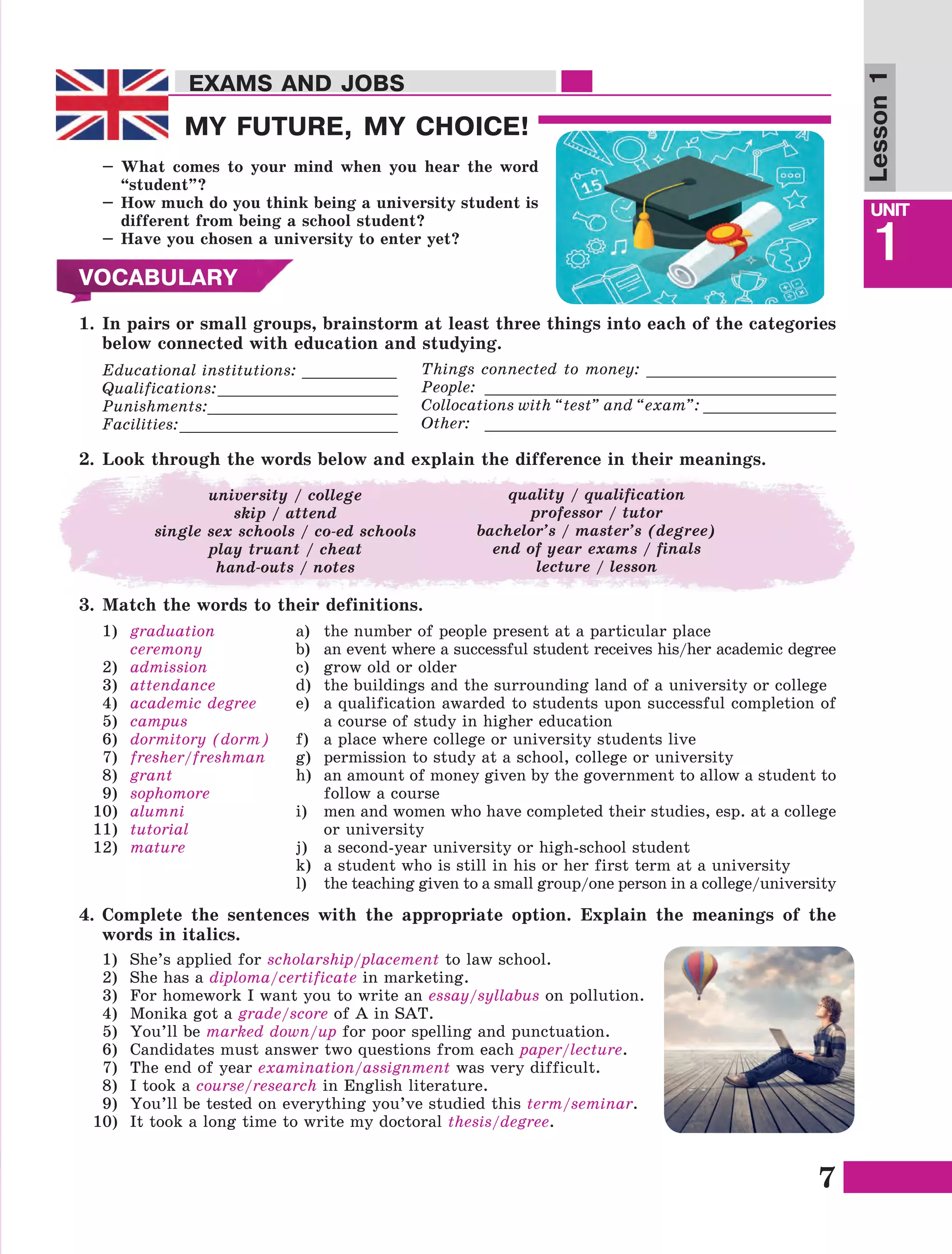
MY FUTURE, MY CHOICE!
–	What comes to your mind when you hear the word
“student”?
–	How much do you think being a university student is
different from being a school student?
–	Have you chosen a university to enter yet?
VOCABULARY
3.	Match the words to their definitions.
1)	 graduation
	ceremony
2)	 admission
3)	 attendance
4)	 academic degree
5)	 campus
6)	 dormitory (dorm)
7)	 fresher/freshman
8)	 grant
9)	 sophomore
10)	 alumni
11)	 tutorial
12)	 mature
a)	 the number of people present at a particular place
b)	 an event where a successful student receives his/her academic degree
c)	 grow old or older
d)	 the buildings and the surrounding land of a university or college
e)	 a qualification awarded to students upon successful completion of
a course of study in higher education
f)	 a place where college or university students live
g)	 permission to study at a school, college or university
h)	 an amount of money given by the government to allow a student to
follow a course
i)	 men and women who have completed their studies, esp. at a college
or university
j)	 a second-year university or high-school student
k)	 a student who is still in his or her first term at a university
l)	 the teaching given to a small group/one person in a college/university
1.	In pairs or small groups, brainstorm at least three things into each of the categories
below connected with education and studying.
Educational institutions: __________
Qualifications:___________________
Punishments:____________________
Facilities:_______________________
Things connected to money: ____________________
People: _____________________________________
Collocations with “test” and “exam”: ______________
Other: _____________________________________
2.	Look through the words below and explain the difference in their meanings.
university / college
skip / attend
single sex schools / co-ed schools
play truant / cheat
hand-outs / notes
quality / qualification
professor / tutor
bachelor’s / master’s (degree)
end of year exams / finals
lecture / lesson
4.	Complete the sentences with the appropriate option. Explain the meanings of the
words in italics.
1)	 She’s applied for scholarship/placement to law school.
2)	 She has a diploma/certificate in marketing.
3)	 For homework I want you to write an essay/syllabus on pollution.
4)	 Monika got a grade/score of A in SAT.
5)	 You’ll be marked down/up for poor spelling and punctuation.
6)	 Candidates must answer two questions from each paper/lecture.
7)	 The end of year examination/assignment was very difficult.
8)	 I took a course/research in English literature.
9)	 You’ll be tested on everything you’ve studied this term/seminar.
10)	 It took a long time to write my doctoral thesis/degree.
8
Lesson1
UNIT
1
EXAMS AND JOBS
READING
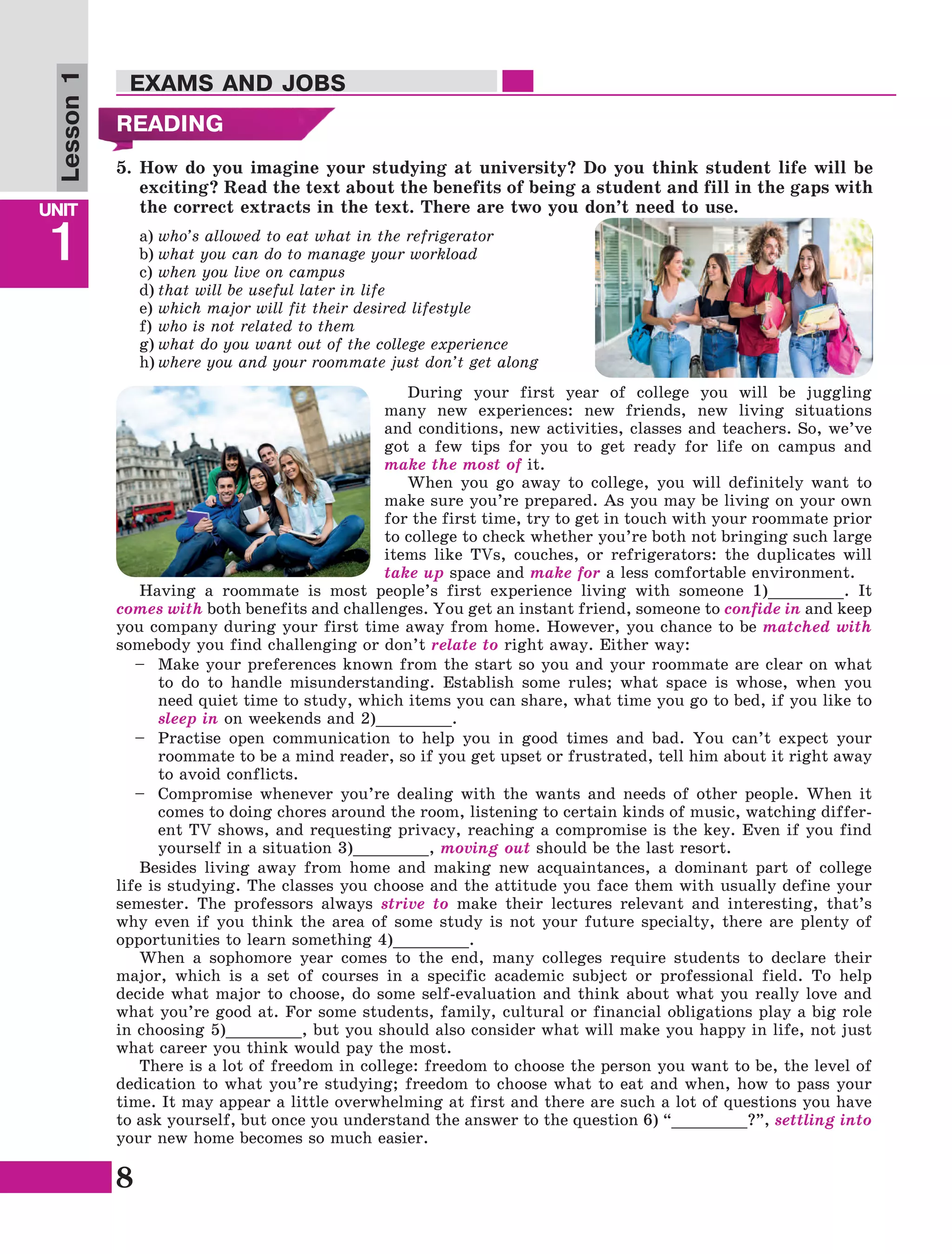
5.	How do you imagine your studying at university? Do you think student life will be
exciting? Read the text about the benefits of being a student and fill in the gaps with
the correct extracts in the text. There are two you don’t need to use.
During your first year of college you will be juggling
many new experiences: new friends, new living situations
and conditions, new activities, classes and teachers. So, we’ve
got a few tips for you to get ready for life on campus and
make the most of it.
When you go away to college, you will definitely want to
make sure you’re prepared. As you may be living on your own
for the first time, try to get in touch with your roommate prior
to college to check whether you’re both not bringing such large
items like TVs, couches, or refrigerators: the duplicates will
take up space and make for a less comfortable environment.
Having a roommate is most people’s first experience living with someone 1)________. It
comes with both benefits and challenges. You get an instant friend, someone to confide in and keep
you company during your first time away from home. However, you chance to be matched with
somebody you find challenging or don’t relate to right away. Either way:
–	Make your preferences known from the start so you and your roommate are clear on what
to do to handle misunderstanding. Establish some rules; what space is whose, when you
need quiet time to study, which items you can share, what time you go to bed, if you like to
sleep in on weekends and 2)________.
–	Practise open communication to help you in good times and bad. You can’t expect your
roommate to be a mind reader, so if you get upset or frustrated, tell him about it right away
to avoid conflicts.
–	Compromise whenever you’re dealing with the wants and needs of other people. When it
comes to doing chores around the room, listening to certain kinds of music, watching differ-
ent TV shows, and requesting privacy, reaching a compromise is the key. Even if you find
yourself in a situation 3)________, moving out should be the last resort.
Besides living away from home and making new acquaintances, a dominant part of college
life is studying. The classes you choose and the attitude you face them with usually define your
semester. The professors always strive to make their lectures relevant and interesting, that’s
why even if you think the area of some study is not your future specialty, there are plenty of
opportunities to learn something 4)________.
When a sophomore year comes to the end, many colleges require students to declare their
major, which is a set of courses in a specific academic subject or professional field. To help
decide what major to choose, do some self-evaluation and think about what you really love and
what you’re good at. For some students, family, cultural or financial obligations play a big role
in choosing 5)________, but you should also consider what will make you happy in life, not just
what career you think would pay the most.
There is a lot of freedom in college: freedom to choose the person you want to be, the level of
dedication to what you’re studying; freedom to choose what to eat and when, how to pass your
time. It may appear a little overwhelming at first and there are such a lot of questions you have
to ask yourself, but once you understand the answer to the question 6) “________?”, settling into
your new home becomes so much easier.
a)	who’s allowed to eat what in the refrigerator
b)	what you can do to manage your workload
c)	when you live on campus
d)	that will be useful later in life
e)	which major will fit their desired lifestyle
f)	who is not related to them
g)	what do you want out of the college experience
h)	where you and your roommate just don’t get along
9
Lesson1
UNIT
1
EXAMS AND JOBS
LISTENING
GRAMMAR Grammar bank
7.	Imagine you meet a foreigner who studies
at college. Think of some things you’d like
to ask him about student life abroad, say in
Britain and write down at least 5 questions.
Listen to the recording and tick the questions
you’ve heard the answers for.
1)	Education system in the UK is very interactive; the idea is ________ while you ________.
2)	Students can choose to study ________, called “joint honours”, but most choose only one.
3)	Most first year students live in university accommodation often known as ________.
4)	________ and ________, the students are entitled to, cover the cost of further accommodation.
5)	Students who study and ________, need to balance it with the other commitments.
	 But it is a good way to ________ income and ________ horizons at the same time!
6)	UK universities have support facilities to help students improve their ________.
7)	College and university traditions and rituals bind the student ________ and give ________.
8)	During annual campus-wide entertaining events students work and ________, ________
with peers, ________ sport games ________ and ________ team chants.
9)	Fresher’s Week is the time when students go to ________, social ________ and get ________.
WAYS OF EXPRESSING THE FUTURE
We use the Present Simple to talk about timetables, programmes or routines.
E.g.: I start school at 8 o’clock every day. My school bus arrives at 7.45.
We use the Present Continuous to talk about arrangements.
E.g.: We are having a meeting of our student council members next week.
We use be going to to talk:
– about intentions, plans or ambitions for the future;
– about predictions based on present evidence.
E.g.: I’m going to enter the university next year. I feel terrible. I think I’m going to fail.
We use will for:
– decisions made at the moment of speaking;
– predictions about the future, based on our beliefs, ideas, expectations, with the verbs I think,
I believe, I hope, etc., the expressions be sure/certain, be afraid, etc., adverbs probably, perhaps;
– actions or events which will definitely happen in the future and which we cannot control.
E.g.: We will take end of the year exams in June. I feel terrible, I think I will fail.
I won’t cheat anymore, please don’t give me a Fail. – Ok, I have to go! I’ll call you tomorrow!
9.	Work in pairs. Make up some more questions about the text. Ask and answer them
in turns. Which facts do you find most surprising? What are the similarities between
British and Ukrainian college student life? What are the differences?
8.	Read the sentences below and try to complete them using the appropriate vocabulary.
Listen to the recording and check your answers.
6.	Match the phrasal verbs in colour in the text to their meanings below.
to trust / to adapt / to try hard / to enjoy / to leave / to put together /
to like or understand / to favour / to occupy / to accompany / to stay in bed until late
10
Lesson1
UNIT
1
EXAMS AND JOBS
10.	Write the sentences in the correct group.
1)	Don’t worry about your entrance test! I’m sure you’ll pass/you’re going to pass.
2)	I won’t come/’m not coming on Saturday, sorry. I have a dentist appointment.
3)	Hurry up! The film starts/is starting in five minutes.
4)	Are you cold? OK, I’m going to/I’ll close the window.
5)	Don’t leave your bag there! Someone’s going to steal/’ll steal it .
6)	Good morning and welcome to our course. In this lecture I’ll/I’m going to tell you about...
7)	Look at the traffic! We’re going to be/We’re late for class.
8)	Oops, I forgot to bring your book! I’m going to/I’ll go to my dorm and get it now.
9)	I don’t think he’ll/think he won’t go to the party.
10)	What time does/will your bus leave tomorrow?
11.	Circle the best future form to complete these sentences.
WRITING
SPEAKING
12.	Work in pairs. Imagine you have to make up your mind about which university to
enter. Look through the list of university characteristics and discuss them with your
partner. Which qualities will you consider prior? Explain your choices.
13.	What are the top prestigious universities you know? Would you like to study at
any of them? Do you know the entry requirements? Do some research and fill in
the chart below. It will help you weigh all the pros and cons to choose your perfect
university.
University Admission/
Requirements
Desirable
qualities
Facilities
(campus life)
Application
deadline
Cost and support
__meeting the admissions requirements
__affordable cost of attending the university
__available financial aid/scholarships
__desirable major/degree
__academic prestige/reputation
__opportunities to study abroad
__employers/corporations come to campus to
interview graduates
__available on-campus housing
__parents approval
__opportunities to engage in desired hobbies
__student government/organizations to join in
__collegiate sporting events/music or theatre
ensembles
__possible part-time study/part-time work
– I don’t think I’ll ever be famous. – I’ll hold the door for you. – I’ll wash. You dry.
– We’ll help you! – I’m seeing Jenny on Sunday. – You’ll feel better soon.
– I’m sure you’ll enjoy it. – It won’t take long to get there. – I’m playing basketball tonight.
– We don’t have seminars next week. – I’ll let him know. What are you doing next week?
– This year school ends on 28 May. – Are you going to the cinema tomorrow night?
– It takes place on Monday. – The TV series continues after the weekend.
Predictions and
hopes
Spontaneous ideas Plans and
arrangements
Timetables and
routines
11
Lesson1
UNIT
1
EXAMS AND JOBS
Lesson2
EXAMS AND JOBS
LEARN THROUGH TRAVELLING
1)	graduate
2)	join
3)	enrol
4)	major
5)	take
6)	hold
7)	apply
8)	be absent
1.	Read the actions people typically do during education
and name these people.
4.	Match the two parts of collocations. Make up sentences, explaining their meaning.
a)	 a gap year
b)	 extracurricular activities
c)	 in distance learning
d)	in (a subject)
e)	 a university degree
f)	 for a student loan
g)	with honours
h)	from class
Read and comment on the following quotation:
«The fate of empires depends on the education of youth».
Aristotle
VOCABULARY
3.	Complete the phrasal verbs about education and studying with the missing letters.
takes notes in class – ...
sets homework – ...
hands in homework – ...
gives lectures – ...
gets a degree – ...
revises for exams – ...
marks tests, exams, homework – ...
organizes a staff meeting – ...
2. Match the words from the list to the verbs below.
a gap year / a degree / a mistake / from university / school / a good university / a break /
research / progress / grades (good/bad) / a course / a subject
1) get/(into) _________
2) graduate __________
3) leave _________
4) make _________
1)	get b_ – survive
2)	put o_ _ – delay doing
3)	catch _ _ with – improve and reach the standard
4)	fall be_ _ _ _ – make less progress
5)	drop _ _t – leave school or university before it
finishes
6)	hand _ _ – give your work to the teacher
7)	get _ _ with – continue doing
8)	get thr_ _ _ _– succeed
9)	work o_ _ – plan a good way
5.	 Work in pairs. Think for one minute and make a list of 3 advantages and 3 disadvantages
of being an exchange student. Share the ideas with your partner. Add to your list the
ideas you agree with.
5) take _________
6) do ___________
The advantages of being
an exchange student
The disadvantages of being
an exchange student
SPEAKING&LISTENING
12
Lesson1
UNIT
1
EXAMS AND JOBS
Lesson2
6.	Look through the list of some more ideas to the question and tick those you haven’t
mentioned yet. In turns name the statements, which mention positive aspects of
becoming an exchange student, and then negative ones. Support your answers each.
__ Making new friends
__ Exploring and understanding new cultures
__ Experiencing culture shock
__ Eliminating fear and prejudice among nations
__ Getting career advantage
__ Having a communication barrier
__ Developing as a person
__ Improving your language skills
__ Having new educational experience
__ Feeling homesick
__ Gaining self-confidence
__ Speaking a foreign language all day long
__ Living independently
__ Creating a long-lasting relationship with a host family
7.	Would you leave your home to study in another country? Would you like to go abroad
for studying? Listen to other students and fill in the table accordingly.
Country Skills Activities Challenges
Speaker 1
Speaker 2
Speaker 3
Speaker 4
8.	Listen to the recording again and fill in the missing phrases.
1)	One of the other hardest things was _______ the culture.
2)	I would recommend _______ to anyone and if you are learning a language or going to learn
a language.
3)	I became more independent, confident, and _______ of my comfort zone.
4)	I also loved _______ – students and instantly _______ over our shared experiences.
5)	I was confident, I knew what I was responsible for, and I learned how _______.
6)	I was lucky enough _______ – and cities and met other exchange students from all over the
world.
7)	People keep _______ was the highlight of my trip, and I honestly don’t know. I have so
many great memories _______, like _______ the first time, millions of funny conversations
that resemble games of charades, _______ my friends or the day I got 18 _______ 20 on my
math test!
9.	Have you ever searched for international education programmes? What programmes
do you know? Which are you interested in? Read the article about international
education programmes and match them to their descriptions. Have you ever heard
about any of them?
a) FLEX			 b) Work and Travel 		 c) Erasmus+	
1) It is a new European Union (EU) programme, which started in January 2014 to support
education, training, youth, and sport in Europe. Its budget of €14.7 billion for 2014-2020 will
provide opportunities for over 4 million Europeans to study, train, gain experience, and volunteer
abroad. It has opportunities for people of all ages, helping them develop and share knowledge and
experience at institutions and organisations in different countries. It’s not just about Europe or
Europeans either – with this programme, people from all over the world can access opportunities.
READING
13
Lesson1
UNIT
1
EXAMS AND JOBS
Lesson2
2) It was established in 1992 and is funded through the U.S.
Department of State’s Bureau of Educational and Cultural Affairs.
The program provides scholarships for high school students from
Europe and Eurasia to spend an academic year in the United States,
living with a family and attending an American high school. The
primary goal of the program is to improve mutual understanding
between the countries and give young foreign citizens the opportunity
to observe and experience the American system of civil society. For
now over 22000 young people from Eurasia have taken part and
returned to their countries inspired with the enthusiasm and desire
to help, share new knowledge and improve their home communities.
3) It is a cultural exchange program of USA’s Department
of State, through which students have the possibility to work
legally in America during university summer holiday period.
It brings more than 100,000 foreign university students to
the US each year. All of the students are between the ages
of 18 and 28, proficient in the English language, and able to
commit to working for at least three months. The maximum
length of stay is determined by the US State Department and
is based in part on typical university schedules in each nation.
This program provides foreign students with an opportunity to live and work in the United
States during their summer vacation from college or university to experience and to be exposed to
the people and way of life in the United States. This program means challenge, because it moves
you in a completely new environment and you have the opportunity to live and work alongside
Americans. This is how you experiment the differences and similarities between your culture and
your colleague’s. It is a real American experience, which, at the same time, helps you to cover
your expenses.
10. Find the synonyms for the following words from the article above.
feel or know / common / skilled / entry / payment / grant /
timetable / financed / discover
11.	 Read the following sentences and say if they are true (T), false (F), or not given.
1)	 Work & Travel is a cultural student exchange program that allows students from all over
the world to stay in America during the summer months.
2)	 Erasmus+ provides foreign students with a possibility to live and work in the United
States.
3)	Your participation in the Work & Travel USA program must be arranged through a
sponsoring organization, appointed by the respective US Department.
4)	 Every FLEX exchange student lives with a volunteer host family for one academic year to
learn about American values and teach Americans about their home countries.
5)	Students going on exchange under the ERASMUS+ programme pay the tuition fees at
their home university.
6)	 Work & Travel allows students to travel and get to know the world at minimum cost.
7)	FLEX has opportunities for students to develop and share knowledge and experience at
institutions in different countries.
8)	Erasmus+ programme is a funding scheme to support activities in the fields of education,
training, youth and sport.
9)	 Now, in its twenty-third year, the FLEX academic year program has provided scholarships
to over 23,000 secondary school students.
14
Lesson1
UNIT
1
EXAMS AND JOBS
Lesson2
GRAMMAR
FUTURE TENSE CONTRAST
FUTURE SIMPLE
(will/shall+V)
next week/month, tomorrow,
the day after tomorrow, soon,
in a year…
We use the future simple to predict the future. It is the basic way we
talk about the future in English, and we often use it if there is no reason
to use another future tense. We can use it for future facts and for things
that are less certain.
E.g.: The sun will rise at 7am.
I think the Conservatives will win the next election.
FUTURE COUNTINUOUS
(will/shall+be+V+ing)
this time next month,
this time tomorrow,
at 5 p.m. tomorrow,
at this moment next week;
when, tonight…
We use the future continuous to tell about:
– an action that will be going on when another future action happens.
(Another future action is expressed by the simple present, because the
future tense forms are not allowed in subordinate clauses of time.)
E.g.: He will probably be sleeping when you return.
– the action will be going on at a specific point of time in the future.
E.g.: She will be working in London at this time next year.
FUTURE PERFECT
(will/shall+have+V3)
by tomorrow/next week/the
end of this year, 2025, until,
before, when (in the meaning
“by the time”)
We use the future perfect to tell about an action that will happen before
another future action or before a specific point of time in the future.
NOTE! (Another future action is expressed by the simple present, because
the future tense forms are not allowed in subordinate clauses of time.)
E.g.: Before she returns, I will have finished my work on the report.
By 2050, scientists will have found the cure for cancer.
FUTURE PERFECT
CONTINUOUS
(will/shall+have+been+V+ing)
all + …, for + …, by + …,
before, when
We use the future perfect continuous to tell about an action that will
last for some time before another future action happens. This action will
last for some time before a specific point of time in the future.
E.g.: He will have been studying English for five years by the time of
his final examinations.
Grammar bank
12.	 Complete the sentences choosing the correct future tense form for the verbs in brackets.
1)	 Don’t call me between 6 and 8 p.m. I ______ (study) at this time tonight.
2)	 If I pass these examinations, I ______ (enter) Stanford University.
3)	 In five years time I ______ (graduate) from university and I’ll be able to earn some
money at last.
4)	 She ______ (wait) for Tim for five hours when his plane finally arrives.
5)	 Do you think you ______ (do) the same job in ten years’ time?
6)	 I ______ (work) in the library all day long tomorrow.
7)	 We ______ (write) the article by five o’clock.
8)	 He can’t meet us at 2 p.m. tomorrow because he ______ (work) at that time.
9)	 When you return home at five o’clock, I ______ (be) home for seven hours.
10)	 By the end of the year she ______ (learn) to speak English.
11)	 In June that firm ______ (carry) on negotiations for the purchase of software.
12)	 How long will you ______ (occupy) this position next year?
13)	 We ______ (not, find) the material by tomorrow.
14)	 Ann wants to speak with you. – Please tell her that I ______ (call) her as soon as I’m free.
15)	 Why don’t you ask Mark for help? I’m sure that he ______ (help) you.
WRITING
13.	You have a friend who lives in a city abroad. You have decided that you would like
to apply and take a course at one of the colleges in this city. Write to your friend
explaining your plans and intentions. Tell him/her what type of work or studies you
have been doing for the past few years and ask for his/her assistance in contacting
an appropriate institution. Write not less than 150 words.
15
Lesson1
UNIT
1
EXAMS AND JOBS
Lesson3
EXAMS AND JOBS
READY, SET, TEST!
Read the following quote and comment on it:
“Exams test your memory, life tests your learning;
others will test your patience.” 
Fennel Hudson
–	What do you think about exams? Are they really necessary?
–	Do they provide proper knowledge assessment? Why/not?
VOCABULARY
1.	Match the idioms to their meanings.
1)	ace a test
2)	bone up on  
3)	hit the books 
4)	knuckle down 
5)	pass with flying colours  
6)	study animal  
7)	teacher’s pet 
8)	school of hard knocks
9)	cram for an exam
10)	pull an all-nighter 
a)	to do very well on a test or exam
b)	to study throughout the night
c) to get a very high score on a test
d)	to study for a test shortly before it is to happen
e)	real and practical experiences of life
f)	prepare for the exam very thoroughly
g)	the teacher’s favourite student
h)	to begin to study hard
i)	someone who studies hard
j)	to focus on a project or a task
2.	Complete the sentences using the idioms from the previous exercise.
1)	If you studied during the school term, you would not have to _________.
2)	At the end of the school year every party animal turns into a _________.
3)	I have an exam tomorrow, I need to _________tonight.
4)	He’s gone back to driving school in an effort to _________.
5)	I have to _________ civil law for a test next week.
6)	I didn’t go to college, but I went to the _________. I learned everything by experience.
7)	If you _________, you will be tired and more prone to making careless mistakes on the test.
8)	Mark is a _________ because he always gives our teacher presents.
9)	I just want to let you know that if you want to pass the class, you really need to _________.
10)	If he doesn’t _________ soon, he’ll never get through those exams.
READING
3.	What do you know about international language exams? Which of them have you
heard of? What are they taken for? Read the article and check your answers.
Higher education in Ukraine has a centuries-old history and world recognition. Modern
Ukraine’s educational system has a lot to teach the world. For today, the educational possibilities
of Ukraine have allowed the country to become one of 10 leading countries in the sphere of
international education.
At the same time, the popularity of foreign higher educational establishments has increased
greatly among the Ukrainian graduates. So, hoping to become an international student, there
is a number of processes you’ll need to understand and navigate when applying to universities.
The three most important aspects are admissions, funding, and visas, however most universities
require foreign applicants to take English as a second language tests. These are standardized
English language tests, such as the International English Language Testing System (IELTS), the
Test of English as a Foreign Language (TOEFL), First Certificate in English (FCE), Cambridge
Advanced English (CAE), which estimate particular skills in English language proficiency:
listening, speaking, reading, and writing testing is an obligatory requirement, even if you excel at
your English skills.
16
Lesson1
UNIT
1
EXAMS AND JOBS
IELTS is designed for foreign speakers, who wish to study,
work, and live in an English-speaking environment and is
multinational worldwide by more than 10,000 institutions, like
universities, corporations, immigration offices, and international
professional organizations. Since 1989 IELTS has become the
most critical and widely approved English-language test in the
world. There are currently three versions of the IELTS: Academic,
General Training, and Life Skills, that differ in content and
address different target groups.
TOEFL provides the opportunity to test the English language
fluency of non-native speakers wishing to enroll in English-speaking
universities. There are three types of the test: the paper version,
computer-based, and the online version. The test is accepted by
many English-speaking academic and professional institutions.
FCE (B2 First) is one of the most commonly attained language
certificates worldwide and was originally launched in 1939. It is
an upper-intermediate qualification used to demonstrate that a
student can use everyday written and spoken English for work
and study purposes. Passing the FCE exam indicates that your
level of English is at the B2 level and you can handle a variety
of different tasks in the workplace. B2 First is offered in two
versions, B2 First for Schools, for school-aged learners, and B2
First, for general and higher education adult learners.
CAE exam makes learning English enjoyable, effective and rewarding. CAE was originally introduced
in 1991. A unique feature of Cambridge Advanced English is that it is less focused on academic skills
and aims at developing more general and broad English knowledge you can apply in daily life.
There is a lot of confusion about how long these exams remain valid and in what countries
they are recognized. IELTS and TOEFL have an expiry date, they are officially valid for only two
years. They are intended to be a snapshot of your current English level. This is done by giving
you a score (IELTS 0-9 and TOEFL 0-120). There is no pass or fail. By taking these exams you
will always come away with a diploma, no matter how high or low your score is. University
admissions departments, employers, and immigration services prefer these exams, because they
can vary the score they require according to their needs. Cambridge exams on the other hand have
the advantage of lasting for the rest of your life, although if you don’t achieve a passing score
you will fail and end up with nothing to show for your efforts and money. These differences
mean that a Cambridge exam may be better in the long term in Britain and other Commonwealth
countries, TOEFL is an American exam and is the most commonly required diploma in the USA,
while IELTS is accepted by both British and New Zealand academic institutions and over 3,000
academic institutions in the United States, as well as by various organizations across the world.
4.	Look through the text again and match the words or phrases in colour to their
definitions below.
1)	to leave in a particular state or condition
2)	started
3)	being very significant, of great importance for the success (or failure)
4)	the ability to speak or write a foreign language easily and accurately
5)	a piece of information or short description that gives an understanding of a situation at a
particular time
6)	be good at
7)	an official record showing that you have finished a training course or have the necessary
skills
8)	to deal with, have responsibility for, or be in charge of
9)	learning strategies and techniques that help to succeed in studying and life
10)	achieved or reached
11)	the lowest possible score on a test or other assessment that a student must earn to either
“pass” or be considered “proficient”
Lesson3
17
Lesson1
UNIT
1
EXAMS AND JOBS
Lesson3
6.	Fill in for, during or while to complete the following sentences.
1)	As she had studied English _____ childhood, she could speak well when she arrived in Canada.
2)	We were holding hands _____ we were watching the performance.
3)	They moved to Ottawa, so I haven’t seen them _____ ages.
4)	Tim scored a goal _____ the volleyball game.
5)	Girls were gardening _____ her husband was painting the chairs.
6)	He planned to stay here _____ two weeks but they need him back at work immediately.
7)	Veronika visited the Eiffel Tower _____ her stay in Paris.
8)	Don’t speak _____ I am doing this exercise!
9)	In Europe, when you are at a cafe you can stay at the table _____ as long as you like.
10)	We should travel _____ we are still young.
11)	She gets up at 6 a.m. and jogs _____ an hour before going to work.
12)	Tim was texting his friends _____ dinner.
13)	I’ve been studying English _____ a couple of years.
14)	_____ the lecture, the professor was speaking _____ his students were listening.
GRAMMAR
FOR, DURING and WHILE used in time expressions
FOR
– answers the question How long?
– followed by a length of time
– explains how long something or someone is
doing something, or something goes on
E.g.: Henry lived in France for all his life.
Mark has been writing his final test for two hours.
Sarah is going to Spain for Christmas holidays.
DURING
– answers the question When?
– followed by a noun
– explains what happened throughout the
period or in the course of an action or event
E.g.: I will be really busy during the week.
The results of the test were given to us
during the lesson.
We always like to travel during the summer.
WHILE
– answers the question When?
– followed by a subject and a verb
– explains an action that occurs during the
time another action is taking place
E.g.: I will work while studying at UNI.
You shouldn’t make noise while you are in the library.
We were taking notes while the professor was giving
the lecture.
NOTE! To talk about future activities, be sure to use the present after WHILE, not future.
E.g.: I hope to practice my German while I am in Berlin, NOT while I will be.
Grammar bank
5.	Read the article again and tell which exams the following statements match with.
1)	These exam scores last two years after the test date.
2)	It is primarily used to measure international students’ ability to use English in academic
contexts.
3)	This exam confirms that the student can speak and write in English and the results are valid
for life.
4)	This language certificate can open doors to international academic and professional
opportunities in many institutions and places in the world where English is used.
5)	This exam is proof of high-level achievement in English and is designed for learners preparing
for university or professional life.
6)	If you are planning to enter college or university in the United States, you should pass one
of these exams.
7)	If your dream is to become the international student and enter Oxford University, you
should pass this exam.
8)	If you wish to get a well-paid job abroad, the employers will ask you about these language
certificates.
18
Lesson1
UNIT
1
EXAMS AND JOBS
Lesson3
SPEAKING
WRITING
9.	Work in pairs. Imagine one of your friends is going to take an examination soon and
feels pretty nervous about that, so you need to help him out. Use the clues below to
prepare “DOs and DON’Ts of dealing with test anxiety”. Share your ideas with the
classmates and make up a final advice list for successful performance on an exam.
8.	Work in groups. Discuss the way you usually feel when faced with a test or exam. Do
you ever deal with test anxiety? Match the verbs to the phrases they best go with to
complete the descriptions of different states and feelings students have when taking a test.
Add some more of your own, if you can. Divide them into positive and negative feelings.
Say what you usually do during a test.
...up late/night’s sleep
...in advance/late/early
concentrate/focus on...
relax/reward yourself...
...self-critical/positive attitude
...stress/distracting thoughts
...deep breath/rush
...simple/harder questions
ask the teacher/pay attention...
...carefully/attentively
review/revise/prepare...
avoid/follow...
For example:
DOs DON’Ts
1) Do space out studying over a few days or
weeks, don’t wait until the night before.
2) ...
1) Don’t cram for an exam. The amount you
learn won’t be worth the stress.
2) ...
Verb Follow-up phrase
Feel (like)
Stay
Become
Find it
Score
Perform
…lower/higher than on homework
or papers
…poorly/well
…suddenly «know» the answers after
turning in the test
…relaxed and calm
...the room is closing in on you
...«go blank»
...frustrated or distracted
…overwhelmed
…heart racing
…difficult to breathe
7.	Use your own ideas to complete the following sentences.
1)	I have stayed at school for ____________________________________________________.
2)	I don’t use my mobile while____________________________________________________.
3)	During summer holidays I ____________________________________________________.
4)	My family came to see me while________________________________________________.
5)	What are you doing while ____________________________________________________?
6)	Students mustn’t _______________________during_______________________________.
7)	To pass my exams I have been revising for_______________________________________.
8)	I was asked a lot of questions during ___________________________________________.
9)	I couldn’t sleep for___________________________________________________________.
10)	Don’t enter the classroom during______________________________________________.
11)	While studying at school ____________________________________________________.
12)	During the university course_________________________________________________.
19
Lesson1
UNIT
1
EXAMS AND JOBSEXAMS AND JOBS
Lesson4
IN THE JOB MARKET
VOCABULARY
–	Do you know yourself well? What are your weaknesses
and strengths? What do you think you are good at?
–	What jobs look appealing to you?
	 Where do you see yourself in five/ten years?
1.	Look through the words given in the first column. Explain their meanings. Think of
some staff representatives of the other area and complete the table.
Educational establishment Company Office
dean, lecturer, tutor, PhD,
professor, principal, teacher
2.	Company structure consists of different departments which involve various posts.
Match the positions to their definitions.
1)	President
2)	Chief Executive Officer
3)	Vice President
4)	shareholder
5)	board of directors
6)	chairman
7)	director
8)	manager
9)	personal assistant
10)	graduate trainee
11)	deputy
a)	 a group of people chosen to establish policy for and control a
company
b)	any of several executive officers, each responsible for a
separate division
c)	 a person managing the affairs of a corporation
d)	a person responsible for day-to-day running of a department
e)	 a person who heads a Board of Directors; head of a company
f)	 a person who is appointed to undertake the duties of a senior
manager in the his absence
g)	a member of the board of directors
h)	a person who holds or owns shares in or a part of a company
or corporation
i)	 head of a company
j)	 an official employee of the firm who is being trained to the job
he/she was hired for after having graduated from university
k)	a secretary or administrative assistant working exclusively
for one particular person
3.	Use the words and phrases below to complete the functions different individuals
perform within their position in a company.
run the company / report to / be in charge of / cooperate with / job title /
delegate work / senior management / line manager
The Chief Executive Officer (CEO) 1) _____. The level below CEO is Chief … Officer, for example
Chief Financial Officer (CFO), who is part of the 2) _____ team. The CFO 3) _____ the CEO (= has
the CEO as their boss). The CFO 4) _____ (= responsible for) all the financial sides of the business.
The next level down might be country level for a large international organization, or departmental
level. A job title here might be Sales Director or Head of Sales or VP (= Vice President) Sales.
The Sales Director for Sweden 5) _____ closely (= talks to in order to work better with) the Chief
Marketing Officer at Head Office. Below this are people with 6) _____ like Manager, Officer,
Coordinator, and etc. The words Assistant or Deputy may also occur at any level. I’m the Business
Development Officer for Sweden. My 7) _____ (= person directly above me, who I report to) is the
Sales Director. The Sales Director 8) _____ (= gives) a lot of the tasks to me.
20
Lesson1
UNIT
1
EXAMS AND JOBS
Lesson4
READING
4.	 Is college or university certification important for getting a good job? Which careers do
you think can be available for the jobseekers without higher education qualifications?
Read the article about some vacancies at the UK market of employment, match the
passages to the jobs. What differs these positions from the other advertised posts?
a)	Communication equipment professionals
b)	Sales reps
c)	Agricultural management
d)	Transportation, storage, and distribution managers
More and more high school graduates are nowadays
seeking options to get a job. Some students work part-
time, and some choose to have full-time jobs either
during their term time, holidays or both. They earn for
their further education, want to have additional income
on personal necessities or luxuries, or simply need to get
by, as their loans fail to cover the cost of living.
Being highly-paid is the main goal of the majority, though it may seem like all the top careers
mean you have to get a college degree, but that’s not the case at all and there are a number of
positions that require no more than a high school diploma. Check some ideas of the best-paid jobs
for no experience high school leavers.
1) _______________
This is a serious occupation with a lot of responsibility, but it usually requires only secondary
school qualifications to get started. According to a Forbes report, it promises the highest annual
salary of any job that does not require formal education. There are various job titles in the
field, so you can work in a warehouse, in logistics, organize shipping and delivery of goods to
end-users. Here you can easily climb the career ladder and gain a lot of experience that can be
beneficial later on in life.
2) _______________
It does not require any academic skills. Usually, such a professional may begin by doing any
manual labour on a farm or a land plot. The downside of being a rancher is the responsibility and
hard physical work. Lots of effort will be required to keep all processes under control. While these
professionals are mostly responsible for supervising other workers, a hands-on approach will be
demanded quite often.
3) _______________
If you’re passionate about retail, you may want to consider trying this role. You will surely
benefit from many employment opportunities. Generally, no formal requirements for education
or training are needed when being hired, and part-time employment options are also available.
However, depending on the situation, you may be asked for previous experience, that could
make it difficult for some high school students and recent graduates to compete against other
candidates.
4) _______________
A final opportunity worth mentioning is in the media market. In movie industry, television
channels, radio stations and other players such workers don’t have to specialize in any particular
skill, because they receive training after getting hired. Their main task will be to monitor,
upgrade, repair and maintain such equipment like cameras, microphones, broadcast technologies,
light systems, lenses, monitors and so on. Because of their technical knowledge, they are well-paid
and highly sought-after. Many work freelance, allowing themselves a good degree of freedom.
The above mentioned list states that there are professions that exist which can earn you more
without any specialization. Although you have to remember, that in most situations the benefit
of good salary and job security comes with higher education qualifications. Anyway, a sincere and
serious look at your interest and skills is a must before jumping to any profession, in case you
feel that further education for a degree in this field is not your cup of tea.
21
Lesson1
UNIT
1
EXAMS AND JOBS
Lesson4
1)	Nowadays school graduates …
	 a) invest more money in their education	 b) look for a job before getting a degree
	 c) make a successful career
2)	There are some professions which don’t require a high school diploma because they …
	 a) are menial and stressful			 b) don’t need special skills and knowledge
	 c) are underpaid and exhausting
3)	Some of the most profitable jobs are …
	 a) connected with management of goods	 b) government positions
	 c) food and entertainment industry
4)	Before choosing the future job, each graduate should …
	 a) get to know himself better			 b) get a college or university degree
	 c) get some basis experience needed for an occupation
GRAMMAR
Grammar bank
PREPOSITIONS
ON TIME means being punctual, not late. If something
happens on time, it happens at the time that it was
planned.
Eg.: The ceremony was well-organized. It
began and finished on time.
IN TIME means being soon enough. If we say we arrived
in time, we’re saying that we got there a little earlier
and there was time to spare. We can also say: just in
time.
E.g.: The agent applied for the interview at
11am. I hope he’ll arrive in time.
We got there just in time for our bus.
AT THE END means being at the point when something
stops, and is usually followed by of + noun/pronoun
E.g.: At the end of the meeting, everybody
went to the canteen.
IN THE END means finally. It is used when you want to
say that a conclusion has arrived after a lot of confusion.
E.g.: I had quite a lot of problems with this
project, but in the end I solved them.
NOTE! It’s wrong to say in the end of... It should always be phrased as at the end of.
5.	Look at the words in colour in the text and match them to their definitions.
6. Complete the test according to the text.
1)	to have specific education or experience in one particular area
2)	to watch a person or  activity to make sure it is done  correctly
3)	knowledge and skills gained by practice
4)	the type of thing that you like
5)	sending goods from one place to another, especially by ship
6)	in a great demand
7)	begin to do something quickly
8)	begin a process or task
9)	process of learning/teaching the skills you need to do a particular job
10)	a person or organization that buys and uses something 
11)	to try to be more successful than someone
12)	to get something good or helpful from something
SPEAKING
7.	Look through the factors that influence your choice when looking for the right job.
Put them in order of importance and compare your list with that of your partner’s.
Discuss your lists and explain your choices.
– job stability
– career prospects
– salary rate
– business trips
– hours of work
– commuting
– medical insurance
– perks
– working environment
– level of responsibility
– job-satisfaction
– holiday allowance
22
Lesson1
UNIT
1
EXAMS AND JOBS
Lesson4
WRITING
11.	Some people say that teenagers should work part-time and earn money. This way
they will learn basic lessons about work and become more disciplined. Others argue
that teenagers shouldn’t sacrifice their rest and after-school activities to work.
Consider both views and give your opinion. You should write at least 250 words.
Give reasons for your answer and include any relevant examples from your own
knowledge or experience.
10.	Choose the correct options to complete the sentences.
1)	At/In the end of this month, it will be my birthday.
I would like to have an English dictionary.
2)	The day before yesterday, I sat an examination.
I knew nothing about the subject. In/At the end,
I returned a blank paper and left.
3)	It took me a long time to find a job. In/At the end,
I got a job in a restaurant.
4)	I will be moving to a new address in/at the end of
May.
5)	He didn’t have a well-paid job. In/At the end, he
found a better one.
6)	Put your signature at/in the end of the contract.
7)	I pay the phone bill in/at the end of each month.
8)	We worked hard, and in/at the end, we achieved
our goal.
9)	I pay the phone bill in/at the end of each month.
10)	We had a few problems at first, but at/in the end,
everything was fine.
9. Read the situations and make up sentences using just in time.
1)	You have a job interview at 8.30 a.m. But this morning you woke up later than usual. You
thought you were going to be late for the appointment. But it started right after you entered
the office. (arrive/place/before/begin/interview)
2)	When being on the bus you saw a man trying to steal another passenger’s wallet. At once
you started calling the police, so the thief immediately ran away. (stop/thief)
3)	You and you sister were setting off on a trip, but you were late to the airport and thought
you could miss your flight. Fortunately the flight was delayed for an hour and just as you
arrived at the airport, the gate was open for check-in. (arrive/airport/flight/to Paris)
4)	The other day I left my mobile at home, but I was waiting for an important phone call from a
potential employer. So, I decided to return home and take my mobile because I couldn’t miss
that call. Just after I opened the door, I heard the phone ringing. (get home/phone call)
5)	My friend was busy with a new project and totally forgot about her boss’s birthday. Luckily
she remembered and could get the present before he came to work. (buy/present/boss)
8.	Complete the sentence using in time or on time.
1)	Don’t worry, I’ll be back _______ to finish the translation of the article.
2)	The meeting has been scheduled for 3 p.m. Please, arrive _______.
3)	We arrived at the theatre _______to have a coffee before the play started.
4)	I almost forgot that it was Tim’s birthday. Fortunately I remembered _______.
5)	Why are you never _______? You always keep everybody waiting.
6)	We arrived right _______, neither early nor late.
23
Lesson1
UNIT
1
EXAMS AND JOBS
IN SEARCH OF A JOB
Lesson5
EXAMS AND JOBS
Find a job you love, and you will never have to
work a day in your life.
Confucius
VOCABULARY
1.	Put Monika Smith’s steps up the career ladder in the correct order and say how
succesful you think she was in her career and life.
__she applied for a vacancy
__she wasn’t out of work for long
__she was taken on as an office clerk
__she was appointed for the post of Head of
Legal Affairs
__she was offered a part-time job
__she was seeking for a permanent job
__she gave in her resignation letter
__she drew up an up-to-date CV
__she attended job interviews
__she got a pay rise and a bonus
__she turned down the job offer
__she retired from her position
__she picked up new skills
__she was promoted to a lawyer’s assistant
__she was laid off because of the crisis
READING
4.	Have you ever volunteered? What kind of voluntary work would you like to do?
Read the article about volunteering and choose the statement that best describes its
main idea.
The article tells …
a) about various skills and useful experiences, you can get when doing volunteer work
b) in what ways how you can improve your career prospects through helping other people
c) that volunteering gives you valuable experience and is worth doing before you search for
your first job
Looking for your first job, you will probably come across a job advertisement that reads “fresh
graduates welcomed” followed by “minimum two years” work experience. New graduates often
struggle with getting a job without any previous employment experience or gaining relevant
experience without having a job in the first place. The good news is that you don’t have to worry
Read the quote and express your opinion about it.
– To what extent do you agree or disagree?
– Do you really think a hobby might work out as a decent job?
2.	Match the halves of the word partnerships in the tables. Give examples of professions
that require or involve the following qualities, skills, or responsibilities.
A) Collocations for requirements B) Collocations with phrasal verbs
1)	formal
2)	refined
3)	specific
4)	sense of
5)	physical
6)	leadership/social
7)	work
8)	good
9)	rich
10)	stress
a)	humour
b)	taste
c)	experience
d)	qualifications
e)	resistance
f)	memory
g)	fitness
h)	imagination
i)	 skills
j)	 knowledge
1)	come up
2)	cut back
3)	get on
4)	keep up
5)	back out
6)	put in
7)	get down
8)	live up
9)	come in
10)	put up
a)	to business
b)	for a promotion
c)	for criticism
d)	to expectations
e)	with a lot of hassle
b)	with a solution
c)	of an agreement
d)	to the account department
e)	with the latest development
f)	on spending
3.	Work in pairs and mark the adjectives P (positive) or N (negative), look up their
meaning if you need to. Make a list of jobs that can be described with these adjectives.
monotonous / labour-intensive / rewarding / challenging / demanding / risky/ prestigious /
seasonal / humanitarian / temporary / freelance / satisfying / menial / manual / stressful /
collaborative / unskilled / voluntary / unfulfilling / promising / shift
DREAM
JOB
24
Lesson1
UNIT
1
EXAMS AND JOBS
Lesson5
if your first CV is only a page long and you feel you do not have enough qualifications to talk
during job interviews. Aside from work experience, there is a whole list of other things to focus
on when creating your resume; academic achievements, involvement in projects, community
participation, awards in contests and competitions really add value and help demonstrate a
potential employer you are a good fit for the job.
However, with so many people today having excellent qualifications, it has become a much more
difficult to find a desirable job. But what makes the employers pick one person over the other? Well,
among all the credentials, one of the sections that can boost your CV and help your application
get noticed, is volunteer work. Volunteering is not only good for your community; it is also good
for your career. Through volunteering you can get valuable training and build up experiences
essential for your dream profession. Your volunteering roles give the employer clear insight into
what your personal strengths are and can help impress him with your ambition.
There are plenty of volunteer opportunities, but to find an ideal mission to suit your needs,
think of the job-specific skills you would like to develop for your target career. For example,
if you need more experience with patient care, consider volunteering at your local hospital. If
you want to work with animals, volunteer at a local shelter or offer to help an animal rescue
group. Even volunteering for a few hours a week will look good on your resume and help you
stand out as a candidate.
With all of this in mind, make sure to highlight any relevant volunteer experience that you
have on your CV! Volunteer work is a great way to give back, but this is also an opportunity that
could be so much more. There’s even a chance a volunteer position can turn into a job. So, if
you still haven’t decided – give it a go! Start with something small, and after all, you’ll be able
to feel the greatest benefit of helping – a real sense of accomplishment, pride, and motivation,
as volunteering is the most rewarding thing you can do.
5.	Look through the text again and explain the meanings of the words in colour. Look
up if necessary. Write sample sentences using them.
	Voluntary work is a form of slavery!
	I believe that voluntary work is an
excellent way for young people to get work
experience.
	Voluntary work is a good way to learn lots
of new.
	I like helping other people.
	The world would be a better place if more
people did voluntary work.
	Voluntary work is a waste of time.
	You need money to survive.
	I don’t have enough free time to volunteer.
	The government should pay for some of
the jobs volunteers do.
LISTENING
7.	Listen to the recording and match the speakers to
their dream jobs.
Speaker 1
Speaker 2
Speaker 3
Speaker 4
Speaker 5
Speaker 6
a)	a naval doctor
b)	a photographer
c)	a medical doctor
d)	a veterinarian
e)	a lawyer
f)	a professional chef
8.	Listen to the recording again and complete the
main reasons for choosing the profession by each
speaker.
6.	Read the statements below and tick those which are true for you. Explain your choice.
Speaker 1: The reason why I want to be a ... is ...
Speaker 2: The reason why I want to be a ... is ...
Speaker 3: The reason why I want to be a ... is ...
Speaker 4: The reason why I want to be a ... is ...
Speaker 5: The reason why I want to be a ... is ...
Speaker 6: The reason why I want to be a ... is ...
25
Lesson1
UNIT
1
EXAMS AND JOBS
Lesson5
GRAMMAR
Grammar bank
9.	 Choose the correct gerund or infinitive form in the brackets at the end of the sentence.
1)	She _________ to get up early in the morning. (likes/dislikes)
2)	Alan can’t stand _________ on trains. (riding/to ride)
3)	Mr. Harris enjoys _________ people out to dinner. (inviting/to invite)
4)	In the old days, gentlemen challenged their rivals _________. (fighting/to fight)
5)	As the famous saying goes, there’s no use _________ over spilt milk. (crying/to cry)
6)	Jim stopped _________ his shoelace. Wait for him. (tying/to tie)
7)	My wife always volunteers _________ cakes for PTA meetings. (baking/to bake)
8)	Don’t waste my time _________ about your salary. (complaining/to complain)
9)	Eva is having trouble _________ on the exam. (concentrating/to concentrate)
10)	Please allow me _________ your Facebook page. (joining/to join)
INFINITIVES AND GERUNDS
An INFINITIVE is a verb form that acts as other
parts of speech in a sentence. It is formed with to +
base form of the verb.
A GERUND is a verb in its «ing» (present
participle) form that functions as a noun that
names an activity rather than a person or thing.
Any action verb can be made into a gerund.
Infinitives can be used as:
1) an object following the verb:
E.g.: Jim always forgets to eat.
2) a subject at the beginning of a sentence:
E.g.: To travel around the world requires a lot of
time and money.
3) an adverb modifying a verb:
E.g.: You promised to buy me a diamond ring.
4) an adjective modifying a noun:
E.g.: Tara has the ability to succeed.
5) Some verbs are directly followed by an
infinitive: E.g.: Do you want to call your family now?
6) Some verbs are directly followed by a noun
or pronoun and then by an infinitive:
E.g.: He advised me to sell all my shares of stock.
1) Gerunds can appear at the beginning of a
sentence when used as a subject:
E.g.: Jogging is a hobby of mine.
2) Gerunds can act as an object following the
verb:
E.g.: Daniel started studying at university a
year ago.
3) Gerunds can serve as an object after a
preposition:
E.g.: I look forward to seeing my new
roommate.
4) Some verbs and verb phrases are directly
followed a gerund:
E.g.: Paul avoids going to noisy parties.
NOTE!
1) Some verbs can be followed by an infinitive or a gerund without causing a change in meaning:
E.g.: Will you continue working/to work after you give birth?
Some people prefer getting up/to get up early in the morning.
2) Some verbs can be followed by an infinitive or a gerund but with a change in meaning:
E.g.: He remembered sending the fax. (He remembered the act of sending the fax)
He remembered to send the fax. (He remembered about the fax and sent it.)
10.	Change the verbs in brackets into the correct form. Sometimes both infinitive and
gerund are possible.
1)	He is determined _________ (win) that race.
2)	He lay in bed _________ (plan) the days to come.
3)	We went _________ (run) in the morning.
4)	Her fear of spiders made _________ (travel) difficult.
5)	They don’t mind _________ (wait) outside.
6)	The problem is _________ (get) there on time.
7)	I am accustomed to _________ (take care) of myself.
8)	I want him _________ (paint) the wall.
9)	_________ (be) or _________ (not be), that is the question.
10)	This guy is known for _________ (break) the rules.
11)	Sue enjoys _________ (dance).
12)	The advantages of_________ (go) by train were clearly visible.
26
Lesson1
UNIT
1
EXAMS AND JOBS
Lesson5
SPEAKING&WRITING
11.	What is the most interesting or unusual job you have ever had or heard about?
Think about jobs your parents, relatives or acquaintances do. Prepare to describe it
to your partner. Answer the questions below to help you organize your dialogue.
– What kind of job is it?
– What are responsibilities to come with the job?
– What personal traits should/shouldn’t one have to match the job?
– How would you describe the job? Is it demanding or rewarding, or what else? In what ways?
– What is the most interesting or unusual thing about it?
12.	Work in pairs. Read functional phrases for the interview. Fill them into the table
below in accordance with the categories. Explain or translate any unknown phrases
to each other.
13.	Make up a dialogue with your partner and role play it. One of you is an interviewer
and the other one is an interviewee. Continue the conversation using the table above
as a plan.
Step 1: Greet the candidate and ask her/him to introduce...
14.	Write a job advert for a vacant job. Write about 100-150 words. Use the following plan.
Job title: (insert job title here)
Salary: (insert starting salary, commissions, or benefits here)
Hours: (insert average number of working hours per week)
Location: (insert location of the office and any public transport required)
Key responsibilities & duties: (insert a list of primary responsibilities for the position)
Academic or trade qualifications: (insert list of desired qualifications)
Work experience and skills: (insert necessary experience and skills needed to
perform the job)
Personal qualities: (insert a list of personal qualities of the worker you are looking for)
a)	This job would offer professional development./This company has a very good reputation.
b)	I did quite well in my final exams. I passed…/I received…for my English.
c)	I’ve got lots of experience in this field./I have had two part-time jobs.
d)	I am a very organized person./I feel that I could fulfill your requirements.
e)	I get on really well with the public./I enjoy…ing (meeting people)
f)	I’m really keen on… (computers)/I am a fast learner/I am ready to take on more responsibilities.
g)	Sometimes I’m a bit too + adjective (e.g. serious, hard-working), and this might…(e.g. make
my colleagues feel uncomfortable).
h)	I think I get too + adjective/adjectival phrase (e.g. involved/caught up) in my work. That
sometimes means… (e.g. I am thinking about work even at lunch or at home).
i)	If I were offered the job, …how soon could I start?/…would there be any on-the-job training
provided?
j)	What expansion plans does the company have?/What are the promotion prospects in the
company?
1) Talk about the job
2) Talk about your education
3) Talk about your skills
4) Talk about yourself
5) Talk about your experience
6) Ask some questions
27
Lesson1
UNIT
1
EXAMS AND JOBS
1.	 Match the words with their definitions.
Lesson6
EXAMS AND JOBS
START-UP
–	What do you think is better: to be self-
employed or to work for somebody? Why?
–	 Look at the word cloud and give some ideas
about who the entrepreneurs are. Name
some if you know any? What made them a
fortune?
VOCABULARY
1)	a niche in the market
2)	an entrepreneur
3)	set up
4)	manufacturer
5)	a pioneer
6)	founder
7)	annual sales
8)	subsidiary
9)	division
10)	multinational corporation
a)	a person who starts and manages a business, accepting the
risks and hoping to make money
b)	a person who goes into new areas (of land, thought, research,
or development, etc.) before other people
c)	a special area of demand for a product
d)	start or establish (a business)
e)	make a product, especially using machines
f)	a large company that does business in several different
countries
g)	a person who establishes an organization
h)	a smaller company that is owned by another bigger company
i)	one of the sectors or groups in a business or organization
j)	the amount of business that a company does in one year
2.	Fill in the blanks with the appropriate vocabulary from the list below.
1)	During the financial crisis, even some large corporations declared ________.
2)	If a CEO cannot manage company ________ well, the company is likely to fail.
3)	________ is an essential part of the Red Cross since it depends on charitable ________.
4)	I often give money to a ________ like Salvation Army or Red Cross.
5)	To keep a business running, companies must have plenty of ________.
6)	Credit ________ somehow make it very easy to spend a lot of money.
7)	Bill Gates earned a ________on Microsoft.
8)	America spends more money than it ears; it is in international ________.
9)	The ________ people receive for their work depend on their qualifications.
10)	If you borrow money in a bank you take out a ________.
3.	 Match the adjectives with their definitions. Complete the pairs of words appropriately.
1. economic a) related to trade, industry
or money
_______ development, be _______, _______use,
_______ forecast, _______ price,
_______hybrid cars, _______ policy,
solar panels are _______ , _______ person;
economical b) not using a lot of money
2. costly/
pricy
a) costing a lot _____ process, time is _______, a _______ item,
______ advice, _______ repairs,
a _______ purchase, _______ jewel,
_______ artifact/antique, _______ collection;
priceless b) having a value beyond any
price
3. worthy a) not having worth and use,
without value
feel _______, a _______ idler, _______rubbish,
_____ plan, _______ to see/do,
_______ of attention/praise, _______as a (painter),
_______ candidate/successor.
worthless b) having worth or value
debt / bankruptcy / capital / profit / donations / finances / charity /
fortune / loan / fund-raising / earnings
28
Lesson1
UNIT
1
EXAMS AND JOBS
Lesson6
If you’re a young entrepreneur who’s sick of the 9-to-5 rat race, you should start
thinking out of the box. You need to find an idea that will allow you to start your own business
so that you can choose your hours and even your salary. The challenges are real, but so are the
opportunities. It is often amazing to think about how early some of the world’s most famous
entrepreneurs began their start-ups and ventures. Many of them simply had a fantastic idea and
then just worked extremely hard to make it reality. You can begin the journey to becoming an
achiever at any age, and the young entrepreneurs in the list below will prove this to you.
Of course, Mark Zuckerberg must be on the top of the list.
Facebook speaks for all the success the man has achieved by
launching it when he was only 19 years old. Within a few years
of its launch, Facebook became one of the most used social media
platforms across the world. An inspiration to a countless number of
people, Zuckerberg is estimated to be worth 61.7 billion USD today
and continues to progress as an entrepreneur.
Fraser Doherty started his incredible business career at the
age of just fourteen. After being taught how to make jam in his
Grandmother’s kitchen in Scotland, he came up with a way of
making jam 100% from fruit. At sixteen, he presented his brand,
SuperJam, to Waitrose and went on to become the youngest ever
supplier to a major supermarket. SuperJam has since grown into a
company that has sold many millions of jars through thousands of
supermarkets around the world and currently has a net worth of
2 million dollars.
Juliette Brindak came up with the idea of what is now “Miss
O&Friends” when she was just 10 years old. During a routine family
vacation, she created a series of drawings of five girls called “Cool
Girls”, the main one of whom was Miss O, inspired by her younger sister
Olivia. Everyone liked the characters so much that soon her family
joined in to help bring the characters to life, which is how “Miss O and
Friends” came into existence. Her entrepreneurial horizons expanded
in 2005, when Juliette launched MissOandFriends.com, a by-girls-for-
girls site where tweens can go to safely interact, play flash games,
receive advice in a supportive community, and get inspired.
At 14 years old Sean Belnick locked himself in his bedroom and 3
days later, Bizchair.com was born! At 20 years old, Sean’s business
chair website brought in $38 Million Dollars! He started out with
just a few office chairs and eventually one employee, he now sells
over 25,000 products and sold chairs to Microsoft, Google, and
Abercrombie and Fitch. Since the year Bizchar.com was set up it
has turned into a thriving company and continues to expand with
an excellent selection of products and customer service.
It’s hard not to feel a bit competitive after reading about all these young entrepreneurs.
However, you have to know that anyone can succeed; what you really need to do is to begin. It’s
never too late or early to chase your dreams. Anything can happen with a great idea, hard work,
and creativity.
So, have you got any ideas for a start up?
become large / bright idea / to appear or arise / follow / creative thinking / distributor /
business / ambitious / make a profit / enterprise / set up / develop well /
total amount of money saved
5.	Match the words in colour with the synonyms below.
4.	Read the article and answer the question at the end.
READING
29
Lesson1
UNIT
1
EXAMS AND JOBS
Lesson6
VERB PATTERNS
– Verb + gerund: admit, advise, avoid, consider, deny, discuss, dislike, enjoy, finish, forget,
imagine, keep, mention, mind, miss, recommend, remember, quit, stop, suggest, understand:
E.g.: He finished reading his newspaper. I spent three years working in Tokyo.
– Verb + gerund or infinitive without a change in meaning: begin, bother, continue, hate, intend,
like, love, prefer, start:
E.g.: Will you continue working/to work after you give birth?
Some people prefer getting up/to get up early in the morning.
– Verb + gerund or infinitive with a change in meaning: forget, remember, stop
E.g.: He remembered sending the fax. (He remembered the act of sending the fax)
He remembered to send the fax. (He remembered about the fax and sent it.)
– Verb + infinitive: afford, agree, appear, arrange, decide, demand, expect, fail, hope, manage,
mean, offer, plan, prepare, pretend, promise, refuse, seem, wait, want, wish, would like, would
prefer:
E.g.: They agreed to pay for Korean lessons. – I didn’t expect to get this job.
– Verb + object + infinitive: advise, allow, ask, cause, challenge, command, convince, expect, forbid,
force, hire, instruct, invite, order, pay, permit, program, remind, teach, tell, urge, want, warn
E.g.: Ann’s mum ordered her to go upstairs and do her homework.
– Verb + object + bare infinitive: most modals (can, could, may, might, should, must, will, would),
sense verbs (hear, see, watch, feel, notice), make, let, help (can go with both ‘to’ or without ‘to’):
E.g.: Dad let me keep the cat. – She made me say sorry. – I helped him (to) do the research.
1)	My mum said she would pick up my friends and me after the party. (AGREED)
	 My mum ________ my friends and me after the party.
2)	I’m not in the mood to cook dinner this evening. (FEEL LIKE)
	 I don’t ________ dinner this evening.
3)	It usually takes me an hour to do my homework. (SPEND)
	 I usually ________ my homework.
4)	I won’t tell anyone your secret. You can trust me. (PROMISE)
	 I ________ anyone your secret. You can trust me.
5)	Do you want to play squash with me tomorrow? (FANCY)
	 Do you ________ squash with me tomorrow?
6)	Do you think your son broke the window on purpose? (MEANT)
	 Do you think your son ________ the window?
7)	You should put on a coat if you’re going outside. (SUGGEST)
	 I ________ a coat if you’re going outside.
8)	She lied and said she was eighteen so she could get into the nightclub. (PRETENDED)
	 She ________ eighteen, so that she could get into the nightclub.
7.	Complete the second sentence so that it has a similar meaning to the first. Use the
word(s) in brackets and an infinitive or -ing form. Use between two and four words.
GRAMMAR Grammar bank
6.	 Read the statements and say whether they are true (T) or false (F) according to the text.
1)	The main purpose of the article is to encourage young people to be hard-working, determined
and innovative.
2)	Facebook instantly became a very profitable business.
3)	Fraser Doherty became a millionaire using his skill of making jam.
4)	“Miss O” is a series of drawing-based characters aimed to be positive role models for young
girls and teens.
5)	BizChair.com was created in 2001 by its then fourteen-year-old founder Sean Belnick.
30
Lesson1
UNIT
1
EXAMS AND JOBS
Lesson6
SPEAKING
WRITING
12.	Think of an entrepreneur you know or research some famous once. Write about
their life and achievements. Use the vocabulary you have learned in the lesson.
10.	Work either individually or in pairs. Now it’s your turn to be the entrepreneur!
So, you have to produce an entrepreneurial business plan. It could be anything you
like and could be realistic or totally imaginary. Your business plan should include.
11.	When your plan is ready, you need to present it to the rest of the class. Every
individual/pair will be given 10,000 USD to invest in the business of their choice.
The individual/pair with the most investment wins!
•	Business start-up overview: (what do you plan to offer? why
and who do you want to sell it to?)
•	Strategy: (why do you think people will buy what you want
to sell? how do you plan to sell them?)
•	Team and personnel: (what are your skills, experience and
qualifications? what people will you employ?)
•	Operations: (where will you run your business? what
equipment and facilities will you need?)
•	Forecasts: (how much will you need to get started? how much
will you sell the product/service for? how much profit will
you make and when? how will you pay investors back?)
8.	Put the verbs into the gerund or the infinitive.
1)	He tried ________ (get) a job in a newspaper firm but they wouldn’t hire him.
2)	He tried ________ (get) a job in a newspaper firm but he still wasn’t satisfied.
3)	We stopped ________ (study) because we were tired.
4)	We stopped ________ (have) a rest because we were really sleepy.
5)	I forget ________ (lock) the door, I have to call my roommate and ask him to check.
6)	Have we studied this before? I’ve forgotten ________ (learn) it.
7)	Please remember ________ (bring) your homework.
8)	I remembered ________ (bring) your book back! Don’t you remember?
9)	I regret ________ (tell) you the train has been delayed.
10)	I regret ________ (tell) Julie my secret; now she has told everyone.
9.	Complete the following paragraph using the words given below in the correct form of
gerund or infinitive (with or without to).
make*3
/ solve / know / appreciate / be / write / get / publish*2
/ read / work / follow / reach
The job I liked best was 1) _____ cartoon strips for a children’s comic paper called The
Superheros, a job I did before I was 22. What I liked most was being creative all day, 2) _____
that young people liked 3) _____ our stories. Using my language skills 4) _____ something new
was very satisfying work. It let me 5) _____ an audience of more than 1 million readers. Of
course, I didn’t have 6) _____ any big problems or fix anything, I didn’t have 7) _____ dirty in
our nice big office, and I didn’t have 8) _____ important decisions or be anyone’s boss. Inside our
huge company, I liked 9) _____ as part of a small team of artists and technicians and 10) _____
the production systems 11) _____ The Superheros. After a while, I left that job 12) _____ more
money, but I never forgot 13) _____ a small part of the 14) _____ industry in the UK. It made
me 15) _____ having freedom and creativity at work.
31
Lesson1
UNIT
1
EXAMS AND JOBS
SELF-ASSESSMENT
1)	Most of the schools give _____ to enable the best of their pupils to complete their studies
abroad.
	a) grants			b) scholarships 	 c) assignments		d) admissions
2)	The highest degree awarded by a university faculty is a _____.
	a) master’s degree 	b) diploma 		 c) academic degree 	 d) doctorate
3)	The work that a person does, in other words a job or profession.
	a) occupation		 b) qualification 	 c) business 		 d) vocation
4)	Only _____ students get the best marks and quality skills.
	a) practical		 b) ambitious		 c) academic		 d) rewarding
5)	Exams are only a month away, if you don’t _____ now, you’ll surely fail.
	a) ace a test		 b) pull an all-nighter	
	c) hit the books		 d) pass with flying colours  
6)	A _____ is an important official at a university or college.
	a) dean 			b) campus		 c) syllabus 		 d) tutorial
7)	Many families on low _____ will be unable to afford to buy their own home.
	a) loans	 		b) salary		 c) profit		 d) incomes
8)	_____ people believe that they are more important than others.
	a) arrogant 	 	b) disorganised		c) team-oriented 	 d) clumsy
9)	The highest-ranking person in a company who is responsible for making managerial decisions.
	a) principle 		 b) director 		 c) CEO			d) chief
10)	I need to know more about the job before I decide whether to _____ it.
	a) go to			b) apply for 		 c) enter			d) drop out of
11)	I heard on the news that they _____ a new shopping centre in the town centre next year.
	a) are going to build 	 b) will build 		 c) are building 	 d) have built
12)	She _____ an appointment with Dr. Thomas tomorrow.
	a) will make		 b) makes		 c) is going to make	d) is making
13)	In the year 2050 all students _____ their own computers in school.
	a) have	 		b) are going to have	c) will be having	d) will have
14)	By the end of the month I _____ off my bank loan.
	a) will pay 		 b) will be paying
	 c) will have paid 		 d) will have been paying
15)	This time next month I _____ for ten years.
	a) will drive		 b) will be driving	 c) will have driven	 d) will have been driving
16)	Ann suddenly began to feel sick _____ she was doing the examination.
	a) while			b) for	 		c) during 		 d) –
17)	My friend offered _____ some money to me.
	a) loan			b) to loan 		 c) loaning
18)	She tried to make me _____ that she was my mother.
	a) believe 		 b) to believe		 c) believing
19)	He kept up his studying for months because he wouldn’t _____ the exam until he was ready.
	a) risk			b) to risk	 	c) risking
20)	The traffic was very bad, but I managed to arrive at work _____ to prepare for the meeting.
	a) in the end 		 b) in time	 	c) on time		 d) at the end
TEST
1.	Choose the correct options to complete the sentences.
32
Lesson1
UNIT
1
EXAMS AND JOBS
TEST
Career consultants always have a few tricks 8)_____ their sleeve for those looking for a job.
Go on and get it right! Read recruitment sections in newspapers and on the Internet. A good
9)_____ job with the promise of long-term employment can be difficult to find, so 10)_____ take
a temporary job, even if it is only for a few months. Every day in most local newspapers there are
attractive advertisements for both full-time and part-time jobs, so don’t miss them!
When you’ve decided to apply 11)_____ a job, send your application with a CV as soon as
possible. Don’t forget to list all your qualifications (degrees and diplomas) and any previous
12)_____ you have with this kind of work.
At the interview don’t be afraid to ask about working 13)_____ (e.g. hours or holidays) but wait
for the interviewer to mention the question of starting salary. Money is a delicate issue and being
greedy will not get you a job. Dress for success! Put on smart clothes and wear something bright
to 14)_____ your confidence at the interview.
1)_____ the 20th century there was nothing that could help you achieve labor market success
more than a good education. Even today, education is one of the strongest predictors of whether
someone 2)_____ and how much he or she is paid.
Yet, the rules have changed. High school 3)_____ in 1950 could get you a solid, middle-class
job. But a diploma today is a minimum 4)_____ to get nearly any job – and, for most, it’s not
enough to get you into the middle class.
5)_____ of education policy and of career and technical education in particular, 6)_____
incredible changes in technology and the workforce. And, while degree requirements have changed,
education continues to be the cornerstone of 7)_____ preparation and success.
a) while
a) is employed
a) degree
a) need
a) scholars
a) saw
a) occupation
b) during
b) has employed
b) certificate
b) stage
b) scientists
b) have seen
b) trade
c) for
c) being employed
c) qualifications
c) obligation
c) tutors
c) are seeing
c) work
d) since
d) employed
d) level
d) requirement
d) professors
d) seen
d) job
1)
2)
3)
4)
5)
6)
7)
In Britain, education is 15)_____ between the ages of 5 and 16. Most children go to state
schools, and only about 7% 16)_____ fee-paying private schools or public schools. They are
famous for their excellence and challenging for unusually clever students, but also appreciative of
less academically-gifted personalities. Young people there are expected to show respect for their
teachers and obey school rules. Students who 17)_____ risk being excluded from school. They
teach self-discipline, but creativity also. They are exciting, and at the same time, successful in
conventional terms of percentage of examination passes and university entrances. Indeed, these
schools 18)_____ students live, work, and play together do seem to have more success in realizing
their objectives than any other educational institution of our times.
19)_____ all schools work a five-day week; the day starts at nine and finishes between three
and four. The school year is divided into three terms. A typical 20)_____ includes Maths, History,
Sciences, Languages, Art, Music, and Physical Education. A lot of schools offer a 21)______
after-school activities such as choir, drama, and trips to interesting places. The main exams are
GCSEs (school-leaving exams at 16), and A-levels (university entrance exams at 18). University
students graduate after completing their first degree, usually in three years. Many students then
continue their studies for a Master’s degree, or a PhD.
a) in
a) stable
a) why don’t
a) to
a) skills
a) benefits
a) boost
b) up
b) constant
b) what if
b) for
b) involvements
b) conditions
b) enhance
c) under
c) permanent
c) if not
c) in
c) practice
c) trainings
c) raise
d) inside
d) frequent
d) why not
d) on
d) experience
d) backgrounds
d) expand
8)
9)
10)
11)
12)
13)
14)
GET READY FOR YOUR TEST
1.	Read the short paragraphs below and choose the answers (a-d) that best fit each gap.
a) comprehensive
a) visit
a) disbehave
a) where
a) closely
a) course
a) a range of
b) general
b) attend
b) behave
b) which
b) around
b) curriculum
b) a set of
c) obligatory
c) go
c) misbehave
c) that
c) about
c) agenda
c) a series of
d) compulsory
d) prefer
d) badly-behaved
d) what
d) nearly
d) programme
d) a diversity of
15)
16)
17)
18)
19)
20)
21)
33
Lesson1
UNIT
1
EXAMS AND JOBS
HUB
LITERARY HUB
1.	Read the excerpt from Jane Austen’s novel and say what the attitude is of the
heroines to the young man they are talking about.
EMMA PASSES JUDGMENT
The next question was:
“What sort of looking man is Mr. Martin?”
“Oh! not handsome – not at all handsome. I thought him very plain at first, but I do not think
him so plain now. One does not, you know, after a time. “But did you never see him? He is in
Highbury every now and then, and he is sure to ride through every week on his way to Kingston.
He has passed you very often.”
“That may be, and may have seen him fifty times, but without having an idea of his name.
A young farmer, whether on horseback or on foot, is the very last sort of person to raise my
curiosity. The yeomanry1
are precisely the order of people with whom I feel I can have nothing
to do. A degree or two lower, and a creditable2
appearance might interest me; I might hope to
be useful to their families in some way or other. But a farmer can need none of my help, and is,
therefore, in one sense, as much above my notice as in every other he is below it. … I have no
doubt of his being a very respectable young man, I know, indeed, that he is so, and, as such, wish
him well. What do you imagine his age to be?”
“He was four-and-twenty the 8th of last June, and my birthday is the 23rd, just a fortnight
and a day’s difference – which is very odd.”
“Only four-and-twenty. That is too young to settle3
. His mother is perfectly right not to be in
a hurry. They seem very comfortable as they are, and if she were to take any pains to marry him,
she would probably repent it. Six years hence4
, if he could meet with a good sort of young woman
in the same rank5
as his own, with a little money, it might be very desirable!”
“Six years hence! Dear Miss Woodhouse, he would be thirty years old!” …
“I wish you would not get into a scrape6
, Harriet, whenever he does marry; – I mean, as to
being acquainted with his wife – for though his sisters, from a superior education are not to be
altogether objected to7
, it does not follow that he might marry any body at all fit8
for you to
notice. The misfortune of your birth9
ought to make you particularly careful as to your associates.
There can be no doubt of your being a gentleman’s daughter, and you must support your claim
to that stat ion10
. ... I say that if you should still be in this country11
when Mr. Martin marries,
I wish you may not be drawn in12
by your intimacy with the sisters, to be acquainted with the wife,
who will probably be some mere13
farmer’s daughter, without education.”
“To be sure. Yes. Not that I think Mr. Martin would ever marry any body but what had had
some education--and been very well brought up. ... But if he marries a very ignorant, vulgar
woman, certainly I had better not visit her, if I can help it.”
Jane Austen (1775-1817)
Austen’s works
Austen’s six major novels (Sense and Sensibility, Pride
and Prejudice, Mansfield Park, Emma, Persuasion
and Northanger Abbey) were all written between the
years 1811 and 1817. They deal primarily with rural
middle-class family life and relationships, and exhibit
a strong sense of satire.
The plot
Emma Woodhouse has decided to find a good husband
for Harriet Smith, a new friend of hers with no social
connections. Harriet has been staying with school
friends and is attracted to their brother, Robert
Martin, a farmer. She is describing him to Emma.
34
Lesson1
UNIT
1
EXAMS AND JOBS
Emma watched her through the fluctuations of this speech, and saw no alarming symptoms of
love. The young man had been the first admirer, but she trusted there was no other hold14
, and
that there would be no serious difficulty, on Harriet’s side, to oppose any friendly arrangement
of her own.
They met Mr. Martin the very next day, as they were walking on the Donwell road. He was on
foot, and after looking very respectfully at her, looked with most unfeigned satisfaction at her
companion. Emma was not sorry to have such an opportunity of survey; and walking a few yards
forward, while they talked together, soon made her quick eye sufficiently acquainted with Mr.
Robert Martin. His appearance was very neat, and he looked like a sensible young man, but his
person had no other advantage; and when he came to be contrasted with gentlemen, she thought
he must lose all the ground he had gained in Harriet’s inclination. Harriet was not insensible of
manner; she had voluntarily noticed her father’s gentleness with admiration as well as wonder.
Mr. Martin looked as if he did not know what manner was.
They remained but a few minutes together, as Miss Woodhouse must not be kept waiting; and
Harriet then came running to her with a smiling face, and in a flutter of spirits, which Miss
Woodhouse hoped very soon to compose.
“Only think of our happening to meet him!--How very odd! It was quite a chance, he said, that
he had not gone round by Randalls... Well, Miss Woodhouse, is he like what you expected? What
do you think of him? Do you think him so very plain?”
From Emma, Chapter 4
GLOSSARY
1)	financially independent working class people
2)	respectable
3)	make a home and get married
4)	from now
5)	social position
6)	make an embarrassing mistake
7)	are not completely unsuitable
8)	suitable
9) Harriet is illegitimate and no-one knows who her
parents are.
10)	make people believe that you really are a gentleman’s
daughter
11)	county, region
12)	led
13)	humble
14)	she believed that there wasn’t any greater attachment
HUB
2.	Answer the questions according to the text.
1)	Why is Emma interested in poor people, but not in farmers like Robert Martin?
2)	Who does Emma think Robert Martin should marry, and when?
3)	How does she think that Harriet should behave toward Robert’s wife when he marries?
Why?
4)	Why is Emma satisfied at the end of the conversation?
5)	What social class do you think Emma belongs to? What is her attitude to people from other
social classes?
6)	Why do you think Emma is so interested in Harriet? Do people still worry about social class
when deciding who to marry?
7)	Are the differences in people’s social class as wide today as they were in Jane Austin’s day?
Support your answer with some facts.
3.	 How do you think the novel ends? Browse the Internet and check out the storyline.
Write a short overview of the novel ending. Share your impressions about the novel.
ask out
at death’s door
bound for
bridge a gap
bump into
chat up
cheat on
come across
come of age
come over/round
dog-headed
fair-weather friend
fellow student
end up
get behind
get down
give up on
hunger strike
let down
look back on
meet up (with)
order out
pick on
put up with
rebel against
settle down
start off
stay up
stop by
take away
talk over
top up
turn down
UNIT
2 YOUTH AND RELATIONSHIPS
alienation
arrogant
bride/bridegroom
bug
christen
consequence
date
divorcee
fiance/fiancee
foresee
hesitation
implementation
imprinted
milestone
mourn
nag
narrow-minded
non-profit
nun
nurture
obedient
obstinate
overprotective
pre-teen
quarrelsome
quick-tempered
rebellious
reunite
row
stern
steady
taboo
terrific
vice-versa
–	Comparison of adjectives
–	Degree modifiers: fairly, rather, quite
–	Intensifiers: such/so/too/enough
–	Narrative tenses/Past tense contrast
–	Ways of expressing habitual behaviours
–	Verbs with prepositions
GRAMMAR
PHRASAL VERBS,
IDIOMS AND
COLLOCATIONS
WORD BANK
36
Lesson1
UNIT
2
YOUTH AND RELATIONSHIPS
MEETING PEOPLE YOU KNOW
1.	What type of friend is each person talking about in the sentences below? Match each
sentence with a person given below.
2.	Read the expressions, which you usually use meeting people on the street. Discuss
them with the class and divide them into the following categories.
YOUTH AND RELATIONSHIPS
VOCABULARY
–	When was the last time you met someone
who you hadn’t seen for ages?
–	What did you talk about? Had he/she
changed a lot?
acquaintance / fair-weather friend / fellow student / flat mate / girlfriend /
mutual friend / old friend / travel companion / true friend / workmate
1)	We’re not close friends – we’re just studying French in the same evening class. _________
2)	I live with Sarah, but each of us has our own circle of friends that we hang out with. ____
___________________________________________________________________________
3)	Olivia and I went on a trip to Peru together ten years ago and we’ve kept up with each other
ever since. __________________________________________________________________
4)	I wouldn’t say we were friends really. We’ve met a couple of times at parties. __________
5)	Oh, do you know Tom? He’s a good friend of mine too. We should all meet up some time. __
___________________________________________________________________________
6)	Jacob always hangs around when he’s bored, but he never comes round when he’s got
something better to do. _______________________________________________________
7)	Kate has always stood by me in times of difficulty. If ever I’m in trouble, I know I can rely
on her for help. _____________________________________________________________
8)	Colin and I have been teaching at the same school for years. We get on very well, even
though we never really see each other socially. I think I’ve been round to his house once. __
___________________________________________________________________________
9)	Barney and I have known each other since we were at school. It doesn’t matter if we haven’t
seen each other for a while; we just seem to pick up where we left off. _________________
10)	Jessica and I are going to a medieval-style wedding. Themed weddings are becoming very
fashionable. ________________________________________________________________
1)	expressing surprise at meeting:
2)	asking for news:
3)	telling about appearance:
4)	describing business:
5)	telling about a mutual friend:
6)	saying there is no possibility to carry on the conversation:
a)	Fancy meeting/seeing you here! /
	 What a (nice) surprise!
b)	How are things? / How are you doing?
c)	What have you been up to? /
	 How’s it all going?
d)	Busy as ever. /
	 I’ve been completely snowed under...
e)	It has its ups and downs. / It goes up/down.
f)	You look well! / It sounds good!
g)	Do you see much of Amanda? /
	 How’s Amanda getting on?
h)	She was asking after you the other day.
i)	Give her my regards. /
	 Say hello to her from me.
j)	Well, I should probably go and … /
	 I don’t mean to be rude, but I need to …
k)	Sorry, I’ve got to rush. /
	 I’m in a bit of a hurry.
l)	It was really nice to see you. /
	 Good luck with ...
37
Lesson1
UNIT
2
YOUTH AND RELATIONSHIPS
3.	Look through the phrasal verbs given below. Try to explain their meaning. Complete
the sentences using the appropriate phrasal verbs.
1)	come over/round
2)	come across
3)	bump into
4)	stop by
5)	meet up (with)
6)	hang out (with)
a)	Tim _____ for dinner the other night.
b)	I _____ a word I’d never seen before.
c)	I _____ your mother at the supermarket.
d)	I was passing your house, so I thought I’d _____ for a chat.
e)	We usually _____ for a quick coffee in the morning.
f)	Who is he _____ with these days?
SPEAKING
4.	Imagine you are in a large shopping centre during your lunch break. Stand up and
move around the classroom “bumping into” other students. Pretend you have met
before, but haven’t seen each other for some time. Ask the person how his/her things
were going and make some future arrangements together. Then move on until you
bump into someone else. Use the expressions from the previous exercises to help you
organize your dialogue.
READING
5.	What do you think are the main rules of etiquette? Are they similar or different
around the world? Do you know how to behave when meeting people abroad? Read
the text and check it out. Which rules might be considered common for Ukraine?
What is socially acceptable? You probably know your own country’s social norms and how to interact
with people. But what is normal in your country may not be in others, and vice-versa. It’s a big world
out there and the beauty of all those different countries is that each one has its own customs and
traditions. Often they can be quite different to what we are used to, but that’s the beauty of travelling!
So we invite you to check out our guide to social etiquette and customs in different countries.
FRANCE: How many times to kiss? In France, greeting
your French friends can be a complicated matter for foreigners.
Rather than shaking hands, waving hello or hugging, you lean
forward, touch cheeks and kiss the air while making a kissing
sound with your lips. They greet friends and family with kisses
everywhere, on the streets, in supermarkets, at the gym, at work,
etc. There’s no stopping them – It’s called “La Bise”.
INDIA: Don’t touch someone of the opposite gender in public. In many parts of India,
touching someone of the opposite sex in public is considered off-limits. This includes even shaking
hands and especially displays of love between married couples. This takes the expression “get a
room”, which means they’d better find some other place for themselves.
JAPAN: Don’t tip! If you’re used to ordering out and deciding if you should leave a
15 percent or 20 percent tip, you don’t have to worry about that in Japan because it is considered
extremely impolite to tip. This includes restaurants, cabs, and more. Save your money in Japan.
ITALY: When in Rome, do as the Romans do! It’s important to insist that you don’t want
any more food once you are full, otherwise your food will keep being topped up. The same goes for
your glass of wine – it’s considered impolite to refuse! It’s also worth noting that the Italians are
fond of an afternoon nap after lunch, with many businesses shutting for an hour or two between
1 p.m. and 4 p.m.
SAUDI ARABIA: Don’t blow your nose! While it is not
healthy to hold your sneezes in, you might want to think twice
about blowing your nose to relieve yourself from sneezing when
travelling abroad. In Saudi Arabia, it is taboo to blow your nose
in public. It is especially bad if you use a handkerchief.
38
Lesson1
UNIT
2
YOUTH AND RELATIONSHIPS
CHINA: Don’t greet anyone by their first name. When
addressing someone in China, it is rude to say their first name first.
Calling someone with their last name first is the proper way to address
someone in China because of the importance of family heritage.
GERMANY: No chewing gum while conversing. While it
is fine to chew gum in Germany, be careful not to do so while in
conversation. It is extremely rude to speak to someone in Germany
while chewing gum or putting your hands in your pockets. Germans
want your full and undivided attention.
6.	Look through the text again and say whether the sentences are true (T) or false (F)
according to the text.
1)	In France it is quite ok to kiss people when you meet them for the first time.
2)	People in India are not allowed to hug if they are not married.
3)	In Japan the less tips you give the better; they don’t take anything for service.
4)	Italians love to sleep during lunch time.
5)	It is extremely impolite to blow your nose in the UAE.
6)	In China you can’t interact on a first-name basis with unfamiliar people.
7)	German people never chew gum or put their hands in pockets.
acceptable / full / take away / demonstration / on the contrary / cause
GRAMMAR
TENSE USE SIGNAL WORDS
PAST SIMPLE
[verb+ed] or
irregular verbs
• Actions in the past taking place once at a definite
time, never or several times.
• Past habits or states which are now finished.
• Action taking place one after another.
• Action taking place in the middle of another action. 
yesterday, 2 minutes
ago, in 1990, the other
day, last Friday, “if-
sentences” type II.
PAST
CONTINUOUS
[was/were +
V-ing]
• Action going on at a certain time in the past.
• Actions taking place at the same time.
• Action in the past that was interrupted by another
action.
• To describe the atmosphere, setting and give
background information to a story.
when, while, as long
as, from____to____
yesterday, the whole
evening, all morning/
evening/day
PAST
PERFECT
[had + past
participle]
• Action taking place before another action or a
stated time in the past.
• Action which finished in the past and whose result
was visible in the past
• Putting emphasis only on the act (not the duration).
Before, after, already,
just, never, not yet, once,
until that day, for, since,
“if-sentences” type III, by
the time
PAST
PERFECT
CONTINUOUS
[had + been
+V-ing]
• Action taking place before a certain time in the past
putting emphasis on the  duration or course of an
action.
• Action which lasted for some time in the past and
whose result was visible in the past.
• Sometimes interchangeable with the past perfect.
for, since, how long,
before, until, the whole
day, all day, for 20
minutes, for 3 hours
Grammar bank
NARRATIVE TENSES/PAST TENSE CONTRAST
7.	Look at the words in colour in the text and match them to their synonyms below.
8.	Make up some sentences about social norms of public behaviour in Ukraine.
39
Lesson1
UNIT
2
YOUTH AND RELATIONSHIPS
9.	Complete the sentences using past tenses, suitable in each case.
1)	While we _____ (clean) the house, the boys _____ (prepare) dinner, so everything
_____ (be) ready at the same time.
2)	Italian immigrants _____ (live) in America for a long time. They _____ (arrive) in the 19th
century and many of them _____ (establish) in New York.
3)	It _____ (be) the worst storm we _____ ever _____ (have).
4)	Everybody was very hungry and by the time we _____ (get) there the food _____ already
_____ (disappear).
5)	I _____ (dream) about true love for years when I finally _____ (meet) my husband!
6)	What _____ (do) during your vacation? – We _____ (travel).
7)	We _____ (not be) at home when you _____ (call) us last night.
8)	When she _____ (open) her eyes she _____ (say) that she _____ (dream) of somewhere she
_____ (be) before.
9)	When the firemen _____ (arrive), the fire _____ (destroy) most of the house.
WRITING
12.	Imagine you have been away from home for some time. Write an email to a friend
or family member asking them for news from home and give them your news. Tell
about something that happened to you during this period of time you were absent
using the correct past tenses.
11.	Complete the text using the correct tense. Note, not only past tenses are possible here.
I 1) _____ (bore) in London, in the capital of England and I 2) _____(live)there until I 3) _____ (leave)
home at the age of 18. My parents 4) _____ (move) to England from China in the 1970s.
As a child I 5) _____ (go) to the local school and, of course, 6) _____ (speak) English with a local
accent, just like all the other children. But at home it was very different. We 7) _____ (live) in
a Chinese environment, with a great extended family of uncles and aunts. I 8) _____ (remember)
feeling part of this big thing called “family”, and an even bigger thing called “China”. I think my
family really 9) _____ (influence) me a lot while I 10) _____ (grow) up. They often talked about
China as “our home” – even though I had never 11) _____ (be) there before.
To me, it 12) _____ (not, seem) at all strange to grow up as part of two cultures. I always
13) _____ (think) that growing up in two cultures is a kind of gift, not a disadvantage. Now
that I 14) _____ (have) a child of my own, I want her to get in touch with her Chinese roots
too, so we _____ (plan) a visit to China later this year. All her Chinese cousins and relatives
15) _____ (look) forward to meeting her.
10.	Choose the correct tense to fill in the blanks.
1)	This happened about ten years ago. I _____ with a college friend, Ann, in the country.
	a) was staying 	 	 b) stayed	 c) had stayed	 d) have been staying
2)	They _____ a very large old country house a few miles from Cambridge.
	a) recently bought	 b) have recently bought c) had recently bought d) had been buying
3)	It was a dark, winter afternoon and we _____ in the sitting room.
	a) have been chatting	b) were chatting c) chatted	 d) had chatted
4)	Sarah’s mum _____ a little while earlier, so we were alone in the house.
	a) went shopping b) had been shopping c) had gone shopping d) had been going shopping
5)	Then, to our surprise we _____ someone walking around in the room above.
	 a) have heard 		 b) had heard 	 c) heard 	 d) had been hearing
6)	But Ann said, “Oh I expect mum _____ something – she always does.”
	a) has forgotten 	 b) had forgotten 	 c) forgot 	 d) was forgetting
7)	So we took no notice and _____ talking.
	a) had carried on	b) were carrying on	 c) have been carrying on d) carried on
8)	Imagine our surprise when five minutes later, we _____ Ann’s mum’s car driving up to the house!
	a) had seen		 b) saw		 	 с) had been seeing	 d) seen
40
Lesson1
UNIT
2
YOUTH AND RELATIONSHIPS
Lesson2
THE BEST TIME OF MY LIFE
YOUTH AND RELATIONSHIPS
–	 Look at the phrases and tell when you can hear them.
a) Is it a he or a she?	 c) Just married!
b) Be a good boy/girl ! 	 d) You are as old as you feel!
VOCABULARY
1.	Look at these life stages. Number the different stages of a life cycle in the correct
order. Which of them do you think might be the best in your life? Why?
2.	Fill in the blanks in the sentences using the words from the previous exercise.
1)	My _____ is so naughty at the moment, since she turned fifteen I can’t control her!
2)	My friend brought her _____ to my wedding. She was gorgeous, less than a week old!
3)	I hate being _____ and paying taxes and not getting any school holidays.
4)	My _____ has just discovered girls. He is 16 and he never talks to us anymore!
5)	Being a _____ can be incredibly difficult. School is a whole new world and nowadays you are
expected to learn so much so quickly. Mine started taking exams when he was just six years old.
6)	Justin Bieber is definitely _____ for the market; 11 and 12 year old girls love him.
7)	My _____ girl is six months old and she has already started crawling.
8)	I’m really worried about my _____ aunt. She is living alone and isn’t getting the help she
needs.
__newborn
__baby
__teenager
3.	Complete the expressions using the given words.
of / look / your / same / get /
at / all / child
my / way / whole / new /
all / full
1)	The _____ age as (me)
2)	When I was _____ age
3)	People of _____ ages
4)	When you _____ to my age
5)	At the age _____ 43
6)	You don’t _____ your age
7)	A _____ of his age
8)	_____ your age
1)	_____ my life
2)	Start a _____ life
3)	It’s a _____ of life
4)	In all _____ life
5)	A very _____ life
__child
__pre-teen
__adolescent
__adult/grown up
__middle-aged
__elderly
4.	Match the beginnings with their endings to complete the sentences.
1)	They’re expecting their child 
2)	She will grow up 
3)	However, you will come of age 
4)	I am not going to bring up
5)	One day I’ll want to settle down
6)	Girls are said to mature 
7)	I want to grow old
8)	He was at death’s door 
9)	They would want him to christen
10)	She was still in mourning
a)	into a beautiful girl.
b)	for her husband.
c)	their baby.
d)	with a mystery illness.
e)	my child in this hole.
f)	and have a family.
g)	with you.
h)	on September 5.
i)	in two months.
j)	faster than boys.
41
Lesson1
UNIT
2
YOUTH AND RELATIONSHIPS
Lesson2
READING
5.	Read a short extract about attitude to life. Tell which stages of life Nicolas mentions
in his life story.
If someone asked you to describe the 10 best days of your life, how would you answer? Most
people start off listing the days of their childhood, their secret love, the promotions, the days of
success, the day when their children were born, the day they got married, and other big milestone
events. But once you get past the top four or five things, the days that people point out as their
“best” days are usually quite ordinary days spent with family and friends, doing enjoyable, yet
average things like days out, camping, or jogging.
It was July 23, and in two days I would be turning twenty. I was insecure about entering a new
decade of my life and feared that my best years were now behind me. My daily routine included
going to the gym for a workout before going to uni. Every morning I would see my friend Mark at
the gym. He was seventy-nine years old and in terrific shape. As I greeted Mark on this particular
day, he noticed I wasn’t full of my usual vitality and asked if there was anything wrong. I told
him I was feeling anxious about turning twenty. I wondered how I would look back on my life
once I reached Mark’s age, so I asked him,
“What was the best time of your life?”
Without hesitation, Mark replied,
“Well, Alex, this is my philosophical answer to your philosophical question”.
When I was a child in Austria and everything was taken care of for me and I was nurtured by
my parents, that was the best time of my life.
When I was going to school and learning the things I know today, that was the best time of
my life.
When I got my first job and had responsibilities and got paid for my efforts, that was the best
time of my life.
When I met my wife and fell in love, that was the best time of my life.
The Second World War came, and my wife and I had to run away from Austria to save our
lives. When we were together and safe on a ship bound for North America, that was the best time
of my life.
When we came to Canada and started a family, that was the best time of my life.
When I was a young father, watching my children grow up, that was the best time of my life.
And now, Alex, I am seventy-nine years old. I have my health, I feel good, and I am in love
with my wife just as I was when we first met. This is the best time of my life.” 
What are the best memories imprinted in your brain? Most
of the time, we don’t even realize that we’re experiencing
one of our best days while we’re having it. It’s only when
we look back that we realize how happy we were. There is no
specific season of life that will contain the best days of your
life and that is completely fine. Whether we may be three,
thirteen, or thirty-three, the best day of our lives could be
just around the corner. Now is the best time of my life. This
day. And, tomorrow could be even better, so I am willing
to foresee that happening. I believe that a positive attitude
makes all the difference, no matter what age or circumstance
surrounds us. I’m 79-years-old, and I’m not done.
6.	Look at the words in colour in the text and match them to their synonyms.
magnificent / expect / firmly fixed (in mind) / uncertainty /
holding a course for / brought up / remember / nervous / refer / begin
42
Lesson1
UNIT
2
YOUTH AND RELATIONSHIPS
Lesson2
7.	Look through the text again and say whether the sentences are true (T), false (F) or
not given according to the text.
1)	The majority of people usually recall only the most memorable, but not usual happy days.
2)	The author has more than 10 events in the list of his best days.
3)	The author felt worried about his coming of age.
4)	Mark had no doubts about the time of his life.
5)	Mark moved twice in his life.
6)	Mark fell in love with his wife at first sight.
7)	People always feel happier in youth days.
8)	You can’t say for sure which day will become your best memory.
9)	The author is positive about his life.
10)	The author has had enough of his life.
GRAMMAR Grammar bank
INTENSIFIERS
SUCH is a determiner; SO is an adverb.
They often have the same meaning of “very” or “to this degree”:
E.g.: Those are such good chocolates. E.g.: Those chocolates are so good.
We use SUCH + (a/an/-) noun phrase and SO + adjective or adverb phrase:
E.g.: She is such a great cook.
I didn’t realize it was such an old house.
E.g.: That was so unpleasant. (so + adjective)
Why do you drive so fast? (so + adverb)
We can also say SO…that or SUCH … that:
E.g.: That book was so good, that I couldn’t
put it down.
E.g.: It was such a good book that I couldn’t
put it down.
SO but not SUCH can also be used in front of much, many, little, few to add emphasis:
E.g.: So much food was wasted every day.
E.g.: In those days there were so few doctors
in our area.
E.g.: So long, so far, so much/so many E.g.: Such a long time, such a long way, such a lot (of)
TOO is used with adjective + for somebody/something
ENOUGH  is used with noun + for somebody/something OR
adjective/adverb +  ENOUGH + for somebody/something
E.g.: The music was too loud for me.
The car went too slowly for him.
E.g.: There isn’t enough water for me.
The book isn’t interesting enough for us.
The tea isn’t sweet enough for me.
He wasn’t knowledgeable enough for the job.
TOO / ENOUGH ... to do something
E.g.: You are too young to work. E.g.: We haven’t got enough money to go on holiday.
NOTE!
E.g.: The bag was too heavy to carry IT.
BUT The water is too cold to swim IN.
E.g.: I’ve read enough of these books.
I’ve had enough of your jokes.
8.	Choose the correct answers for the questions.
1)	Which word goes in the space? – The film is _____ funny! I watched it three times!
	a) too					b) enough			 c) so
2)	What goes in the space? – She’s got _____ nice house!
	a) such					b) such a			c) so
3)	Which phrase completes the sentence? – _____ that I couldn’t see a thing.
	a) It was dark enough			 b) It was too dark		 c) It was so dark
43
Lesson1
UNIT
2
YOUTH AND RELATIONSHIPS
Lesson2
9.	Rewrite the following sentences using so, such, too and enough.
1)	The shelf was so high that I couldn’t reach it. – It was _____________________________.
2)	Unfortunately, I wasn’t early enough to get a good seat. – Unfortunately, I was ___________.
3)	I didn’t know what to buy; there were such a lot of bargains. – There were _____________.
4)	Verona is such a wonderful city that we’d like to visit! – Verona was __________________.
5)	It wasn’t safe enough to ski on the soft melting snow. – It was _______________________.
6)	He was too old to apply for the job. – He wasn’t __________________________________.
7)	We couldn’t talk because the music was so loud. – It was ___________________________.
8)	The queue for petrol was so long that we had to wait two hours. – It was _______________.
9)	The bridge was so low that the bus couldn’t go under it. – It was _____________________.
10)	The food was so delicious that I could have eaten the same again! – It was _____________.
SPEAKING&WRITING
10.	Choose between so, such, too, and enough so that the text makes sense.
A) I’ll never forget my first day at work. It
was 1) _____ a disaster that I lost my job! The
boss explained what I had to do, but she did
it 2) _____ quickly that I didn’t understand.
I wasn’t brave 3) _____ to ask her to repeat
it, so I pretended I knew what to do. It wasn’t
difficult at first – just putting numbers into
a computer. Soon, though, I was 4) _____
busy that I started to make more and more
mistakes. I made  5) _____ a lot of mistakes
that the other workers noticed. They tried to
help me, but it was  6) _____ late. In the end,
I just had 7) _____ much to do that I gave
up. I sat there and stared at my computer for
two hours! The boss came back and she was
8) _____ shocked that she fired me immedi-
ately! My first day was also my last!
B) The gym I go to – “Frank’s Fitness
Centre” – is 1) _____ a nice place and Frank
and his wife are 2) _____ kind-hearted
people. In fact, the whole staff at the centre
are 3) _____ friendly. And that’s the problem.
The gym is 4) _____ good that everyone wants
to go there, but there just isn’t 5) _____ room
for everyone. I don’t think Frank thought
carefully 6) _____ about how successful the
gym was going to be. Last year was fine, but
this year there are 7) _____ many members
to fit in 8) _____ a small gym. You have to
wait 9) _____ a long time to be able to use
the equipment. A twenty-minute wait to use
the press bench is just 10) _____ long for me!
I don’t have 11) _____ time to stand around
and wait. So, I’m going to leave Frank’s and
go to another gym. It’s 12) _____ a shame,
but if I find a gym that nobody else likes, I’ll
be able to use the equipment whenever I want!
to get a driving license / to have a baby / to join the army / to retire / to start school /
to enter the university / to change profession / to buy alcohol / try something new
4)	What is the best way to complete this sentence? – Mark is so rich that _____.
	a) he can buy whatever he wants		b) he works very hard
	c) I bought him a bottle of wine for his birthday
5)	Which word goes in the space? – You must be very proud of Tim. He works _____!
	a) too hard				b) so hard			 c) hard enough
11.	Look at the following phrases and make up sentences using so/such, too/enough.
Describe some important events, legal rights, or other special characteristics related
to these phrases. Use the clues below and think of your own examples.
For example: 3 days: You are old enough to get a birth certificate.
12.	Continue the sentences using different vocabulary from the lesson and the clues below.
1) I (don’t) want to _____ when I’m ____.
2) In my childhood I _____.
3) The best day of my life was _____.
4) Now that I’m _____ I can _____.
5) _____ can be the worst years (days) of
your life.
6) I’ll never forget _____.
7) I think I was the happiest when _____.
44
Lesson1
UNIT
2
YOUTH AND RELATIONSHIPS
BEING IN RELATIONSHIPS
YOUTH AND RELATIONSHIPS
Lesson3
–	Name three people in your life who matter for you. How do
they make you feel?
–	Do you agree that in relationships there is a law “The more
you give the more you get back?”
–	 Do you agree that you always get back much more than you give?
VOCABULARY
1.	Look at the pairs of words below and explain the
difference between them.
2.	Look at the list of events and put them in the order they normally happen in life.
___to get to know somebody
___to fall in love with somebody
___to become friends with somebody
___to propose to somebody
___to get engaged to somebody
___to have an affair with somebody
___to have a row with somebody
___to get divorced to somebody
___to get married to somebody
___to get back together with somebody
3.	a) Match the beginning with the endings of the
expressions below in all possible ways.
1)	She fancies
2)	She’s not really interested
3)	She’s absolutely crazy
4)	I don’t know what she sees
5)	She’s always flirting
a)	with him.
b)	about him.
c)	in him.
d)	you.
b)	Use the expressions to complete the following sentences.
1)	Ann seems to really like Tom, but personally, _____. I don’t
know what she sees in him.
2)	Mark isn’t very happy at the moment, he really likes that girl
at college but _____ at all.
3)	Alice goes bright red every time she talks to you. I’m sure _____.
4)	Tina spends almost every evening with this new guy she’s
seeing. _____.
5)	I’m sure Ann fancies that guy in the accounts department. _____.
4.	Complete the extract with the words and phrases below.
in love / boyfriend / girlfriend / relationship / going out / kissed / romantic / date
Peter had never had a 1) _____ and Anna never had a 2) _____. When they started 3) _____
together, they were both nervous. For their first 4) _____ Peter wanted to take her somewhere
5) _____, so he booked a table at an Italian restaurant. He walked her home. When he left, they
6) _____ goodnight. The next day Anna told her best friend she was 7) _____ with Peter and that
this was the first really serious 8) _____ in her life.
BEST RELATIONSHIP:
TALK LIKE BEST
FRIENDS,
PLAY LIKE
CHILDREN,
ARGUE LIKE
HUSBAND AND WIFE,
PROTECT EACH
OTHER LIKE
BROTHER AND
SISTER.
acquaintance – best friend
single – couple
wife/husband – partner
steady – ex
boyfriend/girlfriend – significant other
fiance/fiancee – bride/bridegroom
45
Lesson1
UNIT
2
YOUTH AND RELATIONSHIPS
Lesson3
READING
5.	Read the text about the great love stories of the crowned heads and say which of
them you find most inspiring.
ROYALTIES MARRIED FOR LOVE
Their names may largely be unfamiliar to most people
in the West but their love produced a monument that is
famous all over the world – the Taj Mahal. The royal couple
shared a loving marriage until Mumtaz died while giving
birth to their 14th child. Shah Jahan was devastated by his
wife’s death and his deep grief affected him both emotionally
and physically. But his grief inspired him to build one of the
world’s greatest architectural masterpieces to serve as the
final resting place of his beloved wife.
Few couples understand sacrifice quite like this Greek
pair. After being torn apart, they wait twenty long years
to be reunited. War takes Odysseus, a legendary Greek king
of Ithaca, away shortly after his marriage to Penelope.
Although she has little hope of his return, she resists the 108
suitors who were anxious to replace her husband. Odysseus
was equally devoted, refusing a beautiful sorceress’s offer of
everlasting love and eternal youth, so that he might return
home to his wife and son.
This love story is about an English royal who mourned her
husband’s death for 40 years. Victoria ascended the throne of
England in 1837. In 1840, she married her first cousin, Prince
Albert of Saxe-Coburg-Gotha. German Prince Albert came
to be admired for his honesty, diligence, and his devotion to
his family. The couple had nine children. Victoria loved her
husband deeply. She relied on his advice in matters of state,
especially in diplomacy. When Albert died in 1861, Victoria
was heartbroken. She did not appear in public for three years,
and continued wearing black until her death in 1901.
Carolyn Bessette and John F. Kennedy Jr. married on
a small island in Georgia, the ceremony was a secret and
indicative of the couple’s desire to keep their relationship
private. The couple tried as much as they could to live a
normal life out of their Tribeca apartment and as with any
normal marriage they had ups and downs.
“They would love
hard, and they would fight hard,” said a friend of the couple.
It was evident the love was there and as public attention
mounted, Carolyn and JFK Jr. became an iconic duo. Sadly,
their love was cut short when the couple tragically died in a
plane crash over the Atlantic ocean.
When Edward VIII fell in love with an American divorcee
it was an affair that shocked a nation and threw Britain’s
monarch into the midst of a constitutional crisis. The marriage
was strongly opposed by the church and government, and
Edward chose to abdicate the throne. He famously proclaimed
his love for Wallis Simpson as he addressed the nation: “I have
found it impossible to carry the heavy burden of responsibility
and to fulfil my duties as king as I would wish to do without
the help and support of the woman I love,” he said, this was
choosing love over kingship.
46
Lesson1
UNIT
2
YOUTH AND RELATIONSHIPS
Lesson3
6.	Choose the correct answer according to the text.
1)	The building, the Taj Mahal, is a _____.
	a) mausoleum for Mumtaz		 b) tomb for Shah Jahan
	c) monument to the love of Mumtaz and Shah Jahan
2)	Which is true about Penelope and Odysseus?
	a) They were separated but devoted to each other, although never met again.
	b) After war, they finally got back together and gave birth to their son.
	c) Penelope was never hopeless and always faithful to her beloved Odysseus, whereas he didn’t
fall to temptation of being forever young and loved.
3)	Victoria trusted her husband with/for _____.
	a) all her secrets				b) royal affairs 	 	c) state affairs
4)	The couple of Carolyn Bessette and John F. Kennedy Jr. was _____.
	a) a picture of true love	 		b) an ordinary marriage	 c) a tragic subject
5)	Edward the VIII abdicated the throne because _____.
	a) he loved Wallis Simpson
	b) he couldn’t get married to his beloved
	c) he didn’t want to be a king
a duty that is hard to bear / a mixture of good and bad things to happen /
have big arguments / to be respected for / sorrowed / a woman after divorce /
never-ending love / be happy in marriage / to be brought back together
GRAMMAR
Grammar bank
COMPARISON OF ADJECTIVES
Before comparatives you can use:
much – a lot – far ( = a lot) – a bit – a little – slightly (= a little)
E.g.: It’s much better. They are a lot more expensive.
He’s slightly taller than her. This one is far more interesting.
You can use any and no + comparative:
E.g.: I’m not going to wait any longer.
Their house is no bigger than ours. OR isn’t any bigger than ours.
We repeat comparatives (better and better, more and more) to say that something changes
continuously:
E.g.: Your English is getting better and better.
These days more and more people are learning English.
You can say the … the … (better) to express that one thing depends on another thing:
E.g.: The younger you are the easier to learn. The sooner we leave the earlier we will arrive.
8.	Use the words in parentheses to complete the sentences. Use much/a bit etc. + a
comparative form. Use than where necessary.
1)	You looked depressed this morning, but you look _____ now. (a bit/happy)
2)	I enjoyed the evening yesterday. The party was _____ I expected. (far/interesting)
3)	You’re walking too fast. Could you walk _____? (a bit/slowly)
4)	The problem was _____ we thought at first. (much/serious)
5)	This box is too small. I need something _____. (much/big)
6)	I’m afraid her illness is _____ it seems. (much/complicated)
7)	It’s _____ to study Geography travelling, not just reading books. (a lot/easy)
8)	I thought she was older than me, but in fact she’s _____. (slightly/young)
7.	Look at the words in colour and match them to their synonyms below.
47
Lesson1
UNIT
2
YOUTH AND RELATIONSHIPS
Lesson3
9.	Complete the sentences using any/no + a comparative. Use than where necessary.
1)	This shop isn’t expensive. The prices are _____ anywhere else. (high)
2)	I must stop for a rest. I can’t walk _____. (far)
3)	I’m fed up with waiting. I’m not waiting _____. (long)
4)	I’m sorry I’m a bit late but I couldn’t get here _____. (soon)
5)	The traffic isn’t particularly bad today. It’s _____ usual. (bad)
10.	Complete the sentences with the suitable comparative structure of the adjectives in
parentheses.
1)	As the day went on, the weather got _____. (bad)
2)	Medicine is becoming _____. (expensive)
3)	It’s becoming_____ to find a job. (difficult)
4)	That hole in your pullover is getting _____. (big)
5)	Since I moved to another country, I got _____. (homesick)
6)	As the conversation went on, he became _____. (talkative)
7)	My luggage seemed to get _____ as I carried them. (heavy)
8)	As I waited for my exams, I was becoming _____. (nervous)
11.	Paraphrase these sentences using the words in parentheses in the correct form.
1)	It’s hard to concentrate when you’re tired. The more tired you are, _____.  (hard)
2)	Kate had to wait a very long time. The longer she waited _____.  (impatient / become)
3)	If you’re studying, you want to make progress. The more you practice, _____.  (progress)
4)	I like warm weather. The warmer the weather, _____.  (feel)
5)	I didn’t really like him when we first met. But the more I got to know him, _____. (like)
couple
sitting on a sofa
cheer
game on TV
remote control
listen to music
earphones
happy
bored
annoyed
SPEAKING&WRITING
12.	Work in pairs. Look at these photographs and describe what you can see in each of
them, using the words given in the box at least once. Make or speculate about these
people and their relationships to each other.
13.	Compare and contrast the pictures pointing out the pros and cons of marrying
young. Use the words in the box below to write a short opinion essay on the issue.
park
have a picnic
blanket
grass / trees
food basket
excited
nervous
pleased
smile
surprise
engagement ring
VERBS:	 be/fall in love, fall out over, get on well, make up, have arguments, spend time
apart/together, put up with, talk things over, pay compliments
ADJECTIVES:	rocky, challenging, lasting, understanding, enthusiastic, fulfilling
NOUNS:	 excitement, joy, priorities, communication skills, compromise, share
48
Lesson1
UNIT
2
YOUTH AND RELATIONSHIPS
LOVE IS IN THE AIR
YOUTH AND RELATIONSHIPS
Lesson4
–	Have you ever wondered what love is? Read the quotes and
guess who could say them. Prove your ideas.
a) a nun		 b) a mother		 c) a child
–	 “Love is like nothing else in the world. It knows no law, no pity,
it dares all things and crushes down all things in its path.”
–	“It is not about how much we give but how much love we put
into giving.”
–	 “I love you to the moon and back.”
VOCABULARY
1.	Look at the phrases and match them to the correct definitions.
1)	Head over heels in love
2)	A match made in heaven
3)	The one (for someone)
4)	One and only
5)	To make a perfect couple
6)	Mr./Mrs. Right
7)	To crush on somebody
a)	a person that you imagine you will spend the rest of your life with
b)	to be madly in love
c)	a combination of two people that is perfect in every way
d)	to look good together
e)	a person regarded as one’s destined life partner.
f)	to have a feeling of romantic love for someone
g)	unique; single
2.	Complete the sentences using phrases from the previous exercise.
1)	He’s awesome, so it wasn’t too surprising that other girls were _____ him.
2)	I have a list of things that I am looking for in a partner. Once I find someone who has all of
those qualities I will know that I have found _____.
3)	Everyone had thought that Bill and Marge were _____; but when they announced their
separation last month, everyone was shocked.
4)	“To my _____ Valentine: I love you”.
5)	Tom and Mary would _____ together. They suit one another so well.
6)	Andrew fell _____ with his former high school sweet heart.
7)	Bustin’ up on a cloud, shout out loud
	 You’re _____ for me
	 With your love by my side
	 The world will be mine.
3.	Match the verbs to prepositions to make up phrasal verbs.
1)	cheat
2)	put
3)	make
4)	ask
5)	fall
6)	go
7)	split/break
8)	let
9)	chat
10)	turn
on
out
up (with)
(somebody)
down
a)	to ask somebody to go out
b)	to be unfaithful or to lie
c)	to have an argument with somebody
d)	to forgive someone and after a disagreement
e)	to end relationship or marriage
f)	to have a romantic relationship
g)	to accept someone that is unpleasant 
h)	to cause someone to be disappointed
i)	to refuse the offer, say no to somebody
j)	 to talk to someone showing that you are attracted to them
4.	Which of the expressions are related to love or lack of love? Make up some sentences
of your own using the phrasal verbs appropriately.
LOVE LACK OF LOVE
49
Lesson1
UNIT
2
YOUTH AND RELATIONSHIPS
Lesson4
LISTENING
5.	Read the short paragraphs and fill in the blanks using the given vocabulary above
each of them. Listen to the recording and check your answers.
a) Dating
b) Beginning Relationships
c) Love and Marriage
d) Ending Relationships
1)	______________________________________.
crush /ask / sight / courage / blind
If you have a 1) _____ on someone, then you have to work up the 2) _____ to 3) _____ them
out. You might also ask a friend to arrange a 4) _____ date. If you are lucky, it will be love at
first 5) _____.
2)	______________________________________.
romantic / falls / on / along / know / seeing
When couples go 1) _____ a date, they usually go to a 2) _____ restaurant or cafe where they
can get to 3) _____ each other better. When you start dating somebody regularly, we say that
you are “4) _____” somebody. If you get 5) _____ really well then you might become a couple.
Sometimes, one person 6) _____ in love, which means they start to have strong feelings for the
other person.
3)	______________________________________.
wedding / proposes / engaged / vows / ring / asks
When couples go out for a long time, they may decide to get 1) _____. One partner, usually the
man, 2) _____. When he proposes, he usually gives the woman a 3) _____ and 4) _____ her to marry
him. They invite their friends and family to the 5) _____ where they say their wedding 6) _____.
4)	______________________________________.
apart / divorced / break / argue / heartbroken / over
Sometimes couples start to 1) _____ about everything. Other couples just grow 2) _____.
And so, sometimes, couples 3) _____ up. If they are married, they get 4) _____. However, when
couples split apart, often one person is 5) _____. In that case, the person will need some time to
get 6) _____ the relationship.
6.	Look through the text again and match the titles to the correct paragraphs.
READING
7.	Read the text and put the missing sentences into the most suitable places in the
paragraphs. Which type of love have you experienced?
a)	In life, there is nothing more satisfying and emotionally pleasing than the ability to love and
be loved in return.
b)	They enjoy giving more than receiving.
c)	It involves a close connection in which two people care about each other and offer emotional
support.
d)	This type of love can also combine with commitment to create a stable, long-term relationship.
e)	It is difficult to maintain happy relationships with such type of love.
f)	Partners measure their satisfaction in the relationship as per convenience.
g)	The bottom line is – you’ve got to be happy.
50
Lesson1
UNIT
2
YOUTH AND RELATIONSHIPS
Lesson4
WHAT ARE THE TYPES OF LOVE?
Loveisinthetruestsense,theessenceofthisUniverse.1) _________________________________.
You can love your family and friends, and of course, we are all aware of romantic love. Ancient
Greeks identified the types of love, and they are all easily recognizable by people.
Altruistic Love is divine and the purest form,
which promotes brotherly affection and love for
each other. In fact, it is exactly what all religions
have been trying to teach us. It is basically love
for all around us. When you give to others, you
are displaying selfless or altruistic love. It can be
shown in multiple types of relationships, but it is
most common between parents and children, when
parents make sacrifices in order to put their children
first. However, you can also show this type of love
to a friend or romantic partner. Some people have
a tendency to love through patience and giving
2) ______________________________________.
Companion Love has a form that talks about the familial love we experience in our society and feel
for our parents and siblings; happy are those who have this bonding. When extended to love between
couples, this love focuses on building a compassionate, caring attitude and commitment. Many
close friendships display this kind of love too. 3) ______________________________________.
Romantic Love is, perhaps, the most evident form of love; all of us have experienced it
at some time or an other. It is the type of love that many people seem to seek out the most.
If you have fallen in love, then you surely know what romantic love feels like. Successful
romantic partnership depends on both partners feeling mutual love for each other.
4) ______________________________________.
Obsessive Love is, as the name suggests, the worst form of love. It is full of extreme
reactions like insecurity, jealousy, obsession, unrealistic demands and often involves controlling
behaviour. Those experiencing such type of love may feel they truly love the other person, but
the object of their love often begins to see the unhealthy quality of this love and rejects them.
5) ______________________________________.
Practical Love is about people who’re completely rational in their relationships. Such
relationships focus more on needs and wants – educational qualifications, professions,
income, social status, common hobbies, parental possessions, material belongings, etc.
6) ______________________________________.
Relationships improve our life and by
recognizing the different flavours of love, you can
fill your life with multiple fulfilling sensations.
7) ____________________________. Although
we are all humans and we are all different, we all
seek happiness and to avoid suffering. And while all
relationships have their ups and downs, certain forms
of love are only about the downs, so if your relationship
isn’t healthy, somewhere you’re at fault too.
8.	Look through the text again and find the words that mean the following.
1)	the most important characteristic (para 1)
2)	a feeling of love and fondness (para 2)
3)	a close relationship between family members or friends (para 3)
4)	be suddenly powerfully attracted to someone (para 4)
5)	a feeling of anger and mistrust (para 5)
6)	a position in life (para 6)
7)	gone wrong, the one to blame (para 7)
51
Lesson1
UNIT
2
YOUTH AND RELATIONSHIPS
Lesson4
GRAMMAR Grammar bank
DEGREE MODIFIERS
RATHER and QUITE are both degree modifiers. You can use quite/rather/pretty/fairly + adjectives
or adverbs, which means less than “very” but more than “a little”:
E.g.: It’s quite/pretty/rather/fairly interesting.
RATHER __________ QUITE _____________VERY
You can use QUITE in the following ways:
Quite a/an + noun (without an adjective): E.g.: I didn’t expect to see him. It was quite a surprise.
Quite a lot (of…): E.g.: There were quite a lot of mistakes in the test.
Quite + verb, especially like or enjoy: E.g.: I quite like jazz, but it’s not my favourite music.
RATHER is similar to QUITE, but we often use rather for negative ideas:
E.g.: The film is not so good. It’s rather boring. Alice is rather lazy. She doesn’t take much action.
When we use rather for positive ideas (good/nice, etc.), it means “unusually” or “surprisingly”:
E.g.: This cake is rather good. Did you make it?
We can use rather before or after a/an:
E.g.: It was rather an interesting film./It was a rather interesting film.
10.	Work in pairs. Read the statements below and share your opinions about them. Say to
what extent you agree or disagree. Use suitable modifiers to express your point of view.
1) What is love at first sight? Do you believe in it?
2) Is romance dead in the modern and fast-paced world of today? Why/not?
3) How do you know that you are in love? Symptoms?
4) What is a wedding ceremony like in your country? Describe it.
5) When do teenagers start going out in your country? Discuss it.
6) Can a single person be as happy as a married one? Discuss it.
7) Do you believe in “2 halves of the same apple”? Could you love only one person forever?
Why/not?
For example: I quite believe in love at first sight, but in my opinion it’s rather difficult to
recognize true love. How about you? –
I quite agree with you, it’s possible to meet a person and fall in love with him/her at the very
same moment, but it is a rather rare chance.
SPEAKING
1)	Peter was quite/rather exhausted after the work in the garden.
2)	I’ve quite/rather forgotten to call my friend.
3)	Quite/Rather a number of people gathered near the Town Hall.
4)	Mila’s little boy seems to be quite/rather intelligent for his age.
5)	I didn’t expect much of the film, but it turned out to be quite/rather interesting.
6)	John’s plan was quite / rather interesting, but quite/rather complicated.
7)	I don’t quite/rather understand what you mean.
8)	There are quite/rather a few English books in my home library.
9)	The child has got a quite/rather bad cold.
10)	I am quite/rather proud of that sweater; I’ve never knitted anything so big before.
11)	The food was excellent, but the wine was quite/rather poor.
12)	This room is quite/rather big. Is there a smaller one free?
13)	Erik seemed quite/rather surprised when I mentioned it.
14)	Little Tim is quite/rather an artist and everybody admires his pictures.
9.	Complete the sentences choosing the correct option. Explain your choice.
52
Lesson1
UNIT
2
YOUTH AND RELATIONSHIPS
Lesson5
BRIDGING THE GENERATION GAP
YOUTH AND RELATIONSHIPS
–	Grown-ups and children are said not to understand each other. This problem is called a
generation gap. Complete the mind map with the things your parents complain about.
Parents complain about
studying fashion
VOCABULARY
1.	a) Circle the adjectives that best describe your parents.
generous / narrow-minded / stern / supportive / overprotective / quarrelsome / loving /
caring / demanding / authoritarian / conservative / old-fashioned / knowing
	 b) Choose the words which you think characterize you best as a child.
obedient / fussy / obstinate / easy-going / aggressive / naughty / brainy / short-tempered
hard-working / sensible / mature / arrogant / rebellious /
ambitious / adventurous / respectful
2. Put the following complaints under the correct headings.
break the rules / set hard rules / don’t listen to advice / nag about chores and school /
mistrust / have bad manners / don’t respect privacy / don’t allow enough freedom /
overdo makeup/ don’t share tastes and views / disapprove of the circle of friends /
wear ugly clothes / misbehave / neglect studying / fail in responsibilities /
give not enough pocket money / always dissatisfied
Teens about parents Parents about teens
3. Fill in the appropriate prepositions: about/of/to/with/out/for/on/at. Choose the
statements that are true for you.
1) My parents disapprove 1) _____ going to parties and never let me stay 2) _____ late with
my friends. They say I must concentrate 3) _____ school and think more 4) _____ my future. My
parents are rather conservative and old-fashioned.
2) I always quarrel 5) _____ my parents because they don’t give me enough pocket money.
Also, when I have a row with my parents, I ignore their bans and sneak 6) _____.
3) I get 7) _____ really well with my mom and dad. I never make decisions myself, parents are
always there to help me 8) _____. I lean 9) _____ my parents’ support, and act so that they are
proud 10) _____ me.
4) I normally agree 11) _____ my parents and often ask 12) _____ their advice. I know my
parents worry 13) _____ me. Although they may seem overprotective, but I try to listen 14) _____
what they say to me and obey their rules.
5) My family are dissatisfied 15) _____ my results. They blame me 16) _____ making mistakes,
not thinking ahead, not acting more grown up, not working hard enough, not paying attention,
not keeping agreements, not behaving responsibly. And the list goes on...
53
Lesson1
UNIT
2
YOUTH AND RELATIONSHIPS
LISTENING
4. You are going to hear a story of a teenage girl about her problems with parents. Look
at the photos and try to predict what kind of problems Ann had faced.
1) Ann’s problem is that her parents _____
	a)	are too authoritarian and demanding.
	b)	don’t want her to make friends.
	c)	don’t give her enough freedom.
2) Ann and her parents argued about _____
	a)	pocket money.
	b)	going to parties and staying out late.
	c)	her bad performance at school.
Lesson5
READING
6. Read the article about the generation gap and number the paragraphs in the order
they are supposed to be in.
3) Ann was embarrassed because _____
	a)	she couldn’t stay late at the party.
	b)	her father was going to pick her up.
	c)	her parents didn’t let her get a Saturday job.
4) How did Ann behave with her parents?
	a)	She was obedient and respectful.
	b)	She was obstinate and broke the rules.
	c)	She was demanding and always wanted more.
5) What do you think the parents’ problem was?
	a)	They didn’t let their daughter make decisions herself.
	b)	They loved the daughter too much and didn’t want to share her with friends.
	c)	They were too conservative and overprotective.
5. Explain the meaning of the phrases and words below. Fill them into the sentences.
Listen to the recording once more and check your answers.
1) I wanted a _________, but my parents ordered me to stay at home and study for exams.
2) I _________ dark blue and _________ before I went to school to provoke my parents.
3) Every time I went out, my parents started _________.
4) They _________ me _________ who I was going with and where we were going.
5) I kept silent and the _________ became strict and firm.
6) The more they tried to keep me in house, the more _________ I _________.
Saturday job / dye hair / to cover face in makeup / folks /
to get dog-headed / to become cross / to bug asking
____Generation gaps have often been attributed to rapid
cultural change since the 1960’s, particularly with respect to
such matters as food, musical tastes, fashion, and politics.
These changes lead new generations to rebel against societal
norms, as reflected in songs, behaviour, fashion trends and
spoken language. How many times have you felt that your
parents don’t understand you, that they have no respect for
you as an individual? How often do you complain about them
and blame it on the “generation gap”? You feel like strangers
forced to live under the same roof, right? Wrong! There is a
way of making things better.
____Generation gap refers to the differences that exist between individuals from different
generations – between people of a younger age and their elders. It occurs when people do not understand
each other because of their different experiences, opinions, habits and manners. Young people want
to express themselves and to enjoy independence and freedom. In their turn, parents want to be sure
that their children are safe and sound; they want the best for them. That is why adults think that
their children are too young to make decisions alone. As a consequence, this leads to conflicts and
causes them to argue.
____Parents and children spend less and less time with one another. Children’s time is taken up
with after-school activities, homework, dating, and all the rest. Parents are forced to throw themselves
into their work in order to provide a family living, give time to commute to and from work, keep up
the house, entertain, and so on.
54
Lesson1
UNIT
2
YOUTH AND RELATIONSHIPS
Lesson5
7. Match the phrases in colour from the text to the correct definitions below.
a)	to complain about or protest
b)	to fill up the blank spaces
c)	to be the best student in class
d)	to relax and take it easy
e)	an emotional distance
f)	to do the cleaning and cooking for your household
GRAMMAR Grammar bank
WAYS OF EXPRESSING HABITUAL BEHAVIOURS
We use the PRESENT or PAST CONTINUOUS + always, constantly, forever to talk about a habit
which is repeated more than usual, and which the speaker finds irritating or annoying.
E.g.: Parents are constantly telling Ben that he spends too much time on the computer.
	 My sister was always going into my room and taking things without asking.
We use WILL/WOULD + infinitive without “to” when talking about behaviour which is typical or
characteristic of the person now. They can describe both pleasant and annoying habits.
E.g.: She’ll turn up at eleven and act as if nothing’s wrong.
	We’d watch TV and eat takeaway pizza together.
We use USED TO + infinitive to talk about a past state or repeated past actions and habits, which
changed with the flow of time and are not true anymore.
E.g.: I used to feel more like a father than an older brother.
	She used to go on peace marches and campaign to ban the bomb.
USED TO can introduce new topics with no need to specify time.
E.g.: I used to eat a lot of chips and burgers, but now I eat healthy food.
We use WOULD when talking about habitual repetitive actions that have changed since the past,
usually with specification of time.
E.g.: My dad would (used to) work nights. He’d come home at six in the morning and we’d have
breakfast together, then he would (used to) take me to school.
NOTE! Used to is used in all types of sentences, and is possible both with states and actions,
but would goes only in statements telling about past habitual actions.
Would is not used to talk about past states and does not have a question.
The PRESENT or PAST SIMPLE can be used for talking about habits and states, that didn’t change.
E.g.: She doesn’t speak much English. Parents always tell her to be home by ten.
	She was fit and healthy because she played outside every day.
	She never understood the concept of privacy.
As parents and children have fewer common interests, it makes it difficult for the family to reduce
the alienation between each other and give individuals a place where they can let their hair down
and be themselves.
____At the same time, parents are satisfied when they see their children succeed. They are pleased
when their children walk at an early age, talk before their peers, are better looking than other
children on the block, perform well in athletics, get good grades, graduate at the top of their class,
go to college, earn good salaries, and so on.
____To conclude, people of all ages must become more tolerant, open-minded and interact
constantly. There cannot be more truth to this than the fact that communication plays the most
important role in bridging gaps not only between parents and children, but also in every relationship
that we can think of. When we communicate respectfully with our family members, we let them
know we are willing to do all it takes to reduce the age gap and accept their points of view.
____So, if you really want to improve your relationship
with your parents, try listening to them, as you listen to a
dear friend. Do we ever try to understand them? Parents are
under a lot of stress, too. Today, when you come back from
school, ask your mom or dad “How did your day go today?”, or
“Tell me a little more about your job.”, or “Is there anything
I can do to help you around the house?” you’ll see the visible
difference it makes to the atmosphere at home. And each day,
try to keep your promises, do your homework, clean your room,
text or telephone if you are away from home.
55
Lesson1
UNIT
2
YOUTH AND RELATIONSHIPS
Lesson5
8.	Choose the best alternative to complete the sentences.
1)	Boris and Mark wouldn’t/didn’t use to get on, but now they’re the best of friends.
2)	Sam really gets on my nerves. He is always moaning/will moan always about his life.
3)	We spent/would spend a few weeks travelling around Asia last year.
4)	My father would always read/ was always reading me a bedtime story when I was little.
5)	If there are free tickets on offer, Susan will be/is the first in the queue.
6)	I don’t live/will not live alone. I will share/share a room with my cousin.
7)	My family would/will always stay in a caravan for the summer holidays.
8)	My cousins would always visit /was always visiting us at Christmas.
9)	When I went to primary school I would often stray/often strayed into the corner sweet shop
on my way home.
10)	I’m not very fit now, but I used to/will play professional football when I was in my twenties.
11)	She will keep/keeps interrupting me when I’m trying to say something. It’s so irritating.
12)	Why are you constantly criticizing/do you constantly criticize everything he does?
13)	My brother loves school and he will always ask/is always asking for more homework on
Fridays.
9.	Cross out the verb forms which are not possible in these sentences. In some cases
both are possible.
When my sister was a teenager there’d be/used to be a lock on our house phone to stop her
making calls on it. Now she has her own phone and her bills must be enormous: she‘s talking/ “ll
talk on it for hours. She’d work/used to work as a hotel receptionist, and she’d tell/used to tell
us funny stories about the hotel guests. Then one afternoon she used to come/came home early
because she had lost her job. Apparently, she was always chatting/she’d chat on the phone instead
of doing her work.
10.	Work in groups. Talk about the things that have
changed in your life. Tell how different you have
become since your childhood. Tell about habits,
manners, behaviour, interests, family traditions,
special rituals with friends, your tastes and views.
11.	Work in pairs. Look at the pictures and pick one
for each of you. Discuss it with your partner. Follow
the plan and explain your answer. Ask some more
questions to your partner.
–	 Describe the cross-generational relationship in the picture.
–	 Describe the relationship between you and your parents.
–	In the future, will you raise your children in the same
way your parents do with you?
12.	Prepare a report about the life of teens in the 1920s (or choose another period).
Describe their way of life, spheres of interest, types of entertainment, problems
and anxieties, difficulties they faced, opportunities they had. Express your opinion
about that period; tell how you think it was better or worse than today. Was the
generation gap an issue for the society then?
SPEAKING
WRITING
1
2
56
Lesson1
UNIT
2
YOUTH AND RELATIONSHIPS
Lesson6
YOUNG AND ACTIVE
YOUTH AND RELATIONSHIPS
– 	Are you a member of any youth organization or
movement, state or international?
– 	Can you give any examples of such an institution?
What do they work for?
– 	Would you like to join any youth club or community?
READING
1.	 Read the text about Ukrainian youth state policy, youth movements and organizations.
Fill in the table of the main social programmes and youth movements in Ukraine
accordingly.
# Name Purpose Activity
Youth policy in Ukraine is among the priorities of the state policy and is implemented for
the benefit of young people, society, and the state at a rather high level; taking into account the
capacity of Ukraine, its economic, social, historical and cultural development.
Context and principles of the national youth policy in Ukraine for 2016-2020 are defined
by the Concept State Target Social Programme “Youth of Ukraine”. The Programme targets
youth between 14 and 35 and is aimed at creating conditions for development and self-realization
of Ukrainian youth, who are a value for the society, building their citizenship position and
national patriotism.
Ukraine has two main national youth associations. The Public Association “National Youth
Council UKRAINE” is a national youth platform, which was established in 2015. The goal of
the organization is to represent and protect the civil, political, social, and economic rights of
young people in Ukraine, to expand opportunities for personal development and active youth
participation in political life. “Ukrainian Youth Forum” was established in 2005, and its goal is
the consolidation of youth, improving the state youth sector and implementation of European
values, such as active healthy lifestyles, technology, innovation, business development, ecology
and democratic development of the state.
In 2015 United Nations Development
Programme in Ukraine, in partnership with
the Ministry of Youth and Sports of Ukraine,
Ministry of Education and Science of Ukraine,
and the State Employment Service launched a
career guidance and career building website for
the Youth Portal – “My Career”. The portal
provides information about the labour market
and actual professions, opportunities for
development and correct career construction. In
addition, it can offer young people to take an
internationally licensed test to determine the
interests, skills, and the choice of the future
direction of study.
Nowadays as democratic oriented changes are taking place in Ukraine, our young generation
has begun to take more interest in the home and foreign policy of Ukraine. The most well-known
youth movements are “The Young Motherland”, “The Students’ Brotherhood”, “The Independent
Ukrainian Youth League”, and “European Youth Parliament of Ukraine”.
57
Lesson1
UNIT
2
YOUTH AND RELATIONSHIPS
Lesson6
The independent Ukrainian Youth League is a very active youth movement in Ukraine, whose
members organize demonstrations and strikes. Another popular organization is The Plast National
Scout Organization of Ukraine, which is the largest Scouting organization in Ukraine; it unites
boys and girls from the age of fourteen for purposes of education, sports, and culture. The Plast
educates its members to be faithful to God and Ukraine.
However, the strongest and the most popular youth
organization is the Students’ Brotherhood. This is a
voluntary, non-profit, non-religious public organization
that operates in accordance with the Constitution of
Ukraine and current legislation. In October 1990 a group
of members of this organization from different institutes
and universities organized a hunger strike in Kyiv and
had a great influence over some decisions of the Ukrainian
Parliament. Nowadays the goal of its operation is the
realization and protection of rights and freedoms of its
members, fostering their creativity and active position on
social and political matters.
1)	A _____ organization
2)	To organize a / take part in a
mass _____
3)	To be internationally _____
3.	What do you think are the main problems teenagers face in a modern society? Look
at the list of issues; tick those that are relevant for youth societies today.
__juvenile delinquency
__peer pressure
__different perspectives
__lack of money
__generation gap
__poor live communication
__low social awareness
__lawless street gangs
__low motivation
__addictions
__discrimination
__stereotyping
4.	Read about some problems teenagers describe. Tell which issues from Ex. 1 they
mention. Fill in the blanks using the appropriate phrasal verbs from the table below.
2.	Look at the words in colour and use them to complete the phrases below. Explain
their meanings. Use them and the table to talk about the organizations from the text.
4)	The _____ of the agreement
5)	A state _____
6)	An equality and diversity _____
7)	To _____ a particular social
group
VOCABULARY&SPEAKING
get angry with / get into / pick on / get down / take care of / make up / get behind /
distract from / spend on / end up / treat like / stay up / give up on
Daniel (14)
The reason I 1) _____ lots of arguments with my parents is that they always think they know
what’s best for me, and never listen to my point of view. We argue about things like what time
I can stay out until in the evenings, how much homework I should do, what clothes I wear, even
my hairstyle. I wish they would give me more space to do what I want to do. I think they don’t
want me to grow up, so that’s why they still 2) _____ me _____ a child.
Jason (16)
Young people have many health problems. Many of us want to look older and more independent.
They do silly things. The girls 3) _____ as Red Indians on the war-path. They try to be fashionable-
looking and lose their style and charm. The boys try to be tough, they are self-assured and
insensible. Both boys and girls begin to smoke and drink beer and sometimes other alcoholic
drinks. Sometimes they begin using drugs and become drug addicts. I think that is terrible.
58
Lesson1
UNIT
2
YOUTH AND RELATIONSHIPS
Monika (16)
I think the biggest problem most teenagers face is peer pressure.
There are people at school who will 4) _____ you if you dress or
behave differently from them. Some of them will even laugh at
you if you don’t like the music they like. You can often read in the
papers about the bad behaviour of gangs of teenagers, but I think
half the time these kids don’t really want to be in a gang, and they
only join because they’re too scared of being different.
Tina (17)
My mum is 5) _____ me _____ about my homework. She always checks the fulfilment of my
homework. She makes me do my homework in advance. That’s why I have no free time at all. I’m
under much strain. Moreover I have three little sisters in my family and my parents make me
6) _____ them all the time. It’s very difficult to feed them and to make them sleep. I’m awfully
tired every day. I can’t think about my homework because I’m too tired.
Heidi (15)
The problem of money is important as well. I think, young
people need to have pocket money for buying books, pens, ice-
cream, and so on. But I do not think it is a good idea to beg
parents to give me some money. If I find a part-time job during
the academic year, they will say it 7) _____ me _____ studies. If I
ask for money they say they 8) _____ too much _____ my school,
clothes and other things.
Dan (16)
I hate going to school so I don’t go most days. Luckily, I am a
clever person so I don’t have a reputation as a rebel. Only the people
who really know me know about my strange feelings. My parents
don’t care – they don’t even say anything if I don’t go to school.
What I 9) _____ doing is sleeping all day and then 10) _____ all
night talking to my girlfriend. I 11) _____ in my work and when I
try to go back to school all my teachers and friends 12) _____ me
for rarely coming to school. I just get so depressed when I think
about it. I have 13) _____ trying to go back and now am thinking
about leaving school forever, but I really don’t want to do that
because I know it would destroy my life.
Lesson6
Problem
Reasons
Consequences
Feelings
Advice
Use the clues:
I usually have problems with …. about ….
…. often complain about ….
The thing is …
Personally I think, ….
In my opinion, …
I often/never/always/constantly …
What else, … / Then, …
How to cope with the problem, if …
To solve the problem we should …
You can’t but agree …
You should …
Besides, try to …
It’s necessary for you …
So, you’d better …
On the one hand, ….
But on the other hand, …
To improve the situation you should …
Why not …?
5.	Which problems are you mostly concerned about? Make up dialogues using the plan
table below. Work in pairs and discuss some difficulties you’ve experienced.
59
Lesson1
UNIT
2
YOUTH AND RELATIONSHIPS
Lesson6
GRAMMAR
VERBS WITH PREPOSITIONS
In the English language there are many verbs which must generally be followed by a certain
preposition, otherwise the meaning can change completely. Memorize them:
WITH agree, argue, begin, deal TO belong, listen, refer, refuse
ABOUT care, complain, decide, think, warn, worry, AGAINST fight, warn, protests, advise
FOR ask, apologize, apply, fight, look, pay, pray,
search, wait
FROM come, suffer, hear, benefit
IN invest, specialize, believe, succeed ON depend, insist, rely, concentrate
OF dream, think, remind, insist AT look, laugh, aim
Grammar bank
WRITING
9.	You are an advice columnist. Choose one of
the teenagers sharing their concerns in Ex. 4
and think of some useful advice you could give
them. Help them sort the problems out and share
your personal experiences of handling similar
difficulties in personal life, studies, family, etc.
Write up to 150 words.
6.	Use additional sources and add some more verbs to each list. Memorize them.
1)	What were you arguing _____?
2)	I’m not apologizing _____ breaking the lamp, because I didn’t do it!
3)	My aunt suffers _____ diabetes.
4)	The course in African Studies at SOAS appeals _____ me the most.
5)	She’s always boasting _____ the one time she was on TV!
6) His success depends _____ his creativity.
7)	She’s waiting _____ the day her son will come home.
8)	People have complained _____ high prices.
9)	The writer referred _____ his family in this book.
10)	Think _____ the consequences before you act.
11)	Elena has devoted all her life _____ poor children.
12)	We have borrowed $10 _____ her.
13)	Stop shouting _____ me, will you?
14)	Why are you staring _____ me?
15)	The man was sentenced _____ life imprisonment.
7.	Complete the following sentences with the correct prepositions.
1)	I’m _____ the white Christmas.
2)	I’m a teacher and I _____ teaching young people.
3)	He got _____ waiting and left.
4)	I can always _____ my parents.
5)	After 6 years she _____ her job and moved to Atlanta.
6)	How do you usually _____ stress?
7)	Do you know Teddy got married _____ Katlin.
8)	My parents _____ my new style.
9)	How long does it take to recover _____ the flu?
10)	This song I’d like to _____ my boyfriend.
8.	Complete the following sentences with the correct verbs and prepositions.
60
Lesson1
UNIT
2
YOUTH AND RELATIONSHIPS
SELF-ASSESSMENT
1)	Have you ever _____ such a horrible person in all your life?
	a) stop by		 b) bump into		 c) come across		 d) meet up
2)	Someone you know a little, who is not a close friend is _____
	a) a flat mate	b) an acquaintance	c) a companion		 d) a fellow student
3)	Many parents find it hard to understand their _____ children.
	a) adolescent	b) teenager	 	c) middle-aged		d) newborn
4)	Watching the children _____ has been the biggest joy of both parents. 
	a) mature		b) bring up		 c) settle down 		d) come of age 
5)	I really _____ you for your courage that is honest respectful action.
	a) reunite		 b) mourne 		 c) admire		 d) burden
6)	When people _____, they want it to last forever, but sometimes it’s not the case.
	a) make up 	 b) fall out over 	 c) get on well 	 d) fall in love
7)	Mark finds it difficult to _____ guys because he often feels shy, and he doesn’t know what
to say.
	a) chat up	b) put up	 	c) cheat on 	 	d) fall out
8)	I hadn’t had enough sleep and was feeling kind of _____.
	a) rebellious 	b) grumpy		 c) nosy			d) obedient
9)	The agency was created for the _____ of the policy.
	a) license		b) implementation 	c) fostering		 d) awareness
10)	The difference between the views of young people and their parents is _____.
	a) an addiction				c) a generation gap
	b) a juvenile delinquency 		 d) a discrimination
11)	He wanted to repair our vacuum cleaner that _____ a few days before.
	a) broke	 	b) was breaking 	 c) has broken		 d) had broken
12)	Before he rang at my door, he _____ for a parking space for about ten minutes.
	a) was looking	b) has looked		 c) had been looking	d) looked
13)	Don’t worry about her. She is smart _____ to realise what she has to do.
	a) enough		 b) too		 	c) so			d) such
14)	He’s _____ an excellent worker! He deserves to get promoted. 
	a) too	 	b) such			c) enough		 d) so
15)	Tom’s illness is _____ serious than he thought. 
	a) much more	b) a lot more		 c) far more		 d) a bit more
16)	I know him _____ well, but I wouldn’t say we were really close friends.
	a) rather		b) fairly		 c) quite			d) very
17)	He said that Holland was _____ cold and Denmark was _____ cold, but Sweden was _____.
	a) a little, quite, much coldest		 c) a little, rather, the coldest
	b) slightly, very, the coldest		 d) a bit, fairly, the coldest
18)	Mrs Zoom is wonderful. She _____ people vegetables and flowers from her garden.
	a) will always give			 c) is always giving
	b) used always to give			 d) always gives
19)	See that building there? I _____ to school there, but now it’s a factory.
	a) went	 	b) was going		 c) would go		 d) used to go
20)	Father insists _____ Mark’s studying every day for two hours.
	a) for	 	b) on			c) of			d) at
TESTI
1.	Choose the correct options to complete the sentences.
61
Lesson1
UNIT
2
YOUTH AND RELATIONSHIPS
Family history is also referred to as genealogy. It is one of the world’s most popular pastimes,
and millions of people around the planet 1)_____ their origins as I write this. From complete
beginners to experienced genealogist, the attraction of finding out more about the past through
your own family is hard to resist. Once you 2)_____ out on the research road, the work can
become 3)_____ fascinating. There are many reasons why. As you explore this route to the past,
you’ll develop new skills, 4)_____ you can use in many ways. You’ll also enjoy the excitement of
the detective process. The voyage of discovery into your family’s past often 5)_____ to a great
understanding of history. It’s also a social network pastime, and 6)_____ you into contact with
many new and 7)_____ people.
a) have investigated
a) have set
a) very
a) what
a) led
a) will bring
a) like-minded
b) are investigating
b) had set
b) so
b) which
b) lead
b) bring
b) like-minding
c) will investigate
c) are set
c) quite
c) that
c) leads
c) bringing
c) alike-minded
d) investigated
d) setted
d) absolutely
d) –
d) is leading
d) brought
d) similar-minding
GET READY FOR YOUR TEST
1.	Read the short paragraphs below and choose the answers (a-d) that best fit each gap.
8)_____ people continue to live life, they form relationships with other people, 9)_____
family members, and co-workers; and also close friends who become closer as if they are considered
family. Relationships give meaning to life; they are a result of people needing 10)_____ for
various reasons: for emotional 11)_____, psychological well-being, love, and affection, etc. But
not 12)_____ relationships are good relationships. In good relationships, people are happy,
healthy, and 13)_____. People in successful relationships are peaceful and get 14)_____, encourage
each other and are there for one another. But good relationships don’t just happen. They are
constructed – even if over time – by four basic pillars, which are communication, commonalities,
respect, and trust.
1)
2)
3)
4)
5)
6)
7)
I would have to write a lot of pages to tell my love story in detail, but I will try to keep it brief.
The first day of college and I saw a girl entering the class – twinkling eyes, mesmerizing look,
and a nose ring that caught my attention. I 15)_____ a huge crush on her at first sight. She was a
topper, very smart, cute, and pretty, I was attracted to her style of walking, her attitude, and the
list goes 16)_____. Within a week I was almost friendly with everyone in the class, but never had
courage to approach her. She was the only one 17)_____ my heart aflutter, but I somehow started
a conversation and was successful with my efforts to be friendly with her. Her voice! How can
someone not fall for her? Days into weeks into months and we started long night talks mentioning
about family, school, friends, memories. We 18)_____ for only 2-3 hours, still being fresh for
college. There used to be a beautiful bond, understanding, and love between us.
After a year I decided to 19)_____ her. And here comes the twist. She is Muslim and I’m
Hindu. We always had this barrier in mind, but could not control our feelings; we were madly in
love, so happily stayed together, spending a beautiful 4 years of college. When we decided to take
it up to parents, they didn’t give their blessing. It was 20)_____ emotional drama. She agreed to
marry a boy that her parents chose. I fought for a year; I could have fought the whole world to
stay with her, but I didn’t manage to win her. I had spent the best 7 years of my life with her!
21)_____ can ever replace her in my heart. We are still in the same office. We see each other, we
smile and I whisper — love you infinitely! I ask God how he can be so unfair! The most beautiful
gift that he has ever given to me, and he took it away!
a) when
a) included
a) each other
a) maintenance
a) whole
a) careful
a) by
b) as
b) include
b) one other
b) support
b) every
b) careless
b) across
c) as soon as
c) including
c) one the other
c) service
c) all
c) caring
c) along
d) during
d) are including
d) each another
d) help
d) each
d) carefree
d) beside
8)
9)
10)
11)
12)
13)
14)
a) felt
a) on
a) who make
a) were sleeping
a) engage
a) a number of
a) None
b) was
b) by
b) to make
b) had slept
b) offer
b) a lot of
b) No one
c) had
c) in
c) having made
c) would have slept
c) propose
c) much
c) Anyone
d) made
d) to
d) made
d) would sleep
d) ask
d) a lot
d) Everyone
15)
16)
17)
18)
19)
20)
21)
TEST
62
Lesson1
UNIT
2
YOUTH AND RELATIONSHIPS
LITERARY HUB
1.	Read the excerpt from the novel and suggest what the heroine’s next words will be.
HUNGER GAMES
The rules of the Hunger Games are simple. In punishment for the uprising, each of the twelve
districts must provide one girl and one boy, called tributes, to participate. The twenty-four
tributes will be imprisoned in a vast outdoor arena that could hold anything from a burning desert
to a frozen wasteland1
. Over a period of several weeks, the competitors must fight to the death.
The last tribute standing wins.
Taking the kids from our districts, forcing them to kill one another while we watch — this is
the Capitol’s way of reminding us how totally we are at their mercy. How little chance we would
stand of surviving another rebellion.
Whatever words they use, the real message is clear. “Look how we take your children and
sacrifice them and there’s nothing you can do. If you lift a finger, we will destroy every last one
of you. Just as we did in District Thirteen.”
To make it humiliating2
as well as torturous3
, the Capitol requires us to treat the Hunger
Games as a festivity, a sporting event pitting every district against the others. The last tribute
alive receives a life of ease4
back home, and their district will be showered with prizes, largely
consisting of food. All year, the Capitol will show the winning district gifts of grain and oil and
even delicacies like sugar while the rest of us battle starvation.
“It is both a time for repentance and a time for thanks,” intones the mayor. ...
Through the crowd, I spot5
Gale looking back at me with a ghost of a smile. As reapings6
go,
this one at least has a slight entertainment factor. But suddenly I am thinking of Gale and his
forty-two names in that big glass ball and how the odds are not in his favor. Not compared to a
lot of the boys. And maybe he’s thinking the same thing about me because his face darkens and
he turns away. “But there are still thousands of slips7
,” I wish I could whisper to him.
It’s time for the drawing8
. Effie Trinket says as she always does, “Ladies first!” and crosses to
the glass ball with the girls” names. She reaches in, digs her hand deep into the ball, and pulls
out a slip of paper. The crowd draws in a collective breath9
and then you can hear a pin drop, and
I’m feeling nauseous and so desperately hoping that it’s not me, that it’s not me, that it’s not me.
Effie Trinket crosses back to the podium, smoothes the slip of paper, and reads out the name
in a clear voice. And it’s not me.
It’s Primrose Everdeen. …
Suzanne Collins, August 10, 1962
Collins’ works
Collins is best known as the author of the best selling
series The Underland Chronicles and The Hunger
Games trilogy (The Hunger Games, Catching Fire,
and Mockingjay), dystopian novels written in the
voice of 16-year-old Katniss Everdeen, who lives in
the future, post-apocalyptic nation of Panem in North
America.
The plot
The Hunger Games is an annual event in which one
boy and one girl aged 12–18 from each of the twelve
districts surrounding the Capitol are selected by
lottery to compete in a televised battle to the death.
The story is narrated by a girl from District 12 who
is telling about the process of drawing for the 74th
Hunger Games, when her 12-year-old sister, Primrose
is chosen by bad chance.
HUB
63
Lesson1
UNIT
2
YOUTH AND RELATIONSHIPS
GLOSSARY
1)	an ugly often devastated or barely
inhabitable place or area
2)	extremely destructive to one’s self-respect
or dignity
3)	painfully difficult or slow 
4)	a comfortable life, without problems 
5)	notice, or recognize (someone or something)
that is difficult to detect 
6)	cutting/harvesting grain from (a field)
7)	small sheets of paper
8)	lottery
9)	to breathe more slowly
10)	to complain about something that you
disagree with, but not in a public way
11)	immediately become pale because you are
shocked or frightened
12)	press or be pressed tightly together,
especially with anger or so as to suppress a
strong emotion
13)	with the edges or ends hanging loose; not
tucked in
14)	a weak, high, interrupted sound made by an
extremely frightened or worried and nervous
person
15)	to push along
16)	movement
2.	 Answer the questions according to the text.
1)	Outline Panem’s history. Focus on its development as well as the function and rules of the
Hunger Games as officially presented by the Capitol. Why did the President decide on the
Hunger Games?
2)	Describe the Reaping system. How is it unfair? How many kids come from each district? Do
children from the Capitol have to participate in the Hunger Games?
3)	Analyze the narrator’s situation and her attitude to Panem and the way the Hunger Games
are presented. Focus on point of view, choice of words and stylistic devices.
4)	What kind of girl is Katniss?
3.	 Choose one of the following tasks.
1)	Discuss the role and the options of an individual like Katniss in a future state like Panem.
Refer to the extract as well as work done in class.
2)	That night Katniss cannot sleep. She thinks about the day and her decision to volunteer as
a tribute instead of her younger sister. In a personal letter to Primrose she expresses her
fears and explains the reasons for her decision. Write her letter.
Somewhere far away, I can hear the crowd murmuring10
unhappily, as they always do when a
twelve-year-old gets chosen, because no one thinks this is fair. And then I see her, the blood drained
from her face11
, hands clenched in fists12
at her sides, walking with stiff, small steps up towards
the stage, passing me, and I see the back of her blouse has become untucked13
and hangs out over
her skirt. It’s this detail; the untucked blouse forming a duck’s tail, that brings me back to myself.
“Prim!” The strangled14
cry comes out of my throat, and my muscles begin to move again.
“Prim!” I don’t need to shove through15
the crowd. The other kids make way immediately, allowing
me a straight path to the stage. I reach her just as she is about to mount the steps. With one
sweep16
of my arm, I push her behind me.
HUB
array of
ask around
beyond the grasp
chill out
city break
cling to dream
culture shock
dress up
get away
get together
grab at a chance
indulge in
laze around
lingua franca
make big
melting pot
pack into
peak season
rags-to-riches
right of way
round off
see off
soak up
stay on
stick of
strike it rich
time off
toast glasses
touch down
wander round
wind down
wrap up
UNIT
3 ENGLISH-SPEAKING COUNTRIES
absolute
archbishop
arbitrary
baron
bush
carving
chairlift
clergy
centralized
citizenship
coexist
dissolve
divine
diversity
dominion
duke
dynasty
fjord
flightless
gala
genuine
heraldic
heritage
housewarming
indigenous
long-haul
majesty
masquerade
multiculturalism
must-see
one-of-a-kind
parkland
passionate
pasture
prejudice
preserve
radiant
ratio
revival
reform
restore
rival
scenic
segregation
sleepover
stunning
troop
tyrannical
unjust
white-water
–	Adjectives&Adverbs
–	Comparison of adjectives
	
and adverbs
–	Participles
–	Relative clauses
–	Sequence of tenses
GRAMMAR
PHRASAL VERBS,
IDIOMS AND
COLLOCATIONS
WORD BANK
65
Lesson1
UNIT
3
ENGLISH-SPEAKING COUNTRIES
BRITISH HERITAGE
ENGLISH-SPEAKING COUNTRIES
–	How much do you know about Great Britain? Try to fill in the table below, use the
appropriate words and names in the categories.
People Place names Events Facts
VOCABULARY&READING
1.	Match the words to their meanings.
1)	Clergy
2)	Archbishop
3)	Baron
4)	Subjects
5)	Dynasty
6)	Royal House
7)	Majesty
8)	Heritage
a)	the religious leaders whose job is serving the needs of their religion and its
members
b)	the history, traditions, languages, buildings, etc. of a particular country,
society, or company that exist from the past and continue to be important
c)	an important priest of the highest rank, in charge of the churches and
other bishops in a large area
d)	a low-ranking male member of the nobility
e)	people who live in a particular country, especially a country with a king or queen
f)	the title used to speak to or about a king or queen
g) family, whose members reign while bearing the title of king or queen
h)	a series of rulers or leaders who are all from the same family, or a period
when a country is ruled by them
2.	Read the text and continue filling in the table in the warm-up section.
1154-1189 – Reign of Henry II. Henry II, first of the
Royal House of Angevin kings, was one of the most effective
England’s monarchs, who reformed the country’s financial,
judicial and administrative systems. Henry also reduced the
privileges of the clergy, but entered into a conflict with his
close friend Thomas Becket, Archbishop of Canterbury. He
refused to allow the clergy to be judged under royal law and
was murdered in his cathedral in 1162.
1199-1216 – Reign of King John. Under King John
taxes were enormous; his administration of justice was
unfair. So the barons demanded a charter of liberties to
secure people from king’s arbitrary behaviour. In May
1215 they rose up in arms against John and conquered
London. In June the parties held negotiations and reached
the agreements, known as the Magna Carta (Great Charter),
which is believed to be the foundation of liberty and main
defence against unjust rule in England. It first established a
significant principle, which meant the king’s power was no
longer absolute, and he was no longer above the law.
1455-1485 – The Wars of the Roses. The name refers
to the heraldic symbols associated with two opposing
branches of the same royal house, the White Rose of York
and the Red Rose of Lancaster. They fought a series of
dynastic wars for the throne of England, which eventually
came to an end after the succession of Henry Tudor VII,
who united the two warring roses into one Tudor Rose – the
national emblem of England.
66
Lesson1
UNIT
3
ENGLISH-SPEAKING COUNTRIES
1509-1547 – Reign of Henry VIII. Henry VIII was
a tyrannical ruler, who alone ordered tens of thousands
political executions, including a couple of his six wives.
However, the king enjoyed great popularity with his
subjects and during his long reign established an efficient
centralized state. Henry is best known for his break with
Rome, when in 1534 with the Act of Supremacy he gained
total control over the Anglican Church and appointed himself
its supreme head. He dissolved all the Catholic convents and
monasteries in England and declared the Church of England
as the official religion of the nation.
1558-1603 – Reign of Elizabeth I. Elizabeth I was
Henry VIII’s daughter and the most significant ruler of the
Tudor dynasty. Historians depict her reign as the “golden
age” in English history. It was the time of exploration,
international expansion, naval triumph over the hated
enemy, the Spanish Armada. This was a great era of the
English Renaissance, most famous for the theatre of William
Shakespeare. Elizabeth I was committed to preserving peace
and stability above all else; her genuine love for her subjects
was legendary.
1642-1689 – The English Civil War. King Charles I
believed in the Divine right of kings, but when Parliament
tried to limit his power, the king dissolved the assembly and
managed to rule his kingdom without calling it for eleven
years. The Personal Rule of Charles I, also named the period
of government without parliaments, caused instability, panic
and rebellions among people in England. The disagreements
between King and Parliament called conflict between their
supporters, namely royalists and parliamentarians, who
eventually broke out Civil War.
“New Model Army”, led by Oliver Cromwell, defeated the royalists; King Charles I was sent to
trial and executed. As the result, monarchy was abolished and the Commonwealth of England was
the name chosen for a new republic formed in 1649. But it only lasted until 1660, when Charles
II restored the monarchy again. The conflict in the government was settled with the “Glorious
Revolution” and the concept of the “Divine right of kings” was brought to an end by the Bill
of Rights Act. It limited the monarch’s right to raise money through taxation and guaranteed
fair elections of members of Parliament. The two basic principles of Britain’s democracy, the
supremacy of Parliament and the rule of law, had been established.
3.	Match the adjectives in colour from the text to their antonyms below.
human / powerless / fake / corrupted / lawful / separated / democratic /
limited / rootless / unrelated / constitutional
4.	Look through the text again and tell what terms are described below.
1)	A document constituting a fundamental guarantee of rights and privileges.
2)	A document that left the Pope with no power in England.
3)	The rule of a monarch characterized by a lack of consultation with the parliamentary body.
4)	A political community founded for the common good.
5)	A statement of the basic laws to protect the rights of a country’s citizens to have justice and
fairness.
6)	Doctrine, which asserted that kings derived their authority from God and could not be held
accountable for their actions by any earthly authority such as a Parliament.
67
Lesson1
UNIT
3
ENGLISH-SPEAKING COUNTRIES
5.	Complete the phrases used in the text.
1) To reform … .
2) To preserve … .
3) To lead … .
4) To rise up in … . against … .
5) To break out … .
6) To defeat … .
7) To limit … .
8) To dissolve … .
9) To gain … over … .
10) To hold … .
11) To reach … .
12) To be above/under … .
13) To restore/abolish … .
14) To enter into/сall/settle … .
LISTENING
6.	What do you think these everyday foods have to do with British history? Listen to
the recording and check your ideas.
		 __ spices 			 __ tea 			 __ sugar 		 __ potatoes
7.	Complete the sentences using the appropriate countries. There is one you don’t need
to use. Listen to the recording again and check your answers.
Africa / Jamaica / Hong Kong / India / Ireland / Singapore / America / China
1)	_____ and _____ became British colonies as a result of the tea trade in the 18th century.
2)	_____ became a British colony as a result of the sugar trade in the 18th century.
3)	_____ became a British colony as a result of the spice trade in the 18th century.
4)	_____ was a British colony from medieval times until 1922.
5)	_____ was a British colony from the 16th century until 1776.
6)	_____ was never a British colony.
GRAMMAR
SEQUENCE OF TENSES
Tenses are verbs that describe when an event, action, or condition has occurred. There are three
types of tenses based on time: PAST TENSE, PRESENT TENSE, FUTURE TENSE. Each of these
has 4 aspects which indicate the continuation of the tenses. So, there are in total 12 tenses that are
regularly used in English Grammar. In the SEQUENCE OF TENSES, there are some basic rules:
1) A past tense in the principal clause is always followed by a past tense in the subordinate clause.
E.g.: She said that she would come.
I realized that I had made a mistake. I worked hard that I might succeed.
NOTE! When the principal clause is in the past tense, the subordinate clause can be in the
present tense if it is citing a universal truth. 
E.g.:  The children were taught that honesty is the best policy.
Galileo maintained that the earth moves around the sun.
2) If the tense used with the principal clause is in the present or future tense, the tense of the
subordinate clause can be in any tense based on the needs to be conveyed.
E.g.:  He says that she was at the club. He says that she is at the club.
He says that she will be at the club.
He will say that she was at the club. He will say that she is at the club.
He will say that she will be at the club.
3) When we use the principal clause in the future tense, we do not use subordinating clauses in
the future tense and use the subordinating clause beginning with when, until, before, after etc.
E.g.: I will call you when dinner is ready. I shall wait until you return.
4) When some phrases such as If only, Wish that, What if, It is time are used, the clauses that
follow are always in the past tense.
E.g.:  I wish I could eat another ice cream.
Grammar bank
68
Lesson1
UNIT
3
ENGLISH-SPEAKING COUNTRIES
8.	Complete the sentences using the appropriate forms of the verbs.
1)	Alice said that she _____ hard for the past few weeks and was very tired.
	a) was working			 b) worked			 c) had been working
2)	Monika begged me not to tell her mother what _____ earlier that day.
	a) had happened			 b) happen			 c) would happen
3)	Ann answered she _____ stories and poems all her life, as long as she could remember.
	 a) wrote				b) had been writing		 c) was writing
4)	The woman standing near the box-office inquired if I knew how much the tickets _____.
	 a) were				b) had been			 c) are
5)	Mark was worried if _____ enough time to finish his report for the conference.
	 a) will have			 b) he would have		 c) would he have
6)	Stella said that she _____ the office earlier that day to get to the station in time.
	 a) had had to leave		 b) had to leave			 c) would have to leave
7)	Peter said that by the end of the year he _____ in his new house for five years.
	 a) would be living		 b) would live			 c) would have been living
8)	Mrs. Fox told me that it had not been raining when lightning _____ the tree in her garden.
	 a) had struck			 b) should be striking		 c) struck
9)	Ann said that she usually bought her clothes on a fashion website, and as a result she _____
any modest things to wear.
	 a) doesn’t have			 b) didn’t have			 c) hasn’t
10)	Sally told me she _____ in Kyiv all that year, and she had no wish to leave the city.
	 a) had lived			 b) was living			 c) lived
11)	Tom believed that Ann _____ the book since Sunday, but she had read only 20 pages so far.
	 a) had been reading		 b) had read			 c) was reading
12)	Ann told me that while she had been eating her cake at the station cafe two strangers _____.
	 a) had come in			 b) came in			 c) would come in
13)	During the interview I asked Kelly Mann why _____ another romantic novel.
	 a) had she written		 b) she wrote			 c) she had written
14)	I knew Ann _____ around Europe for six months already.
	 a) had been travelling		 b) had travelled		 c) was travelling
WRITING
SPEAKING
10.	Work in pairs. Write four sentences about the political history of your country.
Share your ideas with the class, discuss and compile a composite Ukrainian historical
fact sheet.
9. Put the verbs into the correct tense.
Tom 1) _____ (to be) born in a village and 2) _____ (to spend) his childhood there. He
3) _____ (to move) to Leeds when he 4) _____ (to be) fifteen years old and he 5) _____ (to live)
there since his sister 6) _____ (to get) married. At present, he 7) _____ (to work) in an office but
he 8) _____ (to use) to work at a bank before. Next year, he 9) _____ (to go) to London to study at
the University, but only after he 10) _____ (to finish) writing the novel he 11) _____ (to work) at
now. I 12) _____ (to write) a long letter to him several days ago and 13) _____ (to ask) him how
many chapters he already 14)_______ (to write).
11.	Choose one of the significant Britons, read his/her biography, then write a short
review of his/her life story. Pay attention to the sequence of events.
69
Lesson1
UNIT
3
ENGLISH-SPEAKING COUNTRIES
Lesson2
THE AMERICAN DREAM
ENGLISH-SPEAKING COUNTRIES
nationalism
		tolerance
cooperation
–	 Look at the image to the right and choose 3 words
from the box which, in your opinion, best describe it.
Explain your idea.
VOCABULARY
1.	Match the words and phrases to their definitions. Make up sentences about the USA
using the given vocabulary.
1)	prejudice
2)	American
dream
3)	coexist
4)	culture shock
5)	citizenship test
6)	diversity
7)	lingua franca
8)	indigenous
9)	segregation
10)	melting pot
11)	country of
origin
a)	the state or quality of being varied or different
b)	originating in and characteristic of a particular region or country
c)	any language that is widely used as a means of communication among
speakers of other languages
d)	the country a person originally comes from
e)	a test that people who are applying for citizenship of a country have to
pass to become full citizens
f)	is an opinion formed beforehand, especially an unfavourable one based
on inadequate facts, may refer to a particular social group
g)	an environment in which many ideas and races are socially assimilated
h)	a social system that provides separate facilities for minority groups
i)	to live in peace with each other, especially as a matter of policy
j)	the belief that everyone in the US has the chance to be successful and
happy if they work hard
k)	it is a disorientation of a person when visiting a new country either as
a tourist or immigrant
READING
equality
	multiculturalism
happiness
friendship
		racism
diversity
2.	Look at the pictures, where do you think
all these people are coming to and why?
Read the fact sheet and check your
answer.
Fact sheet. “Welcome to the Land of
Freedom,” is an illustration of immigrants on
board the steamer Germanic from Frank Leslie’s
illustrated newspaper, July 2, 1887.
Ellis Island was the place where
immigrants landed in New York City before
entering American soil. Ellis Island is part of
New York City. It is the place where 12 to
20 million immigrants to the United States
were processed from 1892 to 1954. The
selection process followed a certain number of
strict rules. Only the wealthy immigrants who
had travelled first class were automatically
accepted. Now Ellis Island is a museum
devoted to the history of immigration
70
Lesson1
UNIT
3
ENGLISH-SPEAKING COUNTRIES
Lesson2
3.	What do you think the American Dream is? Do you think it can become a reality
today? Read the text about the American Dream and describe how many concepts of
it are mentioned there?
Every American understands the meaning of “the American Dream”, as no other people have
its national dream. It has become an important part of their identity. Today the Dream seems to
mean that anything is possible if you really want it, but we decided to find out the initial concept
of the American Dream.
The Puritans, who came to New England in 1620, had their own dream. In England they had
been well-educated and rich, but they did not agree with how the Anglican Church practised
religion, so they left behind their comfortable lives and set out on a mission. These first Puritans
were dreaming to start a new life and give their children a better future, and this was the heart
of the American Dream.
By 1776 the new Americans had lived in the thirteen colonies for more than 150 years, but
they still did not have their own government. The British took taxes and had authority over them.
So, the colonists started American Revolution and fought for their American Dream: freedom to
live the life they wanted. These democratic ideal was granted to the Americans by The Declaration
of Independence. In fact, the new United States became an equal society only for the white men.
Since the times the meaning of the American Dream has changed significantly: from freedom
and equality to a more material happiness. Although the Dream has always been about achieving a
better life if you work hard enough and think positively. Americans love “rags-to-riches” stories
about real people who have “made it big”. The biography of well-known Abraham Lincoln begins
in a Kentucky log cabin and ends in the White House. Horatio Alger Jr.’s nineteenth-century
novels depict characters’ success stories, as achieved through honest work and courage. In the
1930s, novelist John Steinbeck published “Of Mice and Men” in which the migrant laborers
George and Lennie cling to their dream of owning a farm, even as they face brutal poverty. The
2006 film The Pursuit of Happiness tells the true story of Chris Gardner, who had been homeless
and even in jail, before he finally grabbed at a chance and became one of the richest and most
successful African-Americans on Wall Street.
Like the people who went to California to find gold in the 19th century, many Americans
today hope to “strike it rich” in Las Vegas. Teenagers and adults also try to become rich and
famous in the reality TV shows like American Idol or Big Brother. Some say that the American
Dream has become the pursuit of material prosperity, when people work more hours to get bigger
cars or fancier homes, but have lesser time to enjoy them. Others say that it’s impossible for the
working poor who must do two jobs to insure their family’s survival. Yet others look toward a
new American Dream with less focus on financial gain and more emphasis on living a simple and
fulfilling life. How about your American Dream?
1)	Rags-to-riches
2)	To strike it rich
3)	To cling to a dream
4)	Success story
5)	Grab at a chance
6)	Make it big
a)	His father _____ in the diamond business.
b)	You’re never going to _____ if you don’t put in the hard work.
c)	The book is one of the publishing _____ of recent years
d)	His life sounds to me like the classic _____ story.
e)	We must _____ when it comes because it doesn’t come again.
f)	She is proud to _____ for all her life.
4.	Read the sentences and correct the wrong ones according to the text.
1)	The Dream is an expression of the Americans’ national identity.
2)	Over the years of history the idea of the American Dream has always remained original.
3)	All American citizens obtained the same rights and freedoms after the American Revolution.
4)	To make your Dream come true, it is not only the efforts, but the attitude what also
matters.
5)	Nowadays most Americans are sceptical about the news of instant riches or success and
claim it to be dreamlike.
6)	People still cant leave the idea of money as the main for happiness.
5.	Look through the words in colour in the text. Tell how you understand the meaning of
the following phrases. Fill them into the appropriate sentences using the correct tense.
71
Lesson1
UNIT
3
ENGLISH-SPEAKING COUNTRIES
Lesson2
1)	Abraham Lincoln
2)	Marilyn Monroe
3)	Harriet Tubman
4)	Pocahontas
5)	Martin Luther King, Jr.
6)	Muhammad Ali
7)	Elvis Presley
8)	Neil Armstrong
9)	Henry Ford
10)	Ernest Hemingway
a)	abolished slavery and kept the State strong and united in war
b)	promoted peace between colonists and Native Americans
c)	risked her life to help slaves escape from the South
d)	established equality between black and white
e)	encouraged freedom of belief and racial equality
f)	was the founder and King of Rock-and-Roll
g)	made a giant leap for mankind through a small step for a man
h)	went through a difficult childhood to become one of the most
famous movie stars and pop icons
i)	invented the first affordable and mass-produced automobile
j)	was one of the most influential authors  
GRAMMAR Grammar bank
RELATIVE PRONOUNS
– WHO is used for people when the pronoun is the subject of the clause.
If it is the object it can be omitted: E.g.: The teacher who came to school this year is from Ireland.
– WHOM is used for people when the pronoun is the object of the clause (it can be omitted):
E.g.: The teacher (whom) you saw yesterday at school is from Ireland.
– WHOSE is used for the possessive case. Sometimes you can use “with” instead.
E.g.: The boy whose arm is broken is very clever. The boy with the broken arm is very clever.
– WHICH is used for things, subject or object of the clause. If it is the object it can be omitted.
E.g.: The book which is on the table is the one (which) you lent me.
– WHERE and WHEN are relative adverbs: E.g.: That is the house where I lived
when I was a child. Do you know the time when his plane takes off.
– THAT is more common for people and things, it can replace who or which in a defining clause;
it is used for people and things, subject or object, also after superlatives and after indefinite
pronouns (something, all, everything…etc.): E.g.: He is the best football player that I’ve ever seen.
DEFINING RELATIVE CLAUSE
is used to identify the person or thing.
E.g.: The man who is sitting next to Alex is
a friend of mine. The programme, which is
about wild life, is on tonight.
The relative pronoun can be omitted when it is
the object of the clause.
E.g.: I bought the house (which) you saw
the other day.
That is the man (whom) I told you about
the other day.
NON-DEFINING RELATIVE CLAUSE
doesn’t identify the people or things we are talking
about, but gives additional information.
E.g.: Alex, who used to be a football player, is
now a teacher at my school.
Madrid, which is the city where I was born, is
the capital of Spain.
They are placed between commas, or appear at
the end.
In all cases a relative pronoun is required, it
cannot be omitted.
LISTENING
6.	Can you think of any well-known Americans and say what they were famous for?
Who are these people from the photos? Have you heard of or read about them before?
Listen to the recording and match the names of the outstanding Americans to their
contributions. Whose do you think was the most significant and why?
1 2 3 4 5
72
Lesson1
UNIT
3
ENGLISH-SPEAKING COUNTRIES
Lesson2
8.	Complete the sentences using the relative pronouns who(m), that, which, where,
when, whose.
1) The people _____ house I am staying at are very kind to me.
2) Is this the store _____ you said you bought the fishing equipment?
3) What I’m now going to tell you is something _____ you’ll never forget in your life.
4) The severe drought _____ occurred last summer ruined the crop.
5) The voters were overwhelmingly against the candidate _____ proposals called for higher
taxes.
6) Here is the place _____ grandpa always used to talk about.
7) I live in China _____ is a densely populated country.
8) Tom teaches a class of students _____ native language is not French.
9) Yesterday, I ran into an old friend _____ I hadn’t seen for years.
10) Dan says he will always remember the day _____ his parents first bought him a bike for his
birthday.
11) That’s the drawer _____ I keep my jewellery.
12) The town _____ I used to live in was not very big.
13) We don’t have a big enough room in _____ we can apply sample tests.
14) Why don’t you consult someone _____ has experienced the same troubles?
15) Here is a big thank you to all _____ contributed to this wonderful website.
9.	Work in groups. Make a list of people, places, and events significant in the world’s
history and prepare some sentences about them. Present the information to other
groups, not saying the names, and let them guess what/whom you are talking about.
For example: The man, who was the first president of the USA. (George Washington)
SPEAKING
WRITING
10.	Write an opinion essay: “American Idol” is a
TV show for the people who want to become
pop stars. The best singer becomes famous. In
“Big Brother” people live in a house together
for many weeks. The public vote and the most
popular person wins – and hopes to become rich
and famous. Would you go on “American Idol”
or “Big Brother”? Why/not? Give reasons,
write not less than 250 words.
1)	Football first started in Britain. It is now popular in many countries.
2)	Margaret Thatcher was the Prime Minister of Britain for 11 years.
	 She studied science at university.
3)	The Nile runs through several countries. It is the longest river in Africa.
4)	Gandhi was born in 1869. He became India’s nationalist leader.
5)	Elephants are found in Africa and India. They live to a great age.
6)	The sun is really a star. It is 93 million miles from the earth
7)	John F Kennedy died in 1963. He was a very famous American President.
8)	Charlie Chaplin was from a poor family. He became a very rich man.
9)	Darwin travelled to many countries when he was young.
	 His ideas changed our view of the world.
10)	Sebastian Coe was a successful English runner. He is now a politician.
7.	Combine two sentences with who or which to make one sentence.
73
Lesson1
UNIT
3
ENGLISH-SPEAKING COUNTRIES
Lesson3
EXPLORING CANADA
ENGLISH-SPEAKING COUNTRIES
–	What do you know about Canada? Read the sentences below and
say whether they are true or false about the country.
•	 The oak leaf is on the national flag of Canada.
•	 The beaver is the national animal of Canada.
•	 The Queen of Great Britain is the head of Canada state.
•	 French and English are official languages in Canada.
•	 Canada encompasses 6 time zones.
•	 Canada is divided into states.
•	 Canada borders three countries and touches one ocean.
•	 Superman and the Blackberry were created by a Canadian.
•	 Canada holds the record for the most gold medals ever won at
the Winter Olympics.
VOCABULARY&SPEAKING
1.	Do you often go travelling? How do you usually organise your vacation? What was
the last trip you took? Explain the differences between the following pairs of words.
Give a sample sentence for each.
a b
e f
c
g
d
h
WHISTLER:
1) This is the largest ski resort in North America and is a picturesque town full of charm. You
can hire a vehicle or arrange a bus tour to explore the region depending on the season. This
refreshing and spectacular mountain-top area is a one-of-a-kind alpine wonder and escape for
couples and families with spas, golf courses, and fine dining.
journey – voyage
tour – city break
2.	Would you like to go to Canada? Where exactly would you choose to go to? Read
the extracts about Canadian top travel destinations and match them to the pictures.
Look at the words in colour and explain their meaning.
excursion – outing
package tour – cruise
TORONTO ISLAND:
2) Escape the crowds of downtown Toronto and head off across Lake Ontario by ferry to this
family-friendly destination, to enjoy the Centreville Amusement Park, the Gibraltar Point
Lighthouse, and breathtaking views of the Toronto skyline.
74
Lesson1
UNIT
3
ENGLISH-SPEAKING COUNTRIES
3.	Complete the sentences using the appropriate phrasal verbs. Explain their meanings.
set off / get away /see off / look around / get on / get in / touch down / pack into /
stay on / laze around / soak up / take in / wander round / indulge in / treat to / round off
Lesson3
EXHIBITION PLACE:
3)	 This is a perfect place, which is home to almost half of Toronto’s historical buildings
and is set in expansive parklands. Visit an exhibition, watch a live performance, or visit
a historical monument, such as the Shrine Peace Memorial or the Princes’ Gates.
CN TOWER:
4)	 Undoubtedly this is one of the top tourist attractions and one of the world’s tallest free
standing structures, 553 metres high. If you’re not scared of heights, get to the top in only
58 seconds and experience one of the best views in North America through a glass floor
giving you an 1,122 feet view down below!
CASA LOMA:
5)	 Visit North America’s only “true castle” with ancient gothic architecture, five-acre gardens,
underground tunnels, and a museum, which will transport you to a medieval world. Take a
guided tour or watch a documentary about the millionaire who built this charming structure.
BANFF NATIONAL PARK:
6)	 Home to an array of wildlife including bear and moose, this reserve is in its own
right and operates many tours, including Grizzly bear tours and evening wildlife
safaris. View these wonderful creatures, and a highlight is the orphaned Grizzly
named “Boo” who lives in the Grizzly bear refuge.
GROUSE MOUNTAIN:
7)	 This park is a four-season must-see British Columbia family destination and an adventure
escape full of gondola rides, wildlife, helicopter tours, hiking trails, and paragliding. Kids
and adults alike can easily spend a full day exploring the park and take the chairlift for
breathtaking views of Vancouver city and beyond.
WALKING FOOD TOURS:
8)	 Explore an evolving food scene while discovering Ottawa’s pretty streets. One such
food tour is “C’est Bon Cooking”, which takes you through the Byward Market and
other food hotspots.
1)	What time does the train _____?
2)	Once I _____ a train, who knows how long I’ll be on it?
3)	“Our plane _____ at half past seven in the morning.”
4)	“We _____ really early this morning, that’s why I’m so tired.”
5)	“I’m really stressed at work and what I really need is to _____.
6)	We’ll _____ you _____ at the airport.
7)	“After we checked in to our hotel we wanted to _____ the local area to see what it was like.”
8)	Holidays are a time when we are kind to ourselves – for example we probably eat out more
than we do at home, and we might _____  rich foods that we normally avoid. We might
_____ ourselves _____ a particularly enjoyable experience in order to _____ the holiday,
though if we enjoy ourselves too much, we may be tempted to _____ and get stuck for three
or four days!
9)	Some people enjoy staying active and like to _____ a lot _____ their holidays, while others
prefer to _____, just _____ the atmosphere or _____ the view. You might choose to spend your
days _____ a lovely old town, or enjoying the sun on the beach.
75
Lesson1
UNIT
3
ENGLISH-SPEAKING COUNTRIES
READING
4.	Read the guideline for travelling around Canada and discuss it with your partner.
Would you like to visit Canada? Support your answer and plan your own trip.
Fantastically beautiful Canada is filled with incredibly welcoming
people, gleaming superior cities, and a diverse landscape: from the icy
tundra of the Yukon to the rocky beaches of the east coast, from the
mountains of Calgary to the rainforests of Vancouver. With over 10
provinces, this North American country is a comfortable and exciting
destination for travellers of all ages.
Canada is big and makes for a wonderful road trip country, but it’s
hard to get around without a car. Within city limits, you’ll find great
public transportation networks, especially the metro system. There is a
train service called VIA Rail that runs from coast to coast and is very
scenic. But when it comes to travelling between cities in Ontario and
Quebec Megabus is the cheapest option as fares can be as low as 1 CAD
if booked in advance! For long-haul routes throughout the country there
are Red Arrow, Greyhound, or Coach Canada. If you’re going between
provinces or staying a while in the country, consider renting a car. As
your last alternative, you can fly, but the country has only two major
airlines, WestJet and Air Canada, so both are with high prices.
Accommodation rates can vary a lot depending on what city you’re
staying in. On average, for a dorm room at a hostel or a budget hotel
room you can end up paying some 30-60CAD. But expect prices to rise
remarkably in larger cities, like Vancouver or Toronto, while smaller towns
won’t have many options, though are generally quite cheap. Also don’t
hesitate to ask the locals for advice. Remember, Canadians are friendly!
If camping is your thing, you’ll have plenty of options all across
the country. Prices will vary depending on the grounds and many
of the major campgrounds will sell out early, so be sure to book in
advance during the peak season.
Food can be inexpensive as long as you cook for yourself. A meal
out at a restaurant will cost you around 15-35 CAD, so cheap sandwich
shops and fast food are your most favourable option.
Canada has a lot of outdoor activities – kayaking and canoeing, hiking,
skiing, snowboarding, and white-water rafting are just some of those
available. No matter what part of the country you are in, and no matter
the season, you will always find something to do. There is definitely a
reason everyone around the world loves Canada and its people.
A FEW TIPS FOR YOU:
•	Canadians drive on the right hand side and using mobile phones
while driving is illegal.
•	In Quebec province, road signs are in French and in many areas,
it is legal to turn right on a red light.
•	Pedestrians have the right of way at crosswalks.
PACKING ESSENTIALS:
•	Camera – You’ll want to look back on the amazing views.
•	Warm clothes – Temperatures can drop far below 0°C!
•	Waterproof clothes – You are guaranteed to come across rain or
snow.
•	Hiking boots – There are numerous national parks to explore.
Lesson3
5.	Look at the words in colour in the text and match them to their synonyms.
make possible / rapid streams / best for you / priority in traffic / distant / panoramic / sell
all of smth / most popular time / greatly / excellent of its kind / to go from place to place
76
Lesson1
UNIT
3
ENGLISH-SPEAKING COUNTRIES
6.	Complete the test according to the text. Sometimes more than one option is possible.
1)	There is no wide choice of accommodation …
	a) in different cities.		 b) in small towns.			 c) for rent in Canada.
2)	It is difficult to get a camping pitch …
	a) in the summer period.		 b) without previous reservation.	 c) for a good price.
3)	… will certainly save you money.
	a) Cooking for yourself		 b) Eating out				c) Buying takeaway
4)	When it comes to transport …
	a) there is a great variety of means, but tickets for all are quite expensive.
	b) the price and comfort depends on the route.
	c) camping van is most advisable in all respects.
5)	Canada …
	a) offers numerous possibilities for an active holiday.
	b) gives tourists a chance to experience varied
landscapes and progressive cities.
	 c) is renowned for its fun and pleasant nation.
6)	Driving in Canada …
	 a) switch off your mobile phone. 		 b) give way to
those who travel on foot.
	 c)	hold the opposite to the U.K. side of the road.
Lesson3
GRAMMAR
Grammar bank
PARTICIPLES 
Present Participle Usage
The present participle is the ing-form of a verb. We use this form as:
	 –	a continuous form in tenses, as an adjective and as a gerund:
E.g.: They were just standing there. I seemed to be interesting for them.
They were only interested in grazing.
	 –	after verbs of sensation (feel, find, hear, listen to, notice, see, smell, watch) + object, in order
to emphasise the progress of an action or a value judgement such as admiration or disapproval:
E.g.: I watched them grazing. I saw them throwing rubbish on the grass!
NOTE! Some verbs can be used with either the infinitive or the present participle:
E.g.: I saw the girl pick the flowers. (to emphasise that I saw the entire action take place).
I saw the girl picking the flowers. (to express that I caught the act of picking up the flowers).
	 –	 in order to shorten an active clause that is attached to another clause that shares the same
subject: E.g.: The sheep were just standing there.
They were wagging their tails. The sheep were just standing there wagging their tails. BUT
E.g.: The sheep have come to see if I have food for them. (expresses the goal/purpose of an action)
Past Participle Usage
The Past Participle is the third verb form in the tables of irregular verbs. We use this form:
	 –	in the perfect tenses, passive forms and as an adjective:
E.g.: They had eaten so much grass. They were left out in the meadow.
They were only interested in grazing.
	 –	when changing passive clauses into participle clauses:
E.g.: The sheep were called by me.
They slowly came over to me. Called by me, the sheep slowly came.
Perfect Participle Usage
We use the perfect participle to form participle clauses, when …
	 –	… the action has already been completed before the other action begins:
E.g.: They were full up because they had eaten so much grass.
Having eaten so much grass, they were full up.
	 –	… the action takes place over a longer period of time until another action:
E.g.: They had been running around on the meadow all day long so they were tired.
Having run around on the meadow all day long, they were tired.
77
Lesson1
UNIT
3
ENGLISH-SPEAKING COUNTRIES
Lesson3
7.	Fill in the verbs in the correct form.
1)	(run) _____ five miles, he noticed that he had lost his keys on the way.
2)	(prepare) _____ by the best cook in town, the meal was sheer poetry.
3)	(study) _____ all day, her head was aching in the evening.
4)	(lie) _____ on the sofa, they were watching TV.
5)	Before (leave) _____ the house, I always check if all lights are switched-off.
8.	Combine the following pairs of sentences by using participles.
1)	The police saw the body. It was floating down the river.
2)	He cried at the top of his voice. He rushed at the thief.
3)	We had worked for several hours. We came out of the office.
4)	He didn’t realize the implication of his words. He went on speaking.
5)	It was a fine day. Everybody was out on the roads.
6)	We met a boy. He was carrying a heavy bag.
7)	The house was decorated with lights. It looked beautiful.
8)	The robbers saw the policeman. They ran away.
9)	I found the door open. I went inside.
10)	I walked along the road. I saw a snake.
11)	The burglars broke the door open. They entered the house.
12)	His handwriting was illegible. I couldn’t figure out what he had written.
13)	We make some friendships in childhood. They last forever.
14)	The luggage was packed. We set out on our journey.
9.	Replace the relative clause by a participle clause while keeping the rest of the
sentence unchanged.
1)	Irish people who live in Great Britain have the right to vote in British elections.
2)	A friend who helps you in need is a good friend indeed.
3)	The boy who was waiting in the hall expected a phone call.
4)	Passengers who wanted to go to Liverpool had to change in Manchester.
5)	The girl who was picked up by her brother was very nice.
6)	A picture that shows the image of a person is a portrait.
7)	The problems that were discussed will be essential for your exam.
8)	Animals that eat only plants are called herbivores.
9)	The house that stands at the end of the road will soon be sold.
10)	The conference which was planned by non-governmental organisations was about globalisation.
10.	Write a postcard to your friend
at home about the way you are
spending time in Canada. Tell your
friend:
•	where you are and the way you are
travelling around there;
•	about an awesome place/activity you
saw/did yesterday and how you felt;
•	about other fantastic plans you are
going to fulfil in Canada next week.
WRITING
78
Lesson1
UNIT
3
ENGLISH-SPEAKING COUNTRIES
Lesson4
AUSTRALIA – A COUNTRY OF CONTRASTS
ENGLISH-SPEAKING COUNTRIES
–	 What do you know about Australia?
	 Choose the correct answers.
	 1)	The capital of Australia is:
		a) Sydney			 b) Canberra
	 2)	Australia is:
		a) the world’s largest country
		b) the world’s smallest continent
	 3)	Australia’s nickname is:
		a) Down Under			 b) Aussie
	 4)	Australians pay with the:
		a) Australian dollar 		 b) Australian Pound
	 5)	Who discovered Australia:
		a) James Cook 			b) Marco Polo
	 6)	How many states are there in Australia?
		a) 7				b) 50
	 7)	The first inhabitants of Australia were:
		a) aborigines 			 b) British colonists
	 8)	Australian people love:
		a) tennis and golf		 b) soccer and basketball c) surfing, sailing and swimming
	 9)	How do Australians celebrate Christmas?
		a) have a barbecue at home	b) have a picnic on the beach 	c) hold special parties
VOCABULARY
1.	Match the pictures to the types of parties. Say whether you have ever attended any
such parties.
fancy dress party / gala /
housewarming /
reception / sleepover /
small gathering /
masquerade /
national holiday
1 2 3
4 5 6
7 8
79
Lesson1
UNIT
3
ENGLISH-SPEAKING COUNTRIES
READING
3.	Read the text about the end-of-the-year holidays in Australia and tell how they are
different from your national ones. What is the most unusual fact about them?
Australians live on the world’s largest island,
which is also the world’s smallest continent. Most
of Australia’s immigrants came from England and
Ireland, 1) _____. Australia is the Land Down
Under, where the seasons are opposite to ours, so
Christmas, celebrated on December 25, is during
summer vacation, and the festivities begin yet in
late November. The most popular events of the
Christmas season are singing Christmas carols and
presenting Nativity plays. Families decorate their
homes with ferns, palm leaves, and evergreens, along
with the colourful flowers that bloom in summer
2) _____. Some families put up a Christmas tree.
On Christmas Eve, all children expect
Father Christmas to leave gifts, some families
attend church. Christmas Day comes, kids open
their presents, families and close friends gather
together. The highlight of the day is the midday
dinner, when Australians enjoy a traditional
British Christmas dinner of roast turkey or ham
and a rich plum pudding, 3) _____. Other families
choose to head for the backyard barbecue and grill
their holiday meal in the sunshine, many even go
to the countryside or to the beach to enjoy a picnic,
where Father Christmas may show up in shorts to
greet children on Christmas!
The day after Christmas is called Boxing Day;
this is when Australians with British and Irish
backgrounds leave tips for the grocer, postman,
newspaper carrier, and others 4) _____. But the
highest point of summer holidays in Australia is
the colourful and sparkling celebration of New
Year’s Eve. In the Gregorian calendar, 5) _____,
New Year’s Eve, the last day of the year, is on
31 December.
Lesson4
2.	a) Fill the phrasal verbs into the sentences. Give their Ukrainian equivalents.
1)	look forward to
2)	take time off
3)	put up
4)	wrap up
5)	ask around
6)	count down
7)	dress up
8)	get together
9)	wind down 
10)	chill out
a)	Do you _____ decorations during the Christmas season?
b)	Do you enjoy _____ presents?
c)	Do you like to _____ at the cafe with a book or in front of TV on the sofa?
d)	Do all the members of your family _____ once a year for Christmas or
New Year?
e)	Are you _____ Christmas?
f)	Do you find it difficult to _____ after a day at work/school?
g)	Do you/your parents _____ work to celebrate holidays?
h)	Do you usually _____ your family and friends _____ for a holiday
dinner?
i)	On New Year’s Eve, do you _____ the time until midnight?
j)	Do you ever _____ when going to parties?
	 b) Talk about the holidays. Ask and answer the questions above in pairs.
80
Lesson1
UNIT
3
ENGLISH-SPEAKING COUNTRIES
4.	Complete the text with the following extracts.
a)	to thank them for their help in the past year
b)	called Christmas bush and Christmas bellflower
c)	which was introduced to Australia by European settlers
d)	bringing their Christmas customs with them
e)	which is traditionally set aflame before it is brought to the table
f)	to show their joy and appreciation for the old and new years
Lesson4
Even though, it is not a public holiday, all educational institutions are closed, in most
government offices public servants get time off work, while businesses have normal opening
hours. Australians annually celebrate New Year’s Eve with parties, parades, music, but the
prominent part of the day is New Year’s Eve ball, which is a popular tradition and can have
various themes, like masquerades, black-tie or formal wear, tropical or gangster and glamour. At
such events you can be awarded with prizes for most intriguing or best-dressed outfits.
There are countless free public events held
on the night, where visitors can experience
Australia’s unique cheer. In cities and towns
across the country, Australians get outdoors to
count down the final moments of the year and
enjoy memorable time with family and friends.
As the clock strikes midnight, fireworks are set
off to farewell the old year and to welcome the
new year, New Year’s Day comes. People mark
this occasion, they toast their glasses, drink
champagne, hug or shake hands, kiss each other
on the cheek 6) _____. Everyone prepares their
New Year’s resolutions for the next year.
6.	What do you think is special about Australia? Listen to the people talking about the
advantages of living in this country and mark the reasons each speaker describes.
	Clean environment
	Multicultural society
	Unusual traditions
	Safety rate
	Great destinations
	Low population density
	Local specialties
	Exotic animals
	Opportunities to study
	Friendly people
	Virgin nature
	Great climate
7.	Fill in the blanks in the sentences, then listen to the recording again to check your
answers.
1)	Australia _____ four distinct seasons throughout the year.
2)	Each deep breath of clean air helps _____ your body, _____ your immune system,
_____-happiness as well as making you feel _____ and _____.
3)	People from over 100 countries have _____ to this country, making Australia one of the
world’s most culturally _____ countries.
4)	Some iconic tourist attractions in this country include 19 World _____ including the Great
Barrier _____, Bondi _____, the Daintree _____ and Sydney Opera _____, which are a huge
_____ for many students from all over the world.
5)	No matter where they live, Australians are good at _____ whenever required.
6)	With only 6.4 people per _____, this country is one of less _____ countries in the world.
7)	There is an impressive number of study _____ for overseas students with over 1,200 _____
and 22,000 _____ in Australia to choose from.
LISTENING
5.	Look at the words in colour in the text and use them to tell about the traditions of
Christmas or New Year celebrations in Ukraine.
81
Lesson1
UNIT
3
ENGLISH-SPEAKING COUNTRIES
Lesson4
GRAMMAR
Grammar bank
ADJECTIVES describe nouns (how someone or something is):
E.g.: Theresa is happy that she can travel a lot.
We also use adjectives after the verbs: be, become, get, grow, keep, remain, seem, sound, stay, turn,
feel: E.g.: People feel good when they travel.
ADVERBS describe adjectives, verbs, or other adverbs.
E.g.: A car travels not as fast as a train. We are running along happily.
NOTE! His English is good. (adjective) He speaks English well. (adverb)
Some words have the same form for the adverb as for the adjective. The most important of these
are: daily, enough, early, far, fast, hourly, little, long, low,
monthly, much, straight, weekly, yearly.
E.g.: He spoke in a loud voice. Don’t speak so loudly.
He spoke louder/more loudly than necessary.
They have direct access to the data. They can access the data file direct/directly.
His assumption is wrong. You’ve spelled my name wrong/wrongly.
BUT: Something has gone wrong with that machine. (not: wrongly)
The following adjectives and adverbs have different forms with different meanings:
ADJECTIVE ADVERB (same form as adjective) ADVERB (-ly form)
Hard – Life is hard. Hard – She works hard.
Hardly –
She hardly ever works.
Late – Don’t be late. Late – He is working late today.
Lately–
Have you seen her lately?
Near –
He is a near relative.
Near –
Do you live somewhere near?
Nearly –
He nearly fell off his chair.
Pretty –
She has a pretty face.
Pretty –
She is pretty nervous.
Prettily –
She sings prettily.
Short –
He has got short hair.
Short –
We had to cut our holiday short.
Shortly –
I will be with you shortly.
near / nearly
1)	I _____ missed the train.
2)	They have spent _____ € 1,000,000 on a
new plane.
3)	The time was drawing _____ for my flight
to Paris.
hard / hardly
1)	He has worked _____ all his life.
2)	I didn’t mean to hit him so _____.
3)	We could _____ afford to pay the rent.
high / highly
1)	He was _____ praised for his charity work.
2)	The birds are flying _____.
3)	He raised his hands up _____.
short / shortly
1)	He will come _____.
2)	The cashier came up _____ ten dollars on
his morning shift.
3)	We’re going to have a break proper _____.
8.	Choose the correct adverb to complete the sentences.
deep / deeply
1)	The river runs _____.
2)	I’m _____ sorry for your loss.
3)	His comment offended her _____.
late / lately
1)	He came _____ to school.
2)	I haven’t heard from him _____.
3)	Have I told you _____ that I love you.
dead / deadly
1)	Politics is a _____ serious business.
2)	You’re _____ right.
3)	The lesson was _____ boring.
right / rightly
1)	Turn _____ at the next crossroads.
2)	He was _____ blamed for the accident.
3)	The car keys were _____ here a moment ago.
sharp / sharply
1)	Be here at 6 p.m. _____.
2)	Turn _____ over there at the crossroads.
3)	The teacher spoke _____ to the boy.
82
Lesson1
UNIT
3
ENGLISH-SPEAKING COUNTRIES
Lesson4
9.	Read the following sentences carefully and decide which forms are appropriate in the
given context: near/ly, hard/ly, late/ly, high/ly, wide/ly.
1)	She was standing _____ enough to hear what they were talking about.
2)	I listened _____ but couldn’t understand a word.
3)	There is _____ any difference between these two methods.
4)	Professor Tomas is a _____ regarded mathematician.
5)	I’ve been teaching at this University for _____ ten years.
6)	His views on tuition fees are _____ known.
7)	People over 70 travel _____ on public transport.
8)	Information is _____ available on the Internet.
9)	The house was built on a hill _____ above the sea.
10)	To change the programme at the last minute is _____ impossible.
11)	I could _____ understand a word.
12)	The company _____ went bankrupt last year, but _____ things have been looking up.
13)	Better _____ than never.
14)	She lives _____ here.
15)	I can’t get the figures right, no matter how _____ I try.
16)	At 4 a.m. she was still _____ awake.
__Exercise: do more / join a gym / take up a sport
__Health: lose some weight / go on a diet / eat less
chocolate / stop smoking / give up junk food
__Hobbies: start a new hobby / join a club / learn a new
skill (how to cook, paint, play an instrument)
__Friends: make new friends / write to friends more / be
kinder to friends / spend more or less time with friends
__Studies: study more / do more homework / listen more
in class / get books from the library / read more
__Money: get a Saturday or holiday job / save more
money / spend less / be careful with pocket money
__Stress: worry less / work less / relax more on the
weekends / go to bed earlier
SPEAKING
WRITING
11.	Choose a good year for you. Tell your partner why this year was so special: What
happened? What did you do? Who did you meet? Where did you go? What was most
surprising and pleasant about it?
b)	Think of something you’ve always wanted to
change in your life and tell about it to your
classmates.
10.	a) Here are some common New Year’s resolutions
(personal plans for the coming year). Tick the
resolutions you would like to make.
	 I’m going to…..
83
Lesson1
UNIT
3
ENGLISH-SPEAKING COUNTRIES
Lesson5
NEW ZEALAND – AN ISLAND NATION
ENGLISH-SPEAKING COUNTRIES
Pick up some positive adjectives to describe New Zealand.
For example: breathtaking scenery
_____nature
_____cities
_____people
_____quality of life
_____environment
_____attraction
_____temperatures
_____society
VOCABULARY
2.	Look at the words below. What do you think they mean and
how are they connected to New Zealand?
Wellington / Auckland / Kiwi / Māoris / rugby / the All Blacks / sheep / kiwis /
Aotearoa / haka / bungee jumping / hongi / The Lord of the Rings / bush
1)	Special national dance in which they stick their tongue out to scare enemies;
2)	A national symbol, the most popular bird which cannot fly;
3)	A nickname used for people who come from New Zealand;
4)	Indigenous people of New Zealand, the first to settle on the islands, they tattoo their faces,
caught birds and fish and lived in tribes;
5)	A lot of New Zealanders are farmers and there are 12 times more sheep than people in New Zealand;
6)	A native forest, which once covered most of the islands’ land;
7)	An extreme sport, first popularized by a Kiwi, AJ Hackett, who made his first jump from
Auckland’s Greenhithe Bridge;
8)	The film trilogy was filmed on location in New Zealand and highlighted the country’s
natural scenery and is widely associated with the country worldwide;
9)	A favourite national sport in New Zealand;
10)	The name of the national rugby union team;
11)	The capital city of New Zealand;
12)	The Maori name for the country of New Zealand;
13)	The biggest city in New Zealand, with more than one third of New Zealand’s population
(35 per cent) living there;
14)	The traditional Māori greeting, performed by two people pressing their noses together; some
include, at the same time, the touching of foreheads.
1.	 Use an atlas, find the map of New Zealand and check whether the following statements
about the country are accurate. Correct the wrong ones.
1)	New Zealand is a flat territory.
2)	The Tasman Sea is on the east side of the islands.
3)	There are more lakes in South Island than in North Island.
4)	There is a mountain named after Captain Cook, a British explorer.
5)	New Zealand has only three container ports.
6)	There is an international airport in Dunedin.
7)	There are more skiing facilities on the South Island than on the
North Island.
8)	New Zealand’s principal agricultural activity is growing cereals.
9)	New Zealand is well provided with forests.
10)	New Zealand has no fishing industry.
11)	New Zealand has no off-shore natural gas fields.
84
Lesson1
UNIT
3
ENGLISH-SPEAKING COUNTRIES
GEOGRAPHY&NATURE
New Zealand, also known as Aotearoa, is a remote,
mountainous group of islands sitting on the Pacific
Rim and separated by the Cook Strait. New Zealand has
more than 50 volcanoes, some of which are still active
today. Sharp snowy peaks, rocky shores, glaciers, fjords
and pastures create a majestic landscape. The highest
mountain peak in New Zealand is Mount Cook which
rises to 3,754m; Maori people call it “Cloud Piercer”.
New Zealand is rich in unusual wildlife, its native plants
and birds, such as the kiwi, are unique in the world. The
bats are the only mammals, nearly all the land animals
are birds, with most species flightless. In the last 1,000
years, half of all animals on the islands have become
extinct. Deforestation and draining of swamp land
is still threatening the remaining species. However,
several of them, including the kakapo, kokako, kiwi,
and tuatara are recovering.
HISTORY
The Maori people were first arrived by canoe from
islands in Polynesia near Tahiti around 1,000 A.D. In the
1600s, the Dutch explorer Abel Tasman first visited the
island, but his party was attacked and left the island; they
named New Zealand after a region in the Netherlands. Only
in 1769, English explorer Captain James Cook mapped
the country’s coast. But the first British settlements were
established there in 1840, when 500 Maori chiefs and
representatives of Queen Victoria signed the Treaty of
Waitangi and New Zealand became a British colony. But
soon the tribes’ lands were captured, and they got into war
with British colonial troops; only in the 1870s, after 12
years, peace was restored. New Zealand became the first
country to give women the right to vote in 1893; it was
a dominion of Britain for 40 years and finally gained its
independence from the colonists in 1947.
ECONOMY&GOVERNMENT
For many years on New Zealand’s economy has
earned mainly from farm products, such as wool and
dairy products. Recent developments of tourism, film
production, and winemaking are also significant, but
the country depends heavily on international trade, with
the main exports of milk, meat, butter, cheese, etc.
New Zealand is nominally constitutional monarchy
with a parliamentary democracy. Elizabeth II is the
Queen of New Zealand and thus the head of state. The
Queen is represented by the Governor-General, whom
she appoints on the advice of the Prime Minister, who is
the head of the government. New Zealand’s government
has 122 seats in the House of Representatives and each
is elected for a three-year term. Seven seats are reserved
for the Maori and chosen by their voters.
READING
Lesson5
3.	Read the text about New Zealand’s profile and tell which facts were new for you.
85
Lesson1
UNIT
3
ENGLISH-SPEAKING COUNTRIES
Lesson5
LISTENING
4.	Look through the text once again and say
which facts in the history of New Zealand are
connected with these figures.
1)	1600s	 ________
2)	1769	 ________
3)	86 %	 ________
4)	1840	 ________
5)	1893	 ________
6)	23,500,000 ________
7)	122	 ________
8) 500	 ________
9)	1947	 ________
10)	1998	 ________
6.	Listen to an interview with the people, who tell about the most exciting things to do
while you are staying in New Zealand. Answer the questions about the recording.
1)	Monica recommends the _____ Island. 
	a) North				b) West			c) South
2) She recommends seeing the glaciers by _____. 
	a) plane				b) helicopter			 c) horseback
3)	She says you should drive _____. 
	a) around the South Island 	 b) along the Northern coast	 c) the length of the country
4)	She recommends a farm stay for _____  
	a) a few days			 b) two or three weeks		 c) at least a month
5)	Where can you find the Maori culture? 
	a) Rotarua			 b) Wellington			 c) The hot springs
5.	Look at the words in colour in the text. Match
them to their definitions below.
1)	land consisting of swamps/an area of swamp
2)	a long strip of sea between steep hills, found especially in
Norway
3)	a drawing that gives you a particular type of information
about a particular area
4)	grass or similar plants suitable for animals such as cows and
sheep to eat
5)	not able to fly
6)	the process of becoming more active or popular again
7)	a shape or pattern cut into wood or stone or the skill of doing this
8)	to take something by force
9)	refers to various military units recruited from, or used in colonial territories
10)	an extended area of land
SOCIETY&CULTURE
The indigenous culture is widely respected by people of New
Zealand and many lands under dispute were returned to the tribes
in 1998. Maori cultural traditions include music and dance, carving,
weaving, and oral story-telling. There has been a major revival of
Maori language and culture since the 1970s. New Zealanders, often
called “Kiwis”, are generally well-educated, healthy, and have a good
standard of living. Most Kiwis are no longer farmers now, with 86
percent of the population living in cities. Rugby is their favourite
sport and nearly everyone cheers on the national team, the All Blacks,
but many Kiwis also enjoy cricket. New Zealand has produced many
internationally significant musicians, writers, visual and performing
artists. Today, New Zealand is a multicultural Pacific nation.
86
Lesson1
UNIT
3
ENGLISH-SPEAKING COUNTRIES
Lesson5
Grammar bank
DEGREES OF COMPARISON – ADJECTIVES
Some adjectives are gradable and some are non-gradable or extreme adjectives, which do not have a
comparative or superlative form because they already mean something very … or express something
which cannot be graded like dead or alive:
E.g.: The clown on the show was funny, but this clown on TV is funnier.
The clown is hilarious. (very funny) NOT: The clown has a huge (very big) red nose.
NOT: The clown seems angry. NOT: seems so angry.
Some common extreme adjectives include:
empty, full, pregnant, perfect, unique, round, square, awful, excellent, terrible, horrible,
immortal, starving, brilliant, gigantic, ultimate, ancient, complete etc.
Intensifiers are used with comparative adjectives:
much
far/way
a lot
quite a lot
a great deal
a good deal
a good bit
a fair bit
E.g.: He is much older than me.
New York is a lot bigger than Boston.
France is a much bigger country than Britain.
He is a far better player than Ronaldo.
We use these words as intensifiers with superlative adjectives: easily, by far, much
E.g.: This car was by far the most expensive. – The blue whale is easily the biggest animal.
COMPARATIVE AND SUPERLATIVE – ADVERBS
We use -er/-est to form the comparative of single-syllable adverbs, and of adverbs which have the
same form as their adjectives:
E.g.: hard – harder – the hardest/early – earlier – the earliest
We use more/most to form the comparative of all adverbs that end in -ly (except for adverbs
whose form is the same as the adjective; see above):
E.g.: happily – more happily – the most happily
8.	Select the correct intensifiers. More than one answer is possible.
1)	Aukland is _____ bigger than Wellington.
	a) a great deal	b) a lot		c) by far	d) easily	e) far		 f) much
2)	London is _____ the biggest city in the European Union.
	a) a great deal	 b) a lot		 c) by far	 d) easily	 e) far		 f) much
3)	London is the biggest city in the European Union _____.
	a) a great deal	 b) a lot		 c) by far	 d) easily	 e) far		 f) much
1)	For me, a _______ is the West Coast of the South
Island. It’s very pretty.
2)	Franz Joseph and Fox Glaciers, which are _______ to
look at.
3)	You can pay for a helicopter ride that takes you up and
shows you an _______ of the area.
4)	There’s a lot of _______ opportunities available for
tourists who come to New Zealand.
5)	Rotorua is a nice city to go and visit, and then
_______ down to the capital of New Zealand, which is
Wellington.
GRAMMAR
7.	Complete the sentences with the words below. Explain their meanings. Listen to the
recording again and check your answers.
must do / stunning / aerial view / farm stay / work way
87
Lesson1
UNIT
3
ENGLISH-SPEAKING COUNTRIES
Lesson5
SPEAKING&WRITING
11.	Work in pairs. Write, then ask and answer the questions about English-speaking
countries using the prompts below. Contrast them in different aspects (geography,
nature, history, economy, politics, culture) using the appropriate comparative
structures.
1)	He is taller than his sister. – His sister is _____ he is/him.
2)	Ann dresses more smartly than Erika. – Emily dresses _____ than Ann.
3)	Tom is noisier than his brothers. – His brothers aren’t _____ him.
4)	If you work more, you will earn more. – _____ you work, _____ you will earn.
5)	She is the quickest runner of all. – She is _____ any other runner. No other runner is
_____ she is/her.
6)	If you try harder, you will do better. – _____ you try, _____ you will do.
7)	Wealth is not as precious as health. – Health is _____ than wealth.
8)	Ann studies less diligently than she did in the past. Ann does not study _____ in the past.
9)	He is a terrible driver. – He drives _____.
10)	Tom has got the same number of books as John. – John has got _____ Tom.
11)	She hasn’t made as many mistakes as last time. – She has made _____ last time.
12)	No one else on the team plays better than he does. – He plays _____ on the team.
9.	Choose the correct option for each of the following sentences.
10.	Transform the given sentences using the correct comparative structure without
changing the meaning.
1)	This pair of glasses is as __________ as that pair. (fashionable, more fashionable, fashionably)
2)	Iron is __________ than other metals. (less useful, more usefully, most useful)
3)	His Chinese is getting _________ and _________. (worse/worse, worse/worst, badly/badly)
4)	He worked __________ than I did. (as efficiently, more efficiently, more efficient)
5)	Her promotion was the __________ moment of her life. (proud, prouder, proudest)
6)	The __________ he gets, the _________ he becomes. (older/wiser, elder/wiser, older/ wisest)
7)	Ann does not swim as __________ as her coach claims. (quick, quickly, quicker)
8)	Which is __________, grammar or vocabulary? (more important, most important, important)
9)	The ______ money you spend, the ______ you can save. (little/much, less/more, least/most)
10)	The new job is the __________ one that I have had. (most challenging/more challenging)
11)	Hawaii is __________ from Hong Kong than Japan. (far, farther, farthest)
12)	This ring is too __________ for me. (small, smaller, smallest)
13)	Grace’s work is __________, but Joan’s is __________. (good, better, best)
14)	Do you support his __________ proposal? (late, later, latest)
15)	Prevention is __________ than curing. (good, better, best)
1)	What’s (big/small/strong/comfortable) country?
2)	What’s (expensive/youth-friendly/packed) city in …?
3)	What’s (hot/cold/beautiful/dangerous/interesting) (part/region/place) in… ?
4)	What’s (spectacular/attractive/significant/visited) sight for (tourists/locals) in … ?
5)	What’s (friendly/diverse/fun/hardworking/creative/educated) nation?
6)	Who’s (rich/famous/well-known/respected/significant/influential) (person/celebrity/
politician) in …?
7)	What’s (high/low/long/deep/flat/rocky/picturesque) (mountain/river/canyon/area/
landscape) in …?
For example: “What’s the most expensive city in America?” – “It’s New York”
“London is not as expensive as New York, it’s also way bigger than Big Apple”.
88
Lesson1
UNIT
3
ENGLISH-SPEAKING COUNTRIES
SELF-ASSESSMENT
1)	In history, we learned about a _____ that ruled Egypt for hundreds of years.
	a) dynasty	 b) duke	 	c) archbishop 	 	d) clergy
2)	As a _____ regime, it uses terror to maintain power.
	a) absolute	 b) military		 c) tyrannical 		 d) significant
3)	The organization promotes racial _____ and unity in diversity.
	a) multiculturalism b) tolerance 	 c) equality		 d) nationalism
4)	The international business community sees English as the _____ .
	a) American dream b) culture shock	 c) melting pot		 d) lingua franca 
5)	This is a _____ opportunity – you have to take it! 
	a) peak season	 b) top tourist	c) one of a kind 	d) must see
6)	I often _____ all the cafes, bakeries and pie shops during my travelling.
	a) wander round 	 b) soak up	 	c) laze around		d) stay on
7)	I am so tired. I _____ the days of the week until the weekend.
	a) take time off	 b) count down  	 c) look forward to 	d) wind down
8)	The children always _____ a fir Christmas tree with bright lights and unique ornaments.
	a) put up		 b) celebrate		c) attend		 d) decorate
9)	The highest _____ lifts its majestic cone far into the clouds.
	a) rocky	 	 b) landscape	 c) peak			d) plant
10)	The whole _____ seem to have disappeared off the face of the earth.
	a) tribe	 	 b) troop 		 c) communal group	d) settlement
11)	The teacher asked the boys whether they _____ the problems
	a) solved		 b) have solved	 c) had solved		 d) will solve
12)	Mr. Smith promised he _____ me a suitable job.
	a) is going to find b) will find	 c) found		 d) would find
13)	The homeless people _____ story appeared in the paper last week have now found a place to live.
	a) whose		 b) who	 	c) which		 d) whom
14)	The house _____ they’ve bought is next to the park.
	a) which	 	 b) that	 	c) whose		 d) where
15)	The car, _____ cost more than 50,000 dollars, was a present from his family.
	a) which	 	 b) that	 	c) – 			d) when
16)	_____ in the company for many years, he knew everyone and everything.
	a) worked		 b) being worked	c) working		 d) having worked
17)	Many workers, _____ about their jobs, talked to the boss.
	a) frustrating	 b) frustrated	c) being frustrated d) having frustrated
18)	Don’t worry ! My aunt always treats her guests very _____.
	a) nice		 b) good	 	c) well	 		d) nicely
19)	It is much _____ to speak English than to understand it, isn’t it?
	a) difficult	 b) more difficult	 c) the most difficult	d) difficulty
20)	At the world dance competition, pair number 22 dances _____ of all.
	a) gracefully 	 b) more gracefully 	c) the most gracefully 	d) graceful
TEST
1.	Choose the correct options to complete the sentences.
89
Lesson1
UNIT
3
ENGLISH-SPEAKING COUNTRIES
By 2050, 70% of the world’s 9 billion people 1)_____ in cities. Globalization is creating a series
of melting pots around the world. These are the places where ancient cultures can build 2)_____
each other or collide. New York, London, Sydney, and Melbourne: these are the places of liberty
and “free speech”. But these are also the places of heated cultural tension. This kind of tension
is 3)_____ in many forms. People direct 4)_____ toward that foreigner who “stole” an Aussie job
to make the overpriced clothes they buy. But are these people in the vocal minority, or outspoken
representatives of the majority? Globalisation 5)_____ diverse cultures under one shared flag,
encourages once oppressed groups to 6)_____ and blurs the borders between micro-communities.
This makes it is easy for underlying prejudice to simmer and erupt. When a “minority” group
causes the melting pot to spill over, the city’s western middle-class news media spins a story
tailored for the highest 7)_____, exacerbating this prejudice.
TEST
a) are going to live
a) beside
a) demonstrating
a) hates
a) unites
a) speak up
a) rankings
b) will live
b) besides
b) demonstrated
b) hatred
b) gathers
b) speak out
b) rentings
c) are living
c) each side
c) demonstrates
c) hated
c) joins
c) speak for
c) numbers
d) live
d) on the side
d) demonstrate
d) hating
d) collects
d) speak with
d) ratings
1)
2)
3)
4)
5)
6)
7)
a) anticipation
a) long
a) a
a) alongside
a) about
a) come
a) are
b) expectancy
b) far
b) –
b) by
b) of
b) coming
b) can be
c) suspense
c) way
c) the
c) over
c) to
c) have come
c) was
d) tension
d) yet
d) this
d) through
d) –
d) would come
d) were
8)
9)
10)
11)
12)
13)
14)
GET READY FOR YOUR TEST
1.	Read the short paragraphs below and choose the answers (a-d) that best fit each gap.
a) on the way
a) get away
a) most
a) the 1950s
a) track
a) manage
a) to meeting
b) on foot
b) get out
b) much
b) 1950s
b) trace
b) happen
b) to meet
c) on the road
c) get across
c) more
c) the 1950th
c) originate
c) want
c) to have met
d) on the trail
d) get back
d) more and more
d) the 1950
d) date
d) seem
d) meeting
15)
16)
17)
18)
19)
20)
21)
The night before Christmas I was full of the usual 8)_____ that I always felt during the
Christmas season. Christmas had always been one of the delightful religious festivals for me.
The church started preparing 9)_____ back in November. Beautiful Christmas music could be
heard everywhere on the streets, on the radio, and even on television. Everybody made colourful
crepe paper ornaments to decorate their homes with. It was 10)_____ time when relatives and
friends gathered together and visited each other. All of us looked forward to the Christmas Eve
Service at our church and a joyous procession 11)_____ the streets after the service. Throughout
the celebration, everyone was in a gala mood and greeted people around with the special words
of Merry Christmas and Happy New Year. Then on Christmas Day we went back to church to
sing carols reminding us 12)_____ the meaning of the blessed birth of the baby Jesus. After the
Christmas service young people received special gifts of chocolate, cookies, and crackers. They
were told that the gifts 13)_____ from Father Christmas. They also received new clothes and
perhaps new pairs of shoes. We always thought that these were the things that meant Christmas.
Oh how I wish that those memories 14)_____ real tonight!
Mobility and being 15)_____ create a wonderful sensation to the American people. Although
many families enjoy spending their holidays at home, the majority of them hit the road. They may
simply rent a cabin in the wilderness or near the seaside, or go to one of the many campgrounds
that dot the USA, overall they just strive to 16)_____ from the hectic life of the city and work.
One more popular method to escape stress is to visit national parks, such as Yellowstone or the
Grand Canyon, which 60 million opt for every year.
Though hiking and trail blazing have become 17)_____ popular, Americans also enjoy
international travel. In almost every European city, you are bound to bump into an American
traveller. Since 18)_____, loads of Americans have made their way to Europe. The reason for this
is that the majority of the US population 19)_____ their ancestry back to European countries.
Today, the most common sites like Paris, Berlin, Amsterdam or Rome are full of young American
backpackers, budget travellers who often stay in youth hostels. Should you ever 20)_____ to meet
one, they are adventurous and eager 21)_____ new people. Try to strike up a conversation with
one of them, and your efforts will most likely be rewarded.
90
Lesson1
UNIT
3
ENGLISH-SPEAKING COUNTRIES
HUB
1.	Read the text and tell what the effect of slavery of black people on race relations in
the USA was.
PROPERTY AND POSSESSIONS
Stopping opposite to Tom, who had been attired1
for sale in his best broadcloth2
suit, with well-
starched3
linen and shining boots, he briefly expressed himself as follows:
“Stand up.”
Tom stood up.
“Take off that stock4
!” and, as Tom encumbered by his fetters5
, proceeded to do it, he assisted
him, by pulling it, with no gentle hand, from his neck, and putting it in his pocket.
Legree now turned to Tom’s trunk6
, which, previous to this, he had been ransacking7
, and,
taking from it a pair of old pantaloons and dilapidated8
coat, which Tom had been wont to put
on about his stable-work9
, he said, liberating Tom’s hands from the handcuffs10
, and pointing to
recess in among the boxes,
“You go there, and put these on.”
Tom obeyed, and in a few moments returned.
“Take off your boots,” said Mr Legree.
Tom did so.
“There,” said the former, throwing him a pair of coarse, stout11
shoes, such as were common
among the slaves, “put these on.”
In Tom’s hurried exchange, he had not forgotten to transfer his cherished Bible to his pocket.
It was well he did so; for Mr. Legree, having refitted Tom’s handcuffs, proceeded deliberately to
investigate the contents of his pockets. He drew12
out a silk handkerchief, and put it into his own
pocket. Several little trifles13
, which Tom had treasured, chiefly because they had amused Eva, he
looked upon with a contemptuous grunt, and tossed them over his shoulder into the river. Tom’s
Methodist hymn-book14
, which, in his hurry, he had forgotten, he now held up and turned over.
Humph! pious15
, to be sure. So, what’s yer name, – you belong to the church, eh?”
“Yes, Mas’r,” said Tom , firmly.
“Well, I’ll soon have that out of you. I have none o’ yer bawling16
, praying, singing niggers17
on
my place; so remember. Now, mind yourself18
,” he said, with a stamp and a fierce glance19
of his
gray eye, directed at Tom, “I’m your church now! You understand. – you’ve got to be as I say.”…
LITERARY HUB
Harriet Beecher Stowe (1811-1896)
Beecher Stowe’s works
A committed American social reformer and
Christian, Beecher Stowe published essays,
religious poems, and novels. Her anti-slavery
novel Uncle Tom’s Cabin (1852) sold half a
million copies in the United States and was
quickly translated into 37 languages.
The plot
Tom, a black slave, has had to leave his home
in New Orleans, where his kind master and
his master’s daughter, Eva, have died. He has
just been bought by a plantation owner named
Simon Legree and put on a riverboat with
Legree’s other slaves. Legree is inspecting his
new purchases.
91
Lesson1
UNIT
3
ENGLISH-SPEAKING COUNTRIES
HUB
2.	Answer the questions according to the text.
1)	How is Tom dressed at the start of the scene?
2)	What changes does Legree make to Tom’s clothing?
3)	How does Legree discover that Tom is a religious man?
4)	What is Legree’s attitude to this?
5)	Why do the crew of the boat find Tom’s possessions so
amusing?
6)	What do they do with them?
7)	What possessions is Tom left with at the end of the
scene?
8)	How would you describe Legree’s treatment of Tom, and
his attitude to slaves in general?
9)	What is symbolized by this description of how Tom is
gradually deprived of all his clothes and possessions?
10)	Which of the words would best describe Tom’s behaviour
throughout the scene? (angry, calm, despairing, passive,
resigned, violent)
3.	Look at the images of two scenes from Uncle Tom’s
Cabin. How do you think Tom’s life changed when he
had been sold to another owner? Go on the Internet
and read a short summary of the novel to check your
ideas.
GLOSSARY
He took Tom’s trunk, which contained a very neat and abundant wardrobe, to the forecastle20
,
where it was soon surrounded by various hands21
of the boat. With much laughing, at the expense
of niggers, who tried to be gentlemen, the articles very readily were sold to one and another, and
the empty trunk finally put up at auction. It was a good joke, the all thought, especially to see
how Tom looked after his things, as they were going this way and that; and then the auction of
the trunk, that was funnier than all, and occasioned abundant witticisms22
. This little affair being
over, Simon sauntered up23
again to his property.
“Now, Tom, I’ve relieved you of any extra baggage, you see. Take mighty good care of them
clothes. It’ll be long enough ‘fore you get more. I go in for24
making niggers careful; one suit has
to do for one year; on my place.”
From Uncle Tom’s Cabin, Chapter 31
1)	dressed
2)	a high “quality fabric”
3)	made rigid
4)	neck cloth
5)	restricted by his chains
6)	large suitcase
7)	violently searching through
8)	old and used
9)	used to wear for working in the stables
10)	metal rings that lock the hands together
11)	strong
12)	pulled
13)	insignificant things
14)	book of songs connected to the protestant
Methodist church
15)	religious
16)	shouting
17)	very abusive term for a black person (from
“negro”)
18)	behave correctly
19)	putting his foot down heavily and looking
angry
20)	part of a boat where the crew’s
accommodation is
21)	workers
22) was the cause of a lot of jokes
23)	walked casually
24)	like
92
Lesson1
UNIT
3
ENGLISH-SPEAKING COUNTRIES
Round-up
SKILLS ROUND-UP
The World Happiness Report measures
“subjective well-being” – how happy people are,
and why. According to the survey Norway is
the happiest place on Earth, Denmark, Iceland,
Switzerland, and Finland round out the top five,
while the Central African Republic came in last.
The World Happiness Report was released to
coincide with the United Nations’ International
Day of Happiness on 20 March. It mainly relies
on asking a simple, subjective question of more
than 1,000 people every year in each of more
than 150 countries.
“Imagine a ladder, with steps numbered from
0 at the bottom to 10 at the top,” the question
asks. “The top of the ladder represents the best
possible life for you and the bottom of the ladder
represents the worst possible life for you. On which
step of the ladder would you say you personally
feel you stand at this time?” The average result
is the country’s score – ranging from Norway’s
7.54 to the Central African Republic’s 2.69.
But the report also tries to analyze statistics to
explain why one country is happier than another.
It looks at factors including economic strength,
social support, life expectancy, freedom of
choice, generosity and perceived corruption.
The report also suggests that professional
“white collar” jobs are associated with improved
happiness over “blue collar” roles – but that
having a job at all is one of the biggest factors.
And while “those in well-paying jobs are happier
and more satisfied with their lives”, that effect
has diminishing returns – “an extra $100 of
salary is worth much more to someone at the
lower end of the income distribution than
someone already earning much more.”
1)	The World Happiness Report was released in
spring.
2)	The survey was mainly based on handing
out questionnaire
3)	About 1000 countries were involved in the
survey.
4)	“White collars” are happier than “blue
collars” according to the report.
5)	According to the report working makes people
unhappy.
READING
1.	Read the text and decide if the statements following are true (Т) or false (F).
2.	Read the text and complete the sentences following with an appropriate ending.
Homecoming is a cherished autumn tradition
at universities and high schools across the United
States when alumni from across the country
return to their former academic institutions, also
referred to as their “alma maters,” as part of a
tradition that allows them to reconnect with their
old friends, former classmates and professors
while celebrating their school’s unique history.
This tradition serves as an opportunity for past
and current students alike to bond over their
shared school pride, hear the marching band
playing the fight song and cheer their beloved
teams, hopefully, crushing the opposition.
A few universities claim to have hosted the
first homecoming game, but the University of
Missouri was certainly the first college to center
homecoming around both a parade and a football
game. Since alumni were encouraged to “come
home” for that first homecoming match in 1911,
which attracted over 9,000 spectators, universities
and high schools all over the United States have
developed their own homecoming traditions.
In addition to the homecoming game, students
attend a homecoming dance (also sometimes
called court-warming) that is much like prom.
At the homecoming dance, usually held in the
high school gym, a DJ plays music and students
usually dress up in semi-formal attire.
During the homecoming festivities, two
students are selected as homecoming king
and queen based on their contributions to the
school. The winners are announced at the game
during halftime. Colleges and universities select
homecoming “royalty” as well.
Although traditions vary at individual schools,
the most important part of homecoming remains
the same: it is an opportunity for people to come
together, support their school, and have some fun!
6)	Homecoming is when you are back from
a holiday/a welcome back to a new school
year/when you get back
7)	Alumni means people who used to study/
former students at a particular school/
a silver metal used for many products.
8)	The origin of homecoming tradition is a banquet
for people, towns, high schools and colleges/a
parade featuring the school’s marching band
and sports teams/football game during which
alumni were encouraged to attend.
9)	A homecoming dance is similar to the prom/
allows wearing less formal clothes/is held
during the homecoming game.
10)	Homecoming traditions differ across the
country/have a common idea of joining
people from different schools/are about
honoring school history and reuniting
student community.
93
Lesson1
UNIT
3
ENGLISH-SPEAKING COUNTRIES
Round-up
3.	Complete the text with the appropriate form of each word given on the right.
Backpacking in Japan is a truly fascinating experience. The cities in Japan
are 1)_____ any other. You can easily spend weeks 2)_____ the bright lights
of futuristic Tokyo. Next, head to the Japanese Alps, which has some of the
3)_____ skiing in the world! Speaking of cherry blossom season, make sure
you visit Kanazawa, one of Japan’s most beautiful gardens. Shirakawa and
Takayama are next on the list. Shirakawa is a UNESCO world heritage site,
4)_____ for 250-year-old traditional farmhouses and Takayama 5)_____ for
a great day trip. Finally, head to Kyoto to finish up this amazing trip! With
6)_____ temples, beautiful gardens, imperial palaces, and pretty good nightlife
Kyoto is an unmissable destination. Whilst backpacking in Japan, I never once
7)_____ threatened, and I was 8)_____ frustrated. The main challenge in Japan
is trying not to spend too much money; hitchhiking is the key to travelling
Japan on a budget and experiencing the country 9)_____. Japanese people
uphold formal traditions, valuing etiquette and 10)_____. Abide by these
things, and be 11)_____ when you are visiting temples, shrines, and sites.
LIKE, EXPLORE
GOOD
FAME, MAKE
NUMBER
FEEL, RARE
CHEAP
PUNCTUAL
RESPECT
4.	Fill in the blanks in the text with only one word in each gap.
Walt Disney was a well known film producer and an innovator in animation design. He created
a number of the world’s most famous animation 1)_____, like Mickey Mouse, Donald Duck, Felix
the Cat and many 2)_____.
In his childhood, Walt moved with his family all 3)_____ the United States. When young Walt
arrived in Los Angeles, he 4)_____ only $40 and an unfinished cartoon in his suitcase.
Disney’s first wish was to become a film 5)_____. Since he didn’t succeed 6)_____ live-action
films, Disney turned 7)_____ to animation. His first Hollywood cartoon “studio” 8)_____ a garage
in his uncle’s house. Walt went to his brother Roy and asked 9)_____ his help with opening the
studio. Roy agreed and 10)_____ was the beginning of the Disney Brothers’ Studio.
Walt Disney died on December 15, 1966, 11)_____ years before the opening of his “Walt
Disney World” dream project in Orlando, Florida. The famous Disneyland and Walt Disney World
resort parks in 12)_____ United States, France, Japan, and China were named in his memory.
USE OF ENGLISH
LISTENING
5.	Look at the questions and choose the answer you think is correct for each one. There
may be more than one correct answer for some questions.
1)	The first thing you have to think about is ______________.
	a) what’s more important for you	 b) a good daily planner c) your time spent wisely
2) Which of these things do you need to do to avoid being late?
	a) Setting a reminder one hour before an event	 c) Setting two reminders per every event	
b) Giving yourself a reminder the day before an event
3) How much time do you need to add to the time you think you’ll need?
	a) Twenty minutes		 b) Twenty five minutes c) Twenty five percent
4) What do you have to do to be ready for the next day?
	a) To prepare everything beforehand b) To wake up earlier c) Not to worry over little things
5) The time of the day that you schedule events for doesn’t really matter.
	a) True				 b) False		 c) Not given
6.	Look through the sentences below then listen to the recording and fill in the blanks
with the appropriate vocabulary.
1)	The time of getting to the place depends on
the _____.
2)	The _____ for taxi includes the tip.
3)	You can _____ the tourists from a mile
away.
4)	The tourists walk _____ the street looking
_____ at the skyscrapers.
5)	There are some good restaurants downtown
offering meals at a _____ price.
6)	To get to the place one needs _____ the
subway or taxi, but they don’t run by the
museum that often.
7)	There are buses that run that way too, but
then one has _____ a couple of times then.
94
Lesson1
UNIT
3
ENGLISH-SPEAKING COUNTRIES
Round-up
7.	Rewrite the sentences using the words given so that the meaning is left the same.
1)	I haven’t decided what sort of job I’d like to do when I leave college. MIND
	 I haven’t made _____________ the sort of job I’d like to do when I leave college.
2)	Last Saturday my friend asked me, “Do you want to see a film tonight?” WHETHER
	 Last Saturday my friend asked me _____________ a film that night.
3)	The journey was shorter than I had expected. LONG
	 The journey was _____________ I had expected.
4)	I am sorry I didn’t contact you, but I was very busy. TOUCH
	 I apologise for _____________ you, but I was very busy
5)	The students will finish their English course at the end of June. HAVE
	 The English course _____________ the beginning of July.
6)	Bob hadn’t seen his uncle for several years. GONE
	 After several years _____________, Bob saw his uncle again.
7)	It’s ages since my sister and I had an argument. OUT
	 My sister and I _____________ ages.
8)	The children are always fascinated by nature programmes on TV. FIND
	 The children _____________ when they watch them on TV.
9)	Looking back, I think I was right to study mathematics at university. REGRET
	 Looking back, I _____________ mathematics at university.
10)	While we were going home yesterday we got caught in a thunderstorm. WAY
	 We got caught in a thunderstorm while we were _____________ yesterday.
11)	I’d like you to connect me to the managing director’s extension. THROUGH
	 Could you _____________ the managing director’s extension?
12)	Please behave as if you are in your own home during your stay. MAKE
	 I’d like you all _____________ home during your stay.
13)	The owner established the company in 2011. UP
	 The company _____________ the owner in 2011.
14)	Will your neighbours look after your dog when you go away? TAKE
	 Do you know if your neighbours _____________ your dog when you go away?
15)	The family always spent their holidays climbing in the mountains. USED
	 The family’s holidays _____________ climbing in the mountains.
VOCABULARY&GRAMMAR
SPEAKING
8.	Read the following question. What do you think? Prepare arguments to support your
opinion, then tell it to your teacher, responding to the points below.
Should you start a career or enter university at 18?
–	 earning a living;
–	 starting a family;
–	 gaining experience;
–	 meeting new people.
WRITING
9.	Write a letter to your penfriend in the UK. She or he wants to know about your life
in your country. Write about 200 words. Tell him or her about:
–	 being a teenager;
–	 opportunities for youth;
–	friendships;
–	 attitude to family and marriage.
UNIT
4 PUBLIC VENUES
accompany
aesthetic
affordable
appeal
applause
attic
backstage
bazaar
boast
brat
bustle
cobble
convenience
delicacy
detach
disrupt
flop
garb
gripping
highbrow
hot spot
landline
laid back
lousy
lowbrow
mansion
merry-maker
miserable
mural
off-the-grid
park-line
patio
photo ops
projection
props
ranch
rehearsal
reveller
rooftop
salve
sequel
shutter
skyline
stalk
state-of-the-art
time-honoured
vendor
vibrant
voiceover
wall-to-wall
–	Adjectives with prepositions
–	Quantifiers
–	Determiners: all/every/each/whole
–	Prepositions of place
–	Reported speech
–	Reporting verbs
art display
beauty is in the eye of the beholder
blend of styles
bring along
cameo role
crime rate
culture vulture
flow of life
get out of hand
god-gifted talent
in owe
keep eyes off
look around
make up of
mark down
marvel at
matter of taste
pack with
photo shoot
pick up
praise for
put a twist on
renown for
shell out
shop around
show off
splash out
tip-off
think outside the box
through the roof
up-and-coming
worth a thousand words
GRAMMAR
PHRASAL VERBS,
IDIOMS AND
COLLOCATIONS
WORD BANK
96
Lesson1
UNIT
4
PUBLIC VENUES
A PLACE TO LIVE
PUBLIC VENUES
–	Look at the pictures and describe them in a few words. Choose the Best Place to Live for
Your Lifestyle and explain why.
2 43
1.	Complete the words and add some more vocabulary to each column.
VOCABULARY
pollution / nightlife / cost of living / local facilities / property prices / nature /
transport and traffic / opportunities / flow of life / population / crime rate / life standard
Townscape Landscape
a r… castle, a b… harbour, an industrial a…
a famous m…, a market s…, a stunning v…
a river b…, a dense f…, a steep h…,
a breathtaking s….
2. Discuss the differences of city life and country life. Think of some advantages and
disadvantages. Mention the following points.
READING
1
Urban life Rural life
3.	Read the text about the best cities for young people and tell which city is the most
suitable for you and why.
THE BEST CITIES FOR YOUNG PEOPLE
Young professionals and millennials are on the go now more than ever. They don’t settle down
in a single destination and keep travelling until they’ve found the city they call home. Check out
the list of the most suitable cities according to the latest surveys.
This bustling city of New York, famous as “The City that
Never Sleeps”, tops the list. There is no place like New York with
its iconic skyline. From the Empire State Building to the Art Deco
Chrysler Building, New York City is home to the world’s best-
known skyscrapers. It is a business centre in the United States and
one of the world’s greatest financial hubs. Though rental prices are
through the roof, sharing a place with roommates is always an option
to afford life in the Big Apple. Except for the plenty of opportunities
for youth employment, New York is in the centre of cultural events,
festivals, museums, and crazy busy dynamics and is packed with
tourists and immigrants.
97
Lesson1
UNIT
4
PUBLIC VENUES
6)	the degree of wealth and material comfort
7)	good possibilities for starting business
8)	a lively and popular place
9)	financial centre
10)	visible horizon
6.	 Look at the words in bold in the text and make up sentences about different cities
of the world using these vocabulary.
5.	Look at the italicized adjectives in the text and divide them into positive and
negative ones. Give their antonyms where possible.
Positive Negative
4.	Look at the words in colour in the text and match them to their definitions.
1)	a pavement made of stone
2)	comfortable for travelling
3)	arranged
4)	historic town centre
5)	big urban city
Cosmopolitan Berlin is the city with a 24/7 nightlife and a
thriving start-up scene. It also scores highly on delicious food, reliable
transport network, immigration tolerance, and well-known outdoor
festivals. The capital of Germany is steeped in history and prides itself
on the long list of composers, scientists, inventors, and philosophers it
has produced. It is a youth hot spot due to its affordable real estate,
low crime rate, high employment rate, welcoming people, and high
standard of living with opportunities to be found in a wide range of
sectors like music/film industry, advertising, engineering or business.
Montreal is ranked the third best city in the world for young people!
It combines multiple factors such as transportation, accessibility,
affordability, the quality of education, Internet speed, and healthcare.
Its bilingualism and overflowing culture definitely add to its title.
Montreal stands out as a unique and historic metropolitan area and an
important hub for commerce, arts, culture, and architecture in Canada.
Montreal’s province, Quebec, is culturally distinct from the rest of
Canada because its sole official language is French. Its French-Canadian
charm combined with many immigrant cultures have made this city in
Quebec a lively mix of people, food, and attractions.
The highest ranking UK city on the list is London, which is
praised for its respect for personal freedom and choice. It is rich in
history and a leading global metropolis. London is made up of two
ancient cities, and has numerous public green spaces, museums,
galleries, libraries, and sporting facilities. The City of London is its
historical heart, and the City of Westminster locates most of the
government offices. Each neighbourhood represents a life of its own,
with diverse culture, outstanding food, and varied music scene. More
than 300 languages are spoken within the city. In 2012 London hosted
the Summer Olympics for the third time.
The Dutch nominal capital Amsterdam was merely a small fishing
village founded in the 12th century, and now it is fifth in this list
thanks to its laid back way of life. The city is renowned for inclusivity,
accessibility, vibrant nightlife, and people with open-minded views. In
Amsterdam locals ride their bikes instead of using cars or other means
of transportation, and this makes the city easy to get around. Each of
the thousands of buildings that line Amsterdam’s main canals can be
classified as aesthetic monuments that make the city one of the most
captivating in the world, an amazing place of bridges, picturesque
cobbled streets, and strikingly elegant architecture.
98
Lesson1
UNIT
4
PUBLIC VENUES
GRAMMAR Grammar bank
PREPOSITIONS OF PLACE
IN ON AT
a large place with boundaries,
a building:
in the garden, in the forest,
in the car park, in the library
in contact with a surface:
on the wall, on the table,
on the 5th floor, on the page
close to:
at the table, at the bus stop
inside an enclosed area or
space: in the city, in the sky,
in bed, in my bag,
in the picture
as a point of a line:
on the way from… to…;
on the left/right; on the mind;
on TV/the Internet/radio
events or buildings where events or
activities take place:
at the party, at the concert,
at the cinema, at the library
some forms of transport:
in a car, in a taxi,
in a helicopter
physically be on transport:
on a bike,
on a bus/train/plane/ship,
on board of a ...
travel on trains/planes/buses
before nouns referring to a place or
position, events:
at the top, at the bottom, at the
front, at the back, at the beginning,
at the end, BUT in the middle
arrive in a city, country:
arrive in Paris or France
BUT live/be born in London
directly at a lake, river, sea:
on the River Thames,
on the east coast
arrive at a small place:
arrive at the station, at the office,
at the meeting, at a small village
NOTE!
It’s important to note the use of “at” and “on” when we’re referring to addresses. As you would
expect, we use “at” when we’re providing an exact address. However, we use “on” for addresses
without house or building numbers, just with the name of the street. Also, you need to use “in”
speaking about the location in general.
E.g.: Her favourite bakery is at 123 Cake Street, but her favourite bakery is on Cake Street.
Mark lives at 55 Oxford Street. – Mark lives on Oxford Street.
There is too much litter in the streets of Manila. – I just walked past this woman in the street.
on the streets = in the street (without home):
Some of these people have been living on the streets for years.
Poverty contributes to the growing problem of children living in the street.
7. Choose a suitable preposition: at, in, or on for each sentence.
1)	You can see all members of our staff _________ this photograph.
2) It’s dangerous to play football _________ the streets.
3)	The address mentioned _________ the top page of the booklet is out of date.
4) I didn’t have time to read it properly. I just looked at it quickly while I was _____ the plane.
5)	We got stuck _________ a traffic jam _________ the way to the airport.
6) The headquarters of the United Nations are _________ Long Street _________ New York.
7)	The train stops _________ every station.
8) There is one more entrance _________ the back of the house.
9)	In most countries people drive _________ the right.
10)	I’ll meet you near the shop _________ the corner of Dale Street and Old Hall Street at 10.
11)	Turn left _______ the next crossing and you’ll see that big green building ______ the park.
12)	I’ll meet you _________ the cafe _________ the mall.
13)	So, did you arrive _________ the destination _________ a plane or train?
14)	We stay _________ the hotel _________ the beach.
15) It’s easy to get there. Turn left _______ the next crossing and you’ll see a big green building. 
16)	That man over there keeps staring _________ you, Mary. Do you know him? 
17)	There aren’t many public buildings _________ the city centre. 
18)	What time did you arrive _____ the airport? 
19)	The man sitting _________ the armchair in the hall is waiting for you, Mr. Green. 
20)	The address mentioned _________ this booklet is out of date. You can’t use it. 
99
Lesson1
UNIT
4
PUBLIC VENUES
LISTENING&SPEAKING
10.	Work in pairs. Choose the points above or add your own ideas. Then choose one of the
two pictures below and describe it. Talk about the landscape; mention the facilities,
opportunities and living conditions; state pros and cons. Tell about where you live
now and where you would prefer to live. Ask and answer additional questions. Use
the prompts below.
WRITING
11.	Write an essay about the migration from a big town or city to the country. Explain
some of the difficulties people can face when moving and tell about the benefits
they can get. Use the following points for the discussion.
travelling around / leisure activities / making new friends / shopping facilities /
job and educational opportunities / people and neighbourhood
	 –	This picture shows/We can see …
	 –	The … in this photo is/are …
	 –	They remind me of … , because…
	 –	Judging by .../Based on…
	 –	… looks/seems as if/as though …
	 –	This is obviously/clearly, that/there is/are …
–	 It is definitely/certainly (not) … , because …
–	 It’s hard to be sure/It’s not easy to say/I
can’t really tell you, …
–	 But I know exactly/What’s quite true, is/
The fact is, that …
–	 So/All in all/On the whole, city/country life
8.	Name the five most important things for you in the place where you live. You can
give your own ideas or check the lists in Ex. 10 to help you come up with the answer.
9.	Listen to the 3 teenagers speaking about their places of living and tick the things
which are important to them. Do you think they are satisfied with these places?
		Speaker 1
	Available sports
facilities
	Dynamic nightlife
	Affordable
entertainment
	City traffic
intensity
		Speaker 2
	Street art
	Top brand shops
	Cheap
transportation
	Safe cycle lanes
		Speaker 3
	Gleaming skyline
	Clean
environment
	Job opportunities
	Peaceful
neighbourhood
		Speaker 4
	Quaint design
	Leafy lanes
	Busy downtown
area
	Multicultural
society
	Young population
100
Lesson1
UNIT
4
PUBLIC VENUES
THERE IS NO PLACE LIKE HOME
Lesson2
PUBLIC VENUES
•	An attic
•	A balcony
•	A lot of space
•	Central heating
•	A fireplace
•	Shutters
•	A garage
•	A patio/terrace
•	A beautiful view
1.	Explain the difference between these words.
VOCABULARY
оutskirts – suburb
roof – ceiling
basement – ground floor
balcony – deck
сhimney – fireplace
wood – wooden
–	Which of these do you think are an essential part of a house? Which are not essential?
2.	Match these the types of houses with their definitions.
apartment / penthouse / bungalow / loft apartment / detached / castle /
semi-detached / studio / cottage / palace / terraced house
a)	a small house in the country
b)	a house with no stairs
d)	a house which is part of a bigger building
e)	a house which is not joined to another house
f)	a house which is joined to another house on
one side
g)	a house which is joined to other houses on
two sides/a house which is part of a line of
houses
h)	a house which was built to keep the
inhabitants safe
i)	a house which was built for rich or grand
people
j)	a house which is on the top of a tall
building
k)	a house which was an industrial building
l)	a small one-room flat
1
3. Look at the adverts carefully and find the next word or words that
follow the given vocabulary items. Explain their meaning.
1)	high-speed _____________
2)	rooftop _______________
3)	state-of-the-art _________
4)	spacious ______________
5)	park-line ______________
6)	wall-to-wall ____________
7)	all utilities ____________
8)	controlled _____________
9)	walk to _______________
10)	parking _______________
4
2 3
4.	 Complete the following phrases with house or home.
1) feel at _______
2) _______ hold
3) _______ less
4) _______ ful
5) _______ sick
6) party _______
7) _______ stead
8) _______ wife/husband
9) _______ land
10) _______ mate/holder
11) _______ warming
12) _______-keeping
13) _______-made
14) _______ coming
15) work from _______
16) make yourself at _______
101
Lesson1
UNIT
4
PUBLIC VENUES
Lesson2
6.	Have you ever thought what your ideal house should be like? Read the ideas of these
people and match them to the appropriate paragraphs. Are they have similar to your
ideal home image?
_____, “For me, it’s absolutely easy to say what my idea of a perfect house is. I’ve been dreaming
about it since my childhood. I was brought up in such a house. My house should be my home, first of
all. I mean it should be the place where I feel comfortable and welcome. I dream about a cosy house
in the centre of a small quiet town, not very big but large enough for me and my family. I think
it should have three bedrooms, a kitchen, a sitting room, and a big dining room with a large table.
I like to entertain guests and to treat them to something tasty – that’s what I need a big dining
room for. I would also like to have a small garden with flowers and fruit trees, with an arbour and
some comfortable benches. There should also be a lawn and a play yard for children.”
Irene wants to live
in a comfortable place,
in the countryside. She
doesn’t want it to be
large, but big enough
to have some friends
round, and some space
for kids” pastime.
Greg wants to have a rural household somewhere
off-the-grid, he doesn’t mind it to be divorced from
the comforts of the 21st century. He wants to hold
some animal stock and grow some crops.
Natalie wants to have spacious accommodation,
somewhere far from bustle. It sounds quite majestic
and dreamlike; however she wants the house to have
all the up-to-date improvements.
7.	Match the synonyms to the words in colour in the text.
5.	Complete the following sentences using the idioms given below.
1)	“Those two __________, they’re always laughing together.”
2)	“Don’t expect John to answer, look at him! – __________”.
3)	“The criticism of her performance really began to __________.”
4)	“Sorry we brought you the wrong meal, this one is __________?”
5)	“This plan is as __________. It can’t fail!”
6)	“He only went away for two weeks, but was terribly __________.”
7)	“Come in! __________. Can I get you a drink?”
8)	“She’s going to have to sit down and hear some __________.”
safe as houses / get on like a house on fire / on the house / to make yourself at home /
to hit home / home truth / homesick / the lights are on but nobody’s home
READING
_____, “Well, let me think… It should be large, first of all … a mansion, I think, somewhere in
an isolated place, a two or three-storey building with a balcony, columns and things like that. It’s
even better if it looks like a castle with towers and gates, and high walls. It’s so romantic! Plenty
of rooms, staircases, an attic and a basement. It would be great if it was a real old house where
ghosts live, like in fairy-tales. I could feel like a princess. But there should be all those modern
conveniences like central heating, electricity, cold and hot water, gas, landline and Internet access.”
_____, “The house of my dream? Well, it would be a farm or ranch, I think. It’ll be situated
near a forest, a river or a lake. You know, I like nature. The house should be a simple one, not
very big, but with a large yard and fields around. I don’t need all the modern conveniences, for
I won’t spend much time in there. I’d like to have some cottages or cabins also to have some rest
when I get tired. There should be a garden to grow fruit and vegetables. But the main thing is the
barnyard, to keep cows, sheep, horses, and pigs. I like animals and I like to take care of them.”
flight of stairs / tiny house / telephone cable / modern / remote / without conveniences /
give food and drinks / bettering / summer house / farm
102
Lesson1
UNIT
4
PUBLIC VENUES
Lesson2
8.	Match the words you’ve heard in the text to their synonyms below.
huge constructions / storage premises / work remotely / abandoned / transformed
9.	Listen to the recording about British housing and say whether the sentences are true
or false. Does your town or city have any types of accommodations like that?
1)	Buildings described by the speaker have been built recently.
2)	They are very spacious and have good views.
3)	Nowadays in Britain designers tend to reconstruct residential buildings into industrial.
4)	Some people in Britain work and live in the factories.
5)	In Britain church, school or even station buildings can be converted into apartments.
LISTENING
GRAMMAR
Grammar bank
QUANTIFIERS
You can use a wide range of different expressions to talk about quantity:
Countable nouns
every, each
many
a number of, several
a few, few, very few
both, a couple of, either neither
Uncountable nouns
much
a great deal of
a little, little, very
little
Both
all
a lot of, lots of, loads of,
plenty of
some/any
no, none of
Quantifiers a number of, a couple of, a great deal of, a lot of, lots of, plenty of, none of are
always used with the preposition of.
All other quantifiers (except no and every) can be used with the preposition of, if it is
followed by a personal pronoun, a pronoun (possessive or demonstrative) + noun or the
article the: E.g.: Most shops/Most of the shops were open. – A few of us bought souvenirs
in a gift shop.
100%
0%
All of the people/All of people know, that a room of every common teenager is a total nightmare.
It looks as if a bomb has exploded there. There’s loads/load of dirty washing – in fact, the
whole floor is covered with some/many stuff. There is no space anywhere/any at all. You
have plenty of/several clothes but don’t wear half of them because you forget you have them.
Most of/Most them are in a pile because there are not enough drawers to store them. You’ve had
a number of/a little opportunities to tide your room but you haven’t used them, and now your
new friend is coming round. Very few/Very many of your friends know how scruffy you are and
you want to keep the secret. You don’t have much/a lot of time, so here are a few/a several tips
for high-speed cleaning:
–	Find a laundry basket and put all/each the clothes on the floor into it. Too much/many
clothes? Ok, get a couple/some more bin bags and put the rest in there. Then hide all/either
of the bags in the wardrobe. If the friend comes across them, just say it’s a few/few things
you’re collecting for charity.
–	The whole place smells bad, so take every/all the stinky item to the kitchen immediately.
Open plenty/all the windows right now.
–	 There are a number/several of things that may give the wrong impression about your room –
things like your old kids stuff. Hide them all.
–	 Make the bed. There’s no/any excuse for an unmade bed. Now you are ready!
10.	Read the blog post and choose the best alternative to complete the sentences.
103
Lesson1
UNIT
4
PUBLIC VENUES
Lesson2
SPEAKING
WRITING
•	What are the main features?
•	Do people live in the centre of cities or towns?
•	Are there any unusual houses?
•	Are there any historical houses?
•	Have the types of houses changed in the
last 50 years?
14.	Describe the types of housing available in your country/area. Write a brief overview.
Be sure to mention the following:
1)	At what age do people usually leave home in your country? What are the main reasons?
2)	Why do young people share flats or houses? Do you think this is a good idea?
3)	What might be the advantages of leaving home at 18 to share a flat with friends? What are
the possible disadvantages?
12.	Work in pairs. Discuss the issue of “Flying the nest”.
13.	 Look at the pictures and describe the two student rooms using appropriate quantifiers.
11.	Complete the sentences with of where necessary.
1)	A couple _____ my friends are quite tidy.
2)	Some _____ classmates are very untidy.
3)	Several _____ people know I share a bedroom with my sister.
4)	Very few _____ my friends have big rooms.
5)	Many _____ the teenagers have separate rooms.
6)	Almost every _____ family has Wi-Fi in their house.
7)	None _____ my friends has a TV-set in their room.
8)	Most _____ friends of mine have paintings on their room walls.
104
Lesson1
UNIT
4
PUBLIC VENUES
PUBLIC ART VENUES AND EVENTS
PUBLIC VENUES
Lesson3
VOCABULARY
1)	parade
2)	carnival
3)	street performers
4)	delicacies
5)	refreshments
6)	vendors
7)	chant
8)	merry-makers
9)	reveller
a) mobile event featuring amusement park rides and games
b)	event in which people, usually in costume, are walking or riding down
a street in front of a crowd
c)	special, unique food
d)	a song with little or no music, with short phrases people repeat together
e)	drinks
f)	people who sell things
g)	people having fun and helping others do so also
h)	people such as musicians, acrobats
i)	festival goer
2.	Match the words below to their definitions. Make up your own sentences with them.
1)	The Harbin festival is the largest snow and ice festival in the world, and it features carvings
towering over 20 feet in height and full-size buildings made from gigantic blocks of ice.
2)	People flock from all over the world to participate in the masked celebrations of Carnevale,
that has been a Venice tradition since the 13th century.
3)	Each year over 100,000 visitors come to New Orleans to dance the day and night away. So,
if you want to party like there’s no tomorrow, Mardis Gras’ is is where you belong.
4)	As crazy as it may seem, Spanish La Tomatina is held every year purely for fun, meaning it
isn’t tied to any ancient traditions. In 1945 a few locals began throwing fruits and vegetables
during a parade — and ever since then the tomato-throwing festival has continued on.
5)	Each year Coachella which takes place in California, boasts the biggest names in music, not
to mention an impressive showing of Hollywood’s biggest celebrities.
6)	Don’t miss the Mexican Day of the Dead, full of a colourful display of costume and culture,
that celebrates All Saint’s Day, which remembers all those who have passed before us.
7)	The Running of the Bulls in Pamplona is a time-honoured Spanish tradition, which guarantees
to raise your adrenaline levels, whether you’re running or watching.
8) Holi, also known as the Festival of Colours, celebrates the end of winter and the beginning
of spring. It’s fun, safe, and free. Just remember to BYOD (bring your own dye).
a b c d
e f g h
1.	What is the difference between the words festival, fest, fair and festivity? Give
examples of each. Read the adverts for the festivals and match them to the pictures.
Explain the words and phrases in italics. Look up if needed.
105
Lesson1
UNIT
4
PUBLIC VENUES
3.	How do you celebrate? Match the two parts of the phrase to make some most common
festival activities. Make up a few sentences using the collocations.
1)	follow
2)	watch/set off
3)	decorate
4)	dress up
5)	build
6)	go to
a)	a firework display/fireworks
b)	as a special character
c)	your house or street
d)	ancient traditions
e)	bonfires
f)	shrines
READING
4.	Read the text and tell which of the following events you’d like to visit.
Lesson3
5. Read the text once more and match the statements to the events.
1)	More than 300 artists from around the globe submit their works, which they integrate into
this rural landscapes.
2)	It open to the general public as well, offering attendees the chance to catch a glimpse of the
works of some of the most important and influential artists working today.
3)	It has also allowed Middle Eastern artists breaking down stereotypes and sharing their talent
with an audience that may not have had a chance to see it before.
4) The festival annually draws some of the best artistic talent from the U.K. and beyond, with
actors, musicians, and artists all sharing the stage.
5) The show goes to great lengths to provide security and authenticity to buyers, who can
spend millions of dollars on a single work of art.
For many art lovers, a great art festival can be a truly enriching, inspiring, and eye-opening
display of classic works of art, while exploring new art forms and styles, and that will introduce
attendees to a new breed of artists, sharing their art alongside the great masters of the past.
Here are some festivals and art shows where some of today’s top artists come to show off their
cutting-edge works. These special exhibitions are also where different disciplines of art intersect.
Widely considered to be amongst the premiere art shows for a wide array of modern art works
in the entire world, ART BASEL became the place for high-powered art dealers and lovers to
discover fresh new talent. The show draws art collectors from across the globe and features works
from 4000 artists, represented by more than 300 galleries from different countries.
If you want to see art displayed in a monumental way, you’ll want to visit Paris in
October during FOIRE INTERNATIONALE D’ART CONTEMPORAIN IN FRANCE, or the
INTERNATIONAL FAIR OF CONTEMPORARY ART. The glass-domed exposition hall in the
heart of the city is the perfect venue to host galleries specializing in modern and contemporary art.
The HONG KONG INTERNATIONAL ART FAIR was designed to turn Asia’s most dynamic
and cosmopolitan city into a global art hub. The festival is well known for being a crossroads
of talent from the east and west, allowing the fans of modern art to enjoy a blend of styles and
cultural influences from across the globe. The fair has been known for its high value works and
also for incorporating impressive, large-scale installations.
Visit Japan at the right time and you’ll get to experience an exhibit like no other.
ECHIGO-TSUMARI ART TRIENNIAL is the world’s largest outdoor art festival and it’s held
every three years in the rural Echigo-Tsumari region of Niigata Prefecture, which puts an emphasis
on man living in harmony with nature, and as a result, the art displays are set up outside in more
than 200 small villages. It brings together more than 300 international artists in a natural setting.
If you’re looking for an art event that comes alive at night, go to VIVID SYDNEY. It’s the
largest celebration of light, music, and ideas in the Southern Hemisphere, where visitors can witness
plenty of light installations that include a stunning projection on the Sydney Opera House.
First started back in 1975, THE EUROPEAN FINE ART FOUNDATION’S ART FAIR, held
annually in Maastricht in the Netherlands, may be the premiere place for buying and selling
antiques and works of fine art in the entire world. This is a festival for serious collectors or
museum curators looking to improve their holdings. Casual art lovers can attend as well, although
the entry fee is a bit high.
106
Lesson1
UNIT
4
PUBLIC VENUES
Lesson3
GRAMMAR Grammar bank
ALL EVERY is used EACH is used WHOLE
Use all to talk
about the total
number of things
considered as a
group and not
individuality:
E.g.: All students
like this picture.
All is usually
used for the
entire amount of
something or to
generalize.
– for three or more
persons or things;
– before a noun;
– for repeated actions;
E.g.: We wanted to see
every exhibit in the
museum.
We go to the cinema
every Sunday.
– for two or more persons
or things;
– before an of-phrase;
– before a verb;
– as a pronoun;
E.g.: Each of us has a
different opinion.
The artworks each were
amazing.
Use  whole to say
complete or entire. Most
often we use whole with
singular nouns:  
E.g.: Ann has spent her
whole weekend at the
festival. (BUT all her
weekend!)
We do not normally use
whole with uncountable
nouns.
E.g.: I’ve spent all the
money I had. (NOT the
whole money)
We use “every” to talk about things collectively as a
group more than individually, but “each” is used to
talk about individual members of a group as separate
items:
E.g.: Every class will go on a field trip to a museum.
The students each received a free ticket.
DETERMINERS
LISTENING
6.	Complete the following sentences with the words/phrases in colour from the text.
1)	Sculptures, paintings, architectural designs, songs, films and poems are some examples of
_____, developed specifically for aesthetics and beauty, and serving no practical function.
2)	Part of the success of the festival consists of its ability to attract _____ people.
3)	_____ on to the whiteboard is made directly, using the white surface as the screen.
4)	The _____ are traditionally the space in which art objects meet an audience.
5)	She only bought that sports car to _____ and prove she could afford one.
6)	I cannot find the style for this new design, it seems _____.
7)	These historic tombs were built _____ at the time, and are still of a very impressive and
beautiful character.
8)	From towering tyrannosaurus-rex sculptures and massive inflatable balloons to commercial
skyscrapers and public monuments, there is a great number of _____ completed around the globe.
7.	Look at the types of festivals or fairs and tell which of them the speakers mention.
8.	Listen to the recording once again, complete the phrases below and explain them.
9.	Say whether the sentences are true (T) or false (F) according to the recording.
art festival / film festival / folk festival / food festival / literary festival /
music festival / religious festival / winter-spring festival / book fair / dancing festival
1)	run training _____
2)	international _____
3)	_____ vendors
4)	brightly _____
5)	stroll through _____
6)	parade _____
7)	steel band _____
8)	local market _____
9)	drive away _____
1)	The Sheffield festival shows films and holds interviews with actors.
2)	The Notting Hill Carnival takes place in the Caribbean.
3)	The main attraction of the Tunarama festival is tuna and other seafood.
4)	The symbol of Diwali festival, a clay lamp, signifies that good conquered evil.
5)	The Frankfurt book fair is a commercial event.
107
Lesson1
UNIT
4
PUBLIC VENUES
Lesson3
SPEAKING
WRITING
13.	Web quest. Search the Internet the Internet to find out and write about the Aberdeen
International Festival of Youth Arts. Answer the following questions:
1)	Where is Aberdeen (venue)?
2)	Where does it originate from (historical
event/personality)?
3)	When was it first held?
4)	What type of festival is it?
5)	When does it take place?
6)	How many people attend the event?
7)	Who flocks to the festival?
8)	What does it feature/celebrate?
9)	What are the traditional activities/
displays?
10)	What is the highlight of it?
12.	Work in groups. Do a survey among your classmates, take notes on their answers
and share the results with the class. Sum up using all/every/each/whole.
Find someone who...
•	...has been to a festival in the past year;
•	...knows something about any particular festival
•	…can tell you about their favourite festival;
•	...has never taken part in a festival but would like to;
•	….likes to watch, but wouldn’t want to join it;
•	...thinks that music/food/costumes is an essential
ingredient for a good festival.
For example: I have asked all the students in my group.
Each of them said that... Not everyone described something,
some of them only suggested... Most of the students answered...
The whole group agreed that, a good mood is the main
ingredient for the fest.
11.	Сhoose the correct alternatives.
1)	When I was on holiday, all my luggage/my whole luggage was stolen.
2)	All/Whole I’ve eaten today is a sandwich.
3)	I don’t shop for clothes very often – about every sixth month/every six months.
4)	I’ve spent the whole money/all the money you gave me.
5)	Sue works every day/all days except Sunday.
6)	I’m tired. I’ve been working hard all the day/all day.
7)	It was a terrible fire. Whole building/The whole building was destroyed.
8)	I’ve been trying to contact her, but every time/all the time I phone there’s no answer.
9)	I don’t like the shops here. The goods are of poor quality every time/all the time.
10)	He knows all/whole about the art of shopping.
10.	Complete the sentences using each or every. Sometimes both are possible.
1) I spoke to ________ of the delegates there.
2) We enjoyed ________ minute of our holidays.
3) There were cars parked on ________ side of the street.
4) There are four different leaflets – please take one of ________.
5) ________ visitor has written positive feedback.
6) These magnets cost 25 cent ________.
7) There are six apartments in this building. ________ one has a balcony.
8) They’re open ________ day except Sunday.
9) ________ time I go shopping, I buy more than I intended.
10) ________ student will take the exam. They will ________ have a 15 minute interview.
108
Lesson1
UNIT
4
PUBLIC VENUES
STAGE OR SCREEN
Lesson4
PUBLIC VENUES
–	If you could choose to go to the theatre
or cinema, which would it be?
–	If you could make a movie, what would
the story be about?
–	If you could perform on a stage, what
character would it be?
VOCABULARY
1. The cinema or theatre or both? Which category do these words and phrases belong to?
curtain / act / rehearsal / audition / silent film / lighting / backstage / perform / lines /
stage fright / subtitles / director / blockbuster / box-office hit / set designer / casting /
applause / scenery / script
2.	Match the definitions to the theatre words.
a)	objects used by actors in a play or film
b)	all people in the production crew, including the actors that are
listed at the end of a film
c)	a person who plays a non-speaking part in the background of a
scene, frequently as a member of a crowd
d)	the next part of the film
e)	a secondary acting part of an actor / actress in a film
f)	a location where a film is shot
g)	the bit at the start of the film that tells you the name of the film,
the actors and director
h)	a short appearance in a film made by a well-known actor/actress
i)	collective name for the actors in a film
1)	props
2)	titles
3)	film set
4)	credits
5)	cameo role
6)	sequel
7)	cast
8)	supporting role
9)	extra
3.	Look at the list of words and divide them into the following categories.
brilliant performance / believable / a bit unlikely / masterpiece / Oscar-winning / twisted /
spectacular scenes / technically and visually stunning / familiar narrative / a flop /
simple and ordinary / full of action / charismatic leads / well-acted / intensely shot /
honest and charming / dull and repetitive / full of tension / left something to be desired
Acting Special effects Plot Film/play itself
A B 1)	 Beautiful People is a romantic melodrama. It lasts three
hours, and has a _____ plot, which gets a bit boring. However,
the _____ performance by Tim Franks in the central role will
move you to tears. It also has a _____ message about how we
should deal with AIDS.
2)	 The Monster Movie is both a comedy and a horror film.
It has a _____ storyline, which you just won’t believe, but it
also has some _____ stunts, which look really dangerous. It has
a _____ ending which is so scary you will cover your eyes.
action 
slow 
spine –
breath 
hard 
heart
far
moving
packed
warming
fetched
taking
chilling
hitting
4.	Make compound adjectives by matching the words in column A with those in B. Use
the compound adjectives to complete film reviews below.
109
Lesson1
UNIT
4
PUBLIC VENUES
Lesson4
What a beautiful production of The Nutcracker in one
of my favourite venues – the Detroit Opera House. We all
loved the performance. From the orchestra to the dancers,
a beautiful show – excellent soloists and ensemble, with the
Sugar Plum Fairy being exquisite. I couldn’t keep my eyes off
of them. Perfect costumes and stage settings. Gets you in
the Christmas spirit. Definitely want to take my family back
again next year.
Though it hasn’t won critical acclaim, this new Christmas
story takes a classic tale and puts a large modern twist on it. It
was very cute, but very fantasized. However, the visuals were
stunning. I loved the costumes and setting, they were beautiful
and magical, the cast was outstanding. But I wish there was more
ballet, Mackenzie Foy is perfect as the heroine in the role of Clara,
dealing with the passing of her mother, which is the central theme
of the story. While I could see some kids getting bored at times,
my kid never once got bored. So, all-in-all, the film was visually
appealing, and content-wise, I believe, it is suitable for young
audiences. To those, who thought it was a simple storyline, most
likely you’ve missed some of the deeper messages.
Great family movie, no inappropriate language or fictional
violence. My girls are 6 and 9 and are extremely sensitive –
and there is not a single G-rated movie we’ve seen in the
theatres that hasn’t terrified them. But this was a hit!
They loved it, as did I. We all three are dancers and had
no problem with this tale being different from the traditional
ballet of The Nutcracker.
READING
9. What do you prefer, reading a book or watching a story? Watching it on a screen or
stage? Are you a theatre or cinema goer, or neither? Read the reviews of the same
story screened and staged and tell which of them are theatre or film reviews.
LISTENING&SPEAKING
5. What type of films do you prefer watching? What genres are the most popular among
your peers? Give examples of the following genres.
documentary / autobiography / musical / historical / superhero / family / epics
6.	Listen to the recording and name the types of films mentioned.
7.	Describe each of the film mentioned in the recording using the adjectives below. Tell
which of them are positive, negative, or neutral.
amusing / disappointing / gripping / hilarious / inspiring / lousy / powerful / provocative /
unoriginal / uplifting / absorbing / moving / violent / legendary / sentimental
8.	Work in pairs. Think of a film you have seen recently and describe it. Don’t name the
film, but tell about its type, tell who directed it, starred in it, where it was set, and
what it was about. Share your impressions about the film itself, the actors, stunts,
and special effects and let your partner guess the film you told them about.
110
Lesson1
UNIT
4
PUBLIC VENUES
Lesson4
10.	Look at the words in colour in the text and match them to their synonyms.
praise of critics / graphics / transform / off-stage commentary / cheap /
photo shoot / extremely beautiful and delicate / imagined /
spoilt child / stop looking at / suitable to be seen by children /
a place of any action or event
This show was visually spectacular! The costumes, set, and
props were amazing, as were the “special effects”. The music
and dancing were glorious! All the little extras such as
the live reindeer, the choir in the lobby, and photo ops with
Santa, and the Nutcracker really topped off a spectacular
and memorable experience for my daughter and me.
The first 15 minutes of the movie were okay but sad,
another Disney dead Mother. Story line was terrible and just
strange at times. Ok costumes, but bad acting, some scenes
were disturbing and not appropriate for young children.
The Nutcracker character had only a few speaking scenes
and did not seem important to the story at all, Clara’s
character was an unlikeable brat. Huge waste of money.
We’ll save the time and cost next year and attend some
other performance. Dancers were less than enthusiastic
and lacking the ability to really show professional-level skills.
All but the Sugar Plum Fairy and her partner,
who were beautiful. Sets were absolutely low budget.
The voiceover narration was booming like a sporting event.
This was more like end of the year stuff for the local ballet
schools. I expected much more for one hundred dollar seating.
1)	The first review says that _____.
a)	lead dancers were great
b)	both lead and secondary dancers
were good
c)	the music and dancing were wonderful
2)	The second review says that _____.
a)	it was a good movie adaptation of
an old tale
b)	not everyone understood the main idea
c)	the storyline of the play is plain
3)	The third review says that _____.
a)	The girls weren’t afraid of watching
the movie
b)	The girls were afraid while watching
the movie
c)	There was not such a movie which would
terrify the girls
4)	The fourth review says that _____.
a)	visitors could take a photo with a live
reindeer after the show
b)	visitors could take a photo with Santa
and the Nutcracker during the play
c)	they liked the opportunity to take a photo
with Santa and the Nutcracker a lot
5)	The fifth review says that _____.
a)	first the show was not really good
b)	the show was rather slow but fine
c)	all in all the show is really worth
watching
6)	The sixth review says that _____.
a)	the show is dull and ridiculous
b)	the show is not good enough, but ok
c)	main heroes of the show didn’t impress
the audience
7)	The seventh review says that _____.
a)	all dancers didn’t show a good performance
b)	the Sugar Plum Fairy and her partner
were the only good party
c)	all dancers were professional except
for the Sugar Plum Fairy
11.	Read the reviews again and do the test.
111
Lesson1
UNIT
4
PUBLIC VENUES
Lesson4
1) In Reported Speech we change the following:
• time expressions and words referring to places.
• demonstrative pronouns, personal pronouns, object pronouns and some possessive adjectives
• most tenses in affirmative sentences and in questions, but only when the reporting verb is in
the past tense (he said, she told me, they asked)
2) If the reporting verb is in the present tense (Present Simple or Present Perfect) we do not
change the tense in Reported speech:
E.g.: “I’m not satisfied with your performance.” –
The critic has said he is not satisfied with our performance.
E.g.: “How do you handle the stage fright? –
They want to know how I handle the stage fright.
3) Even when the reporting verb is in the past tense, we do not change the following in Reported
Speech:
• verbs in the Past Perfect Simple and Past Perfect Continuous:
E.g.: Before my appearance in films I had been performing in the theatre.
The actress said that before her appearance in films, she had been performing in the theatre.
“Had you ever shot a historical film before your last film?” – The journalist asked Mel Gibson if
he had ever shot a documentary film before his last film.
• modal verbs would, should, could, might, must, used to and ought to:
E.g.: “During the play you should try to make eye contact with the audience”. –
The stage director told the actors they should try to make eye contact with the audience.
GRAMMAR Grammar bank
REPORTED SPEECH
12.	Put the following words or expressions under the correct columns.
that day / this / that night / the day before / the week after / these / before/ then / now /
yesterday/ the previous day / last week / here / those / that / the next day / today /
this week / the following day / that week
DIRECT SPEECH INDIRECT SPEECH
13. Change the sentences into Reported Speech, using the correct tense.
1)	Mary informed me that she would play/will play cards the following day.
2)	Sophie said that she had gone/went to bed early the night before.
3)	My dad told the immigration officer that it was/is his first visit to England.
4)	He told me that I was/had been the most beautiful girl he had ever seen/he ever saw.
5)	Nick said that he was going/had been going to see his parents the following month.
6)	Gloria said that she was/would be sorry but she couldn’t/couldn’t have come to my birthday
party because she had been/had been being away for the weekend.
7)	Ann complained that she already had written/had already written that paragraph four times.
14. Turn the movie lines into Reported Speech.
1)	Michael Corleone: “There are many things my father taught me here in this room. He
taught me, “keep your friends close, but your enemies closer”.
2)	Harry Potter: “You think I don’t know how this feels?”
3)	Ron Weasley: “No! You do not know how it feels! Your parents are dead! You have no
family!”
4)	Marion Ravenswood: “You’re not the man I knew ten years ago.”
5)	Indiana Jones: “It’s not the years, honey, it’s the mileage”.
6)	William Wallace: “They may take our lives, but they’ll never take our freedom!”
7)	Solomon Northup: “I don’t want to survive, I want to live”.
15. Go back to the reviews in Ex. 9 and rewrite one of them in Reported speech.
112
Lesson1
UNIT
4
PUBLIC VENUES
SHOP TILL YOU DROP
PUBLIC VENUES
Lesson5
Complete the questionnaire below.
1)	Where do you usually go shopping?
	a) markets	 b) department stores 	 c) shopping malls
2)	How much do you usually spend in a month?
	a) less than 500 hrn			 b) more than 500 hrn
3)	What’s important for you when you go to a shop?
	 a) shop assistants	 b) cheap prices		
	c) quality goods
4)	How often do you go to the supermarket?
	a) once a week 		 b) once a month	
	c) more than once a week 	 d) never
5)	When you go to the supermarket, which of the
	 following foodstuffs are always in your basket?
	a) chocolate	 b) coke 	 c) milk		
	d) crisps		 e) meat		 f) oranges
VOCABULARY
1.	Match these words to their definitions.
2.	Use the words below to answer the questions.
a label / a receipt / a till / a shoplifter / a refund / a queue / change / window display / cash
1)	What do you call the place where you try on clothes before you buy them?
2)	When a supermarket is busy, what do you have to stand in when you are waiting to pay?
3)	When you buy something, what do you call the piece of paper that the shop assistant gives
you? It shows the price paid.
4)	If you bring something back to a shop, the shop assistant may give you your money back
when you are unhappy with something that you bought. What is this called?
5)	What do you call someone who steals things from shops?
6)	If something costs 4.70USD, you will probably give the shop assistant a 5USD note. What
do you call the money he/she gives you back?
7)	What do you call the piece of material that is attached to clothes, and tells you the name of
the company that made it, where it is from, and how to wash it?
8)	What do you call the machine that shop assistants use to put the money in?
9)	What do you call a place at the front of the shop where you can see the products?
10)	If you don’t pay by credit card, what can you pay by?
1)	price tag
2)	bar code
3)	discount
4)	stock
5)	bargain
6)	retailer
7)	boutique
8)	department store
9)	shopping mall
10)	wholesale trade
a)	a label attached to a product which shows it’s price
b)	Harrods, Macy’s, Walmart, Target, C&A
c)	the total amount of goods available in a shop
d)	a small independent clothes shop, selling fashionable clothes
e)	something for sale, which is cheaper than expected
f)	a deduction from the usual price of something
g)	a company or person that sells goods to the public in a shop
h)	selling goods in large quantities and at low prices, not to the public
i)	a large building containing many stores and restaurants
j)	a machine-readable representation of data about the goods
1)	A _____ came in Mango store and bought several jackets.
2)	The street was crowded with _____.
3)	_____ have a right to know what they are buying.
4)	The firm is one of our oldest _____ – we don’t want to lose them.
3.	Choose the correct words to complete the sentences or phrases.
customer / client / shopper / consumer
113
Lesson1
UNIT
4
PUBLIC VENUES
Lesson5
5.	Match these phrasal verbs to their meanings and fill them into the blanks.
Look around
Shop around
Pick up
Mark down
Splash out
Shell out
a)	shop without plan
b)	compare prices
c)	to buy
d)	reduce (in price)
e)	to buy something even though
it costs a lot of money
f)	spend a lot of money on
something
1)	The kids _____ – the shops while we unpacked.
2)	_____ first before you buy a car.
3)	Have you _____ anything for yourself?
4)	Seasonal goods are immediately _____ after
holidays.
5)	We can’t afford to _____ that much money for
luxuries.
6)	We _____ an obscene amount of money for
those concert tickets
READING
6.	Read the text and find evidence for the following statements.
1)	The holidays are a tricky time for shopaholics since they
are tempted by the low prices.
2)	Some experts think people shop to relieve their
frustrations.
3)	Compulsive shopping becomes a disease when it gets out
of control and starts to ruin people’s lives.
4)	It is just as difficult to control as other types of obsessive
behaviour.
5)	Some people are totally reckless when it comes to buying
the things they love.
6)	Shopping helps them to deal with their lack of confidence.
For an estimated 6% of Americans with compulsive buying tendencies, the holiday season is a
tough time of the year as attractive bargains egg people on to spend.
“The whole culture conspires against us in the holiday season,” says April Lane Benson, a
Manhattan psychologist. Besides tempting sales and the urge to shop for oneself, she says, “the
holidays bring up a lot of unfulfilled longing for some people – and that’s one reason why they
shop, as a salve for disappointment.”
While the stereotypical compulsive shopper is traditionally a woman in her 30s, experts say
the ease and speed of Internet shopping is appealing more men and more young people. Over Black
Friday weekend, men outspent women $484 to $317, on average, according to the National Retail
Federation. Men also spent an average of $200 online – twice as much as the average woman.
1)	This desire in the commercial sector to create a solid, established identity reflects the rise
of the _____.
2)	There’s an Italian _____ here and their homemade ravioli is delicious.
3)	We couldn’t find anything we wanted in the big _____, and then we came across this little
_____.
4)	They had a big Santa exhibition at the _____.
5)	Tom and his ideas were discussed in the streets and _____ of Baghdad.
4.	Complete each sentence with one-four words to say something was free, cheap or
expensive. The first letter is given. Explain their meanings.
bazaars / chain store / retail outlet / delicatessen / department store / shopping centre
1)	I thought the hotel prices were quite r _____ considering how nice it was.
2)	Wow, two weeks in Barbados, it must have c _____ a f _____.
3)	I’m not going to New York until February. The flights are a bit p _____ at this time of year.
4)	I got this Beatles CD in the second-hand shop for a pound. It was a r_____ b_____.
5)	Was the new car expensive? – It didn’t c_____ me a p_____. My brother gave it to me.
6)	New York was fantastic, but the trip cost me an a_____ and l_____. Now I’m b_____.
7)	We had to get the tickets at the last minute, so we p_____ t_____ the n_____ for them. It
was a real r_____-o_____.
114
Lesson1
UNIT
4
PUBLIC VENUES
Lesson5
GRAMMAR
Grammar bank
REPORTING VERBS: SAY AND TELL
We usually use the verbs say or tell to report what someone said:
– Say: E.g.: He said (that) he was going shopping.
– Say + to + object: E.g.: He said to me (that) he was going shopping.
– Tell + object: E.g.: He told me (that) he was going shopping.
VERBS WITHOUT A DIRECT OBJECT
– Verb + (that ) (e.g. add, admit, agree, complain, explain, insist, promise, recommend, regret)
E.g.: I’ll hire two employees. – The manager decided to hire two new employees.
– Verb + to infinitive (e.g. agree, claim, decide, offer, promise, refuse, threaten):
E.g.: I’ll hire two employees. – The manager decided to hire two new employees.
– Verb + ing form (e.g. admit, deny, propose, recommend, regret, suggest):
E.g.: I didn’t take the money. – The cashier denied taking the money from the customer.
– Verb + preposition + ing form (e.g. apologize for, insist on, object to):
E.g.: I’m sorry I was rude. – I apologized for being rude.
VERBS WITH A DIRECT OBJECT
– Verbs + object + (that) (e.g. advise, assure, inform, persuade, promise, remind, tell, warn):
E.g.: “The performance will start in an hour”. 
The announcer reminded them (that) the play would start in an hour.
– Verb + object + to-infinitive (e.g. advise, ask, beg, convince, encourage, invite, order, persuade,
recommend, remind, tell, warn, urge):
E.g.: “You really should try this dress on.” – Everybody encouraged me to try this dress on.
– Verb + object + preposition + ing form (accuse somebody of/for, blame somebody for, criticize
somebody for, congratulate somebody on, praise somebody for, suspect somebody of);
E.g.: It’s your fault that the label was damaged. –
This shop assistant blames the customer for damaging the label.
7.	Match the words in colour from the text with their synonyms below.
warning or sign / to attract / obsessive / to triumph over / to encourage /
to interfere with / impossible to control / chase or hurt / calm
In a 2005 survey of 195 U.K. teenagers who grew up with the Internet, 44% showed signs of
compulsive shopping habits, according to research published in the British Journal of Psychology.
“The Internet is dangerous for compulsive buyers,” says psychiatrist Elias Aboujaoude.
“Transactions move so quickly that it is hard to pause to reassess the buying desire”, he says.
But when does “retail therapy” cross the line at compulsive shopping? Experts say purchasing
turns pathological when people continue to do it even though it causes financial problems, disrupts
work, family or social life, or involves deceit, such as hiding bills and packages. Feeling out of
control is another tip-off.
Compulsive buying disorder is generally considered an impulse-control problem. Some sufferers
describe feeling their hearts race, cheeks flush, and abandoning all sense of caution when they’re
stalking favourite items. “Usually, the idea is, “I see it, I like it, I want it, I buy it – and damn
the consequences,” says Donald W. Black, a professor of psychiatry at the University of Iowa. But
the thrill fades fast and is often followed by regret, and then more shopping to feel better again.
Many compulsive shoppers also suffer from depression, anxiety, or eating disorders. Compulsive
shoppers themselves often have a sense of what drives them. Some suffer from low self-esteem
and think the perfect dress or accessory will help overcome it.
Arzu Yonak says she shopped out of boredom growing up in rural Ohio. The habit got out of hand
when she had an internship in New York – and her father’s credit cards – at the age of 20.
“I remember having five shopping bags in one hand and the phone in the other, saying “Mom,
I can’t stop!”
Credit to Melinda Beck, Wall Street Journal
115
Lesson1
UNIT
4
PUBLIC VENUES
Lesson5
SPEAKING&WRITING
9.	Fill in the gaps using appropriate vocabulary. Read the dialogue aloud in pairs.
Shop assistant:	 Do you need any help there?
Customer:		 Yes, do you have any jumpers like these _____?
Shop assistant:	 No, I’m afraid we’ve _____ the red ones.
Customer:		 Oh, that’s a shame. Do you have these jeans _____?
Shop assistant:	 Hmm...I’ll just _____ in the stock room... You’re in luck. This is the last pair.
Customer:		 Great! Where can I _____?
Shop assistant:	 The _____ are over there.
Customer:		 They fit fine. I _____ them. Do you have this shirt _____?
Shop assistant:	 Yes, we do. Would you like to _____?
Customer:		 Yes...It looks OK, but I think _____.
Shop assistant:	 Fine. Are you paying cash or by _____?
Customer:		 Cash.
Shop assistant:	 That’s 50 pounds, please.
Customer:		 _____.
Shop assistant:	 Here’s your _____. Goodbye.
10.	In pairs, role-play the following situations. Take turns being the shop assistant and
the customer.
8.	Choose the correct option to complete the reporting sentence.
1)	I _____ I would come to meet you.
	a) told him that		 b) said him that	 c) told that		 d) said that
2)	She advised me _____ angry.
	a) don’t get 		 b) didn’t get		 c) would not get 	 d) not to get
3)	I apologised to them _____ the vase.
	a) for broken 		 b) for breaking		 c) to break		 d) for had broken
4)	One of the students _____ having the lesson in the garden as it was such beautiful weather
that day.
	a) advised		b) insisted		 c) suggested		 d) asked
5)	“Watch out for the weak bridge” – he said. He _____ the weak bridge. 
	a) warned us about				 c) recommend us to watch out
	b) asked to watch out				 d) said us about
6)	“You should apply for the job” – said Mark to Ann. Mark _____ for the job.
	a) asked Ann to apply				 c) insisted on applying
	b) encouraged Ann to apply			 d) told Ann about
7)	He asked me again and again if I would go out with him. He begged _____ out with him.
	a) him to go 		 b) to go			 c) me to go		 d) us to go
8)	“Have you finished with your test?” She _____ with your test.
a) asked if I had finished		 c) suspected me of finishing
b) said if I finished 		 	d) admitted if I have finished
Role play 1
Customer: You want to buy
a jumper, a shirt, and a pair of
trousers. You see a shirt and a
pair of trousers that you like.
You see a nice blue jumper,
but you’d prefer it in black.
Shop assistant: Black jump-
ers are out of stock, and only
the trousers are in the cus-
tomer’s size.
Role play 2
Customer: You see a jacket
that you like. Decide whether
to buy it.
Shop assistant: Try to sell
the jacket to your customer.
Talk about its material and
ask if the customer would like
to try it on.
Role play 3
Customer: You like a sweat-
er and a pair of shoes. Ask
the shop assistant if they
have the sweater in another
colour of your choice and if
they have the shoes in your
size. Try on the items and de-
cide whether to buy them.
Shop assistant: Help the
customer.
116
Lesson1
UNIT
4
PUBLIC VENUES
INSPIRE YOURSELF WITH ART
Lesson6
PUBLIC VENUES
VOCABULARY
1)	Beauty is in
the eye of the
beholder
2)	A picture is worth
a thousand words
3)	Think outside the
box 
4)	Up-and-coming
5)	God-gifted talent
6)	To marvel at
works
7)	A matter of taste
8)	Culture vulture
9)	Highbrow
10)	Lowbrow
a)	Every year, thousands of tourists come _____ of the brilliant
architect.
b)	Tim: “Have you seen pictures of the Maasai tribe in Tanzania who
wear big plates in their lips? I don’t understand why they do it.”
Ann: “Well, _____. In their tribe it’s very attractive.”
c)	The movie’s humour is clearly meant for a _____ audience.
d)	Some people like jazz and some people don’t. It’s all just _____.
e)	If you’re a _____, New York has everything you could want – opera,
theatre, museums, and more.
f)	People who _____ are often labelled as innovators.
g)	They only attend _____ events such as the ballet or the opera.
h)	A good presentation should contain more graphics and less text,
since _____.
i)	Most of the time we don’t see our _____ because we think that there
is nothing extraordinary about us.
j) Willow Smith is an _____ musician. He’ll soon be famous.
3.	Complete the sentences with the most suitable words.
1)	During the dress performance/repetition/rehearsal he was relaxed, but he was very nervous
on the first night.
2)	They have just released a collection of Shakespeare’s works/workers/workings.
3)	The rock group “Glass Weasel” has released a limited edition/collection/publishing of their
new album which contains a CD-ROM of their show.
4)	His book received excellent reviews/reports/revisions in the newspapers.
5)	There is an exhibition/show/display of Monet’s work at the Tate.
6)	Ernest Hemingway was one of the twentieth century’s most famous playwrights/
novelist screenwriters, who used to write standing.
7)	The French impressions/impressionists/impressionisms of the nineteenth century had a
profound impact on the world of art.
8)	The actor had six curtain calls/falls/shouts his after marvellous performance.
9)	Meryl Streep gave an excellent act/performance/character in the film.
10)	She was proud to be singled/selected/separated out for special praise for her performance.
Read the quotes and comment on them.
“The purpose of art is washing the dust of daily life off our souls.”
“Art is not just about the canvas or the gallery. It’s all around us.
Art is what we’re doing when we do our best work.”
fine art  – decorative arts
canvas – collage
mural – marble bust
watercolour – oil painting
still life – mosaic
appeal – depict
cinematography – photography
fiction – feature
masterpiece – state-of-the-art
reproduction – collection
1.	Explain the difference between these art words. Which type of art do they refer to?
2.	 Complete these sentences with the given art idioms. Give their Ukrainian equivalents.
117
Lesson1
UNIT
4
PUBLIC VENUES
Lesson6
READING
4.	How do you usually put yourself at ease after a difficult day/week? Do you know
about art therapy? What do you think it is? Read the text and check your ideas.
5.	Match these questions to the paragraphs above and answer them.
1) What is the definition of art?
2) What are the influences of arts?
3) What is the purpose of art?
4) What is art therapy?
5) What are the side effects?
6)	How can it help?
7)	Who is art therapy for?
8)	How do people practise the therapy?
9)	How does it work?
10)	How do you feel now?
	 What is advised to draw in this state?
•	 Tired – draw flowers
•	 Angry – draw lines
•	 Troubled – sculpt
•	 Bored – fill paper with different colours
•	Depressed – draw a rainbow
•	 Tense – draw patterns
•	 Frustrated – draw roads
•	 Spiritless – draw landscapes
•	 Confused – draw a self-portrait
•	 Miserable – make a collage
•	 Anxious – draw making dots
•	 Doubtful – draw waves and circles
•	 Overpowered – draw spirals
•	 Unfocused – draw nets and targets
I.	 Johann Wolfgang von Goethe said: “A man should hear a little music, read a little poetry,
and see a fine picture every day of his life, in order that worldly cares may not obliterate the
sense of the beautiful which God has implanted in the human soul.” Art is a universal language
that allows us to express ourselves. Music is the food of the spirit and the soul. Studying music
helps develop critical thinking, self-discipline, as well as math and reading skills. Reading
literature in novels, poetry, short stories, and narrations of the world’s greatest writers and
thinkers enriches us by exposing us to interesting, fascinating experiences; giving an insight
and understanding into human nature; helping us understand ourselves; while at the same time
it transports us to different worlds by stimulating our imagination and creativity.
II.	 What is specific about art therapy is that visual images,
not words, are used as a way of communication. Often,
people experiencing psychological traumas or undergoing life
challenges have difficulty expressing themselves verbally.
While the conscious mind might avoid facing painful or
disturbing experience or we don’t have words to express our
feelings, visual imaging can make us aware of the situation
and help in resolving it. However, expressive arts therapy
doesn’t have to be used only as a treatment, but also as a
mode of self-discovery. Your art can tell you many new
things about yourself that you might have no idea about.
IІІ.	 Enjoying art is relaxing and therapeutic. The goal is
not necessarily to create a masterpiece but to express yourself
using art as a medium. Art therapy can help improve various
mental and physical symptoms including, but not limited to,
reducing pain, anxiety, and tension. It can be beneficial to
those who have mental disorders or light emotional abuse,
cancer, post traumatic stress, and people who are bipolar.
Art therapy can also help people with their social skills,
especially those who are withdrawn, shy, or have difficulties
socializing with others.
ІV.	 An art therapist can help you a lot with self-understanding and give you guidance in
improving yourself. Although, if you don’t have the opportunity to work with a specialist, there
are many things you can do on your own. Depending on what you have inside, express different
feelings depicting different things:
118
Lesson1
UNIT
4
PUBLIC VENUES
Lesson6
LISTENING
GRAMMAR
In English some adjectives go with certain prepositions. There are no patterns, but remember that a
preposition is always followed by a noun or a gerund. Here are some examples:
Of
accused,
ashamed,
aware, afraid,
capable, jealous
To
accustomed,
addicted,
allergic, faithful,
grateful, kind,
eager
With
bored, fed up,
disappointed,
familiar, friendly,
pleased, popular,
associated
About
anxious, certain,
crazy, curious,
doubtful, excited,
enthusiastic, happy,
serious, pessimistic
At/By
amazed, angry,
impressed,
surprised, shocked,
On
based, focused,
dependant,
keen
For
famous, late,
qualified, ready
responsible
From
derived, different,
safe, free, absent
In
experienced,
interested, successful,
disappointed, skilled,
talented
At
brilliant, terrible,
skilful, slow,
lucky, clever,
awful, terrible
NOTE! Adjectives with multiple prepositions!
Many adjectives can be paired with multiple prepositions. While some prepositions may change
the meaning of a sentence, others can behave interchangeably (such as at and by). Here are some
sentence pairs that use different prepositions but have identical meanings:
E.g.: “She’s very sorry about the mistake.” – “She’s very sorry for the mistake.”
“Mark is disappointed with the decision.” – “Mark is disappointed in the decision.”
In some cases, however, the prepositions are not interchangeable and can only be used to describe
specific nouns or gerunds. For example, when paired with adjectives, generally refer to people,
whereas about usually refers to things, events, or gerunds:
E.g.: “I’m so happy for them.” (people) – “I’m so happy about the wedding.” (thing/event)
“Dad is angry with Elizabeth.” (person) – “Dad is angry about Elizabeth’s sneaking out.” (gerund)
Grammar bank
PREPOSITIONS
8.	Name the speakers who do arts themselves? Listen to the recording again and match
the speakers to the questions.
_____Speaker 1
_____Speaker 2
_____Speaker 3
_____Speaker 4
_____Speaker 5
a)	 _____Who is a very scrupulous observer of artworks?
b)	 _____Who is open for a bigger variety of his/her particular art choice?
c)	 _____Who is not very original in his/her preferences, as this art is
		 common?
d)	 _____Who is always ready to create an artwork?
e)	 _____Who didn’t manage to become skilled in his/her favourite art type?
7.	Recall any situation and the feeling you had about
it. Follow the advice of the therapist, draw in an
appropriate way. Does it help you control or overcome
your emotion?
6.	Look at the last passage of the text and the list of emotions and feelings there. Tell
whether they are negative or positive? Fill them into the table accordingly.
Positive Negative
119
Lesson1
UNIT
4
PUBLIC VENUES
Lesson6
SPEAKING
11.	Choose a picture and name the type of art imaged. Tell your classmates how it
makes you feel. Have you ever been involved in any of these arts?
WRITING
12.	You received an email from your
penfriend. Read the extract and
write your reply to him in about
150-200 words.
In our school project, we’re trying to find out
what the best loved work of art in the world is.
Can you help us? – What’s your favourite work
of art? (It could be any picture, statue, building,
etc). – What do you know about its history?
– Why do you like it so much?
1
2
3
4
5 6
10.	Complete each group of collocations with the correct prepositions.
1) relevant _____________ the argument/our discussion/the problem
2) responsible _____________ the equipment/making a mess/France and Italy
3) sensitive _____________ that detergent/any movement/criticism
4) suspicious _____________ strangers/everything he says/crowded places
5) accustomed _____________ peace and quiet/getting up late/so much noise
6) afraid _____________ the dark/making a mistake/saying something silly
7) ashamed _____________ yourself/what I’ve done/doing a thing like that
8) capable _____________ high speeds/working fast/anything!
9) dependent _____________ imports/how he feels/what happens
10)	famous _____________ its museums/making pottery/his paintings
11)	full _____________ pride/fun/tourists
12)	jealous _____________ what other people do/her rich friends/his English!
13)	typical _____________ the region/the way he acts/people who …
14)	short _____________ money/breath/time
9.	Choose the correct prepositions or infinitive forms to complete the sentences.
1) He’s certain in/about/to get the job.
2) I’ve always been hopeless at/in/to football.
3) Is this film suitable about/for/to children?
4) It was stupid to/with/of me not to bring an umbrella.
5) She was excited to/in/about the idea.
6) Italy is associated with/for/about the Coliseum.
7) Were you pleased to/of/with the results?
8) They are proud to/for/of her achievements.
9) I was made aware of/with/to the news this morning.
10)	They are opposed to/in/about the war.
120
Lesson1
UNIT
4
PUBLIC VENUES
SELF-ASSESSMENT
1)	Many _____ grow because of a growing informal economy which creates demand for workers.
	a) high-rise 		 b) outskirts 		 c)  slums		 d) neighbourhood
2)	The city has had a _____ art scene for more than 100 years.
	a) thriving 		 b) affordable		 c) iconic		 d) diverse
3)	_____ doors give access to a small courtyard at the back of the house.
	a) basement		 b) shutter		 c) chimney		 d) patio
4)	I think it’s time I should tell you a few _____to show you what you really are.
	a) homesicks 		 b) home truths 	c) hit homes	 	d) on the houses
5)	I bought these sunglasses from a street _____ in Florence.
	a) reveller		b) performer		 c) vendor	 	d) merry-maker
6)	Sometimes a _____ gives you more information than reading the main title.
	a) review			b) subtitle		 c) script 		 d) trailer
7)	This movie was _____ Australia by Oscar-winning director Steve Roger.
	a) set in			b) released in 	 	c) based on	 	d) filmed in 
8)	There are some real _____ opportunities as Apple reduces its stock.
	 a)  bargain		 b) stroll		c) merchant		 d) overpriced
9)	If they _____ these shoes I’ll buy two pairs, because I like them. 
	a) shell out	 	b) shop around		c) mark down 		 d) splash out
10)	 Our aim is to make the _____, museums, and our heritage accessible to all.
	a) performing arts	b) oil paintings		 c) cinematography	d) fiction
11)	 We have lived _____ 108 Rolling Street since 2004.
	a) in		 	b) on	 		c) at			d) –
12)	 I would have helped my friend but I had very _____ time so I had to refuse her.
	a) few	 		b) plenty		 c) lots of		 d) little
13)	 I watched five films during the festival, but _____ of them was good.
	a) neither			b) either		 c) none			d) any
14)	 They weren’t able to stay for _____ concert.
	a) every			b) the whole 		 c) all the		 d) each
15)	 The teacher gave _____ of the students a piece of paper.
	a) every			b) whole 	 	c) all 	 		d) each
16)	 I told him that I _____ his friend for months.
	a) did not see	 	b) have not seen	c) had not seen	 	d) would not see
17)	 Rachael: “Can I go to the festival?” Rachael wanted to know _____ to the festival.
	a) if she could go 	b) if she can go	c) if she was able to	d) when she could go
18)	 As I _____, I am not much of a television watcher.
	a) say	 		b) said			c) tell	 		d) told
19)	 One of my friends is always _____ getting up early every morning.
	a) complaining		 b) denying		 c) accusing		 d) promising
20)	 Mark was angry _____ Jack because he came late to the concert.
	a) by			b) at			c) about		 d) for
TEST
1.	Choose the correct options to complete the sentences.
121
Lesson1
UNIT
4
PUBLIC VENUES
TEST
Over 200 virus strains are implicated in the 8)_____ of the common cold; the rhinoviruses
are the most common. They spread through the air during close contact with infected people
and indirectly through contact with infected objects. Risk factors include going to day-care,
not sleeping well, and psychological stress. Symptoms are mostly due to the body’s immune
response to the infection 9)_____ to tissue destruction by the viruses themselves. In the early
stages of infection, it can be difficult to distinguish between the common cold and influenza.
The latter is commonly referred to as the flu and is usually a more severe disease than a cold. In
fact, influenza is a mixture of 10)_____ of the common cold and pneumonia. Influenza patients
may 11)_____ fever, body aches, headache, diarrhoea, sore throat, runny nose, vomiting, and
fatigue. No 12)_____ for the common cold exists, but the symptoms 13)_____. Nonsteroidal
anti-inflammatory drugs (NSAIDs) such as ibuprofen may help with pain. Antibiotics should not
be used. In addition, evidence from research does not support any benefit from cough 14)_____.
Focusing more on lifestyle issues and their relationships with functional health, 1)_____ from
different studies suggested that people can improve their health via exercise, enough sleep,
2)_____ a healthy body weight, limiting alcohol use, and avoiding smoking. In addition to that,
the ability to adapt and to self manage have been suggested as core components of human health.
Personal health also 3)_____ partially on the social structure of a person’s life. The maintenance
of strong social relationships, volunteering, and other social activities 4)_____ to positive mental
health and even increased 5)_____. In contrast, prolonged psychological stress may negatively
6)_____ health, and has been cited as a factor in cognitive impairment with aging, depressive
7)_____, and expression of disease.
a) datum
a) holding
a) dependant
a) have been linked
a) well-being
a) impact
a) sickness
b) data
b) saving
b) depending
b) had been linked
b) wealth
b) attack
b) illness
c) dates
c) maintaining
c) depends
c) linked
c) health
c) react
c) damage
d) datas
d) keeping
d) depended
d) link
d) longevity
d) force
d) injury
1)
2)
3)
4)
5)
6)
7)
Do we eat too much junk food? The answer, it seems, is: yes, we do! The UK now has one of
the highest levels of 15)_____ in Europe – and people are continuing to get fatter. In 1980, 2.5
million people were overweight; this figure is now 24 million.
The government plans to introduce a voluntary system where supermarkets use coloured labels
to show consumers which products are healthy. For example, a traffic light system of labels would
show red, amber and green symbols to tell if a product has high, medium, or low levels of salt or
fat, or has added sugar and calories.
Another plan is to ban adverts for junk food on television before 9 o’clock in the evening. This
is 16)_____ many children watch TV until then. If this ban 17)_____ effect, it will cover products
high in fat, salt or sugar. That includes burgers, crisps, and 18)_____ drinks.
The UK health system 19)_____ over £6 billion a year as a result of alcohol use – or misuse.
20)_____ the new measures, labels on alcohol, like beer and wine, will also be clearer. But will
such measures change the way we eat and drink? Many people believe that the government should
not tell people what to do. 21)_____, whose fault is it if we choose to eat too much chocolate?
a) reason
a) rather than
a) symptoms
a) struggle for
a) tool
a) can treat
a) pills
b) cause
b) instead of
b) evidence
b) be in pain with
b) cure
b) will be treated
b) medicines
c) basis
c) before
c) signs
c) suffer from
c) mean
c) can be treated
c) remedies
d) matter
d) unlike
d) diagnostics
d) be addicted to
d) recipe
d) are being treated
d) solutions
8)
9)
10)
11)
12)
13)
14)
GET READY FOR YOUR TEST
1.	Read the short paragraphs below and choose the answers (a-d) that best fit each gap.
a) overweight
a) when
a) come onto
a) soft drinks
a) is spending
a) Before
a) Otherwise
b) fatness
b) because
b) come up to
b) still drinks
b) used to spend
b) Under
b) Nevertheless
c) obesity
c) what
c) come into
c) hot drinks
c) spends
c) Because of
c) First of all
d) fullness
d) how
d) come over
d) cold drinks
d) spent
d) Up to
d) After all
15)
16)
17)
18)
19)
20)
21)
122
Lesson1
UNIT
4
PUBLIC VENUES
HUB
LITERARY HUB
1.	Read the text and tell how you understand the meaning of “the small talk” used in
the conversation. Can you spot any differences between the discussers?
PYGMALION
MRS HIGGINS:	 Will it rain, do you think?
ELIZA:	 The shallow depression in the west of these islands is likely to move
slowly in an easterly direction. There are no indication s of any great
change in the barometrical situation.
FREDDY:	 Ha! Ha! How awfully funny!
ELIZA:	 What is wrong with that, young man? I bet I go t it right.
FREDDY:	Killing1
!
MRS EYNSFORD HILL:	 I’m sure I hope it won’t turn cold. There’s so much influenza about. It
runs right through our whole family regularly every spring.
ELIZA:	 My aunt died of influenza: so they said.
MRS EYNSFORD HILL (clicks her tongue sympathetically)
ELIZA:	 But it’s my belief they done the old woman in2
.
MRS HIGGINS:	 Done her in?
ELIZA:	 Y-e-e-e-es. Lord love you! Why should she die of influenza? She come
through3
diphtheria right enough the year before. I saw her with my
own eyes. Fairly blue with it, she was. They all thought she was dead:
but my father he kept ladling4
gin down her throat til she came to5
so
sudden that she bit the bowl off the spoon.
MRS EYNSFORD HILL:	 Dear me!
ELIZA:	 What call6
would a woman with that strength in her have to die of
influenza? What become of7
her new straw hat that should have come
to me? Somebody pinched8
it; and what I say is, them as pinched it done
her in9
.
MRS EYNSFORD HILL:	 What does doing her in mean?
HIGGINS:	 Oh, that’s the new small talk10
. To do a person in means to kill them.
MRS EYNSFORD HILL:	 You surely don’t believe that your aunt was killed?
ELIZA:	 Do I not! Them11
she lived with would have killed her for a hat-pin, let
alone a hat.
MRS EYNSFORD HILL:	 But it can’t have been right for your father to pour spirits down her
throat like that. It might have killed her.
ELIZA:	 Not her. Gin was mother’s milk to her. Besides, he’d poured so much
down his own throat that he knew the good of it.
George Bernard Shaw (1856-1950)
Shaw’s works
The long career of George Bernard Shaw, the Irish
dramatist and socialist campaigner, spanned both the
Victorian age and the early 20th century. Shaw wrote over
50 plays (Mrs Warren’s Profession, 1894, Saint Joan,
1924), most of which deal with moral and social problems.
The plot
In Pygmalion Professor Higgins has been teaching Cockney
flower seller Eliza Doolittle to speak and act like a lady.
For a bet with his friend Colonel Pickering, Higgins hopes
to trick London’s high society into believing that Eliza is
an aristocrat. In this scene he introduces her to his mother
and to her upper-class friends, the Eynslord Hills.
123
Lesson1
UNIT
4
PUBLIC VENUES
MRS EYNSFORD HILL:	 Do you mean that he drank?
ELIZA:	 Drank! My word! Something chronic12
.
MRS EYNSFORD HILL:	 How dreadful for you!
ELIZA:	 Not a bit. It never did him no harm what I could see. But then he did
not keep it up regular. On the burst13
, as you might say. From time to
time.... (to Freddy, who is in convulsions of suppressed laughter) Here!
What are you sniggering14
at?
FREDDY:	 The new small talk. You do it so awfully well.
ELIZA:	 If I was doing it proper, what was you laughing at? Have I said anything
I oughtn’t?
MRS HIGGINS:	 Not at all, Miss Doolittle.
ELIZA:	 Well, that’s a mercy15
, anyhow. What I always say is ...
HIGGINS:	(rising and looking at his watch) Ahem!
ELIZA:	 Well: I must go. So pleased to have met you. Good-bye.
MRS HIGGINS:	Good-bye.
ELIZA:	 Good-bye. Colonel Pickering.
PIKKERING:	 Good-bye, Miss Doolittle.
ELIZA:	 Good-bye, all.
FREDDY:	 Are you walking across the Park, Miss Doolittle? If so ...
ELIZA:	 Walk! Not bloody likely16
(sensation). I am going in a taxi.
From Pygmalion, Act III
GLOSSARY
1)	very funny
2)	killed the old woman
3)	survived
4)	spooning
5)	regained consciousness
6)	why
7)	what happened to
8)	stole
9)	the people who stole it killed her
10) insignificant conversation
11) the people who
12) excessively
13) sporadically
14) laughing
15) that’s a relief
16) you must be joking (“bloody” is a mild
swear word these days. But the play’s
original audience would have been very
shocked by its use)
HUB
2.	Answer the questions according to the text.
1)	How does Eliza speak at the very start of the scene?
How does she speak when she tells about her aunt’s
death?
2)	Why does Eliza think that her aunt was murdered?
3)	How does Higgins explain Eliza’s use of slang?
4)	How does the group react to Eliza’s use of the word
“bloody”?
5)	How do you think Higgins is feeling during this scene?
6)	Does Shaw have any serious message to convey in this scene?
7)	Can you still tell a person’s social class from the way
that they speak?
8)	Do people still worry about revealing their class through
their accents and vocabulary?
9)	Have new methods of communication such as e-mail and
texting made language more democratic?
3.	Prepare some examples of slang words or
colloquialisms that are not supposed to be used
in formal speech. Explain their meaning and give
examples of use in informal conversations.
UNIT
5 HEALTH AND ENVIRONMENT
a la carte
astound
bounty
carnivorous
caterpillar
crutch
daffodil
disposable
diverse
drowsy
faint
fatigue
furry
grasshopper
hawk
herbivorous
heron
linden
mallow
mane
marten
nausea
numb
over-the-counter
precise
raccoon
remedy
shivery
sling
sprout
squid
stiff
stingray
stretcher
stroke
sustainable
tame
tremor
unleaded
unprocessed
–	Collective nouns
–	Nouns with prepositions
–	Passive modals
–	Passive review
–	Passive voice with reporting verbs
–	Quantifies: countable & uncountable
GRAMMAR
PHRASAL VERBS,
IDIOMS AND
COLLOCATIONS
WORD BANK
a bee in your bonnet
a fly in the ointment
a piece of cake
a pinch of salt
bear with a sore paw
bucket list
carbon footprint
chew the fat
cold turkey
count chickens before they hatch
cream of the crop
crocodile tears
cup of tea
dog tired
eat the words
finger in every pie
full of beans
have a whale of a time
have your cake and eat it too
hen pecked
nuts about
rat on
tasting menu
teach an old dog new tricks
utility metres
wipe out
125
Lesson1
UNIT
5
HEALTH AND ENVIRONMENT
HEALTHY LIVING
HEALTH AND ENVIRONMENT
VOCABULARY&LISTENING
–	 What helps us keep fit and stay healthy? Tick
the things you think are most important for a
human’s well-being?
beef / cake / leek / pear / squid / cucumber / cheese / potato / pork / spinach / mussels /
avocado / bread / chocolate / melon / cauliflower
Deep sleep
Homemade food
Regular exercise
A lot of water
Long walks
Healthy habits
Positive mood
Fun activities
Relaxation
Work
Hygiene
Medical checkups
1.	Why do you think we need food? What do we need energy for and where do we get
it from? Read the statements and say whether you agree or disagree. Listen to the
recording and check your ideas.
1) Carbohydrates are a good source of energy.
2) Raw foods should be stored above cooked foods in the fridge.
3) You must exercise at least twice every day for one hour each time.
4) It is best to eat a variety of foods.
5) Always wash your hands before preparing food.
6) Eggs should be eaten before the sell-by-date.
7) Vitamins easily turn into fat.
8) Rubbish bins should be emptied before you go on holiday.
9) Your heart beats more slowly during exercise.
2.	What are the nutrients and their functions? Listen to the recording and match the
appropriate nutrient to its function.
1)	These do most of the repair work to our body cells and they also help us grow. They are
found in eggs, milk, meat, poultry, fish, and cheese.
2)	These give us most of our energy. They are found in bread and potatoes.
3)	This helps to keep our digestive system healthy and is found in vegetables, cereals, grains
and fruits.
4)	These give us energy and help keep us warm. They are found in butter and meat.
5)	These are found in all sorts of foods. They are only needed in small amounts, but they are
extremely important. They are found in fruit, vegetables, eggs, and milk.
3.	What is your idea of “healthy eating”? Do you eat healthily? Match the products to
some more positive effects they have on our health.
1)	________ reduce the risk of heart attack.
2)	________ keep the teeth strong and prevents bone loss.
3)	________ protect the immune system.
4)	________ lower level of stress.
5)	________ slow the ageing process.
6)	________ reduce the risk of obesity
7)	________ make the brain function well.
8)	________ help to improve mood.
fats / proteins / vitamins and minerals / fibre / carbohydrates
126
Lesson1
UNIT
5
HEALTH AND ENVIRONMENT
READING
5.	Do you think it is useful to diet? What are the reasons people go on a diet? What
kinds of diet do you know? Have you ever tried any? Read the article and express
your attitude to this kind of ration.
RAW FOOD DIET
People who support this diet believe it to be ideal for overall good health. 2) _____. If you
exclude processed food, you avoid excessive fats, which are some of the main causatives of in
weight gain and heart disease. The raw food diet may also give you more energy since uncooked
food is full of live enzymes, nutrients, and vitamins that are easily digested by your body. Eating
raw food also requires less of your body’s fluid for digestion, promoting better hydration. Other
reported benefits of eating the raw food diet are lower blood pressure, a stronger immune system,
less fatigue, and improved skin tone. It can also lower your chance of stomach cancer and stroke,
and stop the progression of kidney disease.
Health experts and nutritionists also warn us against
the raw food diet as it may lead to some negative effects
on our health. If you’re on the raw food diet, you may miss
essential nutrients such as zinc, iron, calcium, vitamin B12,
and vitamin D. 3) _____. It is also known that cooking red-
coloured vegetables such as tomatoes increases lycopene,
which strengthens the immune system, fights cancer, and
lowers the risk of heart disease. Live or uncooked food may
make a person ill and could lead to other complications such
as food poisoning. People with a weak immune system are
the most sensitive to foodborne illnesses.
There is no perfect diet out there. The raw food diet is good for the short term, as it contains low-
calories, a good quantity of healthy food choices, and is filling. 4) _____ . You may follow the raw
food diet for a short term to lose weight and then slowly move to a healthy, more traditional diet.
A raw food diet is actually nothing new. 1) _____. The
raw food diet, often called raw foodism or veganism, is
composed of mostly or completely raw and unprocessed food.
Raw food is anything that has not been prepared, canned,
or chemically processed, and has not been heated above 48C.
The diet allows several alternative preparation methods,
such as juicing, blending, dehydrating, soaking. The raw
food diets are usually plant-based, including mostly nuts,
grains, seeds, fruits, and vegetables. However, some people
also consume raw eggs and dairy products, but everything
has to be eaten in its natural state.
4.	 Match the adjectives to the nouns to make up different food names. Which of them are
healthy/junk? Complete the sentences below using the names of food you’ve made up.
Adjectives Nouns
takeaway / fatty / ready-made / frozen /
processed / canned / fresh / fizzy
food / pizza / dish / meat / ravioli /
tuna / fish / drink
1)	_____ may taste good when you are very thirsty, but they often have a high sugar content.
2)	My sister usually buys _____ for dinner – it is so convenient.
3)	_____ can contain artificial colours to make them look more attractive.
4)	Pork is a type of _____ and it is unhealthy food.
5)	I prefer to eat a _____ for supper, because I am on diet.
6)	I am going to eat _____, because I don’t want to cook today.
7)	Eating _____ has the effect of increasing your protein take.
8)	My friend likes to order a _____ online, because it’s easier and faster.
127
Lesson1
UNIT
5
HEALTH AND ENVIRONMENT
6. Choose from the sentences below the one which fits each gap. One sentence is extra.
1)	One of the main advantages of eating a raw food diet is weight loss.
2)	But it is a type of diet that is very hard to sustain in the long term.
3)	The raw food diet has been around since the 1800s, but it has gained a lot of popularity in
recent years.
4)	Therefore, you need to take extra vitamins in capsules or tablets.
5)	This can increase the wellness and health of the body’s cells.
7.	Match the following words to their equivalents in colour from the text.
water level / pure / brain attack / dressing / tiredness / metabolism / foodie /
dieting expert / ferment / red pigment / natural
GRAMMAR Grammar bank
Great in number Small in number
Countable Uncountable Countable Uncountable
MANY is used
with plural
nouns:
E.g: How
many calories
does this dish
contain?
MUCH is unusual
in positive
sentences:
E.g: We didn’t
spend much
money. BUT NOT
a lot of
FEW means “not enough”
and is used in negative
sentences: E.g: There are
only few biscuits left.
A FEW means “some”, “a
small number” and is used
in positive sentences:
E.g: We still have a few
biscuits left.
LITTLE means “not much” and is
used in negative sentences:
E.g: There is little milk, we need
more.
A LITTLE means “some”, “a small
number” and is used in positive
sentences:
E.g: Pour in a little milk and boil
for 3 more minutes.
A LOT OF  (formal)/LOTS OF (informal) mean “many” or “much” and are used before nouns in
both singular and plural forms: (a lot of water, lots of onions, plenty of rice)
NOTE! (hardly) any, some, no are good for both countable and uncountable nouns.
much and many are mostly used in negative and interrogative sentences, and are not so common
in affirmative clauses where we tend to use a lot of, lots of.
QUANTIFIERS: COUNTABLE & UNCOUNTABLE
8. Choose the best options to complete the sentences. In some both are possible.
1)	There aren’t many/much sport facilities in the centre of Oxford.
2)	Eating out is expensive here. There aren’t any/some cheap restaurants.
3)	Liverpool has many/lots of great nightclubs.
4)	Not many children like vegetables, very few/little of them eat squash.
5)	Hurry up! We only have a little/few time to have a bite before the coach leaves.
6)	We saw some/a little of street food scene when we went to France.
7)	There are a few/some shops in the city centre.
8)	I’m sorry, I can’t pay for your lunch. I have little/any money.
9)	It’s a very nice cafeteria. There are many/a lot of delicacies here every day.
10)	People don’t eat any/much cheese in this country.
11)	There were no/a lot of fresh fruit and vegetables in the market.
12)	I always add much/little salt to my dishes.
13)	Luckily I have never been in bad health and had no/few medical problems.
14)	Are there  a lot of/plenty of good players at your football club?
15)	How much/many bottles of soda are there in the fridge?
16)	I’ve unfortunately had a lot of/many headaches already because of stress.
17)	I always put much/plenty of salt in my food.
18)	It’s a great pity, but the hospital has little medicine. They can’t help many/much people.
128
Lesson1
UNIT
5
HEALTH AND ENVIRONMENT
WRITING
11.	Do you always make healthy food choices? Prepare a leaflet about a healthy snack
using your own recipe. Write about the following:
1)	Your snack is:_______________________________________________________________
2)	Details about your snack: ______________________________________________________
	 – list all ingredients included in your snack: ______________________________________
	 – how would you describe your snack? (Hot? Cold? Cut? Baked? Flavour? Size? Texture?)_____
	 – how to cook your snack? _____________________________________________________
	 – are there any toppings on your snack? __________________________________________
3)	What else can you say about your snack? _________________________________________
	 – why is this snack a healthier choice? ___________________________________________
	 – what are the best aspects of this snack? (made with little or no fat/no topping or non fat/
low fat topping/small/medium size/made with little or no added sugar/salt/fruit/vegetable)
SPEAKING
10.	Work in groups. Speak about fast food. Fast food is big business around the world.
Each business has a meal that they are well known for. Whether it’s a burger, chips,
tacos, pizza, or crispy fried chicken, these meals are often high in kilojoules, fat,
salt, or sugar. Together with your group list the ingredients in each meal and give
the details about kilojules, fat, salt, or sugar. Comment on its nutritional value.
9.	Complete the dialogue with some or any, much, many or a lot of.
Peter:	 Hi Ann. Is the picnic ready?
Ann:	 Not yet. We’ve got a bottle of water and
________ fruit. We’ve got two kilogrammes of
apples!
Peter:	 Wow! That’s ________ fruit, but what about
sandwiches?
Ann:	 Hmm. No, we haven’t got ________ sandwiches.
Peter:	 No sandwiches?
Ann:	 No, but we’ve got ________ bread and meat.
Jane:	 Well… I don’t eat meat. Have we got ________
cheese or salad?
Ann:	 There isn’t ________ cheese – one small piece-
and we haven’t got ________ salad.
Jane:	 OK, I need to buy more cheese and salad. What
about drinks?
Ann:	 Well, there isn’t ________ juice; we’ve only got
one bottle. Oh, and we’ve got ten packets of crisps!
Jane:	 That’s _________ crisps, but we need some
juice. What about biscuits?
Ann:	 We haven’t got ________ biscuits. We’ve only
got three!
Jane:	OK.
1 2 3 4
129
Lesson1
UNIT
5
HEALTH AND ENVIRONMENT
EATING OUT
Lesson2
HEALTH AND ENVIRONMENT
VOCABULARY
2.	Look at the following vocabulary and complete the table.
fried calamari / chocolate cake / ravioli with greens / cheese balls / lasagne / jelly /
chicken wings / ice-cream / creamy carbonara / shrimp cocktail / pudding / goulash
Starters Main courses Desserts
1)	Going to restaurants is not my cup of tea so I think that I will stay home this evening.
	a) idea 			 b) wish 				c) lifestyle
2)	I knew when Monika told the lie that she would be eating her words later.
	a) admitting to her untrue claims 				 b) talking in the canteen
	 c) playing the piano
3)	She doesn’t want to work hard, but she wants a pay raise.
	 You can’t have your cake and eat it too!
	a) be a good worker	 b) eat a cake
	 c) have extra privileges at work without giving up anything in return
4)	She is full of beans from the moment she gets up to the time she goes to sleep.
	a) energetic		 b) rating beans				c) busy
5)	I’m nuts about classical music these days.
	 a) hate 			 b) crazy				c) prefer
6)	Take Mandy’s advice with a pinch of salt. She doesn’t always do what she says.
	 a) ironically		 b) directly 				 c) easy
7)	Solving math problems is a piece of cake for him!
	 a) nothing difficult	 b) a favourite thing			 c) a problem
8)	He was a very influential man, he seemed to have a finger in every pie.
	a) own restaurant 	 b) a role in what is happening		 c) the best recipe of a pie
9)	The students at this university are the cream of the crop.
	 a) the best of all		 b) full of energy			 c) good in sports
10)	I love to sit around and chew the fat with old friends.
	 a) eat food		 b) talk and chart 			c) play computer games
–	How often do you go out for a meal? Where do
you usually go?
–	What do you prefer: homemade pasta or takeaway
Thai noodles?
–	Do you think eating out is a healthy option? What are
the most probable dangers of eating away from home?
1.	 Explain the difference between the following words and complete the sentences below.
a bill / a receipt
a cook / a chef
a service charge / a tip
a dish / a meal
eat in / eat out
a helping / a dressing
3.	Choose the most suitable options to replace the food idioms in colour.
1) “Fish and chips” is a typical British _________.
2) You don’t need to leave a tip for the waiter – the bill includes a _________.
3) When I lived in Greece, I used to _________ all the time. The restaurants were so cheap.
4) My _________ was very delicious, so I asked the waiter to bring me another.
5) The food at this restaurant is excellent. Compliments to the _________!
6) Diego always _________. His wife is a very good _________.
130
Lesson1
UNIT
5
HEALTH AND ENVIRONMENT
READING
4.	What is the best cuisine in the world? Which restaurants are usually the most
visited? Read the extract from a travel blog and find the names for the dishes in the
pictures below.
Lesson2
a b c d
Every country has its own culinary speciality. While most people travel to see the wonders of
the world, we go mostly for the food. After all, it’s a pretty great way to experience the culture of
an unfamiliar land. But since this world is so large and diverse, it’s hard to decide where to focus
your culinary efforts. So, here’s our list of restaurants around the world you really have to visit.
1) The three-star Michelin El Celler de Can Roca prospered on the endless imagination of the
trio of gastronomically talented brothers, whose surname translates as “rock” from the Spanish:
Joan, the chef, Josep, the sommelier, and Jordi, the pastry chef. The cuisine served by the
restaurant is traditional Catalan, but a bit more creative. This International Restaurant is praised
for its artistic serving of courses and impressive desserts. Dishes include a crayfish soup, paired
with spring onions, cocoa, and mint, and with unusual presentations such as caramelised olives
served on a bonsai tree.
2) Osteria Francescana is a small restaurant in a modest Italian town of Modena, which
is also rated with 3 stars by the Michelin Guide and boasts some of the most cutting-edge food
in Italy. The restaurant is owned and run by chef Massimo Bottura, who is a real genius when
it comes to flavours and making food beautiful. Bottura’s passion for geometry and colour is
reflected in all of his dishes, but his innovative cooking techniques are balanced with some more
classic Italian culinary traditions. The famous dish of the restaurant is “camouflage”; a thin layer
of foie gras decorated with hare blood, chestnut, and herbs set to look like an army suite.
3) Eleven Madison Park deserves to be on every foodie’s bucket list. It is definitely a special
occasion restaurant, with outstanding service and attention to detail. Though expensive and
Michelin starred, it does not feel conventional. The restaurant offers guests one multi-course
tasting menu inspired by the agricultural bounty of New York and its gastronomy. There is not
an a la carte menu, but a tasting menu consists of over 16 fresh ingredients from which a meal
is prepared. Roast duck with honey and lavender is a signature dish of the restaurant.
4) The founder of Noma Rene Redzepi has built a culinary dynasty by focusing on ingredients
from the Scandinavian region. The 4-time best restaurant in the world, Noma has been synonymous
with food revolution for reinventing long-established Nordic cuisine. The kitchen divides the year
into three seasons, where the menu changes to match the current peak of ingredients. From now
to the beginning of summer there is a Scandinavian seafood focus. From then till the beginning
of fall a vegetable season. After this and to the beginning of 2020, a game and forest menu.
Famous dishes to appear on the restaurant’s menu over the years include dried moss, ants, and
more recently mould.
5.	Match the words in colour in the text to their synonyms.
wine steward / wishlist / unique from chef or restaurant / culinary art / tastes / baker /
dishes offered separately / traditional / degustation-menu / generous amount /
spoiling / famous food product
131
Lesson1
UNIT
5
HEALTH AND ENVIRONMENT
Lesson2
_____	 a) Place the toasted bread on top of each bowl. Depending on the size of your bowls
		 you may need two slices of bread. 
_____	 b) Turn the oven to toast.
_____	 c) Preheat the oven to 1800
C degrees. 
_____	 d) Add the flour and cook for 3 more minutes.
_____	 e) Add olive oil and onions to a large pot over medium heat. Season with a little salt	
	 and pepper and cook until softened. 
_____	 f) Add sugar and continue to gently stir until onions become golden brown and
		 caramelized, about 25 minutes. Be careful to not let them burn!
_____	 g) Cover the tops generously with both types of cheese. Toast until the cheese is
		browned.
_____	 h) Add beef stock, thyme, celery, and bay leaves. Cook partially covered for 30 minutes.
_____	 i) Arrange bread on a baking sheet and brush with melted butter on both sides. 
_____	 j) Bake for 15 minutes, flipping to the other side half-way through. Remove from
		 oven and rub each piece of bread with fresh garlic.
_____	 k) Remove bay leaves and the piece of celery from the soup and ladle soup into 4 oven
		 proof bowls. 
GRAMMAR
Grammar bank
PASSIVE VOICE is used when:
We don’t know who does the action: E.g.: This dish was cooked yesterday.
The doer of the action is not important or is obvious: E.g.: These bananas were grown in Africa.
The action is more important than the doer: E.g.: Flour is used to make cookies.
Tense Present Past Future
Simple am/are/is + past participle was/were + past participle will + be + past participle
Continuous
am/are/is + being + past
participle
was/were + being + past
participle
_________
Perfect
have/has + been + past
participle
had + been + past participle
will + have + been +
past participle
7.	Put the following cooking steps in the correct order. Listen to the recording once
again and check.
LISTENING
6.	Are you a good cook? What is your highlight dish? Are there any special ingredients
you don’t disclose? Read the list of ingredients in the recipe and name the dish. What
cuisine does it belong to? Listen to the recording to check your answers.
•	1/2 kg onions thinly sliced
•	3 tablespoons of olive oil
•	1/4 teaspoon  of sugar
•	1/4 teaspoon of salt
•	1/2 teaspoon of freshly ground
black pepper
•	2 tablespoons  of flour
•	6 cups of low-sodium beef stock
•	1/2 teaspoon of dried thyme
•	1 piece of celery just a small chunk,
not the whole rib
•	2 bay leaves
•	8 slices of baguettes
•	4 tablespoons of butter melted
•	2 cloves of garlic, minced
•	1/3 cup of freshly grated parmesan
cheese
List of ingredients
132
Lesson1
UNIT
5
HEALTH AND ENVIRONMENT
Burger King is an American global chain of hamburger fast
food restaurants. It 1) ________(create) in 1954 in Miami, Florida,
by James McLamore and David Edgerton. More than 34 thousand
people 2) ________ (work) for the company. Burger King
3) ________ (own) mostly by 3G Capital, a Brazilian investment
company. But it 4) ________ also ________ (own) by shareholders
and 5) ________ (use) to publicly trade on the New York Stock
Exchange under the ticker BKW. In 2014, the chain’s operations
6) ________ (merge) with that of Tim Hortons from Canada, under
the name Restaurant Brands International. Since then more than
15,000 Burger King restaurants 7) ________ (open) worldwide
in 100 countries, and almost all of them are franchises. But in
Australia, since the name “Burger King” 8) ________ already
________ (trademark) there, BK franchises 9) ________ (call)
Hungry Jack’s. Over 2.4 billion Burger King hamburgers
10) ________ (sell) each year across the globe.
Lesson2
SPEAKING
9.	Work in pairs. Use the prompts below to make up a dialogue with your partner. You
are in a restaurant and ordering a meal/serving a customer. Act out the dialogues in
roles. Add your own phrases.
Customer:
–	 I’m ready to order.
–	 I’d like to have some…
–	 I’ll have…/I’ll take…/I prefer…
–	 Could I have the bill, please?
–	 No thanks. I’m full.
–	 Can I pay with a credit card?
–	 Is service included?
–	 Thank you, the same to you.
Waiter:
–	 Have you chosen yet?
–	 Would you like a starter?
–	 And what would you like for your main course?
–	 Why don’t you try our specialty?
–	 May I offer you a drink?
–	 Can I get you a dessert?
–	 Anything else?
–	 How would you like to pay?
–	 You’re welcome. Have a good day.
WRITING
10.	You and a friend had dinner in an expensive restaurant last night, but it was an
unpleasant experience. The waiter at the restaurant was terrible and the food was
bad and overpriced. You and your friend had severe stomach-aches the following
day. Write a letter to the restaurant manager and explain your dissatisfaction with
the service offered by the restaurant, quality/taste of food served, complain about
hygiene/cleanliness maintained in the restaurant, and so on. Ask the manager to do
something about the situation or ask for your money back.
8. Complete the story using the appropriate form of the verb.
133
Lesson1
UNIT
5
HEALTH AND ENVIRONMENT
HEALTHCARE
HEALTH AND ENVIRONMENT
Lesson3
–	How do you feel today?
–	How often do you see a doctor?
–	Do you have regular check-ups?
–	Have you ever been taken to a hospital? Why?
VOCABULARY
1.	Match the symptoms with the pictures.
Think of some illnesses that cause such
conditions. Which specialists would you
advise to consult?
1) I have a rotten tooth and swollen jaw.
2) She feels dizzy and looks pale.
3) My limbs go numb, I’m going to faint.
4) I have a rash all over my body.
5) He feels shivery/has a fever.
6) I have a runny nose and a cough.
7) I have pain in my stomach and nausea.
8) She feels drowsy and fatigued.
9) I’ve been injured and I’ve twisted my ankle.
10) I’m sneezing, coughing, my nose is blocked up.
a b
c d
e f
g h
i j
2.	Match the words in A with the words in B.
Sometimes there is more than one possible
answer. Make up your own sentences.
A
1) arms
2) nose
3) leg
4) ankle
5) eyes
6) head
7) throat
8) knee
a) blocked
b) sore
c) itchy
d) bruised
e) swollen
f) grazed
g) twisted
h) broken
B
1) make
2) give
3) do
4) take
5) have
6) check
7) listen to
8) get
a)	an injection
b)	some medicine
c)	a check-up
d)	an operation
e)	a pill
f)	temperature
g)	pulse
h)	a chest
i)	a blood test
134
Lesson1
UNIT
5
HEALTH AND ENVIRONMENT
Lesson3
READING
4.	Do you have a family doctor or do you go to a general practitioner? What do you
think are the main responsibilities of a doctor? Read the article and check.
A physician, medical practitioner, medical doctor, or simply doctor, is a professional who
practises medicine, which is concerned with promoting, maintaining, or restoring health through
the study, diagnosis, prognosis, and treatment of disease, injury, and other physical and mental
impairments. For ages, the profession of a doctor has been one of the most prestigious, respected,
and rewarding. However, as society keeps changing, the role of the doctor continues to evolve.
Many people have a local doctor or “GP” who is their first point of contact for health concerns.
Advances in science and technology, including increased use of the Internet, and the increasingly
multidisciplinary approach to healthcare have also contributed to the changing relationship. Some
people have built a relationship with their GP over time, which can be beneficial as the doctor
gets 1) _________and medical history. Your GP must be well trained in medicine to specialize in
the area of “general practice”. They are qualified 2) _________, such as illnesses or injuries that
cannot be treated by over-the-counter medication. They can diagnose and treat diseases, pain and
other conditions. They can also help with mental health advice. Some specialize in particular areas
such as family practice or children’s health.
If your health problem is more specific, you may need 3) _________in a particular area of
health. Your GP will usually write a letter of introduction to explain your health problem to the
specialist. If you have a chronic or continual medical problem, a medical specialist might become
a part of your healthcare team.
Medical doctors examine, diagnose, and treat patients. There are many medical specialist
areas or “disciplines” recognised in every hospital. Based on their findings, they prescribe
treatment and medications 4) _________. Some of these include general practice, anaesthetics,
surgery, dermatology, emergency medicine, paediatrics, public health medicine, radiology, and
rehabilitation medicine. Some medical specialists then undertake more training so they can
become even more specialized within their chosen discipline.
If you are not confident about doctor’s medical advice or a diagnosis, you can seek a second
opinion. You may ask for a second opinion if you are unsure about a diagnosis or medical treatment
option, or if you just want 5) _________is your best option. A second opinion is when you visit
another doctor, medical specialist, or healthcare professional 6) _________. You can compare the
medical advice and see if the second opinion is similar or the same as of your family doctor or
specialist. This can give you confidence if both doctors agree or it can provide you with a different
view, and you may get a more varied view of your healthcare condition and your medical options.
After seeking a second opinion and when you have all the information you need, you may feel
more confident 7) _________.
3.	Fill in the gaps with the words given below.
1)	I’ve eaten too much chocolate. I feel _________.
2)	Ten people were _________ in the accident.
3)	Sometimes I have a terrible ________ in my back. It can really ________. I must see a doctor.
4)	I’ve got tooth _________, and a head _________. Do you have an aspirin?
5)	Its quite a deep _________, you’ll probably need stitches, I’ll take you to the hospital.
6)	My aunt is very _________ with cancer. We visited her in hospital yesterday.
hurt / pain / sick / ill / injured / ache / wound
Last week, I felt 1) _________ so I made an 2) _________ to see Dr Smith. I arrived early, and
sat in the 3) _________ and read a magazine. I went in to see the doctor, and I told her what my
4) _________ were. I had a bad 5) _________ and a high 6) _________. She 7) _________ me,
and gave me a 8) _________ to take to the chemist.
prescription / temperature / symptoms / headache / appointment /
waiting room / ill / examined
135
Lesson1
UNIT
5
HEALTH AND ENVIRONMENT
Lesson3
5. Put these phrases into the correct places in the text. There is one extra.
1)	to confirm that the planned treatment
2)	to understand particular needs of a person
3)	to ask for their opinion
4)	to see a medical doctor who specializes
5)	to develop new medicines and research cures
6)	to make a decision about your treatment
7)	to attempt to heal any illnesses or injuries
8)	to manage conditions or symptoms
6. Find the synonyms for the words in colour.
drugs / recovery / problems with health / non-prescription drug /
constant medical service / general practitioner / phisical or mental defects
LISTENING&SPEAKING
7. Read the statements below. Listen to the dialogues and tell whether the statements
are about the first (1) or second (2) dialogue.
1) The patient has come for a regular check-up.
2)	The patient has some health complaints.
3)	The patient has some troubling symptoms.
4)	The patient is in good physical shape.
5)	The patient told he had some X-rays before.
6)	The doctor ordered the patient to take a blood test.
7)	The patient comes for check-ups every year.
8)	The doctor has examined the patient.
9)	The doctor is going to examine the patient.
8.	Complete the dialogues. Read the dialogues in roles.
Dialogue 1
Doctor: 	 Good morning. Please have a
seat here. What’s the problem?
Kate: 	I have a terrible 1) _______.
Doctor: 	Do you have any other
2) _____?
Kate: 	 Yes, I feel 3) _______.
Doctor: 	 When did the symptoms start?
Kate: This morning. I think I ate
something bad last night.
Doctor: 	 All right. Here’s a 4) _______.
for indigestion tablets. If that
doesn’t help, please make
another appointment.
Dialogue 2
Doctor: 	 How do you feel today?
Kate: 	 I feel terrible. I have a 5) _______
and a sore 6)_______.
Doctor: 	 Do you feel sick?
Kate: 	 No, I don’t feel sick. Sorry, I have
to 7) _______ . ATCHOO!
Doctor: 	 Do you have an 8 ) _______?
Kate: 	 No, I don’t.
Doctor: 	 Do you have any 9) _______?
Kate: 	No, I don’t think so.
Doctor: 	 I think you have a 10) _______. My
advice is: go home and get some rest.
Here’s a prescription for an aspirin.
allergies / cold/ earache / headache / prescription /
sick / sneeze / stomach / ache /symptoms / throat
9.	Make up similar dialogues to the examples above in pairs. State some other diseases
and symptoms, give some more advice, add some of the following phrases.
–	 Feel awful!
–	 Have complaints!
–	 Suffer from attacks of …!
– Apply …/undergo … (a course of vitamin therapy)
–	 To take … (medicine)… three times a day
–	 Follow a prescription
–	 Make a quick recovery
136
Lesson1
UNIT
5
HEALTH AND ENVIRONMENT
Lesson3
12.	Write an opinion essay. Some people say that healthcare and education should be
the responsibility of the government but others think that it is the responsibility of
the individuals themselves. Discuss both views and give your opinion. Give reasons
and include any relevant examples from your own knowledge or experience.
WRITING
11.	Put the verbs in parentheses into the active or passive voice. Pay attention to the tense.
A hospital is a place where the sick and the injured people 1) _______ (can/take) for
treatment. High-quality emergency care 2) _______ (must/provide) in the hospitals. The
doctors and nurses 3) _______ (have to/work) easily in doing their duties to the patients. Every
patient 4) _______ (should/treat) by doctor with high care. The atmosphere in the hospitals
5) _______ (should/be) pleasant so the patient 6) _______ (can/feel) comfortable. I’m lucky
because I 7) _______ (never /take) to hospital till I 8) _______ (hit) by a car last month. Luckily
no bones 9) _______ (break) but the patients after an accident 10) _______ (should/examine) by
doctors carefully. So I 11) _______ (must/stay) there for a night and I 12) _______ (could/give)
permission to leave the next day.
10.	Paraphrase the sentences using the passive voice with modal verbs.
1)	You must have read the patient leaflet carefully before taking the pills.
2)	You may not get the cast off until your bones grow back together.
3)	You should call an ambulance immediately after the accident.
4)	She is very lazy. If you want her to do anything, you have to force her.
5)	This hospital can no longer serve the needs of the community, they should have built a new
one years ago.
6)	No one is able to explain UFO sightings easily.
7)	We must not give a child everything he or she wants.
8)	Hopefully, scientists will have cured cancer by the year 2050.
9)	Benjamin would have won the competition if they hadn’t canceled it.
10)	The doctors could have persuaded her, but they let her decide.
11)	The earthquake might have injured many people if they weren’t evacuated.
12)	Eventually humanity will discover the elixir of eternal life.
GRAMMAR Grammar bank
PASSIVES WITH MODALS
There are two basic patterns we use for passive modals:
– modal + be + past participle
can/could E.g.: The virus can be fought off by our immune system.
should E.g.: Regular physical examination should be done every year.
will/would E.g.: A child would be protected with vaccination.
may/might E.g.: Visitors may be allowed to stay with the patients in a ward.
must E.g.: The patients must be advised to maintain a balanced diet.
– modal + have been + past participle
can/could E.g.: The consequences could have been more serious.
should E.g.: He should have consulted the doctor earlier.
will/would E.g.: A lot of research will have been done to find the cure.
may/might E.g.: Such symptoms might have been relieved by aspirin.
must E.g.: He must have been a very good doctor to diagnose such a rare illness.
137
Lesson1
UNIT
5
HEALTH AND ENVIRONMENT
MEDICINE AND TECHNOLOGY
Lesson4
HEALTH AND ENVIRONMENT
VOCABULARY
2 3 4 5 6 7
Read the quote and comment on the authors’ opinions.
Which of them do you support? Are you for or against of modern medical advancements?
	 I don’t believe medical advancements are doing much to advance human life.
As fast as we create ways to extend it we are inventing ways to shorten it.
Christian Barnard
	 Thanks to modern medical advances such as antibiotics, nasal spray, and Diet Coke,
it has become routine for people in the civilized world to pass the age of 40,
sometimes more than once.
Dave Barry
1.	Think of your last visit to a doctor, what medical equipment and
tools did you see in the surgery? Look at the pictures and match the
appropriate names. Add to the list more medical equipment.
a)	 medical syringe
b)	 tonometer
c)	 ultrasound scan
d)	stethoscope
e)	 dental engine
f)	 X-ray machine
g)	crutches
h)	wheelchair
i)	 stretcher
j)	 medical chart
1
8 9 10
2.	Tick the items that go in the first aid kit. Explain your choice.
band aid / cast / bandage / cotton / scissors / thermometer / scalpel / gloves /
oxygen mask / painkillers / vitamins / sling / test tube / antiseptic
3.	What does the doctor prescribe? What do doctors treat with? What were the last
medicines you took? Fill in the given words to complete the sentences appropriately.
tablet / injection / nasal spray / eye drops / cough syrup /
dressing / vitamin pills / massage / brace / antibiotic / ointment /
remedy / stitches / painkiller / plaster / antiseptic / bandage
1)	The nurse twisted the _____ round her knee in order to fix it.
2)	You can prevent pain by taking a_____ at the first warning sign.
3) _____ is used to sterilize the skin before giving an ______ .
4)	The doctor put some _____ on the cut after _____ the wound.
5) According to the packet, these _____ restore lost vitality, so I always take my daily dose of it.
6)	Your arm will have to be in _____ for at least six weeks.
7)	The doctor diagnosed a throat infection and prescribed _____ and junior aspirin.
8) The medicine can be taken in _____ or capsule form. Which do you prefer?
9)	I’ll give you some _____ but you can’t go swimming until it clears up.
10)	If you use this _____, your nose should clear a bit.
11) ____ may help to increase blood flow to specific areas of the body or remove strain in muscles.
12) Hot lemon with honey is a good _____ for colds.
13) The surgeon applied some _____ to my burnt fingers.
14) Here is the _____. Take one capful every 4 hours until your cough goes away.
15) She wore a _____ to correct her gappy teeth.
138
Lesson1
UNIT
5
HEALTH AND ENVIRONMENT
1) BRAIN IMPLANTS: _______. Hearts have long been
regulated by electronic implants. Now it’s the brain’s turn. A new
“pacemaker” for the human brain, founded in the US Defense
Department, could boost memory, reduce the symptoms of tremor,
slowness, stiffness, and walking problems. It consists of thin
electrical wires connected to a battery pack that sends electrical
impulses into the brain areas responsible for movement and helps
brain cells work better. This device has a wide potential and will
be “one more part of the puzzle” in treating epilepsy, Parkinson’s,
and Alzheimer’s disease.
2) CANCER VACCINE:_______. Researchers at Stanford
University announced in February, 2018, that they would be
starting the first human testing of a novel cancer therapy. Prior
research conducted on mice (it was 90 infected and 87 cured
completely) found that injections of immune-stimulating agents
were able to remove all traces of cancer, and prohibit potential
growth of diseased cells. It is an incredible breakthrough, that
could present an all-new treatment to fight cancer.
3) TOOTH SENSORS:_______. A team from Tufts University
School of Engineering has developed a sensor that can be worn on
your tooth and provides real-time data on your diet. With the device,
the Tufts team aims to take measurements from inside the mouth,
recording what’s been eaten and how the body has responded. The
biosensor could be of huge benefit to medical professionals when
treating patients.
4) KILLING VIRUSES WITH UV LIGHT: _______. Since
childhood you’ve been told to avoid ultraviolet (UV) radiation,
which is responsible for nearly all skin cancers. But a new study
published in 2018’s February issue of Scientific Reports has shown
that an ultraviolet (UV) lamp can destroy microscopic bacteria
and wipe out viruses, but can’t travel through the protective
outer layers of human skin or eyes. Researchers hope one day the
technology will become available for sale to the public. It can help
prevent the spread of airborne viruses, like seasonal flu, in public
places such as schools, hospitals, or airports.
5) DOUBLE FACE TRANSPLANT: _______. We’re all pretty
used to transplant surgery these days, with livers and kidneys and
even hearts being routinely implanted within patients. But a face
transplant? In January of 2018, French surgeons performed the
world’s first re-transplantation. Surgeries of this kind are incredibly
difficult, and the risk of rejection is high. This landmark discovery
proves that face transplant is a possibility; however it also proves
how much we have yet to learn about this area of surgery.
Lesson4
READING
4.	What medical advances of the 21st
century can you think of? What was the most
useful one? Read the text and tell which of the mentioned medical innovations were
known to you?
5.	Fill in the missing parts of the headings.
a) The World’s First
b) Human Trials Begin
c) A New Way to Fight the Flu
d) Real-time Diet Tracking
e) Improving Human Memory By Up To 15 Percent
139
Lesson1
UNIT
5
HEALTH AND ENVIRONMENT
Lesson4
Grammar bankGRAMMAR
NOUNS WITH PREPOSITIONS
Some nouns in English are followed by specific prepositions:
addiction, access, damage,
threat, reaction, answer/reply/
response, solution, attitude
TO
I think he has an addiction to video games.
I cannot reply to you right now.
There is no solution to this problem.
belief, delay, rise/increase, fall/
decrease, changes, differences
IN
There has been an increase in road accidents.
Differences in symptoms are too important.
advice, attack, emphasis, focus,
report, ban, comment
ON
His focus on success has killed his social life.
The report on fast food made people more careful.
demand, reputation, hope,
responsibility, cure, preference,
respect, reason, talent, regret,
search, passion, sympathy
FOR
I have enormous respect for firefighters.
Nobody seems to have responsibility for this event.
Her talent for learning languages was impressive.
You should always have sympathy for strangers.
cause, way, memory, intention,
lack, result, fear, sound, smell,
taste, knowledge
OF
She presented the results of her research.
His fear of flying made travel difficult.
I love the smell of freshly baked cookies.
attempt, chance, age, point AT(+WHICH) I have no chance at winning this game.
relationship, trouble, problem,
date, matter, contact, link
WITH
She has a good relationship with her mother.
What’s the matter with you?”
protection, transition, break FROM It’s a kind of protection from infections.
difference, connection, contact BETWEEN Is there a difference between these two?
information, story, anxiety ABOUT I don’t believe the stories about a UFO.
6.	Match the words in colour in the text to their meanings below.
1)	when the attached part is not accepted
by the whole body
2)	transported by air
3)	important data, calculations or analysis
4)	design, invent or build something up
5)	protected from a particular disease by
particular substances in blood
6)	new and original, not like anything seen before
7)	a large organ in the body that cleans the blood
8)	a pair of small organs in the body that take
away waste matter from the blood
9)	the condition of being unable to bend or move
easily
10) a shaking movement in a person’s body
7.	Read the following sentences and tell if they are true (Т), false (F) or not given.
1)	Electronic implants have long been used for hearts, but not for brains.
2)	Brain implants are made for everyone who wants to improve the abilities of their brain.
3)	Researchers at Stanford are using the body’s own immune system to seek and destroy cancer
cells.
4)	The research team of a new cancer therapy are hold experimental studies with involved
human participants.
5)	UV light might be just as effective at fighting viruses as it is harmful to human skin or eyes.
6)	Continuous low doses of UV light are harmless to humans.
7)	A tiny sensor on your tooth doesn’t contain any useful information for doctors but can help
you keep fit.
8)	The world’s first facial transplant has been rejected by the patient’s body.
9)	Face transplant surgeries are very dangerous and there is still a lot to be discovered in this
area.
140
Lesson1
UNIT
5
HEALTH AND ENVIRONMENT
Lesson4
SPEAKING
WRITING
10.	Write a letter to your penfriend who came down with some illness. Try to encourage
him/her and wish for a quick recovery. Tell him/her about your recent illness or
injury experience. You should describe it.
•	 What it was, what were the symptoms?
•	 When did it happen, how long did it last?
•	 How you handle it, and how did it affect your life at that time?
9.	Work in pairs. Ask and answer the questions below in turns.
1)	Do you think people pay enough attention to their health today?
2)	What costs are involved when you are ill in your country?
3)	Do older people pay more attention to their health than the younger generation?
4)	Do you think people have become more health conscious in recent years?
5)	Why do you think some people continue bad habits when they know that these are damaging
their health?
6)	How can people be encouraged to stay healthy?
7)	What are the most popular ways of keeping healthy in your country?
8)	How can children learn to have a healthy lifestyle?
9)	Do you think the government should promote a healthy lifestyle among citizens?
10)	Would you say modern science and technology has more of a positive, or a negative influence
on people’s health?
1)	This is an example_____ international collaboration.
2)	The word attack _____ teacher is not polite.
3)	Her skin has a really bad reaction __ the sun.
4)	Pollution is a threat _____ the environment.
5)	We couldn’t believe his lack _____ table manners.
6)	He was responsible for the delay_____ the preparations.
7)	Tomas is making his third attempt _____ the world record.
8)	We have to make a decision _____ the wallpaper today.
9)	Here is no known cure _____ this type of a snake bite.
10)	I’m taking a break _____ my vacation.
11)	There are some differences _____ British and American English.
12)	All information _____ this exhibition must be published.
13)	She caused huge damage ____his car when she crashed into it.
14)	Do you have a good relationship ____most of your relatives?
15)	The advantage _____ having free time is that you can do anything you want with it.
opinion of/about/on My opinion of/about her is the same as yours
expert in/at My sister is an expert at/in English.
love for/of His love of/for singing developed when he was a child.
transition from/to The transition from/to blue to/from orange.
agreement about/on This agreement about/on cooperation will be prolonged.
difficulty with/in I have difficulty with/in this task .
decision about/on This decision about/on moving is difficult for me.
need of/for The need of/for rest is necessary.
arguments for/against I have no arguments for/against this suggestion.
8.	Complete the following sentences with the correct preposition after nouns.
Some nouns are capable of combining with more than one preposition:
141
Lesson1
UNIT
5
HEALTH AND ENVIRONMENT
THE WONDERFUL WORLD
HEALTH AND ENVIRONMENT
Lesson5
VOCABULARY
mallow / linden / heron / turtle / walnut / rhinoceros / daffodil / hawk / lizard / snail /
peony / cheetah / aspen / woodpecker / nymphaea / raccoon / squid / owl / lynx /
caterpillar / hare / goat / whale / buffalo / grasshopper / stingray / trout / marten
1)	Conservation means:
a)	renewing natural resources when possible
b)	not using natural resources
c)	protecting nature
2)	Climate determines:
a)	the type of flora in a particular region
b)	the type of fauna in a particular region
c)	the weather in a particular region
3)	Rapid decline of biodiversity is caused by:
a)	competition between species
b)	destruction of habitat
c)	climate change
4)	The species of plants and animals which are
normally found at a place are called:
a)	endemic species
b)	extinct species	 c) endangered species
Do a nature quiz.
1. What is biodiversity? What is an ecosystem? Put the following living organisms into
the correct columns. Add some more examples. Name their habitats.
Mammals Birds and Insects Trees Flowers Fish and Reptiles
2.	Describe some animals from the previous exercise using the adjectives below.
furry / violent / dangerous / poisonous / tame / agile / clever / aggressive / tiny / extinct /
domesticated / wild / herbivorous / carnivorous / cold-blooded / warm-blooded / endangered
3.	Match the animal idioms to their definitions. Make up a few sentences using some of
them. Give their Ukrainian equivalents.
1)	You can’t teach an old dog
new tricks
2)	Crocodile tears
3)	Bear with a sore paw
4)	Have a whale of a time
5)	To rat on somebody
6)	Cold turkey
7)	Don’t count your chickens
before they hatch
8)	Hen pecked
9)	Dog tired
10)	A fly in the ointment
11)	A bee in your bonnet
a) Don’t presume anything until it is certain
b) Someone in a bad mood
c) False tears to give impression of sadness
d) Someone who is too accustomed to old habits won’t want
to change
e) Husband who is nagged at by his wife
f) Extremely tired
g) Have an exciting, interesting time. Enjoy oneself
enormously
h) One big problem in an otherwise faultless plan
i) Be angry, resentful about a certain issue
j) Tell a person in authority about the bad behaviour of
another person
k) Quitting an addiction suddenly; no tapering off
142
Lesson1
UNIT
5
HEALTH AND ENVIRONMENT
Lesson5
READING
4.	What can you say about Ukrainian nature? What national parks and reserves do you
know? Read the article about Ukrainian conservation territories and match their
titles to the paragraphs.
a) Carpathian National Park
b) Shatskyi National Park
c) National Park “Synevyr”
d) National Park “Oleshkovsky Sands”
e) Askaniya-Nova Biosphere Reserve
f) Podilski Tovtry National Park
Ukraine consists largely of flat, fertile plains (steppes) and plateaus with
intermittent woods. The diverse landscape of Ukraine provides excellent
habitats for flora and fauna species. For this reason areas of Ukraine
have been declared protected areas, nature reserves, and National parks.
National Parks in Ukraine are vital for preserving large natural areas and
provide the country with great opportunities to develop ecotourism.
1) _____________. We can talk endlessly about the uniqueness of
this region, where you may find 15 thousand-year-old archaeological
sites, wooden monuments of folk culture and architecture. Among
natural objects, the most famous is Rudyak bog with small cranberries
and other rare plants. Also, many tourists are fascinated by Dovbush
rock or an amazing 12-meter-high waterfall “Prybiy” in Yaremche. All
this creates an extremely majestic landscape of the region.
2) ______________. This Ukrainian National Park is a biosphere
reserve, within the borders of which there are 23 lakes, with the largest of
them Svityaz; it is famous for a crystal clarity of water, healing properties
of swamps and incredibly beautiful landscapes. Pine forests around the
lakes are a home to 61 Red List species, both of fauna and flora, and the
surrounding air is filled with the pleasant smell of pine needls; this makes
the place a favourite vacation spot for tourists from Ukraine and abroad.
3) ____________. It is a majestic mountain range nowadays,
however in the past, it was a seabed. There are swamps with a spherical
surface in the park. Lake Synevyr itself is considered the most valuable
natural treasure of the national park and is the visiting card of the
Ukrainian Carpathians. Also there you may see the Museum of Forest
and Rafting, and it is the only museum in Europe, where the ancient
tools of lumberjacks and raftsmen are exhibited.
4) ______________. This national park features the largest sand
massif in Europe, it is a real Ukrainian desert, with oases, sand dunes,
snakes, and poisonous spiders, where the sand heats up to 75 degrees
in summer. For a long time the park was a restricted zone locating a
military testing spot. Now it is a popular touristic destination, unique
and unexplored.
5) _____________. This reserve in the territory of Ukraine is unique.
For every visitor, it offers the opportunity to see the arboretum and the
zoo, as well as the virgin steppe. It retained its original inviolability,
where animals can be seen in their natural habitat.
6) _____________. It was founded in 1996 and is known for its
amazing geological formations. Forests, grasslands, meadows, and
valleys define this landscape. Approximately 1 700 plant species can
be found there. Mineral springs, as well as historical and cultural
monuments, attract loads of tourists. This is the place where the
mysterious and majestic Ukrainian Carpathians begin.
5.	Name some more examples of the relief typical for Ukraine.
All Ukrainian national parks are different, but once you see
them you will fall in love.
143
Lesson1
UNIT
5
HEALTH AND ENVIRONMENT
Lesson5
9.	Put the correct nouns from the given words below.
1)	 An ambush of _________
2)	 An army of ___________
3)	 A stand of ____________
4)	 A bask of ____________
5)	 A crowd of ___________
6)	 A hive of ____________
hyenas / fish / singers / people / players / frogs / gorillas / crows / bees / maps /
flamingos / stars / wolves / tigers / natives / otters / rats / crocodiles
7)	 A colony ______________
8)	 A murder of____________
9)	 A family of ____________
10)	A school of_____________
11)	A pack of ______________
12)	A choir of______________
13)	A galaxy of___________
14)	An atlas of ___________
15)	A tribe of ____________
16)	A team of ____________
17)	A clan of _____________
18)	A mob of ____________
Grammar bankGRAMMAR
COLLECTIVE NOUNS refer to groups of people (a class of students, a team of players), animals
(a flock of birds, a school of fish), or things (a bunch of flowers, a range of mountains).
These nouns can be singular or plural depending on the context of the sentence.
Use a singular verb when the members of the
group are acting together as a unit.
E.g.: A litter of kittens was born in the shelter.
Use a plural verb when the members of the group
are acting as individuals.
E.g.: A litter of kittens have been running around
the shelter making messes.
NOTE! If the collective noun refers to the group as a unit, then it takes a singular verb. If it refers
to the individuals in the group or the parts that make up the group, then the verb should be plural.
LISTENING
7.	Make a list of animal species typical for the Ukrainian ecosystem. Listen to the
recording about Ukrainian fauna and tick the animals the speaker mentioned.
1)	Different natural conditions of Ukraine caused a rich and varied animal world to develop.
2)	Ukrainian fauna is classified into three regions.
3)	Ukrainian Carpathians region boasts wildlife representatives from both the forests and plains.
4)	In the Crimean mountain region there are also representative areas similar to the Carpathians
region.
5)	The Black and Azov seas are resources of the Ukrainian fishing industry.
6)	There are 85 types of animal species listed in the Red Book of Ukraine.
8.	Read the sentences and say whether they are true (T) or false (F). Listen to the
recording again and check your answers. Correct the false once.
6.	Read the article again and choose the appropriate options.
1) Carpathian National Park ...
	 a) is over 15 thousand years old		 b) is famous for a variety of ancient landmarks
					 c) is not very rich in flora
2) Shatskyi National Park ...
	 a) is mostly covered with deciduous forests	 b) is situated in a lake region
					 c) is not a developed tourist destination
3) National Park “Synevyr” ...
	 a) is one of the most attractive European natural sights b) used to be below sea level
			 c) is situated in the highlands and there are plenty of mountain rivers
4) National Park “Oleshkovsky Sands” ...
	 a) is a deserted area 			 b) is not open to public
			 c) features rich flora, fauna and climate typical for a desert
5) Askaniya-Nova Biosphere Reserve ...
	 a) is a Ukrainian safari			 b) mostly consists of untouched nature
					 c) amazes visitors with indigenous wildlife
6) Podilski Tovtry National Park ...
	 a) borders with Carpathian National Park	 b) most of the park’s land is low
			 c) offers a variety of places of interest, as well as diverse natural world
144
Lesson1
UNIT
5
HEALTH AND ENVIRONMENT
Lesson5
National Natural Parks Location Landscape Fauna Flora
Galapagos
Grand Canyon
Victoria Falls
Great Barrier Reef
13.	Imagine you are a travel agent. Prepare a leaflet about one of the touristic
destinations of Ukraine. Tell a short prehistory of the place, write about the location
and landscape, flora and fauna, describe a few interesting facts, must-see places,
activities to try. Give some advice on how to get there, where to stay, and what
season is the best for visiting.
WRITING
SPEAKING
12.	Work in pairs. Use additional resources
and prepare a brief presentation by the
table below. Pick one of the National parks
listed in the table and fill in the columns
accordingly. Present the information about
the destination you’ve picked to the class.
11.	Some collective nouns are very descriptive. We hear the collective noun and we can
imagine what the group looks like. A pride of lions sounds more interesting than a
group of lions. Invent a creative collective noun for each of the nouns below, and
then write a sentence to show the collective noun in use.
For example: student /babble – We were surrounded by a babble of students.
cell phones / teachers / computers / children / cars / footballs / ice-creams /
pencils / roller coasters
10.	Complete the following sentences using the appropriate collective nouns given
below. There is one extra option you don’t need to use.
herd / bunch / clump/ flock / swarm / collection / gaggle / class/ set / pack /
company / pod / bouquet / comb / flight / band
1)	The hungry fox saw a _____ of grapes hanging from the vine.
2)	We were attacked by a _____ of bees.
3)	A _____ of birds is always a beautiful sight.
4)	As we drove through the country side, we saw a _____ of sheep grazing in the fields.
5)	A _____ of musicians was hired to perform at the party.
6)	She bought a _____ of bananas for her pet monkey.
7)	In the movie Lion King, a _____ of hyenas attack Simba the lion cub.
8)	They welcomed the chief guest with a _____ of flowers.
9)	The farmer thinks he has the biggest _____ of cattle on his farm.
10)	My friend has a fine _____ of old stamps.
11)	A _____ of geese found their way into the open country.
12)	A _____ of dancers will entertain us first.
13)	We sat down in the shade of a _____ of trees.
14)	Golf is an expensive game. You ’ll need a _____ of clubs.
15)	We were in awe as we watched the _____ of whales swimming.
145
Lesson1
UNIT
5
HEALTH AND ENVIRONMENT
DO THE GREEN THING!
Lesson6
HEALTH AND ENVIRONMENT
– Are you an eco-friendly person? Fill in the empty bubbles with 5 things you do to go green.
GREEN TEEN
–	Look at the pictures and describe the issues they show.
1
1.	What pollutes our environment? Match the word pairs from the two columns and
use them to complete these sentences. There are some phrases you don’t need to use.
А В
acid / carbon / disposable / solar /
endangered / energy / ozone / oil /
greenhouse / renewable / suitable /
unleaded / bottle / fossil
conservation / bank / species / effect /
petrol / energy / slick / products /
rain / power / monoxide /
layer / waste / fuel
1)	The _____ screens out dangerous ultraviolet rays from the sun.
2)	_____ stands beside collection points for other recyclable waste like paper, metals and plastics.
3)	In recent times, agriculture has become a major _____ energy user.
4)	_____ is the conversion of the sun’s energy into heat and electricity.
5)	From October 1990 all new cars manufactured will have to be able to run on _____.
6)	The _____ seriously threatens marine life around the islands.
7)	_____ destroys trees and damages buildings.
8)	_____ is a highly poisonous gas, mostly produced by cars.
9)	Society should protect _____ from extinction.
10)	Global warming is otherwise known as the _____.
2.	What are the ways to fight, prevent or avoid? Match the environmental problems to
their solutions.
32 4
Problems
1)	Lots of poisonous factory emissions –
2)	Electricity bills are too high –
3)	High amounts of car exhaust fumes –
4)	Too much litter in the streets –
5)	Destruction of animal habitats by
mining –
6)	Growing number of
	 endangered or extinct animals –
7)	High exposure to toxic air
contaminants causing health harms –
8)	Illegal fishing and hunting –
9)	Overconsumption of natural
resources –
Solutions
a)	use unleaded petrol
b)	impose fines for polluting public areas
c)	restrict mining leases and encourage land
reforestation
d)	draw up laws to control factory waste disposal
e)	save the wildlife habitats so that species can
breed successfully
f)	stop caring about material things too much
g)	restrict public access to the areas and
strengthen regulations
h)	drive less, walk more
VOCABULARY
146
Lesson1
UNIT
5
HEALTH AND ENVIRONMENT
Lesson6
Nowadays more than ever before people all over the
planet are seeking new sustainable models for living.
“Going green” – it’s a phrase that’s becoming more
and more common as everyone starts to realize the
enormity of the environmental challenges we all face.
But what can ordinary people actually do to reduce their
carbon footprint?
The green movements are catching on with lots of people
in all parts of the world, but this is especially true in the
construction industry. Purchasing an environmentally-
friendly home is a good investment for those who are
concerned about their own health and the well-being of our
planet. Based on this trend, entire districts, known as eco-
communities, are being designed. Their planners and builders have the environment in mind with
every choice they make. They ensure proper ventilation and guarantee residents clean air indoors.
Interior and exterior building materials, such as paints and wood, are natural and non-toxic.
Energy efficiency is one of the top priorities in eco-communities. Not only do energy-efficient
appliances and light fixtures reduce the environmental impact of heating, cooking, and lighting,
they also save residents money. Each resident has his/her own individual utility metres for
electricity and gas, and studies show that people use around 20% less energy when they are billed
for exactly what they use.
Eco-communities also take the future into account by recycling waste and reducing carbon
emissions. In such communities, waste water is treated and reused on-site for flushing toilets,
and a biomass gas plant converts waste wood into a renewable form of gas for hot water systems,
stoves and gas heaters. The residents join the community’s car share program and use local
suppliers for all their transport and utility needs.
Similar green communities are now found all over the world, especially smaller ones known as
ecovillages or “intentional communities”. Most have 50 to 150 residents, all of whom are trying
to create a future model for sensible living: in harmony with the environment, protecting vital
natural systems, and fostering good relations with neighbours, both of the human and animal
variety. They farm, garden and grow healthy organic food within their communities.
Findhorn in Scotland is one such ecovillage. It is internationally known as the home of the
Findhorn Foundation – a self-reliant eco-friendly community based on shared values. People there
promote, and live the vision of creating a better world by starting with themselves. Findhorn is a
dynamic experiment; it is home to an award-winning reforestation project, Trees for Life. This is
the largest intentional community in the United Kingdom, and has been measured as having the
lightest ecological footprint of any community in the country.
3.	What do you think of the place you live in? What about the people? Does the way
of life in your native area allows its citizens to keep the town (city) clean and safe?
Is your community eco-friendly? Do you know any examples of eco-communities or
ecovillages? Are there many in the world? How do you think people live there? What
are their ways of going green? Read the article and check your answers.
1)	a group of people who have chosen to live
together with a common purpose
2)	an organic material that comes from plants
and animals
3)	the act of planting trees on an area of land
that has become empty or spoiled
4)	long-lasting and environmentally-friendly
5)	concepts, beliefs and principles that form
the culture of an organisation
6)	the amount of carbon dioxide produced by
the activities of a person
7)	a device that measures the amount of
electric energy consumed by a residence
8)	small power station which produces
electricity from organic material
9)	using as much energy as it is needed
without wasting it
4.	Match the following definitions to the words in colour in the text.
READING
147
Lesson1
UNIT
5
HEALTH AND ENVIRONMENT
Lesson6
Grammar bank
REPORTING VERBS are verbs of speaking, believing or thinking such as agree, announce, assume,
believe, calculate, claim, consider, declare, discover, estimate, expect, find, feel, hope, know, observe,
presume, proof, report, say, show, suggest, think, understand, tell.
Passive structure For example
Impersonal Passive Construction
It + reporting verb in the passive voice + that + subject + verb
It is known that my grandfather
likes hot weather.
Personal Passive Construction
subject + reporting verb in the passive voice + to + infinitive*
He is said to have visited the most
beautiful park in our city.
*REMEMBER!!! There are 4 forms of infinitives:
Simple			 to protect		 He is said to protect nature.
Continuous		 to be protecting	 He is said to be protecting nature.
Perfect			 to have protected	 He is said to have protected nature.
Perfect Continuous	 to have been protecting He is said to have been protecting nature.
1)	People believed that they had killed the animals during the night.
	 a) It_____ 			 b) They_____
2)	Ancient people thought that the stars would fall on them.
3)	They agree that the Egyptians have built the pyramids.
4)	The reporters believed that the meeting would finish soon.
5)	The newspapers are reporting that the most outstanding sportsmen represent their country.
6)	Everyone thought that the government had shown no regard for public opinion.
7)	They proved that the brown bear was an endangered species.
8)	They expect that the cost of living is going up.
9)	We have thought the volunteers are arriving today.
10)	Citizens presume that the government is responsible for the accident.
1)	Temperatures are reported_____ in the next days.
2)	They are thought_____ under strict protection now.
3)	The new iPhone is thought_____ next September.
4)	The big bang is believed_____ 13.7 billion years ago.
5)	They are thought_____ in a deserted cottage.
6)	Scientists are believed_____ a possible cure for cancer.
7)	More and more rain forests are reported_____ nowadays.
8)	She is claimed_____ at 90km an hour.
1)	For modern people it has become a tendency to try living in harmony with nature.
2)	Going green means existing in a separated area, farming, and promoting a healthy lifestyle.
3)	People live in eco-communities because they are concerned about environmental issues.
4)	Eco-houses are built from modern building materials and equipped with high-tech appliances.
5)	Eco-communities reuse water and recycle waste to provide for themselves.
6)	The main aim of ecovillages is to know more about environmental problems and create a
positive future for themselves.
7)	The Findhorn ecovillage has received some awards for their nature protecting projects.
8)	The Findhorn ecovillage is a home for people who want to bring about change in the world,
teaching others.
5.	Read the article again and say whether the sentences are true (T) or false (F). Correct
the false sentences.
6.	Change the sentences into Personal or Impersonal Passive Constructions.
7.	Put a suitable verb in the appropriate form of the infinitive to complete the sentence.
find / drive / rise / come out / finish / hide / happen / cut down
GRAMMAR
148
Lesson1
UNIT
5
HEALTH AND ENVIRONMENT
Lesson6
STAY IN NATURE & ECO SRI LANKA
Sri Lanka is full of perfect destinations. Being a small island it
gives you the opportunity to travel across the country, taking
in as many places as possible in the shortest possible time. A
diversity of wildlife parks&nature reserves where you can see
elephants, leopards and even the rare red slender loris;
Visit the Sinharaja rain forest. Watch the blue whale and killer
whales, or the adorable dolphins. Trek-up some scenic mountains,
go white water rafting or climb over five thousand steps to the
Holy Mountain. The list is endless... fascination never ends.
ACTIVE ADVENTURES NEW ZEALAND
New Zealand offers unique tours and experiences to help
make your vacation perfect. Take the tour and let your
guide show you the very best of beautiful New Zealand,
combining it with your chosen activity: a relaxing cruise
or a food&drink tour group. If you have a love for the
outdoors – take a nature tour, go camping, stroll through
beautiful gardens or hire a motorhome and travel around
New Zealand at your own leisure.
11.	Continue to work in groups. Your task is to prepare a leaflet or an information note
with a brief presentation of one of eco-destinations in your country or abroad. For
that you have to do a research and check whether the tour agent and the place itself
are really eco-friendly. So, where would you advise to go and what to see there?
8.	What are the ways to leave a lesser impact on nature? How can people explore
nature without harm? Have you heard of ecotourism? How do you think it differs
from traditional tourism? Read the statements about ecotourism and try to predict
whether they are true (T) or false (F). Listen to the recording and check.
Ecotourism is…
a)	«responsible travel to natural areas that conserves the environment and improves the well-
being of local people».
b)	«the meaning of ecotourism is travel that makes a positive impact on both the ECOlogy and
ECOnomy of a given destination».
c)	«tourism directed toward exotic natural environments, intended to help the environment and
observe wildlife».
9.	Listen to the speaker telling about ecotourism and put the headings a-f in the correct
order 1-6, in accordance to the extracts of the recording you are going to hear.
__a)	Is more infrastructure always bad?
__b)	What is ecotourism?
__c)	Is tourism always good?
__d)	How popular is ecotourism?
__e)	What exactly does ecotourism mean?
__f)	Is ecotourism really possible?
10.	Work in groups. Look at the two eco-holiday adverts and discuss the questions.
1) Which of the two eco-holidays do you think is more eco-friendly?
2) Which eco-holiday would your group choose to go on? Why?
3) Are there any eco-holidays in your country?
LISTENING&SPEAKING
WRITING
149
Lesson1
UNIT
5
HEALTH AND ENVIRONMENT
TEST
SELF-ASSESSMENT
1)	A liter of milk contains about thirty grams of _____. 
	 a) cholesterol	 b) vitamin c		 c) iron			 d) protein
2)	The doctor advised him to _____ sugar, it can be dangerous for his health.
	 a) copping with	 b) cut down on		 c) balanced on		 d) give up
3)	He  _____ – there’s never enough left for everyone else once he’s been at the buffet.
	 a) chews the fat	 b) eats like a horse	 c) has a cake and eats it	 d) is out to lunch
4)	You could choose as much or as little as you wanted from an _____ – menu.
	 a) a la carte	 b) tasting menu	 c) appetizer		 d) wishlist
5)	The specialist may prescribe a stronger _____or other medication to help relieve the pain.
	 a) injection	 b) bandage		 c) painkiller		 d) ointment	
6)	The action of restoring someone to health through therapy after illness is _____.
	 a) pathology	 b) rehabilitation	 c) anaesthetics		 d) referral
7)	Doctors usually _____ the disease after studying the symptoms.
	 a) heal		 b) cure			 c) treat			 d) diagnose
8)	We had a heavy lunch today, and now I am feeling a bit  _____.
	 a) ray of sunshine b) under the weather	 c) in deep water	 d) drop in the ocean 
9)	The electricity industry consumes large amounts of  _____ fuels.
	 a) fossil		 b) ozone		 c) energy		 d) acid
10)	Environmental conservation generally works in favour of maintaining _____.
	 a) ecovillages	 b) going green		 c) status quo		 d) footprint
11)	How much milk do you want in your coffee? Only _____.
	 a) a little			 b) a few	 c) much		d) many
12)	Are there _____ cherries left in the bowl?
	 a) much		 b) many		 c) a lot of		 d) plenty of
13)	It _____ if you could reply as soon as possible.
	 a) appreciate	 b) is appreciated	 c) has been appreciated	d) would be appreciated
14)	These statistics _____ revised since 2012.
	 a) are not		 b) were not		 c) are not being	 d) have not been
15)	This medication _____ taken on an empty stomach. 
	 a) should be	 b) shouldn’t be		 c) should been		 d) shouldn’t have been
16)	That necklace is no longer in the shop window so it _____ sold.
	 a) can be		 b) must be		 c) can have been	 d) must have been
17)	There is a real demand _____ new products.
	 a) for		 b) in			 c) to			 d) with
18)	As we drove through the countryside, we saw _____ of sheep grazing in the fields.
	 a) a crowd	 b) a litter		 c) a flock		 d) a clan
19)	The fossil is believed _____ back to the Miocene era.
	 a) to date		 b) to have dates	 c) that it dates		 d) to be dates
20)	Hundreds of people _____ killed in the earthquake.
	 a) are reported that they were		 c) are reported to be
	 b) are reported to have been		 d) are reported that they are
1.	Choose the correct options to complete the sentences.
150
Lesson1
UNIT
5
HEALTH AND ENVIRONMENT
TEST
a) drama
a) as much
a) words
a) sung
a) with
b) dramatic
b) much more
b) songs
b) are sung
b) of
c) dramatized
c) so much
c) verses
c) being sung
c) by
d) dramatist
d) much
d) lyrics
d) singing
d) along
1)
2)
3)
4)
5)
a) rioters
a) At
a) jollymaking
a) over
a) triumph
b) revellers
b) In
b) galamaking
b) among
b) defeat
c) partygoers
c) On
c) funmaking
c) throughout
c) breakthrough
d) precisionists
d) For
d) merrymaking
d) around
d) conquest
6)
7)
8)
9)
10)
GET READY FOR YOUR TEST
1.	Read the short paragraphs below and choose the answers (a-d) that best fit each gap.
Opera refers to a 1)_____ art form, originating in Europe, in which the emotional content is
conveyed to the audience 2)_____ through music, both vocal and instrumental, as it is through
the 3)_____. By contrast, in musical theatre an actor’s dramatic performance is primary, and the
music plays a lesser role. The drama in opera is presented using the primary elements of theatre
such as scenery, costumes, and acting. However, the words of the opera, or libretto, 4)_____
rather than spoken. The singers are accompanied 5)_____ a musical ensemble ranging from a
small instrumental ensemble to a full symphonic orchestra.
a) store
a) are selected
a) up-to-date
a) needs
a) recipe
b) stall
b) selected
b) state-of-the-art
b) requires
b) receipt
c) outlet
c) have selected
c) progressive
c) occupies
c) recap
d) magazine
d) had selected
d) high-tech
d) takes
d) receipt
11)
12)
13)
14)
15)
a) formally
a) diagram
a) referred to
a) lively
a) honoured
a) are awarded
b) informally
b) scheme
b) addressed to
b) life
b) honouring
b) awarded
c) uncommonly
c) sketch
c) described as
c) alive
c) to honour
c) have awarded
d) unofficially
d) plan
d) qualified as
d) live
d) having honoured
d) have been awarded
16)
17)
18)
19)
20)
21)
Bright neon powder covers 6)_____ in northern India during the annual Hindu celebration
called Holi, usually held in March. Known as the festival of colours, Holi is celebrated on the
last full moon in the lunar month of Phalguna. Celebrants light bonfires, throw colourful powder
called gulal, eat sweets, and dance to traditional folk music. 7)_____ this one day societal rankings
such as caste, gender, age, and status are eschewed in the spirit of 8)_____ together, and everyone
is fair game to be doused with colour. Holi’s traditions vary 9)_____ the country and have their
roots in Indian mythology. In many places the festival is associated with the legend of a demon
king in ancient India and heralded as a 10)_____ of good over evil.
Shopping on our web site occurs in a few easy steps. Go to our online 11)_____ . Select the
product and quantity that you want to purchase. A confirmation page is presented to you with the
total value of your order after you 12)_____ the products you wish to purchase. You are required
to enter your name, email address, and postal address to proceed. The credit card number is taken
in the next step on the credit card processor’s site, where your credit card details are requested.
This is done through a secure connection with 13)_____ encryption. After the transaction is
approved and your credit card number and other details verified, you are automatically sent an
email by Syvum Customer Service with all the product installation codes. This normally 14)_____
a few seconds, and you can expect to receive this email even before you proceed to the next
step. You also receive an email which is an electronic 15)_____ of the order. Once your order is
delivered, enjoy the product you have just purchased!
The Academy Awards, 16)_____ known as The Oscars, are a set of awards given annually for
excellence of cinematic achievements; given each year at a formal ceremony. The Oscar statuette
was originally sculpted by George Stanley from a design 17)_____ by Cedric Gibbons. It is officially
named the Academy Award of Merit, although more commonly 18)_____ by its nickname “Oscar”.
The Academy Awards ceremony was first broadcast on radio in 1930 and televised for the first
time in 1953. It is the oldest worldwide entertainment awards ceremony and is now seen 19)_____
worldwide. Its equivalents – the Emmy Awards for television, the Stage Awards for theatre, and
the Grammy Awards for music – are modelled after the Academy Awards. The 90th Academy
Awards ceremony, 20)_____ the best films of 2017, was held on 4 March 2018, at the Dolby
Theatre, in Los Angeles, California. The ceremony was hosted by Jimmy Kimmel and was broadcast
on ABC. A total of 3,072 Oscars 21)_____ from the inception of the award through the 90th.
151
Lesson1
UNIT
5
HEALTH AND ENVIRONMENT
HUB
1.	Read the text and tell your opinion about the level of Mr. Squeers literacy.
AN ENGLISH LESSON AT DOTHEBOYS
He could not but observe how silent and sad the boys all seemed to be. There was none of the
noise and clamour of a schoolroom; none of its boisterous1
play, or hearty mirth2
. The children sat
crouching and shivering3
together, and seemed to lack the spirit to move about. …
After some half-hour’s delay, Mr Squeers reappeared, and the boys took their places and
their books, of which latter commodity4
the average might be about one to eight learners. A few
minutes having elapsed5
, during which Mr Squeers looked very profound, as if he had a perfect
apprehension of what was inside all the books, and could not say every word of their contents by
heart if he only chose to take the trouble, that gentleman called up the first class. Obedient to this
summons there ranged themselves in front of the schoolmaster’s desk, half-a-dozen scarecrows6
,
out7
at knees and elbows, one of whom placed a torn and filthy8
book beneath his learned eye.
“This is the first class in English spelling and philosophy, Nickleby,” said Squeers, beckoning9
Nicholas to stand beside him.
“We’ll get up a Latin one, and hand that over to you. Now, then, where’s the first boy?”
“Please, sir, he’s cleaning the back-parlour window,” said the temporary head of the philosophical
class.
“So he is, to be sure,” rejoined Squeers. “We go upon the practical mode of teaching, Nickleby;
the regular education system. C-l-e-a-n, clean, verb active, to make bright, to scour10
. W-i-n, win,
d-e-r, winder11
, a casement. When the boy knows this out of book, he goes and does it. It’s just
the same principle as the use of the globes. Where’s the second boy?”
“Please, sir, he’s weeding12
the garden,” replied a small voice.
“To be sure,” said Squeers, by no means disconcerted. “So he is. B-o-t, bot, t-i-n, tin, bottin,
n-e-y, ney, bottinney13
”, noun substantive, a knowledge of plants. When he has learned that
bottinney means a knowledge of plants, he goes and knows “em. That’s our system, Nickleby:
what do you think of it?”
“It’s very useful one, at any rate”, answered Nicholas.
“I believe you,” rejoined Squeers, not remarking the emphasis of his usher14
. “Third boy,
what’s horse?” “A beast, sir,” replied the boy.
“So it is,” said Squeers. “Ain’t it, Nickleby?”
“I believe there is no doubt of that, sir,” answered Nicholas.
LITERARY HUB
Charles Dickens (1812-1870)
Dickens’ works
Dickens was one of the most prolific authors of the 19th
century. His works, including some of the best-loved
novels in the English language (Oliver Twist1837-39,
Nicholas Nickleby 1838-39, David Copperfield 1849-
1 8501), were published in serial form in magazines,
and his public reading tours of Britain and the US
earned him huge popularity. His novels are populated
by memorable, often comic, characters from all social
classes, and many of his works criticize the social
inequality of Victorian England.
The plot
In the novel of the same name, 18-year-old Nicholas
Nickleby’s father has died, and Nicholas, his sister, and
his mother are dependent on the dead man’s brother.
Nicholas’ uncle has secured him a job at Dotheboys Hall,
a school for poor boys in Yorkshire, run by Mr. Squeers.
152
Lesson1
UNIT
5
HEALTH AND ENVIRONMENT
HUB
“Of course there isn’t” said Squeers. “A horse is a quadruped, and quadruped’s Latin for beast,
as everybody that’s gone through the grammar knows, or else where’s the use of having grammars
at all?”
“Where, indeed!” said Nicholas abstractedly15
.
“As you’re perfect in that,” resumed Squeers, turning to the boy, “go and look after MY horse,
and rub him down well, or I’ll rub you down. The rest of the class go and draw water up16
, till
somebody tells you to leave off17
, for it’s washing-day tomorrow, and they want the coppers18
filled.”
So saying, he dismissed the first class to their experiments in practical philosophy, and eyed
Nicholas with a look, half cunning and half doubtful, as if he were not altogether certain what he
might think of him by this time.
“That’s the way we do it, Nickleby,” he said, after a pause.
Nicholas shrugged his shoulders in a manner that was perceptible, and said he saw it was.
“And a very good way it is, too,” said Squeers. “Now, just take them fourteen little boys and hear
them some reading, because, you know, you must begin to be useful. Idling about here won’t do.”
From Nicholas Nickleby, Chapter 8
2.	 Answer the questions according to the text.
1)	How is the atmosphere in the classroom at
Dotheboys Hall different from a normal
classroom?
2)	What do the boys there look like?
3)	What does Squeers make the boys do when
they have learned to spell a word?
4)	What four tasks does Squeers make various
boys do?
5)	What details in the text show that: a.
the school has no money? b. Squeers is
uneducated?
6)	What is Nicholas’ reaction to Squeers’
teaching methods? How does Dickens show
this?
7)	What serious message does Dickens intend
to convey in this scene? Why, then, does he
make in a humorous scene?
3.	Prepare a report about how today’s
classrooms and teaching methods are
different from the classrooms and methods
100 years ago? What do you think makes a
good and a bad teacher?
GLOSSARY
1)	I rough
2)	sincere happiness
3)	bent and shaking with cold
4)	a reference to the books
5)	passed
6)	figures made by farmers to frighten birds
7)	with holes in their clothes
8)	very dirty
9)	indicating to
10)	 clean vigorously
11)	 Squeers’ misspelling of window
12)	 pulling out the unwanted plants
13)	 Squeers’ misspelling of botany
14)	 assistant
15)	 with indifference
16)	 pull water up from a well
17)	 stop
18)	 large pans
borne out
break out
bring about
bring round
come into
gear toward
get by
go all-out
groan with food
look down on
pose a danger
put out
put up with
rule of thumb
run over
social ties
stand aside
turn to
turn up
accession
acquire
ambassador
amiable
arson
artificial
assembly
attire
campaign
commissioner
commitment
conduct
constituency
contradict
cowardly
dictatorship
discrepancy
dutiful
electorate
embroidery
flashy
gloomy
hijacking
kidnapping
mischievous
mugging
opposition
pickpocketing
policy
poll
refugee
sacred
sanction
smuggling
summit
superstition
treaty
worldly-wise
–	Articles review
–	Conditionals review
–	Question tags
–	Time clauses
–	Inversion
GRAMMAR
PHRASAL VERBS,
IDIOMS AND
COLLOCATIONS
WORD BANK
UNIT
6 UKRAINE
154
Lesson1
UNIT
6
UKRAINE
VOCABULARY
UKRAINIAN IDENTITY
UKRAINE
–	 What first comes to your
mind when people ask you
about Ukraine?
–	 What are the things that
best describe Ukrainian
identity?
–	 Look at the pictures and
tell about these national
Ukrainian symbols. 1 2 3
loyal / hospitable / amiable / superstitious / chaotic / emotional / weak-willed /
carefree / open-minded / mischievous / dutiful / genuine / obstinate / resourceful /
humorous / practical / modest / ignorant / tolerant / worldly-wise / arrogant /
jealous / adventurous / sly / bossy / patriotic / capable / cowardly / frank
Positive traits Negative traits
1) varenyky – lard – borsch – spaghetti
2) trident – flag – stork – anthem
3) nightingale – crane – eagle – swallow
4) sunflower – rose – poppy – marigold
5) apron – wreath – espadrilles – vyshyvanka
6) sable – chub – Cossacks – polka
7) rushnyk – pysanka – dreamcatcher – motanka
8) bandura – kobza – piano – lyre
9) embroidery – pottery – weaving – knitting
kingdom / values / traditions / character / mentality / language / identity / culture /
stereotypes / heritage / self-determination / territory / symbols / commitment / nation
The national 1) _____ is a set of stable spiritual 2) _____, habits, 3) _____ of behaviour, way
of thinking, and 4) _____, which are typical for a particular 5) _____. A nation is a community
constituted by shared belief and mutual 6) _____, extended in history, active in 7) _____,
connected to a particular 8) _____, and marked off from other communities by its distinct public
9) _____. Ukraine is a self-contained state that has its national emblem, flag, and anthem.
The history of Ukrainian nationality can be traced back to the Kiev-based 10) _____ of Kyiv
Rus’ of the 9th to 12th centuries. National identity arises from personal 11) _____shared with
others on the basis of a common 12) _____, cultural and family 13) _____, religion, and historical
and mythical 14) _____. There is a lively review of these elements in contemporary Ukraine in a
new stage of 15) _____ development.
2.	Here are some sets of words. Cross one word out of each line. Explain your choice.
3.	Fill in the blanks in the paragraph using the words given below.
1.	What personality traits can you use to describe Ukrainian nationality? Put the
following adjectives into the correct columns. What adjectives can you add to the
list? Think of some Ukrainian traditions, customs, habits, that can justify the stated
adjectives as true characteristics of the Ukrainians.
155
Lesson1
UNIT
6
UKRAINE
READING
a)	which became a symbol, and a way to express national identity and pride
b)	it is not even in the top 30 in the world, and is far below most Western countries’ rates
c)	in Ukraine people keep a neutral expression just to protect themselves at first
d)	sweatpants and hoodies would generally be last out of the closet when they are deciding what
to wear
e)	it was given to each other as a symbol of a happy life
f)	because teenagers and young adults mostly can carry a conversation quite easily and fluently
g)	and definitely has much to do with reality
h)	this is no longer relevant for Ukrainians, as they are really patriotic and hard-working
i)	and hands down from generation to generation for centuries
Ukrainians have struggled through the centuries to maintain their distinct identity, traditions
and culture, and largely succeeded in doing so. However there are still a number of misconceptions
about the country. So, here are some typical stereotypes about Ukraine, that’s how foreigners see
our country:
1. Ukrainians are highly traditional; the observance of certain
customs and practices plays a central role in their culture. One
of the essential parts of Ukraine’s national attire is vyshyvanka
1) ___________. Ukrainians used to wear them mostly on big
occasions, but now many are proud to have it everyday wear.
Moreover, the vyshyvanka is now a very popular fashion item in
Ukraine and beyond. World famous brands, from Valentino to H&M,
now use elements of Ukrainian embroidery in their collections.
2. Anyone who attends a Ukrainian birthday party or other
family celebrations will have encountered a table bursting with
huge amounts of food, and one might get the impression Ukrainians
always overindulge at mealtimes. In fact, the Ukrainian diet is
rather healthy and modest, which is confirmed by the country’s
obesity rate: at around 20 percent; 2) ___________.
3. Hospitality is definitely the king of all stereotypes about
Ukrainian mentality 3) ___________. Since ancient times, guests
here, even if uninvited, have been treated with greatest respect
and a homely atmosphere. However there is also a widespread
perception about gloomy and reserved Ukrainians. This might
have appeared because of the Ukrainian habit not to be open and
smiling with strangers. But unlike any other cold and unemotional
Eastern Europeans or the Americans, who often smile artificially
as a way of hiding true emotions, 4) ___________. Once you get
to know them better, Ukrainians express their feelings much more
and can then strike their guests as being more straightforward
and sincere. They are always affectionate and welcoming to people
around and love large, noisy gatherings. Thus, if you happen to
come to a party in Ukraine, you’ll definitely make friends, chat,
laugh, and sing your favourite songs till dawn.
4. There’s no denying that most Ukrainians still have trouble with getting by when a foreigner
approaches them on the street. Most people aren’t used to be addressed in English by a native
and get shy about their communication skills. Some, on the contrary, try to explain themselves
with all it takes, including the language of gestures. The general principle about addressing
Ukrainians in English is seeking someone young-looking, 5) ___________.
4.	How much do you think foreigners know about Ukraine? Read some of the most
popular stereotypes about Ukraine and Ukrainians and tell which of them are actual.
Fill the extracts into the suitable paragraphs. There are two you do not need to use.
156
Lesson1
UNIT
6
UKRAINE
5. Ukrainians are flashy, so when Ukrainian people dress up, they go all-out. Sky-high heels,
glittery skirts, and fur coats on ideally made-up girls, the latest in crisp, bright, or loud men’s
fashion on guys. Even when they’re not dressing to go out, Ukrainian women always seem as
though they’ve stepped out of a fashion magazine. Maybe that is the reason for Ukraine being
ranked among the top 10 countries in the world in terms of the beauty of its women, who are
proud of their femininity and dress accordingly: 6) ___________.
6. People in Ukraine have a lot of “superstitions” that are mostly
habits like “knock on wood” is in many cultures. Though most
Ukrainians don’t believe these things “work”, they will sit down inside
their house before leaving for a trip to ensure a good journey. Apart
from such common beliefs there are symbols and rituals at the national
level, originated since ancient times. For example, Ukrainian pysanka,
a painted Easter egg, has a very deep symbolic meaning. Every detail
of its sacred signs and patterns means something: the red colour
symbolizes the good and the joy of living, yellow is for warmth and
crops, while green means hope. Pysanka has always been a symbol of
the sun, the beginning of a new life; 7) ___________. Superstitious
Ukrainians have been observing the tradition for many centuries and
gladly continue to put heart and soul into this activity.
Ukraine is the country with seas of sunflowers stretching below blue sky. It is a country of
beautiful women, picturesque nature sceneries, delicious cuisine, and friendly people. Words
come easy. You’d better visit Ukraine and find out. Foreigners love Ukraine!
meet / holy / beliefs / impressive / fresh / cope / make great effort / any possible ways /
insincerely / drink and eat too much / to make a lot of effort to do something /
decoration / clothing / false impression / unhappy
5.	Look at the words in colour in the text and match them to their synonyms below.
6.	Read the pairs of headings and pick the best for each paragraph. Which of the
stereotypes were approved in the article? Which of them were unrealistic?
1) Ukrainians prefer national folk style / Ukrainians are extreme nationalists
2) Ukrainians eat a lot / Ukrainian cuisine is rich and fatty
3) Ukrainians are overemotional and loud / Hospitality is a Ukrainian national feature
4) Nobody speaks English in Ukraine / Ukrainians are ignorant
5) Ukrainian women are among the most beautiful / Ukrainians like beautiful clothes
6) Ukraine is one of the most religious countries /
Ukrainian customs and beliefs play a big role in social life
Grammar bank
Indefinite“a”/“an”
– nationalities and religions in singular: E.g.: John is an Englishman. Kate is a Catholic.
– meaning “one”: E.g.: You can't run a/one mile in 5 minutes!
– instead of "per": E.g.: Cheetahs can run 60 miles an/per hour.
– expressions of time, quantity, frequency: E.g.: two times a day, in a week, once in a while
– expressions of quantity: E.g.: a couple of, a number of, a great deal of, a few/little
– idiomatic expressions: E.g.: in a hurry, an only child, two of a kind, one in a thousand
NOTE! Use "an" if the word begins with a vowel sound immediately after the article:
E.g.: an apple, an egg, an hour, an umbrella, an odd couple, an interesting result
BUT! E.g.: a university, a euphoria, a European, a young man
ARTICLES REVIEW
A, AN, and THE can all be used for a noun referring to the whole class to which individual countable
nouns belong: E.g.: A dog is an excellent companion. (any individual dog)
The dog is a loyal and affectionate pet. (all dogs as a category)
Dogs are loyal and affectionate. (all dogs)
GRAMMAR
157
Lesson1
UNIT
6
UKRAINEDefinite“the”
– to talk about a specific person or object defined in a clause: E.g.: That’s the man I told you about.
– the only one in that context: E.g.: Our house is across from the Italian restaurant.
– unique people, places, organizations: E.g.: the EU, the Parliament, the equator
– names of famous buildings, works of art, museums, monuments, newspapers, hotels and
restaurants: E.g.: the Guardian, the Hilton, the Eifel Tower
– nationalities and plural family names: E.g.: the Ukrainian, the Smiths
– adjectives for a group: E.g.: the rich/blind
– musical instruments, services, systems, inventions, currencies, nouns in of-phrase:
E.g.: the euro, play the guitar, surf the Internet, tell the police, the history of the USA
– decades of years: E.g.: the twenties/1920s
– adverbial modifiers of time: E.g.: in the afternoon, the other day
– adverbial modifiers of place: E.g.: in the corner, on the street, across the river
– titles, job titles, ranks: E.g.: the Queen of England, the mayor, the President of the USA
BUT! E.g.: Queen Elizabeth, President Clinton
“noarticle”
– when generalizing: E.g.: Books are important.
– time expressions like: E.g.: at night, all month, every day, last/next Wednesday, yesterday
– names of sports, academic subjects, holidays, meals, languages, nationalities:
E.g.: in Chinese, play volleyball, at Christmas, for dinner, from Math
– singular countries, cities, states, continents: E.g.: We are from Ukraine.
– proper names of streets, shops, stations, airports, colleges, public places and buildings:
E.g.: in prison, at school, to university; Cambridge University, City Hall, Victoria station,
Times Square, Westminster Palace, Disneyland
– separate lakes, waterfalls, islands, beaches, mountains:
E.g.: Lake Titicaca, Mount Fuji, Khortytsia island, Shypit waterfall
– direction followed by a verb: E.g.: We need to walk south.
BUT! E.g.: We need to walk to the south (if it follows a preposition)
LISTENING&SPEAKING
8.	 Read а paragraph about the Ukrainian language and complete it using the appropriate
articles. Change capital letters to lower case letters at the beginning of a sentence if
necessary. Listen to the recording and check your answers.
1) ___Ukrainian belongs to 2) ___ Indo-European family, 3) ___ Slavonic group, and is spoken
by over 50 million people throughout Ukraine and 4) ___ world. 5) ___ modern literary Ukrainian
developed from 6) ___ colloquial language of 7) ___ 17th and 18th centuries and shares some
traits with 8) ___ Belorussian, another East Slavic language. 9) ___ written Ukrainian uses
10) ___ Cyrillic alphabet. 11) ___ Ukrainian is accepted to be 12) ___ official language of 13) ___
Ukraine, since it was declared 14) ___ independent in 1991, but 15) ___ vast majority of 16) ___
population is functionally bilingual. 17) ___ Ukrainian is 18) ___ very melodic and beautiful
language and is worth being learnt. 19) ___ Ukrainian, as well as 20) ___ Italian, is considered to
be one of 21) ___ most romantic languages in 22) ___ world. So, if you want to declare your love
in 23) ___ unique way you should learn Ukrainian phrases. 24) ___ standard 25) ___ Ukrainian
language is regulated by 26) ___ National Academy of 27) ___ Sciences of Ukraine (NANU),
particularly by its Institute for 28) ___ Ukrainian Language, Ukrainian language-information
fund, and 29) ___ Potebnya Institute of Language Studies.
7.	Choose the most suitable article a/an/the/0 (no article) to complete the sentences.
1)	Last month they visited St. Paul’s Cathedral and a/an/the/0 Tower of London.
2)	Carol’s father works as a/an/the/0 electrician.
3)	I’d like a/an/the/0 orange and two lemons please.
4)	A/An/The/0 President of a/an/the/0 Ukraine is giving a speech tonight.
5)	We went to a/an/the/0 most expensive city in the world.
6)	The/A/An/0 British Prime Minister lives in  a/an/the/0 Downing Street 10.
7)	A/An/The/0 Japanese language is often heard in the countryside.
8)	It was a/an/the/0 cold Saturday morning at beginning of a/an/the/0 month.
158
Lesson1
UNIT
6
UKRAINE
9.	Look at the pictures and tell what you know about them. Read the fact sheet of
Ukraine and fill in the blank spaces using a/an/the/– appropriately. Note, there is
some more information missing. Listen to the recording to complete the facts and
check whether you used the articles correctly. Did you know this information before?
10.	Work in pairs. Use the materials of the lesson to prepare a list of questions to
interview your partner about Ukraine. Talk about general facts, well-known
historical and cultural evens and figures. If you wish, you are free to ask about
some specific details. Ask and answer your sets of questions in turns. Together with
your partner check how much new you have learnt from the lesson.
1. The/A name Ukraine is believed to originally mean 1) _____ or 2) _____ Ukrainian
civilizations date back to the/– 4800 B.C. when the/– Trypillians and Scythians settled in the/a
region and thrived.
2. The/A country shares ties with the/– Western Europe, when 3) _____, the/a daughter of
the/– Grand Prince Yaroslav helped pave the way for strengthening of relationships when she
became a/the Queen Consort of 4) _____ in 1051.
3. Ukrainian currency is called the/– Hryvnia. As of 2011, Ukraine was the world’s 3rd
largest 5) _____ exporter. A/– Bread plays a large part in the/– Ukrainian history. The country
was once known as a/the breadbasket of 6) _____, owing to its large agricultural industry.
4. Food in Ukraine is a/– typical Eastern European, such as the/– cottage cheese, home-
made sausages, varenyky with different fillings, holubtsi, and borsch, which is the/a national
7) _____ of Ukraine.
5. In 1710, the/– Ukrainian Hetman 8) ____ introduced “Pacts and Constitutions of Rights
and Freedoms of the/a Zaporizhian Host”, which researchers believe is the world’s first 9) ____.
6. The/– Arsenalna 10) _____ Station in Kiev is the deepest in the world (105 meters). The
station was built in 1960, very close to the/– House of Parliament. According to some reports,
the/– tunnels near Arsenalna house secret 11) _____ built specially for the/a political elite.
7. The third most 12) _____ McDonald’s in the world is in Kyiv, near the/– train station.
This restaurant has always been in the/a top five most crowded in the world.
8. The/– Khreshchatyk Street in Kiev is the shortest yet the/– widest 13) _____ in the
world. At only 1.2 km long but remarkably broad, a/the street, which was destroyed in the/–
14) _____ War, is a focal point of the/a capital.
9. The/– National University of Ostroh 15) _____ is the successor of the/– Ostroh Slavic,
Greek and Latin Academy, the first higher 16) _____ establishment of the/– Eastern Slavs. It
was founded in 1576 by the/– Prince Vasyl-Kostiantyn of Ostroh.
10. The world’s heaviest 17) _____ AN-225 Mriya was created by –/the Kyiv-based Antonov
design bureau. It was designed to airlift space 18) _____ and 19) _____ boosters, but is now
used for carrying oversized payloads.
11. Stalin, Churchill, and Roosevelt met at a/the Yalta Conference in 20) _____, which was
hosted by 21) _____. The/A venue, the/a Livadia Palace, is now a museum.
12. 22) _____ boasts a/the Hero City status, which was conferred by the/– Soviet Union in
an/– honor of its fierce resistance to –/the Nazis in 1941. The/– 23) _____ surrounded the
city in what became known as the/– Battle of Kyiv.
159
Lesson1
UNIT
6
UKRAINE
POLITICS AND GOVERNANCE
UKRAINE
Lesson2
1 2 3 4
VOCABULARY
a)	is a group of countries that have united to form a larger government
b)	is a country that has a king or queen
c)	is a country ruled by a dictator
d)	is a country without being governed or controlled by another country
e)	is a country in which power is held by elected representatives
f)	a nation, state or other political entity founded on law and united
by the people for the common good.
g)	is a country that is governed by elected representatives and
an elected leader
1.	What types of government do you know? Match the terms to their definitions.
– Look at the pictures and tell what these buildings stand for. Where are they?
– What kind of people work there and what are their main functions and role in the society?
1)	Republic
2)	Democracy
3)	Monarchy
4)	Independent
5)	Federation
6)	Dictatorship
7)	Commonwealth
3.	Complete the following table with the appropriate derivatives.
noun (people) noun (other) adjective verb
1 politician
2 independent
3 electoral
4 vote
5 united
6 campaigner
7 ratify
8 goverment
9 able
10 peace
2.	Choose the most appropriate words.
1)	The judge/president ordered the company to pay compensation to the claimant.
2)	This famous politician often attacks his opposition/opponents in the newspaper.
3)	They went into politics/party in the hope of changing society.
4)	The government has limited legal powers/control over television.
5)	Each deputy represents an area of the country that is called a government/constituency.
6)	He has now been formally nominated as presidential candidate/politician.
7)	The most important members of the government are all in the cabinet/assembly.
8)	A popular election/referendum showed that the majority of people want reform.
9)	On voting/polling day electors cast their votes.
10)	The country has a new supreme electorate/representative body.
160
Lesson1
UNIT
6
UKRAINE
Lesson2
READING
4.	Put the following words/phrases in the open places to complete the paragraph.
the parliament / executive / the Cabinet of Ministers / the Chairman / principle / republic /
the President / secret ballot / independent / branches / the Supreme Court / sovereignty
Ukraine is a unitary, sovereign, and 1) _____ democratic, social, and legal state, a
parliamentary-presidential 2) _____ . The people are the bearers of 3) _____ and the only source
of power in Ukraine. The people exercise power directly and through state 4) _____ and local self-
government bodies. The power in Ukraine is carried out according to the 5) _____ of its division
into legislative, 6) _____, and judicial. The executive power in the country belongs to 7) _____ , and
the legislative power – to the 8) _____ . It is called the Verkhovna Rada of Ukraine that is headed
by 9) _____ and is responsible for making laws. The supreme body of the judiciary in Ukraine is
10) _____ of Ukraine. The head of Ukraine is 11) _____ and can influence the work of all three
branches of power. Voting is organized in the form of 12) _____ from the age of 18.
5.	What is your attitude to a visa-free regime for Ukrainians with Europe? What EU
countries can Ukrainians visit without a visa? Look at the map below and name
those countries? Have you tried using it yet? What pros and cons can you name?
Read the article by UNIAN, information agency of Ukraine, and check your ideas.
On June 11, 2017, the
decisionoftheCouncilofthe
European Union introduced
a visa-free regime for
short trips of Ukrainian
citizens to 30 countries
of the European Union
and 1) _____. A visa-free
regime allows Ukrainians
who have a biometric
passport of a citizen
of Ukraine to stay and
freely travel across Europe
2) _____. So, from now
on, Ukrainians can travel
to Europe for tourism,
visiting relatives, search
for business partners,
attending seminars,
conferences, concerts,
music and 3) _____. In case
a person should stay in the
EU for a long time, more
than 90 days, 4) _____.
At the same time, the
visa-free regime does not apply to economic, commercial activities, 5) _____. In this case, a person
must apply for working visa. Although, visa-free regime allows studying in the EU in the framework
of short-term programs lasting no more than 90 days. For a longer period of study, a person will
have to apply for a special visa, but short internships, courses, seminars, participation in scientific
conferences, as well as the choice of a university or college – 6) _____.
When entering the EU countries, a Ukrainian citizen must have documents confirming
the purpose of the trip, the place of residence, the availability of financial means for this period
of stay and 7) _____. In addition, Ukrainian citizens must have a health insurance policy for visa-
free border crossing, and the vehicle owner’s liability insurance policy 8) _____.
161
Lesson1
UNIT
6
UKRAINE
Lesson2
6.	Put the following extracts into the correct places in the article. One phrase is extra.
a)	theatre festivals, sports competitions,
beach recreation
b)	France and the Netherlands
c)	the Schengen zone came into force
d)	employment, contract work, etc
e)	Bulgaria, Cyprus, Romania, and Croatia
f)	for no more than 90 days during any
180-day period
g)	Monaco or the Vatican
h)	all this becomes available without a visa
i)	in case of travelling by car
j)	Iceland, Liechtenstein, Norway, and
Switzerland
k)	before the consent to work is given
l)	he/she should apply for a visa
m)	the intention to return to the place of
permanent residence
7.	Look through the text again and tell whether the following sentences are true (T) or
false (F). Correct the false ones.
1) From June 11, 2017, Schengen visas have been cancelled for the owners of biometric passports.
2) You can work in the EU, but no more than 90 days during any 180-day period.
3) Totally, you can move freely across 22 European countries only with your biometric passport.
4) Visa-free travel is applied to all EU countries, except for Ireland and the UK, plus Iceland,
Liechtenstein, Norway and Switzerland.
5) A visa-free regime provides you with biometric passports travelling to the EU for up to
90 days in any 180-day period, for tourism, to visit relatives or friends, or for business
purposes, commercial activities, and work.
6) You should apply for a Schengen visa if you want to travel to Monaco or the Vatican.
7) You need to get a visa if you want to visit France or the Netherlands.
8) You should have a health insurance policy and show it at border crossings.
8. Complete the following table accordingly.
I need a visa to visit the EU if/when I don’t need a visa to visit the EU if/when
Thanks to the introduction of the regime, Ukrainians are allowed to travel without visas to
those countries of the European Union that are members of the Schengen zone: Austria, Belgium,
Greece, Denmark, Estonia, Spain, Italy, Latvia, Lithuania, Luxembourg, Malta, the Netherlands,
Poland, Portugal, Slovakia, Slovenia, France, the Czech Republic and Sweden. In addition, these
are four EU member states that are members of the Schengen area but have not yet withdrawn
control on their internal borders: 9) _____. Also, these are four other states that are not included
in the EU but are parties to the Schengen agreement – 10) _____.
In addition, visa requirements for Ukrainian travellers will be removed by those countries and
territories that now require Ukrainians to have a Schengen visa or those that can only be entered
by transit through the member states of the Schengen agreement, for example, 11) _____. Visa-
free travel does not apply to travel to the UK and Ireland, which conduct their own migration
policies. Ukrainians still need visas to visit these two countries. The need to get visas also applies
to the non-European territories of 12) _____.
162
Lesson1
UNIT
6
UKRAINE
Lesson2
10.	Match the beginnings with endings to complete the mixed sentences.
1)	I’d have been able to translate the letter
2)	If I didn’t have this homework to do,
3)	If I had gone to university,
4)	If he’d taken the medicine
5)	If I always ate too much,
6)	If Philip thought about it,
7)	If Monika had only planned ahead,
8)	The presentation would have been more
successful
9)	If you switch the photocopier off and on
again,
10)	If I’d won the competition
11)	If we didn’t trust them,
12)	I’d have my driving licence
a)	if my Italian was better.
b)	she wouldn’t be stuck in a war torn
country.
c)	I would have gotten sick a long time ago.
d)	I would be a lawyer now.
e)	it should work.
f)	if you were better at speaking in public.
g)	he wouldn’t still be sick.
h)	if I had stopped at the traffic lights.
i)	I would have gone out with my friends.
j)	 he would have come to the same conclusion.
k)	I’d be going to Berlin next week.
l)	we wouldn’t have asked them to stay with
us last summer.
9.	Put the verbs in brackets into the correct tenses.
1)	He _____ (receive) my e-mail if he’d been online yesterday evening.
2)	If I were him, I _____ (not/have) quit my job until I’d found another.
3)	Go now if you _____ (feel) tired.
4)	What _____ (she/do) if she _____ (fail) the exam?
5)	If Alice were more creative, the company _____ (send) her to Paris to work on the new
advertising campaign.
6)	You can go now if you _____ (finish).
7)	My father would have died if the doctors (not operate) _____ on him straight away.
8)	Mmm! This meal’s delicious! If I _____ (can) cook as well as this, I _____ (open) a restaurant.
9)	If Kate _____ (give) a speech tomorrow, she would be very nervous. 
10)	What would have you done if the boss _____ (ask) you to work overtime?
11)	If you _____ (not/manage) to finish the catalogue on time, we’ll have to postpone the
printing until next month.
12)	The accident _____ (might/not/be) so bad if you’d been driving more slowly. 
CONDITIONALS REVIEW
Zero conditionals are used to refer to general truths, scientific facts and the predictable results of
particular actions. One thing happens and because of this something else happens.
E.g.: If you multiply ten by twelve, what do you get? – When it rains, the ground gets wet.
First conditionals are used when we want to talk about something that is likely to happen in the
future after a specific set of circumstances, the condition.
E.g.: If you don’t go to bed on time, you’ll have trouble waking up.
Second conditionals refer to an imagined present result of an unlikely or impossible present condition.
E.g.: If I had that much money, I’d give up my job immediately.
Third conditionals refer to an imagined past result of something that didn’t happen in the past.
E.g.: If I hadn’t missed the bus, I wouldn’t have met the love of my life.
Mixed conditionals combine the structure of type 2 and type 3 conditionals when the time (past,
present and future) referred to in the if and result clauses are not the same.
Mixed conditionals can refer to:
– something that didn’t happen in the past and the result of that condition in the present:
E.g.: If you hadn’t left the map at home, we wouldn’t be lost.
(You left the map at home in the past. We are lost now.)
– something that won’t happen in the future and the result of that condition in the past:
E.g.: If I weren’t going on holiday next week, I could have accepted that offer of work.
(I am going on holiday in the future which is why I didn’t accept the offer of work in the past.)
GRAMMAR Grammar bank
163
Lesson1
UNIT
6
UKRAINE
Lesson2
LISTENING
1) What is the political system of Ukraine?
2) What are the main political parties in Ukraine? Which party is now in power in Ukraine?
3) Have you ever read the party’s policies? Which ones do you support?
4) How often are elections held in Ukraine? How important is it to vote in elections?
5) Would you like to be the president of Ukraine? Why/not?
6) Do you think being a politician is a hard job? Why/not?
7) What do you think are the main functions of the politicians and the government?
8) Do they fulfil their responsibilities in Ukrainian government?
9) How old do you have to be to vote in Ukraine? What are the ways to encourage young
people to vote?
15.	Write a letter to the president or the government. Express your idea of Youth
Participation in Todays Politics. Should young people be enabled to influence key
decisions that affect their state and society? Should the voting age be lowered?
Do you think the opinions of young people are valued at school and in society in
general? Write about some other possible ways to make young voices be heard.
12.	Are you interested in politics? Why/not? What change can the youth make for the
world when involved in politics? Listen to the recording and note down the ideas.
		 Speaker 1:_____ 		 Speaker 2:_____ 		 Speaker 3:_____
13.	Complete the sentences. Use only one word in each gap. Listen to the recording and
check your answers. Do you agree with the statements below? Support your opinion.
1)	In order to become engaged in politics in the most _____ ways, young people can learn about
political _____, political actions, political _____, and other realities within and _____ the
political system.
2)	These include communication, _____, change management, and conflict _____ skills. It also
means participating in _____ activities designed to build their capacity for _____action.
3)	Never in _____ have children and youth been seen or _____ as serious political actors; given
the _____, they will be.
14.	Work in pairs. Ask and answer the questions in turns. Discuss the following:
11.	Make up mixed type conditionals using the sentences below.
1)	 James is always lazy. He failed a test last week.
____________________________________________________________________________
2)	 You forgot to bring the map. We got lost.
____________________________________________________________________________
3)	 I don’t have a degree, so I didn’t get the job.
____________________________________________________________________________
4)	 Nicole speaks Chinese fluently because she lived in China for ten years.
____________________________________________________________________________
5)	 Tom is not going to come to dinner tomorrow because you insulted him yesterday.
____________________________________________________________________________
6)	 She wasn’t born in the United States and she does need a visa now to work here.
____________________________________________________________________________
7)	 I am not rich and that is why I didn’t buy the Ferrari instead of Ford.
____________________________________________________________________________
SPEAKING&WRITING
164
Lesson1
UNIT
6
UKRAINE
SOCIAL ISSUES
UKRAINE
Lesson3
VOCABULARY
– Complete a quiz below:
1) What is a problem that influences a considerable number of the individuals within a society?
	 a) social issue		 b) global problem		 c) environmental concern
2) What is a population of humans with patterns of relationships between individuals that share
a distinctive culture and/or institutions?
	a) society			b) culture		c) country			d) nation
3) Find only SOCIAL ISSUES.
	 a) Poverty and Welfare, Immigration, Antisocial behaviour, Human Rights, Family issues
	 b)	Censorship, Crime rate, Marine pollution, Nuclear Weapons, Global education, AIDS
	 c)	Agriculture, Overpopulation, Water pollution, Atomic Energy, Gender equality, Bullying
4) What does DISCRIMINATION mean?
	 a) treating a group of people differently because of their race, gender, age, or religion
	 b) a group that has different national or cultural traditions from the majority of the population
	 c)	the traditions, features or qualities of a country that have continued over many generations
1.	 Match the words in the columns to make up pairs and complete the following sentences
using them.
A B
single-parent / ethnic / race / drug / social /
voluntary / gender / domestic
abuse / equality / class / families / violence /
work / minority / relations
1)	 ________________ is a good idea because it brings you into contact with different people,
and helping others is good for self-confidence.
2)	 ________________ are the ways in which people of different races living together in the
same community behave toward one another.
3)	 ________________ is a serious public health problem that affects almost every community
and family in some way.
4)	 ________________ can be defined as groups where a parent lives with dependent children,
either alone or in a larger household, without a spouse or partner.
5)	 ________________ refers to the equal rights, responsibilities and opportunities of women
and men and girls and boys.
6)	 ________________ refers to a group of people with similar levels of wealth, influence, and status.
7)	 An ________________ is a group of people who differ in race or colour or in national,
religious, or cultural origin from the dominant group — often the majority population — of
the country in which they live.
8)	 ________________ is any behaviour the purpose of which is to gain power and control over
a spouse, partner, girl/boyfriend, or intimate family member.
2.	Match the two parts to make up phrases. Choose one of the
issues mentioned in the previous exercise and tell which actions
can be taken to fight the problem.
a) a demonstration to defend my point of view….
b) the petition to support people holding the same views….
c) against the illegal actions of the ….
d) an effective social media campaign about …
e) money for charity to help …
f) in the initiative for the protection of…
g) informational leaflets about …
h) the products/services/business that ….
1)	protest
2)	boycott	
3)	go on	
4)	sign
5)	raise
6)	hold
7)	spread
8)	join
165
Lesson1
UNIT
6
UKRAINE
Lesson3
READING
3.	Match the phrasal verbs to their definitions.
a)	to be lack of something
b)	to accept a bad situation or person without complaining
c)	to stop fighting or arguing, admit defeat
d)	to support in an argument or fight
e)	to consider yourself better than someone
f)	to start to do or use something new as a way to solve a problem
g)	to happen unexpectadly
h)	to cause something happen
i)	to keep treating someone badly or unfairly
j)	to criticise, make someone feel stupid
1) look down on
2) go/do without
3) give in
4) break out
5) bring about
6) pick on
7) put up with
8) put down
9) stand up for
10) turn to
4.	Complete the sentences using the phrasal verbs from the previous exercise. Pay
attention to the tense forms.
1)	Developing countries won’t  _______ the situation for much longer.
2)	After a heated debate, the employersto the union’s demands.
3)	The government refused to _______ to the hijackers’ threats.
4)	We were only freshmen, so the older kids liked to _______ us.
5)	The Renaissance was a period of “rebirth” and _______ great changes in arts, science and
European society.
6)	When World War I _______ and the men went off to fight, it was women who took on their
jobs and kept things running.
7)	Don’t put peolpe down for their mistakes—if you don’t have anything nice to say, don’t say
anything.
8)	He thinks they _______ him because he didn’t get any formal qualifications and so does a
menial job now.
9)	Having their families long way away, they had no one to _______, so they _______ crime,
which was unavoidable in the environment the lived in.
10)	For such a long time she had to _______ his violent temper and a lot of other hardships.
5.	What do you think are the main reasons for migration? What types of migration do
you know? Is migration an issue in your country? Read the article and check your
ideas. Support your answer.
Migration is a reality for present-day Ukraine
– and a serious challenge for the country’s future.
According to State Statistics Service data, over
the past 12 years Ukraine has been experiencing
migration population growth – over the said
period 230,000 more people entered the country
as compared to those who left. At the same time,
according to UN (United Nations) statistics,
Ukraine is among the top ten countries with the
highest emigration levels and the numbers have
increased in recent years. State Statistics Service
estimates the number of migrant workers at 1.3
million, while experts say the number varies
between 2 and 4 million. The discrepancies
emerge both because of different understanding
of what “migrant” means and different data
collection methods.
166
Lesson1
UNIT
6
UKRAINE
Lesson3
Pic.2
The number of migrant workers in Ukraine also varies. For instance, IOM (International
Organisation for Migration) estimates their number at 688k people. State Statistics Service is
also conducting periodic surveys in order to determine the number of migrant workers using
IOM methods. Based on its report survey for the period of 2015-2017, the established number
of migrant workers makes up 1.3 million people (approximately 8% of the total workforce).
Although experts doubt these figures.
(credit: VoxUkraine, author: Tetyana Tyshchuk)
Pic.1
6.	Match the words in colour in the text to their synonyms.
decrease / numbers / connections between people / analysis / organize / receive /
difference / moving the country / a place one wants to go /
previous in time, ex / make smb do smth / weigh
According to UNESCO the definition of a
migrant is “a person who lives temporarily or
permanently in a country where he or she was
not born, and has acquired some significant
social ties to this country”. It is essential that
a migrant decides to move voluntarily. This
means that refugees and persons forced to leave
a country are not migrants under this definition.
Various sources indicate opposite
migration trends in Ukraine. UN data show
that the number of Ukrainians who are
living abroad is constantly increasing and
the number of foreigners who are living
in Ukraine decreased during the first 15
years of independence and then remained
practically steady (picture 1). But according
to State Statistics Service the number of
those coming to live in Ukraine is higher
than the number of those who have left.
According to UN data, during independence migration destinations of Ukrainians have changed
significantly (picture 2). In the first years almost 85% of Ukrainian migrants lived in the former
USSR countries and mostly those were people born in the Ukrainian SSR, who, at a certain,
moved to a different republic of the former Soviet Union. In 27 years, the number of Ukrainians
in those countries has decreased and their share in the general number of migrants dropped to
70%. However, the number of Ukrainian emigrants in the USA, Canada, Western and Central
Europe, and Australia has increased twise and their share in total number of Ukrainians, who
moved abroad, has risen respectively.
5.5
6.9
5.6
6.2
5.6 5.5 5.6
5.1
5.5
4.8
5.8
4.9
5.9
5.0
Українські мігранти за кордоном Міжнародні міграни в Україні
1990 1995 2000 2005 2010 2015 2017
1990 2017
Russia
Poland
Kazakhstan
Belarus
Moldova
Uzbekistan
Israel
USA
Kyrgyzstan
Canada
Poland
Belarus
Russia
USA
Kazakhstan
Uzbekistan
Israel
Germany
Italy
Czechia
3 272
377
123
346
262
236
225
209
136
132
3 302
439
356
262
246
180
168
154
85
51
167
Lesson1
UNIT
6
UKRAINE
Lesson3
Grammar bank
7.	Use the prompts below to give the argument for and against the migration trend.
skills exchange / foreign language fluency / brain drain / exploitation / family split up /
cultural diversity / violation of rights / educational and health resources /
over-population / patriotism / disease spead / pay gap / global market /
pension and taxes / unemployment / workforce loss
ADVANTAGES DISADVANTAGES
9.	Rewrite the following sentences using the suggested alternative conditional words.
1)	I went to the concert. I had finished my training exercises. (only if)
2)	Children cannot watch this film. They are accompanied by an adult. (unless)
3)	You can borrow my car. You drive carefully. (provided)
4)	We will make our decision. We will let you know immediately. (in case)
5)	The research will continue if there is enough funding. (as long as)
6)	If there is a fire, leave the room. (in case)
7)	Don’t vote unless you like this person. (only if)
8)	You can only do the quiz if you have access to the Internet. (otherwise)
9)	As long as I have all my data I will finish my thesis next year. (providing that)
10)	If you were interested in language you could study linguistics. (supposing)
8.	Complete the sentences with the verbs in parentheses in the correct form.
1)	Aunt will bring us cakes when she__________(go) out.
2)	When she_____(call), he had already eaten lunch.
3)	Whenever I _______(hear) that song, it reminds me of my student days.
4)	The fans _________(get) impatient when their favourite star came on the stage, at last!
5)	After she _______(finish) her degree, she got a job in marketing.
6)	When I ______(ask) him to help me, he immediately stopped what he was doing.
7)	You won’t go until I _________(know) the truth.
8)	Tim will come every day to help you with your work while I_____(be) away.
9)	When you _______(finish) your tea you can go out to play.
10)	As soon as you ______(have) your lunch, you can go out.
11)	We knew it was the house for us as soon as we _____(see) it.
12)	I am going to take the exam after I ________(study) all these books.
CONDITIONAL CLAUSES
Conditional clauses can begin with alternative expressions to if, like: as long as, unless, only if, on
condition that, provided/providing (that), supposing/supposed (that), otherwise, in case.
– Unless means something similar to if … not or except if.
E.g.: There soon will be lots of protests unless the government lowers food prices.
– When we need to impose specific conditions or set limits on a situation we can begin with
as long as, so long as, only if, on condition that, providing (that), otherwise, provided (that).
E.g.: You can play in the living room as long as you don’t make a mess.
We’d better send it express, otherwise it’ll take days to be delivered.
They may do whatever they like provided that it is within the law.
– Supposing may be used with a conditional meaning. It can be used in first, second or third
conditional sentences. The speaker invites the listener to imagine a situation:
E.g.: Supposing you lost your passport, you’d have to go to the embassy, wouldn’t you?
– In case is used to talk about things we should do in order to be prepared for possible future
situations: E.g.: I’ll buy a sandwich in case I get hungry.
GRAMMAR
168
Lesson1
UNIT
6
UKRAINE
Lesson3
WRITING
12.	Imagine you are running for mayor of
your town or city. Write the ad and
describe the issues your community
faces today, say what you are going to
do about them. Mention the following:
– the economy;
– education and healthcare;
– crime rate;
– public transportation;
– pollution.
Presenters: Use the language for presentations to
explain your problem clearly. The first person should
introduce the talk. The second person should explain
the causes of the problem.
Listeners: Take notes. After the presentation, give
suggestions for how to solve the problem.
11.	Work in pairs. Some of you will be the presenters and the others will be the listeners.
Match the two parts of a phrase in the two columns of the table and speak on the
issue.
GROUP 1 GROUP 2
human, animal / gun / tobacco, alcohol /
illegal cyber / child / environmental /
free / freedom of economic / health /
intellectual / capital
control / bullying /property / trafficking /
labour use / immigration / trade /
care / speech, religion /
rights development / punishment
Complete the chart below:
LANGUAGE FOR PRESENTATIONS
Stating the purpose:
– Today, I’d like to talk to you about ...
– I’ll begin by (talking about the issue)./
– I’ll provide an overview of (the issue).
– Then I’ll list the (two/three/four) ...
Stating important points:
– Let’s talk first about ...
– One of the main causes of … is ...
– Another/A second cause of ... is ...
– And finally ...
Problem: ___________________________________
Causes of the problem: ________________________
___________________________________________
___________________________________________
SPEAKING
10.	Match the beginning of each sentence with the correct ending. Then complete the
sentences using if, provided, supposing, in case, or unless.
	Beginnings
	 1) you/borrow/the car
	 2) you/travel/anywhere
	 3) you/not do as you are told
	 4) give/phone number
	 5) I/not help you with your homework
	 6) I/cook the dinner
	 7) I won the lottery
	 8) temperature rise
	 9) ask for receipt
10) earn enough
	Endings
	 a)	the ice/melt
	 b)	you fill it/petrol
	 c)	you/not get a treat
	 d)	buy/new house
	 e)	need to/call back
	 f)	you want a refund
	 g)	you wash up
	 h)	in the world/to go/where
	 i)	you promise to concentrate
	 j)	spend money for
For example: You can borrow the car provided you fill it with petrol.
Create solutions to the problems
"I think the most valuable
change we can make as a town is
ensuring that our teaching staff
is filled with individuals who strive
for perfection rather than settling
for what's merely acceptable."
169
Lesson1
UNIT
6
UKRAINE
CRIME AND PUNISHMENT
UKRAINE
Lesson4
VOCABULARY
–	 Do you think the crime rate is high in your country?
–	What kinds of crime are most common in the area where
you live?
–	Talk about the following these crimes with your partner.
Order them from the most to the least serious. Explain
your point of view.
__smoking in public places
__downloading music illegally
__drug dealing
__speeding
1.	Match the following vocabulary to the correct definitions.
1) Arson
2) Theft
3) Hijacking
4) Kidnapping
5) Mugging
6) Burglary
7) Robbery
8) Smuggling
9) Murder
10) Pickpocketing
a)	unlawfully and deliberately killing someone
b)	taking somebody and demanding money to free that person
c)	to enter a building, often while no one is in it, and steal money or objects
d)	to take something by force from someone, often in the street
e)	to steal from someone’s pocket etc, without their realizing
f)	to set fire to a building illegally
g)	to use force to take control of a plane, ship, train, etc.
h)	the crime of stealing from somewhere or someone
i)	stealing-usually secretly and without violence
k)	to bring goods into a country illegally or without paying taxes
2.	Look through the list of possible punishments. Which crimes do you think deserve
such measures?
1)	a fine: _____________________________
2)	community service: __________________
3)	driving ban: ________________________
4)	rehab/probation: ____________________
5)	a5-yearprisonsentence:_______________
6)	life imprisonment: ___________________
7)	thedeathpenalty:____________________
8)	property confiscation: ________________
9)	house arrest: ________________________
10)	awarning:__________________________
3.	Choose the most appropriate word in italics. Sometimes both options are possible.
1)	The police arrested Jack and took him to prison/detention.
2)	The two football fans were later charged with/banned from stadium for hooliganism.
3)	The case can be dismissed for lack of evidence/witnesses.
4)	In a court the witness swears on a bible/under oath.
5)	He refused to provide a (an) alibi/disguise for his son, who was wanted/investigated by the
police.
6)	It can be difficult to make/do a statement to the police, especially if you are reporting a
crime that may have been committed by a family member.
7)	A ransom/reward is the amount of money that is demanded in exchange for the release of
someone from captivity.
8)	If you get away with/escape doing something wrong or risky, you do not suffer any
punishment or other bad consequences because of it.
9)	If a citizen commits a crime/an offence, the law is applied and they will go on trial/serve
punishment in court.
10)	Young people aged 10-17 years old can avoid jail if they admit/confess to a crime and if the
offence is not serious.
__tax evasion
__vandalism
__terrorism
__corruption
170
Lesson1
UNIT
6
UKRAINE
Lesson4
READING
4.	What do people do in a court of law? Use the table below to tell about the functions
of these people. Think about a well-known court case.
a defence lawyer / a judge / the jury / a prosecutor / a defendant / a witness
1) plead guilty/not guilty – state that you are guilty/not guilty of a crime
2) sentence somebody – order punishment for a person who is found guilty of a crime
3) give testimony – tell the court what you saw/know
4) reach a verdict – arrive at a decision about whether a person is guilty or innocent
5) acquit somebody – decide that someone is not guilty of a crime
6) convict somebody – decide that someone is guilty of a crime
5.	What do you know about your rights and duties? Do you know the criminal law and
responsibilities of children in Ukraine? Read the article and check them.
The same principle applies to youth who break the law. In Ukraine, the current age for full
criminal responsibility is 16. Young people also are responsible for administrative offences from
the age of 16. In some serious cases specifically proscribed by law, a young person can be held
criminally liable before they reach the age of criminal responsibility, such as in the case of murder:
“Generally, any person who commits a criminal offence from the age of 16, can be held
criminally liable. Persons who have committed a number of specifically listed offences can be held
criminally liable from the age of 14. These offences are largely violent in nature, but also include
certain property offences.” [Criminal Code, Article 22(1) and (2)].
Even though the young person may be held criminally and administratively liable for their
actions, Ukrainian legislation recognizes that young offenders are not adults and therefore, deals
with them in a special manner that is most appropriate for their age and level of development.
While approaches in the justice system for minors aim to ensure that young people are
held accountable for their actions, they also strive to give young people another chance, by
emphasizing rehabilitation, rather than just punishment. The reason for this is not only for the
good of the young person, who should have a second chance simply because of his/her age, but
also for the good of society. Young people need to be given an opportunity and the tools to become
citizens who contribute to society, rather than pose a danger to their communities through
further criminal activity.
At this time, the level of youth criminality in Ukraine is high: each year, approximately
22,000 young people under the age of 18 come into conflict with the law.
More than 8,000 youth across the country are sentenced under the Criminal Code of Ukraine,
of whom, 6,000 received non-custodial sentences and more than 1400 youth are currently
incarcerated in youth colonies. Many of these young people already have previous convictions.
(Materials and data credit: www.youthjustice.org.ua)
6.	Find the synonyms from given below for the words in colour in the article.
quantity / try / developed / imprison / act / under age / sentence / suspended / outlaw /
indicating / responsible / enter / provide / crime / improvement / criminal
Youth We know that children are physically and mentally not as mature as
adults. Approaches being used in specialized justice systems for minors
recognize that young people are not adults and they have a different
level of development or maturity.
In the legal sense, under Ukrainian legislation, young people
have limited legal capacity until they reach the age of majority. For
example, young people cannot vote until the age of 18, nor can they be
employed until they reach the age of 16 because we know that young
people need to reach a certain level of development before they take on
responsibility for voting or employment.
Community
Justice
171
Lesson1
UNIT
6
UKRAINE
Lesson4
GRAMMAR Grammar bank
QUESTION TAGS
Question tags are short general questions we add at the end of a statement when we want to clarifiy,
check or confirm that what we are saying is correct: E.g.: It was Friday yesterday, wasn’t it?
1) If the sentence is negative, the tag is affirmative: E.g.: Tim won’t be late, will he?
2) If the sentence is affirmative, the tag is negative: E.g.: It was a good film, wasn’t it?
3) If there is “never, nobody, seldom”, the tag is affirmative: E.g.: She never plays football, does she?
4) If there is a modal verb in the sentence, we use the same modal verb in the tag:
E.g.: She cannot swim, can she?
5) The question tag for “Let’s” is always “shall we”?: E.g.: Let’s go to the cinema, shall we?
6) The question tag for the imperative sentence is “will you”/”won’t you”? E.g.: Don’t talk, will you?
7) If the subject is “nothing”, use “it” in the question tag: E.g.: Nothing special was there, wasn’t it?
8) If the subject is “somebody, nobody, anyone”, we use “they” in the tag: E.g.: No one came, did they?
9) If there is “used to”, we use “did not” in the question tag: E.g.: We used to live here, didn’t we?
10) In the exclamatory sentence, the tag contains the auxiliary verb:
E.g.: How nicely the birds sing, doesn’t it?
NOTE!
1) If the sentence goes with “I’m” use “aren’t” NOT “am not I” in the tag:
E.g.: I’m a bit careless, aren’t I?
2) To express a surprise or interest use the affirmative question tag:
E.g.: You are winning the prize, are you?
3) If “have” is used as a principal verb, both “have” and “do” can go in the tag:
E.g.: We have a parrot, haven’t we/don’t we?
7.	Look through the article again and do the test. Sometimes more than one answer is
possible.
1)	It is widely known that children are mentally weaker than adults and ___________.
	 a) have less legal powers and rights
	 b) don’t have to take responsibility for their actions
	 c) lack legal capacity while being under age
2)	Under the Criminal Code of Ukraine young citizens can be charged with a criminal offence
___________.
	a) from the age of 14		 b) from the age of 16		 c) from the age of 18
3)	___________, the young people are held criminally liable before they reach the age of
criminal responsibility.
	 a) In the case of administrative violation 		 b) In the case of law breaking
c) In the case of intentional homicide
4)	The justice system for minors in Ukraine tries ___________.
	 a) to help them get over the difficulties they face 	 b) to improve their life chances
c) to assure they get the punishment they deserve
5)	The main aim of Ukrainian legislation is ___________.
	 a) to protect the communities from young offenders
	 b) to support the young to avoid negative pathways
	 c) to make investments in helping young people create positive changes
6)	Although the level of youth criminality in Ukraine is high, most young people ___________.
	 a) are imprisoned 		 b) get a suspended sentence 	 c) break the law again
7)	Nevertheless, general principals of criminal liability set by Ukrainian Law ___________.
	 a) are the same for the offenders of all ages 	
	 b) are not applied to the young age offenders
	 c) do not release young people from responsibility
172
Lesson1
UNIT
6
UKRAINE
Lesson4
9. Complete the sentences below with the correct question tags.
1)	He made a good impression, ___________?
2)	If he spoke better English he would look
for a job abroad, ___________________?
3)	She’s his half-sister, ________________?
4)	They don’t really see eye to eye, ________?
5)	You are moving to Brazil, ___________?
6)	Your little Angie can’t walk yet, _______?
7)	I’m a responsible person, ____________?
8)	Let’s try and get on with him, __________?
9)	Don’t do that, _____________________?
10)	He used to come here, ________________?
11)	Nobody in that group had much in
common, _________________________?
12)	You just can’t get on with your
step-brother, ______________________?
13)	How beautiful the garden is, _________?
14)	He had a bad headache, _____________?
15)	There is neither electricity nor gas on the
island, ___________________________?
16)	Have a cup of tea, __________________?
17)	Nothing can stop us now, ____________?
18)	Tourists used to come here, __________?
19)	Most people cannot go to Africa, _______
_________________________________?
20)	I should ring him up after our quarrel,
_________________________________?
10.	Complete the sentences using the clue tags.
1)	________________________, aren’t I?
2)	________________________, don’t they?
3)	________________________, hasn’t she?
4)	________________________, shall we?
5)	________________________, can you?
6)	________________________, will you?
7)	________________________, didn’t you?
8)	________________________, are they?
9)	________________________, have you?
10)	________________________, wasn’t it?
LISTENING&SPEAKING
12.	Listen to the recording again and make up one question to each report to help
specify the incident details: crime type/scene, weapon, motive, suspects, and victims.
Use tag questions where possible. Ask and answer the questions in class.
1) __________________________________________________________________________.
2) __________________________________________________________________________.
3) __________________________________________________________________________.
4) __________________________________________________________________________.
5) __________________________________________________________________________.
6) __________________________________________________________________________.
11.	Do you often read or watch criminal news? What was the last news you heard?
Listen to the short reports and number the headings in the order you hear them.
8.	Read the sentences and choose the one option which best fits each space.
1)	If you can't access your account, you have to call the service centre, can you?/can't you?/
have you/don't you?
2)	It's really annoying when people push in front of you in a queue, don't they/aren't they/isn't
it/does it?
3)	You don’t know if Freddy speaks German, don't you/do you/does he/doesn't he?
4)	We hadn't been there very long, had we/didn't we/hadn't we/have we?
5)	She can’t afford any foreign travels, can you/can she/does she/is she?
__UNLUCKY BURGLAR
__CAMPER DIES
__PLANE DRAMA
__WANTED MAN JAILED
__STABBED IN THE BACK
__POLICE THEFT
173
Lesson1
UNIT
6
UKRAINE
Lesson4
WRITING
14.	Have you ever witnessed a crime? Or been a victim?
	 Look at the picture, imagine you are walking along the street and see a group of robbers
running out of the bank and shooting the policeman. It takes some minutes and the
robbers disappear. Later in time the police call you and ask to describe in detail what
you saw as a witness. So, you have to write a report, giving as many helpful evidence
and significant details as possible, in order to help them solve the crime.
To organize your text follow the plan:
1) When? What time/day/time of year … did the murder take place?
2) Where? Where did the murder take place?
3) Who? Who was the murderer/victim?
4) How? What was the weapon/manner?
5) Why? What was the motive for the murder?
Linking words and
expressions:
First-
After that-Then-
Meanwhile-
Eventually-
In the end-...
13.	Research time. Recall some of the famous
criminals (like Bonny and Clyde, Al
Capone, Zodiac Killer) or some of the most
shocking crimes (like The Assassination
of JFK, Stealing the Mona Lisa, The Eifel
Tower Sale) and, choose one and find the
news report in English about it. Write out
all the vocabulary in the text related to
the topic of crime and punishment into the
word wheel as in the example. Use it as
a plan and retell the story to the class.
Together with your classmates, decide on
the best story presenting.
174
Lesson1
UNIT
6
UKRAINE
Lesson5
INTERNATIONAL MEMBERSHIP
UKRAINE
1 2 3 4 5 6 7 8
VOCABULARY
– What is the European Union and how many countries belong to it?
– What are the benefits of joining the EU? Are there any drawbacks?
– What does the EU flag symbolize?
– What are some other international unions or organizations you
can think of?
1.	What do international organizations do? Match the words to make collocations.
peace / a campaign / sanctions / order /
an agreement / a summit / a dispute /
volunteers / a decision
community / campaign / assistance / relief /
loans / aid / relations / fire / treaty
1)	hold ______________________________
2)	settle _____________________________
3)	reach _____________________________
4)	resolve ____________________________
5)	impose ____________________________
6)	recruit ____________________________
7)	run_______________________________
8)	maintain __________________________
9)	veto______________________________
1)	humanitarian ______________________
2)	financial __________________________
3)	fund-raising________________________
4)	international _______________________
5)	emergency _________________________
6)	world _____________________________
7)	low-interest ________________________
8)	cease______________________________
9)	peace _____________________________
2.	Who works for international organizations? Where do they sit? What documents do
they rely on? What do they deal with? Match the columns with the questions and
discuss the words with your teacher, look up if necessary.
Spokesman
Diplomat
Ambassador
Secretary-general
Commissioner
Agency
Court
Council
Assembly
Congress
Charter
Declaration
Resolution
Constitution
International Law
Labour rights
Stability
Wars
State
3.	Look at the acronyms, are any of them familiar to you? What do they stand for?
Match the abbreviations to the full names of the organizations. What do you think
each of them deals with?
a)	 NATO
b)	 UNESCO
c)	 WHO
d)	ICRC
e)	 WB
f)	 UN
g)	IMF
h)	EU
1)	The World Health Organization:________________________________________________
2)	The World Bank:_____________________________________________________________
3)	 The United Nations Educational Scientific and Cultural Organization:__________________
4)	The United Nations:__________________________________________________________
5)	The North Atlantic Treaty Organization:_________________________________________
6)	The International Red Cross and Red Crescent:____________________________________
7)	The International Monetary Fund: ______________________________________________
8)	 The European Union:__________________________________________________________
4.	Match the logos below to the organisations above.
175
Lesson1
UNIT
6
UKRAINE
Lesson5
READING
5.	What do you think are the main roles of these organisations? Read the description
of missions and match them to the appropriate organisations.
a)	Keeping the peace, developing friendly relationships among countries, and improving the
quality of life for the world’s poor people.
b)	 A group of countries that will protect each other in case of attack, they help keep peace and
security around the world and help countries after a natural disaster.
c)	 Help poor and middle-income countries get money to build improvements and reduce poverty
d)	Work to improve health around the entire world.
e)	 Help people around the world: respond to disasters, run programmes in local communities,
visiting prisoners of war.
f)	 Gives loans to poor and developing countries to promote economic development.
g)	Help European countries avoid conflict by making them dependent on each other: create a
single economy, act as a single voice in the world for, give aid to countries around the world.
6.	Do you know what international organisations Ukraine is a member of? What do you
know about their cooperation? Read the article and check your ideas.
The most important step toward the accession of our country to the EU
was WTO Membership. Since Ukraine became a member of the WTO, there
have been a number of particular changes in Ukrainian legislation. The list of
changes, which have been made in Ukrainian legislation since the state became
a member of the WTO in May 16, 2008, includes creating a free trade zone
between Ukraine and the EU; bringing the standards of statistics, tax, pension,
insurance, medical, educational, and other systems in accordance with European;
political and military-political joining in the Euro-Atlantic structures.
The World Trade Organization is the only global international organization dealing with the
rules of trade between nations. 2) ___________. Trade-related disputes are resolved by independent
judges at the WTO. The goal is to ensure that trade flows as smoothly, predictably, and freely as
possible. Ukraine’s WTO membership provided necessary conditions and opened new prospects for the
development of national economy.
Ukraine has formal relations with many nations and in recent decades it has been establishing
diplomatic relations with an expanding circle of nations. The foreign relations of Ukraine are
guided by a number of key priorities outlined in the foreign policy of Ukraine. 1) ___________.
The Energy Community is an international organisation which brings
together the European Union and its neighbours to create an integrated
pan-European energy market. The organisation was founded by the
Treaty establishing the Energy Community signed in October 2005 in
Athens, Greece, in force since July 2006. The key objective of the
Energy Community is to extend the EU internal energy market rules and
principles to countries in South Eastern Europe and the Black Sea region.
3) ___________. Ukraine has been a member of the Energy Community
since February 1, 2011. Naturally, this status entails certain benefits as
well as responsibilities.
The Council of Europe is an international organisation whose stated
aim is to protect, human rights, democracy, and the rule of law in
Europe and to promote European unity by fostering cooperation on legal,
cultural, and social issues. The Council of Europe is an official United
Nations Observer. 4) ___________. Ukraine became the 37th member
State of the Council of Europe on November 9, 1995.
176
Lesson1
UNIT
6
UKRAINE
Lesson5
LISTENING
9.	Do you know a motto or hymn of any international organisation mentioned above?
Which one? Listen to the extract and tell which organization it belongs to?
10.	a)	Read the non-official hymn to the United Nations, look up unknown words if
needed. Think of the words to complete the gaps. Listen and fill in the missing
blanks appropriately.
Eagerly, musician.
________ your string,
So we may ________.
Elated, optative,
Our several_________
Interblending,
_________ contending,
Not interfering
But co-inhering,
For all ________–
The cincture
of the _________,
Is _____ground
Where all are brothers,
None ________Others,
Let mortals beware
Of _____________, for
With words we lie,
Can say _________
(Music: Pablo Casals, Words: W. H. Auden)
b)	What is the main idea of the hymn? Translate it into Ukrainian.
7.	Match the words in the text in colour to their synonyms below.
8.	Read the sentences below and fill them into the gaps in the text appropriately. There
is one you do not need to use.
a)	 Its best known body is the European Court of Human Rights, which enforces the European
Convention on Human Rights.
b)	It operates in disaster management, health and care, tracing service, youth activities/
volunteers, and protection of human dignity.
c)	 It is concerned with early warning, conflict prevention, crisis management, and post-conflict
rehabilitation.
d)	It aims to create a multi-vector system cooperation that would ensure its political, economic,
and energy safety by increasing international contacts.
e)	It prohibits discrimination between trading partners, but provides exceptions for
environmental protection, national security, and other important goals.
f)	It now also includes legislation in relation to security of supply, energy efficiency, oil,
renewable energy, and statistics.
The Organization for Security and Co-operation in Europe
(OSCE) is the world’s largest security-oriented intergovernmental
organization. Its areas of work include issues such as arms
control, promotion of human rights, freedom of the press, and
fair elections. 5) ___________. Ukraine is a full participating
State of the OSCE since January 30, 1992. The Mission monitors
and reports on the security situation with daily reports, and in
response to specific incidents on the ground with spot reports.
weapons used in fighting wars / when the laws are equally obeyed by everyone /
entrance / goal / strategy / buying and selling / require /
check / placement / encourage / European-wide
Organization for Security and
Co-operation in Europe
177
Lesson1
UNIT
6
UKRAINE
Lesson5
GRAMMAR Grammar bank
INVERSION
Inversion happens when we invert the normal word order of a structure, most commonly the
subject-verb word order. The most common type of inversion is question word order, however it
also happens in other situations:
The most common types of inversion are:
– in exclamation: E.g.: Here comes my brother!
NOTE: No inversion when the subject is a pronoun: E.g.: Here he comes!
– after “so, neither/nor, as”: E.g.: She won’t wait for them. – Neither will I.
– after adverbs of place/direction: E.g.: Away ran the thief!
– with “should, were, had” in conditionals when “if” is omitted.:
(I) E.g.: Should my son call, ask him to wait for me. – If my son calls, ask him to wait for me.
(II) E.g.: Were he to ask her, she would surely help you. – If he asked her, she would surely help you.
Were I not so tired, I would go there with you. – If I weren’t so tired, I would go there with you
(III) E.g.: Had he known, he would have resolved it. – If he had known, he would have resolved it.
– in emphatic sentences with a negative word or idea:
E.g.: Seldom do they visit us. = They seldom visit us.
Never before have I felt such fear. – I have never felt such fear before.
– in adverbial expressions placed at the beginning:
E.g.: Often have I heard that corruption doesn’t pay. =
I have often heard that corruption doesn’t pay.
NOTE: Inversion also occurs with other expressions like:
only afterwards / later / seldom / rarely / hardly / little / barely / never before /
not only ... but / yesterday / last week / … only if / only when / only after / only them /
only in this way / not since / in no way / nowhere / not until / till / no sooner … than
11.	Rearrange the word order of the following statements to make the correct sentences.
1) were relaxing/when/on deck/The passengers/a loud bang/suddenly/heard/they/.
2) the steamship/was pouring/at/an alarming speed/into/Water/.
3) any/a/haven’t/you/circumstances/You/sign/read/under/contract/shouldn’t/thoroughly.
4) can/,/do/of/you/If/your/more/nobody/you/best/anything/ask.
5) which/They/in the side of/some hard object/had hit/had torn/a hole/the ship/.
6) had/later/would/only/that/We/night/understand/what/happened.
7) Acropolis/to/must/you/see/If/the/Athens/you.
8) an/today’s/article/There/paper/is/Italy/interesting/in/about.
9) looked over/all/the edge/They/ran to/of the boat/and/jumped up/the side/,/.
10) a terrible scene/saw/To their horror/they/.
11) all/had/The/only/meeting/participants/the/arrived/when/started.
12) leave/must/the/building/on/hours/Employees/no/working/account/during.
12.	Rewrite these sentences using the given inversion, without changing the meaning.
1) They started to argue soon after they had got married. No sooner ____________________
2) Amy had not enjoyed herself so much since she went to the circus as a child. Not since ____
3) I have never seen such a terrible performance of Hamlet before. Never before ____________
4) We will pay you only after you finish the job. Only after____________________________
5)WehadhardlyarrivedwhenJulieburstintothehouse.Barely__________________________
6) He understood little about the situation. Little_____________________________________
7) They are destroying the environment. What ______________________________________
8) She at no time said she was vegetarian. At no time_________________________________
9) People rarely appreciate this musician’s talent. Rarely_______________________________
10) We won’t consider you for the basketball team until you grow up. Not until_____________
11) Exhaustion prevented any of the runners from finishing the race. So_________________
12) She would never again trust her own judgement when buying antiques. Never__________
178
Lesson1
UNIT
6
UKRAINE
Lesson5
SPEAKING
13. Change the following If-clauses intoconditionals without “if”.
1) If you asked John for help, he would happily help you. ______________________________
2) If he had passed the last test, he would have been accepted into the Army Force. _________
3) If you should meet my students, please tell them that I am looking for them. ______________
4) If he had been so tired, he wouldn’t have missed the party. __________________________
5) I couldn’t have bought a new car unless I had borrowed some money from the bank. ______
6) If he had gone to the doctor immediately, he might have been saved. __________________
7) If she got sick, we would call a doctor. ___________________________________________
8) If he studied seriously, he would pass right now. ___________________________________
9) If they knew the truth, they would send you to jail. ________________________________
10) If the police hadn’t stopped him suddenly, he wouldn’t have been in the accident. ________
14.	Work in pairs. Look through the information from the lesson and talk to your partner
about foreign relationships. Ask and answer questions about the international
organizations according to what you’ve learnt in the lesson: acronyms, main
functions, activities, Ukrainian membership.
For example: A: – What does the UN stand for? B: – The UN stands for the United Nations.
WRITING
16.	Prepare a short presentation about one of the international organizations mentioned
in the lesson or choose some other. Do the necessary research and prepare the
following information:
___________ was founded in_____________. ____________ countries are involved today.
The headquarters of __________________________ are in __________________________.
The reason the ________________ exists is to _________________________________________.
The _______________________________ has two roles:
1) __________________________________________________________________________;
2) __________________________________________________________________________.
A good example of something the ___________________ does is ________________________
__________________________________________________________________________.
Benefits for Ukraine being a member of _______________________________________ are
___________________________________________________________________________.
15.	Work in groups. Look at the pictures and describe try to explain what is happening.
Give ideas about how some of the international organizations can deal with these
issues, support your answers with some more examples of what you heard/read in the
news about their recent activities. Do you know how they actually help your country?
1 2 3 4 5
6 7 8 9 10
179
Lesson1
UNIT
6
UKRAINE
SELF-ASSESSMENT
1)	Common cultural, ethnic, and religious _____ are the glue of nationhood for many people.
	 a) identity		 b) mentality	 	c) symbols	 	d) heritages
2)	Ukrainian _____ occupies an important place among the various branches of Ukrainian
decorative arts.
	 a) embroidery		 b) nation 		 c) language 		 d) tradition
3)	The Prime Minister was heavily criticized last month for giving the go ahead to broadcast
a _____ which personally attacked the leader of the opposition.
	 a) referendum	 	b) parliament	 	c) chairman	 	d) manifestos
4)	The people who are trying to win a seat in parliament in an election, are called the _____.
	 a) candidates	 	b) voters	 	c) parties		 d) ministers
5)	The election of the government is carried out by _____.
	 a) polling station 	b) majority 	 	c) secret ballot		 d) policies
6)	UNICEF suggests that poverty is the biggest cause of _____.
	 a) religious freedom	b) free trade 		 c) illegal immigration 	d) child labour
7)	Democracy _____ great change in the lives of the people.
	 a) broke out		 b) brought about	c) got by		 d) put out 	
8)	A crime like _____ is to be punished by 3-5 months imprisonment.
	 a) kidnapping 		 b) hijacking 		 c) arson 		 d) drink-driving
9)	The government should do more to _____ sustainable agriculture.
	 a) promote	 	b) maintain 	 	c) protect		 d) commit
10)	The government is _____ for the provision of education for all children.
	 a) useful	 		b) moderate	 	c) representative	d) responsible 
11)	The scientists disagreed about _____ kind of _____ weather the greenhouse effect would
bring in the future.
	 a) the, 0	 		b) a, 0	 		c) the, the	 	d) a, a
12)	If all eligible voters _____, he wouldn’t have been elected.
	 a) have voted 		 b) had voted	 	c) voted 	 	d) vote
13)	Public transportation changed completely _____ the first airlines began to operate.
	 a) until			b) when 	 	c) as soon as 		 d) before
14)	She will miss the opportunity unless she _____ him now.
	 a) calls 			b) will call		 c) doesn’t call 		 d) hasn’t called
15)	If you had a flat in the centre of town, you _____ with a lot of noise.
	 a) will have to put up 				c) would have to put up	
	b) will put up 	 				d) would have put up
16)	We will continue our research _____ we get a grant.
	 a) since 			b) during the time 	 c) once			d) provided (that)
17)	Let’s watch a film,  _____?
	 a) don’t we 		 b) shall we 		 c) aren’t we 		 d) do we
18)	He never goes to bed before 10 o’clock, _____?
	 a) is he 			b) doesn’t he 		c) does he 		 d) is he
19)	_____me earlier, I would have helped you with your English grammar. 
	 a) Has you asked 	 b) Had you asked 	c) Had you ask 	 d) Has asked you
20)	_____ after months of planning were they ready for the conference.
	 a) Rarely			b) Little 		 c) Only			d) No sooner
TEST
1.	Choose the correct options to complete the sentences.
180
Lesson1
UNIT
6
UKRAINE
The Great Depression was a severe worldwide economic crisis in the 15) _____ preceding
World War II. In most countries the depression started in about 1929 and lasted 16) _____ the
late 1930s or early 1940s. It was the longest, most widespread, and deepest depression of the
20th century. There were multiple causes for the first downturn, but the real 17) _____ are
still unclear. Historians emphasize structural factors like major bank failures and the stock
market crash, but some economists, in contrast, point to monetary factors. The Great Depression
had devastating effects in virtually every country, rich and poor, and 18) _____ any economies
started to recover by the mid-1930s. Personal income, tax revenue, profits, and prices dropped,
while international 19) _____ plunged by more than 50%. Unemployment rose to as high as 33%
in some countries. Cities all around the world were hit hard, especially those dependent 20) _____
heavy industry. Farming and rural areas suffered as crop prices fell by approximately 60%. In
the 21st century, the Great Depression 21) _____ commonly  _____ as an example of how far the
world’s economy can decline.
TEST
Basic rights and freedoms that belong to every person in the world from birth until death are
called human rights. They apply 1) _____ of where you are from, what you believe or how you
choose to live your life and can never be taken away. However, these rights can sometimes be
2) _____, for example, if a person 3) _____ the law or in the interests of national security. These
basic rights are based on dignity, fairness, equality, respect, and independence – shared 4) _____,
which are defined and protected by law. Human rights entail both rights and obligations. By
becoming parties to international treaties, States assume obligations and duties under international
law to respect, to protect, and to fulfil human rights. At the individual level, while we are
5) _____ our rights, we should also respect the rights of 6) _____. Human rights in Ukraine are
enshrined in Section 2 of the Constitution of Ukraine: “Rights, Freedoms and Duties of a Person
and a Citizen”. A citizen of Ukraine has all rights and freedoms on its territory and has 7) _____
duties stipulated by the Constitution of Ukraine.
a) no matter
a) restricted
a) breaks
a) features
a) entitled to
a) others
a) similar
b) apart
b) forbidden
b) brakes
b) options
b) entitled of
b) other
b) general
c) regardless
c) captured
c) offends
c) values
c) entitled with
c) another
c) individual
d) despite
d) shorted
d) abides
d) qualities
d) entitled by
d) the other
d) equal
1)
2)
3)
4)
5)
6)
7)
GET READY FOR YOUR TEST
1.	Read the short paragraphs below and choose the answers (a-d) that best fit each gap.
a) comes from
a) common
a) dominated
a) capture
a) weak
a) in favour of
a) medieval
b) go out of
b) mutual
c) headed
b) takeover
b) enweak
b) in turn to
b) folk
c) turns out
c) public
c) led
c) consumption
c) weaken
c) in behalf of
c) domestic
d) happens in
d) country
d) topped
d) intake
d) weaker
d) in support of
d) local
8)
9)
10)
11)
12)
13)
14)
a) fortnight
a) before
a) ones
a) hardly
a) sales
a) on
a) was ... used
b) century
b) after
b) one
b) harder
b) trade
b) at
b) will ... use
c) decade
c) up to
c) them
c) hard
c) business
c) from
c) is ... used
d) millennium
d) until
d) they
d) hardily
d) market
d) of
d) ... uses
15)
16)
17)
18)
19)
20)
21)
The history of Ukraine 8) _____ far ancient times. It’s made up of many significant dates and
historic events, and the most important in the timeline is Independence Day, the main 9) _____
holiday of the modern state. Although Ukrainians have always had their own language and culture,
they have seldom had their own independent nation-state. For centuries, they were 10) _____ by
foreign nations. During the reign of Joseph Stalin, millions of rural Ukrainians were starved to
death for resisting the state 11) _____ of their farms. This further encouraged Ukrainians to long
for independence. As the Soviet Union began to 12) _____, Ukrainians sensed an opportunity to
try for independence and on August 24, 1991 the parliament of Ukraine declared it to be a fully
independent state. The decision was then ratified by the people in a referendum that year, in
which 90 percent voted 13) _____ independence. This day in Ukraine is a big celebration marked
by parades and crowds of people in 14) _____ costumes, with some waving the Ukrainian flag,
which marks the unity, strength of will, and spirit of the Ukrainian people. It is not just a tribute
to tradition, but the opportunity to prove the power of patriotism.
181
Lesson1
UNIT
6
UKRAINE
HUB
SENTRY
He was wet and muddy and hungry and cold
and he was fifty thousand lightyears from home.
A strange blue sun gave light, and gravity,
twice what he was used to, made every movement
difficult.
But in tens of thousands of years this part of
war hadn’t changed. The flyboys1
were fine with
their sleek2
spaceships and their fancy weapons.
When the chips are down3
, though, it was still
the foot soldier, the infantry4
that had to take
the ground and hold it, foot by bloody foot5
. Like
this damned planet of a star he’s never heard of
until they’d landed him there. And now it was
sacred ground6
because the aliens were there too.
The aliens, the only other intelligent race in the
Galaxy…cruel, hideous and repulsive7
monsters.
Contact had been made with them near the
centre of the Galaxy, after the slow, difficult colonization8
of a dozen thousand planets; and it
had been war at sight9
; they’d shot without even trying to negotiate, or to make peace.
Now, planet by bitter planet, it was being fought out10
.
He was wet and muddy and hungry and cold, and the day was raw11
with a high wind that hurt
his eyes. But the aliens were trying to infiltrate12
and every sentry post was vital.
He stayed alert, gun ready. Fifty thousand light-years from home, fighting on a strange world
and wondering if he’d ever live to see home again.
And then he saw one of them crawling toward him. He drew a bead13
and fired. The alien made
that strange horrible sound they all make, then lay still.
He shuddered14
at the sound and sight of the alien lying there. One ought to be able to get used
to them after a while, but he’d never been able to. Such repulsive creatures they were, with only
two arms and two legs, ghastly15
white skins and no scales.
LITERARY HUB
Frederic Brown (1906–1972)
The plot
The story Sentry is about points of view. Most
of the time it is not reality itself that shapes
our feelings, but rather it is the way we see
reality. It is based on rivals from different
planets who are fighting for power over other
planets.
Brown’s works
He was an American science fiction and mystery
writer, best known for his use of humor and for
his mastery of the “short short” form-stories of 1
to 3 pages, often with ingenious plot devices and
surprise endings. One of his stories, “Arena”, is
officially credited for an adaptation as an episode
of the American television series Star Trek.
1.	Look at the picture, what do you predict the story will be about. What is an “alien”?
What do you think an alien looks like? Read the story and check your ideas.
182
Lesson1
UNIT
6
UKRAINE
GLOSSARY
HUB
2.	Answer the following questions about the story.
1)	Who is the main character of the story (narrator)? Who is a sentry?
2)	Who or what are the aliens? How do you know?
3)	Describe the setting of the story. Provide three specific examples from the story.
	 •	____________________________________
		____________________________________
	 •	____________________________________
		____________________________________
	 •	____________________________________
		____________________________________
4) Tell how the sentry feels about:
	a) the planet where he is	______________________________________________________
	b) his job there		 ______________________________________________________
	c) his home		 ______________________________________________________
	d) the aliens		 ______________________________________________________
5)	How does the author make us empathize with or feel sympathy for the narrator? Find quotes
from the story to support your answer.
YOUR INTERPRETATION QUOTES FROM THE STORY
6)	What is the main type of conflict in the story? Identify and explain the irony.
7)	Author Frederic Brown does not overtly state a theme, but he hints. In your opinion, what
is the message of the story? What do you think about his point in the story? Choose among
the following:
	 •	Things are not always as they seem.
	 •	Everybody is prejudiced.
	 •	There will always be clashes between different cultures.
	 •	Prejudice and misunderstanding are the seeds of hatred.
3.	Work in pairs. Make up a dialogue between the sentry and the alien. Think of the
issues they could discuss, ask and answer questions which might arise during the
dialogue, explain the main motif that guides you in this war for each of the sides.
1)	pilots
2)	elegant
3)	when the sitiation is difficult
4)	foot soldiers
5)	to defend territory on foot
6)	a meaningful or holy place
7)	extremely unpleasant or unacceptable
8)	the act of sending people to live in and govern
another country
9)	immediately, instantly, right then and there
10)	they were conquering planet after planet
11)	very cold
12)	to pass through gaps in the enemy line
13)	to aim rifle carefully
14)	to shake and shiver
15)	horrible
183
Lesson1
UNIT
6
UKRAINE
AvisittopartsofLancasterCounty,Pennsylvania,
is like a trip back in time. People live in simple farm
houses. Family members, including small children,
all work in the fields. Crops are planted and harvested
without modern farm technology.
Most Amish are easy to recognize and they
are known as the Plain People, who came to the
United States from Germany and Switzerland in
the 1700s-1800s. They were expelled or chose to
leave because of religious oppression. Most of
them settled in Pennsylvania, where they were
promised religious freedom.
The Amish permit few differences among
their own people and live much like their
ancestors did. They believe that hard work is
important and enjoyable. They do not believe in
depending on the world outside their community.
Modern technology and things like electricity,
central heating and indoor water pipes are not
considered necessary; they heat their houses
with wood stoves and get their water from wells.
Instead of cars the Amish travel in buggies
pulled by horses. Almost every Amish man can
build a house, make furniture, and raise crops
and animals. Almost every Amish woman can
preserve food and make clothing or quilts.
The Amish pay taxes, but they do not really
vote in elections and don’t accept help from the
federal government. They live by rules explained
in the Bible. They believe it is wrong to fight
wars and such religious beliefs sometimes have
brought the Amish into conflict with American
law. Amish men refuse military service during
war time. Instead, they are permitted to perform
some other kind of public service.
Most Amish families have seven or eight
children, but refuse to send them to public schools,
so they attend their own community schools and
only for 8 years. When boys and girls reach the age
of 16, they have two years of rumspringa. During
this period of time they can live the “American”
life; wear make-up and jewelry, go to parties
and have a job with American people. They have
to decide for themselves whether they want to
stay Amish and return to the old-fashioned way
of living or become American! A very difficult
choice, which often leaves confused and depressed
young people on their own.
1)	Amish people were invited to Pennsylvania
where they could enjoy religious freedom.
2)	The Amish have no private access to electricity
or technology.
3)	Amish people are very skillful and
hardworking.
4)	The Amish are law-abiding citizens and reject
violence.
5)	Rumspringa is the term used about the time
young Amish “come of age”.
Round-up
SKILLS ROUND-UP
1.	Read the text and decide if the statements below are true (Т) or false (F).
READING
2.	Read the text and choose the most appropriate answer.
Black Friday is an annual shopping day that
falls after Thanksgiving in the United States of
America. Every year people take advantage of
the heavily discounted items that shops advertise
for sale. For many people, Black Friday signals
the beginning of the Christmas shopping period.
Many employers even give their workers this day
off work in addition to Thanksgiving Thursday.
Since about 2005, Black Friday has always
been the busiest shopping day of the year.
Many retailers open their stores in the wee
hours of the morning to entice customers in to
get the best deals, some even open at midnight
on Thanksgiving. Many people in the USA will
camp outside shops to ensure they are the first
customers into the store on Black Friday. They
may line up for hours, hoping to get a low price
on a TV or laptop, but not everyone who wants
one will get one, as there are simply not enough
low-priced items to go around. Because of the
number of people trying to bag the bargains,
Black Friday sometimes becomes violent and
people are injured. Fights break out over toys or
people cutting in line. Since 2006 there have even
been 7 deaths as a result of Black Friday hysteria.
But most Black Friday events are safe and fun.
So where does the name “Black Friday”
come from? It was first used in Philadelphia
in the 1950s. The police called this day Black
Friday because of the heavy traffic it drew. In
the 1960s, stores tried to rename the day “Big
Friday” but it did not stick. The name “Black
Friday” continued to spread across the country
and it seems that it is here to stay.
1)	Which title best expresses the author’s purpose
in writing this text?
	a) Black Friday: Why You Should Go This Year
	b) Black Friday: The Stuff That You Should Know
	c) Black Friday: How to Save Money on the Big Day
2)	Black Friday
	a) is always the day after Thanksgiving.
	b) a national holiday.
	с) the start of the holiday season.
184
Lesson1
UNIT
6
UKRAINE
Round-up
3)	The name Black Friday was first used by
	а) the stores as for a serious shopping day.
	b) the police as for the time of the busiest roads.
	с) the stores as for the day when they make a lot of money.
4)	Which best explains the main idea of the second paragraph?
	a) People stand in long lines on Black Friday.
	b) Black Friday is the best time of the year to get good deals.
	c) Black Friday is a really disappointing time of the year as deals are limited.
5)	Which was not cited as one of the downsides of Black Friday?
	a) Stores run out of high demand items quickly.
	b) Nobody really saves any money on Black Friday.
	c) Sometimes violence occurs at Black Friday events.
3.	Complete the text with the appropriate form of each word given on the right.
Experts often refer to exercise, a 1)_____ diet, and plenty of rest as the
three essential factors for good health in the stressful 2)_____ in which we
live. According to leading doctors, 3)_____ is also extremely important to
our general well-being. When we laugh, energy is 4)_____ around the body
and it perks up the whole system. Our stress levels are reduced, which
means laughter has a 5)_____ effect on us.
More 6)_____, perhaps, is the fact that laughter releases chemicals into
the body. These 7)_____ are natural pain suppressants and they affect
the immune system, helping to speed up healing processes and activating
hormones which kill disease cells. In fact, in 1991, the first free Laughter
Clinic was set up in Britain so that patients could have fun, which helps
them to get 8)_____ more quickly.
According to one doctor, laughter is a total body experience in which
all the major system of the body, such as muscles, nerves, heart, brain,
and digestion, 9)_____ fully, so laughter is almost equivalent to a form
of exercise. However, it is important to bear in mind that we are talking
about laughter as 10)_____ to just a smile, in other words, “a belly laugh”
says Howard Kent of the Yoga for Health Association.
So how are we to fill our lives with 11)_____? Every happy home should
have a laughter library of joke books, classic cartoon books, collections of
12)_____ quotations, and audio cassettes of our favourite 13)_____, comedy
videos, fun board games, comic plays, novels, and 14)_____ biographies.
BALANCE
SOCIAL
LAUGH
PUMP
CALM
IMPORTANCE
CHEMISTRY
GOOD
PART
OPPOSE
MERRY
HUMOUR, COMEDY
AMUSE
4.	Fill in the blanks in the text with only one word in each gap.
First language, also known 1)_____ mother tongue, is generally the language a person learns
first. 2)_____, one can have two or more 3)_____ languages thus being a native bilingual or
indeed multilingual. The order 4)_____ which these languages are learned is not necessarily the
order of proficiency. Lacking in first language skills often makes learning 5)_____ languages
difficult. Often a child learns 6)_____ basics of his or her first language or languages from his or
her 7)_____. The term mother tongue, however, should not be interpreted 8)_____ mean that it
is the language of one’s mother. For instance, in some paternal societies, the wife moves in with
the husband and thus may have a different first language or dialect, 9)_____ the local language
of the husband. Yet their children usually only speak their local 10)_____.
5.	Listen to the four texts. Read the headlines below and decide on the best headline to
go with each text. Note, there are twice more headlines than texts. Pick up the most
appropriate ones.
1)	The test that tells you how long you’ll live		 5) A finger prick test in common use
2)	The world’s future in space 				 6) City in the sky
3)	Footballer can’t take a loss 				 7) Footballer stands up for children
4)	Prince Charles donates to Welsh school 			 8) A happy occasion for schoolchildren
USE OF ENGLISH
LISTENING
185
Lesson1
UNIT
6
UKRAINE
6.	Listen to the recording again and tell whether the sentences are true (T) or false (F).
Round-up
VOCABULARY&GRAMMAR
SPEAKING
WRITING
7.	Rewrite the sentences using the words given so that the meaning is left the same.
1)	My brother is too young to get married. NOT
	 My brother ________________ to get married.
2)	How long was the flight from London to Paris? TAKE
	 How long did ________________ London to Paris?
3)	I wasn’t able to understand much until I had studied for several years. BEFORE
	 It was ________________ understand much.
4)	Course fees must be paid in full before the course begins. ALL
	 Students ________________ before the course begins.
5)	It was difficult for Sarah to learn to read in Japanese. DIFFICULTY
	 Sarah ________________ to read in Japanese.
6)	The police had to find out whose fingerprints they were. BELONGED
	 The police had to find out ________________ to.
7)	The school has postponed the trip to London until next week. OFF
	 The school trip to London ________________ until next week.
8)	Mary accidentally crashed her father’s car. MEAN
	 Mary did ________________ her father’s car.
9)	It was wrong of you to copy the homework from your friend. COPIED
	 You should ________________ the homework from your friend.
10)	”I’ll be home by midnight,” said Isadora. GET
	 Isadora promised she ________________ midnight.
11)	They are building a new supermarket in my neighbourhood. BUILT
	 A new supermarket ________________ in the area where I live.
12)	Being rich has no connection with being happy. NOTHING
	 Being rich ________________ being happy
13)	Has John caught a cold? DOWN
	 Can you tell me if ________________ with a cold?
14)	I’m not going to tolerate this untidiness any longer. UP
	 I have no intention ________________ this untidiness any longer.
15)	They had argued, but were friends again by the time of the party. MADE
	 They ________________ and were friends again by the time of the party.
8.	Work in groups. You and a group of friends are planning a street festival to take
place in your neighbourhood in the summer. Here are some notes for you to discuss
and decide on what to pick for the event. Remember to add some ideas of your own
for a better organization.
–	music – dance music? local folk singers?
–	food – ask neighbours? use restaurant? cost?
–	invitations – email everyone? posters?	
–	children – fun activities? competitions? or
no small children invited?
9.	You have received the following note from the editor of Teen Voice, the student
magazine you sometimes write articles for. Write your article in 200-250 words.
In next month’s edition we’re going to focus on public life. I hope you’ll be able to write an
article about the way people live in our town for us. Consider the following:
• housing situation;
• public transport;
• sports and leisure facilities;
• way of life;
• healthcare;
• special traditions.
1)	The paintings on the Wall were symbols of
freedom and great hopes for a better future
for all people of the world.
2)	The Berlin Wall was painted by artists on
both sides before it came down.
3)	Some of the paintings have recently been
restored.
4)	The section of the wall that remains looked
very different back in 1989.
5)	The artwork is the only reason the wall in
the story?
–	setting – open-air? concert hall? river
bank? central square? city park?
Starterlesson
186
A DAY IN THE LIFE OF A TEENAGER
Introduction Enumerating arguments
first of all
to begin with
in order to
decide whether.... or not
firstly, secondly, thirdly, finally/eventually
in addition to/additionally
besides/moreover/furthermore
above all
Weighing up arguments Linking words
on the one hand..... on the other hand
to consider the advantages and disadvantages
arguments for and against
to discuss the pros and cons
in theory ... in reality/both ... and
anyway/at any rate/in any case
in fact/actually/as a matter of fact
up to a point/so to speak/by no means
additionally/again
at last/besides
furthermore/including
indeed/hence
still/moreover
what is more
thus
Comparisons Restrictions
compared to/in comparison with
to draw/make a comparison between
as well as/likewise
too/similarly/equally/instead
however/though
nevertheless/whereas
although/though/even though
in spite of/despite
unlike/in contrast to/with sth.
Referring to Giving examples
with reference to/regarding
as regards/according to
as far as ... is concerned
for example/for instance
such as/including
in particular/particularly
to give you an example of what I mean
to illustrate this point/what I mean
Generalizing Giving reasons
on the whole
in general/generally speaking
as a rule/in many ways
in most respects
in most/many cases
basically
because/because of
as/since
the reason for this is
the reason why
for some reason or another
I have every reason to believe that
Agreeing Disagreeing
I entirely/absolutely agree with
That’s exactly/also my own view
I’m of (exactly) the same opinion
That’s perfectly true
I support this view
I partly disagree with
I don’t entirely agree with
I see things rather differently myself
I’m not at all convinced that
I’m not absolutely sure
Personal point of view Summarizing
I think that
in my opinion/in my view/to my mind
this is a matter of opinion
in my experience
as far as I know
as far as I am concerned
to be aware/unaware of a problem
to tell the truth/the fact is that
I am convinced that/I firmly believe that
I feel sth should be done about that
finally
last of all/last but not least
in conclusion/to conclude
we can draw the conclusion
to sum up/to summarize we can say
all in all/in short/in brief/briefly
all things considered
the subject under discussion
I find it difficult to reach a conclusion, but
I’m tempted to say
PHRASES AND EXPRESSIONPhrases
187
A DAY IN THE LIFE OF A TEENAGER
Starterlesson
IRREGULAR VERBS
lay
lead
leave
learn
lend
let
lie
light
lose
make
mean
meet
offset
overtake
pay
put
prove
read
ride
ring
rise
run
say
see
sell
send
set
shake
shine
shoot
show
shut
sing
sit
sleep
smell
speak
spend
stand
steal
swim
take
teach
telecast
tell
think
throw
understand
wake
wear
wet
win
withdraw
write
laid
led
left
learnt
lent
let
lay
lit/lighted
lost
made
meant
met
offset
overtook
paid
put
proved
read (red)
rode
rang
rose
ran
said
saw
sold
sent
set
shook
shined
shot
showed
shut
sang
sat
slept
smelt
spoke
spent
stood
stole
swam
took
taught
telecast
told
thought
threw
understood
woke
wore
wet
won
withdrew
wrote
laid
led
left
learnt
lent
let
lay
lit/lighted
lost
made
meant
met
offset
overtaken
paid
put
proven
read (red)
ridden
rung
risen
run
said
seen
sold
sent
set
shaken
shined
shot
shown
shut
sung
sat
slept
smelt
spoken
spent
stood
stolen
swum
taken
taught
telecast
told
thought
thrown
understood
woken
worn
wet
won
withdrawn
written
arise
awake
be
bear
beat
become
begin
bend
bite
blow
break
bring
broadcast
build
burn
buy
cast
catch
choose
come
cost
cut
do
draw
dream
drink
drive
eat
fall
feed
feel
fight
find
fly
forbid
foresee
forget
forgive
freeze
get
give
go
grow
have
hang
hear
hide
hit
hold
hurt
input
keep
knit
know
arose
awoke
was,were
bore
beat
became
began
bent
bit
blew
broke
brought
broadcast
built
burnt
bought
cast
caught
chose
came
cost
cut
did
drew
dreamt
drank
drove
ate
fell
fed
felt
fought
found
flew
forbade
foresaw
forgot
forgave
froze
got
gave
went
grew
had
hung
heard
hid
hit
held
hurt
input
kept
knit
knew
arisen
awoken
been
born/borne
beat
become
begun
bent
bitten
blown
broken
brought
broadcast
built
brunt
bought
cast
caught
chosen
come
cost
cut
done
drew
dreamt
drunk
driven
eaten
fallen
fed
felt
fought
found
flown
forbidden
foreseen
forgotten
forgiven
froze
got (goten)
given
gone
grew
had
hung
heard
hidden
hit
held
hurt
input
kept
knit
known
INFINITIVE PAST PARTCIPLE INFINITIVE PAST PARTCIPLE
Verbs
Starterlesson
188
A DAY IN THE LIFE OF A TEENAGERVERBS, ADJECTIVES, NOUNS WITH PREPOSITIONS
A
accompanied by
according to
account for
accuse sb of
accustomed to
add to
addicted to
advantage of
advice on
afraid of
agree on/with
aim at/for/to
allow for
angry with sb about sth
annoyed with/about/at
anxious about
apologise for/to/about
apply to/for
argue with/about
arrest somebody for
arrive at/in/on/by
ashamed of
ask for
astonished at/by
attached to
attack on
attend to
attitude towards on
average on
aware of
B
bad at
basis for
be up to
beg for
begin with
behalf of
believe in
belong to
benefit from
beware of
blame somebody for
borrow sth from sb
break with
C
careful of/about
careless about
cause of
certain about/of
check in/out
clever at
close to sb/sth
collaborate with
combined with
comment on
communicate with
comparison between
complain about
comply with
concentrate on
confidence in sb
congratulate on
congratulate sb on sth
connection between
consist of
contact between
contrast with
contribute to
cope with
correspond to/with
covered with
crash into
crazy about
criticise sb for
cruel to sb/sth
cure for
D
damage to
date back to
deal with
decide on
decrease in
dedicate to
delay in
delighted at/about
demand for/from
departure from
depend on
dependent on
description of
differ from
difference between/of
different from
difficulty in/with
disadvantage of
disagree with
disappointed in/by
disappointed about/with
discouraged from
discussion about/on
disgusted by/at
dismiss from/for
dispose of
distance of/between
divide between/among
divide into
do sth about
doubt/doubtful about
dream about/of
dressed in/up/for
E
eager for
engaged in sb/in sth/to
enter into
enthusiastic about
envious of
equal to
escape from/to
example of
excited about
excuse sb for sth
experienced in
experiment on/with
expert at/in/on
F
face up to
fail to do sth
faithful to
fall in with
familiar to sb/with
famous for
fed up with
fight with
fill in/up/out
finish with
fond of
forget about
forgive for
frightened of/for
full of
G
genius for/to/at
get along with
get rid of sth
give up
glance at
go in for
go up to
good at
grow out of
grow in/by/at/to/on
guess at
guilty of
H
hang up
happen to
happy with/about
harmful to
head for
hear about/from/of
Prepositions
189
A DAY IN THE LIFE OF A TEENAGER
Starterlesson
hear from sb/about
hold on
hope of/on
hopeless at
I
idea of/about
ill with/from
impact on
impressed by/with
impression on sb
incapable of
include in/with
increase in/to
independent of
inform of/about
information about/on
informed about
insist on
intention of
interested in
invest in
invitation to
invite sb to
involve in
J
jealous of
join in
joke about
K
keen on
keep to
kind to
knock at/on
know of/about
knowledge of
L
lack of/in
laugh at
leave for
lend to
listen to
live on/at/with
live up to
locked in
look for/at
M
mad at/about
make up
marriage to
mean to
meet up
mention to
mistake sb for
mix with
N
name after/for
necessary for/to
need for/to
nervous about
nice to
notice of
O
object to
occur to
offence against
opinion of/on/about
opposed to
opposite of/to
P
patient with
pay for
picture of
pity for/to
pleased with
pleasure in
polite to
popular with
praise sb for
prefer to
preference for
prepare for/to
prevent from
protect against/from
protection from
proud of
provide sb with
pull in/up
punish for
put through
puzzled by/about/with
Q
qualified for/to
quality of
quick at
R
reaction to
reason for
receive from
recover from
reduction in/to
refer to
related to
rely on
report on
reputation for/of
responsibility for
result from/in
result of
rise in
room for
S
safe from
same as
scared of
search for
sensitive to(wards)
separate from
serious about
shocked by/at/about
shy of
sick of
similar to
skilled at/with
smile at/to/about
solution to/for
sorry for/about
stand for/with
succeed in
suffer from
surprised by/at
suspicious of
sympathetic to(wards)
sympathise with
T
take care about
talent for
thank sb for
theory in trouble
think of/about
tired of
translate from/into
trouble with
typical of
U
under (no) circumstances
under (no) obligation
under suspicion in
upset about/by/with
use of
W
warn sb about/of/against
waste time
worry/worried about
write to sb
Prepositions
VERBS, ADJECTIVES, NOUNS WITH PREPOSITIONS
Starterlesson
190
A DAY IN THE LIFE OF A TEENAGER
AT
at a disadvantage
at a discount
at a distance
at a price
at a rate of
at a speed of
at all costs
at all events
at an advantage
at any cost
at any rate
at breakfast/lunch/dinner
at fault
at first
at first sight
at hand
at heart
at home (with)
at issue
at last
at least
at liberty
at night
at once
at play
at present
at sea
at the age of
at the beginning
at the bottom of
at the corner
at the door
at the end (of)
at the latest
at the moment
at the peak of
at the same time
at the thought of
at once
at peace/war
at present
at times
at university
at (on) the weekend
at work
BY
by (any) chance
by accident
by air /sea /road
by all means
by any standard
by appointment
by birth
by bus/car/plane
by chance
by day/night
by far
by force
by hand
by heart
by law
by means of
by mistake
by oneself
by order of
by profession
by reason of
by request
by rights
by the time
by the way
FOR
for ages
for certain/sure
for a chance
for ever
for fun
for good
for hire/sale
for instance
for lack of
for life
for love
for real
for the rest of
for a while
FROM
from experience
from memory
from now on
from time to time
IN
in a hurry
in a moment
in a sense
in a temper
in accordance with
in action
in addition to
in advance
in agreement with
in an instant
in answer to
in awe of
in brief
in cash
in character
in charge of
in collaboration with
in combination with
in comfort
in common
in comparison with
in compensation for
in conclusion
in confidence
in confinement
in confusion
in conjunction with
in connection with
in consequence of
in contact with
in danger
in detail
in doubt
in error
in exchange for
in existence
in fact
in future
in general
in good/bad condition
in hand
in keeping with
in love with
in memory of
in mind
in name
in office
in one’s spare time
in origin
in other words
in Parliament
in particular
in person
in place of
in poverty
in private
in public
in quantity
in question
in reality
in relation to
in reply to
in respect of
in response to
in return
in sb’s interest
in sb’s opinion
in search of
in secret
in self-defense
in short
Phrases PREPOSITIONAL PHRASES
191
A DAY IN THE LIFE OF A TEENAGER
Starterlesson
in silence
in small change
in support of
in sympathy with
in terms of
in the case of
in the habit of
in the interest of
in the meantime
in the name of
in the night
in the right
in the way of
in the wrong
in town
in trouble
in turn
in uniform
in view of
in writing
OFF
off school/work
off duty
off the record
ON
on a diet
on a journey/trip/cruise
on account of
on approval
on average
on behalf of
on business
on condition that
on credit
on foot
on good terms
on hand
on holiday
on loan
on occasion
on one’s mind
on the left/right
on order
on page
on purpose
on remand
on sale
on show
on strike
on the agenda
on the hour
on the increase
on the job
on the move
on the news
on the outskirts
on the part of
on the phone
on the point of
on the top of
on the way to
on time
on vacation
OUT OF
out of breath
out of control
out of date
out of doors
out of fashion
out of hand
out of ideas
out of luck
out of mind
out of order
out of place
out of reach
out of stock
out of the question
out of use
out of work
TO
to date
to excess
to sb’s face
to the/this day
to the best of
to the full
to the satisfaction of
UNDER
under age
under consideration
under discussion
under one’s protection
under pressure
under regulations
under repair
under stress
under the impression that
under the influence (of)
under treatment
WITH
with a view to
with regard to
with regret
with respect to
with the help of
PREPOSITIONAL PHRASES
Phrases
Навчальне видання
Нерсисян Марина Арутюнівна
Піроженко Анна Олегівна
Англійська мова
(11-й рік навчання, рівень стандарту)
Підручник для 11 класу закладів загальної середньої освіти
Рекомендовано Міністерством освіти і науки України
Видано за державні кошти. Продаж заборонено.
Фахові редактори:
Яценко Л. М. –	 кандидат педагогічних наук, доцент, завідувач кафедри англійської
мови факультету перекладачів Київського національного лінгвістичного
університету
Елвіра Цепкова –	 вчитель англійської мови, м. Київ, вчитель-методист
Коректори:
Макатер С. В. –	 викладач кафедри англійської мови факультету перекладачів Київського
національного лінгвістичного університету
Mr. Terry Appling – організатор клубу English Speaking Club при Київському національному
лінгвістичному університеті
Художнє оформлення Тимофій Бусел
Комп’ютерна верстка Анастасія Зоря
Ілюстрації надані Авторами підручника
Використані такі інтернет-ресурси:
depositphotos.com, freepik.com, voxukraine.org, wall street journal, the times, kyiv post,
unian.info, youthjustice.org, wikipedia.org, merriam-webster.com,
dictionary.cambridge.org, oxforddictionaries.com and etc.
Підписано до друку 28.05. 2019 р. Формат 84х108/16
Гарнітура SchoolBook. Папір офсетний. Друк офсетний.
Ум. друк. арк. 20,16. Обл.-вид. арк. 21,90. Ум. фарбовідб. 94.92.
Наклад 62 566 прим. Зам №_____
ТОВ «Видавництво «Перун» 08205, Київська обл., м. Ірпінь, вул. Київська, 73а.
Тел.: 098-006-31-14 E-mail: saleperun@gmail.com
www.perun.com.ua
Свідоцтво про внесення до державного реєстру:
Серія ДК № 5996 від 07.02.2018 р.
Видрукувано в Україні. Printed in Ukraine.
Інтернет-підтримка та мультимедійна версія підручника в додатку PerunBooks
Віддруковано у ТОВ «КОНВІ ПРІНТ».
Свідоцтво про внесення суб’єкта видавничої справи до Державного реєстру видавців,
виготовлювачів і розповсюджувачів видавничої продукції серія ДК № 6115, від 29.03.2018 р.
03680, м. Київ, вул. Антона Цедіка, 12, тел. +38 044 332-84-73.

11 am n_2019

  • 2.
    УДК Нерсисян М.А., ПіроженкоА.О. Англійська мова (11-й рік навчання, рівень стандарту) : підруч. для 11 класу закладів загальної середньої освіти / М.А. Нерсисян, А.О. Піроженко. – К.; Ірпінь : ТОВ «Видавництво «Перун», 2019. – 192 с.: іл. ISBN УДК © ТОВ «Видавництво «Перун», 2019 © Нерсисян М. А., Піроженко А. О., 2019 ISBN Рекомендовано Міністерством освіти і науки України (наказ Міністерства освіти і науки України від 12.04.2019р. №472) Видано за державні кошти. Продаж заборонено. 811.111*êë11(075.3) Í 54 811.111*êë11(075.3) Í 54 978-617-7709-27-4 978-617-7709-27-4
  • 3.
    Dear Students! We areglad to welcome you back at school. We are writing to introduce our new course book for 11th graders. Our aim has been to provide you with a set of materials that will help you to be the best student you can be. In other words, we tried to present topics and materials that will keep the modern teenager like you motivated, intrested and prepared. Of course, we accept that each of you is unique and a perfect English course is an unattainable dream, however our own experience in the classroom has taught us to value three things above all when working with study materials: reliability, flexibility and credibility. So taking into account the upcoming external independent testing in English, that you will most probably have to take, we did our best to make our materials work for you. The book is full of critical tools which will help you succeed in your educational career and provide practice in Reading, Listening, Use of English, Writing, and Speaking and all of these skills are practiced at B1+ level. The more you use the book the better prepared you will be for the exam. It provides thorough training in all typical exam skills and tasks, and will cover all the topics and key vocabulary you are likely to meet in the exam. The book is organized in 6 units, each of which explores one broad topic from a variety of different viewpoints. At the end of each unit, you will find extra practice exercises and exam tasks to prepare you for the test and check your general progress (Self-assessment, Get ready for your test). Also the book comes with an extra-curricula section featuring extracts from original fiction books and exercises helping you check general understanding of the material (Literary Hub). To get some more practice of different skill types there are also two round-up sections for topics covered in each semester (Skills Round-up). We hope you’ll enjoy working with our book and it will give you all the skills and confidence you need to be successful in your exam! Best wishes and good luck to you! Remember: “Successful and unsuccessful people do not vary greatly in their abilities. They vary in their desires to reach their potential.” John Maxwell.
  • 4.
    CONTENTS LESSON VOCABULARY GRAMMARPAGE UNIT 1: EXAMS AND JOBS LESSON 1 MY FUTURE, MY CHOICE! International educational programmes Future tense contrast ...7 LESSON 2 LEARN THROUGH TRAVELLING International exams Prepositions: for, during, while ...11 LESSON 3 READY, SET, TEST! Student life Ways of expressing the Future ...15 LESSON 4 IN THE JOB MARKET Young businessmen Gerund review ...19 LESSON 5 IN SEARCH OF A JOB Voluntary work Infinitive review ...23 LESSON 6 START-UP Top jobs in Ukraine Prepositional phrases: in time/on time, at the end/in the end ...27 SELF-ASSESSMENT Check your vocabulary Check your grammar ...31 GET READY FOR YOUR TEST Use of English ...32 LITERARY HUB ENGLISH IN ORIGIN Jane Austen“Emma”, Chapter 4 ...33 UNIT 2: YOUTH AND RELATIONSHIPS LESSON 1 MEETING PEOPLE YOU KNOW Rules of etiquette Narrative tenses/Past tense contrast ...36 LESSON 2 THE BEST TIME OF MY LIFE Stages of life Intensifiers: such/so/too/enough ...40 LESSON 3 BEING IN RELATIONSHIPS Love stories Comparison of adjectives ...44 LESSON 4 LOVE IS IN THE AIR Types of love Degree modifiers: fairly, rather, quite ...48 LESSON 5 BRIDGING THE GENERATION GAP Generation Gap between Parents and Children Ways of expressing habitual behaviour ...52 LESSON 6 YOUNG AND ACTIVE Youth movements and organizations Verbs with prepositions ...56 SELF-ASSESSMENT Check your vocabulary Check your grammar ...60 GET READY FOR YOUR TEST Use of English ...61 LITERARY HUB ENGLISH IN ORIGIN Suzanne Collins "Hunger Games" (excerpt) ...62 UNIT 3: ENGLISH-SPEAKING COUNTRIES LESSON 1 BRITISH HERITAGE British history Sequence of tenses ...65 LESSON 2 THE AMERICAN DREAM America and Americans Relative clauses ...69 LESSON 3 EXPLORING CANADA Travelling Participles ...73 LESSON 4 AUSTRALIA – A COUNTRY OF CONTRASTS Holidays Adjectives&Adverbs ...78 LESSON 5 NEW ZEALAND – AN ISLAND NATION Country profile Comparison of adjectives and adverbs ...83 SELF-ASSESSMENT Check your vocabulary Check your grammar ...88 GET READY FOR YOUR TEST Use of English ...89 LITERARY HUB ENGLISH IN ORIGIN Harriet Beecher Stowe "UncleTom's Cabin", Chapter 31 ...90 SKILLS ROUND-UP ...92
  • 5.
    CONTENTS LESSON VOCABULARY GRAMMARPAGE UNIT 4: PUBLIC VENUES LESSON 1 A PLACE TO LIVE Cities and towns Prepositions of place ...96 LESSON 2 THERE IS NO PLACE LIKE HOME Houses and homes Quantifies ...100 LESSON 3 PUBLIC ART VENUES AND EVENTS Festivals and fairs Determiners: all/every/each/ whole ...104 LESSON 4 STAGE OR SCREEN Cinema and theatre Reported speech ...108 LESSON 5 SHOP TILL YOU DROP Art of shopping Reporting verbs ...112 LESSON 6 INSPIRE YOURSELF WITH ART Art therapy Adjectives with prepositions ...116 SELF-ASSESSMENT Check your vocabulary Check your grammar ...120 GET READY FOR YOUR TEST Use of English ...121 LITERARY HUB ENGLISH IN ORIGIN George Bernard Show "Pygmalion, Act III ...122 UNIT 5: HEALTH AND ENVIRONMENT LESSON 1 HEALTHY LIVING Raw food diet Quantifiers: countable&uncountable ...125 LESSON 2 EATING OUT Top 5 restaurants in the world Passive review ...129 LESSON 3 HEALTHCARE Local doctor Passive modal verbs ...133 LESSON 4 MEDICINE AND TECHNOLOGY Medical advances Nouns with prepositions ...137 LESSON 5 THE WONDERFUL WORLD National parks Collective nouns ...141 LESSON 6 DO THE GREEN THING! Ecotourism Passive voice with reporting verbs ...145 SELF-ASSESSMENT Check your vocabulary Check your grammar ...149 GET READY FOR YOUR TEST Use of English ...150 LITERARY HUB ENGLISH IN ORIGIN Charles Dickens "Nicholas Nickleby", Chapter 8 ...151 UNIT 6: UKRAINE LESSON 1 UKRAINIAN IDENTITY Ukrainian nationality Article review ...154 LESSON 2 POLITICS AND GOVERNANCE Visa-free regime and election Conditionals review ...159 LESSON 3 SOCIAL ISSUES Migration of Ukrainians Time clauses ...164 LESSON 4 CRIME AND PUNISHMENT Criminal rights and duties Question tags ...169 LESSON 5 INTERNATIONAL MEMBERSHIP Missions of international organizations Word order and inversion ...175 SELF-ASSESSMENT Check your vocabulary Check your grammar ...179 GET READY FOR YOUR TEST Use of English ...180 LITERARY HUB ENGLISH IN ORIGIN Frederic Brown "Sentry" (excerpt) ...181 SKILLS ROUND-UP ...183 PHRASES AND EXPRESSION ...186 IRREGULAR VERBS ...187 VERBS, ADJECTIVES, NOUNS WITH PREPOSITIONS ...188 PREPOSITIONAL PHRASES ...190
  • 6.
    ace a test benefitfrom bone up on come away with come into existence come with confide in cram for an exam excel at gap year hit the books knuckle down make for match with move out net worth niche in the market real estate pass with flying colours pull an all-nighter relate to set up settle into skip class specialize in start-up strive to study animal take out take up teacher’s pet the school of hard knocks think out of the box UNIT 1 EXAMS AND JOBS admission alumni attain attendance bachelor campus CEO chairman critical dean deputy dormitory expand fluency freelance fresher/freshman frustrating fund gossip grant labour-intensive launch loan master mature menial monotonous perks PhD principal proficient revenue rewarding roommate shift snapshot sophomore subsidiary supervise thesis thriving truant tutorial venture – Future tense contrast – Gerund review – Infinitive review – Prepositions: for, during, while – Prepositional phrases: in time/on time, at the end/in the end – Ways of expressing the Future GRAMMAR PHRASAL VERBS, IDIOMS AND COLLOCATIONS WORD BANK
  • 7.
    7 Lesson1 UNIT 1 EXAMS AND JOBSEXAMSAND JOBS MY FUTURE, MY CHOICE! – What comes to your mind when you hear the word “student”? – How much do you think being a university student is different from being a school student? – Have you chosen a university to enter yet? VOCABULARY 3. Match the words to their definitions. 1) graduation ceremony 2) admission 3) attendance 4) academic degree 5) campus 6) dormitory (dorm) 7) fresher/freshman 8) grant 9) sophomore 10) alumni 11) tutorial 12) mature a) the number of people present at a particular place b) an event where a successful student receives his/her academic degree c) grow old or older d) the buildings and the surrounding land of a university or college e) a qualification awarded to students upon successful completion of a course of study in higher education f) a place where college or university students live g) permission to study at a school, college or university h) an amount of money given by the government to allow a student to follow a course i) men and women who have completed their studies, esp. at a college or university j) a second-year university or high-school student k) a student who is still in his or her first term at a university l) the teaching given to a small group/one person in a college/university 1. In pairs or small groups, brainstorm at least three things into each of the categories below connected with education and studying. Educational institutions: __________ Qualifications:___________________ Punishments:____________________ Facilities:_______________________ Things connected to money: ____________________ People: _____________________________________ Collocations with “test” and “exam”: ______________ Other: _____________________________________ 2. Look through the words below and explain the difference in their meanings. university / college skip / attend single sex schools / co-ed schools play truant / cheat hand-outs / notes quality / qualification professor / tutor bachelor’s / master’s (degree) end of year exams / finals lecture / lesson 4. Complete the sentences with the appropriate option. Explain the meanings of the words in italics. 1) She’s applied for scholarship/placement to law school. 2) She has a diploma/certificate in marketing. 3) For homework I want you to write an essay/syllabus on pollution. 4) Monika got a grade/score of A in SAT. 5) You’ll be marked down/up for poor spelling and punctuation. 6) Candidates must answer two questions from each paper/lecture. 7) The end of year examination/assignment was very difficult. 8) I took a course/research in English literature. 9) You’ll be tested on everything you’ve studied this term/seminar. 10) It took a long time to write my doctoral thesis/degree.
  • 8.
    8 Lesson1 UNIT 1 EXAMS AND JOBS READING 5. Howdo you imagine your studying at university? Do you think student life will be exciting? Read the text about the benefits of being a student and fill in the gaps with the correct extracts in the text. There are two you don’t need to use. During your first year of college you will be juggling many new experiences: new friends, new living situations and conditions, new activities, classes and teachers. So, we’ve got a few tips for you to get ready for life on campus and make the most of it. When you go away to college, you will definitely want to make sure you’re prepared. As you may be living on your own for the first time, try to get in touch with your roommate prior to college to check whether you’re both not bringing such large items like TVs, couches, or refrigerators: the duplicates will take up space and make for a less comfortable environment. Having a roommate is most people’s first experience living with someone 1)________. It comes with both benefits and challenges. You get an instant friend, someone to confide in and keep you company during your first time away from home. However, you chance to be matched with somebody you find challenging or don’t relate to right away. Either way: – Make your preferences known from the start so you and your roommate are clear on what to do to handle misunderstanding. Establish some rules; what space is whose, when you need quiet time to study, which items you can share, what time you go to bed, if you like to sleep in on weekends and 2)________. – Practise open communication to help you in good times and bad. You can’t expect your roommate to be a mind reader, so if you get upset or frustrated, tell him about it right away to avoid conflicts. – Compromise whenever you’re dealing with the wants and needs of other people. When it comes to doing chores around the room, listening to certain kinds of music, watching differ- ent TV shows, and requesting privacy, reaching a compromise is the key. Even if you find yourself in a situation 3)________, moving out should be the last resort. Besides living away from home and making new acquaintances, a dominant part of college life is studying. The classes you choose and the attitude you face them with usually define your semester. The professors always strive to make their lectures relevant and interesting, that’s why even if you think the area of some study is not your future specialty, there are plenty of opportunities to learn something 4)________. When a sophomore year comes to the end, many colleges require students to declare their major, which is a set of courses in a specific academic subject or professional field. To help decide what major to choose, do some self-evaluation and think about what you really love and what you’re good at. For some students, family, cultural or financial obligations play a big role in choosing 5)________, but you should also consider what will make you happy in life, not just what career you think would pay the most. There is a lot of freedom in college: freedom to choose the person you want to be, the level of dedication to what you’re studying; freedom to choose what to eat and when, how to pass your time. It may appear a little overwhelming at first and there are such a lot of questions you have to ask yourself, but once you understand the answer to the question 6) “________?”, settling into your new home becomes so much easier. a) who’s allowed to eat what in the refrigerator b) what you can do to manage your workload c) when you live on campus d) that will be useful later in life e) which major will fit their desired lifestyle f) who is not related to them g) what do you want out of the college experience h) where you and your roommate just don’t get along
  • 9.
    9 Lesson1 UNIT 1 EXAMS AND JOBS LISTENING GRAMMARGrammar bank 7. Imagine you meet a foreigner who studies at college. Think of some things you’d like to ask him about student life abroad, say in Britain and write down at least 5 questions. Listen to the recording and tick the questions you’ve heard the answers for. 1) Education system in the UK is very interactive; the idea is ________ while you ________. 2) Students can choose to study ________, called “joint honours”, but most choose only one. 3) Most first year students live in university accommodation often known as ________. 4) ________ and ________, the students are entitled to, cover the cost of further accommodation. 5) Students who study and ________, need to balance it with the other commitments. But it is a good way to ________ income and ________ horizons at the same time! 6) UK universities have support facilities to help students improve their ________. 7) College and university traditions and rituals bind the student ________ and give ________. 8) During annual campus-wide entertaining events students work and ________, ________ with peers, ________ sport games ________ and ________ team chants. 9) Fresher’s Week is the time when students go to ________, social ________ and get ________. WAYS OF EXPRESSING THE FUTURE We use the Present Simple to talk about timetables, programmes or routines. E.g.: I start school at 8 o’clock every day. My school bus arrives at 7.45. We use the Present Continuous to talk about arrangements. E.g.: We are having a meeting of our student council members next week. We use be going to to talk: – about intentions, plans or ambitions for the future; – about predictions based on present evidence. E.g.: I’m going to enter the university next year. I feel terrible. I think I’m going to fail. We use will for: – decisions made at the moment of speaking; – predictions about the future, based on our beliefs, ideas, expectations, with the verbs I think, I believe, I hope, etc., the expressions be sure/certain, be afraid, etc., adverbs probably, perhaps; – actions or events which will definitely happen in the future and which we cannot control. E.g.: We will take end of the year exams in June. I feel terrible, I think I will fail. I won’t cheat anymore, please don’t give me a Fail. – Ok, I have to go! I’ll call you tomorrow! 9. Work in pairs. Make up some more questions about the text. Ask and answer them in turns. Which facts do you find most surprising? What are the similarities between British and Ukrainian college student life? What are the differences? 8. Read the sentences below and try to complete them using the appropriate vocabulary. Listen to the recording and check your answers. 6. Match the phrasal verbs in colour in the text to their meanings below. to trust / to adapt / to try hard / to enjoy / to leave / to put together / to like or understand / to favour / to occupy / to accompany / to stay in bed until late
  • 10.
    10 Lesson1 UNIT 1 EXAMS AND JOBS 10. Writethe sentences in the correct group. 1) Don’t worry about your entrance test! I’m sure you’ll pass/you’re going to pass. 2) I won’t come/’m not coming on Saturday, sorry. I have a dentist appointment. 3) Hurry up! The film starts/is starting in five minutes. 4) Are you cold? OK, I’m going to/I’ll close the window. 5) Don’t leave your bag there! Someone’s going to steal/’ll steal it . 6) Good morning and welcome to our course. In this lecture I’ll/I’m going to tell you about... 7) Look at the traffic! We’re going to be/We’re late for class. 8) Oops, I forgot to bring your book! I’m going to/I’ll go to my dorm and get it now. 9) I don’t think he’ll/think he won’t go to the party. 10) What time does/will your bus leave tomorrow? 11. Circle the best future form to complete these sentences. WRITING SPEAKING 12. Work in pairs. Imagine you have to make up your mind about which university to enter. Look through the list of university characteristics and discuss them with your partner. Which qualities will you consider prior? Explain your choices. 13. What are the top prestigious universities you know? Would you like to study at any of them? Do you know the entry requirements? Do some research and fill in the chart below. It will help you weigh all the pros and cons to choose your perfect university. University Admission/ Requirements Desirable qualities Facilities (campus life) Application deadline Cost and support __meeting the admissions requirements __affordable cost of attending the university __available financial aid/scholarships __desirable major/degree __academic prestige/reputation __opportunities to study abroad __employers/corporations come to campus to interview graduates __available on-campus housing __parents approval __opportunities to engage in desired hobbies __student government/organizations to join in __collegiate sporting events/music or theatre ensembles __possible part-time study/part-time work – I don’t think I’ll ever be famous. – I’ll hold the door for you. – I’ll wash. You dry. – We’ll help you! – I’m seeing Jenny on Sunday. – You’ll feel better soon. – I’m sure you’ll enjoy it. – It won’t take long to get there. – I’m playing basketball tonight. – We don’t have seminars next week. – I’ll let him know. What are you doing next week? – This year school ends on 28 May. – Are you going to the cinema tomorrow night? – It takes place on Monday. – The TV series continues after the weekend. Predictions and hopes Spontaneous ideas Plans and arrangements Timetables and routines
  • 11.
    11 Lesson1 UNIT 1 EXAMS AND JOBS Lesson2 EXAMSAND JOBS LEARN THROUGH TRAVELLING 1) graduate 2) join 3) enrol 4) major 5) take 6) hold 7) apply 8) be absent 1. Read the actions people typically do during education and name these people. 4. Match the two parts of collocations. Make up sentences, explaining their meaning. a) a gap year b) extracurricular activities c) in distance learning d) in (a subject) e) a university degree f) for a student loan g) with honours h) from class Read and comment on the following quotation: «The fate of empires depends on the education of youth». Aristotle VOCABULARY 3. Complete the phrasal verbs about education and studying with the missing letters. takes notes in class – ... sets homework – ... hands in homework – ... gives lectures – ... gets a degree – ... revises for exams – ... marks tests, exams, homework – ... organizes a staff meeting – ... 2. Match the words from the list to the verbs below. a gap year / a degree / a mistake / from university / school / a good university / a break / research / progress / grades (good/bad) / a course / a subject 1) get/(into) _________ 2) graduate __________ 3) leave _________ 4) make _________ 1) get b_ – survive 2) put o_ _ – delay doing 3) catch _ _ with – improve and reach the standard 4) fall be_ _ _ _ – make less progress 5) drop _ _t – leave school or university before it finishes 6) hand _ _ – give your work to the teacher 7) get _ _ with – continue doing 8) get thr_ _ _ _– succeed 9) work o_ _ – plan a good way 5. Work in pairs. Think for one minute and make a list of 3 advantages and 3 disadvantages of being an exchange student. Share the ideas with your partner. Add to your list the ideas you agree with. 5) take _________ 6) do ___________ The advantages of being an exchange student The disadvantages of being an exchange student SPEAKING&LISTENING
  • 12.
    12 Lesson1 UNIT 1 EXAMS AND JOBS Lesson2 6. Lookthrough the list of some more ideas to the question and tick those you haven’t mentioned yet. In turns name the statements, which mention positive aspects of becoming an exchange student, and then negative ones. Support your answers each. __ Making new friends __ Exploring and understanding new cultures __ Experiencing culture shock __ Eliminating fear and prejudice among nations __ Getting career advantage __ Having a communication barrier __ Developing as a person __ Improving your language skills __ Having new educational experience __ Feeling homesick __ Gaining self-confidence __ Speaking a foreign language all day long __ Living independently __ Creating a long-lasting relationship with a host family 7. Would you leave your home to study in another country? Would you like to go abroad for studying? Listen to other students and fill in the table accordingly. Country Skills Activities Challenges Speaker 1 Speaker 2 Speaker 3 Speaker 4 8. Listen to the recording again and fill in the missing phrases. 1) One of the other hardest things was _______ the culture. 2) I would recommend _______ to anyone and if you are learning a language or going to learn a language. 3) I became more independent, confident, and _______ of my comfort zone. 4) I also loved _______ – students and instantly _______ over our shared experiences. 5) I was confident, I knew what I was responsible for, and I learned how _______. 6) I was lucky enough _______ – and cities and met other exchange students from all over the world. 7) People keep _______ was the highlight of my trip, and I honestly don’t know. I have so many great memories _______, like _______ the first time, millions of funny conversations that resemble games of charades, _______ my friends or the day I got 18 _______ 20 on my math test! 9. Have you ever searched for international education programmes? What programmes do you know? Which are you interested in? Read the article about international education programmes and match them to their descriptions. Have you ever heard about any of them? a) FLEX b) Work and Travel c) Erasmus+ 1) It is a new European Union (EU) programme, which started in January 2014 to support education, training, youth, and sport in Europe. Its budget of €14.7 billion for 2014-2020 will provide opportunities for over 4 million Europeans to study, train, gain experience, and volunteer abroad. It has opportunities for people of all ages, helping them develop and share knowledge and experience at institutions and organisations in different countries. It’s not just about Europe or Europeans either – with this programme, people from all over the world can access opportunities. READING
  • 13.
    13 Lesson1 UNIT 1 EXAMS AND JOBS Lesson2 2)It was established in 1992 and is funded through the U.S. Department of State’s Bureau of Educational and Cultural Affairs. The program provides scholarships for high school students from Europe and Eurasia to spend an academic year in the United States, living with a family and attending an American high school. The primary goal of the program is to improve mutual understanding between the countries and give young foreign citizens the opportunity to observe and experience the American system of civil society. For now over 22000 young people from Eurasia have taken part and returned to their countries inspired with the enthusiasm and desire to help, share new knowledge and improve their home communities. 3) It is a cultural exchange program of USA’s Department of State, through which students have the possibility to work legally in America during university summer holiday period. It brings more than 100,000 foreign university students to the US each year. All of the students are between the ages of 18 and 28, proficient in the English language, and able to commit to working for at least three months. The maximum length of stay is determined by the US State Department and is based in part on typical university schedules in each nation. This program provides foreign students with an opportunity to live and work in the United States during their summer vacation from college or university to experience and to be exposed to the people and way of life in the United States. This program means challenge, because it moves you in a completely new environment and you have the opportunity to live and work alongside Americans. This is how you experiment the differences and similarities between your culture and your colleague’s. It is a real American experience, which, at the same time, helps you to cover your expenses. 10. Find the synonyms for the following words from the article above. feel or know / common / skilled / entry / payment / grant / timetable / financed / discover 11. Read the following sentences and say if they are true (T), false (F), or not given. 1) Work & Travel is a cultural student exchange program that allows students from all over the world to stay in America during the summer months. 2) Erasmus+ provides foreign students with a possibility to live and work in the United States. 3) Your participation in the Work & Travel USA program must be arranged through a sponsoring organization, appointed by the respective US Department. 4) Every FLEX exchange student lives with a volunteer host family for one academic year to learn about American values and teach Americans about their home countries. 5) Students going on exchange under the ERASMUS+ programme pay the tuition fees at their home university. 6) Work & Travel allows students to travel and get to know the world at minimum cost. 7) FLEX has opportunities for students to develop and share knowledge and experience at institutions in different countries. 8) Erasmus+ programme is a funding scheme to support activities in the fields of education, training, youth and sport. 9) Now, in its twenty-third year, the FLEX academic year program has provided scholarships to over 23,000 secondary school students.
  • 14.
    14 Lesson1 UNIT 1 EXAMS AND JOBS Lesson2 GRAMMAR FUTURETENSE CONTRAST FUTURE SIMPLE (will/shall+V) next week/month, tomorrow, the day after tomorrow, soon, in a year… We use the future simple to predict the future. It is the basic way we talk about the future in English, and we often use it if there is no reason to use another future tense. We can use it for future facts and for things that are less certain. E.g.: The sun will rise at 7am. I think the Conservatives will win the next election. FUTURE COUNTINUOUS (will/shall+be+V+ing) this time next month, this time tomorrow, at 5 p.m. tomorrow, at this moment next week; when, tonight… We use the future continuous to tell about: – an action that will be going on when another future action happens. (Another future action is expressed by the simple present, because the future tense forms are not allowed in subordinate clauses of time.) E.g.: He will probably be sleeping when you return. – the action will be going on at a specific point of time in the future. E.g.: She will be working in London at this time next year. FUTURE PERFECT (will/shall+have+V3) by tomorrow/next week/the end of this year, 2025, until, before, when (in the meaning “by the time”) We use the future perfect to tell about an action that will happen before another future action or before a specific point of time in the future. NOTE! (Another future action is expressed by the simple present, because the future tense forms are not allowed in subordinate clauses of time.) E.g.: Before she returns, I will have finished my work on the report. By 2050, scientists will have found the cure for cancer. FUTURE PERFECT CONTINUOUS (will/shall+have+been+V+ing) all + …, for + …, by + …, before, when We use the future perfect continuous to tell about an action that will last for some time before another future action happens. This action will last for some time before a specific point of time in the future. E.g.: He will have been studying English for five years by the time of his final examinations. Grammar bank 12. Complete the sentences choosing the correct future tense form for the verbs in brackets. 1) Don’t call me between 6 and 8 p.m. I ______ (study) at this time tonight. 2) If I pass these examinations, I ______ (enter) Stanford University. 3) In five years time I ______ (graduate) from university and I’ll be able to earn some money at last. 4) She ______ (wait) for Tim for five hours when his plane finally arrives. 5) Do you think you ______ (do) the same job in ten years’ time? 6) I ______ (work) in the library all day long tomorrow. 7) We ______ (write) the article by five o’clock. 8) He can’t meet us at 2 p.m. tomorrow because he ______ (work) at that time. 9) When you return home at five o’clock, I ______ (be) home for seven hours. 10) By the end of the year she ______ (learn) to speak English. 11) In June that firm ______ (carry) on negotiations for the purchase of software. 12) How long will you ______ (occupy) this position next year? 13) We ______ (not, find) the material by tomorrow. 14) Ann wants to speak with you. – Please tell her that I ______ (call) her as soon as I’m free. 15) Why don’t you ask Mark for help? I’m sure that he ______ (help) you. WRITING 13. You have a friend who lives in a city abroad. You have decided that you would like to apply and take a course at one of the colleges in this city. Write to your friend explaining your plans and intentions. Tell him/her what type of work or studies you have been doing for the past few years and ask for his/her assistance in contacting an appropriate institution. Write not less than 150 words.
  • 15.
    15 Lesson1 UNIT 1 EXAMS AND JOBS Lesson3 EXAMSAND JOBS READY, SET, TEST! Read the following quote and comment on it: “Exams test your memory, life tests your learning; others will test your patience.”  Fennel Hudson – What do you think about exams? Are they really necessary? – Do they provide proper knowledge assessment? Why/not? VOCABULARY 1. Match the idioms to their meanings. 1) ace a test 2) bone up on   3) hit the books  4) knuckle down  5) pass with flying colours   6) study animal   7) teacher’s pet  8) school of hard knocks 9) cram for an exam 10) pull an all-nighter  a) to do very well on a test or exam b) to study throughout the night c) to get a very high score on a test d) to study for a test shortly before it is to happen e) real and practical experiences of life f) prepare for the exam very thoroughly g) the teacher’s favourite student h) to begin to study hard i) someone who studies hard j) to focus on a project or a task 2. Complete the sentences using the idioms from the previous exercise. 1) If you studied during the school term, you would not have to _________. 2) At the end of the school year every party animal turns into a _________. 3) I have an exam tomorrow, I need to _________tonight. 4) He’s gone back to driving school in an effort to _________. 5) I have to _________ civil law for a test next week. 6) I didn’t go to college, but I went to the _________. I learned everything by experience. 7) If you _________, you will be tired and more prone to making careless mistakes on the test. 8) Mark is a _________ because he always gives our teacher presents. 9) I just want to let you know that if you want to pass the class, you really need to _________. 10) If he doesn’t _________ soon, he’ll never get through those exams. READING 3. What do you know about international language exams? Which of them have you heard of? What are they taken for? Read the article and check your answers. Higher education in Ukraine has a centuries-old history and world recognition. Modern Ukraine’s educational system has a lot to teach the world. For today, the educational possibilities of Ukraine have allowed the country to become one of 10 leading countries in the sphere of international education. At the same time, the popularity of foreign higher educational establishments has increased greatly among the Ukrainian graduates. So, hoping to become an international student, there is a number of processes you’ll need to understand and navigate when applying to universities. The three most important aspects are admissions, funding, and visas, however most universities require foreign applicants to take English as a second language tests. These are standardized English language tests, such as the International English Language Testing System (IELTS), the Test of English as a Foreign Language (TOEFL), First Certificate in English (FCE), Cambridge Advanced English (CAE), which estimate particular skills in English language proficiency: listening, speaking, reading, and writing testing is an obligatory requirement, even if you excel at your English skills.
  • 16.
    16 Lesson1 UNIT 1 EXAMS AND JOBS IELTSis designed for foreign speakers, who wish to study, work, and live in an English-speaking environment and is multinational worldwide by more than 10,000 institutions, like universities, corporations, immigration offices, and international professional organizations. Since 1989 IELTS has become the most critical and widely approved English-language test in the world. There are currently three versions of the IELTS: Academic, General Training, and Life Skills, that differ in content and address different target groups. TOEFL provides the opportunity to test the English language fluency of non-native speakers wishing to enroll in English-speaking universities. There are three types of the test: the paper version, computer-based, and the online version. The test is accepted by many English-speaking academic and professional institutions. FCE (B2 First) is one of the most commonly attained language certificates worldwide and was originally launched in 1939. It is an upper-intermediate qualification used to demonstrate that a student can use everyday written and spoken English for work and study purposes. Passing the FCE exam indicates that your level of English is at the B2 level and you can handle a variety of different tasks in the workplace. B2 First is offered in two versions, B2 First for Schools, for school-aged learners, and B2 First, for general and higher education adult learners. CAE exam makes learning English enjoyable, effective and rewarding. CAE was originally introduced in 1991. A unique feature of Cambridge Advanced English is that it is less focused on academic skills and aims at developing more general and broad English knowledge you can apply in daily life. There is a lot of confusion about how long these exams remain valid and in what countries they are recognized. IELTS and TOEFL have an expiry date, they are officially valid for only two years. They are intended to be a snapshot of your current English level. This is done by giving you a score (IELTS 0-9 and TOEFL 0-120). There is no pass or fail. By taking these exams you will always come away with a diploma, no matter how high or low your score is. University admissions departments, employers, and immigration services prefer these exams, because they can vary the score they require according to their needs. Cambridge exams on the other hand have the advantage of lasting for the rest of your life, although if you don’t achieve a passing score you will fail and end up with nothing to show for your efforts and money. These differences mean that a Cambridge exam may be better in the long term in Britain and other Commonwealth countries, TOEFL is an American exam and is the most commonly required diploma in the USA, while IELTS is accepted by both British and New Zealand academic institutions and over 3,000 academic institutions in the United States, as well as by various organizations across the world. 4. Look through the text again and match the words or phrases in colour to their definitions below. 1) to leave in a particular state or condition 2) started 3) being very significant, of great importance for the success (or failure) 4) the ability to speak or write a foreign language easily and accurately 5) a piece of information or short description that gives an understanding of a situation at a particular time 6) be good at 7) an official record showing that you have finished a training course or have the necessary skills 8) to deal with, have responsibility for, or be in charge of 9) learning strategies and techniques that help to succeed in studying and life 10) achieved or reached 11) the lowest possible score on a test or other assessment that a student must earn to either “pass” or be considered “proficient” Lesson3
  • 17.
    17 Lesson1 UNIT 1 EXAMS AND JOBS Lesson3 6. Fillin for, during or while to complete the following sentences. 1) As she had studied English _____ childhood, she could speak well when she arrived in Canada. 2) We were holding hands _____ we were watching the performance. 3) They moved to Ottawa, so I haven’t seen them _____ ages. 4) Tim scored a goal _____ the volleyball game. 5) Girls were gardening _____ her husband was painting the chairs. 6) He planned to stay here _____ two weeks but they need him back at work immediately. 7) Veronika visited the Eiffel Tower _____ her stay in Paris. 8) Don’t speak _____ I am doing this exercise! 9) In Europe, when you are at a cafe you can stay at the table _____ as long as you like. 10) We should travel _____ we are still young. 11) She gets up at 6 a.m. and jogs _____ an hour before going to work. 12) Tim was texting his friends _____ dinner. 13) I’ve been studying English _____ a couple of years. 14) _____ the lecture, the professor was speaking _____ his students were listening. GRAMMAR FOR, DURING and WHILE used in time expressions FOR – answers the question How long? – followed by a length of time – explains how long something or someone is doing something, or something goes on E.g.: Henry lived in France for all his life. Mark has been writing his final test for two hours. Sarah is going to Spain for Christmas holidays. DURING – answers the question When? – followed by a noun – explains what happened throughout the period or in the course of an action or event E.g.: I will be really busy during the week. The results of the test were given to us during the lesson. We always like to travel during the summer. WHILE – answers the question When? – followed by a subject and a verb – explains an action that occurs during the time another action is taking place E.g.: I will work while studying at UNI. You shouldn’t make noise while you are in the library. We were taking notes while the professor was giving the lecture. NOTE! To talk about future activities, be sure to use the present after WHILE, not future. E.g.: I hope to practice my German while I am in Berlin, NOT while I will be. Grammar bank 5. Read the article again and tell which exams the following statements match with. 1) These exam scores last two years after the test date. 2) It is primarily used to measure international students’ ability to use English in academic contexts. 3) This exam confirms that the student can speak and write in English and the results are valid for life. 4) This language certificate can open doors to international academic and professional opportunities in many institutions and places in the world where English is used. 5) This exam is proof of high-level achievement in English and is designed for learners preparing for university or professional life. 6) If you are planning to enter college or university in the United States, you should pass one of these exams. 7) If your dream is to become the international student and enter Oxford University, you should pass this exam. 8) If you wish to get a well-paid job abroad, the employers will ask you about these language certificates.
  • 18.
    18 Lesson1 UNIT 1 EXAMS AND JOBS Lesson3 SPEAKING WRITING 9. Workin pairs. Imagine one of your friends is going to take an examination soon and feels pretty nervous about that, so you need to help him out. Use the clues below to prepare “DOs and DON’Ts of dealing with test anxiety”. Share your ideas with the classmates and make up a final advice list for successful performance on an exam. 8. Work in groups. Discuss the way you usually feel when faced with a test or exam. Do you ever deal with test anxiety? Match the verbs to the phrases they best go with to complete the descriptions of different states and feelings students have when taking a test. Add some more of your own, if you can. Divide them into positive and negative feelings. Say what you usually do during a test. ...up late/night’s sleep ...in advance/late/early concentrate/focus on... relax/reward yourself... ...self-critical/positive attitude ...stress/distracting thoughts ...deep breath/rush ...simple/harder questions ask the teacher/pay attention... ...carefully/attentively review/revise/prepare... avoid/follow... For example: DOs DON’Ts 1) Do space out studying over a few days or weeks, don’t wait until the night before. 2) ... 1) Don’t cram for an exam. The amount you learn won’t be worth the stress. 2) ... Verb Follow-up phrase Feel (like) Stay Become Find it Score Perform …lower/higher than on homework or papers …poorly/well …suddenly «know» the answers after turning in the test …relaxed and calm ...the room is closing in on you ...«go blank» ...frustrated or distracted …overwhelmed …heart racing …difficult to breathe 7. Use your own ideas to complete the following sentences. 1) I have stayed at school for ____________________________________________________. 2) I don’t use my mobile while____________________________________________________. 3) During summer holidays I ____________________________________________________. 4) My family came to see me while________________________________________________. 5) What are you doing while ____________________________________________________? 6) Students mustn’t _______________________during_______________________________. 7) To pass my exams I have been revising for_______________________________________. 8) I was asked a lot of questions during ___________________________________________. 9) I couldn’t sleep for___________________________________________________________. 10) Don’t enter the classroom during______________________________________________. 11) While studying at school ____________________________________________________. 12) During the university course_________________________________________________.
  • 19.
    19 Lesson1 UNIT 1 EXAMS AND JOBSEXAMSAND JOBS Lesson4 IN THE JOB MARKET VOCABULARY – Do you know yourself well? What are your weaknesses and strengths? What do you think you are good at? – What jobs look appealing to you? Where do you see yourself in five/ten years? 1. Look through the words given in the first column. Explain their meanings. Think of some staff representatives of the other area and complete the table. Educational establishment Company Office dean, lecturer, tutor, PhD, professor, principal, teacher 2. Company structure consists of different departments which involve various posts. Match the positions to their definitions. 1) President 2) Chief Executive Officer 3) Vice President 4) shareholder 5) board of directors 6) chairman 7) director 8) manager 9) personal assistant 10) graduate trainee 11) deputy a) a group of people chosen to establish policy for and control a company b) any of several executive officers, each responsible for a separate division c) a person managing the affairs of a corporation d) a person responsible for day-to-day running of a department e) a person who heads a Board of Directors; head of a company f) a person who is appointed to undertake the duties of a senior manager in the his absence g) a member of the board of directors h) a person who holds or owns shares in or a part of a company or corporation i) head of a company j) an official employee of the firm who is being trained to the job he/she was hired for after having graduated from university k) a secretary or administrative assistant working exclusively for one particular person 3. Use the words and phrases below to complete the functions different individuals perform within their position in a company. run the company / report to / be in charge of / cooperate with / job title / delegate work / senior management / line manager The Chief Executive Officer (CEO) 1) _____. The level below CEO is Chief … Officer, for example Chief Financial Officer (CFO), who is part of the 2) _____ team. The CFO 3) _____ the CEO (= has the CEO as their boss). The CFO 4) _____ (= responsible for) all the financial sides of the business. The next level down might be country level for a large international organization, or departmental level. A job title here might be Sales Director or Head of Sales or VP (= Vice President) Sales. The Sales Director for Sweden 5) _____ closely (= talks to in order to work better with) the Chief Marketing Officer at Head Office. Below this are people with 6) _____ like Manager, Officer, Coordinator, and etc. The words Assistant or Deputy may also occur at any level. I’m the Business Development Officer for Sweden. My 7) _____ (= person directly above me, who I report to) is the Sales Director. The Sales Director 8) _____ (= gives) a lot of the tasks to me.
  • 20.
    20 Lesson1 UNIT 1 EXAMS AND JOBS Lesson4 READING 4. Is college or university certification important for getting a good job? Which careers do you think can be available for the jobseekers without higher education qualifications? Read the article about some vacancies at the UK market of employment, match the passages to the jobs. What differs these positions from the other advertised posts? a) Communication equipment professionals b) Sales reps c) Agricultural management d) Transportation, storage, and distribution managers More and more high school graduates are nowadays seeking options to get a job. Some students work part- time, and some choose to have full-time jobs either during their term time, holidays or both. They earn for their further education, want to have additional income on personal necessities or luxuries, or simply need to get by, as their loans fail to cover the cost of living. Being highly-paid is the main goal of the majority, though it may seem like all the top careers mean you have to get a college degree, but that’s not the case at all and there are a number of positions that require no more than a high school diploma. Check some ideas of the best-paid jobs for no experience high school leavers. 1) _______________ This is a serious occupation with a lot of responsibility, but it usually requires only secondary school qualifications to get started. According to a Forbes report, it promises the highest annual salary of any job that does not require formal education. There are various job titles in the field, so you can work in a warehouse, in logistics, organize shipping and delivery of goods to end-users. Here you can easily climb the career ladder and gain a lot of experience that can be beneficial later on in life. 2) _______________ It does not require any academic skills. Usually, such a professional may begin by doing any manual labour on a farm or a land plot. The downside of being a rancher is the responsibility and hard physical work. Lots of effort will be required to keep all processes under control. While these professionals are mostly responsible for supervising other workers, a hands-on approach will be demanded quite often. 3) _______________ If you’re passionate about retail, you may want to consider trying this role. You will surely benefit from many employment opportunities. Generally, no formal requirements for education or training are needed when being hired, and part-time employment options are also available. However, depending on the situation, you may be asked for previous experience, that could make it difficult for some high school students and recent graduates to compete against other candidates. 4) _______________ A final opportunity worth mentioning is in the media market. In movie industry, television channels, radio stations and other players such workers don’t have to specialize in any particular skill, because they receive training after getting hired. Their main task will be to monitor, upgrade, repair and maintain such equipment like cameras, microphones, broadcast technologies, light systems, lenses, monitors and so on. Because of their technical knowledge, they are well-paid and highly sought-after. Many work freelance, allowing themselves a good degree of freedom. The above mentioned list states that there are professions that exist which can earn you more without any specialization. Although you have to remember, that in most situations the benefit of good salary and job security comes with higher education qualifications. Anyway, a sincere and serious look at your interest and skills is a must before jumping to any profession, in case you feel that further education for a degree in this field is not your cup of tea.
  • 21.
    21 Lesson1 UNIT 1 EXAMS AND JOBS Lesson4 1) Nowadaysschool graduates … a) invest more money in their education b) look for a job before getting a degree c) make a successful career 2) There are some professions which don’t require a high school diploma because they … a) are menial and stressful b) don’t need special skills and knowledge c) are underpaid and exhausting 3) Some of the most profitable jobs are … a) connected with management of goods b) government positions c) food and entertainment industry 4) Before choosing the future job, each graduate should … a) get to know himself better b) get a college or university degree c) get some basis experience needed for an occupation GRAMMAR Grammar bank PREPOSITIONS ON TIME means being punctual, not late. If something happens on time, it happens at the time that it was planned. Eg.: The ceremony was well-organized. It began and finished on time. IN TIME means being soon enough. If we say we arrived in time, we’re saying that we got there a little earlier and there was time to spare. We can also say: just in time. E.g.: The agent applied for the interview at 11am. I hope he’ll arrive in time. We got there just in time for our bus. AT THE END means being at the point when something stops, and is usually followed by of + noun/pronoun E.g.: At the end of the meeting, everybody went to the canteen. IN THE END means finally. It is used when you want to say that a conclusion has arrived after a lot of confusion. E.g.: I had quite a lot of problems with this project, but in the end I solved them. NOTE! It’s wrong to say in the end of... It should always be phrased as at the end of. 5. Look at the words in colour in the text and match them to their definitions. 6. Complete the test according to the text. 1) to have specific education or experience in one particular area 2) to watch a person or  activity to make sure it is done  correctly 3) knowledge and skills gained by practice 4) the type of thing that you like 5) sending goods from one place to another, especially by ship 6) in a great demand 7) begin to do something quickly 8) begin a process or task 9) process of learning/teaching the skills you need to do a particular job 10) a person or organization that buys and uses something  11) to try to be more successful than someone 12) to get something good or helpful from something SPEAKING 7. Look through the factors that influence your choice when looking for the right job. Put them in order of importance and compare your list with that of your partner’s. Discuss your lists and explain your choices. – job stability – career prospects – salary rate – business trips – hours of work – commuting – medical insurance – perks – working environment – level of responsibility – job-satisfaction – holiday allowance
  • 22.
    22 Lesson1 UNIT 1 EXAMS AND JOBS Lesson4 WRITING 11. Somepeople say that teenagers should work part-time and earn money. This way they will learn basic lessons about work and become more disciplined. Others argue that teenagers shouldn’t sacrifice their rest and after-school activities to work. Consider both views and give your opinion. You should write at least 250 words. Give reasons for your answer and include any relevant examples from your own knowledge or experience. 10. Choose the correct options to complete the sentences. 1) At/In the end of this month, it will be my birthday. I would like to have an English dictionary. 2) The day before yesterday, I sat an examination. I knew nothing about the subject. In/At the end, I returned a blank paper and left. 3) It took me a long time to find a job. In/At the end, I got a job in a restaurant. 4) I will be moving to a new address in/at the end of May. 5) He didn’t have a well-paid job. In/At the end, he found a better one. 6) Put your signature at/in the end of the contract. 7) I pay the phone bill in/at the end of each month. 8) We worked hard, and in/at the end, we achieved our goal. 9) I pay the phone bill in/at the end of each month. 10) We had a few problems at first, but at/in the end, everything was fine. 9. Read the situations and make up sentences using just in time. 1) You have a job interview at 8.30 a.m. But this morning you woke up later than usual. You thought you were going to be late for the appointment. But it started right after you entered the office. (arrive/place/before/begin/interview) 2) When being on the bus you saw a man trying to steal another passenger’s wallet. At once you started calling the police, so the thief immediately ran away. (stop/thief) 3) You and you sister were setting off on a trip, but you were late to the airport and thought you could miss your flight. Fortunately the flight was delayed for an hour and just as you arrived at the airport, the gate was open for check-in. (arrive/airport/flight/to Paris) 4) The other day I left my mobile at home, but I was waiting for an important phone call from a potential employer. So, I decided to return home and take my mobile because I couldn’t miss that call. Just after I opened the door, I heard the phone ringing. (get home/phone call) 5) My friend was busy with a new project and totally forgot about her boss’s birthday. Luckily she remembered and could get the present before he came to work. (buy/present/boss) 8. Complete the sentence using in time or on time. 1) Don’t worry, I’ll be back _______ to finish the translation of the article. 2) The meeting has been scheduled for 3 p.m. Please, arrive _______. 3) We arrived at the theatre _______to have a coffee before the play started. 4) I almost forgot that it was Tim’s birthday. Fortunately I remembered _______. 5) Why are you never _______? You always keep everybody waiting. 6) We arrived right _______, neither early nor late.
  • 23.
    23 Lesson1 UNIT 1 EXAMS AND JOBS INSEARCH OF A JOB Lesson5 EXAMS AND JOBS Find a job you love, and you will never have to work a day in your life. Confucius VOCABULARY 1. Put Monika Smith’s steps up the career ladder in the correct order and say how succesful you think she was in her career and life. __she applied for a vacancy __she wasn’t out of work for long __she was taken on as an office clerk __she was appointed for the post of Head of Legal Affairs __she was offered a part-time job __she was seeking for a permanent job __she gave in her resignation letter __she drew up an up-to-date CV __she attended job interviews __she got a pay rise and a bonus __she turned down the job offer __she retired from her position __she picked up new skills __she was promoted to a lawyer’s assistant __she was laid off because of the crisis READING 4. Have you ever volunteered? What kind of voluntary work would you like to do? Read the article about volunteering and choose the statement that best describes its main idea. The article tells … a) about various skills and useful experiences, you can get when doing volunteer work b) in what ways how you can improve your career prospects through helping other people c) that volunteering gives you valuable experience and is worth doing before you search for your first job Looking for your first job, you will probably come across a job advertisement that reads “fresh graduates welcomed” followed by “minimum two years” work experience. New graduates often struggle with getting a job without any previous employment experience or gaining relevant experience without having a job in the first place. The good news is that you don’t have to worry Read the quote and express your opinion about it. – To what extent do you agree or disagree? – Do you really think a hobby might work out as a decent job? 2. Match the halves of the word partnerships in the tables. Give examples of professions that require or involve the following qualities, skills, or responsibilities. A) Collocations for requirements B) Collocations with phrasal verbs 1) formal 2) refined 3) specific 4) sense of 5) physical 6) leadership/social 7) work 8) good 9) rich 10) stress a) humour b) taste c) experience d) qualifications e) resistance f) memory g) fitness h) imagination i) skills j) knowledge 1) come up 2) cut back 3) get on 4) keep up 5) back out 6) put in 7) get down 8) live up 9) come in 10) put up a) to business b) for a promotion c) for criticism d) to expectations e) with a lot of hassle b) with a solution c) of an agreement d) to the account department e) with the latest development f) on spending 3. Work in pairs and mark the adjectives P (positive) or N (negative), look up their meaning if you need to. Make a list of jobs that can be described with these adjectives. monotonous / labour-intensive / rewarding / challenging / demanding / risky/ prestigious / seasonal / humanitarian / temporary / freelance / satisfying / menial / manual / stressful / collaborative / unskilled / voluntary / unfulfilling / promising / shift DREAM JOB
  • 24.
    24 Lesson1 UNIT 1 EXAMS AND JOBS Lesson5 ifyour first CV is only a page long and you feel you do not have enough qualifications to talk during job interviews. Aside from work experience, there is a whole list of other things to focus on when creating your resume; academic achievements, involvement in projects, community participation, awards in contests and competitions really add value and help demonstrate a potential employer you are a good fit for the job. However, with so many people today having excellent qualifications, it has become a much more difficult to find a desirable job. But what makes the employers pick one person over the other? Well, among all the credentials, one of the sections that can boost your CV and help your application get noticed, is volunteer work. Volunteering is not only good for your community; it is also good for your career. Through volunteering you can get valuable training and build up experiences essential for your dream profession. Your volunteering roles give the employer clear insight into what your personal strengths are and can help impress him with your ambition. There are plenty of volunteer opportunities, but to find an ideal mission to suit your needs, think of the job-specific skills you would like to develop for your target career. For example, if you need more experience with patient care, consider volunteering at your local hospital. If you want to work with animals, volunteer at a local shelter or offer to help an animal rescue group. Even volunteering for a few hours a week will look good on your resume and help you stand out as a candidate. With all of this in mind, make sure to highlight any relevant volunteer experience that you have on your CV! Volunteer work is a great way to give back, but this is also an opportunity that could be so much more. There’s even a chance a volunteer position can turn into a job. So, if you still haven’t decided – give it a go! Start with something small, and after all, you’ll be able to feel the greatest benefit of helping – a real sense of accomplishment, pride, and motivation, as volunteering is the most rewarding thing you can do. 5. Look through the text again and explain the meanings of the words in colour. Look up if necessary. Write sample sentences using them. Voluntary work is a form of slavery! I believe that voluntary work is an excellent way for young people to get work experience. Voluntary work is a good way to learn lots of new. I like helping other people. The world would be a better place if more people did voluntary work. Voluntary work is a waste of time. You need money to survive. I don’t have enough free time to volunteer. The government should pay for some of the jobs volunteers do. LISTENING 7. Listen to the recording and match the speakers to their dream jobs. Speaker 1 Speaker 2 Speaker 3 Speaker 4 Speaker 5 Speaker 6 a) a naval doctor b) a photographer c) a medical doctor d) a veterinarian e) a lawyer f) a professional chef 8. Listen to the recording again and complete the main reasons for choosing the profession by each speaker. 6. Read the statements below and tick those which are true for you. Explain your choice. Speaker 1: The reason why I want to be a ... is ... Speaker 2: The reason why I want to be a ... is ... Speaker 3: The reason why I want to be a ... is ... Speaker 4: The reason why I want to be a ... is ... Speaker 5: The reason why I want to be a ... is ... Speaker 6: The reason why I want to be a ... is ...
  • 25.
    25 Lesson1 UNIT 1 EXAMS AND JOBS Lesson5 GRAMMAR Grammarbank 9. Choose the correct gerund or infinitive form in the brackets at the end of the sentence. 1) She _________ to get up early in the morning. (likes/dislikes) 2) Alan can’t stand _________ on trains. (riding/to ride) 3) Mr. Harris enjoys _________ people out to dinner. (inviting/to invite) 4) In the old days, gentlemen challenged their rivals _________. (fighting/to fight) 5) As the famous saying goes, there’s no use _________ over spilt milk. (crying/to cry) 6) Jim stopped _________ his shoelace. Wait for him. (tying/to tie) 7) My wife always volunteers _________ cakes for PTA meetings. (baking/to bake) 8) Don’t waste my time _________ about your salary. (complaining/to complain) 9) Eva is having trouble _________ on the exam. (concentrating/to concentrate) 10) Please allow me _________ your Facebook page. (joining/to join) INFINITIVES AND GERUNDS An INFINITIVE is a verb form that acts as other parts of speech in a sentence. It is formed with to + base form of the verb. A GERUND is a verb in its «ing» (present participle) form that functions as a noun that names an activity rather than a person or thing. Any action verb can be made into a gerund. Infinitives can be used as: 1) an object following the verb: E.g.: Jim always forgets to eat. 2) a subject at the beginning of a sentence: E.g.: To travel around the world requires a lot of time and money. 3) an adverb modifying a verb: E.g.: You promised to buy me a diamond ring. 4) an adjective modifying a noun: E.g.: Tara has the ability to succeed. 5) Some verbs are directly followed by an infinitive: E.g.: Do you want to call your family now? 6) Some verbs are directly followed by a noun or pronoun and then by an infinitive: E.g.: He advised me to sell all my shares of stock. 1) Gerunds can appear at the beginning of a sentence when used as a subject: E.g.: Jogging is a hobby of mine. 2) Gerunds can act as an object following the verb: E.g.: Daniel started studying at university a year ago. 3) Gerunds can serve as an object after a preposition: E.g.: I look forward to seeing my new roommate. 4) Some verbs and verb phrases are directly followed a gerund: E.g.: Paul avoids going to noisy parties. NOTE! 1) Some verbs can be followed by an infinitive or a gerund without causing a change in meaning: E.g.: Will you continue working/to work after you give birth? Some people prefer getting up/to get up early in the morning. 2) Some verbs can be followed by an infinitive or a gerund but with a change in meaning: E.g.: He remembered sending the fax. (He remembered the act of sending the fax) He remembered to send the fax. (He remembered about the fax and sent it.) 10. Change the verbs in brackets into the correct form. Sometimes both infinitive and gerund are possible. 1) He is determined _________ (win) that race. 2) He lay in bed _________ (plan) the days to come. 3) We went _________ (run) in the morning. 4) Her fear of spiders made _________ (travel) difficult. 5) They don’t mind _________ (wait) outside. 6) The problem is _________ (get) there on time. 7) I am accustomed to _________ (take care) of myself. 8) I want him _________ (paint) the wall. 9) _________ (be) or _________ (not be), that is the question. 10) This guy is known for _________ (break) the rules. 11) Sue enjoys _________ (dance). 12) The advantages of_________ (go) by train were clearly visible.
  • 26.
    26 Lesson1 UNIT 1 EXAMS AND JOBS Lesson5 SPEAKING&WRITING 11. Whatis the most interesting or unusual job you have ever had or heard about? Think about jobs your parents, relatives or acquaintances do. Prepare to describe it to your partner. Answer the questions below to help you organize your dialogue. – What kind of job is it? – What are responsibilities to come with the job? – What personal traits should/shouldn’t one have to match the job? – How would you describe the job? Is it demanding or rewarding, or what else? In what ways? – What is the most interesting or unusual thing about it? 12. Work in pairs. Read functional phrases for the interview. Fill them into the table below in accordance with the categories. Explain or translate any unknown phrases to each other. 13. Make up a dialogue with your partner and role play it. One of you is an interviewer and the other one is an interviewee. Continue the conversation using the table above as a plan. Step 1: Greet the candidate and ask her/him to introduce... 14. Write a job advert for a vacant job. Write about 100-150 words. Use the following plan. Job title: (insert job title here) Salary: (insert starting salary, commissions, or benefits here) Hours: (insert average number of working hours per week) Location: (insert location of the office and any public transport required) Key responsibilities & duties: (insert a list of primary responsibilities for the position) Academic or trade qualifications: (insert list of desired qualifications) Work experience and skills: (insert necessary experience and skills needed to perform the job) Personal qualities: (insert a list of personal qualities of the worker you are looking for) a) This job would offer professional development./This company has a very good reputation. b) I did quite well in my final exams. I passed…/I received…for my English. c) I’ve got lots of experience in this field./I have had two part-time jobs. d) I am a very organized person./I feel that I could fulfill your requirements. e) I get on really well with the public./I enjoy…ing (meeting people) f) I’m really keen on… (computers)/I am a fast learner/I am ready to take on more responsibilities. g) Sometimes I’m a bit too + adjective (e.g. serious, hard-working), and this might…(e.g. make my colleagues feel uncomfortable). h) I think I get too + adjective/adjectival phrase (e.g. involved/caught up) in my work. That sometimes means… (e.g. I am thinking about work even at lunch or at home). i) If I were offered the job, …how soon could I start?/…would there be any on-the-job training provided? j) What expansion plans does the company have?/What are the promotion prospects in the company? 1) Talk about the job 2) Talk about your education 3) Talk about your skills 4) Talk about yourself 5) Talk about your experience 6) Ask some questions
  • 27.
    27 Lesson1 UNIT 1 EXAMS AND JOBS 1. Match the words with their definitions. Lesson6 EXAMS AND JOBS START-UP – What do you think is better: to be self- employed or to work for somebody? Why? – Look at the word cloud and give some ideas about who the entrepreneurs are. Name some if you know any? What made them a fortune? VOCABULARY 1) a niche in the market 2) an entrepreneur 3) set up 4) manufacturer 5) a pioneer 6) founder 7) annual sales 8) subsidiary 9) division 10) multinational corporation a) a person who starts and manages a business, accepting the risks and hoping to make money b) a person who goes into new areas (of land, thought, research, or development, etc.) before other people c) a special area of demand for a product d) start or establish (a business) e) make a product, especially using machines f) a large company that does business in several different countries g) a person who establishes an organization h) a smaller company that is owned by another bigger company i) one of the sectors or groups in a business or organization j) the amount of business that a company does in one year 2. Fill in the blanks with the appropriate vocabulary from the list below. 1) During the financial crisis, even some large corporations declared ________. 2) If a CEO cannot manage company ________ well, the company is likely to fail. 3) ________ is an essential part of the Red Cross since it depends on charitable ________. 4) I often give money to a ________ like Salvation Army or Red Cross. 5) To keep a business running, companies must have plenty of ________. 6) Credit ________ somehow make it very easy to spend a lot of money. 7) Bill Gates earned a ________on Microsoft. 8) America spends more money than it ears; it is in international ________. 9) The ________ people receive for their work depend on their qualifications. 10) If you borrow money in a bank you take out a ________. 3. Match the adjectives with their definitions. Complete the pairs of words appropriately. 1. economic a) related to trade, industry or money _______ development, be _______, _______use, _______ forecast, _______ price, _______hybrid cars, _______ policy, solar panels are _______ , _______ person; economical b) not using a lot of money 2. costly/ pricy a) costing a lot _____ process, time is _______, a _______ item, ______ advice, _______ repairs, a _______ purchase, _______ jewel, _______ artifact/antique, _______ collection; priceless b) having a value beyond any price 3. worthy a) not having worth and use, without value feel _______, a _______ idler, _______rubbish, _____ plan, _______ to see/do, _______ of attention/praise, _______as a (painter), _______ candidate/successor. worthless b) having worth or value debt / bankruptcy / capital / profit / donations / finances / charity / fortune / loan / fund-raising / earnings
  • 28.
    28 Lesson1 UNIT 1 EXAMS AND JOBS Lesson6 Ifyou’re a young entrepreneur who’s sick of the 9-to-5 rat race, you should start thinking out of the box. You need to find an idea that will allow you to start your own business so that you can choose your hours and even your salary. The challenges are real, but so are the opportunities. It is often amazing to think about how early some of the world’s most famous entrepreneurs began their start-ups and ventures. Many of them simply had a fantastic idea and then just worked extremely hard to make it reality. You can begin the journey to becoming an achiever at any age, and the young entrepreneurs in the list below will prove this to you. Of course, Mark Zuckerberg must be on the top of the list. Facebook speaks for all the success the man has achieved by launching it when he was only 19 years old. Within a few years of its launch, Facebook became one of the most used social media platforms across the world. An inspiration to a countless number of people, Zuckerberg is estimated to be worth 61.7 billion USD today and continues to progress as an entrepreneur. Fraser Doherty started his incredible business career at the age of just fourteen. After being taught how to make jam in his Grandmother’s kitchen in Scotland, he came up with a way of making jam 100% from fruit. At sixteen, he presented his brand, SuperJam, to Waitrose and went on to become the youngest ever supplier to a major supermarket. SuperJam has since grown into a company that has sold many millions of jars through thousands of supermarkets around the world and currently has a net worth of 2 million dollars. Juliette Brindak came up with the idea of what is now “Miss O&Friends” when she was just 10 years old. During a routine family vacation, she created a series of drawings of five girls called “Cool Girls”, the main one of whom was Miss O, inspired by her younger sister Olivia. Everyone liked the characters so much that soon her family joined in to help bring the characters to life, which is how “Miss O and Friends” came into existence. Her entrepreneurial horizons expanded in 2005, when Juliette launched MissOandFriends.com, a by-girls-for- girls site where tweens can go to safely interact, play flash games, receive advice in a supportive community, and get inspired. At 14 years old Sean Belnick locked himself in his bedroom and 3 days later, Bizchair.com was born! At 20 years old, Sean’s business chair website brought in $38 Million Dollars! He started out with just a few office chairs and eventually one employee, he now sells over 25,000 products and sold chairs to Microsoft, Google, and Abercrombie and Fitch. Since the year Bizchar.com was set up it has turned into a thriving company and continues to expand with an excellent selection of products and customer service. It’s hard not to feel a bit competitive after reading about all these young entrepreneurs. However, you have to know that anyone can succeed; what you really need to do is to begin. It’s never too late or early to chase your dreams. Anything can happen with a great idea, hard work, and creativity. So, have you got any ideas for a start up? become large / bright idea / to appear or arise / follow / creative thinking / distributor / business / ambitious / make a profit / enterprise / set up / develop well / total amount of money saved 5. Match the words in colour with the synonyms below. 4. Read the article and answer the question at the end. READING
  • 29.
    29 Lesson1 UNIT 1 EXAMS AND JOBS Lesson6 VERBPATTERNS – Verb + gerund: admit, advise, avoid, consider, deny, discuss, dislike, enjoy, finish, forget, imagine, keep, mention, mind, miss, recommend, remember, quit, stop, suggest, understand: E.g.: He finished reading his newspaper. I spent three years working in Tokyo. – Verb + gerund or infinitive without a change in meaning: begin, bother, continue, hate, intend, like, love, prefer, start: E.g.: Will you continue working/to work after you give birth? Some people prefer getting up/to get up early in the morning. – Verb + gerund or infinitive with a change in meaning: forget, remember, stop E.g.: He remembered sending the fax. (He remembered the act of sending the fax) He remembered to send the fax. (He remembered about the fax and sent it.) – Verb + infinitive: afford, agree, appear, arrange, decide, demand, expect, fail, hope, manage, mean, offer, plan, prepare, pretend, promise, refuse, seem, wait, want, wish, would like, would prefer: E.g.: They agreed to pay for Korean lessons. – I didn’t expect to get this job. – Verb + object + infinitive: advise, allow, ask, cause, challenge, command, convince, expect, forbid, force, hire, instruct, invite, order, pay, permit, program, remind, teach, tell, urge, want, warn E.g.: Ann’s mum ordered her to go upstairs and do her homework. – Verb + object + bare infinitive: most modals (can, could, may, might, should, must, will, would), sense verbs (hear, see, watch, feel, notice), make, let, help (can go with both ‘to’ or without ‘to’): E.g.: Dad let me keep the cat. – She made me say sorry. – I helped him (to) do the research. 1) My mum said she would pick up my friends and me after the party. (AGREED) My mum ________ my friends and me after the party. 2) I’m not in the mood to cook dinner this evening. (FEEL LIKE) I don’t ________ dinner this evening. 3) It usually takes me an hour to do my homework. (SPEND) I usually ________ my homework. 4) I won’t tell anyone your secret. You can trust me. (PROMISE) I ________ anyone your secret. You can trust me. 5) Do you want to play squash with me tomorrow? (FANCY) Do you ________ squash with me tomorrow? 6) Do you think your son broke the window on purpose? (MEANT) Do you think your son ________ the window? 7) You should put on a coat if you’re going outside. (SUGGEST) I ________ a coat if you’re going outside. 8) She lied and said she was eighteen so she could get into the nightclub. (PRETENDED) She ________ eighteen, so that she could get into the nightclub. 7. Complete the second sentence so that it has a similar meaning to the first. Use the word(s) in brackets and an infinitive or -ing form. Use between two and four words. GRAMMAR Grammar bank 6. Read the statements and say whether they are true (T) or false (F) according to the text. 1) The main purpose of the article is to encourage young people to be hard-working, determined and innovative. 2) Facebook instantly became a very profitable business. 3) Fraser Doherty became a millionaire using his skill of making jam. 4) “Miss O” is a series of drawing-based characters aimed to be positive role models for young girls and teens. 5) BizChair.com was created in 2001 by its then fourteen-year-old founder Sean Belnick.
  • 30.
    30 Lesson1 UNIT 1 EXAMS AND JOBS Lesson6 SPEAKING WRITING 12. Thinkof an entrepreneur you know or research some famous once. Write about their life and achievements. Use the vocabulary you have learned in the lesson. 10. Work either individually or in pairs. Now it’s your turn to be the entrepreneur! So, you have to produce an entrepreneurial business plan. It could be anything you like and could be realistic or totally imaginary. Your business plan should include. 11. When your plan is ready, you need to present it to the rest of the class. Every individual/pair will be given 10,000 USD to invest in the business of their choice. The individual/pair with the most investment wins! • Business start-up overview: (what do you plan to offer? why and who do you want to sell it to?) • Strategy: (why do you think people will buy what you want to sell? how do you plan to sell them?) • Team and personnel: (what are your skills, experience and qualifications? what people will you employ?) • Operations: (where will you run your business? what equipment and facilities will you need?) • Forecasts: (how much will you need to get started? how much will you sell the product/service for? how much profit will you make and when? how will you pay investors back?) 8. Put the verbs into the gerund or the infinitive. 1) He tried ________ (get) a job in a newspaper firm but they wouldn’t hire him. 2) He tried ________ (get) a job in a newspaper firm but he still wasn’t satisfied. 3) We stopped ________ (study) because we were tired. 4) We stopped ________ (have) a rest because we were really sleepy. 5) I forget ________ (lock) the door, I have to call my roommate and ask him to check. 6) Have we studied this before? I’ve forgotten ________ (learn) it. 7) Please remember ________ (bring) your homework. 8) I remembered ________ (bring) your book back! Don’t you remember? 9) I regret ________ (tell) you the train has been delayed. 10) I regret ________ (tell) Julie my secret; now she has told everyone. 9. Complete the following paragraph using the words given below in the correct form of gerund or infinitive (with or without to). make*3 / solve / know / appreciate / be / write / get / publish*2 / read / work / follow / reach The job I liked best was 1) _____ cartoon strips for a children’s comic paper called The Superheros, a job I did before I was 22. What I liked most was being creative all day, 2) _____ that young people liked 3) _____ our stories. Using my language skills 4) _____ something new was very satisfying work. It let me 5) _____ an audience of more than 1 million readers. Of course, I didn’t have 6) _____ any big problems or fix anything, I didn’t have 7) _____ dirty in our nice big office, and I didn’t have 8) _____ important decisions or be anyone’s boss. Inside our huge company, I liked 9) _____ as part of a small team of artists and technicians and 10) _____ the production systems 11) _____ The Superheros. After a while, I left that job 12) _____ more money, but I never forgot 13) _____ a small part of the 14) _____ industry in the UK. It made me 15) _____ having freedom and creativity at work.
  • 31.
    31 Lesson1 UNIT 1 EXAMS AND JOBS SELF-ASSESSMENT 1) Mostof the schools give _____ to enable the best of their pupils to complete their studies abroad. a) grants b) scholarships  c) assignments d) admissions 2) The highest degree awarded by a university faculty is a _____. a) master’s degree b) diploma c) academic degree d) doctorate 3) The work that a person does, in other words a job or profession. a) occupation b) qualification c) business d) vocation 4) Only _____ students get the best marks and quality skills. a) practical b) ambitious c) academic d) rewarding 5) Exams are only a month away, if you don’t _____ now, you’ll surely fail. a) ace a test b) pull an all-nighter c) hit the books d) pass with flying colours   6) A _____ is an important official at a university or college. a) dean b) campus c) syllabus d) tutorial 7) Many families on low _____ will be unable to afford to buy their own home. a) loans b) salary c) profit d) incomes 8) _____ people believe that they are more important than others. a) arrogant  b) disorganised c) team-oriented d) clumsy 9) The highest-ranking person in a company who is responsible for making managerial decisions. a) principle b) director c) CEO d) chief 10) I need to know more about the job before I decide whether to _____ it. a) go to b) apply for c) enter d) drop out of 11) I heard on the news that they _____ a new shopping centre in the town centre next year. a) are going to build b) will build c) are building d) have built 12) She _____ an appointment with Dr. Thomas tomorrow. a) will make b) makes c) is going to make d) is making 13) In the year 2050 all students _____ their own computers in school. a) have b) are going to have c) will be having d) will have 14) By the end of the month I _____ off my bank loan. a) will pay b) will be paying c) will have paid d) will have been paying 15) This time next month I _____ for ten years. a) will drive b) will be driving c) will have driven d) will have been driving 16) Ann suddenly began to feel sick _____ she was doing the examination. a) while b) for c) during d) – 17) My friend offered _____ some money to me. a) loan b) to loan c) loaning 18) She tried to make me _____ that she was my mother. a) believe b) to believe c) believing 19) He kept up his studying for months because he wouldn’t _____ the exam until he was ready. a) risk b) to risk c) risking 20) The traffic was very bad, but I managed to arrive at work _____ to prepare for the meeting. a) in the end b) in time c) on time d) at the end TEST 1. Choose the correct options to complete the sentences.
  • 32.
    32 Lesson1 UNIT 1 EXAMS AND JOBS TEST Careerconsultants always have a few tricks 8)_____ their sleeve for those looking for a job. Go on and get it right! Read recruitment sections in newspapers and on the Internet. A good 9)_____ job with the promise of long-term employment can be difficult to find, so 10)_____ take a temporary job, even if it is only for a few months. Every day in most local newspapers there are attractive advertisements for both full-time and part-time jobs, so don’t miss them! When you’ve decided to apply 11)_____ a job, send your application with a CV as soon as possible. Don’t forget to list all your qualifications (degrees and diplomas) and any previous 12)_____ you have with this kind of work. At the interview don’t be afraid to ask about working 13)_____ (e.g. hours or holidays) but wait for the interviewer to mention the question of starting salary. Money is a delicate issue and being greedy will not get you a job. Dress for success! Put on smart clothes and wear something bright to 14)_____ your confidence at the interview. 1)_____ the 20th century there was nothing that could help you achieve labor market success more than a good education. Even today, education is one of the strongest predictors of whether someone 2)_____ and how much he or she is paid. Yet, the rules have changed. High school 3)_____ in 1950 could get you a solid, middle-class job. But a diploma today is a minimum 4)_____ to get nearly any job – and, for most, it’s not enough to get you into the middle class. 5)_____ of education policy and of career and technical education in particular, 6)_____ incredible changes in technology and the workforce. And, while degree requirements have changed, education continues to be the cornerstone of 7)_____ preparation and success. a) while a) is employed a) degree a) need a) scholars a) saw a) occupation b) during b) has employed b) certificate b) stage b) scientists b) have seen b) trade c) for c) being employed c) qualifications c) obligation c) tutors c) are seeing c) work d) since d) employed d) level d) requirement d) professors d) seen d) job 1) 2) 3) 4) 5) 6) 7) In Britain, education is 15)_____ between the ages of 5 and 16. Most children go to state schools, and only about 7% 16)_____ fee-paying private schools or public schools. They are famous for their excellence and challenging for unusually clever students, but also appreciative of less academically-gifted personalities. Young people there are expected to show respect for their teachers and obey school rules. Students who 17)_____ risk being excluded from school. They teach self-discipline, but creativity also. They are exciting, and at the same time, successful in conventional terms of percentage of examination passes and university entrances. Indeed, these schools 18)_____ students live, work, and play together do seem to have more success in realizing their objectives than any other educational institution of our times. 19)_____ all schools work a five-day week; the day starts at nine and finishes between three and four. The school year is divided into three terms. A typical 20)_____ includes Maths, History, Sciences, Languages, Art, Music, and Physical Education. A lot of schools offer a 21)______ after-school activities such as choir, drama, and trips to interesting places. The main exams are GCSEs (school-leaving exams at 16), and A-levels (university entrance exams at 18). University students graduate after completing their first degree, usually in three years. Many students then continue their studies for a Master’s degree, or a PhD. a) in a) stable a) why don’t a) to a) skills a) benefits a) boost b) up b) constant b) what if b) for b) involvements b) conditions b) enhance c) under c) permanent c) if not c) in c) practice c) trainings c) raise d) inside d) frequent d) why not d) on d) experience d) backgrounds d) expand 8) 9) 10) 11) 12) 13) 14) GET READY FOR YOUR TEST 1. Read the short paragraphs below and choose the answers (a-d) that best fit each gap. a) comprehensive a) visit a) disbehave a) where a) closely a) course a) a range of b) general b) attend b) behave b) which b) around b) curriculum b) a set of c) obligatory c) go c) misbehave c) that c) about c) agenda c) a series of d) compulsory d) prefer d) badly-behaved d) what d) nearly d) programme d) a diversity of 15) 16) 17) 18) 19) 20) 21)
  • 33.
    33 Lesson1 UNIT 1 EXAMS AND JOBS HUB LITERARYHUB 1. Read the excerpt from Jane Austen’s novel and say what the attitude is of the heroines to the young man they are talking about. EMMA PASSES JUDGMENT The next question was: “What sort of looking man is Mr. Martin?” “Oh! not handsome – not at all handsome. I thought him very plain at first, but I do not think him so plain now. One does not, you know, after a time. “But did you never see him? He is in Highbury every now and then, and he is sure to ride through every week on his way to Kingston. He has passed you very often.” “That may be, and may have seen him fifty times, but without having an idea of his name. A young farmer, whether on horseback or on foot, is the very last sort of person to raise my curiosity. The yeomanry1 are precisely the order of people with whom I feel I can have nothing to do. A degree or two lower, and a creditable2 appearance might interest me; I might hope to be useful to their families in some way or other. But a farmer can need none of my help, and is, therefore, in one sense, as much above my notice as in every other he is below it. … I have no doubt of his being a very respectable young man, I know, indeed, that he is so, and, as such, wish him well. What do you imagine his age to be?” “He was four-and-twenty the 8th of last June, and my birthday is the 23rd, just a fortnight and a day’s difference – which is very odd.” “Only four-and-twenty. That is too young to settle3 . His mother is perfectly right not to be in a hurry. They seem very comfortable as they are, and if she were to take any pains to marry him, she would probably repent it. Six years hence4 , if he could meet with a good sort of young woman in the same rank5 as his own, with a little money, it might be very desirable!” “Six years hence! Dear Miss Woodhouse, he would be thirty years old!” … “I wish you would not get into a scrape6 , Harriet, whenever he does marry; – I mean, as to being acquainted with his wife – for though his sisters, from a superior education are not to be altogether objected to7 , it does not follow that he might marry any body at all fit8 for you to notice. The misfortune of your birth9 ought to make you particularly careful as to your associates. There can be no doubt of your being a gentleman’s daughter, and you must support your claim to that stat ion10 . ... I say that if you should still be in this country11 when Mr. Martin marries, I wish you may not be drawn in12 by your intimacy with the sisters, to be acquainted with the wife, who will probably be some mere13 farmer’s daughter, without education.” “To be sure. Yes. Not that I think Mr. Martin would ever marry any body but what had had some education--and been very well brought up. ... But if he marries a very ignorant, vulgar woman, certainly I had better not visit her, if I can help it.” Jane Austen (1775-1817) Austen’s works Austen’s six major novels (Sense and Sensibility, Pride and Prejudice, Mansfield Park, Emma, Persuasion and Northanger Abbey) were all written between the years 1811 and 1817. They deal primarily with rural middle-class family life and relationships, and exhibit a strong sense of satire. The plot Emma Woodhouse has decided to find a good husband for Harriet Smith, a new friend of hers with no social connections. Harriet has been staying with school friends and is attracted to their brother, Robert Martin, a farmer. She is describing him to Emma.
  • 34.
    34 Lesson1 UNIT 1 EXAMS AND JOBS Emmawatched her through the fluctuations of this speech, and saw no alarming symptoms of love. The young man had been the first admirer, but she trusted there was no other hold14 , and that there would be no serious difficulty, on Harriet’s side, to oppose any friendly arrangement of her own. They met Mr. Martin the very next day, as they were walking on the Donwell road. He was on foot, and after looking very respectfully at her, looked with most unfeigned satisfaction at her companion. Emma was not sorry to have such an opportunity of survey; and walking a few yards forward, while they talked together, soon made her quick eye sufficiently acquainted with Mr. Robert Martin. His appearance was very neat, and he looked like a sensible young man, but his person had no other advantage; and when he came to be contrasted with gentlemen, she thought he must lose all the ground he had gained in Harriet’s inclination. Harriet was not insensible of manner; she had voluntarily noticed her father’s gentleness with admiration as well as wonder. Mr. Martin looked as if he did not know what manner was. They remained but a few minutes together, as Miss Woodhouse must not be kept waiting; and Harriet then came running to her with a smiling face, and in a flutter of spirits, which Miss Woodhouse hoped very soon to compose. “Only think of our happening to meet him!--How very odd! It was quite a chance, he said, that he had not gone round by Randalls... Well, Miss Woodhouse, is he like what you expected? What do you think of him? Do you think him so very plain?” From Emma, Chapter 4 GLOSSARY 1) financially independent working class people 2) respectable 3) make a home and get married 4) from now 5) social position 6) make an embarrassing mistake 7) are not completely unsuitable 8) suitable 9) Harriet is illegitimate and no-one knows who her parents are. 10) make people believe that you really are a gentleman’s daughter 11) county, region 12) led 13) humble 14) she believed that there wasn’t any greater attachment HUB 2. Answer the questions according to the text. 1) Why is Emma interested in poor people, but not in farmers like Robert Martin? 2) Who does Emma think Robert Martin should marry, and when? 3) How does she think that Harriet should behave toward Robert’s wife when he marries? Why? 4) Why is Emma satisfied at the end of the conversation? 5) What social class do you think Emma belongs to? What is her attitude to people from other social classes? 6) Why do you think Emma is so interested in Harriet? Do people still worry about social class when deciding who to marry? 7) Are the differences in people’s social class as wide today as they were in Jane Austin’s day? Support your answer with some facts. 3. How do you think the novel ends? Browse the Internet and check out the storyline. Write a short overview of the novel ending. Share your impressions about the novel.
  • 35.
    ask out at death’sdoor bound for bridge a gap bump into chat up cheat on come across come of age come over/round dog-headed fair-weather friend fellow student end up get behind get down give up on hunger strike let down look back on meet up (with) order out pick on put up with rebel against settle down start off stay up stop by take away talk over top up turn down UNIT 2 YOUTH AND RELATIONSHIPS alienation arrogant bride/bridegroom bug christen consequence date divorcee fiance/fiancee foresee hesitation implementation imprinted milestone mourn nag narrow-minded non-profit nun nurture obedient obstinate overprotective pre-teen quarrelsome quick-tempered rebellious reunite row stern steady taboo terrific vice-versa – Comparison of adjectives – Degree modifiers: fairly, rather, quite – Intensifiers: such/so/too/enough – Narrative tenses/Past tense contrast – Ways of expressing habitual behaviours – Verbs with prepositions GRAMMAR PHRASAL VERBS, IDIOMS AND COLLOCATIONS WORD BANK
  • 36.
    36 Lesson1 UNIT 2 YOUTH AND RELATIONSHIPS MEETINGPEOPLE YOU KNOW 1. What type of friend is each person talking about in the sentences below? Match each sentence with a person given below. 2. Read the expressions, which you usually use meeting people on the street. Discuss them with the class and divide them into the following categories. YOUTH AND RELATIONSHIPS VOCABULARY – When was the last time you met someone who you hadn’t seen for ages? – What did you talk about? Had he/she changed a lot? acquaintance / fair-weather friend / fellow student / flat mate / girlfriend / mutual friend / old friend / travel companion / true friend / workmate 1) We’re not close friends – we’re just studying French in the same evening class. _________ 2) I live with Sarah, but each of us has our own circle of friends that we hang out with. ____ ___________________________________________________________________________ 3) Olivia and I went on a trip to Peru together ten years ago and we’ve kept up with each other ever since. __________________________________________________________________ 4) I wouldn’t say we were friends really. We’ve met a couple of times at parties. __________ 5) Oh, do you know Tom? He’s a good friend of mine too. We should all meet up some time. __ ___________________________________________________________________________ 6) Jacob always hangs around when he’s bored, but he never comes round when he’s got something better to do. _______________________________________________________ 7) Kate has always stood by me in times of difficulty. If ever I’m in trouble, I know I can rely on her for help. _____________________________________________________________ 8) Colin and I have been teaching at the same school for years. We get on very well, even though we never really see each other socially. I think I’ve been round to his house once. __ ___________________________________________________________________________ 9) Barney and I have known each other since we were at school. It doesn’t matter if we haven’t seen each other for a while; we just seem to pick up where we left off. _________________ 10) Jessica and I are going to a medieval-style wedding. Themed weddings are becoming very fashionable. ________________________________________________________________ 1) expressing surprise at meeting: 2) asking for news: 3) telling about appearance: 4) describing business: 5) telling about a mutual friend: 6) saying there is no possibility to carry on the conversation: a) Fancy meeting/seeing you here! / What a (nice) surprise! b) How are things? / How are you doing? c) What have you been up to? / How’s it all going? d) Busy as ever. / I’ve been completely snowed under... e) It has its ups and downs. / It goes up/down. f) You look well! / It sounds good! g) Do you see much of Amanda? / How’s Amanda getting on? h) She was asking after you the other day. i) Give her my regards. / Say hello to her from me. j) Well, I should probably go and … / I don’t mean to be rude, but I need to … k) Sorry, I’ve got to rush. / I’m in a bit of a hurry. l) It was really nice to see you. / Good luck with ...
  • 37.
    37 Lesson1 UNIT 2 YOUTH AND RELATIONSHIPS 3. Lookthrough the phrasal verbs given below. Try to explain their meaning. Complete the sentences using the appropriate phrasal verbs. 1) come over/round 2) come across 3) bump into 4) stop by 5) meet up (with) 6) hang out (with) a) Tim _____ for dinner the other night. b) I _____ a word I’d never seen before. c) I _____ your mother at the supermarket. d) I was passing your house, so I thought I’d _____ for a chat. e) We usually _____ for a quick coffee in the morning. f) Who is he _____ with these days? SPEAKING 4. Imagine you are in a large shopping centre during your lunch break. Stand up and move around the classroom “bumping into” other students. Pretend you have met before, but haven’t seen each other for some time. Ask the person how his/her things were going and make some future arrangements together. Then move on until you bump into someone else. Use the expressions from the previous exercises to help you organize your dialogue. READING 5. What do you think are the main rules of etiquette? Are they similar or different around the world? Do you know how to behave when meeting people abroad? Read the text and check it out. Which rules might be considered common for Ukraine? What is socially acceptable? You probably know your own country’s social norms and how to interact with people. But what is normal in your country may not be in others, and vice-versa. It’s a big world out there and the beauty of all those different countries is that each one has its own customs and traditions. Often they can be quite different to what we are used to, but that’s the beauty of travelling! So we invite you to check out our guide to social etiquette and customs in different countries. FRANCE: How many times to kiss? In France, greeting your French friends can be a complicated matter for foreigners. Rather than shaking hands, waving hello or hugging, you lean forward, touch cheeks and kiss the air while making a kissing sound with your lips. They greet friends and family with kisses everywhere, on the streets, in supermarkets, at the gym, at work, etc. There’s no stopping them – It’s called “La Bise”. INDIA: Don’t touch someone of the opposite gender in public. In many parts of India, touching someone of the opposite sex in public is considered off-limits. This includes even shaking hands and especially displays of love between married couples. This takes the expression “get a room”, which means they’d better find some other place for themselves. JAPAN: Don’t tip! If you’re used to ordering out and deciding if you should leave a 15 percent or 20 percent tip, you don’t have to worry about that in Japan because it is considered extremely impolite to tip. This includes restaurants, cabs, and more. Save your money in Japan. ITALY: When in Rome, do as the Romans do! It’s important to insist that you don’t want any more food once you are full, otherwise your food will keep being topped up. The same goes for your glass of wine – it’s considered impolite to refuse! It’s also worth noting that the Italians are fond of an afternoon nap after lunch, with many businesses shutting for an hour or two between 1 p.m. and 4 p.m. SAUDI ARABIA: Don’t blow your nose! While it is not healthy to hold your sneezes in, you might want to think twice about blowing your nose to relieve yourself from sneezing when travelling abroad. In Saudi Arabia, it is taboo to blow your nose in public. It is especially bad if you use a handkerchief.
  • 38.
    38 Lesson1 UNIT 2 YOUTH AND RELATIONSHIPS CHINA:Don’t greet anyone by their first name. When addressing someone in China, it is rude to say their first name first. Calling someone with their last name first is the proper way to address someone in China because of the importance of family heritage. GERMANY: No chewing gum while conversing. While it is fine to chew gum in Germany, be careful not to do so while in conversation. It is extremely rude to speak to someone in Germany while chewing gum or putting your hands in your pockets. Germans want your full and undivided attention. 6. Look through the text again and say whether the sentences are true (T) or false (F) according to the text. 1) In France it is quite ok to kiss people when you meet them for the first time. 2) People in India are not allowed to hug if they are not married. 3) In Japan the less tips you give the better; they don’t take anything for service. 4) Italians love to sleep during lunch time. 5) It is extremely impolite to blow your nose in the UAE. 6) In China you can’t interact on a first-name basis with unfamiliar people. 7) German people never chew gum or put their hands in pockets. acceptable / full / take away / demonstration / on the contrary / cause GRAMMAR TENSE USE SIGNAL WORDS PAST SIMPLE [verb+ed] or irregular verbs • Actions in the past taking place once at a definite time, never or several times. • Past habits or states which are now finished. • Action taking place one after another. • Action taking place in the middle of another action.  yesterday, 2 minutes ago, in 1990, the other day, last Friday, “if- sentences” type II. PAST CONTINUOUS [was/were + V-ing] • Action going on at a certain time in the past. • Actions taking place at the same time. • Action in the past that was interrupted by another action. • To describe the atmosphere, setting and give background information to a story. when, while, as long as, from____to____ yesterday, the whole evening, all morning/ evening/day PAST PERFECT [had + past participle] • Action taking place before another action or a stated time in the past. • Action which finished in the past and whose result was visible in the past • Putting emphasis only on the act (not the duration). Before, after, already, just, never, not yet, once, until that day, for, since, “if-sentences” type III, by the time PAST PERFECT CONTINUOUS [had + been +V-ing] • Action taking place before a certain time in the past putting emphasis on the  duration or course of an action. • Action which lasted for some time in the past and whose result was visible in the past. • Sometimes interchangeable with the past perfect. for, since, how long, before, until, the whole day, all day, for 20 minutes, for 3 hours Grammar bank NARRATIVE TENSES/PAST TENSE CONTRAST 7. Look at the words in colour in the text and match them to their synonyms below. 8. Make up some sentences about social norms of public behaviour in Ukraine.
  • 39.
    39 Lesson1 UNIT 2 YOUTH AND RELATIONSHIPS 9. Completethe sentences using past tenses, suitable in each case. 1) While we _____ (clean) the house, the boys _____ (prepare) dinner, so everything _____ (be) ready at the same time. 2) Italian immigrants _____ (live) in America for a long time. They _____ (arrive) in the 19th century and many of them _____ (establish) in New York. 3) It _____ (be) the worst storm we _____ ever _____ (have). 4) Everybody was very hungry and by the time we _____ (get) there the food _____ already _____ (disappear). 5) I _____ (dream) about true love for years when I finally _____ (meet) my husband! 6) What _____ (do) during your vacation? – We _____ (travel). 7) We _____ (not be) at home when you _____ (call) us last night. 8) When she _____ (open) her eyes she _____ (say) that she _____ (dream) of somewhere she _____ (be) before. 9) When the firemen _____ (arrive), the fire _____ (destroy) most of the house. WRITING 12. Imagine you have been away from home for some time. Write an email to a friend or family member asking them for news from home and give them your news. Tell about something that happened to you during this period of time you were absent using the correct past tenses. 11. Complete the text using the correct tense. Note, not only past tenses are possible here. I 1) _____ (bore) in London, in the capital of England and I 2) _____(live)there until I 3) _____ (leave) home at the age of 18. My parents 4) _____ (move) to England from China in the 1970s. As a child I 5) _____ (go) to the local school and, of course, 6) _____ (speak) English with a local accent, just like all the other children. But at home it was very different. We 7) _____ (live) in a Chinese environment, with a great extended family of uncles and aunts. I 8) _____ (remember) feeling part of this big thing called “family”, and an even bigger thing called “China”. I think my family really 9) _____ (influence) me a lot while I 10) _____ (grow) up. They often talked about China as “our home” – even though I had never 11) _____ (be) there before. To me, it 12) _____ (not, seem) at all strange to grow up as part of two cultures. I always 13) _____ (think) that growing up in two cultures is a kind of gift, not a disadvantage. Now that I 14) _____ (have) a child of my own, I want her to get in touch with her Chinese roots too, so we _____ (plan) a visit to China later this year. All her Chinese cousins and relatives 15) _____ (look) forward to meeting her. 10. Choose the correct tense to fill in the blanks. 1) This happened about ten years ago. I _____ with a college friend, Ann, in the country. a) was staying b) stayed c) had stayed d) have been staying 2) They _____ a very large old country house a few miles from Cambridge. a) recently bought b) have recently bought c) had recently bought d) had been buying 3) It was a dark, winter afternoon and we _____ in the sitting room. a) have been chatting b) were chatting c) chatted d) had chatted 4) Sarah’s mum _____ a little while earlier, so we were alone in the house. a) went shopping b) had been shopping c) had gone shopping d) had been going shopping 5) Then, to our surprise we _____ someone walking around in the room above. a) have heard b) had heard c) heard d) had been hearing 6) But Ann said, “Oh I expect mum _____ something – she always does.” a) has forgotten b) had forgotten c) forgot d) was forgetting 7) So we took no notice and _____ talking. a) had carried on b) were carrying on c) have been carrying on d) carried on 8) Imagine our surprise when five minutes later, we _____ Ann’s mum’s car driving up to the house! a) had seen b) saw с) had been seeing d) seen
  • 40.
    40 Lesson1 UNIT 2 YOUTH AND RELATIONSHIPS Lesson2 THEBEST TIME OF MY LIFE YOUTH AND RELATIONSHIPS – Look at the phrases and tell when you can hear them. a) Is it a he or a she? c) Just married! b) Be a good boy/girl ! d) You are as old as you feel! VOCABULARY 1. Look at these life stages. Number the different stages of a life cycle in the correct order. Which of them do you think might be the best in your life? Why? 2. Fill in the blanks in the sentences using the words from the previous exercise. 1) My _____ is so naughty at the moment, since she turned fifteen I can’t control her! 2) My friend brought her _____ to my wedding. She was gorgeous, less than a week old! 3) I hate being _____ and paying taxes and not getting any school holidays. 4) My _____ has just discovered girls. He is 16 and he never talks to us anymore! 5) Being a _____ can be incredibly difficult. School is a whole new world and nowadays you are expected to learn so much so quickly. Mine started taking exams when he was just six years old. 6) Justin Bieber is definitely _____ for the market; 11 and 12 year old girls love him. 7) My _____ girl is six months old and she has already started crawling. 8) I’m really worried about my _____ aunt. She is living alone and isn’t getting the help she needs. __newborn __baby __teenager 3. Complete the expressions using the given words. of / look / your / same / get / at / all / child my / way / whole / new / all / full 1) The _____ age as (me) 2) When I was _____ age 3) People of _____ ages 4) When you _____ to my age 5) At the age _____ 43 6) You don’t _____ your age 7) A _____ of his age 8) _____ your age 1) _____ my life 2) Start a _____ life 3) It’s a _____ of life 4) In all _____ life 5) A very _____ life __child __pre-teen __adolescent __adult/grown up __middle-aged __elderly 4. Match the beginnings with their endings to complete the sentences. 1) They’re expecting their child  2) She will grow up  3) However, you will come of age  4) I am not going to bring up 5) One day I’ll want to settle down 6) Girls are said to mature  7) I want to grow old 8) He was at death’s door  9) They would want him to christen 10) She was still in mourning a) into a beautiful girl. b) for her husband. c) their baby. d) with a mystery illness. e) my child in this hole. f) and have a family. g) with you. h) on September 5. i) in two months. j) faster than boys.
  • 41.
    41 Lesson1 UNIT 2 YOUTH AND RELATIONSHIPS Lesson2 READING 5. Reada short extract about attitude to life. Tell which stages of life Nicolas mentions in his life story. If someone asked you to describe the 10 best days of your life, how would you answer? Most people start off listing the days of their childhood, their secret love, the promotions, the days of success, the day when their children were born, the day they got married, and other big milestone events. But once you get past the top four or five things, the days that people point out as their “best” days are usually quite ordinary days spent with family and friends, doing enjoyable, yet average things like days out, camping, or jogging. It was July 23, and in two days I would be turning twenty. I was insecure about entering a new decade of my life and feared that my best years were now behind me. My daily routine included going to the gym for a workout before going to uni. Every morning I would see my friend Mark at the gym. He was seventy-nine years old and in terrific shape. As I greeted Mark on this particular day, he noticed I wasn’t full of my usual vitality and asked if there was anything wrong. I told him I was feeling anxious about turning twenty. I wondered how I would look back on my life once I reached Mark’s age, so I asked him, “What was the best time of your life?” Without hesitation, Mark replied, “Well, Alex, this is my philosophical answer to your philosophical question”. When I was a child in Austria and everything was taken care of for me and I was nurtured by my parents, that was the best time of my life. When I was going to school and learning the things I know today, that was the best time of my life. When I got my first job and had responsibilities and got paid for my efforts, that was the best time of my life. When I met my wife and fell in love, that was the best time of my life. The Second World War came, and my wife and I had to run away from Austria to save our lives. When we were together and safe on a ship bound for North America, that was the best time of my life. When we came to Canada and started a family, that was the best time of my life. When I was a young father, watching my children grow up, that was the best time of my life. And now, Alex, I am seventy-nine years old. I have my health, I feel good, and I am in love with my wife just as I was when we first met. This is the best time of my life.”  What are the best memories imprinted in your brain? Most of the time, we don’t even realize that we’re experiencing one of our best days while we’re having it. It’s only when we look back that we realize how happy we were. There is no specific season of life that will contain the best days of your life and that is completely fine. Whether we may be three, thirteen, or thirty-three, the best day of our lives could be just around the corner. Now is the best time of my life. This day. And, tomorrow could be even better, so I am willing to foresee that happening. I believe that a positive attitude makes all the difference, no matter what age or circumstance surrounds us. I’m 79-years-old, and I’m not done. 6. Look at the words in colour in the text and match them to their synonyms. magnificent / expect / firmly fixed (in mind) / uncertainty / holding a course for / brought up / remember / nervous / refer / begin
  • 42.
    42 Lesson1 UNIT 2 YOUTH AND RELATIONSHIPS Lesson2 7. Lookthrough the text again and say whether the sentences are true (T), false (F) or not given according to the text. 1) The majority of people usually recall only the most memorable, but not usual happy days. 2) The author has more than 10 events in the list of his best days. 3) The author felt worried about his coming of age. 4) Mark had no doubts about the time of his life. 5) Mark moved twice in his life. 6) Mark fell in love with his wife at first sight. 7) People always feel happier in youth days. 8) You can’t say for sure which day will become your best memory. 9) The author is positive about his life. 10) The author has had enough of his life. GRAMMAR Grammar bank INTENSIFIERS SUCH is a determiner; SO is an adverb. They often have the same meaning of “very” or “to this degree”: E.g.: Those are such good chocolates. E.g.: Those chocolates are so good. We use SUCH + (a/an/-) noun phrase and SO + adjective or adverb phrase: E.g.: She is such a great cook. I didn’t realize it was such an old house. E.g.: That was so unpleasant. (so + adjective) Why do you drive so fast? (so + adverb) We can also say SO…that or SUCH … that: E.g.: That book was so good, that I couldn’t put it down. E.g.: It was such a good book that I couldn’t put it down. SO but not SUCH can also be used in front of much, many, little, few to add emphasis: E.g.: So much food was wasted every day. E.g.: In those days there were so few doctors in our area. E.g.: So long, so far, so much/so many E.g.: Such a long time, such a long way, such a lot (of) TOO is used with adjective + for somebody/something ENOUGH  is used with noun + for somebody/something OR adjective/adverb +  ENOUGH + for somebody/something E.g.: The music was too loud for me. The car went too slowly for him. E.g.: There isn’t enough water for me. The book isn’t interesting enough for us. The tea isn’t sweet enough for me. He wasn’t knowledgeable enough for the job. TOO / ENOUGH ... to do something E.g.: You are too young to work. E.g.: We haven’t got enough money to go on holiday. NOTE! E.g.: The bag was too heavy to carry IT. BUT The water is too cold to swim IN. E.g.: I’ve read enough of these books. I’ve had enough of your jokes. 8. Choose the correct answers for the questions. 1) Which word goes in the space? – The film is _____ funny! I watched it three times! a) too b) enough c) so 2) What goes in the space? – She’s got _____ nice house! a) such b) such a c) so 3) Which phrase completes the sentence? – _____ that I couldn’t see a thing. a) It was dark enough b) It was too dark c) It was so dark
  • 43.
    43 Lesson1 UNIT 2 YOUTH AND RELATIONSHIPS Lesson2 9. Rewritethe following sentences using so, such, too and enough. 1) The shelf was so high that I couldn’t reach it. – It was _____________________________. 2) Unfortunately, I wasn’t early enough to get a good seat. – Unfortunately, I was ___________. 3) I didn’t know what to buy; there were such a lot of bargains. – There were _____________. 4) Verona is such a wonderful city that we’d like to visit! – Verona was __________________. 5) It wasn’t safe enough to ski on the soft melting snow. – It was _______________________. 6) He was too old to apply for the job. – He wasn’t __________________________________. 7) We couldn’t talk because the music was so loud. – It was ___________________________. 8) The queue for petrol was so long that we had to wait two hours. – It was _______________. 9) The bridge was so low that the bus couldn’t go under it. – It was _____________________. 10) The food was so delicious that I could have eaten the same again! – It was _____________. SPEAKING&WRITING 10. Choose between so, such, too, and enough so that the text makes sense. A) I’ll never forget my first day at work. It was 1) _____ a disaster that I lost my job! The boss explained what I had to do, but she did it 2) _____ quickly that I didn’t understand. I wasn’t brave 3) _____ to ask her to repeat it, so I pretended I knew what to do. It wasn’t difficult at first – just putting numbers into a computer. Soon, though, I was 4) _____ busy that I started to make more and more mistakes. I made  5) _____ a lot of mistakes that the other workers noticed. They tried to help me, but it was  6) _____ late. In the end, I just had 7) _____ much to do that I gave up. I sat there and stared at my computer for two hours! The boss came back and she was 8) _____ shocked that she fired me immedi- ately! My first day was also my last! B) The gym I go to – “Frank’s Fitness Centre” – is 1) _____ a nice place and Frank and his wife are 2) _____ kind-hearted people. In fact, the whole staff at the centre are 3) _____ friendly. And that’s the problem. The gym is 4) _____ good that everyone wants to go there, but there just isn’t 5) _____ room for everyone. I don’t think Frank thought carefully 6) _____ about how successful the gym was going to be. Last year was fine, but this year there are 7) _____ many members to fit in 8) _____ a small gym. You have to wait 9) _____ a long time to be able to use the equipment. A twenty-minute wait to use the press bench is just 10) _____ long for me! I don’t have 11) _____ time to stand around and wait. So, I’m going to leave Frank’s and go to another gym. It’s 12) _____ a shame, but if I find a gym that nobody else likes, I’ll be able to use the equipment whenever I want! to get a driving license / to have a baby / to join the army / to retire / to start school / to enter the university / to change profession / to buy alcohol / try something new 4) What is the best way to complete this sentence? – Mark is so rich that _____. a) he can buy whatever he wants b) he works very hard c) I bought him a bottle of wine for his birthday 5) Which word goes in the space? – You must be very proud of Tim. He works _____! a) too hard b) so hard c) hard enough 11. Look at the following phrases and make up sentences using so/such, too/enough. Describe some important events, legal rights, or other special characteristics related to these phrases. Use the clues below and think of your own examples. For example: 3 days: You are old enough to get a birth certificate. 12. Continue the sentences using different vocabulary from the lesson and the clues below. 1) I (don’t) want to _____ when I’m ____. 2) In my childhood I _____. 3) The best day of my life was _____. 4) Now that I’m _____ I can _____. 5) _____ can be the worst years (days) of your life. 6) I’ll never forget _____. 7) I think I was the happiest when _____.
  • 44.
    44 Lesson1 UNIT 2 YOUTH AND RELATIONSHIPS BEINGIN RELATIONSHIPS YOUTH AND RELATIONSHIPS Lesson3 – Name three people in your life who matter for you. How do they make you feel? – Do you agree that in relationships there is a law “The more you give the more you get back?” – Do you agree that you always get back much more than you give? VOCABULARY 1. Look at the pairs of words below and explain the difference between them. 2. Look at the list of events and put them in the order they normally happen in life. ___to get to know somebody ___to fall in love with somebody ___to become friends with somebody ___to propose to somebody ___to get engaged to somebody ___to have an affair with somebody ___to have a row with somebody ___to get divorced to somebody ___to get married to somebody ___to get back together with somebody 3. a) Match the beginning with the endings of the expressions below in all possible ways. 1) She fancies 2) She’s not really interested 3) She’s absolutely crazy 4) I don’t know what she sees 5) She’s always flirting a) with him. b) about him. c) in him. d) you. b) Use the expressions to complete the following sentences. 1) Ann seems to really like Tom, but personally, _____. I don’t know what she sees in him. 2) Mark isn’t very happy at the moment, he really likes that girl at college but _____ at all. 3) Alice goes bright red every time she talks to you. I’m sure _____. 4) Tina spends almost every evening with this new guy she’s seeing. _____. 5) I’m sure Ann fancies that guy in the accounts department. _____. 4. Complete the extract with the words and phrases below. in love / boyfriend / girlfriend / relationship / going out / kissed / romantic / date Peter had never had a 1) _____ and Anna never had a 2) _____. When they started 3) _____ together, they were both nervous. For their first 4) _____ Peter wanted to take her somewhere 5) _____, so he booked a table at an Italian restaurant. He walked her home. When he left, they 6) _____ goodnight. The next day Anna told her best friend she was 7) _____ with Peter and that this was the first really serious 8) _____ in her life. BEST RELATIONSHIP: TALK LIKE BEST FRIENDS, PLAY LIKE CHILDREN, ARGUE LIKE HUSBAND AND WIFE, PROTECT EACH OTHER LIKE BROTHER AND SISTER. acquaintance – best friend single – couple wife/husband – partner steady – ex boyfriend/girlfriend – significant other fiance/fiancee – bride/bridegroom
  • 45.
    45 Lesson1 UNIT 2 YOUTH AND RELATIONSHIPS Lesson3 READING 5. Readthe text about the great love stories of the crowned heads and say which of them you find most inspiring. ROYALTIES MARRIED FOR LOVE Their names may largely be unfamiliar to most people in the West but their love produced a monument that is famous all over the world – the Taj Mahal. The royal couple shared a loving marriage until Mumtaz died while giving birth to their 14th child. Shah Jahan was devastated by his wife’s death and his deep grief affected him both emotionally and physically. But his grief inspired him to build one of the world’s greatest architectural masterpieces to serve as the final resting place of his beloved wife. Few couples understand sacrifice quite like this Greek pair. After being torn apart, they wait twenty long years to be reunited. War takes Odysseus, a legendary Greek king of Ithaca, away shortly after his marriage to Penelope. Although she has little hope of his return, she resists the 108 suitors who were anxious to replace her husband. Odysseus was equally devoted, refusing a beautiful sorceress’s offer of everlasting love and eternal youth, so that he might return home to his wife and son. This love story is about an English royal who mourned her husband’s death for 40 years. Victoria ascended the throne of England in 1837. In 1840, she married her first cousin, Prince Albert of Saxe-Coburg-Gotha. German Prince Albert came to be admired for his honesty, diligence, and his devotion to his family. The couple had nine children. Victoria loved her husband deeply. She relied on his advice in matters of state, especially in diplomacy. When Albert died in 1861, Victoria was heartbroken. She did not appear in public for three years, and continued wearing black until her death in 1901. Carolyn Bessette and John F. Kennedy Jr. married on a small island in Georgia, the ceremony was a secret and indicative of the couple’s desire to keep their relationship private. The couple tried as much as they could to live a normal life out of their Tribeca apartment and as with any normal marriage they had ups and downs. “They would love hard, and they would fight hard,” said a friend of the couple. It was evident the love was there and as public attention mounted, Carolyn and JFK Jr. became an iconic duo. Sadly, their love was cut short when the couple tragically died in a plane crash over the Atlantic ocean. When Edward VIII fell in love with an American divorcee it was an affair that shocked a nation and threw Britain’s monarch into the midst of a constitutional crisis. The marriage was strongly opposed by the church and government, and Edward chose to abdicate the throne. He famously proclaimed his love for Wallis Simpson as he addressed the nation: “I have found it impossible to carry the heavy burden of responsibility and to fulfil my duties as king as I would wish to do without the help and support of the woman I love,” he said, this was choosing love over kingship.
  • 46.
    46 Lesson1 UNIT 2 YOUTH AND RELATIONSHIPS Lesson3 6. Choosethe correct answer according to the text. 1) The building, the Taj Mahal, is a _____. a) mausoleum for Mumtaz b) tomb for Shah Jahan c) monument to the love of Mumtaz and Shah Jahan 2) Which is true about Penelope and Odysseus? a) They were separated but devoted to each other, although never met again. b) After war, they finally got back together and gave birth to their son. c) Penelope was never hopeless and always faithful to her beloved Odysseus, whereas he didn’t fall to temptation of being forever young and loved. 3) Victoria trusted her husband with/for _____. a) all her secrets b) royal affairs c) state affairs 4) The couple of Carolyn Bessette and John F. Kennedy Jr. was _____. a) a picture of true love b) an ordinary marriage c) a tragic subject 5) Edward the VIII abdicated the throne because _____. a) he loved Wallis Simpson b) he couldn’t get married to his beloved c) he didn’t want to be a king a duty that is hard to bear / a mixture of good and bad things to happen / have big arguments / to be respected for / sorrowed / a woman after divorce / never-ending love / be happy in marriage / to be brought back together GRAMMAR Grammar bank COMPARISON OF ADJECTIVES Before comparatives you can use: much – a lot – far ( = a lot) – a bit – a little – slightly (= a little) E.g.: It’s much better. They are a lot more expensive. He’s slightly taller than her. This one is far more interesting. You can use any and no + comparative: E.g.: I’m not going to wait any longer. Their house is no bigger than ours. OR isn’t any bigger than ours. We repeat comparatives (better and better, more and more) to say that something changes continuously: E.g.: Your English is getting better and better. These days more and more people are learning English. You can say the … the … (better) to express that one thing depends on another thing: E.g.: The younger you are the easier to learn. The sooner we leave the earlier we will arrive. 8. Use the words in parentheses to complete the sentences. Use much/a bit etc. + a comparative form. Use than where necessary. 1) You looked depressed this morning, but you look _____ now. (a bit/happy) 2) I enjoyed the evening yesterday. The party was _____ I expected. (far/interesting) 3) You’re walking too fast. Could you walk _____? (a bit/slowly) 4) The problem was _____ we thought at first. (much/serious) 5) This box is too small. I need something _____. (much/big) 6) I’m afraid her illness is _____ it seems. (much/complicated) 7) It’s _____ to study Geography travelling, not just reading books. (a lot/easy) 8) I thought she was older than me, but in fact she’s _____. (slightly/young) 7. Look at the words in colour and match them to their synonyms below.
  • 47.
    47 Lesson1 UNIT 2 YOUTH AND RELATIONSHIPS Lesson3 9. Completethe sentences using any/no + a comparative. Use than where necessary. 1) This shop isn’t expensive. The prices are _____ anywhere else. (high) 2) I must stop for a rest. I can’t walk _____. (far) 3) I’m fed up with waiting. I’m not waiting _____. (long) 4) I’m sorry I’m a bit late but I couldn’t get here _____. (soon) 5) The traffic isn’t particularly bad today. It’s _____ usual. (bad) 10. Complete the sentences with the suitable comparative structure of the adjectives in parentheses. 1) As the day went on, the weather got _____. (bad) 2) Medicine is becoming _____. (expensive) 3) It’s becoming_____ to find a job. (difficult) 4) That hole in your pullover is getting _____. (big) 5) Since I moved to another country, I got _____. (homesick) 6) As the conversation went on, he became _____. (talkative) 7) My luggage seemed to get _____ as I carried them. (heavy) 8) As I waited for my exams, I was becoming _____. (nervous) 11. Paraphrase these sentences using the words in parentheses in the correct form. 1) It’s hard to concentrate when you’re tired. The more tired you are, _____.  (hard) 2) Kate had to wait a very long time. The longer she waited _____.  (impatient / become) 3) If you’re studying, you want to make progress. The more you practice, _____.  (progress) 4) I like warm weather. The warmer the weather, _____.  (feel) 5) I didn’t really like him when we first met. But the more I got to know him, _____. (like) couple sitting on a sofa cheer game on TV remote control listen to music earphones happy bored annoyed SPEAKING&WRITING 12. Work in pairs. Look at these photographs and describe what you can see in each of them, using the words given in the box at least once. Make or speculate about these people and their relationships to each other. 13. Compare and contrast the pictures pointing out the pros and cons of marrying young. Use the words in the box below to write a short opinion essay on the issue. park have a picnic blanket grass / trees food basket excited nervous pleased smile surprise engagement ring VERBS: be/fall in love, fall out over, get on well, make up, have arguments, spend time apart/together, put up with, talk things over, pay compliments ADJECTIVES: rocky, challenging, lasting, understanding, enthusiastic, fulfilling NOUNS: excitement, joy, priorities, communication skills, compromise, share
  • 48.
    48 Lesson1 UNIT 2 YOUTH AND RELATIONSHIPS LOVEIS IN THE AIR YOUTH AND RELATIONSHIPS Lesson4 – Have you ever wondered what love is? Read the quotes and guess who could say them. Prove your ideas. a) a nun b) a mother c) a child – “Love is like nothing else in the world. It knows no law, no pity, it dares all things and crushes down all things in its path.” – “It is not about how much we give but how much love we put into giving.” – “I love you to the moon and back.” VOCABULARY 1. Look at the phrases and match them to the correct definitions. 1) Head over heels in love 2) A match made in heaven 3) The one (for someone) 4) One and only 5) To make a perfect couple 6) Mr./Mrs. Right 7) To crush on somebody a) a person that you imagine you will spend the rest of your life with b) to be madly in love c) a combination of two people that is perfect in every way d) to look good together e) a person regarded as one’s destined life partner. f) to have a feeling of romantic love for someone g) unique; single 2. Complete the sentences using phrases from the previous exercise. 1) He’s awesome, so it wasn’t too surprising that other girls were _____ him. 2) I have a list of things that I am looking for in a partner. Once I find someone who has all of those qualities I will know that I have found _____. 3) Everyone had thought that Bill and Marge were _____; but when they announced their separation last month, everyone was shocked. 4) “To my _____ Valentine: I love you”. 5) Tom and Mary would _____ together. They suit one another so well. 6) Andrew fell _____ with his former high school sweet heart. 7) Bustin’ up on a cloud, shout out loud You’re _____ for me With your love by my side The world will be mine. 3. Match the verbs to prepositions to make up phrasal verbs. 1) cheat 2) put 3) make 4) ask 5) fall 6) go 7) split/break 8) let 9) chat 10) turn on out up (with) (somebody) down a) to ask somebody to go out b) to be unfaithful or to lie c) to have an argument with somebody d) to forgive someone and after a disagreement e) to end relationship or marriage f) to have a romantic relationship g) to accept someone that is unpleasant  h) to cause someone to be disappointed i) to refuse the offer, say no to somebody j) to talk to someone showing that you are attracted to them 4. Which of the expressions are related to love or lack of love? Make up some sentences of your own using the phrasal verbs appropriately. LOVE LACK OF LOVE
  • 49.
    49 Lesson1 UNIT 2 YOUTH AND RELATIONSHIPS Lesson4 LISTENING 5. Readthe short paragraphs and fill in the blanks using the given vocabulary above each of them. Listen to the recording and check your answers. a) Dating b) Beginning Relationships c) Love and Marriage d) Ending Relationships 1) ______________________________________. crush /ask / sight / courage / blind If you have a 1) _____ on someone, then you have to work up the 2) _____ to 3) _____ them out. You might also ask a friend to arrange a 4) _____ date. If you are lucky, it will be love at first 5) _____. 2) ______________________________________. romantic / falls / on / along / know / seeing When couples go 1) _____ a date, they usually go to a 2) _____ restaurant or cafe where they can get to 3) _____ each other better. When you start dating somebody regularly, we say that you are “4) _____” somebody. If you get 5) _____ really well then you might become a couple. Sometimes, one person 6) _____ in love, which means they start to have strong feelings for the other person. 3) ______________________________________. wedding / proposes / engaged / vows / ring / asks When couples go out for a long time, they may decide to get 1) _____. One partner, usually the man, 2) _____. When he proposes, he usually gives the woman a 3) _____ and 4) _____ her to marry him. They invite their friends and family to the 5) _____ where they say their wedding 6) _____. 4) ______________________________________. apart / divorced / break / argue / heartbroken / over Sometimes couples start to 1) _____ about everything. Other couples just grow 2) _____. And so, sometimes, couples 3) _____ up. If they are married, they get 4) _____. However, when couples split apart, often one person is 5) _____. In that case, the person will need some time to get 6) _____ the relationship. 6. Look through the text again and match the titles to the correct paragraphs. READING 7. Read the text and put the missing sentences into the most suitable places in the paragraphs. Which type of love have you experienced? a) In life, there is nothing more satisfying and emotionally pleasing than the ability to love and be loved in return. b) They enjoy giving more than receiving. c) It involves a close connection in which two people care about each other and offer emotional support. d) This type of love can also combine with commitment to create a stable, long-term relationship. e) It is difficult to maintain happy relationships with such type of love. f) Partners measure their satisfaction in the relationship as per convenience. g) The bottom line is – you’ve got to be happy.
  • 50.
    50 Lesson1 UNIT 2 YOUTH AND RELATIONSHIPS Lesson4 WHATARE THE TYPES OF LOVE? Loveisinthetruestsense,theessenceofthisUniverse.1) _________________________________. You can love your family and friends, and of course, we are all aware of romantic love. Ancient Greeks identified the types of love, and they are all easily recognizable by people. Altruistic Love is divine and the purest form, which promotes brotherly affection and love for each other. In fact, it is exactly what all religions have been trying to teach us. It is basically love for all around us. When you give to others, you are displaying selfless or altruistic love. It can be shown in multiple types of relationships, but it is most common between parents and children, when parents make sacrifices in order to put their children first. However, you can also show this type of love to a friend or romantic partner. Some people have a tendency to love through patience and giving 2) ______________________________________. Companion Love has a form that talks about the familial love we experience in our society and feel for our parents and siblings; happy are those who have this bonding. When extended to love between couples, this love focuses on building a compassionate, caring attitude and commitment. Many close friendships display this kind of love too. 3) ______________________________________. Romantic Love is, perhaps, the most evident form of love; all of us have experienced it at some time or an other. It is the type of love that many people seem to seek out the most. If you have fallen in love, then you surely know what romantic love feels like. Successful romantic partnership depends on both partners feeling mutual love for each other. 4) ______________________________________. Obsessive Love is, as the name suggests, the worst form of love. It is full of extreme reactions like insecurity, jealousy, obsession, unrealistic demands and often involves controlling behaviour. Those experiencing such type of love may feel they truly love the other person, but the object of their love often begins to see the unhealthy quality of this love and rejects them. 5) ______________________________________. Practical Love is about people who’re completely rational in their relationships. Such relationships focus more on needs and wants – educational qualifications, professions, income, social status, common hobbies, parental possessions, material belongings, etc. 6) ______________________________________. Relationships improve our life and by recognizing the different flavours of love, you can fill your life with multiple fulfilling sensations. 7) ____________________________. Although we are all humans and we are all different, we all seek happiness and to avoid suffering. And while all relationships have their ups and downs, certain forms of love are only about the downs, so if your relationship isn’t healthy, somewhere you’re at fault too. 8. Look through the text again and find the words that mean the following. 1) the most important characteristic (para 1) 2) a feeling of love and fondness (para 2) 3) a close relationship between family members or friends (para 3) 4) be suddenly powerfully attracted to someone (para 4) 5) a feeling of anger and mistrust (para 5) 6) a position in life (para 6) 7) gone wrong, the one to blame (para 7)
  • 51.
    51 Lesson1 UNIT 2 YOUTH AND RELATIONSHIPS Lesson4 GRAMMARGrammar bank DEGREE MODIFIERS RATHER and QUITE are both degree modifiers. You can use quite/rather/pretty/fairly + adjectives or adverbs, which means less than “very” but more than “a little”: E.g.: It’s quite/pretty/rather/fairly interesting. RATHER __________ QUITE _____________VERY You can use QUITE in the following ways: Quite a/an + noun (without an adjective): E.g.: I didn’t expect to see him. It was quite a surprise. Quite a lot (of…): E.g.: There were quite a lot of mistakes in the test. Quite + verb, especially like or enjoy: E.g.: I quite like jazz, but it’s not my favourite music. RATHER is similar to QUITE, but we often use rather for negative ideas: E.g.: The film is not so good. It’s rather boring. Alice is rather lazy. She doesn’t take much action. When we use rather for positive ideas (good/nice, etc.), it means “unusually” or “surprisingly”: E.g.: This cake is rather good. Did you make it? We can use rather before or after a/an: E.g.: It was rather an interesting film./It was a rather interesting film. 10. Work in pairs. Read the statements below and share your opinions about them. Say to what extent you agree or disagree. Use suitable modifiers to express your point of view. 1) What is love at first sight? Do you believe in it? 2) Is romance dead in the modern and fast-paced world of today? Why/not? 3) How do you know that you are in love? Symptoms? 4) What is a wedding ceremony like in your country? Describe it. 5) When do teenagers start going out in your country? Discuss it. 6) Can a single person be as happy as a married one? Discuss it. 7) Do you believe in “2 halves of the same apple”? Could you love only one person forever? Why/not? For example: I quite believe in love at first sight, but in my opinion it’s rather difficult to recognize true love. How about you? – I quite agree with you, it’s possible to meet a person and fall in love with him/her at the very same moment, but it is a rather rare chance. SPEAKING 1) Peter was quite/rather exhausted after the work in the garden. 2) I’ve quite/rather forgotten to call my friend. 3) Quite/Rather a number of people gathered near the Town Hall. 4) Mila’s little boy seems to be quite/rather intelligent for his age. 5) I didn’t expect much of the film, but it turned out to be quite/rather interesting. 6) John’s plan was quite / rather interesting, but quite/rather complicated. 7) I don’t quite/rather understand what you mean. 8) There are quite/rather a few English books in my home library. 9) The child has got a quite/rather bad cold. 10) I am quite/rather proud of that sweater; I’ve never knitted anything so big before. 11) The food was excellent, but the wine was quite/rather poor. 12) This room is quite/rather big. Is there a smaller one free? 13) Erik seemed quite/rather surprised when I mentioned it. 14) Little Tim is quite/rather an artist and everybody admires his pictures. 9. Complete the sentences choosing the correct option. Explain your choice.
  • 52.
    52 Lesson1 UNIT 2 YOUTH AND RELATIONSHIPS Lesson5 BRIDGINGTHE GENERATION GAP YOUTH AND RELATIONSHIPS – Grown-ups and children are said not to understand each other. This problem is called a generation gap. Complete the mind map with the things your parents complain about. Parents complain about studying fashion VOCABULARY 1. a) Circle the adjectives that best describe your parents. generous / narrow-minded / stern / supportive / overprotective / quarrelsome / loving / caring / demanding / authoritarian / conservative / old-fashioned / knowing b) Choose the words which you think characterize you best as a child. obedient / fussy / obstinate / easy-going / aggressive / naughty / brainy / short-tempered hard-working / sensible / mature / arrogant / rebellious / ambitious / adventurous / respectful 2. Put the following complaints under the correct headings. break the rules / set hard rules / don’t listen to advice / nag about chores and school / mistrust / have bad manners / don’t respect privacy / don’t allow enough freedom / overdo makeup/ don’t share tastes and views / disapprove of the circle of friends / wear ugly clothes / misbehave / neglect studying / fail in responsibilities / give not enough pocket money / always dissatisfied Teens about parents Parents about teens 3. Fill in the appropriate prepositions: about/of/to/with/out/for/on/at. Choose the statements that are true for you. 1) My parents disapprove 1) _____ going to parties and never let me stay 2) _____ late with my friends. They say I must concentrate 3) _____ school and think more 4) _____ my future. My parents are rather conservative and old-fashioned. 2) I always quarrel 5) _____ my parents because they don’t give me enough pocket money. Also, when I have a row with my parents, I ignore their bans and sneak 6) _____. 3) I get 7) _____ really well with my mom and dad. I never make decisions myself, parents are always there to help me 8) _____. I lean 9) _____ my parents’ support, and act so that they are proud 10) _____ me. 4) I normally agree 11) _____ my parents and often ask 12) _____ their advice. I know my parents worry 13) _____ me. Although they may seem overprotective, but I try to listen 14) _____ what they say to me and obey their rules. 5) My family are dissatisfied 15) _____ my results. They blame me 16) _____ making mistakes, not thinking ahead, not acting more grown up, not working hard enough, not paying attention, not keeping agreements, not behaving responsibly. And the list goes on...
  • 53.
    53 Lesson1 UNIT 2 YOUTH AND RELATIONSHIPS LISTENING 4.You are going to hear a story of a teenage girl about her problems with parents. Look at the photos and try to predict what kind of problems Ann had faced. 1) Ann’s problem is that her parents _____ a) are too authoritarian and demanding. b) don’t want her to make friends. c) don’t give her enough freedom. 2) Ann and her parents argued about _____ a) pocket money. b) going to parties and staying out late. c) her bad performance at school. Lesson5 READING 6. Read the article about the generation gap and number the paragraphs in the order they are supposed to be in. 3) Ann was embarrassed because _____ a) she couldn’t stay late at the party. b) her father was going to pick her up. c) her parents didn’t let her get a Saturday job. 4) How did Ann behave with her parents? a) She was obedient and respectful. b) She was obstinate and broke the rules. c) She was demanding and always wanted more. 5) What do you think the parents’ problem was? a) They didn’t let their daughter make decisions herself. b) They loved the daughter too much and didn’t want to share her with friends. c) They were too conservative and overprotective. 5. Explain the meaning of the phrases and words below. Fill them into the sentences. Listen to the recording once more and check your answers. 1) I wanted a _________, but my parents ordered me to stay at home and study for exams. 2) I _________ dark blue and _________ before I went to school to provoke my parents. 3) Every time I went out, my parents started _________. 4) They _________ me _________ who I was going with and where we were going. 5) I kept silent and the _________ became strict and firm. 6) The more they tried to keep me in house, the more _________ I _________. Saturday job / dye hair / to cover face in makeup / folks / to get dog-headed / to become cross / to bug asking ____Generation gaps have often been attributed to rapid cultural change since the 1960’s, particularly with respect to such matters as food, musical tastes, fashion, and politics. These changes lead new generations to rebel against societal norms, as reflected in songs, behaviour, fashion trends and spoken language. How many times have you felt that your parents don’t understand you, that they have no respect for you as an individual? How often do you complain about them and blame it on the “generation gap”? You feel like strangers forced to live under the same roof, right? Wrong! There is a way of making things better. ____Generation gap refers to the differences that exist between individuals from different generations – between people of a younger age and their elders. It occurs when people do not understand each other because of their different experiences, opinions, habits and manners. Young people want to express themselves and to enjoy independence and freedom. In their turn, parents want to be sure that their children are safe and sound; they want the best for them. That is why adults think that their children are too young to make decisions alone. As a consequence, this leads to conflicts and causes them to argue. ____Parents and children spend less and less time with one another. Children’s time is taken up with after-school activities, homework, dating, and all the rest. Parents are forced to throw themselves into their work in order to provide a family living, give time to commute to and from work, keep up the house, entertain, and so on.
  • 54.
    54 Lesson1 UNIT 2 YOUTH AND RELATIONSHIPS Lesson5 7.Match the phrases in colour from the text to the correct definitions below. a) to complain about or protest b) to fill up the blank spaces c) to be the best student in class d) to relax and take it easy e) an emotional distance f) to do the cleaning and cooking for your household GRAMMAR Grammar bank WAYS OF EXPRESSING HABITUAL BEHAVIOURS We use the PRESENT or PAST CONTINUOUS + always, constantly, forever to talk about a habit which is repeated more than usual, and which the speaker finds irritating or annoying. E.g.: Parents are constantly telling Ben that he spends too much time on the computer. My sister was always going into my room and taking things without asking. We use WILL/WOULD + infinitive without “to” when talking about behaviour which is typical or characteristic of the person now. They can describe both pleasant and annoying habits. E.g.: She’ll turn up at eleven and act as if nothing’s wrong. We’d watch TV and eat takeaway pizza together. We use USED TO + infinitive to talk about a past state or repeated past actions and habits, which changed with the flow of time and are not true anymore. E.g.: I used to feel more like a father than an older brother. She used to go on peace marches and campaign to ban the bomb. USED TO can introduce new topics with no need to specify time. E.g.: I used to eat a lot of chips and burgers, but now I eat healthy food. We use WOULD when talking about habitual repetitive actions that have changed since the past, usually with specification of time. E.g.: My dad would (used to) work nights. He’d come home at six in the morning and we’d have breakfast together, then he would (used to) take me to school. NOTE! Used to is used in all types of sentences, and is possible both with states and actions, but would goes only in statements telling about past habitual actions. Would is not used to talk about past states and does not have a question. The PRESENT or PAST SIMPLE can be used for talking about habits and states, that didn’t change. E.g.: She doesn’t speak much English. Parents always tell her to be home by ten. She was fit and healthy because she played outside every day. She never understood the concept of privacy. As parents and children have fewer common interests, it makes it difficult for the family to reduce the alienation between each other and give individuals a place where they can let their hair down and be themselves. ____At the same time, parents are satisfied when they see their children succeed. They are pleased when their children walk at an early age, talk before their peers, are better looking than other children on the block, perform well in athletics, get good grades, graduate at the top of their class, go to college, earn good salaries, and so on. ____To conclude, people of all ages must become more tolerant, open-minded and interact constantly. There cannot be more truth to this than the fact that communication plays the most important role in bridging gaps not only between parents and children, but also in every relationship that we can think of. When we communicate respectfully with our family members, we let them know we are willing to do all it takes to reduce the age gap and accept their points of view. ____So, if you really want to improve your relationship with your parents, try listening to them, as you listen to a dear friend. Do we ever try to understand them? Parents are under a lot of stress, too. Today, when you come back from school, ask your mom or dad “How did your day go today?”, or “Tell me a little more about your job.”, or “Is there anything I can do to help you around the house?” you’ll see the visible difference it makes to the atmosphere at home. And each day, try to keep your promises, do your homework, clean your room, text or telephone if you are away from home.
  • 55.
    55 Lesson1 UNIT 2 YOUTH AND RELATIONSHIPS Lesson5 8. Choosethe best alternative to complete the sentences. 1) Boris and Mark wouldn’t/didn’t use to get on, but now they’re the best of friends. 2) Sam really gets on my nerves. He is always moaning/will moan always about his life. 3) We spent/would spend a few weeks travelling around Asia last year. 4) My father would always read/ was always reading me a bedtime story when I was little. 5) If there are free tickets on offer, Susan will be/is the first in the queue. 6) I don’t live/will not live alone. I will share/share a room with my cousin. 7) My family would/will always stay in a caravan for the summer holidays. 8) My cousins would always visit /was always visiting us at Christmas. 9) When I went to primary school I would often stray/often strayed into the corner sweet shop on my way home. 10) I’m not very fit now, but I used to/will play professional football when I was in my twenties. 11) She will keep/keeps interrupting me when I’m trying to say something. It’s so irritating. 12) Why are you constantly criticizing/do you constantly criticize everything he does? 13) My brother loves school and he will always ask/is always asking for more homework on Fridays. 9. Cross out the verb forms which are not possible in these sentences. In some cases both are possible. When my sister was a teenager there’d be/used to be a lock on our house phone to stop her making calls on it. Now she has her own phone and her bills must be enormous: she‘s talking/ “ll talk on it for hours. She’d work/used to work as a hotel receptionist, and she’d tell/used to tell us funny stories about the hotel guests. Then one afternoon she used to come/came home early because she had lost her job. Apparently, she was always chatting/she’d chat on the phone instead of doing her work. 10. Work in groups. Talk about the things that have changed in your life. Tell how different you have become since your childhood. Tell about habits, manners, behaviour, interests, family traditions, special rituals with friends, your tastes and views. 11. Work in pairs. Look at the pictures and pick one for each of you. Discuss it with your partner. Follow the plan and explain your answer. Ask some more questions to your partner. – Describe the cross-generational relationship in the picture. – Describe the relationship between you and your parents. – In the future, will you raise your children in the same way your parents do with you? 12. Prepare a report about the life of teens in the 1920s (or choose another period). Describe their way of life, spheres of interest, types of entertainment, problems and anxieties, difficulties they faced, opportunities they had. Express your opinion about that period; tell how you think it was better or worse than today. Was the generation gap an issue for the society then? SPEAKING WRITING 1 2
  • 56.
    56 Lesson1 UNIT 2 YOUTH AND RELATIONSHIPS Lesson6 YOUNGAND ACTIVE YOUTH AND RELATIONSHIPS – Are you a member of any youth organization or movement, state or international? – Can you give any examples of such an institution? What do they work for? – Would you like to join any youth club or community? READING 1. Read the text about Ukrainian youth state policy, youth movements and organizations. Fill in the table of the main social programmes and youth movements in Ukraine accordingly. # Name Purpose Activity Youth policy in Ukraine is among the priorities of the state policy and is implemented for the benefit of young people, society, and the state at a rather high level; taking into account the capacity of Ukraine, its economic, social, historical and cultural development. Context and principles of the national youth policy in Ukraine for 2016-2020 are defined by the Concept State Target Social Programme “Youth of Ukraine”. The Programme targets youth between 14 and 35 and is aimed at creating conditions for development and self-realization of Ukrainian youth, who are a value for the society, building their citizenship position and national patriotism. Ukraine has two main national youth associations. The Public Association “National Youth Council UKRAINE” is a national youth platform, which was established in 2015. The goal of the organization is to represent and protect the civil, political, social, and economic rights of young people in Ukraine, to expand opportunities for personal development and active youth participation in political life. “Ukrainian Youth Forum” was established in 2005, and its goal is the consolidation of youth, improving the state youth sector and implementation of European values, such as active healthy lifestyles, technology, innovation, business development, ecology and democratic development of the state. In 2015 United Nations Development Programme in Ukraine, in partnership with the Ministry of Youth and Sports of Ukraine, Ministry of Education and Science of Ukraine, and the State Employment Service launched a career guidance and career building website for the Youth Portal – “My Career”. The portal provides information about the labour market and actual professions, opportunities for development and correct career construction. In addition, it can offer young people to take an internationally licensed test to determine the interests, skills, and the choice of the future direction of study. Nowadays as democratic oriented changes are taking place in Ukraine, our young generation has begun to take more interest in the home and foreign policy of Ukraine. The most well-known youth movements are “The Young Motherland”, “The Students’ Brotherhood”, “The Independent Ukrainian Youth League”, and “European Youth Parliament of Ukraine”.
  • 57.
    57 Lesson1 UNIT 2 YOUTH AND RELATIONSHIPS Lesson6 Theindependent Ukrainian Youth League is a very active youth movement in Ukraine, whose members organize demonstrations and strikes. Another popular organization is The Plast National Scout Organization of Ukraine, which is the largest Scouting organization in Ukraine; it unites boys and girls from the age of fourteen for purposes of education, sports, and culture. The Plast educates its members to be faithful to God and Ukraine. However, the strongest and the most popular youth organization is the Students’ Brotherhood. This is a voluntary, non-profit, non-religious public organization that operates in accordance with the Constitution of Ukraine and current legislation. In October 1990 a group of members of this organization from different institutes and universities organized a hunger strike in Kyiv and had a great influence over some decisions of the Ukrainian Parliament. Nowadays the goal of its operation is the realization and protection of rights and freedoms of its members, fostering their creativity and active position on social and political matters. 1) A _____ organization 2) To organize a / take part in a mass _____ 3) To be internationally _____ 3. What do you think are the main problems teenagers face in a modern society? Look at the list of issues; tick those that are relevant for youth societies today. __juvenile delinquency __peer pressure __different perspectives __lack of money __generation gap __poor live communication __low social awareness __lawless street gangs __low motivation __addictions __discrimination __stereotyping 4. Read about some problems teenagers describe. Tell which issues from Ex. 1 they mention. Fill in the blanks using the appropriate phrasal verbs from the table below. 2. Look at the words in colour and use them to complete the phrases below. Explain their meanings. Use them and the table to talk about the organizations from the text. 4) The _____ of the agreement 5) A state _____ 6) An equality and diversity _____ 7) To _____ a particular social group VOCABULARY&SPEAKING get angry with / get into / pick on / get down / take care of / make up / get behind / distract from / spend on / end up / treat like / stay up / give up on Daniel (14) The reason I 1) _____ lots of arguments with my parents is that they always think they know what’s best for me, and never listen to my point of view. We argue about things like what time I can stay out until in the evenings, how much homework I should do, what clothes I wear, even my hairstyle. I wish they would give me more space to do what I want to do. I think they don’t want me to grow up, so that’s why they still 2) _____ me _____ a child. Jason (16) Young people have many health problems. Many of us want to look older and more independent. They do silly things. The girls 3) _____ as Red Indians on the war-path. They try to be fashionable- looking and lose their style and charm. The boys try to be tough, they are self-assured and insensible. Both boys and girls begin to smoke and drink beer and sometimes other alcoholic drinks. Sometimes they begin using drugs and become drug addicts. I think that is terrible.
  • 58.
    58 Lesson1 UNIT 2 YOUTH AND RELATIONSHIPS Monika(16) I think the biggest problem most teenagers face is peer pressure. There are people at school who will 4) _____ you if you dress or behave differently from them. Some of them will even laugh at you if you don’t like the music they like. You can often read in the papers about the bad behaviour of gangs of teenagers, but I think half the time these kids don’t really want to be in a gang, and they only join because they’re too scared of being different. Tina (17) My mum is 5) _____ me _____ about my homework. She always checks the fulfilment of my homework. She makes me do my homework in advance. That’s why I have no free time at all. I’m under much strain. Moreover I have three little sisters in my family and my parents make me 6) _____ them all the time. It’s very difficult to feed them and to make them sleep. I’m awfully tired every day. I can’t think about my homework because I’m too tired. Heidi (15) The problem of money is important as well. I think, young people need to have pocket money for buying books, pens, ice- cream, and so on. But I do not think it is a good idea to beg parents to give me some money. If I find a part-time job during the academic year, they will say it 7) _____ me _____ studies. If I ask for money they say they 8) _____ too much _____ my school, clothes and other things. Dan (16) I hate going to school so I don’t go most days. Luckily, I am a clever person so I don’t have a reputation as a rebel. Only the people who really know me know about my strange feelings. My parents don’t care – they don’t even say anything if I don’t go to school. What I 9) _____ doing is sleeping all day and then 10) _____ all night talking to my girlfriend. I 11) _____ in my work and when I try to go back to school all my teachers and friends 12) _____ me for rarely coming to school. I just get so depressed when I think about it. I have 13) _____ trying to go back and now am thinking about leaving school forever, but I really don’t want to do that because I know it would destroy my life. Lesson6 Problem Reasons Consequences Feelings Advice Use the clues: I usually have problems with …. about …. …. often complain about …. The thing is … Personally I think, …. In my opinion, … I often/never/always/constantly … What else, … / Then, … How to cope with the problem, if … To solve the problem we should … You can’t but agree … You should … Besides, try to … It’s necessary for you … So, you’d better … On the one hand, …. But on the other hand, … To improve the situation you should … Why not …? 5. Which problems are you mostly concerned about? Make up dialogues using the plan table below. Work in pairs and discuss some difficulties you’ve experienced.
  • 59.
    59 Lesson1 UNIT 2 YOUTH AND RELATIONSHIPS Lesson6 GRAMMAR VERBSWITH PREPOSITIONS In the English language there are many verbs which must generally be followed by a certain preposition, otherwise the meaning can change completely. Memorize them: WITH agree, argue, begin, deal TO belong, listen, refer, refuse ABOUT care, complain, decide, think, warn, worry, AGAINST fight, warn, protests, advise FOR ask, apologize, apply, fight, look, pay, pray, search, wait FROM come, suffer, hear, benefit IN invest, specialize, believe, succeed ON depend, insist, rely, concentrate OF dream, think, remind, insist AT look, laugh, aim Grammar bank WRITING 9. You are an advice columnist. Choose one of the teenagers sharing their concerns in Ex. 4 and think of some useful advice you could give them. Help them sort the problems out and share your personal experiences of handling similar difficulties in personal life, studies, family, etc. Write up to 150 words. 6. Use additional sources and add some more verbs to each list. Memorize them. 1) What were you arguing _____? 2) I’m not apologizing _____ breaking the lamp, because I didn’t do it! 3) My aunt suffers _____ diabetes. 4) The course in African Studies at SOAS appeals _____ me the most. 5) She’s always boasting _____ the one time she was on TV! 6) His success depends _____ his creativity. 7) She’s waiting _____ the day her son will come home. 8) People have complained _____ high prices. 9) The writer referred _____ his family in this book. 10) Think _____ the consequences before you act. 11) Elena has devoted all her life _____ poor children. 12) We have borrowed $10 _____ her. 13) Stop shouting _____ me, will you? 14) Why are you staring _____ me? 15) The man was sentenced _____ life imprisonment. 7. Complete the following sentences with the correct prepositions. 1) I’m _____ the white Christmas. 2) I’m a teacher and I _____ teaching young people. 3) He got _____ waiting and left. 4) I can always _____ my parents. 5) After 6 years she _____ her job and moved to Atlanta. 6) How do you usually _____ stress? 7) Do you know Teddy got married _____ Katlin. 8) My parents _____ my new style. 9) How long does it take to recover _____ the flu? 10) This song I’d like to _____ my boyfriend. 8. Complete the following sentences with the correct verbs and prepositions.
  • 60.
    60 Lesson1 UNIT 2 YOUTH AND RELATIONSHIPS SELF-ASSESSMENT 1) Haveyou ever _____ such a horrible person in all your life? a) stop by b) bump into c) come across d) meet up 2) Someone you know a little, who is not a close friend is _____ a) a flat mate b) an acquaintance c) a companion d) a fellow student 3) Many parents find it hard to understand their _____ children. a) adolescent b) teenager c) middle-aged d) newborn 4) Watching the children _____ has been the biggest joy of both parents.  a) mature b) bring up c) settle down d) come of age  5) I really _____ you for your courage that is honest respectful action. a) reunite b) mourne c) admire d) burden 6) When people _____, they want it to last forever, but sometimes it’s not the case. a) make up b) fall out over c) get on well d) fall in love 7) Mark finds it difficult to _____ guys because he often feels shy, and he doesn’t know what to say. a) chat up b) put up c) cheat on d) fall out 8) I hadn’t had enough sleep and was feeling kind of _____. a) rebellious b) grumpy c) nosy d) obedient 9) The agency was created for the _____ of the policy. a) license b) implementation  c) fostering d) awareness 10) The difference between the views of young people and their parents is _____. a) an addiction c) a generation gap b) a juvenile delinquency d) a discrimination 11) He wanted to repair our vacuum cleaner that _____ a few days before. a) broke b) was breaking c) has broken d) had broken 12) Before he rang at my door, he _____ for a parking space for about ten minutes. a) was looking b) has looked c) had been looking d) looked 13) Don’t worry about her. She is smart _____ to realise what she has to do. a) enough b) too c) so d) such 14) He’s _____ an excellent worker! He deserves to get promoted.  a) too b) such c) enough d) so 15) Tom’s illness is _____ serious than he thought.  a) much more b) a lot more c) far more d) a bit more 16) I know him _____ well, but I wouldn’t say we were really close friends. a) rather b) fairly c) quite d) very 17) He said that Holland was _____ cold and Denmark was _____ cold, but Sweden was _____. a) a little, quite, much coldest c) a little, rather, the coldest b) slightly, very, the coldest d) a bit, fairly, the coldest 18) Mrs Zoom is wonderful. She _____ people vegetables and flowers from her garden. a) will always give c) is always giving b) used always to give d) always gives 19) See that building there? I _____ to school there, but now it’s a factory. a) went b) was going c) would go d) used to go 20) Father insists _____ Mark’s studying every day for two hours. a) for b) on c) of d) at TESTI 1. Choose the correct options to complete the sentences.
  • 61.
    61 Lesson1 UNIT 2 YOUTH AND RELATIONSHIPS Familyhistory is also referred to as genealogy. It is one of the world’s most popular pastimes, and millions of people around the planet 1)_____ their origins as I write this. From complete beginners to experienced genealogist, the attraction of finding out more about the past through your own family is hard to resist. Once you 2)_____ out on the research road, the work can become 3)_____ fascinating. There are many reasons why. As you explore this route to the past, you’ll develop new skills, 4)_____ you can use in many ways. You’ll also enjoy the excitement of the detective process. The voyage of discovery into your family’s past often 5)_____ to a great understanding of history. It’s also a social network pastime, and 6)_____ you into contact with many new and 7)_____ people. a) have investigated a) have set a) very a) what a) led a) will bring a) like-minded b) are investigating b) had set b) so b) which b) lead b) bring b) like-minding c) will investigate c) are set c) quite c) that c) leads c) bringing c) alike-minded d) investigated d) setted d) absolutely d) – d) is leading d) brought d) similar-minding GET READY FOR YOUR TEST 1. Read the short paragraphs below and choose the answers (a-d) that best fit each gap. 8)_____ people continue to live life, they form relationships with other people, 9)_____ family members, and co-workers; and also close friends who become closer as if they are considered family. Relationships give meaning to life; they are a result of people needing 10)_____ for various reasons: for emotional 11)_____, psychological well-being, love, and affection, etc. But not 12)_____ relationships are good relationships. In good relationships, people are happy, healthy, and 13)_____. People in successful relationships are peaceful and get 14)_____, encourage each other and are there for one another. But good relationships don’t just happen. They are constructed – even if over time – by four basic pillars, which are communication, commonalities, respect, and trust. 1) 2) 3) 4) 5) 6) 7) I would have to write a lot of pages to tell my love story in detail, but I will try to keep it brief. The first day of college and I saw a girl entering the class – twinkling eyes, mesmerizing look, and a nose ring that caught my attention. I 15)_____ a huge crush on her at first sight. She was a topper, very smart, cute, and pretty, I was attracted to her style of walking, her attitude, and the list goes 16)_____. Within a week I was almost friendly with everyone in the class, but never had courage to approach her. She was the only one 17)_____ my heart aflutter, but I somehow started a conversation and was successful with my efforts to be friendly with her. Her voice! How can someone not fall for her? Days into weeks into months and we started long night talks mentioning about family, school, friends, memories. We 18)_____ for only 2-3 hours, still being fresh for college. There used to be a beautiful bond, understanding, and love between us. After a year I decided to 19)_____ her. And here comes the twist. She is Muslim and I’m Hindu. We always had this barrier in mind, but could not control our feelings; we were madly in love, so happily stayed together, spending a beautiful 4 years of college. When we decided to take it up to parents, they didn’t give their blessing. It was 20)_____ emotional drama. She agreed to marry a boy that her parents chose. I fought for a year; I could have fought the whole world to stay with her, but I didn’t manage to win her. I had spent the best 7 years of my life with her! 21)_____ can ever replace her in my heart. We are still in the same office. We see each other, we smile and I whisper — love you infinitely! I ask God how he can be so unfair! The most beautiful gift that he has ever given to me, and he took it away! a) when a) included a) each other a) maintenance a) whole a) careful a) by b) as b) include b) one other b) support b) every b) careless b) across c) as soon as c) including c) one the other c) service c) all c) caring c) along d) during d) are including d) each another d) help d) each d) carefree d) beside 8) 9) 10) 11) 12) 13) 14) a) felt a) on a) who make a) were sleeping a) engage a) a number of a) None b) was b) by b) to make b) had slept b) offer b) a lot of b) No one c) had c) in c) having made c) would have slept c) propose c) much c) Anyone d) made d) to d) made d) would sleep d) ask d) a lot d) Everyone 15) 16) 17) 18) 19) 20) 21) TEST
  • 62.
    62 Lesson1 UNIT 2 YOUTH AND RELATIONSHIPS LITERARYHUB 1. Read the excerpt from the novel and suggest what the heroine’s next words will be. HUNGER GAMES The rules of the Hunger Games are simple. In punishment for the uprising, each of the twelve districts must provide one girl and one boy, called tributes, to participate. The twenty-four tributes will be imprisoned in a vast outdoor arena that could hold anything from a burning desert to a frozen wasteland1 . Over a period of several weeks, the competitors must fight to the death. The last tribute standing wins. Taking the kids from our districts, forcing them to kill one another while we watch — this is the Capitol’s way of reminding us how totally we are at their mercy. How little chance we would stand of surviving another rebellion. Whatever words they use, the real message is clear. “Look how we take your children and sacrifice them and there’s nothing you can do. If you lift a finger, we will destroy every last one of you. Just as we did in District Thirteen.” To make it humiliating2 as well as torturous3 , the Capitol requires us to treat the Hunger Games as a festivity, a sporting event pitting every district against the others. The last tribute alive receives a life of ease4 back home, and their district will be showered with prizes, largely consisting of food. All year, the Capitol will show the winning district gifts of grain and oil and even delicacies like sugar while the rest of us battle starvation. “It is both a time for repentance and a time for thanks,” intones the mayor. ... Through the crowd, I spot5 Gale looking back at me with a ghost of a smile. As reapings6 go, this one at least has a slight entertainment factor. But suddenly I am thinking of Gale and his forty-two names in that big glass ball and how the odds are not in his favor. Not compared to a lot of the boys. And maybe he’s thinking the same thing about me because his face darkens and he turns away. “But there are still thousands of slips7 ,” I wish I could whisper to him. It’s time for the drawing8 . Effie Trinket says as she always does, “Ladies first!” and crosses to the glass ball with the girls” names. She reaches in, digs her hand deep into the ball, and pulls out a slip of paper. The crowd draws in a collective breath9 and then you can hear a pin drop, and I’m feeling nauseous and so desperately hoping that it’s not me, that it’s not me, that it’s not me. Effie Trinket crosses back to the podium, smoothes the slip of paper, and reads out the name in a clear voice. And it’s not me. It’s Primrose Everdeen. … Suzanne Collins, August 10, 1962 Collins’ works Collins is best known as the author of the best selling series The Underland Chronicles and The Hunger Games trilogy (The Hunger Games, Catching Fire, and Mockingjay), dystopian novels written in the voice of 16-year-old Katniss Everdeen, who lives in the future, post-apocalyptic nation of Panem in North America. The plot The Hunger Games is an annual event in which one boy and one girl aged 12–18 from each of the twelve districts surrounding the Capitol are selected by lottery to compete in a televised battle to the death. The story is narrated by a girl from District 12 who is telling about the process of drawing for the 74th Hunger Games, when her 12-year-old sister, Primrose is chosen by bad chance. HUB
  • 63.
    63 Lesson1 UNIT 2 YOUTH AND RELATIONSHIPS GLOSSARY 1) anugly often devastated or barely inhabitable place or area 2) extremely destructive to one’s self-respect or dignity 3) painfully difficult or slow  4) a comfortable life, without problems  5) notice, or recognize (someone or something) that is difficult to detect  6) cutting/harvesting grain from (a field) 7) small sheets of paper 8) lottery 9) to breathe more slowly 10) to complain about something that you disagree with, but not in a public way 11) immediately become pale because you are shocked or frightened 12) press or be pressed tightly together, especially with anger or so as to suppress a strong emotion 13) with the edges or ends hanging loose; not tucked in 14) a weak, high, interrupted sound made by an extremely frightened or worried and nervous person 15) to push along 16) movement 2. Answer the questions according to the text. 1) Outline Panem’s history. Focus on its development as well as the function and rules of the Hunger Games as officially presented by the Capitol. Why did the President decide on the Hunger Games? 2) Describe the Reaping system. How is it unfair? How many kids come from each district? Do children from the Capitol have to participate in the Hunger Games? 3) Analyze the narrator’s situation and her attitude to Panem and the way the Hunger Games are presented. Focus on point of view, choice of words and stylistic devices. 4) What kind of girl is Katniss? 3. Choose one of the following tasks. 1) Discuss the role and the options of an individual like Katniss in a future state like Panem. Refer to the extract as well as work done in class. 2) That night Katniss cannot sleep. She thinks about the day and her decision to volunteer as a tribute instead of her younger sister. In a personal letter to Primrose she expresses her fears and explains the reasons for her decision. Write her letter. Somewhere far away, I can hear the crowd murmuring10 unhappily, as they always do when a twelve-year-old gets chosen, because no one thinks this is fair. And then I see her, the blood drained from her face11 , hands clenched in fists12 at her sides, walking with stiff, small steps up towards the stage, passing me, and I see the back of her blouse has become untucked13 and hangs out over her skirt. It’s this detail; the untucked blouse forming a duck’s tail, that brings me back to myself. “Prim!” The strangled14 cry comes out of my throat, and my muscles begin to move again. “Prim!” I don’t need to shove through15 the crowd. The other kids make way immediately, allowing me a straight path to the stage. I reach her just as she is about to mount the steps. With one sweep16 of my arm, I push her behind me. HUB
  • 64.
    array of ask around beyondthe grasp chill out city break cling to dream culture shock dress up get away get together grab at a chance indulge in laze around lingua franca make big melting pot pack into peak season rags-to-riches right of way round off see off soak up stay on stick of strike it rich time off toast glasses touch down wander round wind down wrap up UNIT 3 ENGLISH-SPEAKING COUNTRIES absolute archbishop arbitrary baron bush carving chairlift clergy centralized citizenship coexist dissolve divine diversity dominion duke dynasty fjord flightless gala genuine heraldic heritage housewarming indigenous long-haul majesty masquerade multiculturalism must-see one-of-a-kind parkland passionate pasture prejudice preserve radiant ratio revival reform restore rival scenic segregation sleepover stunning troop tyrannical unjust white-water – Adjectives&Adverbs – Comparison of adjectives and adverbs – Participles – Relative clauses – Sequence of tenses GRAMMAR PHRASAL VERBS, IDIOMS AND COLLOCATIONS WORD BANK
  • 65.
    65 Lesson1 UNIT 3 ENGLISH-SPEAKING COUNTRIES BRITISH HERITAGE ENGLISH-SPEAKINGCOUNTRIES – How much do you know about Great Britain? Try to fill in the table below, use the appropriate words and names in the categories. People Place names Events Facts VOCABULARY&READING 1. Match the words to their meanings. 1) Clergy 2) Archbishop 3) Baron 4) Subjects 5) Dynasty 6) Royal House 7) Majesty 8) Heritage a) the religious leaders whose job is serving the needs of their religion and its members b) the history, traditions, languages, buildings, etc. of a particular country, society, or company that exist from the past and continue to be important c) an important priest of the highest rank, in charge of the churches and other bishops in a large area d) a low-ranking male member of the nobility e) people who live in a particular country, especially a country with a king or queen f) the title used to speak to or about a king or queen g) family, whose members reign while bearing the title of king or queen h) a series of rulers or leaders who are all from the same family, or a period when a country is ruled by them 2. Read the text and continue filling in the table in the warm-up section. 1154-1189 – Reign of Henry II. Henry II, first of the Royal House of Angevin kings, was one of the most effective England’s monarchs, who reformed the country’s financial, judicial and administrative systems. Henry also reduced the privileges of the clergy, but entered into a conflict with his close friend Thomas Becket, Archbishop of Canterbury. He refused to allow the clergy to be judged under royal law and was murdered in his cathedral in 1162. 1199-1216 – Reign of King John. Under King John taxes were enormous; his administration of justice was unfair. So the barons demanded a charter of liberties to secure people from king’s arbitrary behaviour. In May 1215 they rose up in arms against John and conquered London. In June the parties held negotiations and reached the agreements, known as the Magna Carta (Great Charter), which is believed to be the foundation of liberty and main defence against unjust rule in England. It first established a significant principle, which meant the king’s power was no longer absolute, and he was no longer above the law. 1455-1485 – The Wars of the Roses. The name refers to the heraldic symbols associated with two opposing branches of the same royal house, the White Rose of York and the Red Rose of Lancaster. They fought a series of dynastic wars for the throne of England, which eventually came to an end after the succession of Henry Tudor VII, who united the two warring roses into one Tudor Rose – the national emblem of England.
  • 66.
    66 Lesson1 UNIT 3 ENGLISH-SPEAKING COUNTRIES 1509-1547 –Reign of Henry VIII. Henry VIII was a tyrannical ruler, who alone ordered tens of thousands political executions, including a couple of his six wives. However, the king enjoyed great popularity with his subjects and during his long reign established an efficient centralized state. Henry is best known for his break with Rome, when in 1534 with the Act of Supremacy he gained total control over the Anglican Church and appointed himself its supreme head. He dissolved all the Catholic convents and monasteries in England and declared the Church of England as the official religion of the nation. 1558-1603 – Reign of Elizabeth I. Elizabeth I was Henry VIII’s daughter and the most significant ruler of the Tudor dynasty. Historians depict her reign as the “golden age” in English history. It was the time of exploration, international expansion, naval triumph over the hated enemy, the Spanish Armada. This was a great era of the English Renaissance, most famous for the theatre of William Shakespeare. Elizabeth I was committed to preserving peace and stability above all else; her genuine love for her subjects was legendary. 1642-1689 – The English Civil War. King Charles I believed in the Divine right of kings, but when Parliament tried to limit his power, the king dissolved the assembly and managed to rule his kingdom without calling it for eleven years. The Personal Rule of Charles I, also named the period of government without parliaments, caused instability, panic and rebellions among people in England. The disagreements between King and Parliament called conflict between their supporters, namely royalists and parliamentarians, who eventually broke out Civil War. “New Model Army”, led by Oliver Cromwell, defeated the royalists; King Charles I was sent to trial and executed. As the result, monarchy was abolished and the Commonwealth of England was the name chosen for a new republic formed in 1649. But it only lasted until 1660, when Charles II restored the monarchy again. The conflict in the government was settled with the “Glorious Revolution” and the concept of the “Divine right of kings” was brought to an end by the Bill of Rights Act. It limited the monarch’s right to raise money through taxation and guaranteed fair elections of members of Parliament. The two basic principles of Britain’s democracy, the supremacy of Parliament and the rule of law, had been established. 3. Match the adjectives in colour from the text to their antonyms below. human / powerless / fake / corrupted / lawful / separated / democratic / limited / rootless / unrelated / constitutional 4. Look through the text again and tell what terms are described below. 1) A document constituting a fundamental guarantee of rights and privileges. 2) A document that left the Pope with no power in England. 3) The rule of a monarch characterized by a lack of consultation with the parliamentary body. 4) A political community founded for the common good. 5) A statement of the basic laws to protect the rights of a country’s citizens to have justice and fairness. 6) Doctrine, which asserted that kings derived their authority from God and could not be held accountable for their actions by any earthly authority such as a Parliament.
  • 67.
    67 Lesson1 UNIT 3 ENGLISH-SPEAKING COUNTRIES 5. Complete thephrases used in the text. 1) To reform … . 2) To preserve … . 3) To lead … . 4) To rise up in … . against … . 5) To break out … . 6) To defeat … . 7) To limit … . 8) To dissolve … . 9) To gain … over … . 10) To hold … . 11) To reach … . 12) To be above/under … . 13) To restore/abolish … . 14) To enter into/сall/settle … . LISTENING 6. What do you think these everyday foods have to do with British history? Listen to the recording and check your ideas. __ spices __ tea __ sugar __ potatoes 7. Complete the sentences using the appropriate countries. There is one you don’t need to use. Listen to the recording again and check your answers. Africa / Jamaica / Hong Kong / India / Ireland / Singapore / America / China 1) _____ and _____ became British colonies as a result of the tea trade in the 18th century. 2) _____ became a British colony as a result of the sugar trade in the 18th century. 3) _____ became a British colony as a result of the spice trade in the 18th century. 4) _____ was a British colony from medieval times until 1922. 5) _____ was a British colony from the 16th century until 1776. 6) _____ was never a British colony. GRAMMAR SEQUENCE OF TENSES Tenses are verbs that describe when an event, action, or condition has occurred. There are three types of tenses based on time: PAST TENSE, PRESENT TENSE, FUTURE TENSE. Each of these has 4 aspects which indicate the continuation of the tenses. So, there are in total 12 tenses that are regularly used in English Grammar. In the SEQUENCE OF TENSES, there are some basic rules: 1) A past tense in the principal clause is always followed by a past tense in the subordinate clause. E.g.: She said that she would come. I realized that I had made a mistake. I worked hard that I might succeed. NOTE! When the principal clause is in the past tense, the subordinate clause can be in the present tense if it is citing a universal truth.  E.g.:  The children were taught that honesty is the best policy. Galileo maintained that the earth moves around the sun. 2) If the tense used with the principal clause is in the present or future tense, the tense of the subordinate clause can be in any tense based on the needs to be conveyed. E.g.:  He says that she was at the club. He says that she is at the club. He says that she will be at the club. He will say that she was at the club. He will say that she is at the club. He will say that she will be at the club. 3) When we use the principal clause in the future tense, we do not use subordinating clauses in the future tense and use the subordinating clause beginning with when, until, before, after etc. E.g.: I will call you when dinner is ready. I shall wait until you return. 4) When some phrases such as If only, Wish that, What if, It is time are used, the clauses that follow are always in the past tense. E.g.:  I wish I could eat another ice cream. Grammar bank
  • 68.
    68 Lesson1 UNIT 3 ENGLISH-SPEAKING COUNTRIES 8. Complete thesentences using the appropriate forms of the verbs. 1) Alice said that she _____ hard for the past few weeks and was very tired. a) was working b) worked c) had been working 2) Monika begged me not to tell her mother what _____ earlier that day. a) had happened b) happen c) would happen 3) Ann answered she _____ stories and poems all her life, as long as she could remember. a) wrote b) had been writing c) was writing 4) The woman standing near the box-office inquired if I knew how much the tickets _____. a) were b) had been c) are 5) Mark was worried if _____ enough time to finish his report for the conference. a) will have b) he would have c) would he have 6) Stella said that she _____ the office earlier that day to get to the station in time. a) had had to leave b) had to leave c) would have to leave 7) Peter said that by the end of the year he _____ in his new house for five years. a) would be living b) would live c) would have been living 8) Mrs. Fox told me that it had not been raining when lightning _____ the tree in her garden. a) had struck b) should be striking c) struck 9) Ann said that she usually bought her clothes on a fashion website, and as a result she _____ any modest things to wear. a) doesn’t have b) didn’t have c) hasn’t 10) Sally told me she _____ in Kyiv all that year, and she had no wish to leave the city. a) had lived b) was living c) lived 11) Tom believed that Ann _____ the book since Sunday, but she had read only 20 pages so far. a) had been reading b) had read c) was reading 12) Ann told me that while she had been eating her cake at the station cafe two strangers _____. a) had come in b) came in c) would come in 13) During the interview I asked Kelly Mann why _____ another romantic novel. a) had she written b) she wrote c) she had written 14) I knew Ann _____ around Europe for six months already. a) had been travelling b) had travelled c) was travelling WRITING SPEAKING 10. Work in pairs. Write four sentences about the political history of your country. Share your ideas with the class, discuss and compile a composite Ukrainian historical fact sheet. 9. Put the verbs into the correct tense. Tom 1) _____ (to be) born in a village and 2) _____ (to spend) his childhood there. He 3) _____ (to move) to Leeds when he 4) _____ (to be) fifteen years old and he 5) _____ (to live) there since his sister 6) _____ (to get) married. At present, he 7) _____ (to work) in an office but he 8) _____ (to use) to work at a bank before. Next year, he 9) _____ (to go) to London to study at the University, but only after he 10) _____ (to finish) writing the novel he 11) _____ (to work) at now. I 12) _____ (to write) a long letter to him several days ago and 13) _____ (to ask) him how many chapters he already 14)_______ (to write). 11. Choose one of the significant Britons, read his/her biography, then write a short review of his/her life story. Pay attention to the sequence of events.
  • 69.
    69 Lesson1 UNIT 3 ENGLISH-SPEAKING COUNTRIES Lesson2 THE AMERICANDREAM ENGLISH-SPEAKING COUNTRIES nationalism tolerance cooperation – Look at the image to the right and choose 3 words from the box which, in your opinion, best describe it. Explain your idea. VOCABULARY 1. Match the words and phrases to their definitions. Make up sentences about the USA using the given vocabulary. 1) prejudice 2) American dream 3) coexist 4) culture shock 5) citizenship test 6) diversity 7) lingua franca 8) indigenous 9) segregation 10) melting pot 11) country of origin a) the state or quality of being varied or different b) originating in and characteristic of a particular region or country c) any language that is widely used as a means of communication among speakers of other languages d) the country a person originally comes from e) a test that people who are applying for citizenship of a country have to pass to become full citizens f) is an opinion formed beforehand, especially an unfavourable one based on inadequate facts, may refer to a particular social group g) an environment in which many ideas and races are socially assimilated h) a social system that provides separate facilities for minority groups i) to live in peace with each other, especially as a matter of policy j) the belief that everyone in the US has the chance to be successful and happy if they work hard k) it is a disorientation of a person when visiting a new country either as a tourist or immigrant READING equality multiculturalism happiness friendship racism diversity 2. Look at the pictures, where do you think all these people are coming to and why? Read the fact sheet and check your answer. Fact sheet. “Welcome to the Land of Freedom,” is an illustration of immigrants on board the steamer Germanic from Frank Leslie’s illustrated newspaper, July 2, 1887. Ellis Island was the place where immigrants landed in New York City before entering American soil. Ellis Island is part of New York City. It is the place where 12 to 20 million immigrants to the United States were processed from 1892 to 1954. The selection process followed a certain number of strict rules. Only the wealthy immigrants who had travelled first class were automatically accepted. Now Ellis Island is a museum devoted to the history of immigration
  • 70.
    70 Lesson1 UNIT 3 ENGLISH-SPEAKING COUNTRIES Lesson2 3. What doyou think the American Dream is? Do you think it can become a reality today? Read the text about the American Dream and describe how many concepts of it are mentioned there? Every American understands the meaning of “the American Dream”, as no other people have its national dream. It has become an important part of their identity. Today the Dream seems to mean that anything is possible if you really want it, but we decided to find out the initial concept of the American Dream. The Puritans, who came to New England in 1620, had their own dream. In England they had been well-educated and rich, but they did not agree with how the Anglican Church practised religion, so they left behind their comfortable lives and set out on a mission. These first Puritans were dreaming to start a new life and give their children a better future, and this was the heart of the American Dream. By 1776 the new Americans had lived in the thirteen colonies for more than 150 years, but they still did not have their own government. The British took taxes and had authority over them. So, the colonists started American Revolution and fought for their American Dream: freedom to live the life they wanted. These democratic ideal was granted to the Americans by The Declaration of Independence. In fact, the new United States became an equal society only for the white men. Since the times the meaning of the American Dream has changed significantly: from freedom and equality to a more material happiness. Although the Dream has always been about achieving a better life if you work hard enough and think positively. Americans love “rags-to-riches” stories about real people who have “made it big”. The biography of well-known Abraham Lincoln begins in a Kentucky log cabin and ends in the White House. Horatio Alger Jr.’s nineteenth-century novels depict characters’ success stories, as achieved through honest work and courage. In the 1930s, novelist John Steinbeck published “Of Mice and Men” in which the migrant laborers George and Lennie cling to their dream of owning a farm, even as they face brutal poverty. The 2006 film The Pursuit of Happiness tells the true story of Chris Gardner, who had been homeless and even in jail, before he finally grabbed at a chance and became one of the richest and most successful African-Americans on Wall Street. Like the people who went to California to find gold in the 19th century, many Americans today hope to “strike it rich” in Las Vegas. Teenagers and adults also try to become rich and famous in the reality TV shows like American Idol or Big Brother. Some say that the American Dream has become the pursuit of material prosperity, when people work more hours to get bigger cars or fancier homes, but have lesser time to enjoy them. Others say that it’s impossible for the working poor who must do two jobs to insure their family’s survival. Yet others look toward a new American Dream with less focus on financial gain and more emphasis on living a simple and fulfilling life. How about your American Dream? 1) Rags-to-riches 2) To strike it rich 3) To cling to a dream 4) Success story 5) Grab at a chance 6) Make it big a) His father _____ in the diamond business. b) You’re never going to _____ if you don’t put in the hard work. c) The book is one of the publishing _____ of recent years d) His life sounds to me like the classic _____ story. e) We must _____ when it comes because it doesn’t come again. f) She is proud to _____ for all her life. 4. Read the sentences and correct the wrong ones according to the text. 1) The Dream is an expression of the Americans’ national identity. 2) Over the years of history the idea of the American Dream has always remained original. 3) All American citizens obtained the same rights and freedoms after the American Revolution. 4) To make your Dream come true, it is not only the efforts, but the attitude what also matters. 5) Nowadays most Americans are sceptical about the news of instant riches or success and claim it to be dreamlike. 6) People still cant leave the idea of money as the main for happiness. 5. Look through the words in colour in the text. Tell how you understand the meaning of the following phrases. Fill them into the appropriate sentences using the correct tense.
  • 71.
    71 Lesson1 UNIT 3 ENGLISH-SPEAKING COUNTRIES Lesson2 1) Abraham Lincoln 2) MarilynMonroe 3) Harriet Tubman 4) Pocahontas 5) Martin Luther King, Jr. 6) Muhammad Ali 7) Elvis Presley 8) Neil Armstrong 9) Henry Ford 10) Ernest Hemingway a) abolished slavery and kept the State strong and united in war b) promoted peace between colonists and Native Americans c) risked her life to help slaves escape from the South d) established equality between black and white e) encouraged freedom of belief and racial equality f) was the founder and King of Rock-and-Roll g) made a giant leap for mankind through a small step for a man h) went through a difficult childhood to become one of the most famous movie stars and pop icons i) invented the first affordable and mass-produced automobile j) was one of the most influential authors   GRAMMAR Grammar bank RELATIVE PRONOUNS – WHO is used for people when the pronoun is the subject of the clause. If it is the object it can be omitted: E.g.: The teacher who came to school this year is from Ireland. – WHOM is used for people when the pronoun is the object of the clause (it can be omitted): E.g.: The teacher (whom) you saw yesterday at school is from Ireland. – WHOSE is used for the possessive case. Sometimes you can use “with” instead. E.g.: The boy whose arm is broken is very clever. The boy with the broken arm is very clever. – WHICH is used for things, subject or object of the clause. If it is the object it can be omitted. E.g.: The book which is on the table is the one (which) you lent me. – WHERE and WHEN are relative adverbs: E.g.: That is the house where I lived when I was a child. Do you know the time when his plane takes off. – THAT is more common for people and things, it can replace who or which in a defining clause; it is used for people and things, subject or object, also after superlatives and after indefinite pronouns (something, all, everything…etc.): E.g.: He is the best football player that I’ve ever seen. DEFINING RELATIVE CLAUSE is used to identify the person or thing. E.g.: The man who is sitting next to Alex is a friend of mine. The programme, which is about wild life, is on tonight. The relative pronoun can be omitted when it is the object of the clause. E.g.: I bought the house (which) you saw the other day. That is the man (whom) I told you about the other day. NON-DEFINING RELATIVE CLAUSE doesn’t identify the people or things we are talking about, but gives additional information. E.g.: Alex, who used to be a football player, is now a teacher at my school. Madrid, which is the city where I was born, is the capital of Spain. They are placed between commas, or appear at the end. In all cases a relative pronoun is required, it cannot be omitted. LISTENING 6. Can you think of any well-known Americans and say what they were famous for? Who are these people from the photos? Have you heard of or read about them before? Listen to the recording and match the names of the outstanding Americans to their contributions. Whose do you think was the most significant and why? 1 2 3 4 5
  • 72.
    72 Lesson1 UNIT 3 ENGLISH-SPEAKING COUNTRIES Lesson2 8. Complete thesentences using the relative pronouns who(m), that, which, where, when, whose. 1) The people _____ house I am staying at are very kind to me. 2) Is this the store _____ you said you bought the fishing equipment? 3) What I’m now going to tell you is something _____ you’ll never forget in your life. 4) The severe drought _____ occurred last summer ruined the crop. 5) The voters were overwhelmingly against the candidate _____ proposals called for higher taxes. 6) Here is the place _____ grandpa always used to talk about. 7) I live in China _____ is a densely populated country. 8) Tom teaches a class of students _____ native language is not French. 9) Yesterday, I ran into an old friend _____ I hadn’t seen for years. 10) Dan says he will always remember the day _____ his parents first bought him a bike for his birthday. 11) That’s the drawer _____ I keep my jewellery. 12) The town _____ I used to live in was not very big. 13) We don’t have a big enough room in _____ we can apply sample tests. 14) Why don’t you consult someone _____ has experienced the same troubles? 15) Here is a big thank you to all _____ contributed to this wonderful website. 9. Work in groups. Make a list of people, places, and events significant in the world’s history and prepare some sentences about them. Present the information to other groups, not saying the names, and let them guess what/whom you are talking about. For example: The man, who was the first president of the USA. (George Washington) SPEAKING WRITING 10. Write an opinion essay: “American Idol” is a TV show for the people who want to become pop stars. The best singer becomes famous. In “Big Brother” people live in a house together for many weeks. The public vote and the most popular person wins – and hopes to become rich and famous. Would you go on “American Idol” or “Big Brother”? Why/not? Give reasons, write not less than 250 words. 1) Football first started in Britain. It is now popular in many countries. 2) Margaret Thatcher was the Prime Minister of Britain for 11 years. She studied science at university. 3) The Nile runs through several countries. It is the longest river in Africa. 4) Gandhi was born in 1869. He became India’s nationalist leader. 5) Elephants are found in Africa and India. They live to a great age. 6) The sun is really a star. It is 93 million miles from the earth 7) John F Kennedy died in 1963. He was a very famous American President. 8) Charlie Chaplin was from a poor family. He became a very rich man. 9) Darwin travelled to many countries when he was young. His ideas changed our view of the world. 10) Sebastian Coe was a successful English runner. He is now a politician. 7. Combine two sentences with who or which to make one sentence.
  • 73.
    73 Lesson1 UNIT 3 ENGLISH-SPEAKING COUNTRIES Lesson3 EXPLORING CANADA ENGLISH-SPEAKINGCOUNTRIES – What do you know about Canada? Read the sentences below and say whether they are true or false about the country. • The oak leaf is on the national flag of Canada. • The beaver is the national animal of Canada. • The Queen of Great Britain is the head of Canada state. • French and English are official languages in Canada. • Canada encompasses 6 time zones. • Canada is divided into states. • Canada borders three countries and touches one ocean. • Superman and the Blackberry were created by a Canadian. • Canada holds the record for the most gold medals ever won at the Winter Olympics. VOCABULARY&SPEAKING 1. Do you often go travelling? How do you usually organise your vacation? What was the last trip you took? Explain the differences between the following pairs of words. Give a sample sentence for each. a b e f c g d h WHISTLER: 1) This is the largest ski resort in North America and is a picturesque town full of charm. You can hire a vehicle or arrange a bus tour to explore the region depending on the season. This refreshing and spectacular mountain-top area is a one-of-a-kind alpine wonder and escape for couples and families with spas, golf courses, and fine dining. journey – voyage tour – city break 2. Would you like to go to Canada? Where exactly would you choose to go to? Read the extracts about Canadian top travel destinations and match them to the pictures. Look at the words in colour and explain their meaning. excursion – outing package tour – cruise TORONTO ISLAND: 2) Escape the crowds of downtown Toronto and head off across Lake Ontario by ferry to this family-friendly destination, to enjoy the Centreville Amusement Park, the Gibraltar Point Lighthouse, and breathtaking views of the Toronto skyline.
  • 74.
    74 Lesson1 UNIT 3 ENGLISH-SPEAKING COUNTRIES 3. Complete thesentences using the appropriate phrasal verbs. Explain their meanings. set off / get away /see off / look around / get on / get in / touch down / pack into / stay on / laze around / soak up / take in / wander round / indulge in / treat to / round off Lesson3 EXHIBITION PLACE: 3) This is a perfect place, which is home to almost half of Toronto’s historical buildings and is set in expansive parklands. Visit an exhibition, watch a live performance, or visit a historical monument, such as the Shrine Peace Memorial or the Princes’ Gates. CN TOWER: 4) Undoubtedly this is one of the top tourist attractions and one of the world’s tallest free standing structures, 553 metres high. If you’re not scared of heights, get to the top in only 58 seconds and experience one of the best views in North America through a glass floor giving you an 1,122 feet view down below! CASA LOMA: 5) Visit North America’s only “true castle” with ancient gothic architecture, five-acre gardens, underground tunnels, and a museum, which will transport you to a medieval world. Take a guided tour or watch a documentary about the millionaire who built this charming structure. BANFF NATIONAL PARK: 6) Home to an array of wildlife including bear and moose, this reserve is in its own right and operates many tours, including Grizzly bear tours and evening wildlife safaris. View these wonderful creatures, and a highlight is the orphaned Grizzly named “Boo” who lives in the Grizzly bear refuge. GROUSE MOUNTAIN: 7) This park is a four-season must-see British Columbia family destination and an adventure escape full of gondola rides, wildlife, helicopter tours, hiking trails, and paragliding. Kids and adults alike can easily spend a full day exploring the park and take the chairlift for breathtaking views of Vancouver city and beyond. WALKING FOOD TOURS: 8) Explore an evolving food scene while discovering Ottawa’s pretty streets. One such food tour is “C’est Bon Cooking”, which takes you through the Byward Market and other food hotspots. 1) What time does the train _____? 2) Once I _____ a train, who knows how long I’ll be on it? 3) “Our plane _____ at half past seven in the morning.” 4) “We _____ really early this morning, that’s why I’m so tired.” 5) “I’m really stressed at work and what I really need is to _____. 6) We’ll _____ you _____ at the airport. 7) “After we checked in to our hotel we wanted to _____ the local area to see what it was like.” 8) Holidays are a time when we are kind to ourselves – for example we probably eat out more than we do at home, and we might _____  rich foods that we normally avoid. We might _____ ourselves _____ a particularly enjoyable experience in order to _____ the holiday, though if we enjoy ourselves too much, we may be tempted to _____ and get stuck for three or four days! 9) Some people enjoy staying active and like to _____ a lot _____ their holidays, while others prefer to _____, just _____ the atmosphere or _____ the view. You might choose to spend your days _____ a lovely old town, or enjoying the sun on the beach.
  • 75.
    75 Lesson1 UNIT 3 ENGLISH-SPEAKING COUNTRIES READING 4. Read theguideline for travelling around Canada and discuss it with your partner. Would you like to visit Canada? Support your answer and plan your own trip. Fantastically beautiful Canada is filled with incredibly welcoming people, gleaming superior cities, and a diverse landscape: from the icy tundra of the Yukon to the rocky beaches of the east coast, from the mountains of Calgary to the rainforests of Vancouver. With over 10 provinces, this North American country is a comfortable and exciting destination for travellers of all ages. Canada is big and makes for a wonderful road trip country, but it’s hard to get around without a car. Within city limits, you’ll find great public transportation networks, especially the metro system. There is a train service called VIA Rail that runs from coast to coast and is very scenic. But when it comes to travelling between cities in Ontario and Quebec Megabus is the cheapest option as fares can be as low as 1 CAD if booked in advance! For long-haul routes throughout the country there are Red Arrow, Greyhound, or Coach Canada. If you’re going between provinces or staying a while in the country, consider renting a car. As your last alternative, you can fly, but the country has only two major airlines, WestJet and Air Canada, so both are with high prices. Accommodation rates can vary a lot depending on what city you’re staying in. On average, for a dorm room at a hostel or a budget hotel room you can end up paying some 30-60CAD. But expect prices to rise remarkably in larger cities, like Vancouver or Toronto, while smaller towns won’t have many options, though are generally quite cheap. Also don’t hesitate to ask the locals for advice. Remember, Canadians are friendly! If camping is your thing, you’ll have plenty of options all across the country. Prices will vary depending on the grounds and many of the major campgrounds will sell out early, so be sure to book in advance during the peak season. Food can be inexpensive as long as you cook for yourself. A meal out at a restaurant will cost you around 15-35 CAD, so cheap sandwich shops and fast food are your most favourable option. Canada has a lot of outdoor activities – kayaking and canoeing, hiking, skiing, snowboarding, and white-water rafting are just some of those available. No matter what part of the country you are in, and no matter the season, you will always find something to do. There is definitely a reason everyone around the world loves Canada and its people. A FEW TIPS FOR YOU: • Canadians drive on the right hand side and using mobile phones while driving is illegal. • In Quebec province, road signs are in French and in many areas, it is legal to turn right on a red light. • Pedestrians have the right of way at crosswalks. PACKING ESSENTIALS: • Camera – You’ll want to look back on the amazing views. • Warm clothes – Temperatures can drop far below 0°C! • Waterproof clothes – You are guaranteed to come across rain or snow. • Hiking boots – There are numerous national parks to explore. Lesson3 5. Look at the words in colour in the text and match them to their synonyms. make possible / rapid streams / best for you / priority in traffic / distant / panoramic / sell all of smth / most popular time / greatly / excellent of its kind / to go from place to place
  • 76.
    76 Lesson1 UNIT 3 ENGLISH-SPEAKING COUNTRIES 6. Complete thetest according to the text. Sometimes more than one option is possible. 1) There is no wide choice of accommodation … a) in different cities. b) in small towns. c) for rent in Canada. 2) It is difficult to get a camping pitch … a) in the summer period. b) without previous reservation. c) for a good price. 3) … will certainly save you money. a) Cooking for yourself b) Eating out c) Buying takeaway 4) When it comes to transport … a) there is a great variety of means, but tickets for all are quite expensive. b) the price and comfort depends on the route. c) camping van is most advisable in all respects. 5) Canada … a) offers numerous possibilities for an active holiday. b) gives tourists a chance to experience varied landscapes and progressive cities. c) is renowned for its fun and pleasant nation. 6) Driving in Canada … a) switch off your mobile phone. b) give way to those who travel on foot. c) hold the opposite to the U.K. side of the road. Lesson3 GRAMMAR Grammar bank PARTICIPLES  Present Participle Usage The present participle is the ing-form of a verb. We use this form as: – a continuous form in tenses, as an adjective and as a gerund: E.g.: They were just standing there. I seemed to be interesting for them. They were only interested in grazing. – after verbs of sensation (feel, find, hear, listen to, notice, see, smell, watch) + object, in order to emphasise the progress of an action or a value judgement such as admiration or disapproval: E.g.: I watched them grazing. I saw them throwing rubbish on the grass! NOTE! Some verbs can be used with either the infinitive or the present participle: E.g.: I saw the girl pick the flowers. (to emphasise that I saw the entire action take place). I saw the girl picking the flowers. (to express that I caught the act of picking up the flowers). – in order to shorten an active clause that is attached to another clause that shares the same subject: E.g.: The sheep were just standing there. They were wagging their tails. The sheep were just standing there wagging their tails. BUT E.g.: The sheep have come to see if I have food for them. (expresses the goal/purpose of an action) Past Participle Usage The Past Participle is the third verb form in the tables of irregular verbs. We use this form: – in the perfect tenses, passive forms and as an adjective: E.g.: They had eaten so much grass. They were left out in the meadow. They were only interested in grazing. – when changing passive clauses into participle clauses: E.g.: The sheep were called by me. They slowly came over to me. Called by me, the sheep slowly came. Perfect Participle Usage We use the perfect participle to form participle clauses, when … – … the action has already been completed before the other action begins: E.g.: They were full up because they had eaten so much grass. Having eaten so much grass, they were full up. – … the action takes place over a longer period of time until another action: E.g.: They had been running around on the meadow all day long so they were tired. Having run around on the meadow all day long, they were tired.
  • 77.
    77 Lesson1 UNIT 3 ENGLISH-SPEAKING COUNTRIES Lesson3 7. Fill inthe verbs in the correct form. 1) (run) _____ five miles, he noticed that he had lost his keys on the way. 2) (prepare) _____ by the best cook in town, the meal was sheer poetry. 3) (study) _____ all day, her head was aching in the evening. 4) (lie) _____ on the sofa, they were watching TV. 5) Before (leave) _____ the house, I always check if all lights are switched-off. 8. Combine the following pairs of sentences by using participles. 1) The police saw the body. It was floating down the river. 2) He cried at the top of his voice. He rushed at the thief. 3) We had worked for several hours. We came out of the office. 4) He didn’t realize the implication of his words. He went on speaking. 5) It was a fine day. Everybody was out on the roads. 6) We met a boy. He was carrying a heavy bag. 7) The house was decorated with lights. It looked beautiful. 8) The robbers saw the policeman. They ran away. 9) I found the door open. I went inside. 10) I walked along the road. I saw a snake. 11) The burglars broke the door open. They entered the house. 12) His handwriting was illegible. I couldn’t figure out what he had written. 13) We make some friendships in childhood. They last forever. 14) The luggage was packed. We set out on our journey. 9. Replace the relative clause by a participle clause while keeping the rest of the sentence unchanged. 1) Irish people who live in Great Britain have the right to vote in British elections. 2) A friend who helps you in need is a good friend indeed. 3) The boy who was waiting in the hall expected a phone call. 4) Passengers who wanted to go to Liverpool had to change in Manchester. 5) The girl who was picked up by her brother was very nice. 6) A picture that shows the image of a person is a portrait. 7) The problems that were discussed will be essential for your exam. 8) Animals that eat only plants are called herbivores. 9) The house that stands at the end of the road will soon be sold. 10) The conference which was planned by non-governmental organisations was about globalisation. 10. Write a postcard to your friend at home about the way you are spending time in Canada. Tell your friend: • where you are and the way you are travelling around there; • about an awesome place/activity you saw/did yesterday and how you felt; • about other fantastic plans you are going to fulfil in Canada next week. WRITING
  • 78.
    78 Lesson1 UNIT 3 ENGLISH-SPEAKING COUNTRIES Lesson4 AUSTRALIA – ACOUNTRY OF CONTRASTS ENGLISH-SPEAKING COUNTRIES – What do you know about Australia? Choose the correct answers. 1) The capital of Australia is: a) Sydney b) Canberra 2) Australia is: a) the world’s largest country b) the world’s smallest continent 3) Australia’s nickname is: a) Down Under b) Aussie 4) Australians pay with the: a) Australian dollar b) Australian Pound 5) Who discovered Australia: a) James Cook b) Marco Polo 6) How many states are there in Australia? a) 7 b) 50 7) The first inhabitants of Australia were: a) aborigines b) British colonists 8) Australian people love: a) tennis and golf b) soccer and basketball c) surfing, sailing and swimming 9) How do Australians celebrate Christmas? a) have a barbecue at home b) have a picnic on the beach c) hold special parties VOCABULARY 1. Match the pictures to the types of parties. Say whether you have ever attended any such parties. fancy dress party / gala / housewarming / reception / sleepover / small gathering / masquerade / national holiday 1 2 3 4 5 6 7 8
  • 79.
    79 Lesson1 UNIT 3 ENGLISH-SPEAKING COUNTRIES READING 3. Read thetext about the end-of-the-year holidays in Australia and tell how they are different from your national ones. What is the most unusual fact about them? Australians live on the world’s largest island, which is also the world’s smallest continent. Most of Australia’s immigrants came from England and Ireland, 1) _____. Australia is the Land Down Under, where the seasons are opposite to ours, so Christmas, celebrated on December 25, is during summer vacation, and the festivities begin yet in late November. The most popular events of the Christmas season are singing Christmas carols and presenting Nativity plays. Families decorate their homes with ferns, palm leaves, and evergreens, along with the colourful flowers that bloom in summer 2) _____. Some families put up a Christmas tree. On Christmas Eve, all children expect Father Christmas to leave gifts, some families attend church. Christmas Day comes, kids open their presents, families and close friends gather together. The highlight of the day is the midday dinner, when Australians enjoy a traditional British Christmas dinner of roast turkey or ham and a rich plum pudding, 3) _____. Other families choose to head for the backyard barbecue and grill their holiday meal in the sunshine, many even go to the countryside or to the beach to enjoy a picnic, where Father Christmas may show up in shorts to greet children on Christmas! The day after Christmas is called Boxing Day; this is when Australians with British and Irish backgrounds leave tips for the grocer, postman, newspaper carrier, and others 4) _____. But the highest point of summer holidays in Australia is the colourful and sparkling celebration of New Year’s Eve. In the Gregorian calendar, 5) _____, New Year’s Eve, the last day of the year, is on 31 December. Lesson4 2. a) Fill the phrasal verbs into the sentences. Give their Ukrainian equivalents. 1) look forward to 2) take time off 3) put up 4) wrap up 5) ask around 6) count down 7) dress up 8) get together 9) wind down  10) chill out a) Do you _____ decorations during the Christmas season? b) Do you enjoy _____ presents? c) Do you like to _____ at the cafe with a book or in front of TV on the sofa? d) Do all the members of your family _____ once a year for Christmas or New Year? e) Are you _____ Christmas? f) Do you find it difficult to _____ after a day at work/school? g) Do you/your parents _____ work to celebrate holidays? h) Do you usually _____ your family and friends _____ for a holiday dinner? i) On New Year’s Eve, do you _____ the time until midnight? j) Do you ever _____ when going to parties? b) Talk about the holidays. Ask and answer the questions above in pairs.
  • 80.
    80 Lesson1 UNIT 3 ENGLISH-SPEAKING COUNTRIES 4. Complete thetext with the following extracts. a) to thank them for their help in the past year b) called Christmas bush and Christmas bellflower c) which was introduced to Australia by European settlers d) bringing their Christmas customs with them e) which is traditionally set aflame before it is brought to the table f) to show their joy and appreciation for the old and new years Lesson4 Even though, it is not a public holiday, all educational institutions are closed, in most government offices public servants get time off work, while businesses have normal opening hours. Australians annually celebrate New Year’s Eve with parties, parades, music, but the prominent part of the day is New Year’s Eve ball, which is a popular tradition and can have various themes, like masquerades, black-tie or formal wear, tropical or gangster and glamour. At such events you can be awarded with prizes for most intriguing or best-dressed outfits. There are countless free public events held on the night, where visitors can experience Australia’s unique cheer. In cities and towns across the country, Australians get outdoors to count down the final moments of the year and enjoy memorable time with family and friends. As the clock strikes midnight, fireworks are set off to farewell the old year and to welcome the new year, New Year’s Day comes. People mark this occasion, they toast their glasses, drink champagne, hug or shake hands, kiss each other on the cheek 6) _____. Everyone prepares their New Year’s resolutions for the next year. 6. What do you think is special about Australia? Listen to the people talking about the advantages of living in this country and mark the reasons each speaker describes. Clean environment Multicultural society Unusual traditions Safety rate Great destinations Low population density Local specialties Exotic animals Opportunities to study Friendly people Virgin nature Great climate 7. Fill in the blanks in the sentences, then listen to the recording again to check your answers. 1) Australia _____ four distinct seasons throughout the year. 2) Each deep breath of clean air helps _____ your body, _____ your immune system, _____-happiness as well as making you feel _____ and _____. 3) People from over 100 countries have _____ to this country, making Australia one of the world’s most culturally _____ countries. 4) Some iconic tourist attractions in this country include 19 World _____ including the Great Barrier _____, Bondi _____, the Daintree _____ and Sydney Opera _____, which are a huge _____ for many students from all over the world. 5) No matter where they live, Australians are good at _____ whenever required. 6) With only 6.4 people per _____, this country is one of less _____ countries in the world. 7) There is an impressive number of study _____ for overseas students with over 1,200 _____ and 22,000 _____ in Australia to choose from. LISTENING 5. Look at the words in colour in the text and use them to tell about the traditions of Christmas or New Year celebrations in Ukraine.
  • 81.
    81 Lesson1 UNIT 3 ENGLISH-SPEAKING COUNTRIES Lesson4 GRAMMAR Grammar bank ADJECTIVESdescribe nouns (how someone or something is): E.g.: Theresa is happy that she can travel a lot. We also use adjectives after the verbs: be, become, get, grow, keep, remain, seem, sound, stay, turn, feel: E.g.: People feel good when they travel. ADVERBS describe adjectives, verbs, or other adverbs. E.g.: A car travels not as fast as a train. We are running along happily. NOTE! His English is good. (adjective) He speaks English well. (adverb) Some words have the same form for the adverb as for the adjective. The most important of these are: daily, enough, early, far, fast, hourly, little, long, low, monthly, much, straight, weekly, yearly. E.g.: He spoke in a loud voice. Don’t speak so loudly. He spoke louder/more loudly than necessary. They have direct access to the data. They can access the data file direct/directly. His assumption is wrong. You’ve spelled my name wrong/wrongly. BUT: Something has gone wrong with that machine. (not: wrongly) The following adjectives and adverbs have different forms with different meanings: ADJECTIVE ADVERB (same form as adjective) ADVERB (-ly form) Hard – Life is hard. Hard – She works hard. Hardly – She hardly ever works. Late – Don’t be late. Late – He is working late today. Lately– Have you seen her lately? Near – He is a near relative. Near – Do you live somewhere near? Nearly – He nearly fell off his chair. Pretty – She has a pretty face. Pretty – She is pretty nervous. Prettily – She sings prettily. Short – He has got short hair. Short – We had to cut our holiday short. Shortly – I will be with you shortly. near / nearly 1) I _____ missed the train. 2) They have spent _____ € 1,000,000 on a new plane. 3) The time was drawing _____ for my flight to Paris. hard / hardly 1) He has worked _____ all his life. 2) I didn’t mean to hit him so _____. 3) We could _____ afford to pay the rent. high / highly 1) He was _____ praised for his charity work. 2) The birds are flying _____. 3) He raised his hands up _____. short / shortly 1) He will come _____. 2) The cashier came up _____ ten dollars on his morning shift. 3) We’re going to have a break proper _____. 8. Choose the correct adverb to complete the sentences. deep / deeply 1) The river runs _____. 2) I’m _____ sorry for your loss. 3) His comment offended her _____. late / lately 1) He came _____ to school. 2) I haven’t heard from him _____. 3) Have I told you _____ that I love you. dead / deadly 1) Politics is a _____ serious business. 2) You’re _____ right. 3) The lesson was _____ boring. right / rightly 1) Turn _____ at the next crossroads. 2) He was _____ blamed for the accident. 3) The car keys were _____ here a moment ago. sharp / sharply 1) Be here at 6 p.m. _____. 2) Turn _____ over there at the crossroads. 3) The teacher spoke _____ to the boy.
  • 82.
    82 Lesson1 UNIT 3 ENGLISH-SPEAKING COUNTRIES Lesson4 9. Read thefollowing sentences carefully and decide which forms are appropriate in the given context: near/ly, hard/ly, late/ly, high/ly, wide/ly. 1) She was standing _____ enough to hear what they were talking about. 2) I listened _____ but couldn’t understand a word. 3) There is _____ any difference between these two methods. 4) Professor Tomas is a _____ regarded mathematician. 5) I’ve been teaching at this University for _____ ten years. 6) His views on tuition fees are _____ known. 7) People over 70 travel _____ on public transport. 8) Information is _____ available on the Internet. 9) The house was built on a hill _____ above the sea. 10) To change the programme at the last minute is _____ impossible. 11) I could _____ understand a word. 12) The company _____ went bankrupt last year, but _____ things have been looking up. 13) Better _____ than never. 14) She lives _____ here. 15) I can’t get the figures right, no matter how _____ I try. 16) At 4 a.m. she was still _____ awake. __Exercise: do more / join a gym / take up a sport __Health: lose some weight / go on a diet / eat less chocolate / stop smoking / give up junk food __Hobbies: start a new hobby / join a club / learn a new skill (how to cook, paint, play an instrument) __Friends: make new friends / write to friends more / be kinder to friends / spend more or less time with friends __Studies: study more / do more homework / listen more in class / get books from the library / read more __Money: get a Saturday or holiday job / save more money / spend less / be careful with pocket money __Stress: worry less / work less / relax more on the weekends / go to bed earlier SPEAKING WRITING 11. Choose a good year for you. Tell your partner why this year was so special: What happened? What did you do? Who did you meet? Where did you go? What was most surprising and pleasant about it? b) Think of something you’ve always wanted to change in your life and tell about it to your classmates. 10. a) Here are some common New Year’s resolutions (personal plans for the coming year). Tick the resolutions you would like to make. I’m going to…..
  • 83.
    83 Lesson1 UNIT 3 ENGLISH-SPEAKING COUNTRIES Lesson5 NEW ZEALAND –AN ISLAND NATION ENGLISH-SPEAKING COUNTRIES Pick up some positive adjectives to describe New Zealand. For example: breathtaking scenery _____nature _____cities _____people _____quality of life _____environment _____attraction _____temperatures _____society VOCABULARY 2. Look at the words below. What do you think they mean and how are they connected to New Zealand? Wellington / Auckland / Kiwi / Māoris / rugby / the All Blacks / sheep / kiwis / Aotearoa / haka / bungee jumping / hongi / The Lord of the Rings / bush 1) Special national dance in which they stick their tongue out to scare enemies; 2) A national symbol, the most popular bird which cannot fly; 3) A nickname used for people who come from New Zealand; 4) Indigenous people of New Zealand, the first to settle on the islands, they tattoo their faces, caught birds and fish and lived in tribes; 5) A lot of New Zealanders are farmers and there are 12 times more sheep than people in New Zealand; 6) A native forest, which once covered most of the islands’ land; 7) An extreme sport, first popularized by a Kiwi, AJ Hackett, who made his first jump from Auckland’s Greenhithe Bridge; 8) The film trilogy was filmed on location in New Zealand and highlighted the country’s natural scenery and is widely associated with the country worldwide; 9) A favourite national sport in New Zealand; 10) The name of the national rugby union team; 11) The capital city of New Zealand; 12) The Maori name for the country of New Zealand; 13) The biggest city in New Zealand, with more than one third of New Zealand’s population (35 per cent) living there; 14) The traditional Māori greeting, performed by two people pressing their noses together; some include, at the same time, the touching of foreheads. 1. Use an atlas, find the map of New Zealand and check whether the following statements about the country are accurate. Correct the wrong ones. 1) New Zealand is a flat territory. 2) The Tasman Sea is on the east side of the islands. 3) There are more lakes in South Island than in North Island. 4) There is a mountain named after Captain Cook, a British explorer. 5) New Zealand has only three container ports. 6) There is an international airport in Dunedin. 7) There are more skiing facilities on the South Island than on the North Island. 8) New Zealand’s principal agricultural activity is growing cereals. 9) New Zealand is well provided with forests. 10) New Zealand has no fishing industry. 11) New Zealand has no off-shore natural gas fields.
  • 84.
    84 Lesson1 UNIT 3 ENGLISH-SPEAKING COUNTRIES GEOGRAPHY&NATURE New Zealand,also known as Aotearoa, is a remote, mountainous group of islands sitting on the Pacific Rim and separated by the Cook Strait. New Zealand has more than 50 volcanoes, some of which are still active today. Sharp snowy peaks, rocky shores, glaciers, fjords and pastures create a majestic landscape. The highest mountain peak in New Zealand is Mount Cook which rises to 3,754m; Maori people call it “Cloud Piercer”. New Zealand is rich in unusual wildlife, its native plants and birds, such as the kiwi, are unique in the world. The bats are the only mammals, nearly all the land animals are birds, with most species flightless. In the last 1,000 years, half of all animals on the islands have become extinct. Deforestation and draining of swamp land is still threatening the remaining species. However, several of them, including the kakapo, kokako, kiwi, and tuatara are recovering. HISTORY The Maori people were first arrived by canoe from islands in Polynesia near Tahiti around 1,000 A.D. In the 1600s, the Dutch explorer Abel Tasman first visited the island, but his party was attacked and left the island; they named New Zealand after a region in the Netherlands. Only in 1769, English explorer Captain James Cook mapped the country’s coast. But the first British settlements were established there in 1840, when 500 Maori chiefs and representatives of Queen Victoria signed the Treaty of Waitangi and New Zealand became a British colony. But soon the tribes’ lands were captured, and they got into war with British colonial troops; only in the 1870s, after 12 years, peace was restored. New Zealand became the first country to give women the right to vote in 1893; it was a dominion of Britain for 40 years and finally gained its independence from the colonists in 1947. ECONOMY&GOVERNMENT For many years on New Zealand’s economy has earned mainly from farm products, such as wool and dairy products. Recent developments of tourism, film production, and winemaking are also significant, but the country depends heavily on international trade, with the main exports of milk, meat, butter, cheese, etc. New Zealand is nominally constitutional monarchy with a parliamentary democracy. Elizabeth II is the Queen of New Zealand and thus the head of state. The Queen is represented by the Governor-General, whom she appoints on the advice of the Prime Minister, who is the head of the government. New Zealand’s government has 122 seats in the House of Representatives and each is elected for a three-year term. Seven seats are reserved for the Maori and chosen by their voters. READING Lesson5 3. Read the text about New Zealand’s profile and tell which facts were new for you.
  • 85.
    85 Lesson1 UNIT 3 ENGLISH-SPEAKING COUNTRIES Lesson5 LISTENING 4. Look throughthe text once again and say which facts in the history of New Zealand are connected with these figures. 1) 1600s ________ 2) 1769 ________ 3) 86 % ________ 4) 1840 ________ 5) 1893 ________ 6) 23,500,000 ________ 7) 122 ________ 8) 500 ________ 9) 1947 ________ 10) 1998 ________ 6. Listen to an interview with the people, who tell about the most exciting things to do while you are staying in New Zealand. Answer the questions about the recording. 1) Monica recommends the _____ Island.  a) North b) West c) South 2) She recommends seeing the glaciers by _____.  a) plane b) helicopter c) horseback 3) She says you should drive _____.  a) around the South Island b) along the Northern coast c) the length of the country 4) She recommends a farm stay for _____   a) a few days b) two or three weeks c) at least a month 5) Where can you find the Maori culture?  a) Rotarua b) Wellington c) The hot springs 5. Look at the words in colour in the text. Match them to their definitions below. 1) land consisting of swamps/an area of swamp 2) a long strip of sea between steep hills, found especially in Norway 3) a drawing that gives you a particular type of information about a particular area 4) grass or similar plants suitable for animals such as cows and sheep to eat 5) not able to fly 6) the process of becoming more active or popular again 7) a shape or pattern cut into wood or stone or the skill of doing this 8) to take something by force 9) refers to various military units recruited from, or used in colonial territories 10) an extended area of land SOCIETY&CULTURE The indigenous culture is widely respected by people of New Zealand and many lands under dispute were returned to the tribes in 1998. Maori cultural traditions include music and dance, carving, weaving, and oral story-telling. There has been a major revival of Maori language and culture since the 1970s. New Zealanders, often called “Kiwis”, are generally well-educated, healthy, and have a good standard of living. Most Kiwis are no longer farmers now, with 86 percent of the population living in cities. Rugby is their favourite sport and nearly everyone cheers on the national team, the All Blacks, but many Kiwis also enjoy cricket. New Zealand has produced many internationally significant musicians, writers, visual and performing artists. Today, New Zealand is a multicultural Pacific nation.
  • 86.
    86 Lesson1 UNIT 3 ENGLISH-SPEAKING COUNTRIES Lesson5 Grammar bank DEGREESOF COMPARISON – ADJECTIVES Some adjectives are gradable and some are non-gradable or extreme adjectives, which do not have a comparative or superlative form because they already mean something very … or express something which cannot be graded like dead or alive: E.g.: The clown on the show was funny, but this clown on TV is funnier. The clown is hilarious. (very funny) NOT: The clown has a huge (very big) red nose. NOT: The clown seems angry. NOT: seems so angry. Some common extreme adjectives include: empty, full, pregnant, perfect, unique, round, square, awful, excellent, terrible, horrible, immortal, starving, brilliant, gigantic, ultimate, ancient, complete etc. Intensifiers are used with comparative adjectives: much far/way a lot quite a lot a great deal a good deal a good bit a fair bit E.g.: He is much older than me. New York is a lot bigger than Boston. France is a much bigger country than Britain. He is a far better player than Ronaldo. We use these words as intensifiers with superlative adjectives: easily, by far, much E.g.: This car was by far the most expensive. – The blue whale is easily the biggest animal. COMPARATIVE AND SUPERLATIVE – ADVERBS We use -er/-est to form the comparative of single-syllable adverbs, and of adverbs which have the same form as their adjectives: E.g.: hard – harder – the hardest/early – earlier – the earliest We use more/most to form the comparative of all adverbs that end in -ly (except for adverbs whose form is the same as the adjective; see above): E.g.: happily – more happily – the most happily 8. Select the correct intensifiers. More than one answer is possible. 1) Aukland is _____ bigger than Wellington. a) a great deal b) a lot c) by far d) easily e) far f) much 2) London is _____ the biggest city in the European Union. a) a great deal b) a lot c) by far d) easily e) far f) much 3) London is the biggest city in the European Union _____. a) a great deal b) a lot c) by far d) easily e) far f) much 1) For me, a _______ is the West Coast of the South Island. It’s very pretty. 2) Franz Joseph and Fox Glaciers, which are _______ to look at. 3) You can pay for a helicopter ride that takes you up and shows you an _______ of the area. 4) There’s a lot of _______ opportunities available for tourists who come to New Zealand. 5) Rotorua is a nice city to go and visit, and then _______ down to the capital of New Zealand, which is Wellington. GRAMMAR 7. Complete the sentences with the words below. Explain their meanings. Listen to the recording again and check your answers. must do / stunning / aerial view / farm stay / work way
  • 87.
    87 Lesson1 UNIT 3 ENGLISH-SPEAKING COUNTRIES Lesson5 SPEAKING&WRITING 11. Work inpairs. Write, then ask and answer the questions about English-speaking countries using the prompts below. Contrast them in different aspects (geography, nature, history, economy, politics, culture) using the appropriate comparative structures. 1) He is taller than his sister. – His sister is _____ he is/him. 2) Ann dresses more smartly than Erika. – Emily dresses _____ than Ann. 3) Tom is noisier than his brothers. – His brothers aren’t _____ him. 4) If you work more, you will earn more. – _____ you work, _____ you will earn. 5) She is the quickest runner of all. – She is _____ any other runner. No other runner is _____ she is/her. 6) If you try harder, you will do better. – _____ you try, _____ you will do. 7) Wealth is not as precious as health. – Health is _____ than wealth. 8) Ann studies less diligently than she did in the past. Ann does not study _____ in the past. 9) He is a terrible driver. – He drives _____. 10) Tom has got the same number of books as John. – John has got _____ Tom. 11) She hasn’t made as many mistakes as last time. – She has made _____ last time. 12) No one else on the team plays better than he does. – He plays _____ on the team. 9. Choose the correct option for each of the following sentences. 10. Transform the given sentences using the correct comparative structure without changing the meaning. 1) This pair of glasses is as __________ as that pair. (fashionable, more fashionable, fashionably) 2) Iron is __________ than other metals. (less useful, more usefully, most useful) 3) His Chinese is getting _________ and _________. (worse/worse, worse/worst, badly/badly) 4) He worked __________ than I did. (as efficiently, more efficiently, more efficient) 5) Her promotion was the __________ moment of her life. (proud, prouder, proudest) 6) The __________ he gets, the _________ he becomes. (older/wiser, elder/wiser, older/ wisest) 7) Ann does not swim as __________ as her coach claims. (quick, quickly, quicker) 8) Which is __________, grammar or vocabulary? (more important, most important, important) 9) The ______ money you spend, the ______ you can save. (little/much, less/more, least/most) 10) The new job is the __________ one that I have had. (most challenging/more challenging) 11) Hawaii is __________ from Hong Kong than Japan. (far, farther, farthest) 12) This ring is too __________ for me. (small, smaller, smallest) 13) Grace’s work is __________, but Joan’s is __________. (good, better, best) 14) Do you support his __________ proposal? (late, later, latest) 15) Prevention is __________ than curing. (good, better, best) 1) What’s (big/small/strong/comfortable) country? 2) What’s (expensive/youth-friendly/packed) city in …? 3) What’s (hot/cold/beautiful/dangerous/interesting) (part/region/place) in… ? 4) What’s (spectacular/attractive/significant/visited) sight for (tourists/locals) in … ? 5) What’s (friendly/diverse/fun/hardworking/creative/educated) nation? 6) Who’s (rich/famous/well-known/respected/significant/influential) (person/celebrity/ politician) in …? 7) What’s (high/low/long/deep/flat/rocky/picturesque) (mountain/river/canyon/area/ landscape) in …? For example: “What’s the most expensive city in America?” – “It’s New York” “London is not as expensive as New York, it’s also way bigger than Big Apple”.
  • 88.
    88 Lesson1 UNIT 3 ENGLISH-SPEAKING COUNTRIES SELF-ASSESSMENT 1) In history,we learned about a _____ that ruled Egypt for hundreds of years. a) dynasty b) duke c) archbishop d) clergy 2) As a _____ regime, it uses terror to maintain power. a) absolute b) military c) tyrannical  d) significant 3) The organization promotes racial _____ and unity in diversity. a) multiculturalism b) tolerance  c) equality d) nationalism 4) The international business community sees English as the _____ . a) American dream b) culture shock c) melting pot d) lingua franca  5) This is a _____ opportunity – you have to take it!  a) peak season b) top tourist c) one of a kind  d) must see 6) I often _____ all the cafes, bakeries and pie shops during my travelling. a) wander round  b) soak up c) laze around d) stay on 7) I am so tired. I _____ the days of the week until the weekend. a) take time off b) count down  c) look forward to d) wind down 8) The children always _____ a fir Christmas tree with bright lights and unique ornaments. a) put up b) celebrate c) attend d) decorate 9) The highest _____ lifts its majestic cone far into the clouds. a) rocky b) landscape c) peak d) plant 10) The whole _____ seem to have disappeared off the face of the earth. a) tribe b) troop c) communal group d) settlement 11) The teacher asked the boys whether they _____ the problems a) solved b) have solved c) had solved d) will solve 12) Mr. Smith promised he _____ me a suitable job. a) is going to find b) will find c) found d) would find 13) The homeless people _____ story appeared in the paper last week have now found a place to live. a) whose b) who c) which d) whom 14) The house _____ they’ve bought is next to the park. a) which b) that c) whose d) where 15) The car, _____ cost more than 50,000 dollars, was a present from his family. a) which b) that c) – d) when 16) _____ in the company for many years, he knew everyone and everything. a) worked b) being worked c) working d) having worked 17) Many workers, _____ about their jobs, talked to the boss. a) frustrating b) frustrated c) being frustrated d) having frustrated 18) Don’t worry ! My aunt always treats her guests very _____. a) nice b) good c) well d) nicely 19) It is much _____ to speak English than to understand it, isn’t it? a) difficult b) more difficult c) the most difficult d) difficulty 20) At the world dance competition, pair number 22 dances _____ of all. a) gracefully  b) more gracefully  c) the most gracefully  d) graceful TEST 1. Choose the correct options to complete the sentences.
  • 89.
    89 Lesson1 UNIT 3 ENGLISH-SPEAKING COUNTRIES By 2050, 70%of the world’s 9 billion people 1)_____ in cities. Globalization is creating a series of melting pots around the world. These are the places where ancient cultures can build 2)_____ each other or collide. New York, London, Sydney, and Melbourne: these are the places of liberty and “free speech”. But these are also the places of heated cultural tension. This kind of tension is 3)_____ in many forms. People direct 4)_____ toward that foreigner who “stole” an Aussie job to make the overpriced clothes they buy. But are these people in the vocal minority, or outspoken representatives of the majority? Globalisation 5)_____ diverse cultures under one shared flag, encourages once oppressed groups to 6)_____ and blurs the borders between micro-communities. This makes it is easy for underlying prejudice to simmer and erupt. When a “minority” group causes the melting pot to spill over, the city’s western middle-class news media spins a story tailored for the highest 7)_____, exacerbating this prejudice. TEST a) are going to live a) beside a) demonstrating a) hates a) unites a) speak up a) rankings b) will live b) besides b) demonstrated b) hatred b) gathers b) speak out b) rentings c) are living c) each side c) demonstrates c) hated c) joins c) speak for c) numbers d) live d) on the side d) demonstrate d) hating d) collects d) speak with d) ratings 1) 2) 3) 4) 5) 6) 7) a) anticipation a) long a) a a) alongside a) about a) come a) are b) expectancy b) far b) – b) by b) of b) coming b) can be c) suspense c) way c) the c) over c) to c) have come c) was d) tension d) yet d) this d) through d) – d) would come d) were 8) 9) 10) 11) 12) 13) 14) GET READY FOR YOUR TEST 1. Read the short paragraphs below and choose the answers (a-d) that best fit each gap. a) on the way a) get away a) most a) the 1950s a) track a) manage a) to meeting b) on foot b) get out b) much b) 1950s b) trace b) happen b) to meet c) on the road c) get across c) more c) the 1950th c) originate c) want c) to have met d) on the trail d) get back d) more and more d) the 1950 d) date d) seem d) meeting 15) 16) 17) 18) 19) 20) 21) The night before Christmas I was full of the usual 8)_____ that I always felt during the Christmas season. Christmas had always been one of the delightful religious festivals for me. The church started preparing 9)_____ back in November. Beautiful Christmas music could be heard everywhere on the streets, on the radio, and even on television. Everybody made colourful crepe paper ornaments to decorate their homes with. It was 10)_____ time when relatives and friends gathered together and visited each other. All of us looked forward to the Christmas Eve Service at our church and a joyous procession 11)_____ the streets after the service. Throughout the celebration, everyone was in a gala mood and greeted people around with the special words of Merry Christmas and Happy New Year. Then on Christmas Day we went back to church to sing carols reminding us 12)_____ the meaning of the blessed birth of the baby Jesus. After the Christmas service young people received special gifts of chocolate, cookies, and crackers. They were told that the gifts 13)_____ from Father Christmas. They also received new clothes and perhaps new pairs of shoes. We always thought that these were the things that meant Christmas. Oh how I wish that those memories 14)_____ real tonight! Mobility and being 15)_____ create a wonderful sensation to the American people. Although many families enjoy spending their holidays at home, the majority of them hit the road. They may simply rent a cabin in the wilderness or near the seaside, or go to one of the many campgrounds that dot the USA, overall they just strive to 16)_____ from the hectic life of the city and work. One more popular method to escape stress is to visit national parks, such as Yellowstone or the Grand Canyon, which 60 million opt for every year. Though hiking and trail blazing have become 17)_____ popular, Americans also enjoy international travel. In almost every European city, you are bound to bump into an American traveller. Since 18)_____, loads of Americans have made their way to Europe. The reason for this is that the majority of the US population 19)_____ their ancestry back to European countries. Today, the most common sites like Paris, Berlin, Amsterdam or Rome are full of young American backpackers, budget travellers who often stay in youth hostels. Should you ever 20)_____ to meet one, they are adventurous and eager 21)_____ new people. Try to strike up a conversation with one of them, and your efforts will most likely be rewarded.
  • 90.
    90 Lesson1 UNIT 3 ENGLISH-SPEAKING COUNTRIES HUB 1. Read thetext and tell what the effect of slavery of black people on race relations in the USA was. PROPERTY AND POSSESSIONS Stopping opposite to Tom, who had been attired1 for sale in his best broadcloth2 suit, with well- starched3 linen and shining boots, he briefly expressed himself as follows: “Stand up.” Tom stood up. “Take off that stock4 !” and, as Tom encumbered by his fetters5 , proceeded to do it, he assisted him, by pulling it, with no gentle hand, from his neck, and putting it in his pocket. Legree now turned to Tom’s trunk6 , which, previous to this, he had been ransacking7 , and, taking from it a pair of old pantaloons and dilapidated8 coat, which Tom had been wont to put on about his stable-work9 , he said, liberating Tom’s hands from the handcuffs10 , and pointing to recess in among the boxes, “You go there, and put these on.” Tom obeyed, and in a few moments returned. “Take off your boots,” said Mr Legree. Tom did so. “There,” said the former, throwing him a pair of coarse, stout11 shoes, such as were common among the slaves, “put these on.” In Tom’s hurried exchange, he had not forgotten to transfer his cherished Bible to his pocket. It was well he did so; for Mr. Legree, having refitted Tom’s handcuffs, proceeded deliberately to investigate the contents of his pockets. He drew12 out a silk handkerchief, and put it into his own pocket. Several little trifles13 , which Tom had treasured, chiefly because they had amused Eva, he looked upon with a contemptuous grunt, and tossed them over his shoulder into the river. Tom’s Methodist hymn-book14 , which, in his hurry, he had forgotten, he now held up and turned over. Humph! pious15 , to be sure. So, what’s yer name, – you belong to the church, eh?” “Yes, Mas’r,” said Tom , firmly. “Well, I’ll soon have that out of you. I have none o’ yer bawling16 , praying, singing niggers17 on my place; so remember. Now, mind yourself18 ,” he said, with a stamp and a fierce glance19 of his gray eye, directed at Tom, “I’m your church now! You understand. – you’ve got to be as I say.”… LITERARY HUB Harriet Beecher Stowe (1811-1896) Beecher Stowe’s works A committed American social reformer and Christian, Beecher Stowe published essays, religious poems, and novels. Her anti-slavery novel Uncle Tom’s Cabin (1852) sold half a million copies in the United States and was quickly translated into 37 languages. The plot Tom, a black slave, has had to leave his home in New Orleans, where his kind master and his master’s daughter, Eva, have died. He has just been bought by a plantation owner named Simon Legree and put on a riverboat with Legree’s other slaves. Legree is inspecting his new purchases.
  • 91.
    91 Lesson1 UNIT 3 ENGLISH-SPEAKING COUNTRIES HUB 2. Answer thequestions according to the text. 1) How is Tom dressed at the start of the scene? 2) What changes does Legree make to Tom’s clothing? 3) How does Legree discover that Tom is a religious man? 4) What is Legree’s attitude to this? 5) Why do the crew of the boat find Tom’s possessions so amusing? 6) What do they do with them? 7) What possessions is Tom left with at the end of the scene? 8) How would you describe Legree’s treatment of Tom, and his attitude to slaves in general? 9) What is symbolized by this description of how Tom is gradually deprived of all his clothes and possessions? 10) Which of the words would best describe Tom’s behaviour throughout the scene? (angry, calm, despairing, passive, resigned, violent) 3. Look at the images of two scenes from Uncle Tom’s Cabin. How do you think Tom’s life changed when he had been sold to another owner? Go on the Internet and read a short summary of the novel to check your ideas. GLOSSARY He took Tom’s trunk, which contained a very neat and abundant wardrobe, to the forecastle20 , where it was soon surrounded by various hands21 of the boat. With much laughing, at the expense of niggers, who tried to be gentlemen, the articles very readily were sold to one and another, and the empty trunk finally put up at auction. It was a good joke, the all thought, especially to see how Tom looked after his things, as they were going this way and that; and then the auction of the trunk, that was funnier than all, and occasioned abundant witticisms22 . This little affair being over, Simon sauntered up23 again to his property. “Now, Tom, I’ve relieved you of any extra baggage, you see. Take mighty good care of them clothes. It’ll be long enough ‘fore you get more. I go in for24 making niggers careful; one suit has to do for one year; on my place.” From Uncle Tom’s Cabin, Chapter 31 1) dressed 2) a high “quality fabric” 3) made rigid 4) neck cloth 5) restricted by his chains 6) large suitcase 7) violently searching through 8) old and used 9) used to wear for working in the stables 10) metal rings that lock the hands together 11) strong 12) pulled 13) insignificant things 14) book of songs connected to the protestant Methodist church 15) religious 16) shouting 17) very abusive term for a black person (from “negro”) 18) behave correctly 19) putting his foot down heavily and looking angry 20) part of a boat where the crew’s accommodation is 21) workers 22) was the cause of a lot of jokes 23) walked casually 24) like
  • 92.
    92 Lesson1 UNIT 3 ENGLISH-SPEAKING COUNTRIES Round-up SKILLS ROUND-UP TheWorld Happiness Report measures “subjective well-being” – how happy people are, and why. According to the survey Norway is the happiest place on Earth, Denmark, Iceland, Switzerland, and Finland round out the top five, while the Central African Republic came in last. The World Happiness Report was released to coincide with the United Nations’ International Day of Happiness on 20 March. It mainly relies on asking a simple, subjective question of more than 1,000 people every year in each of more than 150 countries. “Imagine a ladder, with steps numbered from 0 at the bottom to 10 at the top,” the question asks. “The top of the ladder represents the best possible life for you and the bottom of the ladder represents the worst possible life for you. On which step of the ladder would you say you personally feel you stand at this time?” The average result is the country’s score – ranging from Norway’s 7.54 to the Central African Republic’s 2.69. But the report also tries to analyze statistics to explain why one country is happier than another. It looks at factors including economic strength, social support, life expectancy, freedom of choice, generosity and perceived corruption. The report also suggests that professional “white collar” jobs are associated with improved happiness over “blue collar” roles – but that having a job at all is one of the biggest factors. And while “those in well-paying jobs are happier and more satisfied with their lives”, that effect has diminishing returns – “an extra $100 of salary is worth much more to someone at the lower end of the income distribution than someone already earning much more.” 1) The World Happiness Report was released in spring. 2) The survey was mainly based on handing out questionnaire 3) About 1000 countries were involved in the survey. 4) “White collars” are happier than “blue collars” according to the report. 5) According to the report working makes people unhappy. READING 1. Read the text and decide if the statements following are true (Т) or false (F). 2. Read the text and complete the sentences following with an appropriate ending. Homecoming is a cherished autumn tradition at universities and high schools across the United States when alumni from across the country return to their former academic institutions, also referred to as their “alma maters,” as part of a tradition that allows them to reconnect with their old friends, former classmates and professors while celebrating their school’s unique history. This tradition serves as an opportunity for past and current students alike to bond over their shared school pride, hear the marching band playing the fight song and cheer their beloved teams, hopefully, crushing the opposition. A few universities claim to have hosted the first homecoming game, but the University of Missouri was certainly the first college to center homecoming around both a parade and a football game. Since alumni were encouraged to “come home” for that first homecoming match in 1911, which attracted over 9,000 spectators, universities and high schools all over the United States have developed their own homecoming traditions. In addition to the homecoming game, students attend a homecoming dance (also sometimes called court-warming) that is much like prom. At the homecoming dance, usually held in the high school gym, a DJ plays music and students usually dress up in semi-formal attire. During the homecoming festivities, two students are selected as homecoming king and queen based on their contributions to the school. The winners are announced at the game during halftime. Colleges and universities select homecoming “royalty” as well. Although traditions vary at individual schools, the most important part of homecoming remains the same: it is an opportunity for people to come together, support their school, and have some fun! 6) Homecoming is when you are back from a holiday/a welcome back to a new school year/when you get back 7) Alumni means people who used to study/ former students at a particular school/ a silver metal used for many products. 8) The origin of homecoming tradition is a banquet for people, towns, high schools and colleges/a parade featuring the school’s marching band and sports teams/football game during which alumni were encouraged to attend. 9) A homecoming dance is similar to the prom/ allows wearing less formal clothes/is held during the homecoming game. 10) Homecoming traditions differ across the country/have a common idea of joining people from different schools/are about honoring school history and reuniting student community.
  • 93.
    93 Lesson1 UNIT 3 ENGLISH-SPEAKING COUNTRIES Round-up 3. Complete thetext with the appropriate form of each word given on the right. Backpacking in Japan is a truly fascinating experience. The cities in Japan are 1)_____ any other. You can easily spend weeks 2)_____ the bright lights of futuristic Tokyo. Next, head to the Japanese Alps, which has some of the 3)_____ skiing in the world! Speaking of cherry blossom season, make sure you visit Kanazawa, one of Japan’s most beautiful gardens. Shirakawa and Takayama are next on the list. Shirakawa is a UNESCO world heritage site, 4)_____ for 250-year-old traditional farmhouses and Takayama 5)_____ for a great day trip. Finally, head to Kyoto to finish up this amazing trip! With 6)_____ temples, beautiful gardens, imperial palaces, and pretty good nightlife Kyoto is an unmissable destination. Whilst backpacking in Japan, I never once 7)_____ threatened, and I was 8)_____ frustrated. The main challenge in Japan is trying not to spend too much money; hitchhiking is the key to travelling Japan on a budget and experiencing the country 9)_____. Japanese people uphold formal traditions, valuing etiquette and 10)_____. Abide by these things, and be 11)_____ when you are visiting temples, shrines, and sites. LIKE, EXPLORE GOOD FAME, MAKE NUMBER FEEL, RARE CHEAP PUNCTUAL RESPECT 4. Fill in the blanks in the text with only one word in each gap. Walt Disney was a well known film producer and an innovator in animation design. He created a number of the world’s most famous animation 1)_____, like Mickey Mouse, Donald Duck, Felix the Cat and many 2)_____. In his childhood, Walt moved with his family all 3)_____ the United States. When young Walt arrived in Los Angeles, he 4)_____ only $40 and an unfinished cartoon in his suitcase. Disney’s first wish was to become a film 5)_____. Since he didn’t succeed 6)_____ live-action films, Disney turned 7)_____ to animation. His first Hollywood cartoon “studio” 8)_____ a garage in his uncle’s house. Walt went to his brother Roy and asked 9)_____ his help with opening the studio. Roy agreed and 10)_____ was the beginning of the Disney Brothers’ Studio. Walt Disney died on December 15, 1966, 11)_____ years before the opening of his “Walt Disney World” dream project in Orlando, Florida. The famous Disneyland and Walt Disney World resort parks in 12)_____ United States, France, Japan, and China were named in his memory. USE OF ENGLISH LISTENING 5. Look at the questions and choose the answer you think is correct for each one. There may be more than one correct answer for some questions. 1) The first thing you have to think about is ______________. a) what’s more important for you b) a good daily planner c) your time spent wisely 2) Which of these things do you need to do to avoid being late? a) Setting a reminder one hour before an event c) Setting two reminders per every event b) Giving yourself a reminder the day before an event 3) How much time do you need to add to the time you think you’ll need? a) Twenty minutes b) Twenty five minutes c) Twenty five percent 4) What do you have to do to be ready for the next day? a) To prepare everything beforehand b) To wake up earlier c) Not to worry over little things 5) The time of the day that you schedule events for doesn’t really matter. a) True b) False c) Not given 6. Look through the sentences below then listen to the recording and fill in the blanks with the appropriate vocabulary. 1) The time of getting to the place depends on the _____. 2) The _____ for taxi includes the tip. 3) You can _____ the tourists from a mile away. 4) The tourists walk _____ the street looking _____ at the skyscrapers. 5) There are some good restaurants downtown offering meals at a _____ price. 6) To get to the place one needs _____ the subway or taxi, but they don’t run by the museum that often. 7) There are buses that run that way too, but then one has _____ a couple of times then.
  • 94.
    94 Lesson1 UNIT 3 ENGLISH-SPEAKING COUNTRIES Round-up 7. Rewrite thesentences using the words given so that the meaning is left the same. 1) I haven’t decided what sort of job I’d like to do when I leave college. MIND I haven’t made _____________ the sort of job I’d like to do when I leave college. 2) Last Saturday my friend asked me, “Do you want to see a film tonight?” WHETHER Last Saturday my friend asked me _____________ a film that night. 3) The journey was shorter than I had expected. LONG The journey was _____________ I had expected. 4) I am sorry I didn’t contact you, but I was very busy. TOUCH I apologise for _____________ you, but I was very busy 5) The students will finish their English course at the end of June. HAVE The English course _____________ the beginning of July. 6) Bob hadn’t seen his uncle for several years. GONE After several years _____________, Bob saw his uncle again. 7) It’s ages since my sister and I had an argument. OUT My sister and I _____________ ages. 8) The children are always fascinated by nature programmes on TV. FIND The children _____________ when they watch them on TV. 9) Looking back, I think I was right to study mathematics at university. REGRET Looking back, I _____________ mathematics at university. 10) While we were going home yesterday we got caught in a thunderstorm. WAY We got caught in a thunderstorm while we were _____________ yesterday. 11) I’d like you to connect me to the managing director’s extension. THROUGH Could you _____________ the managing director’s extension? 12) Please behave as if you are in your own home during your stay. MAKE I’d like you all _____________ home during your stay. 13) The owner established the company in 2011. UP The company _____________ the owner in 2011. 14) Will your neighbours look after your dog when you go away? TAKE Do you know if your neighbours _____________ your dog when you go away? 15) The family always spent their holidays climbing in the mountains. USED The family’s holidays _____________ climbing in the mountains. VOCABULARY&GRAMMAR SPEAKING 8. Read the following question. What do you think? Prepare arguments to support your opinion, then tell it to your teacher, responding to the points below. Should you start a career or enter university at 18? – earning a living; – starting a family; – gaining experience; – meeting new people. WRITING 9. Write a letter to your penfriend in the UK. She or he wants to know about your life in your country. Write about 200 words. Tell him or her about: – being a teenager; – opportunities for youth; – friendships; – attitude to family and marriage.
  • 95.
    UNIT 4 PUBLIC VENUES accompany aesthetic affordable appeal applause attic backstage bazaar boast brat bustle cobble convenience delicacy detach disrupt flop garb gripping highbrow hotspot landline laid back lousy lowbrow mansion merry-maker miserable mural off-the-grid park-line patio photo ops projection props ranch rehearsal reveller rooftop salve sequel shutter skyline stalk state-of-the-art time-honoured vendor vibrant voiceover wall-to-wall – Adjectives with prepositions – Quantifiers – Determiners: all/every/each/whole – Prepositions of place – Reported speech – Reporting verbs art display beauty is in the eye of the beholder blend of styles bring along cameo role crime rate culture vulture flow of life get out of hand god-gifted talent in owe keep eyes off look around make up of mark down marvel at matter of taste pack with photo shoot pick up praise for put a twist on renown for shell out shop around show off splash out tip-off think outside the box through the roof up-and-coming worth a thousand words GRAMMAR PHRASAL VERBS, IDIOMS AND COLLOCATIONS WORD BANK
  • 96.
    96 Lesson1 UNIT 4 PUBLIC VENUES A PLACETO LIVE PUBLIC VENUES – Look at the pictures and describe them in a few words. Choose the Best Place to Live for Your Lifestyle and explain why. 2 43 1. Complete the words and add some more vocabulary to each column. VOCABULARY pollution / nightlife / cost of living / local facilities / property prices / nature / transport and traffic / opportunities / flow of life / population / crime rate / life standard Townscape Landscape a r… castle, a b… harbour, an industrial a… a famous m…, a market s…, a stunning v… a river b…, a dense f…, a steep h…, a breathtaking s…. 2. Discuss the differences of city life and country life. Think of some advantages and disadvantages. Mention the following points. READING 1 Urban life Rural life 3. Read the text about the best cities for young people and tell which city is the most suitable for you and why. THE BEST CITIES FOR YOUNG PEOPLE Young professionals and millennials are on the go now more than ever. They don’t settle down in a single destination and keep travelling until they’ve found the city they call home. Check out the list of the most suitable cities according to the latest surveys. This bustling city of New York, famous as “The City that Never Sleeps”, tops the list. There is no place like New York with its iconic skyline. From the Empire State Building to the Art Deco Chrysler Building, New York City is home to the world’s best- known skyscrapers. It is a business centre in the United States and one of the world’s greatest financial hubs. Though rental prices are through the roof, sharing a place with roommates is always an option to afford life in the Big Apple. Except for the plenty of opportunities for youth employment, New York is in the centre of cultural events, festivals, museums, and crazy busy dynamics and is packed with tourists and immigrants.
  • 97.
    97 Lesson1 UNIT 4 PUBLIC VENUES 6) the degreeof wealth and material comfort 7) good possibilities for starting business 8) a lively and popular place 9) financial centre 10) visible horizon 6. Look at the words in bold in the text and make up sentences about different cities of the world using these vocabulary. 5. Look at the italicized adjectives in the text and divide them into positive and negative ones. Give their antonyms where possible. Positive Negative 4. Look at the words in colour in the text and match them to their definitions. 1) a pavement made of stone 2) comfortable for travelling 3) arranged 4) historic town centre 5) big urban city Cosmopolitan Berlin is the city with a 24/7 nightlife and a thriving start-up scene. It also scores highly on delicious food, reliable transport network, immigration tolerance, and well-known outdoor festivals. The capital of Germany is steeped in history and prides itself on the long list of composers, scientists, inventors, and philosophers it has produced. It is a youth hot spot due to its affordable real estate, low crime rate, high employment rate, welcoming people, and high standard of living with opportunities to be found in a wide range of sectors like music/film industry, advertising, engineering or business. Montreal is ranked the third best city in the world for young people! It combines multiple factors such as transportation, accessibility, affordability, the quality of education, Internet speed, and healthcare. Its bilingualism and overflowing culture definitely add to its title. Montreal stands out as a unique and historic metropolitan area and an important hub for commerce, arts, culture, and architecture in Canada. Montreal’s province, Quebec, is culturally distinct from the rest of Canada because its sole official language is French. Its French-Canadian charm combined with many immigrant cultures have made this city in Quebec a lively mix of people, food, and attractions. The highest ranking UK city on the list is London, which is praised for its respect for personal freedom and choice. It is rich in history and a leading global metropolis. London is made up of two ancient cities, and has numerous public green spaces, museums, galleries, libraries, and sporting facilities. The City of London is its historical heart, and the City of Westminster locates most of the government offices. Each neighbourhood represents a life of its own, with diverse culture, outstanding food, and varied music scene. More than 300 languages are spoken within the city. In 2012 London hosted the Summer Olympics for the third time. The Dutch nominal capital Amsterdam was merely a small fishing village founded in the 12th century, and now it is fifth in this list thanks to its laid back way of life. The city is renowned for inclusivity, accessibility, vibrant nightlife, and people with open-minded views. In Amsterdam locals ride their bikes instead of using cars or other means of transportation, and this makes the city easy to get around. Each of the thousands of buildings that line Amsterdam’s main canals can be classified as aesthetic monuments that make the city one of the most captivating in the world, an amazing place of bridges, picturesque cobbled streets, and strikingly elegant architecture.
  • 98.
    98 Lesson1 UNIT 4 PUBLIC VENUES GRAMMAR Grammarbank PREPOSITIONS OF PLACE IN ON AT a large place with boundaries, a building: in the garden, in the forest, in the car park, in the library in contact with a surface: on the wall, on the table, on the 5th floor, on the page close to: at the table, at the bus stop inside an enclosed area or space: in the city, in the sky, in bed, in my bag, in the picture as a point of a line: on the way from… to…; on the left/right; on the mind; on TV/the Internet/radio events or buildings where events or activities take place: at the party, at the concert, at the cinema, at the library some forms of transport: in a car, in a taxi, in a helicopter physically be on transport: on a bike, on a bus/train/plane/ship, on board of a ... travel on trains/planes/buses before nouns referring to a place or position, events: at the top, at the bottom, at the front, at the back, at the beginning, at the end, BUT in the middle arrive in a city, country: arrive in Paris or France BUT live/be born in London directly at a lake, river, sea: on the River Thames, on the east coast arrive at a small place: arrive at the station, at the office, at the meeting, at a small village NOTE! It’s important to note the use of “at” and “on” when we’re referring to addresses. As you would expect, we use “at” when we’re providing an exact address. However, we use “on” for addresses without house or building numbers, just with the name of the street. Also, you need to use “in” speaking about the location in general. E.g.: Her favourite bakery is at 123 Cake Street, but her favourite bakery is on Cake Street. Mark lives at 55 Oxford Street. – Mark lives on Oxford Street. There is too much litter in the streets of Manila. – I just walked past this woman in the street. on the streets = in the street (without home): Some of these people have been living on the streets for years. Poverty contributes to the growing problem of children living in the street. 7. Choose a suitable preposition: at, in, or on for each sentence. 1) You can see all members of our staff _________ this photograph. 2) It’s dangerous to play football _________ the streets. 3) The address mentioned _________ the top page of the booklet is out of date. 4) I didn’t have time to read it properly. I just looked at it quickly while I was _____ the plane. 5) We got stuck _________ a traffic jam _________ the way to the airport. 6) The headquarters of the United Nations are _________ Long Street _________ New York. 7) The train stops _________ every station. 8) There is one more entrance _________ the back of the house. 9) In most countries people drive _________ the right. 10) I’ll meet you near the shop _________ the corner of Dale Street and Old Hall Street at 10. 11) Turn left _______ the next crossing and you’ll see that big green building ______ the park. 12) I’ll meet you _________ the cafe _________ the mall. 13) So, did you arrive _________ the destination _________ a plane or train? 14) We stay _________ the hotel _________ the beach. 15) It’s easy to get there. Turn left _______ the next crossing and you’ll see a big green building.  16) That man over there keeps staring _________ you, Mary. Do you know him?  17) There aren’t many public buildings _________ the city centre.  18) What time did you arrive _____ the airport?  19) The man sitting _________ the armchair in the hall is waiting for you, Mr. Green.  20) The address mentioned _________ this booklet is out of date. You can’t use it. 
  • 99.
    99 Lesson1 UNIT 4 PUBLIC VENUES LISTENING&SPEAKING 10. Work inpairs. Choose the points above or add your own ideas. Then choose one of the two pictures below and describe it. Talk about the landscape; mention the facilities, opportunities and living conditions; state pros and cons. Tell about where you live now and where you would prefer to live. Ask and answer additional questions. Use the prompts below. WRITING 11. Write an essay about the migration from a big town or city to the country. Explain some of the difficulties people can face when moving and tell about the benefits they can get. Use the following points for the discussion. travelling around / leisure activities / making new friends / shopping facilities / job and educational opportunities / people and neighbourhood – This picture shows/We can see … – The … in this photo is/are … – They remind me of … , because… – Judging by .../Based on… – … looks/seems as if/as though … – This is obviously/clearly, that/there is/are … – It is definitely/certainly (not) … , because … – It’s hard to be sure/It’s not easy to say/I can’t really tell you, … – But I know exactly/What’s quite true, is/ The fact is, that … – So/All in all/On the whole, city/country life 8. Name the five most important things for you in the place where you live. You can give your own ideas or check the lists in Ex. 10 to help you come up with the answer. 9. Listen to the 3 teenagers speaking about their places of living and tick the things which are important to them. Do you think they are satisfied with these places? Speaker 1 Available sports facilities Dynamic nightlife Affordable entertainment City traffic intensity Speaker 2 Street art Top brand shops Cheap transportation Safe cycle lanes Speaker 3 Gleaming skyline Clean environment Job opportunities Peaceful neighbourhood Speaker 4 Quaint design Leafy lanes Busy downtown area Multicultural society Young population
  • 100.
    100 Lesson1 UNIT 4 PUBLIC VENUES THERE ISNO PLACE LIKE HOME Lesson2 PUBLIC VENUES • An attic • A balcony • A lot of space • Central heating • A fireplace • Shutters • A garage • A patio/terrace • A beautiful view 1. Explain the difference between these words. VOCABULARY оutskirts – suburb roof – ceiling basement – ground floor balcony – deck сhimney – fireplace wood – wooden – Which of these do you think are an essential part of a house? Which are not essential? 2. Match these the types of houses with their definitions. apartment / penthouse / bungalow / loft apartment / detached / castle / semi-detached / studio / cottage / palace / terraced house a) a small house in the country b) a house with no stairs d) a house which is part of a bigger building e) a house which is not joined to another house f) a house which is joined to another house on one side g) a house which is joined to other houses on two sides/a house which is part of a line of houses h) a house which was built to keep the inhabitants safe i) a house which was built for rich or grand people j) a house which is on the top of a tall building k) a house which was an industrial building l) a small one-room flat 1 3. Look at the adverts carefully and find the next word or words that follow the given vocabulary items. Explain their meaning. 1) high-speed _____________ 2) rooftop _______________ 3) state-of-the-art _________ 4) spacious ______________ 5) park-line ______________ 6) wall-to-wall ____________ 7) all utilities ____________ 8) controlled _____________ 9) walk to _______________ 10) parking _______________ 4 2 3 4. Complete the following phrases with house or home. 1) feel at _______ 2) _______ hold 3) _______ less 4) _______ ful 5) _______ sick 6) party _______ 7) _______ stead 8) _______ wife/husband 9) _______ land 10) _______ mate/holder 11) _______ warming 12) _______-keeping 13) _______-made 14) _______ coming 15) work from _______ 16) make yourself at _______
  • 101.
    101 Lesson1 UNIT 4 PUBLIC VENUES Lesson2 6. Have youever thought what your ideal house should be like? Read the ideas of these people and match them to the appropriate paragraphs. Are they have similar to your ideal home image? _____, “For me, it’s absolutely easy to say what my idea of a perfect house is. I’ve been dreaming about it since my childhood. I was brought up in such a house. My house should be my home, first of all. I mean it should be the place where I feel comfortable and welcome. I dream about a cosy house in the centre of a small quiet town, not very big but large enough for me and my family. I think it should have three bedrooms, a kitchen, a sitting room, and a big dining room with a large table. I like to entertain guests and to treat them to something tasty – that’s what I need a big dining room for. I would also like to have a small garden with flowers and fruit trees, with an arbour and some comfortable benches. There should also be a lawn and a play yard for children.” Irene wants to live in a comfortable place, in the countryside. She doesn’t want it to be large, but big enough to have some friends round, and some space for kids” pastime. Greg wants to have a rural household somewhere off-the-grid, he doesn’t mind it to be divorced from the comforts of the 21st century. He wants to hold some animal stock and grow some crops. Natalie wants to have spacious accommodation, somewhere far from bustle. It sounds quite majestic and dreamlike; however she wants the house to have all the up-to-date improvements. 7. Match the synonyms to the words in colour in the text. 5. Complete the following sentences using the idioms given below. 1) “Those two __________, they’re always laughing together.” 2) “Don’t expect John to answer, look at him! – __________”. 3) “The criticism of her performance really began to __________.” 4) “Sorry we brought you the wrong meal, this one is __________?” 5) “This plan is as __________. It can’t fail!” 6) “He only went away for two weeks, but was terribly __________.” 7) “Come in! __________. Can I get you a drink?” 8) “She’s going to have to sit down and hear some __________.” safe as houses / get on like a house on fire / on the house / to make yourself at home / to hit home / home truth / homesick / the lights are on but nobody’s home READING _____, “Well, let me think… It should be large, first of all … a mansion, I think, somewhere in an isolated place, a two or three-storey building with a balcony, columns and things like that. It’s even better if it looks like a castle with towers and gates, and high walls. It’s so romantic! Plenty of rooms, staircases, an attic and a basement. It would be great if it was a real old house where ghosts live, like in fairy-tales. I could feel like a princess. But there should be all those modern conveniences like central heating, electricity, cold and hot water, gas, landline and Internet access.” _____, “The house of my dream? Well, it would be a farm or ranch, I think. It’ll be situated near a forest, a river or a lake. You know, I like nature. The house should be a simple one, not very big, but with a large yard and fields around. I don’t need all the modern conveniences, for I won’t spend much time in there. I’d like to have some cottages or cabins also to have some rest when I get tired. There should be a garden to grow fruit and vegetables. But the main thing is the barnyard, to keep cows, sheep, horses, and pigs. I like animals and I like to take care of them.” flight of stairs / tiny house / telephone cable / modern / remote / without conveniences / give food and drinks / bettering / summer house / farm
  • 102.
    102 Lesson1 UNIT 4 PUBLIC VENUES Lesson2 8. Match thewords you’ve heard in the text to their synonyms below. huge constructions / storage premises / work remotely / abandoned / transformed 9. Listen to the recording about British housing and say whether the sentences are true or false. Does your town or city have any types of accommodations like that? 1) Buildings described by the speaker have been built recently. 2) They are very spacious and have good views. 3) Nowadays in Britain designers tend to reconstruct residential buildings into industrial. 4) Some people in Britain work and live in the factories. 5) In Britain church, school or even station buildings can be converted into apartments. LISTENING GRAMMAR Grammar bank QUANTIFIERS You can use a wide range of different expressions to talk about quantity: Countable nouns every, each many a number of, several a few, few, very few both, a couple of, either neither Uncountable nouns much a great deal of a little, little, very little Both all a lot of, lots of, loads of, plenty of some/any no, none of Quantifiers a number of, a couple of, a great deal of, a lot of, lots of, plenty of, none of are always used with the preposition of. All other quantifiers (except no and every) can be used with the preposition of, if it is followed by a personal pronoun, a pronoun (possessive or demonstrative) + noun or the article the: E.g.: Most shops/Most of the shops were open. – A few of us bought souvenirs in a gift shop. 100% 0% All of the people/All of people know, that a room of every common teenager is a total nightmare. It looks as if a bomb has exploded there. There’s loads/load of dirty washing – in fact, the whole floor is covered with some/many stuff. There is no space anywhere/any at all. You have plenty of/several clothes but don’t wear half of them because you forget you have them. Most of/Most them are in a pile because there are not enough drawers to store them. You’ve had a number of/a little opportunities to tide your room but you haven’t used them, and now your new friend is coming round. Very few/Very many of your friends know how scruffy you are and you want to keep the secret. You don’t have much/a lot of time, so here are a few/a several tips for high-speed cleaning: – Find a laundry basket and put all/each the clothes on the floor into it. Too much/many clothes? Ok, get a couple/some more bin bags and put the rest in there. Then hide all/either of the bags in the wardrobe. If the friend comes across them, just say it’s a few/few things you’re collecting for charity. – The whole place smells bad, so take every/all the stinky item to the kitchen immediately. Open plenty/all the windows right now. – There are a number/several of things that may give the wrong impression about your room – things like your old kids stuff. Hide them all. – Make the bed. There’s no/any excuse for an unmade bed. Now you are ready! 10. Read the blog post and choose the best alternative to complete the sentences.
  • 103.
    103 Lesson1 UNIT 4 PUBLIC VENUES Lesson2 SPEAKING WRITING • What arethe main features? • Do people live in the centre of cities or towns? • Are there any unusual houses? • Are there any historical houses? • Have the types of houses changed in the last 50 years? 14. Describe the types of housing available in your country/area. Write a brief overview. Be sure to mention the following: 1) At what age do people usually leave home in your country? What are the main reasons? 2) Why do young people share flats or houses? Do you think this is a good idea? 3) What might be the advantages of leaving home at 18 to share a flat with friends? What are the possible disadvantages? 12. Work in pairs. Discuss the issue of “Flying the nest”. 13. Look at the pictures and describe the two student rooms using appropriate quantifiers. 11. Complete the sentences with of where necessary. 1) A couple _____ my friends are quite tidy. 2) Some _____ classmates are very untidy. 3) Several _____ people know I share a bedroom with my sister. 4) Very few _____ my friends have big rooms. 5) Many _____ the teenagers have separate rooms. 6) Almost every _____ family has Wi-Fi in their house. 7) None _____ my friends has a TV-set in their room. 8) Most _____ friends of mine have paintings on their room walls.
  • 104.
    104 Lesson1 UNIT 4 PUBLIC VENUES PUBLIC ARTVENUES AND EVENTS PUBLIC VENUES Lesson3 VOCABULARY 1) parade 2) carnival 3) street performers 4) delicacies 5) refreshments 6) vendors 7) chant 8) merry-makers 9) reveller a) mobile event featuring amusement park rides and games b) event in which people, usually in costume, are walking or riding down a street in front of a crowd c) special, unique food d) a song with little or no music, with short phrases people repeat together e) drinks f) people who sell things g) people having fun and helping others do so also h) people such as musicians, acrobats i) festival goer 2. Match the words below to their definitions. Make up your own sentences with them. 1) The Harbin festival is the largest snow and ice festival in the world, and it features carvings towering over 20 feet in height and full-size buildings made from gigantic blocks of ice. 2) People flock from all over the world to participate in the masked celebrations of Carnevale, that has been a Venice tradition since the 13th century. 3) Each year over 100,000 visitors come to New Orleans to dance the day and night away. So, if you want to party like there’s no tomorrow, Mardis Gras’ is is where you belong. 4) As crazy as it may seem, Spanish La Tomatina is held every year purely for fun, meaning it isn’t tied to any ancient traditions. In 1945 a few locals began throwing fruits and vegetables during a parade — and ever since then the tomato-throwing festival has continued on. 5) Each year Coachella which takes place in California, boasts the biggest names in music, not to mention an impressive showing of Hollywood’s biggest celebrities. 6) Don’t miss the Mexican Day of the Dead, full of a colourful display of costume and culture, that celebrates All Saint’s Day, which remembers all those who have passed before us. 7) The Running of the Bulls in Pamplona is a time-honoured Spanish tradition, which guarantees to raise your adrenaline levels, whether you’re running or watching. 8) Holi, also known as the Festival of Colours, celebrates the end of winter and the beginning of spring. It’s fun, safe, and free. Just remember to BYOD (bring your own dye). a b c d e f g h 1. What is the difference between the words festival, fest, fair and festivity? Give examples of each. Read the adverts for the festivals and match them to the pictures. Explain the words and phrases in italics. Look up if needed.
  • 105.
    105 Lesson1 UNIT 4 PUBLIC VENUES 3. How doyou celebrate? Match the two parts of the phrase to make some most common festival activities. Make up a few sentences using the collocations. 1) follow 2) watch/set off 3) decorate 4) dress up 5) build 6) go to a) a firework display/fireworks b) as a special character c) your house or street d) ancient traditions e) bonfires f) shrines READING 4. Read the text and tell which of the following events you’d like to visit. Lesson3 5. Read the text once more and match the statements to the events. 1) More than 300 artists from around the globe submit their works, which they integrate into this rural landscapes. 2) It open to the general public as well, offering attendees the chance to catch a glimpse of the works of some of the most important and influential artists working today. 3) It has also allowed Middle Eastern artists breaking down stereotypes and sharing their talent with an audience that may not have had a chance to see it before. 4) The festival annually draws some of the best artistic talent from the U.K. and beyond, with actors, musicians, and artists all sharing the stage. 5) The show goes to great lengths to provide security and authenticity to buyers, who can spend millions of dollars on a single work of art. For many art lovers, a great art festival can be a truly enriching, inspiring, and eye-opening display of classic works of art, while exploring new art forms and styles, and that will introduce attendees to a new breed of artists, sharing their art alongside the great masters of the past. Here are some festivals and art shows where some of today’s top artists come to show off their cutting-edge works. These special exhibitions are also where different disciplines of art intersect. Widely considered to be amongst the premiere art shows for a wide array of modern art works in the entire world, ART BASEL became the place for high-powered art dealers and lovers to discover fresh new talent. The show draws art collectors from across the globe and features works from 4000 artists, represented by more than 300 galleries from different countries. If you want to see art displayed in a monumental way, you’ll want to visit Paris in October during FOIRE INTERNATIONALE D’ART CONTEMPORAIN IN FRANCE, or the INTERNATIONAL FAIR OF CONTEMPORARY ART. The glass-domed exposition hall in the heart of the city is the perfect venue to host galleries specializing in modern and contemporary art. The HONG KONG INTERNATIONAL ART FAIR was designed to turn Asia’s most dynamic and cosmopolitan city into a global art hub. The festival is well known for being a crossroads of talent from the east and west, allowing the fans of modern art to enjoy a blend of styles and cultural influences from across the globe. The fair has been known for its high value works and also for incorporating impressive, large-scale installations. Visit Japan at the right time and you’ll get to experience an exhibit like no other. ECHIGO-TSUMARI ART TRIENNIAL is the world’s largest outdoor art festival and it’s held every three years in the rural Echigo-Tsumari region of Niigata Prefecture, which puts an emphasis on man living in harmony with nature, and as a result, the art displays are set up outside in more than 200 small villages. It brings together more than 300 international artists in a natural setting. If you’re looking for an art event that comes alive at night, go to VIVID SYDNEY. It’s the largest celebration of light, music, and ideas in the Southern Hemisphere, where visitors can witness plenty of light installations that include a stunning projection on the Sydney Opera House. First started back in 1975, THE EUROPEAN FINE ART FOUNDATION’S ART FAIR, held annually in Maastricht in the Netherlands, may be the premiere place for buying and selling antiques and works of fine art in the entire world. This is a festival for serious collectors or museum curators looking to improve their holdings. Casual art lovers can attend as well, although the entry fee is a bit high.
  • 106.
    106 Lesson1 UNIT 4 PUBLIC VENUES Lesson3 GRAMMAR Grammarbank ALL EVERY is used EACH is used WHOLE Use all to talk about the total number of things considered as a group and not individuality: E.g.: All students like this picture. All is usually used for the entire amount of something or to generalize. – for three or more persons or things; – before a noun; – for repeated actions; E.g.: We wanted to see every exhibit in the museum. We go to the cinema every Sunday. – for two or more persons or things; – before an of-phrase; – before a verb; – as a pronoun; E.g.: Each of us has a different opinion. The artworks each were amazing. Use  whole to say complete or entire. Most often we use whole with singular nouns:   E.g.: Ann has spent her whole weekend at the festival. (BUT all her weekend!) We do not normally use whole with uncountable nouns. E.g.: I’ve spent all the money I had. (NOT the whole money) We use “every” to talk about things collectively as a group more than individually, but “each” is used to talk about individual members of a group as separate items: E.g.: Every class will go on a field trip to a museum. The students each received a free ticket. DETERMINERS LISTENING 6. Complete the following sentences with the words/phrases in colour from the text. 1) Sculptures, paintings, architectural designs, songs, films and poems are some examples of _____, developed specifically for aesthetics and beauty, and serving no practical function. 2) Part of the success of the festival consists of its ability to attract _____ people. 3) _____ on to the whiteboard is made directly, using the white surface as the screen. 4) The _____ are traditionally the space in which art objects meet an audience. 5) She only bought that sports car to _____ and prove she could afford one. 6) I cannot find the style for this new design, it seems _____. 7) These historic tombs were built _____ at the time, and are still of a very impressive and beautiful character. 8) From towering tyrannosaurus-rex sculptures and massive inflatable balloons to commercial skyscrapers and public monuments, there is a great number of _____ completed around the globe. 7. Look at the types of festivals or fairs and tell which of them the speakers mention. 8. Listen to the recording once again, complete the phrases below and explain them. 9. Say whether the sentences are true (T) or false (F) according to the recording. art festival / film festival / folk festival / food festival / literary festival / music festival / religious festival / winter-spring festival / book fair / dancing festival 1) run training _____ 2) international _____ 3) _____ vendors 4) brightly _____ 5) stroll through _____ 6) parade _____ 7) steel band _____ 8) local market _____ 9) drive away _____ 1) The Sheffield festival shows films and holds interviews with actors. 2) The Notting Hill Carnival takes place in the Caribbean. 3) The main attraction of the Tunarama festival is tuna and other seafood. 4) The symbol of Diwali festival, a clay lamp, signifies that good conquered evil. 5) The Frankfurt book fair is a commercial event.
  • 107.
    107 Lesson1 UNIT 4 PUBLIC VENUES Lesson3 SPEAKING WRITING 13. Web quest.Search the Internet the Internet to find out and write about the Aberdeen International Festival of Youth Arts. Answer the following questions: 1) Where is Aberdeen (venue)? 2) Where does it originate from (historical event/personality)? 3) When was it first held? 4) What type of festival is it? 5) When does it take place? 6) How many people attend the event? 7) Who flocks to the festival? 8) What does it feature/celebrate? 9) What are the traditional activities/ displays? 10) What is the highlight of it? 12. Work in groups. Do a survey among your classmates, take notes on their answers and share the results with the class. Sum up using all/every/each/whole. Find someone who... • ...has been to a festival in the past year; • ...knows something about any particular festival • …can tell you about their favourite festival; • ...has never taken part in a festival but would like to; • ….likes to watch, but wouldn’t want to join it; • ...thinks that music/food/costumes is an essential ingredient for a good festival. For example: I have asked all the students in my group. Each of them said that... Not everyone described something, some of them only suggested... Most of the students answered... The whole group agreed that, a good mood is the main ingredient for the fest. 11. Сhoose the correct alternatives. 1) When I was on holiday, all my luggage/my whole luggage was stolen. 2) All/Whole I’ve eaten today is a sandwich. 3) I don’t shop for clothes very often – about every sixth month/every six months. 4) I’ve spent the whole money/all the money you gave me. 5) Sue works every day/all days except Sunday. 6) I’m tired. I’ve been working hard all the day/all day. 7) It was a terrible fire. Whole building/The whole building was destroyed. 8) I’ve been trying to contact her, but every time/all the time I phone there’s no answer. 9) I don’t like the shops here. The goods are of poor quality every time/all the time. 10) He knows all/whole about the art of shopping. 10. Complete the sentences using each or every. Sometimes both are possible. 1) I spoke to ________ of the delegates there. 2) We enjoyed ________ minute of our holidays. 3) There were cars parked on ________ side of the street. 4) There are four different leaflets – please take one of ________. 5) ________ visitor has written positive feedback. 6) These magnets cost 25 cent ________. 7) There are six apartments in this building. ________ one has a balcony. 8) They’re open ________ day except Sunday. 9) ________ time I go shopping, I buy more than I intended. 10) ________ student will take the exam. They will ________ have a 15 minute interview.
  • 108.
    108 Lesson1 UNIT 4 PUBLIC VENUES STAGE ORSCREEN Lesson4 PUBLIC VENUES – If you could choose to go to the theatre or cinema, which would it be? – If you could make a movie, what would the story be about? – If you could perform on a stage, what character would it be? VOCABULARY 1. The cinema or theatre or both? Which category do these words and phrases belong to? curtain / act / rehearsal / audition / silent film / lighting / backstage / perform / lines / stage fright / subtitles / director / blockbuster / box-office hit / set designer / casting / applause / scenery / script 2. Match the definitions to the theatre words. a) objects used by actors in a play or film b) all people in the production crew, including the actors that are listed at the end of a film c) a person who plays a non-speaking part in the background of a scene, frequently as a member of a crowd d) the next part of the film e) a secondary acting part of an actor / actress in a film f) a location where a film is shot g) the bit at the start of the film that tells you the name of the film, the actors and director h) a short appearance in a film made by a well-known actor/actress i) collective name for the actors in a film 1) props 2) titles 3) film set 4) credits 5) cameo role 6) sequel 7) cast 8) supporting role 9) extra 3. Look at the list of words and divide them into the following categories. brilliant performance / believable / a bit unlikely / masterpiece / Oscar-winning / twisted / spectacular scenes / technically and visually stunning / familiar narrative / a flop / simple and ordinary / full of action / charismatic leads / well-acted / intensely shot / honest and charming / dull and repetitive / full of tension / left something to be desired Acting Special effects Plot Film/play itself A B 1) Beautiful People is a romantic melodrama. It lasts three hours, and has a _____ plot, which gets a bit boring. However, the _____ performance by Tim Franks in the central role will move you to tears. It also has a _____ message about how we should deal with AIDS. 2) The Monster Movie is both a comedy and a horror film. It has a _____ storyline, which you just won’t believe, but it also has some _____ stunts, which look really dangerous. It has a _____ ending which is so scary you will cover your eyes. action  slow  spine – breath  hard  heart far moving packed warming fetched taking chilling hitting 4. Make compound adjectives by matching the words in column A with those in B. Use the compound adjectives to complete film reviews below.
  • 109.
    109 Lesson1 UNIT 4 PUBLIC VENUES Lesson4 What abeautiful production of The Nutcracker in one of my favourite venues – the Detroit Opera House. We all loved the performance. From the orchestra to the dancers, a beautiful show – excellent soloists and ensemble, with the Sugar Plum Fairy being exquisite. I couldn’t keep my eyes off of them. Perfect costumes and stage settings. Gets you in the Christmas spirit. Definitely want to take my family back again next year. Though it hasn’t won critical acclaim, this new Christmas story takes a classic tale and puts a large modern twist on it. It was very cute, but very fantasized. However, the visuals were stunning. I loved the costumes and setting, they were beautiful and magical, the cast was outstanding. But I wish there was more ballet, Mackenzie Foy is perfect as the heroine in the role of Clara, dealing with the passing of her mother, which is the central theme of the story. While I could see some kids getting bored at times, my kid never once got bored. So, all-in-all, the film was visually appealing, and content-wise, I believe, it is suitable for young audiences. To those, who thought it was a simple storyline, most likely you’ve missed some of the deeper messages. Great family movie, no inappropriate language or fictional violence. My girls are 6 and 9 and are extremely sensitive – and there is not a single G-rated movie we’ve seen in the theatres that hasn’t terrified them. But this was a hit! They loved it, as did I. We all three are dancers and had no problem with this tale being different from the traditional ballet of The Nutcracker. READING 9. What do you prefer, reading a book or watching a story? Watching it on a screen or stage? Are you a theatre or cinema goer, or neither? Read the reviews of the same story screened and staged and tell which of them are theatre or film reviews. LISTENING&SPEAKING 5. What type of films do you prefer watching? What genres are the most popular among your peers? Give examples of the following genres. documentary / autobiography / musical / historical / superhero / family / epics 6. Listen to the recording and name the types of films mentioned. 7. Describe each of the film mentioned in the recording using the adjectives below. Tell which of them are positive, negative, or neutral. amusing / disappointing / gripping / hilarious / inspiring / lousy / powerful / provocative / unoriginal / uplifting / absorbing / moving / violent / legendary / sentimental 8. Work in pairs. Think of a film you have seen recently and describe it. Don’t name the film, but tell about its type, tell who directed it, starred in it, where it was set, and what it was about. Share your impressions about the film itself, the actors, stunts, and special effects and let your partner guess the film you told them about.
  • 110.
    110 Lesson1 UNIT 4 PUBLIC VENUES Lesson4 10. Look atthe words in colour in the text and match them to their synonyms. praise of critics / graphics / transform / off-stage commentary / cheap / photo shoot / extremely beautiful and delicate / imagined / spoilt child / stop looking at / suitable to be seen by children / a place of any action or event This show was visually spectacular! The costumes, set, and props were amazing, as were the “special effects”. The music and dancing were glorious! All the little extras such as the live reindeer, the choir in the lobby, and photo ops with Santa, and the Nutcracker really topped off a spectacular and memorable experience for my daughter and me. The first 15 minutes of the movie were okay but sad, another Disney dead Mother. Story line was terrible and just strange at times. Ok costumes, but bad acting, some scenes were disturbing and not appropriate for young children. The Nutcracker character had only a few speaking scenes and did not seem important to the story at all, Clara’s character was an unlikeable brat. Huge waste of money. We’ll save the time and cost next year and attend some other performance. Dancers were less than enthusiastic and lacking the ability to really show professional-level skills. All but the Sugar Plum Fairy and her partner, who were beautiful. Sets were absolutely low budget. The voiceover narration was booming like a sporting event. This was more like end of the year stuff for the local ballet schools. I expected much more for one hundred dollar seating. 1) The first review says that _____. a) lead dancers were great b) both lead and secondary dancers were good c) the music and dancing were wonderful 2) The second review says that _____. a) it was a good movie adaptation of an old tale b) not everyone understood the main idea c) the storyline of the play is plain 3) The third review says that _____. a) The girls weren’t afraid of watching the movie b) The girls were afraid while watching the movie c) There was not such a movie which would terrify the girls 4) The fourth review says that _____. a) visitors could take a photo with a live reindeer after the show b) visitors could take a photo with Santa and the Nutcracker during the play c) they liked the opportunity to take a photo with Santa and the Nutcracker a lot 5) The fifth review says that _____. a) first the show was not really good b) the show was rather slow but fine c) all in all the show is really worth watching 6) The sixth review says that _____. a) the show is dull and ridiculous b) the show is not good enough, but ok c) main heroes of the show didn’t impress the audience 7) The seventh review says that _____. a) all dancers didn’t show a good performance b) the Sugar Plum Fairy and her partner were the only good party c) all dancers were professional except for the Sugar Plum Fairy 11. Read the reviews again and do the test.
  • 111.
    111 Lesson1 UNIT 4 PUBLIC VENUES Lesson4 1) InReported Speech we change the following: • time expressions and words referring to places. • demonstrative pronouns, personal pronouns, object pronouns and some possessive adjectives • most tenses in affirmative sentences and in questions, but only when the reporting verb is in the past tense (he said, she told me, they asked) 2) If the reporting verb is in the present tense (Present Simple or Present Perfect) we do not change the tense in Reported speech: E.g.: “I’m not satisfied with your performance.” – The critic has said he is not satisfied with our performance. E.g.: “How do you handle the stage fright? – They want to know how I handle the stage fright. 3) Even when the reporting verb is in the past tense, we do not change the following in Reported Speech: • verbs in the Past Perfect Simple and Past Perfect Continuous: E.g.: Before my appearance in films I had been performing in the theatre. The actress said that before her appearance in films, she had been performing in the theatre. “Had you ever shot a historical film before your last film?” – The journalist asked Mel Gibson if he had ever shot a documentary film before his last film. • modal verbs would, should, could, might, must, used to and ought to: E.g.: “During the play you should try to make eye contact with the audience”. – The stage director told the actors they should try to make eye contact with the audience. GRAMMAR Grammar bank REPORTED SPEECH 12. Put the following words or expressions under the correct columns. that day / this / that night / the day before / the week after / these / before/ then / now / yesterday/ the previous day / last week / here / those / that / the next day / today / this week / the following day / that week DIRECT SPEECH INDIRECT SPEECH 13. Change the sentences into Reported Speech, using the correct tense. 1) Mary informed me that she would play/will play cards the following day. 2) Sophie said that she had gone/went to bed early the night before. 3) My dad told the immigration officer that it was/is his first visit to England. 4) He told me that I was/had been the most beautiful girl he had ever seen/he ever saw. 5) Nick said that he was going/had been going to see his parents the following month. 6) Gloria said that she was/would be sorry but she couldn’t/couldn’t have come to my birthday party because she had been/had been being away for the weekend. 7) Ann complained that she already had written/had already written that paragraph four times. 14. Turn the movie lines into Reported Speech. 1) Michael Corleone: “There are many things my father taught me here in this room. He taught me, “keep your friends close, but your enemies closer”. 2) Harry Potter: “You think I don’t know how this feels?” 3) Ron Weasley: “No! You do not know how it feels! Your parents are dead! You have no family!” 4) Marion Ravenswood: “You’re not the man I knew ten years ago.” 5) Indiana Jones: “It’s not the years, honey, it’s the mileage”. 6) William Wallace: “They may take our lives, but they’ll never take our freedom!” 7) Solomon Northup: “I don’t want to survive, I want to live”. 15. Go back to the reviews in Ex. 9 and rewrite one of them in Reported speech.
  • 112.
    112 Lesson1 UNIT 4 PUBLIC VENUES SHOP TILLYOU DROP PUBLIC VENUES Lesson5 Complete the questionnaire below. 1) Where do you usually go shopping? a) markets b) department stores c) shopping malls 2) How much do you usually spend in a month? a) less than 500 hrn b) more than 500 hrn 3) What’s important for you when you go to a shop? a) shop assistants b) cheap prices c) quality goods 4) How often do you go to the supermarket? a) once a week b) once a month c) more than once a week d) never 5) When you go to the supermarket, which of the following foodstuffs are always in your basket? a) chocolate b) coke c) milk d) crisps e) meat f) oranges VOCABULARY 1. Match these words to their definitions. 2. Use the words below to answer the questions. a label / a receipt / a till / a shoplifter / a refund / a queue / change / window display / cash 1) What do you call the place where you try on clothes before you buy them? 2) When a supermarket is busy, what do you have to stand in when you are waiting to pay? 3) When you buy something, what do you call the piece of paper that the shop assistant gives you? It shows the price paid. 4) If you bring something back to a shop, the shop assistant may give you your money back when you are unhappy with something that you bought. What is this called? 5) What do you call someone who steals things from shops? 6) If something costs 4.70USD, you will probably give the shop assistant a 5USD note. What do you call the money he/she gives you back? 7) What do you call the piece of material that is attached to clothes, and tells you the name of the company that made it, where it is from, and how to wash it? 8) What do you call the machine that shop assistants use to put the money in? 9) What do you call a place at the front of the shop where you can see the products? 10) If you don’t pay by credit card, what can you pay by? 1) price tag 2) bar code 3) discount 4) stock 5) bargain 6) retailer 7) boutique 8) department store 9) shopping mall 10) wholesale trade a) a label attached to a product which shows it’s price b) Harrods, Macy’s, Walmart, Target, C&A c) the total amount of goods available in a shop d) a small independent clothes shop, selling fashionable clothes e) something for sale, which is cheaper than expected f) a deduction from the usual price of something g) a company or person that sells goods to the public in a shop h) selling goods in large quantities and at low prices, not to the public i) a large building containing many stores and restaurants j) a machine-readable representation of data about the goods 1) A _____ came in Mango store and bought several jackets. 2) The street was crowded with _____. 3) _____ have a right to know what they are buying. 4) The firm is one of our oldest _____ – we don’t want to lose them. 3. Choose the correct words to complete the sentences or phrases. customer / client / shopper / consumer
  • 113.
    113 Lesson1 UNIT 4 PUBLIC VENUES Lesson5 5. Match thesephrasal verbs to their meanings and fill them into the blanks. Look around Shop around Pick up Mark down Splash out Shell out a) shop without plan b) compare prices c) to buy d) reduce (in price) e) to buy something even though it costs a lot of money f) spend a lot of money on something 1) The kids _____ – the shops while we unpacked. 2) _____ first before you buy a car. 3) Have you _____ anything for yourself? 4) Seasonal goods are immediately _____ after holidays. 5) We can’t afford to _____ that much money for luxuries. 6) We _____ an obscene amount of money for those concert tickets READING 6. Read the text and find evidence for the following statements. 1) The holidays are a tricky time for shopaholics since they are tempted by the low prices. 2) Some experts think people shop to relieve their frustrations. 3) Compulsive shopping becomes a disease when it gets out of control and starts to ruin people’s lives. 4) It is just as difficult to control as other types of obsessive behaviour. 5) Some people are totally reckless when it comes to buying the things they love. 6) Shopping helps them to deal with their lack of confidence. For an estimated 6% of Americans with compulsive buying tendencies, the holiday season is a tough time of the year as attractive bargains egg people on to spend. “The whole culture conspires against us in the holiday season,” says April Lane Benson, a Manhattan psychologist. Besides tempting sales and the urge to shop for oneself, she says, “the holidays bring up a lot of unfulfilled longing for some people – and that’s one reason why they shop, as a salve for disappointment.” While the stereotypical compulsive shopper is traditionally a woman in her 30s, experts say the ease and speed of Internet shopping is appealing more men and more young people. Over Black Friday weekend, men outspent women $484 to $317, on average, according to the National Retail Federation. Men also spent an average of $200 online – twice as much as the average woman. 1) This desire in the commercial sector to create a solid, established identity reflects the rise of the _____. 2) There’s an Italian _____ here and their homemade ravioli is delicious. 3) We couldn’t find anything we wanted in the big _____, and then we came across this little _____. 4) They had a big Santa exhibition at the _____. 5) Tom and his ideas were discussed in the streets and _____ of Baghdad. 4. Complete each sentence with one-four words to say something was free, cheap or expensive. The first letter is given. Explain their meanings. bazaars / chain store / retail outlet / delicatessen / department store / shopping centre 1) I thought the hotel prices were quite r _____ considering how nice it was. 2) Wow, two weeks in Barbados, it must have c _____ a f _____. 3) I’m not going to New York until February. The flights are a bit p _____ at this time of year. 4) I got this Beatles CD in the second-hand shop for a pound. It was a r_____ b_____. 5) Was the new car expensive? – It didn’t c_____ me a p_____. My brother gave it to me. 6) New York was fantastic, but the trip cost me an a_____ and l_____. Now I’m b_____. 7) We had to get the tickets at the last minute, so we p_____ t_____ the n_____ for them. It was a real r_____-o_____.
  • 114.
    114 Lesson1 UNIT 4 PUBLIC VENUES Lesson5 GRAMMAR Grammar bank REPORTINGVERBS: SAY AND TELL We usually use the verbs say or tell to report what someone said: – Say: E.g.: He said (that) he was going shopping. – Say + to + object: E.g.: He said to me (that) he was going shopping. – Tell + object: E.g.: He told me (that) he was going shopping. VERBS WITHOUT A DIRECT OBJECT – Verb + (that ) (e.g. add, admit, agree, complain, explain, insist, promise, recommend, regret) E.g.: I’ll hire two employees. – The manager decided to hire two new employees. – Verb + to infinitive (e.g. agree, claim, decide, offer, promise, refuse, threaten): E.g.: I’ll hire two employees. – The manager decided to hire two new employees. – Verb + ing form (e.g. admit, deny, propose, recommend, regret, suggest): E.g.: I didn’t take the money. – The cashier denied taking the money from the customer. – Verb + preposition + ing form (e.g. apologize for, insist on, object to): E.g.: I’m sorry I was rude. – I apologized for being rude. VERBS WITH A DIRECT OBJECT – Verbs + object + (that) (e.g. advise, assure, inform, persuade, promise, remind, tell, warn): E.g.: “The performance will start in an hour”.  The announcer reminded them (that) the play would start in an hour. – Verb + object + to-infinitive (e.g. advise, ask, beg, convince, encourage, invite, order, persuade, recommend, remind, tell, warn, urge): E.g.: “You really should try this dress on.” – Everybody encouraged me to try this dress on. – Verb + object + preposition + ing form (accuse somebody of/for, blame somebody for, criticize somebody for, congratulate somebody on, praise somebody for, suspect somebody of); E.g.: It’s your fault that the label was damaged. – This shop assistant blames the customer for damaging the label. 7. Match the words in colour from the text with their synonyms below. warning or sign / to attract / obsessive / to triumph over / to encourage / to interfere with / impossible to control / chase or hurt / calm In a 2005 survey of 195 U.K. teenagers who grew up with the Internet, 44% showed signs of compulsive shopping habits, according to research published in the British Journal of Psychology. “The Internet is dangerous for compulsive buyers,” says psychiatrist Elias Aboujaoude. “Transactions move so quickly that it is hard to pause to reassess the buying desire”, he says. But when does “retail therapy” cross the line at compulsive shopping? Experts say purchasing turns pathological when people continue to do it even though it causes financial problems, disrupts work, family or social life, or involves deceit, such as hiding bills and packages. Feeling out of control is another tip-off. Compulsive buying disorder is generally considered an impulse-control problem. Some sufferers describe feeling their hearts race, cheeks flush, and abandoning all sense of caution when they’re stalking favourite items. “Usually, the idea is, “I see it, I like it, I want it, I buy it – and damn the consequences,” says Donald W. Black, a professor of psychiatry at the University of Iowa. But the thrill fades fast and is often followed by regret, and then more shopping to feel better again. Many compulsive shoppers also suffer from depression, anxiety, or eating disorders. Compulsive shoppers themselves often have a sense of what drives them. Some suffer from low self-esteem and think the perfect dress or accessory will help overcome it. Arzu Yonak says she shopped out of boredom growing up in rural Ohio. The habit got out of hand when she had an internship in New York – and her father’s credit cards – at the age of 20. “I remember having five shopping bags in one hand and the phone in the other, saying “Mom, I can’t stop!” Credit to Melinda Beck, Wall Street Journal
  • 115.
    115 Lesson1 UNIT 4 PUBLIC VENUES Lesson5 SPEAKING&WRITING 9. Fill inthe gaps using appropriate vocabulary. Read the dialogue aloud in pairs. Shop assistant: Do you need any help there? Customer: Yes, do you have any jumpers like these _____? Shop assistant: No, I’m afraid we’ve _____ the red ones. Customer: Oh, that’s a shame. Do you have these jeans _____? Shop assistant: Hmm...I’ll just _____ in the stock room... You’re in luck. This is the last pair. Customer: Great! Where can I _____? Shop assistant: The _____ are over there. Customer: They fit fine. I _____ them. Do you have this shirt _____? Shop assistant: Yes, we do. Would you like to _____? Customer: Yes...It looks OK, but I think _____. Shop assistant: Fine. Are you paying cash or by _____? Customer: Cash. Shop assistant: That’s 50 pounds, please. Customer: _____. Shop assistant: Here’s your _____. Goodbye. 10. In pairs, role-play the following situations. Take turns being the shop assistant and the customer. 8. Choose the correct option to complete the reporting sentence. 1) I _____ I would come to meet you. a) told him that b) said him that c) told that d) said that 2) She advised me _____ angry. a) don’t get b) didn’t get c) would not get d) not to get 3) I apologised to them _____ the vase. a) for broken b) for breaking c) to break d) for had broken 4) One of the students _____ having the lesson in the garden as it was such beautiful weather that day. a) advised b) insisted c) suggested d) asked 5) “Watch out for the weak bridge” – he said. He _____ the weak bridge.  a) warned us about c) recommend us to watch out b) asked to watch out d) said us about 6) “You should apply for the job” – said Mark to Ann. Mark _____ for the job. a) asked Ann to apply c) insisted on applying b) encouraged Ann to apply d) told Ann about 7) He asked me again and again if I would go out with him. He begged _____ out with him. a) him to go b) to go c) me to go d) us to go 8) “Have you finished with your test?” She _____ with your test. a) asked if I had finished c) suspected me of finishing b) said if I finished d) admitted if I have finished Role play 1 Customer: You want to buy a jumper, a shirt, and a pair of trousers. You see a shirt and a pair of trousers that you like. You see a nice blue jumper, but you’d prefer it in black. Shop assistant: Black jump- ers are out of stock, and only the trousers are in the cus- tomer’s size. Role play 2 Customer: You see a jacket that you like. Decide whether to buy it. Shop assistant: Try to sell the jacket to your customer. Talk about its material and ask if the customer would like to try it on. Role play 3 Customer: You like a sweat- er and a pair of shoes. Ask the shop assistant if they have the sweater in another colour of your choice and if they have the shoes in your size. Try on the items and de- cide whether to buy them. Shop assistant: Help the customer.
  • 116.
    116 Lesson1 UNIT 4 PUBLIC VENUES INSPIRE YOURSELFWITH ART Lesson6 PUBLIC VENUES VOCABULARY 1) Beauty is in the eye of the beholder 2) A picture is worth a thousand words 3) Think outside the box  4) Up-and-coming 5) God-gifted talent 6) To marvel at works 7) A matter of taste 8) Culture vulture 9) Highbrow 10) Lowbrow a) Every year, thousands of tourists come _____ of the brilliant architect. b) Tim: “Have you seen pictures of the Maasai tribe in Tanzania who wear big plates in their lips? I don’t understand why they do it.” Ann: “Well, _____. In their tribe it’s very attractive.” c) The movie’s humour is clearly meant for a _____ audience. d) Some people like jazz and some people don’t. It’s all just _____. e) If you’re a _____, New York has everything you could want – opera, theatre, museums, and more. f) People who _____ are often labelled as innovators. g) They only attend _____ events such as the ballet or the opera. h) A good presentation should contain more graphics and less text, since _____. i) Most of the time we don’t see our _____ because we think that there is nothing extraordinary about us. j) Willow Smith is an _____ musician. He’ll soon be famous. 3. Complete the sentences with the most suitable words. 1) During the dress performance/repetition/rehearsal he was relaxed, but he was very nervous on the first night. 2) They have just released a collection of Shakespeare’s works/workers/workings. 3) The rock group “Glass Weasel” has released a limited edition/collection/publishing of their new album which contains a CD-ROM of their show. 4) His book received excellent reviews/reports/revisions in the newspapers. 5) There is an exhibition/show/display of Monet’s work at the Tate. 6) Ernest Hemingway was one of the twentieth century’s most famous playwrights/ novelist screenwriters, who used to write standing. 7) The French impressions/impressionists/impressionisms of the nineteenth century had a profound impact on the world of art. 8) The actor had six curtain calls/falls/shouts his after marvellous performance. 9) Meryl Streep gave an excellent act/performance/character in the film. 10) She was proud to be singled/selected/separated out for special praise for her performance. Read the quotes and comment on them. “The purpose of art is washing the dust of daily life off our souls.” “Art is not just about the canvas or the gallery. It’s all around us. Art is what we’re doing when we do our best work.” fine art  – decorative arts canvas – collage mural – marble bust watercolour – oil painting still life – mosaic appeal – depict cinematography – photography fiction – feature masterpiece – state-of-the-art reproduction – collection 1. Explain the difference between these art words. Which type of art do they refer to? 2. Complete these sentences with the given art idioms. Give their Ukrainian equivalents.
  • 117.
    117 Lesson1 UNIT 4 PUBLIC VENUES Lesson6 READING 4. How doyou usually put yourself at ease after a difficult day/week? Do you know about art therapy? What do you think it is? Read the text and check your ideas. 5. Match these questions to the paragraphs above and answer them. 1) What is the definition of art? 2) What are the influences of arts? 3) What is the purpose of art? 4) What is art therapy? 5) What are the side effects? 6) How can it help? 7) Who is art therapy for? 8) How do people practise the therapy? 9) How does it work? 10) How do you feel now? What is advised to draw in this state? • Tired – draw flowers • Angry – draw lines • Troubled – sculpt • Bored – fill paper with different colours • Depressed – draw a rainbow • Tense – draw patterns • Frustrated – draw roads • Spiritless – draw landscapes • Confused – draw a self-portrait • Miserable – make a collage • Anxious – draw making dots • Doubtful – draw waves and circles • Overpowered – draw spirals • Unfocused – draw nets and targets I. Johann Wolfgang von Goethe said: “A man should hear a little music, read a little poetry, and see a fine picture every day of his life, in order that worldly cares may not obliterate the sense of the beautiful which God has implanted in the human soul.” Art is a universal language that allows us to express ourselves. Music is the food of the spirit and the soul. Studying music helps develop critical thinking, self-discipline, as well as math and reading skills. Reading literature in novels, poetry, short stories, and narrations of the world’s greatest writers and thinkers enriches us by exposing us to interesting, fascinating experiences; giving an insight and understanding into human nature; helping us understand ourselves; while at the same time it transports us to different worlds by stimulating our imagination and creativity. II. What is specific about art therapy is that visual images, not words, are used as a way of communication. Often, people experiencing psychological traumas or undergoing life challenges have difficulty expressing themselves verbally. While the conscious mind might avoid facing painful or disturbing experience or we don’t have words to express our feelings, visual imaging can make us aware of the situation and help in resolving it. However, expressive arts therapy doesn’t have to be used only as a treatment, but also as a mode of self-discovery. Your art can tell you many new things about yourself that you might have no idea about. IІІ. Enjoying art is relaxing and therapeutic. The goal is not necessarily to create a masterpiece but to express yourself using art as a medium. Art therapy can help improve various mental and physical symptoms including, but not limited to, reducing pain, anxiety, and tension. It can be beneficial to those who have mental disorders or light emotional abuse, cancer, post traumatic stress, and people who are bipolar. Art therapy can also help people with their social skills, especially those who are withdrawn, shy, or have difficulties socializing with others. ІV. An art therapist can help you a lot with self-understanding and give you guidance in improving yourself. Although, if you don’t have the opportunity to work with a specialist, there are many things you can do on your own. Depending on what you have inside, express different feelings depicting different things:
  • 118.
    118 Lesson1 UNIT 4 PUBLIC VENUES Lesson6 LISTENING GRAMMAR In Englishsome adjectives go with certain prepositions. There are no patterns, but remember that a preposition is always followed by a noun or a gerund. Here are some examples: Of accused, ashamed, aware, afraid, capable, jealous To accustomed, addicted, allergic, faithful, grateful, kind, eager With bored, fed up, disappointed, familiar, friendly, pleased, popular, associated About anxious, certain, crazy, curious, doubtful, excited, enthusiastic, happy, serious, pessimistic At/By amazed, angry, impressed, surprised, shocked, On based, focused, dependant, keen For famous, late, qualified, ready responsible From derived, different, safe, free, absent In experienced, interested, successful, disappointed, skilled, talented At brilliant, terrible, skilful, slow, lucky, clever, awful, terrible NOTE! Adjectives with multiple prepositions! Many adjectives can be paired with multiple prepositions. While some prepositions may change the meaning of a sentence, others can behave interchangeably (such as at and by). Here are some sentence pairs that use different prepositions but have identical meanings: E.g.: “She’s very sorry about the mistake.” – “She’s very sorry for the mistake.” “Mark is disappointed with the decision.” – “Mark is disappointed in the decision.” In some cases, however, the prepositions are not interchangeable and can only be used to describe specific nouns or gerunds. For example, when paired with adjectives, generally refer to people, whereas about usually refers to things, events, or gerunds: E.g.: “I’m so happy for them.” (people) – “I’m so happy about the wedding.” (thing/event) “Dad is angry with Elizabeth.” (person) – “Dad is angry about Elizabeth’s sneaking out.” (gerund) Grammar bank PREPOSITIONS 8. Name the speakers who do arts themselves? Listen to the recording again and match the speakers to the questions. _____Speaker 1 _____Speaker 2 _____Speaker 3 _____Speaker 4 _____Speaker 5 a) _____Who is a very scrupulous observer of artworks? b) _____Who is open for a bigger variety of his/her particular art choice? c) _____Who is not very original in his/her preferences, as this art is common? d) _____Who is always ready to create an artwork? e) _____Who didn’t manage to become skilled in his/her favourite art type? 7. Recall any situation and the feeling you had about it. Follow the advice of the therapist, draw in an appropriate way. Does it help you control or overcome your emotion? 6. Look at the last passage of the text and the list of emotions and feelings there. Tell whether they are negative or positive? Fill them into the table accordingly. Positive Negative
  • 119.
    119 Lesson1 UNIT 4 PUBLIC VENUES Lesson6 SPEAKING 11. Choose apicture and name the type of art imaged. Tell your classmates how it makes you feel. Have you ever been involved in any of these arts? WRITING 12. You received an email from your penfriend. Read the extract and write your reply to him in about 150-200 words. In our school project, we’re trying to find out what the best loved work of art in the world is. Can you help us? – What’s your favourite work of art? (It could be any picture, statue, building, etc). – What do you know about its history? – Why do you like it so much? 1 2 3 4 5 6 10. Complete each group of collocations with the correct prepositions. 1) relevant _____________ the argument/our discussion/the problem 2) responsible _____________ the equipment/making a mess/France and Italy 3) sensitive _____________ that detergent/any movement/criticism 4) suspicious _____________ strangers/everything he says/crowded places 5) accustomed _____________ peace and quiet/getting up late/so much noise 6) afraid _____________ the dark/making a mistake/saying something silly 7) ashamed _____________ yourself/what I’ve done/doing a thing like that 8) capable _____________ high speeds/working fast/anything! 9) dependent _____________ imports/how he feels/what happens 10) famous _____________ its museums/making pottery/his paintings 11) full _____________ pride/fun/tourists 12) jealous _____________ what other people do/her rich friends/his English! 13) typical _____________ the region/the way he acts/people who … 14) short _____________ money/breath/time 9. Choose the correct prepositions or infinitive forms to complete the sentences. 1) He’s certain in/about/to get the job. 2) I’ve always been hopeless at/in/to football. 3) Is this film suitable about/for/to children? 4) It was stupid to/with/of me not to bring an umbrella. 5) She was excited to/in/about the idea. 6) Italy is associated with/for/about the Coliseum. 7) Were you pleased to/of/with the results? 8) They are proud to/for/of her achievements. 9) I was made aware of/with/to the news this morning. 10) They are opposed to/in/about the war.
  • 120.
    120 Lesson1 UNIT 4 PUBLIC VENUES SELF-ASSESSMENT 1) Many _____ grow because of agrowing informal economy which creates demand for workers. a) high-rise b) outskirts c)  slums d) neighbourhood 2) The city has had a _____ art scene for more than 100 years. a) thriving  b) affordable c) iconic d) diverse 3) _____ doors give access to a small courtyard at the back of the house. a) basement b) shutter c) chimney d) patio 4) I think it’s time I should tell you a few _____to show you what you really are. a) homesicks b) home truths c) hit homes d) on the houses 5) I bought these sunglasses from a street _____ in Florence. a) reveller b) performer c) vendor d) merry-maker 6) Sometimes a _____ gives you more information than reading the main title. a) review b) subtitle c) script d) trailer 7) This movie was _____ Australia by Oscar-winning director Steve Roger. a) set in b) released in c) based on d) filmed in  8) There are some real _____ opportunities as Apple reduces its stock. a)  bargain b) stroll c) merchant d) overpriced 9) If they _____ these shoes I’ll buy two pairs, because I like them.  a) shell out b) shop around c) mark down  d) splash out 10) Our aim is to make the _____, museums, and our heritage accessible to all. a) performing arts b) oil paintings c) cinematography d) fiction 11) We have lived _____ 108 Rolling Street since 2004. a) in b) on c) at d) – 12) I would have helped my friend but I had very _____ time so I had to refuse her. a) few b) plenty c) lots of d) little 13) I watched five films during the festival, but _____ of them was good. a) neither b) either c) none d) any 14) They weren’t able to stay for _____ concert. a) every b) the whole  c) all the d) each 15) The teacher gave _____ of the students a piece of paper. a) every b) whole  c) all d) each 16) I told him that I _____ his friend for months. a) did not see b) have not seen c) had not seen   d) would not see 17) Rachael: “Can I go to the festival?” Rachael wanted to know _____ to the festival. a) if she could go b) if she can go c) if she was able to d) when she could go 18) As I _____, I am not much of a television watcher. a) say b) said c) tell d) told 19) One of my friends is always _____ getting up early every morning. a) complaining b) denying c) accusing d) promising 20) Mark was angry _____ Jack because he came late to the concert. a) by b) at c) about d) for TEST 1. Choose the correct options to complete the sentences.
  • 121.
    121 Lesson1 UNIT 4 PUBLIC VENUES TEST Over 200virus strains are implicated in the 8)_____ of the common cold; the rhinoviruses are the most common. They spread through the air during close contact with infected people and indirectly through contact with infected objects. Risk factors include going to day-care, not sleeping well, and psychological stress. Symptoms are mostly due to the body’s immune response to the infection 9)_____ to tissue destruction by the viruses themselves. In the early stages of infection, it can be difficult to distinguish between the common cold and influenza. The latter is commonly referred to as the flu and is usually a more severe disease than a cold. In fact, influenza is a mixture of 10)_____ of the common cold and pneumonia. Influenza patients may 11)_____ fever, body aches, headache, diarrhoea, sore throat, runny nose, vomiting, and fatigue. No 12)_____ for the common cold exists, but the symptoms 13)_____. Nonsteroidal anti-inflammatory drugs (NSAIDs) such as ibuprofen may help with pain. Antibiotics should not be used. In addition, evidence from research does not support any benefit from cough 14)_____. Focusing more on lifestyle issues and their relationships with functional health, 1)_____ from different studies suggested that people can improve their health via exercise, enough sleep, 2)_____ a healthy body weight, limiting alcohol use, and avoiding smoking. In addition to that, the ability to adapt and to self manage have been suggested as core components of human health. Personal health also 3)_____ partially on the social structure of a person’s life. The maintenance of strong social relationships, volunteering, and other social activities 4)_____ to positive mental health and even increased 5)_____. In contrast, prolonged psychological stress may negatively 6)_____ health, and has been cited as a factor in cognitive impairment with aging, depressive 7)_____, and expression of disease. a) datum a) holding a) dependant a) have been linked a) well-being a) impact a) sickness b) data b) saving b) depending b) had been linked b) wealth b) attack b) illness c) dates c) maintaining c) depends c) linked c) health c) react c) damage d) datas d) keeping d) depended d) link d) longevity d) force d) injury 1) 2) 3) 4) 5) 6) 7) Do we eat too much junk food? The answer, it seems, is: yes, we do! The UK now has one of the highest levels of 15)_____ in Europe – and people are continuing to get fatter. In 1980, 2.5 million people were overweight; this figure is now 24 million. The government plans to introduce a voluntary system where supermarkets use coloured labels to show consumers which products are healthy. For example, a traffic light system of labels would show red, amber and green symbols to tell if a product has high, medium, or low levels of salt or fat, or has added sugar and calories. Another plan is to ban adverts for junk food on television before 9 o’clock in the evening. This is 16)_____ many children watch TV until then. If this ban 17)_____ effect, it will cover products high in fat, salt or sugar. That includes burgers, crisps, and 18)_____ drinks. The UK health system 19)_____ over £6 billion a year as a result of alcohol use – or misuse. 20)_____ the new measures, labels on alcohol, like beer and wine, will also be clearer. But will such measures change the way we eat and drink? Many people believe that the government should not tell people what to do. 21)_____, whose fault is it if we choose to eat too much chocolate? a) reason a) rather than a) symptoms a) struggle for a) tool a) can treat a) pills b) cause b) instead of b) evidence b) be in pain with b) cure b) will be treated b) medicines c) basis c) before c) signs c) suffer from c) mean c) can be treated c) remedies d) matter d) unlike d) diagnostics d) be addicted to d) recipe d) are being treated d) solutions 8) 9) 10) 11) 12) 13) 14) GET READY FOR YOUR TEST 1. Read the short paragraphs below and choose the answers (a-d) that best fit each gap. a) overweight a) when a) come onto a) soft drinks a) is spending a) Before a) Otherwise b) fatness b) because b) come up to b) still drinks b) used to spend b) Under b) Nevertheless c) obesity c) what c) come into c) hot drinks c) spends c) Because of c) First of all d) fullness d) how d) come over d) cold drinks d) spent d) Up to d) After all 15) 16) 17) 18) 19) 20) 21)
  • 122.
    122 Lesson1 UNIT 4 PUBLIC VENUES HUB LITERARY HUB 1. Readthe text and tell how you understand the meaning of “the small talk” used in the conversation. Can you spot any differences between the discussers? PYGMALION MRS HIGGINS: Will it rain, do you think? ELIZA: The shallow depression in the west of these islands is likely to move slowly in an easterly direction. There are no indication s of any great change in the barometrical situation. FREDDY: Ha! Ha! How awfully funny! ELIZA: What is wrong with that, young man? I bet I go t it right. FREDDY: Killing1 ! MRS EYNSFORD HILL: I’m sure I hope it won’t turn cold. There’s so much influenza about. It runs right through our whole family regularly every spring. ELIZA: My aunt died of influenza: so they said. MRS EYNSFORD HILL (clicks her tongue sympathetically) ELIZA: But it’s my belief they done the old woman in2 . MRS HIGGINS: Done her in? ELIZA: Y-e-e-e-es. Lord love you! Why should she die of influenza? She come through3 diphtheria right enough the year before. I saw her with my own eyes. Fairly blue with it, she was. They all thought she was dead: but my father he kept ladling4 gin down her throat til she came to5 so sudden that she bit the bowl off the spoon. MRS EYNSFORD HILL: Dear me! ELIZA: What call6 would a woman with that strength in her have to die of influenza? What become of7 her new straw hat that should have come to me? Somebody pinched8 it; and what I say is, them as pinched it done her in9 . MRS EYNSFORD HILL: What does doing her in mean? HIGGINS: Oh, that’s the new small talk10 . To do a person in means to kill them. MRS EYNSFORD HILL: You surely don’t believe that your aunt was killed? ELIZA: Do I not! Them11 she lived with would have killed her for a hat-pin, let alone a hat. MRS EYNSFORD HILL: But it can’t have been right for your father to pour spirits down her throat like that. It might have killed her. ELIZA: Not her. Gin was mother’s milk to her. Besides, he’d poured so much down his own throat that he knew the good of it. George Bernard Shaw (1856-1950) Shaw’s works The long career of George Bernard Shaw, the Irish dramatist and socialist campaigner, spanned both the Victorian age and the early 20th century. Shaw wrote over 50 plays (Mrs Warren’s Profession, 1894, Saint Joan, 1924), most of which deal with moral and social problems. The plot In Pygmalion Professor Higgins has been teaching Cockney flower seller Eliza Doolittle to speak and act like a lady. For a bet with his friend Colonel Pickering, Higgins hopes to trick London’s high society into believing that Eliza is an aristocrat. In this scene he introduces her to his mother and to her upper-class friends, the Eynslord Hills.
  • 123.
    123 Lesson1 UNIT 4 PUBLIC VENUES MRS EYNSFORDHILL: Do you mean that he drank? ELIZA: Drank! My word! Something chronic12 . MRS EYNSFORD HILL: How dreadful for you! ELIZA: Not a bit. It never did him no harm what I could see. But then he did not keep it up regular. On the burst13 , as you might say. From time to time.... (to Freddy, who is in convulsions of suppressed laughter) Here! What are you sniggering14 at? FREDDY: The new small talk. You do it so awfully well. ELIZA: If I was doing it proper, what was you laughing at? Have I said anything I oughtn’t? MRS HIGGINS: Not at all, Miss Doolittle. ELIZA: Well, that’s a mercy15 , anyhow. What I always say is ... HIGGINS: (rising and looking at his watch) Ahem! ELIZA: Well: I must go. So pleased to have met you. Good-bye. MRS HIGGINS: Good-bye. ELIZA: Good-bye. Colonel Pickering. PIKKERING: Good-bye, Miss Doolittle. ELIZA: Good-bye, all. FREDDY: Are you walking across the Park, Miss Doolittle? If so ... ELIZA: Walk! Not bloody likely16 (sensation). I am going in a taxi. From Pygmalion, Act III GLOSSARY 1) very funny 2) killed the old woman 3) survived 4) spooning 5) regained consciousness 6) why 7) what happened to 8) stole 9) the people who stole it killed her 10) insignificant conversation 11) the people who 12) excessively 13) sporadically 14) laughing 15) that’s a relief 16) you must be joking (“bloody” is a mild swear word these days. But the play’s original audience would have been very shocked by its use) HUB 2. Answer the questions according to the text. 1) How does Eliza speak at the very start of the scene? How does she speak when she tells about her aunt’s death? 2) Why does Eliza think that her aunt was murdered? 3) How does Higgins explain Eliza’s use of slang? 4) How does the group react to Eliza’s use of the word “bloody”? 5) How do you think Higgins is feeling during this scene? 6) Does Shaw have any serious message to convey in this scene? 7) Can you still tell a person’s social class from the way that they speak? 8) Do people still worry about revealing their class through their accents and vocabulary? 9) Have new methods of communication such as e-mail and texting made language more democratic? 3. Prepare some examples of slang words or colloquialisms that are not supposed to be used in formal speech. Explain their meaning and give examples of use in informal conversations.
  • 124.
    UNIT 5 HEALTH ANDENVIRONMENT a la carte astound bounty carnivorous caterpillar crutch daffodil disposable diverse drowsy faint fatigue furry grasshopper hawk herbivorous heron linden mallow mane marten nausea numb over-the-counter precise raccoon remedy shivery sling sprout squid stiff stingray stretcher stroke sustainable tame tremor unleaded unprocessed – Collective nouns – Nouns with prepositions – Passive modals – Passive review – Passive voice with reporting verbs – Quantifies: countable & uncountable GRAMMAR PHRASAL VERBS, IDIOMS AND COLLOCATIONS WORD BANK a bee in your bonnet a fly in the ointment a piece of cake a pinch of salt bear with a sore paw bucket list carbon footprint chew the fat cold turkey count chickens before they hatch cream of the crop crocodile tears cup of tea dog tired eat the words finger in every pie full of beans have a whale of a time have your cake and eat it too hen pecked nuts about rat on tasting menu teach an old dog new tricks utility metres wipe out
  • 125.
    125 Lesson1 UNIT 5 HEALTH AND ENVIRONMENT HEALTHYLIVING HEALTH AND ENVIRONMENT VOCABULARY&LISTENING – What helps us keep fit and stay healthy? Tick the things you think are most important for a human’s well-being? beef / cake / leek / pear / squid / cucumber / cheese / potato / pork / spinach / mussels / avocado / bread / chocolate / melon / cauliflower Deep sleep Homemade food Regular exercise A lot of water Long walks Healthy habits Positive mood Fun activities Relaxation Work Hygiene Medical checkups 1. Why do you think we need food? What do we need energy for and where do we get it from? Read the statements and say whether you agree or disagree. Listen to the recording and check your ideas. 1) Carbohydrates are a good source of energy. 2) Raw foods should be stored above cooked foods in the fridge. 3) You must exercise at least twice every day for one hour each time. 4) It is best to eat a variety of foods. 5) Always wash your hands before preparing food. 6) Eggs should be eaten before the sell-by-date. 7) Vitamins easily turn into fat. 8) Rubbish bins should be emptied before you go on holiday. 9) Your heart beats more slowly during exercise. 2. What are the nutrients and their functions? Listen to the recording and match the appropriate nutrient to its function. 1) These do most of the repair work to our body cells and they also help us grow. They are found in eggs, milk, meat, poultry, fish, and cheese. 2) These give us most of our energy. They are found in bread and potatoes. 3) This helps to keep our digestive system healthy and is found in vegetables, cereals, grains and fruits. 4) These give us energy and help keep us warm. They are found in butter and meat. 5) These are found in all sorts of foods. They are only needed in small amounts, but they are extremely important. They are found in fruit, vegetables, eggs, and milk. 3. What is your idea of “healthy eating”? Do you eat healthily? Match the products to some more positive effects they have on our health. 1) ________ reduce the risk of heart attack. 2) ________ keep the teeth strong and prevents bone loss. 3) ________ protect the immune system. 4) ________ lower level of stress. 5) ________ slow the ageing process. 6) ________ reduce the risk of obesity 7) ________ make the brain function well. 8) ________ help to improve mood. fats / proteins / vitamins and minerals / fibre / carbohydrates
  • 126.
    126 Lesson1 UNIT 5 HEALTH AND ENVIRONMENT READING 5. Doyou think it is useful to diet? What are the reasons people go on a diet? What kinds of diet do you know? Have you ever tried any? Read the article and express your attitude to this kind of ration. RAW FOOD DIET People who support this diet believe it to be ideal for overall good health. 2) _____. If you exclude processed food, you avoid excessive fats, which are some of the main causatives of in weight gain and heart disease. The raw food diet may also give you more energy since uncooked food is full of live enzymes, nutrients, and vitamins that are easily digested by your body. Eating raw food also requires less of your body’s fluid for digestion, promoting better hydration. Other reported benefits of eating the raw food diet are lower blood pressure, a stronger immune system, less fatigue, and improved skin tone. It can also lower your chance of stomach cancer and stroke, and stop the progression of kidney disease. Health experts and nutritionists also warn us against the raw food diet as it may lead to some negative effects on our health. If you’re on the raw food diet, you may miss essential nutrients such as zinc, iron, calcium, vitamin B12, and vitamin D. 3) _____. It is also known that cooking red- coloured vegetables such as tomatoes increases lycopene, which strengthens the immune system, fights cancer, and lowers the risk of heart disease. Live or uncooked food may make a person ill and could lead to other complications such as food poisoning. People with a weak immune system are the most sensitive to foodborne illnesses. There is no perfect diet out there. The raw food diet is good for the short term, as it contains low- calories, a good quantity of healthy food choices, and is filling. 4) _____ . You may follow the raw food diet for a short term to lose weight and then slowly move to a healthy, more traditional diet. A raw food diet is actually nothing new. 1) _____. The raw food diet, often called raw foodism or veganism, is composed of mostly or completely raw and unprocessed food. Raw food is anything that has not been prepared, canned, or chemically processed, and has not been heated above 48C. The diet allows several alternative preparation methods, such as juicing, blending, dehydrating, soaking. The raw food diets are usually plant-based, including mostly nuts, grains, seeds, fruits, and vegetables. However, some people also consume raw eggs and dairy products, but everything has to be eaten in its natural state. 4. Match the adjectives to the nouns to make up different food names. Which of them are healthy/junk? Complete the sentences below using the names of food you’ve made up. Adjectives Nouns takeaway / fatty / ready-made / frozen / processed / canned / fresh / fizzy food / pizza / dish / meat / ravioli / tuna / fish / drink 1) _____ may taste good when you are very thirsty, but they often have a high sugar content. 2) My sister usually buys _____ for dinner – it is so convenient. 3) _____ can contain artificial colours to make them look more attractive. 4) Pork is a type of _____ and it is unhealthy food. 5) I prefer to eat a _____ for supper, because I am on diet. 6) I am going to eat _____, because I don’t want to cook today. 7) Eating _____ has the effect of increasing your protein take. 8) My friend likes to order a _____ online, because it’s easier and faster.
  • 127.
    127 Lesson1 UNIT 5 HEALTH AND ENVIRONMENT 6.Choose from the sentences below the one which fits each gap. One sentence is extra. 1) One of the main advantages of eating a raw food diet is weight loss. 2) But it is a type of diet that is very hard to sustain in the long term. 3) The raw food diet has been around since the 1800s, but it has gained a lot of popularity in recent years. 4) Therefore, you need to take extra vitamins in capsules or tablets. 5) This can increase the wellness and health of the body’s cells. 7. Match the following words to their equivalents in colour from the text. water level / pure / brain attack / dressing / tiredness / metabolism / foodie / dieting expert / ferment / red pigment / natural GRAMMAR Grammar bank Great in number Small in number Countable Uncountable Countable Uncountable MANY is used with plural nouns: E.g: How many calories does this dish contain? MUCH is unusual in positive sentences: E.g: We didn’t spend much money. BUT NOT a lot of FEW means “not enough” and is used in negative sentences: E.g: There are only few biscuits left. A FEW means “some”, “a small number” and is used in positive sentences: E.g: We still have a few biscuits left. LITTLE means “not much” and is used in negative sentences: E.g: There is little milk, we need more. A LITTLE means “some”, “a small number” and is used in positive sentences: E.g: Pour in a little milk and boil for 3 more minutes. A LOT OF  (formal)/LOTS OF (informal) mean “many” or “much” and are used before nouns in both singular and plural forms: (a lot of water, lots of onions, plenty of rice) NOTE! (hardly) any, some, no are good for both countable and uncountable nouns. much and many are mostly used in negative and interrogative sentences, and are not so common in affirmative clauses where we tend to use a lot of, lots of. QUANTIFIERS: COUNTABLE & UNCOUNTABLE 8. Choose the best options to complete the sentences. In some both are possible. 1) There aren’t many/much sport facilities in the centre of Oxford. 2) Eating out is expensive here. There aren’t any/some cheap restaurants. 3) Liverpool has many/lots of great nightclubs. 4) Not many children like vegetables, very few/little of them eat squash. 5) Hurry up! We only have a little/few time to have a bite before the coach leaves. 6) We saw some/a little of street food scene when we went to France. 7) There are a few/some shops in the city centre. 8) I’m sorry, I can’t pay for your lunch. I have little/any money. 9) It’s a very nice cafeteria. There are many/a lot of delicacies here every day. 10) People don’t eat any/much cheese in this country. 11) There were no/a lot of fresh fruit and vegetables in the market. 12) I always add much/little salt to my dishes. 13) Luckily I have never been in bad health and had no/few medical problems. 14) Are there  a lot of/plenty of good players at your football club? 15) How much/many bottles of soda are there in the fridge? 16) I’ve unfortunately had a lot of/many headaches already because of stress. 17) I always put much/plenty of salt in my food. 18) It’s a great pity, but the hospital has little medicine. They can’t help many/much people.
  • 128.
    128 Lesson1 UNIT 5 HEALTH AND ENVIRONMENT WRITING 11. Doyou always make healthy food choices? Prepare a leaflet about a healthy snack using your own recipe. Write about the following: 1) Your snack is:_______________________________________________________________ 2) Details about your snack: ______________________________________________________ – list all ingredients included in your snack: ______________________________________ – how would you describe your snack? (Hot? Cold? Cut? Baked? Flavour? Size? Texture?)_____ – how to cook your snack? _____________________________________________________ – are there any toppings on your snack? __________________________________________ 3) What else can you say about your snack? _________________________________________ – why is this snack a healthier choice? ___________________________________________ – what are the best aspects of this snack? (made with little or no fat/no topping or non fat/ low fat topping/small/medium size/made with little or no added sugar/salt/fruit/vegetable) SPEAKING 10. Work in groups. Speak about fast food. Fast food is big business around the world. Each business has a meal that they are well known for. Whether it’s a burger, chips, tacos, pizza, or crispy fried chicken, these meals are often high in kilojoules, fat, salt, or sugar. Together with your group list the ingredients in each meal and give the details about kilojules, fat, salt, or sugar. Comment on its nutritional value. 9. Complete the dialogue with some or any, much, many or a lot of. Peter: Hi Ann. Is the picnic ready? Ann: Not yet. We’ve got a bottle of water and ________ fruit. We’ve got two kilogrammes of apples! Peter: Wow! That’s ________ fruit, but what about sandwiches? Ann: Hmm. No, we haven’t got ________ sandwiches. Peter: No sandwiches? Ann: No, but we’ve got ________ bread and meat. Jane: Well… I don’t eat meat. Have we got ________ cheese or salad? Ann: There isn’t ________ cheese – one small piece- and we haven’t got ________ salad. Jane: OK, I need to buy more cheese and salad. What about drinks? Ann: Well, there isn’t ________ juice; we’ve only got one bottle. Oh, and we’ve got ten packets of crisps! Jane: That’s _________ crisps, but we need some juice. What about biscuits? Ann: We haven’t got ________ biscuits. We’ve only got three! Jane: OK. 1 2 3 4
  • 129.
    129 Lesson1 UNIT 5 HEALTH AND ENVIRONMENT EATINGOUT Lesson2 HEALTH AND ENVIRONMENT VOCABULARY 2. Look at the following vocabulary and complete the table. fried calamari / chocolate cake / ravioli with greens / cheese balls / lasagne / jelly / chicken wings / ice-cream / creamy carbonara / shrimp cocktail / pudding / goulash Starters Main courses Desserts 1) Going to restaurants is not my cup of tea so I think that I will stay home this evening. a) idea b) wish c) lifestyle 2) I knew when Monika told the lie that she would be eating her words later. a) admitting to her untrue claims b) talking in the canteen c) playing the piano 3) She doesn’t want to work hard, but she wants a pay raise. You can’t have your cake and eat it too! a) be a good worker b) eat a cake c) have extra privileges at work without giving up anything in return 4) She is full of beans from the moment she gets up to the time she goes to sleep. a) energetic b) rating beans c) busy 5) I’m nuts about classical music these days. a) hate b) crazy c) prefer 6) Take Mandy’s advice with a pinch of salt. She doesn’t always do what she says. a) ironically b) directly c) easy 7) Solving math problems is a piece of cake for him! a) nothing difficult b) a favourite thing c) a problem 8) He was a very influential man, he seemed to have a finger in every pie. a) own restaurant b) a role in what is happening c) the best recipe of a pie 9) The students at this university are the cream of the crop. a) the best of all b) full of energy c) good in sports 10) I love to sit around and chew the fat with old friends. a) eat food b) talk and chart c) play computer games – How often do you go out for a meal? Where do you usually go? – What do you prefer: homemade pasta or takeaway Thai noodles? – Do you think eating out is a healthy option? What are the most probable dangers of eating away from home? 1. Explain the difference between the following words and complete the sentences below. a bill / a receipt a cook / a chef a service charge / a tip a dish / a meal eat in / eat out a helping / a dressing 3. Choose the most suitable options to replace the food idioms in colour. 1) “Fish and chips” is a typical British _________. 2) You don’t need to leave a tip for the waiter – the bill includes a _________. 3) When I lived in Greece, I used to _________ all the time. The restaurants were so cheap. 4) My _________ was very delicious, so I asked the waiter to bring me another. 5) The food at this restaurant is excellent. Compliments to the _________! 6) Diego always _________. His wife is a very good _________.
  • 130.
    130 Lesson1 UNIT 5 HEALTH AND ENVIRONMENT READING 4. Whatis the best cuisine in the world? Which restaurants are usually the most visited? Read the extract from a travel blog and find the names for the dishes in the pictures below. Lesson2 a b c d Every country has its own culinary speciality. While most people travel to see the wonders of the world, we go mostly for the food. After all, it’s a pretty great way to experience the culture of an unfamiliar land. But since this world is so large and diverse, it’s hard to decide where to focus your culinary efforts. So, here’s our list of restaurants around the world you really have to visit. 1) The three-star Michelin El Celler de Can Roca prospered on the endless imagination of the trio of gastronomically talented brothers, whose surname translates as “rock” from the Spanish: Joan, the chef, Josep, the sommelier, and Jordi, the pastry chef. The cuisine served by the restaurant is traditional Catalan, but a bit more creative. This International Restaurant is praised for its artistic serving of courses and impressive desserts. Dishes include a crayfish soup, paired with spring onions, cocoa, and mint, and with unusual presentations such as caramelised olives served on a bonsai tree. 2) Osteria Francescana is a small restaurant in a modest Italian town of Modena, which is also rated with 3 stars by the Michelin Guide and boasts some of the most cutting-edge food in Italy. The restaurant is owned and run by chef Massimo Bottura, who is a real genius when it comes to flavours and making food beautiful. Bottura’s passion for geometry and colour is reflected in all of his dishes, but his innovative cooking techniques are balanced with some more classic Italian culinary traditions. The famous dish of the restaurant is “camouflage”; a thin layer of foie gras decorated with hare blood, chestnut, and herbs set to look like an army suite. 3) Eleven Madison Park deserves to be on every foodie’s bucket list. It is definitely a special occasion restaurant, with outstanding service and attention to detail. Though expensive and Michelin starred, it does not feel conventional. The restaurant offers guests one multi-course tasting menu inspired by the agricultural bounty of New York and its gastronomy. There is not an a la carte menu, but a tasting menu consists of over 16 fresh ingredients from which a meal is prepared. Roast duck with honey and lavender is a signature dish of the restaurant. 4) The founder of Noma Rene Redzepi has built a culinary dynasty by focusing on ingredients from the Scandinavian region. The 4-time best restaurant in the world, Noma has been synonymous with food revolution for reinventing long-established Nordic cuisine. The kitchen divides the year into three seasons, where the menu changes to match the current peak of ingredients. From now to the beginning of summer there is a Scandinavian seafood focus. From then till the beginning of fall a vegetable season. After this and to the beginning of 2020, a game and forest menu. Famous dishes to appear on the restaurant’s menu over the years include dried moss, ants, and more recently mould. 5. Match the words in colour in the text to their synonyms. wine steward / wishlist / unique from chef or restaurant / culinary art / tastes / baker / dishes offered separately / traditional / degustation-menu / generous amount / spoiling / famous food product
  • 131.
    131 Lesson1 UNIT 5 HEALTH AND ENVIRONMENT Lesson2 _____ a) Place the toasted bread on top of each bowl. Depending on the size of your bowls you may need two slices of bread.  _____ b) Turn the oven to toast. _____ c) Preheat the oven to 1800 C degrees.  _____ d) Add the flour and cook for 3 more minutes. _____ e) Add olive oil and onions to a large pot over medium heat. Season with a little salt and pepper and cook until softened.  _____ f) Add sugar and continue to gently stir until onions become golden brown and caramelized, about 25 minutes. Be careful to not let them burn! _____ g) Cover the tops generously with both types of cheese. Toast until the cheese is browned. _____ h) Add beef stock, thyme, celery, and bay leaves. Cook partially covered for 30 minutes. _____ i) Arrange bread on a baking sheet and brush with melted butter on both sides.  _____ j) Bake for 15 minutes, flipping to the other side half-way through. Remove from oven and rub each piece of bread with fresh garlic. _____ k) Remove bay leaves and the piece of celery from the soup and ladle soup into 4 oven proof bowls.  GRAMMAR Grammar bank PASSIVE VOICE is used when: We don’t know who does the action: E.g.: This dish was cooked yesterday. The doer of the action is not important or is obvious: E.g.: These bananas were grown in Africa. The action is more important than the doer: E.g.: Flour is used to make cookies. Tense Present Past Future Simple am/are/is + past participle was/were + past participle will + be + past participle Continuous am/are/is + being + past participle was/were + being + past participle _________ Perfect have/has + been + past participle had + been + past participle will + have + been + past participle 7. Put the following cooking steps in the correct order. Listen to the recording once again and check. LISTENING 6. Are you a good cook? What is your highlight dish? Are there any special ingredients you don’t disclose? Read the list of ingredients in the recipe and name the dish. What cuisine does it belong to? Listen to the recording to check your answers. • 1/2 kg onions thinly sliced • 3 tablespoons of olive oil • 1/4 teaspoon  of sugar • 1/4 teaspoon of salt • 1/2 teaspoon of freshly ground black pepper • 2 tablespoons  of flour • 6 cups of low-sodium beef stock • 1/2 teaspoon of dried thyme • 1 piece of celery just a small chunk, not the whole rib • 2 bay leaves • 8 slices of baguettes • 4 tablespoons of butter melted • 2 cloves of garlic, minced • 1/3 cup of freshly grated parmesan cheese List of ingredients
  • 132.
    132 Lesson1 UNIT 5 HEALTH AND ENVIRONMENT BurgerKing is an American global chain of hamburger fast food restaurants. It 1) ________(create) in 1954 in Miami, Florida, by James McLamore and David Edgerton. More than 34 thousand people 2) ________ (work) for the company. Burger King 3) ________ (own) mostly by 3G Capital, a Brazilian investment company. But it 4) ________ also ________ (own) by shareholders and 5) ________ (use) to publicly trade on the New York Stock Exchange under the ticker BKW. In 2014, the chain’s operations 6) ________ (merge) with that of Tim Hortons from Canada, under the name Restaurant Brands International. Since then more than 15,000 Burger King restaurants 7) ________ (open) worldwide in 100 countries, and almost all of them are franchises. But in Australia, since the name “Burger King” 8) ________ already ________ (trademark) there, BK franchises 9) ________ (call) Hungry Jack’s. Over 2.4 billion Burger King hamburgers 10) ________ (sell) each year across the globe. Lesson2 SPEAKING 9. Work in pairs. Use the prompts below to make up a dialogue with your partner. You are in a restaurant and ordering a meal/serving a customer. Act out the dialogues in roles. Add your own phrases. Customer: – I’m ready to order. – I’d like to have some… – I’ll have…/I’ll take…/I prefer… – Could I have the bill, please? – No thanks. I’m full. – Can I pay with a credit card? – Is service included? – Thank you, the same to you. Waiter: – Have you chosen yet? – Would you like a starter? – And what would you like for your main course? – Why don’t you try our specialty? – May I offer you a drink? – Can I get you a dessert? – Anything else? – How would you like to pay? – You’re welcome. Have a good day. WRITING 10. You and a friend had dinner in an expensive restaurant last night, but it was an unpleasant experience. The waiter at the restaurant was terrible and the food was bad and overpriced. You and your friend had severe stomach-aches the following day. Write a letter to the restaurant manager and explain your dissatisfaction with the service offered by the restaurant, quality/taste of food served, complain about hygiene/cleanliness maintained in the restaurant, and so on. Ask the manager to do something about the situation or ask for your money back. 8. Complete the story using the appropriate form of the verb.
  • 133.
    133 Lesson1 UNIT 5 HEALTH AND ENVIRONMENT HEALTHCARE HEALTHAND ENVIRONMENT Lesson3 – How do you feel today? – How often do you see a doctor? – Do you have regular check-ups? – Have you ever been taken to a hospital? Why? VOCABULARY 1. Match the symptoms with the pictures. Think of some illnesses that cause such conditions. Which specialists would you advise to consult? 1) I have a rotten tooth and swollen jaw. 2) She feels dizzy and looks pale. 3) My limbs go numb, I’m going to faint. 4) I have a rash all over my body. 5) He feels shivery/has a fever. 6) I have a runny nose and a cough. 7) I have pain in my stomach and nausea. 8) She feels drowsy and fatigued. 9) I’ve been injured and I’ve twisted my ankle. 10) I’m sneezing, coughing, my nose is blocked up. a b c d e f g h i j 2. Match the words in A with the words in B. Sometimes there is more than one possible answer. Make up your own sentences. A 1) arms 2) nose 3) leg 4) ankle 5) eyes 6) head 7) throat 8) knee a) blocked b) sore c) itchy d) bruised e) swollen f) grazed g) twisted h) broken B 1) make 2) give 3) do 4) take 5) have 6) check 7) listen to 8) get a) an injection b) some medicine c) a check-up d) an operation e) a pill f) temperature g) pulse h) a chest i) a blood test
  • 134.
    134 Lesson1 UNIT 5 HEALTH AND ENVIRONMENT Lesson3 READING 4. Doyou have a family doctor or do you go to a general practitioner? What do you think are the main responsibilities of a doctor? Read the article and check. A physician, medical practitioner, medical doctor, or simply doctor, is a professional who practises medicine, which is concerned with promoting, maintaining, or restoring health through the study, diagnosis, prognosis, and treatment of disease, injury, and other physical and mental impairments. For ages, the profession of a doctor has been one of the most prestigious, respected, and rewarding. However, as society keeps changing, the role of the doctor continues to evolve. Many people have a local doctor or “GP” who is their first point of contact for health concerns. Advances in science and technology, including increased use of the Internet, and the increasingly multidisciplinary approach to healthcare have also contributed to the changing relationship. Some people have built a relationship with their GP over time, which can be beneficial as the doctor gets 1) _________and medical history. Your GP must be well trained in medicine to specialize in the area of “general practice”. They are qualified 2) _________, such as illnesses or injuries that cannot be treated by over-the-counter medication. They can diagnose and treat diseases, pain and other conditions. They can also help with mental health advice. Some specialize in particular areas such as family practice or children’s health. If your health problem is more specific, you may need 3) _________in a particular area of health. Your GP will usually write a letter of introduction to explain your health problem to the specialist. If you have a chronic or continual medical problem, a medical specialist might become a part of your healthcare team. Medical doctors examine, diagnose, and treat patients. There are many medical specialist areas or “disciplines” recognised in every hospital. Based on their findings, they prescribe treatment and medications 4) _________. Some of these include general practice, anaesthetics, surgery, dermatology, emergency medicine, paediatrics, public health medicine, radiology, and rehabilitation medicine. Some medical specialists then undertake more training so they can become even more specialized within their chosen discipline. If you are not confident about doctor’s medical advice or a diagnosis, you can seek a second opinion. You may ask for a second opinion if you are unsure about a diagnosis or medical treatment option, or if you just want 5) _________is your best option. A second opinion is when you visit another doctor, medical specialist, or healthcare professional 6) _________. You can compare the medical advice and see if the second opinion is similar or the same as of your family doctor or specialist. This can give you confidence if both doctors agree or it can provide you with a different view, and you may get a more varied view of your healthcare condition and your medical options. After seeking a second opinion and when you have all the information you need, you may feel more confident 7) _________. 3. Fill in the gaps with the words given below. 1) I’ve eaten too much chocolate. I feel _________. 2) Ten people were _________ in the accident. 3) Sometimes I have a terrible ________ in my back. It can really ________. I must see a doctor. 4) I’ve got tooth _________, and a head _________. Do you have an aspirin? 5) Its quite a deep _________, you’ll probably need stitches, I’ll take you to the hospital. 6) My aunt is very _________ with cancer. We visited her in hospital yesterday. hurt / pain / sick / ill / injured / ache / wound Last week, I felt 1) _________ so I made an 2) _________ to see Dr Smith. I arrived early, and sat in the 3) _________ and read a magazine. I went in to see the doctor, and I told her what my 4) _________ were. I had a bad 5) _________ and a high 6) _________. She 7) _________ me, and gave me a 8) _________ to take to the chemist. prescription / temperature / symptoms / headache / appointment / waiting room / ill / examined
  • 135.
    135 Lesson1 UNIT 5 HEALTH AND ENVIRONMENT Lesson3 5.Put these phrases into the correct places in the text. There is one extra. 1) to confirm that the planned treatment 2) to understand particular needs of a person 3) to ask for their opinion 4) to see a medical doctor who specializes 5) to develop new medicines and research cures 6) to make a decision about your treatment 7) to attempt to heal any illnesses or injuries 8) to manage conditions or symptoms 6. Find the synonyms for the words in colour. drugs / recovery / problems with health / non-prescription drug / constant medical service / general practitioner / phisical or mental defects LISTENING&SPEAKING 7. Read the statements below. Listen to the dialogues and tell whether the statements are about the first (1) or second (2) dialogue. 1) The patient has come for a regular check-up. 2) The patient has some health complaints. 3) The patient has some troubling symptoms. 4) The patient is in good physical shape. 5) The patient told he had some X-rays before. 6) The doctor ordered the patient to take a blood test. 7) The patient comes for check-ups every year. 8) The doctor has examined the patient. 9) The doctor is going to examine the patient. 8. Complete the dialogues. Read the dialogues in roles. Dialogue 1 Doctor: Good morning. Please have a seat here. What’s the problem? Kate: I have a terrible 1) _______. Doctor: Do you have any other 2) _____? Kate: Yes, I feel 3) _______. Doctor: When did the symptoms start? Kate: This morning. I think I ate something bad last night. Doctor: All right. Here’s a 4) _______. for indigestion tablets. If that doesn’t help, please make another appointment. Dialogue 2 Doctor: How do you feel today? Kate: I feel terrible. I have a 5) _______ and a sore 6)_______. Doctor: Do you feel sick? Kate: No, I don’t feel sick. Sorry, I have to 7) _______ . ATCHOO! Doctor: Do you have an 8 ) _______? Kate: No, I don’t. Doctor: Do you have any 9) _______? Kate: No, I don’t think so. Doctor: I think you have a 10) _______. My advice is: go home and get some rest. Here’s a prescription for an aspirin. allergies / cold/ earache / headache / prescription / sick / sneeze / stomach / ache /symptoms / throat 9. Make up similar dialogues to the examples above in pairs. State some other diseases and symptoms, give some more advice, add some of the following phrases. – Feel awful! – Have complaints! – Suffer from attacks of …! – Apply …/undergo … (a course of vitamin therapy) – To take … (medicine)… three times a day – Follow a prescription – Make a quick recovery
  • 136.
    136 Lesson1 UNIT 5 HEALTH AND ENVIRONMENT Lesson3 12. Writean opinion essay. Some people say that healthcare and education should be the responsibility of the government but others think that it is the responsibility of the individuals themselves. Discuss both views and give your opinion. Give reasons and include any relevant examples from your own knowledge or experience. WRITING 11. Put the verbs in parentheses into the active or passive voice. Pay attention to the tense. A hospital is a place where the sick and the injured people 1) _______ (can/take) for treatment. High-quality emergency care 2) _______ (must/provide) in the hospitals. The doctors and nurses 3) _______ (have to/work) easily in doing their duties to the patients. Every patient 4) _______ (should/treat) by doctor with high care. The atmosphere in the hospitals 5) _______ (should/be) pleasant so the patient 6) _______ (can/feel) comfortable. I’m lucky because I 7) _______ (never /take) to hospital till I 8) _______ (hit) by a car last month. Luckily no bones 9) _______ (break) but the patients after an accident 10) _______ (should/examine) by doctors carefully. So I 11) _______ (must/stay) there for a night and I 12) _______ (could/give) permission to leave the next day. 10. Paraphrase the sentences using the passive voice with modal verbs. 1) You must have read the patient leaflet carefully before taking the pills. 2) You may not get the cast off until your bones grow back together. 3) You should call an ambulance immediately after the accident. 4) She is very lazy. If you want her to do anything, you have to force her. 5) This hospital can no longer serve the needs of the community, they should have built a new one years ago. 6) No one is able to explain UFO sightings easily. 7) We must not give a child everything he or she wants. 8) Hopefully, scientists will have cured cancer by the year 2050. 9) Benjamin would have won the competition if they hadn’t canceled it. 10) The doctors could have persuaded her, but they let her decide. 11) The earthquake might have injured many people if they weren’t evacuated. 12) Eventually humanity will discover the elixir of eternal life. GRAMMAR Grammar bank PASSIVES WITH MODALS There are two basic patterns we use for passive modals: – modal + be + past participle can/could E.g.: The virus can be fought off by our immune system. should E.g.: Regular physical examination should be done every year. will/would E.g.: A child would be protected with vaccination. may/might E.g.: Visitors may be allowed to stay with the patients in a ward. must E.g.: The patients must be advised to maintain a balanced diet. – modal + have been + past participle can/could E.g.: The consequences could have been more serious. should E.g.: He should have consulted the doctor earlier. will/would E.g.: A lot of research will have been done to find the cure. may/might E.g.: Such symptoms might have been relieved by aspirin. must E.g.: He must have been a very good doctor to diagnose such a rare illness.
  • 137.
    137 Lesson1 UNIT 5 HEALTH AND ENVIRONMENT MEDICINEAND TECHNOLOGY Lesson4 HEALTH AND ENVIRONMENT VOCABULARY 2 3 4 5 6 7 Read the quote and comment on the authors’ opinions. Which of them do you support? Are you for or against of modern medical advancements? I don’t believe medical advancements are doing much to advance human life. As fast as we create ways to extend it we are inventing ways to shorten it. Christian Barnard Thanks to modern medical advances such as antibiotics, nasal spray, and Diet Coke, it has become routine for people in the civilized world to pass the age of 40, sometimes more than once. Dave Barry 1. Think of your last visit to a doctor, what medical equipment and tools did you see in the surgery? Look at the pictures and match the appropriate names. Add to the list more medical equipment. a) medical syringe b) tonometer c) ultrasound scan d) stethoscope e) dental engine f) X-ray machine g) crutches h) wheelchair i) stretcher j) medical chart 1 8 9 10 2. Tick the items that go in the first aid kit. Explain your choice. band aid / cast / bandage / cotton / scissors / thermometer / scalpel / gloves / oxygen mask / painkillers / vitamins / sling / test tube / antiseptic 3. What does the doctor prescribe? What do doctors treat with? What were the last medicines you took? Fill in the given words to complete the sentences appropriately. tablet / injection / nasal spray / eye drops / cough syrup / dressing / vitamin pills / massage / brace / antibiotic / ointment / remedy / stitches / painkiller / plaster / antiseptic / bandage 1) The nurse twisted the _____ round her knee in order to fix it. 2) You can prevent pain by taking a_____ at the first warning sign. 3) _____ is used to sterilize the skin before giving an ______ . 4) The doctor put some _____ on the cut after _____ the wound. 5) According to the packet, these _____ restore lost vitality, so I always take my daily dose of it. 6) Your arm will have to be in _____ for at least six weeks. 7) The doctor diagnosed a throat infection and prescribed _____ and junior aspirin. 8) The medicine can be taken in _____ or capsule form. Which do you prefer? 9) I’ll give you some _____ but you can’t go swimming until it clears up. 10) If you use this _____, your nose should clear a bit. 11) ____ may help to increase blood flow to specific areas of the body or remove strain in muscles. 12) Hot lemon with honey is a good _____ for colds. 13) The surgeon applied some _____ to my burnt fingers. 14) Here is the _____. Take one capful every 4 hours until your cough goes away. 15) She wore a _____ to correct her gappy teeth.
  • 138.
    138 Lesson1 UNIT 5 HEALTH AND ENVIRONMENT 1)BRAIN IMPLANTS: _______. Hearts have long been regulated by electronic implants. Now it’s the brain’s turn. A new “pacemaker” for the human brain, founded in the US Defense Department, could boost memory, reduce the symptoms of tremor, slowness, stiffness, and walking problems. It consists of thin electrical wires connected to a battery pack that sends electrical impulses into the brain areas responsible for movement and helps brain cells work better. This device has a wide potential and will be “one more part of the puzzle” in treating epilepsy, Parkinson’s, and Alzheimer’s disease. 2) CANCER VACCINE:_______. Researchers at Stanford University announced in February, 2018, that they would be starting the first human testing of a novel cancer therapy. Prior research conducted on mice (it was 90 infected and 87 cured completely) found that injections of immune-stimulating agents were able to remove all traces of cancer, and prohibit potential growth of diseased cells. It is an incredible breakthrough, that could present an all-new treatment to fight cancer. 3) TOOTH SENSORS:_______. A team from Tufts University School of Engineering has developed a sensor that can be worn on your tooth and provides real-time data on your diet. With the device, the Tufts team aims to take measurements from inside the mouth, recording what’s been eaten and how the body has responded. The biosensor could be of huge benefit to medical professionals when treating patients. 4) KILLING VIRUSES WITH UV LIGHT: _______. Since childhood you’ve been told to avoid ultraviolet (UV) radiation, which is responsible for nearly all skin cancers. But a new study published in 2018’s February issue of Scientific Reports has shown that an ultraviolet (UV) lamp can destroy microscopic bacteria and wipe out viruses, but can’t travel through the protective outer layers of human skin or eyes. Researchers hope one day the technology will become available for sale to the public. It can help prevent the spread of airborne viruses, like seasonal flu, in public places such as schools, hospitals, or airports. 5) DOUBLE FACE TRANSPLANT: _______. We’re all pretty used to transplant surgery these days, with livers and kidneys and even hearts being routinely implanted within patients. But a face transplant? In January of 2018, French surgeons performed the world’s first re-transplantation. Surgeries of this kind are incredibly difficult, and the risk of rejection is high. This landmark discovery proves that face transplant is a possibility; however it also proves how much we have yet to learn about this area of surgery. Lesson4 READING 4. What medical advances of the 21st century can you think of? What was the most useful one? Read the text and tell which of the mentioned medical innovations were known to you? 5. Fill in the missing parts of the headings. a) The World’s First b) Human Trials Begin c) A New Way to Fight the Flu d) Real-time Diet Tracking e) Improving Human Memory By Up To 15 Percent
  • 139.
    139 Lesson1 UNIT 5 HEALTH AND ENVIRONMENT Lesson4 GrammarbankGRAMMAR NOUNS WITH PREPOSITIONS Some nouns in English are followed by specific prepositions: addiction, access, damage, threat, reaction, answer/reply/ response, solution, attitude TO I think he has an addiction to video games. I cannot reply to you right now. There is no solution to this problem. belief, delay, rise/increase, fall/ decrease, changes, differences IN There has been an increase in road accidents. Differences in symptoms are too important. advice, attack, emphasis, focus, report, ban, comment ON His focus on success has killed his social life. The report on fast food made people more careful. demand, reputation, hope, responsibility, cure, preference, respect, reason, talent, regret, search, passion, sympathy FOR I have enormous respect for firefighters. Nobody seems to have responsibility for this event. Her talent for learning languages was impressive. You should always have sympathy for strangers. cause, way, memory, intention, lack, result, fear, sound, smell, taste, knowledge OF She presented the results of her research. His fear of flying made travel difficult. I love the smell of freshly baked cookies. attempt, chance, age, point AT(+WHICH) I have no chance at winning this game. relationship, trouble, problem, date, matter, contact, link WITH She has a good relationship with her mother. What’s the matter with you?” protection, transition, break FROM It’s a kind of protection from infections. difference, connection, contact BETWEEN Is there a difference between these two? information, story, anxiety ABOUT I don’t believe the stories about a UFO. 6. Match the words in colour in the text to their meanings below. 1) when the attached part is not accepted by the whole body 2) transported by air 3) important data, calculations or analysis 4) design, invent or build something up 5) protected from a particular disease by particular substances in blood 6) new and original, not like anything seen before 7) a large organ in the body that cleans the blood 8) a pair of small organs in the body that take away waste matter from the blood 9) the condition of being unable to bend or move easily 10) a shaking movement in a person’s body 7. Read the following sentences and tell if they are true (Т), false (F) or not given. 1) Electronic implants have long been used for hearts, but not for brains. 2) Brain implants are made for everyone who wants to improve the abilities of their brain. 3) Researchers at Stanford are using the body’s own immune system to seek and destroy cancer cells. 4) The research team of a new cancer therapy are hold experimental studies with involved human participants. 5) UV light might be just as effective at fighting viruses as it is harmful to human skin or eyes. 6) Continuous low doses of UV light are harmless to humans. 7) A tiny sensor on your tooth doesn’t contain any useful information for doctors but can help you keep fit. 8) The world’s first facial transplant has been rejected by the patient’s body. 9) Face transplant surgeries are very dangerous and there is still a lot to be discovered in this area.
  • 140.
    140 Lesson1 UNIT 5 HEALTH AND ENVIRONMENT Lesson4 SPEAKING WRITING 10. Writea letter to your penfriend who came down with some illness. Try to encourage him/her and wish for a quick recovery. Tell him/her about your recent illness or injury experience. You should describe it. • What it was, what were the symptoms? • When did it happen, how long did it last? • How you handle it, and how did it affect your life at that time? 9. Work in pairs. Ask and answer the questions below in turns. 1) Do you think people pay enough attention to their health today? 2) What costs are involved when you are ill in your country? 3) Do older people pay more attention to their health than the younger generation? 4) Do you think people have become more health conscious in recent years? 5) Why do you think some people continue bad habits when they know that these are damaging their health? 6) How can people be encouraged to stay healthy? 7) What are the most popular ways of keeping healthy in your country? 8) How can children learn to have a healthy lifestyle? 9) Do you think the government should promote a healthy lifestyle among citizens? 10) Would you say modern science and technology has more of a positive, or a negative influence on people’s health? 1) This is an example_____ international collaboration. 2) The word attack _____ teacher is not polite. 3) Her skin has a really bad reaction __ the sun. 4) Pollution is a threat _____ the environment. 5) We couldn’t believe his lack _____ table manners. 6) He was responsible for the delay_____ the preparations. 7) Tomas is making his third attempt _____ the world record. 8) We have to make a decision _____ the wallpaper today. 9) Here is no known cure _____ this type of a snake bite. 10) I’m taking a break _____ my vacation. 11) There are some differences _____ British and American English. 12) All information _____ this exhibition must be published. 13) She caused huge damage ____his car when she crashed into it. 14) Do you have a good relationship ____most of your relatives? 15) The advantage _____ having free time is that you can do anything you want with it. opinion of/about/on My opinion of/about her is the same as yours expert in/at My sister is an expert at/in English. love for/of His love of/for singing developed when he was a child. transition from/to The transition from/to blue to/from orange. agreement about/on This agreement about/on cooperation will be prolonged. difficulty with/in I have difficulty with/in this task . decision about/on This decision about/on moving is difficult for me. need of/for The need of/for rest is necessary. arguments for/against I have no arguments for/against this suggestion. 8. Complete the following sentences with the correct preposition after nouns. Some nouns are capable of combining with more than one preposition:
  • 141.
    141 Lesson1 UNIT 5 HEALTH AND ENVIRONMENT THEWONDERFUL WORLD HEALTH AND ENVIRONMENT Lesson5 VOCABULARY mallow / linden / heron / turtle / walnut / rhinoceros / daffodil / hawk / lizard / snail / peony / cheetah / aspen / woodpecker / nymphaea / raccoon / squid / owl / lynx / caterpillar / hare / goat / whale / buffalo / grasshopper / stingray / trout / marten 1) Conservation means: a) renewing natural resources when possible b) not using natural resources c) protecting nature 2) Climate determines: a) the type of flora in a particular region b) the type of fauna in a particular region c) the weather in a particular region 3) Rapid decline of biodiversity is caused by: a) competition between species b) destruction of habitat c) climate change 4) The species of plants and animals which are normally found at a place are called: a) endemic species b) extinct species c) endangered species Do a nature quiz. 1. What is biodiversity? What is an ecosystem? Put the following living organisms into the correct columns. Add some more examples. Name their habitats. Mammals Birds and Insects Trees Flowers Fish and Reptiles 2. Describe some animals from the previous exercise using the adjectives below. furry / violent / dangerous / poisonous / tame / agile / clever / aggressive / tiny / extinct / domesticated / wild / herbivorous / carnivorous / cold-blooded / warm-blooded / endangered 3. Match the animal idioms to their definitions. Make up a few sentences using some of them. Give their Ukrainian equivalents. 1) You can’t teach an old dog new tricks 2) Crocodile tears 3) Bear with a sore paw 4) Have a whale of a time 5) To rat on somebody 6) Cold turkey 7) Don’t count your chickens before they hatch 8) Hen pecked 9) Dog tired 10) A fly in the ointment 11) A bee in your bonnet a) Don’t presume anything until it is certain b) Someone in a bad mood c) False tears to give impression of sadness d) Someone who is too accustomed to old habits won’t want to change e) Husband who is nagged at by his wife f) Extremely tired g) Have an exciting, interesting time. Enjoy oneself enormously h) One big problem in an otherwise faultless plan i) Be angry, resentful about a certain issue j) Tell a person in authority about the bad behaviour of another person k) Quitting an addiction suddenly; no tapering off
  • 142.
    142 Lesson1 UNIT 5 HEALTH AND ENVIRONMENT Lesson5 READING 4. Whatcan you say about Ukrainian nature? What national parks and reserves do you know? Read the article about Ukrainian conservation territories and match their titles to the paragraphs. a) Carpathian National Park b) Shatskyi National Park c) National Park “Synevyr” d) National Park “Oleshkovsky Sands” e) Askaniya-Nova Biosphere Reserve f) Podilski Tovtry National Park Ukraine consists largely of flat, fertile plains (steppes) and plateaus with intermittent woods. The diverse landscape of Ukraine provides excellent habitats for flora and fauna species. For this reason areas of Ukraine have been declared protected areas, nature reserves, and National parks. National Parks in Ukraine are vital for preserving large natural areas and provide the country with great opportunities to develop ecotourism. 1) _____________. We can talk endlessly about the uniqueness of this region, where you may find 15 thousand-year-old archaeological sites, wooden monuments of folk culture and architecture. Among natural objects, the most famous is Rudyak bog with small cranberries and other rare plants. Also, many tourists are fascinated by Dovbush rock or an amazing 12-meter-high waterfall “Prybiy” in Yaremche. All this creates an extremely majestic landscape of the region. 2) ______________. This Ukrainian National Park is a biosphere reserve, within the borders of which there are 23 lakes, with the largest of them Svityaz; it is famous for a crystal clarity of water, healing properties of swamps and incredibly beautiful landscapes. Pine forests around the lakes are a home to 61 Red List species, both of fauna and flora, and the surrounding air is filled with the pleasant smell of pine needls; this makes the place a favourite vacation spot for tourists from Ukraine and abroad. 3) ____________. It is a majestic mountain range nowadays, however in the past, it was a seabed. There are swamps with a spherical surface in the park. Lake Synevyr itself is considered the most valuable natural treasure of the national park and is the visiting card of the Ukrainian Carpathians. Also there you may see the Museum of Forest and Rafting, and it is the only museum in Europe, where the ancient tools of lumberjacks and raftsmen are exhibited. 4) ______________. This national park features the largest sand massif in Europe, it is a real Ukrainian desert, with oases, sand dunes, snakes, and poisonous spiders, where the sand heats up to 75 degrees in summer. For a long time the park was a restricted zone locating a military testing spot. Now it is a popular touristic destination, unique and unexplored. 5) _____________. This reserve in the territory of Ukraine is unique. For every visitor, it offers the opportunity to see the arboretum and the zoo, as well as the virgin steppe. It retained its original inviolability, where animals can be seen in their natural habitat. 6) _____________. It was founded in 1996 and is known for its amazing geological formations. Forests, grasslands, meadows, and valleys define this landscape. Approximately 1 700 plant species can be found there. Mineral springs, as well as historical and cultural monuments, attract loads of tourists. This is the place where the mysterious and majestic Ukrainian Carpathians begin. 5. Name some more examples of the relief typical for Ukraine. All Ukrainian national parks are different, but once you see them you will fall in love.
  • 143.
    143 Lesson1 UNIT 5 HEALTH AND ENVIRONMENT Lesson5 9. Putthe correct nouns from the given words below. 1) An ambush of _________ 2) An army of ___________ 3) A stand of ____________ 4) A bask of ____________ 5) A crowd of ___________ 6) A hive of ____________ hyenas / fish / singers / people / players / frogs / gorillas / crows / bees / maps / flamingos / stars / wolves / tigers / natives / otters / rats / crocodiles 7) A colony ______________ 8) A murder of____________ 9) A family of ____________ 10) A school of_____________ 11) A pack of ______________ 12) A choir of______________ 13) A galaxy of___________ 14) An atlas of ___________ 15) A tribe of ____________ 16) A team of ____________ 17) A clan of _____________ 18) A mob of ____________ Grammar bankGRAMMAR COLLECTIVE NOUNS refer to groups of people (a class of students, a team of players), animals (a flock of birds, a school of fish), or things (a bunch of flowers, a range of mountains). These nouns can be singular or plural depending on the context of the sentence. Use a singular verb when the members of the group are acting together as a unit. E.g.: A litter of kittens was born in the shelter. Use a plural verb when the members of the group are acting as individuals. E.g.: A litter of kittens have been running around the shelter making messes. NOTE! If the collective noun refers to the group as a unit, then it takes a singular verb. If it refers to the individuals in the group or the parts that make up the group, then the verb should be plural. LISTENING 7. Make a list of animal species typical for the Ukrainian ecosystem. Listen to the recording about Ukrainian fauna and tick the animals the speaker mentioned. 1) Different natural conditions of Ukraine caused a rich and varied animal world to develop. 2) Ukrainian fauna is classified into three regions. 3) Ukrainian Carpathians region boasts wildlife representatives from both the forests and plains. 4) In the Crimean mountain region there are also representative areas similar to the Carpathians region. 5) The Black and Azov seas are resources of the Ukrainian fishing industry. 6) There are 85 types of animal species listed in the Red Book of Ukraine. 8. Read the sentences and say whether they are true (T) or false (F). Listen to the recording again and check your answers. Correct the false once. 6. Read the article again and choose the appropriate options. 1) Carpathian National Park ... a) is over 15 thousand years old b) is famous for a variety of ancient landmarks c) is not very rich in flora 2) Shatskyi National Park ... a) is mostly covered with deciduous forests b) is situated in a lake region c) is not a developed tourist destination 3) National Park “Synevyr” ... a) is one of the most attractive European natural sights b) used to be below sea level c) is situated in the highlands and there are plenty of mountain rivers 4) National Park “Oleshkovsky Sands” ... a) is a deserted area b) is not open to public c) features rich flora, fauna and climate typical for a desert 5) Askaniya-Nova Biosphere Reserve ... a) is a Ukrainian safari b) mostly consists of untouched nature c) amazes visitors with indigenous wildlife 6) Podilski Tovtry National Park ... a) borders with Carpathian National Park b) most of the park’s land is low c) offers a variety of places of interest, as well as diverse natural world
  • 144.
    144 Lesson1 UNIT 5 HEALTH AND ENVIRONMENT Lesson5 NationalNatural Parks Location Landscape Fauna Flora Galapagos Grand Canyon Victoria Falls Great Barrier Reef 13. Imagine you are a travel agent. Prepare a leaflet about one of the touristic destinations of Ukraine. Tell a short prehistory of the place, write about the location and landscape, flora and fauna, describe a few interesting facts, must-see places, activities to try. Give some advice on how to get there, where to stay, and what season is the best for visiting. WRITING SPEAKING 12. Work in pairs. Use additional resources and prepare a brief presentation by the table below. Pick one of the National parks listed in the table and fill in the columns accordingly. Present the information about the destination you’ve picked to the class. 11. Some collective nouns are very descriptive. We hear the collective noun and we can imagine what the group looks like. A pride of lions sounds more interesting than a group of lions. Invent a creative collective noun for each of the nouns below, and then write a sentence to show the collective noun in use. For example: student /babble – We were surrounded by a babble of students. cell phones / teachers / computers / children / cars / footballs / ice-creams / pencils / roller coasters 10. Complete the following sentences using the appropriate collective nouns given below. There is one extra option you don’t need to use. herd / bunch / clump/ flock / swarm / collection / gaggle / class/ set / pack / company / pod / bouquet / comb / flight / band 1) The hungry fox saw a _____ of grapes hanging from the vine. 2) We were attacked by a _____ of bees. 3) A _____ of birds is always a beautiful sight. 4) As we drove through the country side, we saw a _____ of sheep grazing in the fields. 5) A _____ of musicians was hired to perform at the party. 6) She bought a _____ of bananas for her pet monkey. 7) In the movie Lion King, a _____ of hyenas attack Simba the lion cub. 8) They welcomed the chief guest with a _____ of flowers. 9) The farmer thinks he has the biggest _____ of cattle on his farm. 10) My friend has a fine _____ of old stamps. 11) A _____ of geese found their way into the open country. 12) A _____ of dancers will entertain us first. 13) We sat down in the shade of a _____ of trees. 14) Golf is an expensive game. You ’ll need a _____ of clubs. 15) We were in awe as we watched the _____ of whales swimming.
  • 145.
    145 Lesson1 UNIT 5 HEALTH AND ENVIRONMENT DOTHE GREEN THING! Lesson6 HEALTH AND ENVIRONMENT – Are you an eco-friendly person? Fill in the empty bubbles with 5 things you do to go green. GREEN TEEN – Look at the pictures and describe the issues they show. 1 1. What pollutes our environment? Match the word pairs from the two columns and use them to complete these sentences. There are some phrases you don’t need to use. А В acid / carbon / disposable / solar / endangered / energy / ozone / oil / greenhouse / renewable / suitable / unleaded / bottle / fossil conservation / bank / species / effect / petrol / energy / slick / products / rain / power / monoxide / layer / waste / fuel 1) The _____ screens out dangerous ultraviolet rays from the sun. 2) _____ stands beside collection points for other recyclable waste like paper, metals and plastics. 3) In recent times, agriculture has become a major _____ energy user. 4) _____ is the conversion of the sun’s energy into heat and electricity. 5) From October 1990 all new cars manufactured will have to be able to run on _____. 6) The _____ seriously threatens marine life around the islands. 7) _____ destroys trees and damages buildings. 8) _____ is a highly poisonous gas, mostly produced by cars. 9) Society should protect _____ from extinction. 10) Global warming is otherwise known as the _____. 2. What are the ways to fight, prevent or avoid? Match the environmental problems to their solutions. 32 4 Problems 1) Lots of poisonous factory emissions – 2) Electricity bills are too high – 3) High amounts of car exhaust fumes – 4) Too much litter in the streets – 5) Destruction of animal habitats by mining – 6) Growing number of endangered or extinct animals – 7) High exposure to toxic air contaminants causing health harms – 8) Illegal fishing and hunting – 9) Overconsumption of natural resources – Solutions a) use unleaded petrol b) impose fines for polluting public areas c) restrict mining leases and encourage land reforestation d) draw up laws to control factory waste disposal e) save the wildlife habitats so that species can breed successfully f) stop caring about material things too much g) restrict public access to the areas and strengthen regulations h) drive less, walk more VOCABULARY
  • 146.
    146 Lesson1 UNIT 5 HEALTH AND ENVIRONMENT Lesson6 Nowadaysmore than ever before people all over the planet are seeking new sustainable models for living. “Going green” – it’s a phrase that’s becoming more and more common as everyone starts to realize the enormity of the environmental challenges we all face. But what can ordinary people actually do to reduce their carbon footprint? The green movements are catching on with lots of people in all parts of the world, but this is especially true in the construction industry. Purchasing an environmentally- friendly home is a good investment for those who are concerned about their own health and the well-being of our planet. Based on this trend, entire districts, known as eco- communities, are being designed. Their planners and builders have the environment in mind with every choice they make. They ensure proper ventilation and guarantee residents clean air indoors. Interior and exterior building materials, such as paints and wood, are natural and non-toxic. Energy efficiency is one of the top priorities in eco-communities. Not only do energy-efficient appliances and light fixtures reduce the environmental impact of heating, cooking, and lighting, they also save residents money. Each resident has his/her own individual utility metres for electricity and gas, and studies show that people use around 20% less energy when they are billed for exactly what they use. Eco-communities also take the future into account by recycling waste and reducing carbon emissions. In such communities, waste water is treated and reused on-site for flushing toilets, and a biomass gas plant converts waste wood into a renewable form of gas for hot water systems, stoves and gas heaters. The residents join the community’s car share program and use local suppliers for all their transport and utility needs. Similar green communities are now found all over the world, especially smaller ones known as ecovillages or “intentional communities”. Most have 50 to 150 residents, all of whom are trying to create a future model for sensible living: in harmony with the environment, protecting vital natural systems, and fostering good relations with neighbours, both of the human and animal variety. They farm, garden and grow healthy organic food within their communities. Findhorn in Scotland is one such ecovillage. It is internationally known as the home of the Findhorn Foundation – a self-reliant eco-friendly community based on shared values. People there promote, and live the vision of creating a better world by starting with themselves. Findhorn is a dynamic experiment; it is home to an award-winning reforestation project, Trees for Life. This is the largest intentional community in the United Kingdom, and has been measured as having the lightest ecological footprint of any community in the country. 3. What do you think of the place you live in? What about the people? Does the way of life in your native area allows its citizens to keep the town (city) clean and safe? Is your community eco-friendly? Do you know any examples of eco-communities or ecovillages? Are there many in the world? How do you think people live there? What are their ways of going green? Read the article and check your answers. 1) a group of people who have chosen to live together with a common purpose 2) an organic material that comes from plants and animals 3) the act of planting trees on an area of land that has become empty or spoiled 4) long-lasting and environmentally-friendly 5) concepts, beliefs and principles that form the culture of an organisation 6) the amount of carbon dioxide produced by the activities of a person 7) a device that measures the amount of electric energy consumed by a residence 8) small power station which produces electricity from organic material 9) using as much energy as it is needed without wasting it 4. Match the following definitions to the words in colour in the text. READING
  • 147.
    147 Lesson1 UNIT 5 HEALTH AND ENVIRONMENT Lesson6 Grammarbank REPORTING VERBS are verbs of speaking, believing or thinking such as agree, announce, assume, believe, calculate, claim, consider, declare, discover, estimate, expect, find, feel, hope, know, observe, presume, proof, report, say, show, suggest, think, understand, tell. Passive structure For example Impersonal Passive Construction It + reporting verb in the passive voice + that + subject + verb It is known that my grandfather likes hot weather. Personal Passive Construction subject + reporting verb in the passive voice + to + infinitive* He is said to have visited the most beautiful park in our city. *REMEMBER!!! There are 4 forms of infinitives: Simple to protect He is said to protect nature. Continuous to be protecting He is said to be protecting nature. Perfect to have protected He is said to have protected nature. Perfect Continuous to have been protecting He is said to have been protecting nature. 1) People believed that they had killed the animals during the night. a) It_____ b) They_____ 2) Ancient people thought that the stars would fall on them. 3) They agree that the Egyptians have built the pyramids. 4) The reporters believed that the meeting would finish soon. 5) The newspapers are reporting that the most outstanding sportsmen represent their country. 6) Everyone thought that the government had shown no regard for public opinion. 7) They proved that the brown bear was an endangered species. 8) They expect that the cost of living is going up. 9) We have thought the volunteers are arriving today. 10) Citizens presume that the government is responsible for the accident. 1) Temperatures are reported_____ in the next days. 2) They are thought_____ under strict protection now. 3) The new iPhone is thought_____ next September. 4) The big bang is believed_____ 13.7 billion years ago. 5) They are thought_____ in a deserted cottage. 6) Scientists are believed_____ a possible cure for cancer. 7) More and more rain forests are reported_____ nowadays. 8) She is claimed_____ at 90km an hour. 1) For modern people it has become a tendency to try living in harmony with nature. 2) Going green means existing in a separated area, farming, and promoting a healthy lifestyle. 3) People live in eco-communities because they are concerned about environmental issues. 4) Eco-houses are built from modern building materials and equipped with high-tech appliances. 5) Eco-communities reuse water and recycle waste to provide for themselves. 6) The main aim of ecovillages is to know more about environmental problems and create a positive future for themselves. 7) The Findhorn ecovillage has received some awards for their nature protecting projects. 8) The Findhorn ecovillage is a home for people who want to bring about change in the world, teaching others. 5. Read the article again and say whether the sentences are true (T) or false (F). Correct the false sentences. 6. Change the sentences into Personal or Impersonal Passive Constructions. 7. Put a suitable verb in the appropriate form of the infinitive to complete the sentence. find / drive / rise / come out / finish / hide / happen / cut down GRAMMAR
  • 148.
    148 Lesson1 UNIT 5 HEALTH AND ENVIRONMENT Lesson6 STAYIN NATURE & ECO SRI LANKA Sri Lanka is full of perfect destinations. Being a small island it gives you the opportunity to travel across the country, taking in as many places as possible in the shortest possible time. A diversity of wildlife parks&nature reserves where you can see elephants, leopards and even the rare red slender loris; Visit the Sinharaja rain forest. Watch the blue whale and killer whales, or the adorable dolphins. Trek-up some scenic mountains, go white water rafting or climb over five thousand steps to the Holy Mountain. The list is endless... fascination never ends. ACTIVE ADVENTURES NEW ZEALAND New Zealand offers unique tours and experiences to help make your vacation perfect. Take the tour and let your guide show you the very best of beautiful New Zealand, combining it with your chosen activity: a relaxing cruise or a food&drink tour group. If you have a love for the outdoors – take a nature tour, go camping, stroll through beautiful gardens or hire a motorhome and travel around New Zealand at your own leisure. 11. Continue to work in groups. Your task is to prepare a leaflet or an information note with a brief presentation of one of eco-destinations in your country or abroad. For that you have to do a research and check whether the tour agent and the place itself are really eco-friendly. So, where would you advise to go and what to see there? 8. What are the ways to leave a lesser impact on nature? How can people explore nature without harm? Have you heard of ecotourism? How do you think it differs from traditional tourism? Read the statements about ecotourism and try to predict whether they are true (T) or false (F). Listen to the recording and check. Ecotourism is… a) «responsible travel to natural areas that conserves the environment and improves the well- being of local people». b) «the meaning of ecotourism is travel that makes a positive impact on both the ECOlogy and ECOnomy of a given destination». c) «tourism directed toward exotic natural environments, intended to help the environment and observe wildlife». 9. Listen to the speaker telling about ecotourism and put the headings a-f in the correct order 1-6, in accordance to the extracts of the recording you are going to hear. __a) Is more infrastructure always bad? __b) What is ecotourism? __c) Is tourism always good? __d) How popular is ecotourism? __e) What exactly does ecotourism mean? __f) Is ecotourism really possible? 10. Work in groups. Look at the two eco-holiday adverts and discuss the questions. 1) Which of the two eco-holidays do you think is more eco-friendly? 2) Which eco-holiday would your group choose to go on? Why? 3) Are there any eco-holidays in your country? LISTENING&SPEAKING WRITING
  • 149.
    149 Lesson1 UNIT 5 HEALTH AND ENVIRONMENT TEST SELF-ASSESSMENT 1) Aliter of milk contains about thirty grams of _____.  a) cholesterol b) vitamin c c) iron d) protein 2) The doctor advised him to _____ sugar, it can be dangerous for his health. a) copping with b) cut down on c) balanced on d) give up 3) He  _____ – there’s never enough left for everyone else once he’s been at the buffet. a) chews the fat b) eats like a horse c) has a cake and eats it d) is out to lunch 4) You could choose as much or as little as you wanted from an _____ – menu. a) a la carte b) tasting menu c) appetizer d) wishlist 5) The specialist may prescribe a stronger _____or other medication to help relieve the pain. a) injection b) bandage c) painkiller d) ointment 6) The action of restoring someone to health through therapy after illness is _____. a) pathology b) rehabilitation c) anaesthetics d) referral 7) Doctors usually _____ the disease after studying the symptoms. a) heal b) cure c) treat d) diagnose 8) We had a heavy lunch today, and now I am feeling a bit  _____. a) ray of sunshine b) under the weather c) in deep water d) drop in the ocean  9) The electricity industry consumes large amounts of  _____ fuels. a) fossil b) ozone c) energy d) acid 10) Environmental conservation generally works in favour of maintaining _____. a) ecovillages b) going green c) status quo d) footprint 11) How much milk do you want in your coffee? Only _____. a) a little b) a few c) much d) many 12) Are there _____ cherries left in the bowl? a) much b) many c) a lot of d) plenty of 13) It _____ if you could reply as soon as possible. a) appreciate b) is appreciated c) has been appreciated d) would be appreciated 14) These statistics _____ revised since 2012. a) are not b) were not c) are not being d) have not been 15) This medication _____ taken on an empty stomach.  a) should be b) shouldn’t be c) should been d) shouldn’t have been 16) That necklace is no longer in the shop window so it _____ sold. a) can be b) must be c) can have been d) must have been 17) There is a real demand _____ new products. a) for b) in c) to d) with 18) As we drove through the countryside, we saw _____ of sheep grazing in the fields. a) a crowd b) a litter c) a flock d) a clan 19) The fossil is believed _____ back to the Miocene era. a) to date b) to have dates c) that it dates d) to be dates 20) Hundreds of people _____ killed in the earthquake. a) are reported that they were c) are reported to be b) are reported to have been d) are reported that they are 1. Choose the correct options to complete the sentences.
  • 150.
    150 Lesson1 UNIT 5 HEALTH AND ENVIRONMENT TEST a)drama a) as much a) words a) sung a) with b) dramatic b) much more b) songs b) are sung b) of c) dramatized c) so much c) verses c) being sung c) by d) dramatist d) much d) lyrics d) singing d) along 1) 2) 3) 4) 5) a) rioters a) At a) jollymaking a) over a) triumph b) revellers b) In b) galamaking b) among b) defeat c) partygoers c) On c) funmaking c) throughout c) breakthrough d) precisionists d) For d) merrymaking d) around d) conquest 6) 7) 8) 9) 10) GET READY FOR YOUR TEST 1. Read the short paragraphs below and choose the answers (a-d) that best fit each gap. Opera refers to a 1)_____ art form, originating in Europe, in which the emotional content is conveyed to the audience 2)_____ through music, both vocal and instrumental, as it is through the 3)_____. By contrast, in musical theatre an actor’s dramatic performance is primary, and the music plays a lesser role. The drama in opera is presented using the primary elements of theatre such as scenery, costumes, and acting. However, the words of the opera, or libretto, 4)_____ rather than spoken. The singers are accompanied 5)_____ a musical ensemble ranging from a small instrumental ensemble to a full symphonic orchestra. a) store a) are selected a) up-to-date a) needs a) recipe b) stall b) selected b) state-of-the-art b) requires b) receipt c) outlet c) have selected c) progressive c) occupies c) recap d) magazine d) had selected d) high-tech d) takes d) receipt 11) 12) 13) 14) 15) a) formally a) diagram a) referred to a) lively a) honoured a) are awarded b) informally b) scheme b) addressed to b) life b) honouring b) awarded c) uncommonly c) sketch c) described as c) alive c) to honour c) have awarded d) unofficially d) plan d) qualified as d) live d) having honoured d) have been awarded 16) 17) 18) 19) 20) 21) Bright neon powder covers 6)_____ in northern India during the annual Hindu celebration called Holi, usually held in March. Known as the festival of colours, Holi is celebrated on the last full moon in the lunar month of Phalguna. Celebrants light bonfires, throw colourful powder called gulal, eat sweets, and dance to traditional folk music. 7)_____ this one day societal rankings such as caste, gender, age, and status are eschewed in the spirit of 8)_____ together, and everyone is fair game to be doused with colour. Holi’s traditions vary 9)_____ the country and have their roots in Indian mythology. In many places the festival is associated with the legend of a demon king in ancient India and heralded as a 10)_____ of good over evil. Shopping on our web site occurs in a few easy steps. Go to our online 11)_____ . Select the product and quantity that you want to purchase. A confirmation page is presented to you with the total value of your order after you 12)_____ the products you wish to purchase. You are required to enter your name, email address, and postal address to proceed. The credit card number is taken in the next step on the credit card processor’s site, where your credit card details are requested. This is done through a secure connection with 13)_____ encryption. After the transaction is approved and your credit card number and other details verified, you are automatically sent an email by Syvum Customer Service with all the product installation codes. This normally 14)_____ a few seconds, and you can expect to receive this email even before you proceed to the next step. You also receive an email which is an electronic 15)_____ of the order. Once your order is delivered, enjoy the product you have just purchased! The Academy Awards, 16)_____ known as The Oscars, are a set of awards given annually for excellence of cinematic achievements; given each year at a formal ceremony. The Oscar statuette was originally sculpted by George Stanley from a design 17)_____ by Cedric Gibbons. It is officially named the Academy Award of Merit, although more commonly 18)_____ by its nickname “Oscar”. The Academy Awards ceremony was first broadcast on radio in 1930 and televised for the first time in 1953. It is the oldest worldwide entertainment awards ceremony and is now seen 19)_____ worldwide. Its equivalents – the Emmy Awards for television, the Stage Awards for theatre, and the Grammy Awards for music – are modelled after the Academy Awards. The 90th Academy Awards ceremony, 20)_____ the best films of 2017, was held on 4 March 2018, at the Dolby Theatre, in Los Angeles, California. The ceremony was hosted by Jimmy Kimmel and was broadcast on ABC. A total of 3,072 Oscars 21)_____ from the inception of the award through the 90th.
  • 151.
    151 Lesson1 UNIT 5 HEALTH AND ENVIRONMENT HUB 1. Readthe text and tell your opinion about the level of Mr. Squeers literacy. AN ENGLISH LESSON AT DOTHEBOYS He could not but observe how silent and sad the boys all seemed to be. There was none of the noise and clamour of a schoolroom; none of its boisterous1 play, or hearty mirth2 . The children sat crouching and shivering3 together, and seemed to lack the spirit to move about. … After some half-hour’s delay, Mr Squeers reappeared, and the boys took their places and their books, of which latter commodity4 the average might be about one to eight learners. A few minutes having elapsed5 , during which Mr Squeers looked very profound, as if he had a perfect apprehension of what was inside all the books, and could not say every word of their contents by heart if he only chose to take the trouble, that gentleman called up the first class. Obedient to this summons there ranged themselves in front of the schoolmaster’s desk, half-a-dozen scarecrows6 , out7 at knees and elbows, one of whom placed a torn and filthy8 book beneath his learned eye. “This is the first class in English spelling and philosophy, Nickleby,” said Squeers, beckoning9 Nicholas to stand beside him. “We’ll get up a Latin one, and hand that over to you. Now, then, where’s the first boy?” “Please, sir, he’s cleaning the back-parlour window,” said the temporary head of the philosophical class. “So he is, to be sure,” rejoined Squeers. “We go upon the practical mode of teaching, Nickleby; the regular education system. C-l-e-a-n, clean, verb active, to make bright, to scour10 . W-i-n, win, d-e-r, winder11 , a casement. When the boy knows this out of book, he goes and does it. It’s just the same principle as the use of the globes. Where’s the second boy?” “Please, sir, he’s weeding12 the garden,” replied a small voice. “To be sure,” said Squeers, by no means disconcerted. “So he is. B-o-t, bot, t-i-n, tin, bottin, n-e-y, ney, bottinney13 ”, noun substantive, a knowledge of plants. When he has learned that bottinney means a knowledge of plants, he goes and knows “em. That’s our system, Nickleby: what do you think of it?” “It’s very useful one, at any rate”, answered Nicholas. “I believe you,” rejoined Squeers, not remarking the emphasis of his usher14 . “Third boy, what’s horse?” “A beast, sir,” replied the boy. “So it is,” said Squeers. “Ain’t it, Nickleby?” “I believe there is no doubt of that, sir,” answered Nicholas. LITERARY HUB Charles Dickens (1812-1870) Dickens’ works Dickens was one of the most prolific authors of the 19th century. His works, including some of the best-loved novels in the English language (Oliver Twist1837-39, Nicholas Nickleby 1838-39, David Copperfield 1849- 1 8501), were published in serial form in magazines, and his public reading tours of Britain and the US earned him huge popularity. His novels are populated by memorable, often comic, characters from all social classes, and many of his works criticize the social inequality of Victorian England. The plot In the novel of the same name, 18-year-old Nicholas Nickleby’s father has died, and Nicholas, his sister, and his mother are dependent on the dead man’s brother. Nicholas’ uncle has secured him a job at Dotheboys Hall, a school for poor boys in Yorkshire, run by Mr. Squeers.
  • 152.
    152 Lesson1 UNIT 5 HEALTH AND ENVIRONMENT HUB “Ofcourse there isn’t” said Squeers. “A horse is a quadruped, and quadruped’s Latin for beast, as everybody that’s gone through the grammar knows, or else where’s the use of having grammars at all?” “Where, indeed!” said Nicholas abstractedly15 . “As you’re perfect in that,” resumed Squeers, turning to the boy, “go and look after MY horse, and rub him down well, or I’ll rub you down. The rest of the class go and draw water up16 , till somebody tells you to leave off17 , for it’s washing-day tomorrow, and they want the coppers18 filled.” So saying, he dismissed the first class to their experiments in practical philosophy, and eyed Nicholas with a look, half cunning and half doubtful, as if he were not altogether certain what he might think of him by this time. “That’s the way we do it, Nickleby,” he said, after a pause. Nicholas shrugged his shoulders in a manner that was perceptible, and said he saw it was. “And a very good way it is, too,” said Squeers. “Now, just take them fourteen little boys and hear them some reading, because, you know, you must begin to be useful. Idling about here won’t do.” From Nicholas Nickleby, Chapter 8 2. Answer the questions according to the text. 1) How is the atmosphere in the classroom at Dotheboys Hall different from a normal classroom? 2) What do the boys there look like? 3) What does Squeers make the boys do when they have learned to spell a word? 4) What four tasks does Squeers make various boys do? 5) What details in the text show that: a. the school has no money? b. Squeers is uneducated? 6) What is Nicholas’ reaction to Squeers’ teaching methods? How does Dickens show this? 7) What serious message does Dickens intend to convey in this scene? Why, then, does he make in a humorous scene? 3. Prepare a report about how today’s classrooms and teaching methods are different from the classrooms and methods 100 years ago? What do you think makes a good and a bad teacher? GLOSSARY 1) I rough 2) sincere happiness 3) bent and shaking with cold 4) a reference to the books 5) passed 6) figures made by farmers to frighten birds 7) with holes in their clothes 8) very dirty 9) indicating to 10) clean vigorously 11) Squeers’ misspelling of window 12) pulling out the unwanted plants 13) Squeers’ misspelling of botany 14) assistant 15) with indifference 16) pull water up from a well 17) stop 18) large pans
  • 153.
    borne out break out bringabout bring round come into gear toward get by go all-out groan with food look down on pose a danger put out put up with rule of thumb run over social ties stand aside turn to turn up accession acquire ambassador amiable arson artificial assembly attire campaign commissioner commitment conduct constituency contradict cowardly dictatorship discrepancy dutiful electorate embroidery flashy gloomy hijacking kidnapping mischievous mugging opposition pickpocketing policy poll refugee sacred sanction smuggling summit superstition treaty worldly-wise – Articles review – Conditionals review – Question tags – Time clauses – Inversion GRAMMAR PHRASAL VERBS, IDIOMS AND COLLOCATIONS WORD BANK UNIT 6 UKRAINE
  • 154.
    154 Lesson1 UNIT 6 UKRAINE VOCABULARY UKRAINIAN IDENTITY UKRAINE – Whatfirst comes to your mind when people ask you about Ukraine? – What are the things that best describe Ukrainian identity? – Look at the pictures and tell about these national Ukrainian symbols. 1 2 3 loyal / hospitable / amiable / superstitious / chaotic / emotional / weak-willed / carefree / open-minded / mischievous / dutiful / genuine / obstinate / resourceful / humorous / practical / modest / ignorant / tolerant / worldly-wise / arrogant / jealous / adventurous / sly / bossy / patriotic / capable / cowardly / frank Positive traits Negative traits 1) varenyky – lard – borsch – spaghetti 2) trident – flag – stork – anthem 3) nightingale – crane – eagle – swallow 4) sunflower – rose – poppy – marigold 5) apron – wreath – espadrilles – vyshyvanka 6) sable – chub – Cossacks – polka 7) rushnyk – pysanka – dreamcatcher – motanka 8) bandura – kobza – piano – lyre 9) embroidery – pottery – weaving – knitting kingdom / values / traditions / character / mentality / language / identity / culture / stereotypes / heritage / self-determination / territory / symbols / commitment / nation The national 1) _____ is a set of stable spiritual 2) _____, habits, 3) _____ of behaviour, way of thinking, and 4) _____, which are typical for a particular 5) _____. A nation is a community constituted by shared belief and mutual 6) _____, extended in history, active in 7) _____, connected to a particular 8) _____, and marked off from other communities by its distinct public 9) _____. Ukraine is a self-contained state that has its national emblem, flag, and anthem. The history of Ukrainian nationality can be traced back to the Kiev-based 10) _____ of Kyiv Rus’ of the 9th to 12th centuries. National identity arises from personal 11) _____shared with others on the basis of a common 12) _____, cultural and family 13) _____, religion, and historical and mythical 14) _____. There is a lively review of these elements in contemporary Ukraine in a new stage of 15) _____ development. 2. Here are some sets of words. Cross one word out of each line. Explain your choice. 3. Fill in the blanks in the paragraph using the words given below. 1. What personality traits can you use to describe Ukrainian nationality? Put the following adjectives into the correct columns. What adjectives can you add to the list? Think of some Ukrainian traditions, customs, habits, that can justify the stated adjectives as true characteristics of the Ukrainians.
  • 155.
    155 Lesson1 UNIT 6 UKRAINE READING a) which became asymbol, and a way to express national identity and pride b) it is not even in the top 30 in the world, and is far below most Western countries’ rates c) in Ukraine people keep a neutral expression just to protect themselves at first d) sweatpants and hoodies would generally be last out of the closet when they are deciding what to wear e) it was given to each other as a symbol of a happy life f) because teenagers and young adults mostly can carry a conversation quite easily and fluently g) and definitely has much to do with reality h) this is no longer relevant for Ukrainians, as they are really patriotic and hard-working i) and hands down from generation to generation for centuries Ukrainians have struggled through the centuries to maintain their distinct identity, traditions and culture, and largely succeeded in doing so. However there are still a number of misconceptions about the country. So, here are some typical stereotypes about Ukraine, that’s how foreigners see our country: 1. Ukrainians are highly traditional; the observance of certain customs and practices plays a central role in their culture. One of the essential parts of Ukraine’s national attire is vyshyvanka 1) ___________. Ukrainians used to wear them mostly on big occasions, but now many are proud to have it everyday wear. Moreover, the vyshyvanka is now a very popular fashion item in Ukraine and beyond. World famous brands, from Valentino to H&M, now use elements of Ukrainian embroidery in their collections. 2. Anyone who attends a Ukrainian birthday party or other family celebrations will have encountered a table bursting with huge amounts of food, and one might get the impression Ukrainians always overindulge at mealtimes. In fact, the Ukrainian diet is rather healthy and modest, which is confirmed by the country’s obesity rate: at around 20 percent; 2) ___________. 3. Hospitality is definitely the king of all stereotypes about Ukrainian mentality 3) ___________. Since ancient times, guests here, even if uninvited, have been treated with greatest respect and a homely atmosphere. However there is also a widespread perception about gloomy and reserved Ukrainians. This might have appeared because of the Ukrainian habit not to be open and smiling with strangers. But unlike any other cold and unemotional Eastern Europeans or the Americans, who often smile artificially as a way of hiding true emotions, 4) ___________. Once you get to know them better, Ukrainians express their feelings much more and can then strike their guests as being more straightforward and sincere. They are always affectionate and welcoming to people around and love large, noisy gatherings. Thus, if you happen to come to a party in Ukraine, you’ll definitely make friends, chat, laugh, and sing your favourite songs till dawn. 4. There’s no denying that most Ukrainians still have trouble with getting by when a foreigner approaches them on the street. Most people aren’t used to be addressed in English by a native and get shy about their communication skills. Some, on the contrary, try to explain themselves with all it takes, including the language of gestures. The general principle about addressing Ukrainians in English is seeking someone young-looking, 5) ___________. 4. How much do you think foreigners know about Ukraine? Read some of the most popular stereotypes about Ukraine and Ukrainians and tell which of them are actual. Fill the extracts into the suitable paragraphs. There are two you do not need to use.
  • 156.
    156 Lesson1 UNIT 6 UKRAINE 5. Ukrainians areflashy, so when Ukrainian people dress up, they go all-out. Sky-high heels, glittery skirts, and fur coats on ideally made-up girls, the latest in crisp, bright, or loud men’s fashion on guys. Even when they’re not dressing to go out, Ukrainian women always seem as though they’ve stepped out of a fashion magazine. Maybe that is the reason for Ukraine being ranked among the top 10 countries in the world in terms of the beauty of its women, who are proud of their femininity and dress accordingly: 6) ___________. 6. People in Ukraine have a lot of “superstitions” that are mostly habits like “knock on wood” is in many cultures. Though most Ukrainians don’t believe these things “work”, they will sit down inside their house before leaving for a trip to ensure a good journey. Apart from such common beliefs there are symbols and rituals at the national level, originated since ancient times. For example, Ukrainian pysanka, a painted Easter egg, has a very deep symbolic meaning. Every detail of its sacred signs and patterns means something: the red colour symbolizes the good and the joy of living, yellow is for warmth and crops, while green means hope. Pysanka has always been a symbol of the sun, the beginning of a new life; 7) ___________. Superstitious Ukrainians have been observing the tradition for many centuries and gladly continue to put heart and soul into this activity. Ukraine is the country with seas of sunflowers stretching below blue sky. It is a country of beautiful women, picturesque nature sceneries, delicious cuisine, and friendly people. Words come easy. You’d better visit Ukraine and find out. Foreigners love Ukraine! meet / holy / beliefs / impressive / fresh / cope / make great effort / any possible ways / insincerely / drink and eat too much / to make a lot of effort to do something / decoration / clothing / false impression / unhappy 5. Look at the words in colour in the text and match them to their synonyms below. 6. Read the pairs of headings and pick the best for each paragraph. Which of the stereotypes were approved in the article? Which of them were unrealistic? 1) Ukrainians prefer national folk style / Ukrainians are extreme nationalists 2) Ukrainians eat a lot / Ukrainian cuisine is rich and fatty 3) Ukrainians are overemotional and loud / Hospitality is a Ukrainian national feature 4) Nobody speaks English in Ukraine / Ukrainians are ignorant 5) Ukrainian women are among the most beautiful / Ukrainians like beautiful clothes 6) Ukraine is one of the most religious countries / Ukrainian customs and beliefs play a big role in social life Grammar bank Indefinite“a”/“an” – nationalities and religions in singular: E.g.: John is an Englishman. Kate is a Catholic. – meaning “one”: E.g.: You can't run a/one mile in 5 minutes! – instead of "per": E.g.: Cheetahs can run 60 miles an/per hour. – expressions of time, quantity, frequency: E.g.: two times a day, in a week, once in a while – expressions of quantity: E.g.: a couple of, a number of, a great deal of, a few/little – idiomatic expressions: E.g.: in a hurry, an only child, two of a kind, one in a thousand NOTE! Use "an" if the word begins with a vowel sound immediately after the article: E.g.: an apple, an egg, an hour, an umbrella, an odd couple, an interesting result BUT! E.g.: a university, a euphoria, a European, a young man ARTICLES REVIEW A, AN, and THE can all be used for a noun referring to the whole class to which individual countable nouns belong: E.g.: A dog is an excellent companion. (any individual dog) The dog is a loyal and affectionate pet. (all dogs as a category) Dogs are loyal and affectionate. (all dogs) GRAMMAR
  • 157.
    157 Lesson1 UNIT 6 UKRAINEDefinite“the” – to talkabout a specific person or object defined in a clause: E.g.: That’s the man I told you about. – the only one in that context: E.g.: Our house is across from the Italian restaurant. – unique people, places, organizations: E.g.: the EU, the Parliament, the equator – names of famous buildings, works of art, museums, monuments, newspapers, hotels and restaurants: E.g.: the Guardian, the Hilton, the Eifel Tower – nationalities and plural family names: E.g.: the Ukrainian, the Smiths – adjectives for a group: E.g.: the rich/blind – musical instruments, services, systems, inventions, currencies, nouns in of-phrase: E.g.: the euro, play the guitar, surf the Internet, tell the police, the history of the USA – decades of years: E.g.: the twenties/1920s – adverbial modifiers of time: E.g.: in the afternoon, the other day – adverbial modifiers of place: E.g.: in the corner, on the street, across the river – titles, job titles, ranks: E.g.: the Queen of England, the mayor, the President of the USA BUT! E.g.: Queen Elizabeth, President Clinton “noarticle” – when generalizing: E.g.: Books are important. – time expressions like: E.g.: at night, all month, every day, last/next Wednesday, yesterday – names of sports, academic subjects, holidays, meals, languages, nationalities: E.g.: in Chinese, play volleyball, at Christmas, for dinner, from Math – singular countries, cities, states, continents: E.g.: We are from Ukraine. – proper names of streets, shops, stations, airports, colleges, public places and buildings: E.g.: in prison, at school, to university; Cambridge University, City Hall, Victoria station, Times Square, Westminster Palace, Disneyland – separate lakes, waterfalls, islands, beaches, mountains: E.g.: Lake Titicaca, Mount Fuji, Khortytsia island, Shypit waterfall – direction followed by a verb: E.g.: We need to walk south. BUT! E.g.: We need to walk to the south (if it follows a preposition) LISTENING&SPEAKING 8. Read а paragraph about the Ukrainian language and complete it using the appropriate articles. Change capital letters to lower case letters at the beginning of a sentence if necessary. Listen to the recording and check your answers. 1) ___Ukrainian belongs to 2) ___ Indo-European family, 3) ___ Slavonic group, and is spoken by over 50 million people throughout Ukraine and 4) ___ world. 5) ___ modern literary Ukrainian developed from 6) ___ colloquial language of 7) ___ 17th and 18th centuries and shares some traits with 8) ___ Belorussian, another East Slavic language. 9) ___ written Ukrainian uses 10) ___ Cyrillic alphabet. 11) ___ Ukrainian is accepted to be 12) ___ official language of 13) ___ Ukraine, since it was declared 14) ___ independent in 1991, but 15) ___ vast majority of 16) ___ population is functionally bilingual. 17) ___ Ukrainian is 18) ___ very melodic and beautiful language and is worth being learnt. 19) ___ Ukrainian, as well as 20) ___ Italian, is considered to be one of 21) ___ most romantic languages in 22) ___ world. So, if you want to declare your love in 23) ___ unique way you should learn Ukrainian phrases. 24) ___ standard 25) ___ Ukrainian language is regulated by 26) ___ National Academy of 27) ___ Sciences of Ukraine (NANU), particularly by its Institute for 28) ___ Ukrainian Language, Ukrainian language-information fund, and 29) ___ Potebnya Institute of Language Studies. 7. Choose the most suitable article a/an/the/0 (no article) to complete the sentences. 1) Last month they visited St. Paul’s Cathedral and a/an/the/0 Tower of London. 2) Carol’s father works as a/an/the/0 electrician. 3) I’d like a/an/the/0 orange and two lemons please. 4) A/An/The/0 President of a/an/the/0 Ukraine is giving a speech tonight. 5) We went to a/an/the/0 most expensive city in the world. 6) The/A/An/0 British Prime Minister lives in  a/an/the/0 Downing Street 10. 7) A/An/The/0 Japanese language is often heard in the countryside. 8) It was a/an/the/0 cold Saturday morning at beginning of a/an/the/0 month.
  • 158.
    158 Lesson1 UNIT 6 UKRAINE 9. Look at thepictures and tell what you know about them. Read the fact sheet of Ukraine and fill in the blank spaces using a/an/the/– appropriately. Note, there is some more information missing. Listen to the recording to complete the facts and check whether you used the articles correctly. Did you know this information before? 10. Work in pairs. Use the materials of the lesson to prepare a list of questions to interview your partner about Ukraine. Talk about general facts, well-known historical and cultural evens and figures. If you wish, you are free to ask about some specific details. Ask and answer your sets of questions in turns. Together with your partner check how much new you have learnt from the lesson. 1. The/A name Ukraine is believed to originally mean 1) _____ or 2) _____ Ukrainian civilizations date back to the/– 4800 B.C. when the/– Trypillians and Scythians settled in the/a region and thrived. 2. The/A country shares ties with the/– Western Europe, when 3) _____, the/a daughter of the/– Grand Prince Yaroslav helped pave the way for strengthening of relationships when she became a/the Queen Consort of 4) _____ in 1051. 3. Ukrainian currency is called the/– Hryvnia. As of 2011, Ukraine was the world’s 3rd largest 5) _____ exporter. A/– Bread plays a large part in the/– Ukrainian history. The country was once known as a/the breadbasket of 6) _____, owing to its large agricultural industry. 4. Food in Ukraine is a/– typical Eastern European, such as the/– cottage cheese, home- made sausages, varenyky with different fillings, holubtsi, and borsch, which is the/a national 7) _____ of Ukraine. 5. In 1710, the/– Ukrainian Hetman 8) ____ introduced “Pacts and Constitutions of Rights and Freedoms of the/a Zaporizhian Host”, which researchers believe is the world’s first 9) ____. 6. The/– Arsenalna 10) _____ Station in Kiev is the deepest in the world (105 meters). The station was built in 1960, very close to the/– House of Parliament. According to some reports, the/– tunnels near Arsenalna house secret 11) _____ built specially for the/a political elite. 7. The third most 12) _____ McDonald’s in the world is in Kyiv, near the/– train station. This restaurant has always been in the/a top five most crowded in the world. 8. The/– Khreshchatyk Street in Kiev is the shortest yet the/– widest 13) _____ in the world. At only 1.2 km long but remarkably broad, a/the street, which was destroyed in the/– 14) _____ War, is a focal point of the/a capital. 9. The/– National University of Ostroh 15) _____ is the successor of the/– Ostroh Slavic, Greek and Latin Academy, the first higher 16) _____ establishment of the/– Eastern Slavs. It was founded in 1576 by the/– Prince Vasyl-Kostiantyn of Ostroh. 10. The world’s heaviest 17) _____ AN-225 Mriya was created by –/the Kyiv-based Antonov design bureau. It was designed to airlift space 18) _____ and 19) _____ boosters, but is now used for carrying oversized payloads. 11. Stalin, Churchill, and Roosevelt met at a/the Yalta Conference in 20) _____, which was hosted by 21) _____. The/A venue, the/a Livadia Palace, is now a museum. 12. 22) _____ boasts a/the Hero City status, which was conferred by the/– Soviet Union in an/– honor of its fierce resistance to –/the Nazis in 1941. The/– 23) _____ surrounded the city in what became known as the/– Battle of Kyiv.
  • 159.
    159 Lesson1 UNIT 6 UKRAINE POLITICS AND GOVERNANCE UKRAINE Lesson2 12 3 4 VOCABULARY a) is a group of countries that have united to form a larger government b) is a country that has a king or queen c) is a country ruled by a dictator d) is a country without being governed or controlled by another country e) is a country in which power is held by elected representatives f) a nation, state or other political entity founded on law and united by the people for the common good. g) is a country that is governed by elected representatives and an elected leader 1. What types of government do you know? Match the terms to their definitions. – Look at the pictures and tell what these buildings stand for. Where are they? – What kind of people work there and what are their main functions and role in the society? 1) Republic 2) Democracy 3) Monarchy 4) Independent 5) Federation 6) Dictatorship 7) Commonwealth 3. Complete the following table with the appropriate derivatives. noun (people) noun (other) adjective verb 1 politician 2 independent 3 electoral 4 vote 5 united 6 campaigner 7 ratify 8 goverment 9 able 10 peace 2. Choose the most appropriate words. 1) The judge/president ordered the company to pay compensation to the claimant. 2) This famous politician often attacks his opposition/opponents in the newspaper. 3) They went into politics/party in the hope of changing society. 4) The government has limited legal powers/control over television. 5) Each deputy represents an area of the country that is called a government/constituency. 6) He has now been formally nominated as presidential candidate/politician. 7) The most important members of the government are all in the cabinet/assembly. 8) A popular election/referendum showed that the majority of people want reform. 9) On voting/polling day electors cast their votes. 10) The country has a new supreme electorate/representative body.
  • 160.
    160 Lesson1 UNIT 6 UKRAINE Lesson2 READING 4. Put the followingwords/phrases in the open places to complete the paragraph. the parliament / executive / the Cabinet of Ministers / the Chairman / principle / republic / the President / secret ballot / independent / branches / the Supreme Court / sovereignty Ukraine is a unitary, sovereign, and 1) _____ democratic, social, and legal state, a parliamentary-presidential 2) _____ . The people are the bearers of 3) _____ and the only source of power in Ukraine. The people exercise power directly and through state 4) _____ and local self- government bodies. The power in Ukraine is carried out according to the 5) _____ of its division into legislative, 6) _____, and judicial. The executive power in the country belongs to 7) _____ , and the legislative power – to the 8) _____ . It is called the Verkhovna Rada of Ukraine that is headed by 9) _____ and is responsible for making laws. The supreme body of the judiciary in Ukraine is 10) _____ of Ukraine. The head of Ukraine is 11) _____ and can influence the work of all three branches of power. Voting is organized in the form of 12) _____ from the age of 18. 5. What is your attitude to a visa-free regime for Ukrainians with Europe? What EU countries can Ukrainians visit without a visa? Look at the map below and name those countries? Have you tried using it yet? What pros and cons can you name? Read the article by UNIAN, information agency of Ukraine, and check your ideas. On June 11, 2017, the decisionoftheCouncilofthe European Union introduced a visa-free regime for short trips of Ukrainian citizens to 30 countries of the European Union and 1) _____. A visa-free regime allows Ukrainians who have a biometric passport of a citizen of Ukraine to stay and freely travel across Europe 2) _____. So, from now on, Ukrainians can travel to Europe for tourism, visiting relatives, search for business partners, attending seminars, conferences, concerts, music and 3) _____. In case a person should stay in the EU for a long time, more than 90 days, 4) _____. At the same time, the visa-free regime does not apply to economic, commercial activities, 5) _____. In this case, a person must apply for working visa. Although, visa-free regime allows studying in the EU in the framework of short-term programs lasting no more than 90 days. For a longer period of study, a person will have to apply for a special visa, but short internships, courses, seminars, participation in scientific conferences, as well as the choice of a university or college – 6) _____. When entering the EU countries, a Ukrainian citizen must have documents confirming the purpose of the trip, the place of residence, the availability of financial means for this period of stay and 7) _____. In addition, Ukrainian citizens must have a health insurance policy for visa- free border crossing, and the vehicle owner’s liability insurance policy 8) _____.
  • 161.
    161 Lesson1 UNIT 6 UKRAINE Lesson2 6. Put the followingextracts into the correct places in the article. One phrase is extra. a) theatre festivals, sports competitions, beach recreation b) France and the Netherlands c) the Schengen zone came into force d) employment, contract work, etc e) Bulgaria, Cyprus, Romania, and Croatia f) for no more than 90 days during any 180-day period g) Monaco or the Vatican h) all this becomes available without a visa i) in case of travelling by car j) Iceland, Liechtenstein, Norway, and Switzerland k) before the consent to work is given l) he/she should apply for a visa m) the intention to return to the place of permanent residence 7. Look through the text again and tell whether the following sentences are true (T) or false (F). Correct the false ones. 1) From June 11, 2017, Schengen visas have been cancelled for the owners of biometric passports. 2) You can work in the EU, but no more than 90 days during any 180-day period. 3) Totally, you can move freely across 22 European countries only with your biometric passport. 4) Visa-free travel is applied to all EU countries, except for Ireland and the UK, plus Iceland, Liechtenstein, Norway and Switzerland. 5) A visa-free regime provides you with biometric passports travelling to the EU for up to 90 days in any 180-day period, for tourism, to visit relatives or friends, or for business purposes, commercial activities, and work. 6) You should apply for a Schengen visa if you want to travel to Monaco or the Vatican. 7) You need to get a visa if you want to visit France or the Netherlands. 8) You should have a health insurance policy and show it at border crossings. 8. Complete the following table accordingly. I need a visa to visit the EU if/when I don’t need a visa to visit the EU if/when Thanks to the introduction of the regime, Ukrainians are allowed to travel without visas to those countries of the European Union that are members of the Schengen zone: Austria, Belgium, Greece, Denmark, Estonia, Spain, Italy, Latvia, Lithuania, Luxembourg, Malta, the Netherlands, Poland, Portugal, Slovakia, Slovenia, France, the Czech Republic and Sweden. In addition, these are four EU member states that are members of the Schengen area but have not yet withdrawn control on their internal borders: 9) _____. Also, these are four other states that are not included in the EU but are parties to the Schengen agreement – 10) _____. In addition, visa requirements for Ukrainian travellers will be removed by those countries and territories that now require Ukrainians to have a Schengen visa or those that can only be entered by transit through the member states of the Schengen agreement, for example, 11) _____. Visa- free travel does not apply to travel to the UK and Ireland, which conduct their own migration policies. Ukrainians still need visas to visit these two countries. The need to get visas also applies to the non-European territories of 12) _____.
  • 162.
    162 Lesson1 UNIT 6 UKRAINE Lesson2 10. Match the beginningswith endings to complete the mixed sentences. 1) I’d have been able to translate the letter 2) If I didn’t have this homework to do, 3) If I had gone to university, 4) If he’d taken the medicine 5) If I always ate too much, 6) If Philip thought about it, 7) If Monika had only planned ahead, 8) The presentation would have been more successful 9) If you switch the photocopier off and on again, 10) If I’d won the competition 11) If we didn’t trust them, 12) I’d have my driving licence a) if my Italian was better. b) she wouldn’t be stuck in a war torn country. c) I would have gotten sick a long time ago. d) I would be a lawyer now. e) it should work. f) if you were better at speaking in public. g) he wouldn’t still be sick. h) if I had stopped at the traffic lights. i) I would have gone out with my friends. j) he would have come to the same conclusion. k) I’d be going to Berlin next week. l) we wouldn’t have asked them to stay with us last summer. 9. Put the verbs in brackets into the correct tenses. 1) He _____ (receive) my e-mail if he’d been online yesterday evening. 2) If I were him, I _____ (not/have) quit my job until I’d found another. 3) Go now if you _____ (feel) tired. 4) What _____ (she/do) if she _____ (fail) the exam? 5) If Alice were more creative, the company _____ (send) her to Paris to work on the new advertising campaign. 6) You can go now if you _____ (finish). 7) My father would have died if the doctors (not operate) _____ on him straight away. 8) Mmm! This meal’s delicious! If I _____ (can) cook as well as this, I _____ (open) a restaurant. 9) If Kate _____ (give) a speech tomorrow, she would be very nervous.  10) What would have you done if the boss _____ (ask) you to work overtime? 11) If you _____ (not/manage) to finish the catalogue on time, we’ll have to postpone the printing until next month. 12) The accident _____ (might/not/be) so bad if you’d been driving more slowly.  CONDITIONALS REVIEW Zero conditionals are used to refer to general truths, scientific facts and the predictable results of particular actions. One thing happens and because of this something else happens. E.g.: If you multiply ten by twelve, what do you get? – When it rains, the ground gets wet. First conditionals are used when we want to talk about something that is likely to happen in the future after a specific set of circumstances, the condition. E.g.: If you don’t go to bed on time, you’ll have trouble waking up. Second conditionals refer to an imagined present result of an unlikely or impossible present condition. E.g.: If I had that much money, I’d give up my job immediately. Third conditionals refer to an imagined past result of something that didn’t happen in the past. E.g.: If I hadn’t missed the bus, I wouldn’t have met the love of my life. Mixed conditionals combine the structure of type 2 and type 3 conditionals when the time (past, present and future) referred to in the if and result clauses are not the same. Mixed conditionals can refer to: – something that didn’t happen in the past and the result of that condition in the present: E.g.: If you hadn’t left the map at home, we wouldn’t be lost. (You left the map at home in the past. We are lost now.) – something that won’t happen in the future and the result of that condition in the past: E.g.: If I weren’t going on holiday next week, I could have accepted that offer of work. (I am going on holiday in the future which is why I didn’t accept the offer of work in the past.) GRAMMAR Grammar bank
  • 163.
    163 Lesson1 UNIT 6 UKRAINE Lesson2 LISTENING 1) What isthe political system of Ukraine? 2) What are the main political parties in Ukraine? Which party is now in power in Ukraine? 3) Have you ever read the party’s policies? Which ones do you support? 4) How often are elections held in Ukraine? How important is it to vote in elections? 5) Would you like to be the president of Ukraine? Why/not? 6) Do you think being a politician is a hard job? Why/not? 7) What do you think are the main functions of the politicians and the government? 8) Do they fulfil their responsibilities in Ukrainian government? 9) How old do you have to be to vote in Ukraine? What are the ways to encourage young people to vote? 15. Write a letter to the president or the government. Express your idea of Youth Participation in Todays Politics. Should young people be enabled to influence key decisions that affect their state and society? Should the voting age be lowered? Do you think the opinions of young people are valued at school and in society in general? Write about some other possible ways to make young voices be heard. 12. Are you interested in politics? Why/not? What change can the youth make for the world when involved in politics? Listen to the recording and note down the ideas. Speaker 1:_____ Speaker 2:_____ Speaker 3:_____ 13. Complete the sentences. Use only one word in each gap. Listen to the recording and check your answers. Do you agree with the statements below? Support your opinion. 1) In order to become engaged in politics in the most _____ ways, young people can learn about political _____, political actions, political _____, and other realities within and _____ the political system. 2) These include communication, _____, change management, and conflict _____ skills. It also means participating in _____ activities designed to build their capacity for _____action. 3) Never in _____ have children and youth been seen or _____ as serious political actors; given the _____, they will be. 14. Work in pairs. Ask and answer the questions in turns. Discuss the following: 11. Make up mixed type conditionals using the sentences below. 1) James is always lazy. He failed a test last week. ____________________________________________________________________________ 2) You forgot to bring the map. We got lost. ____________________________________________________________________________ 3) I don’t have a degree, so I didn’t get the job. ____________________________________________________________________________ 4) Nicole speaks Chinese fluently because she lived in China for ten years. ____________________________________________________________________________ 5) Tom is not going to come to dinner tomorrow because you insulted him yesterday. ____________________________________________________________________________ 6) She wasn’t born in the United States and she does need a visa now to work here. ____________________________________________________________________________ 7) I am not rich and that is why I didn’t buy the Ferrari instead of Ford. ____________________________________________________________________________ SPEAKING&WRITING
  • 164.
    164 Lesson1 UNIT 6 UKRAINE SOCIAL ISSUES UKRAINE Lesson3 VOCABULARY – Completea quiz below: 1) What is a problem that influences a considerable number of the individuals within a society? a) social issue b) global problem c) environmental concern 2) What is a population of humans with patterns of relationships between individuals that share a distinctive culture and/or institutions? a) society b) culture c) country d) nation 3) Find only SOCIAL ISSUES. a) Poverty and Welfare, Immigration, Antisocial behaviour, Human Rights, Family issues b) Censorship, Crime rate, Marine pollution, Nuclear Weapons, Global education, AIDS c) Agriculture, Overpopulation, Water pollution, Atomic Energy, Gender equality, Bullying 4) What does DISCRIMINATION mean? a) treating a group of people differently because of their race, gender, age, or religion b) a group that has different national or cultural traditions from the majority of the population c) the traditions, features or qualities of a country that have continued over many generations 1. Match the words in the columns to make up pairs and complete the following sentences using them. A B single-parent / ethnic / race / drug / social / voluntary / gender / domestic abuse / equality / class / families / violence / work / minority / relations 1) ________________ is a good idea because it brings you into contact with different people, and helping others is good for self-confidence. 2) ________________ are the ways in which people of different races living together in the same community behave toward one another. 3) ________________ is a serious public health problem that affects almost every community and family in some way. 4) ________________ can be defined as groups where a parent lives with dependent children, either alone or in a larger household, without a spouse or partner. 5) ________________ refers to the equal rights, responsibilities and opportunities of women and men and girls and boys. 6) ________________ refers to a group of people with similar levels of wealth, influence, and status. 7) An ________________ is a group of people who differ in race or colour or in national, religious, or cultural origin from the dominant group — often the majority population — of the country in which they live. 8) ________________ is any behaviour the purpose of which is to gain power and control over a spouse, partner, girl/boyfriend, or intimate family member. 2. Match the two parts to make up phrases. Choose one of the issues mentioned in the previous exercise and tell which actions can be taken to fight the problem. a) a demonstration to defend my point of view…. b) the petition to support people holding the same views…. c) against the illegal actions of the …. d) an effective social media campaign about … e) money for charity to help … f) in the initiative for the protection of… g) informational leaflets about … h) the products/services/business that …. 1) protest 2) boycott 3) go on 4) sign 5) raise 6) hold 7) spread 8) join
  • 165.
    165 Lesson1 UNIT 6 UKRAINE Lesson3 READING 3. Match the phrasalverbs to their definitions. a) to be lack of something b) to accept a bad situation or person without complaining c) to stop fighting or arguing, admit defeat d) to support in an argument or fight e) to consider yourself better than someone f) to start to do or use something new as a way to solve a problem g) to happen unexpectadly h) to cause something happen i) to keep treating someone badly or unfairly j) to criticise, make someone feel stupid 1) look down on 2) go/do without 3) give in 4) break out 5) bring about 6) pick on 7) put up with 8) put down 9) stand up for 10) turn to 4. Complete the sentences using the phrasal verbs from the previous exercise. Pay attention to the tense forms. 1) Developing countries won’t  _______ the situation for much longer. 2) After a heated debate, the employersto the union’s demands. 3) The government refused to _______ to the hijackers’ threats. 4) We were only freshmen, so the older kids liked to _______ us. 5) The Renaissance was a period of “rebirth” and _______ great changes in arts, science and European society. 6) When World War I _______ and the men went off to fight, it was women who took on their jobs and kept things running. 7) Don’t put peolpe down for their mistakes—if you don’t have anything nice to say, don’t say anything. 8) He thinks they _______ him because he didn’t get any formal qualifications and so does a menial job now. 9) Having their families long way away, they had no one to _______, so they _______ crime, which was unavoidable in the environment the lived in. 10) For such a long time she had to _______ his violent temper and a lot of other hardships. 5. What do you think are the main reasons for migration? What types of migration do you know? Is migration an issue in your country? Read the article and check your ideas. Support your answer. Migration is a reality for present-day Ukraine – and a serious challenge for the country’s future. According to State Statistics Service data, over the past 12 years Ukraine has been experiencing migration population growth – over the said period 230,000 more people entered the country as compared to those who left. At the same time, according to UN (United Nations) statistics, Ukraine is among the top ten countries with the highest emigration levels and the numbers have increased in recent years. State Statistics Service estimates the number of migrant workers at 1.3 million, while experts say the number varies between 2 and 4 million. The discrepancies emerge both because of different understanding of what “migrant” means and different data collection methods.
  • 166.
    166 Lesson1 UNIT 6 UKRAINE Lesson3 Pic.2 The number ofmigrant workers in Ukraine also varies. For instance, IOM (International Organisation for Migration) estimates their number at 688k people. State Statistics Service is also conducting periodic surveys in order to determine the number of migrant workers using IOM methods. Based on its report survey for the period of 2015-2017, the established number of migrant workers makes up 1.3 million people (approximately 8% of the total workforce). Although experts doubt these figures. (credit: VoxUkraine, author: Tetyana Tyshchuk) Pic.1 6. Match the words in colour in the text to their synonyms. decrease / numbers / connections between people / analysis / organize / receive / difference / moving the country / a place one wants to go / previous in time, ex / make smb do smth / weigh According to UNESCO the definition of a migrant is “a person who lives temporarily or permanently in a country where he or she was not born, and has acquired some significant social ties to this country”. It is essential that a migrant decides to move voluntarily. This means that refugees and persons forced to leave a country are not migrants under this definition. Various sources indicate opposite migration trends in Ukraine. UN data show that the number of Ukrainians who are living abroad is constantly increasing and the number of foreigners who are living in Ukraine decreased during the first 15 years of independence and then remained practically steady (picture 1). But according to State Statistics Service the number of those coming to live in Ukraine is higher than the number of those who have left. According to UN data, during independence migration destinations of Ukrainians have changed significantly (picture 2). In the first years almost 85% of Ukrainian migrants lived in the former USSR countries and mostly those were people born in the Ukrainian SSR, who, at a certain, moved to a different republic of the former Soviet Union. In 27 years, the number of Ukrainians in those countries has decreased and their share in the general number of migrants dropped to 70%. However, the number of Ukrainian emigrants in the USA, Canada, Western and Central Europe, and Australia has increased twise and their share in total number of Ukrainians, who moved abroad, has risen respectively. 5.5 6.9 5.6 6.2 5.6 5.5 5.6 5.1 5.5 4.8 5.8 4.9 5.9 5.0 Українські мігранти за кордоном Міжнародні міграни в Україні 1990 1995 2000 2005 2010 2015 2017 1990 2017 Russia Poland Kazakhstan Belarus Moldova Uzbekistan Israel USA Kyrgyzstan Canada Poland Belarus Russia USA Kazakhstan Uzbekistan Israel Germany Italy Czechia 3 272 377 123 346 262 236 225 209 136 132 3 302 439 356 262 246 180 168 154 85 51
  • 167.
    167 Lesson1 UNIT 6 UKRAINE Lesson3 Grammar bank 7. Use theprompts below to give the argument for and against the migration trend. skills exchange / foreign language fluency / brain drain / exploitation / family split up / cultural diversity / violation of rights / educational and health resources / over-population / patriotism / disease spead / pay gap / global market / pension and taxes / unemployment / workforce loss ADVANTAGES DISADVANTAGES 9. Rewrite the following sentences using the suggested alternative conditional words. 1) I went to the concert. I had finished my training exercises. (only if) 2) Children cannot watch this film. They are accompanied by an adult. (unless) 3) You can borrow my car. You drive carefully. (provided) 4) We will make our decision. We will let you know immediately. (in case) 5) The research will continue if there is enough funding. (as long as) 6) If there is a fire, leave the room. (in case) 7) Don’t vote unless you like this person. (only if) 8) You can only do the quiz if you have access to the Internet. (otherwise) 9) As long as I have all my data I will finish my thesis next year. (providing that) 10) If you were interested in language you could study linguistics. (supposing) 8. Complete the sentences with the verbs in parentheses in the correct form. 1) Aunt will bring us cakes when she__________(go) out. 2) When she_____(call), he had already eaten lunch. 3) Whenever I _______(hear) that song, it reminds me of my student days. 4) The fans _________(get) impatient when their favourite star came on the stage, at last! 5) After she _______(finish) her degree, she got a job in marketing. 6) When I ______(ask) him to help me, he immediately stopped what he was doing. 7) You won’t go until I _________(know) the truth. 8) Tim will come every day to help you with your work while I_____(be) away. 9) When you _______(finish) your tea you can go out to play. 10) As soon as you ______(have) your lunch, you can go out. 11) We knew it was the house for us as soon as we _____(see) it. 12) I am going to take the exam after I ________(study) all these books. CONDITIONAL CLAUSES Conditional clauses can begin with alternative expressions to if, like: as long as, unless, only if, on condition that, provided/providing (that), supposing/supposed (that), otherwise, in case. – Unless means something similar to if … not or except if. E.g.: There soon will be lots of protests unless the government lowers food prices. – When we need to impose specific conditions or set limits on a situation we can begin with as long as, so long as, only if, on condition that, providing (that), otherwise, provided (that). E.g.: You can play in the living room as long as you don’t make a mess. We’d better send it express, otherwise it’ll take days to be delivered. They may do whatever they like provided that it is within the law. – Supposing may be used with a conditional meaning. It can be used in first, second or third conditional sentences. The speaker invites the listener to imagine a situation: E.g.: Supposing you lost your passport, you’d have to go to the embassy, wouldn’t you? – In case is used to talk about things we should do in order to be prepared for possible future situations: E.g.: I’ll buy a sandwich in case I get hungry. GRAMMAR
  • 168.
    168 Lesson1 UNIT 6 UKRAINE Lesson3 WRITING 12. Imagine you arerunning for mayor of your town or city. Write the ad and describe the issues your community faces today, say what you are going to do about them. Mention the following: – the economy; – education and healthcare; – crime rate; – public transportation; – pollution. Presenters: Use the language for presentations to explain your problem clearly. The first person should introduce the talk. The second person should explain the causes of the problem. Listeners: Take notes. After the presentation, give suggestions for how to solve the problem. 11. Work in pairs. Some of you will be the presenters and the others will be the listeners. Match the two parts of a phrase in the two columns of the table and speak on the issue. GROUP 1 GROUP 2 human, animal / gun / tobacco, alcohol / illegal cyber / child / environmental / free / freedom of economic / health / intellectual / capital control / bullying /property / trafficking / labour use / immigration / trade / care / speech, religion / rights development / punishment Complete the chart below: LANGUAGE FOR PRESENTATIONS Stating the purpose: – Today, I’d like to talk to you about ... – I’ll begin by (talking about the issue)./ – I’ll provide an overview of (the issue). – Then I’ll list the (two/three/four) ... Stating important points: – Let’s talk first about ... – One of the main causes of … is ... – Another/A second cause of ... is ... – And finally ... Problem: ___________________________________ Causes of the problem: ________________________ ___________________________________________ ___________________________________________ SPEAKING 10. Match the beginning of each sentence with the correct ending. Then complete the sentences using if, provided, supposing, in case, or unless. Beginnings 1) you/borrow/the car 2) you/travel/anywhere 3) you/not do as you are told 4) give/phone number 5) I/not help you with your homework 6) I/cook the dinner 7) I won the lottery 8) temperature rise 9) ask for receipt 10) earn enough Endings a) the ice/melt b) you fill it/petrol c) you/not get a treat d) buy/new house e) need to/call back f) you want a refund g) you wash up h) in the world/to go/where i) you promise to concentrate j) spend money for For example: You can borrow the car provided you fill it with petrol. Create solutions to the problems "I think the most valuable change we can make as a town is ensuring that our teaching staff is filled with individuals who strive for perfection rather than settling for what's merely acceptable."
  • 169.
    169 Lesson1 UNIT 6 UKRAINE CRIME AND PUNISHMENT UKRAINE Lesson4 VOCABULARY – Do you think the crime rate is high in your country? – What kinds of crime are most common in the area where you live? – Talk about the following these crimes with your partner. Order them from the most to the least serious. Explain your point of view. __smoking in public places __downloading music illegally __drug dealing __speeding 1. Match the following vocabulary to the correct definitions. 1) Arson 2) Theft 3) Hijacking 4) Kidnapping 5) Mugging 6) Burglary 7) Robbery 8) Smuggling 9) Murder 10) Pickpocketing a) unlawfully and deliberately killing someone b) taking somebody and demanding money to free that person c) to enter a building, often while no one is in it, and steal money or objects d) to take something by force from someone, often in the street e) to steal from someone’s pocket etc, without their realizing f) to set fire to a building illegally g) to use force to take control of a plane, ship, train, etc. h) the crime of stealing from somewhere or someone i) stealing-usually secretly and without violence k) to bring goods into a country illegally or without paying taxes 2. Look through the list of possible punishments. Which crimes do you think deserve such measures? 1) a fine: _____________________________ 2) community service: __________________ 3) driving ban: ________________________ 4) rehab/probation: ____________________ 5) a5-yearprisonsentence:_______________ 6) life imprisonment: ___________________ 7) thedeathpenalty:____________________ 8) property confiscation: ________________ 9) house arrest: ________________________ 10) awarning:__________________________ 3. Choose the most appropriate word in italics. Sometimes both options are possible. 1) The police arrested Jack and took him to prison/detention. 2) The two football fans were later charged with/banned from stadium for hooliganism. 3) The case can be dismissed for lack of evidence/witnesses. 4) In a court the witness swears on a bible/under oath. 5) He refused to provide a (an) alibi/disguise for his son, who was wanted/investigated by the police. 6) It can be difficult to make/do a statement to the police, especially if you are reporting a crime that may have been committed by a family member. 7) A ransom/reward is the amount of money that is demanded in exchange for the release of someone from captivity. 8) If you get away with/escape doing something wrong or risky, you do not suffer any punishment or other bad consequences because of it. 9) If a citizen commits a crime/an offence, the law is applied and they will go on trial/serve punishment in court. 10) Young people aged 10-17 years old can avoid jail if they admit/confess to a crime and if the offence is not serious. __tax evasion __vandalism __terrorism __corruption
  • 170.
    170 Lesson1 UNIT 6 UKRAINE Lesson4 READING 4. What do peopledo in a court of law? Use the table below to tell about the functions of these people. Think about a well-known court case. a defence lawyer / a judge / the jury / a prosecutor / a defendant / a witness 1) plead guilty/not guilty – state that you are guilty/not guilty of a crime 2) sentence somebody – order punishment for a person who is found guilty of a crime 3) give testimony – tell the court what you saw/know 4) reach a verdict – arrive at a decision about whether a person is guilty or innocent 5) acquit somebody – decide that someone is not guilty of a crime 6) convict somebody – decide that someone is guilty of a crime 5. What do you know about your rights and duties? Do you know the criminal law and responsibilities of children in Ukraine? Read the article and check them. The same principle applies to youth who break the law. In Ukraine, the current age for full criminal responsibility is 16. Young people also are responsible for administrative offences from the age of 16. In some serious cases specifically proscribed by law, a young person can be held criminally liable before they reach the age of criminal responsibility, such as in the case of murder: “Generally, any person who commits a criminal offence from the age of 16, can be held criminally liable. Persons who have committed a number of specifically listed offences can be held criminally liable from the age of 14. These offences are largely violent in nature, but also include certain property offences.” [Criminal Code, Article 22(1) and (2)]. Even though the young person may be held criminally and administratively liable for their actions, Ukrainian legislation recognizes that young offenders are not adults and therefore, deals with them in a special manner that is most appropriate for their age and level of development. While approaches in the justice system for minors aim to ensure that young people are held accountable for their actions, they also strive to give young people another chance, by emphasizing rehabilitation, rather than just punishment. The reason for this is not only for the good of the young person, who should have a second chance simply because of his/her age, but also for the good of society. Young people need to be given an opportunity and the tools to become citizens who contribute to society, rather than pose a danger to their communities through further criminal activity. At this time, the level of youth criminality in Ukraine is high: each year, approximately 22,000 young people under the age of 18 come into conflict with the law. More than 8,000 youth across the country are sentenced under the Criminal Code of Ukraine, of whom, 6,000 received non-custodial sentences and more than 1400 youth are currently incarcerated in youth colonies. Many of these young people already have previous convictions. (Materials and data credit: www.youthjustice.org.ua) 6. Find the synonyms from given below for the words in colour in the article. quantity / try / developed / imprison / act / under age / sentence / suspended / outlaw / indicating / responsible / enter / provide / crime / improvement / criminal Youth We know that children are physically and mentally not as mature as adults. Approaches being used in specialized justice systems for minors recognize that young people are not adults and they have a different level of development or maturity. In the legal sense, under Ukrainian legislation, young people have limited legal capacity until they reach the age of majority. For example, young people cannot vote until the age of 18, nor can they be employed until they reach the age of 16 because we know that young people need to reach a certain level of development before they take on responsibility for voting or employment. Community Justice
  • 171.
    171 Lesson1 UNIT 6 UKRAINE Lesson4 GRAMMAR Grammar bank QUESTIONTAGS Question tags are short general questions we add at the end of a statement when we want to clarifiy, check or confirm that what we are saying is correct: E.g.: It was Friday yesterday, wasn’t it? 1) If the sentence is negative, the tag is affirmative: E.g.: Tim won’t be late, will he? 2) If the sentence is affirmative, the tag is negative: E.g.: It was a good film, wasn’t it? 3) If there is “never, nobody, seldom”, the tag is affirmative: E.g.: She never plays football, does she? 4) If there is a modal verb in the sentence, we use the same modal verb in the tag: E.g.: She cannot swim, can she? 5) The question tag for “Let’s” is always “shall we”?: E.g.: Let’s go to the cinema, shall we? 6) The question tag for the imperative sentence is “will you”/”won’t you”? E.g.: Don’t talk, will you? 7) If the subject is “nothing”, use “it” in the question tag: E.g.: Nothing special was there, wasn’t it? 8) If the subject is “somebody, nobody, anyone”, we use “they” in the tag: E.g.: No one came, did they? 9) If there is “used to”, we use “did not” in the question tag: E.g.: We used to live here, didn’t we? 10) In the exclamatory sentence, the tag contains the auxiliary verb: E.g.: How nicely the birds sing, doesn’t it? NOTE! 1) If the sentence goes with “I’m” use “aren’t” NOT “am not I” in the tag: E.g.: I’m a bit careless, aren’t I? 2) To express a surprise or interest use the affirmative question tag: E.g.: You are winning the prize, are you? 3) If “have” is used as a principal verb, both “have” and “do” can go in the tag: E.g.: We have a parrot, haven’t we/don’t we? 7. Look through the article again and do the test. Sometimes more than one answer is possible. 1) It is widely known that children are mentally weaker than adults and ___________. a) have less legal powers and rights b) don’t have to take responsibility for their actions c) lack legal capacity while being under age 2) Under the Criminal Code of Ukraine young citizens can be charged with a criminal offence ___________. a) from the age of 14 b) from the age of 16 c) from the age of 18 3) ___________, the young people are held criminally liable before they reach the age of criminal responsibility. a) In the case of administrative violation b) In the case of law breaking c) In the case of intentional homicide 4) The justice system for minors in Ukraine tries ___________. a) to help them get over the difficulties they face b) to improve their life chances c) to assure they get the punishment they deserve 5) The main aim of Ukrainian legislation is ___________. a) to protect the communities from young offenders b) to support the young to avoid negative pathways c) to make investments in helping young people create positive changes 6) Although the level of youth criminality in Ukraine is high, most young people ___________. a) are imprisoned b) get a suspended sentence c) break the law again 7) Nevertheless, general principals of criminal liability set by Ukrainian Law ___________. a) are the same for the offenders of all ages b) are not applied to the young age offenders c) do not release young people from responsibility
  • 172.
    172 Lesson1 UNIT 6 UKRAINE Lesson4 9. Complete thesentences below with the correct question tags. 1) He made a good impression, ___________? 2) If he spoke better English he would look for a job abroad, ___________________? 3) She’s his half-sister, ________________? 4) They don’t really see eye to eye, ________? 5) You are moving to Brazil, ___________? 6) Your little Angie can’t walk yet, _______? 7) I’m a responsible person, ____________? 8) Let’s try and get on with him, __________? 9) Don’t do that, _____________________? 10) He used to come here, ________________? 11) Nobody in that group had much in common, _________________________? 12) You just can’t get on with your step-brother, ______________________? 13) How beautiful the garden is, _________? 14) He had a bad headache, _____________? 15) There is neither electricity nor gas on the island, ___________________________? 16) Have a cup of tea, __________________? 17) Nothing can stop us now, ____________? 18) Tourists used to come here, __________? 19) Most people cannot go to Africa, _______ _________________________________? 20) I should ring him up after our quarrel, _________________________________? 10. Complete the sentences using the clue tags. 1) ________________________, aren’t I? 2) ________________________, don’t they? 3) ________________________, hasn’t she? 4) ________________________, shall we? 5) ________________________, can you? 6) ________________________, will you? 7) ________________________, didn’t you? 8) ________________________, are they? 9) ________________________, have you? 10) ________________________, wasn’t it? LISTENING&SPEAKING 12. Listen to the recording again and make up one question to each report to help specify the incident details: crime type/scene, weapon, motive, suspects, and victims. Use tag questions where possible. Ask and answer the questions in class. 1) __________________________________________________________________________. 2) __________________________________________________________________________. 3) __________________________________________________________________________. 4) __________________________________________________________________________. 5) __________________________________________________________________________. 6) __________________________________________________________________________. 11. Do you often read or watch criminal news? What was the last news you heard? Listen to the short reports and number the headings in the order you hear them. 8. Read the sentences and choose the one option which best fits each space. 1) If you can't access your account, you have to call the service centre, can you?/can't you?/ have you/don't you? 2) It's really annoying when people push in front of you in a queue, don't they/aren't they/isn't it/does it? 3) You don’t know if Freddy speaks German, don't you/do you/does he/doesn't he? 4) We hadn't been there very long, had we/didn't we/hadn't we/have we? 5) She can’t afford any foreign travels, can you/can she/does she/is she? __UNLUCKY BURGLAR __CAMPER DIES __PLANE DRAMA __WANTED MAN JAILED __STABBED IN THE BACK __POLICE THEFT
  • 173.
    173 Lesson1 UNIT 6 UKRAINE Lesson4 WRITING 14. Have you everwitnessed a crime? Or been a victim? Look at the picture, imagine you are walking along the street and see a group of robbers running out of the bank and shooting the policeman. It takes some minutes and the robbers disappear. Later in time the police call you and ask to describe in detail what you saw as a witness. So, you have to write a report, giving as many helpful evidence and significant details as possible, in order to help them solve the crime. To organize your text follow the plan: 1) When? What time/day/time of year … did the murder take place? 2) Where? Where did the murder take place? 3) Who? Who was the murderer/victim? 4) How? What was the weapon/manner? 5) Why? What was the motive for the murder? Linking words and expressions: First- After that-Then- Meanwhile- Eventually- In the end-... 13. Research time. Recall some of the famous criminals (like Bonny and Clyde, Al Capone, Zodiac Killer) or some of the most shocking crimes (like The Assassination of JFK, Stealing the Mona Lisa, The Eifel Tower Sale) and, choose one and find the news report in English about it. Write out all the vocabulary in the text related to the topic of crime and punishment into the word wheel as in the example. Use it as a plan and retell the story to the class. Together with your classmates, decide on the best story presenting.
  • 174.
    174 Lesson1 UNIT 6 UKRAINE Lesson5 INTERNATIONAL MEMBERSHIP UKRAINE 1 23 4 5 6 7 8 VOCABULARY – What is the European Union and how many countries belong to it? – What are the benefits of joining the EU? Are there any drawbacks? – What does the EU flag symbolize? – What are some other international unions or organizations you can think of? 1. What do international organizations do? Match the words to make collocations. peace / a campaign / sanctions / order / an agreement / a summit / a dispute / volunteers / a decision community / campaign / assistance / relief / loans / aid / relations / fire / treaty 1) hold ______________________________ 2) settle _____________________________ 3) reach _____________________________ 4) resolve ____________________________ 5) impose ____________________________ 6) recruit ____________________________ 7) run_______________________________ 8) maintain __________________________ 9) veto______________________________ 1) humanitarian ______________________ 2) financial __________________________ 3) fund-raising________________________ 4) international _______________________ 5) emergency _________________________ 6) world _____________________________ 7) low-interest ________________________ 8) cease______________________________ 9) peace _____________________________ 2. Who works for international organizations? Where do they sit? What documents do they rely on? What do they deal with? Match the columns with the questions and discuss the words with your teacher, look up if necessary. Spokesman Diplomat Ambassador Secretary-general Commissioner Agency Court Council Assembly Congress Charter Declaration Resolution Constitution International Law Labour rights Stability Wars State 3. Look at the acronyms, are any of them familiar to you? What do they stand for? Match the abbreviations to the full names of the organizations. What do you think each of them deals with? a) NATO b) UNESCO c) WHO d) ICRC e) WB f) UN g) IMF h) EU 1) The World Health Organization:________________________________________________ 2) The World Bank:_____________________________________________________________ 3) The United Nations Educational Scientific and Cultural Organization:__________________ 4) The United Nations:__________________________________________________________ 5) The North Atlantic Treaty Organization:_________________________________________ 6) The International Red Cross and Red Crescent:____________________________________ 7) The International Monetary Fund: ______________________________________________ 8) The European Union:__________________________________________________________ 4. Match the logos below to the organisations above.
  • 175.
    175 Lesson1 UNIT 6 UKRAINE Lesson5 READING 5. What do youthink are the main roles of these organisations? Read the description of missions and match them to the appropriate organisations. a) Keeping the peace, developing friendly relationships among countries, and improving the quality of life for the world’s poor people. b) A group of countries that will protect each other in case of attack, they help keep peace and security around the world and help countries after a natural disaster. c) Help poor and middle-income countries get money to build improvements and reduce poverty d) Work to improve health around the entire world. e) Help people around the world: respond to disasters, run programmes in local communities, visiting prisoners of war. f) Gives loans to poor and developing countries to promote economic development. g) Help European countries avoid conflict by making them dependent on each other: create a single economy, act as a single voice in the world for, give aid to countries around the world. 6. Do you know what international organisations Ukraine is a member of? What do you know about their cooperation? Read the article and check your ideas. The most important step toward the accession of our country to the EU was WTO Membership. Since Ukraine became a member of the WTO, there have been a number of particular changes in Ukrainian legislation. The list of changes, which have been made in Ukrainian legislation since the state became a member of the WTO in May 16, 2008, includes creating a free trade zone between Ukraine and the EU; bringing the standards of statistics, tax, pension, insurance, medical, educational, and other systems in accordance with European; political and military-political joining in the Euro-Atlantic structures. The World Trade Organization is the only global international organization dealing with the rules of trade between nations. 2) ___________. Trade-related disputes are resolved by independent judges at the WTO. The goal is to ensure that trade flows as smoothly, predictably, and freely as possible. Ukraine’s WTO membership provided necessary conditions and opened new prospects for the development of national economy. Ukraine has formal relations with many nations and in recent decades it has been establishing diplomatic relations with an expanding circle of nations. The foreign relations of Ukraine are guided by a number of key priorities outlined in the foreign policy of Ukraine. 1) ___________. The Energy Community is an international organisation which brings together the European Union and its neighbours to create an integrated pan-European energy market. The organisation was founded by the Treaty establishing the Energy Community signed in October 2005 in Athens, Greece, in force since July 2006. The key objective of the Energy Community is to extend the EU internal energy market rules and principles to countries in South Eastern Europe and the Black Sea region. 3) ___________. Ukraine has been a member of the Energy Community since February 1, 2011. Naturally, this status entails certain benefits as well as responsibilities. The Council of Europe is an international organisation whose stated aim is to protect, human rights, democracy, and the rule of law in Europe and to promote European unity by fostering cooperation on legal, cultural, and social issues. The Council of Europe is an official United Nations Observer. 4) ___________. Ukraine became the 37th member State of the Council of Europe on November 9, 1995.
  • 176.
    176 Lesson1 UNIT 6 UKRAINE Lesson5 LISTENING 9. Do you knowa motto or hymn of any international organisation mentioned above? Which one? Listen to the extract and tell which organization it belongs to? 10. a) Read the non-official hymn to the United Nations, look up unknown words if needed. Think of the words to complete the gaps. Listen and fill in the missing blanks appropriately. Eagerly, musician. ________ your string, So we may ________. Elated, optative, Our several_________ Interblending, _________ contending, Not interfering But co-inhering, For all ________– The cincture of the _________, Is _____ground Where all are brothers, None ________Others, Let mortals beware Of _____________, for With words we lie, Can say _________ (Music: Pablo Casals, Words: W. H. Auden) b) What is the main idea of the hymn? Translate it into Ukrainian. 7. Match the words in the text in colour to their synonyms below. 8. Read the sentences below and fill them into the gaps in the text appropriately. There is one you do not need to use. a) Its best known body is the European Court of Human Rights, which enforces the European Convention on Human Rights. b) It operates in disaster management, health and care, tracing service, youth activities/ volunteers, and protection of human dignity. c) It is concerned with early warning, conflict prevention, crisis management, and post-conflict rehabilitation. d) It aims to create a multi-vector system cooperation that would ensure its political, economic, and energy safety by increasing international contacts. e) It prohibits discrimination between trading partners, but provides exceptions for environmental protection, national security, and other important goals. f) It now also includes legislation in relation to security of supply, energy efficiency, oil, renewable energy, and statistics. The Organization for Security and Co-operation in Europe (OSCE) is the world’s largest security-oriented intergovernmental organization. Its areas of work include issues such as arms control, promotion of human rights, freedom of the press, and fair elections. 5) ___________. Ukraine is a full participating State of the OSCE since January 30, 1992. The Mission monitors and reports on the security situation with daily reports, and in response to specific incidents on the ground with spot reports. weapons used in fighting wars / when the laws are equally obeyed by everyone / entrance / goal / strategy / buying and selling / require / check / placement / encourage / European-wide Organization for Security and Co-operation in Europe
  • 177.
    177 Lesson1 UNIT 6 UKRAINE Lesson5 GRAMMAR Grammar bank INVERSION Inversionhappens when we invert the normal word order of a structure, most commonly the subject-verb word order. The most common type of inversion is question word order, however it also happens in other situations: The most common types of inversion are: – in exclamation: E.g.: Here comes my brother! NOTE: No inversion when the subject is a pronoun: E.g.: Here he comes! – after “so, neither/nor, as”: E.g.: She won’t wait for them. – Neither will I. – after adverbs of place/direction: E.g.: Away ran the thief! – with “should, were, had” in conditionals when “if” is omitted.: (I) E.g.: Should my son call, ask him to wait for me. – If my son calls, ask him to wait for me. (II) E.g.: Were he to ask her, she would surely help you. – If he asked her, she would surely help you. Were I not so tired, I would go there with you. – If I weren’t so tired, I would go there with you (III) E.g.: Had he known, he would have resolved it. – If he had known, he would have resolved it. – in emphatic sentences with a negative word or idea: E.g.: Seldom do they visit us. = They seldom visit us. Never before have I felt such fear. – I have never felt such fear before. – in adverbial expressions placed at the beginning: E.g.: Often have I heard that corruption doesn’t pay. = I have often heard that corruption doesn’t pay. NOTE: Inversion also occurs with other expressions like: only afterwards / later / seldom / rarely / hardly / little / barely / never before / not only ... but / yesterday / last week / … only if / only when / only after / only them / only in this way / not since / in no way / nowhere / not until / till / no sooner … than 11. Rearrange the word order of the following statements to make the correct sentences. 1) were relaxing/when/on deck/The passengers/a loud bang/suddenly/heard/they/. 2) the steamship/was pouring/at/an alarming speed/into/Water/. 3) any/a/haven’t/you/circumstances/You/sign/read/under/contract/shouldn’t/thoroughly. 4) can/,/do/of/you/If/your/more/nobody/you/best/anything/ask. 5) which/They/in the side of/some hard object/had hit/had torn/a hole/the ship/. 6) had/later/would/only/that/We/night/understand/what/happened. 7) Acropolis/to/must/you/see/If/the/Athens/you. 8) an/today’s/article/There/paper/is/Italy/interesting/in/about. 9) looked over/all/the edge/They/ran to/of the boat/and/jumped up/the side/,/. 10) a terrible scene/saw/To their horror/they/. 11) all/had/The/only/meeting/participants/the/arrived/when/started. 12) leave/must/the/building/on/hours/Employees/no/working/account/during. 12. Rewrite these sentences using the given inversion, without changing the meaning. 1) They started to argue soon after they had got married. No sooner ____________________ 2) Amy had not enjoyed herself so much since she went to the circus as a child. Not since ____ 3) I have never seen such a terrible performance of Hamlet before. Never before ____________ 4) We will pay you only after you finish the job. Only after____________________________ 5)WehadhardlyarrivedwhenJulieburstintothehouse.Barely__________________________ 6) He understood little about the situation. Little_____________________________________ 7) They are destroying the environment. What ______________________________________ 8) She at no time said she was vegetarian. At no time_________________________________ 9) People rarely appreciate this musician’s talent. Rarely_______________________________ 10) We won’t consider you for the basketball team until you grow up. Not until_____________ 11) Exhaustion prevented any of the runners from finishing the race. So_________________ 12) She would never again trust her own judgement when buying antiques. Never__________
  • 178.
    178 Lesson1 UNIT 6 UKRAINE Lesson5 SPEAKING 13. Change thefollowing If-clauses intoconditionals without “if”. 1) If you asked John for help, he would happily help you. ______________________________ 2) If he had passed the last test, he would have been accepted into the Army Force. _________ 3) If you should meet my students, please tell them that I am looking for them. ______________ 4) If he had been so tired, he wouldn’t have missed the party. __________________________ 5) I couldn’t have bought a new car unless I had borrowed some money from the bank. ______ 6) If he had gone to the doctor immediately, he might have been saved. __________________ 7) If she got sick, we would call a doctor. ___________________________________________ 8) If he studied seriously, he would pass right now. ___________________________________ 9) If they knew the truth, they would send you to jail. ________________________________ 10) If the police hadn’t stopped him suddenly, he wouldn’t have been in the accident. ________ 14. Work in pairs. Look through the information from the lesson and talk to your partner about foreign relationships. Ask and answer questions about the international organizations according to what you’ve learnt in the lesson: acronyms, main functions, activities, Ukrainian membership. For example: A: – What does the UN stand for? B: – The UN stands for the United Nations. WRITING 16. Prepare a short presentation about one of the international organizations mentioned in the lesson or choose some other. Do the necessary research and prepare the following information: ___________ was founded in_____________. ____________ countries are involved today. The headquarters of __________________________ are in __________________________. The reason the ________________ exists is to _________________________________________. The _______________________________ has two roles: 1) __________________________________________________________________________; 2) __________________________________________________________________________. A good example of something the ___________________ does is ________________________ __________________________________________________________________________. Benefits for Ukraine being a member of _______________________________________ are ___________________________________________________________________________. 15. Work in groups. Look at the pictures and describe try to explain what is happening. Give ideas about how some of the international organizations can deal with these issues, support your answers with some more examples of what you heard/read in the news about their recent activities. Do you know how they actually help your country? 1 2 3 4 5 6 7 8 9 10
  • 179.
    179 Lesson1 UNIT 6 UKRAINE SELF-ASSESSMENT 1) Common cultural, ethnic,and religious _____ are the glue of nationhood for many people. a) identity b) mentality c) symbols d) heritages 2) Ukrainian _____ occupies an important place among the various branches of Ukrainian decorative arts. a) embroidery b) nation c) language d) tradition 3) The Prime Minister was heavily criticized last month for giving the go ahead to broadcast a _____ which personally attacked the leader of the opposition. a) referendum b) parliament c) chairman d) manifestos 4) The people who are trying to win a seat in parliament in an election, are called the _____. a) candidates b) voters c) parties d) ministers 5) The election of the government is carried out by _____. a) polling station b) majority c) secret ballot d) policies 6) UNICEF suggests that poverty is the biggest cause of _____. a) religious freedom b) free trade c) illegal immigration d) child labour 7) Democracy _____ great change in the lives of the people. a) broke out b) brought about c) got by d) put out 8) A crime like _____ is to be punished by 3-5 months imprisonment. a) kidnapping b) hijacking c) arson d) drink-driving 9) The government should do more to _____ sustainable agriculture. a) promote b) maintain c) protect d) commit 10) The government is _____ for the provision of education for all children. a) useful b) moderate c) representative d) responsible  11) The scientists disagreed about _____ kind of _____ weather the greenhouse effect would bring in the future. a) the, 0 b) a, 0 c) the, the d) a, a 12) If all eligible voters _____, he wouldn’t have been elected. a) have voted b) had voted c) voted d) vote 13) Public transportation changed completely _____ the first airlines began to operate. a) until b) when c) as soon as d) before 14) She will miss the opportunity unless she _____ him now. a) calls b) will call c) doesn’t call d) hasn’t called 15) If you had a flat in the centre of town, you _____ with a lot of noise. a) will have to put up c) would have to put up b) will put up d) would have put up 16) We will continue our research _____ we get a grant. a) since b) during the time c) once d) provided (that) 17) Let’s watch a film,  _____? a) don’t we b) shall we c) aren’t we d) do we 18) He never goes to bed before 10 o’clock, _____? a) is he b) doesn’t he c) does he d) is he 19) _____me earlier, I would have helped you with your English grammar.  a) Has you asked b) Had you asked c) Had you ask d) Has asked you 20) _____ after months of planning were they ready for the conference. a) Rarely b) Little c) Only d) No sooner TEST 1. Choose the correct options to complete the sentences.
  • 180.
    180 Lesson1 UNIT 6 UKRAINE The Great Depressionwas a severe worldwide economic crisis in the 15) _____ preceding World War II. In most countries the depression started in about 1929 and lasted 16) _____ the late 1930s or early 1940s. It was the longest, most widespread, and deepest depression of the 20th century. There were multiple causes for the first downturn, but the real 17) _____ are still unclear. Historians emphasize structural factors like major bank failures and the stock market crash, but some economists, in contrast, point to monetary factors. The Great Depression had devastating effects in virtually every country, rich and poor, and 18) _____ any economies started to recover by the mid-1930s. Personal income, tax revenue, profits, and prices dropped, while international 19) _____ plunged by more than 50%. Unemployment rose to as high as 33% in some countries. Cities all around the world were hit hard, especially those dependent 20) _____ heavy industry. Farming and rural areas suffered as crop prices fell by approximately 60%. In the 21st century, the Great Depression 21) _____ commonly  _____ as an example of how far the world’s economy can decline. TEST Basic rights and freedoms that belong to every person in the world from birth until death are called human rights. They apply 1) _____ of where you are from, what you believe or how you choose to live your life and can never be taken away. However, these rights can sometimes be 2) _____, for example, if a person 3) _____ the law or in the interests of national security. These basic rights are based on dignity, fairness, equality, respect, and independence – shared 4) _____, which are defined and protected by law. Human rights entail both rights and obligations. By becoming parties to international treaties, States assume obligations and duties under international law to respect, to protect, and to fulfil human rights. At the individual level, while we are 5) _____ our rights, we should also respect the rights of 6) _____. Human rights in Ukraine are enshrined in Section 2 of the Constitution of Ukraine: “Rights, Freedoms and Duties of a Person and a Citizen”. A citizen of Ukraine has all rights and freedoms on its territory and has 7) _____ duties stipulated by the Constitution of Ukraine. a) no matter a) restricted a) breaks a) features a) entitled to a) others a) similar b) apart b) forbidden b) brakes b) options b) entitled of b) other b) general c) regardless c) captured c) offends c) values c) entitled with c) another c) individual d) despite d) shorted d) abides d) qualities d) entitled by d) the other d) equal 1) 2) 3) 4) 5) 6) 7) GET READY FOR YOUR TEST 1. Read the short paragraphs below and choose the answers (a-d) that best fit each gap. a) comes from a) common a) dominated a) capture a) weak a) in favour of a) medieval b) go out of b) mutual c) headed b) takeover b) enweak b) in turn to b) folk c) turns out c) public c) led c) consumption c) weaken c) in behalf of c) domestic d) happens in d) country d) topped d) intake d) weaker d) in support of d) local 8) 9) 10) 11) 12) 13) 14) a) fortnight a) before a) ones a) hardly a) sales a) on a) was ... used b) century b) after b) one b) harder b) trade b) at b) will ... use c) decade c) up to c) them c) hard c) business c) from c) is ... used d) millennium d) until d) they d) hardily d) market d) of d) ... uses 15) 16) 17) 18) 19) 20) 21) The history of Ukraine 8) _____ far ancient times. It’s made up of many significant dates and historic events, and the most important in the timeline is Independence Day, the main 9) _____ holiday of the modern state. Although Ukrainians have always had their own language and culture, they have seldom had their own independent nation-state. For centuries, they were 10) _____ by foreign nations. During the reign of Joseph Stalin, millions of rural Ukrainians were starved to death for resisting the state 11) _____ of their farms. This further encouraged Ukrainians to long for independence. As the Soviet Union began to 12) _____, Ukrainians sensed an opportunity to try for independence and on August 24, 1991 the parliament of Ukraine declared it to be a fully independent state. The decision was then ratified by the people in a referendum that year, in which 90 percent voted 13) _____ independence. This day in Ukraine is a big celebration marked by parades and crowds of people in 14) _____ costumes, with some waving the Ukrainian flag, which marks the unity, strength of will, and spirit of the Ukrainian people. It is not just a tribute to tradition, but the opportunity to prove the power of patriotism.
  • 181.
    181 Lesson1 UNIT 6 UKRAINE HUB SENTRY He was wetand muddy and hungry and cold and he was fifty thousand lightyears from home. A strange blue sun gave light, and gravity, twice what he was used to, made every movement difficult. But in tens of thousands of years this part of war hadn’t changed. The flyboys1 were fine with their sleek2 spaceships and their fancy weapons. When the chips are down3 , though, it was still the foot soldier, the infantry4 that had to take the ground and hold it, foot by bloody foot5 . Like this damned planet of a star he’s never heard of until they’d landed him there. And now it was sacred ground6 because the aliens were there too. The aliens, the only other intelligent race in the Galaxy…cruel, hideous and repulsive7 monsters. Contact had been made with them near the centre of the Galaxy, after the slow, difficult colonization8 of a dozen thousand planets; and it had been war at sight9 ; they’d shot without even trying to negotiate, or to make peace. Now, planet by bitter planet, it was being fought out10 . He was wet and muddy and hungry and cold, and the day was raw11 with a high wind that hurt his eyes. But the aliens were trying to infiltrate12 and every sentry post was vital. He stayed alert, gun ready. Fifty thousand light-years from home, fighting on a strange world and wondering if he’d ever live to see home again. And then he saw one of them crawling toward him. He drew a bead13 and fired. The alien made that strange horrible sound they all make, then lay still. He shuddered14 at the sound and sight of the alien lying there. One ought to be able to get used to them after a while, but he’d never been able to. Such repulsive creatures they were, with only two arms and two legs, ghastly15 white skins and no scales. LITERARY HUB Frederic Brown (1906–1972) The plot The story Sentry is about points of view. Most of the time it is not reality itself that shapes our feelings, but rather it is the way we see reality. It is based on rivals from different planets who are fighting for power over other planets. Brown’s works He was an American science fiction and mystery writer, best known for his use of humor and for his mastery of the “short short” form-stories of 1 to 3 pages, often with ingenious plot devices and surprise endings. One of his stories, “Arena”, is officially credited for an adaptation as an episode of the American television series Star Trek. 1. Look at the picture, what do you predict the story will be about. What is an “alien”? What do you think an alien looks like? Read the story and check your ideas.
  • 182.
    182 Lesson1 UNIT 6 UKRAINE GLOSSARY HUB 2. Answer the followingquestions about the story. 1) Who is the main character of the story (narrator)? Who is a sentry? 2) Who or what are the aliens? How do you know? 3) Describe the setting of the story. Provide three specific examples from the story. • ____________________________________ ____________________________________ • ____________________________________ ____________________________________ • ____________________________________ ____________________________________ 4) Tell how the sentry feels about: a) the planet where he is ______________________________________________________ b) his job there ______________________________________________________ c) his home ______________________________________________________ d) the aliens ______________________________________________________ 5) How does the author make us empathize with or feel sympathy for the narrator? Find quotes from the story to support your answer. YOUR INTERPRETATION QUOTES FROM THE STORY 6) What is the main type of conflict in the story? Identify and explain the irony. 7) Author Frederic Brown does not overtly state a theme, but he hints. In your opinion, what is the message of the story? What do you think about his point in the story? Choose among the following: • Things are not always as they seem. • Everybody is prejudiced. • There will always be clashes between different cultures. • Prejudice and misunderstanding are the seeds of hatred. 3. Work in pairs. Make up a dialogue between the sentry and the alien. Think of the issues they could discuss, ask and answer questions which might arise during the dialogue, explain the main motif that guides you in this war for each of the sides. 1) pilots 2) elegant 3) when the sitiation is difficult 4) foot soldiers 5) to defend territory on foot 6) a meaningful or holy place 7) extremely unpleasant or unacceptable 8) the act of sending people to live in and govern another country 9) immediately, instantly, right then and there 10) they were conquering planet after planet 11) very cold 12) to pass through gaps in the enemy line 13) to aim rifle carefully 14) to shake and shiver 15) horrible
  • 183.
    183 Lesson1 UNIT 6 UKRAINE AvisittopartsofLancasterCounty,Pennsylvania, is like atrip back in time. People live in simple farm houses. Family members, including small children, all work in the fields. Crops are planted and harvested without modern farm technology. Most Amish are easy to recognize and they are known as the Plain People, who came to the United States from Germany and Switzerland in the 1700s-1800s. They were expelled or chose to leave because of religious oppression. Most of them settled in Pennsylvania, where they were promised religious freedom. The Amish permit few differences among their own people and live much like their ancestors did. They believe that hard work is important and enjoyable. They do not believe in depending on the world outside their community. Modern technology and things like electricity, central heating and indoor water pipes are not considered necessary; they heat their houses with wood stoves and get their water from wells. Instead of cars the Amish travel in buggies pulled by horses. Almost every Amish man can build a house, make furniture, and raise crops and animals. Almost every Amish woman can preserve food and make clothing or quilts. The Amish pay taxes, but they do not really vote in elections and don’t accept help from the federal government. They live by rules explained in the Bible. They believe it is wrong to fight wars and such religious beliefs sometimes have brought the Amish into conflict with American law. Amish men refuse military service during war time. Instead, they are permitted to perform some other kind of public service. Most Amish families have seven or eight children, but refuse to send them to public schools, so they attend their own community schools and only for 8 years. When boys and girls reach the age of 16, they have two years of rumspringa. During this period of time they can live the “American” life; wear make-up and jewelry, go to parties and have a job with American people. They have to decide for themselves whether they want to stay Amish and return to the old-fashioned way of living or become American! A very difficult choice, which often leaves confused and depressed young people on their own. 1) Amish people were invited to Pennsylvania where they could enjoy religious freedom. 2) The Amish have no private access to electricity or technology. 3) Amish people are very skillful and hardworking. 4) The Amish are law-abiding citizens and reject violence. 5) Rumspringa is the term used about the time young Amish “come of age”. Round-up SKILLS ROUND-UP 1. Read the text and decide if the statements below are true (Т) or false (F). READING 2. Read the text and choose the most appropriate answer. Black Friday is an annual shopping day that falls after Thanksgiving in the United States of America. Every year people take advantage of the heavily discounted items that shops advertise for sale. For many people, Black Friday signals the beginning of the Christmas shopping period. Many employers even give their workers this day off work in addition to Thanksgiving Thursday. Since about 2005, Black Friday has always been the busiest shopping day of the year. Many retailers open their stores in the wee hours of the morning to entice customers in to get the best deals, some even open at midnight on Thanksgiving. Many people in the USA will camp outside shops to ensure they are the first customers into the store on Black Friday. They may line up for hours, hoping to get a low price on a TV or laptop, but not everyone who wants one will get one, as there are simply not enough low-priced items to go around. Because of the number of people trying to bag the bargains, Black Friday sometimes becomes violent and people are injured. Fights break out over toys or people cutting in line. Since 2006 there have even been 7 deaths as a result of Black Friday hysteria. But most Black Friday events are safe and fun. So where does the name “Black Friday” come from? It was first used in Philadelphia in the 1950s. The police called this day Black Friday because of the heavy traffic it drew. In the 1960s, stores tried to rename the day “Big Friday” but it did not stick. The name “Black Friday” continued to spread across the country and it seems that it is here to stay. 1) Which title best expresses the author’s purpose in writing this text? a) Black Friday: Why You Should Go This Year b) Black Friday: The Stuff That You Should Know c) Black Friday: How to Save Money on the Big Day 2) Black Friday a) is always the day after Thanksgiving. b) a national holiday. с) the start of the holiday season.
  • 184.
    184 Lesson1 UNIT 6 UKRAINE Round-up 3) The name BlackFriday was first used by а) the stores as for a serious shopping day. b) the police as for the time of the busiest roads. с) the stores as for the day when they make a lot of money. 4) Which best explains the main idea of the second paragraph? a) People stand in long lines on Black Friday. b) Black Friday is the best time of the year to get good deals. c) Black Friday is a really disappointing time of the year as deals are limited. 5) Which was not cited as one of the downsides of Black Friday? a) Stores run out of high demand items quickly. b) Nobody really saves any money on Black Friday. c) Sometimes violence occurs at Black Friday events. 3. Complete the text with the appropriate form of each word given on the right. Experts often refer to exercise, a 1)_____ diet, and plenty of rest as the three essential factors for good health in the stressful 2)_____ in which we live. According to leading doctors, 3)_____ is also extremely important to our general well-being. When we laugh, energy is 4)_____ around the body and it perks up the whole system. Our stress levels are reduced, which means laughter has a 5)_____ effect on us. More 6)_____, perhaps, is the fact that laughter releases chemicals into the body. These 7)_____ are natural pain suppressants and they affect the immune system, helping to speed up healing processes and activating hormones which kill disease cells. In fact, in 1991, the first free Laughter Clinic was set up in Britain so that patients could have fun, which helps them to get 8)_____ more quickly. According to one doctor, laughter is a total body experience in which all the major system of the body, such as muscles, nerves, heart, brain, and digestion, 9)_____ fully, so laughter is almost equivalent to a form of exercise. However, it is important to bear in mind that we are talking about laughter as 10)_____ to just a smile, in other words, “a belly laugh” says Howard Kent of the Yoga for Health Association. So how are we to fill our lives with 11)_____? Every happy home should have a laughter library of joke books, classic cartoon books, collections of 12)_____ quotations, and audio cassettes of our favourite 13)_____, comedy videos, fun board games, comic plays, novels, and 14)_____ biographies. BALANCE SOCIAL LAUGH PUMP CALM IMPORTANCE CHEMISTRY GOOD PART OPPOSE MERRY HUMOUR, COMEDY AMUSE 4. Fill in the blanks in the text with only one word in each gap. First language, also known 1)_____ mother tongue, is generally the language a person learns first. 2)_____, one can have two or more 3)_____ languages thus being a native bilingual or indeed multilingual. The order 4)_____ which these languages are learned is not necessarily the order of proficiency. Lacking in first language skills often makes learning 5)_____ languages difficult. Often a child learns 6)_____ basics of his or her first language or languages from his or her 7)_____. The term mother tongue, however, should not be interpreted 8)_____ mean that it is the language of one’s mother. For instance, in some paternal societies, the wife moves in with the husband and thus may have a different first language or dialect, 9)_____ the local language of the husband. Yet their children usually only speak their local 10)_____. 5. Listen to the four texts. Read the headlines below and decide on the best headline to go with each text. Note, there are twice more headlines than texts. Pick up the most appropriate ones. 1) The test that tells you how long you’ll live 5) A finger prick test in common use 2) The world’s future in space  6) City in the sky 3) Footballer can’t take a loss 7) Footballer stands up for children 4) Prince Charles donates to Welsh school 8) A happy occasion for schoolchildren USE OF ENGLISH LISTENING
  • 185.
    185 Lesson1 UNIT 6 UKRAINE 6. Listen to therecording again and tell whether the sentences are true (T) or false (F). Round-up VOCABULARY&GRAMMAR SPEAKING WRITING 7. Rewrite the sentences using the words given so that the meaning is left the same. 1) My brother is too young to get married. NOT My brother ________________ to get married. 2) How long was the flight from London to Paris? TAKE How long did ________________ London to Paris? 3) I wasn’t able to understand much until I had studied for several years. BEFORE It was ________________ understand much. 4) Course fees must be paid in full before the course begins. ALL Students ________________ before the course begins. 5) It was difficult for Sarah to learn to read in Japanese. DIFFICULTY Sarah ________________ to read in Japanese. 6) The police had to find out whose fingerprints they were. BELONGED The police had to find out ________________ to. 7) The school has postponed the trip to London until next week. OFF The school trip to London ________________ until next week. 8) Mary accidentally crashed her father’s car. MEAN Mary did ________________ her father’s car. 9) It was wrong of you to copy the homework from your friend. COPIED You should ________________ the homework from your friend. 10) ”I’ll be home by midnight,” said Isadora. GET Isadora promised she ________________ midnight. 11) They are building a new supermarket in my neighbourhood. BUILT A new supermarket ________________ in the area where I live. 12) Being rich has no connection with being happy. NOTHING Being rich ________________ being happy 13) Has John caught a cold? DOWN Can you tell me if ________________ with a cold? 14) I’m not going to tolerate this untidiness any longer. UP I have no intention ________________ this untidiness any longer. 15) They had argued, but were friends again by the time of the party. MADE They ________________ and were friends again by the time of the party. 8. Work in groups. You and a group of friends are planning a street festival to take place in your neighbourhood in the summer. Here are some notes for you to discuss and decide on what to pick for the event. Remember to add some ideas of your own for a better organization. – music – dance music? local folk singers? – food – ask neighbours? use restaurant? cost? – invitations – email everyone? posters? – children – fun activities? competitions? or no small children invited? 9. You have received the following note from the editor of Teen Voice, the student magazine you sometimes write articles for. Write your article in 200-250 words. In next month’s edition we’re going to focus on public life. I hope you’ll be able to write an article about the way people live in our town for us. Consider the following: • housing situation; • public transport; • sports and leisure facilities; • way of life; • healthcare; • special traditions. 1) The paintings on the Wall were symbols of freedom and great hopes for a better future for all people of the world. 2) The Berlin Wall was painted by artists on both sides before it came down. 3) Some of the paintings have recently been restored. 4) The section of the wall that remains looked very different back in 1989. 5) The artwork is the only reason the wall in the story? – setting – open-air? concert hall? river bank? central square? city park?
  • 186.
    Starterlesson 186 A DAY INTHE LIFE OF A TEENAGER Introduction Enumerating arguments first of all to begin with in order to decide whether.... or not firstly, secondly, thirdly, finally/eventually in addition to/additionally besides/moreover/furthermore above all Weighing up arguments Linking words on the one hand..... on the other hand to consider the advantages and disadvantages arguments for and against to discuss the pros and cons in theory ... in reality/both ... and anyway/at any rate/in any case in fact/actually/as a matter of fact up to a point/so to speak/by no means additionally/again at last/besides furthermore/including indeed/hence still/moreover what is more thus Comparisons Restrictions compared to/in comparison with to draw/make a comparison between as well as/likewise too/similarly/equally/instead however/though nevertheless/whereas although/though/even though in spite of/despite unlike/in contrast to/with sth. Referring to Giving examples with reference to/regarding as regards/according to as far as ... is concerned for example/for instance such as/including in particular/particularly to give you an example of what I mean to illustrate this point/what I mean Generalizing Giving reasons on the whole in general/generally speaking as a rule/in many ways in most respects in most/many cases basically because/because of as/since the reason for this is the reason why for some reason or another I have every reason to believe that Agreeing Disagreeing I entirely/absolutely agree with That’s exactly/also my own view I’m of (exactly) the same opinion That’s perfectly true I support this view I partly disagree with I don’t entirely agree with I see things rather differently myself I’m not at all convinced that I’m not absolutely sure Personal point of view Summarizing I think that in my opinion/in my view/to my mind this is a matter of opinion in my experience as far as I know as far as I am concerned to be aware/unaware of a problem to tell the truth/the fact is that I am convinced that/I firmly believe that I feel sth should be done about that finally last of all/last but not least in conclusion/to conclude we can draw the conclusion to sum up/to summarize we can say all in all/in short/in brief/briefly all things considered the subject under discussion I find it difficult to reach a conclusion, but I’m tempted to say PHRASES AND EXPRESSIONPhrases
  • 187.
    187 A DAY INTHE LIFE OF A TEENAGER Starterlesson IRREGULAR VERBS lay lead leave learn lend let lie light lose make mean meet offset overtake pay put prove read ride ring rise run say see sell send set shake shine shoot show shut sing sit sleep smell speak spend stand steal swim take teach telecast tell think throw understand wake wear wet win withdraw write laid led left learnt lent let lay lit/lighted lost made meant met offset overtook paid put proved read (red) rode rang rose ran said saw sold sent set shook shined shot showed shut sang sat slept smelt spoke spent stood stole swam took taught telecast told thought threw understood woke wore wet won withdrew wrote laid led left learnt lent let lay lit/lighted lost made meant met offset overtaken paid put proven read (red) ridden rung risen run said seen sold sent set shaken shined shot shown shut sung sat slept smelt spoken spent stood stolen swum taken taught telecast told thought thrown understood woken worn wet won withdrawn written arise awake be bear beat become begin bend bite blow break bring broadcast build burn buy cast catch choose come cost cut do draw dream drink drive eat fall feed feel fight find fly forbid foresee forget forgive freeze get give go grow have hang hear hide hit hold hurt input keep knit know arose awoke was,were bore beat became began bent bit blew broke brought broadcast built burnt bought cast caught chose came cost cut did drew dreamt drank drove ate fell fed felt fought found flew forbade foresaw forgot forgave froze got gave went grew had hung heard hid hit held hurt input kept knit knew arisen awoken been born/borne beat become begun bent bitten blown broken brought broadcast built brunt bought cast caught chosen come cost cut done drew dreamt drunk driven eaten fallen fed felt fought found flown forbidden foreseen forgotten forgiven froze got (goten) given gone grew had hung heard hidden hit held hurt input kept knit known INFINITIVE PAST PARTCIPLE INFINITIVE PAST PARTCIPLE Verbs
  • 188.
    Starterlesson 188 A DAY INTHE LIFE OF A TEENAGERVERBS, ADJECTIVES, NOUNS WITH PREPOSITIONS A accompanied by according to account for accuse sb of accustomed to add to addicted to advantage of advice on afraid of agree on/with aim at/for/to allow for angry with sb about sth annoyed with/about/at anxious about apologise for/to/about apply to/for argue with/about arrest somebody for arrive at/in/on/by ashamed of ask for astonished at/by attached to attack on attend to attitude towards on average on aware of B bad at basis for be up to beg for begin with behalf of believe in belong to benefit from beware of blame somebody for borrow sth from sb break with C careful of/about careless about cause of certain about/of check in/out clever at close to sb/sth collaborate with combined with comment on communicate with comparison between complain about comply with concentrate on confidence in sb congratulate on congratulate sb on sth connection between consist of contact between contrast with contribute to cope with correspond to/with covered with crash into crazy about criticise sb for cruel to sb/sth cure for D damage to date back to deal with decide on decrease in dedicate to delay in delighted at/about demand for/from departure from depend on dependent on description of differ from difference between/of different from difficulty in/with disadvantage of disagree with disappointed in/by disappointed about/with discouraged from discussion about/on disgusted by/at dismiss from/for dispose of distance of/between divide between/among divide into do sth about doubt/doubtful about dream about/of dressed in/up/for E eager for engaged in sb/in sth/to enter into enthusiastic about envious of equal to escape from/to example of excited about excuse sb for sth experienced in experiment on/with expert at/in/on F face up to fail to do sth faithful to fall in with familiar to sb/with famous for fed up with fight with fill in/up/out finish with fond of forget about forgive for frightened of/for full of G genius for/to/at get along with get rid of sth give up glance at go in for go up to good at grow out of grow in/by/at/to/on guess at guilty of H hang up happen to happy with/about harmful to head for hear about/from/of Prepositions
  • 189.
    189 A DAY INTHE LIFE OF A TEENAGER Starterlesson hear from sb/about hold on hope of/on hopeless at I idea of/about ill with/from impact on impressed by/with impression on sb incapable of include in/with increase in/to independent of inform of/about information about/on informed about insist on intention of interested in invest in invitation to invite sb to involve in J jealous of join in joke about K keen on keep to kind to knock at/on know of/about knowledge of L lack of/in laugh at leave for lend to listen to live on/at/with live up to locked in look for/at M mad at/about make up marriage to mean to meet up mention to mistake sb for mix with N name after/for necessary for/to need for/to nervous about nice to notice of O object to occur to offence against opinion of/on/about opposed to opposite of/to P patient with pay for picture of pity for/to pleased with pleasure in polite to popular with praise sb for prefer to preference for prepare for/to prevent from protect against/from protection from proud of provide sb with pull in/up punish for put through puzzled by/about/with Q qualified for/to quality of quick at R reaction to reason for receive from recover from reduction in/to refer to related to rely on report on reputation for/of responsibility for result from/in result of rise in room for S safe from same as scared of search for sensitive to(wards) separate from serious about shocked by/at/about shy of sick of similar to skilled at/with smile at/to/about solution to/for sorry for/about stand for/with succeed in suffer from surprised by/at suspicious of sympathetic to(wards) sympathise with T take care about talent for thank sb for theory in trouble think of/about tired of translate from/into trouble with typical of U under (no) circumstances under (no) obligation under suspicion in upset about/by/with use of W warn sb about/of/against waste time worry/worried about write to sb Prepositions VERBS, ADJECTIVES, NOUNS WITH PREPOSITIONS
  • 190.
    Starterlesson 190 A DAY INTHE LIFE OF A TEENAGER AT at a disadvantage at a discount at a distance at a price at a rate of at a speed of at all costs at all events at an advantage at any cost at any rate at breakfast/lunch/dinner at fault at first at first sight at hand at heart at home (with) at issue at last at least at liberty at night at once at play at present at sea at the age of at the beginning at the bottom of at the corner at the door at the end (of) at the latest at the moment at the peak of at the same time at the thought of at once at peace/war at present at times at university at (on) the weekend at work BY by (any) chance by accident by air /sea /road by all means by any standard by appointment by birth by bus/car/plane by chance by day/night by far by force by hand by heart by law by means of by mistake by oneself by order of by profession by reason of by request by rights by the time by the way FOR for ages for certain/sure for a chance for ever for fun for good for hire/sale for instance for lack of for life for love for real for the rest of for a while FROM from experience from memory from now on from time to time IN in a hurry in a moment in a sense in a temper in accordance with in action in addition to in advance in agreement with in an instant in answer to in awe of in brief in cash in character in charge of in collaboration with in combination with in comfort in common in comparison with in compensation for in conclusion in confidence in confinement in confusion in conjunction with in connection with in consequence of in contact with in danger in detail in doubt in error in exchange for in existence in fact in future in general in good/bad condition in hand in keeping with in love with in memory of in mind in name in office in one’s spare time in origin in other words in Parliament in particular in person in place of in poverty in private in public in quantity in question in reality in relation to in reply to in respect of in response to in return in sb’s interest in sb’s opinion in search of in secret in self-defense in short Phrases PREPOSITIONAL PHRASES
  • 191.
    191 A DAY INTHE LIFE OF A TEENAGER Starterlesson in silence in small change in support of in sympathy with in terms of in the case of in the habit of in the interest of in the meantime in the name of in the night in the right in the way of in the wrong in town in trouble in turn in uniform in view of in writing OFF off school/work off duty off the record ON on a diet on a journey/trip/cruise on account of on approval on average on behalf of on business on condition that on credit on foot on good terms on hand on holiday on loan on occasion on one’s mind on the left/right on order on page on purpose on remand on sale on show on strike on the agenda on the hour on the increase on the job on the move on the news on the outskirts on the part of on the phone on the point of on the top of on the way to on time on vacation OUT OF out of breath out of control out of date out of doors out of fashion out of hand out of ideas out of luck out of mind out of order out of place out of reach out of stock out of the question out of use out of work TO to date to excess to sb’s face to the/this day to the best of to the full to the satisfaction of UNDER under age under consideration under discussion under one’s protection under pressure under regulations under repair under stress under the impression that under the influence (of) under treatment WITH with a view to with regard to with regret with respect to with the help of PREPOSITIONAL PHRASES Phrases
  • 192.
    Навчальне видання Нерсисян МаринаАрутюнівна Піроженко Анна Олегівна Англійська мова (11-й рік навчання, рівень стандарту) Підручник для 11 класу закладів загальної середньої освіти Рекомендовано Міністерством освіти і науки України Видано за державні кошти. Продаж заборонено. Фахові редактори: Яценко Л. М. – кандидат педагогічних наук, доцент, завідувач кафедри англійської мови факультету перекладачів Київського національного лінгвістичного університету Елвіра Цепкова – вчитель англійської мови, м. Київ, вчитель-методист Коректори: Макатер С. В. – викладач кафедри англійської мови факультету перекладачів Київського національного лінгвістичного університету Mr. Terry Appling – організатор клубу English Speaking Club при Київському національному лінгвістичному університеті Художнє оформлення Тимофій Бусел Комп’ютерна верстка Анастасія Зоря Ілюстрації надані Авторами підручника Використані такі інтернет-ресурси: depositphotos.com, freepik.com, voxukraine.org, wall street journal, the times, kyiv post, unian.info, youthjustice.org, wikipedia.org, merriam-webster.com, dictionary.cambridge.org, oxforddictionaries.com and etc. Підписано до друку 28.05. 2019 р. Формат 84х108/16 Гарнітура SchoolBook. Папір офсетний. Друк офсетний. Ум. друк. арк. 20,16. Обл.-вид. арк. 21,90. Ум. фарбовідб. 94.92. Наклад 62 566 прим. Зам №_____ ТОВ «Видавництво «Перун» 08205, Київська обл., м. Ірпінь, вул. Київська, 73а. Тел.: 098-006-31-14 E-mail: saleperun@gmail.com www.perun.com.ua Свідоцтво про внесення до державного реєстру: Серія ДК № 5996 від 07.02.2018 р. Видрукувано в Україні. Printed in Ukraine. Інтернет-підтримка та мультимедійна версія підручника в додатку PerunBooks Віддруковано у ТОВ «КОНВІ ПРІНТ». Свідоцтво про внесення суб’єкта видавничої справи до Державного реєстру видавців, виготовлювачів і розповсюджувачів видавничої продукції серія ДК № 6115, від 29.03.2018 р. 03680, м. Київ, вул. Антона Цедіка, 12, тел. +38 044 332-84-73.