MINISTERUL EDUCAfiIEI AL REPUBLICII MOLDOVA
9 789975 616829
ISBN 978-9975-61-682-9
ENGLISH AWARENESS
STUDENT’S BOOK 10
MINISTERUL EDUCAȚIEI AL REPUBLICII MOLDOVA
ENGLISH AWARENESS
STUDENT’S BOOK 10
Editura ARC
Galina CHIRA, Margareta DUªCIAC, Maria GÎSCÃ,
Elisaveta ONOFREICIUC, Mihai CHIRA
Working
Together
Working
Together
ENGLISH AS A MAJOR LANGUAGE
2
CZU 811.111 (075.8)
E 57
Redactor: Iulia Ignatiuc, conf. univ., dr., Universitatea „Al. Russo“, Bălți
Copertă și concepție grafică: Mihai Bacinschi, Alexandru Popovici
Tehnoredactare: Marian Motrescu
Fotografii: Iulian Sochircã, Tudor Iovu, Anne Scheuerman
Desene: Galina Bucșa, Anatoli Smișleaev
Editura Arc se obligă să achite deținătorilor de copyright, care încă nu au fost contactați, costurile de reproducere a imaginilor
folosite în prezenta ediție.
Reproducerea integrală sau parțială a textului și ilustrațiilor din această carte este posibilă numai cu acordul prealabil scris al
Editurii ARC.
Toate drepturile asupra acestei ediții aparțin Editurii Arc.
© Editura ARC, 2012
© Galina CHIRA, Margareta DUȘCIAC, Maria GÎSCĂ, Elisaveta ONOFREICIUC, Mihai CHIRA
ISBN 9975-61-682-9
The authors are grateful for the opportunity to acknowledge the people and the organizations that have helped this project
become a reality.
Special thanks to the administration of the Bell School Saffron Walden, the UK, particularly to Rosemery Wilson, Head of
the Bell Teacher Training. Their valuable assistance in organizing special courses for textbook writers has facilitated the process
of developing the textbooks for the lyceum level in Moldova. For their careful reading of the first draft and valuable suggestions,
as well as for their guidance and consultation, our appreciation to: Bruce Milne, Barbara Webb, and Gillie Canningham, Teacher
Trainers, authors of coursebooks in English.
We would like to thank the Soros Foundation and the Peace Corps of the United States of America in Moldova for gracious
support and for providing access to various materials.
We would also like to acknowledge the teachers and students who have piloted and commented on materials included in this
textbook.
Școala.................................................................................................................................................................................................................
Manualul nr.............................................................................................................................................................................
Anul Numele de familie Anul Aspectul manualului
de folosire și prenumele elevului școlar la primire la returnare
1.
2.
3.
4.
5.
Manualul a fost aprobat prin Ordinul nr. 281 din 04 mai 2012 al Ministrului Educației. Manualul este elaborat conform
Curriculumului disciplinar (aprobat în 2010) și finanțat din resursele financiare ale Fondului Special pentru Manuale.
Acest manual este proprietatea Ministerului Educației al Republicii Moldova.
• Dirigintele clasei trebuie să controleze dacă numele elevului este scris corect.
• Elevul nu va face nici un fel de însemnări în manual.
• Aspectul manualului (la primire și la returnare) se va aprecia: nou, bun, satisfăcător, nesatisfăcător.
Comisia de evaluare: Zinaida Orfin, grad didactic superior, Liceul Teoretic „M. Eminescu“, Sîngerei; Nina Enina, grad didactic întîi,
Liceul Teoretic „Antioh Cantemir“, Chișinău.
Recenzenți: Galina Burdeniuc, dr. habilitat în metodica predării limbilor străine; Constantin I. Ciobanu, dr. habilitat în studiul arte-
lor, Institutul Patrimoniului Cultural, Academia de Științe a Moldovei; Iulia Ignatiuc, conf. univ., dr., Universitatea
„Al. Russo“, Bălți; Ion Negură, conf. univ., dr. în psihologie, Șeful Catedrei de psihologie a Universității Pedagogice de
Stat „Ion Creangă“ din Chișinău
3
Dear friend,
You are about to start a new three-year cycle in learning English. By the end of
it, you are expected to reach an advanced level in using the language.
English Textbook is the first book of the series. The present course encourages
you to review the elements of grammar, enrich your vocabulary, and develop your
speaking abilities.
Your trip will be diverse. With English Textbook you will travel through the
world of literature, get to know the English-speaking countries, and discuss various
topics of everyday life in Moldova and abroad. We encourage you to think critically
and express your opinion while participating in class discussions, group and pair
work, debate, and while completing various assignments. The textbook challenges
you to be active, make decisions, solve problems, and be inventive in your project
works.
To get you started and learn more about the present book, we ask you to do
the quiz below.
Good luck!
The authors
Quiz
• How many units are there in the textbook?
• How many lessons are there in each unit? Are all the units and lessons simi-
lar? What is different?
• Where can you find information about the English-speaking countries and
Moldova?
• How is vocabulary presented to you?
• How is grammar presented?
• What kind of information can you find in the Info Boxes, Life Skills boxes,
Learner Training rubric?
• What does the Supplement include? Comment on each of its sections.
• What do you like about the textbook so far?
Coming together is a beginning;
keeping together is a progress;
working together is success.
Henry Ford
American Industrialist
4
CONTENTSCONTENTS
LESSON 1
LESSON 2
LESSON 3
LESSON 4
LESSON 5
UNIT1 ON THE PATH
TO KNOWLEDGE
Enjoy your Journey 6
On Education 10
Literary Focus. Killing Time or Learning? 14
Culture and Civilization. Just Different 18
More English? 20
SUPPLIMENT 119
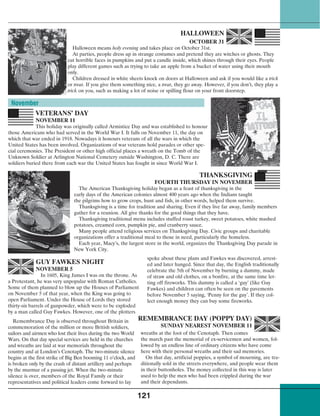
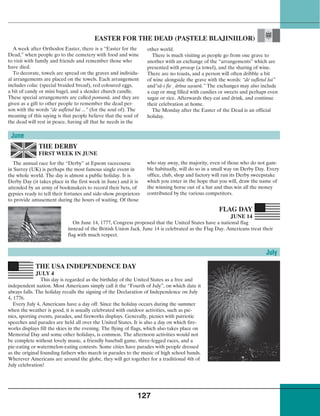
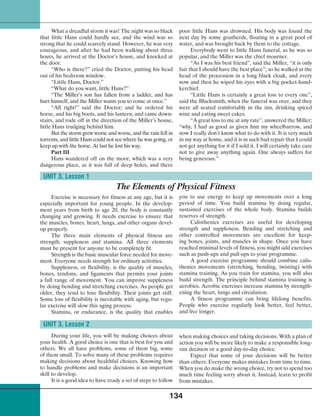
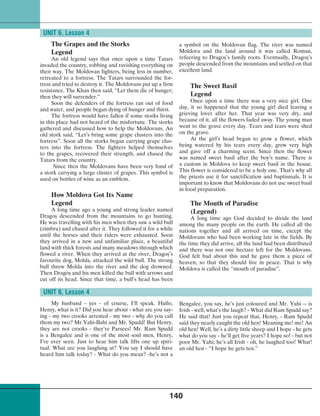
Holidays and Customs 120
Trying Your Hand at Writing Poems 128
Essay writing tips 129
Transitional Devices / Linking Words / Phrases 131
Tape Scripts 132
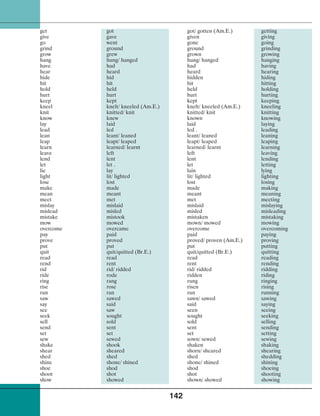
List of Irregular Verbs 141
LESSON 1
LESSON 2
LESSON 3
LESSON 4
LESSON 5
UNIT2 PERSPECTIVES
ON FAMILY AND FRIENDS
Family Ties 24
Age and Youth 28
Literary Focus. Valuing Friendship 32
Culture and Civilization. The Oldest 36
Institution in the UK
More English? 38
LESSON 1
LESSON 2
LESSON 3
LESSON 4
LESSON 5
UNIT3 HEALTH AND WELLNESS
Fitness and You 42
Making Choices 46
Literary Focus. Learn to Love Yourself 50
Culture and Civilization. 54
Medical Care. History and Facts
More English? 56
LESSON 1
LESSON 2
LESSON 3
LESSON 4
LESSON 5
UNIT4 ON RECREATIONAL
ACTIVITIES
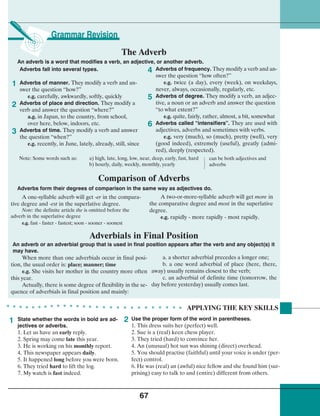
I’m Having the Time of My Life 60
Browsing for Books 64
Literary Focus. The Reading Public 68
Culture and Civilization. Nothing 72
Ventured, Nothing Gained
More English? 74
LESSON 1
LESSON 2
LESSON 3
LESSON 4
LESSON 5
UNIT5 THINGS WE CAN’T
DO WITHOUT
Shopping 78
Eating Out 82
Literary Focus. Just a Bite... 86
Culture and Civilization. Transportation 90
System in London
More English? 92
LESSON 1
LESSON 2
LESSON 3
LESSON 4
LESSON 5
LESSON 6
UNIT6 LEARNING ACROSS
CULTURES
Language — the Treasure of a Nation 96
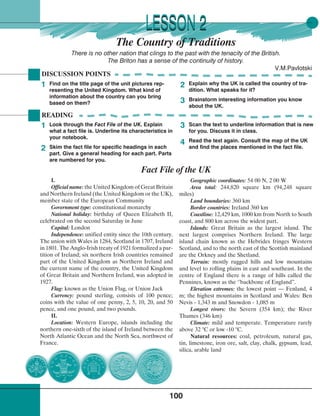
The Country of Traditions 100
The Country of Democracy 104
The Land of Paradise 108
Literary Focus. Believe It or Not! 112
More English? 116
UNIT
ON THE PATH TO KNOWLEDGE
Do you know…
how many people speak English around the globe?
where and when the first schools started?
how British and American schools grade their students?
If you wish to have a rich and last-
ing heritage, truly love
your motherland,
your family,
your nation,
school,
and books.
Aurelian Silvestru
1
6
Obstacles are those frightful things you see when you take your eyes off your goal.
Henry Ford
Dear students,
You have passed into a new stage of your school
life. Open the door to the future to find a world full of
new information and new activities that will give you the
possibility to acquire knowledge at a deeper level and
gain life skills.
The lyceum level is a very important one, it is meant
to prepare you for the baccalaureate exams and indepen-
dent life after graduation.
The way is not easy, but motivation and persever-
ance will make it.
Enjoy your journey.
Enjoy Your Journey
In your notebook answer the following questions to set
your expectations toward the lyceum level. Keep your
notes brief.
a. What do you expect to learn during the three years
ahead of you?
b. How different do you think you will be in three years?
Write at least ten adjectives to describe yourself.
c. What joys and difficulties do you envision you will meet
on your way?
Work in pairs. Share your expectations. Identify common
expectations as well as differences. What do differences
speak of?
As a class, discuss how you see yourselves in three years
and how you can make your expectations come true.
Work in groups and discuss the following topics. Choose one stu-
dent in each group to be the reporter. He or she can make notes of
the discussion and report back to the rest of the class.
a. advantages of knowing English (Use the Info Box as a refer-
ence.)
b. the problems some people have in learning English
c. the best ways of learning English
DISCUSSION POINTS AND WRITING
1
2
4
Read the introduction to the text. Explain why it is entitled My Life
List.
Skim the text and name the categories under which the author
grouped the goals. Tell which of the categories is more appeal-
ing to you and why.
Match the geographical names in the text with their transcrip-
tion in the Pronunciation Key. Pronounce the names of places
correctly and find them on the world map.
Read the text and say which goals John Goddard did not
achieve.
3
1
2
READING
English in the World Today
• One fifth of the world’s population
speaks English to some level of compe-
tence.
• Over 300 million people speak English
as a first language.
• Worldwide there are over 1400 million
people living in countries where English
has official status.
• It is estimated that over one billion
people are learning English.
• English is the favoured language of
international diplomacy, communication,
technology, and scholarship.
• More than half of world’s technical and
scientific periodicals are in English.
• Half of business deals in Europe are
conducted in English.
• English is the official voice of the air
and sea.
• Today English is the basic language
of the World Wide Web. English is the
medium for 80 per cent of the informa-
tion stored in the world’s computers.
• English is the language of Shakespeare
and many other great
writers.
4
Skimming
To skim material is to look at it in order to take in the general subject, the divi-
sions, and the major headings.
You might skim a table of contents to see if the chapters in a book have the infor-
mation that you want. You might also skim a magazine, checking article titles to
see if you want to read any of them.
LESSON 1LESSON 1
3
7
My Life List
One rainy afternoon an inspired
15-year-old boy named John Goddard
sat down at his kitchen table in Los
Angeles and wrote three words at the
top of a yellow pad, “My Life List.”
Under that heading he wrote down
127 goals. He has completed most of
his goals. Each time he accomplished
a goal he checked it on the list. Here
are some of the goals set by young
John.
Explore:
the Nile River
the Amazon River
the Congo River
the Colorado River
the Yangtze River, China
the Niger River
the Orinoco River, Venezuela
Rio Coco, Nicaragua
Study Primitive Cultures In:
The Congo
New Guinea
Brazil
Borneo
The Sudan (John was nearly
buried alive in a sandstorm.)
Australia
Kenya
The Philippines
Tanganyika (now Tanzania)
Ethiopia
Nigeria
Alaska
Pronunciation Key
[
¾
alf¢l
¾
ta†¢]
[
¾
æm¢z¢n]
[
¾
ær¢ræt]
[¢
¾
læsk¢]
[b¢
¾
h¡:m¢z]
[
¾
b™:nl¢†]
[
¾
b¬:ldi]
[br¢
¾
zll]
[
¾
d½¬:dn]
[
¾
ev¢rest]
[
¾
flllpi:nz]
[
¾
fi:d½i:]
[
¾
fl‡rld¢]
[
¾
fu:d½i:]
[
¾
gæll¾li:]
[g¢
¾
læ¾p¢g¢s]
[¾i:³l
¾
¢†pl¢]
[
¾
jæ²ksi:]
[ækæli
¾
f¬:nl¢]
[
¾
k¢†k¢†]
[¾klllm¢n
¾
d½¡:r¢†]
[
¾
kenj¢]
[k‡l¢
¾
r¡:d¢†]
[
¾
k‡²g¢†]
[
¾
k†k]
[nal
¾
æg¢r¢]
[
¾
nald½¢]
[nal
¾
d½l¢ri¢]
[nall]
[¾nlk¢
¾
rægj†¢]
[¾nju:
¾
glni]
[¾nju:
¾
zi:l¢nd]
[¾‡rl
¾
n¢†k¢†]
[‡s
¾
trelli¢]
[
¾
pæn¢ma:]
[
¾
pi:z¢]
[r¢†
¾
dlzl¢]
[
¾
relnl¢]
[
¾
s¤ð¢l¢nd]
[su
¾
d¡:n]
[
¾
sulz]
[su:
¾
pl¢rl¢]
[
¾
t¡:d½m¢
¾
h¡:l]
[¾tæ²g¢
¾
nji:k¢]
[¾tænz¢
¾
ni:¢]
[
¾
t™:ki]
[tltl
¾
k¤k¤]
[
¾
t¼aln¢]
[
¾
vætlk¢n]
[¾vene
¾
zwell¢]
[vlk
¾
t¬:rl¢]
[vl
¾
su:vl¢s]
premed [æpri:
¾
med], n. — a program of premedical study or training to prepare for the
formal study of medicine
chase [t¼els], v. - to go after and try to catch, pursue, follow
warthog [
¾
w¬:t¾h‡g], n. — a wild African hog (a pig) with two pairs of tusks (long
pointed teeth) and protuberances on the face
retrace [rl
¾
trels], v. - to trace (to follow the trail of) again
reef, [ri:f], n. — a ridge of rock, sand, or coral at or near the surface of water
clam [klæm], n. — any of various bivalve mollusks (with a shell consisting of two
parts), many of which are edible (fit to be eaten)
Visit:
North and South Poles
Great Wall of China
Panama and Suez Canals
Easter Island
The Galapagos Islands
Vatican City (Saw the pope)
The Taj Mahal
The Eiffel Tower
The Tower of London
The Leaning Tower of Pisa
Follow River Jordan from the Sea
of Galilee to the Dead Sea
Swim In:
Lake Victoria
Lake Superior
Lake Tanganyika
Lake Titicaca, South America
Lake Nicaragua
Climb:
Mount Everest
Mount Kilimanjaro
Mount Ararat, Turkey
Mount Kenya
Mount Cook, New Zealand
Mount Rainer
Mount Fuji
Mount Vesuvius
Mount Baldy, California
Carry out careers in medicine
and exploration (Studied
premed and treats illnesses
among primitive tribes)
Visit every country in the
world (30 to go)
Learn to fly a plane
Photograph:
Victoria Falls, Rhodesia
(Chased by a warthog in the
process)
Sutherland Falls, New Zealand
Niagara Falls
Retrace travels of Marco Polo
and Alexander the Great
Explore Underwater:
Coral reefs of Florida
Great Barrier Reef, Australia
(Photographed a 300-pound
clam)
the Red Sea
the Fiji Islands
The Bahamas
8
LISTENING
1. a large, long-necked flightless African bird with long, bare legs
2. a small wild horse of Western North America
3. a large marine crustacean with five pairs of legs, of which the first
pair is large and claw-like
4. a large saltwater mollusk having an ear-shaped shell
5. a large thick-skinned herbivorous mammal of Africa and Asia,
with one or two upright horns on the snout (nose)
6. any of several oxlike African or Asian mammals; the American bison
7. a very large marine mammal
8. jaguar, any of various wild leopardlike cats of North and South
America, especially a large species with a yellow and gray coat
marked with black spots
9. a wolf-like animal common in Western North America
10. a reptile having a long body, four legs, and a tapering (becoming
narrower towards the end) tail
a. lobster [
¾
l‡bst¢)]
b. coyote [kal
¾
¢†ti]
c. ostrich [
¾
‡strlt¼]
d. cheetah [
¾
t¼i:t¢]
e. rhinoceros (rhino)
[
¾
ral
¾
n‡s¢r¢s]
f. buffalo [
¾
b¤f¢l¢†]
g. bronco [
¾
br‡²k¢†]
a. arrow [
¾
ær¢†]
b. epee [
¾
epel]
c. boomerang
[
¾
bu:m¢ræ²]
d. bow [b¢†]
e. rifle [ralfl]
f. sabre [
¾
selb¢]
g. lariat [
¾
lærl¢t]
a. glider [
¾
glald¢]
b. freighter [
¾
frelt¢]
c. blimp [bllmp]
d. surfboard [
¾
s™:fb¬:d]
a. polo [
¾
p¢†l¢†]
b. surfing [
¾
s™:fl²]
c. fencing [
¾
fensl²]
d. ju-jitsu [d½u:
¾
d½ltsu:]
Match the descriptions below with the pictures and the words from the listening text.1
h. abalone [¾¢b¢
¾
l¢†ni]
i. whale [well]
j. lizard [
¾
llz¢d]
a
b
e
c
f
h
d
g
j
1
b
c
d
e
f g
a
b
c
d
a
b
c
d
i
Animals and Birds
Weapons
1. a fencing sword with a bowl-shaped guard and a long three sided
narrow blade and a guard over the tip
2. a heavy cavalry sword with a one-edged, slightly curved blade
3. a firearm with a long barrel containing spiral grooves (long narrow
channels)
4. weapon used to shoot arrows
5. a straight, thin shaft (body) that is shot from a bow having a
pointed head and flight stabilizing feathers at the end
6. a rope with a running noose (a loop); lasso
7. a flat, curved missile that can be thrown so that it returns to the thrower
Moving Objects
1. a non-rigid, buoyant (remaining afloat in a liquid or rising in air or
gas) aircraft/airship or dirigible
2. a light, engineless aircraft designed to glide after being towed
aloft into the sky
3. a vehicle, especially a ship, for carrying freight (goods, cargo)
4. a narrow, somewhat rounded board used for surfing
Sports
1. the art, practice, or sport in which an epee, foil, or sabre is used
for defense and attack
2. a Japanese art of self-defense
3. the sport of riding the crests of waves into shore on a surfboard
4. a game played by two teams on horseback, equipped with long-
handled mallets (long-handled hammers used to strike a ball) for
driving a wooden ball
9
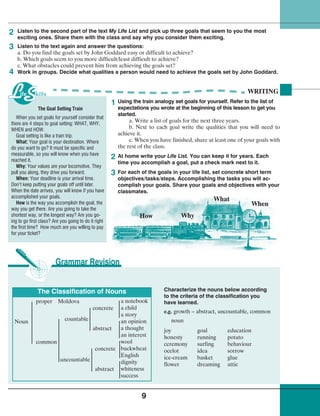
When you set goals for yourself consider that
there are 4 steps to goal setting: WHAT, WHY,
WHEN and HOW.
Goal setting is like a train trip.
What: Your goal is your destination. Where
do you want to go? It must be specific and
measurable, so you will know when you have
reached it.
Why: Your values are your locomotive. They
pull you along, they drive you forward.
When: Your deadline is your arrival time.
Don’t keep putting your goals off until later.
When the date arrives, you will know if you have
accomplished your goals.
How is the way you accomplish the goal, the
way you get there. Are you going to take the
shortest way, or the longest way? Are you go-
ing to go first class? Are you going to do it right
the first time? How much are you willing to pay
for your ticket?
WRITING
Using the train analogy set goals for yourself. Refer to the list of
expectations you wrote at the beginning of this lesson to get you
started.
a. Write a list of goals for the next three years.
b. Next to each goal write the qualities that you will need to
achieve it.
c. When you have finished, share at least one of your goals with
the rest of the class.
At home write your Life List. You can keep it for years. Each
time you accomplish a goal, put a check mark next to it.
For each of the goals in your life list, set concrete short term
objectives/tasks/steps. Accomplishing the tasks you will ac-
complish your goals. Share your goals and objectives with your
classmates.
2
1
2
Why
What
When
How
The Goal Setting Train
Listen to the text again and answer the questions:
a. Do you find the goals set by John Goddard easy or difficult to achieve?
b. Which goals seem to you more difficult/least difficult to achieve?
c. What obstacles could prevent him from achieving the goals set?
Work in groups. Decide what qualities a person would need to achieve the goals set by John Goddard.
3
4
Listen to the second part of the text My Life List and pick up three goals that seem to you the most
exciting ones. Share them with the class and say why you consider them exciting.
proper Moldova
concrete
Noun
abstract
common
concrete
abstract
The Classification of Nouns
a notebook
a child
a story
an opinion
a thought
an interest
wool
buckwheat
English
dignity
whiteness
success
countable
uncountable
Characterize the nouns below according
to the criteria of the classification you
have learned.
e.g. growth – abstract, uncountable, common
noun
joy goal education
honesty running potato
ceremony surfing behaviour
ocelot idea sorrow
ice-cream basket glue
flower dreaming attic
3
10
READING
On Education
• Greek philosophers, or thinkers,
always discussed what education
should try to do and what it should
include. Plato wrote a book called
The Republic, which is one of the
best books ever written on educa-
tion. Since those days, Greek ideas
have influenced European education,
especially secondary and university
education.
Read the passages below. Fill in the gaps with the following words:
liberal, priestly, behaviour, tier, charge, nobles, despised, network, mend,
common, organizing, programme, scriptures.
2
Consult the Pronunciation Key box and learn to pronounce the
words correctly.
1
LESSON 2LESSON 2
Pronunciation Key
Athena [¢
¾
³i:n¢]
Athenian [¢
¾
³i:nl¢n]
Egypt [
¾
i:d½lpt]
Egyptian [
¾
i:d½lp¼n]
Rome [r¢†m]
Roman [
¾
r¢†m¢n]
Sparta [
¾
spa:t¢]
Spartan [
¾
spa:t(¢)n]
China [
¾
t¼aln¢]
Chinese [¾t¼al
¾
ni:z]
Great Britain [
¾
grelt
¾
brlt(¢)n]
British [britl¼]
India [
¾
lndi¢]
Indian [
¾
lndi¢n]
a. Only the sons of ............ attended the
first Egyptian schools, which taught reading,
physical education and good ................ .
b. In China, until the 19th century, education was or-
ganized according to social classes, and consisted largely
of learning the .............. by heart.
c.InancientIndiathe................castedecidedwhatshouldbetaught
to each of the four castes, or groups, into which people were divided.
Only the priestly caste was allowed to learn the scriptures.
DISCUSSION POINTS
1
2
Match the parts to reconstruct sayings or quotations. Agree or disagree with them. Prove your
point of view.
The brighter you are, is like silver in the mine.
The object of teaching a child as being unwilling to learn.
The doors of wisdom the more you have to learn.
Wise men learn by others’ harm; is to enable him to get along without a teacher.
Learn from the skilful; he who teaches himself has a fool for a master.
Being uneducated is not as dishonourable are never shut.
Genius without education fools scarcely by their own.
Brainstorm a list of sayings and proverbs about learning and education in your native lan-
guage. Translate them and comment on their meaning.
The first teachers were fathers and mothers, but very early in the his-
tory of man children began to be taught by people other than their fathers
and mothers. It is thought that schools first started in Egypt 5,000 to 6,000
years ago and that it was the invention of writing which made them neces-
sary. Reading and writing were quite different from the skills used in every-
day life, and writing made it possible to store up knowledge which grew
with each generation. Specially trained people were therefore needed to
teach it.
Education in the Past
The fate of empires depends on the education of youth.
Aristotle
11
11
Big School in
Stratford-upon-
Avon, UK.
Built in 1417.
Used as school
since 1553. It
is believed that
Shakespeare
was educated
here
d. The Athenians were building what
we call a ................. education – one that
helps a man develop all the sides of his
nature, helps him to make and appreciate
beautiful things and helps him to find the
best way of life. They thought it important
to educate the body as well as the mind and
hada...................ofphysicaltrainingwhich
consisted of running, jumping, wrestling
and throwing the discus. As time went on,
education paid special attention to read-
ing, writing and literature and these were
taught by a special teacher, known as the
“dramatist”. .............. people were not edu-
cated: they were trained in craftsmanship,
workmanship, and trades.
e.InGreatBritain,thefirstteacherswe
read about were craftsmen. They taught
children to read, write and count, to cook
and ........... their shoes. In the early 19th
century the main system of teaching was
the “Monitor” system. The teacher could
manage a class of 100 or more by using
older pupils or “monitors” to help him. The
schools had long desks which were some-
times arranged in ......... so that the teacher
could see every child in a large class.
f. The Spartans, a hard and warlike people, gave a purely military
education. At the age of seven, all boys of noble families were taken
from their homes and were sent to live in groups. They were kept un-
der very strict discipline and were taught hunting, military scouting,
swimmingandtheuseofweapons.They...............literature,andsome
people think they could not even read.
g.TheRomanswereverygoodat...................,andtheywerethe
first people to have schools run by the government free of ............. .
Throughouttheirgreatempire,therewasa..............oftheseschools
which provided for three stages of education. At age six or seven
all boys (and some girls) went to the primary school, where they
learned the “three Rs”: reading, writing and arithmetic. Most chil-
dren were not taught more than this, but at 12 or 13 boys of the
rich families went on to the “grammar” school to study language
and literature. At 16, young nobles who wanted to enter politics or
the service of their country went to the schools of rhetoric, or public
speaking.
Read the Info Box and explain what rhetoric is.
Do you think it should be taught in schools?
Why, or why not? If yes, what would the benefits
be?
Complete the following table.
a. Write down the school subjects mentioned in the
text and mark the places where they were taught.
b. Compare the subjects taught in different coun-
tries to identify similarities and differences.
c. Underline the subjects that are still taught in
schools today.
3
4
5
6
Places
Subjects Athena Rome Sparta China India Egypt Great Britain
Reading
Good behaviour
Tell what impressed you most about education
in the past and why.
Tell what is common and what is different
between education in the past and education in
modern times.
Rhetoric [
¾
ret¢rlk] — the art of effective expression and the
persuasive use of language; oratory; the art of influencing the
thought and conduct of an audience.
12
SPEAKING AND WRITING
Resolution — a statement to be debated.
Argument — a unit of discourse in which beliefs are supported by reason.
The starting point of an argument is an assertion, which states the belief,
position or point of view that the arguer is going to expand or support.
Here is what I believe and I will show you why I believe it.
Evidence — specific life examples, statistics, factual references, appeal to
authority (dictionary, encyclopedia, the Bible, the Constitution, etc.)
Write arguments for and against
the resolution “Education is the
key to success”; give supportive
evidence.
Debate the topic in class.
1
2
1 Look at the pictures and reflect on different ways of learning.
a. What can you learn from each of these sources of information?
b. Which of them do you find more efficient and why?
c. Can you name other sources of learning?
Listen to the opinions of a teacher and a parent about school and edu-
cation. How would you answer the questions that the parent and the
teacher ask at the end of their letters?
Replace the underlined words in the following sentences from the text
you have just listened to by their synonyms. Consult the Learner Train-
ing rubric and the Word House.
length, modest, old-fashioned, drop, reduced
a. Today’s children are unlikely to open a book after they leave school
and, in time, books will become obsolete.
b. Their parents have no time either — they are too busy working to
make sure their kids “have everything they need” and also too tired when
they get back home to do much else than flop into an armchair and switch
on cable TV.
c. My students find books boring, probably because computerized vis-
ual effects and televised soap operas have shortened their attention span,
impoverished their vocabulary and dulled their imagination.
d. In my humble opinion, reading is essential to help develop lively,
creative, critical and literate minds.
2
Listen to the texts again and fill in the table below.
a. Pick out of each of the two opinions key arguments in favour of watching
TV, using computer technology, and reading. Note them down in the table.
b. Add your own arguments to each section in the table.
c. Discuss the arguments in class. Prove the importance of each of the sources
listed.
3
Reading books is Watching TV is Using computer technology
important because… important because… is important because…
4
Synonyms
Synonyms are words
that possess almost the
same general meaning.
e.g. large - big
beautiful - good-looking,
pretty - lovely, handsome
Synonyms which are
identical in meaning are
called complete or absolute
synonyms.
Few words in a lan-
guage are identical in
meaning, we usually find
them in terminology.
e.g. scarlatina - scarlet fever
semasiology - semantics
synopsis - summary
parka - anorak
shoestring - shoelace
obsolete [
¾
‡bs¢li:t] [¾‡bs¢
¾
li:t],
adj. – no longer in use or fash-
ion; no longer useful or functi-
oning
flop, [fl‡p], v. – to fall heavily and
noisily
span, [spæn], n. — the length
of time that something lasts or
continues
impoverish [lm
¾
p‡v¢rl¼], v. – to
reduce to poverty; to deprive of
natural richness or strength
dull [d¤l], v. — to become or
make something dull
humble [hvmbl], adj. – marked by
meekness or modesty; showing
submissive respect
LISTENING
13
Study the above scheme. Can you name the four ways of forming nouns? If not, do exercise 2.
Match the words with their definitions
1. contraction a. the forming of nouns by adding either a prefix or a suffix (or both of
them) to the stem of the word.
2. deflexion b. the formation of a noun from another part of speech without adding any
derivative elements.
3. conversion c. the shortening of a word by omitting its first part, its middle or its ending.
4. affixation d. the formation of one word from another word.
5. derivation e. the derivation of one word from another by changing the vowel.
Noun Formation
public inn/house – pub
Frederick – Fred
craftsmanship
APPLYING THE KEY SKILLS
1
2
2
to sculpture – a sculpture
to sound – a sound
disagreement
misunderstanding
to freeze – frost
to drip – drop
Form nouns from the following words:
1. wide 7. secure 13. deep 19. train
2. to improve 8. to meditate 14. percept 20. devise
3. to plan 9. to show 15. to strike 21. choose
4. citizen 10. similar 16. to connect 22. to require
5. to shoot 11. to feed 17. to lift 23. correct
6. to defend 12. identify 18. meek 24. long
Some nouns may be both countable and uncountable depending on
their use. Among these we can enumerate the following:
Countable and Uncountable Nouns
1. Nouns denoting both single items and “substances”
e.g. a chicken/ chicken
There are many chickens in the yard.
We don’t eat chicken very often.
2. Nouns which refer to objects or material.
e.g. an iron/ iron
Can you lend me your iron?
This kitchen utensil is made of iron.
3. Nouns which can refer to something specific or general.
e.g. a light/ light
Not a light could be seen in the house.
Light travels faster than sound.
4. Nouns ending in “-ing.”
e.g. a painting/painting
There was a painting by Turner on the wall.
Painting was the only thing he liked while at school.
Fill in the blanks with a/an, the, – (no article)
1. He doesn’t like to drink … wine.
2. What is … paper made of?
3. … reading is his favourite occupation.
4. My mother bought me … blue ribbon.
5. This has always been … wine of high quality.
6. Where is … paper I was reading two minutes ago?
7. She was asked to deliver … speech at the reunion
tomorrow.
8. Tell him to buy … tea for me and … beer for my fa-
ther.
9. … good knowledge of a foreign language is always a
priority.
10. Is … glass really made from sand?
11. There was … flour everywhere in the kitchen.
12. … education is what he lacks at present.
13. Is that piece of clothing made from … wool or …
cotton?
14. When did he come into … fortune?
1
14
Killing Time or Learning?
DISCUSSION POINTS
Work in groups. Look at the two pictures. Tell
how you would describe the teacher-student
relationships in each of them.
Decide what the missing word in the middle of
the circle is.
1
2
3
Why Are Students Turned Off?
Casey Banas
A teacher pretends to be a student and sits in on
several classes. What does she find in the typical class?
Boredom. Routine. Apathy. Manipulation. Discourage-
ment. If this depressing list sounds familiar, you will be
interested in the following analysis of why classes often
seem to be more about killing time than about learning.
Ellen Glanz lied to her teacher about why she
hadn’t done her homework; but, of course, many
students have lied to their teachers. The difference
is that Ellen Glanz was a twenty-eight-year-old high
school social studies teacher who was a student for
six months to improve her teaching by gaining a fresh
perspective of her school.
She found many classes boring, students doing as
A distinctive feature of a good school is to make the student learn more than he
is taught, even more than the teacher himself knows.
Mihai Eminescu
Answer the questions:
a. What does each of the word combinations
in 2 mean?
b. When does a teacher-student communica-
tion gap occur?
c. How does such a gap influence the atmos-
phere in class?
generation gender communication
trade credibility information
?
READING
Read the title. Predict what the text will tell you about the relationships be-
tween teachers and students.
Scan the text. Check whether your predictions were right. Share the results
with your classmates.
Read the text. Answer the questions:
1. Why are students sometimes turned-off?
2. What does Ellen Glanz suggest doing to end the teacher-student “battle”?
3. Out of the three options mentioned by Ellen Glanz which one would you choose?
Why?
a. confess openly to the teacher b. copy someone’s sheet c. make up an excuse
4. Why are many students “obsessed” with getting very good and excellent marks?
1
2
3
1
little as necessary to pass tests and get good grades,
students using ruses to avoid assignments, and stu-
dents manipulating teachers to do the work for them.
She concluded that many students are turned off be-
cause they have little power and responsibility for
their own education.
Ellen Glanz found herself doing the same things
as the students. There was the day when Glanz want-
ed to join her husband in helping friends celebrate
the purchase of a house, but she had homework for a
math class. For the first time, she knew how teenag-
ers feel when they think something is more impor-
tant than homework.
She found a way out and confided: “I consi-
2
3
Scanning
Scanning is another kind
of rapid reading. You
scan when you want to
find a specific piece of
information quickly. When
you scan, you do not read
every word. You run your
eyes quickly down the
page looking for a specific
idea, fact, detail. Scanning
demands that you ignore
all but the key item being
searched for.
Literary Focus
LESSON 3
LESSON 3
15
dered my options: confess openly to the teacher,
copy someone else’s sheet, or make up an excuse.”
Glanz chose the third option–the one most widely
used–and told the teacher that the pages needed to
complete the assignment had been ripped from the
book. The teacher accepted the story, never check-
ing the book. In class, nobody else did the home-
work; and student after student mumbled responses
when called upon.
“Finally,” Glanz said, “the teacher, thinking
that the assignment must have been difficult, went
over each question at the board while students cop-
ied the problems at their seats. The teacher had
‘covered’ the material and the students had listened
to the explanation. But had anything been learned?
I don’t think so.”
“The system encourages incredible passivity,”
Glanz said. “In most classes, one sits and listens. A
teacher, whose role is activity, simply cannot under-
stand the passivity of the student’s role,” she said.
“When I taught,” Glanz recalled, “my mind was
going constantly–figuring out how to best present
an idea, thinking about whom to call on, whom to
draw out, whom to shut up; how to get students
involved, how to make my point clearer, how to
respond; when to be funny, when serious. As a
student, I experienced little of this. Everything was
done to me.”
Class methods promote the feeling that students
have little control over or responsibility for their own
education because the agenda is the teacher’s, Glanz
said. The teacher is convinced the subject matter is
worth knowing, but the student may not agree. Many
students, Glanz said, are not convinced they need
to know what teachers teach; but they believe good
grades are needed to get into college.
Students, obsessed with getting good grades to
help qualify for the college of their choice, believe
the primary responsibility for their achievement rests
with the teacher, Glanz said. “It was his responsibil-
ity to teach well rather than their responsibility to
learn carefully.”
Teachers were regarded by students, Glanz said,
not as “people,” but as “role-players” who dispensed
information needed to pass a test.
But the sad reality, Glanz said, is the failure of
teachers to recognize their tremendous communica-
tion gap with students. Some students, she explained,
believe that effort has little value. Some have heard
reports of unemployment among college graduates
and others, and after seeing political corruption they
conclude that honesty takes a back seat to getting
ahead any way one can, she said. “I sometimes es-
timated that half to two-thirds of a class cheated on
a given test,” Glanz said. “Worse, I’ve encountered
students who feel no remorse about cheating but are
annoyed that a teacher has confronted them on their
actions.”
Glanz has since returned to teaching at Lincoln-
Sudbury. Before her stint as a student, she would
worry that perhaps she was demanding too much.
“Now I know I should have demanded more,” she
said. Before, she was quick to accept the excuses of
students who came to class unprepared. Now she
says, “You are responsible for learning it.” But a
crackdown is only a small part of the solution.
The larger issue, Glanz said, is that educators
must recognize that teachers and students, though
physically in the same school, are in separate worlds
and have an on-going power struggle. “A first step
toward ending this battle is to convince students that
what we attempt to teach them is genuinely worth
knowing,’’ Glanz said. “We must be sure, ourselves,
that what we are teaching is worth knowing.”
to lie to someone = to tell lies
to find something boring (interesting, comfortable) — to
become informed or aware of, by experience or trial
to turn somebody off — (cause him to) lose interest, desire,
etc.
to make up an excuse — to give reasons for not complying
to get someone involved (in) — to cause to take part (in)
to be obsessed with — to be excessively preoccupied with
to feel (no) remorse about something — to feel (no) regret
for doing something
Phrases and Idioms
5
6
7
8
9
10
11
12
ruse [ru:z], n. — deceitful way of doing something
purchase [
¾
p™:t¼¢s], n. — something bought
confide [k¢n
¾
fald], v. — to tell a secret; tell confidentially
rip, [rlp], v. — to pull, tear or cut something quickly and with
force
promote [pr¢
¾
m¢†t], v. — to encourage, support
regard [rl
¾
ga:d], v. — to consider to be
dispense [dls
¾
pens], v. — to distribute, administer
cheat [t¼i:t] (on), v. — to act in a dishonest way; to win an
advantage or profit
encounter [ln
¾
ka†nt¢] v. — to meet
stint, [stlnt], n. — period of time spent at a particular activity
assume [¢
¾
sju:m], v. — to take for granted or true
crackdown, n. — severe measures to restrict or discourage
undesirable people or actions
4
16
Write the word that goes with each clue below.
The numbers in brackets correspond to the
paragraphs in the text.
1. You usually use this word when you mean
something new, bright, cool, not stale, not tinned.
(1)
2. It refers to things, activities which are not
interesting at all. (2)
3. People use this word when they are given the
right or power to choose. (4)
4. We use this word to show that a person
doesn’t speak distinctly. (4)
5. We pronounce this word when we doubt
something that can not be believed. (6)
6. No meeting, conference, seminar can be
organized and held without having one. (7)
7. The word is used to mean the thing(s) done
successfully, with effort and skill. (8)
8. It’s equivalent of the answer to an equation
or problem. (11)
In the following examples choose the word
which fits the meaning in the sentence.
e.g. What you really lack is the ability to see
things in… .
a. prospect b. relation c. perspective
1. The best thing to do now is to … my sins and
ask God for a blessing.
a. acknowledge b. confess c. deny
2. A clever politician knows how to … his sup-
porters.
a. manipulate b. handle c. manage
3. I recognized him the very moment I saw him
but I couldn’t … his name.
a. recollect b. recall c. remind
4. Do you believe the three-month courses will
help him … for this post?
a. to adapt b. to nominate c. to qualify
5. She can’t distinguish between an … artist
and an amateur.
a. original b. accomplished c. trained
6. All our attempts to stop him from leaving
the country ended in… .
a. loss b. deficiency c. failure
7. There was not enough evidence for the jury
… whether the defendant was guilty or not guilty.
a. to infer b. to conclude c. to sum up
For each word in column A that comes in the
text find a word in column B which is opposite
in meaning. The first example has been done for
you.
A. B.
1. boring a. unusual
2. to purchase b. dishonesty
3. to accept c. interesting
4. funny d. success
5. to gain e. serious
6. separate f. to lose
7. honesty g. to soothe
8. failure h. to sell
9. to annoy i. united
10. common j. to reject
Form strong partnerships with gain, lose, and
miss. Use some of the correct word partnerships
in sentences of your own.
a match recognition
time heart
a fortune one’s balance
a friend ground
chance an advantage
the favour of face
a train the upper hand
school the boat
4
5
6
7
a. What makes students tell lies when they
don’t do their homework?
b. Why do some students find classes boring?
c. What causes students’ passivity and what
should be done about it by both teachers and stu-
dents?
d. What is more important to you, grades or
knowledge? Explain why.
e. Have you ever cheated on any test in any
subject? How did you feel afterwards?
SPEAKING
f. What are you relationships with your teach-
ers? Are you really in “two separate worlds”? Ex-
plain.
g. Where and why does the teacher-student
communication gap begin? Suggest ways of dimin-
ishing it.
h. Which principles (both for teachers and stu-
dents) do you think could facilitate the teaching-
learning process in your school/ class?
Comment on Ellen Glanz’s words from the last
two paragraphs.
Discuss the following.1
2
17
Play the role of a student observer in one of your
classes. Then write an essay stating the atmos-
phere in that particular class and give detailed rea-
sons why you think it is either interesting or boring.
Read your essay in class. (See Steps for Writing an
Essay).
You might want to consider the following:
The teacher: tone, enthusiasm, teaching methods
and aids, sense of humour, understanding, cooperation,
level of interest, ability to handle questions, etc.
The students: discipline, enthusiasm, participation,
motivation, attitude, cooperation, support, etc.
Add other factors, if necessary (how many students
did their homework, how much was learned, how the
students were appreciated, what the teacher-student re-
lationship was).
LITERARY FOCUS
Nonfiction is prose writing that deals with real people, events, and places. One
major type of nonfiction is the essay.
An essay is a composition of three or more paragraphs that present and develop
one main idea.
Some essays are formal – that is, tightly structured and written in an impersonal
style. Others are informal, with a looser structure and more personal style.
There are four common types of essays:
— Expository essays present or explain information and ideas.
— Descriptive essays paint a vivid picture that expresses one main impression of
a person, an object, or a scene.
— Persuasive essays state an opinion on a subject and use facts, examples, and
reasons to convince readers to adopt particular points of view.
— Literary essays are of two types:
a. book review, in which the writer briefly summarizes the contents.
b. critical essay, in which the writer analyzes and interprets a work of literature.
An essay should have:
— an introduction
— a body
— a conclusion
The introduction of an essay
a. captures the reader’s attention,
b. establishes the tone,
c. contains the thesis statement.
Tone is the writer’s attitude toward his or her subject and audience.
The thesis statement states the main idea and makes the writer’s purpose clear.
The paragraphs that make up the body of an essay develop the main idea
expressed in the thesis statement and show the writer’s point of view in a clear and
convincing way.
The purpose of the conclusion is:
a. to summarize the main points;
b. to state an opinion, argument based on the information or evidence in the essay;
c. to suggest other areas to explore that will enlarge the reader’s understanding
of the subject.
Steps for Writing an Essay
1. Write a thesis statement.
2. Write an introduction that includes your thesis statement.
3. Use your outline to write the paragraphs in the body.
4. Use connecting devices to link your thoughts.
5. Add a concluding paragraph.
6. Add a title.
7. Revise your essay for structure, well-developed paragraphs, unity, coherence, empha-
sis, and varied and lively sentences and words.
8. Check your grammar, spelling, and manuscript form.
1. What kind of essay are the
passages below from? How do
you know?
a. Most birds migrate in
silence, but not geese. Whether
you are walking down a city
street, standing in a suburban
backyard, or working in a rural
wood lot, you know when geese
fly away.
b. In Ernest Hemingway’s
novel The Old Man and the Sea,
the main character, Santiago,
endures severe physical hard-
ships. He also suffers a painful
loss. Despite the suffering and
loss, the novel is affirmative and
hopeful.
c. Although I love movies,
going to see them drives me crazy.
For one thing, getting there takes
a lot of time. Another problem is
that the theatre itself is seldom a
pleasant place to be. Half of the
seats seem to be falling apart.
2. a. In “Why Are Students
Turned Off?”, which sentence(s)
is (are) used to attract the read-
er’s interest?
b. The thesis is presented in
– the second sentence;
– the third sentence;
– the fourth sentence.
c. The thesis contains a plan of
development.–Yes. —No.
d. Which words in the thesis
announce the major supporting
points in the essay?
e. Agree upon the topic sen-
tence of each paragraph.
f. Which sentences contain the
concluding thought of the essay?
Apply Your Knowledge
WRITING
Culture
and Civilization
Culture
and Civilization
Culture
and Civilization
18
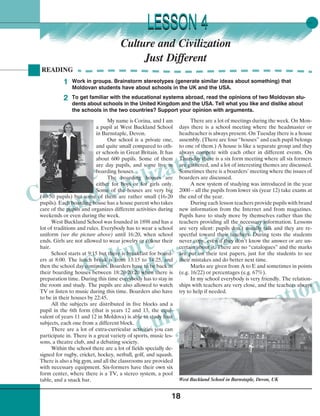
Culture and Civilization
My name is Corina, and I am
a pupil at West Buckland School
in Barnstaple, Devon.
Our school is a private one,
and quite small compared to oth-
er schools in Great Britain. It has
about 600 pupils. Some of them
are day pupils, and some live in
boarding houses.
The boarding houses are
either for boys or for girls only.
Some of the houses are very big
(40-50 pupils) but some of them are rather small (16-20
pupils). Each boarding house has a house parent who takes
care of the pupils and organizes different activities during
weekends or even during the week.
West Buckland School was founded in 1898 and has a
lot of traditions and rules. Everybody has to wear a school
uniform (see the picture above) until 16:20, when school
ends. Girls are not allowed to wear jewelry or colour their
hair.
School starts at 9:15 but there is breakfast for board-
ers at 8:00. The lunch break is from 13:15 to 14:25, and
then the school day continues. Boarders have to be back in
their boarding houses between 18:20-20:20 when there is
preparation time. During this time everybody has to stay in
the room and study. The pupils are also allowed to watch
TV or listen to music during this time. Boarders also have
to be in their houses by 22:45.
All the subjects are distributed in five blocks and a
pupil in the 6th form (that is years 12 and 13, the equi-
valent of years 11 and 12 in Moldova) is able to study four
subjects, each one from a different block.
There are a lot of extra-curricular activities you can
participate in. There is a great variety of sports, music les-
sons, a theatre club, and a debating society.
Within the school there are a lot of fields specially de-
signed for rugby, cricket, hockey, netball, golf, and squash.
There is also a big gym, and all the classrooms are provided
with necessary equipment. Six-formers have their own six
form center, where there is a TV, a stereo system, a pool
table, and a snack bar.
There are a lot of meetings during the week. On Mon-
days there is a school meeting where the headmaster or
headteacher is always present. On Tuesday there is a house
assembly. (There are four “houses” and each pupil belongs
to one of them.) A house is like a separate group and they
always compete with each other in different events. On
Thursday there is a six form meeting where all six formers
are gathered, and a lot of interesting themes are discussed.
Sometimes there is a boarders’ meeting where the issues of
boarders are discussed.
A new system of studying was introduced in the year
2000 – all the pupils from lower six (year 12) take exams at
the end of the year.
During each lesson teachers provide pupils with brand
new information from the Internet and from magazines.
Pupils have to study more by themselves rather than the
teachers providing all the necessary information. Lessons
are very silent: pupils don’t usually talk and they are re-
spectful toward their teachers. During tests the students
never copy, even if they don’t know the answer or are un-
certain about it. There are no “catalogues” and the marks
are put on their test papers, just for the students to see
their mistakes and do better next time.
Marks are given from A to E and sometimes in points
(e.g. 16/22) or percentages (e.g. 67%).
In my school everybody is very friendly. The relation-
ships with teachers are very close, and the teachers always
try to help if needed.
READING
Work in groups. Brainstorm stereotypes (generate similar ideas about something) that
Moldovan students have about schools in the UK and the USA.
To get familiar with the educational systems abroad, read the opinions of two Moldovan stu-
dents about schools in the United Kingdom and the USA. Tell what you like and dislike about
the schools in the two countries? Support your opinion with arguments.
1
2
Just Different
West Buckland School in Barnstaple, Devon, UK
LESSON 4LESSON 4
Culture
and Civilization
Culture
and Civilization
Culture
and Civilization
19
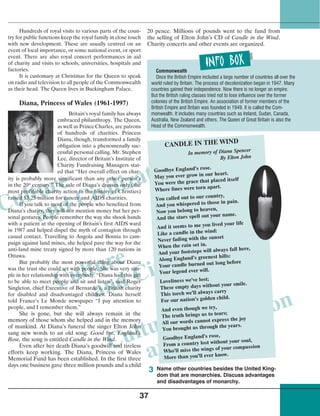
My name is Inga, and I have
graduated from Nevada Union
High School in Grass Valley,
California.
American high school is of-
ten stereotyped in the minds of
Moldovan teenagers. It is viewed
as a time of continuous partying,
easy classes, and straight “As”.
The reality is far from this pic-
ture. It is true that overall Ameri-
can classes are oriented toward
the 4th was lunch. Every day we had the same classes; the
schedule doesn’t change for a whole semester. The stu-
dents in every class are different, there is not such a notion
as class 10 “a” or “b”, or a “class teacher”. Students are
much more independent than in Moldova.
My school is a public school. It is a big one. It has
almost 3000 students, all high school students. There were
no meetings organized for students, only the Students’
Government Body was getting together to discuss issues
related to school life.
There is no uniform required for students: uniforms
are usually obligatory for private schools only. There are
certain restrictions on what types of clothes you can were
at school. There is also a uniform required for Physical
Education classes.
Each of the schools in the United States has coun-
selors. These are people who can give you advice concern-
ing the school subjects, or about continuing studies at col-
lege or university.
There were a lot of extra-curricular activities organ-
ized for students at my school, all in all over 40 clubs of
different kinds.
The relationships between students and teachers are
much more informal than in Moldova. Students and teach-
ers are very friendly. Teachers are viewed more as friends
than “higher level” educators.
There are different ceremonies organized in Ame-
rican schools. Among them are “Prom” and “Graduation”
ceremonies. For graduation, students wear special robes
(see the picture above).
Prom is held three-four weeks before the school ends.
It’s a big formal dance where only seniors are invited.
“Grad night” is another event held for the entire night, the
day following the graduation. There is also a senior trip
somewhere in the country.
an average student, and if you go to school and do your
homework, it’s possible to be classified as a good student.
Still, studying in an American school can be difficult and
even tough.
There is a system called “honors” in most of the
schools and only the best students who maintain their GPA
(Grade Point Average) above a certain level can be en-
rolled in these special classes, which can be qualified as ad-
vanced. The level of students in these classes is above and
average; so is the grading system. For example, if you get
an “A” in an honor class, your grade for that class will be
5.00 points instead of 4.00 as in regular classes. The grad-
ing system is as follows: an “A” equals to 4.00, a “B” to
3.00, a “C” to 2.00 and a “D” to 1.00. An “F” is 0.00 and
the class has to be retaken in order to graduate from high
school. There is a minimum of credits required for gradu-
ation. Every subject taken for a period of one semester has
a corresponding number of credits. For example a biology
class equals to three credits. In high school almost all the
classes have the same amount of credits because they are
required for graduation.
Another difference between American and Moldovan
schools is that you can choose what you want to study. It is
not absolutely liberal, but still the student has something to
say about what he/she wants to study. There is a guideline
for what should be taken and some of the obligatory classes
include English for four years, and Math for two, three or
four years (depending on the school you are in and the col-
lege you want to go to). The other subjects are electives
(or at least this is what they are called). Every student has
to take two science classes (and there are four different
science classes available, such as Physics, General Science,
Chemistry and Astronomy). So, the student has the choice
of any two of these in order to graduate.
At my school, we had classes from early in the morn-
ing (7:35 AM) to 2:30 PM. Everybody had seven periods;
The UK the USA Moldova
Grading System
School Day/Timetable
......................................
Work in pairs. Discuss what is common and what is different between the educational systems
in the United Kingdom, the United States, and Moldova. Fill in the following table:
3
Nevada Union High School in Grass Valley, California, USA
Looking at the title, guess what the text might be about.
Read the text and explain why you find the author’s view an optimistic or pessimistic one.
Prove your point of view.
The tendency of culture is, and will probably conti-
nue to be, towards science and away from art and lit-
erature...
I imagine that a hundred years hence every fairly
educated person will know a good deal of mathematics,
a fair amount of biology, and a great deal about how to
make machines. Education, except for the few, will be-
come more and more what is called “dynamic”, i.e. will
teach people to do, rather than to think or feel. They
will perform all sorts of tasks of extraordinary skill, but
will be incapable of considering rationally whether the
tasks are worth performing...
The daily press, presumably, will be killed by broad-
casting. A certain number of weeklies may survive for
the expression of minority opinions. But reading may
come to be rare practice, its place being taken by listen-
ing to the gramophone, or to whatever better invention
takes its place. Similarly, writing will be replaced, in or-
dinary life by the Dictaphone.
If wars are eliminated and production is organized
scientifically, it is probable that four hours’ work day
will suffice to keep everybody in comfort. It will be an
open question whether to work that amount and enjoy
leisure, or to work more and enjoy luxuries; presum-
ably some will choose one course, some the other. The
hours of leisure will no doubt be spent by most people
in dancing, watching football and going to the movies.
Children will be no anxiety, since the State will care of
them; illness will be very rare; old age will be postponed
by rejuvenation till a short time before death. It will be a
hedonist’s* paradise, in which almost everyone will find
life so tedious as to be scarcely endurable.
Bertrand Russell, Skeptical Essays (1935)
* A hedonist believes that gaining pleasure is the most im-
portant thing in life.
“To do rather than to think or feel...”
Say whether the following statements are right
or wrong according to Russell’s essay.
– Bertrand Russell thinks literary education is
doomed to disappear.
– Practical and mechanical skills will become
less important.
– People will be much more apt to criticize and
reason.
– Fewer books and papers will be read.
– Music and writing will both become things of
the past.
– Everyone will work fewer hours to spend
more time looking after their families.
Classify Bertrand Russell’s predictions into
three categories:
– Those that have already come true.
– Those that are likely to come true within the
next few decades.
– Those that have not yet come true and will
probably never come true.
Tell which of the author’s predictions you would
like to happen and which not. Explain your point
of view.
Give your opinion of the future of education, the
media and our lifestyle.
Project Work. Form two working groups.
a) Imagine that you are part of a group formed
by representatives of the Ministry of Educa-
tion and teachers from different schools that
is elaborating a plan for improving the educa-
tional system of Moldova. Within your group
make suggestions and write them down. When
working on your project, consider the following:
subjects taught, conditions for studies, teach-
ers’ role, parents’ role, etc. Use visuals (diagrams,
drawings, etc.) to be more convincing.
b) When you finish, each group will take turns in
presenting the project to the other group and giving
arguments to support it. The other group will take
the role of Parliament and will have to either ap-
prove or reject the project and support the decision
taken.
More English?
1
3 4
5
2
6
LESSON 5LESSON 5
20
7
21
Match the following words and expressions with
their synonyms.
1. skill a. enter
2. educate b. ability
3. enhance c. competent
4. faculty d. department
5. qualified e. deepen
6. enroll f. teach
Give antonyms to the following words and ex-
pressions.
literate
experience
educated
profound knowledge
to enter school
ignorant
capable
to do well at an exam
final exams
absent
Write nouns corresponding to the following
adjectives.
creative
knowledgeable
diligent
successful
educated
ignorant
intellectual
perseverant
Form nouns from the following verbs.
explain
know
inform
progress
teach
admit
train
appreciate
cooperate
orient
Match the following words to form compound
words or word combinations. Spell them correctly.
In some cases more than one variant is possible.
Two examples have been done for you.
laboratory qualified
personality development
media activity
book drill
fresh man
highly work
play slip
work graduate
competitive examination
language proficiency
tuition educated
boarding house
fire store
computer lab
extra-curricular center
teacher’s lounge
nurse’s office
permission ground
under shop
lunchroom monitor
home assistant
house parent
highly fee
back pack
community college
competent
responsible
confident
active
participate
probe
suspend
achieve
examine
Unscramble the letters to make a word
Example: The Headmaster of a school is also called ____________________ (riipcnalp=Principal) .
1. The _____________ (hcoca) was upset because his team had lost the game.
2. Students went to the school ______________ (rfcetaeia) during their lunch hour.
3. We can watch films at our school _______________ (etaterh).
4. Students in the USA schools have ____________ (klcesor) where they can keep the textbooks.
5. The Physical Education classes are held at the __________________ (umygnsmiya) .
6. You use a _________________ (ihgigterhlh) to underline important information in the text.
8
10
11
12
9
14
Characterize the nouns in bold type in the sentences given below according to the criteria of classifica-
tion and formation you have learned from the schemes of lessons 1 and 2.
13
1. Do you need an excuse?
2. Becky knew nothing about the appointment.
3. He took a long breath and said nothing.
4. The agonizing slowness was harder to endure
than no motion at all.
5. It won’t be very easy to make a run all through
the stubblefield.
6. Her mother’s death was a great loss for her.
7. With wordless disapproval he set down one after
the other the seven small trunks. (E.G. Speare)
8. When you speak about this matter I am always
out of my breath.
9. How long shall we tolerate his irresponsibility
and childish behaviour?
10. She can’t have failed at the exam: she studied a
lot.
11. Roosevelt continued to favour unemployment
programs based on work relief rather than wel-
fare.
12. May you have success!
22
Work in small groups. Prepare and role-play real school life humorous situations in front of your class-
mates. Use vocabulary related to the topic school.
16
American English British English
alumnus [¢
¾
l mn¢s], graduate graduate [
¾
græd½u¢t]
campus [
¾
kæmp¢s] campus, grounds (GB only)
class, year, form (private schools), grade (US only) class, year, form,
elementary school, primary school primary school
faculty (US only), staff (at university) staff
high school (US only), secondary school secondary school
class lesson (mostly GB), class
student pupil (mostly GB), student
dormitory [
¾
d¬:m¢tri] (dorm) boarding [b¬:dl²] house
principal, headmaster/headmistress (private schools) headmaster/headmistress, principal (college)
grade grade, mark (GB only)
public school public school
freshman 1st year student
sophomore [
¾
s‡f¢m¬:] 2nd year student
junior [
¾
d½u:ni¢] 3rd year student
senior[
¾
si:ni¢] 4th year student
Analyze the information below. Find in the Culture and Civilization lesson some of the
following words and compare their use in British and American English.
17
18 Principles of Learning
• Learning depends on motivation.
• Learning depends upon the capacity to learn.
• Learning depends upon past and current experiences.
• Learning depends upon the active involvement of the learner.
• Learning depends upon an atmosphere of respect.
• Learning depends upon critical, reflective thinking.
• Learning is observing.
• Learning is enhanced when learners achieve self-direction.
Reflect on
some basic
principles of
learning (see
the Life Skills
box) and com-
ment on each of
them.
Project work. Complete a list of countries in which English has official status and mark them on the
world map.
a. Write down the names of the English-speaking countries you know, and mark these countries on the
world map. Use your imagination to make it look nice.
b. Compare your list with those of your colleagues to check for accuracy, and compile a common list for
the whole class/group.
c. Revise the Phonetic Support and Reading Guide at the end of the book to assist you in pronouncing the
names of English-speaking countries. Use a dictionary to check your pronunciation.
19
Answer each question with a word or word combination.
1. What does the student receive after successfully completing a school?
2. Who may pay for a student’s education?
3. What is the grant awarded to a student by the university called?
4. What is the person who examines a student during the exam called?
5. What would you say if a student didn’t pass an exam and has to repeat the course?
6. How can you describe an extraordinarily good student? (Give more adjectives.)
7. How would you describe a person who doesn’t give up in front of difficulties and seeks to reach the goal?
8. How do you describe a person who manages to do a lot of things in a short period of time?
9. What kind of knowledge do you need before you study the advanced areas of a subject?
10. What are people who attend the same classes in school called?
11. What is the process of changing the educational system in a country called?
12. What is the institution that takes care of children during the day called?
15
UNIT 2Our lives are shaped by
those who love us.
John Powell
PERSPECTIVES ON FAMILY AND FRIENDS
Do you know…
how many hours a week a woman spends on housework?
how to behave when having misunderstandings with grown-ups?
which institution in the United Kingdom is the oldest?
24
DISCUSSION POINTS
1
2
Family Ties
The men and women who for good reasons and bad, revolt against family, are, for good
reasons and bad, revolting against mankind.
Chesterton
Work in groups to define the word family.
a. Read the Learner Training information and give your own definition
of the word family.
b. Compare the definitions given by different groups and as a class come
up with a more complete and precise one.
c. Search the dictionary for the definition of the word family and com-
pare it with the definition given by you. How are they similar? How are they
different?
Agree or disagree with the following statements, give arguments to sup-
port your opinion.
– Having a big family is much better than having a small one.
– Arguments in the family are helpful in solving problems.
– The husband should be the head of the family.
– Children should participate in making family decisions.
– Keeping in touch with your relatives is a matter of duty.
– People should not invite guests to their homes. Receiving guests takes
a lot of time and is a lot of trouble.
READING
Comment on each of the two pictures. Would you
prefer any of them to have as an ideal version for your
future family? Why, or why not?
Read the list of household chores below and do the
exercises following them.
Dusting furniture, cleaning windows, doing dishes,
repairing household appliances, washing clothes/ doing
laundry, beating/ vacuuming carpets, polishing shoes,
mowing the lawn, weeding plants, cutting the hedge,
feeding animals, cleaning after animals, looking after
children, cooking food, painting/ whitewashing walls,
watering plants, trimming trees, shoveling snow, clean-
ing the apartment/house, sweeping/ washing the floor,
ironing clothes, walking the dog, gardening, hanging a
picture on the wall, repairing the lock.
a. Discuss which of these tasks are usually done
by men, and which are done by women. How do these
responsibilities change from family to family?
b. Explain how much time you spend on housework,
and what your responsibilities are.
c. Provide examples to prove that many times men/
women can achieve proficiency in jobs traditionally per-
formed by the opposite sex.
1
2
Definition means:
1. the act of defining or ma-
king definite, distinct or clear
2. the formal statement of the
meaning or significance of a
word, phrase, etc.
3. the condition of being
definite, distinct, or clearly
outlined
• The definition of the word
should be formulated clearly,
and as precisely as possible.
• When defining a word,
consider all possible mean-
ings of it.
• Write the most frequently
encountered meanings before
less common meanings.
Rare, archaic, or obsolete
senses are usually listed last.
LESSON 1LESSON 1
25
Women’s Changing Role
By Alison Landes, Carol D. Foster, Cornelia B. Cessna
In the 1940’s and 1950’s the archetypal household was
one in which the father went to work every day and the
mother stayed home to raise the children. Now most fami-
lies with children in the USA have two working parents, or
a working parent with no spouse.
Even though more women than ever are working
outside the home, women still spend much more time on
housework than men. An analysis of the National Survey
of Families and Households found that women spend an
average of 15 hours a week cooking and cleaning up after-
wards compared to a man’s four hours. Women spend close
to 12 hours a week cleaning the house and washing clothes;
men spend just over two hours.
The more a woman works, the more she earns, and
the higher her level of education, the more equally she
shares the housework with her spouse; however, the divi-
sion of tasks still tends to be along gender lines.
Women like when men participate in household
chores. A study of more than 1000 married couples found
that the more a husband shared in the chores, the less the
wife thought about divorce. Another study has found that
married men with more education share significantly more
in every chore than the married men with less education.
Scan the following texts and state their main ideas. How are they similar/different?
More British and American fathers are taking on a
share of their children’s care.
“I don’t want to be the sort of father that I had”, says
Arnold Redmond, father of two children. His view is typi-
cal of many fathers in America and Britain these days. A
recent survey showed that 93% of men and women agreed
that both parents should share the care of their children.
Some of the issues facing these men are similar to
those that faced women thirty years ago, when they started
to go out to work. First there is a guilt. Women tend to feel
guilty about not being around for their children. Men seem
to feel guilty that they are not providing enough. Both also
have the uncomfortable feeling that they are breaking the
tradition of men working, and women raising families.
Another issue is the attitude of employers. Even
today, many men and women are expected to behave as if
they have no other life than work. Few of the companies
that say they give equal opportunities to women are happy
when a man wants to be home for his family.
There can also be difficulties at home. While men
have been reluctant to give up their role as main wage
earner for the family, women have been reluctant to give
up their roles as main care giver to the children.
3
archetype [
¾
¡:kitalp], n. – an original model after which other
similar things are patterned
spouse [spa†s], [spa†z], n. – one’s husband or wife
gender, n. — the condition of being male or female; classifica-
tion of sex
survey [
¾
s™:vel], n. — a detailed inspection or investigation
chore [t¼¬:], n. – a daily or routine task
Working Fathers
By Sally Hawksmore
But some of the issues these modern men have to face
are different from those women faced. Thirty years ago
women were fighting to take a step up. Today men are seen
to be taken a step down if they choose to be at home.
This is because it is a step down to earn less than their
partner. So far the “stay-at-home” dad is only seen in large
numbers in the US and the UK. But many men are still not
convinced. Even when they are walking their children to
school, they still think they’ll be better off as the managing
director.
face, [fels], v. — to meet, encounter
provide [pr¢
¾
vald], v. — to supply means of existence: provide
for one’s family
employer [lm
¾
pl¬l¢], n. — one that employs others, hires for work
opportunity [¾‡p¢
¾
tju:n¢ti], n. - a favourable time or occasion
for a certain purpose
wage, [weld½], n. — payment for work done or services rendered
reluctant [rl
¾
l¤kt¢nt], adj. — unwilling; adverse.
Tell whether the following statements are true or false according to the texts. Correct those
that are false.
a. In the 1940s and 1950s the main responsibilities
of the house fell upon women.
b. Most women in the USA have a job now.
c. Today men in the USA spend almost five times
fewer hours on housework than women do.
d. Women would rather do the household chores
by themselves.
e. The more educated a man is, the more conscious
he is about the need to help his wife.
f. Women would prefer to spend more time with
their children.
g. Most employers support men being home to
raise children.
4
26
a. to come in contact with forcefully; strike
b. strike out with the foot
c. to exert force against (an object) to move it
d. to take or grasp suddenly; snatch
e. to push forcefully or rudely
f. to blow with the open hand or with something flat
g. to strike repeatedly
h. to indicate danger or other harm; endanger.
Expressing Opinions
1. My feeling is that ...
2. I would tend to think that ...
3. There is no doubt that ...
4. I believe ...
5. I think this is true/not true ...
6. I am convinced that ...
Underline the facts from the texts that
are also relevant to Moldovan families
and comment on them.
Explain what roles women and men
should have in taking care of their
homes and families. Use phrases from
the following.
7. To my knowledge ...
8. As far as I know ...
9. I disagree/I don’t agree/I agree with ...
10. I think he/she is right/wrong/biased ...
11. What we have to realize is ...
12. In my opinion ...
13. From my point of view...
5
6
Due to the very difficult economic situation many
men, and very often women, leave Moldova to
work abroad and earn money to provide for their
families. Discuss in groups.
a. How does this change the roles and respon-
sibilities of each of the parents and children?
b. What are the positive and negative effects of
this on families?
c. How does it affect society in general?
d. What problems do people who want to leave
the country and work abroad face?
Describe the ideal family. What should each
member of the family do to maintain a healthy,
positive relationship with the others.
LISTENING
Listen to a text about domestic violence and entitle it.
Match the following words from the listening text with the corresponding definitions and state
forms of husband-to-wife abuse.
1. beat
2. hit
3. grab
4. push
5. kick
6. threaten
7. shove
8. slap
a. What do you think the reason for domestic violence is?
b. How do you think women feel when abused by their husbands?
c. In your opinion, how should women act in such situations?
1
2
4 Answer the following questions.
3
abuse [¢
¾
bju:z], v. — to maltreat; to attack with insults
instance [
¾
lnst¢ns], n. - a case or example
admit [¢d
¾
mlt], v. — to acknowledge; confess
claim [klelm], v. — to state to be true
victimize [
¾
vlktlmalz], v. — to make a victim of
SPEAKING
Recollect a usual day with your family. What
would you do or say differently to contribute to
a positive atmosphere in the family and make its
members feel good?
Work in pairs and complete the following tasks.
a. Remember a case when somebody in your
family did something nice for you and share it with
the partner.
b. Make up short dialogues on each of the
situations to express appreciation to members of
your family for what they have done for you.
c. Present the situations and dialogues in front
of the class.
d. Tell why showing appreciation is important.
Write a list of nouns to express notions that should serve as a base for a happy family and
come up with one or more sentences using each of them. Share your lists with the class. The
first example is given for you.
e.g. Support. At difficult moments of our life, we all need support and our parents, children,
brothers and sisters are the people who offer it to us first. Offering support to people I love makes
them feel good and makes me feel good, as I know I can be useful to others. Support from others
helps each of us overcome difficulties.
WRITING
1
2
3
4
Listen again and comment on the sentence from the text: “Surveys depend on what the re-
spondents choose to report and their accuracy cannot be verified”.
27
Read the following plurals and comment on
their spelling and pronunciation.
a. books, discs, stamps, myths, adults, types
b. items, kids, bells, boys, keys, stores
c. glasses, sentences, noises, eyelashes,
branches, packages, lodges, apologies
Which of the five categories (a, b, c, d, e) do the
following irregular noun plurals fall into?
mouse, kangaroo, woman, mosquito, fish, handker-
chief, zoo, elf, bath, self, path, hoof, Eskimo, Viet-
namese, volcano, oath
The Number of Nouns
Countable nouns can be singular or plural.
Singular countable nouns can be used with the in-
definite articles a/an.
e.g. an objective – objectives an owl – owls
a plan – plans a class – classes
Plural countable nouns can be regular or irregular.
To form the plural of most regular nouns we add -s.
The irregular plurals fall into several categories.
a. Nouns with regular spelling but irregular
pronunciation. The ending -s is read [z].
e.g. oaths, truths, youths, mouths
b. Nouns with irregular pronunciation and spelling.
e.g. loaf – loaves, shelf – shelves,
thief – thieves, wife – wives
Write the plural of the following nouns. Check
their pronunciation.
knife roe Englishman
grotto half dash
embargo tariff epoch
belief wolf cameo
gulf ox judge
echo wreath ego
sheriff employee staff
luxury phrase grown-up
youth turf tuxedo
APPLYING THE KEY SKILLS
1
2
3
c. Nouns ending in -o.
Many of these nouns in the plural
are spelt with -es.
e.g. hero – heroes, tomato – tomatoes,
potato – potatoes, echo – echoes
Exceptions:
piano – pianos photo – photos
radio – radios studio – studios
Filipino – Filipinos solo – solos
soprano – sopranos
d. Nouns with irregular spelling.
e.g. foot-feet, man-men, child-children
e. Nouns with the same singular and plural
forms.
e.g. deer, sheep, trout, Chinese
Note: The following nouns have regular and irregular plural pronunciation and spelling: scarf/ scarfs or
scarves, dwarf/ dwarfs or dwarves, hoof/ hoofs or hooves; wharf/ wharfs or wharves.
Some uncountable nouns cannot be used as count-
ables. Quite a different word must be used.
e.g. bread – a loaf poetry – a poem
work – a job money – a coin; a note
We can refer to a single item, to a part of a whole or
a collection of items by means of partitives.
They can be singular They can also be plural.
e.g. a piece of information e.g. two pieces of cloth
a box of matches six packages of flour
a loaf of bread two loaves of bread
We can use a piece and a bit with a large number of
countables (concrete or abstract).
e.g. singular: a piece of/ a bit of chalk, meat, plastic
plural: pieces of/ bits of chalk, meat, plastic
Some other specific partitives are:
a bar of chocolate, a lump of sugar, a slice of bread, a
tube of toothpaste, etc.
Uncountable Nouns and Their Countable Equivalents
Add nouns to form partitives denoting specific
pieces of uncountable nouns.
a piece of ..., a sheet of ..., a cube of ..., a cup of ..., a
jar of ..., a kilo of ..., a game of ..., a glass of ..., a pot
of ..., a jug of ..., a package of ..., a lump of ... .
Fill in the gaps with a partitive to form a meaning-
ful word combination.
1. A … of salt will be enough for the soup.
2. There isn’t a … of milk left in the jug.
3. Who knows what a … of man he is.
4. Is he a member of the … of directors?
5. I need six … of wool to knit a pullover for him.
6. The … of ants was flying to a new colony.
7. Has anyone seen my … of keys?
8. This year the … of potatoes was excellent.
9. We bought her a … of cutlery as a present.
APPLYING THE KEY SKILLS
2
1
28
DISCUSSION POINTS
1
2
3
AGE and YOUTH have always struggled between themselves based on values and morals shared.
But no matter what happens, one thing is undebatable – both of them ARE WONDERFUL!
Age and Youth
Lost Respect by Amy DePrisco
Respect is a word often used concerning atti-
tudes toward adults. I have been raised always to
be polite and considerate of my elders. I believe
strongly in this idea and would never display any
type of disrespect anyway. But frequently I wonder
why it is that I as typical teenager, or, as some say, a
young adult, have rarely been shown that same re-
spect from those same adults.
A good example occurred recently when a few
friends and I went to the mall. One of my friends
purchased a compact disc at each of two record
stores. As he was leaving the second store, the
alarm went off, and two employees rushed at him.
One, a woman, grabbed his packages, and the disc
that he had bought at the first store fell to the floor
and cracked. She threw it back into the bag.
Meanwhile, the other employee found that
the cashier had never cleared the alarm device
on the second disc. That’s why the alarm had
sounded.
There was no apology. The woman clerk
kicked out my friend and me, and when my friend
returned to tell her that she has broken his disc
from the first store, she denied it and threatened
to call security.
Now – do you think that if we had been 20 years
older, we would have been subjected to the same dis-
respect and hostility? I seriously doubt it. We were
stereotyped under the label “teenagers”. And how
do you think most adults react to the word? With
thoughts of rude and disrespectful kids? I think that
is exactly how they define us.
The whole incident was totally the store’s fault,
yet my friend was the one who was accused and
threatened. He was an innocent customer who was
purchasing that store’s items – keeping the store in
business, paying employees’ salaries – and he was
treated like a thief.
Name the reasons for the most common misunderstandings
between you and grown-ups.
a. List things that your parents, teachers or other grown-ups
don’t like about you.
b. List things that you don’t like about the grown-ups.
Work in groups. Prepare and perform a skit to reflect on the
generation gap problem.
a. Roleplay a situation that would show a misunderstanding be-
tween adolescents and grown-ups.
b. Discuss the situations presented. Explain how each situation
could be solved or avoided.
Brainstorm a list of qualities that you think could help you get
along better with people around you, in order to gain their
respect.
READING
Analyze the picture and make up a short story based on it.
Read the text below. Explain why it is entitled “Lost Respect”.
1
2
1
2
3
4
5
6
LESSON 2LESSON 2
29
Find in the text one synonym to each group of
words given below. Paragraphs are indicated
for you.
a. thoughtful, polite, courteous, attentive, gal-
lant, solicitous (1)
b. express, convey, communicate, manifest,
show off, exhibit (1)
c. break, collapse, split, drop (2)
d. apparatus, appliance (3)
e. aggression, aggressiveness, belligerence, an-
tagonism, antipathy (5)
f. little, unimportant, insignificant, inconse-
quential, small, negligible (7)
g. whisper, mutter, murmur (8)
h. abstinent, objective, realistic, down-to-earth,
pragmatic, serious, temperate (10)
The author uses the phrase “to feel degraded”
(12). Give other phrases meaning the same.
Answer the questions:
a. What is your opinion about the behaviour of
the woman clerk in the shop?
b. What other examples in which grown-ups
show disrespect toward teenagers does the author
show?
c. How does the author react to these situa-
tions?
Comment on the sentence “I try to give adults
the benefit of the doubt.” (13)
Comment on the first and last paragraphs of the
text. How do they explain the main idea?
Have you encountered situations when you
have been treated with disrespect? How did you
react to them?
Often adults show disrespect toward teenagers.
Why do you think this happens? How does it af-
fect the teenagers?
3
4
5
6
7
What those employees forget is that teenagers
are major consumers when it comes to businesses
like record stores. According to The New York
Times, young people between the ages of 11 and
17 spend an average of $63 a month on items like
records, cassettes, compact discs, clothing, jewelry,
an other “luxuries” that many adults find trivial.
I cannot tell you how many times I have been
in a grocery store or a clothing store or a drugstore
and thanked the cashier and in return have received
a dirty look or a nasty comment about being a
smart-mouthed kid. Sometimes the clerks mumble
something that sounds like “You’re welcome,” al-
though not really. But the middle-aged woman in
front of me is asked how she is and is told to have
a nice day.
At Christmas in the post office, the clerk of-
fered the elderly man in front of me a choice of
stamps with Christmas trees or with the Three Wise
Men. When it was my turn, he threw me a sheet of
Wise Men and grunted at my thanks.
One night, while I and a very sober group of
friends were leaving a local convenience store, a po-
lice officer walked up and sneeringly told us not to
get smashed. Ha, ha! Big joke!
When I work as a cashier in my father’s store
in the summer, customers watch me constantly,
waiting for me to count their change incorrectly.
I find these situations so deeply insulting be-
cause I was raised in a good home and am a respon-
sible person. I was brought up with strong morals
and values, and when adults assume differently, I
feel degraded.
I try to give adults the benefit of the doubt. For
all I know, I could be, thanking murderers at the su-
permarkets and holding doors open for child abus-
ers. But I am as polite to them as I would be to my
own parents. I think that we should be treated with
the same respect that we offer. And though not all
of us offer respect to our elders, the ones who do
deserve a lot more than they get.
8
7
8 9
10
11
12
13
9
mall [mæl], [m¬:l], n. — a large complex containing stores
and restaurants in a few buildings situated near each other or
in a single large building; an urban street lined with shops and
closed off to motor vehicles
purchase [
¾
p™:t¼¢s], v. — to obtain in exchange for money,
buy
employee [lm
¾
pl¬li:], n. — a person who has been hired to
work for another
apology [¢
¾
p‡l¢d½i], n. — a statement expressing regret for
an offense or fault
clerk [kl¡:k], US [kl™:rk], n. — a salesperson in a store
deny [dl
¾
nal], v. — to declare untrue, contradict
subject [s¢b
¾
d½ekt], v. — to expose, to cause to experience
or undergo
label [
¾
lelbl], n. — a small piece of paper or cloth, attached to
an article to identify it, or its owner
grunt [gr¤nt], v. — to utter with a low guttural sound
sneeringly [
¾
snl¢rl²li], adv. — with a slight raising of one
corner of the upper lip, expressive of open disrespect
30
Explain the following picture. What is
the painter’s message?
WRITING AND SPEAKING
1
2
Age and Youth
W. Shakespeare
Some people think that parents have to yell and shout at
their children in order to educate them, others think that all the
problems between parents and children have to be solved only by
discussing and understanding them. I agree with both ideas, but
each approach has to be used at the appropriate time, depending
on the age of the child. For example, the first situation can be used
when the child is little. I don’t mean that the parent has to shout at
and beat his child. He just has to be severe with him/her, because
the kid is still a little boy or girl and doesn’t really know life, and
this causes trouble many times. When children grow up, they be-
gin to understand many things that they didn’t know before, and
there is no need for conflicts. At this point everything can be solved
by just discussing things. Cristina, 16 years old
Sometimes even a little misunderstanding can be-
come in the future a big argument between parents and
children. The parents should always be patient when they
are talking to their children, give them another chance to
correct the mistake. It is also important for the parents to
discuss the matter with their children.
Parents love us and don’t want anything bad for us.
Often we don’t understand this, but when we become par-
ents too, we will see that the parents’ good will is very
important. We have to respect our parents and listen to
their advice because they are wiser and have more life ex-
perience. And we want to let you know, dear parents, that
we love you as much as you love us.
Ana, 17 years old
3
Nowadays children whose parents are
drunkards or robbers don’t have anything to
learn from them except bad things. That’s why
drugs, smoking, drinking and theft are social
problems that people try to fight with.
Vlad, 16 years old
READING AND SPEAKING
I think that parents should be a little more indifferent to-
ward their children. I mean that they ought to let their kids try
to solve their problems by themselves. If the children are taken
too much care of, and parents decide and solve everything for
them, they won’t be able to live alone, and they will always de-
pend on their parents. Florin, 17 years old
1
Write arguments for and against the resolution
“Adolescence is the best period of our life”.
Split into two groups and debate the topic in
class.
2
Read the poem. Tell what Age and Youth are compared
to and write down the adjectives that describe youth
and age.
Age is
Youth is
Crabbed Age and Youth
Cannot live together:
Youth is full of pleasance,
Age is full of care;
Youth like summer morn,
Age like winter weather;
Youth like summer brave,
Age like winter bare.
Youth is full of sport,
Age’s breath is short;
Youth is nimble, Age is lame;
Youth is hot and bold,
Age is weak and cold;
Youth is wild and Age is tame.
Youth, I do adore thee!
The following are extracts from students’ essays on the topic “Parents and Children – Two
Generations”. Explain whether you agree or disagree with the ideas expressed. Support your
point of view.
DomenicoGhirlandaio(1449-1494),
GrandfatherandGrandson
Some collective nouns can be used with singu-
lar or plural verbs.
They are singular when we think of them as a
whole group. In this case they may be replaced by
which, that or it.
e.g. The committee has not yet decided the
agenda for the next session. It is still debating on
this problem.
They are plural when we think of them in a
more personal way, as the individuals that make up
the group.
e.g. The company, who are said to be real pro-
fessionals, have already begun their activity. Their
products are supposed to become well-known all
over the world.
Some collective nouns have irregular plural
forms but can be followed by either a singular
or a plural verb.
e.g. the minority, the public, the majority
Allow the youth to do what it considers/ they
consider necessary.
Some collective nouns do not have plural forms
but they are followed by plural verbs.
e.g. people, cattle, the police
The police have arrived at the crime scene.
Collective Nouns and Their Plurals
Some collective nouns though plural in form
must always be followed by a verb in the singu-
lar.
e.g. news: What is the news?
games: billiards, bowls, darts, dominoes
Dominoes is not as popular as darts.
Names of cities: Brussels, Naples, Athens
Naples has a population of 23.17 mln. people.
We came to a crossroads.
Some collective nouns ending in -ics take a
singular verb.
e.g. gymnastics, physics, Mathematics
Note: economics, ethics, phonetics, statistics and
acoustics take a singular or plural verb.
Some collective nouns have a plural form and
are followed by a plural verb.
e.g. glasses, trousers, clothes, earnings, goods,
means, quarters, riches, stairs, thanks, belongings,
etc.
Some collective nouns have different meanings
in the singular and plural.
e.g. custom/customs; scale/scales; minute/mi-
nutes; look/looks; ash/ashes; bone/bones; list/lists;
quarter/quarters; etc.
Choose the best variant
1. Darts … not so popular as dominoes.
a is b. are
2. Economics … very interesting.
a. was b. were
3. The government … not yet been appointed.
a. has b. have
4. Only a few people … present at the meeting.
a. was b. were
5. Bad news … fast.
a. travel b. travels
6. The police … not far from where we stopped.
a. was b. were
7. The council … decided to meet at 9 o’clock.
a. have b. has
8. Athens … the place I would like to visit.
a. is b. are
9. Gymnastics … strength and coordination.
a. develop b. develops
10. Whom … the quarters in our neighbourhood
belong to?
a. does b. do
11. The cattle … grazing in the meadow.
a. was b. were
Translate the sentences. Pay attention to how
you translate the collective nouns.
1. The staff have already left home.
2. Has the commission published the findings
already?
3. It won’t take us long to get through customs.
4. The house was burned to ashes.
5. Would you like to take the minutes of the mee-
ting?
6. Measles is an infectious disease marked by an
eruption of distinct red circular spots.
7. Statistics is not taught in schools.
8. Where did the thanks come from?
9. The acoustics of this concert hall is excellent.
10. She’s beginning to lose her looks.
a
b
c
d
e
f
g
1
2
31
32
Part I
Once upon a time there was an honest little fellow
named Hans. He lived in a tiny cottage all by himself,
and every day he worked in his garden. In all the coun-
try-side there was no garden so lovely as his.
Little Hans had a great many friends, but the most
devoted friend of all was big Hugh the Miller. Indeed,
so devoted was the rich Miller to little Hans, that he
would never go by his garden without leaning over the
wall and plucking a large nosegay, or a handful of sweet
herbs, or filling his pockets with plums and cherries if it
was the fruit season.
“Real friends should have everything in common,”
the Miller used to say, and little Hans nodded and
smiled, and felt very proud of having a friend with such
noble ideas.
Sometimes, indeed, the neighbours thought it
strange that the rich Miller never gave little Hans any-
thing in return, but Hans never troubled his head about
these things, and nothing gave him greater pleasure
than to listen to all the wonderful things the Miller used
to say about the unselfishness of true friendship.
So little Hans worked away in his garden. During
the spring, the summer, and the autumn he was very
happy, but when the winter came, and he had no fruit or
Friendship cannot stand always on one side.
Proverb
Valuing Friendship
DISCUSSION POINTS
1
2
The Devoted Friend
He that is thy friend indeed,
He will help thee in the ... :
If thou sorrow, he will weep;
If ... wake, he cannot ... ;
Thus of every ... in heart
He with ... does bear a ... .
These are certain signs to ...
... friends from ... foe.
William Shakespeare
Look through Shakespeare’s poem on the right. Fill in the
gaps with the words from the box below the poem.
Work in groups. Discuss what you think makes a good friend.
Do you agree or disagree with the writer? Explain why.
Work in the same groups. Discuss the following and share
your answers with the other groups.
a. What is your idea of a devoted friend?
b. If you expect your friend to be devoted to you what will
you do in return?
Meditate on the quotation of the lesson. Find out about other
people’s ideas and opinions.
part, flattering, know, grief, need,
thou, sleep, faithful, thee.
3
READING
Scan the first part of the text and state who you believe was a true friend, Hans or the Miller.
Read the text. Look for evidence that could support your initial opinion.
1
2
flowers to bring to the market, he suffered a good deal
from cold and hunger.
“There is no good in my going to see little Hans
as long as the snow lasts,” the Miller used to say to his
wife, “for when people are in trouble they should be left
alone, and not be bothered by visitors. That at least is
my idea about friendship, and I am sure I am right. So I
shall wait till the spring comes, and then I shall pay him
a visit, and he will be able to give me a large basket of
Oscar Wilde
4
Literary Focus
tiny [
¾
talni], adj. — very small
pluck, v. — pick (flowers, fruit)
nosegay [
¾
n¢†zgel], n. — bunch of cut flowers (esp. sweet-
scented)
cask [
¾
k¡:sk], n. — barrel for liquids
sail, n. — set of boards attached to the arm of a windmill to
catch the wind
wheel-spoke, n. — any of one of the bars or wire rods con-
necting the hub (centre) of a wheel with the rim (outer edge)
porch [p¬:t¼], n. — built-out roofed door-way or entrance to
a buiding
trudge [
¾
tr¤d½], v. — to walk wearily or heavily
sluggish [
¾
sl¤gl¼], adj. — inactive, slow-moving
LESSON 3LESSON 3
33
primroses and that will make him so happy.”
“You are certainly very thoughtful about others,”
answered the Wife.
“But could we not ask little Hans up here?” said
the Miller’s youngest son. “If poor Hans is in trouble I
will give him half my porridge, and show him my white
rabbits.”
“What a silly boy you are!” cried the Miller; “I re-
ally don’t know what is the use of sending you to school.
You seem not to learn anything. Why, if little Hans
came up here, and saw our warm fire, and our good
supper, and our great cask of red wine, he might get
envious, and envy is a most terrible thing, and would
spoil anybody’s nature. I certainly will not allow Hans’
nature to be spoiled. I am his best friend, and I will al-
ways watch over him, and see that he is not led into any
temptations.”
“How well you talk! said the Miller’s Wife.”
“Lots of people act well,” answered the Miller;
“but very few people talk well, which shows that talking
is much the more difficult thing of the two, and much
the finer thing also”.
As soon as the winter was over, and the primroses
began to open their pale yellow stars, the Miller said to
his wife that he would go down and see little Hans.
“Why, what a good heart you have!” cried his Wife;
“you are always thinking of others. And mind you take
the big basket with you for the flowers.”
So the Miller tied the sails of the windmill together
with a strong iron chain, and went down the hill with the
basket on his arm.
“Good morning, little Hans,” said the Miller.
“Good morning,” said Hans, leaning on his spade,
and smiling from ear to ear.
“And how have you been all the winter?” said the
Miller.
“Well, really,” cried Hans, “it is very good of you to
ask, very good indeed. I am afraid I had rather a hard
time of it, but now the spring has come, and I am quite
happy, and all my flowers are doing well.”
“We often talked of you during the winter, Hans,”
said the Miller, “and wondered how you were getting
on.”
“That was kind of you,” said Hans; “I was half
afraid you had forgotten me.”
“Hans, I am surprised at you,” said the Miller;
“friendship never forgets. That is the wonderful thing
about it, but I am afraid you don’t understand the po-
etry of life. How lovely your primroses are looking, by-
the-bye”!
“‘They are certainly very lovely,” said Hans, “and
it is a most lucky thing for me that I have so many. I am
going to bring them into the market and sell them to the
Burgomaster’s daughter, and buy back my wheelbarrow
with the money.”
“Buy back your wheelbarrow? What a very stupid
thing to do! I will give you my wheelbarrow. It is not in
very good repair; indeed, one side is gone, and there is
something wrong with the wheel-spokes; but in spite of
that I will give it to you. I know it is very generous of
me, and a great many people would think me extremely
foolish for parting with it, but I am not like the rest of
the world. I think that generosity is the essence of friend-
ship, and, besides, I have got a new wheelbarrow for my-
self. Yes, you may set your mind at ease, I will give you
my wheelbarrow.”
“Well, really, that is generous of you,” said little
Hans, and his funny round face glowed all over with
pleasure.
“And now, as I have given you my wheelbarrow, I
am sure you would like to give me some flowers in return.
Here is the basket, and mind you fill it quite full.
I don’t think that it is much to ask you for a few
flowers. I may be wrong, but I should have thought that
friendship, true friendship, was quite free from selfish-
ness of any kind.”
“My dear friend, my best friend,” cried little Hans,
“you are welcome to all the flowers in my garden” and
he ran and plucked all his pretty primroses, and filled
the Miller’s basket.
The next day he heard the Miller’s voice calling to
him from the road.
to feel proud of — to feel pride or dignity
to trouble one’s head about something — to worry about
something
to suffer a good deal (from something) — to feel or have
pain, loss etc. from
there is no good in (doing something) — it’s no use doing
something
to be in trouble — to have problems; to have difficulties
to pay someone a visit — to visit someone
to smile from ear to ear — to give a wide smile
to set one’s mind at ease — to become less troublesome; to
think less about something
to take pains to do something — to make a great effort,
work hard, to do something
Phrases and Idioms
34
LISTENING
1 2
3
4
Find the words listed below in the text. Based
on the context clues, define each word. Then
check your definitions in a dictionary.
a. honest f. to learn
b. pleasure g. generosity
c. market h. to be anxious
d. to be bothered i. sin
e. envious j. privilege
Match each word on the left which comes from
the text with a synonym on the right.
1. trouble a. queer
2. dreadful b. to occur
3. tiny c. enchanting
4. generosity d. lucky
5. to happen e. appalling
6. lovely f. wee
7. trench g. ditch
8. to gleam h. misfortune
9. strange i. benevolence
10. blessed j. to glow
Fill in the sentences with words opposite to the
words below:
dangerous, to accept, mean, friendship, thought-
ful, privilege, admiration, to be offended
1. How can you be so … for your future
career!
2. Never in my life have I been treated with so
much … and neglect.
3. She was so insistent that we couldn’t … her
invitation to accompany her.
4. His lack of communication puts him at a …
when he meets new people.
5. It was … of you to share your dinner with me
and lodge me for the night.
6. We have never been on … either with our
neighbours or acquaintances.
7. I … greatly … by your promise to give us a
hand whenever we need it.
8. They assured us that it was quite … to cross
the river in a boat.
3 5
4
“Dear little Hans,” said the Miller, “would you
mind carrying this sack of flour for me to market? I
think that, considering that I am going to give you my
wheelbarrow, it is rather unfriendly of you to refuse.”
“Oh, don’t say that,” cried little Hans, “I wouldn’t be
unfriendly for the whole world”; and he ran in for his cap,
and trudged off with the big sack on his shoulders.
“It has certainly been a hard day,” said little Hans
to himself as he was going to bed, “but I am glad I did
not refuse the Miller, for he is my best friend, and, be-
sides, he is going to give me his wheelbarrow.”
Early the next morning the Miller came down to
get the money for his sack of flour, but little Hans was
so tired that he was still in bed.
“Upon my word,” said the Miller, “you are very
lazy. I think you might work harder. Idleness is a great
sin, and I certainly don’t like any of my friends to be idle
or sluggish. I want you to come up to the mill as soon as
you are dressed, and mend my barn-roof for me.”
Poor little Hans was very anxious to go and work in
his garden, for his flowers had not been watered for two
days, but he did not like to refuse the Miller, as he was
such a good friend to him.
He worked there all day long, till sunset, and at
sunset the Miller came to see how he was getting on.
“Ah!” said the Miller, “there is no work so delight-
ful as the work one does for others.”
“It is certainly a great privilege to hear you talk,”
answered little Hans, sitting down, and wiping his fore-
head, “a very great privilege. But I am afraid I shall
never have such beautiful ideas as you have.”
“Oh! they will come to you,” said the Miller, “but
you must take more pains. At present you have only the
practice of friendship; some day you will have the theory
also.”
“Do you really think I shall?” asked little Hans.
“I have no doubt of it,” answered the Miller, “but
now that you have mended the roof, you had better go
home and rest, for I want you to drive my sheep to the
mountain tomorrow...”
Before listening to the second part, match a
verb from column A with a noun from column B
to form meaningful phrases.
A. 1. to run B. a. distressed
2. to be b. at the door
3. to lose c. (on) errands
4. to arrive d. in torrents
5. to knock e. one’s way
6. to send f. in(to) trouble
7. to fall g. at the house
Listen to the second part of the text. Make notes
of facts which prove whether the Miller was or
wasn’t a good friend.
Predict what the ending of the story might be.
Write it down. Discuss it with a partner.
Listen to the third part of the text. How does the
ending of the story compare with the predic-
tions in 3? What made you choose that ending?
35
WRITING
In about 150-200 words write your own ending of the story. Feel free to either exclude or add
some new facts or actions to produce something valuable. Share it with the class.
Work with a partner. Discuss the following.
a. Quote the Miller’s words to show how greedy
he was. Which of his actions prove his greediness?
Give concrete examples.
b. Do you agree or disagree with the state-
ment: “Real friends must have everything in com-
mon”? Explain why.
c. Find in the text other quotations about friend-
ship. Which ones do you agree with? Exchange
opinions with the other pairs.
Work in three groups. Consider the following
situations. Share your opinions with the other
groups.
a. The Miller took advantage of Hans’s kind-
ness. What kind of people do characters like Miller
usually take advantage of? Why? Give specific
examples. What would you have done if you had
been Hans?
b. Do you really think it takes one pains and
time to become smart and wise enough in order to
generate “beautiful” ideas? Why do some people
who are wise enough sometimes act foolishly?
Work out some pieces of advice for those who
SPEAKING
sometimes lose their heads or hearts and allow
people like Miller to decide their fate?
c. Everyone lives his life according to some
principles which in some cases resemble a proverb.
What mottoes do you think guided the two charac-
ters in their lives? Be as specific as possible.
What principles do you live by? How do they
help you to assert yourselves? Use specific reasons
and examples to explain why you think they are
important?
Work as a class. Exchange opinions on the fol-
lowing:
a. Why do you think the author ended the
story this way? Why doesn’t he tell the reader what
became of the Miller’s family?
b. There’s no moral to the story given by the
author. Why? Think of your own and try to explain
why you have chosen it.
c. Which of the two characters do you sympa-
thize with? Why?
d. Is the theme one characteristic of our soci-
ety? Why do you think so? Use specific examples to
support your point of view.
1
2 3
The setting of a story is where and when the
action takes place. Some stories have only minimal
description of setting, in other literary works the
setting is described in detail.
LITERARY FOCUS
1. Which of the following best describes the setting of the story
The Devoted Friend?
a. a market c. a garden
b. a country-side d. other than the above mentioned
Characters are the people who take part in the
action. The main character is the person the story
is mostly about. The other characters, called minor
characters, interact with the main characters and
help move the story along.
2.1. The main character of the story The Devoted Friend is:
a. Hans c. the doctor
b. The Miller d. both Hans and the Miller
2.2. Who are the minor characters of the story and how do
they help develop the story?
Often main characters undergo changes as
the plot unfolds. Such characters are called dynam-
ic characters. Other characters remain the same.
They are called static characters.
3. Which of the characters in the story may be called dynamic
and which ones are static? Why?
Characters whose many personality traits are
revealed by the author, are sometimes referred to
as round characters. Characters who are described
more simply, are reffered to as flat characters.
4. Classify the characters from the story into round and flat.
What details give you clues to understand the very different
characters of Hans, the Miller, the Miller’s wife, the
Miller’s son, the doctor?
Apply Your Knowledge
Culture
and Civilization
36
Culture and Civilization
The United Kingdom is a constitutional monarchy.
This means that it has a monarch (a king or a queen) as
its Head of State.
The monarchy is the oldest institution in the United
Kingdom going back to the 9th century.
The rules of descent provide that the sons of the
Sovereign are in order of succession to the throne accord-
ing to the seniority, or, if there are no sons, the daughters
in order of seniority.*
There is no interregnum between the death of one
Sovereign and the accession of another. The automatic
succession is often summoned up in the phrase “The King
is dead; long live the King!” Immediately after the death of
a monarch an Accession Council issues the proclamation
for the new Sovereign.
The Coronation of the Sovereign follows some months
after the accession.
Her Majesty Queen Elizabeth II
The present United Kingdom’s monarch is Elizabeth
II, born on April 21, 1926.* The Queen’s full title is
“Elizabeth the Second, by the Grace of God of the United
Kingdom of Great Britain and Northern Ireland and of
Her other Realms and Territories. Queen, Head of the
Commonwealth, Defender of the Faith, etc, etc, etc.”
The Queen is the personal symbol of the State and
of national unity. The Queen’s birthday is today officially
celebrated early in June by Trooping the Colour, when
the Queen personally reviews the troops drawn up on the
Explain what you know about the monarchy and Royal Family in the United Kingdom.
Split into two groups. Read the text Royalty in the UK and prepare five questions based on it for
the other group to answer. Take turns in asking questions.
READING
1
2
Horse Guards Parade. The Queen’s Birthday is also cel-
ebrated as Commonwealth Day.
The Queen is very rich, as are other members of the
royal family. The Queen’s image appears on stamps, notes
and coins.
Inoldtimesthemonarchpersonallyexercisedsupreme
executive, legislative and judicial power. Today everything
is done in the Queen’s name. It is her government, her
armed forces, her law courts and so on. She appoints all
the Ministers, including the Prime Minister. Everything is
done, however, on the advice of the elected Government,
and the monarch takes no part in the decision-making pro-
cess. That’s why it is said that nowadays the Queen reigns
but does not rule.
There are still many important public functions that
the Queen performs.
The Queen summons, prorogues and dissolves
Parliament. Normally she opens the new session with a
speech from the throne, which outlines her Government’s
programme. Before a bill, which has passed all its stages in
both Houses of Parliament, becomes legal it must receive
the Royal Assent. The Queen appoints or dismisses
Government ministers, judges, and members of diplomatic
corps. As temporal head of the established Church of
England, she makes appointments to the leading positions
in the Church.
In addition to being head of all armed services,
the Queen is Colonel-in-Chief of several regiments and
corps in the United Kingdom and other Commonwealth
countries. The Queen has the power to conclude trea-
ties, to declare war and to make peace, to recognize
foreign states and governments, and to annex and cede
territory.
One of the most important duties the Sovereign
performs is to act as a host to the heads of States of
Commonwealth and other countries when they visit the
United Kingdom. The Queen confers honours, she pres-
ents annually some 2,200 orders, decorations and med-
als. The Queen pardons those convicted of crimes under
English law.
The Oldest Institution in the UK
LESSON 4LESSON 4
Buckingham Palace. Royal Residency
Royalty in the UK
Culture
and Civilization
Culture
and Civilization
Culture
and Civilization
37
20 pence. Millions of pounds went to the fund from
the selling of Elton John’s CD of Candle in the Wind.
Charity concerts and other events are organized.
Hundreds of royal visits to various parts of the coun-
try for public functions keep the royal family in close touch
with new development. These are usually centred on an
event of local importance, or some national event, or sport
event. There are also royal concert performances in aid
of charity and visits to schools, universities, hospitals and
factories.
It is customary at Christmas for the Queen to speak
on radio and television to all people of the Commonwealth
as their head. The Queen lives in Buckingham Palace.
Diana, Princess of Wales (1961-1997)
Britain’s royal family has always
embraced philanthropy. The Queen,
as well as Prince Charles, are patrons
of hundreds of charities. Princess
Diana, though, transformed a family
obligation into a phenomenally suc-
cessful personal calling. Mr. Stephen
Lee, director of Britain’s Institute of
Charity Fundraising Managers stat-
ed that “Her overall effect on char-
ity is probably more significant than any other person’s
in the 20th
century.” The sale of Diana’s dresses only (the
most profitable charity action in the history of Christies)
raised $3.25 million for cancer and AIDS charities.
If you talk to most of the people who benefited from
Diana’s charity, they will not mention money but her per-
sonal gestures. People remember the way she shook hands
with a patient at the opening of Britain’s first AIDS ward
in 1987 and helped dispel the myth of contagion through
casual contact. Travelling to Angola and Bosnia to cam-
paign against land mines, she helped pave the way for the
anti-land mine treaty signed by more than 120 nations in
Ottawa.
But probably the most powerful thing about Diana
was the trust she could set with people. She was very sim-
ple in her relationship with everybody. “Diana had this gift
to be able to meet people and sit and listen”, said Roger
Singleton, chief Executive of Bernardo’s, a British charity
for disabled and disadvantaged children. Diana herself
told France’s Le Monde newspaper “I pay attention to
people, and I remember them.”
She is gone, but she will always remain in the
memory of those whom she helped and in the memory
of mankind. At Diana’s funeral the singer Elton John
sang new words to an old song: Good bye, England’s
Rose, the song is entitled Candle in the Wind.
Even after her death Diana’s goodwill and tireless
efforts keep working. The Diana, Princess of Wales
Memorial Fund has been established. In the first three
days one business gave three million pounds and a child
CANDLE IN THE WIND
In memory of Diana Spencer
By Elton John
Goodbye England’s rose.
May you ever grow in our heart.
You were the grace that placed itself
Where lines were torn apart.
You called out to our country,
And you whispered to those in pain.
Now you belong to heaven,
And the stars spell out your name.
And it seems to me you lived your life
Like a candle in the wind:
Never fading with the sunset
When the rain set in.
And your footsteps will always fall here,
Along England’s greenest hills:
Your candle burned out long before
Your legend ever will.
Loveliness we’ve lost;
These empty days without your smile.
This torch we’ll always carry
For our nation’s golden child.
And even though we try,
The truth brings us to tears;
All our words cannot express the joy
You brought us through the years.
Goodbye England’s rose,
From a country lost without your soul,
Who’ll miss the wings of your compassion
More than you’ll ever know.
Commonwealth
Once the British Empire included a large number of countries all over the
world ruled by Britain. The process of decolonization began in 1947. Many
countries gained their independence. Now there is no longer an empire.
But the British ruling classes tried not to lose influence over the former
colonies of the British Empire. An association of former members of the
British Empire and Britain was founded in 1949. It is called the Com-
monwealth. It includes many countries such as Ireland, Sudan, Canada,
Australia, New Zealand and others. The Queen of Great Britain is also the
Head of the Commonwealth.
Name other countries besides the United King-
dom that are monarchies. Discuss advantages
and disadvantages of monarchy.
3
38
More English?
Work in two groups. In your group read one of the following passages to learn more about marriage
and anniversaries in the USA or in the UK. Insert the words and phrases into the correct place in your
text. Present your text in front of your colleagues.
LESSON 5LESSON 5
1
Marriage in the USA
Many American women are choosing single life
or getting married later in life. They are more ... than
women used to be. Many Americans are ... ... more than
once in their lives. Many ..., especially those of younger
adults, do not survive the pressures of modern life.
A wedding is both a legal and a social event. A cou-
ple applies for a ... ... in the county where they reside.
Each state has different laws regarding marriage, but in
general the married ... must be at least 18 year old and
not related by ... . A ... ... is required to get a marriage
license. After a marriage license is issued, the ... may
be married at the ceremony of their choice in front of
a ..., minister, priest, or Rabin. Wedding ceremonies
are usually held at ..., churches, chapels, or synagogues.
Some people choose to get married in less ... places: at
their home or the home of a friend, or in outdoor set-
tings such as a park.
On the day of the wedding, it is considered bad
luck for the ... (the man getting married) to see the
... (his wife-to-be) before the wedding ... begins. The
best ..., a friend or relative of the groom holds on the
wedding ... and helps the groom get ready. One of
his important jobs is to keep the groom from getting
nervous! The men in the wedding party are the groom
and his best man, and the ... (those who welcome the
guests and meat them at the ceremony). Each man in
the wedding party usually dresses formally - in a ... .
A bride traditionally wears a white ... gown. In formal
weddings, the bride also wears a .... The bride chooses a
close friend or relative to be her ... of honour, or matron
of honour if the woman is married. During the wedding
ceremony, the maid of honour or matron of honour
holds the bridal ... of flowers. One of the ... usually helps
the bride get ready. Younger girls of the family may
serve as flower girls. The maid of honour, bridesmaids,
and flower girls are part of the wedding party and usu-
ally ... alike for the ceremony.
At the conclusion of the wedding ceremony, there
is usually a ..., with dancing and a banquet. Tradi-
tionally, the bride’s parents hold the reception. After
the reception, the ... ... leave for their ... . Sometimes,
the place for their honeymoon is kept in secret.
reception, independent, newly weds, bouquet, man, blood test, honeymoon,
wedding, bride, dress, bridesmaids, veil, marriage license, groom, maid,
ushers, tuxedo, birth, marriages, rings, ceremony, judge, couple, partners, getting mar-
ried, courthouses, formal
Wedding Superstitions in England
In England the wedding preparations, ceremony and
fiest have all become loaded with ritual practices to ward
off evil and ... the marriage with fortune and fertility.
The choice of date is important. May is tradition-
ally unlucky for ... and many modern couples marry
between Easter and May. The tradition that the bride’s
parents should pay for the wedding dates back from two
or three centuries ago, when wealthy families would
pay an eligible ... to take an unmarried daughter off
their hands in exchange for a large ... . At most formal
weddings, brides still get married in ... white – many
other colours are considered unlucky. A bride will also
ensure that her wedding ... includes “something old,
something new; something borrowed, something blue”.
“Old” maintains her link with the past; “new” ... the
future; “borrowed” gives her a link with the present;
and “blue” symbolizes her purity.
Even a modern bride will observe the ... about
wearing her dress before the ceremony. The groom
mustn’t see her in it until she enters the ... . The ...
should be put on for the first time as she leaves for the
church. It’s a lucky ... if the bride should see a chimney
sweep on her way to church. Sometimes a sweep is paid
to attend the ceremony and kiss the bride - a relic of the
old idea that soot and ... are symbols of fertility.
After the ceremony, the couple is showered
with the ... – to bless the marriage with fertility.
One old ... was for the bride and sometimes the
groom to negotiate some obstacles as they left the
church – guests would ... them with ropes of flowers, for
39
Supply opposites to the following words and
word combinations.
Form nouns. In some cases more than one noun
is possible.
young
eldest
a small family
to be alike
a close relative
to get married
to be of age
a child
a bachelor
to be married
4
3
2
to relate
to resemble
to be engaged
to propose
to be born
to get acquainted
to appreciate
to marry
young
own
5
atmosphere
aunt
Match the words with their definitions.
Form compounds and word combinations related to the topic from the nouns given.
e.g. mother - mother-in-law, grandmother, great grandmother, foster mother, stepmother, godmother
baby
brother
children
couple
daughter
day
family
father
fellow
house
1. a child relying on or requiring the aid of another for support
2. a female servant in a house
3. a person employed to take care of a child
4. a person who is legally responsible for a child
5. a woman who has remained single beyond the conventional age of marrying
6. an unmarried man
7. one of two or more persons having the same parent
8. one of three children born at one birth
9. one of two offspring born at the same birth
10. one that is fully grown or mature, esp. a person who has attained legal age
11. one’s husband or wife
12. something decided upon by a person or authority
13. those who have equal standing with the others
14. to attack with insults, to maltreat
a. spouse
b. dependent
c. sibling
d. spinster
e. maid
f. bachelor
g. triplet
h. will
i. peers
j. twins
k. adult
l. nursemaid
m. abuse
n. guardian
6
7
Express the following in one word.
• a child in the earliest period of its life; baby
• a child of one’s aunt or uncle
• a person during the period of physical and psy-
chological development between childhood and
adulthood
• a child whose parents are dead
• a man who receives guests
• a person approaching old age
• a person from whom one is descended; forefather
• a person who has just got married
• a woman who receives guests
• the father and mother of a child
• the ceremony or celebration of a marriage
• to withdraw from business
8
What gender are the following nouns?
a. baby d. master g. deer j. passenger m. liberty
b. spinster e. chairman h. prosecutor k. spouse n. employer
c. heiress f. guest i. ewe l. sir o. Filipino
child
union
friend
adopt
partner
example, or with sticks that had to be jumped over.
After that the bride is faced with the feast. The
most important item is the ... cake, whose richness
symbolizes ... , just as it has done since Roman times.
Today, the first ... is cut by the bride to ensure a ...
marriage.
fruitful, outfit, wedding, omen, impede, fertility, slice, ashes, bachelor, church, confetti,
bless, virginal, custom, veil, symbolizes, taboos, dowry, weddings
Write a letter to your friend from abroad. Tell him/her about wedding traditions in Moldova. Use the
adequate vocabulary.
marriage
mate
moon
name
relationship
sister
son
violence
wedding
age
40
Write the opposite gender of the nouns below and tell what gender they are.
Foreign Plurals of Nouns
Singular Plural
Ending Ending
-us -i stimulus – stimuli
-is -es analysis – analyses
-a -ae alga – algae
-on -a phenomenon – phenomena
-ex, -ix -ices appendix – appendices
-um -a curriculum – curricula
Note: There is a tendency for foreign words adopt-
ed in English to develop regular plural forms.
9
Form the plural of the following nouns and ar-
range them in two columns.
- Column 1: add -s
- Column 2: change -y in -i and add -es
boy, monkey, luxury, factory, key, apology, toy,
country, story, dictionary, joy, party, Fry, day,
Kennedy, play, guy
Form the plural of the following nouns and ar-
range them in two columns.
- Column 1: add -s to the noun to form the plural
- Column 2: add -es to the noun to form the plural
building, potato, tub, bus, class, dress, box, table,
fox, chicken, watch, match, bush, book
Give the plural of the following nouns.
13
12
10
man
woman
policeman
foot
tooth
goose
child
Englishman
ox
salmon
policewoman
brother
mouse
louse
penny
deer
grouse
plaice
sheep
hovercraft
Portuguese
1980
trout
fish
swiss
craft
Chinese
swine
Japanese
MP
Vietnamese
spacecraft
herring
1890
VIP
aircraft
11
Form the plural of the following nouns.
soprano radio cactus
Filipino buffalo medium
kilo studio vertebra
hero video erratum
potato cameo formula
embargo photo syllabus
cargo piano alumnus
zoo halo index
commando solo hypothesis
concerto tomato cumulus
grotto echo memorandum
mosquito Eskimo emphasis
folio alumna diagnosis
tornado oratorio tuxedo
bacterium kangaroo nucleus
volcano criterion bamboo
fungus alga curriculum
Choose one of the topics given below and write an essay on it.
• Give your opinion about friendship.
• Describe your best friend.
• Explain the proverb “The only way to have a friend is to be one”.
• Tell how similar or different you are from your friend.
14
father
sister
daughter
emperor
grandfather
great-grandfather
aunt
master
great-aunt
bachelor
nephew
mare
brother-in-law
father-in-law
tiger
daughter-in-law
stepdaughter
stepfather
foster mother
godfather
fiancé
bride
wife
grandson
earl
widow
fiancée
ram
Mister
mistress
landlady
host
heir
bear
maternal relatives
UNIT
HEALTH AND WELLNESS
3
Do you know...
• how you can protect and promote your health?
• why exercise is good for your heart and muscles?
• what things you must do to keep your body working well?
• why it is important to get to know yourself?
• how to develop your self-esteem?
The very best medicine that a
family can have in the house
is cheerfulness.
Proverb
42
DISCUSSION POINTS
1
READING
Look at the photograph below and try and guess
what the doctor and the girl in the photograph
are talking about. Share your ideas as a class.
LESSON 1LESSON 1
3
4
Ask your classmates:
• how often they go to the doctor’s;
• if they have ever been hospitalized;
• if they take medicines when they fall ill;
• if they take vitamins;
• if they go for regular medical check-ups;
Comment on the teaching of the quotation of the
lesson. As a class, discuss why it is important to
lead a healthy lifestyle.
2
Read the text and get its central idea. Guess the meaning of the words ‘foundation’, ‘to endure’ and
‘flexible’.
1
withstand [wlð
¾
stænd], v. — to resist or oppose, especially
successfully
detrimental [¾detrl
¾
mentl], adj. — harmful
death rate, n. — the number of deaths for every 100 or 1,000
people in a particular year in a particular place
enhance [ln
¾
h¡:ns], v. — to increase in strength or amount
boost [bu:st], v. — to increase the value, reputation, strength, of
Fitness and You
When it comes to eating right and exercising, there is no “I’ll start tomorrow.”
Tomorrow is disease.
Terri Guillemets
All-around fitness is the foundation of good health
and well-being. The term “fitness” refers to the ability
to endure or withstand stress and to be able to perform
daily tasks vigorously and alertly, to enjoy leisure time
activities and to effectively meet emergency demands.
Fitness is also the state of a body that can work at its
best. Physically fit people can work or play harder, and
with less effort than people who are not fit.
Despite the well-known benefits of physical activ-
ity, many adults and many children lead a relatively
sedentary lifestyle. They remain inactive for most of
the day with little or no exercise. Excessive inactivity is
detrimental to our health and it can contribute to a lot
of preventable causes of death. Lack of exercise causes
muscle atrophy and increases susceptibility to physical
injury. People who don’t exercise have higher death
rates. Low levels of activity can also increase a person’s
risk of developing heart disease, cancer, obesity and
other diseases. It is well-known that cardiovascular dis-
ease is the leading cause of death all over the world.
On the contrary, physical activity reduces the risk
of premature mortality in general, and of coronary heart
disease, high blood pressure and diabetes in particular.
Proper exercise can improve the health of the organs
that help us breathe. It can strengthen our heart and
make our blood flow better. As a result, the health of all
our cells is improved in a way that we can feel. Our body
needs exercise to stay healthy. Exercise gives our body
strength. It makes our body flexible, or able to bend and
stretch easily. Exercise also builds up our endurance,
that is, the ability of our body to work for a long time
without tiring.
By including moderate amounts of physical activ-
ity in their daily lives, people can substantially improve
their health and enhance the quality of their lives. Phys-
ical activity also influences a person’s mental alertness
and emotional stability. Exercise helps to reduce stress,
tension, anxiety and depression, and improves the ef-
ficiency of the body’s systems, thus slowing down the
aging process. Regular exercise, especially aerobics, can
boost our self-image and self-esteem.
Work in pairs. Discuss what medical problem
you might have if
• you stay too long in the sun.
• you get wet on a cold day.
• you are a permanent couch-potato.
• you run unusually fast for a bus.
43
LEARNER TRAINING
Most words of the English language are polysemantic.
Thus the word tone has the following meanings:
a. sound, especially with reference to its quality, pitch,
duration, feeling, etc.
b. the pitch aspect of a (usually stressed) syllable
c. (sing.only) general spirit, character, morale of a
community, etc.
d. shade (of colour), degree (of light)
e. (music) any one of the five larger intervals between
one note and the next
f. proper and normal condition of (parts of) the body
In a polysemantic word the main and secondary
meanings are distinguished.
In the case above, the main meaning of the word
“tone” is the first one, while the others are secondary.
The word is polysemantic in the language but in actu-
al speech it is always monosemantic. It is the context
that makes the polysemantic word monosemantic.
e.g. She’s bought a carpet in tones of blue.
This speaks of the family’s low moral tone.
He can’t keep a serious tone of his voice.
Polysemy
A word is polysemantic when it has many meanings.
Now, what do the words ‘foundation’, ‘to en-
dure’ and ‘flexible’ mean in the text? Choose the
phrase that best suits the context.
a foundation means:
a. founding or establishing (of a town, school,
church, etc.).
b. something that is founded, e.g. a college.
c. fund of money for charity, research, etc.
d. (often pl) strong base of a building, on which it
is built up.
e. that on which an idea, belief, etc is based;
starting point.
to endure means:
a. to suffer pain, hardship, etc.
b. to tolerate, to put up with.
c. to last; to continue in existence.
flexible means:
a. capable of being easily bent.
b. adaptable to change.
c. willing or disposed to yield.
Read the text again and note the important
details.
Answer the questions below about details.
a. What keeps people from living balanced
lives?
b. What are some advantages of leading a more
active lifestyle?
c. How can physical activity increase people’s life
expectancy?
Say which of the facts mentioned in the passage
may be used to support the points below.
• A sedentary lifestyle is one of the top risk fac-
tors for heart disease.
• At its core, physical fitness involves the per-
formance of the heart, lungs and muscles.
• Exercise reduces stress and improves the
quality of life.
As a class, explore what the term “fitness”
means to you and tell the difference between
active and inactive lifestyles. Discuss why it
is important to form some good health habits
while you are young.
2
4
7
8
3
5
6
Think of a title for the text. Read the phrases be-
low and choose the one that best expresses the
main idea of the text. Justify your choice. Feel
free to supply your own title to the text.
1. “Healthy and Not Healthy.”
2. “The Influence of Exercise on Mental
Health.”
3. “Risk Factors for Cardiovascular Diseases.”
4. “Health Benefits of Regular Physical Activity.”
Find in the text words that fit the following defi-
nitions:
a state characterized by health, happiness and pros-
perity; characterized by or accustomed to much sit-
ting and little physical activity; a person’s typical ap-
proach to living, including moral attitudes, preferred
entertainment, fads, fashions, etc; a physical hurt or
wound, especially when caused accidentally.
44
fitness
1. They are doing exercises to improve their fit-
ness.
2. No one questions her fitness for the job.
exercise
1. Walking, running, rowing and cycling are all
healthy forms of exercise.
2. The exercise of patience is essential in diplo-
matic negotiations.
3. These maths exercises are very difficult.
strength
1. She doesn’t have the strength to walk upstairs.
2. How is the strength of alcoholic liquors mea-
sured?
3. I employed the boy on the strength of your
recommendation.
4. Mind is your strength.
5. The police force is 500 below strength (needs
500 more men).
Translate the sentences. Point out the main and the secondary meanings of the words in bold type.
1
2
3
SPEAKING
LISTENING
Before listening to the text, match the words with their definitions.
1. strength
2. stamina
4. aerobics
5. calisthenics
a. physical exercises intended to develop healthy, strong and beautiful bodies
b. a form of very active physical exercise which is usually done in a class with music and
is intended to strengthen the heart and lungs
c. the quality or state of being strong; bodily or muscular power; vigour
d. the strength of body or mind to fight tiredness, discouragement, or illness
1
2 Listen to the text “Elements of Physical Fitness”. Check on your definitions. Translate the words.
Use a dictionary, if necessary.
Listen to the text again and check whether the statements below are true or false.
True False
a. In order to be completely fit, all the main elements of physical fitness must be present.
b. As people get older, they gain more flexibility.
c. A good exercise programme includes both calisthenics and stamina training.
d. Aerobic exercises decrease stamina.
f. Exercise is an important way to keep your mind and body fit.
3
WRITING
Plan and write a 250-word essay illustrating Plato’s quotation that states that “Lack of activity destroys
the good condition of every human being, while movement and methodical physical exercise save it
and preserve it.” The essay will include introduction, body and conclusion, an explicit thesis statement,
logical development/support and explicit discourse markers.
Create several phrases that advertise the advan-
tages of practising aerobics.
Rank the following suggestions as ways of
ensuring physical fitness starting with those you
consider the most effective. Justify your choice.
1. Avoid eating junk food.
2. Eat a healthy, well-balanced diet.
3. Improve memory and attention with scientific
brain games.
4. Learn and train the fine arts of yoga and medita-
tion.
5. Strengthen your legs with isotonic work out.
6. Sleep well.
7. Socialize.
8. Undertake a physical training regime.
9. Do as many push ups as you can.
10. Work out for at least 20 minutes a day.
11. Take the proper supplements.
12. Exercise in the morning.
13. Incorporate exercise into the daily chores.
14. Practise jogging on a regular basis.
15. Refuse to use lifts.
16. Stop smoking.
As a class, decide what other important skills
have been left out. What else can be done in
order to stay healthy?
45
APPLYING THE KEY SKILLS
Do you know another name for the Genitive Case?
Comment on the following examples. Summarize the information. Find out if your classmates
are of the same opinion. Draw a chart to illustrate the rules.
1
2
1. My son’s books have no dog ears in them.
2. When the hostess’s ring was lost, everybody suspected
her neighbour.
3. What do you know about the women’s association in
this city?
4. The woman next door’s husband is an engineer.
5. Have you read any of Dickens’ (or Dickens’s) books?
6. Nobody ever spoke about the workers’ wages.
7. Today about eight percent of the world’s population
are left-handed.
Add “ ’s” where necessary. Use sound arguments to motivate your choice. Formulate some
rules.
1. Nora and Susan parents are doctors.
2. Her brother-in-law sister is an actress.
3. How did you like the editor-in-chief speech?
4. What do you know about Henry the Eighth reign?
5. I read nothing about the NGO statute.
6. The MP decision will be published in tomorrow news-
paper.
7. By whom will the Queen of England throne be in-
herited?
8. Nobody expected to ever meet the girl from Pennsyl-
vania mother.
Note: The “’s” construction is not possible when we speak about non-living things. Every “’s” con-
struction can have an “of” equivalent, but not every “of” construction can have an “‘s” equivalent.
Use possessive nouns in the following sentences.
1. … baby is ten months old.
2. Why is … face covered with freckles?
3. This is Ronald. He is our … nephew.
4. I really can’t tell you my … address. They left only
two days ago.
5. Do you know what old ... tales are?
6. Mothers don’t sometimes approve of their … deci-
sion.
7. The … noise drives me crazy.
8. She has never read … ghost stories.
9. His … axe handle broke while he was cutting a small
sapling.
Note: The ’s/s’ construction can be used on its own when we refer to:
a. a place where someone lives:
e.g. She is staying at her uncle’s.
b. shops, businesses:
e.g. I can’t go to the butcher’s today.
She is at the dressmaker’s now.
c. a noun that is implied:
e.g. Is this Peter’s bag? – No, it’s Nick’s.
d. medical practitioners:
e.g. The child is afraid of going to the dentist’s.
He must go to the doctor’s.
Give examples using the possessive forms enumerated above.
3
4
5
e.g. Eminescu’s poetry – the poetry of Eminescu but: the key of the door
the foot of the mountain
The Genitive/ Possessive Case
46
The first wealth is health
Emerson
READING
LISTENING
Listen to a passage stating why it is important to learn how to make healthful choices. While listening,
decide whether statements 1-4 are true (T) or false (F).
1
1
2
2
3
1
2
LESSON 2LESSON 2
Making Choices
1. During your life, you will be making choices about your career development.
2. A good choice is the one that is best only for you.
3. It is necessary to learn how to make your own responsible decisions and healthy choices.
4. A good approach to solving problems is to break a problem into steps.
Listen to the passage again and then complete the statement “People should view mistakes as learning
opportunities because … “
Young people face difficult choices and decisions every day. Learn to make decisions in accordance
with the following tips: In order to take a right decision, first consider the challenge you are being
faced with. Next, think of both positive and negative consequences of your choices, and, finally, come
up with your final decision upon the issue under consideration.
DISCUSSION POINTS
As a group, discuss your answers to the following questions:
a. What health-related challenges do young people from countries all over the world face in everyday life?
b. What kind of knowledge and skills must adolescents gain in order to take care of their own health?
Restate in your own words the quotation of the lesson. What idea about the interrelationship between
health and human values does it convey? Comment on the teaching of this quotation.
You are going to read a text about young people’s individual
responsibility to promote healthy lifestyles. Try to imagine
what the text will tell you about the major health hazards and
healthy choices.
Read the text and state whether your predictions were true.
It’s Up to You and Me!
Are you careful about the choices you make?
What does to lead a healthy active life mean? Do
you love what you are doing? How do you feel about
your life today? Ask yourself these questions hones-
tly as you read on and state what factors can influ-
ence your health.
Young people face a multitude of health-re-
lated challenges: unsafe neighbourhoods, violence,
family problems, and chronic, untreated health
conditions. Medicines can stop pain and help peo-
ple recover from their illnesses. However, they can
also become harmful if they are used improperly.
Using substances that are against the law or are not
supposed to be taken into the human body is drug
abuse. Drug abuse, also called substance abuse or
chemical abuse, is a disorder that is characterized by a
destructive pattern of using a substance that leads to
significant problems or distress. Drug abuse is a very
dangerous phenomenon and damages the people’s body
and mind.
Despite the ample and conclusive evidence that
smoking cigarettes regularly can cause such diseases as
chronic bronchitis, emphysema, certain types of cancer,
ulcer, heart disease, and although the majority of young
people can realize the dangers of this harmful habit,
many teenagers continue to smoke. It is well - known
47
that most heavy smokers lead shorter lives than non-
smokers, and yet a great number of young people all
over the world begin smoking each year. Teenagers can
also become addicted to alcohol, moreover, they can
become alcoholics much more quickly than adults. In
this age of AIDS, there are many social, personal and
emotional consequences for the people who have it or
the virus that causes it (HIV). Unfortunately, teenagers
can also get the AIDS virus, that’s why it is imperative
that they should learn how to make thoughtful, healthful
decisions which may prevent them from getting AIDS.
Health involves every area of your life. Taking care
of your health by making wise choices is your respon-
sibility. Today, more than ever, teenagers should take
control of their health. It’s up to them to be responsible
for their own life style. This simple commitment is the
first step toward a long and healthy life. No one else
can make this commitment for them. They are the only
ones who can shape their behaviour in ways that affect
their health.
In your own words, explain the dangers of
smoking and drug abuse. Discuss what the
author means when he says that drug abuse
“damages the people’s body and mind.”
Make an analysis of the text. Which of the ideas
in the text have you found to be poorly argued
or contradictory, if any? What facts would you
add to the text to make it more persuasive?
5
6
Explanatory Notes:
Emphysema – a diseased condition in which the
lungs become swollen with air, causing difficulty in
breathing and often preventing the proper action of the
heart.
Ulcer – a sore place appearing on the skin inside or
outside the body which may bleed or produce poisonous
matter: a stomach ulcer/mouth ulcers
Explain the following in your own words.
unsafe neighbourhoods; untreated health conditions;
conclusive evidence; harmful habit; heavy smokers
In the text, find words which mean the same as
a. something that by its nature or character serves as
a call to battle, contest, etc.
b. to regain the strength or control of (oneself)
c. the effect, result, or outcome of something occu-
rring earlier.
3
1
2
4
multitude [
¾
m¤ltltju:d], n — a great number of persons or
things
ample [
¾
æmpl], adj — of adequate or more than adequate
extent, size, or amount
addicted [¢
¾
dlktld], n — devoted or given up to a prac-
tice or habit or to something habit-forming, as a narcotic,
cigarettes, etc.
commitment [k¢
¾
mltm¢nt], n — a pledge or promise;
obligation
SPEAKING
Do you agree with the opinion that the knowledge of self is a prerequisite to understanding others?
Explain your point of view.
Study the information in the Info Box for a few minutes. Then answer the questions that follow.
We all have a mental picture of who we are, how we look, what
we are good at, and what our strengths and weaknesses are. This
mental picture (our self-image) contributes to our self esteem. Self
esteem is our opinion of ourselves.
Low self-esteem, or a negative estimate of one’s worth, is
characterized by submissiveness, passivity, helplessness, timidi-
ty, self-doubting, self-punishing, and a feeling of inferiority. People
with low self-esteem are hit harder by failure in any endeavour.
On the contrary, when someone sees themselves in a posi-
tive way, they display good self-esteem. A positive estimate of
one’s worth is characterized by self-confidence, independence,
assertiveness and self-respect. A positive self-image gives young
people the power and confidence to take on life’s challenges and
to overcome difficulties in the life long run. They accept their
strengths and can easily identify their areas of development.
1. What is the main idea of the passage?
a. Healthy self-esteem will enable you to be hap-
pier and live to your full potential.
b. Start building your self-esteem now.
c. Self-esteem is your overall opinion of yourself.
d. Everyone is special by being different.
2. Why is it important to help your friends and fam-
ily develop a positive self-image when their self-
esteem is low? Give 2-3 reasons to justify your
answers.
Sometimes teen confidence can cross over into
overconfidence. It has been proved that too much
self-esteem (overconfidence) may be just as dam-
aging as too little self-esteem. In small groups,
discuss the consequences of too much or too
little self-esteem, and then, as a class, work out
some steps to overcoming self-image problems
and building healthy, positive self-esteem.
3
48
Work in pairs. Choose a picture. Decide what aspect of health it refers to. Describe the picture
you have chosen.
Good health is something you can choose to strive for. Study the information you can find in the
boxes below and explain how various aspects of health can affect each other.
5
4
WRITING
Imagine that the UN has recently decided to al-
locate $10 million for the development of health edu-
cation programmes in Moldova. With so many areas
in need of funding, they need your help in deciding
how the funding should be divided up. Pick one issue
dealing with personal health care and write an intent
letter to the UN, illustrating why they should allocate
funds for your cause. Letters to the UN should be one
full page in length and include substantial background
knowledge. Letters need to include the who, what,
where, why, when, and how of the importance of the
development of a mature and healthy personality in
the teen years.
Developing a Healthy Personality
Personal Health
• Relates to how we see ourselves as aperson, how our ego develops, what we hopeto achieve, and how we define success forourselves.
• Includes finding self-fulfilment inunique ways.
Mental Health
• Encourages creative,
stimulating mental activities.
• Relates to how we get
information, knowing where
to get information we need
and how to use the informa-
tion we receive.
Social Health
• Relates to how we see ourselves as individuals, as
male or female, and how we interact with other people.
• Includes the pursuit of harmony in one’s family.
Emotional Health
• Includes ways of expressing our
emotions in a healthy way.
• Includes the degree to which one
feels positive and enthusiastic about one-
self and life.
Physical Health
• Physical health is the overall soundness of the body.
• Encourages activities which contribute to a high level
of wellness, including medical selfcare and appropriate use
of the medical system.
• Discourages the use of tobacco, drugs and excessive
alcohol consumption.
Spiritual Health
• Involves seeking meaning and pur-
pose of human existence.
• Involves developing a strong sense
of personal values and ethics.
49
Compound Adjectives
Form compound adjectives that mean the same
as:
– noun + adjective (crystal-clear)
– noun + past participle (horse-drawn)
– noun + present participle (hard-working)
– adjective + adjective (red-hot)
– adverb + adjective (evergreen)
APPLYING THE KEY SKILLS
1
1. a girl with fair hair;
2. a trip that lasted three months;
3. a cart drawn by two horses;
4. a table that is lit by a candle;
5. a flat situated on the fifth floor;
6. a person with eyeballs turned towards the nose;
7. praise that is fully deserved.
1. a long-distance telephone call
2. a double-breasted coat
3. a long-drawn-out visit
4. a point-blank refusal
5. an evil-minded man
6. a cold-hearted reception
7. a one-sided argument
8. tender-hearted parents
2 Translate the following compound adjectives.
3 Fill in the gaps with the following compound adjectives:
good-sized; nine-room; hard-kept; well-ordered; night-coming; old-fashioned; barren-looking; three-act; car-sick.
1. Gold is a … secret.
2. It was a plain … curiosity that made me follow that
trail.
3. He was alone under the … sky.
4. They bought a … house in the suburbs of the city.
5. The rider would turn off the trail into the … hills.
6. Folks who lived quietly in … communities never faced
up to such a situation like his.
7. The rest of the meat had been pulled from the tree
and a … hunk had been cut off.
8. It was a … play and we enjoyed it.
9. Being … she always travels by train.
– numeral + noun (two-day conference)
– adjective + noun + ed (blue-eyed, dark-haired)
– ordinal numeral + noun (second-hand car)
– well, badly + past participle (well-done)
– ill, poorly + past participle (poorly-informed)
Ways of forming compound adjectives.
Comparison of Adjectives
a. The Comparative of Superiority
e.g. longer; more interesting; better; farther
b. The Comparative of Inferiority
e.g. not so/ as beautiful as; less important
Note: A comparative may be made stronger by:
1. using much or far
e.g. She is much younger and far happier than me.
2. repeating the adverb more if the adjective contains more
than one syllable
e.g. It is more and more difficult to do it.
3. repeating the comparative if the adjective is monosylabic
e.g. worse and worse; taller and taller
4. using the adverb ever before the comparative
e.g. ever cheaper; ever more exquisite
The comparative degree of adjectives can be represented by:
c. The Comparative of Equality (Similarity)
It can be expressed by:
1. as … as (As busy as a bee.)
2. the same (The two bags are the same.)
3. the same as (Her hairdo is the same as mine.)
4. almost, exactly, just, nearly + as + adjective
(He is almost as smart as his brother.)
5. almost, exactly, just, nearly + like + noun (She
is just like her mother.)
6. almost, exactly, just, nearly, (not) quite + the
same (The twins are exactly the same.)
7. completely, entirely, quite + different (These
four girls are completely different.)
Make up your own examples to illustrate each of the cases mentioned above.
Match the comparatives of equality with the suitable words in the box.
as fresh as …, as strong as …, as cool as …, as deaf as …, as blind as …, as clear as …,
as sly as …, as slow as …, as sweet as …, as mad as …
APPLYING THE KEY SKILLS
1
2
a post, a hare, a fox, a
horse, a bat, a tortoise,
a daisy, honey, a crystal,
a cucumber
50
DISCUSSION POINTS
I am cool with myself and I don’t care what you think.
Karice Baker-Quow
Read the quotation of the lesson. Think for a
minute or two and then decide what kind of
person might have said that. Share your ideas
with a partner.
READING
“If I looked like you I’d kill myself”. Imagine in what circumstances someone might say this to
someone else. Share your views with a partner.
You are going to read a text about a girl who should have been born black but, because of a
medical condition, was born white. Work in groups.
a. Predict what the medical condition might be.
b. What problems do you think she faced. Discuss and make a list of these problems.
Now read the text and find the answers to these questions:
What’s the name of her medical condition?
What problems did she actually face? List them.
What adjectives would you use to characterize Karice?
1
2
3
1
2
3
a. It would reduce his anger.
b. The passion has died away.
c. Calm down.
d. Take it easy!
e. Wait.
6. Never shall we forget the cool reception she
gave us last summer.
7. The mayor decided to meet with the strikers
to keep the city cool.
b. Replace each idiom in the sentences below
by a suitable expression from the box.
1. Don’t take it close to your heart, Bill. Cool it!
2. If you can’t behave properly, boys, just sit
down and cool your heels.
3. I just stared at him while he was yelling. I
knew that would cool him down.
4. Cool off, Becky. There is no sense getting so
excited.
5. Is Bob still in love with Sally? No, he’s cooled
off a lot.
Working with the same partner, think of a situ-
ation when one may /must / (need to) say that.
Find out what other situations are.
Work as a class
a. Guess the meanings of “cool” in the follow-
ing sentences.
1. He is always cool when he is in financial dif-
ficulties.
2. Be careful, the tea is not cool enough to
drink.
3. She was given a cool reply, but she didn’t de-
spair.
4. This artist always uses cool colours.
5. How cool to borrow so much money and pre-
tend to forget about giving it back!
“I was born with albinism. It’s a skin disorder,
which means I don’t have the pigment that deter-
mines my colour. So although my whole family is
black, I’m missing the melanin that would give me
black skin and hair.
It kind of runs in the family. My great aunt was
SKIN DEEP
15-Year-old Karice Baker-Quow, from London, is a black girl who looks white.....
an albino and then it skipped a few generations un-
til me. My mum had no idea when she was pregnant
so it was a total surprise when I was born. My par-
ents were like: ‘Let’s try and clean her up and she’ll
get darker’, but then my grandparents explained it
all to them.
5
10
Literary Focus
Learn to Love Yourself
LESSON 3LESSON 3
51
I never thought of albinism as a problem un-
til I got to the end of primary school. In secondary
school it was worse ‘cause there were more people
to deal with. Because my family had never treated
me any differently and had always looked past the
colour of my skin, I was surprised that other people
found it so hard to accept.
Most people weren’t interested in me as a per-
son, they just saw the albino thing. I was really con-
fident as a child and would go and speak to anyone,
but all that stopped at secondary school. I started to
lose confidence in a big way and would only speak
to people I knew.
Some people call me names; others just stare
or ask questions. But not in an inquisitive way, it’s
more a kind of’ Uuugh! Why is your hair white?’
When I’m out with my mum, ‘cause she’s small
and quite young, they think I’m out with a friend.
They look totally shocked and confused when I say
she’s my mum. People have also said things like ‘If
I looked like you I’d kill myself.’ They are hurtful
but I’m learning to deal with them more now. They
don’t realise that I’ve heard it all before.
I cope with racism like all black people do. I
guess I just get it from both sides. Fitting in with
groups of friends has been really hard. In a way I
know how mixed race people feel. I’ve had black
people say to me ‘You think you’re white’, and white
friends say ‘You can’t hang around with us ‘cause
you don’t know how it is. You’re not white, you’re
black.’ I want to think I can have a good time with
everyone, white or black and that it doesn’t matter
as long as they are good friends.
I haven’t got a boyfriend at the moment or had
one for a while. There is a boy in my year that I
like and I told him recently. He gave me a cute, shy
smile. He’s hopefully going to the same college as
me, so fingers crossed. I like boys who are slightly
shy and sensitive ‘cause they don’t intimidate me.
I can’t stand gobby, arrogant boys. They’re usually
the sort that get together with their mates and take
the mickey.
In terms of culture I’m West Indian. I’m black,
I love eating black food and listen to black music
like soul and garage, although I don’t listen to just
that. I like a mixture really. I identify with West In-
dian traditions and values. Albinism has opened my
eyes to that more. I’d never relax my hair as peo-
ple see it and know I’m black. If I looked, dare I
say it, ‘normal’ I probably wouldn’t be as bothered
Phrases and Idioms
to deal with - to be concerned with
to have/lose confidence in oneself - to believe/not to believe in
oneself
to call someone names - to insult or abuse someone
to hang around with - a. to spend a lot of time with
b. to waste away time with
to cross one’s fingers - to wish for luck; to hope for a good
outcome
to take the mickey - to tease; to play tricks/jokes on
they are not worth it - they don’t deserve it
it sounds cheesy - it’s sentimental; it’s too good to be true
to be cool with ... - to be calm, unexcited
about my hair but I kind of grasp on to that identity.
I speak West Indian at home with my family like
many black families do. In fact, sometimes I forget
that my skin is a different colour to theirs because
they are so supportive and my albinism just isn’t an
issue to them.
I used to tear myself up thinking, ‘Why do peo-
ple say these hurtful things?’ Then I realised, I’m
not unhappy with being an albino; it’s not an issue
for me. I realised if it wasn’t for other people’s neg-
ativity, there wouldn’t be a problem. They’ve made
me lose my self-confidence but they’re not worth it.
I’m going to do A-levels and go on to university. I
want to be a lawyer, so I’m going to be dealing with
people and standing up in front of audiences all the
time.
If there are any readers who knew someone
with albinism, I’d say don’t suffocate them with
sympathy. There’s nothing worse than people feel-
ing sorry for you. And whether you’ve got albinism
or not, you have to learn to love yourself. It sounds
cheesy, but if you don’t then it’s easier for other
people to upset you. You’ve got to say, ‘I’m cool
with myself and I don’t care what you think’. That’s
what I’ve learnt to do.”
15
20
25
30
35
40
45
50
55
65
70
75
80
85
albinism, n. — the condition of an albino
albino, n.-(pl. albinos) — animal or person born without
natural colouring matter in the skin and hair (which are
white) and the eyes (which are pink)
inquisitive [ln
¾
kwlzltlv], adj. — having (too much)
interest in something
hurtful [
¾
h™:tful], adj. — causing suffering
gobby [
¾
g‡bl], adj. — one who talks much in an insulting
way
60
52
Read the text more carefully and tell whether the following are True or False. Find the line in the text
which supports your point of view.
4
a. The whole family was surprised when Karice
was born white.
b. Karice still hasn’t got used to the hurtful
things people say to her.
c. Karice’s family has found it difficult to accept
her for what she is.
d. Karice feels her situation is similar to those
who have a white father and a black mother (or vice
versa).
e. Being an albino is not a problem for Karice.
What words in the text mean the same as
a. the natural colouring matter in the skin
(line 2).
b. to recognize, to approve (19).
c. to look fixedly (26).
d. not long ago (49).
e. behaving in a proud, superior manner (53).
f. exact likeness (65).
g. question that arouses for discussion (69).
h. gathering of people for the purpose of hear-
ing a speaker (79).
Use the context to rephrase the following sen-
tences making sure the underlined parts are
re-written in your own words. The first has been
done for you.
a. It kind of runs in the family. (line 6)
It appears in most members of the family.
b. It skipped a few generations until me. (7)
c. My family have always looked past the colour
of my skin. (16)
d. I cope with racism like all black people do. (37)
e. I like boys that are slightly shy and sensitive
cause they don’t intimidate me. (53)
f. I identify with West Indian traditions and val-
ues. (59)
g. I’d say don’t suffocate them with sympathy.
(81)
h. It sounds cheesy, but if you don’t then it’s
easier for other people to upset you. (85)
The expressions below are phrasal verbs.
Choose the correct definitions.
1. clean up (line 10)
a. make clean b. put in order c. get rid of
2. deal with (16)
a. manage b. be concerned with c. behave to-
wards
3. be out (30)
a. on strike b. not fashionable c. not at home
4. fit in (38)
a. belong b. match c. conform
5. grasp on (to) (64)
a. accept b.attach c.understand
6. tear up (70)
a. distress b. damage c. torment
85
6
7
“Bread and butter” is a collocation. That means
the two words combine in a way characteristic
to language. Do the exercises below to learn
more about collocations.
a. Match a word from column A with a word from
column B to form collocations.
A. 1. mother and B. a. drink
2. strong b. rain
3. Tom and c. son
4. baby d. tea
5. soft e. Jerry
6. heavy f. sitter
7. to miss g. confidence
8. to make h. fro
9. to and i. a train
10. to lose j. a mistake
b. Cross out any incorrect collocations.
to do a favour hard problem
homework bags
coffee winter
sense man
an attempt traffic
sums rock
to set an example little boy
courage money
the stage traffic
free mistake
the blame deal
a clock time
c. Add more words that collocate with “to tell”,
“to make” and “to feel”.
a lie
to tell to make
a mistakesorry
to feel
at ease
53
1. Explain the title of the text. Do you think it is a
suitable one? Why? Think of your own title. Support
your choice.
2. “Beauty is but skin-deep” is a proverb. Explain
it. Do you agree or disagree with this statement?
Explain why. Find equivalents in your native language
that mean the same. Think of some situations to illus-
trate the proverb.
3. Define the word “discrimination”. Race discrimi-
nation is a collocation. Brainstorm other words that
collocate with the word discrimination. Explain what
they mean.
4. Can you think of any concrete examples when
someone you know suffered after he/she had been
treated differently? Discuss them with the class.
5. Do you think a person should be treated any
differently because of some disease, handicap or any
SPEAKING
other problems he/she has got through no fault of his/
her own? Use specific reasons and examples to support
your point of view.
6. Is Karice’s case a discriminatory one? Why do
you think so? What kind of discrimination does she
face? How does she manage to cope with it?
7. What kind of picture do you get of Karice as a
person? Cite the text to support your opinion.
8. Comment on the last paragraph . How does this
paragraph reveal Karice’s character? Can you think of
any other strong adjectives to describe her? Explain
your overall reaction to the attitude and behaviour of
some of those who are interested in nothing more but
her albinism.
9. How would you handle the situation if you were
Karice?
Karice’s letter is one of the many sent to different newspapers and magazines, especially
by teenagers, who expect to receive answers from readers. Consider the situations below.
Choose one of them and write a letter. Use the information from the Learner Training rubric.
WRITING
After you have read Karice’s letter you decide:
a. to write an answer and tell Karice what you think
about her case. You try to encourage her and give her
some advice.
b. to write a letter to the magazine stating your opin-
ion about the rubric. How useful and/or interesting it is,
how it helps the teenagers to cope with their problems.
c. to write a letter to the magazine describing a
problem of yours or somebody else’s you know and,
asking to be published. See the form below.
LITERARY FOCUS
Unlike fiction, nonfiction contains
mostly factual information. Nonfiction
includes a wide variety of writing, such
as:
• biographies • true-life adventures
• essays • journals
• letters • interviews
• memoirs • informative articles
• speeches • autobiographies
Apply Your Knowledge
State what kind of nonfiction writing these definitions refer to.
a. a true account of a person’s life told by someone else
b. a form of autobiographical writing in which a person recalls significant
events in his or her life
c. a relatively short piece of writing on a single subject
d. appears in magazines, newspapers as well as textbooks, encyclopedias,
etc, and provides facts about a specific subject
e. a type of nonfiction found in popular magazines and books
f. a conversation conducted by a writer or reporter, in which facts or state-
ments are elicited from another person
g. an account of a person’s life written by that person
h. a talk or public address
Heading
Salutation
Body
Closing
Signature
Writing Letters
There are different types of letters.
a. a friendly letter is an informal message that allows you to share news with friends you
may not often see.
b. a social letter is written for a specific reason. It may be a letter of invitation, thank-you
letter, etc.
c. a business letter is written to request information, to place or correct orders, or to apply
for jobs.
d. an order letter follows the same general form as other business letters.
e. a letter of request is written to obtain information or catalogues or to request special
favours.
Writer’s Street Address
Writer’s City ZIP Code
Date the Letter is Written
Discuss the following.
Culture
and Civilization
Culture
and Civilization
Young men and women who choose
a career as a doctor in the United States
face a long, difficult, and expensive
training period. Premedical education
begins in college. Medical schools are
crowded and can admit only a certain
number of new students each year. Most
medical schools are part of a university.
Traditionally, a medical school offers
a four-year course of study. Upon gra-
duation, they receive either Doctor of
Medicine (M.D.) degree or a Doctor
of Osteopathy (D.O.) degree. After
graduating from medical school, doctors
serve at least a year as a hospital intern.
Interns examine patients and prescribe
treatment, but they are supervised by
experienced doctors. Most doctors spe-
cialize in a particular field of medicine
after their internship. To prepare for a
speciality, they must train for at least
three years as a hospital resident. During
residency, doctors work with the kinds of
patients they will treat as specialists. To
become certified specialists, doctors must
complete residency training and pass
a rigorous examination given by their
speciality board. Some doctors undertake
further specialization training, called a
fellowship, for two or three years. These
doctors, known as fellows, must pass
another difficult examination after com-
pleting their training.
In the United States, every state
Culture
and Civilization
54
READING
How to Become a Doctor in the USA
As you read this selection, pay close attention to some of the facts about the health care
system in Great Britain. Organize the facts and gather some more information about the topic
under discussion.
Read the text below and say which facts given in the text were new to you.
LESSON 4LESSON 4
Culture and Civilization
Medical Care. History and Facts
Britain is one of many European nations that have
state-run health care systems. The National Health
Service (NHS) of Great Britain was established in 1948.
At its foundation, the principle of equal treatment was a
defining element. Every citizen of Great Britain was sup-
posed to have equal access to all necessary medical ser-
vices – regardless of their financial status. Nowadays, The
National Health Service (NHS) provides a full range
of medical services that are available to all residents,
without regards for their income. In case of emergency
or accident, a visitor to the UK may have the same free
medical services. The finance comes mostly from general
taxation.
Medical facilities are advanced and life expectancy
rates range from 77.2 to 81.6 years. Infant mortality is
4.62 deaths/1,000 live births.
Britain today is a welfare state that looks after its
citizens in need: the old, the sick, the unemployed.
Some people prefer to pay for treatment when they
are ill. They get more choice, and, thus, they can choose
when, where and by whom they can be treated. The
Medical Care in Great Britain
private health insurance provides the same coverage
that is provided by the National Health Service (NHS),
but people availing the private health insurance can
get better access to higher quality care with reduced
waiting times. Alternative medicine, i.e. reflexology,
osteopathy, aromatherapy, acupuncture, etc. is mostly
private but sometimes available on the NHS.
The first examination is normally conducted by a
general practitioner, called GP.
When you visit your doctor or hospital you have to
pay only for the medicines. However, certain groups
(low income groups, children, people over the age of
60, pregnant women and people with certain illnesses)
are exempt from charges. Central government is directly
responsible for the NHS, administered by a range of
local health authorities and boards throughout Britain
acting as its agents, and for the social security system.
Recently, different projects designed to improve health
care in inner city areas and among ethnic minorities
have been developed.
1
2
Culture
and Civilization
55
Culture
and Civilization
Summarize the information about the health
care systems in Great Britain, the USA and the
Republic of Moldova. Don’t forget to
• reduce sentences, clauses and phrases;
• paraphrase the original words by using syno-
nyms;
• use transitions and other connecting devices
to make your summary flow smoothly.
Reread the texts and create an outline of ideas.
Supply at least 8 supporting details that would
reflect the relationships between the pieces of
information from the reading.
With a peer, participate in a two-minute dialogue
on the topic related to health care systems in
various parts of the world. Make use of the fol-
lowing words and expressions:
to treat somebody for some disease; treatment;
sick-leave/sick-list; to be put on the sick-list; to
prescribe a medicine (a diet); to follow the doctor’s
instructions; to cure somebody of some disease; to
operate; to go to the chemist’s (to a drug store); to
see (consult) a doctor; to examine a patient; to be
x-rayed/to have an X-ray taken; to have one’s blood
tested; to have one’s blood pressure tested
4 6
5
requires doctors to obtain a license before they may
practise medicine in the state. Every state and province
requires doctors to meet certain standards of profes-
sional conduct. Doctors also have their own code of
ethics. They must also keep up with medical progress
by reading medical journals and books, by attending
medical conferences, and consulting with other medical
specialists.
Read the selection below and state how the health care system in Moldova is different from
the ones described above. How are the health care systems in Great Britain and the Republic
of Moldova similar?
3
The reform of the health system in the Republic of
Moldova started in 1995, when the World Bank and the
Moldovan Government started negotiating the enhance-
ment of the quality of the health system. In 1995, the
Basic Law on Health Care was passed making provisions
for private health care. Dental surgeries and pharmacies
are almost all private. The health care system is funded
from three main sources: general taxation, regional taxa-
tion and direct private funding. A further law on health
care passed in 1999 sanctioned hospitals to generate
income from additional sources other than national and
local budgets.
The Ministry of Health and the nation’s Health
Minister are responsible for healthcare in Moldova. All
citizens and registered long-term residents are entitled
by law to equal access to a minimum amount of free
healthcare. The basic package of the offered services of
free healthcare is limited to emergency assistance and
treatment for acute illnesses.
Primary health care services are delivered at a local
level by health posts, family doctors offices, health centres
and family doctors centres linked to local level hospitals.
There is a regional hospital operating in each region
with state level institutes providing specialized care. The
rural areas of Moldova have varying levels of medical
facilities beginning with a network of 1,011 health posts
which are staffed by a medical practitioner, midwife and
an assistant. These health posts provide general medical
care and immunizations to patients. There are also health
centres in rural areas which have inpatient facilities. Over
Health Access in the Republic of Moldova
recent years, specific actions have been undertaken to
strengthen primary health care institutions in rural com-
munities. However, there are still many challenges facing
the health care system. Towns in Moldova with a popula-
tion of over 3,000 people have policlinics which provide
a wider range of services including paediatrics, dentistry,
gynaecology and in some instances outpatient surgical
treatment. These facilities have two nurses per Doctors,
midwives and medical assistants. Moldova is home to 100
hospitals across the country, 5 outpatient clinics and a
psychiatric hospital in Chisinau.
In 2004, the Moldovan government introduced man-
datory (social) health insurance (MHI) aimed at ensuring
sustainable health financing and improved access to ser-
vices for poorer sections of the population. The govern-
ment pays contributions for non-employed groups but the
self-employed citizens of Moldova, which include many
agricultural workers, must purchase their own cover.
Currently, about 75% of the population of the country
is covered by health care insurance. The Government
pays contributions for the unemployed as well as retired
citizens and long term residents
Access to quality health services is a key problem for
Moldova. The Ministry of Health has been involved in
a number of health promotion programmes that deal
with tuberculosis control, prevention of viral hepatitis,
diarrhoeal disease and cholera, anti-rabies and iodine
deficiency disorder prevention programmes. There are
environmental health concerns due to the high levels of
pesticides and fertilizers used in agriculture.
56
More English?
LESSON 5LESSON 5
1 In small groups, discuss whether the picture
you have of yourself and the way you believe
you are seen by other people play an important
role in your behaviour.
Discuss the following.
1. List at least three health problems associated
with inadequate physical activity. How does physi-
cal exercise help to keep your body in good shape?
2. Why do people of all ages need physical ex-
ercise?
Guess the profession of
• a person who has been professionally trained to
treat teeth.
• a doctor whose job is to perform medical opera-
tions.
• a person skilled in preparing medicines.
2
3
4
5
• a person, typically a woman, who is trained to take
care of sick, hurt or old people, especially as direct-
ed by a doctor in a hospital.
Supply your own definitions to the names of the
following specialists:
therapist, cardiologist, pediatrician, obstetrician, psy-
chiatrist, anaesthetist, otorhinolaryngologist.
Find a symptom in list B to fit each name of an ill-
ness in list A.
A. Mumps, flu, pneumonia, measles, chickenpox
B. —dry cough, high fever, chest pain, rapid breathing
—inflammation of the salivary glands, earache or
pain on eating
—rash starting on body, slightly raised temperature
—headache, aching muscles, fever, cough, sneezing
—eruption of small red spots, fever
7 Number the meanings of the following polysemantic words in the right order (first the main and then
the secondary meanings of the words). Make up sentences of your own to illustrate the different mean-
ings of the words below.
1. aid a. help that is given by one country to another, especially in the form of food, machines, etc.
b. support or help
c. something that provides help and especially makes a process easier or more effective
2. to prescribe a. to say (what medicine or treatment) a sick person should or must have
b. to state ( what must happen or be done in certain conditions)
3. mixture a. a usually liquid substance made for the stated purpose by combining other substances
b. a combination of things or people of different types
c. a set of substances mixed together so as to give a combined effect
4. tablet a. a small round solid piece of medicine
b. a shaped flat piece of stone or metal with words cut into it
c. a small block ( of soap)
5. doctor a. a person licensed to practise medicine, especially a physician, dentist or veterinarian
b. a person who has been awarded a doctor’s degree
In each of the following extracts from students’ compositions there is a misprint. Replace the wrong
word by a word that should have been used instead.
6. If you have a toothache you consult a denture.
(…)
7. What do you have to do when you are short-
sited? (…)
8. I complained of a bad headache, a main in the
back and a feeling of sickness (…)
9. He diagnosed the case as the flew. (…)
10. It took me a weak to set well. (…)
6
1.They haven’t been reeling very well for some time.
(….)
2. I had no appetite and I was sleeping madly. (…)
3. I had a pain in my chest and a rather bad bough
that I couldn’t get rid of. (…)
4. The doctor asked me to show him my tongs.
(…)
5. The nurse fixed the medicine with a tea-spot.
(…)
57
Practise making decisions in small groups.
a) Consider the following situations given be-
low. Each member of the group should come to
a decision on the problem described.
b) Report on your decisions and your reasons.
If possible, agree on a decision.
Situation 1
Pete believes that people should watch as
much TV as they like. In his opinion, people get
a lot of important information from television.
Besides, he considers that watching TV is a good
form of relaxation.
His friends agree that watching TV is an in-
tellectual activity. At the same time, some of them
argue that people should limit their TV viewing to
one-two hours a day. They think that television cre-
ates passivity in people. People whose primary en-
tertainment is lounging on a couch, surrounded by
junk food and fizzy drinks, eyes fixed on the TV set
are humorously called “couch potatoes”.
What do you think about this? How can TV in-
fluence people’s health? How much television do you
watch every day? In your opinion, what is the best way
to relax?
Situation 2
Some people start to run because they feel
desperately unfit. But the biggest pay-off for them
is the deep relaxation that they achieve by exercis-
ing. It calms people down.
At the same time, plenty of people consider
that it doesn’t make any sense to run in the expecta-
tion of becoming healthier. What about the chances
of heart attack?
What would you do? What’s the best way of
obtaining some protection from heart attack? How
might a regular programme of jogging make you feel?
Situation3
Nick went to a party. He has just decided to quit
smoking. Some friends of his offered him a cigarette
and encouraged him to smoke it up right there. Nick is
aware of the challenges he is facing. He is considering
two alternatives:
Alternative I
If I accept the cigarette,
my friends will like me;
I shall look more mature;
I shall be one of them;
my girlfriend won’t love my decision;
my parents will get very upset;
it might have serious negative consequences upon
my health.
Alternative II
If I say ‘No! and leave
I won’t have any problems with my parents;
There won’t be any negative consequences upon
my health;
My friends will get mad at me;
I won’t be punished by school officials;
What others solutions or views can you offer? What
arguments would you use in order to persuade your friend
to stop smoking?
8
9 Discuss the following list of reasons that support your opinion that smoking is bad and evaluate each
reason.
Reason Evaluation
Cigarettes cause lung cancer Strong reason
Smoking causes bad breath Weak reason
Nicotine is addictive …
Cigarette smoking is one of the leading causes of
heart disease
…
Smoking burns holes in clothes …
Look again at the reasons in the box. Which reasons would you eliminate or what other reasons would
you include if you were to persuade a classmate never to begin to smoke? Explain your choice.
58
12
11
Supply either the comparative or the superlative form of the adjectives in brackets.
Fill in the spaces with necessary prepositions
1. It is (good) to give than to receive.
2. He is (greedy) person I have ever met.
3. Some people are (reliable) than others.
4. Becky is by far (good) student in her class.
5. (Difficult) text of all remains to be translated.
6. (Much) money you make, (much) you spend.
1. There are wonderful works ... art at this museum.
2. Their addiction ... surfing the Internet is perhaps
as serious as addiction ... drugs.
3. This is not a very good reason ... spending money.
4. Their dedication ... practising Debates is impres-
sive.
5. His knowledge ... Mathematics allowed him to
win the competition.
6. Adolescents ought to show due respect ... adults.
7. She is (helpless) person I have ever known.
8. The hall is much (large) and far (pleasant) than the
dining-room.
9. The weather is getting (bad) and (bad).
10. My (old) sister is five years (old) than I am.
11. Glodeni is 150 kilometres (far).
7. She doesn’t have any control ... her emotions.
8. His reputation ... being trustworthy is well known.
9. I am afraid I took your coat ... mistake.
10. My mother has a lot of wonderful recipes ... deli-
cious pasta dishes.
11. The bond ... parents and children ought never to be
broken.
12. Her talent ... learning English is amazing.
13. He gave her a cheque ... a lot ... money.
Answer the following questions
1. Is Moldova as large as Canada?
2. Is the Danube much longer than the Nistru?
3. Is English less difficult to learn than Chinese?
4. Are people leading sedentary lives as fit as sports-
men?
5. Is your friend more serious than your little brother?
7. Are airplane tickets to London as expensive as
those to New York?
Make up your own examples to illustrate each of the cases mentioned above.
Complete these sentences with
almost, exactly, just, nearly + like + noun:
1. David looks … his brother.
2. This hotel is … the Hilton Hotel.
3. The rugby ball is … the ball used when playing
the American football.
4. These twins look … their grandmother.
5. The practice test-paper was … the Baccalaureate
examination test.
13 14
15
16
Nouns with Prepositions
In a sentence, prepositions connect nouns, pronouns
and phrases to other words.
In the English language there are many examples of
prepositions coming after or before nouns.
e.g. The teacher was surprised by the boy’s lack of
concern.
At the chess tournament two of our classmates were
in competition with the best chess players from all
parts of the world.
Here are a few more nouns and prepositions which
are used together:
fear of approval of
in accordance with at ease with
advice on out of fashion
in answer to a reason for
in association with influence on
belief in difficulty with/in
Match a word from the left with a preposition
from the right:
1. access a. for
2. addiction b. of/for
4. solution d. of
5. respect e. with
9. responsibility i. to
10. connection j. for
11. sympathy k. for/against
12. awareness l. to
13. agreement m. about/on
14. love n. to
15. arguments o. with
16. decision p. for
17. case r. for/against
18. devotion s. to
19. demand t. on/about
10
Add either ‘ or ‘s where necessary:
1. During our excursion to London we visited St.
Paul Cathedral.
2. I will stay at my Granny during my summer vaca-
tion.
3. Teenagers need eight hours sleep every night.
4. To our heart content, we have seen a fall in prices
recently.
5. Have you watched today TV News Programme?
UNIT 4
ON RECREATIONAL ACTIVITIES
Do you know...
what the most popular hobbies among youngsters are?
what the secret of the popularity of football is?
what the advantages of travelling by car are?
why books are considered to be our best friends?
In sports and journeys men
are known.
English Proverb
60
A recreational activity is an activity that one does for pleasure. It fosters the health and social
well-being of individuals through social interaction and constructive use of time. Work in
pairs. Make up short dialogues about various recreational activities. Which activities do you
like doing? Why do you enjoy doing these activities?
First, work in groups to complete the chart. Then share your ideas as a class. The first exam-
ple has been done for you.
1
2
LISTENING
State under what circumstances you
would use the idioms that come from
the world of sport.
to play the game means 1. to obey the rules,
2. (infml) to be fair, honest, and honourable
a sporting chance means a reasonably
good chance
fair play means honest treatment; an
absence of cheating, biased actions, etc
foul play means 1. criminal activity, 2. play
that is against the rules
to play ball (with) (infml) means to coop-
erate
to play games means 1. (of children) be
naughty, 2. (of adults) act without sincerity
SPEAKING
1
I’m Having the Time of My Life
DISCUSSION POINTS
LESSON 1LESSON 1
Happiness is not achieved by the conscious pursuit of happiness;
it is generally the by-product of other activities.
Aldous Huxley
Fill in the suitable expression from the exercise above.
a) Reading other people’s letters is not... ... . b) Members of
the opposing team refused to … … with us. c) A man has been
found dead and the police suspect ... ... . d) In debate, as well as in
other extracurricular activities, everyone should respect the prin-
ciple of ... ... . e) If our plane is on time, we have a ... ... of getting
to Paris before midnight. f) People have a moral duty to play the
game in public. g) It’s definitely not ... ... to cheat in exams. h) It’s
not good when a sportsman intends to win by ... ... . i) It is not very
easy to ... ... in some unfamiliar surroundings. j) He is determined
to win the elections by ... ... . k) She gave me a ... ... of winning by let-
ting me start first. l) We wanted to get the committee’s agreement
on the new plan of actions, but they wouldn’t ... ... . m) It is not
honourable to ... ... at important sittings of the committee.
2
Kinds of Recreational Activities Forms of Activities Points in Favour
Diversion through Entertainment
Recreation through Adventure
Sports and Games
…..
singing, reading, listening to
music, watching movies, dancing,
aerobics, pursuit of hobbies, etc.
mountain biking, skiing, moun-
taineering, bungee jumping, river
rafting, etc.
…..
…..
a source of joy
a break from monotony
a diversion from the daily routine
…
…
…
Work as a class. Talk about different hobbies,
extracurricular and recreational activities high-
school students can do both after classes and
in their leisure time. Why do you think most
people pursue hobbies?
Listen to the speaker and jot down some notes
on each of the hobbies mentioned.
Review your notes and state which of the hob-
bies and recreational activities haven’t been
mentioned by you.
Discuss how different hobbies, recreational and
extracurricular activities can broaden the young
people’s areas of interest. In what way do they
provide relaxation to one’s mind and body?
1
2
3
4
61
Look at the photographs of different places of
interest from all over the world. What do you
know about each of these places? Would you
like to travel to anyone of them? Give 2-3 rea-
sons to justify your answer.
READING
From the title, discuss what you think the passage is about.
As you read, consider the following question: What does the success of the exploring expedi-
tion, according to the author, depend on?
1
2
Conditions of Success and Failure in Travel
[From “The Art of Travel or Shifts and Contrivances Available in Wild Countries”
by Francis Galton, first published in Great Britain by John Murray, London, 1872]
contrivance [k¢n
¾
tralv¢ns] (usu.pl) n. – a clever, often deceit-
ful, plan; scheme
stray, v. – to wander away, especially from the right or proper
path or place
eventuality, n. – a possible event or result, especially an
unpleasant one
outset, n. at/from the outset (of) – at/from the beginning (of)
haven [
¾
helvn], n. (fig.) – place of safety or rest
5
3
Conditions of Success and Failure in Travel.--An
exploring expedition is daily exposed to a succession of
accidents, any one of which might be fatal to its further
progress. The cattle may at any time stray, die, or be
stolen; water may not be reached, and they may perish;
one or more of the men may become seriously ill, or the
party may be attacked by natives. Hence the success of
the expedition depends on a chain of eventualities, each
link of which must be a success; for if one link fails at
that point, there must be an end of further advance. It is
therefore well, especially at the outset of a long journey,
Distribute the means of transport from the list
below into three groups under the headings:
vessel, vehicle, and aircraft. Feel free to add
some more names of means of transport to the
lists created.
train, jet plane, cruise ship, scooter, ice breaker, motor
car (Am. automobile), yacht, ferry, lorry (Am. truck),
aeroplane (Am. airplane), passenger liner, subma-
rine, bicycle, cargo ship, helicopter, sailing ship, bus,
motorcycle, van, tram (Am. streetcar, trolley), diesel
locomotive, boat, man-of-war, amphibian, coach.
The issue of environmentally friendly recreational
activities and their development is very popular
nowadays. Answer the following questions and
then talk about alternative ways of travelling.
a. What kind of recreational facilities should be
available for the inhabitants of large cities? b. What
are the advantages of travelling by boat? c. How can
people drive more earth-friendly? d. What makes
bird watching and horseback riding environmentally
friendly? e. How can people be green when travel-
ling? f. What is eco-tourism?
4
“The Art of Travel” is an engaging compendium of advice to travellers and explorers ‘in wild parts’. The idea of the
work occurred to Sir Francis Galton when he was exploring South-western Africa in 1850-1851. The following excerpt is
from the chapter entitled “Preparatory Inquiries” which describes qualifications of a traveller, dangers and advantages of
travel, ways of obtaining information on scientific matter, etc.
62
WRITING
Write a story about what you would like to see if you took a trip around the world.
LISTENING
Listen to two adolescents describing their travelling experiences. Make notes as you listen.
Methods Countries Reasons for Problems particular
of travelling the journey to these trips
Doina
Daniel
Listen to another text. Complete the sentences using words you have heard in the dialogue.
Ann: Hello, Mary. I remember somebody told me that
you are going on an interesting ... to Moldova,
which is somewhere in ..., I believe.
Mary: Yes, as far as I know, it’s a small country in the ...
... part of Europe.
Ann: You are certainly travelling there by ..., aren’t
you? Flying itself is a ... thing, don’t you agree? By
the way, what is the purpose of your ...?
Mary: To make new..., to meet..., to get to know Mol-
dovan ... and..., and to see how the Moldovans... .
Discuss and confirm the travel arrangements for Doina and Daniel. Consider the following:
travel expenses accomodation return journey
arrival and departure dates free time activities other details
1
2
4
3
Find the sentences in which the following
phrases occur. Explain what they mean.
exploring expedition, a succession of accidents,
a chain of eventualities, at the outset of a long jour-
ney, an adventurous and pleasant life.
In the passage, find words which mean the
same as:
a. causing or capable of causing death;
b. bovine animals, esp. domesticated members
of the genus Bos.;
c. for this reason; therefore;
d. a condition that is difficult to endure.
Give detailed answers to the following ques-
tions:
a. What is the main theme of the selection?
b. Why does the author consider that each link
of the expedition must be a success?
Discuss what the expression conscious pursuit
of happiness means according to the quotation
of the lesson. What other activities, besides the
recreational ones, can make people happy?
Work in groups to make a list of possible prob-
lems encountered during a journey. Suggest
ways of settling them.
Work in pairs. Hold a dialogue based on the situa-
tion where a man is calling a travel agent to book
a trip to one of the English-speaking countries.
Work in small groups. Develop a three-week
tour plan for your families, and create travel
itineraries. As you work, take notes about each
destination you would like to visit on your trip.
Identify the precautions needed for travelling in
a foreign country.
Share your ideas as a class.
3
4
5
6
7
8
9
ARRIVALS
Look at the pictures. What is happening? Where? Think about what the people in the pictures
are saying to each other.
not to go hurriedly to work, nor to push forward too
thoughtlessly. Give the men and cattle time to become
acclimatised, make the bush your home, and avoid
unnecessary hardships. Interest yourself chiefly in the
progress of your journey, and do not look forward to its
end with eagerness. It is better to think of a return to
civilisation, not as an end to hardship and a haven from
ill, but as a close to an adventurous and pleasant life.
63
Adjective Derivation
APPLYING THE KEY SKILLS
1. The clowns were not so (fun) as we thought.
2. After that (rest) night she felt worried.
3. Every western town’s population was made up of the
daring, the (adventure), and the skilled.
4. The (mat) jungles of arctic willows hedged the stream
in places.
5. Those were nothing but (boy) words.
6. The novel brought the author a (world) fame.
7. She is very (thank) to her mother for her advice.
8. What is the child (allergy) to?
9. I would prefer a (digit) watch to my old one.
Form adjectives from the nouns in parentheses by adding suffixes out of the following:
-y; -ly; -i(al); -ous; -ic(al); -ish; -like; -ary; -ery; -ful; -less; -wide. Make whatever spelling
changes are necessary.
Add adjective suffixes to the verbs given below. Make use of: -ent or -ant; -able or -ible;
-ive; -ed; -ing; -some; -ile; -(at)ory; -worthy.
2
1. It soon became (appear) that she was telling a lie.
2. There’s nothing (amaze) about walking home alone.
3. Parents like their children to be (obey).
4. You should be more (persuade) if you want to get
the job.
5. She is a kind of (quarrel), you’d better avoid her.
6. Do you think it (advise) to wait?
7. We were sure he was a (trust) person.
8. Any physical effort should be preceded by some (pre-
pare) training.
9. She is hardly (distinguish) from her twin sister.
10. The most (annoy) thing is that you lied to us.
Supply the correct participial adjective. Keep in mind that the -ing participle has active force
while the -ed participle has passive force.
3
1
1. The horses cropped grass and there was the (comfort)
sound of not being alone.
2. Why were they taking pictures with a (hide) camera?
3. Fancy a (marry) woman doomed to live on without
one single quarrel with her (love) husband.
4. There was a long line of (abandon) trucks and carts
on the road (lead) up the bridge.
5. Trembling from fear he came up to the gate of a
house (surround) by a tall hedge.
6. She went up to the window (overlook) the garden.
7. She is not the kind of a woman who is generally (give)
to conversation.
8. There was a balcony along the third floor (hold up)
by the columns.
Demonstrative Adjectives
Exceptions:
a. this – these; that – those
b. either; the former; the latter
e.g. Mihai and Steve are friends. The former is
Moldovan, the latter is English. Both boys are smart.
c. many; much; (a) few; (a) little
Much progress has been made.
(A) Little progress has been made.
Less progress has been made.
Many books have been bought.
(A) Few books have been bought.
Fewer books have been bought.
Note: A little, a few stress the presence of something in a
small quantity.
e.g. We have a little time left.
She has a few relatives to visit.
Little, few stress the absence of almost all quantity.
e.g. There is little time to waste.
Silvia has very few friends.
Thus: little or few means not a lot
a little or a few means some.
In English, adjectives do not change their form when used with plural nouns.
e.g. a perfect wife – perfect wives
APPLYING THE KEY SKILLS
Fill in the blanks with: (a) little, (a) few.
1. She had talked with … men, and they all were friends
of her father’s.
2. There was … going on which he did not know about.
3. He was a sheriff, but he was running … cattle and was
becoming a man of some importance.
4. He found … sticks left by some previous travellers.
5. Only … trees were damaged by the hurricane.
6. I still have … money left, enough to buy an ice-cream.
7. … people in our school are friendly.
64
Work in pairs. Talk to each other about the
importance of reading. Supply specific details in
answer to the following questions:
a. What hobbies or interests do you have? Give
details on how your age group spends free time.
b. What activities in your opinion are very im-
portant for an all-round development of the indi-
vidual?
c. How much time do you spend on reading? In
what way can reading be useful to people?
d. What is a book pal? Do you think it is impor-
tant to have a friend you can swap books with?
e. Where can you borrow books to read? What
other printed sources of information and research
do you know?
Do you agree with the main idea of the quotation
that follows? Why or why not?
“All books are divisible into two classes, the books
of the hour, and the books of all time.”
Sesame and Lilies (1865) p. 16
‘Of Kings’ Treasuries’
Decide which reasons best support the experts’
opinion that contemporary students need to
spend more time on reding books as they help
them with their homework. Explain your answers.
DISCUSSION POINTS
READING
Read the text below and find a catchy title for the passage. Explain your choice.
Read the passage again and express your opinion about the author’s point of view on reading.
Some people read for instruction, which is praise-
worthy, some for pleasure, which is innocent, but not a
few read from habit, and I suppose that this is neither
innocent nor praiseworthy. Of that lamentable com-
pany I am. Conversation after a time bores, games tire
me, and my own thoughts, which we are told are the
unfailing resource of a sensible man, have a tendency
to run dry. Then I fly to my book as a heavy smoker to
his pipe. I would sooner read the catalogue of the Army
and Navy Stores or Bradshaw ‘s Guide than nothing
at all, and indeed I have spent many delightful hours
over both of these works. At one time I never went out
1
2
3
1
2
LESSON 2LESSON 2
Browsing for Books
Reading is to the mind what exercise is to the body.
Sir Richard Steele
Find solutions to the following situation:
You have quite a rich private library. A friend
of yours asks you to lend him a book by a well-
known author to read. You start searching the book
everywhere in your bookcases but you can’t find it
because all your books are scattered all around the
shelves. How might the situation in your library be
improved? Work out a plan of arranging books in a
proper order. Group the books according to the ca-
tegories given bellow: fairy - tales, adventure stories,
poetry, dictionaries, atlases, encyclopaedias, etc.
With your classmates, discuss how the classifi-
cation of certain items is helpful to people.
4
praiseworthy [
¾
prelzw™:ði], adj. — deserving praise
lamentable [
¾
læm¢nt¢bl], adj. — fml very unsatisfactory
tire [tal¢], v. — to (cause to) become tired
unfailing, adj. — (esp. of something good) always present;
never lost; continuous
frigid [
¾
frld½ld], adj. — cold in manner; unfriendly
venture [
¾
vent¼¢], v. — fml to risk going somewhere or doing
something (dangerous)
65
Explain what the following phrases mean:
lamentable company, a second-hand book-
seller’s list, a sufficiency of reading matter.
Choose from among the meanings of the follow-
ing words the ones that best convey the mean-
ing of the author:
game, n, means:
a. an amusement or pasttime;
b. a competitive activity;
c. wild animals, including birds and fishes, such
as are hunted or taken for sport or profit.
3
4
5
6
1
2
3
pipe, n, means:
a. a tube used for carrying liquids or gas, often
underground;
b. a small tube with a bowl-like container at
one end, used for smoking tobacco;
c. a simple tubelike musical instrument, played
by blowing.
Comment on the personality of the main charac-
ter of the selection. Cite the text.
Identify the main idea of the text and restate it in
your own words.
SPEAKING
Match each of the following parts of a library
with the correct number in the picture:
8
2
3
45
6
7
library user, newspaper shelf, bookshelf,
issue desk, librarian, stack with the
stock of books, reading room, periodi-
cals rack
6
4
5
1
without a second-hand bookseller’s list in my pocket. I
know no reading more fruity.
I never venture far without a sufficiency of reading
matter. But when I am starting on a long journey the
problem is formidable. I have learnt my lesson. Once,
imprisoned by illness for three months in a hill-town in
Java, I came to the end of all the books I had brought
with me, and knowing no Dutch was obliged to buy the
school-books from which intelligent Javanese, I sup-
pose, acquired knowledge of French and German. So I
read again after five and twenty years the frigid plays of
Goethe, the fables of La Fontaine and the tragedies of
the tender and exact Racine.
Tell the class what type of reader you are and
what sort of books you prefer to read, as a rule.
Role play the following situations:
a. You have recently read a great book. You
want to persuade a friend of yours that it is worth
reading. Tell enough about the plot of the literary
work to get your friend interested in reading it, but
don’t tell too much. Let him/her ask you questions
about the main events and characters in the story.
b. A counselor at the school you want to at-
tend is interviewing you. The counselor notices that
you haven’t done any extra reading for the last two
months and asks why.
c. Someone in your class asks you to lend him/
her one of your books. He/she returns it with pages
missing. You begin to resent that he/she does this
all the time.
List several reasons to support the following
claims. Then write fact or opinion next to each
reason.
a. Reading can relax our mind and can remove
our stress and tension.
b. Book-reading will help us to express our
thoughts clearly.
c. We will learn to analyze things critically if we
practice the habit of book-reading.
d. Reading can develop our vocabulary.
e. Another great benefit of reading books is
that we can acquire a good knowledge about differ-
ent topics.
Is reading an important part of your life? List
4-5 factors that have influenced positively the
development of your personality. Discuss with
your classmates how knowledge helps people
in their life.
Read the information about E-books and dis-
cuss how they can improve people’s habit of
book-reading.
Thanks to the advanced technological develop-
ments, we are able to read books conveniently with
the help of a portable electronic book reader. We
can read such books wherever we are. E-books are
electronic versions of hard-bound books. If you have
an E-book, you can even have bookmarks on pages,
make notes, etc. on it. Highlighting pages and sav-
ing some of the portions are also possible.
66
You are going to listen to a text about the importance of the New York Public Library. Try to
guess what words might be used to describe the important role the New York Public Library
plays in the process of spreading knowledge and information throughout the world.
Listen to the text and fill in the missing words.
The New York Public Library, Astor, Lenox and Tilden Foundation, comprises 4 … … in Man-
hattan, and 85 … … in the Bronx, Manhattan, and Staten Island. With more materials than in any
other public library in the…, it is also the largest research library with one of the largest … … in the
world. Computer technology makes its … of holdings accessible to users … There are currently 2.34
million cardholders, more than in any other … … in the nation.
LISTENING
Write a 200 - word essay reviewing books you have recently read. Your essay should include the descrip-
tion of events and characters. In small groups, present your review to your classmates. Evaluate what you
have written. How can you improve the structure of the essay?
WRITING
4
5
2
1
Strategies for Reading
Predict. Try to figure out what will happen next and how the
selection might end. Then read on to see how accurate your guess-
es were.
Visualize. Visualize characters, events, and setting to help you
understand what’s happening. When you read nonfiction, pay at-
tention to the images that form in your mind as you read.
Connect. Connect personally with what you’re reading.
Question. While you are reading, question what is happening.
Searching for reasons behind events and characters’ feelings can help
you feel closer to what you are reading.
Clarify. Stop occasionally to review what you understand, and
expect to have your understanding change and develop as you read
on. Reread and use resources to help you clarify your understand-
ing.
Evaluate. Form opinions about what you read, both while
you’re reading and after you have finished reading. Develop your
own ideas about characters and events.
LEARNER TRAINING
3
National Library, Hofburg Palace, Vienna
Library of Congress, Washington D.C.
Below you can see the photographs of some of the most famous libraries in the world. Look for some addi-
tional information about any of these or other buildings of libraries, reading halls, librarians, readers, etc.
Roleplay a conversation between your
school librarian and you as a subsriber to
the library.
The librarian declares that as a new
reader you should fill in your library card.
He/she tells you that you should be careful
with books and should not damage them in
any way. You want to find out more infor-
mation about how to use the catalogues and
reference books, and whether you can find
periodicals, newspaper files and magazines to
borrow in the reading hall.
Read through the Info Box and the Learner
Training rubric and state how you can
efficiently find and use print and nonprint
sources of information.
Library, Lincoln’s Inn,
London
Finding Sources
Good research involves using the wealth of
resources available to answer your questions and
raise new questions. Knowing where to go and how
to access information can lead you to interesting
and valuable sources.
Reference Works
Reference works are print and nonprint sources of
information that provide quick access to both gen-
eral overviews and specific facts about a subject.
These include: dictionaries, theasauruses, glossa-
ries, encyclopaedias, almanacs and yearbooks,
atlases, specialized reference books and electronic
sources.
One kind of specialized reference is a periodical.
Many periodicals, or joumals, are intended for
specialized or academic audiences.
67
The Adverb
An adverb is a word that modifies a verb, an adjective, or another adverb.
Adverbs fall into several types.
Adverbs of manner. They modify a verb and an-
swer the question “how?”
e.g. carefully, awkwardly, softly, quickly
Adverbs of place and direction. They modify a
verb and answer the question “where?”
a.g. in Japan, to the country, from school,
over here, below, indoors, etc.
Adverbs of time. They modify a verb and answer
the question “when?”
e.g. recently, in June, lately, already, still, since
Adverbs of frequency. They modify a verb and an-
swer the question “how often?”
e.g. twice (a day), every (week), on weekdays,
never, always, occasionally, regularly, etc.
Adverbs of degree. They modify a verb, an adjec-
tive, a noun or an adverb and answer the question
“to what extent?”
e.g. quite, fairly, rather, almost, a bit, somewhat
Adverbs called “intensifiers”. They are used with
adjectives, adverbs and sometimes with verbs.
e.g. very (much), so (much), pretty (well), very
(good indeed), extremely (useful), greatly (admi-
red), deeply (respected).
1
2
3
4
5
6
Comparison of Adverbs
A one-syllable adverb will get -er in the compara-
tive degree and -est in the superlative degree.
Note: the definite article the is omitted before the
adverb in the superlative degree
e.g. fast - faster - fastest; soon - sooner - soonest
Adverbs form their degrees of comparison in the same way as adjectives do.
A two-or-more-syllable adverb will get more in
the comparative degree and most in the superlative
degree.
e.g. rapidly - more rapidly - most rapidly.
Adverbials in Final Position
When more than one adverbials occur in final posi-
tion, the usual order is: place; manner; time
e.g. She visits her mother in the country more often
this year.
Actually, there is some degree of flexibility in the se-
quence of adverbials in final position and mainly:
a. a shorter adverbial precedes a longer one;
b. a one word adverbial of place (here, there,
away) usually remains closest to the verb;
c. an adverbial of definite time (tomorrow, the
day before yesterday) usually comes last.
An adverb or an adverbial group that is used in final position appears after the verb and any object(s) it
may have.
APPLYING THE KEY SKILLS
Note: Some words such as: a) high, late, long, low, near, deep, early, fast, hard
b) hourly, daily, weekly, monthly, yearly
can be both adjectives and
adverbs
123
State whether the words in bold are ad-
jectives or adverbs.
1. Let us have an early reply.
2. Spring may come late this year.
3. He is working on his monthly report.
4. This newspaper appears daily.
5. It happened long before you were born.
6. They tried hard to lift the log.
7. My watch is fast indeed.
Use the proper form of the word in parentheses.
1. This dress suits her (perfect) well.
2. Sue is a (real) keen chess player.
3. They tried (hard) to convince her.
4. An (unusual) hot sun was shining (direct) overhead.
5. You should practise (faithful) until your voice is under (per-
fect) control.
6. He was (real) an (awful) nice fellow and she found him (sur-
prising) easy to talk to and (entire) different from others.
1 2
68
Some books are to be tasted; others to be swallowed; and some few to
be chewed and digested.
Francis Bacon
1
DISCUSSION POINTS
Work with a partner.
a. Draw the arrows pointing in the correct direction.
keeping shelf
book
year note
b. Complete the map with the words from the box be-
low. Point the arrows correctly.
c. Explain the meaning of each of the word
combinations in a and b.
d. Use some of them in sentences of your
own.
Use either brainstorming or brainwriting to
generate ideas on the topic: “A good book is...”.
Select the best variants and write them on the
blackboard.
Explain the quotation of the lesson. How do the
statements you have written on the blackboard
compare with those in the quotation?
mobile, binding, store, stall, guide,
record, maker, seller, mark, story.
2
3
READING
Work in three groups.
a. Read the title of the text following, then look through the words and expressions given in the three
boxes below and decide which of them you think most appropriate to occur in the text. Explain why.
Read the text more carefully. Decide what the best answer to each question or statement is.
librarian, to guess at a glance,
language experience, bound
to make a sensation, at a
different price, to keep track
of, to have an intention, from
curiosity.
book store, buried in a book,
a powerful thing, a charming
love story, it is safe, a slight
doubt, fiction, have a wonder-
ful sale, up-to-date methods,
stress.
ancient classics, to be de-
ceived in someone, to make a
sensation, masterpiece, rainy
season, a critic, a slight doubt,
a sweet story, to look well.
A
b. Read the text and check your answer. Note the line each of the words are met in. Explain what they
mean.
1
2
1. What does at a glance mean?
a. at first sight
b. immediately
c. exactly
2. When people hang around they
a. keep asking questions
b. are in a very critical state
c. stand doing nothing definitely
3. Which of the following meanings of sweet are
secondary and which is the main one?
a. charming
b. fresh and pure
d. tasting like honey
4. It’s having a wonderful sale means:
a. the price is very low
b. there is too much of something
c. something is sold like hot cakes
5. What does one mean by shaking his/ her head?
a. he/ she is shocked
b. he/ she indicates “no”
c. he/ she is troubled
6. At any rate means:
a. in any case
b. at any value
c. at least
The Reading Public
LESSON 3LESSON 3
Literary Focus
B C
69
“Wish to look about the store? Oh, by all means,
sir,” said the manager of one of the biggest book stores
in New York. He called to his assistant, “Just show this
gentleman our ancient classics - the ten-cent series.”
With this he dismissed me from his mind.
In other words, he had guessed at a glance that I
was a professor. The manager of the biggest bookstore
cannot be deceived in a customer. He knew I would
hang around for two hours, get in everybody’s way, and
finally buy the Dialogues of Plato for ten cents.
He despised me, but a professor standing in a cor-
ner buried in a book looks well in a store. It is a sort of
advertisement.
So it was that standing in a far corner I had an
opportunity of noticing something of this up-to-date
manager’s methods with his real customers.
“You are quite sure it’s his latest?” a fashionably-
dressed woman was saying to the manager.
“Oh, yes, madam, this is Mr. Slush’s very latest
book, I assure you. It’s having a wonderful sale.” As he
spoke he pointed to a huge pile of books on the counter
with the title in big letters - Golden Dreams.
“This book,” said the lady idly turning over the
pages, “is it good?”
“It’s an extremely powerful thing,” said the man-
ager, “in fact, it’s a masterpiece. The critics are saying
that without exaggeration, it is the most powerful book
of the season. It is bound to make a sensation.”
“Oh, really!” said the lady. “Well, I think I’ll take
it then.”
Suddenly she remembered something. “Oh, and
will you give me something for my husband? He’s going
down south. You know the kind of thing one reads on
vacation?”
“Oh, perfectly, madam. I think we have just what
THE READING PUBLIC
After S.Leacock
your husband wants. Seven Weeks in the Sahara, 7 dol-
lars; Six Months in a Wagon, 6 dollars; Afternoons in an
Ox-cart, two volumes, 4 dollars 30 cents. Or here, now,
Among the Cannibals of Corfu, or Among the Monkeys
of New Guinea, 10 dollars.” And with this, the manager
laid his hand on another pile as numerous as the pile of
Golden Dreams.
“It seems rather expensive,” remarked the lady.
“Oh, a most expensive book,” repeated the man-
ager in a tone of enthusiasm. “You see, it’s the illustra-
tions, actual photographs of actual monkeys and the
paper.”
The lady bought Among the Monkeys.
Another lady entered, a widow, judging by her
black dress.
“Something new in fiction,” repeated the manager,
“yes, madam, here’s a charming thing, Golden Dreams,
- a very sweet story. In fact, the critics are saying it’s the
sweetest thing Mr.Slush has done.”
“Is it good?” said the lady.
“It’s a very charming love story. My wife was read-
ing it aloud only last night. She could hardly read for
the tears.”
“I suppose it’s quite a safe book?” asked the widow
anxiously. “I want it for my little daughter.”
“I assure you it’s perfectly safe. In fact, it is writ-
ten quite in the old style, like the dear old books of the
past; quite like”, here the manager paused with a slight
doubt, “Dickens and Fielding and - er - so on.”
The widow bought Golden Dreams, received it
wrapped up, and left.
“Have you any good light reading?” called out the
next customer in a loud cheerful voice. He had the air
of a man starting on a holiday.
“Yes,” said the manager, and his face almost
broke into a laugh. “Here’s an excellent thing, Golden
dismiss, v. — to put away from the mind
glance, n. — quick look
despise [dls
¾
palz], v. — to feel contempt for; consider worthless
pile [pall], n. — number of things lying one on another
fiction, n. — (branch of literature concerned with) stories, novels
and romances
light, adj. — (of books, plays, music) primarily for amusement,
not for serious entertainment of study
string, n. — the first/ the alternative person or thing relied on for
achieving one’s purpose
rotten [r‡tn], adj. — (slang) very upleasant or undesirable
70
Match each word on the left with its definition on
the right.
1. numerous a. of the present time
2. advertisement b. one who controls business
3. enthusiasm c. a work done with great skill
4. manager d. public announcement
5. up-to-date e. great in number
6. counter d. uncertainty of thought
7. masterpiece f. a series of issues of a periodical
8. volume g. table where goods are shown
in a shop
9. doubt h. lively interest
3
Complete the following sentences with nouns formed from the words given on the right.
1. We know nothing about his …, it may be no more than a gossip.
2. Does she always speak with that air of …?
3. They gave me a definite … that the money order will be received by 2 o’clock.
4. She thinks herself to be the very … of beauty and wit.
5. Who will cover all their travelling …?
6. She has enough … to win anyone over.
7. To our great …, it started to rain.
8. We resent your … that the debt should be paid at once.
6
Dreams; quite the most humorous book of the season.
My wife was reading it last night. She could hardly read
for laughing.”
After that the customers came and went in a string.
To one lady, Golden Dreams was sold as just the reading
for a holiday, to another as the very book to read after a
holiday; another bought it as a book for a rainy day, and
a fourth, as the right sort of reading for a fine day.
Among the Monkeys was sold as a sea story, a land
story, a story of the jungle, a story of the mountains and
each time at a different price.
After a busy two hours, I drew near and from
a curiosity that I couldn’t resist said, “That book,
Golden Dreams, you seem to think it’s a very wonderful
book?”
The manager knew that I had no intention of buy-
ing the book, so he shook his head. “Frankly speaking,
I imagine it’s perfectly rotten.”
“Haven’t you read it?” I asked in amazement.
“Dear me, no!” said the manager. His air was that
of a milkman who is offered a glass of his own milk. “A
pretty time I’d have if I tried to read all the new books.
Phrases and Idioms
to dismiss someone from one’s mind — to stop thinking about
to guess (something) at a glance — to form an opinion at once
to be deceived in (someone, something) — to be misled (by)
to be bound to (do something) — to be destined to; to be certain
to…
to break into a laugh (tears) — to begin laughing (crying) sud-
denly
to have an intention of (doing something) — to have in mind
as a purpose or plan
to keep/ lose track of (somebody, something) — to follow/ fail
to follow the course or development of
at any rate = in any case;
dismiss
finally
assure
perfectly
expensive
charming
disappointed
insist
It’s quite enough to keep track of them without that.”
“But those people,” I went on, deeply puzzled,
“won’t they be disappointed?”
“By no means!” he said. “They won’t read it. They
never do.”
“But at any rate your wife thought it a fine story,”
I insisted.
The manager smiled widely. “I am not married, sir.”
Identify the relationship between each pair of
words by writing Synonyms(S) or Antonyms(A).
1. curiosity — interest
2. enthusiasm — coolness
3. exaggeration — overestimation
4. husband — spouse
5. expensive — cheap
6. disappointed — satisfied
7. idly - lazily
8. rotten — unpleasant
9. to resist — to submit
10. to deceive — to mislead
Circle the correct preposition in these sentences.
1. They are in / on vacation now.
2. Why is she speaking on / in such a serious tone?
3. Keep aside, please, and don’t get in / on my way.
4. We bought the house on / at a reasonable price.
5. He was looking in / into my eyes trying to convince me of / about his honesty.
6. Why does she insist so much on / at buying the book if she is not interested about / in reading it?
4
5
71
Tone is the attitude a writer takes toward a subject.
Tone reflects the feelings of the writer. The tone can be sad,
funny, loving, tender, humorous, etc.
The author’s purpose is the reason behind his or her
writing. The aurhor’s purpose is usually to entertain, teach,
inform, convince, help, captivate, justify etc.
Mood is the feeling or atmosphere that the writer cre-
ates for the reader. Descriptive words, the setting, and the
figurative language contribute to the mood of a work.
Narrator is the character or voice from whose point of
view events are told.
LITERARY FOCUS
Common transitions
• chronological order:
first, second, then, at first,
immediately, as soon as,
after, finally, thus,
• spacial order: above,
below, right, beyond, east,
inside, behind, next to, etc.
• order of importance:
first, second, more/ most
important, the least, the
largest, besides, another,
one reason, to begin with,
• developmental order:
furthermore, however, de-
spite, in addition, therefore,
also, moreover, although.
Apply Your Knowledge
1. Is the tone of “The Reading Public”:
a. light and funny?
b. serious and quiet?
c. terrifying?
2. What was Stephen Leacock’s purpose in writing this
story?
What mood does St. Leacock create in this piece of lit-
erature for the readers?
Who is the narrator in “The Reading Public”? Why did
the author choose this narrator?
SPEAKING
1. The professor was offered a ten-cent series. Do
you know why?
2. Why did the manager dismiss the professor from
his mind?
3. Why did the professor think that the people who
bought what they had been offered might have been dis-
appointed?
4. Why was the manager quite sure that the cus-
tomers wouldn’t read the books they had purchased?
5. What do you think the manager knew about
Dickens and Fielding? Give reasons.
6. Did the manager have a high opinion of all the
customers? Whom did he consider his real customers?
What was his only aim?
7. Think of some words and expressions you might
use to describe:
a. the professor; b. the manager; c. the customers.
8. What methods do the managers and shop assist-
ants of today use to please their customers? Give a con-
crete example, if possible.
9. Why do some customers, even today, insist on
buying the latest books, the ones that are the most ex-
pensive, the most colourful and pleasant to look at?
10. How do you decide what to buy?
11. What does “the reading public” really symbol-
ize? Explain your answer.
12. Think of another title to the story. Explain your
choice.
WRITING
Write the summary of the story The Reading Public. Follow the steps indicated in the
Learner Training rubric.
Discuss the following.
The summary is a concise condensation of a longer piece of writing, covering only the main points of
the original. It does not include personal comments or interpretations.
Feature of a Summary
1. A summary is usually no more than one third the length of the original.
2. A summary provides the main ideas of the original, omitting all of the details except a few vital ones.
3. A summary presents the main ideas in the same order as the original.
4. The summary expresses the main ideas of the original in the summary writer’s own words.
Steps in Writing a Summary
1. Find the main ideas (if stated directly) or express the main idea (if it is implied).
2. Reduce sentences, clauses and phrases.
3. Paraphrase the original word using synonyms and varying sentence structure.
4. Use transitions and other connecting devices to make your summary flow smoothly.
— repeat a key word from an earlier sentence.
— use new words to repeat an idea from an earlier sentence.
— use a pronoun in place of a word used ealier.
— use transitional words and phrases (see the Info Box).
5. Avoid using direct speech.
Culture
and Civilization
Culture
and Civilization
Culture
and Civilization
72
Work as a class. From the title, discuss what you think the selection is about.
As a class, make a list of places and events in which people showed courage and willingness
to run risks in order to explore the world.
Find out additional information about Christopher Columbus, a skilled sea-captain and a daring
man and share your story with your classmates.
READING AND SPEAKING
1
2
3
In the middle of October, 1492, three small ships
were nosing their way westward across the Atlantic,
the Santa Maria, of 100 tons and with a crew of 52
seamen under the Admiral of the Ocean, Cristopher
Columbus and two caravels, the Pinta and the Nina.
Their voyage was to add a vast continent to the maps
and give a new frontier to the civilized world.
At that time, men had learned that the earth was
round, but no man had yet made a journey from east
to west, or from west to east, in a great circle to prove
it. Their maps carried huge blanks, the question
marks of geography.
Columbus was a Genoese sea-captain, now in the
service of Spain. In this year, 1492, he was a man of
about forty, an experienced seaman who had voyaged
to the far-distant land of Thule. Probably, this was
the country which is called Iceland nowadays. He had
made a special study of geography and astronomy,
and had corresponded with learned men on these
subjects.
Columbus was convinced that if the world was round
it should be possible to steer west from Europe
and come at last to China. The Venetian traveller,
Marco Polo, had gone eastwards overland to China,
and there he had seen the blue waters of the Pacific
Discoverer of a New World
Ocean lapping the sun-warmed shore. Columbus was
convinced that the same waters washed the rocky
coasts of Spain.
Columbus had bent every effort to persuade the mon-
archs of Portugal and Spain to finance him and thus
encourage the great plan that had been forming in his
mind, to make westward to China.
At last, the Spanish monarch, King Ferdinand, agreed
to support that triumphant voyage financially. Colum-
bus discovered unknown lands and annexed them for
the crown of Spain. The King appointed him viceroy
and governor-general over all those lands, with the title
of Admiral.
LESSON 4LESSON 4
Culture and Civilization
Nothing Ventured, Nothing Gained
The Challenge of Modernization
Sports have always played an important part in people’s lives. Work in pairs. Discuss how
modern inventions, for example the computer, have been changing the way many sports are
played nowadays.
1
Today, many athletes have two coaches that help them
play better in sports. The first coach is a person who
watches the players and shows them how to perform
better. The second coach isn’t a person at all. It can’t
Sports and the Use of Computers
run or yell or cheer. It is made of wire, plastic, metal,
and glass. The second coach is a computer.
More and more athletes, together with their coaches
have been using computers to help them in their train-
Culture
and Civilization
Culture
and Civilization
Culture
and Civilization
Culture
and Civilization
73
Children Information Skills Development Centres
Library modernization is one of the main priorities in
the process of improvement of communication and
interlibrary co-operation.
In many cities, in highly developed and less developed
countries of the world, libraries have at their disposal
Video recorders, CD players and computers. They
have CDs, CD-ROMs, video/ audio records with all
kinds of educational and entertainment programmes
as well as educational computer games, and database
subscriptions.
Computers at libraries are provided with the corre-
sponding programmes and assist in the development
of logical services.
The first library automation systems were introduced
in the UK, USA and Canada in the early 1970s. In
Moldova, however, such library systems appeared in
the middle of the 1990s.
Steps that should be taken in order to ensure true
modernization of libraries in Moldova include: adopt-
ing a global perspective; creating a more flexible
library staff, taking full advantage of new technologies,
promoting interlibrary co-operation by adopting com-
mon policies and finding a clear place in the market.
CD, n. — a compact disc
CD-ROM, n. — compact disc read-only memory; a compact
disc on which very large quantities of information can be stored
for use by a computer
database, n. — a large collection of data that is stored in a
computer system in such a way that it can easily be found by a
computer user
Find out what your classmates think about the importance of new information technologies. How do
they contribute to the acquisition of a well-rounded education?
Supply answers to the following questions.
a) Why do coaches and athletes use computers?
b) What helpful information can computers offer to athletes?
Read the text below and express your own opinion on the topic discussed. Why do you think library mo-
dernization in Moldova should become one of the priorities in the process of improving the system of
education?
ing for sports. Computers will never take the place of
people as coaches, but they can help in many different
ways.
Coaches often use computers to keep track of num-
bers. With these numbers, computers can help coaches
make important decisions.
By using facts from the past, computers can help ath-
letes prepare better for what will happen. People can’t
remember as much as machines can. People also can’t
pick out the right facts as quickly as a computer can.
The picture printed out by a computer shows how the
bicycle rider should push the pedals with his or her feet
to get the most power with the least work.
A computer can record how you hold a tennis racquet
or golf club when you swing it. A tennis player’s serve
can be broken into parts and displayed on a computer
screen where it is analyzed by his/ her trainer. Comput-
ers are used to measure the oxygen capacity of a bicy-
clist’s or a swimmer’s lungs. A computer also analyses
the walkers’ performance.
People have been playing sports for thousands of years
before computers were thought out. Yet computers
have made a big change in the way sports are played
today. With coaches and computers helping them,
today’s athletes are racing faster, jumping higher, and
playing tennis better.
There is a well-known saying that two heads are better
than one. This means that two ways of thinking about
an idea are better than just one way. In sports, two
coaches are truly better than one!
from ‘Computer Coaching’
by Brett M. Goodman
2
3
4
74
More English?
Answer the questions:
a. What are the most popular sports in Great Britain and in Moldova? What games are popular in these
countries?
b. Have you ever watched competitions at the stadium? What were your impressions?
1
LEARN ENGLISH WITH A SMILE
Once a salesman, who had been travelling for years on a certain railway in America,
found to his surprise that the train had come in on time.
He immediately went to the guard and said:
“Here’s a cigar. I want to congratulate you. I have been travelling on this railroad for
fifteen years, and this is the first time I have seen a train coming in on time.”
“Keep the cigar,” said the guard, “this is yesterday’s train.”
LESSON 5LESSON 5
Compare and contrast. How are the three pic-
tures alike? How are they different?
Read through the following information and
explain to your partner how to play American
football.
Now explain how to play rugby. Make use of the key-words and phrases given below.
• two teams of either 13 or 15 players • huddles are not permitted
• an oval (egg-shaped) ball • to carry the ball over the opponent’s goal line
• Rugby school • forward passing is not allowed
• no substitutions are allowed • to pass the ball underhand, often with both hands
How would you explain how to play soccer? As a class, decide what makes soccer one of the
most favourite recreational activities for many people around the world.
f. Players have to use their hands to play in-
stead of their legs. There are no goal keepers.
g. The match is started with a kick-off of the
ball into the opposing team’s territory.
a. Each team has exactly eleven players on the field
at all times, but they replace each other frequently. Each
member of each team performs a precise task.
b. Teams prepare a strategy in a huddle (circular
grouping) before each play.
c. The objective of the game is quite straightforward.
The offense has possession of the ball and tries to score
with it. The defense tries to prevent the offensive advance
down the field, protecting its goal line against attack.
d. Each game consists of four quarters of fifteen min-
utes each.
e. The football itself is a leather ball designed for easy
flight. It looks like a lemon.
2
3
4
5
Roleplay the following situation:
Your friend and you are part of the school selection committee for a sports competition.There
are a lot of good sportsmen among your colleagues but you have to select only three. Your task is to
choose the best candidates for the competition. Choose the candidates in accordance with their
a) results in sporting events
b) personality traits
c) desire to participate
Discuss and explain why it is important to state how effective they are as team players.
6
75
With your partner, decide how you can learn
more about the people in your own country by
visiting other countries.
Make up short dialogues or situations using the
remarks below.
a. It’s up to you - we can either fly or go by train.
b. Porter, will you see for my luggage, please?
c. The suitcase and bag can go on the luggage-rack.
d. No, we didn’t. We only saw its coast from the
deck.
e. If I had a lot of money, I’d travel to ... .
f.Let’s take the Metro, it’ll be the quickest way to
get there.
g. How long does the train stop at...?
h. We got very tired from our three day journey on
the train.
Here are some people explaining why they are
fond of travelling. What methods of travelling are
they describing? Which of the methods of travel-
ling have not been mentioned by the speakers?
Jane: It is more comfortable, more convenient
and, of course, far quicker than any other methods
of travelling.
Bill: From the comfortable corner seat you have
a splendid view of the whole country-side. Besides, if
the journey is a long one, you can have a wonderful
bed in a sleeper.
Nick: I love to see the beautiful sunset at sea, to
hear the cry of the sea-gulls, and to see the rise and
fall of the waves.
Ann: I love to take mountain paths through the
heather, to wander by the side of quiet lakes and
through the shade of woods.
7
8
9
Insert the missing words in the sentences below. Consult the Learner Training information.
Mind the difference between the synonyms of the word travel.
10
The general activity of moving from place to place is
travel. It means making a journey, especially a long one in
foreign countries, in search of pleasure, adventure, etc.
Journey is travel from one place to another, usually
taking a rather long time.
Trip is a course of travel, either for business or pleasure.
Tour is 1. a long journey including the visiting of a num-
ber of places in sequence. 2. a journey for fulfilling engage-
ments, as by musicians, politicians or theatre companies.
Voyage is 1. a journey by ship, especially for a long
distance. 2. a long journey through air or space.
Globetrotting is travel widely over the world, usually for
sightseeing.
Peregrination is 1. a course of travel; journey. 2. travel from
one place to another, especially on foot. 3. a long and wander-
ing journey, especially in foreign countries.
Ramble is 1. a long walk in the countryside. 2. an aimless
walk for pleasure.
Excursion is 1. a short journey, usually for pleasure or
enjoyment (=trip). 2. a trip or visit to an interesting place,
especially one that is arranged or recommended by a holiday
company or tourist organization (=outing).
1. He came home after years of foreign ... .
2. Did you go to Rome during your ...?
3. The ... from England to Australia used to take
several months.
4. We’ll have time for a ... to France next weekend.
5. The National Youth Theatre is on ... in the north
of the country at present.
6. We went on a guided ... round the castle.
7. Another pleasant ... is the coral reef in Bermuda,
18 miles away.
8. At each port we went ashore and made most won-
derful ... into the depth of the country.
9. Mark was sent to the Far East on a business ... .
10. A ... is a long journey on a ship or in a space-
craft.
11. The well-known jazz band are currently on a
four-month ... of Latin America.
12. In New Zealand, Tom’s father took him on an ...
to Auckland.
13. He was on a ten days ... across the desert.
14. Every year, more and more people discover that ...
whether for a month or an entire vacation, is the
perfect way to meet new people and see a lot of
countries.
15. They enjoyed the two hours ... through the woods.
16. I really got a huge amount of satisfaction out of fol-
lowing my friend’s ... online.
17. My friend and his family are headed out for a two -
year ... around the world.
18. They do enjoy a ... in the countryside and through
the woods.
19. The ... of the Westminster Abbey was exciting.
20. Several days ago, I enjoyed a quick ... to Orheiul
Vechi which is situated not far from Chişinău.
21. The ... across the Pacific Ocean took five weeks.
22. I love going on shopping ... with my sister.
23. Before setting on a ... through the USA, we bought
a map.
24. ... expenses will be paid by sponsors.
25. On the return ... we visited the old medieval castle.
76
Express the following in one word.
1. What are stories or novels about imaginary
people and events, as compared to other sorts of lit-
erature like history or poetry?
2. What is a book giving a list of the days of a
year, together with the latest information on many
topics, including famous people, business trends,
government and sports?
3. What is a special kind of nonfiction book
which tells the story of a person’s life?
4. What is writing that is about real facts or events
rather than imagined things; not poetry, plays, stories or
novels?
5. What is a book or a set of books dealing with eve-
ry branch of knowledge, or with one particular branch,
usually in alphabetical order?
6. What is a book that is looked at when one needs
information rather than read from beginning to end?
12
11
TYPES of Adverbs POSITION
Adverbs of manner final
but also:
mid-position,
initial-position
Adverbs of place final
and direction but also:
initial
Adverbs of time
definite final
but also:
initial
indefinite mid-position
but also:
initial
final
Adverbs of frequency mid-position
but also:
final
initial
Adverbs of degree final
but also:
mid-position
Intensifiers They appear directly
before the words
they modify
Place the adverbials in parentheses in
the most usual position. Note other pos-
sible positions for these adverbs. The
table on the right will help you.
1. (hardly) There is any place to put up the
tent.
2. (enough) I came to school early.
3. (quite) We enjoyed climbing the moun-
tain.
4. (rather) He was pleased to win the prize.
5. (sometimes) The child is not very well.
6. (from time to time) She comes to see us.
7. (during) Nobody came to visit granny the
entire winter.
8. (usually) She walks home (after classes).
9. (suddenly) The puppy came up to the
stranger and began to bark.
10. (this evening) I had a telephone call.
11. (almost never) She loses her temper.
12. (thoroughly) The case is being investi-
gated.
13. (seldom, in summer) We stay in the city.
14. (frequently) They are absent from
school.
13
Fill in the blanks with prepositions wherever
necessary:
1. When the teacher entered … the classroom …
the Lowood charitable institution, all the boys
rose … their feet to greet him.
2. The old man could hardly climb … the stairs.
3. The door opened, a man motioned … me to en-
ter, and I was admitted … the house.
4. I did enjoy my thirty days vacation … the Alps,
but I was very lonely … my friends whom I had
left … home.
5. The dog is hiding ... the porch ... the house.
6. The train went ... the tunnel.
7. This plateau is ... sea level.
8. They have been gone ... Paris ... Wednesday.
9. He had to leave the office early ... Thursday.
10. The small lizard crawled out ... the rock.
11. The ball went ... the basket.
12.The football rolled ... the road.
13. Jane spilled the juice ... the carpet.
14. The policeman told the young man to drive ... the
city.
15. The weather was hot and the children jumped ... the
pool.
16. Place your groceries ... the shopping bag, please!
17. The students went ... the headmaster’s room.
18. Our new neighbours moved ... the house next door
two weeks ago.
19. It took us 7 hours to fly ... Paris ... New York.
20. When did you arrive ... London?
21. The train arrived ... the railway station later than we
expected.
22. The courageous boys decided to swim ... the river.
23. The computer monitor is ... the lamp.
24. The teacher read the newspaper article ... class.
25. The insect crawled slowly ... the log.
UNIT 5
THINGS WE CAN’T DO WITHOUT
The difference between a good
public worker and a bureaucrat
is that a good public worker
finds a solution for any problem
but a bureaucrat makes
a problem of any solution.
Do you know...
what a Shopping Centre is?
how to find the best place to eat?
where to travel in London?
78
Shopping
DISCUSSION POINTS
READING
The other day my friend George came to see me
and brought a small book with him. It was a guide to
English conversation for the use of foreign travellers.
George said, ”My idea is to go to London early on
Wednesday morning and spend an hour or two going
about and shopping with the help of this book. I want
one or two little things — a hat and a pair of bedroom
slippers.”
On Wednesday we arrived at Waterloo station
and went to a small boot shop. Boxes of boots filled the
shelves. Black and brown boots hung about its doors
and windows. The man, when we entered, was opening
with a hammer a new case full of boots.
George raised his hat, and said “good morning”.
The man did not even turn around. He said some-
thing which was perhaps “Good morning” and went on
with his work.
George said: “I have been recommended to your
shop by my friend, Mr.X.”
The answer to this in the book was “Mr.X. is a
worthy gentleman; it will give me the greatest pleasure
to serve a friend of his.”
What the man said was: “Don’t know him; never
heard of him.”
This was not the answer we expected. The book
gave three or four methods of buying boots; George had
selected the most polite of them centred round “Mr.X.”
You talked with the shopkeeper about this “Mr.X.” and
then you began to speak about your desire to buy boots,
“cheap and good”. But it was necessary to come to busi-
ness with brutal directness. George left “Mr. X”, and
turning back to a previous page, took another sentence.
It was not a good selection; it was useless to make such
a speech to any bootmaker, and especially in a bootshop
full of boots.
George said: “One has told me that you have here
boots for sale”.
For the first time the man put down his hammer,
and looked at us. He spoke slowly. He said: “What do
you think I keep boots for — to smell them?”
The customer is always right.
Modern English Saying
Read the text and tell if the gentlemen have been succesful in shopping. Explain why.1
LESSON 1LESSON 1
department store — a large shop where many types of goods are sold
in different departments;
fishmonger [
¾
fl¼m²²g¢], — a person whose job is to sell fish in a shop;
baker [
¾
belk¢], — a person whose job is baking and selling bread;
butcher [
¾
b†t¼¢] — a person whose job is to sell meat
types of shops: book shop, households, drug store, greengrocer’s,
men’s/ women’s underwear, shoe department, sport clothes, sport tools,
etc.
safety food — food that is not offensive
Discuss the following.
a. Do you like shopping?
b. What things do you like to buy?
c. Who does the shopping list in your family?
d. Are you always satisfied with the things you buy?
e. What do you do if the goods you bought are not quali-
tative?
f. Look at the following goods and products and say in
what types of shops they can be bought.
79
He was one of those men that begin quietly and get
more angry as they go on.
“What do you think I am”, he continued, “a boot
collector? What do you think I’m keeping this shop for
— my health? Do you think I love the boots, and can’t
part with a pair? Do you think I hang them about here
to look at them? Where do you think these boots are
— a historical collection? Did you ever hear of a man
keeping a boot shop and not selling boots? Do you think
I decorate the shop with them? What do you think I am
— a prize idiot?”
I have always said that these conversation books
are practically useless. We could not find the right an-
swer in the book from beginning to end. I must say that,
George chose the best sentence that was there and used
it. He said: “I shall come again, when perhaps, you have
more boots to show me. Till then, good-bye.”
With that we went out. George wanted to stop at
another boot shop and try the experiment once more.
He said he really wanted a pair of bedroom slippers. But
I advised him to buy them another time.
(After Jerome K. Jerome)
SPEAKING
Look at these pictures and answer the following questions.
1.What is the difference in the buying /selling process in these places?
2. How are the customer’s rights observed in these places?
3. Where are the products safer?
4. In what country does each of the types of trade prevail?
5. What’s your opinion about street trading?
Look up the following words in a dictionary. Use them in either sentenc-
es or short situations of your own.
lease, leasehold, franchise, franchisee, bargain, bargaining power, bar-
gain-hunting, instalment, buy in instalments, purchase, purchaser, purchasing
power.
Answer the following questions.
a. Why did George fail to buy what he wanted?
b. Didn’t he know enough English?
c. Did he choose a wrong way to ask for the goods
he wanted?
d. Did he use the wrong sentences?
LISTENING
You are going to listen to several dialogues.
Choose from the list below the types of shops
the conversations are taking place in.
Department Store Shoe Repair Specialty Shops
Supermarket Dry Cleaner Boutiques
Shopping Centre/Mall Wearing Apparel Households
Market Place Appliance Sales Book Shop
Listen to the dialogues again and write down the phrases you find useful while shopping.
Make up your own dialogues using the phrases you have written down.
2
1
2
3
1
2
8080
Shopping center, also called SHOPPING MALL, or SHOPPING
PLAZA is a 20th-century adaptation of the historical marketplace,
with accommodation made for automobiles. A shopping centre is a
collection of independent retail stores, services, and a parking area
conceived, constructed, and maintained by a management firm as a
unit. Shopping centres may also contain restaurants, banks, theatres,
professional offices, service stations, and other establishments.
Shopping centres are generally of neighbourhood, community, or
regional scope. The smallest type, the neighbourhood centre, usually
has a supermarket as a focus, with daily convenience shops such as
a drugstore, shoe repair, laundry, and dry cleaner accompanying it.
The community shopping centre contains all of the above-
mentioned services in addition to a medium-sized department store or
Shopping Centre
Read the Info Box and compare the three types of shopping centers.
What kind of shopping centers are there in your neighborhood/village/town/city?
What services are there available in your community?
variety store, which acts, with the supermarket, as a focus. Wearing apparel,
appliance sales, and repair stores are also found here.
The regional shopping centre provides a full range of shopping services
comparable to those found in a small central business district. On larger sites
motels, medical centres, or office buildings may also be provided.
Car-parking facilities are a major consideration in shopping-centre design.
3
Drug Store
Shoe Repair
Dry Cleaner
Department Store
Variety Store
Supermarket
Wearing Apparel
[¢
¾
pær¢l]
Appliance Sales
[¢
¾
plal¢ns]
Repair Stores
Speciality Shops
[spe¼i
¾
æl¢ti]
Boutique
[bu:
¾
ti:k]
Read the dialogue; fill in the gaps with the modal verbs: can, could, must, should, ought to. Explain your
choice. Make up similar dialogues on the topic.
Making a Complaint
6
4
5
LEARNER TRAINING
To write a research report, a writer gathers information
from several sources, takes notes of the sources and organizes
the notes into an outline. Then he or she writes the report
based on the notes and outline.
While writing pay attention to the following
1. Use your notes and outline to write your research report.
2. Write an introduction that identifies your topic. Include
How to Write a Research Report
interesting sentences to capture the attention of the audi-
ence.
3. Try to compare statistic data available.
4. Write one paragraph for each subtopic in your outline.
5. Follow your outline to write details about your topic.
6. Give your research report a title.
7. Make sure your report has a conclusion.
Make a research report about the goods on sale in your favourite shop. Refer to the Learner Training.7
Customer: Good morning, miss. I’d like to speak to the man-
ager.
Manager: I am the manager, sir. How I help
you?
C: Oh, really? It’s this radio. It doesn’t work.
M: Mm, did you buy it here?
C: Pardon? Of course I bought it here. Look, you switch it on
and nothing happens.
M: I see your receipt?
C: Receipt? I haven’t got one.
M: Oh, you have obtained a receipt when you
bought it.
C: I probably did. I have thrown it away.
M: Ah, well, have you got any other proof of purchase, the
guarantee, for example?
C: No. It have been in the box. I threw that away too.
M: Oh, dear. You really have kept it. We
know the exact date of purchase.
C: What? I only bought it yesterday! That young man over there
served me. Oh, I paid by cheque. I’ve got the cheque stub.
M: That’s all right then. Did you check the radio before you
left the shop?
C: Check it? No, it was in the box. I expected it to work. It
wasn’t a cheap radio, it’s a good make.
M: You have checked it.
C: Come on! Stop telling me what I have done,
and do something! Either give me my money back or give
me another radio.
M: There’s no need to get aggressive, sir. Let me look at it ...
mm ... . You see this little switch on the back?
C: Yes?
M: It’s on ‘mains’, and it be on ‘battery’. You re-
ally read the instructions.
C: Oh!
81
Simple Tenses are also referred to as Indefinite Tenses.
The Simple Tenses
TENSE EXAMPLES MEANING
SIMPLE Water freezes at zero degrees Celsius. a. events or situations that exist always;
PRESENT The earth goes round the sun. general statements of fact, or universal truths.
I go jogging every morning. b. usual/habitual or everyday activities.
Form: simple form of the verb; -s or -es ending for third person singular; do/does for questions and negatives
Simple Present is often used with the following adverbs and expressions of time: always, often, usually, some-
times, regularly, rarely, hardly ever, never, every day/week/month/year
TENSE EXAMPLES MEANING
SIMPLE They lived in Rome for six years, but activities or situations that began and ended at a
PAST now they are living in Athens. particular time in the past which have no connec-
I successfully passed my exam last week. tion with the present. Time is usually indicated.
Form: -ed ending for regular verbs; simple past form for irregular verbs; did for questions and negatives
Simple Past is often used with the following adverbs and expressions of time: three/two days/years… ago, last
week/months/year, in 1997/2006, etc.
TENSE EXAMPLES MEANING
SIMPLE (f) They will call us tonight. The action will happen at one particular time
FUTURE (g) He will take an exam tomorrow. in the future.
Form: shall/will + simple form; shall/will for questions and negatives
Simple Future is used to express predictions about something that the speaker thinks will be true or will
occur in the future, willingness to help, offering to do something, agreement to do something, promise to do
something, request to do something.
We often use will with probably, I expect, I’m sure, I think, I don’t think, I wonder. After I hope we generally
use the present; will is also possible.
APPLYING THE KEY SKILLS
Fill in the blanks with the correct tense form:
1. In England, people … hands when they
meet for the first time. (to shake) 2. They … on the
telephone almost every evening. (to talk) 3.They …
late at school last Monday. (to arrive) 4. Americans
never … late to an appointment. (to come) 5.
Yesterday Frank … in the inter-school competi-
tion. (to run) 6. Children … a lot of milk. (to drink).
7. My baby sister … two cups of milk yesterday. (to
drink) 8. I think they … to busy next term (to be)
9. She … much money on clothes. (to spend) 10.
Columbia … good coffee. (to produce). 11. We
usually … our lessons at 8:30 in the morning. (to
begin) 12. Yesterday we … our classes at 9 o’clock
in the morning (to begin). 13. The Earth … on its
axis. (to revolve) 14. Look at the sky. I am sure it …
a beautiful day. (to be) 15. Don’t worry; I promise I
… home on time. (to come)
Practise the negative and interrogative forms of
the simple tenses:
1. In the morning they watch television or
read. 2. Father worked in the afternoon. 3. My best
friend likes pop-music. 4. We spent our holidays in
the mountains. 5. They will buy the newspaper the
next morning. 6. Those restaurants serve lunch and
dinner. 7. This ice - cream has a delicious taste. 8.
Grandma will read her grandsons a fairy-tale.
Answer the questions, using one of the simple
tenses:
1. What kind of school do you attend? 2. What
subjects did you learn last year? 3.Do your parents
like classical music? 4. Do you live in a new block
of flats? 5. What form will you be in next year?
6. What did you have for breakfast in the morn-
ing? 7. What will you do when you leave school?
8. When will the second term finish?
1 2
3
82
DISCUSSION POINTS
Eating Out
One man’s meat is another man’s poison.
English Proverb
Text I
“This week we decided to look at a small family-run
restaurant in the village of Wardleton. ‘The Old Mill’ is
newly opened and overlooks the River Wardle, and we
had heard several favourable comments about it. Be-
cause we had been advised to book early, we managed to
get a nice table with a view of the quay. We were made
very welcome and the service was excellent because it is
a small family business. The proprietor, Jeff Dean, runs
the kitchen himself and his wife, Nelly, showed us to
our table.
Although the choice of items on the menu was
very extensive, it was rather traditional. A long menu
always worries me, because a large menu often means
a large freezer! We started with Wardle Trout and al-
though it was fresh, it was spoilt by the number of herbs.
For my main course I chose the pepper steak, which was
the speciality of the day. I thought it was almost perfect
because the chef had chosen excellent meat and it was
cooked just long enough.
My wife ordered the roast lamb, and although the
quality of the meat was good, she thought it was a little
underdone. Though the vegetables were fresh, they came
in very small portions and were rather over-cooked for
our taste. However, the bread was fresh because it had
been baked on the premises. I have often complained
in this column about the difficulty of finding any restau-
rant which serves a fresh fruit salad. Luckily, this one
did. Even though it must have been very time-consuming
to prepare, it was a delight to see, and I had a second
helping.
As usual I chose house wine, as this is often the best
way to judge a restaurant’s wine list. It was a French-bot-
tled table wine which was quite satisfactory and reason-
ably priced. The bill, including coffee and brandy, came
to £37, which was acceptable for the class of restaurant,
although that did not include service.”
Discuss the following
1. Look at the pictures. Tell where you
like to eat and why.
2. Tell about the advantages and disad-
vantages of all these places.
3. Where do you think the food is safer?
Why?
4. Is it cheap or expensive to eat out?
READING
Read the texts and compare the two authors’ opinions about eating habits.1
Text II
The world’s two biggest burger chains, McDonald’s
and Burger King, are planning big expansions in UK
to supply what they believe is the nation’s increasing
appetite for fast food.
McDonald’s intends to open 100 restaurants each
year, to add to the 830 it has at present. Its big rival,
Burger King, which has 455 restaurants, is to open 55
new outlets this year.
Tim Lang, Professor of Food Policy at Thames
at home
McDonald’s
a barbeque
a pub
a restaurant
a bar
a canteen
a café
LESSON 2LESSON 2
83
PUBS in the UK
2 What words in the texts mean the same as?
1. a solid landing place where ships load and unload, of-
ten built of stone
2. plant whose leaves or stems are used in medicine,
seasoning, food, or perfume
3. meat or fish for frying or grilling
4. a house or building with its grounds
5. shop that sells goods made by a particular company
6. a pie filled with meat, fish, jam, etc.
7. to appeal strongly; attract
In your own words, try to explain the meaning of
each of the words in italics from the texts above.
Answer the questions:
1. What eating habits are emphasized in the first
text?
2. What did they like and what did they dislike
about the restaurant?
3. What does the author of the second text com-
plain about?
4. What does professor Tim Lang suggest?
5. What does the word burgarization mean?
6. Which of the two restaurants would you like to
eat at and why? Explain your choice.
Read the text about Pubs in the UK and fill in the correct articles. Comment on their usage.
University, declared himself an opponent. “I would be
congratulating the companies if they were moving into
selling fruit and vegetables, but selling more burgers is
hardly the sort of advance that the British diet needs”
he said.
Professor Lang believes that American fast food
wave has changed our eating habits. They have had fish
and chips, Cornish pasties and sandwiches for a long
time, but the difference is that the burger chains set up
in prime High Street spots to tempt us in.
“We can’t say people aren’t enjoying it. They are
buying it and eating it. But does this represent a whole-
some healthy food culture? My honest opinion is no.”
The answer, says Professor Lang is to get the British
back into their kitchens by teaching children to cook.
Children used to learn to cook either at home
around the age of 6 to 8 or at school between 12 and 15.
Now they miss the second chance and are subject to the
“burgerization” attitude of “why bother to cook when
you can nip out and get a burger or a pizza?”
Food analyst Umesh Raichads said about the
McDonald’s and Burger King plans that: “There is
definitely room for this massive expansion. People are
eating out much more than they used to. These chains
are having to expand now to keep out the competition
from pizzas and other ethnic foods. They are hoping
to eat over stomach share and they want to win before
anyone does.”
The Guardian
4
3
5
Public House or PUB, in the UK, is an establishment
providing alcoholic liquors to be consumed on the premis-
es. ... British common law early imposed social responsibili-
ties for ... well-being of travellers upon the inns and taverns,
declaring them to be public houses which must receive all
travellers in reasonable condition who were willing to pay
... price for food, drink, and ... lodging.
During ... time of Tudor (1485-1603), selected innkee-
pers were required by ... royal act to maintain stables; in
addition, some innkeepers acted as ... unofficial postmas-
ters and kept stables for ... royal post. In the mid-1600s,
some public houses even issued unofficial coins which ...
innkeepers guaranteed to redeem in ... realm’s currency.
The early inns or taverns were identified by ... simple
signs, such as lions, dolphins, or black swans. In the 18th
century, ... word Arms was appended to many pub names,
indicating that ... establishment was under the protection
of ... particular noble family, although some heraldic signs
were references to ... original ownership of the land on
which ... inn or tavern stood. Some 200 of ... old coaching
and posting inns, including a few that date back more than
400 years, are still operating in England and Wales under
... management of ... Trust House companies, groups be-
gun in ... early 20th century in order to prevent the old inns
from becoming ... merely local taverns.
Although ... public houses were traditionally owned
and operated by licensed victuallers or publicans, by the
early part of ... 20th century many of them were owned or
otherwise connected to ... comparatively small number of
... brewery companies.
Going Shopping
— Are you fond of going shopping?
— When do you usually go shopping?
— Whom do you go shopping with?
— What do you usually buy?
— When do you think you will go shopping again?
— What are you going to buy?
6
Eating Out
— When did you last eat out?
— Where and who did you go there with?
— What did you order?
— What food did you like most and why?
— Are you going to visit the same place again?
— Will you invite your friends or your family?
Make two-minute presentations on the following topics. Use simple tenses.
84
WEDNESDAY
BREAKFAST: Porridge
LUNCH: Ham sandwich
MID-AFTERNOON: 2 biscuits
TEA: Spaghetti bolognese and garlic bread, ice-cream and fruit
IN BETWEEN: Wall nuts, bananas
SUPPER: Another bowl of Crunchy Nut Cornflakes with
ice-cold milk!
SUNDAY
BREAKFAST: Porridge, toast and jam
LUNCH: 2 bread rolls with sausage
MID-AFTERNOON: a chocolate bar
TEA: Roast beef, potatoes, cauliflower, roast pota-
toes, broccoli, sweetcorn, apple pie
IN BETWEEN: Sandwich, Kit Kat
SUPPER: Cornflakes, cheese and onion crisps
TUESDAY
BREAKFAST: Porridge
LUNCH: Tomato soup and bread
MID-AFTERNOON: 4 Gingernut biscuits
TEA: Scotch pie, chips and beans
IN BETWEEN: Ice-cream cone, Glacier Mints
SUPPER: Crunchy Nut Cornflakes
WRITING
MENU:
1. APPETIZERS
2. SOUPS
3. MAIN DISHES
a)meats b)poultry c)fish
4. SIDE DISHES
5. BEVERAGES
6. SWEETS
7. CHEESE
Apple pie, Apple sauce, Avocado vinaigrette, Beef Wellington,
Blue cheese dressing salad, Butter, Camembert, Coffee, Cream
of mushroom, Dumplings, Farmhouse cheddar, Fruit salad,
Grilled tomatoes, Grilled veal, Hot chocolate, Pork chops, Prawn
cocktail, Roast duck, Spice cake, Turkey, Yorkshire pudding
Work with a dictionary and trans-
late all the dishes Julia ate.
Make up a recommended healthy
diet for people of your age. Use
the phrases in the box.
2
I wouldn’t say I am a fussy eater and
the only thing I really don’t like is fish. I’m
always scared I’ll swallow a bone! I try to eat
a balanced diet and I always have breakfast,
lunch, and tea which are quite healthy be-
cause I have them at home. Sometimes I’m
not so good between meals and eat crisps
and chocolate. There’s a McDonald’s near
my house, so it’s really easy to go in there
and buy a burger! I never used to eat veg-
etables but I’m starting to eat more of them
now. I try to eat fruit fairly often too. But
looking at what I’ve eaten all week, there
doesn’t seem to be much fruit!
SPEAKING
Group work. Look through Julia’s diary and discuss her eating habits and diet and decide if
the food she ate is healthy or not.
1
3 1. It is necessary that... 2. Young people need much... 3. They should
eat... 4. It is recommended that... 5. It is very important that...
SATURDAY
BREAKFAST: Rice Krispies and toast
LUNCH: Chicken soup
MID-AFTERNOON: Cheese and onion crisps.
Mars Bar
TEA: Lasagne, chips and garlic bread
IN BETWEEN: 2 Kit Kats
SUPPER: Packet of crisps, toast
MONDAY
BREAKFAST: Porridge and toast MID-MORNING: Apple
LUNCH: Chicken soup TEA: Ham salad, pasta and roast potatoes
IN BETWEEN: Tomato flavoured crisps
SUPPER: Crunchy Nut Cornflakes
Imagine you are a party organizer. A friend asked you to organize his birthday party in a pub.
Tell him your suggestions about food, drinks and music. Write the menu. You can choose
from the list below.
85
Progressive Tenses are also referred to as Continuous Tenses.
The Progressive Tenses
TENSE EXAMPLES MEANING
PRESENT He is playing right now. a. He went to play after breakfast. It is 12:00 and he
PROGRE- is still playing. He began to play in the past, the
SSIVE action is in progress at the present time, and will
probably continue.
My friend is writing a course paper b. Often the activity is of a general nature:
this month. something generally in progress this week, this
I am trying to improve my English. month, this year.
Ann is always/forever/constantly c. In special circumstances, a present progressive is
complaining about everything used with always to complain, to express annoyance
in the world. I am tired of listening or anger. Forever and constantly are also used with
to her. the present progressive to express annoyance.
Form: am/is/are + verb+ing (present participle), am/is/are for questions and negatives
TENSE EXAMPLES MEANING
PAST He was playing when we arrived. a. He went to play after breakfast. We arrived at
PROGRE- 12:00. He was still playing. The action began before
SSIVE and was in progress at a particular time in the past.
It probably went on.
While mother was cooking, he was b. Sometimes the past progressive is used in both
cleaning the rooms. parts of a sentence when two actions are in progress
simultaneously.
Form: was/were + verb+ing (present participle), was/were for questions and negatives
TENSE EXAMPLES MEANING
FUTURE He will be playing when we arrive. He will go to play before we arrive. The action will be
PROGRE- in progress at a particular time in the future.
SSIVE Probably he will continue to play.
Form: will be + verb+ing (present participle), will be for questions and negatives
APPLYING THE KEY SKILLS
Supply the correct tense form and then change
the sentences into the interrogative and nega-
tive:
1. They … English now. (to learn) 2. The girl
…a cake at the moment. (to make) 3. I … another
book on history now.(to read) 4. At 12:30 yester-
day we … lunch in the park.(to eat) 5. Yesterday
morning I … through the park. (to be jogging) 6.
The child … the piano while his classmates … to
him.(to play, to listen) 7. You constantly … your
gloves. (to lose) Take better care of your things.
8. While I …, you … at a disco. (to work, to dance)
9. What you … when the plane landed? (to think
1 about) 10. What … at 11:00 tomorrow? (to happen)
11. She forever … her living room. (to redecorate) 12.
Kate … her back when she … in the garden. (to hurt,
to work) 13. At 9 o’clock tomorrow she … a book. (to
read) 14. What you … this evening (to do), while I ...
(to cook)? 15. “What your mother (to read) when she is
on holiday?” - She (to read) adventure stories, but now
she (to read) a book on history. 16. My mother usually
(to cook) soup for lunch, but today she (to cook) beef.
17. I usually (to have) a salad, but I (to have) a sandwich
now. 18. What Bob (to do) in the kitchen? He (to taste)
the soup to see if it needs salt .
86
Just a Bite...
Give a clown your finger, and he will take your hand
ProverbDISCUSSION POINTS
...I was startled when the bill of fare was
brought, for the cost was much higher than I had
thought.
“I never eat anything for luncheon,” she said.
“I never eat more than one thing. A little fish per-
haps. I wonder if they have any salmon.”
Well, it was early in the year for salmon and
it was not on the bill of fare, but I asked the waiter
if there was any. Yes, a beautiful salmon had just
come in, it was the first they had had. I ordered it for
my friend. The waiter asked her if she would have
something while they were cooking it.
“No,” she answered, “I never eat more than
one thing. Unless you had a little caviare. I never
mind caviare.”
My heart sank a little. I knew I could not order
caviare, but I could not very well tell her that. I told
the waiter to bring caviare. For myself, I chose the
The Luncheon
cheapest dish on the menu and that was a mutton
chop.
Then came the question of drink.
“I never drink anything for luncheon,” she said.
“Neither do I,” I answered quickly.
“Except white wine,” she said as though I had
not spoken. These French wines are so light. They’re
wonderful for digestion.
“What would you like?” I asked.
She gave me a bright smile.
“My doctor won’t let me drink anything but
champagne.”
I turned pale. I ordered half a bottle. I said that
my doctor had absolutely forbidden me to drink
champagne.
“What are you going to drink then?”
“Water.”
She ate the caviare and she ate the salmon. She
Work in pairs.
a. Look at the picture. Think of different interpreta-
tions of the situation. Discuss them with your partner.
b. Decide upon the most appropriate variant and
share it with your class.
Work in groups. Make a list of words and expressions
you think might be connected with the text. Explain
your choice.
by W. Somerset Maugham
1
2
LISTENING
Listen to the introduction of the story. Predict
the following:
a. The place the action takes place.
b. What the relationship between the two char-
acters is.
Listen to the next extract and check on your
predictions.
Work in the same groups. In no more than 5-6
sentences anticipate what will happen next and
how the story will end. Use the list of words and
expressions from 2 (Discussion Points).
READING
Read the story. Compare its content with what you have anticipated in 3. Share the findings
with your class.
1
2
3
1
5
10
15
20
25
30
35
Literary Focus
LESSON 3LESSON 3
87
to keep body and soul together — to stay alive, though with
some difficulty; to survive
to live (far) beyond one’s means — to spend more money
than one can afford
to be startled at (something), (to do something) — to be
greatly surprised; shocked
to be on the bill of fare — to be on the list of sold goods/
food provided at a table
his heart sank — he felt all hope was lost; His heart failed him
to follow one’s example — to copy or imitate a person’s
conduct
to have a bite — to eat very little (food)
talked of art and literature and music, but I won-
dered what the bill would come to.
“I see that you like to eat a heavy luncheon. I
am sure it is a mistake. Why don’t you follow my
example and just eat one thing?”
“I am only going to eat one thing,” I said as the
waiter came again with the bill of fare.
She waved him aside with an airy gesture.
“No, no, I never eat anything for luncheon.
Just a bite. I couldn’t possibly eat anything more–
unless they had some of those giant asparagus. I
should be sorry to leave Paris without having one
of them.”
My heart sank. I had seen them in the shops
and I knew that they were terribly expensive.
“Madame wants to know if you have any of
those giant asparagus,” I asked the waiter. I tried
with all my might to make him say no. A happy
smile appeared over his broad face, and he told me
that they had some very large, and splendid. I or-
dered them.
We waited for the asparagus to be cooked. Pan-
ic caught me. It was not a question now how much
money I should have for the rest of the month, but
whether I had enough to pay the bill.
The asparagus appeared. They were great. I
Phrases and Idioms
watched her eating them.
At last she finished.
“Coffee?” I said.
“Yes, just an ice-cream and coffee,” she an-
swered.
I ordered coffee for myself and an ice-cream
and coffee for her.
Then a terrible thing happened. While we
were waiting for the coffee, the head waiter
came up to us bringing a large basket full of huge
peaches.
“You, see.” she said, “you have filled your
stomach with a lot of meat and you can’t eat any-
thing more. But I’ve just had a bite and I shall enjoy
a peach.”
The bill came and when I paid it I found that
I had no money left. When I walked out of the res-
taurant I had the whole month before me and not a
penny in my pocket.
“Follow my example,” she said as we shook
hands, “and never eat” more than one thing for
luncheon.”
“I’ll do better than that,” I answered. “I’ll eat
nothing for dinner tonight!”
“Humorist!” she cried, jumping into a cab.
“You are quite a humorist!”
But I have had my revenge at last. I do not
believe that I am a revengeful man, but when the
immortal gods take hand in the matter, it is pardon-
able to observe the result with self-satisfaction. To-
day she weighs twenty-one stones.
Read the text more attentively. Decide whether the following statements are True or False.
a. The lady weighed each of her words.
b. The narrator’s mood changed several times during that evening.
c. The narrator was very attentive to what the lady was saying about literature, art and music.
d. The lady did not get the message when the narrator said he would eat nothing for dinner that night.
2
40
45
50
55
60
65
70
75
80
85
90
bill, n. — written statement of charges for goods delivered or
services given
fare [fe¢], n. — food provided at table
salmon [
¾
sæm¢n], n. — (pl. unchanged) large fish, valued for
food and the sport of catching it with rod and line
caviare [
¾
kævi¡:], n. — pickled roe (eggs) of the sturgeon or
certain other large fish
mutton [m¤tn], n. — flesh of fully grown sheep, eaten as food
asparagus [¢s
¾
pær¢g¢s], n. — plant whose young shoots are
cooked and eaten as a vegetable; the shoots
revenge [rl
¾
vend½], n. — deliberate injury to the person from
whom injury has been received
luncheon [
¾
l¤nt¼¢n], n. = lunch
pardonable [
¾
p¡:dn¢bl], adj. — that can be forgiven (excused)
weigh [wel], v. — to measure how heavy something is by
means of scales
stone [
¾
st¢†n], n. — a unit of weight; equal to 14 pounds
88
Find words and phrases in the text which could
be replaced by:
– man who serves – uncontrolled, quickly
food in a restaurant (8) spread fear (60)
– if not (14) – in the end (65)
– meal (19) – as much as
– completely (33) necessary (67)
– movement – take delight in (78)
of the hand (45) – living forever (92)
Give the opposite of the words in bold.
1. She can’t forget the last quarrel she had with
her mother-in-law.
2. Did he spend a lot of money while abroad?
3. I don’t know whether she was offended by
my remarks.
4. They keep late hours and nothing can be
done about it.
5. Why did you choose to travel by the most
expensive route?
6. He’s not fond of either strong drinks or
strong coffee.
7. She turned red when she heard her name
called.
8. She is a pleasant person to work with.
9. What he dislikes most is going to the movies
and travelling by bus.
The verb to keep has many meanings. Can you
guess its meanings from the following sentenc-
es? Consult a dictionary, if necessary.
1. Keep in mind that you should keep it a
secret, besides, I’ll keep an eye on you to keep you
from telling it either to your sister or friends.
2. Tell her keep her remarks to herself and I’ll
try my best to keep smiling as if nothing had kept
me from keeping my diary.
3. He assured us that he would keep his prom-
ise to keep that ring until the following Friday when
we kept our wedding anniversary.
4. Keep fit in order to be able to keep the goals
and if you keep going like that we shall keep you in
this position.
5. It is quite difficult for a woman to keep her
family and, more than that, to keep a house and a
shop, and manage to keep pace with everything that
is new.
In combination with prepositions the verb to
keep acquires quite different meanings. Study
the meanings of the following phrasal verbs:
a. to keep away - avoid coming near
b. to keep something back - withhold; refuse to give
c. to keep down - hold under control
d. to keep off - a. remain at a distance
b. refrain from
e. to keep on (at) - continue
f. to keep out (of) - remain outside
g. to keep to - stick closely to
h. to keep somebody up - delay from going to bed
i. to keep something up - a. maintain
b. continue
c. observe (customs)
Fill in the gaps with the correct preposition:
1. It was dark and I didn’t notice the “Keep ...
the grass” notice.
2. What made the teacher keep you ... for two
more hours?
3. She will never learn to keep ... her anger.
4. We shall never find out what kept him ... so
long.
5. I always try my best to keep ... of their quar-
rels.
6. It’s the old people who still keep ... these cus-
toms.
3
4
5
6
7
“To keep body and soul together” is an idiom meaning to stay alive, though with some difficulty.
Match up the idioms with their meanings.
1. to keep one’s hand in something a. to keep out of trouble
2. to keep cool b. to keep one’s spirits high
3. to keep one’s nose clean c. to be calm
4. to keep someone in line d. to listen carefully
5. to keep one’s weather eye open e. to retain one’s control of something
6. to keep the wolf from the door f. to maintain oneself at a minimal level
7. to keep one’s ear to the ground g. to keep one’s thoughts and plans to oneself
8. to keep one’s own counsel h. to make certain someone behaves properly
9. to keep late hours i. to be on guard
10. to keep one’s chin up j. to stay out very late
8
89
Situation 5.
- I knew it was Jack who played
the trick. He couldn’t keep his
face from laughter.
First-Person Point of View
A story told from the first — person point of view has a narrator who is a
character in the story and uses the pronouns I, me, and my. A first — person
narrator tells the story as he or she experienced it. One advantage of this is that
the narrator can vividly describe his or her own thoughts, feelings, and observa-
tion. This helps the reader feel close to the narrator or to the action.
LITERARY FOCUS
Choose the correct idiom to be used in each of the situations below.
SPEAKING
1. How accurate were the predictions you made at
the beginning? Discuss with your classmate the details
that either helped or misled you.
2. The narrator says he was too young to have learnt
to say “no” to a woman. How do these words reveal his
manners and his life experience?
3. What kind of person do you think the lady was?
Try to portray her.
4. Would the plot of the story have been different
if the woman had been younger and more charming?
Why?
5. Is it possible that such a lady (should) be contem-
porary with us? What makes you think so?
6. What could a lady who eats only one thing at a
time’ look like? Choose words and phrases from the ones
below to describe her. Add some more of your own.
tall, plump, frail, overweight, graceful, lean-limited,
bony, nimble, sluggish, graceless, lightweight, robust, skin-
ny, slim-waisted, (in)elegant, dystrophic, dynamic, scraggy,
lanky.
7. What would have happened if the young man
hadn’t had enough money to pay the bill?
Situation 1.
- When does your sister take the exam?
- In two days.
- Tell her I wish her good luck.
Situation 2.
- Have you heard about their engagement?
- What engagement?
- Oh, they still keep it a secret, don’t they?
Situation 3.
- Sue, please, tell me what makes
you so unhappy. Don’t keep me
in suspense, please!
Situation 4.
The boy is so rude. Everybody
will turn away from him if he
doesn’t speak decently.
to keep someone
on tenterhooks
to keep one’s fingers crossedto keep a civil tongue
to keep a straight face
to keep some-
thing under
wraps
9
Narrative nonfiction tells a true story that includes a real setting, all the
elements of a plot and a point of view. It may also have a theme.
Writing a Narrative
A successful narrative should:
— focus on a clear, well-defined incident;
— make the importance or significance of the event
clear;
— show clearly the order in which events occurred;
— use descriptive details that appeal to the senses to
describe characters and setting;
— use dialogue to develop characters;
— maintain a consistent tone.
Ending
• tells the out-
come or result of
the event
• presents the
writer’s feelings
about the
experience
Middle
• describes the
event using descrip-
tive details and
possibly
dialogue
• makes the signi-
ficance clear
Beginning
• introduces
the incident
including the
people and place
involved
1. Why do you think the author
uses the first-person point of view in
“The Luncheon”?
2. What do you get from the
first-person narrator in this story?
3. How does this narrative
point of view affect the way you
picture the woman? Explain your
answer.
Apply Your Knowledge
Write a narrative about something that actually happened to you or to someone you know. Fol-
low the scheme and the tips for writing a narrative.
WRITING
Personal Narrative
Discuss the following.
Culture
and Civilization
Culture
and Civilization
90
READING
Work in pairs. Read the information in the pamphlets of London transportation system. Make a list
of positive and negative features of London’s transportation system, and report it to the class.
Dear Visitor
As Mayor of London, I am delighted to welcome you
to our great city.
There are thousands of things to do and see in Lon-
don. From amazing architecture to wide open spaces and
from West End shows to East End markets, London has it
all. And with one of the most comprehensive transport net-
works in Europe, it’s all very simple to get around. You can
hop on one of London’s famous red buses, travel on the Un-
derground, take a boat trip, catch a cab or just walk through
The Underground is
running 20 hours a day, every day
and serving all parts of central
London. The Underground (or
Tube) is one of the easiest ways to travel.
The map shows every Underground line
by name and in a different colour making it
really easy to plan your route to all the city’s
main attractions.
Tickets can be purchased from ticket
machines and ticket offices at all stations.
Entering and leaving the Underground is
made simple by the ticket operated gates.
At the end of your journey, if the value on
your ticket is used up, the gate will open but
your ticket will be retained. The Underground
is divided into six fare zones* with Zone 1
covering central London.
...by bus
With over 17,000 bus stops all
across London you’re never far
from a bus route. And with only
two cash single fares covering the whole of
London, it’s especially simple to get around.
The bus network is divided into four zones:
Zone 1 covering central London and Zones
2, 3 & 4 covering outer London.
In London there are two types of bus stop
which are treated differently:
Compulsory, Buses always stop
here unless full.
the city’s historic streets.
This guide gives you the information you need to travel
around London. At the back you will find maps showing bus,
Underground and Rail routes. If you want further informa-
tion you can ring the London Travel Information Centre on
020 7222 1234 at any time of day or night.
I wish you all the best on your visit to London.
Ken Livingstone
Mayor of London and Chair of Transport for London
Request. To stop a bus put out
your hand and the bus will stop,
unless already full. To get off at
a request stop ring the bell once
and in good time to let the driver know. Night
buses (prefixed with the letter N) treat all
stops as request stops.
...by tram
Tramlink serves the centre of
Croydon and radiates out to
Wimbledon. Leaving approximately
every 15 minutes it is one of the most
user-friendly ways to travel in south London.
Tickets can be purchased from automatic
ticket machines located at all tram stops and
Travelcards are accepted for travel.
...by rail
The National Rail network
covers the entire country,
leaving from central London
locations and spanning out to even the
remotest spots in the UK. Travelcards are
accepted within the Greater London area.
Beyond that you will need to purchase a
ticket for your journey either from the train
station or, in some cases, on the train.
...by taxi
Travelling in one of London’s
famous black cabs at any time of
day or night gives you a unique,
convenient and easy way of getting from
place to place and, more importantly, from
door to door. They are all wheelchair acces-
sible and have many other aids for disabled
customers.
1
Transportation System in London
Culture and Civilization
LESSON 4LESSON 4
...by boat
Daily riverboat services operate
from most central London piers.
Services go to and from Greenwich
and the Thames barrier in the east and,
during the summer, as far as Hampton Court
in the west. You can purchase tickets for
most trips at the pier or, in some cases, on
the boat.
YOU CAN
TRAVEL IN
LONDON BY
91
5 Look at the map of Central London and set up five destinations to reach, starting from Trafalgar Square.
LISTENING
Listen to the recorded tour of Central London and mark the routes on the map.
movement to placement movement from
point to at from
volum into in out of
plan onto on off
process to at from
STREET
along
across
RIVER
over
around
through
about
round
CORNER
2
Say how you go:
a) from Westminster Cathedral to the Tower Bridge;
b) from Waterloo Station to St. Paul’s Cathedral;
c) from Victoria Station to Piccadilly Circus.
Use the prepositions given below.
4
Listen again and write down expressions indicating directions.3
past (the shop)
SHOP
2
92
Dairy Products
milk
eggs
yogurt
cheese
margarine
butter
Frozen Food
carrots
sweet corn
ice cream
fish fingers
Tinned Food
baked beans
peas
pears
mandarins
tuna
Meat
chicken
mince
bacon
lamb
pork
salmon
Look through the list of products below and write recipes for your favourite dishes. Refer to
the Learner Training rubric for guidance.
1
Fruit
pineapple
banana
apple
grape
pear
grapefruit
orange
lemon
lime
melon
watermelon
coconut
mango
papaya
strawberry
kiwi fruit
peach
avocado
plum
Vegetables
cauliflower
asparagus
onion
cabbage
leek
potato
parsley
celery
Imagine you work in a Moldovan restaurant where many foreigners come to eat. You need to
help the guests choose the dish by explaining what it contains and how it is prepared. You
may choose from the pictures below.
2
HOW TO WRITE A RECIPE
While writing a recipe, one should
be very careful in order not to miss
the necessary information. If a small
detail is missing the dish is not going
to be a success.
While writing the recipe pay attention
to the following:
1. First list all the necessary ingre-
dients.
2. Then list the operations one should
perform in order to prepare the dish
he/she wants.
3. Use imperatives (infinitive without
to) of the verbs that express the ac-
tions one should perform.
4. Don’t forget to warn the performer
of possible risks.
More English?
LESSON 5LESSON 5
93
5 Roleplay a dialogue that can take place in a restaurant, a pub, a bank, a shop, at the post office. Make
use of the following words and expressions and the Learner Training rubric.
to pay by check, tip, to cash, to withdraw, withdrawal machine, to try on, to send a telegram, to pay the bill, to
see the menu, the specialty of the day, to have a discount, to ask for a receipt, credit card, to complain.
Fill in the gaps with the right word on buying
things.
1. She kept her money in a brown leather......
a) package b) packet c) parcel d) purse
2. I must buy a new leather ..... to go round my
suitcase.
a) rope b) strap c) string d) thread
3. If your belt is too tight, you should..... it.
a) lengthen b) loose c) loosen d) release
4. I gave her ..... stockings for her birthday.
a) a b) a couple of c) any d) a pair of
5. George is wearing the blue and red .... tie I gave him.
a) designed b) lined c) pictured d) striped
6. He left his ..... at the station and went sightseeing.
a) handbag b) purse c) sack d) suitcase
7. Can you .... that strange perfume she is wearing?
a) feel b) notice c) see d) smell
8. Bright colours don’t ... her pale skin.
a) agree b) fit c) match d) suit
9. I gave Mary a black silk scarf with pink......
a) balls b) marks c) spots d) stains
3
Complete the following sentences using the
words in the box.
1. Which are your favourite vegetables: ... or ... ?
2. The best way to ... water is to put it in a ... .
3. Carrots can be steamed or they can be eaten ... .
4. Indian ... relies heavily on ... spices.
5. Put the mixture in a baking ... and put it into a
preheated ... .
6. With pizza even the best ... may taste dull without the
right ... .
7. A four ... meal of an ... , soup, meat and dessert is
enough for me.
4
In a dialogue, a writer tells the exact words that one
person says to another.
While writing a dialogue do the following:
1. Place quotation marks before and after the exact
words of a speaker.
2. Use a comma to separate a quotation from the
rest of the sentence unless a question mark or an excla-
mation mark is needed.
3. Begin a new paragraph each time the speaker
changes.
4. Be sure that the dialogue sounds like real people
talking.
5. Use words such as: said, called, answered, whis-
pered, shouted, retorted, exclaimed, explained, wondered,
and concluded to express the speaker’s mood.
How to Write a Dialogue
boil, kettle, cuisine, course, aperitif, oven, spices,
ingredients, bitter, raw, pan, egg plant, cabbage
LEARNER TRAINING
Match the words from column A with the ones from column B
to form meaningful sentences/ phrases. Translate them.
A. 1. he is one B. a. on the sore place
2. one can see b. than a dozen girls
3. one always knocks oneself c. of the craft
4. no one is d. the line somewhere
5. one boy is more trouble e. with half an eye
6. one must draw f. indispensible
7. one man’s meat g. deserves another
8. one foot is better h. to shin a cat
9. there’s more than one way i. is another man’s poison
10. one good turn j. than two crutches
Complete the sentences using one/
ones.
1. She is the best … … …
2. Here are some books on American
literature. Which… … …?
3. We have always considered her …
… …
4. Our house seems to be as … … …
5. Your composition is not so … …
6. They say that … … …
7. I like your hair-do, but the … …
8. We shall of course invite them, but…
… …
6 7
94
Each or Every?
Each means every one, thing, group, person
taken separately or individually.
e.g. Each of the boys wants to play in the
team.
Every means all or each one of.
e.g. Not every pupil in the group was
allowed to take the exam.
Note: When every is used attention is
directed to the whole, when each is used attention
is directed to the unit or individual.
e.g. – Did you pay them?
– Yes, every one of them.
– How much?
– Each of them got his fair share.
Fill in with either each or every. Refer to the ex-
planation in the box.
1. … apartment in the building wants some
repairs.
2. … student is requested to contribute to the com-
munity’s well being.
3. As they had both worked so hard, they … were
praised.
4. Could you speak to … of the girls on this matter?
5. I am sure … woman enjoys receiving compliments.
6. … success is worth being mentioned and encour-
aged.
7. … of us is responsible for his own behaviour.
8. We have … been late but for different reasons.
9. I would like … of you to motivate your absence.
10. You have … reason not to be satisfied.
Supply the correct forms of the verbs
in brackets.
1. We must stop talking. The play (to begin) now.
2. When the teacher (to walk) into the classroom
the boys (to play) chess and the girls (to talk).
3. She (to prepare) dinner when a quarrel (to break
out) among the children.
4. He says he (to be angry) if you (not, to come) to
his party. I (to agree) with him that without you
the evening (to be) boring.
5. I think I (to see) them last night at the mall.
They (to buy) vegetables.
6. When we (to leave) he was playing. I assure you
that when we return he (still, to play).
7. We went through beautiful rooms, and I (can) see
that they (to be) rooms of a hospital. At the door of
one room the nurse (to stop, to smile, and to ask)
me to be silent. We (to look) into the room. The
two boys (to sit) near the bed of a girl who (to look)
about twenty years old. She (to wear) a nice silk
jacket, and she (to listen) attentively while the little
boys (to talk).
(A.J. Cronin. The Two Gentlemen of Verona)
7
8
Complete with who, whose, which or where
1. The restaurant “La Taifas” is a place … you can
eat national Moldovan food.
2. Shops and pubs are places … offer public serv-
ices.
3. The man … reads a lot is usually a good public
speaker.
4. The cats … owners like animals are usually well-
taken care of.
5. I like restaurants … they serve good food.
6. I applied to the university ... is said to be one of
the best in the region.
Defining relative clauses are used to give essential
information about a person, thing, or place.
Use:
— who for people;
— which for things or animals;
— where for places
That can be used instead of who/which.
Who, which, and that are often omitted when the
verb after the relative pronoun has a different sub-
ject. The boy (who) we met yesterday is a very good
football player. (The subject of met is we)
Whose = of who or of which. It can’t be omitted.
Non-defining relative clauses are used to give some
extra information about a person or thing.
The extra information is not essential.
Non-defining relative clauses always have a comma
before who/which/where/whose and a comma or full
stop at the end of the clause to separate this extra-
information from the main one.
e.g. 1. John, who is our cousin, has just got married.
2. I came to the party, where my friends were
having a lot of fun.
Complete the sentences to give some extra
information. Use commas where necessary.
1. Disco parties… are a good way of getting re-
laxed.
2. The waiter … was very polite.
3. The dog … is homeless.
4. Our literature teacher … has arisen our interest
in reading.
5. The owner … is my brother in law.
6. Finally I finished writing the essay … .
9
10
UNIT 6
LEARNNING ACROSS CULTURES
The world is my country,
All mankind are my brethren,
And to do good is my religion.
Thomas Paine
Do you know…
what language family tree English belongs to?
what the national symbols of Moldova, the UK,
and the USA are and what they represent?
how to write a Haiku poem?
96
Language — the Treasure of a Nation
He who doesn’t know a foreign language knows nothing about his own.
Goethe
DISCUSSION POINTS
Where Do Languages
Come From?
It is believed that around 5000
B.C., the population of Eastern
Europe spoke the Indo-European
language.
As time progressed and people
moved to other parts of the globe,
new directions developed. Those
were Hellenic (later Attic Greek
and Koine), Italic (later Latin),
Germanic, Celtic, Albanian, Arme-
nian, Balto-Slavic and Indo-Iranian
(later Sanskrit and Persian) lan-
guages. Around 1-1000 A.D. many
of these directions split more and
thus the multitude of the languages
existing today appeared.
The Indo-European language
family is not the only one in the
world, but it is one of the most widely spread. Almost
half the people in the world today speak a language
belonging to the Indo-European family. Some exam-
2000 A.D.
1500 A.D.
1000 A.D.
500 A.D.
1 A.D.
500 B.C.
1000 B.C.
2000 B.C.
3000 B.C.
4000 B.C.
5000 B.C.
SPANISH
ITALIAN
FRENCH
ENGLISH
DUTCH
FLEMISH
GERMAN
ERSE
WELSH
RUSSIAN
POLISH
ALBANIAN
SLOVENE
HINDI
BENGALI
PERSIANHELLENIC
ITALIC
LATIN
GERM
ANIC
BALTO-SLAVIC
INDO-IRANIAN
SANSCRIT
OLDPERSIANMODERNPERSIAN
MODERNGREEKKOINEATTICGREEK
ROMANIAN
PORTUGUESE
SCANDINAVIAN
ARMENIAN
LITHUANIAN
SERBO-CROATIAN
BULGARIAN
CZECHO-SLOVAK
IRISH
OLDENGLISH
INDO-EUROPEAN
IRISHGAELICCELTIC
1
2
1 2
ples of other language families are the Semitic, which
includes the current languages Hebrew and Arabic, or
Ural-Altaic, which includes Finnish and Hungarian.
READING
Explain the quotation of the lesson. Why did
Goethe consider it important to know foreign
languages?
Analyze the Indo-European language family tree
scheme and answer the following questions.
a. What group of languages does the Roma-
nian language belong to?
b. What group of languages does your native
language (if other than Romanian) belong to?
Explain what the picture represents. Tell the
legend connected with it. Where is this monu-
ment situated?
Discuss in groups and explain why language is
considered to be the treasure of the nation.
3
4
Check again the Indo-European language family
tree scheme to trace the origin of the English
language. What other languages influenced
English and during what periods of time? 3
Explain what the abbreviations A.D. and B.C.
mean.
Read the two texts below and answer the ques-
tions after each of them.
a. When did the population of Eastern Europe speak the Indo-European language?
b. What groups of languages evolved from the Indo-European language?
c. What other language families besides the Indo-European do you know?
LESSON 1LESSON 1
97
The Language of Shakespeare
The English language belongs to the Indo-European family and it is very
old. It has changed very much throughout the centuries. If you had an oppor-
tunity to read Shakespeare, you could obviously notice the difference between
the English language spoken today and the one of his epoch.
Throughout history, other languages have influenced English. Though
initially of Germanic origin, it has been in fact replaced around 500 B.C. by
the Celtic language. Celts moved to Britain from the Central and Western
Europe. The Celtic language evolved into the Irish and Welsh languages that
are spoken today in some parts of the United Kingdom.
During the Roman period, A.D. — 43—400, Latin influenced the Celtic
language, and some Latin words entered the Celtic language.
In 449 the Germanic tribes — the Angles, the Saxons and the Jutes, invad-
ed Britain. All spoke dialects of a language that scholars call West Germanic.
Other current West Germanic languages, along with English are Dutch and
German. West Germanic was closely related to North Germanic, which sur-
vived today in the Scandinavian languages such as Norwegian, Swedish, and
Danish. Originally, both West Germanic and North Germanic were the same
language, called Germanic. They all spoke Old English, which replaced Celtic.
Old English was spoken until the year 1000. The name term English goes back
to the name of one of the Germanic tribes - the Angles.
During the Norman Conquest of 1066, William the Conqueror imposed a
new government, and tried to impose on Britain the conquerors’ French. From
then until about 1475, the language is called Middle English. During that time
a. What are the periods of evolution of the English language
called?
b. What languages influenced English during each of the peri-
ods?
c. What are the languages spoken on the territory of the United
Kingdom today?
English was very much under the influence of French and
thousands of French words entered the language.
Around 1475 the English language began to change.
A lot of sounds changed their pronunciation and spelling
changed as well. Thus, the Modern English appeared. It suf-
fered many changes since 1500 and it continues to develop.
Development of science, technology and society in general
brings new valuable additions to the language nowadays.
Statue of Shakespeare, Strat-
ford-upon-Avone
Pronunciation Key
split, [spllt], v. — to separate or divide into two or more
spread, [spred], v. — to become or make something widely
or more widely felt, known, available or used.
evolve [i
¾
v‡lv], v. — to develop naturally and usually gradually
scholar [
¾
sk‡l¢], n. — a person who has a deep knowledge of
an academic subject
conquest [
¾
k‡²kwest], n. — the action or an instance of
conquering somebody/something; defeat
impose [lm
¾
p¢†z], v. — to make somebody endure some-
thing that is not welcomed or wanted
Hellenic [he
¾
lenlk]
Attic Greek [
¾
ætlk
¾
gri:k]
Koine [k¢†’ln]
Italic [l
¾
tællk]
Latin [
¾
lætln]
Germanic [d½™:
¾
mænlk]
Celtic [
¾
keltlk,
¾
seltlk]
Albanian [æl
¾
belnl¢n]
Armenian [a:
¾
mi:nl¢n]
Balto-Slavic [
¾
b¬:lt¢†
¾
sla:vlk]
Indo-Iranian [
¾
lnd¢† l
¾
relnl¢n]
Sanskrit [
¾
sænskrlt]
Persian [
¾
p¢:¼¢n]
Semitic [sl
¾
mltlk]
Hebrew [
¾
hi:bru:]
Arabic [
¾
ær¢blk]
Ural-Altaic [
¾
ju¢r¢l æl
¾
telik]
Finnish [
¾
flni¼]
Hungarian [h¤²
¾
ge¢rl¢n]
Irish [al¢rl¼]
Welsh [wel¼]
Angles [
¾
æ²glz]
Saxons [
¾
sæks(¢)n]
Jutes [
¾
d½u:ts]
Dutch [
¾
d¤t¼]
Scandinavian [¾skændl
¾
nelvl¢n]
Norwegian [n¬:
¾
wi:d½¢n]
Swedish [
¾
swi:dl¼]
Danish [
¾
delnl¼]
Norman [n¬:m¢n]
French [frent¼]
d. Why is English
called the language of
Shakespeare?
e. Why are languages in
continuous change?
98
SPEAKING
Work in groups and complete
the following tasks.
a. List historical events
that happened on the territory of
Moldova and explain how they
influenced the development of
the Romanian language.
b. Give examples of words
having roots that come from
other languages.
Read the Info Box and explain
the significance of the holi-
day celebrated in Moldova on
August 31.
The movement for national emancipa-
tion brought by Gorbaciov’s “Perest-
roica” was one of the first elements of
democracy in Moldova. The fight for
the Romanian language was a part of
this movement. More than one million
signatures were gathered in favour of
decreeing Romanian the official state
language and returning from the Cyrillic
script to the Latin one, specific for
languages of Latin origin. On August 31,
1989, this step was accomplished. Au-
gust 31 was declared a national holiday
Limba noastrã (Our Language). People
do not work on this day. Celebrations
and different events, concerts, etc. are
organized throughout the country.
Following that first step, a series of
decisions have been taken concerning
the minority languages on the territory
of Moldova. Now students can study
Bulgarian, Gagauz, Ukrainian and other
minority languages at school.
Moldova’s State hymn is the masterpiece of
Alexei Mateevici Limba noastrã (Our Language),
written at the beginning of the 20th century. It is
an ode dedicated to the mother tongue. What is
the native language compared with in the poem?
Explain each of the comparisons.
Listen to an article by Yolande Devere about the
future of the English language and say whether
the author’s predictions are optimistic or pessi-
mistic. Explain why you think so.
LISTENING
1
4
5
WRITING
Write a short essay about your mother tongue.
1
3
Listen again attentively and list possible threats
that can weaken the position of the English lan-
guage in the world and analyze them critically.
Fill in the following table.
2
Write down possibilities mentioned in the text
for the future of the English language. What
possibilities do you see for its future?
Threats as
stated by the
author
Why they occur
(explanation from
the text)
Do you consider
them real threats
or not? Explain
2
3
trade [treld], n. — the business of buying and selling
goods; commerce
affect [¢
¾
fekt], v. — to have an influence on
promote [pr¢
¾
m¢†t], v. — to contribute to the progress of
desire [dl’zal¢], n. — a wish, longing
authority [¬:
¾
³‡r¢ti], n. — the right or power to inforce
laws, determine, influence or judge
extinction [lk
¾
stl²k¼n], n. — no longer existing in active
form
Analyze the last sentence of the article.
a. What is the author’s message to the reader?
b. Would you leave the word decade as it is or would
you replace it with another word denoting a period of
time? Explain why.
Answer the questions that stand as the title of
the article. Do you share the author’s concern
about the future of English?
99
The Perfect Tenses
TENSE EXAMPLES MEANING
PRESENT We have already written the test. a. We finished writing before now. The exact time is
PERFECT not important.
We have had four exams so far b. The Present Perfect also expresses the repetition
this year. of an activity before now. The exact time of each
repetition is not important.
She has known her neighbor for c. The Present Perfect also, when used with since or
fifteen years. for, expresses a situation that began in the past and
I have had this watch since my continues to the present.
eighteenth birthday anniversary.
Form: have/has + past participle, have/has for questions and negatives
TENSE EXAMPLES MEANING
PAST We had already written the test First we finished writing. Later the bell rang. Our
PERFECT when the bell rang. writing was completely finished before another time
in the past.
TENSE EXAMPLES MEANING
FUTURE We will already have written the First we will finish writing. Later the bell will ring.
PERFECT test when the bell rings. Our writing will be completely finished before
another time in the future.
APPLYING THE KEY SKILLS
1
Form: had + past participle, had for questions and negatives
Form: will have + past participle, will have for questions and negatives
Use the correct form of the verbs in parentheses
1. “It seems ages since I (to see) you. Where you (to
be)?”
2. “Of course their relation can’t last, but when it
comes to an end it (to be) a wonderful experience
for him. She really (to make) a man of him.”
3. I (to try) to find out where they are, but all my
attempts (to fail).
4. They were beaming with pride when their son anno-
unced he (to break) a swimming record at school.
5. By the time winter sets in my granny (to store) a lot
of delicious food.
6. Great heavy tears ran down her cheeks. She (not to
cry) like that since she was a child.
7. Aunt Maria called us and said she already (to
announce) Mike about the departure, so I suppose
that when we come to him at two, he already (to
pack) his things.
8. Nobody knows that he (to decide) to sell his par-
ents’ house.
9. I never (to ask) you before to do me a favour, but at
the moment I need your trust and understanding.
10. The company that (to promote) the competition con-
tributed with both money and equipment.
11. He affirmed he (to get) all the necessary forms but
didn’t think it was a matter of great urgency.
12. We (to be) here for a long time but we (to see) nobody
to enter the office.
13. After the heavy rain they were glad to discover that
none of the crops (to suffer) from it.
14. By the end of the week they (to raise) enough money
for the abandoned children.
15. The doctor supposed the lady (to die) from sudden fright.
16. It’s too late. The children (to go) to bed by the time we
are home.
17. Julia didn’t enjoy the event as much as she (to expect) to.
18. She couldn’t understand what her mother (to mean) by
saying that she didn’t care for herself.
19. Let’s wait till tomorrow. By that time they (to come) to
a decision.
20. She always reflects whether she fully (to consider) all the
view points on the matter discussed.
21. But for all the hardships we have had, we (to make) a
fortune by now.
100
The Country of Traditions
There is no other nation that clings to the past with the tenacity of the British.
The Briton has a sense of the continuity of history.
V.M.Pavlotski
READING
Fact File of the UK
Geographic coordinates: 54 00 N, 2 00 W
Area total: 244,820 square km (94,248 square
miles)
Land boundaries: 360 km
Border countries: Ireland 360 km
Coastline: 12,429 km, 1000 km from North to South
coast, and 800 km across the widest part.
Islands: Great Britain as the largest island. The
next largest comprises Northern Ireland. The large
island chain known as the Hebrides fringes Western
Scotland, and to the north east of the Scottish mainland
are the Orkney and the Shetland.
Terrain: mostly rugged hills and low mountains
and level to rolling plains in east and southeast. In the
centre of England there is a range of hills called the
Pennines, known as the ‘’backbone of England”.
Elevation extremes: the lowest point — Fenland, 4
m; the highest mountains in Scotland and Wales: Ben
Nevis - 1,343 m and Snowdon - 1,085 m
Longest rivers: the Severn (354 km); the River
Thames (346 km)
Climate: mild and temperate. Temperature rarely
above 32 °C or low -10 °C.
Natural resources: coal, petroleum, natural gas,
tin, limestone, iron ore, salt, clay, chalk, gypsum, lead,
silica, arable land
Find on the title page of the unit pictures rep-
resenting the United Kingdom. What kind of
information about the country can you bring
based on them?
DISCUSSION POINTS
Explain why the UK is called the country of tra-
dition. What speaks for it?
Brainstorm interesting information you know
about the UK.
1 2
3
Look through the Fact File of the UK. Explain
what a fact file is. Underline its characteristics in
your notebook.
Skim the fact file for specific headings in each
part. Give a general heading for each part. Parts
are numbered for you.
Scan the text to underline information that is new
for you. Discuss it in class.
Read the text again. Consult the map of the UK
and find the places mentioned in the fact file.
1
2
3
4
LESSON 2LESSON 2
I.
Official name: the United Kingdom of Great Britain
and Northern Ireland (the United Kingdom or the UK),
member state of the European Community
Government type: constitutional monarchy
National holiday: birthday of Queen Elizabeth II,
celebrated on the second Saturday in June
Capital: London
Independence: unified entity since the 10th century.
The union with Wales in 1284, Scotland in 1707, Ireland
in 1801. The Anglo-Irish treaty of 1921 formalized a par-
tition of Ireland; six northern Irish countries remained
part of the United Kingdom as Northern Ireland and
the current name of the country, the United Kingdom
of Great Britain and Northern Ireland, was adopted in
1927.
Flag: known as the Union Flag, or Union Jack
Currency: pound sterling, consists of 100 pence;
coins with the value of one penny, 2, 5, 10, 20, and 50
pence, and one pound, and two pounds.
II.
Location: Western Europe, islands including the
northern one-sixth of the island of Ireland between the
North Atlantic Ocean and the North Sea, northwest of
France.
101
III.
Population: 62,262,000 (2010 estimates)
Nationality: noun: Briton(s), British (collective plu-
ral); adjective: British
Ethnic groups: English 81.5%, Scottish 9.6%, Irish
2.4%, Welsh 1.9%, Ulster 1.8%, West Indian, Indian,
Pakistani, and other 2.8%
Languages: English, Welsh (about 26% of the
population of Wales), Scottish form of Gaelic (about
60,000 in Scotland).
Religions: Anglican, Roman Catholic, Muslim,
Presbyterian, Methodist, Sikh, Hindu, Jewish
IV.
Legal system: common law tradition with early
Roman and modern continental influences; no judicial
review of Acts of Parliament
Suffrage: 18 years of age; universal
Executive branch:
Chief of state: Queen Elizabeth II (since 6 February
1952); Heir Apparent Prince Charles, son of the Queen
Head of government: Prime Minister
Cabinet: Cabinet of Ministers appointed by the
Prime Minister; the Prime Minister is the leader of the
majority party in the House of Commons
Legislative branch: bicameral Parliament comprised
of House of Lords and House of Commons (members
are elected by popular vote to serve five-year terms)
Elections: House of Lords - no elections; House of
Commons — elections once in five years
Judicial branch: House of Lords (highest court
of appeal; several Lords of Appeal in Ordinary are
appointed by the monarch for life). Supreme Courts of
England, Wales, and Northern Ireland
Political parties and leaders: Conservative and
Unionist Party, Democratic Unionist Party (Northern
Ireland); Labour Party; Liberal Democrats; Party of
Wales; Scottish National Party or SNP; Sinn Fein
(Northern Ireland); Social Democratic and Labour
Party or SDLP (Northern Ireland); Ulster Unionist
Party (Northern Ireland)
Work in two groups to check your knowledge
about the United Kingdom.
a. In each group write questions based on the
information from the fact file.
b. Organize a contest. Teams should take
turns in asking questions.
Choose one person from each team to help
the teacher judge the contest. Each correct
answer will make up for one point. Each ad-
ditional relevant information from the team
responding to the question will count as 0.5
points. Good luck!
5
entity [
¾
ent¢ti], n. — the fact of existence, sth that exists inde-
pendently
partition [p¡:
¾
tl¼n], n. — the act or process of dividing sth into
parts
currency [
¾
k¤r¢nsi], n. — a form of money in actual use as a
medium of exchange
comprise [k¢m
¾
pralz], v. — to consist of, to include
fringe [frlnd½], v. — to form a border around sth, to surround sth
rugged [
¾
r¤gld], adj. — having a rough irregular surface
elevation [¾ell
¾
vel¼n], n. — a height, as above sea level, to which
sth is elevated
tin, n. — symbol: SN. A malleable, silvery metallic element used
to coat other metals to prevent corrosion. Atomic number 50.
limestone [
¾
lalmst¢†n], n. — a sedimentary rock composed
chiefly of calcium carbonate
ore [¬:], n. — a mineral or rock from which a valuable constitu-
ent, esp. a metal can be mined or extracted
lead [led], n. — symbol: PB. A soft, bluish-white dense metallic
element, used in solder and type metal bullets, radiation shielding
and paints. Atomic number 82
silica [
¾
slllk¢], n. — a crystalline, compound SI02, that occurs
abundantly as quartz, sand and other minerals
suffrage [
¾
s¤frld½], n. — a vote, the right or priviledge of voting
peer [pl¢], n. — a nobleman
heir [e¢], n. — one who inherits or is legally entitled to inherit the
property, rank, title, etc.
Pronunciation Key
Hebrides [
¾
hebrldi:z]
Orkney [
¾
¬:kni]
Shetland [
¾
¼etl¢nd]
Pennines [
¾
penaln(¢)s]
Fenland [
¾
fenl¢nd]
Ben Nevis [
¾
ben
¾
ni:vls]
Snowdon [
¾
sn¢†d(¢)n]
Severn [
¾
sev(¢)rn]
Thames [
¾
temz]
Gaelic [
¾
gelllk]
WRITING
Using the information given in the Fact File of the
UK, write a report about the United Kingdom. Under-
line the verbs, prepositions, adverbs, pronouns,
conjunctions, and other words that helped you link
the brief information from the fact file to form sen-
tences and paragraphs.
SPEAKING
Make a short oral presentation based on your
report about the UK in front of your classmates.
Refer to Learner Training at the end of the book for
guidance.
102
Fill in the words from the text in the following sentences.
a. The Lancastrians and the Yorkists were the two ... houses for the English throne in the Wars of the
Roses.
b. The Norsmen landed in Scotland with the intention of ... and settling in the country.
c. As they arrived late in the day, ... and tired after a long march, they ... their camp and rested, not
expecting the enemy before the next day.
d. They intended to take the Scots by surprise and ... them in their sleep.
e. One of the Norsemen stepped on a ... .
f. The sudden and sharp pain he felt caused him to ... .
g. There is ... evidence that Welshmen wore ... on St David’s Day in Shakespeare’s time.
i. An equally ... observance on St. Patrick’s day is wetting the Shamrock, the ... aspect of Irish loyalty to
their patron saint.
leeks
weary
contending
pitched
plundering
tenacious
slaughter
shriek
convivial
thistle
conclusive
2
3
4
LISTENING
Name the four regions forming the United Kingdom of Great Britain and Northern Ireland. Show them on
the map.
If you had the choice of visiting one of the four regions of the UK, which one would it be? Explain why.
Listen to the text and say what impressed you most.
1
area population languages capital
England
Wales
Scotland
Northern
Ireland
Look at the four symbols. Tell what region of the
U.K. each of them represents and explain their
significance.
Listen to the four parts of the text again and
take notes to complete the following table.
5 6
National Symbols
Union Jack
The flag of the United Kingdom
of Great Britain and Northern Ireland
is known as the Union Flag or Union
Jack. It is blue and it is made up of three
crosses. The upright red is the cross of St.
George, the patron saint of England. The
white diagonal cross (with the arms going into the corners) is
the cross of St. Andrew, the patron saint of Scotland. The red
diagonal cross is the cross of St. Patrick, the patron saint of
Ireland. St. David is the patron saint of Wales.
The design and colours (especially the Blue Ensign) have
been the basis for a number of other flags including other
Commonwealth countries and their constituent states or prov-
inces, as well as British overseas territories.
Coat-of-arms
Since 1837 the royal coat-of-arms
has depicted a shield with the three
English lions, the Scottish lions and the
Irish harp, surrounded by the Ribbon of
the Order of Garter, the highest award
of the UK, with its motto Honi soit qui
mal y pense. (Shame on him who thinks
evil of it.) The shield is supported by an
English lion and the Scottish unicorn, standing on a field with
the emblems of England (the rose), Scotland (the thistle) and
Ireland (the shamrock). Below this is the royal motto Dieu et
mon droit (God and My Right).
Anthem
The British national anthem was established as such in
1745, making it the oldest in the world. The anthem is based
on a 17th century song.
ADDITIONAL READING
Read the information about the national symbols of the UK. Answer the following questions:
1. What does the flag of the UK represent?
2. What is represented on the UK coat of arms?
3. How old is the UK national anthem?
103
The Perfect-Progressive Tenses
TENSE EXAMPLES MEANING
PRESENT She has been cooking for Event in progress: cooking.
PERFECT three hours. When? Before now, up to now.
PROGRESSIVE How long? For three hours.
Form: have/has been + present participle, have/has been for questions and negatives
APPLYING THE KEY SKILLS
1
Perfect-Progressive Tenses are also referred to as Perfect Continuous Tenses.
TENSE EXAMPLES MEANING
PAST She had been cooking for three Event in progress: cooking
PERFECT hours when the guests called. When? Before another event in the past.
PROGRESSIVE How long? For three hours.
Form: had been + present participle, had been for questions and negatives
TENSE EXAMPLES MEANING
FUTURE She will have been cooking Event in progress: cooking
PERFECT for three hours by the time the When? Before another event in the future.
PROGRESSIVE guests call. How long? For three hours.
Form: will have been + present participle, will have been for questions and negatives
1. “Where in the world you (to be)? We (to look)
for you?”
2. “Why is she so nervous?”
“Don’t you know? She (not to be sleeping) very
well for the last three nights.”
3. “It seems ages since I (to see) you. What you (to
do) with yourself all this time?”
“Nothing very much. I (to have) a good time for
the last two weeks. I (to enjoy) every minute,
encouraging myself and thinking that God still
loves me.”
4. For four generations, Isgro’s (to serve) the finest
quality of Italian pastry.
5. His father came in from outdoors. He (to work)
in the garden, as he often did, until it was actu-
ally too dark to see.
6. He (to live) in the house about a week when
he discovered that the mailbox belonging to his
apartment (to disappear).
7. When the judge began to investigate, it turned
out that Rosy’s friend (to draw) her money into
his account for several months already.
8. He (not to act) like a father lately, has he?
9. Your eyes are red. You (to cry)?
10. Before your arrival, we (to be) in the garden. I (to
plant) my favourite flowers and my husband (to
mow) the grass.
11. Cezara and Tudor are wonderful dancers. By next
July they (to dance) in Codreanca for seven years.
12. She was breathless. She (to run) all the way to the
cabin.
13. I (to work) at this problem for an hour before I
asked my father to help me.
14. They (to travel) for three months by the time they
return.
15. She said the children (to play) since they went out.
16. Tim (to make) the same spelling mistakes since I
started teaching him.
17. We (to correspond) since I moved to this town.
18. How long she (to study) French before she left for
Paris?
19. The child is so dirty. He (to play) in the wet sand
since morning.
20. My eyes are aching. I (to read) the report for the
whole afternoon.
21. By the time we finish the tenth form, we (to write)
a lot of essays and summaries .
104
The Country of Democracy
America is so vast that almost everything said about it is likely to be true,
and the opposite is probably equally true.
READING
Discovering the USA
cents coins are called nickels, 10 cents, are called
dimes, 25 cents are named quarters, 50 cents are
half-dollar. One dollar coins can also be found.
The relief is mostly lowlands and mountains.
In the west there are the Rocky Mountains, the
Cordillera and the Sierra Nevada, the highest
mountains in the USA. In the east there are the
Appalachian Mountains. The highest point is Mount
McKinley, Alaska (6.198 m).
The US has wonderful lakes and large magnifi-
cent rivers that have always attracted tourists. In the
northeastern part there is the region of five Great
Lakes: Lake Superior, Lake Huron, Lake Michigan,
Lake Erie and Lake Ontario. Here there is the
Niagara River and the famous Niagara Falls. The
largest rivers in the USA are the Mississippi River,
Skim the text to divide it into logical parts. Entitle each part.
Scan the text to underline the information that is new for you. Discuss it in class.
Read the text. Consult the map of the USA and find the places mentioned in the text.
James T. Farrell
Find on the title page of the unit pictures repre-
senting the United States of America. What kind
of information about the country can you bring
based on them?
DISCUSSION POINTS
Explain why the USA is called the country of
democracy. What speaks for it?
Brainstorm interesting information you know
about the USA.
1 2
3
1
2
3
LESSON 3LESSON 3
Pronunciation Key
Hawaii [
¾
h¢
¾
waii]
Rhode [
¾
r¢†d]
Cordillera [¾k¬:dil
¾
j¥¢r¢s]
Appalachian [¾æp¢
¾
lel¼l¢n]
Huron [
¾
hj†¢r¢n]
Michigan [
¾
ml¼ig¢n]
Erie [
¾
l¢rl]
Ontario [‡n
¾
te¢rl¢†]
Mississippi [¾mlsi
¾
slipl]
Missouri [¾ml
¾
z†¢rl]
Ohio [¢†
¾
hal¢†]
Columbia [k¢
¾
l¤mbl¢]
Hudson [
¾
h¤dsn]
Yukon [
¾
ju:k‡n]
Polynesian [¾p‡ll
¾
ni:½¢n]
Eskimo [
¾
eskl¾m¢†]
Puerto Rican
[
¾
pw¢:t¢†
¾
ri:k(¢)n]
Mexican [
¾
mekslk¢n]
Yiddish [
¾
jldl¼]
The United States of America (the US or the
USA) is situated in the central and southern parts
of the continent of North America, and includes the
state of Alaska and the Hawaii Islands in the Pacific
Ocean. Its area is of 9,372,614 square km or 3,623,420
square miles.
The United States of America is a federal
republic. It consists of 50 states and the District of
Columbia. The largest state is Alaska (1,530,700 sq.
km). The smallest state is the Rhode Island (3,100 sq.
km). Each state has a governor and legislature.
The US capital is Washington, D. C. (District of
Columbia). The population of the capital is 567,094
people. The largest city is New York (over 18 million
people). The country celebrates its national holiday,
Independence Day, on the 4th of July, the day when
it declared independence from Great Britain in 1776.
The flag of the USA is called the Stars and Stripes.
The country’s currency is the Dollar. You can
find 1, 2, 5, 10, 20, 50, 100, 1000 bills. A dollar con-
sists of 100 cents. It’s interesting that coins have their
specific names: one cent coins are called pennies, 5
ized by a “donkey”) and the Republican Party (its
symbol is an “elephant”). The President is the head
of state and government and is elected for four
years. The bicameral Congress consists of an upper
house or Senate and a Lower House or House of
Representatives. The Senate consists of 100 mem-
bers – two from each state, chosen by popular vote
for a six-year term. The House of Representatives
has about 450 members elected by popular vote
every two years. The President, Vice President and
Cabinet represent the executive branch. The judicial
branch includes Federal District Courts, Courts of
Appeal and the Supreme Court.
105
the Missouri and the Ohio. The largest rivers in the
west are the Columbia River and the Colorado River
that run into the Pacific Ocean. The St. Lawrence
River and the Hudson River are in the east. The
Yukon is the largest river in Alaska. The Mississippi
is the longest river (3.950 km). The Mississippi and
the Missouri form one of the longest rivers in the
world – 7,330 km.
The coldest climate is in the north. In Alaska, in
the district of Yukon, the climate is arctic. Along the
western coast and in the southeast the climate is hot
and dry; in the central part it is continental.
Natural resources include coal, copper, lead,
phosphates, uranium, bauxite, gold, iron, mercury,
nickel, potash, silver, tungsten, zinc, crude oil, natu-
ral gas, timber.
The population of the USA is 313,576,000
people (2012 estimates). People in the US are called
Americans. The nation’s ethnic diversity is chiefly
due to large-scale immigration, most of which took
place before 1920. Whites comprise about 88 per
cent of the population, black people 11 per cent,
and other races the remaining one per cent. Though
mainly European and African in origin, Americans
are derived from nearly all races and nations, includ-
ing Chinese, Arab, Polynesian, Eskimo, and Native
Americans (0,7%).
English is the official and predominant language
in the country. Spanish is the preferred language of
sizeable minorities in New York City (chiefly Puerto
Rican migrants), Florida (immigrants from Cuba),
and along the Mexican border. Other minority lan-
guages include Italian, German, Polish, Yiddish,
Russian, Native American languages, Chinese and
Japanese.
The predominant religions are Protestant,
Roman Catholic, Mormon, Jewish, and Muslim.
The USA is one of the most democratic coun-
tries in the world. There are two main political
parties in the USA: the Democratic Party (symbol-
legislature [
¾
led½lslelt¼¢], n. — a body of persons empowered
to make laws
copper [k‡p¢], n. — symbol: CU. A ductile, malleable, reddish-
brown metallic element that is an excellent conductor of heat
and electricity and is used for electrical wiring, water, piping, and
corrosion-resistant parts. Atomic number 29.
phosphate [
¾
f‡sfelt], n. — a salt or ester of phosphoric acid, a
fertilizer containing phosphorus components
bauxite [
¾
b¬:ksalt], n. — the principal ore of aluminum, with
ferric oxide and silica as impurities
nickel [
¾
nlkl], n. — symbol: NI. A silvery, hard, ductile, ferro-
magnetic metallic element used in alloys, in corrosion-resistant
surfaces and batteries, and for electroplating. Atomic number 28.
potash [
¾
p‡tæ¼], n. — potassium carbonate, potassium hydrox-
ide; any of several compounds containing potassium, esp. soluble
compounds, used chiefly in fertilizers
tungsten [
¾
t¤²st¢n], n. — symbol: W. A hard, brittle corrosion-
resistant gray to white metallic element used in high-temperature
structural materials and electrical elements. Atomic number 74.
zinc [zi²k], n. — symbol:ZN. A bluish-white lustrous metallic
element used to form a wide variety of alloys, including brass,
bronze, and various solders, and in galvanizing iron and other met-
als. Atomic number 30.
timber [
¾
tlmb¢], n. — trees as a wooden land considered as a
source of wood.
Work in groups.
a. Write a Fact File of the USA based on the information from the text.
b. Share your fact files with the other groups and analyze them critically. Take into consideration the fact
file outline and criteria for writing a fact file that you came with in the previous lesson.
c. Put your fact files nicely on paper using drawings, graphs, pictures, etc. and display them in your
school.
WRITING
106
LISTENING
Look at the following pictures. Tell what they represent and why these places
are important to people in the USA.
Listen to a text about the places in the pictures and tell what interesting informa-
tion you remembered.
Listen to the text again and answer the questions below:
1. Where was the Liberty bell made?
2. Why is the Liberty Bell called so? What other names did it have?
3. When and where was the Declaration of Independence signed?
4. What is the name of the sculptor who created the Statue of Liberty? Who
helped him?
5. Where did the money for the statue come from?
6. What does the figure of the statue represent? What does it symbolize?
7. Who wrote the poem that was placed on the plaque in the pedestal? When was
it written? What is the message of the poem?
8. What did you learn about the museum at the base of the statue?
Tell what statue is considered symbolic to Moldovan people and explain why.
1
2
3
National Symbols
The Flag of the U.S. — the Stars and Stripes
June 14 is Flag Day in the USA.
A legend says that Mrs. Betsy Ross made the first Stars
and Stripes in her home in June 1776, at the request of a com-
mittee composed of George Washington, Robert Morris, and
George Ross.
A resolution adopted June 14, 1777 read: Resolved; that
the flag of the United States be thirteen stripes, alternate red and
white; that the union be thirteen stars, white in a blue field, rep-
resenting a new constellation.
The horizontal red and white stripes on the flag repre-
sent the original thirteen American states. The stars in the
flag - white on a deep blue background - represent the num-
ber of the states making up the United States.
Americans treat their flag with respect. There are many
rules for the flag: for example, you should display it only dur-
ing the day, and you should fold it in a special way. In some
schools there is a flag in each classroom, and children stand in
front of the flag and say the pledge of Allegiance:
I pledge allegiance to the flag of the
United States of America
And to the Republic for which it stands;
One nation, under God, indivisible,
with liberty and justice for all.
The Great Seal of the U.S.
On July 4, 1776, the Continental Congress appointed
a committee consisting of Benjamin Franklin, John Adams
and Thomas Jefferson “to bring in a device for a seal of the
Split in groups and scan the texts below to answer the following questions. Choose one person to rep-
resent the group while sharing the answers with your colleagues.
1. What are the national symbols of the USA?
2. Why is the flag of the USA called the Stars and
Stripes? What other names do you know for it?
3. Why was the bald eagle chosen as a national symbol?
4. What is the national motto of the US?
5. What is represented on the Great Seal of the US?
United States of America.” After many delays,
a verbal description of a design was finally
approved by Congress on June 20, 1782. The
seal shows an American bald eagle with a rib-
bon in its mouth bearing the device E pluribus
unum (One out of many). In its talons are the
arrows of war and an olive branch of peace. On the reverse
side it shows an unfinished pyramid with an eye (the eye of
Providence) above it.
The Bald Eagle
This magnificent bird can be found on many things in
the United States.
Since ancient times, eagles have been a sign of power. It
was decided in 1782 that the bald eagle, which was unique to
North America, be the emblem.
The bald eagle is not really bald. The head of the adult
bird is white, and was called bald by the people from England
who first settled in America. To them, bald meant white or
white-streaked, not hairless!
The bald eagle still serves as the American national bird,
a symbol of the size and strength of the nation.
United States National Motto
In God We Trust, designed as the US National Motto
by Congress in 1956, originated during the Civil War as an
inscription for US coins. It first appeared on some US coins in
1864, disappeared and reappeared on various coins until 1955,
when Congress ordered it placed on all paper money and coins.
ADDITIONAL READING
107
The Passive Voice
Many verbs may be used to make statements about the same event in two different ways.
Active Voice (a) The child (subject) dropped the ball (object).
Passive Voice (b) The ball (original object) was dropped by the child (original subject).
In the passive, the original object of an active
verb becomes the subject of the passive verb: “The
child” in (a) becomes the subject of the passive verb
in (b). (a) and (b) have the same meaning.
Note: Mainly transitive verbs are used in the
passive voice. The passive voice requires
forms of the verb “be” as tense auxiliaries.
A transitive verb is a verb that takes an object.
The passive voice is preferred when the doer of
the action is unimportant or unknown. The passive
voice is commonly found in textbooks, in scientific,
technical or business reports, and in newspaper
stories.
e.g. This carpet was made in Moldova.
The matter has already been
investigated.
The by phrase is included only if the writer/
speaker wants to focus attention on the subject of the
sentence, or it is important to know who performs
the action.
e.g. A party in his honour has recently
been given by his friend.
Oliver Twist was written by Charles
Dickens.
Note: With verbs that take indirect objects, either the
direct or the indirect object may be the grammatical
subject of the passive verb.
e.g. He sent them application forms.
They were sent application forms.
Application forms were sent to them.
Form of the passive: be + past participle
Forms of the Passive Voice
Tense Active Voice Passive Voice
Present persuade, persuades am
Simple is persuaded
are
Past persuaded was
Simple were
Future shall shall
Simple will will
Present am am
Continuos is is being persuaded
(Progressive) are are
Past was was
Progressive were were
Present have have
Perfect has has
Past Perfect had persuaded had been persuaded
Future shall shall
Perfect will will
123123
123
123123
123
123
123123123
123123
persuade
persuading
persuading
persuaded
have
persuaded
persuaded
be persuaded
being persuaded
been persuaded
have been persuaded
Change the following sentences into the Pas-
sive Voice:
1. He didn’t clean the room yesterday.
2. I shall send a letter to my friend next Monday.
3. Who wrote this book?
4. We were discussing the text when he entered.
5. They have already chosen the topic of the dis-
cussion.
6. When did you receive this information.
7. He must feed his pet every day.
8. My grandfather built this house two years ago.
9. What pets do people keep in their houses?
10. I shall give her all the papers tomorrow.
11. We always help him when he is in trouble.
12. If you don’t take me to the station, I will miss
the bus.
13. Will you return the book to Mary tomorrow?
14. We don’t usually write articles about music for
the school newspaper.
15. How many friends will you invite to the party?
16. My mother didn’t help me write the essay in
English.
17. Do you often help your mother about the
house?
1
APPLYING THE KEY SKILLS
108
Wonderful traditions, interesting people, good food, beautiful vineyards — this is Moldova.
Jennifer O’Connel
READING AND SPEAKING
I. General data
Official title: Republic of Moldova
Status: Democratic Republic; approved by the
European Council, UN Country
Country Telephone Code: + 373 (Moldova); 22
(Chisinau)
Capital: Chiºinãu
Independence: 27 August 1991 from the Union of
Soviet Socialist Republics
National Holiday: Independence Day, 27 August
State Flag: Tricolor.
Currency: Moldovan Leu (MDL); 1 Moldovan leu
= 100 bani. Coins of 1, 5, 10, 25, 50 bani
II. Geography
33,371 square km; water: 472 square km. The distance
between the north extreme limit and the south extre-
mity is 350 km, from east to west - 150 km.
Comparative area: slightly more than twice the size
of Hawaii
Land boundaries: total 1,389 km; Romania 450 km,
Ukraine 939 km; coastline 0 km.
Relief: gently rolling hilly plain in the north, thick
deciduous forests in the center, numerous ravines and
steppes in the south
Elevation extremes: lowest point Nistru river 2 m,
highest point Mount Bãlãneºti 430 m
Main rivers: Nistru and Prut
Climate: moderately continental with hot summers,
warm and long autumns, and relatively mild winters.
The average annual air temperature is +8, +10 C (in
January between -3 to -5 C; in July between +20 to
+25 C). Summers are long, hot and relatively dry, but
winters are short and mild or temperate.
Average annual precipitation: about 400 mm in the
south and 600 mm in the central part and the north
Soil: black (chernozem) soil, rich in humus pre-
dominates
Natural resources: lignite, gypsum, dolomite
Flora: remarkably rich. Extremely favourable com-
bination of climate conditions and the soil makes it
possible to obtain rich harvest of cereals, fruits and
vegetables.
Fact File of Moldova
Divide into four groups. Each group will choose one part of the Fact File of Moldova to work on it.
a. Read your part. Consult the map of Moldova and find the places mentioned in the fact file.
b. Underline the most important information in your part.
c. Add any other relevant information that you know.
d. Prepare a short presentation and deliver it in front of your classmates.
Find on the title page of the unit pictures repre-
senting Moldova. What kind of information about
the country can you bring based on them?
If you were to go abroad for an exchange
program what would you take from Moldova to
represent our country? Explain why.
DISCUSSION POINTS
Your friend from abroad has come to visit
Moldova. He doesn’t know much about the
country and tries to get as much information
as possible by asking diverse questions. Form
pairs. Make up dialogues.
1
2
3
Location: Eastern Europe, northeast of Romania.
The Republic of Moldova is situated in central
Europe.
Geographic coordinates: 47 00 N, 29 00 E
Area: total area: 33,843 square km; land area:
LESSON 4LESSON 4
The Land of Paradise
109
III. Population and Language
Population: 4,320,748 (2007 estimates)
Languages: The state language is Romanian.
Ukranian, Russian, Gagauz, Bulgarian are also spo-
ken.
Religions: Eastern (Moldovan) Orthodox 98%
Jewish 1.5%, other religions in small numbers
Ethnic divisions: Moldovan/Romanian, Ukrainian,
Russian, Gagauz, Jewish, Bulgarian, etc.
Native population constitutes the majority.
Largest cities/towns: Tiraspol, Balti, and Bender.
IV. Political system
Constitution: approved on September 29, 1994 - the
most significant event of internal policy. Dignity, rights
and liberty of a person, free development of personal-
ity, right and political pluralism are the supreme guar-
anteed values.
Head of State: President of the Republic of Mol-
dova, represents the state and is the guarantee of sove-
reignty, national independence, unity and territorial
integrity of the country; elected for four years.
Legislative body: Parliament with 101 deputies as its
members. It is the representative of the supreme body
of people and it is the unique legislative authority of the
state. The Parliament is elected for 4 years by general,
equal, direct, secret and free vote
Legal voting age: 18 years of age, universal
Executive body: the Government assures the imple-
mentation of internal and external policy of the state
and exercises general management of public adminis-
tration.
Judicial body: Supreme Court of Justice
LISTENING
Look at the following pictures.
Tell any legends you remember connected with them.
Listen to the four legends about Moldova. Stop the tape after
each of them to answer the following questions.
a. Why is Moldova called the land of paradise? What speaks for it?
b. Where does the name Moldova come from?
c. How did the storks save the Moldovans?
d. Why don’t Moldovans use sweet basil in food preparation?
1
2
deciduous [dl
¾
sld½u¢s], adj. — shedding foliage at the end of the
growing season
ravine [r¢
¾
vi:n], n. — a deep, narrow cut in the earth’s surface,
esp. one worn by water
steppe [step], n. — a vast semiarid grass-covered plain
lignite [
¾
llgnalt], n. — a low-grade, brownish-black coal
dolomite [
¾
d‡l¢¾malt], n. — a magnesia-rich sedimentary rock
resembling limestone
humus [
¾
hju:m¢s] n. — a brown or black organic substance
consisting of decomposed animal or vegetable matter
dignity [
¾
dlgn¢ti], n. — the condition of being worthy or honorable
110
WRITING
Write a poem about Moldova. Choose one or two of the tasks below. Use the Trying Your Hand
at Writing Poems in the Supplement.
a. Compose a couplet or a quatrain about your motherland.
b. Write a Haiku poem to describe the beauty of Moldovan nature and its seasons.
c. Write a cinquain to describe national music or dance.
d. Write a limerick about funny personages of Moldovan fairy tales.
Share the poems with your colleagues and compile a small booklet of those. If possible,
multiply the booklet to share with teachers and other students. Display the best poems in the
school newspaper.
The Flag of Moldova
National Symbols
The Coat of Arms of the Republic of Moldova
ADDITIONAL READING
The state flag of the
Republic of Moldova is
Tricolored. The colours are
arranged vertically in the fol-
lowing order from the flag
The Eagle represents progress.
The Cross represents Christianity.
The Laurel represents eternal victory.
The Scepter represents strength.
The Shield is a symbol of defence for the nation.
The Blue head is a historical symbol representing the
continuance of Moldova as a nation.
The Star represents purity. The Moon and the Sun
represent eternity.
The Coat of Arms consists of a
shield divided horizontally into two parts:
the upper part is red, and the lower part
is blue with an aurochs’s head showing
between its horns an eight-pointed star.
On its right the aurochs’s head is flanked
by a five-petal rose, and on its left by a
slightly inclined crescent. All heraldic elements present
on the shield are of golden (yellow) colour. The shield is
laid on the breast of a natural eagle carrying in its beak a
golden cross, in its right claw a green olive-tree branch,
and in its left claw a golden scepter.
Blue represents the sky and peace
Yellow represents the sun and wheat
Red represents the blood of those who died for this land
Read the information about the national symbols of Moldova. Tell what makes you proud of
your country.
1
1
Answer the following questions.
a. What do the colours on the flag of Moldova represent?
b. What is represented on the Coat of Arms of the Republic of Moldova? What is the signi-
ficance of each element?
2
shield [si:ld], n. - an article of protective armor carried on the
forearm; a means of defense; protection
aurochs [¬:r‡ks], n. — a large black European wild ox extinct
since 1627
flanked [flænkt], adj. — to be placed or situated at the side of
crescent [
¾
kresnt], n. — the figure of the moon in its first quarter,
with concave and convex edges terminating in points; sth shaped
like a crescent
heraldic [he
¾
rældlk], adj. — of or pertaining to heralds or heraldry
beak [bi:k], n. — the horny, projecting mouth parts of a bird
claw [kl¬:], n. — a sharp, often curved nail on the toe of an animal
sceptre [
¾
sept¢], n. - a staff carried by a sovereign as an emblem
of authority
laurel [
¾
l‡r¢l], n. — a shrub or tree of the Mediterranean region,
having aromatic evergreen leaves
olive [‡llv], n. — a semitropical fruit, yellow flowers and leathery
leaves
pole: blue, yellow, red.
The coat-of-arms is printed on the central yellow
stripe of the Tricolor.
111
Reported Speech
Indirect Speech is a report of what somebody has
said, which does not reproduce their exact words.
Remember:
1. Statements are usually introduced by that, which
may also be omitted.
e.g. He says: “I often keep late hours”. He says
(that) he often keeps late hours.
2. a. General questions are introduced by if or
whether.
e. g. Mary asked: “Will your sister take the exam,
Kay?” Mary asked Kay if her sister would take the exam.
b. Special questions are introduced by interroga-
tive words, such as where, why, when etc.
e.g. She asked: “Where does Henry live?” She
asked where Henry lived.
c. Imperatives are introduced by the to-Infinitive
or not+to-Infinitive.
e.g. Mother said: “Behave yourselves, boys”.
Mother told the boys to behave themselves. Mother
said: “Don’t lose your heart, Jane”. Mother advised
Jane not to lose her heart.
Note: Remember that in reported questions the order of
words is the same as in statements.
e.g. He asked: “Why is she leaving?” He wanted to know
why she was leaving.
Adverbs change as follows:
now–then, this–that, these–those, tomorrow–the
next day, in 10 days–10 days later, next day–the next
day; the following day, here–there, recently–not long
before, today–that day, last– the previous, yesterday–
the day before, ago–before
3.a. When the predicate of the Principal Clause
is in the Present Indefinite Tense the predicate of the
Subordinate Clause does not change.
e. g. He says: “We have never been to Boston”.
He says that he has never been to Boston.
b. When the predicate of the Principal Clause is in
thePastIndefiniteTensethepredicateoftheSubordinate
Clause should be in one of the past tenses, too.
The following changes should be remembered:
Present Indefinite(Simple) → Past Indefinite
Present Continuous → Past Continuous
Present Perfect → Past Perfect
Past Indefinite → Past Perfect
Future Indefinite → Future-in-the-Past
Note: a. It is not always necessary to change the verb
when you use reported speech. If you are reporting some-
thing and you think it is still true, or you report general truth
or facts, you do not need to change the tense of the verb.
e.g. She said: “London is bigger than Cambridge”. She
said that London is bigger than Cambridge. He said: “The
sun rises in the East”. He said that the sun rises in the East.
c. When you report something that took place at
an exact time in the past you do not need to change the
tense of the verb.
e.g. Our teacher said: “I went to Great Britain in
1998”. Our teacher said that he went to Great Britain
in 1998.
4. If you say who you are talking to, you should
use tell. Otherwise you use say. If you don’t say who
he/she/they told, you have to use talk or speak.
e.g. They told us about their daughter. They said
(that) their daughter had left for France. They talked
(spoke) about their trip to Oxford.
Change the following sentences into Reported
Speech.
1. “Do you want me to read to you”, I asked.
2. “All boys like candy”, she said.” “Eat this candy.
I’ll bring you some more.”
3. “Please”, she said, “what does the telegram
say? Will you read it to me?”
4. “Ann, what’s the time? My watch has stopped.”
— she added.
5. “When I am in the country,” he replied, “I
never wish to leave it; and when I am in town it
is pretty much the same.” (Jane Austen)
6. “You must not be too severe upon yourself,”
APPLYING THE KEY SKILLS
replied Elizabeth. (Jane Austen)
7. “Do you suppose them to be in London?”
“Yes; where else can they be so well concealed?”,
she said. (Jane Austen)
8. “You’d better keep him interested,” said I, “till we
get the scheme going loosen up.”
9. “I am sorry. What’s the matter?”, he asked.
“I haven’t been sleeping very well the last two or
three nights,” she said calmly. (S. Maugham)
10. “Try not to be too late,” she said to Julia.
“It’s going to be a heavenly party.”
“I’ll come as soon as ever I can.” (S. Maugham)
112
READING
Work in two groups.
Group 1. Scan the text to find as much information as possible to be able to answer the questions ad-
dressed by group 2.
Group 2. Write down as many questions as you manage in order to learn about the most relevant facts you
are interested in, by asking group 1.
Look at the pictures. What do they have in common?
What is ‚divination’ or ‚fortune telling’? Are such prac-
tices as astrology, palm reading, tarot cards, mediums
and ouija [
¾
wl:j¢] boards popular today? Why or why
not?
What kind of people and when do such people usually
turn to fortune-tellers, and why?
Do you believe in the prophecies of fortune-tellers?
Why or why not? Do they really help people to seek
out ways of overcoming life’s problems? How?
DISCUSSION POINTS
1
2
LESSON 5LESSON 5
We make our own fortunes and we call them fate.
Disraeli
Literary Focus*
Believe It or Not!
3
4
5
Work individually. Match each verb to a noun to
form correct word partnerships.
1. to read a. a revelation
2. to get b. a check
3. to do c. one’s horoscope
4. to shake d. an interview
5. to hurt e. the spirits
6. to tell f. one’s fortune
7. to shudder at g. prophecy
8. to cash h. the thought of
9. to receive i. one’s feelings
10. to call up g. one’s head
Read the text. As you read:
• tick the correct word partnerships;
• correct those that are wrong;
• find out :
a. whether Mrs. Easy was superstitious.
b. how Mr. Easy reacted to Mr. Yahi’s prophecies.
c. how much money Mrs. Easy’s ransom was worth.
Read the text again and try to guess what sensa-
tional arrest the man from the “Evening Times”
wanted to know about. What makes you think so?
1
2 3
4
Mrs.Easy upon entering her apartment finds a friend
waiting for her.
Oh, my dear Mary, I’m so sorry, I’m just exhausted.
I’ve just had such an exciting experience! I’m just done
out, I must tell you all about it. I’ve just come from hav-
ing my fortune told, at least I don’t mean that, I mean
having my horoscope read. You must excuse my being so
breathless, I’m not really breathless, it’s just the excite-
Mrs. Easy Has Her Fortune Told
Stephen Leacock
ment. My dear Mary, I must say it, I can’t keep it to my-
self - I’m going to be kidnapped! Yes, kidnapped, now, at
any minute, right here!
Did Mrs. Brown say that was my fortune? Oh,
goodness, no! I don’t mean I went to old Mrs. Brown,
or anybody of that class - she’s all right, of course, Mrs.
Brown, I’ve often been to her and she’s a dear old soul.
I must have gone to her nearly once a week last winter.
Recall any cases (from real life, literature, etc) when crooks fooled
trustful people. Share them with your classmates.
* This lesson is optional.
113
But she never says anything, and even what she says is
so ordinary, don’t you know. She prophesied that Henry
would live to ninety. That’s all right. I hope he does,
I’m sure, and Henry’s good as husbands go anyway. But
ninety! And after all that’s not the kind of thing you
pay to hear. Of course, she did prophesy that we’d go
to Bermuda at Easter. But that had been in the paper
anyway.
But this fortune-teller is utterly different. He’s not
just a fortune-teller. He’s a Yogi soothsayer-it’s differ-
ent, he’s Mr. Yahi-Bahi, it means a Hindu, only higher
up. You see, I know all about India because Henry and
I were on a round-the-world cruise and we had a whole
day in Bombay, and there was a Chinese gentleman on
board with us, a Mr. O-Hoo, and he’d been at Harvard
for four months and he told us all about the Hindu reli-
gion and why it is so far ahead of Christianity.
And Mr.Yahi-Bahi’s caste is on the top of all.
Would you believe? Before he came here he sat on the
top of a post for a month - with just a loin cloth on - and
just meditated. So then he came here and began cast-
ing horoscopes - that’s what it’s called - and Mary! Such
wonderful results! Do you know that he told Mrs. Faith
that something dark was hanging over her - and that
very month her chauffer left her; and he told Mrs. Gull
that there was a fate over her youngest son, the one at
college: and there was. He was sent home for drinking
at the end of the term.
Oh, he’s just wonderful. And my dear! No money!
He scorns it! You can offer it if you like just as a cour-
tesy, but he just quietly refuses. Money, to him, is just
dirt. You see his expenses are nothing; contemplation
doesn’t cost anything.
So it’s very hard to get an interview. Why, my dear, I
had to wait for ever so long. You see, I couldn’t have my
fortune told - only it is not really called that, it’s receiving
a revelation - I couldn’t receive a revelation till I was fit
to receive it - that’s part of the method.
So I had to qualify by contemplation: I had to
send in ten dollars (not to Mr. Yahi-Bahi, to Mr. Ram
Spudd, his assistant) and then contemplate for a week.
At first, it was awfully hard. I don’t mean the ten dol-
lars, that was easy, but to contemplate. You see, you
have to think of nothing. I managed to learn fairly well,
and at the end of the week I got a message, a thought
message ( it was sent by post) to tell me to send ten dol-
lars again and keep on contemplating. So I knew I had
succeeded…
After contemplating like that for four weeks I went
to see Mr. Yahi-Bahi himself for the first time. I asked
his assistant if I could see Mr. Yahi-Bahi and he said he
was in meditation, and mustn’t be disturbed. I laid down
ten dollars on a little side table - just unobtrusively, so
as not to insult him. Mr. Spudd, the assistant, waved his
hand and the ten dollars had gone! My dear, he has de-
astralized it! I saw myself. One minute it was there! and
the next gone!
So I came like that three more times and each time
Mr. Yahi-Bahi was meditating. I laid ten dollars on the
table and each time it was de-astralized! Then I got
afraid it was bad taste and might hurt his feelings — so
the next day I didn’t put any money down - and perhaps
the shock — you see it’s all subtle - the shock woke up
Mr. Yahi out of his meditation and he said he would see
me. He was such a strange-looking man, so tall and yet
he wasn’t really tall, I suppose it was his long gown, and
his eyes, so deep, like pools of molasses! He took my
hand between his, looked into my eyes and said -”You
have a soul!”, and then he said - “Dark things are im-
pending over you,” and I said, “What are they?” But he
just shook his head and was gone. I had just closed my
eyes and he vanished!
Once, when I went to him, he called up the spirits
of Napoleon, and I talked to Napoleon, behind the cur-
tain, and he asked me so queer questions; if I had an
extra key of my apartment, and he said to leave it with
Mr. Yahi. So I did, but I don’t want Napoleon coming
over at night. I said to Mr. Yahi I’d have an extra lock
put on — and just imagine, my dear, the spirit of Joan
of Arc warned me not to. I think that if Mr. Yahi gives
the key to Napoleon he will let me know.
Two days ago I got a revelation from Mr. Yahi. He
said something terrible is going to happen to Henry and
Commentary
Bermuda Isles, Bermudas — a group of islands in the Atlantic
Yogi [
¾
j¢ugl] — one who practices Yoga, a system of meditation,
exercises (India)
Parsee [
¾
p¡:
¾
sl:] — a member of a Sun-worshipping sect in India
Isis [
¾
alsls] — the Egyptian goddess of fertility
Osiris [¢u
¾
salrls] — the chief god of ancient Egypt
prophecy [
¾
pr‡flsl], n, — foretelling future events
prophesy [
¾
pr‡fl¾sal], v, — to tell what will happen
utterly [
¾
¤t¢ll], adv, — completely, totally, absolutely
cruise [kru:z], n, — journey or travel from place to place
courtesy [
¾
k‡:tlsl], n, — a polite or thoughtful act
molasses [m¢
¾
læslz], n, — a sweet, brown syrup obtained in
the process of making sugar
loincloth [
¾
l‡lnkl‡³], n, — a piece of cloth worn around the
body at the hips
impend [lm
¾
pend], v, — to be likely to happen soon
114
he must leave town at once, and take nothing with him
of any value. I called Henry up on the phone as soon as
I got home and said, “Mr. Yahi says the sand is low in
your glass” and Henry said, “I fell down badly in the wa-
ter-hole” and I said, “Henry, you’ve got to get under the
protection of Osiris,” and he said, “What’s wrong with
the police?” You know that mocking way Henry is.
But when he came home I told him about Napo-
leon having our key. I thought he was jealous.
That was yesterday and today I went round again
and Mr. Yahi was there - he was not meditating - and
told me my horoscope. He said I’m going to lose Henry
- I’m just shuddering at the thought of it.
Mr. Yahi said that I’m in hourly danger of being
kidnapped! Yes, kidnapped! and held for ransom! I
asked him how much and he said he would try to find
and he looked into a crystal ball, all dark and shining -
looked and said the figures were there but were hard
to read and asked how much would I pay, and I said it
would depend on Henry and Mr. Yahi shook his head
and said the figures looked like a hundred thousand
to him. I said I was glad it wasn’t more; and he looked
again and said he believed it was a hundred and fifty
thousand, and added, “Isis guard you!” I asked what I
would do, and he said I should pack everything I had of
value and leave it here, with the secret mark to guard it.
He said, put the mark on anything valuable, like jewels,
and if I decided for a reason to leave it, mark plainly
RANSOM. Then he said I should leave town and take
nothing with me. You see, he explained to me that pro-
tection in the Yogi doctrine is only for the week - and
I must leave behind even all my money. He said Osiris
would…
Is that some one at the door — don’t take the chain
off it, Martha. A young man from the “Evening Times”,
you say, about the “sensational arrest”? I don’t know
about the “sensational arrest” — shut him out, Martha.
But my goodness, “sensational arrest”, does that mean
that the kidnappers are caught already? Isn’t Osiris
wonderful - just think of divining what they were going
to do before they did it! Well, thank goodness…There’s
the telephone again, Martha…
LISTENING
Listen to the ending of the text. Check how accurate the predictions you made about the ‘sensational ar-
rest’ were. Have you thought about the two ‘magicians’? What reasons did you have for thinking so?
Listen again and try to remember the context the following words are used in: Bengalee, crooks,
sheep, soul, hen, Irish, laughing.
Comment on the ending and on Mrs.Easy’s mood.
Find in the text words that mean the same as:
noun verb adjective adverb
breath
to mean
prophetic
hopefully
belief
to succeed
dependable
riskily
1
2
3
4
• very tired
• one’s lot or fortune
• usual; according to habit or custom
• person who claims to foretell the future
• disclosure of divine truth
• to disappear, especially suddenly
• not usual or normal
• real worth
• what is taught as true
Fill in the gaps with words formed from those in
parentheses.
1. She is … to have got a scholarship. (fortune)
2. The exam period is the most … one. (exhaust)
3. She loves her parents … . (dear)
4. When we told him about making compromises
he looked at us … and left without saying a word.
(scorn)
5. Keep away from using … words; they won’t bear
it any more. (hurt)
6. Let this notice be a … to you to be more careful.
(warn)
7. Try to take a … decision if you want to succeed.
(reason)
8. I called them … but nobody picked up the re-
ceiver. (repeat)
Fill in the word form chart and give examples
of collocations or idioms with any of the words
from each group.
5
6
115
Prepare and deliver a speech in class on one of the following tasks.
1. Write a one-day astrological horoscope for all the signs of the zodiac. It may be either serious or comic, writ-
ten either in prose or in verse.
2. People always ask themselves questions that intrigue them, like: Why? What if? …I wonder? Ask yourself
some of these questions and then search for information to find answers to them.
3. Write a persuasive speech on the topic: “Fortune-telling / palm-reading/mediums, etc. is a good/a bad thing.
Very often authors use definitions or any other
signals, such as: is called, means, refers to, is, Mr.
X. defines…, is defined as, as well as punctuation
(colon [:], semi-colon [;], dash [-], parentheses ( ),
to help the readers understand words and their
meanings, without looking them up in a diction-
ary. These signals also help readers to better
understand what the writer really meant.
E.g. He’s a Yogi soothsayer - it’s different; he’s
Mr.Yahi-Bahi, it means a Hindu, only higher up.
a. Explain the way the authors used such sig-
nals in the sentences below and how they help
the reader.
1. I’ve just come from having my fortune told, at
least I don’t mean that, I mean having my horo-
scope read.
2. But she never says anything, that is, what she says
is so ordinary.
3. The Olympian’s masons, (gigantic one-eyed Cy-
clopes), had built the great walls on much the
same plan as royal palaces on earth.
4. Opposite Poseidon sat his sister Demeter, god-
dess of all useful fruits, grasses, and grains.
5. When a child, he was a rover: he was fond of
wandering over the fields and woods in the neigh-
bourhood.
6. A counsellor, the teacher explained, is a person
who gives advice, an instructor or leader in a
summer camp.
7. New York, called the metropolis of the United
States, is the most important city of this country.
8. In a few minutes they will be driving back to civi-
lization — to Paris.
b. Find in the text sentences containing signals
that provide definitions and comment on them.
1. Do you think the title fits the story? What informa-
tion is carried by the title? Think of your own title to
the story. Explain your choice.
2. What form of narration prevails in the story? What is
the relation between the narrator and the other char-
acters? How are the beginning and the ending of the
text related? Does the plot of the story include all the
stages of development?
3. What is the mood prevalent in the story? What is the
author’s purpose in writing the story? Does the au-
thor make any critical remarks on the way the char-
acters act? Does he make any conclusions? What is
characteristic of Stephen Leacock’s writings? (make
reference to “The Reading Public” also).
4. Bring evidence from the text to show that Mrs. Easy
was superstitious. Was she a clever person? What
SPEAKING
proves her ignorance?
5. What did Mr. Easy think about fortune-telling? How
did he treat his wife and why? What shows that he
had a sense of humour?
6. What proves that Mr. Easy was more clever than his
wife? Do you think he ever lost his patience while
talking to his wife? Why did he listen so attentively to
his wife’s story about Napoleon?
7. What would the two ‘magicians’ have done if they
hadn’t been arrested?
8. What is your overall attitude towards the characters?
What does each of them symbolize?
9. Is the topic worth being discussed? Why or why not?
10. What conclusions should be drawn and remem-
bered?
7
8
LITERARY FOCUS
Style is the particular way in which a piece of lite-
rature is written. Style is not what is said but how it is
said. Many elements contribute to style, including word
choice, tone, sentence length, figurative language and
point of view.
Sarcasm is the use of language to hurt, wound,
ridicule, taunt.
Apply Your Knowledge
Choose a paragraph from the story whose style you found
interesting. Discuss with your classmates how the author used
some of the elements that contribute to the style of the story.
The author is sarcastic about Mrs. Easy. Comment on the
way he expresses his sarcasm.
WRITING
116
More English?
Father, Mother, and Me,
Sister and Auntie say
All the people like us are We
And everyone else is They.
And They live over the sea
While we live over the way,
But — would you believe it? - They look upon We
As only a sort of They!
Read the following extract from Rudyard Kipling’s poem. Explain its meaning.
All good people agree,
And all good people say,
All nice people, like us, are We
And everyone else is They:
But if you cross over the sea,
Instead of over the way,
You may end by (think of it!) looking on We
As only a sort of They!
We and They
Rudyard Kipling
Work in groups.
a. Choose a topic out of the ones that you have discussed in this unit to prepare and deliver a
presentation in English for younger students.
b. The presentation should include at least three items out of the following: useful advice, a skit,
a game, a story, a comical drawing.
c. Prepare visual aids to help you with the presentation.
Discuss what you’ve learned as a result of this activity.
4
5
Read the passage below and explain why it is important to know about the differences be-
tween British and American English.
Compare the opinions of different people about the two variants of the English language. Are
they contradictory or alike? What is the main idea of each quotation?
“There is not the faint-
est chance of there ever
being an American language
as apart from English.”
Stephen Leacock, 1943
“The two varieties of English have never been so
different as people have imagined, and the dominant
tendency, for several decades now, has clearly been that
of convergence and even greater similarity.”
Albert H.Marckwardt and
Sir Randolph Quirk, 1964
“Most of the Oxford English Dictionary’s words are
just as much my vocabulary as they are Queen Elizabeth’s;
we speak them a bit differently, but... these differences
are more amusing than troubling, more interesting than
inconvenient.“
Kenneth G. Wilson, 1986
Each intelligent person should be aware of the dif-
ferences in the British and American English in order
to make correct use of those. Which dialect to choose
is the matter that can be decided by each individual
British English and American English
depending on whom he is speaking to - an American
or Englishman.
Find below opinions about the differences of
British and American English.
1
2
3
LESSON 6LESSON 6
“The English used in the United States and that used in England are so overwhelm-
ingly alike that such differences as do exist hardly justify anyone in advancing a claim of
superior excellence for either the so-called American language or the English language.
The really surprising thing about the English of England and that of the United States is
not that they differ slightly, but that their difference is as slight as it is.”
Mitford M.Mathews, 1931.
117
Old English Period
The earliest Old English records date back
from about the year 650. Most surviving Old
English manuscripts, however, are from the
tenth and eleven centuries, including the single
surviving manuscript of the epic poem Beowulf.
The English of these times is much different
from that of today. The extract below is taken
from records of English written documents of
old times. The first lines of the Lord’s Prayer
as written in the southwest of England about
the year 1000 says: Faeder ure, thu the eart on
heofenum, si thin nama gehalgod...
Midlle English Period
• Chaucer wrote during the Middle English
period and died in the year 1400, the English is
much more easily recognizable as the language
we speak today. See below the famous opening
couplet of Chaucer’s Canterbury Tales:
What that Aprille with his shoures sote,
The droghte of Marche hath perced to the
rote.
• Shakespeare, like Chaucer, wrote in the
London dialect of English, so did other writers
of his time. It is important to realize that more
current editions of Shakespeare do not keep the
original spellings. Here is a famous line from
Hamlet as found in an edition printed in 1604
(the second Quarto edition: O that this too too
sallied flesh would melt…
The European Commission has just announced an
LEARN ENGLISH WITH A SMILE
European Commission News
Read the Info Box. Try to recognize Old English
and Middle English words in the passages given
as examples, and provide their Modern English
equivalents. How much can you understand out
of these passages?
How much do you think English will change in
100-200 years? Try to guess what might influ-
ence this change.
Read the following passage. Explain what in
your opinion makes it funny.
7 8
9
agreement whereby English will be the official language of the
European Union (rather than German, the other candidate language).
As part of the negotiations Her Majesty’s government conceded that
English spelling had some room for improvement and has accepted a
five year phase-in plan that would be known as Euro-English.
In the first year the soft “c” will be replaced by an “s”. Sertainly,
this will make some sivil servants jump with joy. The hard “c” will then
be dropped in favour of the “k”. This should klear up konfusion and
keyboards kan have one letter less.
There will be growing publik enthusiasm in the sekond year when
the troublesome “ph” will be replaced by the “f”. This will make words
like fotograf shorter.
In the 3rd year, publik akseptanse of the new spelling kan be
expekted to reach the taget where more komplikated changes are
possible. Governments will enkourage the removal of double letters,
which have always ben a deterent to akurate speling. Also al wil agre
that the trouble of the silent “e” in the languag is disgrasful and it
should go away...
By the 4th yar peopl wil be replasing “th” with “z” and “w” with
“v”.
During ze fifz yar unesesary “o” can be droped from vords kontain-
ing “ou”, and similar changes vud of korz be aplid to ozer kombinations
of leters.
After zis fifz yar ve vill hav a reli sensible riten styl. Zer vil be no
mor trubl or dificultis and evri vun vil find it esi tu onderstnd ech ozer.
Ze drem vil finaly kum tru.
a. a passage selected from a poem, book, piece of music, etc.
b. two lines of verse of equal length one after the other
c. a row of words on a page of writing or in print
d. a document that is written by hand, not typed or printed; an author’s work when it is not yet a
printed book
e. a story, often that is simple to read or understand
f. a long poem about the deeds of great men and women, or about a nation’s past history
g. the total number of copies of a book, newspaper, etc. issued at one time
h. permanent account, esp. in a document or computer, of facts, events, etc.
1. record
2. couplet
3. manuscript
4. epic
5. extract
6. tale
7. edition
8. line
6 Match the following nouns with their definitions. Find the words in the Info Box and translate the sen-
tences in which they occur. Form your own sentences or word-combinations with each of the words.
118
Change the following sentences to passive forms. Be sure to use the same tense
as in the original sentence.
In the following sentences containing passive
verbs without agents, use the verb form re-
quired by the time expression.
1. Most of the work (complete) before they left for
the seaside.
2. Their house (paint) when a fire broke out.
3. A new law (vote) in the Parliament right now.
4. The children (already, take) to their granny.
5. The crystal egg (lose) and nothing (hear) about
it since that time.
6. His behaviour (discuss) when his parents (invite)
to come to school.
7. The saplings they brought yesterday (plant) right
now in the school garden.
8. A delicious dinner (prepare) by the time they arrive.
9. The patient (must, take) to the hospital and his
relatives (should, inform) about the accident.
Give the two possible ways of restating the
following sentences in the Passive Voice. Do
not change the tense, and do not include the
agent unless it is necessary for the meaning.
1. She gave the letter to Johnny to copy it.
2. We have mailed them the answer today.
3. My mother will buy me some warm clothes for
winter.
4. The bank had lent us the money we needed.
5. A local firm offers her a good job.
6. My bank is sending me a huge credit card bill.
7. Somebody sent us a very mysterious package.
Shall I open it?
8. Karen mailed a check to the bank.
9. The doctor explained the problem to the patient.
10. She has never told us about her misfortunes.
11. The hotel is furnishing him everything he needs.
1. He has made only a few mistakes in his dictation.
2. They are investigating the case right now.
3. The fire has entirely destroyed the house.
4. His parents permit him to do whatever he
pleases.
5. We’ll have finished all the work by the time you
come home.
6. Several aspects of this subject require further discus-
sion.
7. We have to fill out these forms.
8. She has already made the reservations.
9. I hope I didn’t offend you.
10. While she was cleaning the attic she found some
letters addressed to her granny.
10
11 13
Use any of the given words and phrases to in-
troduce it: to explain, to inquire, to ask, to reply, to
add, to exclaim, to remark, to interrupt, to prompt, to
repeat, to point out, to retort.
1. “Never mind who I was talking to.”
2. “I am looking for my friend, I don’t know where
he is. He was here at 11 o’clock”.
3. “She has been informed there weren’t any strang-
ers in the hotel.”
4. “I tell you, I have never met this person, it’s a
mistake, I think.”
5. “When we find him, we’ll all have a good laugh
together.”
6. “Why is he in such a hurry to leave?”
7. “When can you take up your duties, Doctor
Manson?”
8. “It’s your duty to help us. It’s a game, but a
damned important one for all of us.”
9. “Has she deserved that you should treat her like
this?”
10. “How is she going to live? Don’t you care for
her any more?”
11. “John Wesley’s Chapel was built in 1778.”
12. “What do you want with me?”
13. “I’ll always come to see you in the evening,
Frank.”
Change the sentences into Indirect Speech. Use
the words given in brackets.
1. I must say it, I can’t keep it to myself. (to cry out)
2. Martha, put the chain back on the door. (to
insist)
3. Wait till I ring and tell Martha to make a cocktail.
(to ask)
4. Martha, is the chain on the door? Don’t open it
for anyone. (to inquire, to order)
5. I do hope, I haven’t kept you waiting long. (to
explain)
6. Mrs. Brown never says anything and even what
she says is so ordinary. (to remark, to continue)
7. That’s not the kind of thing you pay to hear. (to
point out)
8. You must excuse my being so brainless, I’m
not really brainless, it’s just the excitement. (to
remark)
9. Oh, thank you, Martha, put them down here
beside the others. (to tell)
10. Is that some one at the door? — don’t take the
chain off it, gracious — don’t let any one in,
Martha. (to be anxious to know, to implore)
11. I’ve just had such an exciting experience. (to
explain)
12. Royal Festival Hall was built for the 1951
Festival of Britain. (to add)
12 14
SUPPLEMENTHOLIDAYS AND CUSTOMS
PHONETIC SUPPORT
READING GUIDE
TRYING YOUR HAND
AT WRITING POEMS
TAPE SCRIPTS
METRIC SYSTEM
LIST OF IRREGULAR VERBS
120
LABOUR DAY
FIRST MONDAY IN SEPTEMBER
September
October
COLUMBUS DAY
SECOND MONDAY IN OCTOBER
This day commemorates the landing in the New World on October 12,
1492 of the Italian navigator Christopher Columbus. President Franklin Roosevelt pro-
claimed every October 12 as Columbus Day. Since 1971, it has been celebrated on the
second Monday in October. The major celebration takes place in New York City, which
holds a huge parade each year.
The word holiday literally means holy day. It is synony-
mous with celebration.
Most public holidays in the United Kingdom are also
known as Bank Holidays. People do not go to work, but on
many of these days, shops stay open.
In the strict sense, there are no national holidays in the
United States. Each of the 50 states has jurisdiction over
its holidays. In practice, however, most states observe the
federal (legal) public holidays, even though the President
and Congress can legally designate holidays only for federal
government employees.
People in Moldova celebrate both public and religious
holidays.
Holidays and Customs
INDEPENDENCE DAY
AUGUST 27
August
AUGUST BANK HOLIDAY
LAST MONDAY IN AUGUST
On the Bank Holiday in the UK, the towns folk usually flock into the country and to the
coast. If the weather is fine, many families take a picnic-lunch or tea with them and enjoy
their meal in the open. Great amusement parks do a roaring trade with their scenic railways,
shooting galleries, water-shoots, Crazy Houses, Haunted Houses, and so on. Trippers will wear
comic paper hats with slogans such as: “Kiss Me Quick” and they will eat and drink the weird-
est mixture of stuff you can imagine. Bank Holiday is also an occasion for big sports meetings,
mainly all kinds of athletics. There are also horse race meetings all over the country.
This day has been a federal holiday since 1894. Its purpose
is to honour the nation’s working people. In many cities the
day is marked by parades of working people representing the
labour unions. For most Americans, it also marks the end of
the summer season, during which most of them take vaca-
tions - although vacations can be taken at other times of the
year. Public schools and other schools below the college level
open just before or after Labour Day.
August 27 is a holiday to celebrate the anniver-
sary of Moldova’s independence from the former Soviet
Union. When “Perestroika” started many of the former
Soviet Republics declared themselves independent. The
Independence of Moldova was declared on August 27 in
1991 as a result of the struggle for independence of the pro-
gressive movements of the Republic. Moldova took a new
democratic way in its development.
On Independence Day many concerts, meetings and liter-
ary activities are held in the parks and throughout the towns
celebrations are organized.
LANGUAGE DAY
AUGUST 31
This is a special day to celebrate the return to the Latin
alphabet for the Romanian language on August 31, 1989.
Celebrations are held throughout the country. There are
many literary activities in which many writers, poets, and
government officials take part. This day is also considered an
official holiday.
121
HALLOWEEN
OCTOBER 31
Halloween means holy evening and takes place on October 31st.
At parties, people dress up in strange costumes and pretend they are witches or ghosts. They
cut horrible faces in pumpkins and put a candle inside, which shines through their eyes. People
play different games such as trying to take an apple from a bucket of water using their mouth
only.
Children dressed in white sheets knock on doors at Halloween and ask if you would like a trick
or treat. If you give them something nice, a treat, they go away. However, if you don’t, they play a
trick on you, such as making a lot of noise or spilling flour on your front doorstep.
November
VETERANS’ DAY
NOVEMBER 11
This holiday was originally called Armistice Day and was established to honour
those Americans who had served in the World War I. It falls on November 11, the day on
which that war ended in 1918. Nowadays it honours veterans of all the wars in which the
United States has been involved. Organizations of war veterans hold parades or other spe-
cial ceremonies. The President or other high official places a wreath on the Tomb of the
Unknown Soldier at Arlington National Cemetery outside Washington, D. C. There are
soldiers buried there from each war the United States has fought in since World War I.
THANKSGIVING
FOURTH THURSDAY IN NOVEMBER
The American Thanksgiving holiday began as a feast of thanksgiving in the
early days of the American colonies almost 400 years ago when the Indians taught
the pilgrims how to grow crops, hunt and fish, in other words, helped them survive.
Thanksgiving is a time for tradition and sharing. Even if they live far away, family members
gather for a reunion. All give thanks for the good things that they have.
Thanksgiving traditional menu includes stuffed roast turkey, sweet potatoes, white mashed
potatoes, creamed corn, pumpkin pie, and cranberry sauce.
Many people attend religious services on Thanksgiving Day. Civic groups and charitable
organizations offer a traditional meal to those in need, particularly the homeless.
Each year, Macy’s, the largest store in the world, organizes the Thanksgiving Day parade in
New York City.
GUY FAWKES NIGHT
NOVEMBER 5
In 1605, King James I was on the throne. As
a Protestant, he was very unpopular with Roman Catholics.
Some of them planned to blow up the Houses of Parliament
on November 5 of that year, when the King was going to
open Parliament. Under the House of Lords they stored
thirty-six barrels of gunpowder, which were to be exploded
by a man called Guy Fawkes. However, one of the plotters
spoke about these plans and Fawkes was discovered, arrest-
ed and later hanged. Since that day, the English traditionally
celebrate the 5th of November by burning a dummy, made
of straw and old clothes, on a bonfire, at the same time let-
ting off fireworks. This dummy is called a ‘guy’ (like Guy
Fawkes) and children can often be seen on the pavements
before November 5 saying, ‘Penny for the guy’. If they col-
lect enough money they can buy some fireworks.
REMEMBRANCE DAY (POPPY DAY)
SUNDAY NEAREST NOVEMBER 11
Remembrance Day is observed throughout Britain in
commemoration of the million or more British soldiers,
sailors and airmen who lost their lives during the two World
Wars. On that day special services are held in the churches
and wreaths are laid at war memorials throughout the
country and at London’s Cenotaph. The two-minute silence
begins at the first strike of Big Ben booming 11 o’clock, and
is broken only by the crash of distant artillery and perhaps
by the murmur of a passing jet. When the two-minute
silence is over, members of the Royal Family or their
representatives and political leaders come forward to lay
wreaths at the foot of the Cenotaph. Then comes
the march past the memorial of ex-servicemen and women, fol-
lowed by an endless line of ordinary citizens who have come
here with their personal wreaths and their sad memories.
On that day, artificial poppies, a symbol of mourning, are tra-
ditionally sold in the streets everywhere, and people wear them
in their buttonholes. The money collected in this way is later
used to help the men who had been crippled during the war
and their dependants.
122
December
CHRISTMAS
DECEMBER 25
It seems that nearly every family in the USA
has its own unique Christmas observances.
Many people are especially proud of Christmas traditions
Charity actions are
organized. Members of
organizations such as the
Salvation Army dress
up as Santa Claus and
stand on the sidewalks outside stores to collect money for
their own soup kitchens. People contribute new or used toys
for children in hospitals and orphanages. Employees give a
small part of their pay-checks as a donation to a favourite
charity. Such groups and organizations try to emphasize the
true message of Christmas – to share what you have with
others.
American children believe that Santa Claus lives at the
North Pole with his wife. On December 24, Christmas Eve,
Santa hitches his eight reindeer to a sleigh, and he delivers
presents to children all around the world, that is, if they had
been good all year.
CHRISTMAS
DECEMBER 25For most British families, Christmas is the most important
festival of the year.
On the Sunday before Christmas in the United Kingdom
many churches hold a carol service where special hymns are
sung. Sometimes carol-singers can be heard on the streets
as they collect money for charity. People are reminded of
Charles Dickens’ story Christmas Carol. Most families deco-
rate their houses with brightly-coloured paper or holly, and
they usually have a Christmas tree in the corner of the front
room, glittering with coloured lights and decorations.
There are a lot of traditions connected with Christmas but
perhaps the most important one is the giving of presents.
BOXING DAY
DECEMBER 26
The 26th of December is also a public holiday
in the UK, Boxing Day, and this is the time to
visit friends and relatives or watch football.
In the country there are usually Boxing Day Meets (fox-
hunting). In the big cities and towns tradition on that day
demands a visit to the pantomime where once again one is
entertained by the story of Cinderella, Puss in Boots or who-
ever it may be – the story being protracted and elaborated
into as many spectacular scenes as the producer thinks one
can take at a sit.
CHRISTMAS
DECEMBER 25 BY NEW CALENDAR,
JANUARY 7 BY OLD CALENDAR
Catholic and Protestant churches celebrate Christmas on
December 25 and Orthodox churches celebrate it on January 7,
in accordance with the “old” calendar. There is still very little
commercialization in Moldova. Usually families have dinner
together and go to church. Children and sometimes adults go
from house to house and sing carols (colinde). Hosts give them
candies and money.
Charity donations for those in need are also organized.
At schools concerts and parties to celebrate Christmas and the
New Year are organized. The long school winter vacation starts
before December 25.
brought to the United States from their countries of origin.
The wonderful diversity of foods, music and songs, prayers
and stories – all make Christmas the holiday of holidays in
the United States. Some family members go to choose a
Christmas tree to buy and bring home. Others decorate the
house, or wrap presents. And of course, each household
needs to make lots of food! The Christmas table looks much
like a Thanksgiving feast of turkey and ham, potatoes and
pie. No Christmas is complete without lots of desserts.
On Christmas Eve and on Christmas Day, there are reli-
gious ceremonies at churches attended by families. Special
Christmas songs, or carols, are sung and heard all during the
holiday season.
Children leave a long sock or stocking at the end of their
beds on Christmas Eve, December 24, hoping that Father
Christmas will come down the chimney during the night and
bring them small presents, fruit and nuts. They are usually
not disappointed! At some time on Christmas Day the fam-
ily will sit down to a big turkey dinner followed by Christmas
pudding.
Later in the afternoon they may watch the Queen on tele-
vision as she delivers her traditional Christmas message to
the United Kingdom and the Commonwealth.
123
HOGMANAY AND FIRST FOOTING
DECEMBER 31
New Year’s Eve is a more important festival in Scotland
than it is in England, and it even has a special name. It is
not clear where the word ‘Hogmanay’ comes from, but it
is connected with the provision of food and drink for all
visitors to your home on December 31.
At midnight on December 31 people celebrate the com-
ing of the New Year, by holding hands in a large circle
and singing the old song Auld Lang Syne by the Scotland’s
most famous poet Robert Burns.
It was believed that the first person to visit one’s
house on New Year’s Day could bring good or bad luck.
Therefore, people tried to arrange for the person of their own
choice to be standing outside their houses ready to be let in the
moment midnight had come. Usually a dark-complexioned man
was chosen, and never a woman, for she would bring bad luck.
The first footer was required to carry three articles: a piece of
coal to wish warmth, a piece of bread to wish food, and a silver
coin to wish wealth. In some parts of northern England this
pleasing custom is still observed.
NEW YEAR’S EVE
DECEMBER 31 BY NEW CALENDAR, JANUARY 13 BY OLD CALENDAR
January
NEW YEAR’S DAY
JANUARY 1 BY NEW CALENDAR, JANUARY 14 BY OLD CALENDAR
NEW YEAR’S DAY
JANUARY 1
In the United States the legal holiday is January 1, but
Americans begin celebrating on December 31. Sometimes
people have masquerade balls, where guests dress up in cos-
tumes and cover their faces with masks. According to an old
tradition, guests unmask at midnight.
Most of the television channels show Times Square in the
heart of New York City. At one minute before midnight,
a lighted ball drops slowly from the top to the bottom of a
pole on one of the buildings. People count down at the same
time as the ball drops. When it reaches the bottom, the New
Year sign is lighted. People hug and kiss, and wish each
other “Happy New Year!”
Many families and friends watch television together enjoy-
ing the Tournament of Roses parade preceding the Rose
Bowl football game in Pasadena, California. Today the
parade is usually more than five miles long with thousands
of participants. City officials ride in the cars pulling the floats.
A celebrity is chosen to be the grand marshal, or official mas-
ter of ceremonies, the queen of the tournament rides on a
special float which is always the most elaborate one of the
parade, being made from more than 250,000 flowers.
MARTIN LUTHER KING DAY
THIRD MONDAY IN JANUARY
Martin Luther King was a black
clergyman who is ranked among the
greatest of black Americans because
of his crusade during the 1950s and
1960s to win full civil rights for his
people. In 1968, Martin Luther King was assassinated while
he was leading a workers’ strike in Memphis, Tennessee.
Martin Luther King’s death did not slow the Civil Rights
Movement. Black and white people continued to fight for
On the 31st of December people celebrate New Year’s
Eve. Children, young people and adults decorate fir trees,
prepare costumes, masks, and of course, delicious meals.
Families and friends get together to celebrate at midnight
with champagne, wine and many toasts. Children are given
presents, more often they find them under the New Year
tree on the morning of January 1st
; they believe it was left
there by Moº Crãciun.
The children take their bells and go with the Pluguºorul
(plough) to express wishes for the New Year. It is customary
to give them treats such as candy, cookies or money.
The first of January (14 of January old style) is the begin-
ning of the New Year. In the morning children gather seeds,
go to the homes of relatives or friends and then throw the
seeds into the house while reciting special words and poems
wishing a good New Year to the hosts. This practice is called
“the sowing” (semãnatul). The children are then given treats,
cookies, candy, money, or other small gifts. Relatives and
friends visit each other or stay home and watch television.
freedom and equality.
In 1986, President Ronald Reagan declared the third
Monday in January a federal legal holiday commemorating
Dr. Martin Luther King’s birthday. Schools, offices and fed-
eral agencies are closed for the holiday. On Monday there
are quiet memorial services as well as elaborate ceremonies
in honour of Dr. King. All weekend, popular radio stations
play songs and speeches that tell the history of the Civil
Rights Movement.
124
February
VALENTINE’S DAY
FEBRUARY 14
St Valentine was a priest who
lived in Rome and died for his faith in AD 170. His feast
happens to fall on February 14th – the traditional day for
lovers. But this is mere coincidence. He was not noted for
helping lovers in distress and was not therefore the true
patron saint of lovers.
There was in early times a strong belief that on this day,
birds choose their mates. To some extent this might explain
why lovebirds seem to be such popular motifs on Valentine’s
cards. There used to be a custom in England on St.
Valentine’s Day, mentioned by Chaucer and Shakespeare:
the names of young unmarried men and girls were mixed up
and drawn out by chance. The person of the opposite sex
whose name came
after yours was your
chosen “Valentine”
for
the year.
Just over a cen-
tury ago it became fashionable to send pretty lace-edged
cards. Anonymity is, of course, part of the thrill of sending
Valentine cards – you must not say who you are. The person
receiving it must be left to wonder. It is good to know that in
this troubled world, love is still living and spreading a little
happiness, especially in dreary February.
PRESIDENTS’ DAY
THIRD MONDAY IN FEBRUARY
Until the mid-1970s, the birthday of George Washington, first president of the
United States (February 22) was observed as a federal holiday. In addition, the birthday of
Abraham Lincoln (February 12), president during the Civil War (1861 – 1865), was observed
as a holiday in most states. In the 1970s, Congress declared that in order to honour all past
presidents of the United States, a single holiday, to be called Presidents’ Day, would be
observed on the third Monday in February. In many states, however, the holiday continues to
be known as George Washington’s birthday.
PANCAKE DAY
FEBRUARY
March
CELEBRATION OF SPRING - MÃRȚIªOR
MARCH 1
During the first ten days of March, there are many concerts, musicals and enter-
tainment to celebrate spring. As a token of love, friendship and greeting, people give and wear
small red and white flowers, mostly a handmade decoration, to signify an age-old legends of
Martisor. People wear the Martisor emblem until the last day of March when they hang it on a
tree limb to assure a good harvest.
WOMEN’S DAY
MARCH 8
Women’s Day is mostly celebrated at work places, schools and
families. At schools, children prepare concerts and invite their mothers and
grandmothers. They express their appreciation and their love for the care
given to them. Men offer flowers and small presents to women at work places.
In families food is prepared by men and children, they present gifts, candy and
flowers to their wives/mothers and grandmothers.
Ash Wednesday is the day in February when the Christian
period of Lent begins in the UK. This refers to the time
when Christ went into the desert and fasted for 40 days.
Although not many people actually give up eating dur-
ing this period, on Pancake Tuesday, the day before Ash
Wednesday, they eat lots of pancakes. These are made from
flour, milk and eggs, and cooked on a hot pan.
125
ST. PATRICK’S DAY
MARCH 17
Just like many other holidays, St. Patrick has its origins in
ancient times. A young boy named Patrick lived on the British Isles. During the war,
he was captured and taken as a slave to what is now Ireland. Patrick was very religious
and felt that he was called by God to convert Celtic people to the Christian religion. He
became a missionary. Once, several people came up to tell him that they found it difficult
to understand the belief in the Holy Trinity. Patrick thought for a moment, then stooped
down and picked one of the plentiful shamrocks growing wild around Ireland and
explained the concept. From that time, the shamrock has been the symbol of Ireland.
St. Patrick died on March 17, and the Irish people set aside the day to mourn. He
became the Patron Saint of Ireland. Americans have inherited this custom as many emi-
grants are of Irish origin.
April
APRIL FOOL’S DAY
APRIL 1
In the sixteenth-century
France, the start of the New Year was observed on April 1.
Then in 1562, Pope Gregory introduced a new calendar for the
Christian world, and the New Year fell on January 1. There were
some people, however, who did not believe in the change of the
date, so they continued to celebrate the New Year on April 1.
Others played tricks on them and called them April
fools. They sent them on a fools’ errand or tried to make
them believe that something false was true.
Today people in many countries of the world play
small tricks on friends and strangers alike on the first
of April. Most April Fool jokes are in good fun and not
meant to harm anyone. The American humourist Mark
Twain wrote: “The first of April is the day we remember
what we are the other 364 days of the year.”
ARBOUR DAY/EARTH DAY
APRIL 22
In the 1840s, the mid-western state of Nebraska was a territory within a
wide prairie. There was no shade from the sun or wind, and crops did not grow well in
the dry earth.
Sterling Morton, a journalist who moved to those lands advocated planting trees to
help life on this vast barren plain. Nebraskans planted almost one million trees on the
first Arbour Day. In 1882 Nebraska declared the Arbour Day as a legal holiday. Later
the date was changed to April 22, Morton’s birthday.
On April 22, 1970 Arbour Day activities were modified to emphasize the critical
importance of the environment and to make Americans aware of the destruction of the
Earth’s natural preserves. This day was called Earth Day and observed by twenty million
Americans. Twenty years later, Earth Day was observed once again in Washington D.C.
and since then it is observed annually.
May
MAY DAY CELEBRATIONS
FIRST MONDAY IN MAY
LABOUR DAY
MAY 1
This is a day of the working people. It is a day off and people stay at home, or often go to the forest for
a picnic with family and friends. More often the second of May is a day off as well.
The beautiful springtime festival of May Day is observed
in every nation, each according to its own customs and tra-
ditions. In most countries on May 1, a new life begins for
both nature and man.
Britain likes to celebrate the end of winter. Their celebra-
tions are connected with dancing, which is performed to
encourage life and growth and drive away harmful spirits.
Children may be seen dancing round the maypole on vil-
lage greens, wearing their brightly- coloured scarves into a
beautiful pattern. Morris men dance all day long on May 1
waving their white handkerchiefs to drive away the evil spir-
its and welcome in the new ones.
126
VICTORY DAY
MAY 9
MOTHER’S DAY
SECOND SUNDAY IN MAY
England was one of the first
countries to set aside a day to recognize mothers. In the eigh-
teenth century when many people worked as household ser-
vants for the rich, “Mothering Sunday” was given to them to
return home to be with their mothers. Later, in the twentieth
century, one Sunday was established as a holiday for mothers.
In the USA, Mother’s Day did not become an official holi-
day until 1914.
On Mother’s Day morning, some children follow the
tradition of serving their mothers breakfast in bed. Other
children will give their mothers gifts which they have made
themselves or bought in stores. Adults give their mothers
red carnations, the official mother’s day flower. People try to
show how much they appreciate their mothers.
MEMORIAL DAY
LAST MONDAY IN MAY
This holiday is a day on which Americans honour the dead. Originally a day on
which flowers were placed on graves of soldiers who died in the American Civil War, it has
become a day on which the dead of all wars and all other dead are remembered in the same
way. Church services, visits to the cemetery, flowers on graves, or even silent tribute mark the
day with dignity and solemnity. It is a day of reflection.
In many communities, special ceremonies are held by the veterans of military services in ceme-
teries, or at monuments to those who had died in the wars. Some hold parades and others hold
memorial services or special programmes in churches, schools or other public meeting places.
On Memorial Day, the President or Vice President of the United States gives a speech and
lays a wreath on the tombs.
Other Spring Holidays
EASTER
At Easter, people celebrate the idea of the new
birth by giving each other chocolate Easter eggs, which are opened and eaten
on Easter Sunday.
Egg-rolling is a traditional Easter pastime which takes place on Easter
Sunday or Monday, and consists of rolling coloured, hard-boiled eggs down
a slope until they are cracked and broken after which they are eaten by
their owners. The tradition of rolling the eggs is kept in the USA as well. The
ancient custom of dyeing eggs at Easter time is still very popular.
The Easter bunny originated in pre-Christian fertility lore. The rabbit was
the most fertile animal our ancestors knew, so they selected it as a symbol of
new life. Today, children enjoy eating candy bunnies and listening to stories
about the Easter bunny, who supposedly brings Easter eggs in a fancy basket.
EASTER
This holiday was initially established to honour those who
had served in World War II. It falls on May 9, the day when
World War II ended. It honours veterans of all the wars in
which Moldovans have been involved, including veterans of
the Afghanistan war and Transnistrian conflict. Flowers are
placed on the monuments of those who died during wars,
and meetings are held.
Easter is celebrated at churches in traditional all-night ser-
vices with the congregation standing the entire time. In the
early morning people go out of the church and form circles
around the building. Each family prepares a display on the
ground or in a basket which includes Easter cake (pasca),
red coloured eggs, wine, other food, and a lighted candle.
The priest dips a branch of basil into a large bucket of water,
and splashes generously droplets of holy water over the
people and their food in a traditional blessing. Everybody is
supposed to eat blessed food in the morning before eating
something else for three consecutive days. Easter Monday is
also celebrated as an official holiday. Children visit relatives
and are given coloured eggs, cookies, candies and money.
For forty days after Easter, instead of the greeting, “Bunã
ziua,” the greeting is “Hristos a înviat” with the response
“Adevãrat a înviat.” On the fortieth day, people say “Hristos
s-a înal˛at,” with the response “Cu-adevãrat s-a înãl˛at.”
127
THE USA INDEPENDENCE DAY
JULY 4
This day is regarded as the birthday of the United States as a free and
independent nation. Most Americans simply call it the “Fourth of July”, on which date it
always falls. The holiday recalls the signing of the Declaration of Independence on July
4, 1776.
Every July 4, Americans have a day off. Since the holiday occurs during the summer
when the weather is good, it is usually celebrated with outdoor activities, such as pic-
nics, sporting events, parades, and fireworks displays. Generally, picnics with patriotic
speeches and parades are held all over the United States. It is also a day on which fire-
works displays fill the skies in the evening. The flying of flags, which also takes place on
Memorial Day and some other holidays, is common. The afternoon activities would not
be complete without lovely music, a friendly baseball game, three-legged races, and a
pie-eating or watermelon-eating contests. Some cities have parades with people dressed
as the original founding fathers who march in parades to the music of high school bands.
Wherever Americans are around the globe, they will get together for a traditional 4th of
July celebration!
EASTER FOR THE DEAD (PAªTELE BLAJINIILOR)
A week after Orthodox Easter, there is a “Easter for the
Dead,” when people go to the cemetery with food and wine
to visit with family and friends and remember those who
have died.
To decorate, towels are spread on the graves and individu-
al arrangements are placed on the towels. Each arrangement
includes colac (special braided bread), red coloured eggs,
a bit of candy or mini bagel, and a slender church candle.
These special arrangements are called pomanã, and they are
given as a gift to other people to remember the dead per-
son with the words “de sufletul lui ...” (for the soul of). The
meaning of this saying is that people believe that the soul of
the dead will rest in peace, having all that he needs in the
other world.
There is much visiting as people go from one grave to
another with an exchange of the “arrangements” which are
presented with prosop (a towel), and the sharing of wine.
There are no toasts, and a person will often dribble a bit
of wine alongside the grave with the words: “de sufletul lui”
and“sã-i fie ˛ãrîna uºoarã.” The exchanges may also include
a cup or mug filled with candies or sweets and perhaps even
sugar or rice. Afterwards they eat and drink, and continue
their celebration at home.
The Monday after the Easter of the Dead is an official
holiday.
June
THE DERBY
FIRST WEEK IN JUNE
FLAG DAY
JUNE 14
On June 14, 1777, Congress proposed that the United States have a national flag
instead of the British Union Jack. June 14 is celebrated as the Flag Day. Americans treat their
flag with much respect.
The annual race for the “Derby” at Epsom racecourse
in Surrey (UK) is perhaps the most famous single event in
the whole world. The day is almost a public holiday. It is
Derby Day (it takes place in the first week in June) and it is
attended by an army of bookmakers to record their bets, of
gypsies ready to tell their fortunes and side-show proprietors
to provide amusement during the hours of waiting. Of those
who stay away, the majority, even of those who do not gam-
ble habitually, will do so in a small way on Derby Day. Every
office, club, shop and factory will run its Derby sweepstake
which you enter in the hope that you will, draw the name of
the winning horse out of a hat and thus win all the money
contributed by the various competitors.
July
128
A poem is an expression of a poet’s perception of
the world. A poem contains the elements of imagery,
rhythm and rhyme.
Imagery is a special use of words that makes them
suggest more than they mean in ordinary speech. By
using imagery the poet helps the reader form mental
pictures.
Rhythm is the pattern of accented and unaccented
syllables in a line of poetry. This pattern gives a poem
its beat.
Rhyme is a regular pattern of similar sounds. In the
end rhyme sequential or alternate lines end in words
similar sounds words (for example fan and ran). Any
regular pattern of vowel sounds, no matter where it
occurs in the poem, qualifies as rhyme.
Couplet
A couplet is a pair of lines that rhyme. The couplet
may be complete in itself or it may be part of a longer
poem.
The artist stirred some blue and green
To paint an underwater scene.
Line 4 — four words that express a feeling about
the subject
Line 5 — one word that refers to or is a synonym
for the subject
Butterflies
Gentle creatures
Fluttering, searching, landing
Lovely flashes of light
Miracles.
Quatrain
A quatrain is a four-line poem. Its scheme may be
aabb, abab, abcb, or abba. Quatrains are often com-
bined to form a long poem.
There is nothing quite so peaceful
As the sound of gentle rain,
Pitter-pitter-patting
Against my window pane.
Cinquain
A cinquain is an unrhymed poem made up of five
lines. Each line of the poem has a set number of words
and a specific function.
Line 1 — one word that names a subject
Line 2 — two words that describe the subject
Line 3 — three verbs that describe actions related
to the subject
Haiku
The haiku originated in Japan. It is an unrhymed
poem made up of three lines and 17 syllables. The first
and third lines have five syllables each, and the second
line has seven. Traditional Japanese haiku describes
something in nature, with reference to one of the sea-
sons. Although the poems are brief, they convey much
feeling.
The autumn wind blows,
Calling the leaves on the ground
To join him in dance.
Limerick
A limerick is a humorous five-line poem. It is
made up of 13 beats and has a rhyme scheme of aabba.
Lines 1,2, and 5 each have three beats. Lines 3 and 4
each have two beats. The poem is named after the city
of Limerick, Ireland, although no one knows how or
where the form originated.
There was a young boy from Caboo,
Who had trouble trying his shoe.
He said to his ox,
“I’ll just walk in my socks.”
Now all of his friends do that, too!
TRYING YOUR HAND AT WRITING POEMS
129
ESSAY WRITING TIPS
Am I good at writing essays?
An essay is
• a short literary composition
• on a single subject
• that presents the personal view
of the author.
WHAT IS AN ESSAY?
DOES THE ESSAY NEED TO HAVE A STRUCTURE?
1st PARAGRAPH
2nd PARAGRAPH
3rd PARAGRAPH
HOW MUCH TIME WILL I HAVE TO WRITE MY ES-
SAY? HOW LONG SHOULD IT BE?
At exams and tests, including the TOEFL test, most
likely, 30 minutes will be allotted for a required length
of approximately 300 words. This is a general guideline,
though, as length and time may differ from case to case.
HOW IS ESSAY WRITING DIFFERENT FROM ORAL SPEECH?
As opposed to oral communication, people do not have the possibility to challenge
you to give reasons for your statements. So, if you want to communicate effectively
with them, you must give solid evidence for any point you make in your essay.
The general structure is as follows:
Introductory paragraph
The introduction should be designed to attract the reader’s attention and give an idea of the essay’s
focus.
• Begin with an attention grabber - several sentences.
• Continue with the thesis/the central idea – one or two sentences.
• You may choose to add the plan of development (optional) – a preview of the major points that will
support the main thesis listed in the order they will appear in the essay – usually one sentence.
Body (2-4 paragraphs)
Two to four supporting paragraphs. A paragraph is a group of related sentences
that develop one single idea that supports your thesis. If you have three or four main
ideas, you will have three or four body paragraphs.
Topic sentence: it is a summarizing sentence of a paragraph; it states the point to
be detailed in that paragraph, what the paragraph is about. It can be placed at the
beginning or at the end of the paragraph.
Supporting sentences: they develop and explain the paragraph idea. Give specific
reasons and evidence. Give enough specific details to excite the reader’s interest and
to explain the writer’s point.
Concluding paragraph
The conclusion brings closure to the reader, summing up your points or providing a final perspective on
your topic. All the conclusion needs is three or four strong sentences which do not need to follow any set
formula. Simply review the main points (being careful not to restate them exactly) or briefly describe your
feelings about the topic.
Add a final memorable thought. Include one of the following:
• a thought provoking question or short series of questions following the points you made in the essay
• a prediction; state what will happen in future
• a call for action
• a recommendation that suggests what should be done about a situation or problem
• a quotation
• an interesting twist of logic
130
When you finish, evaluate your essay. Ask yourself
the following questions:
• Does my essay address the topic? Does it focus on
the assigned topic? Does it complete all tasks set
forth by the assignment?
• Are my thoughts organized well? Is there an effec-
tive introduction? Are the paragraphs logically ar-
ranged? Does each paragraph focus on one main
HOW CAN I GRAB THE READER’S ATTENTION IN THE INTRODUCTORY PARAGRAPH?
WHAT IS A THESIS AND HOW TO CORRECTLY WRITE IT?
WHAT ARE TRANSITIONAL DEVICES/LINKING WORDS? WHAT IS THEIR PURPOSE?
HOW DO I KNOW THAT MY ESSAY IS GOOD?
• Begin with startling information. This information
must be true and verifiable, and it doesn’t need to
be totally new to your readers. It could simply be
a pertinent fact that explicitly illustrates the point
you wish to make.
• Start with an idea or situation opposite to the one
you will develop (a surprise element).
• Explain the importance of the topic (the reader
will want to continue reading).
• Use an incident, brief story, or anecdote (appeal
to curiosity/grabbing attention). An anecdote is a
story that illustrates a point. Be sure your anecdote
is short, to the point, and relevant to your topic.
• Ask one or two questions; remember that ques-
tions need answers.
• Use a quotation, proverb, saying, advertising slo-
gan, or someone’s favourite expression.
• Use a dialogue. An appropriate dialogue does not
have to identify the speakers, but the reader must
understand the point you are trying to convey. Use
only two or three exchanges between speakers to
make your point. Follow the dialogue with a sen-
tence or two of elaboration.
If the attention grabber was only a sentence or
two, add one or two more sentences that will lead the
reader from your opening to your thesis statement.
Pick your best idea and put it down in a clear as-
sertion that you can write your entire essay around.
Your thesis is your main point, summed up in a con-
cise sentence that lets the reader know where you’re
going, and why. It’s practically impossible to write a
good essay without a clear thesis.
Common Mistakes
• Do not substitute the introduction of the subject
for a true thesis idea.
e.g. The subject of this essay will be my parents.
• Thesis is too broad or too narrow
e.g. My parents have been the most influential
people in my life. (the thesis is too broad)
e.g. My parent had only one child. (the thesis is too
narrow)
e.g. My parents helped me grow in three important
ways (an this is OK thesis)
e.g. My parents helped me grow in three important
ways, although in other respects I was limited (this is
a vague statement, that includes two separate ideas
and therefore hard to support)
Transitional devices help the reader to follow the writer’s line of thought from one idea or concept to
another. They help to move the ideas smoothly from one sentence to another, or from one paragraph to
another.
idea? Are there smooth transitions between para-
graphs? Is there an effective closing?
• Does the essay support all my points? Are there
sufficient specific details for each point? Are the
examples given relevant to the issue? Are the ex-
amples fully developed?
• Did I use language correctly? Check for correct
grammar, punctuation, spelling, vocabulary.
131
Personal opinion in my opnion, in my view, to my mind, to my way of thinking, personally I believe that, it
strikes me that, I feel very strongly that, I am inclined to believe that, it seems to me that, as
far as I am concerned, I think that
To list advantages and disad-
vantages
one advantage of, another advantage of, one other advantage of, a further advantage of, the
main advantage of, the greatest advantage of, the first advantage of; one disadvantage of,
another disadvantage of, one other disadvantage of, a further disadvantage of, the main disad-
vantage of, the greatest disadvantage of, the first disadvantage of
To list points firstly, first of all, in the first place, secondly, thirdly, finally, to start with
To list points in a specific
sequence
beginning – first, to start with, to begin with, first of all; continuing – secondly, after this/that,
afterwards, then, next; concluding – finally, lastly, last but not least
To add more points on the
same topic
what is more, furthermore, apart from this/that, in addition (to this), moreover, besides (this),
not to mention the fact that, also, too, not only ... but, both ... and
To refer to other sources with reference to, according to
To express cause because, owing to the fact that, due to the fact that, on the grounds that, since, as, in view of,
because of, owing to, for this reason, seeing that, now that
To express effect thus, therefore, so, consequently, as a result, as a consequence, for this reason
To express purpose for fear (that), so that, so as to, in order to, in case
To emphasise what you say clearly, obviously, of course, needless to say
To express reality it is a fact that, in effect, in fact, as a matter of fact, the fact of the matter is (that), actually, in
practice, indeed, to tell you the truth
To express the difference be-
tween appearance and reality
initially, at first, at first sight
To give examples for instance, for example, such as, like, particularly, in particular, especially
To make general statements as a general rule, generally, in general, on the whole
To make partially correct
statements
up to a point, to a certain extent, to some extent, in a sense, in a way
To express limit of knowledge to the best of my knowledge, as far as I know
To state other people’s
opinion
it is popularly believed that, people often claim that, it is often alleged that, some people
argue that, many argue that, a lot of people think that, a lot of people believe that, contrary to
popular belief
To make contrasting points yet, however, nevertheless, but, at the same time, even so, still, nonetheless, although, even though,
regardless of the fact that, in spite of the fact that, despite the fact that, while
To express balance (the other
side of the argument)
however, but, on the other hand, although, yet, at the same time, in contrast
Negative addition neither ... nor, either, neither, nor.
To express exception but, apart from, except (for)
To clarify/rephrase in other words, that is to say, to put it another way
To express similarity similarly, likewise, in the same way
To give an alternative either, on the other hand, alternatively
To express condition on the condition that, provided (that), providing (that), only if, as long as, in the event, in the
event that, if, in case of, in case it, whether (or not), otherwise, or (else)
To express the consequence
of a condition
consequently, then, so, in which case, if so, if not, otherwise
To express comparison as ... as, more ... than, twice as ... as, less ... than
To conclude finally, lastly, above all, all in all, taking everything into account, on the whole, all things con-
sidered, in conclusion, as I have said, as was previously stated, to sum up
Time when, whenever, before, until, till, after, since, while, now, that, as
Relatives who, that, whose, which, that, where, whom
Reference regarding, concerning, with respect, with regard, with refernce to, in regard, in reference to
Summarising in short, briefly, to put it briefly
TRANSITIONAL DEVICES / LINKING WORDS / PHRASES
132
Part II
Accomplish:
73. Become an Eagle Scout
74. Dive in a submarine
75. Land on and take off from an aircraft carrier
76. Fly in a blimp, hot air balloon and glider
77. Ride an elephant, camel, ostrich and bronco
78. Skin dive to 40 feet and hold breath two and a half
minutes underwater
79. Catch a ten-pound lobster and a ten-inch abalone
80. Play flute and violin
81. Type 50 words a minute
82. Take a parachute jump
83. Learn water and snow skiing
84. Go on a church mission
85. Follow the John Muir Trail
86. Study native medicines and bring back useful ones
87. Bag camera trophies of elephant, lion, rhino, chee-
tah, cape buffalo and whale
88. Learn to fence
89. Learn ju-jitsu
90. Teach a college course
91. Watch a cremation ceremony in Bali
92. Explore depths of the sea
93. Appear in a Tarzan movie (He now considers this an
irrelevant boyhood dream)
94. Own a horse, chimpanzee, cheetah, ocelot and coyote
(Yet to own a chimp or cheetah)
95. Become a ham radio operator
96. Build own telescope
97. Write a book (On Nile trip)
98. Publish an article in National Geographic Magazine
99. High jump five feet
100. Broad jump 15 feet
101. Run a mile in five minutes
102. Weigh 175 pounds stripped
103. Perform 200 sit-ups and 20 pull-ups
104. Learn French, Spanish and Arabic
TAPE SCRIPTS
105. Study dragon lizards on Komodo Island (Boat broke
down within 20 miles of island)
106. Visit birthplace of Grandfather Sorenson in
Denmark
107. Visit birthplace of Grandfather Goddard in England
108. Ship aboard a freighter as a seaman
109. Read the entire Encyclopedia Britannica (Has read
extensive parts in each volume)
110. Read the Bible from cover to cover
111. Read the works of Shakespeare, Plato, Aristotle,
Dickens, Thoreau, Poe, Rousseau, Bacon, Heming-
way, Twain, Burroughs, Conrad, Talmage, Tolstoi,
Longfellow, Keats, Whittier and Emerson (Not
every work of each)
112. Become familiar with the compositions of Bach,
Beethoven, Debussy, Ibert, Mendelssohn, Lalo,
Rimski-Korsakov, Respighi, Liszt, Rachmaninoff,
Stravinsky, Toch, Tschaikovsky, Verdi
113. Become proficient in the use of a plane, motorcy-
cle, tractor, surfboard, rifle, pistol, canoe, micro-
scope, football, basketball, bow and arrow, lariat
and boomerang
114. Compose music
115. Play Clair de Lune on the piano
116. Watch fire-walking ceremony (In Bali and Surinam)
117. Milk a poisonous snake (Bitten by a diamond
back during a photo session)
118. Light a match with a 22 rifle
119. Visit a movie studio
120. Climb Cheops’ pyramid
121. Become a member of the Explorers’ Club and the
Adventurers’ Club
122. Learn to play polo
123. Travel through the Grand Canyon on foot and by boat
124. Circumnavigate the globe (four times)
125. Visit the moon (“Some day if God wills”)
126. Marry and have children (Has five children)
127. Live to see the 21st Century (at 75 years of age)
UNIT 1, Lesson 1
My Life List
UNIT 1, Lesson 2
Letters to the Editor
Sir,
I recently went back to my old school and was amazed
to see that things had not changed much since I was there
over thirty years ago. Pupils were sitting at the same old
desks and using the same old books.
Why is it that no-one in our educational system
seems to realize that books are a thing of the past? Text-
books should be replaced by TV screens in every class-
room, with video recorders and computer technology to
get children used to their future working environment.
Dictionaries and encyclopedias are old hat - much more
data can be stored on compact disks for computers.
Today’s children are unlikely to open a book after
they leave school and, in time, books will become obso-
lete. When are our schools going to wake up to the fact
that the world has changed?
Emily C. Davis
133
Sir,
Recently my students’ reaction to reading novels has as-
tonished me - they want to know if they are available on video
cassettes or audio tape to save them the trouble of reading!
They “don’t have time” to read, but can spend hours
in front of a computer or TV screen. Their parents have
no time either - they are too busy working to make sure
their kids have “everything they need” and also too tired
when they get back home to do much else than flop into an
armchair and switch on cable TV.
My students find books boring, probably because
computerized visual effects and televised soap operas
have shotened their attention span, impoverished their
vocabulary and dulled their imagination. In my humble
opinion, reading is essential to help develop lively, crea-
tive, critical and literate minds. How on earth can we put
this vital message across to the younger generation?
Yours Keith Collings
You can say that for a typical woman the problem
of violence is not the violence in the streets that we hear
about all the time, but it’s the violence in her own home.
It is impossible to know how much abuse goes on in
people’s homes. Surveys depend on what the respondents
choose to report and their accuracy cannot be verified.
The Family Violence Research Laboratory at the Univer-
sity of New Hampshire conducted a study of family vio-
lence. It was found that the overall rate (there were 6002
families studied) of husband to wife abuse (the husband
hitting the wife) is 113 instances per 1000 couples and the
rate of severe violence (hitting, kicking, the use of a weap-
on) is 30 per 1000 couples. Pushing, grabbing, and shov-
UNIT 2, Lesson 1
Domestic Violence
ing is the more common forms of abuse (93 per 1000 cou-
ples), followed by slapping at 29 per 1000 couples. Only
small numbers of couples reported severe violence - 8 per
1000 couples admitted to being beaten, 4 per 1000 cou-
ples reported the husband had threatened the wife with a
gun or knife, and 2 per 1000 claimed that the husband had
used the knife or the gun. 5 % of the abused women, have
been abused more than once. Following the first act of
violence, 20% were abused at least once a week or more,
20% were abused once a month or more, and 14 % were
victimized six or more times a year.
Alison Landes, Carol D. Foster, Cornelia B. Cessna,
“Women’s Changing Role”
Part II
Poor little Hans was afraid to say anything to this,
and early the next morning the Miller brought his sheep
round to the cottage, and Hans started off with them to
the mountain. It took him the whole day to get there and
back; and when he returned he was so tired that he went
off to sleep in his chair, and did not wake up till it was
broad daylight.
“What a delightful time I shall have in my garden”,
he said, and he went to work at once.
But somehow he was never able to look after his
flowers at all, for his friend the Miller was always coming
round and sending him off on long errands, or getting him
to help at the mill. Little Hans was very much distressed
at times, as he was afraid his flowers would think he had
forgotten them, but he consoled himself by the reflection
that the Miller was his best friend. “Besides”, he used to
say, “he is going to give me his wheelbarrow, and that is
an act of pure generosity.”
So little Hans worked away for the Miller, and the
Miller said all kinds of beautiful things about friendship,
which Hans took down in a note-book, and used to read
over at night, for he was a very good scholar.
Now it happened that one evening little Hans was
sitting by his fireside when a loud rap came at the door. It
was a very wild night, and the wind was blowing and roar-
UNIT 2, Lesson 3
The Devoted Friend Oscar Wilde
ing round the house so terribly that at first he thought it
was merely the storm. But a second rap came, and then a
third, louder than any of the others.
“It is some poor traveller”, said little Hans to him-
self, and he ran to the door.
There stood the Miller with a lantern in one hand
and a big stick in the other.
“Dear little Hans”, cried the Miller, “I am in great
trouble. My little boy has fallen off a ladder and hurt him-
self, and I am going for the Doctor. But he lives so far
away, and it is such a bad night, that it has just occurred
to me that it would be much better if you went instead of
me. You know I am going to give you my wheelbarrow,
and so, it is only fair that you should do something for me
in return.”
“Certainly”, cried little Hans, “I take it quite as
a compliment your coming to me, and I will start off at
once. But you must lend me your lantern, as the night is
so dark that I am afraid I might fall into the ditch.”
“I am very sorry,” answered the Miller, “but it is my
new lantern, and it would be a great loss to me if anything
happened to it.”
“Well, never mind, I will do without it”, cried little
Hans, and he took down his great fur coat, and his warm
scarlet cap, and tied a muffler round his throat, and start-
ed off.
134
What a dreadful storm it was! The night was so black
that little Hans could hardly see, and the wind was so
strong that he could scarcely stand. However, he was very
courageous, and after he had been walking about three
hours, he arrived at the Doctor’s house, and knocked at
the door.
“Who is there?” cried the Doctor, putting his head
out of his bedroom window.
“Little Hans, Doctor.”
“What do you want, little Hans?”
“The Miller’s son has fallen from a ladder, and has
hurt himself, and the Miller wants you to come at once.”
“All right!” said the Doctor; and he ordered his
horse, and his big boots, and his lantern, and came down-
stairs, and rode off in the direction of the Miller’s house,
little Hans trudging behind him.
But the storm grew worse and worse, and the rain fell in
torrents, and little Hans could not see where he was going, or
keep up with the horse. At last he lost his way.
Part III
Hans wandered off on the moor, which was a very
dangerous place, as it was full of deep holes, and there
poor little Hans was drowned. His body was found the
next day by some goatherds, floating in a great pool of
water, and was brought back by them to the cottage.
Everybody went to little Hans funeral, as he was so
popular, and the Miller was the chief mourner.
“As I was his best friend”, said the Miller, “it is only
fair that I should have the best place”; so he walked at the
head of the procession in a long black cloak, and every
now and then he wiped his eyes with a big pocket-hand-
kerchief.
“Little Hans is certainly a great loss to every one”,
said the Blacksmith, when the funeral was over, and they
were all seated comfortably in the inn, drinking spiced
wine and eating sweet cakes.
“A great loss to me at any rate”, answered the Miller;
“why, I had as good as given him my wheelbarrow, and
now I really don’t know what to do with it. It is very much
in my way at home, and it is in such bad repair that I could
not get anything for it if I sold it. I will certainly take care
not to give away anything again. One always suffers for
being generous.”
Exercise is necessary for fitness at any age, but it is
especially important for young people. In the develop-
ment years from birth to age 20, the body is constantly
changing and growing. It needs exercise to ensure that
the muscles, bones, heart, lungs, and other organs devel-
op properly.
The three main elements of physical fitness are
strength, suppleness and stamina. All three elements
must be present for anyone to be completely fit.
Strength is the basic muscular force needed for move-
ment. Everyone needs strength for ordinary activities.
Suppleness, or flexibility, is the quality of muscles,
bones, tendons, and ligaments that permits your joints
a full range of movement. You can improve suppleness
by doing bending and stretching exercises. As people get
older, they tend to lose flexibility. Their joints get stiff.
Some loss of flexibility is inevitable with aging, but regu-
lar exercise will slow this aging process.
Stamina, or endurance, is the quality that enables
UNIT 3, Lesson 1
The Elements of Physical Fitness
you to use energy to keep up movements over a long
period of time. You build stamina by doing regular,
sustained exercises of the whole body. Stamina builds
reserves of strength.
Calisthenics exercises are useful for developing
strength and suppleness. Bending and stretching and
other controlled movements are excellent for keep-
ing bones, joints, and muscles in shape. Once you have
reached minimal levels of fitness, you might add exercises
such as push-ups and pull-ups to your programme.
A good exercise programme should combine calis-
thenics movements (stretching, bending, twisting) with
stamina training. As you train for stamina, you will also
build strength. The principle behind stamina training is
aerobics. Aerobic exercises increase stamina by strength-
ening the heart, lungs and circulation.
A fitness programme can bring lifelong benefits.
People who exercise regularly look better, feel better,
and live longer.
During your life, you will be making choices about
your health. A good choice is one that is best for you and
others. We all have problems, some of them big, some
of them small. To solve many of these problems requires
making decisions about healthful choices. Knowing how
to handle problems and make decisions is an important
skill to develop.
It is a good idea to have ready a set of steps to follow
UNIT 3, Lesson 2
when making choices and taking decisions. With a plan of
action you will be more likely to make a responsible long-
run decision or a good day-to-day choice.
Expect that some of your decisions will be better
than others. Everyone makes mistakes from time to time.
When you do make the wrong choice, try not to spend too
much time feeling sorry about it. Instead, learn to profit
from mistakes.
135
UNIT 4, Lesson 1
Hobbies
There are hundreds of personal interests and ways to
spend one’s free time. The most popular hobbies are phi-
lately, collecting picture postcards and books.
Hobbies are a necessary part of people’s lives. Almost
any kind of leisure-time occupations can become a hobby.
A philosopher said, “Twice happy is the man who has
a hobby, for he has two worlds to live in”. You can learn
the world through stamp collection. A useful hobby is col-
lecting tape-recordings. You may have recordings of op-
eras, folk-music or jazz concerts. It is difficult to describe
all hobbies known in the world. The main thing is that they
help you to obtain knowledge. Some people are interest-
ed in modern architecture. They collect pictures showing
interesting architectural designs. Others are interested in
photography. They always take their cameras with them
when they are on holiday.
Handicrafts attract hobbyists who can work with their
hands.
Many people participate in sports as amateurs for
personal enjoyment.
Collecting things like stamps or coins offers fascinat-
ing ways to pass the time.
Listening to music, singing, and playing the piano of-
fers a way to relax after periods of hard work.
Swimming is a good form of recreation.
Knitting and sewing provide distraction from daily
problems.
UNIT 4, Lesson 1
It’s Good to Travel
Listening ex. 2
Doina
Last summer I visited East Anglia. I went there
by plane. Travelling by air is a usual thing today. Many
people like it because it is more comfortable and much
quicker than any other means of transport. It is difficult
to describe East Anglia in a few words. And it is very dif-
ficult to see all the places of interest. The plush green
farmlands stretch northeast from London. East Anglia’s
flat terrain and relatively low annual rainfall are a boon
to bikers and hikers. I was especially interested to visit
Cambridge University, as I hope to come to study there
some day. Founded over 700 years ago by a group of stu-
dents forced to flee the Oxford riots, the university is now
made up of 31 historic colleges. Many of the colleges are
now open to the public: highlights include Peterhouse,
the original Cambridge college, founded in 1284 and the
famous chapel of King’s College — over the altar can be
seen the Rubens’ masterpiece “Adoration of the Magi”
painted in 1634. Cambridge is an architect’s dream, pack-
ing some of the most breathtaking examples of English
architecture into less than one square mile. I was really
pressed for time and that’s why I managed to visit only
one chapel (the King’), one library (the Trinity’s), Christ’s
College, founded as “God’s house” in 1448). Compet-
ing in most everything with Oxford, Cambridge loses in
age and boat races but wins on charm and spectacle; the
countryfield Backs on the West bank of the River Cam
lend a pastoral air to the city.
Daniel
Two years ago I visited the city of Lyon in France.
It was a rather tiresome journey. First I travelled by bus
through Germany to Nuremberg and then I took a fast
train to Lyon. It took me three days to reach Lyon. At
last I arrived in Lyon and was very happy to meet there
my brother Dorin who is a student at INSA. We spent
a wonderful time there and it was very kind of Dorin to
show me so many places of interest there, such, as, place
Bellecour, old city, the Musée des Beaux Arts, and other
museums. The Musée de la Resistance has assembled
documents and photos of the Resistance, which was cen-
tered in Lyon. The city of Lyon prides itself on its histori-
cal dominance of the European silk industry. A brief walk
across the Sâone leads to the most intriguing part of town,
Vieux Lyon. The renovated Renaissance buildings in the
St.Paul, St. Georges and St. Jean quarters are the most
costly residences in the city. A particularly interesting
church in the St-Jean quarter is the Cathédrale St-Jean.
Its northern transept holds a 14 th century astronomical
clock that shows the feast days from 600 years ago all the
way through 2000. When urban fatigue sets in, a lot of
tourists usually leave the city noise behind for the roses
of the Parc de la Tête d’Or, Lyon’s botanical garden, so
called because it is believed that a golden bust of Christ is
buried somewhere within.
Listening ex. 3
Ann: Hello, Mary. I remember somebody told me
that you are going on an interesting trip to Moldova,
which is somewhere in Europe, I believe.
Mary: Yes, as far as I know, it’s a small country in the
south-eastern part of Europe.
Ann: You are certainly travelling there by air, aren’t
you? Flying itself is a thrilling thing, don’t you agree? By
the way, what is the purpose of your visit?
Mary: To make new friends, to meet people, to get to
know Moldovan customs and traditions, and to see how
the Moldovans live.
136
The New York Public Library, Astor, Lenox and
Tilden Foundations, comprises 4 research centers in
Manhattan, and 85 branch libraries in the Bronx, Man-
hattan, and Staten Island. With more materials than in
any other public library in the nation, it is also the largest
UNIT 4, Lesson 2
Browsing for Books
research library with one of the largest circulating systems
in the world. Computer technology makes its catalogues
of holdings accessible to users worldwide. There are cur-
rently 2.34 million cardholders, more than in any other
library system in the nation.
UNIT 5, Lesson 1
1) A. Good morning.
B. Good morning. I’d like to cash this, please.
A. How would you like it?
B. Erm... Could I have some fives and a few one
pound coins, please?
C.Certainly.
D. Thanks.
2) — Can I help you?
— Yes, I’d like some Cheedar.
— Is it for cooking?
— No, it’s to have with biscuits.
— Then I recommend this one. It’s mature, and
quite strong.
— Could I try a little, please?
— Yes, of course.
— Mmm, very nice. I’ll have a pound, please.
— Anything, else?
— No, that’ll be all, thank you.
3) — I’d like some nice lamb chops, please.
— English or New Zealand?
— Is there much difference in price?
— The New Zealand is a little cheaper, but of
course it’s not quite the same quality.
— Could I have a look at the New Zealand?
— Of course.
— They look fine. Six please.
— Two pounds thirty, please.
— Thank you.
4) — I like the style very much and they are very
comfortable.
— Yes, they fit extremely well.
— I’m afraid I don’t like the colour. Have you got
something a bit brighter? Brown is such a dull
colour.
— I’ll have a look. What about red?
— Yes, I’ve got quite a few things that might go
with red. Could I try them on?
— Yes, I’ll just fetch them. One moment.
5) — Good morning.
— Hello. A large wholemeal loaf, please.
— Thank you. 57 p, please.
— And a half-a-dozen soft white rolls.
— Do you want the ones with sesame seeds?
— They are for hamburgers, so yes, that’d be all
right, wouldn’t it?
— Yes.
— Yes. That’s fine.
— Anything else?
— No thanks. Not today.
6) — Hello Tom. How are you today?
— Not bad thanks. You?
— OK. What can I do for you?
— I’d like some sprouts, Alf, please.
— I couldn’t get any today, sorry.
— Oh. Well, I’ll have some beans, then.
— How many?
— A pound will do. Have you got any avocados?
— Lovely ones. When are they for?
— Tonight please.
— Here we are. Two beauties.
— A lettice and a cucumber, please.
— Right.
— That’s it, thanks.
What sort of shop are they in?
THE LUNCHEON by W. Somerset Maugham
UNIT 5, Lesson 3
Part 1
I saw her at the play and in answer to her beckoning
I went over during the interval and sat down beside her.
It was long since I had last seen her. She addressed me
brightly:
“Well, it’s many years since we first met. How time
does fly! Do you remember the first time I saw you? You
asked me to luncheon.”
“Did I remember?”
It was twenty years ago and I was living in Plan’s. I
had a small apartment in the Latin Quarter overlooking a
cemetery and I was earning money to keep body and soul
137
Will English stay the global language or become a
minority tongue?
English is regarded as the global language — but will
this still be true for the 21st
century? The world in which it
is used is going through such huge changes that there is a
possibility it will lose its place as the world’s most impor-
tant language.
English is the language of international trade, and
has more books, films and TV programs published than
any other language.
But as we start the twenty-first century there are
changes taking place that may affect the global domi-
nance of English. For example, in the twentieth century,
western countries helped the spread of English. They
were the strongest economics. Now Asian economies are
growing in strength and want to promote their own cul-
tures and languages.
Another threat to the English language’s position is
old age. The rich countries are getting older — or rather
their populations are made up of more old people than
young people. In the future young people with money
to spend will be found in Asia and Latin America rather
than Europe or the US. These young adults may want to
express their desires in their own languages.
The Internet is another factor. Until recently English
has been the main language of the Internet, but now there
is just as much content in non-English languages. English
itself is changing all the time. This has been true for 1500
years, and is even more evident today. In the past English
absorbed new words from other languages. Today the
worlds of telecommunication and the Internet are rich
sources of new vocabulary.
Speakers of English as a second language give it a
life of their own. Here English develops in ways that re-
flect local culture or language. It becomes different from
the English spoken in Britain and the US. In France the word
‘asap’ is borrowed from English to mean ‘quickly’. There
is no such word in English, but there is an abbreviation
ASAP meaning ‘as soon as possible’.
Within the first decade of the twenty-first century,
the number of speakers of English as a second language
will outnumber native speakers. At this point, will native
speakers lose their authority over a language that is no
longer theirs? Does this matter?
There are many possibilities for the future. We can
imagine a world where English is simply an alternative
language to Chinese and Spanish. There are languages
that already have more native speakers (Chinese) or very
wide use across the world (Spanish). Or, we can imagine
a world where English has driven many of the world’s lan-
guages to extinction.
There are many factors affecting the English lan-
guage and they all seem to be pulling in different dire-
ctions. One thing seems sure for the future of English: it
will be important enough over the next decade for you to
invest the time learning the language!
together. She had read a book of mine and had written
to me about it. I answered thanking her and presently I
received from her another letter saying that she was pass-
ing through Paris and would like to have a talk with me;
but her time was limited and the only free moment she
had was on the following Thursday; she was spending the
morning at the Luxemburg and would I give her a little
luncheon at Foyot’s afterwards? (Foyot’s was a restaurant
so far beyond my means that I had never even thought of
going there. But I was flattered and I was too young to
have learnt to say no to a woman.)
I answered that I would meet my friend by corre-
spondence at Foyot’s on Thursday at half past twelve.
She was not so young as I expected and in appearance
imposing rather than attractive. It seemed to me that she
wanted to talk about me and I was prepared to be a good
listener.
We start our trip at Trafalgar Square in front of the
National Gallery and go down to Westminster. On the
left you have a nice view of the Houses of Parliament
and on the right is the Westminster Abby. We pass the
Abby and turn to Victoria Street and go strait ahead to
Buckingham Gate to the Buckingham Palace. Which is
on our right. From Buckingham Palace we go to the Hyde
Park Corner through the Marble Arch and turn to Pic-
UNIT 5, Lesson 4
SIGHTSEEING IN LONDON
cadilly Street to reach Piccadilly Circus. It’s a nice place
with very many people taking pictures at the monument.
From this place you can go to different directions. We’ll
go to Regents Streets as it seems one of the nicest street
in London and then we turn right to Oxford Street where
there are a great number of shops and tourists like to do
shopping here. If we turn right again we are in Charring
Cross Road which leads us back to Trafalgar Square.
UNIT 6, Lesson 1
Does English Have a Future?
By Yolande Devere
138
The Thistle
The thistle is the national emblem of Scotland. This is how, according to a curious
legend, that homely plant came to be chosen as a badge, in preference to any other.
In very ancient times the Norsemen, old times Scandinavian invaders, once land-
ed somewhere on the East Coast of Scotland, with the intention of plundering and
settling in the country. The Scots assembled with their arms and took their stations
behind the river Tay, the largest in Scotland, at the only practicable ford. As they ar-
rived late in the day, weary and tired after a long march, they pitched their camp and
rested, not expecting the enemy before the next day.
The Norsemen, however, were near; noticing that no guards or sentinels pro-
tected the camp, they crossed the river Tay, intending to take the Scots by surprise and
slaughter them in their sleep. To this end, they took off their shoes so as to make the least
noise possible. But one of the Norsemen stepped on a thistle. The sudden and sharp pain
he felt caused him to shriek. The alarm was given in the Scots’ camp. The Norsemen were
put to flight, and as an acknowledgement for the timely and unexpected help from the
thistle, the Scots took it as their national emblem.
SCOTLAND
Area: 78,789 sq. km
Population: 5,149,000
Languages: English and
Scottish
Capital: Edinburgh
ENGLAND
Area: 130,478 sq. km
Population: 48,999,000
Language: English
Capital: London
The Rose
The red rose was the emblem of the Lancastrians, the white rose that of the
Yorkists, the two contending Houses for the English throne in the Wars of the Roses
(1455–1485). All rivalry between the Roses ended by the marriage of Henry VII, the
Lancastrian with Princess Elizabeth, daughter of Edward IV, the Yorkist. The red
rose has since become the national emblem of England.
UNIT 6, Lesson 2
NORTHERN
IRELAND
Area: 14,144 sq. km
Population: 1,665,000
Languages:
English and Irish
Capital: Belfast
The Shamrock
What the red rose is to Englishmen and, the leek and daffodil to the Welsh, the
little shamrock is to the Irish, and no Irishman worth his salt fails to wear this national
emblem on St Patrick’s Day, March 17. It is worn in memory of Ireland’s patron saint,
whose cross is embodied in the Union Jack by the thin red one under the cross of St
George.
A popular notion is that when preaching the doctrine of the Trinity to the pagan
Irish St. Patrick used the shamrock, a small white clover bearing three leaves on the
stem as an illustration of the mystery.
Shortly after the formation of the Irish Guards in 1902 the custom of presenting
the national emblem to the new regiment on St Patrick’s Day began. An equally tena-
cious observance on St Patrick’s Day is wetting the Shamrock, the convivial aspect of
Irish loyalty to their patron saint.
The Leek
Welshmen all over the world celebrate St. David’s Day by wearing either leeks or
daffodils. The link between the leek and St David is the belief that he is supposed to
have lived for several years on bread and wild leeks.
There is conclusive evidence that Welshmen wore leeks on St. David’s Day in
Shakespeare’s time. In Shakespeare’s historical chronicle Henry V Fluellen tells the
King: “If your Majesty is remembered of it, the Welshmen did good service in a gar-
den where leeks did grow, wearing leeks in their Monmouth caps; which, your Majesty
knows, to this hour is an honourable pledge of the service; and I do believe your Maj-
esty takes no scorn to wear the leek upon Saint Tavy’s day!”
The daffodil is associated with St. David’s Day, due to the belief that it flowers
on that day. It became an alternative to the Leek as a Welsh emblem in the present
century, because some thought the leek vulgar.
WALES
Area: 20,766 sq. km
Population: 2, 929,000
Languages:
English and Welsh
Capital: Cardiff
139
UNIT 6, Lesson 3
Liberty Bell
The people of Pennsylvania sent an order to
England in 1751 for the making of a “bell of about two
thousand pounds weight” to be used in the State House
in Philadelphia, then the capital of the US. They asked
that this inscription be cast around the bell’s crown:
“Proclaim Liberty throughout all the land unto all the
inhabitants thereof.” Soon after the bell’s arrival to
America in 1752, it cracked the first time it rang. It was
then recast in Philadelphia and began its ringing for
freedom.
On July 4, 1776, a group of rebels, representing the
thirteen British colonies on the Atlantic coast of North
America signed a document stating that the colonies had
the right to be free and independent. This document is
known as the Declaration of Independence. Americans
celebrate July 4 as a national holiday - Independence
Day.
There is a building in Philadelphia, Pennsylvania,
which is called Independence Hall. Here the declaration
was signed. In front of the building you can see the famous
Liberty Bell which rang on July 8, 1776 to announce the
first reading of The Declaration of Independence to the
people of Philadelphia.
The bell was known by several names besides the Old
State House Bell. It was called the Bell of the Revolution
and Old Independence. But it was not until 1839 that it
was called the Liberty Bell. The Liberty Bell became a
symbol of freedom, even though it could not be heard. It
began to tour the country by train, visiting such places as
New Orleans, Chicago, Charleston, Boston, Atlanta, St.
Louis, and San Francisco. Since 1915, the Liberty Bell
has been on permanent display in a glass-enclosed build-
ing in Philadelphia.
The Liberty Bell continues to “proclaim liberty
throughout all land” and to people throughout the world.
The Statue of Liberty
Interesting Statistics
Pedestal height: 47 meters
Statue height: 46.05 meters
Statue weight: 204 metric tons
Combined height: 92.99 meters from base of the
pedestal to the top of the torch
Torch arm: 13 meters
Face: 3 meters from ear to ear
Across each eye: 8 meters
In 1865, Edouard de Laboulaye, French historian
and admirer of American political institutions, suggested
that the French present a monument to the United States
that would be a tribute to this liberty as well as a symbol
of the friendship between the two countries. This idea
became a reality when a sculptor named Frederic August
Bartholdi sailed to the United States to find support and
a location for France’s gift.
Construction began on “Lady Liberty” in a Paris
workshop in 1875. The sculptor was helped greatly by
Alexander Gustave Eiffel, who designed the framework
to support the gigantic statue.
Meanwhile back in the United States, money was
being raised for the base and the pedestal necessary to
support France’s gift because of a newspaper campaign
started by Joseph Pulitzer. In less than five years about
121,000 people had given the $ 100,000 needed to build
the pedestal.
The complete statue was officially presented to the
United States in Paris, France on July 4, 1884. It was then
carefully taken apart and shipped to America. The statue
arrived in 1885 and the pedestal was completed in April
of 1886.
Liberty Enlightening the World was hoisted on
Beadloe Island (Liberty Island) on October 28, 1886,
over ten years after the work began.
The statue was made from copper sheets and it is
hollow inside. Inside there is a circular stairway from the
base to the crown. There is also a lift in it.
The figure shows a young woman. She holds a torch
in her right hand above her head and in her left hand is a
tablet with the date July 4th, 1776 on it, which symbolizes
the Declaration of Independence. The torch lights up at
night.
Over the years, Liberty Enlightening the World had
commonly been called The Statue of Liberty. American
poet Emma Lazarus wrote a poem that was placed on a
plaque in the pedestal in 1903. The words gave, and con-
tinue to give, a message of hope to all who wish to settle
in the land of liberty.
“Give me your tired, your poor,
Your huddled masses yearning to breathe free,
The wretched refuse of your teeming shore.
Send these, the homeless, tempest – tost to me,
I lift my lamp beside the golden door!”
To many people, the Statue of Liberty is one of
America’s most cherished symbols. It is the symbol of
freedom, a freedom that millions of people have come to
America to find.
President Nixon opened a $ 2.5 million building at
the base of the statue housing the American Museum of
Immigration in 1972. It houses a permanent exhibition
of photos, posters, and artifacts tracing the history of
American immigration.
140
The Grapes and the Storks
Legend
An old legend says that once upon a time Tatars
invaded the country, robbing and ravishing everything on
their way. The Moldovan fighters, being less in number,
retreated to a fortress. The Tatars surrounded the for-
tress and tried to destroy it. The Moldovans put up a firm
resistance. The Khan then said, “Let them die of hunger;
then they will surrender.”
Soon the defenders of the fortress ran out of food
and water, and people began dying of hunger and thirst.
The fortress would have fallen if some storks living
in this place had not heard of the misfortune. The storks
gathered and discussed how to help the Moldovans. An
old stork said, “Let’s bring some grape clusters into the
fortress”. Soon all the storks began carrying grape clus-
ters into the fortress. The fighters helped themselves
to the grapes, recovered their strength, and chased the
Tatars from the country.
Since then the Moldovans have been very fond of
a stork carrying a large cluster of grapes. This symbol is
used on bottles of wine as an emblem.
How Moldova Got Its Name
Legend
A long time ago a young and strong leader named
Dragoº descended from the mountains to go hunting.
He was travelling with his men when they saw a wild bull
(zimbru) and chased after it. They followed it for a while
until the horses and their riders were exhausted. Soon
they arrived in a new and unfamiliar place, a beautiful
land with thick forests and many meadows through which
flowed a river. When they arrived at the river, Dragoº’s
favourite dog, Molda, attacked the wild bull. The strong
bull threw Molda into the river and the dog drowned.
Then Dragoº and his men killed the bull with arrows and
cut off its head. Since that time, a bull’s head has been
UNIT 6, Lesson 4
a symbol on the Moldovan flag. The river was named
Moldova and the land around it was called Roman,
refeering to Dragoº’s family roots. Eventually, Dragoº’s
people descended from the mountains and settled on that
excellent land.
The Sweet Basil
Legend
Once upon a time there was a very nice girl. One
day, it so happened that the young girl died leaving a
grieving lover after her. That year was very dry, and
because of it, all the flowers faded away. The young man
went to the grave every day. Tears and tears were shed
on the grave.
At the girl’s head began to grow a flower, which
being watered by his tears every day, grew very high
and gave off a charming scent. Since then the flower
was named sweet basil after the boy’s name. There is
a custom in Moldova to keep sweet basil in the house.
This flower is considered to be a holy one. That’s why all
the priests use it for sanctification and baptismals. It is
important to know that Moldovans do not use sweet basil
in food preparation.
The Mouth of Paradise
(Legend)
A long time ago God decided to divide the land
among the many people on the earth. He called all the
nations together and all arrived on time, except the
Moldovans who had been working late in the fields. By
the time they did arrive, all the land had been distributed
and there was not one hectare left for the Moldovans.
God felt bad about this and he gave them a piece of
heaven, so that they should live in peace. That is why
Moldova is called the “mouth of paradise”.
UNIT 6, Lesson 4
My husband - yes - of course, I’ll speak. Hullo,
Henry, what is it? Did you hear about - what are you say-
ing - my two crooks arrested - my two - why do you call
them my two? Mr.Yahi-Bahi and Mr. Spudd! But Henry,
they are not crooks - they’re Parsees! Mr. Ram Spudd
is a Bengalee and is one of the most soul men, Henry,
I’ve ever seen. Just to hear him talk lifts one up spiri-
tual. What are you laughing at? You say I should have
heard him talk today? - What do you mean? -he’s not a
Bengalee, you say, he’s just coloured and Mr. Yahi -- is
Irish - well, what’s the laugh? - What did Ram Spudd say?
He said that! Just you repeat that, Henry, - Ram Spudd
said they nearly caught the old hen! Meaning me! me! An
old hen! Well, he’s a dirty little sheep and I hope - he gets
what do you say - he’ll get five years? I hope so! - but not
poor Mr. Yahi; he’s all Irish - oh, he laughed too! What!
an old hen - “I hope he gets ten.”
141
LIST OF IRREGULAR VERBS
abide abided/abode abided abiding
arise arose arisen arising
awake awoke/awaked awoken awaking
be was/were been being
bear bore borne/born bearing
beat beat beaten/beat beating
become became become becoming
begin began begun beginning
bend bent bent bending
bet bet/betted (Br.E.) bet/betted (Br.E.) betting
bid bid/bade bid/bidden bidding
bind bound bound binding
bite bit bitten biting
bleed bled bled bleeding
bless blessed/blest blessed/blest blessing
blow blew blown blowing
break broke broken breaking
breed bred bred breeding
bring brought brought bringing
broadcast broadcast broadcast broadcasting
build built built building
burn burnt/burned burnt/burned burning
burst burst burst bursting
buy bought bought buying
cast cast cast casting
catch caught caught catching
choose chose chosen choosing
cling clung clung clinging
come came come coming
cost cost cost costing
creep crept crept creeping
cut cut cut cutting
deal dealt dealt dealing
dig dug dug digging
dive dived/dove dived diving
do did done doing
draw drew drawn drawing
dream dreamed/dreamt dreamed/dreamt dreaming
drink drank drunk drinking
drive drove driven driving
dwell dwelt/dwelled dwelt/dwelled dwelling
eat ate eaten eating
fall fell fallen falling
feed fed fed feeding
feel felt felt feeling
fight fought fought fighting
find found found finding
fit fit/fitted (Br.E.) fit/fitted (Br.E.) fitting
flee fled fled fleeing
fling flung flung flinging
fly flew flown flying
forbid forbade/forbad forbidden/forbid forbidding
forecast forecast forecast forecasting
foresee foresaw foreseen foreseeing
forget forgot forgotten forgetting
forgive forgave forgiven forgiving
forsake forsook forsaken forsaking
freeze froze frozen freezing
142
get got got/ gotten (Am.E.) getting
give gave given giving
go went gone going
grind ground ground grinding
grow grew grown growing
hang hung/ hanged hung/ hanged hanging
have had had having
hear heard heard hearing
hide hid hidden hiding
hit hit hit hitting
hold held held holding
hurt hurt hurt hurting
keep kept kept keeping
kneel knelt/ kneeled (Am.E.) knelt/ kneeled (Am.E.) kneeling
knit knitted/ knit knitted/ knit knitting
know knew known knowing
lay laid laid laying
lead led led . leading
lean leant/ leaned leant/ leaned leaning
leap leapt/ leaped leapt/ leaped leaping
learn learned/ learnt learned/ learnt learning
leave left left leaving
lend lent lent lending
let let . let letting
lie lay lain lying
light lit/ lighted lit/ lighted lighting
lose lost lost losing
make made made making
mean meant meant meaning
meet met met meeting
mislay mislaid mislaid mislaying
mislead misled misled misleading
mistake mistook mistaken mistaking
mow mowed mown/ mowed mowing
overcome overcame overcome overcoming
pay paid paid paying
prove proved proved/ proven (Am.E.) proving
put put put putting
quit quit/quitted (Br.E.) quit/quitted (Br.E.) quitting
read read read reading
rend rent rent rending
rid rid/ ridded rid/ ridded ridding
ride rode ridden riding
ring rang rung ringing
rise rose risen rising
run ran run running
saw sawed sawn/ sawed sawing
say said said saying
see saw seen seeing
seek sought sought seeking
sell sold sold selling
send sent sent sending
set set set setting
sew sewed sown/ sewed sewing
shake shook shaken shaking
shear sheared shorn/ sheared shearing
shed shed shed shedding
shine shone/ shined shone/ shined shining
shoe shod shod shoeing
shoot shot shot shooting
show showed shown/ showed showing
143
shrink shrank/ shrunk shrunk shrinking
shut shut shut shutting
sing sang sung singing
sink sank/ sunk sunk sinking
sit sat sat ., sitting
slay slew slain slaying
sleep slept slept sleeping
slide slid slid sliding
sling slung slung slinging
slit slit slit slitting
smell smelt/ smelled (Am.E.) smelt/ smelled (Am.E.) smelling
sow sowed sown/ sowed sowing
speak spoke spoken speaking
speed sped/ speeded sped/ speeded speeding
spell spelt/ spelled (Am.E.) spelt/ spelled (Am.E.) spelling
spend spent spent spending
spill spilt/ spilled (Am.E.) spilt/ spilled (Am.E.) spilling
spin spun/ span spun spinning
spit spat/ spit (Am.E.) spat/ spit (Am.E.) spitting
split split split splitting
spoil spoiled/ spoilt spoiled/ spoilt spoiling
spread spread spread spreading
spring sprang/ sprung (Am.E.) sprung springing
stand stood stood standing
steal stole stolen stealing
stick stuck stuck sticking
sting stung stung stinging
stink stank/ stunk stunk stinking
stride strode stridden striding
strike struck struck striking
string strung strung stringing
strive strove/ strived striven/ strived striving
swear swore sworn swearing
sweep swept swept sweeping
swell swelled swollen/ swelled swelling
swim swam swum swimming
swing swung swung swinging
take took taken taking
teach taught taught teaching
tear tore torn tearing
tell told told telling
think thought thought thinking
thrive thrived/ throve thrived thriving
throw threw thrown throwing
thrust thrust thrust thrusting
tread trod trodden/ trod treading
undergo underwent undergone undergoing
understand understood understood understanding
undertake undertook undertaken undertaking
upset upset upset upsetting
wake woke/ waked woken/ waked waking
wear wore worn wearing
weave wove woven weaving
wed wedded/ wed wedded/ wed wedding
weep wept wept weeping
wet wetted/ wet wetted/ wet wetting
win won won winning
wind wound wound winding
withdraw withdrew withdrawn withdrawing
wring wrung wrung wringing
write wrote written writing
Descrierea CIP a Camerei Naționale a Cărții
Working Together: Student’s Book 10 / Galina Chira, Margareta Dușciac, Maria
Gîscă, Elisaveta Onofreiciuc, Mihai Chira — Ed. a 3-a. — Ch.: Arc, 2012 („Serebia“
SRL). — 144 p.
ISBN 9975-61-682-9
811.111(075.8)
E 57
Editura ARC, str. G. Meniuc nr. 3, Chișinău;
tel. (37322) 73-36-19, 73-53-29; fax (37322) 73-36-23;
e-mail: info@arc.moldnet.md
www.edituraarc.md
Tipărit la „Serebia“ SRL
Com. nr. 117
MINISTERUL EDUCAfiIEI AL REPUBLICII MOLDOVA
9 789975 616829
ISBN 978-9975-61-682-9

Учебник английский язык 10 класс

  • 1.
    MINISTERUL EDUCAfiIEI ALREPUBLICII MOLDOVA 9 789975 616829 ISBN 978-9975-61-682-9
  • 2.
    ENGLISH AWARENESS STUDENT’S BOOK10 MINISTERUL EDUCAȚIEI AL REPUBLICII MOLDOVA ENGLISH AWARENESS STUDENT’S BOOK 10 Editura ARC Galina CHIRA, Margareta DUªCIAC, Maria GÎSCÃ, Elisaveta ONOFREICIUC, Mihai CHIRA Working Together Working Together ENGLISH AS A MAJOR LANGUAGE
  • 3.
    2 CZU 811.111 (075.8) E57 Redactor: Iulia Ignatiuc, conf. univ., dr., Universitatea „Al. Russo“, Bălți Copertă și concepție grafică: Mihai Bacinschi, Alexandru Popovici Tehnoredactare: Marian Motrescu Fotografii: Iulian Sochircã, Tudor Iovu, Anne Scheuerman Desene: Galina Bucșa, Anatoli Smișleaev Editura Arc se obligă să achite deținătorilor de copyright, care încă nu au fost contactați, costurile de reproducere a imaginilor folosite în prezenta ediție. Reproducerea integrală sau parțială a textului și ilustrațiilor din această carte este posibilă numai cu acordul prealabil scris al Editurii ARC. Toate drepturile asupra acestei ediții aparțin Editurii Arc. © Editura ARC, 2012 © Galina CHIRA, Margareta DUȘCIAC, Maria GÎSCĂ, Elisaveta ONOFREICIUC, Mihai CHIRA ISBN 9975-61-682-9 The authors are grateful for the opportunity to acknowledge the people and the organizations that have helped this project become a reality. Special thanks to the administration of the Bell School Saffron Walden, the UK, particularly to Rosemery Wilson, Head of the Bell Teacher Training. Their valuable assistance in organizing special courses for textbook writers has facilitated the process of developing the textbooks for the lyceum level in Moldova. For their careful reading of the first draft and valuable suggestions, as well as for their guidance and consultation, our appreciation to: Bruce Milne, Barbara Webb, and Gillie Canningham, Teacher Trainers, authors of coursebooks in English. We would like to thank the Soros Foundation and the Peace Corps of the United States of America in Moldova for gracious support and for providing access to various materials. We would also like to acknowledge the teachers and students who have piloted and commented on materials included in this textbook. Școala................................................................................................................................................................................................................. Manualul nr............................................................................................................................................................................. Anul Numele de familie Anul Aspectul manualului de folosire și prenumele elevului școlar la primire la returnare 1. 2. 3. 4. 5. Manualul a fost aprobat prin Ordinul nr. 281 din 04 mai 2012 al Ministrului Educației. Manualul este elaborat conform Curriculumului disciplinar (aprobat în 2010) și finanțat din resursele financiare ale Fondului Special pentru Manuale. Acest manual este proprietatea Ministerului Educației al Republicii Moldova. • Dirigintele clasei trebuie să controleze dacă numele elevului este scris corect. • Elevul nu va face nici un fel de însemnări în manual. • Aspectul manualului (la primire și la returnare) se va aprecia: nou, bun, satisfăcător, nesatisfăcător. Comisia de evaluare: Zinaida Orfin, grad didactic superior, Liceul Teoretic „M. Eminescu“, Sîngerei; Nina Enina, grad didactic întîi, Liceul Teoretic „Antioh Cantemir“, Chișinău. Recenzenți: Galina Burdeniuc, dr. habilitat în metodica predării limbilor străine; Constantin I. Ciobanu, dr. habilitat în studiul arte- lor, Institutul Patrimoniului Cultural, Academia de Științe a Moldovei; Iulia Ignatiuc, conf. univ., dr., Universitatea „Al. Russo“, Bălți; Ion Negură, conf. univ., dr. în psihologie, Șeful Catedrei de psihologie a Universității Pedagogice de Stat „Ion Creangă“ din Chișinău
  • 4.
    3 Dear friend, You areabout to start a new three-year cycle in learning English. By the end of it, you are expected to reach an advanced level in using the language. English Textbook is the first book of the series. The present course encourages you to review the elements of grammar, enrich your vocabulary, and develop your speaking abilities. Your trip will be diverse. With English Textbook you will travel through the world of literature, get to know the English-speaking countries, and discuss various topics of everyday life in Moldova and abroad. We encourage you to think critically and express your opinion while participating in class discussions, group and pair work, debate, and while completing various assignments. The textbook challenges you to be active, make decisions, solve problems, and be inventive in your project works. To get you started and learn more about the present book, we ask you to do the quiz below. Good luck! The authors Quiz • How many units are there in the textbook? • How many lessons are there in each unit? Are all the units and lessons simi- lar? What is different? • Where can you find information about the English-speaking countries and Moldova? • How is vocabulary presented to you? • How is grammar presented? • What kind of information can you find in the Info Boxes, Life Skills boxes, Learner Training rubric? • What does the Supplement include? Comment on each of its sections. • What do you like about the textbook so far? Coming together is a beginning; keeping together is a progress; working together is success. Henry Ford American Industrialist
  • 5.
    4 CONTENTSCONTENTS LESSON 1 LESSON 2 LESSON3 LESSON 4 LESSON 5 UNIT1 ON THE PATH TO KNOWLEDGE Enjoy your Journey 6 On Education 10 Literary Focus. Killing Time or Learning? 14 Culture and Civilization. Just Different 18 More English? 20 SUPPLIMENT 119 Holidays and Customs 120 Trying Your Hand at Writing Poems 128 Essay writing tips 129 Transitional Devices / Linking Words / Phrases 131 Tape Scripts 132 List of Irregular Verbs 141 LESSON 1 LESSON 2 LESSON 3 LESSON 4 LESSON 5 UNIT2 PERSPECTIVES ON FAMILY AND FRIENDS Family Ties 24 Age and Youth 28 Literary Focus. Valuing Friendship 32 Culture and Civilization. The Oldest 36 Institution in the UK More English? 38 LESSON 1 LESSON 2 LESSON 3 LESSON 4 LESSON 5 UNIT3 HEALTH AND WELLNESS Fitness and You 42 Making Choices 46 Literary Focus. Learn to Love Yourself 50 Culture and Civilization. 54 Medical Care. History and Facts More English? 56 LESSON 1 LESSON 2 LESSON 3 LESSON 4 LESSON 5 UNIT4 ON RECREATIONAL ACTIVITIES I’m Having the Time of My Life 60 Browsing for Books 64 Literary Focus. The Reading Public 68 Culture and Civilization. Nothing 72 Ventured, Nothing Gained More English? 74 LESSON 1 LESSON 2 LESSON 3 LESSON 4 LESSON 5 UNIT5 THINGS WE CAN’T DO WITHOUT Shopping 78 Eating Out 82 Literary Focus. Just a Bite... 86 Culture and Civilization. Transportation 90 System in London More English? 92 LESSON 1 LESSON 2 LESSON 3 LESSON 4 LESSON 5 LESSON 6 UNIT6 LEARNING ACROSS CULTURES Language — the Treasure of a Nation 96 The Country of Traditions 100 The Country of Democracy 104 The Land of Paradise 108 Literary Focus. Believe It or Not! 112 More English? 116
  • 6.
    UNIT ON THE PATHTO KNOWLEDGE Do you know… how many people speak English around the globe? where and when the first schools started? how British and American schools grade their students? If you wish to have a rich and last- ing heritage, truly love your motherland, your family, your nation, school, and books. Aurelian Silvestru 1
  • 7.
    6 Obstacles are thosefrightful things you see when you take your eyes off your goal. Henry Ford Dear students, You have passed into a new stage of your school life. Open the door to the future to find a world full of new information and new activities that will give you the possibility to acquire knowledge at a deeper level and gain life skills. The lyceum level is a very important one, it is meant to prepare you for the baccalaureate exams and indepen- dent life after graduation. The way is not easy, but motivation and persever- ance will make it. Enjoy your journey. Enjoy Your Journey In your notebook answer the following questions to set your expectations toward the lyceum level. Keep your notes brief. a. What do you expect to learn during the three years ahead of you? b. How different do you think you will be in three years? Write at least ten adjectives to describe yourself. c. What joys and difficulties do you envision you will meet on your way? Work in pairs. Share your expectations. Identify common expectations as well as differences. What do differences speak of? As a class, discuss how you see yourselves in three years and how you can make your expectations come true. Work in groups and discuss the following topics. Choose one stu- dent in each group to be the reporter. He or she can make notes of the discussion and report back to the rest of the class. a. advantages of knowing English (Use the Info Box as a refer- ence.) b. the problems some people have in learning English c. the best ways of learning English DISCUSSION POINTS AND WRITING 1 2 4 Read the introduction to the text. Explain why it is entitled My Life List. Skim the text and name the categories under which the author grouped the goals. Tell which of the categories is more appeal- ing to you and why. Match the geographical names in the text with their transcrip- tion in the Pronunciation Key. Pronounce the names of places correctly and find them on the world map. Read the text and say which goals John Goddard did not achieve. 3 1 2 READING English in the World Today • One fifth of the world’s population speaks English to some level of compe- tence. • Over 300 million people speak English as a first language. • Worldwide there are over 1400 million people living in countries where English has official status. • It is estimated that over one billion people are learning English. • English is the favoured language of international diplomacy, communication, technology, and scholarship. • More than half of world’s technical and scientific periodicals are in English. • Half of business deals in Europe are conducted in English. • English is the official voice of the air and sea. • Today English is the basic language of the World Wide Web. English is the medium for 80 per cent of the informa- tion stored in the world’s computers. • English is the language of Shakespeare and many other great writers. 4 Skimming To skim material is to look at it in order to take in the general subject, the divi- sions, and the major headings. You might skim a table of contents to see if the chapters in a book have the infor- mation that you want. You might also skim a magazine, checking article titles to see if you want to read any of them. LESSON 1LESSON 1 3
  • 8.
    7 My Life List Onerainy afternoon an inspired 15-year-old boy named John Goddard sat down at his kitchen table in Los Angeles and wrote three words at the top of a yellow pad, “My Life List.” Under that heading he wrote down 127 goals. He has completed most of his goals. Each time he accomplished a goal he checked it on the list. Here are some of the goals set by young John. Explore: the Nile River the Amazon River the Congo River the Colorado River the Yangtze River, China the Niger River the Orinoco River, Venezuela Rio Coco, Nicaragua Study Primitive Cultures In: The Congo New Guinea Brazil Borneo The Sudan (John was nearly buried alive in a sandstorm.) Australia Kenya The Philippines Tanganyika (now Tanzania) Ethiopia Nigeria Alaska Pronunciation Key [ ¾ alf¢l ¾ ta†¢] [ ¾ æm¢z¢n] [ ¾ ær¢ræt] [¢ ¾ læsk¢] [b¢ ¾ h¡:m¢z] [ ¾ b™:nl¢†] [ ¾ b¬:ldi] [br¢ ¾ zll] [ ¾ d½¬:dn] [ ¾ ev¢rest] [ ¾ flllpi:nz] [ ¾ fi:d½i:] [ ¾ fl‡rld¢] [ ¾ fu:d½i:] [ ¾ gæll¾li:] [g¢ ¾ læ¾p¢g¢s] [¾i:³l ¾ ¢†pl¢] [ ¾ jæ²ksi:] [ækæli ¾ f¬:nl¢] [ ¾ k¢†k¢†] [¾klllm¢n ¾ d½¡:r¢†] [ ¾ kenj¢] [k‡l¢ ¾ r¡:d¢†] [ ¾ k‡²g¢†] [ ¾ k†k] [nal ¾ æg¢r¢] [ ¾ nald½¢] [nal ¾ d½l¢ri¢] [nall] [¾nlk¢ ¾ rægj†¢] [¾nju: ¾ glni] [¾nju: ¾ zi:l¢nd] [¾‡rl ¾ n¢†k¢†] [‡s ¾ trelli¢] [ ¾ pæn¢ma:] [ ¾ pi:z¢] [r¢† ¾ dlzl¢] [ ¾ relnl¢] [ ¾ s¤ð¢l¢nd] [su ¾ d¡:n] [ ¾ sulz] [su: ¾ pl¢rl¢] [ ¾ t¡:d½m¢ ¾ h¡:l] [¾tæ²g¢ ¾ nji:k¢] [¾tænz¢ ¾ ni:¢] [ ¾ t™:ki] [tltl ¾ k¤k¤] [ ¾ t¼aln¢] [ ¾ vætlk¢n] [¾vene ¾ zwell¢] [vlk ¾ t¬:rl¢] [vl ¾ su:vl¢s] premed [æpri: ¾ med], n. — a program of premedical study or training to prepare for the formal study of medicine chase [t¼els], v. - to go after and try to catch, pursue, follow warthog [ ¾ w¬:t¾h‡g], n. — a wild African hog (a pig) with two pairs of tusks (long pointed teeth) and protuberances on the face retrace [rl ¾ trels], v. - to trace (to follow the trail of) again reef, [ri:f], n. — a ridge of rock, sand, or coral at or near the surface of water clam [klæm], n. — any of various bivalve mollusks (with a shell consisting of two parts), many of which are edible (fit to be eaten) Visit: North and South Poles Great Wall of China Panama and Suez Canals Easter Island The Galapagos Islands Vatican City (Saw the pope) The Taj Mahal The Eiffel Tower The Tower of London The Leaning Tower of Pisa Follow River Jordan from the Sea of Galilee to the Dead Sea Swim In: Lake Victoria Lake Superior Lake Tanganyika Lake Titicaca, South America Lake Nicaragua Climb: Mount Everest Mount Kilimanjaro Mount Ararat, Turkey Mount Kenya Mount Cook, New Zealand Mount Rainer Mount Fuji Mount Vesuvius Mount Baldy, California Carry out careers in medicine and exploration (Studied premed and treats illnesses among primitive tribes) Visit every country in the world (30 to go) Learn to fly a plane Photograph: Victoria Falls, Rhodesia (Chased by a warthog in the process) Sutherland Falls, New Zealand Niagara Falls Retrace travels of Marco Polo and Alexander the Great Explore Underwater: Coral reefs of Florida Great Barrier Reef, Australia (Photographed a 300-pound clam) the Red Sea the Fiji Islands The Bahamas
  • 9.
    8 LISTENING 1. a large,long-necked flightless African bird with long, bare legs 2. a small wild horse of Western North America 3. a large marine crustacean with five pairs of legs, of which the first pair is large and claw-like 4. a large saltwater mollusk having an ear-shaped shell 5. a large thick-skinned herbivorous mammal of Africa and Asia, with one or two upright horns on the snout (nose) 6. any of several oxlike African or Asian mammals; the American bison 7. a very large marine mammal 8. jaguar, any of various wild leopardlike cats of North and South America, especially a large species with a yellow and gray coat marked with black spots 9. a wolf-like animal common in Western North America 10. a reptile having a long body, four legs, and a tapering (becoming narrower towards the end) tail a. lobster [ ¾ l‡bst¢)] b. coyote [kal ¾ ¢†ti] c. ostrich [ ¾ ‡strlt¼] d. cheetah [ ¾ t¼i:t¢] e. rhinoceros (rhino) [ ¾ ral ¾ n‡s¢r¢s] f. buffalo [ ¾ b¤f¢l¢†] g. bronco [ ¾ br‡²k¢†] a. arrow [ ¾ ær¢†] b. epee [ ¾ epel] c. boomerang [ ¾ bu:m¢ræ²] d. bow [b¢†] e. rifle [ralfl] f. sabre [ ¾ selb¢] g. lariat [ ¾ lærl¢t] a. glider [ ¾ glald¢] b. freighter [ ¾ frelt¢] c. blimp [bllmp] d. surfboard [ ¾ s™:fb¬:d] a. polo [ ¾ p¢†l¢†] b. surfing [ ¾ s™:fl²] c. fencing [ ¾ fensl²] d. ju-jitsu [d½u: ¾ d½ltsu:] Match the descriptions below with the pictures and the words from the listening text.1 h. abalone [¾¢b¢ ¾ l¢†ni] i. whale [well] j. lizard [ ¾ llz¢d] a b e c f h d g j 1 b c d e f g a b c d a b c d i Animals and Birds Weapons 1. a fencing sword with a bowl-shaped guard and a long three sided narrow blade and a guard over the tip 2. a heavy cavalry sword with a one-edged, slightly curved blade 3. a firearm with a long barrel containing spiral grooves (long narrow channels) 4. weapon used to shoot arrows 5. a straight, thin shaft (body) that is shot from a bow having a pointed head and flight stabilizing feathers at the end 6. a rope with a running noose (a loop); lasso 7. a flat, curved missile that can be thrown so that it returns to the thrower Moving Objects 1. a non-rigid, buoyant (remaining afloat in a liquid or rising in air or gas) aircraft/airship or dirigible 2. a light, engineless aircraft designed to glide after being towed aloft into the sky 3. a vehicle, especially a ship, for carrying freight (goods, cargo) 4. a narrow, somewhat rounded board used for surfing Sports 1. the art, practice, or sport in which an epee, foil, or sabre is used for defense and attack 2. a Japanese art of self-defense 3. the sport of riding the crests of waves into shore on a surfboard 4. a game played by two teams on horseback, equipped with long- handled mallets (long-handled hammers used to strike a ball) for driving a wooden ball
  • 10.
    9 When you setgoals for yourself consider that there are 4 steps to goal setting: WHAT, WHY, WHEN and HOW. Goal setting is like a train trip. What: Your goal is your destination. Where do you want to go? It must be specific and measurable, so you will know when you have reached it. Why: Your values are your locomotive. They pull you along, they drive you forward. When: Your deadline is your arrival time. Don’t keep putting your goals off until later. When the date arrives, you will know if you have accomplished your goals. How is the way you accomplish the goal, the way you get there. Are you going to take the shortest way, or the longest way? Are you go- ing to go first class? Are you going to do it right the first time? How much are you willing to pay for your ticket? WRITING Using the train analogy set goals for yourself. Refer to the list of expectations you wrote at the beginning of this lesson to get you started. a. Write a list of goals for the next three years. b. Next to each goal write the qualities that you will need to achieve it. c. When you have finished, share at least one of your goals with the rest of the class. At home write your Life List. You can keep it for years. Each time you accomplish a goal, put a check mark next to it. For each of the goals in your life list, set concrete short term objectives/tasks/steps. Accomplishing the tasks you will ac- complish your goals. Share your goals and objectives with your classmates. 2 1 2 Why What When How The Goal Setting Train Listen to the text again and answer the questions: a. Do you find the goals set by John Goddard easy or difficult to achieve? b. Which goals seem to you more difficult/least difficult to achieve? c. What obstacles could prevent him from achieving the goals set? Work in groups. Decide what qualities a person would need to achieve the goals set by John Goddard. 3 4 Listen to the second part of the text My Life List and pick up three goals that seem to you the most exciting ones. Share them with the class and say why you consider them exciting. proper Moldova concrete Noun abstract common concrete abstract The Classification of Nouns a notebook a child a story an opinion a thought an interest wool buckwheat English dignity whiteness success countable uncountable Characterize the nouns below according to the criteria of the classification you have learned. e.g. growth – abstract, uncountable, common noun joy goal education honesty running potato ceremony surfing behaviour ocelot idea sorrow ice-cream basket glue flower dreaming attic 3
  • 11.
    10 READING On Education • Greekphilosophers, or thinkers, always discussed what education should try to do and what it should include. Plato wrote a book called The Republic, which is one of the best books ever written on educa- tion. Since those days, Greek ideas have influenced European education, especially secondary and university education. Read the passages below. Fill in the gaps with the following words: liberal, priestly, behaviour, tier, charge, nobles, despised, network, mend, common, organizing, programme, scriptures. 2 Consult the Pronunciation Key box and learn to pronounce the words correctly. 1 LESSON 2LESSON 2 Pronunciation Key Athena [¢ ¾ ³i:n¢] Athenian [¢ ¾ ³i:nl¢n] Egypt [ ¾ i:d½lpt] Egyptian [ ¾ i:d½lp¼n] Rome [r¢†m] Roman [ ¾ r¢†m¢n] Sparta [ ¾ spa:t¢] Spartan [ ¾ spa:t(¢)n] China [ ¾ t¼aln¢] Chinese [¾t¼al ¾ ni:z] Great Britain [ ¾ grelt ¾ brlt(¢)n] British [britl¼] India [ ¾ lndi¢] Indian [ ¾ lndi¢n] a. Only the sons of ............ attended the first Egyptian schools, which taught reading, physical education and good ................ . b. In China, until the 19th century, education was or- ganized according to social classes, and consisted largely of learning the .............. by heart. c.InancientIndiathe................castedecidedwhatshouldbetaught to each of the four castes, or groups, into which people were divided. Only the priestly caste was allowed to learn the scriptures. DISCUSSION POINTS 1 2 Match the parts to reconstruct sayings or quotations. Agree or disagree with them. Prove your point of view. The brighter you are, is like silver in the mine. The object of teaching a child as being unwilling to learn. The doors of wisdom the more you have to learn. Wise men learn by others’ harm; is to enable him to get along without a teacher. Learn from the skilful; he who teaches himself has a fool for a master. Being uneducated is not as dishonourable are never shut. Genius without education fools scarcely by their own. Brainstorm a list of sayings and proverbs about learning and education in your native lan- guage. Translate them and comment on their meaning. The first teachers were fathers and mothers, but very early in the his- tory of man children began to be taught by people other than their fathers and mothers. It is thought that schools first started in Egypt 5,000 to 6,000 years ago and that it was the invention of writing which made them neces- sary. Reading and writing were quite different from the skills used in every- day life, and writing made it possible to store up knowledge which grew with each generation. Specially trained people were therefore needed to teach it. Education in the Past The fate of empires depends on the education of youth. Aristotle
  • 12.
    11 11 Big School in Stratford-upon- Avon,UK. Built in 1417. Used as school since 1553. It is believed that Shakespeare was educated here d. The Athenians were building what we call a ................. education – one that helps a man develop all the sides of his nature, helps him to make and appreciate beautiful things and helps him to find the best way of life. They thought it important to educate the body as well as the mind and hada...................ofphysicaltrainingwhich consisted of running, jumping, wrestling and throwing the discus. As time went on, education paid special attention to read- ing, writing and literature and these were taught by a special teacher, known as the “dramatist”. .............. people were not edu- cated: they were trained in craftsmanship, workmanship, and trades. e.InGreatBritain,thefirstteacherswe read about were craftsmen. They taught children to read, write and count, to cook and ........... their shoes. In the early 19th century the main system of teaching was the “Monitor” system. The teacher could manage a class of 100 or more by using older pupils or “monitors” to help him. The schools had long desks which were some- times arranged in ......... so that the teacher could see every child in a large class. f. The Spartans, a hard and warlike people, gave a purely military education. At the age of seven, all boys of noble families were taken from their homes and were sent to live in groups. They were kept un- der very strict discipline and were taught hunting, military scouting, swimmingandtheuseofweapons.They...............literature,andsome people think they could not even read. g.TheRomanswereverygoodat...................,andtheywerethe first people to have schools run by the government free of ............. . Throughouttheirgreatempire,therewasa..............oftheseschools which provided for three stages of education. At age six or seven all boys (and some girls) went to the primary school, where they learned the “three Rs”: reading, writing and arithmetic. Most chil- dren were not taught more than this, but at 12 or 13 boys of the rich families went on to the “grammar” school to study language and literature. At 16, young nobles who wanted to enter politics or the service of their country went to the schools of rhetoric, or public speaking. Read the Info Box and explain what rhetoric is. Do you think it should be taught in schools? Why, or why not? If yes, what would the benefits be? Complete the following table. a. Write down the school subjects mentioned in the text and mark the places where they were taught. b. Compare the subjects taught in different coun- tries to identify similarities and differences. c. Underline the subjects that are still taught in schools today. 3 4 5 6 Places Subjects Athena Rome Sparta China India Egypt Great Britain Reading Good behaviour Tell what impressed you most about education in the past and why. Tell what is common and what is different between education in the past and education in modern times. Rhetoric [ ¾ ret¢rlk] — the art of effective expression and the persuasive use of language; oratory; the art of influencing the thought and conduct of an audience.
  • 13.
    12 SPEAKING AND WRITING Resolution— a statement to be debated. Argument — a unit of discourse in which beliefs are supported by reason. The starting point of an argument is an assertion, which states the belief, position or point of view that the arguer is going to expand or support. Here is what I believe and I will show you why I believe it. Evidence — specific life examples, statistics, factual references, appeal to authority (dictionary, encyclopedia, the Bible, the Constitution, etc.) Write arguments for and against the resolution “Education is the key to success”; give supportive evidence. Debate the topic in class. 1 2 1 Look at the pictures and reflect on different ways of learning. a. What can you learn from each of these sources of information? b. Which of them do you find more efficient and why? c. Can you name other sources of learning? Listen to the opinions of a teacher and a parent about school and edu- cation. How would you answer the questions that the parent and the teacher ask at the end of their letters? Replace the underlined words in the following sentences from the text you have just listened to by their synonyms. Consult the Learner Train- ing rubric and the Word House. length, modest, old-fashioned, drop, reduced a. Today’s children are unlikely to open a book after they leave school and, in time, books will become obsolete. b. Their parents have no time either — they are too busy working to make sure their kids “have everything they need” and also too tired when they get back home to do much else than flop into an armchair and switch on cable TV. c. My students find books boring, probably because computerized vis- ual effects and televised soap operas have shortened their attention span, impoverished their vocabulary and dulled their imagination. d. In my humble opinion, reading is essential to help develop lively, creative, critical and literate minds. 2 Listen to the texts again and fill in the table below. a. Pick out of each of the two opinions key arguments in favour of watching TV, using computer technology, and reading. Note them down in the table. b. Add your own arguments to each section in the table. c. Discuss the arguments in class. Prove the importance of each of the sources listed. 3 Reading books is Watching TV is Using computer technology important because… important because… is important because… 4 Synonyms Synonyms are words that possess almost the same general meaning. e.g. large - big beautiful - good-looking, pretty - lovely, handsome Synonyms which are identical in meaning are called complete or absolute synonyms. Few words in a lan- guage are identical in meaning, we usually find them in terminology. e.g. scarlatina - scarlet fever semasiology - semantics synopsis - summary parka - anorak shoestring - shoelace obsolete [ ¾ ‡bs¢li:t] [¾‡bs¢ ¾ li:t], adj. – no longer in use or fash- ion; no longer useful or functi- oning flop, [fl‡p], v. – to fall heavily and noisily span, [spæn], n. — the length of time that something lasts or continues impoverish [lm ¾ p‡v¢rl¼], v. – to reduce to poverty; to deprive of natural richness or strength dull [d¤l], v. — to become or make something dull humble [hvmbl], adj. – marked by meekness or modesty; showing submissive respect LISTENING
  • 14.
    13 Study the abovescheme. Can you name the four ways of forming nouns? If not, do exercise 2. Match the words with their definitions 1. contraction a. the forming of nouns by adding either a prefix or a suffix (or both of them) to the stem of the word. 2. deflexion b. the formation of a noun from another part of speech without adding any derivative elements. 3. conversion c. the shortening of a word by omitting its first part, its middle or its ending. 4. affixation d. the formation of one word from another word. 5. derivation e. the derivation of one word from another by changing the vowel. Noun Formation public inn/house – pub Frederick – Fred craftsmanship APPLYING THE KEY SKILLS 1 2 2 to sculpture – a sculpture to sound – a sound disagreement misunderstanding to freeze – frost to drip – drop Form nouns from the following words: 1. wide 7. secure 13. deep 19. train 2. to improve 8. to meditate 14. percept 20. devise 3. to plan 9. to show 15. to strike 21. choose 4. citizen 10. similar 16. to connect 22. to require 5. to shoot 11. to feed 17. to lift 23. correct 6. to defend 12. identify 18. meek 24. long Some nouns may be both countable and uncountable depending on their use. Among these we can enumerate the following: Countable and Uncountable Nouns 1. Nouns denoting both single items and “substances” e.g. a chicken/ chicken There are many chickens in the yard. We don’t eat chicken very often. 2. Nouns which refer to objects or material. e.g. an iron/ iron Can you lend me your iron? This kitchen utensil is made of iron. 3. Nouns which can refer to something specific or general. e.g. a light/ light Not a light could be seen in the house. Light travels faster than sound. 4. Nouns ending in “-ing.” e.g. a painting/painting There was a painting by Turner on the wall. Painting was the only thing he liked while at school. Fill in the blanks with a/an, the, – (no article) 1. He doesn’t like to drink … wine. 2. What is … paper made of? 3. … reading is his favourite occupation. 4. My mother bought me … blue ribbon. 5. This has always been … wine of high quality. 6. Where is … paper I was reading two minutes ago? 7. She was asked to deliver … speech at the reunion tomorrow. 8. Tell him to buy … tea for me and … beer for my fa- ther. 9. … good knowledge of a foreign language is always a priority. 10. Is … glass really made from sand? 11. There was … flour everywhere in the kitchen. 12. … education is what he lacks at present. 13. Is that piece of clothing made from … wool or … cotton? 14. When did he come into … fortune? 1
  • 15.
    14 Killing Time orLearning? DISCUSSION POINTS Work in groups. Look at the two pictures. Tell how you would describe the teacher-student relationships in each of them. Decide what the missing word in the middle of the circle is. 1 2 3 Why Are Students Turned Off? Casey Banas A teacher pretends to be a student and sits in on several classes. What does she find in the typical class? Boredom. Routine. Apathy. Manipulation. Discourage- ment. If this depressing list sounds familiar, you will be interested in the following analysis of why classes often seem to be more about killing time than about learning. Ellen Glanz lied to her teacher about why she hadn’t done her homework; but, of course, many students have lied to their teachers. The difference is that Ellen Glanz was a twenty-eight-year-old high school social studies teacher who was a student for six months to improve her teaching by gaining a fresh perspective of her school. She found many classes boring, students doing as A distinctive feature of a good school is to make the student learn more than he is taught, even more than the teacher himself knows. Mihai Eminescu Answer the questions: a. What does each of the word combinations in 2 mean? b. When does a teacher-student communica- tion gap occur? c. How does such a gap influence the atmos- phere in class? generation gender communication trade credibility information ? READING Read the title. Predict what the text will tell you about the relationships be- tween teachers and students. Scan the text. Check whether your predictions were right. Share the results with your classmates. Read the text. Answer the questions: 1. Why are students sometimes turned-off? 2. What does Ellen Glanz suggest doing to end the teacher-student “battle”? 3. Out of the three options mentioned by Ellen Glanz which one would you choose? Why? a. confess openly to the teacher b. copy someone’s sheet c. make up an excuse 4. Why are many students “obsessed” with getting very good and excellent marks? 1 2 3 1 little as necessary to pass tests and get good grades, students using ruses to avoid assignments, and stu- dents manipulating teachers to do the work for them. She concluded that many students are turned off be- cause they have little power and responsibility for their own education. Ellen Glanz found herself doing the same things as the students. There was the day when Glanz want- ed to join her husband in helping friends celebrate the purchase of a house, but she had homework for a math class. For the first time, she knew how teenag- ers feel when they think something is more impor- tant than homework. She found a way out and confided: “I consi- 2 3 Scanning Scanning is another kind of rapid reading. You scan when you want to find a specific piece of information quickly. When you scan, you do not read every word. You run your eyes quickly down the page looking for a specific idea, fact, detail. Scanning demands that you ignore all but the key item being searched for. Literary Focus LESSON 3 LESSON 3
  • 16.
    15 dered my options:confess openly to the teacher, copy someone else’s sheet, or make up an excuse.” Glanz chose the third option–the one most widely used–and told the teacher that the pages needed to complete the assignment had been ripped from the book. The teacher accepted the story, never check- ing the book. In class, nobody else did the home- work; and student after student mumbled responses when called upon. “Finally,” Glanz said, “the teacher, thinking that the assignment must have been difficult, went over each question at the board while students cop- ied the problems at their seats. The teacher had ‘covered’ the material and the students had listened to the explanation. But had anything been learned? I don’t think so.” “The system encourages incredible passivity,” Glanz said. “In most classes, one sits and listens. A teacher, whose role is activity, simply cannot under- stand the passivity of the student’s role,” she said. “When I taught,” Glanz recalled, “my mind was going constantly–figuring out how to best present an idea, thinking about whom to call on, whom to draw out, whom to shut up; how to get students involved, how to make my point clearer, how to respond; when to be funny, when serious. As a student, I experienced little of this. Everything was done to me.” Class methods promote the feeling that students have little control over or responsibility for their own education because the agenda is the teacher’s, Glanz said. The teacher is convinced the subject matter is worth knowing, but the student may not agree. Many students, Glanz said, are not convinced they need to know what teachers teach; but they believe good grades are needed to get into college. Students, obsessed with getting good grades to help qualify for the college of their choice, believe the primary responsibility for their achievement rests with the teacher, Glanz said. “It was his responsibil- ity to teach well rather than their responsibility to learn carefully.” Teachers were regarded by students, Glanz said, not as “people,” but as “role-players” who dispensed information needed to pass a test. But the sad reality, Glanz said, is the failure of teachers to recognize their tremendous communica- tion gap with students. Some students, she explained, believe that effort has little value. Some have heard reports of unemployment among college graduates and others, and after seeing political corruption they conclude that honesty takes a back seat to getting ahead any way one can, she said. “I sometimes es- timated that half to two-thirds of a class cheated on a given test,” Glanz said. “Worse, I’ve encountered students who feel no remorse about cheating but are annoyed that a teacher has confronted them on their actions.” Glanz has since returned to teaching at Lincoln- Sudbury. Before her stint as a student, she would worry that perhaps she was demanding too much. “Now I know I should have demanded more,” she said. Before, she was quick to accept the excuses of students who came to class unprepared. Now she says, “You are responsible for learning it.” But a crackdown is only a small part of the solution. The larger issue, Glanz said, is that educators must recognize that teachers and students, though physically in the same school, are in separate worlds and have an on-going power struggle. “A first step toward ending this battle is to convince students that what we attempt to teach them is genuinely worth knowing,’’ Glanz said. “We must be sure, ourselves, that what we are teaching is worth knowing.” to lie to someone = to tell lies to find something boring (interesting, comfortable) — to become informed or aware of, by experience or trial to turn somebody off — (cause him to) lose interest, desire, etc. to make up an excuse — to give reasons for not complying to get someone involved (in) — to cause to take part (in) to be obsessed with — to be excessively preoccupied with to feel (no) remorse about something — to feel (no) regret for doing something Phrases and Idioms 5 6 7 8 9 10 11 12 ruse [ru:z], n. — deceitful way of doing something purchase [ ¾ p™:t¼¢s], n. — something bought confide [k¢n ¾ fald], v. — to tell a secret; tell confidentially rip, [rlp], v. — to pull, tear or cut something quickly and with force promote [pr¢ ¾ m¢†t], v. — to encourage, support regard [rl ¾ ga:d], v. — to consider to be dispense [dls ¾ pens], v. — to distribute, administer cheat [t¼i:t] (on), v. — to act in a dishonest way; to win an advantage or profit encounter [ln ¾ ka†nt¢] v. — to meet stint, [stlnt], n. — period of time spent at a particular activity assume [¢ ¾ sju:m], v. — to take for granted or true crackdown, n. — severe measures to restrict or discourage undesirable people or actions 4
  • 17.
    16 Write the wordthat goes with each clue below. The numbers in brackets correspond to the paragraphs in the text. 1. You usually use this word when you mean something new, bright, cool, not stale, not tinned. (1) 2. It refers to things, activities which are not interesting at all. (2) 3. People use this word when they are given the right or power to choose. (4) 4. We use this word to show that a person doesn’t speak distinctly. (4) 5. We pronounce this word when we doubt something that can not be believed. (6) 6. No meeting, conference, seminar can be organized and held without having one. (7) 7. The word is used to mean the thing(s) done successfully, with effort and skill. (8) 8. It’s equivalent of the answer to an equation or problem. (11) In the following examples choose the word which fits the meaning in the sentence. e.g. What you really lack is the ability to see things in… . a. prospect b. relation c. perspective 1. The best thing to do now is to … my sins and ask God for a blessing. a. acknowledge b. confess c. deny 2. A clever politician knows how to … his sup- porters. a. manipulate b. handle c. manage 3. I recognized him the very moment I saw him but I couldn’t … his name. a. recollect b. recall c. remind 4. Do you believe the three-month courses will help him … for this post? a. to adapt b. to nominate c. to qualify 5. She can’t distinguish between an … artist and an amateur. a. original b. accomplished c. trained 6. All our attempts to stop him from leaving the country ended in… . a. loss b. deficiency c. failure 7. There was not enough evidence for the jury … whether the defendant was guilty or not guilty. a. to infer b. to conclude c. to sum up For each word in column A that comes in the text find a word in column B which is opposite in meaning. The first example has been done for you. A. B. 1. boring a. unusual 2. to purchase b. dishonesty 3. to accept c. interesting 4. funny d. success 5. to gain e. serious 6. separate f. to lose 7. honesty g. to soothe 8. failure h. to sell 9. to annoy i. united 10. common j. to reject Form strong partnerships with gain, lose, and miss. Use some of the correct word partnerships in sentences of your own. a match recognition time heart a fortune one’s balance a friend ground chance an advantage the favour of face a train the upper hand school the boat 4 5 6 7 a. What makes students tell lies when they don’t do their homework? b. Why do some students find classes boring? c. What causes students’ passivity and what should be done about it by both teachers and stu- dents? d. What is more important to you, grades or knowledge? Explain why. e. Have you ever cheated on any test in any subject? How did you feel afterwards? SPEAKING f. What are you relationships with your teach- ers? Are you really in “two separate worlds”? Ex- plain. g. Where and why does the teacher-student communication gap begin? Suggest ways of dimin- ishing it. h. Which principles (both for teachers and stu- dents) do you think could facilitate the teaching- learning process in your school/ class? Comment on Ellen Glanz’s words from the last two paragraphs. Discuss the following.1 2
  • 18.
    17 Play the roleof a student observer in one of your classes. Then write an essay stating the atmos- phere in that particular class and give detailed rea- sons why you think it is either interesting or boring. Read your essay in class. (See Steps for Writing an Essay). You might want to consider the following: The teacher: tone, enthusiasm, teaching methods and aids, sense of humour, understanding, cooperation, level of interest, ability to handle questions, etc. The students: discipline, enthusiasm, participation, motivation, attitude, cooperation, support, etc. Add other factors, if necessary (how many students did their homework, how much was learned, how the students were appreciated, what the teacher-student re- lationship was). LITERARY FOCUS Nonfiction is prose writing that deals with real people, events, and places. One major type of nonfiction is the essay. An essay is a composition of three or more paragraphs that present and develop one main idea. Some essays are formal – that is, tightly structured and written in an impersonal style. Others are informal, with a looser structure and more personal style. There are four common types of essays: — Expository essays present or explain information and ideas. — Descriptive essays paint a vivid picture that expresses one main impression of a person, an object, or a scene. — Persuasive essays state an opinion on a subject and use facts, examples, and reasons to convince readers to adopt particular points of view. — Literary essays are of two types: a. book review, in which the writer briefly summarizes the contents. b. critical essay, in which the writer analyzes and interprets a work of literature. An essay should have: — an introduction — a body — a conclusion The introduction of an essay a. captures the reader’s attention, b. establishes the tone, c. contains the thesis statement. Tone is the writer’s attitude toward his or her subject and audience. The thesis statement states the main idea and makes the writer’s purpose clear. The paragraphs that make up the body of an essay develop the main idea expressed in the thesis statement and show the writer’s point of view in a clear and convincing way. The purpose of the conclusion is: a. to summarize the main points; b. to state an opinion, argument based on the information or evidence in the essay; c. to suggest other areas to explore that will enlarge the reader’s understanding of the subject. Steps for Writing an Essay 1. Write a thesis statement. 2. Write an introduction that includes your thesis statement. 3. Use your outline to write the paragraphs in the body. 4. Use connecting devices to link your thoughts. 5. Add a concluding paragraph. 6. Add a title. 7. Revise your essay for structure, well-developed paragraphs, unity, coherence, empha- sis, and varied and lively sentences and words. 8. Check your grammar, spelling, and manuscript form. 1. What kind of essay are the passages below from? How do you know? a. Most birds migrate in silence, but not geese. Whether you are walking down a city street, standing in a suburban backyard, or working in a rural wood lot, you know when geese fly away. b. In Ernest Hemingway’s novel The Old Man and the Sea, the main character, Santiago, endures severe physical hard- ships. He also suffers a painful loss. Despite the suffering and loss, the novel is affirmative and hopeful. c. Although I love movies, going to see them drives me crazy. For one thing, getting there takes a lot of time. Another problem is that the theatre itself is seldom a pleasant place to be. Half of the seats seem to be falling apart. 2. a. In “Why Are Students Turned Off?”, which sentence(s) is (are) used to attract the read- er’s interest? b. The thesis is presented in – the second sentence; – the third sentence; – the fourth sentence. c. The thesis contains a plan of development.–Yes. —No. d. Which words in the thesis announce the major supporting points in the essay? e. Agree upon the topic sen- tence of each paragraph. f. Which sentences contain the concluding thought of the essay? Apply Your Knowledge WRITING
  • 19.
    Culture and Civilization Culture and Civilization Culture andCivilization 18 Culture and Civilization My name is Corina, and I am a pupil at West Buckland School in Barnstaple, Devon. Our school is a private one, and quite small compared to oth- er schools in Great Britain. It has about 600 pupils. Some of them are day pupils, and some live in boarding houses. The boarding houses are either for boys or for girls only. Some of the houses are very big (40-50 pupils) but some of them are rather small (16-20 pupils). Each boarding house has a house parent who takes care of the pupils and organizes different activities during weekends or even during the week. West Buckland School was founded in 1898 and has a lot of traditions and rules. Everybody has to wear a school uniform (see the picture above) until 16:20, when school ends. Girls are not allowed to wear jewelry or colour their hair. School starts at 9:15 but there is breakfast for board- ers at 8:00. The lunch break is from 13:15 to 14:25, and then the school day continues. Boarders have to be back in their boarding houses between 18:20-20:20 when there is preparation time. During this time everybody has to stay in the room and study. The pupils are also allowed to watch TV or listen to music during this time. Boarders also have to be in their houses by 22:45. All the subjects are distributed in five blocks and a pupil in the 6th form (that is years 12 and 13, the equi- valent of years 11 and 12 in Moldova) is able to study four subjects, each one from a different block. There are a lot of extra-curricular activities you can participate in. There is a great variety of sports, music les- sons, a theatre club, and a debating society. Within the school there are a lot of fields specially de- signed for rugby, cricket, hockey, netball, golf, and squash. There is also a big gym, and all the classrooms are provided with necessary equipment. Six-formers have their own six form center, where there is a TV, a stereo system, a pool table, and a snack bar. There are a lot of meetings during the week. On Mon- days there is a school meeting where the headmaster or headteacher is always present. On Tuesday there is a house assembly. (There are four “houses” and each pupil belongs to one of them.) A house is like a separate group and they always compete with each other in different events. On Thursday there is a six form meeting where all six formers are gathered, and a lot of interesting themes are discussed. Sometimes there is a boarders’ meeting where the issues of boarders are discussed. A new system of studying was introduced in the year 2000 – all the pupils from lower six (year 12) take exams at the end of the year. During each lesson teachers provide pupils with brand new information from the Internet and from magazines. Pupils have to study more by themselves rather than the teachers providing all the necessary information. Lessons are very silent: pupils don’t usually talk and they are re- spectful toward their teachers. During tests the students never copy, even if they don’t know the answer or are un- certain about it. There are no “catalogues” and the marks are put on their test papers, just for the students to see their mistakes and do better next time. Marks are given from A to E and sometimes in points (e.g. 16/22) or percentages (e.g. 67%). In my school everybody is very friendly. The relation- ships with teachers are very close, and the teachers always try to help if needed. READING Work in groups. Brainstorm stereotypes (generate similar ideas about something) that Moldovan students have about schools in the UK and the USA. To get familiar with the educational systems abroad, read the opinions of two Moldovan stu- dents about schools in the United Kingdom and the USA. Tell what you like and dislike about the schools in the two countries? Support your opinion with arguments. 1 2 Just Different West Buckland School in Barnstaple, Devon, UK LESSON 4LESSON 4
  • 20.
    Culture and Civilization Culture and Civilization Culture andCivilization 19 My name is Inga, and I have graduated from Nevada Union High School in Grass Valley, California. American high school is of- ten stereotyped in the minds of Moldovan teenagers. It is viewed as a time of continuous partying, easy classes, and straight “As”. The reality is far from this pic- ture. It is true that overall Ameri- can classes are oriented toward the 4th was lunch. Every day we had the same classes; the schedule doesn’t change for a whole semester. The stu- dents in every class are different, there is not such a notion as class 10 “a” or “b”, or a “class teacher”. Students are much more independent than in Moldova. My school is a public school. It is a big one. It has almost 3000 students, all high school students. There were no meetings organized for students, only the Students’ Government Body was getting together to discuss issues related to school life. There is no uniform required for students: uniforms are usually obligatory for private schools only. There are certain restrictions on what types of clothes you can were at school. There is also a uniform required for Physical Education classes. Each of the schools in the United States has coun- selors. These are people who can give you advice concern- ing the school subjects, or about continuing studies at col- lege or university. There were a lot of extra-curricular activities organ- ized for students at my school, all in all over 40 clubs of different kinds. The relationships between students and teachers are much more informal than in Moldova. Students and teach- ers are very friendly. Teachers are viewed more as friends than “higher level” educators. There are different ceremonies organized in Ame- rican schools. Among them are “Prom” and “Graduation” ceremonies. For graduation, students wear special robes (see the picture above). Prom is held three-four weeks before the school ends. It’s a big formal dance where only seniors are invited. “Grad night” is another event held for the entire night, the day following the graduation. There is also a senior trip somewhere in the country. an average student, and if you go to school and do your homework, it’s possible to be classified as a good student. Still, studying in an American school can be difficult and even tough. There is a system called “honors” in most of the schools and only the best students who maintain their GPA (Grade Point Average) above a certain level can be en- rolled in these special classes, which can be qualified as ad- vanced. The level of students in these classes is above and average; so is the grading system. For example, if you get an “A” in an honor class, your grade for that class will be 5.00 points instead of 4.00 as in regular classes. The grad- ing system is as follows: an “A” equals to 4.00, a “B” to 3.00, a “C” to 2.00 and a “D” to 1.00. An “F” is 0.00 and the class has to be retaken in order to graduate from high school. There is a minimum of credits required for gradu- ation. Every subject taken for a period of one semester has a corresponding number of credits. For example a biology class equals to three credits. In high school almost all the classes have the same amount of credits because they are required for graduation. Another difference between American and Moldovan schools is that you can choose what you want to study. It is not absolutely liberal, but still the student has something to say about what he/she wants to study. There is a guideline for what should be taken and some of the obligatory classes include English for four years, and Math for two, three or four years (depending on the school you are in and the col- lege you want to go to). The other subjects are electives (or at least this is what they are called). Every student has to take two science classes (and there are four different science classes available, such as Physics, General Science, Chemistry and Astronomy). So, the student has the choice of any two of these in order to graduate. At my school, we had classes from early in the morn- ing (7:35 AM) to 2:30 PM. Everybody had seven periods; The UK the USA Moldova Grading System School Day/Timetable ...................................... Work in pairs. Discuss what is common and what is different between the educational systems in the United Kingdom, the United States, and Moldova. Fill in the following table: 3 Nevada Union High School in Grass Valley, California, USA
  • 21.
    Looking at thetitle, guess what the text might be about. Read the text and explain why you find the author’s view an optimistic or pessimistic one. Prove your point of view. The tendency of culture is, and will probably conti- nue to be, towards science and away from art and lit- erature... I imagine that a hundred years hence every fairly educated person will know a good deal of mathematics, a fair amount of biology, and a great deal about how to make machines. Education, except for the few, will be- come more and more what is called “dynamic”, i.e. will teach people to do, rather than to think or feel. They will perform all sorts of tasks of extraordinary skill, but will be incapable of considering rationally whether the tasks are worth performing... The daily press, presumably, will be killed by broad- casting. A certain number of weeklies may survive for the expression of minority opinions. But reading may come to be rare practice, its place being taken by listen- ing to the gramophone, or to whatever better invention takes its place. Similarly, writing will be replaced, in or- dinary life by the Dictaphone. If wars are eliminated and production is organized scientifically, it is probable that four hours’ work day will suffice to keep everybody in comfort. It will be an open question whether to work that amount and enjoy leisure, or to work more and enjoy luxuries; presum- ably some will choose one course, some the other. The hours of leisure will no doubt be spent by most people in dancing, watching football and going to the movies. Children will be no anxiety, since the State will care of them; illness will be very rare; old age will be postponed by rejuvenation till a short time before death. It will be a hedonist’s* paradise, in which almost everyone will find life so tedious as to be scarcely endurable. Bertrand Russell, Skeptical Essays (1935) * A hedonist believes that gaining pleasure is the most im- portant thing in life. “To do rather than to think or feel...” Say whether the following statements are right or wrong according to Russell’s essay. – Bertrand Russell thinks literary education is doomed to disappear. – Practical and mechanical skills will become less important. – People will be much more apt to criticize and reason. – Fewer books and papers will be read. – Music and writing will both become things of the past. – Everyone will work fewer hours to spend more time looking after their families. Classify Bertrand Russell’s predictions into three categories: – Those that have already come true. – Those that are likely to come true within the next few decades. – Those that have not yet come true and will probably never come true. Tell which of the author’s predictions you would like to happen and which not. Explain your point of view. Give your opinion of the future of education, the media and our lifestyle. Project Work. Form two working groups. a) Imagine that you are part of a group formed by representatives of the Ministry of Educa- tion and teachers from different schools that is elaborating a plan for improving the educa- tional system of Moldova. Within your group make suggestions and write them down. When working on your project, consider the following: subjects taught, conditions for studies, teach- ers’ role, parents’ role, etc. Use visuals (diagrams, drawings, etc.) to be more convincing. b) When you finish, each group will take turns in presenting the project to the other group and giving arguments to support it. The other group will take the role of Parliament and will have to either ap- prove or reject the project and support the decision taken. More English? 1 3 4 5 2 6 LESSON 5LESSON 5 20 7
  • 22.
    21 Match the followingwords and expressions with their synonyms. 1. skill a. enter 2. educate b. ability 3. enhance c. competent 4. faculty d. department 5. qualified e. deepen 6. enroll f. teach Give antonyms to the following words and ex- pressions. literate experience educated profound knowledge to enter school ignorant capable to do well at an exam final exams absent Write nouns corresponding to the following adjectives. creative knowledgeable diligent successful educated ignorant intellectual perseverant Form nouns from the following verbs. explain know inform progress teach admit train appreciate cooperate orient Match the following words to form compound words or word combinations. Spell them correctly. In some cases more than one variant is possible. Two examples have been done for you. laboratory qualified personality development media activity book drill fresh man highly work play slip work graduate competitive examination language proficiency tuition educated boarding house fire store computer lab extra-curricular center teacher’s lounge nurse’s office permission ground under shop lunchroom monitor home assistant house parent highly fee back pack community college competent responsible confident active participate probe suspend achieve examine Unscramble the letters to make a word Example: The Headmaster of a school is also called ____________________ (riipcnalp=Principal) . 1. The _____________ (hcoca) was upset because his team had lost the game. 2. Students went to the school ______________ (rfcetaeia) during their lunch hour. 3. We can watch films at our school _______________ (etaterh). 4. Students in the USA schools have ____________ (klcesor) where they can keep the textbooks. 5. The Physical Education classes are held at the __________________ (umygnsmiya) . 6. You use a _________________ (ihgigterhlh) to underline important information in the text. 8 10 11 12 9 14 Characterize the nouns in bold type in the sentences given below according to the criteria of classifica- tion and formation you have learned from the schemes of lessons 1 and 2. 13 1. Do you need an excuse? 2. Becky knew nothing about the appointment. 3. He took a long breath and said nothing. 4. The agonizing slowness was harder to endure than no motion at all. 5. It won’t be very easy to make a run all through the stubblefield. 6. Her mother’s death was a great loss for her. 7. With wordless disapproval he set down one after the other the seven small trunks. (E.G. Speare) 8. When you speak about this matter I am always out of my breath. 9. How long shall we tolerate his irresponsibility and childish behaviour? 10. She can’t have failed at the exam: she studied a lot. 11. Roosevelt continued to favour unemployment programs based on work relief rather than wel- fare. 12. May you have success!
  • 23.
    22 Work in smallgroups. Prepare and role-play real school life humorous situations in front of your class- mates. Use vocabulary related to the topic school. 16 American English British English alumnus [¢ ¾ l mn¢s], graduate graduate [ ¾ græd½u¢t] campus [ ¾ kæmp¢s] campus, grounds (GB only) class, year, form (private schools), grade (US only) class, year, form, elementary school, primary school primary school faculty (US only), staff (at university) staff high school (US only), secondary school secondary school class lesson (mostly GB), class student pupil (mostly GB), student dormitory [ ¾ d¬:m¢tri] (dorm) boarding [b¬:dl²] house principal, headmaster/headmistress (private schools) headmaster/headmistress, principal (college) grade grade, mark (GB only) public school public school freshman 1st year student sophomore [ ¾ s‡f¢m¬:] 2nd year student junior [ ¾ d½u:ni¢] 3rd year student senior[ ¾ si:ni¢] 4th year student Analyze the information below. Find in the Culture and Civilization lesson some of the following words and compare their use in British and American English. 17 18 Principles of Learning • Learning depends on motivation. • Learning depends upon the capacity to learn. • Learning depends upon past and current experiences. • Learning depends upon the active involvement of the learner. • Learning depends upon an atmosphere of respect. • Learning depends upon critical, reflective thinking. • Learning is observing. • Learning is enhanced when learners achieve self-direction. Reflect on some basic principles of learning (see the Life Skills box) and com- ment on each of them. Project work. Complete a list of countries in which English has official status and mark them on the world map. a. Write down the names of the English-speaking countries you know, and mark these countries on the world map. Use your imagination to make it look nice. b. Compare your list with those of your colleagues to check for accuracy, and compile a common list for the whole class/group. c. Revise the Phonetic Support and Reading Guide at the end of the book to assist you in pronouncing the names of English-speaking countries. Use a dictionary to check your pronunciation. 19 Answer each question with a word or word combination. 1. What does the student receive after successfully completing a school? 2. Who may pay for a student’s education? 3. What is the grant awarded to a student by the university called? 4. What is the person who examines a student during the exam called? 5. What would you say if a student didn’t pass an exam and has to repeat the course? 6. How can you describe an extraordinarily good student? (Give more adjectives.) 7. How would you describe a person who doesn’t give up in front of difficulties and seeks to reach the goal? 8. How do you describe a person who manages to do a lot of things in a short period of time? 9. What kind of knowledge do you need before you study the advanced areas of a subject? 10. What are people who attend the same classes in school called? 11. What is the process of changing the educational system in a country called? 12. What is the institution that takes care of children during the day called? 15
  • 24.
    UNIT 2Our livesare shaped by those who love us. John Powell PERSPECTIVES ON FAMILY AND FRIENDS Do you know… how many hours a week a woman spends on housework? how to behave when having misunderstandings with grown-ups? which institution in the United Kingdom is the oldest?
  • 25.
    24 DISCUSSION POINTS 1 2 Family Ties Themen and women who for good reasons and bad, revolt against family, are, for good reasons and bad, revolting against mankind. Chesterton Work in groups to define the word family. a. Read the Learner Training information and give your own definition of the word family. b. Compare the definitions given by different groups and as a class come up with a more complete and precise one. c. Search the dictionary for the definition of the word family and com- pare it with the definition given by you. How are they similar? How are they different? Agree or disagree with the following statements, give arguments to sup- port your opinion. – Having a big family is much better than having a small one. – Arguments in the family are helpful in solving problems. – The husband should be the head of the family. – Children should participate in making family decisions. – Keeping in touch with your relatives is a matter of duty. – People should not invite guests to their homes. Receiving guests takes a lot of time and is a lot of trouble. READING Comment on each of the two pictures. Would you prefer any of them to have as an ideal version for your future family? Why, or why not? Read the list of household chores below and do the exercises following them. Dusting furniture, cleaning windows, doing dishes, repairing household appliances, washing clothes/ doing laundry, beating/ vacuuming carpets, polishing shoes, mowing the lawn, weeding plants, cutting the hedge, feeding animals, cleaning after animals, looking after children, cooking food, painting/ whitewashing walls, watering plants, trimming trees, shoveling snow, clean- ing the apartment/house, sweeping/ washing the floor, ironing clothes, walking the dog, gardening, hanging a picture on the wall, repairing the lock. a. Discuss which of these tasks are usually done by men, and which are done by women. How do these responsibilities change from family to family? b. Explain how much time you spend on housework, and what your responsibilities are. c. Provide examples to prove that many times men/ women can achieve proficiency in jobs traditionally per- formed by the opposite sex. 1 2 Definition means: 1. the act of defining or ma- king definite, distinct or clear 2. the formal statement of the meaning or significance of a word, phrase, etc. 3. the condition of being definite, distinct, or clearly outlined • The definition of the word should be formulated clearly, and as precisely as possible. • When defining a word, consider all possible mean- ings of it. • Write the most frequently encountered meanings before less common meanings. Rare, archaic, or obsolete senses are usually listed last. LESSON 1LESSON 1
  • 26.
    25 Women’s Changing Role ByAlison Landes, Carol D. Foster, Cornelia B. Cessna In the 1940’s and 1950’s the archetypal household was one in which the father went to work every day and the mother stayed home to raise the children. Now most fami- lies with children in the USA have two working parents, or a working parent with no spouse. Even though more women than ever are working outside the home, women still spend much more time on housework than men. An analysis of the National Survey of Families and Households found that women spend an average of 15 hours a week cooking and cleaning up after- wards compared to a man’s four hours. Women spend close to 12 hours a week cleaning the house and washing clothes; men spend just over two hours. The more a woman works, the more she earns, and the higher her level of education, the more equally she shares the housework with her spouse; however, the divi- sion of tasks still tends to be along gender lines. Women like when men participate in household chores. A study of more than 1000 married couples found that the more a husband shared in the chores, the less the wife thought about divorce. Another study has found that married men with more education share significantly more in every chore than the married men with less education. Scan the following texts and state their main ideas. How are they similar/different? More British and American fathers are taking on a share of their children’s care. “I don’t want to be the sort of father that I had”, says Arnold Redmond, father of two children. His view is typi- cal of many fathers in America and Britain these days. A recent survey showed that 93% of men and women agreed that both parents should share the care of their children. Some of the issues facing these men are similar to those that faced women thirty years ago, when they started to go out to work. First there is a guilt. Women tend to feel guilty about not being around for their children. Men seem to feel guilty that they are not providing enough. Both also have the uncomfortable feeling that they are breaking the tradition of men working, and women raising families. Another issue is the attitude of employers. Even today, many men and women are expected to behave as if they have no other life than work. Few of the companies that say they give equal opportunities to women are happy when a man wants to be home for his family. There can also be difficulties at home. While men have been reluctant to give up their role as main wage earner for the family, women have been reluctant to give up their roles as main care giver to the children. 3 archetype [ ¾ ¡:kitalp], n. – an original model after which other similar things are patterned spouse [spa†s], [spa†z], n. – one’s husband or wife gender, n. — the condition of being male or female; classifica- tion of sex survey [ ¾ s™:vel], n. — a detailed inspection or investigation chore [t¼¬:], n. – a daily or routine task Working Fathers By Sally Hawksmore But some of the issues these modern men have to face are different from those women faced. Thirty years ago women were fighting to take a step up. Today men are seen to be taken a step down if they choose to be at home. This is because it is a step down to earn less than their partner. So far the “stay-at-home” dad is only seen in large numbers in the US and the UK. But many men are still not convinced. Even when they are walking their children to school, they still think they’ll be better off as the managing director. face, [fels], v. — to meet, encounter provide [pr¢ ¾ vald], v. — to supply means of existence: provide for one’s family employer [lm ¾ pl¬l¢], n. — one that employs others, hires for work opportunity [¾‡p¢ ¾ tju:n¢ti], n. - a favourable time or occasion for a certain purpose wage, [weld½], n. — payment for work done or services rendered reluctant [rl ¾ l¤kt¢nt], adj. — unwilling; adverse. Tell whether the following statements are true or false according to the texts. Correct those that are false. a. In the 1940s and 1950s the main responsibilities of the house fell upon women. b. Most women in the USA have a job now. c. Today men in the USA spend almost five times fewer hours on housework than women do. d. Women would rather do the household chores by themselves. e. The more educated a man is, the more conscious he is about the need to help his wife. f. Women would prefer to spend more time with their children. g. Most employers support men being home to raise children. 4
  • 27.
    26 a. to comein contact with forcefully; strike b. strike out with the foot c. to exert force against (an object) to move it d. to take or grasp suddenly; snatch e. to push forcefully or rudely f. to blow with the open hand or with something flat g. to strike repeatedly h. to indicate danger or other harm; endanger. Expressing Opinions 1. My feeling is that ... 2. I would tend to think that ... 3. There is no doubt that ... 4. I believe ... 5. I think this is true/not true ... 6. I am convinced that ... Underline the facts from the texts that are also relevant to Moldovan families and comment on them. Explain what roles women and men should have in taking care of their homes and families. Use phrases from the following. 7. To my knowledge ... 8. As far as I know ... 9. I disagree/I don’t agree/I agree with ... 10. I think he/she is right/wrong/biased ... 11. What we have to realize is ... 12. In my opinion ... 13. From my point of view... 5 6 Due to the very difficult economic situation many men, and very often women, leave Moldova to work abroad and earn money to provide for their families. Discuss in groups. a. How does this change the roles and respon- sibilities of each of the parents and children? b. What are the positive and negative effects of this on families? c. How does it affect society in general? d. What problems do people who want to leave the country and work abroad face? Describe the ideal family. What should each member of the family do to maintain a healthy, positive relationship with the others. LISTENING Listen to a text about domestic violence and entitle it. Match the following words from the listening text with the corresponding definitions and state forms of husband-to-wife abuse. 1. beat 2. hit 3. grab 4. push 5. kick 6. threaten 7. shove 8. slap a. What do you think the reason for domestic violence is? b. How do you think women feel when abused by their husbands? c. In your opinion, how should women act in such situations? 1 2 4 Answer the following questions. 3 abuse [¢ ¾ bju:z], v. — to maltreat; to attack with insults instance [ ¾ lnst¢ns], n. - a case or example admit [¢d ¾ mlt], v. — to acknowledge; confess claim [klelm], v. — to state to be true victimize [ ¾ vlktlmalz], v. — to make a victim of SPEAKING Recollect a usual day with your family. What would you do or say differently to contribute to a positive atmosphere in the family and make its members feel good? Work in pairs and complete the following tasks. a. Remember a case when somebody in your family did something nice for you and share it with the partner. b. Make up short dialogues on each of the situations to express appreciation to members of your family for what they have done for you. c. Present the situations and dialogues in front of the class. d. Tell why showing appreciation is important. Write a list of nouns to express notions that should serve as a base for a happy family and come up with one or more sentences using each of them. Share your lists with the class. The first example is given for you. e.g. Support. At difficult moments of our life, we all need support and our parents, children, brothers and sisters are the people who offer it to us first. Offering support to people I love makes them feel good and makes me feel good, as I know I can be useful to others. Support from others helps each of us overcome difficulties. WRITING 1 2 3 4 Listen again and comment on the sentence from the text: “Surveys depend on what the re- spondents choose to report and their accuracy cannot be verified”.
  • 28.
    27 Read the followingplurals and comment on their spelling and pronunciation. a. books, discs, stamps, myths, adults, types b. items, kids, bells, boys, keys, stores c. glasses, sentences, noises, eyelashes, branches, packages, lodges, apologies Which of the five categories (a, b, c, d, e) do the following irregular noun plurals fall into? mouse, kangaroo, woman, mosquito, fish, handker- chief, zoo, elf, bath, self, path, hoof, Eskimo, Viet- namese, volcano, oath The Number of Nouns Countable nouns can be singular or plural. Singular countable nouns can be used with the in- definite articles a/an. e.g. an objective – objectives an owl – owls a plan – plans a class – classes Plural countable nouns can be regular or irregular. To form the plural of most regular nouns we add -s. The irregular plurals fall into several categories. a. Nouns with regular spelling but irregular pronunciation. The ending -s is read [z]. e.g. oaths, truths, youths, mouths b. Nouns with irregular pronunciation and spelling. e.g. loaf – loaves, shelf – shelves, thief – thieves, wife – wives Write the plural of the following nouns. Check their pronunciation. knife roe Englishman grotto half dash embargo tariff epoch belief wolf cameo gulf ox judge echo wreath ego sheriff employee staff luxury phrase grown-up youth turf tuxedo APPLYING THE KEY SKILLS 1 2 3 c. Nouns ending in -o. Many of these nouns in the plural are spelt with -es. e.g. hero – heroes, tomato – tomatoes, potato – potatoes, echo – echoes Exceptions: piano – pianos photo – photos radio – radios studio – studios Filipino – Filipinos solo – solos soprano – sopranos d. Nouns with irregular spelling. e.g. foot-feet, man-men, child-children e. Nouns with the same singular and plural forms. e.g. deer, sheep, trout, Chinese Note: The following nouns have regular and irregular plural pronunciation and spelling: scarf/ scarfs or scarves, dwarf/ dwarfs or dwarves, hoof/ hoofs or hooves; wharf/ wharfs or wharves. Some uncountable nouns cannot be used as count- ables. Quite a different word must be used. e.g. bread – a loaf poetry – a poem work – a job money – a coin; a note We can refer to a single item, to a part of a whole or a collection of items by means of partitives. They can be singular They can also be plural. e.g. a piece of information e.g. two pieces of cloth a box of matches six packages of flour a loaf of bread two loaves of bread We can use a piece and a bit with a large number of countables (concrete or abstract). e.g. singular: a piece of/ a bit of chalk, meat, plastic plural: pieces of/ bits of chalk, meat, plastic Some other specific partitives are: a bar of chocolate, a lump of sugar, a slice of bread, a tube of toothpaste, etc. Uncountable Nouns and Their Countable Equivalents Add nouns to form partitives denoting specific pieces of uncountable nouns. a piece of ..., a sheet of ..., a cube of ..., a cup of ..., a jar of ..., a kilo of ..., a game of ..., a glass of ..., a pot of ..., a jug of ..., a package of ..., a lump of ... . Fill in the gaps with a partitive to form a meaning- ful word combination. 1. A … of salt will be enough for the soup. 2. There isn’t a … of milk left in the jug. 3. Who knows what a … of man he is. 4. Is he a member of the … of directors? 5. I need six … of wool to knit a pullover for him. 6. The … of ants was flying to a new colony. 7. Has anyone seen my … of keys? 8. This year the … of potatoes was excellent. 9. We bought her a … of cutlery as a present. APPLYING THE KEY SKILLS 2 1
  • 29.
    28 DISCUSSION POINTS 1 2 3 AGE andYOUTH have always struggled between themselves based on values and morals shared. But no matter what happens, one thing is undebatable – both of them ARE WONDERFUL! Age and Youth Lost Respect by Amy DePrisco Respect is a word often used concerning atti- tudes toward adults. I have been raised always to be polite and considerate of my elders. I believe strongly in this idea and would never display any type of disrespect anyway. But frequently I wonder why it is that I as typical teenager, or, as some say, a young adult, have rarely been shown that same re- spect from those same adults. A good example occurred recently when a few friends and I went to the mall. One of my friends purchased a compact disc at each of two record stores. As he was leaving the second store, the alarm went off, and two employees rushed at him. One, a woman, grabbed his packages, and the disc that he had bought at the first store fell to the floor and cracked. She threw it back into the bag. Meanwhile, the other employee found that the cashier had never cleared the alarm device on the second disc. That’s why the alarm had sounded. There was no apology. The woman clerk kicked out my friend and me, and when my friend returned to tell her that she has broken his disc from the first store, she denied it and threatened to call security. Now – do you think that if we had been 20 years older, we would have been subjected to the same dis- respect and hostility? I seriously doubt it. We were stereotyped under the label “teenagers”. And how do you think most adults react to the word? With thoughts of rude and disrespectful kids? I think that is exactly how they define us. The whole incident was totally the store’s fault, yet my friend was the one who was accused and threatened. He was an innocent customer who was purchasing that store’s items – keeping the store in business, paying employees’ salaries – and he was treated like a thief. Name the reasons for the most common misunderstandings between you and grown-ups. a. List things that your parents, teachers or other grown-ups don’t like about you. b. List things that you don’t like about the grown-ups. Work in groups. Prepare and perform a skit to reflect on the generation gap problem. a. Roleplay a situation that would show a misunderstanding be- tween adolescents and grown-ups. b. Discuss the situations presented. Explain how each situation could be solved or avoided. Brainstorm a list of qualities that you think could help you get along better with people around you, in order to gain their respect. READING Analyze the picture and make up a short story based on it. Read the text below. Explain why it is entitled “Lost Respect”. 1 2 1 2 3 4 5 6 LESSON 2LESSON 2
  • 30.
    29 Find in thetext one synonym to each group of words given below. Paragraphs are indicated for you. a. thoughtful, polite, courteous, attentive, gal- lant, solicitous (1) b. express, convey, communicate, manifest, show off, exhibit (1) c. break, collapse, split, drop (2) d. apparatus, appliance (3) e. aggression, aggressiveness, belligerence, an- tagonism, antipathy (5) f. little, unimportant, insignificant, inconse- quential, small, negligible (7) g. whisper, mutter, murmur (8) h. abstinent, objective, realistic, down-to-earth, pragmatic, serious, temperate (10) The author uses the phrase “to feel degraded” (12). Give other phrases meaning the same. Answer the questions: a. What is your opinion about the behaviour of the woman clerk in the shop? b. What other examples in which grown-ups show disrespect toward teenagers does the author show? c. How does the author react to these situa- tions? Comment on the sentence “I try to give adults the benefit of the doubt.” (13) Comment on the first and last paragraphs of the text. How do they explain the main idea? Have you encountered situations when you have been treated with disrespect? How did you react to them? Often adults show disrespect toward teenagers. Why do you think this happens? How does it af- fect the teenagers? 3 4 5 6 7 What those employees forget is that teenagers are major consumers when it comes to businesses like record stores. According to The New York Times, young people between the ages of 11 and 17 spend an average of $63 a month on items like records, cassettes, compact discs, clothing, jewelry, an other “luxuries” that many adults find trivial. I cannot tell you how many times I have been in a grocery store or a clothing store or a drugstore and thanked the cashier and in return have received a dirty look or a nasty comment about being a smart-mouthed kid. Sometimes the clerks mumble something that sounds like “You’re welcome,” al- though not really. But the middle-aged woman in front of me is asked how she is and is told to have a nice day. At Christmas in the post office, the clerk of- fered the elderly man in front of me a choice of stamps with Christmas trees or with the Three Wise Men. When it was my turn, he threw me a sheet of Wise Men and grunted at my thanks. One night, while I and a very sober group of friends were leaving a local convenience store, a po- lice officer walked up and sneeringly told us not to get smashed. Ha, ha! Big joke! When I work as a cashier in my father’s store in the summer, customers watch me constantly, waiting for me to count their change incorrectly. I find these situations so deeply insulting be- cause I was raised in a good home and am a respon- sible person. I was brought up with strong morals and values, and when adults assume differently, I feel degraded. I try to give adults the benefit of the doubt. For all I know, I could be, thanking murderers at the su- permarkets and holding doors open for child abus- ers. But I am as polite to them as I would be to my own parents. I think that we should be treated with the same respect that we offer. And though not all of us offer respect to our elders, the ones who do deserve a lot more than they get. 8 7 8 9 10 11 12 13 9 mall [mæl], [m¬:l], n. — a large complex containing stores and restaurants in a few buildings situated near each other or in a single large building; an urban street lined with shops and closed off to motor vehicles purchase [ ¾ p™:t¼¢s], v. — to obtain in exchange for money, buy employee [lm ¾ pl¬li:], n. — a person who has been hired to work for another apology [¢ ¾ p‡l¢d½i], n. — a statement expressing regret for an offense or fault clerk [kl¡:k], US [kl™:rk], n. — a salesperson in a store deny [dl ¾ nal], v. — to declare untrue, contradict subject [s¢b ¾ d½ekt], v. — to expose, to cause to experience or undergo label [ ¾ lelbl], n. — a small piece of paper or cloth, attached to an article to identify it, or its owner grunt [gr¤nt], v. — to utter with a low guttural sound sneeringly [ ¾ snl¢rl²li], adv. — with a slight raising of one corner of the upper lip, expressive of open disrespect
  • 31.
    30 Explain the followingpicture. What is the painter’s message? WRITING AND SPEAKING 1 2 Age and Youth W. Shakespeare Some people think that parents have to yell and shout at their children in order to educate them, others think that all the problems between parents and children have to be solved only by discussing and understanding them. I agree with both ideas, but each approach has to be used at the appropriate time, depending on the age of the child. For example, the first situation can be used when the child is little. I don’t mean that the parent has to shout at and beat his child. He just has to be severe with him/her, because the kid is still a little boy or girl and doesn’t really know life, and this causes trouble many times. When children grow up, they be- gin to understand many things that they didn’t know before, and there is no need for conflicts. At this point everything can be solved by just discussing things. Cristina, 16 years old Sometimes even a little misunderstanding can be- come in the future a big argument between parents and children. The parents should always be patient when they are talking to their children, give them another chance to correct the mistake. It is also important for the parents to discuss the matter with their children. Parents love us and don’t want anything bad for us. Often we don’t understand this, but when we become par- ents too, we will see that the parents’ good will is very important. We have to respect our parents and listen to their advice because they are wiser and have more life ex- perience. And we want to let you know, dear parents, that we love you as much as you love us. Ana, 17 years old 3 Nowadays children whose parents are drunkards or robbers don’t have anything to learn from them except bad things. That’s why drugs, smoking, drinking and theft are social problems that people try to fight with. Vlad, 16 years old READING AND SPEAKING I think that parents should be a little more indifferent to- ward their children. I mean that they ought to let their kids try to solve their problems by themselves. If the children are taken too much care of, and parents decide and solve everything for them, they won’t be able to live alone, and they will always de- pend on their parents. Florin, 17 years old 1 Write arguments for and against the resolution “Adolescence is the best period of our life”. Split into two groups and debate the topic in class. 2 Read the poem. Tell what Age and Youth are compared to and write down the adjectives that describe youth and age. Age is Youth is Crabbed Age and Youth Cannot live together: Youth is full of pleasance, Age is full of care; Youth like summer morn, Age like winter weather; Youth like summer brave, Age like winter bare. Youth is full of sport, Age’s breath is short; Youth is nimble, Age is lame; Youth is hot and bold, Age is weak and cold; Youth is wild and Age is tame. Youth, I do adore thee! The following are extracts from students’ essays on the topic “Parents and Children – Two Generations”. Explain whether you agree or disagree with the ideas expressed. Support your point of view. DomenicoGhirlandaio(1449-1494), GrandfatherandGrandson
  • 32.
    Some collective nounscan be used with singu- lar or plural verbs. They are singular when we think of them as a whole group. In this case they may be replaced by which, that or it. e.g. The committee has not yet decided the agenda for the next session. It is still debating on this problem. They are plural when we think of them in a more personal way, as the individuals that make up the group. e.g. The company, who are said to be real pro- fessionals, have already begun their activity. Their products are supposed to become well-known all over the world. Some collective nouns have irregular plural forms but can be followed by either a singular or a plural verb. e.g. the minority, the public, the majority Allow the youth to do what it considers/ they consider necessary. Some collective nouns do not have plural forms but they are followed by plural verbs. e.g. people, cattle, the police The police have arrived at the crime scene. Collective Nouns and Their Plurals Some collective nouns though plural in form must always be followed by a verb in the singu- lar. e.g. news: What is the news? games: billiards, bowls, darts, dominoes Dominoes is not as popular as darts. Names of cities: Brussels, Naples, Athens Naples has a population of 23.17 mln. people. We came to a crossroads. Some collective nouns ending in -ics take a singular verb. e.g. gymnastics, physics, Mathematics Note: economics, ethics, phonetics, statistics and acoustics take a singular or plural verb. Some collective nouns have a plural form and are followed by a plural verb. e.g. glasses, trousers, clothes, earnings, goods, means, quarters, riches, stairs, thanks, belongings, etc. Some collective nouns have different meanings in the singular and plural. e.g. custom/customs; scale/scales; minute/mi- nutes; look/looks; ash/ashes; bone/bones; list/lists; quarter/quarters; etc. Choose the best variant 1. Darts … not so popular as dominoes. a is b. are 2. Economics … very interesting. a. was b. were 3. The government … not yet been appointed. a. has b. have 4. Only a few people … present at the meeting. a. was b. were 5. Bad news … fast. a. travel b. travels 6. The police … not far from where we stopped. a. was b. were 7. The council … decided to meet at 9 o’clock. a. have b. has 8. Athens … the place I would like to visit. a. is b. are 9. Gymnastics … strength and coordination. a. develop b. develops 10. Whom … the quarters in our neighbourhood belong to? a. does b. do 11. The cattle … grazing in the meadow. a. was b. were Translate the sentences. Pay attention to how you translate the collective nouns. 1. The staff have already left home. 2. Has the commission published the findings already? 3. It won’t take us long to get through customs. 4. The house was burned to ashes. 5. Would you like to take the minutes of the mee- ting? 6. Measles is an infectious disease marked by an eruption of distinct red circular spots. 7. Statistics is not taught in schools. 8. Where did the thanks come from? 9. The acoustics of this concert hall is excellent. 10. She’s beginning to lose her looks. a b c d e f g 1 2 31
  • 33.
    32 Part I Once upona time there was an honest little fellow named Hans. He lived in a tiny cottage all by himself, and every day he worked in his garden. In all the coun- try-side there was no garden so lovely as his. Little Hans had a great many friends, but the most devoted friend of all was big Hugh the Miller. Indeed, so devoted was the rich Miller to little Hans, that he would never go by his garden without leaning over the wall and plucking a large nosegay, or a handful of sweet herbs, or filling his pockets with plums and cherries if it was the fruit season. “Real friends should have everything in common,” the Miller used to say, and little Hans nodded and smiled, and felt very proud of having a friend with such noble ideas. Sometimes, indeed, the neighbours thought it strange that the rich Miller never gave little Hans any- thing in return, but Hans never troubled his head about these things, and nothing gave him greater pleasure than to listen to all the wonderful things the Miller used to say about the unselfishness of true friendship. So little Hans worked away in his garden. During the spring, the summer, and the autumn he was very happy, but when the winter came, and he had no fruit or Friendship cannot stand always on one side. Proverb Valuing Friendship DISCUSSION POINTS 1 2 The Devoted Friend He that is thy friend indeed, He will help thee in the ... : If thou sorrow, he will weep; If ... wake, he cannot ... ; Thus of every ... in heart He with ... does bear a ... . These are certain signs to ... ... friends from ... foe. William Shakespeare Look through Shakespeare’s poem on the right. Fill in the gaps with the words from the box below the poem. Work in groups. Discuss what you think makes a good friend. Do you agree or disagree with the writer? Explain why. Work in the same groups. Discuss the following and share your answers with the other groups. a. What is your idea of a devoted friend? b. If you expect your friend to be devoted to you what will you do in return? Meditate on the quotation of the lesson. Find out about other people’s ideas and opinions. part, flattering, know, grief, need, thou, sleep, faithful, thee. 3 READING Scan the first part of the text and state who you believe was a true friend, Hans or the Miller. Read the text. Look for evidence that could support your initial opinion. 1 2 flowers to bring to the market, he suffered a good deal from cold and hunger. “There is no good in my going to see little Hans as long as the snow lasts,” the Miller used to say to his wife, “for when people are in trouble they should be left alone, and not be bothered by visitors. That at least is my idea about friendship, and I am sure I am right. So I shall wait till the spring comes, and then I shall pay him a visit, and he will be able to give me a large basket of Oscar Wilde 4 Literary Focus tiny [ ¾ talni], adj. — very small pluck, v. — pick (flowers, fruit) nosegay [ ¾ n¢†zgel], n. — bunch of cut flowers (esp. sweet- scented) cask [ ¾ k¡:sk], n. — barrel for liquids sail, n. — set of boards attached to the arm of a windmill to catch the wind wheel-spoke, n. — any of one of the bars or wire rods con- necting the hub (centre) of a wheel with the rim (outer edge) porch [p¬:t¼], n. — built-out roofed door-way or entrance to a buiding trudge [ ¾ tr¤d½], v. — to walk wearily or heavily sluggish [ ¾ sl¤gl¼], adj. — inactive, slow-moving LESSON 3LESSON 3
  • 34.
    33 primroses and thatwill make him so happy.” “You are certainly very thoughtful about others,” answered the Wife. “But could we not ask little Hans up here?” said the Miller’s youngest son. “If poor Hans is in trouble I will give him half my porridge, and show him my white rabbits.” “What a silly boy you are!” cried the Miller; “I re- ally don’t know what is the use of sending you to school. You seem not to learn anything. Why, if little Hans came up here, and saw our warm fire, and our good supper, and our great cask of red wine, he might get envious, and envy is a most terrible thing, and would spoil anybody’s nature. I certainly will not allow Hans’ nature to be spoiled. I am his best friend, and I will al- ways watch over him, and see that he is not led into any temptations.” “How well you talk! said the Miller’s Wife.” “Lots of people act well,” answered the Miller; “but very few people talk well, which shows that talking is much the more difficult thing of the two, and much the finer thing also”. As soon as the winter was over, and the primroses began to open their pale yellow stars, the Miller said to his wife that he would go down and see little Hans. “Why, what a good heart you have!” cried his Wife; “you are always thinking of others. And mind you take the big basket with you for the flowers.” So the Miller tied the sails of the windmill together with a strong iron chain, and went down the hill with the basket on his arm. “Good morning, little Hans,” said the Miller. “Good morning,” said Hans, leaning on his spade, and smiling from ear to ear. “And how have you been all the winter?” said the Miller. “Well, really,” cried Hans, “it is very good of you to ask, very good indeed. I am afraid I had rather a hard time of it, but now the spring has come, and I am quite happy, and all my flowers are doing well.” “We often talked of you during the winter, Hans,” said the Miller, “and wondered how you were getting on.” “That was kind of you,” said Hans; “I was half afraid you had forgotten me.” “Hans, I am surprised at you,” said the Miller; “friendship never forgets. That is the wonderful thing about it, but I am afraid you don’t understand the po- etry of life. How lovely your primroses are looking, by- the-bye”! “‘They are certainly very lovely,” said Hans, “and it is a most lucky thing for me that I have so many. I am going to bring them into the market and sell them to the Burgomaster’s daughter, and buy back my wheelbarrow with the money.” “Buy back your wheelbarrow? What a very stupid thing to do! I will give you my wheelbarrow. It is not in very good repair; indeed, one side is gone, and there is something wrong with the wheel-spokes; but in spite of that I will give it to you. I know it is very generous of me, and a great many people would think me extremely foolish for parting with it, but I am not like the rest of the world. I think that generosity is the essence of friend- ship, and, besides, I have got a new wheelbarrow for my- self. Yes, you may set your mind at ease, I will give you my wheelbarrow.” “Well, really, that is generous of you,” said little Hans, and his funny round face glowed all over with pleasure. “And now, as I have given you my wheelbarrow, I am sure you would like to give me some flowers in return. Here is the basket, and mind you fill it quite full. I don’t think that it is much to ask you for a few flowers. I may be wrong, but I should have thought that friendship, true friendship, was quite free from selfish- ness of any kind.” “My dear friend, my best friend,” cried little Hans, “you are welcome to all the flowers in my garden” and he ran and plucked all his pretty primroses, and filled the Miller’s basket. The next day he heard the Miller’s voice calling to him from the road. to feel proud of — to feel pride or dignity to trouble one’s head about something — to worry about something to suffer a good deal (from something) — to feel or have pain, loss etc. from there is no good in (doing something) — it’s no use doing something to be in trouble — to have problems; to have difficulties to pay someone a visit — to visit someone to smile from ear to ear — to give a wide smile to set one’s mind at ease — to become less troublesome; to think less about something to take pains to do something — to make a great effort, work hard, to do something Phrases and Idioms
  • 35.
    34 LISTENING 1 2 3 4 Find thewords listed below in the text. Based on the context clues, define each word. Then check your definitions in a dictionary. a. honest f. to learn b. pleasure g. generosity c. market h. to be anxious d. to be bothered i. sin e. envious j. privilege Match each word on the left which comes from the text with a synonym on the right. 1. trouble a. queer 2. dreadful b. to occur 3. tiny c. enchanting 4. generosity d. lucky 5. to happen e. appalling 6. lovely f. wee 7. trench g. ditch 8. to gleam h. misfortune 9. strange i. benevolence 10. blessed j. to glow Fill in the sentences with words opposite to the words below: dangerous, to accept, mean, friendship, thought- ful, privilege, admiration, to be offended 1. How can you be so … for your future career! 2. Never in my life have I been treated with so much … and neglect. 3. She was so insistent that we couldn’t … her invitation to accompany her. 4. His lack of communication puts him at a … when he meets new people. 5. It was … of you to share your dinner with me and lodge me for the night. 6. We have never been on … either with our neighbours or acquaintances. 7. I … greatly … by your promise to give us a hand whenever we need it. 8. They assured us that it was quite … to cross the river in a boat. 3 5 4 “Dear little Hans,” said the Miller, “would you mind carrying this sack of flour for me to market? I think that, considering that I am going to give you my wheelbarrow, it is rather unfriendly of you to refuse.” “Oh, don’t say that,” cried little Hans, “I wouldn’t be unfriendly for the whole world”; and he ran in for his cap, and trudged off with the big sack on his shoulders. “It has certainly been a hard day,” said little Hans to himself as he was going to bed, “but I am glad I did not refuse the Miller, for he is my best friend, and, be- sides, he is going to give me his wheelbarrow.” Early the next morning the Miller came down to get the money for his sack of flour, but little Hans was so tired that he was still in bed. “Upon my word,” said the Miller, “you are very lazy. I think you might work harder. Idleness is a great sin, and I certainly don’t like any of my friends to be idle or sluggish. I want you to come up to the mill as soon as you are dressed, and mend my barn-roof for me.” Poor little Hans was very anxious to go and work in his garden, for his flowers had not been watered for two days, but he did not like to refuse the Miller, as he was such a good friend to him. He worked there all day long, till sunset, and at sunset the Miller came to see how he was getting on. “Ah!” said the Miller, “there is no work so delight- ful as the work one does for others.” “It is certainly a great privilege to hear you talk,” answered little Hans, sitting down, and wiping his fore- head, “a very great privilege. But I am afraid I shall never have such beautiful ideas as you have.” “Oh! they will come to you,” said the Miller, “but you must take more pains. At present you have only the practice of friendship; some day you will have the theory also.” “Do you really think I shall?” asked little Hans. “I have no doubt of it,” answered the Miller, “but now that you have mended the roof, you had better go home and rest, for I want you to drive my sheep to the mountain tomorrow...” Before listening to the second part, match a verb from column A with a noun from column B to form meaningful phrases. A. 1. to run B. a. distressed 2. to be b. at the door 3. to lose c. (on) errands 4. to arrive d. in torrents 5. to knock e. one’s way 6. to send f. in(to) trouble 7. to fall g. at the house Listen to the second part of the text. Make notes of facts which prove whether the Miller was or wasn’t a good friend. Predict what the ending of the story might be. Write it down. Discuss it with a partner. Listen to the third part of the text. How does the ending of the story compare with the predic- tions in 3? What made you choose that ending?
  • 36.
    35 WRITING In about 150-200words write your own ending of the story. Feel free to either exclude or add some new facts or actions to produce something valuable. Share it with the class. Work with a partner. Discuss the following. a. Quote the Miller’s words to show how greedy he was. Which of his actions prove his greediness? Give concrete examples. b. Do you agree or disagree with the state- ment: “Real friends must have everything in com- mon”? Explain why. c. Find in the text other quotations about friend- ship. Which ones do you agree with? Exchange opinions with the other pairs. Work in three groups. Consider the following situations. Share your opinions with the other groups. a. The Miller took advantage of Hans’s kind- ness. What kind of people do characters like Miller usually take advantage of? Why? Give specific examples. What would you have done if you had been Hans? b. Do you really think it takes one pains and time to become smart and wise enough in order to generate “beautiful” ideas? Why do some people who are wise enough sometimes act foolishly? Work out some pieces of advice for those who SPEAKING sometimes lose their heads or hearts and allow people like Miller to decide their fate? c. Everyone lives his life according to some principles which in some cases resemble a proverb. What mottoes do you think guided the two charac- ters in their lives? Be as specific as possible. What principles do you live by? How do they help you to assert yourselves? Use specific reasons and examples to explain why you think they are important? Work as a class. Exchange opinions on the fol- lowing: a. Why do you think the author ended the story this way? Why doesn’t he tell the reader what became of the Miller’s family? b. There’s no moral to the story given by the author. Why? Think of your own and try to explain why you have chosen it. c. Which of the two characters do you sympa- thize with? Why? d. Is the theme one characteristic of our soci- ety? Why do you think so? Use specific examples to support your point of view. 1 2 3 The setting of a story is where and when the action takes place. Some stories have only minimal description of setting, in other literary works the setting is described in detail. LITERARY FOCUS 1. Which of the following best describes the setting of the story The Devoted Friend? a. a market c. a garden b. a country-side d. other than the above mentioned Characters are the people who take part in the action. The main character is the person the story is mostly about. The other characters, called minor characters, interact with the main characters and help move the story along. 2.1. The main character of the story The Devoted Friend is: a. Hans c. the doctor b. The Miller d. both Hans and the Miller 2.2. Who are the minor characters of the story and how do they help develop the story? Often main characters undergo changes as the plot unfolds. Such characters are called dynam- ic characters. Other characters remain the same. They are called static characters. 3. Which of the characters in the story may be called dynamic and which ones are static? Why? Characters whose many personality traits are revealed by the author, are sometimes referred to as round characters. Characters who are described more simply, are reffered to as flat characters. 4. Classify the characters from the story into round and flat. What details give you clues to understand the very different characters of Hans, the Miller, the Miller’s wife, the Miller’s son, the doctor? Apply Your Knowledge
  • 37.
    Culture and Civilization 36 Culture andCivilization The United Kingdom is a constitutional monarchy. This means that it has a monarch (a king or a queen) as its Head of State. The monarchy is the oldest institution in the United Kingdom going back to the 9th century. The rules of descent provide that the sons of the Sovereign are in order of succession to the throne accord- ing to the seniority, or, if there are no sons, the daughters in order of seniority.* There is no interregnum between the death of one Sovereign and the accession of another. The automatic succession is often summoned up in the phrase “The King is dead; long live the King!” Immediately after the death of a monarch an Accession Council issues the proclamation for the new Sovereign. The Coronation of the Sovereign follows some months after the accession. Her Majesty Queen Elizabeth II The present United Kingdom’s monarch is Elizabeth II, born on April 21, 1926.* The Queen’s full title is “Elizabeth the Second, by the Grace of God of the United Kingdom of Great Britain and Northern Ireland and of Her other Realms and Territories. Queen, Head of the Commonwealth, Defender of the Faith, etc, etc, etc.” The Queen is the personal symbol of the State and of national unity. The Queen’s birthday is today officially celebrated early in June by Trooping the Colour, when the Queen personally reviews the troops drawn up on the Explain what you know about the monarchy and Royal Family in the United Kingdom. Split into two groups. Read the text Royalty in the UK and prepare five questions based on it for the other group to answer. Take turns in asking questions. READING 1 2 Horse Guards Parade. The Queen’s Birthday is also cel- ebrated as Commonwealth Day. The Queen is very rich, as are other members of the royal family. The Queen’s image appears on stamps, notes and coins. Inoldtimesthemonarchpersonallyexercisedsupreme executive, legislative and judicial power. Today everything is done in the Queen’s name. It is her government, her armed forces, her law courts and so on. She appoints all the Ministers, including the Prime Minister. Everything is done, however, on the advice of the elected Government, and the monarch takes no part in the decision-making pro- cess. That’s why it is said that nowadays the Queen reigns but does not rule. There are still many important public functions that the Queen performs. The Queen summons, prorogues and dissolves Parliament. Normally she opens the new session with a speech from the throne, which outlines her Government’s programme. Before a bill, which has passed all its stages in both Houses of Parliament, becomes legal it must receive the Royal Assent. The Queen appoints or dismisses Government ministers, judges, and members of diplomatic corps. As temporal head of the established Church of England, she makes appointments to the leading positions in the Church. In addition to being head of all armed services, the Queen is Colonel-in-Chief of several regiments and corps in the United Kingdom and other Commonwealth countries. The Queen has the power to conclude trea- ties, to declare war and to make peace, to recognize foreign states and governments, and to annex and cede territory. One of the most important duties the Sovereign performs is to act as a host to the heads of States of Commonwealth and other countries when they visit the United Kingdom. The Queen confers honours, she pres- ents annually some 2,200 orders, decorations and med- als. The Queen pardons those convicted of crimes under English law. The Oldest Institution in the UK LESSON 4LESSON 4 Buckingham Palace. Royal Residency Royalty in the UK
  • 38.
    Culture and Civilization Culture and Civilization Culture andCivilization 37 20 pence. Millions of pounds went to the fund from the selling of Elton John’s CD of Candle in the Wind. Charity concerts and other events are organized. Hundreds of royal visits to various parts of the coun- try for public functions keep the royal family in close touch with new development. These are usually centred on an event of local importance, or some national event, or sport event. There are also royal concert performances in aid of charity and visits to schools, universities, hospitals and factories. It is customary at Christmas for the Queen to speak on radio and television to all people of the Commonwealth as their head. The Queen lives in Buckingham Palace. Diana, Princess of Wales (1961-1997) Britain’s royal family has always embraced philanthropy. The Queen, as well as Prince Charles, are patrons of hundreds of charities. Princess Diana, though, transformed a family obligation into a phenomenally suc- cessful personal calling. Mr. Stephen Lee, director of Britain’s Institute of Charity Fundraising Managers stat- ed that “Her overall effect on char- ity is probably more significant than any other person’s in the 20th century.” The sale of Diana’s dresses only (the most profitable charity action in the history of Christies) raised $3.25 million for cancer and AIDS charities. If you talk to most of the people who benefited from Diana’s charity, they will not mention money but her per- sonal gestures. People remember the way she shook hands with a patient at the opening of Britain’s first AIDS ward in 1987 and helped dispel the myth of contagion through casual contact. Travelling to Angola and Bosnia to cam- paign against land mines, she helped pave the way for the anti-land mine treaty signed by more than 120 nations in Ottawa. But probably the most powerful thing about Diana was the trust she could set with people. She was very sim- ple in her relationship with everybody. “Diana had this gift to be able to meet people and sit and listen”, said Roger Singleton, chief Executive of Bernardo’s, a British charity for disabled and disadvantaged children. Diana herself told France’s Le Monde newspaper “I pay attention to people, and I remember them.” She is gone, but she will always remain in the memory of those whom she helped and in the memory of mankind. At Diana’s funeral the singer Elton John sang new words to an old song: Good bye, England’s Rose, the song is entitled Candle in the Wind. Even after her death Diana’s goodwill and tireless efforts keep working. The Diana, Princess of Wales Memorial Fund has been established. In the first three days one business gave three million pounds and a child CANDLE IN THE WIND In memory of Diana Spencer By Elton John Goodbye England’s rose. May you ever grow in our heart. You were the grace that placed itself Where lines were torn apart. You called out to our country, And you whispered to those in pain. Now you belong to heaven, And the stars spell out your name. And it seems to me you lived your life Like a candle in the wind: Never fading with the sunset When the rain set in. And your footsteps will always fall here, Along England’s greenest hills: Your candle burned out long before Your legend ever will. Loveliness we’ve lost; These empty days without your smile. This torch we’ll always carry For our nation’s golden child. And even though we try, The truth brings us to tears; All our words cannot express the joy You brought us through the years. Goodbye England’s rose, From a country lost without your soul, Who’ll miss the wings of your compassion More than you’ll ever know. Commonwealth Once the British Empire included a large number of countries all over the world ruled by Britain. The process of decolonization began in 1947. Many countries gained their independence. Now there is no longer an empire. But the British ruling classes tried not to lose influence over the former colonies of the British Empire. An association of former members of the British Empire and Britain was founded in 1949. It is called the Com- monwealth. It includes many countries such as Ireland, Sudan, Canada, Australia, New Zealand and others. The Queen of Great Britain is also the Head of the Commonwealth. Name other countries besides the United King- dom that are monarchies. Discuss advantages and disadvantages of monarchy. 3
  • 39.
    38 More English? Work intwo groups. In your group read one of the following passages to learn more about marriage and anniversaries in the USA or in the UK. Insert the words and phrases into the correct place in your text. Present your text in front of your colleagues. LESSON 5LESSON 5 1 Marriage in the USA Many American women are choosing single life or getting married later in life. They are more ... than women used to be. Many Americans are ... ... more than once in their lives. Many ..., especially those of younger adults, do not survive the pressures of modern life. A wedding is both a legal and a social event. A cou- ple applies for a ... ... in the county where they reside. Each state has different laws regarding marriage, but in general the married ... must be at least 18 year old and not related by ... . A ... ... is required to get a marriage license. After a marriage license is issued, the ... may be married at the ceremony of their choice in front of a ..., minister, priest, or Rabin. Wedding ceremonies are usually held at ..., churches, chapels, or synagogues. Some people choose to get married in less ... places: at their home or the home of a friend, or in outdoor set- tings such as a park. On the day of the wedding, it is considered bad luck for the ... (the man getting married) to see the ... (his wife-to-be) before the wedding ... begins. The best ..., a friend or relative of the groom holds on the wedding ... and helps the groom get ready. One of his important jobs is to keep the groom from getting nervous! The men in the wedding party are the groom and his best man, and the ... (those who welcome the guests and meat them at the ceremony). Each man in the wedding party usually dresses formally - in a ... . A bride traditionally wears a white ... gown. In formal weddings, the bride also wears a .... The bride chooses a close friend or relative to be her ... of honour, or matron of honour if the woman is married. During the wedding ceremony, the maid of honour or matron of honour holds the bridal ... of flowers. One of the ... usually helps the bride get ready. Younger girls of the family may serve as flower girls. The maid of honour, bridesmaids, and flower girls are part of the wedding party and usu- ally ... alike for the ceremony. At the conclusion of the wedding ceremony, there is usually a ..., with dancing and a banquet. Tradi- tionally, the bride’s parents hold the reception. After the reception, the ... ... leave for their ... . Sometimes, the place for their honeymoon is kept in secret. reception, independent, newly weds, bouquet, man, blood test, honeymoon, wedding, bride, dress, bridesmaids, veil, marriage license, groom, maid, ushers, tuxedo, birth, marriages, rings, ceremony, judge, couple, partners, getting mar- ried, courthouses, formal Wedding Superstitions in England In England the wedding preparations, ceremony and fiest have all become loaded with ritual practices to ward off evil and ... the marriage with fortune and fertility. The choice of date is important. May is tradition- ally unlucky for ... and many modern couples marry between Easter and May. The tradition that the bride’s parents should pay for the wedding dates back from two or three centuries ago, when wealthy families would pay an eligible ... to take an unmarried daughter off their hands in exchange for a large ... . At most formal weddings, brides still get married in ... white – many other colours are considered unlucky. A bride will also ensure that her wedding ... includes “something old, something new; something borrowed, something blue”. “Old” maintains her link with the past; “new” ... the future; “borrowed” gives her a link with the present; and “blue” symbolizes her purity. Even a modern bride will observe the ... about wearing her dress before the ceremony. The groom mustn’t see her in it until she enters the ... . The ... should be put on for the first time as she leaves for the church. It’s a lucky ... if the bride should see a chimney sweep on her way to church. Sometimes a sweep is paid to attend the ceremony and kiss the bride - a relic of the old idea that soot and ... are symbols of fertility. After the ceremony, the couple is showered with the ... – to bless the marriage with fertility. One old ... was for the bride and sometimes the groom to negotiate some obstacles as they left the church – guests would ... them with ropes of flowers, for
  • 40.
    39 Supply opposites tothe following words and word combinations. Form nouns. In some cases more than one noun is possible. young eldest a small family to be alike a close relative to get married to be of age a child a bachelor to be married 4 3 2 to relate to resemble to be engaged to propose to be born to get acquainted to appreciate to marry young own 5 atmosphere aunt Match the words with their definitions. Form compounds and word combinations related to the topic from the nouns given. e.g. mother - mother-in-law, grandmother, great grandmother, foster mother, stepmother, godmother baby brother children couple daughter day family father fellow house 1. a child relying on or requiring the aid of another for support 2. a female servant in a house 3. a person employed to take care of a child 4. a person who is legally responsible for a child 5. a woman who has remained single beyond the conventional age of marrying 6. an unmarried man 7. one of two or more persons having the same parent 8. one of three children born at one birth 9. one of two offspring born at the same birth 10. one that is fully grown or mature, esp. a person who has attained legal age 11. one’s husband or wife 12. something decided upon by a person or authority 13. those who have equal standing with the others 14. to attack with insults, to maltreat a. spouse b. dependent c. sibling d. spinster e. maid f. bachelor g. triplet h. will i. peers j. twins k. adult l. nursemaid m. abuse n. guardian 6 7 Express the following in one word. • a child in the earliest period of its life; baby • a child of one’s aunt or uncle • a person during the period of physical and psy- chological development between childhood and adulthood • a child whose parents are dead • a man who receives guests • a person approaching old age • a person from whom one is descended; forefather • a person who has just got married • a woman who receives guests • the father and mother of a child • the ceremony or celebration of a marriage • to withdraw from business 8 What gender are the following nouns? a. baby d. master g. deer j. passenger m. liberty b. spinster e. chairman h. prosecutor k. spouse n. employer c. heiress f. guest i. ewe l. sir o. Filipino child union friend adopt partner example, or with sticks that had to be jumped over. After that the bride is faced with the feast. The most important item is the ... cake, whose richness symbolizes ... , just as it has done since Roman times. Today, the first ... is cut by the bride to ensure a ... marriage. fruitful, outfit, wedding, omen, impede, fertility, slice, ashes, bachelor, church, confetti, bless, virginal, custom, veil, symbolizes, taboos, dowry, weddings Write a letter to your friend from abroad. Tell him/her about wedding traditions in Moldova. Use the adequate vocabulary. marriage mate moon name relationship sister son violence wedding age
  • 41.
    40 Write the oppositegender of the nouns below and tell what gender they are. Foreign Plurals of Nouns Singular Plural Ending Ending -us -i stimulus – stimuli -is -es analysis – analyses -a -ae alga – algae -on -a phenomenon – phenomena -ex, -ix -ices appendix – appendices -um -a curriculum – curricula Note: There is a tendency for foreign words adopt- ed in English to develop regular plural forms. 9 Form the plural of the following nouns and ar- range them in two columns. - Column 1: add -s - Column 2: change -y in -i and add -es boy, monkey, luxury, factory, key, apology, toy, country, story, dictionary, joy, party, Fry, day, Kennedy, play, guy Form the plural of the following nouns and ar- range them in two columns. - Column 1: add -s to the noun to form the plural - Column 2: add -es to the noun to form the plural building, potato, tub, bus, class, dress, box, table, fox, chicken, watch, match, bush, book Give the plural of the following nouns. 13 12 10 man woman policeman foot tooth goose child Englishman ox salmon policewoman brother mouse louse penny deer grouse plaice sheep hovercraft Portuguese 1980 trout fish swiss craft Chinese swine Japanese MP Vietnamese spacecraft herring 1890 VIP aircraft 11 Form the plural of the following nouns. soprano radio cactus Filipino buffalo medium kilo studio vertebra hero video erratum potato cameo formula embargo photo syllabus cargo piano alumnus zoo halo index commando solo hypothesis concerto tomato cumulus grotto echo memorandum mosquito Eskimo emphasis folio alumna diagnosis tornado oratorio tuxedo bacterium kangaroo nucleus volcano criterion bamboo fungus alga curriculum Choose one of the topics given below and write an essay on it. • Give your opinion about friendship. • Describe your best friend. • Explain the proverb “The only way to have a friend is to be one”. • Tell how similar or different you are from your friend. 14 father sister daughter emperor grandfather great-grandfather aunt master great-aunt bachelor nephew mare brother-in-law father-in-law tiger daughter-in-law stepdaughter stepfather foster mother godfather fiancé bride wife grandson earl widow fiancée ram Mister mistress landlady host heir bear maternal relatives
  • 42.
    UNIT HEALTH AND WELLNESS 3 Doyou know... • how you can protect and promote your health? • why exercise is good for your heart and muscles? • what things you must do to keep your body working well? • why it is important to get to know yourself? • how to develop your self-esteem? The very best medicine that a family can have in the house is cheerfulness. Proverb
  • 43.
    42 DISCUSSION POINTS 1 READING Look atthe photograph below and try and guess what the doctor and the girl in the photograph are talking about. Share your ideas as a class. LESSON 1LESSON 1 3 4 Ask your classmates: • how often they go to the doctor’s; • if they have ever been hospitalized; • if they take medicines when they fall ill; • if they take vitamins; • if they go for regular medical check-ups; Comment on the teaching of the quotation of the lesson. As a class, discuss why it is important to lead a healthy lifestyle. 2 Read the text and get its central idea. Guess the meaning of the words ‘foundation’, ‘to endure’ and ‘flexible’. 1 withstand [wlð ¾ stænd], v. — to resist or oppose, especially successfully detrimental [¾detrl ¾ mentl], adj. — harmful death rate, n. — the number of deaths for every 100 or 1,000 people in a particular year in a particular place enhance [ln ¾ h¡:ns], v. — to increase in strength or amount boost [bu:st], v. — to increase the value, reputation, strength, of Fitness and You When it comes to eating right and exercising, there is no “I’ll start tomorrow.” Tomorrow is disease. Terri Guillemets All-around fitness is the foundation of good health and well-being. The term “fitness” refers to the ability to endure or withstand stress and to be able to perform daily tasks vigorously and alertly, to enjoy leisure time activities and to effectively meet emergency demands. Fitness is also the state of a body that can work at its best. Physically fit people can work or play harder, and with less effort than people who are not fit. Despite the well-known benefits of physical activ- ity, many adults and many children lead a relatively sedentary lifestyle. They remain inactive for most of the day with little or no exercise. Excessive inactivity is detrimental to our health and it can contribute to a lot of preventable causes of death. Lack of exercise causes muscle atrophy and increases susceptibility to physical injury. People who don’t exercise have higher death rates. Low levels of activity can also increase a person’s risk of developing heart disease, cancer, obesity and other diseases. It is well-known that cardiovascular dis- ease is the leading cause of death all over the world. On the contrary, physical activity reduces the risk of premature mortality in general, and of coronary heart disease, high blood pressure and diabetes in particular. Proper exercise can improve the health of the organs that help us breathe. It can strengthen our heart and make our blood flow better. As a result, the health of all our cells is improved in a way that we can feel. Our body needs exercise to stay healthy. Exercise gives our body strength. It makes our body flexible, or able to bend and stretch easily. Exercise also builds up our endurance, that is, the ability of our body to work for a long time without tiring. By including moderate amounts of physical activ- ity in their daily lives, people can substantially improve their health and enhance the quality of their lives. Phys- ical activity also influences a person’s mental alertness and emotional stability. Exercise helps to reduce stress, tension, anxiety and depression, and improves the ef- ficiency of the body’s systems, thus slowing down the aging process. Regular exercise, especially aerobics, can boost our self-image and self-esteem. Work in pairs. Discuss what medical problem you might have if • you stay too long in the sun. • you get wet on a cold day. • you are a permanent couch-potato. • you run unusually fast for a bus.
  • 44.
    43 LEARNER TRAINING Most wordsof the English language are polysemantic. Thus the word tone has the following meanings: a. sound, especially with reference to its quality, pitch, duration, feeling, etc. b. the pitch aspect of a (usually stressed) syllable c. (sing.only) general spirit, character, morale of a community, etc. d. shade (of colour), degree (of light) e. (music) any one of the five larger intervals between one note and the next f. proper and normal condition of (parts of) the body In a polysemantic word the main and secondary meanings are distinguished. In the case above, the main meaning of the word “tone” is the first one, while the others are secondary. The word is polysemantic in the language but in actu- al speech it is always monosemantic. It is the context that makes the polysemantic word monosemantic. e.g. She’s bought a carpet in tones of blue. This speaks of the family’s low moral tone. He can’t keep a serious tone of his voice. Polysemy A word is polysemantic when it has many meanings. Now, what do the words ‘foundation’, ‘to en- dure’ and ‘flexible’ mean in the text? Choose the phrase that best suits the context. a foundation means: a. founding or establishing (of a town, school, church, etc.). b. something that is founded, e.g. a college. c. fund of money for charity, research, etc. d. (often pl) strong base of a building, on which it is built up. e. that on which an idea, belief, etc is based; starting point. to endure means: a. to suffer pain, hardship, etc. b. to tolerate, to put up with. c. to last; to continue in existence. flexible means: a. capable of being easily bent. b. adaptable to change. c. willing or disposed to yield. Read the text again and note the important details. Answer the questions below about details. a. What keeps people from living balanced lives? b. What are some advantages of leading a more active lifestyle? c. How can physical activity increase people’s life expectancy? Say which of the facts mentioned in the passage may be used to support the points below. • A sedentary lifestyle is one of the top risk fac- tors for heart disease. • At its core, physical fitness involves the per- formance of the heart, lungs and muscles. • Exercise reduces stress and improves the quality of life. As a class, explore what the term “fitness” means to you and tell the difference between active and inactive lifestyles. Discuss why it is important to form some good health habits while you are young. 2 4 7 8 3 5 6 Think of a title for the text. Read the phrases be- low and choose the one that best expresses the main idea of the text. Justify your choice. Feel free to supply your own title to the text. 1. “Healthy and Not Healthy.” 2. “The Influence of Exercise on Mental Health.” 3. “Risk Factors for Cardiovascular Diseases.” 4. “Health Benefits of Regular Physical Activity.” Find in the text words that fit the following defi- nitions: a state characterized by health, happiness and pros- perity; characterized by or accustomed to much sit- ting and little physical activity; a person’s typical ap- proach to living, including moral attitudes, preferred entertainment, fads, fashions, etc; a physical hurt or wound, especially when caused accidentally.
  • 45.
    44 fitness 1. They aredoing exercises to improve their fit- ness. 2. No one questions her fitness for the job. exercise 1. Walking, running, rowing and cycling are all healthy forms of exercise. 2. The exercise of patience is essential in diplo- matic negotiations. 3. These maths exercises are very difficult. strength 1. She doesn’t have the strength to walk upstairs. 2. How is the strength of alcoholic liquors mea- sured? 3. I employed the boy on the strength of your recommendation. 4. Mind is your strength. 5. The police force is 500 below strength (needs 500 more men). Translate the sentences. Point out the main and the secondary meanings of the words in bold type. 1 2 3 SPEAKING LISTENING Before listening to the text, match the words with their definitions. 1. strength 2. stamina 4. aerobics 5. calisthenics a. physical exercises intended to develop healthy, strong and beautiful bodies b. a form of very active physical exercise which is usually done in a class with music and is intended to strengthen the heart and lungs c. the quality or state of being strong; bodily or muscular power; vigour d. the strength of body or mind to fight tiredness, discouragement, or illness 1 2 Listen to the text “Elements of Physical Fitness”. Check on your definitions. Translate the words. Use a dictionary, if necessary. Listen to the text again and check whether the statements below are true or false. True False a. In order to be completely fit, all the main elements of physical fitness must be present. b. As people get older, they gain more flexibility. c. A good exercise programme includes both calisthenics and stamina training. d. Aerobic exercises decrease stamina. f. Exercise is an important way to keep your mind and body fit. 3 WRITING Plan and write a 250-word essay illustrating Plato’s quotation that states that “Lack of activity destroys the good condition of every human being, while movement and methodical physical exercise save it and preserve it.” The essay will include introduction, body and conclusion, an explicit thesis statement, logical development/support and explicit discourse markers. Create several phrases that advertise the advan- tages of practising aerobics. Rank the following suggestions as ways of ensuring physical fitness starting with those you consider the most effective. Justify your choice. 1. Avoid eating junk food. 2. Eat a healthy, well-balanced diet. 3. Improve memory and attention with scientific brain games. 4. Learn and train the fine arts of yoga and medita- tion. 5. Strengthen your legs with isotonic work out. 6. Sleep well. 7. Socialize. 8. Undertake a physical training regime. 9. Do as many push ups as you can. 10. Work out for at least 20 minutes a day. 11. Take the proper supplements. 12. Exercise in the morning. 13. Incorporate exercise into the daily chores. 14. Practise jogging on a regular basis. 15. Refuse to use lifts. 16. Stop smoking. As a class, decide what other important skills have been left out. What else can be done in order to stay healthy?
  • 46.
    45 APPLYING THE KEYSKILLS Do you know another name for the Genitive Case? Comment on the following examples. Summarize the information. Find out if your classmates are of the same opinion. Draw a chart to illustrate the rules. 1 2 1. My son’s books have no dog ears in them. 2. When the hostess’s ring was lost, everybody suspected her neighbour. 3. What do you know about the women’s association in this city? 4. The woman next door’s husband is an engineer. 5. Have you read any of Dickens’ (or Dickens’s) books? 6. Nobody ever spoke about the workers’ wages. 7. Today about eight percent of the world’s population are left-handed. Add “ ’s” where necessary. Use sound arguments to motivate your choice. Formulate some rules. 1. Nora and Susan parents are doctors. 2. Her brother-in-law sister is an actress. 3. How did you like the editor-in-chief speech? 4. What do you know about Henry the Eighth reign? 5. I read nothing about the NGO statute. 6. The MP decision will be published in tomorrow news- paper. 7. By whom will the Queen of England throne be in- herited? 8. Nobody expected to ever meet the girl from Pennsyl- vania mother. Note: The “’s” construction is not possible when we speak about non-living things. Every “’s” con- struction can have an “of” equivalent, but not every “of” construction can have an “‘s” equivalent. Use possessive nouns in the following sentences. 1. … baby is ten months old. 2. Why is … face covered with freckles? 3. This is Ronald. He is our … nephew. 4. I really can’t tell you my … address. They left only two days ago. 5. Do you know what old ... tales are? 6. Mothers don’t sometimes approve of their … deci- sion. 7. The … noise drives me crazy. 8. She has never read … ghost stories. 9. His … axe handle broke while he was cutting a small sapling. Note: The ’s/s’ construction can be used on its own when we refer to: a. a place where someone lives: e.g. She is staying at her uncle’s. b. shops, businesses: e.g. I can’t go to the butcher’s today. She is at the dressmaker’s now. c. a noun that is implied: e.g. Is this Peter’s bag? – No, it’s Nick’s. d. medical practitioners: e.g. The child is afraid of going to the dentist’s. He must go to the doctor’s. Give examples using the possessive forms enumerated above. 3 4 5 e.g. Eminescu’s poetry – the poetry of Eminescu but: the key of the door the foot of the mountain The Genitive/ Possessive Case
  • 47.
    46 The first wealthis health Emerson READING LISTENING Listen to a passage stating why it is important to learn how to make healthful choices. While listening, decide whether statements 1-4 are true (T) or false (F). 1 1 2 2 3 1 2 LESSON 2LESSON 2 Making Choices 1. During your life, you will be making choices about your career development. 2. A good choice is the one that is best only for you. 3. It is necessary to learn how to make your own responsible decisions and healthy choices. 4. A good approach to solving problems is to break a problem into steps. Listen to the passage again and then complete the statement “People should view mistakes as learning opportunities because … “ Young people face difficult choices and decisions every day. Learn to make decisions in accordance with the following tips: In order to take a right decision, first consider the challenge you are being faced with. Next, think of both positive and negative consequences of your choices, and, finally, come up with your final decision upon the issue under consideration. DISCUSSION POINTS As a group, discuss your answers to the following questions: a. What health-related challenges do young people from countries all over the world face in everyday life? b. What kind of knowledge and skills must adolescents gain in order to take care of their own health? Restate in your own words the quotation of the lesson. What idea about the interrelationship between health and human values does it convey? Comment on the teaching of this quotation. You are going to read a text about young people’s individual responsibility to promote healthy lifestyles. Try to imagine what the text will tell you about the major health hazards and healthy choices. Read the text and state whether your predictions were true. It’s Up to You and Me! Are you careful about the choices you make? What does to lead a healthy active life mean? Do you love what you are doing? How do you feel about your life today? Ask yourself these questions hones- tly as you read on and state what factors can influ- ence your health. Young people face a multitude of health-re- lated challenges: unsafe neighbourhoods, violence, family problems, and chronic, untreated health conditions. Medicines can stop pain and help peo- ple recover from their illnesses. However, they can also become harmful if they are used improperly. Using substances that are against the law or are not supposed to be taken into the human body is drug abuse. Drug abuse, also called substance abuse or chemical abuse, is a disorder that is characterized by a destructive pattern of using a substance that leads to significant problems or distress. Drug abuse is a very dangerous phenomenon and damages the people’s body and mind. Despite the ample and conclusive evidence that smoking cigarettes regularly can cause such diseases as chronic bronchitis, emphysema, certain types of cancer, ulcer, heart disease, and although the majority of young people can realize the dangers of this harmful habit, many teenagers continue to smoke. It is well - known
  • 48.
    47 that most heavysmokers lead shorter lives than non- smokers, and yet a great number of young people all over the world begin smoking each year. Teenagers can also become addicted to alcohol, moreover, they can become alcoholics much more quickly than adults. In this age of AIDS, there are many social, personal and emotional consequences for the people who have it or the virus that causes it (HIV). Unfortunately, teenagers can also get the AIDS virus, that’s why it is imperative that they should learn how to make thoughtful, healthful decisions which may prevent them from getting AIDS. Health involves every area of your life. Taking care of your health by making wise choices is your respon- sibility. Today, more than ever, teenagers should take control of their health. It’s up to them to be responsible for their own life style. This simple commitment is the first step toward a long and healthy life. No one else can make this commitment for them. They are the only ones who can shape their behaviour in ways that affect their health. In your own words, explain the dangers of smoking and drug abuse. Discuss what the author means when he says that drug abuse “damages the people’s body and mind.” Make an analysis of the text. Which of the ideas in the text have you found to be poorly argued or contradictory, if any? What facts would you add to the text to make it more persuasive? 5 6 Explanatory Notes: Emphysema – a diseased condition in which the lungs become swollen with air, causing difficulty in breathing and often preventing the proper action of the heart. Ulcer – a sore place appearing on the skin inside or outside the body which may bleed or produce poisonous matter: a stomach ulcer/mouth ulcers Explain the following in your own words. unsafe neighbourhoods; untreated health conditions; conclusive evidence; harmful habit; heavy smokers In the text, find words which mean the same as a. something that by its nature or character serves as a call to battle, contest, etc. b. to regain the strength or control of (oneself) c. the effect, result, or outcome of something occu- rring earlier. 3 1 2 4 multitude [ ¾ m¤ltltju:d], n — a great number of persons or things ample [ ¾ æmpl], adj — of adequate or more than adequate extent, size, or amount addicted [¢ ¾ dlktld], n — devoted or given up to a prac- tice or habit or to something habit-forming, as a narcotic, cigarettes, etc. commitment [k¢ ¾ mltm¢nt], n — a pledge or promise; obligation SPEAKING Do you agree with the opinion that the knowledge of self is a prerequisite to understanding others? Explain your point of view. Study the information in the Info Box for a few minutes. Then answer the questions that follow. We all have a mental picture of who we are, how we look, what we are good at, and what our strengths and weaknesses are. This mental picture (our self-image) contributes to our self esteem. Self esteem is our opinion of ourselves. Low self-esteem, or a negative estimate of one’s worth, is characterized by submissiveness, passivity, helplessness, timidi- ty, self-doubting, self-punishing, and a feeling of inferiority. People with low self-esteem are hit harder by failure in any endeavour. On the contrary, when someone sees themselves in a posi- tive way, they display good self-esteem. A positive estimate of one’s worth is characterized by self-confidence, independence, assertiveness and self-respect. A positive self-image gives young people the power and confidence to take on life’s challenges and to overcome difficulties in the life long run. They accept their strengths and can easily identify their areas of development. 1. What is the main idea of the passage? a. Healthy self-esteem will enable you to be hap- pier and live to your full potential. b. Start building your self-esteem now. c. Self-esteem is your overall opinion of yourself. d. Everyone is special by being different. 2. Why is it important to help your friends and fam- ily develop a positive self-image when their self- esteem is low? Give 2-3 reasons to justify your answers. Sometimes teen confidence can cross over into overconfidence. It has been proved that too much self-esteem (overconfidence) may be just as dam- aging as too little self-esteem. In small groups, discuss the consequences of too much or too little self-esteem, and then, as a class, work out some steps to overcoming self-image problems and building healthy, positive self-esteem. 3
  • 49.
    48 Work in pairs.Choose a picture. Decide what aspect of health it refers to. Describe the picture you have chosen. Good health is something you can choose to strive for. Study the information you can find in the boxes below and explain how various aspects of health can affect each other. 5 4 WRITING Imagine that the UN has recently decided to al- locate $10 million for the development of health edu- cation programmes in Moldova. With so many areas in need of funding, they need your help in deciding how the funding should be divided up. Pick one issue dealing with personal health care and write an intent letter to the UN, illustrating why they should allocate funds for your cause. Letters to the UN should be one full page in length and include substantial background knowledge. Letters need to include the who, what, where, why, when, and how of the importance of the development of a mature and healthy personality in the teen years. Developing a Healthy Personality Personal Health • Relates to how we see ourselves as aperson, how our ego develops, what we hopeto achieve, and how we define success forourselves. • Includes finding self-fulfilment inunique ways. Mental Health • Encourages creative, stimulating mental activities. • Relates to how we get information, knowing where to get information we need and how to use the informa- tion we receive. Social Health • Relates to how we see ourselves as individuals, as male or female, and how we interact with other people. • Includes the pursuit of harmony in one’s family. Emotional Health • Includes ways of expressing our emotions in a healthy way. • Includes the degree to which one feels positive and enthusiastic about one- self and life. Physical Health • Physical health is the overall soundness of the body. • Encourages activities which contribute to a high level of wellness, including medical selfcare and appropriate use of the medical system. • Discourages the use of tobacco, drugs and excessive alcohol consumption. Spiritual Health • Involves seeking meaning and pur- pose of human existence. • Involves developing a strong sense of personal values and ethics.
  • 50.
    49 Compound Adjectives Form compoundadjectives that mean the same as: – noun + adjective (crystal-clear) – noun + past participle (horse-drawn) – noun + present participle (hard-working) – adjective + adjective (red-hot) – adverb + adjective (evergreen) APPLYING THE KEY SKILLS 1 1. a girl with fair hair; 2. a trip that lasted three months; 3. a cart drawn by two horses; 4. a table that is lit by a candle; 5. a flat situated on the fifth floor; 6. a person with eyeballs turned towards the nose; 7. praise that is fully deserved. 1. a long-distance telephone call 2. a double-breasted coat 3. a long-drawn-out visit 4. a point-blank refusal 5. an evil-minded man 6. a cold-hearted reception 7. a one-sided argument 8. tender-hearted parents 2 Translate the following compound adjectives. 3 Fill in the gaps with the following compound adjectives: good-sized; nine-room; hard-kept; well-ordered; night-coming; old-fashioned; barren-looking; three-act; car-sick. 1. Gold is a … secret. 2. It was a plain … curiosity that made me follow that trail. 3. He was alone under the … sky. 4. They bought a … house in the suburbs of the city. 5. The rider would turn off the trail into the … hills. 6. Folks who lived quietly in … communities never faced up to such a situation like his. 7. The rest of the meat had been pulled from the tree and a … hunk had been cut off. 8. It was a … play and we enjoyed it. 9. Being … she always travels by train. – numeral + noun (two-day conference) – adjective + noun + ed (blue-eyed, dark-haired) – ordinal numeral + noun (second-hand car) – well, badly + past participle (well-done) – ill, poorly + past participle (poorly-informed) Ways of forming compound adjectives. Comparison of Adjectives a. The Comparative of Superiority e.g. longer; more interesting; better; farther b. The Comparative of Inferiority e.g. not so/ as beautiful as; less important Note: A comparative may be made stronger by: 1. using much or far e.g. She is much younger and far happier than me. 2. repeating the adverb more if the adjective contains more than one syllable e.g. It is more and more difficult to do it. 3. repeating the comparative if the adjective is monosylabic e.g. worse and worse; taller and taller 4. using the adverb ever before the comparative e.g. ever cheaper; ever more exquisite The comparative degree of adjectives can be represented by: c. The Comparative of Equality (Similarity) It can be expressed by: 1. as … as (As busy as a bee.) 2. the same (The two bags are the same.) 3. the same as (Her hairdo is the same as mine.) 4. almost, exactly, just, nearly + as + adjective (He is almost as smart as his brother.) 5. almost, exactly, just, nearly + like + noun (She is just like her mother.) 6. almost, exactly, just, nearly, (not) quite + the same (The twins are exactly the same.) 7. completely, entirely, quite + different (These four girls are completely different.) Make up your own examples to illustrate each of the cases mentioned above. Match the comparatives of equality with the suitable words in the box. as fresh as …, as strong as …, as cool as …, as deaf as …, as blind as …, as clear as …, as sly as …, as slow as …, as sweet as …, as mad as … APPLYING THE KEY SKILLS 1 2 a post, a hare, a fox, a horse, a bat, a tortoise, a daisy, honey, a crystal, a cucumber
  • 51.
    50 DISCUSSION POINTS I amcool with myself and I don’t care what you think. Karice Baker-Quow Read the quotation of the lesson. Think for a minute or two and then decide what kind of person might have said that. Share your ideas with a partner. READING “If I looked like you I’d kill myself”. Imagine in what circumstances someone might say this to someone else. Share your views with a partner. You are going to read a text about a girl who should have been born black but, because of a medical condition, was born white. Work in groups. a. Predict what the medical condition might be. b. What problems do you think she faced. Discuss and make a list of these problems. Now read the text and find the answers to these questions: What’s the name of her medical condition? What problems did she actually face? List them. What adjectives would you use to characterize Karice? 1 2 3 1 2 3 a. It would reduce his anger. b. The passion has died away. c. Calm down. d. Take it easy! e. Wait. 6. Never shall we forget the cool reception she gave us last summer. 7. The mayor decided to meet with the strikers to keep the city cool. b. Replace each idiom in the sentences below by a suitable expression from the box. 1. Don’t take it close to your heart, Bill. Cool it! 2. If you can’t behave properly, boys, just sit down and cool your heels. 3. I just stared at him while he was yelling. I knew that would cool him down. 4. Cool off, Becky. There is no sense getting so excited. 5. Is Bob still in love with Sally? No, he’s cooled off a lot. Working with the same partner, think of a situ- ation when one may /must / (need to) say that. Find out what other situations are. Work as a class a. Guess the meanings of “cool” in the follow- ing sentences. 1. He is always cool when he is in financial dif- ficulties. 2. Be careful, the tea is not cool enough to drink. 3. She was given a cool reply, but she didn’t de- spair. 4. This artist always uses cool colours. 5. How cool to borrow so much money and pre- tend to forget about giving it back! “I was born with albinism. It’s a skin disorder, which means I don’t have the pigment that deter- mines my colour. So although my whole family is black, I’m missing the melanin that would give me black skin and hair. It kind of runs in the family. My great aunt was SKIN DEEP 15-Year-old Karice Baker-Quow, from London, is a black girl who looks white..... an albino and then it skipped a few generations un- til me. My mum had no idea when she was pregnant so it was a total surprise when I was born. My par- ents were like: ‘Let’s try and clean her up and she’ll get darker’, but then my grandparents explained it all to them. 5 10 Literary Focus Learn to Love Yourself LESSON 3LESSON 3
  • 52.
    51 I never thoughtof albinism as a problem un- til I got to the end of primary school. In secondary school it was worse ‘cause there were more people to deal with. Because my family had never treated me any differently and had always looked past the colour of my skin, I was surprised that other people found it so hard to accept. Most people weren’t interested in me as a per- son, they just saw the albino thing. I was really con- fident as a child and would go and speak to anyone, but all that stopped at secondary school. I started to lose confidence in a big way and would only speak to people I knew. Some people call me names; others just stare or ask questions. But not in an inquisitive way, it’s more a kind of’ Uuugh! Why is your hair white?’ When I’m out with my mum, ‘cause she’s small and quite young, they think I’m out with a friend. They look totally shocked and confused when I say she’s my mum. People have also said things like ‘If I looked like you I’d kill myself.’ They are hurtful but I’m learning to deal with them more now. They don’t realise that I’ve heard it all before. I cope with racism like all black people do. I guess I just get it from both sides. Fitting in with groups of friends has been really hard. In a way I know how mixed race people feel. I’ve had black people say to me ‘You think you’re white’, and white friends say ‘You can’t hang around with us ‘cause you don’t know how it is. You’re not white, you’re black.’ I want to think I can have a good time with everyone, white or black and that it doesn’t matter as long as they are good friends. I haven’t got a boyfriend at the moment or had one for a while. There is a boy in my year that I like and I told him recently. He gave me a cute, shy smile. He’s hopefully going to the same college as me, so fingers crossed. I like boys who are slightly shy and sensitive ‘cause they don’t intimidate me. I can’t stand gobby, arrogant boys. They’re usually the sort that get together with their mates and take the mickey. In terms of culture I’m West Indian. I’m black, I love eating black food and listen to black music like soul and garage, although I don’t listen to just that. I like a mixture really. I identify with West In- dian traditions and values. Albinism has opened my eyes to that more. I’d never relax my hair as peo- ple see it and know I’m black. If I looked, dare I say it, ‘normal’ I probably wouldn’t be as bothered Phrases and Idioms to deal with - to be concerned with to have/lose confidence in oneself - to believe/not to believe in oneself to call someone names - to insult or abuse someone to hang around with - a. to spend a lot of time with b. to waste away time with to cross one’s fingers - to wish for luck; to hope for a good outcome to take the mickey - to tease; to play tricks/jokes on they are not worth it - they don’t deserve it it sounds cheesy - it’s sentimental; it’s too good to be true to be cool with ... - to be calm, unexcited about my hair but I kind of grasp on to that identity. I speak West Indian at home with my family like many black families do. In fact, sometimes I forget that my skin is a different colour to theirs because they are so supportive and my albinism just isn’t an issue to them. I used to tear myself up thinking, ‘Why do peo- ple say these hurtful things?’ Then I realised, I’m not unhappy with being an albino; it’s not an issue for me. I realised if it wasn’t for other people’s neg- ativity, there wouldn’t be a problem. They’ve made me lose my self-confidence but they’re not worth it. I’m going to do A-levels and go on to university. I want to be a lawyer, so I’m going to be dealing with people and standing up in front of audiences all the time. If there are any readers who knew someone with albinism, I’d say don’t suffocate them with sympathy. There’s nothing worse than people feel- ing sorry for you. And whether you’ve got albinism or not, you have to learn to love yourself. It sounds cheesy, but if you don’t then it’s easier for other people to upset you. You’ve got to say, ‘I’m cool with myself and I don’t care what you think’. That’s what I’ve learnt to do.” 15 20 25 30 35 40 45 50 55 65 70 75 80 85 albinism, n. — the condition of an albino albino, n.-(pl. albinos) — animal or person born without natural colouring matter in the skin and hair (which are white) and the eyes (which are pink) inquisitive [ln ¾ kwlzltlv], adj. — having (too much) interest in something hurtful [ ¾ h™:tful], adj. — causing suffering gobby [ ¾ g‡bl], adj. — one who talks much in an insulting way 60
  • 53.
    52 Read the textmore carefully and tell whether the following are True or False. Find the line in the text which supports your point of view. 4 a. The whole family was surprised when Karice was born white. b. Karice still hasn’t got used to the hurtful things people say to her. c. Karice’s family has found it difficult to accept her for what she is. d. Karice feels her situation is similar to those who have a white father and a black mother (or vice versa). e. Being an albino is not a problem for Karice. What words in the text mean the same as a. the natural colouring matter in the skin (line 2). b. to recognize, to approve (19). c. to look fixedly (26). d. not long ago (49). e. behaving in a proud, superior manner (53). f. exact likeness (65). g. question that arouses for discussion (69). h. gathering of people for the purpose of hear- ing a speaker (79). Use the context to rephrase the following sen- tences making sure the underlined parts are re-written in your own words. The first has been done for you. a. It kind of runs in the family. (line 6) It appears in most members of the family. b. It skipped a few generations until me. (7) c. My family have always looked past the colour of my skin. (16) d. I cope with racism like all black people do. (37) e. I like boys that are slightly shy and sensitive cause they don’t intimidate me. (53) f. I identify with West Indian traditions and val- ues. (59) g. I’d say don’t suffocate them with sympathy. (81) h. It sounds cheesy, but if you don’t then it’s easier for other people to upset you. (85) The expressions below are phrasal verbs. Choose the correct definitions. 1. clean up (line 10) a. make clean b. put in order c. get rid of 2. deal with (16) a. manage b. be concerned with c. behave to- wards 3. be out (30) a. on strike b. not fashionable c. not at home 4. fit in (38) a. belong b. match c. conform 5. grasp on (to) (64) a. accept b.attach c.understand 6. tear up (70) a. distress b. damage c. torment 85 6 7 “Bread and butter” is a collocation. That means the two words combine in a way characteristic to language. Do the exercises below to learn more about collocations. a. Match a word from column A with a word from column B to form collocations. A. 1. mother and B. a. drink 2. strong b. rain 3. Tom and c. son 4. baby d. tea 5. soft e. Jerry 6. heavy f. sitter 7. to miss g. confidence 8. to make h. fro 9. to and i. a train 10. to lose j. a mistake b. Cross out any incorrect collocations. to do a favour hard problem homework bags coffee winter sense man an attempt traffic sums rock to set an example little boy courage money the stage traffic free mistake the blame deal a clock time c. Add more words that collocate with “to tell”, “to make” and “to feel”. a lie to tell to make a mistakesorry to feel at ease
  • 54.
    53 1. Explain thetitle of the text. Do you think it is a suitable one? Why? Think of your own title. Support your choice. 2. “Beauty is but skin-deep” is a proverb. Explain it. Do you agree or disagree with this statement? Explain why. Find equivalents in your native language that mean the same. Think of some situations to illus- trate the proverb. 3. Define the word “discrimination”. Race discrimi- nation is a collocation. Brainstorm other words that collocate with the word discrimination. Explain what they mean. 4. Can you think of any concrete examples when someone you know suffered after he/she had been treated differently? Discuss them with the class. 5. Do you think a person should be treated any differently because of some disease, handicap or any SPEAKING other problems he/she has got through no fault of his/ her own? Use specific reasons and examples to support your point of view. 6. Is Karice’s case a discriminatory one? Why do you think so? What kind of discrimination does she face? How does she manage to cope with it? 7. What kind of picture do you get of Karice as a person? Cite the text to support your opinion. 8. Comment on the last paragraph . How does this paragraph reveal Karice’s character? Can you think of any other strong adjectives to describe her? Explain your overall reaction to the attitude and behaviour of some of those who are interested in nothing more but her albinism. 9. How would you handle the situation if you were Karice? Karice’s letter is one of the many sent to different newspapers and magazines, especially by teenagers, who expect to receive answers from readers. Consider the situations below. Choose one of them and write a letter. Use the information from the Learner Training rubric. WRITING After you have read Karice’s letter you decide: a. to write an answer and tell Karice what you think about her case. You try to encourage her and give her some advice. b. to write a letter to the magazine stating your opin- ion about the rubric. How useful and/or interesting it is, how it helps the teenagers to cope with their problems. c. to write a letter to the magazine describing a problem of yours or somebody else’s you know and, asking to be published. See the form below. LITERARY FOCUS Unlike fiction, nonfiction contains mostly factual information. Nonfiction includes a wide variety of writing, such as: • biographies • true-life adventures • essays • journals • letters • interviews • memoirs • informative articles • speeches • autobiographies Apply Your Knowledge State what kind of nonfiction writing these definitions refer to. a. a true account of a person’s life told by someone else b. a form of autobiographical writing in which a person recalls significant events in his or her life c. a relatively short piece of writing on a single subject d. appears in magazines, newspapers as well as textbooks, encyclopedias, etc, and provides facts about a specific subject e. a type of nonfiction found in popular magazines and books f. a conversation conducted by a writer or reporter, in which facts or state- ments are elicited from another person g. an account of a person’s life written by that person h. a talk or public address Heading Salutation Body Closing Signature Writing Letters There are different types of letters. a. a friendly letter is an informal message that allows you to share news with friends you may not often see. b. a social letter is written for a specific reason. It may be a letter of invitation, thank-you letter, etc. c. a business letter is written to request information, to place or correct orders, or to apply for jobs. d. an order letter follows the same general form as other business letters. e. a letter of request is written to obtain information or catalogues or to request special favours. Writer’s Street Address Writer’s City ZIP Code Date the Letter is Written Discuss the following.
  • 55.
    Culture and Civilization Culture and Civilization Youngmen and women who choose a career as a doctor in the United States face a long, difficult, and expensive training period. Premedical education begins in college. Medical schools are crowded and can admit only a certain number of new students each year. Most medical schools are part of a university. Traditionally, a medical school offers a four-year course of study. Upon gra- duation, they receive either Doctor of Medicine (M.D.) degree or a Doctor of Osteopathy (D.O.) degree. After graduating from medical school, doctors serve at least a year as a hospital intern. Interns examine patients and prescribe treatment, but they are supervised by experienced doctors. Most doctors spe- cialize in a particular field of medicine after their internship. To prepare for a speciality, they must train for at least three years as a hospital resident. During residency, doctors work with the kinds of patients they will treat as specialists. To become certified specialists, doctors must complete residency training and pass a rigorous examination given by their speciality board. Some doctors undertake further specialization training, called a fellowship, for two or three years. These doctors, known as fellows, must pass another difficult examination after com- pleting their training. In the United States, every state Culture and Civilization 54 READING How to Become a Doctor in the USA As you read this selection, pay close attention to some of the facts about the health care system in Great Britain. Organize the facts and gather some more information about the topic under discussion. Read the text below and say which facts given in the text were new to you. LESSON 4LESSON 4 Culture and Civilization Medical Care. History and Facts Britain is one of many European nations that have state-run health care systems. The National Health Service (NHS) of Great Britain was established in 1948. At its foundation, the principle of equal treatment was a defining element. Every citizen of Great Britain was sup- posed to have equal access to all necessary medical ser- vices – regardless of their financial status. Nowadays, The National Health Service (NHS) provides a full range of medical services that are available to all residents, without regards for their income. In case of emergency or accident, a visitor to the UK may have the same free medical services. The finance comes mostly from general taxation. Medical facilities are advanced and life expectancy rates range from 77.2 to 81.6 years. Infant mortality is 4.62 deaths/1,000 live births. Britain today is a welfare state that looks after its citizens in need: the old, the sick, the unemployed. Some people prefer to pay for treatment when they are ill. They get more choice, and, thus, they can choose when, where and by whom they can be treated. The Medical Care in Great Britain private health insurance provides the same coverage that is provided by the National Health Service (NHS), but people availing the private health insurance can get better access to higher quality care with reduced waiting times. Alternative medicine, i.e. reflexology, osteopathy, aromatherapy, acupuncture, etc. is mostly private but sometimes available on the NHS. The first examination is normally conducted by a general practitioner, called GP. When you visit your doctor or hospital you have to pay only for the medicines. However, certain groups (low income groups, children, people over the age of 60, pregnant women and people with certain illnesses) are exempt from charges. Central government is directly responsible for the NHS, administered by a range of local health authorities and boards throughout Britain acting as its agents, and for the social security system. Recently, different projects designed to improve health care in inner city areas and among ethnic minorities have been developed. 1 2
  • 56.
    Culture and Civilization 55 Culture and Civilization Summarizethe information about the health care systems in Great Britain, the USA and the Republic of Moldova. Don’t forget to • reduce sentences, clauses and phrases; • paraphrase the original words by using syno- nyms; • use transitions and other connecting devices to make your summary flow smoothly. Reread the texts and create an outline of ideas. Supply at least 8 supporting details that would reflect the relationships between the pieces of information from the reading. With a peer, participate in a two-minute dialogue on the topic related to health care systems in various parts of the world. Make use of the fol- lowing words and expressions: to treat somebody for some disease; treatment; sick-leave/sick-list; to be put on the sick-list; to prescribe a medicine (a diet); to follow the doctor’s instructions; to cure somebody of some disease; to operate; to go to the chemist’s (to a drug store); to see (consult) a doctor; to examine a patient; to be x-rayed/to have an X-ray taken; to have one’s blood tested; to have one’s blood pressure tested 4 6 5 requires doctors to obtain a license before they may practise medicine in the state. Every state and province requires doctors to meet certain standards of profes- sional conduct. Doctors also have their own code of ethics. They must also keep up with medical progress by reading medical journals and books, by attending medical conferences, and consulting with other medical specialists. Read the selection below and state how the health care system in Moldova is different from the ones described above. How are the health care systems in Great Britain and the Republic of Moldova similar? 3 The reform of the health system in the Republic of Moldova started in 1995, when the World Bank and the Moldovan Government started negotiating the enhance- ment of the quality of the health system. In 1995, the Basic Law on Health Care was passed making provisions for private health care. Dental surgeries and pharmacies are almost all private. The health care system is funded from three main sources: general taxation, regional taxa- tion and direct private funding. A further law on health care passed in 1999 sanctioned hospitals to generate income from additional sources other than national and local budgets. The Ministry of Health and the nation’s Health Minister are responsible for healthcare in Moldova. All citizens and registered long-term residents are entitled by law to equal access to a minimum amount of free healthcare. The basic package of the offered services of free healthcare is limited to emergency assistance and treatment for acute illnesses. Primary health care services are delivered at a local level by health posts, family doctors offices, health centres and family doctors centres linked to local level hospitals. There is a regional hospital operating in each region with state level institutes providing specialized care. The rural areas of Moldova have varying levels of medical facilities beginning with a network of 1,011 health posts which are staffed by a medical practitioner, midwife and an assistant. These health posts provide general medical care and immunizations to patients. There are also health centres in rural areas which have inpatient facilities. Over Health Access in the Republic of Moldova recent years, specific actions have been undertaken to strengthen primary health care institutions in rural com- munities. However, there are still many challenges facing the health care system. Towns in Moldova with a popula- tion of over 3,000 people have policlinics which provide a wider range of services including paediatrics, dentistry, gynaecology and in some instances outpatient surgical treatment. These facilities have two nurses per Doctors, midwives and medical assistants. Moldova is home to 100 hospitals across the country, 5 outpatient clinics and a psychiatric hospital in Chisinau. In 2004, the Moldovan government introduced man- datory (social) health insurance (MHI) aimed at ensuring sustainable health financing and improved access to ser- vices for poorer sections of the population. The govern- ment pays contributions for non-employed groups but the self-employed citizens of Moldova, which include many agricultural workers, must purchase their own cover. Currently, about 75% of the population of the country is covered by health care insurance. The Government pays contributions for the unemployed as well as retired citizens and long term residents Access to quality health services is a key problem for Moldova. The Ministry of Health has been involved in a number of health promotion programmes that deal with tuberculosis control, prevention of viral hepatitis, diarrhoeal disease and cholera, anti-rabies and iodine deficiency disorder prevention programmes. There are environmental health concerns due to the high levels of pesticides and fertilizers used in agriculture.
  • 57.
    56 More English? LESSON 5LESSON5 1 In small groups, discuss whether the picture you have of yourself and the way you believe you are seen by other people play an important role in your behaviour. Discuss the following. 1. List at least three health problems associated with inadequate physical activity. How does physi- cal exercise help to keep your body in good shape? 2. Why do people of all ages need physical ex- ercise? Guess the profession of • a person who has been professionally trained to treat teeth. • a doctor whose job is to perform medical opera- tions. • a person skilled in preparing medicines. 2 3 4 5 • a person, typically a woman, who is trained to take care of sick, hurt or old people, especially as direct- ed by a doctor in a hospital. Supply your own definitions to the names of the following specialists: therapist, cardiologist, pediatrician, obstetrician, psy- chiatrist, anaesthetist, otorhinolaryngologist. Find a symptom in list B to fit each name of an ill- ness in list A. A. Mumps, flu, pneumonia, measles, chickenpox B. —dry cough, high fever, chest pain, rapid breathing —inflammation of the salivary glands, earache or pain on eating —rash starting on body, slightly raised temperature —headache, aching muscles, fever, cough, sneezing —eruption of small red spots, fever 7 Number the meanings of the following polysemantic words in the right order (first the main and then the secondary meanings of the words). Make up sentences of your own to illustrate the different mean- ings of the words below. 1. aid a. help that is given by one country to another, especially in the form of food, machines, etc. b. support or help c. something that provides help and especially makes a process easier or more effective 2. to prescribe a. to say (what medicine or treatment) a sick person should or must have b. to state ( what must happen or be done in certain conditions) 3. mixture a. a usually liquid substance made for the stated purpose by combining other substances b. a combination of things or people of different types c. a set of substances mixed together so as to give a combined effect 4. tablet a. a small round solid piece of medicine b. a shaped flat piece of stone or metal with words cut into it c. a small block ( of soap) 5. doctor a. a person licensed to practise medicine, especially a physician, dentist or veterinarian b. a person who has been awarded a doctor’s degree In each of the following extracts from students’ compositions there is a misprint. Replace the wrong word by a word that should have been used instead. 6. If you have a toothache you consult a denture. (…) 7. What do you have to do when you are short- sited? (…) 8. I complained of a bad headache, a main in the back and a feeling of sickness (…) 9. He diagnosed the case as the flew. (…) 10. It took me a weak to set well. (…) 6 1.They haven’t been reeling very well for some time. (….) 2. I had no appetite and I was sleeping madly. (…) 3. I had a pain in my chest and a rather bad bough that I couldn’t get rid of. (…) 4. The doctor asked me to show him my tongs. (…) 5. The nurse fixed the medicine with a tea-spot. (…)
  • 58.
    57 Practise making decisionsin small groups. a) Consider the following situations given be- low. Each member of the group should come to a decision on the problem described. b) Report on your decisions and your reasons. If possible, agree on a decision. Situation 1 Pete believes that people should watch as much TV as they like. In his opinion, people get a lot of important information from television. Besides, he considers that watching TV is a good form of relaxation. His friends agree that watching TV is an in- tellectual activity. At the same time, some of them argue that people should limit their TV viewing to one-two hours a day. They think that television cre- ates passivity in people. People whose primary en- tertainment is lounging on a couch, surrounded by junk food and fizzy drinks, eyes fixed on the TV set are humorously called “couch potatoes”. What do you think about this? How can TV in- fluence people’s health? How much television do you watch every day? In your opinion, what is the best way to relax? Situation 2 Some people start to run because they feel desperately unfit. But the biggest pay-off for them is the deep relaxation that they achieve by exercis- ing. It calms people down. At the same time, plenty of people consider that it doesn’t make any sense to run in the expecta- tion of becoming healthier. What about the chances of heart attack? What would you do? What’s the best way of obtaining some protection from heart attack? How might a regular programme of jogging make you feel? Situation3 Nick went to a party. He has just decided to quit smoking. Some friends of his offered him a cigarette and encouraged him to smoke it up right there. Nick is aware of the challenges he is facing. He is considering two alternatives: Alternative I If I accept the cigarette, my friends will like me; I shall look more mature; I shall be one of them; my girlfriend won’t love my decision; my parents will get very upset; it might have serious negative consequences upon my health. Alternative II If I say ‘No! and leave I won’t have any problems with my parents; There won’t be any negative consequences upon my health; My friends will get mad at me; I won’t be punished by school officials; What others solutions or views can you offer? What arguments would you use in order to persuade your friend to stop smoking? 8 9 Discuss the following list of reasons that support your opinion that smoking is bad and evaluate each reason. Reason Evaluation Cigarettes cause lung cancer Strong reason Smoking causes bad breath Weak reason Nicotine is addictive … Cigarette smoking is one of the leading causes of heart disease … Smoking burns holes in clothes … Look again at the reasons in the box. Which reasons would you eliminate or what other reasons would you include if you were to persuade a classmate never to begin to smoke? Explain your choice.
  • 59.
    58 12 11 Supply either thecomparative or the superlative form of the adjectives in brackets. Fill in the spaces with necessary prepositions 1. It is (good) to give than to receive. 2. He is (greedy) person I have ever met. 3. Some people are (reliable) than others. 4. Becky is by far (good) student in her class. 5. (Difficult) text of all remains to be translated. 6. (Much) money you make, (much) you spend. 1. There are wonderful works ... art at this museum. 2. Their addiction ... surfing the Internet is perhaps as serious as addiction ... drugs. 3. This is not a very good reason ... spending money. 4. Their dedication ... practising Debates is impres- sive. 5. His knowledge ... Mathematics allowed him to win the competition. 6. Adolescents ought to show due respect ... adults. 7. She is (helpless) person I have ever known. 8. The hall is much (large) and far (pleasant) than the dining-room. 9. The weather is getting (bad) and (bad). 10. My (old) sister is five years (old) than I am. 11. Glodeni is 150 kilometres (far). 7. She doesn’t have any control ... her emotions. 8. His reputation ... being trustworthy is well known. 9. I am afraid I took your coat ... mistake. 10. My mother has a lot of wonderful recipes ... deli- cious pasta dishes. 11. The bond ... parents and children ought never to be broken. 12. Her talent ... learning English is amazing. 13. He gave her a cheque ... a lot ... money. Answer the following questions 1. Is Moldova as large as Canada? 2. Is the Danube much longer than the Nistru? 3. Is English less difficult to learn than Chinese? 4. Are people leading sedentary lives as fit as sports- men? 5. Is your friend more serious than your little brother? 7. Are airplane tickets to London as expensive as those to New York? Make up your own examples to illustrate each of the cases mentioned above. Complete these sentences with almost, exactly, just, nearly + like + noun: 1. David looks … his brother. 2. This hotel is … the Hilton Hotel. 3. The rugby ball is … the ball used when playing the American football. 4. These twins look … their grandmother. 5. The practice test-paper was … the Baccalaureate examination test. 13 14 15 16 Nouns with Prepositions In a sentence, prepositions connect nouns, pronouns and phrases to other words. In the English language there are many examples of prepositions coming after or before nouns. e.g. The teacher was surprised by the boy’s lack of concern. At the chess tournament two of our classmates were in competition with the best chess players from all parts of the world. Here are a few more nouns and prepositions which are used together: fear of approval of in accordance with at ease with advice on out of fashion in answer to a reason for in association with influence on belief in difficulty with/in Match a word from the left with a preposition from the right: 1. access a. for 2. addiction b. of/for 4. solution d. of 5. respect e. with 9. responsibility i. to 10. connection j. for 11. sympathy k. for/against 12. awareness l. to 13. agreement m. about/on 14. love n. to 15. arguments o. with 16. decision p. for 17. case r. for/against 18. devotion s. to 19. demand t. on/about 10 Add either ‘ or ‘s where necessary: 1. During our excursion to London we visited St. Paul Cathedral. 2. I will stay at my Granny during my summer vaca- tion. 3. Teenagers need eight hours sleep every night. 4. To our heart content, we have seen a fall in prices recently. 5. Have you watched today TV News Programme?
  • 60.
    UNIT 4 ON RECREATIONALACTIVITIES Do you know... what the most popular hobbies among youngsters are? what the secret of the popularity of football is? what the advantages of travelling by car are? why books are considered to be our best friends? In sports and journeys men are known. English Proverb
  • 61.
    60 A recreational activityis an activity that one does for pleasure. It fosters the health and social well-being of individuals through social interaction and constructive use of time. Work in pairs. Make up short dialogues about various recreational activities. Which activities do you like doing? Why do you enjoy doing these activities? First, work in groups to complete the chart. Then share your ideas as a class. The first exam- ple has been done for you. 1 2 LISTENING State under what circumstances you would use the idioms that come from the world of sport. to play the game means 1. to obey the rules, 2. (infml) to be fair, honest, and honourable a sporting chance means a reasonably good chance fair play means honest treatment; an absence of cheating, biased actions, etc foul play means 1. criminal activity, 2. play that is against the rules to play ball (with) (infml) means to coop- erate to play games means 1. (of children) be naughty, 2. (of adults) act without sincerity SPEAKING 1 I’m Having the Time of My Life DISCUSSION POINTS LESSON 1LESSON 1 Happiness is not achieved by the conscious pursuit of happiness; it is generally the by-product of other activities. Aldous Huxley Fill in the suitable expression from the exercise above. a) Reading other people’s letters is not... ... . b) Members of the opposing team refused to … … with us. c) A man has been found dead and the police suspect ... ... . d) In debate, as well as in other extracurricular activities, everyone should respect the prin- ciple of ... ... . e) If our plane is on time, we have a ... ... of getting to Paris before midnight. f) People have a moral duty to play the game in public. g) It’s definitely not ... ... to cheat in exams. h) It’s not good when a sportsman intends to win by ... ... . i) It is not very easy to ... ... in some unfamiliar surroundings. j) He is determined to win the elections by ... ... . k) She gave me a ... ... of winning by let- ting me start first. l) We wanted to get the committee’s agreement on the new plan of actions, but they wouldn’t ... ... . m) It is not honourable to ... ... at important sittings of the committee. 2 Kinds of Recreational Activities Forms of Activities Points in Favour Diversion through Entertainment Recreation through Adventure Sports and Games ….. singing, reading, listening to music, watching movies, dancing, aerobics, pursuit of hobbies, etc. mountain biking, skiing, moun- taineering, bungee jumping, river rafting, etc. ….. ….. a source of joy a break from monotony a diversion from the daily routine … … … Work as a class. Talk about different hobbies, extracurricular and recreational activities high- school students can do both after classes and in their leisure time. Why do you think most people pursue hobbies? Listen to the speaker and jot down some notes on each of the hobbies mentioned. Review your notes and state which of the hob- bies and recreational activities haven’t been mentioned by you. Discuss how different hobbies, recreational and extracurricular activities can broaden the young people’s areas of interest. In what way do they provide relaxation to one’s mind and body? 1 2 3 4
  • 62.
    61 Look at thephotographs of different places of interest from all over the world. What do you know about each of these places? Would you like to travel to anyone of them? Give 2-3 rea- sons to justify your answer. READING From the title, discuss what you think the passage is about. As you read, consider the following question: What does the success of the exploring expedi- tion, according to the author, depend on? 1 2 Conditions of Success and Failure in Travel [From “The Art of Travel or Shifts and Contrivances Available in Wild Countries” by Francis Galton, first published in Great Britain by John Murray, London, 1872] contrivance [k¢n ¾ tralv¢ns] (usu.pl) n. – a clever, often deceit- ful, plan; scheme stray, v. – to wander away, especially from the right or proper path or place eventuality, n. – a possible event or result, especially an unpleasant one outset, n. at/from the outset (of) – at/from the beginning (of) haven [ ¾ helvn], n. (fig.) – place of safety or rest 5 3 Conditions of Success and Failure in Travel.--An exploring expedition is daily exposed to a succession of accidents, any one of which might be fatal to its further progress. The cattle may at any time stray, die, or be stolen; water may not be reached, and they may perish; one or more of the men may become seriously ill, or the party may be attacked by natives. Hence the success of the expedition depends on a chain of eventualities, each link of which must be a success; for if one link fails at that point, there must be an end of further advance. It is therefore well, especially at the outset of a long journey, Distribute the means of transport from the list below into three groups under the headings: vessel, vehicle, and aircraft. Feel free to add some more names of means of transport to the lists created. train, jet plane, cruise ship, scooter, ice breaker, motor car (Am. automobile), yacht, ferry, lorry (Am. truck), aeroplane (Am. airplane), passenger liner, subma- rine, bicycle, cargo ship, helicopter, sailing ship, bus, motorcycle, van, tram (Am. streetcar, trolley), diesel locomotive, boat, man-of-war, amphibian, coach. The issue of environmentally friendly recreational activities and their development is very popular nowadays. Answer the following questions and then talk about alternative ways of travelling. a. What kind of recreational facilities should be available for the inhabitants of large cities? b. What are the advantages of travelling by boat? c. How can people drive more earth-friendly? d. What makes bird watching and horseback riding environmentally friendly? e. How can people be green when travel- ling? f. What is eco-tourism? 4 “The Art of Travel” is an engaging compendium of advice to travellers and explorers ‘in wild parts’. The idea of the work occurred to Sir Francis Galton when he was exploring South-western Africa in 1850-1851. The following excerpt is from the chapter entitled “Preparatory Inquiries” which describes qualifications of a traveller, dangers and advantages of travel, ways of obtaining information on scientific matter, etc.
  • 63.
    62 WRITING Write a storyabout what you would like to see if you took a trip around the world. LISTENING Listen to two adolescents describing their travelling experiences. Make notes as you listen. Methods Countries Reasons for Problems particular of travelling the journey to these trips Doina Daniel Listen to another text. Complete the sentences using words you have heard in the dialogue. Ann: Hello, Mary. I remember somebody told me that you are going on an interesting ... to Moldova, which is somewhere in ..., I believe. Mary: Yes, as far as I know, it’s a small country in the ... ... part of Europe. Ann: You are certainly travelling there by ..., aren’t you? Flying itself is a ... thing, don’t you agree? By the way, what is the purpose of your ...? Mary: To make new..., to meet..., to get to know Mol- dovan ... and..., and to see how the Moldovans... . Discuss and confirm the travel arrangements for Doina and Daniel. Consider the following: travel expenses accomodation return journey arrival and departure dates free time activities other details 1 2 4 3 Find the sentences in which the following phrases occur. Explain what they mean. exploring expedition, a succession of accidents, a chain of eventualities, at the outset of a long jour- ney, an adventurous and pleasant life. In the passage, find words which mean the same as: a. causing or capable of causing death; b. bovine animals, esp. domesticated members of the genus Bos.; c. for this reason; therefore; d. a condition that is difficult to endure. Give detailed answers to the following ques- tions: a. What is the main theme of the selection? b. Why does the author consider that each link of the expedition must be a success? Discuss what the expression conscious pursuit of happiness means according to the quotation of the lesson. What other activities, besides the recreational ones, can make people happy? Work in groups to make a list of possible prob- lems encountered during a journey. Suggest ways of settling them. Work in pairs. Hold a dialogue based on the situa- tion where a man is calling a travel agent to book a trip to one of the English-speaking countries. Work in small groups. Develop a three-week tour plan for your families, and create travel itineraries. As you work, take notes about each destination you would like to visit on your trip. Identify the precautions needed for travelling in a foreign country. Share your ideas as a class. 3 4 5 6 7 8 9 ARRIVALS Look at the pictures. What is happening? Where? Think about what the people in the pictures are saying to each other. not to go hurriedly to work, nor to push forward too thoughtlessly. Give the men and cattle time to become acclimatised, make the bush your home, and avoid unnecessary hardships. Interest yourself chiefly in the progress of your journey, and do not look forward to its end with eagerness. It is better to think of a return to civilisation, not as an end to hardship and a haven from ill, but as a close to an adventurous and pleasant life.
  • 64.
    63 Adjective Derivation APPLYING THEKEY SKILLS 1. The clowns were not so (fun) as we thought. 2. After that (rest) night she felt worried. 3. Every western town’s population was made up of the daring, the (adventure), and the skilled. 4. The (mat) jungles of arctic willows hedged the stream in places. 5. Those were nothing but (boy) words. 6. The novel brought the author a (world) fame. 7. She is very (thank) to her mother for her advice. 8. What is the child (allergy) to? 9. I would prefer a (digit) watch to my old one. Form adjectives from the nouns in parentheses by adding suffixes out of the following: -y; -ly; -i(al); -ous; -ic(al); -ish; -like; -ary; -ery; -ful; -less; -wide. Make whatever spelling changes are necessary. Add adjective suffixes to the verbs given below. Make use of: -ent or -ant; -able or -ible; -ive; -ed; -ing; -some; -ile; -(at)ory; -worthy. 2 1. It soon became (appear) that she was telling a lie. 2. There’s nothing (amaze) about walking home alone. 3. Parents like their children to be (obey). 4. You should be more (persuade) if you want to get the job. 5. She is a kind of (quarrel), you’d better avoid her. 6. Do you think it (advise) to wait? 7. We were sure he was a (trust) person. 8. Any physical effort should be preceded by some (pre- pare) training. 9. She is hardly (distinguish) from her twin sister. 10. The most (annoy) thing is that you lied to us. Supply the correct participial adjective. Keep in mind that the -ing participle has active force while the -ed participle has passive force. 3 1 1. The horses cropped grass and there was the (comfort) sound of not being alone. 2. Why were they taking pictures with a (hide) camera? 3. Fancy a (marry) woman doomed to live on without one single quarrel with her (love) husband. 4. There was a long line of (abandon) trucks and carts on the road (lead) up the bridge. 5. Trembling from fear he came up to the gate of a house (surround) by a tall hedge. 6. She went up to the window (overlook) the garden. 7. She is not the kind of a woman who is generally (give) to conversation. 8. There was a balcony along the third floor (hold up) by the columns. Demonstrative Adjectives Exceptions: a. this – these; that – those b. either; the former; the latter e.g. Mihai and Steve are friends. The former is Moldovan, the latter is English. Both boys are smart. c. many; much; (a) few; (a) little Much progress has been made. (A) Little progress has been made. Less progress has been made. Many books have been bought. (A) Few books have been bought. Fewer books have been bought. Note: A little, a few stress the presence of something in a small quantity. e.g. We have a little time left. She has a few relatives to visit. Little, few stress the absence of almost all quantity. e.g. There is little time to waste. Silvia has very few friends. Thus: little or few means not a lot a little or a few means some. In English, adjectives do not change their form when used with plural nouns. e.g. a perfect wife – perfect wives APPLYING THE KEY SKILLS Fill in the blanks with: (a) little, (a) few. 1. She had talked with … men, and they all were friends of her father’s. 2. There was … going on which he did not know about. 3. He was a sheriff, but he was running … cattle and was becoming a man of some importance. 4. He found … sticks left by some previous travellers. 5. Only … trees were damaged by the hurricane. 6. I still have … money left, enough to buy an ice-cream. 7. … people in our school are friendly.
  • 65.
    64 Work in pairs.Talk to each other about the importance of reading. Supply specific details in answer to the following questions: a. What hobbies or interests do you have? Give details on how your age group spends free time. b. What activities in your opinion are very im- portant for an all-round development of the indi- vidual? c. How much time do you spend on reading? In what way can reading be useful to people? d. What is a book pal? Do you think it is impor- tant to have a friend you can swap books with? e. Where can you borrow books to read? What other printed sources of information and research do you know? Do you agree with the main idea of the quotation that follows? Why or why not? “All books are divisible into two classes, the books of the hour, and the books of all time.” Sesame and Lilies (1865) p. 16 ‘Of Kings’ Treasuries’ Decide which reasons best support the experts’ opinion that contemporary students need to spend more time on reding books as they help them with their homework. Explain your answers. DISCUSSION POINTS READING Read the text below and find a catchy title for the passage. Explain your choice. Read the passage again and express your opinion about the author’s point of view on reading. Some people read for instruction, which is praise- worthy, some for pleasure, which is innocent, but not a few read from habit, and I suppose that this is neither innocent nor praiseworthy. Of that lamentable com- pany I am. Conversation after a time bores, games tire me, and my own thoughts, which we are told are the unfailing resource of a sensible man, have a tendency to run dry. Then I fly to my book as a heavy smoker to his pipe. I would sooner read the catalogue of the Army and Navy Stores or Bradshaw ‘s Guide than nothing at all, and indeed I have spent many delightful hours over both of these works. At one time I never went out 1 2 3 1 2 LESSON 2LESSON 2 Browsing for Books Reading is to the mind what exercise is to the body. Sir Richard Steele Find solutions to the following situation: You have quite a rich private library. A friend of yours asks you to lend him a book by a well- known author to read. You start searching the book everywhere in your bookcases but you can’t find it because all your books are scattered all around the shelves. How might the situation in your library be improved? Work out a plan of arranging books in a proper order. Group the books according to the ca- tegories given bellow: fairy - tales, adventure stories, poetry, dictionaries, atlases, encyclopaedias, etc. With your classmates, discuss how the classifi- cation of certain items is helpful to people. 4 praiseworthy [ ¾ prelzw™:ði], adj. — deserving praise lamentable [ ¾ læm¢nt¢bl], adj. — fml very unsatisfactory tire [tal¢], v. — to (cause to) become tired unfailing, adj. — (esp. of something good) always present; never lost; continuous frigid [ ¾ frld½ld], adj. — cold in manner; unfriendly venture [ ¾ vent¼¢], v. — fml to risk going somewhere or doing something (dangerous)
  • 66.
    65 Explain what thefollowing phrases mean: lamentable company, a second-hand book- seller’s list, a sufficiency of reading matter. Choose from among the meanings of the follow- ing words the ones that best convey the mean- ing of the author: game, n, means: a. an amusement or pasttime; b. a competitive activity; c. wild animals, including birds and fishes, such as are hunted or taken for sport or profit. 3 4 5 6 1 2 3 pipe, n, means: a. a tube used for carrying liquids or gas, often underground; b. a small tube with a bowl-like container at one end, used for smoking tobacco; c. a simple tubelike musical instrument, played by blowing. Comment on the personality of the main charac- ter of the selection. Cite the text. Identify the main idea of the text and restate it in your own words. SPEAKING Match each of the following parts of a library with the correct number in the picture: 8 2 3 45 6 7 library user, newspaper shelf, bookshelf, issue desk, librarian, stack with the stock of books, reading room, periodi- cals rack 6 4 5 1 without a second-hand bookseller’s list in my pocket. I know no reading more fruity. I never venture far without a sufficiency of reading matter. But when I am starting on a long journey the problem is formidable. I have learnt my lesson. Once, imprisoned by illness for three months in a hill-town in Java, I came to the end of all the books I had brought with me, and knowing no Dutch was obliged to buy the school-books from which intelligent Javanese, I sup- pose, acquired knowledge of French and German. So I read again after five and twenty years the frigid plays of Goethe, the fables of La Fontaine and the tragedies of the tender and exact Racine. Tell the class what type of reader you are and what sort of books you prefer to read, as a rule. Role play the following situations: a. You have recently read a great book. You want to persuade a friend of yours that it is worth reading. Tell enough about the plot of the literary work to get your friend interested in reading it, but don’t tell too much. Let him/her ask you questions about the main events and characters in the story. b. A counselor at the school you want to at- tend is interviewing you. The counselor notices that you haven’t done any extra reading for the last two months and asks why. c. Someone in your class asks you to lend him/ her one of your books. He/she returns it with pages missing. You begin to resent that he/she does this all the time. List several reasons to support the following claims. Then write fact or opinion next to each reason. a. Reading can relax our mind and can remove our stress and tension. b. Book-reading will help us to express our thoughts clearly. c. We will learn to analyze things critically if we practice the habit of book-reading. d. Reading can develop our vocabulary. e. Another great benefit of reading books is that we can acquire a good knowledge about differ- ent topics. Is reading an important part of your life? List 4-5 factors that have influenced positively the development of your personality. Discuss with your classmates how knowledge helps people in their life. Read the information about E-books and dis- cuss how they can improve people’s habit of book-reading. Thanks to the advanced technological develop- ments, we are able to read books conveniently with the help of a portable electronic book reader. We can read such books wherever we are. E-books are electronic versions of hard-bound books. If you have an E-book, you can even have bookmarks on pages, make notes, etc. on it. Highlighting pages and sav- ing some of the portions are also possible.
  • 67.
    66 You are goingto listen to a text about the importance of the New York Public Library. Try to guess what words might be used to describe the important role the New York Public Library plays in the process of spreading knowledge and information throughout the world. Listen to the text and fill in the missing words. The New York Public Library, Astor, Lenox and Tilden Foundation, comprises 4 … … in Man- hattan, and 85 … … in the Bronx, Manhattan, and Staten Island. With more materials than in any other public library in the…, it is also the largest research library with one of the largest … … in the world. Computer technology makes its … of holdings accessible to users … There are currently 2.34 million cardholders, more than in any other … … in the nation. LISTENING Write a 200 - word essay reviewing books you have recently read. Your essay should include the descrip- tion of events and characters. In small groups, present your review to your classmates. Evaluate what you have written. How can you improve the structure of the essay? WRITING 4 5 2 1 Strategies for Reading Predict. Try to figure out what will happen next and how the selection might end. Then read on to see how accurate your guess- es were. Visualize. Visualize characters, events, and setting to help you understand what’s happening. When you read nonfiction, pay at- tention to the images that form in your mind as you read. Connect. Connect personally with what you’re reading. Question. While you are reading, question what is happening. Searching for reasons behind events and characters’ feelings can help you feel closer to what you are reading. Clarify. Stop occasionally to review what you understand, and expect to have your understanding change and develop as you read on. Reread and use resources to help you clarify your understand- ing. Evaluate. Form opinions about what you read, both while you’re reading and after you have finished reading. Develop your own ideas about characters and events. LEARNER TRAINING 3 National Library, Hofburg Palace, Vienna Library of Congress, Washington D.C. Below you can see the photographs of some of the most famous libraries in the world. Look for some addi- tional information about any of these or other buildings of libraries, reading halls, librarians, readers, etc. Roleplay a conversation between your school librarian and you as a subsriber to the library. The librarian declares that as a new reader you should fill in your library card. He/she tells you that you should be careful with books and should not damage them in any way. You want to find out more infor- mation about how to use the catalogues and reference books, and whether you can find periodicals, newspaper files and magazines to borrow in the reading hall. Read through the Info Box and the Learner Training rubric and state how you can efficiently find and use print and nonprint sources of information. Library, Lincoln’s Inn, London Finding Sources Good research involves using the wealth of resources available to answer your questions and raise new questions. Knowing where to go and how to access information can lead you to interesting and valuable sources. Reference Works Reference works are print and nonprint sources of information that provide quick access to both gen- eral overviews and specific facts about a subject. These include: dictionaries, theasauruses, glossa- ries, encyclopaedias, almanacs and yearbooks, atlases, specialized reference books and electronic sources. One kind of specialized reference is a periodical. Many periodicals, or joumals, are intended for specialized or academic audiences.
  • 68.
    67 The Adverb An adverbis a word that modifies a verb, an adjective, or another adverb. Adverbs fall into several types. Adverbs of manner. They modify a verb and an- swer the question “how?” e.g. carefully, awkwardly, softly, quickly Adverbs of place and direction. They modify a verb and answer the question “where?” a.g. in Japan, to the country, from school, over here, below, indoors, etc. Adverbs of time. They modify a verb and answer the question “when?” e.g. recently, in June, lately, already, still, since Adverbs of frequency. They modify a verb and an- swer the question “how often?” e.g. twice (a day), every (week), on weekdays, never, always, occasionally, regularly, etc. Adverbs of degree. They modify a verb, an adjec- tive, a noun or an adverb and answer the question “to what extent?” e.g. quite, fairly, rather, almost, a bit, somewhat Adverbs called “intensifiers”. They are used with adjectives, adverbs and sometimes with verbs. e.g. very (much), so (much), pretty (well), very (good indeed), extremely (useful), greatly (admi- red), deeply (respected). 1 2 3 4 5 6 Comparison of Adverbs A one-syllable adverb will get -er in the compara- tive degree and -est in the superlative degree. Note: the definite article the is omitted before the adverb in the superlative degree e.g. fast - faster - fastest; soon - sooner - soonest Adverbs form their degrees of comparison in the same way as adjectives do. A two-or-more-syllable adverb will get more in the comparative degree and most in the superlative degree. e.g. rapidly - more rapidly - most rapidly. Adverbials in Final Position When more than one adverbials occur in final posi- tion, the usual order is: place; manner; time e.g. She visits her mother in the country more often this year. Actually, there is some degree of flexibility in the se- quence of adverbials in final position and mainly: a. a shorter adverbial precedes a longer one; b. a one word adverbial of place (here, there, away) usually remains closest to the verb; c. an adverbial of definite time (tomorrow, the day before yesterday) usually comes last. An adverb or an adverbial group that is used in final position appears after the verb and any object(s) it may have. APPLYING THE KEY SKILLS Note: Some words such as: a) high, late, long, low, near, deep, early, fast, hard b) hourly, daily, weekly, monthly, yearly can be both adjectives and adverbs 123 State whether the words in bold are ad- jectives or adverbs. 1. Let us have an early reply. 2. Spring may come late this year. 3. He is working on his monthly report. 4. This newspaper appears daily. 5. It happened long before you were born. 6. They tried hard to lift the log. 7. My watch is fast indeed. Use the proper form of the word in parentheses. 1. This dress suits her (perfect) well. 2. Sue is a (real) keen chess player. 3. They tried (hard) to convince her. 4. An (unusual) hot sun was shining (direct) overhead. 5. You should practise (faithful) until your voice is under (per- fect) control. 6. He was (real) an (awful) nice fellow and she found him (sur- prising) easy to talk to and (entire) different from others. 1 2
  • 69.
    68 Some books areto be tasted; others to be swallowed; and some few to be chewed and digested. Francis Bacon 1 DISCUSSION POINTS Work with a partner. a. Draw the arrows pointing in the correct direction. keeping shelf book year note b. Complete the map with the words from the box be- low. Point the arrows correctly. c. Explain the meaning of each of the word combinations in a and b. d. Use some of them in sentences of your own. Use either brainstorming or brainwriting to generate ideas on the topic: “A good book is...”. Select the best variants and write them on the blackboard. Explain the quotation of the lesson. How do the statements you have written on the blackboard compare with those in the quotation? mobile, binding, store, stall, guide, record, maker, seller, mark, story. 2 3 READING Work in three groups. a. Read the title of the text following, then look through the words and expressions given in the three boxes below and decide which of them you think most appropriate to occur in the text. Explain why. Read the text more carefully. Decide what the best answer to each question or statement is. librarian, to guess at a glance, language experience, bound to make a sensation, at a different price, to keep track of, to have an intention, from curiosity. book store, buried in a book, a powerful thing, a charming love story, it is safe, a slight doubt, fiction, have a wonder- ful sale, up-to-date methods, stress. ancient classics, to be de- ceived in someone, to make a sensation, masterpiece, rainy season, a critic, a slight doubt, a sweet story, to look well. A b. Read the text and check your answer. Note the line each of the words are met in. Explain what they mean. 1 2 1. What does at a glance mean? a. at first sight b. immediately c. exactly 2. When people hang around they a. keep asking questions b. are in a very critical state c. stand doing nothing definitely 3. Which of the following meanings of sweet are secondary and which is the main one? a. charming b. fresh and pure d. tasting like honey 4. It’s having a wonderful sale means: a. the price is very low b. there is too much of something c. something is sold like hot cakes 5. What does one mean by shaking his/ her head? a. he/ she is shocked b. he/ she indicates “no” c. he/ she is troubled 6. At any rate means: a. in any case b. at any value c. at least The Reading Public LESSON 3LESSON 3 Literary Focus B C
  • 70.
    69 “Wish to lookabout the store? Oh, by all means, sir,” said the manager of one of the biggest book stores in New York. He called to his assistant, “Just show this gentleman our ancient classics - the ten-cent series.” With this he dismissed me from his mind. In other words, he had guessed at a glance that I was a professor. The manager of the biggest bookstore cannot be deceived in a customer. He knew I would hang around for two hours, get in everybody’s way, and finally buy the Dialogues of Plato for ten cents. He despised me, but a professor standing in a cor- ner buried in a book looks well in a store. It is a sort of advertisement. So it was that standing in a far corner I had an opportunity of noticing something of this up-to-date manager’s methods with his real customers. “You are quite sure it’s his latest?” a fashionably- dressed woman was saying to the manager. “Oh, yes, madam, this is Mr. Slush’s very latest book, I assure you. It’s having a wonderful sale.” As he spoke he pointed to a huge pile of books on the counter with the title in big letters - Golden Dreams. “This book,” said the lady idly turning over the pages, “is it good?” “It’s an extremely powerful thing,” said the man- ager, “in fact, it’s a masterpiece. The critics are saying that without exaggeration, it is the most powerful book of the season. It is bound to make a sensation.” “Oh, really!” said the lady. “Well, I think I’ll take it then.” Suddenly she remembered something. “Oh, and will you give me something for my husband? He’s going down south. You know the kind of thing one reads on vacation?” “Oh, perfectly, madam. I think we have just what THE READING PUBLIC After S.Leacock your husband wants. Seven Weeks in the Sahara, 7 dol- lars; Six Months in a Wagon, 6 dollars; Afternoons in an Ox-cart, two volumes, 4 dollars 30 cents. Or here, now, Among the Cannibals of Corfu, or Among the Monkeys of New Guinea, 10 dollars.” And with this, the manager laid his hand on another pile as numerous as the pile of Golden Dreams. “It seems rather expensive,” remarked the lady. “Oh, a most expensive book,” repeated the man- ager in a tone of enthusiasm. “You see, it’s the illustra- tions, actual photographs of actual monkeys and the paper.” The lady bought Among the Monkeys. Another lady entered, a widow, judging by her black dress. “Something new in fiction,” repeated the manager, “yes, madam, here’s a charming thing, Golden Dreams, - a very sweet story. In fact, the critics are saying it’s the sweetest thing Mr.Slush has done.” “Is it good?” said the lady. “It’s a very charming love story. My wife was read- ing it aloud only last night. She could hardly read for the tears.” “I suppose it’s quite a safe book?” asked the widow anxiously. “I want it for my little daughter.” “I assure you it’s perfectly safe. In fact, it is writ- ten quite in the old style, like the dear old books of the past; quite like”, here the manager paused with a slight doubt, “Dickens and Fielding and - er - so on.” The widow bought Golden Dreams, received it wrapped up, and left. “Have you any good light reading?” called out the next customer in a loud cheerful voice. He had the air of a man starting on a holiday. “Yes,” said the manager, and his face almost broke into a laugh. “Here’s an excellent thing, Golden dismiss, v. — to put away from the mind glance, n. — quick look despise [dls ¾ palz], v. — to feel contempt for; consider worthless pile [pall], n. — number of things lying one on another fiction, n. — (branch of literature concerned with) stories, novels and romances light, adj. — (of books, plays, music) primarily for amusement, not for serious entertainment of study string, n. — the first/ the alternative person or thing relied on for achieving one’s purpose rotten [r‡tn], adj. — (slang) very upleasant or undesirable
  • 71.
    70 Match each wordon the left with its definition on the right. 1. numerous a. of the present time 2. advertisement b. one who controls business 3. enthusiasm c. a work done with great skill 4. manager d. public announcement 5. up-to-date e. great in number 6. counter d. uncertainty of thought 7. masterpiece f. a series of issues of a periodical 8. volume g. table where goods are shown in a shop 9. doubt h. lively interest 3 Complete the following sentences with nouns formed from the words given on the right. 1. We know nothing about his …, it may be no more than a gossip. 2. Does she always speak with that air of …? 3. They gave me a definite … that the money order will be received by 2 o’clock. 4. She thinks herself to be the very … of beauty and wit. 5. Who will cover all their travelling …? 6. She has enough … to win anyone over. 7. To our great …, it started to rain. 8. We resent your … that the debt should be paid at once. 6 Dreams; quite the most humorous book of the season. My wife was reading it last night. She could hardly read for laughing.” After that the customers came and went in a string. To one lady, Golden Dreams was sold as just the reading for a holiday, to another as the very book to read after a holiday; another bought it as a book for a rainy day, and a fourth, as the right sort of reading for a fine day. Among the Monkeys was sold as a sea story, a land story, a story of the jungle, a story of the mountains and each time at a different price. After a busy two hours, I drew near and from a curiosity that I couldn’t resist said, “That book, Golden Dreams, you seem to think it’s a very wonderful book?” The manager knew that I had no intention of buy- ing the book, so he shook his head. “Frankly speaking, I imagine it’s perfectly rotten.” “Haven’t you read it?” I asked in amazement. “Dear me, no!” said the manager. His air was that of a milkman who is offered a glass of his own milk. “A pretty time I’d have if I tried to read all the new books. Phrases and Idioms to dismiss someone from one’s mind — to stop thinking about to guess (something) at a glance — to form an opinion at once to be deceived in (someone, something) — to be misled (by) to be bound to (do something) — to be destined to; to be certain to… to break into a laugh (tears) — to begin laughing (crying) sud- denly to have an intention of (doing something) — to have in mind as a purpose or plan to keep/ lose track of (somebody, something) — to follow/ fail to follow the course or development of at any rate = in any case; dismiss finally assure perfectly expensive charming disappointed insist It’s quite enough to keep track of them without that.” “But those people,” I went on, deeply puzzled, “won’t they be disappointed?” “By no means!” he said. “They won’t read it. They never do.” “But at any rate your wife thought it a fine story,” I insisted. The manager smiled widely. “I am not married, sir.” Identify the relationship between each pair of words by writing Synonyms(S) or Antonyms(A). 1. curiosity — interest 2. enthusiasm — coolness 3. exaggeration — overestimation 4. husband — spouse 5. expensive — cheap 6. disappointed — satisfied 7. idly - lazily 8. rotten — unpleasant 9. to resist — to submit 10. to deceive — to mislead Circle the correct preposition in these sentences. 1. They are in / on vacation now. 2. Why is she speaking on / in such a serious tone? 3. Keep aside, please, and don’t get in / on my way. 4. We bought the house on / at a reasonable price. 5. He was looking in / into my eyes trying to convince me of / about his honesty. 6. Why does she insist so much on / at buying the book if she is not interested about / in reading it? 4 5
  • 72.
    71 Tone is theattitude a writer takes toward a subject. Tone reflects the feelings of the writer. The tone can be sad, funny, loving, tender, humorous, etc. The author’s purpose is the reason behind his or her writing. The aurhor’s purpose is usually to entertain, teach, inform, convince, help, captivate, justify etc. Mood is the feeling or atmosphere that the writer cre- ates for the reader. Descriptive words, the setting, and the figurative language contribute to the mood of a work. Narrator is the character or voice from whose point of view events are told. LITERARY FOCUS Common transitions • chronological order: first, second, then, at first, immediately, as soon as, after, finally, thus, • spacial order: above, below, right, beyond, east, inside, behind, next to, etc. • order of importance: first, second, more/ most important, the least, the largest, besides, another, one reason, to begin with, • developmental order: furthermore, however, de- spite, in addition, therefore, also, moreover, although. Apply Your Knowledge 1. Is the tone of “The Reading Public”: a. light and funny? b. serious and quiet? c. terrifying? 2. What was Stephen Leacock’s purpose in writing this story? What mood does St. Leacock create in this piece of lit- erature for the readers? Who is the narrator in “The Reading Public”? Why did the author choose this narrator? SPEAKING 1. The professor was offered a ten-cent series. Do you know why? 2. Why did the manager dismiss the professor from his mind? 3. Why did the professor think that the people who bought what they had been offered might have been dis- appointed? 4. Why was the manager quite sure that the cus- tomers wouldn’t read the books they had purchased? 5. What do you think the manager knew about Dickens and Fielding? Give reasons. 6. Did the manager have a high opinion of all the customers? Whom did he consider his real customers? What was his only aim? 7. Think of some words and expressions you might use to describe: a. the professor; b. the manager; c. the customers. 8. What methods do the managers and shop assist- ants of today use to please their customers? Give a con- crete example, if possible. 9. Why do some customers, even today, insist on buying the latest books, the ones that are the most ex- pensive, the most colourful and pleasant to look at? 10. How do you decide what to buy? 11. What does “the reading public” really symbol- ize? Explain your answer. 12. Think of another title to the story. Explain your choice. WRITING Write the summary of the story The Reading Public. Follow the steps indicated in the Learner Training rubric. Discuss the following. The summary is a concise condensation of a longer piece of writing, covering only the main points of the original. It does not include personal comments or interpretations. Feature of a Summary 1. A summary is usually no more than one third the length of the original. 2. A summary provides the main ideas of the original, omitting all of the details except a few vital ones. 3. A summary presents the main ideas in the same order as the original. 4. The summary expresses the main ideas of the original in the summary writer’s own words. Steps in Writing a Summary 1. Find the main ideas (if stated directly) or express the main idea (if it is implied). 2. Reduce sentences, clauses and phrases. 3. Paraphrase the original word using synonyms and varying sentence structure. 4. Use transitions and other connecting devices to make your summary flow smoothly. — repeat a key word from an earlier sentence. — use new words to repeat an idea from an earlier sentence. — use a pronoun in place of a word used ealier. — use transitional words and phrases (see the Info Box). 5. Avoid using direct speech.
  • 73.
    Culture and Civilization Culture and Civilization Culture andCivilization 72 Work as a class. From the title, discuss what you think the selection is about. As a class, make a list of places and events in which people showed courage and willingness to run risks in order to explore the world. Find out additional information about Christopher Columbus, a skilled sea-captain and a daring man and share your story with your classmates. READING AND SPEAKING 1 2 3 In the middle of October, 1492, three small ships were nosing their way westward across the Atlantic, the Santa Maria, of 100 tons and with a crew of 52 seamen under the Admiral of the Ocean, Cristopher Columbus and two caravels, the Pinta and the Nina. Their voyage was to add a vast continent to the maps and give a new frontier to the civilized world. At that time, men had learned that the earth was round, but no man had yet made a journey from east to west, or from west to east, in a great circle to prove it. Their maps carried huge blanks, the question marks of geography. Columbus was a Genoese sea-captain, now in the service of Spain. In this year, 1492, he was a man of about forty, an experienced seaman who had voyaged to the far-distant land of Thule. Probably, this was the country which is called Iceland nowadays. He had made a special study of geography and astronomy, and had corresponded with learned men on these subjects. Columbus was convinced that if the world was round it should be possible to steer west from Europe and come at last to China. The Venetian traveller, Marco Polo, had gone eastwards overland to China, and there he had seen the blue waters of the Pacific Discoverer of a New World Ocean lapping the sun-warmed shore. Columbus was convinced that the same waters washed the rocky coasts of Spain. Columbus had bent every effort to persuade the mon- archs of Portugal and Spain to finance him and thus encourage the great plan that had been forming in his mind, to make westward to China. At last, the Spanish monarch, King Ferdinand, agreed to support that triumphant voyage financially. Colum- bus discovered unknown lands and annexed them for the crown of Spain. The King appointed him viceroy and governor-general over all those lands, with the title of Admiral. LESSON 4LESSON 4 Culture and Civilization Nothing Ventured, Nothing Gained The Challenge of Modernization Sports have always played an important part in people’s lives. Work in pairs. Discuss how modern inventions, for example the computer, have been changing the way many sports are played nowadays. 1 Today, many athletes have two coaches that help them play better in sports. The first coach is a person who watches the players and shows them how to perform better. The second coach isn’t a person at all. It can’t Sports and the Use of Computers run or yell or cheer. It is made of wire, plastic, metal, and glass. The second coach is a computer. More and more athletes, together with their coaches have been using computers to help them in their train-
  • 74.
    Culture and Civilization Culture and Civilization Culture andCivilization Culture and Civilization 73 Children Information Skills Development Centres Library modernization is one of the main priorities in the process of improvement of communication and interlibrary co-operation. In many cities, in highly developed and less developed countries of the world, libraries have at their disposal Video recorders, CD players and computers. They have CDs, CD-ROMs, video/ audio records with all kinds of educational and entertainment programmes as well as educational computer games, and database subscriptions. Computers at libraries are provided with the corre- sponding programmes and assist in the development of logical services. The first library automation systems were introduced in the UK, USA and Canada in the early 1970s. In Moldova, however, such library systems appeared in the middle of the 1990s. Steps that should be taken in order to ensure true modernization of libraries in Moldova include: adopt- ing a global perspective; creating a more flexible library staff, taking full advantage of new technologies, promoting interlibrary co-operation by adopting com- mon policies and finding a clear place in the market. CD, n. — a compact disc CD-ROM, n. — compact disc read-only memory; a compact disc on which very large quantities of information can be stored for use by a computer database, n. — a large collection of data that is stored in a computer system in such a way that it can easily be found by a computer user Find out what your classmates think about the importance of new information technologies. How do they contribute to the acquisition of a well-rounded education? Supply answers to the following questions. a) Why do coaches and athletes use computers? b) What helpful information can computers offer to athletes? Read the text below and express your own opinion on the topic discussed. Why do you think library mo- dernization in Moldova should become one of the priorities in the process of improving the system of education? ing for sports. Computers will never take the place of people as coaches, but they can help in many different ways. Coaches often use computers to keep track of num- bers. With these numbers, computers can help coaches make important decisions. By using facts from the past, computers can help ath- letes prepare better for what will happen. People can’t remember as much as machines can. People also can’t pick out the right facts as quickly as a computer can. The picture printed out by a computer shows how the bicycle rider should push the pedals with his or her feet to get the most power with the least work. A computer can record how you hold a tennis racquet or golf club when you swing it. A tennis player’s serve can be broken into parts and displayed on a computer screen where it is analyzed by his/ her trainer. Comput- ers are used to measure the oxygen capacity of a bicy- clist’s or a swimmer’s lungs. A computer also analyses the walkers’ performance. People have been playing sports for thousands of years before computers were thought out. Yet computers have made a big change in the way sports are played today. With coaches and computers helping them, today’s athletes are racing faster, jumping higher, and playing tennis better. There is a well-known saying that two heads are better than one. This means that two ways of thinking about an idea are better than just one way. In sports, two coaches are truly better than one! from ‘Computer Coaching’ by Brett M. Goodman 2 3 4
  • 75.
    74 More English? Answer thequestions: a. What are the most popular sports in Great Britain and in Moldova? What games are popular in these countries? b. Have you ever watched competitions at the stadium? What were your impressions? 1 LEARN ENGLISH WITH A SMILE Once a salesman, who had been travelling for years on a certain railway in America, found to his surprise that the train had come in on time. He immediately went to the guard and said: “Here’s a cigar. I want to congratulate you. I have been travelling on this railroad for fifteen years, and this is the first time I have seen a train coming in on time.” “Keep the cigar,” said the guard, “this is yesterday’s train.” LESSON 5LESSON 5 Compare and contrast. How are the three pic- tures alike? How are they different? Read through the following information and explain to your partner how to play American football. Now explain how to play rugby. Make use of the key-words and phrases given below. • two teams of either 13 or 15 players • huddles are not permitted • an oval (egg-shaped) ball • to carry the ball over the opponent’s goal line • Rugby school • forward passing is not allowed • no substitutions are allowed • to pass the ball underhand, often with both hands How would you explain how to play soccer? As a class, decide what makes soccer one of the most favourite recreational activities for many people around the world. f. Players have to use their hands to play in- stead of their legs. There are no goal keepers. g. The match is started with a kick-off of the ball into the opposing team’s territory. a. Each team has exactly eleven players on the field at all times, but they replace each other frequently. Each member of each team performs a precise task. b. Teams prepare a strategy in a huddle (circular grouping) before each play. c. The objective of the game is quite straightforward. The offense has possession of the ball and tries to score with it. The defense tries to prevent the offensive advance down the field, protecting its goal line against attack. d. Each game consists of four quarters of fifteen min- utes each. e. The football itself is a leather ball designed for easy flight. It looks like a lemon. 2 3 4 5 Roleplay the following situation: Your friend and you are part of the school selection committee for a sports competition.There are a lot of good sportsmen among your colleagues but you have to select only three. Your task is to choose the best candidates for the competition. Choose the candidates in accordance with their a) results in sporting events b) personality traits c) desire to participate Discuss and explain why it is important to state how effective they are as team players. 6
  • 76.
    75 With your partner,decide how you can learn more about the people in your own country by visiting other countries. Make up short dialogues or situations using the remarks below. a. It’s up to you - we can either fly or go by train. b. Porter, will you see for my luggage, please? c. The suitcase and bag can go on the luggage-rack. d. No, we didn’t. We only saw its coast from the deck. e. If I had a lot of money, I’d travel to ... . f.Let’s take the Metro, it’ll be the quickest way to get there. g. How long does the train stop at...? h. We got very tired from our three day journey on the train. Here are some people explaining why they are fond of travelling. What methods of travelling are they describing? Which of the methods of travel- ling have not been mentioned by the speakers? Jane: It is more comfortable, more convenient and, of course, far quicker than any other methods of travelling. Bill: From the comfortable corner seat you have a splendid view of the whole country-side. Besides, if the journey is a long one, you can have a wonderful bed in a sleeper. Nick: I love to see the beautiful sunset at sea, to hear the cry of the sea-gulls, and to see the rise and fall of the waves. Ann: I love to take mountain paths through the heather, to wander by the side of quiet lakes and through the shade of woods. 7 8 9 Insert the missing words in the sentences below. Consult the Learner Training information. Mind the difference between the synonyms of the word travel. 10 The general activity of moving from place to place is travel. It means making a journey, especially a long one in foreign countries, in search of pleasure, adventure, etc. Journey is travel from one place to another, usually taking a rather long time. Trip is a course of travel, either for business or pleasure. Tour is 1. a long journey including the visiting of a num- ber of places in sequence. 2. a journey for fulfilling engage- ments, as by musicians, politicians or theatre companies. Voyage is 1. a journey by ship, especially for a long distance. 2. a long journey through air or space. Globetrotting is travel widely over the world, usually for sightseeing. Peregrination is 1. a course of travel; journey. 2. travel from one place to another, especially on foot. 3. a long and wander- ing journey, especially in foreign countries. Ramble is 1. a long walk in the countryside. 2. an aimless walk for pleasure. Excursion is 1. a short journey, usually for pleasure or enjoyment (=trip). 2. a trip or visit to an interesting place, especially one that is arranged or recommended by a holiday company or tourist organization (=outing). 1. He came home after years of foreign ... . 2. Did you go to Rome during your ...? 3. The ... from England to Australia used to take several months. 4. We’ll have time for a ... to France next weekend. 5. The National Youth Theatre is on ... in the north of the country at present. 6. We went on a guided ... round the castle. 7. Another pleasant ... is the coral reef in Bermuda, 18 miles away. 8. At each port we went ashore and made most won- derful ... into the depth of the country. 9. Mark was sent to the Far East on a business ... . 10. A ... is a long journey on a ship or in a space- craft. 11. The well-known jazz band are currently on a four-month ... of Latin America. 12. In New Zealand, Tom’s father took him on an ... to Auckland. 13. He was on a ten days ... across the desert. 14. Every year, more and more people discover that ... whether for a month or an entire vacation, is the perfect way to meet new people and see a lot of countries. 15. They enjoyed the two hours ... through the woods. 16. I really got a huge amount of satisfaction out of fol- lowing my friend’s ... online. 17. My friend and his family are headed out for a two - year ... around the world. 18. They do enjoy a ... in the countryside and through the woods. 19. The ... of the Westminster Abbey was exciting. 20. Several days ago, I enjoyed a quick ... to Orheiul Vechi which is situated not far from Chişinău. 21. The ... across the Pacific Ocean took five weeks. 22. I love going on shopping ... with my sister. 23. Before setting on a ... through the USA, we bought a map. 24. ... expenses will be paid by sponsors. 25. On the return ... we visited the old medieval castle.
  • 77.
    76 Express the followingin one word. 1. What are stories or novels about imaginary people and events, as compared to other sorts of lit- erature like history or poetry? 2. What is a book giving a list of the days of a year, together with the latest information on many topics, including famous people, business trends, government and sports? 3. What is a special kind of nonfiction book which tells the story of a person’s life? 4. What is writing that is about real facts or events rather than imagined things; not poetry, plays, stories or novels? 5. What is a book or a set of books dealing with eve- ry branch of knowledge, or with one particular branch, usually in alphabetical order? 6. What is a book that is looked at when one needs information rather than read from beginning to end? 12 11 TYPES of Adverbs POSITION Adverbs of manner final but also: mid-position, initial-position Adverbs of place final and direction but also: initial Adverbs of time definite final but also: initial indefinite mid-position but also: initial final Adverbs of frequency mid-position but also: final initial Adverbs of degree final but also: mid-position Intensifiers They appear directly before the words they modify Place the adverbials in parentheses in the most usual position. Note other pos- sible positions for these adverbs. The table on the right will help you. 1. (hardly) There is any place to put up the tent. 2. (enough) I came to school early. 3. (quite) We enjoyed climbing the moun- tain. 4. (rather) He was pleased to win the prize. 5. (sometimes) The child is not very well. 6. (from time to time) She comes to see us. 7. (during) Nobody came to visit granny the entire winter. 8. (usually) She walks home (after classes). 9. (suddenly) The puppy came up to the stranger and began to bark. 10. (this evening) I had a telephone call. 11. (almost never) She loses her temper. 12. (thoroughly) The case is being investi- gated. 13. (seldom, in summer) We stay in the city. 14. (frequently) They are absent from school. 13 Fill in the blanks with prepositions wherever necessary: 1. When the teacher entered … the classroom … the Lowood charitable institution, all the boys rose … their feet to greet him. 2. The old man could hardly climb … the stairs. 3. The door opened, a man motioned … me to en- ter, and I was admitted … the house. 4. I did enjoy my thirty days vacation … the Alps, but I was very lonely … my friends whom I had left … home. 5. The dog is hiding ... the porch ... the house. 6. The train went ... the tunnel. 7. This plateau is ... sea level. 8. They have been gone ... Paris ... Wednesday. 9. He had to leave the office early ... Thursday. 10. The small lizard crawled out ... the rock. 11. The ball went ... the basket. 12.The football rolled ... the road. 13. Jane spilled the juice ... the carpet. 14. The policeman told the young man to drive ... the city. 15. The weather was hot and the children jumped ... the pool. 16. Place your groceries ... the shopping bag, please! 17. The students went ... the headmaster’s room. 18. Our new neighbours moved ... the house next door two weeks ago. 19. It took us 7 hours to fly ... Paris ... New York. 20. When did you arrive ... London? 21. The train arrived ... the railway station later than we expected. 22. The courageous boys decided to swim ... the river. 23. The computer monitor is ... the lamp. 24. The teacher read the newspaper article ... class. 25. The insect crawled slowly ... the log.
  • 78.
    UNIT 5 THINGS WECAN’T DO WITHOUT The difference between a good public worker and a bureaucrat is that a good public worker finds a solution for any problem but a bureaucrat makes a problem of any solution. Do you know... what a Shopping Centre is? how to find the best place to eat? where to travel in London?
  • 79.
    78 Shopping DISCUSSION POINTS READING The otherday my friend George came to see me and brought a small book with him. It was a guide to English conversation for the use of foreign travellers. George said, ”My idea is to go to London early on Wednesday morning and spend an hour or two going about and shopping with the help of this book. I want one or two little things — a hat and a pair of bedroom slippers.” On Wednesday we arrived at Waterloo station and went to a small boot shop. Boxes of boots filled the shelves. Black and brown boots hung about its doors and windows. The man, when we entered, was opening with a hammer a new case full of boots. George raised his hat, and said “good morning”. The man did not even turn around. He said some- thing which was perhaps “Good morning” and went on with his work. George said: “I have been recommended to your shop by my friend, Mr.X.” The answer to this in the book was “Mr.X. is a worthy gentleman; it will give me the greatest pleasure to serve a friend of his.” What the man said was: “Don’t know him; never heard of him.” This was not the answer we expected. The book gave three or four methods of buying boots; George had selected the most polite of them centred round “Mr.X.” You talked with the shopkeeper about this “Mr.X.” and then you began to speak about your desire to buy boots, “cheap and good”. But it was necessary to come to busi- ness with brutal directness. George left “Mr. X”, and turning back to a previous page, took another sentence. It was not a good selection; it was useless to make such a speech to any bootmaker, and especially in a bootshop full of boots. George said: “One has told me that you have here boots for sale”. For the first time the man put down his hammer, and looked at us. He spoke slowly. He said: “What do you think I keep boots for — to smell them?” The customer is always right. Modern English Saying Read the text and tell if the gentlemen have been succesful in shopping. Explain why.1 LESSON 1LESSON 1 department store — a large shop where many types of goods are sold in different departments; fishmonger [ ¾ fl¼m²²g¢], — a person whose job is to sell fish in a shop; baker [ ¾ belk¢], — a person whose job is baking and selling bread; butcher [ ¾ b†t¼¢] — a person whose job is to sell meat types of shops: book shop, households, drug store, greengrocer’s, men’s/ women’s underwear, shoe department, sport clothes, sport tools, etc. safety food — food that is not offensive Discuss the following. a. Do you like shopping? b. What things do you like to buy? c. Who does the shopping list in your family? d. Are you always satisfied with the things you buy? e. What do you do if the goods you bought are not quali- tative? f. Look at the following goods and products and say in what types of shops they can be bought.
  • 80.
    79 He was oneof those men that begin quietly and get more angry as they go on. “What do you think I am”, he continued, “a boot collector? What do you think I’m keeping this shop for — my health? Do you think I love the boots, and can’t part with a pair? Do you think I hang them about here to look at them? Where do you think these boots are — a historical collection? Did you ever hear of a man keeping a boot shop and not selling boots? Do you think I decorate the shop with them? What do you think I am — a prize idiot?” I have always said that these conversation books are practically useless. We could not find the right an- swer in the book from beginning to end. I must say that, George chose the best sentence that was there and used it. He said: “I shall come again, when perhaps, you have more boots to show me. Till then, good-bye.” With that we went out. George wanted to stop at another boot shop and try the experiment once more. He said he really wanted a pair of bedroom slippers. But I advised him to buy them another time. (After Jerome K. Jerome) SPEAKING Look at these pictures and answer the following questions. 1.What is the difference in the buying /selling process in these places? 2. How are the customer’s rights observed in these places? 3. Where are the products safer? 4. In what country does each of the types of trade prevail? 5. What’s your opinion about street trading? Look up the following words in a dictionary. Use them in either sentenc- es or short situations of your own. lease, leasehold, franchise, franchisee, bargain, bargaining power, bar- gain-hunting, instalment, buy in instalments, purchase, purchaser, purchasing power. Answer the following questions. a. Why did George fail to buy what he wanted? b. Didn’t he know enough English? c. Did he choose a wrong way to ask for the goods he wanted? d. Did he use the wrong sentences? LISTENING You are going to listen to several dialogues. Choose from the list below the types of shops the conversations are taking place in. Department Store Shoe Repair Specialty Shops Supermarket Dry Cleaner Boutiques Shopping Centre/Mall Wearing Apparel Households Market Place Appliance Sales Book Shop Listen to the dialogues again and write down the phrases you find useful while shopping. Make up your own dialogues using the phrases you have written down. 2 1 2 3 1 2
  • 81.
    8080 Shopping center, alsocalled SHOPPING MALL, or SHOPPING PLAZA is a 20th-century adaptation of the historical marketplace, with accommodation made for automobiles. A shopping centre is a collection of independent retail stores, services, and a parking area conceived, constructed, and maintained by a management firm as a unit. Shopping centres may also contain restaurants, banks, theatres, professional offices, service stations, and other establishments. Shopping centres are generally of neighbourhood, community, or regional scope. The smallest type, the neighbourhood centre, usually has a supermarket as a focus, with daily convenience shops such as a drugstore, shoe repair, laundry, and dry cleaner accompanying it. The community shopping centre contains all of the above- mentioned services in addition to a medium-sized department store or Shopping Centre Read the Info Box and compare the three types of shopping centers. What kind of shopping centers are there in your neighborhood/village/town/city? What services are there available in your community? variety store, which acts, with the supermarket, as a focus. Wearing apparel, appliance sales, and repair stores are also found here. The regional shopping centre provides a full range of shopping services comparable to those found in a small central business district. On larger sites motels, medical centres, or office buildings may also be provided. Car-parking facilities are a major consideration in shopping-centre design. 3 Drug Store Shoe Repair Dry Cleaner Department Store Variety Store Supermarket Wearing Apparel [¢ ¾ pær¢l] Appliance Sales [¢ ¾ plal¢ns] Repair Stores Speciality Shops [spe¼i ¾ æl¢ti] Boutique [bu: ¾ ti:k] Read the dialogue; fill in the gaps with the modal verbs: can, could, must, should, ought to. Explain your choice. Make up similar dialogues on the topic. Making a Complaint 6 4 5 LEARNER TRAINING To write a research report, a writer gathers information from several sources, takes notes of the sources and organizes the notes into an outline. Then he or she writes the report based on the notes and outline. While writing pay attention to the following 1. Use your notes and outline to write your research report. 2. Write an introduction that identifies your topic. Include How to Write a Research Report interesting sentences to capture the attention of the audi- ence. 3. Try to compare statistic data available. 4. Write one paragraph for each subtopic in your outline. 5. Follow your outline to write details about your topic. 6. Give your research report a title. 7. Make sure your report has a conclusion. Make a research report about the goods on sale in your favourite shop. Refer to the Learner Training.7 Customer: Good morning, miss. I’d like to speak to the man- ager. Manager: I am the manager, sir. How I help you? C: Oh, really? It’s this radio. It doesn’t work. M: Mm, did you buy it here? C: Pardon? Of course I bought it here. Look, you switch it on and nothing happens. M: I see your receipt? C: Receipt? I haven’t got one. M: Oh, you have obtained a receipt when you bought it. C: I probably did. I have thrown it away. M: Ah, well, have you got any other proof of purchase, the guarantee, for example? C: No. It have been in the box. I threw that away too. M: Oh, dear. You really have kept it. We know the exact date of purchase. C: What? I only bought it yesterday! That young man over there served me. Oh, I paid by cheque. I’ve got the cheque stub. M: That’s all right then. Did you check the radio before you left the shop? C: Check it? No, it was in the box. I expected it to work. It wasn’t a cheap radio, it’s a good make. M: You have checked it. C: Come on! Stop telling me what I have done, and do something! Either give me my money back or give me another radio. M: There’s no need to get aggressive, sir. Let me look at it ... mm ... . You see this little switch on the back? C: Yes? M: It’s on ‘mains’, and it be on ‘battery’. You re- ally read the instructions. C: Oh!
  • 82.
    81 Simple Tenses arealso referred to as Indefinite Tenses. The Simple Tenses TENSE EXAMPLES MEANING SIMPLE Water freezes at zero degrees Celsius. a. events or situations that exist always; PRESENT The earth goes round the sun. general statements of fact, or universal truths. I go jogging every morning. b. usual/habitual or everyday activities. Form: simple form of the verb; -s or -es ending for third person singular; do/does for questions and negatives Simple Present is often used with the following adverbs and expressions of time: always, often, usually, some- times, regularly, rarely, hardly ever, never, every day/week/month/year TENSE EXAMPLES MEANING SIMPLE They lived in Rome for six years, but activities or situations that began and ended at a PAST now they are living in Athens. particular time in the past which have no connec- I successfully passed my exam last week. tion with the present. Time is usually indicated. Form: -ed ending for regular verbs; simple past form for irregular verbs; did for questions and negatives Simple Past is often used with the following adverbs and expressions of time: three/two days/years… ago, last week/months/year, in 1997/2006, etc. TENSE EXAMPLES MEANING SIMPLE (f) They will call us tonight. The action will happen at one particular time FUTURE (g) He will take an exam tomorrow. in the future. Form: shall/will + simple form; shall/will for questions and negatives Simple Future is used to express predictions about something that the speaker thinks will be true or will occur in the future, willingness to help, offering to do something, agreement to do something, promise to do something, request to do something. We often use will with probably, I expect, I’m sure, I think, I don’t think, I wonder. After I hope we generally use the present; will is also possible. APPLYING THE KEY SKILLS Fill in the blanks with the correct tense form: 1. In England, people … hands when they meet for the first time. (to shake) 2. They … on the telephone almost every evening. (to talk) 3.They … late at school last Monday. (to arrive) 4. Americans never … late to an appointment. (to come) 5. Yesterday Frank … in the inter-school competi- tion. (to run) 6. Children … a lot of milk. (to drink). 7. My baby sister … two cups of milk yesterday. (to drink) 8. I think they … to busy next term (to be) 9. She … much money on clothes. (to spend) 10. Columbia … good coffee. (to produce). 11. We usually … our lessons at 8:30 in the morning. (to begin) 12. Yesterday we … our classes at 9 o’clock in the morning (to begin). 13. The Earth … on its axis. (to revolve) 14. Look at the sky. I am sure it … a beautiful day. (to be) 15. Don’t worry; I promise I … home on time. (to come) Practise the negative and interrogative forms of the simple tenses: 1. In the morning they watch television or read. 2. Father worked in the afternoon. 3. My best friend likes pop-music. 4. We spent our holidays in the mountains. 5. They will buy the newspaper the next morning. 6. Those restaurants serve lunch and dinner. 7. This ice - cream has a delicious taste. 8. Grandma will read her grandsons a fairy-tale. Answer the questions, using one of the simple tenses: 1. What kind of school do you attend? 2. What subjects did you learn last year? 3.Do your parents like classical music? 4. Do you live in a new block of flats? 5. What form will you be in next year? 6. What did you have for breakfast in the morn- ing? 7. What will you do when you leave school? 8. When will the second term finish? 1 2 3
  • 83.
    82 DISCUSSION POINTS Eating Out Oneman’s meat is another man’s poison. English Proverb Text I “This week we decided to look at a small family-run restaurant in the village of Wardleton. ‘The Old Mill’ is newly opened and overlooks the River Wardle, and we had heard several favourable comments about it. Be- cause we had been advised to book early, we managed to get a nice table with a view of the quay. We were made very welcome and the service was excellent because it is a small family business. The proprietor, Jeff Dean, runs the kitchen himself and his wife, Nelly, showed us to our table. Although the choice of items on the menu was very extensive, it was rather traditional. A long menu always worries me, because a large menu often means a large freezer! We started with Wardle Trout and al- though it was fresh, it was spoilt by the number of herbs. For my main course I chose the pepper steak, which was the speciality of the day. I thought it was almost perfect because the chef had chosen excellent meat and it was cooked just long enough. My wife ordered the roast lamb, and although the quality of the meat was good, she thought it was a little underdone. Though the vegetables were fresh, they came in very small portions and were rather over-cooked for our taste. However, the bread was fresh because it had been baked on the premises. I have often complained in this column about the difficulty of finding any restau- rant which serves a fresh fruit salad. Luckily, this one did. Even though it must have been very time-consuming to prepare, it was a delight to see, and I had a second helping. As usual I chose house wine, as this is often the best way to judge a restaurant’s wine list. It was a French-bot- tled table wine which was quite satisfactory and reason- ably priced. The bill, including coffee and brandy, came to £37, which was acceptable for the class of restaurant, although that did not include service.” Discuss the following 1. Look at the pictures. Tell where you like to eat and why. 2. Tell about the advantages and disad- vantages of all these places. 3. Where do you think the food is safer? Why? 4. Is it cheap or expensive to eat out? READING Read the texts and compare the two authors’ opinions about eating habits.1 Text II The world’s two biggest burger chains, McDonald’s and Burger King, are planning big expansions in UK to supply what they believe is the nation’s increasing appetite for fast food. McDonald’s intends to open 100 restaurants each year, to add to the 830 it has at present. Its big rival, Burger King, which has 455 restaurants, is to open 55 new outlets this year. Tim Lang, Professor of Food Policy at Thames at home McDonald’s a barbeque a pub a restaurant a bar a canteen a café LESSON 2LESSON 2
  • 84.
    83 PUBS in theUK 2 What words in the texts mean the same as? 1. a solid landing place where ships load and unload, of- ten built of stone 2. plant whose leaves or stems are used in medicine, seasoning, food, or perfume 3. meat or fish for frying or grilling 4. a house or building with its grounds 5. shop that sells goods made by a particular company 6. a pie filled with meat, fish, jam, etc. 7. to appeal strongly; attract In your own words, try to explain the meaning of each of the words in italics from the texts above. Answer the questions: 1. What eating habits are emphasized in the first text? 2. What did they like and what did they dislike about the restaurant? 3. What does the author of the second text com- plain about? 4. What does professor Tim Lang suggest? 5. What does the word burgarization mean? 6. Which of the two restaurants would you like to eat at and why? Explain your choice. Read the text about Pubs in the UK and fill in the correct articles. Comment on their usage. University, declared himself an opponent. “I would be congratulating the companies if they were moving into selling fruit and vegetables, but selling more burgers is hardly the sort of advance that the British diet needs” he said. Professor Lang believes that American fast food wave has changed our eating habits. They have had fish and chips, Cornish pasties and sandwiches for a long time, but the difference is that the burger chains set up in prime High Street spots to tempt us in. “We can’t say people aren’t enjoying it. They are buying it and eating it. But does this represent a whole- some healthy food culture? My honest opinion is no.” The answer, says Professor Lang is to get the British back into their kitchens by teaching children to cook. Children used to learn to cook either at home around the age of 6 to 8 or at school between 12 and 15. Now they miss the second chance and are subject to the “burgerization” attitude of “why bother to cook when you can nip out and get a burger or a pizza?” Food analyst Umesh Raichads said about the McDonald’s and Burger King plans that: “There is definitely room for this massive expansion. People are eating out much more than they used to. These chains are having to expand now to keep out the competition from pizzas and other ethnic foods. They are hoping to eat over stomach share and they want to win before anyone does.” The Guardian 4 3 5 Public House or PUB, in the UK, is an establishment providing alcoholic liquors to be consumed on the premis- es. ... British common law early imposed social responsibili- ties for ... well-being of travellers upon the inns and taverns, declaring them to be public houses which must receive all travellers in reasonable condition who were willing to pay ... price for food, drink, and ... lodging. During ... time of Tudor (1485-1603), selected innkee- pers were required by ... royal act to maintain stables; in addition, some innkeepers acted as ... unofficial postmas- ters and kept stables for ... royal post. In the mid-1600s, some public houses even issued unofficial coins which ... innkeepers guaranteed to redeem in ... realm’s currency. The early inns or taverns were identified by ... simple signs, such as lions, dolphins, or black swans. In the 18th century, ... word Arms was appended to many pub names, indicating that ... establishment was under the protection of ... particular noble family, although some heraldic signs were references to ... original ownership of the land on which ... inn or tavern stood. Some 200 of ... old coaching and posting inns, including a few that date back more than 400 years, are still operating in England and Wales under ... management of ... Trust House companies, groups be- gun in ... early 20th century in order to prevent the old inns from becoming ... merely local taverns. Although ... public houses were traditionally owned and operated by licensed victuallers or publicans, by the early part of ... 20th century many of them were owned or otherwise connected to ... comparatively small number of ... brewery companies. Going Shopping — Are you fond of going shopping? — When do you usually go shopping? — Whom do you go shopping with? — What do you usually buy? — When do you think you will go shopping again? — What are you going to buy? 6 Eating Out — When did you last eat out? — Where and who did you go there with? — What did you order? — What food did you like most and why? — Are you going to visit the same place again? — Will you invite your friends or your family? Make two-minute presentations on the following topics. Use simple tenses.
  • 85.
    84 WEDNESDAY BREAKFAST: Porridge LUNCH: Hamsandwich MID-AFTERNOON: 2 biscuits TEA: Spaghetti bolognese and garlic bread, ice-cream and fruit IN BETWEEN: Wall nuts, bananas SUPPER: Another bowl of Crunchy Nut Cornflakes with ice-cold milk! SUNDAY BREAKFAST: Porridge, toast and jam LUNCH: 2 bread rolls with sausage MID-AFTERNOON: a chocolate bar TEA: Roast beef, potatoes, cauliflower, roast pota- toes, broccoli, sweetcorn, apple pie IN BETWEEN: Sandwich, Kit Kat SUPPER: Cornflakes, cheese and onion crisps TUESDAY BREAKFAST: Porridge LUNCH: Tomato soup and bread MID-AFTERNOON: 4 Gingernut biscuits TEA: Scotch pie, chips and beans IN BETWEEN: Ice-cream cone, Glacier Mints SUPPER: Crunchy Nut Cornflakes WRITING MENU: 1. APPETIZERS 2. SOUPS 3. MAIN DISHES a)meats b)poultry c)fish 4. SIDE DISHES 5. BEVERAGES 6. SWEETS 7. CHEESE Apple pie, Apple sauce, Avocado vinaigrette, Beef Wellington, Blue cheese dressing salad, Butter, Camembert, Coffee, Cream of mushroom, Dumplings, Farmhouse cheddar, Fruit salad, Grilled tomatoes, Grilled veal, Hot chocolate, Pork chops, Prawn cocktail, Roast duck, Spice cake, Turkey, Yorkshire pudding Work with a dictionary and trans- late all the dishes Julia ate. Make up a recommended healthy diet for people of your age. Use the phrases in the box. 2 I wouldn’t say I am a fussy eater and the only thing I really don’t like is fish. I’m always scared I’ll swallow a bone! I try to eat a balanced diet and I always have breakfast, lunch, and tea which are quite healthy be- cause I have them at home. Sometimes I’m not so good between meals and eat crisps and chocolate. There’s a McDonald’s near my house, so it’s really easy to go in there and buy a burger! I never used to eat veg- etables but I’m starting to eat more of them now. I try to eat fruit fairly often too. But looking at what I’ve eaten all week, there doesn’t seem to be much fruit! SPEAKING Group work. Look through Julia’s diary and discuss her eating habits and diet and decide if the food she ate is healthy or not. 1 3 1. It is necessary that... 2. Young people need much... 3. They should eat... 4. It is recommended that... 5. It is very important that... SATURDAY BREAKFAST: Rice Krispies and toast LUNCH: Chicken soup MID-AFTERNOON: Cheese and onion crisps. Mars Bar TEA: Lasagne, chips and garlic bread IN BETWEEN: 2 Kit Kats SUPPER: Packet of crisps, toast MONDAY BREAKFAST: Porridge and toast MID-MORNING: Apple LUNCH: Chicken soup TEA: Ham salad, pasta and roast potatoes IN BETWEEN: Tomato flavoured crisps SUPPER: Crunchy Nut Cornflakes Imagine you are a party organizer. A friend asked you to organize his birthday party in a pub. Tell him your suggestions about food, drinks and music. Write the menu. You can choose from the list below.
  • 86.
    85 Progressive Tenses arealso referred to as Continuous Tenses. The Progressive Tenses TENSE EXAMPLES MEANING PRESENT He is playing right now. a. He went to play after breakfast. It is 12:00 and he PROGRE- is still playing. He began to play in the past, the SSIVE action is in progress at the present time, and will probably continue. My friend is writing a course paper b. Often the activity is of a general nature: this month. something generally in progress this week, this I am trying to improve my English. month, this year. Ann is always/forever/constantly c. In special circumstances, a present progressive is complaining about everything used with always to complain, to express annoyance in the world. I am tired of listening or anger. Forever and constantly are also used with to her. the present progressive to express annoyance. Form: am/is/are + verb+ing (present participle), am/is/are for questions and negatives TENSE EXAMPLES MEANING PAST He was playing when we arrived. a. He went to play after breakfast. We arrived at PROGRE- 12:00. He was still playing. The action began before SSIVE and was in progress at a particular time in the past. It probably went on. While mother was cooking, he was b. Sometimes the past progressive is used in both cleaning the rooms. parts of a sentence when two actions are in progress simultaneously. Form: was/were + verb+ing (present participle), was/were for questions and negatives TENSE EXAMPLES MEANING FUTURE He will be playing when we arrive. He will go to play before we arrive. The action will be PROGRE- in progress at a particular time in the future. SSIVE Probably he will continue to play. Form: will be + verb+ing (present participle), will be for questions and negatives APPLYING THE KEY SKILLS Supply the correct tense form and then change the sentences into the interrogative and nega- tive: 1. They … English now. (to learn) 2. The girl …a cake at the moment. (to make) 3. I … another book on history now.(to read) 4. At 12:30 yester- day we … lunch in the park.(to eat) 5. Yesterday morning I … through the park. (to be jogging) 6. The child … the piano while his classmates … to him.(to play, to listen) 7. You constantly … your gloves. (to lose) Take better care of your things. 8. While I …, you … at a disco. (to work, to dance) 9. What you … when the plane landed? (to think 1 about) 10. What … at 11:00 tomorrow? (to happen) 11. She forever … her living room. (to redecorate) 12. Kate … her back when she … in the garden. (to hurt, to work) 13. At 9 o’clock tomorrow she … a book. (to read) 14. What you … this evening (to do), while I ... (to cook)? 15. “What your mother (to read) when she is on holiday?” - She (to read) adventure stories, but now she (to read) a book on history. 16. My mother usually (to cook) soup for lunch, but today she (to cook) beef. 17. I usually (to have) a salad, but I (to have) a sandwich now. 18. What Bob (to do) in the kitchen? He (to taste) the soup to see if it needs salt .
  • 87.
    86 Just a Bite... Givea clown your finger, and he will take your hand ProverbDISCUSSION POINTS ...I was startled when the bill of fare was brought, for the cost was much higher than I had thought. “I never eat anything for luncheon,” she said. “I never eat more than one thing. A little fish per- haps. I wonder if they have any salmon.” Well, it was early in the year for salmon and it was not on the bill of fare, but I asked the waiter if there was any. Yes, a beautiful salmon had just come in, it was the first they had had. I ordered it for my friend. The waiter asked her if she would have something while they were cooking it. “No,” she answered, “I never eat more than one thing. Unless you had a little caviare. I never mind caviare.” My heart sank a little. I knew I could not order caviare, but I could not very well tell her that. I told the waiter to bring caviare. For myself, I chose the The Luncheon cheapest dish on the menu and that was a mutton chop. Then came the question of drink. “I never drink anything for luncheon,” she said. “Neither do I,” I answered quickly. “Except white wine,” she said as though I had not spoken. These French wines are so light. They’re wonderful for digestion. “What would you like?” I asked. She gave me a bright smile. “My doctor won’t let me drink anything but champagne.” I turned pale. I ordered half a bottle. I said that my doctor had absolutely forbidden me to drink champagne. “What are you going to drink then?” “Water.” She ate the caviare and she ate the salmon. She Work in pairs. a. Look at the picture. Think of different interpreta- tions of the situation. Discuss them with your partner. b. Decide upon the most appropriate variant and share it with your class. Work in groups. Make a list of words and expressions you think might be connected with the text. Explain your choice. by W. Somerset Maugham 1 2 LISTENING Listen to the introduction of the story. Predict the following: a. The place the action takes place. b. What the relationship between the two char- acters is. Listen to the next extract and check on your predictions. Work in the same groups. In no more than 5-6 sentences anticipate what will happen next and how the story will end. Use the list of words and expressions from 2 (Discussion Points). READING Read the story. Compare its content with what you have anticipated in 3. Share the findings with your class. 1 2 3 1 5 10 15 20 25 30 35 Literary Focus LESSON 3LESSON 3
  • 88.
    87 to keep bodyand soul together — to stay alive, though with some difficulty; to survive to live (far) beyond one’s means — to spend more money than one can afford to be startled at (something), (to do something) — to be greatly surprised; shocked to be on the bill of fare — to be on the list of sold goods/ food provided at a table his heart sank — he felt all hope was lost; His heart failed him to follow one’s example — to copy or imitate a person’s conduct to have a bite — to eat very little (food) talked of art and literature and music, but I won- dered what the bill would come to. “I see that you like to eat a heavy luncheon. I am sure it is a mistake. Why don’t you follow my example and just eat one thing?” “I am only going to eat one thing,” I said as the waiter came again with the bill of fare. She waved him aside with an airy gesture. “No, no, I never eat anything for luncheon. Just a bite. I couldn’t possibly eat anything more– unless they had some of those giant asparagus. I should be sorry to leave Paris without having one of them.” My heart sank. I had seen them in the shops and I knew that they were terribly expensive. “Madame wants to know if you have any of those giant asparagus,” I asked the waiter. I tried with all my might to make him say no. A happy smile appeared over his broad face, and he told me that they had some very large, and splendid. I or- dered them. We waited for the asparagus to be cooked. Pan- ic caught me. It was not a question now how much money I should have for the rest of the month, but whether I had enough to pay the bill. The asparagus appeared. They were great. I Phrases and Idioms watched her eating them. At last she finished. “Coffee?” I said. “Yes, just an ice-cream and coffee,” she an- swered. I ordered coffee for myself and an ice-cream and coffee for her. Then a terrible thing happened. While we were waiting for the coffee, the head waiter came up to us bringing a large basket full of huge peaches. “You, see.” she said, “you have filled your stomach with a lot of meat and you can’t eat any- thing more. But I’ve just had a bite and I shall enjoy a peach.” The bill came and when I paid it I found that I had no money left. When I walked out of the res- taurant I had the whole month before me and not a penny in my pocket. “Follow my example,” she said as we shook hands, “and never eat” more than one thing for luncheon.” “I’ll do better than that,” I answered. “I’ll eat nothing for dinner tonight!” “Humorist!” she cried, jumping into a cab. “You are quite a humorist!” But I have had my revenge at last. I do not believe that I am a revengeful man, but when the immortal gods take hand in the matter, it is pardon- able to observe the result with self-satisfaction. To- day she weighs twenty-one stones. Read the text more attentively. Decide whether the following statements are True or False. a. The lady weighed each of her words. b. The narrator’s mood changed several times during that evening. c. The narrator was very attentive to what the lady was saying about literature, art and music. d. The lady did not get the message when the narrator said he would eat nothing for dinner that night. 2 40 45 50 55 60 65 70 75 80 85 90 bill, n. — written statement of charges for goods delivered or services given fare [fe¢], n. — food provided at table salmon [ ¾ sæm¢n], n. — (pl. unchanged) large fish, valued for food and the sport of catching it with rod and line caviare [ ¾ kævi¡:], n. — pickled roe (eggs) of the sturgeon or certain other large fish mutton [m¤tn], n. — flesh of fully grown sheep, eaten as food asparagus [¢s ¾ pær¢g¢s], n. — plant whose young shoots are cooked and eaten as a vegetable; the shoots revenge [rl ¾ vend½], n. — deliberate injury to the person from whom injury has been received luncheon [ ¾ l¤nt¼¢n], n. = lunch pardonable [ ¾ p¡:dn¢bl], adj. — that can be forgiven (excused) weigh [wel], v. — to measure how heavy something is by means of scales stone [ ¾ st¢†n], n. — a unit of weight; equal to 14 pounds
  • 89.
    88 Find words andphrases in the text which could be replaced by: – man who serves – uncontrolled, quickly food in a restaurant (8) spread fear (60) – if not (14) – in the end (65) – meal (19) – as much as – completely (33) necessary (67) – movement – take delight in (78) of the hand (45) – living forever (92) Give the opposite of the words in bold. 1. She can’t forget the last quarrel she had with her mother-in-law. 2. Did he spend a lot of money while abroad? 3. I don’t know whether she was offended by my remarks. 4. They keep late hours and nothing can be done about it. 5. Why did you choose to travel by the most expensive route? 6. He’s not fond of either strong drinks or strong coffee. 7. She turned red when she heard her name called. 8. She is a pleasant person to work with. 9. What he dislikes most is going to the movies and travelling by bus. The verb to keep has many meanings. Can you guess its meanings from the following sentenc- es? Consult a dictionary, if necessary. 1. Keep in mind that you should keep it a secret, besides, I’ll keep an eye on you to keep you from telling it either to your sister or friends. 2. Tell her keep her remarks to herself and I’ll try my best to keep smiling as if nothing had kept me from keeping my diary. 3. He assured us that he would keep his prom- ise to keep that ring until the following Friday when we kept our wedding anniversary. 4. Keep fit in order to be able to keep the goals and if you keep going like that we shall keep you in this position. 5. It is quite difficult for a woman to keep her family and, more than that, to keep a house and a shop, and manage to keep pace with everything that is new. In combination with prepositions the verb to keep acquires quite different meanings. Study the meanings of the following phrasal verbs: a. to keep away - avoid coming near b. to keep something back - withhold; refuse to give c. to keep down - hold under control d. to keep off - a. remain at a distance b. refrain from e. to keep on (at) - continue f. to keep out (of) - remain outside g. to keep to - stick closely to h. to keep somebody up - delay from going to bed i. to keep something up - a. maintain b. continue c. observe (customs) Fill in the gaps with the correct preposition: 1. It was dark and I didn’t notice the “Keep ... the grass” notice. 2. What made the teacher keep you ... for two more hours? 3. She will never learn to keep ... her anger. 4. We shall never find out what kept him ... so long. 5. I always try my best to keep ... of their quar- rels. 6. It’s the old people who still keep ... these cus- toms. 3 4 5 6 7 “To keep body and soul together” is an idiom meaning to stay alive, though with some difficulty. Match up the idioms with their meanings. 1. to keep one’s hand in something a. to keep out of trouble 2. to keep cool b. to keep one’s spirits high 3. to keep one’s nose clean c. to be calm 4. to keep someone in line d. to listen carefully 5. to keep one’s weather eye open e. to retain one’s control of something 6. to keep the wolf from the door f. to maintain oneself at a minimal level 7. to keep one’s ear to the ground g. to keep one’s thoughts and plans to oneself 8. to keep one’s own counsel h. to make certain someone behaves properly 9. to keep late hours i. to be on guard 10. to keep one’s chin up j. to stay out very late 8
  • 90.
    89 Situation 5. - Iknew it was Jack who played the trick. He couldn’t keep his face from laughter. First-Person Point of View A story told from the first — person point of view has a narrator who is a character in the story and uses the pronouns I, me, and my. A first — person narrator tells the story as he or she experienced it. One advantage of this is that the narrator can vividly describe his or her own thoughts, feelings, and observa- tion. This helps the reader feel close to the narrator or to the action. LITERARY FOCUS Choose the correct idiom to be used in each of the situations below. SPEAKING 1. How accurate were the predictions you made at the beginning? Discuss with your classmate the details that either helped or misled you. 2. The narrator says he was too young to have learnt to say “no” to a woman. How do these words reveal his manners and his life experience? 3. What kind of person do you think the lady was? Try to portray her. 4. Would the plot of the story have been different if the woman had been younger and more charming? Why? 5. Is it possible that such a lady (should) be contem- porary with us? What makes you think so? 6. What could a lady who eats only one thing at a time’ look like? Choose words and phrases from the ones below to describe her. Add some more of your own. tall, plump, frail, overweight, graceful, lean-limited, bony, nimble, sluggish, graceless, lightweight, robust, skin- ny, slim-waisted, (in)elegant, dystrophic, dynamic, scraggy, lanky. 7. What would have happened if the young man hadn’t had enough money to pay the bill? Situation 1. - When does your sister take the exam? - In two days. - Tell her I wish her good luck. Situation 2. - Have you heard about their engagement? - What engagement? - Oh, they still keep it a secret, don’t they? Situation 3. - Sue, please, tell me what makes you so unhappy. Don’t keep me in suspense, please! Situation 4. The boy is so rude. Everybody will turn away from him if he doesn’t speak decently. to keep someone on tenterhooks to keep one’s fingers crossedto keep a civil tongue to keep a straight face to keep some- thing under wraps 9 Narrative nonfiction tells a true story that includes a real setting, all the elements of a plot and a point of view. It may also have a theme. Writing a Narrative A successful narrative should: — focus on a clear, well-defined incident; — make the importance or significance of the event clear; — show clearly the order in which events occurred; — use descriptive details that appeal to the senses to describe characters and setting; — use dialogue to develop characters; — maintain a consistent tone. Ending • tells the out- come or result of the event • presents the writer’s feelings about the experience Middle • describes the event using descrip- tive details and possibly dialogue • makes the signi- ficance clear Beginning • introduces the incident including the people and place involved 1. Why do you think the author uses the first-person point of view in “The Luncheon”? 2. What do you get from the first-person narrator in this story? 3. How does this narrative point of view affect the way you picture the woman? Explain your answer. Apply Your Knowledge Write a narrative about something that actually happened to you or to someone you know. Fol- low the scheme and the tips for writing a narrative. WRITING Personal Narrative Discuss the following.
  • 91.
    Culture and Civilization Culture and Civilization 90 READING Workin pairs. Read the information in the pamphlets of London transportation system. Make a list of positive and negative features of London’s transportation system, and report it to the class. Dear Visitor As Mayor of London, I am delighted to welcome you to our great city. There are thousands of things to do and see in Lon- don. From amazing architecture to wide open spaces and from West End shows to East End markets, London has it all. And with one of the most comprehensive transport net- works in Europe, it’s all very simple to get around. You can hop on one of London’s famous red buses, travel on the Un- derground, take a boat trip, catch a cab or just walk through The Underground is running 20 hours a day, every day and serving all parts of central London. The Underground (or Tube) is one of the easiest ways to travel. The map shows every Underground line by name and in a different colour making it really easy to plan your route to all the city’s main attractions. Tickets can be purchased from ticket machines and ticket offices at all stations. Entering and leaving the Underground is made simple by the ticket operated gates. At the end of your journey, if the value on your ticket is used up, the gate will open but your ticket will be retained. The Underground is divided into six fare zones* with Zone 1 covering central London. ...by bus With over 17,000 bus stops all across London you’re never far from a bus route. And with only two cash single fares covering the whole of London, it’s especially simple to get around. The bus network is divided into four zones: Zone 1 covering central London and Zones 2, 3 & 4 covering outer London. In London there are two types of bus stop which are treated differently: Compulsory, Buses always stop here unless full. the city’s historic streets. This guide gives you the information you need to travel around London. At the back you will find maps showing bus, Underground and Rail routes. If you want further informa- tion you can ring the London Travel Information Centre on 020 7222 1234 at any time of day or night. I wish you all the best on your visit to London. Ken Livingstone Mayor of London and Chair of Transport for London Request. To stop a bus put out your hand and the bus will stop, unless already full. To get off at a request stop ring the bell once and in good time to let the driver know. Night buses (prefixed with the letter N) treat all stops as request stops. ...by tram Tramlink serves the centre of Croydon and radiates out to Wimbledon. Leaving approximately every 15 minutes it is one of the most user-friendly ways to travel in south London. Tickets can be purchased from automatic ticket machines located at all tram stops and Travelcards are accepted for travel. ...by rail The National Rail network covers the entire country, leaving from central London locations and spanning out to even the remotest spots in the UK. Travelcards are accepted within the Greater London area. Beyond that you will need to purchase a ticket for your journey either from the train station or, in some cases, on the train. ...by taxi Travelling in one of London’s famous black cabs at any time of day or night gives you a unique, convenient and easy way of getting from place to place and, more importantly, from door to door. They are all wheelchair acces- sible and have many other aids for disabled customers. 1 Transportation System in London Culture and Civilization LESSON 4LESSON 4 ...by boat Daily riverboat services operate from most central London piers. Services go to and from Greenwich and the Thames barrier in the east and, during the summer, as far as Hampton Court in the west. You can purchase tickets for most trips at the pier or, in some cases, on the boat. YOU CAN TRAVEL IN LONDON BY
  • 92.
    91 5 Look atthe map of Central London and set up five destinations to reach, starting from Trafalgar Square. LISTENING Listen to the recorded tour of Central London and mark the routes on the map. movement to placement movement from point to at from volum into in out of plan onto on off process to at from STREET along across RIVER over around through about round CORNER 2 Say how you go: a) from Westminster Cathedral to the Tower Bridge; b) from Waterloo Station to St. Paul’s Cathedral; c) from Victoria Station to Piccadilly Circus. Use the prepositions given below. 4 Listen again and write down expressions indicating directions.3 past (the shop) SHOP 2
  • 93.
    92 Dairy Products milk eggs yogurt cheese margarine butter Frozen Food carrots sweetcorn ice cream fish fingers Tinned Food baked beans peas pears mandarins tuna Meat chicken mince bacon lamb pork salmon Look through the list of products below and write recipes for your favourite dishes. Refer to the Learner Training rubric for guidance. 1 Fruit pineapple banana apple grape pear grapefruit orange lemon lime melon watermelon coconut mango papaya strawberry kiwi fruit peach avocado plum Vegetables cauliflower asparagus onion cabbage leek potato parsley celery Imagine you work in a Moldovan restaurant where many foreigners come to eat. You need to help the guests choose the dish by explaining what it contains and how it is prepared. You may choose from the pictures below. 2 HOW TO WRITE A RECIPE While writing a recipe, one should be very careful in order not to miss the necessary information. If a small detail is missing the dish is not going to be a success. While writing the recipe pay attention to the following: 1. First list all the necessary ingre- dients. 2. Then list the operations one should perform in order to prepare the dish he/she wants. 3. Use imperatives (infinitive without to) of the verbs that express the ac- tions one should perform. 4. Don’t forget to warn the performer of possible risks. More English? LESSON 5LESSON 5
  • 94.
    93 5 Roleplay adialogue that can take place in a restaurant, a pub, a bank, a shop, at the post office. Make use of the following words and expressions and the Learner Training rubric. to pay by check, tip, to cash, to withdraw, withdrawal machine, to try on, to send a telegram, to pay the bill, to see the menu, the specialty of the day, to have a discount, to ask for a receipt, credit card, to complain. Fill in the gaps with the right word on buying things. 1. She kept her money in a brown leather...... a) package b) packet c) parcel d) purse 2. I must buy a new leather ..... to go round my suitcase. a) rope b) strap c) string d) thread 3. If your belt is too tight, you should..... it. a) lengthen b) loose c) loosen d) release 4. I gave her ..... stockings for her birthday. a) a b) a couple of c) any d) a pair of 5. George is wearing the blue and red .... tie I gave him. a) designed b) lined c) pictured d) striped 6. He left his ..... at the station and went sightseeing. a) handbag b) purse c) sack d) suitcase 7. Can you .... that strange perfume she is wearing? a) feel b) notice c) see d) smell 8. Bright colours don’t ... her pale skin. a) agree b) fit c) match d) suit 9. I gave Mary a black silk scarf with pink...... a) balls b) marks c) spots d) stains 3 Complete the following sentences using the words in the box. 1. Which are your favourite vegetables: ... or ... ? 2. The best way to ... water is to put it in a ... . 3. Carrots can be steamed or they can be eaten ... . 4. Indian ... relies heavily on ... spices. 5. Put the mixture in a baking ... and put it into a preheated ... . 6. With pizza even the best ... may taste dull without the right ... . 7. A four ... meal of an ... , soup, meat and dessert is enough for me. 4 In a dialogue, a writer tells the exact words that one person says to another. While writing a dialogue do the following: 1. Place quotation marks before and after the exact words of a speaker. 2. Use a comma to separate a quotation from the rest of the sentence unless a question mark or an excla- mation mark is needed. 3. Begin a new paragraph each time the speaker changes. 4. Be sure that the dialogue sounds like real people talking. 5. Use words such as: said, called, answered, whis- pered, shouted, retorted, exclaimed, explained, wondered, and concluded to express the speaker’s mood. How to Write a Dialogue boil, kettle, cuisine, course, aperitif, oven, spices, ingredients, bitter, raw, pan, egg plant, cabbage LEARNER TRAINING Match the words from column A with the ones from column B to form meaningful sentences/ phrases. Translate them. A. 1. he is one B. a. on the sore place 2. one can see b. than a dozen girls 3. one always knocks oneself c. of the craft 4. no one is d. the line somewhere 5. one boy is more trouble e. with half an eye 6. one must draw f. indispensible 7. one man’s meat g. deserves another 8. one foot is better h. to shin a cat 9. there’s more than one way i. is another man’s poison 10. one good turn j. than two crutches Complete the sentences using one/ ones. 1. She is the best … … … 2. Here are some books on American literature. Which… … …? 3. We have always considered her … … … 4. Our house seems to be as … … … 5. Your composition is not so … … 6. They say that … … … 7. I like your hair-do, but the … … 8. We shall of course invite them, but… … … 6 7
  • 95.
    94 Each or Every? Eachmeans every one, thing, group, person taken separately or individually. e.g. Each of the boys wants to play in the team. Every means all or each one of. e.g. Not every pupil in the group was allowed to take the exam. Note: When every is used attention is directed to the whole, when each is used attention is directed to the unit or individual. e.g. – Did you pay them? – Yes, every one of them. – How much? – Each of them got his fair share. Fill in with either each or every. Refer to the ex- planation in the box. 1. … apartment in the building wants some repairs. 2. … student is requested to contribute to the com- munity’s well being. 3. As they had both worked so hard, they … were praised. 4. Could you speak to … of the girls on this matter? 5. I am sure … woman enjoys receiving compliments. 6. … success is worth being mentioned and encour- aged. 7. … of us is responsible for his own behaviour. 8. We have … been late but for different reasons. 9. I would like … of you to motivate your absence. 10. You have … reason not to be satisfied. Supply the correct forms of the verbs in brackets. 1. We must stop talking. The play (to begin) now. 2. When the teacher (to walk) into the classroom the boys (to play) chess and the girls (to talk). 3. She (to prepare) dinner when a quarrel (to break out) among the children. 4. He says he (to be angry) if you (not, to come) to his party. I (to agree) with him that without you the evening (to be) boring. 5. I think I (to see) them last night at the mall. They (to buy) vegetables. 6. When we (to leave) he was playing. I assure you that when we return he (still, to play). 7. We went through beautiful rooms, and I (can) see that they (to be) rooms of a hospital. At the door of one room the nurse (to stop, to smile, and to ask) me to be silent. We (to look) into the room. The two boys (to sit) near the bed of a girl who (to look) about twenty years old. She (to wear) a nice silk jacket, and she (to listen) attentively while the little boys (to talk). (A.J. Cronin. The Two Gentlemen of Verona) 7 8 Complete with who, whose, which or where 1. The restaurant “La Taifas” is a place … you can eat national Moldovan food. 2. Shops and pubs are places … offer public serv- ices. 3. The man … reads a lot is usually a good public speaker. 4. The cats … owners like animals are usually well- taken care of. 5. I like restaurants … they serve good food. 6. I applied to the university ... is said to be one of the best in the region. Defining relative clauses are used to give essential information about a person, thing, or place. Use: — who for people; — which for things or animals; — where for places That can be used instead of who/which. Who, which, and that are often omitted when the verb after the relative pronoun has a different sub- ject. The boy (who) we met yesterday is a very good football player. (The subject of met is we) Whose = of who or of which. It can’t be omitted. Non-defining relative clauses are used to give some extra information about a person or thing. The extra information is not essential. Non-defining relative clauses always have a comma before who/which/where/whose and a comma or full stop at the end of the clause to separate this extra- information from the main one. e.g. 1. John, who is our cousin, has just got married. 2. I came to the party, where my friends were having a lot of fun. Complete the sentences to give some extra information. Use commas where necessary. 1. Disco parties… are a good way of getting re- laxed. 2. The waiter … was very polite. 3. The dog … is homeless. 4. Our literature teacher … has arisen our interest in reading. 5. The owner … is my brother in law. 6. Finally I finished writing the essay … . 9 10
  • 96.
    UNIT 6 LEARNNING ACROSSCULTURES The world is my country, All mankind are my brethren, And to do good is my religion. Thomas Paine Do you know… what language family tree English belongs to? what the national symbols of Moldova, the UK, and the USA are and what they represent? how to write a Haiku poem?
  • 97.
    96 Language — theTreasure of a Nation He who doesn’t know a foreign language knows nothing about his own. Goethe DISCUSSION POINTS Where Do Languages Come From? It is believed that around 5000 B.C., the population of Eastern Europe spoke the Indo-European language. As time progressed and people moved to other parts of the globe, new directions developed. Those were Hellenic (later Attic Greek and Koine), Italic (later Latin), Germanic, Celtic, Albanian, Arme- nian, Balto-Slavic and Indo-Iranian (later Sanskrit and Persian) lan- guages. Around 1-1000 A.D. many of these directions split more and thus the multitude of the languages existing today appeared. The Indo-European language family is not the only one in the world, but it is one of the most widely spread. Almost half the people in the world today speak a language belonging to the Indo-European family. Some exam- 2000 A.D. 1500 A.D. 1000 A.D. 500 A.D. 1 A.D. 500 B.C. 1000 B.C. 2000 B.C. 3000 B.C. 4000 B.C. 5000 B.C. SPANISH ITALIAN FRENCH ENGLISH DUTCH FLEMISH GERMAN ERSE WELSH RUSSIAN POLISH ALBANIAN SLOVENE HINDI BENGALI PERSIANHELLENIC ITALIC LATIN GERM ANIC BALTO-SLAVIC INDO-IRANIAN SANSCRIT OLDPERSIANMODERNPERSIAN MODERNGREEKKOINEATTICGREEK ROMANIAN PORTUGUESE SCANDINAVIAN ARMENIAN LITHUANIAN SERBO-CROATIAN BULGARIAN CZECHO-SLOVAK IRISH OLDENGLISH INDO-EUROPEAN IRISHGAELICCELTIC 1 2 1 2 ples of other language families are the Semitic, which includes the current languages Hebrew and Arabic, or Ural-Altaic, which includes Finnish and Hungarian. READING Explain the quotation of the lesson. Why did Goethe consider it important to know foreign languages? Analyze the Indo-European language family tree scheme and answer the following questions. a. What group of languages does the Roma- nian language belong to? b. What group of languages does your native language (if other than Romanian) belong to? Explain what the picture represents. Tell the legend connected with it. Where is this monu- ment situated? Discuss in groups and explain why language is considered to be the treasure of the nation. 3 4 Check again the Indo-European language family tree scheme to trace the origin of the English language. What other languages influenced English and during what periods of time? 3 Explain what the abbreviations A.D. and B.C. mean. Read the two texts below and answer the ques- tions after each of them. a. When did the population of Eastern Europe speak the Indo-European language? b. What groups of languages evolved from the Indo-European language? c. What other language families besides the Indo-European do you know? LESSON 1LESSON 1
  • 98.
    97 The Language ofShakespeare The English language belongs to the Indo-European family and it is very old. It has changed very much throughout the centuries. If you had an oppor- tunity to read Shakespeare, you could obviously notice the difference between the English language spoken today and the one of his epoch. Throughout history, other languages have influenced English. Though initially of Germanic origin, it has been in fact replaced around 500 B.C. by the Celtic language. Celts moved to Britain from the Central and Western Europe. The Celtic language evolved into the Irish and Welsh languages that are spoken today in some parts of the United Kingdom. During the Roman period, A.D. — 43—400, Latin influenced the Celtic language, and some Latin words entered the Celtic language. In 449 the Germanic tribes — the Angles, the Saxons and the Jutes, invad- ed Britain. All spoke dialects of a language that scholars call West Germanic. Other current West Germanic languages, along with English are Dutch and German. West Germanic was closely related to North Germanic, which sur- vived today in the Scandinavian languages such as Norwegian, Swedish, and Danish. Originally, both West Germanic and North Germanic were the same language, called Germanic. They all spoke Old English, which replaced Celtic. Old English was spoken until the year 1000. The name term English goes back to the name of one of the Germanic tribes - the Angles. During the Norman Conquest of 1066, William the Conqueror imposed a new government, and tried to impose on Britain the conquerors’ French. From then until about 1475, the language is called Middle English. During that time a. What are the periods of evolution of the English language called? b. What languages influenced English during each of the peri- ods? c. What are the languages spoken on the territory of the United Kingdom today? English was very much under the influence of French and thousands of French words entered the language. Around 1475 the English language began to change. A lot of sounds changed their pronunciation and spelling changed as well. Thus, the Modern English appeared. It suf- fered many changes since 1500 and it continues to develop. Development of science, technology and society in general brings new valuable additions to the language nowadays. Statue of Shakespeare, Strat- ford-upon-Avone Pronunciation Key split, [spllt], v. — to separate or divide into two or more spread, [spred], v. — to become or make something widely or more widely felt, known, available or used. evolve [i ¾ v‡lv], v. — to develop naturally and usually gradually scholar [ ¾ sk‡l¢], n. — a person who has a deep knowledge of an academic subject conquest [ ¾ k‡²kwest], n. — the action or an instance of conquering somebody/something; defeat impose [lm ¾ p¢†z], v. — to make somebody endure some- thing that is not welcomed or wanted Hellenic [he ¾ lenlk] Attic Greek [ ¾ ætlk ¾ gri:k] Koine [k¢†’ln] Italic [l ¾ tællk] Latin [ ¾ lætln] Germanic [d½™: ¾ mænlk] Celtic [ ¾ keltlk, ¾ seltlk] Albanian [æl ¾ belnl¢n] Armenian [a: ¾ mi:nl¢n] Balto-Slavic [ ¾ b¬:lt¢† ¾ sla:vlk] Indo-Iranian [ ¾ lnd¢† l ¾ relnl¢n] Sanskrit [ ¾ sænskrlt] Persian [ ¾ p¢:¼¢n] Semitic [sl ¾ mltlk] Hebrew [ ¾ hi:bru:] Arabic [ ¾ ær¢blk] Ural-Altaic [ ¾ ju¢r¢l æl ¾ telik] Finnish [ ¾ flni¼] Hungarian [h¤² ¾ ge¢rl¢n] Irish [al¢rl¼] Welsh [wel¼] Angles [ ¾ æ²glz] Saxons [ ¾ sæks(¢)n] Jutes [ ¾ d½u:ts] Dutch [ ¾ d¤t¼] Scandinavian [¾skændl ¾ nelvl¢n] Norwegian [n¬: ¾ wi:d½¢n] Swedish [ ¾ swi:dl¼] Danish [ ¾ delnl¼] Norman [n¬:m¢n] French [frent¼] d. Why is English called the language of Shakespeare? e. Why are languages in continuous change?
  • 99.
    98 SPEAKING Work in groupsand complete the following tasks. a. List historical events that happened on the territory of Moldova and explain how they influenced the development of the Romanian language. b. Give examples of words having roots that come from other languages. Read the Info Box and explain the significance of the holi- day celebrated in Moldova on August 31. The movement for national emancipa- tion brought by Gorbaciov’s “Perest- roica” was one of the first elements of democracy in Moldova. The fight for the Romanian language was a part of this movement. More than one million signatures were gathered in favour of decreeing Romanian the official state language and returning from the Cyrillic script to the Latin one, specific for languages of Latin origin. On August 31, 1989, this step was accomplished. Au- gust 31 was declared a national holiday Limba noastrã (Our Language). People do not work on this day. Celebrations and different events, concerts, etc. are organized throughout the country. Following that first step, a series of decisions have been taken concerning the minority languages on the territory of Moldova. Now students can study Bulgarian, Gagauz, Ukrainian and other minority languages at school. Moldova’s State hymn is the masterpiece of Alexei Mateevici Limba noastrã (Our Language), written at the beginning of the 20th century. It is an ode dedicated to the mother tongue. What is the native language compared with in the poem? Explain each of the comparisons. Listen to an article by Yolande Devere about the future of the English language and say whether the author’s predictions are optimistic or pessi- mistic. Explain why you think so. LISTENING 1 4 5 WRITING Write a short essay about your mother tongue. 1 3 Listen again attentively and list possible threats that can weaken the position of the English lan- guage in the world and analyze them critically. Fill in the following table. 2 Write down possibilities mentioned in the text for the future of the English language. What possibilities do you see for its future? Threats as stated by the author Why they occur (explanation from the text) Do you consider them real threats or not? Explain 2 3 trade [treld], n. — the business of buying and selling goods; commerce affect [¢ ¾ fekt], v. — to have an influence on promote [pr¢ ¾ m¢†t], v. — to contribute to the progress of desire [dl’zal¢], n. — a wish, longing authority [¬: ¾ ³‡r¢ti], n. — the right or power to inforce laws, determine, influence or judge extinction [lk ¾ stl²k¼n], n. — no longer existing in active form Analyze the last sentence of the article. a. What is the author’s message to the reader? b. Would you leave the word decade as it is or would you replace it with another word denoting a period of time? Explain why. Answer the questions that stand as the title of the article. Do you share the author’s concern about the future of English?
  • 100.
    99 The Perfect Tenses TENSEEXAMPLES MEANING PRESENT We have already written the test. a. We finished writing before now. The exact time is PERFECT not important. We have had four exams so far b. The Present Perfect also expresses the repetition this year. of an activity before now. The exact time of each repetition is not important. She has known her neighbor for c. The Present Perfect also, when used with since or fifteen years. for, expresses a situation that began in the past and I have had this watch since my continues to the present. eighteenth birthday anniversary. Form: have/has + past participle, have/has for questions and negatives TENSE EXAMPLES MEANING PAST We had already written the test First we finished writing. Later the bell rang. Our PERFECT when the bell rang. writing was completely finished before another time in the past. TENSE EXAMPLES MEANING FUTURE We will already have written the First we will finish writing. Later the bell will ring. PERFECT test when the bell rings. Our writing will be completely finished before another time in the future. APPLYING THE KEY SKILLS 1 Form: had + past participle, had for questions and negatives Form: will have + past participle, will have for questions and negatives Use the correct form of the verbs in parentheses 1. “It seems ages since I (to see) you. Where you (to be)?” 2. “Of course their relation can’t last, but when it comes to an end it (to be) a wonderful experience for him. She really (to make) a man of him.” 3. I (to try) to find out where they are, but all my attempts (to fail). 4. They were beaming with pride when their son anno- unced he (to break) a swimming record at school. 5. By the time winter sets in my granny (to store) a lot of delicious food. 6. Great heavy tears ran down her cheeks. She (not to cry) like that since she was a child. 7. Aunt Maria called us and said she already (to announce) Mike about the departure, so I suppose that when we come to him at two, he already (to pack) his things. 8. Nobody knows that he (to decide) to sell his par- ents’ house. 9. I never (to ask) you before to do me a favour, but at the moment I need your trust and understanding. 10. The company that (to promote) the competition con- tributed with both money and equipment. 11. He affirmed he (to get) all the necessary forms but didn’t think it was a matter of great urgency. 12. We (to be) here for a long time but we (to see) nobody to enter the office. 13. After the heavy rain they were glad to discover that none of the crops (to suffer) from it. 14. By the end of the week they (to raise) enough money for the abandoned children. 15. The doctor supposed the lady (to die) from sudden fright. 16. It’s too late. The children (to go) to bed by the time we are home. 17. Julia didn’t enjoy the event as much as she (to expect) to. 18. She couldn’t understand what her mother (to mean) by saying that she didn’t care for herself. 19. Let’s wait till tomorrow. By that time they (to come) to a decision. 20. She always reflects whether she fully (to consider) all the view points on the matter discussed. 21. But for all the hardships we have had, we (to make) a fortune by now.
  • 101.
    100 The Country ofTraditions There is no other nation that clings to the past with the tenacity of the British. The Briton has a sense of the continuity of history. V.M.Pavlotski READING Fact File of the UK Geographic coordinates: 54 00 N, 2 00 W Area total: 244,820 square km (94,248 square miles) Land boundaries: 360 km Border countries: Ireland 360 km Coastline: 12,429 km, 1000 km from North to South coast, and 800 km across the widest part. Islands: Great Britain as the largest island. The next largest comprises Northern Ireland. The large island chain known as the Hebrides fringes Western Scotland, and to the north east of the Scottish mainland are the Orkney and the Shetland. Terrain: mostly rugged hills and low mountains and level to rolling plains in east and southeast. In the centre of England there is a range of hills called the Pennines, known as the ‘’backbone of England”. Elevation extremes: the lowest point — Fenland, 4 m; the highest mountains in Scotland and Wales: Ben Nevis - 1,343 m and Snowdon - 1,085 m Longest rivers: the Severn (354 km); the River Thames (346 km) Climate: mild and temperate. Temperature rarely above 32 °C or low -10 °C. Natural resources: coal, petroleum, natural gas, tin, limestone, iron ore, salt, clay, chalk, gypsum, lead, silica, arable land Find on the title page of the unit pictures rep- resenting the United Kingdom. What kind of information about the country can you bring based on them? DISCUSSION POINTS Explain why the UK is called the country of tra- dition. What speaks for it? Brainstorm interesting information you know about the UK. 1 2 3 Look through the Fact File of the UK. Explain what a fact file is. Underline its characteristics in your notebook. Skim the fact file for specific headings in each part. Give a general heading for each part. Parts are numbered for you. Scan the text to underline information that is new for you. Discuss it in class. Read the text again. Consult the map of the UK and find the places mentioned in the fact file. 1 2 3 4 LESSON 2LESSON 2 I. Official name: the United Kingdom of Great Britain and Northern Ireland (the United Kingdom or the UK), member state of the European Community Government type: constitutional monarchy National holiday: birthday of Queen Elizabeth II, celebrated on the second Saturday in June Capital: London Independence: unified entity since the 10th century. The union with Wales in 1284, Scotland in 1707, Ireland in 1801. The Anglo-Irish treaty of 1921 formalized a par- tition of Ireland; six northern Irish countries remained part of the United Kingdom as Northern Ireland and the current name of the country, the United Kingdom of Great Britain and Northern Ireland, was adopted in 1927. Flag: known as the Union Flag, or Union Jack Currency: pound sterling, consists of 100 pence; coins with the value of one penny, 2, 5, 10, 20, and 50 pence, and one pound, and two pounds. II. Location: Western Europe, islands including the northern one-sixth of the island of Ireland between the North Atlantic Ocean and the North Sea, northwest of France.
  • 102.
    101 III. Population: 62,262,000 (2010estimates) Nationality: noun: Briton(s), British (collective plu- ral); adjective: British Ethnic groups: English 81.5%, Scottish 9.6%, Irish 2.4%, Welsh 1.9%, Ulster 1.8%, West Indian, Indian, Pakistani, and other 2.8% Languages: English, Welsh (about 26% of the population of Wales), Scottish form of Gaelic (about 60,000 in Scotland). Religions: Anglican, Roman Catholic, Muslim, Presbyterian, Methodist, Sikh, Hindu, Jewish IV. Legal system: common law tradition with early Roman and modern continental influences; no judicial review of Acts of Parliament Suffrage: 18 years of age; universal Executive branch: Chief of state: Queen Elizabeth II (since 6 February 1952); Heir Apparent Prince Charles, son of the Queen Head of government: Prime Minister Cabinet: Cabinet of Ministers appointed by the Prime Minister; the Prime Minister is the leader of the majority party in the House of Commons Legislative branch: bicameral Parliament comprised of House of Lords and House of Commons (members are elected by popular vote to serve five-year terms) Elections: House of Lords - no elections; House of Commons — elections once in five years Judicial branch: House of Lords (highest court of appeal; several Lords of Appeal in Ordinary are appointed by the monarch for life). Supreme Courts of England, Wales, and Northern Ireland Political parties and leaders: Conservative and Unionist Party, Democratic Unionist Party (Northern Ireland); Labour Party; Liberal Democrats; Party of Wales; Scottish National Party or SNP; Sinn Fein (Northern Ireland); Social Democratic and Labour Party or SDLP (Northern Ireland); Ulster Unionist Party (Northern Ireland) Work in two groups to check your knowledge about the United Kingdom. a. In each group write questions based on the information from the fact file. b. Organize a contest. Teams should take turns in asking questions. Choose one person from each team to help the teacher judge the contest. Each correct answer will make up for one point. Each ad- ditional relevant information from the team responding to the question will count as 0.5 points. Good luck! 5 entity [ ¾ ent¢ti], n. — the fact of existence, sth that exists inde- pendently partition [p¡: ¾ tl¼n], n. — the act or process of dividing sth into parts currency [ ¾ k¤r¢nsi], n. — a form of money in actual use as a medium of exchange comprise [k¢m ¾ pralz], v. — to consist of, to include fringe [frlnd½], v. — to form a border around sth, to surround sth rugged [ ¾ r¤gld], adj. — having a rough irregular surface elevation [¾ell ¾ vel¼n], n. — a height, as above sea level, to which sth is elevated tin, n. — symbol: SN. A malleable, silvery metallic element used to coat other metals to prevent corrosion. Atomic number 50. limestone [ ¾ lalmst¢†n], n. — a sedimentary rock composed chiefly of calcium carbonate ore [¬:], n. — a mineral or rock from which a valuable constitu- ent, esp. a metal can be mined or extracted lead [led], n. — symbol: PB. A soft, bluish-white dense metallic element, used in solder and type metal bullets, radiation shielding and paints. Atomic number 82 silica [ ¾ slllk¢], n. — a crystalline, compound SI02, that occurs abundantly as quartz, sand and other minerals suffrage [ ¾ s¤frld½], n. — a vote, the right or priviledge of voting peer [pl¢], n. — a nobleman heir [e¢], n. — one who inherits or is legally entitled to inherit the property, rank, title, etc. Pronunciation Key Hebrides [ ¾ hebrldi:z] Orkney [ ¾ ¬:kni] Shetland [ ¾ ¼etl¢nd] Pennines [ ¾ penaln(¢)s] Fenland [ ¾ fenl¢nd] Ben Nevis [ ¾ ben ¾ ni:vls] Snowdon [ ¾ sn¢†d(¢)n] Severn [ ¾ sev(¢)rn] Thames [ ¾ temz] Gaelic [ ¾ gelllk] WRITING Using the information given in the Fact File of the UK, write a report about the United Kingdom. Under- line the verbs, prepositions, adverbs, pronouns, conjunctions, and other words that helped you link the brief information from the fact file to form sen- tences and paragraphs. SPEAKING Make a short oral presentation based on your report about the UK in front of your classmates. Refer to Learner Training at the end of the book for guidance.
  • 103.
    102 Fill in thewords from the text in the following sentences. a. The Lancastrians and the Yorkists were the two ... houses for the English throne in the Wars of the Roses. b. The Norsmen landed in Scotland with the intention of ... and settling in the country. c. As they arrived late in the day, ... and tired after a long march, they ... their camp and rested, not expecting the enemy before the next day. d. They intended to take the Scots by surprise and ... them in their sleep. e. One of the Norsemen stepped on a ... . f. The sudden and sharp pain he felt caused him to ... . g. There is ... evidence that Welshmen wore ... on St David’s Day in Shakespeare’s time. i. An equally ... observance on St. Patrick’s day is wetting the Shamrock, the ... aspect of Irish loyalty to their patron saint. leeks weary contending pitched plundering tenacious slaughter shriek convivial thistle conclusive 2 3 4 LISTENING Name the four regions forming the United Kingdom of Great Britain and Northern Ireland. Show them on the map. If you had the choice of visiting one of the four regions of the UK, which one would it be? Explain why. Listen to the text and say what impressed you most. 1 area population languages capital England Wales Scotland Northern Ireland Look at the four symbols. Tell what region of the U.K. each of them represents and explain their significance. Listen to the four parts of the text again and take notes to complete the following table. 5 6 National Symbols Union Jack The flag of the United Kingdom of Great Britain and Northern Ireland is known as the Union Flag or Union Jack. It is blue and it is made up of three crosses. The upright red is the cross of St. George, the patron saint of England. The white diagonal cross (with the arms going into the corners) is the cross of St. Andrew, the patron saint of Scotland. The red diagonal cross is the cross of St. Patrick, the patron saint of Ireland. St. David is the patron saint of Wales. The design and colours (especially the Blue Ensign) have been the basis for a number of other flags including other Commonwealth countries and their constituent states or prov- inces, as well as British overseas territories. Coat-of-arms Since 1837 the royal coat-of-arms has depicted a shield with the three English lions, the Scottish lions and the Irish harp, surrounded by the Ribbon of the Order of Garter, the highest award of the UK, with its motto Honi soit qui mal y pense. (Shame on him who thinks evil of it.) The shield is supported by an English lion and the Scottish unicorn, standing on a field with the emblems of England (the rose), Scotland (the thistle) and Ireland (the shamrock). Below this is the royal motto Dieu et mon droit (God and My Right). Anthem The British national anthem was established as such in 1745, making it the oldest in the world. The anthem is based on a 17th century song. ADDITIONAL READING Read the information about the national symbols of the UK. Answer the following questions: 1. What does the flag of the UK represent? 2. What is represented on the UK coat of arms? 3. How old is the UK national anthem?
  • 104.
    103 The Perfect-Progressive Tenses TENSEEXAMPLES MEANING PRESENT She has been cooking for Event in progress: cooking. PERFECT three hours. When? Before now, up to now. PROGRESSIVE How long? For three hours. Form: have/has been + present participle, have/has been for questions and negatives APPLYING THE KEY SKILLS 1 Perfect-Progressive Tenses are also referred to as Perfect Continuous Tenses. TENSE EXAMPLES MEANING PAST She had been cooking for three Event in progress: cooking PERFECT hours when the guests called. When? Before another event in the past. PROGRESSIVE How long? For three hours. Form: had been + present participle, had been for questions and negatives TENSE EXAMPLES MEANING FUTURE She will have been cooking Event in progress: cooking PERFECT for three hours by the time the When? Before another event in the future. PROGRESSIVE guests call. How long? For three hours. Form: will have been + present participle, will have been for questions and negatives 1. “Where in the world you (to be)? We (to look) for you?” 2. “Why is she so nervous?” “Don’t you know? She (not to be sleeping) very well for the last three nights.” 3. “It seems ages since I (to see) you. What you (to do) with yourself all this time?” “Nothing very much. I (to have) a good time for the last two weeks. I (to enjoy) every minute, encouraging myself and thinking that God still loves me.” 4. For four generations, Isgro’s (to serve) the finest quality of Italian pastry. 5. His father came in from outdoors. He (to work) in the garden, as he often did, until it was actu- ally too dark to see. 6. He (to live) in the house about a week when he discovered that the mailbox belonging to his apartment (to disappear). 7. When the judge began to investigate, it turned out that Rosy’s friend (to draw) her money into his account for several months already. 8. He (not to act) like a father lately, has he? 9. Your eyes are red. You (to cry)? 10. Before your arrival, we (to be) in the garden. I (to plant) my favourite flowers and my husband (to mow) the grass. 11. Cezara and Tudor are wonderful dancers. By next July they (to dance) in Codreanca for seven years. 12. She was breathless. She (to run) all the way to the cabin. 13. I (to work) at this problem for an hour before I asked my father to help me. 14. They (to travel) for three months by the time they return. 15. She said the children (to play) since they went out. 16. Tim (to make) the same spelling mistakes since I started teaching him. 17. We (to correspond) since I moved to this town. 18. How long she (to study) French before she left for Paris? 19. The child is so dirty. He (to play) in the wet sand since morning. 20. My eyes are aching. I (to read) the report for the whole afternoon. 21. By the time we finish the tenth form, we (to write) a lot of essays and summaries .
  • 105.
    104 The Country ofDemocracy America is so vast that almost everything said about it is likely to be true, and the opposite is probably equally true. READING Discovering the USA cents coins are called nickels, 10 cents, are called dimes, 25 cents are named quarters, 50 cents are half-dollar. One dollar coins can also be found. The relief is mostly lowlands and mountains. In the west there are the Rocky Mountains, the Cordillera and the Sierra Nevada, the highest mountains in the USA. In the east there are the Appalachian Mountains. The highest point is Mount McKinley, Alaska (6.198 m). The US has wonderful lakes and large magnifi- cent rivers that have always attracted tourists. In the northeastern part there is the region of five Great Lakes: Lake Superior, Lake Huron, Lake Michigan, Lake Erie and Lake Ontario. Here there is the Niagara River and the famous Niagara Falls. The largest rivers in the USA are the Mississippi River, Skim the text to divide it into logical parts. Entitle each part. Scan the text to underline the information that is new for you. Discuss it in class. Read the text. Consult the map of the USA and find the places mentioned in the text. James T. Farrell Find on the title page of the unit pictures repre- senting the United States of America. What kind of information about the country can you bring based on them? DISCUSSION POINTS Explain why the USA is called the country of democracy. What speaks for it? Brainstorm interesting information you know about the USA. 1 2 3 1 2 3 LESSON 3LESSON 3 Pronunciation Key Hawaii [ ¾ h¢ ¾ waii] Rhode [ ¾ r¢†d] Cordillera [¾k¬:dil ¾ j¥¢r¢s] Appalachian [¾æp¢ ¾ lel¼l¢n] Huron [ ¾ hj†¢r¢n] Michigan [ ¾ ml¼ig¢n] Erie [ ¾ l¢rl] Ontario [‡n ¾ te¢rl¢†] Mississippi [¾mlsi ¾ slipl] Missouri [¾ml ¾ z†¢rl] Ohio [¢† ¾ hal¢†] Columbia [k¢ ¾ l¤mbl¢] Hudson [ ¾ h¤dsn] Yukon [ ¾ ju:k‡n] Polynesian [¾p‡ll ¾ ni:½¢n] Eskimo [ ¾ eskl¾m¢†] Puerto Rican [ ¾ pw¢:t¢† ¾ ri:k(¢)n] Mexican [ ¾ mekslk¢n] Yiddish [ ¾ jldl¼] The United States of America (the US or the USA) is situated in the central and southern parts of the continent of North America, and includes the state of Alaska and the Hawaii Islands in the Pacific Ocean. Its area is of 9,372,614 square km or 3,623,420 square miles. The United States of America is a federal republic. It consists of 50 states and the District of Columbia. The largest state is Alaska (1,530,700 sq. km). The smallest state is the Rhode Island (3,100 sq. km). Each state has a governor and legislature. The US capital is Washington, D. C. (District of Columbia). The population of the capital is 567,094 people. The largest city is New York (over 18 million people). The country celebrates its national holiday, Independence Day, on the 4th of July, the day when it declared independence from Great Britain in 1776. The flag of the USA is called the Stars and Stripes. The country’s currency is the Dollar. You can find 1, 2, 5, 10, 20, 50, 100, 1000 bills. A dollar con- sists of 100 cents. It’s interesting that coins have their specific names: one cent coins are called pennies, 5
  • 106.
    ized by a“donkey”) and the Republican Party (its symbol is an “elephant”). The President is the head of state and government and is elected for four years. The bicameral Congress consists of an upper house or Senate and a Lower House or House of Representatives. The Senate consists of 100 mem- bers – two from each state, chosen by popular vote for a six-year term. The House of Representatives has about 450 members elected by popular vote every two years. The President, Vice President and Cabinet represent the executive branch. The judicial branch includes Federal District Courts, Courts of Appeal and the Supreme Court. 105 the Missouri and the Ohio. The largest rivers in the west are the Columbia River and the Colorado River that run into the Pacific Ocean. The St. Lawrence River and the Hudson River are in the east. The Yukon is the largest river in Alaska. The Mississippi is the longest river (3.950 km). The Mississippi and the Missouri form one of the longest rivers in the world – 7,330 km. The coldest climate is in the north. In Alaska, in the district of Yukon, the climate is arctic. Along the western coast and in the southeast the climate is hot and dry; in the central part it is continental. Natural resources include coal, copper, lead, phosphates, uranium, bauxite, gold, iron, mercury, nickel, potash, silver, tungsten, zinc, crude oil, natu- ral gas, timber. The population of the USA is 313,576,000 people (2012 estimates). People in the US are called Americans. The nation’s ethnic diversity is chiefly due to large-scale immigration, most of which took place before 1920. Whites comprise about 88 per cent of the population, black people 11 per cent, and other races the remaining one per cent. Though mainly European and African in origin, Americans are derived from nearly all races and nations, includ- ing Chinese, Arab, Polynesian, Eskimo, and Native Americans (0,7%). English is the official and predominant language in the country. Spanish is the preferred language of sizeable minorities in New York City (chiefly Puerto Rican migrants), Florida (immigrants from Cuba), and along the Mexican border. Other minority lan- guages include Italian, German, Polish, Yiddish, Russian, Native American languages, Chinese and Japanese. The predominant religions are Protestant, Roman Catholic, Mormon, Jewish, and Muslim. The USA is one of the most democratic coun- tries in the world. There are two main political parties in the USA: the Democratic Party (symbol- legislature [ ¾ led½lslelt¼¢], n. — a body of persons empowered to make laws copper [k‡p¢], n. — symbol: CU. A ductile, malleable, reddish- brown metallic element that is an excellent conductor of heat and electricity and is used for electrical wiring, water, piping, and corrosion-resistant parts. Atomic number 29. phosphate [ ¾ f‡sfelt], n. — a salt or ester of phosphoric acid, a fertilizer containing phosphorus components bauxite [ ¾ b¬:ksalt], n. — the principal ore of aluminum, with ferric oxide and silica as impurities nickel [ ¾ nlkl], n. — symbol: NI. A silvery, hard, ductile, ferro- magnetic metallic element used in alloys, in corrosion-resistant surfaces and batteries, and for electroplating. Atomic number 28. potash [ ¾ p‡tæ¼], n. — potassium carbonate, potassium hydrox- ide; any of several compounds containing potassium, esp. soluble compounds, used chiefly in fertilizers tungsten [ ¾ t¤²st¢n], n. — symbol: W. A hard, brittle corrosion- resistant gray to white metallic element used in high-temperature structural materials and electrical elements. Atomic number 74. zinc [zi²k], n. — symbol:ZN. A bluish-white lustrous metallic element used to form a wide variety of alloys, including brass, bronze, and various solders, and in galvanizing iron and other met- als. Atomic number 30. timber [ ¾ tlmb¢], n. — trees as a wooden land considered as a source of wood. Work in groups. a. Write a Fact File of the USA based on the information from the text. b. Share your fact files with the other groups and analyze them critically. Take into consideration the fact file outline and criteria for writing a fact file that you came with in the previous lesson. c. Put your fact files nicely on paper using drawings, graphs, pictures, etc. and display them in your school. WRITING
  • 107.
    106 LISTENING Look at thefollowing pictures. Tell what they represent and why these places are important to people in the USA. Listen to a text about the places in the pictures and tell what interesting informa- tion you remembered. Listen to the text again and answer the questions below: 1. Where was the Liberty bell made? 2. Why is the Liberty Bell called so? What other names did it have? 3. When and where was the Declaration of Independence signed? 4. What is the name of the sculptor who created the Statue of Liberty? Who helped him? 5. Where did the money for the statue come from? 6. What does the figure of the statue represent? What does it symbolize? 7. Who wrote the poem that was placed on the plaque in the pedestal? When was it written? What is the message of the poem? 8. What did you learn about the museum at the base of the statue? Tell what statue is considered symbolic to Moldovan people and explain why. 1 2 3 National Symbols The Flag of the U.S. — the Stars and Stripes June 14 is Flag Day in the USA. A legend says that Mrs. Betsy Ross made the first Stars and Stripes in her home in June 1776, at the request of a com- mittee composed of George Washington, Robert Morris, and George Ross. A resolution adopted June 14, 1777 read: Resolved; that the flag of the United States be thirteen stripes, alternate red and white; that the union be thirteen stars, white in a blue field, rep- resenting a new constellation. The horizontal red and white stripes on the flag repre- sent the original thirteen American states. The stars in the flag - white on a deep blue background - represent the num- ber of the states making up the United States. Americans treat their flag with respect. There are many rules for the flag: for example, you should display it only dur- ing the day, and you should fold it in a special way. In some schools there is a flag in each classroom, and children stand in front of the flag and say the pledge of Allegiance: I pledge allegiance to the flag of the United States of America And to the Republic for which it stands; One nation, under God, indivisible, with liberty and justice for all. The Great Seal of the U.S. On July 4, 1776, the Continental Congress appointed a committee consisting of Benjamin Franklin, John Adams and Thomas Jefferson “to bring in a device for a seal of the Split in groups and scan the texts below to answer the following questions. Choose one person to rep- resent the group while sharing the answers with your colleagues. 1. What are the national symbols of the USA? 2. Why is the flag of the USA called the Stars and Stripes? What other names do you know for it? 3. Why was the bald eagle chosen as a national symbol? 4. What is the national motto of the US? 5. What is represented on the Great Seal of the US? United States of America.” After many delays, a verbal description of a design was finally approved by Congress on June 20, 1782. The seal shows an American bald eagle with a rib- bon in its mouth bearing the device E pluribus unum (One out of many). In its talons are the arrows of war and an olive branch of peace. On the reverse side it shows an unfinished pyramid with an eye (the eye of Providence) above it. The Bald Eagle This magnificent bird can be found on many things in the United States. Since ancient times, eagles have been a sign of power. It was decided in 1782 that the bald eagle, which was unique to North America, be the emblem. The bald eagle is not really bald. The head of the adult bird is white, and was called bald by the people from England who first settled in America. To them, bald meant white or white-streaked, not hairless! The bald eagle still serves as the American national bird, a symbol of the size and strength of the nation. United States National Motto In God We Trust, designed as the US National Motto by Congress in 1956, originated during the Civil War as an inscription for US coins. It first appeared on some US coins in 1864, disappeared and reappeared on various coins until 1955, when Congress ordered it placed on all paper money and coins. ADDITIONAL READING
  • 108.
    107 The Passive Voice Manyverbs may be used to make statements about the same event in two different ways. Active Voice (a) The child (subject) dropped the ball (object). Passive Voice (b) The ball (original object) was dropped by the child (original subject). In the passive, the original object of an active verb becomes the subject of the passive verb: “The child” in (a) becomes the subject of the passive verb in (b). (a) and (b) have the same meaning. Note: Mainly transitive verbs are used in the passive voice. The passive voice requires forms of the verb “be” as tense auxiliaries. A transitive verb is a verb that takes an object. The passive voice is preferred when the doer of the action is unimportant or unknown. The passive voice is commonly found in textbooks, in scientific, technical or business reports, and in newspaper stories. e.g. This carpet was made in Moldova. The matter has already been investigated. The by phrase is included only if the writer/ speaker wants to focus attention on the subject of the sentence, or it is important to know who performs the action. e.g. A party in his honour has recently been given by his friend. Oliver Twist was written by Charles Dickens. Note: With verbs that take indirect objects, either the direct or the indirect object may be the grammatical subject of the passive verb. e.g. He sent them application forms. They were sent application forms. Application forms were sent to them. Form of the passive: be + past participle Forms of the Passive Voice Tense Active Voice Passive Voice Present persuade, persuades am Simple is persuaded are Past persuaded was Simple were Future shall shall Simple will will Present am am Continuos is is being persuaded (Progressive) are are Past was was Progressive were were Present have have Perfect has has Past Perfect had persuaded had been persuaded Future shall shall Perfect will will 123123 123 123123 123 123 123123123 123123 persuade persuading persuading persuaded have persuaded persuaded be persuaded being persuaded been persuaded have been persuaded Change the following sentences into the Pas- sive Voice: 1. He didn’t clean the room yesterday. 2. I shall send a letter to my friend next Monday. 3. Who wrote this book? 4. We were discussing the text when he entered. 5. They have already chosen the topic of the dis- cussion. 6. When did you receive this information. 7. He must feed his pet every day. 8. My grandfather built this house two years ago. 9. What pets do people keep in their houses? 10. I shall give her all the papers tomorrow. 11. We always help him when he is in trouble. 12. If you don’t take me to the station, I will miss the bus. 13. Will you return the book to Mary tomorrow? 14. We don’t usually write articles about music for the school newspaper. 15. How many friends will you invite to the party? 16. My mother didn’t help me write the essay in English. 17. Do you often help your mother about the house? 1 APPLYING THE KEY SKILLS
  • 109.
    108 Wonderful traditions, interestingpeople, good food, beautiful vineyards — this is Moldova. Jennifer O’Connel READING AND SPEAKING I. General data Official title: Republic of Moldova Status: Democratic Republic; approved by the European Council, UN Country Country Telephone Code: + 373 (Moldova); 22 (Chisinau) Capital: Chiºinãu Independence: 27 August 1991 from the Union of Soviet Socialist Republics National Holiday: Independence Day, 27 August State Flag: Tricolor. Currency: Moldovan Leu (MDL); 1 Moldovan leu = 100 bani. Coins of 1, 5, 10, 25, 50 bani II. Geography 33,371 square km; water: 472 square km. The distance between the north extreme limit and the south extre- mity is 350 km, from east to west - 150 km. Comparative area: slightly more than twice the size of Hawaii Land boundaries: total 1,389 km; Romania 450 km, Ukraine 939 km; coastline 0 km. Relief: gently rolling hilly plain in the north, thick deciduous forests in the center, numerous ravines and steppes in the south Elevation extremes: lowest point Nistru river 2 m, highest point Mount Bãlãneºti 430 m Main rivers: Nistru and Prut Climate: moderately continental with hot summers, warm and long autumns, and relatively mild winters. The average annual air temperature is +8, +10 C (in January between -3 to -5 C; in July between +20 to +25 C). Summers are long, hot and relatively dry, but winters are short and mild or temperate. Average annual precipitation: about 400 mm in the south and 600 mm in the central part and the north Soil: black (chernozem) soil, rich in humus pre- dominates Natural resources: lignite, gypsum, dolomite Flora: remarkably rich. Extremely favourable com- bination of climate conditions and the soil makes it possible to obtain rich harvest of cereals, fruits and vegetables. Fact File of Moldova Divide into four groups. Each group will choose one part of the Fact File of Moldova to work on it. a. Read your part. Consult the map of Moldova and find the places mentioned in the fact file. b. Underline the most important information in your part. c. Add any other relevant information that you know. d. Prepare a short presentation and deliver it in front of your classmates. Find on the title page of the unit pictures repre- senting Moldova. What kind of information about the country can you bring based on them? If you were to go abroad for an exchange program what would you take from Moldova to represent our country? Explain why. DISCUSSION POINTS Your friend from abroad has come to visit Moldova. He doesn’t know much about the country and tries to get as much information as possible by asking diverse questions. Form pairs. Make up dialogues. 1 2 3 Location: Eastern Europe, northeast of Romania. The Republic of Moldova is situated in central Europe. Geographic coordinates: 47 00 N, 29 00 E Area: total area: 33,843 square km; land area: LESSON 4LESSON 4 The Land of Paradise
  • 110.
    109 III. Population andLanguage Population: 4,320,748 (2007 estimates) Languages: The state language is Romanian. Ukranian, Russian, Gagauz, Bulgarian are also spo- ken. Religions: Eastern (Moldovan) Orthodox 98% Jewish 1.5%, other religions in small numbers Ethnic divisions: Moldovan/Romanian, Ukrainian, Russian, Gagauz, Jewish, Bulgarian, etc. Native population constitutes the majority. Largest cities/towns: Tiraspol, Balti, and Bender. IV. Political system Constitution: approved on September 29, 1994 - the most significant event of internal policy. Dignity, rights and liberty of a person, free development of personal- ity, right and political pluralism are the supreme guar- anteed values. Head of State: President of the Republic of Mol- dova, represents the state and is the guarantee of sove- reignty, national independence, unity and territorial integrity of the country; elected for four years. Legislative body: Parliament with 101 deputies as its members. It is the representative of the supreme body of people and it is the unique legislative authority of the state. The Parliament is elected for 4 years by general, equal, direct, secret and free vote Legal voting age: 18 years of age, universal Executive body: the Government assures the imple- mentation of internal and external policy of the state and exercises general management of public adminis- tration. Judicial body: Supreme Court of Justice LISTENING Look at the following pictures. Tell any legends you remember connected with them. Listen to the four legends about Moldova. Stop the tape after each of them to answer the following questions. a. Why is Moldova called the land of paradise? What speaks for it? b. Where does the name Moldova come from? c. How did the storks save the Moldovans? d. Why don’t Moldovans use sweet basil in food preparation? 1 2 deciduous [dl ¾ sld½u¢s], adj. — shedding foliage at the end of the growing season ravine [r¢ ¾ vi:n], n. — a deep, narrow cut in the earth’s surface, esp. one worn by water steppe [step], n. — a vast semiarid grass-covered plain lignite [ ¾ llgnalt], n. — a low-grade, brownish-black coal dolomite [ ¾ d‡l¢¾malt], n. — a magnesia-rich sedimentary rock resembling limestone humus [ ¾ hju:m¢s] n. — a brown or black organic substance consisting of decomposed animal or vegetable matter dignity [ ¾ dlgn¢ti], n. — the condition of being worthy or honorable
  • 111.
    110 WRITING Write a poemabout Moldova. Choose one or two of the tasks below. Use the Trying Your Hand at Writing Poems in the Supplement. a. Compose a couplet or a quatrain about your motherland. b. Write a Haiku poem to describe the beauty of Moldovan nature and its seasons. c. Write a cinquain to describe national music or dance. d. Write a limerick about funny personages of Moldovan fairy tales. Share the poems with your colleagues and compile a small booklet of those. If possible, multiply the booklet to share with teachers and other students. Display the best poems in the school newspaper. The Flag of Moldova National Symbols The Coat of Arms of the Republic of Moldova ADDITIONAL READING The state flag of the Republic of Moldova is Tricolored. The colours are arranged vertically in the fol- lowing order from the flag The Eagle represents progress. The Cross represents Christianity. The Laurel represents eternal victory. The Scepter represents strength. The Shield is a symbol of defence for the nation. The Blue head is a historical symbol representing the continuance of Moldova as a nation. The Star represents purity. The Moon and the Sun represent eternity. The Coat of Arms consists of a shield divided horizontally into two parts: the upper part is red, and the lower part is blue with an aurochs’s head showing between its horns an eight-pointed star. On its right the aurochs’s head is flanked by a five-petal rose, and on its left by a slightly inclined crescent. All heraldic elements present on the shield are of golden (yellow) colour. The shield is laid on the breast of a natural eagle carrying in its beak a golden cross, in its right claw a green olive-tree branch, and in its left claw a golden scepter. Blue represents the sky and peace Yellow represents the sun and wheat Red represents the blood of those who died for this land Read the information about the national symbols of Moldova. Tell what makes you proud of your country. 1 1 Answer the following questions. a. What do the colours on the flag of Moldova represent? b. What is represented on the Coat of Arms of the Republic of Moldova? What is the signi- ficance of each element? 2 shield [si:ld], n. - an article of protective armor carried on the forearm; a means of defense; protection aurochs [¬:r‡ks], n. — a large black European wild ox extinct since 1627 flanked [flænkt], adj. — to be placed or situated at the side of crescent [ ¾ kresnt], n. — the figure of the moon in its first quarter, with concave and convex edges terminating in points; sth shaped like a crescent heraldic [he ¾ rældlk], adj. — of or pertaining to heralds or heraldry beak [bi:k], n. — the horny, projecting mouth parts of a bird claw [kl¬:], n. — a sharp, often curved nail on the toe of an animal sceptre [ ¾ sept¢], n. - a staff carried by a sovereign as an emblem of authority laurel [ ¾ l‡r¢l], n. — a shrub or tree of the Mediterranean region, having aromatic evergreen leaves olive [‡llv], n. — a semitropical fruit, yellow flowers and leathery leaves pole: blue, yellow, red. The coat-of-arms is printed on the central yellow stripe of the Tricolor.
  • 112.
    111 Reported Speech Indirect Speechis a report of what somebody has said, which does not reproduce their exact words. Remember: 1. Statements are usually introduced by that, which may also be omitted. e.g. He says: “I often keep late hours”. He says (that) he often keeps late hours. 2. a. General questions are introduced by if or whether. e. g. Mary asked: “Will your sister take the exam, Kay?” Mary asked Kay if her sister would take the exam. b. Special questions are introduced by interroga- tive words, such as where, why, when etc. e.g. She asked: “Where does Henry live?” She asked where Henry lived. c. Imperatives are introduced by the to-Infinitive or not+to-Infinitive. e.g. Mother said: “Behave yourselves, boys”. Mother told the boys to behave themselves. Mother said: “Don’t lose your heart, Jane”. Mother advised Jane not to lose her heart. Note: Remember that in reported questions the order of words is the same as in statements. e.g. He asked: “Why is she leaving?” He wanted to know why she was leaving. Adverbs change as follows: now–then, this–that, these–those, tomorrow–the next day, in 10 days–10 days later, next day–the next day; the following day, here–there, recently–not long before, today–that day, last– the previous, yesterday– the day before, ago–before 3.a. When the predicate of the Principal Clause is in the Present Indefinite Tense the predicate of the Subordinate Clause does not change. e. g. He says: “We have never been to Boston”. He says that he has never been to Boston. b. When the predicate of the Principal Clause is in thePastIndefiniteTensethepredicateoftheSubordinate Clause should be in one of the past tenses, too. The following changes should be remembered: Present Indefinite(Simple) → Past Indefinite Present Continuous → Past Continuous Present Perfect → Past Perfect Past Indefinite → Past Perfect Future Indefinite → Future-in-the-Past Note: a. It is not always necessary to change the verb when you use reported speech. If you are reporting some- thing and you think it is still true, or you report general truth or facts, you do not need to change the tense of the verb. e.g. She said: “London is bigger than Cambridge”. She said that London is bigger than Cambridge. He said: “The sun rises in the East”. He said that the sun rises in the East. c. When you report something that took place at an exact time in the past you do not need to change the tense of the verb. e.g. Our teacher said: “I went to Great Britain in 1998”. Our teacher said that he went to Great Britain in 1998. 4. If you say who you are talking to, you should use tell. Otherwise you use say. If you don’t say who he/she/they told, you have to use talk or speak. e.g. They told us about their daughter. They said (that) their daughter had left for France. They talked (spoke) about their trip to Oxford. Change the following sentences into Reported Speech. 1. “Do you want me to read to you”, I asked. 2. “All boys like candy”, she said.” “Eat this candy. I’ll bring you some more.” 3. “Please”, she said, “what does the telegram say? Will you read it to me?” 4. “Ann, what’s the time? My watch has stopped.” — she added. 5. “When I am in the country,” he replied, “I never wish to leave it; and when I am in town it is pretty much the same.” (Jane Austen) 6. “You must not be too severe upon yourself,” APPLYING THE KEY SKILLS replied Elizabeth. (Jane Austen) 7. “Do you suppose them to be in London?” “Yes; where else can they be so well concealed?”, she said. (Jane Austen) 8. “You’d better keep him interested,” said I, “till we get the scheme going loosen up.” 9. “I am sorry. What’s the matter?”, he asked. “I haven’t been sleeping very well the last two or three nights,” she said calmly. (S. Maugham) 10. “Try not to be too late,” she said to Julia. “It’s going to be a heavenly party.” “I’ll come as soon as ever I can.” (S. Maugham)
  • 113.
    112 READING Work in twogroups. Group 1. Scan the text to find as much information as possible to be able to answer the questions ad- dressed by group 2. Group 2. Write down as many questions as you manage in order to learn about the most relevant facts you are interested in, by asking group 1. Look at the pictures. What do they have in common? What is ‚divination’ or ‚fortune telling’? Are such prac- tices as astrology, palm reading, tarot cards, mediums and ouija [ ¾ wl:j¢] boards popular today? Why or why not? What kind of people and when do such people usually turn to fortune-tellers, and why? Do you believe in the prophecies of fortune-tellers? Why or why not? Do they really help people to seek out ways of overcoming life’s problems? How? DISCUSSION POINTS 1 2 LESSON 5LESSON 5 We make our own fortunes and we call them fate. Disraeli Literary Focus* Believe It or Not! 3 4 5 Work individually. Match each verb to a noun to form correct word partnerships. 1. to read a. a revelation 2. to get b. a check 3. to do c. one’s horoscope 4. to shake d. an interview 5. to hurt e. the spirits 6. to tell f. one’s fortune 7. to shudder at g. prophecy 8. to cash h. the thought of 9. to receive i. one’s feelings 10. to call up g. one’s head Read the text. As you read: • tick the correct word partnerships; • correct those that are wrong; • find out : a. whether Mrs. Easy was superstitious. b. how Mr. Easy reacted to Mr. Yahi’s prophecies. c. how much money Mrs. Easy’s ransom was worth. Read the text again and try to guess what sensa- tional arrest the man from the “Evening Times” wanted to know about. What makes you think so? 1 2 3 4 Mrs.Easy upon entering her apartment finds a friend waiting for her. Oh, my dear Mary, I’m so sorry, I’m just exhausted. I’ve just had such an exciting experience! I’m just done out, I must tell you all about it. I’ve just come from hav- ing my fortune told, at least I don’t mean that, I mean having my horoscope read. You must excuse my being so breathless, I’m not really breathless, it’s just the excite- Mrs. Easy Has Her Fortune Told Stephen Leacock ment. My dear Mary, I must say it, I can’t keep it to my- self - I’m going to be kidnapped! Yes, kidnapped, now, at any minute, right here! Did Mrs. Brown say that was my fortune? Oh, goodness, no! I don’t mean I went to old Mrs. Brown, or anybody of that class - she’s all right, of course, Mrs. Brown, I’ve often been to her and she’s a dear old soul. I must have gone to her nearly once a week last winter. Recall any cases (from real life, literature, etc) when crooks fooled trustful people. Share them with your classmates. * This lesson is optional.
  • 114.
    113 But she neversays anything, and even what she says is so ordinary, don’t you know. She prophesied that Henry would live to ninety. That’s all right. I hope he does, I’m sure, and Henry’s good as husbands go anyway. But ninety! And after all that’s not the kind of thing you pay to hear. Of course, she did prophesy that we’d go to Bermuda at Easter. But that had been in the paper anyway. But this fortune-teller is utterly different. He’s not just a fortune-teller. He’s a Yogi soothsayer-it’s differ- ent, he’s Mr. Yahi-Bahi, it means a Hindu, only higher up. You see, I know all about India because Henry and I were on a round-the-world cruise and we had a whole day in Bombay, and there was a Chinese gentleman on board with us, a Mr. O-Hoo, and he’d been at Harvard for four months and he told us all about the Hindu reli- gion and why it is so far ahead of Christianity. And Mr.Yahi-Bahi’s caste is on the top of all. Would you believe? Before he came here he sat on the top of a post for a month - with just a loin cloth on - and just meditated. So then he came here and began cast- ing horoscopes - that’s what it’s called - and Mary! Such wonderful results! Do you know that he told Mrs. Faith that something dark was hanging over her - and that very month her chauffer left her; and he told Mrs. Gull that there was a fate over her youngest son, the one at college: and there was. He was sent home for drinking at the end of the term. Oh, he’s just wonderful. And my dear! No money! He scorns it! You can offer it if you like just as a cour- tesy, but he just quietly refuses. Money, to him, is just dirt. You see his expenses are nothing; contemplation doesn’t cost anything. So it’s very hard to get an interview. Why, my dear, I had to wait for ever so long. You see, I couldn’t have my fortune told - only it is not really called that, it’s receiving a revelation - I couldn’t receive a revelation till I was fit to receive it - that’s part of the method. So I had to qualify by contemplation: I had to send in ten dollars (not to Mr. Yahi-Bahi, to Mr. Ram Spudd, his assistant) and then contemplate for a week. At first, it was awfully hard. I don’t mean the ten dol- lars, that was easy, but to contemplate. You see, you have to think of nothing. I managed to learn fairly well, and at the end of the week I got a message, a thought message ( it was sent by post) to tell me to send ten dol- lars again and keep on contemplating. So I knew I had succeeded… After contemplating like that for four weeks I went to see Mr. Yahi-Bahi himself for the first time. I asked his assistant if I could see Mr. Yahi-Bahi and he said he was in meditation, and mustn’t be disturbed. I laid down ten dollars on a little side table - just unobtrusively, so as not to insult him. Mr. Spudd, the assistant, waved his hand and the ten dollars had gone! My dear, he has de- astralized it! I saw myself. One minute it was there! and the next gone! So I came like that three more times and each time Mr. Yahi-Bahi was meditating. I laid ten dollars on the table and each time it was de-astralized! Then I got afraid it was bad taste and might hurt his feelings — so the next day I didn’t put any money down - and perhaps the shock — you see it’s all subtle - the shock woke up Mr. Yahi out of his meditation and he said he would see me. He was such a strange-looking man, so tall and yet he wasn’t really tall, I suppose it was his long gown, and his eyes, so deep, like pools of molasses! He took my hand between his, looked into my eyes and said -”You have a soul!”, and then he said - “Dark things are im- pending over you,” and I said, “What are they?” But he just shook his head and was gone. I had just closed my eyes and he vanished! Once, when I went to him, he called up the spirits of Napoleon, and I talked to Napoleon, behind the cur- tain, and he asked me so queer questions; if I had an extra key of my apartment, and he said to leave it with Mr. Yahi. So I did, but I don’t want Napoleon coming over at night. I said to Mr. Yahi I’d have an extra lock put on — and just imagine, my dear, the spirit of Joan of Arc warned me not to. I think that if Mr. Yahi gives the key to Napoleon he will let me know. Two days ago I got a revelation from Mr. Yahi. He said something terrible is going to happen to Henry and Commentary Bermuda Isles, Bermudas — a group of islands in the Atlantic Yogi [ ¾ j¢ugl] — one who practices Yoga, a system of meditation, exercises (India) Parsee [ ¾ p¡: ¾ sl:] — a member of a Sun-worshipping sect in India Isis [ ¾ alsls] — the Egyptian goddess of fertility Osiris [¢u ¾ salrls] — the chief god of ancient Egypt prophecy [ ¾ pr‡flsl], n, — foretelling future events prophesy [ ¾ pr‡fl¾sal], v, — to tell what will happen utterly [ ¾ ¤t¢ll], adv, — completely, totally, absolutely cruise [kru:z], n, — journey or travel from place to place courtesy [ ¾ k‡:tlsl], n, — a polite or thoughtful act molasses [m¢ ¾ læslz], n, — a sweet, brown syrup obtained in the process of making sugar loincloth [ ¾ l‡lnkl‡³], n, — a piece of cloth worn around the body at the hips impend [lm ¾ pend], v, — to be likely to happen soon
  • 115.
    114 he must leavetown at once, and take nothing with him of any value. I called Henry up on the phone as soon as I got home and said, “Mr. Yahi says the sand is low in your glass” and Henry said, “I fell down badly in the wa- ter-hole” and I said, “Henry, you’ve got to get under the protection of Osiris,” and he said, “What’s wrong with the police?” You know that mocking way Henry is. But when he came home I told him about Napo- leon having our key. I thought he was jealous. That was yesterday and today I went round again and Mr. Yahi was there - he was not meditating - and told me my horoscope. He said I’m going to lose Henry - I’m just shuddering at the thought of it. Mr. Yahi said that I’m in hourly danger of being kidnapped! Yes, kidnapped! and held for ransom! I asked him how much and he said he would try to find and he looked into a crystal ball, all dark and shining - looked and said the figures were there but were hard to read and asked how much would I pay, and I said it would depend on Henry and Mr. Yahi shook his head and said the figures looked like a hundred thousand to him. I said I was glad it wasn’t more; and he looked again and said he believed it was a hundred and fifty thousand, and added, “Isis guard you!” I asked what I would do, and he said I should pack everything I had of value and leave it here, with the secret mark to guard it. He said, put the mark on anything valuable, like jewels, and if I decided for a reason to leave it, mark plainly RANSOM. Then he said I should leave town and take nothing with me. You see, he explained to me that pro- tection in the Yogi doctrine is only for the week - and I must leave behind even all my money. He said Osiris would… Is that some one at the door — don’t take the chain off it, Martha. A young man from the “Evening Times”, you say, about the “sensational arrest”? I don’t know about the “sensational arrest” — shut him out, Martha. But my goodness, “sensational arrest”, does that mean that the kidnappers are caught already? Isn’t Osiris wonderful - just think of divining what they were going to do before they did it! Well, thank goodness…There’s the telephone again, Martha… LISTENING Listen to the ending of the text. Check how accurate the predictions you made about the ‘sensational ar- rest’ were. Have you thought about the two ‘magicians’? What reasons did you have for thinking so? Listen again and try to remember the context the following words are used in: Bengalee, crooks, sheep, soul, hen, Irish, laughing. Comment on the ending and on Mrs.Easy’s mood. Find in the text words that mean the same as: noun verb adjective adverb breath to mean prophetic hopefully belief to succeed dependable riskily 1 2 3 4 • very tired • one’s lot or fortune • usual; according to habit or custom • person who claims to foretell the future • disclosure of divine truth • to disappear, especially suddenly • not usual or normal • real worth • what is taught as true Fill in the gaps with words formed from those in parentheses. 1. She is … to have got a scholarship. (fortune) 2. The exam period is the most … one. (exhaust) 3. She loves her parents … . (dear) 4. When we told him about making compromises he looked at us … and left without saying a word. (scorn) 5. Keep away from using … words; they won’t bear it any more. (hurt) 6. Let this notice be a … to you to be more careful. (warn) 7. Try to take a … decision if you want to succeed. (reason) 8. I called them … but nobody picked up the re- ceiver. (repeat) Fill in the word form chart and give examples of collocations or idioms with any of the words from each group. 5 6
  • 116.
    115 Prepare and delivera speech in class on one of the following tasks. 1. Write a one-day astrological horoscope for all the signs of the zodiac. It may be either serious or comic, writ- ten either in prose or in verse. 2. People always ask themselves questions that intrigue them, like: Why? What if? …I wonder? Ask yourself some of these questions and then search for information to find answers to them. 3. Write a persuasive speech on the topic: “Fortune-telling / palm-reading/mediums, etc. is a good/a bad thing. Very often authors use definitions or any other signals, such as: is called, means, refers to, is, Mr. X. defines…, is defined as, as well as punctuation (colon [:], semi-colon [;], dash [-], parentheses ( ), to help the readers understand words and their meanings, without looking them up in a diction- ary. These signals also help readers to better understand what the writer really meant. E.g. He’s a Yogi soothsayer - it’s different; he’s Mr.Yahi-Bahi, it means a Hindu, only higher up. a. Explain the way the authors used such sig- nals in the sentences below and how they help the reader. 1. I’ve just come from having my fortune told, at least I don’t mean that, I mean having my horo- scope read. 2. But she never says anything, that is, what she says is so ordinary. 3. The Olympian’s masons, (gigantic one-eyed Cy- clopes), had built the great walls on much the same plan as royal palaces on earth. 4. Opposite Poseidon sat his sister Demeter, god- dess of all useful fruits, grasses, and grains. 5. When a child, he was a rover: he was fond of wandering over the fields and woods in the neigh- bourhood. 6. A counsellor, the teacher explained, is a person who gives advice, an instructor or leader in a summer camp. 7. New York, called the metropolis of the United States, is the most important city of this country. 8. In a few minutes they will be driving back to civi- lization — to Paris. b. Find in the text sentences containing signals that provide definitions and comment on them. 1. Do you think the title fits the story? What informa- tion is carried by the title? Think of your own title to the story. Explain your choice. 2. What form of narration prevails in the story? What is the relation between the narrator and the other char- acters? How are the beginning and the ending of the text related? Does the plot of the story include all the stages of development? 3. What is the mood prevalent in the story? What is the author’s purpose in writing the story? Does the au- thor make any critical remarks on the way the char- acters act? Does he make any conclusions? What is characteristic of Stephen Leacock’s writings? (make reference to “The Reading Public” also). 4. Bring evidence from the text to show that Mrs. Easy was superstitious. Was she a clever person? What SPEAKING proves her ignorance? 5. What did Mr. Easy think about fortune-telling? How did he treat his wife and why? What shows that he had a sense of humour? 6. What proves that Mr. Easy was more clever than his wife? Do you think he ever lost his patience while talking to his wife? Why did he listen so attentively to his wife’s story about Napoleon? 7. What would the two ‘magicians’ have done if they hadn’t been arrested? 8. What is your overall attitude towards the characters? What does each of them symbolize? 9. Is the topic worth being discussed? Why or why not? 10. What conclusions should be drawn and remem- bered? 7 8 LITERARY FOCUS Style is the particular way in which a piece of lite- rature is written. Style is not what is said but how it is said. Many elements contribute to style, including word choice, tone, sentence length, figurative language and point of view. Sarcasm is the use of language to hurt, wound, ridicule, taunt. Apply Your Knowledge Choose a paragraph from the story whose style you found interesting. Discuss with your classmates how the author used some of the elements that contribute to the style of the story. The author is sarcastic about Mrs. Easy. Comment on the way he expresses his sarcasm. WRITING
  • 117.
    116 More English? Father, Mother,and Me, Sister and Auntie say All the people like us are We And everyone else is They. And They live over the sea While we live over the way, But — would you believe it? - They look upon We As only a sort of They! Read the following extract from Rudyard Kipling’s poem. Explain its meaning. All good people agree, And all good people say, All nice people, like us, are We And everyone else is They: But if you cross over the sea, Instead of over the way, You may end by (think of it!) looking on We As only a sort of They! We and They Rudyard Kipling Work in groups. a. Choose a topic out of the ones that you have discussed in this unit to prepare and deliver a presentation in English for younger students. b. The presentation should include at least three items out of the following: useful advice, a skit, a game, a story, a comical drawing. c. Prepare visual aids to help you with the presentation. Discuss what you’ve learned as a result of this activity. 4 5 Read the passage below and explain why it is important to know about the differences be- tween British and American English. Compare the opinions of different people about the two variants of the English language. Are they contradictory or alike? What is the main idea of each quotation? “There is not the faint- est chance of there ever being an American language as apart from English.” Stephen Leacock, 1943 “The two varieties of English have never been so different as people have imagined, and the dominant tendency, for several decades now, has clearly been that of convergence and even greater similarity.” Albert H.Marckwardt and Sir Randolph Quirk, 1964 “Most of the Oxford English Dictionary’s words are just as much my vocabulary as they are Queen Elizabeth’s; we speak them a bit differently, but... these differences are more amusing than troubling, more interesting than inconvenient.“ Kenneth G. Wilson, 1986 Each intelligent person should be aware of the dif- ferences in the British and American English in order to make correct use of those. Which dialect to choose is the matter that can be decided by each individual British English and American English depending on whom he is speaking to - an American or Englishman. Find below opinions about the differences of British and American English. 1 2 3 LESSON 6LESSON 6 “The English used in the United States and that used in England are so overwhelm- ingly alike that such differences as do exist hardly justify anyone in advancing a claim of superior excellence for either the so-called American language or the English language. The really surprising thing about the English of England and that of the United States is not that they differ slightly, but that their difference is as slight as it is.” Mitford M.Mathews, 1931.
  • 118.
    117 Old English Period Theearliest Old English records date back from about the year 650. Most surviving Old English manuscripts, however, are from the tenth and eleven centuries, including the single surviving manuscript of the epic poem Beowulf. The English of these times is much different from that of today. The extract below is taken from records of English written documents of old times. The first lines of the Lord’s Prayer as written in the southwest of England about the year 1000 says: Faeder ure, thu the eart on heofenum, si thin nama gehalgod... Midlle English Period • Chaucer wrote during the Middle English period and died in the year 1400, the English is much more easily recognizable as the language we speak today. See below the famous opening couplet of Chaucer’s Canterbury Tales: What that Aprille with his shoures sote, The droghte of Marche hath perced to the rote. • Shakespeare, like Chaucer, wrote in the London dialect of English, so did other writers of his time. It is important to realize that more current editions of Shakespeare do not keep the original spellings. Here is a famous line from Hamlet as found in an edition printed in 1604 (the second Quarto edition: O that this too too sallied flesh would melt… The European Commission has just announced an LEARN ENGLISH WITH A SMILE European Commission News Read the Info Box. Try to recognize Old English and Middle English words in the passages given as examples, and provide their Modern English equivalents. How much can you understand out of these passages? How much do you think English will change in 100-200 years? Try to guess what might influ- ence this change. Read the following passage. Explain what in your opinion makes it funny. 7 8 9 agreement whereby English will be the official language of the European Union (rather than German, the other candidate language). As part of the negotiations Her Majesty’s government conceded that English spelling had some room for improvement and has accepted a five year phase-in plan that would be known as Euro-English. In the first year the soft “c” will be replaced by an “s”. Sertainly, this will make some sivil servants jump with joy. The hard “c” will then be dropped in favour of the “k”. This should klear up konfusion and keyboards kan have one letter less. There will be growing publik enthusiasm in the sekond year when the troublesome “ph” will be replaced by the “f”. This will make words like fotograf shorter. In the 3rd year, publik akseptanse of the new spelling kan be expekted to reach the taget where more komplikated changes are possible. Governments will enkourage the removal of double letters, which have always ben a deterent to akurate speling. Also al wil agre that the trouble of the silent “e” in the languag is disgrasful and it should go away... By the 4th yar peopl wil be replasing “th” with “z” and “w” with “v”. During ze fifz yar unesesary “o” can be droped from vords kontain- ing “ou”, and similar changes vud of korz be aplid to ozer kombinations of leters. After zis fifz yar ve vill hav a reli sensible riten styl. Zer vil be no mor trubl or dificultis and evri vun vil find it esi tu onderstnd ech ozer. Ze drem vil finaly kum tru. a. a passage selected from a poem, book, piece of music, etc. b. two lines of verse of equal length one after the other c. a row of words on a page of writing or in print d. a document that is written by hand, not typed or printed; an author’s work when it is not yet a printed book e. a story, often that is simple to read or understand f. a long poem about the deeds of great men and women, or about a nation’s past history g. the total number of copies of a book, newspaper, etc. issued at one time h. permanent account, esp. in a document or computer, of facts, events, etc. 1. record 2. couplet 3. manuscript 4. epic 5. extract 6. tale 7. edition 8. line 6 Match the following nouns with their definitions. Find the words in the Info Box and translate the sen- tences in which they occur. Form your own sentences or word-combinations with each of the words.
  • 119.
    118 Change the followingsentences to passive forms. Be sure to use the same tense as in the original sentence. In the following sentences containing passive verbs without agents, use the verb form re- quired by the time expression. 1. Most of the work (complete) before they left for the seaside. 2. Their house (paint) when a fire broke out. 3. A new law (vote) in the Parliament right now. 4. The children (already, take) to their granny. 5. The crystal egg (lose) and nothing (hear) about it since that time. 6. His behaviour (discuss) when his parents (invite) to come to school. 7. The saplings they brought yesterday (plant) right now in the school garden. 8. A delicious dinner (prepare) by the time they arrive. 9. The patient (must, take) to the hospital and his relatives (should, inform) about the accident. Give the two possible ways of restating the following sentences in the Passive Voice. Do not change the tense, and do not include the agent unless it is necessary for the meaning. 1. She gave the letter to Johnny to copy it. 2. We have mailed them the answer today. 3. My mother will buy me some warm clothes for winter. 4. The bank had lent us the money we needed. 5. A local firm offers her a good job. 6. My bank is sending me a huge credit card bill. 7. Somebody sent us a very mysterious package. Shall I open it? 8. Karen mailed a check to the bank. 9. The doctor explained the problem to the patient. 10. She has never told us about her misfortunes. 11. The hotel is furnishing him everything he needs. 1. He has made only a few mistakes in his dictation. 2. They are investigating the case right now. 3. The fire has entirely destroyed the house. 4. His parents permit him to do whatever he pleases. 5. We’ll have finished all the work by the time you come home. 6. Several aspects of this subject require further discus- sion. 7. We have to fill out these forms. 8. She has already made the reservations. 9. I hope I didn’t offend you. 10. While she was cleaning the attic she found some letters addressed to her granny. 10 11 13 Use any of the given words and phrases to in- troduce it: to explain, to inquire, to ask, to reply, to add, to exclaim, to remark, to interrupt, to prompt, to repeat, to point out, to retort. 1. “Never mind who I was talking to.” 2. “I am looking for my friend, I don’t know where he is. He was here at 11 o’clock”. 3. “She has been informed there weren’t any strang- ers in the hotel.” 4. “I tell you, I have never met this person, it’s a mistake, I think.” 5. “When we find him, we’ll all have a good laugh together.” 6. “Why is he in such a hurry to leave?” 7. “When can you take up your duties, Doctor Manson?” 8. “It’s your duty to help us. It’s a game, but a damned important one for all of us.” 9. “Has she deserved that you should treat her like this?” 10. “How is she going to live? Don’t you care for her any more?” 11. “John Wesley’s Chapel was built in 1778.” 12. “What do you want with me?” 13. “I’ll always come to see you in the evening, Frank.” Change the sentences into Indirect Speech. Use the words given in brackets. 1. I must say it, I can’t keep it to myself. (to cry out) 2. Martha, put the chain back on the door. (to insist) 3. Wait till I ring and tell Martha to make a cocktail. (to ask) 4. Martha, is the chain on the door? Don’t open it for anyone. (to inquire, to order) 5. I do hope, I haven’t kept you waiting long. (to explain) 6. Mrs. Brown never says anything and even what she says is so ordinary. (to remark, to continue) 7. That’s not the kind of thing you pay to hear. (to point out) 8. You must excuse my being so brainless, I’m not really brainless, it’s just the excitement. (to remark) 9. Oh, thank you, Martha, put them down here beside the others. (to tell) 10. Is that some one at the door? — don’t take the chain off it, gracious — don’t let any one in, Martha. (to be anxious to know, to implore) 11. I’ve just had such an exciting experience. (to explain) 12. Royal Festival Hall was built for the 1951 Festival of Britain. (to add) 12 14
  • 120.
    SUPPLEMENTHOLIDAYS AND CUSTOMS PHONETICSUPPORT READING GUIDE TRYING YOUR HAND AT WRITING POEMS TAPE SCRIPTS METRIC SYSTEM LIST OF IRREGULAR VERBS
  • 121.
    120 LABOUR DAY FIRST MONDAYIN SEPTEMBER September October COLUMBUS DAY SECOND MONDAY IN OCTOBER This day commemorates the landing in the New World on October 12, 1492 of the Italian navigator Christopher Columbus. President Franklin Roosevelt pro- claimed every October 12 as Columbus Day. Since 1971, it has been celebrated on the second Monday in October. The major celebration takes place in New York City, which holds a huge parade each year. The word holiday literally means holy day. It is synony- mous with celebration. Most public holidays in the United Kingdom are also known as Bank Holidays. People do not go to work, but on many of these days, shops stay open. In the strict sense, there are no national holidays in the United States. Each of the 50 states has jurisdiction over its holidays. In practice, however, most states observe the federal (legal) public holidays, even though the President and Congress can legally designate holidays only for federal government employees. People in Moldova celebrate both public and religious holidays. Holidays and Customs INDEPENDENCE DAY AUGUST 27 August AUGUST BANK HOLIDAY LAST MONDAY IN AUGUST On the Bank Holiday in the UK, the towns folk usually flock into the country and to the coast. If the weather is fine, many families take a picnic-lunch or tea with them and enjoy their meal in the open. Great amusement parks do a roaring trade with their scenic railways, shooting galleries, water-shoots, Crazy Houses, Haunted Houses, and so on. Trippers will wear comic paper hats with slogans such as: “Kiss Me Quick” and they will eat and drink the weird- est mixture of stuff you can imagine. Bank Holiday is also an occasion for big sports meetings, mainly all kinds of athletics. There are also horse race meetings all over the country. This day has been a federal holiday since 1894. Its purpose is to honour the nation’s working people. In many cities the day is marked by parades of working people representing the labour unions. For most Americans, it also marks the end of the summer season, during which most of them take vaca- tions - although vacations can be taken at other times of the year. Public schools and other schools below the college level open just before or after Labour Day. August 27 is a holiday to celebrate the anniver- sary of Moldova’s independence from the former Soviet Union. When “Perestroika” started many of the former Soviet Republics declared themselves independent. The Independence of Moldova was declared on August 27 in 1991 as a result of the struggle for independence of the pro- gressive movements of the Republic. Moldova took a new democratic way in its development. On Independence Day many concerts, meetings and liter- ary activities are held in the parks and throughout the towns celebrations are organized. LANGUAGE DAY AUGUST 31 This is a special day to celebrate the return to the Latin alphabet for the Romanian language on August 31, 1989. Celebrations are held throughout the country. There are many literary activities in which many writers, poets, and government officials take part. This day is also considered an official holiday.
  • 122.
    121 HALLOWEEN OCTOBER 31 Halloween meansholy evening and takes place on October 31st. At parties, people dress up in strange costumes and pretend they are witches or ghosts. They cut horrible faces in pumpkins and put a candle inside, which shines through their eyes. People play different games such as trying to take an apple from a bucket of water using their mouth only. Children dressed in white sheets knock on doors at Halloween and ask if you would like a trick or treat. If you give them something nice, a treat, they go away. However, if you don’t, they play a trick on you, such as making a lot of noise or spilling flour on your front doorstep. November VETERANS’ DAY NOVEMBER 11 This holiday was originally called Armistice Day and was established to honour those Americans who had served in the World War I. It falls on November 11, the day on which that war ended in 1918. Nowadays it honours veterans of all the wars in which the United States has been involved. Organizations of war veterans hold parades or other spe- cial ceremonies. The President or other high official places a wreath on the Tomb of the Unknown Soldier at Arlington National Cemetery outside Washington, D. C. There are soldiers buried there from each war the United States has fought in since World War I. THANKSGIVING FOURTH THURSDAY IN NOVEMBER The American Thanksgiving holiday began as a feast of thanksgiving in the early days of the American colonies almost 400 years ago when the Indians taught the pilgrims how to grow crops, hunt and fish, in other words, helped them survive. Thanksgiving is a time for tradition and sharing. Even if they live far away, family members gather for a reunion. All give thanks for the good things that they have. Thanksgiving traditional menu includes stuffed roast turkey, sweet potatoes, white mashed potatoes, creamed corn, pumpkin pie, and cranberry sauce. Many people attend religious services on Thanksgiving Day. Civic groups and charitable organizations offer a traditional meal to those in need, particularly the homeless. Each year, Macy’s, the largest store in the world, organizes the Thanksgiving Day parade in New York City. GUY FAWKES NIGHT NOVEMBER 5 In 1605, King James I was on the throne. As a Protestant, he was very unpopular with Roman Catholics. Some of them planned to blow up the Houses of Parliament on November 5 of that year, when the King was going to open Parliament. Under the House of Lords they stored thirty-six barrels of gunpowder, which were to be exploded by a man called Guy Fawkes. However, one of the plotters spoke about these plans and Fawkes was discovered, arrest- ed and later hanged. Since that day, the English traditionally celebrate the 5th of November by burning a dummy, made of straw and old clothes, on a bonfire, at the same time let- ting off fireworks. This dummy is called a ‘guy’ (like Guy Fawkes) and children can often be seen on the pavements before November 5 saying, ‘Penny for the guy’. If they col- lect enough money they can buy some fireworks. REMEMBRANCE DAY (POPPY DAY) SUNDAY NEAREST NOVEMBER 11 Remembrance Day is observed throughout Britain in commemoration of the million or more British soldiers, sailors and airmen who lost their lives during the two World Wars. On that day special services are held in the churches and wreaths are laid at war memorials throughout the country and at London’s Cenotaph. The two-minute silence begins at the first strike of Big Ben booming 11 o’clock, and is broken only by the crash of distant artillery and perhaps by the murmur of a passing jet. When the two-minute silence is over, members of the Royal Family or their representatives and political leaders come forward to lay wreaths at the foot of the Cenotaph. Then comes the march past the memorial of ex-servicemen and women, fol- lowed by an endless line of ordinary citizens who have come here with their personal wreaths and their sad memories. On that day, artificial poppies, a symbol of mourning, are tra- ditionally sold in the streets everywhere, and people wear them in their buttonholes. The money collected in this way is later used to help the men who had been crippled during the war and their dependants.
  • 123.
    122 December CHRISTMAS DECEMBER 25 It seemsthat nearly every family in the USA has its own unique Christmas observances. Many people are especially proud of Christmas traditions Charity actions are organized. Members of organizations such as the Salvation Army dress up as Santa Claus and stand on the sidewalks outside stores to collect money for their own soup kitchens. People contribute new or used toys for children in hospitals and orphanages. Employees give a small part of their pay-checks as a donation to a favourite charity. Such groups and organizations try to emphasize the true message of Christmas – to share what you have with others. American children believe that Santa Claus lives at the North Pole with his wife. On December 24, Christmas Eve, Santa hitches his eight reindeer to a sleigh, and he delivers presents to children all around the world, that is, if they had been good all year. CHRISTMAS DECEMBER 25For most British families, Christmas is the most important festival of the year. On the Sunday before Christmas in the United Kingdom many churches hold a carol service where special hymns are sung. Sometimes carol-singers can be heard on the streets as they collect money for charity. People are reminded of Charles Dickens’ story Christmas Carol. Most families deco- rate their houses with brightly-coloured paper or holly, and they usually have a Christmas tree in the corner of the front room, glittering with coloured lights and decorations. There are a lot of traditions connected with Christmas but perhaps the most important one is the giving of presents. BOXING DAY DECEMBER 26 The 26th of December is also a public holiday in the UK, Boxing Day, and this is the time to visit friends and relatives or watch football. In the country there are usually Boxing Day Meets (fox- hunting). In the big cities and towns tradition on that day demands a visit to the pantomime where once again one is entertained by the story of Cinderella, Puss in Boots or who- ever it may be – the story being protracted and elaborated into as many spectacular scenes as the producer thinks one can take at a sit. CHRISTMAS DECEMBER 25 BY NEW CALENDAR, JANUARY 7 BY OLD CALENDAR Catholic and Protestant churches celebrate Christmas on December 25 and Orthodox churches celebrate it on January 7, in accordance with the “old” calendar. There is still very little commercialization in Moldova. Usually families have dinner together and go to church. Children and sometimes adults go from house to house and sing carols (colinde). Hosts give them candies and money. Charity donations for those in need are also organized. At schools concerts and parties to celebrate Christmas and the New Year are organized. The long school winter vacation starts before December 25. brought to the United States from their countries of origin. The wonderful diversity of foods, music and songs, prayers and stories – all make Christmas the holiday of holidays in the United States. Some family members go to choose a Christmas tree to buy and bring home. Others decorate the house, or wrap presents. And of course, each household needs to make lots of food! The Christmas table looks much like a Thanksgiving feast of turkey and ham, potatoes and pie. No Christmas is complete without lots of desserts. On Christmas Eve and on Christmas Day, there are reli- gious ceremonies at churches attended by families. Special Christmas songs, or carols, are sung and heard all during the holiday season. Children leave a long sock or stocking at the end of their beds on Christmas Eve, December 24, hoping that Father Christmas will come down the chimney during the night and bring them small presents, fruit and nuts. They are usually not disappointed! At some time on Christmas Day the fam- ily will sit down to a big turkey dinner followed by Christmas pudding. Later in the afternoon they may watch the Queen on tele- vision as she delivers her traditional Christmas message to the United Kingdom and the Commonwealth.
  • 124.
    123 HOGMANAY AND FIRSTFOOTING DECEMBER 31 New Year’s Eve is a more important festival in Scotland than it is in England, and it even has a special name. It is not clear where the word ‘Hogmanay’ comes from, but it is connected with the provision of food and drink for all visitors to your home on December 31. At midnight on December 31 people celebrate the com- ing of the New Year, by holding hands in a large circle and singing the old song Auld Lang Syne by the Scotland’s most famous poet Robert Burns. It was believed that the first person to visit one’s house on New Year’s Day could bring good or bad luck. Therefore, people tried to arrange for the person of their own choice to be standing outside their houses ready to be let in the moment midnight had come. Usually a dark-complexioned man was chosen, and never a woman, for she would bring bad luck. The first footer was required to carry three articles: a piece of coal to wish warmth, a piece of bread to wish food, and a silver coin to wish wealth. In some parts of northern England this pleasing custom is still observed. NEW YEAR’S EVE DECEMBER 31 BY NEW CALENDAR, JANUARY 13 BY OLD CALENDAR January NEW YEAR’S DAY JANUARY 1 BY NEW CALENDAR, JANUARY 14 BY OLD CALENDAR NEW YEAR’S DAY JANUARY 1 In the United States the legal holiday is January 1, but Americans begin celebrating on December 31. Sometimes people have masquerade balls, where guests dress up in cos- tumes and cover their faces with masks. According to an old tradition, guests unmask at midnight. Most of the television channels show Times Square in the heart of New York City. At one minute before midnight, a lighted ball drops slowly from the top to the bottom of a pole on one of the buildings. People count down at the same time as the ball drops. When it reaches the bottom, the New Year sign is lighted. People hug and kiss, and wish each other “Happy New Year!” Many families and friends watch television together enjoy- ing the Tournament of Roses parade preceding the Rose Bowl football game in Pasadena, California. Today the parade is usually more than five miles long with thousands of participants. City officials ride in the cars pulling the floats. A celebrity is chosen to be the grand marshal, or official mas- ter of ceremonies, the queen of the tournament rides on a special float which is always the most elaborate one of the parade, being made from more than 250,000 flowers. MARTIN LUTHER KING DAY THIRD MONDAY IN JANUARY Martin Luther King was a black clergyman who is ranked among the greatest of black Americans because of his crusade during the 1950s and 1960s to win full civil rights for his people. In 1968, Martin Luther King was assassinated while he was leading a workers’ strike in Memphis, Tennessee. Martin Luther King’s death did not slow the Civil Rights Movement. Black and white people continued to fight for On the 31st of December people celebrate New Year’s Eve. Children, young people and adults decorate fir trees, prepare costumes, masks, and of course, delicious meals. Families and friends get together to celebrate at midnight with champagne, wine and many toasts. Children are given presents, more often they find them under the New Year tree on the morning of January 1st ; they believe it was left there by Moº Crãciun. The children take their bells and go with the Pluguºorul (plough) to express wishes for the New Year. It is customary to give them treats such as candy, cookies or money. The first of January (14 of January old style) is the begin- ning of the New Year. In the morning children gather seeds, go to the homes of relatives or friends and then throw the seeds into the house while reciting special words and poems wishing a good New Year to the hosts. This practice is called “the sowing” (semãnatul). The children are then given treats, cookies, candy, money, or other small gifts. Relatives and friends visit each other or stay home and watch television. freedom and equality. In 1986, President Ronald Reagan declared the third Monday in January a federal legal holiday commemorating Dr. Martin Luther King’s birthday. Schools, offices and fed- eral agencies are closed for the holiday. On Monday there are quiet memorial services as well as elaborate ceremonies in honour of Dr. King. All weekend, popular radio stations play songs and speeches that tell the history of the Civil Rights Movement.
  • 125.
    124 February VALENTINE’S DAY FEBRUARY 14 StValentine was a priest who lived in Rome and died for his faith in AD 170. His feast happens to fall on February 14th – the traditional day for lovers. But this is mere coincidence. He was not noted for helping lovers in distress and was not therefore the true patron saint of lovers. There was in early times a strong belief that on this day, birds choose their mates. To some extent this might explain why lovebirds seem to be such popular motifs on Valentine’s cards. There used to be a custom in England on St. Valentine’s Day, mentioned by Chaucer and Shakespeare: the names of young unmarried men and girls were mixed up and drawn out by chance. The person of the opposite sex whose name came after yours was your chosen “Valentine” for the year. Just over a cen- tury ago it became fashionable to send pretty lace-edged cards. Anonymity is, of course, part of the thrill of sending Valentine cards – you must not say who you are. The person receiving it must be left to wonder. It is good to know that in this troubled world, love is still living and spreading a little happiness, especially in dreary February. PRESIDENTS’ DAY THIRD MONDAY IN FEBRUARY Until the mid-1970s, the birthday of George Washington, first president of the United States (February 22) was observed as a federal holiday. In addition, the birthday of Abraham Lincoln (February 12), president during the Civil War (1861 – 1865), was observed as a holiday in most states. In the 1970s, Congress declared that in order to honour all past presidents of the United States, a single holiday, to be called Presidents’ Day, would be observed on the third Monday in February. In many states, however, the holiday continues to be known as George Washington’s birthday. PANCAKE DAY FEBRUARY March CELEBRATION OF SPRING - MÃRȚIªOR MARCH 1 During the first ten days of March, there are many concerts, musicals and enter- tainment to celebrate spring. As a token of love, friendship and greeting, people give and wear small red and white flowers, mostly a handmade decoration, to signify an age-old legends of Martisor. People wear the Martisor emblem until the last day of March when they hang it on a tree limb to assure a good harvest. WOMEN’S DAY MARCH 8 Women’s Day is mostly celebrated at work places, schools and families. At schools, children prepare concerts and invite their mothers and grandmothers. They express their appreciation and their love for the care given to them. Men offer flowers and small presents to women at work places. In families food is prepared by men and children, they present gifts, candy and flowers to their wives/mothers and grandmothers. Ash Wednesday is the day in February when the Christian period of Lent begins in the UK. This refers to the time when Christ went into the desert and fasted for 40 days. Although not many people actually give up eating dur- ing this period, on Pancake Tuesday, the day before Ash Wednesday, they eat lots of pancakes. These are made from flour, milk and eggs, and cooked on a hot pan.
  • 126.
    125 ST. PATRICK’S DAY MARCH17 Just like many other holidays, St. Patrick has its origins in ancient times. A young boy named Patrick lived on the British Isles. During the war, he was captured and taken as a slave to what is now Ireland. Patrick was very religious and felt that he was called by God to convert Celtic people to the Christian religion. He became a missionary. Once, several people came up to tell him that they found it difficult to understand the belief in the Holy Trinity. Patrick thought for a moment, then stooped down and picked one of the plentiful shamrocks growing wild around Ireland and explained the concept. From that time, the shamrock has been the symbol of Ireland. St. Patrick died on March 17, and the Irish people set aside the day to mourn. He became the Patron Saint of Ireland. Americans have inherited this custom as many emi- grants are of Irish origin. April APRIL FOOL’S DAY APRIL 1 In the sixteenth-century France, the start of the New Year was observed on April 1. Then in 1562, Pope Gregory introduced a new calendar for the Christian world, and the New Year fell on January 1. There were some people, however, who did not believe in the change of the date, so they continued to celebrate the New Year on April 1. Others played tricks on them and called them April fools. They sent them on a fools’ errand or tried to make them believe that something false was true. Today people in many countries of the world play small tricks on friends and strangers alike on the first of April. Most April Fool jokes are in good fun and not meant to harm anyone. The American humourist Mark Twain wrote: “The first of April is the day we remember what we are the other 364 days of the year.” ARBOUR DAY/EARTH DAY APRIL 22 In the 1840s, the mid-western state of Nebraska was a territory within a wide prairie. There was no shade from the sun or wind, and crops did not grow well in the dry earth. Sterling Morton, a journalist who moved to those lands advocated planting trees to help life on this vast barren plain. Nebraskans planted almost one million trees on the first Arbour Day. In 1882 Nebraska declared the Arbour Day as a legal holiday. Later the date was changed to April 22, Morton’s birthday. On April 22, 1970 Arbour Day activities were modified to emphasize the critical importance of the environment and to make Americans aware of the destruction of the Earth’s natural preserves. This day was called Earth Day and observed by twenty million Americans. Twenty years later, Earth Day was observed once again in Washington D.C. and since then it is observed annually. May MAY DAY CELEBRATIONS FIRST MONDAY IN MAY LABOUR DAY MAY 1 This is a day of the working people. It is a day off and people stay at home, or often go to the forest for a picnic with family and friends. More often the second of May is a day off as well. The beautiful springtime festival of May Day is observed in every nation, each according to its own customs and tra- ditions. In most countries on May 1, a new life begins for both nature and man. Britain likes to celebrate the end of winter. Their celebra- tions are connected with dancing, which is performed to encourage life and growth and drive away harmful spirits. Children may be seen dancing round the maypole on vil- lage greens, wearing their brightly- coloured scarves into a beautiful pattern. Morris men dance all day long on May 1 waving their white handkerchiefs to drive away the evil spir- its and welcome in the new ones.
  • 127.
    126 VICTORY DAY MAY 9 MOTHER’SDAY SECOND SUNDAY IN MAY England was one of the first countries to set aside a day to recognize mothers. In the eigh- teenth century when many people worked as household ser- vants for the rich, “Mothering Sunday” was given to them to return home to be with their mothers. Later, in the twentieth century, one Sunday was established as a holiday for mothers. In the USA, Mother’s Day did not become an official holi- day until 1914. On Mother’s Day morning, some children follow the tradition of serving their mothers breakfast in bed. Other children will give their mothers gifts which they have made themselves or bought in stores. Adults give their mothers red carnations, the official mother’s day flower. People try to show how much they appreciate their mothers. MEMORIAL DAY LAST MONDAY IN MAY This holiday is a day on which Americans honour the dead. Originally a day on which flowers were placed on graves of soldiers who died in the American Civil War, it has become a day on which the dead of all wars and all other dead are remembered in the same way. Church services, visits to the cemetery, flowers on graves, or even silent tribute mark the day with dignity and solemnity. It is a day of reflection. In many communities, special ceremonies are held by the veterans of military services in ceme- teries, or at monuments to those who had died in the wars. Some hold parades and others hold memorial services or special programmes in churches, schools or other public meeting places. On Memorial Day, the President or Vice President of the United States gives a speech and lays a wreath on the tombs. Other Spring Holidays EASTER At Easter, people celebrate the idea of the new birth by giving each other chocolate Easter eggs, which are opened and eaten on Easter Sunday. Egg-rolling is a traditional Easter pastime which takes place on Easter Sunday or Monday, and consists of rolling coloured, hard-boiled eggs down a slope until they are cracked and broken after which they are eaten by their owners. The tradition of rolling the eggs is kept in the USA as well. The ancient custom of dyeing eggs at Easter time is still very popular. The Easter bunny originated in pre-Christian fertility lore. The rabbit was the most fertile animal our ancestors knew, so they selected it as a symbol of new life. Today, children enjoy eating candy bunnies and listening to stories about the Easter bunny, who supposedly brings Easter eggs in a fancy basket. EASTER This holiday was initially established to honour those who had served in World War II. It falls on May 9, the day when World War II ended. It honours veterans of all the wars in which Moldovans have been involved, including veterans of the Afghanistan war and Transnistrian conflict. Flowers are placed on the monuments of those who died during wars, and meetings are held. Easter is celebrated at churches in traditional all-night ser- vices with the congregation standing the entire time. In the early morning people go out of the church and form circles around the building. Each family prepares a display on the ground or in a basket which includes Easter cake (pasca), red coloured eggs, wine, other food, and a lighted candle. The priest dips a branch of basil into a large bucket of water, and splashes generously droplets of holy water over the people and their food in a traditional blessing. Everybody is supposed to eat blessed food in the morning before eating something else for three consecutive days. Easter Monday is also celebrated as an official holiday. Children visit relatives and are given coloured eggs, cookies, candies and money. For forty days after Easter, instead of the greeting, “Bunã ziua,” the greeting is “Hristos a înviat” with the response “Adevãrat a înviat.” On the fortieth day, people say “Hristos s-a înal˛at,” with the response “Cu-adevãrat s-a înãl˛at.”
  • 128.
    127 THE USA INDEPENDENCEDAY JULY 4 This day is regarded as the birthday of the United States as a free and independent nation. Most Americans simply call it the “Fourth of July”, on which date it always falls. The holiday recalls the signing of the Declaration of Independence on July 4, 1776. Every July 4, Americans have a day off. Since the holiday occurs during the summer when the weather is good, it is usually celebrated with outdoor activities, such as pic- nics, sporting events, parades, and fireworks displays. Generally, picnics with patriotic speeches and parades are held all over the United States. It is also a day on which fire- works displays fill the skies in the evening. The flying of flags, which also takes place on Memorial Day and some other holidays, is common. The afternoon activities would not be complete without lovely music, a friendly baseball game, three-legged races, and a pie-eating or watermelon-eating contests. Some cities have parades with people dressed as the original founding fathers who march in parades to the music of high school bands. Wherever Americans are around the globe, they will get together for a traditional 4th of July celebration! EASTER FOR THE DEAD (PAªTELE BLAJINIILOR) A week after Orthodox Easter, there is a “Easter for the Dead,” when people go to the cemetery with food and wine to visit with family and friends and remember those who have died. To decorate, towels are spread on the graves and individu- al arrangements are placed on the towels. Each arrangement includes colac (special braided bread), red coloured eggs, a bit of candy or mini bagel, and a slender church candle. These special arrangements are called pomanã, and they are given as a gift to other people to remember the dead per- son with the words “de sufletul lui ...” (for the soul of). The meaning of this saying is that people believe that the soul of the dead will rest in peace, having all that he needs in the other world. There is much visiting as people go from one grave to another with an exchange of the “arrangements” which are presented with prosop (a towel), and the sharing of wine. There are no toasts, and a person will often dribble a bit of wine alongside the grave with the words: “de sufletul lui” and“sã-i fie ˛ãrîna uºoarã.” The exchanges may also include a cup or mug filled with candies or sweets and perhaps even sugar or rice. Afterwards they eat and drink, and continue their celebration at home. The Monday after the Easter of the Dead is an official holiday. June THE DERBY FIRST WEEK IN JUNE FLAG DAY JUNE 14 On June 14, 1777, Congress proposed that the United States have a national flag instead of the British Union Jack. June 14 is celebrated as the Flag Day. Americans treat their flag with much respect. The annual race for the “Derby” at Epsom racecourse in Surrey (UK) is perhaps the most famous single event in the whole world. The day is almost a public holiday. It is Derby Day (it takes place in the first week in June) and it is attended by an army of bookmakers to record their bets, of gypsies ready to tell their fortunes and side-show proprietors to provide amusement during the hours of waiting. Of those who stay away, the majority, even of those who do not gam- ble habitually, will do so in a small way on Derby Day. Every office, club, shop and factory will run its Derby sweepstake which you enter in the hope that you will, draw the name of the winning horse out of a hat and thus win all the money contributed by the various competitors. July
  • 129.
    128 A poem isan expression of a poet’s perception of the world. A poem contains the elements of imagery, rhythm and rhyme. Imagery is a special use of words that makes them suggest more than they mean in ordinary speech. By using imagery the poet helps the reader form mental pictures. Rhythm is the pattern of accented and unaccented syllables in a line of poetry. This pattern gives a poem its beat. Rhyme is a regular pattern of similar sounds. In the end rhyme sequential or alternate lines end in words similar sounds words (for example fan and ran). Any regular pattern of vowel sounds, no matter where it occurs in the poem, qualifies as rhyme. Couplet A couplet is a pair of lines that rhyme. The couplet may be complete in itself or it may be part of a longer poem. The artist stirred some blue and green To paint an underwater scene. Line 4 — four words that express a feeling about the subject Line 5 — one word that refers to or is a synonym for the subject Butterflies Gentle creatures Fluttering, searching, landing Lovely flashes of light Miracles. Quatrain A quatrain is a four-line poem. Its scheme may be aabb, abab, abcb, or abba. Quatrains are often com- bined to form a long poem. There is nothing quite so peaceful As the sound of gentle rain, Pitter-pitter-patting Against my window pane. Cinquain A cinquain is an unrhymed poem made up of five lines. Each line of the poem has a set number of words and a specific function. Line 1 — one word that names a subject Line 2 — two words that describe the subject Line 3 — three verbs that describe actions related to the subject Haiku The haiku originated in Japan. It is an unrhymed poem made up of three lines and 17 syllables. The first and third lines have five syllables each, and the second line has seven. Traditional Japanese haiku describes something in nature, with reference to one of the sea- sons. Although the poems are brief, they convey much feeling. The autumn wind blows, Calling the leaves on the ground To join him in dance. Limerick A limerick is a humorous five-line poem. It is made up of 13 beats and has a rhyme scheme of aabba. Lines 1,2, and 5 each have three beats. Lines 3 and 4 each have two beats. The poem is named after the city of Limerick, Ireland, although no one knows how or where the form originated. There was a young boy from Caboo, Who had trouble trying his shoe. He said to his ox, “I’ll just walk in my socks.” Now all of his friends do that, too! TRYING YOUR HAND AT WRITING POEMS
  • 130.
    129 ESSAY WRITING TIPS AmI good at writing essays? An essay is • a short literary composition • on a single subject • that presents the personal view of the author. WHAT IS AN ESSAY? DOES THE ESSAY NEED TO HAVE A STRUCTURE? 1st PARAGRAPH 2nd PARAGRAPH 3rd PARAGRAPH HOW MUCH TIME WILL I HAVE TO WRITE MY ES- SAY? HOW LONG SHOULD IT BE? At exams and tests, including the TOEFL test, most likely, 30 minutes will be allotted for a required length of approximately 300 words. This is a general guideline, though, as length and time may differ from case to case. HOW IS ESSAY WRITING DIFFERENT FROM ORAL SPEECH? As opposed to oral communication, people do not have the possibility to challenge you to give reasons for your statements. So, if you want to communicate effectively with them, you must give solid evidence for any point you make in your essay. The general structure is as follows: Introductory paragraph The introduction should be designed to attract the reader’s attention and give an idea of the essay’s focus. • Begin with an attention grabber - several sentences. • Continue with the thesis/the central idea – one or two sentences. • You may choose to add the plan of development (optional) – a preview of the major points that will support the main thesis listed in the order they will appear in the essay – usually one sentence. Body (2-4 paragraphs) Two to four supporting paragraphs. A paragraph is a group of related sentences that develop one single idea that supports your thesis. If you have three or four main ideas, you will have three or four body paragraphs. Topic sentence: it is a summarizing sentence of a paragraph; it states the point to be detailed in that paragraph, what the paragraph is about. It can be placed at the beginning or at the end of the paragraph. Supporting sentences: they develop and explain the paragraph idea. Give specific reasons and evidence. Give enough specific details to excite the reader’s interest and to explain the writer’s point. Concluding paragraph The conclusion brings closure to the reader, summing up your points or providing a final perspective on your topic. All the conclusion needs is three or four strong sentences which do not need to follow any set formula. Simply review the main points (being careful not to restate them exactly) or briefly describe your feelings about the topic. Add a final memorable thought. Include one of the following: • a thought provoking question or short series of questions following the points you made in the essay • a prediction; state what will happen in future • a call for action • a recommendation that suggests what should be done about a situation or problem • a quotation • an interesting twist of logic
  • 131.
    130 When you finish,evaluate your essay. Ask yourself the following questions: • Does my essay address the topic? Does it focus on the assigned topic? Does it complete all tasks set forth by the assignment? • Are my thoughts organized well? Is there an effec- tive introduction? Are the paragraphs logically ar- ranged? Does each paragraph focus on one main HOW CAN I GRAB THE READER’S ATTENTION IN THE INTRODUCTORY PARAGRAPH? WHAT IS A THESIS AND HOW TO CORRECTLY WRITE IT? WHAT ARE TRANSITIONAL DEVICES/LINKING WORDS? WHAT IS THEIR PURPOSE? HOW DO I KNOW THAT MY ESSAY IS GOOD? • Begin with startling information. This information must be true and verifiable, and it doesn’t need to be totally new to your readers. It could simply be a pertinent fact that explicitly illustrates the point you wish to make. • Start with an idea or situation opposite to the one you will develop (a surprise element). • Explain the importance of the topic (the reader will want to continue reading). • Use an incident, brief story, or anecdote (appeal to curiosity/grabbing attention). An anecdote is a story that illustrates a point. Be sure your anecdote is short, to the point, and relevant to your topic. • Ask one or two questions; remember that ques- tions need answers. • Use a quotation, proverb, saying, advertising slo- gan, or someone’s favourite expression. • Use a dialogue. An appropriate dialogue does not have to identify the speakers, but the reader must understand the point you are trying to convey. Use only two or three exchanges between speakers to make your point. Follow the dialogue with a sen- tence or two of elaboration. If the attention grabber was only a sentence or two, add one or two more sentences that will lead the reader from your opening to your thesis statement. Pick your best idea and put it down in a clear as- sertion that you can write your entire essay around. Your thesis is your main point, summed up in a con- cise sentence that lets the reader know where you’re going, and why. It’s practically impossible to write a good essay without a clear thesis. Common Mistakes • Do not substitute the introduction of the subject for a true thesis idea. e.g. The subject of this essay will be my parents. • Thesis is too broad or too narrow e.g. My parents have been the most influential people in my life. (the thesis is too broad) e.g. My parent had only one child. (the thesis is too narrow) e.g. My parents helped me grow in three important ways (an this is OK thesis) e.g. My parents helped me grow in three important ways, although in other respects I was limited (this is a vague statement, that includes two separate ideas and therefore hard to support) Transitional devices help the reader to follow the writer’s line of thought from one idea or concept to another. They help to move the ideas smoothly from one sentence to another, or from one paragraph to another. idea? Are there smooth transitions between para- graphs? Is there an effective closing? • Does the essay support all my points? Are there sufficient specific details for each point? Are the examples given relevant to the issue? Are the ex- amples fully developed? • Did I use language correctly? Check for correct grammar, punctuation, spelling, vocabulary.
  • 132.
    131 Personal opinion inmy opnion, in my view, to my mind, to my way of thinking, personally I believe that, it strikes me that, I feel very strongly that, I am inclined to believe that, it seems to me that, as far as I am concerned, I think that To list advantages and disad- vantages one advantage of, another advantage of, one other advantage of, a further advantage of, the main advantage of, the greatest advantage of, the first advantage of; one disadvantage of, another disadvantage of, one other disadvantage of, a further disadvantage of, the main disad- vantage of, the greatest disadvantage of, the first disadvantage of To list points firstly, first of all, in the first place, secondly, thirdly, finally, to start with To list points in a specific sequence beginning – first, to start with, to begin with, first of all; continuing – secondly, after this/that, afterwards, then, next; concluding – finally, lastly, last but not least To add more points on the same topic what is more, furthermore, apart from this/that, in addition (to this), moreover, besides (this), not to mention the fact that, also, too, not only ... but, both ... and To refer to other sources with reference to, according to To express cause because, owing to the fact that, due to the fact that, on the grounds that, since, as, in view of, because of, owing to, for this reason, seeing that, now that To express effect thus, therefore, so, consequently, as a result, as a consequence, for this reason To express purpose for fear (that), so that, so as to, in order to, in case To emphasise what you say clearly, obviously, of course, needless to say To express reality it is a fact that, in effect, in fact, as a matter of fact, the fact of the matter is (that), actually, in practice, indeed, to tell you the truth To express the difference be- tween appearance and reality initially, at first, at first sight To give examples for instance, for example, such as, like, particularly, in particular, especially To make general statements as a general rule, generally, in general, on the whole To make partially correct statements up to a point, to a certain extent, to some extent, in a sense, in a way To express limit of knowledge to the best of my knowledge, as far as I know To state other people’s opinion it is popularly believed that, people often claim that, it is often alleged that, some people argue that, many argue that, a lot of people think that, a lot of people believe that, contrary to popular belief To make contrasting points yet, however, nevertheless, but, at the same time, even so, still, nonetheless, although, even though, regardless of the fact that, in spite of the fact that, despite the fact that, while To express balance (the other side of the argument) however, but, on the other hand, although, yet, at the same time, in contrast Negative addition neither ... nor, either, neither, nor. To express exception but, apart from, except (for) To clarify/rephrase in other words, that is to say, to put it another way To express similarity similarly, likewise, in the same way To give an alternative either, on the other hand, alternatively To express condition on the condition that, provided (that), providing (that), only if, as long as, in the event, in the event that, if, in case of, in case it, whether (or not), otherwise, or (else) To express the consequence of a condition consequently, then, so, in which case, if so, if not, otherwise To express comparison as ... as, more ... than, twice as ... as, less ... than To conclude finally, lastly, above all, all in all, taking everything into account, on the whole, all things con- sidered, in conclusion, as I have said, as was previously stated, to sum up Time when, whenever, before, until, till, after, since, while, now, that, as Relatives who, that, whose, which, that, where, whom Reference regarding, concerning, with respect, with regard, with refernce to, in regard, in reference to Summarising in short, briefly, to put it briefly TRANSITIONAL DEVICES / LINKING WORDS / PHRASES
  • 133.
    132 Part II Accomplish: 73. Becomean Eagle Scout 74. Dive in a submarine 75. Land on and take off from an aircraft carrier 76. Fly in a blimp, hot air balloon and glider 77. Ride an elephant, camel, ostrich and bronco 78. Skin dive to 40 feet and hold breath two and a half minutes underwater 79. Catch a ten-pound lobster and a ten-inch abalone 80. Play flute and violin 81. Type 50 words a minute 82. Take a parachute jump 83. Learn water and snow skiing 84. Go on a church mission 85. Follow the John Muir Trail 86. Study native medicines and bring back useful ones 87. Bag camera trophies of elephant, lion, rhino, chee- tah, cape buffalo and whale 88. Learn to fence 89. Learn ju-jitsu 90. Teach a college course 91. Watch a cremation ceremony in Bali 92. Explore depths of the sea 93. Appear in a Tarzan movie (He now considers this an irrelevant boyhood dream) 94. Own a horse, chimpanzee, cheetah, ocelot and coyote (Yet to own a chimp or cheetah) 95. Become a ham radio operator 96. Build own telescope 97. Write a book (On Nile trip) 98. Publish an article in National Geographic Magazine 99. High jump five feet 100. Broad jump 15 feet 101. Run a mile in five minutes 102. Weigh 175 pounds stripped 103. Perform 200 sit-ups and 20 pull-ups 104. Learn French, Spanish and Arabic TAPE SCRIPTS 105. Study dragon lizards on Komodo Island (Boat broke down within 20 miles of island) 106. Visit birthplace of Grandfather Sorenson in Denmark 107. Visit birthplace of Grandfather Goddard in England 108. Ship aboard a freighter as a seaman 109. Read the entire Encyclopedia Britannica (Has read extensive parts in each volume) 110. Read the Bible from cover to cover 111. Read the works of Shakespeare, Plato, Aristotle, Dickens, Thoreau, Poe, Rousseau, Bacon, Heming- way, Twain, Burroughs, Conrad, Talmage, Tolstoi, Longfellow, Keats, Whittier and Emerson (Not every work of each) 112. Become familiar with the compositions of Bach, Beethoven, Debussy, Ibert, Mendelssohn, Lalo, Rimski-Korsakov, Respighi, Liszt, Rachmaninoff, Stravinsky, Toch, Tschaikovsky, Verdi 113. Become proficient in the use of a plane, motorcy- cle, tractor, surfboard, rifle, pistol, canoe, micro- scope, football, basketball, bow and arrow, lariat and boomerang 114. Compose music 115. Play Clair de Lune on the piano 116. Watch fire-walking ceremony (In Bali and Surinam) 117. Milk a poisonous snake (Bitten by a diamond back during a photo session) 118. Light a match with a 22 rifle 119. Visit a movie studio 120. Climb Cheops’ pyramid 121. Become a member of the Explorers’ Club and the Adventurers’ Club 122. Learn to play polo 123. Travel through the Grand Canyon on foot and by boat 124. Circumnavigate the globe (four times) 125. Visit the moon (“Some day if God wills”) 126. Marry and have children (Has five children) 127. Live to see the 21st Century (at 75 years of age) UNIT 1, Lesson 1 My Life List UNIT 1, Lesson 2 Letters to the Editor Sir, I recently went back to my old school and was amazed to see that things had not changed much since I was there over thirty years ago. Pupils were sitting at the same old desks and using the same old books. Why is it that no-one in our educational system seems to realize that books are a thing of the past? Text- books should be replaced by TV screens in every class- room, with video recorders and computer technology to get children used to their future working environment. Dictionaries and encyclopedias are old hat - much more data can be stored on compact disks for computers. Today’s children are unlikely to open a book after they leave school and, in time, books will become obso- lete. When are our schools going to wake up to the fact that the world has changed? Emily C. Davis
  • 134.
    133 Sir, Recently my students’reaction to reading novels has as- tonished me - they want to know if they are available on video cassettes or audio tape to save them the trouble of reading! They “don’t have time” to read, but can spend hours in front of a computer or TV screen. Their parents have no time either - they are too busy working to make sure their kids have “everything they need” and also too tired when they get back home to do much else than flop into an armchair and switch on cable TV. My students find books boring, probably because computerized visual effects and televised soap operas have shotened their attention span, impoverished their vocabulary and dulled their imagination. In my humble opinion, reading is essential to help develop lively, crea- tive, critical and literate minds. How on earth can we put this vital message across to the younger generation? Yours Keith Collings You can say that for a typical woman the problem of violence is not the violence in the streets that we hear about all the time, but it’s the violence in her own home. It is impossible to know how much abuse goes on in people’s homes. Surveys depend on what the respondents choose to report and their accuracy cannot be verified. The Family Violence Research Laboratory at the Univer- sity of New Hampshire conducted a study of family vio- lence. It was found that the overall rate (there were 6002 families studied) of husband to wife abuse (the husband hitting the wife) is 113 instances per 1000 couples and the rate of severe violence (hitting, kicking, the use of a weap- on) is 30 per 1000 couples. Pushing, grabbing, and shov- UNIT 2, Lesson 1 Domestic Violence ing is the more common forms of abuse (93 per 1000 cou- ples), followed by slapping at 29 per 1000 couples. Only small numbers of couples reported severe violence - 8 per 1000 couples admitted to being beaten, 4 per 1000 cou- ples reported the husband had threatened the wife with a gun or knife, and 2 per 1000 claimed that the husband had used the knife or the gun. 5 % of the abused women, have been abused more than once. Following the first act of violence, 20% were abused at least once a week or more, 20% were abused once a month or more, and 14 % were victimized six or more times a year. Alison Landes, Carol D. Foster, Cornelia B. Cessna, “Women’s Changing Role” Part II Poor little Hans was afraid to say anything to this, and early the next morning the Miller brought his sheep round to the cottage, and Hans started off with them to the mountain. It took him the whole day to get there and back; and when he returned he was so tired that he went off to sleep in his chair, and did not wake up till it was broad daylight. “What a delightful time I shall have in my garden”, he said, and he went to work at once. But somehow he was never able to look after his flowers at all, for his friend the Miller was always coming round and sending him off on long errands, or getting him to help at the mill. Little Hans was very much distressed at times, as he was afraid his flowers would think he had forgotten them, but he consoled himself by the reflection that the Miller was his best friend. “Besides”, he used to say, “he is going to give me his wheelbarrow, and that is an act of pure generosity.” So little Hans worked away for the Miller, and the Miller said all kinds of beautiful things about friendship, which Hans took down in a note-book, and used to read over at night, for he was a very good scholar. Now it happened that one evening little Hans was sitting by his fireside when a loud rap came at the door. It was a very wild night, and the wind was blowing and roar- UNIT 2, Lesson 3 The Devoted Friend Oscar Wilde ing round the house so terribly that at first he thought it was merely the storm. But a second rap came, and then a third, louder than any of the others. “It is some poor traveller”, said little Hans to him- self, and he ran to the door. There stood the Miller with a lantern in one hand and a big stick in the other. “Dear little Hans”, cried the Miller, “I am in great trouble. My little boy has fallen off a ladder and hurt him- self, and I am going for the Doctor. But he lives so far away, and it is such a bad night, that it has just occurred to me that it would be much better if you went instead of me. You know I am going to give you my wheelbarrow, and so, it is only fair that you should do something for me in return.” “Certainly”, cried little Hans, “I take it quite as a compliment your coming to me, and I will start off at once. But you must lend me your lantern, as the night is so dark that I am afraid I might fall into the ditch.” “I am very sorry,” answered the Miller, “but it is my new lantern, and it would be a great loss to me if anything happened to it.” “Well, never mind, I will do without it”, cried little Hans, and he took down his great fur coat, and his warm scarlet cap, and tied a muffler round his throat, and start- ed off.
  • 135.
    134 What a dreadfulstorm it was! The night was so black that little Hans could hardly see, and the wind was so strong that he could scarcely stand. However, he was very courageous, and after he had been walking about three hours, he arrived at the Doctor’s house, and knocked at the door. “Who is there?” cried the Doctor, putting his head out of his bedroom window. “Little Hans, Doctor.” “What do you want, little Hans?” “The Miller’s son has fallen from a ladder, and has hurt himself, and the Miller wants you to come at once.” “All right!” said the Doctor; and he ordered his horse, and his big boots, and his lantern, and came down- stairs, and rode off in the direction of the Miller’s house, little Hans trudging behind him. But the storm grew worse and worse, and the rain fell in torrents, and little Hans could not see where he was going, or keep up with the horse. At last he lost his way. Part III Hans wandered off on the moor, which was a very dangerous place, as it was full of deep holes, and there poor little Hans was drowned. His body was found the next day by some goatherds, floating in a great pool of water, and was brought back by them to the cottage. Everybody went to little Hans funeral, as he was so popular, and the Miller was the chief mourner. “As I was his best friend”, said the Miller, “it is only fair that I should have the best place”; so he walked at the head of the procession in a long black cloak, and every now and then he wiped his eyes with a big pocket-hand- kerchief. “Little Hans is certainly a great loss to every one”, said the Blacksmith, when the funeral was over, and they were all seated comfortably in the inn, drinking spiced wine and eating sweet cakes. “A great loss to me at any rate”, answered the Miller; “why, I had as good as given him my wheelbarrow, and now I really don’t know what to do with it. It is very much in my way at home, and it is in such bad repair that I could not get anything for it if I sold it. I will certainly take care not to give away anything again. One always suffers for being generous.” Exercise is necessary for fitness at any age, but it is especially important for young people. In the develop- ment years from birth to age 20, the body is constantly changing and growing. It needs exercise to ensure that the muscles, bones, heart, lungs, and other organs devel- op properly. The three main elements of physical fitness are strength, suppleness and stamina. All three elements must be present for anyone to be completely fit. Strength is the basic muscular force needed for move- ment. Everyone needs strength for ordinary activities. Suppleness, or flexibility, is the quality of muscles, bones, tendons, and ligaments that permits your joints a full range of movement. You can improve suppleness by doing bending and stretching exercises. As people get older, they tend to lose flexibility. Their joints get stiff. Some loss of flexibility is inevitable with aging, but regu- lar exercise will slow this aging process. Stamina, or endurance, is the quality that enables UNIT 3, Lesson 1 The Elements of Physical Fitness you to use energy to keep up movements over a long period of time. You build stamina by doing regular, sustained exercises of the whole body. Stamina builds reserves of strength. Calisthenics exercises are useful for developing strength and suppleness. Bending and stretching and other controlled movements are excellent for keep- ing bones, joints, and muscles in shape. Once you have reached minimal levels of fitness, you might add exercises such as push-ups and pull-ups to your programme. A good exercise programme should combine calis- thenics movements (stretching, bending, twisting) with stamina training. As you train for stamina, you will also build strength. The principle behind stamina training is aerobics. Aerobic exercises increase stamina by strength- ening the heart, lungs and circulation. A fitness programme can bring lifelong benefits. People who exercise regularly look better, feel better, and live longer. During your life, you will be making choices about your health. A good choice is one that is best for you and others. We all have problems, some of them big, some of them small. To solve many of these problems requires making decisions about healthful choices. Knowing how to handle problems and make decisions is an important skill to develop. It is a good idea to have ready a set of steps to follow UNIT 3, Lesson 2 when making choices and taking decisions. With a plan of action you will be more likely to make a responsible long- run decision or a good day-to-day choice. Expect that some of your decisions will be better than others. Everyone makes mistakes from time to time. When you do make the wrong choice, try not to spend too much time feeling sorry about it. Instead, learn to profit from mistakes.
  • 136.
    135 UNIT 4, Lesson1 Hobbies There are hundreds of personal interests and ways to spend one’s free time. The most popular hobbies are phi- lately, collecting picture postcards and books. Hobbies are a necessary part of people’s lives. Almost any kind of leisure-time occupations can become a hobby. A philosopher said, “Twice happy is the man who has a hobby, for he has two worlds to live in”. You can learn the world through stamp collection. A useful hobby is col- lecting tape-recordings. You may have recordings of op- eras, folk-music or jazz concerts. It is difficult to describe all hobbies known in the world. The main thing is that they help you to obtain knowledge. Some people are interest- ed in modern architecture. They collect pictures showing interesting architectural designs. Others are interested in photography. They always take their cameras with them when they are on holiday. Handicrafts attract hobbyists who can work with their hands. Many people participate in sports as amateurs for personal enjoyment. Collecting things like stamps or coins offers fascinat- ing ways to pass the time. Listening to music, singing, and playing the piano of- fers a way to relax after periods of hard work. Swimming is a good form of recreation. Knitting and sewing provide distraction from daily problems. UNIT 4, Lesson 1 It’s Good to Travel Listening ex. 2 Doina Last summer I visited East Anglia. I went there by plane. Travelling by air is a usual thing today. Many people like it because it is more comfortable and much quicker than any other means of transport. It is difficult to describe East Anglia in a few words. And it is very dif- ficult to see all the places of interest. The plush green farmlands stretch northeast from London. East Anglia’s flat terrain and relatively low annual rainfall are a boon to bikers and hikers. I was especially interested to visit Cambridge University, as I hope to come to study there some day. Founded over 700 years ago by a group of stu- dents forced to flee the Oxford riots, the university is now made up of 31 historic colleges. Many of the colleges are now open to the public: highlights include Peterhouse, the original Cambridge college, founded in 1284 and the famous chapel of King’s College — over the altar can be seen the Rubens’ masterpiece “Adoration of the Magi” painted in 1634. Cambridge is an architect’s dream, pack- ing some of the most breathtaking examples of English architecture into less than one square mile. I was really pressed for time and that’s why I managed to visit only one chapel (the King’), one library (the Trinity’s), Christ’s College, founded as “God’s house” in 1448). Compet- ing in most everything with Oxford, Cambridge loses in age and boat races but wins on charm and spectacle; the countryfield Backs on the West bank of the River Cam lend a pastoral air to the city. Daniel Two years ago I visited the city of Lyon in France. It was a rather tiresome journey. First I travelled by bus through Germany to Nuremberg and then I took a fast train to Lyon. It took me three days to reach Lyon. At last I arrived in Lyon and was very happy to meet there my brother Dorin who is a student at INSA. We spent a wonderful time there and it was very kind of Dorin to show me so many places of interest there, such, as, place Bellecour, old city, the Musée des Beaux Arts, and other museums. The Musée de la Resistance has assembled documents and photos of the Resistance, which was cen- tered in Lyon. The city of Lyon prides itself on its histori- cal dominance of the European silk industry. A brief walk across the Sâone leads to the most intriguing part of town, Vieux Lyon. The renovated Renaissance buildings in the St.Paul, St. Georges and St. Jean quarters are the most costly residences in the city. A particularly interesting church in the St-Jean quarter is the Cathédrale St-Jean. Its northern transept holds a 14 th century astronomical clock that shows the feast days from 600 years ago all the way through 2000. When urban fatigue sets in, a lot of tourists usually leave the city noise behind for the roses of the Parc de la Tête d’Or, Lyon’s botanical garden, so called because it is believed that a golden bust of Christ is buried somewhere within. Listening ex. 3 Ann: Hello, Mary. I remember somebody told me that you are going on an interesting trip to Moldova, which is somewhere in Europe, I believe. Mary: Yes, as far as I know, it’s a small country in the south-eastern part of Europe. Ann: You are certainly travelling there by air, aren’t you? Flying itself is a thrilling thing, don’t you agree? By the way, what is the purpose of your visit? Mary: To make new friends, to meet people, to get to know Moldovan customs and traditions, and to see how the Moldovans live.
  • 137.
    136 The New YorkPublic Library, Astor, Lenox and Tilden Foundations, comprises 4 research centers in Manhattan, and 85 branch libraries in the Bronx, Man- hattan, and Staten Island. With more materials than in any other public library in the nation, it is also the largest UNIT 4, Lesson 2 Browsing for Books research library with one of the largest circulating systems in the world. Computer technology makes its catalogues of holdings accessible to users worldwide. There are cur- rently 2.34 million cardholders, more than in any other library system in the nation. UNIT 5, Lesson 1 1) A. Good morning. B. Good morning. I’d like to cash this, please. A. How would you like it? B. Erm... Could I have some fives and a few one pound coins, please? C.Certainly. D. Thanks. 2) — Can I help you? — Yes, I’d like some Cheedar. — Is it for cooking? — No, it’s to have with biscuits. — Then I recommend this one. It’s mature, and quite strong. — Could I try a little, please? — Yes, of course. — Mmm, very nice. I’ll have a pound, please. — Anything, else? — No, that’ll be all, thank you. 3) — I’d like some nice lamb chops, please. — English or New Zealand? — Is there much difference in price? — The New Zealand is a little cheaper, but of course it’s not quite the same quality. — Could I have a look at the New Zealand? — Of course. — They look fine. Six please. — Two pounds thirty, please. — Thank you. 4) — I like the style very much and they are very comfortable. — Yes, they fit extremely well. — I’m afraid I don’t like the colour. Have you got something a bit brighter? Brown is such a dull colour. — I’ll have a look. What about red? — Yes, I’ve got quite a few things that might go with red. Could I try them on? — Yes, I’ll just fetch them. One moment. 5) — Good morning. — Hello. A large wholemeal loaf, please. — Thank you. 57 p, please. — And a half-a-dozen soft white rolls. — Do you want the ones with sesame seeds? — They are for hamburgers, so yes, that’d be all right, wouldn’t it? — Yes. — Yes. That’s fine. — Anything else? — No thanks. Not today. 6) — Hello Tom. How are you today? — Not bad thanks. You? — OK. What can I do for you? — I’d like some sprouts, Alf, please. — I couldn’t get any today, sorry. — Oh. Well, I’ll have some beans, then. — How many? — A pound will do. Have you got any avocados? — Lovely ones. When are they for? — Tonight please. — Here we are. Two beauties. — A lettice and a cucumber, please. — Right. — That’s it, thanks. What sort of shop are they in? THE LUNCHEON by W. Somerset Maugham UNIT 5, Lesson 3 Part 1 I saw her at the play and in answer to her beckoning I went over during the interval and sat down beside her. It was long since I had last seen her. She addressed me brightly: “Well, it’s many years since we first met. How time does fly! Do you remember the first time I saw you? You asked me to luncheon.” “Did I remember?” It was twenty years ago and I was living in Plan’s. I had a small apartment in the Latin Quarter overlooking a cemetery and I was earning money to keep body and soul
  • 138.
    137 Will English staythe global language or become a minority tongue? English is regarded as the global language — but will this still be true for the 21st century? The world in which it is used is going through such huge changes that there is a possibility it will lose its place as the world’s most impor- tant language. English is the language of international trade, and has more books, films and TV programs published than any other language. But as we start the twenty-first century there are changes taking place that may affect the global domi- nance of English. For example, in the twentieth century, western countries helped the spread of English. They were the strongest economics. Now Asian economies are growing in strength and want to promote their own cul- tures and languages. Another threat to the English language’s position is old age. The rich countries are getting older — or rather their populations are made up of more old people than young people. In the future young people with money to spend will be found in Asia and Latin America rather than Europe or the US. These young adults may want to express their desires in their own languages. The Internet is another factor. Until recently English has been the main language of the Internet, but now there is just as much content in non-English languages. English itself is changing all the time. This has been true for 1500 years, and is even more evident today. In the past English absorbed new words from other languages. Today the worlds of telecommunication and the Internet are rich sources of new vocabulary. Speakers of English as a second language give it a life of their own. Here English develops in ways that re- flect local culture or language. It becomes different from the English spoken in Britain and the US. In France the word ‘asap’ is borrowed from English to mean ‘quickly’. There is no such word in English, but there is an abbreviation ASAP meaning ‘as soon as possible’. Within the first decade of the twenty-first century, the number of speakers of English as a second language will outnumber native speakers. At this point, will native speakers lose their authority over a language that is no longer theirs? Does this matter? There are many possibilities for the future. We can imagine a world where English is simply an alternative language to Chinese and Spanish. There are languages that already have more native speakers (Chinese) or very wide use across the world (Spanish). Or, we can imagine a world where English has driven many of the world’s lan- guages to extinction. There are many factors affecting the English lan- guage and they all seem to be pulling in different dire- ctions. One thing seems sure for the future of English: it will be important enough over the next decade for you to invest the time learning the language! together. She had read a book of mine and had written to me about it. I answered thanking her and presently I received from her another letter saying that she was pass- ing through Paris and would like to have a talk with me; but her time was limited and the only free moment she had was on the following Thursday; she was spending the morning at the Luxemburg and would I give her a little luncheon at Foyot’s afterwards? (Foyot’s was a restaurant so far beyond my means that I had never even thought of going there. But I was flattered and I was too young to have learnt to say no to a woman.) I answered that I would meet my friend by corre- spondence at Foyot’s on Thursday at half past twelve. She was not so young as I expected and in appearance imposing rather than attractive. It seemed to me that she wanted to talk about me and I was prepared to be a good listener. We start our trip at Trafalgar Square in front of the National Gallery and go down to Westminster. On the left you have a nice view of the Houses of Parliament and on the right is the Westminster Abby. We pass the Abby and turn to Victoria Street and go strait ahead to Buckingham Gate to the Buckingham Palace. Which is on our right. From Buckingham Palace we go to the Hyde Park Corner through the Marble Arch and turn to Pic- UNIT 5, Lesson 4 SIGHTSEEING IN LONDON cadilly Street to reach Piccadilly Circus. It’s a nice place with very many people taking pictures at the monument. From this place you can go to different directions. We’ll go to Regents Streets as it seems one of the nicest street in London and then we turn right to Oxford Street where there are a great number of shops and tourists like to do shopping here. If we turn right again we are in Charring Cross Road which leads us back to Trafalgar Square. UNIT 6, Lesson 1 Does English Have a Future? By Yolande Devere
  • 139.
    138 The Thistle The thistleis the national emblem of Scotland. This is how, according to a curious legend, that homely plant came to be chosen as a badge, in preference to any other. In very ancient times the Norsemen, old times Scandinavian invaders, once land- ed somewhere on the East Coast of Scotland, with the intention of plundering and settling in the country. The Scots assembled with their arms and took their stations behind the river Tay, the largest in Scotland, at the only practicable ford. As they ar- rived late in the day, weary and tired after a long march, they pitched their camp and rested, not expecting the enemy before the next day. The Norsemen, however, were near; noticing that no guards or sentinels pro- tected the camp, they crossed the river Tay, intending to take the Scots by surprise and slaughter them in their sleep. To this end, they took off their shoes so as to make the least noise possible. But one of the Norsemen stepped on a thistle. The sudden and sharp pain he felt caused him to shriek. The alarm was given in the Scots’ camp. The Norsemen were put to flight, and as an acknowledgement for the timely and unexpected help from the thistle, the Scots took it as their national emblem. SCOTLAND Area: 78,789 sq. km Population: 5,149,000 Languages: English and Scottish Capital: Edinburgh ENGLAND Area: 130,478 sq. km Population: 48,999,000 Language: English Capital: London The Rose The red rose was the emblem of the Lancastrians, the white rose that of the Yorkists, the two contending Houses for the English throne in the Wars of the Roses (1455–1485). All rivalry between the Roses ended by the marriage of Henry VII, the Lancastrian with Princess Elizabeth, daughter of Edward IV, the Yorkist. The red rose has since become the national emblem of England. UNIT 6, Lesson 2 NORTHERN IRELAND Area: 14,144 sq. km Population: 1,665,000 Languages: English and Irish Capital: Belfast The Shamrock What the red rose is to Englishmen and, the leek and daffodil to the Welsh, the little shamrock is to the Irish, and no Irishman worth his salt fails to wear this national emblem on St Patrick’s Day, March 17. It is worn in memory of Ireland’s patron saint, whose cross is embodied in the Union Jack by the thin red one under the cross of St George. A popular notion is that when preaching the doctrine of the Trinity to the pagan Irish St. Patrick used the shamrock, a small white clover bearing three leaves on the stem as an illustration of the mystery. Shortly after the formation of the Irish Guards in 1902 the custom of presenting the national emblem to the new regiment on St Patrick’s Day began. An equally tena- cious observance on St Patrick’s Day is wetting the Shamrock, the convivial aspect of Irish loyalty to their patron saint. The Leek Welshmen all over the world celebrate St. David’s Day by wearing either leeks or daffodils. The link between the leek and St David is the belief that he is supposed to have lived for several years on bread and wild leeks. There is conclusive evidence that Welshmen wore leeks on St. David’s Day in Shakespeare’s time. In Shakespeare’s historical chronicle Henry V Fluellen tells the King: “If your Majesty is remembered of it, the Welshmen did good service in a gar- den where leeks did grow, wearing leeks in their Monmouth caps; which, your Majesty knows, to this hour is an honourable pledge of the service; and I do believe your Maj- esty takes no scorn to wear the leek upon Saint Tavy’s day!” The daffodil is associated with St. David’s Day, due to the belief that it flowers on that day. It became an alternative to the Leek as a Welsh emblem in the present century, because some thought the leek vulgar. WALES Area: 20,766 sq. km Population: 2, 929,000 Languages: English and Welsh Capital: Cardiff
  • 140.
    139 UNIT 6, Lesson3 Liberty Bell The people of Pennsylvania sent an order to England in 1751 for the making of a “bell of about two thousand pounds weight” to be used in the State House in Philadelphia, then the capital of the US. They asked that this inscription be cast around the bell’s crown: “Proclaim Liberty throughout all the land unto all the inhabitants thereof.” Soon after the bell’s arrival to America in 1752, it cracked the first time it rang. It was then recast in Philadelphia and began its ringing for freedom. On July 4, 1776, a group of rebels, representing the thirteen British colonies on the Atlantic coast of North America signed a document stating that the colonies had the right to be free and independent. This document is known as the Declaration of Independence. Americans celebrate July 4 as a national holiday - Independence Day. There is a building in Philadelphia, Pennsylvania, which is called Independence Hall. Here the declaration was signed. In front of the building you can see the famous Liberty Bell which rang on July 8, 1776 to announce the first reading of The Declaration of Independence to the people of Philadelphia. The bell was known by several names besides the Old State House Bell. It was called the Bell of the Revolution and Old Independence. But it was not until 1839 that it was called the Liberty Bell. The Liberty Bell became a symbol of freedom, even though it could not be heard. It began to tour the country by train, visiting such places as New Orleans, Chicago, Charleston, Boston, Atlanta, St. Louis, and San Francisco. Since 1915, the Liberty Bell has been on permanent display in a glass-enclosed build- ing in Philadelphia. The Liberty Bell continues to “proclaim liberty throughout all land” and to people throughout the world. The Statue of Liberty Interesting Statistics Pedestal height: 47 meters Statue height: 46.05 meters Statue weight: 204 metric tons Combined height: 92.99 meters from base of the pedestal to the top of the torch Torch arm: 13 meters Face: 3 meters from ear to ear Across each eye: 8 meters In 1865, Edouard de Laboulaye, French historian and admirer of American political institutions, suggested that the French present a monument to the United States that would be a tribute to this liberty as well as a symbol of the friendship between the two countries. This idea became a reality when a sculptor named Frederic August Bartholdi sailed to the United States to find support and a location for France’s gift. Construction began on “Lady Liberty” in a Paris workshop in 1875. The sculptor was helped greatly by Alexander Gustave Eiffel, who designed the framework to support the gigantic statue. Meanwhile back in the United States, money was being raised for the base and the pedestal necessary to support France’s gift because of a newspaper campaign started by Joseph Pulitzer. In less than five years about 121,000 people had given the $ 100,000 needed to build the pedestal. The complete statue was officially presented to the United States in Paris, France on July 4, 1884. It was then carefully taken apart and shipped to America. The statue arrived in 1885 and the pedestal was completed in April of 1886. Liberty Enlightening the World was hoisted on Beadloe Island (Liberty Island) on October 28, 1886, over ten years after the work began. The statue was made from copper sheets and it is hollow inside. Inside there is a circular stairway from the base to the crown. There is also a lift in it. The figure shows a young woman. She holds a torch in her right hand above her head and in her left hand is a tablet with the date July 4th, 1776 on it, which symbolizes the Declaration of Independence. The torch lights up at night. Over the years, Liberty Enlightening the World had commonly been called The Statue of Liberty. American poet Emma Lazarus wrote a poem that was placed on a plaque in the pedestal in 1903. The words gave, and con- tinue to give, a message of hope to all who wish to settle in the land of liberty. “Give me your tired, your poor, Your huddled masses yearning to breathe free, The wretched refuse of your teeming shore. Send these, the homeless, tempest – tost to me, I lift my lamp beside the golden door!” To many people, the Statue of Liberty is one of America’s most cherished symbols. It is the symbol of freedom, a freedom that millions of people have come to America to find. President Nixon opened a $ 2.5 million building at the base of the statue housing the American Museum of Immigration in 1972. It houses a permanent exhibition of photos, posters, and artifacts tracing the history of American immigration.
  • 141.
    140 The Grapes andthe Storks Legend An old legend says that once upon a time Tatars invaded the country, robbing and ravishing everything on their way. The Moldovan fighters, being less in number, retreated to a fortress. The Tatars surrounded the for- tress and tried to destroy it. The Moldovans put up a firm resistance. The Khan then said, “Let them die of hunger; then they will surrender.” Soon the defenders of the fortress ran out of food and water, and people began dying of hunger and thirst. The fortress would have fallen if some storks living in this place had not heard of the misfortune. The storks gathered and discussed how to help the Moldovans. An old stork said, “Let’s bring some grape clusters into the fortress”. Soon all the storks began carrying grape clus- ters into the fortress. The fighters helped themselves to the grapes, recovered their strength, and chased the Tatars from the country. Since then the Moldovans have been very fond of a stork carrying a large cluster of grapes. This symbol is used on bottles of wine as an emblem. How Moldova Got Its Name Legend A long time ago a young and strong leader named Dragoº descended from the mountains to go hunting. He was travelling with his men when they saw a wild bull (zimbru) and chased after it. They followed it for a while until the horses and their riders were exhausted. Soon they arrived in a new and unfamiliar place, a beautiful land with thick forests and many meadows through which flowed a river. When they arrived at the river, Dragoº’s favourite dog, Molda, attacked the wild bull. The strong bull threw Molda into the river and the dog drowned. Then Dragoº and his men killed the bull with arrows and cut off its head. Since that time, a bull’s head has been UNIT 6, Lesson 4 a symbol on the Moldovan flag. The river was named Moldova and the land around it was called Roman, refeering to Dragoº’s family roots. Eventually, Dragoº’s people descended from the mountains and settled on that excellent land. The Sweet Basil Legend Once upon a time there was a very nice girl. One day, it so happened that the young girl died leaving a grieving lover after her. That year was very dry, and because of it, all the flowers faded away. The young man went to the grave every day. Tears and tears were shed on the grave. At the girl’s head began to grow a flower, which being watered by his tears every day, grew very high and gave off a charming scent. Since then the flower was named sweet basil after the boy’s name. There is a custom in Moldova to keep sweet basil in the house. This flower is considered to be a holy one. That’s why all the priests use it for sanctification and baptismals. It is important to know that Moldovans do not use sweet basil in food preparation. The Mouth of Paradise (Legend) A long time ago God decided to divide the land among the many people on the earth. He called all the nations together and all arrived on time, except the Moldovans who had been working late in the fields. By the time they did arrive, all the land had been distributed and there was not one hectare left for the Moldovans. God felt bad about this and he gave them a piece of heaven, so that they should live in peace. That is why Moldova is called the “mouth of paradise”. UNIT 6, Lesson 4 My husband - yes - of course, I’ll speak. Hullo, Henry, what is it? Did you hear about - what are you say- ing - my two crooks arrested - my two - why do you call them my two? Mr.Yahi-Bahi and Mr. Spudd! But Henry, they are not crooks - they’re Parsees! Mr. Ram Spudd is a Bengalee and is one of the most soul men, Henry, I’ve ever seen. Just to hear him talk lifts one up spiri- tual. What are you laughing at? You say I should have heard him talk today? - What do you mean? -he’s not a Bengalee, you say, he’s just coloured and Mr. Yahi -- is Irish - well, what’s the laugh? - What did Ram Spudd say? He said that! Just you repeat that, Henry, - Ram Spudd said they nearly caught the old hen! Meaning me! me! An old hen! Well, he’s a dirty little sheep and I hope - he gets what do you say - he’ll get five years? I hope so! - but not poor Mr. Yahi; he’s all Irish - oh, he laughed too! What! an old hen - “I hope he gets ten.”
  • 142.
    141 LIST OF IRREGULARVERBS abide abided/abode abided abiding arise arose arisen arising awake awoke/awaked awoken awaking be was/were been being bear bore borne/born bearing beat beat beaten/beat beating become became become becoming begin began begun beginning bend bent bent bending bet bet/betted (Br.E.) bet/betted (Br.E.) betting bid bid/bade bid/bidden bidding bind bound bound binding bite bit bitten biting bleed bled bled bleeding bless blessed/blest blessed/blest blessing blow blew blown blowing break broke broken breaking breed bred bred breeding bring brought brought bringing broadcast broadcast broadcast broadcasting build built built building burn burnt/burned burnt/burned burning burst burst burst bursting buy bought bought buying cast cast cast casting catch caught caught catching choose chose chosen choosing cling clung clung clinging come came come coming cost cost cost costing creep crept crept creeping cut cut cut cutting deal dealt dealt dealing dig dug dug digging dive dived/dove dived diving do did done doing draw drew drawn drawing dream dreamed/dreamt dreamed/dreamt dreaming drink drank drunk drinking drive drove driven driving dwell dwelt/dwelled dwelt/dwelled dwelling eat ate eaten eating fall fell fallen falling feed fed fed feeding feel felt felt feeling fight fought fought fighting find found found finding fit fit/fitted (Br.E.) fit/fitted (Br.E.) fitting flee fled fled fleeing fling flung flung flinging fly flew flown flying forbid forbade/forbad forbidden/forbid forbidding forecast forecast forecast forecasting foresee foresaw foreseen foreseeing forget forgot forgotten forgetting forgive forgave forgiven forgiving forsake forsook forsaken forsaking freeze froze frozen freezing
  • 143.
    142 get got got/gotten (Am.E.) getting give gave given giving go went gone going grind ground ground grinding grow grew grown growing hang hung/ hanged hung/ hanged hanging have had had having hear heard heard hearing hide hid hidden hiding hit hit hit hitting hold held held holding hurt hurt hurt hurting keep kept kept keeping kneel knelt/ kneeled (Am.E.) knelt/ kneeled (Am.E.) kneeling knit knitted/ knit knitted/ knit knitting know knew known knowing lay laid laid laying lead led led . leading lean leant/ leaned leant/ leaned leaning leap leapt/ leaped leapt/ leaped leaping learn learned/ learnt learned/ learnt learning leave left left leaving lend lent lent lending let let . let letting lie lay lain lying light lit/ lighted lit/ lighted lighting lose lost lost losing make made made making mean meant meant meaning meet met met meeting mislay mislaid mislaid mislaying mislead misled misled misleading mistake mistook mistaken mistaking mow mowed mown/ mowed mowing overcome overcame overcome overcoming pay paid paid paying prove proved proved/ proven (Am.E.) proving put put put putting quit quit/quitted (Br.E.) quit/quitted (Br.E.) quitting read read read reading rend rent rent rending rid rid/ ridded rid/ ridded ridding ride rode ridden riding ring rang rung ringing rise rose risen rising run ran run running saw sawed sawn/ sawed sawing say said said saying see saw seen seeing seek sought sought seeking sell sold sold selling send sent sent sending set set set setting sew sewed sown/ sewed sewing shake shook shaken shaking shear sheared shorn/ sheared shearing shed shed shed shedding shine shone/ shined shone/ shined shining shoe shod shod shoeing shoot shot shot shooting show showed shown/ showed showing
  • 144.
    143 shrink shrank/ shrunkshrunk shrinking shut shut shut shutting sing sang sung singing sink sank/ sunk sunk sinking sit sat sat ., sitting slay slew slain slaying sleep slept slept sleeping slide slid slid sliding sling slung slung slinging slit slit slit slitting smell smelt/ smelled (Am.E.) smelt/ smelled (Am.E.) smelling sow sowed sown/ sowed sowing speak spoke spoken speaking speed sped/ speeded sped/ speeded speeding spell spelt/ spelled (Am.E.) spelt/ spelled (Am.E.) spelling spend spent spent spending spill spilt/ spilled (Am.E.) spilt/ spilled (Am.E.) spilling spin spun/ span spun spinning spit spat/ spit (Am.E.) spat/ spit (Am.E.) spitting split split split splitting spoil spoiled/ spoilt spoiled/ spoilt spoiling spread spread spread spreading spring sprang/ sprung (Am.E.) sprung springing stand stood stood standing steal stole stolen stealing stick stuck stuck sticking sting stung stung stinging stink stank/ stunk stunk stinking stride strode stridden striding strike struck struck striking string strung strung stringing strive strove/ strived striven/ strived striving swear swore sworn swearing sweep swept swept sweeping swell swelled swollen/ swelled swelling swim swam swum swimming swing swung swung swinging take took taken taking teach taught taught teaching tear tore torn tearing tell told told telling think thought thought thinking thrive thrived/ throve thrived thriving throw threw thrown throwing thrust thrust thrust thrusting tread trod trodden/ trod treading undergo underwent undergone undergoing understand understood understood understanding undertake undertook undertaken undertaking upset upset upset upsetting wake woke/ waked woken/ waked waking wear wore worn wearing weave wove woven weaving wed wedded/ wed wedded/ wed wedding weep wept wept weeping wet wetted/ wet wetted/ wet wetting win won won winning wind wound wound winding withdraw withdrew withdrawn withdrawing wring wrung wrung wringing write wrote written writing
  • 145.
    Descrierea CIP aCamerei Naționale a Cărții Working Together: Student’s Book 10 / Galina Chira, Margareta Dușciac, Maria Gîscă, Elisaveta Onofreiciuc, Mihai Chira — Ed. a 3-a. — Ch.: Arc, 2012 („Serebia“ SRL). — 144 p. ISBN 9975-61-682-9 811.111(075.8) E 57 Editura ARC, str. G. Meniuc nr. 3, Chișinău; tel. (37322) 73-36-19, 73-53-29; fax (37322) 73-36-23; e-mail: info@arc.moldnet.md www.edituraarc.md Tipărit la „Serebia“ SRL Com. nr. 117
  • 146.
    MINISTERUL EDUCAfiIEI ALREPUBLICII MOLDOVA 9 789975 616829 ISBN 978-9975-61-682-9