M.PHOOL BADSHAH
 Principal:
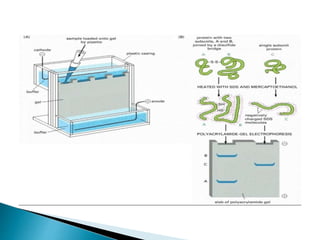
 SDS (also called sodium lauryl sulphate) is an anionic detergent meaning
that when dissolved its molecules have a net negative charge within a wide
PH range.
 A polypeptide chain binds amounts of SDS in proportion to its relative
molecular mass.
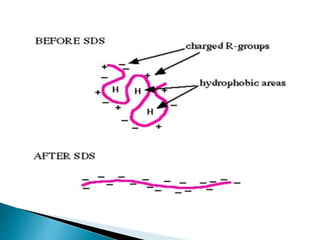
 The negative charges on SDS destroy most of the complex structure of
proteins, and strongly attracted toward an anode (positive charged
electrode) in an electric field.
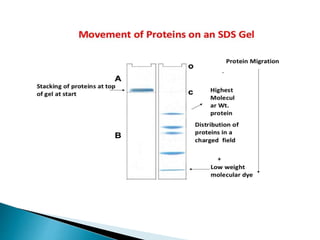
 Polyacryalamide gels restrain larger molecules from migrating as fast as
smaller molecules.
 Because the charge-to-mass ratio is nearly the same among SDS-denatured
the polypeptides, the final separation of proteins is dependent almost
entirely on the differences in relative molecular mass of polypeptides.
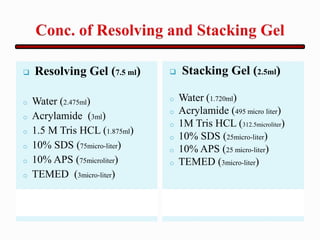
 Resolving Gel (7.5 ml)
o Water (2.475ml)
o Acrylamide (3ml)
o 1.5 M Tris HCL (1.875ml)
o 10% SDS (75micro-liter)
o 10% APS (75microliter)
o TEMED (3micro-liter)
 Stacking Gel (2.5ml)
o Water (1.720ml)
o Acrylamide (495 micro liter)
o 1M Tris HCL (312.5microliter)
o 10% SDS (25micro-liter)
o 10% APS (25 micro-liter)
o TEMED (3micro-liter)
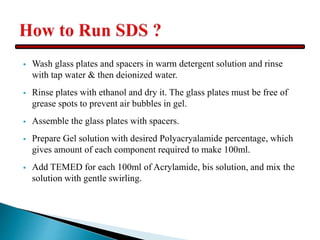
 Wash glass plates and spacers in warm detergent solution and rinse
with tap water & then deionized water.
 Rinse plates with ethanol and dry it. The glass plates must be free of
grease spots to prevent air bubbles in gel.
 Assemble the glass plates with spacers.
 Prepare Gel solution with desired Polyacryalamide percentage, which
gives amount of each component required to make 100ml.
 Add TEMED for each 100ml of Acrylamide, bis solution, and mix the
solution with gentle swirling.
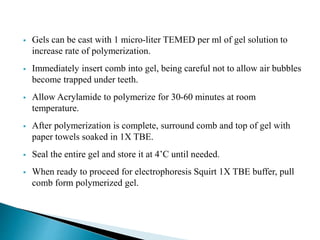
 Gels can be cast with 1 micro-liter TEMED per ml of gel solution to
increase rate of polymerization.
 Immediately insert comb into gel, being careful not to allow air bubbles
become trapped under teeth.
 Allow Acrylamide to polymerize for 30-60 minutes at room
temperature.
 After polymerization is complete, surround comb and top of gel with
paper towels soaked in 1X TBE.
 Seal the entire gel and store it at 4’C until needed.
 When ready to proceed for electrophoresis Squirt 1X TBE buffer, pull
comb form polymerized gel.
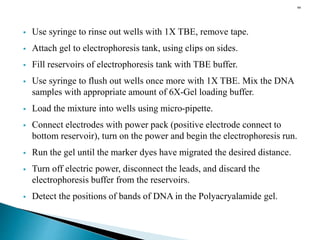
 Use syringe to rinse out wells with 1X TBE, remove tape.
 Attach gel to electrophoresis tank, using clips on sides.
 Fill reservoirs of electrophoresis tank with TBE buffer.
 Use syringe to flush out wells once more with 1X TBE. Mix the DNA
samples with appropriate amount of 6X-Gel loading buffer.
 Load the mixture into wells using micro-pipette.
 Connect electrodes with power pack (positive electrode connect to
bottom reservoir), turn on the power and begin the electrophoresis run.
 Run the gel until the marker dyes have migrated the desired distance.
 Turn off electric power, disconnect the leads, and discard the
electrophoresis buffer from the reservoirs.
 Detect the positions of bands of DNA in the Polyacryalamide gel.
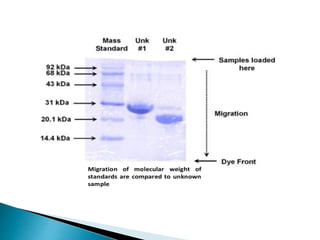
 Separate from other proteins on the basis of molecular
weight and size.
 Determine molecular size of protein.
 Determine quantifies amount present.
 Used in western blot assay.
 Page has high loading capacity, upto 10 micrograms of DNA
can be loaded into single well without significant loss of
resolution.
 Page is an ideal system from which isolate DNA fragemnts for
sub-cloning and other molecular biological techniques.

10-SDS PAGE.pptx

  • 1.
  • 3.
     Principal:  SDS(also called sodium lauryl sulphate) is an anionic detergent meaning that when dissolved its molecules have a net negative charge within a wide PH range.  A polypeptide chain binds amounts of SDS in proportion to its relative molecular mass.  The negative charges on SDS destroy most of the complex structure of proteins, and strongly attracted toward an anode (positive charged electrode) in an electric field.
  • 4.
     Polyacryalamide gelsrestrain larger molecules from migrating as fast as smaller molecules.  Because the charge-to-mass ratio is nearly the same among SDS-denatured the polypeptides, the final separation of proteins is dependent almost entirely on the differences in relative molecular mass of polypeptides.
  • 6.
     Resolving Gel(7.5 ml) o Water (2.475ml) o Acrylamide (3ml) o 1.5 M Tris HCL (1.875ml) o 10% SDS (75micro-liter) o 10% APS (75microliter) o TEMED (3micro-liter)  Stacking Gel (2.5ml) o Water (1.720ml) o Acrylamide (495 micro liter) o 1M Tris HCL (312.5microliter) o 10% SDS (25micro-liter) o 10% APS (25 micro-liter) o TEMED (3micro-liter)
  • 7.
     Wash glassplates and spacers in warm detergent solution and rinse with tap water & then deionized water.  Rinse plates with ethanol and dry it. The glass plates must be free of grease spots to prevent air bubbles in gel.  Assemble the glass plates with spacers.  Prepare Gel solution with desired Polyacryalamide percentage, which gives amount of each component required to make 100ml.  Add TEMED for each 100ml of Acrylamide, bis solution, and mix the solution with gentle swirling.
  • 8.
     Gels canbe cast with 1 micro-liter TEMED per ml of gel solution to increase rate of polymerization.  Immediately insert comb into gel, being careful not to allow air bubbles become trapped under teeth.  Allow Acrylamide to polymerize for 30-60 minutes at room temperature.  After polymerization is complete, surround comb and top of gel with paper towels soaked in 1X TBE.  Seal the entire gel and store it at 4’C until needed.  When ready to proceed for electrophoresis Squirt 1X TBE buffer, pull comb form polymerized gel.
  • 9.
     Use syringeto rinse out wells with 1X TBE, remove tape.  Attach gel to electrophoresis tank, using clips on sides.  Fill reservoirs of electrophoresis tank with TBE buffer.  Use syringe to flush out wells once more with 1X TBE. Mix the DNA samples with appropriate amount of 6X-Gel loading buffer.  Load the mixture into wells using micro-pipette.  Connect electrodes with power pack (positive electrode connect to bottom reservoir), turn on the power and begin the electrophoresis run.  Run the gel until the marker dyes have migrated the desired distance.  Turn off electric power, disconnect the leads, and discard the electrophoresis buffer from the reservoirs.  Detect the positions of bands of DNA in the Polyacryalamide gel.
  • 11.
     Separate fromother proteins on the basis of molecular weight and size.  Determine molecular size of protein.  Determine quantifies amount present.  Used in western blot assay.
  • 14.
     Page hashigh loading capacity, upto 10 micrograms of DNA can be loaded into single well without significant loss of resolution.  Page is an ideal system from which isolate DNA fragemnts for sub-cloning and other molecular biological techniques.