View the video footage on the Moratorium March
(http://mpegmedia.abc.net.au/archives/80days/video/1970_Moratorium.mp4)
Complete the table below in your book whilst watching the clip
Who When
Where How
Big Idea:
The nation is impacted
when there is divided
support for war
Success Criteria
I can explain what the Vietnam War Moratorium movement was and
why it took place.
I can discuss the impact of the movement on Australian society at the
time and the legacy that it left.
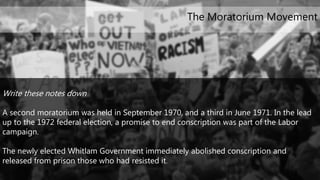
Write these notes down
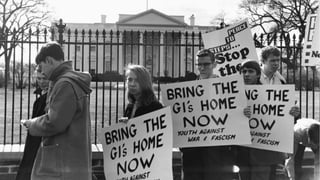
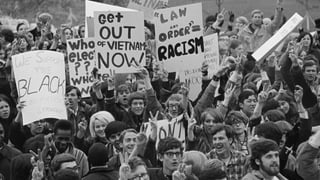
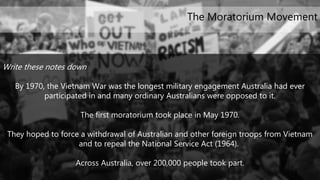
By 1970, the Vietnam War was the longest military engagement Australia had ever
participated in and many ordinary Australians were opposed to it.
The first moratorium took place in May 1970.
They hoped to force a withdrawal of Australian and other foreign troops from Vietnam
and to repeal the National Service Act (1964).
Across Australia, over 200,000 people took part.
The Moratorium Movement
Write these notes down
A second moratorium was held in September 1970, and a third in June 1971. In the lead
up to the 1972 federal election, a promise to end conscription was part of the Labor
campaign.
The newly elected Whitlam Government immediately abolished conscription and
released from prison those who had resisted it.
The Moratorium Movement
Write these notes down
Despite the eventual strength and widespread nature of the anti-war movement, its
effectiveness in Australia is open to question.
The Australian Government had followed the United States lead in Vietnam since the
early 1960s and continued to do so until the last Australian troops were withdrawn in
1972.
When the United States began removing its troops from Vietnam, Australia followed suit,
irrespective of the well-attended protests of 1970 and 1971.
The Moratorium Movement
1. There are 3 sources for you to view
2. Once you have looked at the sources answer the following questions in your
workbook and put into the google doc:
a) How do these sources help you to understand the type of people who
protested against the war?
b) Explain how useful each source is to a historian investigating the reasons that
people protested against the war.
c) Assess the reliability of each source as a tool for understanding divisions in
Australian society at the time.
The Vietnam Moratorium movement Source Study
(textbook p.273)
Research one of the following groups and put a
brief summary (150 words) into the group
discussion
Vietnam Moratorium Campaign
Youth Campaign Against Conscription
Save Our Sons
The Draft Resisters Union
Conscientious objectors (Quakers)
Read the article Vietnam War Moratorium: participatory democracy
(http://www.abc.net.au/news/2010-05-07/33984)
Define the term “participatory democracy” form the article and discuss how the Vietnam
War Moratorium can be considered an example of it.
What is the evaluation of the moratorium movement given in the article? Do you agree
with the author (why/why not)?
Extension Activity

10HIS Moratorium Day (HOLJ)

  • 2.
    View the videofootage on the Moratorium March (http://mpegmedia.abc.net.au/archives/80days/video/1970_Moratorium.mp4) Complete the table below in your book whilst watching the clip Who When Where How
  • 3.
    Big Idea: The nationis impacted when there is divided support for war
  • 4.
    Success Criteria I canexplain what the Vietnam War Moratorium movement was and why it took place. I can discuss the impact of the movement on Australian society at the time and the legacy that it left.
  • 6.
    Write these notesdown By 1970, the Vietnam War was the longest military engagement Australia had ever participated in and many ordinary Australians were opposed to it. The first moratorium took place in May 1970. They hoped to force a withdrawal of Australian and other foreign troops from Vietnam and to repeal the National Service Act (1964). Across Australia, over 200,000 people took part. The Moratorium Movement
  • 7.
    Write these notesdown A second moratorium was held in September 1970, and a third in June 1971. In the lead up to the 1972 federal election, a promise to end conscription was part of the Labor campaign. The newly elected Whitlam Government immediately abolished conscription and released from prison those who had resisted it. The Moratorium Movement
  • 8.
    Write these notesdown Despite the eventual strength and widespread nature of the anti-war movement, its effectiveness in Australia is open to question. The Australian Government had followed the United States lead in Vietnam since the early 1960s and continued to do so until the last Australian troops were withdrawn in 1972. When the United States began removing its troops from Vietnam, Australia followed suit, irrespective of the well-attended protests of 1970 and 1971. The Moratorium Movement
  • 9.
    1. There are3 sources for you to view 2. Once you have looked at the sources answer the following questions in your workbook and put into the google doc: a) How do these sources help you to understand the type of people who protested against the war? b) Explain how useful each source is to a historian investigating the reasons that people protested against the war. c) Assess the reliability of each source as a tool for understanding divisions in Australian society at the time. The Vietnam Moratorium movement Source Study (textbook p.273)
  • 10.
    Research one ofthe following groups and put a brief summary (150 words) into the group discussion Vietnam Moratorium Campaign Youth Campaign Against Conscription Save Our Sons The Draft Resisters Union Conscientious objectors (Quakers)
  • 11.
    Read the articleVietnam War Moratorium: participatory democracy (http://www.abc.net.au/news/2010-05-07/33984) Define the term “participatory democracy” form the article and discuss how the Vietnam War Moratorium can be considered an example of it. What is the evaluation of the moratorium movement given in the article? Do you agree with the author (why/why not)? Extension Activity