Inventory control &
condemnation procedures
Rupinder Deol
Assistant Professor
College of Nursing
AIIMS Rishikesh
Definition Of inventory :
 Inventory: An inventory is a record of all
goods or materials procured, received,
stored and used in the hospital.
 An inventory is a detailed list of all
materials, their specification and standard
number or quantify.
Purposes of an inventory:
 To make an account of material held in the
ward to check against the recommended
standards.
 To dispose excess and obsolete materials.
 To determine the serviceability of all
materials/equipments.
 To request for repair or replacement.
 To return equipment to its proper place if
borrowed eg. Central supply dept. OT etc.

Purposes contd..
 To maintain and trace materials for their
adequacy.
 To identify discrepancies such as loss,
damage.
 To put the defective items for condemnation
accordingly as per the polices of the
organization.
Following goods can be put in
inventory
 Raw materials
 Components
 Work in progress
 Finished goods
Types of inventory
Official
inventory
Unofficial
inventory
Official inventory:
 The materials lying in the main store and
being accounted for but have not been
issued to the user units.
 a. Medical and surgical items
 b. Dressings
 c. Linens
 d. X-ray supplies
 e. Laboratory supplies
 f. Housekeeping items
Unofficial inventory:
 The materials have been issued to the user
units like the dispensary, CSSD, laundry,
wards, OPD, cast rooms etc.
 In case of forecasting or demand estimation,
these items are not taken into consideration
by the hospital administration, so it is called
as un-official inventory for hospitals.
TYPES OF INVENTORY ON
THE BASIS OF COST
 Low cost inventory
 High cost inventory
 Balancing the cost of carrying high
inventory and cost of shortage is done on
through a system of scientific inventory
control.
Intuitive method
 This is the “want book method” & most
effective method.
 when the no. of units in stock reaches close
to zero. The items are recorded in the want
book and The amount of items are best
estimated and ordered.
Perpetual method
 This is one of the best accurate and effective
method of inventory is of course, an ideal
situation if the record keeping can be kept up
to date .
 In a ward situation , the nurse in charge of
dispensing at the end of each day
,summarizes all drugs issued to patients and
make the proper posting in perpetual
inventory.
ABC method
 (Always Better Control)
 This method is based on the fact that some
stock items have a much higher annual
usage value than others. This can be done
on cost analysis, stock items are separated
into different categories.
 A= highest value/ cost
 B= medium value/cost
 C= lower value/cost
VED method
 V= vital
 E=Essential
 D=Desirable
 In this method each item is divided on
either vital ,essential or desirable based on h
criticality of the items.
Two bin method
 This method separates the stock of each item into two
boxes .
The second small bin contains enough stock to satisfy
demand during the period necessary for
replenishment.
 When the first bin is exhausted, an order for
replenishment is immediately placed.
 In the mean time stock in the second bin is used to
satisfy the demand until the replenishment stock is
arrived .
Daily
use Main stock
Perpetual inventory or automatic
inventory system:
– The two main functions of the perpetual inventory system
are:
 I. Recording stores receipts and issues so as to
determine how much stock in hand, in quantity
or value or both without the need for physical
count of stock.
 II. Continuous verification of the physical stock with
reference or the balance recorded in the stores
records, at any frequency, as convenient for the
management.
 :
Perpetual inventory system is
comprised of
Bin card
Continuous
stock
taking
Store
ledger
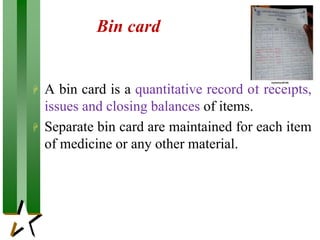
Bin card
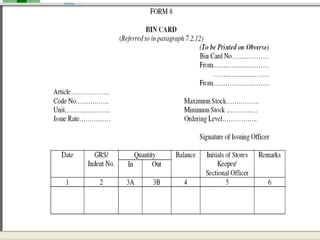
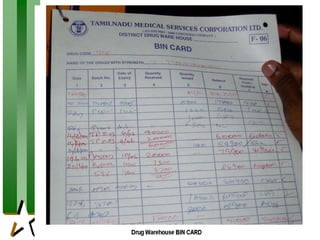
 A bin card is a quantitative record of receipts,
issues and closing balances of items.
 Separate bin card are maintained for each item
of medicine or any other material.
Bin card:
contd……
 On receipt of consignment of material and
medicine, entry of the quantity is made in
the receipts column of the bin card from
goods received note.
 Similarly issues of materials /medicines to
various departments of the hospital /agency
materials are recorded in the “issue”
column.
Store ledger
 Like the bin card the
stores ledger is
maintained to record all
receipt and issues
transaction in respect of
materials.
The difference that along
with the quantities, the
cost / values (sometimes
the rate per unit quantity)
are entered in the
receipt, issues and
balance column.
STORE LEDGER
 ITEM:----------------


RECEIVED ISSUE BALANCE
 Date Reference Quantity Unit cost Total cost Quantity Unit cost total
 cost

Continuous physical stock
verification
 The perpetual inventory system is not
complete without a systematic procedure for
physical verification of stores.
 The bin cards and stores ledger record the
balance but their correctness can be verified by
means of physical verification only.
 It indicates balances, ‘should be” or “should
have been’ where as physical check reveals
what the balances “actually are”
Valuation of inventory
 Closing stock in the asset side of balance
sheet is calculated by using the formula
“cost price or market price which is lower’
 But when any item purchased at different
prices then………………….
First in first out method (FIFO)
 The oldest items in the stock are assumed to
be issued first
 then the new stock entered and the issued is
priced accordingly .
 Benefits of FIFO method
 The issues and inventory are priced exactly
at original cost.
 Limitations:
 Not suitable in “inflationary” condition.
LAST IN OUT FIRST
METHOD (LIFO)
 The newest Items in stock are assumed to
be issued before the order and priced
according.
 Benefits:
 Suitable method for “inflationary” condition.
 Limitation: not suitable for “ deflationary
condition
Average unit price method
 In this method the issue price and price of
inventory is set by averaging in the
quantities and prices of each new purchase
of the item.
 Advantage:
This is suitable both for inflationary and
deflationary conditions since it reflects less
gain or loss than the previous methods.
 Difficulty:
Lots of mathematics involved in this system.
Fixed last price method
 In this method issues and inventory at stock
taking time are priced at the price of the last
receipt of the item.
Advantage :
 No cumbersome calculations are involved.
Donated supplies
 Hospitals and agencies often
receive gifts in the form of
donated supplies from public or
any other agencies. Such
supplies are entered in its books
and shown in balance sheets.
Narcotics:
 Under the dangerous drugs act 1950,it is imperative
for every hospital to be conversant with rules and
regulations governing the handling of dangerous
drugs in its own state.
 An adequate perpetual inventory must be maintained
by the pharmacy department for receipt and issued
each narcotic.
 Maintain a “narcotic stock register” which will have
a separate sheet in the register for each item.
Narcotics
 Further, to complete the records for doses
administered in the ward, a record of
narcotics must be maintained.
 All records must be kept on file for
minimum of five years and is subject to
government inspection at any time.
CONDEMNATION &
DISPOSAL
 The materials which could not be used within
its shelf life, deteriorated and declared unfit for
use, became obsolete or banned due to legal
provisions are considered for condemnation or
disposal.

Criteria for condemnation:
 The equipment has become:
 1. Non-functional & beyond economical
repair
 2. Non-functional & obsolete
 3. Functional, but obsolete
 4. Functional, but hazardous
 5. Functional, but no longer required
PROCEDURE FOR CONDEMNATION
 Following procedure is generally carried out
in case of the materials particularly drugs
and non-drug items:
 A condemnation committee comprising
of three or more members is constituted by
the competent authority.
 the terms of reference of the committee
are:
 i. To go in details of the reasons as to why
this situation has occurred.
PROCEDURE FOR CONDEMNATION
contd…
 ii. The people who are responsible for the
lapses on the aspects from acquisition to
storage and distribution of materials.
 iii. To suggest measures to be taken for
disposal of the items.
 The committee members go into details
through inventory records right from the
point of demand estimation to the
distribution level of materials, and will find
out reasons for being an item surplus and
remained unused.
PROCEDURE FOR CONDEMNATION
contd…
 The committee will declare the items
condemned and make recommendation for
further disposal of items.
 The condemned items are to be
destroyed, so it is to be taken out from the
inventory registers
 A write off sanction of the competent
authority is obtained before final disposal.

PROCEDURE FOR CONDEMNATION
contd…
 The items particularly medicines which
are toxic and cannot be disposed of by
burial or as per the relevant laid down rules
under the subject of waste disposal.
PROCEDURE FOR CONDEMNATION
contd…
 The effective measures are taken for
disposal of surplus items before it becomes
unfit for use is:
 A list of surplus material is circulated
among the hospital staff/user units
requesting them to pay special attention for
mobilizing such items and giving priority to
this category of items.
PROCEDURE FOR CONDEMNATION
contd…
 The surplus materials are transferred to
other hospitals where these may be
required.
 The surplus materials are offered to the
manufacturer/ suppliers for buy back.
 In case of materials other than drugs like
equipments, instruments any such articles
are treated as salvage or scrap, whatever the
case may be, action is taken accordingly:
PROCEDURE FOR CONDEMNATION
contd…
 The materials may be sold by inviting
tender.
 Open auctions of items through
authorized auctioneers.
REFERENCES
 Margaret MM. Professionalization of nursing; current issues and
trends. JB Lippincott company; Philadelphia: 1992
 Karen P, Corrigan P. Quality improvement in nursing and health care.
Chapman& Hall; Newyork: 1995
 Patrica& Cerrell. Nursing leadership and management; A practical
guide. Thomson Delmar; Canada: 2005
 Roger E. Professional competence and quality assurance in the caring
professions. Chapman& Hall; USA: 1993
 Basavanthappa BT. Nursing administration. Jaypee brothers; New
Delhi: 2000
 Srinivasan AV. Managing a modern hospital. Sage publishers; New
Delhi: 2000.
 Barbara C. Contemporary nursing issues trends and management,
Mosby publication; St Louis: 2001.

1040_Inventory_control__condemnation_procedures.pptx

  • 1.
    Inventory control & condemnationprocedures Rupinder Deol Assistant Professor College of Nursing AIIMS Rishikesh
  • 2.
    Definition Of inventory:  Inventory: An inventory is a record of all goods or materials procured, received, stored and used in the hospital.  An inventory is a detailed list of all materials, their specification and standard number or quantify.
  • 3.
    Purposes of aninventory:  To make an account of material held in the ward to check against the recommended standards.  To dispose excess and obsolete materials.  To determine the serviceability of all materials/equipments.  To request for repair or replacement.  To return equipment to its proper place if borrowed eg. Central supply dept. OT etc. 
  • 4.
    Purposes contd..  Tomaintain and trace materials for their adequacy.  To identify discrepancies such as loss, damage.  To put the defective items for condemnation accordingly as per the polices of the organization.
  • 5.
    Following goods canbe put in inventory  Raw materials  Components  Work in progress  Finished goods
  • 6.
  • 7.
    Official inventory:  Thematerials lying in the main store and being accounted for but have not been issued to the user units.  a. Medical and surgical items  b. Dressings  c. Linens  d. X-ray supplies  e. Laboratory supplies  f. Housekeeping items
  • 8.
    Unofficial inventory:  Thematerials have been issued to the user units like the dispensary, CSSD, laundry, wards, OPD, cast rooms etc.  In case of forecasting or demand estimation, these items are not taken into consideration by the hospital administration, so it is called as un-official inventory for hospitals.
  • 9.
    TYPES OF INVENTORYON THE BASIS OF COST  Low cost inventory  High cost inventory  Balancing the cost of carrying high inventory and cost of shortage is done on through a system of scientific inventory control.
  • 11.
    Intuitive method  Thisis the “want book method” & most effective method.  when the no. of units in stock reaches close to zero. The items are recorded in the want book and The amount of items are best estimated and ordered.
  • 12.
    Perpetual method  Thisis one of the best accurate and effective method of inventory is of course, an ideal situation if the record keeping can be kept up to date .  In a ward situation , the nurse in charge of dispensing at the end of each day ,summarizes all drugs issued to patients and make the proper posting in perpetual inventory.
  • 13.
    ABC method  (AlwaysBetter Control)  This method is based on the fact that some stock items have a much higher annual usage value than others. This can be done on cost analysis, stock items are separated into different categories.  A= highest value/ cost  B= medium value/cost  C= lower value/cost
  • 14.
    VED method  V=vital  E=Essential  D=Desirable  In this method each item is divided on either vital ,essential or desirable based on h criticality of the items.
  • 15.
    Two bin method This method separates the stock of each item into two boxes . The second small bin contains enough stock to satisfy demand during the period necessary for replenishment.  When the first bin is exhausted, an order for replenishment is immediately placed.  In the mean time stock in the second bin is used to satisfy the demand until the replenishment stock is arrived . Daily use Main stock
  • 16.
    Perpetual inventory orautomatic inventory system: – The two main functions of the perpetual inventory system are:  I. Recording stores receipts and issues so as to determine how much stock in hand, in quantity or value or both without the need for physical count of stock.  II. Continuous verification of the physical stock with reference or the balance recorded in the stores records, at any frequency, as convenient for the management.  :
  • 17.
    Perpetual inventory systemis comprised of Bin card Continuous stock taking Store ledger
  • 18.
    Bin card  Abin card is a quantitative record of receipts, issues and closing balances of items.  Separate bin card are maintained for each item of medicine or any other material.
  • 19.
    Bin card: contd……  Onreceipt of consignment of material and medicine, entry of the quantity is made in the receipts column of the bin card from goods received note.  Similarly issues of materials /medicines to various departments of the hospital /agency materials are recorded in the “issue” column.
  • 22.
    Store ledger  Likethe bin card the stores ledger is maintained to record all receipt and issues transaction in respect of materials. The difference that along with the quantities, the cost / values (sometimes the rate per unit quantity) are entered in the receipt, issues and balance column.
  • 23.
    STORE LEDGER  ITEM:----------------   RECEIVEDISSUE BALANCE  Date Reference Quantity Unit cost Total cost Quantity Unit cost total  cost 
  • 24.
    Continuous physical stock verification The perpetual inventory system is not complete without a systematic procedure for physical verification of stores.  The bin cards and stores ledger record the balance but their correctness can be verified by means of physical verification only.  It indicates balances, ‘should be” or “should have been’ where as physical check reveals what the balances “actually are”
  • 25.
    Valuation of inventory Closing stock in the asset side of balance sheet is calculated by using the formula “cost price or market price which is lower’  But when any item purchased at different prices then………………….
  • 26.
    First in firstout method (FIFO)  The oldest items in the stock are assumed to be issued first  then the new stock entered and the issued is priced accordingly .
  • 27.
     Benefits ofFIFO method  The issues and inventory are priced exactly at original cost.  Limitations:  Not suitable in “inflationary” condition.
  • 28.
    LAST IN OUTFIRST METHOD (LIFO)  The newest Items in stock are assumed to be issued before the order and priced according.  Benefits:  Suitable method for “inflationary” condition.  Limitation: not suitable for “ deflationary condition
  • 29.
    Average unit pricemethod  In this method the issue price and price of inventory is set by averaging in the quantities and prices of each new purchase of the item.  Advantage: This is suitable both for inflationary and deflationary conditions since it reflects less gain or loss than the previous methods.  Difficulty: Lots of mathematics involved in this system.
  • 30.
    Fixed last pricemethod  In this method issues and inventory at stock taking time are priced at the price of the last receipt of the item. Advantage :  No cumbersome calculations are involved.
  • 31.
    Donated supplies  Hospitalsand agencies often receive gifts in the form of donated supplies from public or any other agencies. Such supplies are entered in its books and shown in balance sheets.
  • 32.
    Narcotics:  Under thedangerous drugs act 1950,it is imperative for every hospital to be conversant with rules and regulations governing the handling of dangerous drugs in its own state.  An adequate perpetual inventory must be maintained by the pharmacy department for receipt and issued each narcotic.  Maintain a “narcotic stock register” which will have a separate sheet in the register for each item.
  • 34.
    Narcotics  Further, tocomplete the records for doses administered in the ward, a record of narcotics must be maintained.  All records must be kept on file for minimum of five years and is subject to government inspection at any time.
  • 35.
    CONDEMNATION & DISPOSAL  Thematerials which could not be used within its shelf life, deteriorated and declared unfit for use, became obsolete or banned due to legal provisions are considered for condemnation or disposal. 
  • 36.
    Criteria for condemnation: The equipment has become:  1. Non-functional & beyond economical repair  2. Non-functional & obsolete  3. Functional, but obsolete  4. Functional, but hazardous  5. Functional, but no longer required
  • 37.
    PROCEDURE FOR CONDEMNATION Following procedure is generally carried out in case of the materials particularly drugs and non-drug items:  A condemnation committee comprising of three or more members is constituted by the competent authority.  the terms of reference of the committee are:  i. To go in details of the reasons as to why this situation has occurred.
  • 38.
    PROCEDURE FOR CONDEMNATION contd… ii. The people who are responsible for the lapses on the aspects from acquisition to storage and distribution of materials.  iii. To suggest measures to be taken for disposal of the items.  The committee members go into details through inventory records right from the point of demand estimation to the distribution level of materials, and will find out reasons for being an item surplus and remained unused.
  • 39.
    PROCEDURE FOR CONDEMNATION contd… The committee will declare the items condemned and make recommendation for further disposal of items.  The condemned items are to be destroyed, so it is to be taken out from the inventory registers  A write off sanction of the competent authority is obtained before final disposal. 
  • 40.
    PROCEDURE FOR CONDEMNATION contd… The items particularly medicines which are toxic and cannot be disposed of by burial or as per the relevant laid down rules under the subject of waste disposal.
  • 41.
    PROCEDURE FOR CONDEMNATION contd… The effective measures are taken for disposal of surplus items before it becomes unfit for use is:  A list of surplus material is circulated among the hospital staff/user units requesting them to pay special attention for mobilizing such items and giving priority to this category of items.
  • 42.
    PROCEDURE FOR CONDEMNATION contd… The surplus materials are transferred to other hospitals where these may be required.  The surplus materials are offered to the manufacturer/ suppliers for buy back.  In case of materials other than drugs like equipments, instruments any such articles are treated as salvage or scrap, whatever the case may be, action is taken accordingly:
  • 43.
    PROCEDURE FOR CONDEMNATION contd… The materials may be sold by inviting tender.  Open auctions of items through authorized auctioneers.
  • 44.
    REFERENCES  Margaret MM.Professionalization of nursing; current issues and trends. JB Lippincott company; Philadelphia: 1992  Karen P, Corrigan P. Quality improvement in nursing and health care. Chapman& Hall; Newyork: 1995  Patrica& Cerrell. Nursing leadership and management; A practical guide. Thomson Delmar; Canada: 2005  Roger E. Professional competence and quality assurance in the caring professions. Chapman& Hall; USA: 1993  Basavanthappa BT. Nursing administration. Jaypee brothers; New Delhi: 2000  Srinivasan AV. Managing a modern hospital. Sage publishers; New Delhi: 2000.  Barbara C. Contemporary nursing issues trends and management, Mosby publication; St Louis: 2001.