1,000 Reading Clubs
A few things to note…did you know?
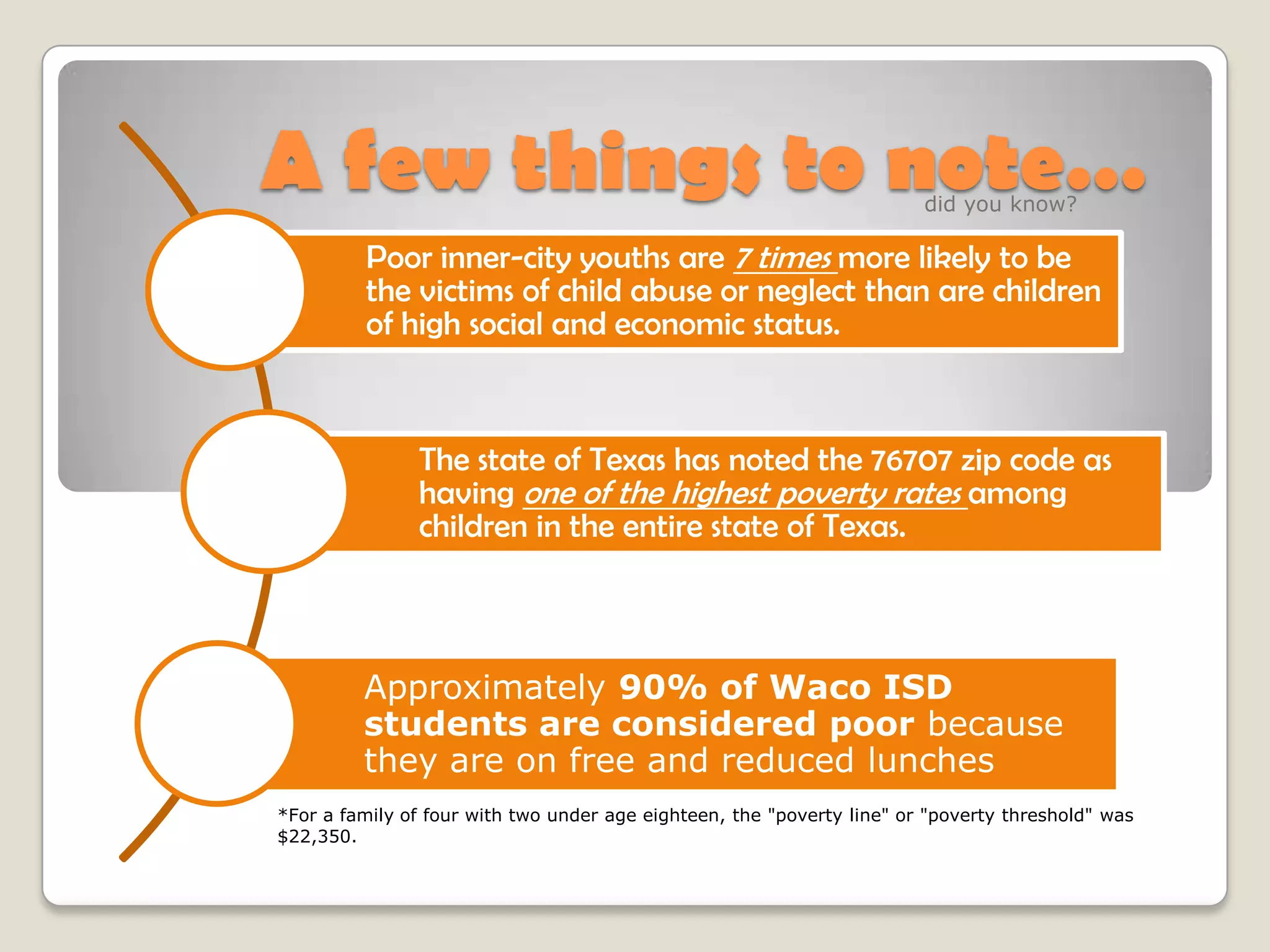
Poor inner-city youths are 7 times more likely to be
the victims of child abuse or neglect than are children
of high social and economic status.
The state of Texas has noted the 76707 zip code as
having one of the highest poverty rates among
children in the entire state of Texas.
Approximately 90% of Waco ISD
students are considered poor because
they are on free and reduced lunches
*For a family of four with two under age eighteen, the "poverty line" or "poverty threshold" was
$22,350.
A few things to note…did you know?
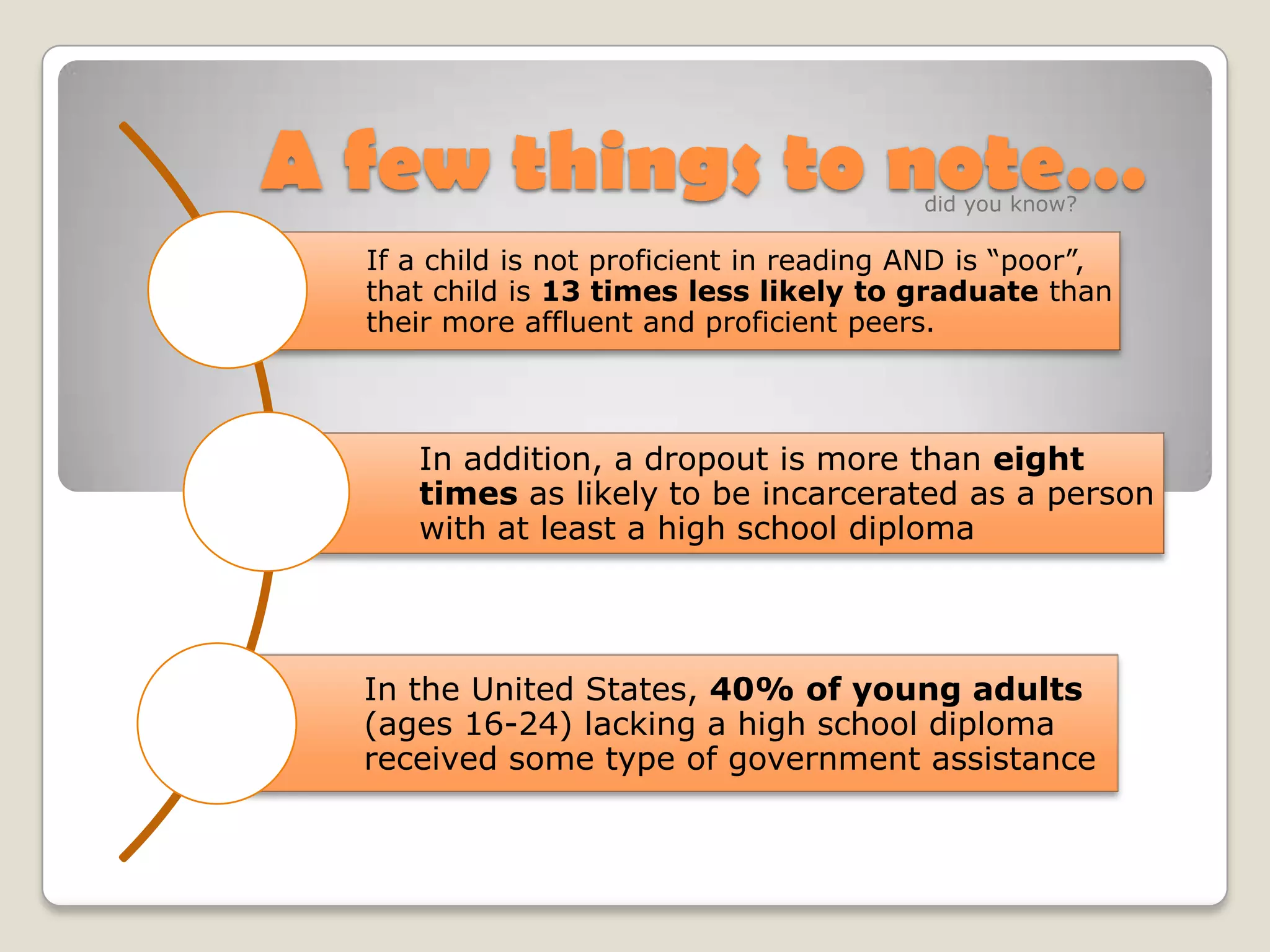
If a child is not proficient in reading AND is “poor”,
that child is 13 times less likely to graduate than
their more affluent and proficient peers.
In addition, a dropout is more than eight
times as likely to be incarcerated as a person
with at least a high school diploma
In the United States, 40% of young adults
(ages 16-24) lacking a high school diploma
received some type of government assistance
A few things to note…did you know?
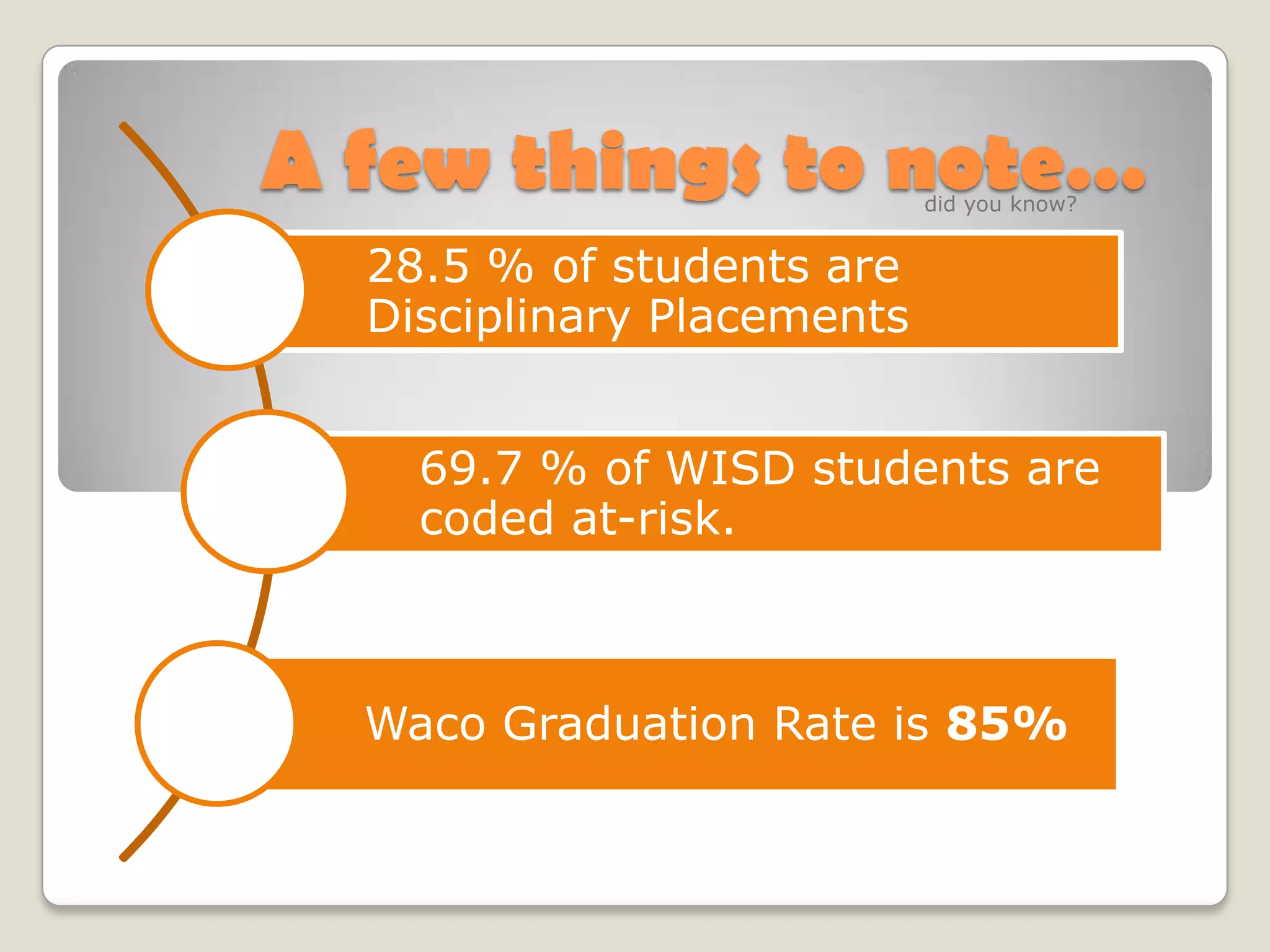
28.5 % of students are
Disciplinary Placements
69.7 % of WISD students are
coded at-risk.
Waco Graduation Rate is 85%
How Can Reading Clubs
Help?
Reading Clubs are an
“easy win” form of
mentoring.
Mentoring Is…
Consistently sharing life for
the purpose of helping
someone else grow.
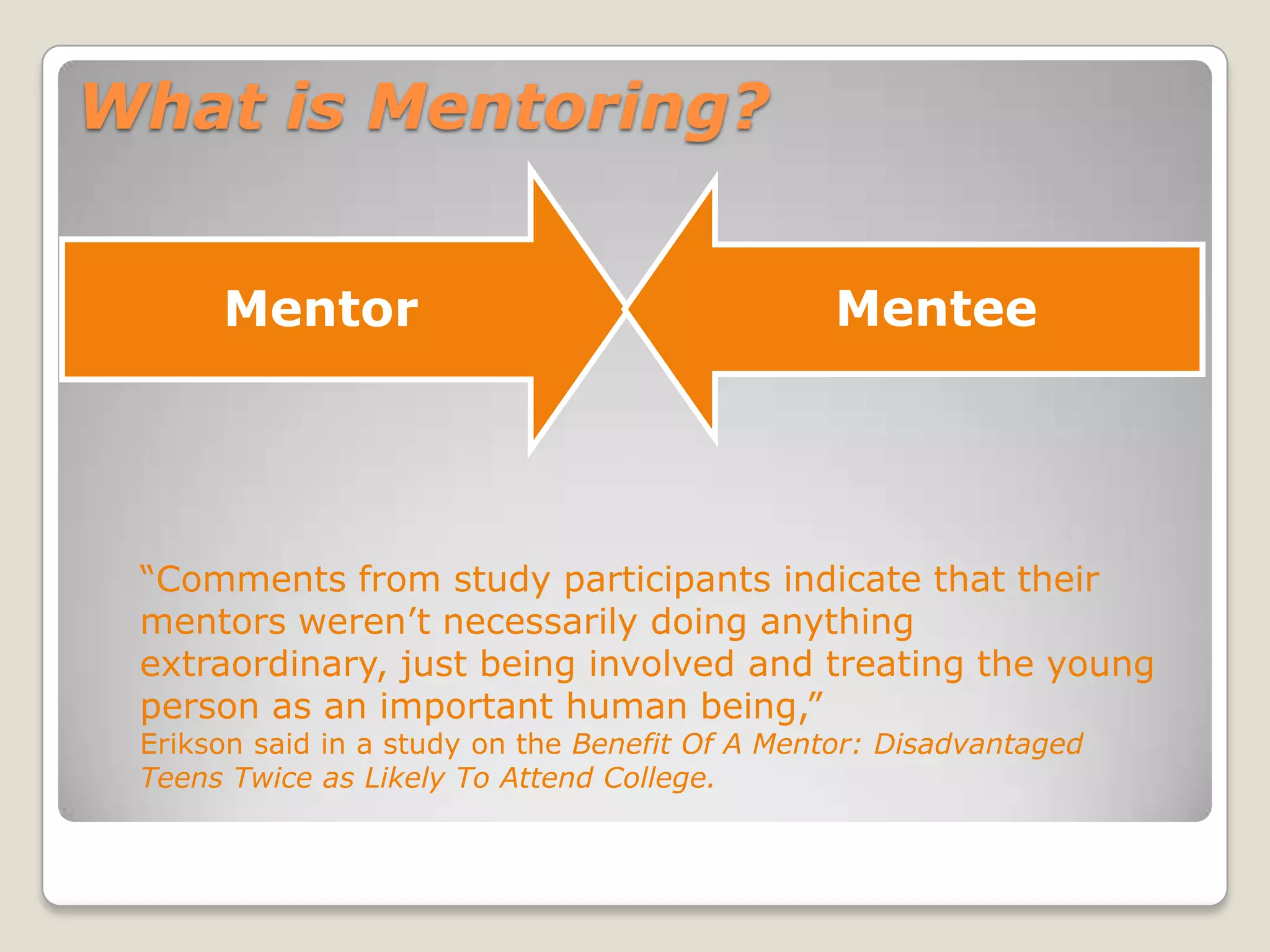
What is Mentoring?
Mentor Mentee
“Comments from study participants indicate that their
mentors weren’t necessarily doing anything
extraordinary, just being involved and treating the young
person as an important human being,”
Erikson said in a study on the Benefit Of A Mentor: Disadvantaged
Teens Twice as Likely To Attend College.
Why do reading clubs work?
“Kids need one positive adult
caring relationship in order to
have a chance at a productive
life.”
Dr. Del Elliott
Senior Scientific research for the University
of Colorado
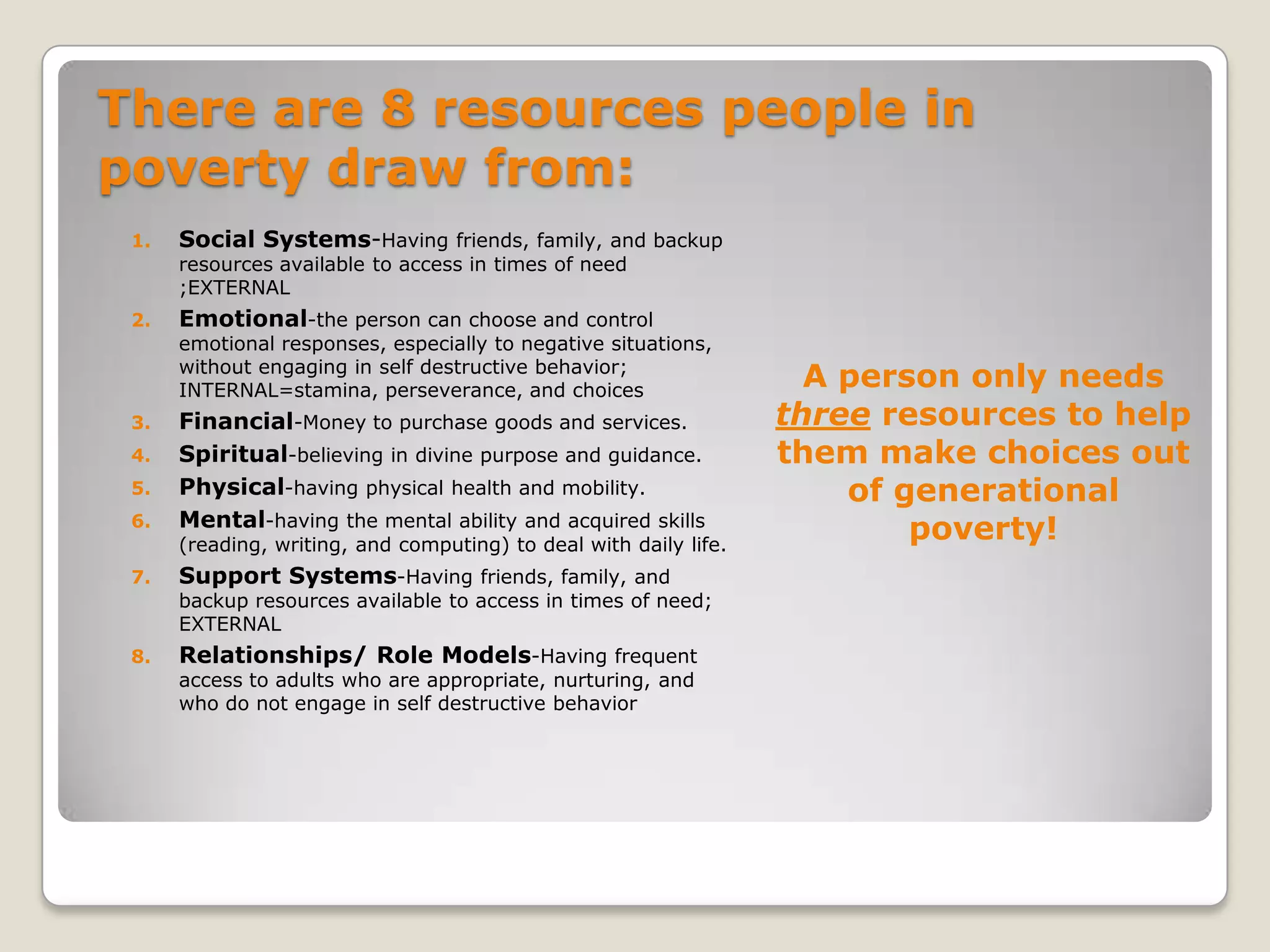
There are 8 resources people in
poverty draw from:
1. Social Systems-Having friends, family, and backup
resources available to access in times of need
;EXTERNAL
2. Emotional-the person can choose and control
emotional responses, especially to negative situations,
without engaging in self destructive behavior;
INTERNAL=stamina, perseverance, and choices
3. Financial-Money to purchase goods and services.
4. Spiritual-believing in divine purpose and guidance.
5. Physical-having physical health and mobility.
6. Mental-having the mental ability and acquired skills
(reading, writing, and computing) to deal with daily life.
7. Support Systems-Having friends, family, and
backup resources available to access in times of need;
EXTERNAL
8. Relationships/ Role Models-Having frequent
access to adults who are appropriate, nurturing, and
who do not engage in self destructive behavior
A person only needs
three resources to help
them make choices out
of generational
poverty!
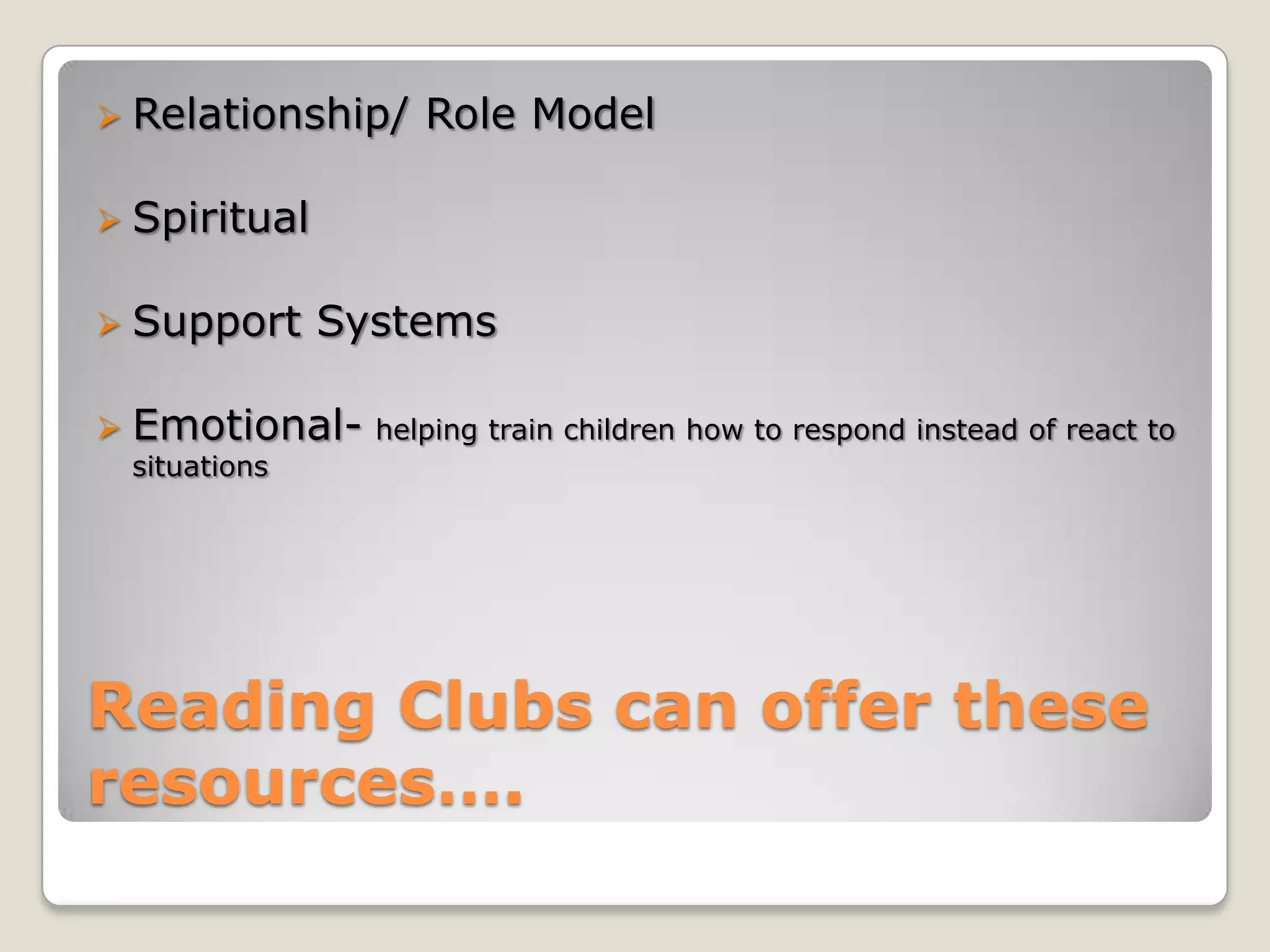
Reading Clubs can offer these
resources….
 Relationship/ Role Model
 Spiritual
 Support Systems
 Emotional- helping train children how to respond instead of react to
situations
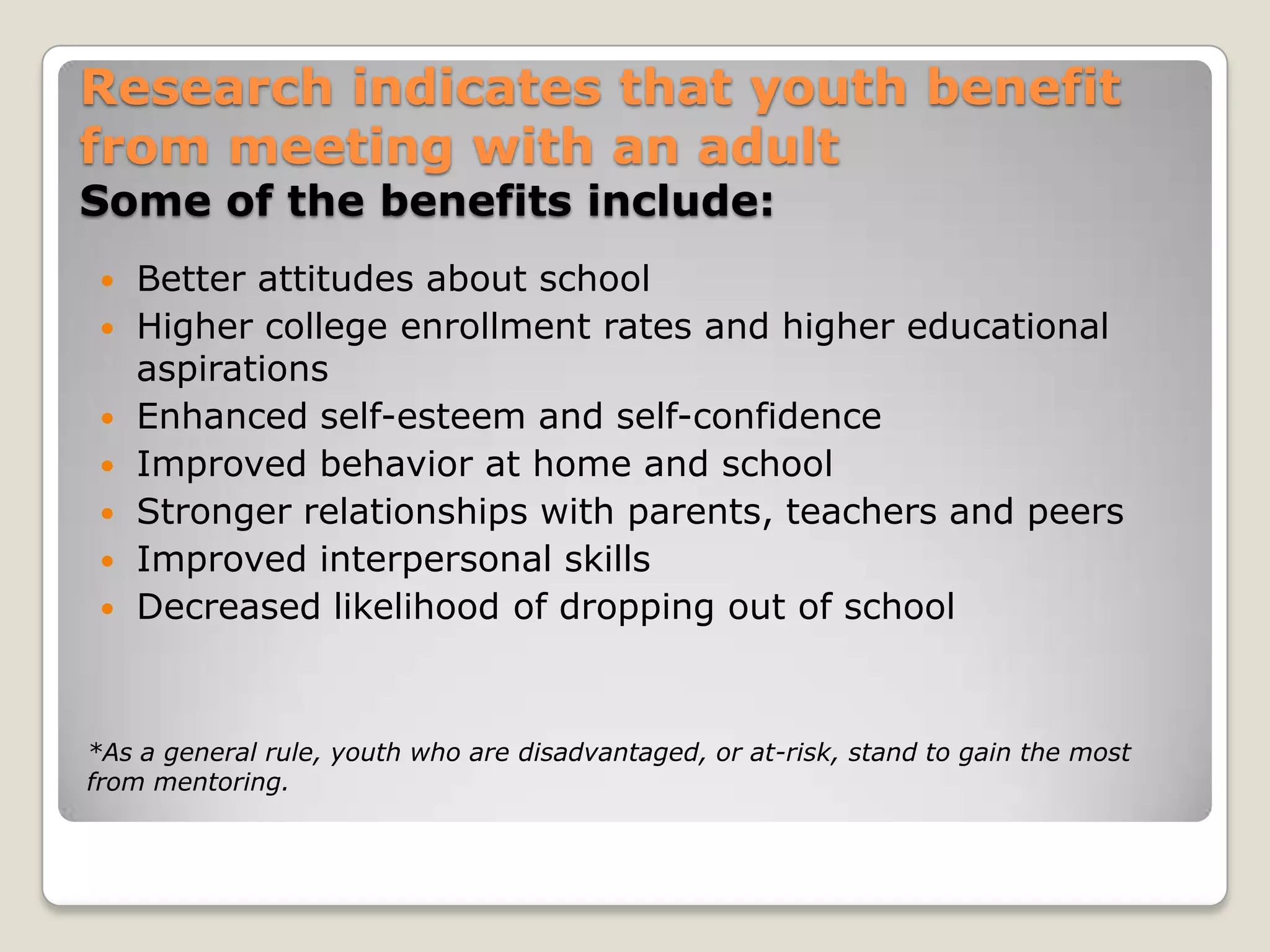
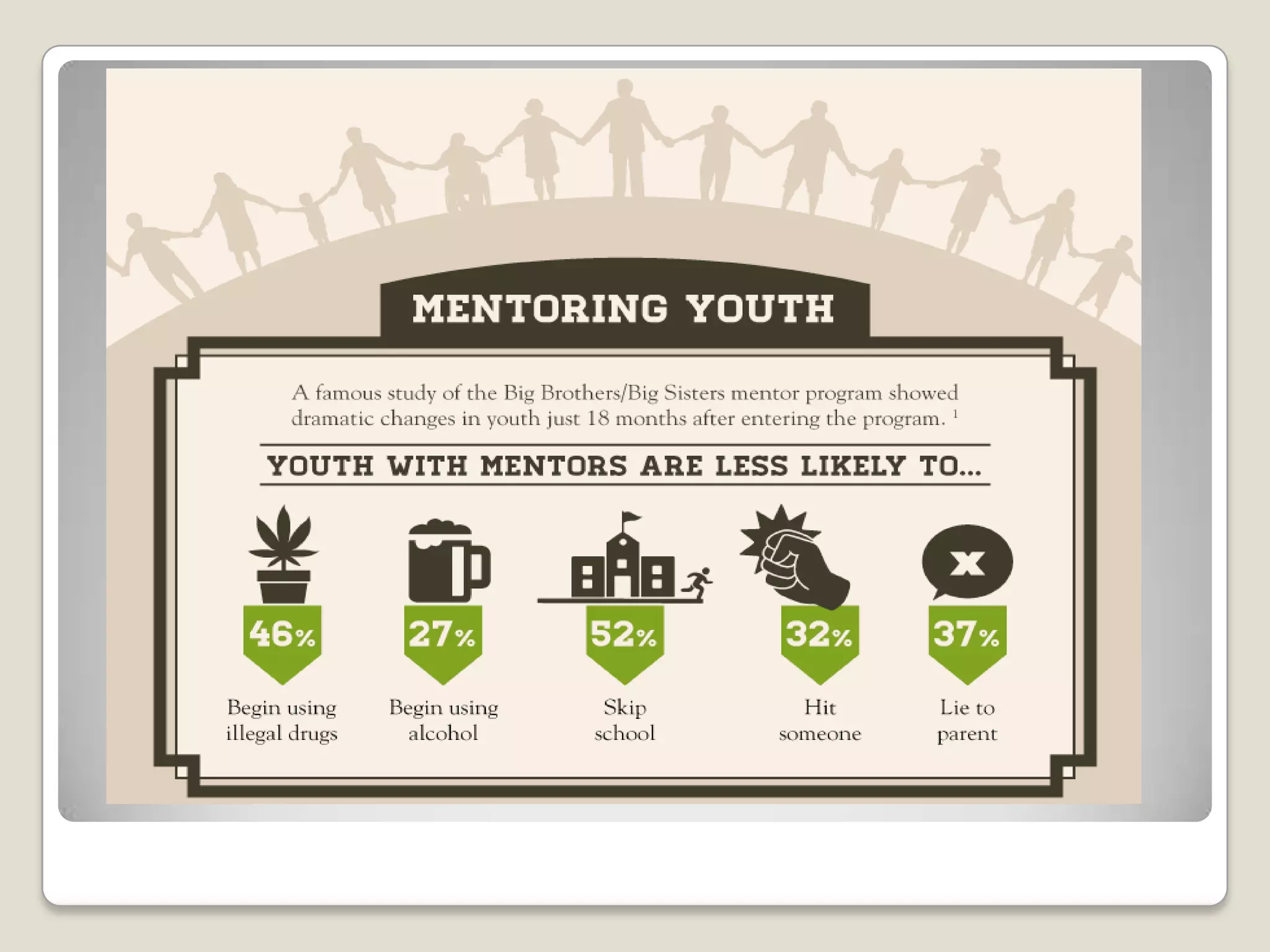
Research indicates that youth benefit
from meeting with an adult
Some of the benefits include:
 Better attitudes about school
 Higher college enrollment rates and higher educational
aspirations
 Enhanced self-esteem and self-confidence
 Improved behavior at home and school
 Stronger relationships with parents, teachers and peers
 Improved interpersonal skills
 Decreased likelihood of dropping out of school
*As a general rule, youth who are disadvantaged, or at-risk, stand to gain the most
from mentoring.
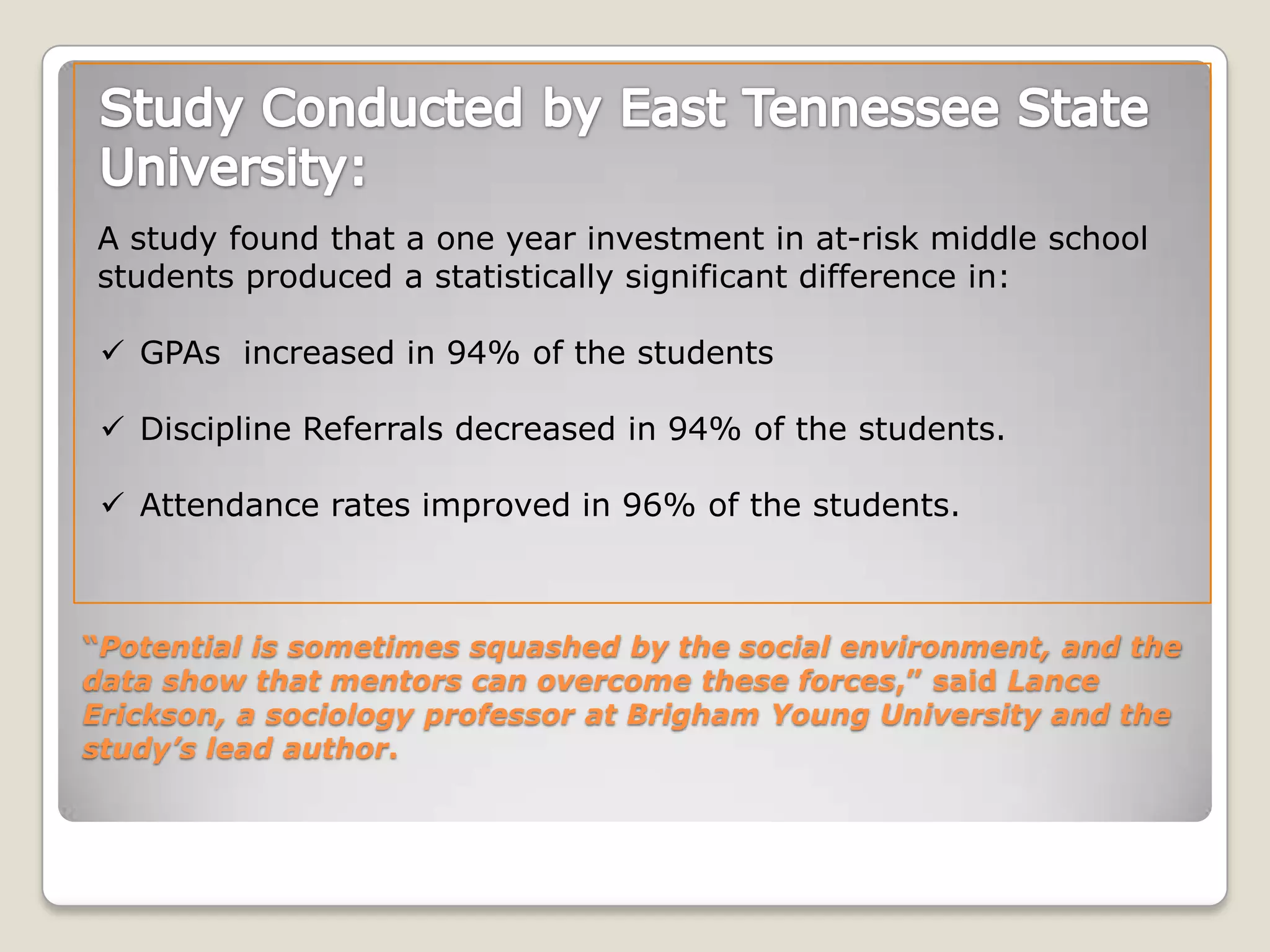
“Potential is sometimes squashed by the social environment, and the
data show that mentors can overcome these forces,” said Lance
Erickson, a sociology professor at Brigham Young University and the
study’s lead author.
A study found that a one year investment in at-risk middle school
students produced a statistically significant difference in:
 GPAs increased in 94% of the students
 Discipline Referrals decreased in 94% of the students.
 Attendance rates improved in 96% of the students.
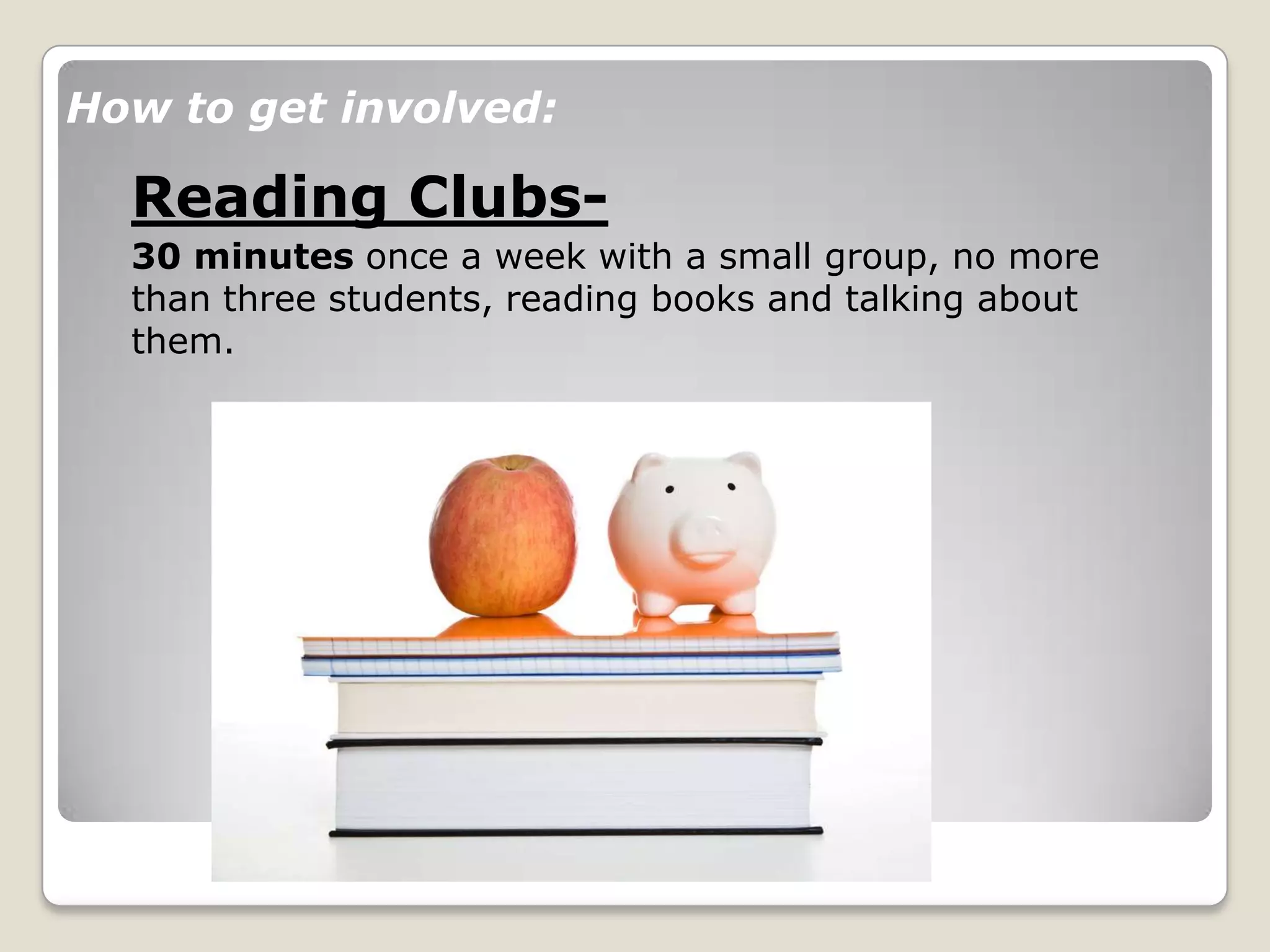
How to get involved:
Reading Clubs-
30 minutes once a week with a small group, no more
than three students, reading books and talking about
them.
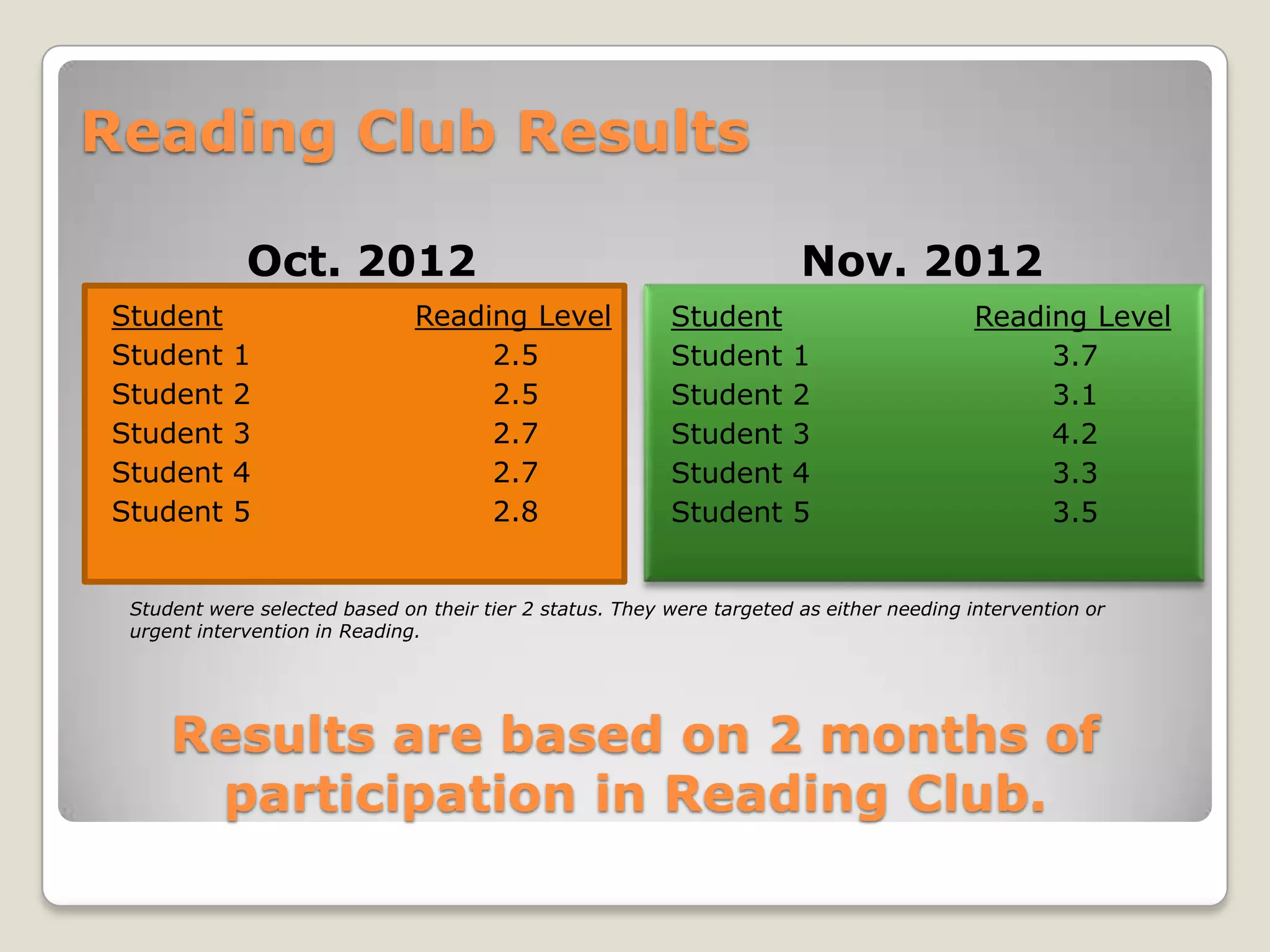
Results are based on 2 months of
participation in Reading Club.
Oct. 2012 Nov. 2012
Student Reading Level
Student 1 2.5
Student 2 2.5
Student 3 2.7
Student 4 2.7
Student 5 2.8
Student Reading Level
Student 1 3.7
Student 2 3.1
Student 3 4.2
Student 4 3.3
Student 5 3.5
Student were selected based on their tier 2 status. They were targeted as either needing intervention or
urgent intervention in Reading.
Reading Club Results
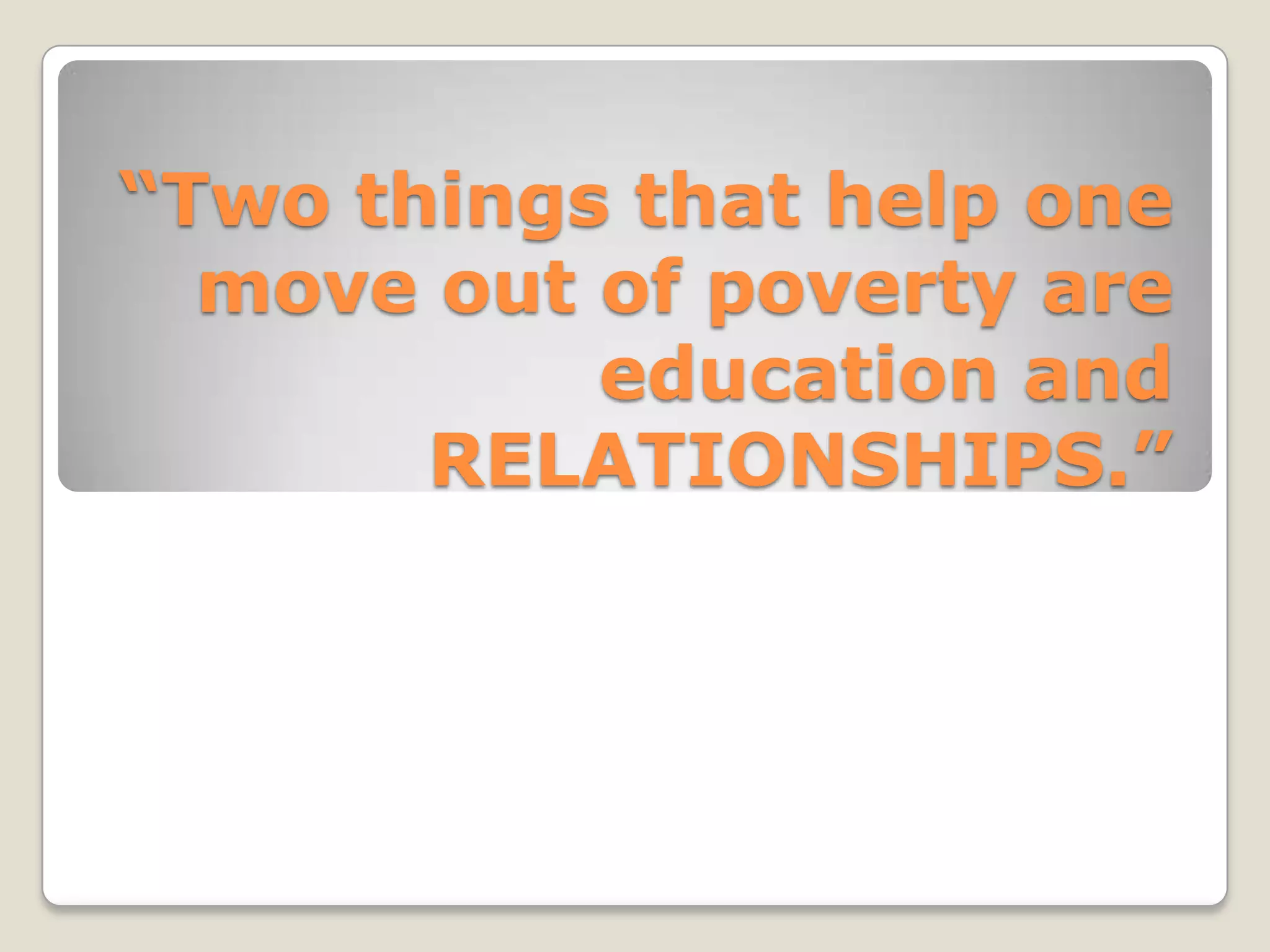
“Two things that help one
move out of poverty are
education and
RELATIONSHIPS.”
What Could Happen?
 Currently for each student that drops out
of Waco ISD, Waco loses $300,000+ in
forgone income, tax revenues, and
increased job training, welfare,
unemployment and criminal justice costs
 If just 100 students chose not to drop
out each year, that would save the city of
Waco $30 Million over their lifetimes
 In just 10 years, the City of Waco would
save $300 Million
Just 100 Students
Do you have 30mins?

1,000 reading clubs

  • 1.
  • 2.
    A few thingsto note…did you know? Poor inner-city youths are 7 times more likely to be the victims of child abuse or neglect than are children of high social and economic status. The state of Texas has noted the 76707 zip code as having one of the highest poverty rates among children in the entire state of Texas. Approximately 90% of Waco ISD students are considered poor because they are on free and reduced lunches *For a family of four with two under age eighteen, the "poverty line" or "poverty threshold" was $22,350.
  • 3.
    A few thingsto note…did you know? If a child is not proficient in reading AND is “poor”, that child is 13 times less likely to graduate than their more affluent and proficient peers. In addition, a dropout is more than eight times as likely to be incarcerated as a person with at least a high school diploma In the United States, 40% of young adults (ages 16-24) lacking a high school diploma received some type of government assistance
  • 4.
    A few thingsto note…did you know? 28.5 % of students are Disciplinary Placements 69.7 % of WISD students are coded at-risk. Waco Graduation Rate is 85%
  • 5.
    How Can ReadingClubs Help?
  • 6.
    Reading Clubs arean “easy win” form of mentoring.
  • 7.
    Mentoring Is… Consistently sharinglife for the purpose of helping someone else grow.
  • 8.
    What is Mentoring? MentorMentee “Comments from study participants indicate that their mentors weren’t necessarily doing anything extraordinary, just being involved and treating the young person as an important human being,” Erikson said in a study on the Benefit Of A Mentor: Disadvantaged Teens Twice as Likely To Attend College.
  • 9.
    Why do readingclubs work? “Kids need one positive adult caring relationship in order to have a chance at a productive life.” Dr. Del Elliott Senior Scientific research for the University of Colorado
  • 10.
    There are 8resources people in poverty draw from: 1. Social Systems-Having friends, family, and backup resources available to access in times of need ;EXTERNAL 2. Emotional-the person can choose and control emotional responses, especially to negative situations, without engaging in self destructive behavior; INTERNAL=stamina, perseverance, and choices 3. Financial-Money to purchase goods and services. 4. Spiritual-believing in divine purpose and guidance. 5. Physical-having physical health and mobility. 6. Mental-having the mental ability and acquired skills (reading, writing, and computing) to deal with daily life. 7. Support Systems-Having friends, family, and backup resources available to access in times of need; EXTERNAL 8. Relationships/ Role Models-Having frequent access to adults who are appropriate, nurturing, and who do not engage in self destructive behavior A person only needs three resources to help them make choices out of generational poverty!
  • 11.
    Reading Clubs canoffer these resources….  Relationship/ Role Model  Spiritual  Support Systems  Emotional- helping train children how to respond instead of react to situations
  • 12.
    Research indicates thatyouth benefit from meeting with an adult Some of the benefits include:  Better attitudes about school  Higher college enrollment rates and higher educational aspirations  Enhanced self-esteem and self-confidence  Improved behavior at home and school  Stronger relationships with parents, teachers and peers  Improved interpersonal skills  Decreased likelihood of dropping out of school *As a general rule, youth who are disadvantaged, or at-risk, stand to gain the most from mentoring.
  • 13.
    “Potential is sometimessquashed by the social environment, and the data show that mentors can overcome these forces,” said Lance Erickson, a sociology professor at Brigham Young University and the study’s lead author. A study found that a one year investment in at-risk middle school students produced a statistically significant difference in:  GPAs increased in 94% of the students  Discipline Referrals decreased in 94% of the students.  Attendance rates improved in 96% of the students.
  • 15.
    How to getinvolved: Reading Clubs- 30 minutes once a week with a small group, no more than three students, reading books and talking about them.
  • 16.
    Results are basedon 2 months of participation in Reading Club. Oct. 2012 Nov. 2012 Student Reading Level Student 1 2.5 Student 2 2.5 Student 3 2.7 Student 4 2.7 Student 5 2.8 Student Reading Level Student 1 3.7 Student 2 3.1 Student 3 4.2 Student 4 3.3 Student 5 3.5 Student were selected based on their tier 2 status. They were targeted as either needing intervention or urgent intervention in Reading. Reading Club Results
  • 17.
    “Two things thathelp one move out of poverty are education and RELATIONSHIPS.”
  • 18.
  • 19.
     Currently foreach student that drops out of Waco ISD, Waco loses $300,000+ in forgone income, tax revenues, and increased job training, welfare, unemployment and criminal justice costs
  • 20.
     If just100 students chose not to drop out each year, that would save the city of Waco $30 Million over their lifetimes  In just 10 years, the City of Waco would save $300 Million Just 100 Students
  • 21.
    Do you have30mins?