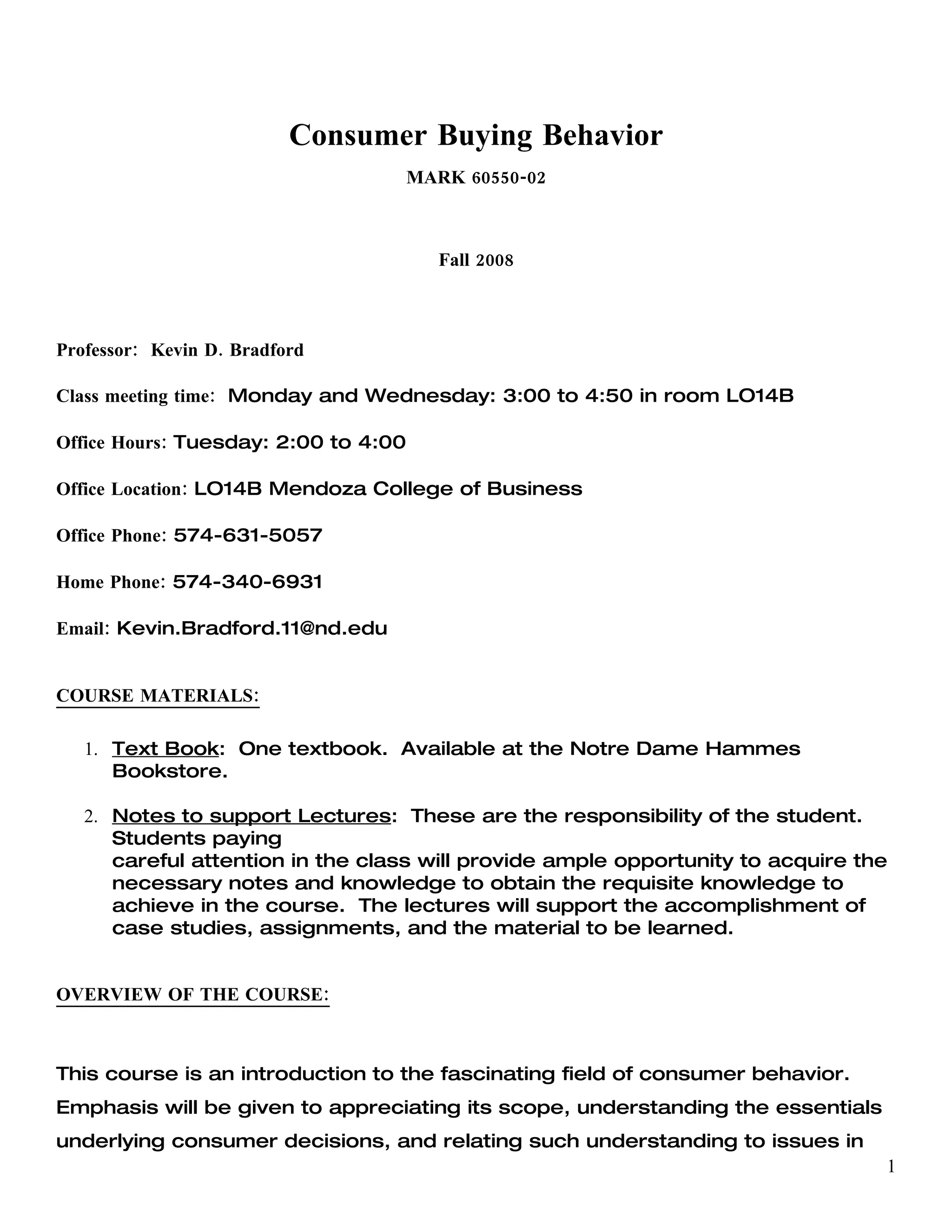
Consumer Buying Behavior
                                      MARK 60550-02


                                        Fall 2008


Professor: Kevin D. Bradford

Class meeting time: Monday and Wednesday: 3:00 to 4:50 in room LO14B

Office Hours: Tuesday: 2:00 to 4:00

Office Location: LO14B Mendoza College of Business

Office Phone: 574-631-5057

Home Phone: 574-340-6931

Email: Kevin.Bradford.11@nd.edu


COURSE MATERIALS:

   1. Text Book: One textbook. Available at the Notre Dame Hammes
      Bookstore.

   2. Notes to support Lectures: These are the responsibility of the student.
      Students paying
      careful attention in the class will provide ample opportunity to acquire the
      necessary notes and knowledge to obtain the requisite knowledge to
      achieve in the course. The lectures will support the accomplishment of
      case studies, assignments, and the material to be learned.


OVERVIEW OF THE COURSE:


This course is an introduction to the fascinating field of consumer behavior.
Emphasis will be given to appreciating its scope, understanding the essentials
underlying consumer decisions, and relating such understanding to issues in
                                                                                 1
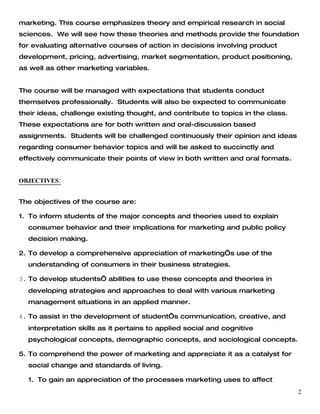
marketing. This course emphasizes theory and empirical research in social
sciences. We will see how these theories and methods provide the foundation
for evaluating alternative courses of action in decisions involving product
development, pricing, advertising, market segmentation, product positioning,
as well as other marketing variables.


The course will be managed with expectations that students conduct
themselves professionally. Students will also be expected to communicate
their ideas, challenge existing thought, and contribute to topics in the class.
These expectations are for both written and oral-discussion based
assignments. Students will be challenged continuously their opinion and ideas
regarding consumer behavior topics and will be asked to succinctly and
effectively communicate their points of view in both written and oral formats.


OBJECTIVES:


The objectives of the course are:

1. To inform students of the major concepts and theories used to explain
  consumer behavior and their implications for marketing and public policy
  decision making.

2. To develop a comprehensive appreciation of marketing’s use of the
  understanding of consumers in their business strategies.

3. To develop students’ abilities to use these concepts and theories in
  developing strategies and approaches to deal with various marketing
  management situations in an applied manner.

4. To assist in the development of student’s communication, creative, and
  interpretation skills as it pertains to applied social and cognitive
  psychological concepts, demographic concepts, and sociological concepts.

5. To comprehend the power of marketing and appreciate it as a catalyst for
  social change and standards of living.

  1. To gain an appreciation of the processes marketing uses to affect
                                                                                  2
change.

6. To provide background for a broader consideration set for marketing
  decisions to consider not only the maximization of profit for the firm but to
  consider the effects of marketing decisions on all of the stakeholders.


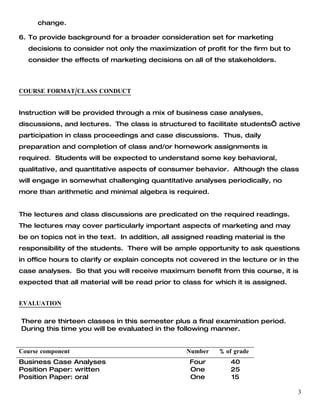
COURSE FORMAT/CLASS CONDUCT


Instruction will be provided through a mix of business case analyses,
discussions, and lectures. The class is structured to facilitate students’ active
participation in class proceedings and case discussions. Thus, daily
preparation and completion of class and/or homework assignments is
required. Students will be expected to understand some key behavioral,
qualitative, and quantitative aspects of consumer behavior. Although the class
will engage in somewhat challenging quantitative analyses periodically, no
more than arithmetic and minimal algebra is required.


The lectures and class discussions are predicated on the required readings.
The lectures may cover particularly important aspects of marketing and may
be on topics not in the text. In addition, all assigned reading material is the
responsibility of the students. There will be ample opportunity to ask questions
in office hours to clarify or explain concepts not covered in the lecture or in the
case analyses. So that you will receive maximum benefit from this course, it is
expected that all material will be read prior to class for which it is assigned.


EVALUATION

There are thirteen classes in this semester plus a final examination period.
During this time you will be evaluated in the following manner.


Course component                                  Number   % of grade
Business Case Analyses                            Four         40
Position Paper: written                           One          25
Position Paper: oral                              One          15

                                                                                   3
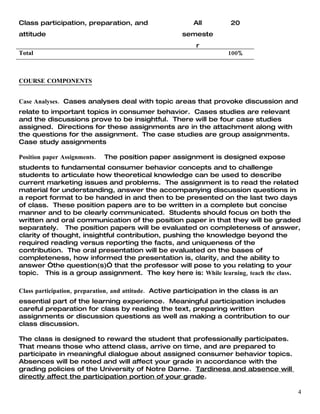
Class participation, preparation, and                     All          20
attitude                                              semeste
                                                           r
Total                                                                 100%


COURSE COMPONENTS


Case Analyses. Cases analyses deal with topic areas that provoke discussion and
relate to important topics in consumer behavior. Cases studies are relevant
and the discussions prove to be insightful. There will be four case studies
assigned. Directions for these assignments are in the attachment along with
the questions for the assignment. The case studies are group assignments.
Case study assignments

Position paper Assignments.   The position paper assignment is designed expose
students to fundamental consumer behavior concepts and to challenge
students to articulate how theoretical knowledge can be used to describe
current marketing issues and problems. The assignment is to read the related
material for understanding, answer the accompanying discussion questions in
a report format to be handed in and then to be presented on the last two days
of class. These position papers are to be written in a complete but concise
manner and to be clearly communicated. Students should focus on both the
written and oral communication of the position paper in that they will be graded
separately. The position papers will be evaluated on completeness of answer,
clarity of thought, insightful contribution, pushing the knowledge beyond the
required reading versus reporting the facts, and uniqueness of the
contribution. The oral presentation will be evaluated on the bases of
completeness, how informed the presentation is, clarity, and the ability to
answer “the question(s)” that the professor will pose to you relating to your
topic. This is a group assignment. The key here is: While learning, teach the class.

Class participation, preparation, and attitude. Active participation in the class is an
essential part of the learning experience. Meaningful participation includes
careful preparation for class by reading the text, preparing written
assignments or discussion questions as well as making a contribution to our
class discussion.

The class is designed to reward the student that professionally participates.
That means those who attend class, arrive on time, and are prepared to
participate in meaningful dialogue about assigned consumer behavior topics.
Absences will be noted and will affect your grade in accordance with the
grading policies of the University of Notre Dame. Tardiness and absence will
directly affect the participation portion of your grade.

                                                                                          4
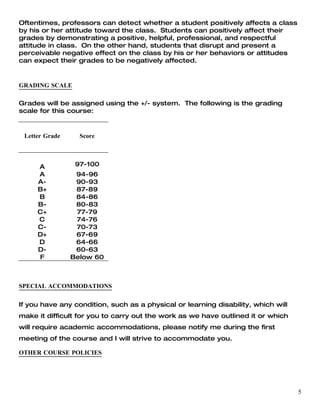
Oftentimes, professors can detect whether a student positively affects a class
by his or her attitude toward the class. Students can positively affect their
grades by demonstrating a positive, helpful, professional, and respectful
attitude in class. On the other hand, students that disrupt and present a
perceivable negative effect on the class by his or her behaviors or attitudes
can expect their grades to be negatively affected.


GRADING SCALE

Grades will be assigned using the +/- system. The following is the grading
scale for this course:


 Letter Grade     Score


     A           97-100
     A           94-96
     A-          90-93
     B+          87-89
     B           84-86
     B-          80-83
     C+          77-79
     C           74-76
     C-          70-73
     D+          67-69
     D           64-66
     D-          60-63
     F          Below 60


SPECIAL ACCOMMODATIONS

If you have any condition, such as a physical or learning disability, which will
make it difficult for you to carry out the work as we have outlined it or which
will require academic accommodations, please notify me during the first
meeting of the course and I will strive to accommodate you.

OTHER COURSE POLICIES


                                                                                   5
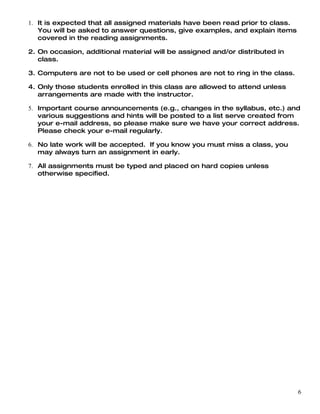
1. It is expected that all assigned materials have been read prior to class.
   You will be asked to answer questions, give examples, and explain items
   covered in the reading assignments.

2. On occasion, additional material will be assigned and/or distributed in
   class.

3. Computers are not to be used or cell phones are not to ring in the class.

4. Only those students enrolled in this class are allowed to attend unless
   arrangements are made with the instructor.

5. Important course announcements (e.g., changes in the syllabus, etc.) and
   various suggestions and hints will be posted to a list serve created from
   your e-mail address, so please make sure we have your correct address.
   Please check your e-mail regularly.

6. No late work will be accepted. If you know you must miss a class, you
   may always turn an assignment in early.

7. All assignments must be typed and placed on hard copies unless
   otherwise specified.


                                                                               6
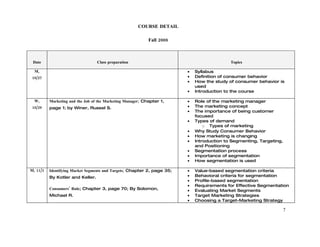
COURSE DETAIL

                                                            Fall 2008


 Date                             Class preparation                                         Topics

  M,                                                                     •   Syllabus
 10/27                                                                   •   Definition of consumer behavior
                                                                         •   How the study of consumer behavior is
                                                                             used
                                                                         •   Introduction to the course

  W,      Marketing and the Job of the Marketing Manager; Chapter 1,     •   Role of the marketing manager
 10/29    page 1; by Winer, Russel S.                                    •   The marketing concept
                                                                         •   The importance of being customer
                                                                             focused
                                                                         •   Types of demand
                                                                                 o Types of marketing
                                                                         •   Why Study Consumer Behavior
                                                                         •   How marketing is changing
                                                                         •   Introduction to Segmenting, Targeting,
                                                                             and Positioning
                                                                         •   Segmentation process
                                                                         •   Importance of segmentation
                                                                         •   How segmentation is used

M, 11/3   Identifying Market Segments and Targets; Chapter 2, page 35;   •   Value-based segmentation criteria
          By Kotler and Keller.                                          •   Behavioral criteria for segmentation
                                                                         •   Profile-based segmentation
                                                                         •   Requirements for Effective Segmentation
          Consumers’ Rule; Chapter 3, page 70; By Solomon,               •   Evaluating Market Segments
          Michael R.                                                     •   Target Marketing Strategies
                                                                         •   Choosing a Target-Marketing Strategy

                                                                                                                      7
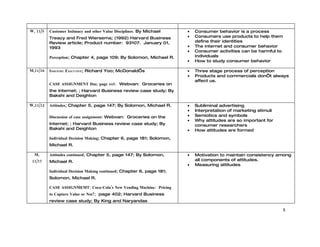
W, 11/5   Customer Intimacy and other Value Disciplines. By Michael    •   Consumer behavior is a process
          Treacy and Fred Wiersema; (1992) Harvard Business            •   Consumers use products to help them
          Review article; Product number: 93107. January 01,               define their identities
          1993                                                         •   The internet and consumer behavior
                                                                       •   Consumer activities can be harmful to
          Perception; Chapter 4, page 109; By Solomon, Michael R.          individuals
                                                                       •   How to study consumer behavior

M,11/10   INDUSTRY EXECUTIVE; Richard Yoo; McDonald’s                  •   Three stage process of perception
                                                                       •   Products and commercials don’t always
                                                                           affect us.
          CASE ASSIGNMENT Due, page 445: Webvan: Groceries on
          the Internet; ; Harvard Business review case study; By
          Bakshi and Deighton

W,11/12   Attitudes; Chapter 5, page 147; By Solomon, Michael R.       •   Subliminal advertising
                                                                       •   Interpretation of marketing stimuli
          Discussion of case assignment: Webvan: Groceries on the      •   Semiotics and symbols
                                                                       •   Why attitudes are so important for
          Internet; ; Harvard Business review case study; By               consumer researchers
          Bakshi and Deighton                                          •   How attitudes are formed
          Individual Decision Making; Chapter 6, page 181; Solomon,
          Michael R.

  M,      Attitudes continued; Chapter 5, page 147; By Solomon,        •   Motivation to maintain consistency among
 11/17    Michael R.                                                       all components of attitudes.
                                                                       •   Measuring attitudes
          Individual Decision Making continued; Chapter 6, page 181;
          Solomon, Michael R.

          CASE ASSIGNMEMT: Coca-Cola’s New Vending Machine: Pricing
          to Capture Value or Not?; page 402; Harvard Business
          review case study; By King and Naryandas

                                                                                                                   8
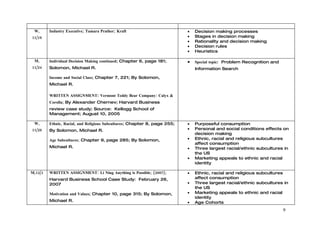
W,      Industry Executive; Tamara Prather; Kraft                         •   Decision making processes
11/19                                                                      •   Stages in decision making
                                                                           •   Rationality and decision making
                                                                           •   Decision rules
                                                                           •   Heuristics

 M,      Individual Decision Making continued; Chapter 6, page 181;        •   Special topic: Problem Recognition and
11/24    Solomon, Michael R.                                                   Information Search

         Income and Social Class; Chapter 7, 221; By Solomon,
         Michael R.

         WRITTEN ASSIGNMENT: Vermont Teddy Bear Company: Calyx &
         Corolla; By Alexander Chernev; Harvard Business
         review case study; Source: Kellogg School of
         Management; August 10, 2005

 W,      Ethnic, Racial, and Religious Subcultures; Chapter 8, page 255;   •   Purposeful consumption
11/26    By Solomon, Michael R.                                            •   Personal and social conditions effects on
                                                                               decision making
         Age Subcultures; Chapter 9, page 285; By Solomon,                 •   Ethnic, racial and religious subcultures
                                                                               affect consumption
         Michael R.                                                        •   Three largest racial/ethnic subcultures in
                                                                               the US
                                                                           •   Marketing appeals to ethnic and racial
                                                                               identity

M,12/1   WRITTEN ASSIGNMENT: Li Ning Anything is Possible; (2007);         •   Ethnic, racial and religious subcultures
         Harvard Business School Case Study: February 26,                      affect consumption
         2007                                                              •   Three largest racial/ethnic subcultures in
                                                                               the US
         Motivation and Values; Chapter 10, page 315; By Solomon,          •   Marketing appeals to ethnic and racial
                                                                               identity
         Michael R.                                                        •   Age Cohorts
                                                                                                                        9
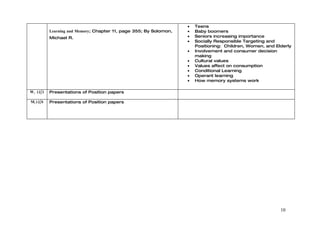
•   Teens
          Learning and Memory; Chapter 11, page 355; By Solomon,   •   Baby boomers
          Michael R.                                               •   Seniors increasing importance
                                                                   •   Socially Responsible Targeting and
                                                                       Positioning: Children, Women, and Elderly
                                                                   •   Involvement and consumer decision
                                                                       making
                                                                   •   Cultural values
                                                                   •   Values affect on consumption
                                                                   •   Conditional Learning
                                                                   •   Operant learning
                                                                   •   How memory systems work

W, 12/3   Presentations of Position papers

M,12/8    Presentations of Position papers


                                                                                                           10

100 mark 60550 bradford (1)

  • 1.
    Consumer Buying Behavior MARK 60550-02 Fall 2008 Professor: Kevin D. Bradford Class meeting time: Monday and Wednesday: 3:00 to 4:50 in room LO14B Office Hours: Tuesday: 2:00 to 4:00 Office Location: LO14B Mendoza College of Business Office Phone: 574-631-5057 Home Phone: 574-340-6931 Email: Kevin.Bradford.11@nd.edu COURSE MATERIALS: 1. Text Book: One textbook. Available at the Notre Dame Hammes Bookstore. 2. Notes to support Lectures: These are the responsibility of the student. Students paying careful attention in the class will provide ample opportunity to acquire the necessary notes and knowledge to obtain the requisite knowledge to achieve in the course. The lectures will support the accomplishment of case studies, assignments, and the material to be learned. OVERVIEW OF THE COURSE: This course is an introduction to the fascinating field of consumer behavior. Emphasis will be given to appreciating its scope, understanding the essentials underlying consumer decisions, and relating such understanding to issues in 1
  • 2.
    marketing. This courseemphasizes theory and empirical research in social sciences. We will see how these theories and methods provide the foundation for evaluating alternative courses of action in decisions involving product development, pricing, advertising, market segmentation, product positioning, as well as other marketing variables. The course will be managed with expectations that students conduct themselves professionally. Students will also be expected to communicate their ideas, challenge existing thought, and contribute to topics in the class. These expectations are for both written and oral-discussion based assignments. Students will be challenged continuously their opinion and ideas regarding consumer behavior topics and will be asked to succinctly and effectively communicate their points of view in both written and oral formats. OBJECTIVES: The objectives of the course are: 1. To inform students of the major concepts and theories used to explain consumer behavior and their implications for marketing and public policy decision making. 2. To develop a comprehensive appreciation of marketing’s use of the understanding of consumers in their business strategies. 3. To develop students’ abilities to use these concepts and theories in developing strategies and approaches to deal with various marketing management situations in an applied manner. 4. To assist in the development of student’s communication, creative, and interpretation skills as it pertains to applied social and cognitive psychological concepts, demographic concepts, and sociological concepts. 5. To comprehend the power of marketing and appreciate it as a catalyst for social change and standards of living. 1. To gain an appreciation of the processes marketing uses to affect 2
  • 3.
    change. 6. To providebackground for a broader consideration set for marketing decisions to consider not only the maximization of profit for the firm but to consider the effects of marketing decisions on all of the stakeholders. COURSE FORMAT/CLASS CONDUCT Instruction will be provided through a mix of business case analyses, discussions, and lectures. The class is structured to facilitate students’ active participation in class proceedings and case discussions. Thus, daily preparation and completion of class and/or homework assignments is required. Students will be expected to understand some key behavioral, qualitative, and quantitative aspects of consumer behavior. Although the class will engage in somewhat challenging quantitative analyses periodically, no more than arithmetic and minimal algebra is required. The lectures and class discussions are predicated on the required readings. The lectures may cover particularly important aspects of marketing and may be on topics not in the text. In addition, all assigned reading material is the responsibility of the students. There will be ample opportunity to ask questions in office hours to clarify or explain concepts not covered in the lecture or in the case analyses. So that you will receive maximum benefit from this course, it is expected that all material will be read prior to class for which it is assigned. EVALUATION There are thirteen classes in this semester plus a final examination period. During this time you will be evaluated in the following manner. Course component Number % of grade Business Case Analyses Four 40 Position Paper: written One 25 Position Paper: oral One 15 3
  • 4.
    Class participation, preparation,and All 20 attitude semeste r Total 100% COURSE COMPONENTS Case Analyses. Cases analyses deal with topic areas that provoke discussion and relate to important topics in consumer behavior. Cases studies are relevant and the discussions prove to be insightful. There will be four case studies assigned. Directions for these assignments are in the attachment along with the questions for the assignment. The case studies are group assignments. Case study assignments Position paper Assignments. The position paper assignment is designed expose students to fundamental consumer behavior concepts and to challenge students to articulate how theoretical knowledge can be used to describe current marketing issues and problems. The assignment is to read the related material for understanding, answer the accompanying discussion questions in a report format to be handed in and then to be presented on the last two days of class. These position papers are to be written in a complete but concise manner and to be clearly communicated. Students should focus on both the written and oral communication of the position paper in that they will be graded separately. The position papers will be evaluated on completeness of answer, clarity of thought, insightful contribution, pushing the knowledge beyond the required reading versus reporting the facts, and uniqueness of the contribution. The oral presentation will be evaluated on the bases of completeness, how informed the presentation is, clarity, and the ability to answer “the question(s)” that the professor will pose to you relating to your topic. This is a group assignment. The key here is: While learning, teach the class. Class participation, preparation, and attitude. Active participation in the class is an essential part of the learning experience. Meaningful participation includes careful preparation for class by reading the text, preparing written assignments or discussion questions as well as making a contribution to our class discussion. The class is designed to reward the student that professionally participates. That means those who attend class, arrive on time, and are prepared to participate in meaningful dialogue about assigned consumer behavior topics. Absences will be noted and will affect your grade in accordance with the grading policies of the University of Notre Dame. Tardiness and absence will directly affect the participation portion of your grade. 4
  • 5.
    Oftentimes, professors candetect whether a student positively affects a class by his or her attitude toward the class. Students can positively affect their grades by demonstrating a positive, helpful, professional, and respectful attitude in class. On the other hand, students that disrupt and present a perceivable negative effect on the class by his or her behaviors or attitudes can expect their grades to be negatively affected. GRADING SCALE Grades will be assigned using the +/- system. The following is the grading scale for this course: Letter Grade Score A 97-100 A 94-96 A- 90-93 B+ 87-89 B 84-86 B- 80-83 C+ 77-79 C 74-76 C- 70-73 D+ 67-69 D 64-66 D- 60-63 F Below 60 SPECIAL ACCOMMODATIONS If you have any condition, such as a physical or learning disability, which will make it difficult for you to carry out the work as we have outlined it or which will require academic accommodations, please notify me during the first meeting of the course and I will strive to accommodate you. OTHER COURSE POLICIES 5
  • 6.
    1. It isexpected that all assigned materials have been read prior to class. You will be asked to answer questions, give examples, and explain items covered in the reading assignments. 2. On occasion, additional material will be assigned and/or distributed in class. 3. Computers are not to be used or cell phones are not to ring in the class. 4. Only those students enrolled in this class are allowed to attend unless arrangements are made with the instructor. 5. Important course announcements (e.g., changes in the syllabus, etc.) and various suggestions and hints will be posted to a list serve created from your e-mail address, so please make sure we have your correct address. Please check your e-mail regularly. 6. No late work will be accepted. If you know you must miss a class, you may always turn an assignment in early. 7. All assignments must be typed and placed on hard copies unless otherwise specified. 6
  • 7.
    COURSE DETAIL Fall 2008 Date Class preparation Topics M, • Syllabus 10/27 • Definition of consumer behavior • How the study of consumer behavior is used • Introduction to the course W, Marketing and the Job of the Marketing Manager; Chapter 1, • Role of the marketing manager 10/29 page 1; by Winer, Russel S. • The marketing concept • The importance of being customer focused • Types of demand o Types of marketing • Why Study Consumer Behavior • How marketing is changing • Introduction to Segmenting, Targeting, and Positioning • Segmentation process • Importance of segmentation • How segmentation is used M, 11/3 Identifying Market Segments and Targets; Chapter 2, page 35; • Value-based segmentation criteria By Kotler and Keller. • Behavioral criteria for segmentation • Profile-based segmentation • Requirements for Effective Segmentation Consumers’ Rule; Chapter 3, page 70; By Solomon, • Evaluating Market Segments Michael R. • Target Marketing Strategies • Choosing a Target-Marketing Strategy 7
  • 8.
    W, 11/5 Customer Intimacy and other Value Disciplines. By Michael • Consumer behavior is a process Treacy and Fred Wiersema; (1992) Harvard Business • Consumers use products to help them Review article; Product number: 93107. January 01, define their identities 1993 • The internet and consumer behavior • Consumer activities can be harmful to Perception; Chapter 4, page 109; By Solomon, Michael R. individuals • How to study consumer behavior M,11/10 INDUSTRY EXECUTIVE; Richard Yoo; McDonald’s • Three stage process of perception • Products and commercials don’t always affect us. CASE ASSIGNMENT Due, page 445: Webvan: Groceries on the Internet; ; Harvard Business review case study; By Bakshi and Deighton W,11/12 Attitudes; Chapter 5, page 147; By Solomon, Michael R. • Subliminal advertising • Interpretation of marketing stimuli Discussion of case assignment: Webvan: Groceries on the • Semiotics and symbols • Why attitudes are so important for Internet; ; Harvard Business review case study; By consumer researchers Bakshi and Deighton • How attitudes are formed Individual Decision Making; Chapter 6, page 181; Solomon, Michael R. M, Attitudes continued; Chapter 5, page 147; By Solomon, • Motivation to maintain consistency among 11/17 Michael R. all components of attitudes. • Measuring attitudes Individual Decision Making continued; Chapter 6, page 181; Solomon, Michael R. CASE ASSIGNMEMT: Coca-Cola’s New Vending Machine: Pricing to Capture Value or Not?; page 402; Harvard Business review case study; By King and Naryandas 8
  • 9.
    W, Industry Executive; Tamara Prather; Kraft • Decision making processes 11/19 • Stages in decision making • Rationality and decision making • Decision rules • Heuristics M, Individual Decision Making continued; Chapter 6, page 181; • Special topic: Problem Recognition and 11/24 Solomon, Michael R. Information Search Income and Social Class; Chapter 7, 221; By Solomon, Michael R. WRITTEN ASSIGNMENT: Vermont Teddy Bear Company: Calyx & Corolla; By Alexander Chernev; Harvard Business review case study; Source: Kellogg School of Management; August 10, 2005 W, Ethnic, Racial, and Religious Subcultures; Chapter 8, page 255; • Purposeful consumption 11/26 By Solomon, Michael R. • Personal and social conditions effects on decision making Age Subcultures; Chapter 9, page 285; By Solomon, • Ethnic, racial and religious subcultures affect consumption Michael R. • Three largest racial/ethnic subcultures in the US • Marketing appeals to ethnic and racial identity M,12/1 WRITTEN ASSIGNMENT: Li Ning Anything is Possible; (2007); • Ethnic, racial and religious subcultures Harvard Business School Case Study: February 26, affect consumption 2007 • Three largest racial/ethnic subcultures in the US Motivation and Values; Chapter 10, page 315; By Solomon, • Marketing appeals to ethnic and racial identity Michael R. • Age Cohorts 9
  • 10.
    Teens Learning and Memory; Chapter 11, page 355; By Solomon, • Baby boomers Michael R. • Seniors increasing importance • Socially Responsible Targeting and Positioning: Children, Women, and Elderly • Involvement and consumer decision making • Cultural values • Values affect on consumption • Conditional Learning • Operant learning • How memory systems work W, 12/3 Presentations of Position papers M,12/8 Presentations of Position papers 10