Design Patterns

   1. Strategy Pattern
How to design for flexibility?


           Strategy Pattern      1
References
•   Design Patterns: Elements of Reusable
    Object-Oriented Software By Gamma, Erich;
    Richard Helm, Ralph Johnson, and John
    Vlissides (1995). Addison-Wesley. ISBN 0-
    201-63361-2.
•   Head First Design Patterns By Eric Freeman,
    Elisabeth Freeman, Kathy Sierra, Bert Bates
    First Edition October 2004
    ISBN 10: 0-596-00712-4

                    Strategy Pattern          2
Existing Duck application
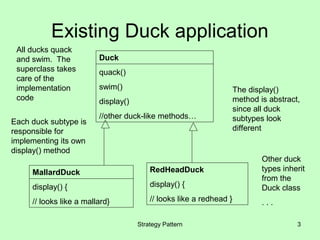
 All ducks quack
 and swim. The           Duck
 superclass takes        quack()
 care of the
 implementation          swim()                                      The display()
 code                    display()                                   method is abstract,
                                                                     since all duck
                         //other duck-like methods…                  subtypes look
Each duck subtype is
responsible for                                                      different
implementing its own
display() method
                                                                             Other duck
     MallardDuck                         RedHeadDuck                         types inherit
                                                                             from the
     display() {                         display() {                         Duck class
     // looks like a mallard}            // looks like a redhead }           ...

                                     Strategy Pattern                                  3
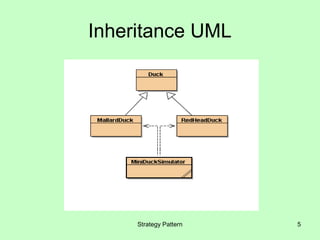
Inheritance
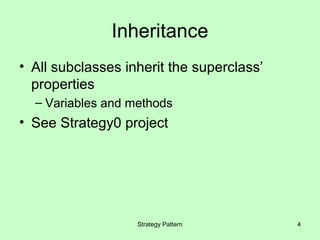
• All subclasses inherit the superclass’
  properties
  – Variables and methods
• See Strategy0 project


                   Strategy Pattern        4
Inheritance UML


     Strategy Pattern   5
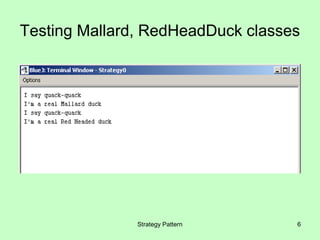
Testing Mallard, RedHeadDuck classes


               Strategy Pattern    6
But Executives want to introduce fly
          capability quickly
• How to do it in a short time, like 2 days?


                   Strategy Pattern            7
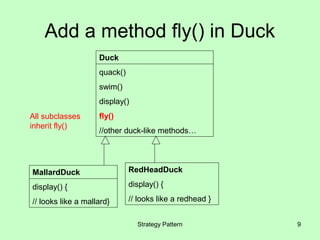
Solution #1
• No sweat!
  – Add a method fly() in Duck
  – Continue to use inheritance


                    Strategy Pattern   8
Add a method fly() in Duck
                    Duck
                    quack()
                    swim()
                    display()
All subclasses      fly()
inherit fly()
                    //other duck-like methods…


MallardDuck                   RedHeadDuck

display() {                   display() {

// looks like a mallard}      // looks like a redhead }


                                Strategy Pattern          9
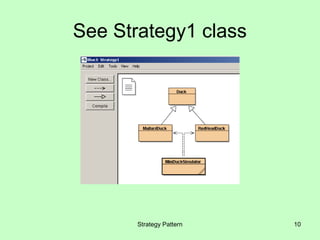
See Strategy1 class


       Strategy Pattern   10
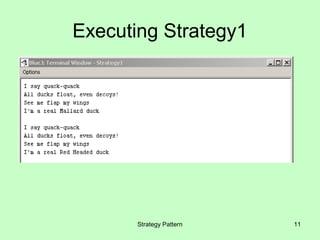
Executing Strategy1


       Strategy Pattern   11
Everything OK?
• Think harder.


                  Strategy Pattern   12
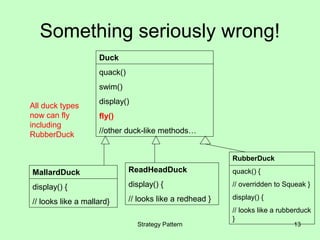
Something seriously wrong!
                    Duck
                    quack()
                    swim()
                    display()
All duck types
now can fly         fly()
including
RubberDuck          //other duck-like methods…


                                                          RubberDuck

MallardDuck                   ReadHeadDuck                quack() {

display() {                   display() {                 // overridden to Squeak }

                              // looks like a redhead }   display() {
// looks like a mallard}
                                                          // looks like a rubberduck
                                                          }
                                Strategy Pattern                              13
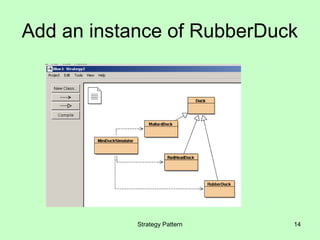
Add an instance of RubberDuck


            Strategy Pattern   14
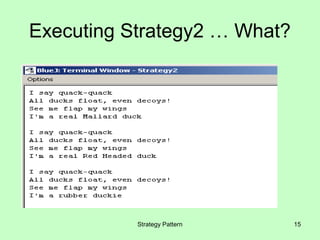
Executing Strategy2 … What?


           Strategy Pattern   15
Root cause?
• Applying inheritance to achieve re-use
• Poor solution for maintenance


                  Strategy Pattern         16
How do we fix this?
• Using inheritance as before
  – Override the fly() method in rubber duck as in
    quack()
• Will it fix the problem?
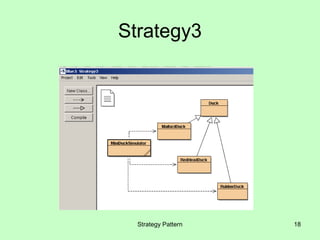
  – See Strategy3


                    Strategy Pattern             17
Strategy3


  Strategy Pattern   18
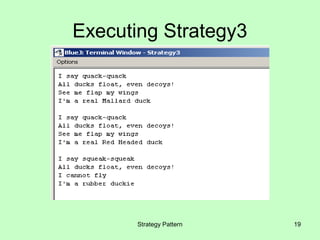
Executing Strategy3


       Strategy Pattern   19
Is the problem solved?
• Any new problems?


                Strategy Pattern   20
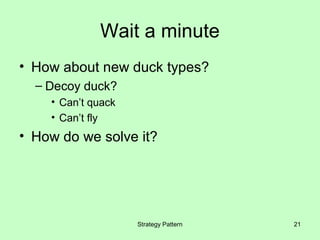
Wait a minute
• How about new duck types?
  – Decoy duck?
    • Can’t quack
    • Can’t fly
• How do we solve it?


                    Strategy Pattern   21
Summary
• What have we done so far?
• What problems have we solved?
• What problems have we introduced in
  solving the problems?
• Is there a better way of doing things?


                  Strategy Pattern         22
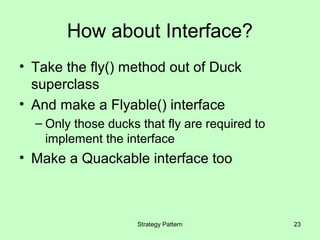
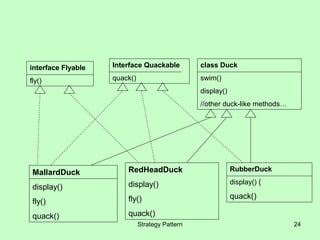
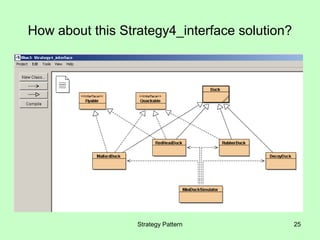
How about Interface?
• Take the fly() method out of Duck
  superclass
• And make a Flyable() interface
  – Only those ducks that fly are required to
    implement the interface
• Make a Quackable interface too


                     Strategy Pattern           23
interface Flyable   Interface Quackable          class Duck

fly()               quack()                      swim()
                                                 display()
                                                 //other duck-like methods…


 MallardDuck            RedHeadDuck                          RubberDuck

                        display()                            display() {
 display()
                        fly()                                quack()
 fly()
 quack()                quack()
                              Strategy Pattern                                24
How about this Strategy4_interface solution?


                  Strategy Pattern             25
But
• You shoot yourself in the foot by
  duplicating code for every duck type that
  can fly and quack!
• And we have a lot of duck types
• We have to be careful about the properties
  – we cannot just call the methods blindly
• We have created a maintenance
  nightmare!
                  Strategy Pattern         26
Re-thinking:
• Inheritance has not worked well because
   – Duck behavior keeps changing
   – Not suitable for all subclasses to have those
     properties
• Interface was at first promising, but
   – No code re-use
   – Tedious
      • Every time a behavior is changed, you must track down and
        change it in all the subclasses where it is defined
   – Error prone

                          Strategy Pattern                      27
#1 Design Principle
• Identify the aspects of your application
  that vary and separate them from what
  stays the same
• So what are variable in the Duck class?
  – Flying behavior
  – Quacking behavior
• Pull these duck behaviors out of the Duck
  class
  – Create new classes for these behaviors
                   Strategy Pattern           28
How do we design the classes to implement
      the fly and quack behaviors?
• Goal: to keep things flexible
• Want to assign behaviors to instances of
  Duck
  – Instantiate a new MallardDuck instance
  – Initialize it with a specific type of flying
  – Be able to change the behavior dynamically


                    Strategy Pattern               29
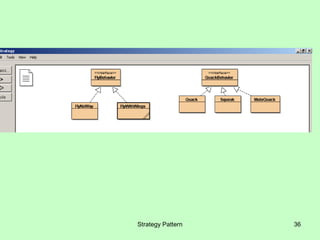
#2 Design Principle
• Program to a supertype, not an implementation
• Use a supertype to represent each behavior
  – FlyBehavior and QuackBehavior
  – Each implementation of a behavior will implement one
    of these supertypes
• In the past, we rely on an implementation
  – In superclass Duck, or
  – A specialized implementation in the subclass
• Now: Duck subclass will use a behavior
  represented in a supertype.

                       Strategy Pattern               30
Strategy Pattern   31
Strategy Pattern   32
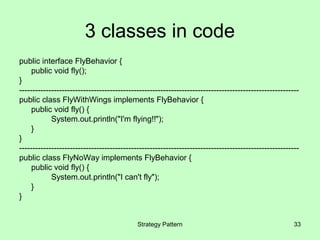
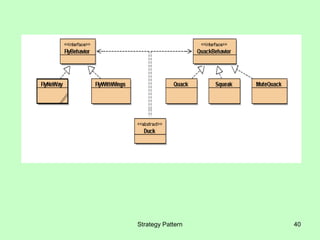
3 classes in code
public interface FlyBehavior {
     public void fly();
}
---------------------------------------------------------------------------------------------------------
public class FlyWithWings implements FlyBehavior {
     public void fly() {
            System.out.println("I'm flying!!");
     }
}
---------------------------------------------------------------------------------------------------------
public class FlyNoWay implements FlyBehavior {
     public void fly() {
            System.out.println("I can't fly");
     }
}


                                            Strategy Pattern                                           33
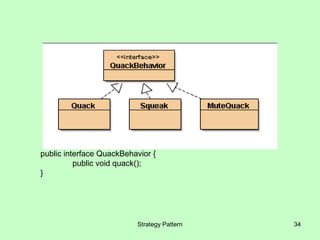
public interface QuackBehavior {
          public void quack();
}


                          Strategy Pattern   34
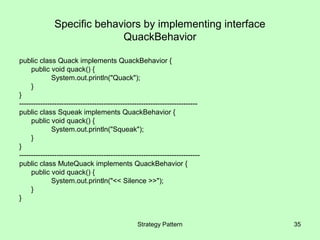
Specific behaviors by implementing interface
                             QuackBehavior

public class Quack implements QuackBehavior {
     public void quack() {
              System.out.println("Quack");
     }
}
----------------------------------------------------------------------------
public class Squeak implements QuackBehavior {
     public void quack() {
              System.out.println("Squeak");
     }
}
-----------------------------------------------------------------------------
public class MuteQuack implements QuackBehavior {
     public void quack() {
              System.out.println("<< Silence >>");
     }
}


                                                  Strategy Pattern              35
Strategy Pattern   36
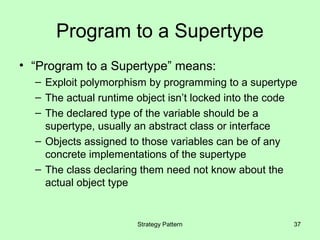
Program to a Supertype
• “Program to a Supertype” means:
  – Exploit polymorphism by programming to a supertype
  – The actual runtime object isn’t locked into the code
  – The declared type of the variable should be a
    supertype, usually an abstract class or interface
  – Objects assigned to those variables can be of any
    concrete implementations of the supertype
  – The class declaring them need not know about the
    actual object type


                       Strategy Pattern                37
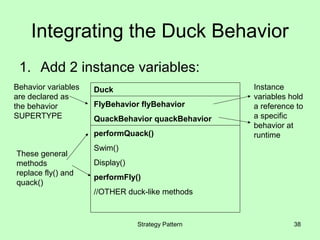
Integrating the Duck Behavior
 1. Add 2 instance variables:
Behavior variables   Duck                           Instance
are declared as                                     variables hold
the behavior         FlyBehavior flyBehavior        a reference to
SUPERTYPE            QuackBehavior quackBehavior    a specific
                                                    behavior at
                     performQuack()                 runtime
                     Swim()
These general
methods              Display()
replace fly() and
                     performFly()
quack()
                     //OTHER duck-like methods


                                 Strategy Pattern              38
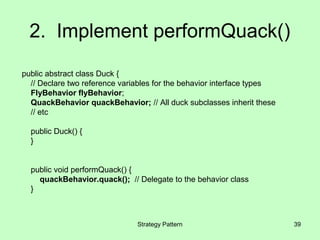
2. Implement performQuack()
public abstract class Duck {
  // Declare two reference variables for the behavior interface types
  FlyBehavior flyBehavior;
  QuackBehavior quackBehavior; // All duck subclasses inherit these
  // etc

  public Duck() {
  }


  public void performQuack() {
    quackBehavior.quack(); // Delegate to the behavior class
  }


                               Strategy Pattern                         39
Strategy Pattern   40
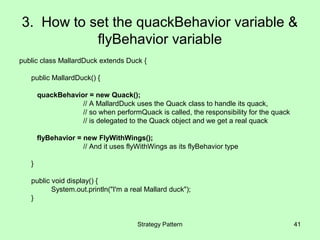
3. How to set the quackBehavior variable &
           flyBehavior variable
public class MallardDuck extends Duck {

   public MallardDuck() {

       quackBehavior = new Quack();
                   // A MallardDuck uses the Quack class to handle its quack,
                   // so when performQuack is called, the responsibility for the quack
                   // is delegated to the Quack object and we get a real quack

       flyBehavior = new FlyWithWings();
                     // And it uses flyWithWings as its flyBehavior type

   }

   public void display() {
          System.out.println("I'm a real Mallard duck");
   }


                                       Strategy Pattern                                  41
Strategy Pattern   42
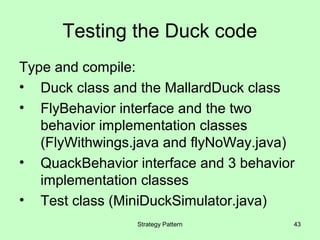
Testing the Duck code
Type and compile:
• Duck class and the MallardDuck class
• FlyBehavior interface and the two
   behavior implementation classes
   (FlyWithwings.java and flyNoWay.java)
• QuackBehavior interface and 3 behavior
   implementation classes
• Test class (MiniDuckSimulator.java)
                 Strategy Pattern      43
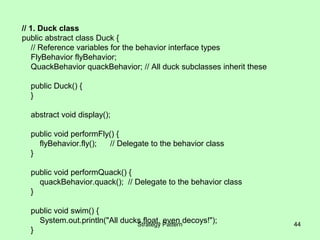
// 1. Duck class
public abstract class Duck {
    // Reference variables for the behavior interface types
    FlyBehavior flyBehavior;
    QuackBehavior quackBehavior; // All duck subclasses inherit these

  public Duck() {
  }

  abstract void display();

  public void performFly() {
    flyBehavior.fly();   // Delegate to the behavior class
  }

  public void performQuack() {
    quackBehavior.quack(); // Delegate to the behavior class
  }

  public void swim() {
    System.out.println("All ducks float, Patterndecoys!");
                                Strategy
                                         even                           44
  }
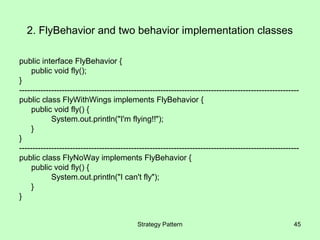
2. FlyBehavior and two behavior implementation classes

public interface FlyBehavior {
     public void fly();
}
---------------------------------------------------------------------------------------------------------
public class FlyWithWings implements FlyBehavior {
     public void fly() {
            System.out.println("I'm flying!!");
     }
}
---------------------------------------------------------------------------------------------------------
public class FlyNoWay implements FlyBehavior {
     public void fly() {
            System.out.println("I can't fly");
     }
}


                                            Strategy Pattern                                           45
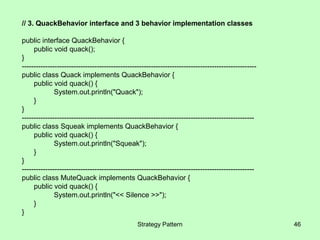
// 3. QuackBehavior interface and 3 behavior implementation classes

public interface QuackBehavior {
     public void quack();
}
----------------------------------------------------------------------------------------------------
public class Quack implements QuackBehavior {
     public void quack() {
              System.out.println("Quack");
     }
}
---------------------------------------------------------------------------------------------------
public class Squeak implements QuackBehavior {
     public void quack() {
              System.out.println("Squeak");
     }
}
---------------------------------------------------------------------------------------------------
public class MuteQuack implements QuackBehavior {
     public void quack() {
              System.out.println("<< Silence >>");
     }
}
                                                 Strategy Pattern                                      46
4. Type and compile the test class
(MiniDuckSimulator.java)
public class MiniDuckSimulator {

    public static void main(String[] args) {

        Duck mallard = new MallardDuck();
        mallard.performQuack();
         // This calls the MallardDuck's inherited performQuack() method,
         // which then delegates to the object's QuackBehavior
         // (i.e. calls quack() on the duck's inherited quackBehavior
         // reference)
        mallard.performFly();
          // Then we do the same thing with MallardDuck's inherited
          // performFly() method.
    }
}
                                Strategy Pattern                      47
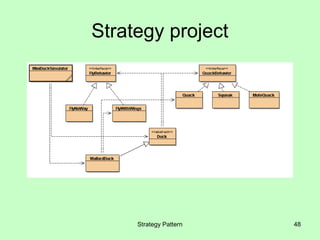
Strategy project


     Strategy Pattern   48
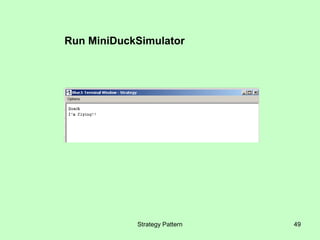
Run MiniDuckSimulator


            Strategy Pattern   49
Check-in
• We have built dynamic behavior in ducks
  e.g. a MallardDuck
  – The dynamic behavior is instantiated in the
    duck’s constructor
• How can we change the duck’s behavior
  after instantiation?


                    Strategy Pattern              50
Changing a duck’s behavior after
            instantiation
• Set the duck’s behavior type through a
  mutator method on the duck’s subclass


                  Strategy Pattern         51
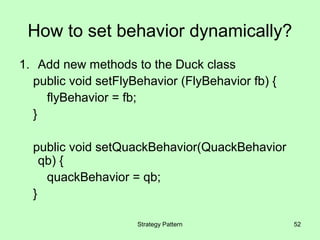
How to set behavior dynamically?
1. Add new methods to the Duck class
  public void setFlyBehavior (FlyBehavior fb) {
    flyBehavior = fb;
  }

  public void setQuackBehavior(QuackBehavior
    qb) {
     quackBehavior = qb;
  }

                     Strategy Pattern             52
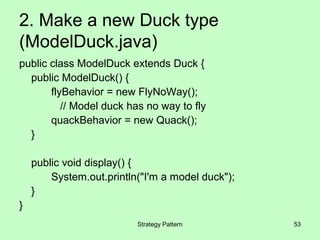
2. Make a new Duck type
(ModelDuck.java)
public class ModelDuck extends Duck {
  public ModelDuck() {
       flyBehavior = new FlyNoWay();
          // Model duck has no way to fly
       quackBehavior = new Quack();
  }

    public void display() {
        System.out.println("I'm a model duck");
    }
}
                          Strategy Pattern        53
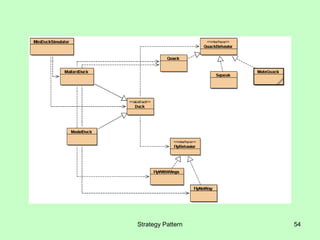
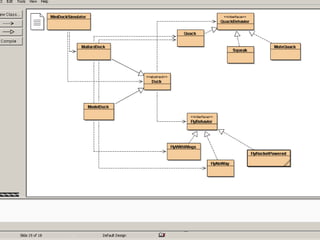
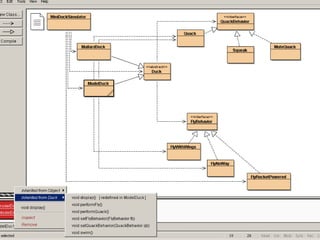
Strategy Pattern   54
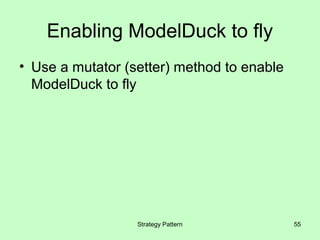
Enabling ModelDuck to fly
• Use a mutator (setter) method to enable
  ModelDuck to fly


                  Strategy Pattern          55
3. Make a new FlyBehavior type
(FlyRocketPowered.java)

public class FlyRocketPowered implements FlyBehavior {

    public void fly() {
        System.out.println("I'm flying with a rocket");
    }
}


                           Strategy Pattern               56
Strategy Pattern   57
4. Change the test class (MiniDuckSimulator.java), add the
   ModelDuck, and make the ModelDuck rocket-enabled

 Duck model = new ModelDuck();
    model.performFly();
      // call to performFly() delegates to the flyBehavior
      // object set in ModelDuck's constructor
    model.setFlyBehavior(new FlyRocketPowered());
     // change the duck's behavior at runtime by
     // invoking the model's inherited behavior setter
     // method
    model.performFly();


                         Strategy Pattern                    58
Strategy Pattern   59
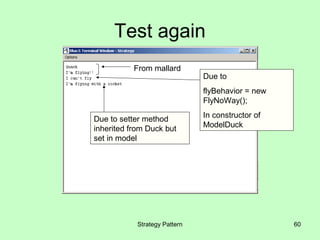
Test again
           From mallard
                               Due to
                               flyBehavior = new
                               FlyNoWay();

Due to setter method           In constructor of
inherited from Duck but        ModelDuck
set in model


            Strategy Pattern                       60
Strategy Pattern   61
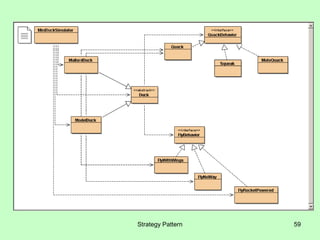
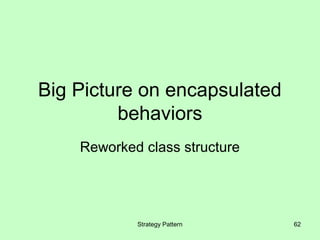
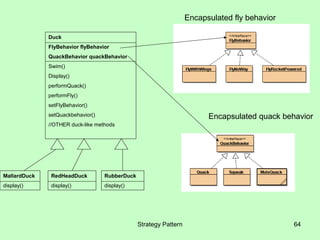
Big Picture on encapsulated
         behaviors
    Reworked class structure


            Strategy Pattern   62
Summary
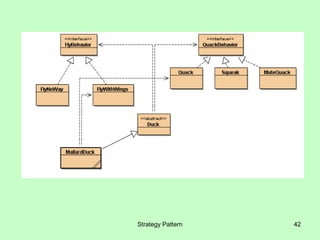
• Reworked class structure
  – ducks extending Duck
  – fly behaviors implementing FlyBehavior
  – quack behaviors implementing QuackBehavior
• Think of each set of behaviors as a family of
  algorithms
• Relationships: IS-A, HAS-A, IMPELMENTS
• Exercise: mark up the following diagram with the
  relationships above

                     Strategy Pattern            63
Encapsulated fly behavior

              Duck
              FlyBehavior flyBehavior
              QuackBehavior quackBehavior
              Swim()
              Display()
              performQuack()
              performFly()
              setFlyBehavior()
              setQuackbehavior()                                         Encapsulated quack behavior
              //OTHER duck-like methods


MallardDuck    RedHeadDuck         RubberDuck
display()      display()           display()


                                                Strategy Pattern                               64
HAS-A can be better than IS-A
• Each duck has a FlyBehavior and a
  QuackBehavior to which it delegates flying
  and quacking
• Composition at work
  – Instead of inheriting behavior, ducks get their
    behavior by being composed with the right
    behavior object


                     Strategy Pattern                 65
Third Design Principle
• Favor composition over inheritance
  – More flexibility
  – Encapsulate a family of algorithms into their
    own set of classes
  – Able to change behavior at runtime


                     Strategy Pattern               66
Strategy Pattern

• The strategy Pattern
  – Defines a family of algorithms,
  – Encapsulates each one,
  – Makes them interchangeable.
• Strategy lets the algorithm vary
  independently from clients that use it


                    Strategy Pattern       67

10 strategy pattern

  • 1.
    Design Patterns 1. Strategy Pattern How to design for flexibility? Strategy Pattern 1
  • 2.
    References • Design Patterns: Elements of Reusable Object-Oriented Software By Gamma, Erich; Richard Helm, Ralph Johnson, and John Vlissides (1995). Addison-Wesley. ISBN 0- 201-63361-2. • Head First Design Patterns By Eric Freeman, Elisabeth Freeman, Kathy Sierra, Bert Bates First Edition October 2004 ISBN 10: 0-596-00712-4 Strategy Pattern 2
  • 3.
    Existing Duck application All ducks quack and swim. The Duck superclass takes quack() care of the implementation swim() The display() code display() method is abstract, since all duck //other duck-like methods… subtypes look Each duck subtype is responsible for different implementing its own display() method Other duck MallardDuck RedHeadDuck types inherit from the display() { display() { Duck class // looks like a mallard} // looks like a redhead } ... Strategy Pattern 3
  • 4.
    Inheritance • All subclassesinherit the superclass’ properties – Variables and methods • See Strategy0 project Strategy Pattern 4
  • 5.
    Inheritance UML Strategy Pattern 5
  • 6.
    Testing Mallard, RedHeadDuckclasses Strategy Pattern 6
  • 7.
    But Executives wantto introduce fly capability quickly • How to do it in a short time, like 2 days? Strategy Pattern 7
  • 8.
    Solution #1 • Nosweat! – Add a method fly() in Duck – Continue to use inheritance Strategy Pattern 8
  • 9.
    Add a methodfly() in Duck Duck quack() swim() display() All subclasses fly() inherit fly() //other duck-like methods… MallardDuck RedHeadDuck display() { display() { // looks like a mallard} // looks like a redhead } Strategy Pattern 9
  • 10.
    See Strategy1 class Strategy Pattern 10
  • 11.
    Executing Strategy1 Strategy Pattern 11
  • 12.
    Everything OK? • Thinkharder. Strategy Pattern 12
  • 13.
    Something seriously wrong! Duck quack() swim() display() All duck types now can fly fly() including RubberDuck //other duck-like methods… RubberDuck MallardDuck ReadHeadDuck quack() { display() { display() { // overridden to Squeak } // looks like a redhead } display() { // looks like a mallard} // looks like a rubberduck } Strategy Pattern 13
  • 14.
    Add an instanceof RubberDuck Strategy Pattern 14
  • 15.
    Executing Strategy2 …What? Strategy Pattern 15
  • 16.
    Root cause? • Applyinginheritance to achieve re-use • Poor solution for maintenance Strategy Pattern 16
  • 17.
    How do wefix this? • Using inheritance as before – Override the fly() method in rubber duck as in quack() • Will it fix the problem? – See Strategy3 Strategy Pattern 17
  • 18.
  • 19.
    Executing Strategy3 Strategy Pattern 19
  • 20.
    Is the problemsolved? • Any new problems? Strategy Pattern 20
  • 21.
    Wait a minute •How about new duck types? – Decoy duck? • Can’t quack • Can’t fly • How do we solve it? Strategy Pattern 21
  • 22.
    Summary • What havewe done so far? • What problems have we solved? • What problems have we introduced in solving the problems? • Is there a better way of doing things? Strategy Pattern 22
  • 23.
    How about Interface? •Take the fly() method out of Duck superclass • And make a Flyable() interface – Only those ducks that fly are required to implement the interface • Make a Quackable interface too Strategy Pattern 23
  • 24.
    interface Flyable Interface Quackable class Duck fly() quack() swim() display() //other duck-like methods… MallardDuck RedHeadDuck RubberDuck display() display() { display() fly() quack() fly() quack() quack() Strategy Pattern 24
  • 25.
    How about thisStrategy4_interface solution? Strategy Pattern 25
  • 26.
    But • You shootyourself in the foot by duplicating code for every duck type that can fly and quack! • And we have a lot of duck types • We have to be careful about the properties – we cannot just call the methods blindly • We have created a maintenance nightmare! Strategy Pattern 26
  • 27.
    Re-thinking: • Inheritance hasnot worked well because – Duck behavior keeps changing – Not suitable for all subclasses to have those properties • Interface was at first promising, but – No code re-use – Tedious • Every time a behavior is changed, you must track down and change it in all the subclasses where it is defined – Error prone Strategy Pattern 27
  • 28.
    #1 Design Principle •Identify the aspects of your application that vary and separate them from what stays the same • So what are variable in the Duck class? – Flying behavior – Quacking behavior • Pull these duck behaviors out of the Duck class – Create new classes for these behaviors Strategy Pattern 28
  • 29.
    How do wedesign the classes to implement the fly and quack behaviors? • Goal: to keep things flexible • Want to assign behaviors to instances of Duck – Instantiate a new MallardDuck instance – Initialize it with a specific type of flying – Be able to change the behavior dynamically Strategy Pattern 29
  • 30.
    #2 Design Principle •Program to a supertype, not an implementation • Use a supertype to represent each behavior – FlyBehavior and QuackBehavior – Each implementation of a behavior will implement one of these supertypes • In the past, we rely on an implementation – In superclass Duck, or – A specialized implementation in the subclass • Now: Duck subclass will use a behavior represented in a supertype. Strategy Pattern 30
  • 31.
  • 32.
  • 33.
    3 classes incode public interface FlyBehavior { public void fly(); } --------------------------------------------------------------------------------------------------------- public class FlyWithWings implements FlyBehavior { public void fly() { System.out.println("I'm flying!!"); } } --------------------------------------------------------------------------------------------------------- public class FlyNoWay implements FlyBehavior { public void fly() { System.out.println("I can't fly"); } } Strategy Pattern 33
  • 34.
    public interface QuackBehavior{ public void quack(); } Strategy Pattern 34
  • 35.
    Specific behaviors byimplementing interface QuackBehavior public class Quack implements QuackBehavior { public void quack() { System.out.println("Quack"); } } ---------------------------------------------------------------------------- public class Squeak implements QuackBehavior { public void quack() { System.out.println("Squeak"); } } ----------------------------------------------------------------------------- public class MuteQuack implements QuackBehavior { public void quack() { System.out.println("<< Silence >>"); } } Strategy Pattern 35
  • 36.
  • 37.
    Program to aSupertype • “Program to a Supertype” means: – Exploit polymorphism by programming to a supertype – The actual runtime object isn’t locked into the code – The declared type of the variable should be a supertype, usually an abstract class or interface – Objects assigned to those variables can be of any concrete implementations of the supertype – The class declaring them need not know about the actual object type Strategy Pattern 37
  • 38.
    Integrating the DuckBehavior 1. Add 2 instance variables: Behavior variables Duck Instance are declared as variables hold the behavior FlyBehavior flyBehavior a reference to SUPERTYPE QuackBehavior quackBehavior a specific behavior at performQuack() runtime Swim() These general methods Display() replace fly() and performFly() quack() //OTHER duck-like methods Strategy Pattern 38
  • 39.
    2. Implement performQuack() publicabstract class Duck { // Declare two reference variables for the behavior interface types FlyBehavior flyBehavior; QuackBehavior quackBehavior; // All duck subclasses inherit these // etc public Duck() { } public void performQuack() { quackBehavior.quack(); // Delegate to the behavior class } Strategy Pattern 39
  • 40.
  • 41.
    3. How toset the quackBehavior variable & flyBehavior variable public class MallardDuck extends Duck { public MallardDuck() { quackBehavior = new Quack(); // A MallardDuck uses the Quack class to handle its quack, // so when performQuack is called, the responsibility for the quack // is delegated to the Quack object and we get a real quack flyBehavior = new FlyWithWings(); // And it uses flyWithWings as its flyBehavior type } public void display() { System.out.println("I'm a real Mallard duck"); } Strategy Pattern 41
  • 42.
  • 43.
    Testing the Duckcode Type and compile: • Duck class and the MallardDuck class • FlyBehavior interface and the two behavior implementation classes (FlyWithwings.java and flyNoWay.java) • QuackBehavior interface and 3 behavior implementation classes • Test class (MiniDuckSimulator.java) Strategy Pattern 43
  • 44.
    // 1. Duckclass public abstract class Duck { // Reference variables for the behavior interface types FlyBehavior flyBehavior; QuackBehavior quackBehavior; // All duck subclasses inherit these public Duck() { } abstract void display(); public void performFly() { flyBehavior.fly(); // Delegate to the behavior class } public void performQuack() { quackBehavior.quack(); // Delegate to the behavior class } public void swim() { System.out.println("All ducks float, Patterndecoys!"); Strategy even 44 }
  • 45.
    2. FlyBehavior andtwo behavior implementation classes public interface FlyBehavior { public void fly(); } --------------------------------------------------------------------------------------------------------- public class FlyWithWings implements FlyBehavior { public void fly() { System.out.println("I'm flying!!"); } } --------------------------------------------------------------------------------------------------------- public class FlyNoWay implements FlyBehavior { public void fly() { System.out.println("I can't fly"); } } Strategy Pattern 45
  • 46.
    // 3. QuackBehaviorinterface and 3 behavior implementation classes public interface QuackBehavior { public void quack(); } ---------------------------------------------------------------------------------------------------- public class Quack implements QuackBehavior { public void quack() { System.out.println("Quack"); } } --------------------------------------------------------------------------------------------------- public class Squeak implements QuackBehavior { public void quack() { System.out.println("Squeak"); } } --------------------------------------------------------------------------------------------------- public class MuteQuack implements QuackBehavior { public void quack() { System.out.println("<< Silence >>"); } } Strategy Pattern 46
  • 47.
    4. Type andcompile the test class (MiniDuckSimulator.java) public class MiniDuckSimulator { public static void main(String[] args) { Duck mallard = new MallardDuck(); mallard.performQuack(); // This calls the MallardDuck's inherited performQuack() method, // which then delegates to the object's QuackBehavior // (i.e. calls quack() on the duck's inherited quackBehavior // reference) mallard.performFly(); // Then we do the same thing with MallardDuck's inherited // performFly() method. } } Strategy Pattern 47
  • 48.
    Strategy project Strategy Pattern 48
  • 49.
    Run MiniDuckSimulator Strategy Pattern 49
  • 50.
    Check-in • We havebuilt dynamic behavior in ducks e.g. a MallardDuck – The dynamic behavior is instantiated in the duck’s constructor • How can we change the duck’s behavior after instantiation? Strategy Pattern 50
  • 51.
    Changing a duck’sbehavior after instantiation • Set the duck’s behavior type through a mutator method on the duck’s subclass Strategy Pattern 51
  • 52.
    How to setbehavior dynamically? 1. Add new methods to the Duck class public void setFlyBehavior (FlyBehavior fb) { flyBehavior = fb; } public void setQuackBehavior(QuackBehavior qb) { quackBehavior = qb; } Strategy Pattern 52
  • 53.
    2. Make anew Duck type (ModelDuck.java) public class ModelDuck extends Duck { public ModelDuck() { flyBehavior = new FlyNoWay(); // Model duck has no way to fly quackBehavior = new Quack(); } public void display() { System.out.println("I'm a model duck"); } } Strategy Pattern 53
  • 54.
  • 55.
    Enabling ModelDuck tofly • Use a mutator (setter) method to enable ModelDuck to fly Strategy Pattern 55
  • 56.
    3. Make anew FlyBehavior type (FlyRocketPowered.java) public class FlyRocketPowered implements FlyBehavior { public void fly() { System.out.println("I'm flying with a rocket"); } } Strategy Pattern 56
  • 57.
  • 58.
    4. Change thetest class (MiniDuckSimulator.java), add the ModelDuck, and make the ModelDuck rocket-enabled Duck model = new ModelDuck(); model.performFly(); // call to performFly() delegates to the flyBehavior // object set in ModelDuck's constructor model.setFlyBehavior(new FlyRocketPowered()); // change the duck's behavior at runtime by // invoking the model's inherited behavior setter // method model.performFly(); Strategy Pattern 58
  • 59.
  • 60.
    Test again From mallard Due to flyBehavior = new FlyNoWay(); Due to setter method In constructor of inherited from Duck but ModelDuck set in model Strategy Pattern 60
  • 61.
  • 62.
    Big Picture onencapsulated behaviors Reworked class structure Strategy Pattern 62
  • 63.
    Summary • Reworked classstructure – ducks extending Duck – fly behaviors implementing FlyBehavior – quack behaviors implementing QuackBehavior • Think of each set of behaviors as a family of algorithms • Relationships: IS-A, HAS-A, IMPELMENTS • Exercise: mark up the following diagram with the relationships above Strategy Pattern 63
  • 64.
    Encapsulated fly behavior Duck FlyBehavior flyBehavior QuackBehavior quackBehavior Swim() Display() performQuack() performFly() setFlyBehavior() setQuackbehavior() Encapsulated quack behavior //OTHER duck-like methods MallardDuck RedHeadDuck RubberDuck display() display() display() Strategy Pattern 64
  • 65.
    HAS-A can bebetter than IS-A • Each duck has a FlyBehavior and a QuackBehavior to which it delegates flying and quacking • Composition at work – Instead of inheriting behavior, ducks get their behavior by being composed with the right behavior object Strategy Pattern 65
  • 66.
    Third Design Principle •Favor composition over inheritance – More flexibility – Encapsulate a family of algorithms into their own set of classes – Able to change behavior at runtime Strategy Pattern 66
  • 67.
    Strategy Pattern • Thestrategy Pattern – Defines a family of algorithms, – Encapsulates each one, – Makes them interchangeable. • Strategy lets the algorithm vary independently from clients that use it Strategy Pattern 67