






03/17/10 © 2010 - 11,Ashok Narayanan.  All rights reserved.
Why Change? 03/17/10 © 2010 - 11,Ashok Narayanan.  All rights reserved.
Adoption of a new idea or behavior by an organization. Organizations need to continuously adapt to new situations if they are to survive and prosper. Constant change keeps organizations agile. Indicative of “learning” organizations. 03/17/10 © 2010 - 11,Ashok Narayanan.  All rights reserved.
The Other Factors  Market Transparency Labour Mobility Global Capital flows and  Instantaneous communications  In most industries — and in almost all companies, from giants on down — heightened global competition has concentrated management’s collective mind on something that, in the past, it happily avoided: CHANGE.  03/17/10 © 2010 - 11,Ashok Narayanan.  All rights reserved.
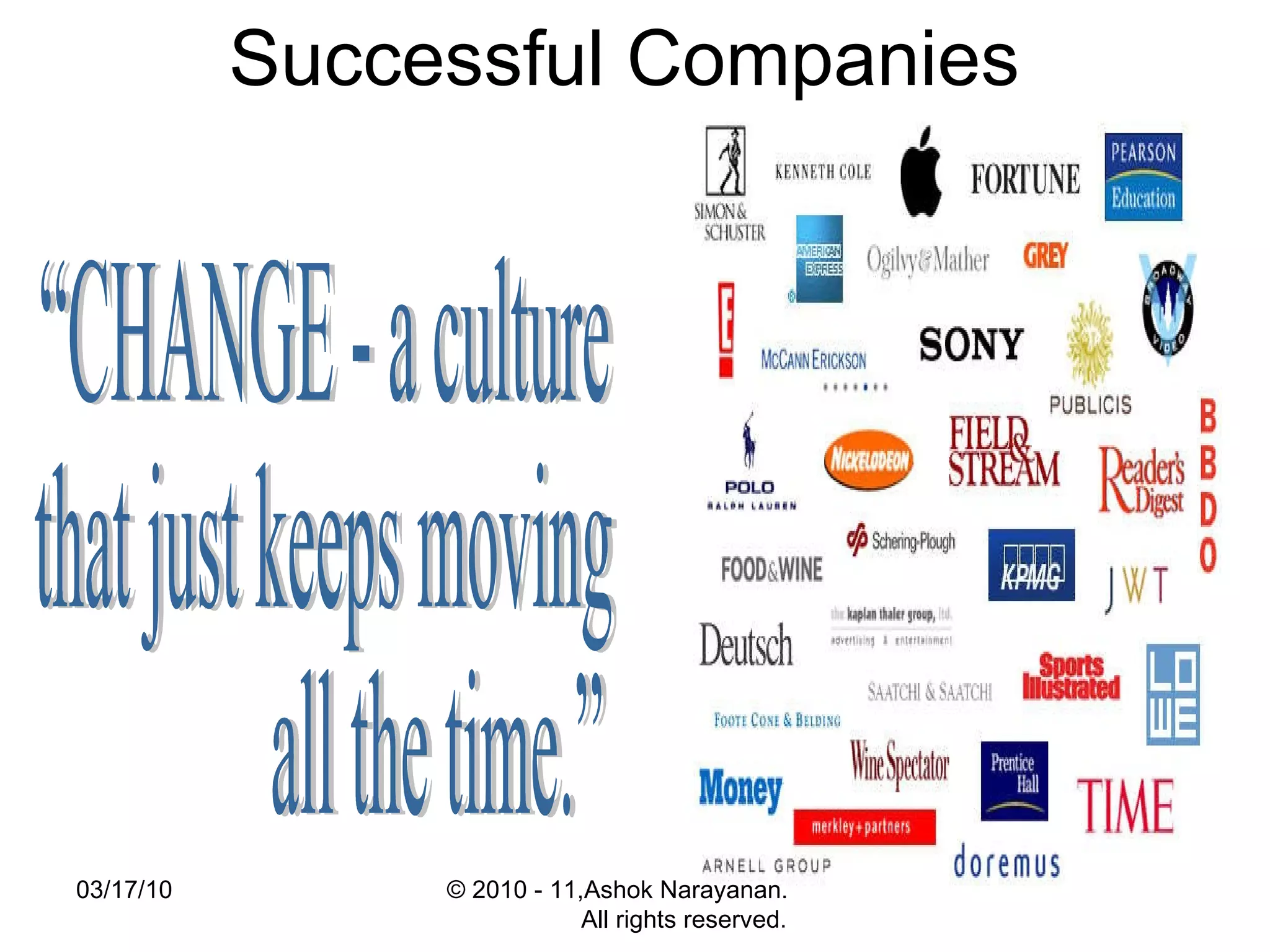
Successful Companies  “CHANGE - a culture that just keeps moving  all the time.”  03/17/10 © 2010 - 11,Ashok Narayanan.  All rights reserved.
03/17/10 © 2010 - 11,Ashok Narayanan.  All rights reserved.
10 Principles of Change Management   03/17/10 © 2010 - 11,Ashok Narayanan.  All rights reserved.
1.Address the “Human side” systematically   03/17/10 © 2010 - 11,Ashok Narayanan.  All rights reserved.
2.  Start at the Top 03/17/10 © 2010 - 11,Ashok Narayanan.  All rights reserved.
3.  Involve Every layer   Define Strategy Setting Targets  Design Implement  03/17/10 © 2010 - 11,Ashok Narayanan.  All rights reserved.
4.Make the formal case   Three steps should be followed in developing the case: First, confront reality and articulate a convincing need for change.  Second, demonstrate faith that the company has a viable future and the leadership to get there.  Finally, provide a road map to guide behaviour and decision making.  03/17/10 © 2010 - 11,Ashok Narayanan.  All rights reserved.
5. Create Ownership.   03/17/10 © 2010 - 11,Ashok Narayanan.  All rights reserved.
6. Communicate the Message   03/17/10 © 2010 - 11,Ashok Narayanan.  All rights reserved.
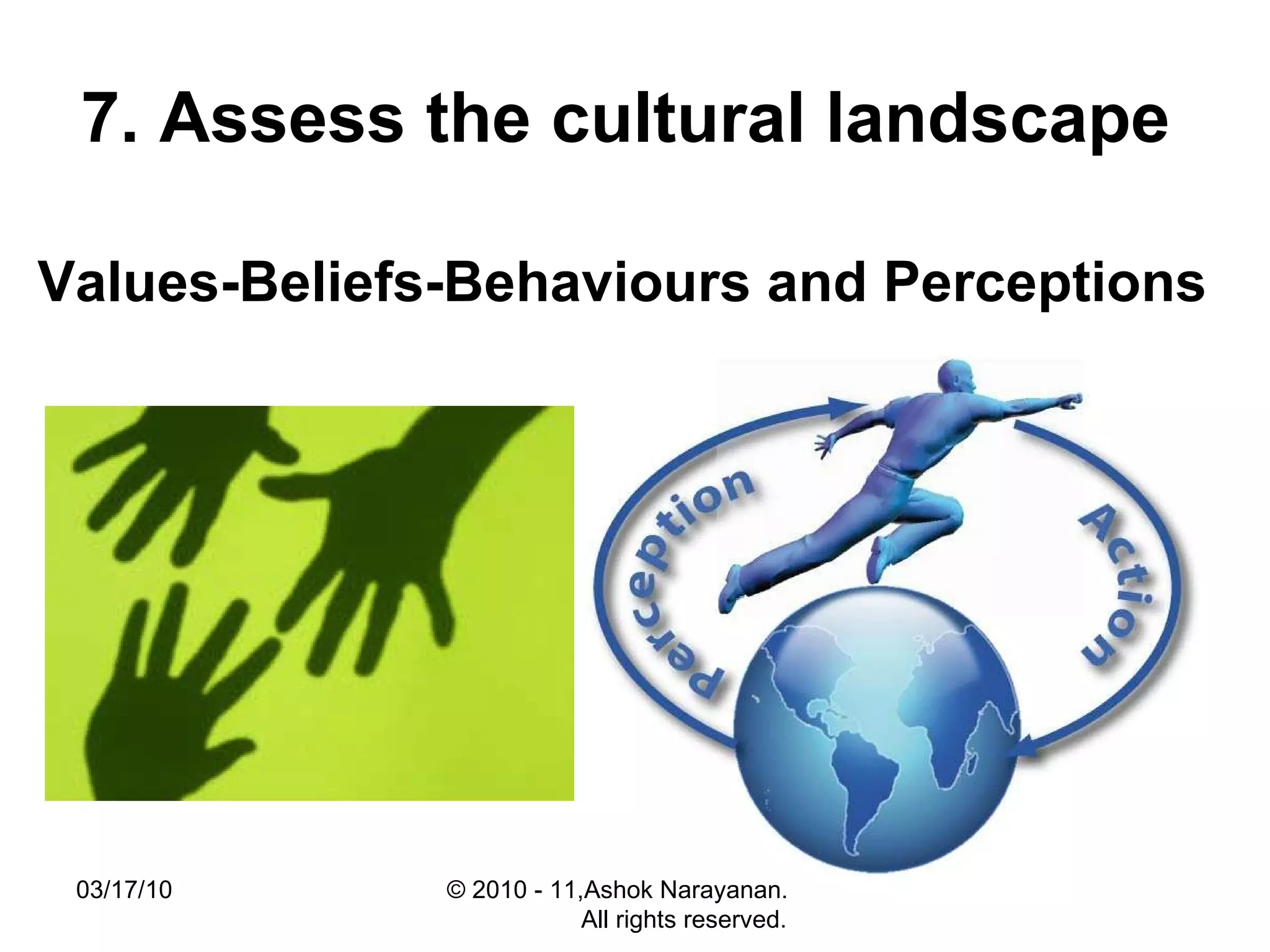
7. Assess the cultural landscape   Values-Beliefs-Behaviours and Perceptions   03/17/10 © 2010 - 11,Ashok Narayanan.  All rights reserved.
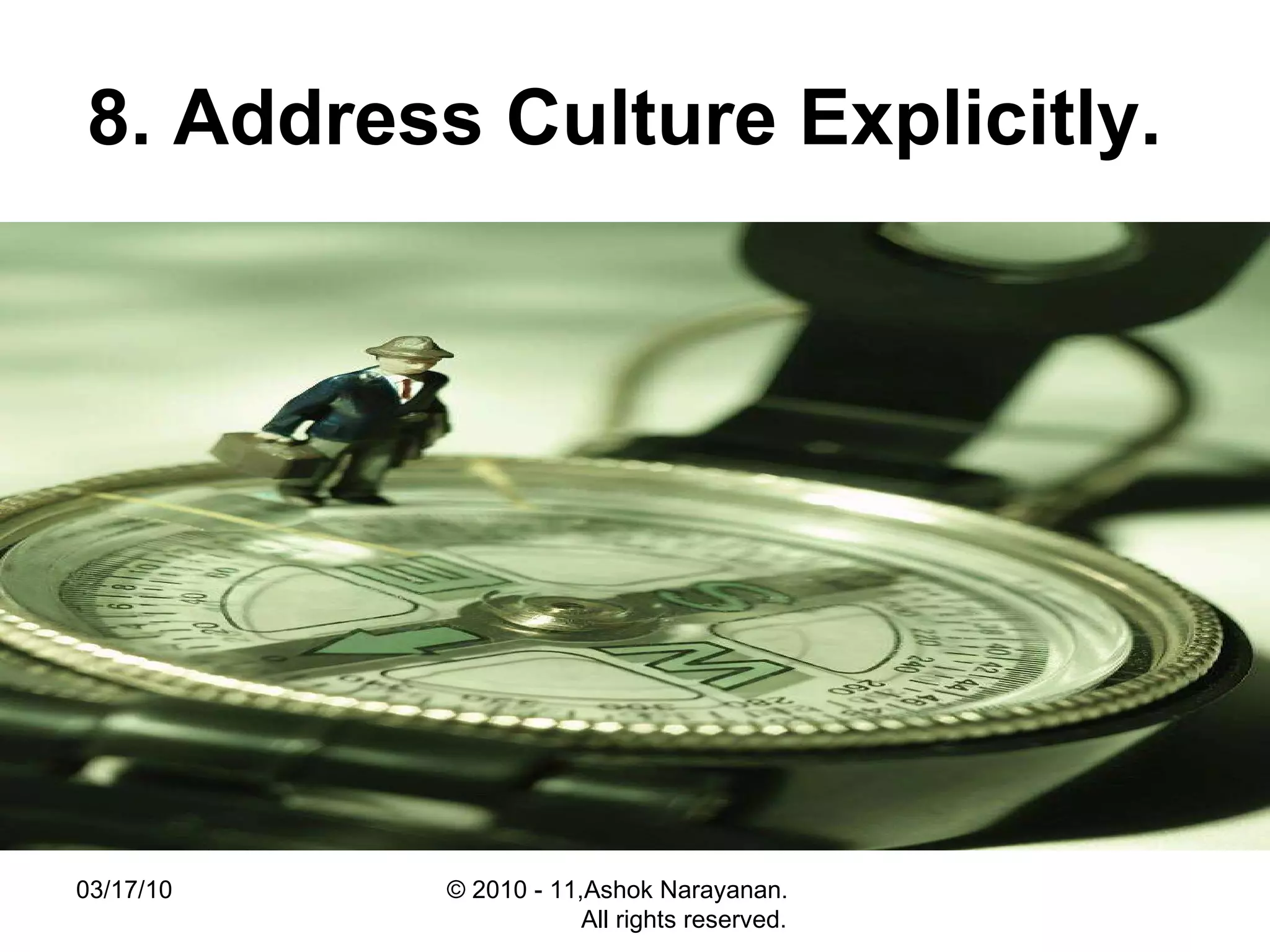
8. Address Culture Explicitly.   03/17/10 © 2010 - 11,Ashok Narayanan.  All rights reserved.
9. Prepare for the Unexpected   03/17/10 © 2010 - 11,Ashok Narayanan.  All rights reserved.
10. Speak to the Individual   03/17/10 © 2010 - 11,Ashok Narayanan.  All rights reserved.
03/17/10 © 2010 - 11,Ashok Narayanan.  All rights reserved.

10 Principles Of Change Management

  • 1.
    03/17/10 © 2010- 11,Ashok Narayanan. All rights reserved.
  • 2.
    03/17/10 © 2010- 11,Ashok Narayanan. All rights reserved.
  • 3.
    Why Change? 03/17/10© 2010 - 11,Ashok Narayanan. All rights reserved.
  • 4.
    Adoption of anew idea or behavior by an organization. Organizations need to continuously adapt to new situations if they are to survive and prosper. Constant change keeps organizations agile. Indicative of “learning” organizations. 03/17/10 © 2010 - 11,Ashok Narayanan. All rights reserved.
  • 5.
    The Other Factors Market Transparency Labour Mobility Global Capital flows and Instantaneous communications In most industries — and in almost all companies, from giants on down — heightened global competition has concentrated management’s collective mind on something that, in the past, it happily avoided: CHANGE. 03/17/10 © 2010 - 11,Ashok Narayanan. All rights reserved.
  • 6.
    Successful Companies “CHANGE - a culture that just keeps moving all the time.” 03/17/10 © 2010 - 11,Ashok Narayanan. All rights reserved.
  • 7.
    03/17/10 © 2010- 11,Ashok Narayanan. All rights reserved.
  • 8.
    03/17/10 © 2010- 11,Ashok Narayanan. All rights reserved.
  • 9.
    10 Principles ofChange Management 03/17/10 © 2010 - 11,Ashok Narayanan. All rights reserved.
  • 10.
    1.Address the “Humanside” systematically 03/17/10 © 2010 - 11,Ashok Narayanan. All rights reserved.
  • 11.
    2. Startat the Top 03/17/10 © 2010 - 11,Ashok Narayanan. All rights reserved.
  • 12.
    3. InvolveEvery layer Define Strategy Setting Targets Design Implement 03/17/10 © 2010 - 11,Ashok Narayanan. All rights reserved.
  • 13.
    4.Make the formalcase Three steps should be followed in developing the case: First, confront reality and articulate a convincing need for change. Second, demonstrate faith that the company has a viable future and the leadership to get there. Finally, provide a road map to guide behaviour and decision making. 03/17/10 © 2010 - 11,Ashok Narayanan. All rights reserved.
  • 14.
    5. Create Ownership. 03/17/10 © 2010 - 11,Ashok Narayanan. All rights reserved.
  • 15.
    6. Communicate theMessage 03/17/10 © 2010 - 11,Ashok Narayanan. All rights reserved.
  • 16.
    7. Assess thecultural landscape Values-Beliefs-Behaviours and Perceptions 03/17/10 © 2010 - 11,Ashok Narayanan. All rights reserved.
  • 17.
    8. Address CultureExplicitly. 03/17/10 © 2010 - 11,Ashok Narayanan. All rights reserved.
  • 18.
    9. Prepare forthe Unexpected 03/17/10 © 2010 - 11,Ashok Narayanan. All rights reserved.
  • 19.
    10. Speak tothe Individual 03/17/10 © 2010 - 11,Ashok Narayanan. All rights reserved.
  • 20.
    03/17/10 © 2010- 11,Ashok Narayanan. All rights reserved.