Inheritance
09/04/131 VIT - SCSE
By
G.SasiKumar., M.E., (Ph.D).,
Assistant Professor
School of Computing Science and Engineering
VIT University
09/04/132 VIT - SCSE
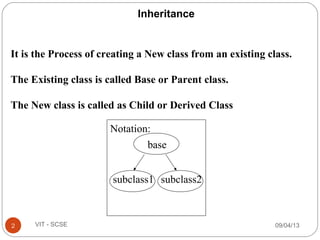
It is the Process of creating a New class from an existing class.
The Existing class is called Base or Parent class.
The New class is called as Child or Derived Class
Inheritance
base
subclass1 subclass2
Notation:
09/04/133 VIT - SCSE
Advantages
It permits code reusability. So, save time and increase
the program reliability.
Improve Program Reliability
It Permits code sharing
09/04/134 VIT - SCSE
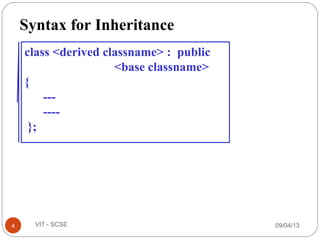
class <derived classname> : public
<base classname>
{
---
----
};
Syntax for Inheritance
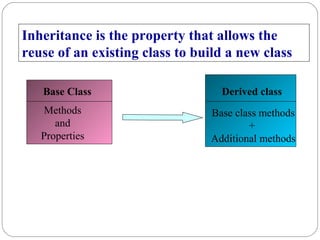
Derived classBase Class
Methods
and
Properties
Base class methods
+
Additional methods
Inheritance is the property that allows the
reuse of an existing class to build a new class
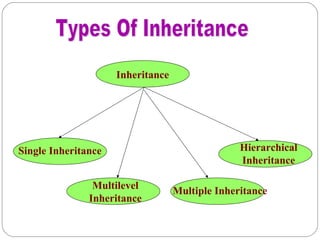
Inheritance
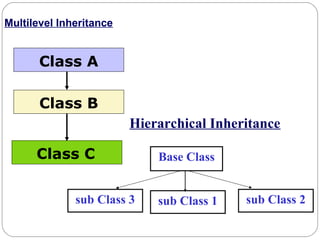
Multilevel
Inheritance
Single Inheritance
Multiple Inheritance
Hierarchical
Inheritance
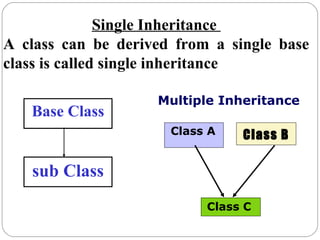
Single Inheritance
A class can be derived from a single base
class is called single inheritance
Base Class
sub Class
Multiple Inheritance
Class A Class B
Class C
Class A
Class B
Class C
Multilevel Inheritance
Hierarchical Inheritance
Base Class
sub Class 1sub Class 3 sub Class 2
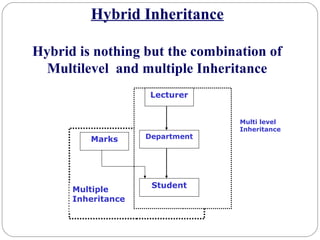
Hybrid Inheritance
Hybrid is nothing but the combination of
Multilevel and multiple Inheritance
Lecturer
Marks Department
Student
Multi level
Inheritance
Multiple
Inheritance
Function Type
Access directly to
Private Protected Public
Class member Yes Yes Yes
Derived class
member
No Yes Yes
Friend Yes Yes Yes
Friend class
member
Yes Yes Yes
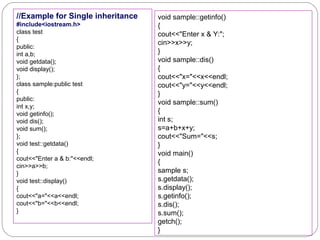
//Example for Single inheritance
#include<iostream.h>
class test
{
public:
int a,b;
void getdata();
void display();
};
class sample:public test
{
public:
int x,y;
void getinfo();
void dis();
void sum();
};
void test::getdata()
{
cout<<"Enter a & b:"<<endl;
cin>>a>>b;
}
void test::display()
{
cout<<"a="<<a<<endl;
cout<<"b="<<b<<endl;
}
void sample::getinfo()
{
cout<<"Enter x & Y:";
cin>>x>>y;
}
void sample::dis()
{
cout<<"x="<<x<<endl;
cout<<"y="<<y<<endl;
}
void sample::sum()
{
int s;
s=a+b+x+y;
cout<<"Sum="<<s;
}
void main()
{
sample s;
s.getdata();
s.display();
s.getinfo();
s.dis();
s.sum();
getch();
}
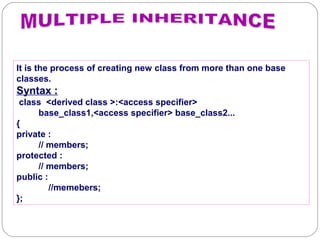
It is the process of creating new class from more than one base
classes.
Syntax :
class <derived class >:<access specifier>
base_class1,<access specifier> base_class2...
{
private :
// members;
protected :
// members;
public :
//memebers;
};
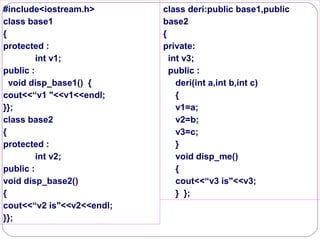
#include<iostream.h>
class base1
{
protected :
int v1;
public :
void disp_base1() {
cout<<“v1 "<<v1<<endl;
}};
class base2
{
protected :
int v2;
public :
void disp_base2()
{
cout<<“v2 is"<<v2<<endl;
}};
class deri:public base1,public
base2
{
private:
int v3;
public :
deri(int a,int b,int c)
{
v1=a;
v2=b;
v3=c;
}
void disp_me()
{
cout<<“v3 is"<<v3;
} };
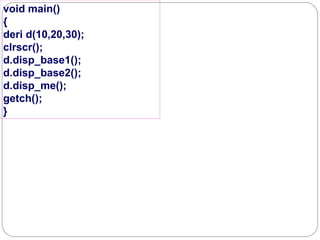
void main()
{
deri d(10,20,30);
clrscr();
d.disp_base1();
d.disp_base2();
d.disp_me();
getch();
}
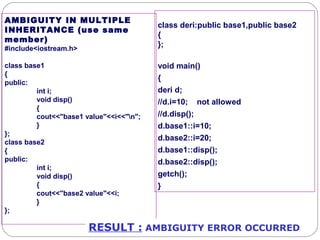
AMBIGUITY IN MULTIPLE
INHERITANCE (use same
member)
#include<iostream.h>
class base1
{
public:
int i;
void disp()
{
cout<<"base1 value"<<i<<"n";
}
};
class base2
{
public:
int i;
void disp()
{
cout<<"base2 value"<<i;
}
};
class deri:public base1,public base2
{
};
void main()
{
deri d;
//d.i=10; not allowed
//d.disp();
d.base1::i=10;
d.base2::i=20;
d.base1::disp();
d.base2::disp();
getch();
}
RESULT : AMBIGUITY ERROR OCCURRED
//Example for MultiLevel inheritance
#include<iostream.h>
#include<conio.h>
class publication
{
public:
int bookno;
void getdata()
{
cout<<"Enter Book Number:";
cin>>bookno;
}
void putdata()
{
cout<<bookno<<endl;
}
};
class author:public publication
{
public:
char aname[20];
void getdata()
{
publication::getdata();
cout<<"Enter author name";
cin>>aname;
}
};
class test:public author
{
public:
void display();
};
void test::display()
{
cout<<"Book Number:"<<bookno<<endl;
cout<<"Author Name:"<<aname<<endl;
}
void main()
{
test t;
t.getdata();
t.putdata();
t.author::getdata();
t.display();
getch();
}
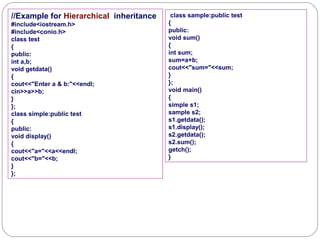
//Example for Hierarchical inheritance
#include<iostream.h>
#include<conio.h>
class test
{
public:
int a,b;
void getdata()
{
cout<<"Enter a & b:"<<endl;
cin>>a>>b;
}
};
class simple:public test
{
public:
void display()
{
cout<<"a="<<a<<endl;
cout<<"b="<<b;
}
};
class sample:public test
{
public:
void sum()
{
int sum;
sum=a+b;
cout<<"sum="<<sum;
}
};
void main()
{
simple s1;
sample s2;
s1.getdata();
s1.display();
s2.getdata();
s2.sum();
getch();
}
HYBRID
INHERITANCE
#include<iostream.h>
class lecturer
{
private :
char lecturer_name[20];
public :
void getdata()
{
cout<<"Enter Lecturer name";
cin>>lecturer_name;
}
void putdata()
{
cout<<"lecturer name is
"<<lecturer_name;
}
};
class department : public lecturer
{
private :
char department_name[20];
public:
void getdata()
{
cout<<"Enter Department name";
cin>>department_name;
}
void putdata()
{
cout<<"Department name is "<<department_name;
}
};
class marks
{
public :
int mark1;
int mark2;
int mark3;
void getdata()
{
cout<<"Enter the marks for 3 subjects";
cin>>mark1>>mark2>>mark3;
}
void putdata()
{
cout<<"The marks for 3 subjects are
"<<mark1<<"t"<<mark2<<"t"<<mark3;
}
};
class student:public department,public marks
{
private:
int roll_no;
char student_name[20];
public:
void getdata()
{
department::getdata();
cout<<"Enter the student name";
cin>>student_name;
cout<<"Enter the student Enrollment no";
cin>>roll_no;
marks::getdata();
}
void putdata()
{
department::putdata();
cout<<"The name & rollno is
"<<student_name<<"t"<<roll_no;
marks::putdata();
}
};
void main()
{
student s;
clrscr();
s.getdata();
s.putdata();
getch();
}
09/04/1320 VIT - SCSE
1. The derived class need not have a constructor as long as
the base class has a no-argument constructor.
2. However, if the base class has constructors with
arguments (one or more), then it is mandatory for the
derived class to have a constructor and pass the
arguments to the base class constructor.
3. When an object of a derived class is created, the
constructor of the base class is executed first and later the
constructor of the derived class.
Constructors in Derived Classes

10 inheritance

  • 1.
    Inheritance 09/04/131 VIT -SCSE By G.SasiKumar., M.E., (Ph.D)., Assistant Professor School of Computing Science and Engineering VIT University
  • 2.
    09/04/132 VIT -SCSE It is the Process of creating a New class from an existing class. The Existing class is called Base or Parent class. The New class is called as Child or Derived Class Inheritance base subclass1 subclass2 Notation:
  • 3.
    09/04/133 VIT -SCSE Advantages It permits code reusability. So, save time and increase the program reliability. Improve Program Reliability It Permits code sharing
  • 4.
    09/04/134 VIT -SCSE class <derived classname> : public <base classname> { --- ---- }; Syntax for Inheritance
  • 5.
    Derived classBase Class Methods and Properties Baseclass methods + Additional methods Inheritance is the property that allows the reuse of an existing class to build a new class
  • 6.
  • 7.
    Single Inheritance A classcan be derived from a single base class is called single inheritance Base Class sub Class Multiple Inheritance Class A Class B Class C
  • 8.
    Class A Class B ClassC Multilevel Inheritance Hierarchical Inheritance Base Class sub Class 1sub Class 3 sub Class 2
  • 9.
    Hybrid Inheritance Hybrid isnothing but the combination of Multilevel and multiple Inheritance Lecturer Marks Department Student Multi level Inheritance Multiple Inheritance
  • 10.
    Function Type Access directlyto Private Protected Public Class member Yes Yes Yes Derived class member No Yes Yes Friend Yes Yes Yes Friend class member Yes Yes Yes
  • 11.
    //Example for Singleinheritance #include<iostream.h> class test { public: int a,b; void getdata(); void display(); }; class sample:public test { public: int x,y; void getinfo(); void dis(); void sum(); }; void test::getdata() { cout<<"Enter a & b:"<<endl; cin>>a>>b; } void test::display() { cout<<"a="<<a<<endl; cout<<"b="<<b<<endl; } void sample::getinfo() { cout<<"Enter x & Y:"; cin>>x>>y; } void sample::dis() { cout<<"x="<<x<<endl; cout<<"y="<<y<<endl; } void sample::sum() { int s; s=a+b+x+y; cout<<"Sum="<<s; } void main() { sample s; s.getdata(); s.display(); s.getinfo(); s.dis(); s.sum(); getch(); }
  • 12.
    It is theprocess of creating new class from more than one base classes. Syntax : class <derived class >:<access specifier> base_class1,<access specifier> base_class2... { private : // members; protected : // members; public : //memebers; };
  • 13.
    #include<iostream.h> class base1 { protected : intv1; public : void disp_base1() { cout<<“v1 "<<v1<<endl; }}; class base2 { protected : int v2; public : void disp_base2() { cout<<“v2 is"<<v2<<endl; }}; class deri:public base1,public base2 { private: int v3; public : deri(int a,int b,int c) { v1=a; v2=b; v3=c; } void disp_me() { cout<<“v3 is"<<v3; } };
  • 14.
  • 15.
    AMBIGUITY IN MULTIPLE INHERITANCE(use same member) #include<iostream.h> class base1 { public: int i; void disp() { cout<<"base1 value"<<i<<"n"; } }; class base2 { public: int i; void disp() { cout<<"base2 value"<<i; } }; class deri:public base1,public base2 { }; void main() { deri d; //d.i=10; not allowed //d.disp(); d.base1::i=10; d.base2::i=20; d.base1::disp(); d.base2::disp(); getch(); } RESULT : AMBIGUITY ERROR OCCURRED
  • 16.
    //Example for MultiLevelinheritance #include<iostream.h> #include<conio.h> class publication { public: int bookno; void getdata() { cout<<"Enter Book Number:"; cin>>bookno; } void putdata() { cout<<bookno<<endl; } }; class author:public publication { public: char aname[20]; void getdata() { publication::getdata(); cout<<"Enter author name"; cin>>aname; } }; class test:public author { public: void display(); }; void test::display() { cout<<"Book Number:"<<bookno<<endl; cout<<"Author Name:"<<aname<<endl; } void main() { test t; t.getdata(); t.putdata(); t.author::getdata(); t.display(); getch(); }
  • 17.
    //Example for Hierarchicalinheritance #include<iostream.h> #include<conio.h> class test { public: int a,b; void getdata() { cout<<"Enter a & b:"<<endl; cin>>a>>b; } }; class simple:public test { public: void display() { cout<<"a="<<a<<endl; cout<<"b="<<b; } }; class sample:public test { public: void sum() { int sum; sum=a+b; cout<<"sum="<<sum; } }; void main() { simple s1; sample s2; s1.getdata(); s1.display(); s2.getdata(); s2.sum(); getch(); }
  • 18.
    HYBRID INHERITANCE #include<iostream.h> class lecturer { private : charlecturer_name[20]; public : void getdata() { cout<<"Enter Lecturer name"; cin>>lecturer_name; } void putdata() { cout<<"lecturer name is "<<lecturer_name; } }; class department : public lecturer { private : char department_name[20]; public: void getdata() { cout<<"Enter Department name"; cin>>department_name; } void putdata() { cout<<"Department name is "<<department_name; } }; class marks { public : int mark1; int mark2; int mark3; void getdata() { cout<<"Enter the marks for 3 subjects"; cin>>mark1>>mark2>>mark3; } void putdata() { cout<<"The marks for 3 subjects are "<<mark1<<"t"<<mark2<<"t"<<mark3; } }; class student:public department,public marks { private: int roll_no;
  • 19.
    char student_name[20]; public: void getdata() { department::getdata(); cout<<"Enterthe student name"; cin>>student_name; cout<<"Enter the student Enrollment no"; cin>>roll_no; marks::getdata(); } void putdata() { department::putdata(); cout<<"The name & rollno is "<<student_name<<"t"<<roll_no; marks::putdata(); } }; void main() { student s; clrscr(); s.getdata(); s.putdata(); getch(); }
  • 20.
    09/04/1320 VIT -SCSE 1. The derived class need not have a constructor as long as the base class has a no-argument constructor. 2. However, if the base class has constructors with arguments (one or more), then it is mandatory for the derived class to have a constructor and pass the arguments to the base class constructor. 3. When an object of a derived class is created, the constructor of the base class is executed first and later the constructor of the derived class. Constructors in Derived Classes