The Truth about IPv6
Security

          Fernando Gont
               UTN/FRH

    FutureNet: MPLS, Ethernet and Beyond
      Boston, MA, USA, May 10-13, 2010
Agenda
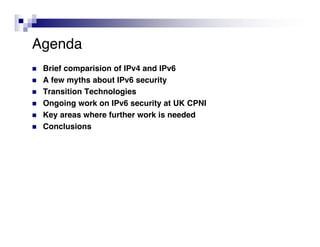
   Brief comparision of IPv4 and IPv6
   A few myths about IPv6 security
   Transition Technologies
   Ongoing work on IPv6 security at UK CPNI
   Key areas where further work is needed
   Conclusions
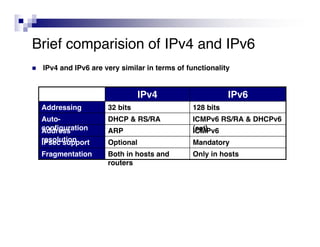
Brief comparision of IPv4 and IPv6
   IPv4 and IPv6 are very similar in terms of functionality


                                  IPv4                     IPv6
    Addressing         32 bits                  128 bits
    Auto-              DHCP & RS/RA             ICMPv6 RS/RA & DHCPv6
    configuration
    Address            ARP                      (opt)
                                                ICMPv6
    resolution
    IPsec support      Optional                 Mandatory
    Fragmentation      Both in hosts and        Only in hosts
                       routers
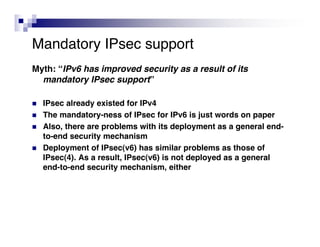
Mandatory IPsec support
Myth: “IPv6 has improved security as a result of its
  mandatory IPsec support”

   IPsec already existed for IPv4
   The mandatory-ness of IPsec for IPv6 is just words on paper
   Also, there are problems with its deployment as a general end-
    to-end security mechanism
   Deployment of IPsec(v6) has similar problems as those of
    IPsec(4). As a result, IPsec(v6) is not deployed as a general
    end-to-end security mechanism, either
Larger address space
Myth: “It is unfeasible to brute-force scan an IPv6 network
  for alive nodes, as the IPv6 address space is so large.
  Such a scan would take ages!”

   [Malone, 2008] (*) measured IPv6 address assignement patterns
   For hosts,
        50% autoconf, 20% IPv4-based, 10% Teredo, 8% “low-byte”
   For infrastructure,
        70% “low-byte”, 5% IPv4-based
   Anyway, most compromised systems are hosts. Once a host is
    compromised, brute-force scanning becomes trivial


      Size matters… only if you use it properly! ;-)
(*) Malone, D. 2008. Observations of IPv6 Addresses. Passive and Active Measurement Conference (PAM 2008,
LNCS 4979), 29–30 April 2008.
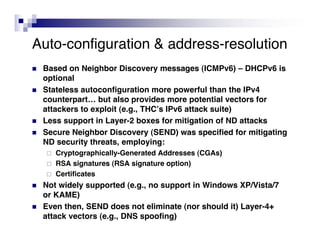
Auto-configuration & address-resolution
   Based on Neighbor Discovery messages (ICMPv6) – DHCPv6 is
    optional
   Stateless autoconfiguration more powerful than the IPv4
    counterpart… but also provides more potential vectors for
    attackers to exploit (e.g., THCʼs IPv6 attack suite)
   Less support in Layer-2 boxes for mitigation of ND attacks
   Secure Neighbor Discovery (SEND) was specified for mitigating
    ND security threats, employing:
       Cryptographically-Generated Addresses (CGAs)
       RSA signatures (RSA signature option)
       Certificates
   Not widely supported (e.g., no support in Windows XP/Vista/7
    or KAME)
   Even then, SEND does not eliminate (nor should it) Layer-4+
    attack vectors (e.g., DNS spoofing)
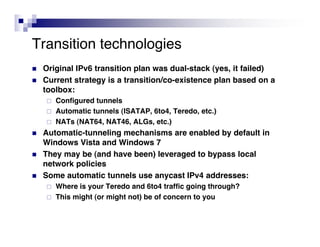
Transition technologies
   Original IPv6 transition plan was dual-stack (yes, it failed)
   Current strategy is a transition/co-existence plan based on a
    toolbox:
       Configured tunnels
       Automatic tunnels (ISATAP, 6to4, Teredo, etc.)
       NATs (NAT64, NAT46, ALGs, etc.)
   Automatic-tunneling mechanisms are enabled by default in
    Windows Vista and Windows 7
   They may be (and have been) leveraged to bypass local
    network policies
   Some automatic tunnels use anycast IPv4 addresses:
       Where is your Teredo and 6to4 traffic going through?
       This might (or might not) be of concern to you
Ongoing work
(or “what weʼre doing on v6 security”)
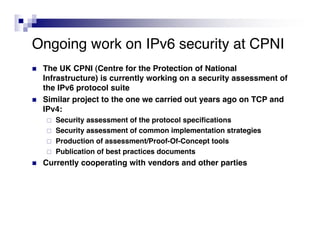
Ongoing work on IPv6 security at CPNI
   The UK CPNI (Centre for the Protection of National
    Infrastructure) is currently working on a security assessment of
    the IPv6 protocol suite
   Similar project to the one we carried out years ago on TCP and
    IPv4:
       Security assessment of the protocol specifications
       Security assessment of common implementation strategies
       Production of assessment/Proof-Of-Concept tools
       Publication of best practices documents
   Currently cooperating with vendors and other parties
Further work
(or “whatʼs missing?”)
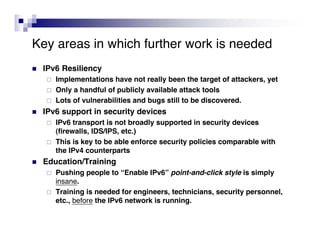
Key areas in which further work is needed
   IPv6 Resiliency
       Implementations have not really been the target of attackers, yet
       Only a handful of publicly available attack tools
       Lots of vulnerabilities and bugs still to be discovered.
   IPv6 support in security devices
       IPv6 transport is not broadly supported in security devices
        (firewalls, IDS/IPS, etc.)
       This is key to be able enforce security policies comparable with
        the IPv4 counterparts
   Education/Training
       Pushing people to “Enable IPv6” point-and-click style is simply
        insane.
       Training is needed for engineers, technicians, security personnel,
        etc., before the IPv6 network is running.
Conclusions
 (or “so what?”)
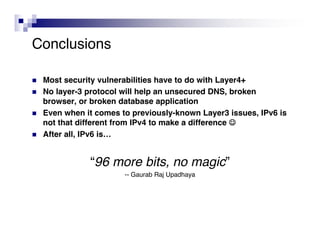
Conclusions

   Most security vulnerabilities have to do with Layer4+
   No layer-3 protocol will help an unsecured DNS, broken
    browser, or broken database application
   Even when it comes to previously-known Layer3 issues, IPv6 is
    not that different from IPv4 to make a difference 
   After all, IPv6 is…


               “96 more bits, no magic”
                        -- Gaurab Raj Upadhaya
Questions?
Acknowledgements
   UK CPNI, for their continued support
   Future-Net organizers, for the invitation to present in this
    conference


                          Fernando Gont
                     fernando@gont.com.ar
                     http://www.gont.com.ar

10 fn s05

  • 1.
    The Truth aboutIPv6 Security Fernando Gont UTN/FRH FutureNet: MPLS, Ethernet and Beyond Boston, MA, USA, May 10-13, 2010
  • 2.
    Agenda  Brief comparision of IPv4 and IPv6  A few myths about IPv6 security  Transition Technologies  Ongoing work on IPv6 security at UK CPNI  Key areas where further work is needed  Conclusions
  • 3.
    Brief comparision ofIPv4 and IPv6  IPv4 and IPv6 are very similar in terms of functionality IPv4 IPv6 Addressing 32 bits 128 bits Auto- DHCP & RS/RA ICMPv6 RS/RA & DHCPv6 configuration Address ARP (opt) ICMPv6 resolution IPsec support Optional Mandatory Fragmentation Both in hosts and Only in hosts routers
  • 4.
    Mandatory IPsec support Myth:“IPv6 has improved security as a result of its mandatory IPsec support”  IPsec already existed for IPv4  The mandatory-ness of IPsec for IPv6 is just words on paper  Also, there are problems with its deployment as a general end- to-end security mechanism  Deployment of IPsec(v6) has similar problems as those of IPsec(4). As a result, IPsec(v6) is not deployed as a general end-to-end security mechanism, either
  • 5.
    Larger address space Myth:“It is unfeasible to brute-force scan an IPv6 network for alive nodes, as the IPv6 address space is so large. Such a scan would take ages!”  [Malone, 2008] (*) measured IPv6 address assignement patterns  For hosts,  50% autoconf, 20% IPv4-based, 10% Teredo, 8% “low-byte”  For infrastructure,  70% “low-byte”, 5% IPv4-based  Anyway, most compromised systems are hosts. Once a host is compromised, brute-force scanning becomes trivial Size matters… only if you use it properly! ;-) (*) Malone, D. 2008. Observations of IPv6 Addresses. Passive and Active Measurement Conference (PAM 2008, LNCS 4979), 29–30 April 2008.
  • 6.
    Auto-configuration & address-resolution  Based on Neighbor Discovery messages (ICMPv6) – DHCPv6 is optional  Stateless autoconfiguration more powerful than the IPv4 counterpart… but also provides more potential vectors for attackers to exploit (e.g., THCʼs IPv6 attack suite)  Less support in Layer-2 boxes for mitigation of ND attacks  Secure Neighbor Discovery (SEND) was specified for mitigating ND security threats, employing:  Cryptographically-Generated Addresses (CGAs)  RSA signatures (RSA signature option)  Certificates  Not widely supported (e.g., no support in Windows XP/Vista/7 or KAME)  Even then, SEND does not eliminate (nor should it) Layer-4+ attack vectors (e.g., DNS spoofing)
  • 7.
    Transition technologies  Original IPv6 transition plan was dual-stack (yes, it failed)  Current strategy is a transition/co-existence plan based on a toolbox:  Configured tunnels  Automatic tunnels (ISATAP, 6to4, Teredo, etc.)  NATs (NAT64, NAT46, ALGs, etc.)  Automatic-tunneling mechanisms are enabled by default in Windows Vista and Windows 7  They may be (and have been) leveraged to bypass local network policies  Some automatic tunnels use anycast IPv4 addresses:  Where is your Teredo and 6to4 traffic going through?  This might (or might not) be of concern to you
  • 8.
    Ongoing work (or “whatweʼre doing on v6 security”)
  • 9.
    Ongoing work onIPv6 security at CPNI  The UK CPNI (Centre for the Protection of National Infrastructure) is currently working on a security assessment of the IPv6 protocol suite  Similar project to the one we carried out years ago on TCP and IPv4:  Security assessment of the protocol specifications  Security assessment of common implementation strategies  Production of assessment/Proof-Of-Concept tools  Publication of best practices documents  Currently cooperating with vendors and other parties
  • 10.
  • 11.
    Key areas inwhich further work is needed  IPv6 Resiliency  Implementations have not really been the target of attackers, yet  Only a handful of publicly available attack tools  Lots of vulnerabilities and bugs still to be discovered.  IPv6 support in security devices  IPv6 transport is not broadly supported in security devices (firewalls, IDS/IPS, etc.)  This is key to be able enforce security policies comparable with the IPv4 counterparts  Education/Training  Pushing people to “Enable IPv6” point-and-click style is simply insane.  Training is needed for engineers, technicians, security personnel, etc., before the IPv6 network is running.
  • 12.
  • 13.
    Conclusions  Most security vulnerabilities have to do with Layer4+  No layer-3 protocol will help an unsecured DNS, broken browser, or broken database application  Even when it comes to previously-known Layer3 issues, IPv6 is not that different from IPv4 to make a difference   After all, IPv6 is… “96 more bits, no magic” -- Gaurab Raj Upadhaya
  • 14.
  • 15.
    Acknowledgements  UK CPNI, for their continued support  Future-Net organizers, for the invitation to present in this conference Fernando Gont fernando@gont.com.ar http://www.gont.com.ar