The Trouble with NAT
(Or why I care about IPv6)
Mark Smith
markzzzsmith@gmail.com
@markzzzsmith
AusNOG Conference
2016
A Sad Story from 1996
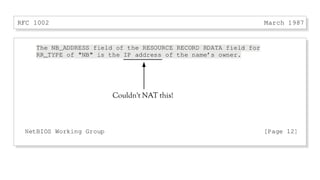
Couldn't NAT this!
On Being a Network Operator
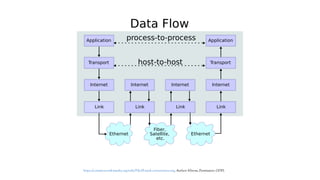
Application
Transport
Internet
Link
Application
Transport
Internet
Link
Internet Internet
host-to-host
Link Link
Fiber,
Satellite,
etc.
Ethernet
Data Flow
Ethernet
process-to-process
https://commons.wikimedia.org/wiki/File:IP_stack_connections.svg, Author: Kbrose, Permission: GDFL
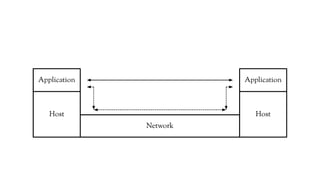
Network
Host Host
Application Application
Network
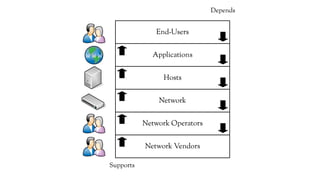
Network Operators
Network Vendors
Hosts
Applications
End-Users
Supports
Depends
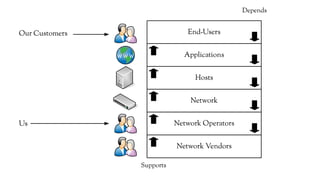
Network
Network Operators
Network Vendors
Hosts
Applications
End-Users
Supports
Depends
Us
Our Customers
Our Mission
Or,
Network Critical Success Factors
(NCSFs)
Available
https://flic.kr/p/81SRQG; Author: Daniel Weir; No Mods; Lic:CC BY-NC 2.0
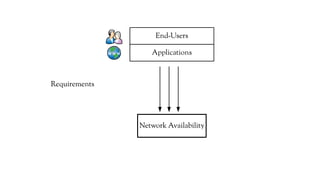
Applications
End-Users
Network Availability
Requirements
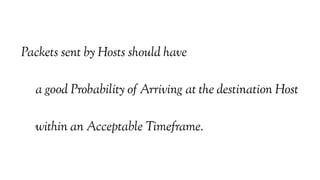
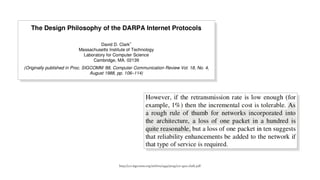
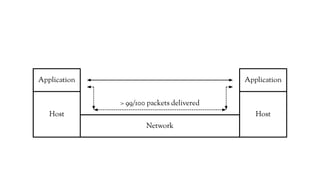
Packets sent by Hosts should have
a good Probability of Arriving at the destination Host
within an Acceptable Timeframe.
http://ccr.sigcomm.org/archive/1995/jan95/ccr-9501-clark.pdf
Network
Host Host
Application Application
> 99/100 packets delivered
Scalable
https://flic.kr/p/aAu2Py
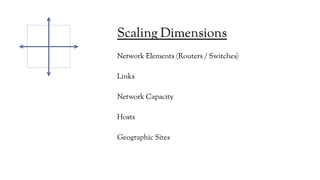
Scaling Dimensions
Network Elements (Routers / Switches)
Links
Network Capacity
Hosts
Geographic Sites
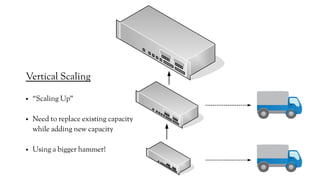
Vertical Scaling
● “Scaling Up”
● Need to replace existing capacity
while adding new capacity
● Using a bigger hammer!
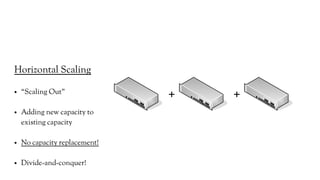
Horizontal Scaling
● “Scaling Out”
● Adding new capacity to
existing capacity
● No capacity replacement!
● Divide-and-conquer!
+ +
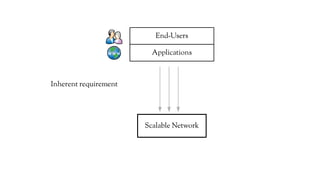
Applications
End-Users
Scalable Network
Inherent requirement
Adequately Performing
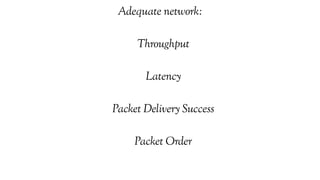
Adequate network:
Throughput
Latency
Packet Delivery Success
Packet Order
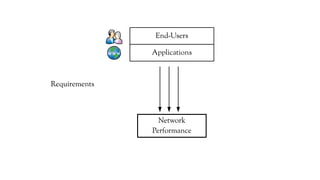
Applications
End-Users
Network
Performance
Requirements
Constrained by Budget
https://flic.kr/p/akxao3
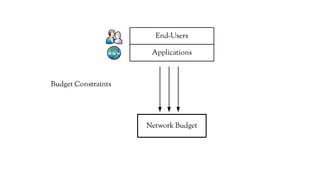
Applications
End-Users
Network Budget
Budget Constraints
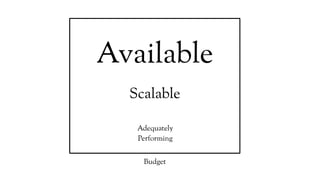
Available
Scalable
Adequately
Performing
Budget
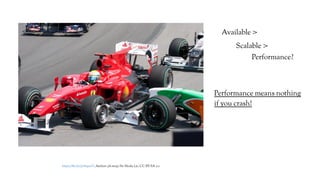
https://flic.kr/p/8a9uyV; Author: ph-stop; No Mods; Lic: CC BY-SA 2.0
Available >
Scalable >
Performance?
Performance means nothing
if you crash!
The Trouble with NAT
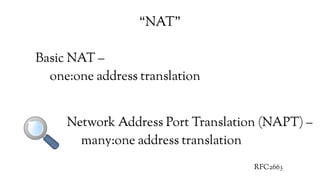
Basic NAT –
one:one address translation
Network Address Port Translation (NAPT) –
many:one address translation
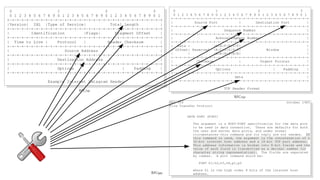
RFC2663
“NAT”
RFC791
RFC793
RFC959
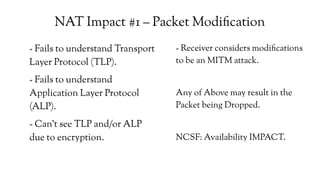
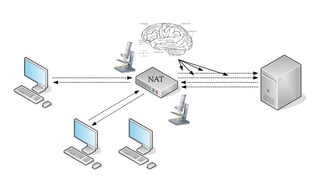
NAT Impact #1 – Packet Modification
- Fails to understand Transport
Layer Protocol (TLP).
- Fails to understand
Application Layer Protocol
(ALP).
- Can't see TLP and/or ALP
due to encryption.
- Receiver considers modifications
to be an MITM attack.
Any of Above may result in the
Packet being Dropped.
NCSF: Availability IMPACT.
NAT
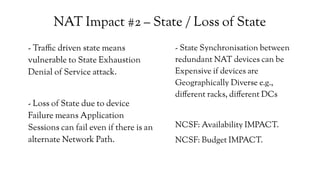
NAT Impact #2 – State / Loss of State
- Traffic driven state means
vulnerable to State Exhaustion
Denial of Service attack.
- Loss of State due to device
Failure means Application
Sessions can fail even if there is an
alternate Network Path.
- State Synchronisation between
redundant NAT devices can be
Expensive if devices are
Geographically Diverse e.g.,
different racks, different DCs
NCSF: Availability IMPACT.
NCSF: Budget IMPACT.
NAT NAT
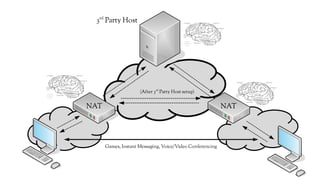
(After 3rd
Party Host setup)
3rd
Party Host
Games, Instant Messaging, Voice/Video Conferencing
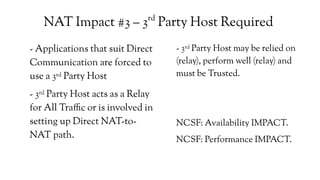
NAT Impact #3 – 3rd
Party Host Required
- Applications that suit Direct
Communication are forced to
use a 3rd Party Host
- 3rd Party Host acts as a Relay
for All Traffic or is involved in
setting up Direct NAT-to-
NAT path.
- 3rd Party Host may be relied on
(relay), perform well (relay) and
must be Trusted.
NCSF: Availability IMPACT.
NCSF: Performance IMPACT.
NAT NAT
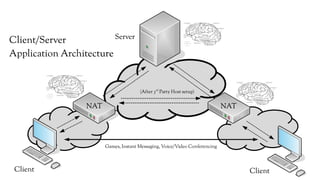
(After 3rd
Party Host setup)
Server
Games, Instant Messaging, Voice/Video Conferencing
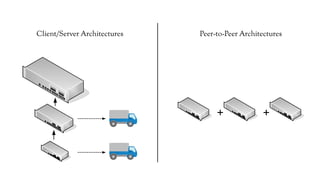
Client/Server
Application Architecture
Client Client
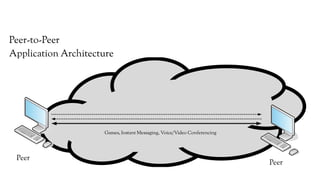
Games, Instant Messaging, Voice/Video Conferencing
Peer-to-Peer
Application Architecture
Peer
Peer
+ +
Client/Server Architectures Peer-to-Peer Architectures
What is the Nature of the Internet Protocols?
Client/Server?
IPv4
[mark@x13 RFCs]$ egrep -i "(Client|Server)" rfc791.txt
[mark@x13 RFCs]$
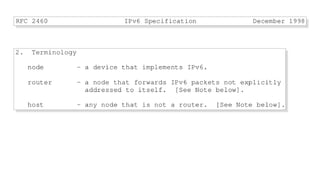
IPv6
[mark@x13 RFCs]$ egrep -i "(Client|Server)" rfc2460.txt
[mark@x13 RFCs]$
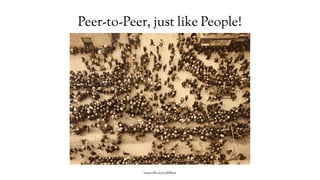
Peer-to-Peer, just like People!
https://flic.kr/p/9PiRpm
Being a Peer
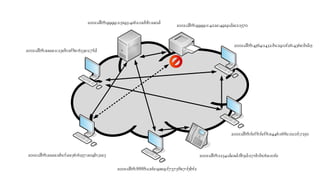
A device with an IP address should be able to:
Send Packets to and receive Packets from All other devices with IP
addresses attached to the Same Network, Security Permitting.
Use its own IP address to Identify itself to Others when Referring to
itself.
2001:db8:aaaa:1:23eb:af8e:633e:c7fd
2001:db8:8888:cafe:9ae9:f737:58e7:f5bf2
2001:db8:aaaa:abcf:ee36:6257:a09b:31e3 2001:db8:1234:dead:fb3d:071b:bc6a:10fe
2001:db8:fef8:fef8:a446:168c:0c0f:7250
2001:db8:4564:1432:bc29:0f26:436e:bd15
2001:db8:9999:1:422e:4919:dac1:1570
2001:db8:9999:2:5193:4162:0ebb:2a0d
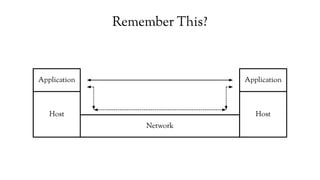
Network
Host Host
Application Application
Remember This?
The Fundamental Constraint of NAT is that it
Prevents IP nodes attached to the same network
from Acting as Peers of each Other.
IPv6 without NAT
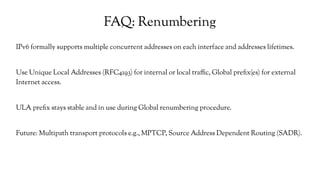
FAQ: Renumbering
IPv6 formally supports multiple concurrent addresses on each interface and addresses lifetimes.
Use Unique Local Addresses (RFC4193) for internal or local traffic, Global prefix(es) for external
Internet access.
ULA prefix stays stable and in use during Global renumbering procedure.
Future: Multipath transport protocols e.g., MPTCP, Source Address Dependent Routing (SADR).
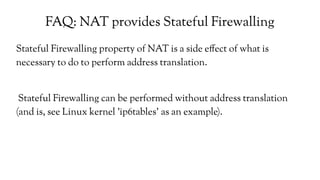
FAQ: NAT provides Stateful Firewalling
Stateful Firewalling property of NAT is a side effect of what is
necessary to do to perform address translation.
Stateful Firewalling can be performed without address translation
(and is, see Linux kernel 'ip6tables' as an example).
FAQ: NAT hides devices
People are really saying, “NAT hides devices from unsolicited inbound address probes”.
Devices are not hidden from other forms of discovery such as HTTP cookies, or
addresses and other identifiers that are leaked in other places in protocols.
Network or host stateful or stateless inbound filters can “hide” IPv6 devices, as well as
addressing schemes such as IPv6 Temporary/Privacy Addresses and hard to find using
probing Stable Opaque (RFC7217) Addresses.
FAQ: NAT Internal Topology Hiding
RFC4864 mentions using host routes for small scale sites and Mobile IPv6 larger ones.
Another option is various forms of tunnelling over IPv4 to make an IPv6 device appear
where the tunnelling concentrator is located.
For example, ISATAP (Intra-Site Automatic Tunnel Addressing Protocol) makes IPv6
devices attached to an IPv4 network appear to all come from the same single /64.
Convinced?
Some Further Reading
RFC1627 - “Network 10 Considered Harmful (Some Practices Shouldn't be Codified)”
RFC1958 - “Architectural Principles of the Internet”
RFC2775 - “Internet Transparency”
RFC2993 - “Architectural Implications of NAT”
RFC3439 - “Some Internet Architectural Guidelines and Philosophy”
RFC3879 - “Deprecating Site Local Addresses”
RFC4924 - “Reflections on Internet Transparency”
RFC5902 - “IAB Thoughts on IPv6 Network Address Translation”
Questions?
Thanks for listening.
https://flic.kr/p/dA1sTY; Author:Shara Miller; No Mods; Lic: CC BY-NC-ND 2.0

AusNOG 2016 - The Trouble with NAT