Rumen Function (and Dysfunction)
Mike Allen
Department of Animal Science
Topics
• What is proper rumen function?
• Regulation of ruminal pH
• Consequences of low ruminal pH
• Additives: buffers, antibiotics, etc.
• More than pH: osmolality
• Recommendations
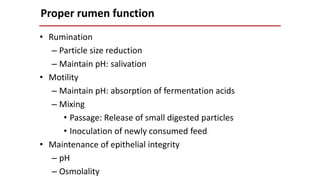
Proper rumen function
• Rumination
– Particle size reduction
– Maintain pH: salivation
• Motility
– Maintain pH: absorption of fermentation acids
– Mixing
• Passage: Release of small digested particles
• Inoculation of newly consumed feed
• Maintenance of epithelial integrity
– pH
– Osmolality
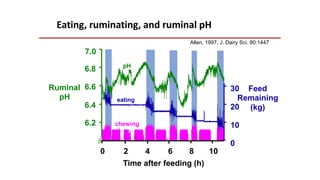
Eating, ruminating, and ruminal pH
7.0
6.8
6.6
6.4
6.2
Ruminal
pH
pH
chewing
Allen, 1997, J. Dairy Sci. 80:1447
30
20
10
0
Feed
Remaining
(kg)
eating
6
4
2
0 8 10
Time after feeding (h)
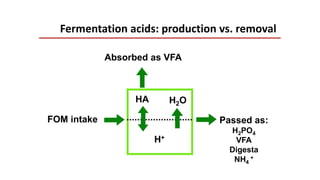
Fermentation acids: production vs. removal
FOM intake
HA
H+
Passed as:
H2PO4
VFA
Digesta
NH4
+
Absorbed as VFA
H2O
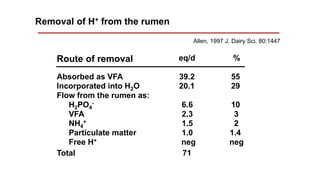
Removal of H+ from the rumen
Route of removal eq/d %
Absorbed as VFA 39.2 55
Incorporated into H2O 20.1 29
Flow from the rumen as:
H2PO4
- 6.6 10
VFA 2.3 3
NH4
+ 1.5 2
Particulate matter 1.0 1.4
Free H+ neg neg
Total 71
Allen, 1997 J. Dairy Sci. 80:1447
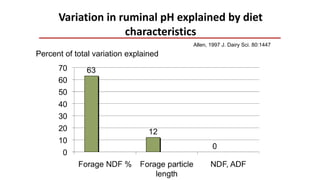
Variation in ruminal pH explained by diet
characteristics
Allen, 1997 J. Dairy Sci. 80:1447
Percent of total variation explained
Effective fiber and salivary buffer flow
Allen, 1997, J. Dairy Sci. 80: 1447
Fine, 20% FNDF Coarse, 24% FNDF
Total chewing, min/d 462 659
Ruminating, min/d 288 402
Eating, min/d 174 257
Saliva flow, L/d 256 271
Buffer flow, eq/d 38.9 41.2
Diet effects:
Cow effects: unknown
Effective fiber has additional effects by direct buffering of rumen
mass and stimulating motility and VFA absorption.
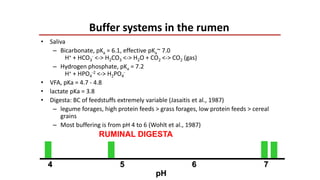
Buffer systems in the rumen
• Saliva
– Bicarbonate, pKa = 6.1, effective pKa~ 7.0
H+ + HCO3
- <-> H2CO3 <-> H2O + CO2 <-> CO2 (gas)
– Hydrogen phosphate, pKa = 7.2
H+ + HPO4
-2 <-> H2PO4
-
• VFA, pKa = 4.7 - 4.8
• lactate pKa = 3.8
• Digesta: BC of feedstuffs extremely variable (Jasaitis et al., 1987)
– legume forages, high protein feeds > grass forages, low protein feeds > cereal
grains
– Most buffering is from pH 4 to 6 (Wohlt et al., 1987)
4 5 6 7
pH
RUMINAL DIGESTA
Effects of supplemental buffers
Erdman, 1988 J. Dairy Sci. 71:3246
• Studies show variable effectiveness at increasing ruminal
pH, fiber digestibility, milk fat yield, and DMI
• More effective on low fiber diets
• Dependent upon forage type (e.g. corn silage > alfalfa)
Buffering capacity of forages (meq/kg DM)
Forage Initial pH pH 4 to 6
Fresh Italian ryegrass 6.03 386
Perennial ryegrass 6.01 388
Fresh alfalfa 6.10 487
Alfalfa silage 4.74 705
Whole corn plant 5.20 191
Corn silage 3.90 397
Erdman, 1988 J. Dairy Sci. 71:3246
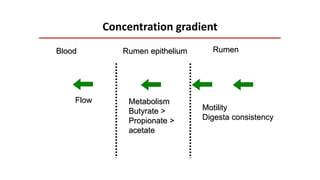
Concentration gradient
Blood Rumen epithelium Rumen
Motility
Digesta consistency
Metabolism
Butyrate >
Propionate >
acetate
Flow
Effects of increased acid load
• Decreased DM intake (propionate)
• Decreased rumen contents
• Decreased motility and mixing
• Decreased buffering
– Rumen contents
– Chewing, saliva flow
Rumen motility decreased
• Cause
– Low rumen fill
– Hypertonic fluids at abomasum
– Butyric acid
– Stimulation of CCK by dietary fat
• Effects
– Decreased absorption of VFA
– Increased tonicity of rumen fluid
– Decreased passage of VFA, water
– Increased liquid pool size in rumen
– Systemic dehydration
Low pH decreases rate of fiber digestion
Oba and Allen 2003 J Dairy Sci 86:184
Closed: 32% starch
Open: 21% starch
Circle: HMC
Triangle: DRY
R = 0.58, P < 0.001
Relationship between milk fat % and ruminal pH
5.0
5.5
6.0
6.5
7.0
2.0 2.5 3.0 3.5 4.0 4.5
Milk Fat %
pH
Allen, 1997 J. Dairy Sci. 80:1447
16
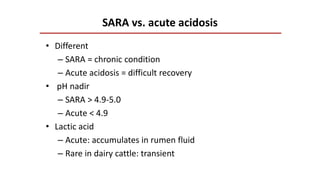
SARA vs. acute acidosis
• Different
– SARA = chronic condition
– Acute acidosis = difficult recovery
• pH nadir
– SARA > 4.9-5.0
– Acute < 4.9
• Lactic acid
– Acute: accumulates in rumen fluid
– Rare in dairy cattle: transient
Lactic acid accumulation in the rumen: main players
• S. bovis: starch fermenter, can grow rapidly, tolerates pH 5, Gram +,
sensitive to virginiamycin
– Normal growth: produces acetate, ethanol, and formate
– Rapid growth or low pH: produces lactic acid
• M. elsdenii: lactic acid utilizer, grows more slowly, tolerates pH 5.2
– Produces acetate and butyrate
• Lactobaccilli: ferment sugars, starch, Gram +, sensitive to virginiamycin,
tolerates pH << 5.0
– Produces L-lactic acid and D-lactic acid
Russell, J. B. and M. S. Allen (1983)
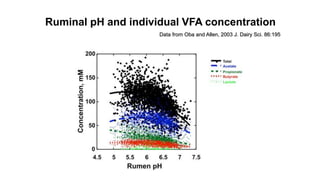
Ruminal pH and individual VFA concentration
Data from Oba and Allen, 2003 J. Dairy Sci. 86:195
0
5
10
15
20
25
4.5 5 5.5 6 6.5 7 7.5
Concentration,
mM
Rumen pH
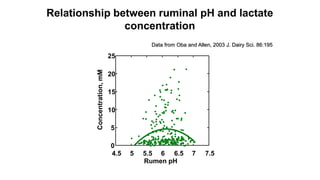
Data from Oba and Allen, 2003 J. Dairy Sci. 86:195
Relationship between ruminal pH and lactate
concentration
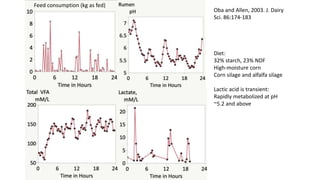
Feed consumption (kg as fed)
Oba and Allen, 2003. J. Dairy
Sci. 86:174-183
Diet:
32% starch, 23% NDF
High-moisture corn
Corn silage and alfalfa silage
Lactic acid is transient:
Rapidly metabolized at pH
~5.2 and above
Effects of feed additives on rumen function
• 8 heifers per treatment fed 2.5% of BW/d DMI of a TMR (62:38
F:C) and feed additives for 20-d
• Treatments
– Control
– Virginiamycin, 10 g/d
– Monensin, 2.2 g/d + Tylosin, 0.44 g/d
– Monensin, 2.5 g/d + live yeast (S. cerevisiae), 25 g/d
– Sodium bicarbonate, 200 g/g + Magnesium oxide, 30 g/d
• Challenge on d 21: wheat @ 1% of BW and fructose @ 0.1% of BW
• No effect of treatment on ruminal pH or concentrations of total
VFA, propionate, L-lactate, D-lactate or total lactate.
Golder et al., 2014. J. Dairy Sci. 97 :985–1004
Survey of ruminal acidosis in Australia
• 8 cows (3 primiparous & 5 multiparous) from each of 100 dairy
herds in NSW and VIC
• Ruminal pH determined by ruminocentesis 2-6 h after
milking/feeding, rumen fluid collected by stomach tube for VFA
concentrations
• Herds were separated into 3 groups by cluster analysis based on
ruminal pH, VFA, lactic acid, and ammonia concentrations:
– “Acidotic” (10%): low rumen pH, higher total [VFA]
100% monensin (252 mg), 50% virginiamycin (157 mg)
– “Sub-optimal” (30%): higher rumen pH, higher total [VFA]
66% monensin (258 mg), 29% virginiamycin (187 mg)
– “Normal” (60%): higher rumen pH, lower total [VFA]
61% monensin (240 mg), 7% lasalocid (265 mg), 25% virginiamycin (157 mg), 4% tylosin (120 mg)
Bramley et al., 2008. J. Dairy Sci. 91:308–321
Survey of ruminal acidosis in Australia (cont.)
Bramley et al., 2008. J. Dairy Sci. 91:308–321
Results “Acidotic” “Sub-optimal” “Normal”
NDF, % 30.4c 35.7b 36.1a
NFC, % 40.3a 33.7b 33.5b
Starch 22.7a 16.8b 16.9b
DMI, kg/d 19.4 18.7 19.2
Milk (L/d) 30.0a 27.9b 29.7a
Milk fat (kg/d) 1.00 1.04 1.05
Milk protein (kg/d) 0.94 0.87 0.91
Ruminal pH 5.7c 6.2b 6.3a
Total VFA, mM 101a 95a 63b
D-lactate, mM 0.34a 0.28b 0.12c
What is the evidence that lactic acid is a problem in dairy herds?
Importance of rumen fill
• Reduce risk of DA’s
• Maintain rumen pH
– Direct buffering
– Stimulate rumen movement, acid absorption
– Stimulate chewing, salivary buffer secretion
Epithelial damage: rumen ulcers
• Cause
– Low intracellular pH of ruminal epithelia, cell death
• Affected by both high VFA concentration and low
ruminal pH (Plaisier et al., 2022 J. Dairy Sci. 105:7141-7160)
– Rapid change in ruminal osmolality
• Effects
– Colonization by Fusobacterium necrophorum
– Access to blood
• Liver abcesses, lung abcesses
• Endotoxin absorption
• Histamine absorption
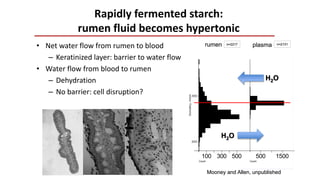
Rapidly fermented starch:
rumen fluid becomes hypertonic
• Net water flow from rumen to blood
– Keratinized layer: barrier to water flow
• Water flow from blood to rumen
– Dehydration
– No barrier: cell disruption?
Mooney and Allen, unpublished
rumen plasma n=2131
n=2217
H2O
H2O
Recommendations
• Limit rapidly fermented starch sources
• Prevent slug feeding of starch
• Keep the rumen full
Summary
• Concentration gradient is an important factor affecting rate of VFA
absorption and rumen pH
• Rumen motility increases the concentration gradient
• Rumen motility is increased by fibrous mass and inhibited by
butyric acid and increased osmolality
• Rumenitis/ulcers likely from rapid increase in ruminal
fermentation, increased VFA concentration AND lower pH
• Major risk factors for acidosis include:
– Low ruminal digesta mass (buffer capacity)
– Highly fermentable ration, feeding grain separately
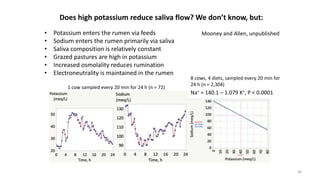
Does high potassium reduce saliva flow? We don’t know, but:
• Potassium enters the rumen via feeds
• Sodium enters the rumen primarily via saliva
• Saliva composition is relatively constant
• Grazed pastures are high in potassium
• Increased osmolality reduces rumination
• Electroneutrality is maintained in the rumen
31
Mooney and Allen, unpublished
1 cow sampled every 20 min for 24 h (n = 72)
Na+ = 140.1 – 1.079 K+, P < 0.0001
8 cows, 4 diets, sampled every 20 min for
24 h (n = 2,304)

10. Feedworks-Rumen function (and dysfunction).pptx

  • 1.
    Rumen Function (andDysfunction) Mike Allen Department of Animal Science
  • 2.
    Topics • What isproper rumen function? • Regulation of ruminal pH • Consequences of low ruminal pH • Additives: buffers, antibiotics, etc. • More than pH: osmolality • Recommendations
  • 3.
    Proper rumen function •Rumination – Particle size reduction – Maintain pH: salivation • Motility – Maintain pH: absorption of fermentation acids – Mixing • Passage: Release of small digested particles • Inoculation of newly consumed feed • Maintenance of epithelial integrity – pH – Osmolality
  • 4.
    Eating, ruminating, andruminal pH 7.0 6.8 6.6 6.4 6.2 Ruminal pH pH chewing Allen, 1997, J. Dairy Sci. 80:1447 30 20 10 0 Feed Remaining (kg) eating 6 4 2 0 8 10 Time after feeding (h)
  • 5.
    Fermentation acids: productionvs. removal FOM intake HA H+ Passed as: H2PO4 VFA Digesta NH4 + Absorbed as VFA H2O
  • 6.
    Removal of H+from the rumen Route of removal eq/d % Absorbed as VFA 39.2 55 Incorporated into H2O 20.1 29 Flow from the rumen as: H2PO4 - 6.6 10 VFA 2.3 3 NH4 + 1.5 2 Particulate matter 1.0 1.4 Free H+ neg neg Total 71 Allen, 1997 J. Dairy Sci. 80:1447
  • 7.
    Variation in ruminalpH explained by diet characteristics Allen, 1997 J. Dairy Sci. 80:1447 Percent of total variation explained
  • 8.
    Effective fiber andsalivary buffer flow Allen, 1997, J. Dairy Sci. 80: 1447 Fine, 20% FNDF Coarse, 24% FNDF Total chewing, min/d 462 659 Ruminating, min/d 288 402 Eating, min/d 174 257 Saliva flow, L/d 256 271 Buffer flow, eq/d 38.9 41.2 Diet effects: Cow effects: unknown Effective fiber has additional effects by direct buffering of rumen mass and stimulating motility and VFA absorption.
  • 9.
    Buffer systems inthe rumen • Saliva – Bicarbonate, pKa = 6.1, effective pKa~ 7.0 H+ + HCO3 - <-> H2CO3 <-> H2O + CO2 <-> CO2 (gas) – Hydrogen phosphate, pKa = 7.2 H+ + HPO4 -2 <-> H2PO4 - • VFA, pKa = 4.7 - 4.8 • lactate pKa = 3.8 • Digesta: BC of feedstuffs extremely variable (Jasaitis et al., 1987) – legume forages, high protein feeds > grass forages, low protein feeds > cereal grains – Most buffering is from pH 4 to 6 (Wohlt et al., 1987) 4 5 6 7 pH RUMINAL DIGESTA
  • 10.
    Effects of supplementalbuffers Erdman, 1988 J. Dairy Sci. 71:3246 • Studies show variable effectiveness at increasing ruminal pH, fiber digestibility, milk fat yield, and DMI • More effective on low fiber diets • Dependent upon forage type (e.g. corn silage > alfalfa)
  • 11.
    Buffering capacity offorages (meq/kg DM) Forage Initial pH pH 4 to 6 Fresh Italian ryegrass 6.03 386 Perennial ryegrass 6.01 388 Fresh alfalfa 6.10 487 Alfalfa silage 4.74 705 Whole corn plant 5.20 191 Corn silage 3.90 397 Erdman, 1988 J. Dairy Sci. 71:3246
  • 12.
    Concentration gradient Blood Rumenepithelium Rumen Motility Digesta consistency Metabolism Butyrate > Propionate > acetate Flow
  • 13.
    Effects of increasedacid load • Decreased DM intake (propionate) • Decreased rumen contents • Decreased motility and mixing • Decreased buffering – Rumen contents – Chewing, saliva flow
  • 14.
    Rumen motility decreased •Cause – Low rumen fill – Hypertonic fluids at abomasum – Butyric acid – Stimulation of CCK by dietary fat • Effects – Decreased absorption of VFA – Increased tonicity of rumen fluid – Decreased passage of VFA, water – Increased liquid pool size in rumen – Systemic dehydration
  • 15.
    Low pH decreasesrate of fiber digestion Oba and Allen 2003 J Dairy Sci 86:184 Closed: 32% starch Open: 21% starch Circle: HMC Triangle: DRY R = 0.58, P < 0.001
  • 16.
    Relationship between milkfat % and ruminal pH 5.0 5.5 6.0 6.5 7.0 2.0 2.5 3.0 3.5 4.0 4.5 Milk Fat % pH Allen, 1997 J. Dairy Sci. 80:1447 16
  • 17.
    SARA vs. acuteacidosis • Different – SARA = chronic condition – Acute acidosis = difficult recovery • pH nadir – SARA > 4.9-5.0 – Acute < 4.9 • Lactic acid – Acute: accumulates in rumen fluid – Rare in dairy cattle: transient
  • 18.
    Lactic acid accumulationin the rumen: main players • S. bovis: starch fermenter, can grow rapidly, tolerates pH 5, Gram +, sensitive to virginiamycin – Normal growth: produces acetate, ethanol, and formate – Rapid growth or low pH: produces lactic acid • M. elsdenii: lactic acid utilizer, grows more slowly, tolerates pH 5.2 – Produces acetate and butyrate • Lactobaccilli: ferment sugars, starch, Gram +, sensitive to virginiamycin, tolerates pH << 5.0 – Produces L-lactic acid and D-lactic acid Russell, J. B. and M. S. Allen (1983)
  • 19.
    Ruminal pH andindividual VFA concentration Data from Oba and Allen, 2003 J. Dairy Sci. 86:195
  • 20.
    0 5 10 15 20 25 4.5 5 5.56 6.5 7 7.5 Concentration, mM Rumen pH Data from Oba and Allen, 2003 J. Dairy Sci. 86:195 Relationship between ruminal pH and lactate concentration
  • 21.
    Feed consumption (kgas fed) Oba and Allen, 2003. J. Dairy Sci. 86:174-183 Diet: 32% starch, 23% NDF High-moisture corn Corn silage and alfalfa silage Lactic acid is transient: Rapidly metabolized at pH ~5.2 and above
  • 22.
    Effects of feedadditives on rumen function • 8 heifers per treatment fed 2.5% of BW/d DMI of a TMR (62:38 F:C) and feed additives for 20-d • Treatments – Control – Virginiamycin, 10 g/d – Monensin, 2.2 g/d + Tylosin, 0.44 g/d – Monensin, 2.5 g/d + live yeast (S. cerevisiae), 25 g/d – Sodium bicarbonate, 200 g/g + Magnesium oxide, 30 g/d • Challenge on d 21: wheat @ 1% of BW and fructose @ 0.1% of BW • No effect of treatment on ruminal pH or concentrations of total VFA, propionate, L-lactate, D-lactate or total lactate. Golder et al., 2014. J. Dairy Sci. 97 :985–1004
  • 23.
    Survey of ruminalacidosis in Australia • 8 cows (3 primiparous & 5 multiparous) from each of 100 dairy herds in NSW and VIC • Ruminal pH determined by ruminocentesis 2-6 h after milking/feeding, rumen fluid collected by stomach tube for VFA concentrations • Herds were separated into 3 groups by cluster analysis based on ruminal pH, VFA, lactic acid, and ammonia concentrations: – “Acidotic” (10%): low rumen pH, higher total [VFA] 100% monensin (252 mg), 50% virginiamycin (157 mg) – “Sub-optimal” (30%): higher rumen pH, higher total [VFA] 66% monensin (258 mg), 29% virginiamycin (187 mg) – “Normal” (60%): higher rumen pH, lower total [VFA] 61% monensin (240 mg), 7% lasalocid (265 mg), 25% virginiamycin (157 mg), 4% tylosin (120 mg) Bramley et al., 2008. J. Dairy Sci. 91:308–321
  • 24.
    Survey of ruminalacidosis in Australia (cont.) Bramley et al., 2008. J. Dairy Sci. 91:308–321 Results “Acidotic” “Sub-optimal” “Normal” NDF, % 30.4c 35.7b 36.1a NFC, % 40.3a 33.7b 33.5b Starch 22.7a 16.8b 16.9b DMI, kg/d 19.4 18.7 19.2 Milk (L/d) 30.0a 27.9b 29.7a Milk fat (kg/d) 1.00 1.04 1.05 Milk protein (kg/d) 0.94 0.87 0.91 Ruminal pH 5.7c 6.2b 6.3a Total VFA, mM 101a 95a 63b D-lactate, mM 0.34a 0.28b 0.12c What is the evidence that lactic acid is a problem in dairy herds?
  • 25.
    Importance of rumenfill • Reduce risk of DA’s • Maintain rumen pH – Direct buffering – Stimulate rumen movement, acid absorption – Stimulate chewing, salivary buffer secretion
  • 26.
    Epithelial damage: rumenulcers • Cause – Low intracellular pH of ruminal epithelia, cell death • Affected by both high VFA concentration and low ruminal pH (Plaisier et al., 2022 J. Dairy Sci. 105:7141-7160) – Rapid change in ruminal osmolality • Effects – Colonization by Fusobacterium necrophorum – Access to blood • Liver abcesses, lung abcesses • Endotoxin absorption • Histamine absorption
  • 27.
    Rapidly fermented starch: rumenfluid becomes hypertonic • Net water flow from rumen to blood – Keratinized layer: barrier to water flow • Water flow from blood to rumen – Dehydration – No barrier: cell disruption? Mooney and Allen, unpublished rumen plasma n=2131 n=2217 H2O H2O
  • 28.
    Recommendations • Limit rapidlyfermented starch sources • Prevent slug feeding of starch • Keep the rumen full
  • 29.
    Summary • Concentration gradientis an important factor affecting rate of VFA absorption and rumen pH • Rumen motility increases the concentration gradient • Rumen motility is increased by fibrous mass and inhibited by butyric acid and increased osmolality • Rumenitis/ulcers likely from rapid increase in ruminal fermentation, increased VFA concentration AND lower pH • Major risk factors for acidosis include: – Low ruminal digesta mass (buffer capacity) – Highly fermentable ration, feeding grain separately
  • 31.
    Does high potassiumreduce saliva flow? We don’t know, but: • Potassium enters the rumen via feeds • Sodium enters the rumen primarily via saliva • Saliva composition is relatively constant • Grazed pastures are high in potassium • Increased osmolality reduces rumination • Electroneutrality is maintained in the rumen 31 Mooney and Allen, unpublished 1 cow sampled every 20 min for 24 h (n = 72) Na+ = 140.1 – 1.079 K+, P < 0.0001 8 cows, 4 diets, sampled every 20 min for 24 h (n = 2,304)

Editor's Notes

  • #19 Russell, J. B. and M. S. Allen (1983). Physiological basis for interactions among rumen bacteria: Streptococcus bovis and Megasphaera elsdenii as a model. Current Perspectives in Microbial Ecology. American Society of Microbiology.
  • #30 57