Towards “Affective Knowing” in the Diary Film !
and Interactive Documentary

Hannah Brasier

!1
theme

in honours
I applied Deleuze’s concept of the affect-image, outlined in
Cinema One: the movement image, as a framework for the
creation of two interactive online videos.

!2
question

!3
then

What can the essay film contribute to interactive documentary?
What can interactive documentary contribute to the essay film?

!4
now

What can the essay film contribute to interactive documentary?
What can interactive documentary contribute to the essay film?
How may interactivity as an affective system, and the diary film
as “affective knowing”, provide a framework for new ways of
making and theorising the diary film, and interactive
documentary?

!5
now…

How may interactivity as an affective system, and the diary film
as “affective knowing”, provide a framework for new ways of
making and theorising the diary film, and interactive
documentary?

!6
interactivity

modularity means each element of a whole maintains their
“separate identities…without losing their independence” (Manovich
30)

variability means a new media object is “not something fixed
once and for all, but something that can exist in different,
potentially infinite versions” (Manovich 36)

!7
interactivity

“as a cultural form, the database represents the world as a list of
items, and it refuses to order this list” (Manovich 225)

!8
interactive documentary

Manovich finds it surprising why “narratives—still exist in new
media,” when there is “nothing in the logic of the medium itself
that would foster its generation” (228)
Miles considers that because documentaries focus on the
contemplation of ideas, as opposed to narrative movement, they
can be considered as a collection of contemplative affective
moments.

!9
interactive documentary

a working concept of interactive documentary is a collection of
modular affective video clips that are interacted with by a user
through an interface.

!10
affective system

“what matters in interactive documentary is the enlarging of the
interval between perception and action…so that deciding
becomes analogous to understanding. This is synonymous with
Deleuze’s affect image” (Miles 24)

!11
diary film

from the essay film
described by Corrigan as a “(1) testing of expressive
subjectivity through (2) experiential encounters in a public
arena, (3) the product of which becomes the figuration of
thinking or thought” (30)

!12
diary film

to the diary film
where essayistic subjectivity continually reinvents itself
“between the extremes of boredom and emergency as a
series of different, daily, and redemptive time
zones” (Corrigan 144)
!

!13
“affective knowing”

In the diary film, affective moments of contemplation are
constructed to show reinventions of enquiring subjectivity
through lived experience, and could be viewed as the diarist
moving towards a sort of “affective knowing” (Miles 22)
!

!14
towards

I envision this PhD to focus on how the diary film is a form of
documentary filmmaking that is particularly suited to “affective
knowing”, and how this may lend itself to affective systems of
interaction.
!

!15
how

!16
how

Gibson in “The Known World” suggests
“Artist-researchers have the chance to woo two modes of
knowing: the implicit and the explicit. They have the
chance to entwine the insider’s embodied know-how with
the outsider’s analytical precepts” (11)

!17
how

an essayistic approach to writing which displays the
“essayist’s train of thought in full view”
and for the essayist to combine these thoughts to produce a
“constellation of meanings that surround any of the issues
considered by the essayist” (Montero 8)

!18
how

The essayist as meditator and combiner mimics the dual
knowings of Gibson’s proposition that you need to “step both
outside and inside the mystery” (Gibson 4)

!19
project one

!20
making

lists “function primarily as provocations, as litanies of
surprisingly contrasted curiosities” (Bogost 26)
mirroring becomes an observational tool to learn “something
about the researcher, as well as, perhaps, something about the
phenomenon” (Mason 181)
“expertise is sensation to notice, coupled with techniques for
analysis of, use of, or enquiry into, that noticing” (Mason 35)

!21
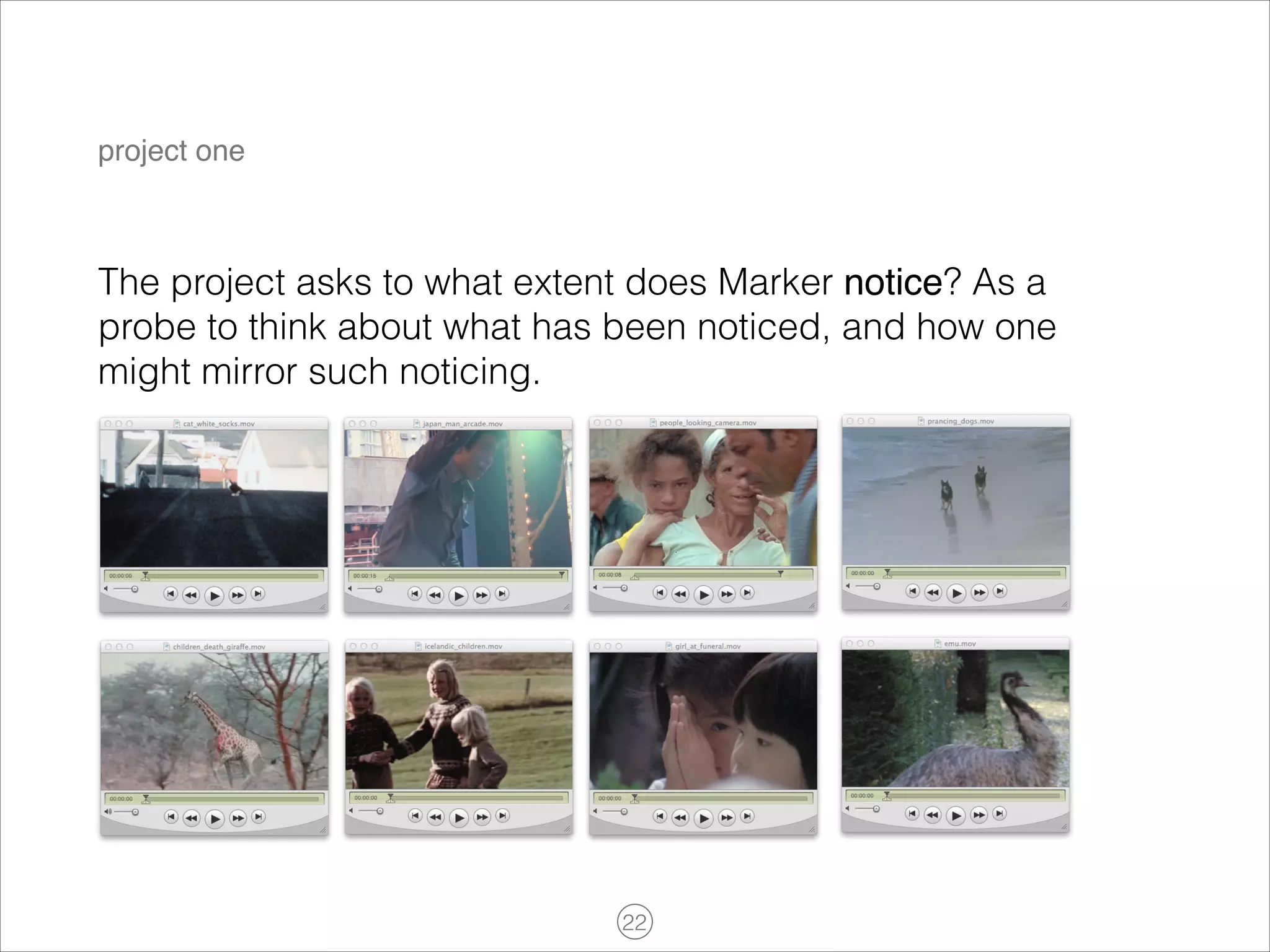
project one

The project asks to what extent does Marker notice? As a
probe to think about what has been noticed, and how one
might mirror such noticing.

!22
why

!23
why

transformations of the diary film into a new media context
emerging practices of personal expression
contributions to documentary theory and new media studies

!24
tasks

!25
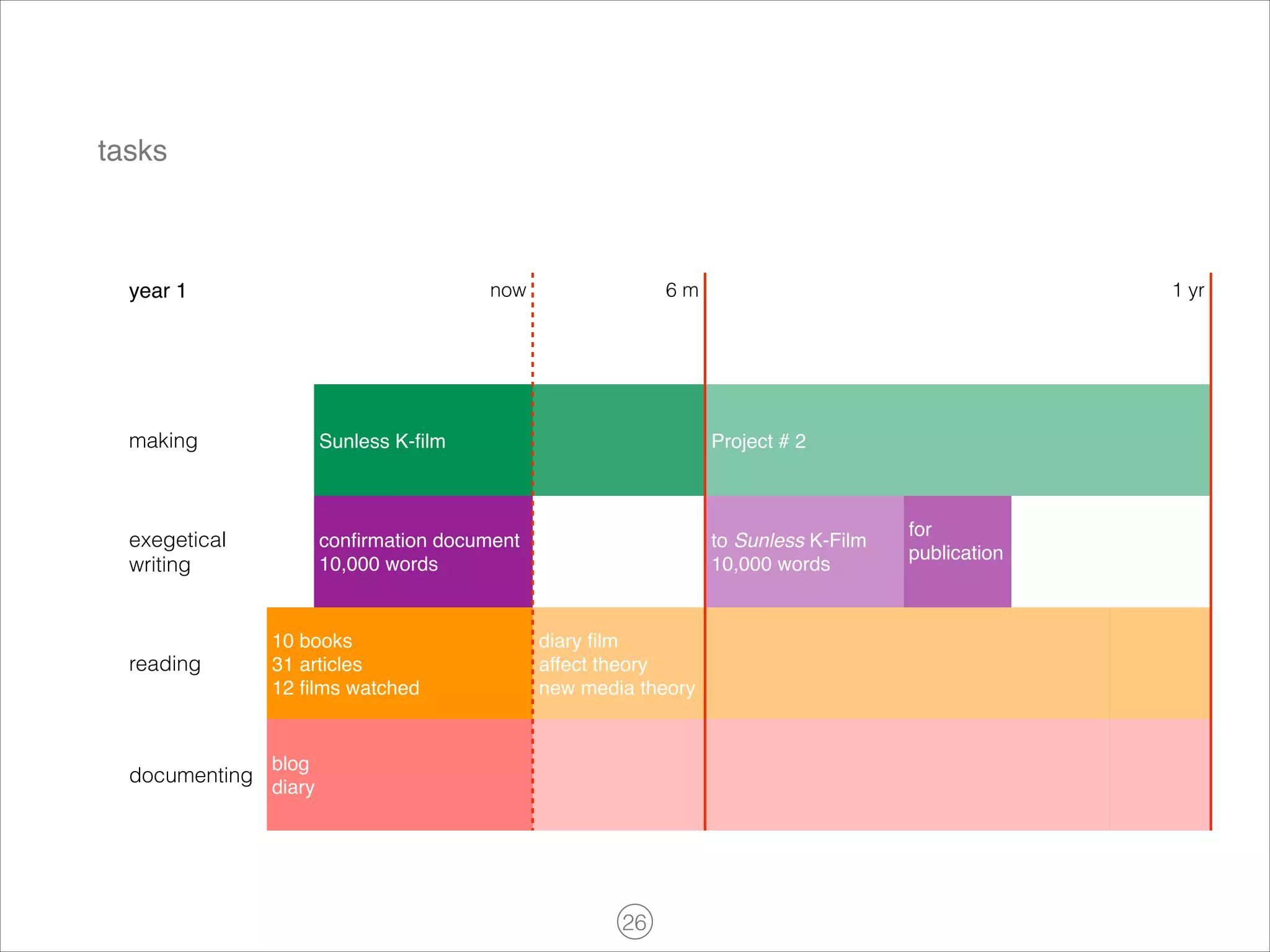
tasks

now

year 1

6m

1 yr

!

making

Sunless K-film!

confirmation document!
10,000 words

exegetical
writing

Project # 2

to Sunless K-Film!
10,000 words

reading

10 books!
31 articles!
12 films watched

documenting

diary film!
affect theory!
new media theory

blog!
diary

!26

for
publication!
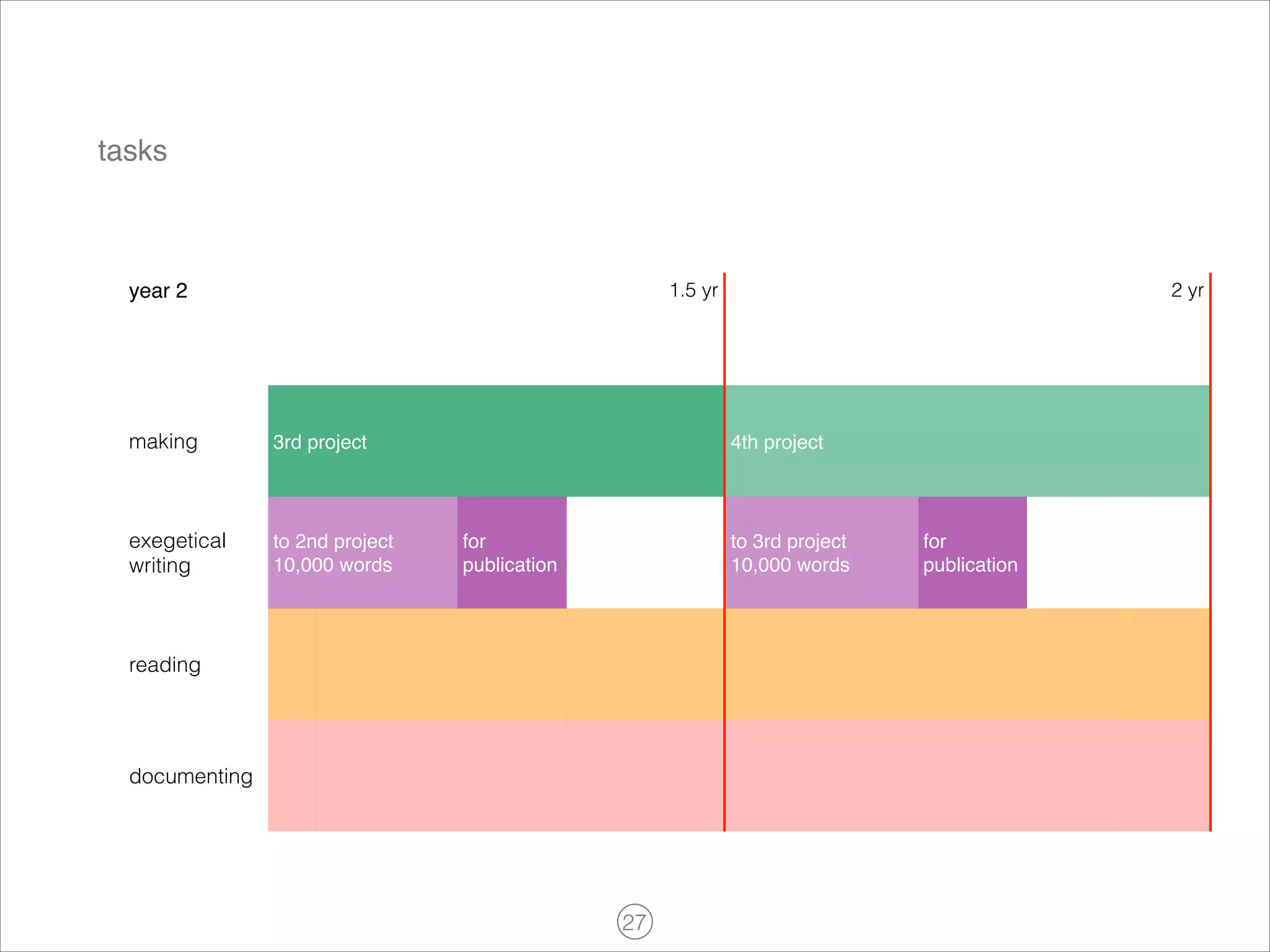
tasks

1.5 yr

year 2

making

3rd project

exegetical
writing

to 2nd project!
10,000 words

2 yr

4th project

for
publication

to 3rd project!
10,000 words

reading

documenting

!27

for
publication
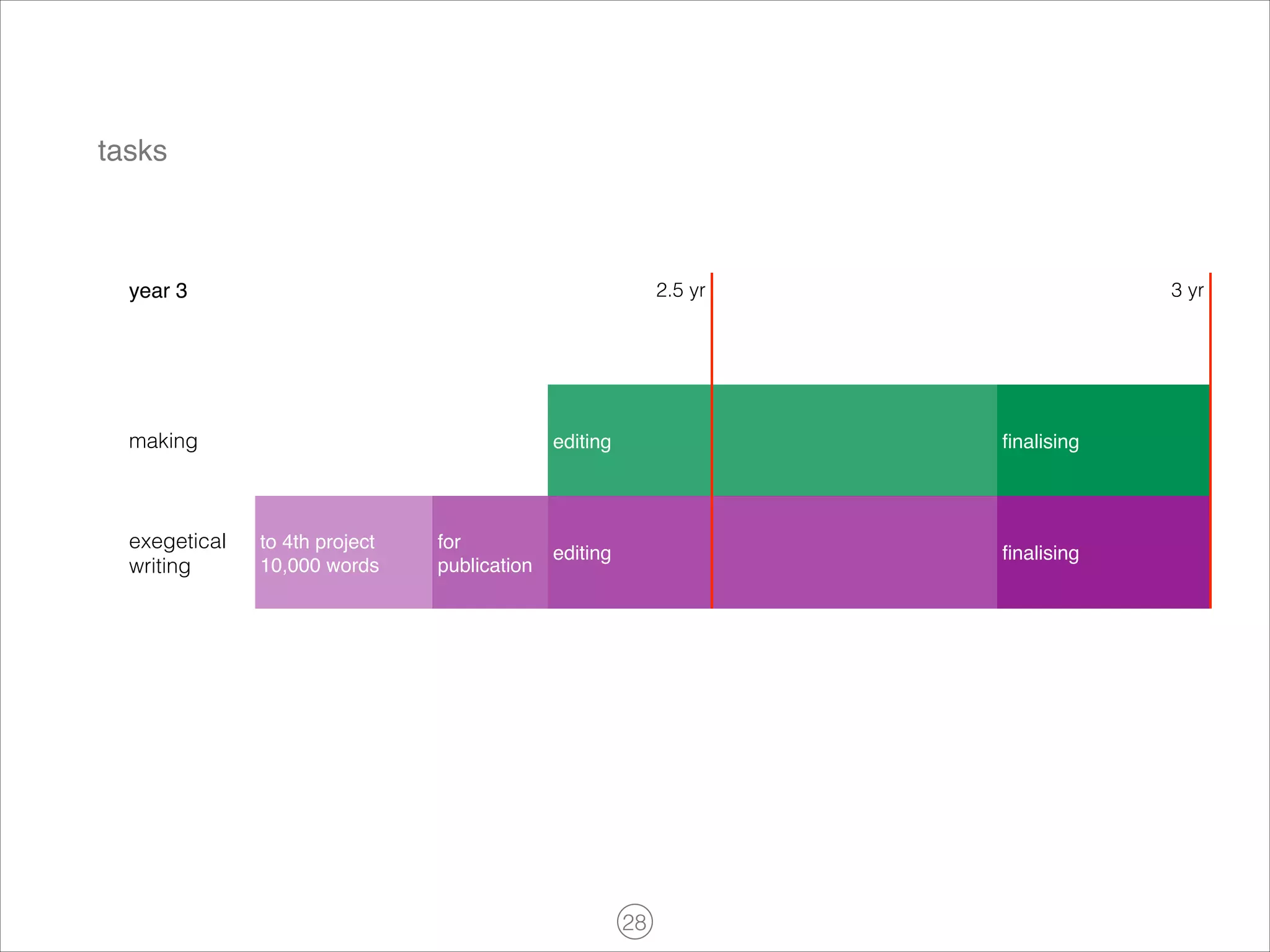
tasks

2.5 yr

year 3

making

exegetical
writing

3 yr

editing

to 4th project!
10,000 words

finalising

for
editing
publication!

finalising

!28
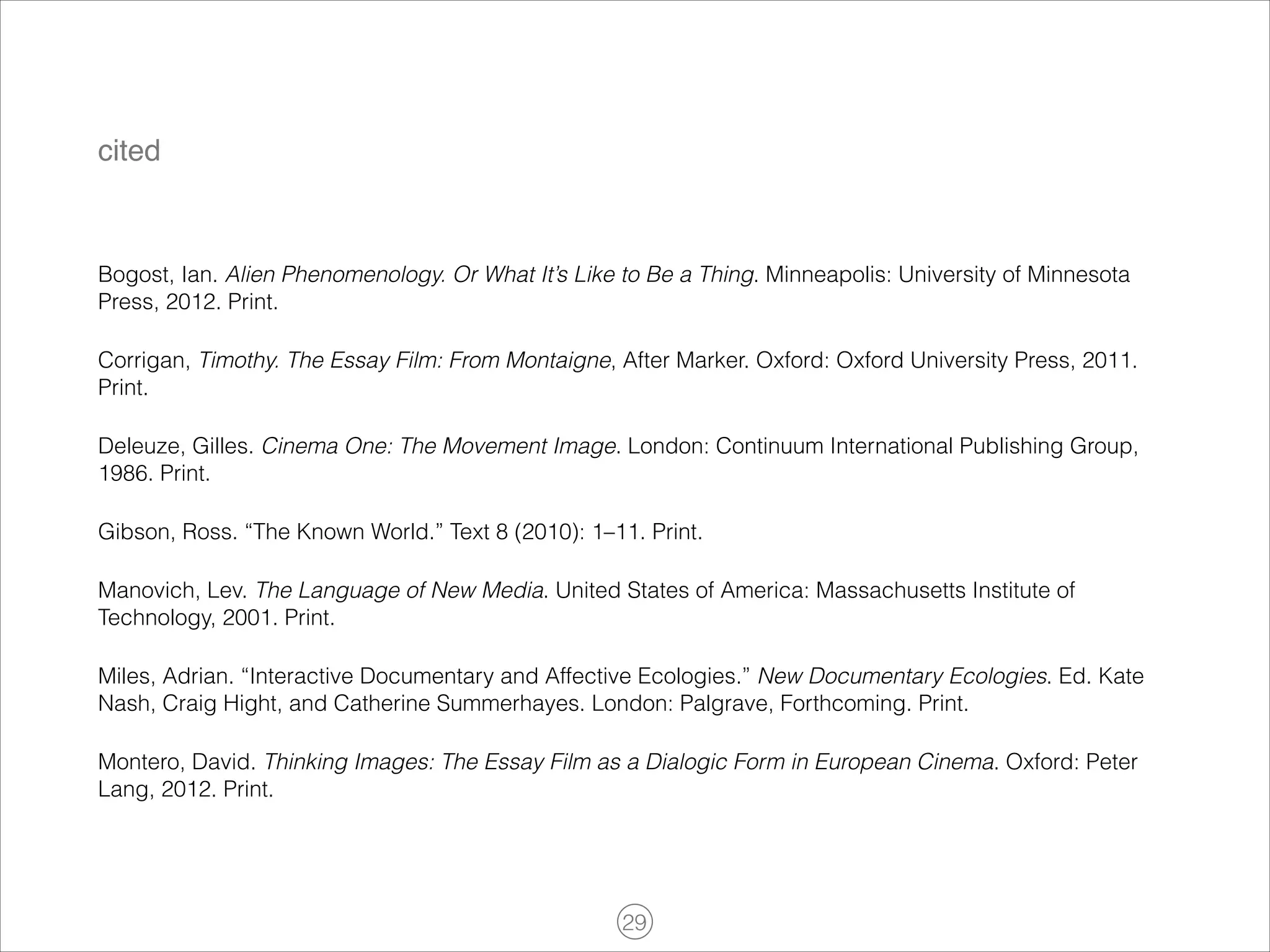
cited

Bogost, Ian. Alien Phenomenology. Or What It’s Like to Be a Thing. Minneapolis: University of Minnesota
Press, 2012. Print.
Corrigan, Timothy. The Essay Film: From Montaigne, After Marker. Oxford: Oxford University Press, 2011.
Print.
Deleuze, Gilles. Cinema One: The Movement Image. London: Continuum International Publishing Group,
1986. Print.
Gibson, Ross. “The Known World.” Text 8 (2010): 1–11. Print.
Manovich, Lev. The Language of New Media. United States of America: Massachusetts Institute of
Technology, 2001. Print.
Miles, Adrian. “Interactive Documentary and Affective Ecologies.” New Documentary Ecologies. Ed. Kate
Nash, Craig Hight, and Catherine Summerhayes. London: Palgrave, Forthcoming. Print.
Montero, David. Thinking Images: The Essay Film as a Dialogic Form in European Cinema. Oxford: Peter
Lang, 2012. Print.

!29

PhD confirmation presentation

  • 1.
    Towards “Affective Knowing”in the Diary Film ! and Interactive Documentary Hannah Brasier !1
  • 2.
    theme in honours I appliedDeleuze’s concept of the affect-image, outlined in Cinema One: the movement image, as a framework for the creation of two interactive online videos. !2
  • 3.
  • 4.
    then What can theessay film contribute to interactive documentary? What can interactive documentary contribute to the essay film? !4
  • 5.
    now What can theessay film contribute to interactive documentary? What can interactive documentary contribute to the essay film? How may interactivity as an affective system, and the diary film as “affective knowing”, provide a framework for new ways of making and theorising the diary film, and interactive documentary? !5
  • 6.
    now… How may interactivityas an affective system, and the diary film as “affective knowing”, provide a framework for new ways of making and theorising the diary film, and interactive documentary? !6
  • 7.
    interactivity modularity means eachelement of a whole maintains their “separate identities…without losing their independence” (Manovich 30) variability means a new media object is “not something fixed once and for all, but something that can exist in different, potentially infinite versions” (Manovich 36) !7
  • 8.
    interactivity “as a culturalform, the database represents the world as a list of items, and it refuses to order this list” (Manovich 225) !8
  • 9.
    interactive documentary Manovich findsit surprising why “narratives—still exist in new media,” when there is “nothing in the logic of the medium itself that would foster its generation” (228) Miles considers that because documentaries focus on the contemplation of ideas, as opposed to narrative movement, they can be considered as a collection of contemplative affective moments. !9
  • 10.
    interactive documentary a workingconcept of interactive documentary is a collection of modular affective video clips that are interacted with by a user through an interface. !10
  • 11.
    affective system “what mattersin interactive documentary is the enlarging of the interval between perception and action…so that deciding becomes analogous to understanding. This is synonymous with Deleuze’s affect image” (Miles 24) !11
  • 12.
    diary film from theessay film described by Corrigan as a “(1) testing of expressive subjectivity through (2) experiential encounters in a public arena, (3) the product of which becomes the figuration of thinking or thought” (30) !12
  • 13.
    diary film to thediary film where essayistic subjectivity continually reinvents itself “between the extremes of boredom and emergency as a series of different, daily, and redemptive time zones” (Corrigan 144) ! !13
  • 14.
    “affective knowing” In thediary film, affective moments of contemplation are constructed to show reinventions of enquiring subjectivity through lived experience, and could be viewed as the diarist moving towards a sort of “affective knowing” (Miles 22) ! !14
  • 15.
    towards I envision thisPhD to focus on how the diary film is a form of documentary filmmaking that is particularly suited to “affective knowing”, and how this may lend itself to affective systems of interaction. ! !15
  • 16.
  • 17.
    how Gibson in “TheKnown World” suggests “Artist-researchers have the chance to woo two modes of knowing: the implicit and the explicit. They have the chance to entwine the insider’s embodied know-how with the outsider’s analytical precepts” (11) !17
  • 18.
    how an essayistic approachto writing which displays the “essayist’s train of thought in full view” and for the essayist to combine these thoughts to produce a “constellation of meanings that surround any of the issues considered by the essayist” (Montero 8) !18
  • 19.
    how The essayist asmeditator and combiner mimics the dual knowings of Gibson’s proposition that you need to “step both outside and inside the mystery” (Gibson 4) !19
  • 20.
  • 21.
    making lists “function primarilyas provocations, as litanies of surprisingly contrasted curiosities” (Bogost 26) mirroring becomes an observational tool to learn “something about the researcher, as well as, perhaps, something about the phenomenon” (Mason 181) “expertise is sensation to notice, coupled with techniques for analysis of, use of, or enquiry into, that noticing” (Mason 35) !21
  • 22.
    project one The projectasks to what extent does Marker notice? As a probe to think about what has been noticed, and how one might mirror such noticing. !22
  • 23.
  • 24.
    why transformations of thediary film into a new media context emerging practices of personal expression contributions to documentary theory and new media studies !24
  • 25.
  • 26.
    tasks now year 1 6m 1 yr ! making SunlessK-film! confirmation document! 10,000 words exegetical writing Project # 2 to Sunless K-Film! 10,000 words reading 10 books! 31 articles! 12 films watched documenting diary film! affect theory! new media theory blog! diary !26 for publication!
  • 27.
    tasks 1.5 yr year 2 making 3rdproject exegetical writing to 2nd project! 10,000 words 2 yr 4th project for publication to 3rd project! 10,000 words reading documenting !27 for publication
  • 28.
    tasks 2.5 yr year 3 making exegetical writing 3yr editing to 4th project! 10,000 words finalising for editing publication! finalising !28
  • 29.
    cited Bogost, Ian. AlienPhenomenology. Or What It’s Like to Be a Thing. Minneapolis: University of Minnesota Press, 2012. Print. Corrigan, Timothy. The Essay Film: From Montaigne, After Marker. Oxford: Oxford University Press, 2011. Print. Deleuze, Gilles. Cinema One: The Movement Image. London: Continuum International Publishing Group, 1986. Print. Gibson, Ross. “The Known World.” Text 8 (2010): 1–11. Print. Manovich, Lev. The Language of New Media. United States of America: Massachusetts Institute of Technology, 2001. Print. Miles, Adrian. “Interactive Documentary and Affective Ecologies.” New Documentary Ecologies. Ed. Kate Nash, Craig Hight, and Catherine Summerhayes. London: Palgrave, Forthcoming. Print. Montero, David. Thinking Images: The Essay Film as a Dialogic Form in European Cinema. Oxford: Peter Lang, 2012. Print. !29