Types and
Components of
Computer
systems
Chapter-1
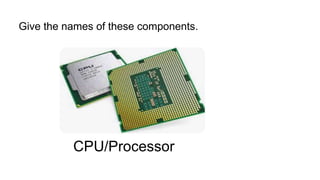
Give the names of these components.
CPU/Processor
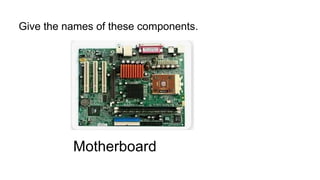
Give the names of these components.
Motherboard
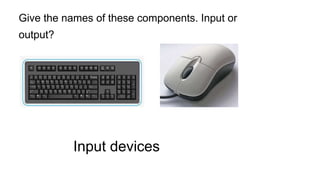
Give the names of these components. Input or
output?
Input devices
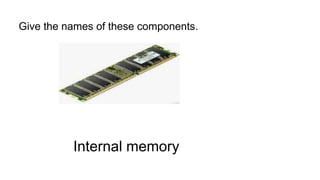
Give the names of these components.
Internal memory
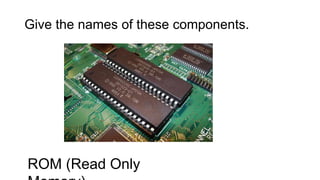
Give the names of these components.
ROM (Read Only
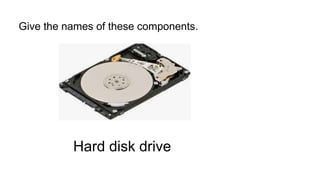
Give the names of these components.
Hard disk drive
Computer systems have revolutionized the
way we live, work and play and are involved
in all aspects of our lives.
In Japan, industrial robots have taken
over the jobs of many workers.
1. Explain why a robot can be thought of as
a computer system. (5mins)
1. Sensors and Input Devices: Just like a
computer system has input devices
(keyboard, mouse, etc.)
2. Processing Unit: The robot has a central
processing unit (CPU) or a
microcontroller, similar to a computer's
CPU.
3. Memory and Storage: Robots have
memory and storage components, akin to
RAM and hard drives in computers.
4. Output Devices and Actuators: In place
of a computer's output devices (monitor,
printer, etc.), a robot has actuators that
produce movement or actions.
5. Communication Interfaces: Robots often have
communication interfaces to interact with other
systems, much like computers use network cards or
ports. These can include wireless communication
modules (Wi-Fi, Bluetooth),.
6. Software and Algorithms: Robots run on
software and algorithms that dictate their behavior,
similar to how software applications run on a
computer. This includes operating systems,
middleware, and application-specific programs.
7. Power Supply: Both computers and robots
require a power source to function. For robots, this
could be batteries or a direct power supply.
8. Control Systems: The robot's control systems
manage the coordination and operation of all its
components, comparable to how an operating
system manages a computer's hardware and
software resources..
2. List advantages and disadvantages to
an employer in using robots rather than
people.
Advantages
Increased Productivity:
• Robots can work continuously without
breaks, leading to higher output.
• They can operate 24/7, which is
beneficial for industries requiring
constant production.
Advantages
Consistency and Precision:
•Robots perform tasks with high precision
and consistency, reducing errors and
variability in product quality.
•They can execute complex tasks with
exact repeatability.
Advantages
Cost Efficiency:
•Over time, robots can be more cost-
effective than human labor due to lower
operational costs (no salaries, benefits, or
holidays).
•Robots can take on dangerous or
repetitive tasks, reducing workplace
injuries and associated costs.
Advantages
Enhanced Safety:
•Robots can work in hazardous
environments, handling dangerous
materials, extreme temperatures, or heavy
loads, reducing risk to human workers.
•They help ensure compliance with safety
standards by reducing human error in
dangerous tasks.
Advantages
Scalability and Flexibility:
•Robots can be reprogrammed and
repurposed for different tasks, providing
flexibility in production processes.
•They can quickly adapt to changes in
production requirements or new product
lines.
Disadvantages
High Initial Investment:
•The upfront cost of purchasing, installing,
and programming robots can be very high.
•Maintenance and repair costs can also be
significant over time.
Disadvantages
Job Displacement:
•Replacing human workers with robots can
lead to job losses, creating social and
economic challenges.
•There may be resistance from employees
and unions against automation.
Disadvantages
Limited Capability:
•Robots may struggle with tasks requiring
human judgment, creativity, or fine motor
skills.
•They may not perform well in
unpredictable environments or with tasks
requiring high adaptability.
Disadvantages
Technical Issues:
•Robots are prone to technical
malfunctions and require regular
maintenance.
•Downtime due to technical problems can
disrupt production and lead to losses.
Disadvantages
Training and Expertise:
•Employers need skilled personnel to
program, operate, and maintain robots,
which can require significant training and
expertise.
•There is a continuous need to update
skills as technology evolves.
Disadvantages
Ethical and Legal Concerns:
•The use of robots raises ethical questions
regarding the replacement of human
workers and the societal impact of
automation.
•Legal and regulatory issues may arise
concerning the deployment of robots in the
workplace.

1 Types and Components of Computer systems.pptx

  • 1.
  • 2.
    Give the namesof these components. CPU/Processor
  • 3.
    Give the namesof these components. Motherboard
  • 4.
    Give the namesof these components. Input or output? Input devices
  • 5.
    Give the namesof these components. Internal memory
  • 6.
    Give the namesof these components. ROM (Read Only
  • 7.
    Give the namesof these components. Hard disk drive
  • 8.
    Computer systems haverevolutionized the way we live, work and play and are involved in all aspects of our lives. In Japan, industrial robots have taken over the jobs of many workers.
  • 9.
    1. Explain whya robot can be thought of as a computer system. (5mins)
  • 10.
    1. Sensors andInput Devices: Just like a computer system has input devices (keyboard, mouse, etc.) 2. Processing Unit: The robot has a central processing unit (CPU) or a microcontroller, similar to a computer's CPU.
  • 11.
    3. Memory andStorage: Robots have memory and storage components, akin to RAM and hard drives in computers. 4. Output Devices and Actuators: In place of a computer's output devices (monitor, printer, etc.), a robot has actuators that produce movement or actions.
  • 12.
    5. Communication Interfaces:Robots often have communication interfaces to interact with other systems, much like computers use network cards or ports. These can include wireless communication modules (Wi-Fi, Bluetooth),. 6. Software and Algorithms: Robots run on software and algorithms that dictate their behavior, similar to how software applications run on a computer. This includes operating systems, middleware, and application-specific programs.
  • 13.
    7. Power Supply:Both computers and robots require a power source to function. For robots, this could be batteries or a direct power supply. 8. Control Systems: The robot's control systems manage the coordination and operation of all its components, comparable to how an operating system manages a computer's hardware and software resources..
  • 14.
    2. List advantagesand disadvantages to an employer in using robots rather than people.
  • 15.
    Advantages Increased Productivity: • Robotscan work continuously without breaks, leading to higher output. • They can operate 24/7, which is beneficial for industries requiring constant production.
  • 16.
    Advantages Consistency and Precision: •Robotsperform tasks with high precision and consistency, reducing errors and variability in product quality. •They can execute complex tasks with exact repeatability.
  • 17.
    Advantages Cost Efficiency: •Over time,robots can be more cost- effective than human labor due to lower operational costs (no salaries, benefits, or holidays). •Robots can take on dangerous or repetitive tasks, reducing workplace injuries and associated costs.
  • 18.
    Advantages Enhanced Safety: •Robots canwork in hazardous environments, handling dangerous materials, extreme temperatures, or heavy loads, reducing risk to human workers. •They help ensure compliance with safety standards by reducing human error in dangerous tasks.
  • 19.
    Advantages Scalability and Flexibility: •Robotscan be reprogrammed and repurposed for different tasks, providing flexibility in production processes. •They can quickly adapt to changes in production requirements or new product lines.
  • 20.
    Disadvantages High Initial Investment: •Theupfront cost of purchasing, installing, and programming robots can be very high. •Maintenance and repair costs can also be significant over time.
  • 21.
    Disadvantages Job Displacement: •Replacing humanworkers with robots can lead to job losses, creating social and economic challenges. •There may be resistance from employees and unions against automation.
  • 22.
    Disadvantages Limited Capability: •Robots maystruggle with tasks requiring human judgment, creativity, or fine motor skills. •They may not perform well in unpredictable environments or with tasks requiring high adaptability.
  • 23.
    Disadvantages Technical Issues: •Robots areprone to technical malfunctions and require regular maintenance. •Downtime due to technical problems can disrupt production and lead to losses.
  • 24.
    Disadvantages Training and Expertise: •Employersneed skilled personnel to program, operate, and maintain robots, which can require significant training and expertise. •There is a continuous need to update skills as technology evolves.
  • 25.
    Disadvantages Ethical and LegalConcerns: •The use of robots raises ethical questions regarding the replacement of human workers and the societal impact of automation. •Legal and regulatory issues may arise concerning the deployment of robots in the workplace.