Robotics
1. Introducing robotics
2. Introducing
robotics
2
Learning outcomes
You will be able
to:
Understand a definition
of robotics and suggest
some examples of
industrial robots.
Describe what robots
need to work and how
they move.
3
Identify some
advantages and
disadvantages of robotics
and suggest how future
innovations in robotics
might overcome one
or more limitations.
1. Introducing robotics
Image © This Is Engineering
What is a robot?
When you think of a robot, what do you imagine, and why?
4
4
• Sketch and label how you imagine
a robot.
• Share and explain your sketch.
• Discuss why you chose this type of robot.
• Then, share a definition of a robot - try to think
like an engineer.
1. Introducing robotics
Robots replace human effort
5
1. Introducing robotics
A robot is a programmable machine that can carry out complex actions with speed
and precision and without the need for human intervention.
What complex actions might
this robot carry out?
Why do speed and precision matter
in industry?
How might this robot avoid the need for
human intervention?
What programming might this
robot require?
What do robots need to work?
6
1. Introducing robotics
Robots can replace human effort through, for example:
What features would
allow the robot to move,
manipulate, process an object and
obtain information about its
position, state and environment?
Complex actions:
• Lift, move and manipulate an object or tool.
• Mill a shape from a block of material.
Programming:
• Sequence of movements.
• Decisions depending on inputs.
• Safety responses.
Speed is important for productivity.
Precision is important for quality and functionality.
Human intervention can be limited by effective programming
and use of input sensors that enable the robot to respond to
‘most likely’ scenarios, for example to sense that the object
to be worked on is in the correct position, that the tool is correct
and calibrated, that the machine is safe etc.
Industrial robots move, manipulate and
process pieces of work. They need to obtain
and process information about their position,
state and environment.
What do robots need to work?
7
1. Introducing robotics
Robots can replace human effort through, for example:
Imagine you
are a production
engineer considering
robotic automation.
List some advantages
and limitations you
might identify.
Actuators for movement Sensors for information
Examples:
Position
Angle
Proximity or touch
Force
Vision
End effectors for
manipulation and processing
Examples:
Tool holder (gripper, paint,
weld, drill, mill)
Gripper
Pin
Suction
Examples:
Linear
Rotational
Advantages and limitations of robotics
8
Advantages
Fast
Tireless
Accurate
Consistent
Can work in hazardous
environments
Limitations
Expensive
Complex
Employee safety
Limited decision-making
Limited dexterity
• In terms of human
abilities, what weaknesses
can robotics successfully
replace or improve, and what
strengths do robotics
currently fail to replace?
• Discuss what innovations you
think will help robotics to
replace or improve these
human strengths.
1. Introducing robotics
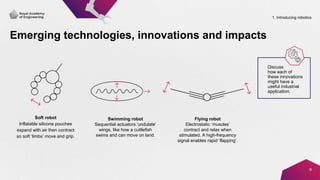
Emerging technologies, innovations and impacts
9
Soft robot
Inflatable silicone pouches
expand with air then contract
so soft ‘limbs’ move and grip.
Swimming robot
Sequential actuators ‘undulate’
wings, like how a cuttlefish
swims and can move on land.
Flying robot
Electrostatic ‘muscles’
contract and relax when
stimulated. A high-frequency
signal enables rapid ‘flapping’.
Discuss
how each of
these innovations
might have a
useful industrial
application.
1. Introducing robotics
Careers and robotics
10
Design engineer
Creates the overall
design solution for
a robotics task.
Software engineer
Writes the software
and algorithms for the
control systems.
Electromechanical
engineer
Designs how the robot
will use sensors,
actuators and end
effectors.
1. Introducing robotics
Sales engineer
Helps clients
choose the right
robotics product
for their needs.
Mechanical
engineer
Designs the moving
parts of the robot.
Automation
engineer
Plans, implements
and monitors factory
automation.
Design a future robot
We can only engineer what we imagine. When we reimagine what
a robot can look like, we create new possibilities.
11
1. Introducing robotics
• Design a future robot that overcomes
one limitation you identified.
• Identify what your robot needs to do, how it might
sense its environment and how it will move and
manipulate things.
• Include one of the innovations you’ve seen, or ideas
of your own.
• How does this reimagine what an industrial robot
can be?
• How might your robot incorporate AI?
Image © This Is Engineering

rae_rob1_introducing_robotics_learner.pptx

  • 1.
  • 2.
  • 3.
    Learning outcomes You willbe able to: Understand a definition of robotics and suggest some examples of industrial robots. Describe what robots need to work and how they move. 3 Identify some advantages and disadvantages of robotics and suggest how future innovations in robotics might overcome one or more limitations. 1. Introducing robotics Image © This Is Engineering
  • 4.
    What is arobot? When you think of a robot, what do you imagine, and why? 4 4 • Sketch and label how you imagine a robot. • Share and explain your sketch. • Discuss why you chose this type of robot. • Then, share a definition of a robot - try to think like an engineer. 1. Introducing robotics
  • 5.
    Robots replace humaneffort 5 1. Introducing robotics A robot is a programmable machine that can carry out complex actions with speed and precision and without the need for human intervention. What complex actions might this robot carry out? Why do speed and precision matter in industry? How might this robot avoid the need for human intervention? What programming might this robot require?
  • 6.
    What do robotsneed to work? 6 1. Introducing robotics Robots can replace human effort through, for example: What features would allow the robot to move, manipulate, process an object and obtain information about its position, state and environment? Complex actions: • Lift, move and manipulate an object or tool. • Mill a shape from a block of material. Programming: • Sequence of movements. • Decisions depending on inputs. • Safety responses. Speed is important for productivity. Precision is important for quality and functionality. Human intervention can be limited by effective programming and use of input sensors that enable the robot to respond to ‘most likely’ scenarios, for example to sense that the object to be worked on is in the correct position, that the tool is correct and calibrated, that the machine is safe etc. Industrial robots move, manipulate and process pieces of work. They need to obtain and process information about their position, state and environment.
  • 7.
    What do robotsneed to work? 7 1. Introducing robotics Robots can replace human effort through, for example: Imagine you are a production engineer considering robotic automation. List some advantages and limitations you might identify. Actuators for movement Sensors for information Examples: Position Angle Proximity or touch Force Vision End effectors for manipulation and processing Examples: Tool holder (gripper, paint, weld, drill, mill) Gripper Pin Suction Examples: Linear Rotational
  • 8.
    Advantages and limitationsof robotics 8 Advantages Fast Tireless Accurate Consistent Can work in hazardous environments Limitations Expensive Complex Employee safety Limited decision-making Limited dexterity • In terms of human abilities, what weaknesses can robotics successfully replace or improve, and what strengths do robotics currently fail to replace? • Discuss what innovations you think will help robotics to replace or improve these human strengths. 1. Introducing robotics
  • 9.
    Emerging technologies, innovationsand impacts 9 Soft robot Inflatable silicone pouches expand with air then contract so soft ‘limbs’ move and grip. Swimming robot Sequential actuators ‘undulate’ wings, like how a cuttlefish swims and can move on land. Flying robot Electrostatic ‘muscles’ contract and relax when stimulated. A high-frequency signal enables rapid ‘flapping’. Discuss how each of these innovations might have a useful industrial application. 1. Introducing robotics
  • 10.
    Careers and robotics 10 Designengineer Creates the overall design solution for a robotics task. Software engineer Writes the software and algorithms for the control systems. Electromechanical engineer Designs how the robot will use sensors, actuators and end effectors. 1. Introducing robotics Sales engineer Helps clients choose the right robotics product for their needs. Mechanical engineer Designs the moving parts of the robot. Automation engineer Plans, implements and monitors factory automation.
  • 11.
    Design a futurerobot We can only engineer what we imagine. When we reimagine what a robot can look like, we create new possibilities. 11 1. Introducing robotics • Design a future robot that overcomes one limitation you identified. • Identify what your robot needs to do, how it might sense its environment and how it will move and manipulate things. • Include one of the innovations you’ve seen, or ideas of your own. • How does this reimagine what an industrial robot can be? • How might your robot incorporate AI? Image © This Is Engineering